Cambridge A Level History 9389 — 2016 Oct/Nov Paper 2 · Variant 2
9389/22/O/N/16 · 60 marks · ≈68 min
The question paper and its mark scheme, free to read here and free to download. This is Cambridge’s own paper, exactly as it was sat.
Question paper4 pages
Mark scheme15 pages
Answers below. Sit the paper first if you are practising.
Paper as text
Question paper, page 1
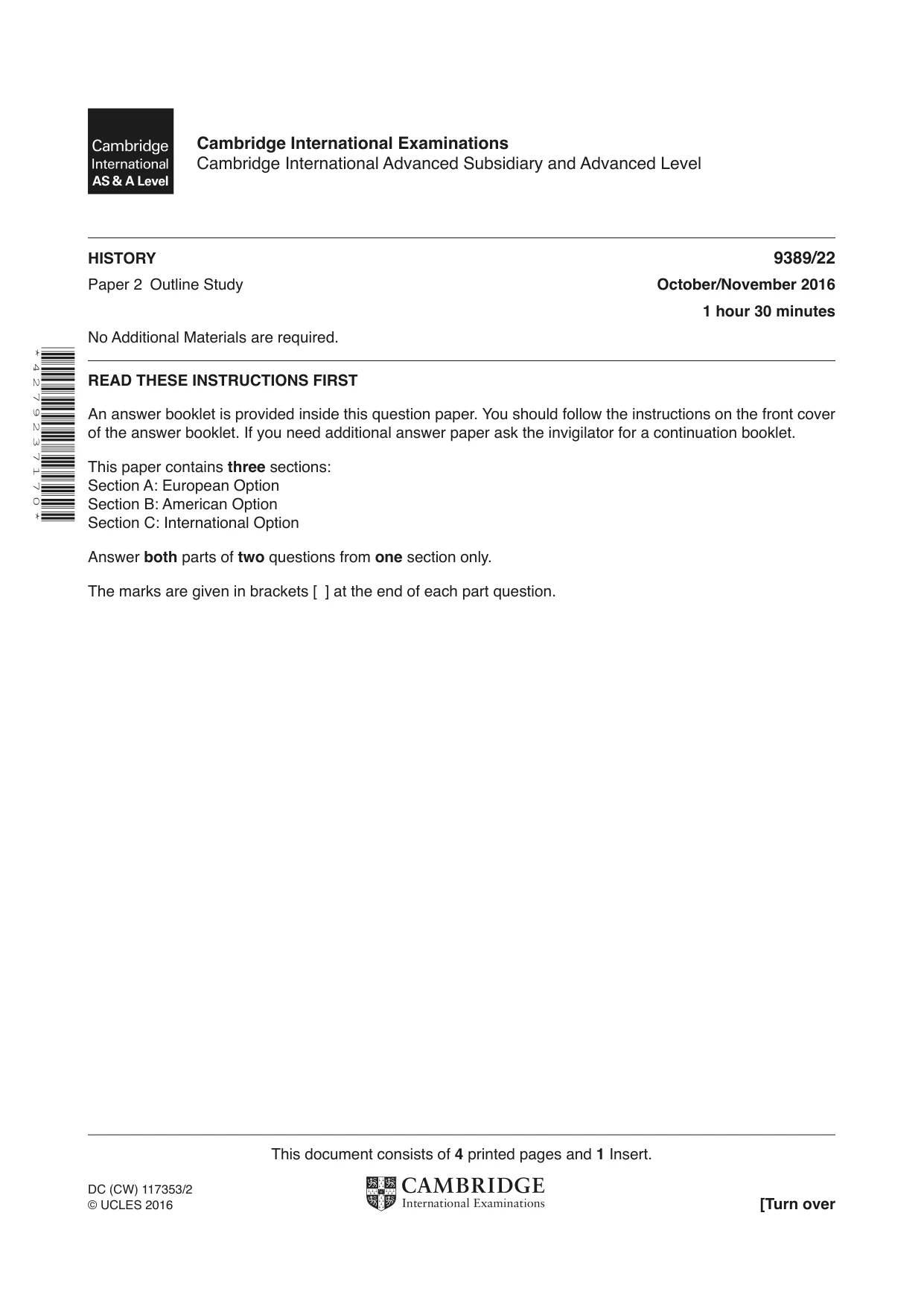
This document consists of 4 printed pages and 1 Insert. DC (CW) 117353/2 © UCLES 2016 [Turn over * 4 2 7 9 2 3 7 1 7 0 * HISTORY 9389/22 Paper 2 Outline Study October/November 2016 1 hour 30 minutes No Additional Materials are required. READ THESE INSTRUCTIONS FIRST An answer booklet is provided inside this question paper. You should follow the instructions on the front cover of the answer booklet. If you need additional answer paper ask the invigilator for a continuation booklet. This paper contains three sections: Section A: European Option Section B: American Option Section C: International Option Answer both parts of two questions from one section only. The marks are given in brackets [ ] at the end of each part question. Cambridge International Examinations Cambridge International Advanced Subsidiary and Advanced Level
Question paper, page 2
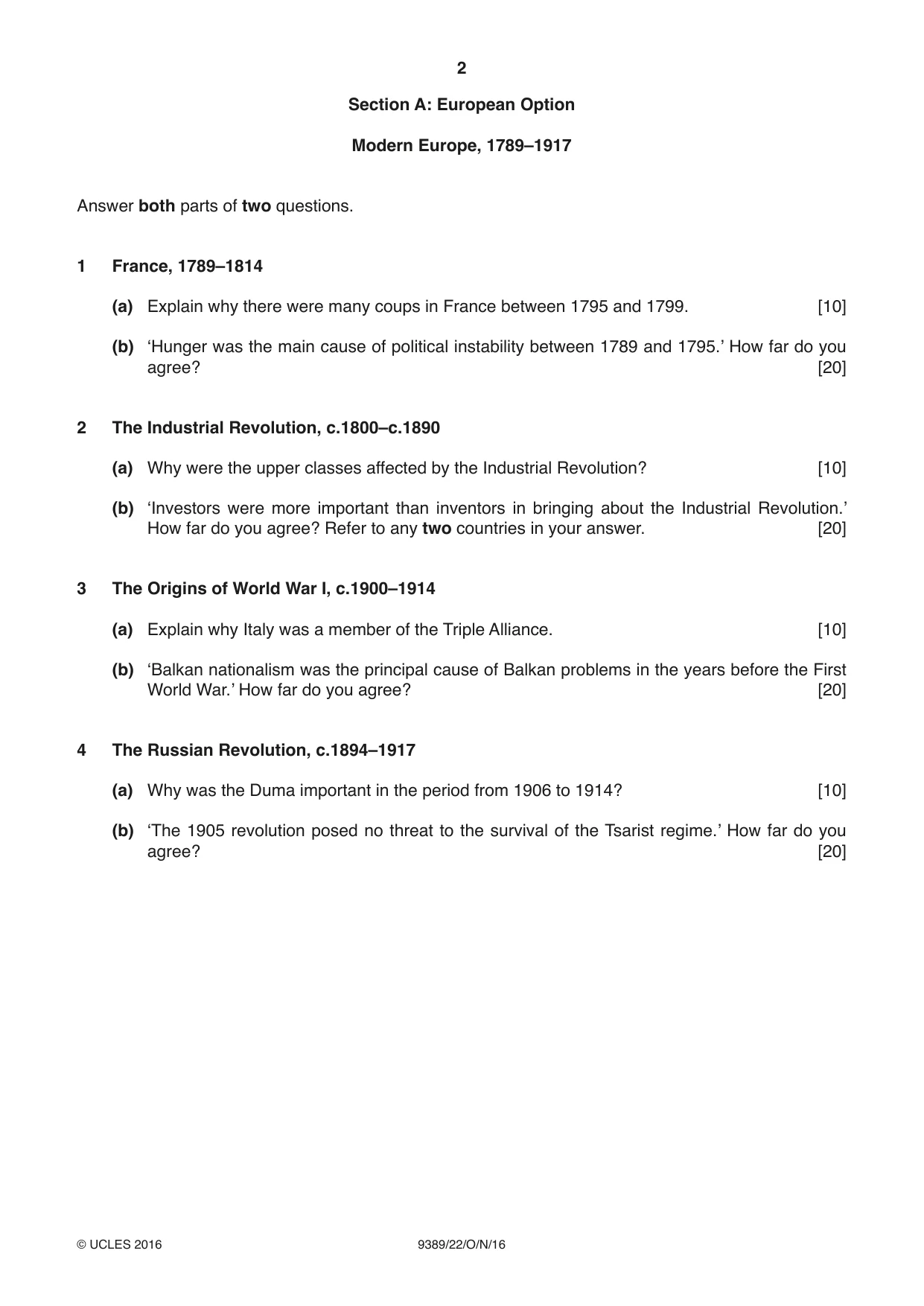
2 9389/22/O/N/16 © UCLES 2016 Section A: European Option Modern Europe, 1789–1917 Answer both parts of two questions. 1 France, 1789–1814 (a) Explain why there were many coups in France between 1795 and 1799. [10] (b) ‘Hunger was the main cause of political instability between 1789 and 1795.’ How far do you agree? [20] 2 The Industrial Revolution, c.1800–c.1890 (a) Why were the upper classes affected by the Industrial Revolution? [10] (b) ‘Investors were more important than inventors in bringing about the Industrial Revolution.’ How far do you agree? Refer to any two countries in your answer. [20] 3 The Origins of World War I, c.1900–1914 (a) Explain why Italy was a member of the Triple Alliance. [10] (b) ‘Balkan nationalism was the principal cause of Balkan problems in the years before the First World War.’ How far do you agree? [20] 4 The Russian Revolution, c.1894–1917 (a) Why was the Duma important in the period from 1906 to 1914? [10] (b) ‘The 1905 revolution posed no threat to the survival of the Tsarist regime.’ How far do you agree? [20]
Question paper, page 3
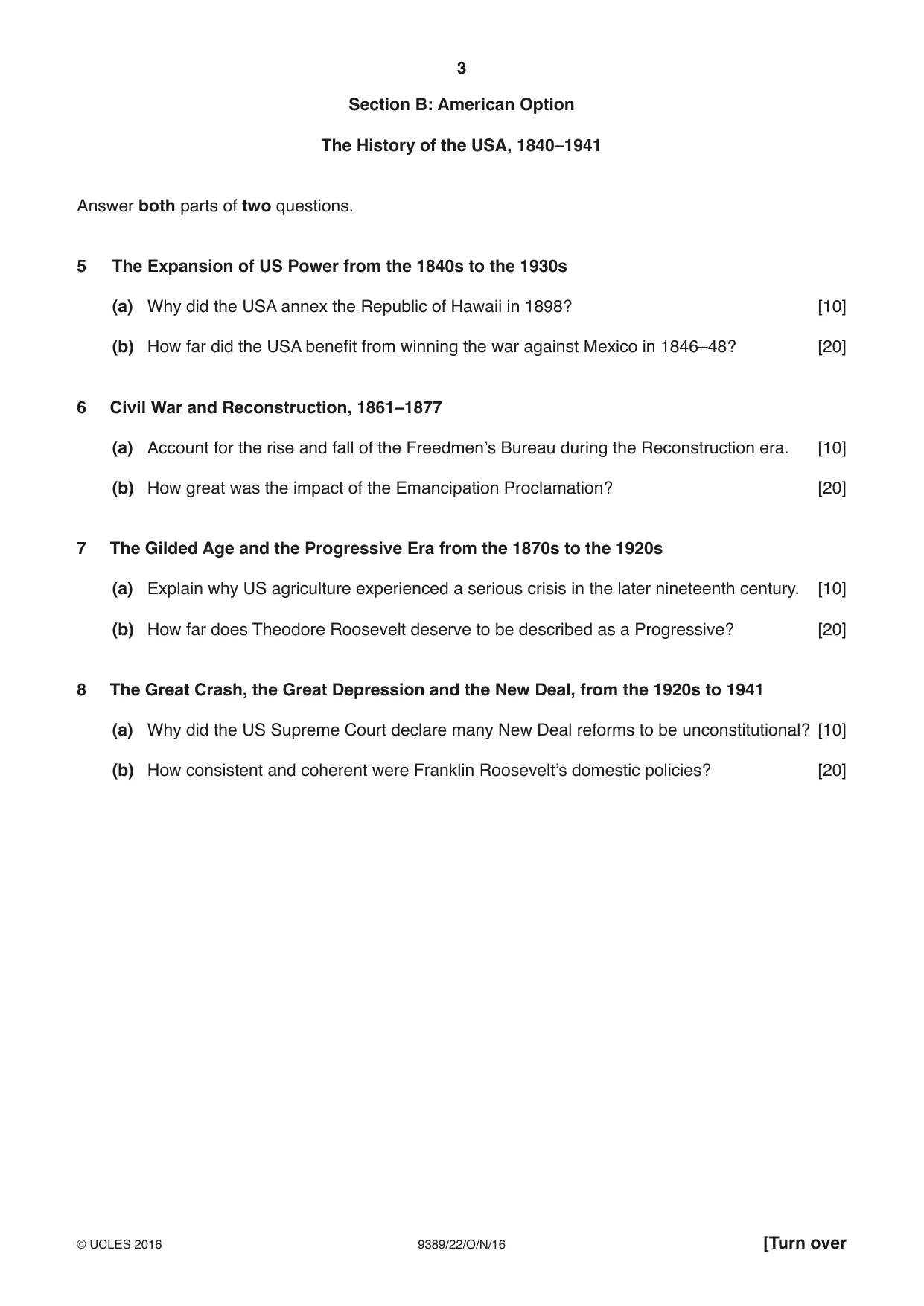
3 9389/22/O/N/16 © UCLES 2016 [Turn over Section B: American Option The History of the USA, 1840–1941 Answer both parts of two questions. 5 The Expansion of US Power from the 1840s to the 1930s (a) Why did the USA annex the Republic of Hawaii in 1898? [10] (b) How far did the USA benefit from winning the war against Mexico in 1846–48? [20] 6 Civil War and Reconstruction, 1861–1877 (a) Account for the rise and fall of the Freedmen’s Bureau during the Reconstruction era. [10] (b) How great was the impact of the Emancipation Proclamation? [20] 7 The Gilded Age and the Progressive Era from the 1870s to the 1920s (a) Explain why US agriculture experienced a serious crisis in the later nineteenth century. [10] (b) How far does Theodore Roosevelt deserve to be described as a Progressive? [20] 8 The Great Crash, the Great Depression and the New Deal, from the 1920s to 1941 (a) Why did the US Supreme Court declare many New Deal reforms to be unconstitutional? [10] (b) How consistent and coherent were Franklin Roosevelt’s domestic policies? [20]
Question paper, page 4
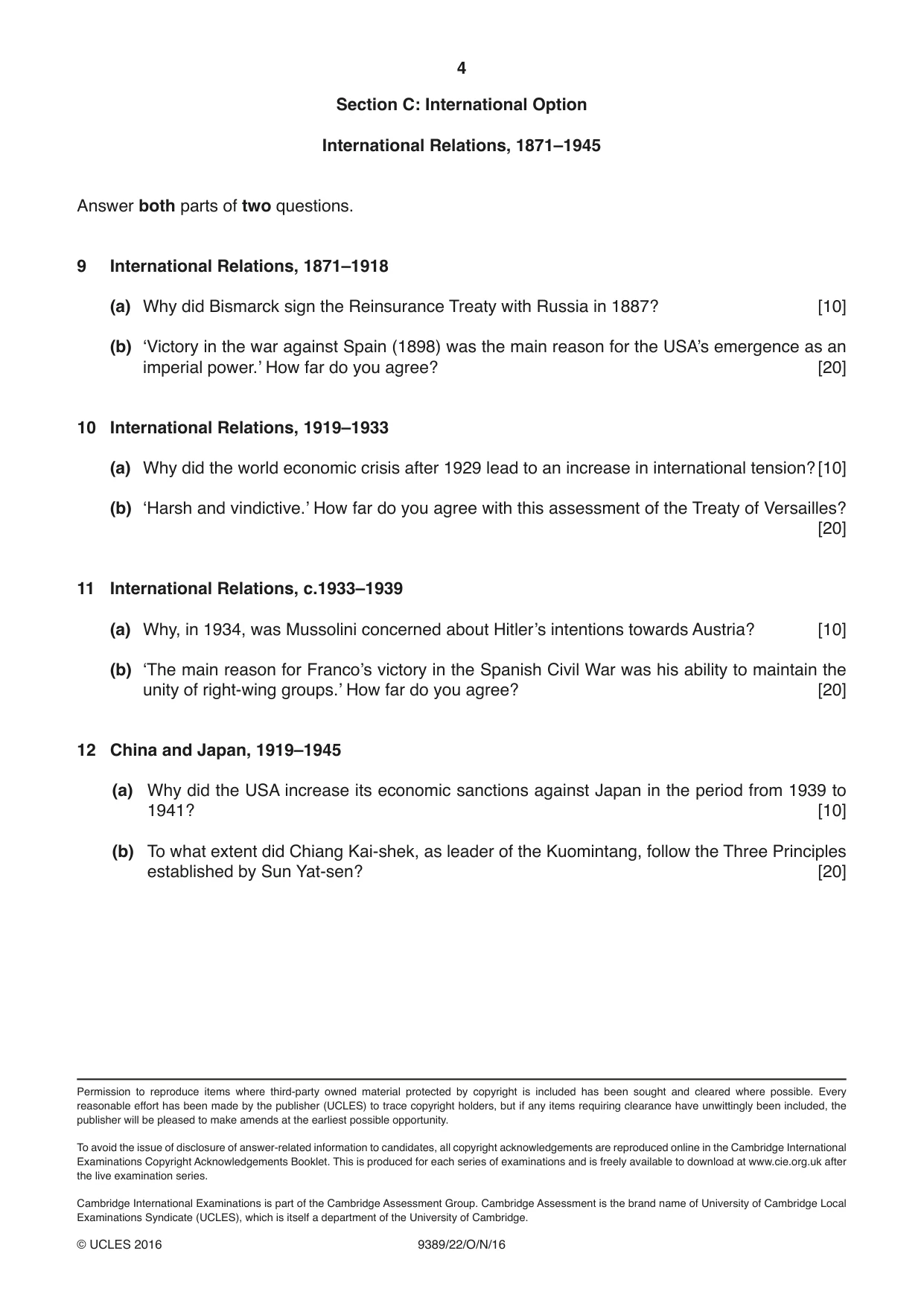
4 9389/22/O/N/16 © UCLES 2016 Permission to reproduce items where third-party owned material protected by copyright is included has been sought and cleared where possible. Every reasonable effort has been made by the publisher (UCLES) to trace copyright holders, but if any items requiring clearance have unwittingly been included, the publisher will be pleased to make amends at the earliest possible opportunity. To avoid the issue of disclosure of answer-related information to candidates, all copyright acknowledgements are reproduced online in the Cambridge International Examinations Copyright Acknowledgements Booklet. This is produced for each series of examinations and is freely available to download at www.cie.org.uk after the live examination series. Cambridge International Examinations is part of the Cambridge Assessment Group. Cambridge Assessment is the brand name of University of Cambridge Local Examinations Syndicate (UCLES), which is itself a department of the University of Cambridge. Section C: International Option International Relations, 1871–1945 Answer both parts of two questions. 9 International Relations, 1871–1918 (a) Why did Bismarck sign the Reinsurance Treaty with Russia in 1887? [10] (b) ‘Victory in the war against Spain (1898) was the main reason for the USA’s emergence as an imperial power.’ How far do you agree? [20] 10 International Relations, 1919–1933 (a) Why did the world economic crisis after 1929 lead to an increase in international tension? [10] (b) ‘Harsh and vindictive.’ How far do you agree with this assessment of the Treaty of Versailles? [20] 11 International Relations, c.1933–1939 (a) Why, in 1934, was Mussolini concerned about Hitler’s intentions towards Austria? [10] (b) ‘The main reason for Franco’s victory in the Spanish Civil War was his ability to maintain the unity of right-wing groups.’ How far do you agree? [20] 12 China and Japan, 1919–1945 (a) Why did the USA increase its economic sanctions against Japan in the period from 1939 to 1941? [10] (b) To what extent did Chiang Kai-shek, as leader of the Kuomintang, follow the Three Principles established by Sun Yat-sen? [20]
Mark scheme, page 1
® IGCSE is the registered trademark of Cambridge International Examinations. This document consists of 15 printed pages. © UCLES 2016 [Turn over Cambridge International Examinations Cambridge International Advanced Subsidiary and Advanced Level HISTORY 9389/22 Paper 2 Outline Study October/November 2016 MARK SCHEME Maximum Mark: 60 Published This mark scheme is published as an aid to teachers and candidates, to indicate the requirements of the examination. It shows the basis on which Examiners were instructed to award marks. It does not indicate the details of the discussions that took place at an Examiners’ meeting before marking began, which would have considered the acceptability of alternative answers. Mark schemes should be read in conjunction with the question paper and the Principal Examiner Report for Teachers. Cambridge will not enter into discussions about these mark schemes. Cambridge is publishing the mark schemes for the October/November 2016 series for most Cambridge IGCSE®, Cambridge International A and AS Level components and some Cambridge O Level components.
Mark scheme, page 2
Page 2 Mark Scheme Syllabus Paper Cambridge International AS/A Level – October/November 2016 9389 22 © UCLES 2016 Generic levels of response Part (a) Level 4: Evaluates factors [9–10] Answers are well focused and identify and explain a range of factors. Answers are supported by precise evidence and demonstrate clear understanding of the connections between causes. Answers consider the relative significance of factors and reach a supported conclusion. Level 3: Explains factors [6–8] Answers demonstrate good understanding of the demands of the question, providing relevant explanations supported by relevant and detailed information. Answers are clearly expressed. Candidates may attempt to reach a judgement about the significance of factors but this may not be effectively supported. Level 2: Describes factors [3–5] Answers show some knowledge and understanding of the demands of the question. Answers are either entirely descriptive in approach with few explicit links to the question, or they provide some explanation which is supported by information which is limited in range and depth. Level 1: Describes the topic/issue [1–2] Answers contain some relevant material but are descriptive in nature, making little reference to causation. Answers may be assertive or generalised. The response is limited in development. Level 0: Answers contain no relevant content [0]
Mark scheme, page 3
Page 3 Mark Scheme Syllabus Paper Cambridge International AS/A Level – October/November 2016 9389 22 © UCLES 2016 Part (b) Level 5: Responses which develop a sustained judgement [18–20] Answers are well focused and closely argued. Arguments are supported by precisely selected evidence. They lead to a relevant conclusion/judgement which is developed and supported. They are fluent and well organised. Level 4: Responses which develop a balanced argument [15–17] Answers show explicit understanding of the demands of the question. They develop a balanced argument supported by a good range of appropriately selected evidence. They begin to form a judgement in response to the question. At this level the judgement may be partial or not fully supported. Level 3: Responses which begin to develop assessment [10–14] Answers show a developed understanding of the demands of the question. They provide some assessment, supported by relevant and appropriately selected evidence. However, these answers are likely to lack depth and/or balance. Answers are generally coherent and well organised. Level 2: Responses which show some understanding of the question [6–9] Answers show some understanding of the focus of the question. They are either entirely descriptive with few explicit links to the question or they may contain some explicit comment with relevant but limited support. Level 1: Descriptive or partial responses [1–5] Answers contain descriptive material which is only loosely linked to the focus of the question. They may only address part of the question. Alternatively, there may be some explicit comment on the question which lacks detailed factual support. Answers are likely to be generalised and assertive. Answers may be fragmentary and disjointed. Level 0: Answers contain no relevant content [0]
Mark scheme, page 4
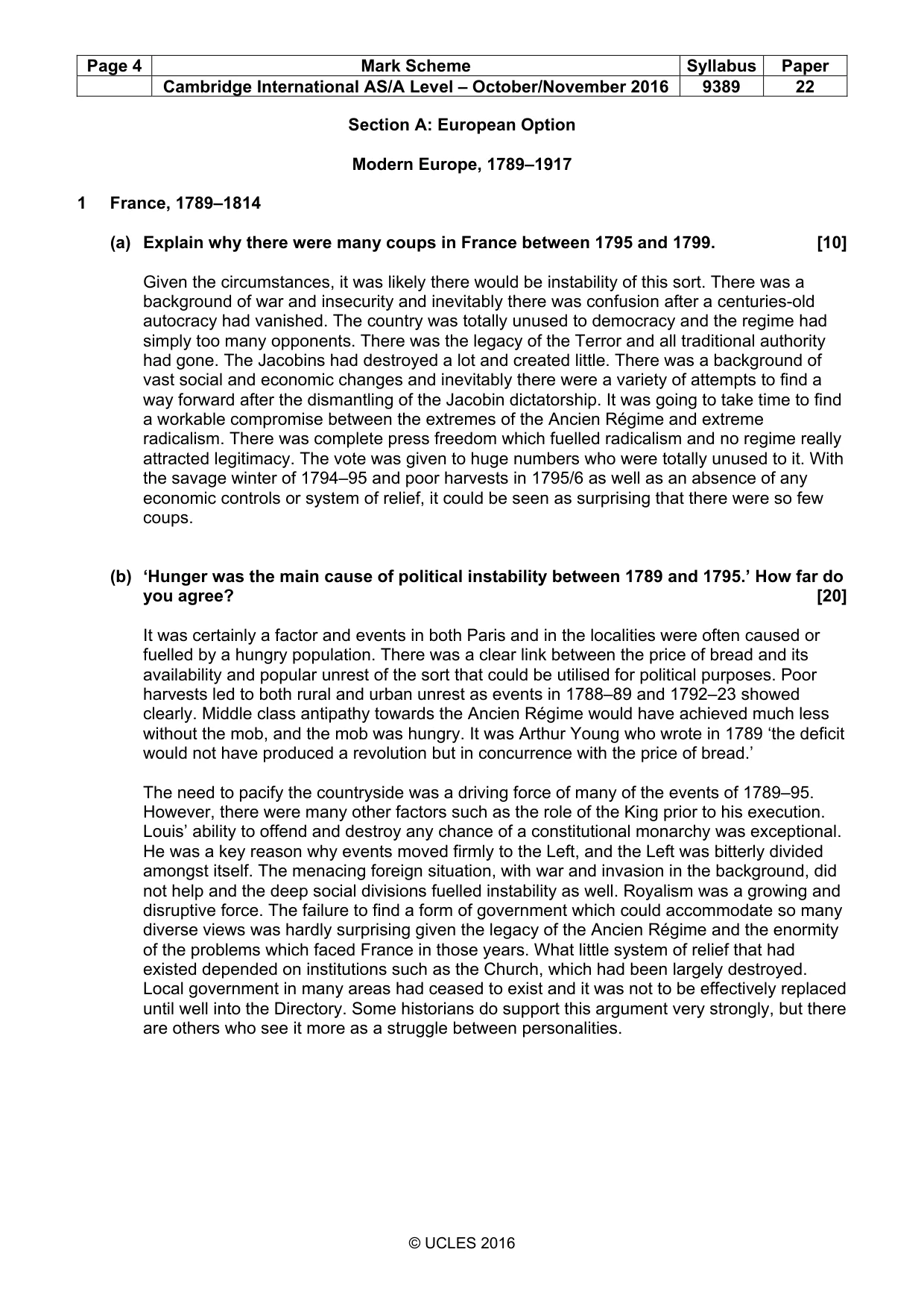
Page 4 Mark Scheme Syllabus Paper Cambridge International AS/A Level – October/November 2016 9389 22 © UCLES 2016 Section A: European Option Modern Europe, 1789–1917 1 France, 1789–1814 (a) Explain why there were many coups in France between 1795 and 1799. [10] Given the circumstances, it was likely there would be instability of this sort. There was a background of war and insecurity and inevitably there was confusion after a centuries-old autocracy had vanished. The country was totally unused to democracy and the regime had simply too many opponents. There was the legacy of the Terror and all traditional authority had gone. The Jacobins had destroyed a lot and created little. There was a background of vast social and economic changes and inevitably there were a variety of attempts to find a way forward after the dismantling of the Jacobin dictatorship. It was going to take time to find a workable compromise between the extremes of the Ancien Régime and extreme radicalism. There was complete press freedom which fuelled radicalism and no regime really attracted legitimacy. The vote was given to huge numbers who were totally unused to it. With the savage winter of 1794–95 and poor harvests in 1795/6 as well as an absence of any economic controls or system of relief, it could be seen as surprising that there were so few coups. (b) ‘Hunger was the main cause of political instability between 1789 and 1795.’ How far do you agree? [20] It was certainly a factor and events in both Paris and in the localities were often caused or fuelled by a hungry population. There was a clear link between the price of bread and its availability and popular unrest of the sort that could be utilised for political purposes. Poor harvests led to both rural and urban unrest as events in 1788–89 and 1792–23 showed clearly. Middle class antipathy towards the Ancien Régime would have achieved much less without the mob, and the mob was hungry. It was Arthur Young who wrote in 1789 ‘the deficit would not have produced a revolution but in concurrence with the price of bread.’ The need to pacify the countryside was a driving force of many of the events of 1789–95. However, there were many other factors such as the role of the King prior to his execution. Louis’ ability to offend and destroy any chance of a constitutional monarchy was exceptional. He was a key reason why events moved firmly to the Left, and the Left was bitterly divided amongst itself. The menacing foreign situation, with war and invasion in the background, did not help and the deep social divisions fuelled instability as well. Royalism was a growing and disruptive force. The failure to find a form of government which could accommodate so many diverse views was hardly surprising given the legacy of the Ancien Régime and the enormity of the problems which faced France in those years. What little system of relief that had existed depended on institutions such as the Church, which had been largely destroyed. Local government in many areas had ceased to exist and it was not to be effectively replaced until well into the Directory. Some historians do support this argument very strongly, but there are others who see it more as a struggle between personalities.
Mark scheme, page 5
Page 5 Mark Scheme Syllabus Paper Cambridge International AS/A Level – October/November 2016 9389 22 © UCLES 2016 2 The Industrial Revolution, c.1800–c.1890 (a) Why were the upper classes affected by the Industrial Revolution? [10] Much increased social mobility lower down the social scale was bound to impact on those above. In the UK, there was substantial intermarriage between the middle and upper classes and with the growth of a wealthy and educated middle class there was the demand for political as well as social change, and the growth of organised labour brought further changes in the course of the nineteenth century. The aristocratic monopoly on land, wealth and power was dramatically reduced. The impact varied between countries. In France, the aristocracy had largely been neutered by the French Revolution and it had limited impact. In the UK, industrialisation had led to the rise of a dynamic middle class which, as 1832 showed, joined forces with the aristocracy to manage the UK. Industrial wealth soon ‘outweighed’ agricultural wealth with concomitant changes in status. There was frequent intermarriage between aristocrat and bourgeois, and much of the wealth accumulated in the Agricultural Revolution was invested in canals, railways and manufacturing. In Germany, there was a different impact where the Prussian military elite remained the dominant social and political force, but under the careful guidance of Bismarck, took care to ensure that a suitable alliance with the middle class manufacturer was created to ensure that German industry served the state as well as its owners. (b) ‘Investors were more important than inventors in bringing about the Industrial Revolution.’ How far do you agree? Refer to any two countries in your answer. [20] They could be seen to be critical. Large factories, canal systems and massive organisations like the railways needed huge investment and sophisticated money markets. It was the countries that had the advanced backing and credit systems that led the way in industrialisation. Good availability of credit and the means of raising and transferring cash easily and quickly were vital. Developing industries such as the iron and steel industries would not have been possible without massive injections of capital, and virtually all of the key entrepreneurs like Wedgwood and Krupp could have done little without capital and credit. Considerable capital was accumulated by landowners during the Agricultural Revolution and there is ample evidence that, in the case of the UK, it was essential for the first stages of the factory system where substantial capital was needed. The range of possible inventors which could be considered is large. There were the obvious UK ones such as Arkwright, Cartwright and Stevenson who, arguably, made it all into a ‘revolution’ in terms of output. Bessemer and the other iron/steel innovators could also be mentioned, as well as the pioneering engineers like Brunel. Obviously there are a large number of other factors which can be considered, such as the Agricultural Revolution (which in itself often needed capital to progress), the attitude of government and the availability of raw materials and markets. There is no reason why the two factors mentioned in the quote should not be dealt with exclusively, but those who wish to argue that there were other important factors should also be credited.
Mark scheme, page 6
Page 6 Mark Scheme Syllabus Paper Cambridge International AS/A Level – October/November 2016 9389 22 © UCLES 2016 3 The Origins of World War I, c.1900–1914 (a) Explain why Italy was a member of the Triple Alliance. [10] As a ‘new’ nation it was keen to create a position for itself in international affairs and Italian governments in the pre-1914 period were anxious to focus popular attention away from major problems at home. The attempt to expand into East Africa had been a humiliating disaster, so it was looking for allies to help its expansionist plans in Africa, the Mediterranean and, above all, in the Balkans. It was involved in conflict with the Turks and was also looking for assistance there as well. It disliked Britain and its naval power in the Mediterranean. It gave Italy the great power status it hungered for. It gave it greater confidence to expand into North Africa. It was largely a cynical move, a means of using other powers to advance Italy’s own interests and ambitions. It was an odd choice in some respects, given the Italian dislike of Austria and their conflicting ambitions in the Balkans. While the Germans had no respect for Italy, another ally, or at least a neutral one, next to France was always an asset and it would also inconvenience the British Navy in the Mediterranean. (b) ‘Balkan nationalism was the principal cause of Balkan problems in the years before the First World War.’ How far do you agree? [20] It was certainly a factor, but given the diverse range of potential ‘nations’, let alone religious and racial factors, it was just one amongst many. The complex past of the region and its particular geography just added to the complex mixture there. The collapse of the Turkish Empire and the way in which individual sections broke away from it, or were annexed, raised huge issues. The range of countries, such as Greece, Italy, Russia and Austria which harboured very strong ambitions in the region, was a major cause. The way in which ‘occupiers’ like Austria treated their subjects and dealt with issues there, often putting their own selfish interests long before what was in the best interests of their Balkan subjects, was also important. The way in which nationalism was manipulated could be as problematic as the idea itself. The Austrians and the Italians argued over Albania and their respective ambitions caused problems there. The Turks were determined to at least retain, if not regain, territory in the region. The Bulgarians had their own agenda, fighting the Serbs, Greeks and Romanians for territory. Serbia was desperate for an Adriatic port, and the Austrians loathed the Serbs and saw them, as much as nationalism itself, as a huge threat to their very survival as an empire. There was a deep religious antagonism in the region and also a growing Pan Slavic movement which Russia did all it could to encourage. The range of possible ‘principal’ causes is considerable and a variety of factors could be seen as ‘the’ one.
Mark scheme, page 7
Page 7 Mark Scheme Syllabus Paper Cambridge International AS/A Level – October/November 2016 9389 22 © UCLES 2016 4 The Russian Revolution, c.1894–1917 (a) Why was the Duma important in the period from 1906 to 1914? [10] It could be seen just as a symbol and as an empty gesture towards progress in constitutional terms. It was perhaps an example of the Tsar’s reluctance to genuinely reform, or a sign of a desire to actually make a real change. It was seen as a first step towards the modernisation of Russia in a political sense. It gave a sense of legitimacy to the regime. While it tended to be ignored or dissolved, it did provide an impetus to the reforms of men like Stolypin; it provided a focus for opposition of a moderate type while at the same time its importance alienated the radicals and drove many towards extreme solutions. The Tsar’s management of it was a great recruiter for the far Left. It did play a part in lowering the ‘temperature’ after 1905 and it took the war to drive Russia to revolution. Some of the leaders of the Provisional Government got their early training there. (b) ‘The 1905 revolution posed no threat to the survival of the Tsarist regime.’ How far do you agree? [20] This is arguable. Historians now suggest ‘it was a close run thing’. Not all the army remained loyal; there were mutinies in many regiments which had fought in the disastrous Far East campaign. It was the regiments which had not fought there that were critical in restoring order in the countryside in 1905–06. There were major mutinies in the Navy, a very different case from the army, and showed a fundamental weakness in the regime. The fact that the uprising, initially, was spontaneous and unplanned of course limited its threat. The mix of the disasters of Mukden and Tsushima and real hunger in the countryside was potentially lethal. There was also huge unrest in ‘colonies’ like Poland and Georgia. There was deep unrest in industrialised areas and factories and radicals were making an impact there. If the response to Bloody Sunday and the wider social and political unrest had been even more inept it could well have been disastrous. If it had been perceived that there was no real threat, then it is highly unlikely the regime would have come up with the Duma and all the other changes that followed. The threat was real, but the lack of coordination between the very diverse opponents and their very different motives enabled the regime to survive. There was no chance, then, of the real radicals linking with the industrial workers, peasants and middle class liberals, and it took the war to do this. It is felt that the October Manifesto was absolutely vital for the regime’s survival and if this had not bought off the middle class and brought them back into the fold, then the regime would not have survived.
Mark scheme, page 8
Page 8 Mark Scheme Syllabus Paper Cambridge International AS/A Level – October/November 2016 9389 22 © UCLES 2016 Section B: American Option The History of the USA, 1840–1941 5 The Expansion of US Power from the 1840s to the 1930s (a) Why did the USA annex the Republic of Hawaii in 1898? [10] The kingdom of Hawaii, recognised as independent by the great powers, including the USA in the 1840s, was overthrown in 1893 by a group of businessmen supported by the US marines – who did not have to fire their guns. They established the Republic of Hawaii. Five years later the US Congress voted to annex Hawaii, quietly encouraged by President McKinley. There were two main motives for doing so, both commercial. The first might be called local-commercial. Hawaii sugar producers had been hit hard by the McKinley tariff of 1890. Annexation took Hawaii inside the tariff wall. The second was strategic-commercial. Hawaii was roughly halfway between the planned Panama Canal and the markets of China and was thus valuable as both a coaling station and a cable station for the trans-Pacific cable. The USA was very keen to maintain access to the Chinese market, an access which was threatened earlier in 1898 by European powers acquiring Chinese ports. A specific benefit of annexation was that it meant that the US possession of Pearl Harbour, already granted but open to repeal by the Hawaiians, was made secure. McKinley also saw acquisition as part of America’s manifest destiny to expand overseas now that expansion in North America had been completed and the frontier closed. And it should not be forgotten that annexation occurred in 1898, the year of the successful war with Spain. That success encouraged the USA to become more of a presence in the Pacific as well as the Caribbean. Some also saw the acquisition of Hawaii as a check on the expansionist ambitions of Japan, though there is no evidence that this motivated federal politicians. (b) How far did the USA benefit from winning the war against Mexico in 1846–48? [20] The treaty of Guadalupe Hidalgo, which ended the war, certainly gave the USA great territorial benefits. A huge slice of land from the Rio Grande to the Pacific Ocean was handed over. Gaining California meant gaining Californian gold, which greatly encouraged westward expansion and chimed with the growing – if not universal – belief in manifest destiny. The USA became more of a continental power, ‘from sea to shining sea’. The acquisition of so much territory raised problems of governance. The biggest of these was the issue of slavery in the new territories. Mexico had abolished slavery. Thus the lands passed to the USA could not be slave lands. And yet the slave states of the South needed to create more slave states in order to maintain the delicate balance between free and unfree states. The Wilmot Proviso of 1847 was an attempt to prevent slavery being established anywhere in the new lands. It failed. However, the slavery issue was resolved only with the Compromise of 1850, a complex and long drawn out bargain between North and South, which replaced the Missouri Compromise of 1820. The 1850 agreement was too complex to last and during the 1850s, over the Kansas-Nebraska question and the Fugitive Slave Act, the consensus broke down. It is possible to see the makings of the Civil War of 1861 in the acquisition of lands from Mexico thirteen years before. On the economic side, however, the benefits of the new lands were huge, especially with the discovery of gold in California.
Mark scheme, page 9
Page 9 Mark Scheme Syllabus Paper Cambridge International AS/A Level – October/November 2016 9389 22 © UCLES 2016 6 Civil War and Reconstruction, 1861–1877 (a) Account for the rise and fall of the Freedmen’s Bureau during the Reconstruction era. [10] The Refugees, Freedmen and Abandoned Lands Bureau, to give the Bureau its full name, was established in March 1865 and closed down in 1869–72. The Bureau ceased to exist in 1869 but some of its work, e.g. hospitals, continued until 1872. Its brief life was extremely controversial. The first date shows that the Bureau was established in the last few months of Lincoln’s presidency and thus was a wartime agency. It was intended to last for one year only, helping the ex-slaves become free men and then, presumably, leaving them to it. Four million slaves had been freed. White Southerners resisted. They passed the Black Codes. They formed the Ku Klux Klan. The US Congress persisted. In 1866 it passed a bill to extend the life and powers of the Freedmen’s Bureau for another two years. They had to override President Johnson’s veto in order to get their way. Though underfunded and understaffed – it had just 900 employees – it did much useful work, providing hospitals and schools and supporting ex-slaves in labour disputes with their ex- owners. Its life was extended only for a year or two at a time. In 1869 it lost any legal authority and so was wound up. As Southern states were readmitted to the US Congress, they used their votes to stop the work of the Bureau. Grant introduced another bill to maintain emergency federal powers in the South with the Ku Klux Klan Act. The Bureau, the first initiative which saw federal government taking roles which traditionally belonged to the states, was no more. (b) How great was the impact of the Emancipation Proclamation? [20] The Emancipation Proclamation, announced in September 1862 and implemented from January 1863, had a huge impact upon the Civil War, American politics and society and how it was viewed in Europe. The Proclamation freed slaves in areas which the North was to conquer. It also allowed black men to be recruited into the Northern armies. A war which had been about the government of the USA became one about race and rights and liberty. Lincoln took this bold step because the war was not going well for the North. The Proclamation seriously undermined the Southern war effort because it could not rely on the support of its slaves. It strengthened the Northern war effort because there was now a cause to fight for whereas before the goal of defeating the Southern rebellion stirred few to action. Black regiments were formed. The Proclamation tilted the balance of the war in favour of the North. The Proclamation further helped the North because it was received with great acclaim in Britain and France, the two powers with the greatest interest in the Civil War. Beforehand, there had been some sympathy in Europe for the Southern rebels; after the Proclamation there was little. Thus the Proclamation proved to be a very effective initiative by President Lincoln. A war in stalemate, at least on the Atlantic seaboard, became a war of movement. The counter-argument is that the balance shifted not because of a policy shift by Lincoln but because the imbalance of resources, in terms of men, infrastructure and materiel, which existed from the start, at last in 1863–64 made itself felt.
Mark scheme, page 10
Page 10 Mark Scheme Syllabus Paper Cambridge International AS/A Level – October/November 2016 9389 22 © UCLES 2016 7 The Gilded Age and the Progressive Era from the 1870s to the 1920s (a) Explain why US agriculture experienced a serious crisis in the later nineteenth century. [10] The famers of the time, especially grain farmers of the Midwest and the Great Plains, complained about three things: falling incomes at a time of falling prices, railroads’ pricing policies and banks’ credit policies. Incomes were falling, despite an expanding market, because there was overproduction, especially internationally, Argentina and Russia being big grain producers. Secondly, farmers believed that railroad companies were exploiting their monopoly position and overcharging, adding to costs. Thirdly, they criticised the banks for their overdraft and mortgage policies. Farmers had to borrow to purchase equipment and land, etc., some months, even years, before they sold their grain. And this was at a time when the post-Civil War governments had re-established a ‘hard money’ policy after the inflationary war years. Farmers wanted a return of more inflationary policies. These were the reasons expressed by farmers at the time. Economic historians have looked at the evidence and questioned all three elements of the farmers’ case. They conclude that the crisis was more a consequence of US grain farming being on the margins of more reliable production environments, e.g. variable and limited annual rainfall. Thus production varied from year to year. Their living was insecure. This was compounded by having to compete in national and international markets. The US grain farmer’s life was a precarious one and they sought people to blame for their troubled times. (b) How far does Theodore Roosevelt deserve to be described as a Progressive? [20] The first need is to define Progressivism. It is best seen as (a) the desire to address the growing social, economic and political inequalities that were evident in late nineteenth century USA and (b) the expansion of the role of governments, state and federal, in order to address these inequalities. Social reform could concern urban reforms to improve lives in the cities and educational reform as well as prohibition. Economic reform meant attacking the big corporations, known as trusts, which dominated US life. Political reform meant expanding democracy and the end of big city corruption associated with party bosses. There are three parts of TR’s career which could be considered. The first, the most obvious, was his Presidency, from 1901 to 1909. His legislative achievements have been described as ‘modest but historic’. They include railroad regulation, meat inspections and the Pure Food and Drug Act. An uncooperative Congress meant little radical legislation could be passed. Progressive constitutional amendments came after he had left office. More significant was TR’s use of the Presidency to act progressively. He ordered the prosecution of the Northern Securities Company, a railroad trust. The Supreme Court ordered the trust to be dissolved. TR became known as the ‘trust buster’. He intervened in the anthracite coal miners’ strike of 1902 not by sending in troops to break the strike, as had been the norm before, but to urge the two sides to talk to each other. Theodore Roosevelt certainly called himself a Progressive, especially in the 1912 presidential election. His conservation initiatives, setting up national parks for the benefit of all, can also be seen as Progressive. The second period to examine was his Bull Moose candidacy for the Presidency in 1912. Though unsuccessful, TR did support obviously Progressive reforms, such as women’s suffrage and social insurance. Finally, and probably forgotten, there is his work as a representative in the state of New York in the 1880s, when he did what he could to attack rule by party bosses. The main limitation of TR’s Progressivism concerns civil rights, especially of Blacks facing Jim Crow laws in the South, but there the Democratic Party was too strong.
Mark scheme, page 11
Page 11 Mark Scheme Syllabus Paper Cambridge International AS/A Level – October/November 2016 9389 22 © UCLES 2016 8 The Great Crash, the Great Depression and the New Deal, from the 1920s to 1941 (a) Why did the US Supreme Court declare many New Deal reforms to be unconstitutional? [10] There are probably two main reasons: legal/constitutional and political/ideological. The Supreme Court of the 1930s was divided between the ‘four horsemen’ – conservative – and the ‘three musketeers’, who were liberal. The two remaining judges, including Chief Justice Hughes, were less consistent ‘swing’ judges. In 1935–36, the Supreme Court ruled against the Agricultural Adjustment Act and the National Industrial Recovery Act, two central New Deal reforms, as well as the state of New York’s minimum wage legislation. Their decisions were extremely controversial: unelected judges were overturning democratically-approved and popular legislation. On legal/constitutional grounds they did so because they interpreted the constitution to mean that it did not allow legislation which had expanded the role of government beyond that intended by the Founding Fathers. The particular focus of their argument was the extent of the federal government’s right to regulate interstate commerce. This conservative interpretation had been used to limit some of the reforms of the Progressive era. The political/ideological argument is based on the fact that four of the nine Supreme Court judges had been appointed by Republican presidents. In the 1930s, a time of widening ideological views, this fact was seen as significant by those who saw the judges as acting in a narrow, partisan manner. This argument about the Supreme Court resurfaces every so often. Separating the judicial and political aspects of Supreme Court judgements is often impossible. (b) How consistent and coherent were Franklin Roosevelt’s domestic policies? [20] Candidates should make some attempt to define the meaning of consistent/inconsistent and coherent/incoherent as they might apply to government policies. The two can be seen as one and the same. They mean that there are no major changes of either goals or methods, no U-turns, that there is a logic and rationale underpinning the set of reforms. It is worth noting that FDR himself had little intention to be consistent. In a 1932 election speech he said that the USA needed bold experimentation and if a policy failed then it should be changed. The question asks about policies, that is methods, rather than aims. There are some major contrasts between the First and Second New Deals. The First aimed to restart the economy by giving money and power to a range of federal agencies, while the Second was more focused on institutional reform, e.g. the Wagner Act, and on social welfare, with the Social Security Act. There was a difference of focus. Both, however, required an expanded role for federal government and in this sense they were consistent. According to some, Roosevelt’s attitude towards public expenditure was inconsistent, however, as shown by the so-called ‘Roosevelt Recession’ of 1937–38. They argue that his cuts in federal expenditure were a major cause of the recession. But Roosevelt did continue to experiment, to try new policies, often in response to a changing political and economic context. In a very broad sense, his policies were consistent. In their detailed implementation, they often were not.
Mark scheme, page 12
Page 12 Mark Scheme Syllabus Paper Cambridge International AS/A Level – October/November 2016 9389 22 © UCLES 2016 Section C: International Option International Relations, 1871–1945 9 International Relations, 1871–1918 (a) Why did Bismarck sign the Reinsurance Treaty with Russia in 1887? [10] Concerned by Germany’s vulnerable position in the centre of Europe, Bismarck aimed to isolate potential enemies, especially France, which he knew would be seeking revenge after its costly defeat in the Franco–Prussian War. He wanted to create a series of friendly agreements to ensure Germany’s security. In particular, he wanted to ensure that Germany could not face war on three fronts – against France in the west, Russia in the east and Austria-Hungary in the south. The Dreikaiserbund (1873) was his attempt to ally Germany with Austria–Hungary and Russia. When this collapsed in 1879, due to on-going disputes between Germany’s two allies, he formed the Dual Alliance (Germany and Austria–Hungary). In 1882, this became the Triple Alliance, with the addition of Italy. However, this did not meet Bismarck’s main aim of isolating France; if Russia and France should form an alliance, Germany could still be threatened from two sides. Therefore, he signed the Reinsurance Treaty with Russia in 1887; this guaranteed Russian and German neutrality in any war unless Germany attacked France or Russia attacked Austria-Hungary. This provided Bismarck with the security that Germany could not be simultaneously attacked from both east and west. (b) ‘Victory in the war against Spain (1898) was the main reason for the USA’s emergence as an imperial power.’ How far do you agree? [20] Although the political debate between expansionists and isolationists had begun earlier, it was the war against Spain which effectively started the USA’s imperialistic policy. Victory in the war left the USA in effective control of a nominally independent Cuba. Moreover, the USA gained former Spanish possessions, such as Guam, the Philippines and Puerto Rico. While isolationists continued to oppose American expansionism, McKinley’s victory over Bryan in the 1900 presidential elections confirmed that public opinion favoured a more imperialistic policy. After McKinley’s assassination, Roosevelt took the policy further – taking control of the Panama Canal, drawing up the Platt Amendment to the Cuban constitution and assuming oversight of the Caribbean region through the Corollary to the Monroe Doctrine. Although the war against Spain may have acted as a catalyst, the process of developing a more imperialistic policy had begun before 1898. This was because of the USA’s rapid industrial expansion in the late nineteenth century. A sudden economic downturn in 1893 had alerted industrialists and businessmen to the dangers of over-reliance on the domestic market. With Europe practising protectionism, this meant that the USA would need to seek markets elsewhere, such as in China and the Far East. This led to investment in a strong navy to protect merchant shipping, together with demands for the acquisition of overseas bases to protect American economic interests. As the determination to gain control of the Panama Canal demonstrates, it was the USA’s need for overseas trade which led to the adoption of a more expansionist/ imperialistic policy.
Mark scheme, page 13
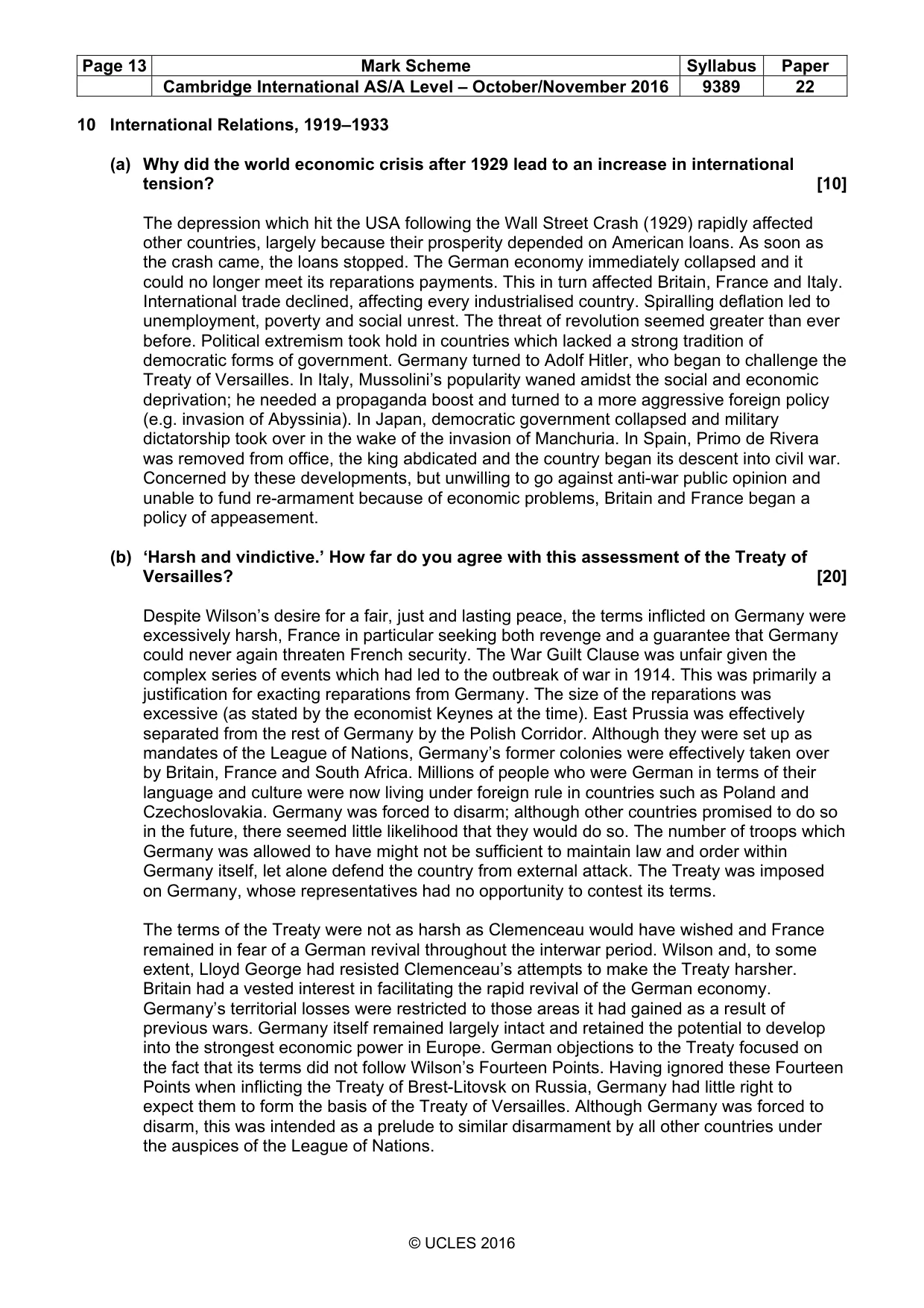
Page 13 Mark Scheme Syllabus Paper Cambridge International AS/A Level – October/November 2016 9389 22 © UCLES 2016 10 International Relations, 1919–1933 (a) Why did the world economic crisis after 1929 lead to an increase in international tension? [10] The depression which hit the USA following the Wall Street Crash (1929) rapidly affected other countries, largely because their prosperity depended on American loans. As soon as the crash came, the loans stopped. The German economy immediately collapsed and it could no longer meet its reparations payments. This in turn affected Britain, France and Italy. International trade declined, affecting every industrialised country. Spiralling deflation led to unemployment, poverty and social unrest. The threat of revolution seemed greater than ever before. Political extremism took hold in countries which lacked a strong tradition of democratic forms of government. Germany turned to Adolf Hitler, who began to challenge the Treaty of Versailles. In Italy, Mussolini’s popularity waned amidst the social and economic deprivation; he needed a propaganda boost and turned to a more aggressive foreign policy (e.g. invasion of Abyssinia). In Japan, democratic government collapsed and military dictatorship took over in the wake of the invasion of Manchuria. In Spain, Primo de Rivera was removed from office, the king abdicated and the country began its descent into civil war. Concerned by these developments, but unwilling to go against anti-war public opinion and unable to fund re-armament because of economic problems, Britain and France began a policy of appeasement. (b) ‘Harsh and vindictive.’ How far do you agree with this assessment of the Treaty of Versailles? [20] Despite Wilson’s desire for a fair, just and lasting peace, the terms inflicted on Germany were excessively harsh, France in particular seeking both revenge and a guarantee that Germany could never again threaten French security. The War Guilt Clause was unfair given the complex series of events which had led to the outbreak of war in 1914. This was primarily a justification for exacting reparations from Germany. The size of the reparations was excessive (as stated by the economist Keynes at the time). East Prussia was effectively separated from the rest of Germany by the Polish Corridor. Although they were set up as mandates of the League of Nations, Germany’s former colonies were effectively taken over by Britain, France and South Africa. Millions of people who were German in terms of their language and culture were now living under foreign rule in countries such as Poland and Czechoslovakia. Germany was forced to disarm; although other countries promised to do so in the future, there seemed little likelihood that they would do so. The number of troops which Germany was allowed to have might not be sufficient to maintain law and order within Germany itself, let alone defend the country from external attack. The Treaty was imposed on Germany, whose representatives had no opportunity to contest its terms. The terms of the Treaty were not as harsh as Clemenceau would have wished and France remained in fear of a German revival throughout the interwar period. Wilson and, to some extent, Lloyd George had resisted Clemenceau’s attempts to make the Treaty harsher. Britain had a vested interest in facilitating the rapid revival of the German economy. Germany’s territorial losses were restricted to those areas it had gained as a result of previous wars. Germany itself remained largely intact and retained the potential to develop into the strongest economic power in Europe. German objections to the Treaty focused on the fact that its terms did not follow Wilson’s Fourteen Points. Having ignored these Fourteen Points when inflicting the Treaty of Brest-Litovsk on Russia, Germany had little right to expect them to form the basis of the Treaty of Versailles. Although Germany was forced to disarm, this was intended as a prelude to similar disarmament by all other countries under the auspices of the League of Nations.
Mark scheme, page 14
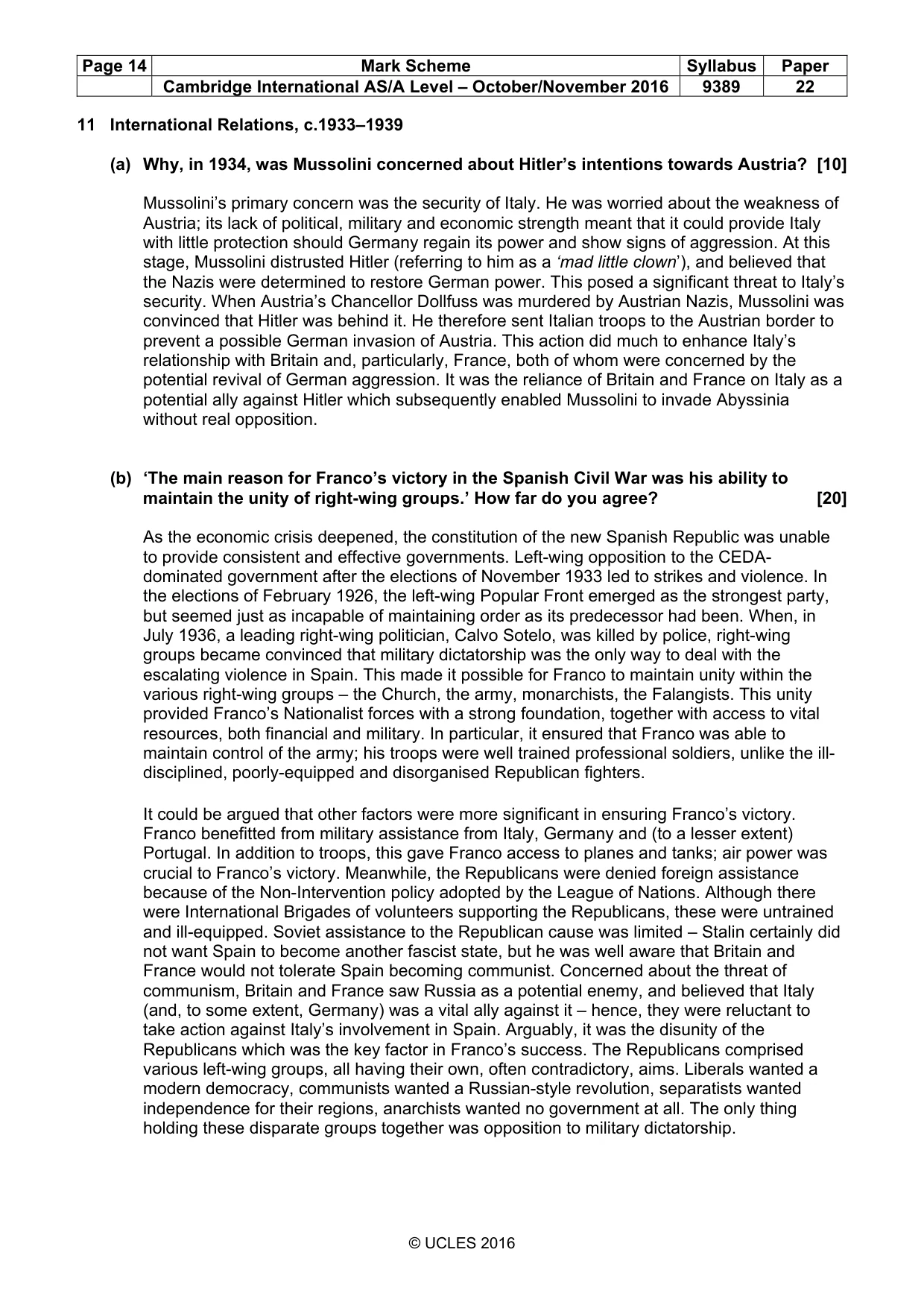
Page 14 Mark Scheme Syllabus Paper Cambridge International AS/A Level – October/November 2016 9389 22 © UCLES 2016 11 International Relations, c.1933–1939 (a) Why, in 1934, was Mussolini concerned about Hitler’s intentions towards Austria? [10] Mussolini’s primary concern was the security of Italy. He was worried about the weakness of Austria; its lack of political, military and economic strength meant that it could provide Italy with little protection should Germany regain its power and show signs of aggression. At this stage, Mussolini distrusted Hitler (referring to him as a ‘mad little clown’), and believed that the Nazis were determined to restore German power. This posed a significant threat to Italy’s security. When Austria’s Chancellor Dollfuss was murdered by Austrian Nazis, Mussolini was convinced that Hitler was behind it. He therefore sent Italian troops to the Austrian border to prevent a possible German invasion of Austria. This action did much to enhance Italy’s relationship with Britain and, particularly, France, both of whom were concerned by the potential revival of German aggression. It was the reliance of Britain and France on Italy as a potential ally against Hitler which subsequently enabled Mussolini to invade Abyssinia without real opposition. (b) ‘The main reason for Franco’s victory in the Spanish Civil War was his ability to maintain the unity of right-wing groups.’ How far do you agree? [20] As the economic crisis deepened, the constitution of the new Spanish Republic was unable to provide consistent and effective governments. Left-wing opposition to the CEDA- dominated government after the elections of November 1933 led to strikes and violence. In the elections of February 1926, the left-wing Popular Front emerged as the strongest party, but seemed just as incapable of maintaining order as its predecessor had been. When, in July 1936, a leading right-wing politician, Calvo Sotelo, was killed by police, right-wing groups became convinced that military dictatorship was the only way to deal with the escalating violence in Spain. This made it possible for Franco to maintain unity within the various right-wing groups – the Church, the army, monarchists, the Falangists. This unity provided Franco’s Nationalist forces with a strong foundation, together with access to vital resources, both financial and military. In particular, it ensured that Franco was able to maintain control of the army; his troops were well trained professional soldiers, unlike the ill- disciplined, poorly-equipped and disorganised Republican fighters. It could be argued that other factors were more significant in ensuring Franco’s victory. Franco benefitted from military assistance from Italy, Germany and (to a lesser extent) Portugal. In addition to troops, this gave Franco access to planes and tanks; air power was crucial to Franco’s victory. Meanwhile, the Republicans were denied foreign assistance because of the Non-Intervention policy adopted by the League of Nations. Although there were International Brigades of volunteers supporting the Republicans, these were untrained and ill-equipped. Soviet assistance to the Republican cause was limited – Stalin certainly did not want Spain to become another fascist state, but he was well aware that Britain and France would not tolerate Spain becoming communist. Concerned about the threat of communism, Britain and France saw Russia as a potential enemy, and believed that Italy (and, to some extent, Germany) was a vital ally against it – hence, they were reluctant to take action against Italy’s involvement in Spain. Arguably, it was the disunity of the Republicans which was the key factor in Franco’s success. The Republicans comprised various left-wing groups, all having their own, often contradictory, aims. Liberals wanted a modern democracy, communists wanted a Russian-style revolution, separatists wanted independence for their regions, anarchists wanted no government at all. The only thing holding these disparate groups together was opposition to military dictatorship.
Mark scheme, page 15
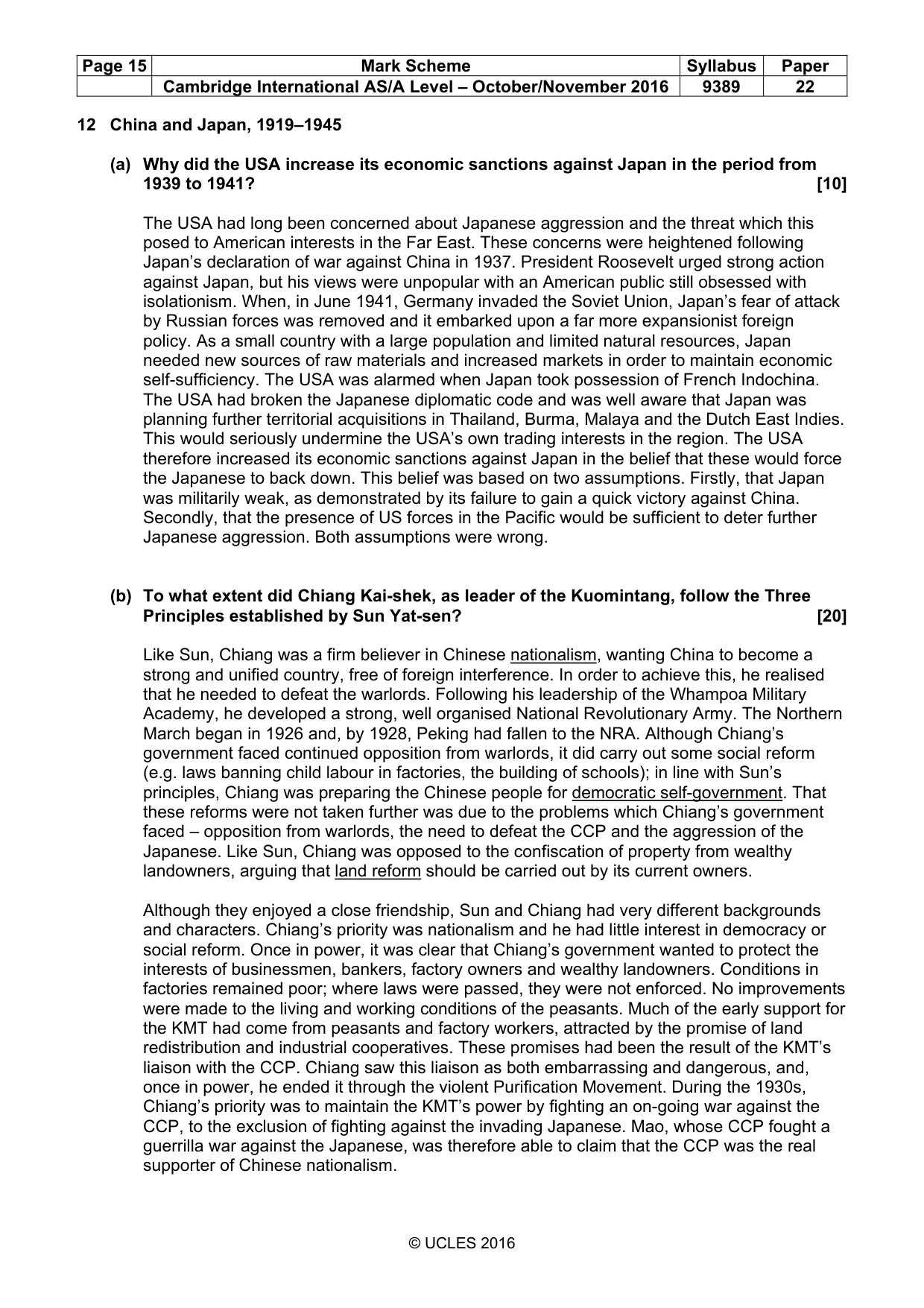
Page 15 Mark Scheme Syllabus Paper Cambridge International AS/A Level – October/November 2016 9389 22 © UCLES 2016 12 China and Japan, 1919–1945 (a) Why did the USA increase its economic sanctions against Japan in the period from 1939 to 1941? [10] The USA had long been concerned about Japanese aggression and the threat which this posed to American interests in the Far East. These concerns were heightened following Japan’s declaration of war against China in 1937. President Roosevelt urged strong action against Japan, but his views were unpopular with an American public still obsessed with isolationism. When, in June 1941, Germany invaded the Soviet Union, Japan’s fear of attack by Russian forces was removed and it embarked upon a far more expansionist foreign policy. As a small country with a large population and limited natural resources, Japan needed new sources of raw materials and increased markets in order to maintain economic self-sufficiency. The USA was alarmed when Japan took possession of French Indochina. The USA had broken the Japanese diplomatic code and was well aware that Japan was planning further territorial acquisitions in Thailand, Burma, Malaya and the Dutch East Indies. This would seriously undermine the USA’s own trading interests in the region. The USA therefore increased its economic sanctions against Japan in the belief that these would force the Japanese to back down. This belief was based on two assumptions. Firstly, that Japan was militarily weak, as demonstrated by its failure to gain a quick victory against China. Secondly, that the presence of US forces in the Pacific would be sufficient to deter further Japanese aggression. Both assumptions were wrong. (b) To what extent did Chiang Kai-shek, as leader of the Kuomintang, follow the Three Principles established by Sun Yat-sen? [20] Like Sun, Chiang was a firm believer in Chinese nationalism, wanting China to become a strong and unified country, free of foreign interference. In order to achieve this, he realised that he needed to defeat the warlords. Following his leadership of the Whampoa Military Academy, he developed a strong, well organised National Revolutionary Army. The Northern March began in 1926 and, by 1928, Peking had fallen to the NRA. Although Chiang’s government faced continued opposition from warlords, it did carry out some social reform (e.g. laws banning child labour in factories, the building of schools); in line with Sun’s principles, Chiang was preparing the Chinese people for democratic self-government. That these reforms were not taken further was due to the problems which Chiang’s government faced – opposition from warlords, the need to defeat the CCP and the aggression of the Japanese. Like Sun, Chiang was opposed to the confiscation of property from wealthy landowners, arguing that land reform should be carried out by its current owners. Although they enjoyed a close friendship, Sun and Chiang had very different backgrounds and characters. Chiang’s priority was nationalism and he had little interest in democracy or social reform. Once in power, it was clear that Chiang’s government wanted to protect the interests of businessmen, bankers, factory owners and wealthy landowners. Conditions in factories remained poor; where laws were passed, they were not enforced. No improvements were made to the living and working conditions of the peasants. Much of the early support for the KMT had come from peasants and factory workers, attracted by the promise of land redistribution and industrial cooperatives. These promises had been the result of the KMT’s liaison with the CCP. Chiang saw this liaison as both embarrassing and dangerous, and, once in power, he ended it through the violent Purification Movement. During the 1930s, Chiang’s priority was to maintain the KMT’s power by fighting an on-going war against the CCP, to the exclusion of fighting against the invading Japanese. Mao, whose CCP fought a guerrilla war against the Japanese, was therefore able to claim that the CCP was the real supporter of Chinese nationalism.
What you needed in this session
Cambridge’s own grade thresholds for 2016 Oct/Nov, Paper 2 · Variant 2. A higher threshold means an easier paper — the bar moves with how the cohort did.