Cambridge A Level History 9389 — 2016 Oct/Nov Paper 2 · Variant 3
9389/23/O/N/16 · 60 marks · ≈68 min
The question paper and its mark scheme, free to read here and free to download. This is Cambridge’s own paper, exactly as it was sat.
Question paper4 pages
Mark scheme15 pages
Answers below. Sit the paper first if you are practising.
Paper as text
Question paper, page 1
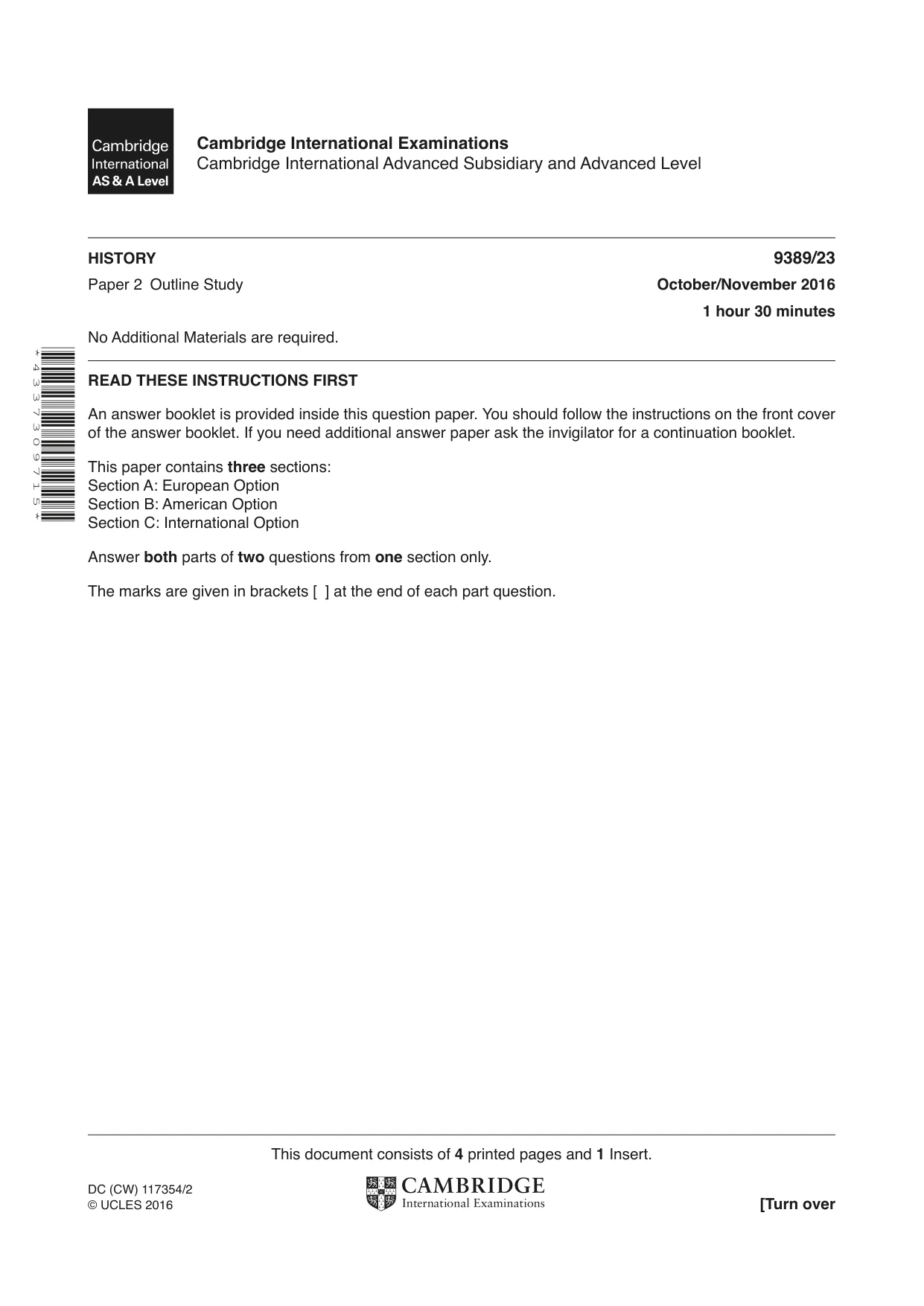
This document consists of 4 printed pages and 1 Insert. DC (CW) 117354/2 © UCLES 2016 [Turn over * 4 3 3 7 3 0 9 7 1 5 * HISTORY 9389/23 Paper 2 Outline Study October/November 2016 1 hour 30 minutes No Additional Materials are required. READ THESE INSTRUCTIONS FIRST An answer booklet is provided inside this question paper. You should follow the instructions on the front cover of the answer booklet. If you need additional answer paper ask the invigilator for a continuation booklet. This paper contains three sections: Section A: European Option Section B: American Option Section C: International Option Answer both parts of two questions from one section only. The marks are given in brackets [ ] at the end of each part question. Cambridge International Examinations Cambridge International Advanced Subsidiary and Advanced Level
Question paper, page 2
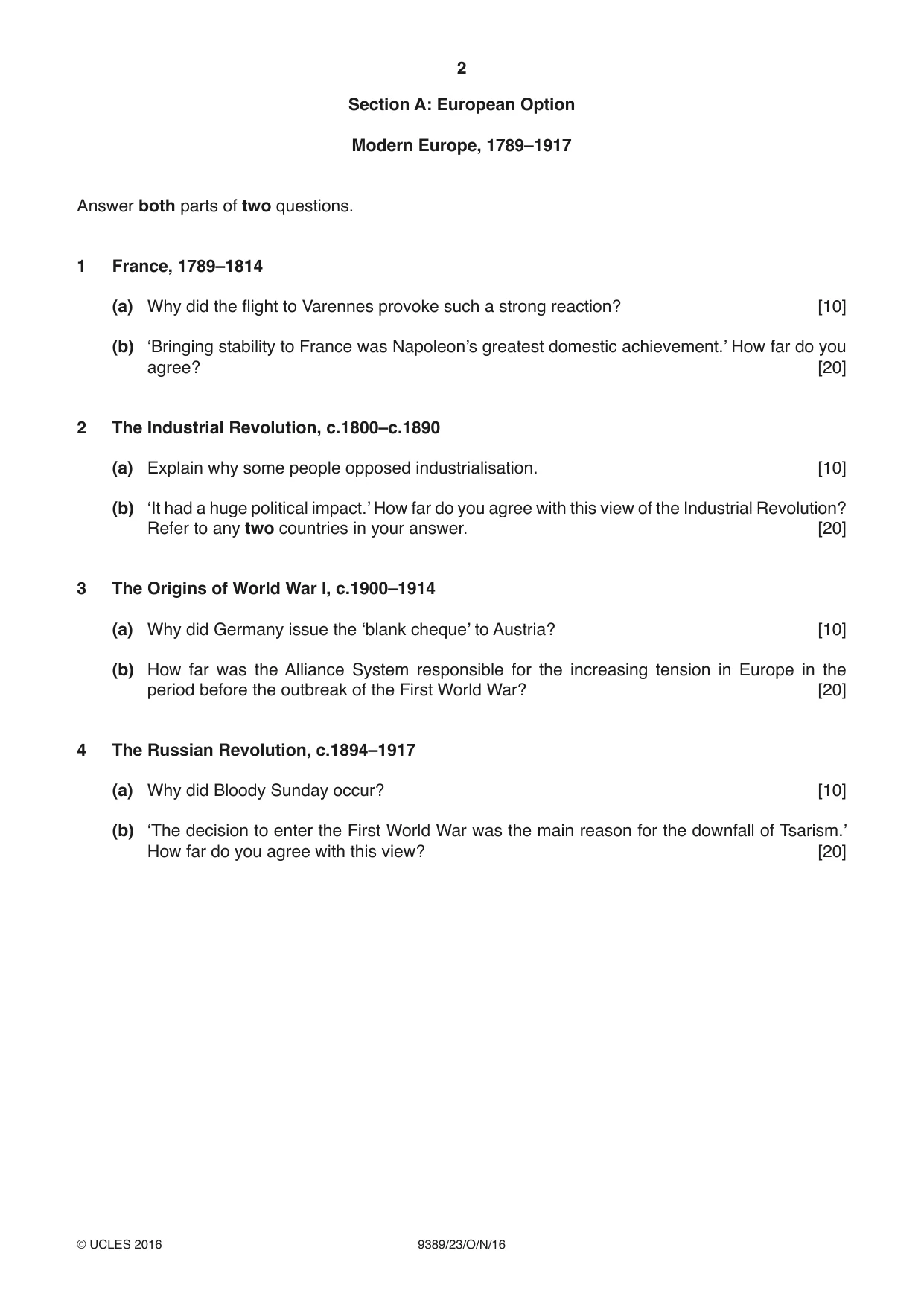
2 9389/23/O/N/16 © UCLES 2016 Section A: European Option Modern Europe, 1789–1917 Answer both parts of two questions. 1 France, 1789–1814 (a) Why did the flight to Varennes provoke such a strong reaction? [10] (b) ‘Bringing stability to France was Napoleon’s greatest domestic achievement.’ How far do you agree? [20] 2 The Industrial Revolution, c.1800–c.1890 (a) Explain why some people opposed industrialisation. [10] (b) ‘It had a huge political impact.’ How far do you agree with this view of the Industrial Revolution? Refer to any two countries in your answer. [20] 3 The Origins of World War I, c.1900–1914 (a) Why did Germany issue the ‘blank cheque’ to Austria? [10] (b) How far was the Alliance System responsible for the increasing tension in Europe in the period before the outbreak of the First World War? [20] 4 The Russian Revolution, c.1894–1917 (a) Why did Bloody Sunday occur? [10] (b) ‘The decision to enter the First World War was the main reason for the downfall of Tsarism.’ How far do you agree with this view? [20]
Question paper, page 3
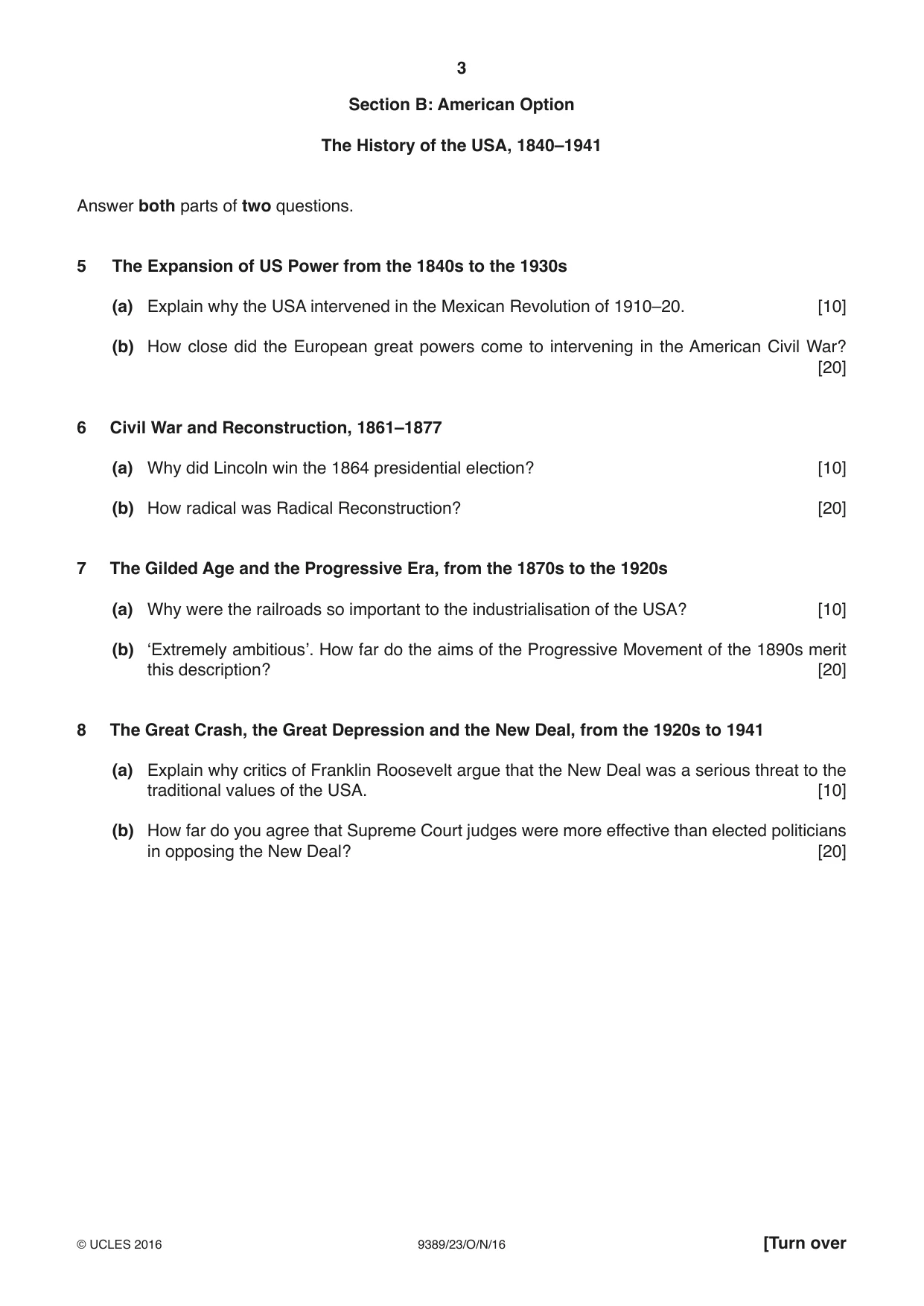
3 9389/23/O/N/16 © UCLES 2016 [Turn over Section B: American Option The History of the USA, 1840–1941 Answer both parts of two questions. 5 The Expansion of US Power from the 1840s to the 1930s (a) Explain why the USA intervened in the Mexican Revolution of 1910–20. [10] (b) How close did the European great powers come to intervening in the American Civil War? [20] 6 Civil War and Reconstruction, 1861–1877 (a) Why did Lincoln win the 1864 presidential election? [10] (b) How radical was Radical Reconstruction? [20] 7 The Gilded Age and the Progressive Era, from the 1870s to the 1920s (a) Why were the railroads so important to the industrialisation of the USA? [10] (b) ‘Extremely ambitious’. How far do the aims of the Progressive Movement of the 1890s merit this description? [20] 8 The Great Crash, the Great Depression and the New Deal, from the 1920s to 1941 (a) Explain why critics of Franklin Roosevelt argue that the New Deal was a serious threat to the traditional values of the USA. [10] (b) How far do you agree that Supreme Court judges were more effective than elected politicians in opposing the New Deal? [20]
Question paper, page 4
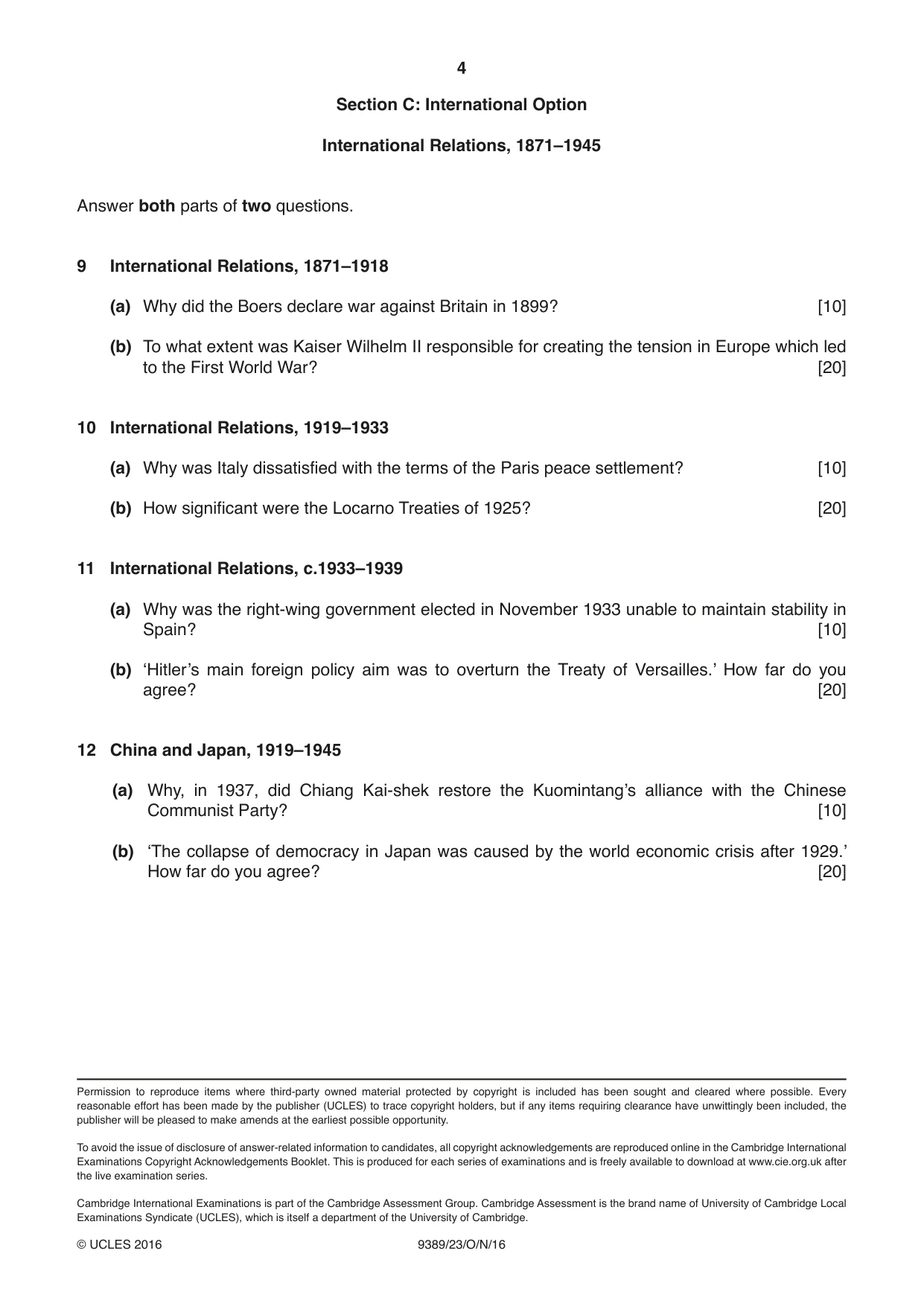
4 9389/23/O/N/16 © UCLES 2016 Permission to reproduce items where third-party owned material protected by copyright is included has been sought and cleared where possible. Every reasonable effort has been made by the publisher (UCLES) to trace copyright holders, but if any items requiring clearance have unwittingly been included, the publisher will be pleased to make amends at the earliest possible opportunity. To avoid the issue of disclosure of answer-related information to candidates, all copyright acknowledgements are reproduced online in the Cambridge International Examinations Copyright Acknowledgements Booklet. This is produced for each series of examinations and is freely available to download at www.cie.org.uk after the live examination series. Cambridge International Examinations is part of the Cambridge Assessment Group. Cambridge Assessment is the brand name of University of Cambridge Local Examinations Syndicate (UCLES), which is itself a department of the University of Cambridge. Section C: International Option International Relations, 1871–1945 Answer both parts of two questions. 9 International Relations, 1871–1918 (a) Why did the Boers declare war against Britain in 1899? [10] (b) To what extent was Kaiser Wilhelm II responsible for creating the tension in Europe which led to the First World War? [20] 10 International Relations, 1919–1933 (a) Why was Italy dissatisfied with the terms of the Paris peace settlement? [10] (b) How significant were the Locarno Treaties of 1925? [20] 11 International Relations, c.1933–1939 (a) Why was the right-wing government elected in November 1933 unable to maintain stability in Spain? [10] (b) ‘Hitler’s main foreign policy aim was to overturn the Treaty of Versailles.’ How far do you agree? [20] 12 China and Japan, 1919–1945 (a) Why, in 1937, did Chiang Kai-shek restore the Kuomintang’s alliance with the Chinese Communist Party? [10] (b) ‘The collapse of democracy in Japan was caused by the world economic crisis after 1929.’ How far do you agree? [20]
Mark scheme, page 1
® IGCSE is the registered trademark of Cambridge International Examinations. This document consists of 15 printed pages. © UCLES 2016 [Turn over Cambridge International Examinations Cambridge International Advanced Subsidiary and Advanced Level HISTORY 9389/23 Paper 2 Outline Study October/November 2016 MARK SCHEME Maximum Mark: 60 Published This mark scheme is published as an aid to teachers and candidates, to indicate the requirements of the examination. It shows the basis on which Examiners were instructed to award marks. It does not indicate the details of the discussions that took place at an Examiners’ meeting before marking began, which would have considered the acceptability of alternative answers. Mark schemes should be read in conjunction with the question paper and the Principal Examiner Report for Teachers. Cambridge will not enter into discussions about these mark schemes. Cambridge is publishing the mark schemes for the October/November 2016 series for most Cambridge IGCSE®, Cambridge International A and AS Level components and some Cambridge O Level components.
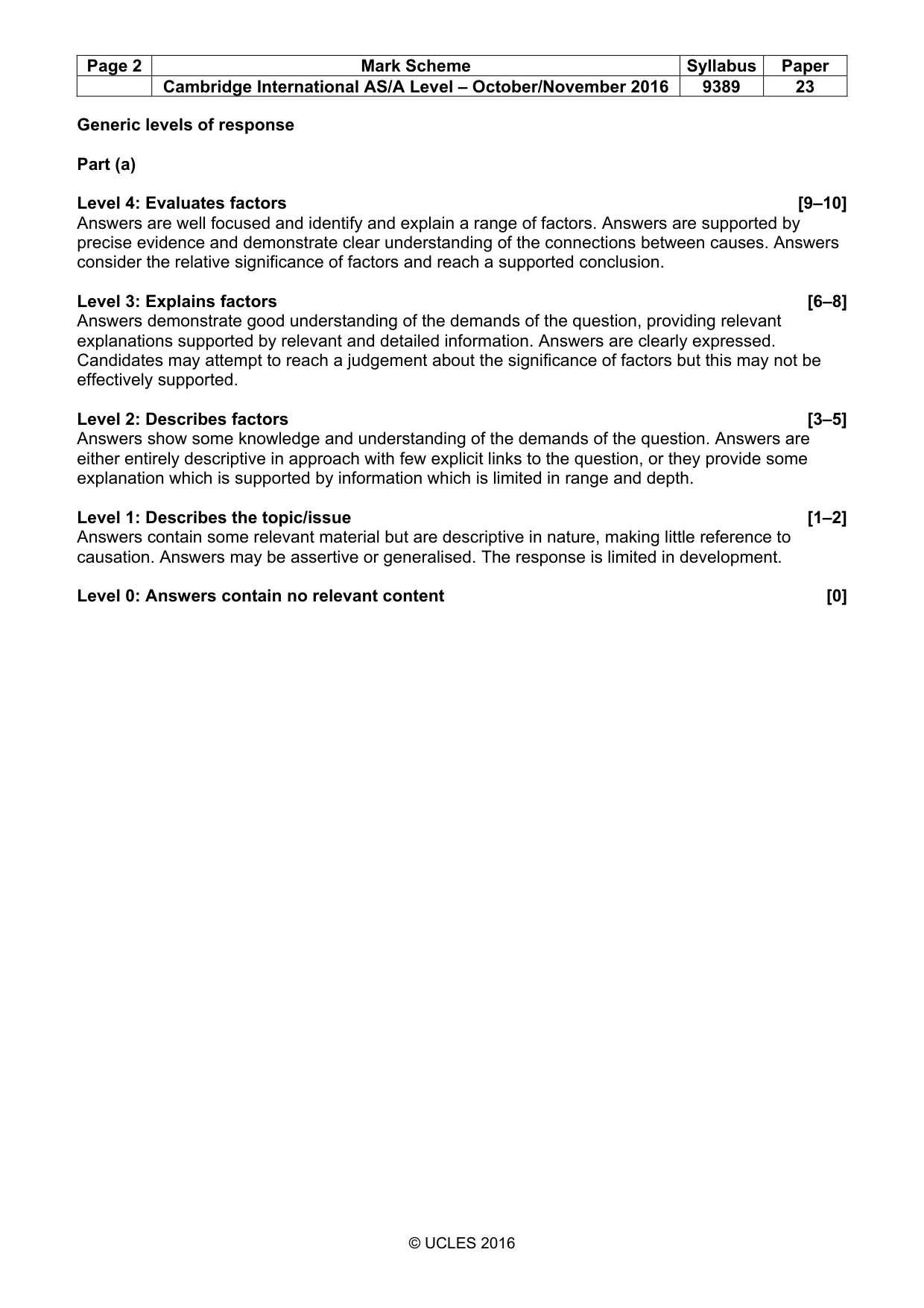
Mark scheme, page 2
Page 2 Mark Scheme Syllabus Paper Cambridge International AS/A Level – October/November 2016 9389 23 © UCLES 2016 Generic levels of response Part (a) Level 4: Evaluates factors [9–10] Answers are well focused and identify and explain a range of factors. Answers are supported by precise evidence and demonstrate clear understanding of the connections between causes. Answers consider the relative significance of factors and reach a supported conclusion. Level 3: Explains factors [6–8] Answers demonstrate good understanding of the demands of the question, providing relevant explanations supported by relevant and detailed information. Answers are clearly expressed. Candidates may attempt to reach a judgement about the significance of factors but this may not be effectively supported. Level 2: Describes factors [3–5] Answers show some knowledge and understanding of the demands of the question. Answers are either entirely descriptive in approach with few explicit links to the question, or they provide some explanation which is supported by information which is limited in range and depth. Level 1: Describes the topic/issue [1–2] Answers contain some relevant material but are descriptive in nature, making little reference to causation. Answers may be assertive or generalised. The response is limited in development. Level 0: Answers contain no relevant content [0]
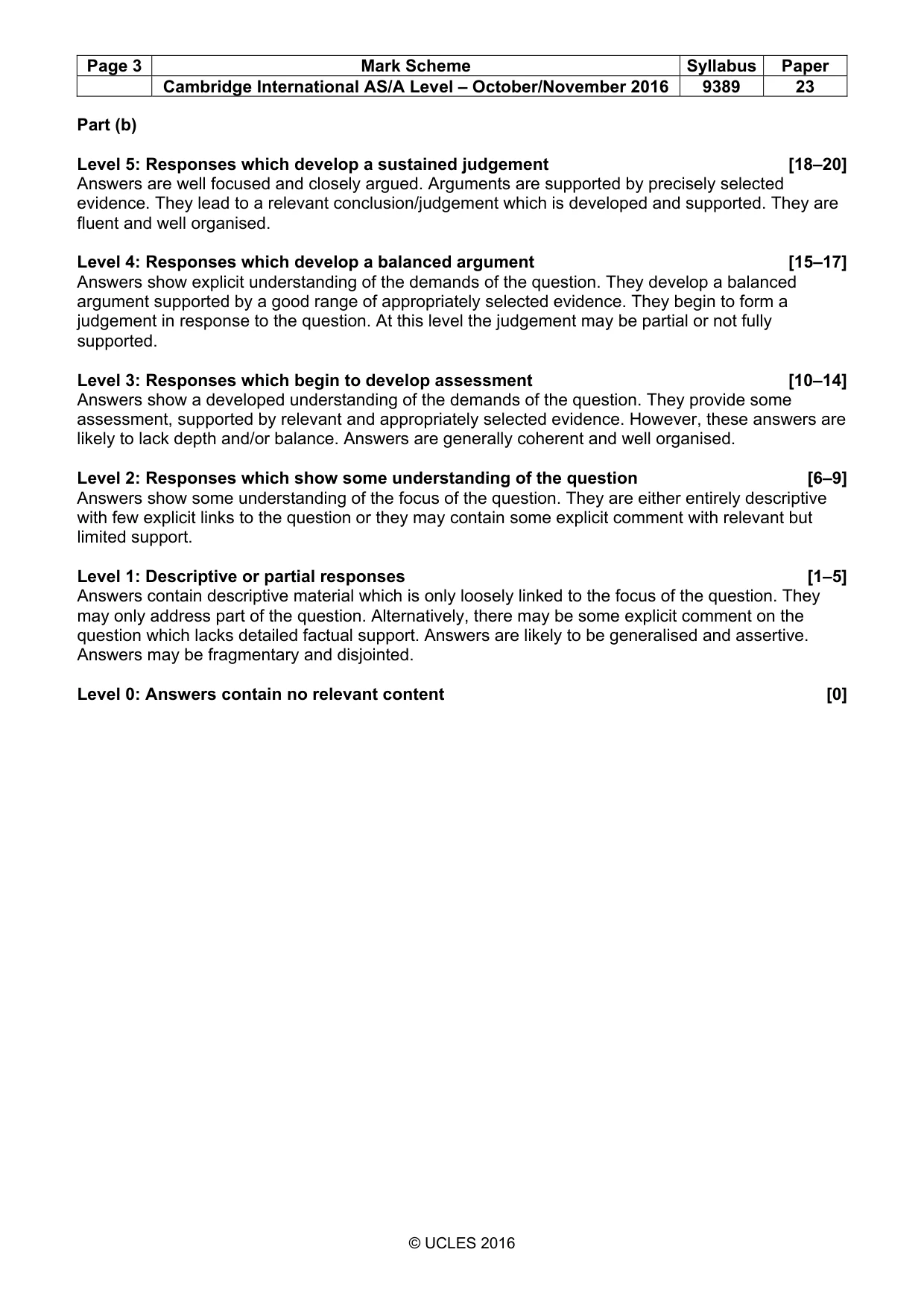
Mark scheme, page 3
Page 3 Mark Scheme Syllabus Paper Cambridge International AS/A Level – October/November 2016 9389 23 © UCLES 2016 Part (b) Level 5: Responses which develop a sustained judgement [18–20] Answers are well focused and closely argued. Arguments are supported by precisely selected evidence. They lead to a relevant conclusion/judgement which is developed and supported. They are fluent and well organised. Level 4: Responses which develop a balanced argument [15–17] Answers show explicit understanding of the demands of the question. They develop a balanced argument supported by a good range of appropriately selected evidence. They begin to form a judgement in response to the question. At this level the judgement may be partial or not fully supported. Level 3: Responses which begin to develop assessment [10–14] Answers show a developed understanding of the demands of the question. They provide some assessment, supported by relevant and appropriately selected evidence. However, these answers are likely to lack depth and/or balance. Answers are generally coherent and well organised. Level 2: Responses which show some understanding of the question [6–9] Answers show some understanding of the focus of the question. They are either entirely descriptive with few explicit links to the question or they may contain some explicit comment with relevant but limited support. Level 1: Descriptive or partial responses [1–5] Answers contain descriptive material which is only loosely linked to the focus of the question. They may only address part of the question. Alternatively, there may be some explicit comment on the question which lacks detailed factual support. Answers are likely to be generalised and assertive. Answers may be fragmentary and disjointed. Level 0: Answers contain no relevant content [0]
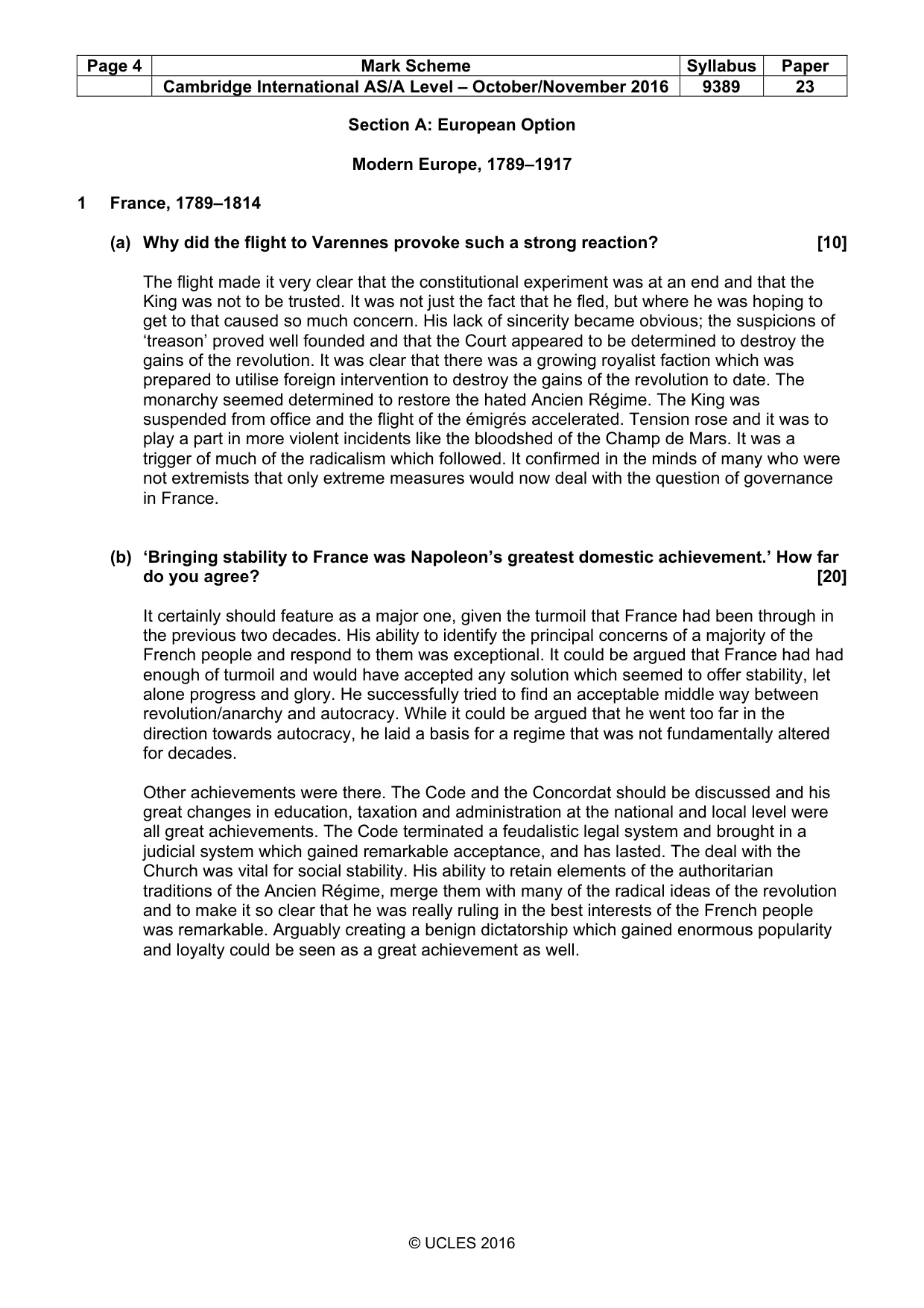
Mark scheme, page 4
Page 4 Mark Scheme Syllabus Paper Cambridge International AS/A Level – October/November 2016 9389 23 © UCLES 2016 Section A: European Option Modern Europe, 1789–1917 1 France, 1789–1814 (a) Why did the flight to Varennes provoke such a strong reaction? [10] The flight made it very clear that the constitutional experiment was at an end and that the King was not to be trusted. It was not just the fact that he fled, but where he was hoping to get to that caused so much concern. His lack of sincerity became obvious; the suspicions of ‘treason’ proved well founded and that the Court appeared to be determined to destroy the gains of the revolution. It was clear that there was a growing royalist faction which was prepared to utilise foreign intervention to destroy the gains of the revolution to date. The monarchy seemed determined to restore the hated Ancien Régime. The King was suspended from office and the flight of the émigrés accelerated. Tension rose and it was to play a part in more violent incidents like the bloodshed of the Champ de Mars. It was a trigger of much of the radicalism which followed. It confirmed in the minds of many who were not extremists that only extreme measures would now deal with the question of governance in France. (b) ‘Bringing stability to France was Napoleon’s greatest domestic achievement.’ How far do you agree? [20] It certainly should feature as a major one, given the turmoil that France had been through in the previous two decades. His ability to identify the principal concerns of a majority of the French people and respond to them was exceptional. It could be argued that France had had enough of turmoil and would have accepted any solution which seemed to offer stability, let alone progress and glory. He successfully tried to find an acceptable middle way between revolution/anarchy and autocracy. While it could be argued that he went too far in the direction towards autocracy, he laid a basis for a regime that was not fundamentally altered for decades. Other achievements were there. The Code and the Concordat should be discussed and his great changes in education, taxation and administration at the national and local level were all great achievements. The Code terminated a feudalistic legal system and brought in a judicial system which gained remarkable acceptance, and has lasted. The deal with the Church was vital for social stability. His ability to retain elements of the authoritarian traditions of the Ancien Régime, merge them with many of the radical ideas of the revolution and to make it so clear that he was really ruling in the best interests of the French people was remarkable. Arguably creating a benign dictatorship which gained enormous popularity and loyalty could be seen as a great achievement as well.
Mark scheme, page 5
Page 5 Mark Scheme Syllabus Paper Cambridge International AS/A Level – October/November 2016 9389 23 © UCLES 2016 2 The Industrial Revolution, c.1800–c.1890 (a) Explain why some people opposed industrialisation. [10] A range of factors could be considered. There were a variety of vested interests which opposed any change. For example, large landowners and aristocrats who did not wish to have hunting disrupted by railroads and their social, economic and political status threatened by middle class entrepreneurs. Rulers of some of the small German states saw it leading to erosion of their powers and submersion into a greater ‘Germany’. Guilds, with their restrictive practices, opposed any challenge to their monopolies and to their status and jobs. Some skilled workers such as handloom weavers saw this change as leading to a loss of income and status. Luddism appeared in many forms in all three countries. The traditional cottage industries were largely destroyed and in many cases there was a critical loss of income which led to leaving the countryside and heading to factory labour in the towns. Communities which had existed for centuries were destroyed. Countries with rigid social systems such as France did not like its aristocracy being tainted by ‘trade’ and resented the rise of a richer middle class. Governments could fear the rise of organised labour and the onward march of democracy. (b) ‘It had a huge political impact.’ How far do you agree with this view of the Industrial Revolution? Refer to any two countries in your answer. [20] This is arguable. It was certainly the case in the UK, but over quite a long period of time. It was to lead to the rise of a dynamic middle class which, after it had gained economic muscle, went on to demand political power and direction of policy. The 1832 Reform Act, with its ending of the aristocratic monopoly of political power in the UK, can certainly be linked back to industrialisation. Later developments in the UK, such as the 1867 Reform Act, saw the urban proletariat gaining the vote. Industrialisation was to lead to the rise of radical political movements like those inspired by Owen and Marx as well as the franchise for the working class. Trade unions started to be developed and in all three countries there were strong direct or indirect links between them and the political process. The need to provide welfare systems and regulate cities and factories became major political issues. The impact was less in Germany perhaps than elsewhere, where a more traditional authoritarian system controlled the process much more efficiently and led to minimal regime change. However, Bismarck had to pay great attention to welfare issues and all three governments were well aware of the potential dangers of a radicalised and hungry working class being led by middle class radicals. The Paris Commune showed that an industrial proletariat could cause enormous harm, and much of the legislation of the Republican governments from 1870 onwards was concerned with dealing with the social and economic issues arising out of industrialisation.
Mark scheme, page 6
Page 6 Mark Scheme Syllabus Paper Cambridge International AS/A Level – October/November 2016 9389 23 © UCLES 2016 3 The Origins of World War I, c.1900–1914 (a) Why did Germany issue the ‘blank cheque’ to Austria? [10] This is where the Kaiser told the Austrian Ambassador to Berlin that Austria could count on full German support even if Russia got involved in the Austrian/Serbian conflict. The Kaiser made it clear that he was prepared to risk war with Russia and it was what gave the Austrian- Hungarian Council of Ministers the confidence to provoke war with the Serbs. It was vital in convincing the Austrian Emperor and more cautious Ministers like Tiza that the ultimatum could be delivered and drafted in such a way that all knew it would be totally unacceptable to the Serbs. The fact that it was followed up by the Germans pressing the Austrians for rapid action could also be mentioned. The Kaiser made it absolutely clear that he was prepared to risk a much wider war and have Serbia eliminated. Obviously Austria had been a key ally of Germany’s since Prussia had defeated them in the 1860s and the Kaiser was also concerned with the potential threat from Russia and France. There is some evidence that the Kaiser thought that Serbia would give in and the Russians would not risk further military humiliation along the lines of their disastrous war with Japan. Recent work suggests that the Kaiser actually gave it little thought, being anxious to get away quickly for his summer holiday, and never thought for a moment what the full implications might be. With essentially ‘yes men’ amongst his ministers and a military machine prepared for war plus a complex system of alliances, this lack of thought could be disastrous. (b) How far was the Alliance System responsible for the increasing tension in Europe in the period before the outbreak of the First World War? [20] In one way it was just one factor amongst many in creating the highly explosive situation in 1914. It certainly gave much confidence to participants to proceed along more radical lines than otherwise, as the Agadir crisis showed. It was seen as a threat by ‘opponents’ and increasingly gave rise to the feeling that there were two armed camps growing in Europe. While the British joined up with the French partly to solve colonial problems, it was also to deal with what they perceived was a growing threat by the Germans. Once the Entente developed, it was to lead to the vital ‘military conversations’ between the British and the French over the ‘Left Flank’ and the naval defence of the North Sea and the Mediterranean, which had a major impact on the threat felt by the Kaiser. The Entente was viewed by the Germans as highly threatening. The Germans viewed their early alliances in Bismarckian times as a means of gaining greater security; the Russians were to view it as a threat which needed a similar response. Alliances may have been intended to reduce tension, but they certainly played a role in raising it. The Entente between the Russians and the French also terrified the Germans as they felt encircled and was critical to the thinking behind the Schlieffen Plan. The French, gaining confidence from their Russian and British support, developed a totally offensive anti- German military strategy (which the German General Staff were well aware of in full detail) which also increased tension. The focus of the response should be on ‘tension’ and not just on causing the outbreak of war. The respective media of all countries were important in persuading the public that it was no longer a matter of ‘if’ a war broke out, but more a matter of ‘when’. Organisations like the Navy Leagues helped to heighten tension as did the obvious arms race. Certainly the poor quality leadership in some countries could be critical as well.
Mark scheme, page 7
Page 7 Mark Scheme Syllabus Paper Cambridge International AS/A Level – October/November 2016 9389 23 © UCLES 2016 4 The Russian Revolution, c.1894–1917 (a) Why did Bloody Sunday occur? [10] Incompetence by the Tsar and the police/military were central factors – the whole intention of the marchers was peaceful and it could and should have remained so. There had been considerable industrial unrest and events at the Putilov works were important here. In the background were the humiliation of the war with Japan, the ongoing legacy of serfdom and real hunger and social deprivation. Gapon, a radical priest, had been instrumental in creating a Trade Union and it was many of his members that were amongst those who marched. Inflation and declining pay had meant real wages had dropped by 20% in the previous year, and 11–12 hour days, six days a week in appalling working and living conditions fuelled anger. It is not known how responsible the Tsar was for the massacre, but he was known to detest ‘that socialist’ Gapon. The troops who did the killings were Cossacks from the Don Region and not local ‘Russians’ who might well have reacted differently. Some reports suggest it was purely a panic reaction by badly officered soldiers. (b) ‘The decision to enter the First World War was the main reason for the downfall of Tsarism.’ How far do you agree with this view? [20] There is a good case to argue here. The consensus amongst historians is that the regime was looking like surviving in 1914, in spite of the comparative failure of the Dumas, for example, and it took the devastation of the war to at least alienate support for the regime and provide the opportunity for Lenin and the Bolsheviks. It could, of course, be argued that it was not the decision itself, but the fact that the war was being lost. In 1914, the Left was bitterly divided and many were in exile. Middle class opinion was largely in favour of the war. However, the war was to cause an enormous range of problems and demonstrate the failure of the regime to manage campaigns and a war machine. Inflation and hunger were endemic. Generals lost battles and the loyalty of the army was destroyed. The staggering and obvious incompetence of the military, as Tannenburg and the Masurian Lakes showed, proved highly damaging as well. The sight of urgently needed supplies for the front rotting in marshalling yards as there were not the engines to take them there was important. Even the deep sense of nationalism always present in Russia was damaged and alienated. There were other factors as well: the memories of the limited and resented concessions after 1905 and the Stolypin ‘neckties’ and the general failure of the regime to show any indication that it was prepared to make a fundamental change. The personal command of the army by the Tsar was a critical error, as was the presence of Rasputin and the role assigned to the German born Tsarina. The Tsar’s inability to sense that the tide had turned against autocracy and accept a form of constitutional monarchy where responsibility could be passed downwards was probably fatal as well. It could be argued that the seeds of destruction were already there before 1914 and it only needed a much greater degree of unity amongst those who wished Tsarism to change radically, or go, for it to happen. The Tsar personally was a man of limited intelligence and less common sense, and he was totally out of his depth. When a fool is in charge of a regime, then the regime is bound to be at risk.
Mark scheme, page 8
Page 8 Mark Scheme Syllabus Paper Cambridge International AS/A Level – October/November 2016 9389 23 © UCLES 2016 Section B: American Option The History of the USA, 1840–1941 5 The Expansion of US Power from the 1840s to the 1930s (a) Explain why the USA intervened in the Mexican Revolution of 1910–20. [10] The Mexican Revolution was a long and complex period of great instability. In ten years, there were five major rulers: Dias [1870–1911], overthrown by revolution; Madero [1911–13], murdered after his overthrow by Huerta; Huerta [1913–14], a military man who fled to exile; Carranza [1917–20], assassinated. In addition, the forces of Pancho Villa and Emiliano Zapata created further conflict. Villa especially was a thorn in the side of the USA as he paid little regard to the US-Mexican border. American intervention took two forms: political and military. Military intervention occurred twice: in 1914 when US forces occupied the port of Veracruz, and in 1916–17 when the ‘Punitive Expedition’ aimed to defeat and capture Villa. Neither was that successful. Both added to Mexican antagonisms towards the USA. Political intervention was most obvious in the overthrow of Madero, in which the US ambassador was involved. The reasons why the USA intervened were essentially twofold: to achieve stable government, so essential to protecting the USA’s considerable investments in Mexico; to respond to offences against American citizens and territory. More generally, such instability on the USA’s southern borders was undesirable, given past tensions between the USA and Mexico and ethnic and religious differences between the two states. (b) How close did the European great powers come to intervening in the American Civil War? [20] The main powers were obviously Britain and France. The French Emperor, Napoleon III, accepted British leadership with regard to the Civil War, though it should not be forgotten that France was at war with Mexico at the same time, imposing its choice of monarch, if only briefly. For various reasons, economic, cultural and historical, the British had some sympathies with both sides. Its sympathy for the North was put at risk in the first weeks of the war when the North imposed a naval blockade restricting British access to Southern markets. Britain soon recognised the South as a belligerent, a status only properly given to sovereign states. When, in November 1861, the North seized two Southern diplomats on board the Trent, a British ship, relations worsened. The British sent 10 000 regular troops to the US- Canada border. At this time, the South expected British support, given its dependence on raw cotton. Britain, however, stayed on the sidelines. As the war continued, however, the British thought of offering its services to mediate an end to the war, especially in the autumn of 1862; British economic and financial interests were being affected. Northern military victories and the Emancipation Proclamation shifted British public opinion in favour of the North. The building of the CSA ship Alabama in Britain and its subsequent escape in the summer of 1862 to destroy US shipping did nothing to improve UK relations with the North but is not relevant to this question as the likeliest chance of European intervention had passed. Thus in the first year or so of the war, Britain at least had come close to intervening, at one stage against the North. If Southern diplomacy had been less arrogant, more skilful, how might events have changed?
Mark scheme, page 9
Page 9 Mark Scheme Syllabus Paper Cambridge International AS/A Level – October/November 2016 9389 23 © UCLES 2016 6 Civil War and Reconstruction, 1861–1877 (a) Why did Lincoln win the 1864 presidential election? [10] The main reason he won was because on September 2, the Northern army led by Sherman took control of Atlanta, Georgia. This tilted the balance of the war even more favourably to the North. The end of the war was in sight. There were other reasons, however, as in the summer of 1864 Lincoln’s victory was not obvious: the war and some of its political consequences – the draft, limits on civil liberties, high rates of casualty – caused many to question whether it could continue. These questions split both parties. Radical Republicans wanted a firmer commitment to emancipate themselves than Lincoln was prepared to give. The Democrats were divided between those who wanted a compromise peace straight away and those who remained committed to supporting the Northern war efforts. The Republican split was less serious, more short-lived than the Democrats’. The Democratic candidate, ex- general George McClellan, even opposed the party’s peace proposals. Another point of detail was that Northern soldiers, largely pro-Lincoln, were either given an absentee ballot or allowed to go home to vote. The main reason, however, was the fall of Atlanta. (b) How radical was Radical Reconstruction? [20] To provide some framework of analysis, ‘radical’ needs defining: fundamental rather than limited reform is the most obvious. Radical Reconstruction aimed to bring about some big changes in the post-war settlement of the South: redistribution of land, harsh treatment of CSA leaders, political equality and support for ex-slaves. Some goals were achieved, e.g. political equality, at least in terms of the constitutional theory, via the 14th and 15th Amendments. However, the practice of Southern politics was far from equal, especially once the North became less involved in the details of Southern governance. Other goals were harder to achieve. CSA leaders escaped relatively lightly. Only Jefferson Davis was arrested and eventually, after almost four years in prison, he was released without charge. The federal government of Andrew Johnson lacked the will to take effective action against Southern leaders – but neither was there reconciliation between the two sides. Land redistribution was almost completely ignored. Many ex-slaves thought they had a right to ‘forty acres and a mule’ but that was never part of federal government policy. Land remained in the hands of the previous landowners. Ex-slaves often ended up working for their ex- masters on terms which were only slightly better than before. Radical Reconstruction had some radical goals. The practice of Reconstruction, however, was limited by the politics of both the South and of federal government.
Mark scheme, page 10
Page 10 Mark Scheme Syllabus Paper Cambridge International AS/A Level – October/November 2016 9389 23 © UCLES 2016 7 The Gilded Age and the Progressive Era, from the 1870s to the 1920s (a) Why were the railroads so important to the industrialisation of the USA? [10] Even critics of the ‘importance of the railroad to industrialisation’ thesis, such as Robert Fogel, accept that the railroads were beneficial to economic growth in the late 1890s. They were so important because they provided the first integrated – and much speedier – transport system across the USA. While most of the growth – from 30 000 miles in 1860 to 130 000 miles in 1890 – was in the North East and the Mid-West, this expansion gave producers quicker access to a larger market and to raw materials. Eventually, five transcontinental railroads were built, creating a large single market and thus greater economies of scale. In addition, the construction of the railroads also helped the industrialisation of the USA. Coal and steel were needed in large quantities, as was the capital to build them. Initially reliant on UK supplies of steel and money, the expansion of the railroads encouraged the development of indigenous supplies. The very size of railroad companies, the largest of the era, provided examples of business organisation which other companies followed. Not all railroads were successful, few were profitable. The expectations they raised and the reality of their construction did much to help the USA industrialise so quickly in the last third of the nineteenth century. (b) ‘Extremely ambitious.’ How far do the aims of the Progressive Movement of the 1890s merit this description? [20] The movement, which emerged in the 1890s as it grew out of and replaced the Populist movement, set itself some ambitious goals. It wanted to end the abuses of power associated with the Gilded Age, whether by party bosses in the cities or the ‘robber barons’ of big business trusts in the regions or across the USA. It wanted to bring about an America which benefitted all the people and not just the powerful few. To these ends, it needed to increase the power of public bodies in order to regulate private, profit-making corporations. It also aimed to improve the lives of ordinary people. This meant a range of social legislation to control housing as well as the provision of food and water; the prohibition of the sale of alcohol was a major goal in this respect. The best restraint upon the power of elites was the power of the people and so Progressives advocated political reforms, at local, regional and national levels, over parties as well as governments, via party primaries and state initiatives [or referendums]. As the 1890s was a time of economic depression, the Progressives wanted a relaxation of the gold-based money supply by having silver as a second precious metal to back the currency. The figure most closely associated with the ‘free silver’ movement was the Democratic Party’s candidate in 1896, William Jennings Bryan, who also represented the People’s Party at the same election. Before the emergence of Theodore Roosevelt in 1901, the movement lacked an obvious national leader. Emerging at the city level, it consisted of a broad and very loose alliance of muckraking journalists and middle class professionals, many of them women. Challenging powerful elites in these ways was certainly ambitious. However, ambition must be measured against achievements and many of these proposals did become law in the first two decades of the twentieth century, e.g. prohibition and trust-busting legislation. Thus it can be argued that the proposals of the 1890s were not as ambitious as might be seen from the perspective of that decade.
Mark scheme, page 11
Page 11 Mark Scheme Syllabus Paper Cambridge International AS/A Level – October/November 2016 9389 23 © UCLES 2016 8 The Great Crash, the Great Depression and the New Deal, from the 1920s to 1941 (a) Explain why critics of Franklin Roosevelt argue that the New Deal was a serious threat to the traditional values of the USA. [10] The traditional values of the USA were seen as being those of rugged individualism and the American dream, both focused on the individual and his [in those days] responsibilities and opportunities. Another fundamental American value was democracy, of ‘we, the people’. These are the values which critics of FDR argued were most threatened by the New Deal. The common theme was that the expanding role of the federal executive which was at the heart of the New Deal threatened both. Rather than finding and providing work for themselves, individuals could turn to Federal government bodies such as the CCC to do so. Rather than deal with problems which faced them, farmers would be provided with some assistance by the AAA. Rather than provide pensions themselves, the Social Security Act of 1935 would do so. The fact that the pension was a social insurance scheme with individuals needing to contribute in order to receive benefits was often overlooked. The scheme was seen by many as a form of socialism, which was not part of the American way of life. The growth of bureaucracy and increases in direct taxation were seen by many as alien to the way things should be. The subsequent history of the USA has strengthened the argument of those who believe that with the New Deal, the USA departed from its traditional values and way of life. (b) How far do you agree that Supreme Court judges were more effective than elected politicians in opposing the New Deal? [20] Political opposition to the New Deal was spread widely but thinly from left to right, from Huey Long via Francis Townsend to various businessmen on the right, including the newspaper proprietor, William Randolph Hearst. In other words, the political opposition was divided by aims and interests. It lacked the unity required to have an impact on New Deal policies. More importantly, it lacked popular support, as shown by federal election results in 1934 and 1936 – though the 1938 mid-terms saw Republican gains, if not enough to dent the Democratic majority. FDR’s popularity was such that he did not have to take that much notice of what his opponents were advocating. Supreme Court judges, however, were unelected and secure. They also were faced with making judgements about specific New Deal policies and thus were bound to have a great impact on the practice of the New Deal. As FDR expanded the role of federal government so the Supreme Court became involved as it had to decide whether these new powers were constitutional. In 1935–6, the Court ruled against both NIRA and the AAA. They were so effective in opposing the New Deal that FDR proposed his court- packing plan to limit the influence of the right wingers in the Court – though the plan was portrayed as having this intention. Thereafter, for whatever reason, the Supreme Court started to make judgements which accepted New Deal legislation. Was the political opposition ever more effective in opposing the New Deal? A case could be made for Francis Townsend, whose pension plans gained the support of several million people via Townsend Clubs in the mid-30s, helping to persuade FDR to introduce Social Security for old people.
Mark scheme, page 12
Page 12 Mark Scheme Syllabus Paper Cambridge International AS/A Level – October/November 2016 9389 23 © UCLES 2016 Section C: International Option International Relations, 1871–1945 9 International Relations, 1871–1918 (a) Why did the Boers declare war against Britain in 1899? [10] British rule in Cape Colony was deeply resented by the Boers and, once the threat posed by the Zulus had been removed, they rebelled (First Boer War 1880–81). Under the Pretoria Convention (1881), Transvaal and Orange Free State were given self-governing status under British oversight. Further discoveries of gold in the Transvaal brought new settlers to the region, many of them British. They were denied political rights by the Transvaal President, Paul Kruger. British expansionist ambitions led to the failed Jameson Raid of 1895 – Britain was hoping to stir up a rebellion amongst the settlers and to use this as a pretext for an invasion. When no rebellion occurred, Jameson went ahead with the raid and was easily defeated. The Boers gained the support of many European nations, which saw the raid as a British attack on a small, independent nation (e.g. Kaiser Telegram). In 1899, Kruger demanded full independence for the Transvaal and the removal of British troops. When Britain refused, Kruger declared war against Britain. (b) To what extent was Kaiser Wilhelm II responsible for creating the tension in Europe which led to the First World War? [20] After Bismarck’s removal from office, the Kaiser adopted a less cautious foreign policy. He did not renew the Reinsurance Treaty, which led Russia into an unlikely alliance with France. Germany’s naval developments caused panic in Britain, leading to an arms race and the ending of Britain’s policy of splendid isolation. Britain joined France and Russia in the Triple Entente, a rival alliance to the Triple Alliance. The Kaiser reversed Bismarck’s policy of keeping Germany out of the race for overseas possessions, causing potential conflict. The Kaiser’s support for the Boers through his telegram of 1896 caused anger and concern in Britain, while his actions in Morocco were perceived as provocative. Such actions had the effect of pushing Britain and France closer together. In response to the assassination of Archduke Franz Ferdinand, Austria-Hungary declared war on Serbia in the certain knowledge that it had the support of the Kaiser’s Germany. Although the Kaiser was considerably less tactful in his foreign policy than Bismarck had been, there were other more significant causes of tension in Europe. In general, the alliance system was able to prevent relatively minor incidents escalating into war (e.g. when the Kaiser was forced to back down over Morocco in 1911 because of Britain’s support for France). The ongoing disintegration of the Habsburg, Russian and Turkish empires was a major cause of instability, and it was rivalry between Austria-Hungary and Russia that caused the main tension. It was this rivalry over the Balkans which had prevented Bismarck from maintaining his defensive alliance with both Austria-Hungary and Russia, and it led to a series of crises in the period leading up to WWI. Although originally envisaged as defensive/protective alliances, the existence of the Triple Alliance and the Triple Entente based on secret terms caused concern across Europe. For example, it was fear of a joint attack by France and Germany which led the Kaiser to introduce conscription in 1913; the French interpreted this as the start of preparations for an attack on France. Another key factor in the build-up of tension was French anger and resentment at its humiliating defeat in the Franco-Prussian War.
Mark scheme, page 13
Page 13 Mark Scheme Syllabus Paper Cambridge International AS/A Level – October/November 2016 9389 23 © UCLES 2016 10 International Relations, 1919–1933 (a) Why was Italy dissatisfied with the terms of the Paris peace settlement? [10] The Italian Prime Minister, Vittorio Orlando, had been a member of the Council of Four at the Paris peace talks. In reality, however, decisions had been made by ‘the Big Three’ (Wilson, Lloyd George and Clemenceau). Italy felt frustrated and humiliated by the outcome of the peace talks. Italy had been convinced to enter WWI against the Central Powers in 1916 on the promise that it would gain territory at the expense of the Habsburg and Ottoman Empires (e.g. the Tyrol region, Fiume, parts of Dalmatia, and islands along the Adriatic coast). Britain and France felt that Italy had been of little use during WWI and saw no reason to honour the agreements made. In Paris, the Italians were largely excluded from the decision-making process, gaining only a small amount of territory on their northeast border. The territory which Italy had been promised went instead to Yugoslavia, Hungary and Serbia. For a time, the Italian delegation left the Paris peace talks as a result of these decisions. (b) How significant were the Locarno Treaties of 1925? [20] The Locarno Treaties marked a major turning point in international affairs. They were greeted with enthusiasm and relief across Europe and the ‘Locarno spirit’ ushered in a new era of reconciliation and cooperation. In particular, the Treaties marked France’s new willingness to become more understanding and friendly in its attitude towards Germany. This was partly because France felt reassured that German reparations would be paid as a result of the Dawes Plan (1924). Germany, France and Belgium promised to respect their joint frontiers, an agreement which was guaranteed by Britain and Italy. Improved relationships between France and Germany were symbolised by the good working relationship developed between Briand and Stresemann, foreign ministers of France and Germany respectively. Franco- German relations remained sound for the remainder of the 1920s; France was even willing to accept the Young Plan (1929) which reduced the amount of reparations which Germany had to pay. Old suspicions, tensions and resentment remained despite the Locarno Treaties. This became clear in the failure of the World Disarmament Conference (1932–33). The Treaties gave no guarantees regarding Germany’s borders with Poland and Czechoslovakia. France’s aggressive stance towards Germany (e.g. the occupation of the Ruhr) had brought criticism of Britain and the USA, without whose support the French would feel even more insecure in the face of a German revival. France, therefore, had a vested interest in displaying a more friendly attitude towards Germany, something which was now possible because of the Dawes Plan’s guarantee that reparations would now be paid. Many historians argue that France’s seemingly more friendly attitude towards Germany was less than sincere, merely a diplomatic convenience. Moreover, the Treaties did not address some of the key issues causing tension in Europe (e.g. disarmament, the problems facing the successor states).
Mark scheme, page 14
Page 14 Mark Scheme Syllabus Paper Cambridge International AS/A Level – October/November 2016 9389 23 © UCLES 2016 11 International Relations, c.1933–1939 (a) Why was the right-wing government elected in November 1933 unable to maintain stability in Spain? [10] Constitutional monarchy had been unable to cope with the political divisions within Spain. After a bloodless coup in 1923, Spain had been ruled by the military dictatorship of Miguel Primo de Rivera. He was forced to resign when he lost the support of the army. Facing an economic crisis, high unemployment and violence in the major cities, the King abdicated and Spain became a Republic (1931). Initially, the Spanish parliament (Cortes) was dominated by the left-wing government of Manuel Azana, who embarked on a programme of radical reform. Spain faced a series of strikes, riots and assassinations, and Azana was forced to resign. In the elections of November 1933, right-wing groups won an overall majority, CEDA becoming the main party under the leadership of José Maria Gil-Robles. The new government immediately set about cancelling Azana’s reforms. This had the effect of drawing left-wing groups (socialists, anarchists, communists) together in opposition, and they unified in the Popular Front. This new group organised a general strike in 1934 and the number of riots and acts of violence increased (e.g. anarchists derailed the Barcelona-Seville train, killing 19). Fearing that a revolution might occur, the government used the army to crush opposition. The unity of left- wing groups against the oppressive government led to the Popular Front becoming the strongest party in the Cortes following the elections of February 1936. Gil-Robles’ government had become the latest victim of political divisions and economic turmoil in Spain. (b) ‘Hitler’s main foreign policy aim was to overturn the Treaty of Versailles.’ How far do you agree? [20] The imposed Treaty of Versailles was hated in Germany, and Hitler’s speeches since the 1920s had made it clear that his aim was to end Germany’s commitment to it. This would involve recovering all lost territory (including the Polish Corridor and the Saar coalfields), developing the German army, navy and air force, forming union with Austria (Anschluss) and re-uniting all German-speaking people under the government of Germany. He withdrew Germany from the World Disarmament Conference and the League of Nations because he wanted to rearm Germany since other countries had not kept to their commitment to disarm. Hitler developed German armed forces, entered the demilitarised Rhineland and achieved Anschluss. He was able to argue that he was a man of peace who wanted only to remove an unfair peace treaty – appeasement shows that many foreign politicians agreed with him. Hitler’s main aim was to restore Germany to its rightful position as a major European power. Overturning the Treaty of Versailles was, therefore, merely a vital precondition of his longer term ambitions. As early as the 1920s, Hitler had spoken of lebensraum, taking land to the east to allow for Germany’s rapidly expanding population. At Munich, Hitler convinced Chamberlain that his ambitions for Czechoslovakia were confined to bringing German- speaking people under German rule. It quickly became clear that his true intentions were to take the whole of Czechoslovakia. The signing of the Nazi-Soviet Pact was designed to remove Russian opposition to his planned invasion of Poland, in defiance of treaties which he himself had signed. Stalin was fully aware that Hitler’s longer-term plan involved an attack on the USSR. Fuelled by intense nationalism, Hitler’s main foreign policy aim was to make Germany the most powerful nation in Europe. He did this by isolating potential opposition through a series of devious tactics.
Mark scheme, page 15
Page 15 Mark Scheme Syllabus Paper Cambridge International AS/A Level – October/November 2016 9389 23 © UCLES 2016 12 China and Japan, 1919–1945 (a) Why, in 1937, did Chiang Kai-shek restore the Kuomintang’s alliance with the Chinese Communist Party? [10] Following the success of the KMT’s Northern March, Chiang had embarked on the Purification Movement (after 1927), which ended the earlier liaison between the KMT and the CCP. Chiang, being opposed to the communists’ plans for land redistribution and industrial cooperatives, saw the CCP as a dangerous and embarrassing ally. Chiang continued to see the CCP as the main threat to KMT power, fighting an ongoing war against communist forces. When Japanese forces invaded Manchuria in 1931, Chiang adopted a policy of non- resistance. This was because the KMT’s control of China was still far from complete due to opposition from warlords and the CCP, and because he did not feel the KMT could win a war against Japan. Conversely, Mao’s CCP fought a guerrilla war against the invading Japanese, claiming that this proved the CCP was the real party of Chinese nationalism. Chiang’s policy of non-resistance was not universally popular within the KMT and, in December 1936, Chiang was taken prisoner by some of his own troops (mainly Manchurians angered by the Japanese invasion). Eventually, Chiang was effectively forced to agree to a new alliance with the CCP in order to provide a national front against the Japanese. (b) ‘The collapse of democracy in Japan was caused by the world economic crisis after 1929.’ How far do you agree? [20] The economic boom which Japan had experienced during WWI ended by 1921, by which time European industry had revived and was beginning to recover lost markets. Unemployment and rising prices affected Japan throughout the 1920s. Japan was particularly badly hit by the world depression which followed the Wall Street Crash. Japanese exports fell and unemployment grew still worse. The democratically elected government was widely blamed for these problems, not least because it suppressed attempts by industrial workers and farmers to form trade unions and political organisations. A more aggressive foreign policy towards China seemed to be the best way of easing Japan’s economic problems – providing new sources of raw materials and a bigger, guaranteed market for Japanese goods. Economic hardship fostered extreme nationalism, which led to the decline of democratic government. The collapse of democracy in Japan was due to political rather than economic factors. The concept of democracy was relatively new to Japan, the Diet having only been created in 1889. The Japanese people’s respect for parliamentary democracy declined quickly once it became clear that many politicians were corrupt and open to bribery. Moreover, politicians seemed unable to reach agreement on key issues, leading to weak and ineffective government. Democracy seemed to be dividing Japan rather than unifying it. Secret military groups began to appear (e.g. Cherry Blossom Society), which aimed to end parliamentary democracy and restore the Emperor as head of state in a military dictatorship. The agreements which the Japanese government made at the Washington Conferences (1921– 22) were not widely popular – public opinion was nationalistic and anti-Western, and therefore opposed agreements reached with the USA and European nations. That the democratic government had little real control was shown when the Kwantung Army took unilateral action in Manchuria; when the Prime Minister, Inukai Tsuyoshi, criticised this action, he was assassinated. The Emperor steadfastly refused the order the Kwantung Army to withdraw.
What you needed in this session
Cambridge’s own grade thresholds for 2016 Oct/Nov, Paper 2 · Variant 3. A higher threshold means an easier paper — the bar moves with how the cohort did.