Cambridge A Level History 9389 — 2016 Oct/Nov Paper 2 · Variant 1
9389/21/O/N/16 · 60 marks · ≈68 min
The question paper and its mark scheme, free to read here and free to download. This is Cambridge’s own paper, exactly as it was sat.
Question paper4 pages
Mark scheme14 pages
Answers below. Sit the paper first if you are practising.
Paper as text
Question paper, page 1
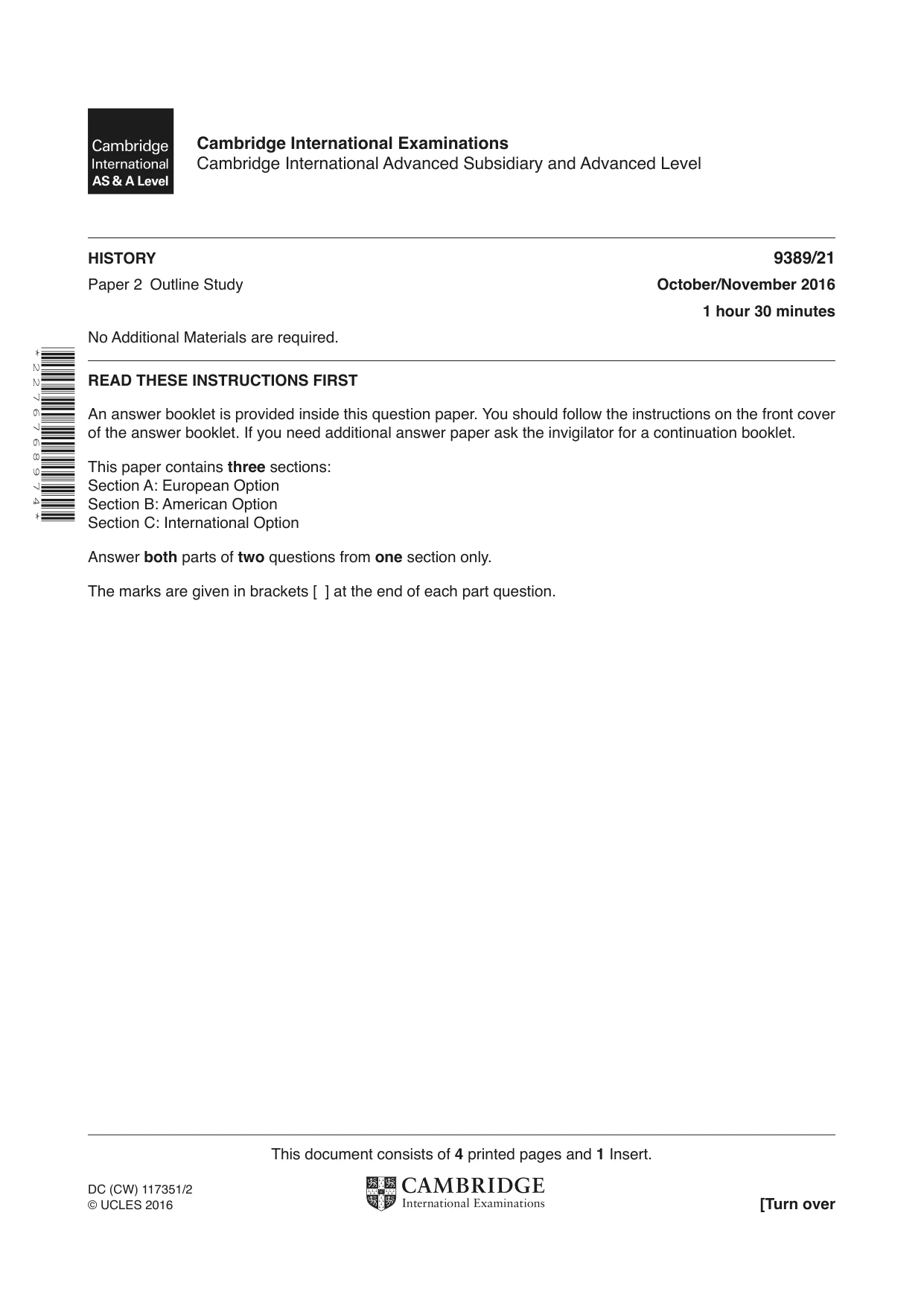
This document consists of 4 printed pages and 1 Insert. DC (CW) 117351/2 © UCLES 2016 [Turn over * 2 2 7 6 7 6 8 9 7 4 * HISTORY 9389/21 Paper 2 Outline Study October/November 2016 1 hour 30 minutes No Additional Materials are required. READ THESE INSTRUCTIONS FIRST An answer booklet is provided inside this question paper. You should follow the instructions on the front cover of the answer booklet. If you need additional answer paper ask the invigilator for a continuation booklet. This paper contains three sections: Section A: European Option Section B: American Option Section C: International Option Answer both parts of two questions from one section only. The marks are given in brackets [ ] at the end of each part question. Cambridge International Examinations Cambridge International Advanced Subsidiary and Advanced Level
Question paper, page 2
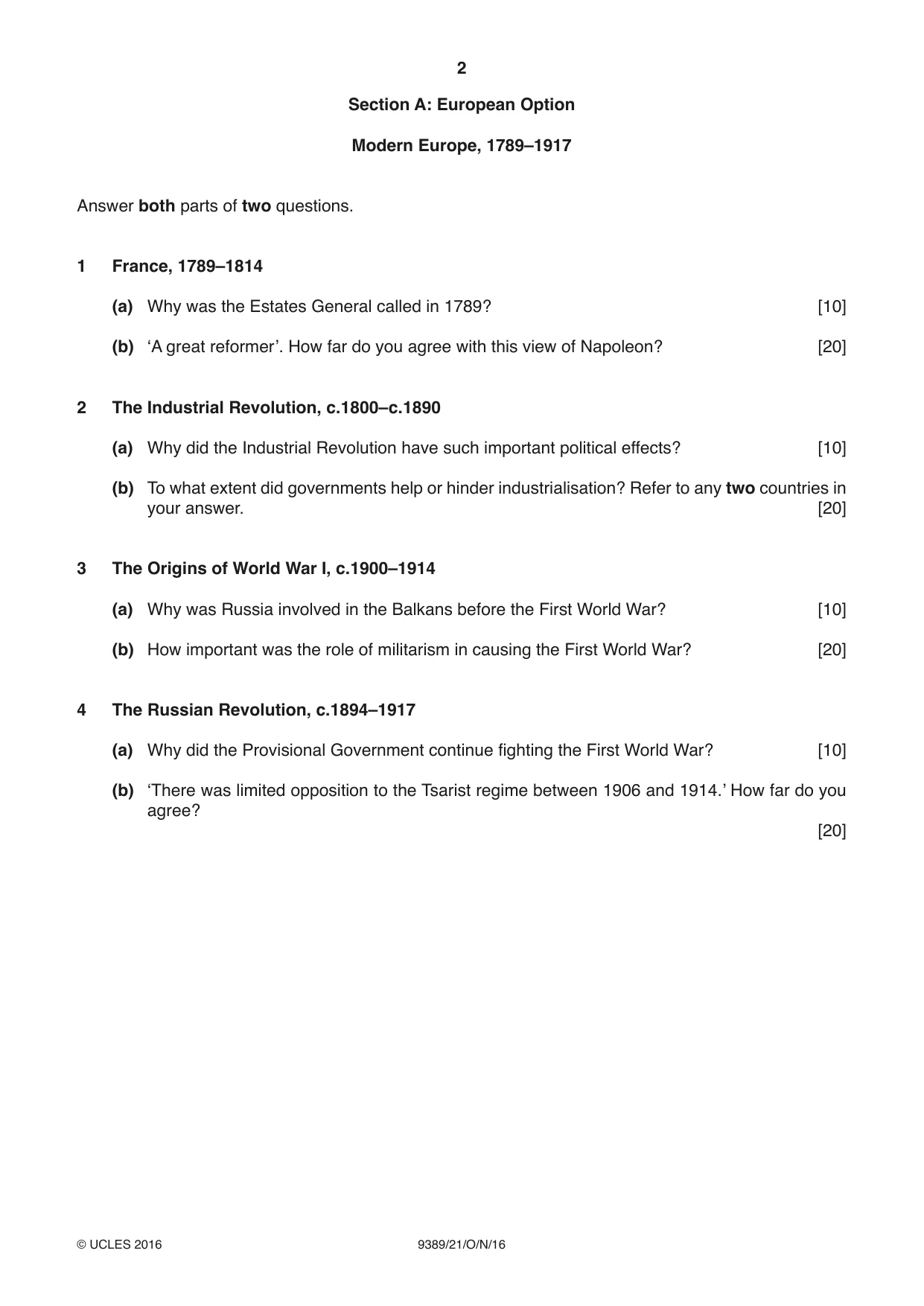
2 9389/21/O/N/16 © UCLES 2016 Section A: European Option Modern Europe, 1789–1917 Answer both parts of two questions. 1 France, 1789–1814 (a) Why was the Estates General called in 1789? [10] (b) ‘A great reformer’. How far do you agree with this view of Napoleon? [20] 2 The Industrial Revolution, c.1800–c.1890 (a) Why did the Industrial Revolution have such important political effects? [10] (b) To what extent did governments help or hinder industrialisation? Refer to any two countries in your answer. [20] 3 The Origins of World War I, c.1900–1914 (a) Why was Russia involved in the Balkans before the First World War? [10] (b) How important was the role of militarism in causing the First World War? [20] 4 The Russian Revolution, c.1894–1917 (a) Why did the Provisional Government continue fighting the First World War? [10] (b) ‘There was limited opposition to the Tsarist regime between 1906 and 1914.’ How far do you agree? [20]
Question paper, page 3
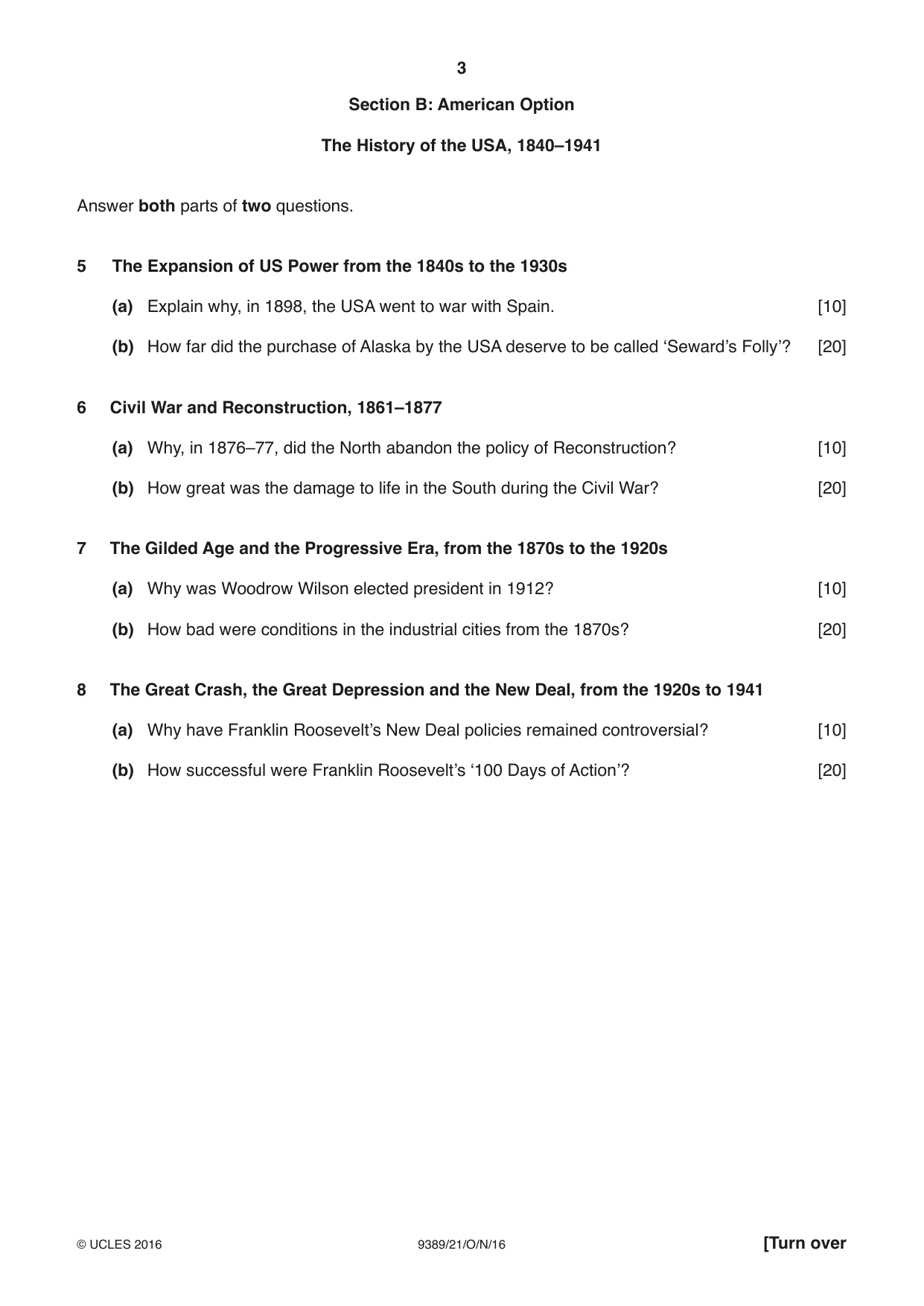
3 9389/21/O/N/16 © UCLES 2016 [Turn over Section B: American Option The History of the USA, 1840–1941 Answer both parts of two questions. 5 The Expansion of US Power from the 1840s to the 1930s (a) Explain why, in 1898, the USA went to war with Spain. [10] (b) How far did the purchase of Alaska by the USA deserve to be called ‘Seward’s Folly’? [20] 6 Civil War and Reconstruction, 1861–1877 (a) Why, in 1876–77, did the North abandon the policy of Reconstruction? [10] (b) How great was the damage to life in the South during the Civil War? [20] 7 The Gilded Age and the Progressive Era, from the 1870s to the 1920s (a) Why was Woodrow Wilson elected president in 1912? [10] (b) How bad were conditions in the industrial cities from the 1870s? [20] 8 The Great Crash, the Great Depression and the New Deal, from the 1920s to 1941 (a) Why have Franklin Roosevelt’s New Deal policies remained controversial? [10] (b) How successful were Franklin Roosevelt’s ‘100 Days of Action’? [20]
Question paper, page 4
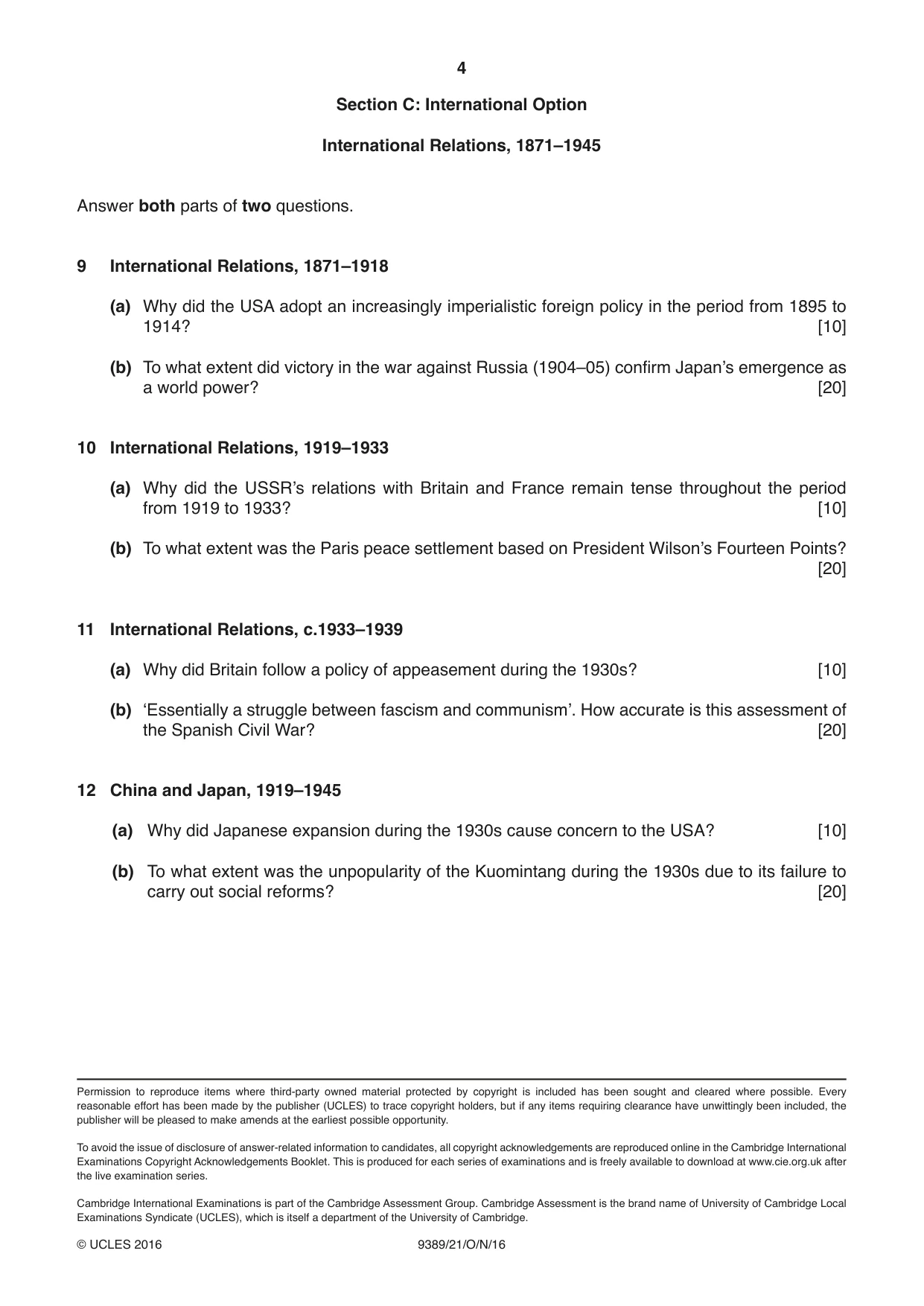
4 9389/21/O/N/16 © UCLES 2016 Permission to reproduce items where third-party owned material protected by copyright is included has been sought and cleared where possible. Every reasonable effort has been made by the publisher (UCLES) to trace copyright holders, but if any items requiring clearance have unwittingly been included, the publisher will be pleased to make amends at the earliest possible opportunity. To avoid the issue of disclosure of answer-related information to candidates, all copyright acknowledgements are reproduced online in the Cambridge International Examinations Copyright Acknowledgements Booklet. This is produced for each series of examinations and is freely available to download at www.cie.org.uk after the live examination series. Cambridge International Examinations is part of the Cambridge Assessment Group. Cambridge Assessment is the brand name of University of Cambridge Local Examinations Syndicate (UCLES), which is itself a department of the University of Cambridge. Section C: International Option International Relations, 1871–1945 Answer both parts of two questions. 9 International Relations, 1871–1918 (a) Why did the USA adopt an increasingly imperialistic foreign policy in the period from 1895 to 1914? [10] (b) To what extent did victory in the war against Russia (1904–05) confirm Japan’s emergence as a world power? [20] 10 International Relations, 1919–1933 (a) Why did the USSR’s relations with Britain and France remain tense throughout the period from 1919 to 1933? [10] (b) To what extent was the Paris peace settlement based on President Wilson’s Fourteen Points? [20] 11 International Relations, c.1933–1939 (a) Why did Britain follow a policy of appeasement during the 1930s? [10] (b) ‘Essentially a struggle between fascism and communism’. How accurate is this assessment of the Spanish Civil War? [20] 12 China and Japan, 1919–1945 (a) Why did Japanese expansion during the 1930s cause concern to the USA? [10] (b) To what extent was the unpopularity of the Kuomintang during the 1930s due to its failure to carry out social reforms? [20]
Mark scheme, page 1
® IGCSE is the registered trademark of Cambridge International Examinations. This document consists of 14 printed pages. © UCLES 2016 [Turn over Cambridge International Examinations Cambridge International Advanced Subsidiary and Advanced Level HISTORY 9389/21 Paper 2 Outline Study October/November 2016 MARK SCHEME Maximum Mark: 60 Published This mark scheme is published as an aid to teachers and candidates, to indicate the requirements of the examination. It shows the basis on which Examiners were instructed to award marks. It does not indicate the details of the discussions that took place at an Examiners’ meeting before marking began, which would have considered the acceptability of alternative answers. Mark schemes should be read in conjunction with the question paper and the Principal Examiner Report for Teachers. Cambridge will not enter into discussions about these mark schemes. Cambridge is publishing the mark schemes for the October/November 2016 series for most Cambridge IGCSE®, Cambridge International A and AS Level components and some Cambridge O Level components.
Mark scheme, page 2
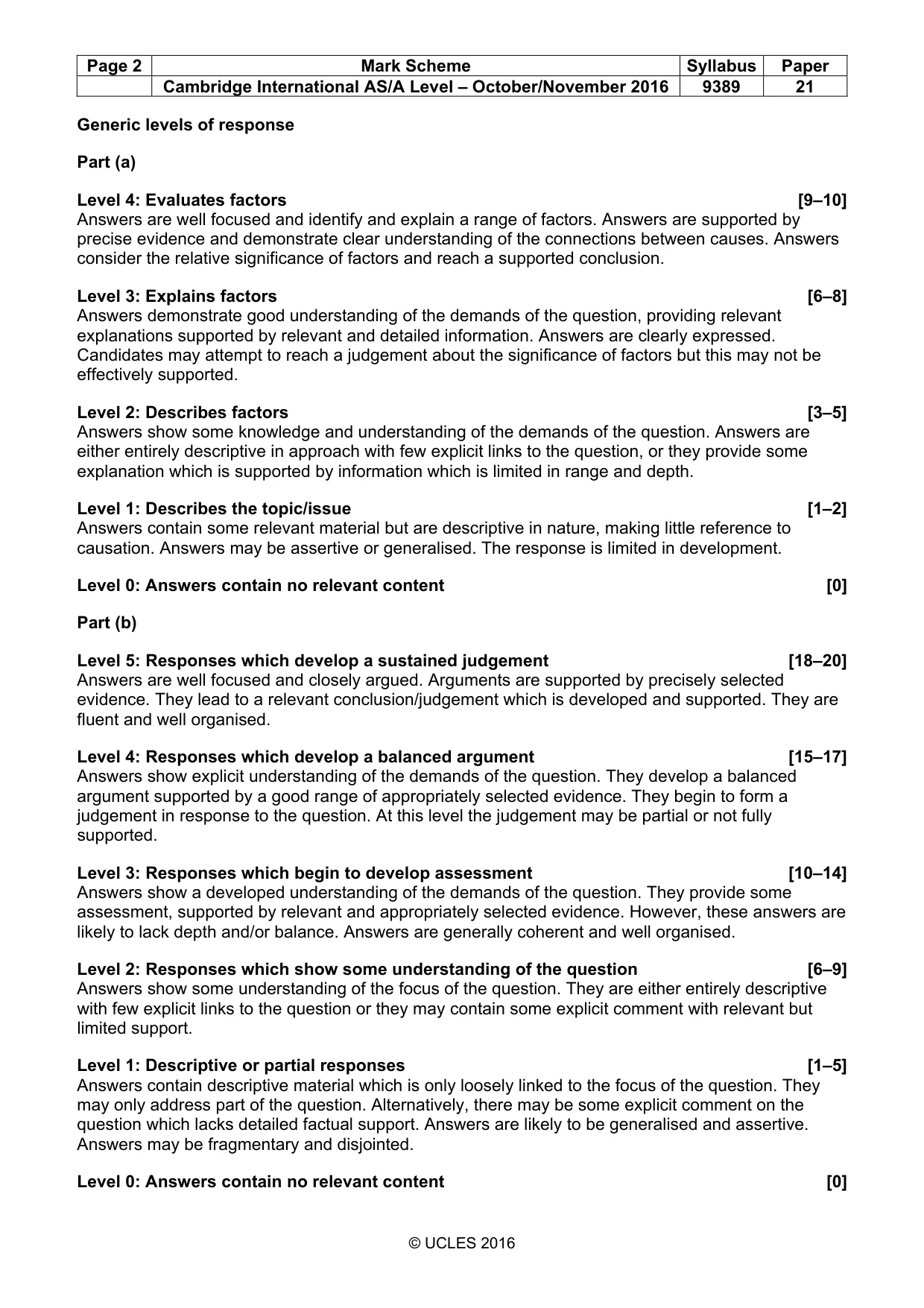
Page 2 Mark Scheme Syllabus Paper Cambridge International AS/A Level – October/November 2016 9389 21 © UCLES 2016 Generic levels of response Part (a) Level 4: Evaluates factors [9–10] Answers are well focused and identify and explain a range of factors. Answers are supported by precise evidence and demonstrate clear understanding of the connections between causes. Answers consider the relative significance of factors and reach a supported conclusion. Level 3: Explains factors [6–8] Answers demonstrate good understanding of the demands of the question, providing relevant explanations supported by relevant and detailed information. Answers are clearly expressed. Candidates may attempt to reach a judgement about the significance of factors but this may not be effectively supported. Level 2: Describes factors [3–5] Answers show some knowledge and understanding of the demands of the question. Answers are either entirely descriptive in approach with few explicit links to the question, or they provide some explanation which is supported by information which is limited in range and depth. Level 1: Describes the topic/issue [1–2] Answers contain some relevant material but are descriptive in nature, making little reference to causation. Answers may be assertive or generalised. The response is limited in development. Level 0: Answers contain no relevant content [0] Part (b) Level 5: Responses which develop a sustained judgement [18–20] Answers are well focused and closely argued. Arguments are supported by precisely selected evidence. They lead to a relevant conclusion/judgement which is developed and supported. They are fluent and well organised. Level 4: Responses which develop a balanced argument [15–17] Answers show explicit understanding of the demands of the question. They develop a balanced argument supported by a good range of appropriately selected evidence. They begin to form a judgement in response to the question. At this level the judgement may be partial or not fully supported. Level 3: Responses which begin to develop assessment [10–14] Answers show a developed understanding of the demands of the question. They provide some assessment, supported by relevant and appropriately selected evidence. However, these answers are likely to lack depth and/or balance. Answers are generally coherent and well organised. Level 2: Responses which show some understanding of the question [6–9] Answers show some understanding of the focus of the question. They are either entirely descriptive with few explicit links to the question or they may contain some explicit comment with relevant but limited support. Level 1: Descriptive or partial responses [1–5] Answers contain descriptive material which is only loosely linked to the focus of the question. They may only address part of the question. Alternatively, there may be some explicit comment on the question which lacks detailed factual support. Answers are likely to be generalised and assertive. Answers may be fragmentary and disjointed. Level 0: Answers contain no relevant content [0]
Mark scheme, page 3
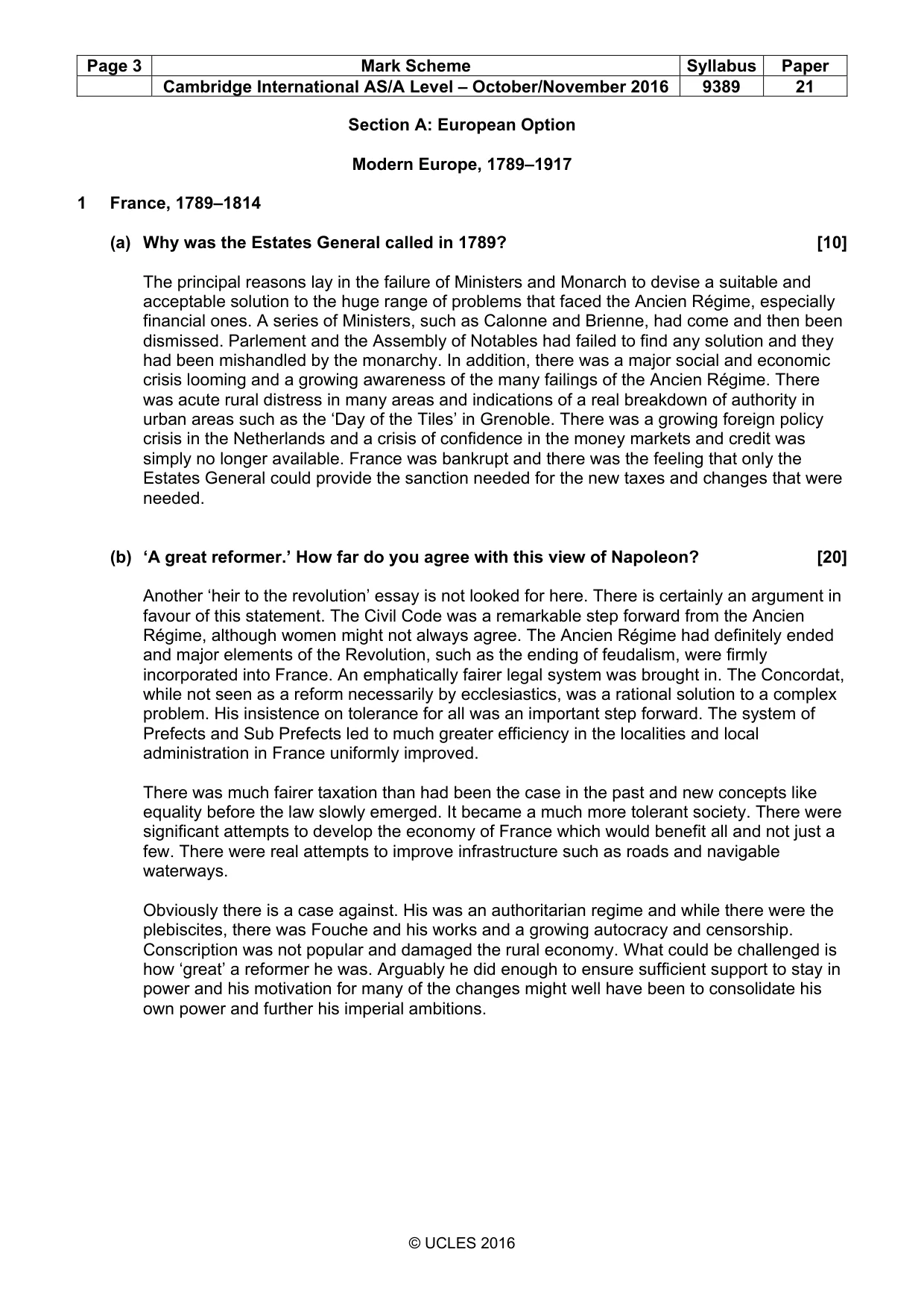
Page 3 Mark Scheme Syllabus Paper Cambridge International AS/A Level – October/November 2016 9389 21 © UCLES 2016 Section A: European Option Modern Europe, 1789–1917 1 France, 1789–1814 (a) Why was the Estates General called in 1789? [10] The principal reasons lay in the failure of Ministers and Monarch to devise a suitable and acceptable solution to the huge range of problems that faced the Ancien Régime, especially financial ones. A series of Ministers, such as Calonne and Brienne, had come and then been dismissed. Parlement and the Assembly of Notables had failed to find any solution and they had been mishandled by the monarchy. In addition, there was a major social and economic crisis looming and a growing awareness of the many failings of the Ancien Régime. There was acute rural distress in many areas and indications of a real breakdown of authority in urban areas such as the ‘Day of the Tiles’ in Grenoble. There was a growing foreign policy crisis in the Netherlands and a crisis of confidence in the money markets and credit was simply no longer available. France was bankrupt and there was the feeling that only the Estates General could provide the sanction needed for the new taxes and changes that were needed. (b) ‘A great reformer.’ How far do you agree with this view of Napoleon? [20] Another ‘heir to the revolution’ essay is not looked for here. There is certainly an argument in favour of this statement. The Civil Code was a remarkable step forward from the Ancien Régime, although women might not always agree. The Ancien Régime had definitely ended and major elements of the Revolution, such as the ending of feudalism, were firmly incorporated into France. An emphatically fairer legal system was brought in. The Concordat, while not seen as a reform necessarily by ecclesiastics, was a rational solution to a complex problem. His insistence on tolerance for all was an important step forward. The system of Prefects and Sub Prefects led to much greater efficiency in the localities and local administration in France uniformly improved. There was much fairer taxation than had been the case in the past and new concepts like equality before the law slowly emerged. It became a much more tolerant society. There were significant attempts to develop the economy of France which would benefit all and not just a few. There were real attempts to improve infrastructure such as roads and navigable waterways. Obviously there is a case against. His was an authoritarian regime and while there were the plebiscites, there was Fouche and his works and a growing autocracy and censorship. Conscription was not popular and damaged the rural economy. What could be challenged is how ‘great’ a reformer he was. Arguably he did enough to ensure sufficient support to stay in power and his motivation for many of the changes might well have been to consolidate his own power and further his imperial ambitions.
Mark scheme, page 4
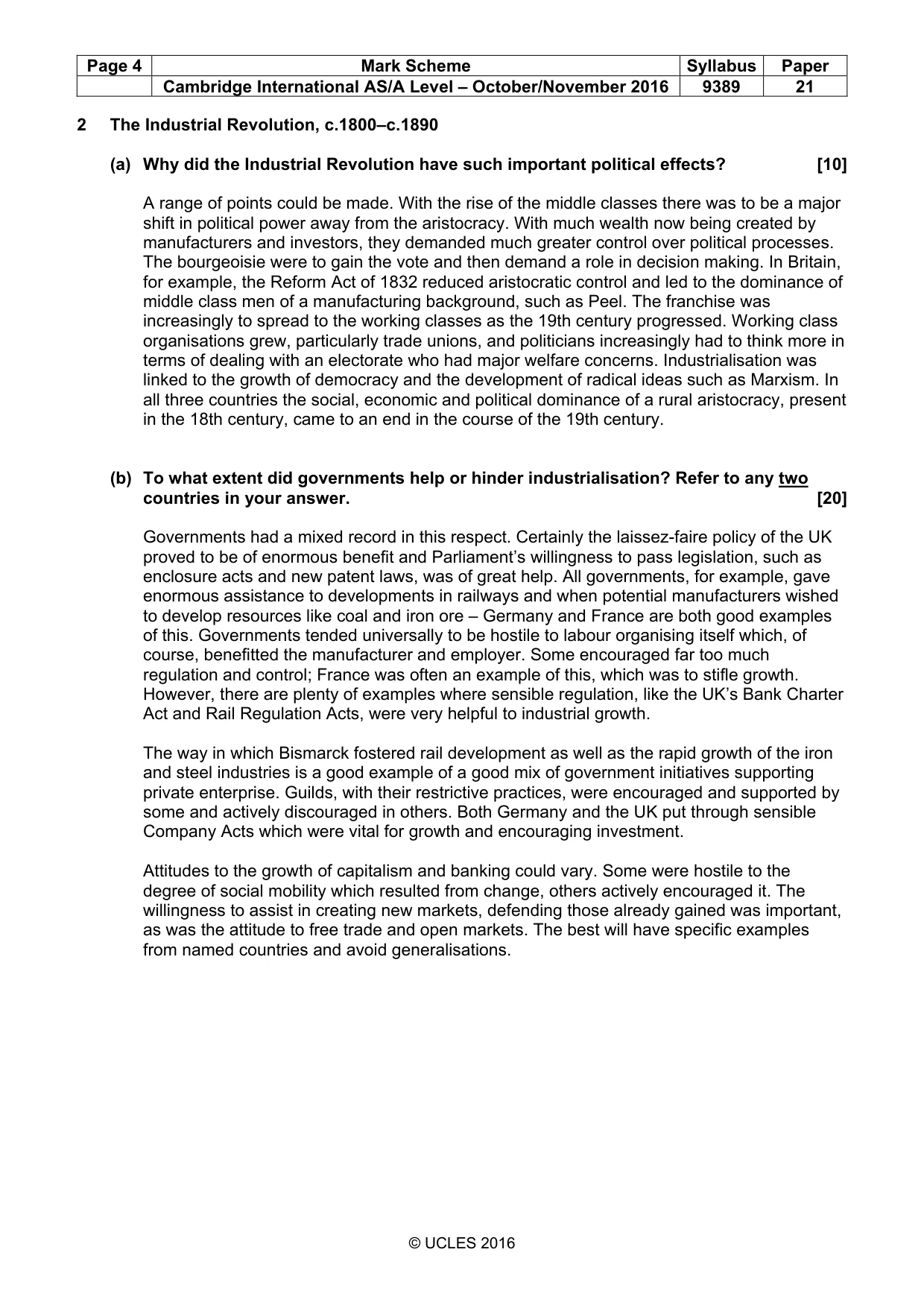
Page 4 Mark Scheme Syllabus Paper Cambridge International AS/A Level – October/November 2016 9389 21 © UCLES 2016 2 The Industrial Revolution, c.1800–c.1890 (a) Why did the Industrial Revolution have such important political effects? [10] A range of points could be made. With the rise of the middle classes there was to be a major shift in political power away from the aristocracy. With much wealth now being created by manufacturers and investors, they demanded much greater control over political processes. The bourgeoisie were to gain the vote and then demand a role in decision making. In Britain, for example, the Reform Act of 1832 reduced aristocratic control and led to the dominance of middle class men of a manufacturing background, such as Peel. The franchise was increasingly to spread to the working classes as the 19th century progressed. Working class organisations grew, particularly trade unions, and politicians increasingly had to think more in terms of dealing with an electorate who had major welfare concerns. Industrialisation was linked to the growth of democracy and the development of radical ideas such as Marxism. In all three countries the social, economic and political dominance of a rural aristocracy, present in the 18th century, came to an end in the course of the 19th century. (b) To what extent did governments help or hinder industrialisation? Refer to any two countries in your answer. [20] Governments had a mixed record in this respect. Certainly the laissez-faire policy of the UK proved to be of enormous benefit and Parliament’s willingness to pass legislation, such as enclosure acts and new patent laws, was of great help. All governments, for example, gave enormous assistance to developments in railways and when potential manufacturers wished to develop resources like coal and iron ore – Germany and France are both good examples of this. Governments tended universally to be hostile to labour organising itself which, of course, benefitted the manufacturer and employer. Some encouraged far too much regulation and control; France was often an example of this, which was to stifle growth. However, there are plenty of examples where sensible regulation, like the UK’s Bank Charter Act and Rail Regulation Acts, were very helpful to industrial growth. The way in which Bismarck fostered rail development as well as the rapid growth of the iron and steel industries is a good example of a good mix of government initiatives supporting private enterprise. Guilds, with their restrictive practices, were encouraged and supported by some and actively discouraged in others. Both Germany and the UK put through sensible Company Acts which were vital for growth and encouraging investment. Attitudes to the growth of capitalism and banking could vary. Some were hostile to the degree of social mobility which resulted from change, others actively encouraged it. The willingness to assist in creating new markets, defending those already gained was important, as was the attitude to free trade and open markets. The best will have specific examples from named countries and avoid generalisations.
Mark scheme, page 5
Page 5 Mark Scheme Syllabus Paper Cambridge International AS/A Level – October/November 2016 9389 21 © UCLES 2016 3 The Origins of World War I, c.1900–1914 (a) Why was Russia involved in the Balkans before the First World War? [10] After the disasters and humiliation of the Russo–Japanese War, Russia was anxious to take any opportunity to improve its international status and gain prestige. Russia had always shown an interest in expanding into the region and its ambitions in the Bosphorus and Dardanelles were well known. It was anxious to get support to revise the Treaties which had led to the closure of the Bosphorus and Dardanelles. It demonstrated regularly its hostility to Austria over its ambitions in the Balkans, and felt bitterly betrayed by Austria over its annexations there. Russia always made its commitment to supporting the Serbs very clear indeed and that was vital in its formulation of a pro-Serb policy and supporting Balkan nationalism generally. Like other powers, it viewed the failing Turkish Empire as something it could benefit from. The growth of German influence in Turkey after 1913 also encouraged Russia to take greater interest in the Balkans. Its role in the July crisis was critical as well, particularly over the Serb attitude towards the Austrian ultimatum. (b) How important was the role of militarism in causing the First World War? [20] It could be argued that it was more of an accelerant than a cause, but there is a good case to be made each way. Some definition of militarism should be there in the better answers. There are a wide range of factors which could be considered. Mobilisation plans dominated much military and also political thinking, and the Russian mobilisation in 1914 was to be a trigger to much of what was to happen. Conscription – the Germans were conscripting 280 000 men each year for military service, for example – was universal with the major European powers and led to huge armies with large reserves. Military thinking tended to dominate political thinking, even in democracies. All armies had major mobilisation plans. It was militarism which led to the Schlieffen Plan, a plan where the political implications were ignored and yet were to further the drift towards catastrophe. The Naval Race engendered great antipathy and fear and conscription led to mass armies ready for war. Organisations like the Navy Leagues and the National Service League in the UK just helped create an explosive atmosphere. It was the military conversations between France and Britain, for example, that were to have a substantial impact on British thinking in the critical days in 1914, with the British ‘commitment’ to support the French armies ‘left’ and the North Sea/Mediterranean arrangement for their navies. Ultimately, it was monarchs and political leaders who made the final decisions, but military factors were dominant in their minds.
Mark scheme, page 6
Page 6 Mark Scheme Syllabus Paper Cambridge International AS/A Level – October/November 2016 9389 21 © UCLES 2016 4 The Russian Revolution, c.1894–1917 (a) Why did the Provisional Government continue fighting the First World War? [10] Kerensky and others were well aware that France had supported Russia in 1914, and there was a genuine sense of commitment to Russia’s allies. They were also aware both of the monetary and moral debt owed by Russia. A deep sense of nationalism and awareness of the massive losses already sustained were also factors. A desire to gain credit for a victory was there and there was huge Allied pressure to stay in the war. There was also the inability to take the radical decisions needed to leave the war and Allied recognition for the new regime was also seen to be important. Kerensky had been Minister for War, and that may have been an influential factor. He was anxious to gain the prestige that would come from military victory and he hoped that his allies would be successful in their offensives on the Western Front in 1917. He felt that military defeat in the East would lead to the disintegration of Russia as he was aware of what the Germans would demand as a price. He knew that leaving the war would be seen as a betrayal of Russian interests, and while not responsible for bringing Russia into the war, or for the catastrophic results of the war for Russia, he knew he would take the blame. (b) ‘There was limited opposition to the Tsarist regime between 1906 and 1914.’ How far do you agree? [20] This is arguable. There were plenty of those who disagreed with much of what the regime did, but it was so diverse and uncoordinated that in total it did not amount to a great deal. It was the disunity of the opposition that made it quite limited in impact. Obviously the radical left wished totally to change the regime and hoped for fundamental change in both the economic and social structure of Russia. However, there were huge divisions within the Left with endless disputes between the Bolsheviks, Mensheviks and Social Revolutionaries. Some of the aristocracy were badly alienated by the ‘softness’ of the October Manifesto, while others formed an important part of the Kadet Party. The Kadets, however, disagreed strongly with the Octobrists. Many middle class wanted a constitutional solution to Russia’s problems, and, while disagreeing with Tsarist policies, saw the Tsar as part of the solution and it took the war to alienate them totally, although the Tsar’s attitude to the Duma alienated many. The army and the peasantry remained basically loyal, and again it took the appalling stresses of the war to alienate them. However there was a gradual breakdown of order in the countryside with increasing peasant takeover of lands. There was a substantial growth of Unions and little was done to deal with industrial unrest as the Lena goldfield crisis of 1912 showed. There were constant minor mutinies in the army and navy. The Okrahna proved effective and there was ruthless enforcement of policy by Stolypin – over 2700 were executed by his ‘neckties’. Much depends on how ‘limited’ is viewed; opposition was frequently radical but never co-ordinated.
Mark scheme, page 7
Page 7 Mark Scheme Syllabus Paper Cambridge International AS/A Level – October/November 2016 9389 21 © UCLES 2016 Section B: American Option The History of the USA, 1840–1941 5 The Expansion of US Power from the 1840s to the 1930s (a) Explain why, in 1898, the USA went to war with Spain. [10] The traditional explanation is that, following the destruction of the USS Maine in Havana harbour in February 1898, (a) the yellow press of Hearst and Pulitzer (b) excited the American public into (c) influencing US politicians in Congress and a weak President in the White House to go to war in order to help the Cuban people who, since 1895, had been fighting a war of liberation. The reality was more complicated. The war with Spain was a war fought to further American economic interests at least as much as the cause of Cuban freedom. Intervention would help control the process of independence, preventing the establishment of a black republic, similar to that in Haiti almost a century before. The aim was as much to restore the order which US business interests required as it was to end some four hundred years of Spanish rule in the interests of the Cuban people. By the 1890s, the decade when the internal frontier of the USA was declared closed, some Americans were starting to consider overseas expansion. The decade was a high-water mark of imperialism, Germany and Japan being new powers with global ambitions. America could not afford to miss out, such people believed. They influenced the decision of Congress and President McKinley to go to war with Spain – a war which involved conflict in the Philippines as well. (b) How far did the purchase of Alaska by the USA deserve to be called ‘Seward’s Folly’? [20] Though the origin of the phrase remains obscure, the description was contemporary and very quickly became popular. There are several reasons why the purchase of Russian America for $7.2m might be seen as a big mistake. One was financial: there was an (unfounded) belief that Russia was prepared to make a gift of its territory in North America. Linked with this were questions about the cost of administering such a vast and underpopulated territory in the future. A second was the belief that the land had been bought not to benefit the USA but more to deflect public attention away from domestic events such as the impeachment of President Johnson. A third criticism was that the purchase was a foolish move by a Secretary of State with unrealistic ambitions for the USA. Seward was an expansionist, seeking to acquire new lands for both commercial and political reasons. He was keen to build the USA into a more active regional and even global power. Most of his plans came to naught. Alaska almost fell into his lap – though he paid $2m more than he had wanted to. [Though Russian motives are not relevant to this question, the Tsar was keen to get rid of Alaska. It was potential hostage to war in any conflict with its traditional enemy, Britain. Also Russia needed the money to help pay for emancipation of the serfs.] The deal was quickly done, which was a further cause of criticism. On the other side of the argument, the case for Seward having made a wise purchase has two strands. One concerns his strategic vision for the USA. Establishing a presence in the further north west of North America did expand the range of American interests. These included economic benefits such as the trade in ice – shipped to California – and in fishing and whaling. Even if Seward’s plans to use the purchase to pressurise British Colombia to join the USA did not work out, the purchase still made the USA the dominant power in the region. Contemporary rumours that gold had been discovered in Alaska did not become reality until the 1890s, but its doing so put paid to the negative view of the acquisition of Alaska once and for all. The purchase of Alaska might have been a short-term folly; it was certainly a long-term success.
Mark scheme, page 8
Page 8 Mark Scheme Syllabus Paper Cambridge International AS/A Level – October/November 2016 9389 21 © UCLES 2016 6 Civil War and Reconstruction, 1861–1877 (a) Why, in 1876–77, did the North abandon the policy of Reconstruction? [10] The main reasons for doing so followed from the economic depression, usually labelled the Long Depression, which lasted for five years from 1873 to 1879. The depression resulted in labour unrest in the industrial north-east and agitation by the farmers of the west. Politicians’ attentions turned away from the South. The governing Republican party lost popularity and in 1874 control of Congress; that result meant the end of Reconstruction. The Republican party kept control of the Presidency in 1876 only by the so-called Compromise or bargain of 1877 with the Democratic party. A practical consequence of that deal was that Republican policies to reconstruct the South were finally abandoned. Federal forces were no longer used to uphold new constitutional rights. In reality, the Republicans had been losing the will to impose their egalitarian policies on the South for some time. The second term of Grant’s presidency coincided with the Long Depression at its worst. The Republican party, essentially a Northern party, turned its attention to more urgent matters than the reconstruction of the South, which won it few votes. The Enforcement Acts of 1870 and the Ku Klux Klan Act of 1871 had been the high-water mark of federal intervention. Thereafter, the Democrats started to gain control of states such as North Carolina, Georgia and Alabama. (b) How great was the damage to life in the South during the Civil War? [20] The damage was certainly great. The casualty rates of Southern soldiers were higher than those in the North. Emancipation of the slaves, either by the slaves themselves or by advancing federal forces, disrupted plantation life, often requiring women to do the work previously done by slaves. White family life suffered: nuclear families were separated, extended families divided. The ‘black flight’ to makeshift refugee camps behind Northern lines weakened an economy founded on slavery. The value of the Confederate dollar deteriorated rapidly as the government failed to establish a soundly-based currency. By April 1863, women in Richmond, Virginia, rioted in protest at the shortage of bread. The expanding powers of the Confederal government caused resentment in many Southern states, e.g. Georgia. Divisions emerged within Southern society, especially given the exclusion of the landed class from some of the harsher wartime policies, e.g. conscription. More voiced the view that the struggle to secede was ‘a rich man’s war and a poor man’s fight’. The Northern blockade meant an increasing shortage of both imports and exports, which hit the Southern economy hard. Thus the longer the war lasted, the worse the damage became. This was especially true of Georgia and South Carolina which suffered Sherman’s March to the Sea in late 1864. Many women and children became refugees. By the end of the war, the wealth of the South was 40% of that of the North, so great was the impact of four years of war. The damage was so great that for many decades the South was the poorest, most neglected part of the USA. There is plenty to argue about.
Mark scheme, page 9
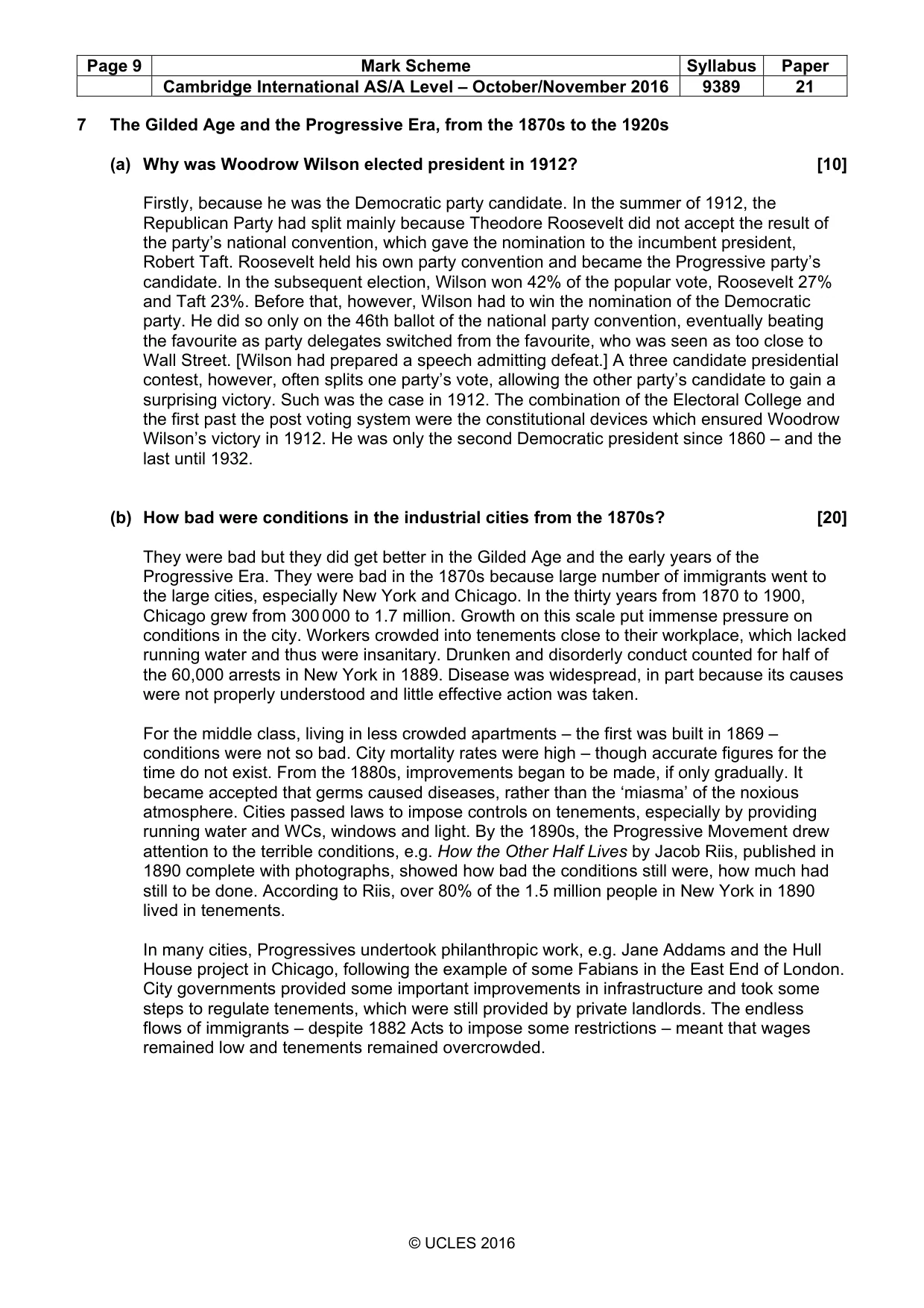
Page 9 Mark Scheme Syllabus Paper Cambridge International AS/A Level – October/November 2016 9389 21 © UCLES 2016 7 The Gilded Age and the Progressive Era, from the 1870s to the 1920s (a) Why was Woodrow Wilson elected president in 1912? [10] Firstly, because he was the Democratic party candidate. In the summer of 1912, the Republican Party had split mainly because Theodore Roosevelt did not accept the result of the party’s national convention, which gave the nomination to the incumbent president, Robert Taft. Roosevelt held his own party convention and became the Progressive party’s candidate. In the subsequent election, Wilson won 42% of the popular vote, Roosevelt 27% and Taft 23%. Before that, however, Wilson had to win the nomination of the Democratic party. He did so only on the 46th ballot of the national party convention, eventually beating the favourite as party delegates switched from the favourite, who was seen as too close to Wall Street. [Wilson had prepared a speech admitting defeat.] A three candidate presidential contest, however, often splits one party’s vote, allowing the other party’s candidate to gain a surprising victory. Such was the case in 1912. The combination of the Electoral College and the first past the post voting system were the constitutional devices which ensured Woodrow Wilson’s victory in 1912. He was only the second Democratic president since 1860 – and the last until 1932. (b) How bad were conditions in the industrial cities from the 1870s? [20] They were bad but they did get better in the Gilded Age and the early years of the Progressive Era. They were bad in the 1870s because large number of immigrants went to the large cities, especially New York and Chicago. In the thirty years from 1870 to 1900, Chicago grew from 300 000 to 1.7 million. Growth on this scale put immense pressure on conditions in the city. Workers crowded into tenements close to their workplace, which lacked running water and thus were insanitary. Drunken and disorderly conduct counted for half of the 60,000 arrests in New York in 1889. Disease was widespread, in part because its causes were not properly understood and little effective action was taken. For the middle class, living in less crowded apartments – the first was built in 1869 – conditions were not so bad. City mortality rates were high – though accurate figures for the time do not exist. From the 1880s, improvements began to be made, if only gradually. It became accepted that germs caused diseases, rather than the ‘miasma’ of the noxious atmosphere. Cities passed laws to impose controls on tenements, especially by providing running water and WCs, windows and light. By the 1890s, the Progressive Movement drew attention to the terrible conditions, e.g. How the Other Half Lives by Jacob Riis, published in 1890 complete with photographs, showed how bad the conditions still were, how much had still to be done. According to Riis, over 80% of the 1.5 million people in New York in 1890 lived in tenements. In many cities, Progressives undertook philanthropic work, e.g. Jane Addams and the Hull House project in Chicago, following the example of some Fabians in the East End of London. City governments provided some important improvements in infrastructure and took some steps to regulate tenements, which were still provided by private landlords. The endless flows of immigrants – despite 1882 Acts to impose some restrictions – meant that wages remained low and tenements remained overcrowded.
Mark scheme, page 10
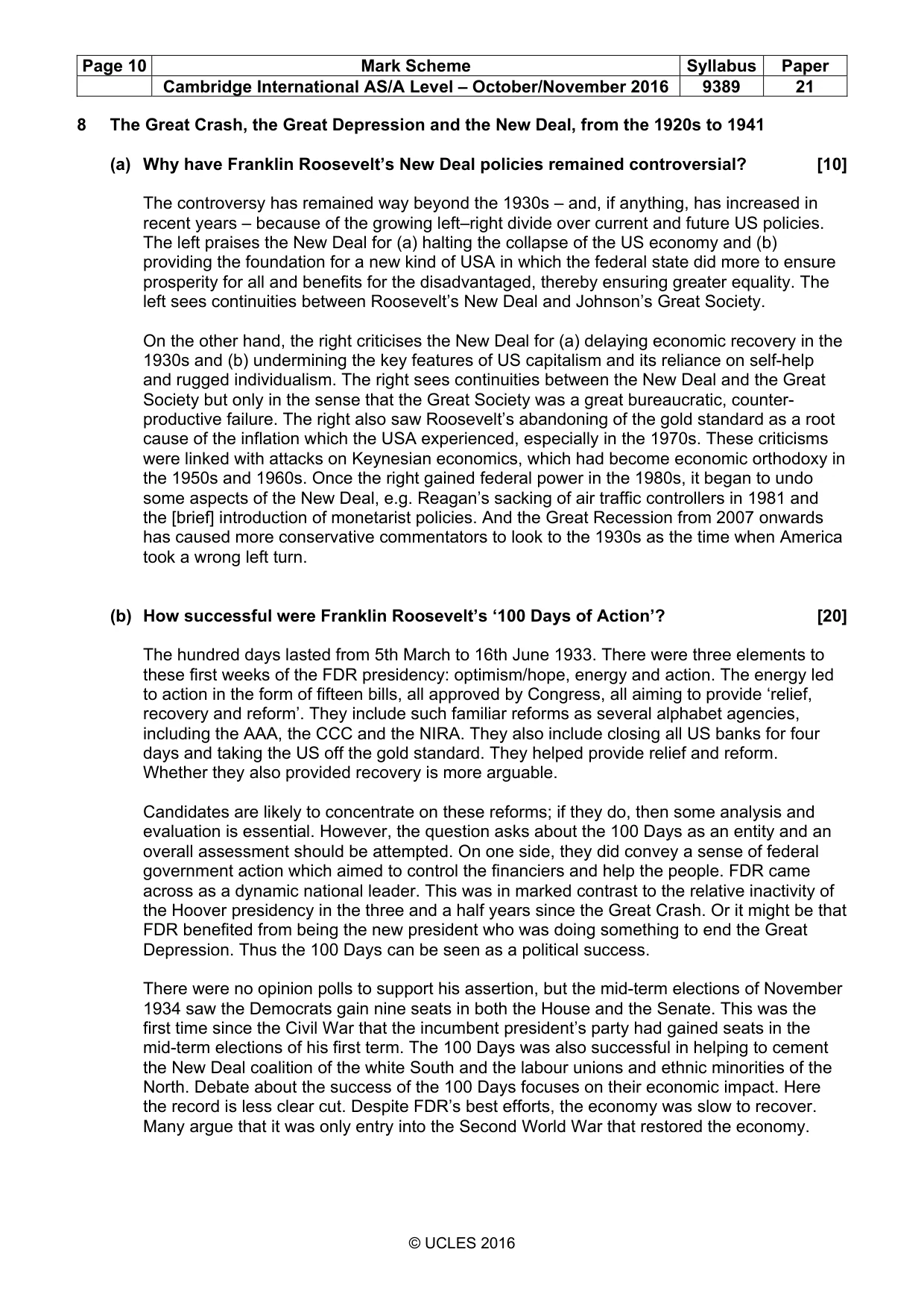
Page 10 Mark Scheme Syllabus Paper Cambridge International AS/A Level – October/November 2016 9389 21 © UCLES 2016 8 The Great Crash, the Great Depression and the New Deal, from the 1920s to 1941 (a) Why have Franklin Roosevelt’s New Deal policies remained controversial? [10] The controversy has remained way beyond the 1930s – and, if anything, has increased in recent years – because of the growing left–right divide over current and future US policies. The left praises the New Deal for (a) halting the collapse of the US economy and (b) providing the foundation for a new kind of USA in which the federal state did more to ensure prosperity for all and benefits for the disadvantaged, thereby ensuring greater equality. The left sees continuities between Roosevelt’s New Deal and Johnson’s Great Society. On the other hand, the right criticises the New Deal for (a) delaying economic recovery in the 1930s and (b) undermining the key features of US capitalism and its reliance on self-help and rugged individualism. The right sees continuities between the New Deal and the Great Society but only in the sense that the Great Society was a great bureaucratic, counter- productive failure. The right also saw Roosevelt’s abandoning of the gold standard as a root cause of the inflation which the USA experienced, especially in the 1970s. These criticisms were linked with attacks on Keynesian economics, which had become economic orthodoxy in the 1950s and 1960s. Once the right gained federal power in the 1980s, it began to undo some aspects of the New Deal, e.g. Reagan’s sacking of air traffic controllers in 1981 and the [brief] introduction of monetarist policies. And the Great Recession from 2007 onwards has caused more conservative commentators to look to the 1930s as the time when America took a wrong left turn. (b) How successful were Franklin Roosevelt’s ‘100 Days of Action’? [20] The hundred days lasted from 5th March to 16th June 1933. There were three elements to these first weeks of the FDR presidency: optimism/hope, energy and action. The energy led to action in the form of fifteen bills, all approved by Congress, all aiming to provide ‘relief, recovery and reform’. They include such familiar reforms as several alphabet agencies, including the AAA, the CCC and the NIRA. They also include closing all US banks for four days and taking the US off the gold standard. They helped provide relief and reform. Whether they also provided recovery is more arguable. Candidates are likely to concentrate on these reforms; if they do, then some analysis and evaluation is essential. However, the question asks about the 100 Days as an entity and an overall assessment should be attempted. On one side, they did convey a sense of federal government action which aimed to control the financiers and help the people. FDR came across as a dynamic national leader. This was in marked contrast to the relative inactivity of the Hoover presidency in the three and a half years since the Great Crash. Or it might be that FDR benefited from being the new president who was doing something to end the Great Depression. Thus the 100 Days can be seen as a political success. There were no opinion polls to support his assertion, but the mid-term elections of November 1934 saw the Democrats gain nine seats in both the House and the Senate. This was the first time since the Civil War that the incumbent president’s party had gained seats in the mid-term elections of his first term. The 100 Days was also successful in helping to cement the New Deal coalition of the white South and the labour unions and ethnic minorities of the North. Debate about the success of the 100 Days focuses on their economic impact. Here the record is less clear cut. Despite FDR’s best efforts, the economy was slow to recover. Many argue that it was only entry into the Second World War that restored the economy.
Mark scheme, page 11
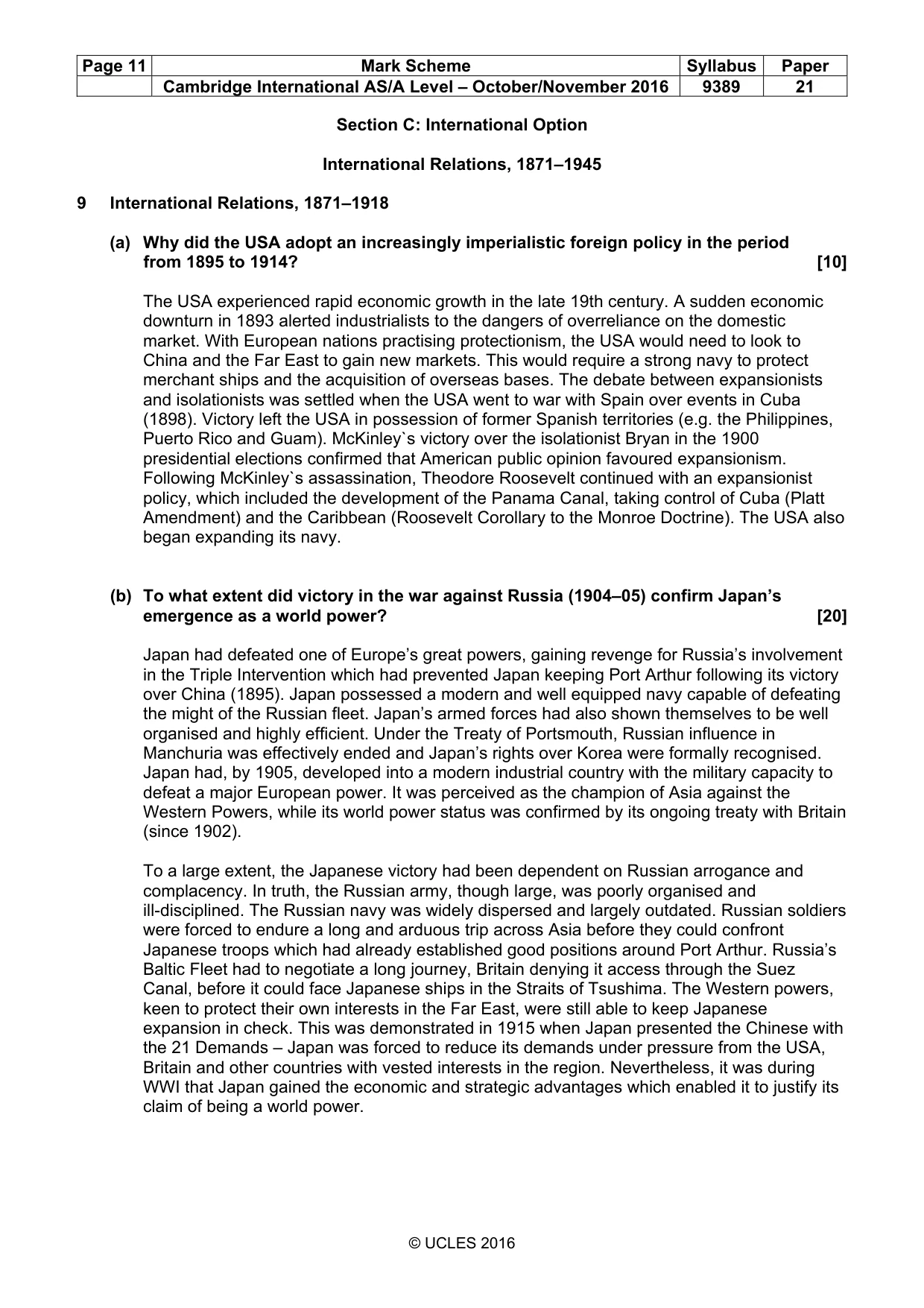
Page 11 Mark Scheme Syllabus Paper Cambridge International AS/A Level – October/November 2016 9389 21 © UCLES 2016 Section C: International Option International Relations, 1871–1945 9 International Relations, 1871–1918 (a) Why did the USA adopt an increasingly imperialistic foreign policy in the period from 1895 to 1914? [10] The USA experienced rapid economic growth in the late 19th century. A sudden economic downturn in 1893 alerted industrialists to the dangers of overreliance on the domestic market. With European nations practising protectionism, the USA would need to look to China and the Far East to gain new markets. This would require a strong navy to protect merchant ships and the acquisition of overseas bases. The debate between expansionists and isolationists was settled when the USA went to war with Spain over events in Cuba (1898). Victory left the USA in possession of former Spanish territories (e.g. the Philippines, Puerto Rico and Guam). McKinley`s victory over the isolationist Bryan in the 1900 presidential elections confirmed that American public opinion favoured expansionism. Following McKinley`s assassination, Theodore Roosevelt continued with an expansionist policy, which included the development of the Panama Canal, taking control of Cuba (Platt Amendment) and the Caribbean (Roosevelt Corollary to the Monroe Doctrine). The USA also began expanding its navy. (b) To what extent did victory in the war against Russia (1904–05) confirm Japan’s emergence as a world power? [20] Japan had defeated one of Europe’s great powers, gaining revenge for Russia’s involvement in the Triple Intervention which had prevented Japan keeping Port Arthur following its victory over China (1895). Japan possessed a modern and well equipped navy capable of defeating the might of the Russian fleet. Japan’s armed forces had also shown themselves to be well organised and highly efficient. Under the Treaty of Portsmouth, Russian influence in Manchuria was effectively ended and Japan’s rights over Korea were formally recognised. Japan had, by 1905, developed into a modern industrial country with the military capacity to defeat a major European power. It was perceived as the champion of Asia against the Western Powers, while its world power status was confirmed by its ongoing treaty with Britain (since 1902). To a large extent, the Japanese victory had been dependent on Russian arrogance and complacency. In truth, the Russian army, though large, was poorly organised and ill-disciplined. The Russian navy was widely dispersed and largely outdated. Russian soldiers were forced to endure a long and arduous trip across Asia before they could confront Japanese troops which had already established good positions around Port Arthur. Russia’s Baltic Fleet had to negotiate a long journey, Britain denying it access through the Suez Canal, before it could face Japanese ships in the Straits of Tsushima. The Western powers, keen to protect their own interests in the Far East, were still able to keep Japanese expansion in check. This was demonstrated in 1915 when Japan presented the Chinese with the 21 Demands – Japan was forced to reduce its demands under pressure from the USA, Britain and other countries with vested interests in the region. Nevertheless, it was during WWI that Japan gained the economic and strategic advantages which enabled it to justify its claim of being a world power.
Mark scheme, page 12
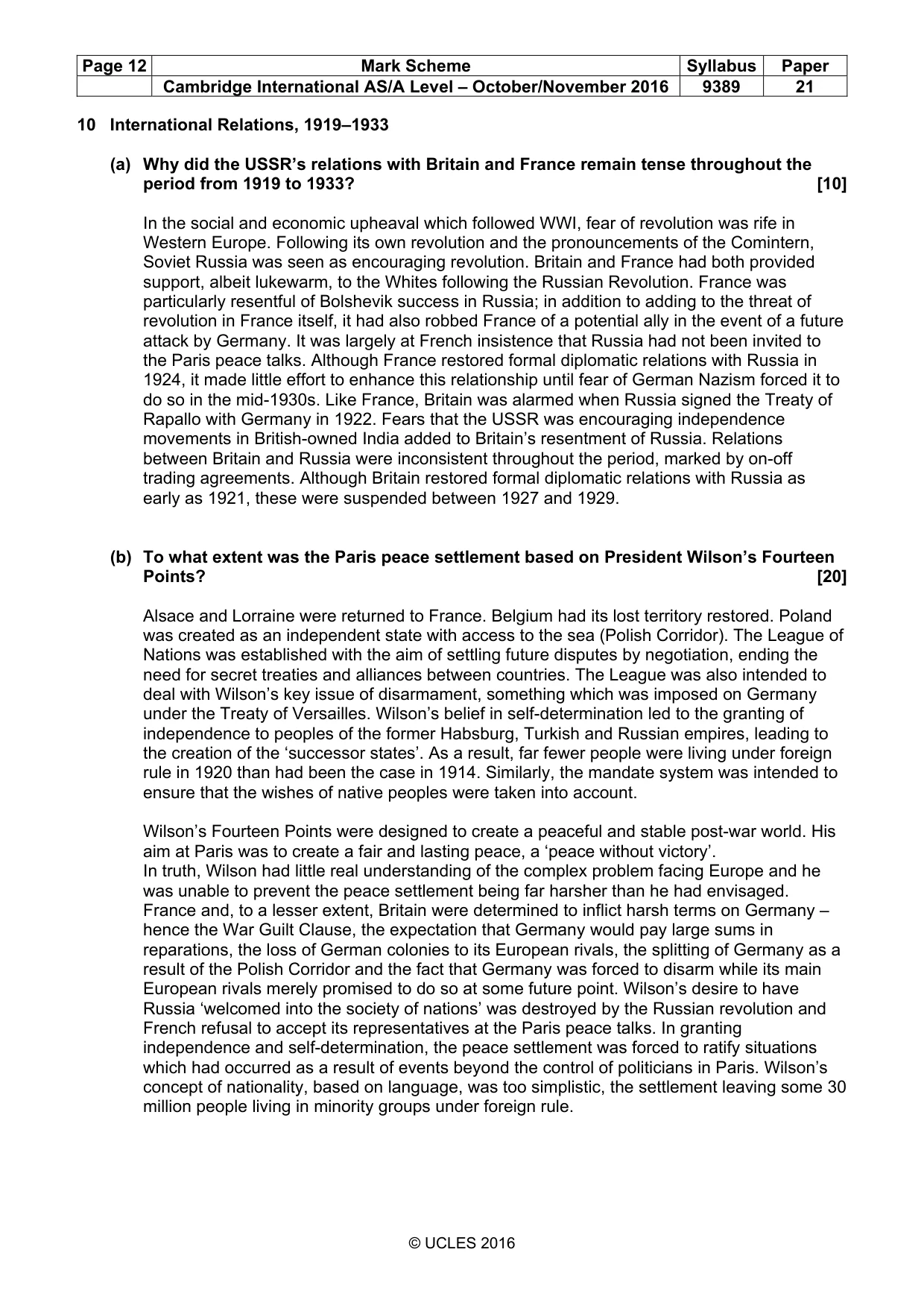
Page 12 Mark Scheme Syllabus Paper Cambridge International AS/A Level – October/November 2016 9389 21 © UCLES 2016 10 International Relations, 1919–1933 (a) Why did the USSR’s relations with Britain and France remain tense throughout the period from 1919 to 1933? [10] In the social and economic upheaval which followed WWI, fear of revolution was rife in Western Europe. Following its own revolution and the pronouncements of the Comintern, Soviet Russia was seen as encouraging revolution. Britain and France had both provided support, albeit lukewarm, to the Whites following the Russian Revolution. France was particularly resentful of Bolshevik success in Russia; in addition to adding to the threat of revolution in France itself, it had also robbed France of a potential ally in the event of a future attack by Germany. It was largely at French insistence that Russia had not been invited to the Paris peace talks. Although France restored formal diplomatic relations with Russia in 1924, it made little effort to enhance this relationship until fear of German Nazism forced it to do so in the mid-1930s. Like France, Britain was alarmed when Russia signed the Treaty of Rapallo with Germany in 1922. Fears that the USSR was encouraging independence movements in British-owned India added to Britain’s resentment of Russia. Relations between Britain and Russia were inconsistent throughout the period, marked by on-off trading agreements. Although Britain restored formal diplomatic relations with Russia as early as 1921, these were suspended between 1927 and 1929. (b) To what extent was the Paris peace settlement based on President Wilson’s Fourteen Points? [20] Alsace and Lorraine were returned to France. Belgium had its lost territory restored. Poland was created as an independent state with access to the sea (Polish Corridor). The League of Nations was established with the aim of settling future disputes by negotiation, ending the need for secret treaties and alliances between countries. The League was also intended to deal with Wilson’s key issue of disarmament, something which was imposed on Germany under the Treaty of Versailles. Wilson’s belief in self-determination led to the granting of independence to peoples of the former Habsburg, Turkish and Russian empires, leading to the creation of the ‘successor states’. As a result, far fewer people were living under foreign rule in 1920 than had been the case in 1914. Similarly, the mandate system was intended to ensure that the wishes of native peoples were taken into account. Wilson’s Fourteen Points were designed to create a peaceful and stable post-war world. His aim at Paris was to create a fair and lasting peace, a ‘peace without victory’. In truth, Wilson had little real understanding of the complex problem facing Europe and he was unable to prevent the peace settlement being far harsher than he had envisaged. France and, to a lesser extent, Britain were determined to inflict harsh terms on Germany – hence the War Guilt Clause, the expectation that Germany would pay large sums in reparations, the loss of German colonies to its European rivals, the splitting of Germany as a result of the Polish Corridor and the fact that Germany was forced to disarm while its main European rivals merely promised to do so at some future point. Wilson’s desire to have Russia ‘welcomed into the society of nations’ was destroyed by the Russian revolution and French refusal to accept its representatives at the Paris peace talks. In granting independence and self-determination, the peace settlement was forced to ratify situations which had occurred as a result of events beyond the control of politicians in Paris. Wilson’s concept of nationality, based on language, was too simplistic, the settlement leaving some 30 million people living in minority groups under foreign rule.
Mark scheme, page 13
Page 13 Mark Scheme Syllabus Paper Cambridge International AS/A Level – October/November 2016 9389 21 © UCLES 2016 11 International Relations, c.1933–1939 (a) Why did Britain follow a policy of appeasement during the 1930s? [10] In hindsight, appeasement may appear foolish, but there seemed to be compelling reasons for adopting this policy at the time. British public opinion was strongly against involvement in another war. Due to the world economic crisis, Britain did not want the expense of extensive rearmament. British businessmen and industrialists had a vested interest in the resurgence of the German economy. Many British politicians believed that the Treaty of Versailles had been too harsh on Germany and that Hitler was merely addressing genuine grievances. They were convinced that Hitler’s aggression would cease as soon as this unfair Treaty had been destroyed. Communism was still perceived as the gravest threat facing Britain; a strong Germany was seen as a valued buffer against communism. Similarly, Italy was seen as a strong ally against any possible future aggression by Germany – the Italian alliance was, therefore, seen as more important than opposing Mussolini over his actions in Abyssinia. As long as British interests in the Far East were not adversely affected, Britain could see no reason to go to war in defence of China against Japanese aggression. The Spanish Civil War was seen as an internal Spanish matter and, as such, Britain had no reason or right to get involved. (b) ‘Essentially a struggle between fascism and communism.’ How accurate is this assessment of the Spanish Civil War? [20] The army officers who began a revolt in July 1936 worked in collaboration with the Spanish fascist party (Falange) formed by José Antonio Primo de Rivera in 1933. As leader of the Nationalist forces, Franco sought assistance from Europe’s two fascist states, Italy and Germany, claiming that he was fighting to prevent a communist revolution in Spain. Public opinion in the democratic states of Britain, France and the USA, already concerned by Mussolini’s invasion of Abyssinia and Hitler’s occupation of the Rhineland, perceived Franco as another brutal fascist dictator determined to seize power. However, they did not come to the aid of the Republicans, arguing that the war was an internal Spanish issue; moreover, they did not want a communist government in Spain. Communist politicians tended to be the most vociferous in advocating the Republican cause. The USSR supported the Republicans because it did not want Spain to become yet another fascist state which might pose a threat to its own security. The Spanish Civil War was the result of political, economic, social and regional divisions within Spain. Constitutional monarchy in Spain was not strong enough to cope with these divisions and the additional problems caused by the world economic crisis. As a result, the King abdicated and the government of Spain oscillated between left-wing and right-wing parties. The left-wing comprised a variety of groups – socialists, separatists, anarchists, liberals and communists. The right-wing similarly consisted of various groups – monarchists, the Church, the army, the Falangists. The issue was, therefore, not specifically communist versus fascist, but how best to govern Spain. Army officers decided that the only method likely to succeed was military dictatorship (which had worked under Miguel Primo de Rivera, 1923–30, until he lost the support of the army). Like Primo de Rivera, once in power Franco did not follow the typical pattern of a fascist leader. While the involvement of Italy, Germany and the USSR gave the Spanish Civil War the appearance of a struggle between fascism and communism, this was not the real issue facing Spain.
Mark scheme, page 14
Page 14 Mark Scheme Syllabus Paper Cambridge International AS/A Level – October/November 2016 9389 21 © UCLES 2016 12 China and Japan, 1919–1945 (a) Why did Japanese expansion during the 1930s cause concern to the USA? [10] Still following its isolationist policy, the USA could see no reason to protect China against Japanese aggression. However, the USA was concerned about protecting its own national interests in the region, particularly in maintaining the ‘open door’ trading policy. Under its military dictatorship, Japan was breaking the agreements which it had made at the Washington Naval Conference (1921–22), and the growth of its naval power posed a threat to American bases in the region. President Franklin Roosevelt was fully aware of Japan’s plans for further territorial acquisitions and the threat which this posed to American interests. He argued that the USA should go to war against Japan, but his views were rejected by the heavily isolationist American people. Although Japan’s government continued to claim that it wanted peace and carried on diplomatic negotiations with the USA, the Japanese acquisition of French Indochina posed a significant threat to American interests. As a result, the USA introduced economic sanctions against Japan. Having cracked the Japanese code, American intelligence was aware that an attack on an American Pacific base was imminent, but did not know the exact location. The attack on Pearl Harbor confirmed that Roosevelt had been right all along regarding Japanese intentions. (b) To what extent was the unpopularity of the Kuomintang during the 1930s due to its failure to carry out social reforms? [20] One of the main reasons for the success of the KMT’s Northern March was its widespread appeal in China. Much of its support came from peasants and factory workers, attracted by the promise of land redistribution and industrial cooperatives. In reality, these promises were the result of the KMT’s liaison with the CCP. Once in power, Chiang ended this liaison, murdering many trade union and peasant leaders. His government’s main priority was to protect the interests of businessmen, bankers, factory owners and wealthy landowners. As a result, conditions in factories and other industrial establishments remained poor. When laws were passed (e.g. banning child labour in textile factories), they were not enforced. Similarly, nothing was done to alleviate the conditions of the largest section of the Chinese population, the peasants. As leader of the CCP, Mao was able to exploit this growing resentment against the KMT government. He portrayed the CCP as the party which represented the poor and disadvantaged, making effective use of propaganda to enhance his case. It was the KMT’s ability to defeat the hated warlords, together with the communists’ promise of land redistribution and industrial cooperatives, which had originally gained it support. Ending the collaboration with the CCP, through the violent Purification Movement, gave the impression that Chiang was more concerned with maintaining his own power (and that of the KMT) than in helping the people of China. Through clever use of propaganda, Mao was able to exploit this and, as support for the CCP grew among the disadvantaged, so support for the KMT declined. Chiang’s failure to defeat the CCP during its Long March gave Mao further propaganda material, and also allowed the CCP to establish a safe base in Shensi Province. Chiang’s decision to continue fighting the CCP rather than Japanese invaders also lost the KMT support – Mao was able to portray the CCP as the true party of Chinese nationalism. The fact that Chiang was held prisoner by some of his own KMT troops and was forced to restore liaison with the CCP to address the issue of Japanese aggression is further evidence of his inability to maintain popular support.
What you needed in this session
Cambridge’s own grade thresholds for 2016 Oct/Nov, Paper 2 · Variant 1. A higher threshold means an easier paper — the bar moves with how the cohort did.