Cambridge A Level History 9389 — 2016 Oct/Nov Paper 1 · Variant 2
9389/12/O/N/16 · 40 marks · ≈45 min
The question paper and its mark scheme, free to read here and free to download. This is Cambridge’s own paper, exactly as it was sat.
Question paper8 pages
Mark scheme9 pages
Answers below. Sit the paper first if you are practising.
Paper as text
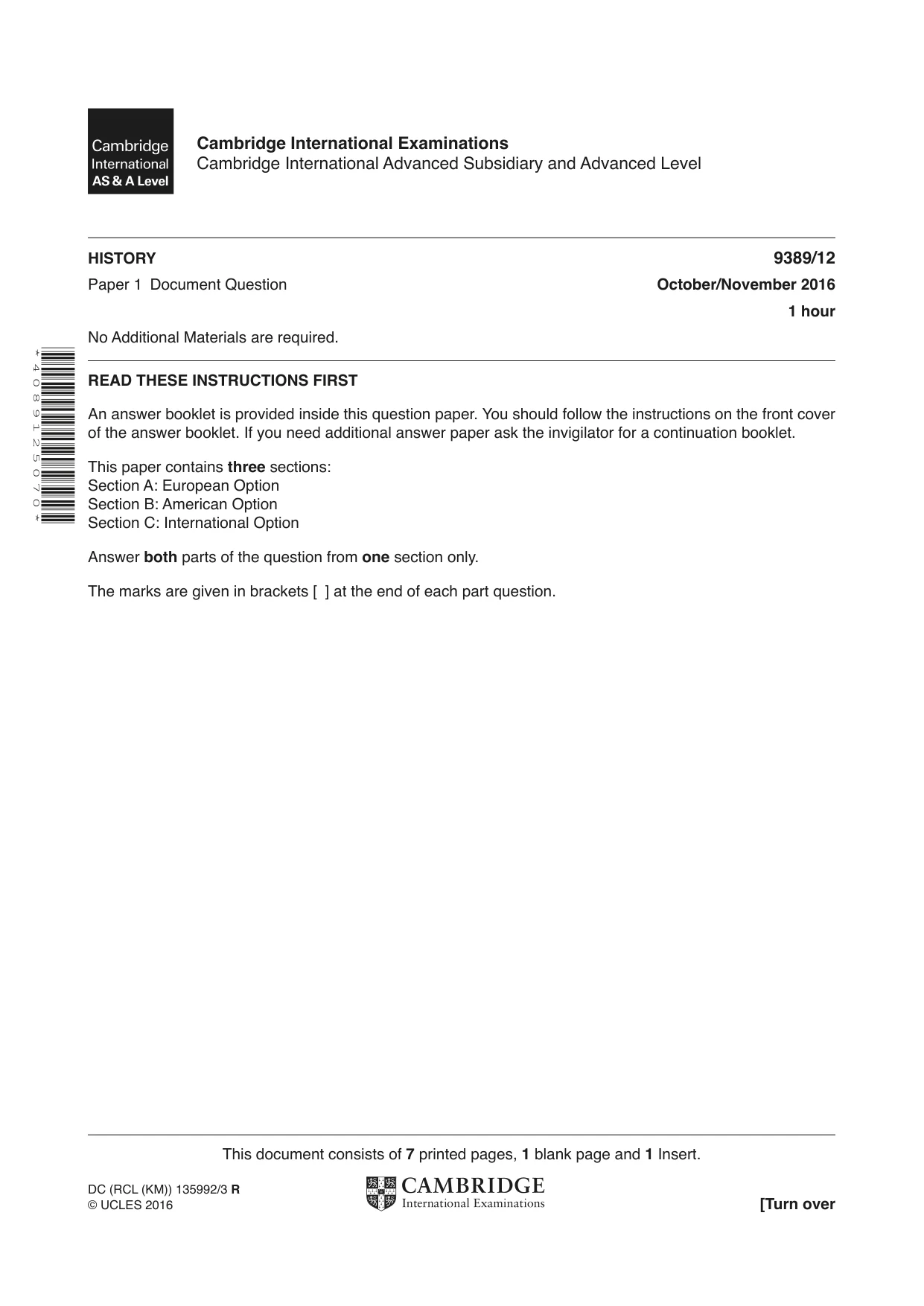
Question paper, page 1
This document consists of 7 printed pages, 1 blank page and 1 Insert. DC (RCL (KM)) 135992/3 R © UCLES 2016 [Turn over Cambridge International Examinations Cambridge International Advanced Subsidiary and Advanced Level * 4 0 8 9 1 2 5 0 7 0 * HISTORY 9389/12 Paper 1 Document Question October/November 2016 1 hour No Additional Materials are required. READ THESE INSTRUCTIONS FIRST An answer booklet is provided inside this question paper. You should follow the instructions on the front cover of the answer booklet. If you need additional answer paper ask the invigilator for a continuation booklet. This paper contains three sections: Section A: European Option Section B: American Option Section C: International Option Answer both parts of the question from one section only. The marks are given in brackets [ ] at the end of each part question.
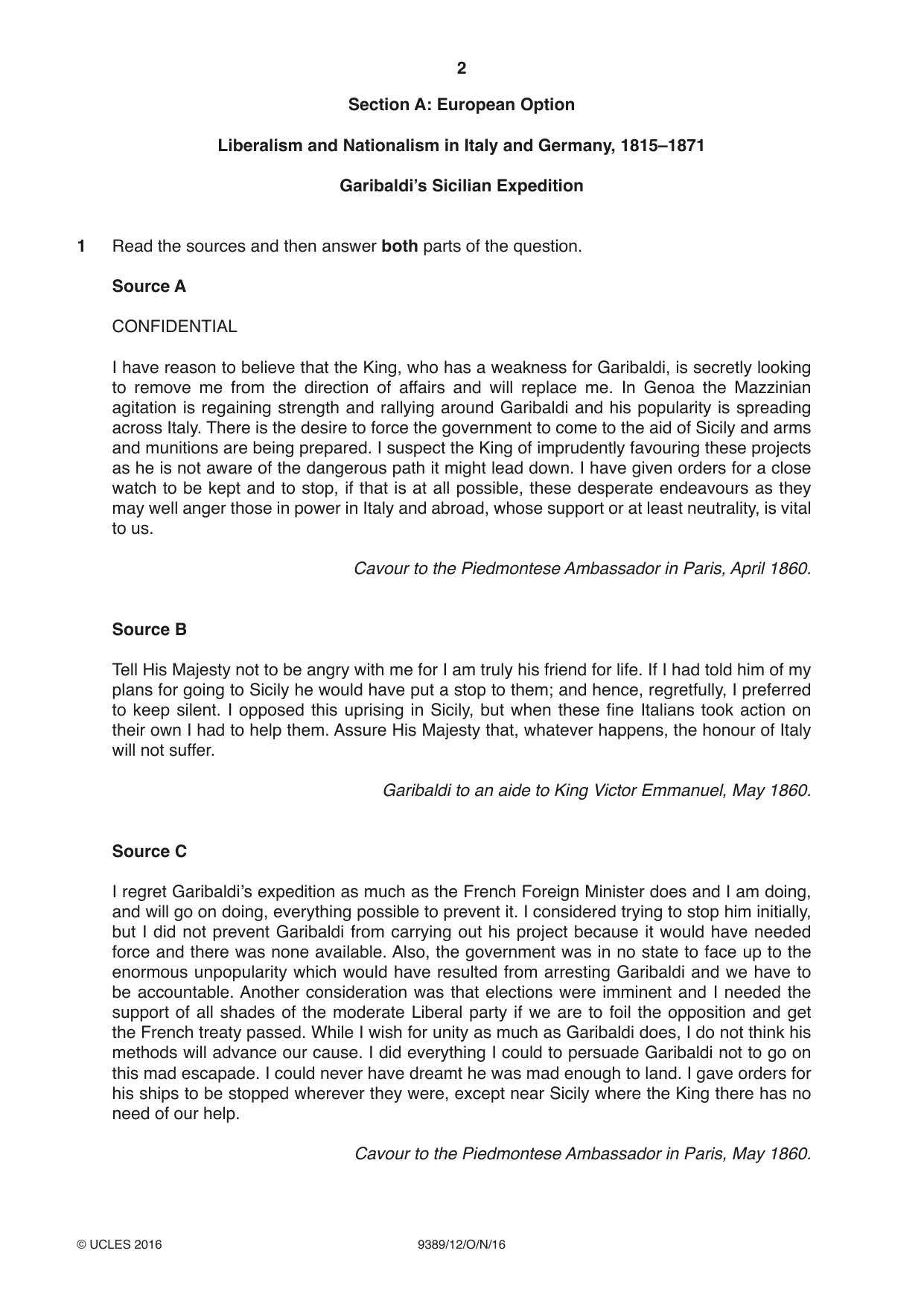
Question paper, page 2
2 9389/12/O/N/16 © UCLES 2016 Section A: European Option Liberalism and Nationalism in Italy and Germany, 1815–1871 Garibaldi’s Sicilian Expedition 1 Read the sources and then answer both parts of the question. Source A CONFIDENTIAL I have reason to believe that the King, who has a weakness for Garibaldi, is secretly looking to remove me from the direction of affairs and will replace me. In Genoa the Mazzinian agitation is regaining strength and rallying around Garibaldi and his popularity is spreading across Italy. There is the desire to force the government to come to the aid of Sicily and arms and munitions are being prepared. I suspect the King of imprudently favouring these projects as he is not aware of the dangerous path it might lead down. I have given orders for a close watch to be kept and to stop, if that is at all possible, these desperate endeavours as they may well anger those in power in Italy and abroad, whose support or at least neutrality, is vital to us. Cavour to the Piedmontese Ambassador in Paris, April 1860. Source B Tell His Majesty not to be angry with me for I am truly his friend for life. If I had told him of my plans for going to Sicily he would have put a stop to them; and hence, regretfully, I preferred to keep silent. I opposed this uprising in Sicily, but when these fine Italians took action on their own I had to help them. Assure His Majesty that, whatever happens, the honour of Italy will not suffer. Garibaldi to an aide to King Victor Emmanuel, May 1860. Source C I regret Garibaldi’s expedition as much as the French Foreign Minister does and I am doing, and will go on doing, everything possible to prevent it. I considered trying to stop him initially, but I did not prevent Garibaldi from carrying out his project because it would have needed force and there was none available. Also, the government was in no state to face up to the enormous unpopularity which would have resulted from arresting Garibaldi and we have to be accountable. Another consideration was that elections were imminent and I needed the support of all shades of the moderate Liberal party if we are to foil the opposition and get the French treaty passed. While I wish for unity as much as Garibaldi does, I do not think his methods will advance our cause. I did everything I could to persuade Garibaldi not to go on this mad escapade. I could never have dreamt he was mad enough to land. I gave orders for his ships to be stopped wherever they were, except near Sicily where the King there has no need of our help. Cavour to the Piedmontese Ambassador in Paris, May 1860.
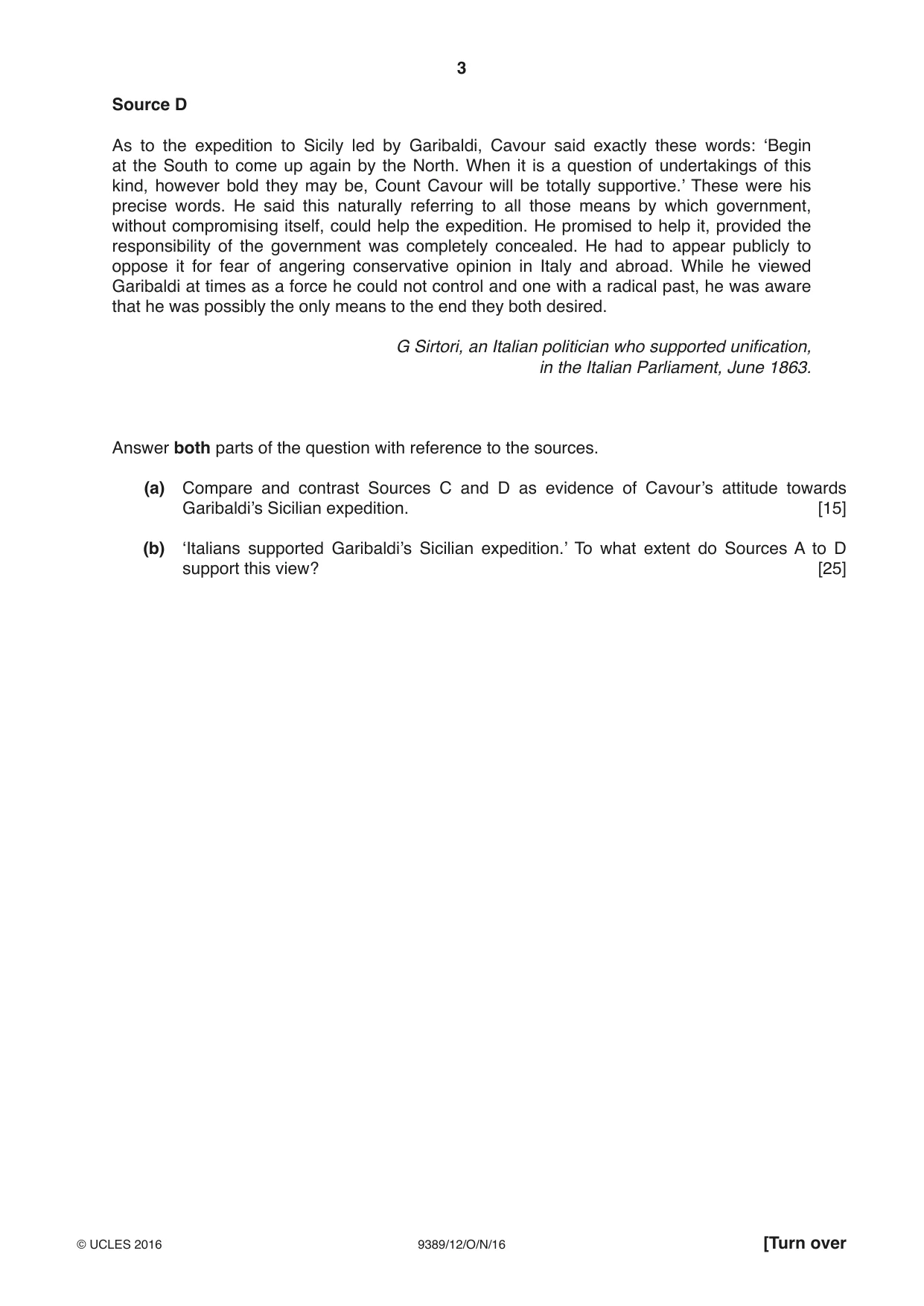
Question paper, page 3
3 9389/12/O/N/16 © UCLES 2016 [Turn over Source D As to the expedition to Sicily led by Garibaldi, Cavour said exactly these words: ‘Begin at the South to come up again by the North. When it is a question of undertakings of this kind, however bold they may be, Count Cavour will be totally supportive.’ These were his precise words. He said this naturally referring to all those means by which government, without compromising itself, could help the expedition. He promised to help it, provided the responsibility of the government was completely concealed. He had to appear publicly to oppose it for fear of angering conservative opinion in Italy and abroad. While he viewed Garibaldi at times as a force he could not control and one with a radical past, he was aware that he was possibly the only means to the end they both desired. G Sirtori, an Italian politician who supported unification, in the Italian Parliament, June 1863. Answer both parts of the question with reference to the sources. (a) Compare and contrast Sources C and D as evidence of Cavour’s attitude towards Garibaldi’s Sicilian expedition. [15] (b) ‘Italians supported Garibaldi’s Sicilian expedition.’ To what extent do Sources A to D support this view? [25]
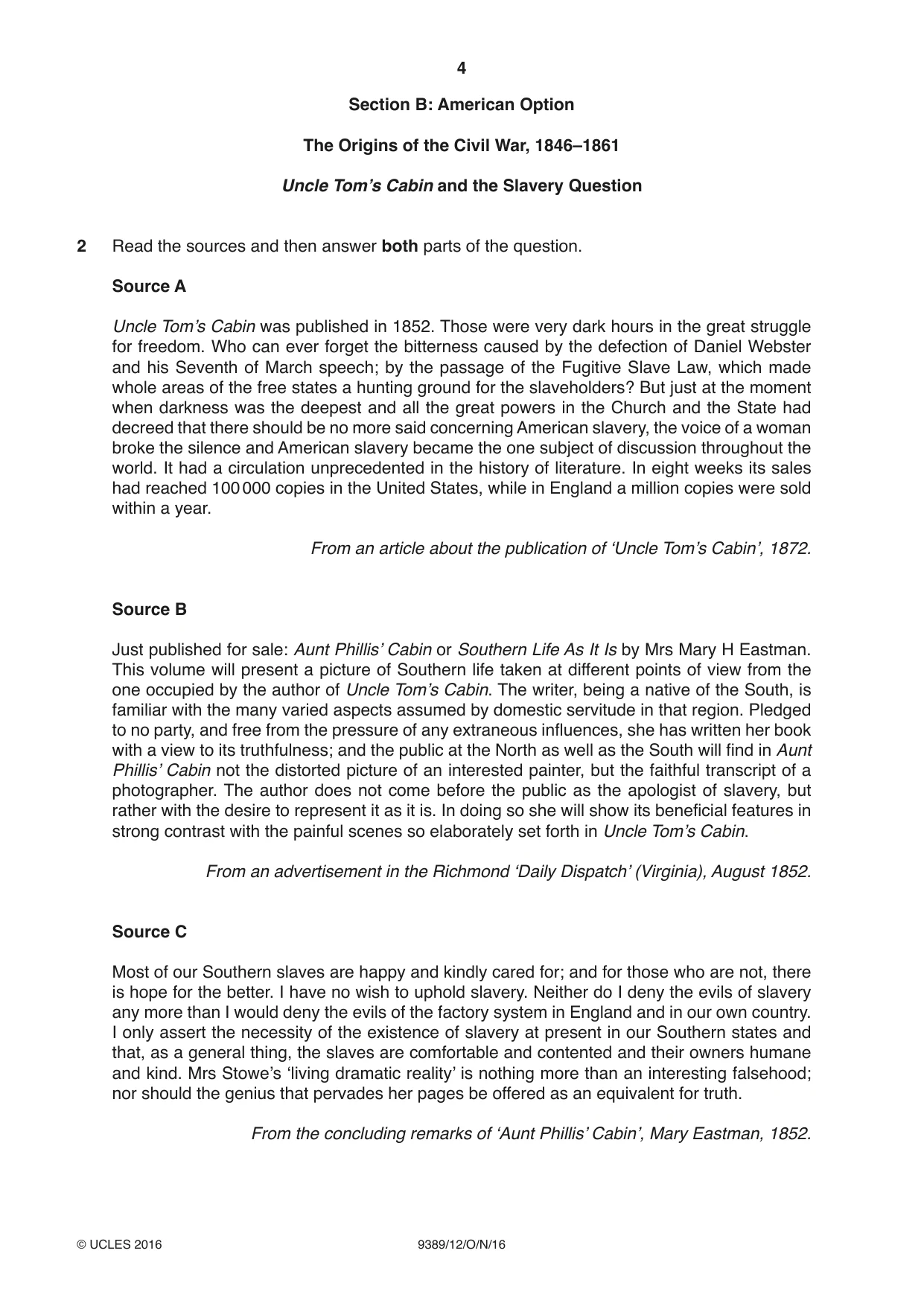
Question paper, page 4
4 9389/12/O/N/16 © UCLES 2016 Section B: American Option The Origins of the Civil War, 1846–1861 Uncle Tom’s Cabin and the Slavery Question 2 Read the sources and then answer both parts of the question. Source A Uncle Tom’s Cabin was published in 1852. Those were very dark hours in the great struggle for freedom. Who can ever forget the bitterness caused by the defection of Daniel Webster and his Seventh of March speech; by the passage of the Fugitive Slave Law, which made whole areas of the free states a hunting ground for the slaveholders? But just at the moment when darkness was the deepest and all the great powers in the Church and the State had decreed that there should be no more said concerning American slavery, the voice of a woman broke the silence and American slavery became the one subject of discussion throughout the world. It had a circulation unprecedented in the history of literature. In eight weeks its sales had reached 100 000 copies in the United States, while in England a million copies were sold within a year. From an article about the publication of ‘Uncle Tom’s Cabin’, 1872. Source B Just published for sale: Aunt Phillis’ Cabin or Southern Life As It Is by Mrs Mary H Eastman. This volume will present a picture of Southern life taken at different points of view from the one occupied by the author of Uncle Tom’s Cabin. The writer, being a native of the South, is familiar with the many varied aspects assumed by domestic servitude in that region. Pledged to no party, and free from the pressure of any extraneous influences, she has written her book with a view to its truthfulness; and the public at the North as well as the South will find in Aunt Phillis’ Cabin not the distorted picture of an interested painter, but the faithful transcript of a photographer. The author does not come before the public as the apologist of slavery, but rather with the desire to represent it as it is. In doing so she will show its beneficial features in strong contrast with the painful scenes so elaborately set forth in Uncle Tom’s Cabin. From an advertisement in the Richmond ‘Daily Dispatch’ (Virginia), August 1852. Source C Most of our Southern slaves are happy and kindly cared for; and for those who are not, there is hope for the better. I have no wish to uphold slavery. Neither do I deny the evils of slavery any more than I would deny the evils of the factory system in England and in our own country. I only assert the necessity of the existence of slavery at present in our Southern states and that, as a general thing, the slaves are comfortable and contented and their owners humane and kind. Mrs Stowe’s ‘living dramatic reality’ is nothing more than an interesting falsehood; nor should the genius that pervades her pages be offered as an equivalent for truth. From the concluding remarks of ‘Aunt Phillis’ Cabin’, Mary Eastman, 1852.
Question paper, page 5
5 9389/12/O/N/16 © UCLES 2016 [Turn over Source D This book depicts with graphic force Negro life in the United States. That it does this with as much truth as vigour will be seen by a perusal of Uncle Tom’s Cabin. But this truthfulness has been called into question. It has been said that Uncle Tom’s Cabin misrepresents slavery and slaveholders and that its influence must be harmful in tightening more closely the chains of the poor slave. Henry Clay, the modern disciple of Compromise, has frequently lashed audiences into a storm by his eloquence and Daniel Webster, who was heaven-born but slavery-bound, has frequently spoken ponderous words to a listening Senate. But their voices sent no electric currents through the great arteries of public opinion like Uncle Tom’s Cabin. It will be seen that this gentle woman will do more to uproot slavery than conventions and associations and premature legislative action. From the preface to ‘Uncle Tom’s Companions: Truth Stranger than Fiction’, by a British journalist,1852. Answer both parts of the question with reference to the sources. (a) To what extent do Sources C and D agree about Uncle Tom’s Cabin? [15] (b) How far do Sources A to D support the assertion that Uncle Tom’s Cabin did little to change American attitudes towards slavery? [25]
Question paper, page 6
6 9389/12/O/N/16 © UCLES 2016 Section C: International Option The Search for International Peace and Security, 1919–1945 Early Support for the Establishment of a League of Nations 3 Read the sources and then answer both parts of the question. Source A We must discard the idea of an international government which is in the minds of some people. The League must operate by consent. The idea of an international government will not be accepted by any existing state. But while we avoid international government at one end, we must equally be careful to avoid the mere debating society at the other end. We want a League which can make decisions, a League which will be practical and effective. A scheme which brings independent states of the world together and requires that their decisions must be unanimous means that there never will be any decisions issuing from the League, that nobody will take it seriously, that it will soon be dead and buried. The League will face a dilemma – if its votes have to be unanimous, the League will be unworkable and if they are decided by a majority, the Great Powers will not enter it. From ‘The League of Nations: A Practical Suggestion’, by the South African politician Jan Smuts, 1918. Source B The British Government Minister, Lord Robert Cecil, tonight gave American journalists Britain’s views about the proposed League of Nations. He defined the League as ‘an association of nations providing safeguards for peace and the securing of better international cooperation’. He said that there should be an agreement among nations by which each nation binds itself to see that all warlike disputes are presented to the League for consideration, and to the use of force to accomplish this if necessary. He asserted that an international army and navy was not feasible at this time. Nations, he said, are not ready to surrender their sovereignty to a League of Nations to such an extent that they would be willing to allow it to dictate whether they should employ their forces in the settling of a dispute. He said he believed, however, that each nation should bind itself to use all means, even force, to compel the dispute to be brought before the League. Report in the New York Times, January 1919.
Question paper, page 7
7 9389/12/O/N/16 © UCLES 2016 Source C If the League is to impose peace, it must be known that it possesses the means of bringing this about. This would be impossible unless a central organisation is built up which would be ready to act at once against a warlike power. A permanent body should be created to plan and prepare the League’s military and naval programme, so that obligations imposed on member states by the Covenant can be enforced with immediate effect in any urgent situation. Such a provision is absolutely necessary to ensure prompt and effective action on the part of the League, not only for the safety of nations exposed to risks, but also for the defence of the League itself. Statement by the French delegation to the Commission charged with drafting the League of Nations’ Covenant, February 1919. Source D The League’s success depends on three conditions. First, member states must have a common understanding of the principles of international order and general agreement on the laws which give them effectiveness. Second, each one of these laws must have received the free and unqualified consent of each state; any sanctions proclaimed by the League must be similarly agreed, so that no nation can claim to have been forced into participating in a collective action without its consent. Finally, there should be a tribunal of unquestionable impartiality to define for each individual case the findings of international law and to rule on their application. If these three conditions are met, then the League of Nations will be able to function, on the one hand, with a flexibility which will allow its members to feel secure and at ease within its authority and, on the other hand, with the kind of moral force that will preclude the members from even thinking of evading its decisions. From a speech by the French politician Leon Bourgeois, 1922. Answer both parts of the question with reference to the sources. (a) Compare and contrast the views of Britain (Source B) and France (Source C) regarding how the League of Nations should deal with warlike countries. [15] (b) ‘There was little prospect of the League succeeding.’ How far do Sources A to D support this view? [25]
Question paper, page 8
8 9389/12/O/N/16 © UCLES 2016 BLANK PAGE Permission to reproduce items where third-party owned material protected by copyright is included has been sought and cleared where possible. Every reasonable effort has been made by the publisher (UCLES) to trace copyright holders, but if any items requiring clearance have unwittingly been included, the publisher will be pleased to make amends at the earliest possible opportunity. To avoid the issue of disclosure of answer-related information to candidates, all copyright acknowledgements are reproduced online in the Cambridge International Examinations Copyright Acknowledgements Booklet. This is produced for each series of examinations and is freely available to download at www.cie.org.uk after the live examination series. Cambridge International Examinations is part of the Cambridge Assessment Group. Cambridge Assessment is the brand name of University of Cambridge Local Examinations Syndicate (UCLES), which is itself a department of the University of Cambridge.
Mark scheme, page 1
® IGCSE is the registered trademark of Cambridge International Examinations. This document consists of 9 printed pages. © UCLES 2016 [Turn over Cambridge International Examinations Cambridge International Advanced Subsidiary and Advanced Level HISTORY 9389/12 Paper 1 Document Question October/November 2016 MARK SCHEME Maximum Mark: 40 Published This mark scheme is published as an aid to teachers and candidates, to indicate the requirements of the examination. It shows the basis on which Examiners were instructed to award marks. It does not indicate the details of the discussions that took place at an Examiners’ meeting before marking began, which would have considered the acceptability of alternative answers. Mark schemes should be read in conjunction with the question paper and the Principal Examiner Report for Teachers. Cambridge will not enter into discussions about these mark schemes. Cambridge is publishing the mark schemes for the October/November 2016 series for most Cambridge IGCSE®, Cambridge International A and AS Level components and some Cambridge O Level components.
Mark scheme, page 2
Page 2 Mark Scheme Syllabus Paper Cambridge International AS/A Level – October/November 2016 9389 12 © UCLES 2016 Generic Levels of Response Part (a) Level 4: Makes a developed comparison [12–15] Makes a developed comparison between the two sources, recognising points of similarity and difference. Uses knowledge to evaluate the sources and shows good contextual awareness. Level 3: Compares views and identifies similarities and differences [8–11] Compares the views expressed in the sources, identifying differences and similarities. Begins to explain and evaluate the views using the sources and knowledge. Level 2: Compares views and identifies similarities and/or differences [4–7] Identifies relevant similarities or differences between views/sources and the response may be one- sided with only one aspect explained. Alternatively, both similarities and differences may be mentioned but both aspects lack development. Level 1: Describes content of each source [1–3] Describes or paraphrases the content of the two sources. Very simple comparisons may be made (e.g. one is from a letter and the other is from a speech) but these are not developed. Level 0: No relevant comment on the sources or the issue [0] Part (b) Level 5: Evaluates the sources to reach a sustained judgement [21–25] Answers are well focused, demonstrating a clear understanding of the sources and the question. Reaches a sustained judgement about the extent to which the sources support the statement and weighs the evidence in order to do this. Level 4: Evaluates the sources [16–20] Demonstrates a clear understanding of the sources and the question. Begins to evaluate the material in context, considering the nature, origin and purpose of the sources in relation to the statement. At the top of this level candidates may begin to reach a judgement but this is not sustained. Level 3: Uses the sources to support and challenge the statement [11–15] Makes valid points from the sources to both challenge and support the statement in the question. These comments may be derived from source content or may be about the provenance/nature of the sources. Level 2: Uses the sources to support or challenge the statement [6–10] Makes valid points from the sources to either support the statement in the question or to challenge it. These comments may be derived from source content or may be about the provenance/nature of the sources. Level 1: Does not make valid use of the sources [1–5] Describes the content of the sources with little attempt to link the material to the question. Alternatively, candidates may write an essay about the question without reference to the sources. Level 0: No relevant comment on the sources or the issue [0]
Mark scheme, page 3
Page 3 Mark Scheme Syllabus Paper Cambridge International AS/A Level – October/November 2016 9389 12 © UCLES 2016 Section A: European Option Liberalism and Nationalism in Italy and Germany, 1815–1871 Garibaldi’s Sicilian Expedition Indicative content 1 (a) Compare and contrast Sources C and D as evidence of Cavour’s attitude towards Garibaldi’s Sicilian expedition. [15] Source C is very indicative of the highly ambivalent attitude Cavour publicly gave out towards the expedition. It is likely that Cavour was well aware that the French would be very unhappy with what Garibaldi was out to achieve, and what Cavour is doing in the letter is to provide material for his ambassador in France to pacify French anger. He certainly did not do everything possible to stop it and his dealings with the Admiral in charge of the navy demonstrated that clearly and the ‘except near Sicily’ is revealing. All the reasons given for non-intervention are valid. D goes to the other extreme. While showing awareness of Cavour’s need not to compromise the government of Piedmont in the eyes of Europe, it suggests that he was fully supportive and promised to help it, as well as giving practical advice. Given the speech was made in public after Cavour’s death, there is no reason for its validity to be doubted. (b) ‘Italians supported Garibaldi’s Sicilian expedition.’ To what extent do Sources A to D support this view? [25] Source A, from a well informed source in this context, shows that the Piedmontese King is supportive, and also refers to support coming from Genoa and the ‘Mazzinians’. Cavour himself shows opposition, but there is evidence elsewhere to indicate that he was more ambivalent on the issue than is perhaps shown here. B is interesting in that it indicates that the King was less keen on the expedition than is made out in A, and that even Garibaldi himself had reservations until he ‘had to help them’. C again shows Cavour’s ambivalence on the issue, referring to it as a ‘mad expedition’, but it also makes clear the huge popularity of Garibaldi in Piedmont and the risk the government would take if he was stopped. D indicates that while the ‘Government’ may well have been opposed, but primarily for political and diplomatic reasons, the reality was very different. There was opposition from monarchs likely to be overthrown such as the ruler of Sicily and Naples as well as the Pope, but it was increasingly confined to a narrow section of the population.
Mark scheme, page 4
Page 4 Mark Scheme Syllabus Paper Cambridge International AS/A Level – October/November 2016 9389 12 © UCLES 2016 Section B: American Option The Origins of the Civil War, 1846–1861 Uncle Tom’s Cabin and the Slavery Question Indicative content 2 (a) To what extent do Sources C and D agree about Uncle Tom’s Cabin? [15] Source C, from a Southern writer, maintains that Uncle Tom’s Cabin ‘is nothing more than an interesting falsehood’ and no ‘equivalent for truth’. Source D, on the other hand, having asserted the forcefulness of the book, then argues that the book portrays Negro life ‘with as much truth as vigour’. This is the fundamental difference between the two. The sources are similar in that they both recognise the talents of Harriet Beecher Stowe. Source C talks of ‘the genius that pervades her pages’ while Source D claims that the vigour of her prose has ‘sent … electric currents through the great arteries of public opinion’. Source C is from a Southern writer who defends slavery, Source D from a British writer who is likely to be less familiar with the issue of slavery in the USA in the 1850s. (b) How far do Sources A to D support the assertion that Uncle Tom’s Cabin did little to change American attitudes towards slavery? [25] Uncle Tom’s Cabin was published in March 1852. Its author, Harriet Beecher Stowe, was a teacher from New England. She wrote Uncle Tom’s Cabin as a response to the passage of the Fugitive Slave Act of 1850. In its first year of publication it sold 300 000 copies in the USA and around one million in the UK. The book was also the basis of plays and musicals and was thus seen by many more people. The book had a huge cultural impact, its characters reinforcing certain stereotypes, e.g. Uncle Tom himself as the deferential African American. In the 1850s, it also had a political impact, though how great that impact was is hard to determine, given other developments in race relations, e.g. the Kansas-Nebraska Act of 1854. Lincoln is alleged to have said to Harriet Beecher Stowe when he first met her in 1862, ‘So this is the little lady who started this great war’, but there is no evidence to support his story. Two sources, B and C, broadly agree with the assertion while the other two, A and D, challenge it. However, Sources B and C could been seen as challenging the hypothesis in that the very production of Aunt Phillis’ Cabin so soon after the publication of Uncle Tom’s Cabin is evidence that at least one publisher believes that Uncle Tom’s Cabin is having a profound impact on US attitudes. These two sources are closely related. Source B is an advertisement for a book from which Source C is taken. Source C, written as a direct response to Uncle Tom’s Cabin, puts American slavery in a more positive light. It is generally reasonable in tone. It even portrays slavery as being necessary for the South ‘at present’, which could be taken to mean that it might not be necessary in the future. However, Source C is also very critical of Uncle Tom’s Cabin, which it calls ‘an interesting falsehood’. Such criticism of such a bestseller is made with the intention of undermining its impact upon the American public. Source B is an advertisement for Source C. Unlike modern adverts, it is very muted in tone. However, it makes some clear contrasts between the two books which emphasise the virtues of Aunt Phillis’ Cabin compared with Uncle Tom’s Cabin: referring to contemporary technology, it says the former is more a photograph than a painting. A painting is subjective, personal, a photograph objective and impersonal: ‘the camera cannot lie’. A painting will have less effect than a photograph.
Mark scheme, page 5
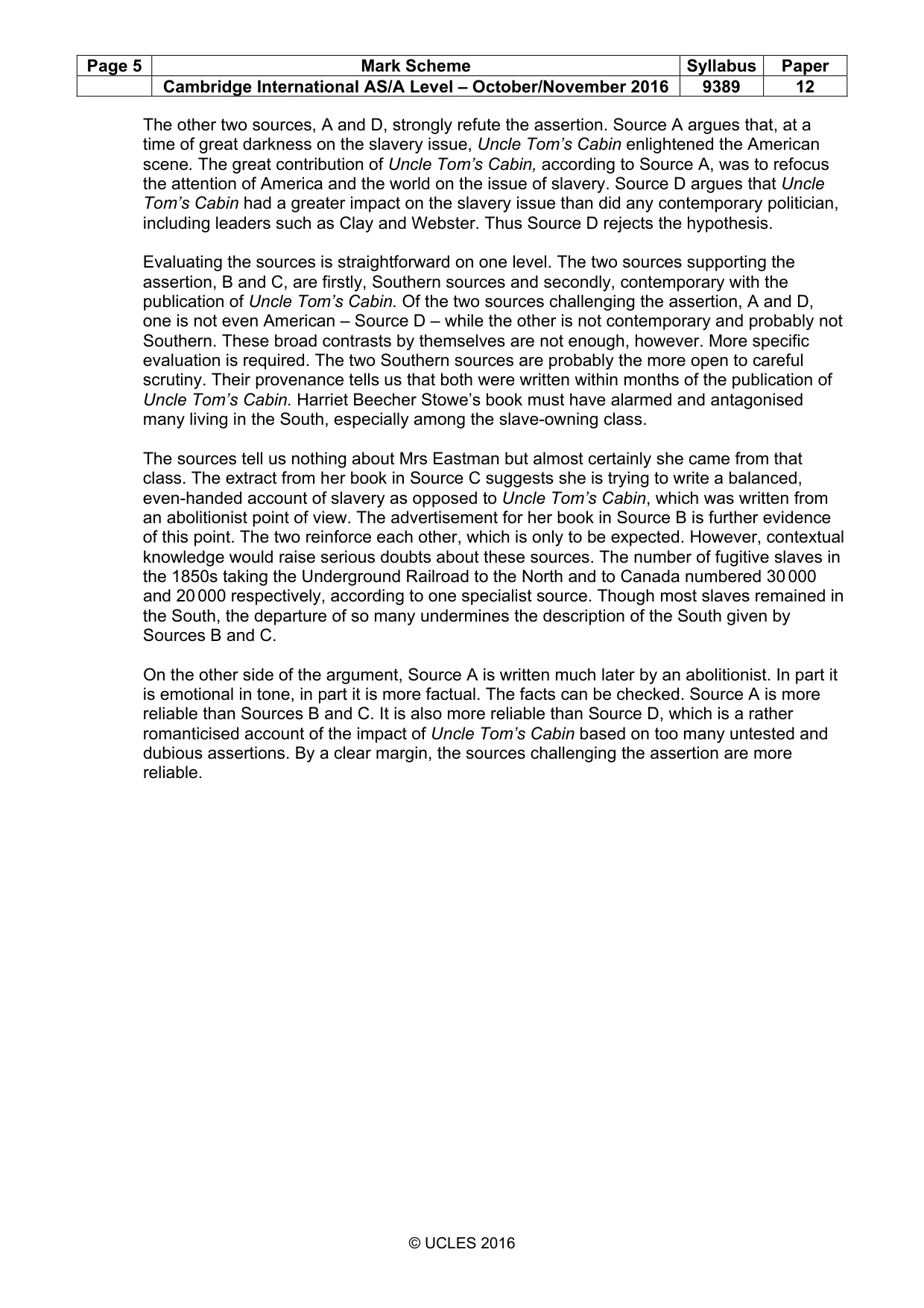
Page 5 Mark Scheme Syllabus Paper Cambridge International AS/A Level – October/November 2016 9389 12 © UCLES 2016 The other two sources, A and D, strongly refute the assertion. Source A argues that, at a time of great darkness on the slavery issue, Uncle Tom’s Cabin enlightened the American scene. The great contribution of Uncle Tom’s Cabin, according to Source A, was to refocus the attention of America and the world on the issue of slavery. Source D argues that Uncle Tom’s Cabin had a greater impact on the slavery issue than did any contemporary politician, including leaders such as Clay and Webster. Thus Source D rejects the hypothesis. Evaluating the sources is straightforward on one level. The two sources supporting the assertion, B and C, are firstly, Southern sources and secondly, contemporary with the publication of Uncle Tom’s Cabin. Of the two sources challenging the assertion, A and D, one is not even American – Source D – while the other is not contemporary and probably not Southern. These broad contrasts by themselves are not enough, however. More specific evaluation is required. The two Southern sources are probably the more open to careful scrutiny. Their provenance tells us that both were written within months of the publication of Uncle Tom’s Cabin. Harriet Beecher Stowe’s book must have alarmed and antagonised many living in the South, especially among the slave-owning class. The sources tell us nothing about Mrs Eastman but almost certainly she came from that class. The extract from her book in Source C suggests she is trying to write a balanced, even-handed account of slavery as opposed to Uncle Tom’s Cabin, which was written from an abolitionist point of view. The advertisement for her book in Source B is further evidence of this point. The two reinforce each other, which is only to be expected. However, contextual knowledge would raise serious doubts about these sources. The number of fugitive slaves in the 1850s taking the Underground Railroad to the North and to Canada numbered 30 000 and 20 000 respectively, according to one specialist source. Though most slaves remained in the South, the departure of so many undermines the description of the South given by Sources B and C. On the other side of the argument, Source A is written much later by an abolitionist. In part it is emotional in tone, in part it is more factual. The facts can be checked. Source A is more reliable than Sources B and C. It is also more reliable than Source D, which is a rather romanticised account of the impact of Uncle Tom’s Cabin based on too many untested and dubious assertions. By a clear margin, the sources challenging the assertion are more reliable.
Mark scheme, page 6
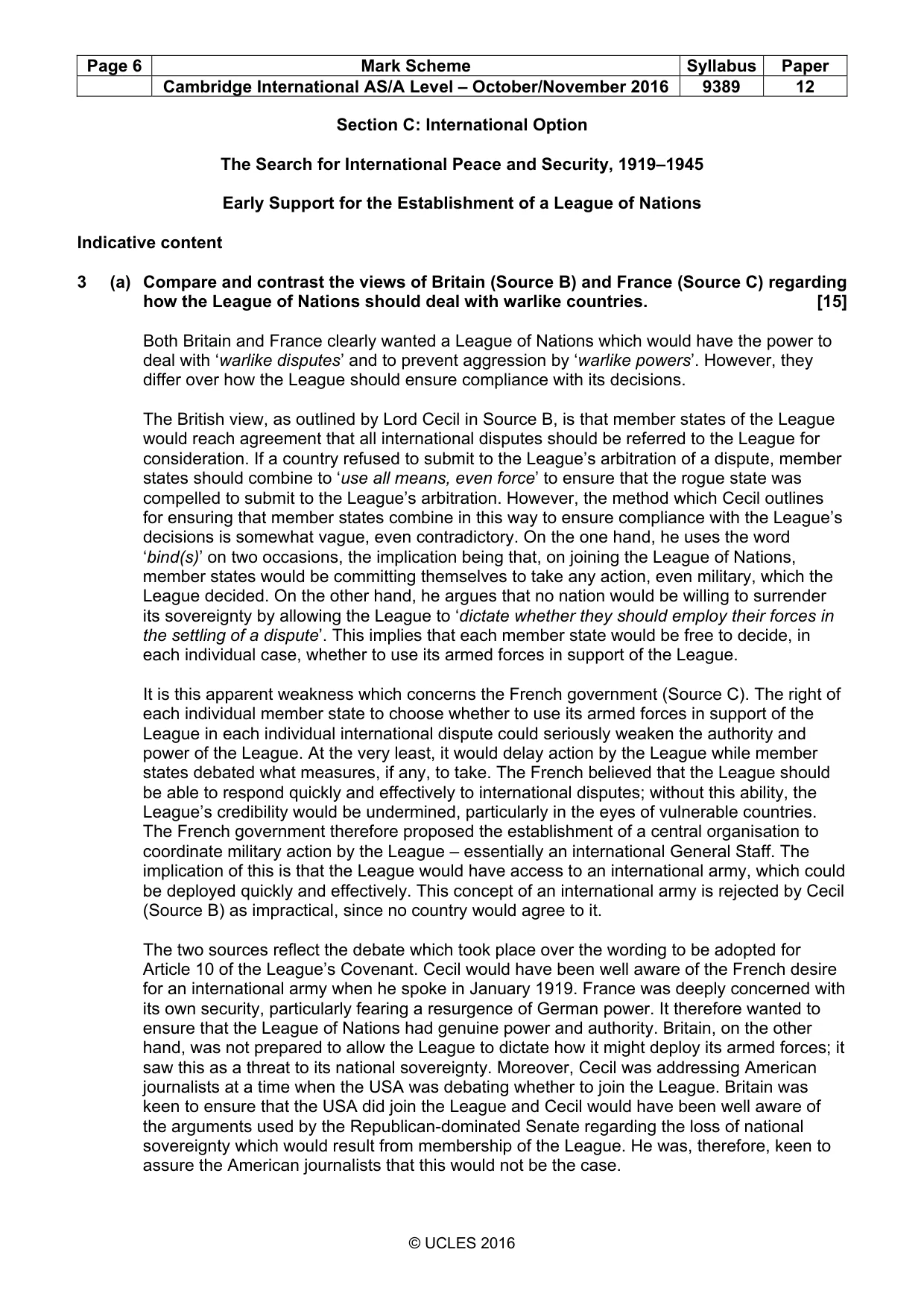
Page 6 Mark Scheme Syllabus Paper Cambridge International AS/A Level – October/November 2016 9389 12 © UCLES 2016 Section C: International Option The Search for International Peace and Security, 1919–1945 Early Support for the Establishment of a League of Nations Indicative content 3 (a) Compare and contrast the views of Britain (Source B) and France (Source C) regarding how the League of Nations should deal with warlike countries. [15] Both Britain and France clearly wanted a League of Nations which would have the power to deal with ‘warlike disputes’ and to prevent aggression by ‘warlike powers’. However, they differ over how the League should ensure compliance with its decisions. The British view, as outlined by Lord Cecil in Source B, is that member states of the League would reach agreement that all international disputes should be referred to the League for consideration. If a country refused to submit to the League’s arbitration of a dispute, member states should combine to ‘use all means, even force’ to ensure that the rogue state was compelled to submit to the League’s arbitration. However, the method which Cecil outlines for ensuring that member states combine in this way to ensure compliance with the League’s decisions is somewhat vague, even contradictory. On the one hand, he uses the word ‘bind(s)’ on two occasions, the implication being that, on joining the League of Nations, member states would be committing themselves to take any action, even military, which the League decided. On the other hand, he argues that no nation would be willing to surrender its sovereignty by allowing the League to ‘dictate whether they should employ their forces in the settling of a dispute’. This implies that each member state would be free to decide, in each individual case, whether to use its armed forces in support of the League. It is this apparent weakness which concerns the French government (Source C). The right of each individual member state to choose whether to use its armed forces in support of the League in each individual international dispute could seriously weaken the authority and power of the League. At the very least, it would delay action by the League while member states debated what measures, if any, to take. The French believed that the League should be able to respond quickly and effectively to international disputes; without this ability, the League’s credibility would be undermined, particularly in the eyes of vulnerable countries. The French government therefore proposed the establishment of a central organisation to coordinate military action by the League – essentially an international General Staff. The implication of this is that the League would have access to an international army, which could be deployed quickly and effectively. This concept of an international army is rejected by Cecil (Source B) as impractical, since no country would agree to it. The two sources reflect the debate which took place over the wording to be adopted for Article 10 of the League’s Covenant. Cecil would have been well aware of the French desire for an international army when he spoke in January 1919. France was deeply concerned with its own security, particularly fearing a resurgence of German power. It therefore wanted to ensure that the League of Nations had genuine power and authority. Britain, on the other hand, was not prepared to allow the League to dictate how it might deploy its armed forces; it saw this as a threat to its national sovereignty. Moreover, Cecil was addressing American journalists at a time when the USA was debating whether to join the League. Britain was keen to ensure that the USA did join the League and Cecil would have been well aware of the arguments used by the Republican-dominated Senate regarding the loss of national sovereignty which would result from membership of the League. He was, therefore, keen to assure the American journalists that this would not be the case.
Mark scheme, page 7
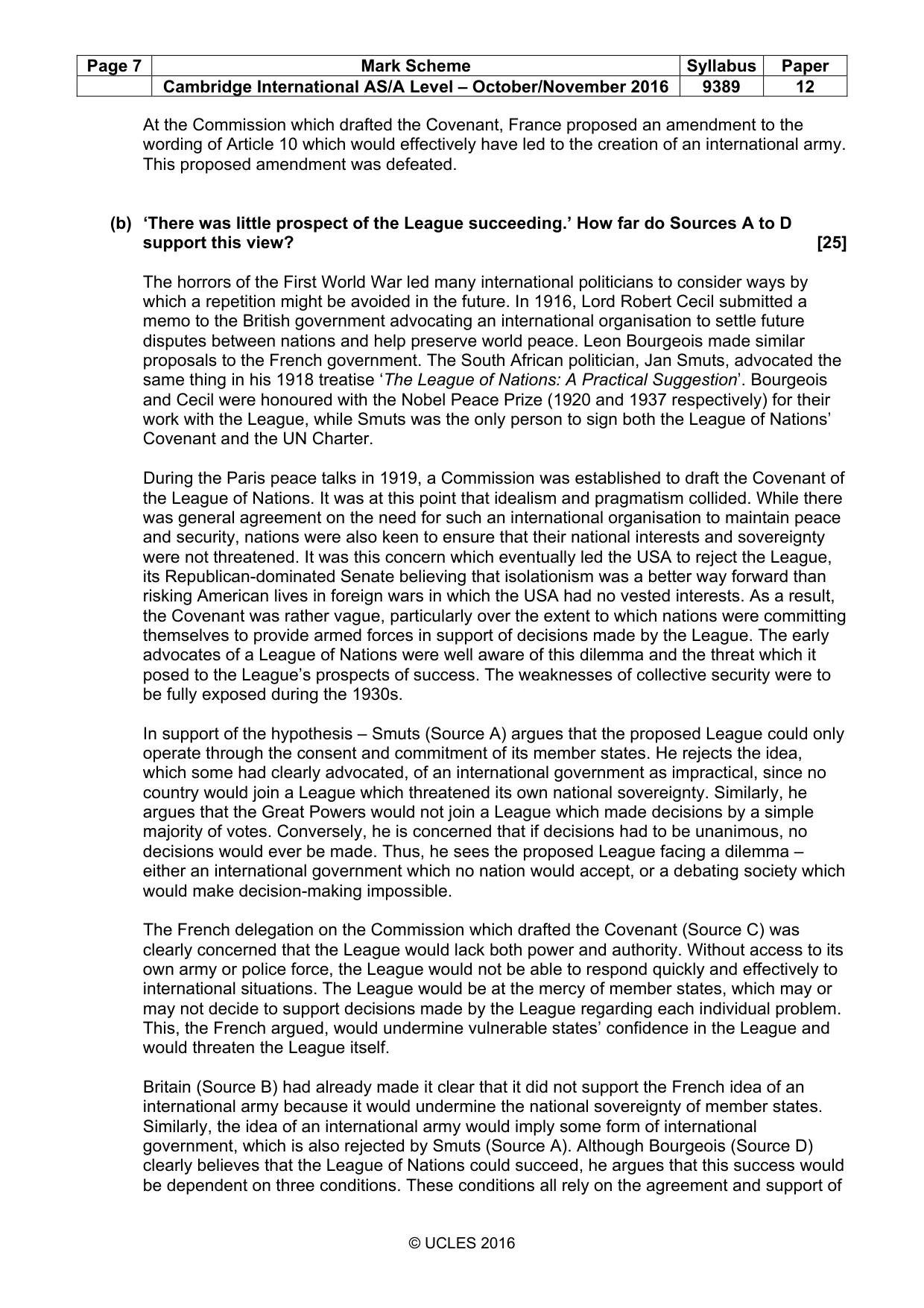
Page 7 Mark Scheme Syllabus Paper Cambridge International AS/A Level – October/November 2016 9389 12 © UCLES 2016 At the Commission which drafted the Covenant, France proposed an amendment to the wording of Article 10 which would effectively have led to the creation of an international army. This proposed amendment was defeated. (b) ‘There was little prospect of the League succeeding.’ How far do Sources A to D support this view? [25] The horrors of the First World War led many international politicians to consider ways by which a repetition might be avoided in the future. In 1916, Lord Robert Cecil submitted a memo to the British government advocating an international organisation to settle future disputes between nations and help preserve world peace. Leon Bourgeois made similar proposals to the French government. The South African politician, Jan Smuts, advocated the same thing in his 1918 treatise ‘The League of Nations: A Practical Suggestion’. Bourgeois and Cecil were honoured with the Nobel Peace Prize (1920 and 1937 respectively) for their work with the League, while Smuts was the only person to sign both the League of Nations’ Covenant and the UN Charter. During the Paris peace talks in 1919, a Commission was established to draft the Covenant of the League of Nations. It was at this point that idealism and pragmatism collided. While there was general agreement on the need for such an international organisation to maintain peace and security, nations were also keen to ensure that their national interests and sovereignty were not threatened. It was this concern which eventually led the USA to reject the League, its Republican-dominated Senate believing that isolationism was a better way forward than risking American lives in foreign wars in which the USA had no vested interests. As a result, the Covenant was rather vague, particularly over the extent to which nations were committing themselves to provide armed forces in support of decisions made by the League. The early advocates of a League of Nations were well aware of this dilemma and the threat which it posed to the League’s prospects of success. The weaknesses of collective security were to be fully exposed during the 1930s. In support of the hypothesis – Smuts (Source A) argues that the proposed League could only operate through the consent and commitment of its member states. He rejects the idea, which some had clearly advocated, of an international government as impractical, since no country would join a League which threatened its own national sovereignty. Similarly, he argues that the Great Powers would not join a League which made decisions by a simple majority of votes. Conversely, he is concerned that if decisions had to be unanimous, no decisions would ever be made. Thus, he sees the proposed League facing a dilemma – either an international government which no nation would accept, or a debating society which would make decision-making impossible. The French delegation on the Commission which drafted the Covenant (Source C) was clearly concerned that the League would lack both power and authority. Without access to its own army or police force, the League would not be able to respond quickly and effectively to international situations. The League would be at the mercy of member states, which may or may not decide to support decisions made by the League regarding each individual problem. This, the French argued, would undermine vulnerable states’ confidence in the League and would threaten the League itself. Britain (Source B) had already made it clear that it did not support the French idea of an international army because it would undermine the national sovereignty of member states. Similarly, the idea of an international army would imply some form of international government, which is also rejected by Smuts (Source A). Although Bourgeois (Source D) clearly believes that the League of Nations could succeed, he argues that this success would be dependent on three conditions. These conditions all rely on the agreement and support of
Mark scheme, page 8
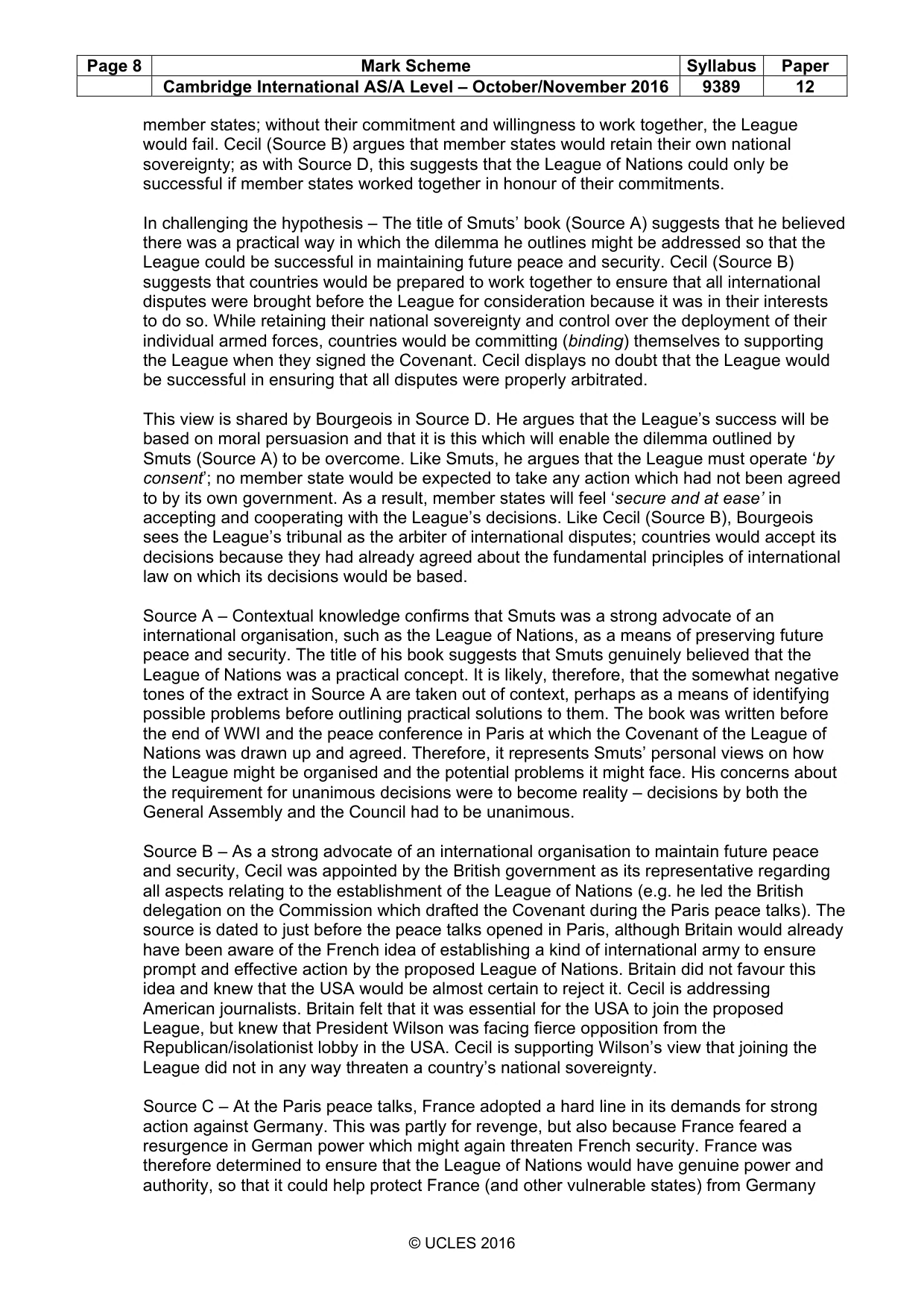
Page 8 Mark Scheme Syllabus Paper Cambridge International AS/A Level – October/November 2016 9389 12 © UCLES 2016 member states; without their commitment and willingness to work together, the League would fail. Cecil (Source B) argues that member states would retain their own national sovereignty; as with Source D, this suggests that the League of Nations could only be successful if member states worked together in honour of their commitments. In challenging the hypothesis – The title of Smuts’ book (Source A) suggests that he believed there was a practical way in which the dilemma he outlines might be addressed so that the League could be successful in maintaining future peace and security. Cecil (Source B) suggests that countries would be prepared to work together to ensure that all international disputes were brought before the League for consideration because it was in their interests to do so. While retaining their national sovereignty and control over the deployment of their individual armed forces, countries would be committing (binding) themselves to supporting the League when they signed the Covenant. Cecil displays no doubt that the League would be successful in ensuring that all disputes were properly arbitrated. This view is shared by Bourgeois in Source D. He argues that the League’s success will be based on moral persuasion and that it is this which will enable the dilemma outlined by Smuts (Source A) to be overcome. Like Smuts, he argues that the League must operate ‘by consent’; no member state would be expected to take any action which had not been agreed to by its own government. As a result, member states will feel ‘secure and at ease’ in accepting and cooperating with the League’s decisions. Like Cecil (Source B), Bourgeois sees the League’s tribunal as the arbiter of international disputes; countries would accept its decisions because they had already agreed about the fundamental principles of international law on which its decisions would be based. Source A – Contextual knowledge confirms that Smuts was a strong advocate of an international organisation, such as the League of Nations, as a means of preserving future peace and security. The title of his book suggests that Smuts genuinely believed that the League of Nations was a practical concept. It is likely, therefore, that the somewhat negative tones of the extract in Source A are taken out of context, perhaps as a means of identifying possible problems before outlining practical solutions to them. The book was written before the end of WWI and the peace conference in Paris at which the Covenant of the League of Nations was drawn up and agreed. Therefore, it represents Smuts’ personal views on how the League might be organised and the potential problems it might face. His concerns about the requirement for unanimous decisions were to become reality – decisions by both the General Assembly and the Council had to be unanimous. Source B – As a strong advocate of an international organisation to maintain future peace and security, Cecil was appointed by the British government as its representative regarding all aspects relating to the establishment of the League of Nations (e.g. he led the British delegation on the Commission which drafted the Covenant during the Paris peace talks). The source is dated to just before the peace talks opened in Paris, although Britain would already have been aware of the French idea of establishing a kind of international army to ensure prompt and effective action by the proposed League of Nations. Britain did not favour this idea and knew that the USA would be almost certain to reject it. Cecil is addressing American journalists. Britain felt that it was essential for the USA to join the proposed League, but knew that President Wilson was facing fierce opposition from the Republican/isolationist lobby in the USA. Cecil is supporting Wilson’s view that joining the League did not in any way threaten a country’s national sovereignty. Source C – At the Paris peace talks, France adopted a hard line in its demands for strong action against Germany. This was partly for revenge, but also because France feared a resurgence in German power which might again threaten French security. France was therefore determined to ensure that the League of Nations would have genuine power and authority, so that it could help protect France (and other vulnerable states) from Germany
Mark scheme, page 9
Page 9 Mark Scheme Syllabus Paper Cambridge International AS/A Level – October/November 2016 9389 12 © UCLES 2016 (and other potentially aggressive nations). The French considered the draft wording of Article 10 (as outlined in Cecil’s comments in Source B) as too vague and likely to weaken (or at least delay) the League’s response to international problems. Source D – Bourgeois was a strong advocate of the establishment of an international organisation such as the League of Nations. He represented France on the Commission which drafted the Charter. His speech was delivered in 1922, two years after the formal opening of the League. [It is actually his acceptance speech after receiving the Nobel Peace Prize in 1920; illness prevented him making the speech in 1920 and it was delivered, in written form, two years later.] The speech shows that Bourgeois was fully aware of the factors which might lead to the failure of the League, and stresses what needs to be done to ensure that this does not happen.
What you needed in this session
Cambridge’s own grade thresholds for 2016 Oct/Nov, Paper 1 · Variant 2. A higher threshold means an easier paper — the bar moves with how the cohort did.