Cambridge A Level History 9389 — 2016 Oct/Nov Paper 1 · Variant 1
9389/11/O/N/16 · 40 marks · ≈45 min
The question paper and its mark scheme, free to read here and free to download. This is Cambridge’s own paper, exactly as it was sat.
Question paper8 pages
Mark scheme9 pages
Answers below. Sit the paper first if you are practising.
Paper as text
Question paper, page 1
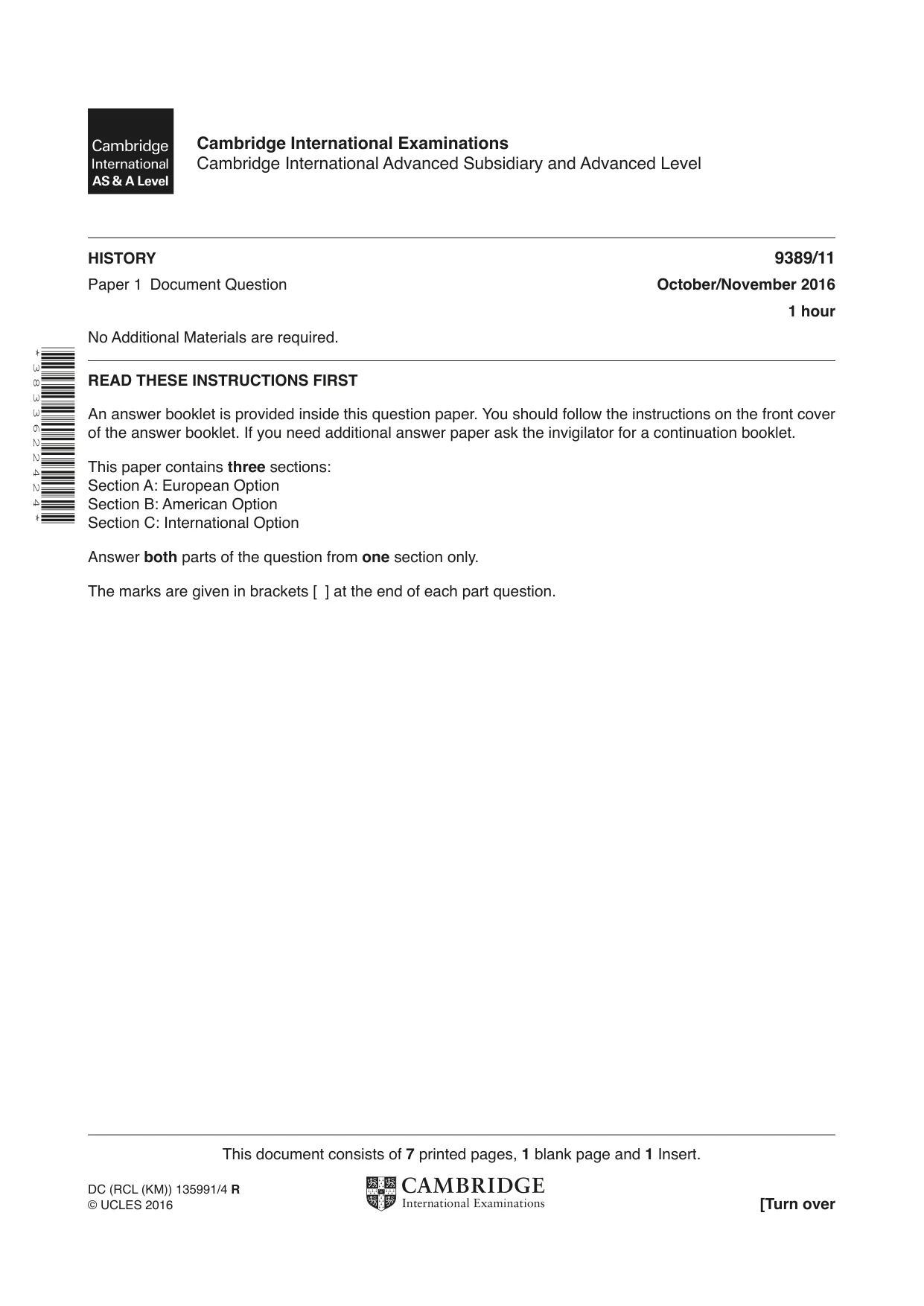
This document consists of 7 printed pages, 1 blank page and 1 Insert. DC (RCL (KM)) 135991/4 R © UCLES 2016 [Turn over Cambridge International Examinations Cambridge International Advanced Subsidiary and Advanced Level * 3 8 3 3 6 2 2 4 2 4 * HISTORY 9389/11 Paper 1 Document Question October/November 2016 1 hour No Additional Materials are required. READ THESE INSTRUCTIONS FIRST An answer booklet is provided inside this question paper. You should follow the instructions on the front cover of the answer booklet. If you need additional answer paper ask the invigilator for a continuation booklet. This paper contains three sections: Section A: European Option Section B: American Option Section C: International Option Answer both parts of the question from one section only. The marks are given in brackets [ ] at the end of each part question.
Question paper, page 2
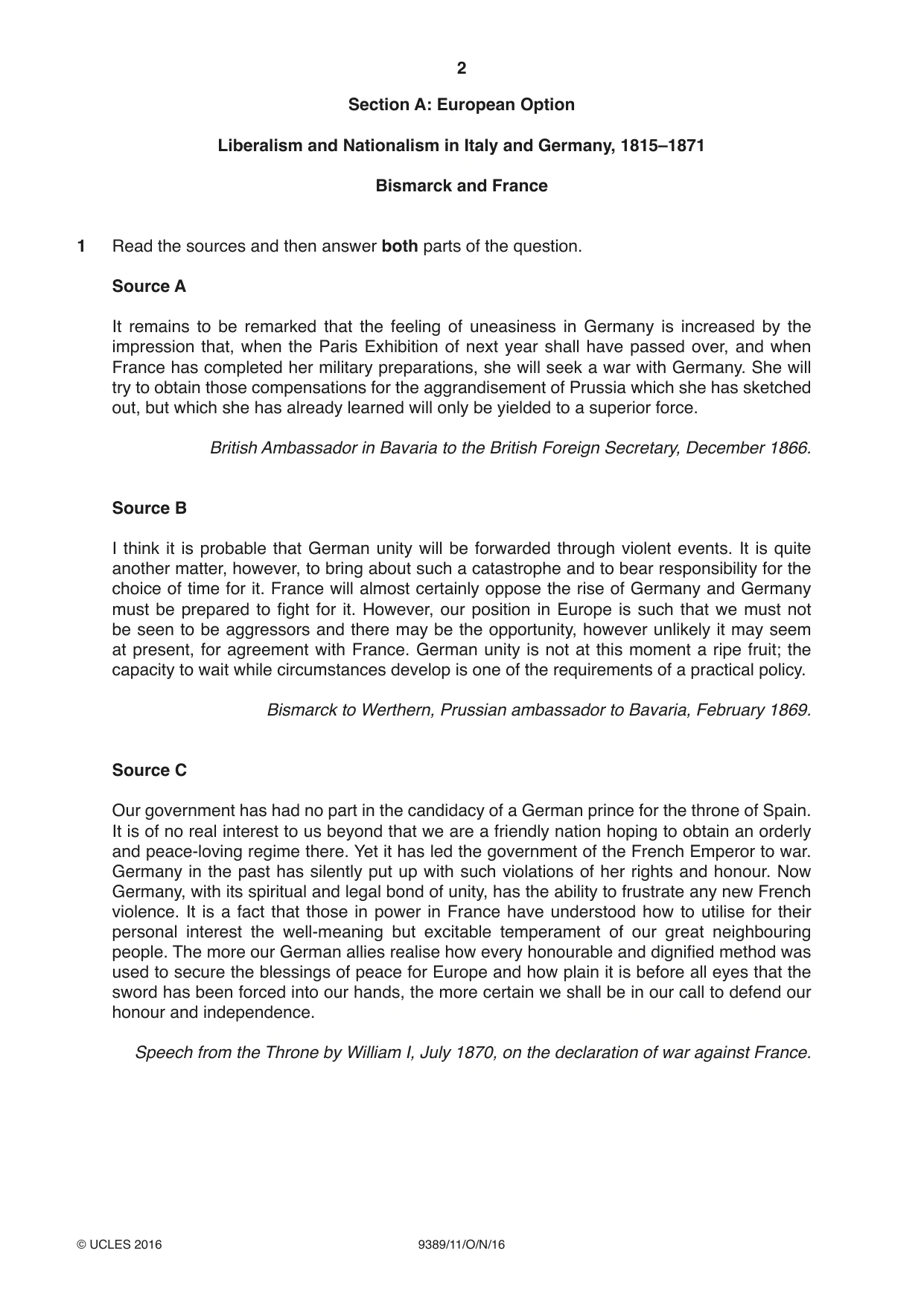
2 9389/11/O/N/16 © UCLES 2016 Section A: European Option Liberalism and Nationalism in Italy and Germany, 1815–1871 Bismarck and France 1 Read the sources and then answer both parts of the question. Source A It remains to be remarked that the feeling of uneasiness in Germany is increased by the impression that, when the Paris Exhibition of next year shall have passed over, and when France has completed her military preparations, she will seek a war with Germany. She will try to obtain those compensations for the aggrandisement of Prussia which she has sketched out, but which she has already learned will only be yielded to a superior force. British Ambassador in Bavaria to the British Foreign Secretary, December 1866. Source B I think it is probable that German unity will be forwarded through violent events. It is quite another matter, however, to bring about such a catastrophe and to bear responsibility for the choice of time for it. France will almost certainly oppose the rise of Germany and Germany must be prepared to fight for it. However, our position in Europe is such that we must not be seen to be aggressors and there may be the opportunity, however unlikely it may seem at present, for agreement with France. German unity is not at this moment a ripe fruit; the capacity to wait while circumstances develop is one of the requirements of a practical policy. Bismarck to Werthern, Prussian ambassador to Bavaria, February 1869. Source C Our government has had no part in the candidacy of a German prince for the throne of Spain. It is of no real interest to us beyond that we are a friendly nation hoping to obtain an orderly and peace-loving regime there. Yet it has led the government of the French Emperor to war. Germany in the past has silently put up with such violations of her rights and honour. Now Germany, with its spiritual and legal bond of unity, has the ability to frustrate any new French violence. It is a fact that those in power in France have understood how to utilise for their personal interest the well-meaning but excitable temperament of our great neighbouring people. The more our German allies realise how every honourable and dignified method was used to secure the blessings of peace for Europe and how plain it is before all eyes that the sword has been forced into our hands, the more certain we shall be in our call to defend our honour and independence. Speech from the Throne by William I, July 1870, on the declaration of war against France.
Question paper, page 3
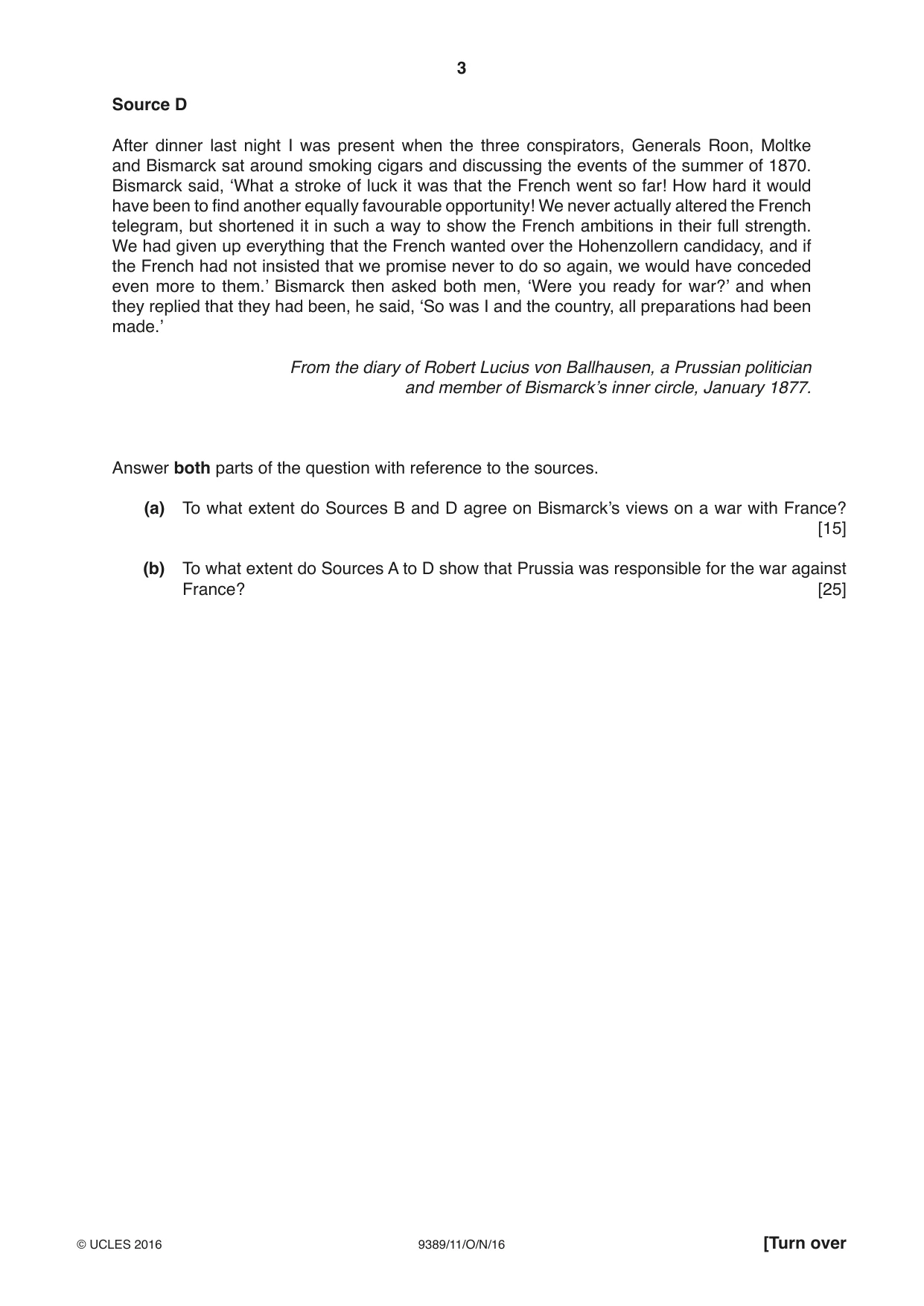
3 9389/11/O/N/16 © UCLES 2016 [Turn over Source D After dinner last night I was present when the three conspirators, Generals Roon, Moltke and Bismarck sat around smoking cigars and discussing the events of the summer of 1870. Bismarck said, ‘What a stroke of luck it was that the French went so far! How hard it would have been to find another equally favourable opportunity! We never actually altered the French telegram, but shortened it in such a way to show the French ambitions in their full strength. We had given up everything that the French wanted over the Hohenzollern candidacy, and if the French had not insisted that we promise never to do so again, we would have conceded even more to them.’ Bismarck then asked both men, ‘Were you ready for war?’ and when they replied that they had been, he said, ‘So was I and the country, all preparations had been made.’ From the diary of Robert Lucius von Ballhausen, a Prussian politician and member of Bismarck’s inner circle, January 1877. Answer both parts of the question with reference to the sources. (a) To what extent do Sources B and D agree on Bismarck’s views on a war with France? [15] (b) To what extent do Sources A to D show that Prussia was responsible for the war against France? [25]
Question paper, page 4
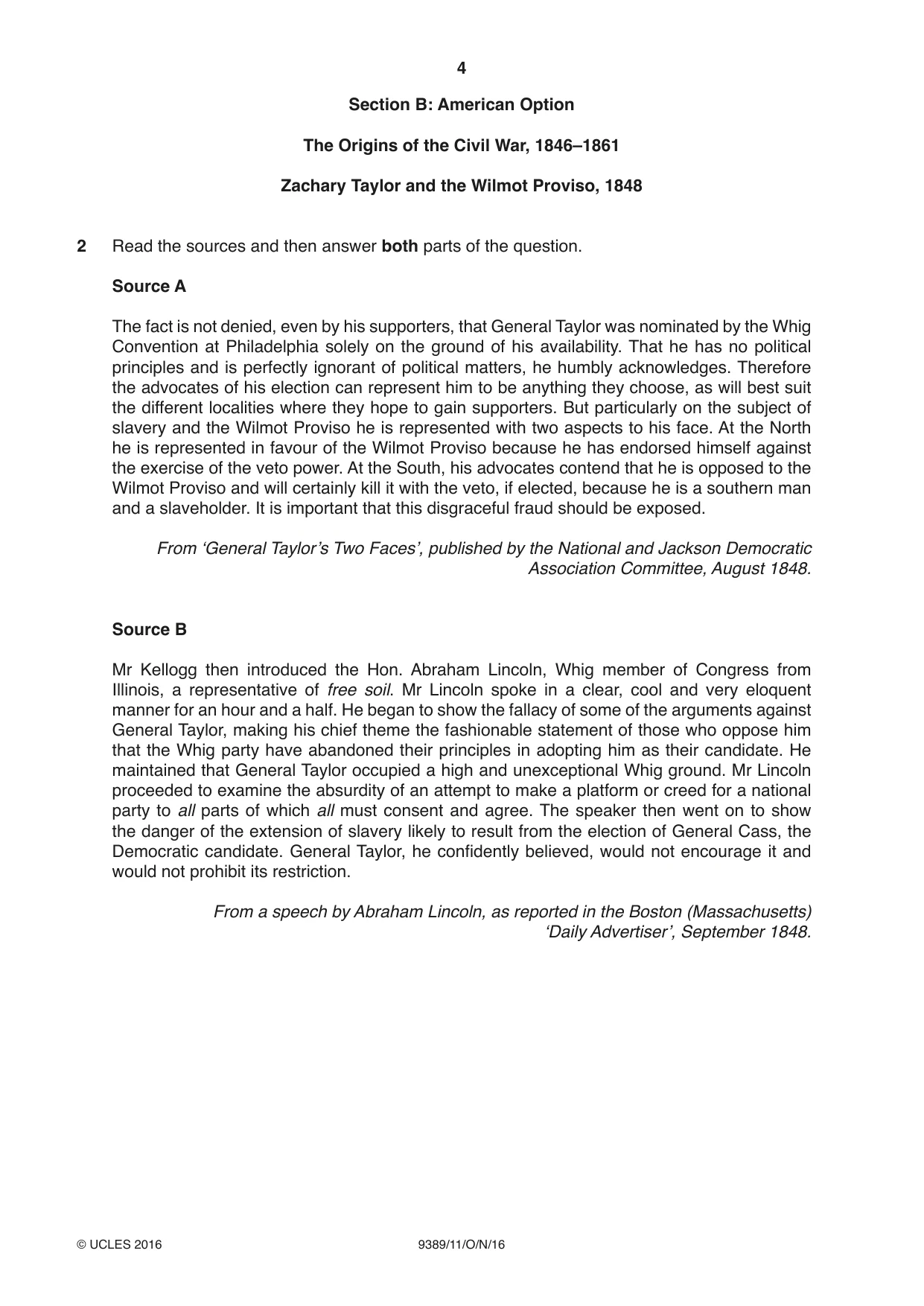
4 9389/11/O/N/16 © UCLES 2016 Section B: American Option The Origins of the Civil War, 1846–1861 Zachary Taylor and the Wilmot Proviso, 1848 2 Read the sources and then answer both parts of the question. Source A The fact is not denied, even by his supporters, that General Taylor was nominated by the Whig Convention at Philadelphia solely on the ground of his availability. That he has no political principles and is perfectly ignorant of political matters, he humbly acknowledges. Therefore the advocates of his election can represent him to be anything they choose, as will best suit the different localities where they hope to gain supporters. But particularly on the subject of slavery and the Wilmot Proviso he is represented with two aspects to his face. At the North he is represented in favour of the Wilmot Proviso because he has endorsed himself against the exercise of the veto power. At the South, his advocates contend that he is opposed to the Wilmot Proviso and will certainly kill it with the veto, if elected, because he is a southern man and a slaveholder. It is important that this disgraceful fraud should be exposed. From ‘General Taylor’s Two Faces’, published by the National and Jackson Democratic Association Committee, August 1848. Source B Mr Kellogg then introduced the Hon. Abraham Lincoln, Whig member of Congress from Illinois, a representative of free soil. Mr Lincoln spoke in a clear, cool and very eloquent manner for an hour and a half. He began to show the fallacy of some of the arguments against General Taylor, making his chief theme the fashionable statement of those who oppose him that the Whig party have abandoned their principles in adopting him as their candidate. He maintained that General Taylor occupied a high and unexceptional Whig ground. Mr Lincoln proceeded to examine the absurdity of an attempt to make a platform or creed for a national party to all parts of which all must consent and agree. The speaker then went on to show the danger of the extension of slavery likely to result from the election of General Cass, the Democratic candidate. General Taylor, he confidently believed, would not encourage it and would not prohibit its restriction. From a speech by Abraham Lincoln, as reported in the Boston (Massachusetts) ‘Daily Advertiser’, September 1848.
Question paper, page 5
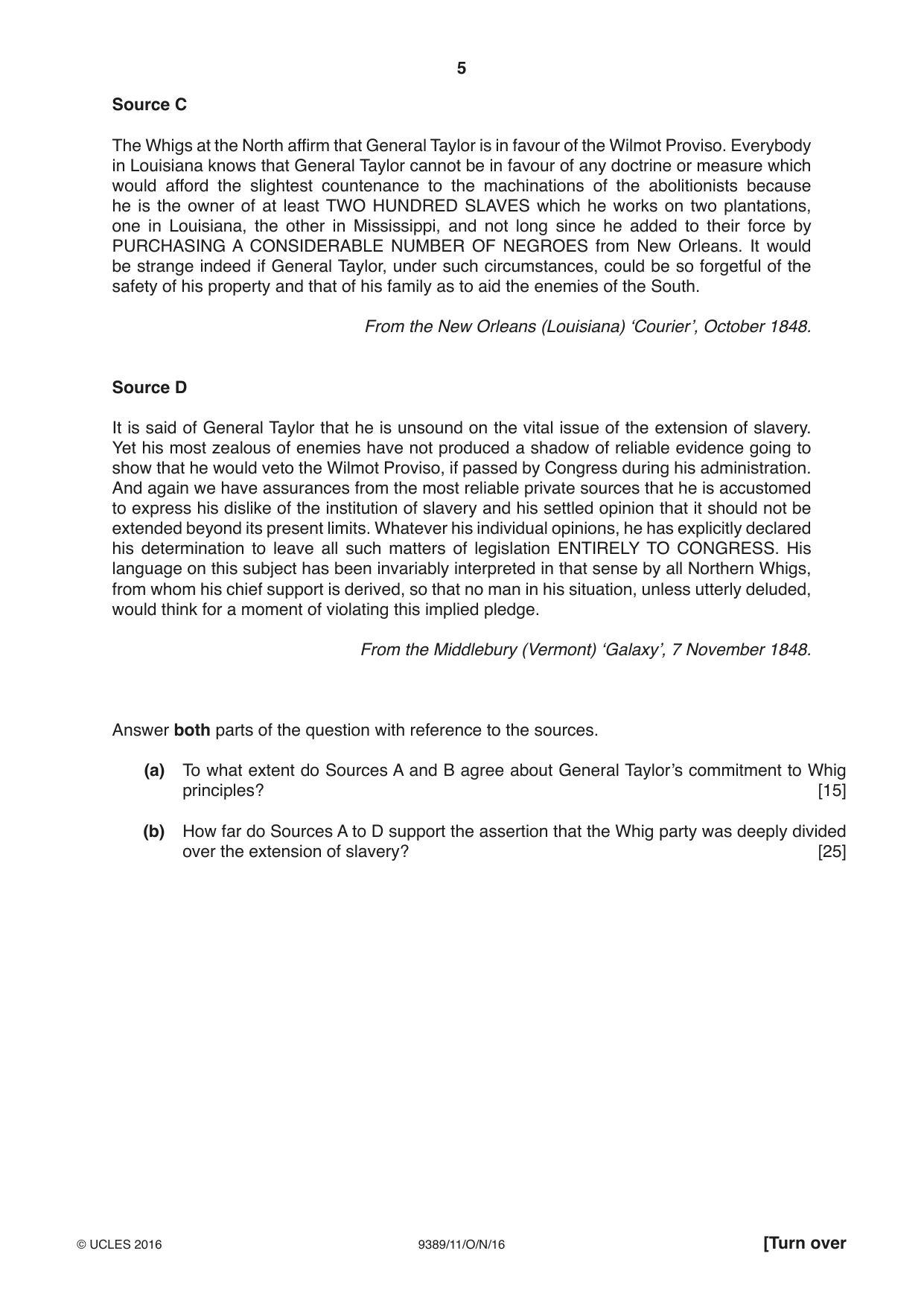
5 9389/11/O/N/16 © UCLES 2016 [Turn over Source C The Whigs at the North affirm that General Taylor is in favour of the Wilmot Proviso. Everybody in Louisiana knows that General Taylor cannot be in favour of any doctrine or measure which would afford the slightest countenance to the machinations of the abolitionists because he is the owner of at least TWO HUNDRED SLAVES which he works on two plantations, one in Louisiana, the other in Mississippi, and not long since he added to their force by PURCHASING A CONSIDERABLE NUMBER OF NEGROES from New Orleans. It would be strange indeed if General Taylor, under such circumstances, could be so forgetful of the safety of his property and that of his family as to aid the enemies of the South. From the New Orleans (Louisiana) ‘Courier’, October 1848. Source D It is said of General Taylor that he is unsound on the vital issue of the extension of slavery. Yet his most zealous of enemies have not produced a shadow of reliable evidence going to show that he would veto the Wilmot Proviso, if passed by Congress during his administration. And again we have assurances from the most reliable private sources that he is accustomed to express his dislike of the institution of slavery and his settled opinion that it should not be extended beyond its present limits. Whatever his individual opinions, he has explicitly declared his determination to leave all such matters of legislation ENTIRELY TO CONGRESS. His language on this subject has been invariably interpreted in that sense by all Northern Whigs, from whom his chief support is derived, so that no man in his situation, unless utterly deluded, would think for a moment of violating this implied pledge. From the Middlebury (Vermont) ‘Galaxy’, 7 November 1848. Answer both parts of the question with reference to the sources. (a) To what extent do Sources A and B agree about General Taylor’s commitment to Whig principles? [15] (b) How far do Sources A to D support the assertion that the Whig party was deeply divided over the extension of slavery? [25]
Question paper, page 6
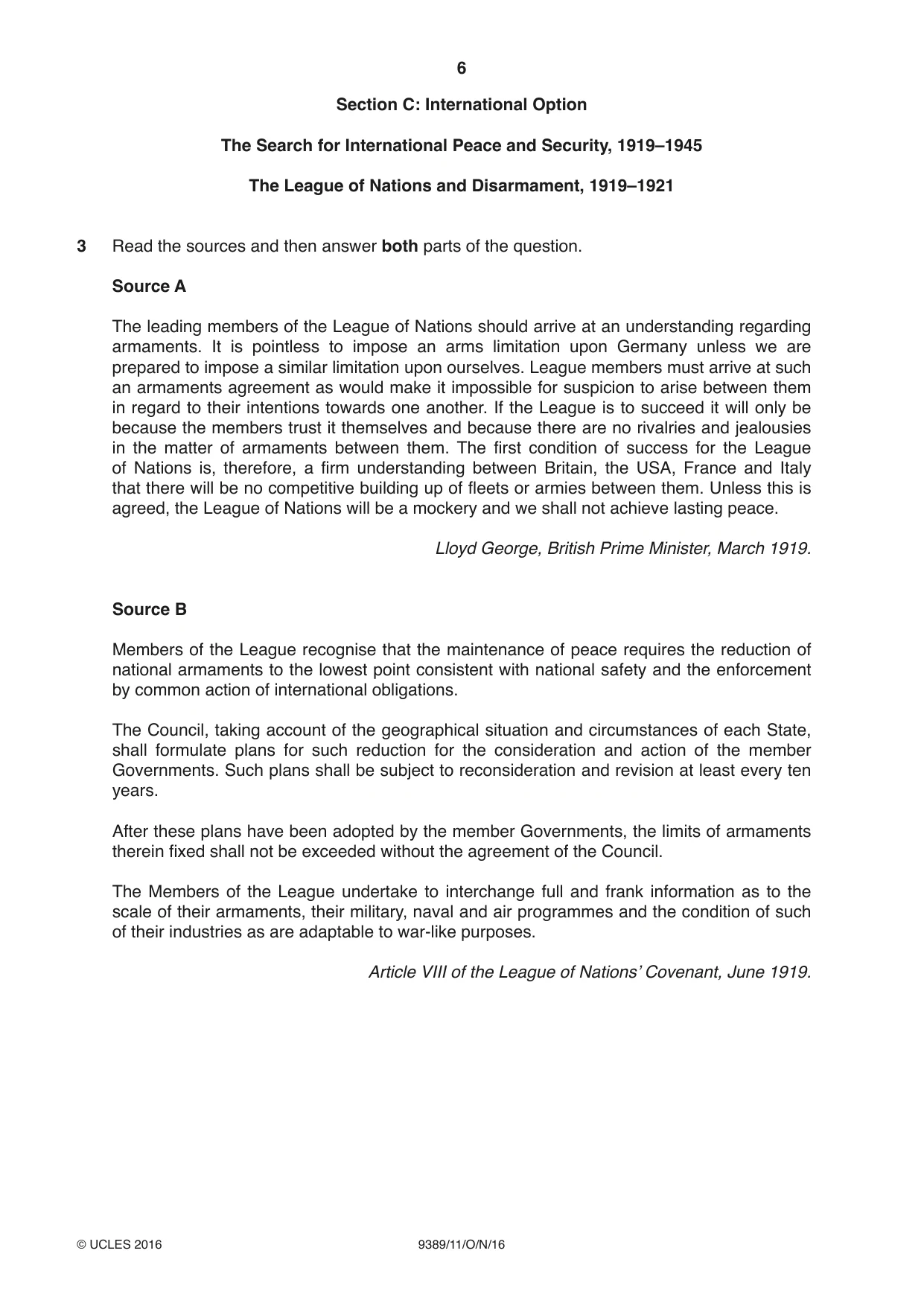
6 9389/11/O/N/16 © UCLES 2016 Section C: International Option The Search for International Peace and Security, 1919–1945 The League of Nations and Disarmament, 1919–1921 3 Read the sources and then answer both parts of the question. Source A The leading members of the League of Nations should arrive at an understanding regarding armaments. It is pointless to impose an arms limitation upon Germany unless we are prepared to impose a similar limitation upon ourselves. League members must arrive at such an armaments agreement as would make it impossible for suspicion to arise between them in regard to their intentions towards one another. If the League is to succeed it will only be because the members trust it themselves and because there are no rivalries and jealousies in the matter of armaments between them. The first condition of success for the League of Nations is, therefore, a firm understanding between Britain, the USA, France and Italy that there will be no competitive building up of fleets or armies between them. Unless this is agreed, the League of Nations will be a mockery and we shall not achieve lasting peace. Lloyd George, British Prime Minister, March 1919. Source B Members of the League recognise that the maintenance of peace requires the reduction of national armaments to the lowest point consistent with national safety and the enforcement by common action of international obligations. The Council, taking account of the geographical situation and circumstances of each State, shall formulate plans for such reduction for the consideration and action of the member Governments. Such plans shall be subject to reconsideration and revision at least every ten years. After these plans have been adopted by the member Governments, the limits of armaments therein fixed shall not be exceeded without the agreement of the Council. The Members of the League undertake to interchange full and frank information as to the scale of their armaments, their military, naval and air programmes and the condition of such of their industries as are adaptable to war-like purposes. Article VIII of the League of Nations’ Covenant, June 1919.
Question paper, page 7
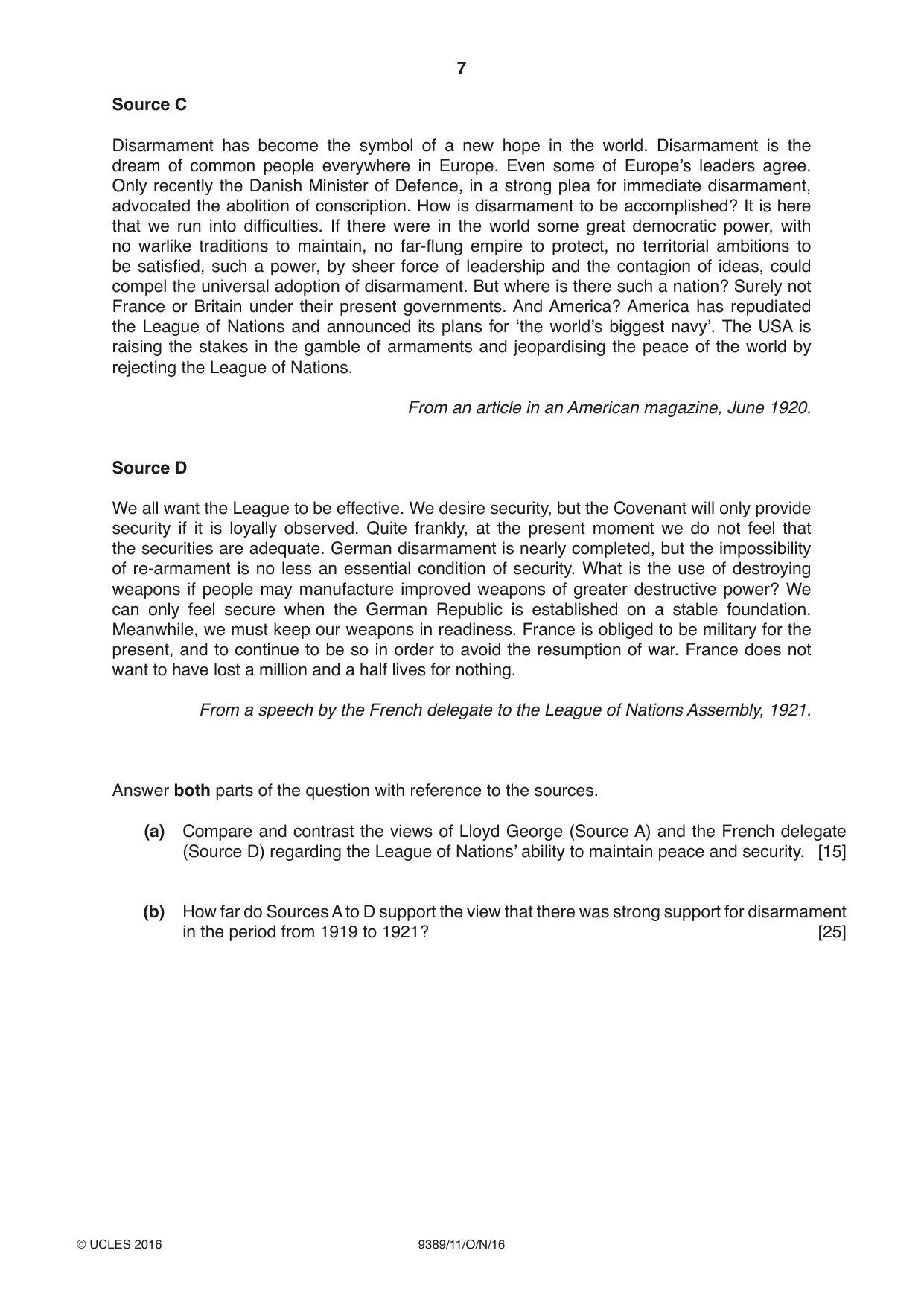
7 9389/11/O/N/16 © UCLES 2016 Source C Disarmament has become the symbol of a new hope in the world. Disarmament is the dream of common people everywhere in Europe. Even some of Europe’s leaders agree. Only recently the Danish Minister of Defence, in a strong plea for immediate disarmament, advocated the abolition of conscription. How is disarmament to be accomplished? It is here that we run into difficulties. If there were in the world some great democratic power, with no warlike traditions to maintain, no far-flung empire to protect, no territorial ambitions to be satisfied, such a power, by sheer force of leadership and the contagion of ideas, could compel the universal adoption of disarmament. But where is there such a nation? Surely not France or Britain under their present governments. And America? America has repudiated the League of Nations and announced its plans for ‘the world’s biggest navy’. The USA is raising the stakes in the gamble of armaments and jeopardising the peace of the world by rejecting the League of Nations. From an article in an American magazine, June 1920. Source D We all want the League to be effective. We desire security, but the Covenant will only provide security if it is loyally observed. Quite frankly, at the present moment we do not feel that the securities are adequate. German disarmament is nearly completed, but the impossibility of re-armament is no less an essential condition of security. What is the use of destroying weapons if people may manufacture improved weapons of greater destructive power? We can only feel secure when the German Republic is established on a stable foundation. Meanwhile, we must keep our weapons in readiness. France is obliged to be military for the present, and to continue to be so in order to avoid the resumption of war. France does not want to have lost a million and a half lives for nothing. From a speech by the French delegate to the League of Nations Assembly, 1921. Answer both parts of the question with reference to the sources. (a) Compare and contrast the views of Lloyd George (Source A) and the French delegate (Source D) regarding the League of Nations’ ability to maintain peace and security. [15] (b) How far do Sources A to D support the view that there was strong support for disarmament in the period from 1919 to 1921? [25]
Question paper, page 8
8 9389/11/O/N/16 © UCLES 2016 BLANK PAGE Permission to reproduce items where third-party owned material protected by copyright is included has been sought and cleared where possible. Every reasonable effort has been made by the publisher (UCLES) to trace copyright holders, but if any items requiring clearance have unwittingly been included, the publisher will be pleased to make amends at the earliest possible opportunity. To avoid the issue of disclosure of answer-related information to candidates, all copyright acknowledgements are reproduced online in the Cambridge International Examinations Copyright Acknowledgements Booklet. This is produced for each series of examinations and is freely available to download at www.cie.org.uk after the live examination series. Cambridge International Examinations is part of the Cambridge Assessment Group. Cambridge Assessment is the brand name of University of Cambridge Local Examinations Syndicate (UCLES), which is itself a department of the University of Cambridge.
Mark scheme, page 1
® IGCSE is the registered trademark of Cambridge International Examinations. This document consists of 9 printed pages. © UCLES 2016 [Turn over Cambridge International Examinations Cambridge International Advanced Subsidiary and Advanced Level HISTORY 9389/11 Paper 1 Document Question October/November 2016 MARK SCHEME Maximum Mark: 40 Published This mark scheme is published as an aid to teachers and candidates, to indicate the requirements of the examination. It shows the basis on which Examiners were instructed to award marks. It does not indicate the details of the discussions that took place at an Examiners’ meeting before marking began, which would have considered the acceptability of alternative answers. Mark schemes should be read in conjunction with the question paper and the Principal Examiner Report for Teachers. Cambridge will not enter into discussions about these mark schemes. Cambridge is publishing the mark schemes for the October/November 2016 series for most Cambridge IGCSE®, Cambridge International A and AS Level components and some Cambridge O Level components.
Mark scheme, page 2
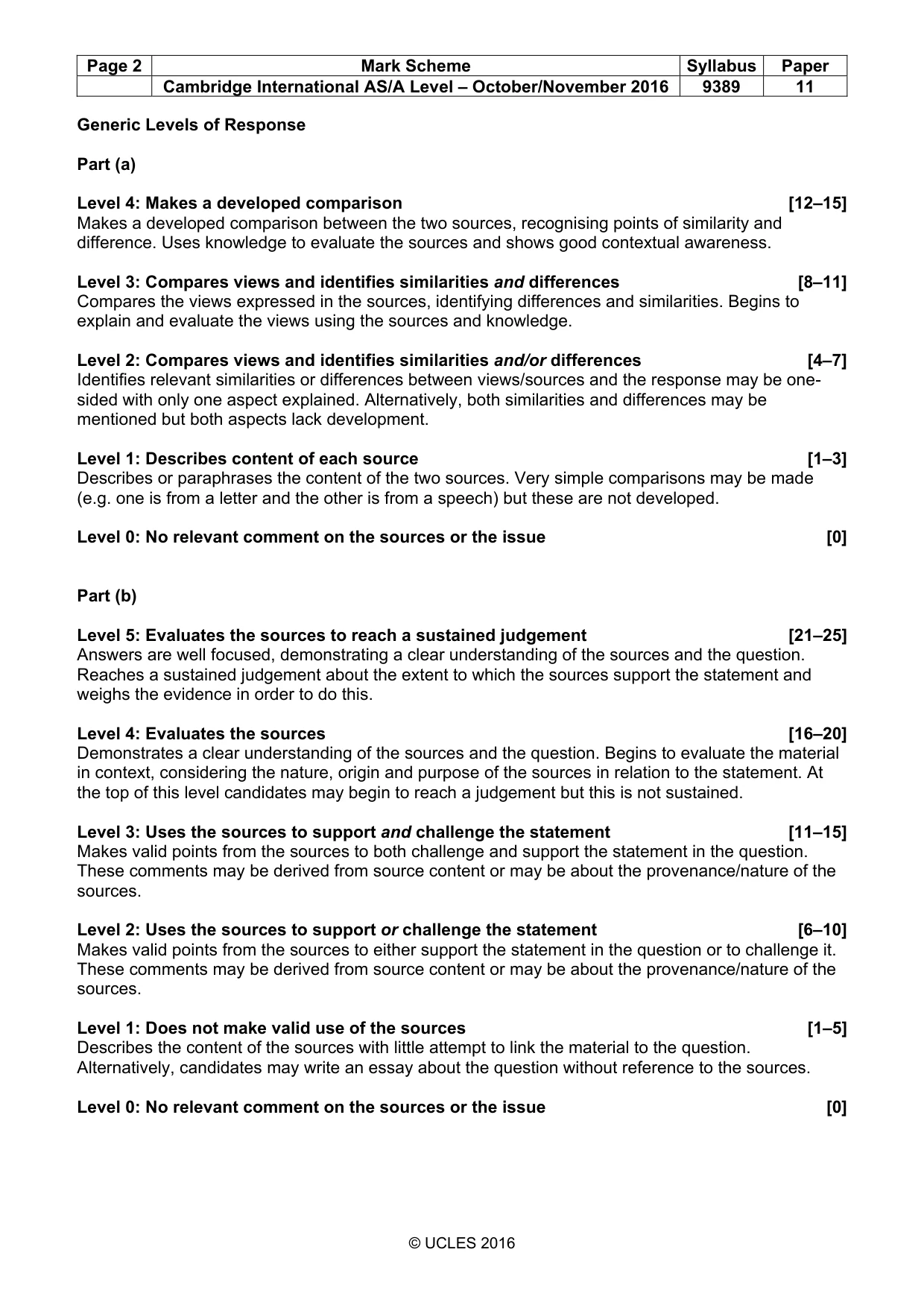
Page 2 Mark Scheme Syllabus Paper Cambridge International AS/A Level – October/November 2016 9389 11 © UCLES 2016 Generic Levels of Response Part (a) Level 4: Makes a developed comparison [12–15] Makes a developed comparison between the two sources, recognising points of similarity and difference. Uses knowledge to evaluate the sources and shows good contextual awareness. Level 3: Compares views and identifies similarities and differences [8–11] Compares the views expressed in the sources, identifying differences and similarities. Begins to explain and evaluate the views using the sources and knowledge. Level 2: Compares views and identifies similarities and/or differences [4–7] Identifies relevant similarities or differences between views/sources and the response may be one- sided with only one aspect explained. Alternatively, both similarities and differences may be mentioned but both aspects lack development. Level 1: Describes content of each source [1–3] Describes or paraphrases the content of the two sources. Very simple comparisons may be made (e.g. one is from a letter and the other is from a speech) but these are not developed. Level 0: No relevant comment on the sources or the issue [0] Part (b) Level 5: Evaluates the sources to reach a sustained judgement [21–25] Answers are well focused, demonstrating a clear understanding of the sources and the question. Reaches a sustained judgement about the extent to which the sources support the statement and weighs the evidence in order to do this. Level 4: Evaluates the sources [16–20] Demonstrates a clear understanding of the sources and the question. Begins to evaluate the material in context, considering the nature, origin and purpose of the sources in relation to the statement. At the top of this level candidates may begin to reach a judgement but this is not sustained. Level 3: Uses the sources to support and challenge the statement [11–15] Makes valid points from the sources to both challenge and support the statement in the question. These comments may be derived from source content or may be about the provenance/nature of the sources. Level 2: Uses the sources to support or challenge the statement [6–10] Makes valid points from the sources to either support the statement in the question or to challenge it. These comments may be derived from source content or may be about the provenance/nature of the sources. Level 1: Does not make valid use of the sources [1–5] Describes the content of the sources with little attempt to link the material to the question. Alternatively, candidates may write an essay about the question without reference to the sources. Level 0: No relevant comment on the sources or the issue [0]
Mark scheme, page 3
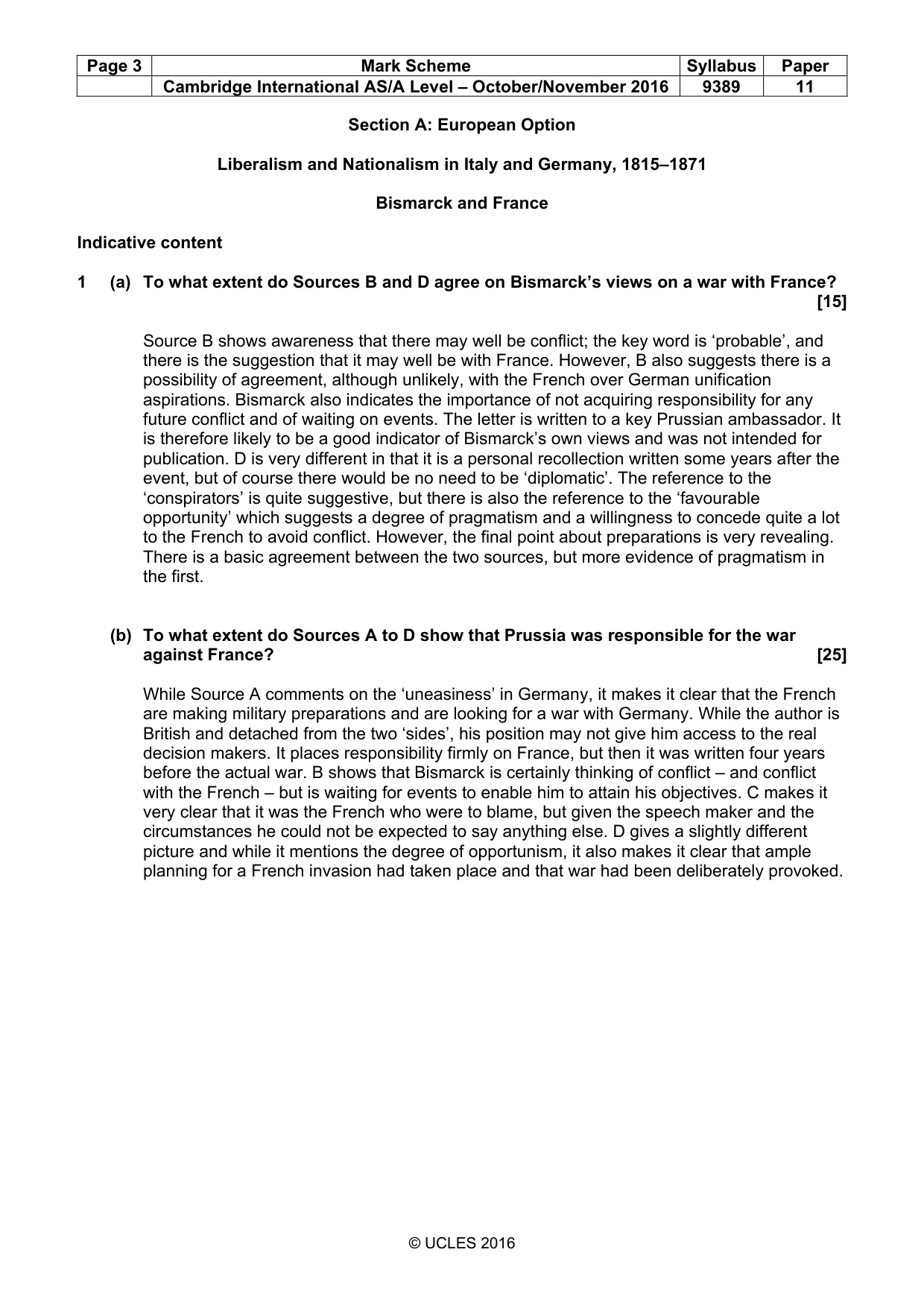
Page 3 Mark Scheme Syllabus Paper Cambridge International AS/A Level – October/November 2016 9389 11 © UCLES 2016 Section A: European Option Liberalism and Nationalism in Italy and Germany, 1815–1871 Bismarck and France Indicative content 1 (a) To what extent do Sources B and D agree on Bismarck’s views on a war with France? [15] Source B shows awareness that there may well be conflict; the key word is ‘probable’, and there is the suggestion that it may well be with France. However, B also suggests there is a possibility of agreement, although unlikely, with the French over German unification aspirations. Bismarck also indicates the importance of not acquiring responsibility for any future conflict and of waiting on events. The letter is written to a key Prussian ambassador. It is therefore likely to be a good indicator of Bismarck’s own views and was not intended for publication. D is very different in that it is a personal recollection written some years after the event, but of course there would be no need to be ‘diplomatic’. The reference to the ‘conspirators’ is quite suggestive, but there is also the reference to the ‘favourable opportunity’ which suggests a degree of pragmatism and a willingness to concede quite a lot to the French to avoid conflict. However, the final point about preparations is very revealing. There is a basic agreement between the two sources, but more evidence of pragmatism in the first. (b) To what extent do Sources A to D show that Prussia was responsible for the war against France? [25] While Source A comments on the ‘uneasiness’ in Germany, it makes it clear that the French are making military preparations and are looking for a war with Germany. While the author is British and detached from the two ‘sides’, his position may not give him access to the real decision makers. It places responsibility firmly on France, but then it was written four years before the actual war. B shows that Bismarck is certainly thinking of conflict – and conflict with the French – but is waiting for events to enable him to attain his objectives. C makes it very clear that it was the French who were to blame, but given the speech maker and the circumstances he could not be expected to say anything else. D gives a slightly different picture and while it mentions the degree of opportunism, it also makes it clear that ample planning for a French invasion had taken place and that war had been deliberately provoked.
Mark scheme, page 4
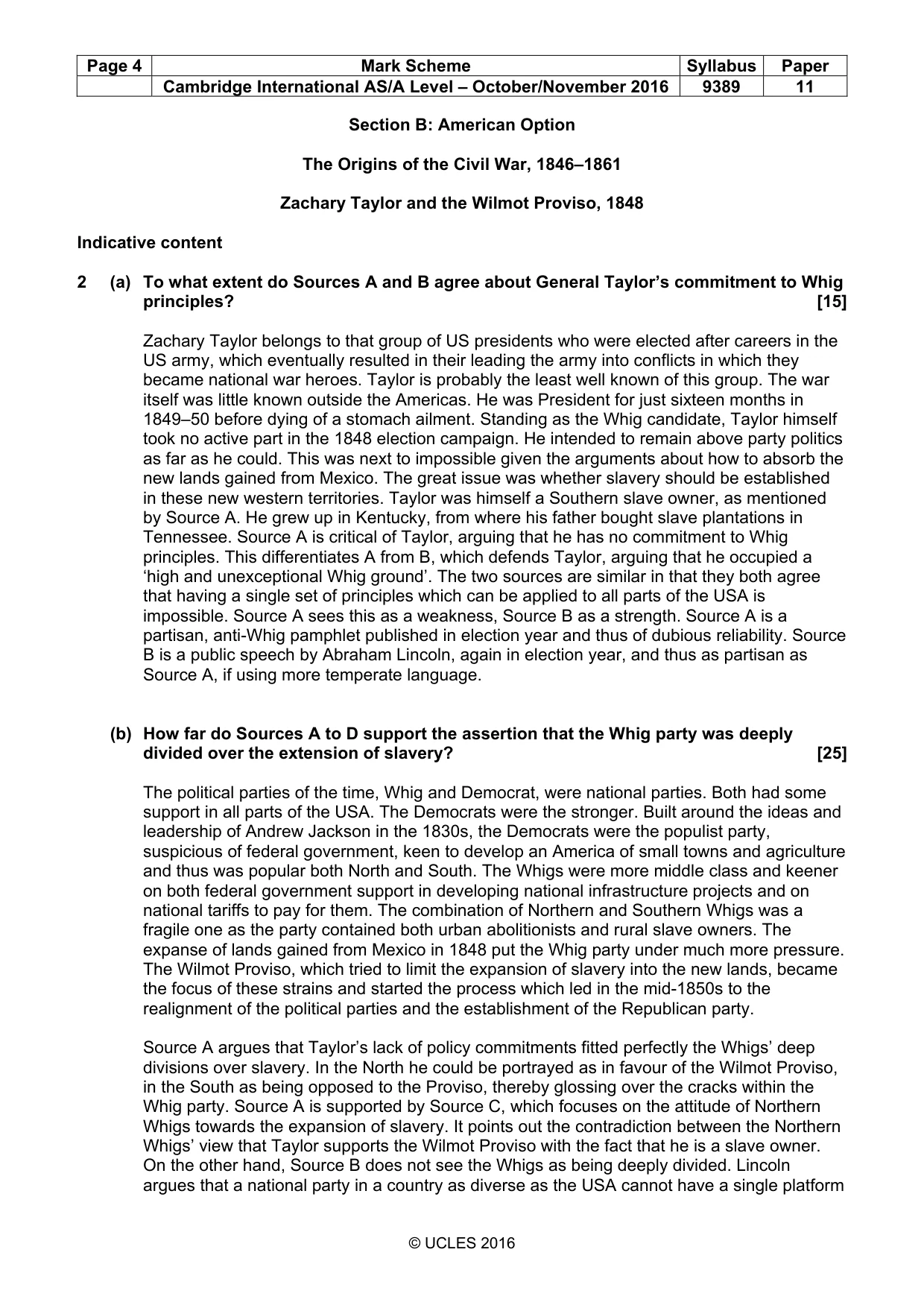
Page 4 Mark Scheme Syllabus Paper Cambridge International AS/A Level – October/November 2016 9389 11 © UCLES 2016 Section B: American Option The Origins of the Civil War, 1846–1861 Zachary Taylor and the Wilmot Proviso, 1848 Indicative content 2 (a) To what extent do Sources A and B agree about General Taylor’s commitment to Whig principles? [15] Zachary Taylor belongs to that group of US presidents who were elected after careers in the US army, which eventually resulted in their leading the army into conflicts in which they became national war heroes. Taylor is probably the least well known of this group. The war itself was little known outside the Americas. He was President for just sixteen months in 1849–50 before dying of a stomach ailment. Standing as the Whig candidate, Taylor himself took no active part in the 1848 election campaign. He intended to remain above party politics as far as he could. This was next to impossible given the arguments about how to absorb the new lands gained from Mexico. The great issue was whether slavery should be established in these new western territories. Taylor was himself a Southern slave owner, as mentioned by Source A. He grew up in Kentucky, from where his father bought slave plantations in Tennessee. Source A is critical of Taylor, arguing that he has no commitment to Whig principles. This differentiates A from B, which defends Taylor, arguing that he occupied a ‘high and unexceptional Whig ground’. The two sources are similar in that they both agree that having a single set of principles which can be applied to all parts of the USA is impossible. Source A sees this as a weakness, Source B as a strength. Source A is a partisan, anti-Whig pamphlet published in election year and thus of dubious reliability. Source B is a public speech by Abraham Lincoln, again in election year, and thus as partisan as Source A, if using more temperate language. (b) How far do Sources A to D support the assertion that the Whig party was deeply divided over the extension of slavery? [25] The political parties of the time, Whig and Democrat, were national parties. Both had some support in all parts of the USA. The Democrats were the stronger. Built around the ideas and leadership of Andrew Jackson in the 1830s, the Democrats were the populist party, suspicious of federal government, keen to develop an America of small towns and agriculture and thus was popular both North and South. The Whigs were more middle class and keener on both federal government support in developing national infrastructure projects and on national tariffs to pay for them. The combination of Northern and Southern Whigs was a fragile one as the party contained both urban abolitionists and rural slave owners. The expanse of lands gained from Mexico in 1848 put the Whig party under much more pressure. The Wilmot Proviso, which tried to limit the expansion of slavery into the new lands, became the focus of these strains and started the process which led in the mid-1850s to the realignment of the political parties and the establishment of the Republican party. Source A argues that Taylor’s lack of policy commitments fitted perfectly the Whigs’ deep divisions over slavery. In the North he could be portrayed as in favour of the Wilmot Proviso, in the South as being opposed to the Proviso, thereby glossing over the cracks within the Whig party. Source A is supported by Source C, which focuses on the attitude of Northern Whigs towards the expansion of slavery. It points out the contradiction between the Northern Whigs’ view that Taylor supports the Wilmot Proviso with the fact that he is a slave owner. On the other hand, Source B does not see the Whigs as being deeply divided. Lincoln argues that a national party in a country as diverse as the USA cannot have a single platform
Mark scheme, page 5
Page 5 Mark Scheme Syllabus Paper Cambridge International AS/A Level – October/November 2016 9389 11 © UCLES 2016 which will be acceptable to all parts of the country. There are bound to be differences of emphasis according to section and region. Source D also challenges the hypothesis, arguing that Taylor will not block the Wilmot Proviso, if approved by Congress. In arguing thus, Source D contradicts Source C. Sources C and D contradict each other’s argument. Each comes from a sectional and presumably partisan newspaper. Both are written in the autumn of 1848, when the presidential election campaign was becoming more intense. Both were aimed to appeal to their readers. Both are indeed partisan. Source C argues that Taylor’s self-interest means that he cannot work with the abolitionists of the North. Source D asserts that Taylor dislikes the institution of slavery, a contradiction with Source C which cannot easily be resolved. However, Source D goes on to say that Taylor does not want to see slavery extend beyond its present limits – which is exactly what the Wilmot Proviso intends to achieve. It is possible to be a [Southern] slave owner, opposed to the abolition of slavery, and yet not want slavery extended to the West. Source D is the more reliable of the two. Source A is even more partisan than either Source C or Source D. It comes from the party whose candidate is competing with Taylor for the presidency. Its content needs to be viewed very sceptically. Source C does support some of the assertions of Source A but that is to be expected of a Southern source and thus does little to improve the reliability of Source A. Finally, Source B is a Northern newspaper report of a speech by Abraham Lincoln at the start of his political career. There is a danger in assuming that because Lincoln is speaking, therefore the source will be reliable. Lincoln, however, is a Whig politician making a speech in election year in favour of the Whig presidential candidate, which brings the source’s reliability into doubt. Source D gives some support to Source B but then Source D is another partisan source. Source B states that Lincoln did consider the arguments of those who oppose Taylor, which means that his speech was more balanced, less one-sided than the others. Also, contextual knowledge of the era suggests that Whig divisions in 1848 were not as deep as they became in the 1850s, when the party split in two.
Mark scheme, page 6
Page 6 Mark Scheme Syllabus Paper Cambridge International AS/A Level – October/November 2016 9389 11 © UCLES 2016 Section C: International Option The Search for International Peace and Security, 1919–1945 The League of Nations and Disarmament, 1919–1921 Indicative content 3 (a) Compare and contrast the views of Lloyd George (Source A) and the French delegate (Source D) regarding the League of Nations’ ability to maintain peace and security. [15] Lloyd George (Source A) argues that the League of Nations could provide international peace and security, but only if the victorious Allied powers were prepared to work together in mutual trust and understanding. He suggests that a key element of this involves disarmament. He feels that it would be wrong and counterproductive to impose arms reduction on Germany unless the leading Allied nations were prepared to reduce their own armaments. By working together through the League, countries would be able to ensure their national security without needing their own large-scale armaments. The implication is that Britain is prepared to commit itself to disarmament, provided its main allies (the USA, France and Italy) do likewise. Without such mutual trust and understanding, he believes that the League would fail. The French delegate (Source D) is not convinced that the League and its Covenant provide France with effective security. Although Germany has complied with the disarmament requirements imposed by the Treaty of Versailles, France is concerned about the possibility of future German rearmament. As a result, France believes that it must retain its armaments in order to protect its own national security, a clear indication that France does not believe the League is capable of preserving international peace and security. France, therefore, seems to lack the trust which Lloyd George believed was vital for the League’s success. Lloyd George was writing in March 1919, during the negotiations at the Paris peace conference. At that stage, the League of Nations’ Covenant had not been finalised or agreed, and the USA’s subsequent refusal to either ratify the peace settlement or join the League of Nations was not known. While Lloyd George clearly shared US President Wilson’s idealistic belief in the importance of establishing a League of Nations, he is realistic enough to identify issues which might lead to the League’s failure. He believes that collective security, a fundamental element of the League, could only work if countries worked together in mutual trust and understanding; he displays some scepticism regarding the prospect of this actually happening. The French delegate was speaking in 1921. By this time, it was clear that Lloyd George’s pre-conditions for the League’s success in maintaining peace and security had not been met. The USA had failed to ratify the peace settlement and refused to join the League. This seriously undermined French confidence since it meant that France was no longer guaranteed the support of both Britain and the USA in the event of any future German attack. Italy, disenchanted with the terms of the peace settlement, was lukewarm in its support of the League. France and Britain had disagreed about how severely to treat Germany in the Treaty of Versailles. Britain, with a vested interest in Germany’s economic recovery, argued for less severe terms than those desired by Clemenceau. France was also concerned by the fact that the League of Nations did not have its own army or police force; in effect, France would be relying on the armed forces of other countries, whose support could not be guaranteed. France therefore felt vulnerable and did not believe that the League would be able to guarantee its national security. Moreover, by 1921, Britain had itself set increased armaments budgets.
Mark scheme, page 7
Page 7 Mark Scheme Syllabus Paper Cambridge International AS/A Level – October/November 2016 9389 11 © UCLES 2016 (b) How far do Sources A to D support the view that there was strong support for disarmament in the period from 1919 to 1921? [25] One of Wilson’s main aims at the Paris peace conference was to create a situation in which future war was impossible. Key elements in this were the establishment of a League of Nations, based on mutual trust and understanding, and a reduction in armaments to prevent the kind of arms race which led to WWI. Weary of war and afraid of another, the people of Europe shared Wilson’s dream. At Paris, therefore, there was a general feeling that global disarmament was a vital prerequisite of lasting peace and security. This was enshrined in the Covenant of the League of Nations, signed by 44 nations in 1919 and operative from January 1920. The concept was that each nation’s territorial integrity would be guaranteed by the League’s members working together in collective security, thereby rendering unwarranted aggression bound to fail; nations would, therefore, not need to maintain their own large-scale armaments as a means of security. A combination of idealism and political expediency had encouraged politicians to commit their countries to disarmament, but this commitment was never honoured. While Germany disarmed in line with the terms of the Treaty of Versailles, other countries did not. The USA did not ratify the peace settlement or join the League of Nations; it increased the size of its navy in order to protect its Pacific interests. France, fearing a revival of German power, insisted on maintaining a high level of armaments, arguing that the League offered no guarantee of protection because it lacked its own army or police force. Italy, disenchanted with the peace settlement, made its expansionist intentions clear. Britain increased the size of the armaments budget. Before the Covenant was finalised and agreed, Lloyd George had argued that the League could only be successful if member states trusted each other; it quickly became apparent that this prerequisite of success was missing. As late as 1932, when the World Disarmament Conference opened, no progress had been made on the key issue of disarmament, much to the resentment of Germany. In support of the hypothesis – The British Prime Minister (Source A) is clearly committed to disarmament. He argues that disarmament is vital if the League of Nations is to be successful, since it would help to reduce suspicion between countries and increase mutual trust and cooperation. He also argues that it would be wrong and counter-productive to impose disarmament on Germany and the defeated nations if the major Allied nations were not prepared to make a similar commitment. Implicit in this is the view that the whole peace settlement would fail unless all countries embraced disarmament. The Covenant of the League of Nations included Article VIII (Source B), and was signed by 44 nations on 28 June 1919. These nations included Britain, the USA, France and Italy, the four nations whose commitment to disarmament Lloyd George (Source A) had identified as vital for the League’s success. In signing the Covenant, countries were committing themselves to disarmament, entrusting the League of Nations to provide them with territorial security. Countries would not be allowed to exceed armaments limits established by the League of Nations, and would be expected to provide the League with full details of their military capabilities. The American writer of Source C clearly supports the League of Nations and argues that disarmament is vital in the interests of future peace. He suggests that popular opinion in Europe is heavily in favour of disarmament and shows that even some leading politicians support it (e.g. Denmark’s Minister of Defence).
Mark scheme, page 8
Page 8 Mark Scheme Syllabus Paper Cambridge International AS/A Level – October/November 2016 9389 11 © UCLES 2016 In challenging the hypothesis – The American writer of Source C argues that, while disarmament is a good idea in theory, in reality there is little possibility of it happening. The USA, not bound by any commitment to the League of Nations, has already announced its intention to increase the size of its navy. The source makes it clear that Britain and France, ‘under their present governments’, have no intention of honouring their commitment to disarmament. The writer suggests that countries are putting their own national interests above their commitment to the League of Nations – interests such as protecting their empires (e.g. Britain) or satisfying their territorial ambitions (e.g. Italy). While the ‘common people’ of Europe want their countries to disarm, politicians are reluctant to do so (except those representing small, unwarlike countries such as Denmark). As reflected in Source D, the French government lacked trust in the League’s ability to guarantee peace and security. Fearful of a resurgence of German power, which would pose a threat to France, the French government felt it necessary to maintain its own large-scale armaments. In Source A, the British Prime Minister argues in favour of disarmament, but seems a little sceptical about whether countries will have sufficient mutual trust to make it a reality. Source A – Written at a fairly early stage of the Paris peace talks and before the Covenant was either finalised or signed. It reflects Britain’s support for President Wilson’s aim to create a fair and lasting peace, one which was not too harsh on the defeated Germany, in whose economic resurgence Britain had a vested interest. Lloyd George clearly supports the proposed League of Nations, but is fully aware of potential issues which could cause it to fail. He supports disarmament because he believes it is the only way to develop the trust and mutual understanding between nations which will be vital for the League’s success. Source B – After a lengthy process of drafting and debate, the Covenant was signed by the representatives of 44 nations on 28 June 1919, becoming effective from January 1920. Taken literally (as the US Senate did), it suggests that the League of Nations would decide the level of armaments which each member state would be allowed. Most signatories clearly did not take the wording literally; they believed that national security (including armaments) remained an internal issue, to be determined by their own governments. The Article contains the phrase ‘the reduction of national armaments to the lowest point consistent with national safety’; this is open to various interpretations – for example, France would argue that its views as expressed in Source D are not inconsistent with its commitment to the Covenant. Source C – Written in June 1920, by which time the USA had rejected both the Paris peace settlement and the League of Nations. It was, therefore, no longer committed to the Covenant and had announced its plans to increase the size of its navy. Lloyd George’s pre- conditions for the League’s success were, therefore, already broken. France, no longer guaranteed American support in the event of German hostility, felt the need to maintain its own military capabilities (as in Source D). Despite his country’s attitude, the writer clearly supports the concept of a League of Nations – he is critical both of the USA’s rejection of the League and of leading European politicians’ refusal to embrace disarmament. He argues that European public opinion is in favour of disarmament, but provides no substantial evidence to support this. Denmark is a relatively small, militarily weak and potentially vulnerable nation; it is not surprising, therefore, that its politicians would favour international disarmament – collective security provided by the League of Nations would have appeared to offer better protection than Denmark could provide for itself. Published in an American magazine, the article is critical of US government policy; it is possible, therefore, that it may have been politically motivated.
Mark scheme, page 9
Page 9 Mark Scheme Syllabus Paper Cambridge International AS/A Level – October/November 2016 9389 11 © UCLES 2016 Source D – In Source A, Lloyd George argues that the League would only be successful if the members ‘trust it themselves’. Clearly, the French government did not trust it, doubting its ability to provide peace and security. The speech was made in 1921, by which time the USA had already rejected the League and embarked on its own programme of enhanced armaments. French concerns of a resurgent Germany remained strong, and France felt the need to protect itself against possible future German aggression. It is evident that France did not believe collective security could protect it. Although the speech reiterates France’s commitment to the League of Nations, it reflects the determination of the French to protect themselves.
What you needed in this session
Cambridge’s own grade thresholds for 2016 Oct/Nov, Paper 1 · Variant 1. A higher threshold means an easier paper — the bar moves with how the cohort did.