Cambridge A Level History 9389 — 2016 Oct/Nov Paper 1 · Variant 3
9389/13/O/N/16 · 40 marks · ≈45 min
The question paper and its mark scheme, free to read here and free to download. This is Cambridge’s own paper, exactly as it was sat.
Question paper8 pages
Mark scheme8 pages
Answers below. Sit the paper first if you are practising.
Paper as text
Question paper, page 1
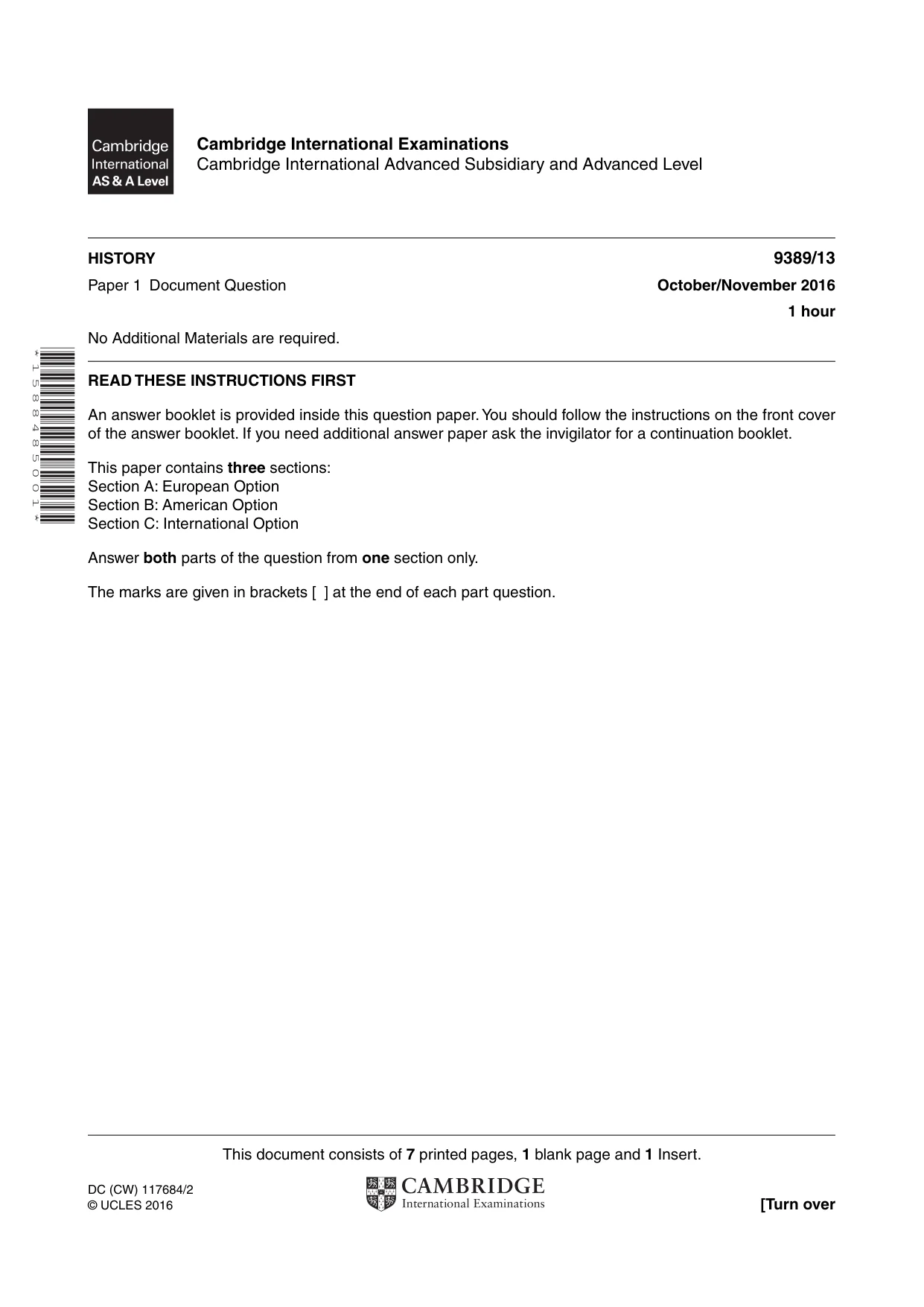
This document consists of 7 printed pages, 1 blank page and 1 Insert. DC (CW) 117684/2 © UCLES 2016 [Turn over Cambridge International Examinations Cambridge International Advanced Subsidiary and Advanced Level * 1 5 8 8 4 8 5 0 0 1 * HISTORY 9389/13 Paper 1 Document Question October/November 2016 1 hour No Additional Materials are required. READ THESE INSTRUCTIONS FIRST An answer booklet is provided inside this question paper. You should follow the instructions on the front cover of the answer booklet. If you need additional answer paper ask the invigilator for a continuation booklet. This paper contains three sections: Section A: European Option Section B: American Option Section C: International Option Answer both parts of the question from one section only. The marks are given in brackets [ ] at the end of each part question.
Question paper, page 2
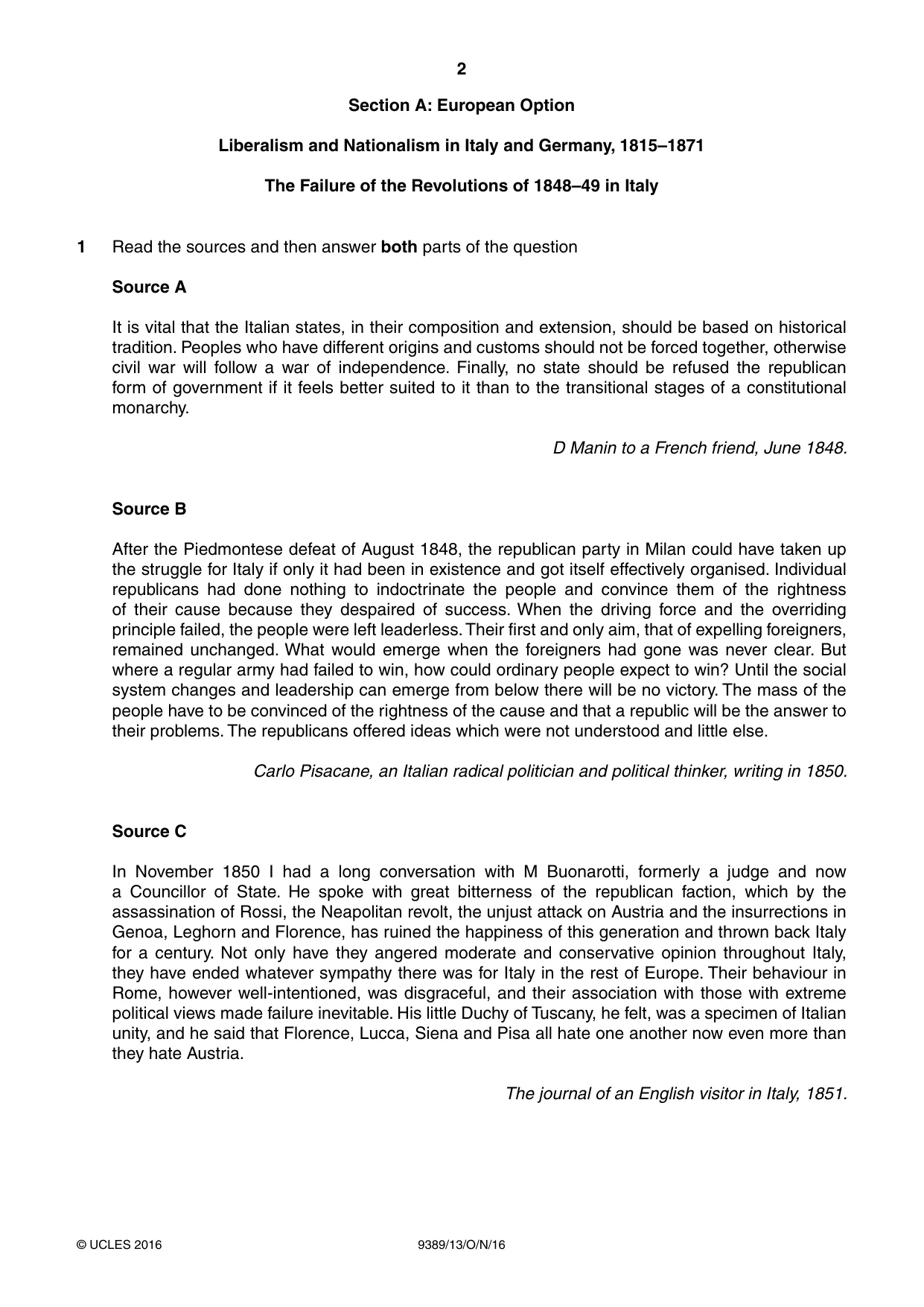
2 9389/13/O/N/16 © UCLES 2016 Section A: European Option Liberalism and Nationalism in Italy and Germany, 1815–1871 The Failure of the Revolutions of 1848–49 in Italy 1 Read the sources and then answer both parts of the question Source A It is vital that the Italian states, in their composition and extension, should be based on historical tradition. Peoples who have different origins and customs should not be forced together, otherwise civil war will follow a war of independence. Finally, no state should be refused the republican form of government if it feels better suited to it than to the transitional stages of a constitutional monarchy. D Manin to a French friend, June 1848. Source B After the Piedmontese defeat of August 1848, the republican party in Milan could have taken up the struggle for Italy if only it had been in existence and got itself effectively organised. Individual republicans had done nothing to indoctrinate the people and convince them of the rightness of their cause because they despaired of success. When the driving force and the overriding principle failed, the people were left leaderless. Their first and only aim, that of expelling foreigners, remained unchanged. What would emerge when the foreigners had gone was never clear. But where a regular army had failed to win, how could ordinary people expect to win? Until the social system changes and leadership can emerge from below there will be no victory. The mass of the people have to be convinced of the rightness of the cause and that a republic will be the answer to their problems. The republicans offered ideas which were not understood and little else. Carlo Pisacane, an Italian radical politician and political thinker, writing in 1850. Source C In November 1850 I had a long conversation with M Buonarotti, formerly a judge and now a Councillor of State. He spoke with great bitterness of the republican faction, which by the assassination of Rossi, the Neapolitan revolt, the unjust attack on Austria and the insurrections in Genoa, Leghorn and Florence, has ruined the happiness of this generation and thrown back Italy for a century. Not only have they angered moderate and conservative opinion throughout Italy, they have ended whatever sympathy there was for Italy in the rest of Europe. Their behaviour in Rome, however well-intentioned, was disgraceful, and their association with those with extreme political views made failure inevitable. His little Duchy of Tuscany, he felt, was a specimen of Italian unity, and he said that Florence, Lucca, Siena and Pisa all hate one another now even more than they hate Austria. The journal of an English visitor in Italy, 1851.
Question paper, page 3
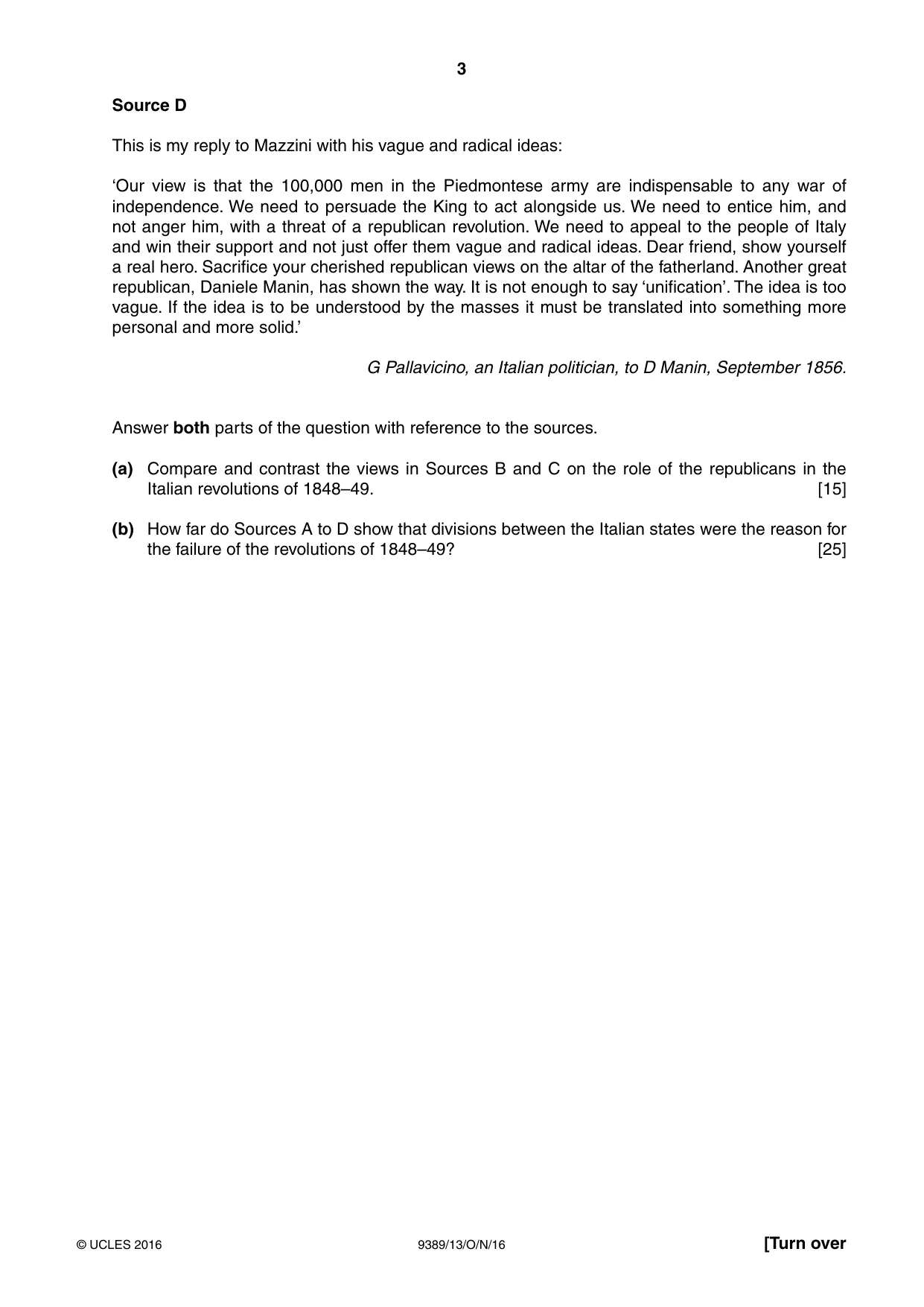
3 9389/13/O/N/16 © UCLES 2016 [Turn over Source D This is my reply to Mazzini with his vague and radical ideas: ‘Our view is that the 100,000 men in the Piedmontese army are indispensable to any war of independence. We need to persuade the King to act alongside us. We need to entice him, and not anger him, with a threat of a republican revolution. We need to appeal to the people of Italy and win their support and not just offer them vague and radical ideas. Dear friend, show yourself a real hero. Sacrifice your cherished republican views on the altar of the fatherland. Another great republican, Daniele Manin, has shown the way. It is not enough to say ‘unification’. The idea is too vague. If the idea is to be understood by the masses it must be translated into something more personal and more solid.’ G Pallavicino, an Italian politician, to D Manin, September 1856. Answer both parts of the question with reference to the sources. (a) Compare and contrast the views in Sources B and C on the role of the republicans in the Italian revolutions of 1848–49. [15] (b) How far do Sources A to D show that divisions between the Italian states were the reason for the failure of the revolutions of 1848–49? [25]
Question paper, page 4
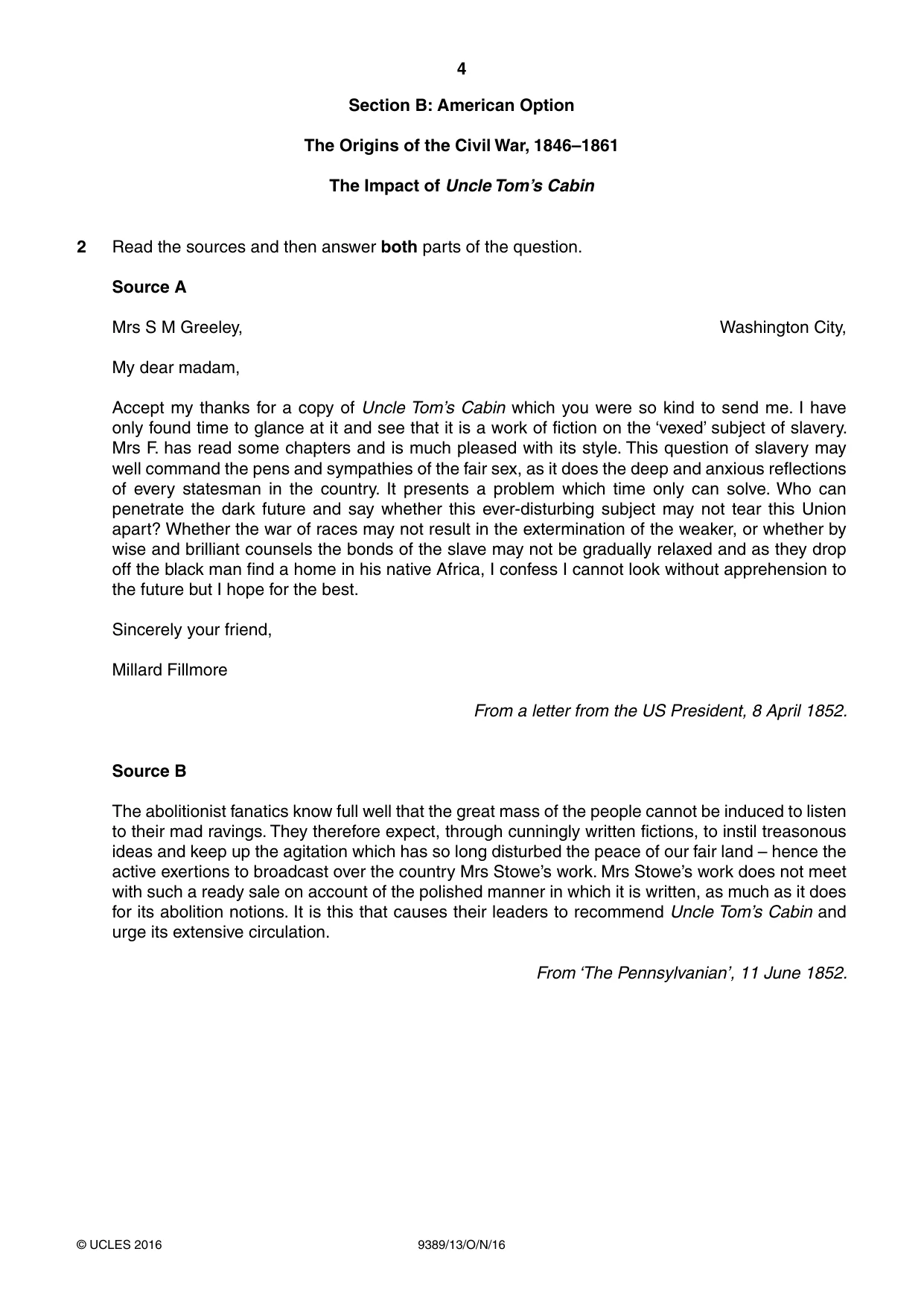
4 9389/13/O/N/16 © UCLES 2016 Section B: American Option The Origins of the Civil War, 1846–1861 The Impact of Uncle Tom’s Cabin 2 Read the sources and then answer both parts of the question. Source A Mrs S M Greeley, Washington City, My dear madam, Accept my thanks for a copy of Uncle Tom’s Cabin which you were so kind to send me. I have only found time to glance at it and see that it is a work of fiction on the ‘vexed’ subject of slavery. Mrs F. has read some chapters and is much pleased with its style. This question of slavery may well command the pens and sympathies of the fair sex, as it does the deep and anxious reflections of every statesman in the country. It presents a problem which time only can solve. Who can penetrate the dark future and say whether this ever-disturbing subject may not tear this Union apart? Whether the war of races may not result in the extermination of the weaker, or whether by wise and brilliant counsels the bonds of the slave may not be gradually relaxed and as they drop off the black man find a home in his native Africa, I confess I cannot look without apprehension to the future but I hope for the best. Sincerely your friend, Millard Fillmore From a letter from the US President, 8 April 1852. Source B The abolitionist fanatics know full well that the great mass of the people cannot be induced to listen to their mad ravings. They therefore expect, through cunningly written fictions, to instil treasonous ideas and keep up the agitation which has so long disturbed the peace of our fair land – hence the active exertions to broadcast over the country Mrs Stowe’s work. Mrs Stowe’s work does not meet with such a ready sale on account of the polished manner in which it is written, as much as it does for its abolition notions. It is this that causes their leaders to recommend Uncle Tom’s Cabin and urge its extensive circulation. From ‘The Pennsylvanian’, 11 June 1852.
Question paper, page 5
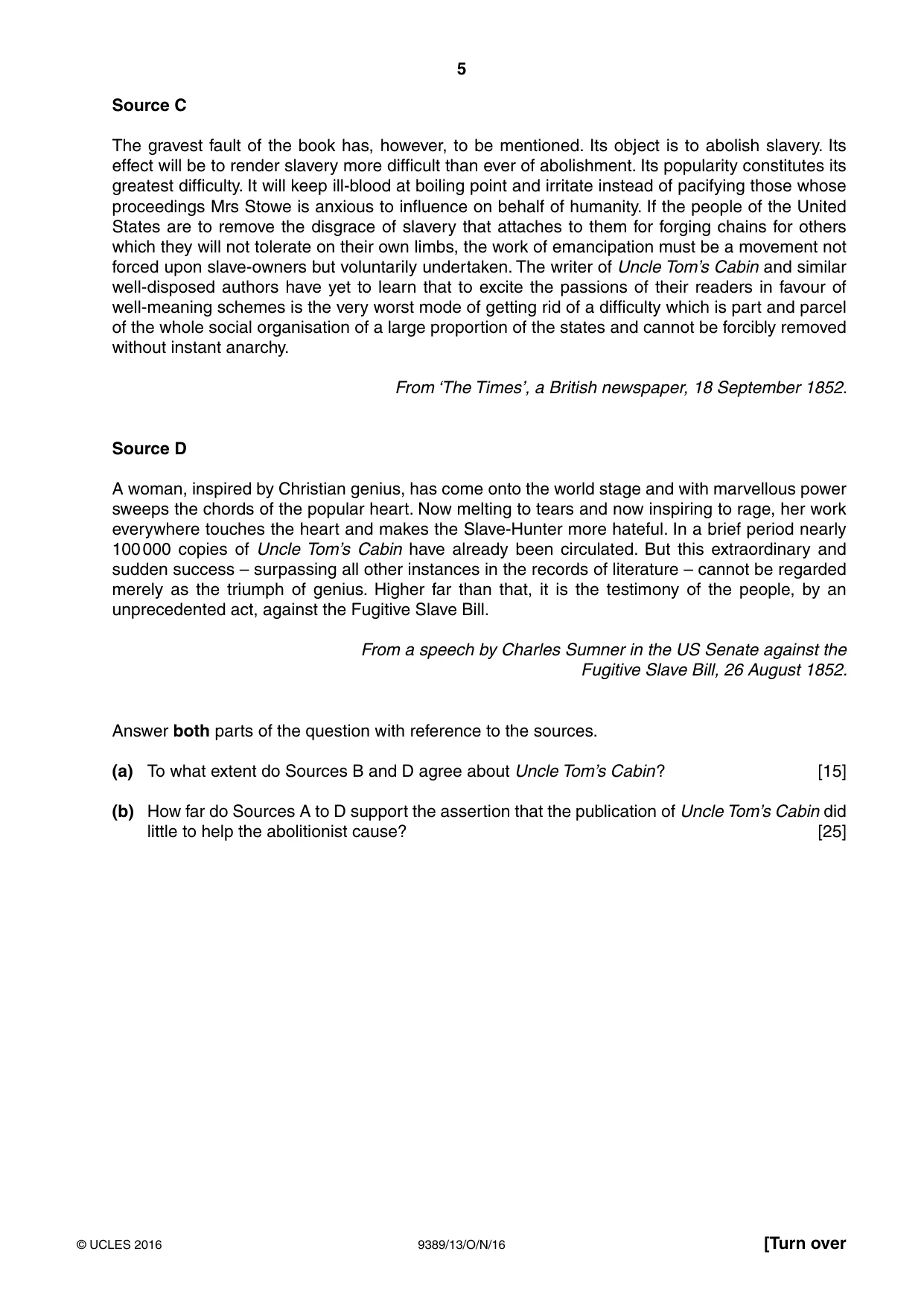
5 9389/13/O/N/16 © UCLES 2016 [Turn over Source C The gravest fault of the book has, however, to be mentioned. Its object is to abolish slavery. Its effect will be to render slavery more difficult than ever of abolishment. Its popularity constitutes its greatest difficulty. It will keep ill-blood at boiling point and irritate instead of pacifying those whose proceedings Mrs Stowe is anxious to influence on behalf of humanity. If the people of the United States are to remove the disgrace of slavery that attaches to them for forging chains for others which they will not tolerate on their own limbs, the work of emancipation must be a movement not forced upon slave-owners but voluntarily undertaken. The writer of Uncle Tom’s Cabin and similar well-disposed authors have yet to learn that to excite the passions of their readers in favour of well-meaning schemes is the very worst mode of getting rid of a difficulty which is part and parcel of the whole social organisation of a large proportion of the states and cannot be forcibly removed without instant anarchy. From ‘The Times’, a British newspaper, 18 September 1852. Source D A woman, inspired by Christian genius, has come onto the world stage and with marvellous power sweeps the chords of the popular heart. Now melting to tears and now inspiring to rage, her work everywhere touches the heart and makes the Slave-Hunter more hateful. In a brief period nearly 100 000 copies of Uncle Tom’s Cabin have already been circulated. But this extraordinary and sudden success – surpassing all other instances in the records of literature – cannot be regarded merely as the triumph of genius. Higher far than that, it is the testimony of the people, by an unprecedented act, against the Fugitive Slave Bill. From a speech by Charles Sumner in the US Senate against the Fugitive Slave Bill, 26 August 1852. Answer both parts of the question with reference to the sources. (a) To what extent do Sources B and D agree about Uncle Tom’s Cabin ? [15] (b) How far do Sources A to D support the assertion that the publication of Uncle Tom’s Cabin did little to help the abolitionist cause? [25]
Question paper, page 6
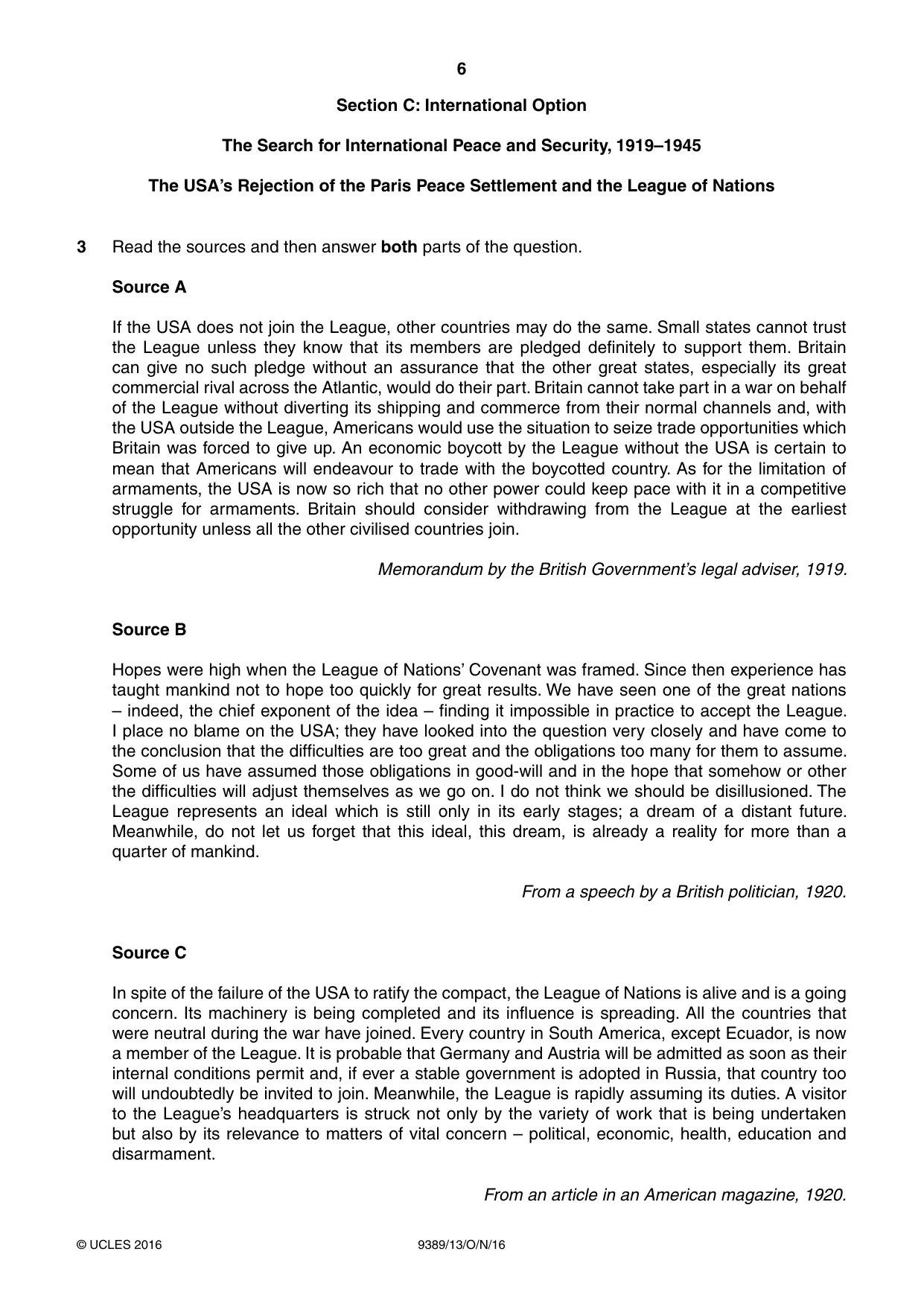
6 9389/13/O/N/16 © UCLES 2016 Section C: International Option The Search for International Peace and Security, 1919–1945 The USA’s Rejection of the Paris Peace Settlement and the League of Nations 3 Read the sources and then answer both parts of the question. Source A If the USA does not join the League, other countries may do the same. Small states cannot trust the League unless they know that its members are pledged definitely to support them. Britain can give no such pledge without an assurance that the other great states, especially its great commercial rival across the Atlantic, would do their part. Britain cannot take part in a war on behalf of the League without diverting its shipping and commerce from their normal channels and, with the USA outside the League, Americans would use the situation to seize trade opportunities which Britain was forced to give up. An economic boycott by the League without the USA is certain to mean that Americans will endeavour to trade with the boycotted country. As for the limitation of armaments, the USA is now so rich that no other power could keep pace with it in a competitive struggle for armaments. Britain should consider withdrawing from the League at the earliest opportunity unless all the other civilised countries join. Memorandum by the British Government’s legal adviser, 1919. Source B Hopes were high when the League of Nations’ Covenant was framed. Since then experience has taught mankind not to hope too quickly for great results. We have seen one of the great nations – indeed, the chief exponent of the idea – finding it impossible in practice to accept the League. I place no blame on the USA; they have looked into the question very closely and have come to the conclusion that the difficulties are too great and the obligations too many for them to assume. Some of us have assumed those obligations in good-will and in the hope that somehow or other the difficulties will adjust themselves as we go on. I do not think we should be disillusioned. The League represents an ideal which is still only in its early stages; a dream of a distant future. Meanwhile, do not let us forget that this ideal, this dream, is already a reality for more than a quarter of mankind. From a speech by a British politician, 1920. Source C In spite of the failure of the USA to ratify the compact, the League of Nations is alive and is a going concern. Its machinery is being completed and its influence is spreading. All the countries that were neutral during the war have joined. Every country in South America, except Ecuador, is now a member of the League. It is probable that Germany and Austria will be admitted as soon as their internal conditions permit and, if ever a stable government is adopted in Russia, that country too will undoubtedly be invited to join. Meanwhile, the League is rapidly assuming its duties. A visitor to the League’s headquarters is struck not only by the variety of work that is being undertaken but also by its relevance to matters of vital concern – political, economic, health, education and disarmament. From an article in an American magazine, 1920.
Question paper, page 7
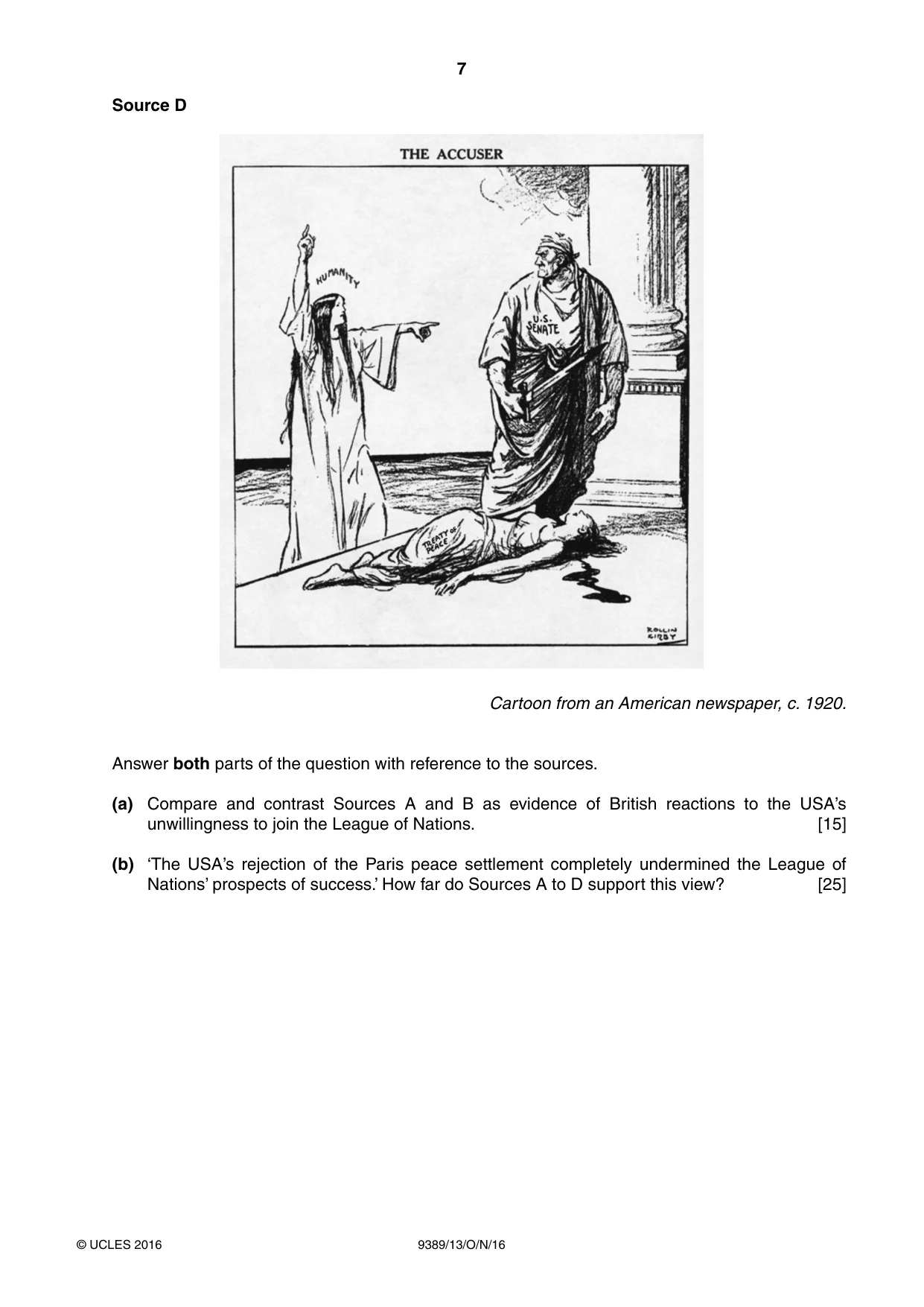
7 9389/13/O/N/16 © UCLES 2016 Source D Cartoon from an American newspaper, c. 1920. Answer both parts of the question with reference to the sources. (a) Compare and contrast Sources A and B as evidence of British reactions to the USA’s unwillingness to join the League of Nations. [15] (b) ‘The USA’s rejection of the Paris peace settlement completely undermined the League of Nations’ prospects of success.’ How far do Sources A to D support this view? [25]
Question paper, page 8
8 9389/13/O/N/16 © UCLES 2016 BLANK PAGE Permission to reproduce items where third-party owned material protected by copyright is included has been sought and cleared where possible. Every reasonable effort has been made by the publisher (UCLES) to trace copyright holders, but if any items requiring clearance have unwittingly been included, the publisher will be pleased to make amends at the earliest possible opportunity. To avoid the issue of disclosure of answer-related information to candidates, all copyright acknowledgements are reproduced online in the Cambridge International Examinations Copyright Acknowledgements Booklet. This is produced for each series of examinations and is freely available to download at www.cie.org.uk after the live examination series. Cambridge International Examinations is part of the Cambridge Assessment Group. Cambridge Assessment is the brand name of University of Cambridge Local Examinations Syndicate (UCLES), which is itself a department of the University of Cambridge.
Mark scheme, page 1
® IGCSE is the registered trademark of Cambridge International Examinations. This document consists of 8 printed pages. © UCLES 2016 [Turn over Cambridge International Examinations Cambridge International Advanced Subsidiary and Advanced Level HISTORY 9389/13 Paper 1 Document Question October/November 2016 MARK SCHEME Maximum Mark: 40 Published This mark scheme is published as an aid to teachers and candidates, to indicate the requirements of the examination. It shows the basis on which Examiners were instructed to award marks. It does not indicate the details of the discussions that took place at an Examiners’ meeting before marking began, which would have considered the acceptability of alternative answers. Mark schemes should be read in conjunction with the question paper and the Principal Examiner Report for Teachers. Cambridge will not enter into discussions about these mark schemes. Cambridge is publishing the mark schemes for the October/November 2016 series for most Cambridge IGCSE®, Cambridge International A and AS Level components and some Cambridge O Level components.
Mark scheme, page 2
Page 2 Mark Scheme Syllabus Paper Cambridge International AS/A Level – October/November 2016 9389 13 © UCLES 2016 Generic Levels of Response Part (a) Level 4: Makes a developed comparison [12–15] Makes a developed comparison between the two sources, recognising points of similarity and difference. Uses knowledge to evaluate the sources and shows good contextual awareness. Level 3: Compares views and identifies similarities and differences [8–11] Compares the views expressed in the sources, identifying differences and similarities. Begins to explain and evaluate the views using the sources and knowledge. Level 2: Compares views and identifies similarities and/or differences [4–7] Identifies relevant similarities or differences between views/sources and the response may be one- sided with only one aspect explained. Alternatively, both similarities and differences may be mentioned but both aspects lack development. Level 1: Describes content of each source [1–3] Describes or paraphrases the content of the two sources. Very simple comparisons may be made (e.g. one is from a letter and the other is from a speech) but these are not developed. Level 0: No relevant comment on the sources or the issue [0] Part (b) Level 5: Evaluates the sources to reach a sustained judgement [21–25] Answers are well focused, demonstrating a clear understanding of the sources and the question. Reaches a sustained judgement about the extent to which the sources support the statement and weighs the evidence in order to do this. Level 4: Evaluates the sources [16–20] Demonstrates a clear understanding of the sources and the question. Begins to evaluate the material in context, considering the nature, origin and purpose of the sources in relation to the statement. At the top of this level candidates may begin to reach a judgement but this is not sustained. Level 3: Uses the sources to support and challenge the statement [11–15] Makes valid points from the sources to both challenge and support the statement in the question. These comments may be derived from source content or may be about the provenance/nature of the sources. Level 2: Uses the sources to support or challenge the statement [6–10] Makes valid points from the sources to either support the statement in the question or to challenge it. These comments may be derived from source content or may be about the provenance/nature of the sources. Level 1: Does not make valid use of the sources [1–5] Describes the content of the sources with little attempt to link the material to the question. Alternatively, candidates may write an essay about the question without reference to the sources. Level 0: No relevant comment on the sources or the issue [0]
Mark scheme, page 3
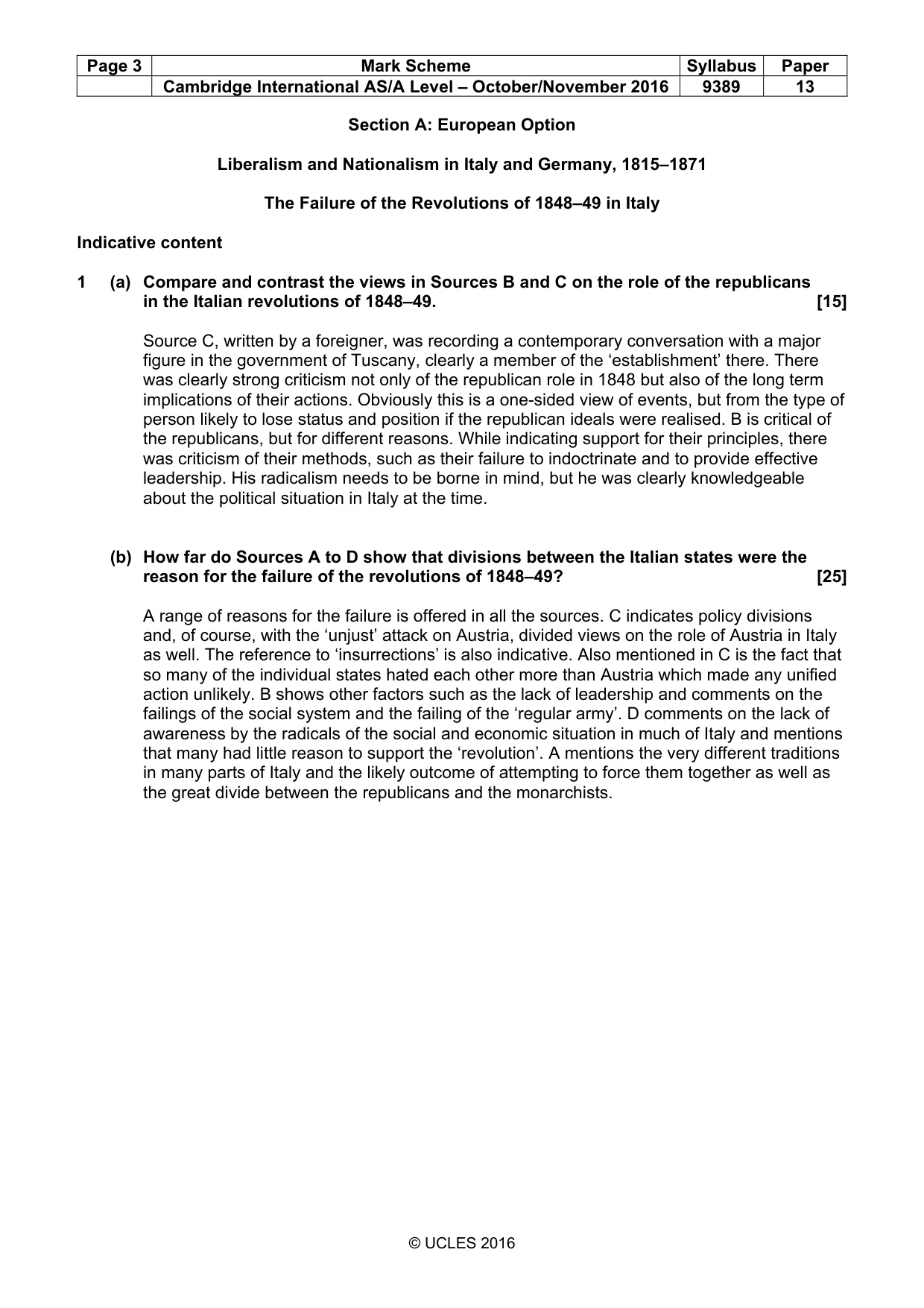
Page 3 Mark Scheme Syllabus Paper Cambridge International AS/A Level – October/November 2016 9389 13 © UCLES 2016 Section A: European Option Liberalism and Nationalism in Italy and Germany, 1815–1871 The Failure of the Revolutions of 1848–49 in Italy Indicative content 1 (a) Compare and contrast the views in Sources B and C on the role of the republicans in the Italian revolutions of 1848–49. [15] Source C, written by a foreigner, was recording a contemporary conversation with a major figure in the government of Tuscany, clearly a member of the ‘establishment’ there. There was clearly strong criticism not only of the republican role in 1848 but also of the long term implications of their actions. Obviously this is a one-sided view of events, but from the type of person likely to lose status and position if the republican ideals were realised. B is critical of the republicans, but for different reasons. While indicating support for their principles, there was criticism of their methods, such as their failure to indoctrinate and to provide effective leadership. His radicalism needs to be borne in mind, but he was clearly knowledgeable about the political situation in Italy at the time. (b) How far do Sources A to D show that divisions between the Italian states were the reason for the failure of the revolutions of 1848–49? [25] A range of reasons for the failure is offered in all the sources. C indicates policy divisions and, of course, with the ‘unjust’ attack on Austria, divided views on the role of Austria in Italy as well. The reference to ‘insurrections’ is also indicative. Also mentioned in C is the fact that so many of the individual states hated each other more than Austria which made any unified action unlikely. B shows other factors such as the lack of leadership and comments on the failings of the social system and the failing of the ‘regular army’. D comments on the lack of awareness by the radicals of the social and economic situation in much of Italy and mentions that many had little reason to support the ‘revolution’. A mentions the very different traditions in many parts of Italy and the likely outcome of attempting to force them together as well as the great divide between the republicans and the monarchists.
Mark scheme, page 4
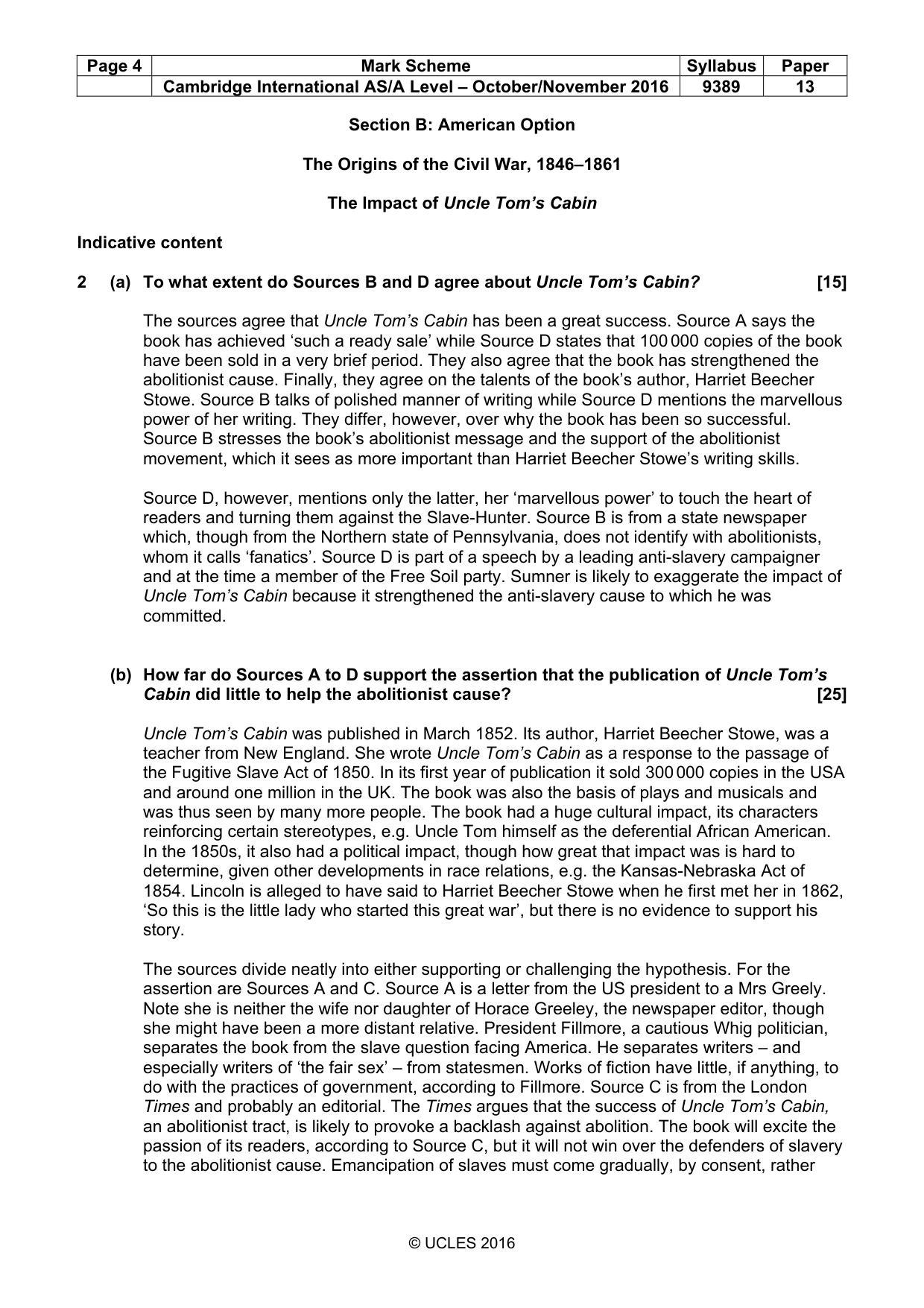
Page 4 Mark Scheme Syllabus Paper Cambridge International AS/A Level – October/November 2016 9389 13 © UCLES 2016 Section B: American Option The Origins of the Civil War, 1846–1861 The Impact of Uncle Tom’s Cabin Indicative content 2 (a) To what extent do Sources B and D agree about Uncle Tom’s Cabin? [15] The sources agree that Uncle Tom’s Cabin has been a great success. Source A says the book has achieved ‘such a ready sale’ while Source D states that 100 000 copies of the book have been sold in a very brief period. They also agree that the book has strengthened the abolitionist cause. Finally, they agree on the talents of the book’s author, Harriet Beecher Stowe. Source B talks of polished manner of writing while Source D mentions the marvellous power of her writing. They differ, however, over why the book has been so successful. Source B stresses the book’s abolitionist message and the support of the abolitionist movement, which it sees as more important than Harriet Beecher Stowe’s writing skills. Source D, however, mentions only the latter, her ‘marvellous power’ to touch the heart of readers and turning them against the Slave-Hunter. Source B is from a state newspaper which, though from the Northern state of Pennsylvania, does not identify with abolitionists, whom it calls ‘fanatics’. Source D is part of a speech by a leading anti-slavery campaigner and at the time a member of the Free Soil party. Sumner is likely to exaggerate the impact of Uncle Tom’s Cabin because it strengthened the anti-slavery cause to which he was committed. (b) How far do Sources A to D support the assertion that the publication of Uncle Tom’s Cabin did little to help the abolitionist cause? [25] Uncle Tom’s Cabin was published in March 1852. Its author, Harriet Beecher Stowe, was a teacher from New England. She wrote Uncle Tom’s Cabin as a response to the passage of the Fugitive Slave Act of 1850. In its first year of publication it sold 300 000 copies in the USA and around one million in the UK. The book was also the basis of plays and musicals and was thus seen by many more people. The book had a huge cultural impact, its characters reinforcing certain stereotypes, e.g. Uncle Tom himself as the deferential African American. In the 1850s, it also had a political impact, though how great that impact was is hard to determine, given other developments in race relations, e.g. the Kansas-Nebraska Act of 1854. Lincoln is alleged to have said to Harriet Beecher Stowe when he first met her in 1862, ‘So this is the little lady who started this great war’, but there is no evidence to support his story. The sources divide neatly into either supporting or challenging the hypothesis. For the assertion are Sources A and C. Source A is a letter from the US president to a Mrs Greely. Note she is neither the wife nor daughter of Horace Greeley, the newspaper editor, though she might have been a more distant relative. President Fillmore, a cautious Whig politician, separates the book from the slave question facing America. He separates writers – and especially writers of ‘the fair sex’ – from statesmen. Works of fiction have little, if anything, to do with the practices of government, according to Fillmore. Source C is from the London Times and probably an editorial. The Times argues that the success of Uncle Tom’s Cabin, an abolitionist tract, is likely to provoke a backlash against abolition. The book will excite the passion of its readers, according to Source C, but it will not win over the defenders of slavery to the abolitionist cause. Emancipation of slaves must come gradually, by consent, rather
Mark scheme, page 5
Page 5 Mark Scheme Syllabus Paper Cambridge International AS/A Level – October/November 2016 9389 13 © UCLES 2016 than be imposed by force. According to the Times, Uncle Tom’s Cabin makes gaining that consent even less likely in the short term. On the other side of the argument are Sources B and D. Source B argues that publication of Uncle Tom’s Cabin did much to advance the abolitionist cause, if not really because of its own merits. Source D asserts that the book has skilfully articulated the arguments of the anti- slavery movement. Thus Source D argues that Uncle Tom’s Cabin provided great publicity for a movement which was growing in importance, which is not quite the same as the book converting people to the abolitionist cause. Two sources are from politicians, A and D, and two are from newspapers, B and C. Source A was a private letter from the US president to a private citizen on a non-political matter – though Fillmore does make a broader point about the slavery issue in the second half of the letter. He admits he has only glanced at Uncle Tom’s Cabin when a more calculating politician might have wanted to give the impression he has read the whole book. This implies a rare degree of honesty from a politician. Source D is a public speech from a leading abolitionist, delighted at the extra support given to the cause by a best-selling book, the publishing sensation of the 1850s. Thus the reliability of Source D is open to question. Of the two newspaper sources, one is American, the other British. The latter, Source C, the London Times, was already noted for its objectivity and reliability. Source C suffers, however, from being rather abstract and condescending. It is almost as if the British political elite is telling Americans how best to address the problem of slavery. It has no evidence from the USA upon which it might base a sounder analysis. Source C is a useful statement of British views. As a source addressing the question, it is much less useful, much less reliable. Source B comes from a Northern newspaper and gives quite a cynical account of the success of Uncle Tom’s Cabin. Its argument would seem to have some validity. Contextual knowledge would suggest that in 1850s America, the huge success of Uncle Tom’s Cabin could not have been achieved by its publisher alone. They must have had someone’s help and the most likely source would be the abolitionist movement. Source B is probably the most reliable of the four sources and helps strengthen the argument that Uncle Tom’s Cabin did much to help the abolitionist cause.
Mark scheme, page 6
Page 6 Mark Scheme Syllabus Paper Cambridge International AS/A Level – October/November 2016 9389 13 © UCLES 2016 Section C: International Option The Search for International Peace and Security, 1919–1945 The USA’s Rejection of the Paris Peace Settlement and the League of Nations Indicative content 3 (a) Compare and contrast Sources A and B as evidence of British reactions to the USA’s unwillingness to join the League of Nations. [15] Source A argues that the League of Nations would be severely damaged if the USA did not join. Other powerful countries might decide to follow the USA’s example and opt out of the League. Small and vulnerable countries would have little confidence that the League would be able to provide them with protection and security against aggression by more powerful states. The USA’s absence from the League would put Britain in a highly disadvantageous position for three main reasons: 1. As a member of the League, Britain might be obliged to go to war against an aggressor state as part of collective action decided by the League (under Article 10). With no such obligation, the USA would exploit Britain’s involvement in war by taking over British trading agreements. 2. As a member of the League, Britain might be obliged to take economic sanctions against an aggressor state as part of collective action decided by the League (under Article 16). With no such obligation, the USA could continue trading with the boycotted country. 3. As a member of the League, Britain would be bound by its decisions on disarmament (under Article 8), while the USA would be free to build up its armed forces, especially its navy – this could pose a threat to the security of the British Empire. In view of these concerns, Source A argues that Britain should consider withdrawing from the League unless all of the other leading countries, including the USA, commit themselves to it. Source B seems considerably less concerned by the USA’s reluctance to join the League. While Source A clearly resents the USA’s reluctance to join, Source B is more understanding of it and, indeed, does not blame the USA at all. Source B sees no reason to be disillusioned by the USA’s reluctance to join the League and nor does it even consider the idea that Britain should withdraw from the League in response to it. Source A was written in 1919, before the USA had formally rejected the Paris peace settlement. However, it was already clear from statements issued by the Senate that the USA would almost certainly refuse membership of the League. It is a memo to the British government and therefore not meant for public scrutiny. As its legal adviser, the writer would inevitably have to point out to the British government the likely implications for Britain if the USA decided not to join the League. It takes the Articles of the Covenant literally and outlines the possible outcomes of Britain’s commitment to them. It is implied that the British government should do everything possible to encourage the USA to join the League. If this failed, the government should consider withdrawing from the League to avoid placing Britain in an invidious position compared to its main commercial rival, the USA. The speech (Source B) was delivered after the USA had formally rejected membership of the League. The speaker’s view of the League of Nations is very different from that of the writer of Source A. Whereas Source A considers the immediate legal implications of Britain’s membership of the League, Source B views the League in a less precise way – an
Mark scheme, page 7
Page 7 Mark Scheme Syllabus Paper Cambridge International AS/A Level – October/November 2016 9389 13 © UCLES 2016 ideal/dream which would gradually develop over time as the difficulties ‘adjust themselves’. The speaker argues that Britain should continue to embrace the League in a spirit of ‘good- will’, accepting that progress towards the ‘dream’ will be slow. The absence of the USA is seen as a drawback, but no reason for disillusionment with the basic concept of the League of Nations. (b) ‘The USA’s rejection of the Paris peace settlement completely undermined the League of Nations’ prospects of success.’ How far do Sources A to D support this view? [25] President Woodrow Wilson had played a major role in drafting the Paris peace settlement and had signed the League of Nations’ Covenant in June 1919. However, it was becoming increasingly clear that Wilson lacked the support of the Republican-dominated US Senate and that the USA would, in all probability, reject the peace settlement and refuse to join the League of Nations. Other countries had to come to terms with the fact that one of the world’s most politically, economically and militarily powerful nations would remain outside the League, unfettered by the commitments and obligations which membership seemed to entail. Some historians have argued that, by failing to ratify the Paris peace settlement, the USA destroyed the League of Nations’ potential for success even before it was formally established in January 1920. In support of the hypothesis – Source A is heavily critical of the USA’s reluctance to join the League, arguing that it would undermine the confidence of small and vulnerable states in the League’s ability to provide them with protection and security against unwarranted aggression. As a non-member, the USA would not be bound by decisions taken by the League – it could continue to develop its armaments, carry out trade in defiance of League boycotts and exploit opportunities which might arise when member states were engaged in collective military action against aggressive countries. Source A argues that this would give the USA an unfair advantage over countries which joined the League, particularly Britain. Under these circumstances, the writer suggests that Britain should consider withdrawing from the League unless all the other major countries, including the USA, committed themselves to it. The fact that Britain was even considering such a course of action inevitably undermined confidence in the League. The cartoon (Source D) is equally critical of the USA’s decision to reject the Paris peace settlement and, by implication, membership of the League. It depicts the US Senate as a murderer, killing the peace settlement and destroying all hope of future international peace and security. The establishment of the League of Nations was an integral element of the Paris peace settlement; with the settlement dead, there would be no hope for the League. In challenging the hypothesis, Source C provides the main challenge to the hypothesis. It argues that the League of Nations is progressing well despite the USA’s refusal to join. The vast majority of countries have joined the League, and the writer is optimistic that WWI’s defeated nations and even Russia will soon be invited to join. The implication is that countries have not been put off joining the League as a result of the USA’s decision. Moreover, Source C argues that, even at this early stage in its development, the League has already begun a wide variety of activities which are vital to the wellbeing of mankind, in particular addressing the problems which existed in the aftermath of WWI. Source B also suggests that the USA’s decision to reject the peace settlement and membership of the League is not a cause for disillusionment. It sees the League as a long-term project which will gradually develop over time as initial problems are overcome. Like Source C, it confirms that many nations have already committed themselves to the League, and the speaker is clearly optimistic about the League’s future prospects.
Mark scheme, page 8
Page 8 Mark Scheme Syllabus Paper Cambridge International AS/A Level – October/November 2016 9389 13 © UCLES 2016 Source A – A formal memo to the British government, not intended for public scrutiny. The memo addresses the issue of how Britain should react if the USA eventually decided not to join the League. At this stage, the USA had not formally announced its rejection of the Paris peace settlement, although the likelihood of this was clear from statements coming from the Senate. As the government’s legal adviser, the writer had a duty to outline the legal implications of Britain’s membership of the League. The Articles of the Covenant are taken literally in terms of the obligations which they imposed on Britain as a result of its membership of the League. The writer seeks to ensure that the British government is fully aware of what membership of the League entails for Britain and how the country might be affected by the USA’s likely decision not to join. Source B – A personal view which sees the League of Nations in idealistic rather than specific terms. The speaker clearly does not expect the League to achieve much in the short term – he sees it as a long-term project which, initially, will be hampered by numerous problems, one of which is the USA’s refusal to join. Over time, these problems will ‘adjust themselves’ and countries will come together in the League in a spirit of goodwill. Source C – The writer is clearly a supporter of the League of Nations and makes every effort to praise its early achievements. In many ways these are exaggerated – e.g. German, Austrian and Russian membership of the League was still some way off; while mechanisms were being developed within the League to deal with the post-WWI problems, they had achieved little by 1920. The article may have been politically motivated – the writer clearly supported Wilson in the debate over whether the USA should accept or reject the Paris peace settlement and the League. The implication of the source is that the USA was wrong not to join the League and was in some way missing out by not doing so. Source D – The US Senate (Brutus) is depicted as killing the Paris peace settlement (Caesar) and being accused by humanity (the League of Nations) of destroying all hope for future international peace and security. The cartoon is a product of the debate which raged in the USA in the build-up to the presidential elections of 1920. The Republican-dominated Senate argued for a return to isolationism, rejection of the Paris peace settlement and refusal to join the League of Nations. President Wilson, in many ways the architect of the peace settlement, tried to gain support for American acceptance of both the settlement and the League. Wilson’s heavy defeat in the election showed the extent of popular opinion in the USA against American involvement in the League. The cartoonist clearly supported Wilson and is heavily critical of the actions taken by the Senate.
What you needed in this session
Cambridge’s own grade thresholds for 2016 Oct/Nov, Paper 1 · Variant 3. A higher threshold means an easier paper — the bar moves with how the cohort did.