Cambridge A Level History 9389 — 2016 May/June Paper 4 · Variant 3
9389/43/M/J/16 · 60 marks · ≈68 min
The question paper and its mark scheme, free to read here and free to download. This is Cambridge’s own paper, exactly as it was sat.
Question paper4 pages
Mark scheme14 pages
Answers below. Sit the paper first if you are practising.
Paper as text
Question paper, page 1
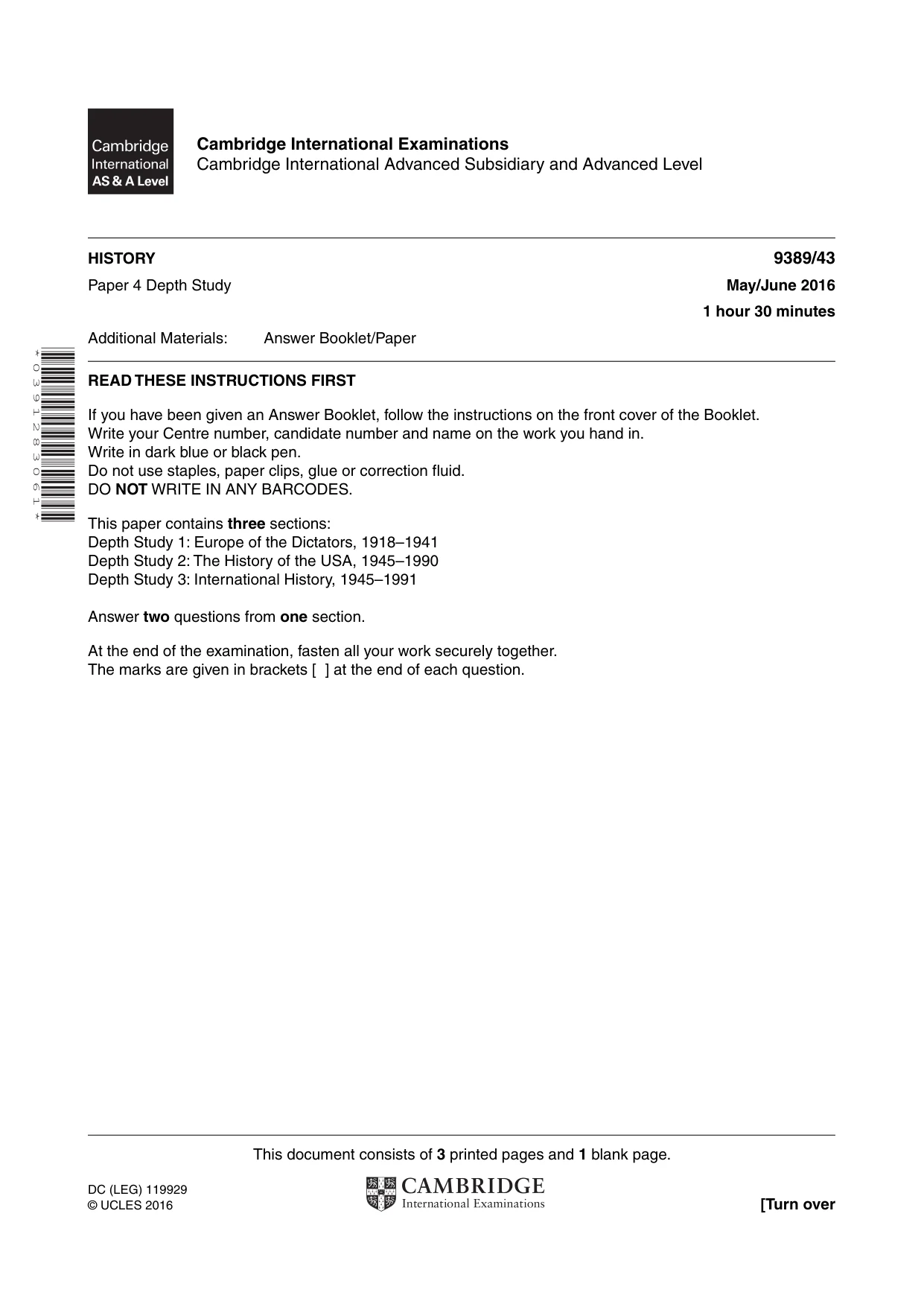
This document consists of 3 printed pages and 1 blank page. DC (LEG) 119929 © UCLES 2016 [Turn over Cambridge International Examinations Cambridge International Advanced Subsidiary and Advanced Level * 0 3 9 1 2 8 3 0 6 1 * HISTORY 9389/43 Paper 4 Depth Study May/June 2016 1 hour 30 minutes Additional Materials: Answer Booklet/Paper READ THESE INSTRUCTIONS FIRST If you have been given an Answer Booklet, follow the instructions on the front cover of the Booklet. Write your Centre number, candidate number and name on the work you hand in. Write in dark blue or black pen. Do not use staples, paper clips, glue or correction fluid. DO NOT WRITE IN ANY BARCODES. This paper contains three sections: Depth Study 1: Europe of the Dictators, 1918–1941 Depth Study 2: The History of the USA, 1945–1990 Depth Study 3: International History, 1945–1991 Answer two questions from one section. At the end of the examination, fasten all your work securely together. The marks are given in brackets [ ] at the end of each question.
Question paper, page 2
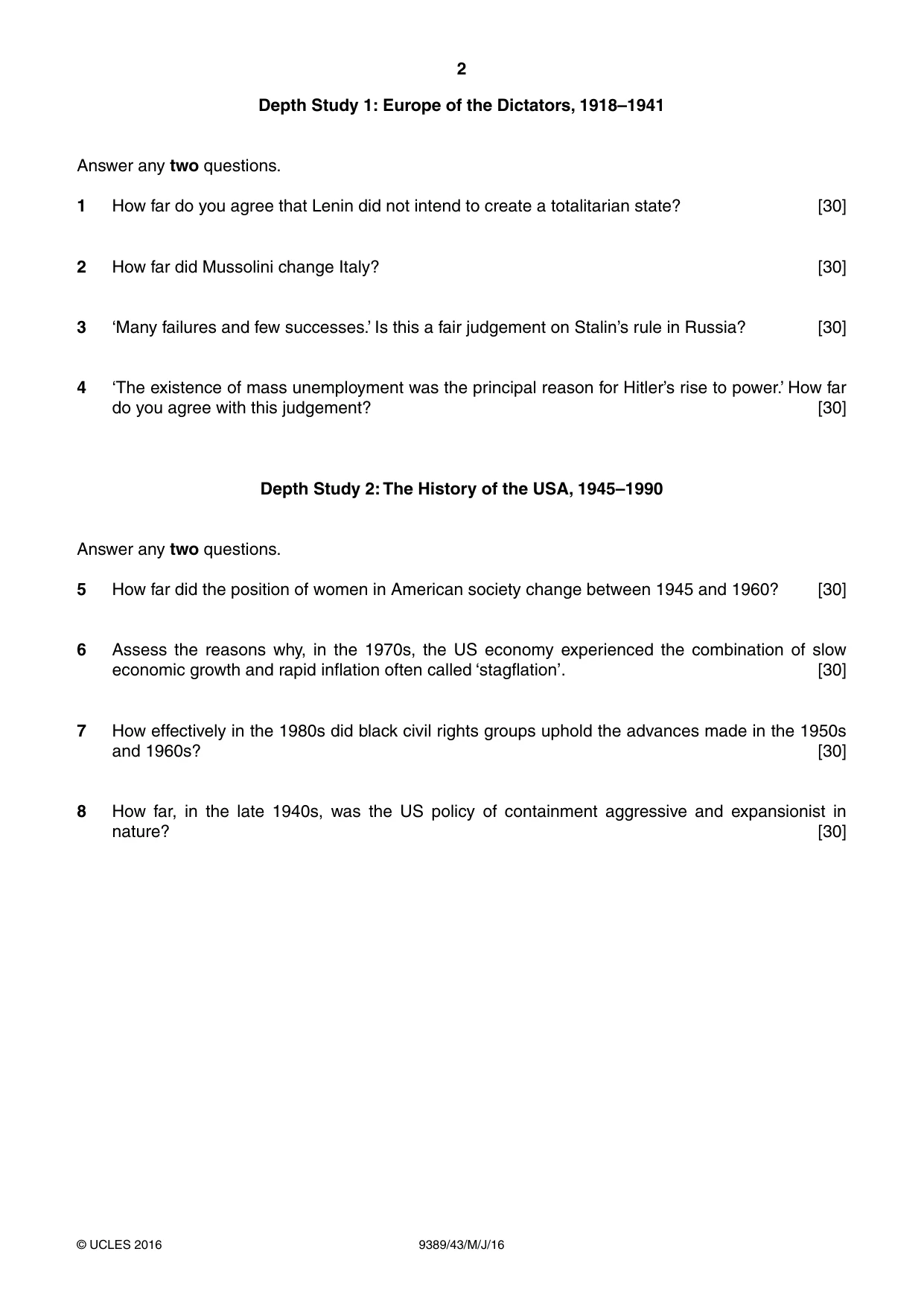
2 9389/43/M/J/16 © UCLES 2016 Depth Study 1: Europe of the Dictators, 1918–1941 Answer any two questions. 1 How far do you agree that Lenin did not intend to create a totalitarian state? [30] 2 How far did Mussolini change Italy? [30] 3 ‘Many failures and few successes.’ Is this a fair judgement on Stalin’s rule in Russia? [30] 4 ‘The existence of mass unemployment was the principal reason for Hitler’s rise to power.’ How far do you agree with this judgement? [30] Depth Study 2: The History of the USA, 1945–1990 Answer any two questions. 5 How far did the position of women in American society change between 1945 and 1960? [30] 6 Assess the reasons why, in the 1970s, the US economy experienced the combination of slow economic growth and rapid inflation often called ‘stagflation’. [30] 7 How effectively in the 1980s did black civil rights groups uphold the advances made in the 1950s and 1960s? [30] 8 How far, in the late 1940s, was the US policy of containment aggressive and expansionist in nature? [30]
Question paper, page 3
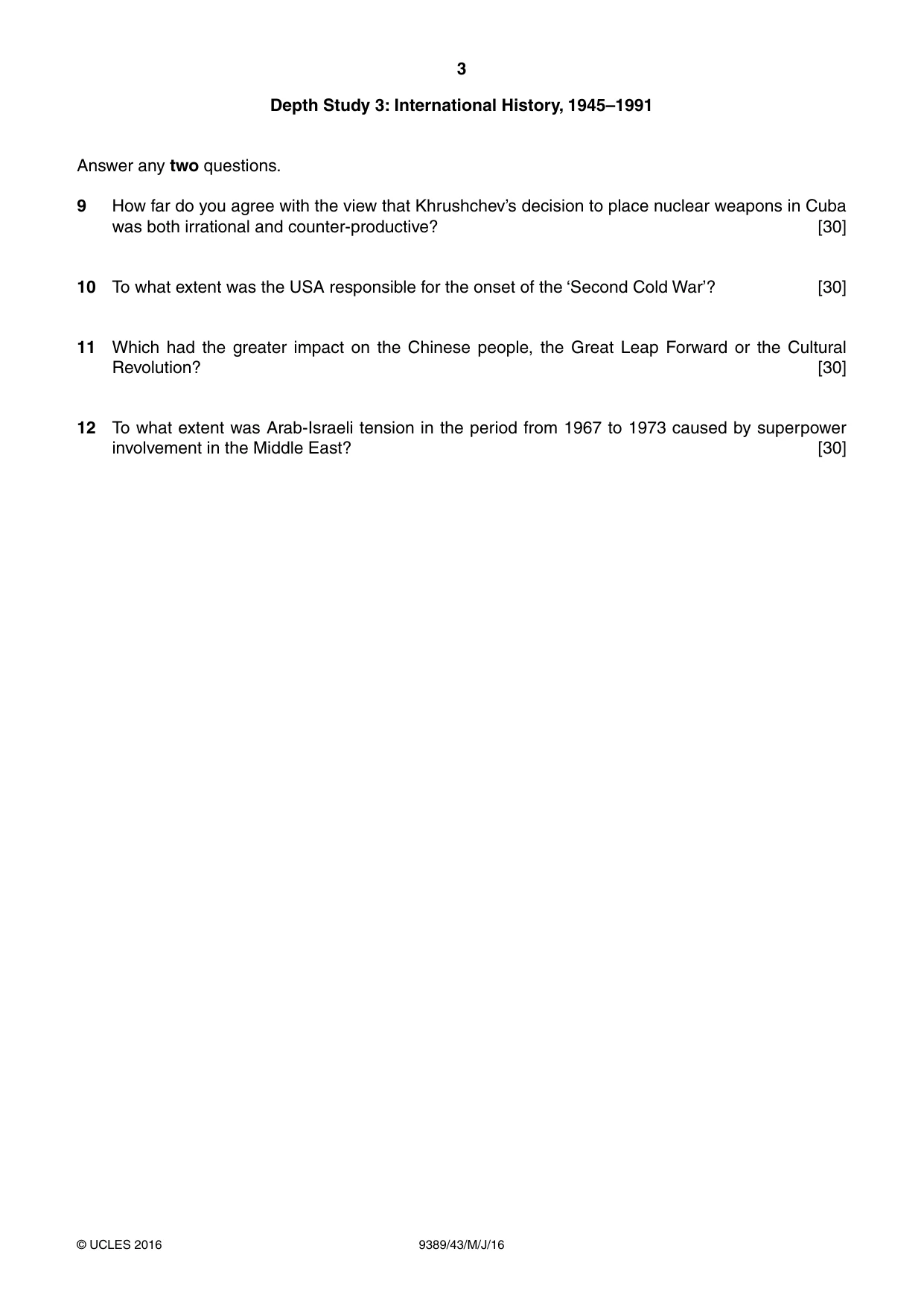
3 9389/43/M/J/16 © UCLES 2016 Depth Study 3: International History, 1945–1991 Answer any two questions. 9 How far do you agree with the view that Khrushchev’s decision to place nuclear weapons in Cuba was both irrational and counter-productive? [30] 10 To what extent was the USA responsible for the onset of the ‘Second Cold War’? [30] 11 Which had the greater impact on the Chinese people, the Great Leap Forward or the Cultural Revolution? [30] 12 To what extent was Arab-Israeli tension in the period from 1967 to 1973 caused by superpower involvement in the Middle East? [30]
Question paper, page 4
4 9389/43/M/J/16 © UCLES 2016 BLANK PAGE Permission to reproduce items where third-party owned material protected by copyright is included has been sought and cleared where possible. Every reasonable effort has been made by the publisher (UCLES) to trace copyright holders, but if any items requiring clearance have unwittingly been included, the publisher will be pleased to make amends at the earliest possible opportunity. To avoid the issue of disclosure of answer-related information to candidates, all copyright acknowledgements are reproduced online in the Cambridge International Examinations Copyright Acknowledgements Booklet. This is produced for each series of examinations and is freely available to download at www.cie.org.uk after the live examination series. Cambridge International Examinations is part of the Cambridge Assessment Group. Cambridge Assessment is the brand name of University of Cambridge Local Examinations Syndicate (UCLES), which is itself a department of the University of Cambridge.
Mark scheme, page 1
® IGCSE is the registered trademark of Cambridge International Examinations. This document consists of 14 printed pages. © UCLES 2016 [Turn over Cambridge International Examinations Cambridge International Advanced Subsidiary and Advanced Level HISTORY 9389/43 Paper 4 Depth Study May/June 2016 MARK SCHEME Maximum Mark: 60 Published This mark scheme is published as an aid to teachers and candidates, to indicate the requirements of the examination. It shows the basis on which Examiners were instructed to award marks. It does not indicate the details of the discussions that took place at an Examiners’ meeting before marking began, which would have considered the acceptability of alternative answers. Mark schemes should be read in conjunction with the question paper and the Principal Examiner Report for Teachers. Cambridge will not enter into discussions about these mark schemes. Cambridge is publishing the mark schemes for the May/June 2016 series for most Cambridge IGCSE®, Cambridge International A and AS Level components and some Cambridge O Level components.
Mark scheme, page 2
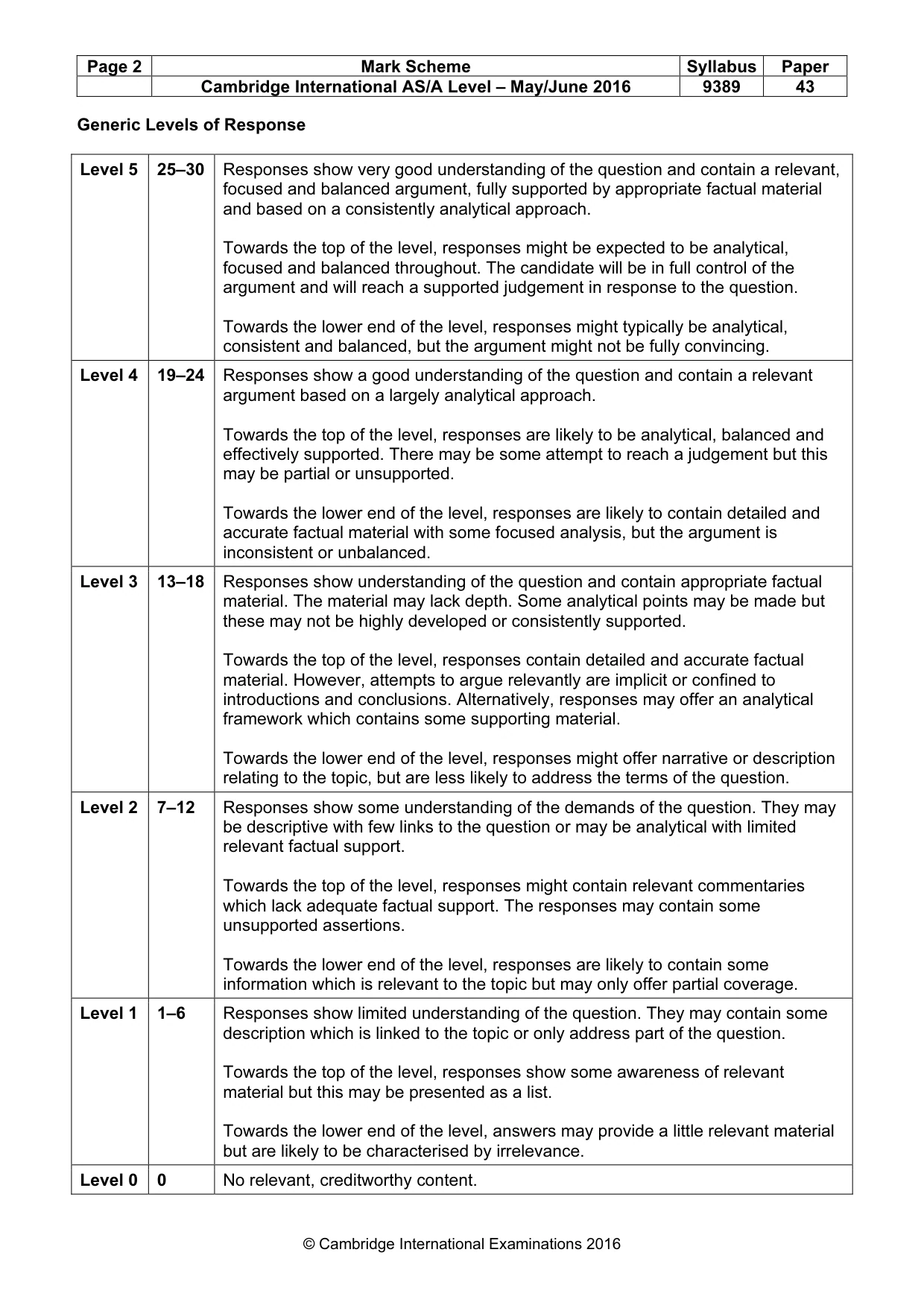
Page 2 Mark Scheme Syllabus Paper Cambridge International AS/A Level – May/June 2016 9389 43 © Cambridge International Examinations 2016 Generic Levels of Response Level 5 25–30 Responses show very good understanding of the question and contain a relevant, focused and balanced argument, fully supported by appropriate factual material and based on a consistently analytical approach. Towards the top of the level, responses might be expected to be analytical, focused and balanced throughout. The candidate will be in full control of the argument and will reach a supported judgement in response to the question. Towards the lower end of the level, responses might typically be analytical, consistent and balanced, but the argument might not be fully convincing. Level 4 19–24 Responses show a good understanding of the question and contain a relevant argument based on a largely analytical approach. Towards the top of the level, responses are likely to be analytical, balanced and effectively supported. There may be some attempt to reach a judgement but this may be partial or unsupported. Towards the lower end of the level, responses are likely to contain detailed and accurate factual material with some focused analysis, but the argument is inconsistent or unbalanced. Level 3 13–18 Responses show understanding of the question and contain appropriate factual material. The material may lack depth. Some analytical points may be made but these may not be highly developed or consistently supported. Towards the top of the level, responses contain detailed and accurate factual material. However, attempts to argue relevantly are implicit or confined to introductions and conclusions. Alternatively, responses may offer an analytical framework which contains some supporting material. Towards the lower end of the level, responses might offer narrative or description relating to the topic, but are less likely to address the terms of the question. Level 2 7–12 Responses show some understanding of the demands of the question. They may be descriptive with few links to the question or may be analytical with limited relevant factual support. Towards the top of the level, responses might contain relevant commentaries which lack adequate factual support. The responses may contain some unsupported assertions. Towards the lower end of the level, responses are likely to contain some information which is relevant to the topic but may only offer partial coverage. Level 1 1–6 Responses show limited understanding of the question. They may contain some description which is linked to the topic or only address part of the question. Towards the top of the level, responses show some awareness of relevant material but this may be presented as a list. Towards the lower end of the level, answers may provide a little relevant material but are likely to be characterised by irrelevance. Level 0 0 No relevant, creditworthy content.
Mark scheme, page 3
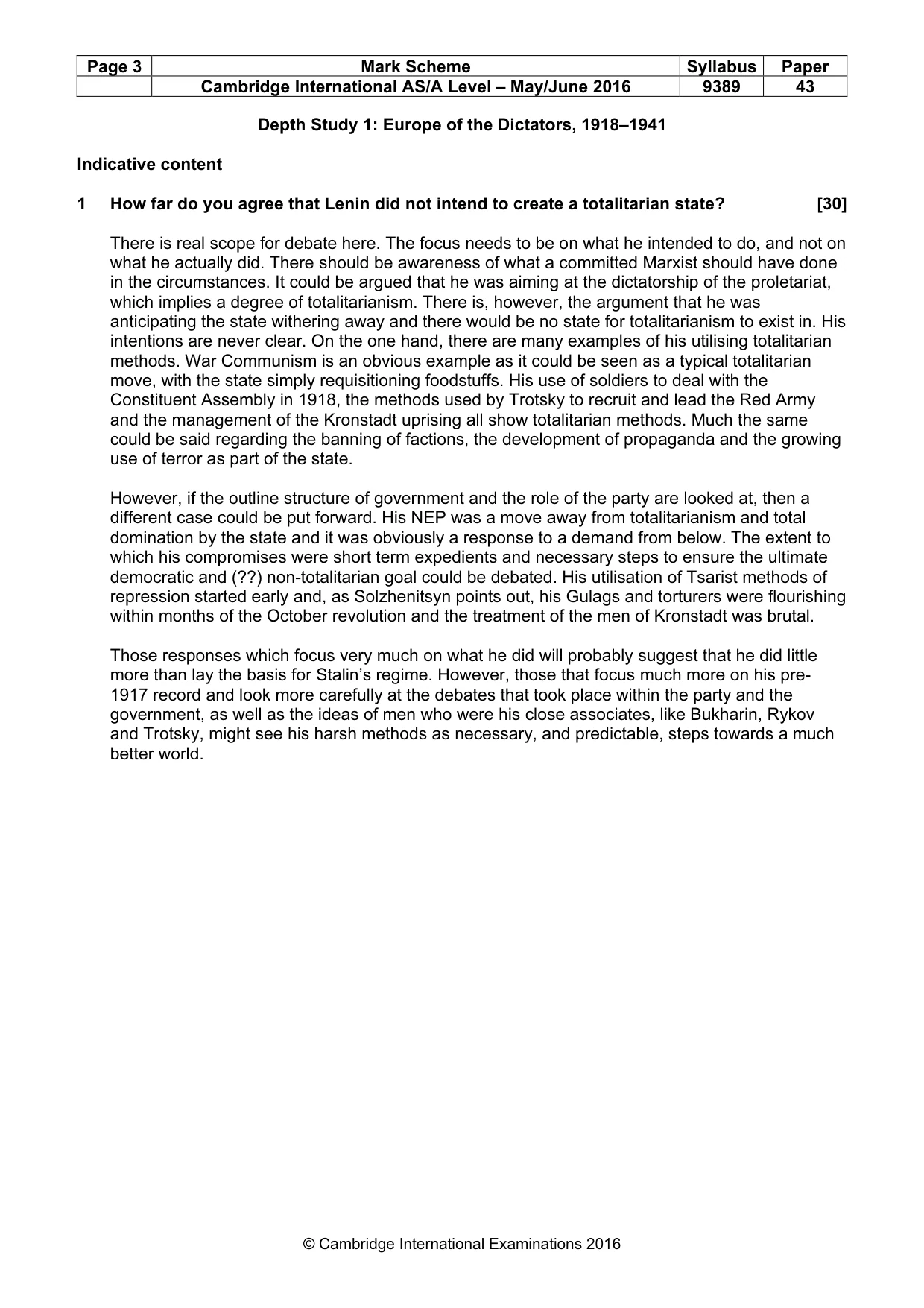
Page 3 Mark Scheme Syllabus Paper Cambridge International AS/A Level – May/June 2016 9389 43 © Cambridge International Examinations 2016 Depth Study 1: Europe of the Dictators, 1918–1941 Indicative content 1 How far do you agree that Lenin did not intend to create a totalitarian state? [30] There is real scope for debate here. The focus needs to be on what he intended to do, and not on what he actually did. There should be awareness of what a committed Marxist should have done in the circumstances. It could be argued that he was aiming at the dictatorship of the proletariat, which implies a degree of totalitarianism. There is, however, the argument that he was anticipating the state withering away and there would be no state for totalitarianism to exist in. His intentions are never clear. On the one hand, there are many examples of his utilising totalitarian methods. War Communism is an obvious example as it could be seen as a typical totalitarian move, with the state simply requisitioning foodstuffs. His use of soldiers to deal with the Constituent Assembly in 1918, the methods used by Trotsky to recruit and lead the Red Army and the management of the Kronstadt uprising all show totalitarian methods. Much the same could be said regarding the banning of factions, the development of propaganda and the growing use of terror as part of the state. However, if the outline structure of government and the role of the party are looked at, then a different case could be put forward. His NEP was a move away from totalitarianism and total domination by the state and it was obviously a response to a demand from below. The extent to which his compromises were short term expedients and necessary steps to ensure the ultimate democratic and (??) non-totalitarian goal could be debated. His utilisation of Tsarist methods of repression started early and, as Solzhenitsyn points out, his Gulags and torturers were flourishing within months of the October revolution and the treatment of the men of Kronstadt was brutal. Those responses which focus very much on what he did will probably suggest that he did little more than lay the basis for Stalin’s regime. However, those that focus much more on his pre- 1917 record and look more carefully at the debates that took place within the party and the government, as well as the ideas of men who were his close associates, like Bukharin, Rykov and Trotsky, might see his harsh methods as necessary, and predictable, steps towards a much better world.
Mark scheme, page 4
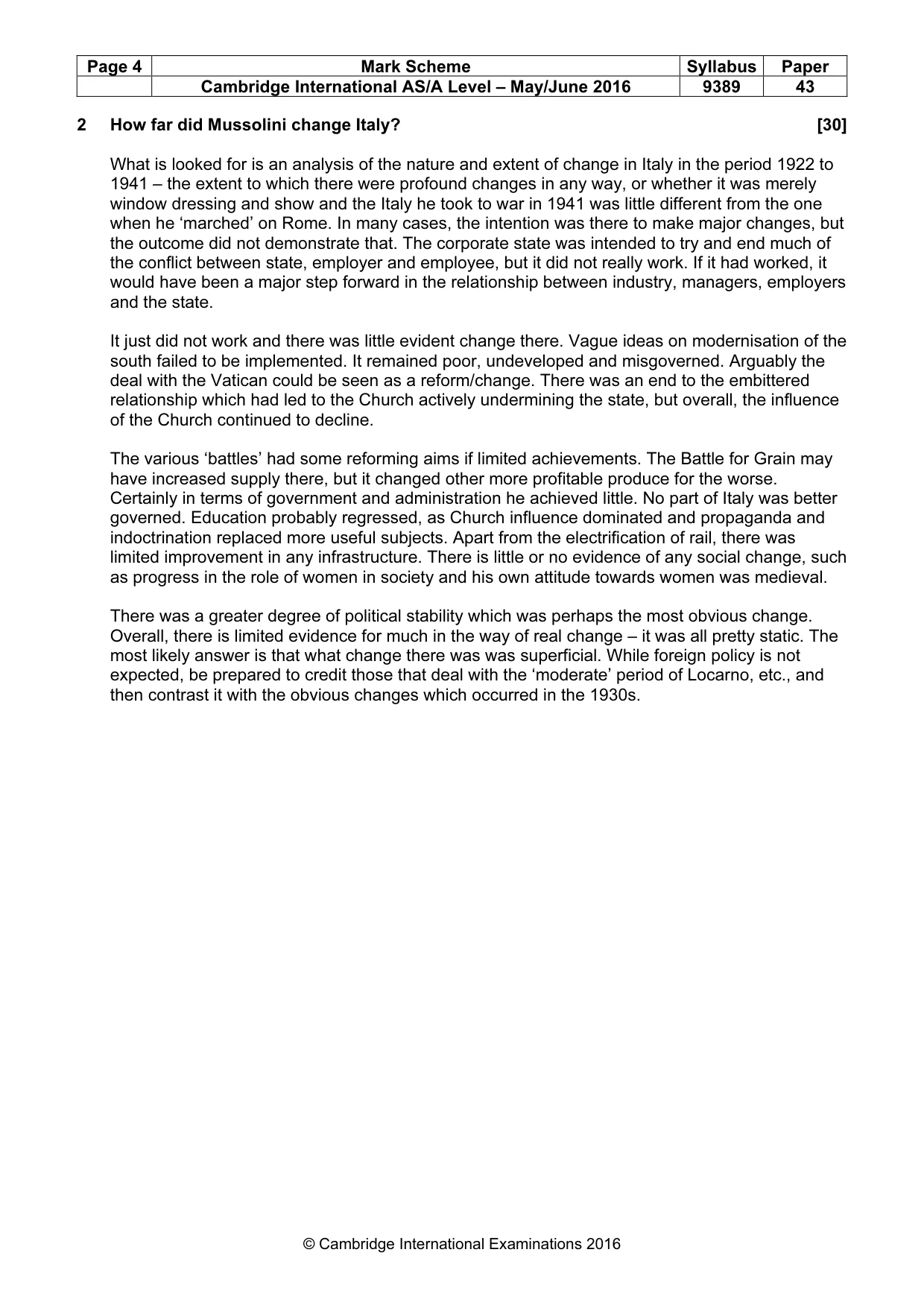
Page 4 Mark Scheme Syllabus Paper Cambridge International AS/A Level – May/June 2016 9389 43 © Cambridge International Examinations 2016 2 How far did Mussolini change Italy? [30] What is looked for is an analysis of the nature and extent of change in Italy in the period 1922 to 1941 – the extent to which there were profound changes in any way, or whether it was merely window dressing and show and the Italy he took to war in 1941 was little different from the one when he ‘marched’ on Rome. In many cases, the intention was there to make major changes, but the outcome did not demonstrate that. The corporate state was intended to try and end much of the conflict between state, employer and employee, but it did not really work. If it had worked, it would have been a major step forward in the relationship between industry, managers, employers and the state. It just did not work and there was little evident change there. Vague ideas on modernisation of the south failed to be implemented. It remained poor, undeveloped and misgoverned. Arguably the deal with the Vatican could be seen as a reform/change. There was an end to the embittered relationship which had led to the Church actively undermining the state, but overall, the influence of the Church continued to decline. The various ‘battles’ had some reforming aims if limited achievements. The Battle for Grain may have increased supply there, but it changed other more profitable produce for the worse. Certainly in terms of government and administration he achieved little. No part of Italy was better governed. Education probably regressed, as Church influence dominated and propaganda and indoctrination replaced more useful subjects. Apart from the electrification of rail, there was limited improvement in any infrastructure. There is little or no evidence of any social change, such as progress in the role of women in society and his own attitude towards women was medieval. There was a greater degree of political stability which was perhaps the most obvious change. Overall, there is limited evidence for much in the way of real change – it was all pretty static. The most likely answer is that what change there was was superficial. While foreign policy is not expected, be prepared to credit those that deal with the ‘moderate’ period of Locarno, etc., and then contrast it with the obvious changes which occurred in the 1930s.
Mark scheme, page 5
Page 5 Mark Scheme Syllabus Paper Cambridge International AS/A Level – May/June 2016 9389 43 © Cambridge International Examinations 2016 3 ‘Many failures and few successes.’ Is this a fair judgement on Stalin’s rule in Russia? [30] What is looked for is some reflection on what might be seen as a failure, or success, in the context of Russia under Stalin in the period c.1930–1941. What might be seen as a success in terms of Stalin’s bid for absolute power might, of course, be seen as a complete failure from the point of view of Russia and its people. There needs to be a balance in the response and the best will make a sustained judgement. Issues like collectivisation could be seen in different ways. By 1939, according to Russian statistics, about 99% of land was collectivised; this could be seen as a success for the state. Grain production did start to increase. There was now the capacity to support a rapidly growing industrial workforce. However, it could be seen as a total disaster from another point of view. The human cost was staggering and Russian agriculture never really recovered, and it was now open to disasters such as Lysenko’s ideas. Heavy industry could be seen as a great success. New industries were created where none existed. Production of coal, electricity and steel rose rapidly, and it is always stressed that Russia was able to withstand the Nazi invasion. It would have helped, however, if Russian tanks had been better built and if someone had remembered the need for spare parts and the sort of ammunition which could actually penetrate German armour. Thousands of tractors were built, but no arrangements had been made to get fuel for them. Other factors such as the establishment of a Marxist state could be considered, but how ‘Marxist’ it was could be debated. It could be argued that he successfully created a totalitarian state, and he successfully purged all actual and possible opponents to his rule, but again, the human cost could be seen as a failure. Having to scour the Gulags to try and find some army officers left alive in 1941 is not a sign of success, and it was clear that slave labour was not the most efficient way of doing things. There is huge scope for debate here from many different perspectives.
Mark scheme, page 6
Page 6 Mark Scheme Syllabus Paper Cambridge International AS/A Level – May/June 2016 9389 43 © Cambridge International Examinations 2016 4 ‘The existence of mass unemployment was the principal reason for Hitler’s rise to power.’ How far do you agree with this judgement? [30] What is looked for in the response is an analysis of the role played by the existence of mass unemployment, and then contrast it with the many other factors which played a part in his rise to power. There is no ‘right’ answer, but most commentators do stress that it was a critical factor and that without the Depression he would have been little more than a footnote in German history. There is a case to argue there. Certainly the despair generated by the Depression, serious deflation (and not inflation!) and mass unemployment could be seen as major factors. Without it, it is difficult to see how Hitler could have generated such support. The way in which the mass unemployment boosted the Communists, which led to middle class/upper class fear of the Reds moving into support for the strongest anti-communist party, the Nazis, growing. While German politics missed Stresemann, Schacht had solutions to the problems that Germany faced. What was lacking was the will and ability of the Weimar politicians of the period to take the decisions necessary to implement those Keynesian ideas. Obviously, Hitler’s own talents and message were vital, as were the propaganda of Goebbels and the work of many others such as Goering and Rohm. The way in which the SA was developed and utilised was vital in both getting over the Nazi message and preventing those of others being heard. Weimar politicians were to play a role as well. Few emerge with any credit and those like Von Papen who thought they could manage Hitler soon learned to regret it. Other factors such as the legacy of Versailles and problems inherent in the Weimar Constitution could be considered as well; expect to see comments on Article 48 and the electoral system. Some now suggest, however, that electoral systems do not cause political instability, but can reflect it better than other systems. There was perhaps a ‘natural’ drift back to an authoritarian regime in a time of crisis. Democracy in Germany was of very recent origin and many were looking for a scapegoat on which to blame all the failings of the previous regime.
Mark scheme, page 7
Page 7 Mark Scheme Syllabus Paper Cambridge International AS/A Level – May/June 2016 9389 43 © Cambridge International Examinations 2016 Depth Study 2: The History of the USA, 1945–1990 Indicative content 5 How far did the position of women in American society change between 1945 and 1960? [30] Women had played a major part in winning the Second World War, often abandoning their domestic roles to work in factories and offices as men went to fight in Europe and Asia. The poster of Rosie the Riveter, her right arm raised and the slogan ‘we can do it!’ showed a new image of women. When the war ended, most soldiers returned to work and most female workers were expected to return home. There they would look after children and support their husband, the breadwinner. The baby boom of the late 1940s meant they had to stay at home as nursery provision was minimal and grandparents not always close at hand. The image of women in the 1950s is of a stay-at-home mother. The reality was slightly different, at least according to national statistics. In 1950, women formed 34% of the labour force, in 1960 38%. More significantly, 60% of married women were employed in 1960 compared with 52% ten years earlier. Women’s work was often low paid and/or part-time. Married women both stayed at home and went out to work, the latter as the children became older. Women took jobs rather than had a career. The fashionable Tupperware parties of the era enabled many women to do both at the same time. The domestic goddess role, however, was the one which prevailed in the media of the time and especially in women’s magazines. It is also argued that the context of the times – the Cold War and the nuclear age – caused people to turn more to the family as a source of security. Proving such an assertion is almost impossible, however. It is more likely that the move to the suburbs which was a key feature of the decade did mean that more mothers had to stay at home – at least until the family had a second car. Betty Friedan’s The Feminine Mystique, published in 1963, was a critique of women’s lifestyles in the 1950s. She argued that these lifestyles caused women much unhappiness. The reaction was to come in the 1960s.
Mark scheme, page 8
Page 8 Mark Scheme Syllabus Paper Cambridge International AS/A Level – May/June 2016 9389 43 © Cambridge International Examinations 2016 6 Assess the reasons why, in the 1970s, the US economy experienced the combination of slow economic growth and rapid inflation often called ‘stagflation’. [30] This term combines two features of a national economy which, according to classical economic theory, are meant to be opposites. If you have stagnation and thus high unemployment, which is recession by another name, then prices will fall as suppliers try and increase demand for their goods and unemployment falls. If you have inflation, then you will have economic growth as people have more money to spend – or to save and invest. The term ‘stagflation’ was coined by a British Conservative politician in 1965 but is more usually applied to advanced industrial economies in the 1970s, especially the mid-1970s. By 1973, the US economy was already in recession and then came the inflation of the oil shock. There is a narrative which explains how and why stagflation arrived. By 1969, the US economy was already in difficulty, experiencing the first trade deficit in modern times as well as rising inflation. These were the consequences of fighting the Vietnam War. Richard Nixon became president, determined to do all he could to get re-elected in 1972. In August 1971, he announced what became known as the Nixon Shock: taking the dollar off the gold-dollar standard; introducing a 10% import surcharge; imposing a 90-day freeze on all prices and wages. The freeze in some form continued until 1974. Employers could not increase their prices so balanced the books by laying off workers. Prices of imports, however, rose following the abandonment of the gold standard. The shock helped Nixon win in 1972. However, its economic consequences were negative. Inflation rose from 3.3% in 1971 to 12.3% in 1974, while the economy moved into recession with three quarters of a percent negative growth in late 1974 and early 1975. One further shock pushed the USA into stagflation: the OPEC oil embargo which was announced after the Arab- Israeli War of 1973. The embargo quadrupled oil prices. There was a second oil price crisis in 1979 following the Iranian Revolution. Thus the causes of the American stagflation of the 1970s come under three headings. First, long term, there was the growing uncompetitiveness of American industry, especially with the revival of Japan and [West] Germany. Goods from those countries outsold American goods, causing production to stagnate. Secondly, there were contradictory government policies, several taken for party political reasons. One of these could be the cost of continuing the war in Vietnam. Thirdly, there was the oil price shock of 1973, which has been compared to pouring oil on a raging fire. Stagflation lasted, if in a less virulent form, into the later 1970s. Stagflation was the economic dimension of a profound crisis, political and constitutional, which hit the USA in the mid-1970s.
Mark scheme, page 9
Page 9 Mark Scheme Syllabus Paper Cambridge International AS/A Level – May/June 2016 9389 43 © Cambridge International Examinations 2016 7 How effectively in the 1980s did black civil rights groups uphold the advances made in the 1950s and 1960s? [30] The main groups which had helped advance civil rights in the 1950s and 1960s were the Southern Christian Leadership Conference [SCLC], the Congress for Racial Equality [CORE] and the National Association for the Advancement of Coloured People [NAACP]. Not relevant are the various Black Power groups of the 1960s, which were not really civil rights groups, and the Nation of Islam, a religious group. The main advances in civil rights included the 1964 Civil Rights Act, the 1965 Voting Rights Act and the policies known as affirmative action. There was just one black civil rights leader of the 1970s and 1980s who was a national name, Jesse Jackson, though Al Sharpton might merit a mention. Jesse Jackson, initially seen as Martin Luther King’s successor at the SCLC, split from the movement in 1971. In the 1980s, he set up the Rainbow Coalition with a wider focus than black civil rights. In 1984 and 1988, he ran for President as a third party candidate. The 1980s were a decade dominated by the Republican party, the party of the white majority with little sympathy for black civil rights. The main civil rights issue of the 1980s was affirmative action. For the groups themselves, SCLC, CORE and NAACP, the 1980s were a time when very little was achieved. In 1982, the 1965 Voting Rights Act was strengthened. In 1983, responding to great public pressure and ignoring Republican opposition, President Reagan signed an Act establishing Martin Luther King’s birthday as a public holiday. This was a symbolic move only, doing nothing to maintain the advances of the 1960s. The main political issue of the decade was affirmative action, a policy which many Republicans opposed. The NAACP did its best to uphold this particular advance in several court cases, but the US Supreme Court usually decided to limit the role of federal government in upholding affirmative action regulations. In 1989, the NAACP sponsored a silent march through Washington DC to protest against recent US Supreme Court judgments. More than 100 000 people turned out to participate in what was a symbol of the ineffectiveness of black civil rights groups in upholding the advances of the 1950s and 1960s.
Mark scheme, page 10
Page 10 Mark Scheme Syllabus Paper Cambridge International AS/A Level – May/June 2016 9389 43 © Cambridge International Examinations 2016 8 How far, in the late 1940s, was the US policy of containment aggressive and expansionist in nature? [30] The use of the word containment to describe US policy towards the USSR after the Second World War came from the US diplomat George Kennan in his famous 1947 article on the Sources of Soviet Conduct, which was published anonymously. It was quickly followed in Match 1947 by what soon became known as the Truman Doctrine, i.e. support for free peoples resisting attempted subjugation, and the Marshall Plan which would provide financial support for the free states of western Europe. These policies were followed by the year-long Berlin Blockade in 1948–49 and the formation of NATO in the latter year. The initial explanation for these major initiatives was the need to contain the expansionist tendencies of the USSR, as indicated by Soviet policies towards Poland, which the USA argued breached the terms of the Yalta Agreement. In other words, containment was defensive in nature. Soviet aggression had caused the Cold War. This interpretation became widely accepted in the West in the early years of the Cold War, if only because evidence of Soviet aggression in both word and deed was plentiful. From the later 1950s, some historians began to argue that America’s intentions were more aggressive than defensive, especially in terms of economic goals. The first such work was The Tragedy of American Diplomacy by William Appleman Williams. He argued that in the late 1940s, the USA was seeking access to new markets in Europe, in part to avoid a repetition of the Great Depression. Other Western historians, mainly from the New Left, developed this analysis. Gar Alperovitz, in Atomic Diplomacy, argued that the dropping of the atomic bomb on Hiroshima was aimed at warning the USSR as much as it was intended to bring about the surrender of Japan. There is a third school of history concerning the origins of the Cold War, namely post-revisionism. This argues that the Cold War was more a result of misunderstandings on both sides rather than deliberate intent from either the USSR or the USA to expand their power and influence. The policy of containment was certainly a radical departure from the traditional US policy of isolationism. It also departed from the more diplomatic approach towards the USSR taken by Franklin Roosevelt. ‘I am tired of babying the Soviets’, Truman said in 1946, implying that babying the Soviets was FDR’s approach. However, US containment policies were less aggressive than the policies of rollback, advocated by John Foster Dulles in the early 1950s but never put into practice. There is plenty to discuss.
Mark scheme, page 11
Page 11 Mark Scheme Syllabus Paper Cambridge International AS/A Level – May/June 2016 9389 43 © Cambridge International Examinations 2016 Depth Study 3: International History, 1945–1991 Indicative content 9 How far do you agree with the view that Khrushchev’s decision to place nuclear weapons in Cuba was both irrational and counter-productive? [30] Agree – Placing Soviet nuclear missile bases in Cuba was both provocative and extremely risky. In reality, the Cuban missiles posed no new threat to the USA (long-range missiles could already reach the USA from the USSR itself), yet the decision inevitably led to a hostile reaction from the USA, which could have led to nuclear war. There was no guarantee that the Soviet missiles would protect Cuba; there was pressure on Kennedy at the time to call Khrushchev’s bluff by attacking Cuba and deposing Castro (and some criticism of him subsequently for not having done so). When Kennedy imposed a blockade to prevent Russian ships bringing missiles to Cuba, Khrushchev was forced to back down, ordering the ships to turn back. Kennedy’s strategy was highly praised by many Americans at the time, while Khrushchev faced heavy criticism both in the USSR and from China. Castro himself was critical of Khrushchev’s decision to remove the missiles; he had urged Khrushchev to launch a nuclear attack on the USA in the event of an American invasion of Cuba. Although Kennedy agreed to remove American Thor and Jupiter missiles from Turkey, he insisted that this should not be made public; in reality, this was no real victory for Khrushchev anyway since the missiles had already been scheduled for removal. Khrushchev’s decision to back down in the Cuban crisis was part of the reason for his removal from office in 1964. Disagree – Although the Soviet missiles in Cuba posed a threat to major cities in central and eastern USA (e.g. New York, Washington, Chicago, Boston), it was never Khrushchev’s intention to use them as anything other than a bargaining tool. Having lost the lead in ICBMs, Khrushchev was seeking to restore balance by threatening the USA in the same way that American missiles in Turkey and Europe threatened the USSR. He may also have intended to use the Cuban missiles as a means of achieving the withdrawal of the West from Berlin. With a new, young and inexperienced president, 1962 seemed the perfect time to seek concessions from the USA. Although Khrushchev was publicly perceived as the first one to back down, in reality he achieved four significant objectives. Firstly, in return for the removal of Soviet missiles in Cuba, the USA agreed to remove its missiles from Turkey. Secondly, and most significantly, Kennedy agreed that the USA would not attack Cuba; given the threat which the USA had posed to Castro’s Cuba prior to the missile crisis, this was no mean achievement. Thirdly, the USSR had gained a communist ally located within the Americas; although Castro was initially angered by Khrushchev’s decision to remove the Soviet missiles from Cuba, good Soviet-Cuban relations were soon restored. Fourthly, the USSR could be seen supporting a new and vulnerable communist state from the imperialistic actions of the USA; this was important in terms of the USSR’s international prestige during the Cold War, particularly at a time of decolonisation when the superpowers were competing for influence in newly independent states.
Mark scheme, page 12
Page 12 Mark Scheme Syllabus Paper Cambridge International AS/A Level – May/June 2016 9389 43 © Cambridge International Examinations 2016 10 To what extent was the USA responsible for the onset of the ‘Second Cold War’? [30] Responsible – Détente had initially suited the USA; defeat in Vietnam, high inflation and a large budget deficit meant that the USA needed to reduce its intervention in world affairs. Even staunch anti-communists, such as Nixon and Kissinger, had supported the move to détente, preferring negotiation to confrontation. However, by the time Carter became president in 1976, right-wing conservatism was regaining strength in the USA. The view that détente was too soft on communism began to prevail. Carter increased supplies of arms to anti-communist groups and governments in the developing world (e.g. El Salvador, Nicaragua). Although he reached agreement with Brezhnev on the SALT II Treaty in June 1979, opposition to the Treaty was already mounting in the USA and it seemed unlikely that the Senate would ratify it. With Brezhnev’s health failing, negotiating with the USSR became slow and difficult, so it was easier to adopt a more hardline stance. When Islamic militants occupied the US embassy in Teheran in 1979, the incident seemed to symbolise American impotence in world affairs; this led the right-wing to call for a tougher foreign policy. The Soviet invasion of Afghanistan in 1979 was, therefore, the last straw for Carter, who immediately withdrew SALT II from the Senate. With the USSR already threatened by the spread of Muslim Fundamentalism, the USA’s threat to support anti-Soviet factions in Afghanistan could be seen as a key reason for the USSR’s decision to invade Afghanistan. Not responsible – Throughout the period of détente, the USSR continued to enhance its influence in the Third World (e.g. Angola, Mozambique, Ethiopia). To American right-wing politicians, this was clear evidence of the USSR’s continuing ambition to spread communism. Despite agreeing to the Helsinki Accords of 1975, the USSR continued to violate human rights. To many in the USA, this was a clear sign that the USSR could not be trusted and that negotiations were, therefore, pointless. This problem was enhanced by the USSR’s lack of effective leadership as a result of Brezhnev’s ill-health; this made decision making slow and laborious, which, to right-wing Americans, was perceived as prevarication. Determined to maintain a pro-Soviet government in Afghanistan, the USSR invaded in 1979. This is commonly seen as the act which ended détente and began the Second Cold War. Unwilling to let the USSR get away with another intervention in a foreign country, Carter immediately withdrew the USA from SALT II, cut off trade contracts with the USSR and encouraged a Western boycott of the Moscow Olympics in 1980. Carter also increased arms spending, including nuclear weaponry. Despite this, Carter’s perceived weakness in dealing with the ‘Soviet threat’ led to his defeat by Reagan in the 1980 presidential elections.
Mark scheme, page 13
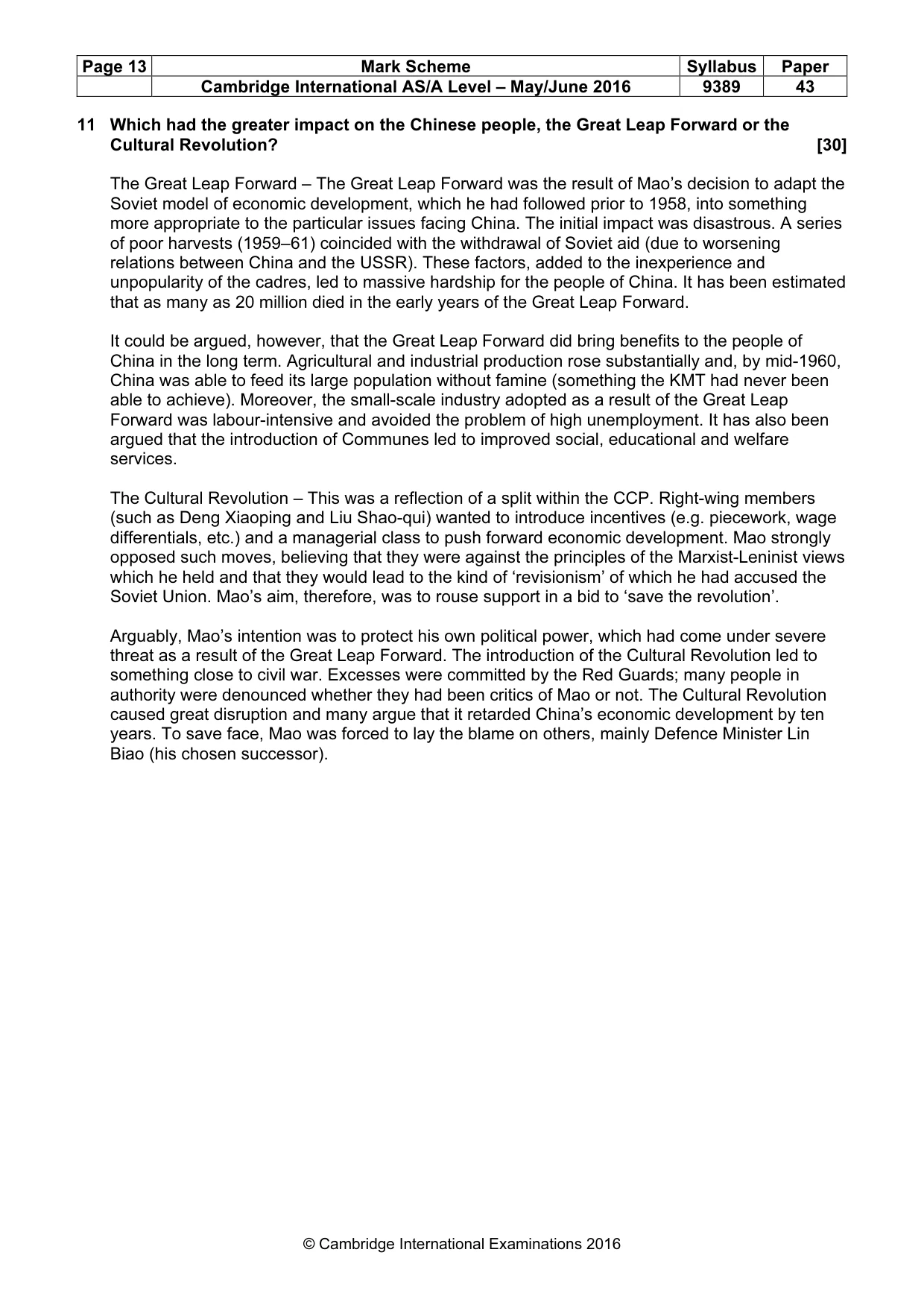
Page 13 Mark Scheme Syllabus Paper Cambridge International AS/A Level – May/June 2016 9389 43 © Cambridge International Examinations 2016 11 Which had the greater impact on the Chinese people, the Great Leap Forward or the Cultural Revolution? [30] The Great Leap Forward – The Great Leap Forward was the result of Mao’s decision to adapt the Soviet model of economic development, which he had followed prior to 1958, into something more appropriate to the particular issues facing China. The initial impact was disastrous. A series of poor harvests (1959–61) coincided with the withdrawal of Soviet aid (due to worsening relations between China and the USSR). These factors, added to the inexperience and unpopularity of the cadres, led to massive hardship for the people of China. It has been estimated that as many as 20 million died in the early years of the Great Leap Forward. It could be argued, however, that the Great Leap Forward did bring benefits to the people of China in the long term. Agricultural and industrial production rose substantially and, by mid-1960, China was able to feed its large population without famine (something the KMT had never been able to achieve). Moreover, the small-scale industry adopted as a result of the Great Leap Forward was labour-intensive and avoided the problem of high unemployment. It has also been argued that the introduction of Communes led to improved social, educational and welfare services. The Cultural Revolution – This was a reflection of a split within the CCP. Right-wing members (such as Deng Xiaoping and Liu Shao-qui) wanted to introduce incentives (e.g. piecework, wage differentials, etc.) and a managerial class to push forward economic development. Mao strongly opposed such moves, believing that they were against the principles of the Marxist-Leninist views which he held and that they would lead to the kind of ‘revisionism’ of which he had accused the Soviet Union. Mao’s aim, therefore, was to rouse support in a bid to ‘save the revolution’. Arguably, Mao’s intention was to protect his own political power, which had come under severe threat as a result of the Great Leap Forward. The introduction of the Cultural Revolution led to something close to civil war. Excesses were committed by the Red Guards; many people in authority were denounced whether they had been critics of Mao or not. The Cultural Revolution caused great disruption and many argue that it retarded China’s economic development by ten years. To save face, Mao was forced to lay the blame on others, mainly Defence Minister Lin Biao (his chosen successor).
Mark scheme, page 14
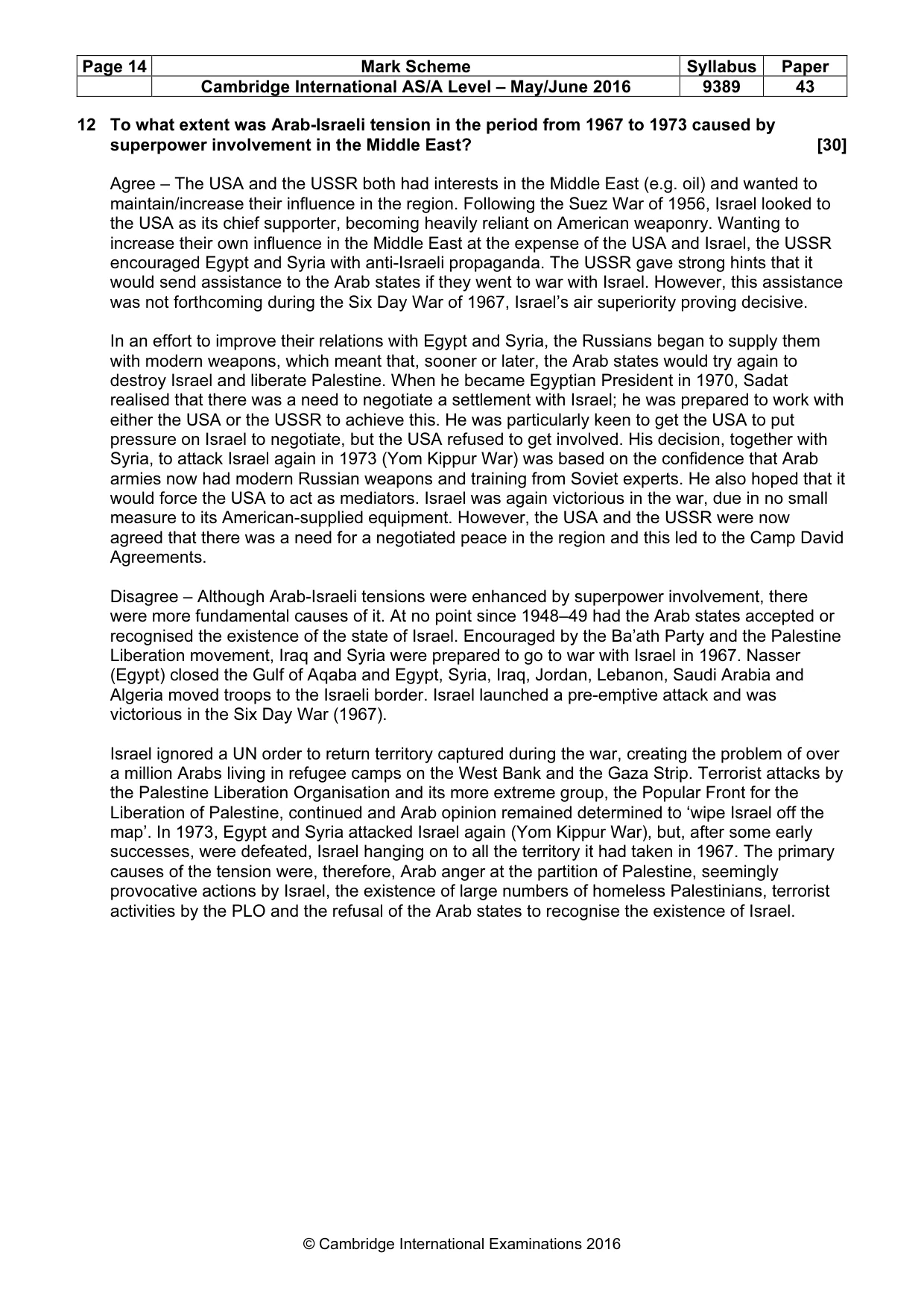
Page 14 Mark Scheme Syllabus Paper Cambridge International AS/A Level – May/June 2016 9389 43 © Cambridge International Examinations 2016 12 To what extent was Arab-Israeli tension in the period from 1967 to 1973 caused by superpower involvement in the Middle East? [30] Agree – The USA and the USSR both had interests in the Middle East (e.g. oil) and wanted to maintain/increase their influence in the region. Following the Suez War of 1956, Israel looked to the USA as its chief supporter, becoming heavily reliant on American weaponry. Wanting to increase their own influence in the Middle East at the expense of the USA and Israel, the USSR encouraged Egypt and Syria with anti-Israeli propaganda. The USSR gave strong hints that it would send assistance to the Arab states if they went to war with Israel. However, this assistance was not forthcoming during the Six Day War of 1967, Israel’s air superiority proving decisive. In an effort to improve their relations with Egypt and Syria, the Russians began to supply them with modern weapons, which meant that, sooner or later, the Arab states would try again to destroy Israel and liberate Palestine. When he became Egyptian President in 1970, Sadat realised that there was a need to negotiate a settlement with Israel; he was prepared to work with either the USA or the USSR to achieve this. He was particularly keen to get the USA to put pressure on Israel to negotiate, but the USA refused to get involved. His decision, together with Syria, to attack Israel again in 1973 (Yom Kippur War) was based on the confidence that Arab armies now had modern Russian weapons and training from Soviet experts. He also hoped that it would force the USA to act as mediators. Israel was again victorious in the war, due in no small measure to its American-supplied equipment. However, the USA and the USSR were now agreed that there was a need for a negotiated peace in the region and this led to the Camp David Agreements. Disagree – Although Arab-Israeli tensions were enhanced by superpower involvement, there were more fundamental causes of it. At no point since 1948–49 had the Arab states accepted or recognised the existence of the state of Israel. Encouraged by the Ba’ath Party and the Palestine Liberation movement, Iraq and Syria were prepared to go to war with Israel in 1967. Nasser (Egypt) closed the Gulf of Aqaba and Egypt, Syria, Iraq, Jordan, Lebanon, Saudi Arabia and Algeria moved troops to the Israeli border. Israel launched a pre-emptive attack and was victorious in the Six Day War (1967). Israel ignored a UN order to return territory captured during the war, creating the problem of over a million Arabs living in refugee camps on the West Bank and the Gaza Strip. Terrorist attacks by the Palestine Liberation Organisation and its more extreme group, the Popular Front for the Liberation of Palestine, continued and Arab opinion remained determined to ‘wipe Israel off the map’. In 1973, Egypt and Syria attacked Israel again (Yom Kippur War), but, after some early successes, were defeated, Israel hanging on to all the territory it had taken in 1967. The primary causes of the tension were, therefore, Arab anger at the partition of Palestine, seemingly provocative actions by Israel, the existence of large numbers of homeless Palestinians, terrorist activities by the PLO and the refusal of the Arab states to recognise the existence of Israel.
What you needed in this session
Cambridge’s own grade thresholds for 2016 May/June, Paper 4 · Variant 3. A higher threshold means an easier paper — the bar moves with how the cohort did.