Cambridge A Level History 9389 — 2016 May/June Paper 4 · Variant 2
9389/42/M/J/16 · 60 marks · ≈68 min
The question paper and its mark scheme, free to read here and free to download. This is Cambridge’s own paper, exactly as it was sat.
Question paper4 pages
Mark scheme14 pages
Answers below. Sit the paper first if you are practising.
Paper as text
Question paper, page 1
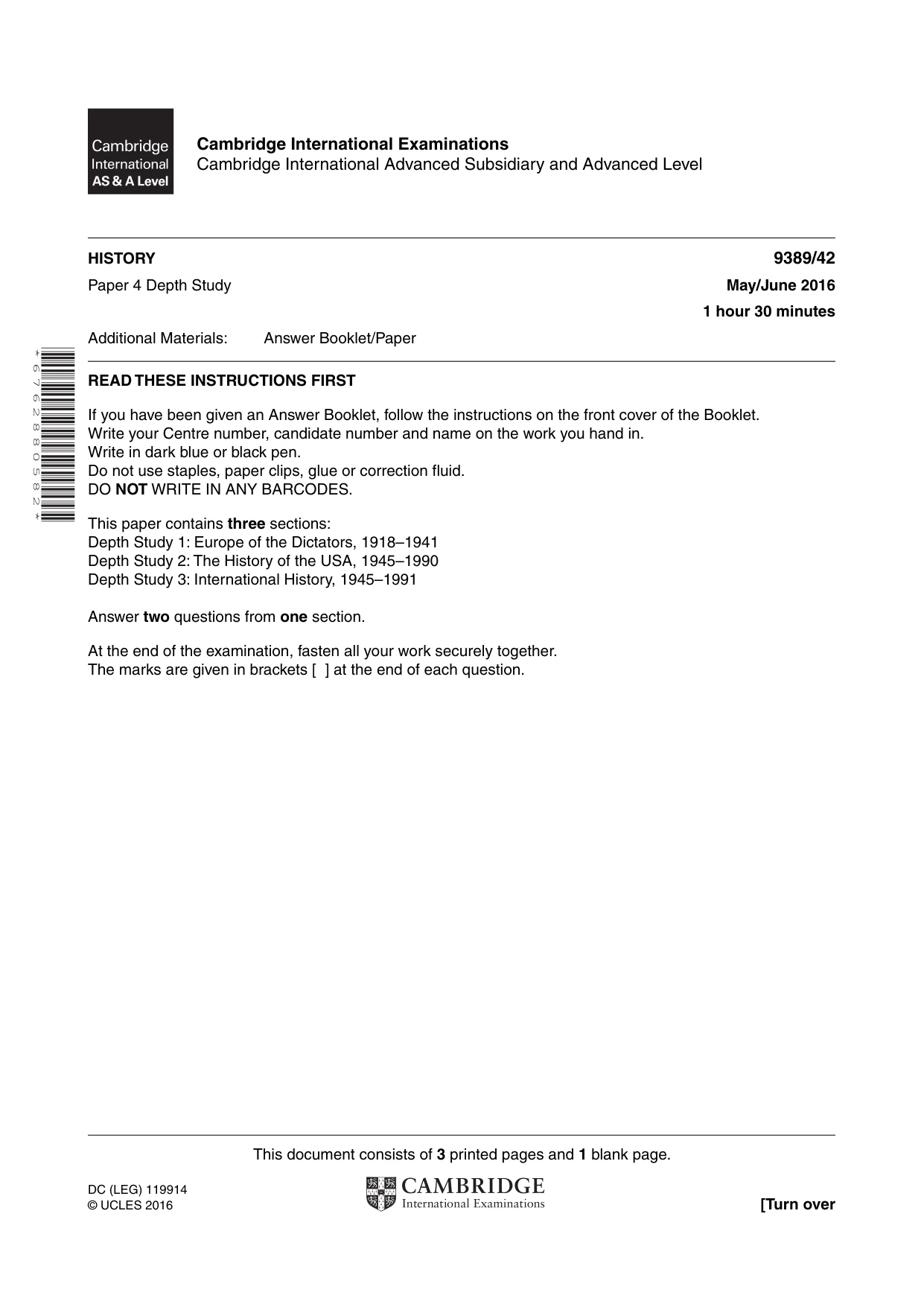
This document consists of 3 printed pages and 1 blank page. DC (LEG) 119914 © UCLES 2016 [Turn over Cambridge International Examinations Cambridge International Advanced Subsidiary and Advanced Level * 6 7 6 2 8 8 0 5 8 2 * HISTORY 9389/42 Paper 4 Depth Study May/June 2016 1 hour 30 minutes Additional Materials: Answer Booklet/Paper READ THESE INSTRUCTIONS FIRST If you have been given an Answer Booklet, follow the instructions on the front cover of the Booklet. Write your Centre number, candidate number and name on the work you hand in. Write in dark blue or black pen. Do not use staples, paper clips, glue or correction fluid. DO NOT WRITE IN ANY BARCODES. This paper contains three sections: Depth Study 1: Europe of the Dictators, 1918–1941 Depth Study 2: The History of the USA, 1945–1990 Depth Study 3: International History, 1945–1991 Answer two questions from one section. At the end of the examination, fasten all your work securely together. The marks are given in brackets [ ] at the end of each question.
Question paper, page 2
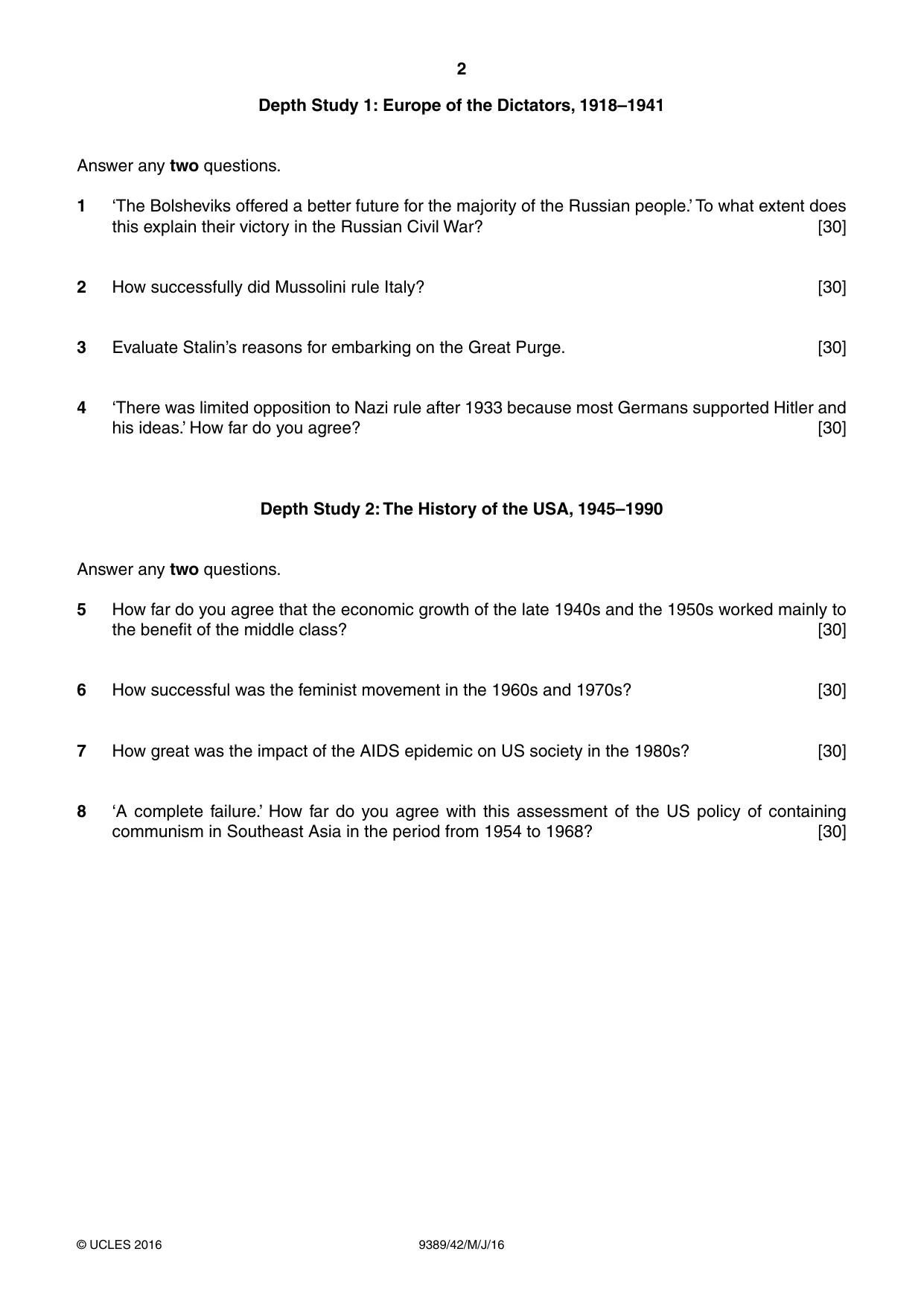
2 9389/42/M/J/16 © UCLES 2016 Depth Study 1: Europe of the Dictators, 1918–1941 Answer any two questions. 1 ‘The Bolsheviks offered a better future for the majority of the Russian people.’ To what extent does this explain their victory in the Russian Civil War? [30] 2 How successfully did Mussolini rule Italy? [30] 3 Evaluate Stalin’s reasons for embarking on the Great Purge. [30] 4 ‘There was limited opposition to Nazi rule after 1933 because most Germans supported Hitler and his ideas.’ How far do you agree? [30] Depth Study 2: The History of the USA, 1945–1990 Answer any two questions. 5 How far do you agree that the economic growth of the late 1940s and the 1950s worked mainly to the benefit of the middle class? [30] 6 How successful was the feminist movement in the 1960s and 1970s? [30] 7 How great was the impact of the AIDS epidemic on US society in the 1980s? [30] 8 ‘A complete failure.’ How far do you agree with this assessment of the US policy of containing communism in Southeast Asia in the period from 1954 to 1968? [30]
Question paper, page 3
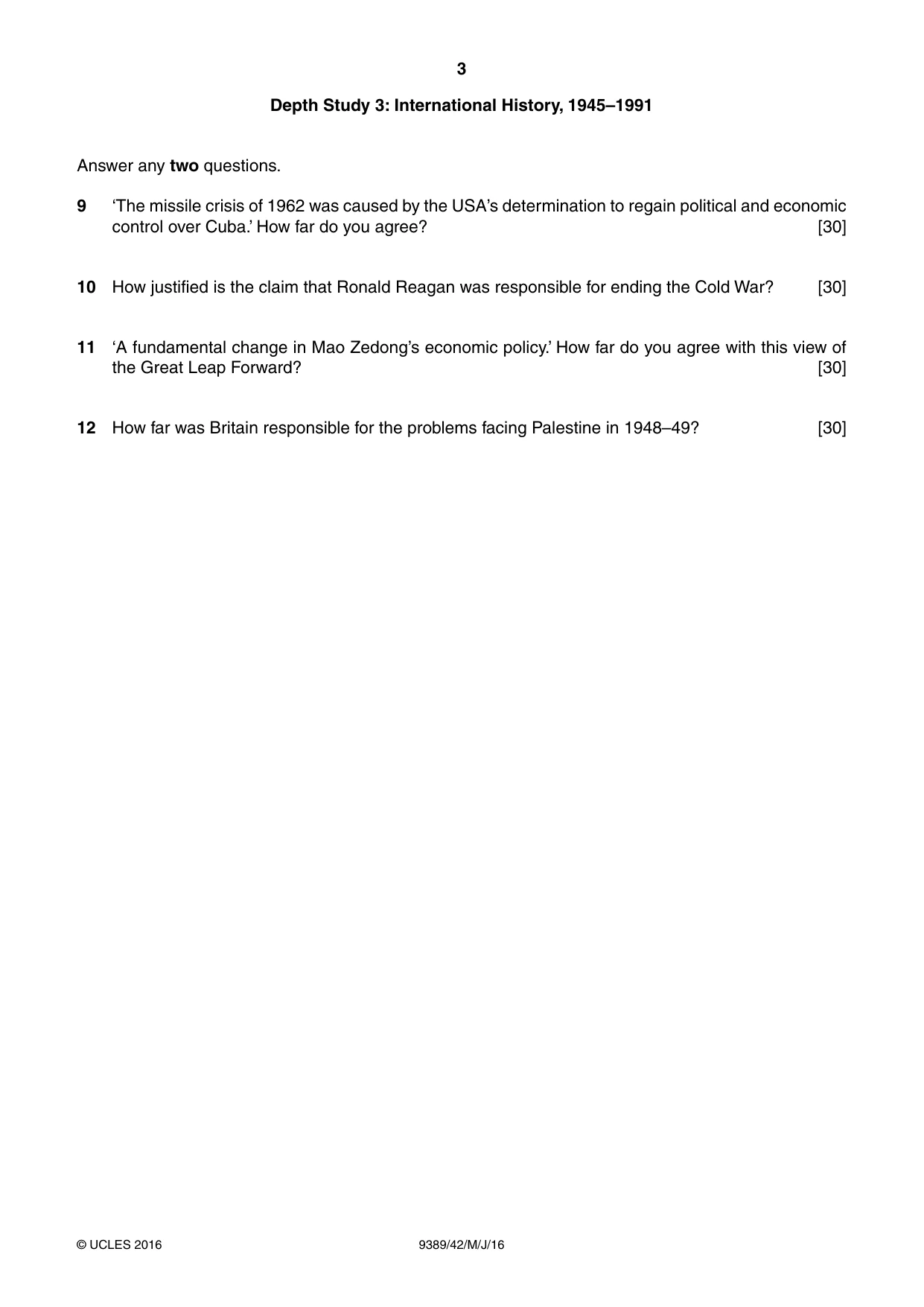
3 9389/42/M/J/16 © UCLES 2016 Depth Study 3: International History, 1945–1991 Answer any two questions. 9 ‘The missile crisis of 1962 was caused by the USA’s determination to regain political and economic control over Cuba.’ How far do you agree? [30] 10 How justified is the claim that Ronald Reagan was responsible for ending the Cold War? [30] 11 ‘A fundamental change in Mao Zedong’s economic policy.’ How far do you agree with this view of the Great Leap Forward? [30] 12 How far was Britain responsible for the problems facing Palestine in 1948–49? [30]
Question paper, page 4
4 9389/42/M/J/16 © UCLES 2016 BLANK PAGE Permission to reproduce items where third-party owned material protected by copyright is included has been sought and cleared where possible. Every reasonable effort has been made by the publisher (UCLES) to trace copyright holders, but if any items requiring clearance have unwittingly been included, the publisher will be pleased to make amends at the earliest possible opportunity. To avoid the issue of disclosure of answer-related information to candidates, all copyright acknowledgements are reproduced online in the Cambridge International Examinations Copyright Acknowledgements Booklet. This is produced for each series of examinations and is freely available to download at www.cie.org.uk after the live examination series. Cambridge International Examinations is part of the Cambridge Assessment Group. Cambridge Assessment is the brand name of University of Cambridge Local Examinations Syndicate (UCLES), which is itself a department of the University of Cambridge.
Mark scheme, page 1
® IGCSE is the registered trademark of Cambridge International Examinations. This document consists of 14 printed pages. © UCLES 2016 [Turn over Cambridge International Examinations Cambridge International Advanced Subsidiary and Advanced Level HISTORY 9389/42 Paper 4 Depth Study May/June 2016 MARK SCHEME Maximum Mark: 60 Published This mark scheme is published as an aid to teachers and candidates, to indicate the requirements of the examination. It shows the basis on which Examiners were instructed to award marks. It does not indicate the details of the discussions that took place at an Examiners’ meeting before marking began, which would have considered the acceptability of alternative answers. Mark schemes should be read in conjunction with the question paper and the Principal Examiner Report for Teachers. Cambridge will not enter into discussions about these mark schemes. Cambridge is publishing the mark schemes for the May/June 2016 series for most Cambridge IGCSE®, Cambridge International A and AS Level components and some Cambridge O Level components.
Mark scheme, page 2
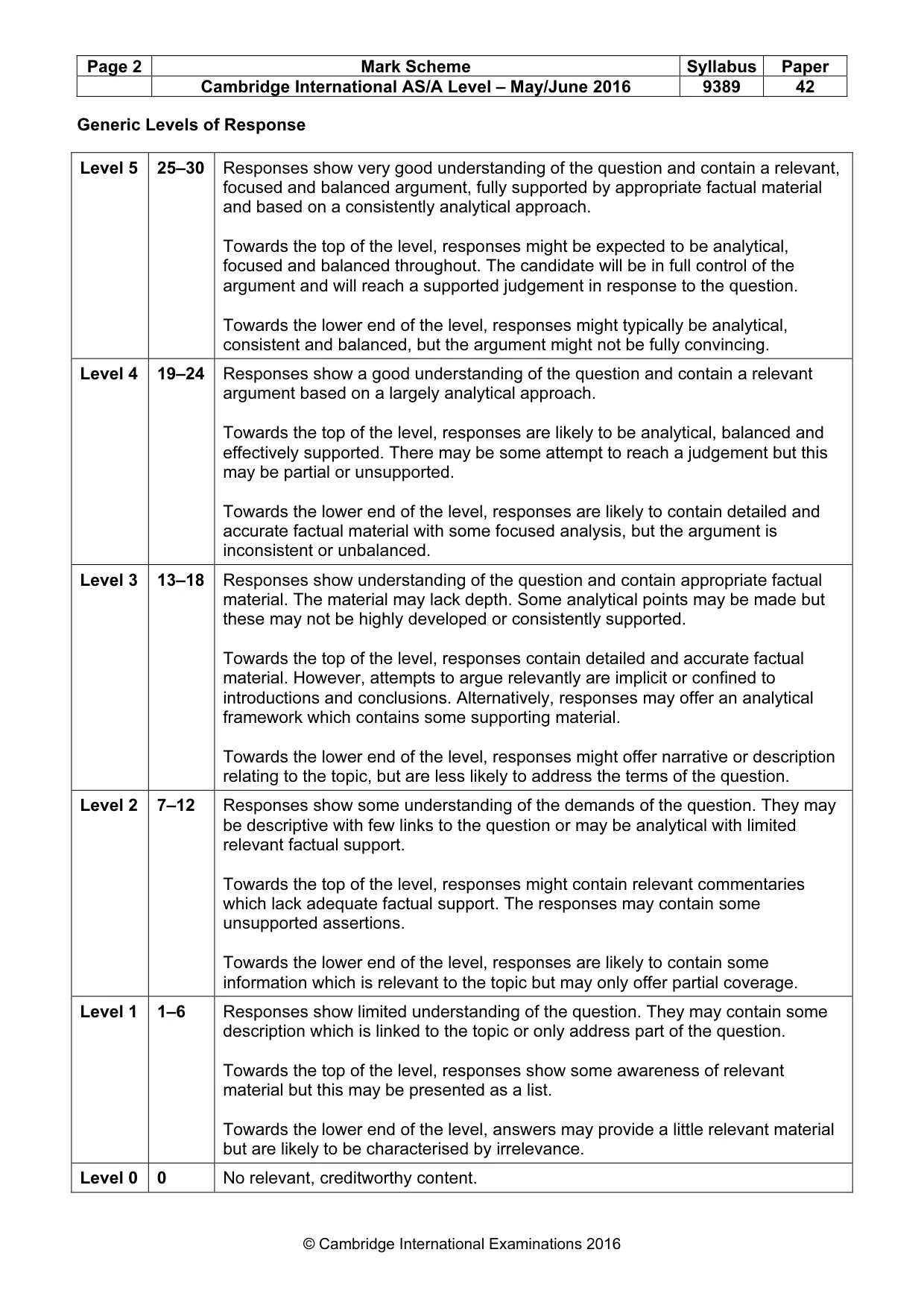
Page 2 Mark Scheme Syllabus Paper Cambridge International AS/A Level – May/June 2016 9389 42 © Cambridge International Examinations 2016 Generic Levels of Response Level 5 25–30 Responses show very good understanding of the question and contain a relevant, focused and balanced argument, fully supported by appropriate factual material and based on a consistently analytical approach. Towards the top of the level, responses might be expected to be analytical, focused and balanced throughout. The candidate will be in full control of the argument and will reach a supported judgement in response to the question. Towards the lower end of the level, responses might typically be analytical, consistent and balanced, but the argument might not be fully convincing. Level 4 19–24 Responses show a good understanding of the question and contain a relevant argument based on a largely analytical approach. Towards the top of the level, responses are likely to be analytical, balanced and effectively supported. There may be some attempt to reach a judgement but this may be partial or unsupported. Towards the lower end of the level, responses are likely to contain detailed and accurate factual material with some focused analysis, but the argument is inconsistent or unbalanced. Level 3 13–18 Responses show understanding of the question and contain appropriate factual material. The material may lack depth. Some analytical points may be made but these may not be highly developed or consistently supported. Towards the top of the level, responses contain detailed and accurate factual material. However, attempts to argue relevantly are implicit or confined to introductions and conclusions. Alternatively, responses may offer an analytical framework which contains some supporting material. Towards the lower end of the level, responses might offer narrative or description relating to the topic, but are less likely to address the terms of the question. Level 2 7–12 Responses show some understanding of the demands of the question. They may be descriptive with few links to the question or may be analytical with limited relevant factual support. Towards the top of the level, responses might contain relevant commentaries which lack adequate factual support. The responses may contain some unsupported assertions. Towards the lower end of the level, responses are likely to contain some information which is relevant to the topic but may only offer partial coverage. Level 1 1–6 Responses show limited understanding of the question. They may contain some description which is linked to the topic or only address part of the question. Towards the top of the level, responses show some awareness of relevant material but this may be presented as a list. Towards the lower end of the level, answers may provide a little relevant material but are likely to be characterised by irrelevance. Level 0 0 No relevant, creditworthy content.
Mark scheme, page 3
Page 3 Mark Scheme Syllabus Paper Cambridge International AS/A Level – May/June 2016 9389 42 © Cambridge International Examinations 2016 Depth Study 1: Europe of the Dictators, 1918–1941 Indicative content 1 ‘The Bolsheviks offered a better future for the majority of the Russian people.’ To what extent does this explain their victory in the Russian Civil War? [30] An analysis of the factors behind Bolshevik victory in the Russian Civil War is looked for. Certainly the Marxist message had an appeal to some, but the ‘Peace, Bread, Land’ aspects of Lenin’s appeal were also very strong. There should be identification of the principal elements of Bolshevism here, or at least some of the essentially socialist ideas and what their appeal might be. While the industrial proletariat clearly supported communist/socialist ideas and the growth of the Soviets demonstrated this, the peasantry had different ideals which, initially, the Bolsheviks encouraged. What appealed to the Jewish minority who had suffered appallingly from Tsarist pogroms differed from what the Don Cossacks were hoping for. The various ‘nationalist’ minorities also had different aspirations which were at times supported by the Bolsheviks. There were many other factors to be considered. The White leadership was divided and never competent and Allied support wavered. Kolchak and Deniken appeared to be little more than ambitious warlords and there was no suitable Tsarist candidate. There never appeared to be a better alternative to the ‘Left’. Geography was an important factor, with the Reds operating out of the centre of the country and controlling what was left of the national communications system and the Russian arms industry. The Whites were never able to co-ordinate anything effectively, even if they had the intention to. Trotsky’s leadership of the Red Army was outstanding, and his sheer ruthlessness and drive were very important factors and were also key. However, Lenin’s personal appeal and propaganda skills were important, as was his willingness to take critically important decisions such as Brest Litovsk and War Communism. Sheer war weariness may have played a part as well. There is no clear consensus on this one by the experts, so accept any well sustained judgment.
Mark scheme, page 4
Page 4 Mark Scheme Syllabus Paper Cambridge International AS/A Level – May/June 2016 9389 42 © Cambridge International Examinations 2016 2 How successfully did Mussolini rule Italy? [30] Reflection on what a ‘successful’ ruler might be seen as is probably a requirement for the higher marks. Should just survival in such troubled times be seen as a ‘success’ – or perhaps in bringing a degree of stability to a country? Certainly there were failures. Emigration continued on a large scale. Corruption and incompetence became deep rooted. Overseas adventures caused an international outcry and played a part in bringing Italy into a disastrous war later. The various ‘battles’ achieved little and war was to show just how weak Italy’s industry and infrastructure were. However, there was grudging support for his regime and there was an end to the endemic political, economic and social unrest of earlier years. The ‘Church’ issue was dealt with. The appalling regimes of Hitler and Stalin were not copied, with doses of castor oil and exile being used rather than terror and the gulags. The Corporate State certainly had some valid ideas underpinning it, but it required far greater skill and commitment than was present within the regime for any chance of successful implementation. Given the seemingly intractable problem of the relationship between the State and the Church in Italy, a semblance of sense was brought to his negotiations with the Papacy and there was no longer the damaging issue of having the Church in Italy actively trying to undermine the State. His attempts at economic reform were usually misguided and failed. The problems of the South were ignored and the wishes of major industrialists were allowed to play too important a role in State thinking. Workers’ rights, such as they existed, diminished. State influence over the economy and industry meant that the armed services were great at display but unable to take on any opponent who was actually armed with modern weapons and was capable of responding in kind to gas attacks. Educational standards dropped in the interests of pacifying the Church and indoctrinating youth in the benefits of Fascism and Mussolini. Depending on the definition of ‘success’, there is a good case which can be argued either way.
Mark scheme, page 5
Page 5 Mark Scheme Syllabus Paper Cambridge International AS/A Level – May/June 2016 9389 42 © Cambridge International Examinations 2016 3 Evaluate Stalin’s reasons for embarking on the Great Purge. [30] What is looked for in an ‘evaluate’ response is an analysis of the various causes and comments on which was seen as the most significant, and why. There is no consensus whatever amongst historians on this one and all the respectable ones suggest that it was a combination of factors. Terror had been utilised by the Tsars as the pogroms against the Jews earlier in the century and the treatment of ‘subject’ peoples like the Kazakhs showed. Lenin, always seen as Stalin’s mentor, had deliberately utilised terror to establish the Bolshevik regime, and what Stalin did, arguably, was just building on that precedent. Those who manage to avoid a list of what he did and get involved in the historiography of the issue deserve credit. Some argue that it was never his intention to let it go so far and that it got out of hand with enthusiastic supporters, but that view has been increasingly discredited. There is the argument that it was needed to cement the gains of the revolution and ensure that communism stood a chance of getting embedded in Russia and that all the ‘old order’, be it aristocratic or bourgeois as well as Bolshevik, had to be eliminated for this to happen. The extent to which it was just the paranoia of a suspicious and warped mind needs to be considered as well and the extent of his personal involvement in the whole process is very well known. The situation in Russia, political, social and economic played a part, as did the rise of Fascism in Europe. Stalin had always reacted savagely towards others, but on a smaller scale, when he felt threatened. He did feel, probably correctly, that his leadership was threatened by the many grumblings in 1934 at the Seventeenth Party Congress. What role Kirov played is not clear, but clearly he was seen as a potential threat and was probably eliminated on Stalin’s orders. Quite why the army was purged to the extent that it was has never been identified. Some suggest that it was simply a wish to fill the gulags with a supply of cheap slave labour. How the appalling damage that the purges caused is fitted in to the explanation also needs reflection for the highest marks.
Mark scheme, page 6
Page 6 Mark Scheme Syllabus Paper Cambridge International AS/A Level – May/June 2016 9389 42 © Cambridge International Examinations 2016 4 ‘There was limited opposition to Nazi rule after 1933 because most Germans supported Hitler and his ideas.’ How far do you agree? [30] The focus should be very firmly on events in Germany between 1933 and 1941 at the latest, and expect to see the emphasis being on the period between 1933 and 1939. Some might feel the need to challenge the ‘limited’ part of the question, but do not expect that. There are a variety of possible reasons for the lack of opposition that Hitler faced after 1933. There was a tradition of authoritarian rule in Germany which Weimar could be seen as an exception to. There was also a tendency to support the government of the day, and given the endorsement of Hindenburg initially, Hitler did represent the establishment and legitimacy. He had taken great care to come to power ‘legally’ and waited to show his true hand after he had the backing of the Enabling Act. There was also the underlying use of force; what happened on the Night of the Long Knives was a good reason for potential opposition to be wary. A police state soon existed and dissidents in any form, from trade unionists to priests, soon found that any form of dissent was treated with state endorsed brutality. The Gestapo and the SS had awesome powers and seemed to have endorsement by a complaint judiciary. Those with influence in communities, like teachers and priests, were watched and pressurised. When the regime sensed potential opposition, such as from the Church over the euthanasia programme, it backed away. The principal potential opponents, ranging from the industrialist to the army officer corps, were very carefully managed and great care was taken to encourage their interests. Rearmament meant a bigger army and lots of weapons manufactured at a profit. Clever propaganda played a part as well. However, the promise of a return to a higher national status was very appealing. Many cared little about any ideology and restoring jobs, incomes and Germany’s status was important to them. The need for a scapegoat was strong; anti-Semitism had always been a force in Germany and Austria, and the promise of employment and an end to the days of political uncertainty and economic distress was very strong also. Great care was taken to ensure that those who could lead opposition were bribed, isolated or coerced.
Mark scheme, page 7
Page 7 Mark Scheme Syllabus Paper Cambridge International AS/A Level – May/June 2016 9389 42 © Cambridge International Examinations 2016 Depth Study 2: The History of the USA, 1945–1990 Indicative content 5 How far do you agree that the economic growth of the late 1940s and the 1950s worked mainly to the benefit of the middle class? [30] The middle class as applied to US society is hard to define. Most Americans see themselves as middle class [unlike the UK, where most see themselves as working class]. Academics, however, see America as closer to the British model. The simplest equation is middle class = white collar as opposed to blue collar jobs which rely more on mental than physical skills. In 1951, C Wright Mills, a sociologist, published a book entitled White Collar: The American Middle Classes. Note the plural. White collar jobs included both private and public sector jobs, from managers, bank clerks and salesmen to teachers and civil servants. The economic growth of the late 1940s and the 1950s would benefit this type of worker as capitalism became more managerial. Some have called the post-war era ‘the golden age of managerial capitalism’ where private corporations did lead economic growth and innovation but were restrained by federal government and labour unions. A 2012 Washington Post article stated that during the era following the Great Depression, ‘the gap between rich and poor shrank as more Americans joined the middle class’. The number of private sector managers, federal bureaucrats and union officials, all middle class, grew steadily. Unemployment was low for most of this decade and a half. The relative effect of this upon the middle and working classes can only be estimated; both had a security which was to vanish in later decades. Taxation policies also helped reduce the gap between the middle and upper classes. The mid- twentieth century was an age of progressive direct taxation as the upper class paid a greater proportion of their income than did the middle class – 20% compared with 10%. This was accepted by the majority, given the need for shared sacrifice, especially in the Second World War but even in the early years of the Cold War. The lowest income earners also benefited from these taxation rates; the poorest fifth of wage earners paid just 2% of their income in direct tax. Among the poor would be African Americans, most living either on Southern farms or in Northern ghettos – though a black middle class was starting to emerge. They would have benefited from the relatively full employment of the era but not to the extent that the middle classes did. The latter moved in large numbers to suburbs, using their prosperity to buy the new consumer goods of the time: cars and televisions.
Mark scheme, page 8
Page 8 Mark Scheme Syllabus Paper Cambridge International AS/A Level – May/June 2016 9389 42 © Cambridge International Examinations 2016 6 How successful was the feminist movement in the 1960s and 1970s? [30] In the 1960s, women entered the public arena in what became known as second-wave feminism. The first wave of the late nineteenth and early twentieth centuries had focused on political rights, especially gaining the vote. Second-wave feminism focused more on social and economic issues, which included reproductive rights as well as employment rights. At the time, the movement was often labelled women’s liberation. The movement is dated as emerging in the mid-1960s: following the 1963 publication of Betty Friedan’s The Feminine Mystique, the National Organisation for Women [NOW] was formed in 1966. Even before 1966, women’s rights had been improved via the Equal Pay Act 1963 and the Civil Rights Act 1964. Both, however, were observed more in theory than in practice. NOW was described at the time as the NAACP for women. In its early years, NOW aimed to ensure that equality of opportunity for all women was achieved so that women achieved their full potential. Particular attention was given to passing the Equal Rights Amendment to the US constitution. This amendment was approved by both Houses of Congress in 1972 but failed narrowly to gain the approval of three-quarters of the fifty states needed to ensure its inclusion in the constitution. Another key aim of the movement concerned the issue of reproductive rights and the rights of women to control their own bodies. This raised the issue of abortion, an issue which was to divide the USA for many years. In 1973, the US Supreme Court, in the case of Roe vs. Wade, decided that women’s right to privacy did include the right to have an abortion, subject to certain conditions. Women’s groups had to fight hard thereafter to maintain this right. NOW had a series of aims which together were ambitious, requiring some kind of cultural revolution. The intention of achieving a fully equal participation of the sexes, whether in the family or the community, was far too ambitious. The feminist movement was protean in form with many aspects, e.g. ethnicity, class as well as sexuality, some of which caused dissent within the movement. So complex were some of the issues raised by second-wave feminism that from the 1980s what has been labelled third-wave feminism emerged.
Mark scheme, page 9
Page 9 Mark Scheme Syllabus Paper Cambridge International AS/A Level – May/June 2016 9389 42 © Cambridge International Examinations 2016 7 How great was the impact of the AIDS epidemic on US society in the 1980s? [30] Acquired Immunodeficiency Syndrome was first labelled in 1982. The acronym replaced GRID, i.e. Gay-related Immunodeficiency. The first death from AIDS in the USA came in 1980. In 1984, HIV – Human Immunodeficiency Virus – was discovered as the cause of AIDS, though not everyone accepted this causal link. HIV/AIDS was spread by the exchange of bodily fluids, including blood transfusions. There was a great deal of ignorance and fear for much of the 1980s. There were exaggerated claims about the number of people who would be affected. In 1987, the popular scientist Stephen Jay Gould wrote ‘Yes, AIDS may run through the whole population and may carry off more than a quarter of us’. Accurate records of AIDS-related deaths were kept only from 1987. In the next ten years more than 300 000 people died from AIDS, the annual total falling sharply from the mid-1990s as more effective treatments became available. [The current total number of US deaths is around 600 000.] One casualty who affected US policy was Ryan White. He contracted AIDS from blood transfusions and died in 1990 aged 18. The Democrats in Congress passed what became known as the Ryan White Care Act, which established the largest federal-funded healthcare project apart from Medicare and Medicaid. This reform was in part a response to the limited action against AIDS taken by the Reagan administration. President Reagan’s response to the AIDS epidemic is a matter of some debate. Some blame him for being slow to respond, as did Randy Shilts in And the Band Played On, a contemporary account of the spread of AIDS. The first time Reagan spoke publicly about AIDS was at a press conference in 1985. His first speech on the subject came in 1987, towards the end of his second term, when he established a Presidential Commission on the HIV epidemic. He did little to implement its recommendations. Some link this procrastination with the power of the Religious Right at the time – this evangelical movement saw AIDS as God’s judgement on gay men – but with no explicit evidence of any such influence. Reagan himself seemed to accept gay men rather than criticise them. Given the breadth of support for the Religious Right, a more hostile response to AIDS sufferers might have been more evident than was the case – at least, in the public arena. Of the response at the personal, family level, any generalisation is impossible to make.
Mark scheme, page 10
Page 10 Mark Scheme Syllabus Paper Cambridge International AS/A Level – May/June 2016 9389 42 © Cambridge International Examinations 2016 8 ‘A complete failure.’ How far do you agree with this assessment of the US policy of containing communism in Southeast Asia in the period from 1954 to 1968? [30] One obvious way of answering this question is to focus on the domino theory. First publicised by President Eisenhower in 1954, just before the French army was defeated at Dien Bien Phu, the theory argued that if one country fell to communism, then neighbouring states would soon follow and Southeast Asia would soon be lost to the West. This metaphor helped explain US intervention in Vietnam. Following the adoption of communism in China and North Korea in 1949, other states in the region might also go communist. Only with the three-year Korean War was the expansion of communism to South Korea prevented. Vietnam seemed to be the next in line. After the French defeat at Dien Bien Phu, an international conference agreed both to divide Vietnam and to hold elections across the country. The elections never took place. The two sides were too suspicious of each other. Before long, the USA was committing military advisers and eventually troops to prevent the communists gaining control of the South. The war followed a path by now well known: military might under LBJ, the bombing of Cambodia under Richard Nixon before the gradual withdrawal of US forces, and then in 1975 the takeover of South Vietnam by the North. Not only had the Vietnam domino fallen but so had the Cambodian and Laotian. This is the evidence which supports the thesis that the policy of containment of communism in Southeast Asia was a complete failure. In one sense, however, the answer to the question depends on the length of the line of dominoes. If the line is taken to include Thailand, the Philippines, Indonesia and Malaya, the containment was something of a success. Communist insurgents existed in all four countries and yet in none of them did they succeed in gaining power. Some argue a further success was the formation of the Association of South East Asian Nations [ASEAN] in 1967, a grouping of some five states committed to economic cooperation and the rule of law, Western-style. The Vietnam War itself can be seen as a disaster for the USA, especially in terms of domestic disunity and loss of morale. [The casualty rates were not at the level of the First or Second World Wars.] However, it is possible to argue that the USA lost the military battle for Vietnam but won the strategic battle for Southeast Asia.
Mark scheme, page 11
Page 11 Mark Scheme Syllabus Paper Cambridge International AS/A Level – May/June 2016 9389 42 © Cambridge International Examinations 2016 Depth Study 3: International History, 1945–1991 Indicative content 9 ‘The missile crisis of 1962 was caused by the USA’s determination to regain political and economic control over Cuba.’ How far do you agree? [30] Agree – Since the Spanish-American War of 1898, the USA had effectively controlled the island. Under the Platt Amendment (1903), the USA controlled Cuban foreign policy, while American business and commercial interests flourished. The education system was used to impose American culture on the Cubans. From 1934, the pro-American Batista ruled Cuba in a corrupt, ruthless and undemocratic manner. When Batista was overthrown by Castro’s nationalist revolution in 1959, American commercial interests were threatened; this became clear when Castro nationalised American-owned factories and business interests. Moreover, Castro’s actions posed a threat to the USA’s control over the Caribbean region, a vital element of its Monroe Doctrine. Kennedy’s USA therefore imposed economic sanctions on Cuba and supported the ill-fated Bay of Pigs invasion. When this failed, Kennedy’s government sank Cuban merchant ships, sabotaged Cuban institutions and carried out military invasion exercises. Fearing an American invasion of Cuba, Castro declared himself a communist and turned to the USSR for protection and economic assistance. Khrushchev was, therefore, simply seeking to protect a new and vulnerable communist state. Disagree – The USSR exploited the situation in Cuba. Far from simply providing Cuba with protection, Khrushchev had more general Cold War motives for placing nuclear weapons on the island. The USSR hoped to gain international prestige by supporting a vulnerable country against potential American invasion; this would help it to gain support from newly independent states. Having lost the lead in the development of ICBMs, Khrushchev was aiming to regain the initiative. The USSR felt threatened by the development of American missile bases in Turkey and parts of Europe, and Khrushchev felt that placing missiles in Cuba would provide him with a bargaining tool to get the US missiles removed. Khrushchev was also keen to get the West out of Berlin, and he felt that Soviet Cuban missiles might help in negotiations to achieve this. Moreover, Khrushchev was keen to test the resolve of the USA’s new, young and highly inexperienced president. Castro himself was prepared to exploit Cold War rivalry between the USA and the USSR in order to protect his revolutionary government and Cuba’s newly-won independence. In declaring himself a communist and seeking economic and military aid from the USSR, Castro was inflaming the USA’s animosity towards him.
Mark scheme, page 12
Page 12 Mark Scheme Syllabus Paper Cambridge International AS/A Level – May/June 2016 9389 42 © Cambridge International Examinations 2016 10 How justified is the claim that Ronald Reagan was responsible for ending the Cold War? [30] Justified – Reagan’s policy of militarised counter-revolution demonstrated the USA’s determination to pursue the Second Cold War on all fronts. He vastly increased defence expenditure (13% in 1982; 8% in 1983; 8% in 1984). New methods of deploying nuclear missiles were developed (e.g. Stealth Bomber, Trident submarines). His development of SDI was so costly that the USSR would simply not be able to match American expenditure. Under the Reagan Doctrine, the USA sent assistance to anti-communist insurgents and governments, with the aim of reducing the USSR’s influence in the Third World (e.g. supporting the Contras in Nicaragua; supporting the right-wing government of El Salvador). The USA used radio broadcasts to encourage anti-communist sentiments in Eastern Europe. The USA used economic sanctions against Poland when its government banned the independent trade union Solidarity. Thatcher’s Britain supported Reagan’s hard line against the ‘evil empire’; by allowing US nuclear missile bases in Britain, she was imposing further pressure on the USSR. Unable to match the USA’s military expenditure, the USSR had no choice but to call an end to the arms race and the Cold War. With the pressure which his policies imposed on the USSR clearly working, Reagan was prepared to negotiate with Gorbachev. Unjustified – Support for the ‘triumphalist’ argument has come largely from right-wing historians; other historians have argued that a hardline stance against the USSR had been ineffective in the past (e.g. in Vietnam in the 1960s) and that, therefore, there must have been other reasons for the USSR’s decline. When Gorbachev became its leader in 1985, the USSR was suffering from economic and political stagnation. A succession of old and infirm leaders following Brezhnev’s death in 1982 (Andropov, Chernenko – the gerontocracy) had led to inertia, while there were increasing calls for political reform in Eastern Europe. Gorbachev saw the need to make the USSR more productive and economically viable; this could only be achieved by reducing military expenditure and spending on supporting communist governments throughout the world. Gorbachev’s New Political Thinking led to domestic reform (perestroika, glasnost, democratisation) and a willingness to negotiate with the West. Gorbachev ended the Brezhnev Doctrine, partly to reduce expenditure and partly because he believed that the best way to rejuvenate communism was to introduce a degree of liberalism. As a result, the USSR effectively gave up control of Eastern Europe. Rather than pressure from Reagan’s USA, it was internal issues which led to the collapse of the USSR and the end of the Cold War.
Mark scheme, page 13
Page 13 Mark Scheme Syllabus Paper Cambridge International AS/A Level – May/June 2016 9389 42 © Cambridge International Examinations 2016 11 ‘A fundamental change in Mao Zedong’s economic policy.’ How far do you agree with this view of the Great Leap Forward? [30] Fundamental change – Mao’s initial economic policy largely followed that of the Soviet Union. In agriculture, this involved the redistribution of land from wealthy landowners to peasants, replacing large inefficient farms with large co-operative farms based on joint ownership of land and equipment. In industry, Mao embarked on a Soviet-style Five Year Plan in 1953, focusing on the development of heavy industries (iron, chemicals, steel, coal, etc.). With the beginning of the Great Leap Forward in 1958, Mao’s policy changed in two ways. Firstly, agriculture was changed with the introduction of Communes – larger units than the collective farms which they replaced, they acted as a local council, organising all aspects of farming and industry. Secondly, realising that China was not suited to the massive development of large-scale heavy industry, he reduced the scale of industrial development. Smaller factories were established, controlled by the local Communes; Mao referred to them as ‘backyard steel furnaces’. The Commune also became responsible for local works, such as roads, canals, irrigation schemes, etc. The Great Leap Forward, therefore, meant a significant change of emphasis in economic reform, moving away from the Soviet model to one which Mao felt was more suited to the needs of China. Not a fundamental change – The underlying principles behind Mao’s economic policy did not change with the introduction of the Great Leap Forward. He remained determined to make China’s economy better organised, based on pure communist principles of joint ownership. It is understandable that, in the chaos facing China when Mao gained power, he would initially adopt the methods which had already been used in the Soviet Union. It soon became clear that these methods needed to be adapted to make them more suited to the particular circumstances in China. He was also concerned that continuing with the Soviet model would lead to the kind of communist revisionism of which he accused the USSR. The Great Leap Forward was, therefore, merely an adaption/refinement of existing policies rather than a fundamental change. The introduction of the Great Leap Forward coincided with a series of bad harvests (1959–63); this, together with the withdrawal of Soviet aid as a result of worsening relations with the USSR, caused great hardship in China. It is this which gives the impression that the Great Leap Forward marked a fundamental change in Mao’s policy. In reality, Mao’s underlying aims and principles had not changed.
Mark scheme, page 14
Page 14 Mark Scheme Syllabus Paper Cambridge International AS/A Level – May/June 2016 9389 42 © Cambridge International Examinations 2016 12 How far was Britain responsible for the problems facing Palestine in 1948–49? [30] Responsible – Palestine became a British mandate in 1919. Britain declared that it supported the idea of a Jewish national home in Palestine, but also stated that there would be no interference with the rights of Palestinian Arabs. Britain failed to understand the deep gulf between the Jewish and Arab communities, and continued to allow Jewish immigration into Palestine. Britain’s attempts to negotiate two separate states within Palestine simply led to hostility from both Jewish and Arab communities. Arab protests were brutally crushed in 1936, while Britain’s refusal to allow 100 000 Jews into Palestine led to a Jewish terrorist campaign. By 1945, weakened by the impact of WWII, Britain felt unable to cope, and asked the UN to deal with the Palestinian problem. The UN decided to divide Palestine (1947). In 1948, despite ongoing fighting between Jews and Arabs, Britain withdrew all its troops from Palestine. When Ben Gurion declared the independence of the new state of Israel, Egypt, Syria, Iraq and Lebanon immediately attacked. Israel, many of whose troops had gained experience fighting in the British army in WWII, was victorious, creating the problem of Palestinian refugees. Most of the world blamed Britain, arguing that British troops should have remained to ensure that the partition of Palestine went smoothly. The Arabs accused Britain of being pro-Jewish for allowing too much Jewish immigration in the first place. The Jews accused Britain of being pro-Arab for trying to limit Jewish immigration. Even the right-wing press in Britain blamed the British Labour government for its handling of the partition. Not responsible – Britain had made a genuine effort to be fair to both sides. It was impossible to arrange a peaceful solution between the Arabs and the Jews, whose views were too entrenched. Britain had spent large sums of money trying to maintain peace and, in 1945, it could ill afford to maintain such expenditure. It made sense for Britain to withdraw and let the UN take responsibility for carrying out its decision to partition Palestine. The British government blamed the USA for the chaos in Palestine. It was President Truman who had pressed Britain to allow an extra 100 000 Jews into Palestine in 1946, something which would have inflamed the situation still more. Moreover, Truman refused to provide any American troops to keep the peace in Palestine. It was the USA which pressed the UN to partition Palestine, even though all of the Arab states voted against it. It was the USA which rejected the British Morrison Plan (1946), which would have established separate Jewish and Arab states under British supervision.
What you needed in this session
Cambridge’s own grade thresholds for 2016 May/June, Paper 4 · Variant 2. A higher threshold means an easier paper — the bar moves with how the cohort did.