Cambridge A Level History 9389 — 2016 May/June Paper 4 · Variant 1
9389/41/M/J/16 · 60 marks · ≈68 min
The question paper and its mark scheme, free to read here and free to download. This is Cambridge’s own paper, exactly as it was sat.
Question paper4 pages
Mark scheme15 pages
Answers below. Sit the paper first if you are practising.

Paper as text
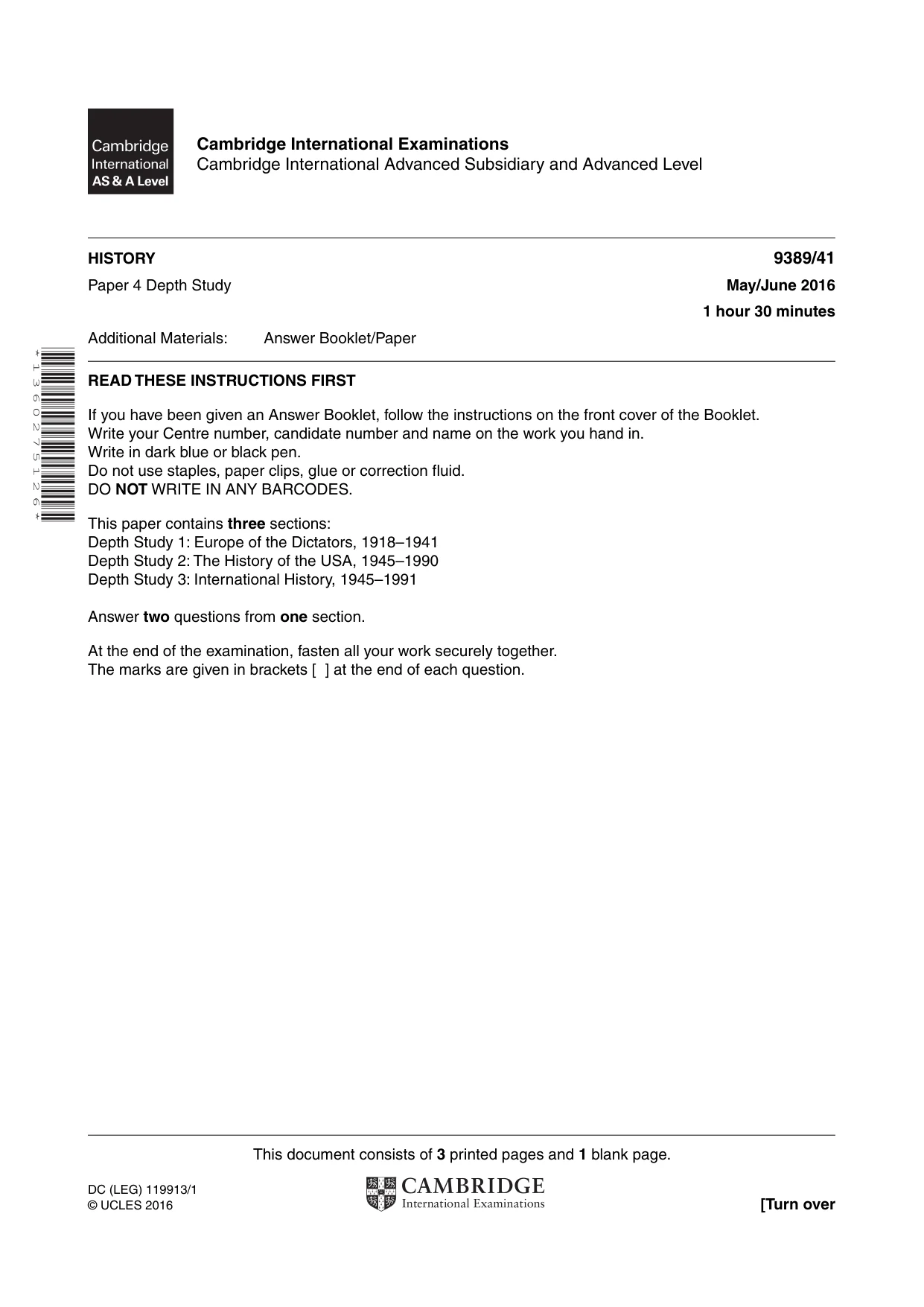
Question paper, page 1
This document consists of 3 printed pages and 1 blank page. DC (LEG) 119913/1 © UCLES 2016 [Turn over Cambridge International Examinations Cambridge International Advanced Subsidiary and Advanced Level * 1 3 6 0 2 7 5 1 2 6 * HISTORY 9389/41 Paper 4 Depth Study May/June 2016 1 hour 30 minutes Additional Materials: Answer Booklet/Paper READ THESE INSTRUCTIONS FIRST If you have been given an Answer Booklet, follow the instructions on the front cover of the Booklet. Write your Centre number, candidate number and name on the work you hand in. Write in dark blue or black pen. Do not use staples, paper clips, glue or correction fluid. DO NOT WRITE IN ANY BARCODES. This paper contains three sections: Depth Study 1: Europe of the Dictators, 1918–1941 Depth Study 2: The History of the USA, 1945–1990 Depth Study 3: International History, 1945–1991 Answer two questions from one section. At the end of the examination, fasten all your work securely together. The marks are given in brackets [ ] at the end of each question.
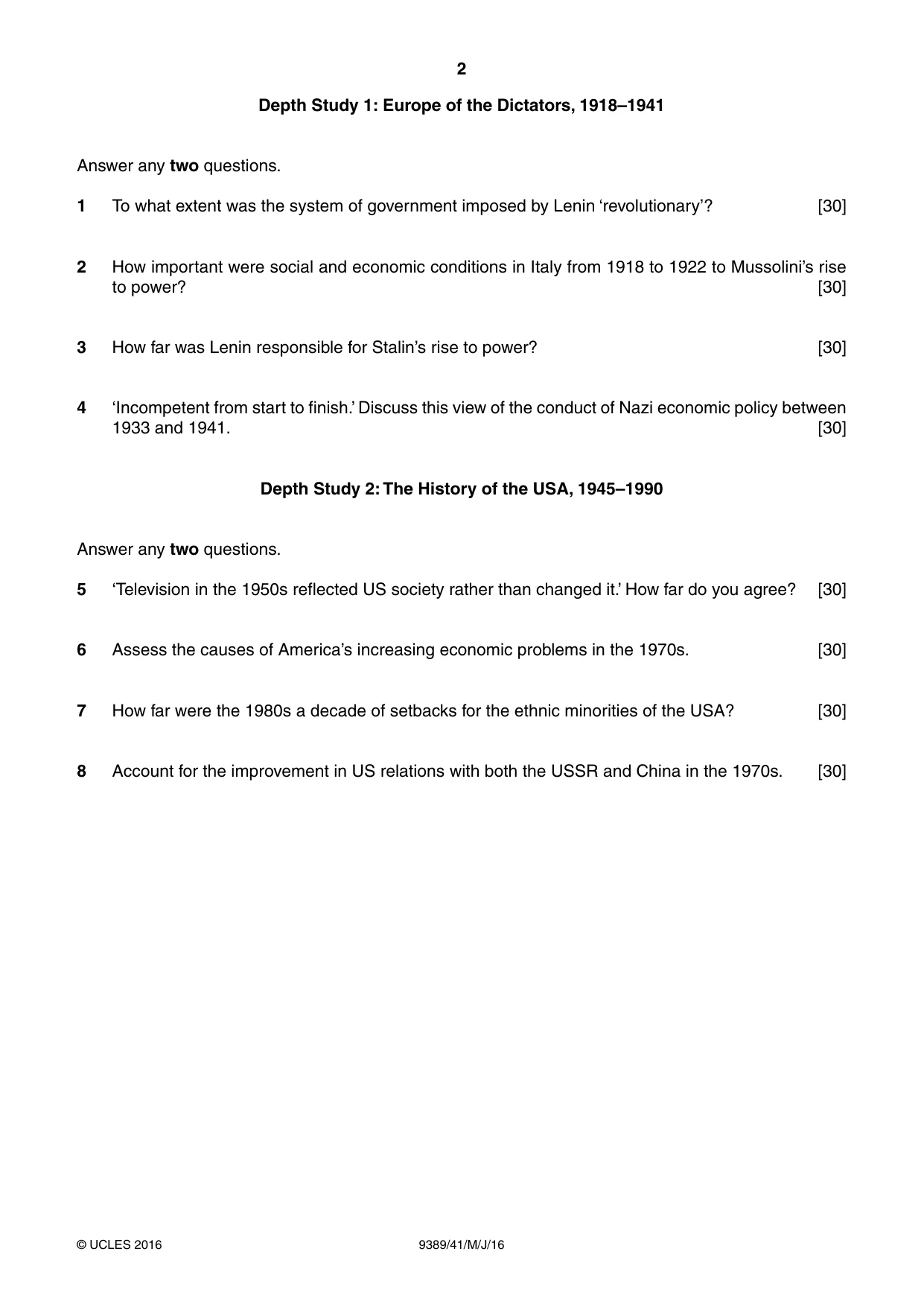
Question paper, page 2
2 9389/41/M/J/16 © UCLES 2016 Depth Study 1: Europe of the Dictators, 1918–1941 Answer any two questions. 1 To what extent was the system of government imposed by Lenin ‘revolutionary’? [30] 2 How important were social and economic conditions in Italy from 1918 to 1922 to Mussolini’s rise to power? [30] 3 How far was Lenin responsible for Stalin’s rise to power? [30] 4 ‘Incompetent from start to finish.’ Discuss this view of the conduct of Nazi economic policy between 1933 and 1941. [30] Depth Study 2: The History of the USA, 1945–1990 Answer any two questions. 5 ‘Television in the 1950s reflected US society rather than changed it.’ How far do you agree? [30] 6 Assess the causes of America’s increasing economic problems in the 1970s. [30] 7 How far were the 1980s a decade of setbacks for the ethnic minorities of the USA? [30] 8 Account for the improvement in US relations with both the USSR and China in the 1970s. [30]
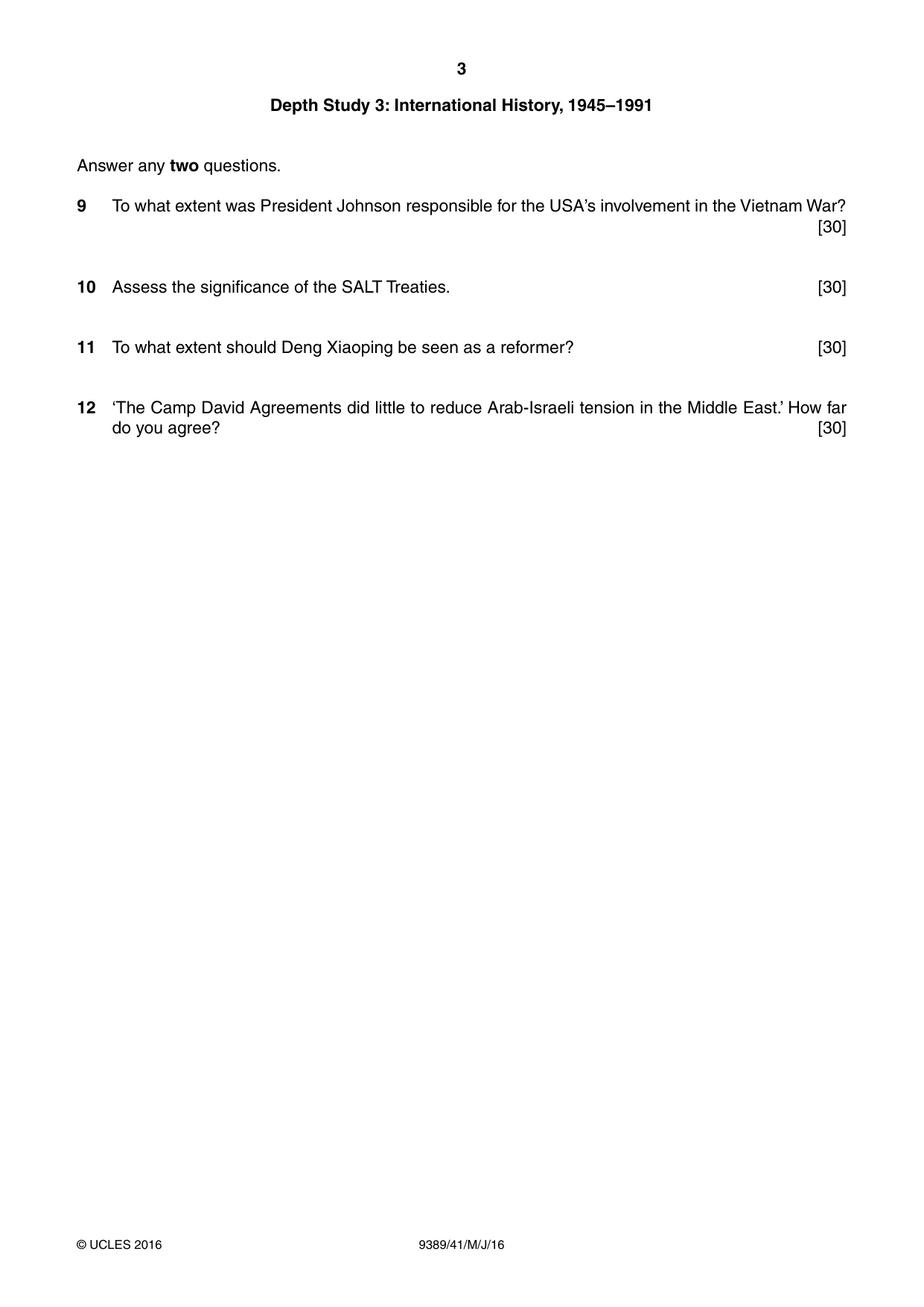
Question paper, page 3
3 9389/41/M/J/16 © UCLES 2016 Depth Study 3: International History, 1945–1991 Answer any two questions. 9 To what extent was President Johnson responsible for the USA’s involvement in the Vietnam War? [30] 10 Assess the significance of the SALT Treaties. [30] 11 To what extent should Deng Xiaoping be seen as a reformer? [30] 12 ‘The Camp David Agreements did little to reduce Arab-Israeli tension in the Middle East.’ How far do you agree? [30]
Question paper, page 4
4 9389/41/M/J/16 © UCLES 2016 BLANK PAGE Permission to reproduce items where third-party owned material protected by copyright is included has been sought and cleared where possible. Every reasonable effort has been made by the publisher (UCLES) to trace copyright holders, but if any items requiring clearance have unwittingly been included, the publisher will be pleased to make amends at the earliest possible opportunity. To avoid the issue of disclosure of answer-related information to candidates, all copyright acknowledgements are reproduced online in the Cambridge International Examinations Copyright Acknowledgements Booklet. This is produced for each series of examinations and is freely available to download at www.cie.org.uk after the live examination series. Cambridge International Examinations is part of the Cambridge Assessment Group. Cambridge Assessment is the brand name of University of Cambridge Local Examinations Syndicate (UCLES), which is itself a department of the University of Cambridge.
Mark scheme, page 1
® IGCSE is the registered trademark of Cambridge International Examinations. This document consists of 15 printed pages. © UCLES 2016 [Turn over Cambridge International Examinations Cambridge International Advanced Subsidiary and Advanced Level HISTORY 9389/41 Paper 4 Depth Study May/June 2016 MARK SCHEME Maximum Mark: 60 Published This mark scheme is published as an aid to teachers and candidates, to indicate the requirements of the examination. It shows the basis on which Examiners were instructed to award marks. It does not indicate the details of the discussions that took place at an Examiners’ meeting before marking began, which would have considered the acceptability of alternative answers. Mark schemes should be read in conjunction with the question paper and the Principal Examiner Report for Teachers. Cambridge will not enter into discussions about these mark schemes. Cambridge is publishing the mark schemes for the May/June 2016 series for most Cambridge IGCSE®, Cambridge International A and AS Level components and some Cambridge O Level components.
Mark scheme, page 2
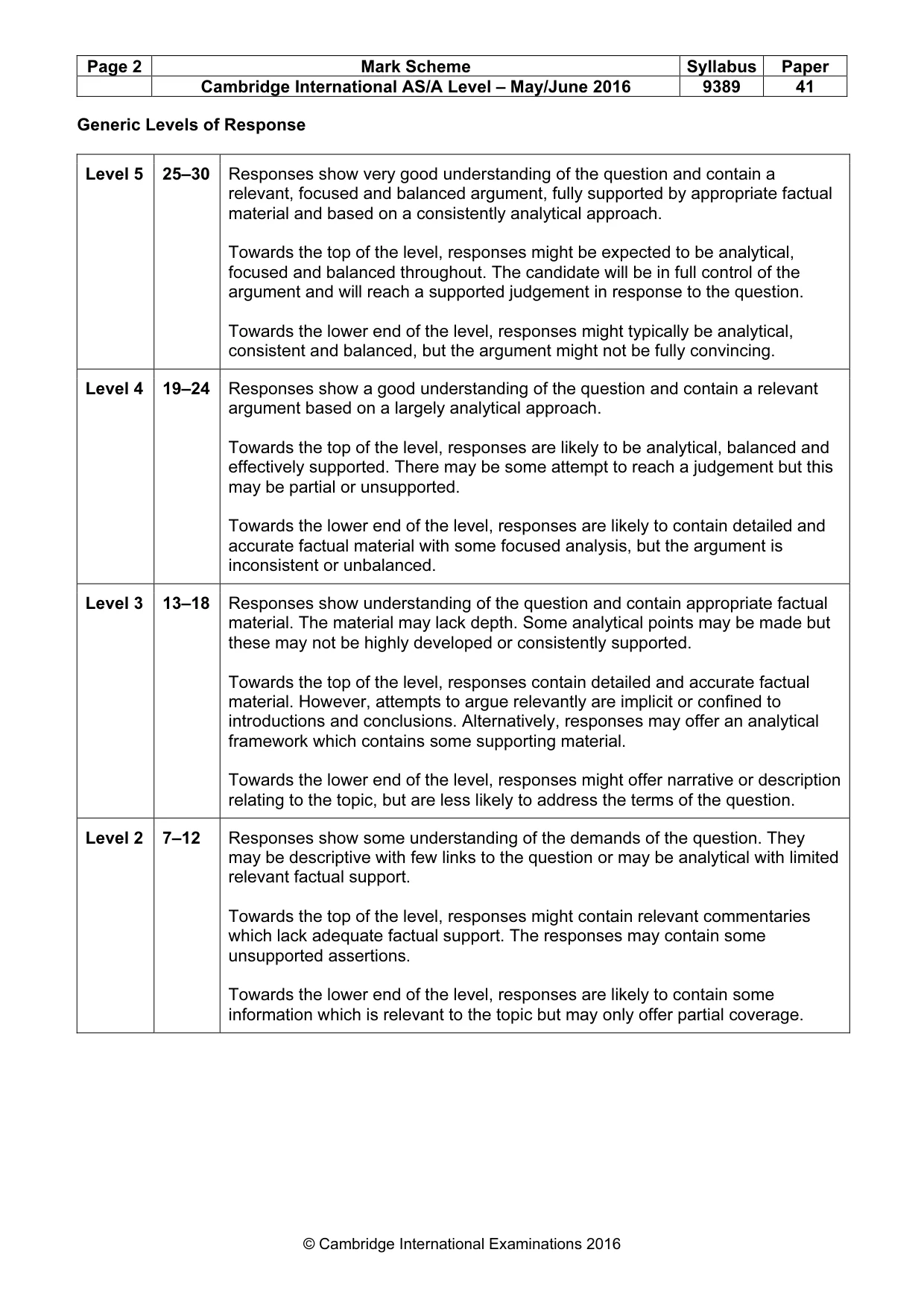
Page 2 Mark Scheme Syllabus Paper Cambridge International AS/A Level – May/June 2016 9389 41 © Cambridge International Examinations 2016 Generic Levels of Response Level 5 25–30 Responses show very good understanding of the question and contain a relevant, focused and balanced argument, fully supported by appropriate factual material and based on a consistently analytical approach. Towards the top of the level, responses might be expected to be analytical, focused and balanced throughout. The candidate will be in full control of the argument and will reach a supported judgement in response to the question. Towards the lower end of the level, responses might typically be analytical, consistent and balanced, but the argument might not be fully convincing. Level 4 19–24 Responses show a good understanding of the question and contain a relevant argument based on a largely analytical approach. Towards the top of the level, responses are likely to be analytical, balanced and effectively supported. There may be some attempt to reach a judgement but this may be partial or unsupported. Towards the lower end of the level, responses are likely to contain detailed and accurate factual material with some focused analysis, but the argument is inconsistent or unbalanced. Level 3 13–18 Responses show understanding of the question and contain appropriate factual material. The material may lack depth. Some analytical points may be made but these may not be highly developed or consistently supported. Towards the top of the level, responses contain detailed and accurate factual material. However, attempts to argue relevantly are implicit or confined to introductions and conclusions. Alternatively, responses may offer an analytical framework which contains some supporting material. Towards the lower end of the level, responses might offer narrative or description relating to the topic, but are less likely to address the terms of the question. Level 2 7–12 Responses show some understanding of the demands of the question. They may be descriptive with few links to the question or may be analytical with limited relevant factual support. Towards the top of the level, responses might contain relevant commentaries which lack adequate factual support. The responses may contain some unsupported assertions. Towards the lower end of the level, responses are likely to contain some information which is relevant to the topic but may only offer partial coverage.
Mark scheme, page 3
Page 3 Mark Scheme Syllabus Paper Cambridge International AS/A Level – May/June 2016 9389 41 © Cambridge International Examinations 2016 Level 1 1–6 Responses show limited understanding of the question. They may contain some description which is linked to the topic or only address part of the question. Towards the top of the level, responses show some awareness of relevant material but this may be presented as a list. Towards the lower end of the level, answers may provide a little relevant material but are likely to be characterised by irrelevance. Level 0 0 No relevant, creditworthy content.
Mark scheme, page 4
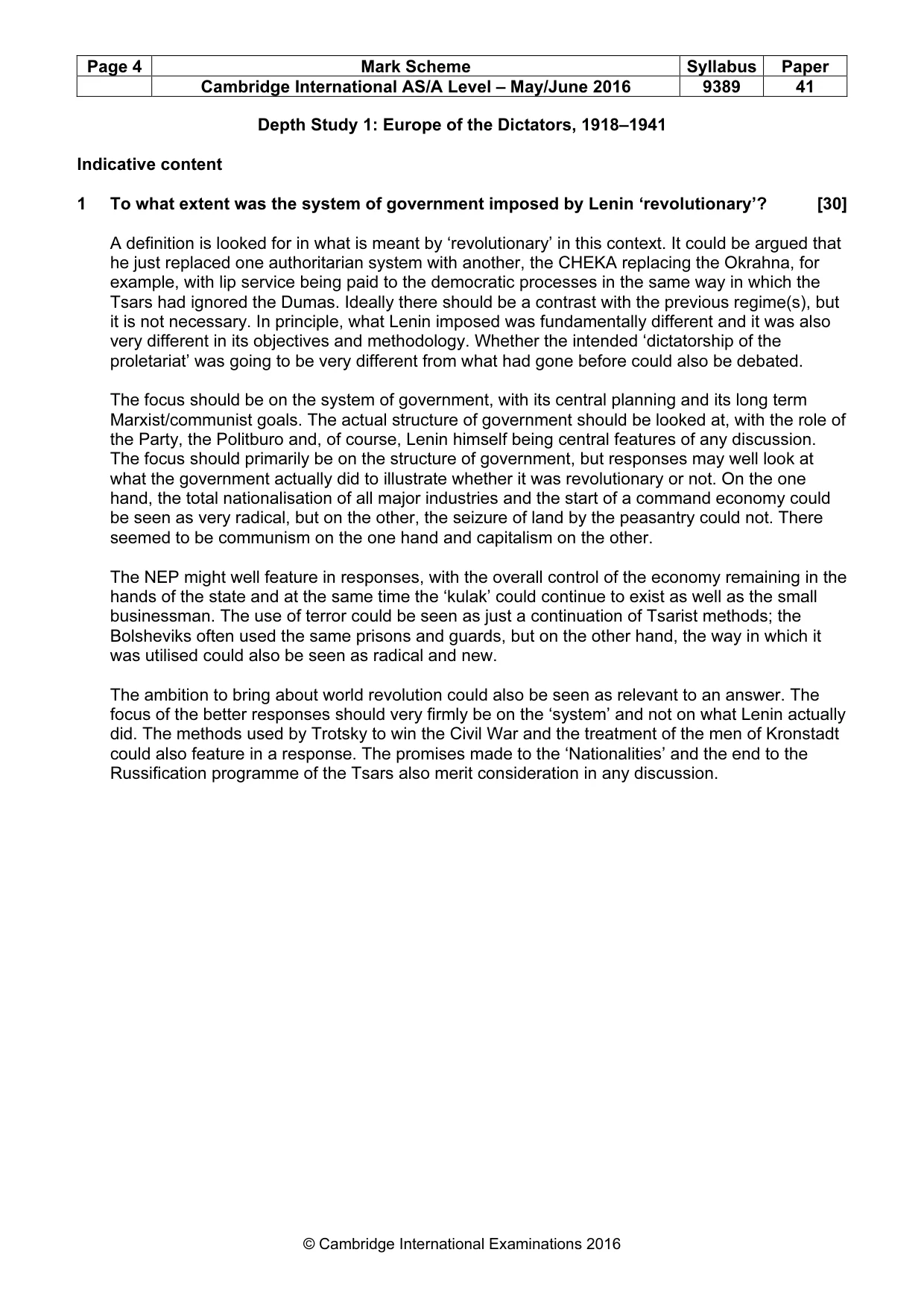
Page 4 Mark Scheme Syllabus Paper Cambridge International AS/A Level – May/June 2016 9389 41 © Cambridge International Examinations 2016 Depth Study 1: Europe of the Dictators, 1918–1941 Indicative content 1 To what extent was the system of government imposed by Lenin ‘revolutionary’? [30] A definition is looked for in what is meant by ‘revolutionary’ in this context. It could be argued that he just replaced one authoritarian system with another, the CHEKA replacing the Okrahna, for example, with lip service being paid to the democratic processes in the same way in which the Tsars had ignored the Dumas. Ideally there should be a contrast with the previous regime(s), but it is not necessary. In principle, what Lenin imposed was fundamentally different and it was also very different in its objectives and methodology. Whether the intended ‘dictatorship of the proletariat’ was going to be very different from what had gone before could also be debated. The focus should be on the system of government, with its central planning and its long term Marxist/communist goals. The actual structure of government should be looked at, with the role of the Party, the Politburo and, of course, Lenin himself being central features of any discussion. The focus should primarily be on the structure of government, but responses may well look at what the government actually did to illustrate whether it was revolutionary or not. On the one hand, the total nationalisation of all major industries and the start of a command economy could be seen as very radical, but on the other, the seizure of land by the peasantry could not. There seemed to be communism on the one hand and capitalism on the other. The NEP might well feature in responses, with the overall control of the economy remaining in the hands of the state and at the same time the ‘kulak’ could continue to exist as well as the small businessman. The use of terror could be seen as just a continuation of Tsarist methods; the Bolsheviks often used the same prisons and guards, but on the other hand, the way in which it was utilised could also be seen as radical and new. The ambition to bring about world revolution could also be seen as relevant to an answer. The focus of the better responses should very firmly be on the ‘system’ and not on what Lenin actually did. The methods used by Trotsky to win the Civil War and the treatment of the men of Kronstadt could also feature in a response. The promises made to the ‘Nationalities’ and the end to the Russification programme of the Tsars also merit consideration in any discussion.
Mark scheme, page 5
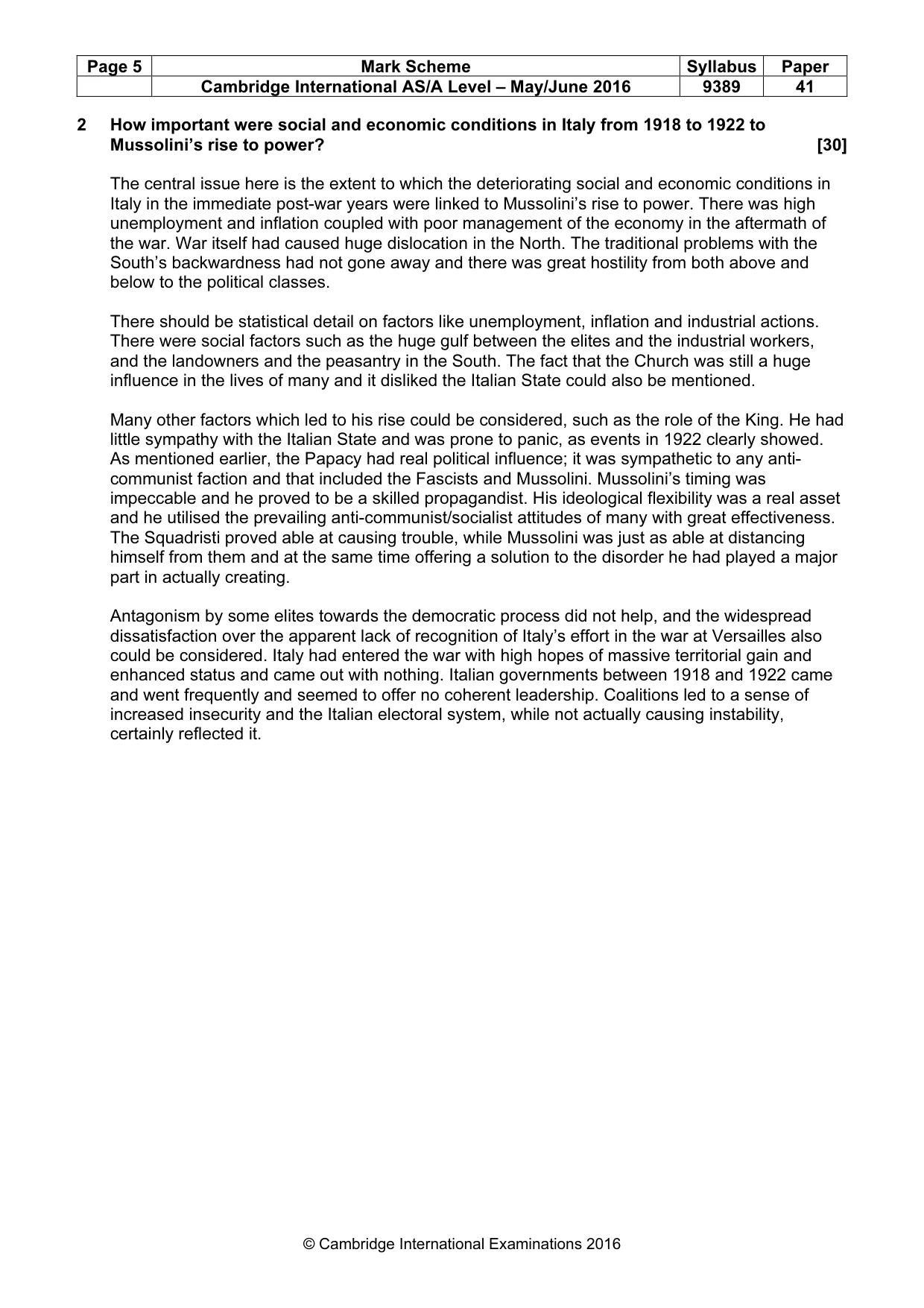
Page 5 Mark Scheme Syllabus Paper Cambridge International AS/A Level – May/June 2016 9389 41 © Cambridge International Examinations 2016 2 How important were social and economic conditions in Italy from 1918 to 1922 to Mussolini’s rise to power? [30] The central issue here is the extent to which the deteriorating social and economic conditions in Italy in the immediate post-war years were linked to Mussolini’s rise to power. There was high unemployment and inflation coupled with poor management of the economy in the aftermath of the war. War itself had caused huge dislocation in the North. The traditional problems with the South’s backwardness had not gone away and there was great hostility from both above and below to the political classes. There should be statistical detail on factors like unemployment, inflation and industrial actions. There were social factors such as the huge gulf between the elites and the industrial workers, and the landowners and the peasantry in the South. The fact that the Church was still a huge influence in the lives of many and it disliked the Italian State could also be mentioned. Many other factors which led to his rise could be considered, such as the role of the King. He had little sympathy with the Italian State and was prone to panic, as events in 1922 clearly showed. As mentioned earlier, the Papacy had real political influence; it was sympathetic to any anti- communist faction and that included the Fascists and Mussolini. Mussolini’s timing was impeccable and he proved to be a skilled propagandist. His ideological flexibility was a real asset and he utilised the prevailing anti-communist/socialist attitudes of many with great effectiveness. The Squadristi proved able at causing trouble, while Mussolini was just as able at distancing himself from them and at the same time offering a solution to the disorder he had played a major part in actually creating. Antagonism by some elites towards the democratic process did not help, and the widespread dissatisfaction over the apparent lack of recognition of Italy’s effort in the war at Versailles also could be considered. Italy had entered the war with high hopes of massive territorial gain and enhanced status and came out with nothing. Italian governments between 1918 and 1922 came and went frequently and seemed to offer no coherent leadership. Coalitions led to a sense of increased insecurity and the Italian electoral system, while not actually causing instability, certainly reflected it.
Mark scheme, page 6
Page 6 Mark Scheme Syllabus Paper Cambridge International AS/A Level – May/June 2016 9389 41 © Cambridge International Examinations 2016 3 How far was Lenin responsible for Stalin’s rise to power? [30] Ideally, a ‘how far’ response should lead to a firm response making it very clear whether one factor played a key role or not. The responsibility for Stalin’s rise to power needs to be considered here. Certainly Lenin played a role. He seems to have been well aware of Stalin’s tendencies and attitude, and the dangers he represented, but seemed reluctant to take any action to deal with it. Lenin’s will is indicative of his concerns, and Stalin’s incompetence over Poland, for example, does not seem to have prompted any action by Lenin. Lenin knew he was seriously ill and that he needed to make provision for the future of the revolution and neglecting to do so was inevitably damaging. He was well aware that there were many competing individuals and factions who had ambitions other than simply advancing the revolution. However, there are many other factors to consider in Stalin’s rise. The inability of the other key members of the Politburo to see the threat that Stalin represented and their willingness to be manipulated by him could be commented on. The way in which Stalin managed to isolate, discredit and then exile his most dangerous rival, Trotsky, could be stressed. Trotsky himself made errors of judgment and his arrogance alienated many potential supporters. Stalin’s own skills need to be considered, with his mixture of opportunism and careful planning being the obvious ones. He managed to utilise the divisions between the NEP supporters and the ‘communists’ and the ‘socialism in one country’ versus the ‘world revolutionaries’ very effectively. His creation of the cult of Lenin with him as its chief disciple was clever, as was his exceptionally effective use of his role as party secretary. He just did not appear to be a rival or a threat until much too late. Even the way in which he utilised Lenin’s funeral to create just the right image of himself, limit the influence of Lenin’s wife and start the isolation of Trotsky was very clever. Very clever and experienced men like Bukharin, Rykov and Tomsky simply did not realise what Stalin was up to until far too late. He had driving ambitions for himself, while others were much more interested in the future of the revolution and Russia.
Mark scheme, page 7
Page 7 Mark Scheme Syllabus Paper Cambridge International AS/A Level – May/June 2016 9389 41 © Cambridge International Examinations 2016 4 ‘Incompetent from start to finish.’ Discuss this view of the conduct of Nazi economic policy between 1933 and 1941. [30] Ideally, candidates will look both at concept and execution. There was little in Mein Kampf on economics and the Nazis promised much before 1933 but offered little in the way of actual detailed planning. Beyond autarky and rearmament, Hitler had little to suggest in terms of economic policy. Initially Schacht’s ideas were followed, and they had been present before the Nazis came into power. There were real achievements in the early years, but that had little to do with Nazi policy. Arguably Keynes was the principal influence in the borrow and spend programme that was adopted from almost the first day that Hitler was in power. Unemployment did go down, but the extent to which that was led by conscription and ensuring that women did not come onto the job market is arguable. Certainly there were signs of an economic miracle and to have achieved full employment with stable prices by 1936 was impressive. Countries like the US and the UK came nowhere near that level of recovery. Real wages rose as well and there were many benefits for workers prepared to toe the interindustry profits and investment rose. The birth rate rose sharply, in contrast to what was happening in both France and Italy. There was the chaotic overlap between ministries and the conflicting jurisdictions given to Goering and others. It is worth stressing that the much feted autobahns were largely made by hand as using machines would not have employed so many men. Schacht left in despair at the lack of coherent thinking and the irrational thinking behind self-sufficiency and the focus on expansion and war. The fact that the economy reached its peak of productivity well into the war – under the guidance of Speer and after years of bombing – indicates perhaps a lack of success on the part of the Nazis in the earlier years. The fact that it was based on borrowing could be stressed, while taxation remained quite high as well. The desired autarky was not achieved – with 33% of vital raw materials and over 20% of essential food still having to be imported. The German war machine ran out of lorries and fuel in front of Moscow in 1941, which perhaps demonstrated the true degree of incompetence.
Mark scheme, page 8
Page 8 Mark Scheme Syllabus Paper Cambridge International AS/A Level – May/June 2016 9389 41 © Cambridge International Examinations 2016 Depth Study 2: The History of the USA, 1945–1990 Indicative content 5 ‘Television in the 1950s reflected US society rather than changed it.’ How far do you agree? [30] American television programmes were provided by private, profit-making companies. In the 1950s, there were three national networks linked via telephone cables: NBC, CBS and ABC. In 1950, TV coverage was limited to major cities; by 1960 it was nationwide – more or less. Advertising was the main form of income. 1950s TV broadcasts were transmitted for only a few hours each day, had fewer advertising breaks than nowadays and were shown in black and white. The percentage of households with a television grew from 10% in 1950 to 67% in 1955 and 87% in 1960. 63 million sets were sold during the decade. The argument that the growth of television changed the USA is more often based on the impact of TV images from the Vietnam War in the 1960s. The most-quoted example of a TV broadcast making a political difference concerns the 1960 presidential election, when in the first-ever televised debates John Kennedy outshone Richard Nixon, making a crucial difference in a closely-run contest. The political impact of 1950s TV was much less; Richard Nixon’s Checkers speech in 1952, when he was the Republican’s vice-presidential candidate seems to have saved his candidacy. Eisenhower adapted more quickly to the television medium than did Adlai Stevenson, the Democrat candidate in both 1952 and 1956. Vance Packard’s 1957 book, The Hidden Persuaders, though not focused wholly on TV aroused concerns about both commercial and political advertising. Whether commercial advertising changed US society is open to debate. It presumably affected attitudes and expenditures but in ways which reinforced existing consumer habits. The most popular programmes of the decade were I Love Lucy and Gunsmoke followed by $64,000 Question, all entertainment programmes. These suggest that television, rather than changing American society, reflected it. I Love Lucy was a sitcom about a nuclear family initially living in New York and later moving to the suburbs, which reflected the experience of many families in the 1950s. It also included many gender stereotypes. It should not be forgotten that commercial television was quite carefully regulated via the Federal Communications Commission and the 1951 Production Code; the latter especially imposed limits perhaps even stricter than the Hays Code did on cinema films. After Elvis Presley had made several controversial appearances on TV in 1956, CBS film of him performing showed him from above the waist only. It could be argued that in the 1950s, American society was changing fast despite the conservative nature of television broadcasting.
Mark scheme, page 9
Page 9 Mark Scheme Syllabus Paper Cambridge International AS/A Level – May/June 2016 9389 41 © Cambridge International Examinations 2016 6 Assess the causes of America’s increasing economic problems in the 1970s. [30] The USA emerged from the Second World War as ‘the arsenal of democracy’, providing the world with most of its manufactured goods as well as developing the framework for an international finance and free trade system known as Bretton Woods. By 1980, its predominant position in manufacturing had been lost and the Bretton Woods system greatly damaged. By August 1971, the situation was so serious that President Nixon took the US dollar off the international gold standard, introduced a wages and prices freeze and a 10% import duty in what became known as the Nixon Shock. More shocks were to come. These included two oil crises: in 1973 following the Yom Kippur war and in 1979 following the Iranian revolution. US oil prices rose tenfold in just six years. Prices and unemployment rose while wages remained stagnant, causing much industrial unrest. The USA’s economic problems of the 1970s were caused by a mixture of external and internal factors. The Vietnam War of 1965–75 was a causal factor which was more internal. Its huge cost, paid for by borrowing rather than taxation, put the government budget into deficit, further weakening the dollar. There was also a trade deficit on manufacturing goods, a major contrast with the predominance of the USA in the world economy some twenty years before. This deficit was partly caused by the revival of manufacturing industries in Japan and West Germany. Japan especially produced cars which were more reliable than those of American competitors and were much more economical, the latter being important as petrol prices rose rapidly during the 1970s. America failed to invest in the latest manufacturing methods, companies preferring to leave the traditional industrial heartlands of the north east to the air-conditioned factories and cheaper, non- unionised labour of the south and west, moving from rust belt to sun belt. Governments did little to address these structural economic and social problems, especially in the first half of the decade, when the US politicians concentrated more on foreign policy and the constitutional crisis known as Watergate. The president of the second half of the 1970s, Jimmy Carter, highlighted the economic problems of the USA but could do little to address them beyond asking Americans to use their cars a lot less. The 1970s was a time of great economic difficulty for the USA.
Mark scheme, page 10
Page 10 Mark Scheme Syllabus Paper Cambridge International AS/A Level – May/June 2016 9389 41 © Cambridge International Examinations 2016 7 How far were the 1980s a decade of setbacks for the ethnic minorities of the USA? [30] Ethnic minorities include African Americans, Hispanics [or Latinos], Native Americans and Asian Americans. In terms of the history of ethnic groups and their relations with the majority white group and especially government institutions, the 1980s are almost the forgotten decade – though the 1970s come a close second. The 1960s had the drama of the civil rights movement and black power. The 1990s saw events such as the Los Angeles riots of 1992, the O J Simpson trial in 1995 and the million man march of the same year. The African American leaders of the 1970s and 1980s did not match Martin Luther King and Barack Obama. Jesse Jackson was the best known, running for President in both 1984 and 1988, but his efforts at building a Rainbow Coalition of ethnic minorities and other disadvantaged groups made little impact. The Rainbow Coalition attempted to organise political opposition to Reaganomics, which cut public expenditure, much of which provided relief for ethnic minorities living in the towns and cities of the USA. The Rainbow Coalition, though it never really coalesced, showed that ethnic minorities were facing social and economic hardship at the time. The US economy might have grown in the 1980s but its benefits were not felt by the majority of ethnic minorities. The Republican party’s dominance of the 1980s was the dominance of the white majority. Most ethnic minorities voted Democrat. Thus the policies of the Reagan administration towards ethnic minorities were as hostile as political correctness allowed. Affirmative Action – called positive discrimination in some parts of the world – was a policy much resented by Republicans. As affirmative action cases were decided in court, judicial appointments were significant. Reagan made three appointments to the US Supreme Court – Sandra Day O’Connor, Scalia and Kennedy. One more right-wing nominee, Robert Bork, proved too controversial to be approved. Scalia in particular proved to be a setback for affirmative action. The classic example of policies aimed against African Americans was the so-called ‘war on drugs’. This war was declared first by President Nixon in 1971 and then by President Reagan. The ‘war on drugs’ focussed primarily on cocaine use and especially ‘crack’ cocaine, a cheaper form of the drug. Use of crack cocaine was more prevalent in poorer, African American, communities unlike the more expensive powder cocaine typically used by the white middle class. In 1986, the Anti-Drug Use Act, agreed by Republicans and Democrats, imposed much harsher sentences for the use of crack cocaine with mandatory minimum sentences for those found guilty. The number of young black males going to prison grew rapidly. Therefore, some saw the war on drugs as an onslaught on young black men, who could not afford the same legal representation as middle-class drug users. Though the focus is mainly on African Americans, other minorities should be considered. None were politically organised at the time. Some, however, benefited from the economic prosperity of the 1980s, in particular the 10 million Asian Americans.
Mark scheme, page 11
Page 11 Mark Scheme Syllabus Paper Cambridge International AS/A Level – May/June 2016 9389 41 © Cambridge International Examinations 2016 8 Account for the improvement in US relations with both the USSR and China in the 1970s. [30] From 1949, the USSR and China were seen as communist allies against the ‘free’, i.e. capitalist, world led by the USA. From 1960, these leading communist states fell out for a variety of reasons. By 1969, Soviet and Chinese troops clashed in disputed border regions. A bipolar world had become tripolar. In the 1960s, following the Cuban missile crisis, the USA managed to improve relations with the USSR in a series of policy initiatives known as détente. These agreements continued into the early 1970s with the Strategic Arms Limitations Treaty [SALT 1] and the Anti-Ballistic Missile Treaty [ABM Treaty], both in 1972. Relations with China remained poor in the 1960s, however, in part because of the Vietnam War, especially when Nixon extended it to Cambodia and Laos, in part because of developments within China, not least the Cultural Revolution. Then, in January 1969, Richard Nixon became US President and he appointed Henry Kissinger as his National Security Adviser. Both were keen to improve relations with China, in part in the hope – mistaken as it turned out to be – that doing so would help end the war in Vietnam. By the early 1970s, key figures in the Chinese leadership, not least Zhou Enlai, were willing to improve relations with the USA. Achieving the breakthrough required a great deal of subterfuge on the part of Kissinger in particular, as most Americans and especially Republicans still saw China as a Red Menace. The several small steps towards public talks were labeled ‘ping pong diplomacy’. In February 1972, Nixon met Zhou and Mao Zedong in Beijing. 1972 was election year in the USA. Nixon was hoping that talks with China would increase his chances of victory. He was right. Most Americans approved of the initiative. The thaw in relations continued throughout the 1970s and in 1979 China and the USA established full diplomatic relations with each other. A third reason why Nixon improved relations with China was the belief that US industry would benefit from access to the Chinese market. This was especially so given the troubled state of the US economy at the time. The US maintained the policy of détente for most of the ’70s, as shown by the Helsinki Agreements of 1975. Relations became strained, however, following the Soviet invasion of Afghanistan in December 1979. Thus the tripolar world of the 1970s saw rather complex and changing relations between the three powers. The USA was aware that it was not the superpower it once was and thus saw economic, political and strategic benefits from improving relations with the USSR and China. Which causal factor was the most significant is a matter of continuing historical debate.
Mark scheme, page 12
Page 12 Mark Scheme Syllabus Paper Cambridge International AS/A Level – May/June 2016 9389 41 © Cambridge International Examinations 2016 Depth Study 3: International History, 1945–1991 Indicative content 9 To what extent was President Johnson responsible for the USA’s involvement in the Vietnam War? [30] Yes – As US President from 1963 to 1969, Johnson was responsible for committing the USA to large-scale military intervention in Vietnam. Convinced that the Vietcong were being supplied and controlled by Ho Chi Minh, he began the bombing of North Vietnam in 1965. He also sent over 500 000 American troops to South Vietnam. Johnson claimed that the USA was seeking to defend the independence of the Vietnamese people, but the reality was that the USA was determined to avoid South Vietnam falling into the communist bloc. Having failed to defeat communism in Korea or Cuba, American prestige could not allow another failure while its economic interests in SE Asia seemed to be under threat. Unlike in Korea, the USA was acting without the support of the UN, many members of which were heavily critical of American involvement in what they considered to be an independent country. Despite its enormous military presence in Vietnam, the USA was unable to defeat the Vietcong, and Johnson was forced to suspend the bombing of North Vietnam, freeze troop levels and seek a negotiated settlement (1968). American public opinion had grown strongly resentful of the USA’s involvement in Vietnam; the President was seen as the person responsible and, increasingly, the war was referred to as ‘Johnson’s War’. No – American involvement in Vietnam did not begin with Johnson. President Eisenhower had supported the Ngo regime in South Vietnam with economic aid and military advisers since 1954. This was despite the fact that South Vietnam had failed to carry out elections. The USA was convinced by Ngo’s claims that communists were responsible for the problems facing South Vietnam, and felt that it was necessary to take a strong stand against the threat which communism posed. President Kennedy (1961–63) increased the USA’s commitment in Vietnam; he provided South Vietnam with helicopters, military equipment and 16 000 ‘advisers’. He also introduced the ‘safe village policy’, which failed to make any inroads into the successes of the Vietcong. When Johnson became President, fear of communism remained intense in the USA. With Kennedy’s strategies failing, Johnson had a choice – either increase American involvement in Vietnam or back down entirely. Backing down would have been political suicide, so Johnson felt he had no alternative but to honour the American commitment to South Vietnam which he had inherited from Eisenhower and Kennedy. More recent historians have dismissed the view that Vietnam was ‘Johnson’s War’, arguing that he was more interested in carrying out social reform within the USA and that he was afraid that increasing American involvement in Vietnam would bring China into the war. The dilemma which Johnson faced in 1963 was replicated when Nixon became President in 1969 – on the one hand, he bowed to public pressure and prepared for the gradual withdrawal of American troops under the policy of ‘Vietnamization’, yet, on the other hand, he began bombing North Vietnam, Laos and Cambodia.
Mark scheme, page 13
Page 13 Mark Scheme Syllabus Paper Cambridge International AS/A Level – May/June 2016 9389 41 © Cambridge International Examinations 2016 10 Assess the significance of the SALT Treaties. [30] Significant – The SALT Treaties marked the high point of détente and established the principle of discussion/negotiation which subsequently led to more effective treaties, such as START. The ABM Treaty (part of SALT I) limited the number of ABM systems which each superpower could have to two (one for their capital city and one to protect their nuclear missiles); this effectively meant that both the USA and the USSR would retain retaliation capability, which would clearly deter nuclear attack. Limits were placed on the number of ICBMs and SLBMs (1 618 and 740 for the USSR, 1 054 and 740 for the USA). Moreover, the Basic Principles Agreement (part of SALT I) did lead to greater understanding and calmer relations between the USA and the USSR (e.g. trade agreements and joint visits). Not significant – The difficulties involved in reaching agreement on nuclear arms limitation is clearly reflected in the length of time it took to negotiate the treaties; discussions began in 1968, yet SALT I was not agreed until 1972, whilst SALT II was not signed until 1979, by which time relations between the superpowers had deteriorated and, accordingly, it was never ratified by the US Senate. There were disagreements over how arms should be limited and, indeed, what types of weapons to include (Soviet and American weapons were not easily comparable, and there were doubts regarding the reliability of information regarding how many weapons each superpower actually had). There was a tendency to focus on limiting existing weapons, yet this took no account of the new technologies which both superpowers were developing (for example, the Interim Treaty on Offensive Weapons, part of SALT I but only due to last until 1977, limited ICBMs and SLBMs, but ignored MIRV, which carried multiple warheads on a single missile. Similarly, SALT II set limits on missile launchers and strategic bombers, but ignored Cruise Missiles). Public opinion in the USA, fostered by a resurgence of right-wing political views, increasingly opposed arms control, viewing it as a mechanism by which the USSR could catch up with superior American weaponry. Moreover, the USA increasingly saw the USSR as untrustworthy, a country which could not be relied upon to carry out its agreements.
Mark scheme, page 14
Page 14 Mark Scheme Syllabus Paper Cambridge International AS/A Level – May/June 2016 9389 41 © Cambridge International Examinations 2016 11 To what extent should Deng Xiaoping be seen as a reformer? [30] Reformer – Deng reversed many of the changes introduced during the Cultural Revolution – revolutionary committees were abolished and replaced by more democratically elected bodies; communes were abolished; property was returned to its owners; there was more religious freedom and freedom of expression for intellectuals in literature and the arts. Deng initiated the ‘Democracy Wall’ and allowed representation for non-communist groups in the National People’s Congress. Deng was determined to reform China’s economy and was willing to gain financial and technical assistance from the West in order to modernise industry, agriculture, science and technology. In 1980, China joined the IMF and the World Bank. Deng introduced incentives, such as bonuses and piece rates, arguing that ‘to get rich is not a crime’. Deng argued that this move towards ‘market socialism’ was essential if China was to become a prosperous, modernised state. Non-Reformer – Although Deng was prepared to allow elements of capitalism into the Chinese economy, he was totally opposed to other kinds of reform, especially political. He firmly believed in the one party state, arguing that ‘without the Party, China will retrogress into divisions and confusions’. As early as 1978, Deng’s government banned marches and poster campaigns since he believed that demands for more reforms were undermining law and order and the CCP’s control. Although he had allowed the Democracy Wall when it was criticising Mao and the Gang of Four, he quickly abolished it once it became a vehicle for criticism of his own government. Leading dissidents were arrested and imprisoned. Student demonstrations, seeking greater political freedoms, were dispersed in 1987. By carefully balancing the demands of hardliners and reformers within the Party, and by retaining control of the army, Deng was able to ensure that the CCP remained in power, despite the international outcry following Tiananmen Square in 1989. Deng was convinced that to give way to the students’ demands for democracy would have caused disruption and chaos in China, arguing that one-party control was essential if the move towards market socialism was to succeed. Conclusion – Deng was an economic reformer, but totally opposed to political reform.
Mark scheme, page 15
Page 15 Mark Scheme Syllabus Paper Cambridge International AS/A Level – May/June 2016 9389 41 © Cambridge International Examinations 2016 12 'The Camp David Agreements did little to reduce Arab-Israeli tension in the Middle East.’ How far do you agree? [30] Agree – The agreements between Egypt (Sadat) and Israel (Begin) were condemned by the PLO and most Arab states (the only exceptions being Sudan and Morocco). Syria and Jordan, in particular, remained extremely hostile towards Israel. In 1980, the Israeli Prime Minister, Menachem Begin, announced that Israel would never return the Golan Heights to Syria and would never allow the West Bank to become part of an independent Palestinian state which would pose a threat to Israel’s existence. Moreover, Begin’s government followed a policy of establishing Jewish settlements on Arab-owned land on the West Bank, causing increasing anger and resentment amongst Arabs. Israel also refused the USA’s attempts to bring Israel and the PLO to the negotiating table. Already undermined by Israel’s uncompromising and provocative actions, the agreements were further threatened when Sadat was assassinated by extremist Muslim soldiers in 1981. Sadat was seen by many as a traitor to the Arab/Muslim cause for negotiating with the Israelis. Therefore tensions remained high. In 1987, there were large-scale demonstrations by Palestinians living in refugee camps on the Gaza Strip and the West Bank. Israel deployed repressive measures, which were condemned by the UN. Disagree – The ending of the Yom Kippur War (1973) genuinely seemed to offer hope of peace between the Arabs and the Israelis. The USA and the USSR were agreed that it was necessary to develop a lasting peace settlement in the region, and, working with the UN, a ceasefire was negotiated. Sadat realised that Israel could not be defeated by force and was, therefore, prepared to negotiate. This in itself meant accepting the existence of the state of Israel. Israel, too, had reasons to negotiate; suffering economic problems due to high defence expenditure, and being pressured by its ally, the USA, to reach a negotiated settlement. Agreement between Israel and Egypt was seen as a beginning to a more all-embracing negotiated peace between Israel and the Arabs. With US President Carter acting as mediator, Begin and Sadat signed a peace treaty in Washington (March 1979). They agreed, for the first time, that the state of war which had existed between Egypt and Israel since 1948 was ended. Israel promised to withdraw its troops from Sinai, in exchange for which Egypt promised not to attack Israel again. Egypt also agreed to supply Israel with oil from the recently opened wells in southern Sinai and allowed Israel to use the Suez Canal. These were major concessions on both sides. Although Sadat was assassinated, this did not threaten the Treaty – his successor, Hosni Mubarak, announced that he would continue the Camp David agreements. Given the protracted dispute between Israel and the Arab states, it would have been impossible to make agreements which would completely end the tension. However, the Camp David Agreements were a major stepping stone to a more all- embracing peace.
What you needed in this session
Cambridge’s own grade thresholds for 2016 May/June, Paper 4 · Variant 1. A higher threshold means an easier paper — the bar moves with how the cohort did.