Cambridge A Level History 9389 — 2016 May/June Paper 1 · Variant 2
9389/12/M/J/16 · 40 marks · ≈45 min
The question paper and its mark scheme, free to read here and free to download. This is Cambridge’s own paper, exactly as it was sat.
Question paper8 pages
Mark scheme10 pages
Answers below. Sit the paper first if you are practising.
Paper as text
Question paper, page 1
This document consists of 7 printed pages, 1 blank page and 1 Insert. DC (RCL (JDA)) 117692/1 © UCLES 2016 [Turn over Cambridge International Examinations Cambridge International Advanced Subsidiary and Advanced Level * 3 9 4 4 3 6 9 0 4 3 * HISTORY 9389/12 Paper 1 Document Question May/June 2016 1 hour No Additional Materials are required. READ THESE INSTRUCTIONS FIRST An answer booklet is provided inside this question paper. You should follow the instructions on the front cover of the answer booklet. If you need additional answer paper ask the invigilator for a continuation booklet. This paper contains three sections: Section A: European Option Section B: American Option Section C: International Option Answer both parts of the question from one section only. The marks are given in brackets [ ] at the end of each part question.
Question paper, page 2
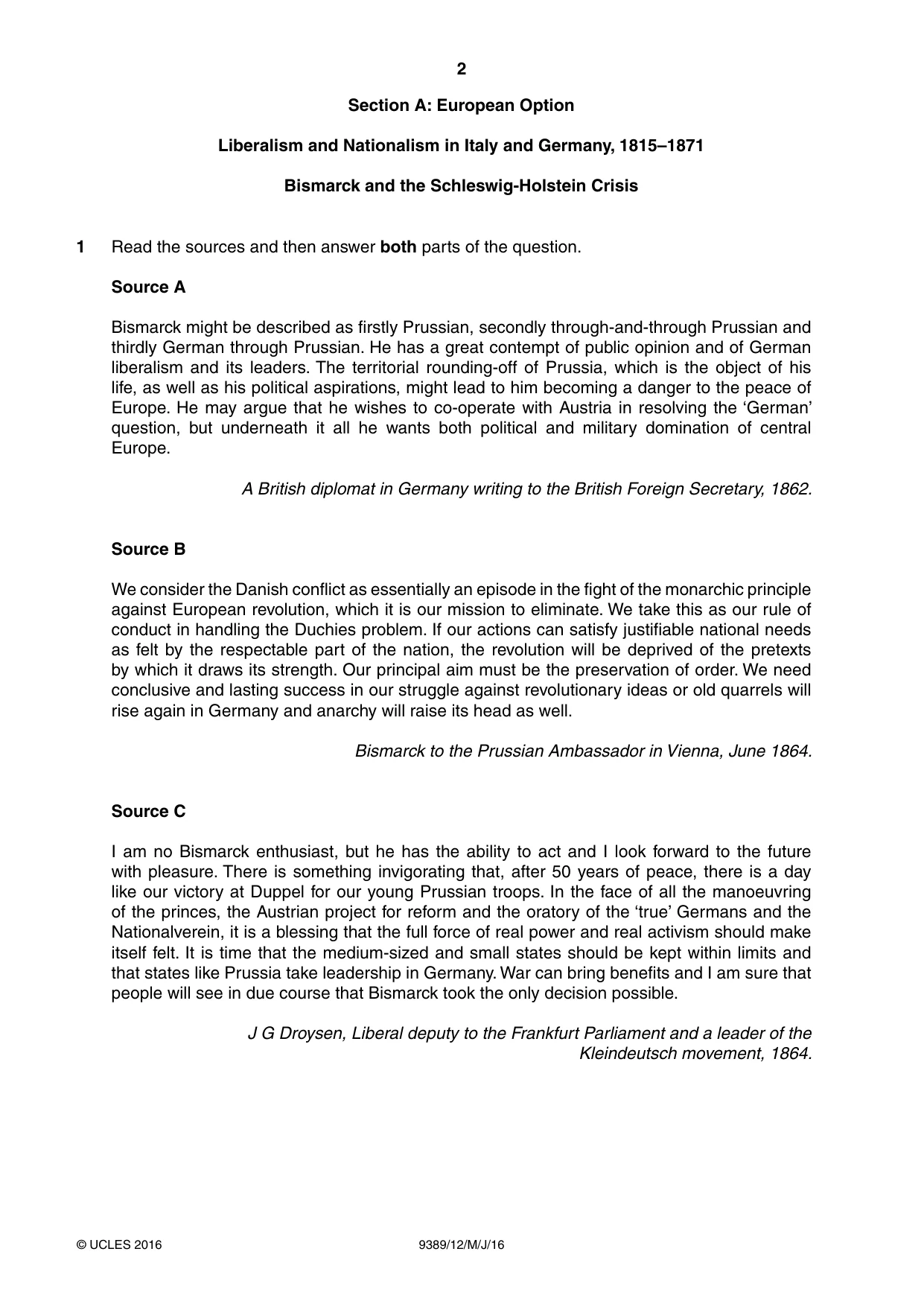
2 9389/12/M/J/16 © UCLES 2016 Section A: European Option Liberalism and Nationalism in Italy and Germany, 1815–1871 Bismarck and the Schleswig-Holstein Crisis 1 Read the sources and then answer both parts of the question. Source A Bismarck might be described as firstly Prussian, secondly through-and-through Prussian and thirdly German through Prussian. He has a great contempt of public opinion and of German liberalism and its leaders. The territorial rounding-off of Prussia, which is the object of his life, as well as his political aspirations, might lead to him becoming a danger to the peace of Europe. He may argue that he wishes to co-operate with Austria in resolving the ‘German’ question, but underneath it all he wants both political and military domination of central Europe. A British diplomat in Germany writing to the British Foreign Secretary, 1862. Source B We consider the Danish conflict as essentially an episode in the fight of the monarchic principle against European revolution, which it is our mission to eliminate. We take this as our rule of conduct in handling the Duchies problem. If our actions can satisfy justifiable national needs as felt by the respectable part of the nation, the revolution will be deprived of the pretexts by which it draws its strength. Our principal aim must be the preservation of order. We need conclusive and lasting success in our struggle against revolutionary ideas or old quarrels will rise again in Germany and anarchy will raise its head as well. Bismarck to the Prussian Ambassador in Vienna, June 1864. Source C I am no Bismarck enthusiast, but he has the ability to act and I look forward to the future with pleasure. There is something invigorating that, after 50 years of peace, there is a day like our victory at Duppel for our young Prussian troops. In the face of all the manoeuvring of the princes, the Austrian project for reform and the oratory of the ‘true’ Germans and the Nationalverein, it is a blessing that the full force of real power and real activism should make itself felt. It is time that the medium-sized and small states should be kept within limits and that states like Prussia take leadership in Germany. War can bring benefits and I am sure that people will see in due course that Bismarck took the only decision possible. J G Droysen, Liberal deputy to the Frankfurt Parliament and a leader of the Kleindeutsch movement, 1864.
Question paper, page 3
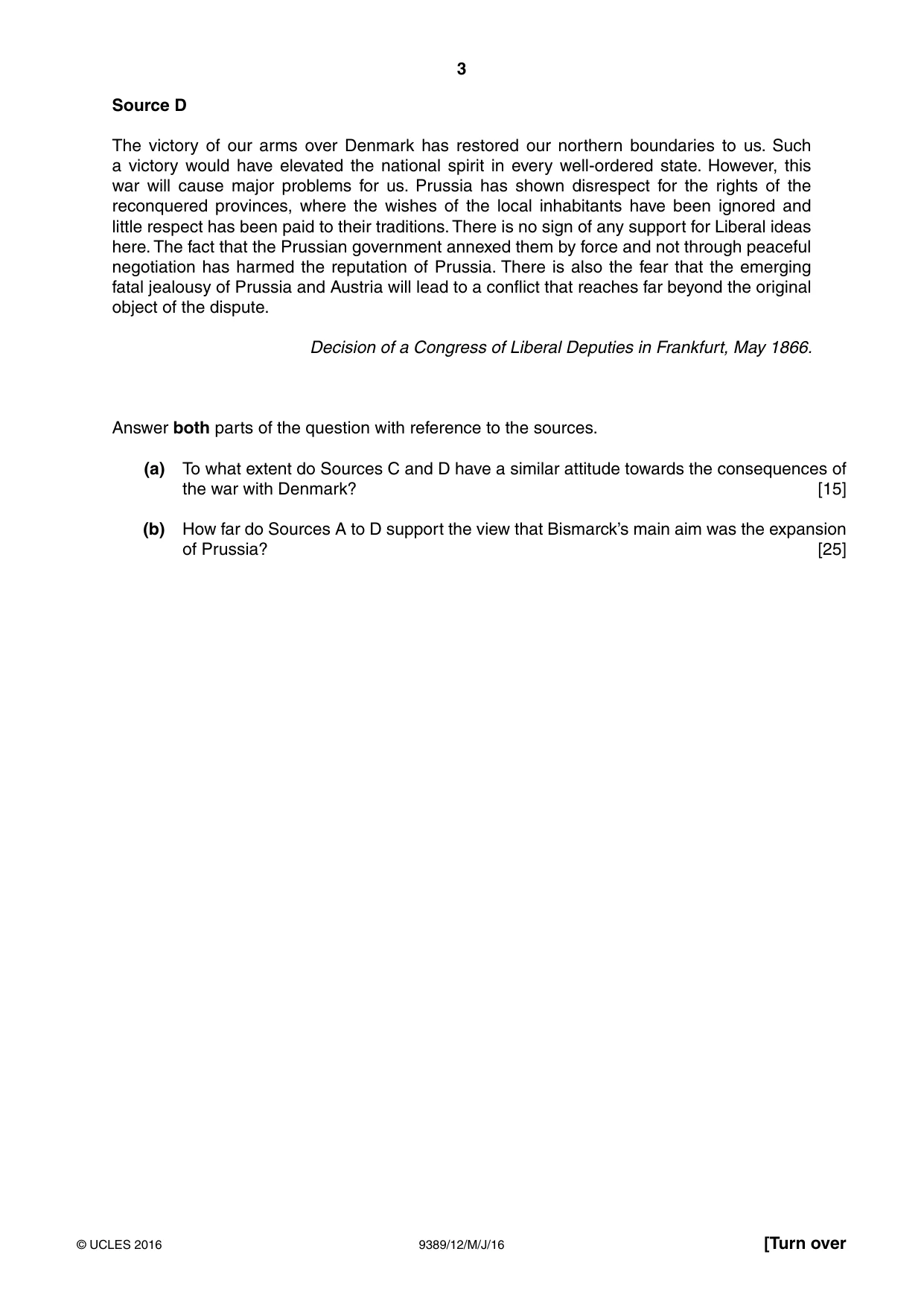
3 9389/12/M/J/16 © UCLES 2016 [Turn over Source D The victory of our arms over Denmark has restored our northern boundaries to us. Such a victory would have elevated the national spirit in every well-ordered state. However, this war will cause major problems for us. Prussia has shown disrespect for the rights of the reconquered provinces, where the wishes of the local inhabitants have been ignored and little respect has been paid to their traditions. There is no sign of any support for Liberal ideas here. The fact that the Prussian government annexed them by force and not through peaceful negotiation has harmed the reputation of Prussia. There is also the fear that the emerging fatal jealousy of Prussia and Austria will lead to a conflict that reaches far beyond the original object of the dispute. Decision of a Congress of Liberal Deputies in Frankfurt, May 1866. Answer both parts of the question with reference to the sources. (a) To what extent do Sources C and D have a similar attitude towards the consequences of the war with Denmark? [15] (b) How far do Sources A to D support the view that Bismarck’s main aim was the expansion of Prussia? [25]
Question paper, page 4
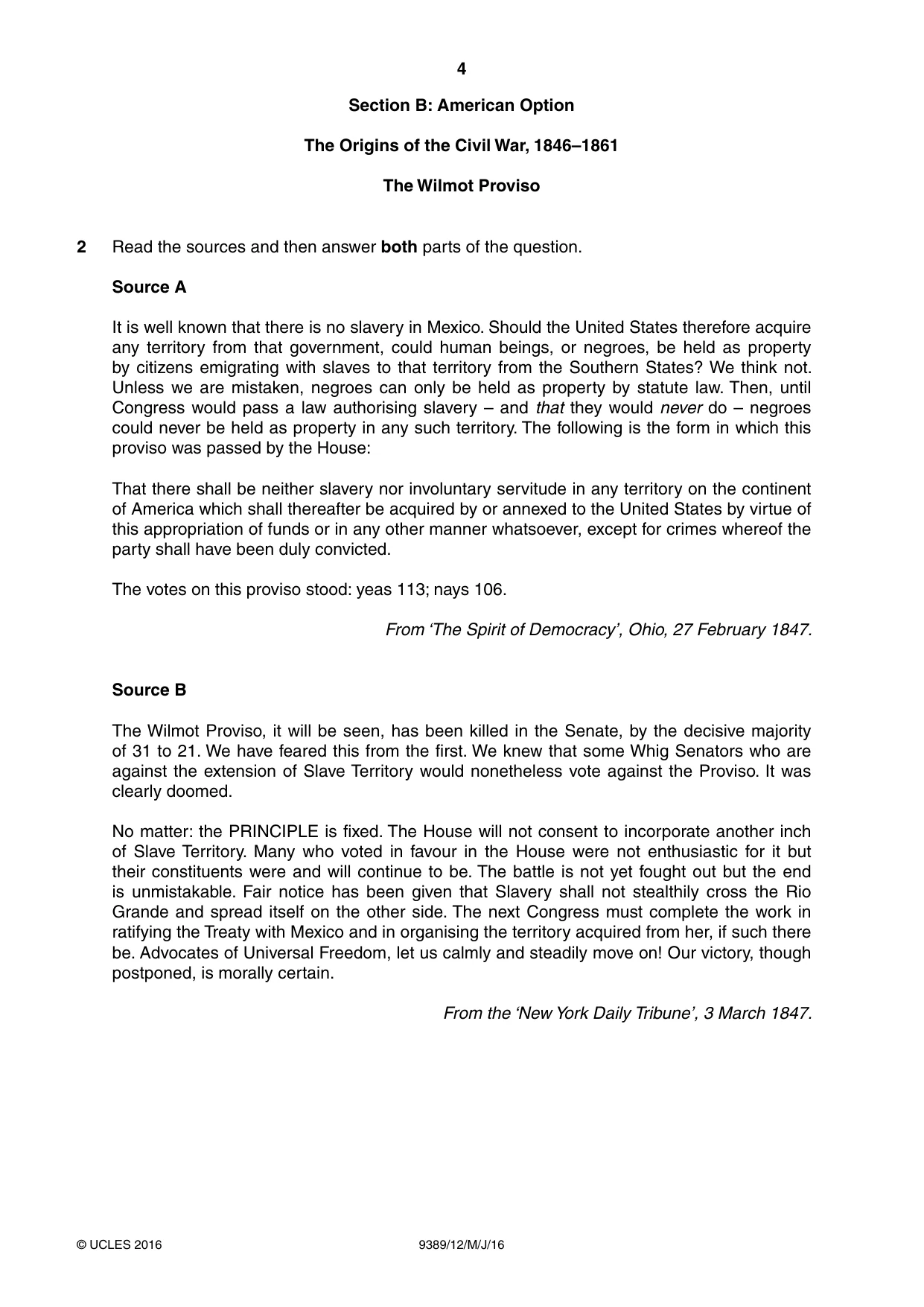
4 9389/12/M/J/16 © UCLES 2016 Section B: American Option The Origins of the Civil War, 1846–1861 The Wilmot Proviso 2 Read the sources and then answer both parts of the question. Source A It is well known that there is no slavery in Mexico. Should the United States therefore acquire any territory from that government, could human beings, or negroes, be held as property by citizens emigrating with slaves to that territory from the Southern States? We think not. Unless we are mistaken, negroes can only be held as property by statute law. Then, until Congress would pass a law authorising slavery – and that they would never do – negroes could never be held as property in any such territory. The following is the form in which this proviso was passed by the House: That there shall be neither slavery nor involuntary servitude in any territory on the continent of America which shall thereafter be acquired by or annexed to the United States by virtue of this appropriation of funds or in any other manner whatsoever, except for crimes whereof the party shall have been duly convicted. The votes on this proviso stood: yeas 113; nays 106. From ‘The Spirit of Democracy’, Ohio, 27 February 1847. Source B The Wilmot Proviso, it will be seen, has been killed in the Senate, by the decisive majority of 31 to 21. We have feared this from the first. We knew that some Whig Senators who are against the extension of Slave Territory would nonetheless vote against the Proviso. It was clearly doomed. No matter: the PRINCIPLE is fixed. The House will not consent to incorporate another inch of Slave Territory. Many who voted in favour in the House were not enthusiastic for it but their constituents were and will continue to be. The battle is not yet fought out but the end is unmistakable. Fair notice has been given that Slavery shall not stealthily cross the Rio Grande and spread itself on the other side. The next Congress must complete the work in ratifying the Treaty with Mexico and in organising the territory acquired from her, if such there be. Advocates of Universal Freedom, let us calmly and steadily move on! Our victory, though postponed, is morally certain. From the ‘New York Daily Tribune’, 3 March 1847.
Question paper, page 5
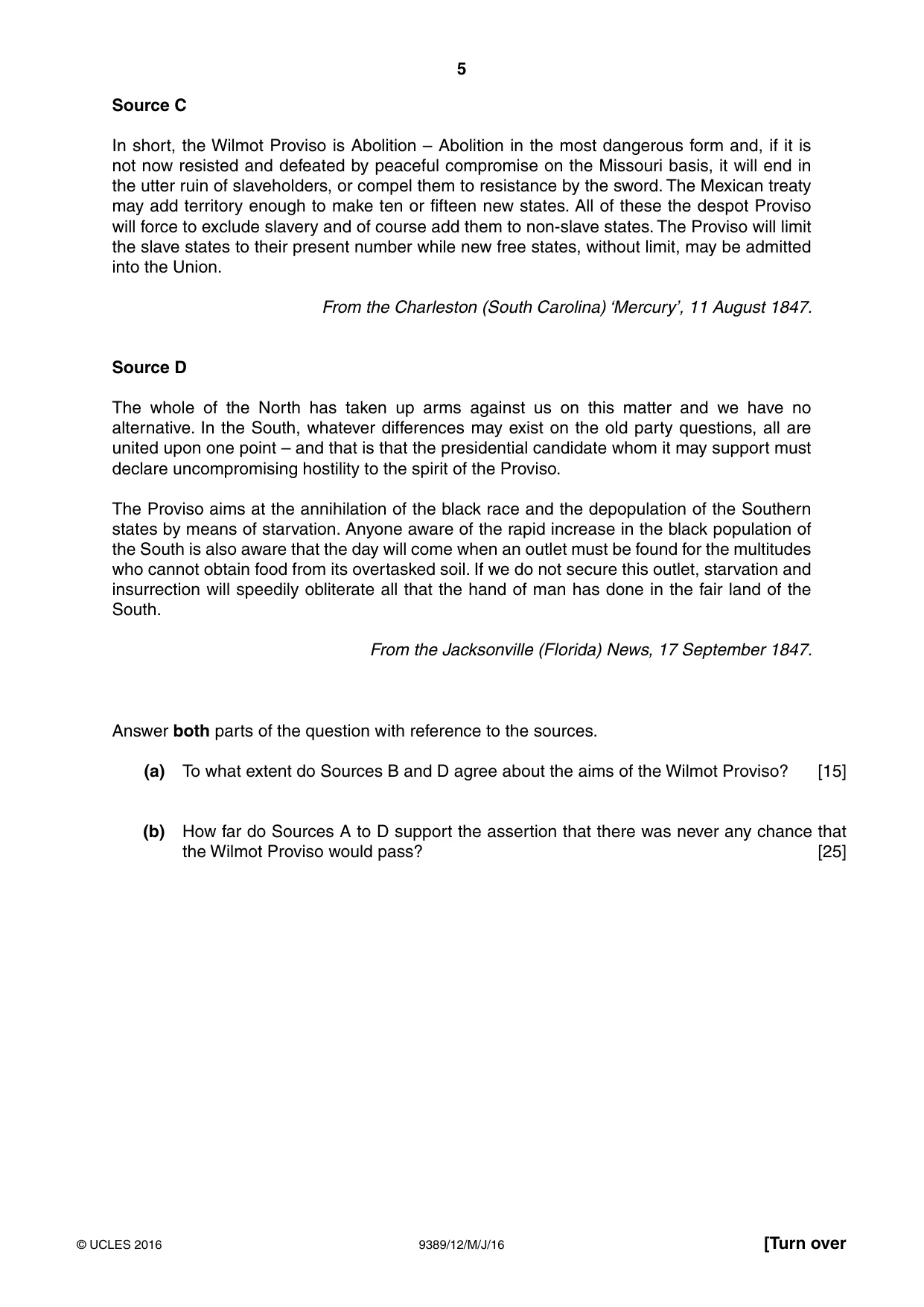
5 9389/12/M/J/16 © UCLES 2016 [Turn over Source C In short, the Wilmot Proviso is Abolition – Abolition in the most dangerous form and, if it is not now resisted and defeated by peaceful compromise on the Missouri basis, it will end in the utter ruin of slaveholders, or compel them to resistance by the sword. The Mexican treaty may add territory enough to make ten or fifteen new states. All of these the despot Proviso will force to exclude slavery and of course add them to non-slave states. The Proviso will limit the slave states to their present number while new free states, without limit, may be admitted into the Union. From the Charleston (South Carolina) ‘Mercury’, 11 August 1847. Source D The whole of the North has taken up arms against us on this matter and we have no alternative. In the South, whatever differences may exist on the old party questions, all are united upon one point – and that is that the presidential candidate whom it may support must declare uncompromising hostility to the spirit of the Proviso. The Proviso aims at the annihilation of the black race and the depopulation of the Southern states by means of starvation. Anyone aware of the rapid increase in the black population of the South is also aware that the day will come when an outlet must be found for the multitudes who cannot obtain food from its overtasked soil. If we do not secure this outlet, starvation and insurrection will speedily obliterate all that the hand of man has done in the fair land of the South. From the Jacksonville (Florida) News, 17 September 1847. Answer both parts of the question with reference to the sources. (a) To what extent do Sources B and D agree about the aims of the Wilmot Proviso? [15] (b) How far do Sources A to D support the assertion that there was never any chance that the Wilmot Proviso would pass? [25]
Question paper, page 6
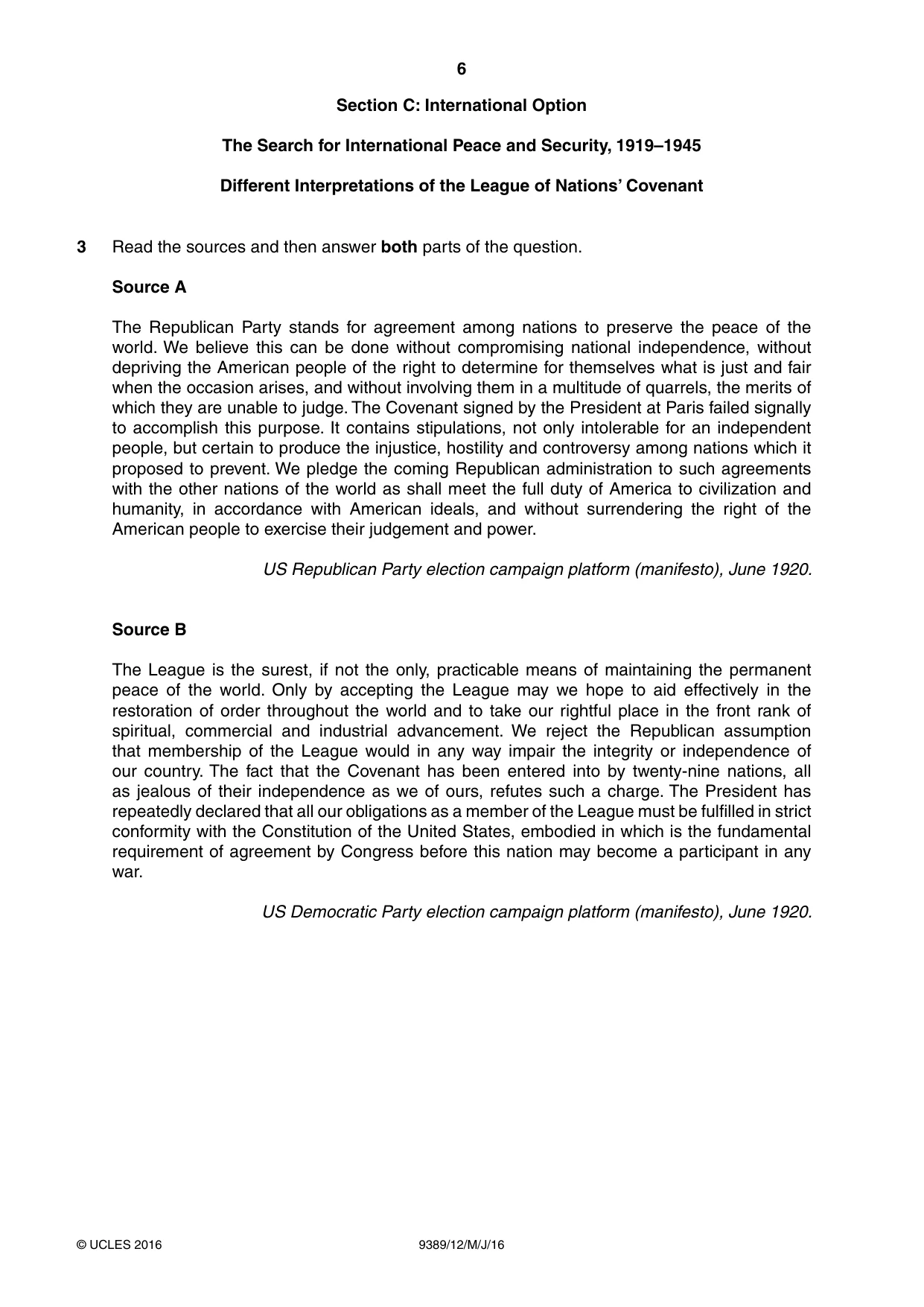
6 9389/12/M/J/16 © UCLES 2016 Section C: International Option The Search for International Peace and Security, 1919–1945 Different Interpretations of the League of Nations’ Covenant 3 Read the sources and then answer both parts of the question. Source A The Republican Party stands for agreement among nations to preserve the peace of the world. We believe this can be done without compromising national independence, without depriving the American people of the right to determine for themselves what is just and fair when the occasion arises, and without involving them in a multitude of quarrels, the merits of which they are unable to judge. The Covenant signed by the President at Paris failed signally to accomplish this purpose. It contains stipulations, not only intolerable for an independent people, but certain to produce the injustice, hostility and controversy among nations which it proposed to prevent. We pledge the coming Republican administration to such agreements with the other nations of the world as shall meet the full duty of America to civilization and humanity, in accordance with American ideals, and without surrendering the right of the American people to exercise their judgement and power. US Republican Party election campaign platform (manifesto), June 1920. Source B The League is the surest, if not the only, practicable means of maintaining the permanent peace of the world. Only by accepting the League may we hope to aid effectively in the restoration of order throughout the world and to take our rightful place in the front rank of spiritual, commercial and industrial advancement. We reject the Republican assumption that membership of the League would in any way impair the integrity or independence of our country. The fact that the Covenant has been entered into by twenty-nine nations, all as jealous of their independence as we of ours, refutes such a charge. The President has repeatedly declared that all our obligations as a member of the League must be fulfilled in strict conformity with the Constitution of the United States, embodied in which is the fundamental requirement of agreement by Congress before this nation may become a participant in any war. US Democratic Party election campaign platform (manifesto), June 1920.
Question paper, page 7
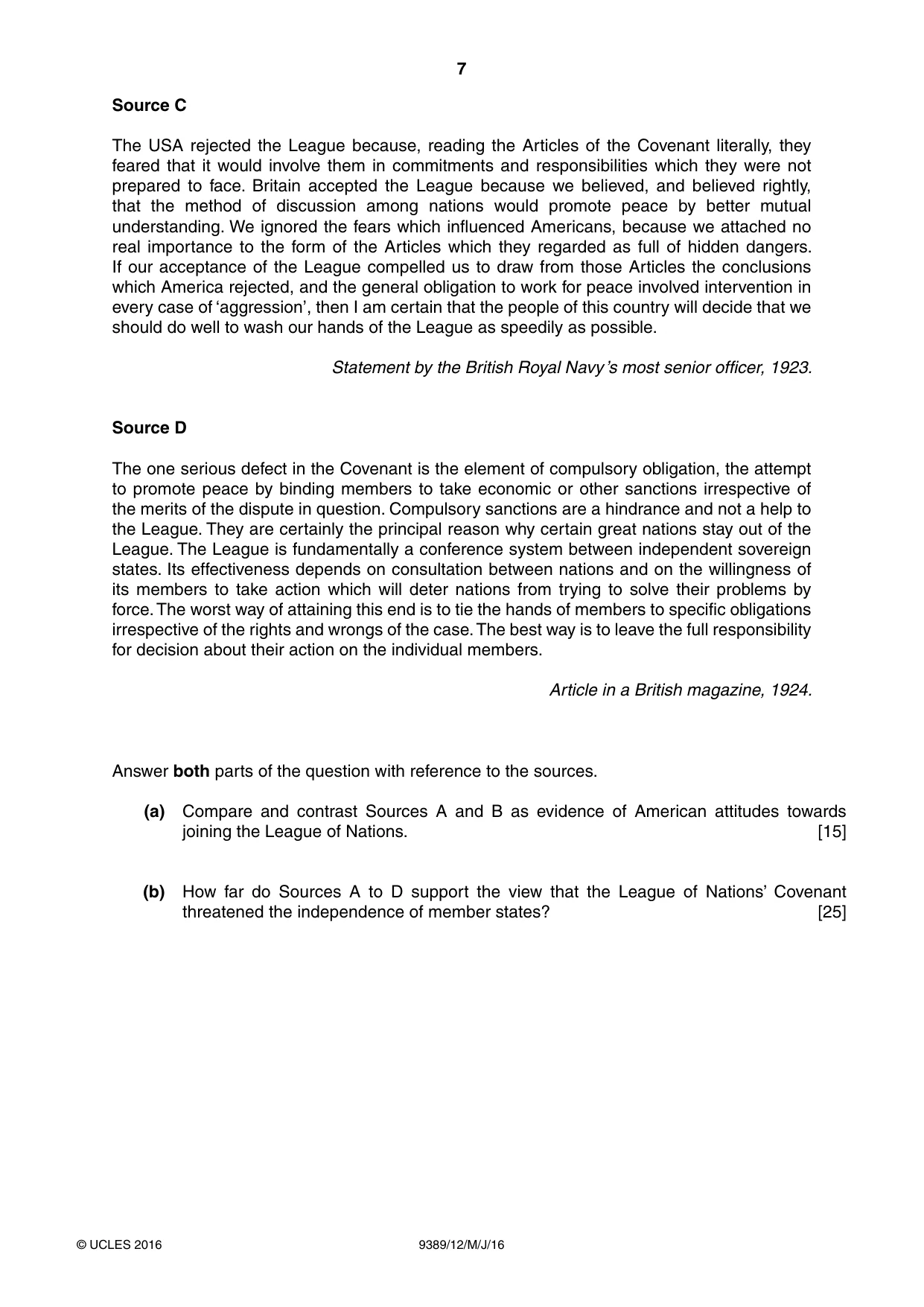
7 9389/12/M/J/16 © UCLES 2016 Source C The USA rejected the League because, reading the Articles of the Covenant literally, they feared that it would involve them in commitments and responsibilities which they were not prepared to face. Britain accepted the League because we believed, and believed rightly, that the method of discussion among nations would promote peace by better mutual understanding. We ignored the fears which influenced Americans, because we attached no real importance to the form of the Articles which they regarded as full of hidden dangers. If our acceptance of the League compelled us to draw from those Articles the conclusions which America rejected, and the general obligation to work for peace involved intervention in every case of ‘aggression’, then I am certain that the people of this country will decide that we should do well to wash our hands of the League as speedily as possible. Statement by the British Royal Navy ’s most senior officer, 1923. Source D The one serious defect in the Covenant is the element of compulsory obligation, the attempt to promote peace by binding members to take economic or other sanctions irrespective of the merits of the dispute in question. Compulsory sanctions are a hindrance and not a help to the League. They are certainly the principal reason why certain great nations stay out of the League. The League is fundamentally a conference system between independent sovereign states. Its effectiveness depends on consultation between nations and on the willingness of its members to take action which will deter nations from trying to solve their problems by force. The worst way of attaining this end is to tie the hands of members to specific obligations irrespective of the rights and wrongs of the case. The best way is to leave the full responsibility for decision about their action on the individual members. Article in a British magazine, 1924. Answer both parts of the question with reference to the sources. (a) Compare and contrast Sources A and B as evidence of American attitudes towards joining the League of Nations. [15] (b) How far do Sources A to D support the view that the League of Nations’ Covenant threatened the independence of member states? [25]
Question paper, page 8
8 9389/12/M/J/16 © UCLES 2016 BLANK PAGE Permission to reproduce items where third-party owned material protected by copyright is included has been sought and cleared where possible. Every reasonable effort has been made by the publisher (UCLES) to trace copyright holders, but if any items requiring clearance have unwittingly been included, the publisher will be pleased to make amends at the earliest possible opportunity. To avoid the issue of disclosure of answer-related information to candidates, all copyright acknowledgements are reproduced online in the Cambridge International Examinations Copyright Acknowledgements Booklet. This is produced for each series of examinations and is freely available to download at www.cie.org.uk after the live examination series. Cambridge International Examinations is part of the Cambridge Assessment Group. Cambridge Assessment is the brand name of University of Cambridge Local Examinations Syndicate (UCLES), which is itself a department of the University of Cambridge.
Mark scheme, page 1
® IGCSE is the registered trademark of Cambridge International Examinations. This document consists of 10 printed pages. © UCLES 2016 [Turn over Cambridge International Examinations Cambridge International Advanced Subsidiary and Advanced Level HISTORY 9389/12 Paper 1 Document Question 12 May/June 2016 MARK SCHEME Maximum Mark: 40 Published This mark scheme is published as an aid to teachers and candidates, to indicate the requirements of the examination. It shows the basis on which Examiners were instructed to award marks. It does not indicate the details of the discussions that took place at an Examiners’ meeting before marking began, which would have considered the acceptability of alternative answers. Mark schemes should be read in conjunction with the question paper and the Principal Examiner Report for Teachers. Cambridge will not enter into discussions about these mark schemes. Cambridge is publishing the mark schemes for the May/June 2016 series for most Cambridge IGCSE®, Cambridge International A and AS Level components and some Cambridge O Level components.
Mark scheme, page 2
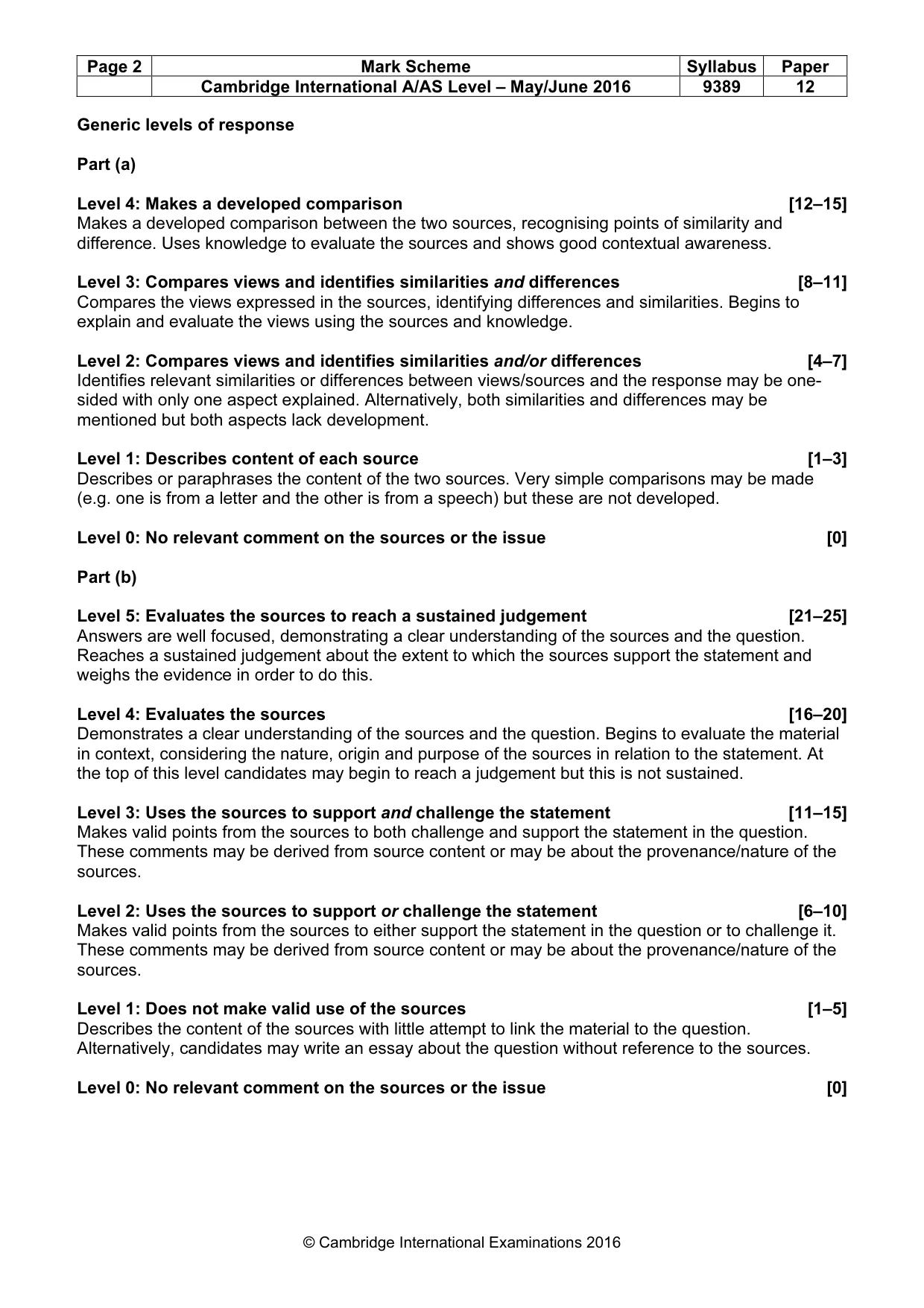
Page 2 Mark Scheme Syllabus Paper Cambridge International A/AS Level – May/June 2016 9389 12 © Cambridge International Examinations 2016 Generic levels of response Part (a) Level 4: Makes a developed comparison [12–15] Makes a developed comparison between the two sources, recognising points of similarity and difference. Uses knowledge to evaluate the sources and shows good contextual awareness. Level 3: Compares views and identifies similarities and differences [8–11] Compares the views expressed in the sources, identifying differences and similarities. Begins to explain and evaluate the views using the sources and knowledge. Level 2: Compares views and identifies similarities and/or differences [4–7] Identifies relevant similarities or differences between views/sources and the response may be one- sided with only one aspect explained. Alternatively, both similarities and differences may be mentioned but both aspects lack development. Level 1: Describes content of each source [1–3] Describes or paraphrases the content of the two sources. Very simple comparisons may be made (e.g. one is from a letter and the other is from a speech) but these are not developed. Level 0: No relevant comment on the sources or the issue [0] Part (b) Level 5: Evaluates the sources to reach a sustained judgement [21–25] Answers are well focused, demonstrating a clear understanding of the sources and the question. Reaches a sustained judgement about the extent to which the sources support the statement and weighs the evidence in order to do this. Level 4: Evaluates the sources [16–20] Demonstrates a clear understanding of the sources and the question. Begins to evaluate the material in context, considering the nature, origin and purpose of the sources in relation to the statement. At the top of this level candidates may begin to reach a judgement but this is not sustained. Level 3: Uses the sources to support and challenge the statement [11–15] Makes valid points from the sources to both challenge and support the statement in the question. These comments may be derived from source content or may be about the provenance/nature of the sources. Level 2: Uses the sources to support or challenge the statement [6–10] Makes valid points from the sources to either support the statement in the question or to challenge it. These comments may be derived from source content or may be about the provenance/nature of the sources. Level 1: Does not make valid use of the sources [1–5] Describes the content of the sources with little attempt to link the material to the question. Alternatively, candidates may write an essay about the question without reference to the sources. Level 0: No relevant comment on the sources or the issue [0]
Mark scheme, page 3
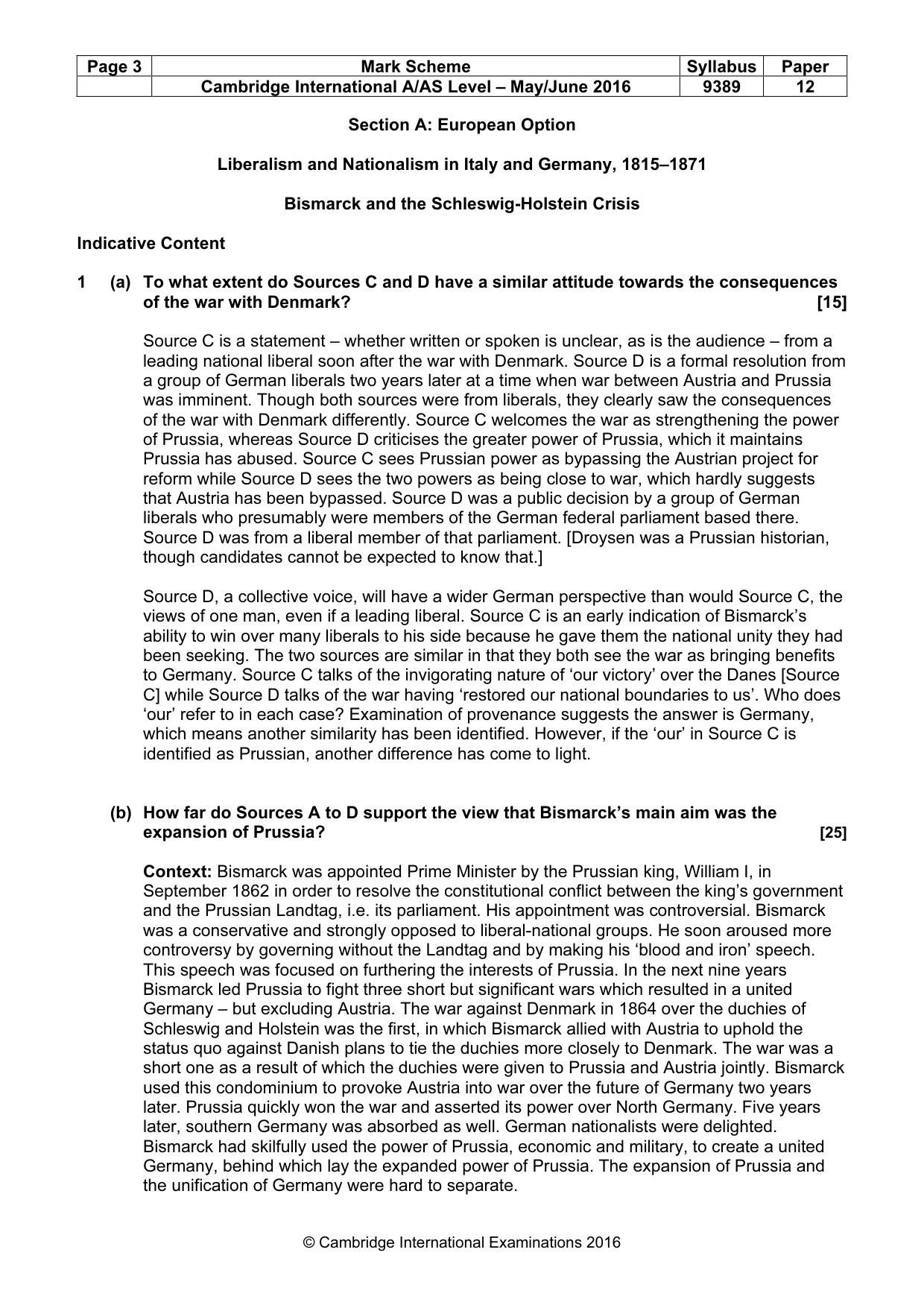
Page 3 Mark Scheme Syllabus Paper Cambridge International A/AS Level – May/June 2016 9389 12 © Cambridge International Examinations 2016 Section A: European Option Liberalism and Nationalism in Italy and Germany, 1815–1871 Bismarck and the Schleswig-Holstein Crisis Indicative Content 1 (a) To what extent do Sources C and D have a similar attitude towards the consequences of the war with Denmark? [15] Source C is a statement – whether written or spoken is unclear, as is the audience – from a leading national liberal soon after the war with Denmark. Source D is a formal resolution from a group of German liberals two years later at a time when war between Austria and Prussia was imminent. Though both sources were from liberals, they clearly saw the consequences of the war with Denmark differently. Source C welcomes the war as strengthening the power of Prussia, whereas Source D criticises the greater power of Prussia, which it maintains Prussia has abused. Source C sees Prussian power as bypassing the Austrian project for reform while Source D sees the two powers as being close to war, which hardly suggests that Austria has been bypassed. Source D was a public decision by a group of German liberals who presumably were members of the German federal parliament based there. Source D was from a liberal member of that parliament. [Droysen was a Prussian historian, though candidates cannot be expected to know that.] Source D, a collective voice, will have a wider German perspective than would Source C, the views of one man, even if a leading liberal. Source C is an early indication of Bismarck’s ability to win over many liberals to his side because he gave them the national unity they had been seeking. The two sources are similar in that they both see the war as bringing benefits to Germany. Source C talks of the invigorating nature of ‘our victory’ over the Danes [Source C] while Source D talks of the war having ‘restored our national boundaries to us’. Who does ‘our’ refer to in each case? Examination of provenance suggests the answer is Germany, which means another similarity has been identified. However, if the ‘our’ in Source C is identified as Prussian, another difference has come to light. (b) How far do Sources A to D support the view that Bismarck’s main aim was the expansion of Prussia? [25] Context: Bismarck was appointed Prime Minister by the Prussian king, William I, in September 1862 in order to resolve the constitutional conflict between the king’s government and the Prussian Landtag, i.e. its parliament. His appointment was controversial. Bismarck was a conservative and strongly opposed to liberal-national groups. He soon aroused more controversy by governing without the Landtag and by making his ‘blood and iron’ speech. This speech was focused on furthering the interests of Prussia. In the next nine years Bismarck led Prussia to fight three short but significant wars which resulted in a united Germany – but excluding Austria. The war against Denmark in 1864 over the duchies of Schleswig and Holstein was the first, in which Bismarck allied with Austria to uphold the status quo against Danish plans to tie the duchies more closely to Denmark. The war was a short one as a result of which the duchies were given to Prussia and Austria jointly. Bismarck used this condominium to provoke Austria into war over the future of Germany two years later. Prussia quickly won the war and asserted its power over North Germany. Five years later, southern Germany was absorbed as well. German nationalists were delighted. Bismarck had skilfully used the power of Prussia, economic and military, to create a united Germany, behind which lay the expanded power of Prussia. The expansion of Prussia and the unification of Germany were hard to separate.
Mark scheme, page 4
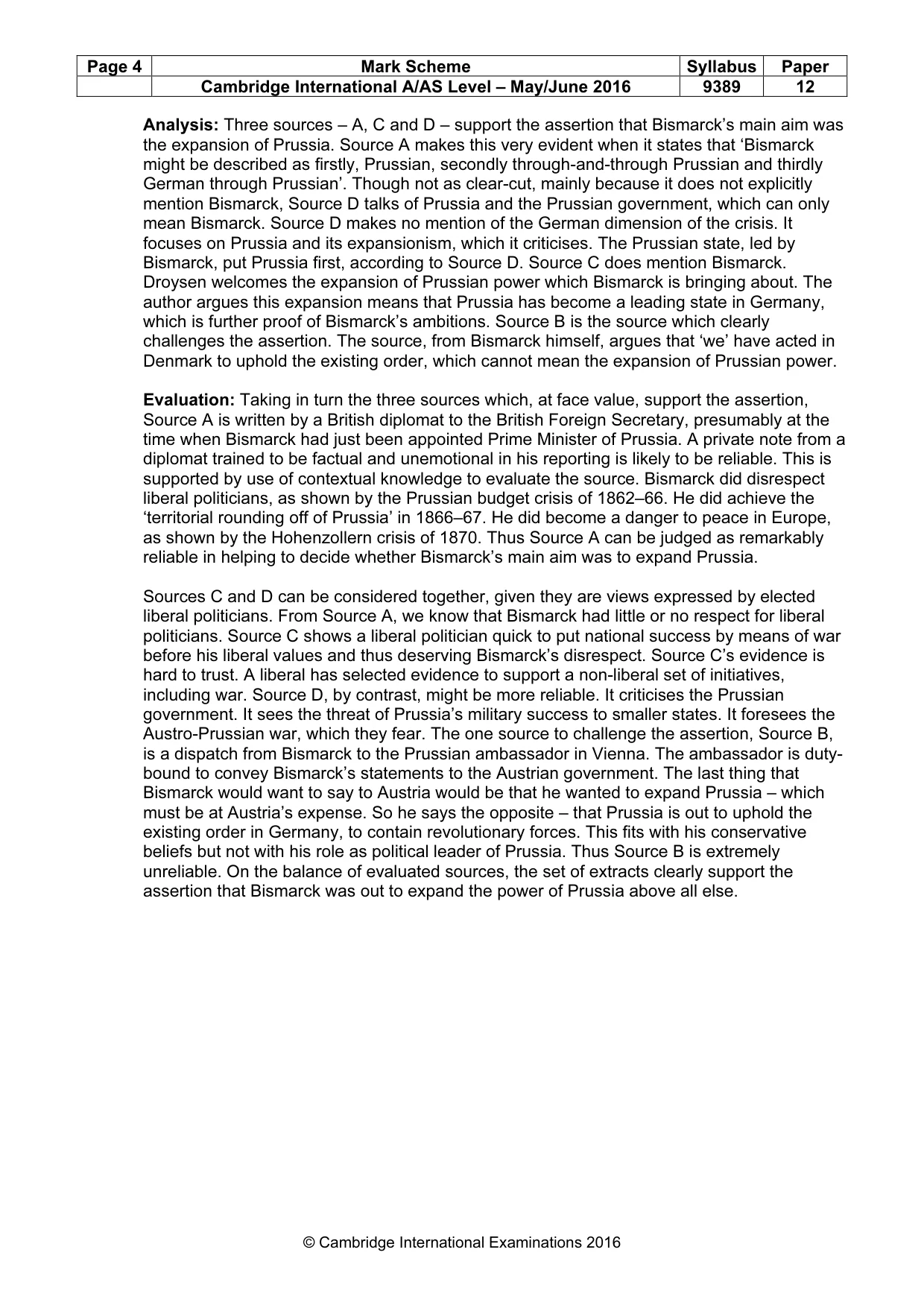
Page 4 Mark Scheme Syllabus Paper Cambridge International A/AS Level – May/June 2016 9389 12 © Cambridge International Examinations 2016 Analysis: Three sources – A, C and D – support the assertion that Bismarck’s main aim was the expansion of Prussia. Source A makes this very evident when it states that ‘Bismarck might be described as firstly, Prussian, secondly through-and-through Prussian and thirdly German through Prussian’. Though not as clear-cut, mainly because it does not explicitly mention Bismarck, Source D talks of Prussia and the Prussian government, which can only mean Bismarck. Source D makes no mention of the German dimension of the crisis. It focuses on Prussia and its expansionism, which it criticises. The Prussian state, led by Bismarck, put Prussia first, according to Source D. Source C does mention Bismarck. Droysen welcomes the expansion of Prussian power which Bismarck is bringing about. The author argues this expansion means that Prussia has become a leading state in Germany, which is further proof of Bismarck’s ambitions. Source B is the source which clearly challenges the assertion. The source, from Bismarck himself, argues that ‘we’ have acted in Denmark to uphold the existing order, which cannot mean the expansion of Prussian power. Evaluation: Taking in turn the three sources which, at face value, support the assertion, Source A is written by a British diplomat to the British Foreign Secretary, presumably at the time when Bismarck had just been appointed Prime Minister of Prussia. A private note from a diplomat trained to be factual and unemotional in his reporting is likely to be reliable. This is supported by use of contextual knowledge to evaluate the source. Bismarck did disrespect liberal politicians, as shown by the Prussian budget crisis of 1862–66. He did achieve the ‘territorial rounding off of Prussia’ in 1866–67. He did become a danger to peace in Europe, as shown by the Hohenzollern crisis of 1870. Thus Source A can be judged as remarkably reliable in helping to decide whether Bismarck’s main aim was to expand Prussia. Sources C and D can be considered together, given they are views expressed by elected liberal politicians. From Source A, we know that Bismarck had little or no respect for liberal politicians. Source C shows a liberal politician quick to put national success by means of war before his liberal values and thus deserving Bismarck’s disrespect. Source C’s evidence is hard to trust. A liberal has selected evidence to support a non-liberal set of initiatives, including war. Source D, by contrast, might be more reliable. It criticises the Prussian government. It sees the threat of Prussia’s military success to smaller states. It foresees the Austro-Prussian war, which they fear. The one source to challenge the assertion, Source B, is a dispatch from Bismarck to the Prussian ambassador in Vienna. The ambassador is duty- bound to convey Bismarck’s statements to the Austrian government. The last thing that Bismarck would want to say to Austria would be that he wanted to expand Prussia – which must be at Austria’s expense. So he says the opposite – that Prussia is out to uphold the existing order in Germany, to contain revolutionary forces. This fits with his conservative beliefs but not with his role as political leader of Prussia. Thus Source B is extremely unreliable. On the balance of evaluated sources, the set of extracts clearly support the assertion that Bismarck was out to expand the power of Prussia above all else.
Mark scheme, page 5
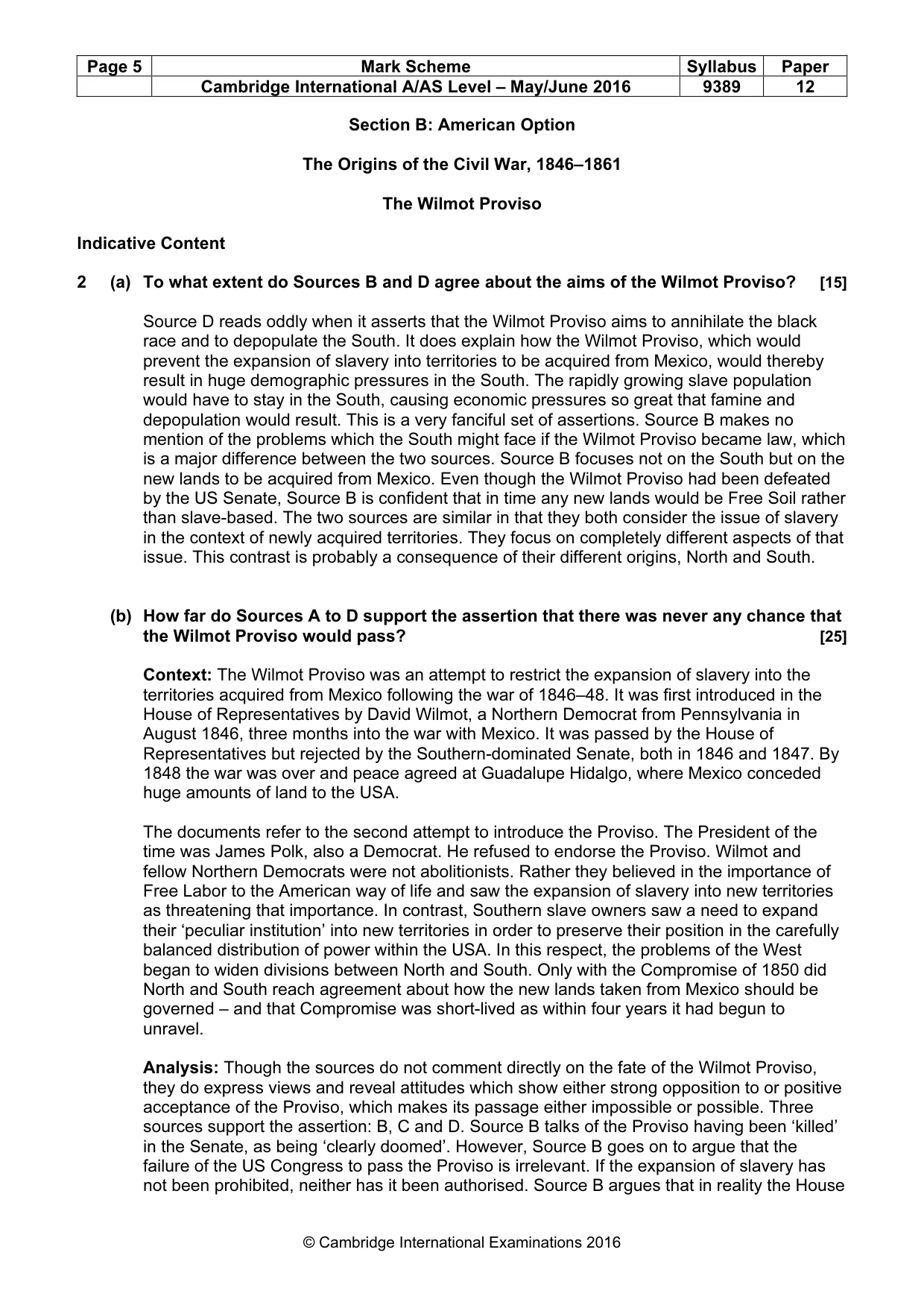
Page 5 Mark Scheme Syllabus Paper Cambridge International A/AS Level – May/June 2016 9389 12 © Cambridge International Examinations 2016 Section B: American Option The Origins of the Civil War, 1846–1861 The Wilmot Proviso Indicative Content 2 (a) To what extent do Sources B and D agree about the aims of the Wilmot Proviso? [15] Source D reads oddly when it asserts that the Wilmot Proviso aims to annihilate the black race and to depopulate the South. It does explain how the Wilmot Proviso, which would prevent the expansion of slavery into territories to be acquired from Mexico, would thereby result in huge demographic pressures in the South. The rapidly growing slave population would have to stay in the South, causing economic pressures so great that famine and depopulation would result. This is a very fanciful set of assertions. Source B makes no mention of the problems which the South might face if the Wilmot Proviso became law, which is a major difference between the two sources. Source B focuses not on the South but on the new lands to be acquired from Mexico. Even though the Wilmot Proviso had been defeated by the US Senate, Source B is confident that in time any new lands would be Free Soil rather than slave-based. The two sources are similar in that they both consider the issue of slavery in the context of newly acquired territories. They focus on completely different aspects of that issue. This contrast is probably a consequence of their different origins, North and South. (b) How far do Sources A to D support the assertion that there was never any chance that the Wilmot Proviso would pass? [25] Context: The Wilmot Proviso was an attempt to restrict the expansion of slavery into the territories acquired from Mexico following the war of 1846–48. It was first introduced in the House of Representatives by David Wilmot, a Northern Democrat from Pennsylvania in August 1846, three months into the war with Mexico. It was passed by the House of Representatives but rejected by the Southern-dominated Senate, both in 1846 and 1847. By 1848 the war was over and peace agreed at Guadalupe Hidalgo, where Mexico conceded huge amounts of land to the USA. The documents refer to the second attempt to introduce the Proviso. The President of the time was James Polk, also a Democrat. He refused to endorse the Proviso. Wilmot and fellow Northern Democrats were not abolitionists. Rather they believed in the importance of Free Labor to the American way of life and saw the expansion of slavery into new territories as threatening that importance. In contrast, Southern slave owners saw a need to expand their ‘peculiar institution’ into new territories in order to preserve their position in the carefully balanced distribution of power within the USA. In this respect, the problems of the West began to widen divisions between North and South. Only with the Compromise of 1850 did North and South reach agreement about how the new lands taken from Mexico should be governed – and that Compromise was short-lived as within four years it had begun to unravel. Analysis: Though the sources do not comment directly on the fate of the Wilmot Proviso, they do express views and reveal attitudes which show either strong opposition to or positive acceptance of the Proviso, which makes its passage either impossible or possible. Three sources support the assertion: B, C and D. Source B talks of the Proviso having been ‘killed’ in the Senate, as being ‘clearly doomed’. However, Source B goes on to argue that the failure of the US Congress to pass the Proviso is irrelevant. If the expansion of slavery has not been prohibited, neither has it been authorised. Source B argues that in reality the House
Mark scheme, page 6
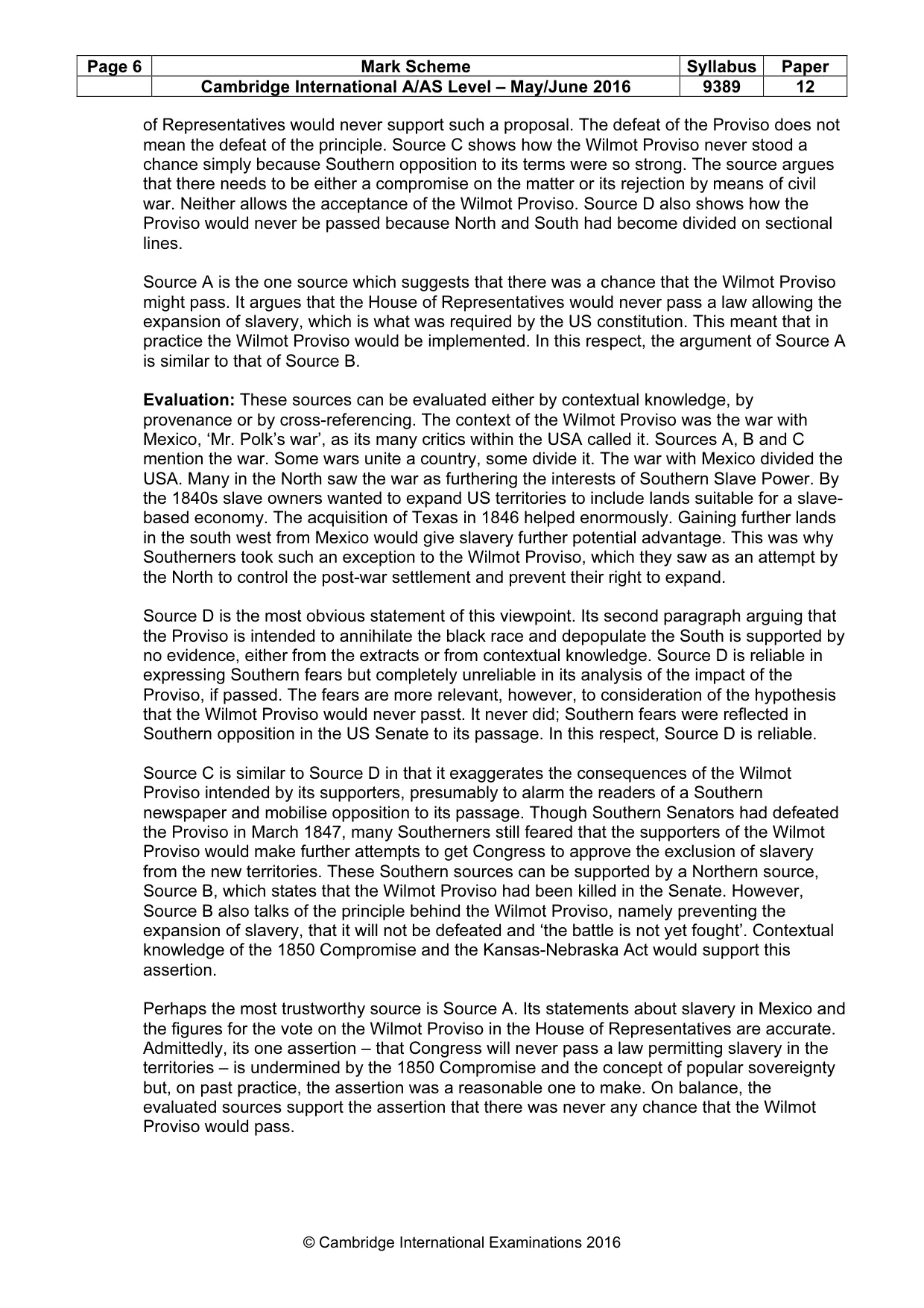
Page 6 Mark Scheme Syllabus Paper Cambridge International A/AS Level – May/June 2016 9389 12 © Cambridge International Examinations 2016 of Representatives would never support such a proposal. The defeat of the Proviso does not mean the defeat of the principle. Source C shows how the Wilmot Proviso never stood a chance simply because Southern opposition to its terms were so strong. The source argues that there needs to be either a compromise on the matter or its rejection by means of civil war. Neither allows the acceptance of the Wilmot Proviso. Source D also shows how the Proviso would never be passed because North and South had become divided on sectional lines. Source A is the one source which suggests that there was a chance that the Wilmot Proviso might pass. It argues that the House of Representatives would never pass a law allowing the expansion of slavery, which is what was required by the US constitution. This meant that in practice the Wilmot Proviso would be implemented. In this respect, the argument of Source A is similar to that of Source B. Evaluation: These sources can be evaluated either by contextual knowledge, by provenance or by cross-referencing. The context of the Wilmot Proviso was the war with Mexico, ‘Mr. Polk’s war’, as its many critics within the USA called it. Sources A, B and C mention the war. Some wars unite a country, some divide it. The war with Mexico divided the USA. Many in the North saw the war as furthering the interests of Southern Slave Power. By the 1840s slave owners wanted to expand US territories to include lands suitable for a slave- based economy. The acquisition of Texas in 1846 helped enormously. Gaining further lands in the south west from Mexico would give slavery further potential advantage. This was why Southerners took such an exception to the Wilmot Proviso, which they saw as an attempt by the North to control the post-war settlement and prevent their right to expand. Source D is the most obvious statement of this viewpoint. Its second paragraph arguing that the Proviso is intended to annihilate the black race and depopulate the South is supported by no evidence, either from the extracts or from contextual knowledge. Source D is reliable in expressing Southern fears but completely unreliable in its analysis of the impact of the Proviso, if passed. The fears are more relevant, however, to consideration of the hypothesis that the Wilmot Proviso would never passt. It never did; Southern fears were reflected in Southern opposition in the US Senate to its passage. In this respect, Source D is reliable. Source C is similar to Source D in that it exaggerates the consequences of the Wilmot Proviso intended by its supporters, presumably to alarm the readers of a Southern newspaper and mobilise opposition to its passage. Though Southern Senators had defeated the Proviso in March 1847, many Southerners still feared that the supporters of the Wilmot Proviso would make further attempts to get Congress to approve the exclusion of slavery from the new territories. These Southern sources can be supported by a Northern source, Source B, which states that the Wilmot Proviso had been killed in the Senate. However, Source B also talks of the principle behind the Wilmot Proviso, namely preventing the expansion of slavery, that it will not be defeated and ‘the battle is not yet fought’. Contextual knowledge of the 1850 Compromise and the Kansas-Nebraska Act would support this assertion. Perhaps the most trustworthy source is Source A. Its statements about slavery in Mexico and the figures for the vote on the Wilmot Proviso in the House of Representatives are accurate. Admittedly, its one assertion – that Congress will never pass a law permitting slavery in the territories – is undermined by the 1850 Compromise and the concept of popular sovereignty but, on past practice, the assertion was a reasonable one to make. On balance, the evaluated sources support the assertion that there was never any chance that the Wilmot Proviso would pass.
Mark scheme, page 7
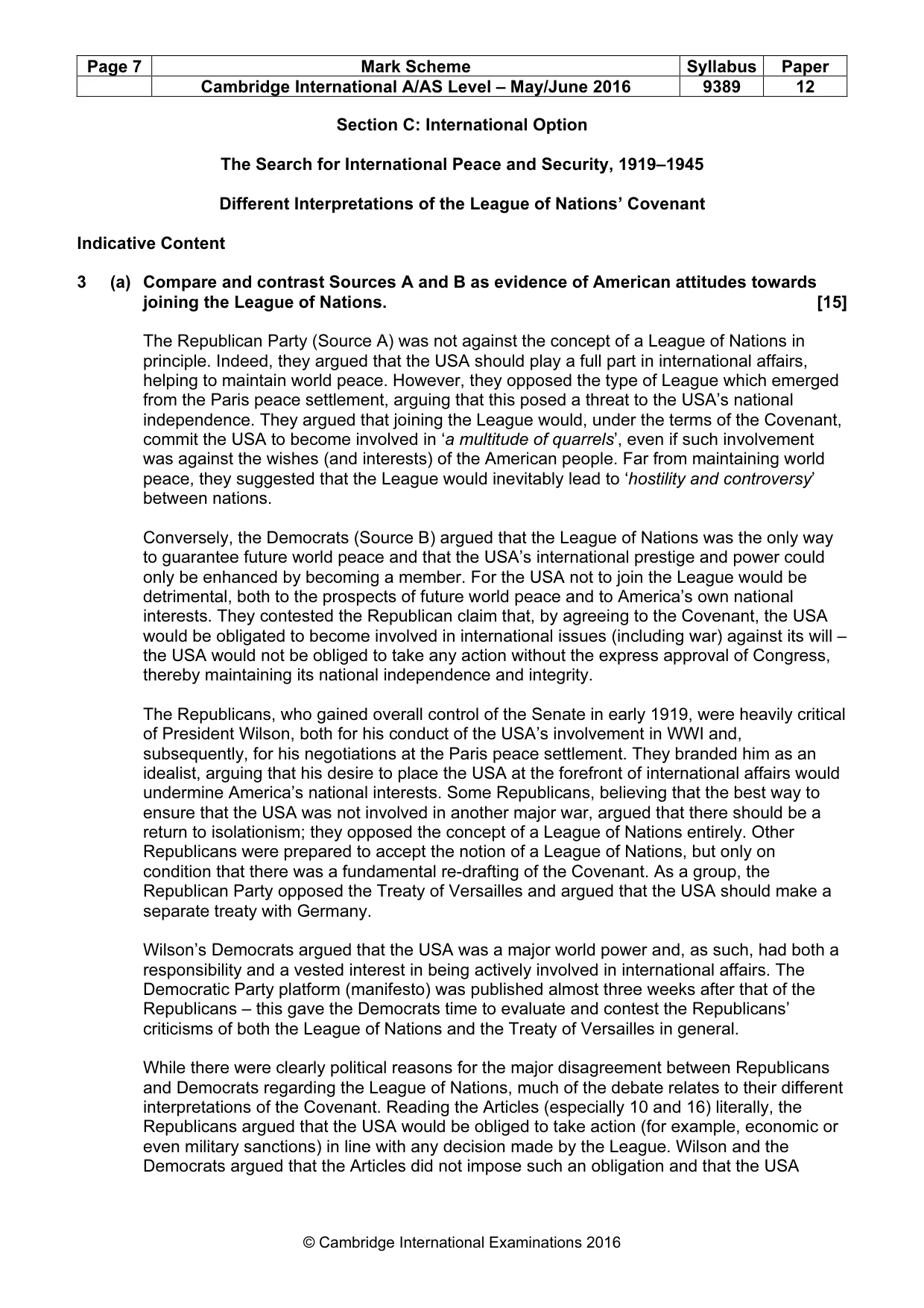
Page 7 Mark Scheme Syllabus Paper Cambridge International A/AS Level – May/June 2016 9389 12 © Cambridge International Examinations 2016 Section C: International Option The Search for International Peace and Security, 1919–1945 Different Interpretations of the League of Nations’ Covenant Indicative Content 3 (a) Compare and contrast Sources A and B as evidence of American attitudes towards joining the League of Nations. [15] The Republican Party (Source A) was not against the concept of a League of Nations in principle. Indeed, they argued that the USA should play a full part in international affairs, helping to maintain world peace. However, they opposed the type of League which emerged from the Paris peace settlement, arguing that this posed a threat to the USA’s national independence. They argued that joining the League would, under the terms of the Covenant, commit the USA to become involved in ‘a multitude of quarrels’, even if such involvement was against the wishes (and interests) of the American people. Far from maintaining world peace, they suggested that the League would inevitably lead to ‘hostility and controversy’ between nations. Conversely, the Democrats (Source B) argued that the League of Nations was the only way to guarantee future world peace and that the USA’s international prestige and power could only be enhanced by becoming a member. For the USA not to join the League would be detrimental, both to the prospects of future world peace and to America’s own national interests. They contested the Republican claim that, by agreeing to the Covenant, the USA would be obligated to become involved in international issues (including war) against its will – the USA would not be obliged to take any action without the express approval of Congress, thereby maintaining its national independence and integrity. The Republicans, who gained overall control of the Senate in early 1919, were heavily critical of President Wilson, both for his conduct of the USA’s involvement in WWI and, subsequently, for his negotiations at the Paris peace settlement. They branded him as an idealist, arguing that his desire to place the USA at the forefront of international affairs would undermine America’s national interests. Some Republicans, believing that the best way to ensure that the USA was not involved in another major war, argued that there should be a return to isolationism; they opposed the concept of a League of Nations entirely. Other Republicans were prepared to accept the notion of a League of Nations, but only on condition that there was a fundamental re-drafting of the Covenant. As a group, the Republican Party opposed the Treaty of Versailles and argued that the USA should make a separate treaty with Germany. Wilson’s Democrats argued that the USA was a major world power and, as such, had both a responsibility and a vested interest in being actively involved in international affairs. The Democratic Party platform (manifesto) was published almost three weeks after that of the Republicans – this gave the Democrats time to evaluate and contest the Republicans’ criticisms of both the League of Nations and the Treaty of Versailles in general. While there were clearly political reasons for the major disagreement between Republicans and Democrats regarding the League of Nations, much of the debate relates to their different interpretations of the Covenant. Reading the Articles (especially 10 and 16) literally, the Republicans argued that the USA would be obliged to take action (for example, economic or even military sanctions) in line with any decision made by the League. Wilson and the Democrats argued that the Articles did not impose such an obligation and that the USA
Mark scheme, page 8
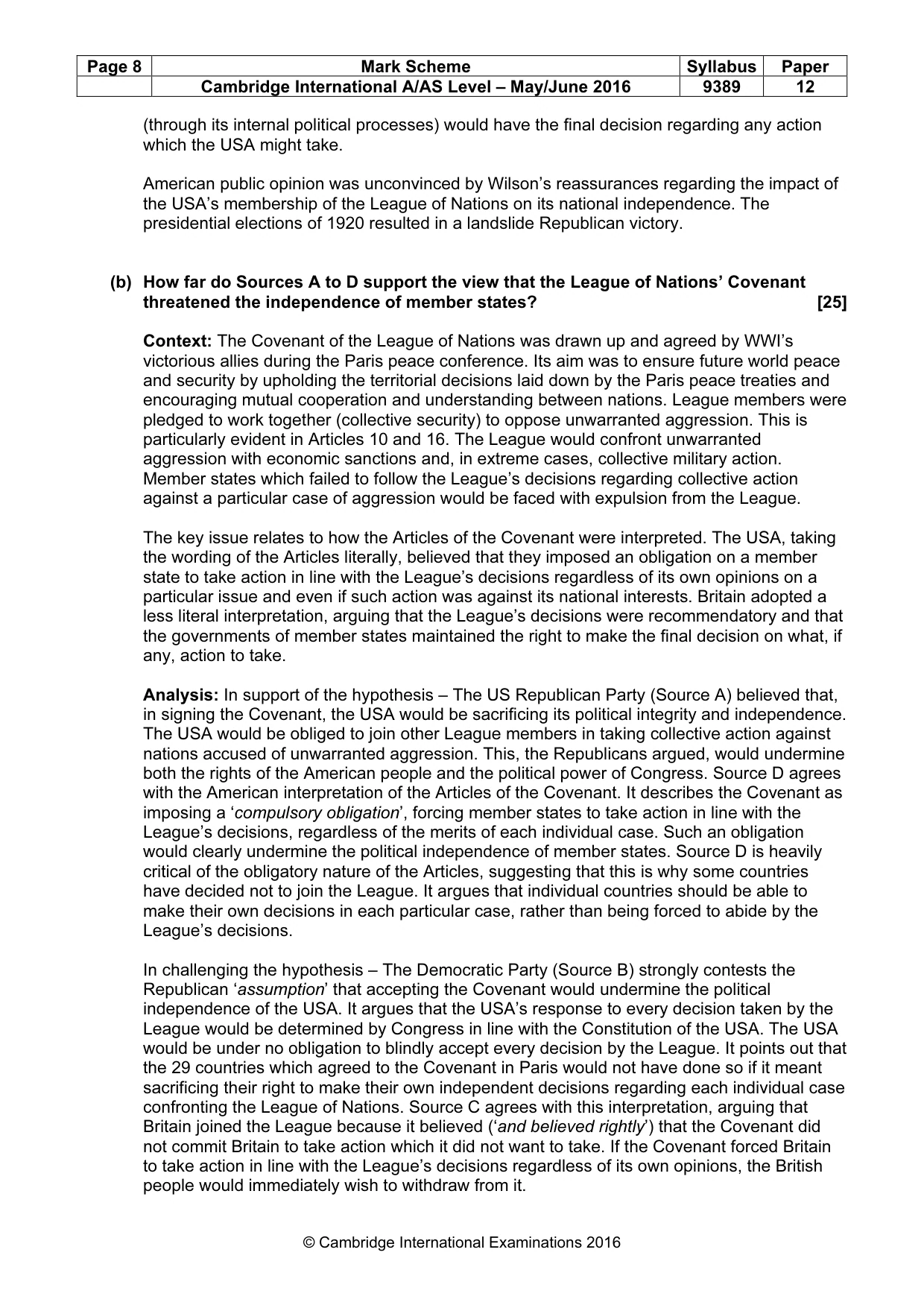
Page 8 Mark Scheme Syllabus Paper Cambridge International A/AS Level – May/June 2016 9389 12 © Cambridge International Examinations 2016 (through its internal political processes) would have the final decision regarding any action which the USA might take. American public opinion was unconvinced by Wilson’s reassurances regarding the impact of the USA’s membership of the League of Nations on its national independence. The presidential elections of 1920 resulted in a landslide Republican victory. (b) How far do Sources A to D support the view that the League of Nations’ Covenant threatened the independence of member states? [25] Context: The Covenant of the League of Nations was drawn up and agreed by WWI’s victorious allies during the Paris peace conference. Its aim was to ensure future world peace and security by upholding the territorial decisions laid down by the Paris peace treaties and encouraging mutual cooperation and understanding between nations. League members were pledged to work together (collective security) to oppose unwarranted aggression. This is particularly evident in Articles 10 and 16. The League would confront unwarranted aggression with economic sanctions and, in extreme cases, collective military action. Member states which failed to follow the League’s decisions regarding collective action against a particular case of aggression would be faced with expulsion from the League. The key issue relates to how the Articles of the Covenant were interpreted. The USA, taking the wording of the Articles literally, believed that they imposed an obligation on a member state to take action in line with the League’s decisions regardless of its own opinions on a particular issue and even if such action was against its national interests. Britain adopted a less literal interpretation, arguing that the League’s decisions were recommendatory and that the governments of member states maintained the right to make the final decision on what, if any, action to take. Analysis: In support of the hypothesis – The US Republican Party (Source A) believed that, in signing the Covenant, the USA would be sacrificing its political integrity and independence. The USA would be obliged to join other League members in taking collective action against nations accused of unwarranted aggression. This, the Republicans argued, would undermine both the rights of the American people and the political power of Congress. Source D agrees with the American interpretation of the Articles of the Covenant. It describes the Covenant as imposing a ‘compulsory obligation’, forcing member states to take action in line with the League’s decisions, regardless of the merits of each individual case. Such an obligation would clearly undermine the political independence of member states. Source D is heavily critical of the obligatory nature of the Articles, suggesting that this is why some countries have decided not to join the League. It argues that individual countries should be able to make their own decisions in each particular case, rather than being forced to abide by the League’s decisions. In challenging the hypothesis – The Democratic Party (Source B) strongly contests the Republican ‘assumption’ that accepting the Covenant would undermine the political independence of the USA. It argues that the USA’s response to every decision taken by the League would be determined by Congress in line with the Constitution of the USA. The USA would be under no obligation to blindly accept every decision by the League. It points out that the 29 countries which agreed to the Covenant in Paris would not have done so if it meant sacrificing their right to make their own independent decisions regarding each individual case confronting the League of Nations. Source C agrees with this interpretation, arguing that Britain joined the League because it believed (‘and believed rightly’) that the Covenant did not commit Britain to take action which it did not want to take. If the Covenant forced Britain to take action in line with the League’s decisions regardless of its own opinions, the British people would immediately wish to withdraw from it.
Mark scheme, page 9
Page 9 Mark Scheme Syllabus Paper Cambridge International A/AS Level – May/June 2016 9389 12 © Cambridge International Examinations 2016 Evaluation: As an election manifesto, source A is clearly politically motivated. While Wilson was away in Paris, the Republicans had made a concerted effort to convince American public opinion that ratifying the Treaty of Versailles in general, and the League of Nations in particular, was not in the USA’s best interests. They derided Wilson as an idealist, arguing that the League would lead to conflict rather than agreement between countries. They argued that joining the League would impose obligations on the USA, leading to American interference in the affairs of other countries. Moreover, other countries would have the opportunity to meddle in the internal affairs of the USA. Senator Henry Cabot Lodge was the most vociferous in his attacks on Wilson, the Treaty of Versailles and the League of Nations. To the Republicans, the best way for the USA to protect its own interests, while at the same time encouraging international peace, was to return to a policy of isolationism. In particular, this was the best way of avoiding the USA becoming embroiled in another major war. This policy appealed to the American people, for whom involvement in WWI had become increasingly unpopular. Source B is a politically motivated source. On his return from Paris, Wilson had embarked on an extensive tour of the USA in an attempt to convince the American people that the Treaty of Versailles and the League of Nations were very much in the USA’s best interests. The Democratic Party published its manifesto almost three weeks after the Republicans issued theirs, and it makes a clear attempt to convince the American electorate that the Republican fears regarding the League of Nations’ Covenant are unfounded. Emotively, it claims that the USA’s international power and prestige would be adversely affected if the country did not play a leading role in the League. Wilson’s heavy defeat in the 1920 presidential election shows that he failed to convince the American people. Source C is written by Britain’s most senior naval officer, Source C has great credibility in terms of its assessment of why Britain joined the League. In much the same way as the Democratic Party’s election manifesto of 1920, it dismisses the US Republican fears as unfounded and based on a too literal interpretation of the Covenant’s Articles. The source is clearly in favour of the League, but only on condition that member states retain their independent political rights. The second part of the source might indicate that there had, by 1923, been moves to clarify the Articles of the Covenant, adding in some element which might force member states to take action in response to the League’s decisions. The source clearly opposes such a move and argues that the British people would not accept it. As a senior military commander, the writer would expect to take orders from his country’s government rather than the more nebulous authority of the League of Nations. [In fact, this source was written in response to Cecil’s draft Treaty of Mutual Guarantee, which would, in effect, oblige member states of the League to take collective action in line with the League’s decisions.] As an article in a magazine, source D reflects the views of the writer rather than those of the British government. The writer’s interpretation of the Covenant is much the same as that of the US Republican Party – that it did impose an obligation on the part of member states to support the League’s decisions regardless of their own national interests and opinions. It argues that this obligation is the reason why some countries refuse to join the League, clearly a reference to the USA. It suggests that the obligatory nature of the Articles was not in the best interests of the League and should be removed, giving each member state the right to determine what action to take in each individual case confronting the League of Nations. The writer agrees with Source C that obliging countries to blindly follow the League’s decisions is wrong, but while Source C is concerned that this might happen, Source D claims that it already has because it is implicit in the Covenant. Source D reflects the British government’s view that the League of Nations could only work if all member countries were fully committed. It rejects the reservations issued by the US
Mark scheme, page 10
Page 10 Mark Scheme Syllabus Paper Cambridge International A/AS Level – May/June 2016 9389 12 © Cambridge International Examinations 2016 Senate, arguing that they would destroy the whole concept of the League. The British government was clearly hoping that Wilson would be able to overturn the opposition of the Senate. The tone of the memorandum implies that Britain believed the League could not be established successfully without the USA’s full and unreserved commitment.
What you needed in this session
Cambridge’s own grade thresholds for 2016 May/June, Paper 1 · Variant 2. A higher threshold means an easier paper — the bar moves with how the cohort did.