Cambridge A Level History 9389 — 2016 May/June Paper 1 · Variant 3
9389/13/M/J/16 · 40 marks · ≈45 min
The question paper and its mark scheme, free to read here and free to download. This is Cambridge’s own paper, exactly as it was sat.
Question paper8 pages
Mark scheme11 pages
Answers below. Sit the paper first if you are practising.
Paper as text
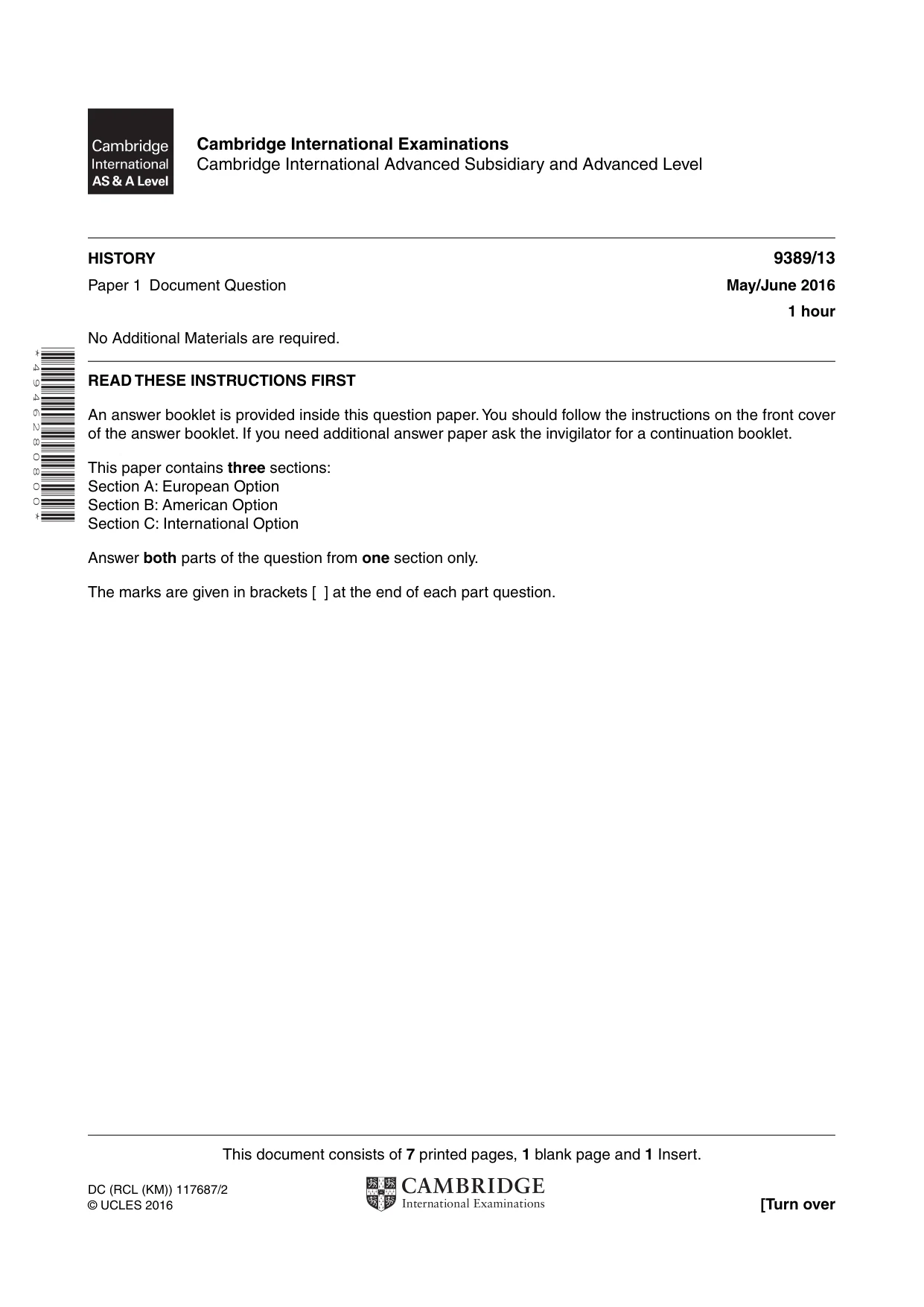
Question paper, page 1
This document consists of 7 printed pages, 1 blank page and 1 Insert. DC (RCL (KM)) 117687/2 © UCLES 2016 [Turn over Cambridge International Examinations Cambridge International Advanced Subsidiary and Advanced Level * 4 9 4 6 2 8 0 8 0 0 * HISTORY 9389/13 Paper 1 Document Question May/June 2016 1 hour No Additional Materials are required. READ THESE INSTRUCTIONS FIRST An answer booklet is provided inside this question paper. You should follow the instructions on the front cover of the answer booklet. If you need additional answer paper ask the invigilator for a continuation booklet. This paper contains three sections: Section A: European Option Section B: American Option Section C: International Option Answer both parts of the question from one section only. The marks are given in brackets [ ] at the end of each part question.
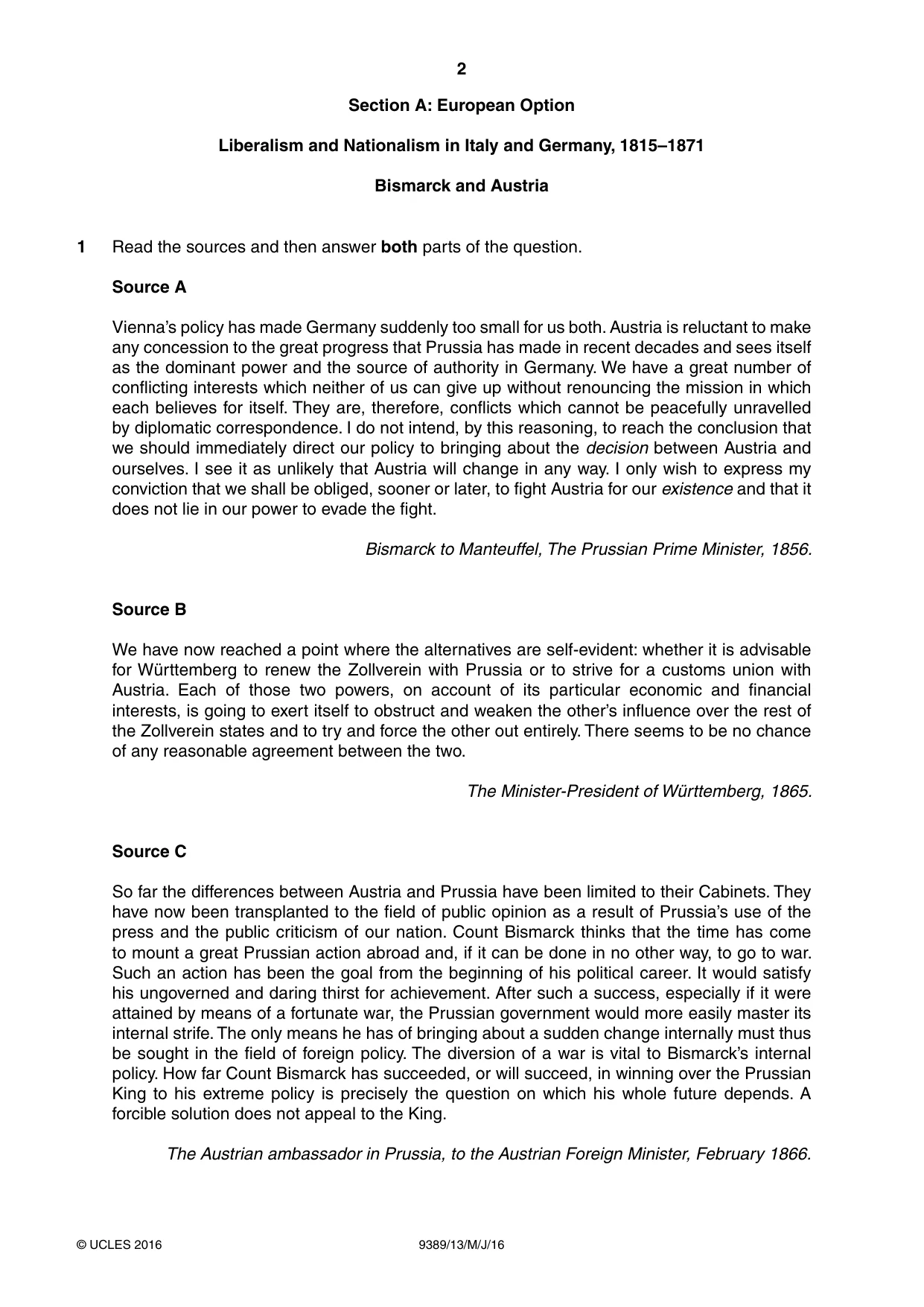
Question paper, page 2
2 9389/13/M/J/16 © UCLES 2016 Section A: European Option Liberalism and Nationalism in Italy and Germany, 1815–1871 Bismarck and Austria 1 Read the sources and then answer both parts of the question. Source A Vienna’s policy has made Germany suddenly too small for us both. Austria is reluctant to make any concession to the great progress that Prussia has made in recent decades and sees itself as the dominant power and the source of authority in Germany. We have a great number of conflicting interests which neither of us can give up without renouncing the mission in which each believes for itself. They are, therefore, conflicts which cannot be peacefully unravelled by diplomatic correspondence. I do not intend, by this reasoning, to reach the conclusion that we should immediately direct our policy to bringing about the decision between Austria and ourselves. I see it as unlikely that Austria will change in any way. I only wish to express my conviction that we shall be obliged, sooner or later, to fight Austria for our existence and that it does not lie in our power to evade the fight. Bismarck to Manteuffel, The Prussian Prime Minister, 1856. Source B We have now reached a point where the alternatives are self-evident: whether it is advisable for Württemberg to renew the Zollverein with Prussia or to strive for a customs union with Austria. Each of those two powers, on account of its particular economic and financial interests, is going to exert itself to obstruct and weaken the other’s influence over the rest of the Zollverein states and to try and force the other out entirely. There seems to be no chance of any reasonable agreement between the two. The Minister-President of Württemberg, 1865. Source C So far the differences between Austria and Prussia have been limited to their Cabinets. They have now been transplanted to the field of public opinion as a result of Prussia’s use of the press and the public criticism of our nation. Count Bismarck thinks that the time has come to mount a great Prussian action abroad and, if it can be done in no other way, to go to war. Such an action has been the goal from the beginning of his political career. It would satisfy his ungoverned and daring thirst for achievement. After such a success, especially if it were attained by means of a fortunate war, the Prussian government would more easily master its internal strife. The only means he has of bringing about a sudden change internally must thus be sought in the field of foreign policy. The diversion of a war is vital to Bismarck’s internal policy. How far Count Bismarck has succeeded, or will succeed, in winning over the Prussian King to his extreme policy is precisely the question on which his whole future depends. A forcible solution does not appeal to the King. The Austrian ambassador in Prussia, to the Austrian Foreign Minister, February 1866.
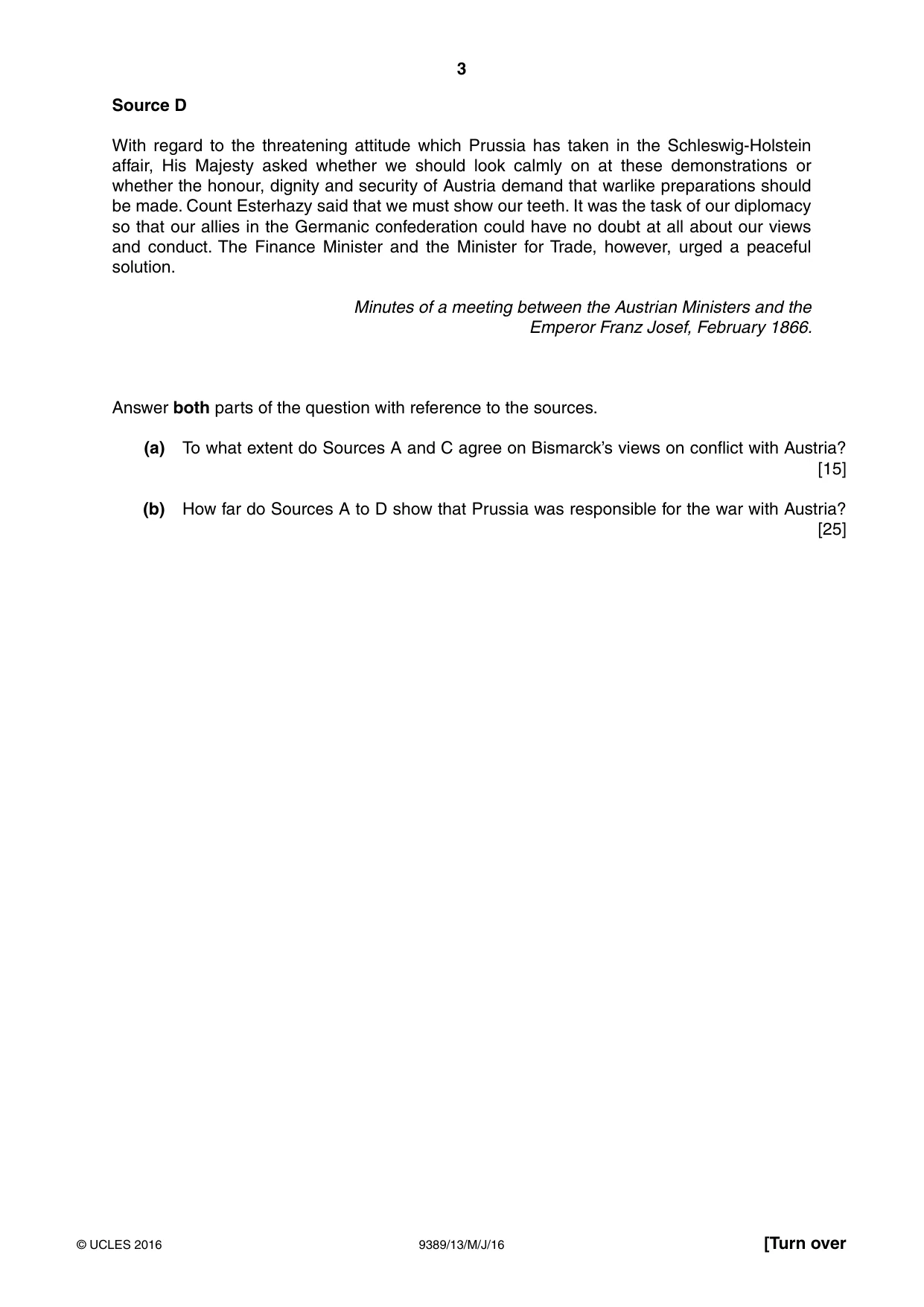
Question paper, page 3
3 9389/13/M/J/16 © UCLES 2016 [Turn over Source D With regard to the threatening attitude which Prussia has taken in the Schleswig-Holstein affair, His Majesty asked whether we should look calmly on at these demonstrations or whether the honour, dignity and security of Austria demand that warlike preparations should be made. Count Esterhazy said that we must show our teeth. It was the task of our diplomacy so that our allies in the Germanic confederation could have no doubt at all about our views and conduct. The Finance Minister and the Minister for Trade, however, urged a peaceful solution. Minutes of a meeting between the Austrian Ministers and the Emperor Franz Josef, February 1866. Answer both parts of the question with reference to the sources. (a) To what extent do Sources A and C agree on Bismarck’s views on conflict with Austria? [15] (b) How far do Sources A to D show that Prussia was responsible for the war with Austria? [25]
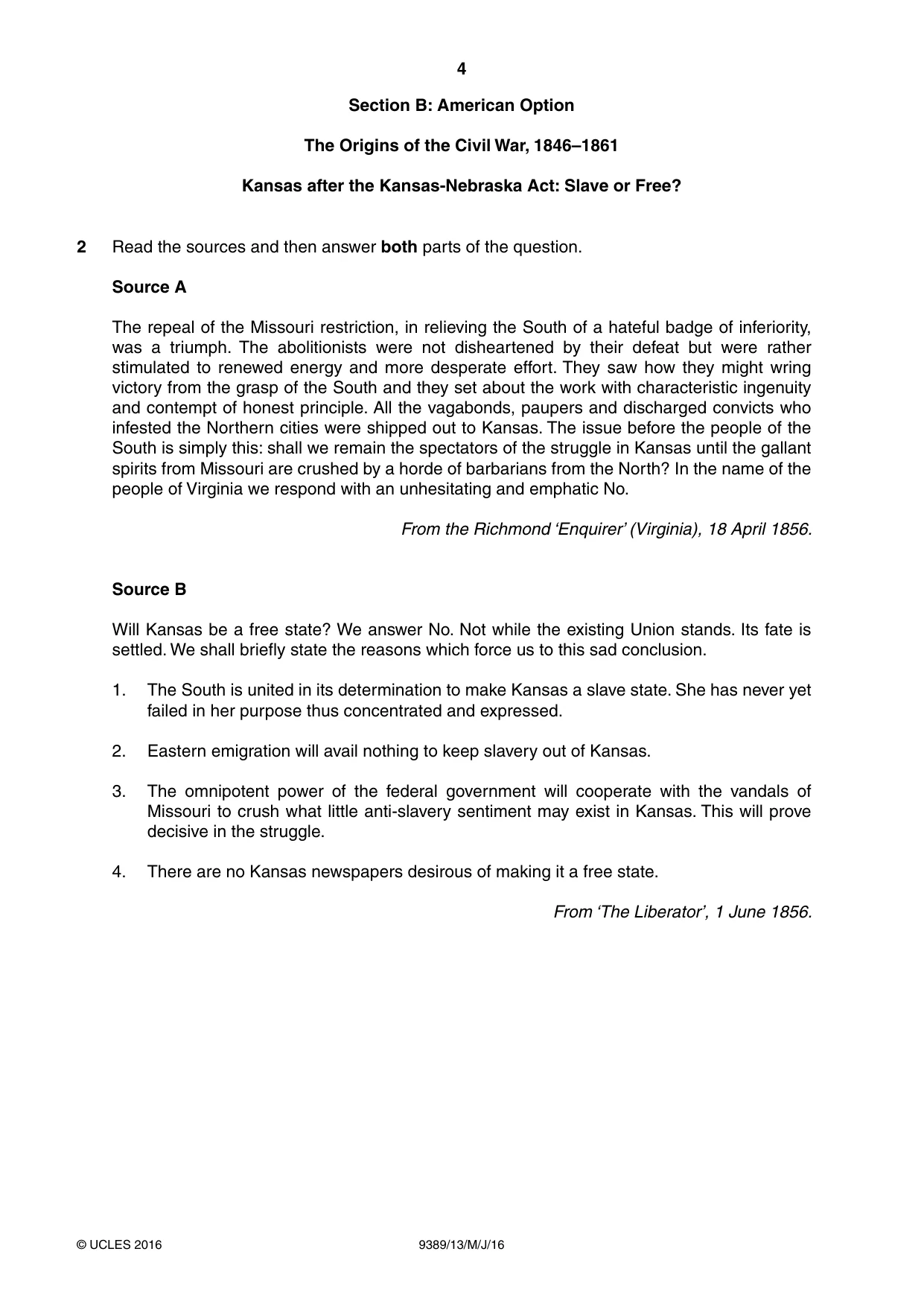
Question paper, page 4
4 9389/13/M/J/16 © UCLES 2016 Section B: American Option The Origins of the Civil War, 1846–1861 Kansas after the Kansas-Nebraska Act: Slave or Free? 2 Read the sources and then answer both parts of the question. Source A The repeal of the Missouri restriction, in relieving the South of a hateful badge of inferiority, was a triumph. The abolitionists were not disheartened by their defeat but were rather stimulated to renewed energy and more desperate effort. They saw how they might wring victory from the grasp of the South and they set about the work with characteristic ingenuity and contempt of honest principle. All the vagabonds, paupers and discharged convicts who infested the Northern cities were shipped out to Kansas. The issue before the people of the South is simply this: shall we remain the spectators of the struggle in Kansas until the gallant spirits from Missouri are crushed by a horde of barbarians from the North? In the name of the people of Virginia we respond with an unhesitating and emphatic No. From the Richmond ‘Enquirer’ (Virginia), 18 April 1856. Source B Will Kansas be a free state? We answer No. Not while the existing Union stands. Its fate is settled. We shall briefly state the reasons which force us to this sad conclusion. 1. The South is united in its determination to make Kansas a slave state. She has never yet failed in her purpose thus concentrated and expressed. 2. Eastern emigration will avail nothing to keep slavery out of Kansas. 3. The omnipotent power of the federal government will cooperate with the vandals of Missouri to crush what little anti-slavery sentiment may exist in Kansas. This will prove decisive in the struggle. 4. There are no Kansas newspapers desirous of making it a free state. From ‘The Liberator’, 1 June 1856.
Question paper, page 5
5 9389/13/M/J/16 © UCLES 2016 [Turn over Source C Can Kansas be made a slave state? Thus far the pro-slavery party has triumphed in Kansas in spite of the abolitionists and their emigrant aid societies. They have raised their millions of money and sent upon us their hordes of fools, armed with Sharpe’s rifles, to trample down our institutions and confiscate our property and drive us from the country. Yet we have peaceably whipped them at the polls, forced them to beg for mercy on the battlefield and proven to the world that truth and justice are on our side. And all this has been accomplished by the hardy squatters without any aid from the South, save now and again a straggling ‘border ruffian’ from Missouri. What then is in the way of making Kansas a slave state? Nothing can prevent it if the southern people do but half their duty. But they must do that or Kansas will be lost and the Union dissolved. From ‘Debow’s Review’, New Orleans (Louisiana), June 1856. Source D We secured the freedom of Kansas while the slaveholders had every possible advantage in the contest. They had full control of every department of the government and were in force on the border of the territory while our emigrants had to make a journey of many hundreds of miles, much through the slave state of Missouri. By the Plan of Freedom adopted by the Emigrant Aid Company, Kansas was made free – very decidedly free – so that when admitted to the Union there was no slave party within her borders. No man, unless he be ignorant of the facts of the Kansas struggle or completely blinded by malice or envy, will ever attempt to defraud the Emigrant Aid Society of the glory of having saved Kansas by defeating the Slave Power in a great and decisive contest. From ‘The Kansas Crusade’ by Eli Thayer, founder of the Emigrant Aid Society, 1889. Answer both parts of the question with reference to the sources. (a) To what extent do Sources B and C agree about the reasons why Kansas would become a slave state? [15] (b) How far do Sources A to D support the assertion that the Pro-Slavery forces had only themselves to blame for their failure to make Kansas a slave state? [25]
Question paper, page 6
6 9389/13/M/J/16 © UCLES 2016 Section C: International Option The Search for International Peace and Security, 1919–1945 The League of Nations in the Period from 1936 to 1938 3 Read the sources and then answer both parts of the question. Source A In 1919, I was a member of the Committee which framed the Covenant, and I well remember the high and noble ideals to which all our thoughts were directed after the terrible ordeals of the War. The disappointment we experience today is bitter. The League is faced with a crisis, demonstrated by the abandonment of sanctions in the Abyssinian dispute. The League can only act by the agreement of its members. It is on the resolve of the Great States for collaboration and peace that the action of the League depends. The League will not be capable of accomplishing its mission so long as the Great States remain bound by rivalries, suspicions, threats and ambitions. Collective security presents evident weaknesses. Nations will hesitate long before going to war over a dispute in which their vital interests are not at stake. The little states remain deeply attached to the League. It is necessary, then, to maintain, defend and consolidate the League. We should not change the Covenant or call its principles into question. We must effect the necessary improvements by a more realistic application of the system of collective security. From an article by the Belgian politician Paul Hymans, 1936. Source B Collective security has been tried out and it has failed. There is no reason why, because the policy of collective security has failed, we should abandon the idea of the League and give up the ideals for which the League stands. But if we have retained any vestige of common sense, surely we must admit that we have tried to impose upon the League a task which was beyond its powers to fulfil. Member nations should review the situation and decide to limit the functions of the League. I believe that this might go far to restore the prestige of the League and the moral influence which it ought to exert in the world. But if the League were to be limited in this way, it must be admitted that it could no longer be relied upon by itself to secure the peace of the world. From a speech by Neville Chamberlain, British Prime Minister, 1936. Source C The framers of the Covenant saw that it would be foolish to create a super-state to override national governments. They rejected the idea, much favoured in France, of a League army or police, or of any other method by which a member state might be compelled to bow to the League’s will. Rather than violate in any way the sovereign rights of nation states, the founders were prepared that their League should be an association of countries, each protected from invasion of its domestic prerogatives by the requirement that any decisions of the League should receive unanimous assent. The League of Nations can be no better than the member states of which it is composed. If they wish for peace, the League provides machinery by which peace may be the better secured and maintained, but League or no League, a state which is resolved on war can always have it. From a book by Herbert Fisher (member of the British government, 1916–22), 1938.
Question paper, page 7
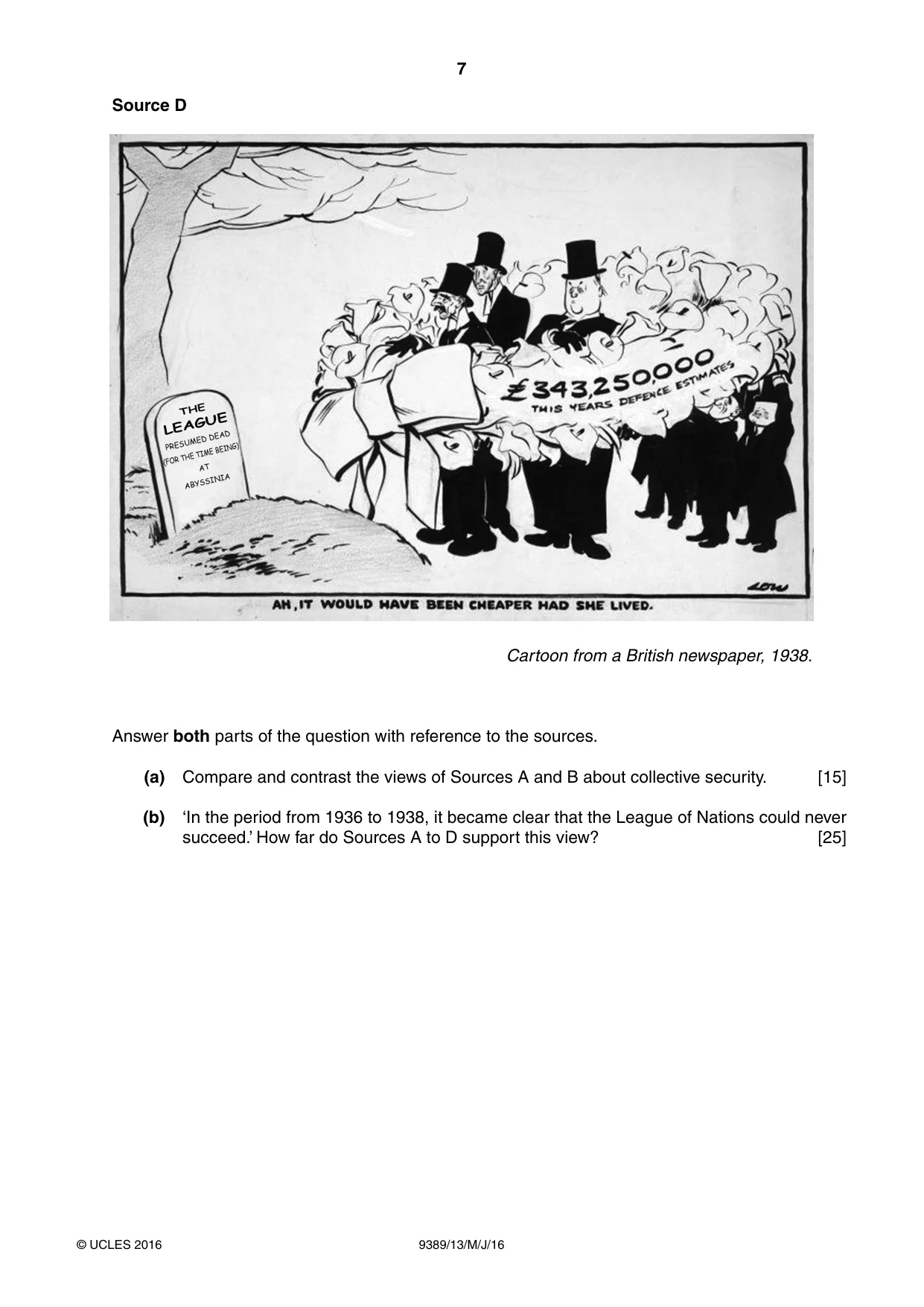
7 9389/13/M/J/16 © UCLES 2016 Source D Cartoon from a British newspaper, 1938. Answer both parts of the question with reference to the sources. (a) Compare and contrast the views of Sources A and B about collective security. [15] (b) ‘In the period from 1936 to 1938, it became clear that the League of Nations could never succeed.’ How far do Sources A to D support this view? [25]
Question paper, page 8
8 9389/13/M/J/16 © UCLES 2016 BLANK PAGE Permission to reproduce items where third-party owned material protected by copyright is included has been sought and cleared where possible. Every reasonable effort has been made by the publisher (UCLES) to trace copyright holders, but if any items requiring clearance have unwittingly been included, the publisher will be pleased to make amends at the earliest possible opportunity. To avoid the issue of disclosure of answer-related information to candidates, all copyright acknowledgements are reproduced online in the Cambridge International Examinations Copyright Acknowledgements Booklet. This is produced for each series of examinations and is freely available to download at www.cie.org.uk after the live examination series. Cambridge International Examinations is part of the Cambridge Assessment Group. Cambridge Assessment is the brand name of University of Cambridge Local Examinations Syndicate (UCLES), which is itself a department of the University of Cambridge.
Mark scheme, page 1
® IGCSE is the registered trademark of Cambridge International Examinations. This document consists of 11 printed pages. © UCLES 2016 [Turn over Cambridge International Examinations Cambridge International Advanced Subsidiary and Advanced Level HISTORY 9389/13 Paper 1 Document Question May/June 2016 MARK SCHEME Maximum Mark: 40 Published This mark scheme is published as an aid to teachers and candidates, to indicate the requirements of the examination. It shows the basis on which Examiners were instructed to award marks. It does not indicate the details of the discussions that took place at an Examiners’ meeting before marking began, which would have considered the acceptability of alternative answers. Mark schemes should be read in conjunction with the question paper and the Principal Examiner Report for Teachers. Cambridge will not enter into discussions about these mark schemes. Cambridge is publishing the mark schemes for the May/June 2016 series for most Cambridge IGCSE®, Cambridge International A and AS Level components and some Cambridge O Level components.
Mark scheme, page 2
Page 2 Mark Scheme Syllabus Paper Cambridge International AS/A Level – May/June 2016 9389 13 © Cambridge International Examinations 2016 Generic levels of response Part (a) Level 4: Makes a developed comparison [12–15] Makes a developed comparison between the two sources, recognising points of similarity and difference. Uses knowledge to evaluate the sources and shows good contextual awareness. Level 3: Compares views and identifies similarities and differences [8–11] Compares the views expressed in the sources, identifying differences and similarities. Begins to explain and evaluate the views using the sources and knowledge. Level 2: Compares views and identifies similarities and/or differences [4–7] Identifies relevant similarities or differences between views/sources and the response may be one- sided with only one aspect explained. Alternatively, both similarities and differences may be mentioned but both aspects lack development. Level 1: Describes content of each source [1–3] Describes or paraphrases the content of the two sources. Very simple comparisons may be made (e.g. one is from a letter and the other is from a speech) but these are not developed. Level 0: No relevant comment on the sources or the issue [0] Part (b) Level 5: Evaluates the sources to reach a sustained judgement [21–25] Answers are well focused, demonstrating a clear understanding of the sources and the question. Reaches a sustained judgement about the extent to which the sources support the statement and weighs the evidence in order to do this. Level 4: Evaluates the sources [16–20] Demonstrates a clear understanding of the sources and the question. Begins to evaluate the material in context, considering the nature, origin and purpose of the sources in relation to the statement. At the top of this level candidates may begin to reach a judgement but this is not sustained. Level 3: Uses the sources to support and challenge the statement [11–15] Makes valid points from the sources to both challenge and support the statement in the question. These comments may be derived from source content or may be about the provenance/nature of the sources. Level 2: Uses the sources to support or challenge the statement [6–10] Makes valid points from the sources to either support the statement in the question or to challenge it. These comments may be derived from source content or may be about the provenance/nature of the sources. Level 1: Does not make valid use of the sources [1–5] Describes the content of the sources with little attempt to link the material to the question. Alternatively, candidates may write an essay about the question without reference to the sources. Level 0: No relevant comment on the sources or the issue [0]
Mark scheme, page 3
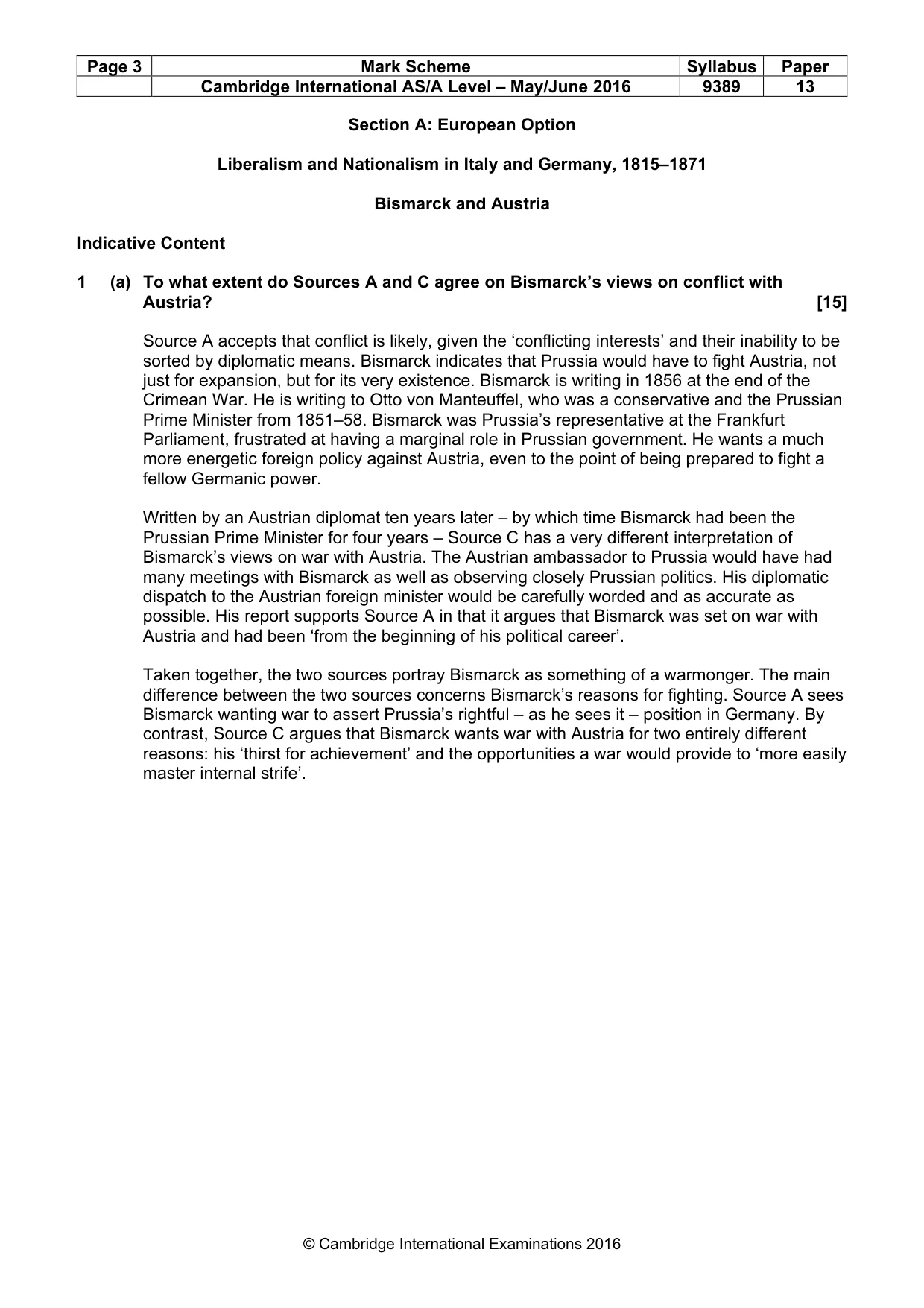
Page 3 Mark Scheme Syllabus Paper Cambridge International AS/A Level – May/June 2016 9389 13 © Cambridge International Examinations 2016 Section A: European Option Liberalism and Nationalism in Italy and Germany, 1815–1871 Bismarck and Austria Indicative Content 1 (a) To what extent do Sources A and C agree on Bismarck’s views on conflict with Austria? [15] Source A accepts that conflict is likely, given the ‘conflicting interests’ and their inability to be sorted by diplomatic means. Bismarck indicates that Prussia would have to fight Austria, not just for expansion, but for its very existence. Bismarck is writing in 1856 at the end of the Crimean War. He is writing to Otto von Manteuffel, who was a conservative and the Prussian Prime Minister from 1851–58. Bismarck was Prussia’s representative at the Frankfurt Parliament, frustrated at having a marginal role in Prussian government. He wants a much more energetic foreign policy against Austria, even to the point of being prepared to fight a fellow Germanic power. Written by an Austrian diplomat ten years later – by which time Bismarck had been the Prussian Prime Minister for four years – Source C has a very different interpretation of Bismarck’s views on war with Austria. The Austrian ambassador to Prussia would have had many meetings with Bismarck as well as observing closely Prussian politics. His diplomatic dispatch to the Austrian foreign minister would be carefully worded and as accurate as possible. His report supports Source A in that it argues that Bismarck was set on war with Austria and had been ‘from the beginning of his political career’. Taken together, the two sources portray Bismarck as something of a warmonger. The main difference between the two sources concerns Bismarck’s reasons for fighting. Source A sees Bismarck wanting war to assert Prussia’s rightful – as he sees it – position in Germany. By contrast, Source C argues that Bismarck wants war with Austria for two entirely different reasons: his ‘thirst for achievement’ and the opportunities a war would provide to ‘more easily master internal strife’.
Mark scheme, page 4
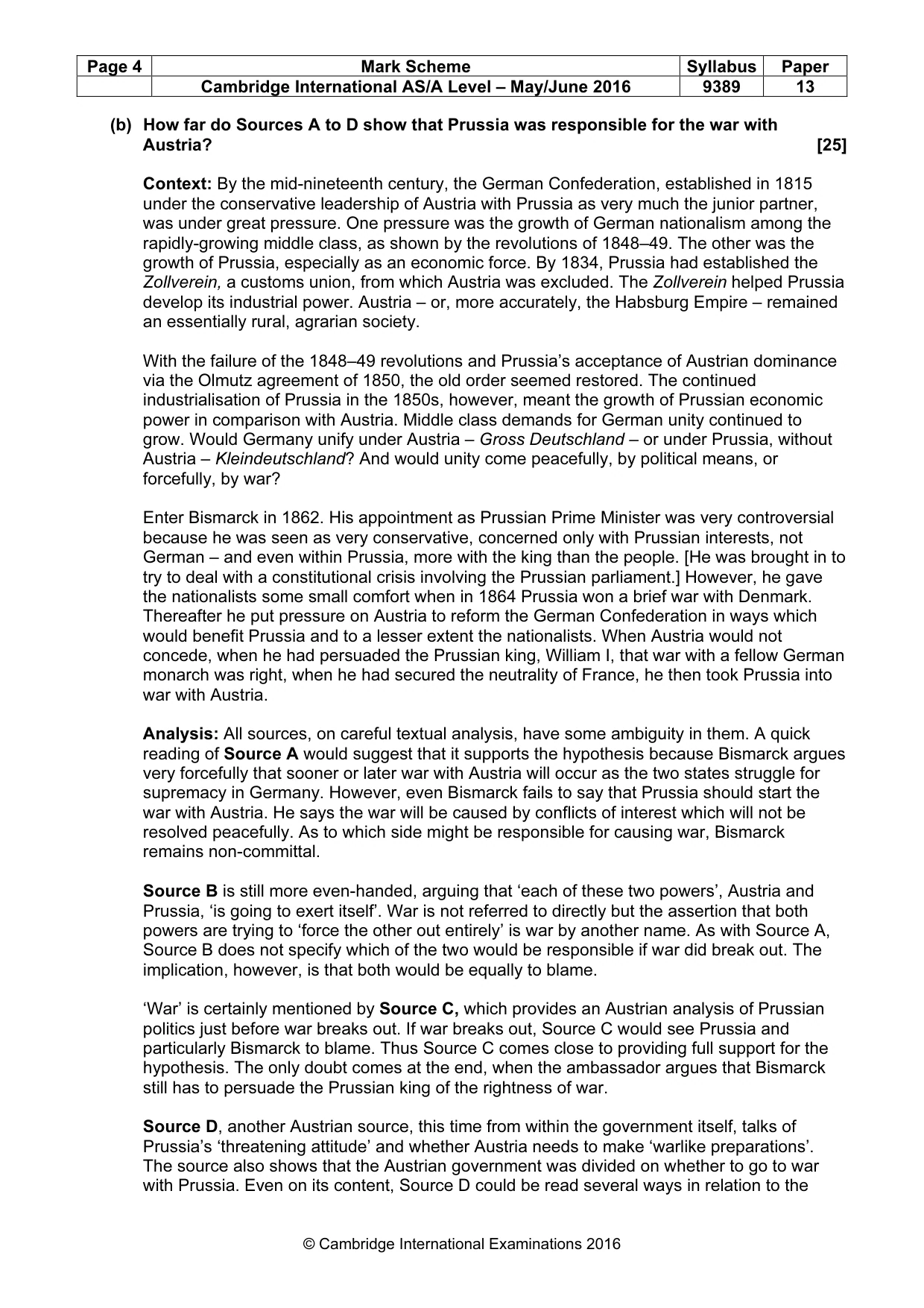
Page 4 Mark Scheme Syllabus Paper Cambridge International AS/A Level – May/June 2016 9389 13 © Cambridge International Examinations 2016 (b) How far do Sources A to D show that Prussia was responsible for the war with Austria? [25] Context: By the mid-nineteenth century, the German Confederation, established in 1815 under the conservative leadership of Austria with Prussia as very much the junior partner, was under great pressure. One pressure was the growth of German nationalism among the rapidly-growing middle class, as shown by the revolutions of 1848–49. The other was the growth of Prussia, especially as an economic force. By 1834, Prussia had established the Zollverein, a customs union, from which Austria was excluded. The Zollverein helped Prussia develop its industrial power. Austria – or, more accurately, the Habsburg Empire – remained an essentially rural, agrarian society. With the failure of the 1848–49 revolutions and Prussia’s acceptance of Austrian dominance via the Olmutz agreement of 1850, the old order seemed restored. The continued industrialisation of Prussia in the 1850s, however, meant the growth of Prussian economic power in comparison with Austria. Middle class demands for German unity continued to grow. Would Germany unify under Austria – Gross Deutschland – or under Prussia, without Austria – Kleindeutschland? And would unity come peacefully, by political means, or forcefully, by war? Enter Bismarck in 1862. His appointment as Prussian Prime Minister was very controversial because he was seen as very conservative, concerned only with Prussian interests, not German – and even within Prussia, more with the king than the people. [He was brought in to try to deal with a constitutional crisis involving the Prussian parliament.] However, he gave the nationalists some small comfort when in 1864 Prussia won a brief war with Denmark. Thereafter he put pressure on Austria to reform the German Confederation in ways which would benefit Prussia and to a lesser extent the nationalists. When Austria would not concede, when he had persuaded the Prussian king, William I, that war with a fellow German monarch was right, when he had secured the neutrality of France, he then took Prussia into war with Austria. Analysis: All sources, on careful textual analysis, have some ambiguity in them. A quick reading of Source A would suggest that it supports the hypothesis because Bismarck argues very forcefully that sooner or later war with Austria will occur as the two states struggle for supremacy in Germany. However, even Bismarck fails to say that Prussia should start the war with Austria. He says the war will be caused by conflicts of interest which will not be resolved peacefully. As to which side might be responsible for causing war, Bismarck remains non-committal. Source B is still more even-handed, arguing that ‘each of these two powers’, Austria and Prussia, ‘is going to exert itself’. War is not referred to directly but the assertion that both powers are trying to ‘force the other out entirely’ is war by another name. As with Source A, Source B does not specify which of the two would be responsible if war did break out. The implication, however, is that both would be equally to blame. ‘War’ is certainly mentioned by Source C, which provides an Austrian analysis of Prussian politics just before war breaks out. If war breaks out, Source C would see Prussia and particularly Bismarck to blame. Thus Source C comes close to providing full support for the hypothesis. The only doubt comes at the end, when the ambassador argues that Bismarck still has to persuade the Prussian king of the rightness of war. Source D, another Austrian source, this time from within the government itself, talks of Prussia’s ‘threatening attitude’ and whether Austria needs to make ‘warlike preparations’. The source also shows that the Austrian government was divided on whether to go to war with Prussia. Even on its content, Source D could be read several ways in relation to the
Mark scheme, page 5
Page 5 Mark Scheme Syllabus Paper Cambridge International AS/A Level – May/June 2016 9389 13 © Cambridge International Examinations 2016 hypothesis: that Austria was close to going to war; that Austria was unwilling to go to war; that Prussia provoked Austria into going to war. The last two suggest that Source D tends to support the hypothesis. Evaluation: Serious doubts can be raised about the reliability of all four sources in relation to the issue of responsibility for causing the Austrian-Prussian war of 1866. Source A is of little value, even though (a) it is written by the man who led Prussia into the war and (b) it argues for the inevitability of such a war. The source is unreliable because it is written ten years before the war broke out by a politician who was a long way from the centre of Prussian government at a time when Prussia was still Austria’s junior partner in Germany. Source A might show how prescient Bismarck could be. It cannot be used as primary evidence that Prussia caused the war of 1866. The other three sources might be more reliable because they are from the months leading up to the war itself – though none are from Prussia. Source B is from the prime minister of a minor south German state, caught in the middle of the struggle for supremacy between the two leading German states. The source shows that Wurttemberg is a member of the Prussia-dominated Zollverein. Whether that would make her PM pro- or anti-Prussian is impossible to say. In reality, as a south German state, it was more pro-Austrian. In the context of rapidly-worsening relations between Austria and Prussia, Source B is remarkably even-handed and thus worth trusting more than the others. Sources C and D are contemporary Austrian sources and thus almost bound to blame Prussia for the war. Source C is the one which more definitely blames Prussia. Detailed contextual knowledge supports Source C and its assertion that the main obstacle facing Bismarck’s plans for war was the opposition of William I. Once Bismarck had won the king round, as he did in the weeks before war began, war was inevitable. Source D is more even- handed. It is hard to evaluate because more detailed knowledge of the debates and decisions of the Austrian government in the spring of 1866 is needed. It should be put to one side. Though secondary accounts of the war usually point the finger of blame at Bismarck, these sources, once evaluated, do not provide enough convincing evidence that Prussia caused the war.
Mark scheme, page 6
Page 6 Mark Scheme Syllabus Paper Cambridge International AS/A Level – May/June 2016 9389 13 © Cambridge International Examinations 2016 Section B: American Option The Origins of the Civil War, 1846–1861 Kansas after the Kansas-Nebraska Act: Slave or Free? Indicative Content 2 (a) To what extent do Sources B and C agree about the reasons why Kansas would become a slave state? [15] Source B identifies four specific reasons why Kansas would become a slave state. Only one of those is mentioned by Source C, namely the ineffectiveness of emigration aid societies. The main reason that Source C sees as making it likely that Kansas would become a slave state was the efforts of pro-slavery forces within Kansas. They have won both in elections and on the battlefield. Only the occasional border ruffian has helped Kansas supporters of slavery. Source C does continue by arguing that those efforts by themselves would not be enough. The people of the South must help them out. This appeal to the South suggests that the South is not doing much to help Kansas become a slave state. This is in marked contrast to Source B which talks of the South being united in wanting to make Kansas a slave state. Also Source B stresses the importance of the federal government and the ‘vandals of Missouri’ who will work together to impose slavery on Kansas, a point not mentioned in Source C. There are a number of comparisons and contrasts which can be made. In terms of the sources, Source B comes from the Liberator, an abolitionist paper, which makes its assertions something of a surprise. Source C, mainly an assertion of Southern success, comes as no surprise, even if its final doubt about the likelihood of success does undermine the rest of the extract. (b) How far do Sources A to D support the assertion that the Pro-Slavery forces had only themselves to blame for their failure to make Kansas a slave state? [25] Context: The balance of free and slave states within the USA was always a controversial issue. The Missouri Compromise of 1820, mentioned briefly by Source A, applied to lands gained from France via the Louisiana Purchase. It established a border at latitude 36 30’ beyond which slavery could not expand. The Compromise of 1850 did not extend that line westwards and apply it to lands gained from Mexico in 1848, as might have been expected. Instead it introduced the idea of popular sovereignty to two new territories, Utah and New Mexico, whereby the [white male] residents of those lands would choose whether the lands were free or slave as they applied to become US states. This meant that slavery might expand north of the 1820 Compromise line. [Neither territory chose slavery.] Those wanting to make the lands of Kansas and Nebraska, acquired as part of the Louisiana Purchase, into formal territories of the USA included the principle of popular sovereignty in the Kansas-Nebraska Act of 1854. This also meant the possible expansion of slavery beyond 36 30’ north, in effect ending this part of the Missouri Compromise. Few white settlers lived in Kansas, which had been Indian territory until then. The 1854 Act created a rush of settlers into the territory from both North and South. The latter were labelled ‘border ruffians’. A series of clashes, both political and physical, occurred in the mid 1850s before those opposed to slavery won the day. Kansas joined the USA as a free state in January 1861.
Mark scheme, page 7
Page 7 Mark Scheme Syllabus Paper Cambridge International AS/A Level – May/June 2016 9389 13 © Cambridge International Examinations 2016 Analysis: Source A focuses on the strength and determination of Northern abolitionists, as evidenced by their work in Kansas until the spring of 1856, when the balance was tilting in favour of the anti-slavery groups in Kansas. The second part of Source A is thus an appeal to the states and peoples of the South to help tilt the balance in the opposite direction. Source A thus explains two main reasons for the lack of success of pro-slavery forces: the determination of the North and the passivity of the South. This means that Source A neither fully supports nor fully challenges the assertion. Source B is unusual because it believes that pro-slavery forces would triumph. Contextual knowledge could be used to relate the assertions of Source B to the question. Cross- referencing is probably more helpful. Where did the source go wrong? The other sources make it evident that Source B overestimated the power of the South and federal government while underestimating the power of eastern immigration. There was also an active set of newspapers in Kansas supporting the cause of freedom. Thus Source B does not really point the finger of blame at the South. Source C, however, does say that pro-slavery forces, on the advance in Kansas, would be defeated if the South does not intervene in Kansas. Source C fully supports the hypothesis. Source D takes the opposite view, arguing that the defeat of pro-slavery forces was the result of the determination shown by forces for freedom, especially in the shape of emigrant aid societies from the North East. Source analysis thus shows Sources B and D challenging the assertion while Source C supports it and Source A can be used either way. Evaluation: Source D is probably the easiest to evaluate. There are three reasons why its evidence needs to be treated with great caution: it is a paean of praise for the Emigrant Aid Society, it is written by its founder; it is published some thirty years later and thus presumably written at that time, when memories are more fallible. Thus the first piece of evidence against the assertion is greatly devalued. Its companion source, B, also has to be discounted. It is from a partisan Northern source whose evidence can easily be disproved, as explained above. It is surprising that a newspaper on the side of freedom is quite so pessimistic about the chances of freedom in the new territory of Kansas – what effect will this have on the readers of the Liberator? But this surprise does not make the source a valuable one. The two sources from the South, A and C, are in their own ways equally unreliable. Source A, in describing the free-soilers who moved to Kansas as ‘vagabonds, paupers and discharged convicts’, greatly distorts reality. Source C also distorts the two sides when it refers to Northern settlers as ‘fools’ and pro-slavery supporters as ‘hardy squatters’. This is a set of documents in which all four sources are unreliable to some degree. Contextual knowledge is needed to place these sources in their historical place. The chance of establishing slavery in a state as far north as Kansas was most unlikely. Though adjoining the slave state of Missouri, it was that much further west, making slave-based agriculture impossible to establish.
Mark scheme, page 8
Page 8 Mark Scheme Syllabus Paper Cambridge International AS/A Level – May/June 2016 9389 13 © Cambridge International Examinations 2016 Section C: International Option The Search for International Peace and Security, 1919–1945 The League of Nations in the Period from 1936 to 1938 Indicative Content 3 (a) Compare and contrast the views of Sources A and B about collective security. [15] Hymans and Chamberlain agree on two issues – firstly, that the concept of collective security has been unsuccessful; secondly, that the League of Nations is an important institution which should continue to exist despite the problems it has faced. However, they differ over what role the League should play in the future and what reforms are necessary to enable it to play that role effectively. Chamberlain (Source B) argues that the League should have a much reduced role in international affairs and that its functions should be limited to what it could reasonably be expected to undertake successfully. He does not specify what these functions should be, but he is clear that they should not include the concept of collective security which, he argues, had palpably failed. The League had been established with the primary aim of maintaining international peace and security – Chamberlain argues that the League has failed to achieve this and, as a result, there needs to be a fundamental revision of the League’s stated aims. The implication of the abandonment of the policy of collective security is that there need to be changes to the Covenant, in particular the removal of those Articles (e.g. 10 and 16) which oblige member states to take collective action against unwarranted aggression. Chamberlain suggests that a League of Nations with reduced functions could still play a vital role in exerting a ‘moral influence’ over international affairs. However, he realises that it ‘could no longer be relied upon by itself to secure the peace of the world’, and that it would need to be supplemented by other strategies. Unlike Chamberlain, Hymans (Source A) does not wish to see an end to the principle of collective security, simply ‘a more realistic application’ of it. While Chamberlain is arguing for a reduction in the League’s powers, Hymans believes that it is necessary to ‘maintain, defend and consolidate’ the League. Hymans is against any changes to either the Covenant or the League’s basic principles and aims; he feels that any such changes would fundamentally weaken the League and further undermine its prestige, especially with the smaller, more vulnerable states. Hymans attributes the failings of the League not to the wording of its Covenant but to the failure of the Great States to set aside their own national interests and work collaboratively in the interests of world peace. He suggests that it is this issue which needs to be addressed, rather than seeking to weaken the powers of the League. Both sources come from 1936, at a time when the League’s failure to confront aggression was becoming clear. In the cases of Japanese aggression in Manchuria and the Italian invasion of Abyssinia, the League had failed to take effective action. This was largely because the national interests of the Great States (i.e. Britain and France) were at odds with their obligations to the League of Nations. As a result of its failure to confront such aggression, the League was losing prestige. As Prime Minister of Britain, Chamberlain is arguing from the viewpoint of a Great State; he is being realistic in his assessment that the Great States could not be relied upon to support the League regarding collective action (although he does not accept that the Great States should be blamed for the League’s weaknesses and nor does he apologise for Britain’s contribution to them). Coming from one of the small, more vulnerable states, Hymans is especially keen for the League to survive and prosper since it potentially offers countries such as Belgium the security which they
Mark scheme, page 9
Page 9 Mark Scheme Syllabus Paper Cambridge International AS/A Level – May/June 2016 9389 13 © Cambridge International Examinations 2016 could not provide for themselves. He has no hesitation in blaming the Great States for their failure to provide adequate support for the League. (b) ‘In the period from 1936 to 1938, it became clear that the League of Nations could never succeed.’ How far do Sources A to D support this view? [25] Context: The League of Nations had been established with the aims of enhancing international cooperation and securing future world peace and security. Member states would work together to ensure that acts of unwarranted aggression were confronted and that international disputes were addressed by arbitration. When moral persuasion failed, League members would work collectively against recalcitrant states in the form of economic sanctions or, if necessary, military action. The success of the League was, therefore, entirely dependent on the support of its members. This support was not always forthcoming, largely because the vested national interests of member states sometimes conflicted with their obligations to the League. This problem became particularly evident during the 1930s when the League failed to adequately confront aggression in Manchuria, the Spanish Civil War and Abyssinia. In the case of Abyssinia, one League member was invading another, yet the League did nothing beyond the imposition of weak and ineffective economic sanctions against Italy. As a result, smaller and vulnerable states lost faith in the League’s ability to provide them with security. Aggressive states, such as Germany, Japan and Italy had all left the League by 1936. Britain and France, the strongest nations remaining in the League, were following a policy of appeasement and did not want to confront aggression which did not directly affect their own national interests for fear of a major war. By the late 1930s, with the League’s weaknesses exposed, Britain and France began increasing their own national armaments as a defence against the growing menace of the fascist powers. Analysis: In support of the hypothesis – Hymans (Source A) expresses ‘bitter disappointment’ regarding the crisis facing the League of Nations following its failure to prevent or confront the Italian invasion of Abyssinia. He clearly feels that the League has failed to live up to the ‘high and noble ideals’ which characterised the drafting of the Covenant in 1919. He implies that the League has lost credibility with the Great States, which, because of their own rivalries and national interests, have not been committed to it. It is clear from Chamberlain`s speech (Source B) that the League’s prestige has been adversely affected by the failure of collective security. He argues that expectations of what the League could achieve had been too ambitious and that it was necessary to review and reduce its aims and methods. In particular, he suggests that the concept of collective security, the basis on which the League was intended to confront aggression and threats of war, should be abandoned. He clearly believes that the League does not provide a credible means of guaranteeing international peace and security. Fisher (Source C) argues that the League of Nations never was a credible means of ensuring international peace because of its reliance on the support of member states. Without its own army or police force, the League lacked the power to enforce its decisions without the commitment and support of its member states. The League could only act with the unanimous consent of the member states and, given the rivalries which existed between them, such unanimity was unlikely to be achieved over major issues. The cartoon (Source D) depicts the League as dead and buried as a result of its failure to confront unwarranted aggression, particularly in the case of the Italian invasion of Abyssinia.
Mark scheme, page 10
Page 10 Mark Scheme Syllabus Paper Cambridge International AS/A Level – May/June 2016 9389 13 © Cambridge International Examinations 2016 The implication of this is that the League of Nations is no longer credible as a means of securing international peace and security. In challenging the hypothesis – Despite the disappointment he feels regarding the League’s failures over Abyssinia, Hymans argues that the League is still strongly supported by the smaller (and more vulnerable) states, such as Belgium. He argues that there is nothing wrong with either the stated aims of the League or the wording of its Covenant – these should remain the same, but there should be better methods of ensuring the compliance of member states with the League’s decisions. With a tightening up of the procedures relating to collective security, he believes that the League of Nations remains both viable and credible. Chamberlain (Source B) does not suggest that the League of Nations should be abandoned, merely that its aims and methods should be refined. Chamberlain feels that, with a redefined role, the League could regain its lost prestige and continue to exert a moral influence over international affairs. Fisher (Source C) argues that the problems lie not with the League itself but with its member states. He sees the League’s inability to compel member states to support its decisions as a fundamental weakness which had been present from the very beginning of the League. Although the failure to confront Italian aggression in Italy had fully exposed this weakness, it was not a new phenomenon and had always been a threat to the League’s success. He implies that the concept of the League was idealistic and never provided a credible means of preventing aggression by warlike states. Although the cartoon (Source D) implies that the League had died (lost all credibility) as a result of its failure to confront Italian aggression in Abyssinia, it does not rule out the possibility of its survival; the League is only ‘Presumed dead – for the time being’. The cartoon depicts British people bemoaning the presumed death of the League and honouring it with a wreath. In the absence of the League to provide guarantees of world peace, Britain is forced to spend more on its own defence budget. The implications are that there remains support for the League, that there is the possibility of it being restored and that it has not lost all credibility. Evaluation: Source A – Contextual knowledge confirms that Paul Hymans was a strong advocate of an international organisation designed to guarantee world peace and security. He had made such proposals to the Belgian government even before the establishment of the Committee which drafted the Covenant in 1919, a Committee of which he was a member. He remained an active supporter of the League throughout his life, serving as its President on two occasions. Given Hymans’ strong association with the League, it is unlikely that he would be critical of it or desire changes to its Covenant or structure. He is keen, therefore, to lay the blame for the League’s weaknesses and failures not on the League itself, but on the Great States which have failed to keep their commitment to it. Hymans represented Belgium, a small and potentially vulnerable state whose security depended on guarantees provided by the League. Unable to defend itself, Belgium was desperate for the League to survive and operate effectively. The article was written in 1936, when the League’s failure to confront international problems had become evident (e.g. Manchuria, Spanish Civil War, Abyssinia, Hitler’s defiance of the Treaty of Versailles). Source B – A speech delivered at a similar time to Hymans’ article. Chamberlain represented one of the Great States of which Hymans was so critical. The League’s inability to confront unwarranted aggression in the 1930s owed much to Britain’s fear of war and reluctance to go against its own national interests (e.g. in the case of Abyssinia, Britain’s desire to maintain an alliance with Italy took precedence over its League commitment to protect a member state). Chamberlain would clearly not wish to openly admit that Britain was
Mark scheme, page 11
Page 11 Mark Scheme Syllabus Paper Cambridge International AS/A Level – May/June 2016 9389 13 © Cambridge International Examinations 2016 at least in part responsible for the League’s failure. Therefore, he is keen to lay the blame on the League itself, claiming that the Covenant was unrealistic. Chamberlain was a strong exponent of appeasement, and this is clearly evident in his dismissal of collective security. Source C – Written in 1938, at a time when the prospects of another war seemed high in Europe and countries were preparing for it by increasing their expenditure on armaments. There had been a number of acts of unwarranted aggression during the 1930s and, by 1938, Hitler’s activities were causing major concern. Fisher clearly highlights the basic dilemma which had faced those who designed the League of Nations Covenant. The Great States would not have joined the League if this meant sacrificing their national sovereignty (it was fear of this which led to the USA’s decision not to join). Hence, the Covenant was rather vague regarding the obligations of member states to support the League’s decisions (e.g. Articles 10 and 16). Without the guarantee of support from member states, and without its own army or police force, the League would inevitably lack power and authority. In essence, Fisher is agreeing with Hymans (A) that the League’s weaknesses stemmed from the lack of commitment it received from the Great States. Equally, however, he is agreeing with Chamberlain (B) that the League’s aims were too ambitious. Source D – The cartoon is heavily sarcastic. It shows Britain lamenting the ‘death’ of the League of Nations, despite the fact that Britain was in no small way responsible for it. The indecision which had characterised the League’s activities during the 1930s is reflected in the words on the tombstone – the League might or might not be dead; it might or might not be ‘reincarnated’. Self-interest had prevented Britain from supporting the League, yet now self- interest (i.e. reducing the defence budget) might lead Britain to support its revival. The basic message is that if the League of Nations had been stronger and more effective in confronting aggression during the 1930s, the world would not now be facing the prospect of another major war. The cartoon is prophetic in the sense that the United Nations was created after WWII with similar aims to those of the League after WWI (‘Presumed dead – for the time being’).
What you needed in this session
Cambridge’s own grade thresholds for 2016 May/June, Paper 1 · Variant 3. A higher threshold means an easier paper — the bar moves with how the cohort did.