Cambridge A Level History 9389 — 2016 May/June Paper 1 · Variant 1
9389/11/M/J/16 · 40 marks · ≈45 min
The question paper and its mark scheme, free to read here and free to download. This is Cambridge’s own paper, exactly as it was sat.
Question paper8 pages
Mark scheme9 pages
Answers below. Sit the paper first if you are practising.
Paper as text
Question paper, page 1
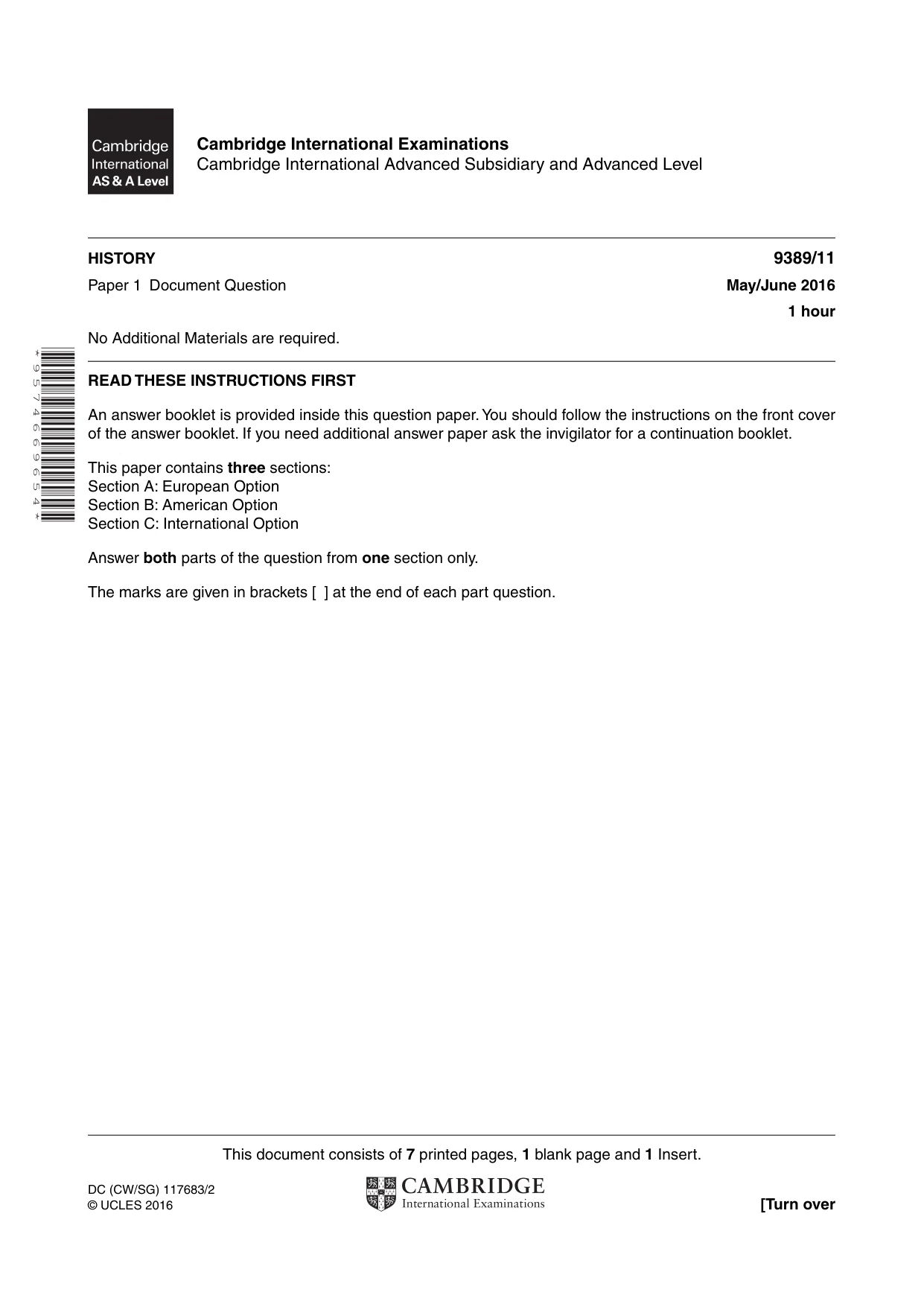
This document consists of 7 printed pages, 1 blank page and 1 Insert. DC (CW/SG) 117683/2 © UCLES 2016 [Turn over Cambridge International Examinations Cambridge International Advanced Subsidiary and Advanced Level * 9 5 7 4 6 6 9 6 5 4 * HISTORY 9389/11 Paper 1 Document Question May/June 2016 1 hour No Additional Materials are required. READ THESE INSTRUCTIONS FIRST An answer booklet is provided inside this question paper. You should follow the instructions on the front cover of the answer booklet. If you need additional answer paper ask the invigilator for a continuation booklet. This paper contains three sections: Section A: European Option Section B: American Option Section C: International Option Answer both parts of the question from one section only. The marks are given in brackets [ ] at the end of each part question.
Question paper, page 2
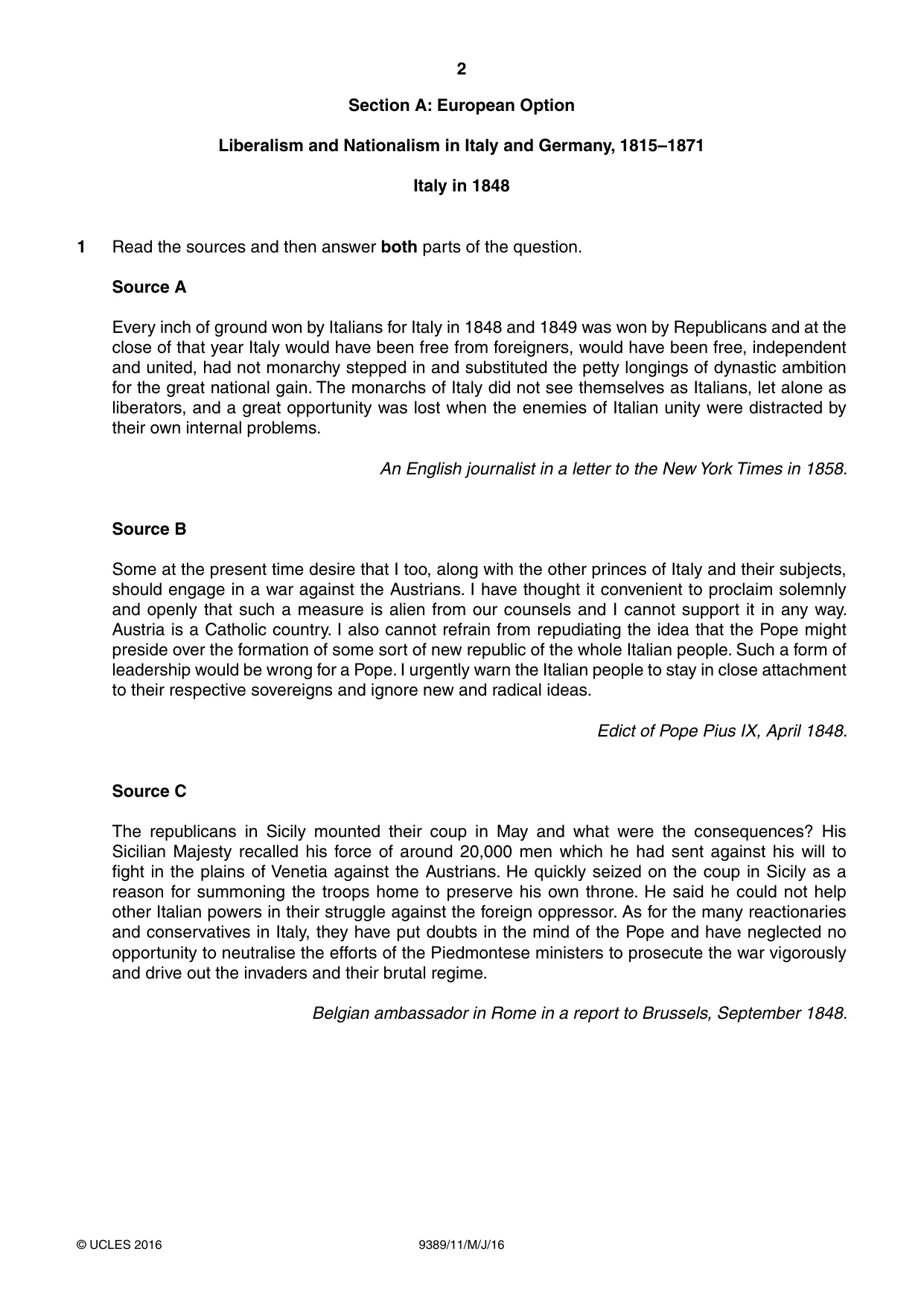
2 9389/11/M/J/16 © UCLES 2016 Section A: European Option Liberalism and Nationalism in Italy and Germany, 1815–1871 Italy in 1848 1 Read the sources and then answer both parts of the question. Source A Every inch of ground won by Italians for Italy in 1848 and 1849 was won by Republicans and at the close of that year Italy would have been free from foreigners, would have been free, independent and united, had not monarchy stepped in and substituted the petty longings of dynastic ambition for the great national gain. The monarchs of Italy did not see themselves as Italians, let alone as liberators, and a great opportunity was lost when the enemies of Italian unity were distracted by their own internal problems. An English journalist in a letter to the New York Times in 1858. Source B Some at the present time desire that I too, along with the other princes of Italy and their subjects, should engage in a war against the Austrians. I have thought it convenient to proclaim solemnly and openly that such a measure is alien from our counsels and I cannot support it in any way. Austria is a Catholic country. I also cannot refrain from repudiating the idea that the Pope might preside over the formation of some sort of new republic of the whole Italian people. Such a form of leadership would be wrong for a Pope. I urgently warn the Italian people to stay in close attachment to their respective sovereigns and ignore new and radical ideas. Edict of Pope Pius IX, April 1848. Source C The republicans in Sicily mounted their coup in May and what were the consequences? His Sicilian Majesty recalled his force of around 20,000 men which he had sent against his will to fight in the plains of Venetia against the Austrians. He quickly seized on the coup in Sicily as a reason for summoning the troops home to preserve his own throne. He said he could not help other Italian powers in their struggle against the foreign oppressor. As for the many reactionaries and conservatives in Italy, they have put doubts in the mind of the Pope and have neglected no opportunity to neutralise the efforts of the Piedmontese ministers to prosecute the war vigorously and drive out the invaders and their brutal regime. Belgian ambassador in Rome in a report to Brussels, September 1848.
Question paper, page 3
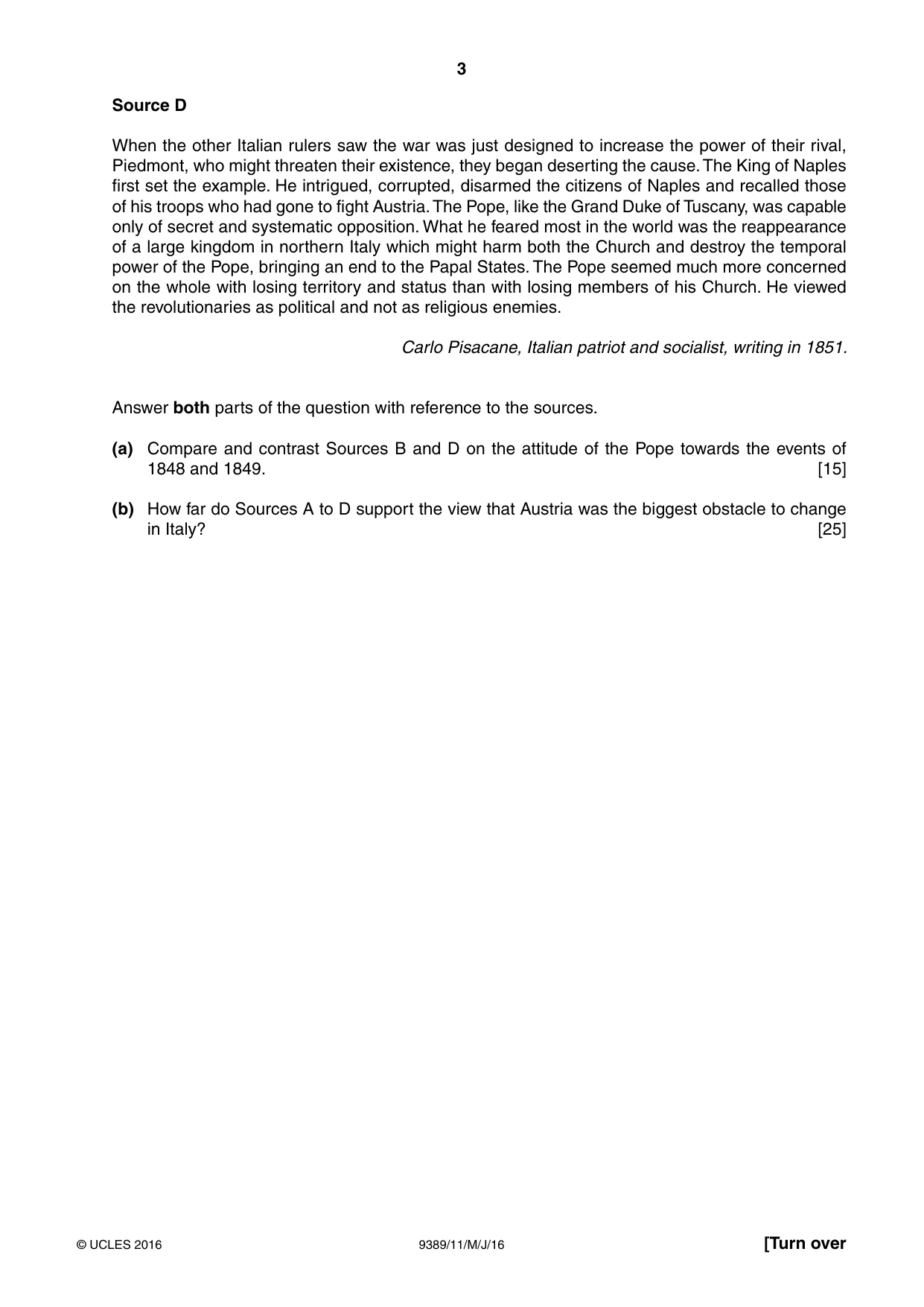
3 9389/11/M/J/16 © UCLES 2016 [Turn over Source D When the other Italian rulers saw the war was just designed to increase the power of their rival, Piedmont, who might threaten their existence, they began deserting the cause. The King of Naples first set the example. He intrigued, corrupted, disarmed the citizens of Naples and recalled those of his troops who had gone to fight Austria. The Pope, like the Grand Duke of Tuscany, was capable only of secret and systematic opposition. What he feared most in the world was the reappearance of a large kingdom in northern Italy which might harm both the Church and destroy the temporal power of the Pope, bringing an end to the Papal States. The Pope seemed much more concerned on the whole with losing territory and status than with losing members of his Church. He viewed the revolutionaries as political and not as religious enemies. Carlo Pisacane, Italian patriot and socialist, writing in 1851. Answer both parts of the question with reference to the sources. (a) Compare and contrast Sources B and D on the attitude of the Pope towards the events of 1848 and 1849. [15] (b) How far do Sources A to D support the view that Austria was the biggest obstacle to change in Italy? [25]
Question paper, page 4
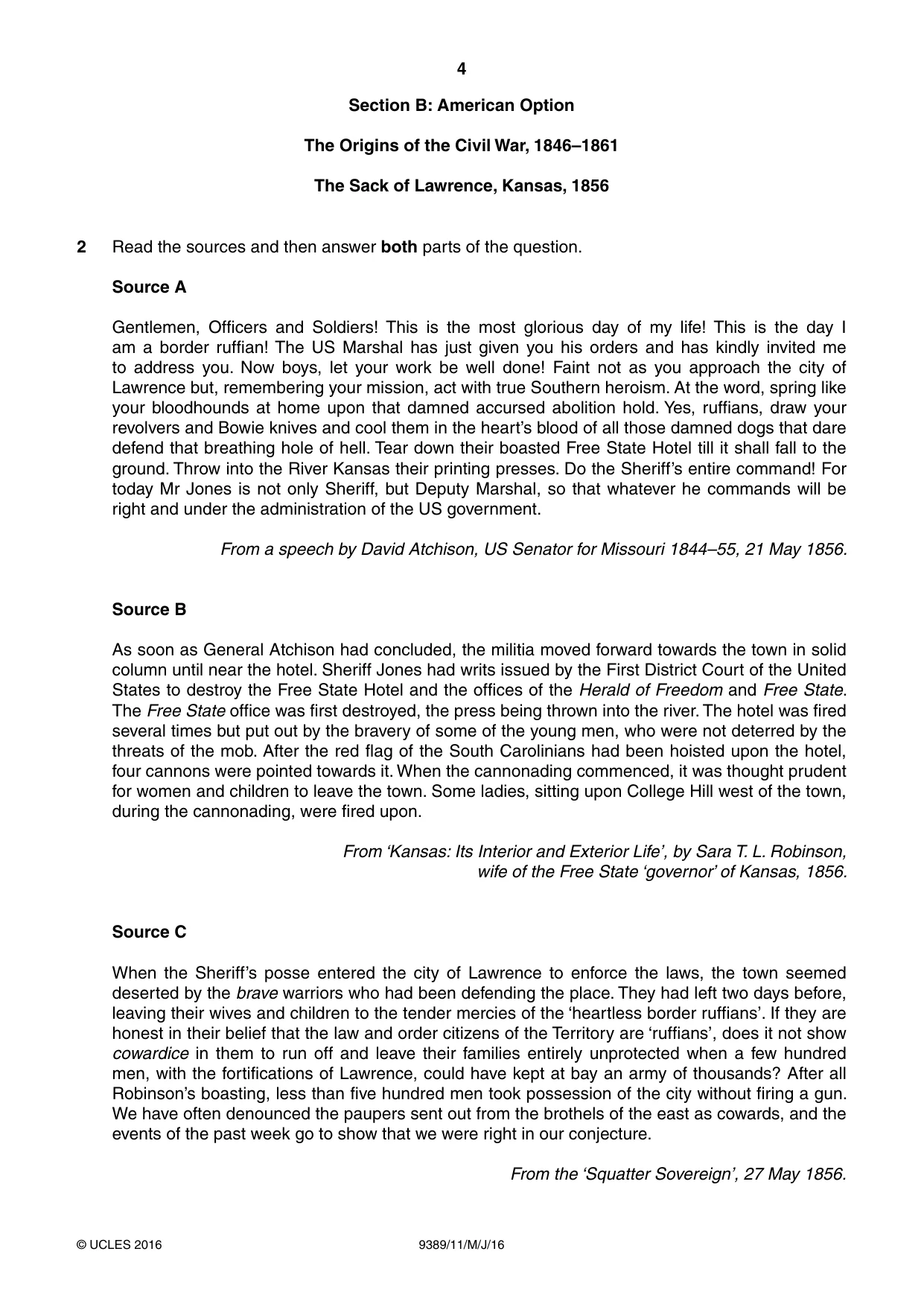
4 9389/11/M/J/16 © UCLES 2016 Section B: American Option The Origins of the Civil War, 1846–1861 The Sack of Lawrence, Kansas, 1856 2 Read the sources and then answer both parts of the question. Source A Gentlemen, Officers and Soldiers! This is the most glorious day of my life! This is the day I am a border ruffian! The US Marshal has just given you his orders and has kindly invited me to address you. Now boys, let your work be well done! Faint not as you approach the city of Lawrence but, remembering your mission, act with true Southern heroism. At the word, spring like your bloodhounds at home upon that damned accursed abolition hold. Yes, ruffians, draw your revolvers and Bowie knives and cool them in the heart’s blood of all those damned dogs that dare defend that breathing hole of hell. Tear down their boasted Free State Hotel till it shall fall to the ground. Throw into the River Kansas their printing presses. Do the Sheriff’s entire command! For today Mr Jones is not only Sheriff, but Deputy Marshal, so that whatever he commands will be right and under the administration of the US government. From a speech by David Atchison, US Senator for Missouri 1844–55, 21 May 1856. Source B As soon as General Atchison had concluded, the militia moved forward towards the town in solid column until near the hotel. Sheriff Jones had writs issued by the First District Court of the United States to destroy the Free State Hotel and the offices of the Herald of Freedom and Free State. The Free State office was first destroyed, the press being thrown into the river. The hotel was fired several times but put out by the bravery of some of the young men, who were not deterred by the threats of the mob. After the red flag of the South Carolinians had been hoisted upon the hotel, four cannons were pointed towards it. When the cannonading commenced, it was thought prudent for women and children to leave the town. Some ladies, sitting upon College Hill west of the town, during the cannonading, were fired upon. From ‘Kansas: Its Interior and Exterior Life’, by Sara T. L. Robinson, wife of the Free State ‘governor’ of Kansas, 1856. Source C When the Sheriff’s posse entered the city of Lawrence to enforce the laws, the town seemed deserted by the brave warriors who had been defending the place. They had left two days before, leaving their wives and children to the tender mercies of the ‘heartless border ruffians’. If they are honest in their belief that the law and order citizens of the Territory are ‘ruffians’, does it not show cowardice in them to run off and leave their families entirely unprotected when a few hundred men, with the fortifications of Lawrence, could have kept at bay an army of thousands? After all Robinson’s boasting, less than five hundred men took possession of the city without firing a gun. We have often denounced the paupers sent out from the brothels of the east as cowards, and the events of the past week go to show that we were right in our conjecture. From the ‘Squatter Sovereign’, 27 May 1856.
Question paper, page 5
5 9389/11/M/J/16 © UCLES 2016 [Turn over Source D The attack and burning of Lawrence brought a great change in popular feeling. ‘We will stand it no longer,’ was the substance of what I heard on every side from the free-state adherents. Before I left, it had become the universal conviction that a civil war had commenced. At the same moment came the news from Washington of the outrage committed in the Senate chamber upon the person of Mr Sumner. I well remember the effect this had upon many, who concluded that the rule of force and violence had been inaugurated even in the highest places of the land and was no longer restricted to the lawless inhabitants of the frontier. From ‘The Englishman in Kansas’ by Thomas Gladstone, 1857. Answer both parts of the question with reference to the sources. (a) To what extent do Sources B and C agree about the reaction of the people of Lawrence to the attack by the Border Ruffians? [15] (b) How far do Sources A to D support the assertion that ‘a civil war had commenced’ in Kansas in 1856? [25]
Question paper, page 6
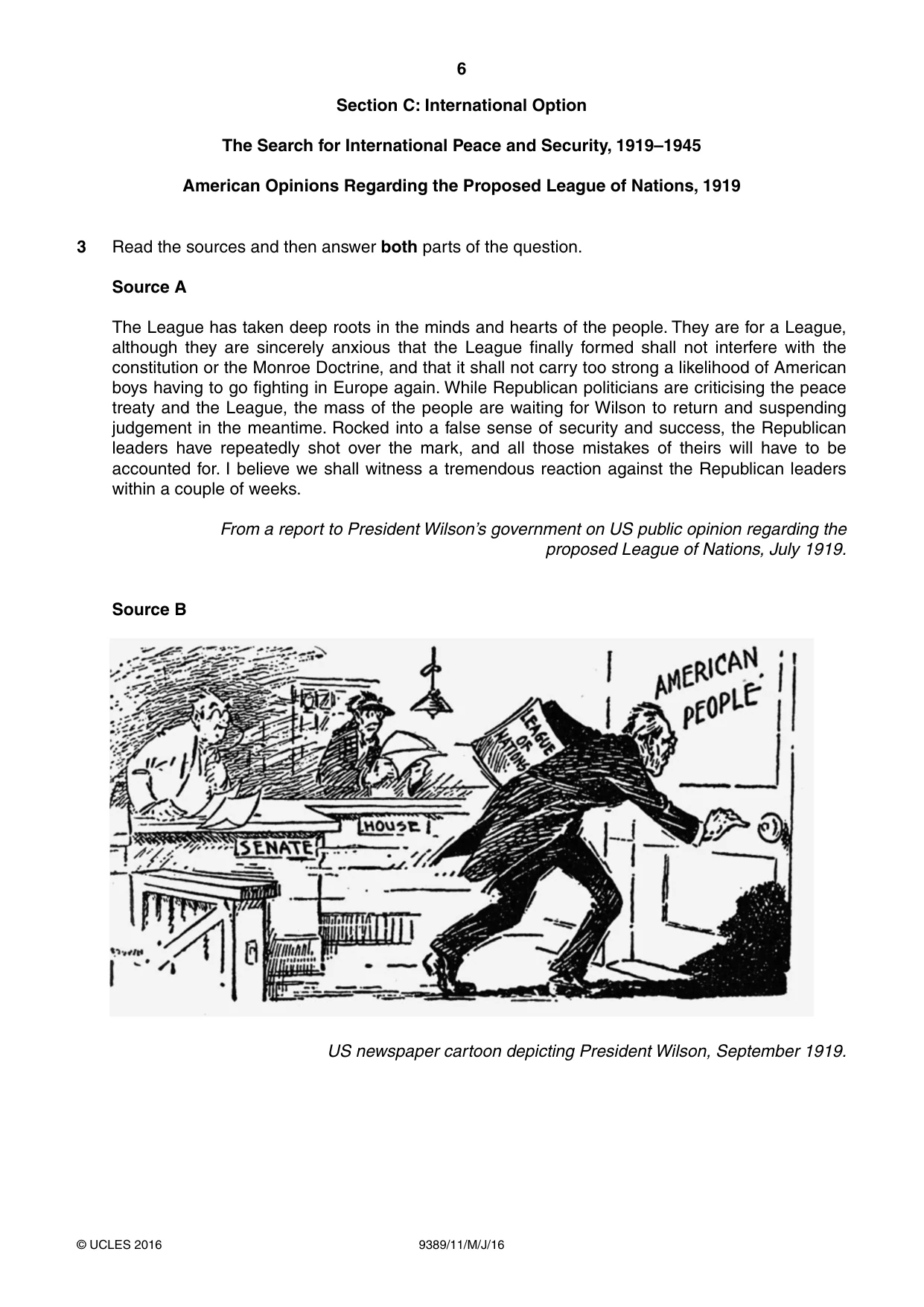
6 9389/11/M/J/16 © UCLES 2016 Section C: International Option The Search for International Peace and Security, 1919–1945 American Opinions Regarding the Proposed League of Nations, 1919 3 Read the sources and then answer both parts of the question. Source A The League has taken deep roots in the minds and hearts of the people. They are for a League, although they are sincerely anxious that the League finally formed shall not interfere with the constitution or the Monroe Doctrine, and that it shall not carry too strong a likelihood of American boys having to go fighting in Europe again. While Republican politicians are criticising the peace treaty and the League, the mass of the people are waiting for Wilson to return and suspending judgement in the meantime. Rocked into a false sense of security and success, the Republican leaders have repeatedly shot over the mark, and all those mistakes of theirs will have to be accounted for. I believe we shall witness a tremendous reaction against the Republican leaders within a couple of weeks. From a report to President Wilson’s government on US public opinion regarding the proposed League of Nations, July 1919. Source B US newspaper cartoon depicting President Wilson, September 1919.
Question paper, page 7
7 9389/11/M/J/16 © UCLES 2016 Source C The USA assumes no obligation to preserve the territorial integrity or political independence of any other country or to interfere in controversies between nations, whether members of the League or not, or to employ its military forces under any article of the Treaty. Under the Constitution, Congress has the sole power to declare war or authorise the deployment of US military forces. The USA reserves the right to decide what questions are within its domestic jurisdiction, and declares that all internal issues are solely within the jurisdiction of the USA and are not to be submitted in any way to arbitration by the League of Nations. If the USA shall at any time adopt any plan for the limitation of armaments proposed by the League of Nations, it reserves the right to increase such armaments without the consent of the League whenever the USA is threatened with invasion or engaged in war. Reservations about the League of Nations adopted by the Republican-dominated US Senate, November 1919. Source D The effect of the reservations adopted by the US Senate would be to create the situation that the USA should be allowed to join the League upon a footing different to that upon which other countries join. This would inevitably give rise to the impression among other countries that there is to be one rule for the USA and one rule for the rest of the world. The US Senate accepts no obligation to preserve against external aggression the territorial integrity of other members of the League without the consent of Congress on each occasion. This would destroy the confidence of smaller states, which cannot trust the League unless they know that its members are pledged definitely to support them. And, if every nation is to be entitled to increase armaments beyond the agreed limitation whenever it considers itself threatened, the Covenant is not worth the paper it is written on. President Wilson says that the Senate’s reservations cut the heart out of the Covenant and intends to refuse to accept them. British government memorandum, November 1919. Answer both parts of the question with reference to the sources. (a) Compare and contrast the attitudes towards the proposed League of Nations expressed by the US Senate (Source C) and the British government (Source D). [15] (b) ‘In 1919 the American people did not support the proposed League of Nations.’ How far do Sources A to D support this view? [25]
Question paper, page 8
8 9389/11/M/J/16 © UCLES 2016 BLANK PAGE Permission to reproduce items where third-party owned material protected by copyright is included has been sought and cleared where possible. Every reasonable effort has been made by the publisher (UCLES) to trace copyright holders, but if any items requiring clearance have unwittingly been included, the publisher will be pleased to make amends at the earliest possible opportunity. To avoid the issue of disclosure of answer-related information to candidates, all copyright acknowledgements are reproduced online in the Cambridge International Examinations Copyright Acknowledgements Booklet. This is produced for each series of examinations and is freely available to download at www.cie.org.uk after the live examination series. Cambridge International Examinations is part of the Cambridge Assessment Group. Cambridge Assessment is the brand name of University of Cambridge Local Examinations Syndicate (UCLES), which is itself a department of the University of Cambridge.
Mark scheme, page 1
® IGCSE is the registered trademark of Cambridge International Examinations. This document consists of 9 printed pages. © UCLES 2016 [Turn over Cambridge International Examinations Cambridge International Advanced Subsidiary and Advanced Level HISTORY 9389/11 Paper 1 Document Question 11 May/June 2016 MARK SCHEME Maximum Mark: 40 Published This mark scheme is published as an aid to teachers and candidates, to indicate the requirements of the examination. It shows the basis on which Examiners were instructed to award marks. It does not indicate the details of the discussions that took place at an Examiners’ meeting before marking began, which would have considered the acceptability of alternative answers. Mark schemes should be read in conjunction with the question paper and the Principal Examiner Report for Teachers. Cambridge will not enter into discussions about these mark schemes. Cambridge is publishing the mark schemes for the May/June 2016 series for most Cambridge IGCSE®, Cambridge International A and AS Level components and some Cambridge O Level components.
Mark scheme, page 2
Page 2 Mark Scheme Syllabus Paper Cambridge International AS/A Level – May/June 2016 9389 11 Cambridge International Examinations 2016 Generic levels of response Part (a) Level 4: Makes a developed comparison [12–15] Makes a developed comparison between the two sources, recognising points of similarity and difference. Uses knowledge to evaluate the sources and shows good contextual awareness. Level 3: Compares views and identifies similarities and differences [8–11] Compares the views expressed in the sources, identifying differences and similarities. Begins to explain and evaluate the views using the sources and knowledge. Level 2: Compares views and identifies similarities and/or differences [4–7] Identifies relevant similarities or differences between views/sources and the response may be one- sided with only one aspect explained. Alternatively, both similarities and differences may be mentioned but both aspects lack development. Level 1: Describes content of each source [1–3] Describes or paraphrases the content of the two sources. Very simple comparisons may be made (e.g. one is from a letter and the other is from a speech) but these are not developed. Level 0: No relevant comment on the sources or the issue [0] Part (b) Level 5: Evaluates the sources to reach a sustained judgement [21–25] Answers are well focused, demonstrating a clear understanding of the sources and the question. Reaches a sustained judgement about the extent to which the sources support the statement and weighs the evidence in order to do this. Level 4: Evaluates the sources [16–20] Demonstrates a clear understanding of the sources and the question. Begins to evaluate the material in context, considering the nature, origin and purpose of the sources in relation to the statement. At the top of this level candidates may begin to reach a judgement but this is not sustained. Level 3: Uses the sources to support and challenge the statement [11–15] Makes valid points from the sources to both challenge and support the statement in the question. These comments may be derived from source content or may be about the provenance/nature of the sources. Level 2: Uses the sources to support or challenge the statement [6–10] Makes valid points from the sources to either support the statement in the question or to challenge it. These comments may be derived from source content or may be about the provenance/nature of the sources. Level 1: Does not make valid use of the sources [1–5] Describes the content of the sources with little attempt to link the material to the question. Alternatively, candidates may write an essay about the question without reference to the sources. Level 0: No relevant comment on the sources or the issue [0]
Mark scheme, page 3
Page 3 Mark Scheme Syllabus Paper Cambridge International AS/A Level – May/June 2016 9389 11 Cambridge International Examinations 2016 Section A: European Option Liberalism and Nationalism in Italy and Germany, 1815–1871 Italy in 1848 Indicative Content 1 (a) Compare and contrast Sources B and D on the attitude of the Pope towards the events of 1848 and 1849. [15] Source B is a formal, public statement by Pope Pius IX in the early days of what became known as the 1848 Revolutions. Source D is the thoughts of a little-known left-wing Italian nationalist reflecting on the events of 1848–49. Straight away, there are clear differences of provenance. There are also significant, if less obvious, differences of content. The major similarity is that they both show that the Pope is opposed to the war against Austria that was being waged in northern Italy at the time. The main difference between the two concerns the reason why the Pope was against going to war with Austria. Source B, from the Pope himself, says it was because Austria was a Catholic country, which meant that he, as head of the Catholic Church, could not attack. Source D maintains that the Pope abstained from war because he was alarmed by the emergence of a large state in northern Italy which would threaten his temporal power over the Papal States. On the other two points mentioned in Source B – the Pope’s refusal to lead a united Italy and his urging the people of Italy not to support revolution and war – Source D is silent. A socialist writer and Italian patriot, writing 2–3 years after the failure of the 1848–49 revolutions, is bound to criticise the Pope for his failure to support the revolution. Thus, when it comes to conveying the views of the Pope about contemporary events, Source B is the more reliable of the two sources. (b) How far do Sources A to D support the view that Austria was the biggest obstacle to change in Italy? [25] Context: Austria had dominated Italian politics since the Vienna settlement of 1815. When revolutions did occur in Italy, as in 1820 and 1830–31, Austria had ensured that they were crushed. In January 1848, revolutions had broken out in Italy again. This time, however, in a kind of European spring, they affected Austria as well, bringing about the overthrow of Metternich, the Austrian ruler of the previous 30–40 years and the dominant figure of European politics. Some Italian rulers, showing sympathy with nationalism but by no means nationalist themselves, decided to take advantage of Austrian weakness. Charles Albert, King of Piedmont, led the way in March 1848, when he declared war against Austria. At that stage, Pope Pius IX, who earlier had shown a tendency to liberalise the Papal States, was sympathetic to the Italian cause. Some Papal troops even went north to join Italian forces – though not with the Pope’s consent. He then rapidly did a U-turn by supporting the conservative, anti-nationalist cause. The war against Austria initially went well but soon resulted in defeat, at Custozza in July 1848. An armistice was agreed and lasted until March 1849, when Piedmont started the war once more. Austrian forces quickly defeated the Piedmontese army at Novara, as a result of which Charles Albert abdicated. Meanwhile, in November 1848, the Pope had had to flee from Rome for his own safety. Rome declared itself a Republic. The Pope was restored only with the military help of the two Catholic powers, France and Austria.
Mark scheme, page 4
Page 4 Mark Scheme Syllabus Paper Cambridge International AS/A Level – May/June 2016 9389 11 Cambridge International Examinations 2016 Analysis: Three sources – B, C and D – refer to the Italian war against Austria in 1848. In addition, Source A argues that Italy would have freed itself of foreigners had it not been deflected by ‘the petty longings of dynastic ambition’. Thus, directly or indirectly, all sources identify Austria, the only foreign power in Italy, as an obstacle to change, if not necessarily the biggest. None of the sources focus on Austria as a major obstacle. For Source A, ‘dynastic ambition’ is more important. In Source B, the Pope makes himself a major obstacle to Italian unity. While agreeing with Source A about the importance of dynastic self-interest, Source C adds a third obstacle: ‘the many conservatives and reactionaries in Italy’. Source D confirms the analysis of Sources A and C in arguing for the great importance of the narrow self-interest of rulers such as the King of Naples and the Pope. What, however, set off these dynastic rivalries and the papal U-turn? It was the presence of Austria in Italy. Imagine Italy in 1848 without Austria present and you have a very different history. Contextual knowledge can prove that Austria was the greatest obstacle while also helping to evaluate the sources. Evaluation: Two sources, B and C, are from 1848–49, two from soon after. Two are Italian, B and D, two are foreign. Source B, the Pope’s response to Italian attempts to eject Austria from Italy, reveals his alarm at popular acceptance of ‘new and radical ideas’. Before the year was out, he had to abandon Rome and flee south for his own safety as Rome declared itself a Republic. France rather than Austria restored the Pope to Rome, but France needed Austrian approval to do so. In terms of his own position, the Pope’s warning found in Source B was well made. Those who undertook revolutionary change would find their efforts overturned by the military power of France and Austria. Italian princes could be overcome, France and Austria could not. Source C, from the Belgian ambassador, has no self-interest to defend, even though his sympathies lie with Italian efforts to throw out the Austrian ‘invaders and their brutal regime’. This is to be expected of someone representing a state established by revolution only in the 1830s. Thus Source C favours the liberal-national cause, which makes its analysis less than reliable. Of the two reflective sources, A and D, Source A is also sympathetic to the liberal- national cause. It is also a letter written to the leading newspaper in the USA, the only major republic of the time. The author therefore has a double reason to praise the republicans in Italy and to attack their opponents. It too is hard to trust. Finally, Source D is from a left-wing Italian looking back on events that he had probably taken part in. [Pisacane had fought for Italy in both 1848 and 1849, the latter in Rome, but candidates cannot be expected to know that.] His partisan perspective was bound to distort his analysis. None of the sources are reliable. All must be treated with great caution.
Mark scheme, page 5
Page 5 Mark Scheme Syllabus Paper Cambridge International AS/A Level – May/June 2016 9389 11 Cambridge International Examinations 2016 Section B: American Option The Origins of the Civil War, 1846–1861 The Sack of Lawrence, Kansas, 1856 Indicative Content 2 (a) To what extent do Sources B and C agree about the reaction of the people of Lawrence to the attack by the Border Ruffians? [15] According to Source B, the reaction of the people of Lawrence was mixed: some stayed to defend the town against the Border Ruffians while others left for their own safety. According to B, the former were the young men, the latter women and children, which conforms to the traditional view of the role of men and women in conflict. In contrast, Source C states that the men had already moved out, leaving their women and children behind without any protection. This reversal of tradition enables Source C to describe the men of Lawrence as cowards. Source B says that the women and children left after the attack by the Border Ruffians, implying that their men stayed behind to defend the town. The sources are similar in that they show a withdrawal from Lawrence by some if not all of its inhabitants in response to the Border Ruffians’ aggression. They also show that the occupying forces were acting to uphold federal law. Source C is more critical of the response of Lawrence to the attack as shown by labelling them cowards. The language of Source B is less emotional, more descriptive, if still favouring the people of Lawrence. The difference can be explained by the authorship of the two sources: Source C comes from a leading pro-slavery newspaper commenting on the events at Lawrence. Source B is from a book written by the wife of the man who was leading the Free State movement. (b) How far do Sources A to D support the assertion that ‘a civil war had commenced’ in Kansas in 1856? [25] Context: The Kansas-Nebraska Act of 1854 established two new Territories in the mid-West. This jeopardised the careful balance of slave and Free States achieved until then. It also meant the end of the 1820 Missouri Compromise which confined slavery to lands below latitude 36 30’ North – with the exception of Missouri. Rather than deciding itself whether the Territories should be slave or free, the US Congress accepted Senator Douglas’s idea of popular sovereignty, which left the decision to resident voters in Kansas and Nebraska. Kansas became the focus of the struggle between pro- and anti-slavery forces. Immediately to the west of Missouri, a slave state, but north of the 1820 Missouri Compromise line, Kansas became the key battleground. Pro-slavery supporters in Missouri had no distance to travel as Kansas was on the other side of the Missouri river. Abolitionists, strongest in New England, had a much longer journey, though the first arrived in 1854, establishing the new city of Lawrence. Though most settlers went to Kansas for economic reasons, those committed for or against slavery made the most noise, even taking the law into their own hands at times. John Brown was the best-known example of the latter, as shown by the Pottawatomie massacre of May 1856. This was a response to the sack of Lawrence, the opening ‘conflict’ in the struggle for dominance in Kansas. Similar examples of violence during the summer of 1856, often, if inaccurately, described as ‘battles’, resulted in the label ‘Bleeding Kansas’. The federal elections of 1856 led to a decline in hostilities. In 1857, the struggle for control of Kansas became more political than military, the focus of the debate being the pro-slavery Lecompton
Mark scheme, page 6
Page 6 Mark Scheme Syllabus Paper Cambridge International AS/A Level – May/June 2016 9389 11 Cambridge International Examinations 2016 Constitution. Though estimates vary about how many people died in the conflict (between 50 and 100), Kansas joined the USA as a free state in January 1861. Analysis: Source D can be seen as supporting the assertion as it states the universal conviction that ‘a civil war had commenced’ in Kansas, an assertion supported to a great degree by the caning of Senator Sumner in the US Congress. The other sources come down more on the side of rejecting the hypothesis. Source A, while a blood-curdling speech, can be seen as exhorting men who are authorised by US federal law – and led by a federal officer – to use force against the people and premises of Lawrence. The reasons why such extreme action is needed are not specified. Source B shows little resistance from the people of Lawrence to the Border Ruffians’ attack on their city. Source C says much the same. If a civil war requires the use of force by both sides, then the sources as a group do not suggest that civil war had commenced. Evaluation: All three processes of source evaluation can be used to evaluate these sources. Firstly, cross-referencing and provenance show differences of interpretation which must discount the reliability of some sources. The greatest contrast is between Sources B and C and their accounts of which groups of the citizens of Lawrence remained in town to meet the incursion of the Border Ruffians, as already considered in sub-question (a). That Source C is a newspaper report and intended to rally support for the Pro-slavery cause undermines its reliability. Source B has a different, less political purpose and thus is preferable. Source A is similar to Source C, if with a still narrower focus – to energise ‘troops’ into battle. Its reliability is equally questionable. Source D focuses on the consequences of the sack of Lawrence, the author describing the convictions of the Free State supporters that a civil war had begun. Here provenance comes into play. Source D is the only source written by someone not directly involved in the conflict. At the same time, Thomas Gladstone was in Kansas in 1856 and thus his comments are based on personal observation. He reports the reactions of people on one side of the conflict only but does so unemotionally, giving his observations greater credence. Then contextual knowledge can be used to evaluate the sources. Even the term ‘Bloody Kansas’, a term not mentioned in any of the sources, can be used to provide some support for the hypothesis. Similarly, the people of Kansas and their supporters were so divided that both sides were prepared to use violence – think of Beecher’s Bibles aka Sharpe’s Rifles being sent out to Kansas by Northern abolitionists. Finally, the violent actions of John Brown at Pottawatomie in 1856 show how close Kansas was to a local civil war. It did not occur, however. Events in Kansas in 1857–58 were more peaceful than violent, even though the differences between the two sides persisted. Southern supporters quickly lost heart, especially as the vast majority of emigrants into Kansas came from Northern states.
Mark scheme, page 7
Page 7 Mark Scheme Syllabus Paper Cambridge International AS/A Level – May/June 2016 9389 11 Cambridge International Examinations 2016 Section C: International Option The Search for International Peace and Security, 1919–1945 American Opinions Regarding the Proposed League of Nations, 1919 Indicative Content 3 (a) Compare and contrast the attitudes towards the proposed League of Nations expressed by the US Senate (Source C) and the British government (Source D). [15] The US Senate (C) clearly sees the proposed League of Nations as a threat to the independence of the USA. It does not want the USA to be obligated to abide by decisions made by the League – rather it wants to consider each case on its merits, Congress having the right to make the final decision on whether or not the USA should get involved. The Senate also rejects the possibility of the League making any decisions relating to US domestic/internal issues and insists on the right of the USA Congress to determine the extent of the country’s armaments, regardless of any prior agreements entered into with the League. Conversely, the British government appears to accept that membership of the League imposes responsibilities, such as supporting countries against aggression. It believes that this must be a firm commitment for all countries which become members of the League; without such a commitment, the League would offer no guarantee of protection, especially for smaller states. It rejects the US Senate’s idea that the USA should be able to determine whether or not it gets involved in any particular case, arguing that this would completely undermine the League. Similarly, the British government feels that the League’s armaments agreements should be observed by all member countries and not disregarded at the whim of individual countries’ governments. The US Senate was dominated by the Republican Party, and its reservations reflect the Republicans’ opposition to both the Paris peace settlement and the idea of a League of Nations. WWI had been unpopular in the USA, and the Republicans wanted to avoid the possibility of the USA becoming involved in future wars by returning to the policy of isolationism. Republican senators (for example, Cabot Lodge) argued that the USA should be free to make its own decisions and not be fettered by commitments to the League of Nations; commitments which might force the USA to become involved in other countries’ affairs and which might lead the League to become involved in issues relating to the USA’s internal and external affairs. Republicans branded President Wilson an idealist and claimed that his aim to involve the USA in a League of Nations would undermine the American constitution and the American people’s right to govern themselves without foreign interference. The British government shared Wilson’s more idealistic attitude towards the League, believing that it was the only way to guarantee future peace and security. However, for the League to be successful, all member countries would have to commit themselves wholeheartedly to it. Without such a commitment, countries could have no confidence in the League’s ability to resolve issues peacefully. As a European country, Britain had witnessed the terrible effects of the armaments build-up which had eventually led to WWI. The British government was therefore keen to ensure reduction in armaments by all countries, arguing that the League would protect countries from aggression so they did not need to develop large-scale armaments to protect themselves. Clearly, this strategy could not be successful if a major country, such as the USA, reserved the right to increase its armaments in defiance of
Mark scheme, page 8
Page 8 Mark Scheme Syllabus Paper Cambridge International AS/A Level – May/June 2016 9389 11 Cambridge International Examinations 2016 League agreements. The British government is, therefore, effectively rejecting the reservations put forward by the US Senate. (b) ‘In 1919 the American people did not support the proposed League of Nations.’ How far do Sources A to D support this view? [25] Context: At the Paris Peace Conference, US President Woodrow Wilson strongly supported the establishment of a League of Nations with the aim of ensuring future international peace and security. Indeed, it was at his insistence that the League was included in all of the treaties which emerged from the Conference. Involvement in WWI, however, had become increasingly unpopular in the USA. While Wilson was away in Europe, the Republicans, who controlled the Senate, took the opportunity to shape American public opinion to their own views against both the peace settlement and the idea of a League of Nations. Wilson was branded an idealist. The League was portrayed as forcing the USA to become involved in the affairs of other countries and enabling other countries to become involved in the USA’s internal issues. On his return from Europe, Wilson undertook a debilitating tour of the USA in an effort to convince the American people that the Paris peace settlement and the League of Nations were good for the USA. Wilson suffered a landslide defeat to Warren Harding in the presidential elections of 1920. The USA rejected both the peace settlement and the League of Nations. Analysis: In support of the hypothesis – While not completely rejecting the idea of a League of Nations, the US Senate (Source C) clearly establishes the terms on which the USA might be prepared to join. These terms (as indicated in Source D) would be different from those accepted by other countries, effectively meaning that the USA would make no firm commitment to abide by any decisions made by the League. Under the Senate’s terms, the USA would decide in each individual case whether to support a member state of the League faced with aggression, would refuse to allow the League to make any decisions relating to what it considered to be internal US matters and would not be bound by the League’s agreements on armaments. These terms would effectively render the League useless, a point made by both President Wilson and the British government (Source D). Some of the points made by the US Senate are reflected in the report on American public opinion (Source A) – the report implies that, while the American people were prepared to listen to Wilson’s arguments when he returned from Europe, they did not want to join the League if this threatened the US constitution or involved the likelihood of Americans again having to fight in Europe. Source B depicts Wilson, weighed down by the burden imposed by the League of Nations, desperately seeking to convince the American people that joining the League of Nations would be beneficial to the USA, despite the opposition of the Senate. The implication of the cartoon is that Wilson stands little chance of succeeding. In challenging the hypothesis – American support for the proposed League of Nations came from the highest level – President Wilson himself. Wilson’s support for the League is confirmed by his disappointment over the Senate’s reservations and his willingness to challenge the Senate over them (Source D). He clearly believed that, on his return to the USA, he would be able to convince the American people of the importance of joining the League. This is confirmed in Source B, which depicts Wilson ignoring the Senate and appealing directly to the American people, armed with plenty of evidence to support his case. His conviction that he could persuade the American people to accept the League possibly came from the report (Source A) which suggests that public opinion was in favour of the League and that there would be a backlash against the Republicans once Wilson had returned to the USA and explained his arguments in detail. Even the US Senate (Source C)
Mark scheme, page 9
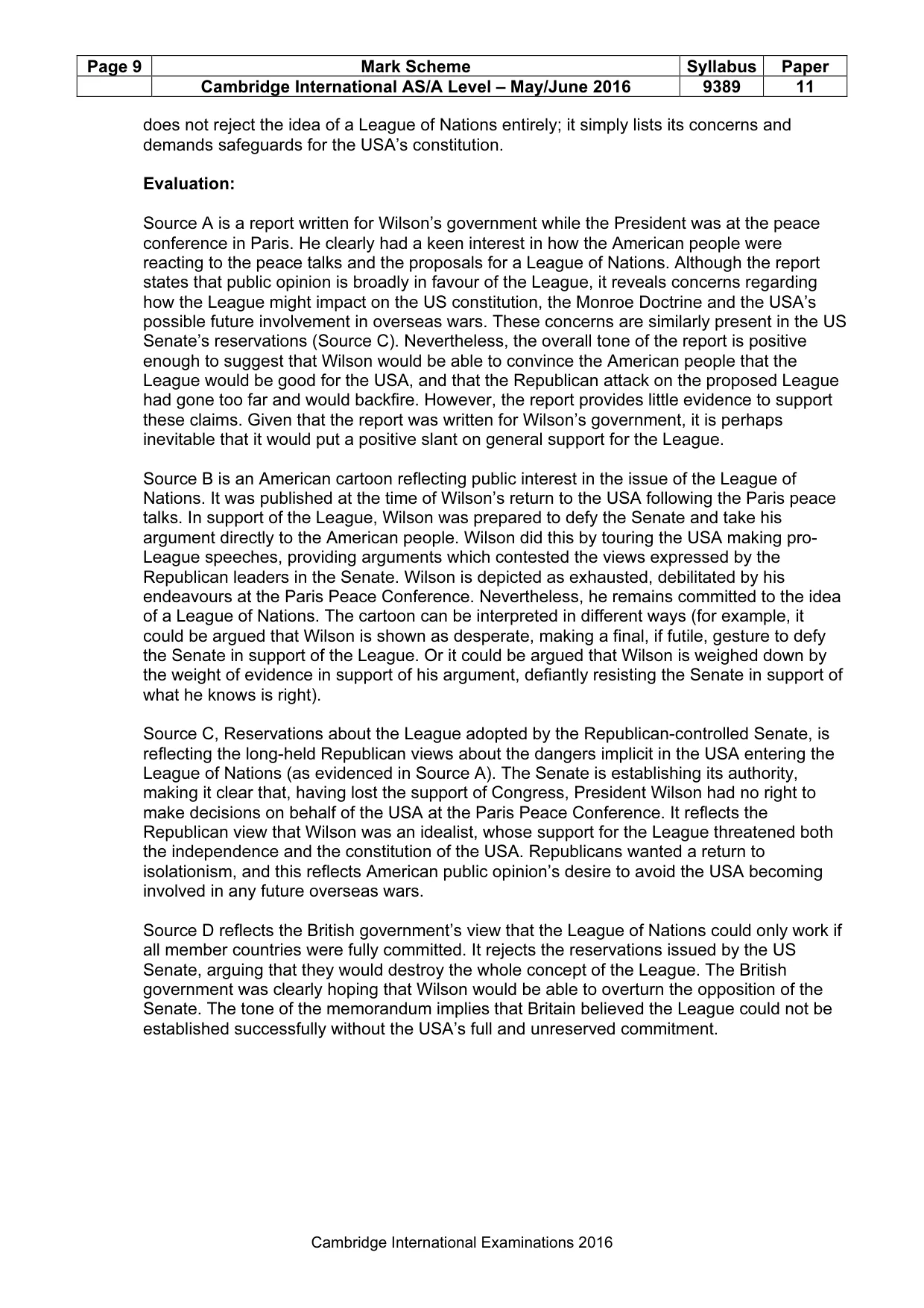
Page 9 Mark Scheme Syllabus Paper Cambridge International AS/A Level – May/June 2016 9389 11 Cambridge International Examinations 2016 does not reject the idea of a League of Nations entirely; it simply lists its concerns and demands safeguards for the USA’s constitution. Evaluation: Source A is a report written for Wilson’s government while the President was at the peace conference in Paris. He clearly had a keen interest in how the American people were reacting to the peace talks and the proposals for a League of Nations. Although the report states that public opinion is broadly in favour of the League, it reveals concerns regarding how the League might impact on the US constitution, the Monroe Doctrine and the USA’s possible future involvement in overseas wars. These concerns are similarly present in the US Senate’s reservations (Source C). Nevertheless, the overall tone of the report is positive enough to suggest that Wilson would be able to convince the American people that the League would be good for the USA, and that the Republican attack on the proposed League had gone too far and would backfire. However, the report provides little evidence to support these claims. Given that the report was written for Wilson’s government, it is perhaps inevitable that it would put a positive slant on general support for the League. Source B is an American cartoon reflecting public interest in the issue of the League of Nations. It was published at the time of Wilson’s return to the USA following the Paris peace talks. In support of the League, Wilson was prepared to defy the Senate and take his argument directly to the American people. Wilson did this by touring the USA making pro- League speeches, providing arguments which contested the views expressed by the Republican leaders in the Senate. Wilson is depicted as exhausted, debilitated by his endeavours at the Paris Peace Conference. Nevertheless, he remains committed to the idea of a League of Nations. The cartoon can be interpreted in different ways (for example, it could be argued that Wilson is shown as desperate, making a final, if futile, gesture to defy the Senate in support of the League. Or it could be argued that Wilson is weighed down by the weight of evidence in support of his argument, defiantly resisting the Senate in support of what he knows is right). Source C, Reservations about the League adopted by the Republican-controlled Senate, is reflecting the long-held Republican views about the dangers implicit in the USA entering the League of Nations (as evidenced in Source A). The Senate is establishing its authority, making it clear that, having lost the support of Congress, President Wilson had no right to make decisions on behalf of the USA at the Paris Peace Conference. It reflects the Republican view that Wilson was an idealist, whose support for the League threatened both the independence and the constitution of the USA. Republicans wanted a return to isolationism, and this reflects American public opinion’s desire to avoid the USA becoming involved in any future overseas wars. Source D reflects the British government’s view that the League of Nations could only work if all member countries were fully committed. It rejects the reservations issued by the US Senate, arguing that they would destroy the whole concept of the League. The British government was clearly hoping that Wilson would be able to overturn the opposition of the Senate. The tone of the memorandum implies that Britain believed the League could not be established successfully without the USA’s full and unreserved commitment.
What you needed in this session
Cambridge’s own grade thresholds for 2016 May/June, Paper 1 · Variant 1. A higher threshold means an easier paper — the bar moves with how the cohort did.