Cambridge A Level English - Language and Literature (AS Level only, from 2016) 8695 — 2025 Oct/Nov Paper 2 · Variant 3
8695/23/O/N/25 · 50 marks · 120 min
The question paper and its mark scheme, free to read here and free to download. This is Cambridge’s own paper, exactly as it was sat.
Question paper20 pages

Mark scheme14 pages
Answers below. Sit the paper first if you are practising.
Paper as text
Question paper, page 1
Cambridge Assessment International Education Cambridge International AS Level LANGUAGE AND LITERATURE IN ENGLISH 8695/23 Paper 2 Drama, Poetry and Prose October/November 2025 2 hours You must answer on the enclosed answer booklet. You will need: Answer booklet (enclosed) INSTRUCTIONS e Answer two questions in total, each from a different section. e Follow the instructions on the front cover of the answer booklet. If you need additional answer paper, ask the invigilator for a continuation booklet. e Dictionaries are not allowed. INFORMATION e The total mark for this paper is 50. e The number of marks for each question or part question is shown in brackets [ ]. This document has 20 pages. Any blank pages are indicated. DC (RCL (DF)) 342801/3 © UCLES 2025 [Turn over
Question paper, page 2
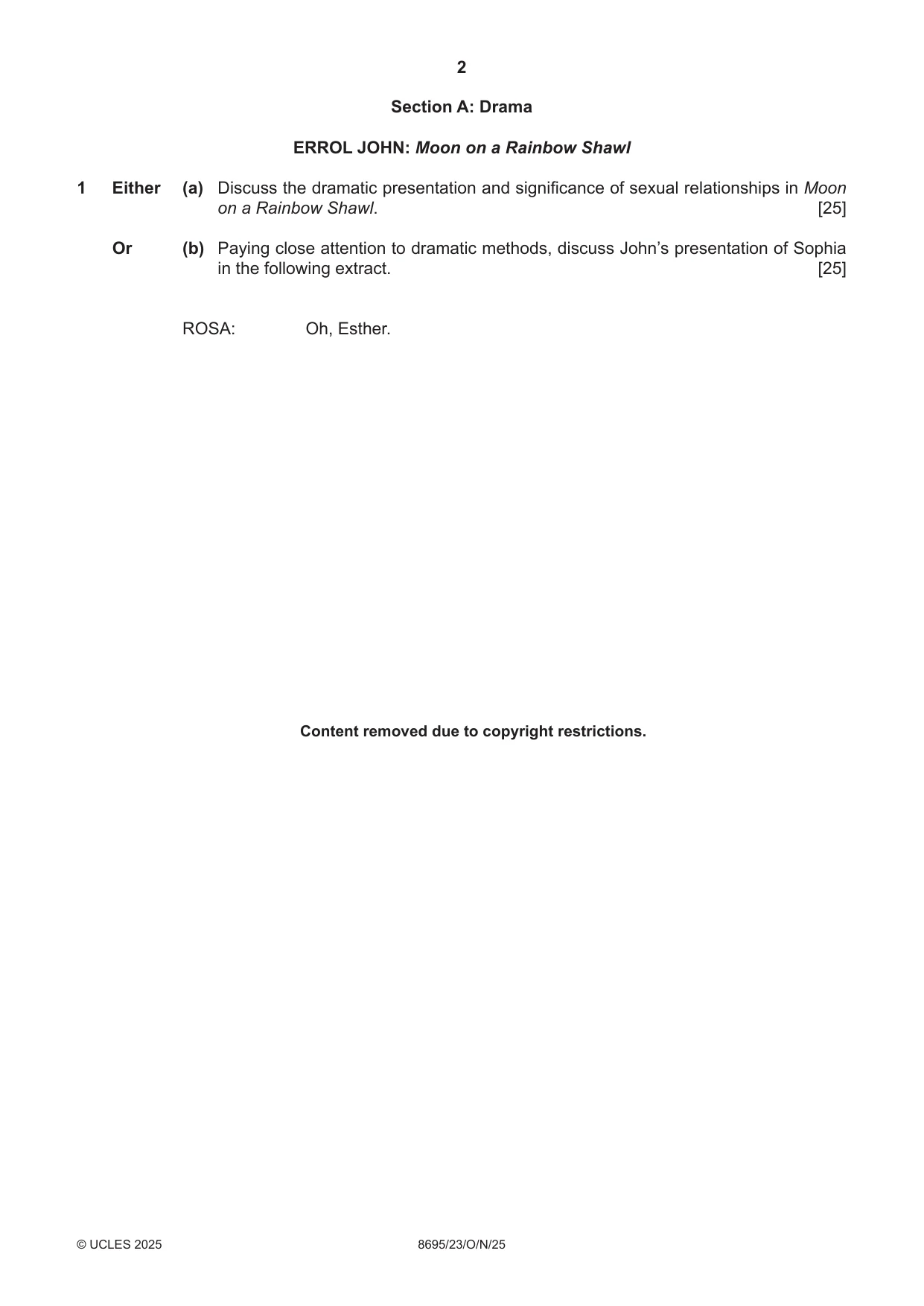
2 8695/23/O/N/25 © UCLES 2025 Section A: Drama ERROL JOHN: Moon on a Rainbow Shawl 1 Either (a) Discuss the dramatic presentation and significance of sexual relationships in Moon on a Rainbow Shawl. [25] Or (b) Paying close attention to dramatic methods, discuss John’s presentation of Sophia in the following extract. [25] ROSA: Oh, Esther. Content removed due to copyright restrictions.
Question paper, page 3
3 8695/23/O/N/25 © UCLES 2025 [Turn over [Laughing as he gets her meaning] Lady! (from Act 1, Scene 2) Content removed due to copyright restrictions.
Question paper, page 4
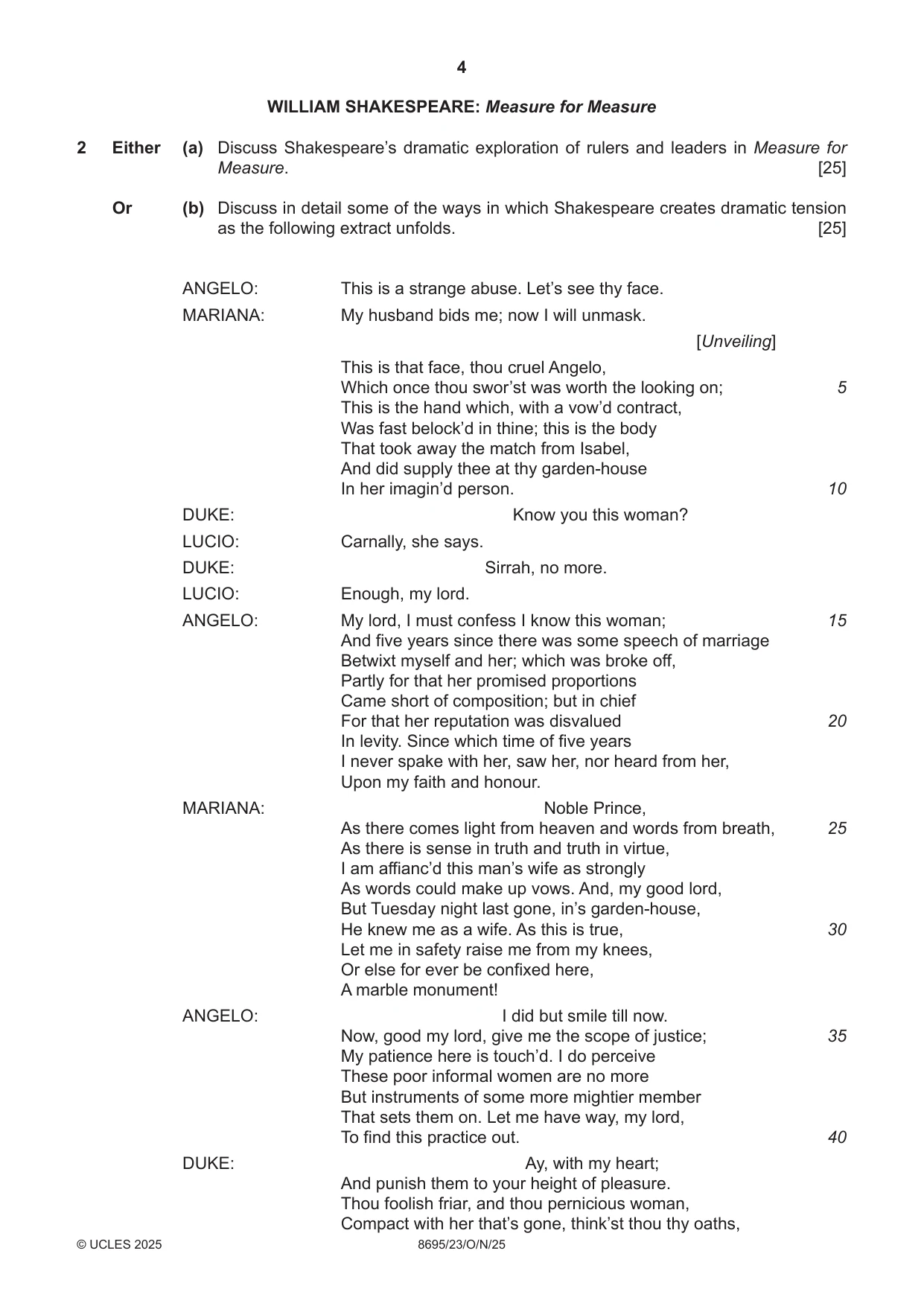
4 8695/23/O/N/25 © UCLES 2025 WILLIAM SHAKESPEARE: Measure for Measure 2 Either (a) Discuss Shakespeare’s dramatic exploration of rulers and leaders in Measure for Measure. [25] Or (b) Discuss in detail some of the ways in which Shakespeare creates dramatic tension as the following extract unfolds. [25] ANGELO: This is a strange abuse. Let’s see thy face. MARIANA: My husband bids me; now I will unmask. [Unveiling] This is that face, thou cruel Angelo, Which once thou swor’st was worth the looking on; This is the hand which, with a vow’d contract, Was fast belock’d in thine; this is the body That took away the match from Isabel, And did supply thee at thy garden-house In her imagin’d person. DUKE: Know you this woman? LUCIO: Carnally, she says. DUKE: Sirrah, no more. LUCIO: Enough, my lord. ANGELO: My lord, I must confess I know this woman; And five years since there was some speech of marriage Betwixt myself and her; which was broke off, Partly for that her promised proportions Came short of composition; but in chief For that her reputation was disvalued In levity. Since which time of five years I never spake with her, saw her, nor heard from her, Upon my faith and honour. MARIANA: Noble Prince, As there comes light from heaven and words from breath, As there is sense in truth and truth in virtue, I am affianc’d this man’s wife as strongly As words could make up vows. And, my good lord, But Tuesday night last gone, in’s garden-house, He knew me as a wife. As this is true, Let me in safety raise me from my knees, Or else for ever be confixed here, A marble monument! ANGELO: I did but smile till now. Now, good my lord, give me the scope of justice; My patience here is touch’d. I do perceive These poor informal women are no more But instruments of some more mightier member That sets them on. Let me have way, my lord, To find this practice out. DUKE: Ay, with my heart; And punish them to your height of pleasure. Thou foolish friar, and thou pernicious woman, Compact with her that’s gone, think’st thou thy oaths, 5 10 15 20 25 30 35 40
Question paper, page 5
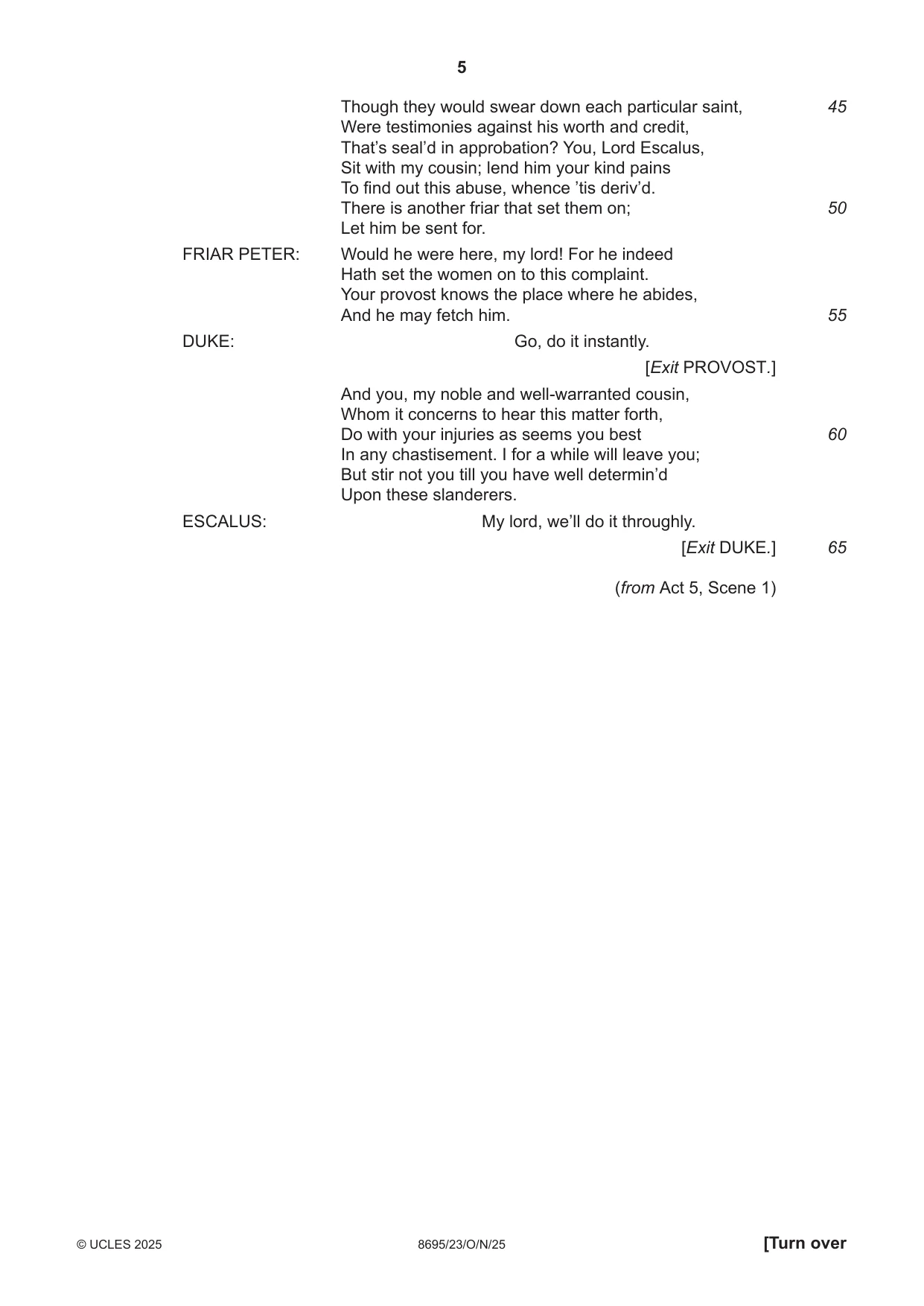
5 8695/23/O/N/25 © UCLES 2025 [Turn over Though they would swear down each particular saint, Were testimonies against his worth and credit, That’s seal’d in approbation? You, Lord Escalus, Sit with my cousin; lend him your kind pains To find out this abuse, whence ’tis deriv’d. There is another friar that set them on; Let him be sent for. FRIAR PETER: Would he were here, my lord! For he indeed Hath set the women on to this complaint. Your provost knows the place where he abides, And he may fetch him. DUKE: Go, do it instantly. [Exit PROVOST.] And you, my noble and well-warranted cousin, Whom it concerns to hear this matter forth, Do with your injuries as seems you best In any chastisement. I for a while will leave you; But stir not you till you have well determin’d Upon these slanderers. ESCALUS: My lord, we’ll do it throughly. [Exit DUKE.] (from Act 5, Scene 1) 45 50 55 60 65
Question paper, page 6
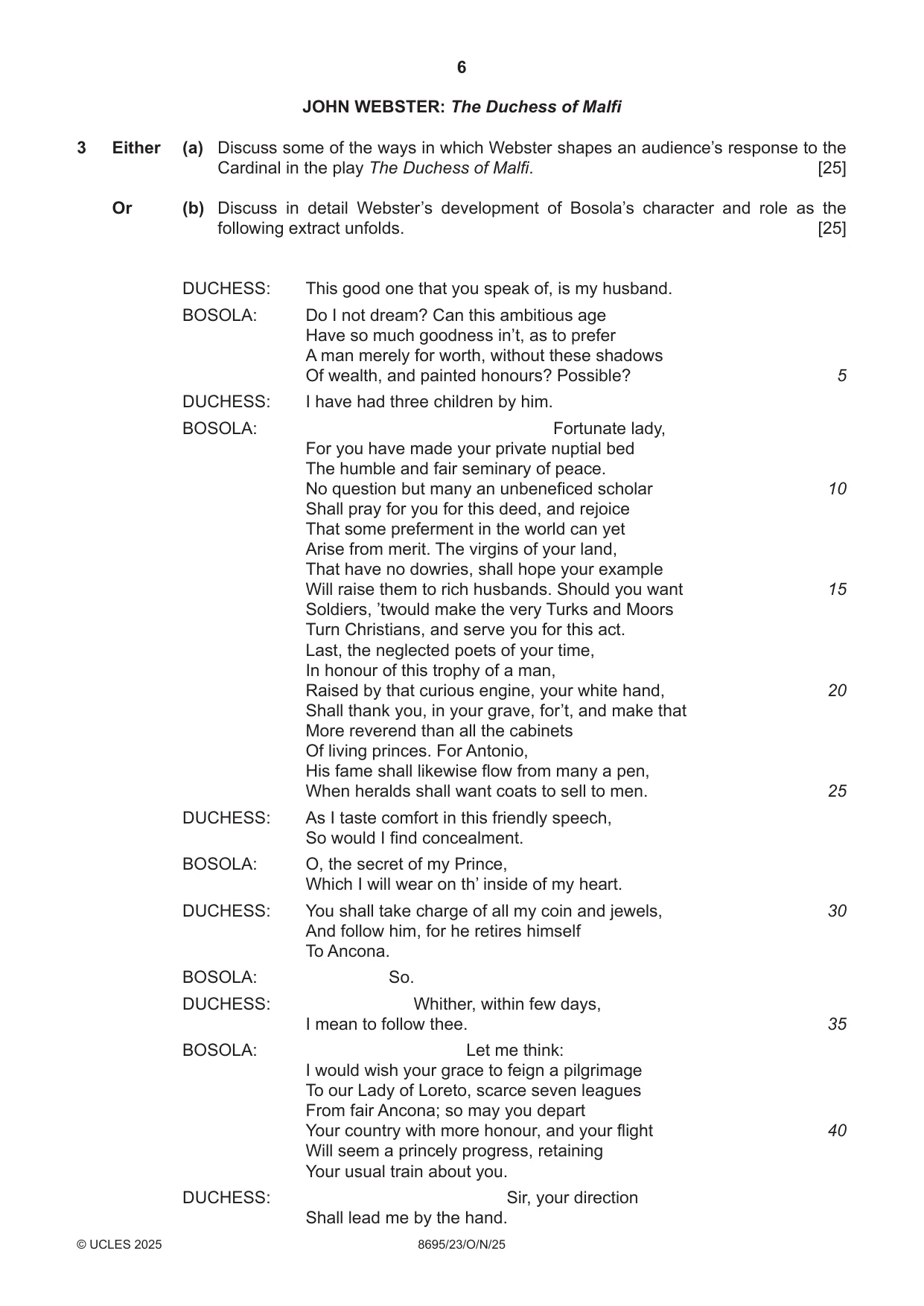
6 8695/23/O/N/25 © UCLES 2025 JOHN WEBSTER: The Duchess of Malfi 3 Either (a) Discuss some of the ways in which Webster shapes an audience’s response to the Cardinal in the play The Duchess of Malfi. [25] Or (b) Discuss in detail Webster’s development of Bosola’s character and role as the following extract unfolds. [25] DUCHESS: This good one that you speak of, is my husband. BOSOLA: Do I not dream? Can this ambitious age Have so much goodness in’t, as to prefer A man merely for worth, without these shadows Of wealth, and painted honours? Possible? DUCHESS: I have had three children by him. BOSOLA: Fortunate lady, For you have made your private nuptial bed The humble and fair seminary of peace. No question but many an unbeneficed scholar Shall pray for you for this deed, and rejoice That some preferment in the world can yet Arise from merit. The virgins of your land, That have no dowries, shall hope your example Will raise them to rich husbands. Should you want Soldiers, ’twould make the very Turks and Moors Turn Christians, and serve you for this act. Last, the neglected poets of your time, In honour of this trophy of a man, Raised by that curious engine, your white hand, Shall thank you, in your grave, for’t, and make that More reverend than all the cabinets Of living princes. For Antonio, His fame shall likewise flow from many a pen, When heralds shall want coats to sell to men. DUCHESS: As I taste comfort in this friendly speech, So would I find concealment. BOSOLA: O, the secret of my Prince, Which I will wear on th’ inside of my heart. DUCHESS: You shall take charge of all my coin and jewels, And follow him, for he retires himself To Ancona. BOSOLA: So. DUCHESS: Whither, within few days, I mean to follow thee. BOSOLA: Let me think: I would wish your grace to feign a pilgrimage To our Lady of Loreto, scarce seven leagues From fair Ancona; so may you depart Your country with more honour, and your flight Will seem a princely progress, retaining Your usual train about you. DUCHESS: Sir, your direction Shall lead me by the hand. 5 10 15 20 25 30 35 40
Question paper, page 7
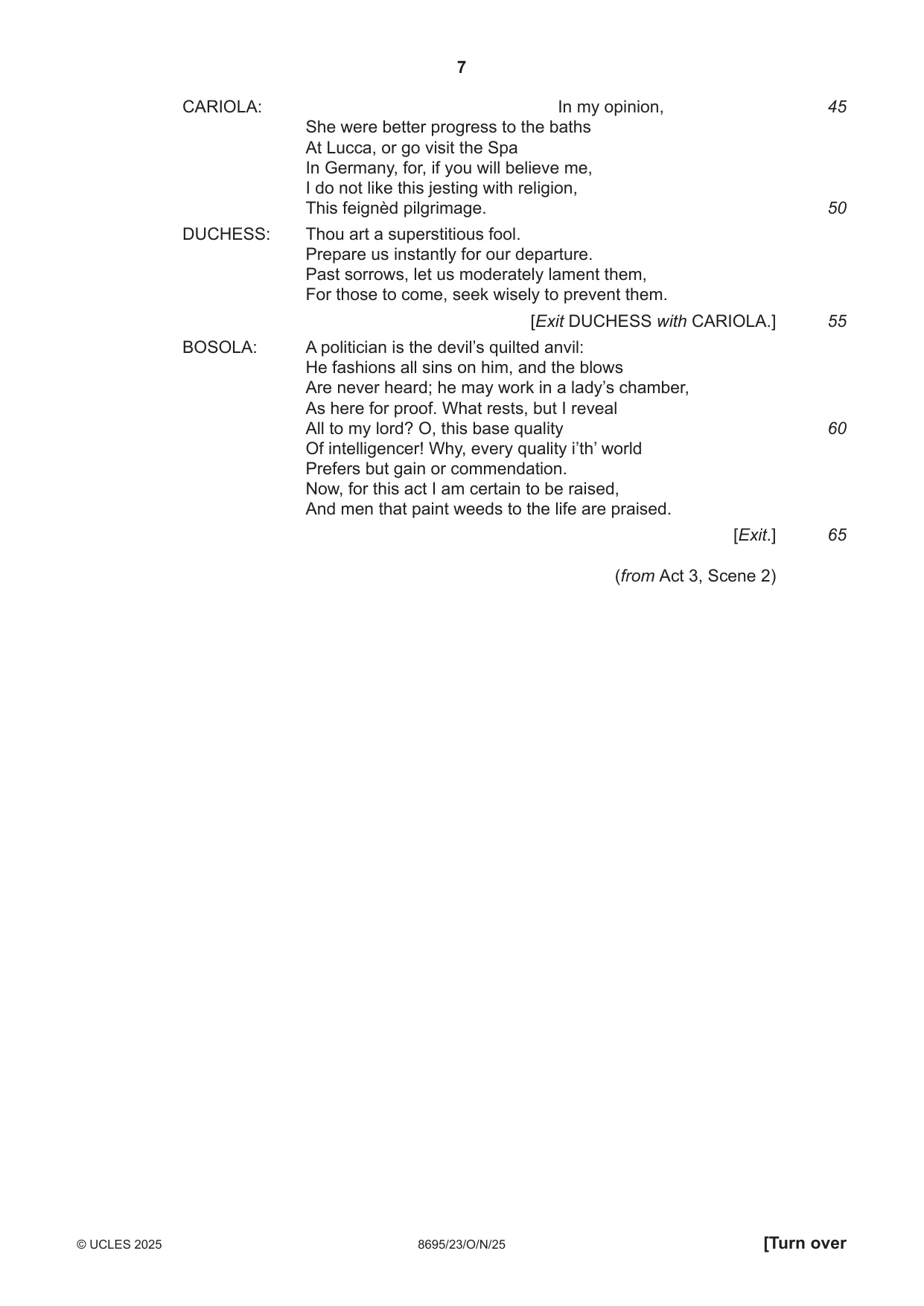
7 8695/23/O/N/25 © UCLES 2025 [Turn over CARIOLA: In my opinion, She were better progress to the baths At Lucca, or go visit the Spa In Germany, for, if you will believe me, I do not like this jesting with religion, This feignèd pilgrimage. DUCHESS: Thou art a superstitious fool. Prepare us instantly for our departure. Past sorrows, let us moderately lament them, For those to come, seek wisely to prevent them. [Exit DUCHESS with CARIOLA.] BOSOLA: A politician is the devil’s quilted anvil: He fashions all sins on him, and the blows Are never heard; he may work in a lady’s chamber, As here for proof. What rests, but I reveal All to my lord? O, this base quality Of intelligencer! Why, every quality i’th’ world Prefers but gain or commendation. Now, for this act I am certain to be raised, And men that paint weeds to the life are praised. [Exit.] (from Act 3, Scene 2) 45 50 55 60 65
Question paper, page 8
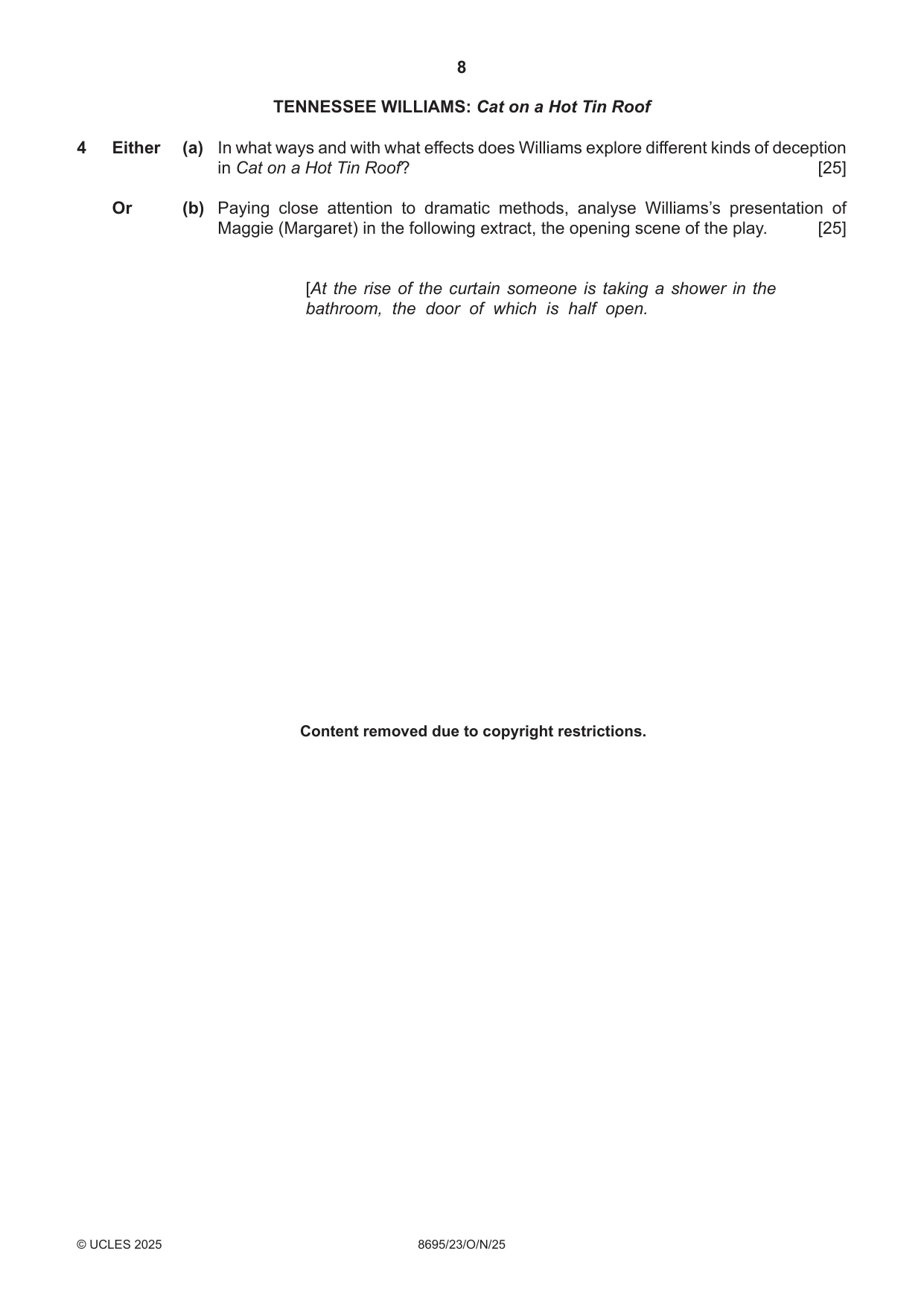
8 8695/23/O/N/25 © UCLES 2025 TENNESSEE WILLIAMS: Cat on a Hot Tin Roof 4 Either (a) In what ways and with what effects does Williams explore different kinds of deception in Cat on a Hot Tin Roof? [25] Or (b) Paying close attention to dramatic methods, analyse Williams’s presentation of Maggie (Margaret) in the following extract, the opening scene of the play. [25] [At the rise of the curtain someone is taking a shower in the bathroom, the door of which is half open. Content removed due to copyright restrictions.
Question paper, page 9
9 8695/23/O/N/25 © UCLES 2025 [Turn over [Without interest] What are they up to, Maggie? (from Act 1) Content removed due to copyright restrictions.
Question paper, page 10
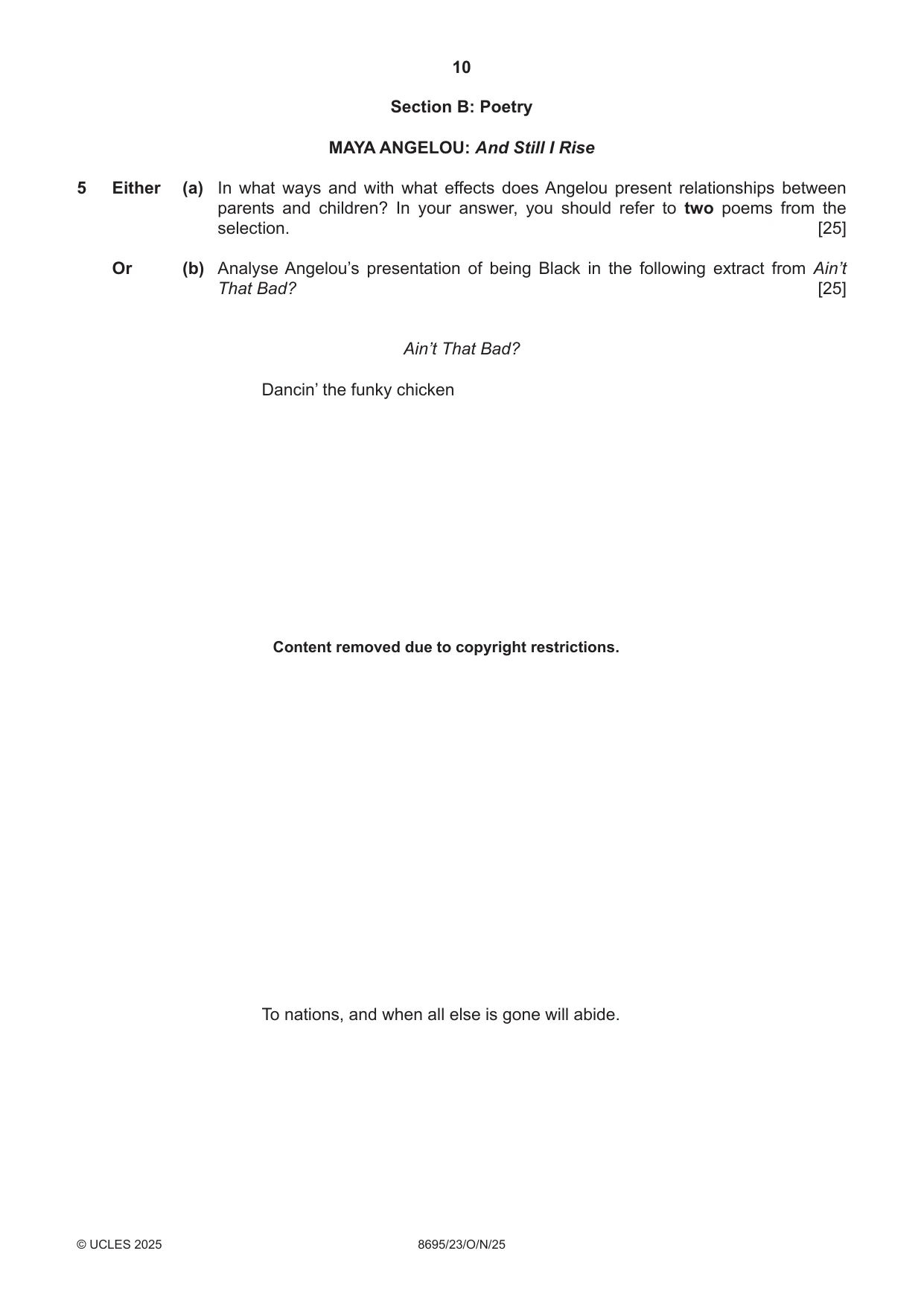
10 8695/23/O/N/25 © UCLES 2025 Section B: Poetry MAYA ANGELOU: And Still I Rise 5 Either (a) In what ways and with what effects does Angelou present relationships between parents and children? In your answer, you should refer to two poems from the selection. [25] Or (b) Analyse Angelou’s presentation of being Black in the following extract from Ain’t That Bad? [25] Ain’t That Bad? Dancin’ the funky chicken To nations, and when all else is gone will abide. Content removed due to copyright restrictions.
Question paper, page 11
11 8695/23/O/N/25 © UCLES 2025 [Turn over SIMON ARMITAGE: Sir Gawain and the Green Knight 6 Either (a) Discuss some of the ways in which Armitage makes feasts and feasting significant in the poem. [25] Or (b) Comment closely on Armitage’s presentation of the lady’s gift in the following extract from Sir Gawain and the Green Knight. [25] Snubbed by his decision, she said to him then, three kisses come his way. Content removed due to copyright restrictions.
Question paper, page 12
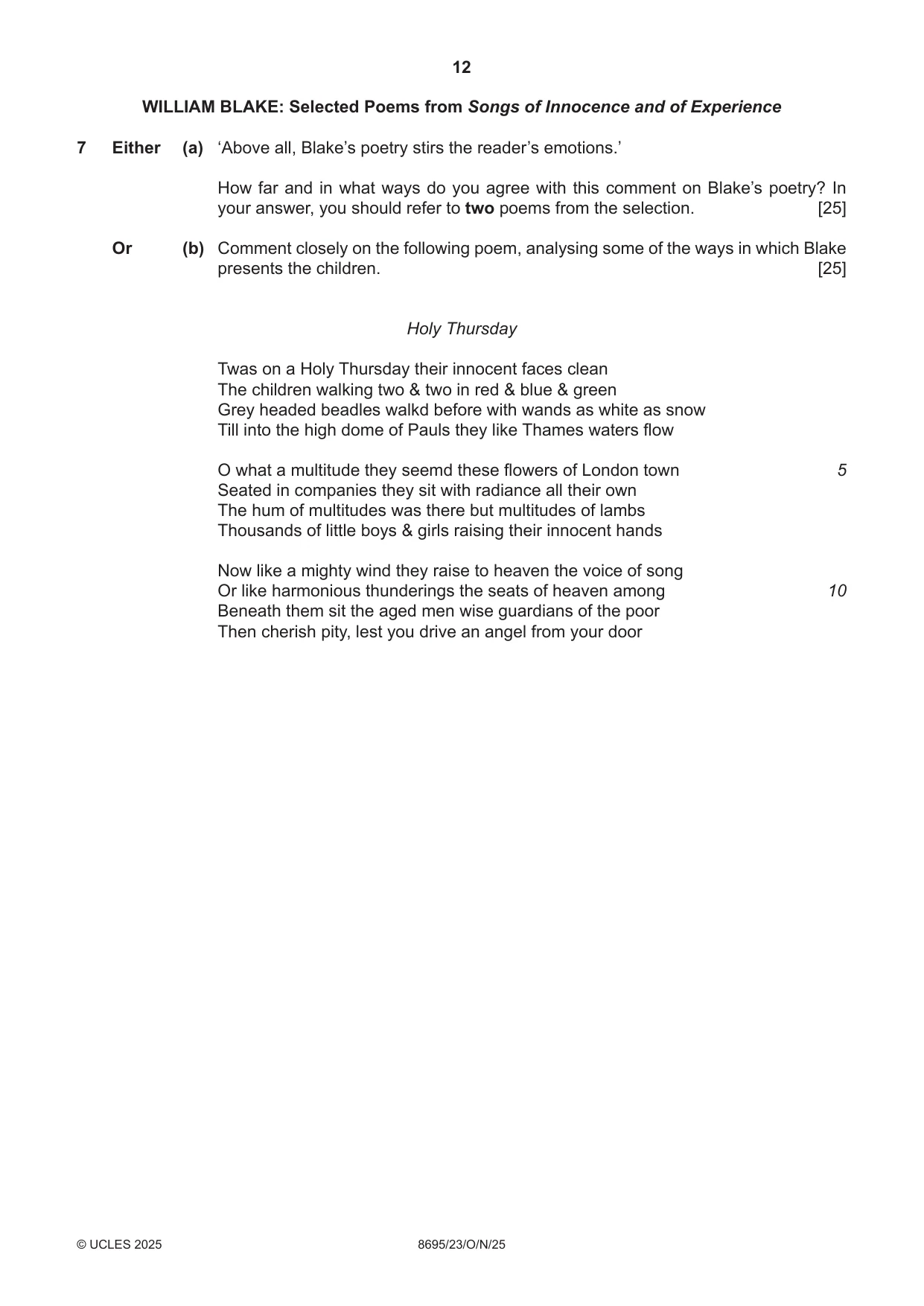
12 8695/23/O/N/25 © UCLES 2025 WILLIAM BLAKE: Selected Poems from Songs of Innocence and of Experience 7 Either (a) ‘Above all, Blake’s poetry stirs the reader’s emotions.’ How far and in what ways do you agree with this comment on Blake’s poetry? In your answer, you should refer to two poems from the selection. [25] Or (b) Comment closely on the following poem, analysing some of the ways in which Blake presents the children. [25] Holy Thursday Twas on a Holy Thursday their innocent faces clean The children walking two & two in red & blue & green Grey headed beadles walkd before with wands as white as snow Till into the high dome of Pauls they like Thames waters flow O what a multitude they seemd these flowers of London town Seated in companies they sit with radiance all their own The hum of multitudes was there but multitudes of lambs Thousands of little boys & girls raising their innocent hands Now like a mighty wind they raise to heaven the voice of song Or like harmonious thunderings the seats of heaven among Beneath them sit the aged men wise guardians of the poor Then cherish pity, lest you drive an angel from your door 5 10
Question paper, page 13
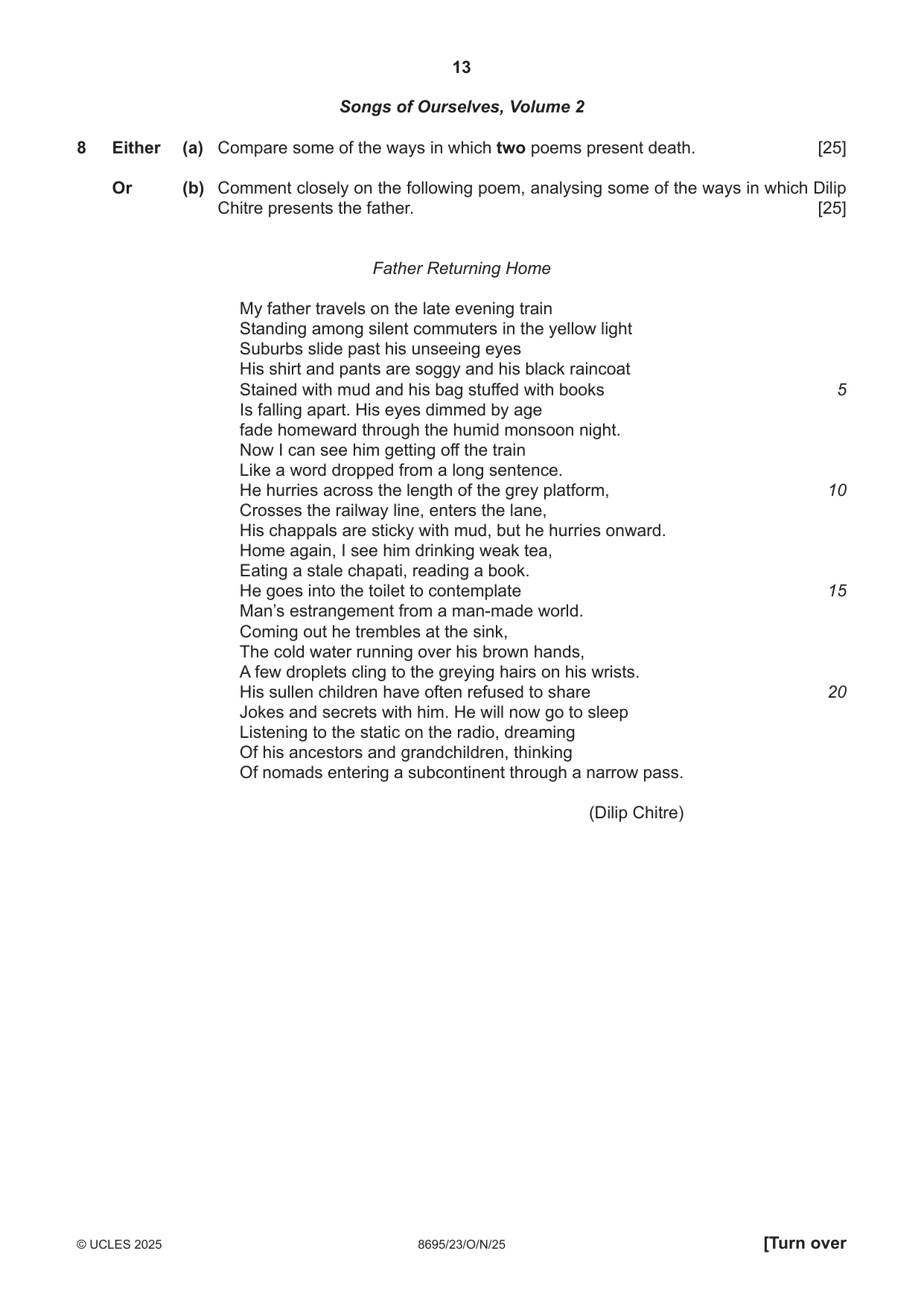
13 8695/23/O/N/25 © UCLES 2025 [Turn over Songs of Ourselves, Volume 2 8 Either (a) Compare some of the ways in which two poems present death. [25] Or (b) Comment closely on the following poem, analysing some of the ways in which Dilip Chitre presents the father. [25] Father Returning Home My father travels on the late evening train Standing among silent commuters in the yellow light Suburbs slide past his unseeing eyes His shirt and pants are soggy and his black raincoat Stained with mud and his bag stuffed with books Is falling apart. His eyes dimmed by age fade homeward through the humid monsoon night. Now I can see him getting off the train Like a word dropped from a long sentence. He hurries across the length of the grey platform, Crosses the railway line, enters the lane, His chappals are sticky with mud, but he hurries onward. Home again, I see him drinking weak tea, Eating a stale chapati, reading a book. He goes into the toilet to contemplate Man’s estrangement from a man-made world. Coming out he trembles at the sink, The cold water running over his brown hands, A few droplets cling to the greying hairs on his wrists. His sullen children have often refused to share Jokes and secrets with him. He will now go to sleep Listening to the static on the radio, dreaming Of his ancestors and grandchildren, thinking Of nomads entering a subcontinent through a narrow pass. (Dilip Chitre) 5 10 15 20
Question paper, page 14
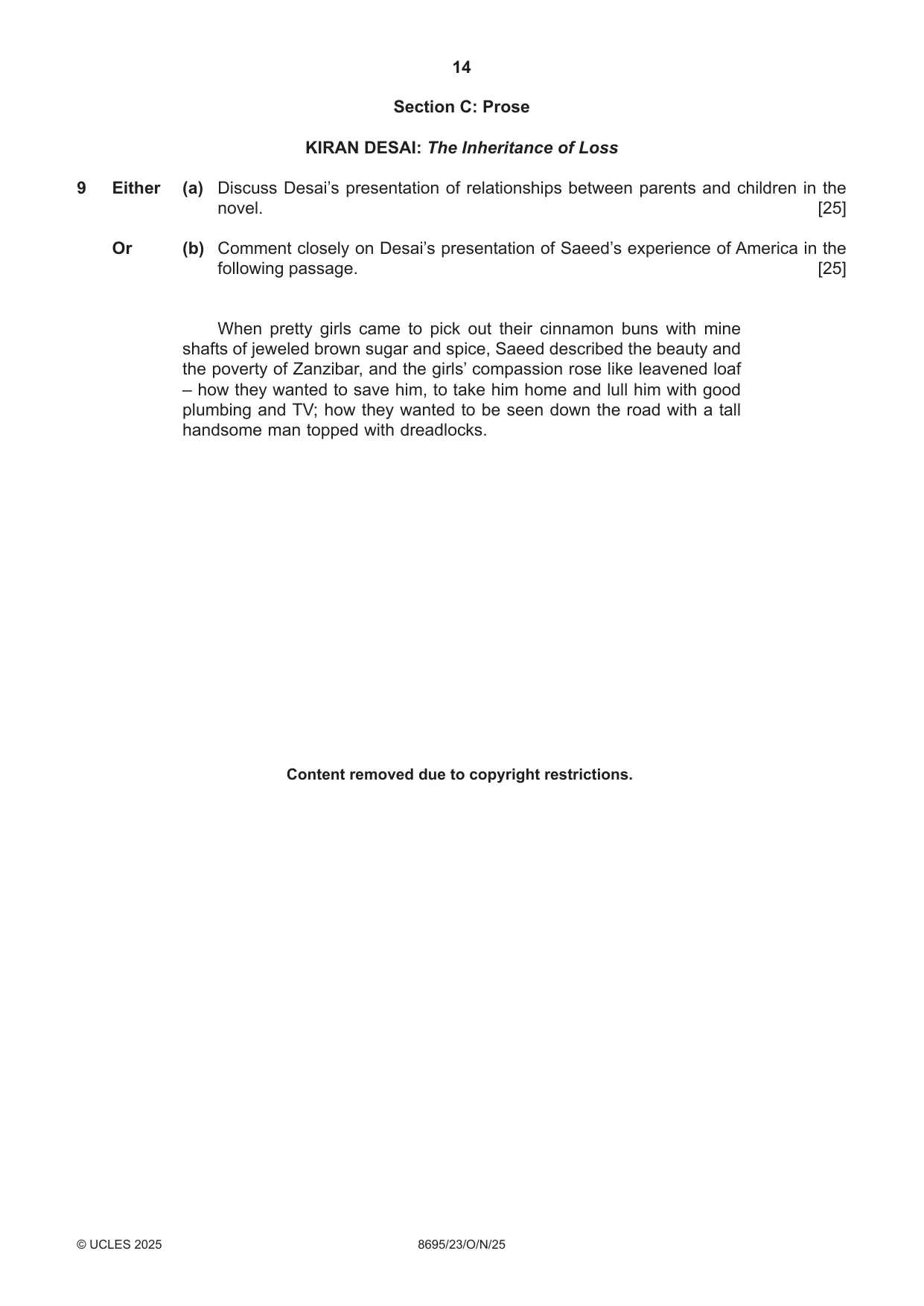
14 8695/23/O/N/25 © UCLES 2025 Section C: Prose KIRAN DESAI: The Inheritance of Loss 9 Either (a) Discuss Desai’s presentation of relationships between parents and children in the novel. [25] Or (b) Comment closely on Desai’s presentation of Saeed’s experience of America in the following passage. [25] When pretty girls came to pick out their cinnamon buns with mine shafts of jeweled brown sugar and spice, Saeed described the beauty and the poverty of Zanzibar, and the girls’ compassion rose like leavened loaf – how they wanted to save him, to take him home and lull him with good plumbing and TV; how they wanted to be seen down the road with a tall handsome man topped with dreadlocks. Content removed due to copyright restrictions.
Question paper, page 15
15 8695/23/O/N/25 © UCLES 2025 [Turn over Ups and downs, sometimes more sour than sweet, maybe, but nonetheless, beyond anything the INS could imagine, it was an old-fashioned romance. (from Chapter 14) Content removed due to copyright restrictions.
Question paper, page 16
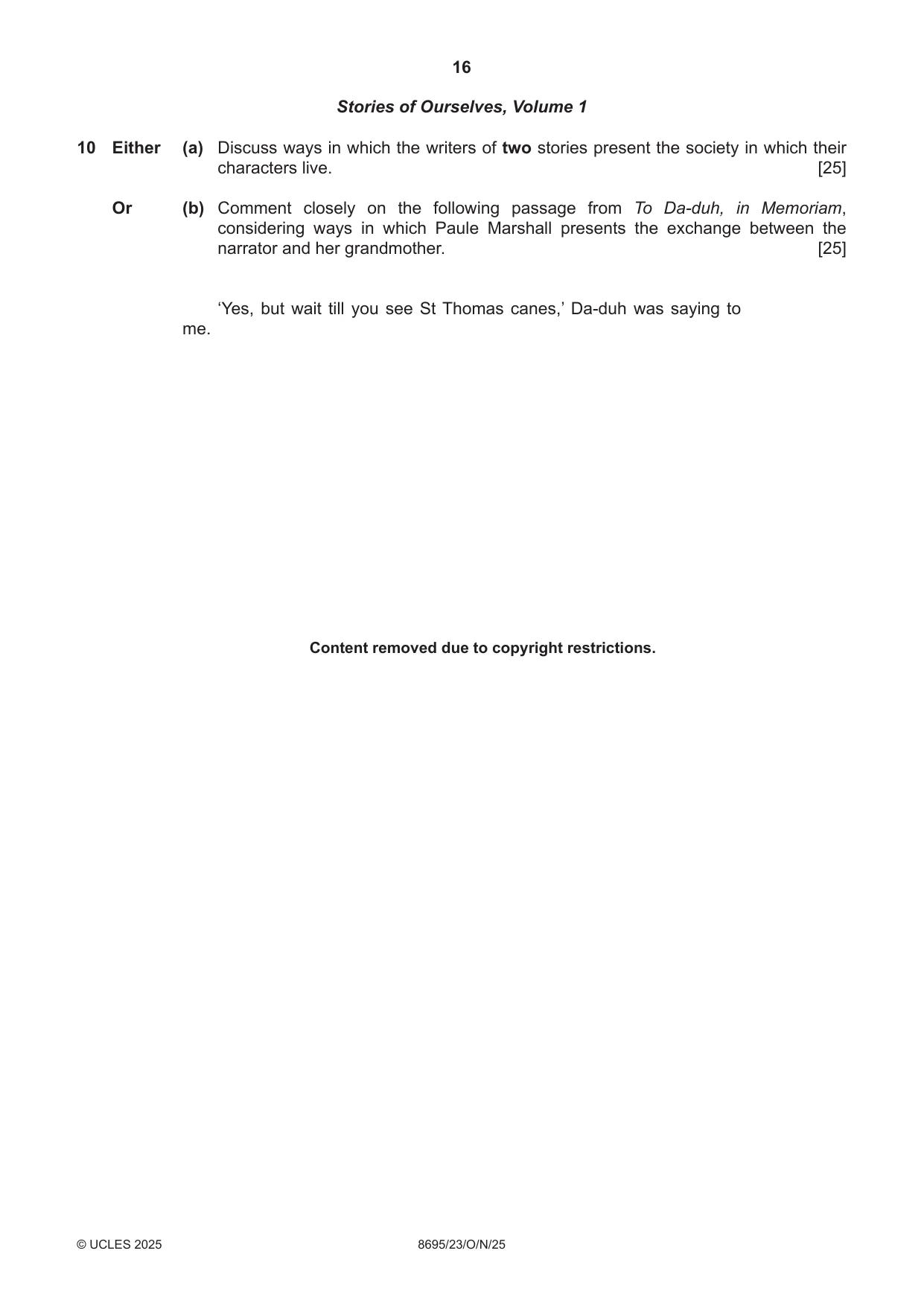
16 8695/23/O/N/25 © UCLES 2025 Stories of Ourselves, Volume 1 10 Either (a) Discuss ways in which the writers of two stories present the society in which their characters live. [25] Or (b) Comment closely on the following passage from To Da-duh, in Memoriam, considering ways in which Paule Marshall presents the exchange between the narrator and her grandmother. [25] ‘Yes, but wait till you see St Thomas canes,’ Da-duh was saying to me. Content removed due to copyright restrictions.
Question paper, page 17
17 8695/23/O/N/25 © UCLES 2025 [Turn over Looking up, I studied her closely, sensing my chance, and then I told her, describing at length and with as much drama as I could summon not only what snow in the city was like, but what it would be like here, in her perennial summer kingdom. (from To Da-duh, in Memoriam) Content removed due to copyright restrictions.
Question paper, page 18
18 8695/23/O/N/25 © UCLES 2025 EVELYN WAUGH: A Handful of Dust 11 Either (a) Discuss ways in which Waugh presents the relationship between Tony and Jock Grant-Menzies. [25] Or (b) Comment closely on the following passage, considering ways in which Waugh presents Brenda and John Beaver. [25] ‘I suppose we ought to be going too.’ Then he was sulky. (from English Gothic – 1, Part 3) Content removed due to copyright restrictions.
Question paper, page 19
19 8695/23/O/N/25 © UCLES 2025 COLSON WHITEHEAD: The Underground Railroad 12 Either (a) Discuss some of the ways in which Whitehead presents racial inequalities in the novel. [25] Or (b) Comment closely on Whitehead’s presentation of Cora and Lovey in the following passage. [25] ‘If you could pick your birthday, what would it be?’ The dirt at her feet had a story, the oldest story Cora knew. (from Georgia) Content removed due to copyright restrictions.
Question paper, page 20
20 8695/23/O/N/25 © UCLES 2025 Permission to reproduce items where third-party owned material protected by copyright is included has been sought and cleared where possible. Every reasonable effort has been made by the publisher (UCLES) to trace copyright holders, but if any items requiring clearance have unwittingly been included, the publisher will be pleased to make amends at the earliest possible opportunity. To avoid the issue of disclosure of answer-related information to candidates, all copyright acknowledgements are reproduced online in the Cambridge Assessment International Education Copyright Acknowledgements Booklet. This is produced for each series of examinations and is freely available to download at www.cambridgeinternational.org after the live examination series. Cambridge Assessment International Education is part of Cambridge Assessment. Cambridge Assessment is the brand name of the University of Cambridge Local Examinations Syndicate (UCLES), which is a department of the University of Cambridge. BLANK PAGE
Mark scheme, page 1
This document consists of 14 printed pages. © Cambridge University Press & Assessment 2025 [Turn over Cambridge International AS Level LANGUAGE AND LITERATURE IN ENGLISH 8695/23 Paper 2 Drama, Poetry and Prose October/November 2025 MARK SCHEME Maximum Mark: 50 Published This mark scheme is published as an aid to teachers and candidates, to indicate the requirements of the examination. It shows the basis on which Examiners were instructed to award marks. It does not indicate the details of the discussions that took place at an Examiners’ meeting before marking began, which would have considered the acceptability of alternative answers. Mark schemes should be read in conjunction with the question paper and the Principal Examiner Report for Teachers. Cambridge International will not enter into discussions about these mark schemes. Cambridge International is publishing the mark schemes for the October/November 2025 series for most Cambridge IGCSE, Cambridge International A and AS Level components, and some Cambridge O Level components.
Mark scheme, page 2
8695/23 Cambridge International AS Level – Mark Scheme PUBLISHED October/November 2025 © Cambridge University Press & Assessment 2025 Page 2 of 14 Generic Marking Principles These general marking principles must be applied by all examiners when marking candidate answers. They should be applied alongside the specific content of the mark scheme or generic level descriptions for a question. Each question paper and mark scheme will also comply with these marking principles. GENERIC MARKING PRINCIPLE 1: Marks must be awarded in line with: • the specific content of the mark scheme or the generic level descriptors for the question • the specific skills defined in the mark scheme or in the generic level descriptors for the question • the standard of response required by a candidate as exemplified by the standardisation scripts. GENERIC MARKING PRINCIPLE 2: Marks awarded are always whole marks (not half marks, or other fractions). GENERIC MARKING PRINCIPLE 3: Marks must be awarded positively: • marks are awarded for correct/valid answers, as defined in the mark scheme. However, credit is given for valid answers which go beyond the scope of the syllabus and mark scheme, referring to your Team Leader as appropriate • marks are awarded when candidates clearly demonstrate what they know and can do • marks are not deducted for errors • marks are not deducted for omissions • answers should only be judged on the quality of spelling, punctuation and grammar when these features are specifically assessed by the question as indicated by the mark scheme. The meaning, however, should be unambiguous. GENERIC MARKING PRINCIPLE 4: Rules must be applied consistently, e.g. in situations where candidates have not followed instructions or in the application of generic level descriptors. GENERIC MARKING PRINCIPLE 5: Marks should be awarded using the full range of marks defined in the mark scheme for the question (however; the use of the full mark range may be limited according to the quality of the candidate responses seen). GENERIC MARKING PRINCIPLE 6: Marks awarded are based solely on the requirements as defined in the mark scheme. Marks should not be awarded with grade thresholds or grade descriptors in mind.
Mark scheme, page 3
8695/23 Cambridge International AS Level – Mark Scheme PUBLISHED October/November 2025 © Cambridge University Press & Assessment 2025 Page 3 of 14 English & Media subject specific general marking principles (To be read in conjunction with the Generic Marking Principles (and requiring further guidance on how to place marks within levels)) Components using level descriptors: • We use level descriptors as a guide to broad understanding of the qualities normally expected of, or typical of, work in a level. • Level descriptors are a means of general guidance and should not be interpreted as hurdle statements. • Where indicative content notes are supplied for a question, these are not a prescription of required content, and must not be treated as such. Alternative correct points and unexpected answers in candidates’ scripts must be given marks that fairly reflect the knowledge and skills demonstrated. • While we may have legitimate expectations as to the ground most answers may occupy, we must at all times be prepared to meet candidates on their chosen ground, provided it is relevant ground (e.g. clearly related to and derived from a relevant passage/text and meeting the mark scheme requirements for the question).
Mark scheme, page 4
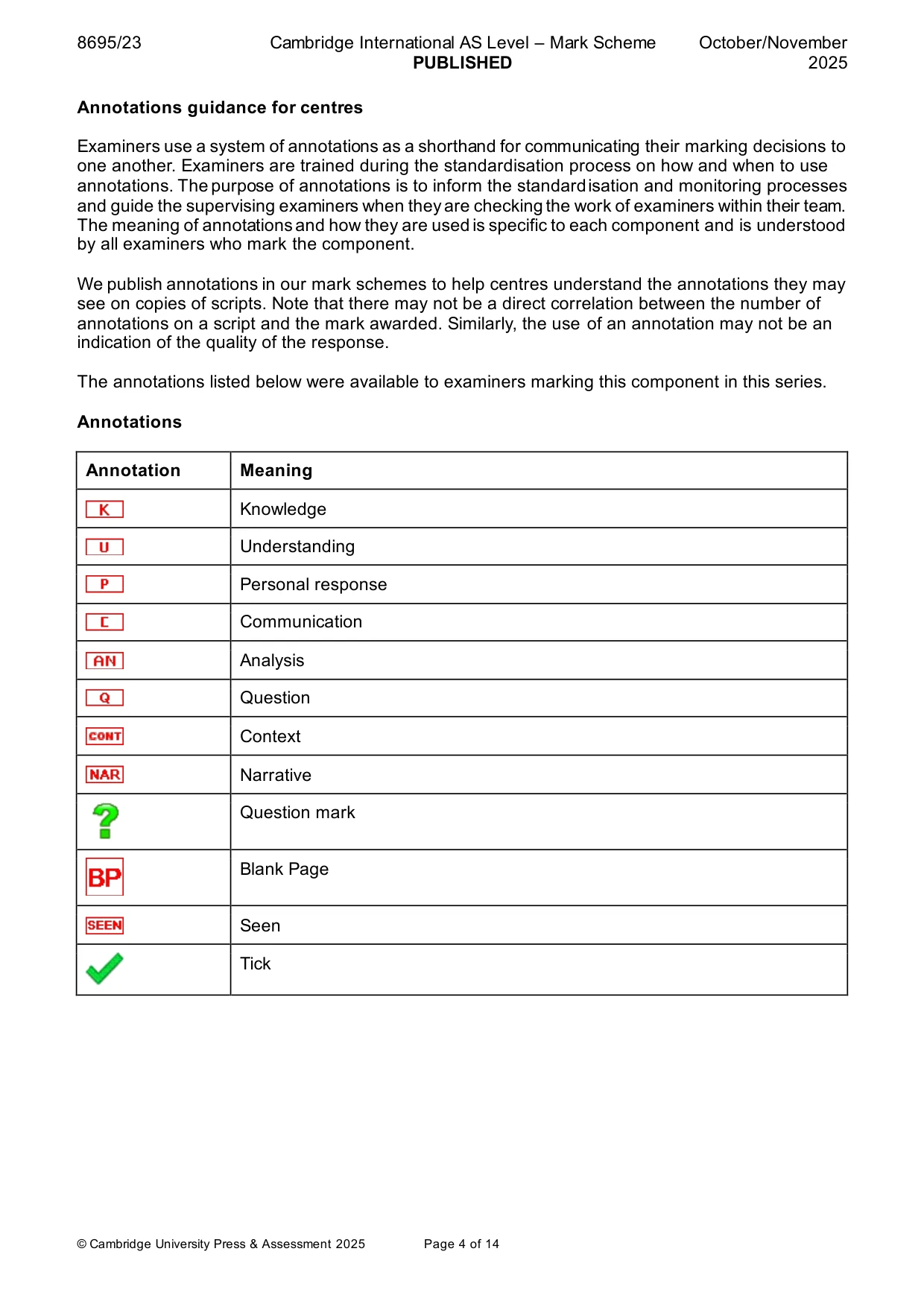
8695/23 Cambridge International AS Level – Mark Scheme PUBLISHED October/November 2025 © Cambridge University Press & Assessment 2025 Page 4 of 14 Annotations guidance for centres Examiners use a system of annotations as a shorthand for communicating their marking decisions to one another. Examiners are trained during the standardisation process on how and when to use annotations. The purpose of annotations is to inform the standardisation and monitoring processes and guide the supervising examiners when they are checking the work of examiners within their team. The meaning of annotations and how they are used is specific to each component and is understood by all examiners who mark the component. We publish annotations in our mark schemes to help centres understand the annotations they may see on copies of scripts. Note that there may not be a direct correlation between the number of annotations on a script and the mark awarded. Similarly, the use of an annotation may not be an indication of the quality of the response. The annotations listed below were available to examiners marking this component in this series. Annotations Annotation Meaning Knowledge Understanding Personal response Communication Analysis Question Context Narrative Question mark Blank Page Seen Tick
Mark scheme, page 5
8695/23 Cambridge International AS Level – Mark Scheme PUBLISHED October/November 2025 © Cambridge University Press & Assessment 2025 Page 5 of 14 Literature in English specific marking instructions Using the mark levels Use the generic mark scheme levels to find the mark. Place the answer in a level first. Look for the ‘best fit’ of the answer into a level. An answer needs to show evidence of most but not necessarily ALL of the qualities described in a level, in order to be placed in that level. Then award a mark for the relative position of the answer within the level. Candidates may address the question in many different ways. There is no one required answer or approach and do not penalise answers for leaving out a particular focus. Reward what is there, showing what you are rewarding in your comments. Consider all strands and weigh up the performance as a whole in placing the answer in a level, then show that you have done so in the summative comment. Each answer is marked out of 25, in accordance with the general marking criteria. Assessment objectives All assessment objectives are equally weighted, and all are considered in assessing each essay. Each level in the marking criteria is divided into strands corresponding to the assessment objectives – AO1: Knowledge and understanding (K/U), AO2: Analysis (AN), AO3: Personal response (P), AO4: Communication (C). AO1 Knowledge and understanding Respond with understanding to literary texts in a variety of forms, from different cultures; with an appreciation of relevant contexts that illuminate readings of the texts. AO2 Analysis Analyse ways in which writers’ choices of language, form and structure shape meanings and effects. AO3 Personal response Produce informed independent opinions and interpretations of literary texts. AO4 Communication Communicate a relevant, structured and supported response appropriate to literary study.
Mark scheme, page 6
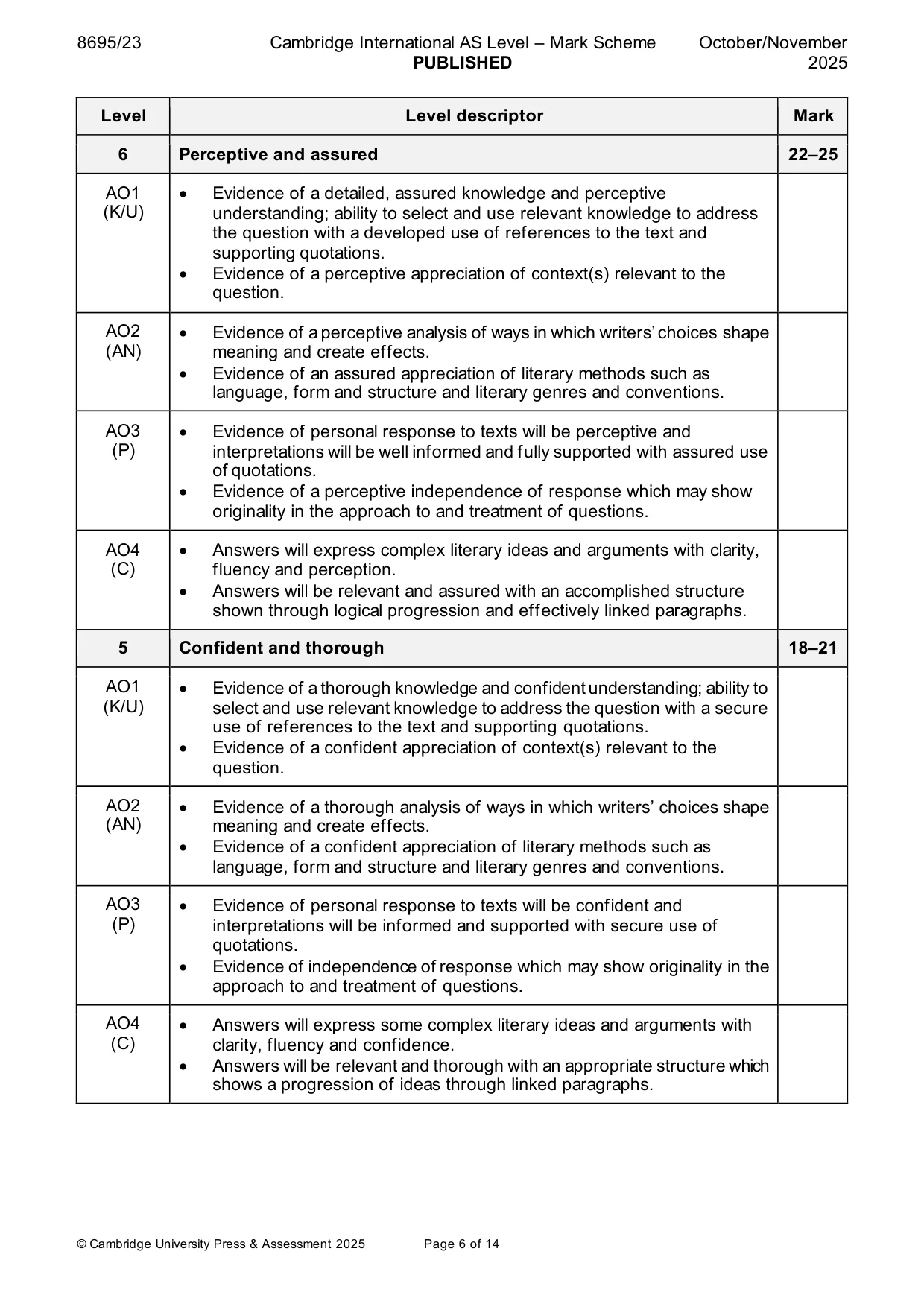
8695/23 Cambridge International AS Level – Mark Scheme PUBLISHED October/November 2025 © Cambridge University Press & Assessment 2025 Page 6 of 14 Level Level descriptor Mark 6 Perceptive and assured 22–25 AO1 (K/U) • Evidence of a detailed, assured knowledge and perceptive understanding; ability to select and use relevant knowledge to address the question with a developed use of references to the text and supporting quotations. • Evidence of a perceptive appreciation of context(s) relevant to the question. AO2 (AN) • Evidence of a perceptive analysis of ways in which writers’ choices shape meaning and create effects. • Evidence of an assured appreciation of literary methods such as language, form and structure and literary genres and conventions. AO3 (P) • Evidence of personal response to texts will be perceptive and interpretations will be well informed and fully supported with assured use of quotations. • Evidence of a perceptive independence of response which may show originality in the approach to and treatment of questions. AO4 (C) • Answers will express complex literary ideas and arguments with clarity, fluency and perception. • Answers will be relevant and assured with an accomplished structure shown through logical progression and effectively linked paragraphs. 5 Confident and thorough 18–21 AO1 (K/U) • Evidence of a thorough knowledge and confident understanding; ability to select and use relevant knowledge to address the question with a secure use of references to the text and supporting quotations. • Evidence of a confident appreciation of context(s) relevant to the question. AO2 (AN) • Evidence of a thorough analysis of ways in which writers’ choices shape meaning and create effects. • Evidence of a confident appreciation of literary methods such as language, form and structure and literary genres and conventions. AO3 (P) • Evidence of personal response to texts will be confident and interpretations will be informed and supported with secure use of quotations. • Evidence of independence of response which may show originality in the approach to and treatment of questions. AO4 (C) • Answers will express some complex literary ideas and arguments with clarity, fluency and confidence. • Answers will be relevant and thorough with an appropriate structure which shows a progression of ideas through linked paragraphs.
Mark scheme, page 7
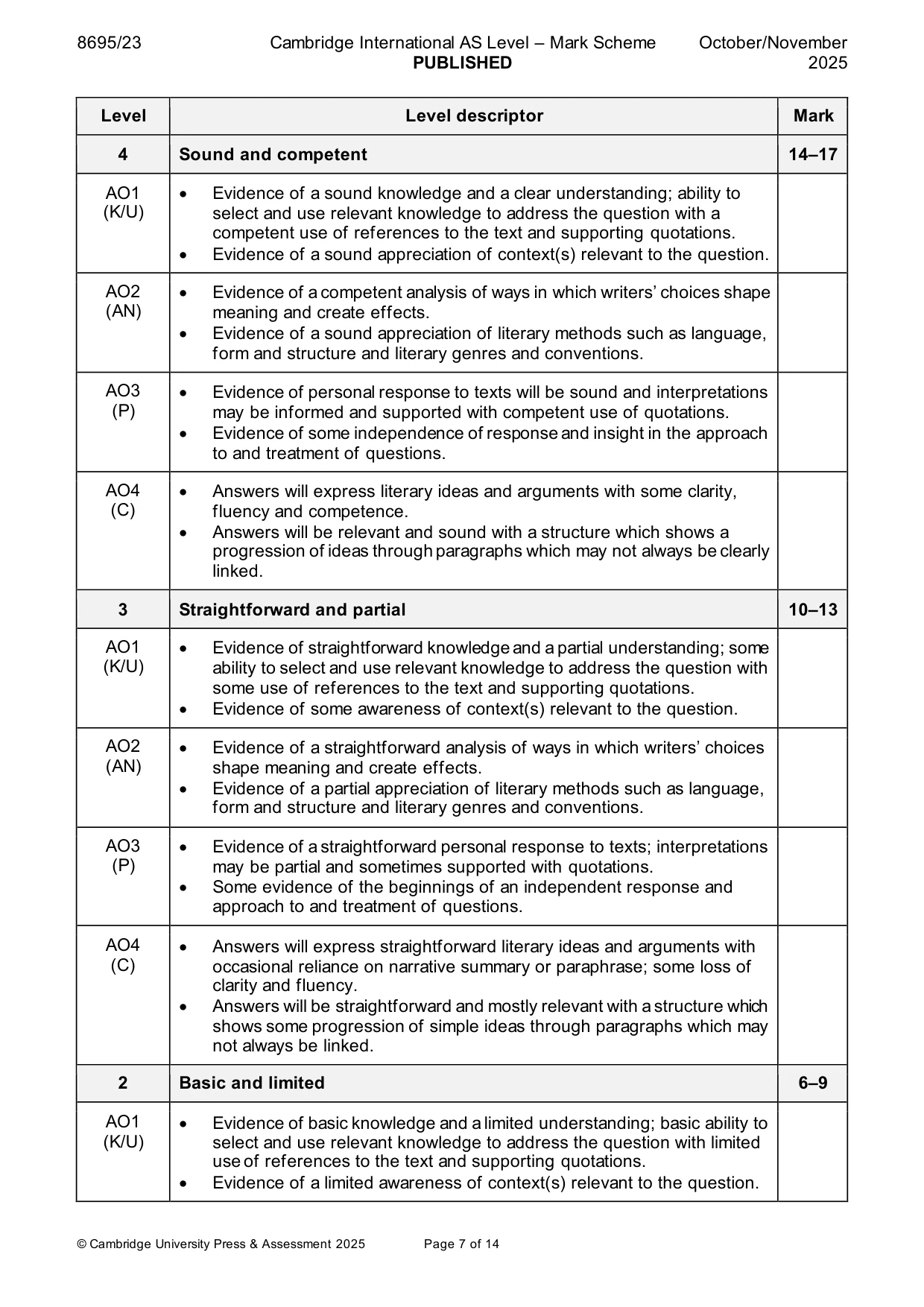
8695/23 Cambridge International AS Level – Mark Scheme PUBLISHED October/November 2025 © Cambridge University Press & Assessment 2025 Page 7 of 14 Level Level descriptor Mark 4 Sound and competent 14–17 AO1 (K/U) • Evidence of a sound knowledge and a clear understanding; ability to select and use relevant knowledge to address the question with a competent use of references to the text and supporting quotations. • Evidence of a sound appreciation of context(s) relevant to the question. AO2 (AN) • Evidence of a competent analysis of ways in which writers’ choices shape meaning and create effects. • Evidence of a sound appreciation of literary methods such as language, form and structure and literary genres and conventions. AO3 (P) • Evidence of personal response to texts will be sound and interpretations may be informed and supported with competent use of quotations. • Evidence of some independence of response and insight in the approach to and treatment of questions. AO4 (C) • Answers will express literary ideas and arguments with some clarity, fluency and competence. • Answers will be relevant and sound with a structure which shows a progression of ideas through paragraphs which may not always be clearly linked. 3 Straightforward and partial 10–13 AO1 (K/U) • Evidence of straightforward knowledge and a partial understanding; some ability to select and use relevant knowledge to address the question with some use of references to the text and supporting quotations. • Evidence of some awareness of context(s) relevant to the question. AO2 (AN) • Evidence of a straightforward analysis of ways in which writers’ choices shape meaning and create effects. • Evidence of a partial appreciation of literary methods such as language, form and structure and literary genres and conventions. AO3 (P) • Evidence of a straightforward personal response to texts; interpretations may be partial and sometimes supported with quotations. • Some evidence of the beginnings of an independent response and approach to and treatment of questions. AO4 (C) • Answers will express straightforward literary ideas and arguments with occasional reliance on narrative summary or paraphrase; some loss of clarity and fluency. • Answers will be straightforward and mostly relevant with a structure which shows some progression of simple ideas through paragraphs which may not always be linked. 2 Basic and limited 6–9 AO1 (K/U) • Evidence of basic knowledge and a limited understanding; basic ability to select and use relevant knowledge to address the question with limited use of references to the text and supporting quotations. • Evidence of a limited awareness of context(s) relevant to the question.
Mark scheme, page 8
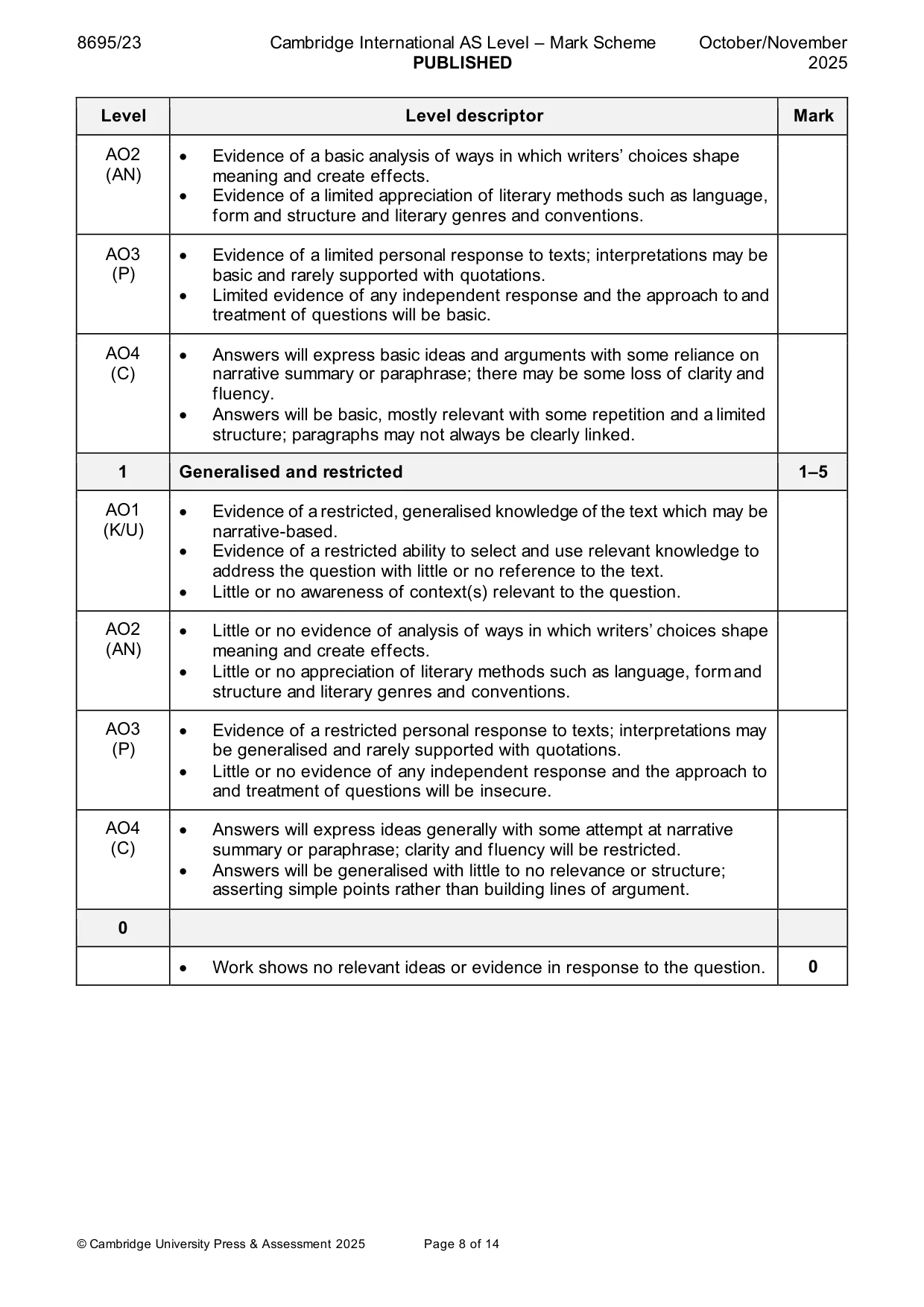
8695/23 Cambridge International AS Level – Mark Scheme PUBLISHED October/November 2025 © Cambridge University Press & Assessment 2025 Page 8 of 14 Level Level descriptor Mark AO2 (AN) • Evidence of a basic analysis of ways in which writers’ choices shape meaning and create effects. • Evidence of a limited appreciation of literary methods such as language, form and structure and literary genres and conventions. AO3 (P) • Evidence of a limited personal response to texts; interpretations may be basic and rarely supported with quotations. • Limited evidence of any independent response and the approach to and treatment of questions will be basic. AO4 (C) • Answers will express basic ideas and arguments with some reliance on narrative summary or paraphrase; there may be some loss of clarity and fluency. • Answers will be basic, mostly relevant with some repetition and a limited structure; paragraphs may not always be clearly linked. 1 Generalised and restricted 1–5 AO1 (K/U) • Evidence of a restricted, generalised knowledge of the text which may be narrative-based. • Evidence of a restricted ability to select and use relevant knowledge to address the question with little or no reference to the text. • Little or no awareness of context(s) relevant to the question. AO2 (AN) • Little or no evidence of analysis of ways in which writers’ choices shape meaning and create effects. • Little or no appreciation of literary methods such as language, form and structure and literary genres and conventions. AO3 (P) • Evidence of a restricted personal response to texts; interpretations may be generalised and rarely supported with quotations. • Little or no evidence of any independent response and the approach to and treatment of questions will be insecure. AO4 (C) • Answers will express ideas generally with some attempt at narrative summary or paraphrase; clarity and fluency will be restricted. • Answers will be generalised with little to no relevance or structure; asserting simple points rather than building lines of argument. 0 • Work shows no relevant ideas or evidence in response to the question. 0
Mark scheme, page 9
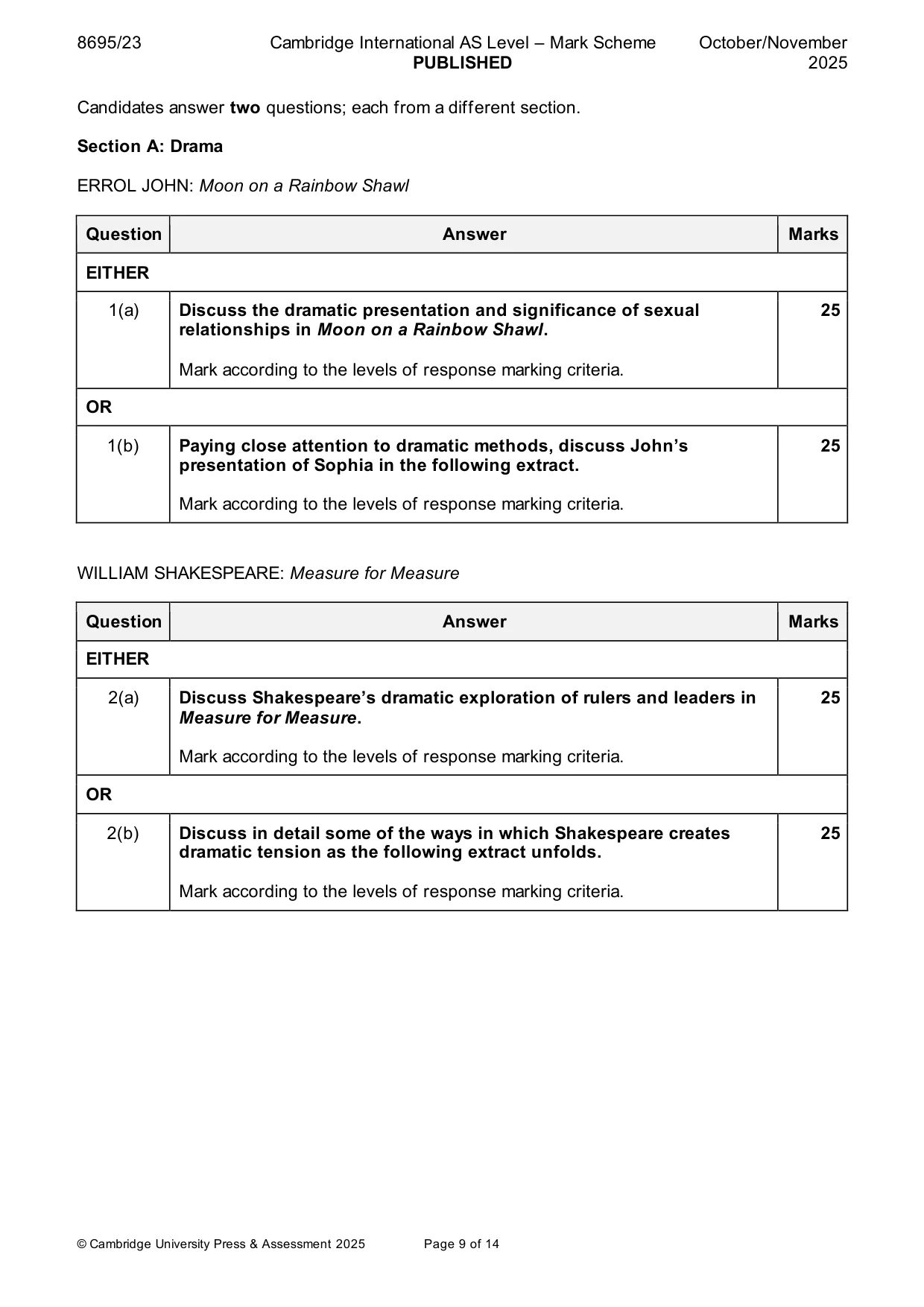
8695/23 Cambridge International AS Level – Mark Scheme PUBLISHED October/November 2025 © Cambridge University Press & Assessment 2025 Page 9 of 14 Candidates answer two questions; each from a different section. Section A: Drama ERROL JOHN: Moon on a Rainbow Shawl Question Answer Marks EITHER 1(a) Discuss the dramatic presentation and significance of sexual relationships in Moon on a Rainbow Shawl. Mark according to the levels of response marking criteria. 25 OR 1(b) Paying close attention to dramatic methods, discuss John’s presentation of Sophia in the following extract. Mark according to the levels of response marking criteria. 25 WILLIAM SHAKESPEARE: Measure for Measure Question Answer Marks EITHER 2(a) Discuss Shakespeare’s dramatic exploration of rulers and leaders in Measure for Measure. Mark according to the levels of response marking criteria. 25 OR 2(b) Discuss in detail some of the ways in which Shakespeare creates dramatic tension as the following extract unfolds. Mark according to the levels of response marking criteria. 25
Mark scheme, page 10
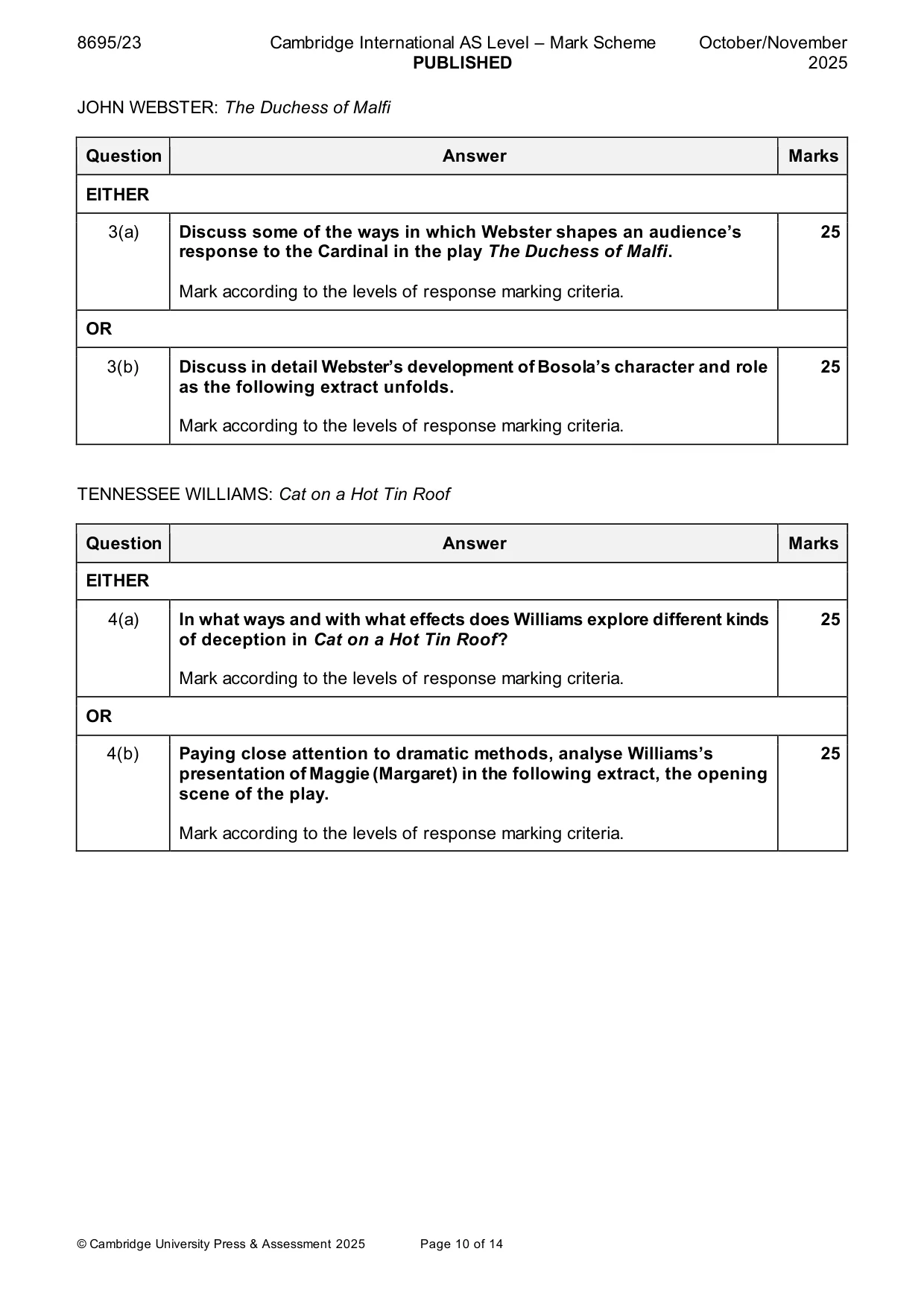
8695/23 Cambridge International AS Level – Mark Scheme PUBLISHED October/November 2025 © Cambridge University Press & Assessment 2025 Page 10 of 14 JOHN WEBSTER: The Duchess of Malfi Question Answer Marks EITHER 3(a) Discuss some of the ways in which Webster shapes an audience’s response to the Cardinal in the play The Duchess of Malfi. Mark according to the levels of response marking criteria. 25 OR 3(b) Discuss in detail Webster’s development of Bosola’s character and role as the following extract unfolds. Mark according to the levels of response marking criteria. 25 TENNESSEE WILLIAMS: Cat on a Hot Tin Roof Question Answer Marks EITHER 4(a) In what ways and with what effects does Williams explore different kinds of deception in Cat on a Hot Tin Roof? Mark according to the levels of response marking criteria. 25 OR 4(b) Paying close attention to dramatic methods, analyse Williams’s presentation of Maggie (Margaret) in the following extract, the opening scene of the play. Mark according to the levels of response marking criteria. 25
Mark scheme, page 11
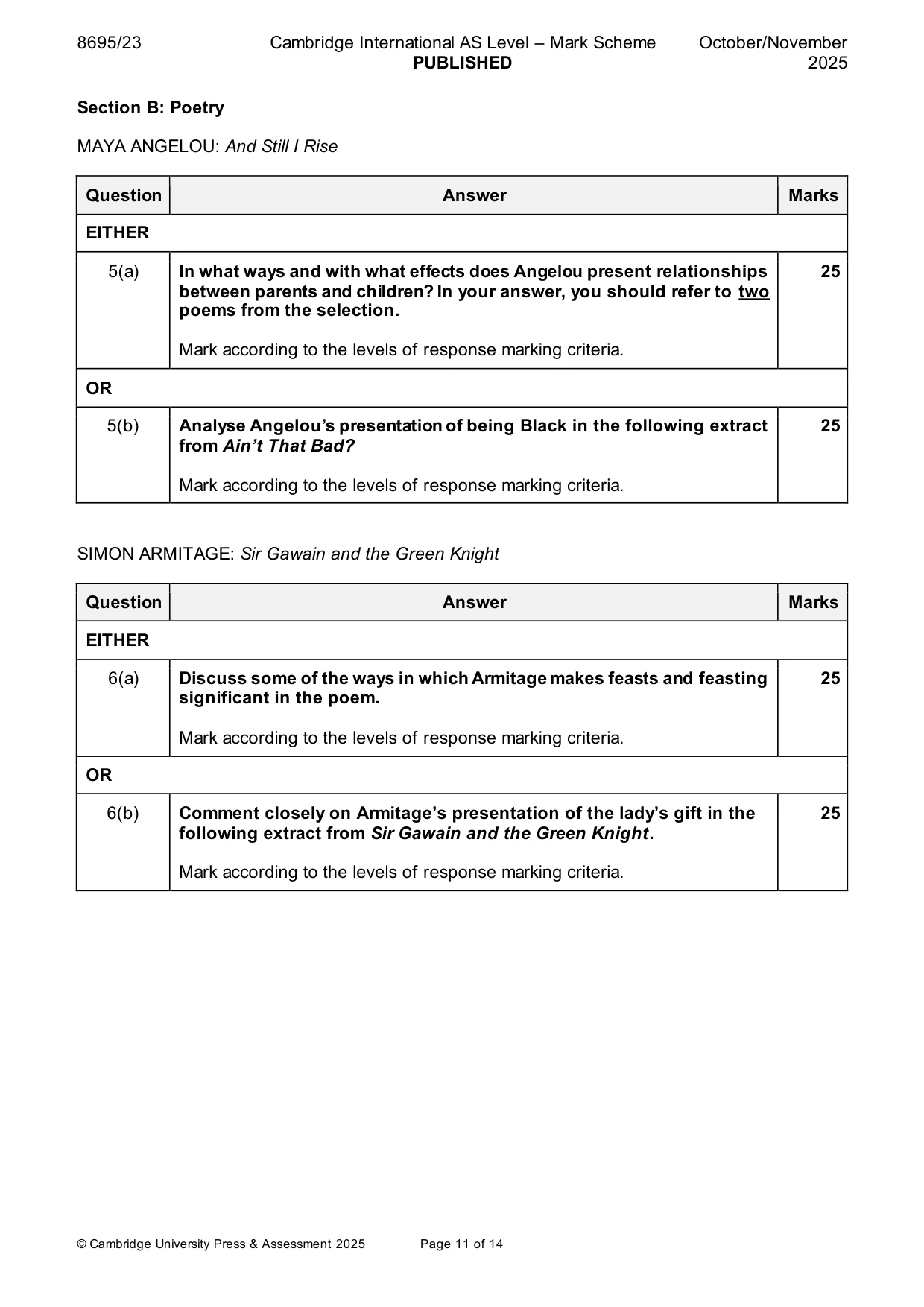
8695/23 Cambridge International AS Level – Mark Scheme PUBLISHED October/November 2025 © Cambridge University Press & Assessment 2025 Page 11 of 14 Section B: Poetry MAYA ANGELOU: And Still I Rise Question Answer Marks EITHER 5(a) In what ways and with what effects does Angelou present relationships between parents and children? In your answer, you should refer to two poems from the selection. Mark according to the levels of response marking criteria. 25 OR 5(b) Analyse Angelou’s presentation of being Black in the following extract from Ain’t That Bad? Mark according to the levels of response marking criteria. 25 SIMON ARMITAGE: Sir Gawain and the Green Knight Question Answer Marks EITHER 6(a) Discuss some of the ways in which Armitage makes feasts and feasting significant in the poem. Mark according to the levels of response marking criteria. 25 OR 6(b) Comment closely on Armitage’s presentation of the lady’s gift in the following extract from Sir Gawain and the Green Knight. Mark according to the levels of response marking criteria. 25
Mark scheme, page 12
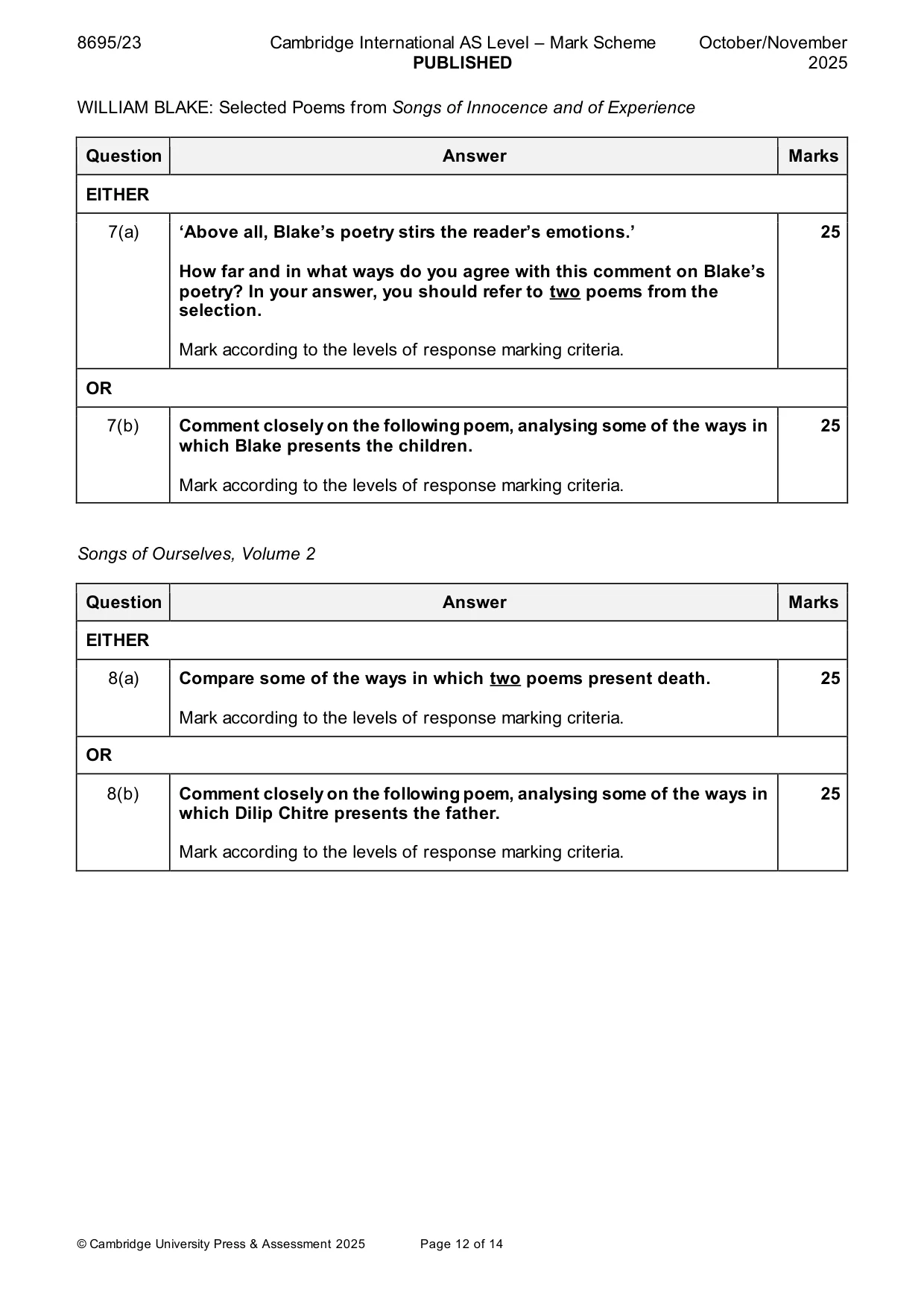
8695/23 Cambridge International AS Level – Mark Scheme PUBLISHED October/November 2025 © Cambridge University Press & Assessment 2025 Page 12 of 14 WILLIAM BLAKE: Selected Poems from Songs of Innocence and of Experience Question Answer Marks EITHER 7(a) ‘Above all, Blake’s poetry stirs the reader’s emotions.’ How far and in what ways do you agree with this comment on Blake’s poetry? In your answer, you should refer to two poems from the selection. Mark according to the levels of response marking criteria. 25 OR 7(b) Comment closely on the following poem, analysing some of the ways in which Blake presents the children. Mark according to the levels of response marking criteria. 25 Songs of Ourselves, Volume 2 Question Answer Marks EITHER 8(a) Compare some of the ways in which two poems present death. Mark according to the levels of response marking criteria. 25 OR 8(b) Comment closely on the following poem, analysing some of the ways in which Dilip Chitre presents the father. Mark according to the levels of response marking criteria. 25
Mark scheme, page 13
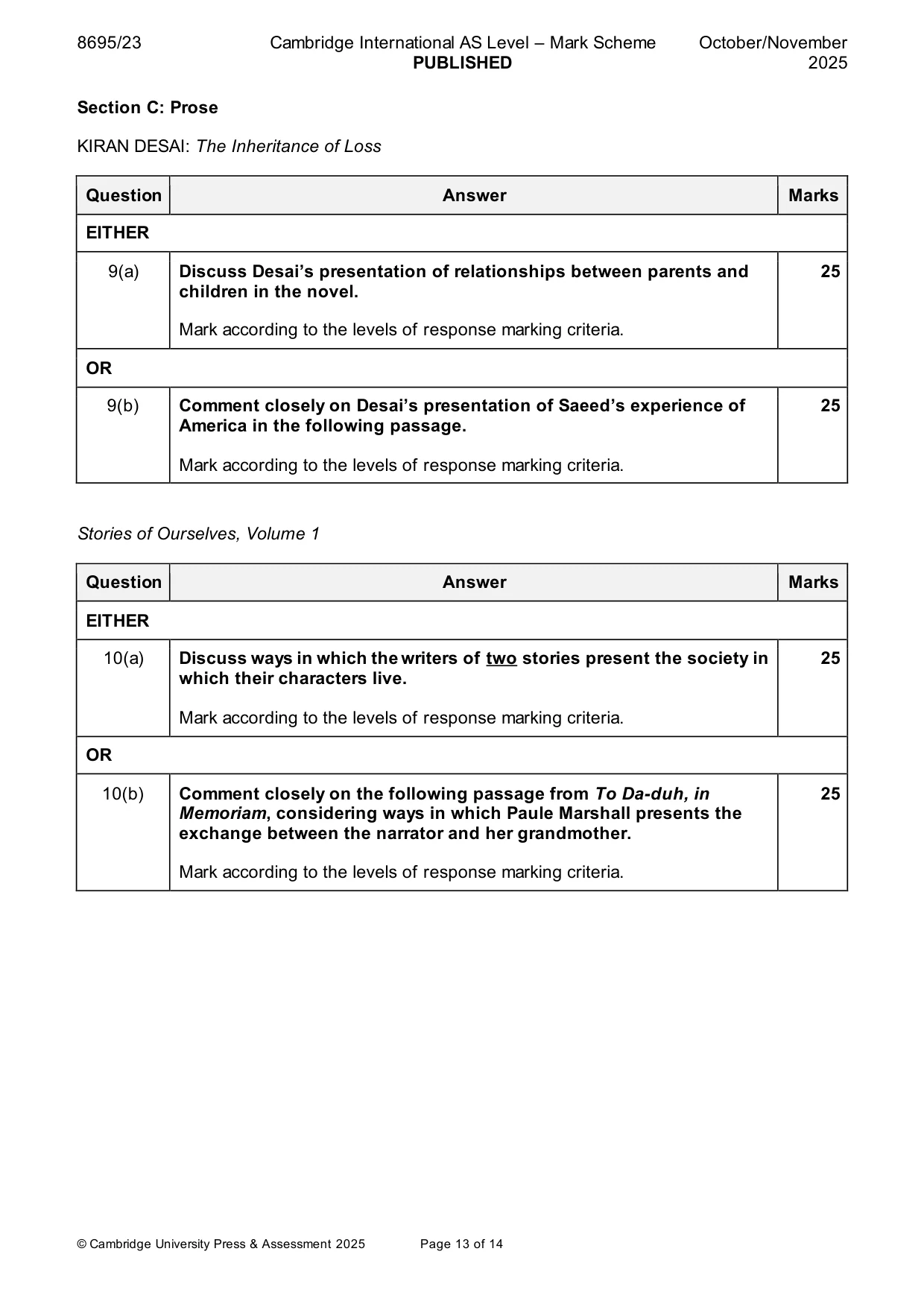
8695/23 Cambridge International AS Level – Mark Scheme PUBLISHED October/November 2025 © Cambridge University Press & Assessment 2025 Page 13 of 14 Section C: Prose KIRAN DESAI: The Inheritance of Loss Question Answer Marks EITHER 9(a) Discuss Desai’s presentation of relationships between parents and children in the novel. Mark according to the levels of response marking criteria. 25 OR 9(b) Comment closely on Desai’s presentation of Saeed’s experience of America in the following passage. Mark according to the levels of response marking criteria. 25 Stories of Ourselves, Volume 1 Question Answer Marks EITHER 10(a) Discuss ways in which the writers of two stories present the society in which their characters live. Mark according to the levels of response marking criteria. 25 OR 10(b) Comment closely on the following passage from To Da-duh, in Memoriam, considering ways in which Paule Marshall presents the exchange between the narrator and her grandmother. Mark according to the levels of response marking criteria. 25
Mark scheme, page 14
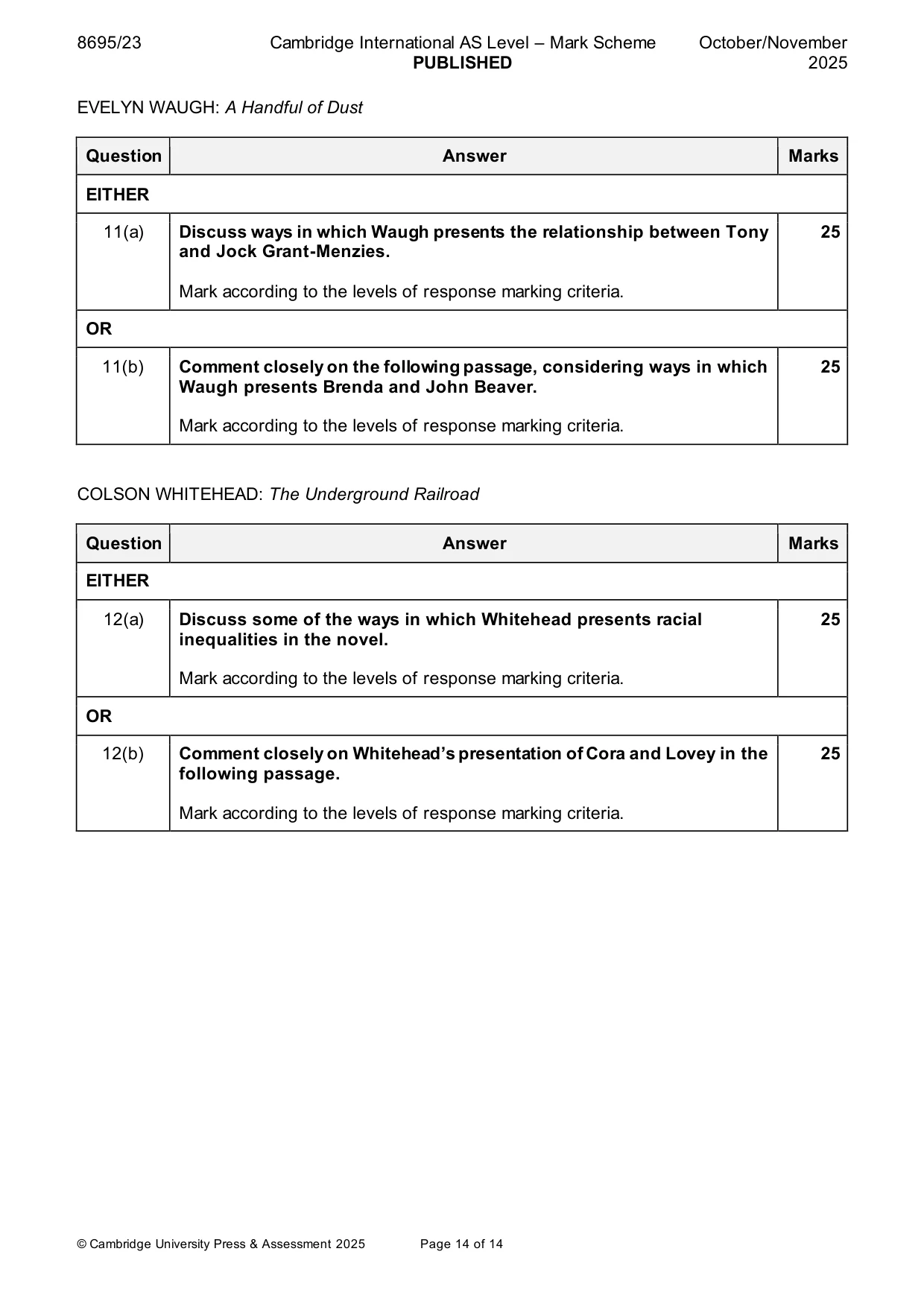
8695/23 Cambridge International AS Level – Mark Scheme PUBLISHED October/November 2025 © Cambridge University Press & Assessment 2025 Page 14 of 14 EVELYN WAUGH: A Handful of Dust Question Answer Marks EITHER 11(a) Discuss ways in which Waugh presents the relationship between Tony and Jock Grant-Menzies. Mark according to the levels of response marking criteria. 25 OR 11(b) Comment closely on the following passage, considering ways in which Waugh presents Brenda and John Beaver. Mark according to the levels of response marking criteria. 25 COLSON WHITEHEAD: The Underground Railroad Question Answer Marks EITHER 12(a) Discuss some of the ways in which Whitehead presents racial inequalities in the novel. Mark according to the levels of response marking criteria. 25 OR 12(b) Comment closely on Whitehead’s presentation of Cora and Lovey in the following passage. Mark according to the levels of response marking criteria. 25
What you needed in this session
Cambridge’s own grade thresholds for 2025 Oct/Nov, Paper 2 · Variant 3. A higher threshold means an easier paper — the bar moves with how the cohort did.