Cambridge A Level English - Language and Literature (AS Level only, from 2016) 8695 — 2024 May/June Paper 2 · Variant 3
8695/23/M/J/24 · 50 marks · 120 min
The question paper and its mark scheme, free to read here and free to download. This is Cambridge’s own paper, exactly as it was sat.
Question paper24 pages





Mark scheme13 pages
Answers below. Sit the paper first if you are practising.
Paper as text
Question paper, page 1
This document has 24 pages. Any blank pages are indicated. [Turn over Cambridge International AS Level * 1 2 8 5 3 2 8 3 9 4 * DC (RCL (DF)) 329893/3 © UCLES 2024 LANGUAGE AND LITERATURE IN ENGLISH 8695/23 Paper 2 Drama, Poetry and Prose May/June 2024 2 hours You must answer on the enclosed answer booklet. You will need: Answer booklet (enclosed) INSTRUCTIONS ● Answer two questions in total, each from a different section. ● Follow the instructions on the front cover of the answer booklet. If you need additional answer paper, ask the invigilator for a continuation booklet. ● Dictionaries are not allowed. INFORMATION ● The total mark for this paper is 50. ● The number of marks for each question or part question is shown in brackets [ ].
Question paper, page 2
2 8695/23/M/J/24 © UCLES 2024 Section A: Drama ERROL JOHN: Moon on a Rainbow Shawl 1 Either (a) Discuss the dramatic significance of Mavis in the play as a whole. [25] Or (b) How might an audience respond to the following extract, the end of the play? In your answer pay close attention to John’s dramatic methods. [25] Epf: Mrs Adams! Content removed due to copyright restrictions.
Question paper, page 3
8695/23/M/J/24 © UCLES 2024 [Turn over Curtain.] (from Act 3, Scene 2) Content removed due to copyright restrictions.
Question paper, page 4
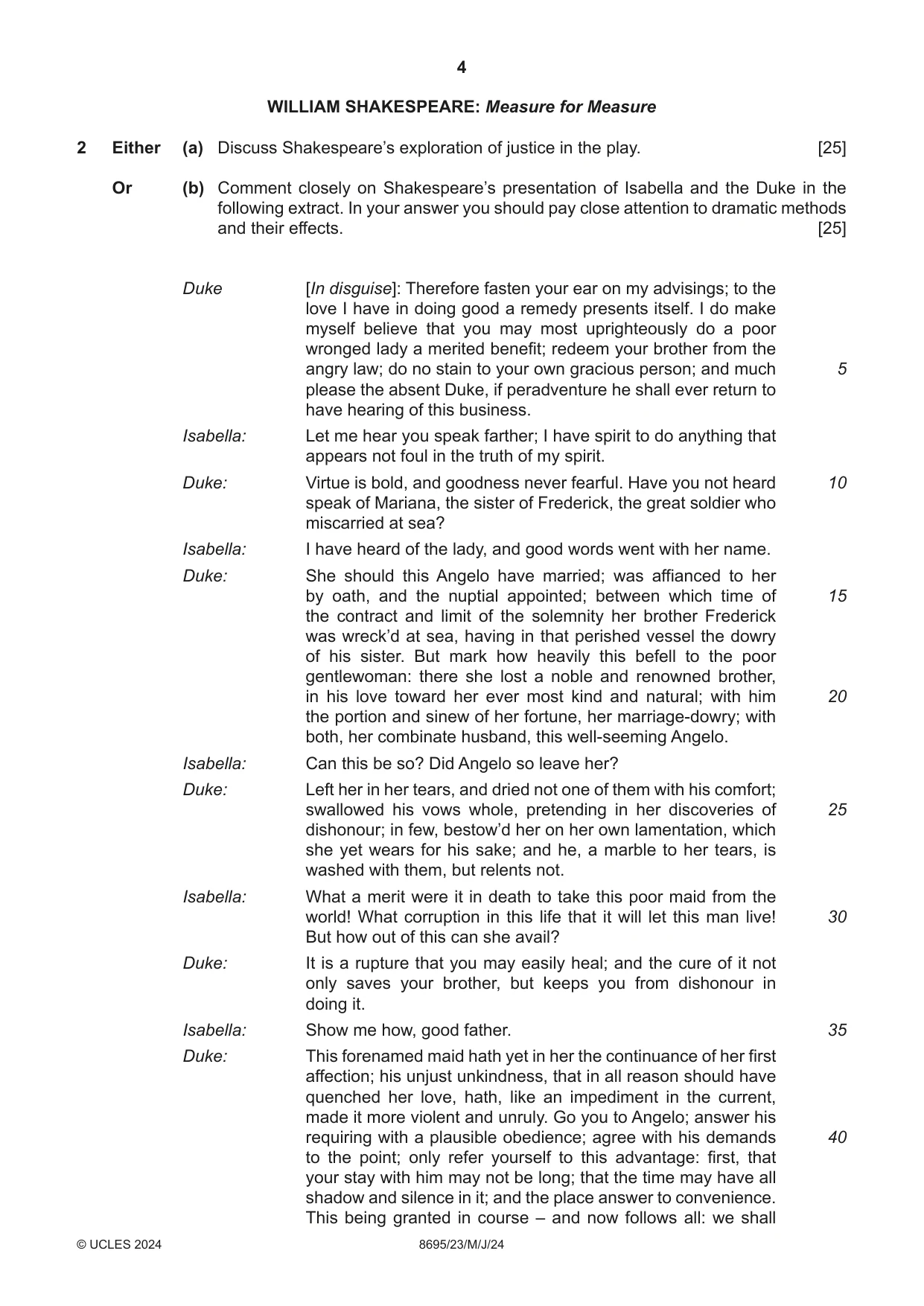
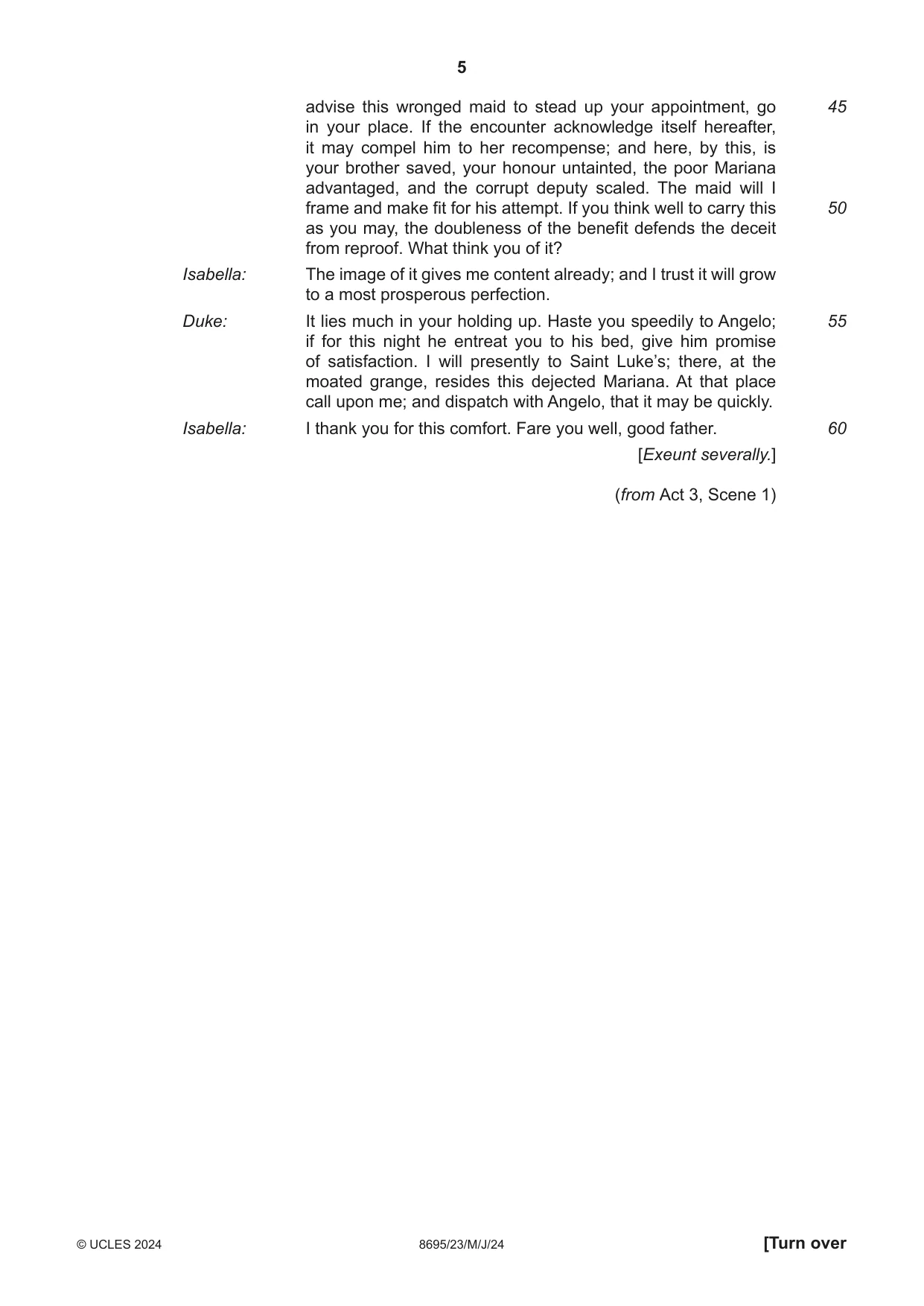
4 8695/23/M/J/24 © UCLES 2024 WILLIAM SHAKESPEARE: Measure for Measure 2 Either (a) Discuss Shakespeare’s exploration of justice in the play. [25] Or (b) Comment closely on Shakespeare’s presentation of Isabella and the Duke in the following extract. In your answer you should pay close attention to dramatic methods and their effects. [25] Duke [In disguise]: Therefore fasten your ear on my advisings; to the love I have in doing good a remedy presents itself. I do make myself believe that you may most uprighteously do a poor wronged lady a merited benefit; redeem your brother from the angry law; do no stain to your own gracious person; and much please the absent Duke, if peradventure he shall ever return to have hearing of this business. Isabella: Let me hear you speak farther; I have spirit to do anything that appears not foul in the truth of my spirit. Duke: Virtue is bold, and goodness never fearful. Have you not heard speak of Mariana, the sister of Frederick, the great soldier who miscarried at sea? Isabella: I have heard of the lady, and good words went with her name. Duke: She should this Angelo have married; was affianced to her by oath, and the nuptial appointed; between which time of the contract and limit of the solemnity her brother Frederick was wreck’d at sea, having in that perished vessel the dowry of his sister. But mark how heavily this befell to the poor gentlewoman: there she lost a noble and renowned brother, in his love toward her ever most kind and natural; with him the portion and sinew of her fortune, her marriage-dowry; with both, her combinate husband, this well-seeming Angelo. Isabella: Can this be so? Did Angelo so leave her? Duke: Left her in her tears, and dried not one of them with his comfort; swallowed his vows whole, pretending in her discoveries of dishonour; in few, bestow’d her on her own lamentation, which she yet wears for his sake; and he, a marble to her tears, is washed with them, but relents not. Isabella: What a merit were it in death to take this poor maid from the world! What corruption in this life that it will let this man live! But how out of this can she avail? Duke: It is a rupture that you may easily heal; and the cure of it not only saves your brother, but keeps you from dishonour in doing it. Isabella: Show me how, good father. Duke: This forenamed maid hath yet in her the continuance of her first affection; his unjust unkindness, that in all reason should have quenched her love, hath, like an impediment in the current, made it more violent and unruly. Go you to Angelo; answer his requiring with a plausible obedience; agree with his demands to the point; only refer yourself to this advantage: first, that your stay with him may not be long; that the time may have all shadow and silence in it; and the place answer to convenience. This being granted in course – and now follows all: we shall 5 10 15 20 25 30 35 40
Question paper, page 5
5 8695/23/M/J/24 © UCLES 2024 [Turn over advise this wronged maid to stead up your appointment, go in your place. If the encounter acknowledge itself hereafter, it may compel him to her recompense; and here, by this, is your brother saved, your honour untainted, the poor Mariana advantaged, and the corrupt deputy scaled. The maid will I frame and make fit for his attempt. If you think well to carry this as you may, the doubleness of the benefit defends the deceit from reproof. What think you of it? Isabella: The image of it gives me content already; and I trust it will grow to a most prosperous perfection. Duke: It lies much in your holding up. Haste you speedily to Angelo; if for this night he entreat you to his bed, give him promise of satisfaction. I will presently to Saint Luke’s; there, at the moated grange, resides this dejected Mariana. At that place call upon me; and dispatch with Angelo, that it may be quickly. Isabella: I thank you for this comfort. Fare you well, good father. [Exeunt severally.] (from Act 3, Scene 1) 45 50 55 60
Question paper, page 6
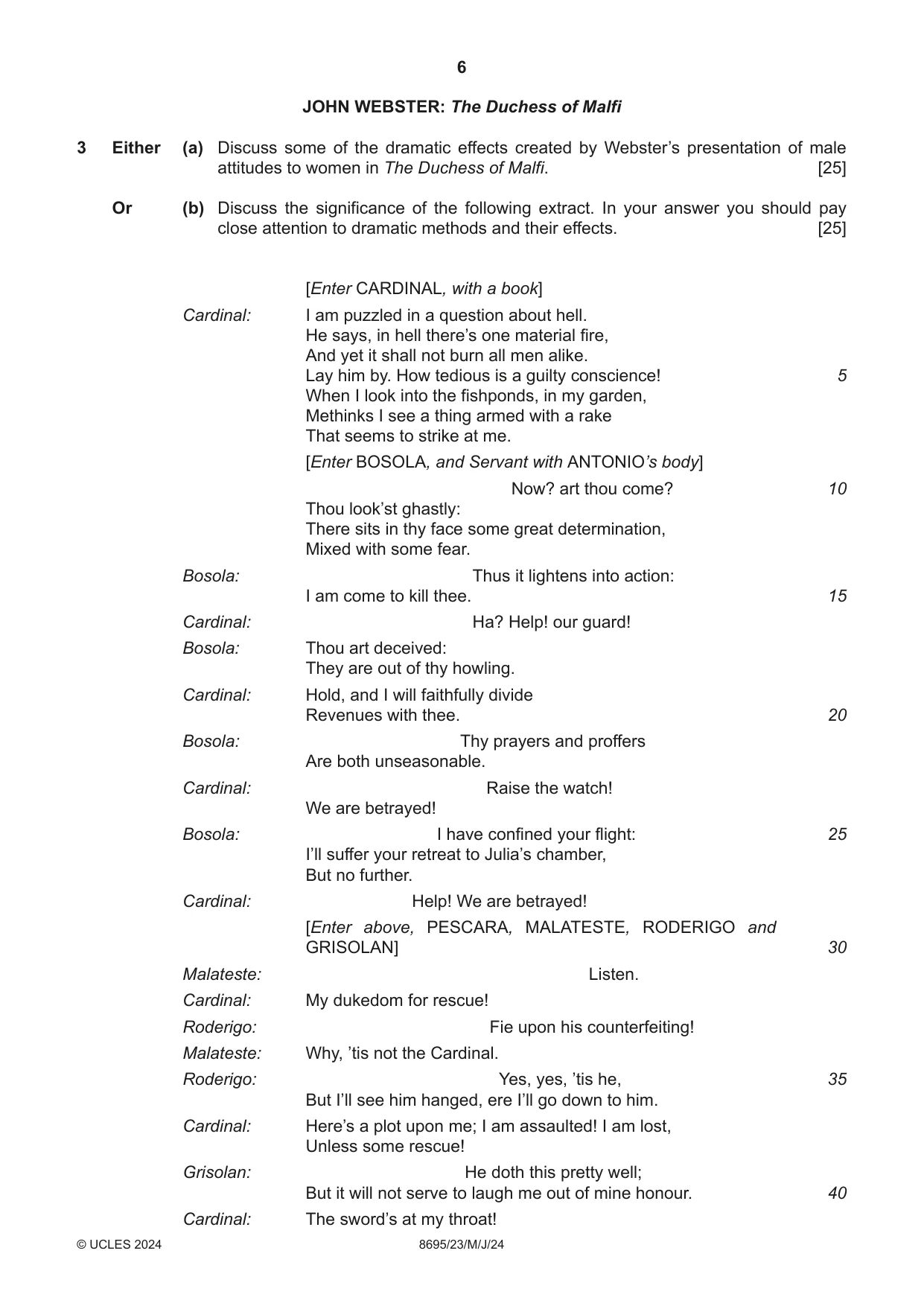
6 8695/23/M/J/24 © UCLES 2024 JOHN WEBSTER: The Duchess of Malfi 3 Either (a) Discuss some of the dramatic effects created by Webster’s presentation of male attitudes to women in The Duchess of Malfi. [25] Or (b) Discuss the significance of the following extract. In your answer you should pay close attention to dramatic methods and their effects. [25] [Enter CARDINAL, with a book] Cardinal: I am puzzled in a question about hell. He says, in hell there’s one material fire, And yet it shall not burn all men alike. Lay him by. How tedious is a guilty conscience! When I look into the fishponds, in my garden, Methinks I see a thing armed with a rake That seems to strike at me. [Enter BOSOLA, and Servant with ANTONIO’s body] Now? art thou come? Thou look’st ghastly: There sits in thy face some great determination, Mixed with some fear. Bosola: Thus it lightens into action: I am come to kill thee. Cardinal: Ha? Help! our guard! Bosola: Thou art deceived: They are out of thy howling. Cardinal: Hold, and I will faithfully divide Revenues with thee. Bosola: Thy prayers and proffers Are both unseasonable. Cardinal: Raise the watch! We are betrayed! Bosola: I have confined your flight: I’ll suffer your retreat to Julia’s chamber, But no further. Cardinal: Help! We are betrayed! [Enter above, PESCARA, MALATESTE, RODERIGO and GRISOLAN] Malateste: Listen. Cardinal: My dukedom for rescue! Roderigo: Fie upon his counterfeiting! Malateste: Why, ’tis not the Cardinal. Roderigo: Yes, yes, ’tis he, But I’ll see him hanged, ere I’ll go down to him. Cardinal: Here’s a plot upon me; I am assaulted! I am lost, Unless some rescue! Grisolan: He doth this pretty well; But it will not serve to laugh me out of mine honour. Cardinal: The sword’s at my throat! 5 10 15 20 25 30 35 40
Question paper, page 7
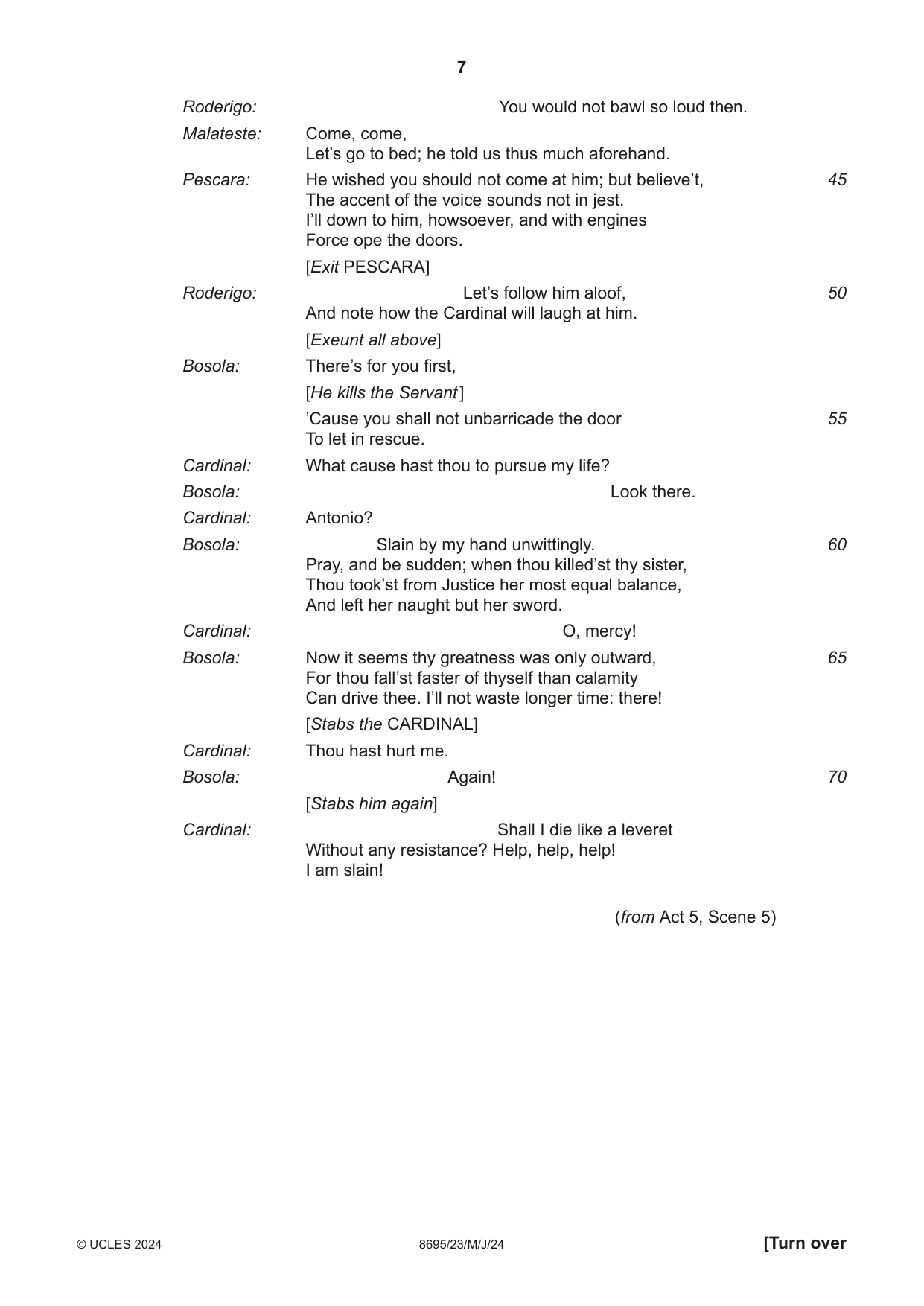
7 8695/23/M/J/24 © UCLES 2024 [Turn over Roderigo: You would not bawl so loud then. Malateste: Come, come, Let’s go to bed; he told us thus much aforehand. Pescara: He wished you should not come at him; but believe’t, The accent of the voice sounds not in jest. I’ll down to him, howsoever, and with engines Force ope the doors. [Exit PESCARA] Roderigo: Let’s follow him aloof, And note how the Cardinal will laugh at him. [Exeunt all above] Bosola: There’s for you first, [He kills the Servant ] ’Cause you shall not unbarricade the door To let in rescue. Cardinal: What cause hast thou to pursue my life? Bosola: Look there. Cardinal: Antonio? Bosola: Slain by my hand unwittingly. Pray, and be sudden; when thou killed’st thy sister, Thou took’st from Justice her most equal balance, And left her naught but her sword. Cardinal: O, mercy! Bosola: Now it seems thy greatness was only outward, For thou fall’st faster of thyself than calamity Can drive thee. I’ll not waste longer time: there! [Stabs the CARDINAL] Cardinal: Thou hast hurt me. Bosola: Again! [Stabs him again] Cardinal: Shall I die like a leveret Without any resistance? Help, help, help! I am slain! (from Act 5, Scene 5) 45 50 55 60 65 70
Question paper, page 8
8 8695/23/M/J/24 © UCLES 2024 TENNESSEE WILLIAMS: Cat on a Hot Tin Roof 4 Either (a) What, in your view, does the relationship between Big Mama and Big Daddy add to the play’s meaning and effects? [25] Or (b) Paying close attention to dramatic methods, discuss the significance of the following extract from Cat on a Hot Tin Roof. [25] Brick: […] Skipper and me had a clean, true thing between us! Content removed due to copyright restrictions.
Question paper, page 9
9 8695/23/M/J/24 © UCLES 2024 [Turn over What did you leave out? (from Act 2) Content removed due to copyright restrictions.
Question paper, page 10
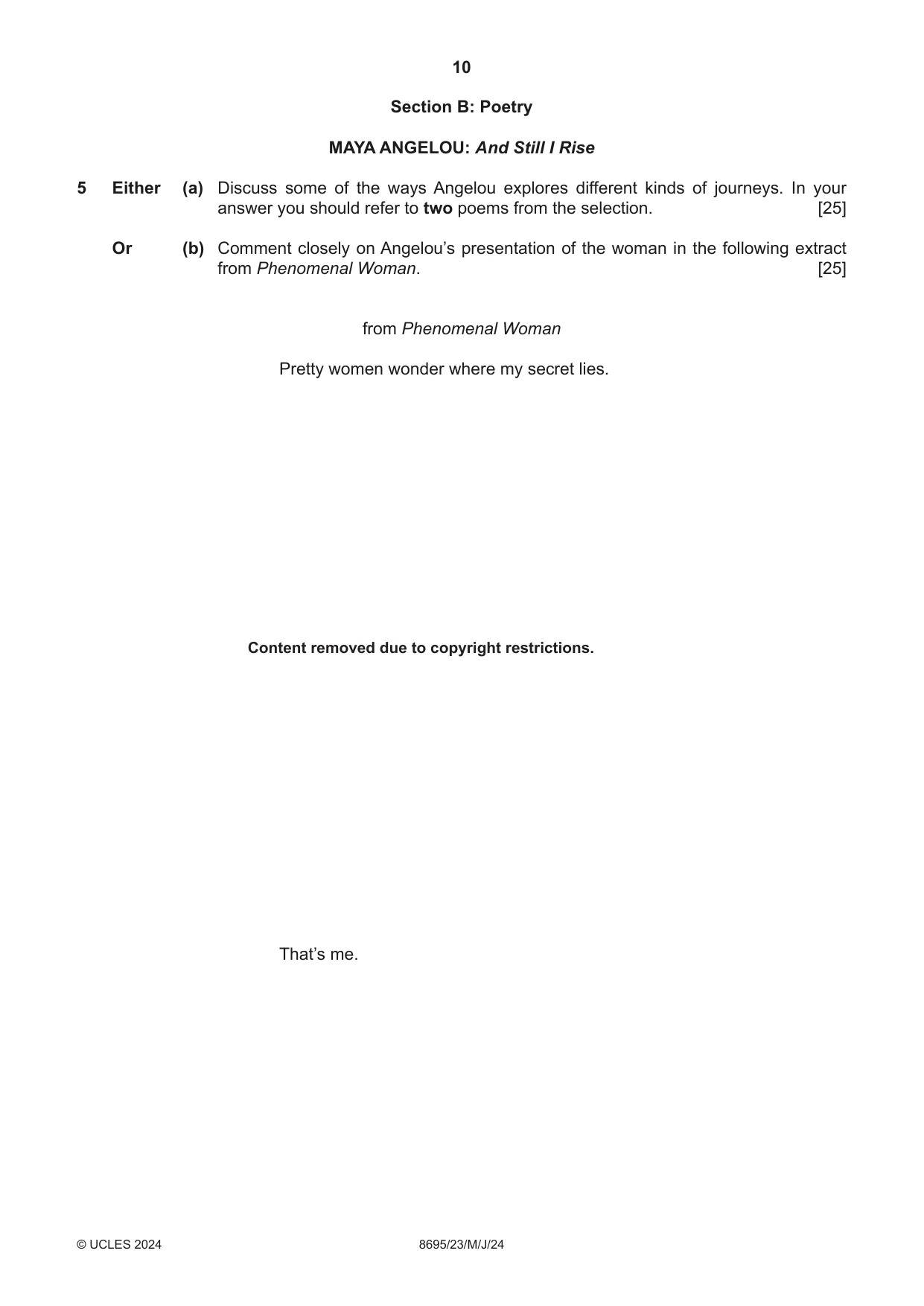
10 8695/23/M/J/24 © UCLES 2024 Section B: Poetry MAYA ANGELOU: And Still I Rise 5 Either (a) Discuss some of the ways Angelou explores different kinds of journeys. In your answer you should refer to two poems from the selection. [25] Or (b) Comment closely on Angelou’s presentation of the woman in the following extract from Phenomenal Woman. [25] from Phenomenal Woman Pretty women wonder where my secret lies. That’s me. Content removed due to copyright restrictions.
Question paper, page 11
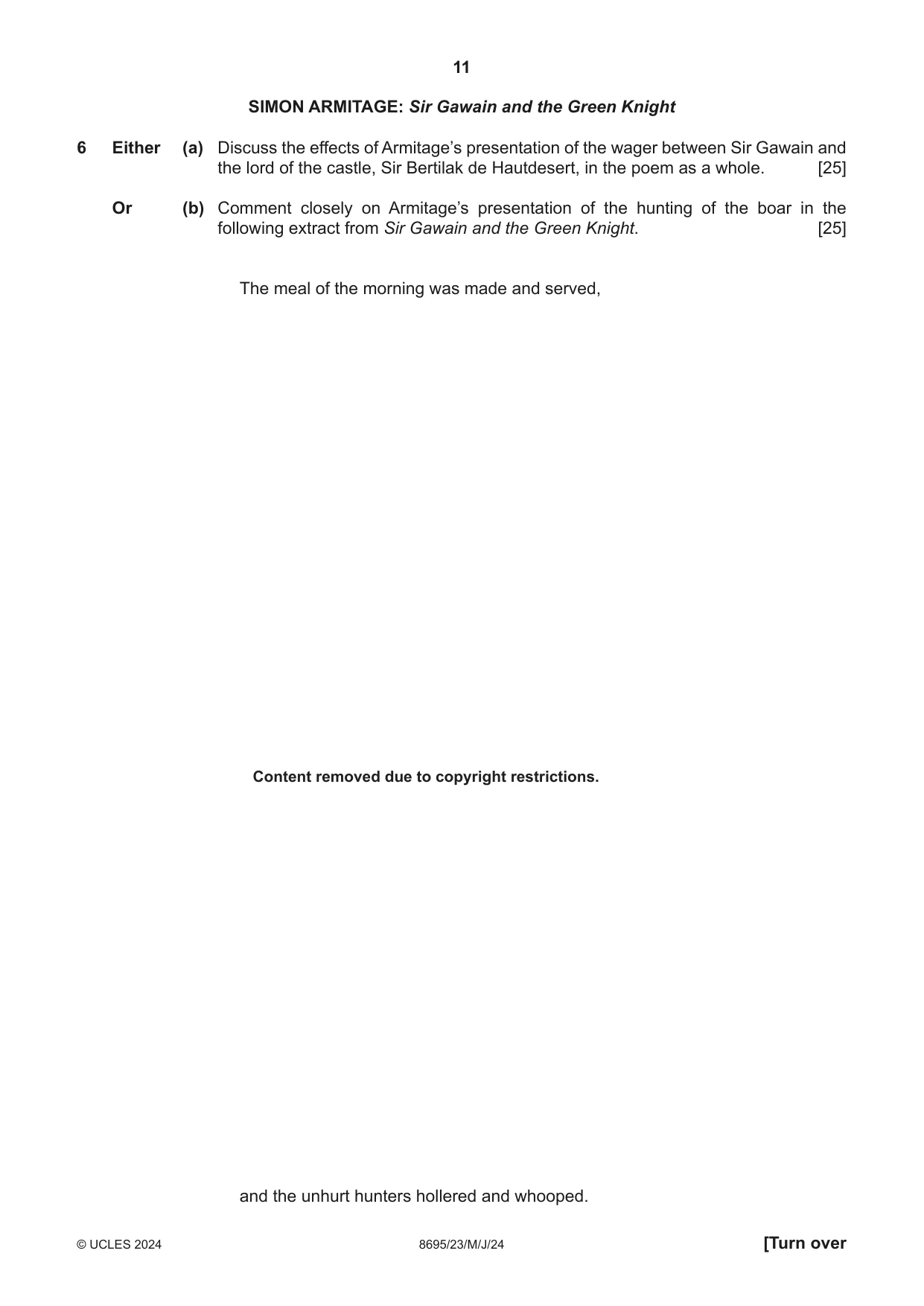
11 8695/23/M/J/24 © UCLES 2024 [Turn over SIMON ARMITAGE: Sir Gawain and the Green Knight 6 Either (a) Discuss the effects of Armitage’s presentation of the wager between Sir Gawain and the lord of the castle, Sir Bertilak de Hautdesert, in the poem as a whole. [25] Or (b) Comment closely on Armitage’s presentation of the hunting of the boar in the following extract from Sir Gawain and the Green Knight. [25] The meal of the morning was made and served, and the unhurt hunters hollered and whooped. Content removed due to copyright restrictions.
Question paper, page 12
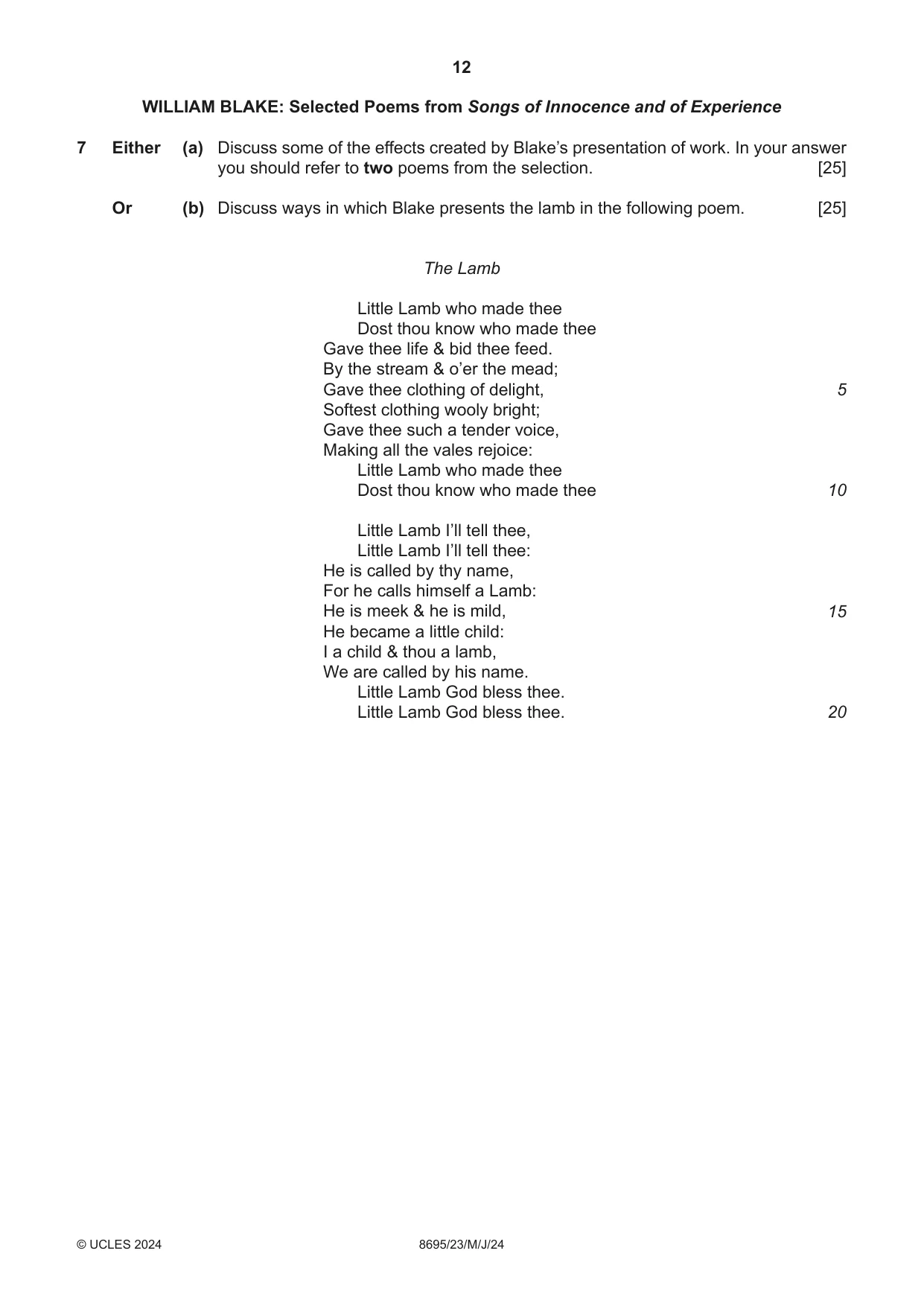
12 8695/23/M/J/24 © UCLES 2024 WILLIAM BLAKE: Selected Poems from Songs of Innocence and of Experience 7 Either (a) Discuss some of the effects created by Blake’s presentation of work. In your answer you should refer to two poems from the selection. [25] Or (b) Discuss ways in which Blake presents the lamb in the following poem. [25] The Lamb Little Lamb who made thee Dost thou know who made thee Gave thee life & bid thee feed. By the stream & o’er the mead; Gave thee clothing of delight, Softest clothing wooly bright; Gave thee such a tender voice, Making all the vales rejoice: Little Lamb who made thee Dost thou know who made thee Little Lamb I’ll tell thee, Little Lamb I’ll tell thee: He is called by thy name, For he calls himself a Lamb: He is meek & he is mild, He became a little child: I a child & thou a lamb, We are called by his name. Little Lamb God bless thee. Little Lamb God bless thee. 5 10 15 20
Question paper, page 13
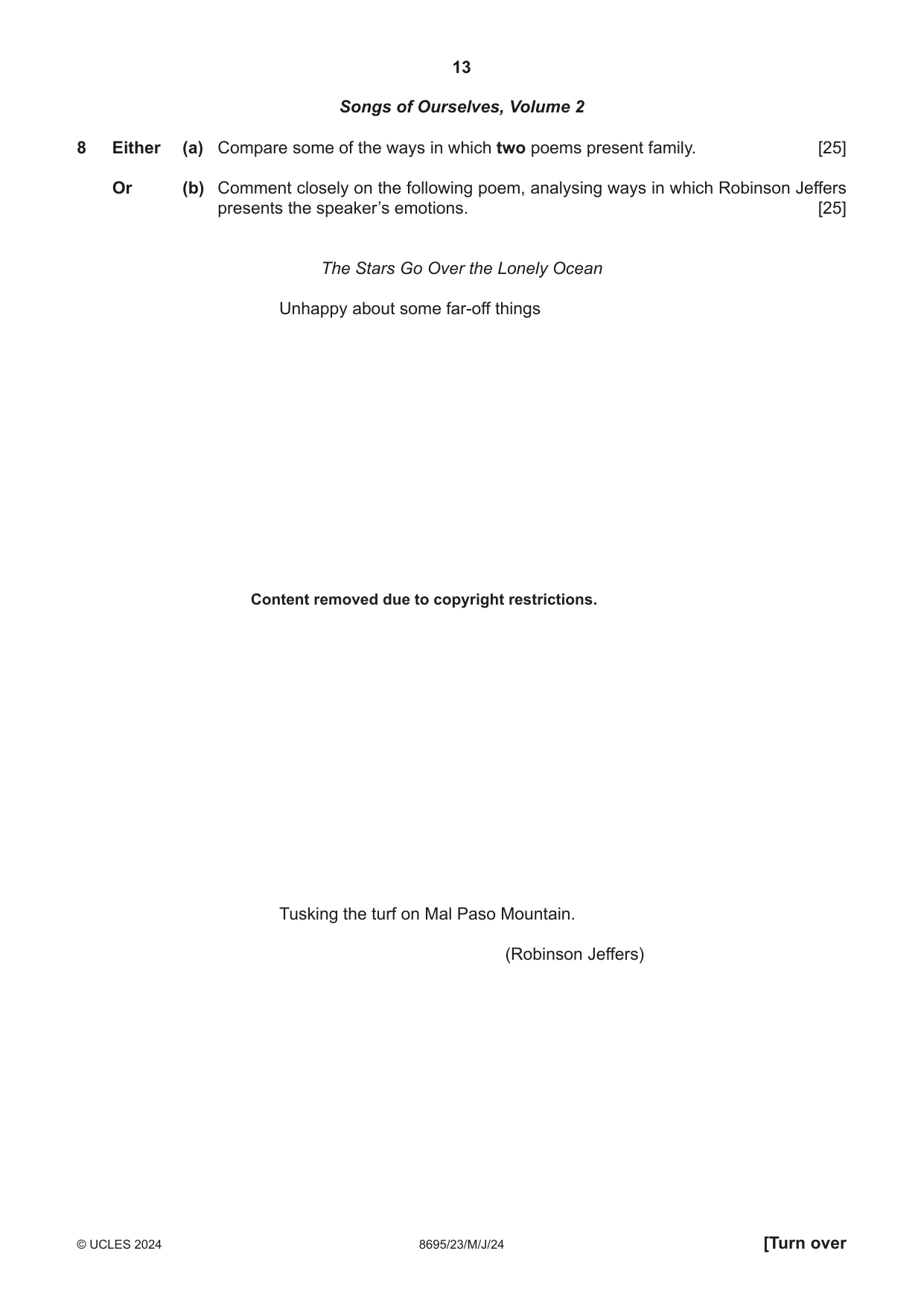
13 8695/23/M/J/24 © UCLES 2024 [Turn over Songs of Ourselves, Volume 2 8 Either (a) Compare some of the ways in which two poems present family. [25] Or (b) Comment closely on the following poem, analysing ways in which Robinson Jeffers presents the speaker’s emotions. [25] The Stars Go Over the Lonely Ocean Unhappy about some far-off things Tusking the turf on Mal Paso Mountain. (Robinson Jeffers) Content removed due to copyright restrictions.
Question paper, page 14
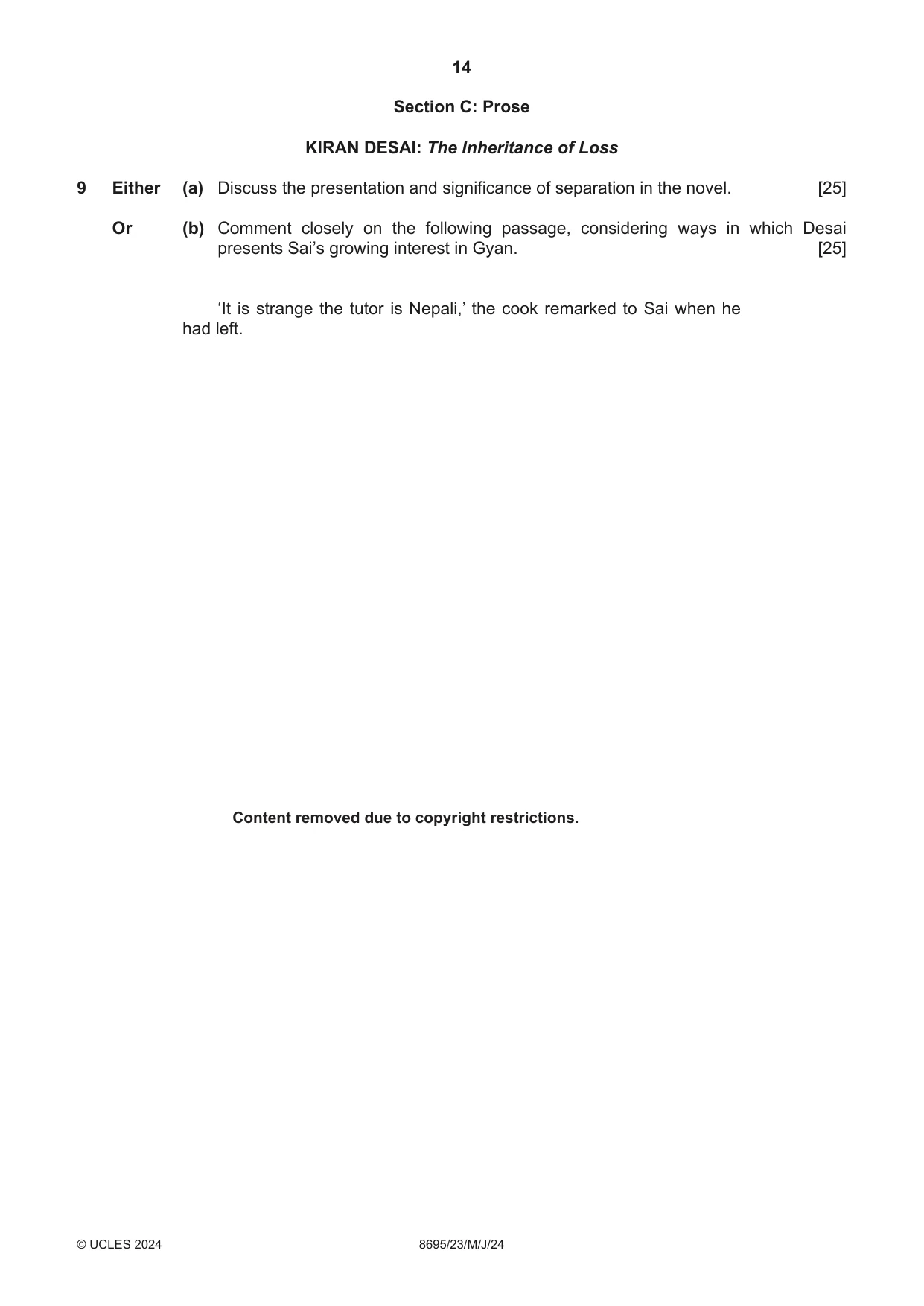
14 8695/23/M/J/24 © UCLES 2024 Section C: Prose KIRAN DESAI: The Inheritance of Loss 9 Either (a) Discuss the presentation and significance of separation in the novel. [25] Or (b) Comment closely on the following passage, considering ways in which Desai presents Sai’s growing interest in Gyan. [25] ‘It is strange the tutor is Nepali,’ the cook remarked to Sai when he had left. Content removed due to copyright restrictions.
Question paper, page 15
15 8695/23/M/J/24 © UCLES 2024 [Turn over She’d have to propel herself into the future by whatever means possible or she’d be trapped forever in a place whose time had already passed. (from Chapter 13) Content removed due to copyright restrictions.
Question paper, page 16
16 8695/23/M/J/24 © UCLES 2024 IAN McEWAN: Atonement 10 Either (a) Discuss some of the ways in which McEwan presents love in the novel. [25] Or (b) Comment closely on McEwan’s presentation of Briony in the following passage. [25] She wrote, ‘There was an old lady who swallowed a fly.’ ‘I’ve had the most appalling evening.’ (from Chapter 10) Content removed due to copyright restrictions.
Question paper, page 17
17 8695/23/M/J/24 © UCLES 2024 [Turn over TURN OVER FOR QUESTION 11.
Question paper, page 18
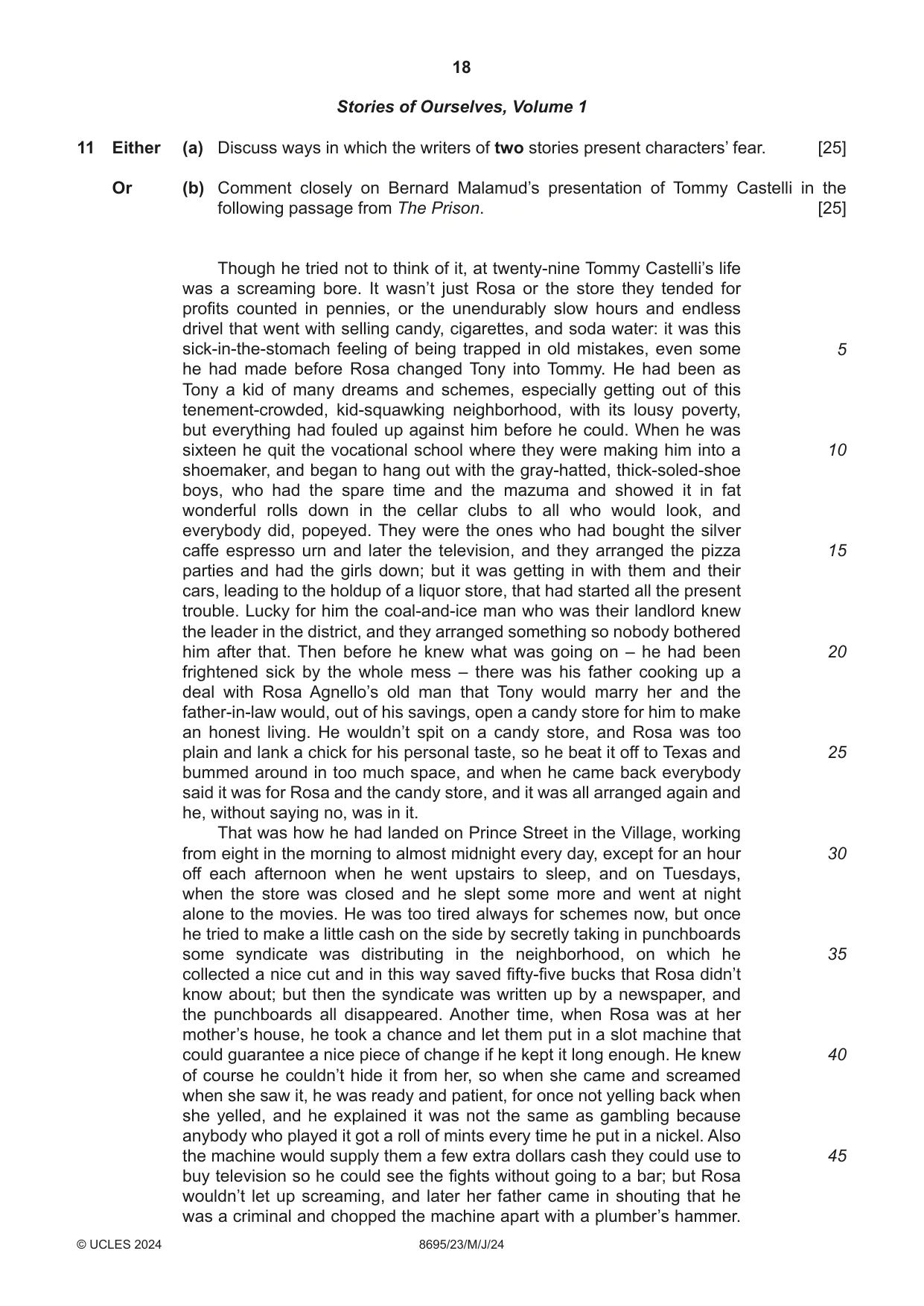
18 8695/23/M/J/24 © UCLES 2024 Stories of Ourselves, Volume 1 11 Either (a) Discuss ways in which the writers of two stories present characters’ fear. [25] Or (b) Comment closely on Bernard Malamud’s presentation of Tommy Castelli in the following passage from The Prison. [25] Though he tried not to think of it, at twenty-nine Tommy Castelli’s life was a screaming bore. It wasn’t just Rosa or the store they tended for profits counted in pennies, or the unendurably slow hours and endless drivel that went with selling candy, cigarettes, and soda water: it was this sick-in-the-stomach feeling of being trapped in old mistakes, even some he had made before Rosa changed Tony into Tommy. He had been as Tony a kid of many dreams and schemes, especially getting out of this tenement-crowded, kid-squawking neighborhood, with its lousy poverty, but everything had fouled up against him before he could. When he was sixteen he quit the vocational school where they were making him into a shoemaker, and began to hang out with the gray-hatted, thick-soled-shoe boys, who had the spare time and the mazuma and showed it in fat wonderful rolls down in the cellar clubs to all who would look, and everybody did, popeyed. They were the ones who had bought the silver caffe espresso urn and later the television, and they arranged the pizza parties and had the girls down; but it was getting in with them and their cars, leading to the holdup of a liquor store, that had started all the present trouble. Lucky for him the coal-and-ice man who was their landlord knew the leader in the district, and they arranged something so nobody bothered him after that. Then before he knew what was going on – he had been frightened sick by the whole mess – there was his father cooking up a deal with Rosa Agnello’s old man that Tony would marry her and the father-in-law would, out of his savings, open a candy store for him to make an honest living. He wouldn’t spit on a candy store, and Rosa was too plain and lank a chick for his personal taste, so he beat it off to Texas and bummed around in too much space, and when he came back everybody said it was for Rosa and the candy store, and it was all arranged again and he, without saying no, was in it. That was how he had landed on Prince Street in the Village, working from eight in the morning to almost midnight every day, except for an hour off each afternoon when he went upstairs to sleep, and on Tuesdays, when the store was closed and he slept some more and went at night alone to the movies. He was too tired always for schemes now, but once he tried to make a little cash on the side by secretly taking in punchboards some syndicate was distributing in the neighborhood, on which he collected a nice cut and in this way saved fifty-five bucks that Rosa didn’t know about; but then the syndicate was written up by a newspaper, and the punchboards all disappeared. Another time, when Rosa was at her mother’s house, he took a chance and let them put in a slot machine that could guarantee a nice piece of change if he kept it long enough. He knew of course he couldn’t hide it from her, so when she came and screamed when she saw it, he was ready and patient, for once not yelling back when she yelled, and he explained it was not the same as gambling because anybody who played it got a roll of mints every time he put in a nickel. Also the machine would supply them a few extra dollars cash they could use to buy television so he could see the fights without going to a bar; but Rosa wouldn’t let up screaming, and later her father came in shouting that he was a criminal and chopped the machine apart with a plumber’s hammer. 5 10 15 20 25 30 35 40 45
Question paper, page 19
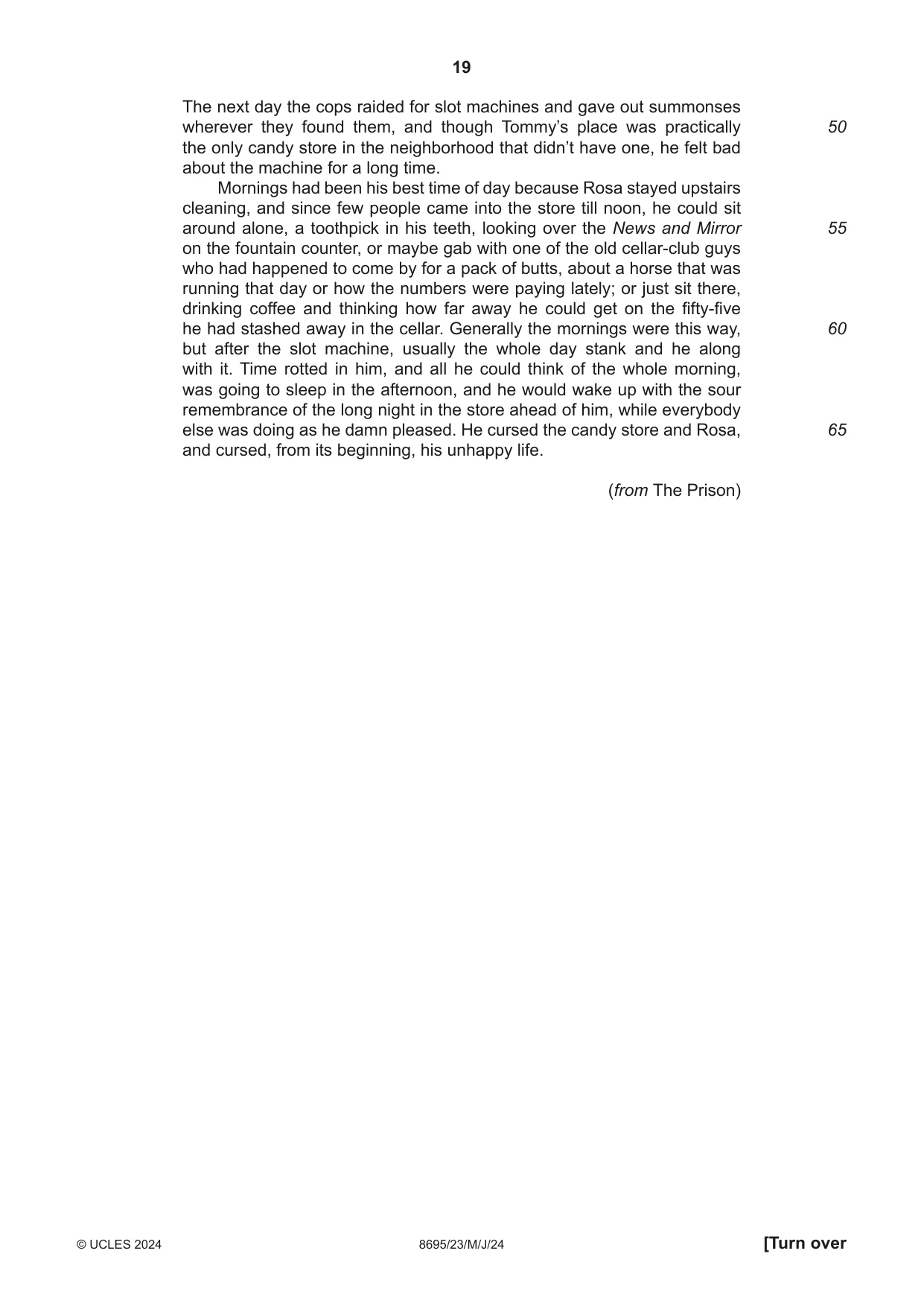
19 8695/23/M/J/24 © UCLES 2024 [Turn over The next day the cops raided for slot machines and gave out summonses wherever they found them, and though Tommy’s place was practically the only candy store in the neighborhood that didn’t have one, he felt bad about the machine for a long time. Mornings had been his best time of day because Rosa stayed upstairs cleaning, and since few people came into the store till noon, he could sit around alone, a toothpick in his teeth, looking over the News and Mirror on the fountain counter, or maybe gab with one of the old cellar-club guys who had happened to come by for a pack of butts, about a horse that was running that day or how the numbers were paying lately; or just sit there, drinking coffee and thinking how far away he could get on the fifty-five he had stashed away in the cellar. Generally the mornings were this way, but after the slot machine, usually the whole day stank and he along with it. Time rotted in him, and all he could think of the whole morning, was going to sleep in the afternoon, and he would wake up with the sour remembrance of the long night in the store ahead of him, while everybody else was doing as he damn pleased. He cursed the candy store and Rosa, and cursed, from its beginning, his unhappy life. (from The Prison) 50 55 60 65
Question paper, page 20
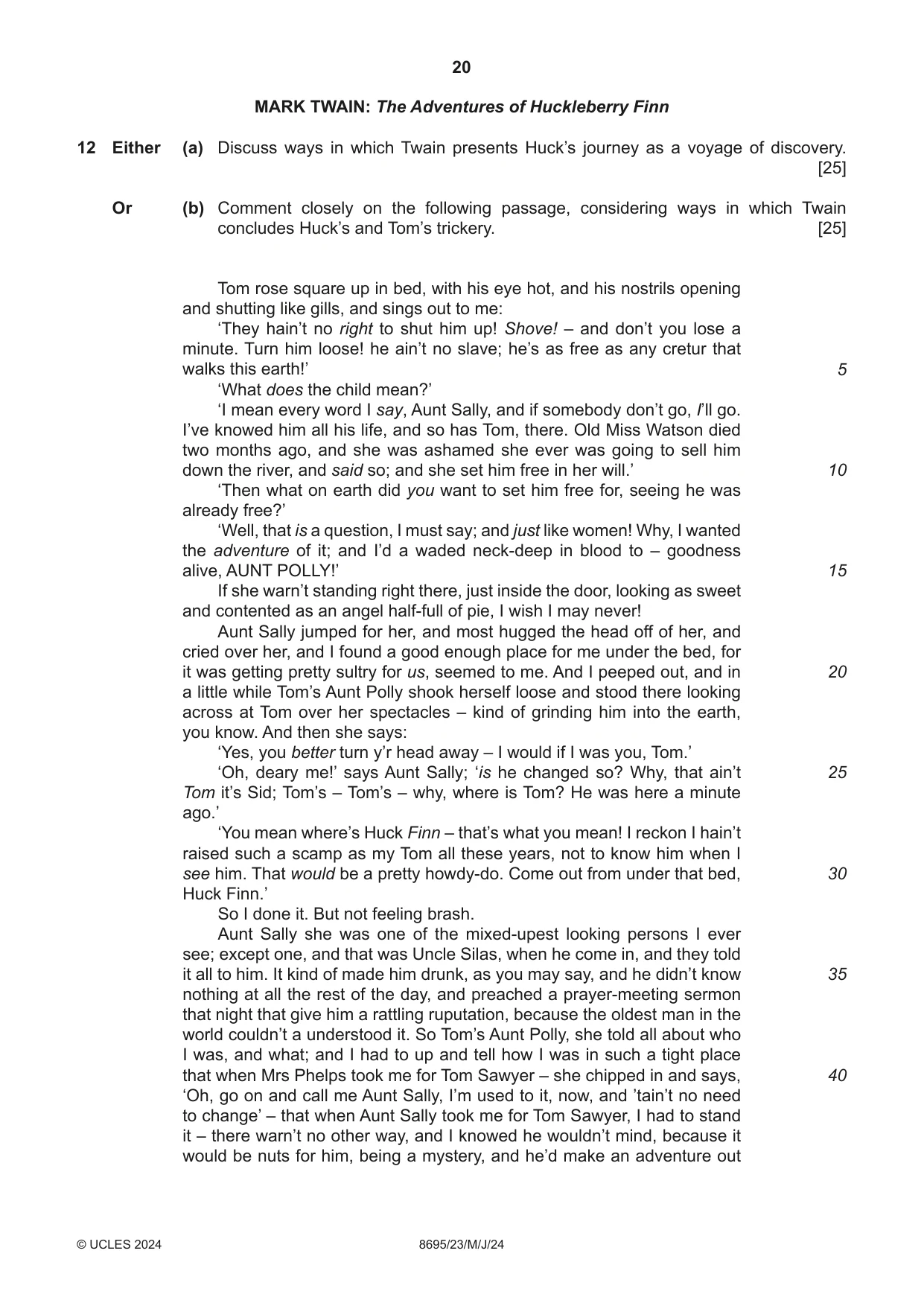
20 8695/23/M/J/24 © UCLES 2024 MARK TWAIN: The Adventures of Huckleberry Finn 12 Either (a) Discuss ways in which Twain presents Huck’s journey as a voyage of discovery. [25] Or (b) Comment closely on the following passage, considering ways in which Twain concludes Huck’s and Tom’s trickery. [25] Tom rose square up in bed, with his eye hot, and his nostrils opening and shutting like gills, and sings out to me: ‘They hain’t no right to shut him up! Shove! – and don’t you lose a minute. Turn him loose! he ain’t no slave; he’s as free as any cretur that walks this earth!’ ‘What does the child mean?’ ‘I mean every word I say, Aunt Sally, and if somebody don’t go, I’ll go. I’ve knowed him all his life, and so has Tom, there. Old Miss Watson died two months ago, and she was ashamed she ever was going to sell him down the river, and said so; and she set him free in her will.’ ‘Then what on earth did you want to set him free for, seeing he was already free?’ ‘Well, that is a question, I must say; and just like women! Why, I wanted the adventure of it; and I’d a waded neck-deep in blood to – goodness alive, AUNT POLLY!’ If she warn’t standing right there, just inside the door, looking as sweet and contented as an angel half-full of pie, I wish I may never! Aunt Sally jumped for her, and most hugged the head off of her, and cried over her, and I found a good enough place for me under the bed, for it was getting pretty sultry for us, seemed to me. And I peeped out, and in a little while Tom’s Aunt Polly shook herself loose and stood there looking across at Tom over her spectacles – kind of grinding him into the earth, you know. And then she says: ‘Yes, you better turn y’r head away – I would if I was you, Tom.’ ‘Oh, deary me!’ says Aunt Sally; ‘is he changed so? Why, that ain’t Tom it’s Sid; Tom’s – Tom’s – why, where is Tom? He was here a minute ago.’ ‘You mean where’s Huck Finn – that’s what you mean! I reckon I hain’t raised such a scamp as my Tom all these years, not to know him when I see him. That would be a pretty howdy-do. Come out from under that bed, Huck Finn.’ So I done it. But not feeling brash. Aunt Sally she was one of the mixed-upest looking persons I ever see; except one, and that was Uncle Silas, when he come in, and they told it all to him. It kind of made him drunk, as you may say, and he didn’t know nothing at all the rest of the day, and preached a prayer-meeting sermon that night that give him a rattling ruputation, because the oldest man in the world couldn’t a understood it. So Tom’s Aunt Polly, she told all about who I was, and what; and I had to up and tell how I was in such a tight place that when Mrs Phelps took me for Tom Sawyer – she chipped in and says, ‘Oh, go on and call me Aunt Sally, I’m used to it, now, and ’tain’t no need to change’ – that when Aunt Sally took me for Tom Sawyer, I had to stand it – there warn’t no other way, and I knowed he wouldn’t mind, because it would be nuts for him, being a mystery, and he’d make an adventure out 5 10 15 20 25 30 35 40
Question paper, page 21
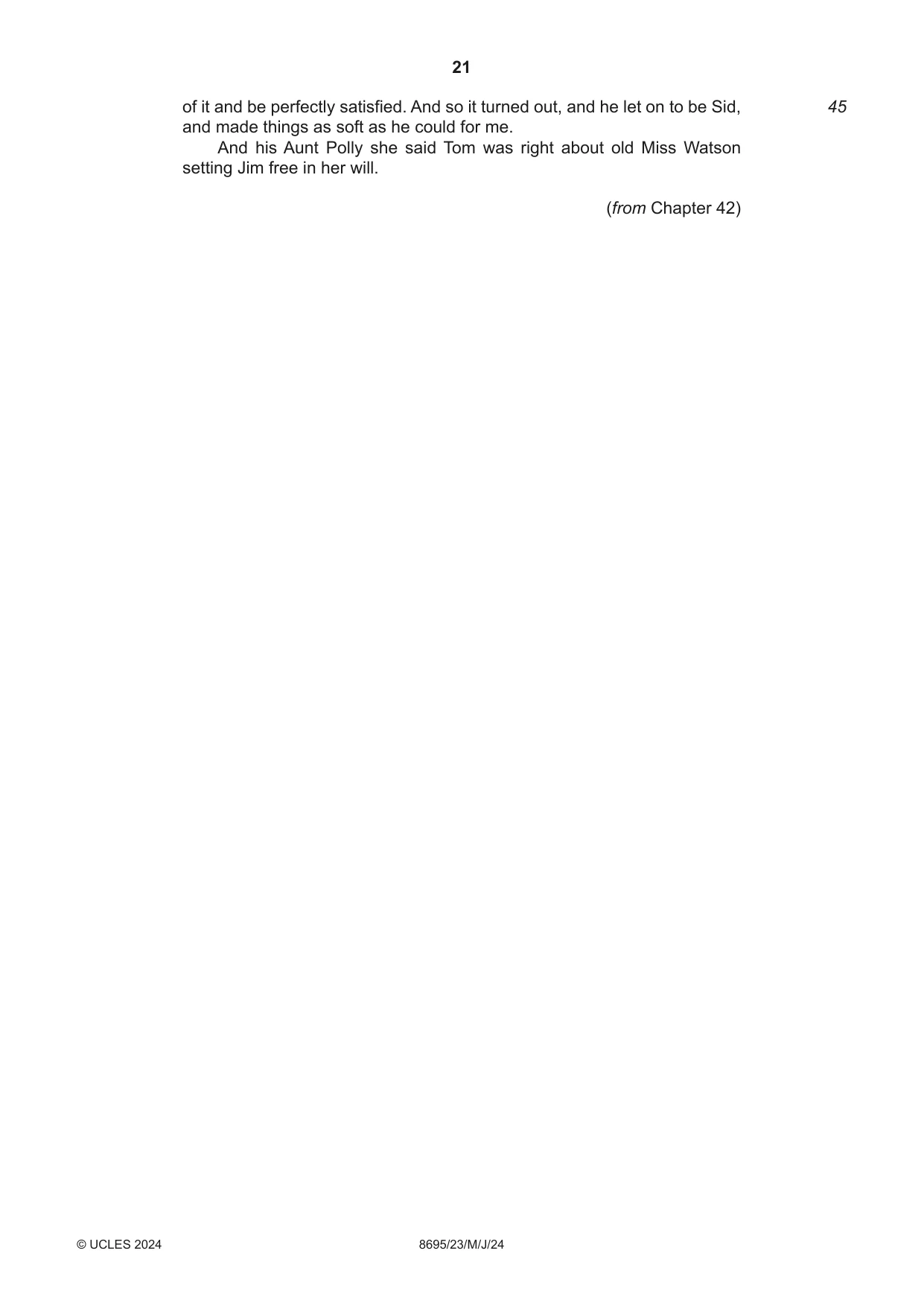
21 8695/23/M/J/24 © UCLES 2024 of it and be perfectly satisfied. And so it turned out, and he let on to be Sid, and made things as soft as he could for me. And his Aunt Polly she said Tom was right about old Miss Watson setting Jim free in her will. (from Chapter 42) 45
Question paper, page 22
22 8695/23/M/J/24 © UCLES 2024 BLANK PAGE
Question paper, page 23
23 8695/23/M/J/24 © UCLES 2024 BLANK PAGE
Question paper, page 24
24 8695/23/M/J/24 © UCLES 2024 Permission to reproduce items where third-party owned material protected by copyright is included has been sought and cleared where possible. Every reasonable effort has been made by the publisher (UCLES) to trace copyright holders, but if any items requiring clearance have unwittingly been included, the publisher will be pleased to make amends at the earliest possible opportunity. To avoid the issue of disclosure of answer-related information to candidates, all copyright acknowledgements are reproduced online in the Cambridge Assessment International Education Copyright Acknowledgements Booklet. This is produced for each series of examinations and is freely available to download at www.cambridgeinternational.org after the live examination series. Cambridge Assessment International Education is part of Cambridge Assessment. Cambridge Assessment is the brand name of the University of Cambridge Local Examinations Syndicate (UCLES), which is a department of the University of Cambridge. BLANK PAGE
Mark scheme, page 1
This document consists of 13 printed pages. © Cambridge University Press & Assessment 2024 [Turn over Cambridge International AS Level LANGUAGE AND LITERATURE IN ENGLISH 8695/23 Paper 2 Drama, Poetry and Prose May/June 2024 MARK SCHEME Maximum Mark: 50 Published This mark scheme is published as an aid to teachers and candidates, to indicate the requirements of the examination. It shows the basis on which Examiners were instructed to award marks. It does not indicate the details of the discussions that took place at an Examiners’ meeting before marking began, which would have considered the acceptability of alternative answers. Mark schemes should be read in conjunction with the question paper and the Principal Examiner Report for Teachers. Cambridge International will not enter into discussions about these mark schemes. Cambridge International is publishing the mark schemes for the May/June 2024 series for most Cambridge IGCSE, Cambridge International A and AS Level and Cambridge Pre-U components, and some Cambridge O Level components.
Mark scheme, page 2
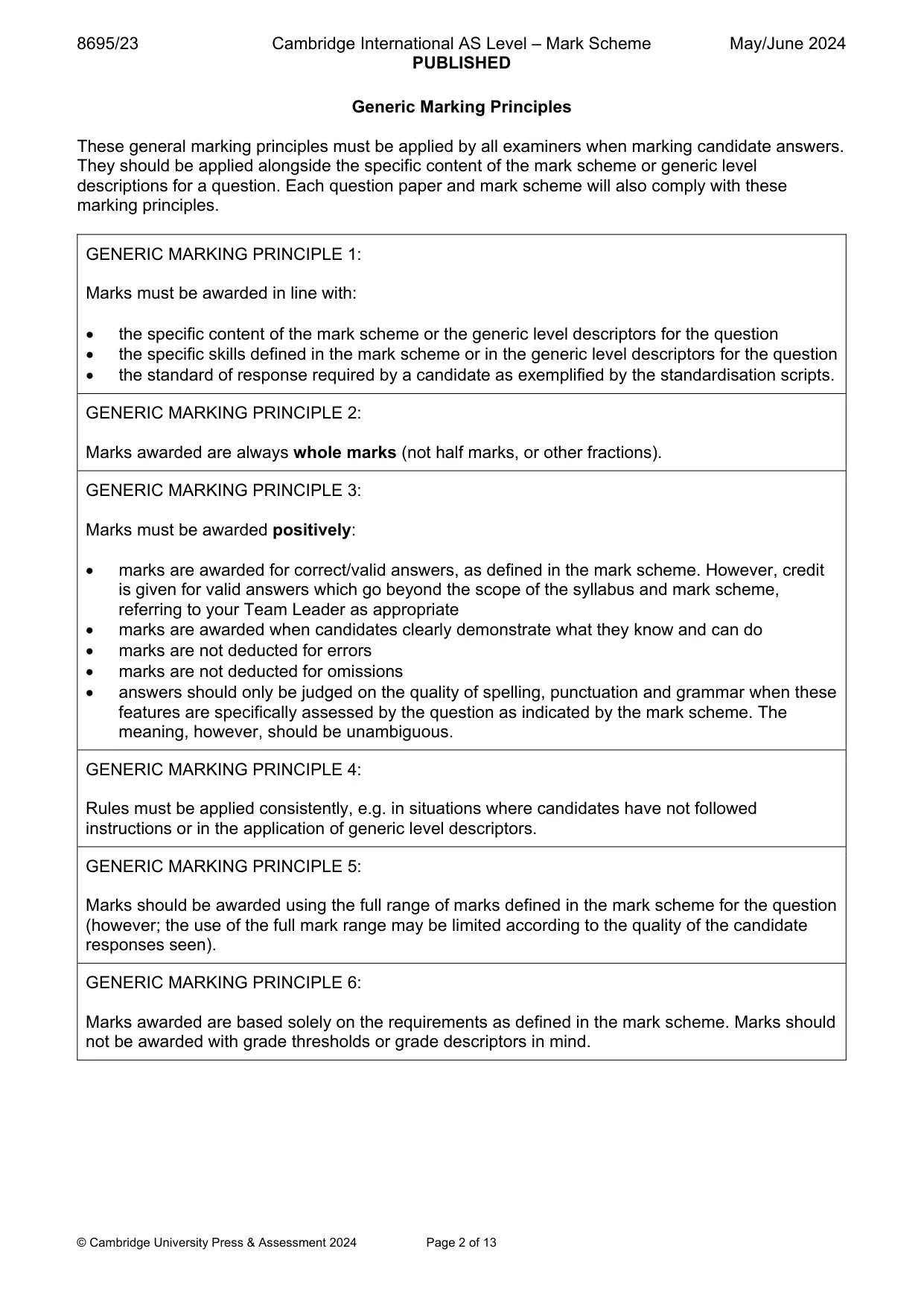
8695/23 Cambridge International AS Level – Mark Scheme PUBLISHED May/June 2024 © Cambridge University Press & Assessment 2024 Page 2 of 13 Generic Marking Principles These general marking principles must be applied by all examiners when marking candidate answers. They should be applied alongside the specific content of the mark scheme or generic level descriptions for a question. Each question paper and mark scheme will also comply with these marking principles. GENERIC MARKING PRINCIPLE 1: Marks must be awarded in line with: the specific content of the mark scheme or the generic level descriptors for the question the specific skills defined in the mark scheme or in the generic level descriptors for the question the standard of response required by a candidate as exemplified by the standardisation scripts. GENERIC MARKING PRINCIPLE 2: Marks awarded are always whole marks (not half marks, or other fractions). GENERIC MARKING PRINCIPLE 3: Marks must be awarded positively: marks are awarded for correct/valid answers, as defined in the mark scheme. However, credit is given for valid answers which go beyond the scope of the syllabus and mark scheme, referring to your Team Leader as appropriate marks are awarded when candidates clearly demonstrate what they know and can do marks are not deducted for errors marks are not deducted for omissions answers should only be judged on the quality of spelling, punctuation and grammar when these features are specifically assessed by the question as indicated by the mark scheme. The meaning, however, should be unambiguous. GENERIC MARKING PRINCIPLE 4: Rules must be applied consistently, e.g. in situations where candidates have not followed instructions or in the application of generic level descriptors. GENERIC MARKING PRINCIPLE 5: Marks should be awarded using the full range of marks defined in the mark scheme for the question (however; the use of the full mark range may be limited according to the quality of the candidate responses seen). GENERIC MARKING PRINCIPLE 6: Marks awarded are based solely on the requirements as defined in the mark scheme. Marks should not be awarded with grade thresholds or grade descriptors in mind.
Mark scheme, page 3
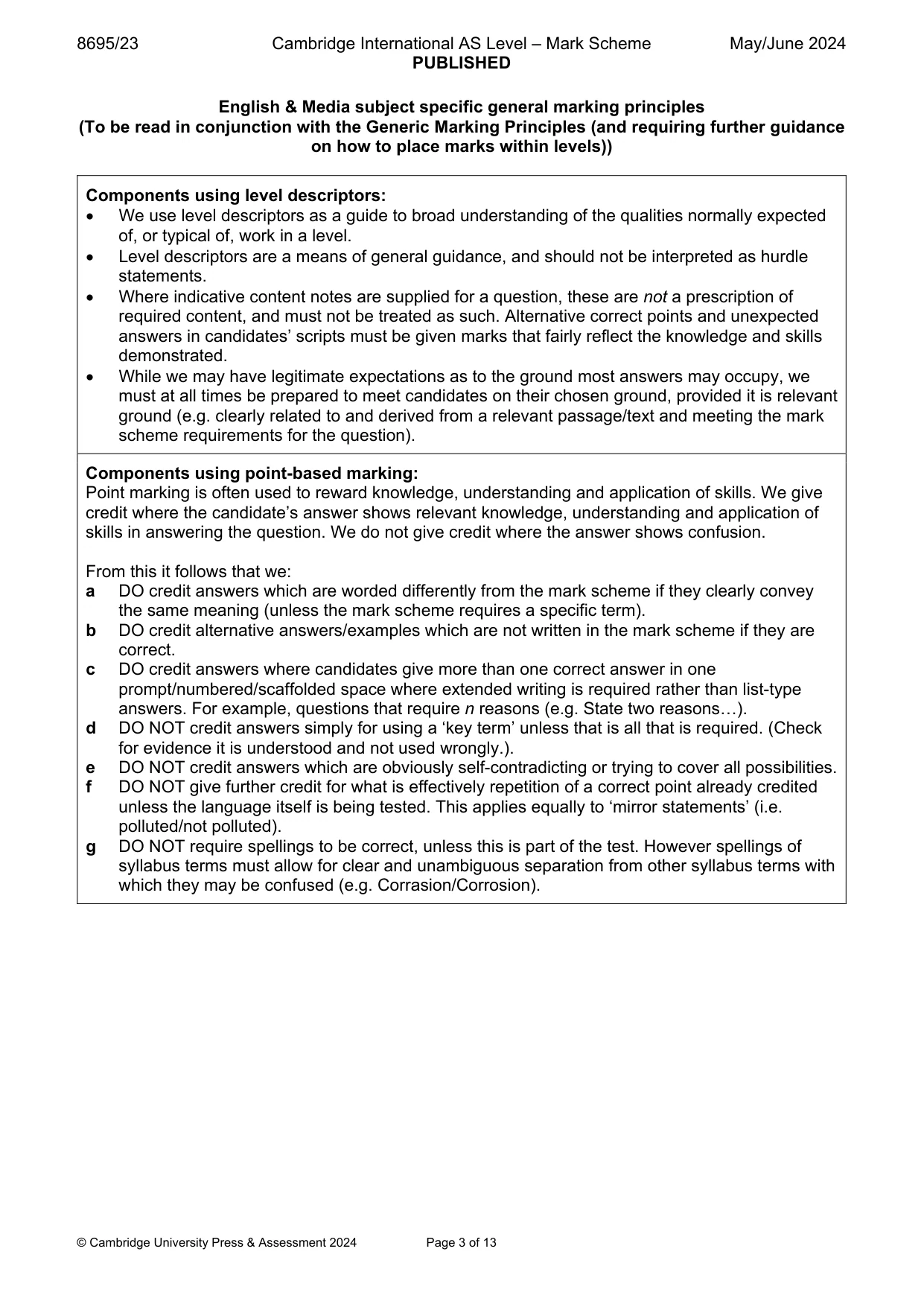
8695/23 Cambridge International AS Level – Mark Scheme PUBLISHED May/June 2024 © Cambridge University Press & Assessment 2024 Page 3 of 13 English & Media subject specific general marking principles (To be read in conjunction with the Generic Marking Principles (and requiring further guidance on how to place marks within levels)) Components using level descriptors: We use level descriptors as a guide to broad understanding of the qualities normally expected of, or typical of, work in a level. Level descriptors are a means of general guidance, and should not be interpreted as hurdle statements. Where indicative content notes are supplied for a question, these are not a prescription of required content, and must not be treated as such. Alternative correct points and unexpected answers in candidates’ scripts must be given marks that fairly reflect the knowledge and skills demonstrated. While we may have legitimate expectations as to the ground most answers may occupy, we must at all times be prepared to meet candidates on their chosen ground, provided it is relevant ground (e.g. clearly related to and derived from a relevant passage/text and meeting the mark scheme requirements for the question). Components using point-based marking: Point marking is often used to reward knowledge, understanding and application of skills. We give credit where the candidate’s answer shows relevant knowledge, understanding and application of skills in answering the question. We do not give credit where the answer shows confusion. From this it follows that we: a DO credit answers which are worded differently from the mark scheme if they clearly convey the same meaning (unless the mark scheme requires a specific term). b DO credit alternative answers/examples which are not written in the mark scheme if they are correct. c DO credit answers where candidates give more than one correct answer in one prompt/numbered/scaffolded space where extended writing is required rather than list-type answers. For example, questions that require n reasons (e.g. State two reasons…). d DO NOT credit answers simply for using a ‘key term’ unless that is all that is required. (Check for evidence it is understood and not used wrongly.). e DO NOT credit answers which are obviously self-contradicting or trying to cover all possibilities. f DO NOT give further credit for what is effectively repetition of a correct point already credited unless the language itself is being tested. This applies equally to ‘mirror statements’ (i.e. polluted/not polluted). g DO NOT require spellings to be correct, unless this is part of the test. However spellings of syllabus terms must allow for clear and unambiguous separation from other syllabus terms with which they may be confused (e.g. Corrasion/Corrosion).
Mark scheme, page 4
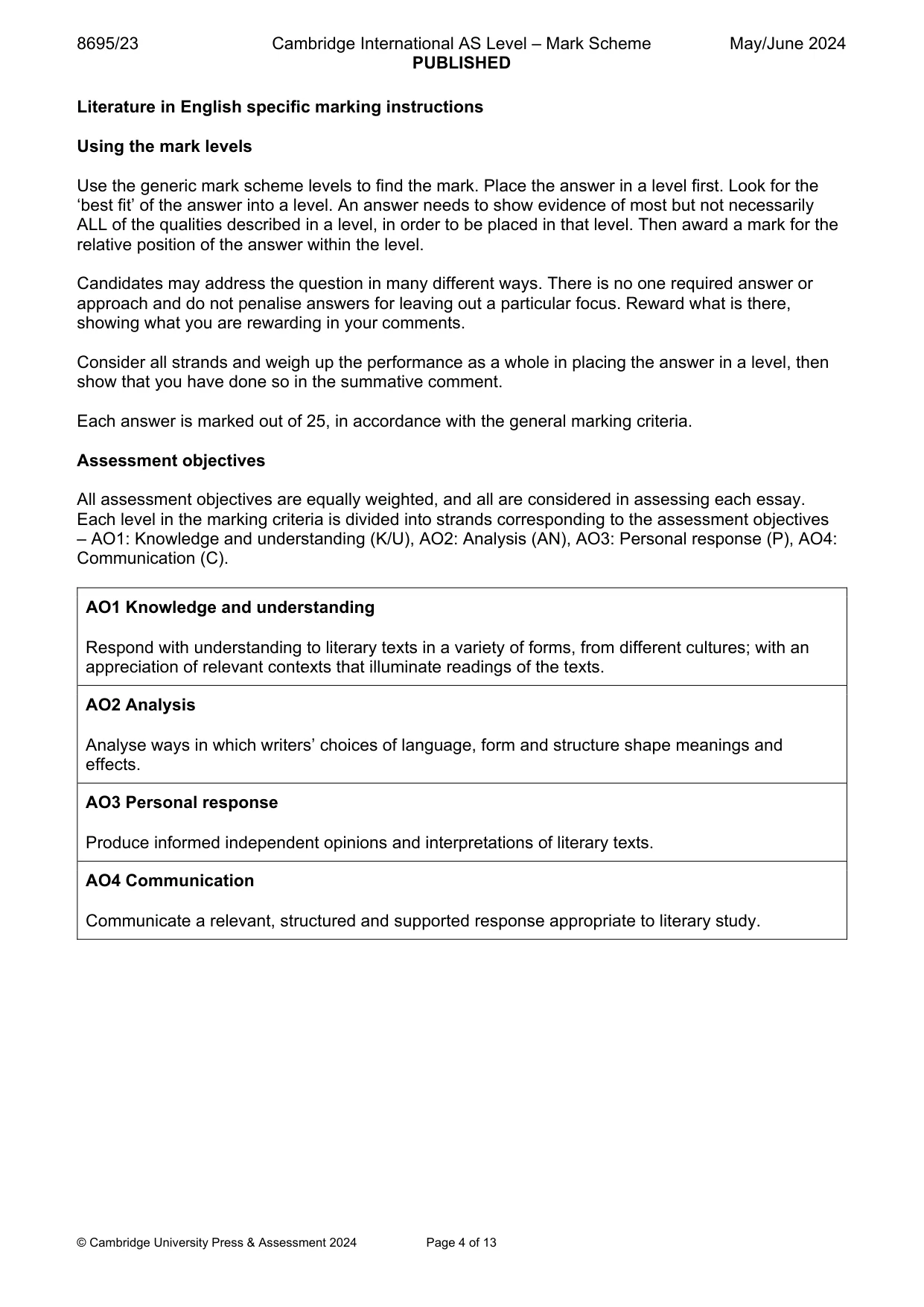
8695/23 Cambridge International AS Level – Mark Scheme PUBLISHED May/June 2024 © Cambridge University Press & Assessment 2024 Page 4 of 13 Literature in English specific marking instructions Using the mark levels Use the generic mark scheme levels to find the mark. Place the answer in a level first. Look for the ‘best fit’ of the answer into a level. An answer needs to show evidence of most but not necessarily ALL of the qualities described in a level, in order to be placed in that level. Then award a mark for the relative position of the answer within the level. Candidates may address the question in many different ways. There is no one required answer or approach and do not penalise answers for leaving out a particular focus. Reward what is there, showing what you are rewarding in your comments. Consider all strands and weigh up the performance as a whole in placing the answer in a level, then show that you have done so in the summative comment. Each answer is marked out of 25, in accordance with the general marking criteria. Assessment objectives All assessment objectives are equally weighted, and all are considered in assessing each essay. Each level in the marking criteria is divided into strands corresponding to the assessment objectives – AO1: Knowledge and understanding (K/U), AO2: Analysis (AN), AO3: Personal response (P), AO4: Communication (C). AO1 Knowledge and understanding Respond with understanding to literary texts in a variety of forms, from different cultures; with an appreciation of relevant contexts that illuminate readings of the texts. AO2 Analysis Analyse ways in which writers’ choices of language, form and structure shape meanings and effects. AO3 Personal response Produce informed independent opinions and interpretations of literary texts. AO4 Communication Communicate a relevant, structured and supported response appropriate to literary study.
Mark scheme, page 5
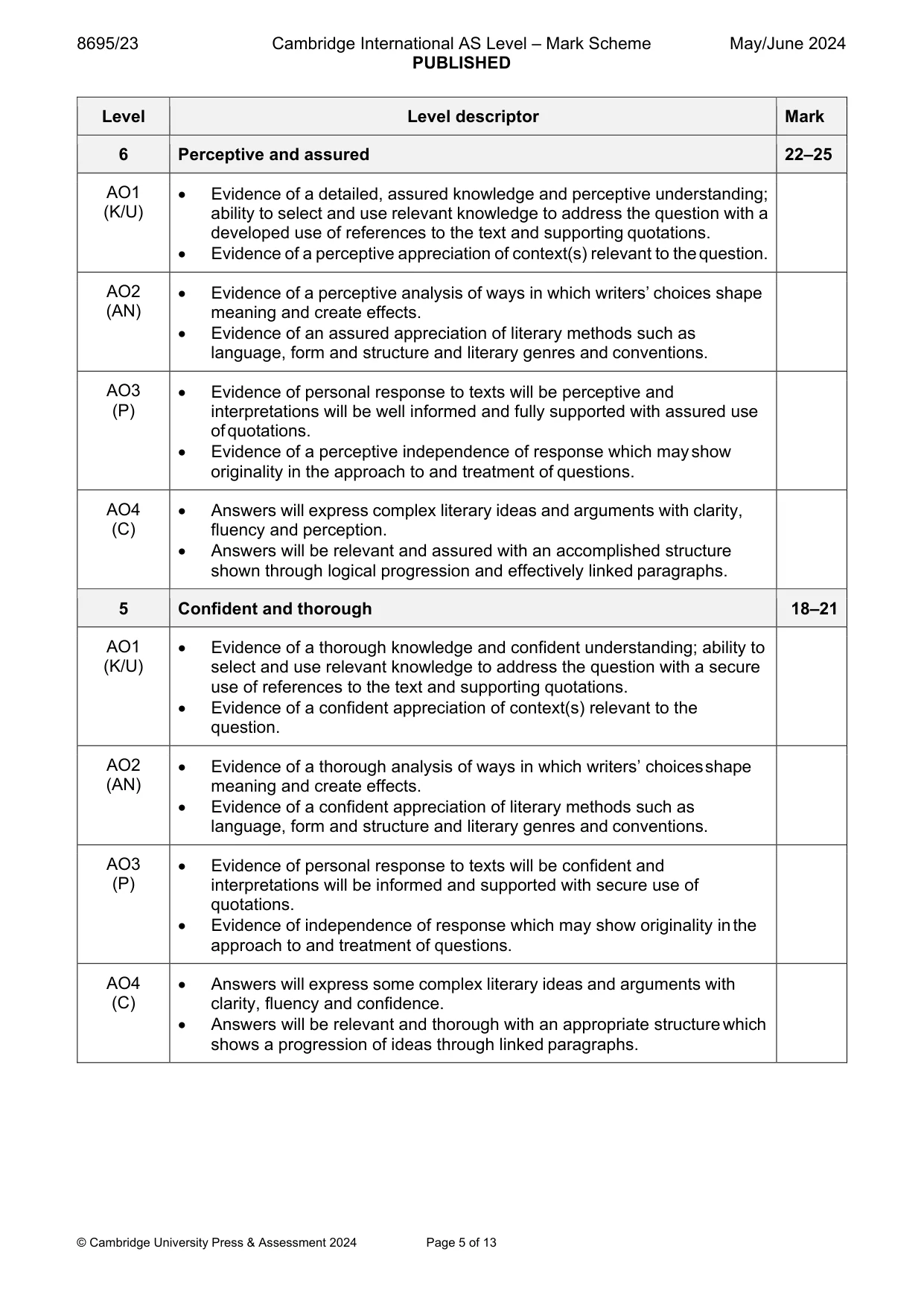
8695/23 Cambridge International AS Level – Mark Scheme PUBLISHED May/June 2024 © Cambridge University Press & Assessment 2024 Page 5 of 13 Level Level descriptor Mark 6 Perceptive and assured 22–25 AO1 (K/U) Evidence of a detailed, assured knowledge and perceptive understanding; ability to select and use relevant knowledge to address the question with a developed use of references to the text and supporting quotations. Evidence of a perceptive appreciation of context(s) relevant to the question. AO2 (AN) Evidence of a perceptive analysis of ways in which writers’ choices shape meaning and create effects. Evidence of an assured appreciation of literary methods such as language, form and structure and literary genres and conventions. AO3 (P) Evidence of personal response to texts will be perceptive and interpretations will be well informed and fully supported with assured use of quotations. Evidence of a perceptive independence of response which may show originality in the approach to and treatment of questions. AO4 (C) Answers will express complex literary ideas and arguments with clarity, fluency and perception. Answers will be relevant and assured with an accomplished structure shown through logical progression and effectively linked paragraphs. 5 Confident and thorough 18–21 AO1 (K/U) Evidence of a thorough knowledge and confident understanding; ability to select and use relevant knowledge to address the question with a secure use of references to the text and supporting quotations. Evidence of a confident appreciation of context(s) relevant to the question. AO2 (AN) Evidence of a thorough analysis of ways in which writers’ choices shape meaning and create effects. Evidence of a confident appreciation of literary methods such as language, form and structure and literary genres and conventions. AO3 (P) Evidence of personal response to texts will be confident and interpretations will be informed and supported with secure use of quotations. Evidence of independence of response which may show originality in the approach to and treatment of questions. AO4 (C) Answers will express some complex literary ideas and arguments with clarity, fluency and confidence. Answers will be relevant and thorough with an appropriate structure which shows a progression of ideas through linked paragraphs.
Mark scheme, page 6
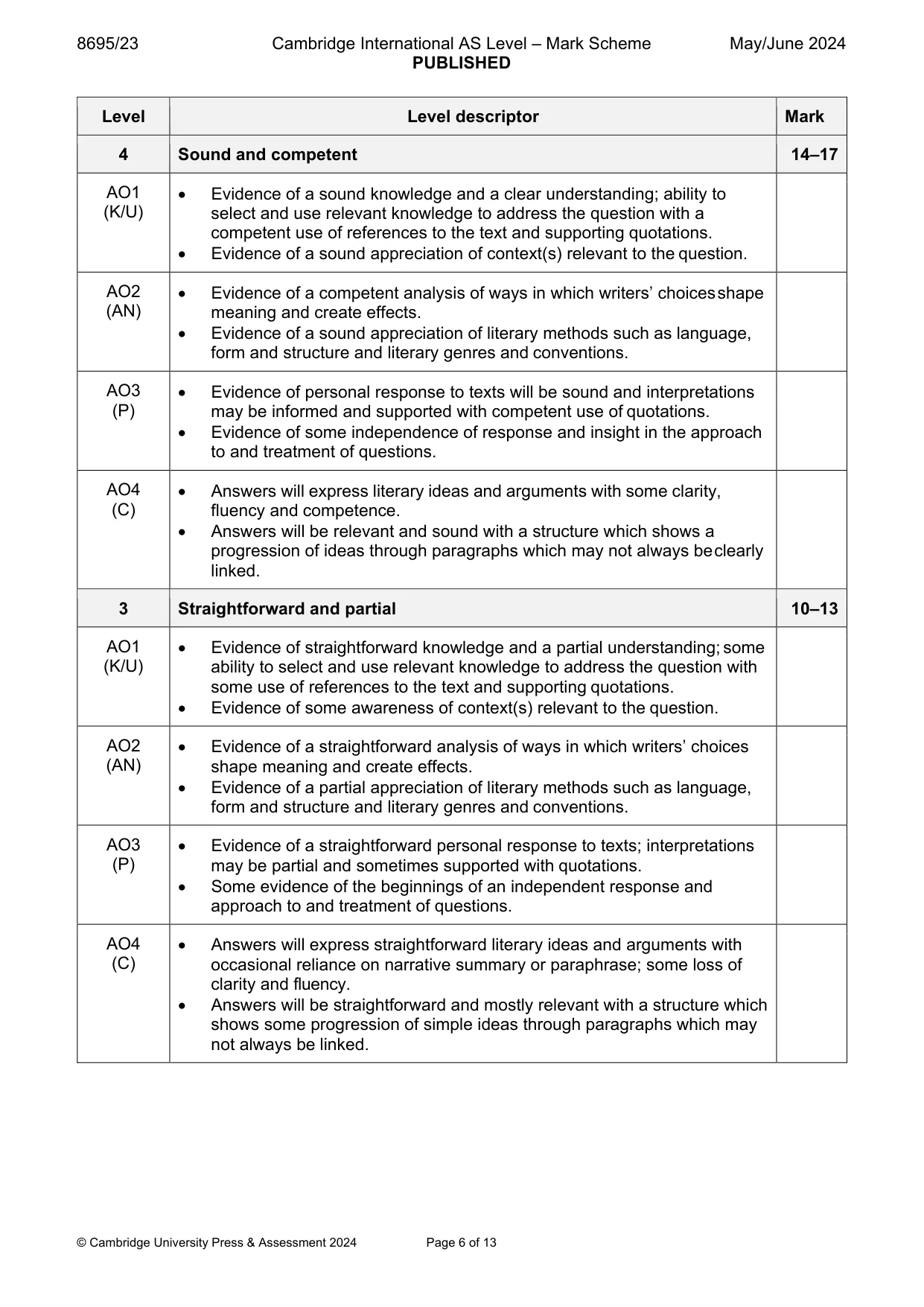
8695/23 Cambridge International AS Level – Mark Scheme PUBLISHED May/June 2024 © Cambridge University Press & Assessment 2024 Page 6 of 13 Level Level descriptor Mark 4 Sound and competent 14–17 AO1 (K/U) Evidence of a sound knowledge and a clear understanding; ability to select and use relevant knowledge to address the question with a competent use of references to the text and supporting quotations. Evidence of a sound appreciation of context(s) relevant to the question. AO2 (AN) Evidence of a competent analysis of ways in which writers’ choices shape meaning and create effects. Evidence of a sound appreciation of literary methods such as language, form and structure and literary genres and conventions. AO3 (P) Evidence of personal response to texts will be sound and interpretations may be informed and supported with competent use of quotations. Evidence of some independence of response and insight in the approach to and treatment of questions. AO4 (C) Answers will express literary ideas and arguments with some clarity, fluency and competence. Answers will be relevant and sound with a structure which shows a progression of ideas through paragraphs which may not always be clearly linked. 3 Straightforward and partial 10–13 AO1 (K/U) Evidence of straightforward knowledge and a partial understanding; some ability to select and use relevant knowledge to address the question with some use of references to the text and supporting quotations. Evidence of some awareness of context(s) relevant to the question. AO2 (AN) Evidence of a straightforward analysis of ways in which writers’ choices shape meaning and create effects. Evidence of a partial appreciation of literary methods such as language, form and structure and literary genres and conventions. AO3 (P) Evidence of a straightforward personal response to texts; interpretations may be partial and sometimes supported with quotations. Some evidence of the beginnings of an independent response and approach to and treatment of questions. AO4 (C) Answers will express straightforward literary ideas and arguments with occasional reliance on narrative summary or paraphrase; some loss of clarity and fluency. Answers will be straightforward and mostly relevant with a structure which shows some progression of simple ideas through paragraphs which may not always be linked.
Mark scheme, page 7
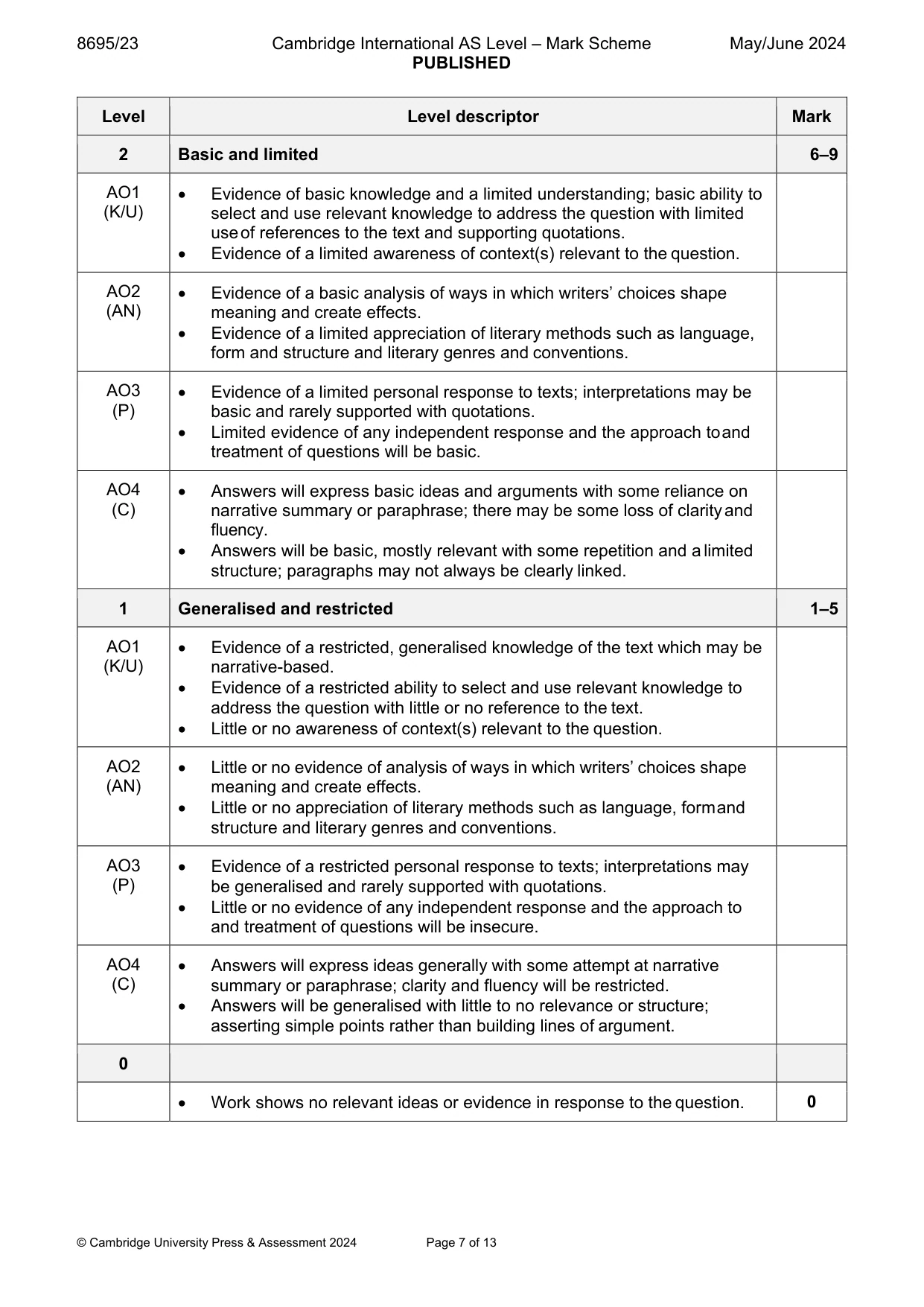
8695/23 Cambridge International AS Level – Mark Scheme PUBLISHED May/June 2024 © Cambridge University Press & Assessment 2024 Page 7 of 13 Level Level descriptor Mark 2 Basic and limited 6–9 AO1 (K/U) Evidence of basic knowledge and a limited understanding; basic ability to select and use relevant knowledge to address the question with limited use of references to the text and supporting quotations. Evidence of a limited awareness of context(s) relevant to the question. AO2 (AN) Evidence of a basic analysis of ways in which writers’ choices shape meaning and create effects. Evidence of a limited appreciation of literary methods such as language, form and structure and literary genres and conventions. AO3 (P) Evidence of a limited personal response to texts; interpretations may be basic and rarely supported with quotations. Limited evidence of any independent response and the approach to and treatment of questions will be basic. AO4 (C) Answers will express basic ideas and arguments with some reliance on narrative summary or paraphrase; there may be some loss of clarity and fluency. Answers will be basic, mostly relevant with some repetition and a limited structure; paragraphs may not always be clearly linked. 1 Generalised and restricted 1–5 AO1 (K/U) Evidence of a restricted, generalised knowledge of the text which may be narrative-based. Evidence of a restricted ability to select and use relevant knowledge to address the question with little or no reference to the text. Little or no awareness of context(s) relevant to the question. AO2 (AN) Little or no evidence of analysis of ways in which writers’ choices shape meaning and create effects. Little or no appreciation of literary methods such as language, form and structure and literary genres and conventions. AO3 (P) Evidence of a restricted personal response to texts; interpretations may be generalised and rarely supported with quotations. Little or no evidence of any independent response and the approach to and treatment of questions will be insecure. AO4 (C) Answers will express ideas generally with some attempt at narrative summary or paraphrase; clarity and fluency will be restricted. Answers will be generalised with little to no relevance or structure; asserting simple points rather than building lines of argument. 0 Work shows no relevant ideas or evidence in response to the question. 0
Mark scheme, page 8
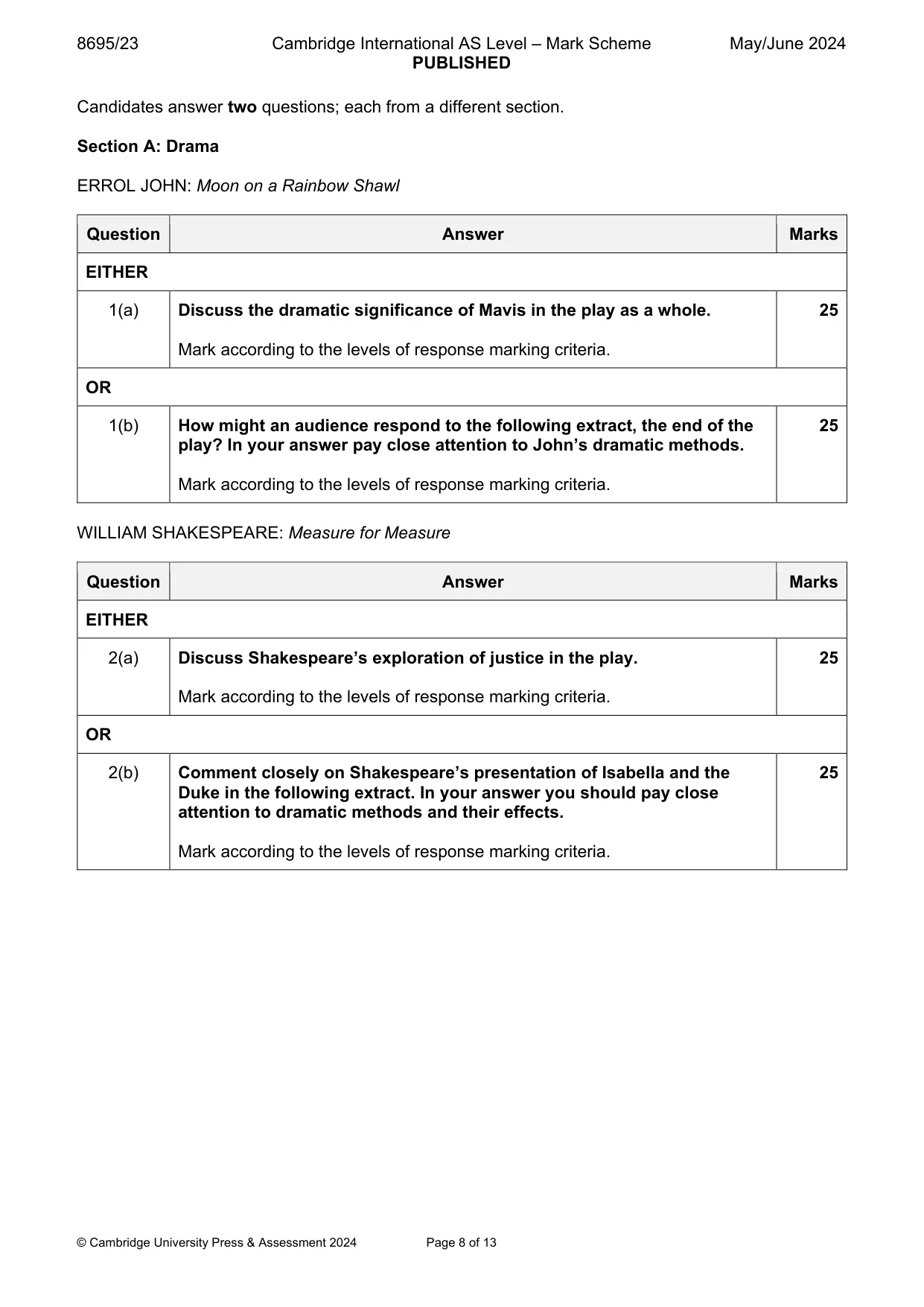
8695/23 Cambridge International AS Level – Mark Scheme PUBLISHED May/June 2024 © Cambridge University Press & Assessment 2024 Page 8 of 13 Candidates answer two questions; each from a different section. Section A: Drama ERROL JOHN: Moon on a Rainbow Shawl Question Answer Marks EITHER 1(a) Discuss the dramatic significance of Mavis in the play as a whole. Mark according to the levels of response marking criteria. 25 OR 1(b) How might an audience respond to the following extract, the end of the play? In your answer pay close attention to John’s dramatic methods. Mark according to the levels of response marking criteria. 25 WILLIAM SHAKESPEARE: Measure for Measure Question Answer Marks EITHER 2(a) Discuss Shakespeare’s exploration of justice in the play. Mark according to the levels of response marking criteria. 25 OR 2(b) Comment closely on Shakespeare’s presentation of Isabella and the Duke in the following extract. In your answer you should pay close attention to dramatic methods and their effects. Mark according to the levels of response marking criteria. 25
Mark scheme, page 9
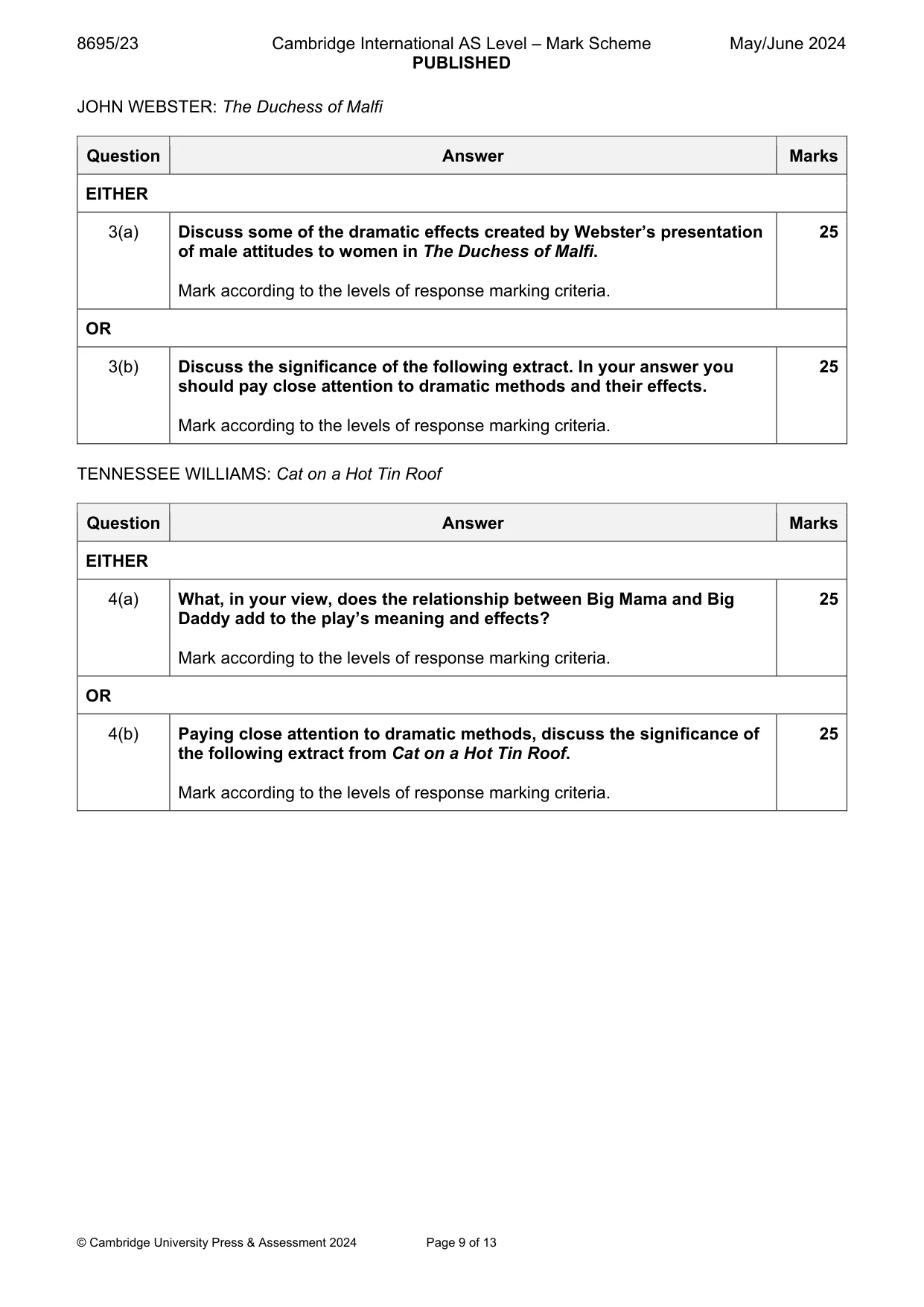
8695/23 Cambridge International AS Level – Mark Scheme PUBLISHED May/June 2024 © Cambridge University Press & Assessment 2024 Page 9 of 13 JOHN WEBSTER: The Duchess of Malfi Question Answer Marks EITHER 3(a) Discuss some of the dramatic effects created by Webster’s presentation of male attitudes to women in The Duchess of Malfi. Mark according to the levels of response marking criteria. 25 OR 3(b) Discuss the significance of the following extract. In your answer you should pay close attention to dramatic methods and their effects. Mark according to the levels of response marking criteria. 25 TENNESSEE WILLIAMS: Cat on a Hot Tin Roof Question Answer Marks EITHER 4(a) What, in your view, does the relationship between Big Mama and Big Daddy add to the play’s meaning and effects? Mark according to the levels of response marking criteria. 25 OR 4(b) Paying close attention to dramatic methods, discuss the significance of the following extract from Cat on a Hot Tin Roof. Mark according to the levels of response marking criteria. 25
Mark scheme, page 10
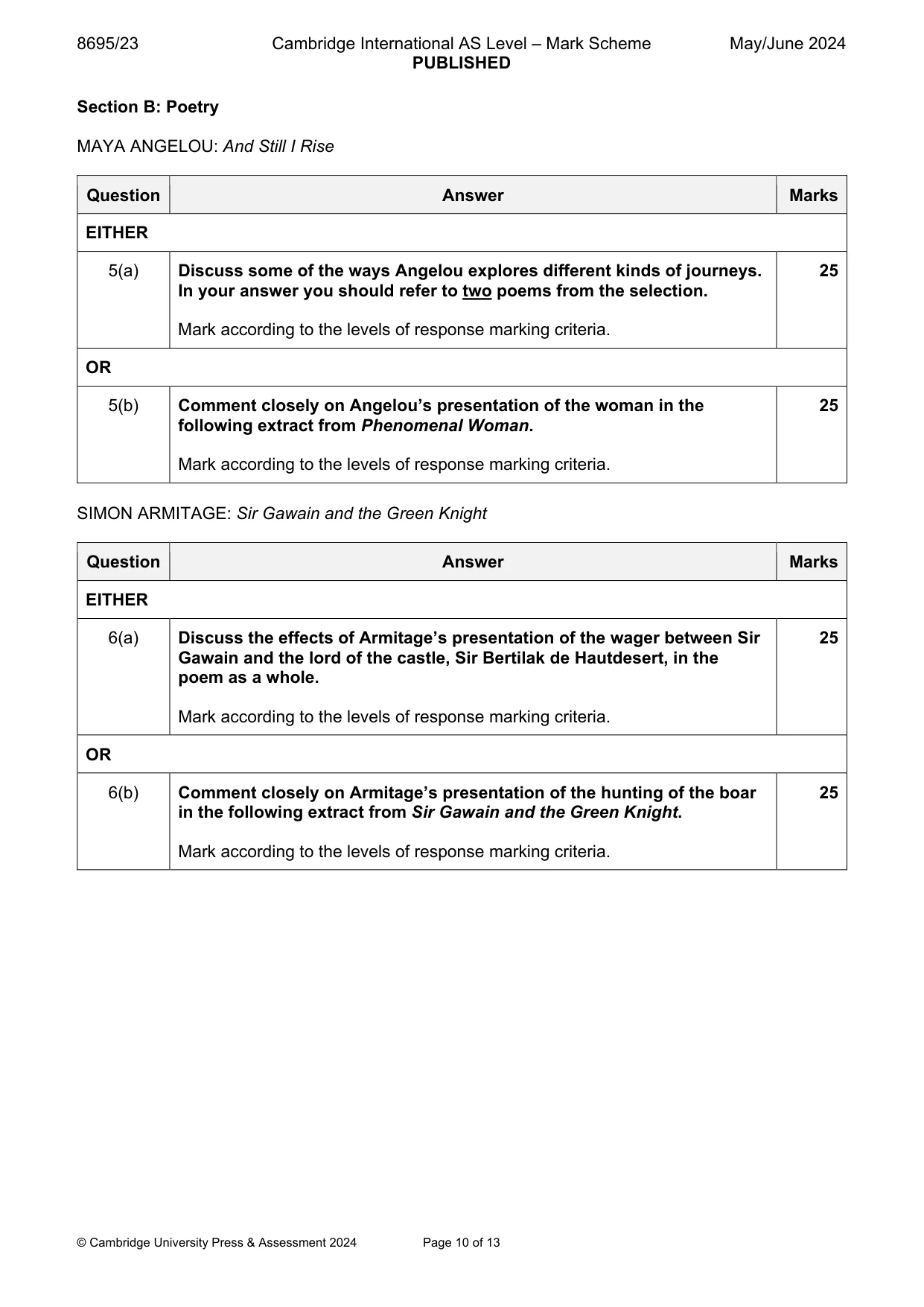
8695/23 Cambridge International AS Level – Mark Scheme PUBLISHED May/June 2024 © Cambridge University Press & Assessment 2024 Page 10 of 13 Section B: Poetry MAYA ANGELOU: And Still I Rise Question Answer Marks EITHER 5(a) Discuss some of the ways Angelou explores different kinds of journeys. In your answer you should refer to two poems from the selection. Mark according to the levels of response marking criteria. 25 OR 5(b) Comment closely on Angelou’s presentation of the woman in the following extract from Phenomenal Woman. Mark according to the levels of response marking criteria. 25 SIMON ARMITAGE: Sir Gawain and the Green Knight Question Answer Marks EITHER 6(a) Discuss the effects of Armitage’s presentation of the wager between Sir Gawain and the lord of the castle, Sir Bertilak de Hautdesert, in the poem as a whole. Mark according to the levels of response marking criteria. 25 OR 6(b) Comment closely on Armitage’s presentation of the hunting of the boar in the following extract from Sir Gawain and the Green Knight. Mark according to the levels of response marking criteria. 25
Mark scheme, page 11
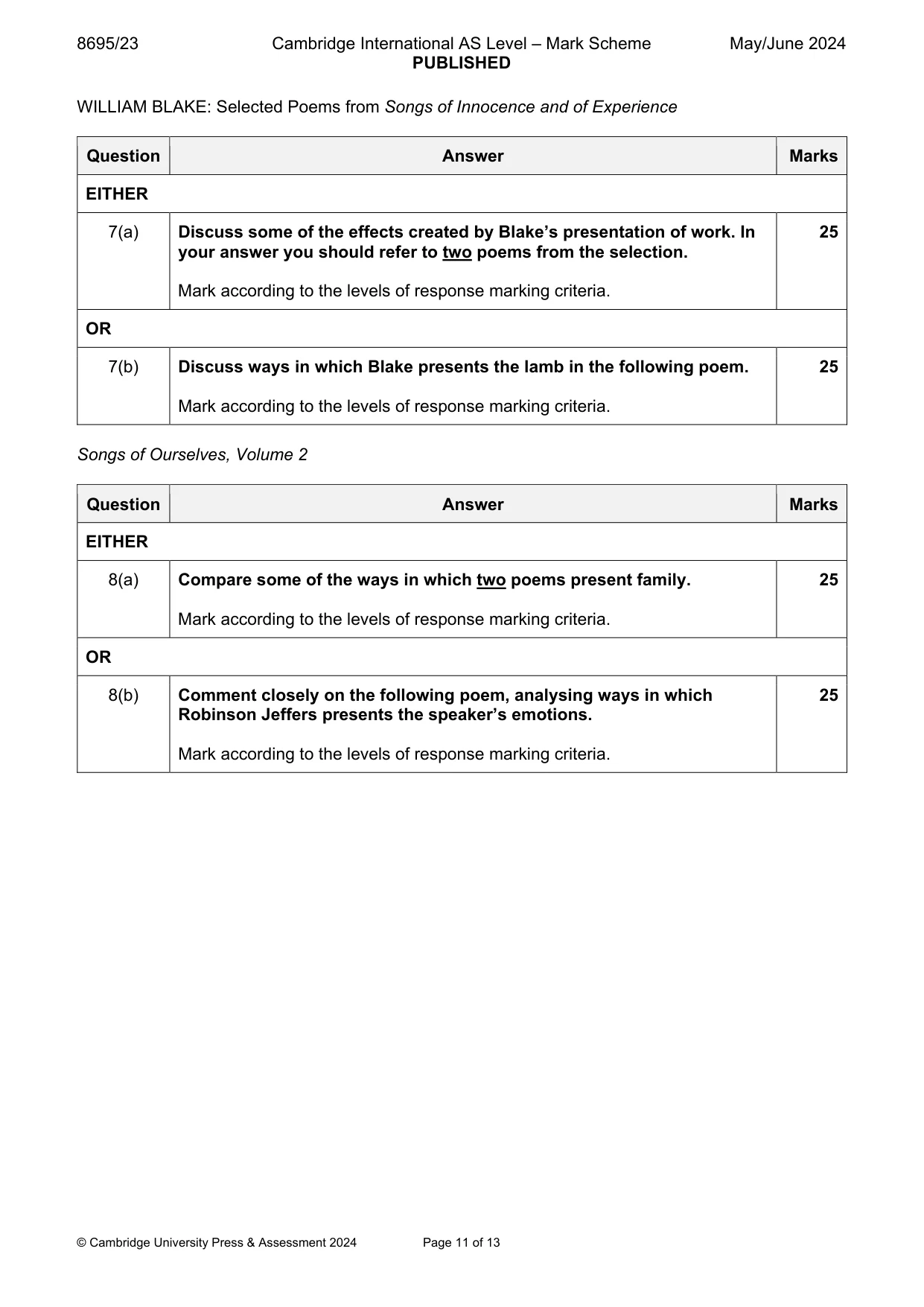
8695/23 Cambridge International AS Level – Mark Scheme PUBLISHED May/June 2024 © Cambridge University Press & Assessment 2024 Page 11 of 13 WILLIAM BLAKE: Selected Poems from Songs of Innocence and of Experience Question Answer Marks EITHER 7(a) Discuss some of the effects created by Blake’s presentation of work. In your answer you should refer to two poems from the selection. Mark according to the levels of response marking criteria. 25 OR 7(b) Discuss ways in which Blake presents the lamb in the following poem. Mark according to the levels of response marking criteria. 25 Songs of Ourselves, Volume 2 Question Answer Marks EITHER 8(a) Compare some of the ways in which two poems present family. Mark according to the levels of response marking criteria. 25 OR 8(b) Comment closely on the following poem, analysing ways in which Robinson Jeffers presents the speaker’s emotions. Mark according to the levels of response marking criteria. 25
Mark scheme, page 12
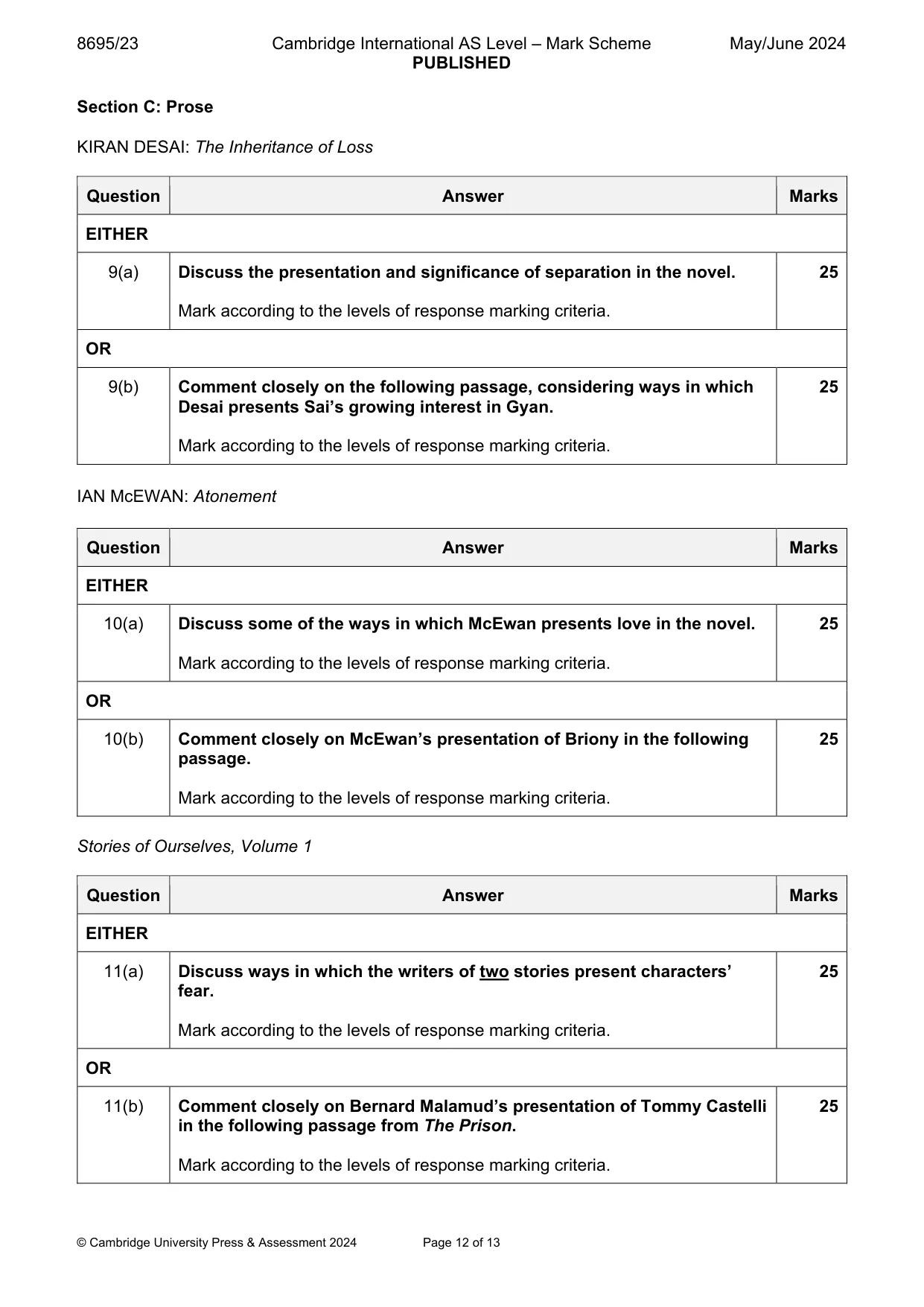
8695/23 Cambridge International AS Level – Mark Scheme PUBLISHED May/June 2024 © Cambridge University Press & Assessment 2024 Page 12 of 13 Section C: Prose KIRAN DESAI: The Inheritance of Loss Question Answer Marks EITHER 9(a) Discuss the presentation and significance of separation in the novel. Mark according to the levels of response marking criteria. 25 OR 9(b) Comment closely on the following passage, considering ways in which Desai presents Sai’s growing interest in Gyan. Mark according to the levels of response marking criteria. 25 IAN McEWAN: Atonement Question Answer Marks EITHER 10(a) Discuss some of the ways in which McEwan presents love in the novel. Mark according to the levels of response marking criteria. 25 OR 10(b) Comment closely on McEwan’s presentation of Briony in the following passage. Mark according to the levels of response marking criteria. 25 Stories of Ourselves, Volume 1 Question Answer Marks EITHER 11(a) Discuss ways in which the writers of two stories present characters’ fear. Mark according to the levels of response marking criteria. 25 OR 11(b) Comment closely on Bernard Malamud’s presentation of Tommy Castelli in the following passage from The Prison. Mark according to the levels of response marking criteria. 25
Mark scheme, page 13
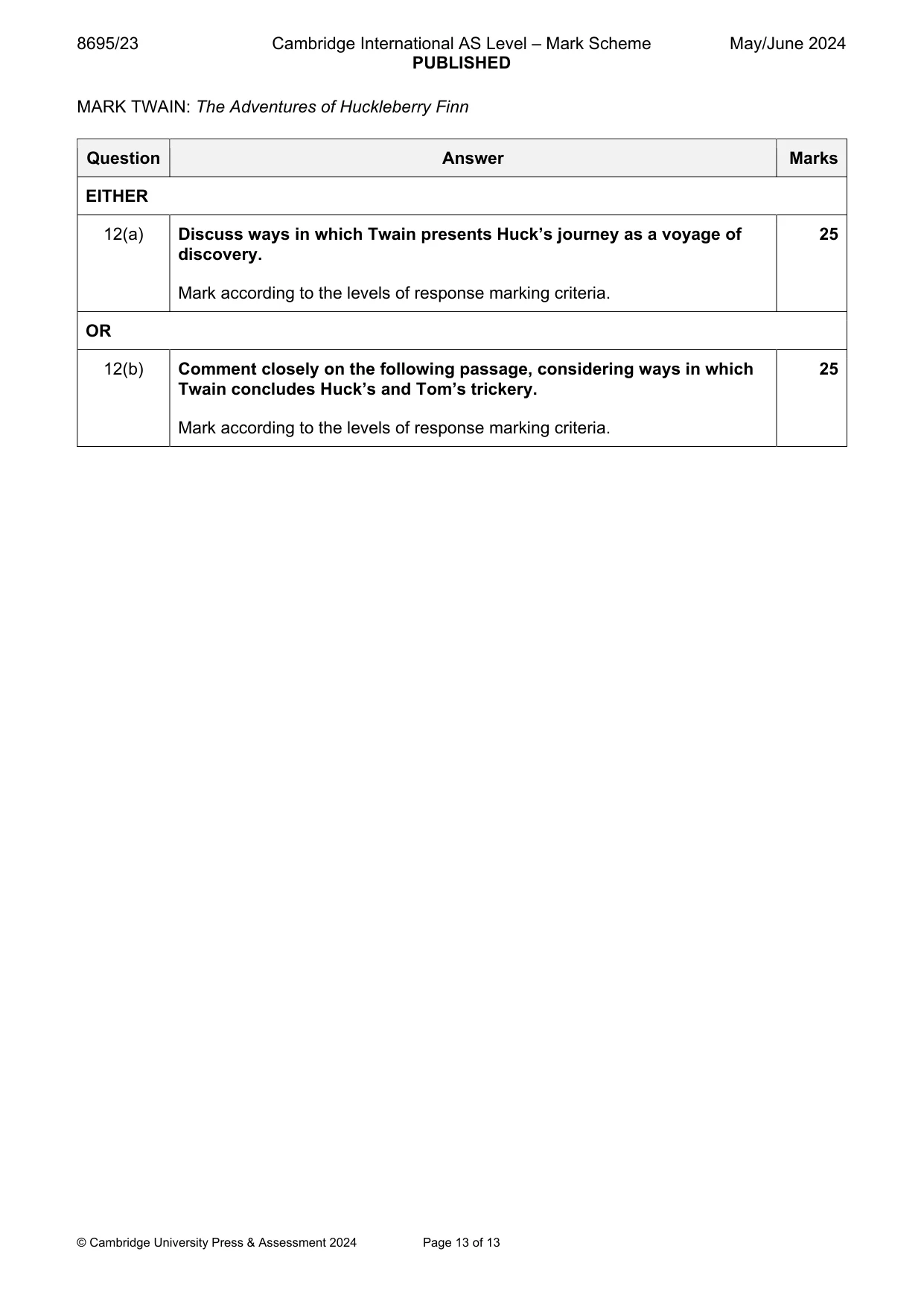
8695/23 Cambridge International AS Level – Mark Scheme PUBLISHED May/June 2024 © Cambridge University Press & Assessment 2024 Page 13 of 13 MARK TWAIN: The Adventures of Huckleberry Finn Question Answer Marks EITHER 12(a) Discuss ways in which Twain presents Huck’s journey as a voyage of discovery. Mark according to the levels of response marking criteria. 25 OR 12(b) Comment closely on the following passage, considering ways in which Twain concludes Huck’s and Tom’s trickery. Mark according to the levels of response marking criteria. 25
What you needed in this session
Cambridge’s own grade thresholds for 2024 May/June, Paper 2 · Variant 3. A higher threshold means an easier paper — the bar moves with how the cohort did.