Cambridge A Level English - Language and Literature (AS Level only, from 2016) 8695 — 2025 Oct/Nov Paper 2 · Variant 1
8695/21/O/N/25 · 50 marks · 120 min
The question paper and its mark scheme, free to read here and free to download. This is Cambridge’s own paper, exactly as it was sat.
Question paper20 pages

Mark scheme14 pages
Answers below. Sit the paper first if you are practising.
Paper as text
Question paper, page 1
Cambridge Assessment International Education Cambridge International AS Level LANGUAGE AND LITERATURE IN ENGLISH 8695/21 Paper 2 Drama, Poetry and Prose October/November 2025 2 hours You must answer on the enclosed answer booklet. You will need: Answer booklet (enclosed) INSTRUCTIONS e Answer two questions in total, each from a different section. e Follow the instructions on the front cover of the answer booklet. If you need additional answer paper, ask the invigilator for a continuation booklet. e Dictionaries are not allowed. INFORMATION e The total mark for this paper is 50. e The number of marks for each question or part question is shown in brackets [ ]. This document has 20 pages. Any blank pages are indicated. DC (RCL (DF)) 342720/3 © UCLES 2025 [Turn over
Question paper, page 2
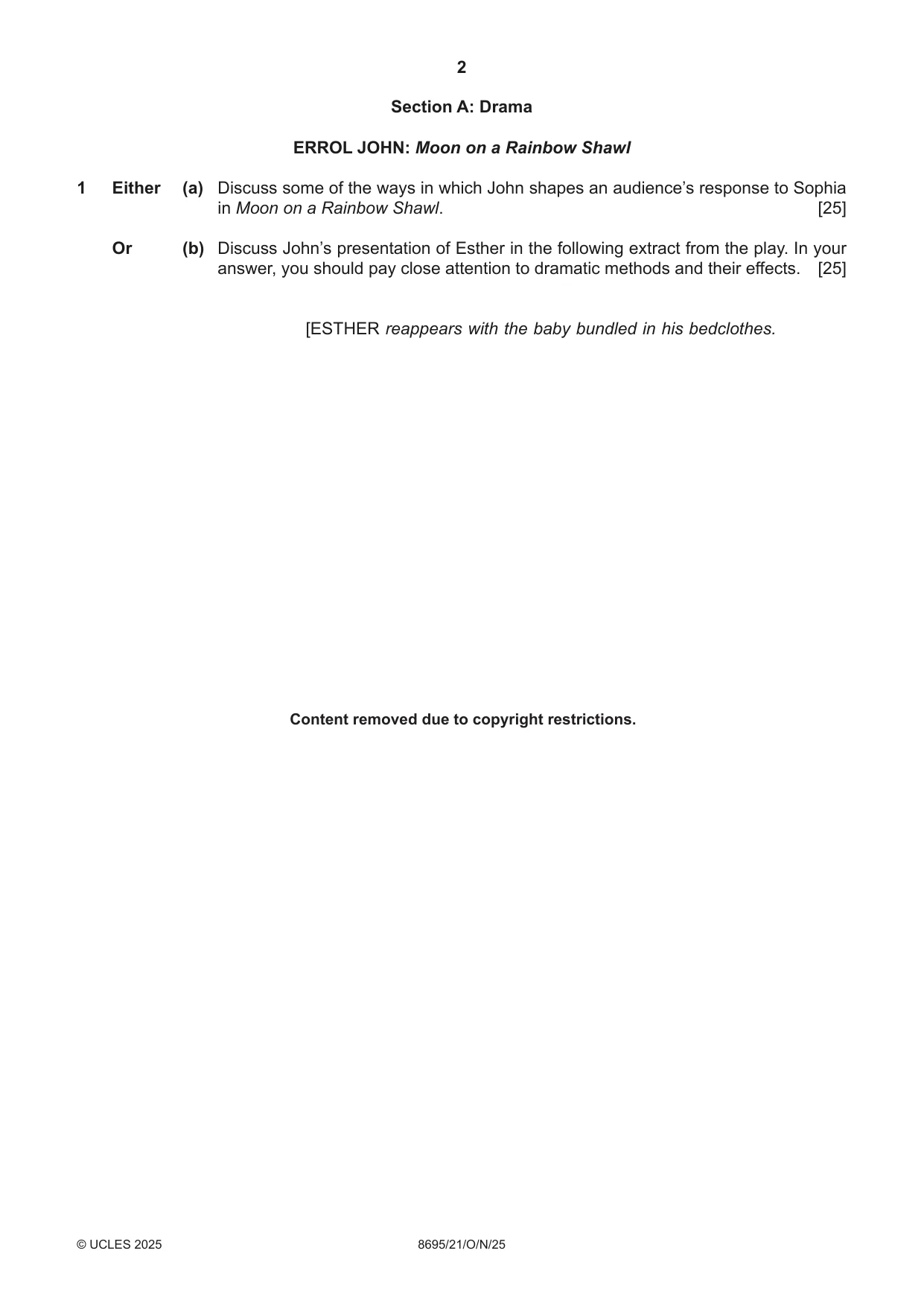
2 8695/21/O/N/25 © UCLES 2025 Section A: Drama ERROL JOHN: Moon on a Rainbow Shawl 1 Either (a) Discuss some of the ways in which John shapes an audience’s response to Sophia in Moon on a Rainbow Shawl. [25] Or (b) Discuss John’s presentation of Esther in the following extract from the play. In your answer, you should pay close attention to dramatic methods and their effects. [25] [ESTHER reappears with the baby bundled in his bedclothes. Content removed due to copyright restrictions.
Question paper, page 3
3 8695/21/O/N/25 © UCLES 2025 [Turn over So many things we find we have to get. (from Act 1, Scene 1) Content removed due to copyright restrictions.
Question paper, page 4
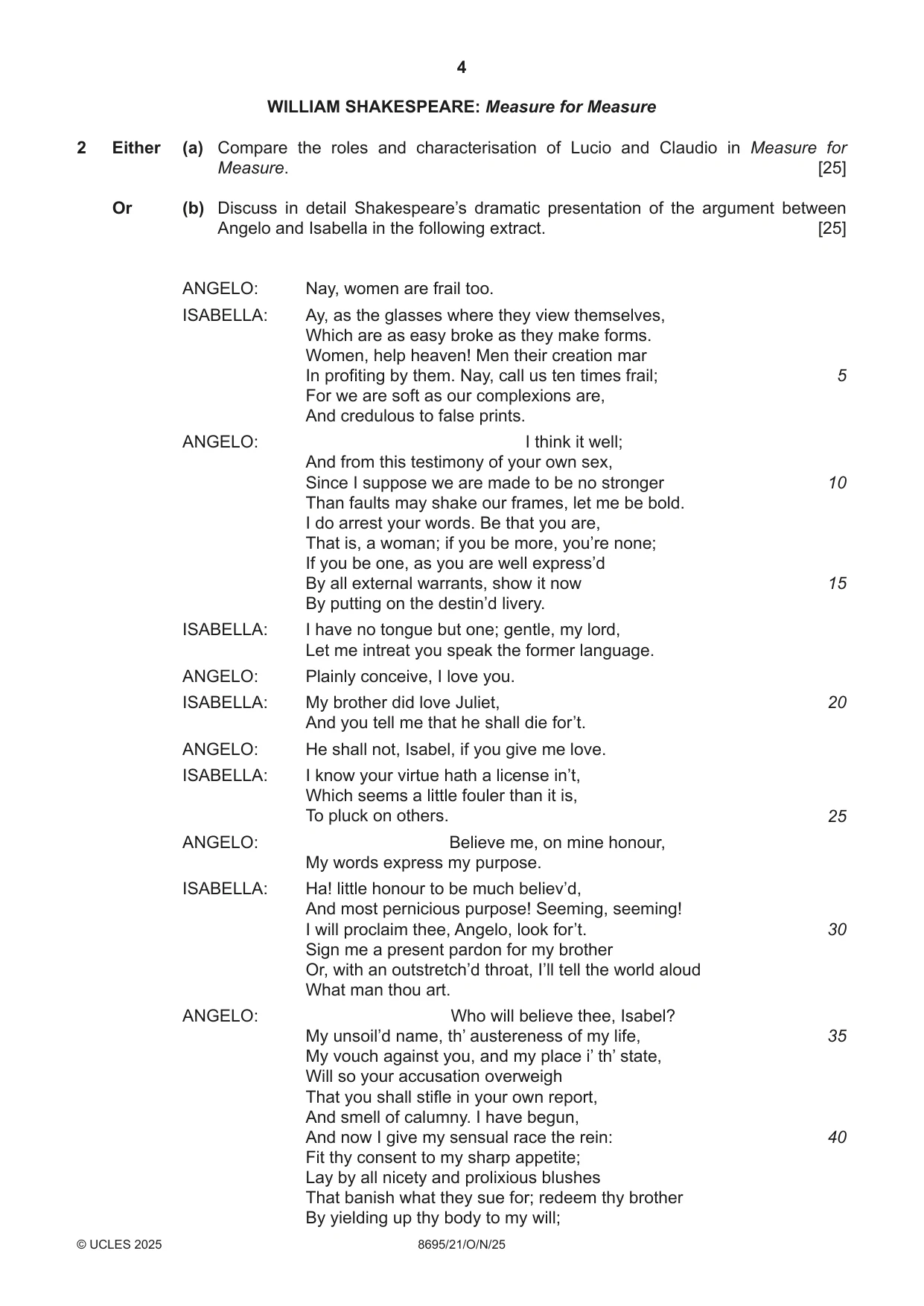
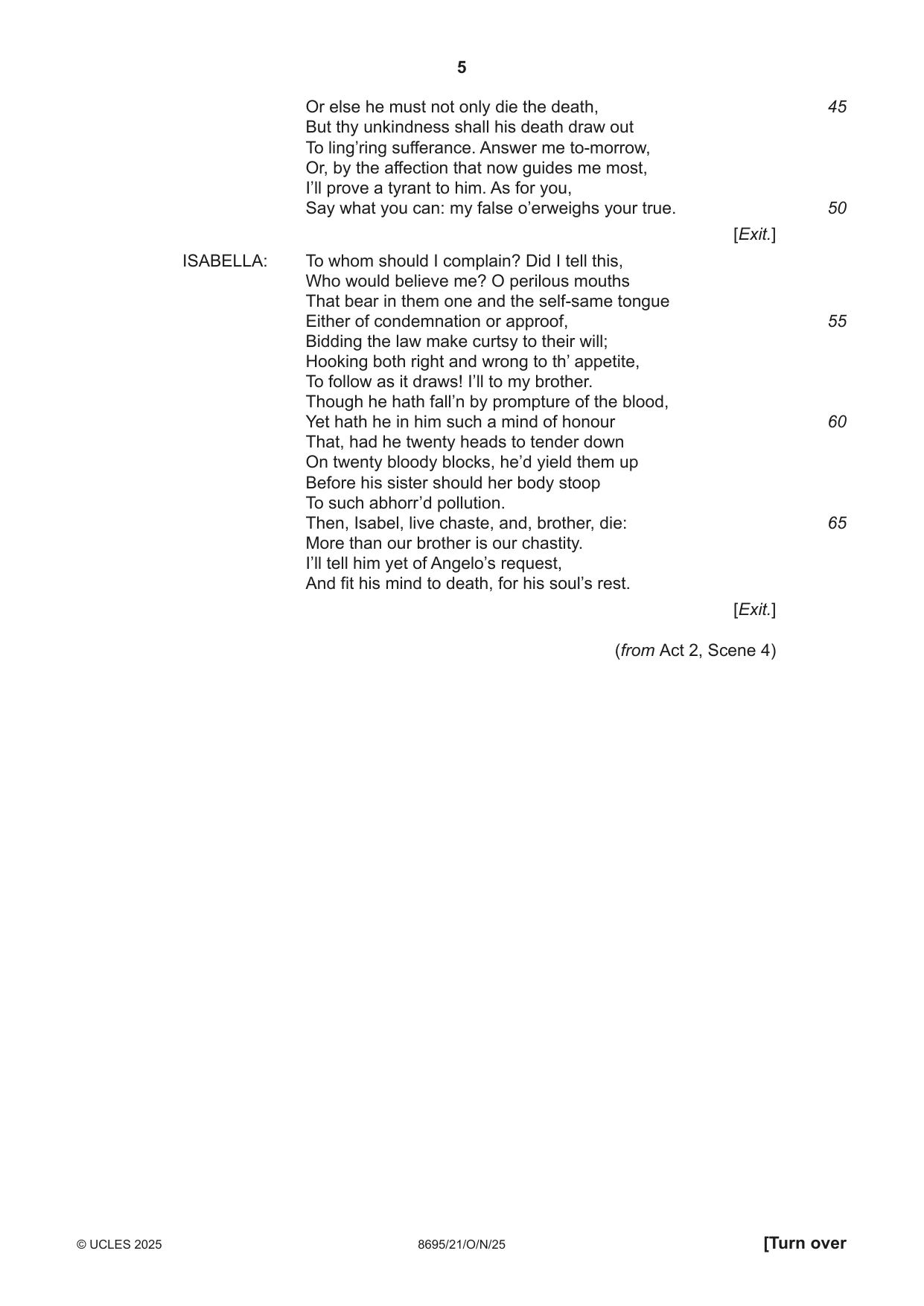
4 8695/21/O/N/25 © UCLES 2025 WILLIAM SHAKESPEARE: Measure for Measure 2 Either (a) Compare the roles and characterisation of Lucio and Claudio in Measure for Measure. [25] Or (b) Discuss in detail Shakespeare’s dramatic presentation of the argument between Angelo and Isabella in the following extract. [25] ANGELO: Nay, women are frail too. ISABELLA: Ay, as the glasses where they view themselves, Which are as easy broke as they make forms. Women, help heaven! Men their creation mar In profiting by them. Nay, call us ten times frail; For we are soft as our complexions are, And credulous to false prints. ANGELO: I think it well; And from this testimony of your own sex, Since I suppose we are made to be no stronger Than faults may shake our frames, let me be bold. I do arrest your words. Be that you are, That is, a woman; if you be more, you’re none; If you be one, as you are well express’d By all external warrants, show it now By putting on the destin’d livery. ISABELLA: I have no tongue but one; gentle, my lord, Let me intreat you speak the former language. ANGELO: Plainly conceive, I love you. ISABELLA: My brother did love Juliet, And you tell me that he shall die for’t. ANGELO: He shall not, Isabel, if you give me love. ISABELLA: I know your virtue hath a license in’t, Which seems a little fouler than it is, To pluck on others. ANGELO: Believe me, on mine honour, My words express my purpose. ISABELLA: Ha! little honour to be much believ’d, And most pernicious purpose! Seeming, seeming! I will proclaim thee, Angelo, look for’t. Sign me a present pardon for my brother Or, with an outstretch’d throat, I’ll tell the world aloud What man thou art. ANGELO: Who will believe thee, Isabel? My unsoil’d name, th’ austereness of my life, My vouch against you, and my place i’ th’ state, Will so your accusation overweigh That you shall stifle in your own report, And smell of calumny. I have begun, And now I give my sensual race the rein: Fit thy consent to my sharp appetite; Lay by all nicety and prolixious blushes That banish what they sue for; redeem thy brother By yielding up thy body to my will; 5 10 15 20 25 30 35 40
Question paper, page 5
5 8695/21/O/N/25 © UCLES 2025 [Turn over Or else he must not only die the death, But thy unkindness shall his death draw out To ling’ring sufferance. Answer me to-morrow, Or, by the affection that now guides me most, I’ll prove a tyrant to him. As for you, Say what you can: my false o’erweighs your true. [Exit.] ISABELLA: To whom should I complain? Did I tell this, Who would believe me? O perilous mouths That bear in them one and the self-same tongue Either of condemnation or approof, Bidding the law make curtsy to their will; Hooking both right and wrong to th’ appetite, To follow as it draws! I’ll to my brother. Though he hath fall’n by prompture of the blood, Yet hath he in him such a mind of honour That, had he twenty heads to tender down On twenty bloody blocks, he’d yield them up Before his sister should her body stoop To such abhorr’d pollution. Then, Isabel, live chaste, and, brother, die: More than our brother is our chastity. I’ll tell him yet of Angelo’s request, And fit his mind to death, for his soul’s rest. [Exit.] (from Act 2, Scene 4) 45 50 55 60 65
Question paper, page 6
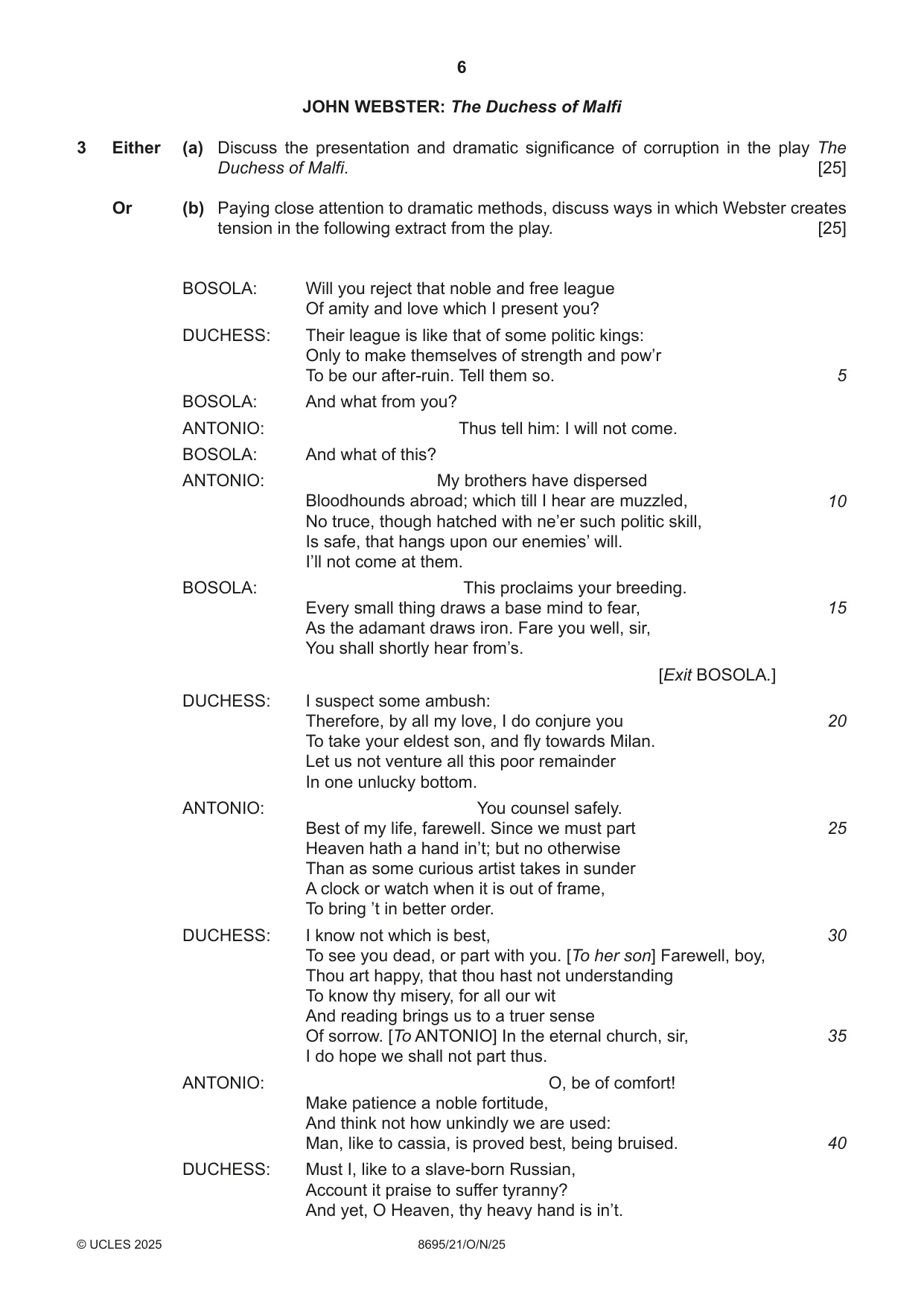
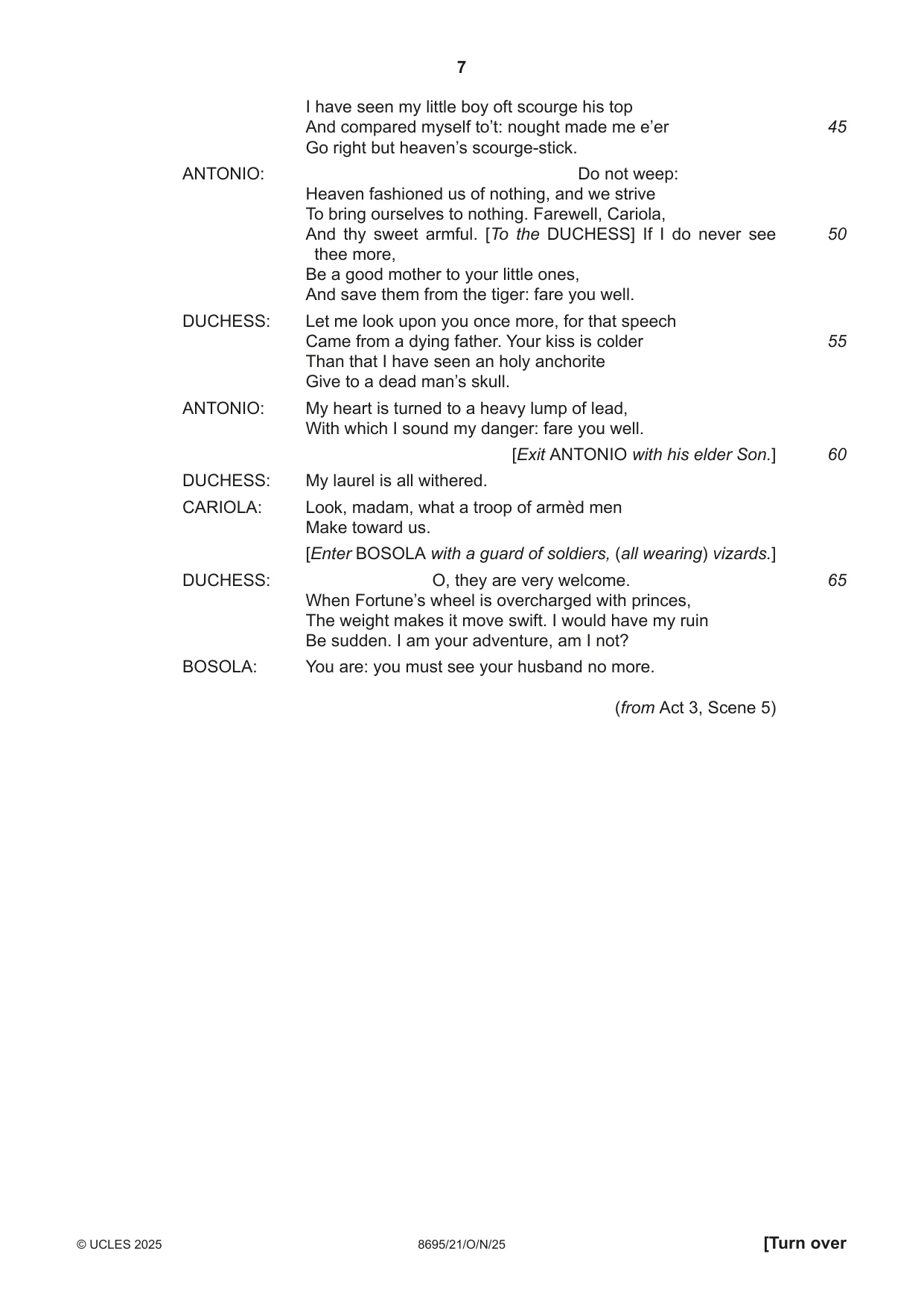
6 8695/21/O/N/25 © UCLES 2025 JOHN WEBSTER: The Duchess of Malfi 3 Either (a) Discuss the presentation and dramatic significance of corruption in the play The Duchess of Malfi. [25] Or (b) Paying close attention to dramatic methods, discuss ways in which Webster creates tension in the following extract from the play. [25] BOSOLA: Will you reject that noble and free league Of amity and love which I present you? DUCHESS: Their league is like that of some politic kings: Only to make themselves of strength and pow’r To be our after-ruin. Tell them so. BOSOLA: And what from you? ANTONIO: Thus tell him: I will not come. BOSOLA: And what of this? ANTONIO: My brothers have dispersed Bloodhounds abroad; which till I hear are muzzled, No truce, though hatched with ne’er such politic skill, Is safe, that hangs upon our enemies’ will. I’ll not come at them. BOSOLA: This proclaims your breeding. Every small thing draws a base mind to fear, As the adamant draws iron. Fare you well, sir, You shall shortly hear from’s. [Exit BOSOLA.] DUCHESS: I suspect some ambush: Therefore, by all my love, I do conjure you To take your eldest son, and fly towards Milan. Let us not venture all this poor remainder In one unlucky bottom. ANTONIO: You counsel safely. Best of my life, farewell. Since we must part Heaven hath a hand in’t; but no otherwise Than as some curious artist takes in sunder A clock or watch when it is out of frame, To bring ’t in better order. DUCHESS: I know not which is best, To see you dead, or part with you. [To her son] Farewell, boy, Thou art happy, that thou hast not understanding To know thy misery, for all our wit And reading brings us to a truer sense Of sorrow. [To ANTONIO] In the eternal church, sir, I do hope we shall not part thus. ANTONIO: O, be of comfort! Make patience a noble fortitude, And think not how unkindly we are used: Man, like to cassia, is proved best, being bruised. DUCHESS: Must I, like to a slave-born Russian, Account it praise to suffer tyranny? And yet, O Heaven, thy heavy hand is in’t. 5 10 15 20 25 30 35 40
Question paper, page 7
7 8695/21/O/N/25 © UCLES 2025 [Turn over I have seen my little boy oft scourge his top And compared myself to’t: nought made me e’er Go right but heaven’s scourge-stick. ANTONIO: Do not weep: Heaven fashioned us of nothing, and we strive To bring ourselves to nothing. Farewell, Cariola, And thy sweet armful. [To the DUCHESS] If I do never see thee more, Be a good mother to your little ones, And save them from the tiger: fare you well. DUCHESS: Let me look upon you once more, for that speech Came from a dying father. Your kiss is colder Than that I have seen an holy anchorite Give to a dead man’s skull. ANTONIO: My heart is turned to a heavy lump of lead, With which I sound my danger: fare you well. [Exit ANTONIO with his elder Son.] DUCHESS: My laurel is all withered. CARIOLA: Look, madam, what a troop of armèd men Make toward us. [Enter BOSOLA with a guard of soldiers, (all wearing) vizards.] DUCHESS: O, they are very welcome. When Fortune’s wheel is overcharged with princes, The weight makes it move swift. I would have my ruin Be sudden. I am your adventure, am I not? BOSOLA: You are: you must see your husband no more. (from Act 3, Scene 5) 45 50 55 60 65
Question paper, page 8
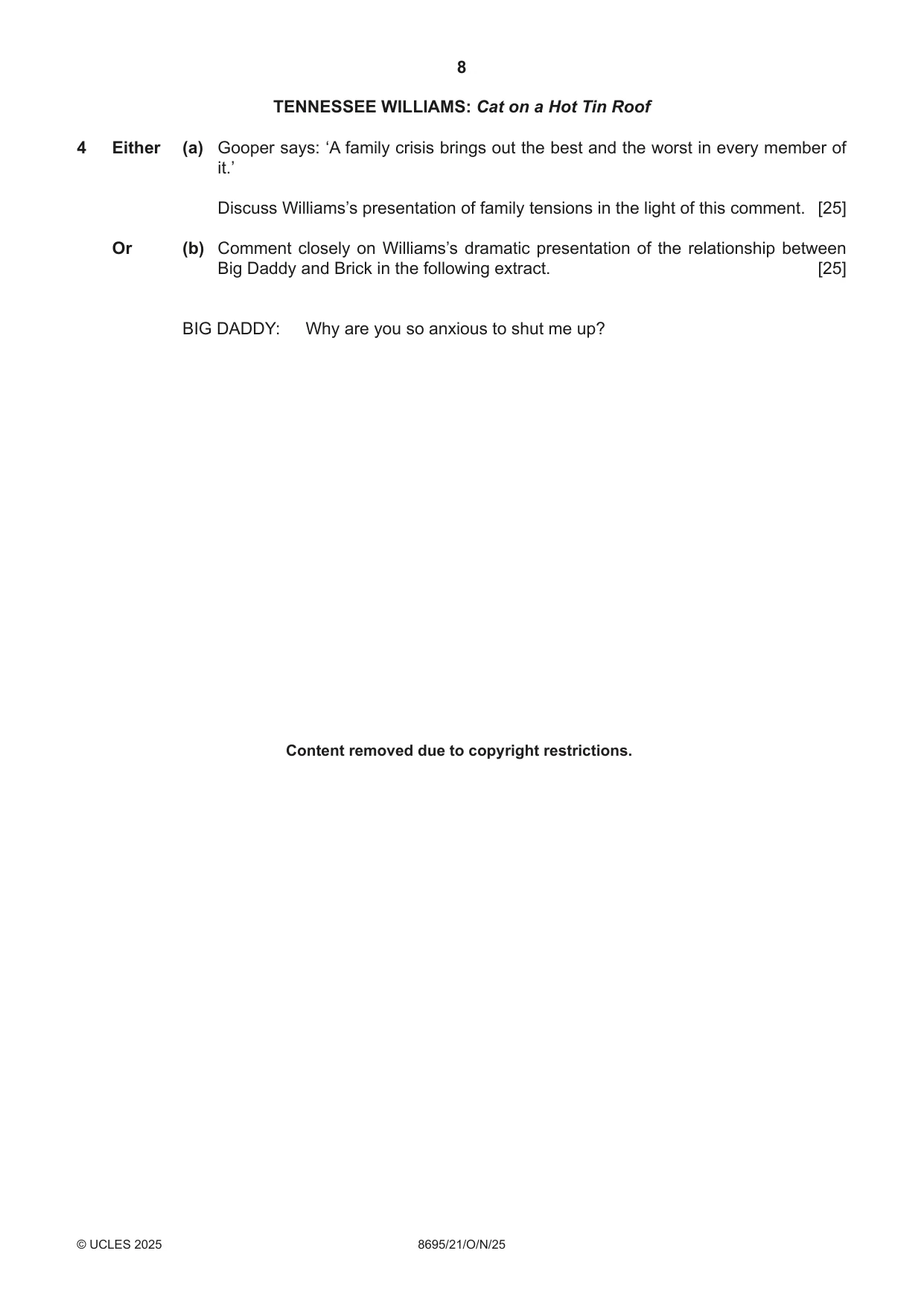
8 8695/21/O/N/25 © UCLES 2025 TENNESSEE WILLIAMS: Cat on a Hot Tin Roof 4 Either (a) Gooper says: ‘A family crisis brings out the best and the worst in every member of it.’ Discuss Williams’s presentation of family tensions in the light of this comment. [25] Or (b) Comment closely on Williams’s dramatic presentation of the relationship between Big Daddy and Brick in the following extract. [25] BIG DADDY: Why are you so anxious to shut me up? Content removed due to copyright restrictions.
Question paper, page 9
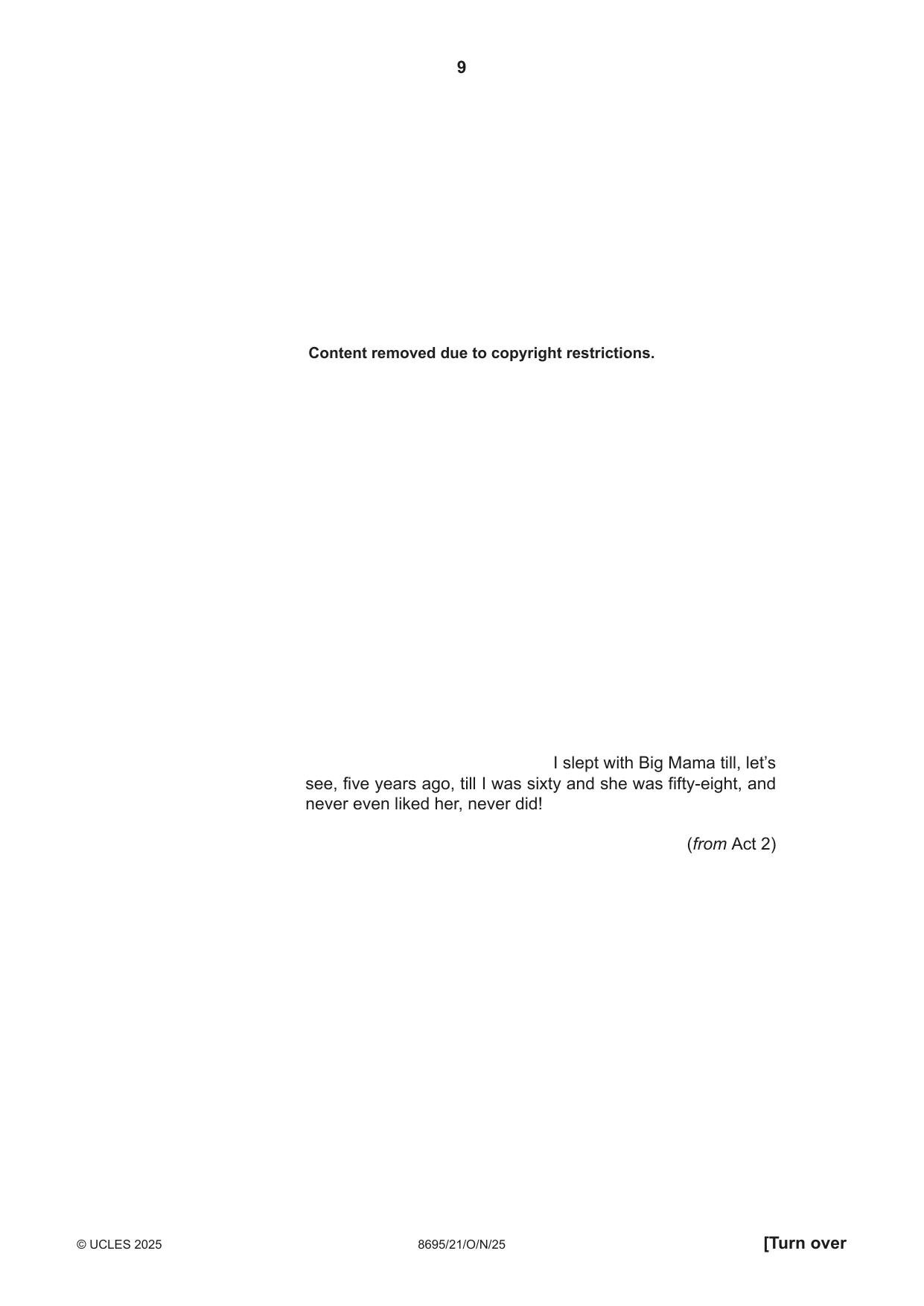
9 8695/21/O/N/25 © UCLES 2025 [Turn over I slept with Big Mama till, let’s see, five years ago, till I was sixty and she was fifty-eight, and never even liked her, never did! (from Act 2) Content removed due to copyright restrictions.
Question paper, page 10
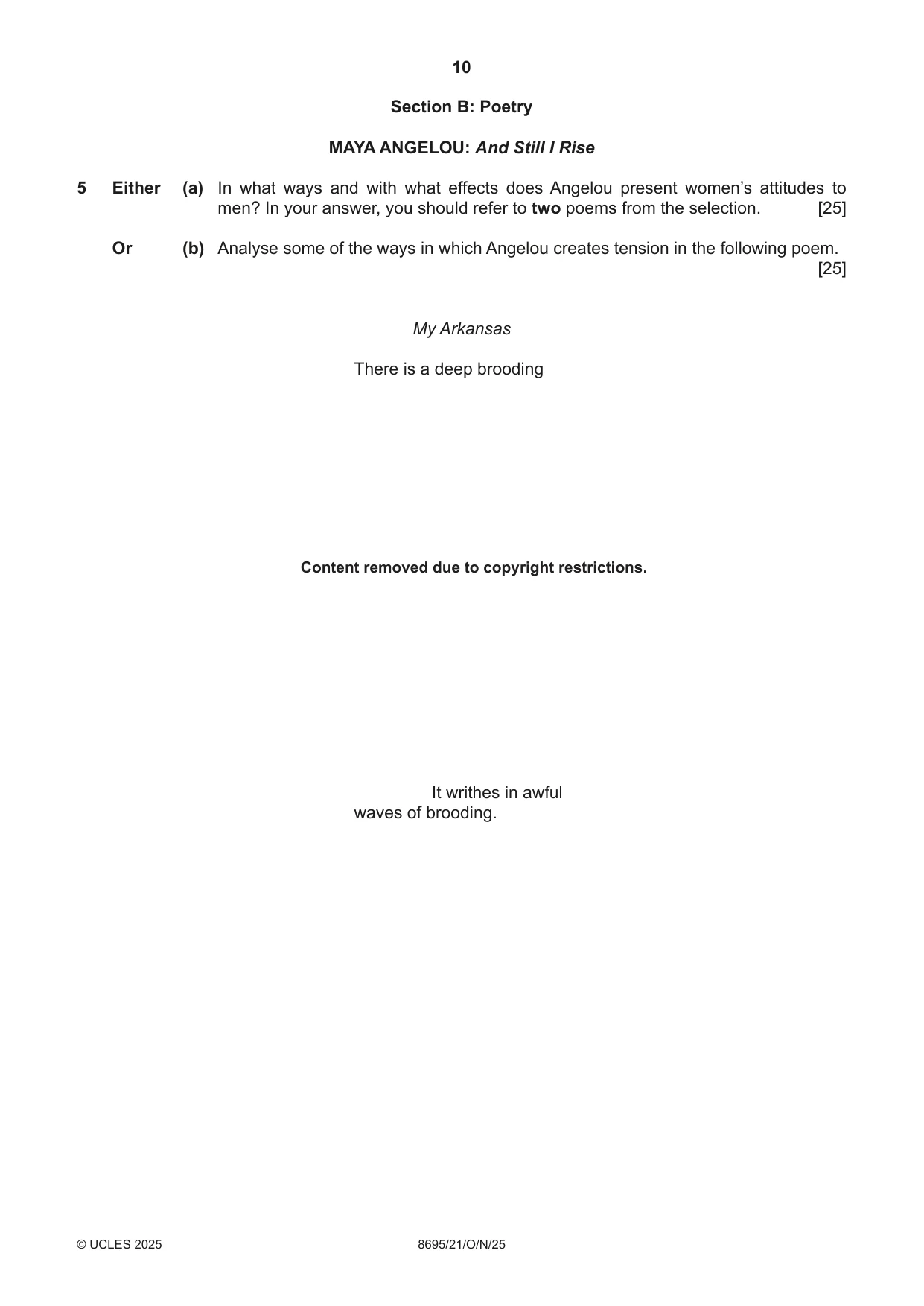
10 8695/21/O/N/25 © UCLES 2025 Section B: Poetry MAYA ANGELOU: And Still I Rise 5 Either (a) In what ways and with what effects does Angelou present women’s attitudes to men? In your answer, you should refer to two poems from the selection. [25] Or (b) Analyse some of the ways in which Angelou creates tension in the following poem. [25] My Arkansas There is a deep brooding It writhes in awful waves of brooding. Content removed due to copyright restrictions.
Question paper, page 11
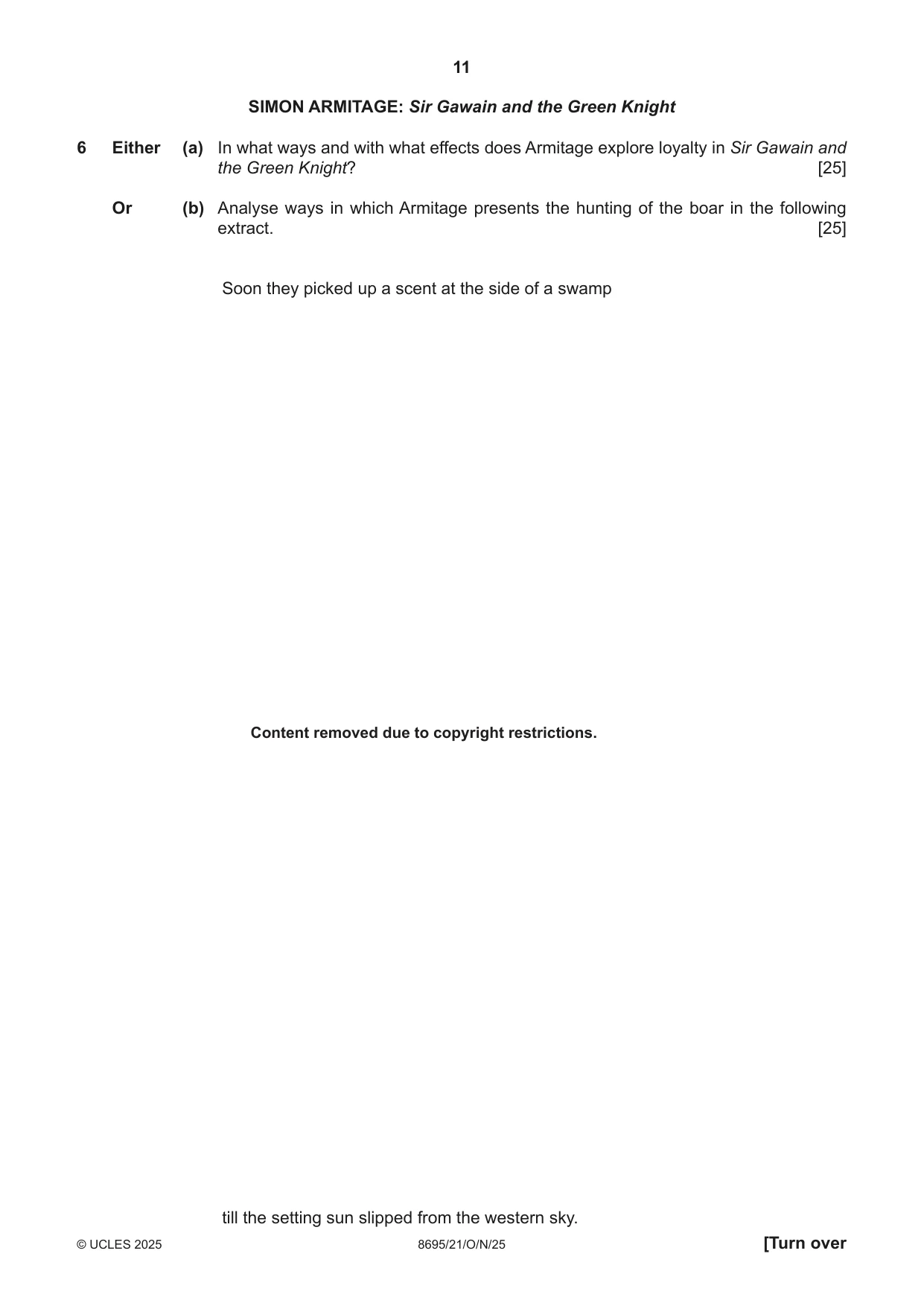
11 8695/21/O/N/25 © UCLES 2025 [Turn over SIMON ARMITAGE: Sir Gawain and the Green Knight 6 Either (a) In what ways and with what effects does Armitage explore loyalty in Sir Gawain and the Green Knight? [25] Or (b) Analyse ways in which Armitage presents the hunting of the boar in the following extract. [25] Soon they picked up a scent at the side of a swamp till the setting sun slipped from the western sky. Content removed due to copyright restrictions.
Question paper, page 12
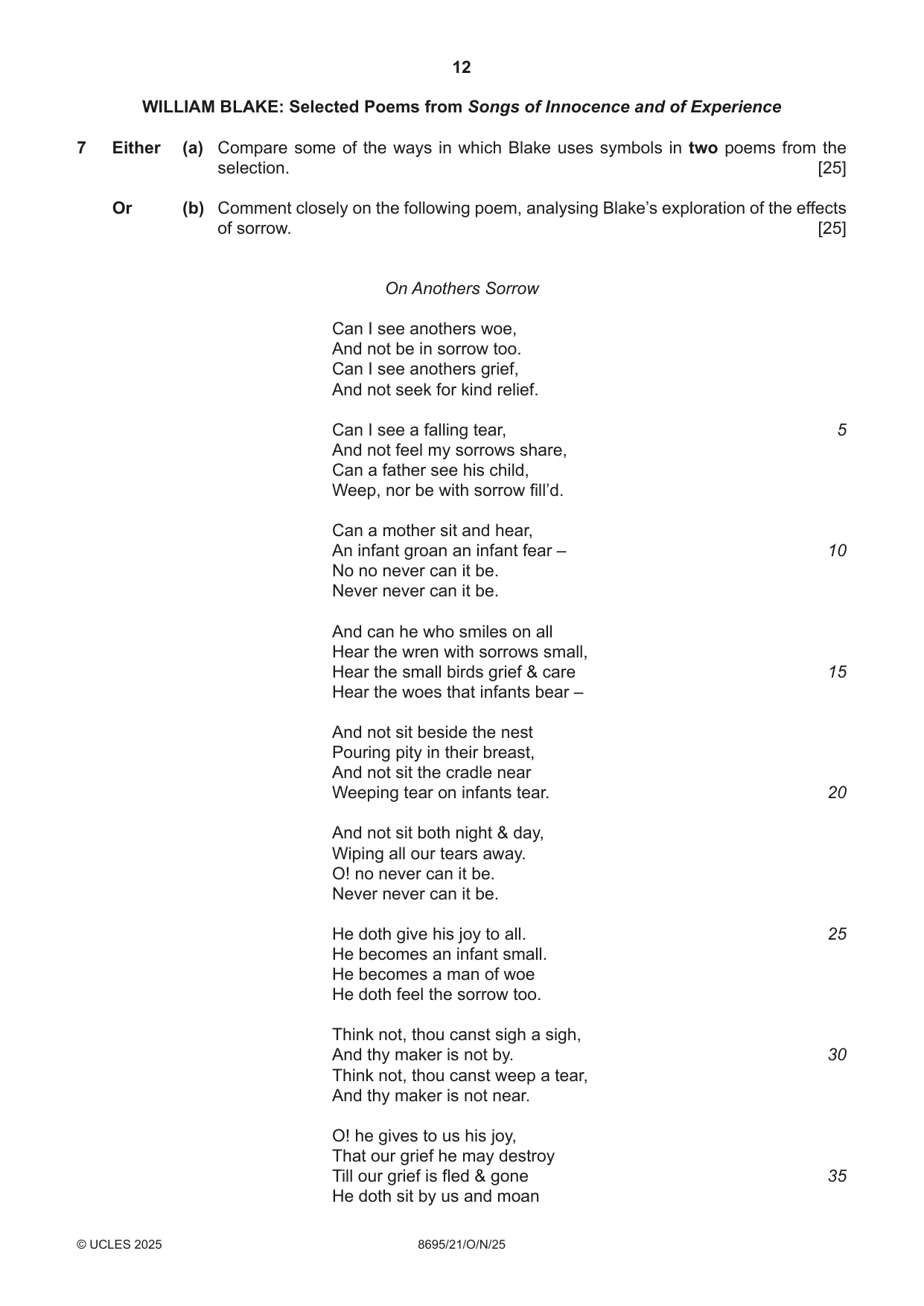
12 8695/21/O/N/25 © UCLES 2025 WILLIAM BLAKE: Selected Poems from Songs of Innocence and of Experience 7 Either (a) Compare some of the ways in which Blake uses symbols in two poems from the selection. [25] Or (b) Comment closely on the following poem, analysing Blake’s exploration of the effects of sorrow. [25] On Anothers Sorrow Can I see anothers woe, And not be in sorrow too. Can I see anothers grief, And not seek for kind relief. Can I see a falling tear, And not feel my sorrows share, Can a father see his child, Weep, nor be with sorrow fill’d. Can a mother sit and hear, An infant groan an infant fear – No no never can it be. Never never can it be. And can he who smiles on all Hear the wren with sorrows small, Hear the small birds grief & care Hear the woes that infants bear – And not sit beside the nest Pouring pity in their breast, And not sit the cradle near Weeping tear on infants tear. And not sit both night & day, Wiping all our tears away. O! no never can it be. Never never can it be. He doth give his joy to all. He becomes an infant small. He becomes a man of woe He doth feel the sorrow too. Think not, thou canst sigh a sigh, And thy maker is not by. Think not, thou canst weep a tear, And thy maker is not near. O! he gives to us his joy, That our grief he may destroy Till our grief is fled & gone He doth sit by us and moan 5 10 15 20 25 30 35
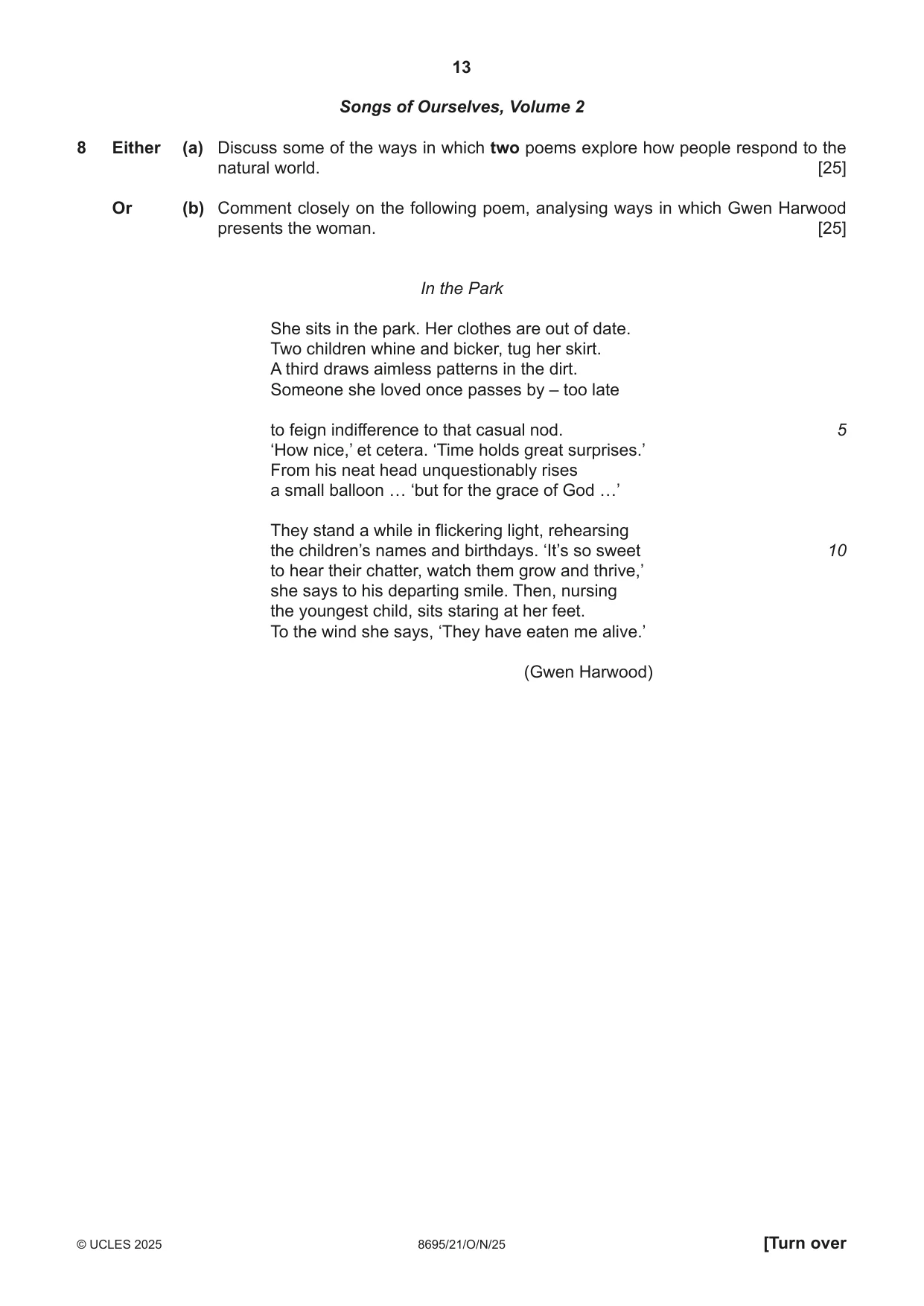
Question paper, page 13
13 8695/21/O/N/25 © UCLES 2025 [Turn over Songs of Ourselves, Volume 2 8 Either (a) Discuss some of the ways in which two poems explore how people respond to the natural world. [25] Or (b) Comment closely on the following poem, analysing ways in which Gwen Harwood presents the woman. [25] In the Park She sits in the park. Her clothes are out of date. Two children whine and bicker, tug her skirt. A third draws aimless patterns in the dirt. Someone she loved once passes by – too late to feign indifference to that casual nod. ‘How nice,’ et cetera. ‘Time holds great surprises.’ From his neat head unquestionably rises a small balloon … ‘but for the grace of God …’ They stand a while in flickering light, rehearsing the children’s names and birthdays. ‘It’s so sweet to hear their chatter, watch them grow and thrive,’ she says to his departing smile. Then, nursing the youngest child, sits staring at her feet. To the wind she says, ‘They have eaten me alive.’ (Gwen Harwood) 5 10
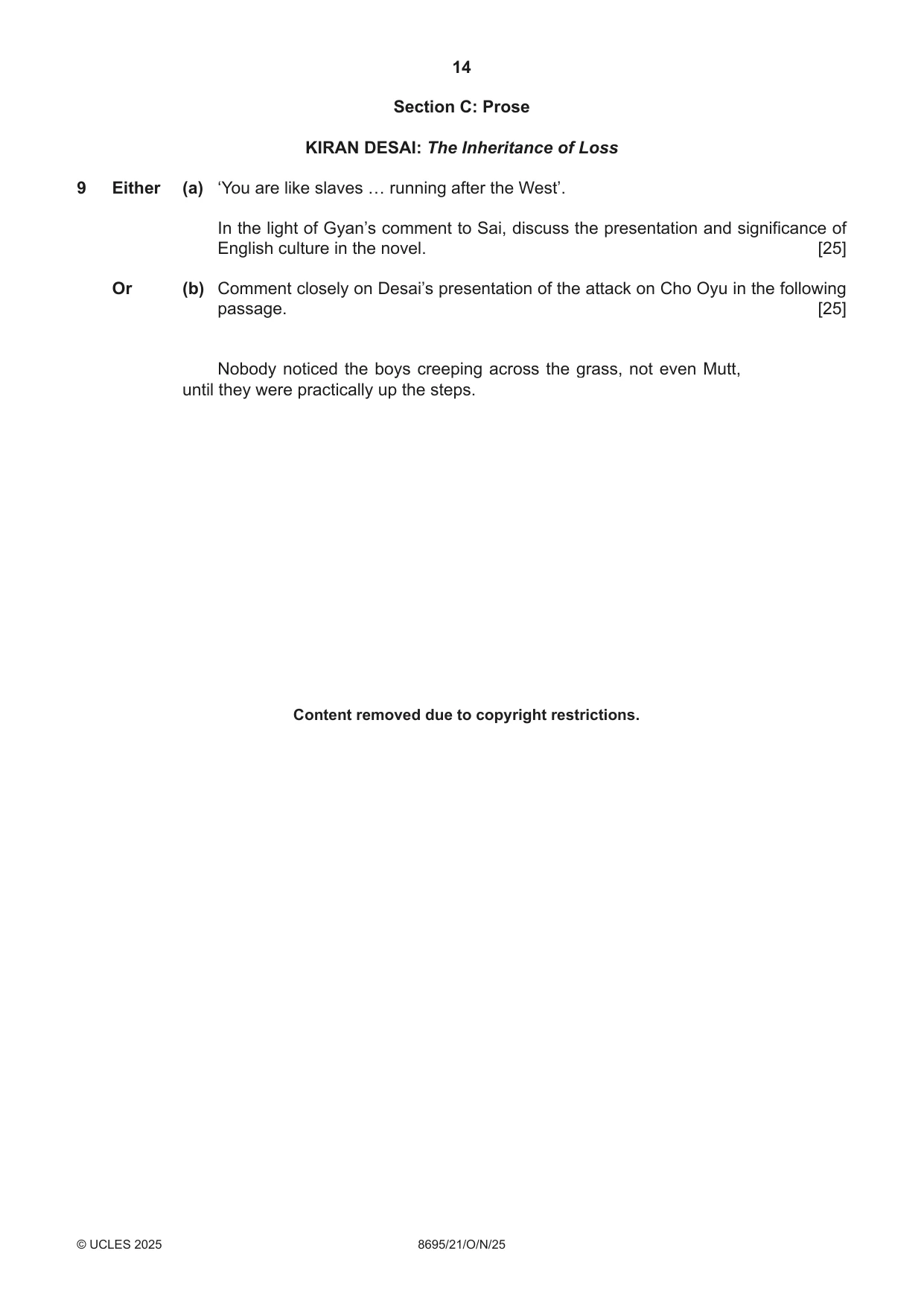
Question paper, page 14
14 8695/21/O/N/25 © UCLES 2025 Section C: Prose KIRAN DESAI: The Inheritance of Loss 9 Either (a) ‘You are like slaves … running after the West’. In the light of Gyan’s comment to Sai, discuss the presentation and significance of English culture in the novel. [25] Or (b) Comment closely on Desai’s presentation of the attack on Cho Oyu in the following passage. [25] Nobody noticed the boys creeping across the grass, not even Mutt, until they were practically up the steps. Content removed due to copyright restrictions.
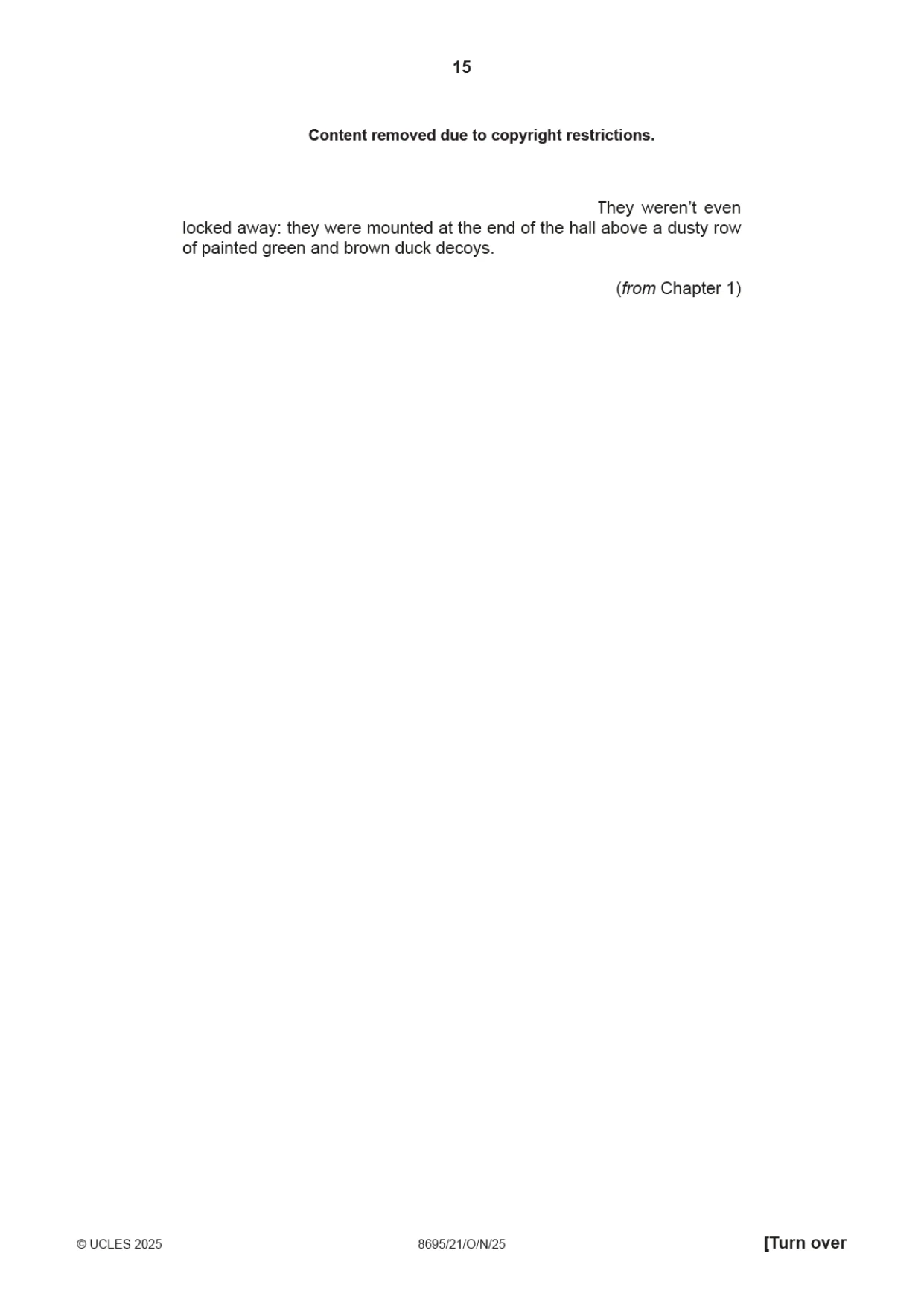
Question paper, page 15
15 Content removed due to copyright restrictions. They weren't even locked away: they were mounted at the end of the hall above a dusty row of painted green and brown duck decoys. (from Chapter 1) ©UCLES 2025 8695/21/0/N/25 [Turn over
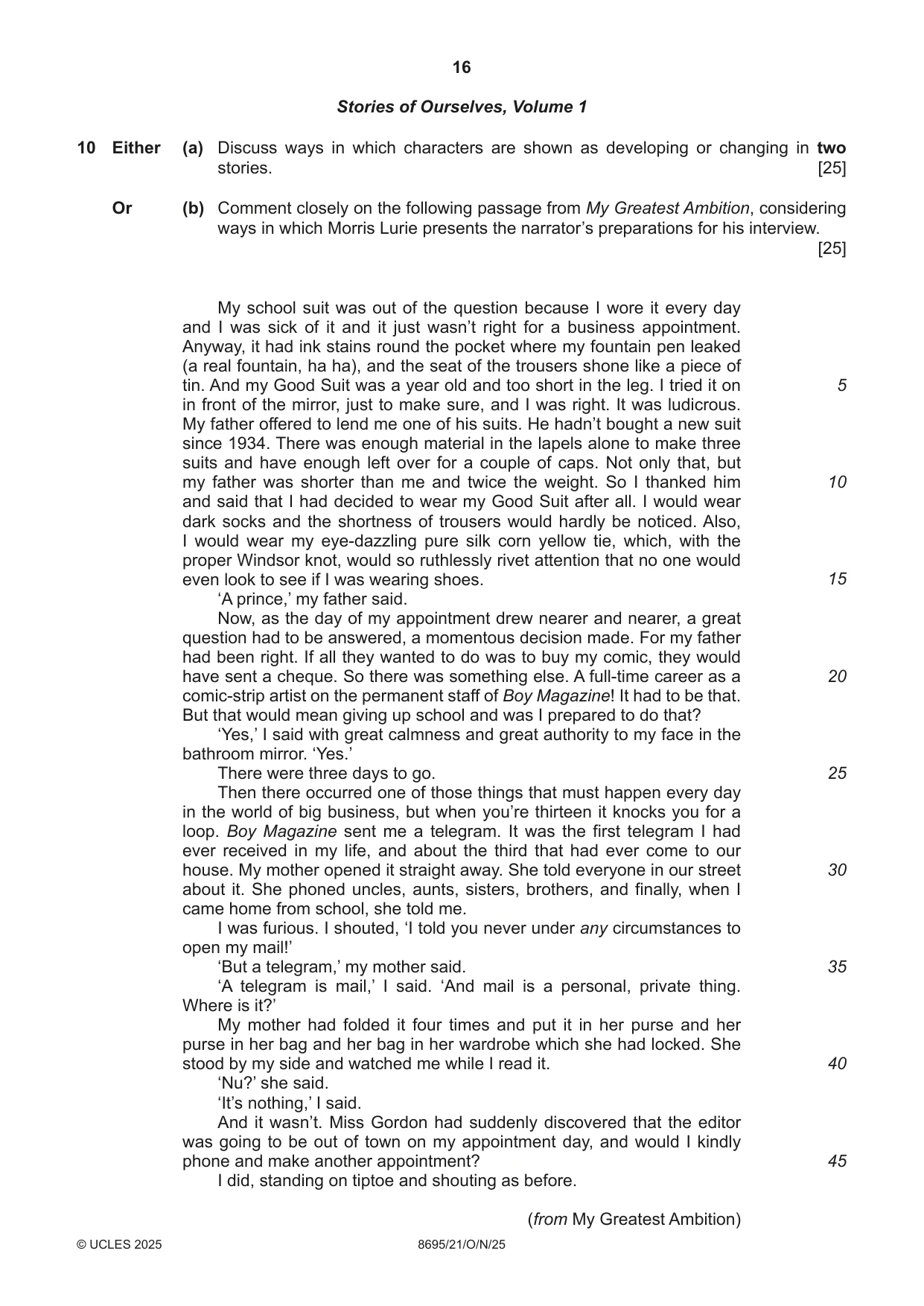
Question paper, page 16
16 8695/21/O/N/25 © UCLES 2025 Stories of Ourselves, Volume 1 10 Either (a) Discuss ways in which characters are shown as developing or changing in two stories. [25] Or (b) Comment closely on the following passage from My Greatest Ambition, considering ways in which Morris Lurie presents the narrator’s preparations for his interview. [25] My school suit was out of the question because I wore it every day and I was sick of it and it just wasn’t right for a business appointment. Anyway, it had ink stains round the pocket where my fountain pen leaked (a real fountain, ha ha), and the seat of the trousers shone like a piece of tin. And my Good Suit was a year old and too short in the leg. I tried it on in front of the mirror, just to make sure, and I was right. It was ludicrous. My father offered to lend me one of his suits. He hadn’t bought a new suit since 1934. There was enough material in the lapels alone to make three suits and have enough left over for a couple of caps. Not only that, but my father was shorter than me and twice the weight. So I thanked him and said that I had decided to wear my Good Suit after all. I would wear dark socks and the shortness of trousers would hardly be noticed. Also, I would wear my eye-dazzling pure silk corn yellow tie, which, with the proper Windsor knot, would so ruthlessly rivet attention that no one would even look to see if I was wearing shoes. ‘A prince,’ my father said. Now, as the day of my appointment drew nearer and nearer, a great question had to be answered, a momentous decision made. For my father had been right. If all they wanted to do was to buy my comic, they would have sent a cheque. So there was something else. A full-time career as a comic-strip artist on the permanent staff of Boy Magazine! It had to be that. But that would mean giving up school and was I prepared to do that? ‘Yes,’ I said with great calmness and great authority to my face in the bathroom mirror. ‘Yes.’ There were three days to go. Then there occurred one of those things that must happen every day in the world of big business, but when you’re thirteen it knocks you for a loop. Boy Magazine sent me a telegram. It was the first telegram I had ever received in my life, and about the third that had ever come to our house. My mother opened it straight away. She told everyone in our street about it. She phoned uncles, aunts, sisters, brothers, and finally, when I came home from school, she told me. I was furious. I shouted, ‘I told you never under any circumstances to open my mail!’ ‘But a telegram,’ my mother said. ‘A telegram is mail,’ I said. ‘And mail is a personal, private thing. Where is it?’ My mother had folded it four times and put it in her purse and her purse in her bag and her bag in her wardrobe which she had locked. She stood by my side and watched me while I read it. ‘Nu?’ she said. ‘It’s nothing,’ I said. And it wasn’t. Miss Gordon had suddenly discovered that the editor was going to be out of town on my appointment day, and would I kindly phone and make another appointment? I did, standing on tiptoe and shouting as before. (from My Greatest Ambition) 5 10 15 20 25 30 35 40 45
Question paper, page 17
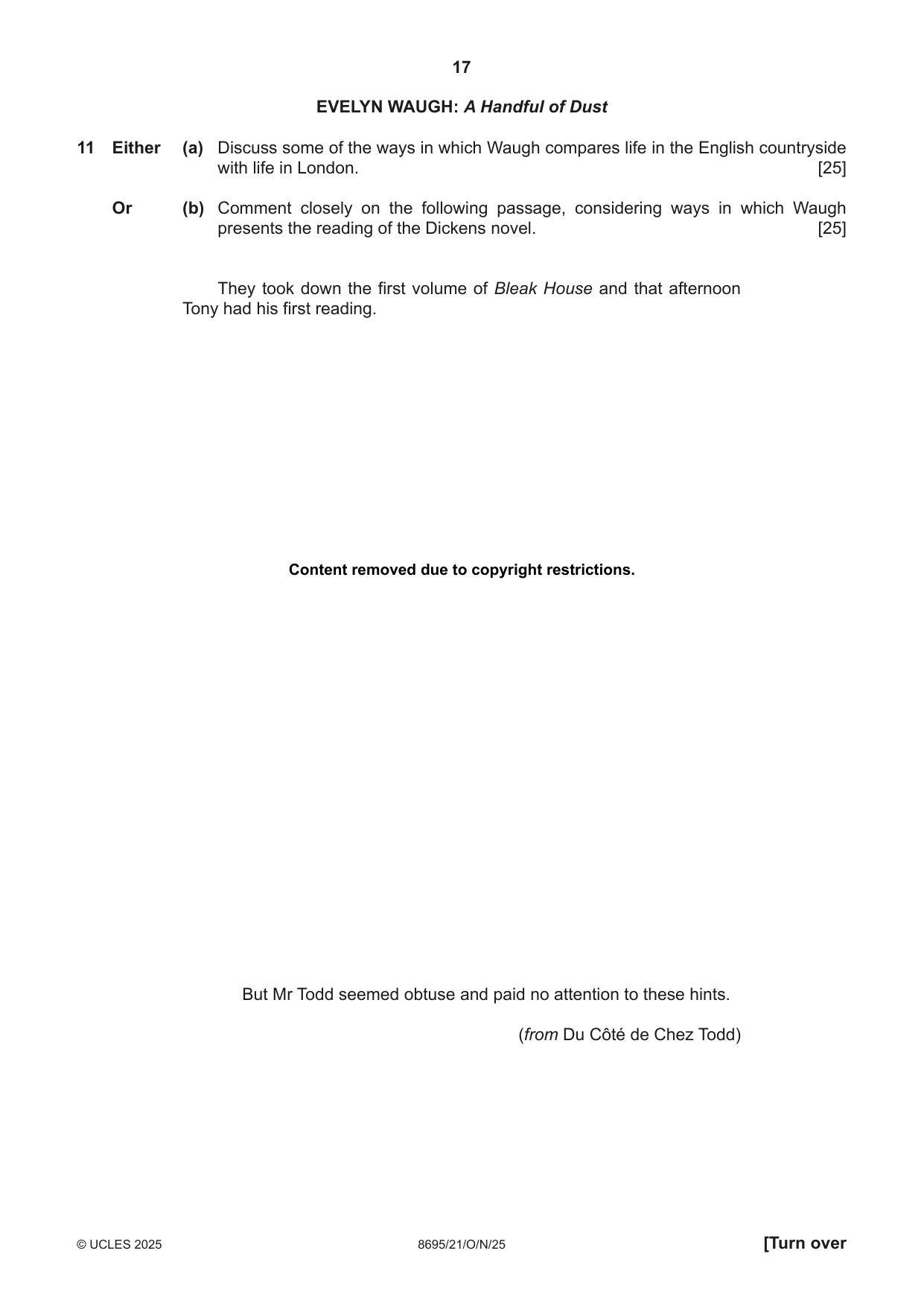
17 8695/21/O/N/25 © UCLES 2025 [Turn over EVELYN WAUGH: A Handful of Dust 11 Either (a) Discuss some of the ways in which Waugh compares life in the English countryside with life in London. [25] Or (b) Comment closely on the following passage, considering ways in which Waugh presents the reading of the Dickens novel. [25] They took down the first volume of Bleak House and that afternoon Tony had his first reading. But Mr Todd seemed obtuse and paid no attention to these hints. (from Du Côté de Chez Todd) Content removed due to copyright restrictions.
Question paper, page 18
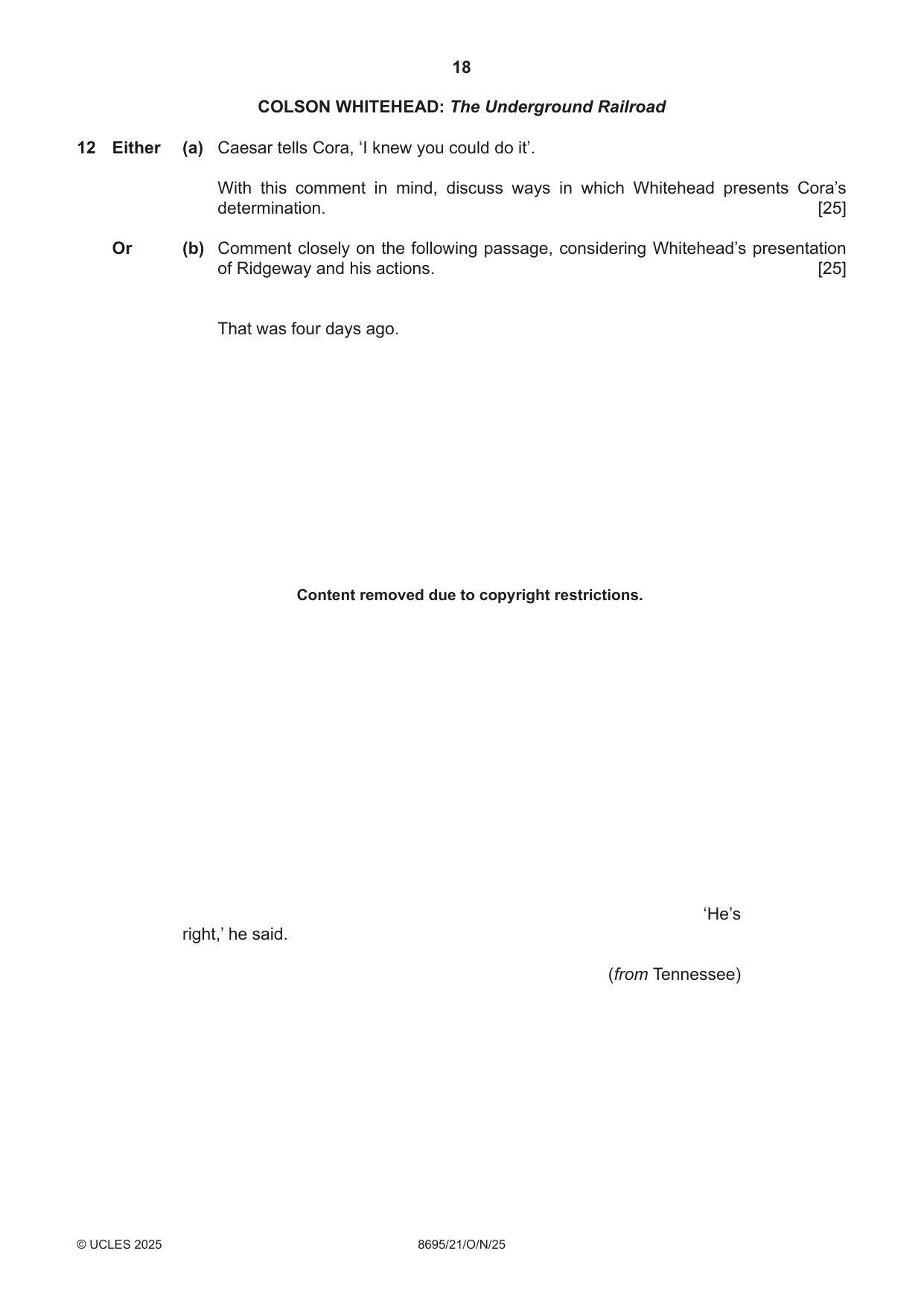
18 8695/21/O/N/25 © UCLES 2025 COLSON WHITEHEAD: The Underground Railroad 12 Either (a) Caesar tells Cora, ‘I knew you could do it’. With this comment in mind, discuss ways in which Whitehead presents Cora’s determination. [25] Or (b) Comment closely on the following passage, considering Whitehead’s presentation of Ridgeway and his actions. [25] That was four days ago. ‘He’s right,’ he said. (from Tennessee) Content removed due to copyright restrictions.
Question paper, page 19
19 8695/21/O/N/25 © UCLES 2025 BLANK PAGE
Question paper, page 20
20 8695/21/O/N/25 © UCLES 2025 Permission to reproduce items where third-party owned material protected by copyright is included has been sought and cleared where possible. Every reasonable effort has been made by the publisher (UCLES) to trace copyright holders, but if any items requiring clearance have unwittingly been included, the publisher will be pleased to make amends at the earliest possible opportunity. To avoid the issue of disclosure of answer-related information to candidates, all copyright acknowledgements are reproduced online in the Cambridge Assessment International Education Copyright Acknowledgements Booklet. This is produced for each series of examinations and is freely available to download at www.cambridgeinternational.org after the live examination series. Cambridge Assessment International Education is part of Cambridge Assessment. Cambridge Assessment is the brand name of the University of Cambridge Local Examinations Syndicate (UCLES), which is a department of the University of Cambridge. BLANK PAGE
Mark scheme, page 1
This document consists of 14 printed pages. © Cambridge University Press & Assessment 2025 [Turn over Cambridge International AS Level LANGUAGE AND LITERATURE IN ENGLISH 8695/21 Paper 2 Drama, Poetry and Prose October/November 2025 MARK SCHEME Maximum Mark: 50 Published This mark scheme is published as an aid to teachers and candidates, to indicate the requirements of the examination. It shows the basis on which Examiners were instructed to award marks. It does not indicate the details of the discussions that took place at an Examiners’ meeting before marking began, which would have considered the acceptability of alternative answers. Mark schemes should be read in conjunction with the question paper and the Principal Examiner Report for Teachers. Cambridge International will not enter into discussions about these mark schemes. Cambridge International is publishing the mark schemes for the October/November 2025 series for most Cambridge IGCSE, Cambridge International A and AS Level components, and some Cambridge O Level components.
Mark scheme, page 2
8695/21 Cambridge International AS Level – Mark Scheme PUBLISHED October/November 2025 © Cambridge University Press & Assessment 2025 Page 2 of 14 Generic Marking Principles These general marking principles must be applied by all examiners when marking candidate answers. They should be applied alongside the specific content of the mark scheme or generic level descriptions for a question. Each question paper and mark scheme will also comply with these marking principles. GENERIC MARKING PRINCIPLE 1: Marks must be awarded in line with: • the specific content of the mark scheme or the generic level descriptors for the question • the specific skills defined in the mark scheme or in the generic level descriptors for the question • the standard of response required by a candidate as exemplified by the standardisation scripts. GENERIC MARKING PRINCIPLE 2: Marks awarded are always whole marks (not half marks, or other fractions). GENERIC MARKING PRINCIPLE 3: Marks must be awarded positively: • marks are awarded for correct/valid answers, as defined in the mark scheme. However, credit is given for valid answers which go beyond the scope of the syllabus and mark scheme, referring to your Team Leader as appropriate • marks are awarded when candidates clearly demonstrate what they know and can do • marks are not deducted for errors • marks are not deducted for omissions • answers should only be judged on the quality of spelling, punctuation and grammar when these features are specifically assessed by the question as indicated by the mark scheme. The meaning, however, should be unambiguous. GENERIC MARKING PRINCIPLE 4: Rules must be applied consistently, e.g. in situations where candidates have not followed instructions or in the application of generic level descriptors. GENERIC MARKING PRINCIPLE 5: Marks should be awarded using the full range of marks defined in the mark scheme for the question (however; the use of the full mark range may be limited according to the quality of the candidate responses seen). GENERIC MARKING PRINCIPLE 6: Marks awarded are based solely on the requirements as defined in the mark scheme. Marks should not be awarded with grade thresholds or grade descriptors in mind.
Mark scheme, page 3
8695/21 Cambridge International AS Level – Mark Scheme PUBLISHED October/November 2025 © Cambridge University Press & Assessment 2025 Page 3 of 14 English & Media subject specific general marking principles (To be read in conjunction with the Generic Marking Principles (and requiring further guidance on how to place marks within levels)) Components using level descriptors: • We use level descriptors as a guide to broad understanding of the qualities normally expected of, or typical of, work in a level. • Level descriptors are a means of general guidance and should not be interpreted as hurdle statements. • Where indicative content notes are supplied for a question, these are not a prescription of required content, and must not be treated as such. Alternative correct points and unexpected answers in candidates’ scripts must be given marks that fairly reflect the knowledge and skills demonstrated. • While we may have legitimate expectations as to the ground most answers may occupy, we must at all times be prepared to meet candidates on their chosen ground, provided it is relevant ground (e.g. clearly related to and derived from a relevant passage/text and meeting the mark scheme requirements for the question).
Mark scheme, page 4
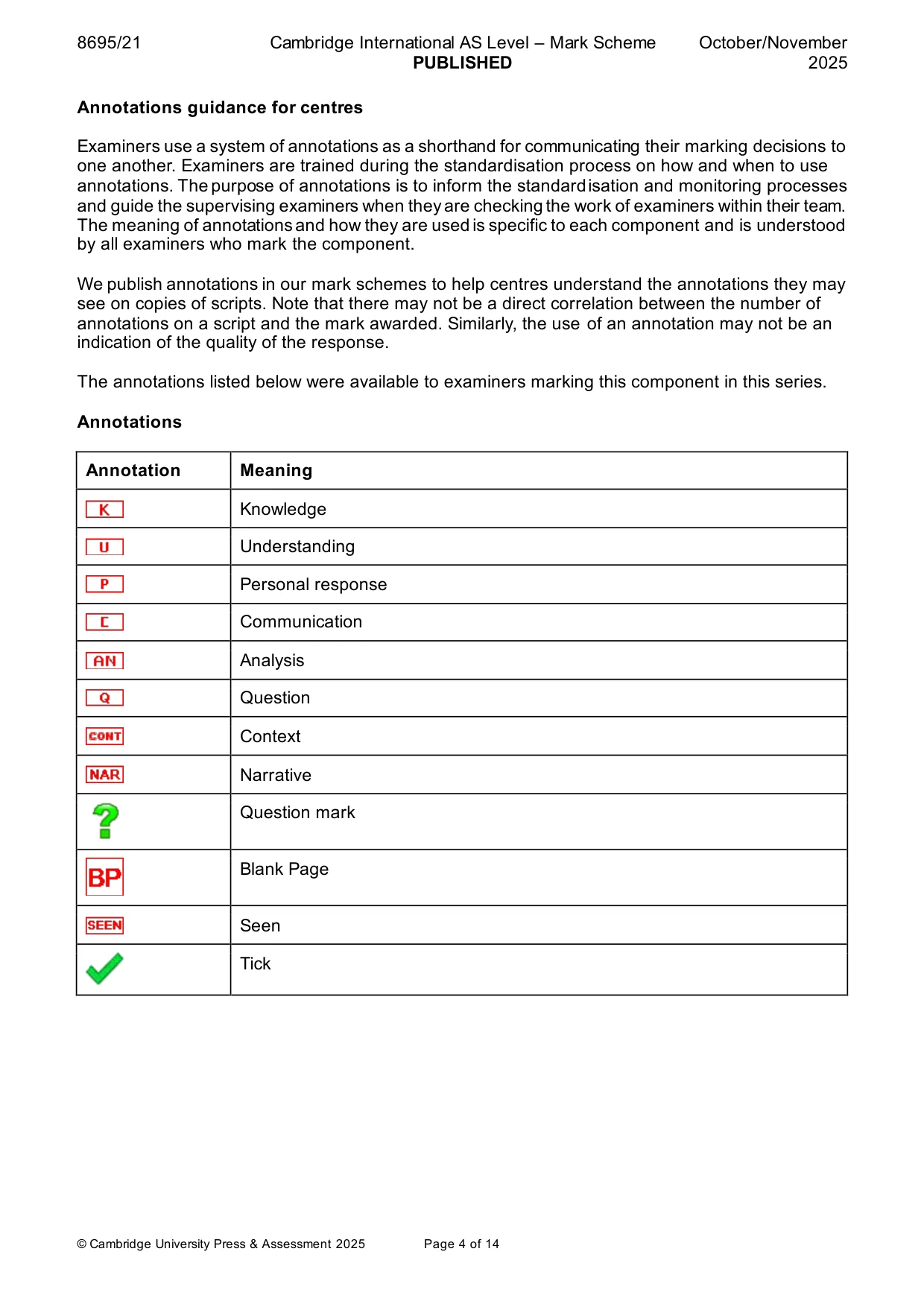
8695/21 Cambridge International AS Level – Mark Scheme PUBLISHED October/November 2025 © Cambridge University Press & Assessment 2025 Page 4 of 14 Annotations guidance for centres Examiners use a system of annotations as a shorthand for communicating their marking decisions to one another. Examiners are trained during the standardisation process on how and when to use annotations. The purpose of annotations is to inform the standardisation and monitoring processes and guide the supervising examiners when they are checking the work of examiners within their team. The meaning of annotations and how they are used is specific to each component and is understood by all examiners who mark the component. We publish annotations in our mark schemes to help centres understand the annotations they may see on copies of scripts. Note that there may not be a direct correlation between the number of annotations on a script and the mark awarded. Similarly, the use of an annotation may not be an indication of the quality of the response. The annotations listed below were available to examiners marking this component in this series. Annotations Annotation Meaning Knowledge Understanding Personal response Communication Analysis Question Context Narrative Question mark Blank Page Seen Tick
Mark scheme, page 5
8695/21 Cambridge International AS Level – Mark Scheme PUBLISHED October/November 2025 © Cambridge University Press & Assessment 2025 Page 5 of 14 Literature in English specific marking instructions Using the mark levels Use the generic mark scheme levels to find the mark. Place the answer in a level first. Look for the ‘best fit’ of the answer into a level. An answer needs to show evidence of most but not necessarily ALL of the qualities described in a level, in order to be placed in that level. Then award a mark for the relative position of the answer within the level. Candidates may address the question in many different ways. There is no one required answer or approach and do not penalise answers for leaving out a particular focus. Reward what is there, showing what you are rewarding in your comments. Consider all strands and weigh up the performance as a whole in placing the answer in a level, then show that you have done so in the summative comment. Each answer is marked out of 25, in accordance with the general marking criteria. Assessment objectives All assessment objectives are equally weighted, and all are considered in assessing each essay. Each level in the marking criteria is divided into strands corresponding to the assessment objectives – AO1: Knowledge and understanding (K/U), AO2: Analysis (AN), AO3: Personal response (P), AO4: Communication (C). AO1 Knowledge and understanding Respond with understanding to literary texts in a variety of forms, from different cultures; with an appreciation of relevant contexts that illuminate readings of the texts. AO2 Analysis Analyse ways in which writers’ choices of language, form and structure shape meanings and effects. AO3 Personal response Produce informed independent opinions and interpretations of literary texts. AO4 Communication Communicate a relevant, structured and supported response appropriate to literary study.
Mark scheme, page 6
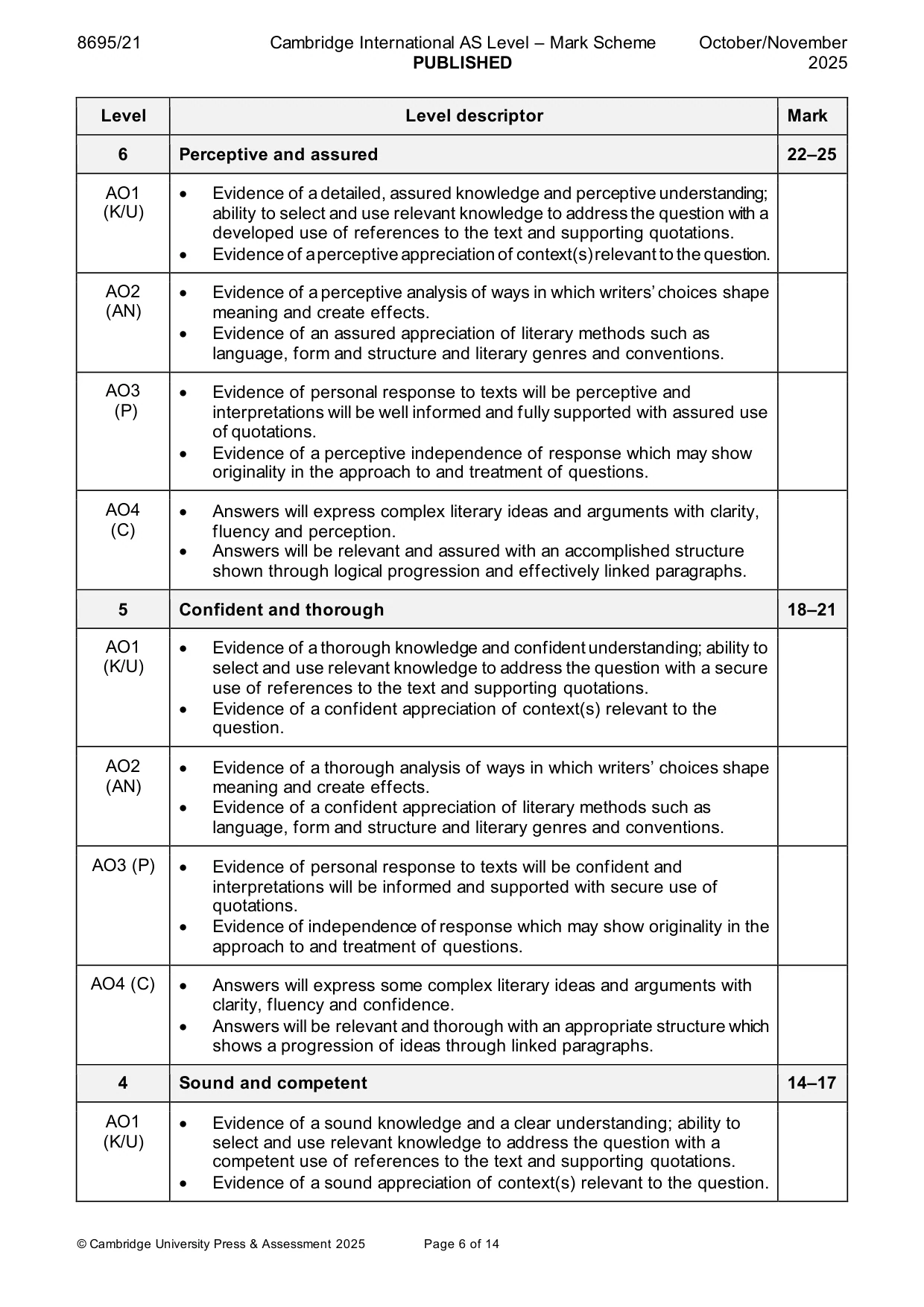
8695/21 Cambridge International AS Level – Mark Scheme PUBLISHED October/November 2025 © Cambridge University Press & Assessment 2025 Page 6 of 14 Level Level descriptor Mark 6 Perceptive and assured 22–25 AO1 (K/U) • Evidence of a detailed, assured knowledge and perceptive understanding; ability to select and use relevant knowledge to address the question with a developed use of references to the text and supporting quotations. • Evidence of a perceptive appreciation of context(s) relevant to the question. AO2 (AN) • Evidence of a perceptive analysis of ways in which writers’ choices shape meaning and create effects. • Evidence of an assured appreciation of literary methods such as language, form and structure and literary genres and conventions. AO3 (P) • Evidence of personal response to texts will be perceptive and interpretations will be well informed and fully supported with assured use of quotations. • Evidence of a perceptive independence of response which may show originality in the approach to and treatment of questions. AO4 (C) • Answers will express complex literary ideas and arguments with clarity, fluency and perception. • Answers will be relevant and assured with an accomplished structure shown through logical progression and effectively linked paragraphs. 5 Confident and thorough 18–21 AO1 (K/U) • Evidence of a thorough knowledge and confident understanding; ability to select and use relevant knowledge to address the question with a secure use of references to the text and supporting quotations. • Evidence of a confident appreciation of context(s) relevant to the question. AO2 (AN) • Evidence of a thorough analysis of ways in which writers’ choices shape meaning and create effects. • Evidence of a confident appreciation of literary methods such as language, form and structure and literary genres and conventions. AO3 (P) • Evidence of personal response to texts will be confident and interpretations will be informed and supported with secure use of quotations. • Evidence of independence of response which may show originality in the approach to and treatment of questions. AO4 (C) • Answers will express some complex literary ideas and arguments with clarity, fluency and confidence. • Answers will be relevant and thorough with an appropriate structure which shows a progression of ideas through linked paragraphs. 4 Sound and competent 14–17 AO1 (K/U) • Evidence of a sound knowledge and a clear understanding; ability to select and use relevant knowledge to address the question with a competent use of references to the text and supporting quotations. • Evidence of a sound appreciation of context(s) relevant to the question.
Mark scheme, page 7
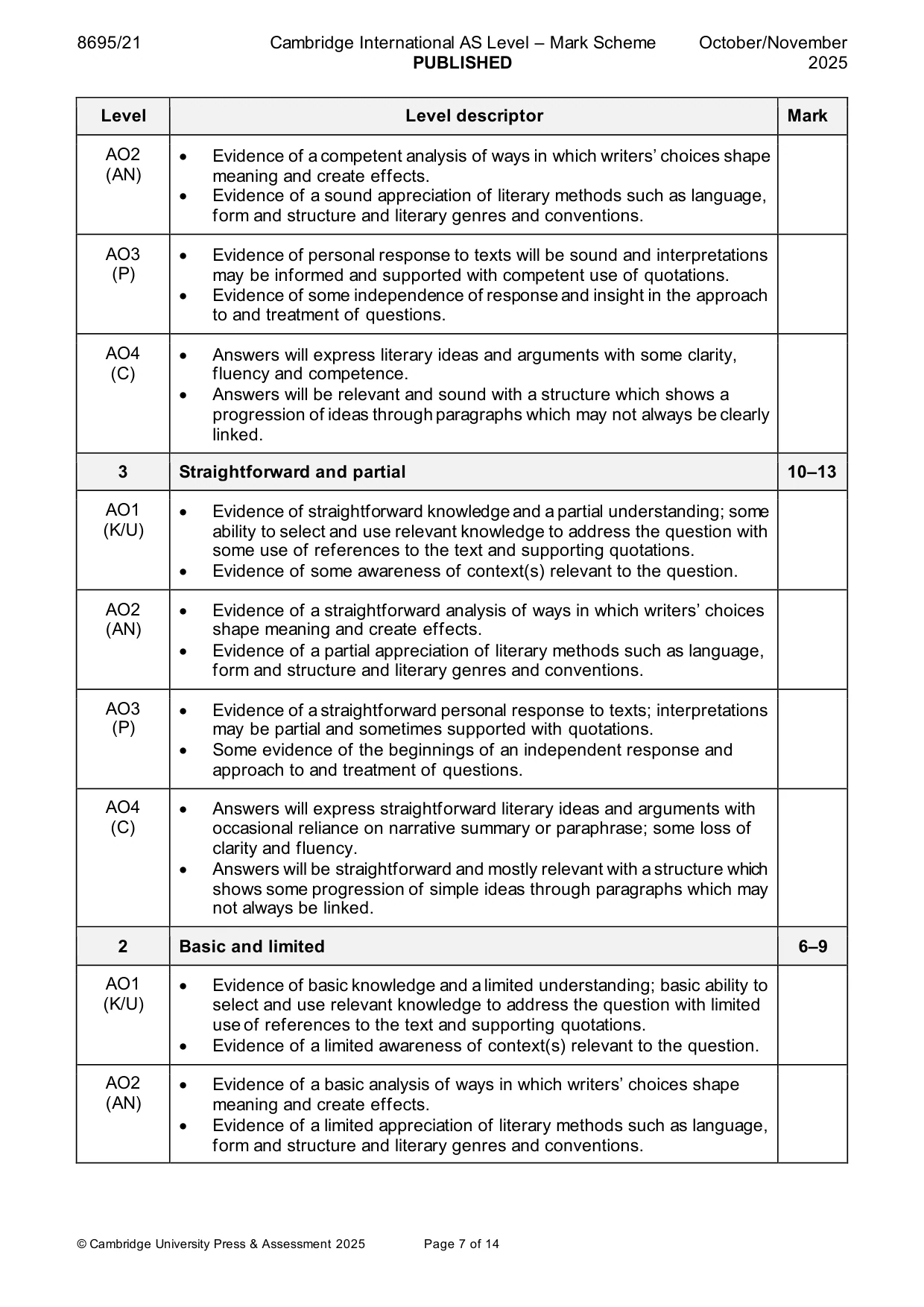
8695/21 Cambridge International AS Level – Mark Scheme PUBLISHED October/November 2025 © Cambridge University Press & Assessment 2025 Page 7 of 14 Level Level descriptor Mark AO2 (AN) • Evidence of a competent analysis of ways in which writers’ choices shape meaning and create effects. • Evidence of a sound appreciation of literary methods such as language, form and structure and literary genres and conventions. AO3 (P) • Evidence of personal response to texts will be sound and interpretations may be informed and supported with competent use of quotations. • Evidence of some independence of response and insight in the approach to and treatment of questions. AO4 (C) • Answers will express literary ideas and arguments with some clarity, fluency and competence. • Answers will be relevant and sound with a structure which shows a progression of ideas through paragraphs which may not always be clearly linked. 3 Straightforward and partial 10–13 AO1 (K/U) • Evidence of straightforward knowledge and a partial understanding; some ability to select and use relevant knowledge to address the question with some use of references to the text and supporting quotations. • Evidence of some awareness of context(s) relevant to the question. AO2 (AN) • Evidence of a straightforward analysis of ways in which writers’ choices shape meaning and create effects. • Evidence of a partial appreciation of literary methods such as language, form and structure and literary genres and conventions. AO3 (P) • Evidence of a straightforward personal response to texts; interpretations may be partial and sometimes supported with quotations. • Some evidence of the beginnings of an independent response and approach to and treatment of questions. AO4 (C) • Answers will express straightforward literary ideas and arguments with occasional reliance on narrative summary or paraphrase; some loss of clarity and fluency. • Answers will be straightforward and mostly relevant with a structure which shows some progression of simple ideas through paragraphs which may not always be linked. 2 Basic and limited 6–9 AO1 (K/U) • Evidence of basic knowledge and a limited understanding; basic ability to select and use relevant knowledge to address the question with limited use of references to the text and supporting quotations. • Evidence of a limited awareness of context(s) relevant to the question. AO2 (AN) • Evidence of a basic analysis of ways in which writers’ choices shape meaning and create effects. • Evidence of a limited appreciation of literary methods such as language, form and structure and literary genres and conventions.
Mark scheme, page 8
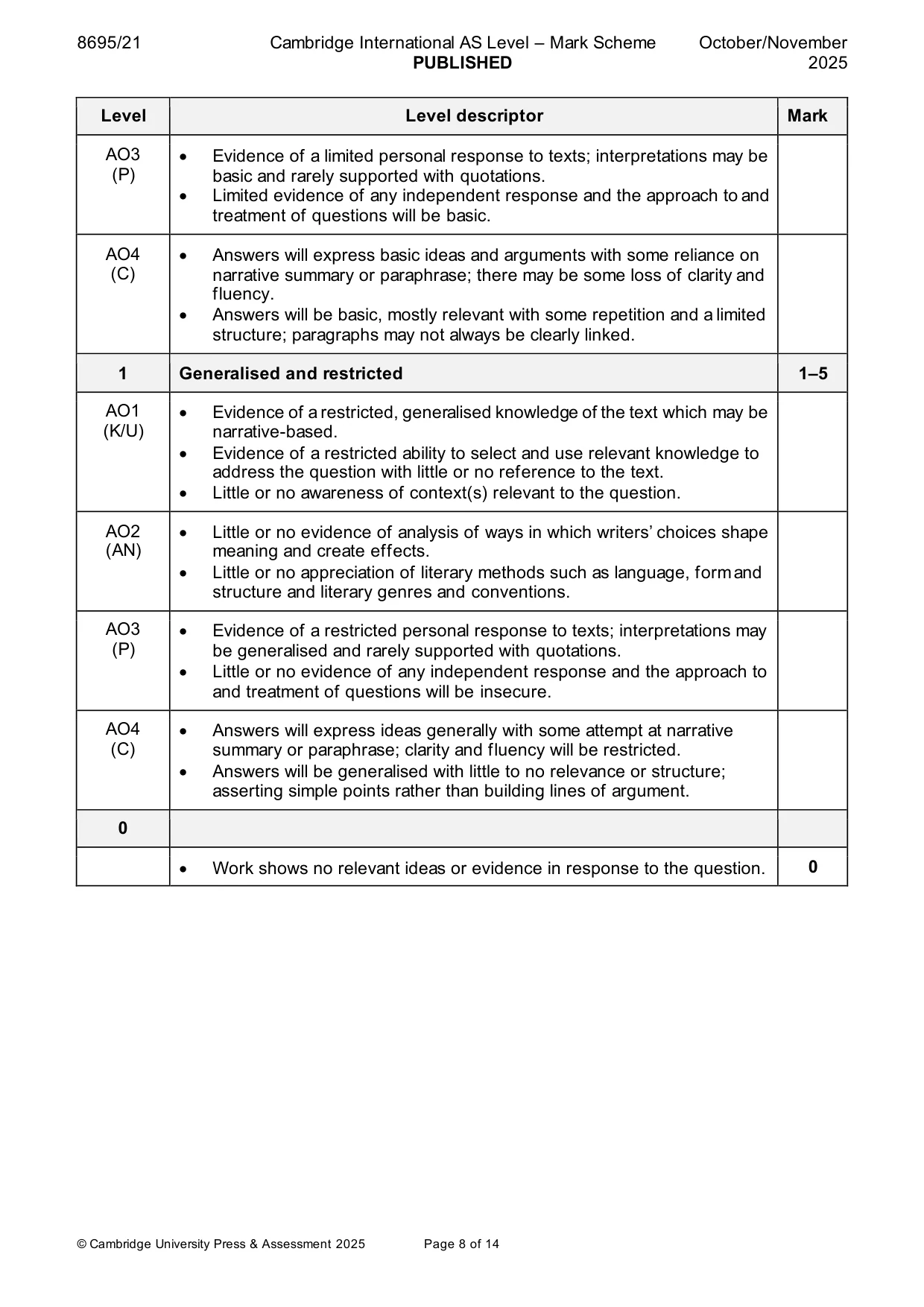
8695/21 Cambridge International AS Level – Mark Scheme PUBLISHED October/November 2025 © Cambridge University Press & Assessment 2025 Page 8 of 14 Level Level descriptor Mark AO3 (P) • Evidence of a limited personal response to texts; interpretations may be basic and rarely supported with quotations. • Limited evidence of any independent response and the approach to and treatment of questions will be basic. AO4 (C) • Answers will express basic ideas and arguments with some reliance on narrative summary or paraphrase; there may be some loss of clarity and fluency. • Answers will be basic, mostly relevant with some repetition and a limited structure; paragraphs may not always be clearly linked. 1 Generalised and restricted 1–5 AO1 (K/U) • Evidence of a restricted, generalised knowledge of the text which may be narrative-based. • Evidence of a restricted ability to select and use relevant knowledge to address the question with little or no reference to the text. • Little or no awareness of context(s) relevant to the question. AO2 (AN) • Little or no evidence of analysis of ways in which writers’ choices shape meaning and create effects. • Little or no appreciation of literary methods such as language, form and structure and literary genres and conventions. AO3 (P) • Evidence of a restricted personal response to texts; interpretations may be generalised and rarely supported with quotations. • Little or no evidence of any independent response and the approach to and treatment of questions will be insecure. AO4 (C) • Answers will express ideas generally with some attempt at narrative summary or paraphrase; clarity and fluency will be restricted. • Answers will be generalised with little to no relevance or structure; asserting simple points rather than building lines of argument. 0 • Work shows no relevant ideas or evidence in response to the question. 0
Mark scheme, page 9
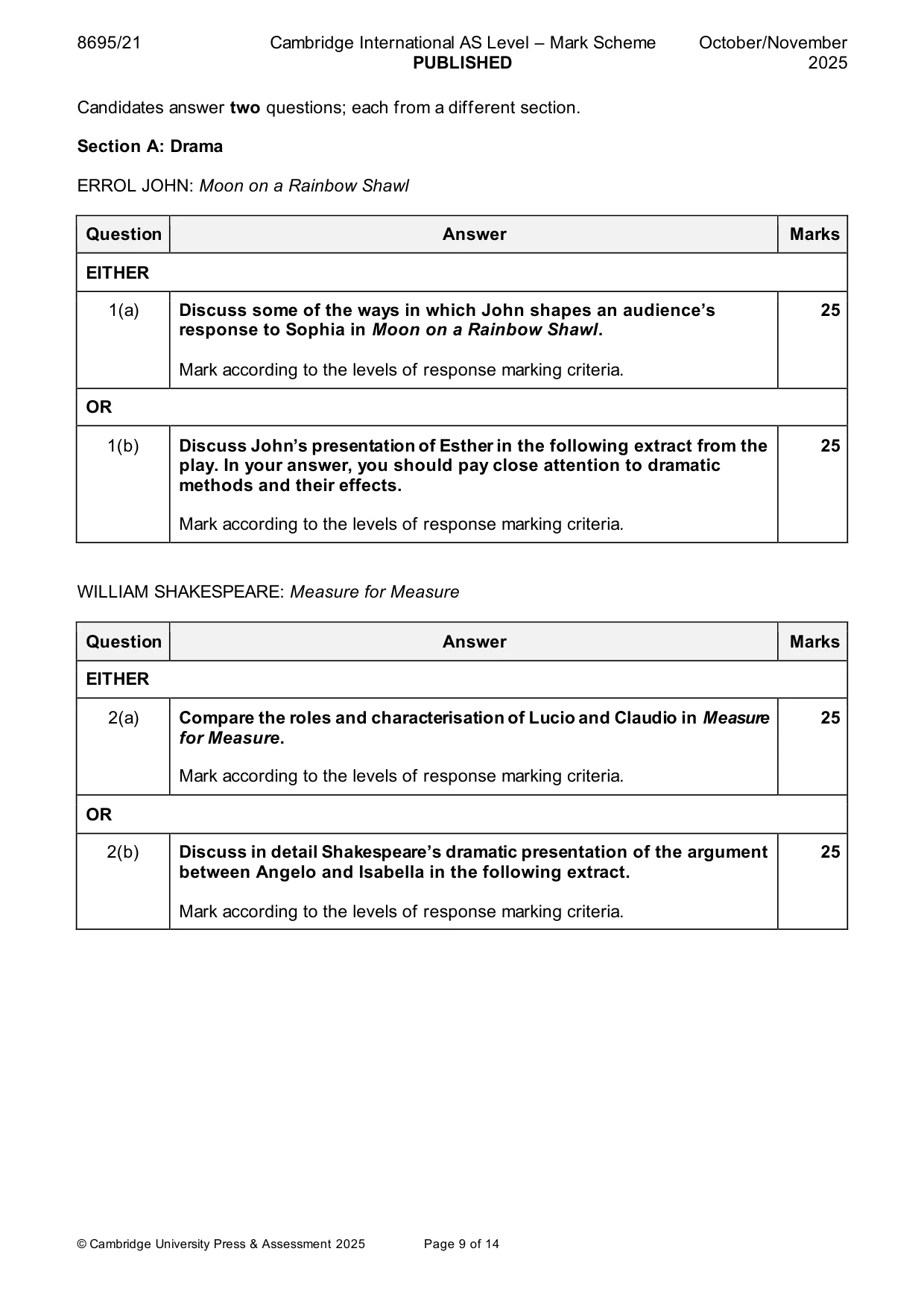
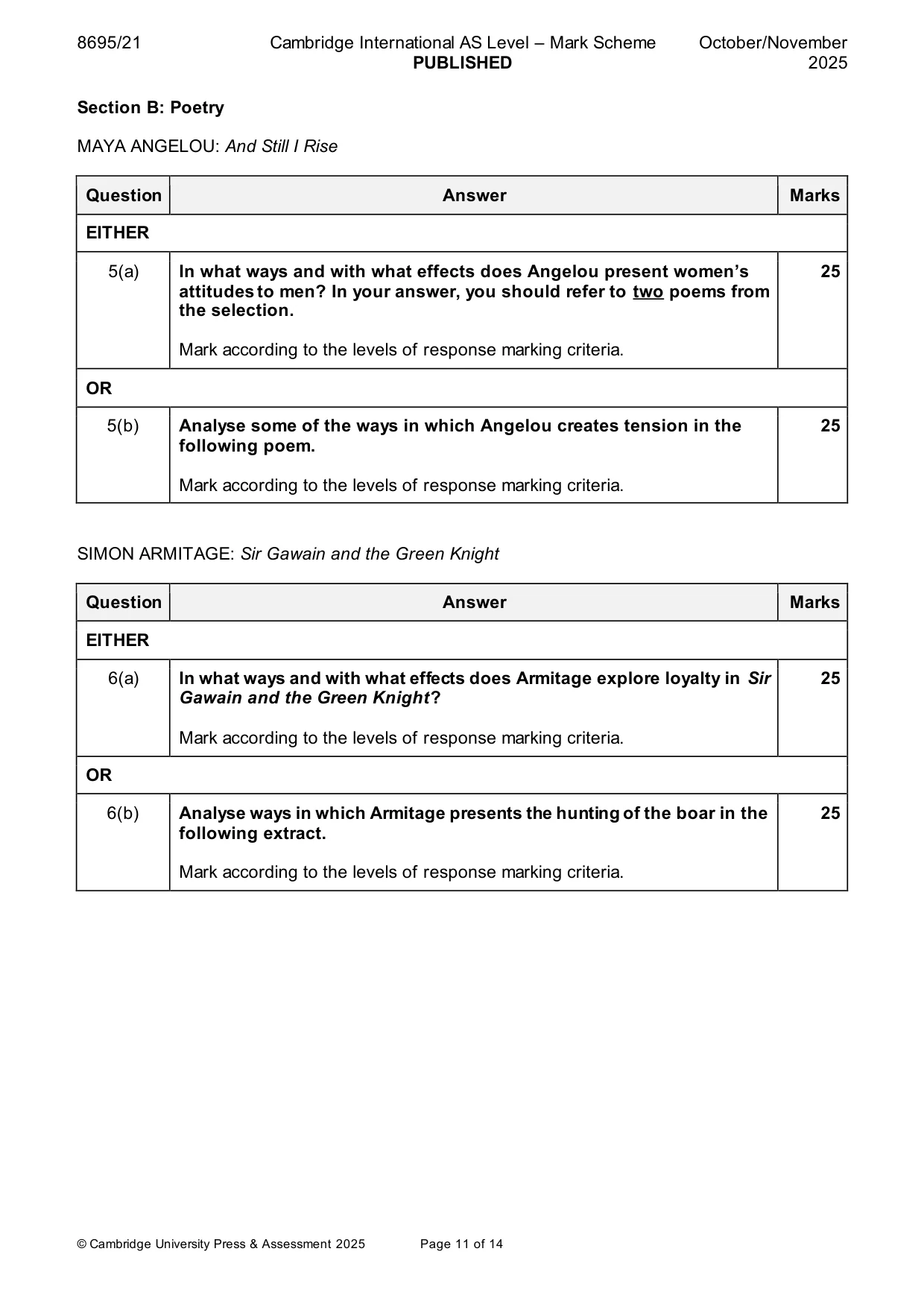
8695/21 Cambridge International AS Level – Mark Scheme PUBLISHED October/November 2025 © Cambridge University Press & Assessment 2025 Page 9 of 14 Candidates answer two questions; each from a different section. Section A: Drama ERROL JOHN: Moon on a Rainbow Shawl Question Answer Marks EITHER 1(a) Discuss some of the ways in which John shapes an audience’s response to Sophia in Moon on a Rainbow Shawl. Mark according to the levels of response marking criteria. 25 OR 1(b) Discuss John’s presentation of Esther in the following extract from the play. In your answer, you should pay close attention to dramatic methods and their effects. Mark according to the levels of response marking criteria. 25 WILLIAM SHAKESPEARE: Measure for Measure Question Answer Marks EITHER 2(a) Compare the roles and characterisation of Lucio and Claudio in Measure for Measure. Mark according to the levels of response marking criteria. 25 OR 2(b) Discuss in detail Shakespeare’s dramatic presentation of the argument between Angelo and Isabella in the following extract. Mark according to the levels of response marking criteria. 25
Mark scheme, page 10
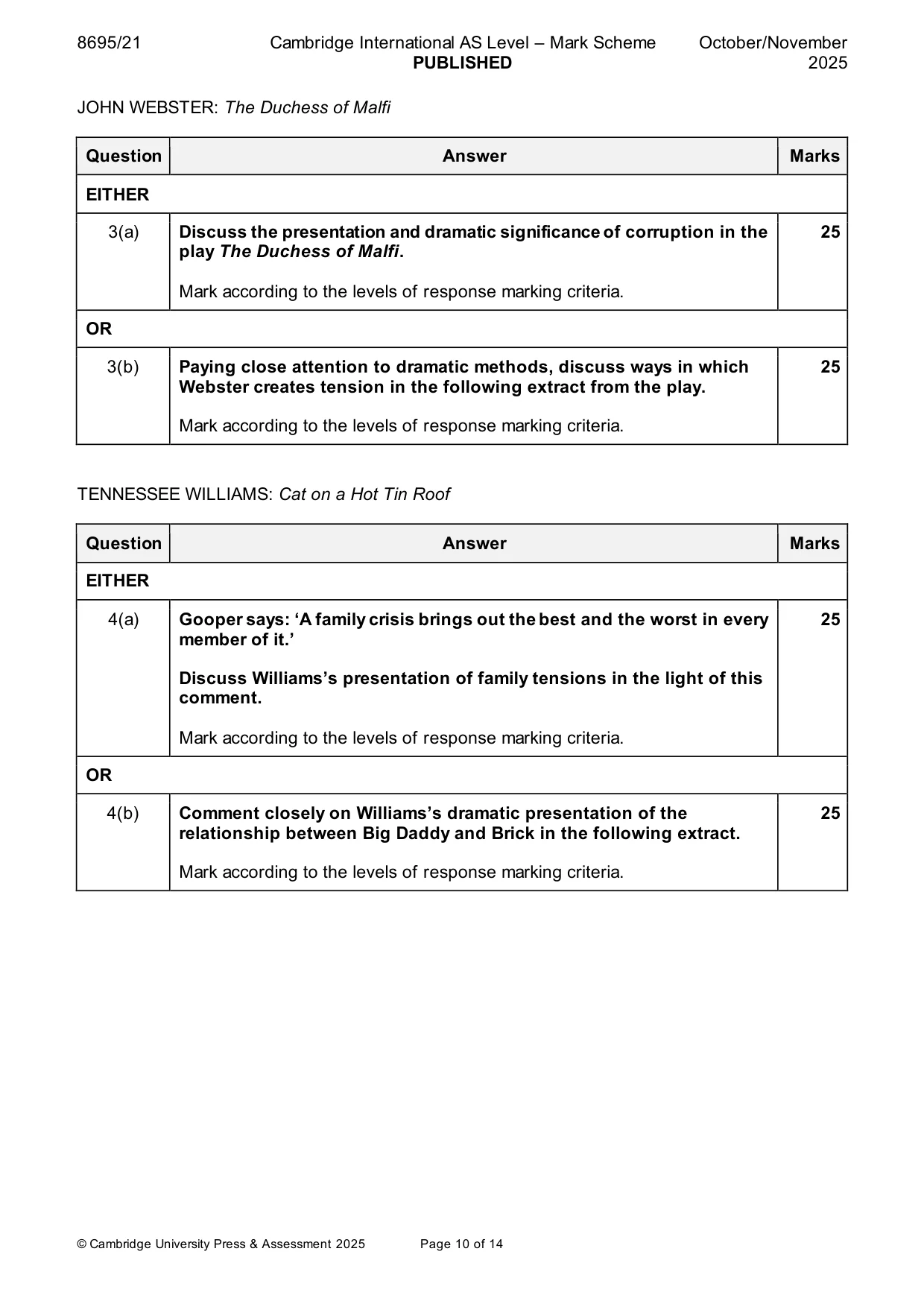
8695/21 Cambridge International AS Level – Mark Scheme PUBLISHED October/November 2025 © Cambridge University Press & Assessment 2025 Page 10 of 14 JOHN WEBSTER: The Duchess of Malfi Question Answer Marks EITHER 3(a) Discuss the presentation and dramatic significance of corruption in the play The Duchess of Malfi. Mark according to the levels of response marking criteria. 25 OR 3(b) Paying close attention to dramatic methods, discuss ways in which Webster creates tension in the following extract from the play. Mark according to the levels of response marking criteria. 25 TENNESSEE WILLIAMS: Cat on a Hot Tin Roof Question Answer Marks EITHER 4(a) Gooper says: ‘A family crisis brings out the best and the worst in every member of it.’ Discuss Williams’s presentation of family tensions in the light of this comment. Mark according to the levels of response marking criteria. 25 OR 4(b) Comment closely on Williams’s dramatic presentation of the relationship between Big Daddy and Brick in the following extract. Mark according to the levels of response marking criteria. 25
Mark scheme, page 11
8695/21 Cambridge International AS Level – Mark Scheme PUBLISHED October/November 2025 © Cambridge University Press & Assessment 2025 Page 11 of 14 Section B: Poetry MAYA ANGELOU: And Still I Rise Question Answer Marks EITHER 5(a) In what ways and with what effects does Angelou present women’s attitudes to men? In your answer, you should refer to two poems from the selection. Mark according to the levels of response marking criteria. 25 OR 5(b) Analyse some of the ways in which Angelou creates tension in the following poem. Mark according to the levels of response marking criteria. 25 SIMON ARMITAGE: Sir Gawain and the Green Knight Question Answer Marks EITHER 6(a) In what ways and with what effects does Armitage explore loyalty in Sir Gawain and the Green Knight? Mark according to the levels of response marking criteria. 25 OR 6(b) Analyse ways in which Armitage presents the hunting of the boar in the following extract. Mark according to the levels of response marking criteria. 25
Mark scheme, page 12
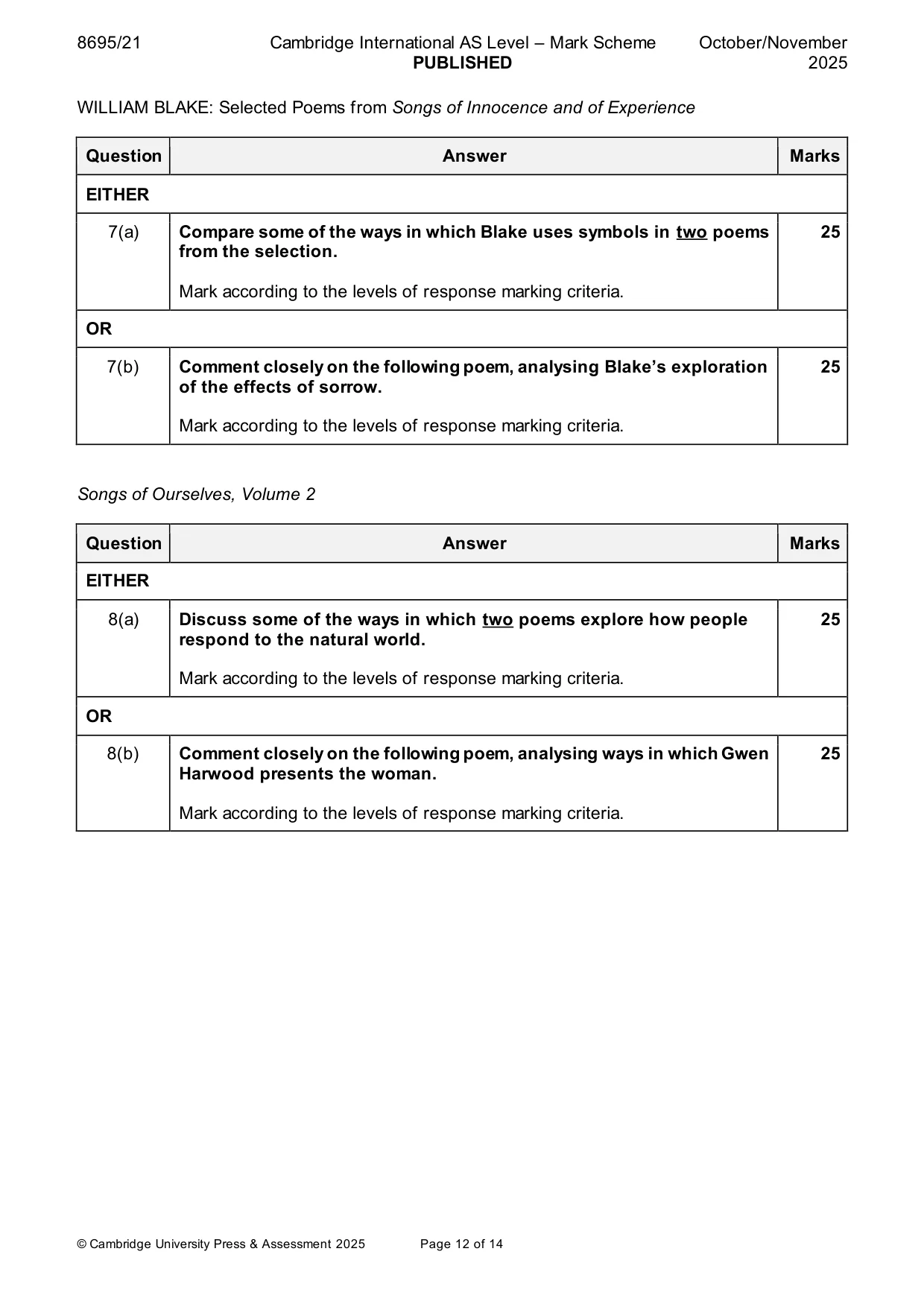
8695/21 Cambridge International AS Level – Mark Scheme PUBLISHED October/November 2025 © Cambridge University Press & Assessment 2025 Page 12 of 14 WILLIAM BLAKE: Selected Poems from Songs of Innocence and of Experience Question Answer Marks EITHER 7(a) Compare some of the ways in which Blake uses symbols in two poems from the selection. Mark according to the levels of response marking criteria. 25 OR 7(b) Comment closely on the following poem, analysing Blake’s exploration of the effects of sorrow. Mark according to the levels of response marking criteria. 25 Songs of Ourselves, Volume 2 Question Answer Marks EITHER 8(a) Discuss some of the ways in which two poems explore how people respond to the natural world. Mark according to the levels of response marking criteria. 25 OR 8(b) Comment closely on the following poem, analysing ways in which Gwen Harwood presents the woman. Mark according to the levels of response marking criteria. 25
Mark scheme, page 13
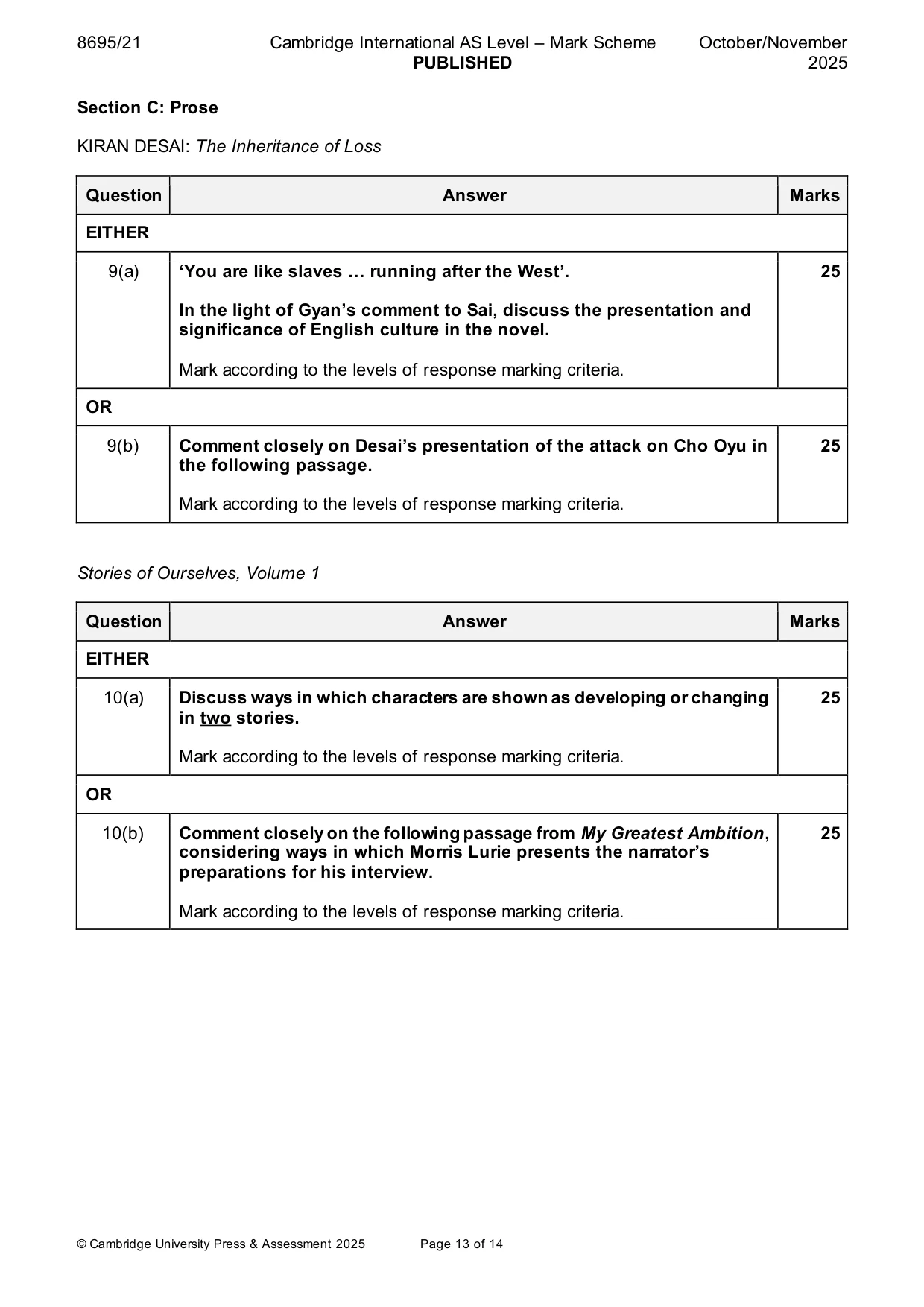
8695/21 Cambridge International AS Level – Mark Scheme PUBLISHED October/November 2025 © Cambridge University Press & Assessment 2025 Page 13 of 14 Section C: Prose KIRAN DESAI: The Inheritance of Loss Question Answer Marks EITHER 9(a) ‘You are like slaves … running after the West’. In the light of Gyan’s comment to Sai, discuss the presentation and significance of English culture in the novel. Mark according to the levels of response marking criteria. 25 OR 9(b) Comment closely on Desai’s presentation of the attack on Cho Oyu in the following passage. Mark according to the levels of response marking criteria. 25 Stories of Ourselves, Volume 1 Question Answer Marks EITHER 10(a) Discuss ways in which characters are shown as developing or changing in two stories. Mark according to the levels of response marking criteria. 25 OR 10(b) Comment closely on the following passage from My Greatest Ambition, considering ways in which Morris Lurie presents the narrator’s preparations for his interview. Mark according to the levels of response marking criteria. 25
Mark scheme, page 14
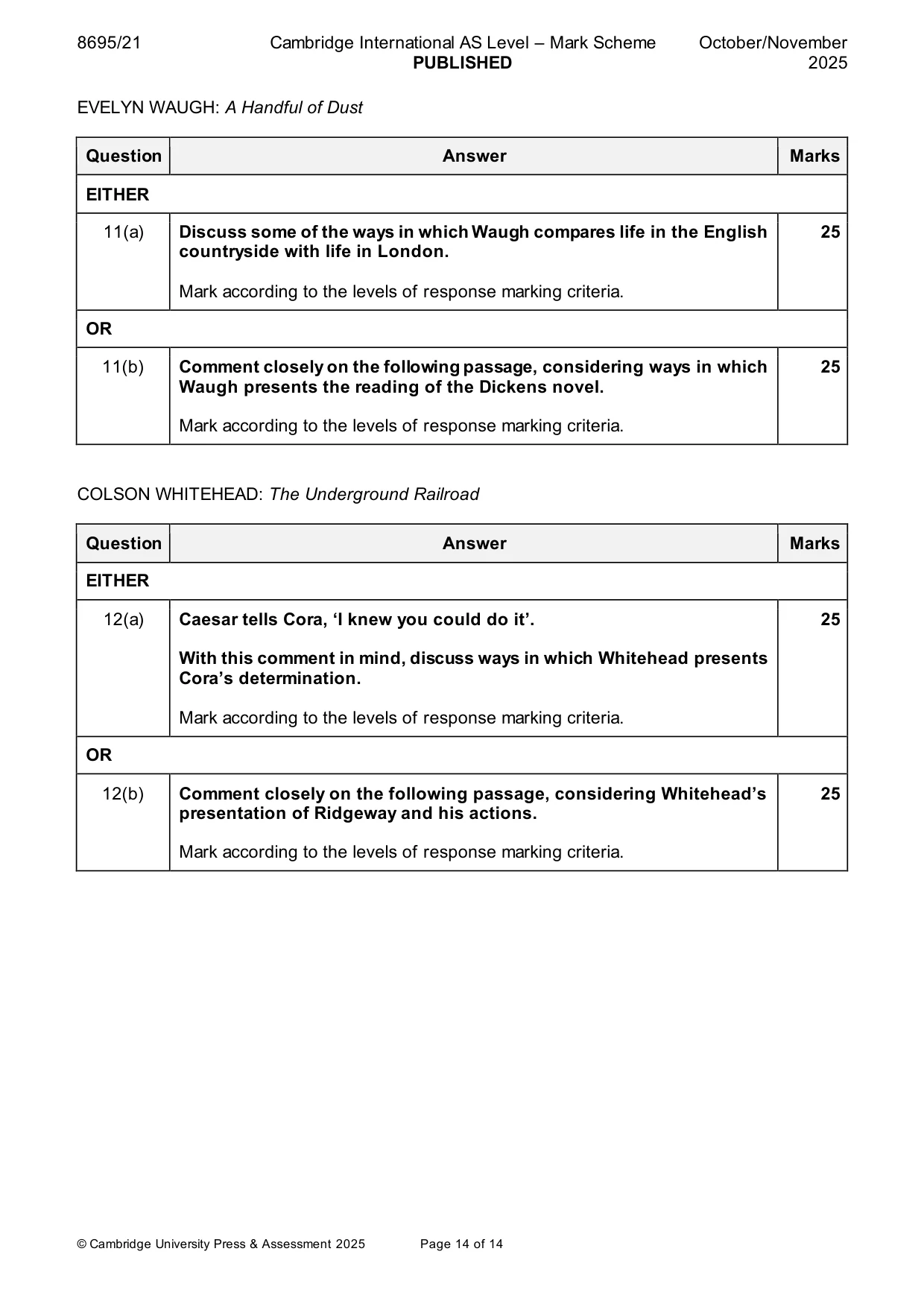
8695/21 Cambridge International AS Level – Mark Scheme PUBLISHED October/November 2025 © Cambridge University Press & Assessment 2025 Page 14 of 14 EVELYN WAUGH: A Handful of Dust Question Answer Marks EITHER 11(a) Discuss some of the ways in which Waugh compares life in the English countryside with life in London. Mark according to the levels of response marking criteria. 25 OR 11(b) Comment closely on the following passage, considering ways in which Waugh presents the reading of the Dickens novel. Mark according to the levels of response marking criteria. 25 COLSON WHITEHEAD: The Underground Railroad Question Answer Marks EITHER 12(a) Caesar tells Cora, ‘I knew you could do it’. With this comment in mind, discuss ways in which Whitehead presents Cora’s determination. Mark according to the levels of response marking criteria. 25 OR 12(b) Comment closely on the following passage, considering Whitehead’s presentation of Ridgeway and his actions. Mark according to the levels of response marking criteria. 25
What you needed in this session
Cambridge’s own grade thresholds for 2025 Oct/Nov, Paper 2 · Variant 1. A higher threshold means an easier paper — the bar moves with how the cohort did.