Cambridge A Level English - Language and Literature (AS Level only, from 2016) 8695 — 2024 Oct/Nov Paper 2 · Variant 3
8695/23/O/N/24 · 50 marks · 120 min
The question paper and its mark scheme, free to read here and free to download. This is Cambridge’s own paper, exactly as it was sat.
Question paper24 pages


Mark scheme13 pages
Answers below. Sit the paper first if you are practising.
Paper as text
Question paper, page 1
This document has 24 pages. Any blank pages are indicated. [Turn over DC (RCL (DF)) 336138/3 © UCLES 2024 Cambridge International AS Level * 7 5 5 5 0 1 1 7 3 5 * LANGUAGE AND LITERATURE IN ENGLISH 8695/23 Paper 2 Drama, Poetry and Prose October/November 2024 2 hours You must answer on the enclosed answer booklet. You will need: Answer booklet (enclosed) INSTRUCTIONS ● Answer two questions in total, each from a different section. ● Follow the instructions on the front cover of the answer booklet. If you need additional answer paper, ask the invigilator for a continuation booklet. ● Dictionaries are not allowed. INFORMATION ● The total mark for this paper is 50. ● The number of marks for each question or part question is shown in brackets [ ].
Question paper, page 2
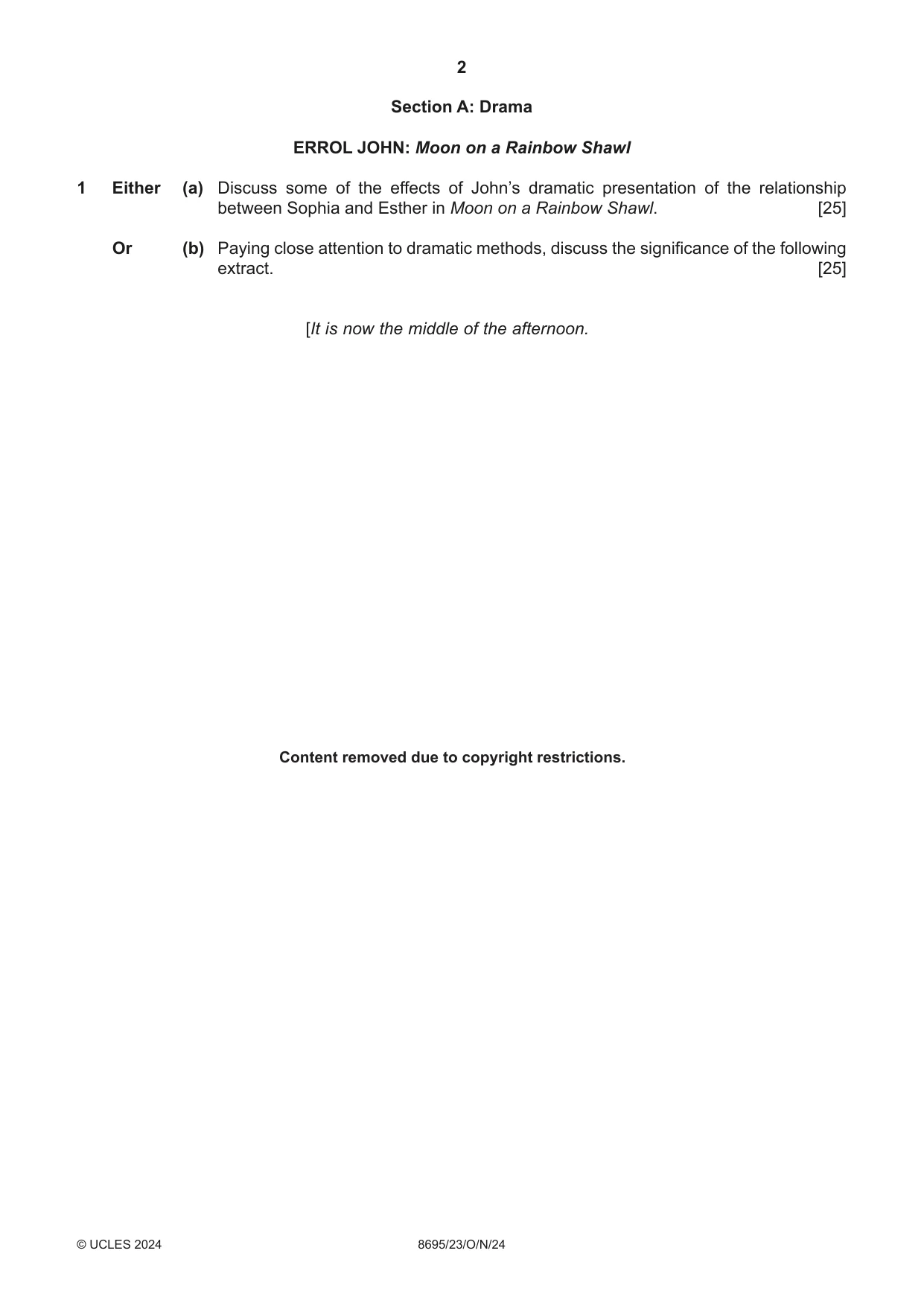
2 8695/23/O/N/24 © UCLES 2024 Section A: Drama ERROL JOHN: Moon on a Rainbow Shawl 1 Either (a) Discuss some of the effects of John’s dramatic presentation of the relationship between Sophia and Esther in Moon on a Rainbow Shawl. [25] Or (b) Paying close attention to dramatic methods, discuss the significance of the following extract. [25] [It is now the middle of the afternoon. Content removed due to copyright restrictions.
Question paper, page 3
3 8695/23/O/N/24 © UCLES 2024 [Turn over We ent married yet, yer know! (from Act 3, Scene 1) Content removed due to copyright restrictions.
Question paper, page 4
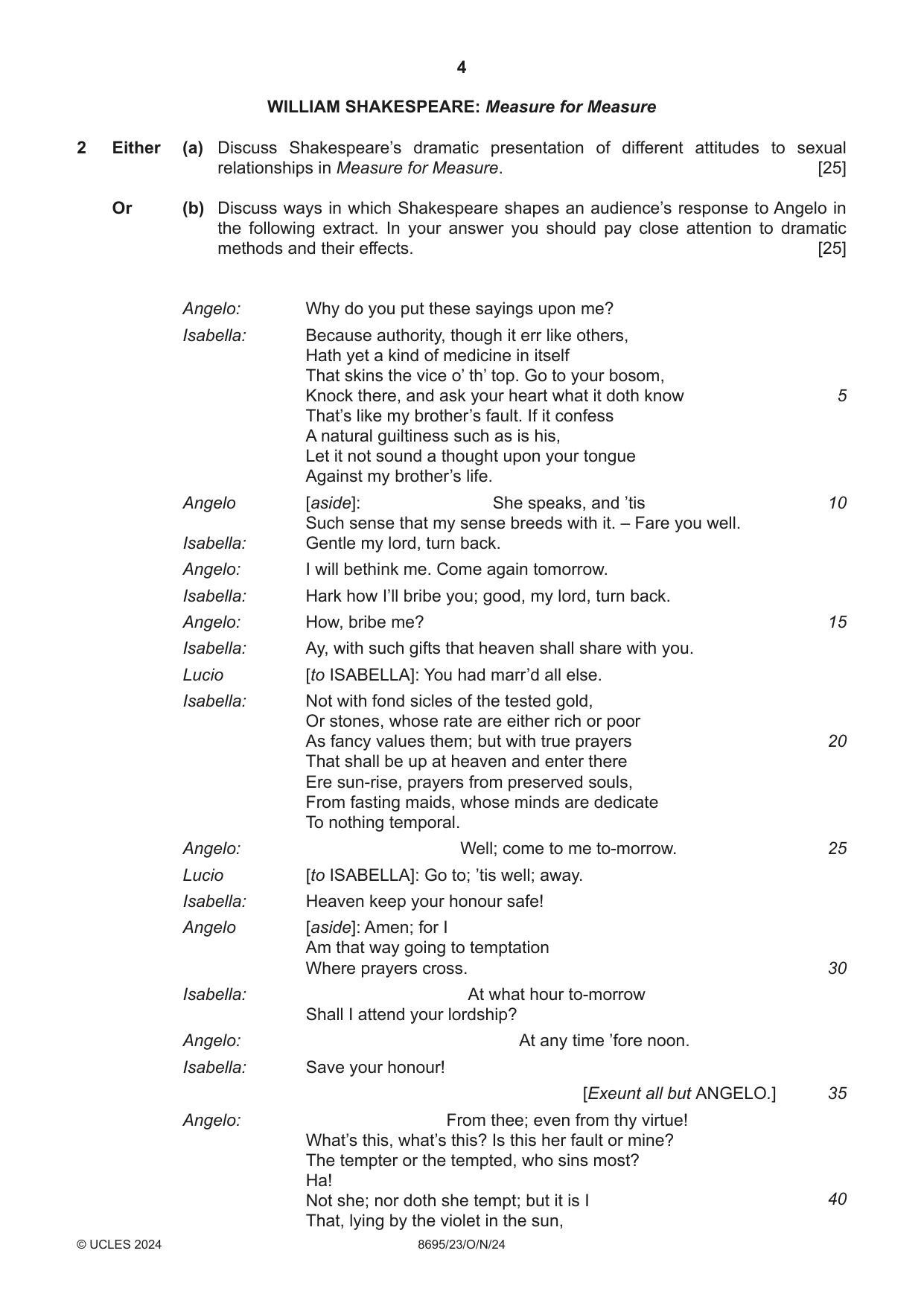
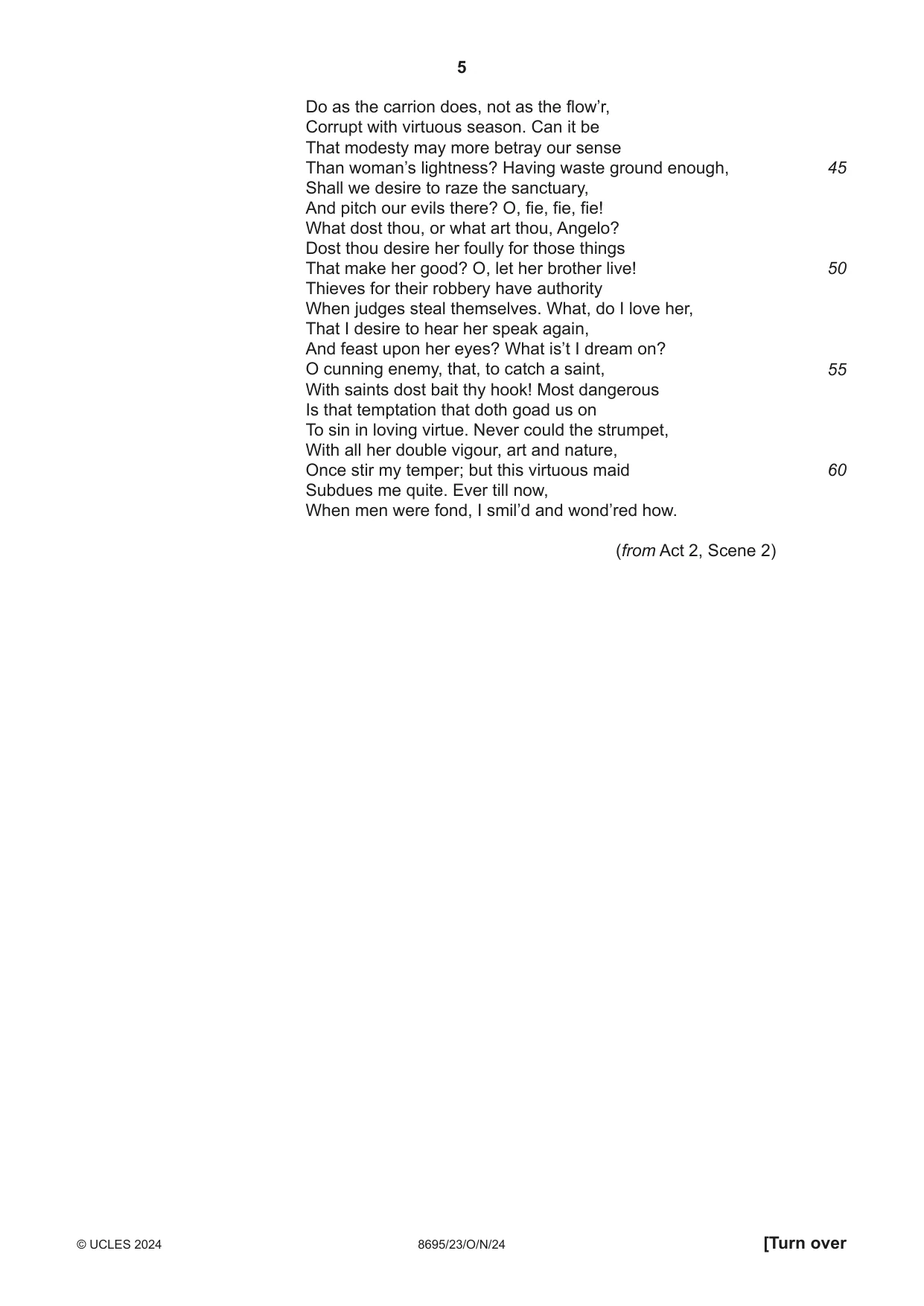
4 8695/23/O/N/24 © UCLES 2024 WILLIAM SHAKESPEARE: Measure for Measure 2 Either (a) Discuss Shakespeare’s dramatic presentation of different attitudes to sexual relationships in Measure for Measure. [25] Or (b) Discuss ways in which Shakespeare shapes an audience’s response to Angelo in the following extract. In your answer you should pay close attention to dramatic methods and their effects. [25] Angelo: Why do you put these sayings upon me? Isabella: Because authority, though it err like others, Hath yet a kind of medicine in itself That skins the vice o’ th’ top. Go to your bosom, Knock there, and ask your heart what it doth know That’s like my brother’s fault. If it confess A natural guiltiness such as is his, Let it not sound a thought upon your tongue Against my brother’s life. Angelo [aside]: She speaks, and ’tis Such sense that my sense breeds with it. – Fare you well. Isabella: Gentle my lord, turn back. Angelo: I will bethink me. Come again tomorrow. Isabella: Hark how I’ll bribe you; good, my lord, turn back. Angelo: How, bribe me? Isabella: Ay, with such gifts that heaven shall share with you. Lucio [to ISABELLA]: You had marr’d all else. Isabella: Not with fond sicles of the tested gold, Or stones, whose rate are either rich or poor As fancy values them; but with true prayers That shall be up at heaven and enter there Ere sun-rise, prayers from preserved souls, From fasting maids, whose minds are dedicate To nothing temporal. Angelo: Well; come to me to-morrow. Lucio [to ISABELLA]: Go to; ’tis well; away. Isabella: Heaven keep your honour safe! Angelo [aside]: Amen; for I Am that way going to temptation Where prayers cross. Isabella: At what hour to-morrow Shall I attend your lordship? Angelo: At any time ’fore noon. Isabella: Save your honour! [Exeunt all but ANGELO.] Angelo: From thee; even from thy virtue! What’s this, what’s this? Is this her fault or mine? The tempter or the tempted, who sins most? Ha! Not she; nor doth she tempt; but it is I That, lying by the violet in the sun, 5 10 15 20 25 30 35 40
Question paper, page 5
5 8695/23/O/N/24 © UCLES 2024 [Turn over Do as the carrion does, not as the flow’r, Corrupt with virtuous season. Can it be That modesty may more betray our sense Than woman’s lightness? Having waste ground enough, Shall we desire to raze the sanctuary, And pitch our evils there? O, fie, fie, fie! What dost thou, or what art thou, Angelo? Dost thou desire her foully for those things That make her good? O, let her brother live! Thieves for their robbery have authority When judges steal themselves. What, do I love her, That I desire to hear her speak again, And feast upon her eyes? What is’t I dream on? O cunning enemy, that, to catch a saint, With saints dost bait thy hook! Most dangerous Is that temptation that doth goad us on To sin in loving virtue. Never could the strumpet, With all her double vigour, art and nature, Once stir my temper; but this virtuous maid Subdues me quite. Ever till now, When men were fond, I smil’d and wond’red how. (from Act 2, Scene 2) 45 50 55 60
Question paper, page 6
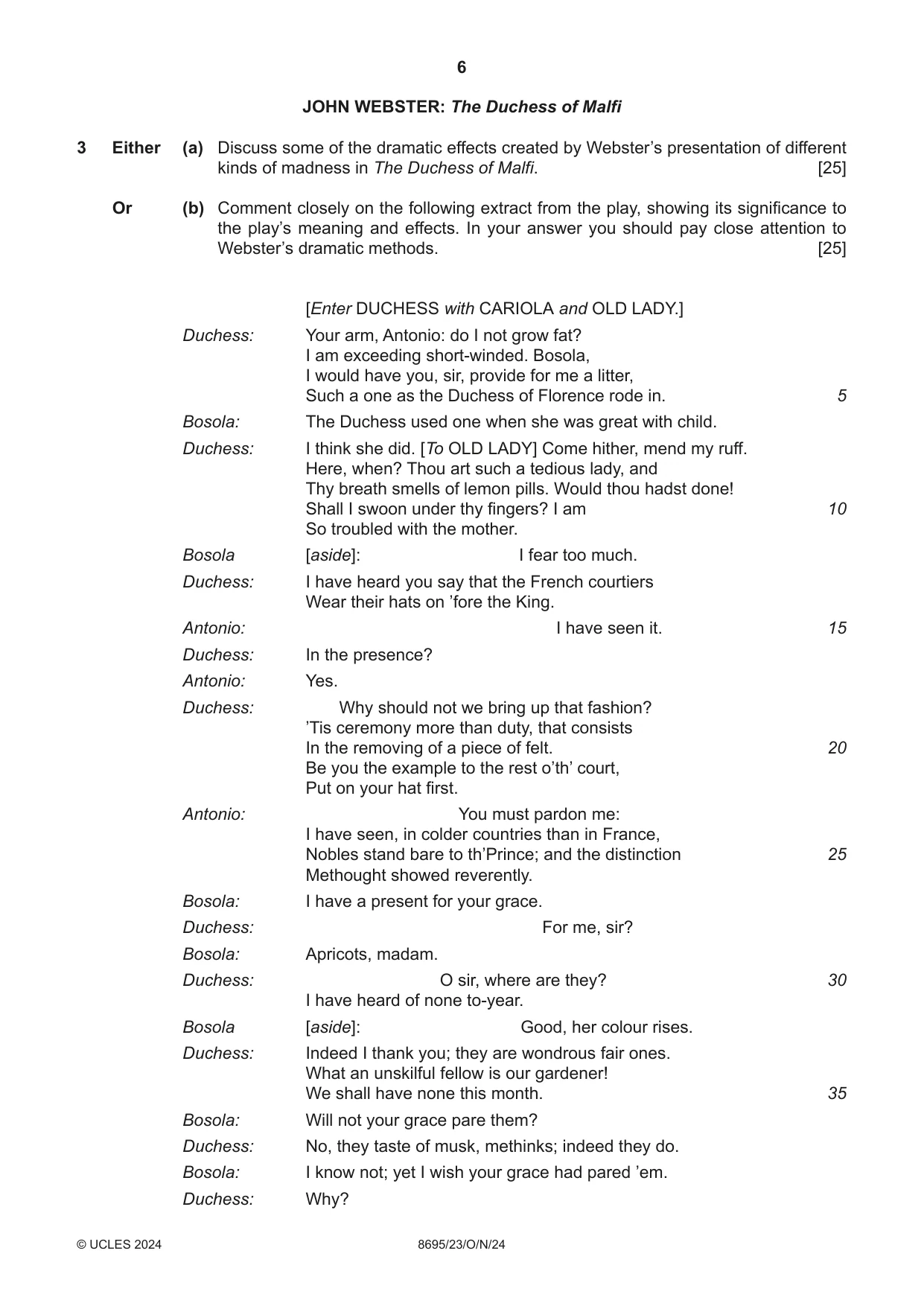
6 8695/23/O/N/24 © UCLES 2024 JOHN WEBSTER: The Duchess of Malfi 3 Either (a) Discuss some of the dramatic effects created by Webster’s presentation of different kinds of madness in The Duchess of Malfi. [25] Or (b) Comment closely on the following extract from the play, showing its significance to the play’s meaning and effects. In your answer you should pay close attention to Webster’s dramatic methods. [25] [Enter DUCHESS with CARIOLA and OLD LADY.] Duchess: Your arm, Antonio: do I not grow fat? I am exceeding short-winded. Bosola, I would have you, sir, provide for me a litter, Such a one as the Duchess of Florence rode in. Bosola: The Duchess used one when she was great with child. Duchess: I think she did. [To OLD LADY] Come hither, mend my ruff. Here, when? Thou art such a tedious lady, and Thy breath smells of lemon pills. Would thou hadst done! Shall I swoon under thy fingers? I am So troubled with the mother. Bosola [aside]: I fear too much. Duchess: I have heard you say that the French courtiers Wear their hats on ’fore the King. Antonio: I have seen it. Duchess: In the presence? Antonio: Yes. Duchess: Why should not we bring up that fashion? ’Tis ceremony more than duty, that consists In the removing of a piece of felt. Be you the example to the rest o’th’ court, Put on your hat first. Antonio: You must pardon me: I have seen, in colder countries than in France, Nobles stand bare to th’Prince; and the distinction Methought showed reverently. Bosola: I have a present for your grace. Duchess: For me, sir? Bosola: Apricots, madam. Duchess: O sir, where are they? I have heard of none to-year. Bosola [aside]: Good, her colour rises. Duchess: Indeed I thank you; they are wondrous fair ones. What an unskilful fellow is our gardener! We shall have none this month. Bosola: Will not your grace pare them? Duchess: No, they taste of musk, methinks; indeed they do. Bosola: I know not; yet I wish your grace had pared ’em. Duchess: Why? 5 10 15 20 25 30 35
Question paper, page 7
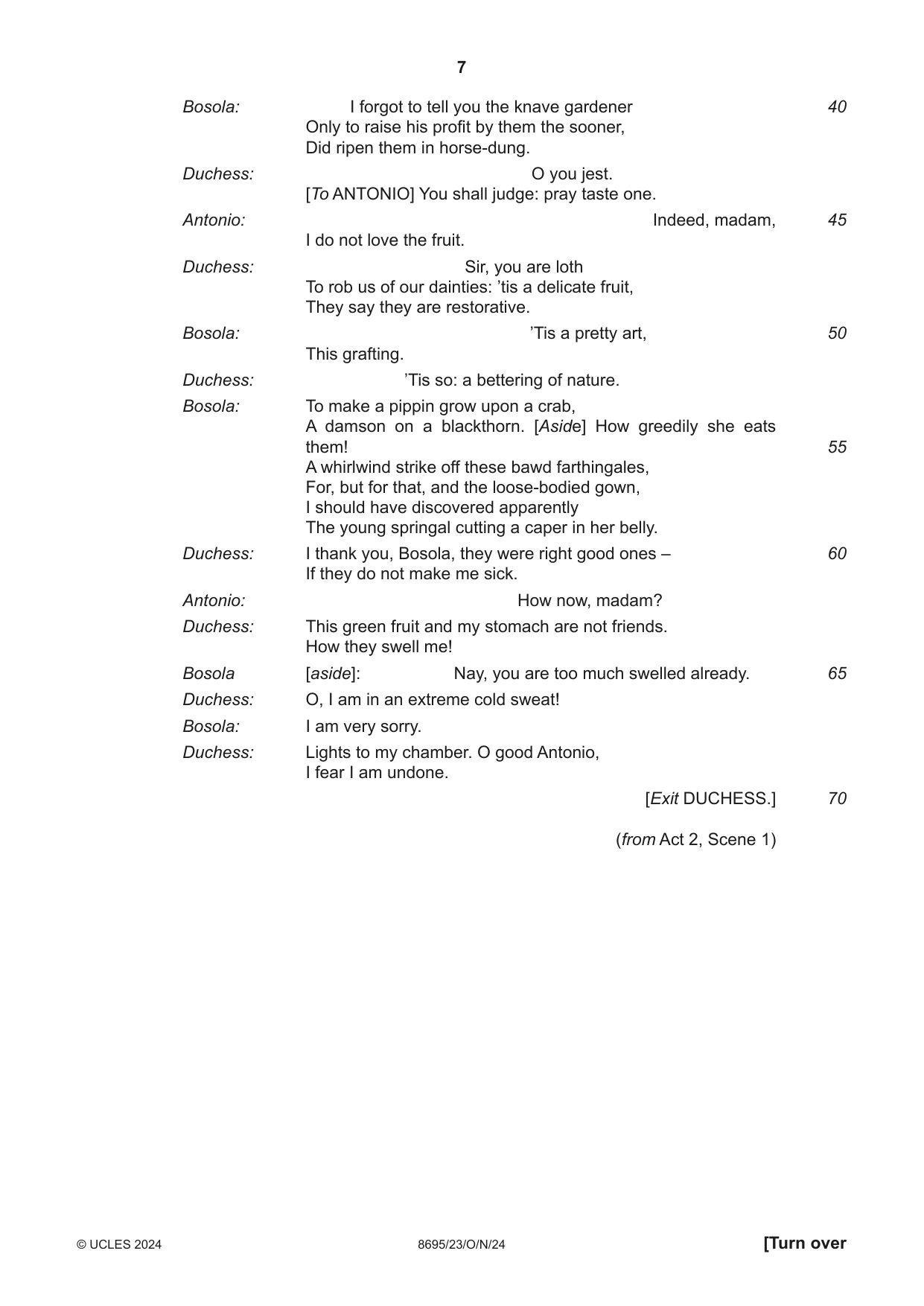
7 8695/23/O/N/24 © UCLES 2024 [Turn over Bosola: I forgot to tell you the knave gardener Only to raise his profit by them the sooner, Did ripen them in horse-dung. Duchess: O you jest. [To ANTONIO] You shall judge: pray taste one. Antonio: Indeed, madam, I do not love the fruit. Duchess: Sir, you are loth To rob us of our dainties: ’tis a delicate fruit, They say they are restorative. Bosola: ’Tis a pretty art, This grafting. Duchess: ’Tis so: a bettering of nature. Bosola: To make a pippin grow upon a crab, A damson on a blackthorn. [Aside] How greedily she eats them! A whirlwind strike off these bawd farthingales, For, but for that, and the loose-bodied gown, I should have discovered apparently The young springal cutting a caper in her belly. Duchess: I thank you, Bosola, they were right good ones – If they do not make me sick. Antonio: How now, madam? Duchess: This green fruit and my stomach are not friends. How they swell me! Bosola [aside]: Nay, you are too much swelled already. Duchess: O, I am in an extreme cold sweat! Bosola: I am very sorry. Duchess: Lights to my chamber. O good Antonio, I fear I am undone. [Exit DUCHESS.] (from Act 2, Scene 1) 40 45 50 55 60 65 70
Question paper, page 8
8 8695/23/O/N/24 © UCLES 2024 TENNESSEE WILLIAMS: Cat on a Hot Tin Roof 4 Either (a) Discuss some of the dramatic ways in which Williams shapes an audience’s response to Maggie in Cat on a Hot Tin Roof. [25] Or (b) Discuss Williams’s presentation of Big Mama in the following extract. In your answer you should pay close attention to dramatic methods and their effects. [25] Big Mama: Now you listen to me, all of you, you listen here! Content removed due to copyright restrictions.
Question paper, page 9
9 8695/23/O/N/24 © UCLES 2024 [Turn over [She seizes the glass from his hand.] (from Act 3) Content removed due to copyright restrictions.
Question paper, page 10
10 8695/23/O/N/24 © UCLES 2024 Section B: Poetry MAYA ANGELOU: And Still I Rise 5 Either (a) In what ways, and with what effects, does Angelou explore change? In your answer you should refer to two poems from the selection. [25] Or (b) Comment closely on Angelou’s presentation of the speaker in the following extract from Just Like Job. [25] Just Like Job My Lord, My Lord, I’m stepping out on Your word. Content removed due to copyright restrictions.
Question paper, page 11
11 8695/23/O/N/24 © UCLES 2024 [Turn over TURN OVER FOR QUESTION 6.
Question paper, page 12
12 8695/23/O/N/24 © UCLES 2024 SIMON ARMITAGE: Sir Gawain and the Green Knight 6 Either (a) In what ways does Armitage’s presentation of the Green Knight develop your understanding of chivalry in the poem? [25] Or (b) Comment closely on Armitage’s presentation of the welcome for Sir Gawain in the following extract. [25] In front of a flaming fireside a chair Content removed due to copyright restrictions.
Question paper, page 13
13 8695/23/O/N/24 © UCLES 2024 [Turn over love’s tender language too.’ Content removed due to copyright restrictions.
Question paper, page 14
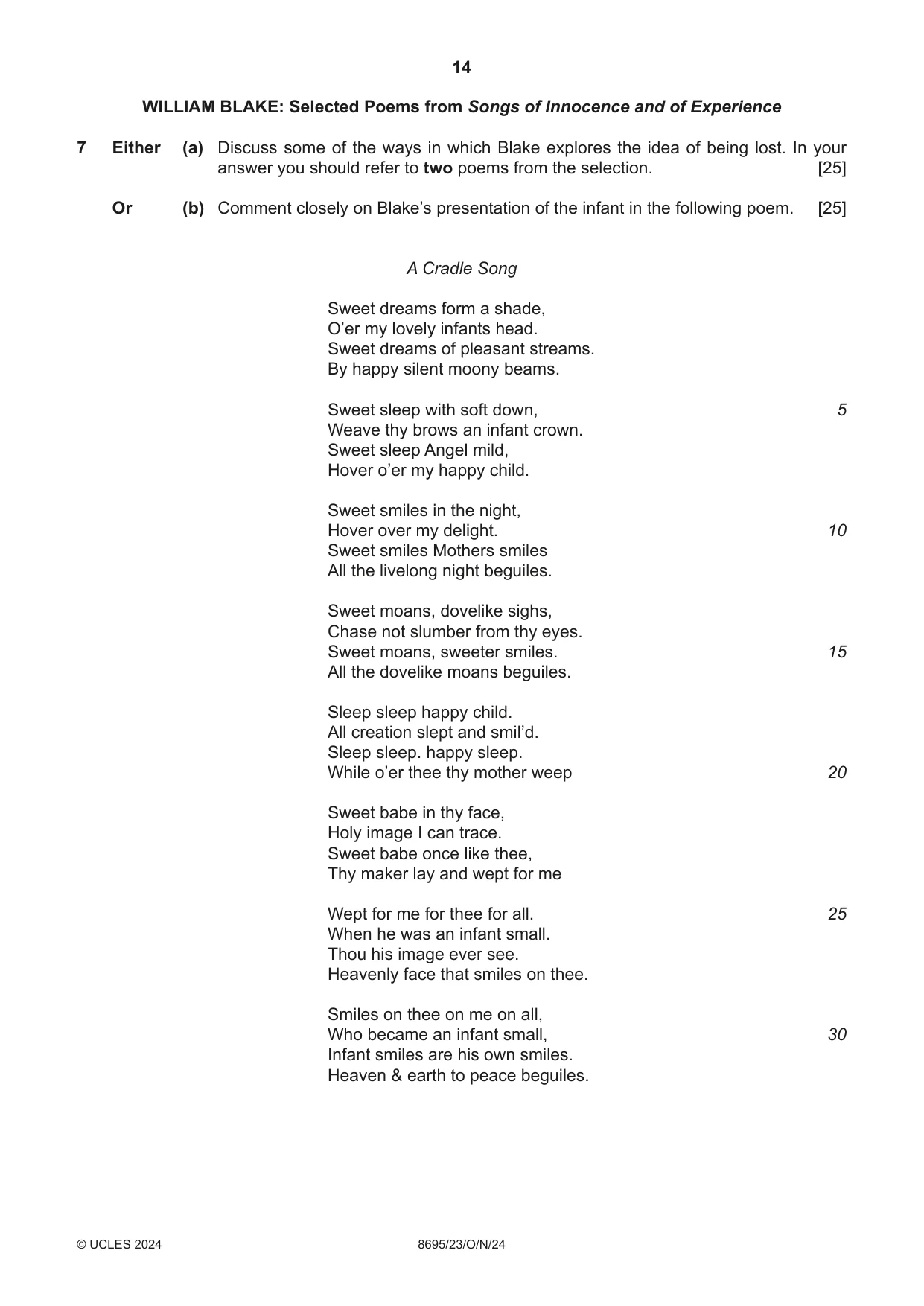
14 8695/23/O/N/24 © UCLES 2024 WILLIAM BLAKE: Selected Poems from Songs of Innocence and of Experience 7 Either (a) Discuss some of the ways in which Blake explores the idea of being lost. In your answer you should refer to two poems from the selection. [25] Or (b) Comment closely on Blake’s presentation of the infant in the following poem. [25] A Cradle Song Sweet dreams form a shade, O’er my lovely infants head. Sweet dreams of pleasant streams. By happy silent moony beams. Sweet sleep with soft down, Weave thy brows an infant crown. Sweet sleep Angel mild, Hover o’er my happy child. Sweet smiles in the night, Hover over my delight. Sweet smiles Mothers smiles All the livelong night beguiles. Sweet moans, dovelike sighs, Chase not slumber from thy eyes. Sweet moans, sweeter smiles. All the dovelike moans beguiles. Sleep sleep happy child. All creation slept and smil’d. Sleep sleep. happy sleep. While o’er thee thy mother weep Sweet babe in thy face, Holy image I can trace. Sweet babe once like thee, Thy maker lay and wept for me Wept for me for thee for all. When he was an infant small. Thou his image ever see. Heavenly face that smiles on thee. Smiles on thee on me on all, Who became an infant small, Infant smiles are his own smiles. Heaven & earth to peace beguiles. 5 10 15 20 25 30
Question paper, page 15
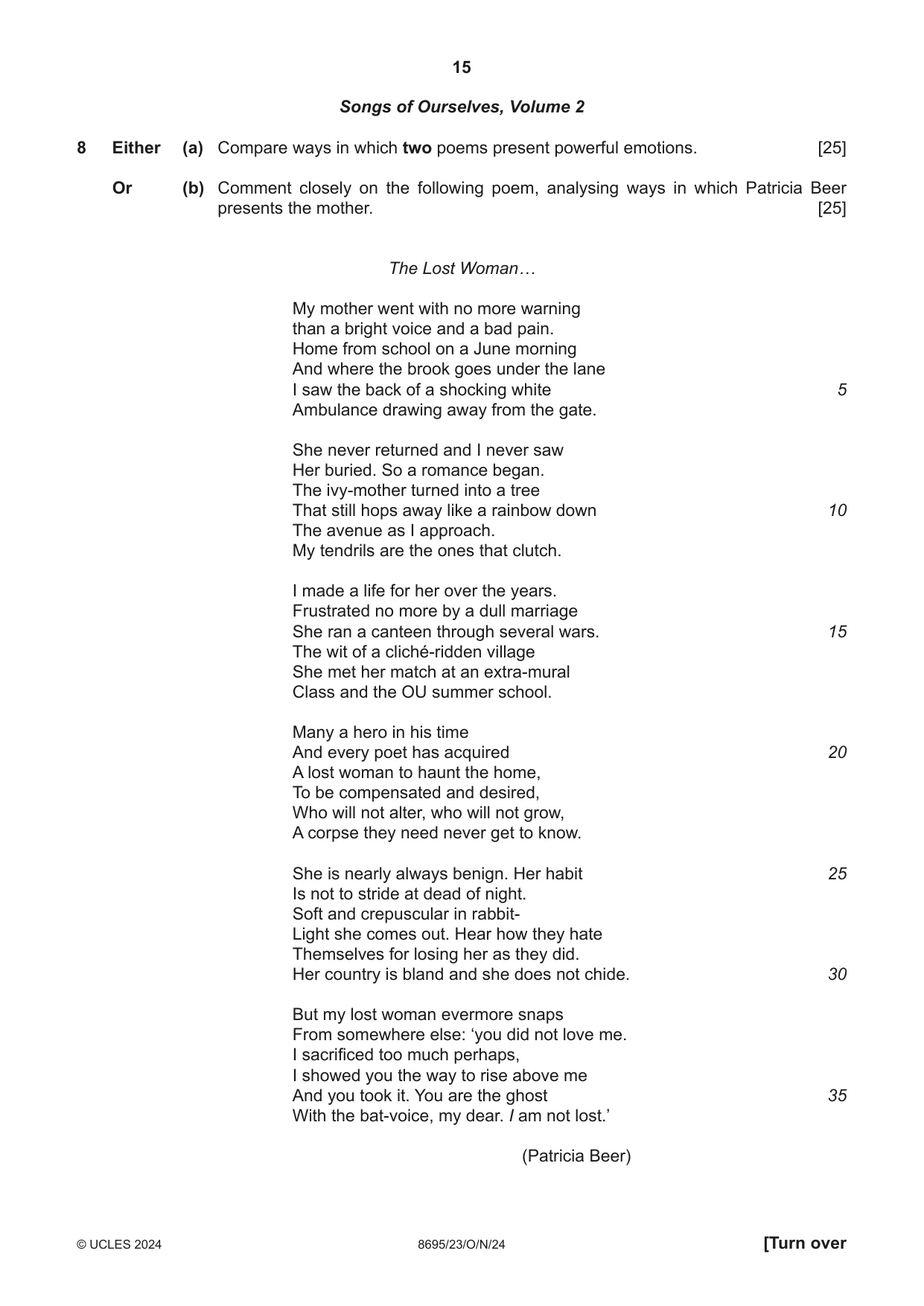
15 8695/23/O/N/24 © UCLES 2024 [Turn over Songs of Ourselves, Volume 2 8 Either (a) Compare ways in which two poems present powerful emotions. [25] Or (b) Comment closely on the following poem, analysing ways in which Patricia Beer presents the mother. [25] The Lost Woman… My mother went with no more warning than a bright voice and a bad pain. Home from school on a June morning And where the brook goes under the lane I saw the back of a shocking white Ambulance drawing away from the gate. She never returned and I never saw Her buried. So a romance began. The ivy-mother turned into a tree That still hops away like a rainbow down The avenue as I approach. My tendrils are the ones that clutch. I made a life for her over the years. Frustrated no more by a dull marriage She ran a canteen through several wars. The wit of a cliché-ridden village She met her match at an extra-mural Class and the OU summer school. Many a hero in his time And every poet has acquired A lost woman to haunt the home, To be compensated and desired, Who will not alter, who will not grow, A corpse they need never get to know. She is nearly always benign. Her habit Is not to stride at dead of night. Soft and crepuscular in rabbit- Light she comes out. Hear how they hate Themselves for losing her as they did. Her country is bland and she does not chide. But my lost woman evermore snaps From somewhere else: ‘you did not love me. I sacrificed too much perhaps, I showed you the way to rise above me And you took it. You are the ghost With the bat-voice, my dear. I am not lost.’ (Patricia Beer) 5 10 15 20 25 30 35
Question paper, page 16
16 8695/23/O/N/24 © UCLES 2024 Section C: Prose KIRAN DESAI: The Inheritance of Loss 9 Either (a) Discuss Desai’s presentation of the Gorkha revolutionary forces. [25] Or (b) Comment closely on Desai’s presentation of the characters’ thoughts and feelings in the following passage. [25] Noni had never had love at all. Content removed due to copyright restrictions.
Question paper, page 17
17 8695/23/O/N/24 © UCLES 2024 [Turn over Then they put it down again. (from Chapter 12) Content removed due to copyright restrictions.
Question paper, page 18
18 8695/23/O/N/24 © UCLES 2024 IAN McEWAN: Atonement 10 Either (a) Discuss ways in which McEwan presents life in the Tallis household. [25] Or (b) Comment closely on ways in which McEwan presents the developing events in the following passage. [25] ‘Beg pardon, sir. The broad spray of fire was advancing up the road at two hundred miles an hour, a rattling hail-storm din of cannon rounds hitting metal and glass. (from Part Two) Content removed due to copyright restrictions.
Question paper, page 19
19 8695/23/O/N/24 © UCLES 2024 [Turn over TURN OVER FOR QUESTION 11.
Question paper, page 20
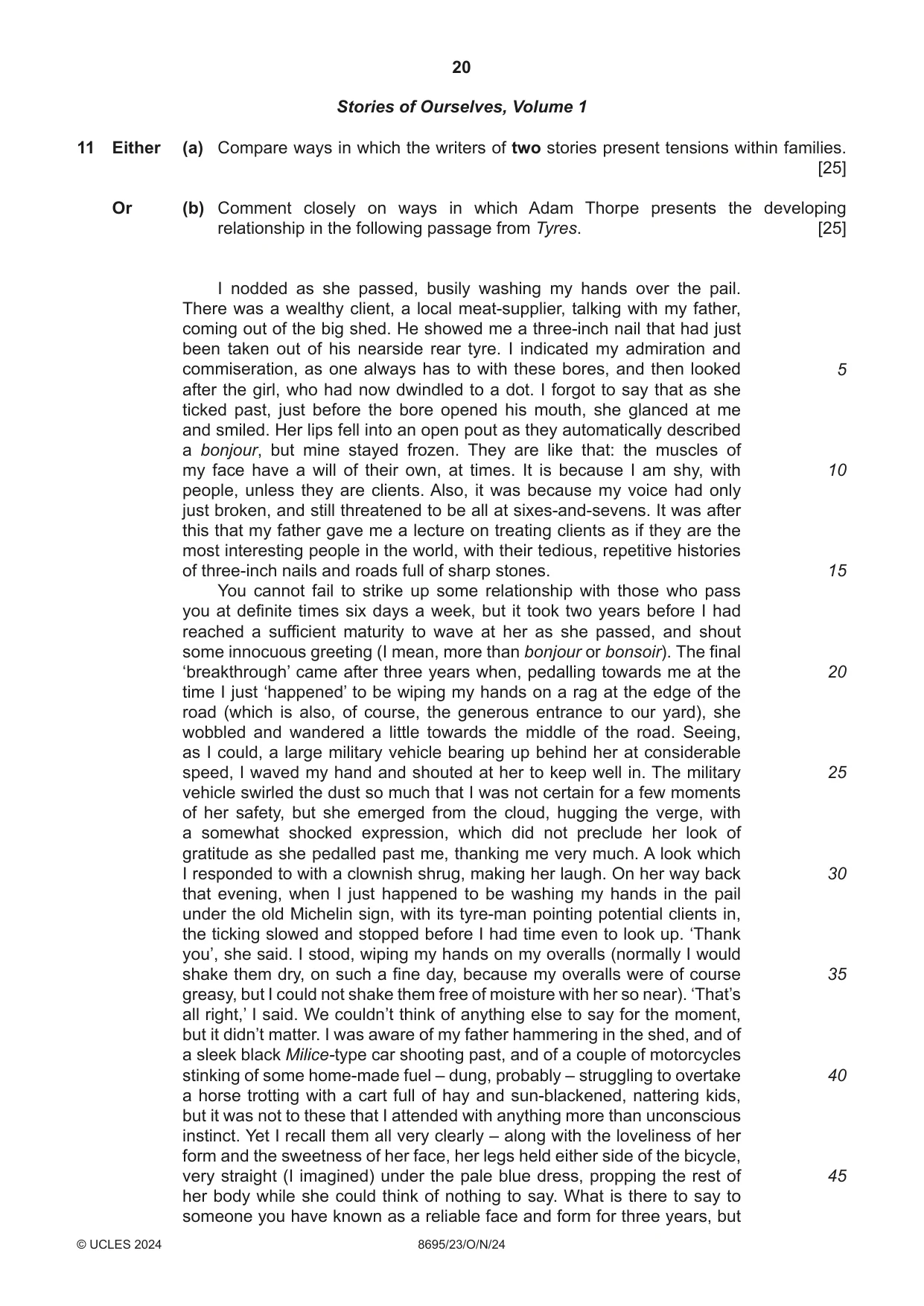
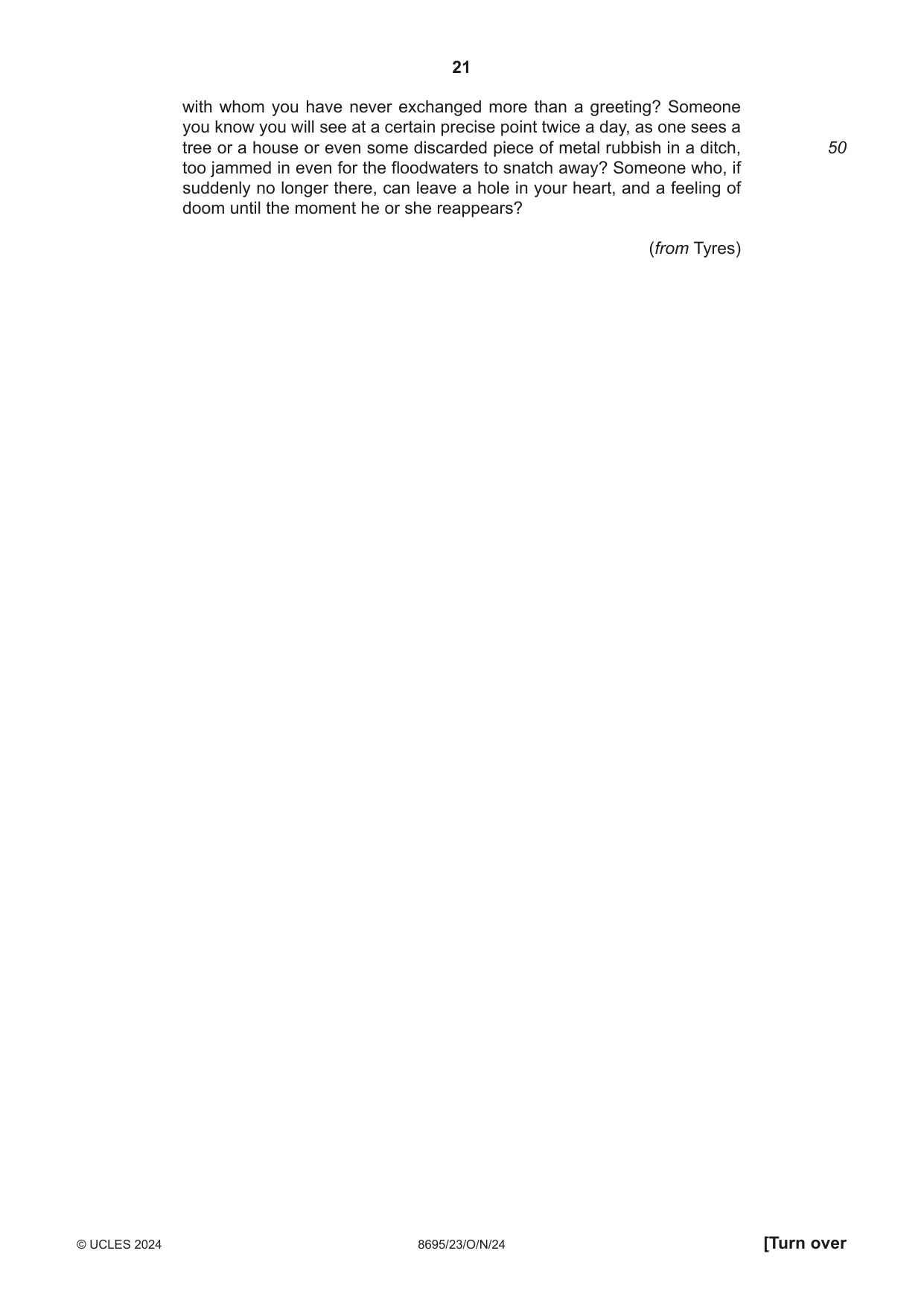
20 8695/23/O/N/24 © UCLES 2024 Stories of Ourselves, Volume 1 11 Either (a) Compare ways in which the writers of two stories present tensions within families. [25] Or (b) Comment closely on ways in which Adam Thorpe presents the developing relationship in the following passage from Tyres. [25] I nodded as she passed, busily washing my hands over the pail. There was a wealthy client, a local meat-supplier, talking with my father, coming out of the big shed. He showed me a three-inch nail that had just been taken out of his nearside rear tyre. I indicated my admiration and commiseration, as one always has to with these bores, and then looked after the girl, who had now dwindled to a dot. I forgot to say that as she ticked past, just before the bore opened his mouth, she glanced at me and smiled. Her lips fell into an open pout as they automatically described a bonjour, but mine stayed frozen. They are like that: the muscles of my face have a will of their own, at times. It is because I am shy, with people, unless they are clients. Also, it was because my voice had only just broken, and still threatened to be all at sixes-and-sevens. It was after this that my father gave me a lecture on treating clients as if they are the most interesting people in the world, with their tedious, repetitive histories of three-inch nails and roads full of sharp stones. You cannot fail to strike up some relationship with those who pass you at definite times six days a week, but it took two years before I had reached a sufficient maturity to wave at her as she passed, and shout some innocuous greeting (I mean, more than bonjour or bonsoir). The final ‘breakthrough’ came after three years when, pedalling towards me at the time I just ‘happened’ to be wiping my hands on a rag at the edge of the road (which is also, of course, the generous entrance to our yard), she wobbled and wandered a little towards the middle of the road. Seeing, as I could, a large military vehicle bearing up behind her at considerable speed, I waved my hand and shouted at her to keep well in. The military vehicle swirled the dust so much that I was not certain for a few moments of her safety, but she emerged from the cloud, hugging the verge, with a somewhat shocked expression, which did not preclude her look of gratitude as she pedalled past me, thanking me very much. A look which I responded to with a clownish shrug, making her laugh. On her way back that evening, when I just happened to be washing my hands in the pail under the old Michelin sign, with its tyre-man pointing potential clients in, the ticking slowed and stopped before I had time even to look up. ‘Thank you’, she said. I stood, wiping my hands on my overalls (normally I would shake them dry, on such a fine day, because my overalls were of course greasy, but I could not shake them free of moisture with her so near). ‘That’s all right,’ I said. We couldn’t think of anything else to say for the moment, but it didn’t matter. I was aware of my father hammering in the shed, and of a sleek black Milice-type car shooting past, and of a couple of motorcycles stinking of some home-made fuel – dung, probably – struggling to overtake a horse trotting with a cart full of hay and sun-blackened, nattering kids, but it was not to these that I attended with anything more than unconscious instinct. Yet I recall them all very clearly – along with the loveliness of her form and the sweetness of her face, her legs held either side of the bicycle, very straight (I imagined) under the pale blue dress, propping the rest of her body while she could think of nothing to say. What is there to say to someone you have known as a reliable face and form for three years, but 5 10 15 20 25 30 35 40 45
Question paper, page 21
21 8695/23/O/N/24 © UCLES 2024 [Turn over with whom you have never exchanged more than a greeting? Someone you know you will see at a certain precise point twice a day, as one sees a tree or a house or even some discarded piece of metal rubbish in a ditch, too jammed in even for the floodwaters to snatch away? Someone who, if suddenly no longer there, can leave a hole in your heart, and a feeling of doom until the moment he or she reappears? (from Tyres) 50
Question paper, page 22
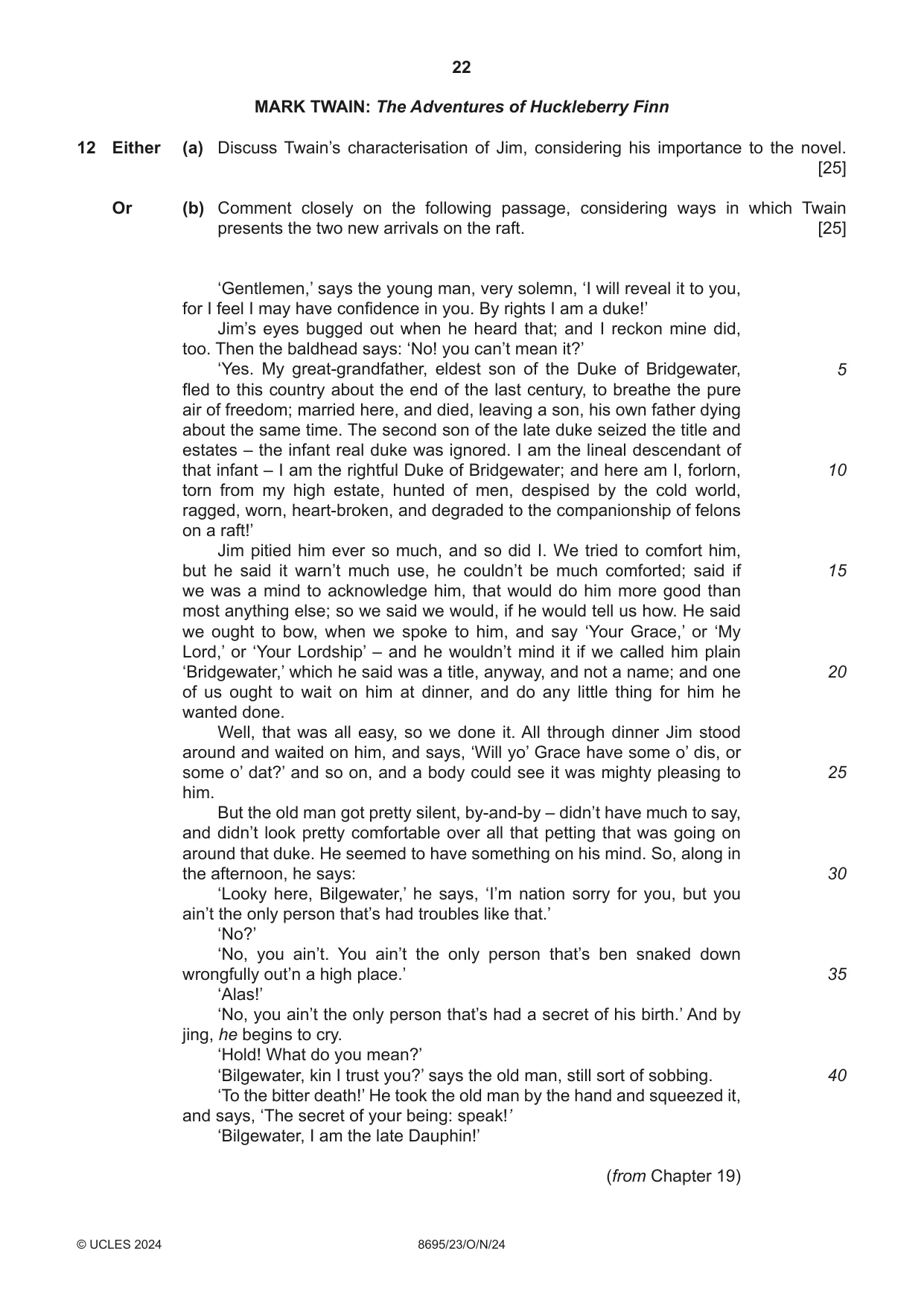
22 8695/23/O/N/24 © UCLES 2024 MARK TWAIN: The Adventures of Huckleberry Finn 12 Either (a) Discuss Twain’s characterisation of Jim, considering his importance to the novel. [25] Or (b) Comment closely on the following passage, considering ways in which Twain presents the two new arrivals on the raft. [25] ‘Gentlemen,’ says the young man, very solemn, ‘I will reveal it to you, for I feel I may have confidence in you. By rights I am a duke!’ Jim’s eyes bugged out when he heard that; and I reckon mine did, too. Then the baldhead says: ‘No! you can’t mean it?’ ‘Yes. My great-grandfather, eldest son of the Duke of Bridgewater, fled to this country about the end of the last century, to breathe the pure air of freedom; married here, and died, leaving a son, his own father dying about the same time. The second son of the late duke seized the title and estates – the infant real duke was ignored. I am the lineal descendant of that infant – I am the rightful Duke of Bridgewater; and here am I, forlorn, torn from my high estate, hunted of men, despised by the cold world, ragged, worn, heart-broken, and degraded to the companionship of felons on a raft!’ Jim pitied him ever so much, and so did I. We tried to comfort him, but he said it warn’t much use, he couldn’t be much comforted; said if we was a mind to acknowledge him, that would do him more good than most anything else; so we said we would, if he would tell us how. He said we ought to bow, when we spoke to him, and say ‘Your Grace,’ or ‘My Lord,’ or ‘Your Lordship’ – and he wouldn’t mind it if we called him plain ‘Bridgewater,’ which he said was a title, anyway, and not a name; and one of us ought to wait on him at dinner, and do any little thing for him he wanted done. Well, that was all easy, so we done it. All through dinner Jim stood around and waited on him, and says, ‘Will yo’ Grace have some o’ dis, or some o’ dat?’ and so on, and a body could see it was mighty pleasing to him. But the old man got pretty silent, by-and-by – didn’t have much to say, and didn’t look pretty comfortable over all that petting that was going on around that duke. He seemed to have something on his mind. So, along in the afternoon, he says: ‘Looky here, Bilgewater,’ he says, ‘I’m nation sorry for you, but you ain’t the only person that’s had troubles like that.’ ‘No?’ ‘No, you ain’t. You ain’t the only person that’s ben snaked down wrongfully out’n a high place.’ ‘Alas!’ ‘No, you ain’t the only person that’s had a secret of his birth.’ And by jing, he begins to cry. ‘Hold! What do you mean?’ ‘Bilgewater, kin I trust you?’ says the old man, still sort of sobbing. ‘To the bitter death!’ He took the old man by the hand and squeezed it, and says, ‘The secret of your being: speak!’ ‘Bilgewater, I am the late Dauphin!’ (from Chapter 19) 5 10 15 20 25 30 35 40
Question paper, page 23
23 8695/23/O/N/24 © UCLES 2024 BLANK PAGE
Question paper, page 24
24 8695/23/O/N/24 © UCLES 2024 Permission to reproduce items where third-party owned material protected by copyright is included has been sought and cleared where possible. Every reasonable effort has been made by the publisher (UCLES) to trace copyright holders, but if any items requiring clearance have unwittingly been included, the publisher will be pleased to make amends at the earliest possible opportunity. To avoid the issue of disclosure of answer-related information to candidates, all copyright acknowledgements are reproduced online in the Cambridge Assessment International Education Copyright Acknowledgements Booklet. This is produced for each series of examinations and is freely available to download at www.cambridgeinternational.org after the live examination series. Cambridge Assessment International Education is part of Cambridge Assessment. Cambridge Assessment is the brand name of the University of Cambridge Local Examinations Syndicate (UCLES), which is a department of the University of Cambridge. BLANK PAGE
Mark scheme, page 1
This document consists of 13 printed pages. © Cambridge University Press & Assessment 2024 [Turn over Cambridge International AS Level LANGUAGE AND LITERATURE IN ENGLISH 8695/23 Paper 2 Drama, Poetry and Prose October/November 2024 MARK SCHEME Maximum Mark: 50 Published This mark scheme is published as an aid to teachers and candidates, to indicate the requirements of the examination. It shows the basis on which Examiners were instructed to award marks. It does not indicate the details of the discussions that took place at an Examiners’ meeting before marking began, which would have considered the acceptability of alternative answers. Mark schemes should be read in conjunction with the question paper and the Principal Examiner Report for Teachers. Cambridge International will not enter into discussions about these mark schemes. Cambridge International is publishing the mark schemes for the October/November 2024 series for most Cambridge IGCSE, Cambridge International A and AS Level components, and some Cambridge O Level components.
Mark scheme, page 2
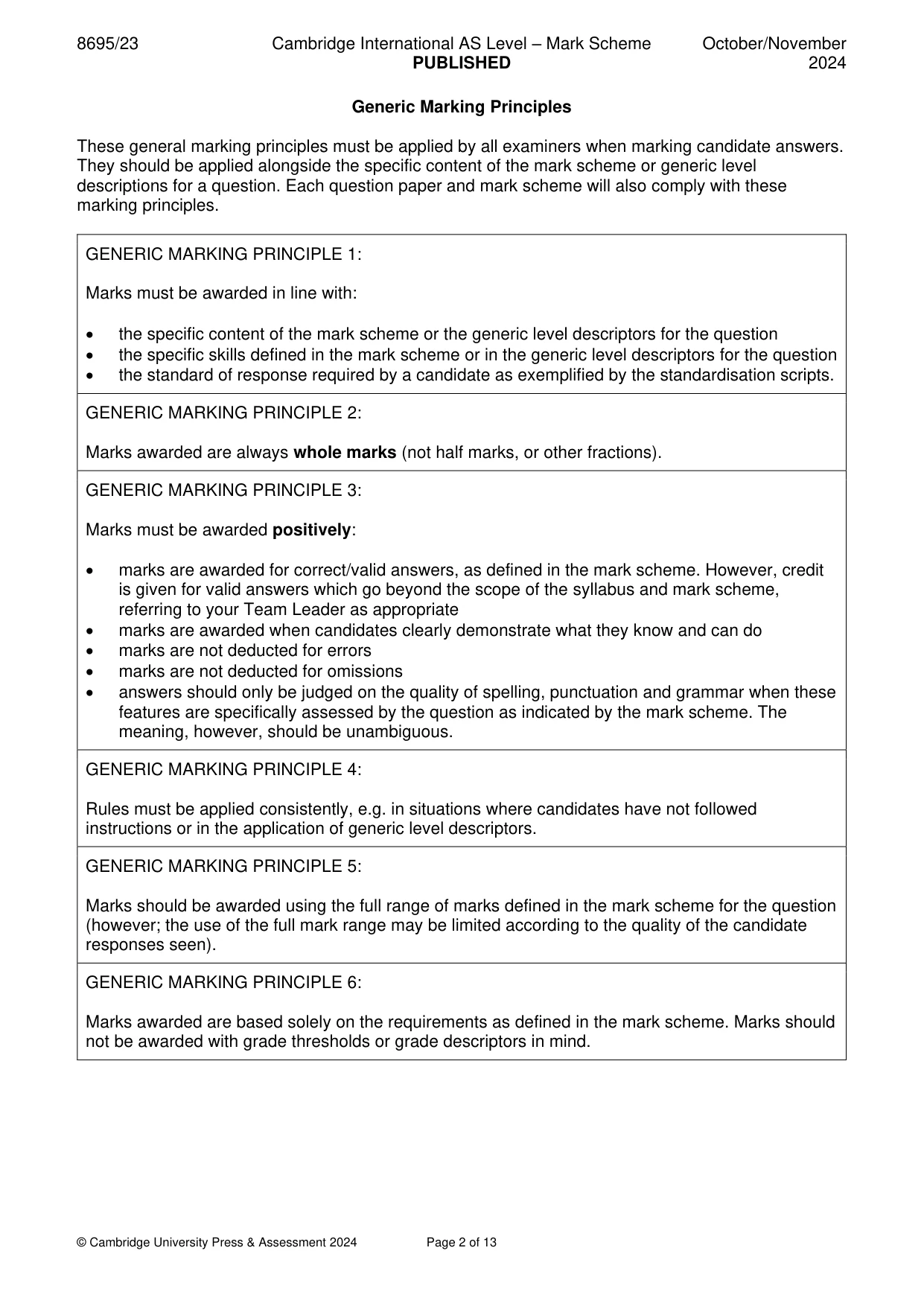
8695/23 Cambridge International AS Level – Mark Scheme PUBLISHED October/November 2024 © Cambridge University Press & Assessment 2024 Page 2 of 13 Generic Marking Principles These general marking principles must be applied by all examiners when marking candidate answers. They should be applied alongside the specific content of the mark scheme or generic level descriptions for a question. Each question paper and mark scheme will also comply with these marking principles. GENERIC MARKING PRINCIPLE 1: Marks must be awarded in line with: • the specific content of the mark scheme or the generic level descriptors for the question • the specific skills defined in the mark scheme or in the generic level descriptors for the question • the standard of response required by a candidate as exemplified by the standardisation scripts. GENERIC MARKING PRINCIPLE 2: Marks awarded are always whole marks (not half marks, or other fractions). GENERIC MARKING PRINCIPLE 3: Marks must be awarded positively: • marks are awarded for correct/valid answers, as defined in the mark scheme. However, credit is given for valid answers which go beyond the scope of the syllabus and mark scheme, referring to your Team Leader as appropriate • marks are awarded when candidates clearly demonstrate what they know and can do • marks are not deducted for errors • marks are not deducted for omissions • answers should only be judged on the quality of spelling, punctuation and grammar when these features are specifically assessed by the question as indicated by the mark scheme. The meaning, however, should be unambiguous. GENERIC MARKING PRINCIPLE 4: Rules must be applied consistently, e.g. in situations where candidates have not followed instructions or in the application of generic level descriptors. GENERIC MARKING PRINCIPLE 5: Marks should be awarded using the full range of marks defined in the mark scheme for the question (however; the use of the full mark range may be limited according to the quality of the candidate responses seen). GENERIC MARKING PRINCIPLE 6: Marks awarded are based solely on the requirements as defined in the mark scheme. Marks should not be awarded with grade thresholds or grade descriptors in mind.
Mark scheme, page 3
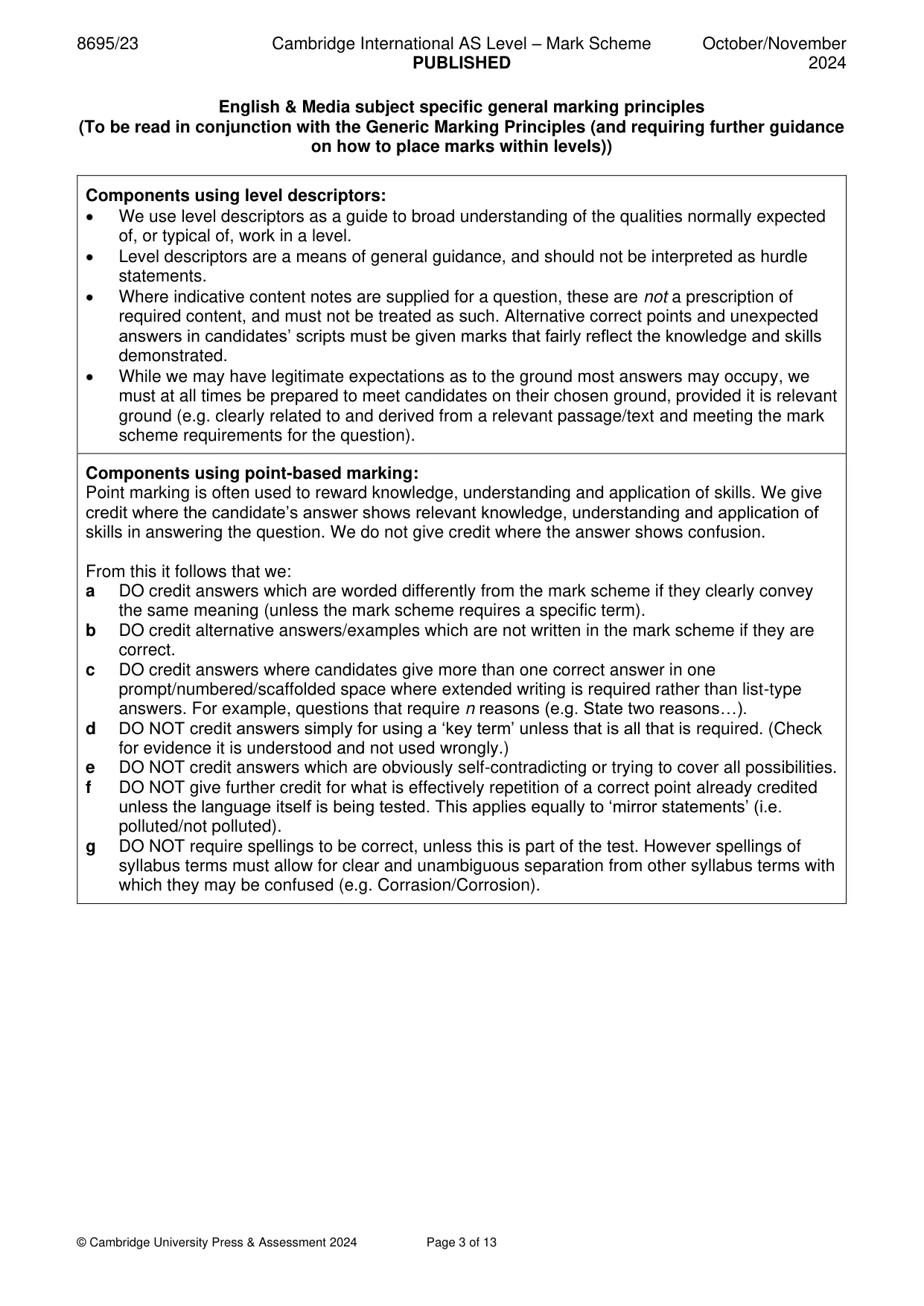
8695/23 Cambridge International AS Level – Mark Scheme PUBLISHED October/November 2024 © Cambridge University Press & Assessment 2024 Page 3 of 13 English & Media subject specific general marking principles (To be read in conjunction with the Generic Marking Principles (and requiring further guidance on how to place marks within levels)) Components using level descriptors: • We use level descriptors as a guide to broad understanding of the qualities normally expected of, or typical of, work in a level. • Level descriptors are a means of general guidance, and should not be interpreted as hurdle statements. • Where indicative content notes are supplied for a question, these are not a prescription of required content, and must not be treated as such. Alternative correct points and unexpected answers in candidates’ scripts must be given marks that fairly reflect the knowledge and skills demonstrated. • While we may have legitimate expectations as to the ground most answers may occupy, we must at all times be prepared to meet candidates on their chosen ground, provided it is relevant ground (e.g. clearly related to and derived from a relevant passage/text and meeting the mark scheme requirements for the question). Components using point-based marking: Point marking is often used to reward knowledge, understanding and application of skills. We give credit where the candidate’s answer shows relevant knowledge, understanding and application of skills in answering the question. We do not give credit where the answer shows confusion. From this it follows that we: a DO credit answers which are worded differently from the mark scheme if they clearly convey the same meaning (unless the mark scheme requires a specific term). b DO credit alternative answers/examples which are not written in the mark scheme if they are correct. c DO credit answers where candidates give more than one correct answer in one prompt/numbered/scaffolded space where extended writing is required rather than list-type answers. For example, questions that require n reasons (e.g. State two reasons…). d DO NOT credit answers simply for using a ‘key term’ unless that is all that is required. (Check for evidence it is understood and not used wrongly.) e DO NOT credit answers which are obviously self-contradicting or trying to cover all possibilities. f DO NOT give further credit for what is effectively repetition of a correct point already credited unless the language itself is being tested. This applies equally to ‘mirror statements’ (i.e. polluted/not polluted). g DO NOT require spellings to be correct, unless this is part of the test. However spellings of syllabus terms must allow for clear and unambiguous separation from other syllabus terms with which they may be confused (e.g. Corrasion/Corrosion).
Mark scheme, page 4
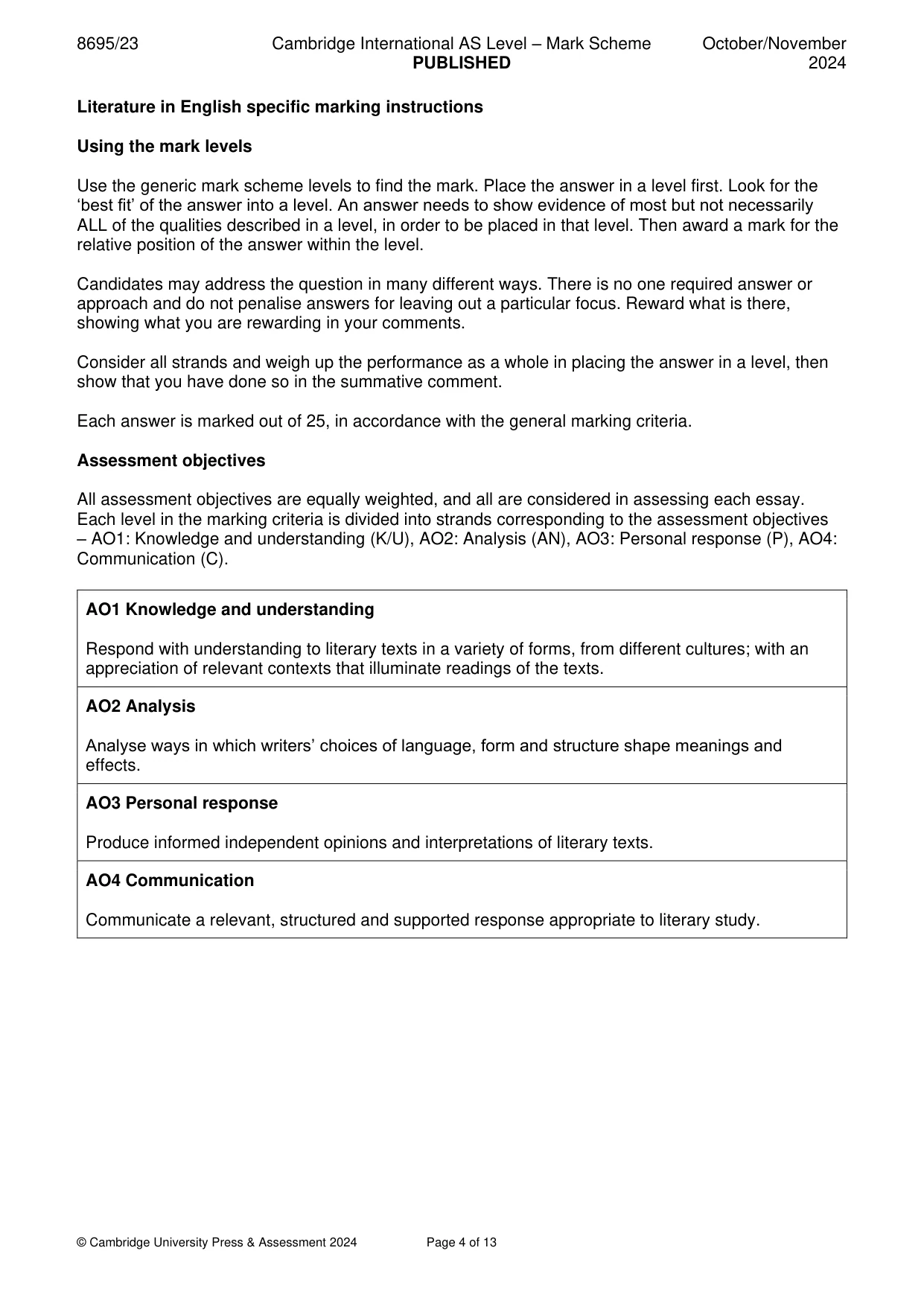
8695/23 Cambridge International AS Level – Mark Scheme PUBLISHED October/November 2024 © Cambridge University Press & Assessment 2024 Page 4 of 13 Literature in English specific marking instructions Using the mark levels Use the generic mark scheme levels to find the mark. Place the answer in a level first. Look for the ‘best fit’ of the answer into a level. An answer needs to show evidence of most but not necessarily ALL of the qualities described in a level, in order to be placed in that level. Then award a mark for the relative position of the answer within the level. Candidates may address the question in many different ways. There is no one required answer or approach and do not penalise answers for leaving out a particular focus. Reward what is there, showing what you are rewarding in your comments. Consider all strands and weigh up the performance as a whole in placing the answer in a level, then show that you have done so in the summative comment. Each answer is marked out of 25, in accordance with the general marking criteria. Assessment objectives All assessment objectives are equally weighted, and all are considered in assessing each essay. Each level in the marking criteria is divided into strands corresponding to the assessment objectives – AO1: Knowledge and understanding (K/U), AO2: Analysis (AN), AO3: Personal response (P), AO4: Communication (C). AO1 Knowledge and understanding Respond with understanding to literary texts in a variety of forms, from different cultures; with an appreciation of relevant contexts that illuminate readings of the texts. AO2 Analysis Analyse ways in which writers’ choices of language, form and structure shape meanings and effects. AO3 Personal response Produce informed independent opinions and interpretations of literary texts. AO4 Communication Communicate a relevant, structured and supported response appropriate to literary study.
Mark scheme, page 5
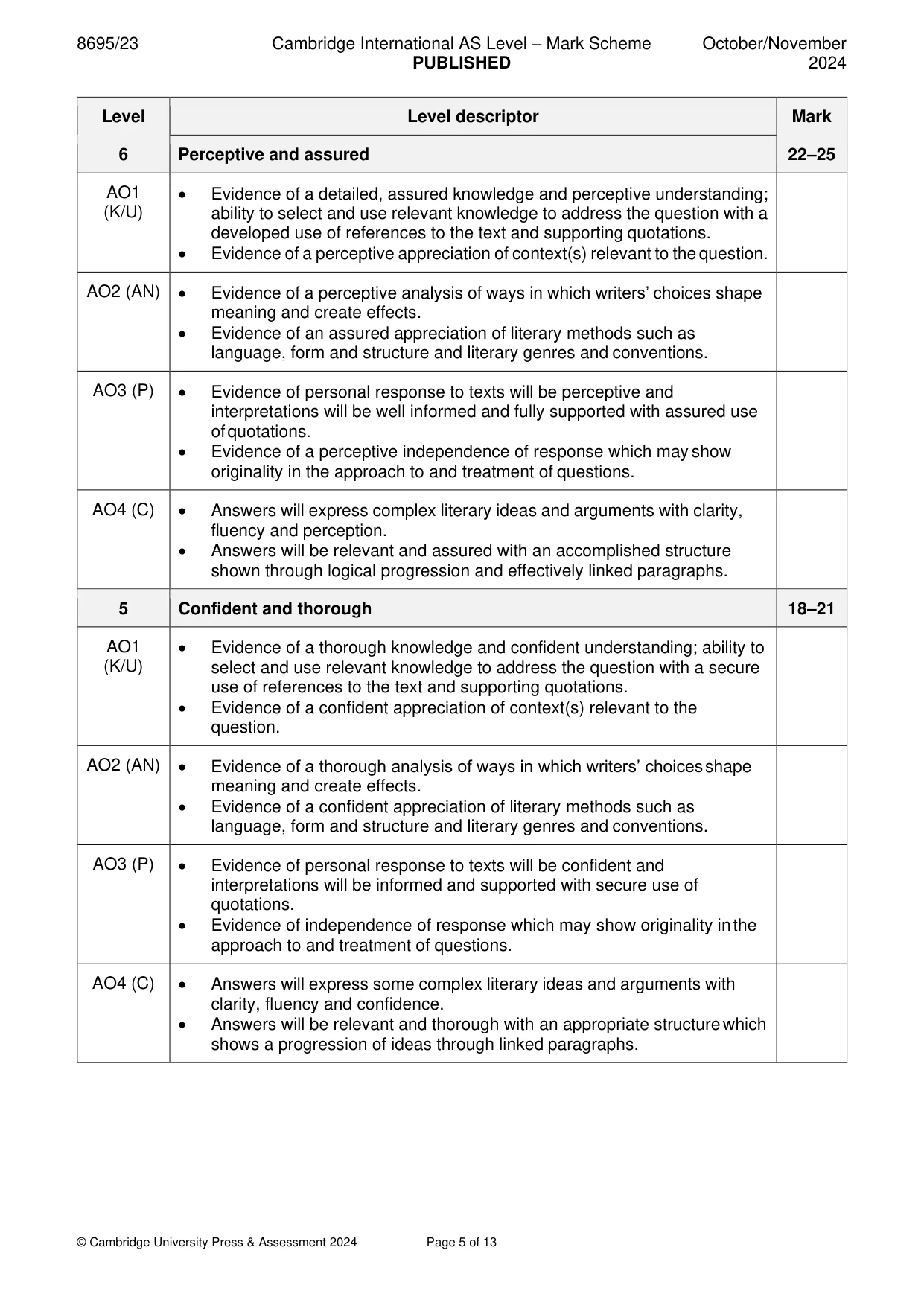
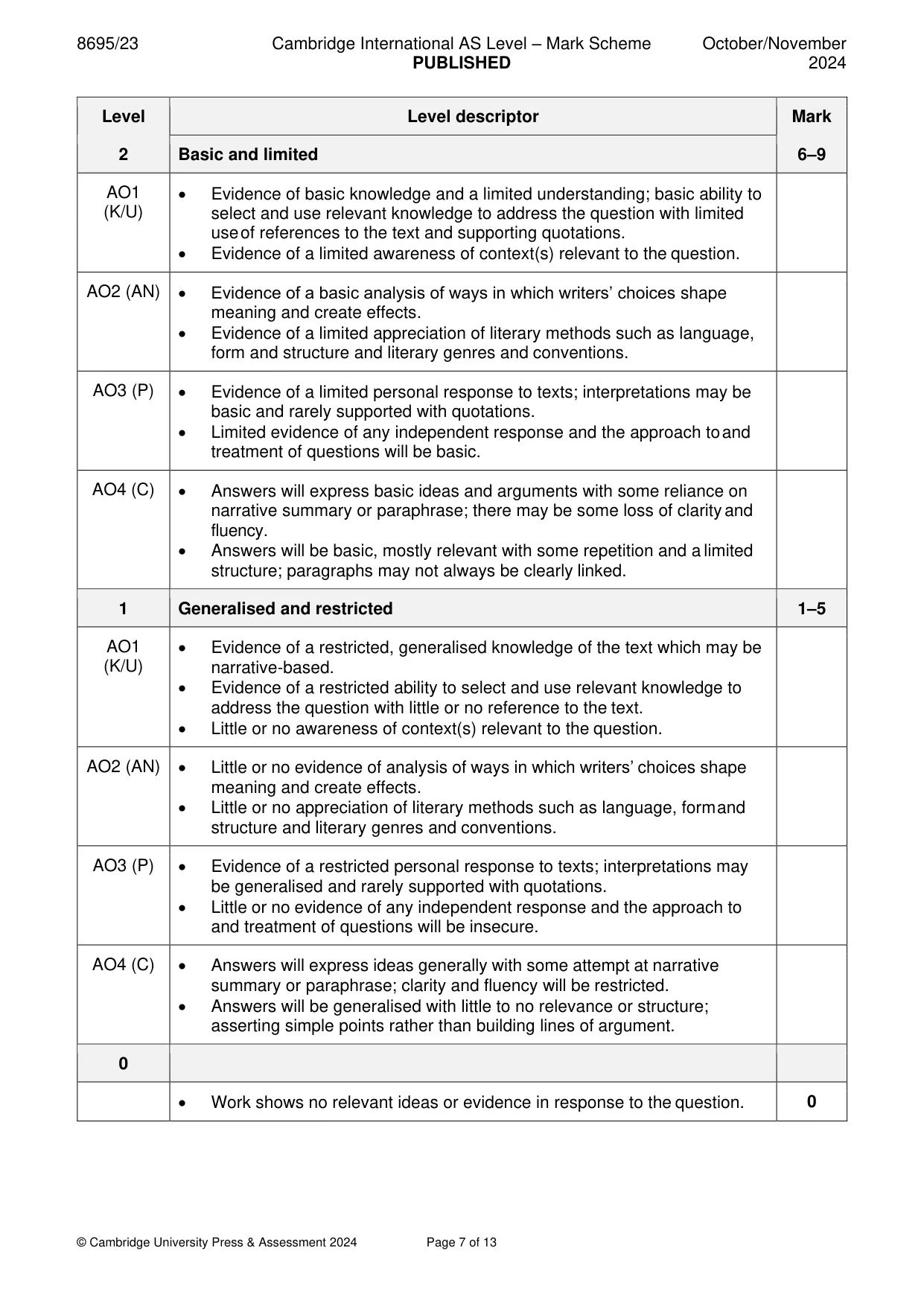
8695/23 Cambridge International AS Level – Mark Scheme PUBLISHED October/November 2024 © Cambridge University Press & Assessment 2024 Page 5 of 13 Level Level descriptor Mark 6 Perceptive and assured 22–25 AO1 (K/U) • Evidence of a detailed, assured knowledge and perceptive understanding; ability to select and use relevant knowledge to address the question with a developed use of references to the text and supporting quotations. • Evidence of a perceptive appreciation of context(s) relevant to the question. AO2 (AN) • Evidence of a perceptive analysis of ways in which writers’ choices shape meaning and create effects. • Evidence of an assured appreciation of literary methods such as language, form and structure and literary genres and conventions. AO3 (P) • Evidence of personal response to texts will be perceptive and interpretations will be well informed and fully supported with assured use of quotations. • Evidence of a perceptive independence of response which may show originality in the approach to and treatment of questions. AO4 (C) • Answers will express complex literary ideas and arguments with clarity, fluency and perception. • Answers will be relevant and assured with an accomplished structure shown through logical progression and effectively linked paragraphs. 5 Confident and thorough 18–21 AO1 (K/U) • Evidence of a thorough knowledge and confident understanding; ability to select and use relevant knowledge to address the question with a secure use of references to the text and supporting quotations. • Evidence of a confident appreciation of context(s) relevant to the question. AO2 (AN) • Evidence of a thorough analysis of ways in which writers’ choices shape meaning and create effects. • Evidence of a confident appreciation of literary methods such as language, form and structure and literary genres and conventions. AO3 (P) • Evidence of personal response to texts will be confident and interpretations will be informed and supported with secure use of quotations. • Evidence of independence of response which may show originality in the approach to and treatment of questions. AO4 (C) • Answers will express some complex literary ideas and arguments with clarity, fluency and confidence. • Answers will be relevant and thorough with an appropriate structure which shows a progression of ideas through linked paragraphs.
Mark scheme, page 6
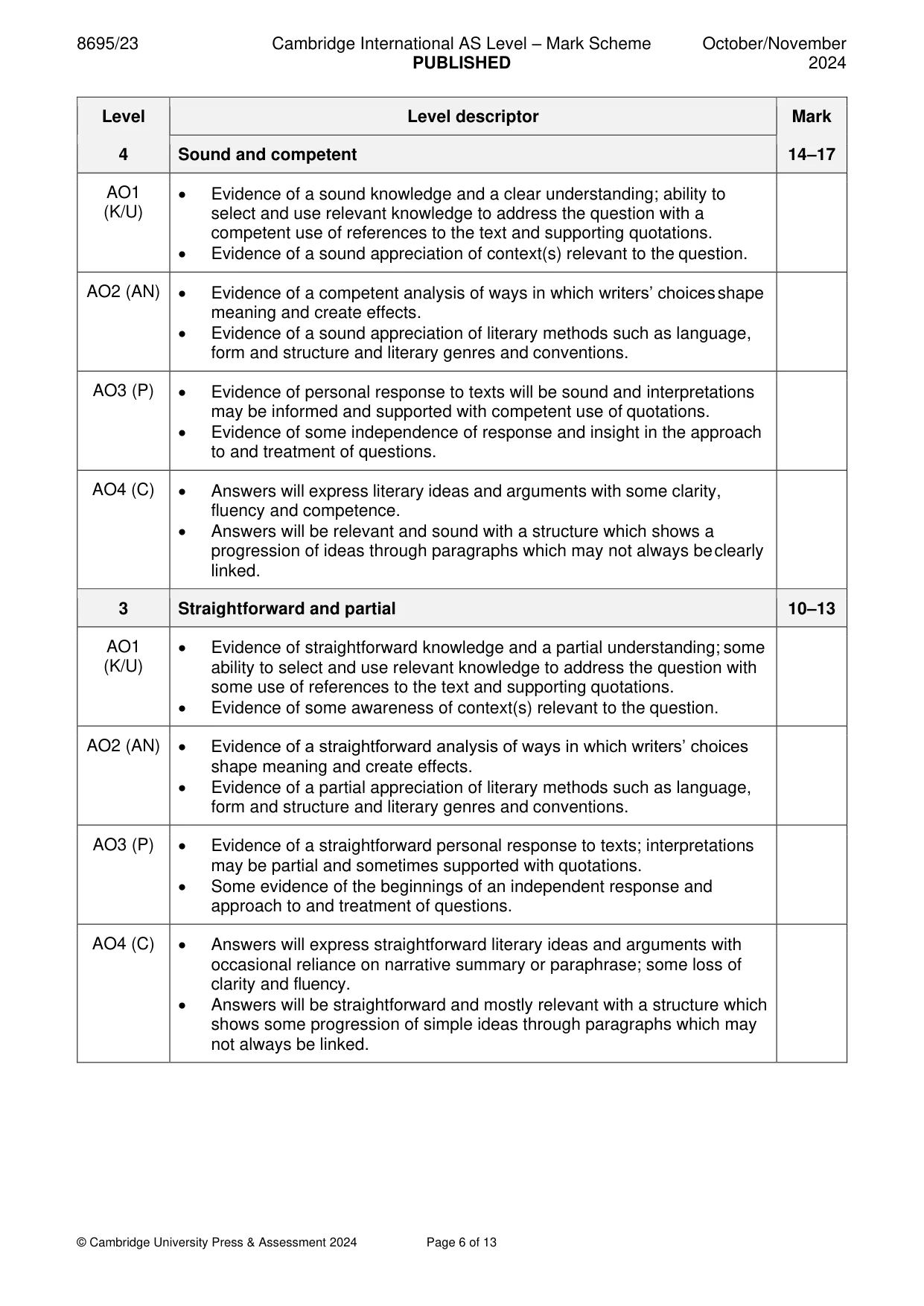
8695/23 Cambridge International AS Level – Mark Scheme PUBLISHED October/November 2024 © Cambridge University Press & Assessment 2024 Page 6 of 13 Level Level descriptor Mark 4 Sound and competent 14–17 AO1 (K/U) • Evidence of a sound knowledge and a clear understanding; ability to select and use relevant knowledge to address the question with a competent use of references to the text and supporting quotations. • Evidence of a sound appreciation of context(s) relevant to the question. AO2 (AN) • Evidence of a competent analysis of ways in which writers’ choices shape meaning and create effects. • Evidence of a sound appreciation of literary methods such as language, form and structure and literary genres and conventions. AO3 (P) • Evidence of personal response to texts will be sound and interpretations may be informed and supported with competent use of quotations. • Evidence of some independence of response and insight in the approach to and treatment of questions. AO4 (C) • Answers will express literary ideas and arguments with some clarity, fluency and competence. • Answers will be relevant and sound with a structure which shows a progression of ideas through paragraphs which may not always be clearly linked. 3 Straightforward and partial 10–13 AO1 (K/U) • Evidence of straightforward knowledge and a partial understanding; some ability to select and use relevant knowledge to address the question with some use of references to the text and supporting quotations. • Evidence of some awareness of context(s) relevant to the question. AO2 (AN) • Evidence of a straightforward analysis of ways in which writers’ choices shape meaning and create effects. • Evidence of a partial appreciation of literary methods such as language, form and structure and literary genres and conventions. AO3 (P) • Evidence of a straightforward personal response to texts; interpretations may be partial and sometimes supported with quotations. • Some evidence of the beginnings of an independent response and approach to and treatment of questions. AO4 (C) • Answers will express straightforward literary ideas and arguments with occasional reliance on narrative summary or paraphrase; some loss of clarity and fluency. • Answers will be straightforward and mostly relevant with a structure which shows some progression of simple ideas through paragraphs which may not always be linked.
Mark scheme, page 7
8695/23 Cambridge International AS Level – Mark Scheme PUBLISHED October/November 2024 © Cambridge University Press & Assessment 2024 Page 7 of 13 Level Level descriptor Mark 2 Basic and limited 6–9 AO1 (K/U) • Evidence of basic knowledge and a limited understanding; basic ability to select and use relevant knowledge to address the question with limited use of references to the text and supporting quotations. • Evidence of a limited awareness of context(s) relevant to the question. AO2 (AN) • Evidence of a basic analysis of ways in which writers’ choices shape meaning and create effects. • Evidence of a limited appreciation of literary methods such as language, form and structure and literary genres and conventions. AO3 (P) • Evidence of a limited personal response to texts; interpretations may be basic and rarely supported with quotations. • Limited evidence of any independent response and the approach to and treatment of questions will be basic. AO4 (C) • Answers will express basic ideas and arguments with some reliance on narrative summary or paraphrase; there may be some loss of clarity and fluency. • Answers will be basic, mostly relevant with some repetition and a limited structure; paragraphs may not always be clearly linked. 1 Generalised and restricted 1–5 AO1 (K/U) • Evidence of a restricted, generalised knowledge of the text which may be narrative-based. • Evidence of a restricted ability to select and use relevant knowledge to address the question with little or no reference to the text. • Little or no awareness of context(s) relevant to the question. AO2 (AN) • Little or no evidence of analysis of ways in which writers’ choices shape meaning and create effects. • Little or no appreciation of literary methods such as language, form and structure and literary genres and conventions. AO3 (P) • Evidence of a restricted personal response to texts; interpretations may be generalised and rarely supported with quotations. • Little or no evidence of any independent response and the approach to and treatment of questions will be insecure. AO4 (C) • Answers will express ideas generally with some attempt at narrative summary or paraphrase; clarity and fluency will be restricted. • Answers will be generalised with little to no relevance or structure; asserting simple points rather than building lines of argument. 0 • Work shows no relevant ideas or evidence in response to the question. 0
Mark scheme, page 8
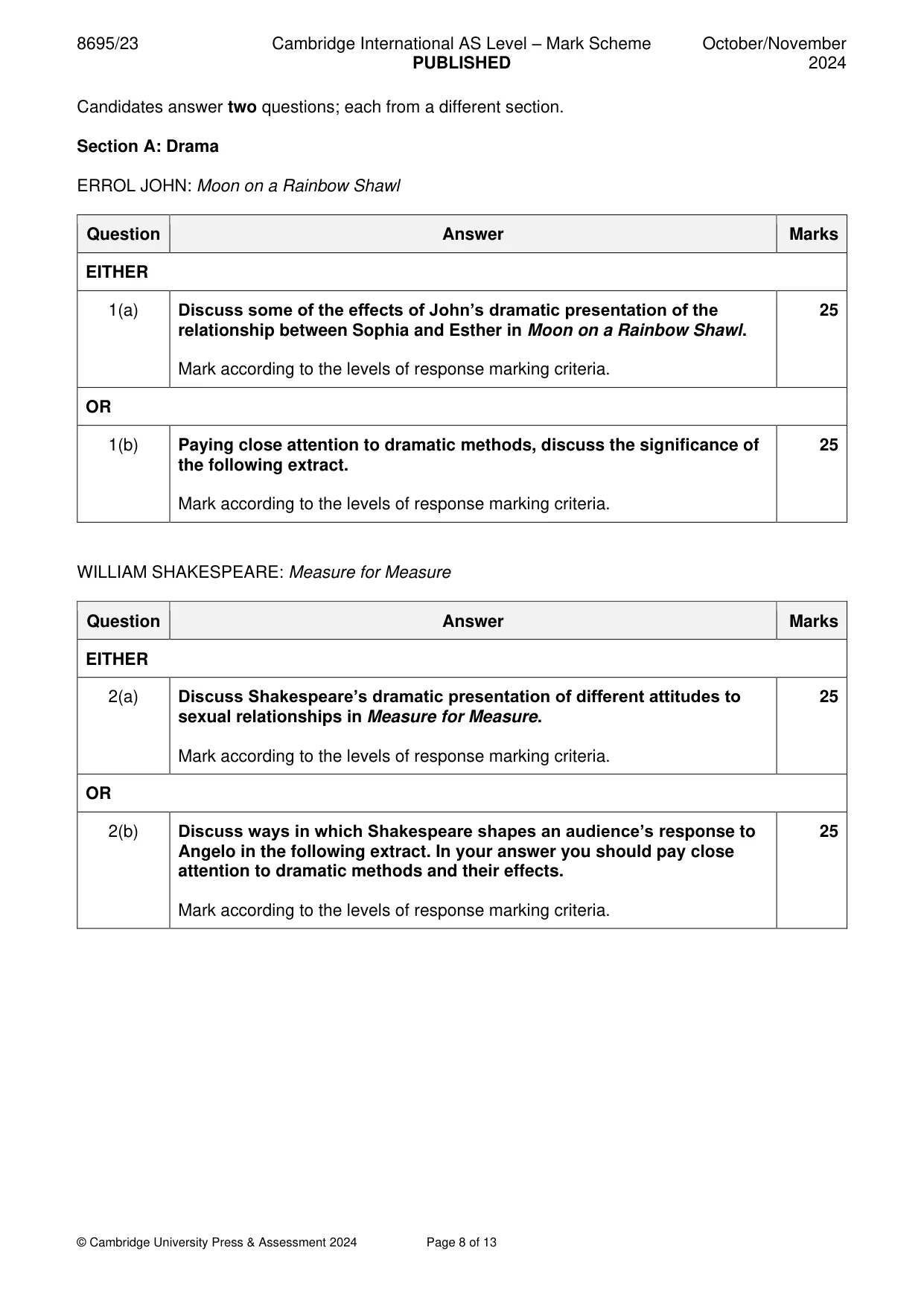
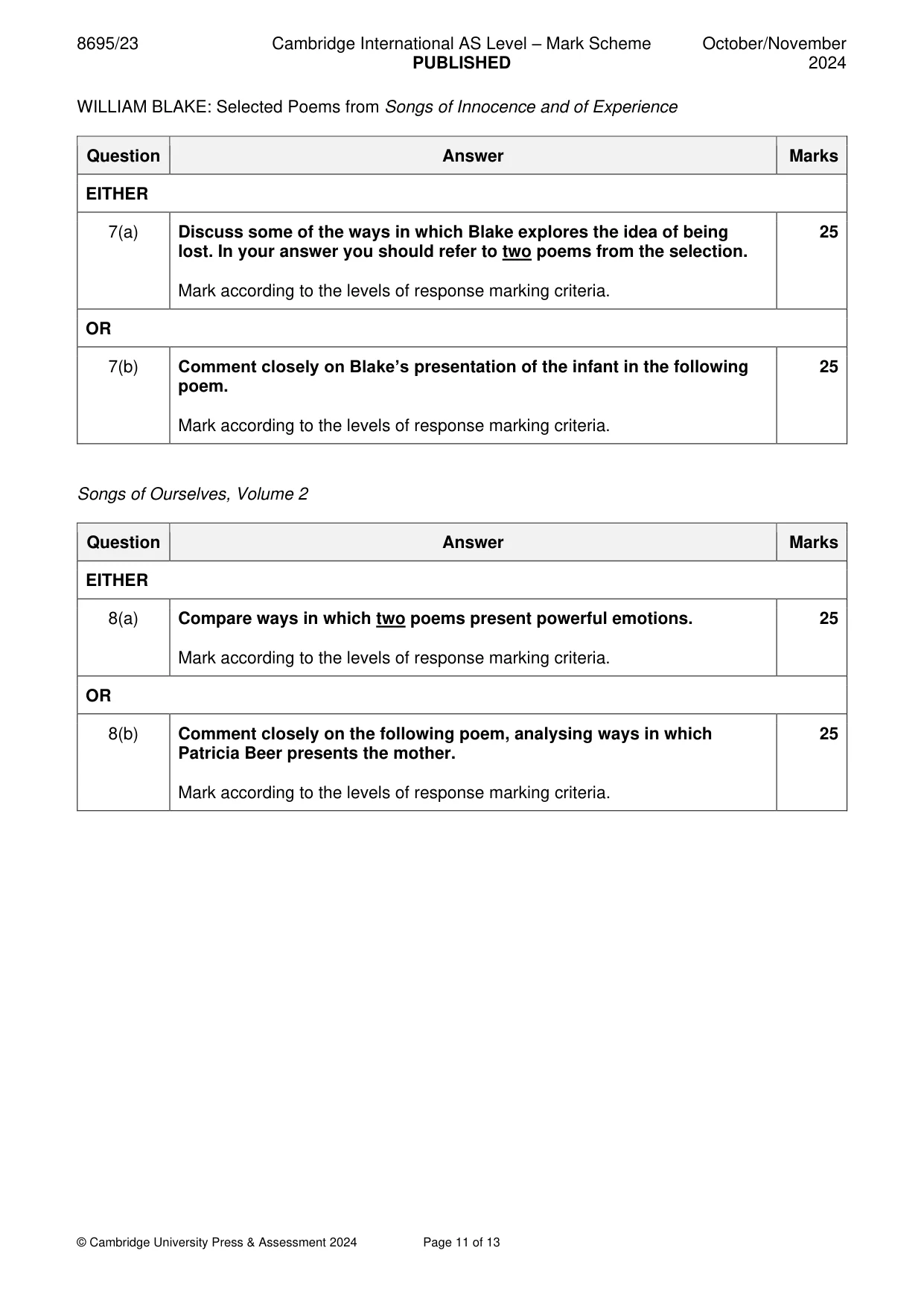
8695/23 Cambridge International AS Level – Mark Scheme PUBLISHED October/November 2024 © Cambridge University Press & Assessment 2024 Page 8 of 13 Candidates answer two questions; each from a different section. Section A: Drama ERROL JOHN: Moon on a Rainbow Shawl Question Answer Marks EITHER 1(a) Discuss some of the effects of John’s dramatic presentation of the relationship between Sophia and Esther in Moon on a Rainbow Shawl. Mark according to the levels of response marking criteria. 25 OR 1(b) Paying close attention to dramatic methods, discuss the significance of the following extract. Mark according to the levels of response marking criteria. 25 WILLIAM SHAKESPEARE: Measure for Measure Question Answer Marks EITHER 2(a) Discuss Shakespeare’s dramatic presentation of different attitudes to sexual relationships in Measure for Measure. Mark according to the levels of response marking criteria. 25 OR 2(b) Discuss ways in which Shakespeare shapes an audience’s response to Angelo in the following extract. In your answer you should pay close attention to dramatic methods and their effects. Mark according to the levels of response marking criteria. 25
Mark scheme, page 9
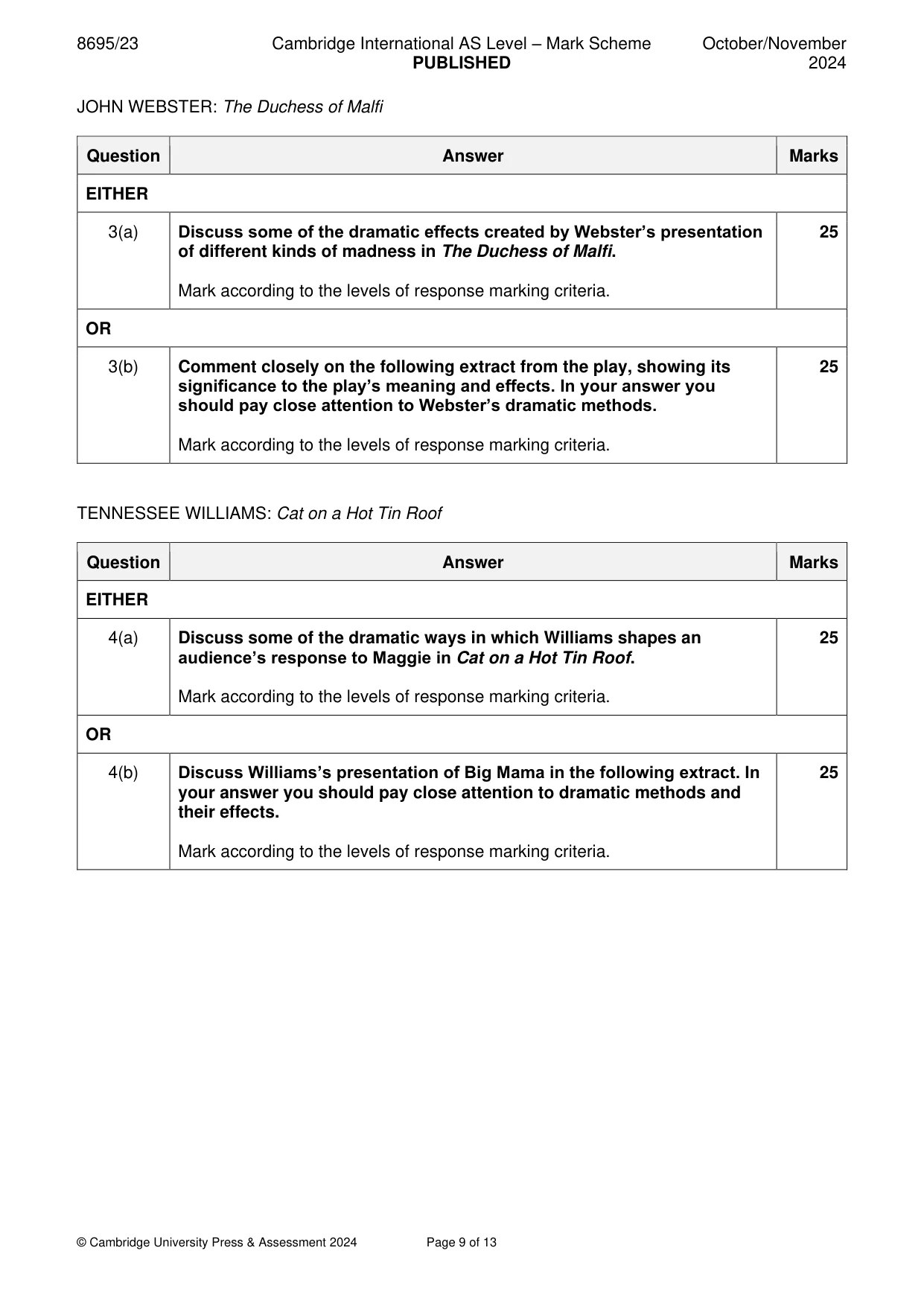
8695/23 Cambridge International AS Level – Mark Scheme PUBLISHED October/November 2024 © Cambridge University Press & Assessment 2024 Page 9 of 13 JOHN WEBSTER: The Duchess of Malfi Question Answer Marks EITHER 3(a) Discuss some of the dramatic effects created by Webster’s presentation of different kinds of madness in The Duchess of Malfi. Mark according to the levels of response marking criteria. 25 OR 3(b) Comment closely on the following extract from the play, showing its significance to the play’s meaning and effects. In your answer you should pay close attention to Webster’s dramatic methods. Mark according to the levels of response marking criteria. 25 TENNESSEE WILLIAMS: Cat on a Hot Tin Roof Question Answer Marks EITHER 4(a) Discuss some of the dramatic ways in which Williams shapes an audience’s response to Maggie in Cat on a Hot Tin Roof. Mark according to the levels of response marking criteria. 25 OR 4(b) Discuss Williams’s presentation of Big Mama in the following extract. In your answer you should pay close attention to dramatic methods and their effects. Mark according to the levels of response marking criteria. 25
Mark scheme, page 10
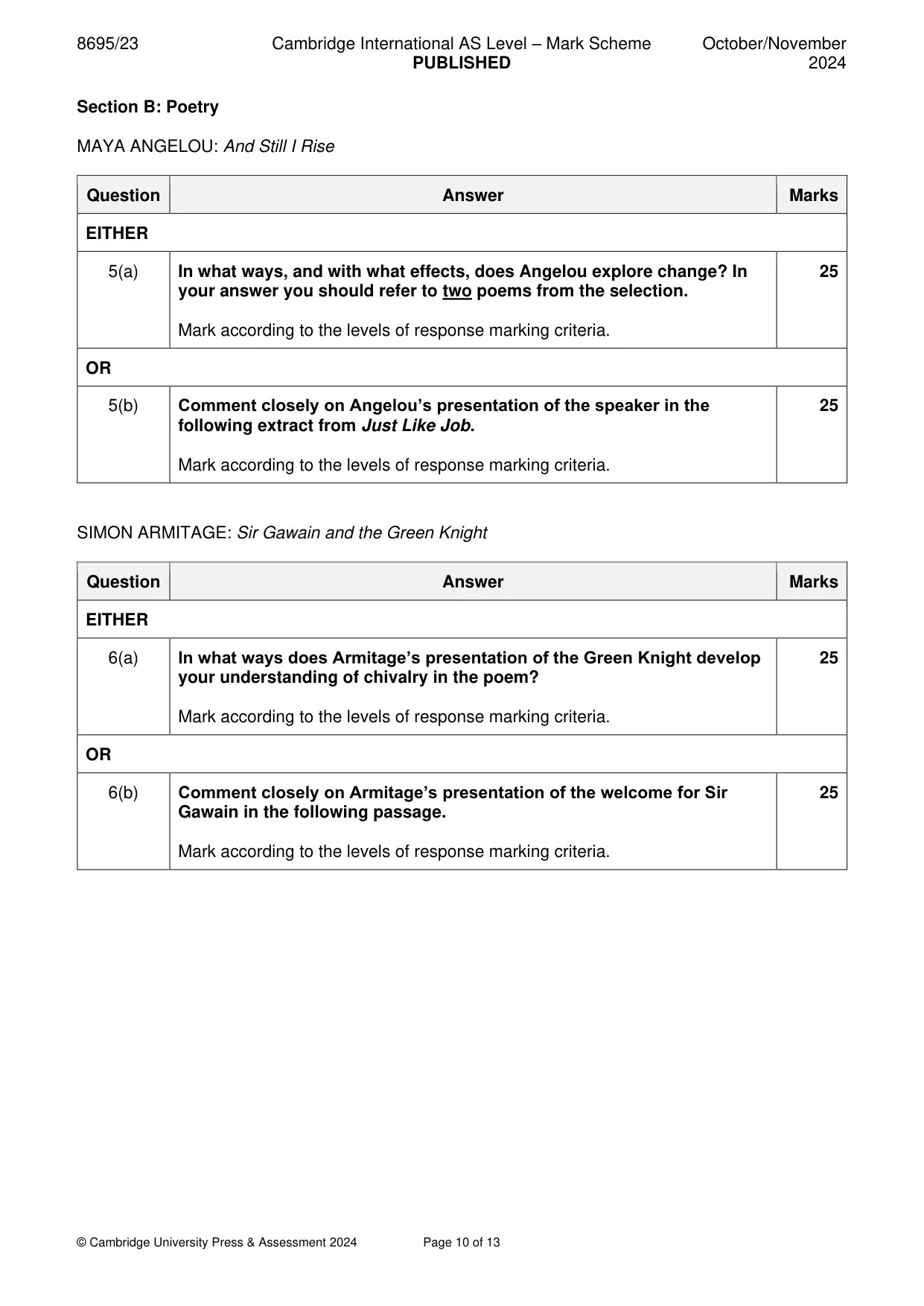
8695/23 Cambridge International AS Level – Mark Scheme PUBLISHED October/November 2024 © Cambridge University Press & Assessment 2024 Page 10 of 13 Section B: Poetry MAYA ANGELOU: And Still I Rise Question Answer Marks EITHER 5(a) In what ways, and with what effects, does Angelou explore change? In your answer you should refer to two poems from the selection. Mark according to the levels of response marking criteria. 25 OR 5(b) Comment closely on Angelou’s presentation of the speaker in the following extract from Just Like Job. Mark according to the levels of response marking criteria. 25 SIMON ARMITAGE: Sir Gawain and the Green Knight Question Answer Marks EITHER 6(a) In what ways does Armitage’s presentation of the Green Knight develop your understanding of chivalry in the poem? Mark according to the levels of response marking criteria. 25 OR 6(b) Comment closely on Armitage’s presentation of the welcome for Sir Gawain in the following passage. Mark according to the levels of response marking criteria. 25
Mark scheme, page 11
8695/23 Cambridge International AS Level – Mark Scheme PUBLISHED October/November 2024 © Cambridge University Press & Assessment 2024 Page 11 of 13 WILLIAM BLAKE: Selected Poems from Songs of Innocence and of Experience Question Answer Marks EITHER 7(a) Discuss some of the ways in which Blake explores the idea of being lost. In your answer you should refer to two poems from the selection. Mark according to the levels of response marking criteria. 25 OR 7(b) Comment closely on Blake’s presentation of the infant in the following poem. Mark according to the levels of response marking criteria. 25 Songs of Ourselves, Volume 2 Question Answer Marks EITHER 8(a) Compare ways in which two poems present powerful emotions. Mark according to the levels of response marking criteria. 25 OR 8(b) Comment closely on the following poem, analysing ways in which Patricia Beer presents the mother. Mark according to the levels of response marking criteria. 25
Mark scheme, page 12
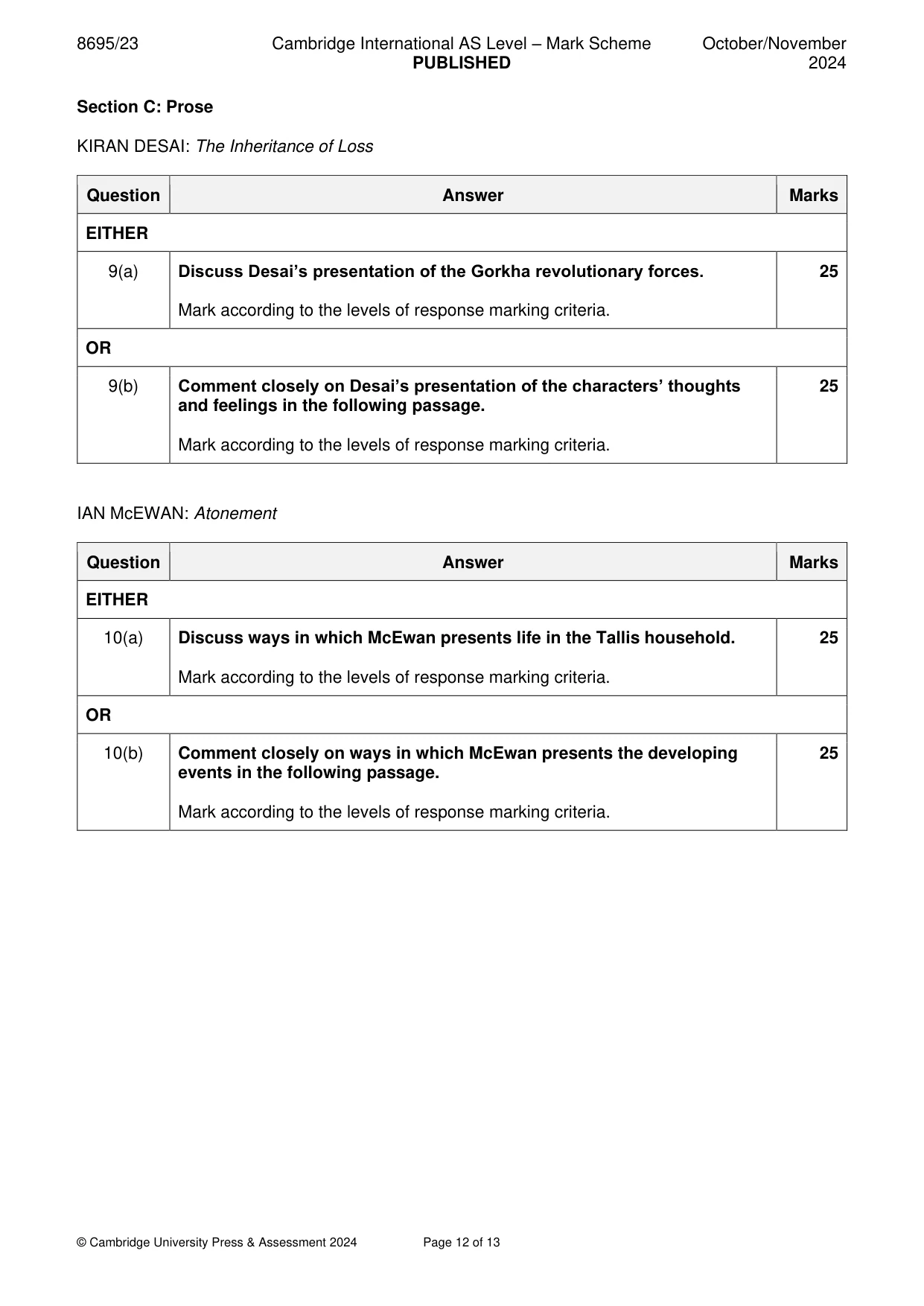
8695/23 Cambridge International AS Level – Mark Scheme PUBLISHED October/November 2024 © Cambridge University Press & Assessment 2024 Page 12 of 13 Section C: Prose KIRAN DESAI: The Inheritance of Loss Question Answer Marks EITHER 9(a) Discuss Desai’s presentation of the Gorkha revolutionary forces. Mark according to the levels of response marking criteria. 25 OR 9(b) Comment closely on Desai’s presentation of the characters’ thoughts and feelings in the following passage. Mark according to the levels of response marking criteria. 25 IAN McEWAN: Atonement Question Answer Marks EITHER 10(a) Discuss ways in which McEwan presents life in the Tallis household. Mark according to the levels of response marking criteria. 25 OR 10(b) Comment closely on ways in which McEwan presents the developing events in the following passage. Mark according to the levels of response marking criteria. 25
Mark scheme, page 13
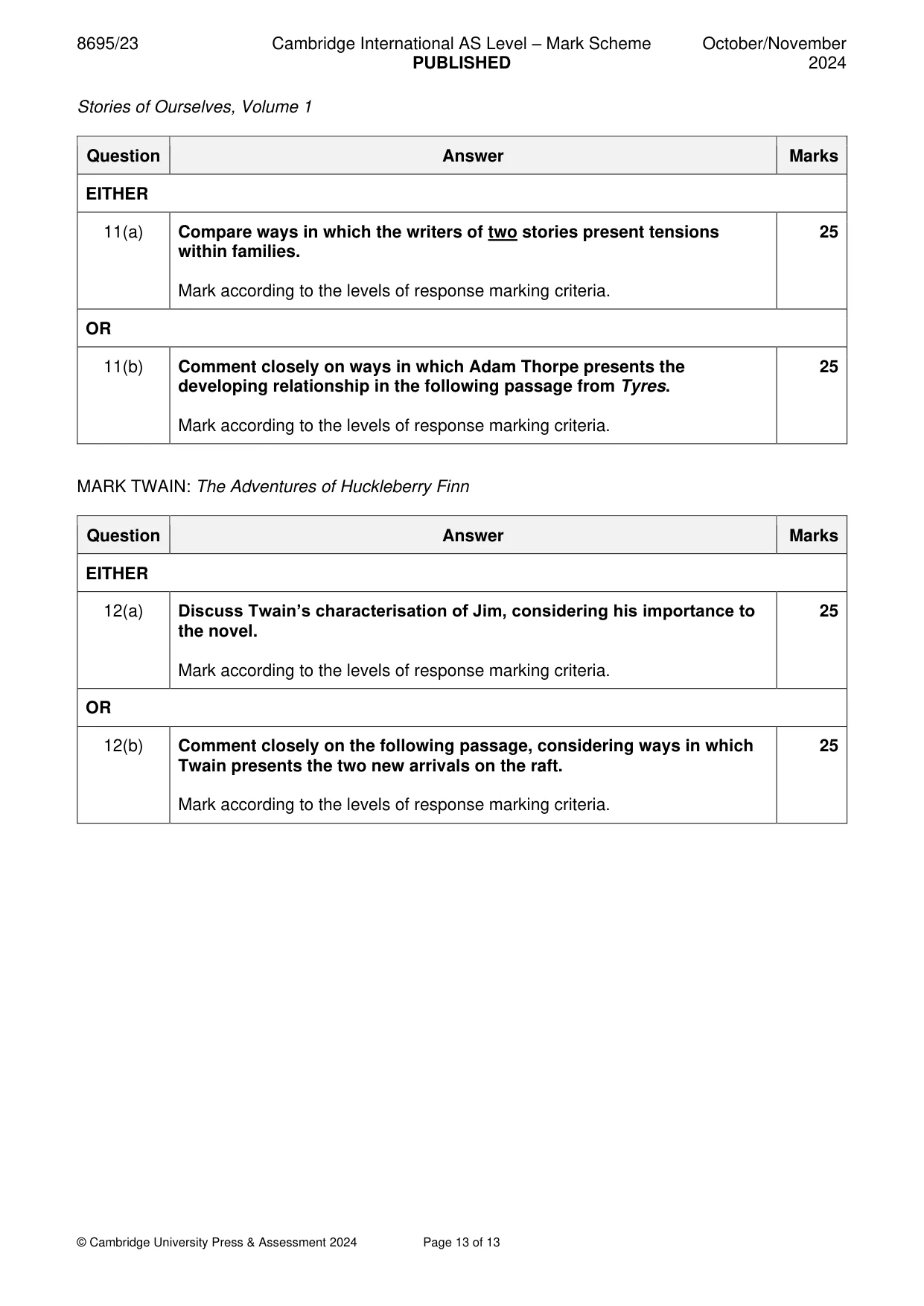
8695/23 Cambridge International AS Level – Mark Scheme PUBLISHED October/November 2024 © Cambridge University Press & Assessment 2024 Page 13 of 13 Stories of Ourselves, Volume 1 Question Answer Marks EITHER 11(a) Compare ways in which the writers of two stories present tensions within families. Mark according to the levels of response marking criteria. 25 OR 11(b) Comment closely on ways in which Adam Thorpe presents the developing relationship in the following passage from Tyres. Mark according to the levels of response marking criteria. 25 MARK TWAIN: The Adventures of Huckleberry Finn Question Answer Marks EITHER 12(a) Discuss Twain’s characterisation of Jim, considering his importance to the novel. Mark according to the levels of response marking criteria. 25 OR 12(b) Comment closely on the following passage, considering ways in which Twain presents the two new arrivals on the raft. Mark according to the levels of response marking criteria. 25
What you needed in this session
Cambridge’s own grade thresholds for 2024 Oct/Nov, Paper 2 · Variant 3. A higher threshold means an easier paper — the bar moves with how the cohort did.