Cambridge A Level English - Language and Literature (AS Level only, from 2016) 8695 — 2023 May/June Paper 2 · Variant 3
8695/23/M/J/23 · 50 marks · ≈56 min
The question paper and its mark scheme, free to read here and free to download. This is Cambridge’s own paper, exactly as it was sat.
Question paper20 pages
Mark scheme13 pages
Answers below. Sit the paper first if you are practising.
Paper as text
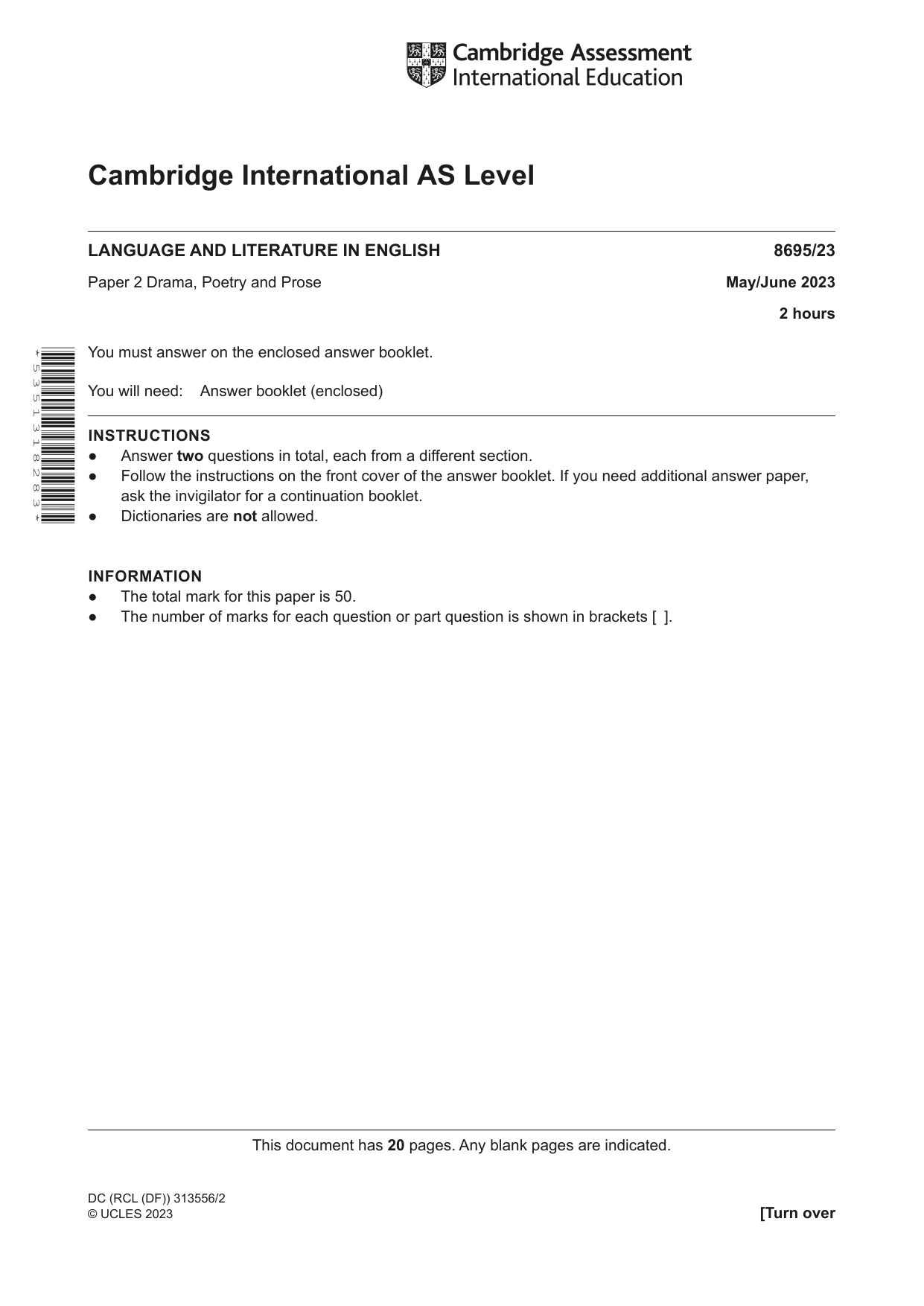
Question paper, page 1
This document has 20 pages. Any blank pages are indicated. [Turn over Cambridge International AS Level * 5 3 5 1 3 1 8 2 8 3 * DC (RCL (DF)) 313556/2 © UCLES 2023 LANGUAGE AND LITERATURE IN ENGLISH 8695/23 Paper 2 Drama, Poetry and Prose May/June 2023 2 hours You must answer on the enclosed answer booklet. You will need: Answer booklet (enclosed) INSTRUCTIONS ● Answer two questions in total, each from a different section. ● Follow the instructions on the front cover of the answer booklet. If you need additional answer paper, ask the invigilator for a continuation booklet. ● Dictionaries are not allowed. INFORMATION ● The total mark for this paper is 50. ● The number of marks for each question or part question is shown in brackets [ ].
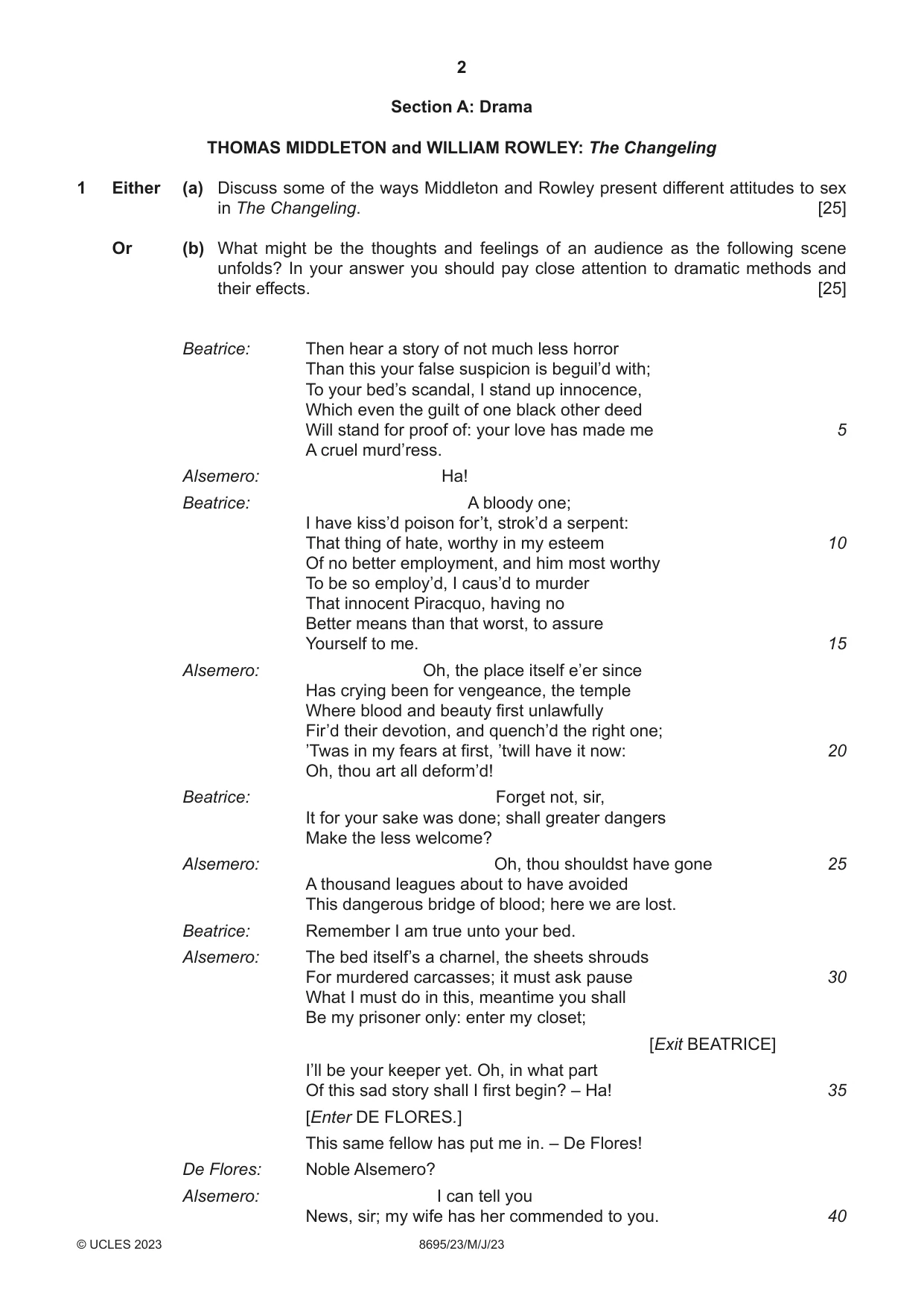
Question paper, page 2
2 8695/23/M/J/23 © UCLES 2023 Section A: Drama THOMAS MIDDLETON and WILLIAM ROWLEY: The Changeling 1 Either (a) Discuss some of the ways Middleton and Rowley present different attitudes to sex in The Changeling. [25] Or (b) What might be the thoughts and feelings of an audience as the following scene unfolds? In your answer you should pay close attention to dramatic methods and their effects. [25] Beatrice: Then hear a story of not much less horror Than this your false suspicion is beguil’d with; To your bed’s scandal, I stand up innocence, Which even the guilt of one black other deed Will stand for proof of: your love has made me A cruel murd’ress. Alsemero: Ha! Beatrice: A bloody one; I have kiss’d poison for’t, strok’d a serpent: That thing of hate, worthy in my esteem Of no better employment, and him most worthy To be so employ’d, I caus’d to murder That innocent Piracquo, having no Better means than that worst, to assure Yourself to me. Alsemero: Oh, the place itself e’er since Has crying been for vengeance, the temple Where blood and beauty first unlawfully Fir’d their devotion, and quench’d the right one; ’Twas in my fears at first, ’twill have it now: Oh, thou art all deform’d! Beatrice: Forget not, sir, It for your sake was done; shall greater dangers Make the less welcome? Alsemero: Oh, thou shouldst have gone A thousand leagues about to have avoided This dangerous bridge of blood; here we are lost. Beatrice: Remember I am true unto your bed. Alsemero: The bed itself’s a charnel, the sheets shrouds For murdered carcasses; it must ask pause What I must do in this, meantime you shall Be my prisoner only: enter my closet; [Exit BEATRICE] I’ll be your keeper yet. Oh, in what part Of this sad story shall I first begin? – Ha! [Enter DE FLORES.] This same fellow has put me in. – De Flores! De Flores: Noble Alsemero? Alsemero: I can tell you News, sir; my wife has her commended to you. 5 10 15 20 25 30 35 40
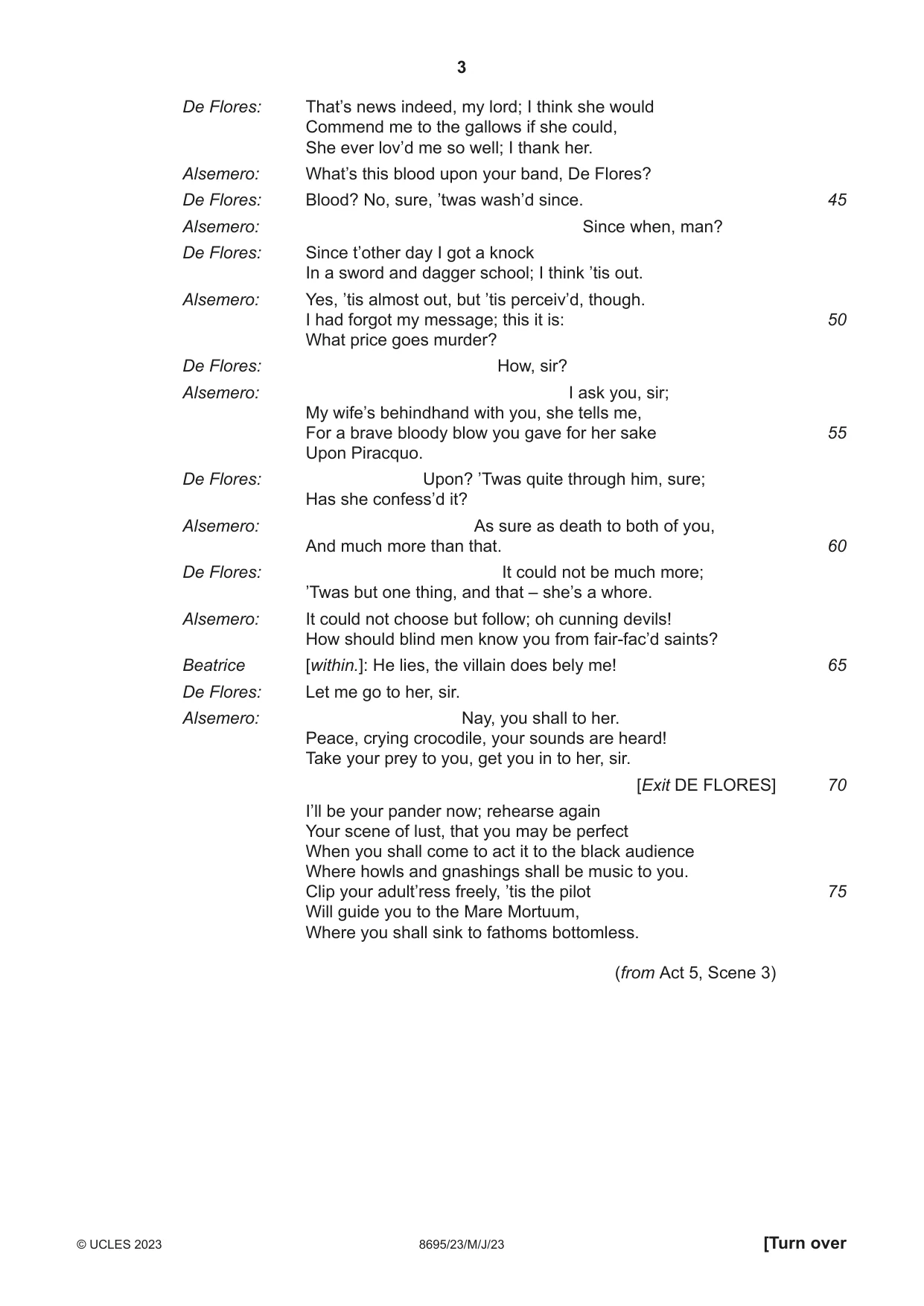
Question paper, page 3
3 8695/23/M/J/23 © UCLES 2023 [Turn over De Flores: That’s news indeed, my lord; I think she would Commend me to the gallows if she could, She ever lov’d me so well; I thank her. Alsemero: What’s this blood upon your band, De Flores? De Flores: Blood? No, sure, ’twas wash’d since. Alsemero: Since when, man? De Flores: Since t’other day I got a knock In a sword and dagger school; I think ’tis out. Alsemero: Yes, ’tis almost out, but ’tis perceiv’d, though. I had forgot my message; this it is: What price goes murder? De Flores: How, sir? Alsemero: I ask you, sir; My wife’s behindhand with you, she tells me, For a brave bloody blow you gave for her sake Upon Piracquo. De Flores: Upon? ’Twas quite through him, sure; Has she confess’d it? Alsemero: As sure as death to both of you, And much more than that. De Flores: It could not be much more; ’Twas but one thing, and that – she’s a whore. Alsemero: It could not choose but follow; oh cunning devils! How should blind men know you from fair-fac’d saints? Beatrice [within.]: He lies, the villain does bely me! De Flores: Let me go to her, sir. Alsemero: Nay, you shall to her. Peace, crying crocodile, your sounds are heard! Take your prey to you, get you in to her, sir. [Exit DE FLORES] I’ll be your pander now; rehearse again Your scene of lust, that you may be perfect When you shall come to act it to the black audience Where howls and gnashings shall be music to you. Clip your adult’ress freely, ’tis the pilot Will guide you to the Mare Mortuum, Where you shall sink to fathoms bottomless. (from Act 5, Scene 3) 45 50 55 60 65 70 75
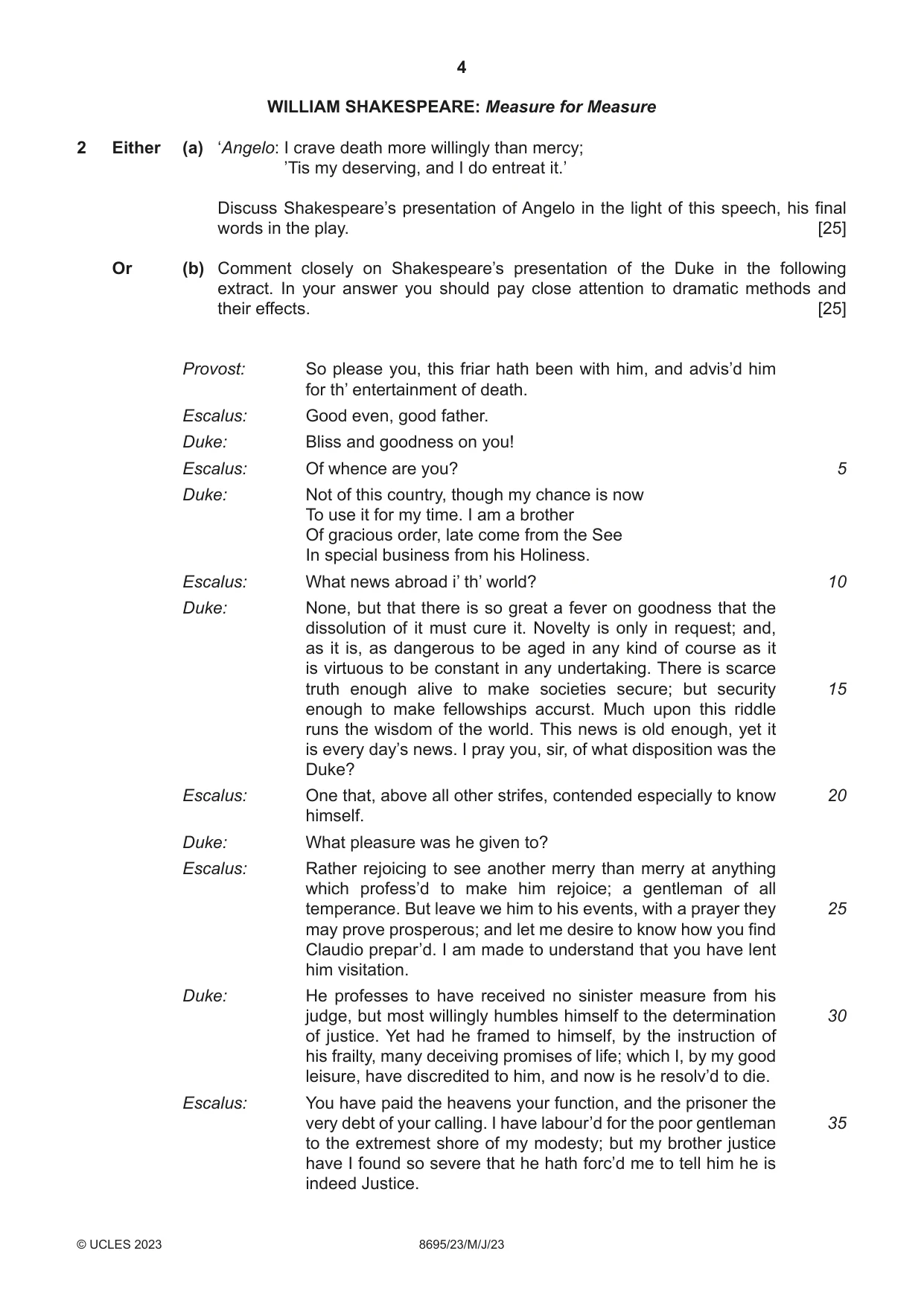
Question paper, page 4
4 8695/23/M/J/23 © UCLES 2023 WILLIAM SHAKESPEARE: Measure for Measure 2 Either (a) ‘Angelo: I crave death more willingly than mercy; ’Tis my deserving, and I do entreat it.’ Discuss Shakespeare’s presentation of Angelo in the light of this speech, his final words in the play. [25] Or (b) Comment closely on Shakespeare’s presentation of the Duke in the following extract. In your answer you should pay close attention to dramatic methods and their effects. [25] Provost: So please you, this friar hath been with him, and advis’d him for th’ entertainment of death. Escalus: Good even, good father. Duke: Bliss and goodness on you! Escalus: Οf whence are you? Duke: Not of this country, though my chance is now To use it for my time. I am a brother Of gracious order, late come from the See In special business from his Holiness. Escalus: What news abroad i’ th’ world? Duke: None, but that there is so great a fever on goodness that the dissolution of it must cure it. Novelty is only in request; and, as it is, as dangerous to be aged in any kind of course as it is virtuous to be constant in any undertaking. There is scarce truth enough alive to make societies secure; but security enough to make fellowships accurst. Much upon this riddle runs the wisdom of the world. This news is old enough, yet it is every day’s news. I pray you, sir, of what disposition was the Duke? Escalus: One that, above all other strifes, contended especially to know himself. Duke: What pleasure was he given to? Escalus: Rather rejoicing to see another merry than merry at anything which profess’d to make him rejoice; a gentleman of all temperance. But leave we him to his events, with a prayer they may prove prosperous; and let me desire to know how you find Claudio prepar’d. I am made to understand that you have lent him visitation. Duke: He professes to have received no sinister measure from his judge, but most willingly humbles himself to the determination of justice. Yet had he framed to himself, by the instruction of his frailty, many deceiving promises of life; which I, by my good leisure, have discredited to him, and now is he resolv’d to die. Escalus: You have paid the heavens your function, and the prisoner the very debt of your calling. I have labour’d for the poor gentleman to the extremest shore of my modesty; but my brother justice have I found so severe that he hath forc’d me to tell him he is indeed Justice. 5 10 15 20 25 30 35
Question paper, page 5
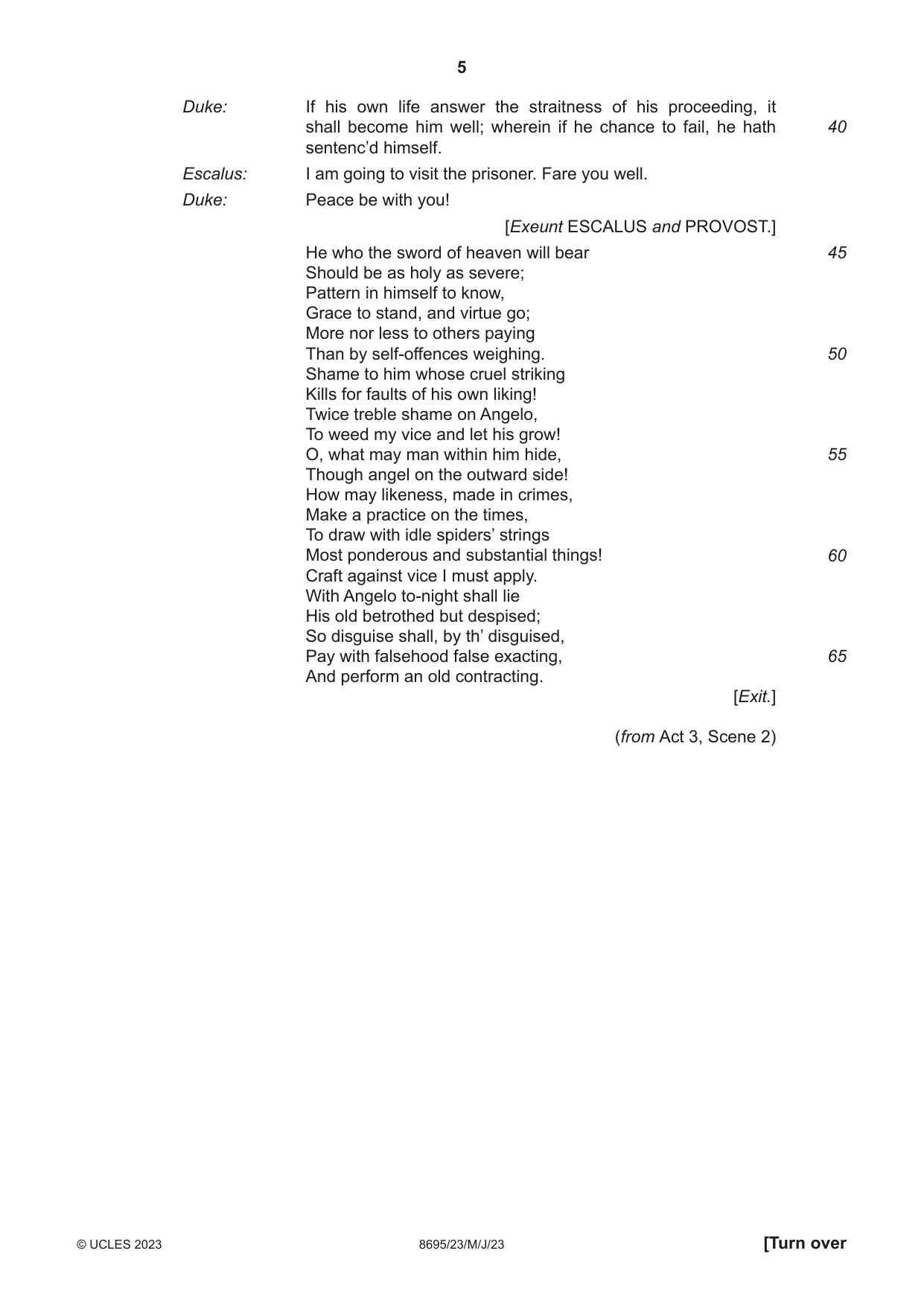
5 8695/23/M/J/23 © UCLES 2023 [Turn over Duke: If his own life answer the straitness of his proceeding, it shall become him well; wherein if he chance to fail, he hath sentenc’d himself. Escalus: I am going to visit the prisoner. Fare you well. Duke: Peace be with you! [Exeunt ESCALUS and PROVOST.] He who the sword of heaven will bear Should be as holy as severe; Pattern in himself to know, Grace to stand, and virtue go; More nor less to others paying Than by self-offences weighing. Shame to him whose cruel striking Kills for faults of his own liking! Twice treble shame on Angelo, To weed my vice and let his grow! O, what may man within him hide, Though angel on the outward side! How may likeness, made in crimes, Make a practice on the times, To draw with idle spiders’ strings Most ponderous and substantial things! Craft against vice I must apply. With Angelo to-night shall lie His old betrothed but despised; So disguise shall, by th’ disguised, Pay with falsehood false exacting, And perform an old contracting. [Exit.] (from Act 3, Scene 2) 40 45 50 55 60 65
Question paper, page 6
6 8695/23/M/J/23 © UCLES 2023 WOLE SOYINKA: The Trials of Brother Jero and Jero’s Metamorphosis 3 Either (a) Discuss some of the ways Soyinka presents different kinds of conflict in the two plays. [25] Or (b) Discuss Soyinka’s presentation of the relationship between Jero and Ananaias in the following extract. In your answer you should pay close attention to dramatic methods and their effects. [25] Jero: Violence will not help us. Content removed due to copyright restrictions.
Question paper, page 7
7 8695/23/M/J/23 © UCLES 2023 [Turn over Ananaias: I’ll support you, Brother, depend on my vote any time. (from Jero’s Metamorphosis, Scene 1) Content removed due to copyright restrictions.
Question paper, page 8
8 8695/23/M/J/23 © UCLES 2023 TENNESSEE WILLIAMS: Cat on a Hot Tin Roof 4 Either (a) Discuss Williams’s dramatic presentation of different attitudes to money and wealth in Cat on a Hot Tin Roof. [25] Or (b) Discuss the presentation of the relationship between Maggie (Margaret) and Brick in the following extract. In your answer you should pay close attention to dramatic methods and their effects. [25] Margaret: Think of it, Brick, they’ve got five of them and number six is coming. Content removed due to copyright restrictions.
Question paper, page 9
9 8695/23/M/J/23 © UCLES 2023 [Turn over Brick: I’m not in the movies. (from Act 1) Content removed due to copyright restrictions.
Question paper, page 10
10 8695/23/M/J/23 © UCLES 2023 Section B: Poetry SIMON ARMITAGE: Sir Gawain and the Green Knight 5 Either (a) Discuss some of the effects created by Armitage’s use of symbols in Sir Gawain and the Green Knight. [25] Or (b) Comment closely on ways Armitage presents the relationship between the Lady and Sir Gawain in the following extract from Sir Gawain and the Green Knight. [25] ‘I would like to learn,’ said the noble lady, to enmesh him in whatever mischief she had in mind. Content removed due to copyright restrictions.
Question paper, page 11
11 8695/23/M/J/23 © UCLES 2023 [Turn over TURN OVER FOR QUESTION 6.
Question paper, page 12
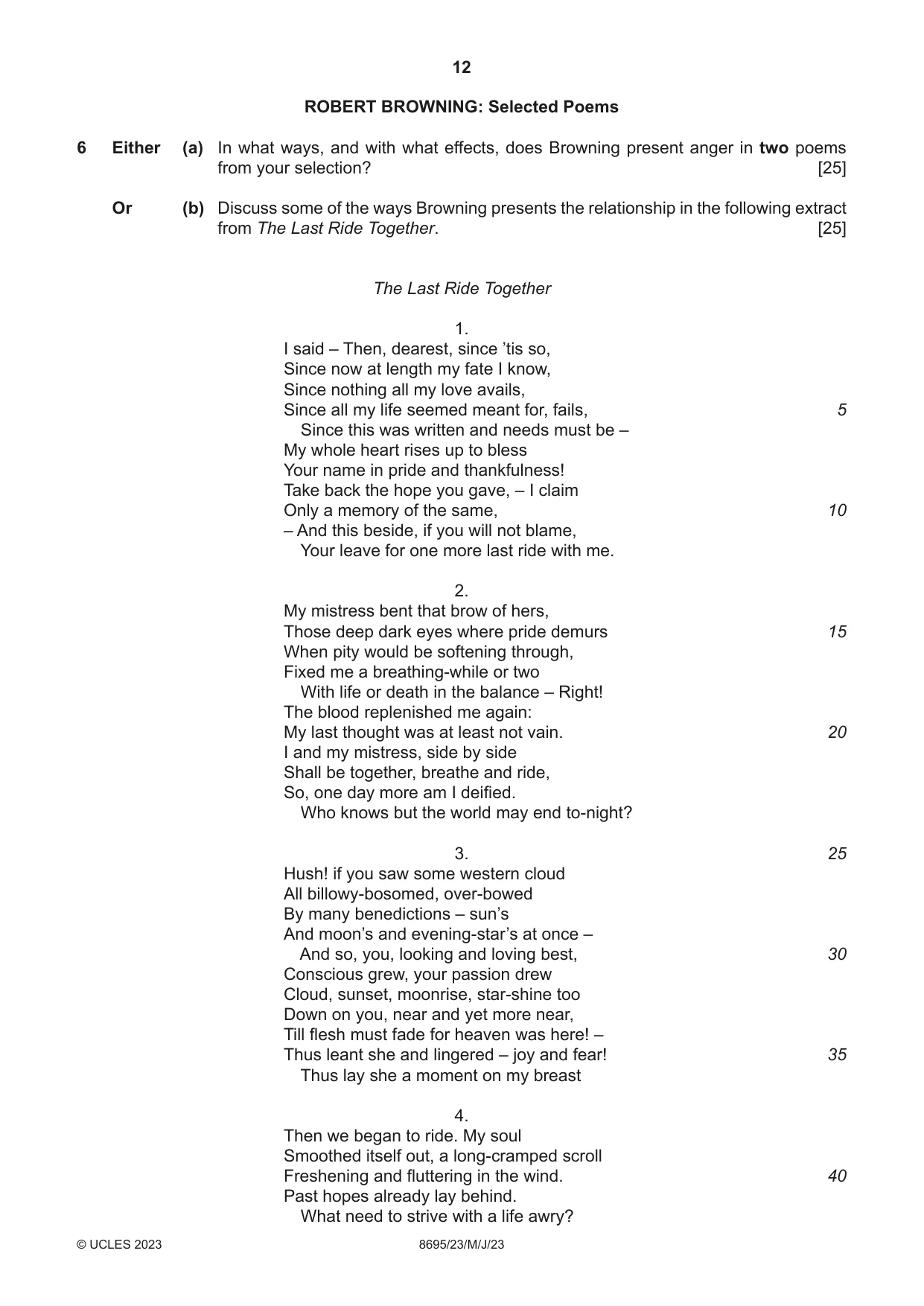
12 8695/23/M/J/23 © UCLES 2023 ROBERT BROWNING: Selected Poems 6 Either (a) In what ways, and with what effects, does Browning present anger in two poems from your selection? [25] Or (b) Discuss some of the ways Browning presents the relationship in the following extract from The Last Ride Together. [25] The Last Ride Together 1. I said – Then, dearest, since ’tis so, Since now at length my fate I know, Since nothing all my love avails, Since all my life seemed meant for, fails, Since this was written and needs must be – My whole heart rises up to bless Your name in pride and thankfulness! Take back the hope you gave, – I claim Only a memory of the same, – And this beside, if you will not blame, Your leave for one more last ride with me. 2. My mistress bent that brow of hers, Those deep dark eyes where pride demurs When pity would be softening through, Fixed me a breathing-while or two With life or death in the balance – Right! The blood replenished me again: My last thought was at least not vain. I and my mistress, side by side Shall be together, breathe and ride, So, one day more am I deified. Who knows but the world may end to-night? 3. Hush! if you saw some western cloud All billowy-bosomed, over-bowed By many benedictions – sun’s And moon’s and evening-star’s at once – And so, you, looking and loving best, Conscious grew, your passion drew Cloud, sunset, moonrise, star-shine too Down on you, near and yet more near, Till flesh must fade for heaven was here! – Thus leant she and lingered – joy and fear! Thus lay she a moment on my breast 4. Then we began to ride. My soul Smoothed itself out, a long-cramped scroll Freshening and fluttering in the wind. Past hopes already lay behind. What need to strive with a life awry? 5 10 15 20 25 30 35 40
Question paper, page 13
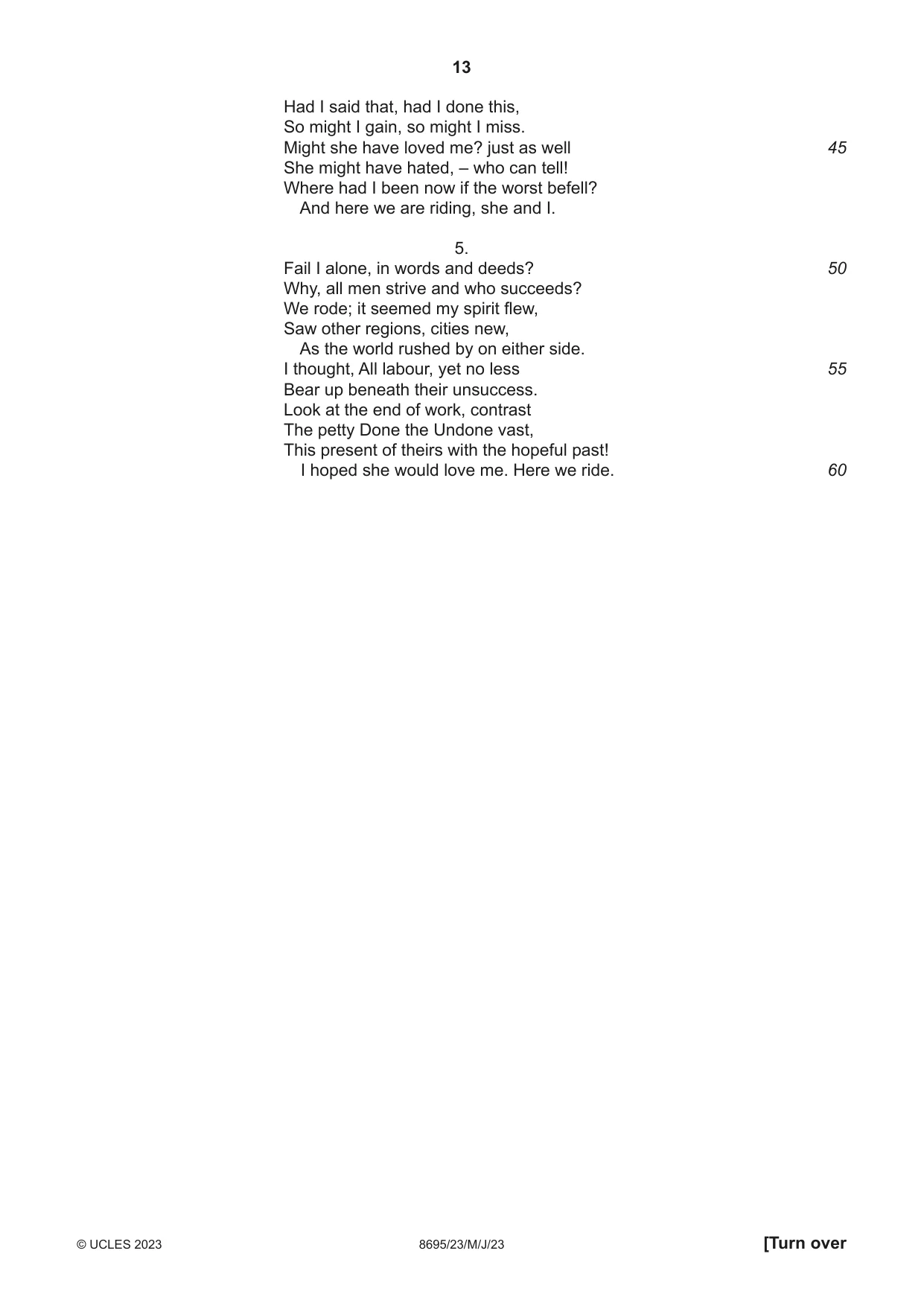
13 8695/23/M/J/23 © UCLES 2023 [Turn over Had I said that, had I done this, So might I gain, so might I miss. Might she have loved me? just as well She might have hated, – who can tell! Where had I been now if the worst befell? And here we are riding, she and I. 5. Fail I alone, in words and deeds? Why, all men strive and who succeeds? We rode; it seemed my spirit flew, Saw other regions, cities new, As the world rushed by on either side. I thought, All labour, yet no less Bear up beneath their unsuccess. Look at the end of work, contrast The petty Done the Undone vast, This present of theirs with the hopeful past! I hoped she would love me. Here we ride. 45 50 55 60
Question paper, page 14
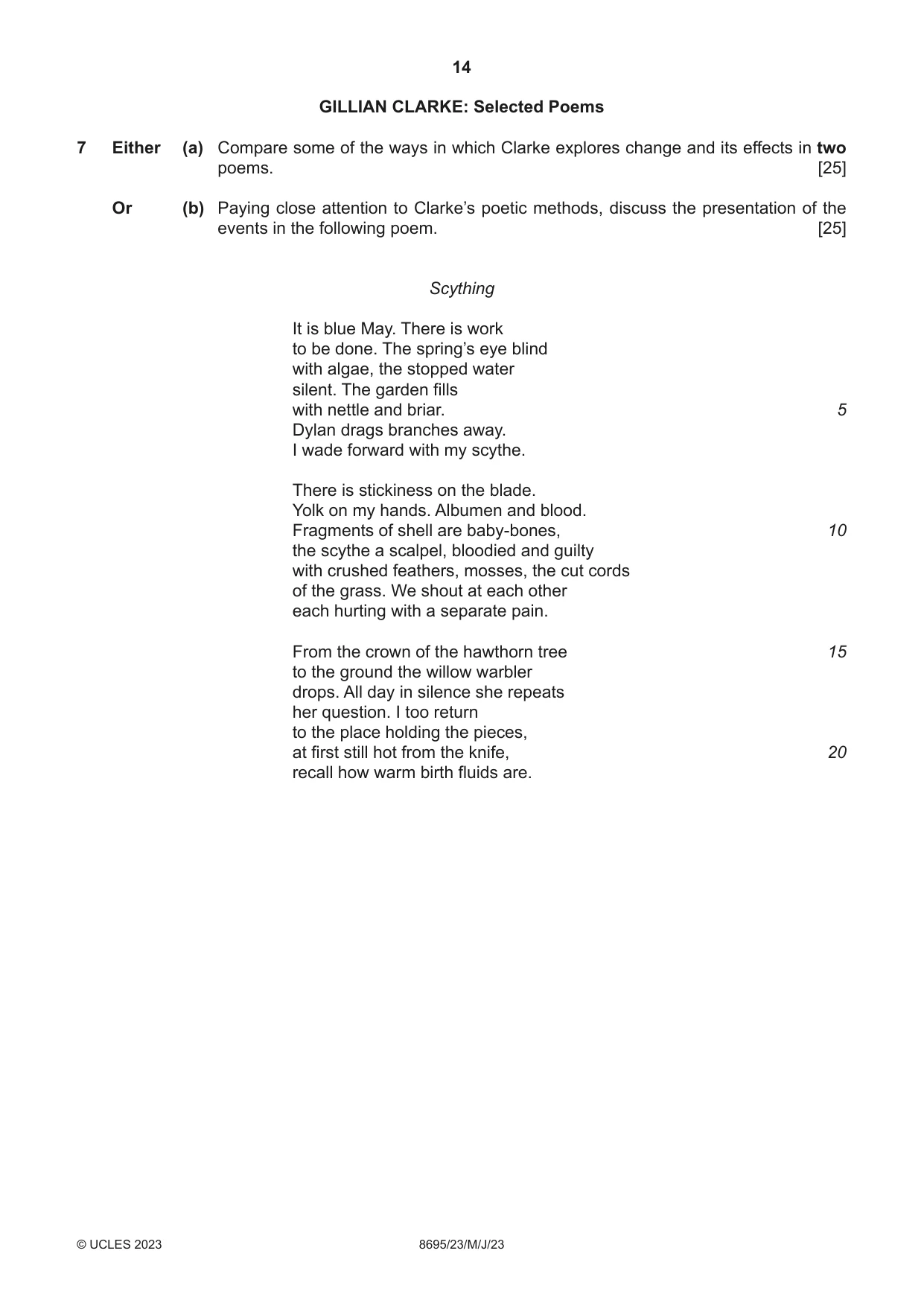
14 8695/23/M/J/23 © UCLES 2023 GILLIAN CLARKE: Selected Poems 7 Either (a) Compare some of the ways in which Clarke explores change and its effects in two poems. [25] Or (b) Paying close attention to Clarke’s poetic methods, discuss the presentation of the events in the following poem. [25] Scything It is blue May. There is work to be done. The spring’s eye blind with algae, the stopped water silent. The garden fills with nettle and briar. Dylan drags branches away. I wade forward with my scythe. There is stickiness on the blade. Yolk on my hands. Albumen and blood. Fragments of shell are baby-bones, the scythe a scalpel, bloodied and guilty with crushed feathers, mosses, the cut cords of the grass. We shout at each other each hurting with a separate pain. From the crown of the hawthorn tree to the ground the willow warbler drops. All day in silence she repeats her question. I too return to the place holding the pieces, at first still hot from the knife, recall how warm birth fluids are. 5 10 15 20
Question paper, page 15
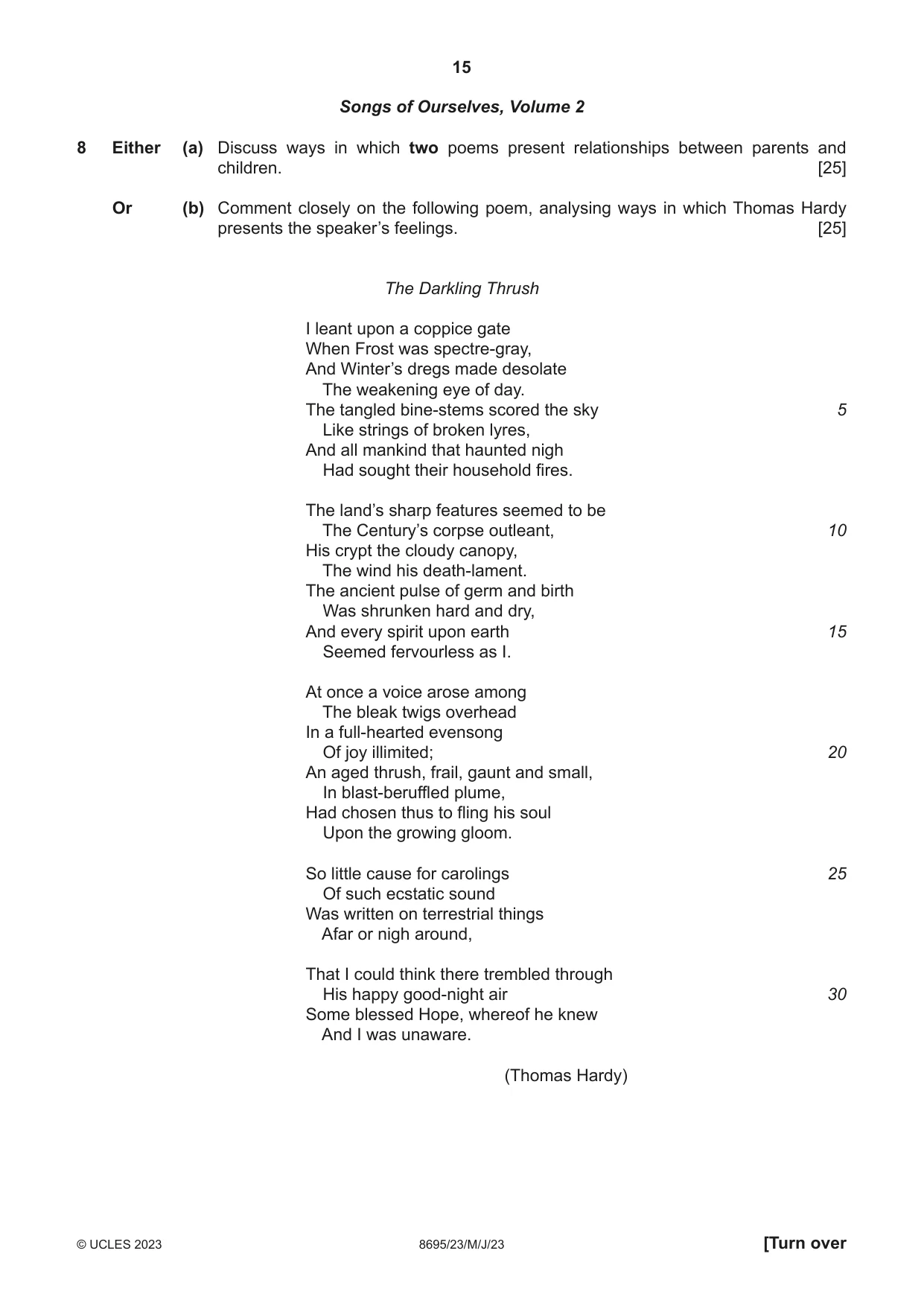
15 8695/23/M/J/23 © UCLES 2023 [Turn over Songs of Ourselves, Volume 2 8 Either (a) Discuss ways in which two poems present relationships between parents and children. [25] Or (b) Comment closely on the following poem, analysing ways in which Thomas Hardy presents the speaker’s feelings. [25] The Darkling Thrush I leant upon a coppice gate When Frost was spectre-gray, And Winter’s dregs made desolate The weakening eye of day. The tangled bine-stems scored the sky Like strings of broken lyres, And all mankind that haunted nigh Had sought their household fires. The land’s sharp features seemed to be The Century’s corpse outleant, His crypt the cloudy canopy, The wind his death-lament. The ancient pulse of germ and birth Was shrunken hard and dry, And every spirit upon earth Seemed fervourless as I. At once a voice arose among The bleak twigs overhead In a full-hearted evensong Of joy illimited; An aged thrush, frail, gaunt and small, In blast-beruffled plume, Had chosen thus to fling his soul Upon the growing gloom. So little cause for carolings Of such ecstatic sound Was written on terrestrial things Afar or nigh around, That I could think there trembled through His happy good-night air Some blessed Hope, whereof he knew And I was unaware. (Thomas Hardy) 5 10 15 20 25 30
Question paper, page 16
16 8695/23/M/J/23 © UCLES 2023 Section C: Prose IAN McEWAN: Atonement 9 Either (a) Discuss some of the ways in which McEwan explores ideas of atonement in the novel. [25] Or (b) Comment closely on the presentation of the threats to the airman in the following passage. [25] A globule of spittle hit the back of the man’s head and fell behind his ear. ‘Where’s the RAF?’ (from Part 2) Content removed due to copyright restrictions.
Question paper, page 17
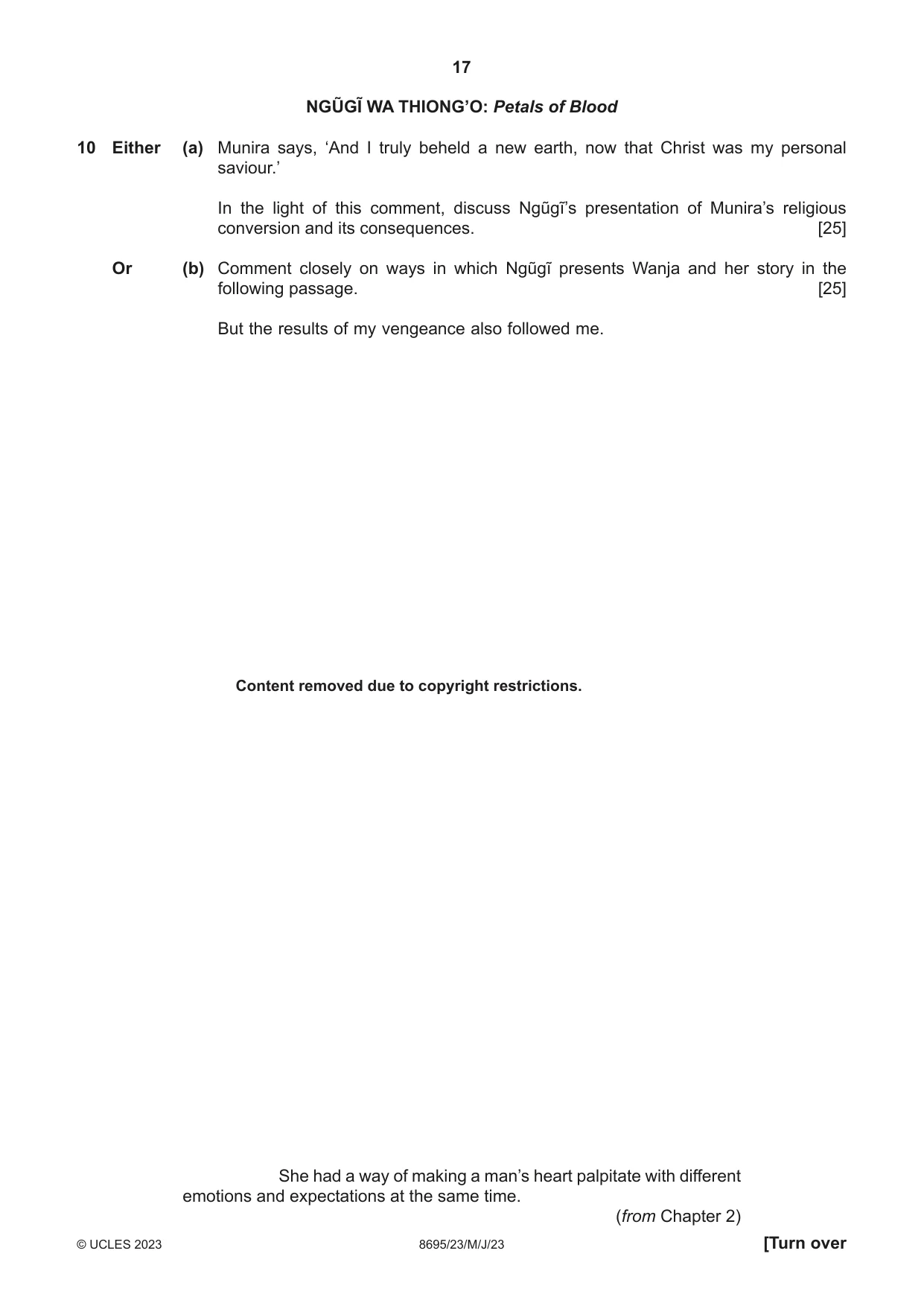
17 8695/23/M/J/23 © UCLES 2023 [Turn over NGŨGĨ WA THIONG’O: Petals of Blood 10 Either (a) Munira says, ‘And I truly beheld a new earth, now that Christ was my personal saviour.’ In the light of this comment, discuss Ngũgĩ’s presentation of Munira’s religious conversion and its consequences. [25] Or (b) Comment closely on ways in which Ngũgĩ presents Wanja and her story in the following passage. [25] But the results of my vengeance also followed me. She had a way of making a man’s heart palpitate with different emotions and expectations at the same time. (from Chapter 2) Content removed due to copyright restrictions.
Question paper, page 18
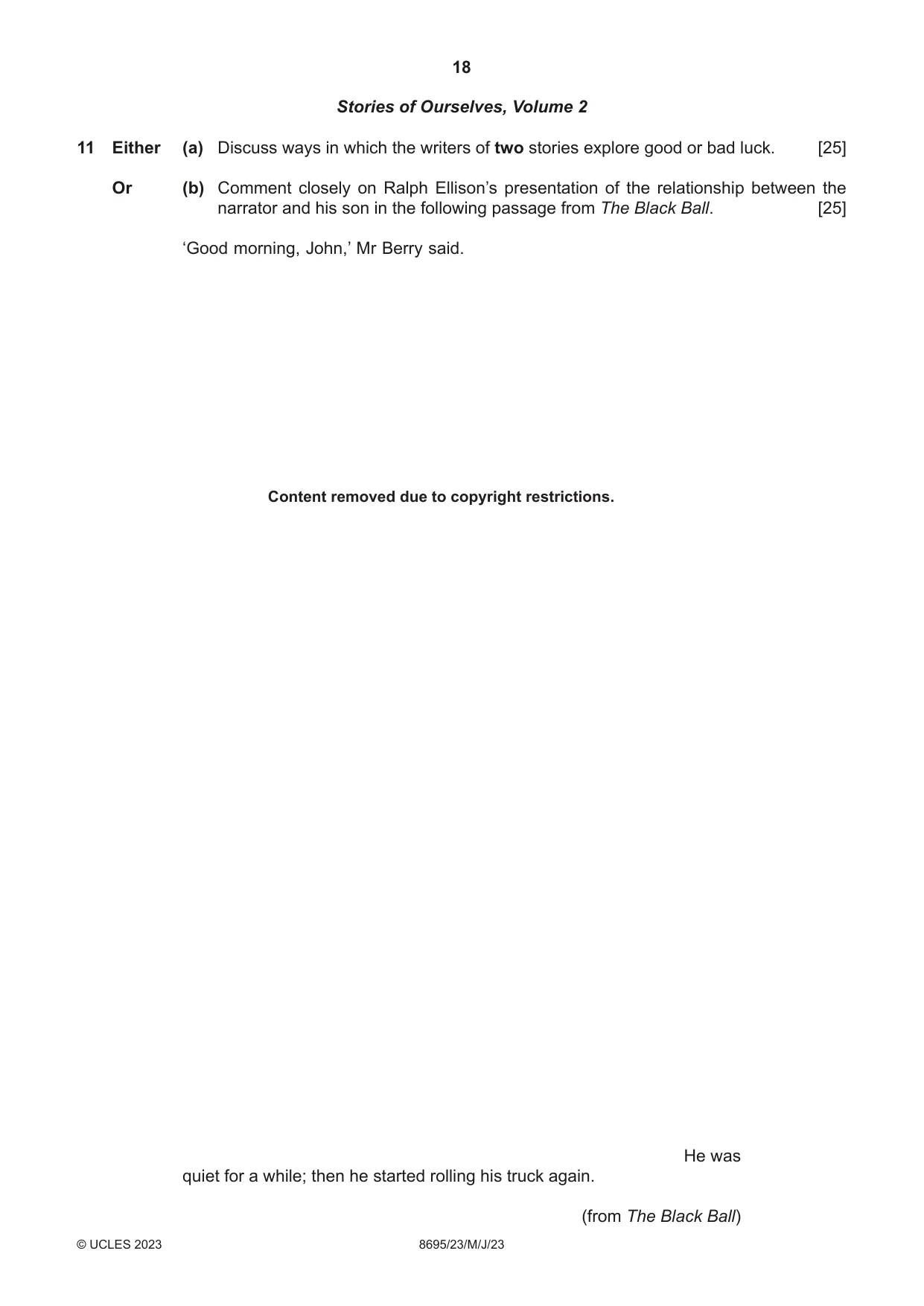
18 8695/23/M/J/23 © UCLES 2023 Stories of Ourselves, Volume 2 11 Either (a) Discuss ways in which the writers of two stories explore good or bad luck. [25] Or (b) Comment closely on Ralph Ellison’s presentation of the relationship between the narrator and his son in the following passage from The Black Ball. [25] ‘Good morning, John,’ Mr Berry said. He was quiet for a while; then he started rolling his truck again. (from The Black Ball) Content removed due to copyright restrictions.
Question paper, page 19
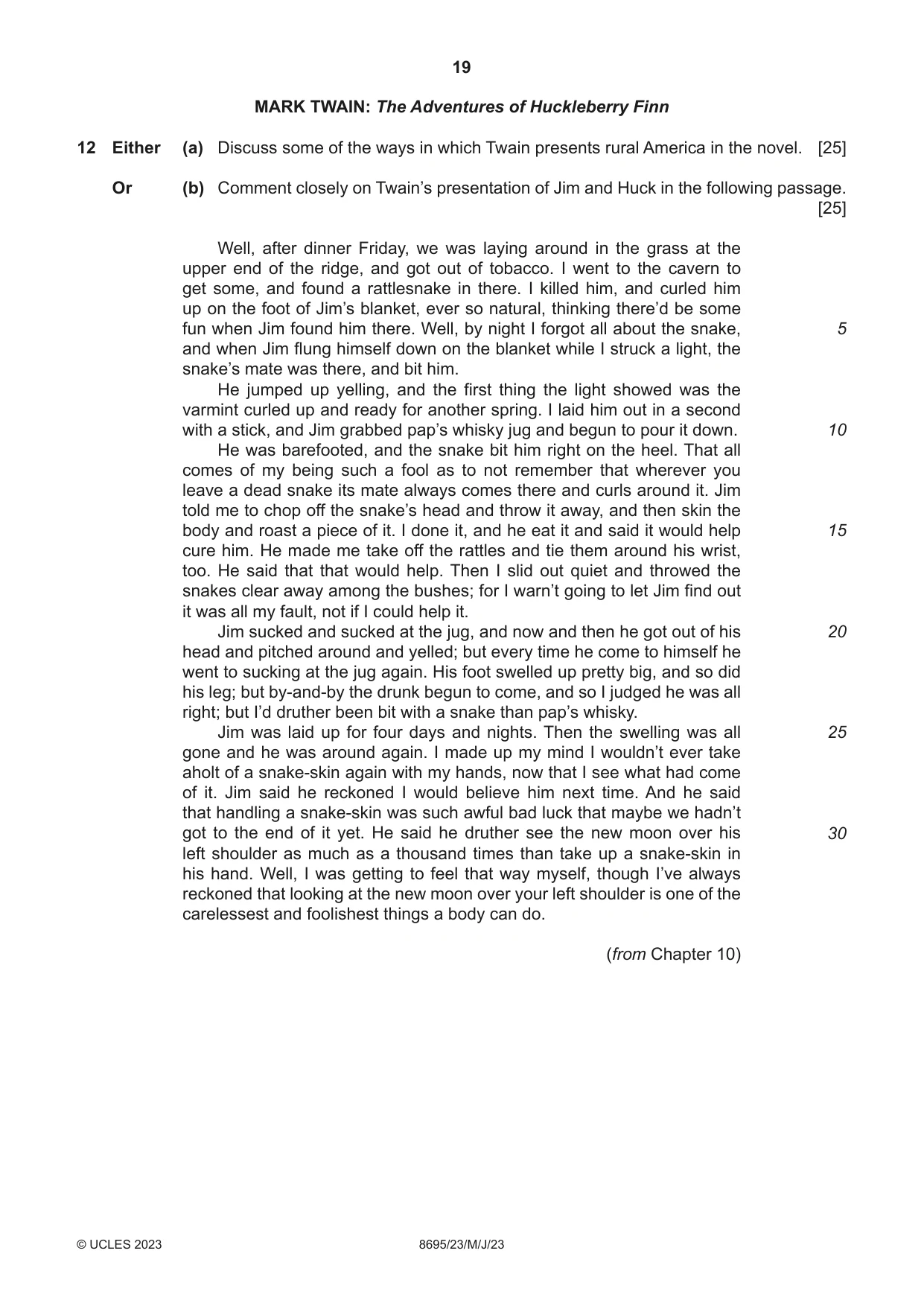
19 8695/23/M/J/23 © UCLES 2023 MARK TWAIN: The Adventures of Huckleberry Finn 12 Either (a) Discuss some of the ways in which Twain presents rural America in the novel. [25] Or (b) Comment closely on Twain’s presentation of Jim and Huck in the following passage. [25] Well, after dinner Friday, we was laying around in the grass at the upper end of the ridge, and got out of tobacco. I went to the cavern to get some, and found a rattlesnake in there. I killed him, and curled him up on the foot of Jim’s blanket, ever so natural, thinking there’d be some fun when Jim found him there. Well, by night I forgot all about the snake, and when Jim flung himself down on the blanket while I struck a light, the snake’s mate was there, and bit him. He jumped up yelling, and the first thing the light showed was the varmint curled up and ready for another spring. I laid him out in a second with a stick, and Jim grabbed pap’s whisky jug and begun to pour it down. He was barefooted, and the snake bit him right on the heel. That all comes of my being such a fool as to not remember that wherever you leave a dead snake its mate always comes there and curls around it. Jim told me to chop off the snake’s head and throw it away, and then skin the body and roast a piece of it. I done it, and he eat it and said it would help cure him. He made me take off the rattles and tie them around his wrist, too. He said that that would help. Then I slid out quiet and throwed the snakes clear away among the bushes; for I warn’t going to let Jim find out it was all my fault, not if I could help it. Jim sucked and sucked at the jug, and now and then he got out of his head and pitched around and yelled; but every time he come to himself he went to sucking at the jug again. His foot swelled up pretty big, and so did his leg; but by-and-by the drunk begun to come, and so I judged he was all right; but I’d druther been bit with a snake than pap’s whisky. Jim was laid up for four days and nights. Then the swelling was all gone and he was around again. I made up my mind I wouldn’t ever take aholt of a snake-skin again with my hands, now that I see what had come of it. Jim said he reckoned I would believe him next time. And he said that handling a snake-skin was such awful bad luck that maybe we hadn’t got to the end of it yet. He said he druther see the new moon over his left shoulder as much as a thousand times than take up a snake-skin in his hand. Well, I was getting to feel that way myself, though I’ve always reckoned that looking at the new moon over your left shoulder is one of the carelessest and foolishest things a body can do. (from Chapter 10) 5 10 15 20 25 30
Question paper, page 20
20 8695/23/M/J/23 © UCLES 2023 Permission to reproduce items where third-party owned material protected by copyright is included has been sought and cleared where possible. Every reasonable effort has been made by the publisher (UCLES) to trace copyright holders, but if any items requiring clearance have unwittingly been included, the publisher will be pleased to make amends at the earliest possible opportunity. To avoid the issue of disclosure of answer-related information to candidates, all copyright acknowledgements are reproduced online in the Cambridge Assessment International Education Copyright Acknowledgements Booklet. This is produced for each series of examinations and is freely available to download at www.cambridgeinternational.org after the live examination series. Cambridge Assessment International Education is part of Cambridge Assessment. Cambridge Assessment is the brand name of the University of Cambridge Local Examinations Syndicate (UCLES), which is a department of the University of Cambridge. BLANK PAGE
Mark scheme, page 1
This document consists of 13 printed pages. © UCLES 2023 [Turn over Cambridge International AS Level LANGUAGE AND LITERATURE IN ENGLISH 8695/23 Paper 2 Drama, Poetry and Prose May/June 2023 MARK SCHEME Maximum Mark: 50 Published This mark scheme is published as an aid to teachers and candidates, to indicate the requirements of the examination. It shows the basis on which Examiners were instructed to award marks. It does not indicate the details of the discussions that took place at an Examiners’ meeting before marking began, which would have considered the acceptability of alternative answers. Mark schemes should be read in conjunction with the question paper and the Principal Examiner Report for Teachers. Cambridge International will not enter into discussions about these mark schemes. Cambridge International is publishing the mark schemes for the May/June 2023 series for most Cambridge IGCSE, Cambridge International A and AS Level and Cambridge Pre-U components, and some Cambridge O Level components.
Mark scheme, page 2
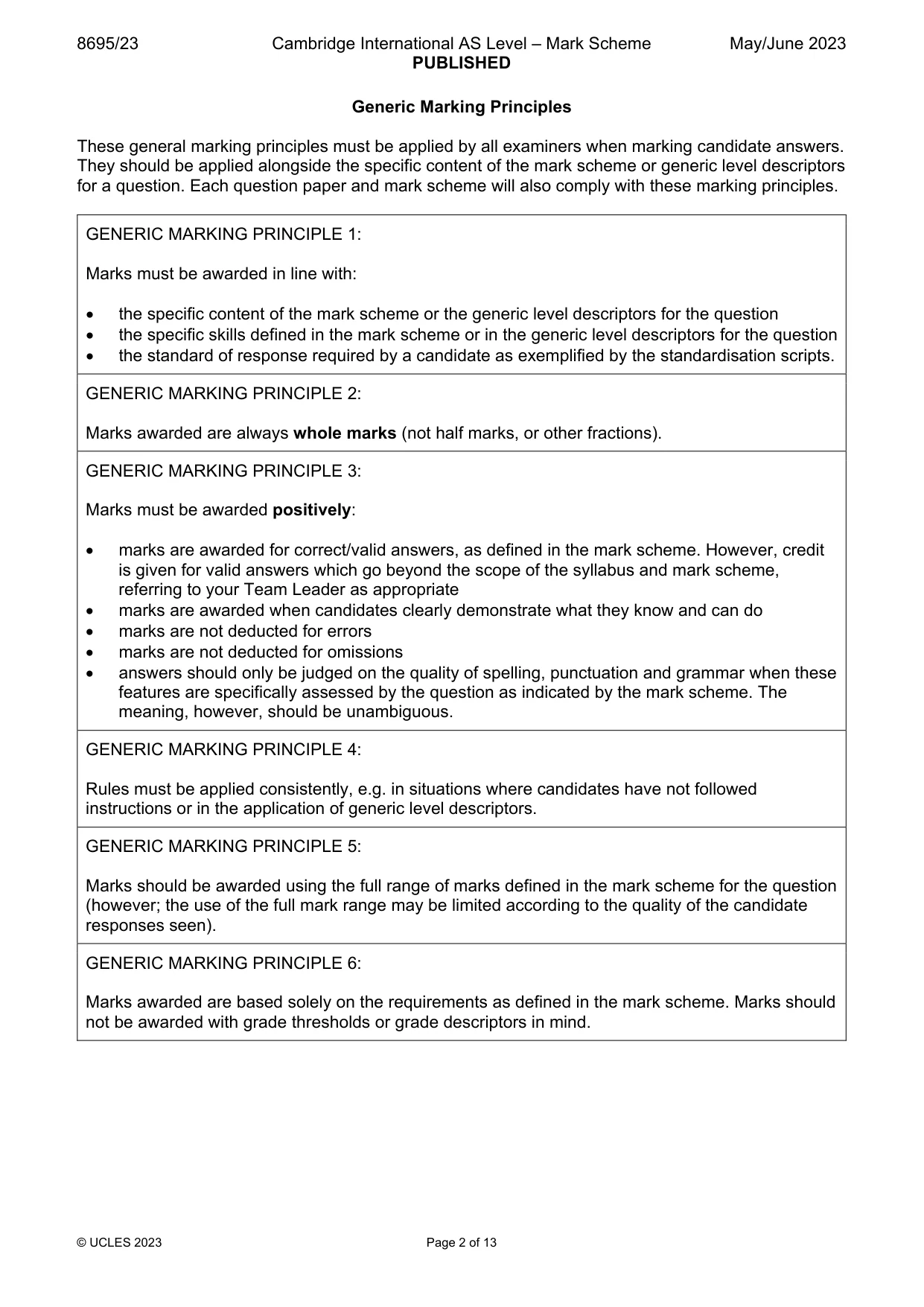
8695/23 Cambridge International AS Level – Mark Scheme PUBLISHED May/June 2023 © UCLES 2023 Page 2 of 13 Generic Marking Principles These general marking principles must be applied by all examiners when marking candidate answers. They should be applied alongside the specific content of the mark scheme or generic level descriptors for a question. Each question paper and mark scheme will also comply with these marking principles. GENERIC MARKING PRINCIPLE 1: Marks must be awarded in line with: the specific content of the mark scheme or the generic level descriptors for the question the specific skills defined in the mark scheme or in the generic level descriptors for the question the standard of response required by a candidate as exemplified by the standardisation scripts. GENERIC MARKING PRINCIPLE 2: Marks awarded are always whole marks (not half marks, or other fractions). GENERIC MARKING PRINCIPLE 3: Marks must be awarded positively: marks are awarded for correct/valid answers, as defined in the mark scheme. However, credit is given for valid answers which go beyond the scope of the syllabus and mark scheme, referring to your Team Leader as appropriate marks are awarded when candidates clearly demonstrate what they know and can do marks are not deducted for errors marks are not deducted for omissions answers should only be judged on the quality of spelling, punctuation and grammar when these features are specifically assessed by the question as indicated by the mark scheme. The meaning, however, should be unambiguous. GENERIC MARKING PRINCIPLE 4: Rules must be applied consistently, e.g. in situations where candidates have not followed instructions or in the application of generic level descriptors. GENERIC MARKING PRINCIPLE 5: Marks should be awarded using the full range of marks defined in the mark scheme for the question (however; the use of the full mark range may be limited according to the quality of the candidate responses seen). GENERIC MARKING PRINCIPLE 6: Marks awarded are based solely on the requirements as defined in the mark scheme. Marks should not be awarded with grade thresholds or grade descriptors in mind.
Mark scheme, page 3
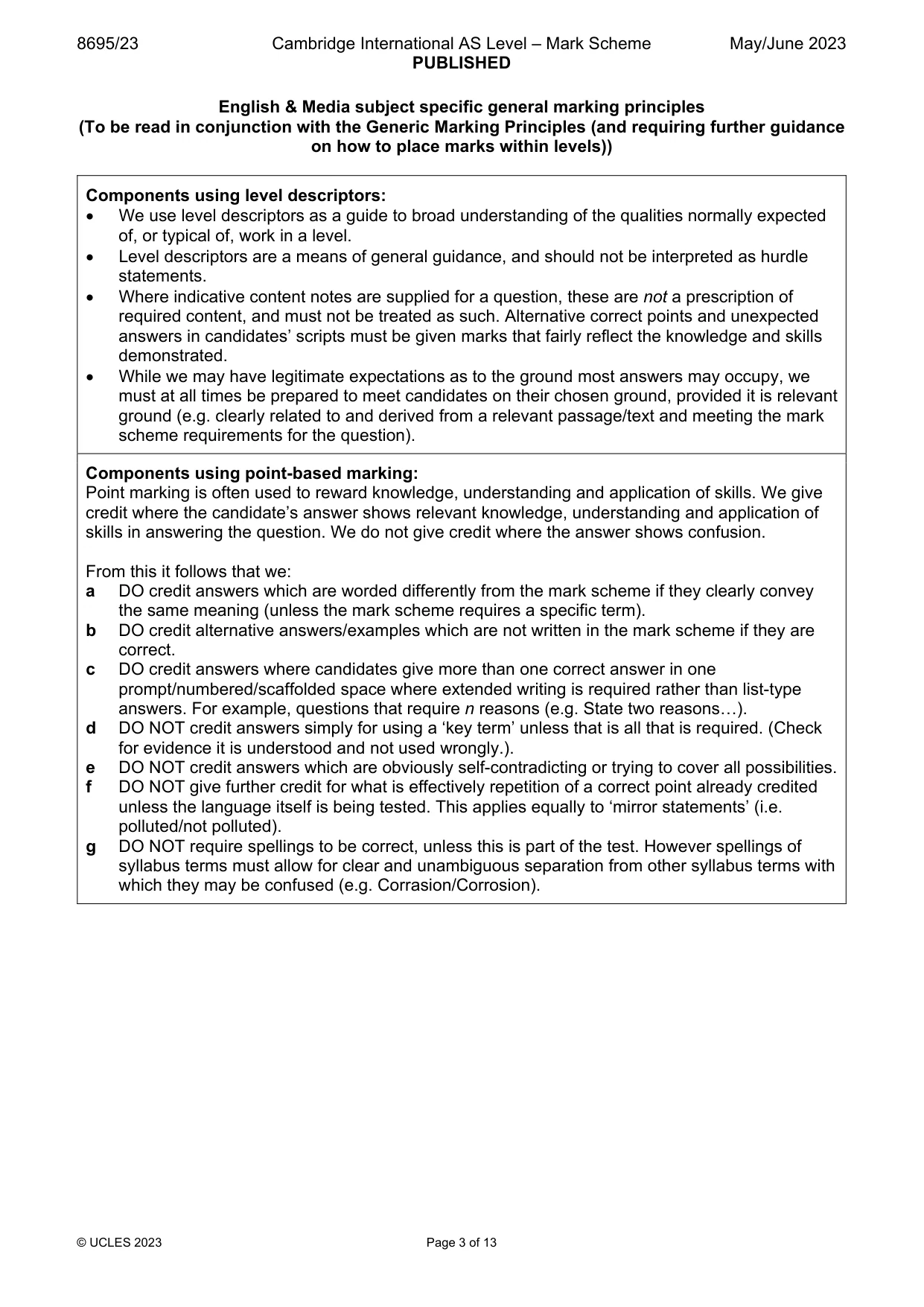
8695/23 Cambridge International AS Level – Mark Scheme PUBLISHED May/June 2023 © UCLES 2023 Page 3 of 13 English & Media subject specific general marking principles (To be read in conjunction with the Generic Marking Principles (and requiring further guidance on how to place marks within levels)) Components using level descriptors: We use level descriptors as a guide to broad understanding of the qualities normally expected of, or typical of, work in a level. Level descriptors are a means of general guidance, and should not be interpreted as hurdle statements. Where indicative content notes are supplied for a question, these are not a prescription of required content, and must not be treated as such. Alternative correct points and unexpected answers in candidates’ scripts must be given marks that fairly reflect the knowledge and skills demonstrated. While we may have legitimate expectations as to the ground most answers may occupy, we must at all times be prepared to meet candidates on their chosen ground, provided it is relevant ground (e.g. clearly related to and derived from a relevant passage/text and meeting the mark scheme requirements for the question). Components using point-based marking: Point marking is often used to reward knowledge, understanding and application of skills. We give credit where the candidate’s answer shows relevant knowledge, understanding and application of skills in answering the question. We do not give credit where the answer shows confusion. From this it follows that we: a DO credit answers which are worded differently from the mark scheme if they clearly convey the same meaning (unless the mark scheme requires a specific term). b DO credit alternative answers/examples which are not written in the mark scheme if they are correct. c DO credit answers where candidates give more than one correct answer in one prompt/numbered/scaffolded space where extended writing is required rather than list-type answers. For example, questions that require n reasons (e.g. State two reasons…). d DO NOT credit answers simply for using a ‘key term’ unless that is all that is required. (Check for evidence it is understood and not used wrongly.). e DO NOT credit answers which are obviously self-contradicting or trying to cover all possibilities. f DO NOT give further credit for what is effectively repetition of a correct point already credited unless the language itself is being tested. This applies equally to ‘mirror statements’ (i.e. polluted/not polluted). g DO NOT require spellings to be correct, unless this is part of the test. However spellings of syllabus terms must allow for clear and unambiguous separation from other syllabus terms with which they may be confused (e.g. Corrasion/Corrosion).
Mark scheme, page 4
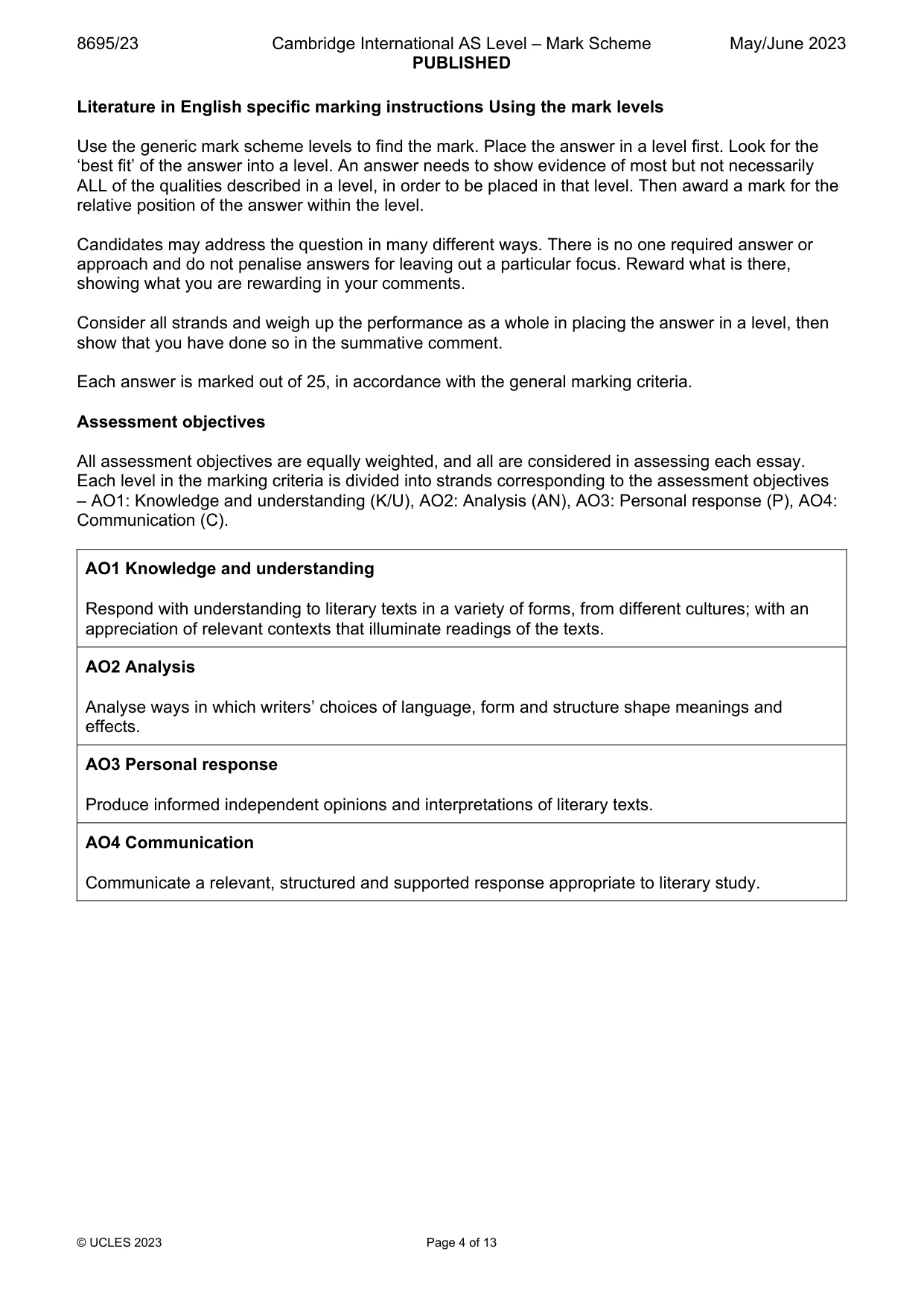
8695/23 Cambridge International AS Level – Mark Scheme PUBLISHED May/June 2023 © UCLES 2023 Page 4 of 13 Literature in English specific marking instructions Using the mark levels Use the generic mark scheme levels to find the mark. Place the answer in a level first. Look for the ‘best fit’ of the answer into a level. An answer needs to show evidence of most but not necessarily ALL of the qualities described in a level, in order to be placed in that level. Then award a mark for the relative position of the answer within the level. Candidates may address the question in many different ways. There is no one required answer or approach and do not penalise answers for leaving out a particular focus. Reward what is there, showing what you are rewarding in your comments. Consider all strands and weigh up the performance as a whole in placing the answer in a level, then show that you have done so in the summative comment. Each answer is marked out of 25, in accordance with the general marking criteria. Assessment objectives All assessment objectives are equally weighted, and all are considered in assessing each essay. Each level in the marking criteria is divided into strands corresponding to the assessment objectives – AO1: Knowledge and understanding (K/U), AO2: Analysis (AN), AO3: Personal response (P), AO4: Communication (C). AO1 Knowledge and understanding Respond with understanding to literary texts in a variety of forms, from different cultures; with an appreciation of relevant contexts that illuminate readings of the texts. AO2 Analysis Analyse ways in which writers’ choices of language, form and structure shape meanings and effects. AO3 Personal response Produce informed independent opinions and interpretations of literary texts. AO4 Communication Communicate a relevant, structured and supported response appropriate to literary study.
Mark scheme, page 5
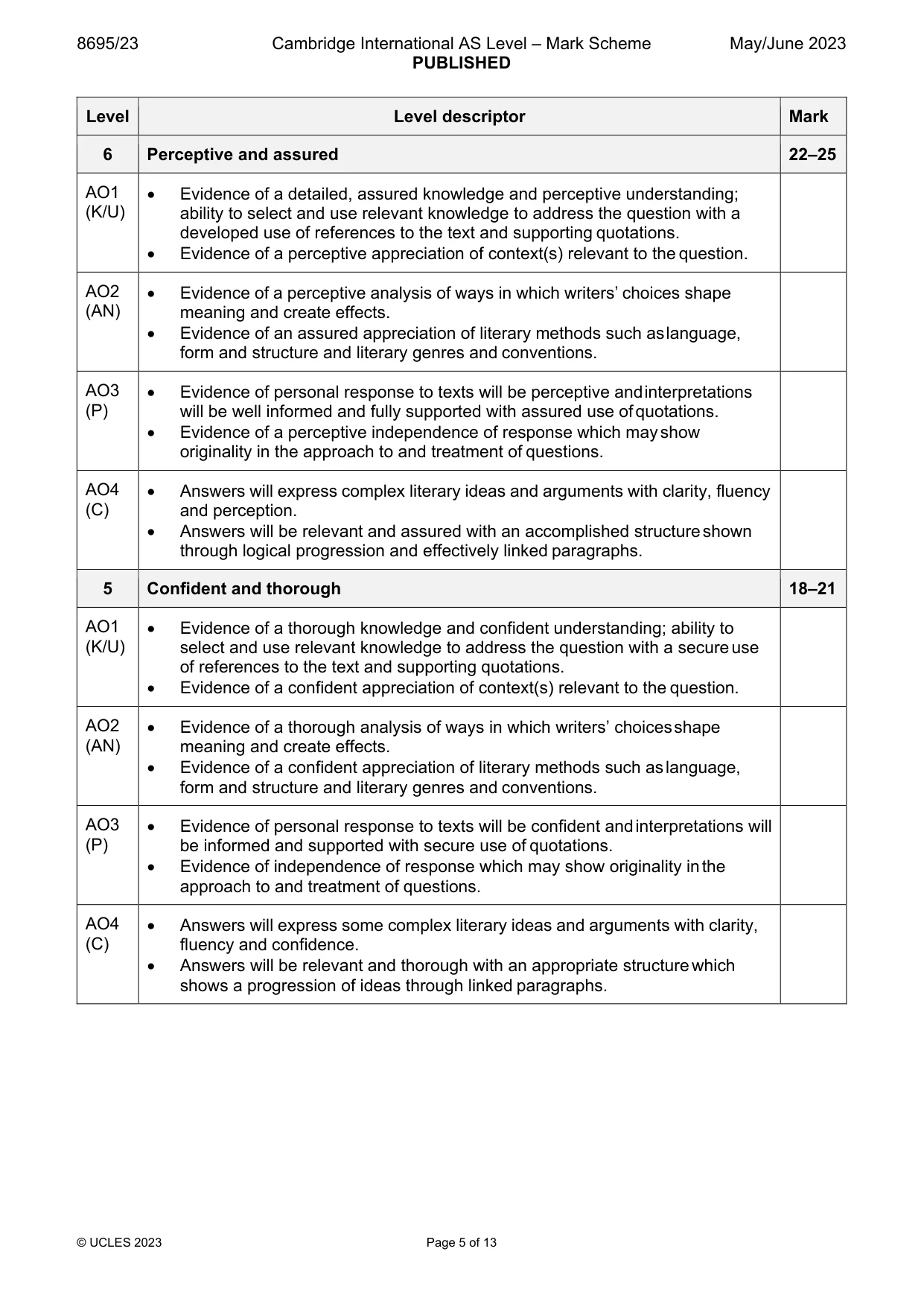
8695/23 Cambridge International AS Level – Mark Scheme PUBLISHED May/June 2023 © UCLES 2023 Page 5 of 13 Level Level descriptor Mark 6 Perceptive and assured 22–25 AO1 (K/U) Evidence of a detailed, assured knowledge and perceptive understanding; ability to select and use relevant knowledge to address the question with a developed use of references to the text and supporting quotations. Evidence of a perceptive appreciation of context(s) relevant to the question. AO2 (AN) Evidence of a perceptive analysis of ways in which writers’ choices shape meaning and create effects. Evidence of an assured appreciation of literary methods such as language, form and structure and literary genres and conventions. AO3 (P) Evidence of personal response to texts will be perceptive and interpretations will be well informed and fully supported with assured use of quotations. Evidence of a perceptive independence of response which may show originality in the approach to and treatment of questions. AO4 (C) Answers will express complex literary ideas and arguments with clarity, fluency and perception. Answers will be relevant and assured with an accomplished structure shown through logical progression and effectively linked paragraphs. 5 Confident and thorough 18–21 AO1 (K/U) Evidence of a thorough knowledge and confident understanding; ability to select and use relevant knowledge to address the question with a secure use of references to the text and supporting quotations. Evidence of a confident appreciation of context(s) relevant to the question. AO2 (AN) Evidence of a thorough analysis of ways in which writers’ choices shape meaning and create effects. Evidence of a confident appreciation of literary methods such as language, form and structure and literary genres and conventions. AO3 (P) Evidence of personal response to texts will be confident and interpretations will be informed and supported with secure use of quotations. Evidence of independence of response which may show originality in the approach to and treatment of questions. AO4 (C) Answers will express some complex literary ideas and arguments with clarity, fluency and confidence. Answers will be relevant and thorough with an appropriate structure which shows a progression of ideas through linked paragraphs.
Mark scheme, page 6
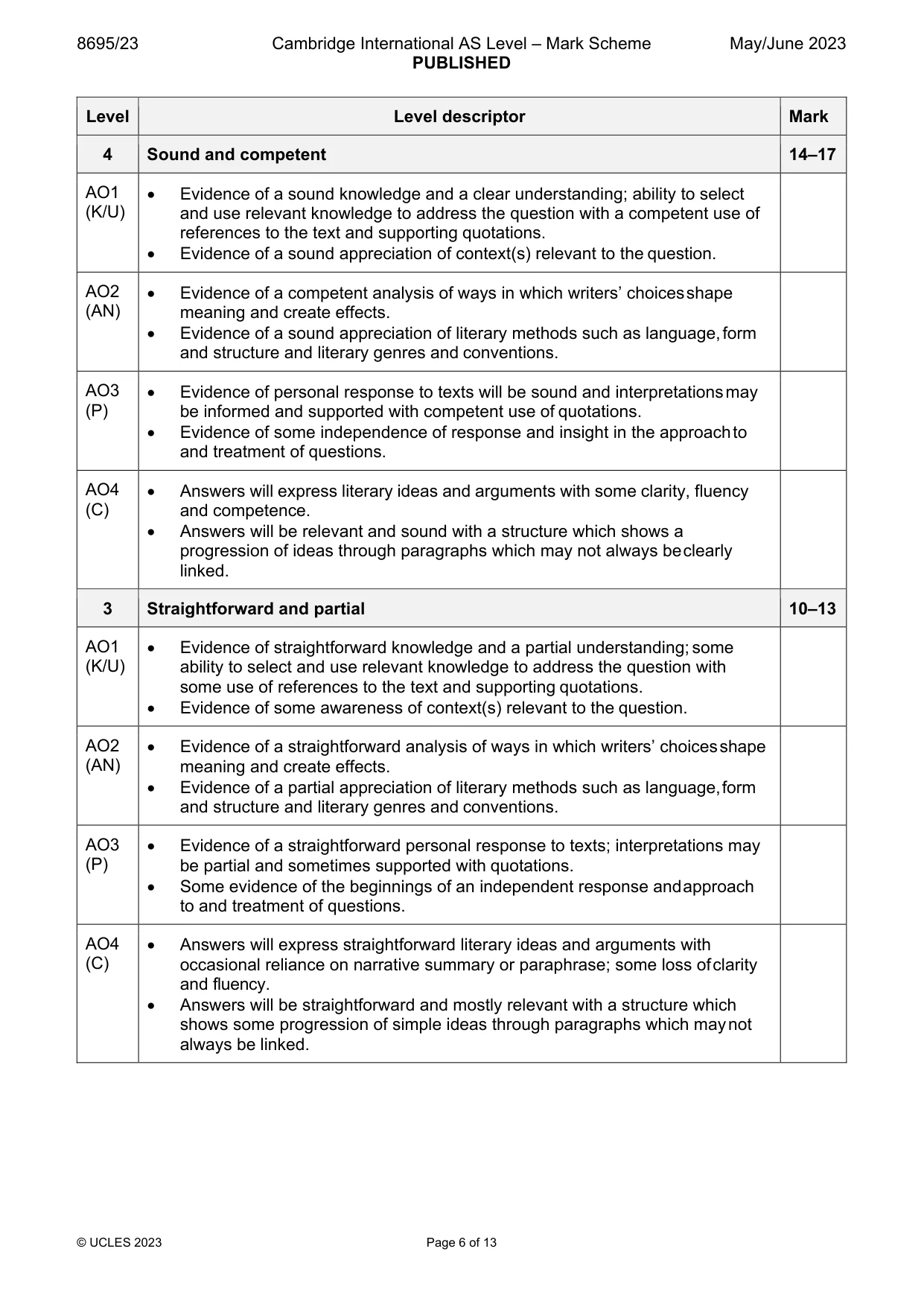
8695/23 Cambridge International AS Level – Mark Scheme PUBLISHED May/June 2023 © UCLES 2023 Page 6 of 13 Level Level descriptor Mark 4 Sound and competent 14–17 AO1 (K/U) Evidence of a sound knowledge and a clear understanding; ability to select and use relevant knowledge to address the question with a competent use of references to the text and supporting quotations. Evidence of a sound appreciation of context(s) relevant to the question. AO2 (AN) Evidence of a competent analysis of ways in which writers’ choices shape meaning and create effects. Evidence of a sound appreciation of literary methods such as language, form and structure and literary genres and conventions. AO3 (P) Evidence of personal response to texts will be sound and interpretations may be informed and supported with competent use of quotations. Evidence of some independence of response and insight in the approach to and treatment of questions. AO4 (C) Answers will express literary ideas and arguments with some clarity, fluency and competence. Answers will be relevant and sound with a structure which shows a progression of ideas through paragraphs which may not always be clearly linked. 3 Straightforward and partial 10–13 AO1 (K/U) Evidence of straightforward knowledge and a partial understanding; some ability to select and use relevant knowledge to address the question with some use of references to the text and supporting quotations. Evidence of some awareness of context(s) relevant to the question. AO2 (AN) Evidence of a straightforward analysis of ways in which writers’ choices shape meaning and create effects. Evidence of a partial appreciation of literary methods such as language, form and structure and literary genres and conventions. AO3 (P) Evidence of a straightforward personal response to texts; interpretations may be partial and sometimes supported with quotations. Some evidence of the beginnings of an independent response and approach to and treatment of questions. AO4 (C) Answers will express straightforward literary ideas and arguments with occasional reliance on narrative summary or paraphrase; some loss of clarity and fluency. Answers will be straightforward and mostly relevant with a structure which shows some progression of simple ideas through paragraphs which may not always be linked.
Mark scheme, page 7
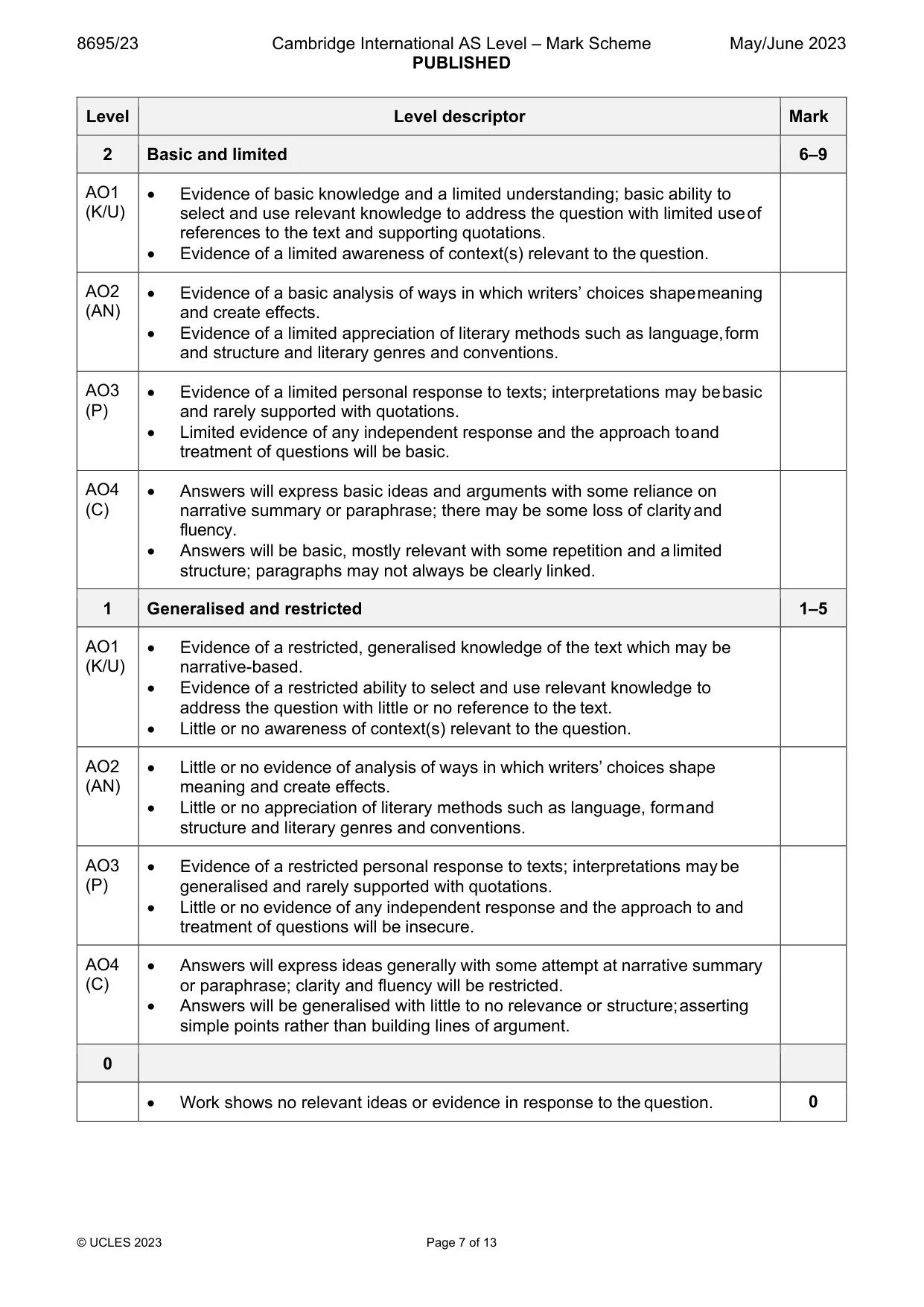
8695/23 Cambridge International AS Level – Mark Scheme PUBLISHED May/June 2023 © UCLES 2023 Page 7 of 13 Level Level descriptor Mark 2 Basic and limited 6–9 AO1 (K/U) Evidence of basic knowledge and a limited understanding; basic ability to select and use relevant knowledge to address the question with limited use of references to the text and supporting quotations. Evidence of a limited awareness of context(s) relevant to the question. AO2 (AN) Evidence of a basic analysis of ways in which writers’ choices shape meaning and create effects. Evidence of a limited appreciation of literary methods such as language, form and structure and literary genres and conventions. AO3 (P) Evidence of a limited personal response to texts; interpretations may be basic and rarely supported with quotations. Limited evidence of any independent response and the approach to and treatment of questions will be basic. AO4 (C) Answers will express basic ideas and arguments with some reliance on narrative summary or paraphrase; there may be some loss of clarity and fluency. Answers will be basic, mostly relevant with some repetition and a limited structure; paragraphs may not always be clearly linked. 1 Generalised and restricted 1–5 AO1 (K/U) Evidence of a restricted, generalised knowledge of the text which may be narrative-based. Evidence of a restricted ability to select and use relevant knowledge to address the question with little or no reference to the text. Little or no awareness of context(s) relevant to the question. AO2 (AN) Little or no evidence of analysis of ways in which writers’ choices shape meaning and create effects. Little or no appreciation of literary methods such as language, form and structure and literary genres and conventions. AO3 (P) Evidence of a restricted personal response to texts; interpretations may be generalised and rarely supported with quotations. Little or no evidence of any independent response and the approach to and treatment of questions will be insecure. AO4 (C) Answers will express ideas generally with some attempt at narrative summary or paraphrase; clarity and fluency will be restricted. Answers will be generalised with little to no relevance or structure; asserting simple points rather than building lines of argument. 0 Work shows no relevant ideas or evidence in response to the question. 0
Mark scheme, page 8
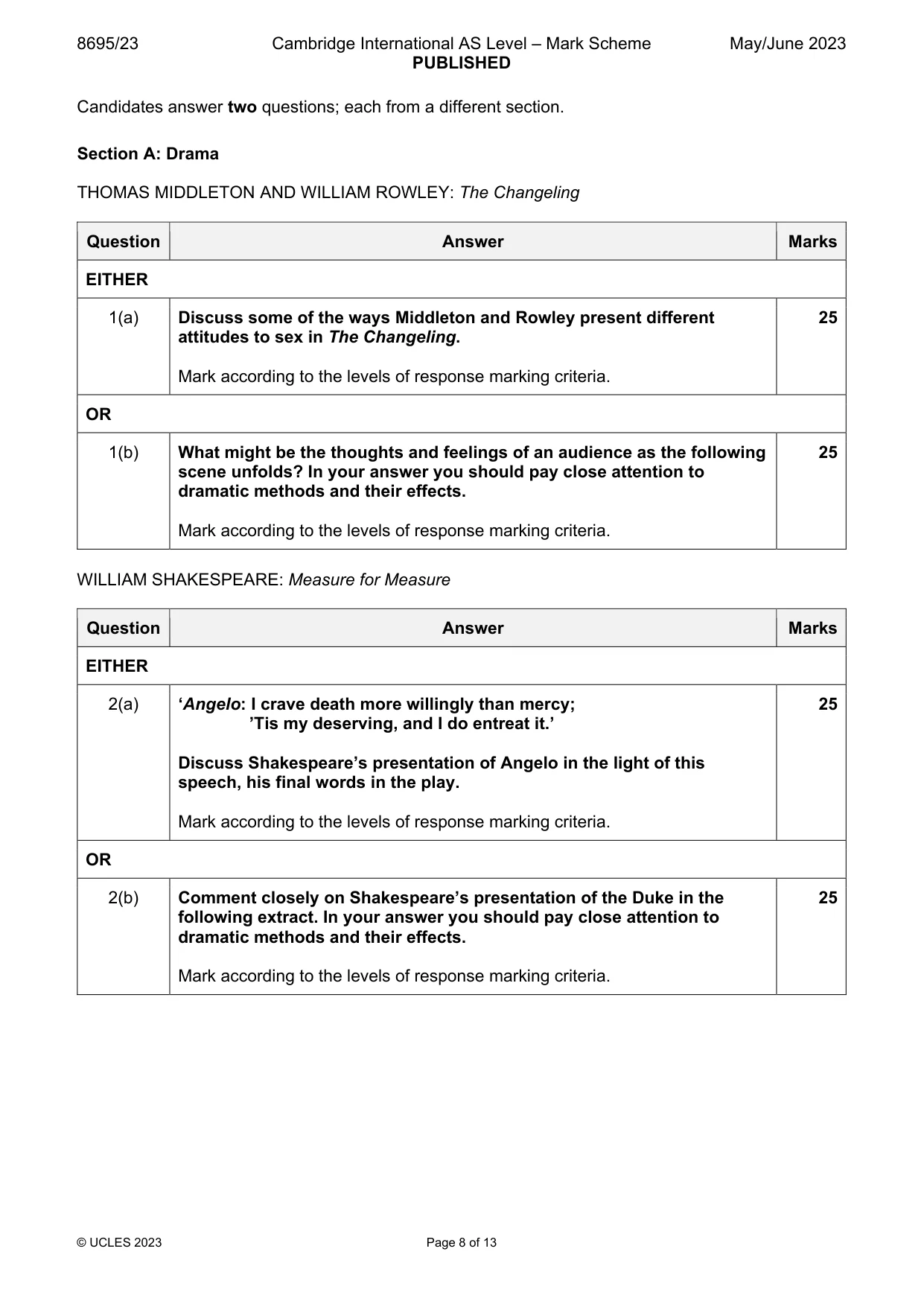
8695/23 Cambridge International AS Level – Mark Scheme PUBLISHED May/June 2023 © UCLES 2023 Page 8 of 13 Candidates answer two questions; each from a different section. Section A: Drama THOMAS MIDDLETON AND WILLIAM ROWLEY: The Changeling Question Answer Marks EITHER 1(a) Discuss some of the ways Middleton and Rowley present different attitudes to sex in The Changeling. Mark according to the levels of response marking criteria. 25 OR 1(b) What might be the thoughts and feelings of an audience as the following scene unfolds? In your answer you should pay close attention to dramatic methods and their effects. Mark according to the levels of response marking criteria. 25 WILLIAM SHAKESPEARE: Measure for Measure Question Answer Marks EITHER 2(a) ‘Angelo: I crave death more willingly than mercy; ’Tis my deserving, and I do entreat it.’ Discuss Shakespeare’s presentation of Angelo in the light of this speech, his final words in the play. Mark according to the levels of response marking criteria. 25 OR 2(b) Comment closely on Shakespeare’s presentation of the Duke in the following extract. In your answer you should pay close attention to dramatic methods and their effects. Mark according to the levels of response marking criteria. 25
Mark scheme, page 9
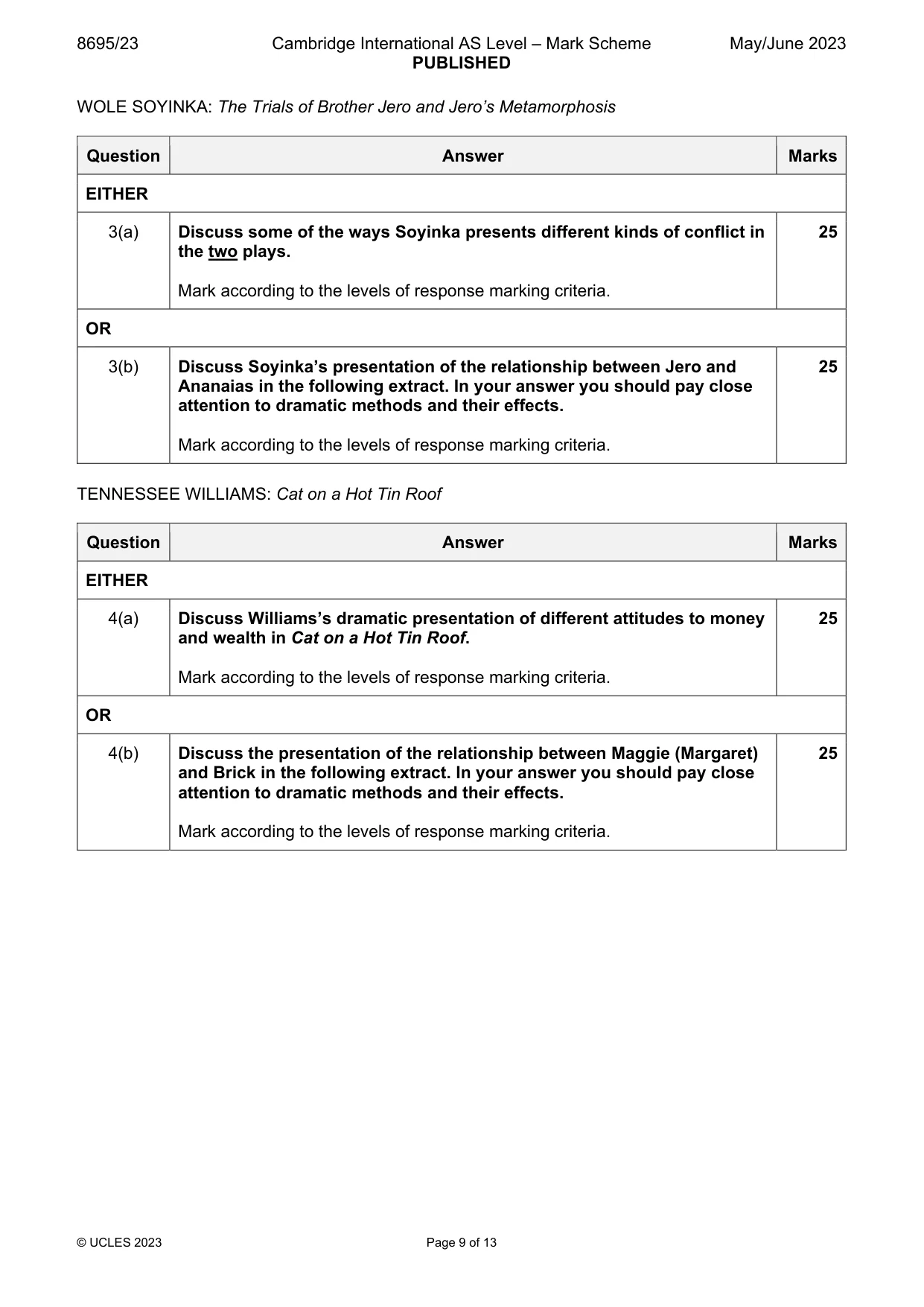
8695/23 Cambridge International AS Level – Mark Scheme PUBLISHED May/June 2023 © UCLES 2023 Page 9 of 13 WOLE SOYINKA: The Trials of Brother Jero and Jero’s Metamorphosis Question Answer Marks EITHER 3(a) Discuss some of the ways Soyinka presents different kinds of conflict in the two plays. Mark according to the levels of response marking criteria. 25 OR 3(b) Discuss Soyinka’s presentation of the relationship between Jero and Ananaias in the following extract. In your answer you should pay close attention to dramatic methods and their effects. Mark according to the levels of response marking criteria. 25 TENNESSEE WILLIAMS: Cat on a Hot Tin Roof Question Answer Marks EITHER 4(a) Discuss Williams’s dramatic presentation of different attitudes to money and wealth in Cat on a Hot Tin Roof. Mark according to the levels of response marking criteria. 25 OR 4(b) Discuss the presentation of the relationship between Maggie (Margaret) and Brick in the following extract. In your answer you should pay close attention to dramatic methods and their effects. Mark according to the levels of response marking criteria. 25
Mark scheme, page 10
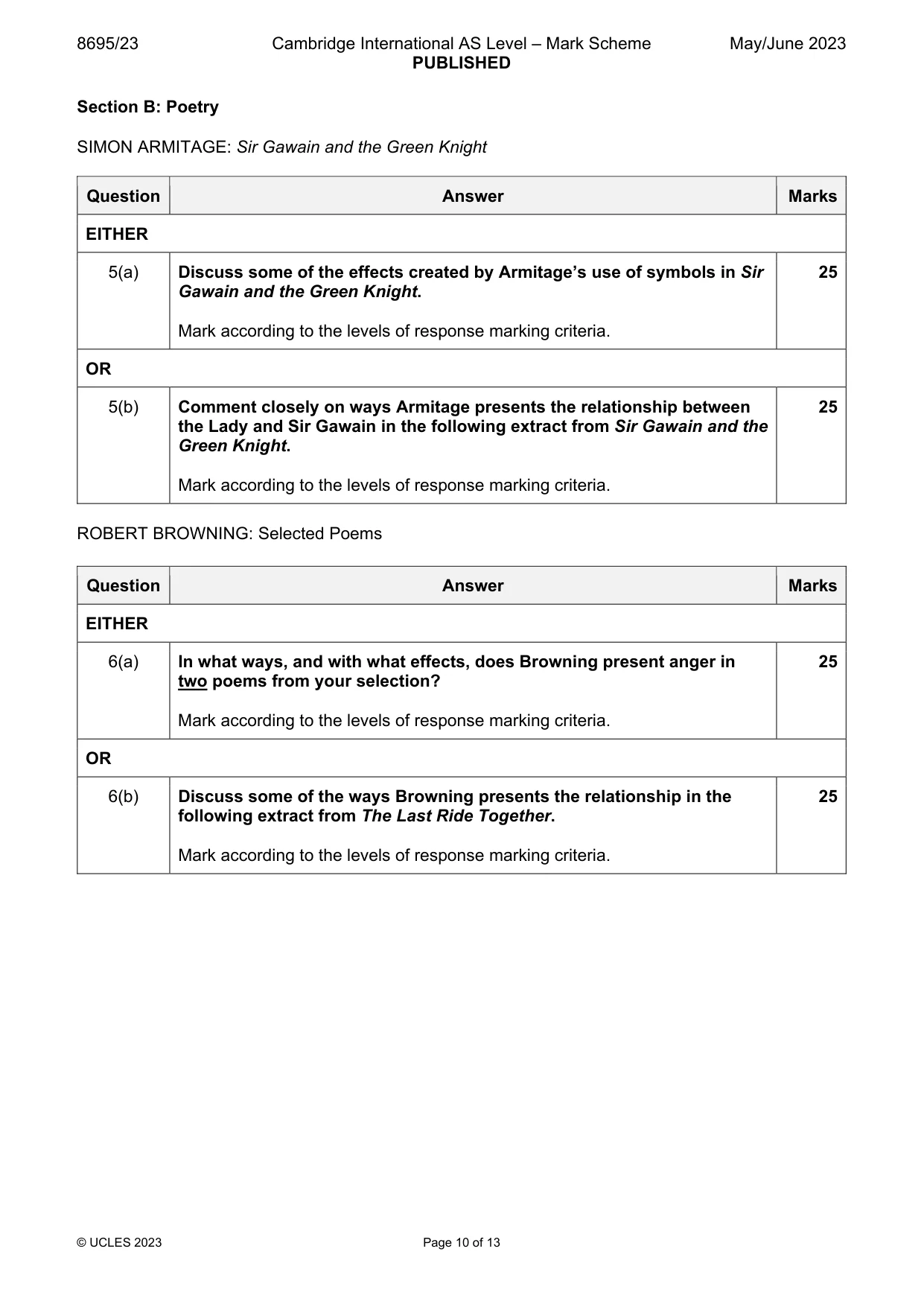
8695/23 Cambridge International AS Level – Mark Scheme PUBLISHED May/June 2023 © UCLES 2023 Page 10 of 13 Section B: Poetry SIMON ARMITAGE: Sir Gawain and the Green Knight Question Answer Marks EITHER 5(a) Discuss some of the effects created by Armitage’s use of symbols in Sir Gawain and the Green Knight. Mark according to the levels of response marking criteria. 25 OR 5(b) Comment closely on ways Armitage presents the relationship between the Lady and Sir Gawain in the following extract from Sir Gawain and the Green Knight. Mark according to the levels of response marking criteria. 25 ROBERT BROWNING: Selected Poems Question Answer Marks EITHER 6(a) In what ways, and with what effects, does Browning present anger in two poems from your selection? Mark according to the levels of response marking criteria. 25 OR 6(b) Discuss some of the ways Browning presents the relationship in the following extract from The Last Ride Together. Mark according to the levels of response marking criteria. 25
Mark scheme, page 11
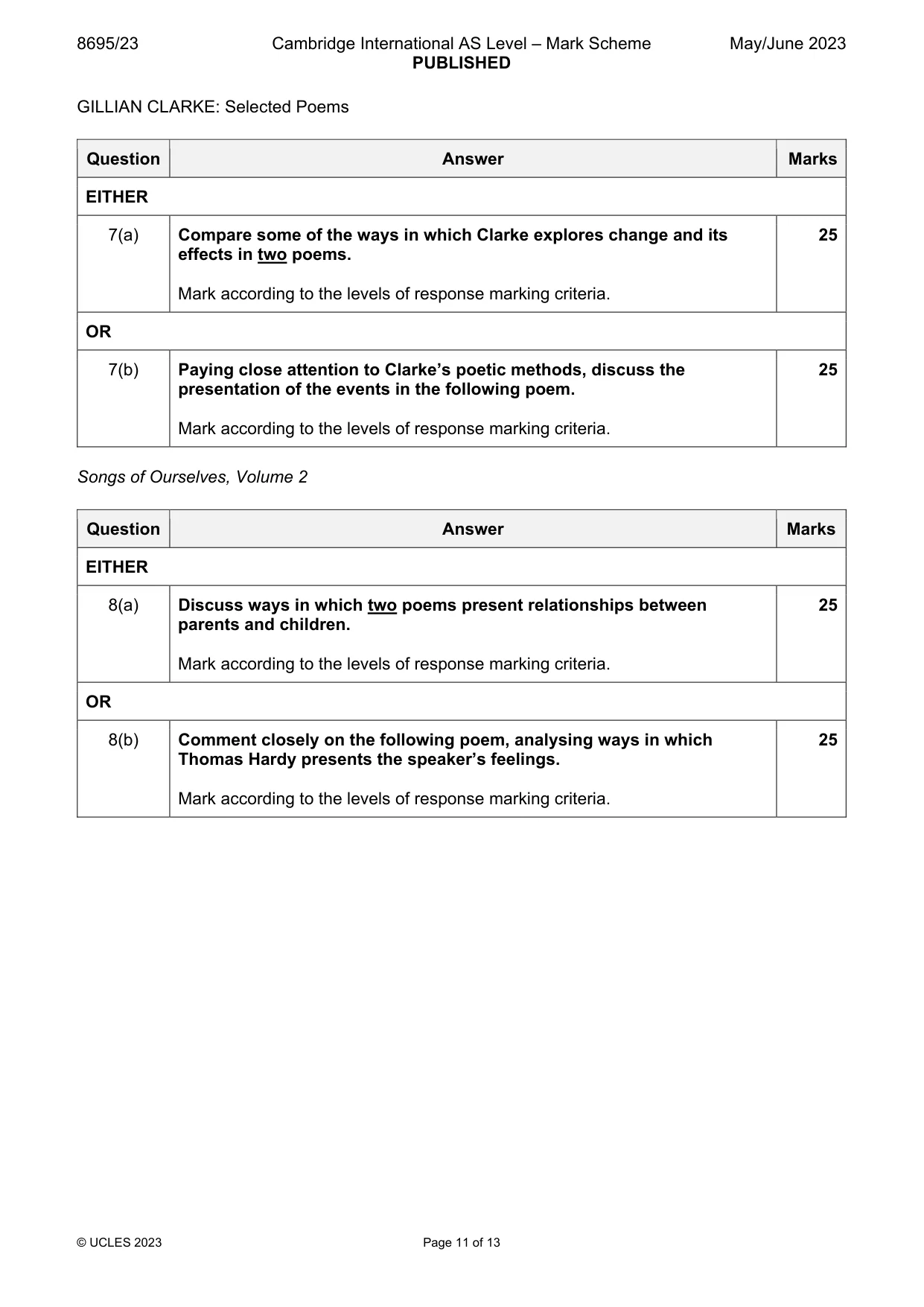
8695/23 Cambridge International AS Level – Mark Scheme PUBLISHED May/June 2023 © UCLES 2023 Page 11 of 13 GILLIAN CLARKE: Selected Poems Question Answer Marks EITHER 7(a) Compare some of the ways in which Clarke explores change and its effects in two poems. Mark according to the levels of response marking criteria. 25 OR 7(b) Paying close attention to Clarke’s poetic methods, discuss the presentation of the events in the following poem. Mark according to the levels of response marking criteria. 25 Songs of Ourselves, Volume 2 Question Answer Marks EITHER 8(a) Discuss ways in which two poems present relationships between parents and children. Mark according to the levels of response marking criteria. 25 OR 8(b) Comment closely on the following poem, analysing ways in which Thomas Hardy presents the speaker’s feelings. Mark according to the levels of response marking criteria. 25
Mark scheme, page 12
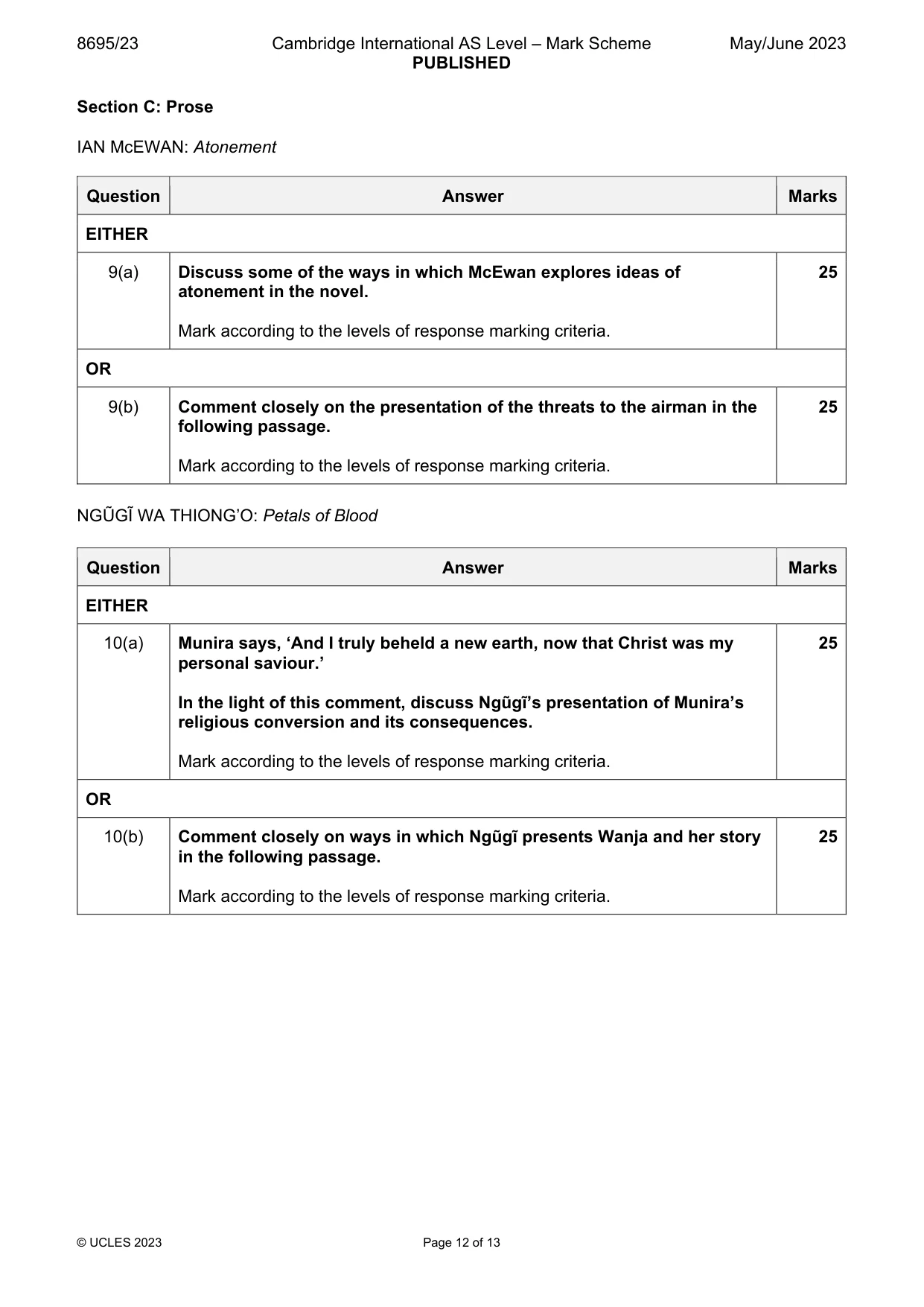
8695/23 Cambridge International AS Level – Mark Scheme PUBLISHED May/June 2023 © UCLES 2023 Page 12 of 13 Section C: Prose IAN McEWAN: Atonement Question Answer Marks EITHER 9(a) Discuss some of the ways in which McEwan explores ideas of atonement in the novel. Mark according to the levels of response marking criteria. 25 OR 9(b) Comment closely on the presentation of the threats to the airman in the following passage. Mark according to the levels of response marking criteria. 25 NGŨGĨ WA THIONG’O: Petals of Blood Question Answer Marks EITHER 10(a) Munira says, ‘And I truly beheld a new earth, now that Christ was my personal saviour.’ In the light of this comment, discuss Ngũgĩ’s presentation of Munira’s religious conversion and its consequences. Mark according to the levels of response marking criteria. 25 OR 10(b) Comment closely on ways in which Ngũgĩ presents Wanja and her story in the following passage. Mark according to the levels of response marking criteria. 25
Mark scheme, page 13
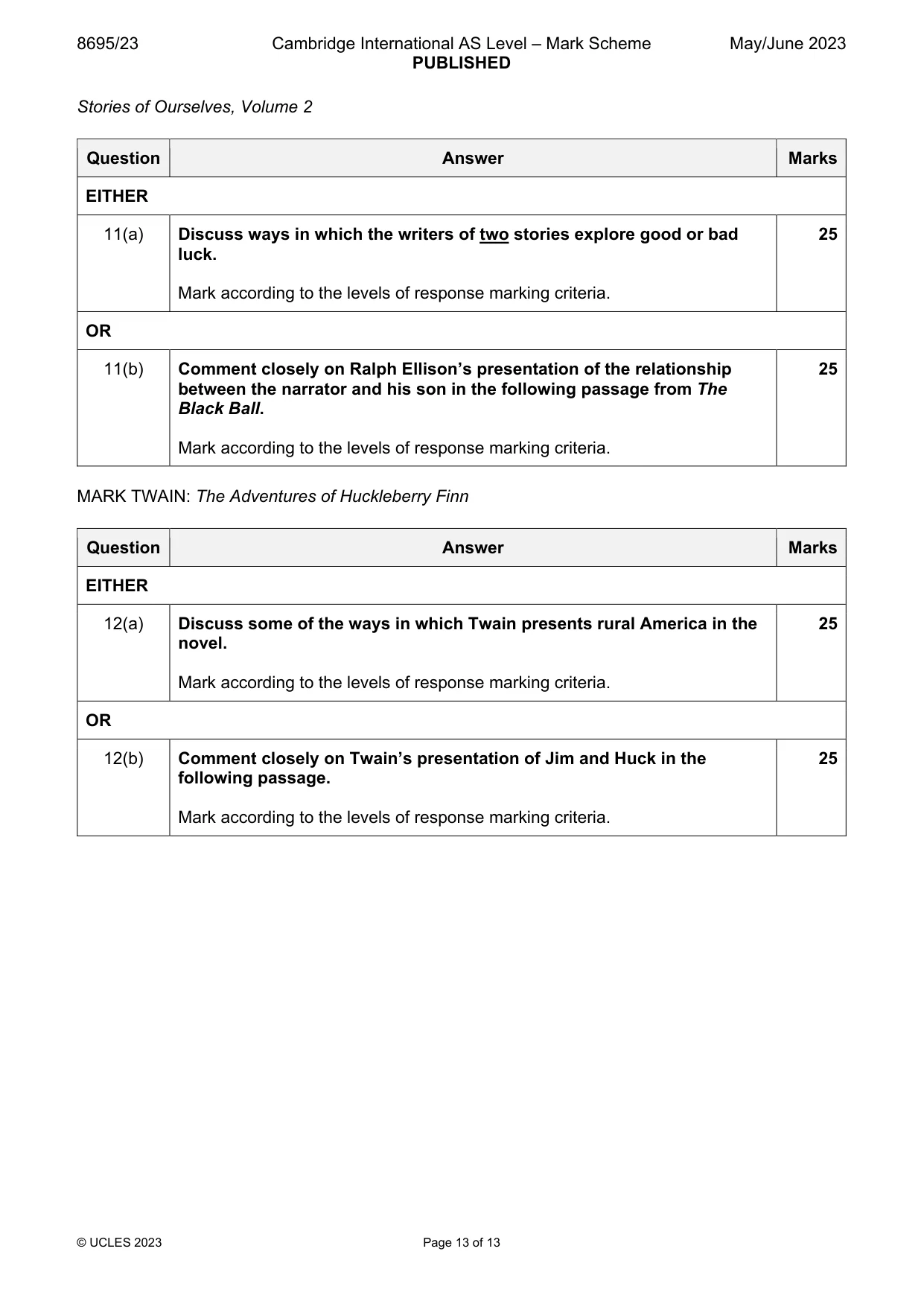
8695/23 Cambridge International AS Level – Mark Scheme PUBLISHED May/June 2023 © UCLES 2023 Page 13 of 13 Stories of Ourselves, Volume 2 Question Answer Marks EITHER 11(a) Discuss ways in which the writers of two stories explore good or bad luck. Mark according to the levels of response marking criteria. 25 OR 11(b) Comment closely on Ralph Ellison’s presentation of the relationship between the narrator and his son in the following passage from The Black Ball. Mark according to the levels of response marking criteria. 25 MARK TWAIN: The Adventures of Huckleberry Finn Question Answer Marks EITHER 12(a) Discuss some of the ways in which Twain presents rural America in the novel. Mark according to the levels of response marking criteria. 25 OR 12(b) Comment closely on Twain’s presentation of Jim and Huck in the following passage. Mark according to the levels of response marking criteria. 25
What you needed in this session
Cambridge’s own grade thresholds for 2023 May/June, Paper 2 · Variant 3. A higher threshold means an easier paper — the bar moves with how the cohort did.