Cambridge A Level English - Language and Literature (AS Level only, from 2016) 8695 — 2023 Oct/Nov Paper 2 · Variant 3
8695/23/O/N/23 · 50 marks · ≈56 min
The question paper and its mark scheme, free to read here and free to download. This is Cambridge’s own paper, exactly as it was sat.
Question paper24 pages





Mark scheme13 pages
Answers below. Sit the paper first if you are practising.
Paper as text
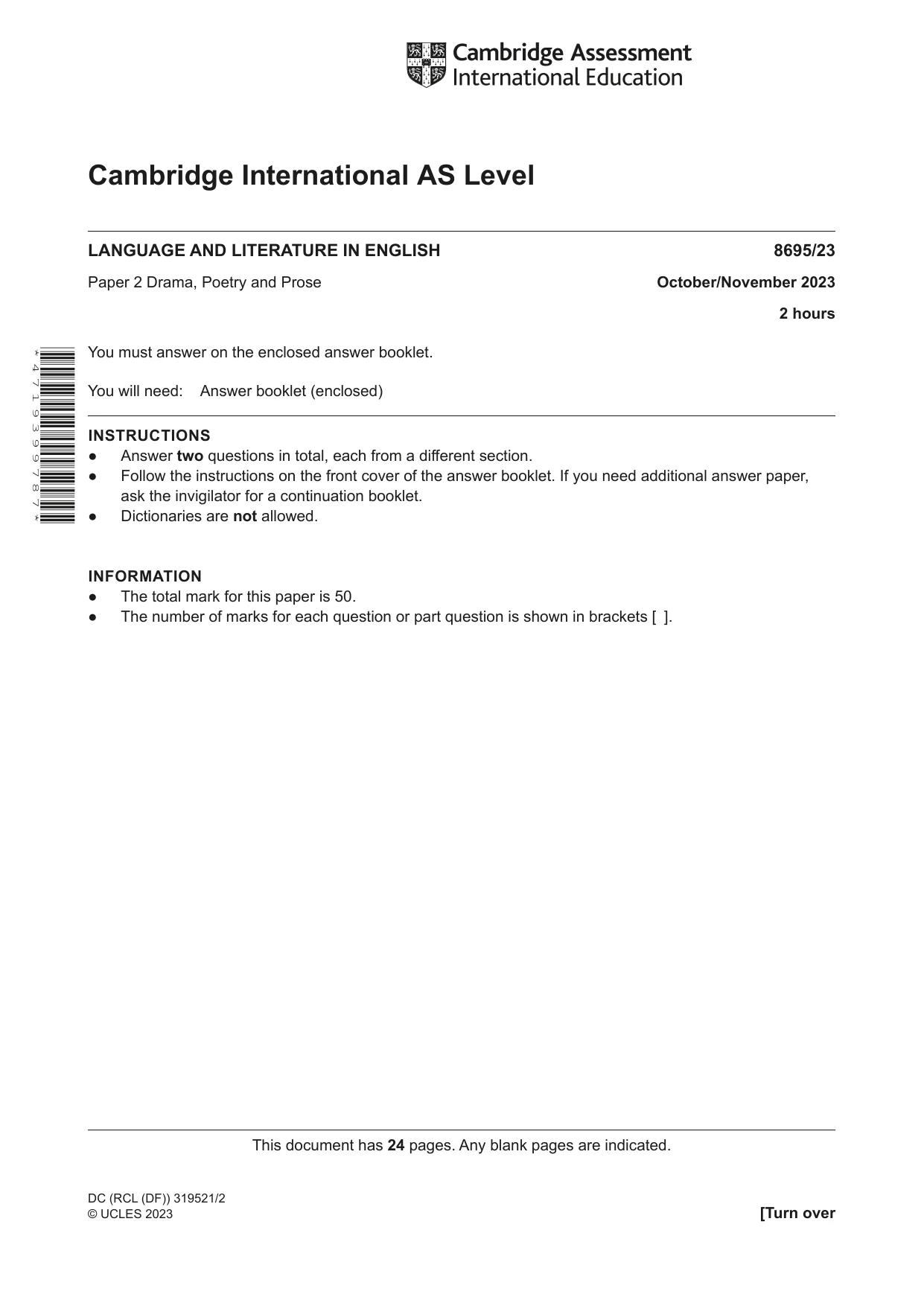
Question paper, page 1
This document has 24 pages. Any blank pages are indicated. [Turn over Cambridge International AS Level * 4 7 1 9 3 9 9 7 8 7 * DC (RCL (DF)) 319521/2 © UCLES 2023 LANGUAGE AND LITERATURE IN ENGLISH 8695/23 Paper 2 Drama, Poetry and Prose October/November 2023 2 hours You must answer on the enclosed answer booklet. You will need: Answer booklet (enclosed) INSTRUCTIONS ● Answer two questions in total, each from a different section. ● Follow the instructions on the front cover of the answer booklet. If you need additional answer paper, ask the invigilator for a continuation booklet. ● Dictionaries are not allowed. INFORMATION ● The total mark for this paper is 50. ● The number of marks for each question or part question is shown in brackets [ ].
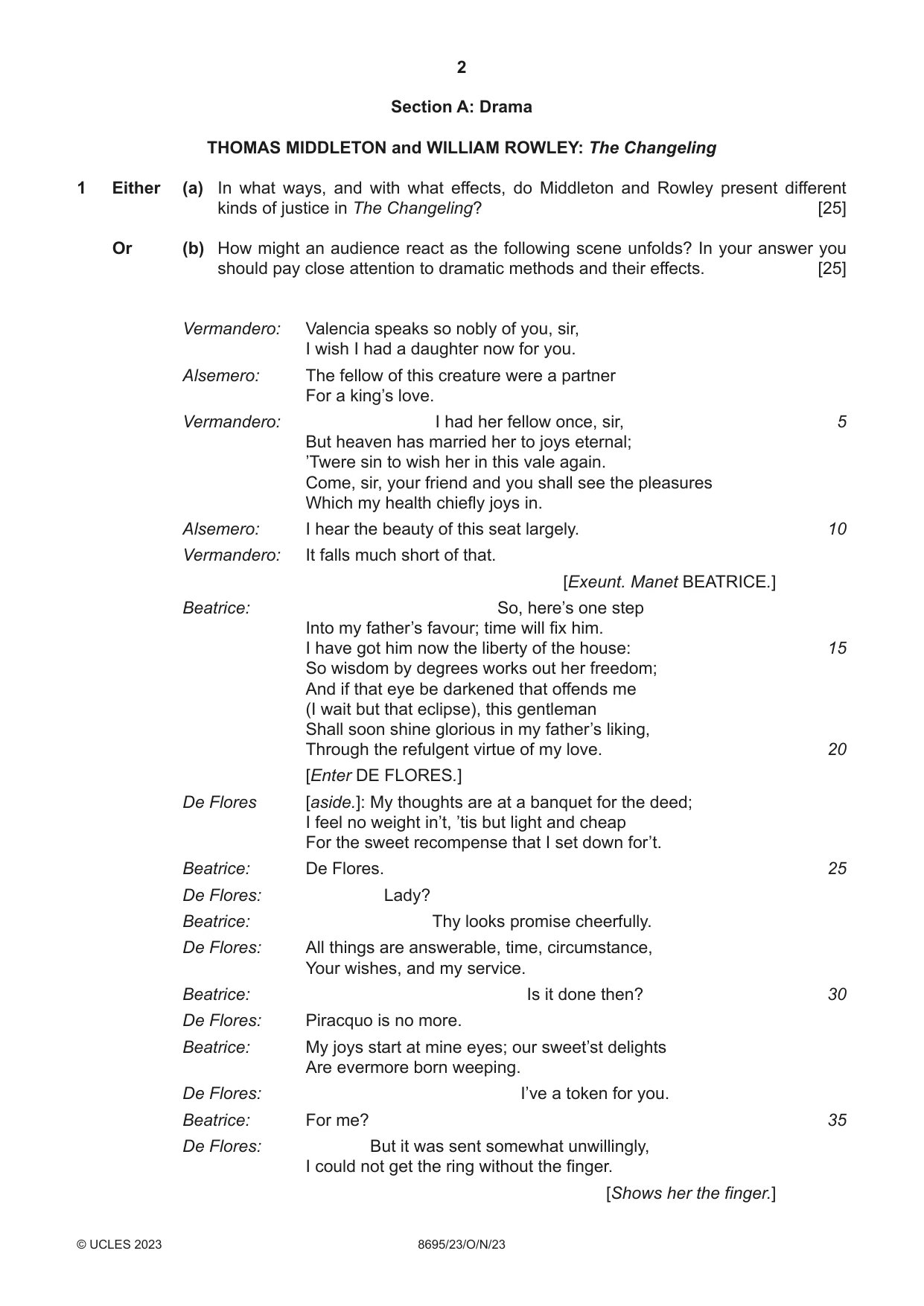
Question paper, page 2
2 8695/23/O/N/23 © UCLES 2023 Section A: Drama THOMAS MIDDLETON and WILLIAM ROWLEY: The Changeling 1 Either (a) In what ways, and with what effects, do Middleton and Rowley present different kinds of justice in The Changeling? [25] Or (b) How might an audience react as the following scene unfolds? In your answer you should pay close attention to dramatic methods and their effects. [25] Vermandero: Valencia speaks so nobly of you, sir, I wish I had a daughter now for you. Alsemero: The fellow of this creature were a partner For a king’s love. Vermandero: I had her fellow once, sir, But heaven has married her to joys eternal; ’Twere sin to wish her in this vale again. Come, sir, your friend and you shall see the pleasures Which my health chiefly joys in. Alsemero: I hear the beauty of this seat largely. Vermandero: It falls much short of that. [Exeunt. Manet BEATRICE.] Beatrice: So, here’s one step Into my father’s favour; time will fix him. I have got him now the liberty of the house: So wisdom by degrees works out her freedom; And if that eye be darkened that offends me (I wait but that eclipse), this gentleman Shall soon shine glorious in my father’s liking, Through the refulgent virtue of my love. [Enter DE FLORES.] De Flores [aside.]: My thoughts are at a banquet for the deed; I feel no weight in’t, ’tis but light and cheap For the sweet recompense that I set down for’t. Beatrice: De Flores. De Flores: Lady? Beatrice: Thy looks promise cheerfully. De Flores: All things are answerable, time, circumstance, Your wishes, and my service. Beatrice: Is it done then? De Flores: Piracquo is no more. Beatrice: My joys start at mine eyes; our sweet’st delights Are evermore born weeping. De Flores: I’ve a token for you. Beatrice: For me? De Flores: But it was sent somewhat unwillingly, I could not get the ring without the finger. [Shows her the finger.] 5 10 15 20 25 30 35
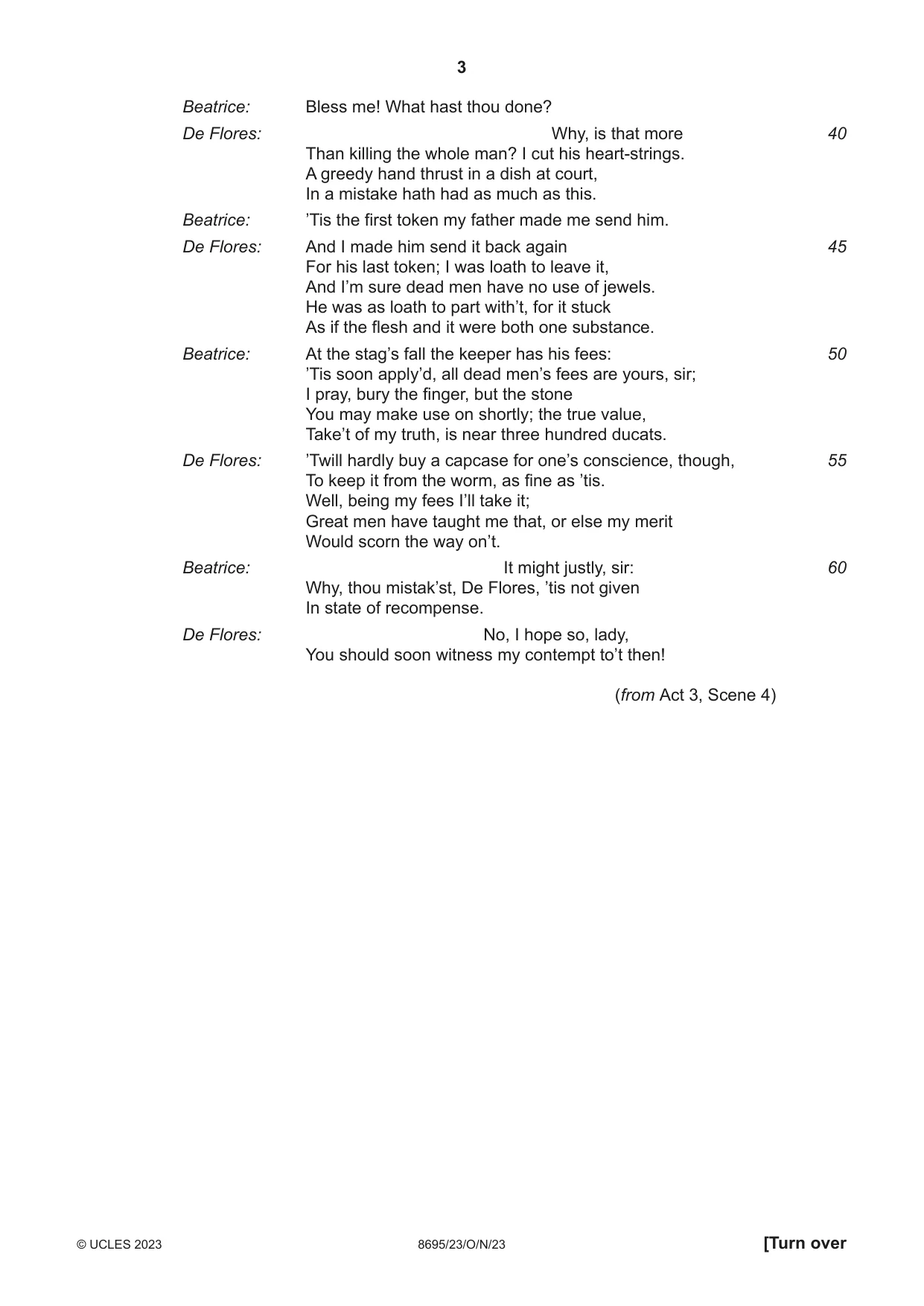
Question paper, page 3
3 8695/23/O/N/23 © UCLES 2023 [Turn over Beatrice: Bless me! What hast thou done? De Flores: Why, is that more Than killing the whole man? I cut his heart-strings. A greedy hand thrust in a dish at court, In a mistake hath had as much as this. Beatrice: ’Tis the first token my father made me send him. De Flores: And I made him send it back again For his last token; I was loath to leave it, And I’m sure dead men have no use of jewels. He was as loath to part with’t, for it stuck As if the flesh and it were both one substance. Beatrice: At the stag’s fall the keeper has his fees: ’Tis soon apply’d, all dead men’s fees are yours, sir; I pray, bury the finger, but the stone You may make use on shortly; the true value, Take’t of my truth, is near three hundred ducats. De Flores: ’Twill hardly buy a capcase for one’s conscience, though, To keep it from the worm, as fine as ’tis. Well, being my fees I’ll take it; Great men have taught me that, or else my merit Would scorn the way on’t. Beatrice: It might justly, sir: Why, thou mistak’st, De Flores, ’tis not given In state of recompense. De Flores: No, I hope so, lady, You should soon witness my contempt to’t then! (from Act 3, Scene 4) 40 45 50 55 60
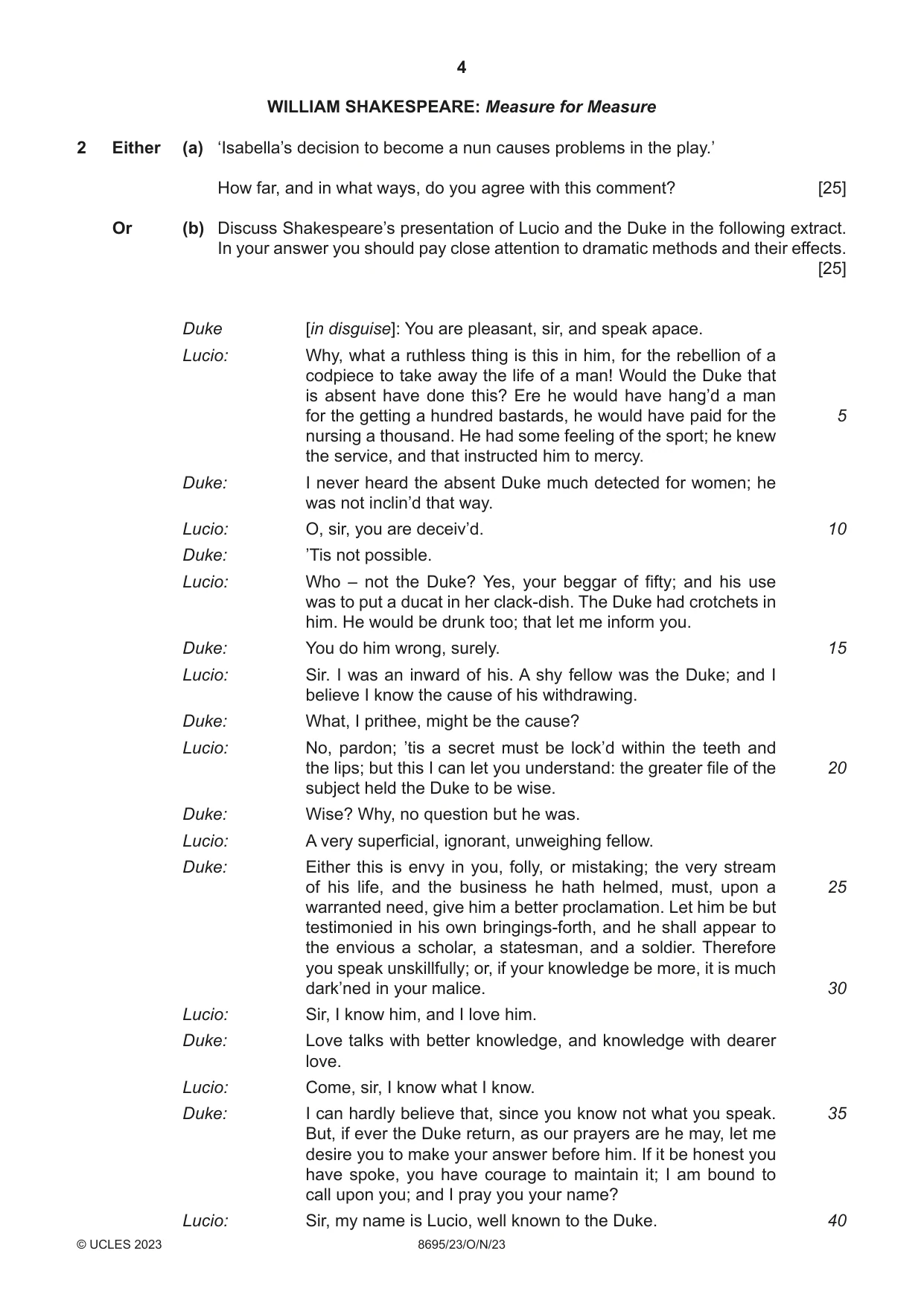
Question paper, page 4
4 8695/23/O/N/23 © UCLES 2023 WILLIAM SHAKESPEARE: Measure for Measure 2 Either (a) ‘Isabella’s decision to become a nun causes problems in the play.’ How far, and in what ways, do you agree with this comment? [25] Or (b) Discuss Shakespeare’s presentation of Lucio and the Duke in the following extract. In your answer you should pay close attention to dramatic methods and their effects. [25] Duke [in disguise]: You are pleasant, sir, and speak apace. Lucio: Why, what a ruthless thing is this in him, for the rebellion of a codpiece to take away the life of a man! Would the Duke that is absent have done this? Ere he would have hang’d a man for the getting a hundred bastards, he would have paid for the nursing a thousand. He had some feeling of the sport; he knew the service, and that instructed him to mercy. Duke: I never heard the absent Duke much detected for women; he was not inclin’d that way. Lucio: O, sir, you are deceiv’d. Duke: ’Tis not possible. Lucio: Who – not the Duke? Yes, your beggar of fifty; and his use was to put a ducat in her clack-dish. The Duke had crotchets in him. He would be drunk too; that let me inform you. Duke: You do him wrong, surely. Lucio: Sir. I was an inward of his. A shy fellow was the Duke; and I believe I know the cause of his withdrawing. Duke: What, I prithee, might be the cause? Lucio: No, pardon; ’tis a secret must be lock’d within the teeth and the lips; but this I can let you understand: the greater file of the subject held the Duke to be wise. Duke: Wise? Why, no question but he was. Lucio: A very superficial, ignorant, unweighing fellow. Duke: Either this is envy in you, folly, or mistaking; the very stream of his life, and the business he hath helmed, must, upon a warranted need, give him a better proclamation. Let him be but testimonied in his own bringings-forth, and he shall appear to the envious a scholar, a statesman, and a soldier. Therefore you speak unskillfully; or, if your knowledge be more, it is much dark’ned in your malice. Lucio: Sir, I know him, and I love him. Duke: Love talks with better knowledge, and knowledge with dearer love. Lucio: Come, sir, I know what I know. Duke: I can hardly believe that, since you know not what you speak. But, if ever the Duke return, as our prayers are he may, let me desire you to make your answer before him. If it be honest you have spoke, you have courage to maintain it; I am bound to call upon you; and I pray you your name? Lucio: Sir, my name is Lucio, well known to the Duke. 5 10 15 20 25 30 35 40
Question paper, page 5
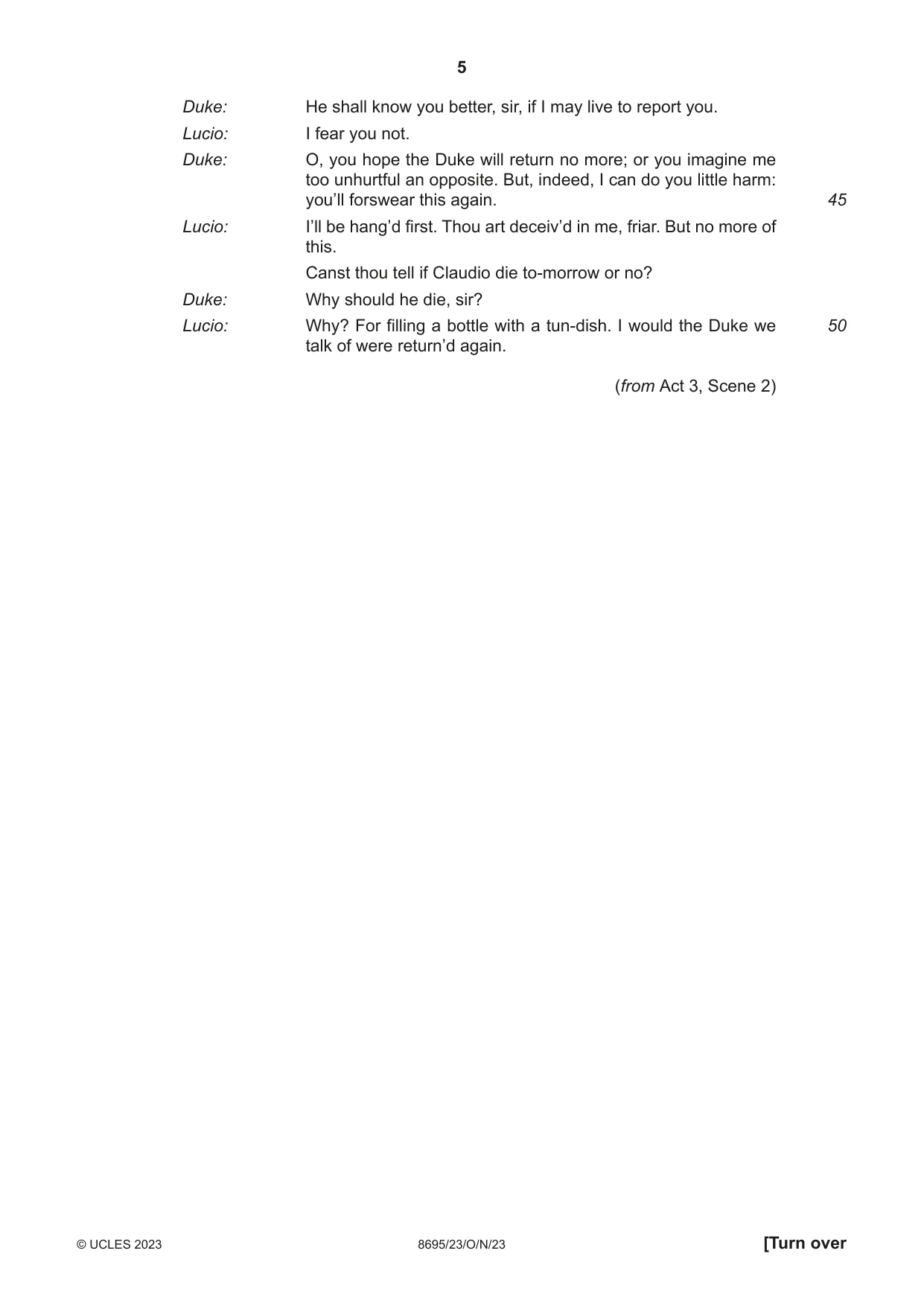
5 8695/23/O/N/23 © UCLES 2023 [Turn over Duke: He shall know you better, sir, if I may live to report you. Lucio: I fear you not. Duke: O, you hope the Duke will return no more; or you imagine me too unhurtful an opposite. But, indeed, I can do you little harm: you’ll forswear this again. Lucio: I’ll be hang’d first. Thou art deceiv’d in me, friar. But no more of this. Canst thou tell if Claudio die to-morrow or no? Duke: Why should he die, sir? Lucio: Why? For filling a bottle with a tun-dish. I would the Duke we talk of were return’d again. (from Act 3, Scene 2) 45 50
Question paper, page 6
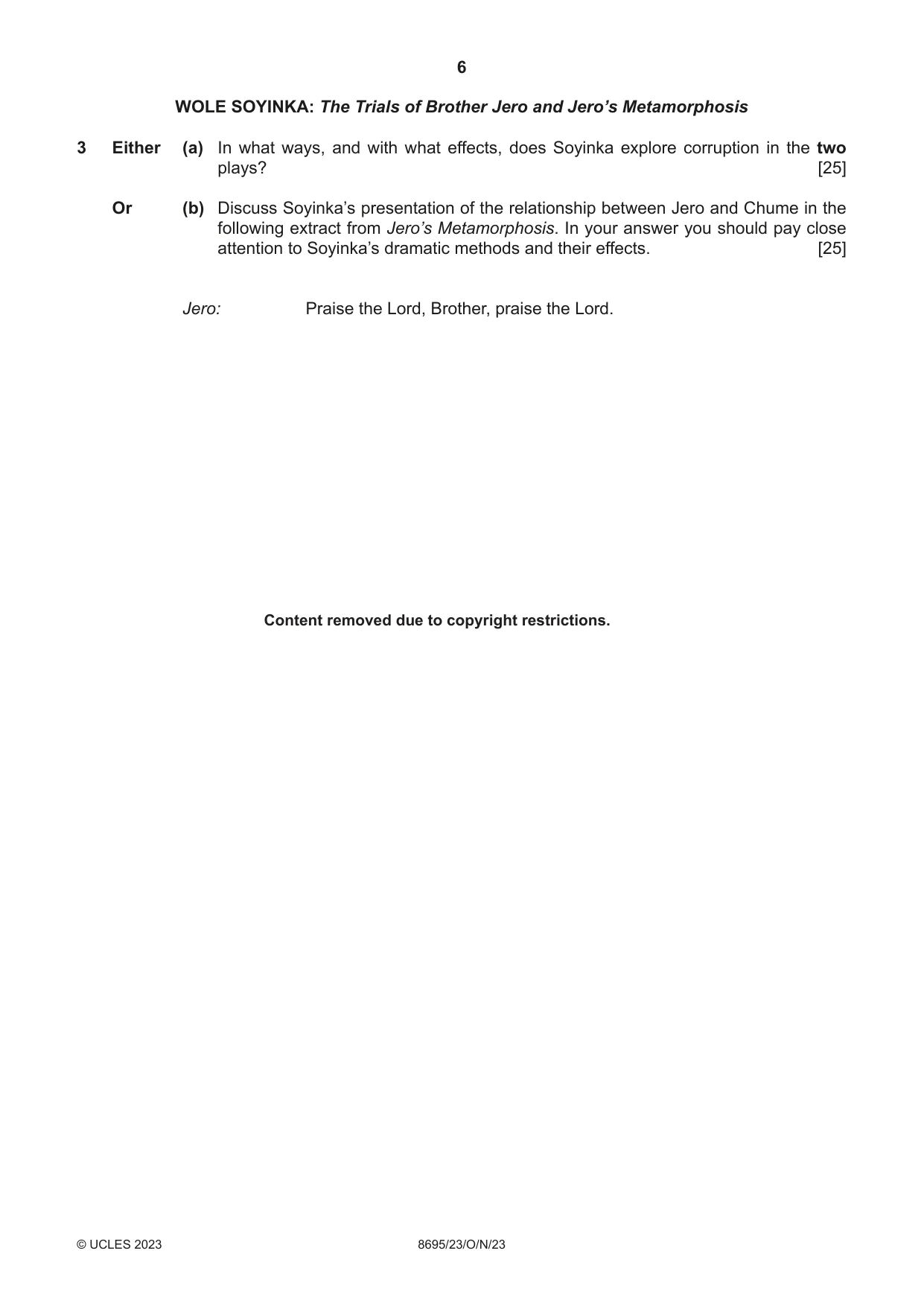
6 8695/23/O/N/23 © UCLES 2023 WOLE SOYINKA: The Trials of Brother Jero and Jero’s Metamorphosis 3 Either (a) In what ways, and with what effects, does Soyinka explore corruption in the two plays? [25] Or (b) Discuss Soyinka’s presentation of the relationship between Jero and Chume in the following extract from Jero’s Metamorphosis. In your answer you should pay close attention to Soyinka’s dramatic methods and their effects. [25] Jero: Praise the Lord, Brother, praise the Lord. Content removed due to copyright restrictions.
Question paper, page 7
7 8695/23/O/N/23 © UCLES 2023 [Turn over [Blackout.] (from Jero’s Metamorphosis, Scene 2) Content removed due to copyright restrictions.
Question paper, page 8
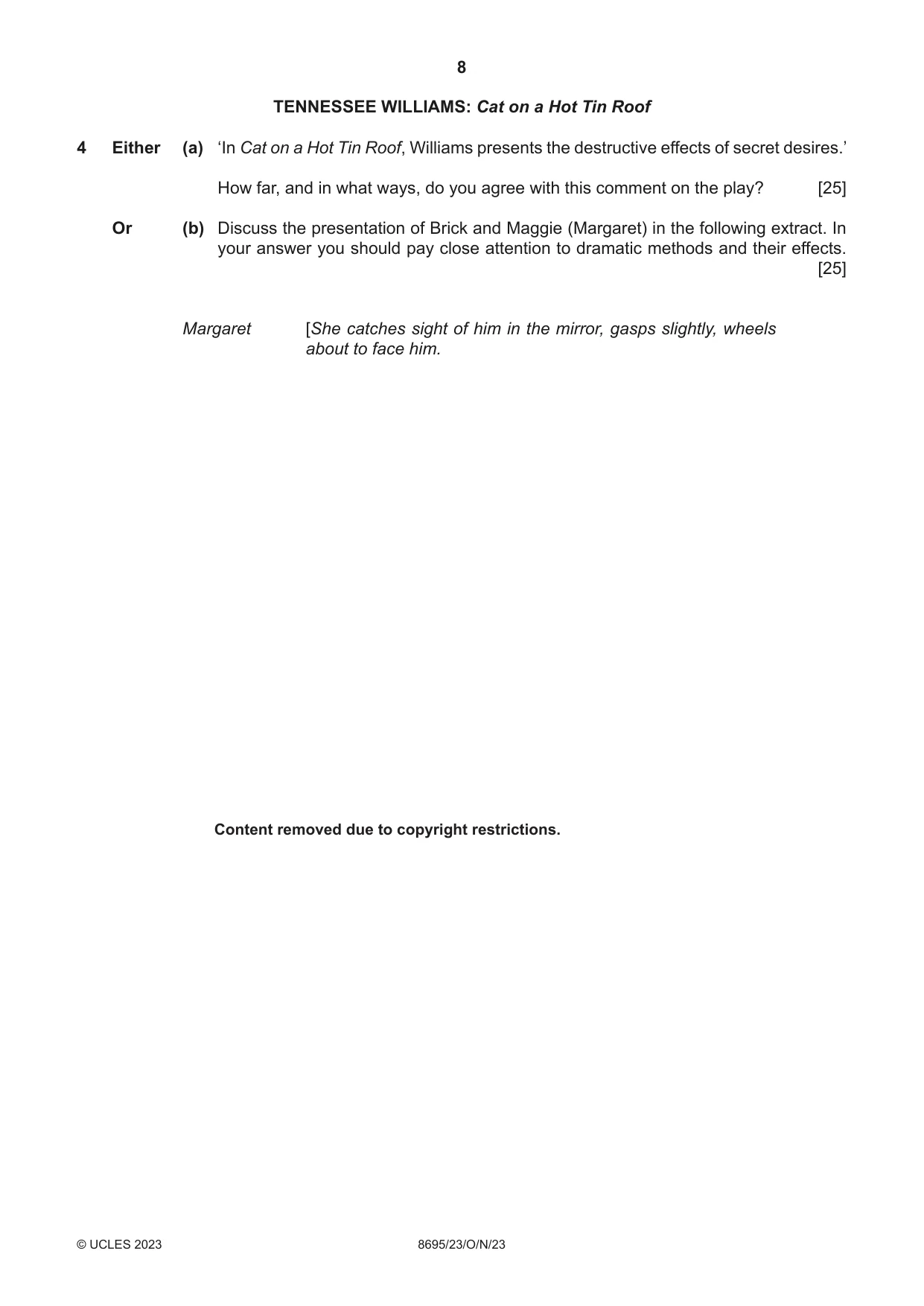
8 8695/23/O/N/23 © UCLES 2023 TENNESSEE WILLIAMS: Cat on a Hot Tin Roof 4 Either (a) ‘In Cat on a Hot Tin Roof, Williams presents the destructive effects of secret desires.’ How far, and in what ways, do you agree with this comment on the play? [25] Or (b) Discuss the presentation of Brick and Maggie (Margaret) in the following extract. In your answer you should pay close attention to dramatic methods and their effects. [25] Margaret [She catches sight of him in the mirror, gasps slightly, wheels about to face him. Content removed due to copyright restrictions.
Question paper, page 9
9 8695/23/O/N/23 © UCLES 2023 [Turn over Yeah, a person who didn’t know you would think you’d never had a tense nerve in your body or a strained muscle. (from Act 1) Content removed due to copyright restrictions.
Question paper, page 10
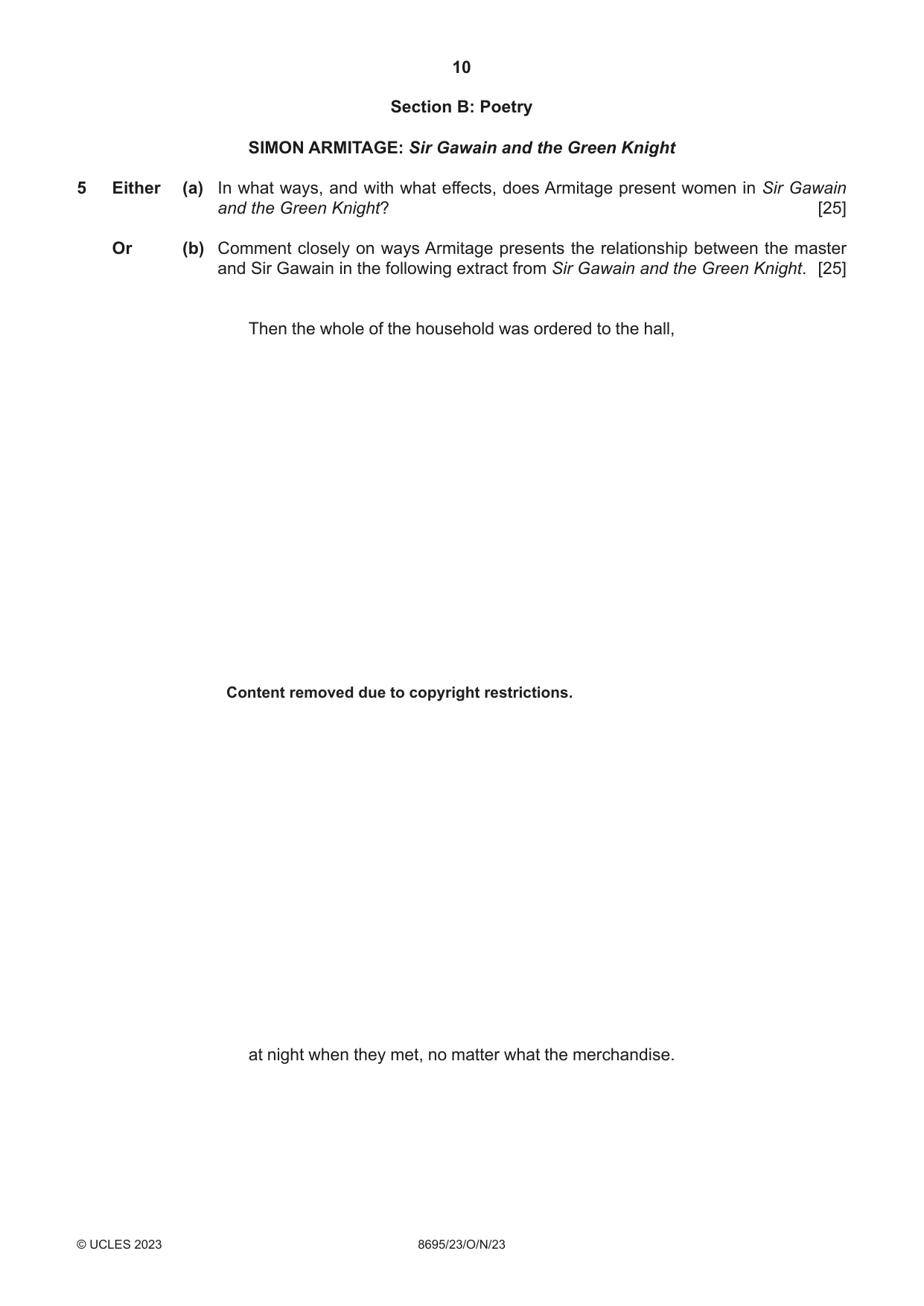
10 8695/23/O/N/23 © UCLES 2023 Section B: Poetry SIMON ARMITAGE: Sir Gawain and the Green Knight 5 Either (a) In what ways, and with what effects, does Armitage present women in Sir Gawain and the Green Knight? [25] Or (b) Comment closely on ways Armitage presents the relationship between the master and Sir Gawain in the following extract from Sir Gawain and the Green Knight. [25] Then the whole of the household was ordered to the hall, at night when they met, no matter what the merchandise. Content removed due to copyright restrictions.
Question paper, page 11
11 8695/23/O/N/23 © UCLES 2023 [Turn over TURN OVER FOR QUESTION 6.
Question paper, page 12
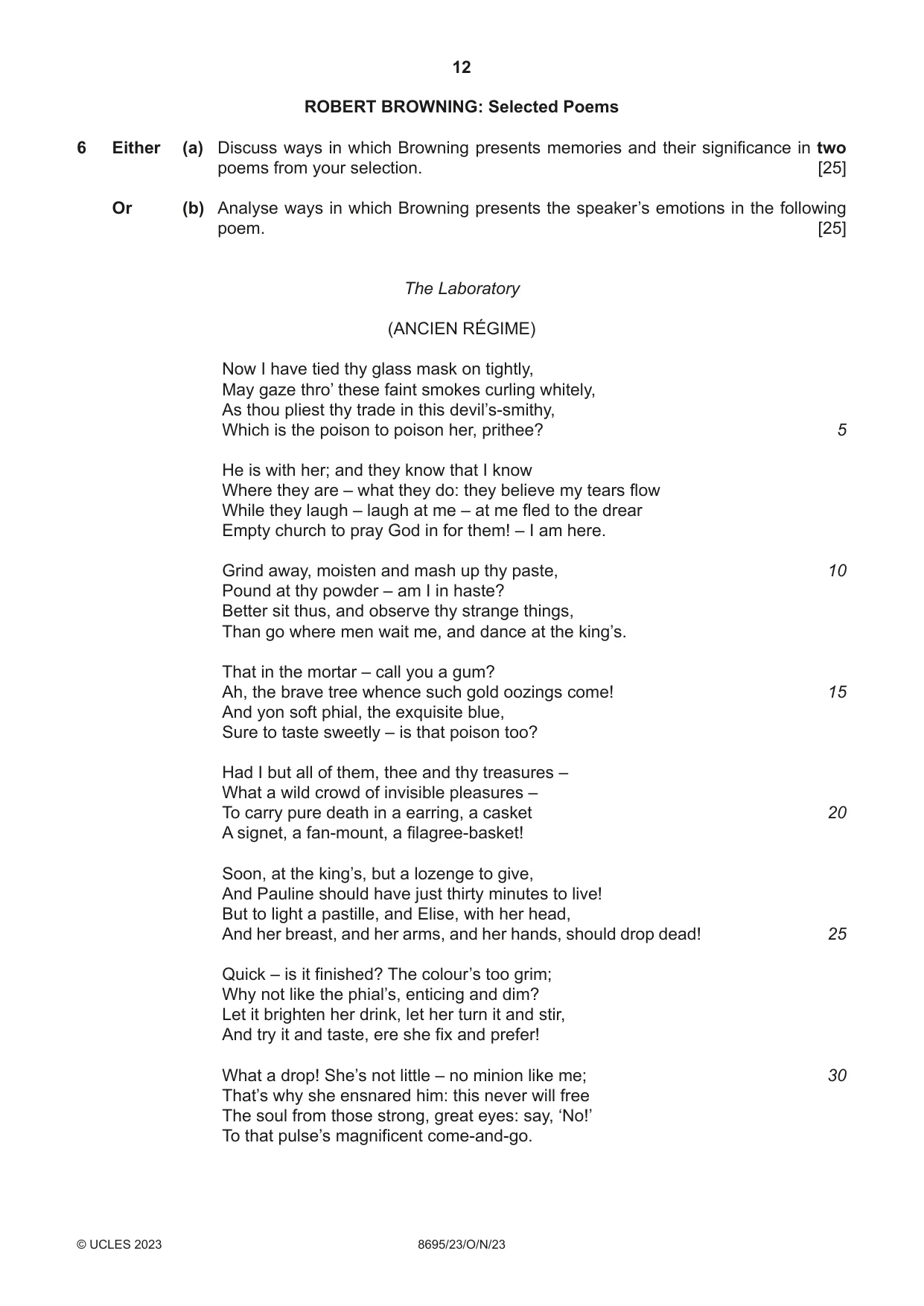
12 8695/23/O/N/23 © UCLES 2023 ROBERT BROWNING: Selected Poems 6 Either (a) Discuss ways in which Browning presents memories and their significance in two poems from your selection. [25] Or (b) Analyse ways in which Browning presents the speaker’s emotions in the following poem. [25] The Laboratory (ANCIEN RÉGIME) Now I have tied thy glass mask on tightly, May gaze thro’ these faint smokes curling whitely, As thou pliest thy trade in this devil’s-smithy, Which is the poison to poison her, prithee? He is with her; and they know that I know Where they are – what they do: they believe my tears flow While they laugh – laugh at me – at me fled to the drear Empty church to pray God in for them! – I am here. Grind away, moisten and mash up thy paste, Pound at thy powder – am I in haste? Better sit thus, and observe thy strange things, Than go where men wait me, and dance at the king’s. That in the mortar – call you a gum? Ah, the brave tree whence such gold oozings come! And yon soft phial, the exquisite blue, Sure to taste sweetly – is that poison too? Had I but all of them, thee and thy treasures – What a wild crowd of invisible pleasures – To carry pure death in a earring, a casket A signet, a fan-mount, a filagree-basket! Soon, at the king’s, but a lozenge to give, And Pauline should have just thirty minutes to live! But to light a pastille, and Elise, with her head, And her breast, and her arms, and her hands, should drop dead! Quick – is it finished? The colour’s too grim; Why not like the phial’s, enticing and dim? Let it brighten her drink, let her turn it and stir, And try it and taste, ere she fix and prefer! What a drop! She’s not little – no minion like me; That’s why she ensnared him: this never will free The soul from those strong, great eyes: say, ‘No!’ To that pulse’s magnificent come-and-go. 5 10 15 20 25 30
Question paper, page 13
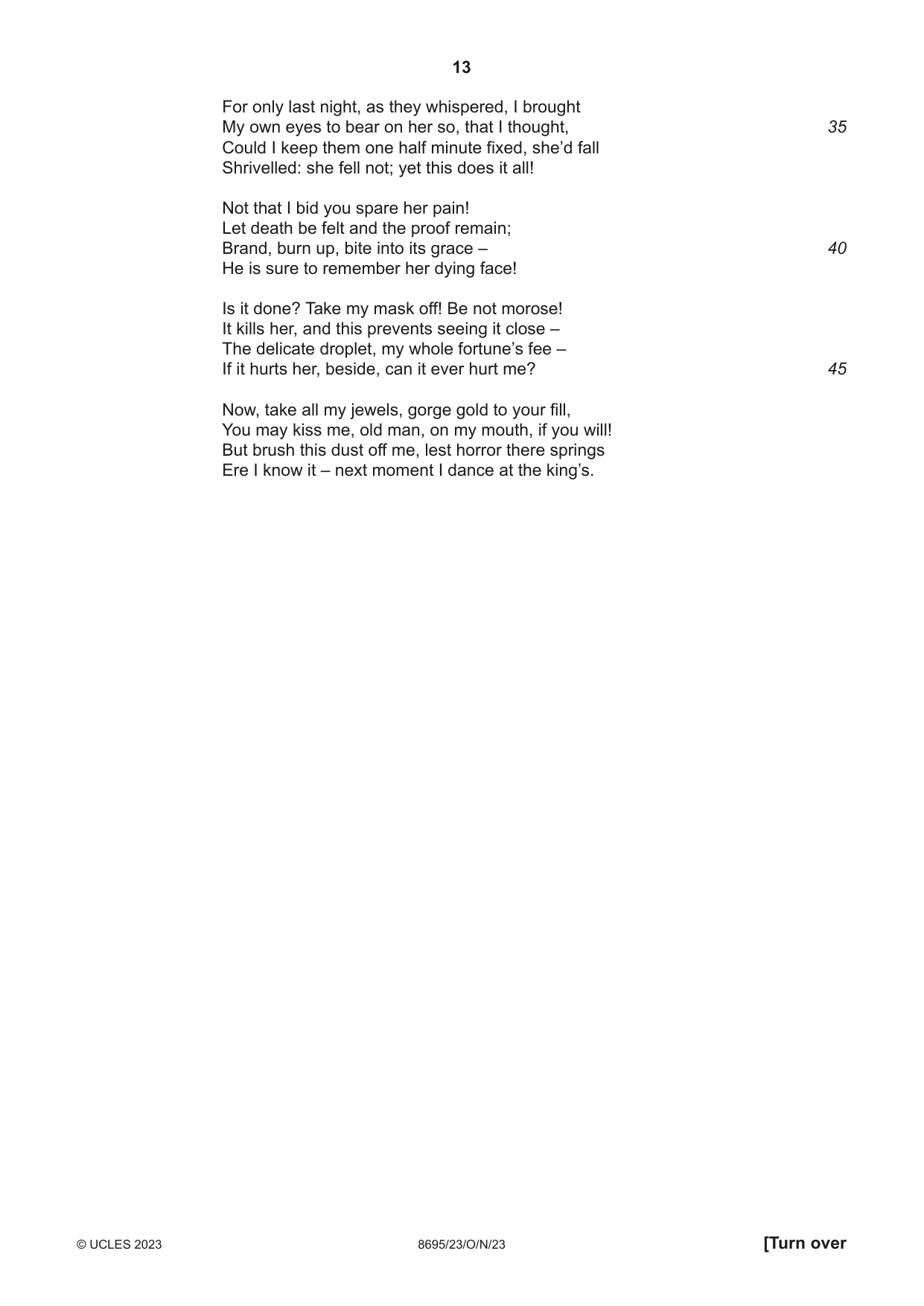
13 8695/23/O/N/23 © UCLES 2023 [Turn over For only last night, as they whispered, I brought My own eyes to bear on her so, that I thought, Could I keep them one half minute fixed, she’d fall Shrivelled: she fell not; yet this does it all! Not that I bid you spare her pain! Let death be felt and the proof remain; Brand, burn up, bite into its grace – He is sure to remember her dying face! Is it done? Take my mask off! Be not morose! It kills her, and this prevents seeing it close – The delicate droplet, my whole fortune’s fee – If it hurts her, beside, can it ever hurt me? Now, take all my jewels, gorge gold to your fill, You may kiss me, old man, on my mouth, if you will! But brush this dust off me, lest horror there springs Ere I know it – next moment I dance at the king’s. 35 40 45
Question paper, page 14
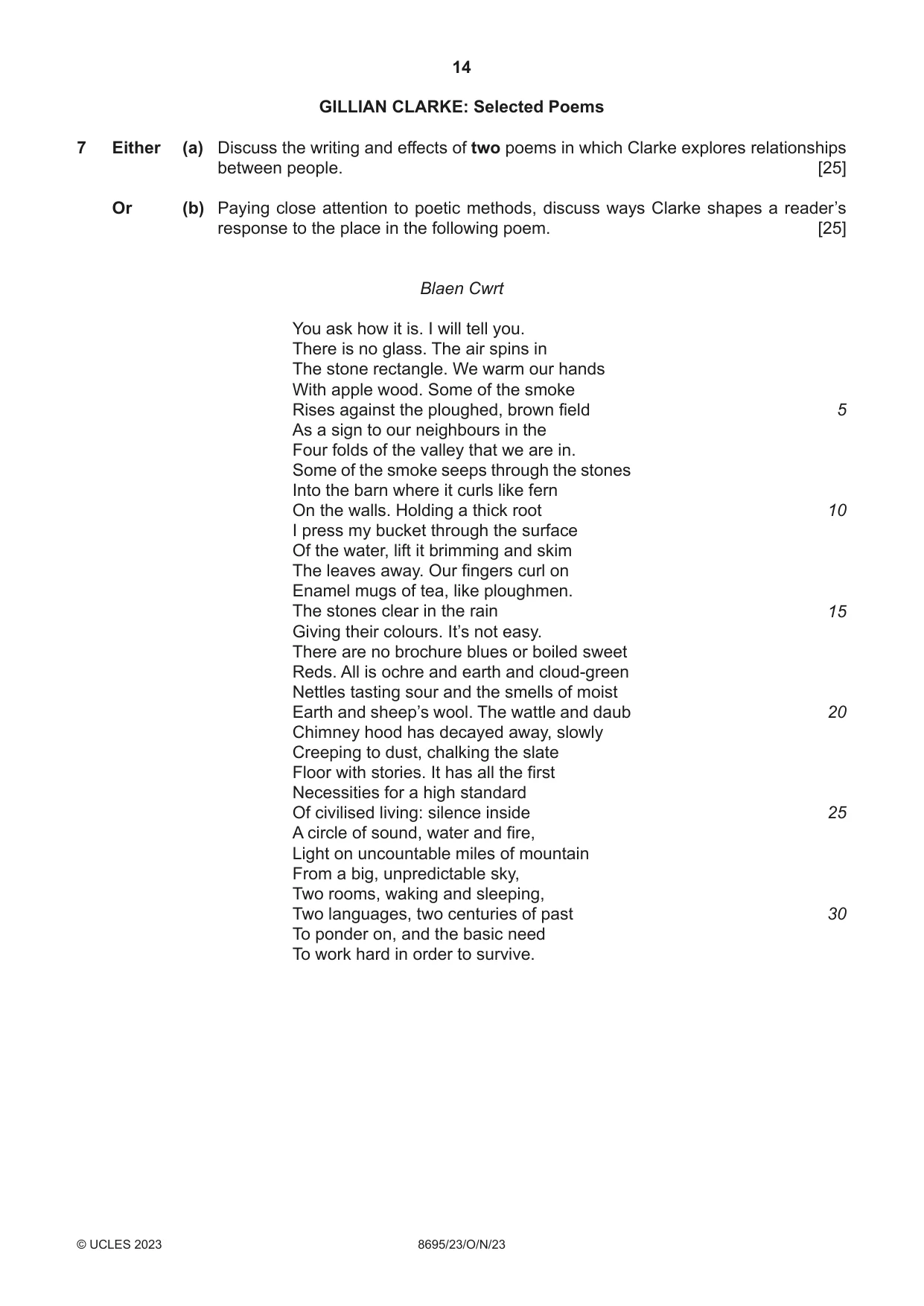
14 8695/23/O/N/23 © UCLES 2023 GILLIAN CLARKE: Selected Poems 7 Either (a) Discuss the writing and effects of two poems in which Clarke explores relationships between people. [25] Or (b) Paying close attention to poetic methods, discuss ways Clarke shapes a reader’s response to the place in the following poem. [25] Blaen Cwrt You ask how it is. I will tell you. There is no glass. The air spins in The stone rectangle. We warm our hands With apple wood. Some of the smoke Rises against the ploughed, brown field As a sign to our neighbours in the Four folds of the valley that we are in. Some of the smoke seeps through the stones Into the barn where it curls like fern On the walls. Holding a thick root I press my bucket through the surface Of the water, lift it brimming and skim The leaves away. Our fingers curl on Enamel mugs of tea, like ploughmen. The stones clear in the rain Giving their colours. It’s not easy. There are no brochure blues or boiled sweet Reds. All is ochre and earth and cloud-green Nettles tasting sour and the smells of moist Earth and sheep’s wool. The wattle and daub Chimney hood has decayed away, slowly Creeping to dust, chalking the slate Floor with stories. It has all the first Necessities for a high standard Of civilised living: silence inside A circle of sound, water and fire, Light on uncountable miles of mountain From a big, unpredictable sky, Two rooms, waking and sleeping, Two languages, two centuries of past To ponder on, and the basic need To work hard in order to survive. 5 10 15 20 25 30
Question paper, page 15
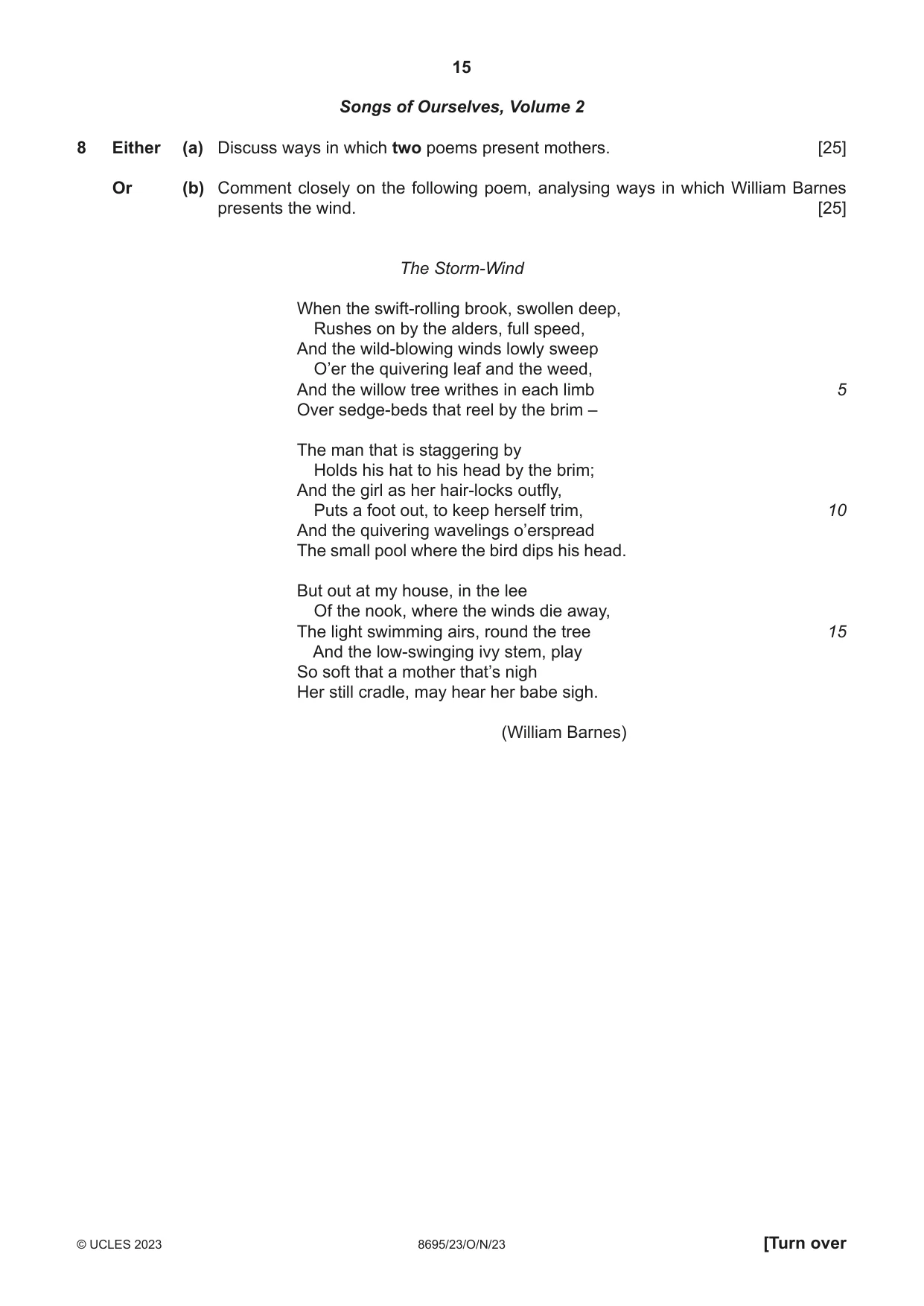
15 8695/23/O/N/23 © UCLES 2023 [Turn over Songs of Ourselves, Volume 2 8 Either (a) Discuss ways in which two poems present mothers. [25] Or (b) Comment closely on the following poem, analysing ways in which William Barnes presents the wind. [25] The Storm-Wind When the swift-rolling brook, swollen deep, Rushes on by the alders, full speed, And the wild-blowing winds lowly sweep O’er the quivering leaf and the weed, And the willow tree writhes in each limb Over sedge-beds that reel by the brim – The man that is staggering by Holds his hat to his head by the brim; And the girl as her hair-locks outfly, Puts a foot out, to keep herself trim, And the quivering wavelings o’erspread The small pool where the bird dips his head. But out at my house, in the lee Of the nook, where the winds die away, The light swimming airs, round the tree And the low-swinging ivy stem, play So soft that a mother that’s nigh Her still cradle, may hear her babe sigh. (William Barnes) 5 10 15
Question paper, page 16
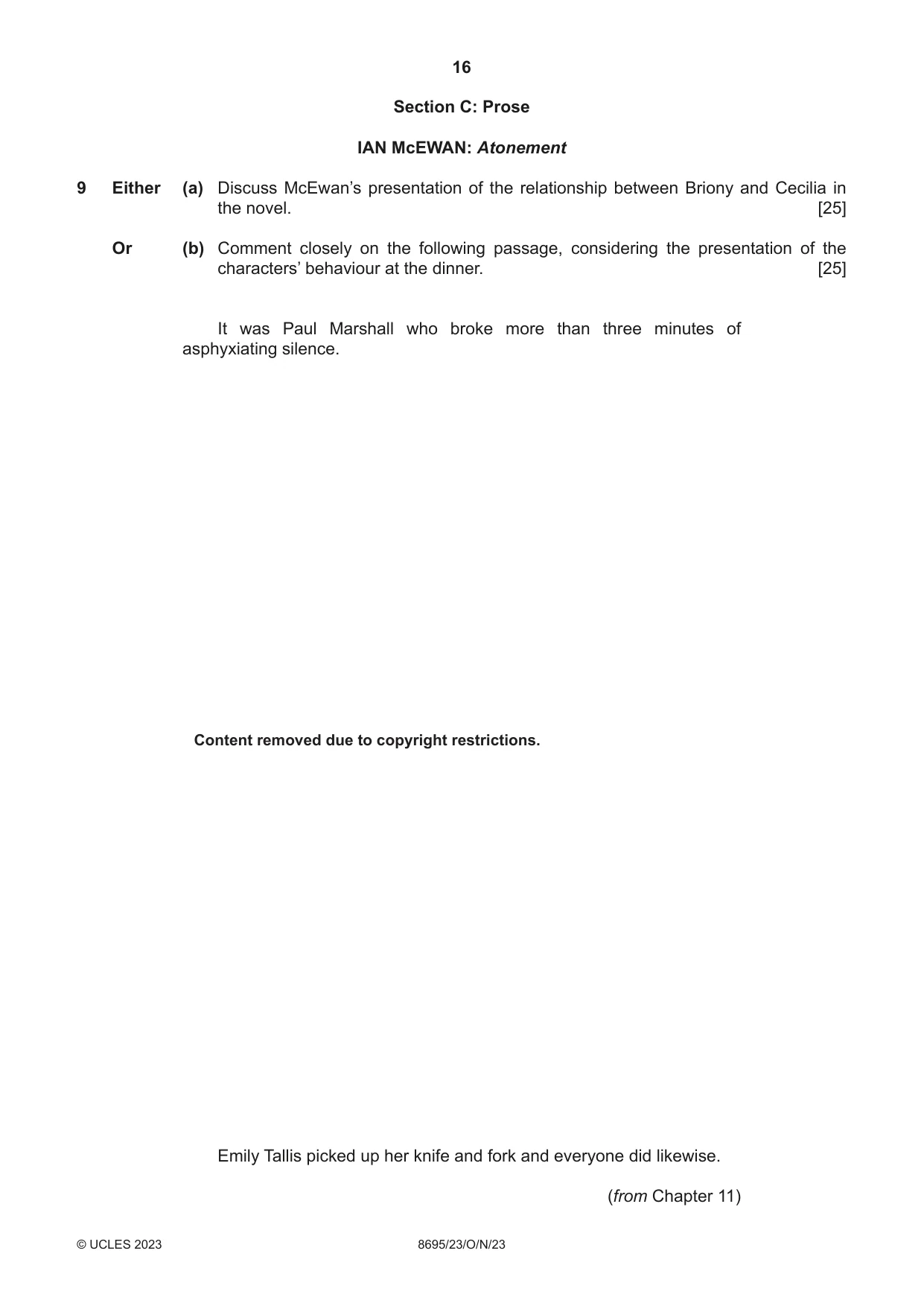
16 8695/23/O/N/23 © UCLES 2023 Section C: Prose IAN McEWAN: Atonement 9 Either (a) Discuss McEwan’s presentation of the relationship between Briony and Cecilia in the novel. [25] Or (b) Comment closely on the following passage, considering the presentation of the characters’ behaviour at the dinner. [25] It was Paul Marshall who broke more than three minutes of asphyxiating silence. Emily Tallis picked up her knife and fork and everyone did likewise. (from Chapter 11) Content removed due to copyright restrictions.
Question paper, page 17
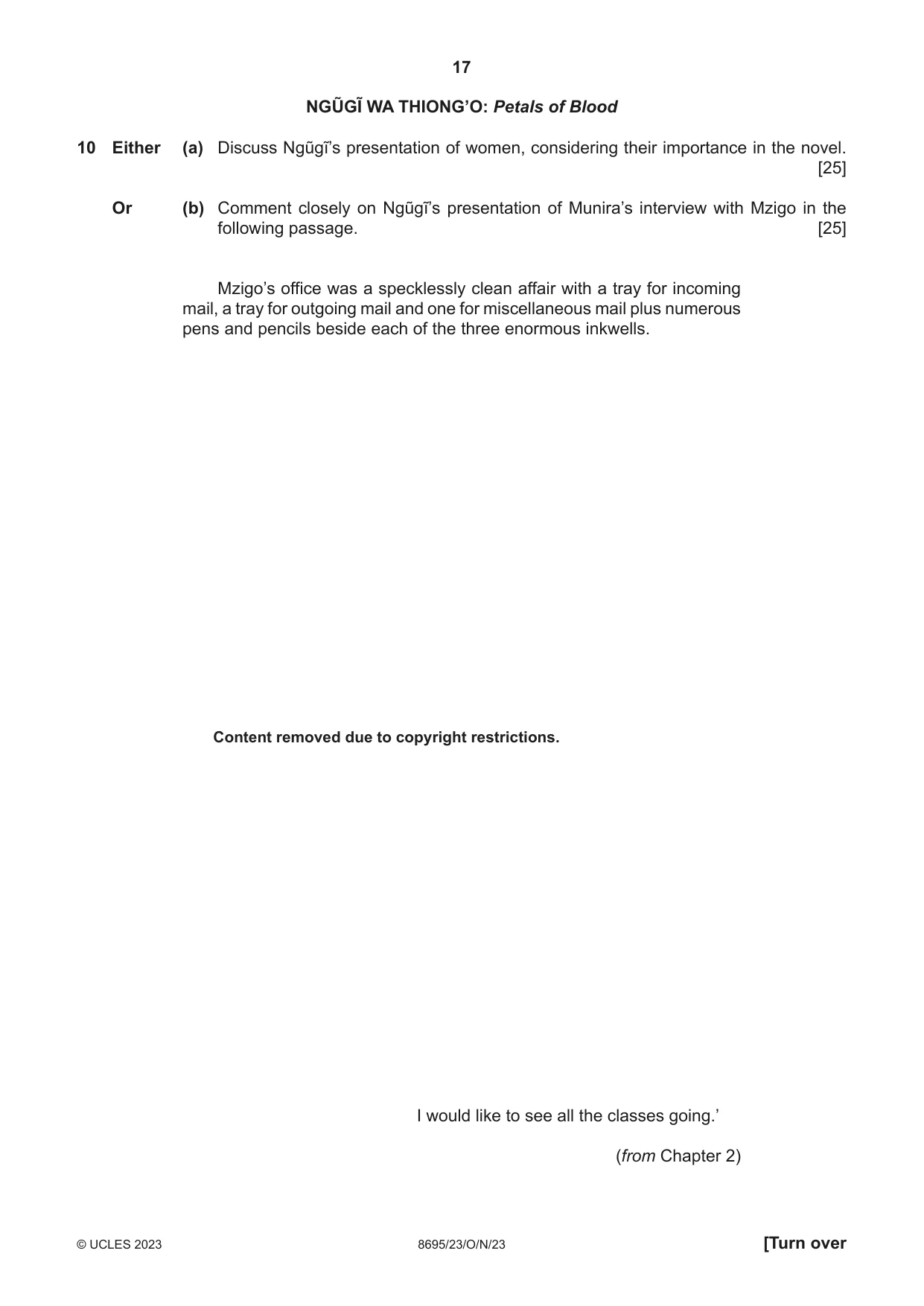
17 8695/23/O/N/23 © UCLES 2023 [Turn over NGŨGĨ WA THIONG’O: Petals of Blood 10 Either (a) Discuss Ngũgĩ’s presentation of women, considering their importance in the novel. [25] Or (b) Comment closely on Ngũgĩ’s presentation of Munira’s interview with Mzigo in the following passage. [25] Mzigo’s office was a specklessly clean affair with a tray for incoming mail, a tray for outgoing mail and one for miscellaneous mail plus numerous pens and pencils beside each of the three enormous inkwells. I would like to see all the classes going.’ (from Chapter 2) Content removed due to copyright restrictions.
Question paper, page 18
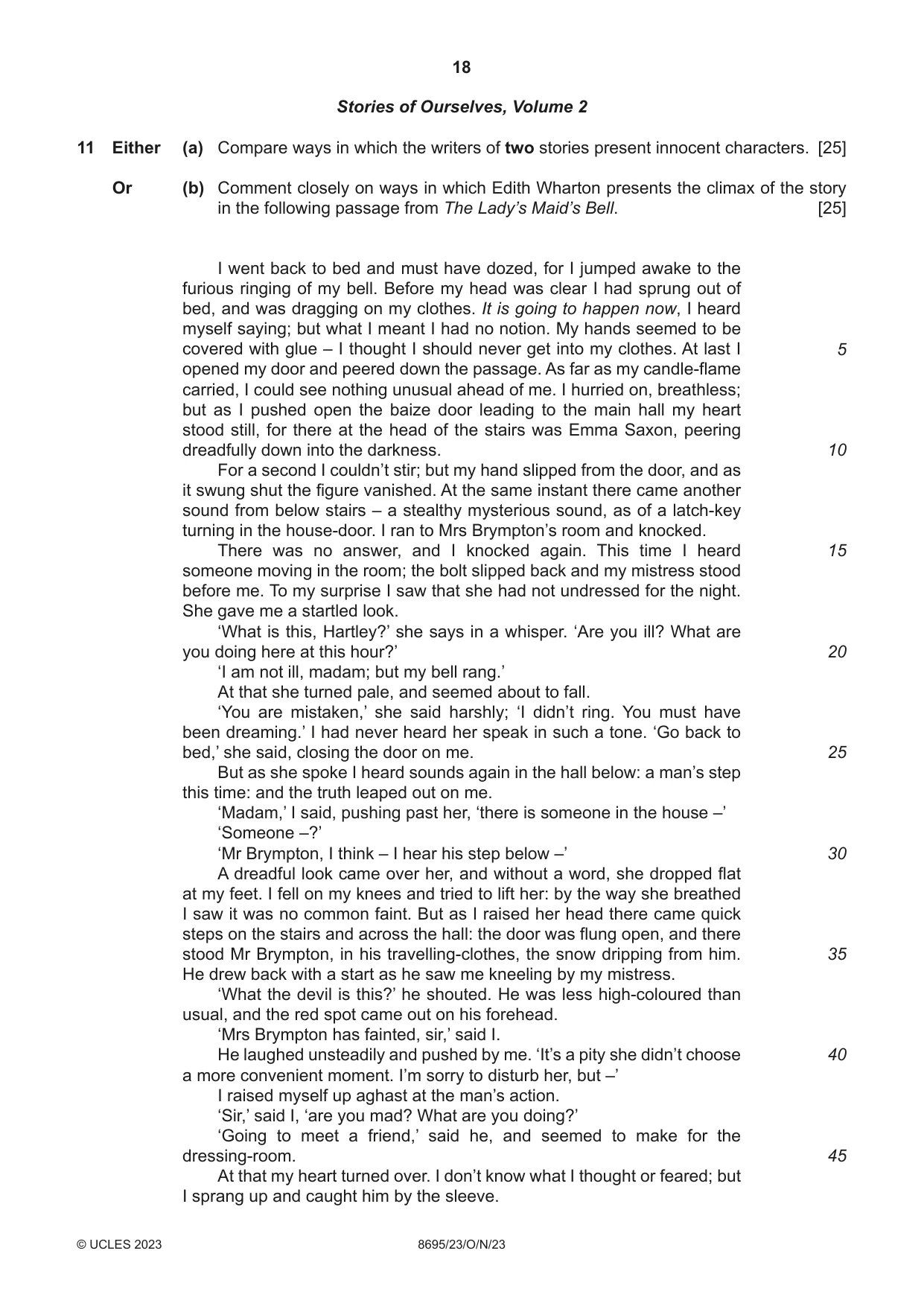
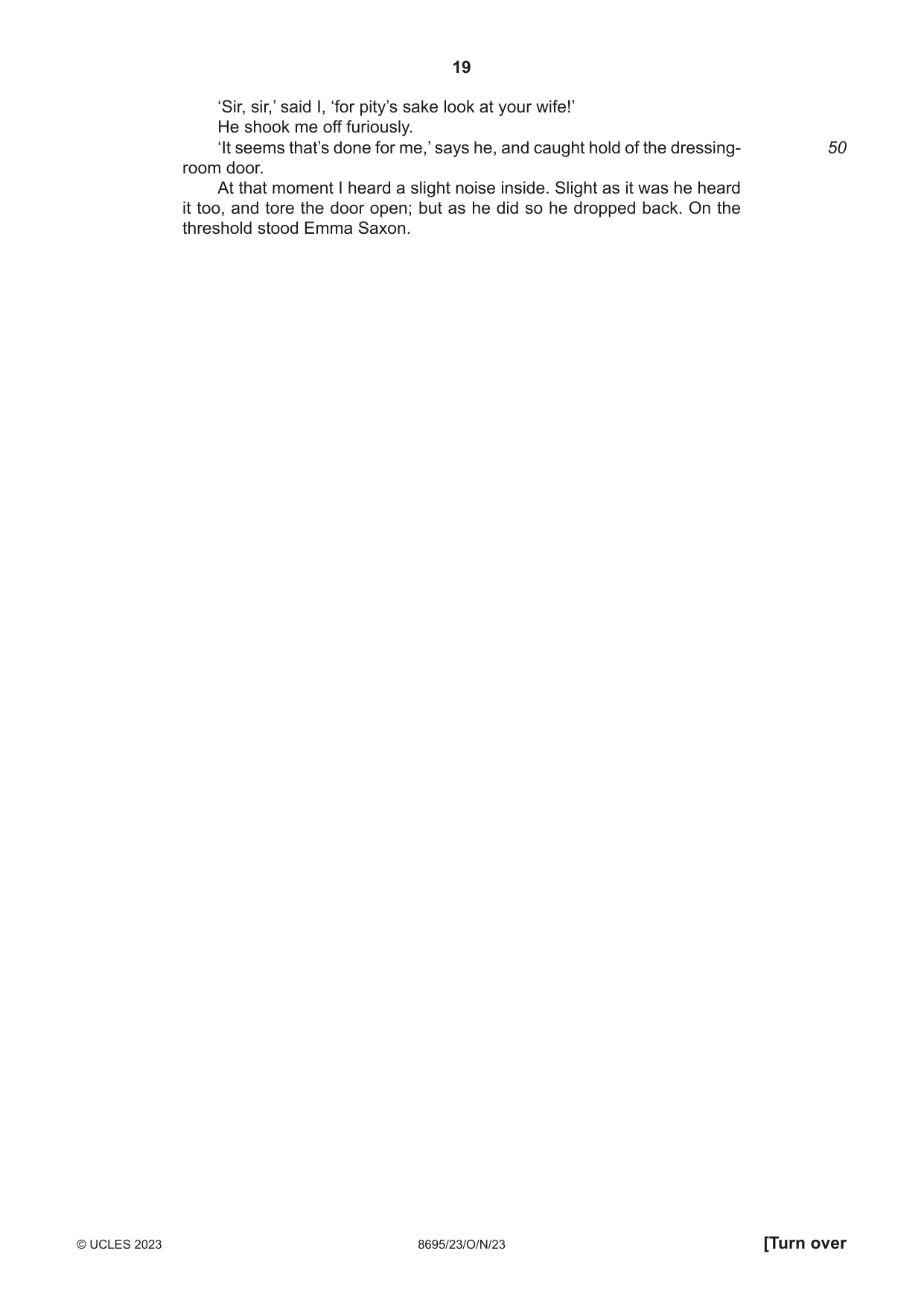
18 8695/23/O/N/23 © UCLES 2023 Stories of Ourselves, Volume 2 11 Either (a) Compare ways in which the writers of two stories present innocent characters. [25] Or (b) Comment closely on ways in which Edith Wharton presents the climax of the story in the following passage from The Lady’s Maid’s Bell. [25] I went back to bed and must have dozed, for I jumped awake to the furious ringing of my bell. Before my head was clear I had sprung out of bed, and was dragging on my clothes. It is going to happen now, I heard myself saying; but what I meant I had no notion. My hands seemed to be covered with glue – I thought I should never get into my clothes. At last I opened my door and peered down the passage. As far as my candle-flame carried, I could see nothing unusual ahead of me. I hurried on, breathless; but as I pushed open the baize door leading to the main hall my heart stood still, for there at the head of the stairs was Emma Saxon, peering dreadfully down into the darkness. For a second I couldn’t stir; but my hand slipped from the door, and as it swung shut the figure vanished. At the same instant there came another sound from below stairs – a stealthy mysterious sound, as of a latch-key turning in the house-door. I ran to Mrs Brympton’s room and knocked. There was no answer, and I knocked again. This time I heard someone moving in the room; the bolt slipped back and my mistress stood before me. To my surprise I saw that she had not undressed for the night. She gave me a startled look. ‘What is this, Hartley?’ she says in a whisper. ‘Are you ill? What are you doing here at this hour?’ ‘I am not ill, madam; but my bell rang.’ At that she turned pale, and seemed about to fall. ‘You are mistaken,’ she said harshly; ‘I didn’t ring. You must have been dreaming.’ I had never heard her speak in such a tone. ‘Go back to bed,’ she said, closing the door on me. But as she spoke I heard sounds again in the hall below: a man’s step this time: and the truth leaped out on me. ‘Madam,’ I said, pushing past her, ‘there is someone in the house –’ ‘Someone –?’ ‘Mr Brympton, I think – I hear his step below –’ A dreadful look came over her, and without a word, she dropped flat at my feet. I fell on my knees and tried to lift her: by the way she breathed I saw it was no common faint. But as I raised her head there came quick steps on the stairs and across the hall: the door was flung open, and there stood Mr Brympton, in his travelling-clothes, the snow dripping from him. He drew back with a start as he saw me kneeling by my mistress. ‘What the devil is this?’ he shouted. He was less high-coloured than usual, and the red spot came out on his forehead. ‘Mrs Brympton has fainted, sir,’ said I. He laughed unsteadily and pushed by me. ‘It’s a pity she didn’t choose a more convenient moment. I’m sorry to disturb her, but –’ I raised myself up aghast at the man’s action. ‘Sir,’ said I, ‘are you mad? What are you doing?’ ‘Going to meet a friend,’ said he, and seemed to make for the dressing-room. At that my heart turned over. I don’t know what I thought or feared; but I sprang up and caught him by the sleeve. 5 10 15 20 25 30 35 40 45
Question paper, page 19
19 8695/23/O/N/23 © UCLES 2023 [Turn over ‘Sir, sir,’ said I, ‘for pity’s sake look at your wife!’ He shook me off furiously. ‘It seems that’s done for me,’ says he, and caught hold of the dressing- room door. At that moment I heard a slight noise inside. Slight as it was he heard it too, and tore the door open; but as he did so he dropped back. On the threshold stood Emma Saxon. 50
Question paper, page 20
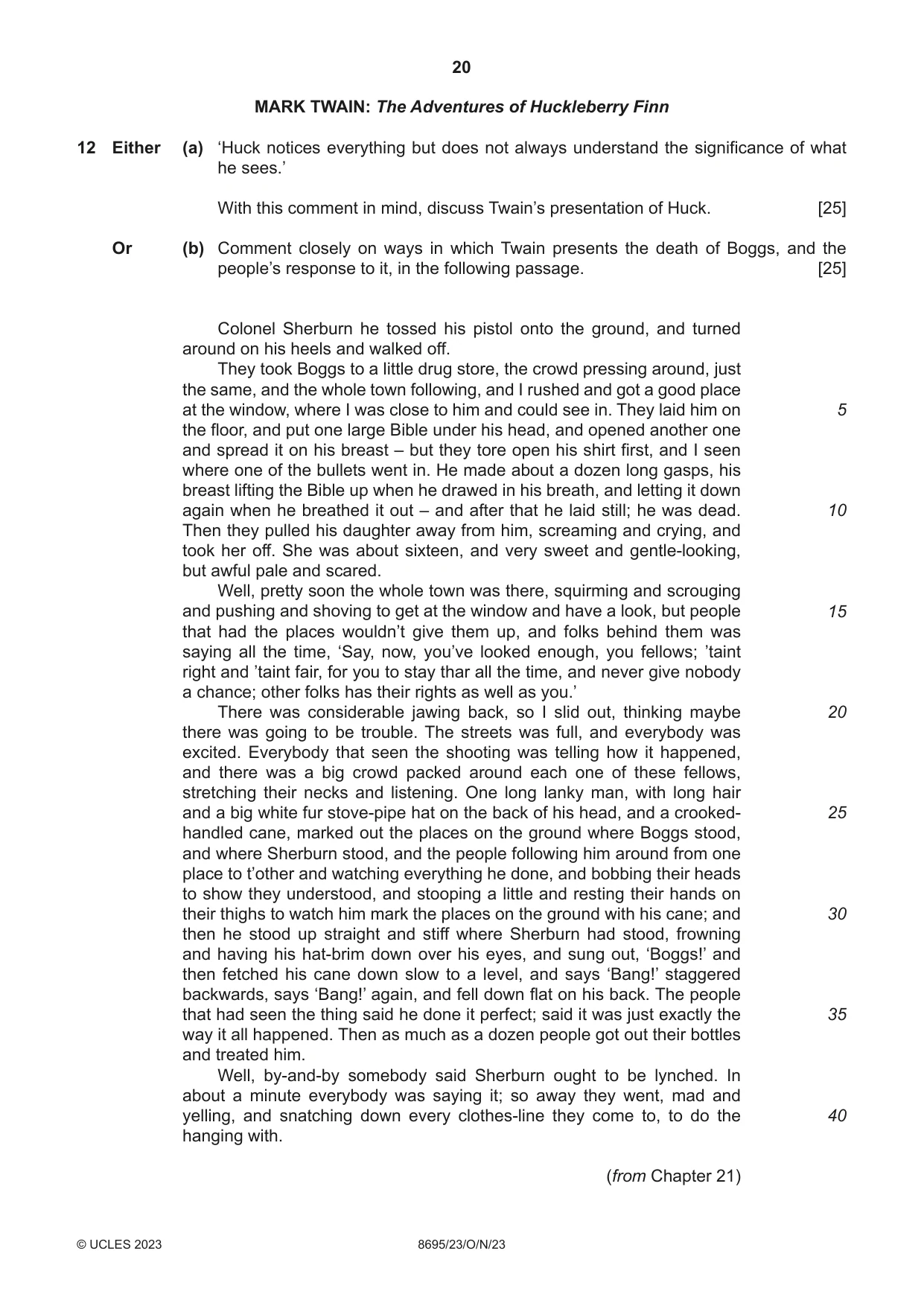
20 8695/23/O/N/23 © UCLES 2023 MARK TWAIN: The Adventures of Huckleberry Finn 12 Either (a) ‘Huck notices everything but does not always understand the significance of what he sees.’ With this comment in mind, discuss Twain’s presentation of Huck. [25] Or (b) Comment closely on ways in which Twain presents the death of Boggs, and the people’s response to it, in the following passage. [25] Colonel Sherburn he tossed his pistol onto the ground, and turned around on his heels and walked off. They took Boggs to a little drug store, the crowd pressing around, just the same, and the whole town following, and I rushed and got a good place at the window, where I was close to him and could see in. They laid him on the floor, and put one large Bible under his head, and opened another one and spread it on his breast – but they tore open his shirt first, and I seen where one of the bullets went in. He made about a dozen long gasps, his breast lifting the Bible up when he drawed in his breath, and letting it down again when he breathed it out – and after that he laid still; he was dead. Then they pulled his daughter away from him, screaming and crying, and took her off. She was about sixteen, and very sweet and gentle-looking, but awful pale and scared. Well, pretty soon the whole town was there, squirming and scrouging and pushing and shoving to get at the window and have a look, but people that had the places wouldn’t give them up, and folks behind them was saying all the time, ‘Say, now, you’ve looked enough, you fellows; ’taint right and ’taint fair, for you to stay thar all the time, and never give nobody a chance; other folks has their rights as well as you.’ There was considerable jawing back, so I slid out, thinking maybe there was going to be trouble. The streets was full, and everybody was excited. Everybody that seen the shooting was telling how it happened, and there was a big crowd packed around each one of these fellows, stretching their necks and listening. One long lanky man, with long hair and a big white fur stove-pipe hat on the back of his head, and a crooked- handled cane, marked out the places on the ground where Boggs stood, and where Sherburn stood, and the people following him around from one place to t’other and watching everything he done, and bobbing their heads to show they understood, and stooping a little and resting their hands on their thighs to watch him mark the places on the ground with his cane; and then he stood up straight and stiff where Sherburn had stood, frowning and having his hat-brim down over his eyes, and sung out, ‘Boggs!’ and then fetched his cane down slow to a level, and says ‘Bang!’ staggered backwards, says ‘Bang!’ again, and fell down flat on his back. The people that had seen the thing said he done it perfect; said it was just exactly the way it all happened. Then as much as a dozen people got out their bottles and treated him. Well, by-and-by somebody said Sherburn ought to be lynched. In about a minute everybody was saying it; so away they went, mad and yelling, and snatching down every clothes-line they come to, to do the hanging with. (from Chapter 21) 5 10 15 20 25 30 35 40
Question paper, page 21
21 8695/23/O/N/23 © UCLES 2023 BLANK PAGE
Question paper, page 22
22 8695/23/O/N/23 © UCLES 2023 BLANK PAGE
Question paper, page 23
23 8695/23/O/N/23 © UCLES 2023 BLANK PAGE
Question paper, page 24
24 8695/23/O/N/23 © UCLES 2023 Permission to reproduce items where third-party owned material protected by copyright is included has been sought and cleared where possible. Every reasonable effort has been made by the publisher (UCLES) to trace copyright holders, but if any items requiring clearance have unwittingly been included, the publisher will be pleased to make amends at the earliest possible opportunity. To avoid the issue of disclosure of answer-related information to candidates, all copyright acknowledgements are reproduced online in the Cambridge Assessment International Education Copyright Acknowledgements Booklet. This is produced for each series of examinations and is freely available to download at www.cambridgeinternational.org after the live examination series. Cambridge Assessment International Education is part of Cambridge Assessment. Cambridge Assessment is the brand name of the University of Cambridge Local Examinations Syndicate (UCLES), which is a department of the University of Cambridge. BLANK PAGE
Mark scheme, page 1
This document consists of 13 printed pages. © UCLES 2023 [Turn over Cambridge International AS Level LANGUAGE AND LITERATURE IN ENGLISH 8695/23 Paper 2 Drama, Poetry and Prose October/November 2023 MARK SCHEME Maximum Mark: 50 Published This mark scheme is published as an aid to teachers and candidates, to indicate the requirements of the examination. It shows the basis on which Examiners were instructed to award marks. It does not indicate the details of the discussions that took place at an Examiners’ meeting before marking began, which would have considered the acceptability of alternative answers. Mark schemes should be read in conjunction with the question paper and the Principal Examiner Report for Teachers. Cambridge International will not enter into discussions about these mark schemes. Cambridge International is publishing the mark schemes for the October/November 2023 series for most Cambridge IGCSE, Cambridge International A and AS Level components, and some Cambridge O Level components.
Mark scheme, page 2
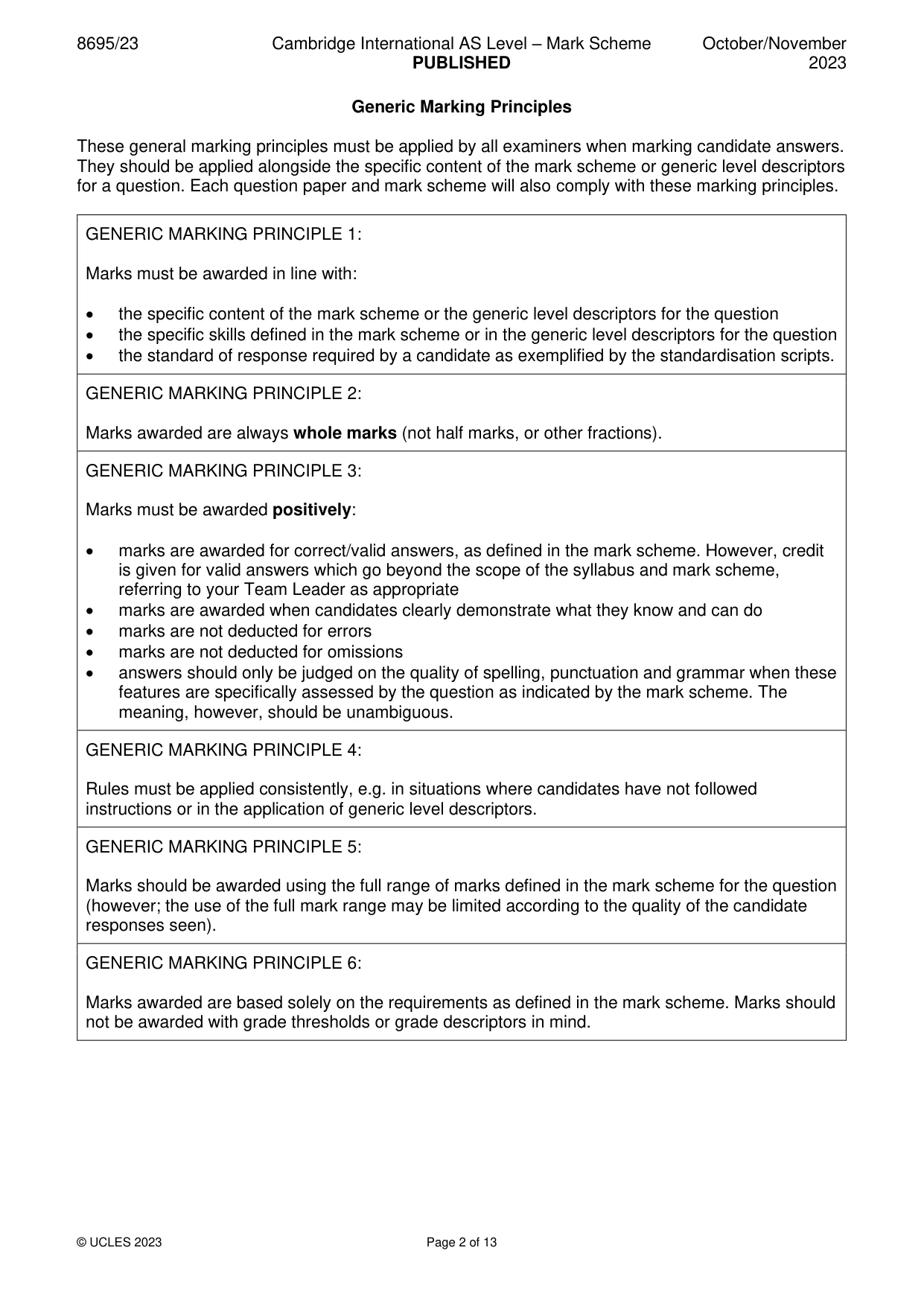
8695/23 Cambridge International AS Level – Mark Scheme PUBLISHED October/November 2023 © UCLES 2023 Page 2 of 13 Generic Marking Principles These general marking principles must be applied by all examiners when marking candidate answers. They should be applied alongside the specific content of the mark scheme or generic level descriptors for a question. Each question paper and mark scheme will also comply with these marking principles. GENERIC MARKING PRINCIPLE 1: Marks must be awarded in line with: • the specific content of the mark scheme or the generic level descriptors for the question • the specific skills defined in the mark scheme or in the generic level descriptors for the question • the standard of response required by a candidate as exemplified by the standardisation scripts. GENERIC MARKING PRINCIPLE 2: Marks awarded are always whole marks (not half marks, or other fractions). GENERIC MARKING PRINCIPLE 3: Marks must be awarded positively: • marks are awarded for correct/valid answers, as defined in the mark scheme. However, credit is given for valid answers which go beyond the scope of the syllabus and mark scheme, referring to your Team Leader as appropriate • marks are awarded when candidates clearly demonstrate what they know and can do • marks are not deducted for errors • marks are not deducted for omissions • answers should only be judged on the quality of spelling, punctuation and grammar when these features are specifically assessed by the question as indicated by the mark scheme. The meaning, however, should be unambiguous. GENERIC MARKING PRINCIPLE 4: Rules must be applied consistently, e.g. in situations where candidates have not followed instructions or in the application of generic level descriptors. GENERIC MARKING PRINCIPLE 5: Marks should be awarded using the full range of marks defined in the mark scheme for the question (however; the use of the full mark range may be limited according to the quality of the candidate responses seen). GENERIC MARKING PRINCIPLE 6: Marks awarded are based solely on the requirements as defined in the mark scheme. Marks should not be awarded with grade thresholds or grade descriptors in mind.
Mark scheme, page 3
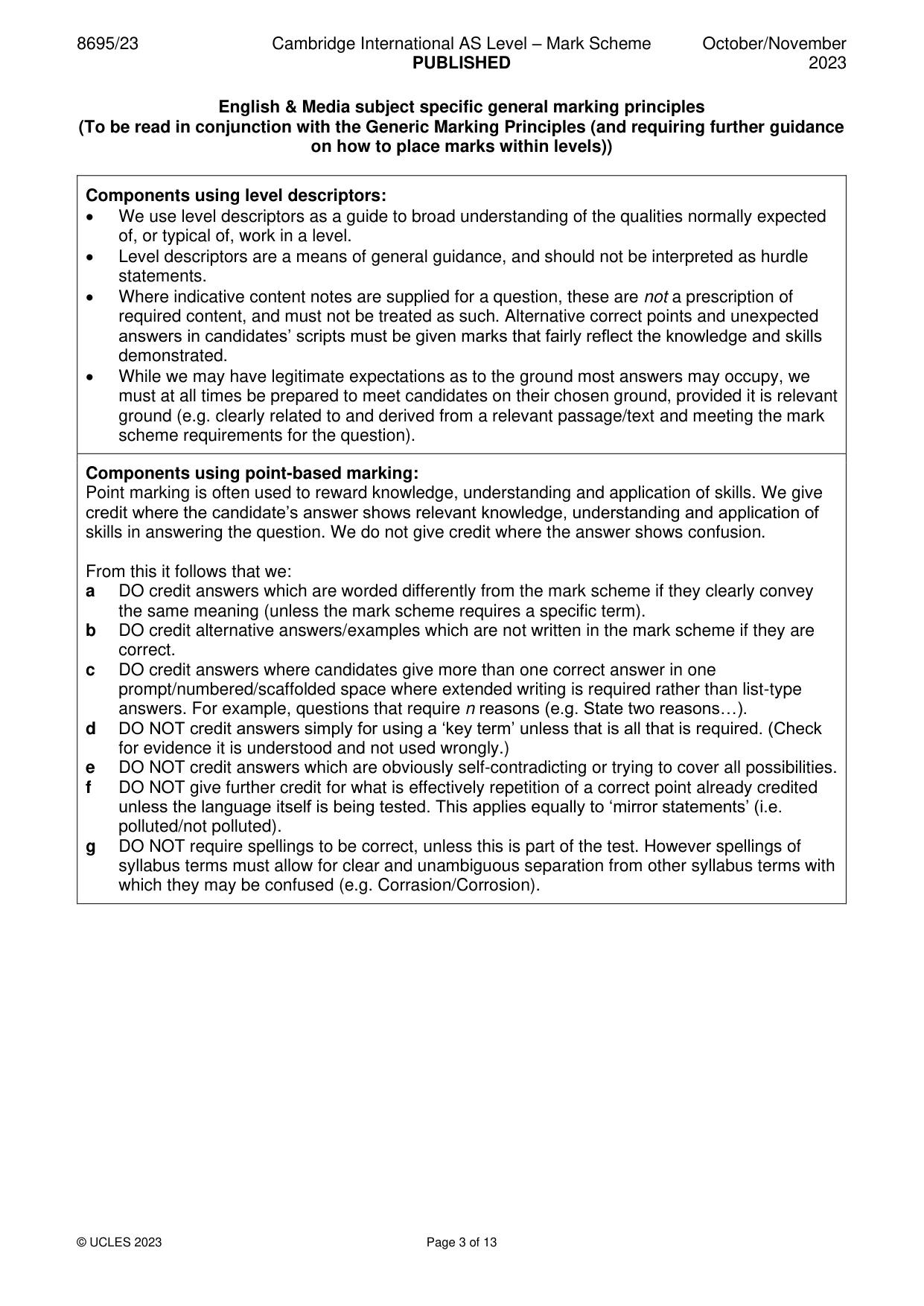
8695/23 Cambridge International AS Level – Mark Scheme PUBLISHED October/November 2023 © UCLES 2023 Page 3 of 13 English & Media subject specific general marking principles (To be read in conjunction with the Generic Marking Principles (and requiring further guidance on how to place marks within levels)) Components using level descriptors: • We use level descriptors as a guide to broad understanding of the qualities normally expected of, or typical of, work in a level. • Level descriptors are a means of general guidance, and should not be interpreted as hurdle statements. • Where indicative content notes are supplied for a question, these are not a prescription of required content, and must not be treated as such. Alternative correct points and unexpected answers in candidates’ scripts must be given marks that fairly reflect the knowledge and skills demonstrated. • While we may have legitimate expectations as to the ground most answers may occupy, we must at all times be prepared to meet candidates on their chosen ground, provided it is relevant ground (e.g. clearly related to and derived from a relevant passage/text and meeting the mark scheme requirements for the question). Components using point-based marking: Point marking is often used to reward knowledge, understanding and application of skills. We give credit where the candidate’s answer shows relevant knowledge, understanding and application of skills in answering the question. We do not give credit where the answer shows confusion. From this it follows that we: a DO credit answers which are worded differently from the mark scheme if they clearly convey the same meaning (unless the mark scheme requires a specific term). b DO credit alternative answers/examples which are not written in the mark scheme if they are correct. c DO credit answers where candidates give more than one correct answer in one prompt/numbered/scaffolded space where extended writing is required rather than list-type answers. For example, questions that require n reasons (e.g. State two reasons…). d DO NOT credit answers simply for using a ‘key term’ unless that is all that is required. (Check for evidence it is understood and not used wrongly.) e DO NOT credit answers which are obviously self-contradicting or trying to cover all possibilities. f DO NOT give further credit for what is effectively repetition of a correct point already credited unless the language itself is being tested. This applies equally to ‘mirror statements’ (i.e. polluted/not polluted). g DO NOT require spellings to be correct, unless this is part of the test. However spellings of syllabus terms must allow for clear and unambiguous separation from other syllabus terms with which they may be confused (e.g. Corrasion/Corrosion).
Mark scheme, page 4
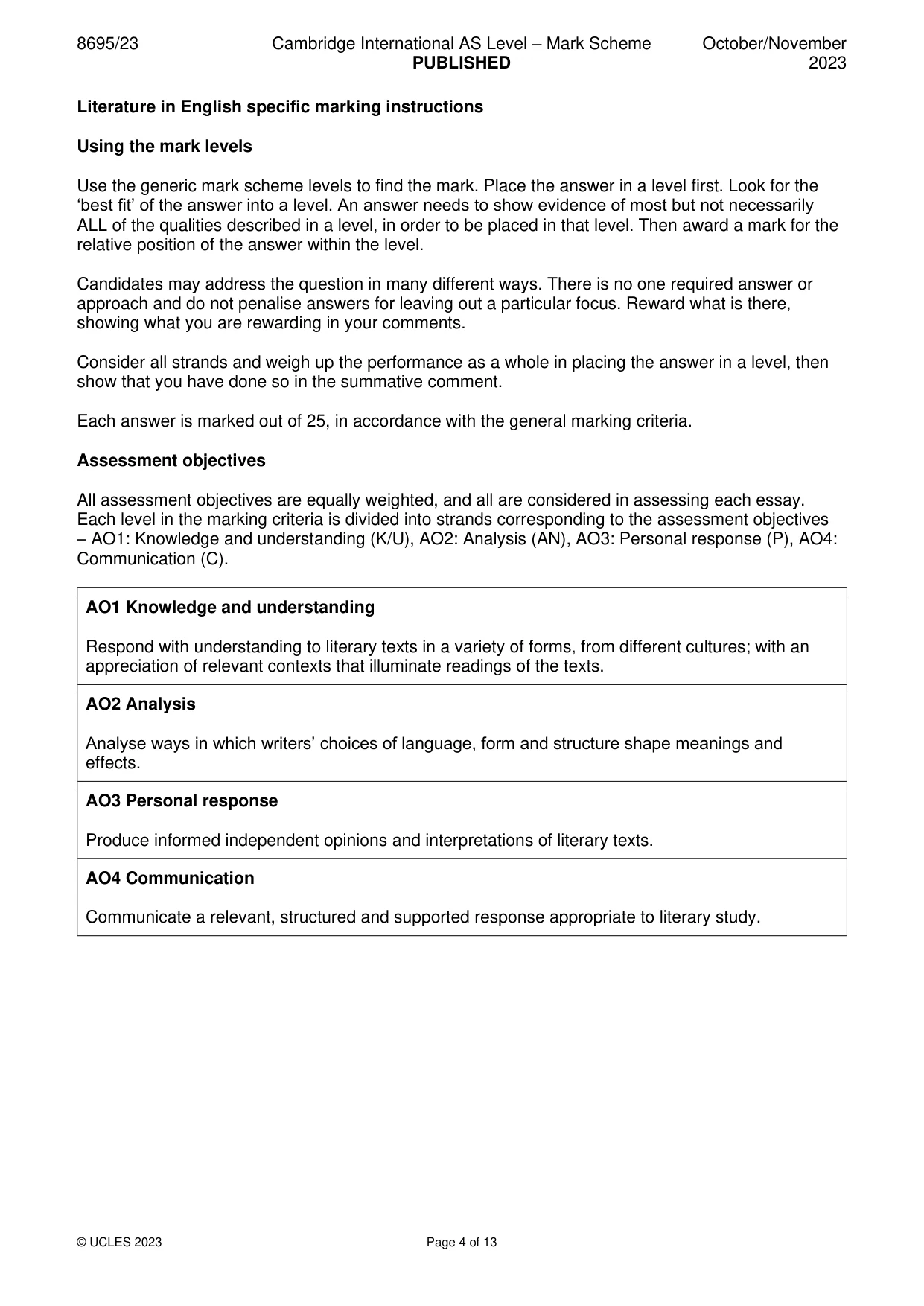
8695/23 Cambridge International AS Level – Mark Scheme PUBLISHED October/November 2023 © UCLES 2023 Page 4 of 13 Literature in English specific marking instructions Using the mark levels Use the generic mark scheme levels to find the mark. Place the answer in a level first. Look for the ‘best fit’ of the answer into a level. An answer needs to show evidence of most but not necessarily ALL of the qualities described in a level, in order to be placed in that level. Then award a mark for the relative position of the answer within the level. Candidates may address the question in many different ways. There is no one required answer or approach and do not penalise answers for leaving out a particular focus. Reward what is there, showing what you are rewarding in your comments. Consider all strands and weigh up the performance as a whole in placing the answer in a level, then show that you have done so in the summative comment. Each answer is marked out of 25, in accordance with the general marking criteria. Assessment objectives All assessment objectives are equally weighted, and all are considered in assessing each essay. Each level in the marking criteria is divided into strands corresponding to the assessment objectives – AO1: Knowledge and understanding (K/U), AO2: Analysis (AN), AO3: Personal response (P), AO4: Communication (C). AO1 Knowledge and understanding Respond with understanding to literary texts in a variety of forms, from different cultures; with an appreciation of relevant contexts that illuminate readings of the texts. AO2 Analysis Analyse ways in which writers’ choices of language, form and structure shape meanings and effects. AO3 Personal response Produce informed independent opinions and interpretations of literary texts. AO4 Communication Communicate a relevant, structured and supported response appropriate to literary study.
Mark scheme, page 5
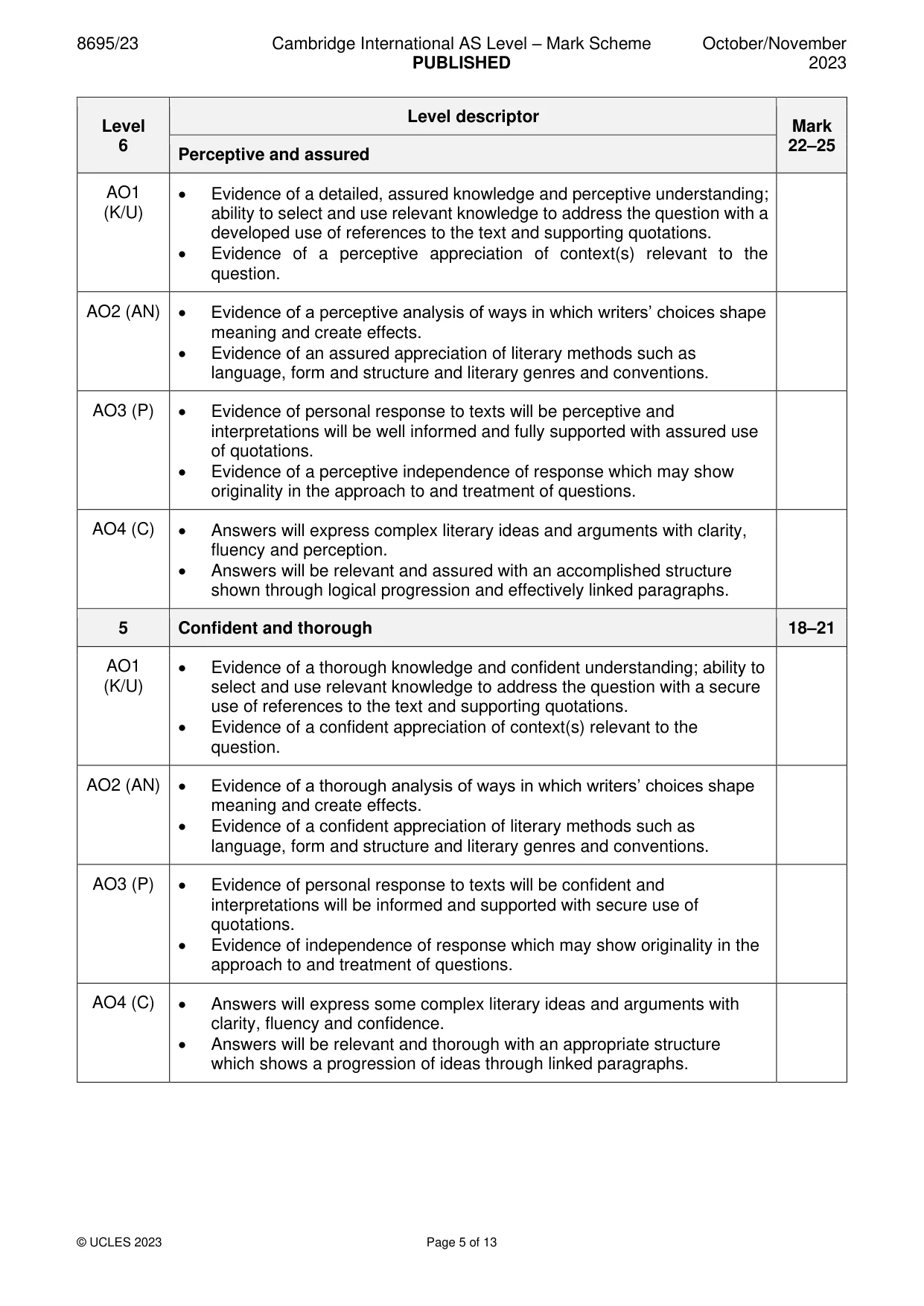
8695/23 Cambridge International AS Level – Mark Scheme PUBLISHED October/November 2023 © UCLES 2023 Page 5 of 13 Level 6 Level descriptor Mark 22–25 Perceptive and assured AO1 (K/U) • Evidence of a detailed, assured knowledge and perceptive understanding; ability to select and use relevant knowledge to address the question with a developed use of references to the text and supporting quotations. • Evidence of a perceptive appreciation of context(s) relevant to the question. AO2 (AN) • Evidence of a perceptive analysis of ways in which writers’ choices shape meaning and create effects. • Evidence of an assured appreciation of literary methods such as language, form and structure and literary genres and conventions. AO3 (P) • Evidence of personal response to texts will be perceptive and interpretations will be well informed and fully supported with assured use of quotations. • Evidence of a perceptive independence of response which may show originality in the approach to and treatment of questions. AO4 (C) • Answers will express complex literary ideas and arguments with clarity, fluency and perception. • Answers will be relevant and assured with an accomplished structure shown through logical progression and effectively linked paragraphs. 5 Confident and thorough 18–21 AO1 (K/U) • Evidence of a thorough knowledge and confident understanding; ability to select and use relevant knowledge to address the question with a secure use of references to the text and supporting quotations. • Evidence of a confident appreciation of context(s) relevant to the question. AO2 (AN) • Evidence of a thorough analysis of ways in which writers’ choices shape meaning and create effects. • Evidence of a confident appreciation of literary methods such as language, form and structure and literary genres and conventions. AO3 (P) • Evidence of personal response to texts will be confident and interpretations will be informed and supported with secure use of quotations. • Evidence of independence of response which may show originality in the approach to and treatment of questions. AO4 (C) • Answers will express some complex literary ideas and arguments with clarity, fluency and confidence. • Answers will be relevant and thorough with an appropriate structure which shows a progression of ideas through linked paragraphs.
Mark scheme, page 6
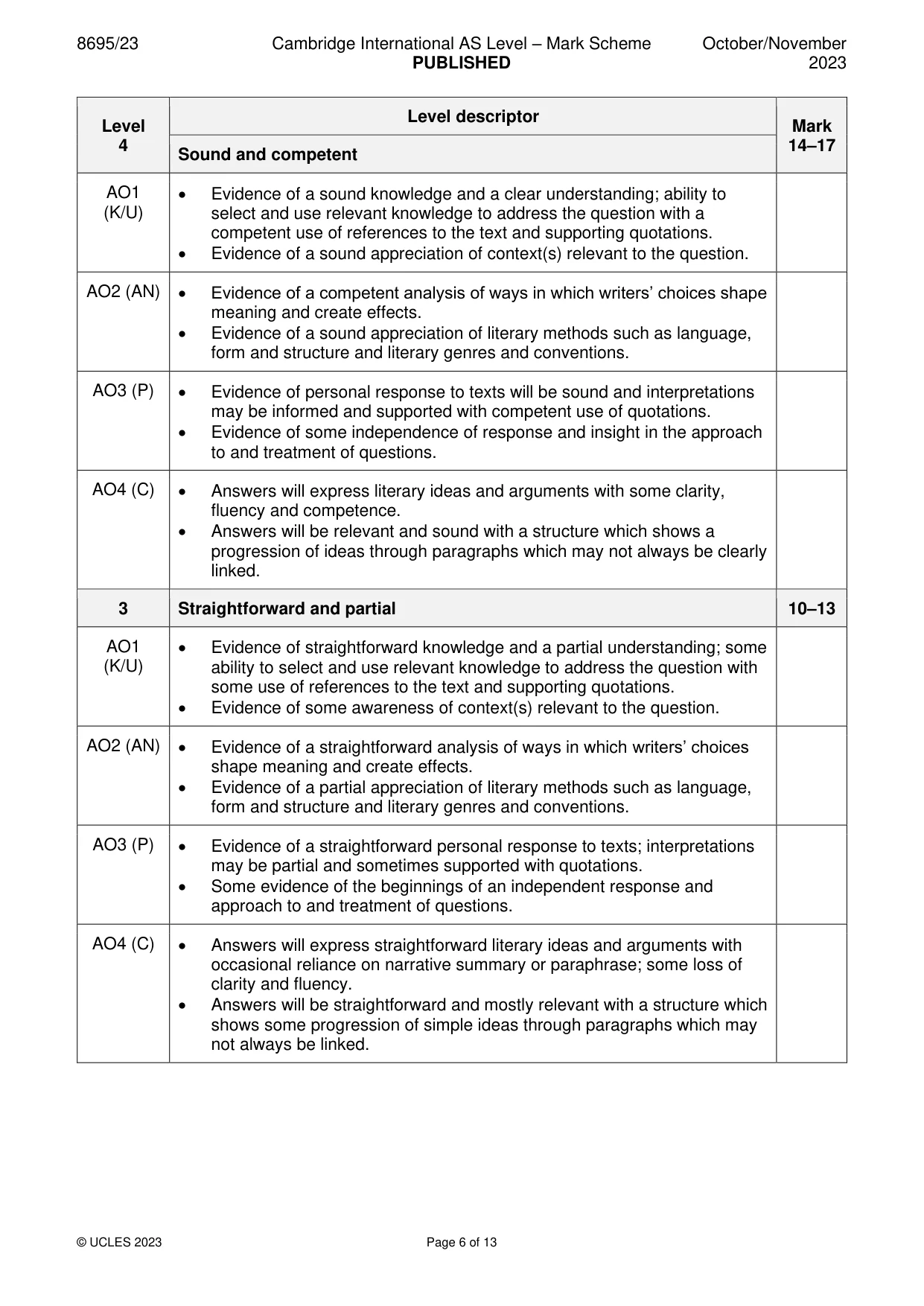
8695/23 Cambridge International AS Level – Mark Scheme PUBLISHED October/November 2023 © UCLES 2023 Page 6 of 13 Level 4 Level descriptor Mark 14–17 Sound and competent AO1 (K/U) • Evidence of a sound knowledge and a clear understanding; ability to select and use relevant knowledge to address the question with a competent use of references to the text and supporting quotations. • Evidence of a sound appreciation of context(s) relevant to the question. AO2 (AN) • Evidence of a competent analysis of ways in which writers’ choices shape meaning and create effects. • Evidence of a sound appreciation of literary methods such as language, form and structure and literary genres and conventions. AO3 (P) • Evidence of personal response to texts will be sound and interpretations may be informed and supported with competent use of quotations. • Evidence of some independence of response and insight in the approach to and treatment of questions. AO4 (C) • Answers will express literary ideas and arguments with some clarity, fluency and competence. • Answers will be relevant and sound with a structure which shows a progression of ideas through paragraphs which may not always be clearly linked. 3 Straightforward and partial 10–13 AO1 (K/U) • Evidence of straightforward knowledge and a partial understanding; some ability to select and use relevant knowledge to address the question with some use of references to the text and supporting quotations. • Evidence of some awareness of context(s) relevant to the question. AO2 (AN) • Evidence of a straightforward analysis of ways in which writers’ choices shape meaning and create effects. • Evidence of a partial appreciation of literary methods such as language, form and structure and literary genres and conventions. AO3 (P) • Evidence of a straightforward personal response to texts; interpretations may be partial and sometimes supported with quotations. • Some evidence of the beginnings of an independent response and approach to and treatment of questions. AO4 (C) • Answers will express straightforward literary ideas and arguments with occasional reliance on narrative summary or paraphrase; some loss of clarity and fluency. • Answers will be straightforward and mostly relevant with a structure which shows some progression of simple ideas through paragraphs which may not always be linked.
Mark scheme, page 7
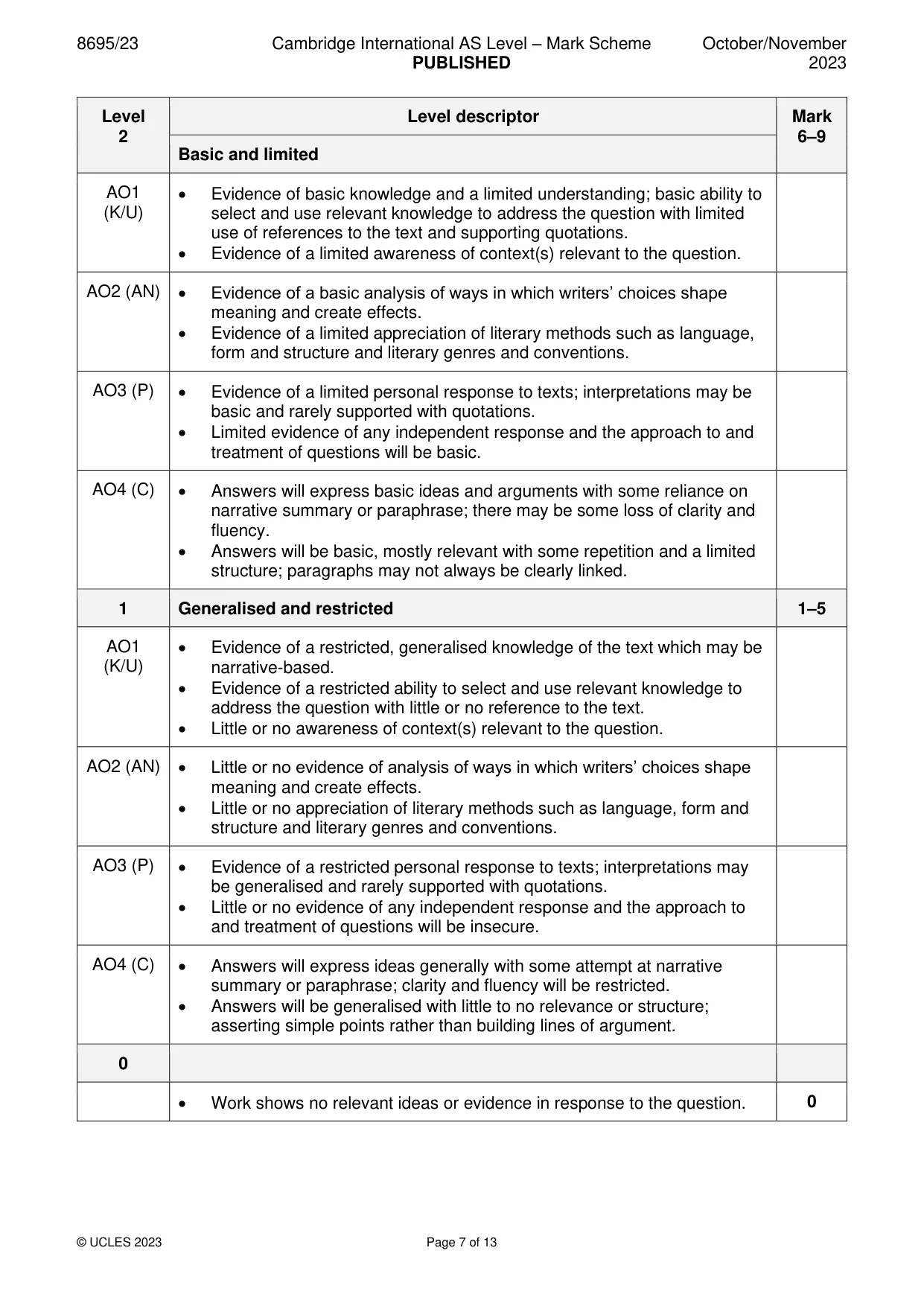
8695/23 Cambridge International AS Level – Mark Scheme PUBLISHED October/November 2023 © UCLES 2023 Page 7 of 13 Level 2 Level descriptor Mark 6–9 Basic and limited AO1 (K/U) • Evidence of basic knowledge and a limited understanding; basic ability to select and use relevant knowledge to address the question with limited use of references to the text and supporting quotations. • Evidence of a limited awareness of context(s) relevant to the question. AO2 (AN) • Evidence of a basic analysis of ways in which writers’ choices shape meaning and create effects. • Evidence of a limited appreciation of literary methods such as language, form and structure and literary genres and conventions. AO3 (P) • Evidence of a limited personal response to texts; interpretations may be basic and rarely supported with quotations. • Limited evidence of any independent response and the approach to and treatment of questions will be basic. AO4 (C) • Answers will express basic ideas and arguments with some reliance on narrative summary or paraphrase; there may be some loss of clarity and fluency. • Answers will be basic, mostly relevant with some repetition and a limited structure; paragraphs may not always be clearly linked. 1 Generalised and restricted 1–5 AO1 (K/U) • Evidence of a restricted, generalised knowledge of the text which may be narrative-based. • Evidence of a restricted ability to select and use relevant knowledge to address the question with little or no reference to the text. • Little or no awareness of context(s) relevant to the question. AO2 (AN) • Little or no evidence of analysis of ways in which writers’ choices shape meaning and create effects. • Little or no appreciation of literary methods such as language, form and structure and literary genres and conventions. AO3 (P) • Evidence of a restricted personal response to texts; interpretations may be generalised and rarely supported with quotations. • Little or no evidence of any independent response and the approach to and treatment of questions will be insecure. AO4 (C) • Answers will express ideas generally with some attempt at narrative summary or paraphrase; clarity and fluency will be restricted. • Answers will be generalised with little to no relevance or structure; asserting simple points rather than building lines of argument. 0 • Work shows no relevant ideas or evidence in response to the question. 0
Mark scheme, page 8
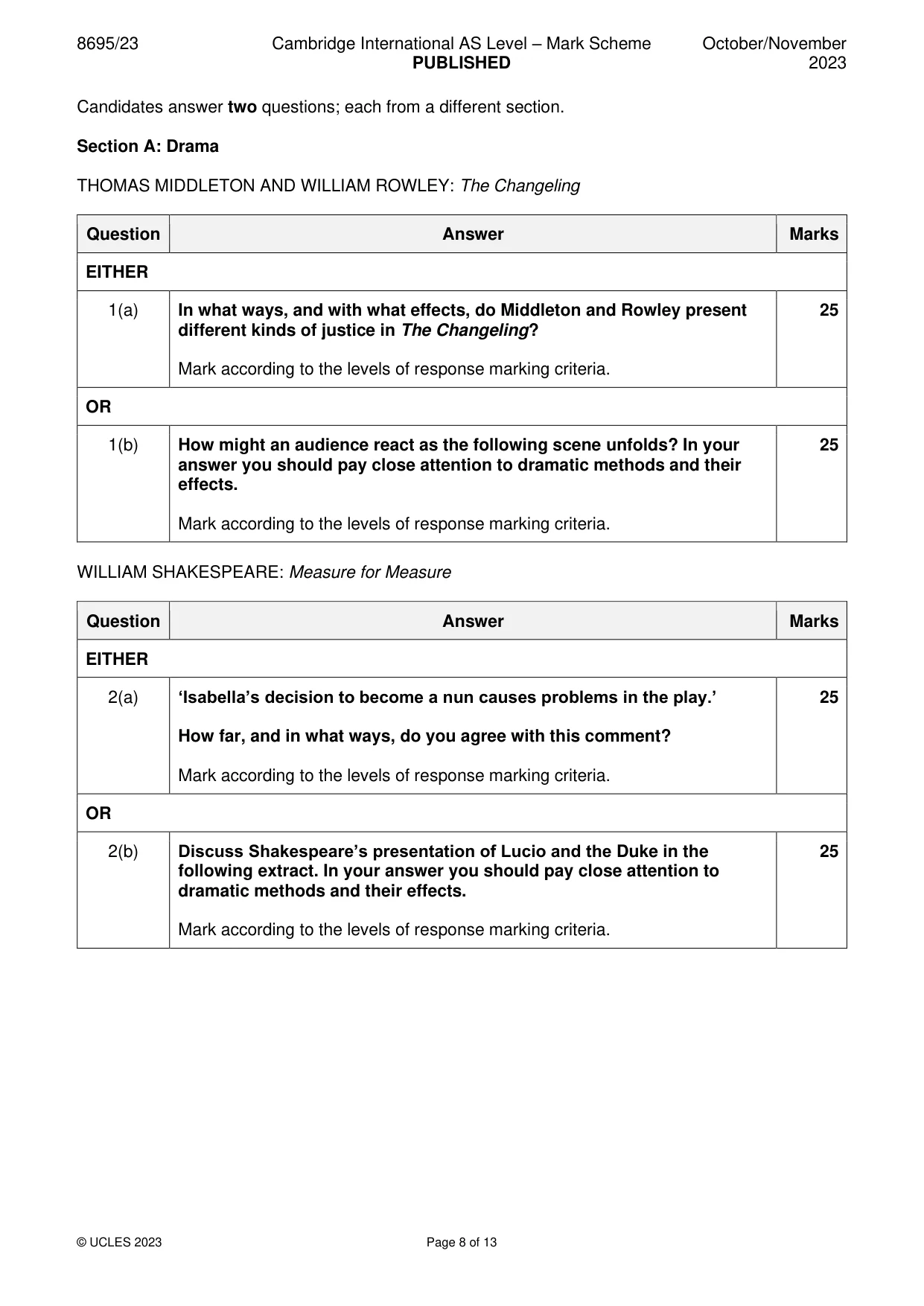
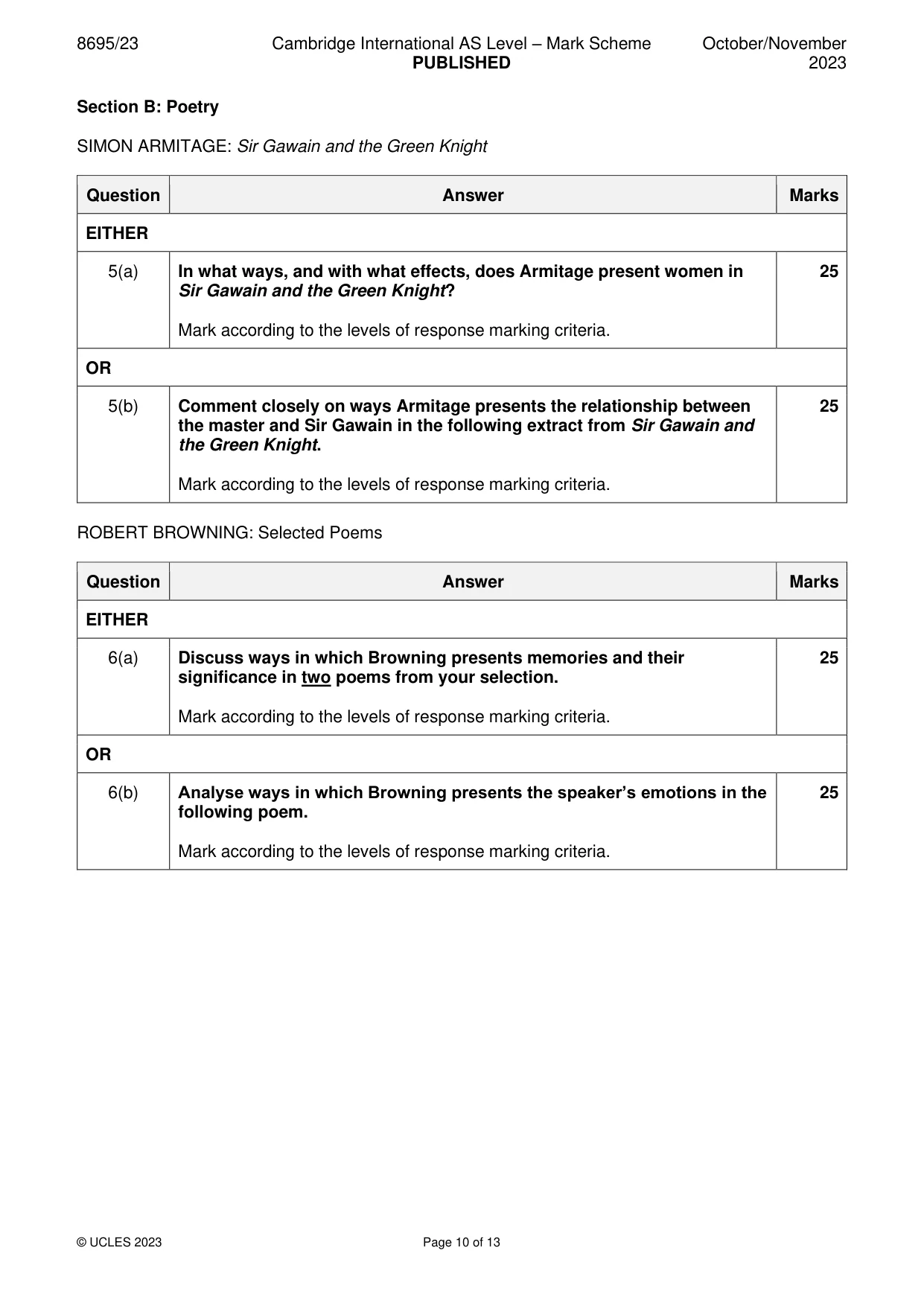
8695/23 Cambridge International AS Level – Mark Scheme PUBLISHED October/November 2023 © UCLES 2023 Page 8 of 13 Candidates answer two questions; each from a different section. Section A: Drama THOMAS MIDDLETON AND WILLIAM ROWLEY: The Changeling Question Answer Marks EITHER 1(a) In what ways, and with what effects, do Middleton and Rowley present different kinds of justice in The Changeling? Mark according to the levels of response marking criteria. 25 OR 1(b) How might an audience react as the following scene unfolds? In your answer you should pay close attention to dramatic methods and their effects. Mark according to the levels of response marking criteria. 25 WILLIAM SHAKESPEARE: Measure for Measure Question Answer Marks EITHER 2(a) ‘Isabella’s decision to become a nun causes problems in the play.’ How far, and in what ways, do you agree with this comment? Mark according to the levels of response marking criteria. 25 OR 2(b) Discuss Shakespeare’s presentation of Lucio and the Duke in the following extract. In your answer you should pay close attention to dramatic methods and their effects. Mark according to the levels of response marking criteria. 25
Mark scheme, page 9
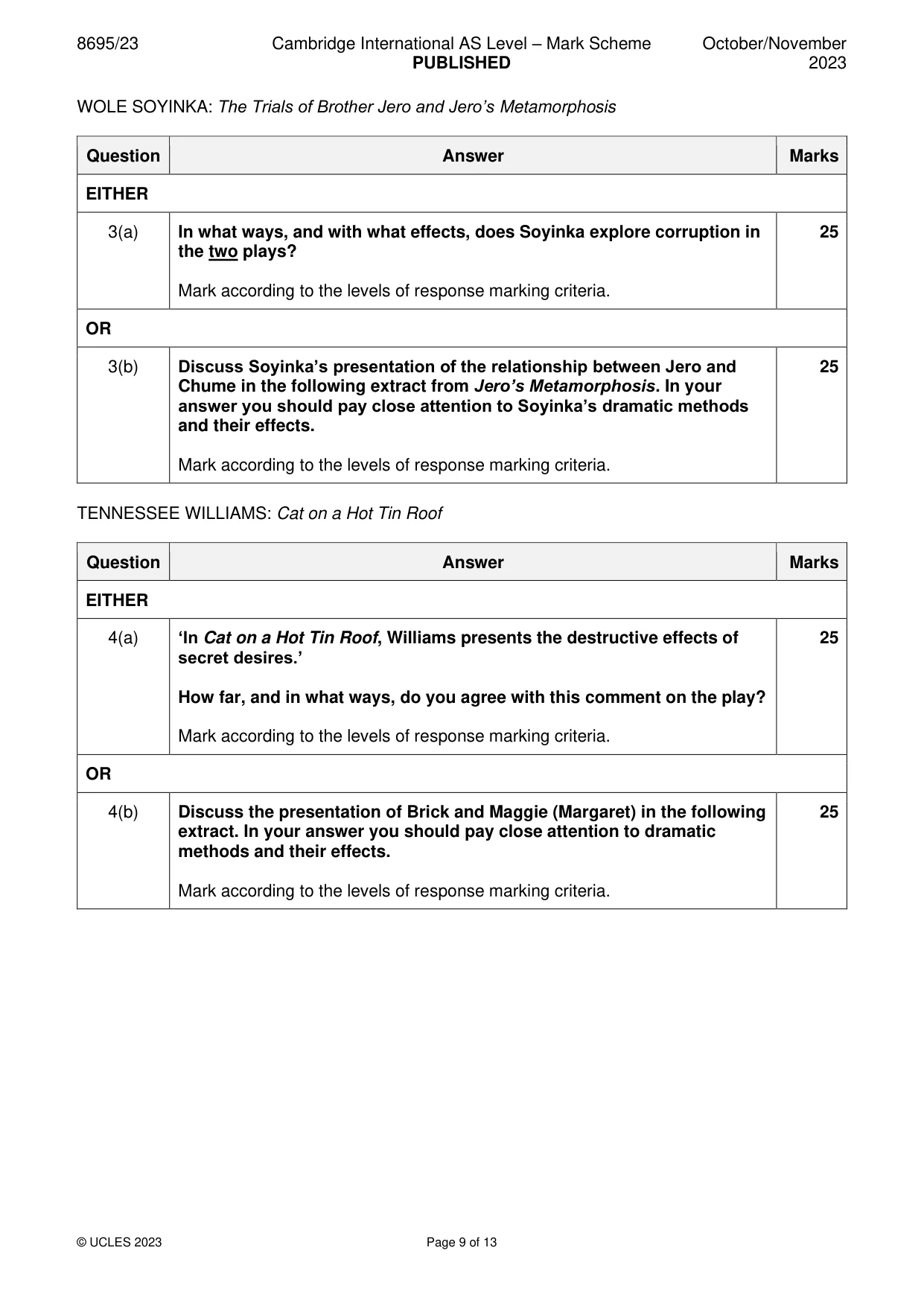
8695/23 Cambridge International AS Level – Mark Scheme PUBLISHED October/November 2023 © UCLES 2023 Page 9 of 13 WOLE SOYINKA: The Trials of Brother Jero and Jero’s Metamorphosis Question Answer Marks EITHER 3(a) In what ways, and with what effects, does Soyinka explore corruption in the two plays? Mark according to the levels of response marking criteria. 25 OR 3(b) Discuss Soyinka’s presentation of the relationship between Jero and Chume in the following extract from Jero’s Metamorphosis. In your answer you should pay close attention to Soyinka’s dramatic methods and their effects. Mark according to the levels of response marking criteria. 25 TENNESSEE WILLIAMS: Cat on a Hot Tin Roof Question Answer Marks EITHER 4(a) ‘In Cat on a Hot Tin Roof, Williams presents the destructive effects of secret desires.’ How far, and in what ways, do you agree with this comment on the play? Mark according to the levels of response marking criteria. 25 OR 4(b) Discuss the presentation of Brick and Maggie (Margaret) in the following extract. In your answer you should pay close attention to dramatic methods and their effects. Mark according to the levels of response marking criteria. 25
Mark scheme, page 10
8695/23 Cambridge International AS Level – Mark Scheme PUBLISHED October/November 2023 © UCLES 2023 Page 10 of 13 Section B: Poetry SIMON ARMITAGE: Sir Gawain and the Green Knight Question Answer Marks EITHER 5(a) In what ways, and with what effects, does Armitage present women in Sir Gawain and the Green Knight? Mark according to the levels of response marking criteria. 25 OR 5(b) Comment closely on ways Armitage presents the relationship between the master and Sir Gawain in the following extract from Sir Gawain and the Green Knight. Mark according to the levels of response marking criteria. 25 ROBERT BROWNING: Selected Poems Question Answer Marks EITHER 6(a) Discuss ways in which Browning presents memories and their significance in two poems from your selection. Mark according to the levels of response marking criteria. 25 OR 6(b) Analyse ways in which Browning presents the speaker’s emotions in the following poem. Mark according to the levels of response marking criteria. 25
Mark scheme, page 11
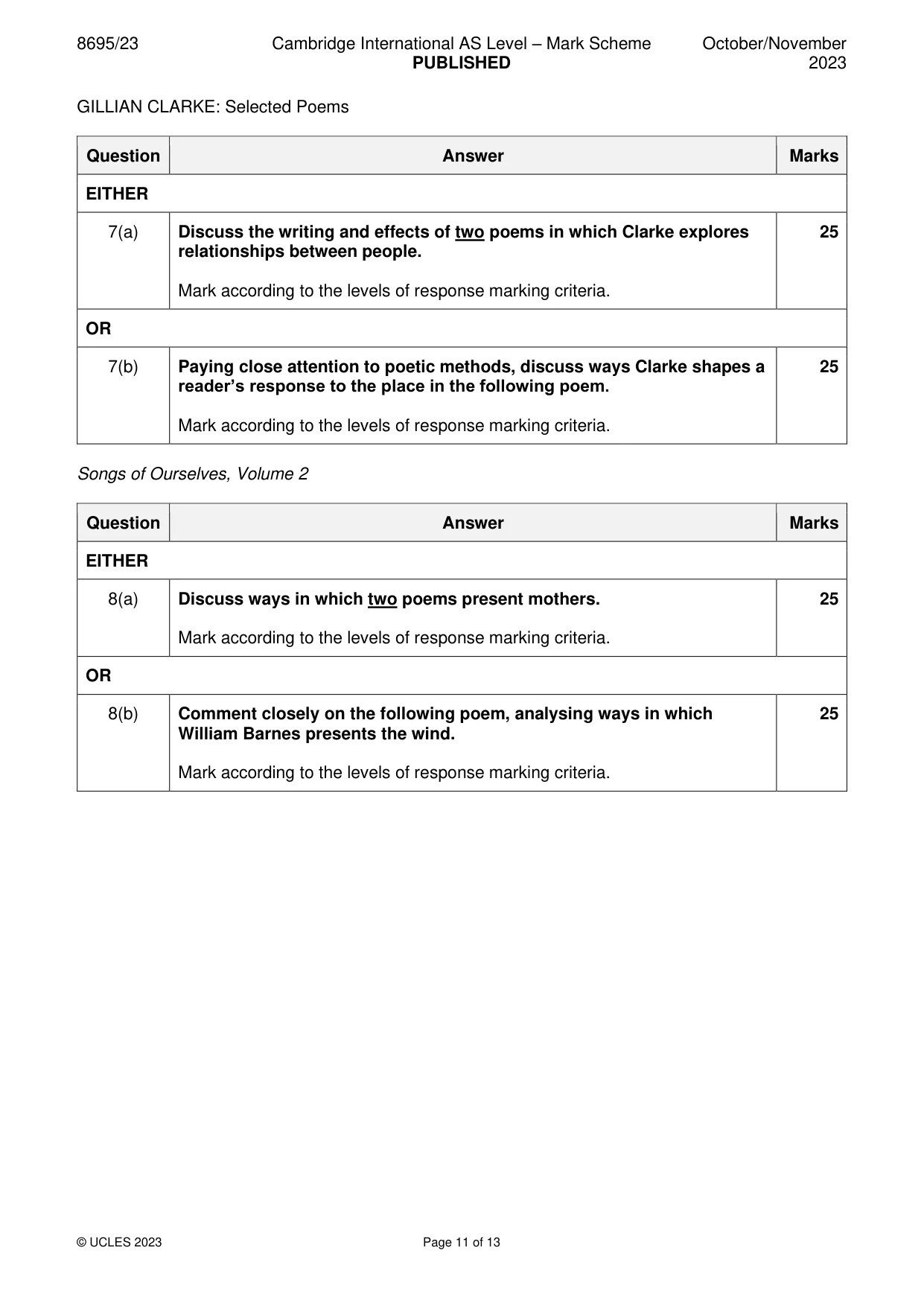
8695/23 Cambridge International AS Level – Mark Scheme PUBLISHED October/November 2023 © UCLES 2023 Page 11 of 13 GILLIAN CLARKE: Selected Poems Question Answer Marks EITHER 7(a) Discuss the writing and effects of two poems in which Clarke explores relationships between people. Mark according to the levels of response marking criteria. 25 OR 7(b) Paying close attention to poetic methods, discuss ways Clarke shapes a reader’s response to the place in the following poem. Mark according to the levels of response marking criteria. 25 Songs of Ourselves, Volume 2 Question Answer Marks EITHER 8(a) Discuss ways in which two poems present mothers. Mark according to the levels of response marking criteria. 25 OR 8(b) Comment closely on the following poem, analysing ways in which William Barnes presents the wind. Mark according to the levels of response marking criteria. 25
Mark scheme, page 12
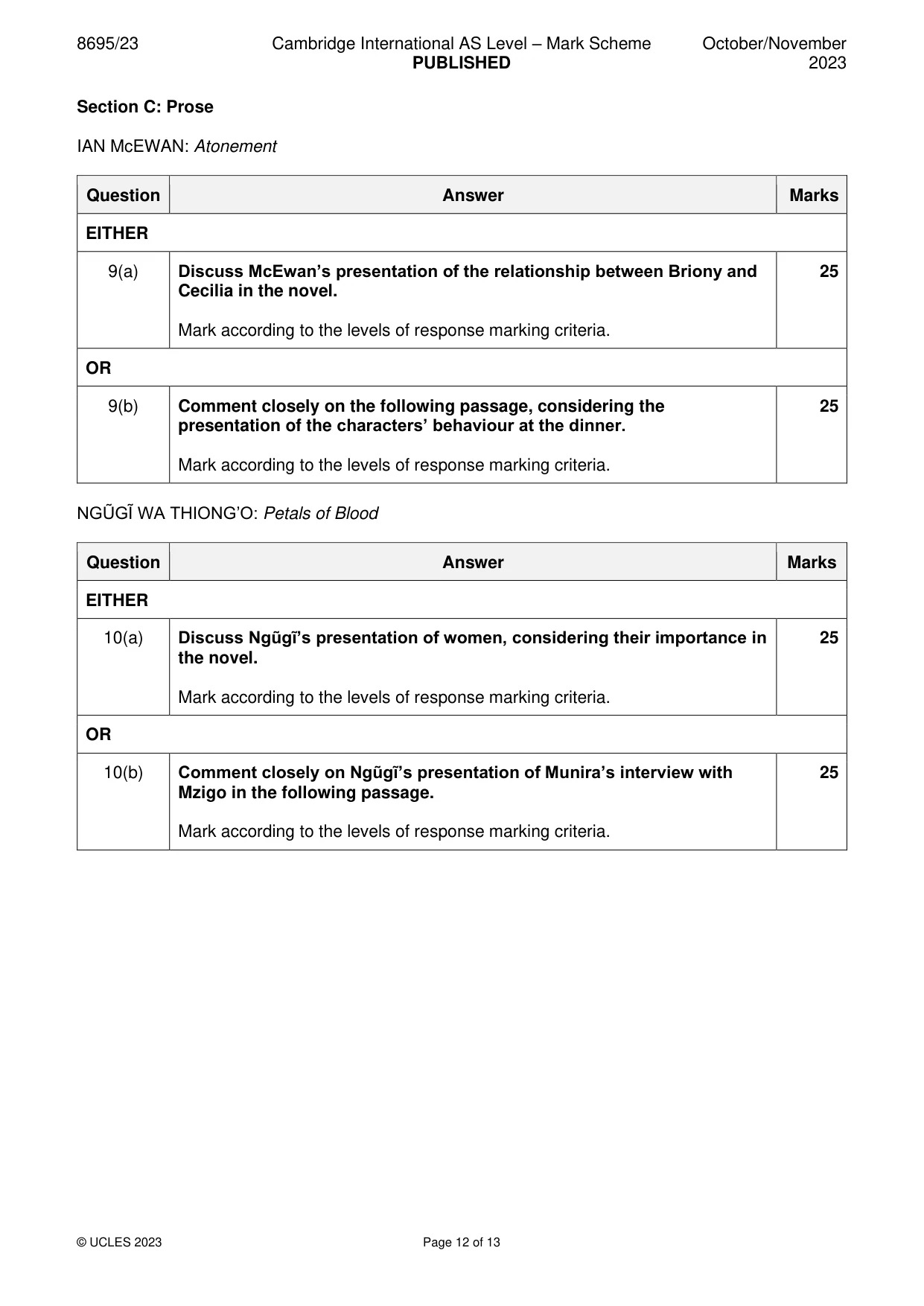
8695/23 Cambridge International AS Level – Mark Scheme PUBLISHED October/November 2023 © UCLES 2023 Page 12 of 13 Section C: Prose IAN McEWAN: Atonement Question Answer Marks EITHER 9(a) Discuss McEwan’s presentation of the relationship between Briony and Cecilia in the novel. Mark according to the levels of response marking criteria. 25 OR 9(b) Comment closely on the following passage, considering the presentation of the characters’ behaviour at the dinner. Mark according to the levels of response marking criteria. 25 NGŨGĨ WA THIONG’O: Petals of Blood Question Answer Marks EITHER 10(a) Discuss Ngũgĩ’s presentation of women, considering their importance in the novel. Mark according to the levels of response marking criteria. 25 OR 10(b) Comment closely on Ngũgĩ’s presentation of Munira’s interview with Mzigo in the following passage. Mark according to the levels of response marking criteria. 25
Mark scheme, page 13
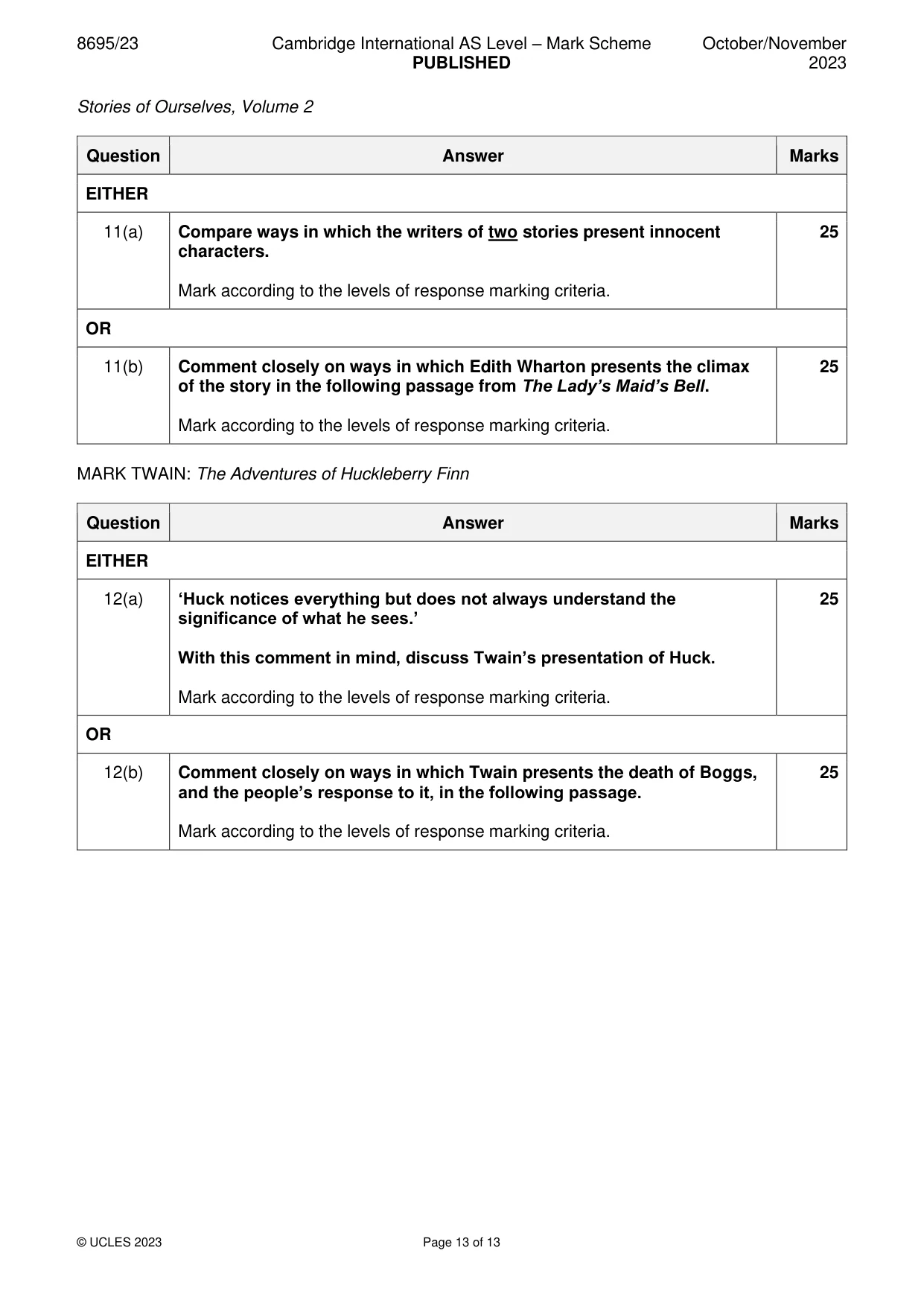
8695/23 Cambridge International AS Level – Mark Scheme PUBLISHED October/November 2023 © UCLES 2023 Page 13 of 13 Stories of Ourselves, Volume 2 Question Answer Marks EITHER 11(a) Compare ways in which the writers of two stories present innocent characters. Mark according to the levels of response marking criteria. 25 OR 11(b) Comment closely on ways in which Edith Wharton presents the climax of the story in the following passage from The Lady’s Maid’s Bell. Mark according to the levels of response marking criteria. 25 MARK TWAIN: The Adventures of Huckleberry Finn Question Answer Marks EITHER 12(a) ‘Huck notices everything but does not always understand the significance of what he sees.’ With this comment in mind, discuss Twain’s presentation of Huck. Mark according to the levels of response marking criteria. 25 OR 12(b) Comment closely on ways in which Twain presents the death of Boggs, and the people’s response to it, in the following passage. Mark according to the levels of response marking criteria. 25
What you needed in this session
Cambridge’s own grade thresholds for 2023 Oct/Nov, Paper 2 · Variant 3. A higher threshold means an easier paper — the bar moves with how the cohort did.