Cambridge A Level English - Language and Literature (AS Level only, from 2016) 8695 — 2025 Oct/Nov Paper 2 · Variant 2
8695/22/O/N/25 · 50 marks · 120 min
The question paper and its mark scheme, free to read here and free to download. This is Cambridge’s own paper, exactly as it was sat.
Question paper20 pages

Mark scheme14 pages
Answers below. Sit the paper first if you are practising.
Paper as text
Question paper, page 1
Cambridge Assessment International Education Cambridge International AS Level LANGUAGE AND LITERATURE IN ENGLISH 8695/22 Paper 2 Drama, Poetry and Prose October/November 2025 2 hours You must answer on the enclosed answer booklet. You will need: Answer booklet (enclosed) INSTRUCTIONS e Answer two questions in total, each from a different section. e Follow the instructions on the front cover of the answer booklet. If you need additional answer paper, ask the invigilator for a continuation booklet. e Dictionaries are not allowed. INFORMATION e The total mark for this paper is 50. e The number of marks for each question or part question is shown in brackets [ ]. This document has 20 pages. Any blank pages are indicated. DC (RCL (DF)) 342766/3 © UCLES 2025 [Turn over
Question paper, page 2
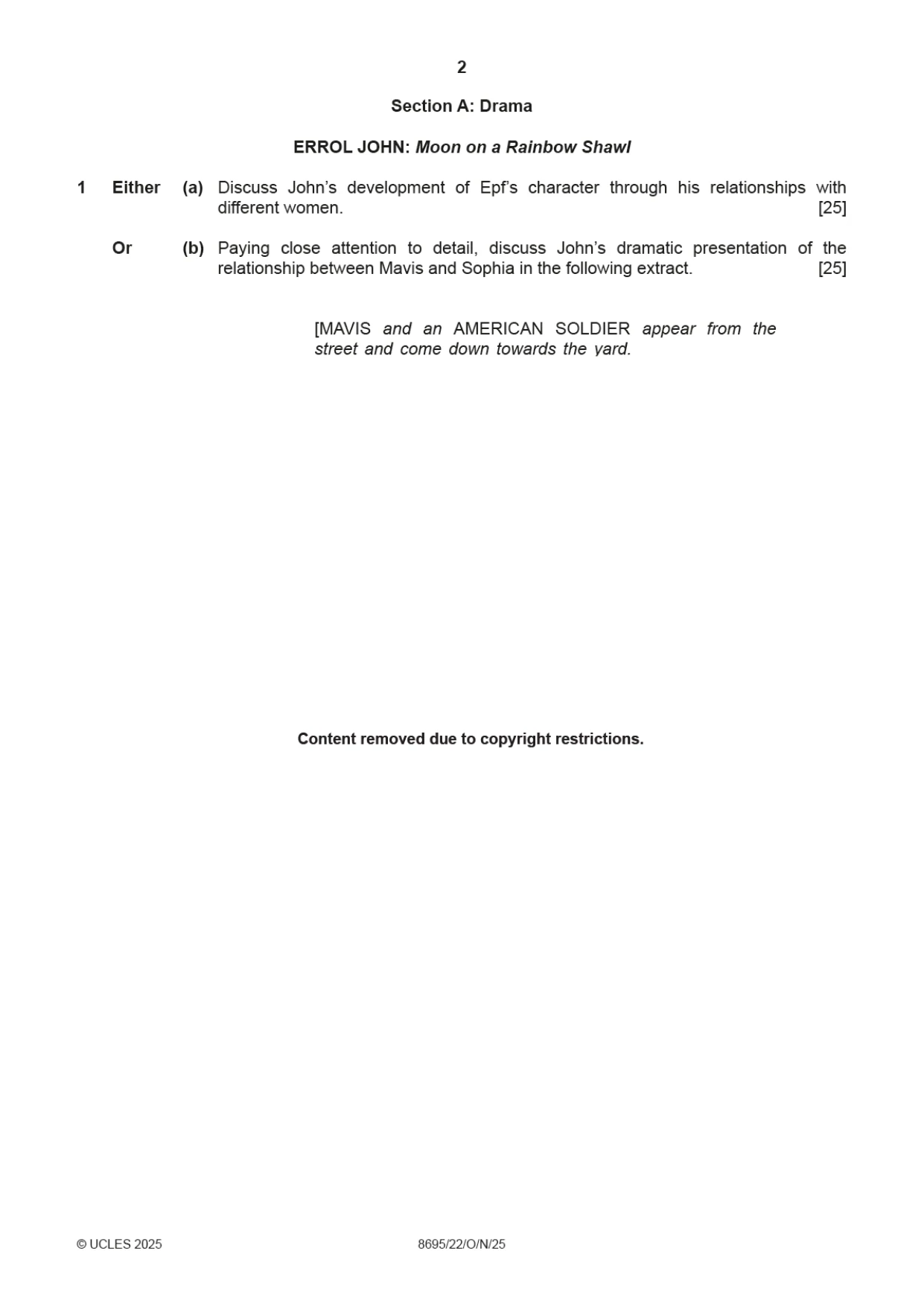
2 Section A: Drama ERROL JOHN: Moon on a Rainbow Shawl 1 Either (a) Discuss John’s development of Epfs character through his relationships with different women. [25] Or (b) Paying close attention to detail, discuss John’s dramatic presentation of the relationship between Mavis and Sophia in the following extract. [25] [MAVIS and an AMERICAN SOLDIER appear from the street and come down towards the yard. Content removed due to copyright restrictions. ©UCLES 2025 8695/22/O/N/25
Question paper, page 3
3 8695/22/O/N/25 © UCLES 2025 [Turn over [She grabs the American and pushes him into the room.] (from Act 2, Scene 1) Content removed due to copyright restrictions.
Question paper, page 4
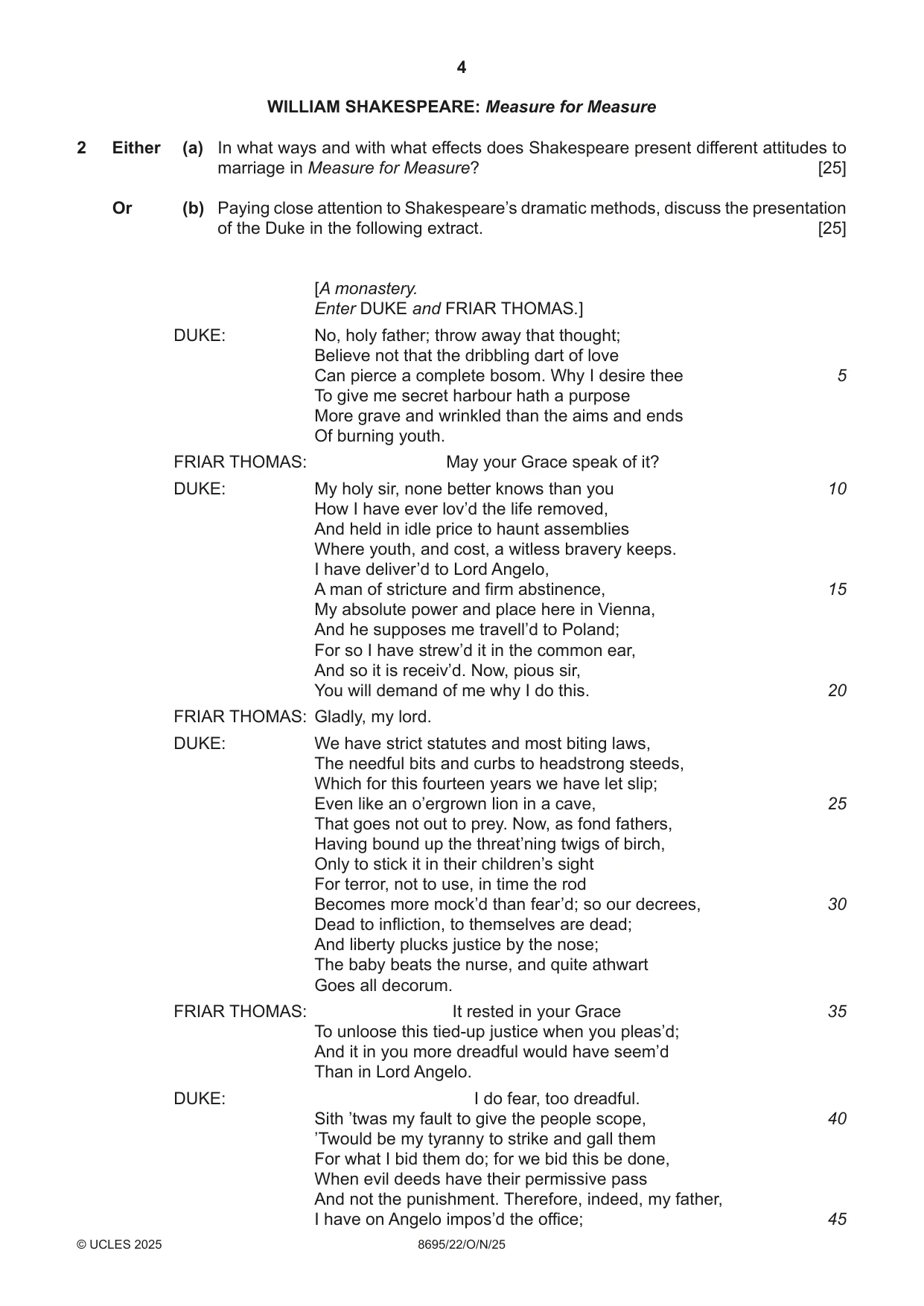
4 8695/22/O/N/25 © UCLES 2025 WILLIAM SHAKESPEARE: Measure for Measure 2 Either (a) In what ways and with what effects does Shakespeare present different attitudes to marriage in Measure for Measure? [25] Or (b) Paying close attention to Shakespeare’s dramatic methods, discuss the presentation of the Duke in the following extract. [25] [A monastery. Enter DUKE and FRIAR THOMAS.] DUKE: No, holy father; throw away that thought; Believe not that the dribbling dart of love Can pierce a complete bosom. Why I desire thee To give me secret harbour hath a purpose More grave and wrinkled than the aims and ends Of burning youth. FRIAR THOMAS: May your Grace speak of it? DUKE: My holy sir, none better knows than you How I have ever lov’d the life removed, And held in idle price to haunt assemblies Where youth, and cost, a witless bravery keeps. I have deliver’d to Lord Angelo, A man of stricture and firm abstinence, My absolute power and place here in Vienna, And he supposes me travell’d to Poland; For so I have strew’d it in the common ear, And so it is receiv’d. Now, pious sir, You will demand of me why I do this. FRIAR THOMAS: Gladly, my lord. DUKE: We have strict statutes and most biting laws, The needful bits and curbs to headstrong steeds, Which for this fourteen years we have let slip; Even like an o’ergrown lion in a cave, That goes not out to prey. Now, as fond fathers, Having bound up the threat’ning twigs of birch, Only to stick it in their children’s sight For terror, not to use, in time the rod Becomes more mock’d than fear’d; so our decrees, Dead to infliction, to themselves are dead; And liberty plucks justice by the nose; The baby beats the nurse, and quite athwart Goes all decorum. FRIAR THOMAS: It rested in your Grace To unloose this tied-up justice when you pleas’d; And it in you more dreadful would have seem’d Than in Lord Angelo. DUKE: I do fear, too dreadful. Sith ’twas my fault to give the people scope, ’Twould be my tyranny to strike and gall them For what I bid them do; for we bid this be done, When evil deeds have their permissive pass And not the punishment. Therefore, indeed, my father, I have on Angelo impos’d the office; 5 10 15 20 25 30 35 40 45
Question paper, page 5
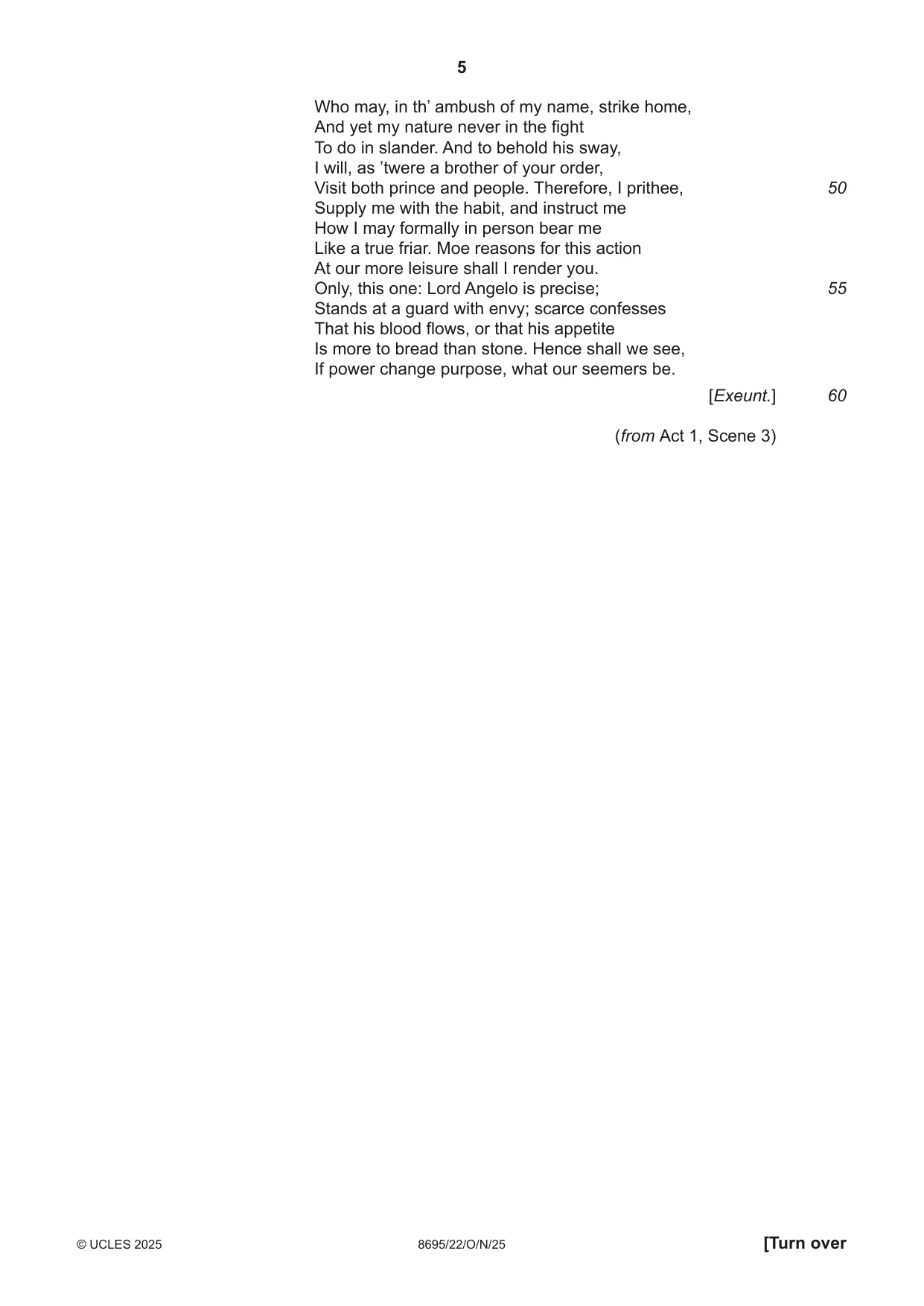
5 8695/22/O/N/25 © UCLES 2025 [Turn over Who may, in th’ ambush of my name, strike home, And yet my nature never in the fight To do in slander. And to behold his sway, I will, as ’twere a brother of your order, Visit both prince and people. Therefore, I prithee, Supply me with the habit, and instruct me How I may formally in person bear me Like a true friar. Moe reasons for this action At our more leisure shall I render you. Only, this one: Lord Angelo is precise; Stands at a guard with envy; scarce confesses That his blood flows, or that his appetite Is more to bread than stone. Hence shall we see, If power change purpose, what our seemers be. [Exeunt.] (from Act 1, Scene 3) 50 55 60
Question paper, page 6
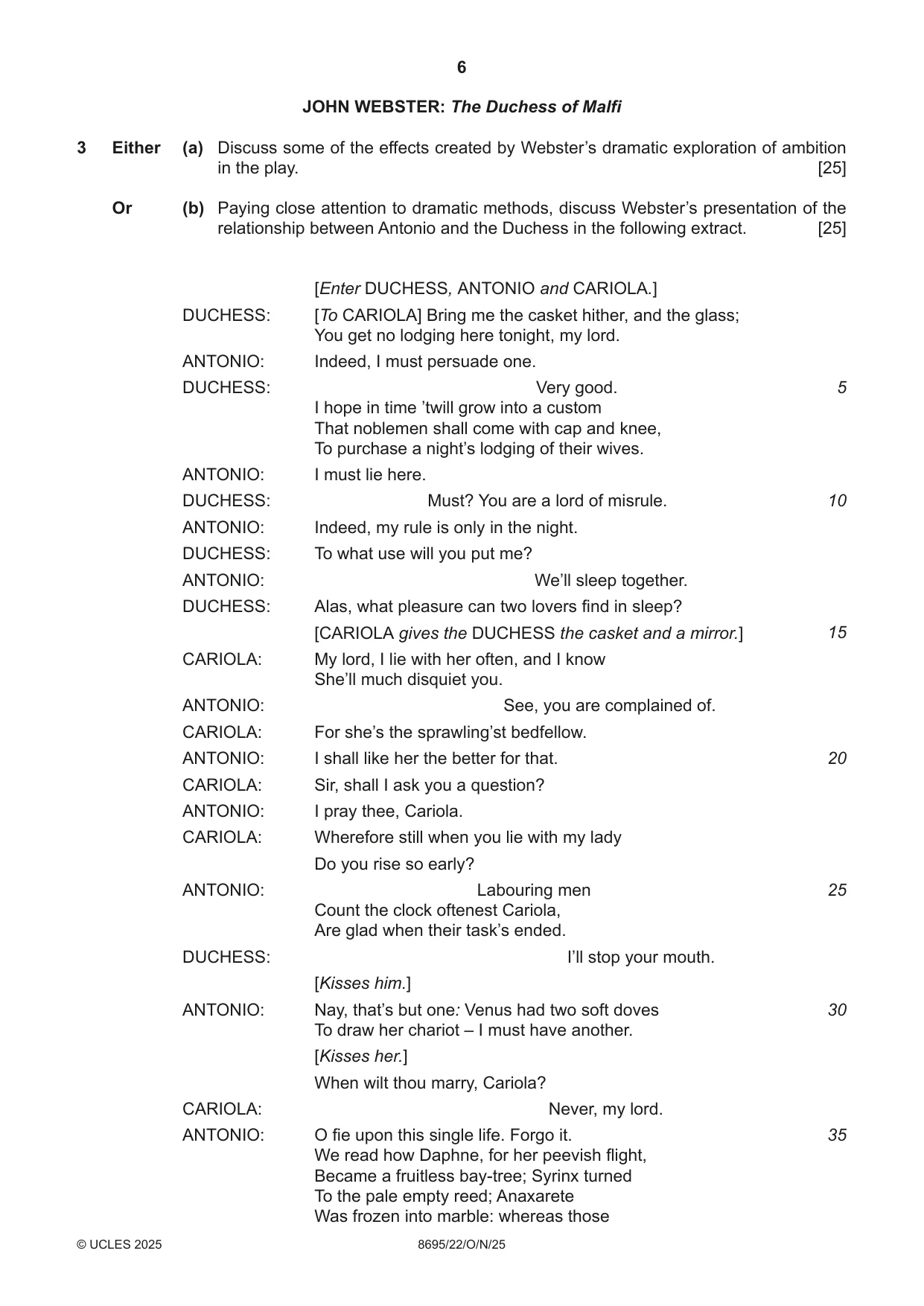
6 8695/22/O/N/25 © UCLES 2025 JOHN WEBSTER: The Duchess of Malfi 3 Either (a) Discuss some of the effects created by Webster’s dramatic exploration of ambition in the play. [25] Or (b) Paying close attention to dramatic methods, discuss Webster’s presentation of the relationship between Antonio and the Duchess in the following extract. [25] [Enter DUCHESS, ANTONIO and CARIOLA.] DUCHESS: [To CARIOLA] Bring me the casket hither, and the glass; You get no lodging here tonight, my lord. ANTONIO: Indeed, I must persuade one. DUCHESS: Very good. I hope in time ’twill grow into a custom That noblemen shall come with cap and knee, To purchase a night’s lodging of their wives. ANTONIO: I must lie here. DUCHESS: Must? You are a lord of misrule. ANTONIO: Indeed, my rule is only in the night. DUCHESS: To what use will you put me? ANTONIO: We’ll sleep together. DUCHESS: Alas, what pleasure can two lovers find in sleep? [CARIOLA gives the DUCHESS the casket and a mirror.] CARIOLA: My lord, I lie with her often, and I know She’ll much disquiet you. ANTONIO: See, you are complained of. CARIOLA: For she’s the sprawling’st bedfellow. ANTONIO: I shall like her the better for that. CARIOLA: Sir, shall I ask you a question? ANTONIO: I pray thee, Cariola. CARIOLA: Wherefore still when you lie with my lady Do you rise so early? ANTONIO: Labouring men Count the clock oftenest Cariola, Are glad when their task’s ended. DUCHESS: I’ll stop your mouth. [Kisses him.] ANTONIO: Nay, that’s but one: Venus had two soft doves To draw her chariot – I must have another. [Kisses her.] When wilt thou marry, Cariola? CARIOLA: Never, my lord. ANTONIO: O fie upon this single life. Forgo it. We read how Daphne, for her peevish flight, Became a fruitless bay-tree; Syrinx turned To the pale empty reed; Anaxarete Was frozen into marble: whereas those 5 10 15 20 25 30 35
Question paper, page 7
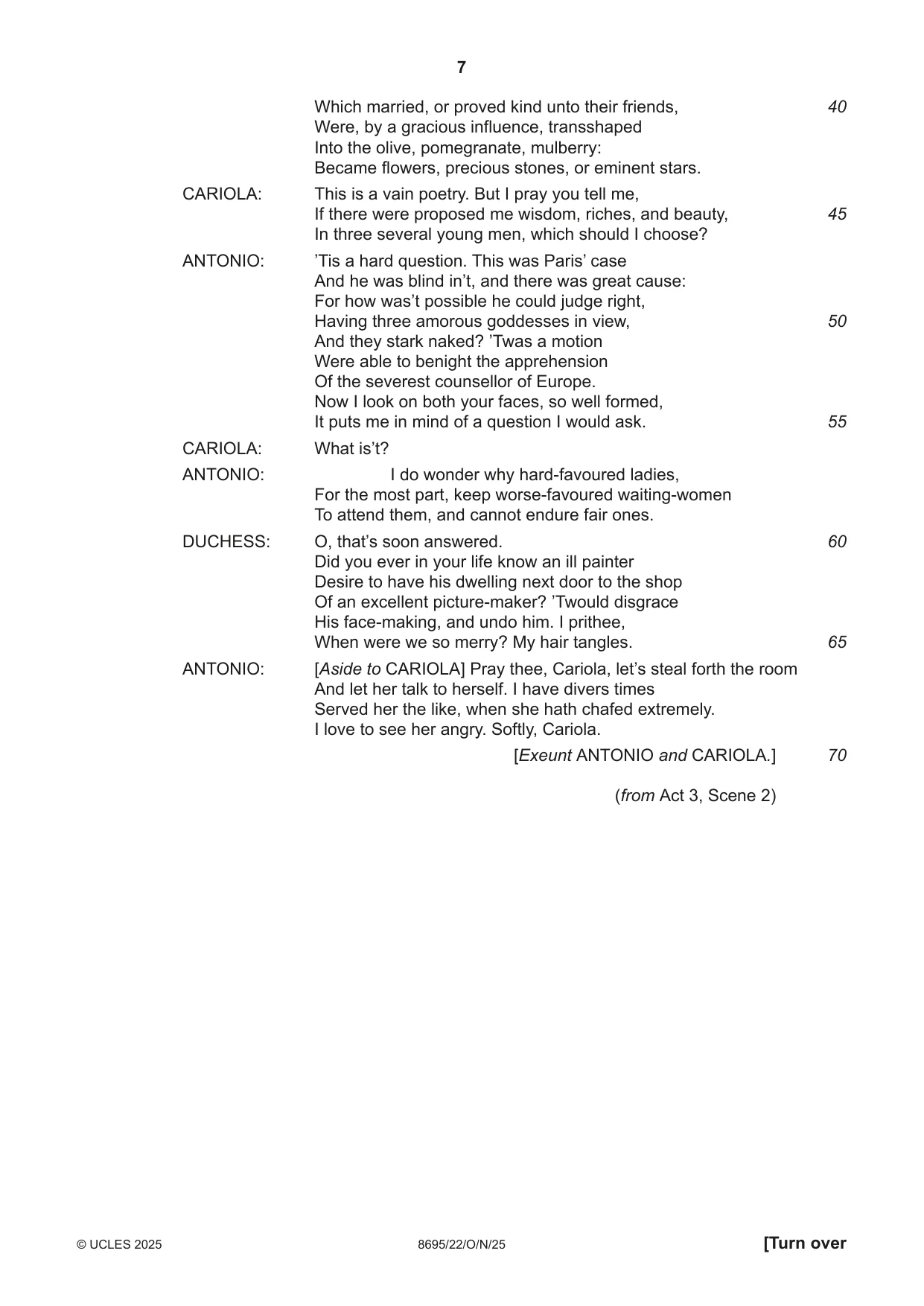
7 8695/22/O/N/25 © UCLES 2025 [Turn over Which married, or proved kind unto their friends, Were, by a gracious influence, transshaped Into the olive, pomegranate, mulberry: Became flowers, precious stones, or eminent stars. CARIOLA: This is a vain poetry. But I pray you tell me, If there were proposed me wisdom, riches, and beauty, In three several young men, which should I choose? ANTONIO: ’Tis a hard question. This was Paris’ case And he was blind in’t, and there was great cause: For how was’t possible he could judge right, Having three amorous goddesses in view, And they stark naked? ’Twas a motion Were able to benight the apprehension Of the severest counsellor of Europe. Now I look on both your faces, so well formed, It puts me in mind of a question I would ask. CARIOLA: What is’t? ANTONIO: I do wonder why hard-favoured ladies, For the most part, keep worse-favoured waiting-women To attend them, and cannot endure fair ones. DUCHESS: O, that’s soon answered. Did you ever in your life know an ill painter Desire to have his dwelling next door to the shop Of an excellent picture-maker? ’Twould disgrace His face-making, and undo him. I prithee, When were we so merry? My hair tangles. ANTONIO: [Aside to CARIOLA] Pray thee, Cariola, let’s steal forth the room And let her talk to herself. I have divers times Served her the like, when she hath chafed extremely. I love to see her angry. Softly, Cariola. [Exeunt ANTONIO and CARIOLA.] (from Act 3, Scene 2) 40 45 50 55 60 65 70
Question paper, page 8
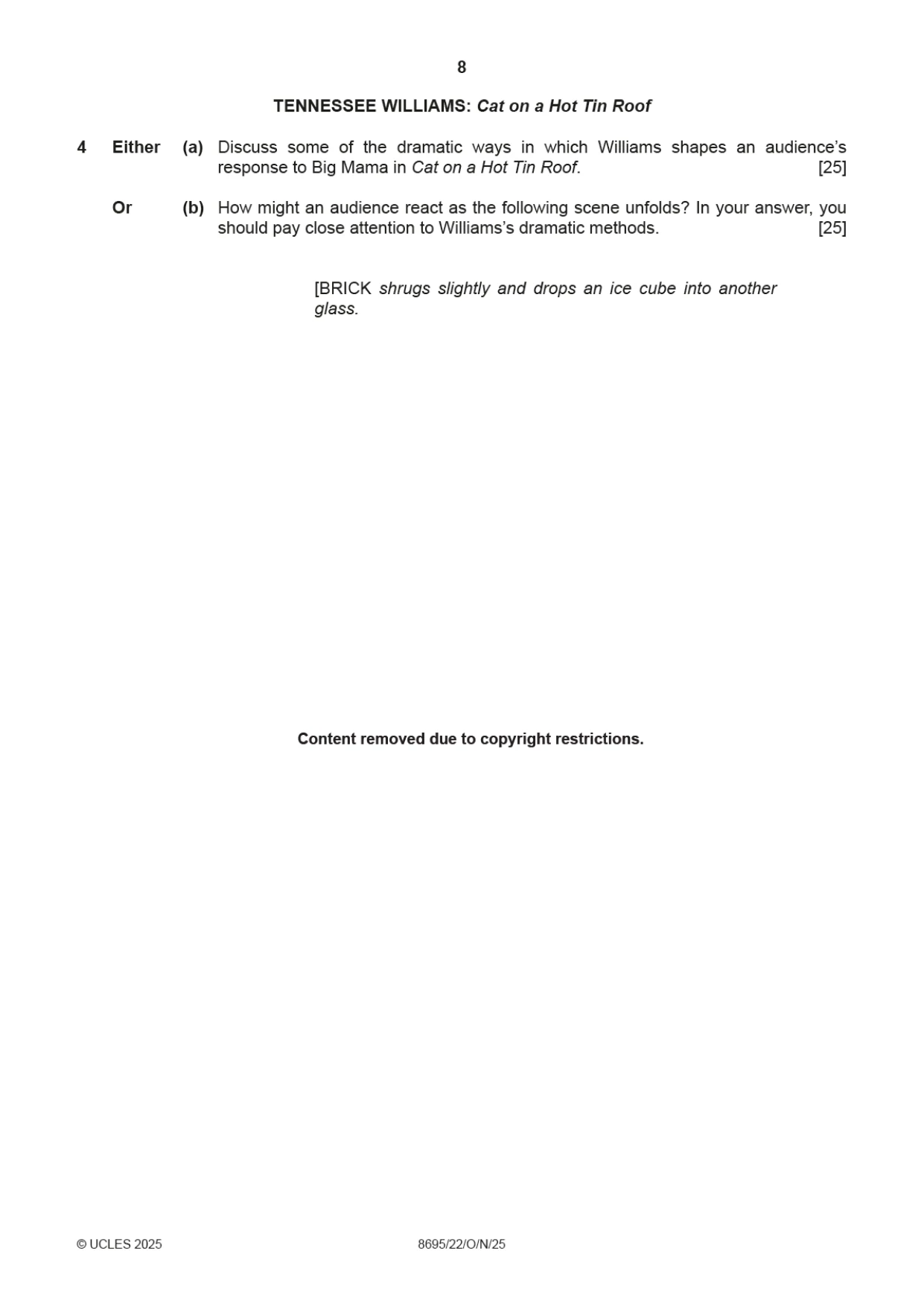
4 Either Or ©UCLES 2025 (a) (b) 8 TENNESSEE WILLIAMS: Cat on a Hot Tin Roof Discuss some of the dramatic ways in which Williams shapes an audience’s response to Big Mama in Cat on a Hot Tin Roof. [25] How might an audience react as the following scene unfolds? In your answer, you should pay close attention to Williams’s dramatic methods. [25] [BRICK shrugs slightly and drops an ice cube into another glass. Content removed due to copyright restrictions. 8695/22/O/N/25
Question paper, page 9
9 8695/22/O/N/25 © UCLES 2025 [Turn over – I – know what you – mean … (from Act 3) Content removed due to copyright restrictions.
Question paper, page 10
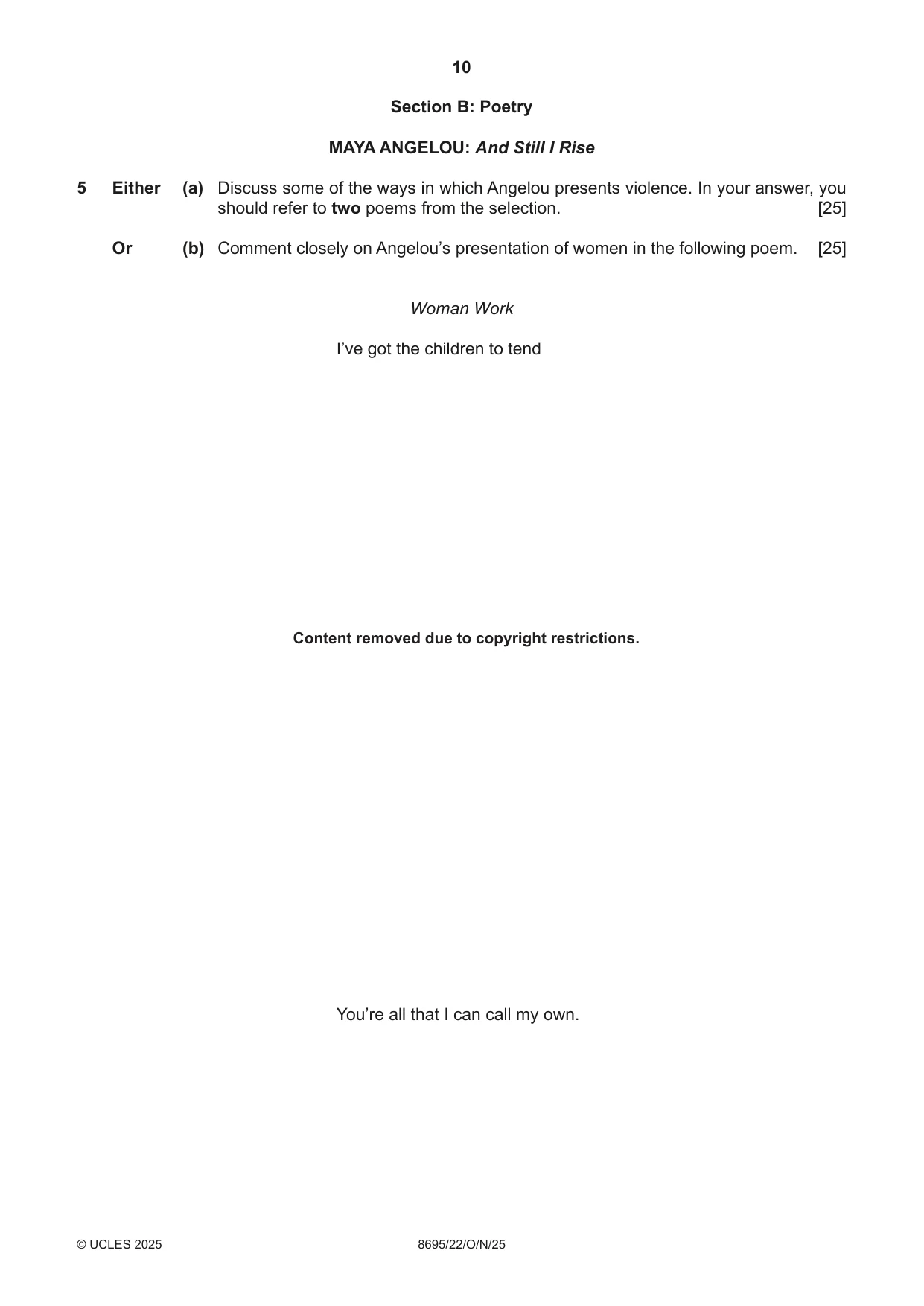
10 8695/22/O/N/25 © UCLES 2025 Section B: Poetry MAYA ANGELOU: And Still I Rise 5 Either (a) Discuss some of the ways in which Angelou presents violence. In your answer, you should refer to two poems from the selection. [25] Or (b) Comment closely on Angelou’s presentation of women in the following poem. [25] Woman Work I’ve got the children to tend You’re all that I can call my own. Content removed due to copyright restrictions.
Question paper, page 11
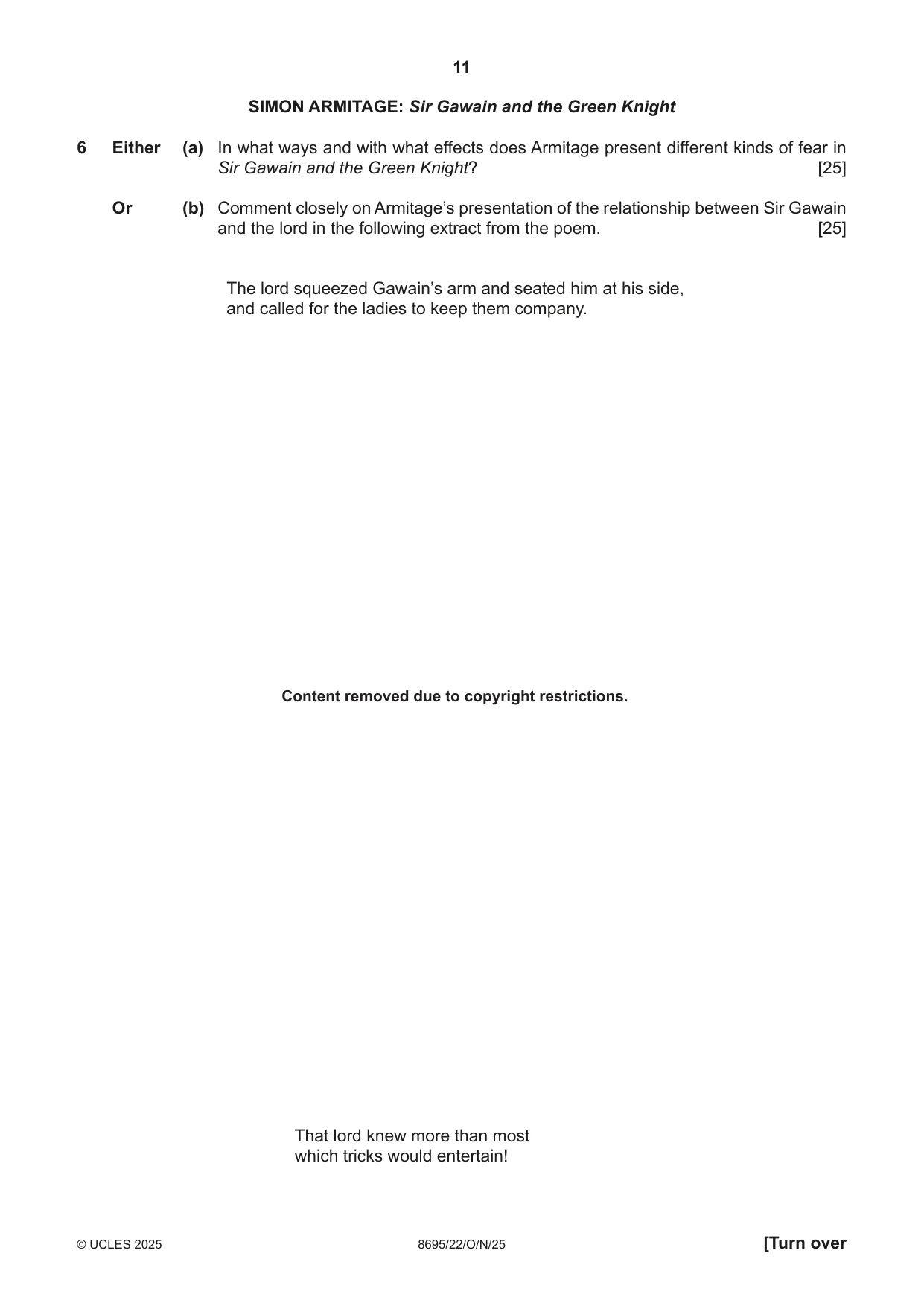
11 8695/22/O/N/25 © UCLES 2025 [Turn over SIMON ARMITAGE: Sir Gawain and the Green Knight 6 Either (a) In what ways and with what effects does Armitage present different kinds of fear in Sir Gawain and the Green Knight? [25] Or (b) Comment closely on Armitage’s presentation of the relationship between Sir Gawain and the lord in the following extract from the poem. [25] The lord squeezed Gawain’s arm and seated him at his side, and called for the ladies to keep them company. That lord knew more than most which tricks would entertain! Content removed due to copyright restrictions.
Question paper, page 12
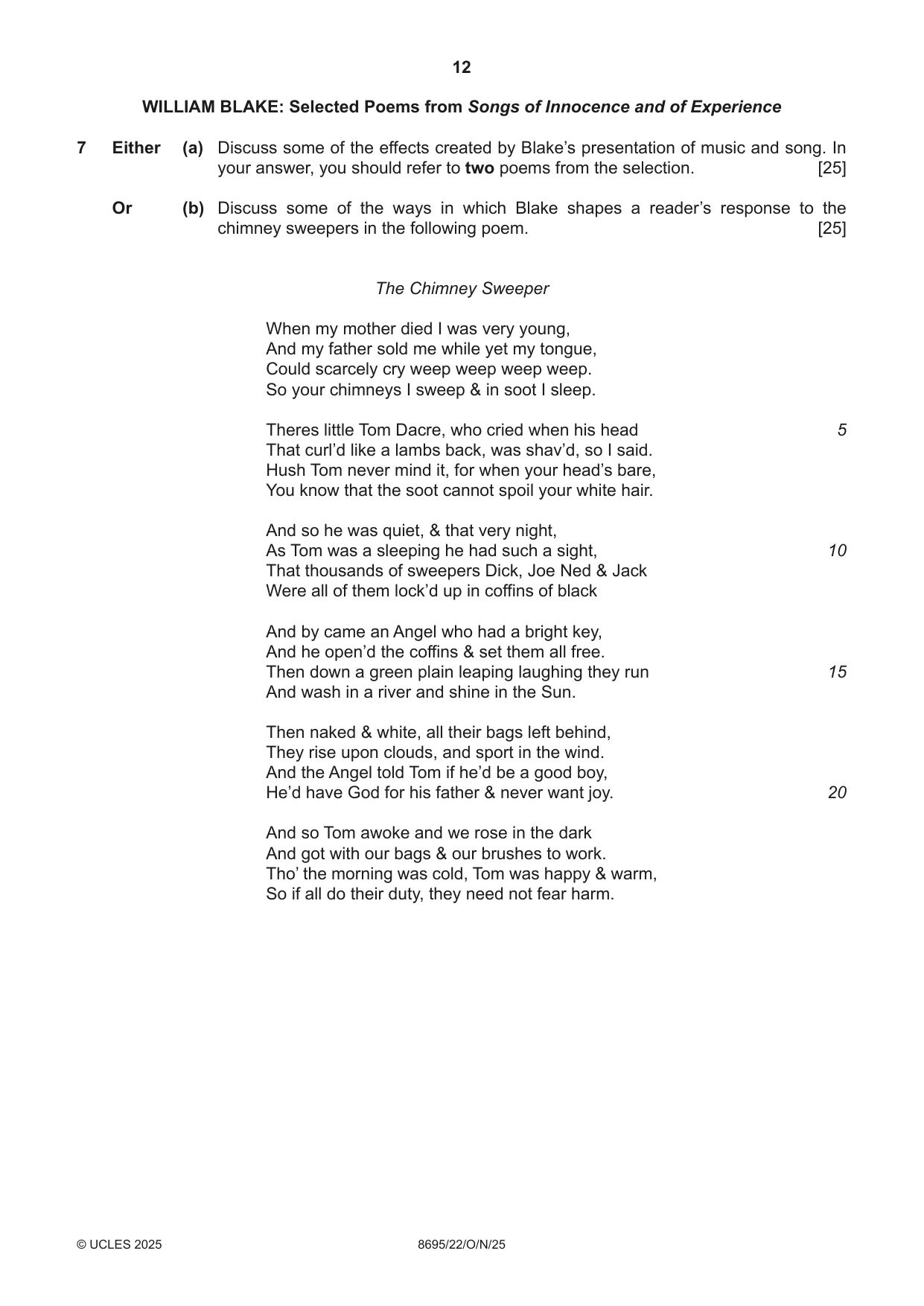
12 8695/22/O/N/25 © UCLES 2025 WILLIAM BLAKE: Selected Poems from Songs of Innocence and of Experience 7 Either (a) Discuss some of the effects created by Blake’s presentation of music and song. In your answer, you should refer to two poems from the selection. [25] Or (b) Discuss some of the ways in which Blake shapes a reader’s response to the chimney sweepers in the following poem. [25] The Chimney Sweeper When my mother died I was very young, And my father sold me while yet my tongue, Could scarcely cry weep weep weep weep. So your chimneys I sweep & in soot I sleep. Theres little Tom Dacre, who cried when his head That curl’d like a lambs back, was shav’d, so I said. Hush Tom never mind it, for when your head’s bare, You know that the soot cannot spoil your white hair. And so he was quiet, & that very night, As Tom was a sleeping he had such a sight, That thousands of sweepers Dick, Joe Ned & Jack Were all of them lock’d up in coffins of black And by came an Angel who had a bright key, And he open’d the coffins & set them all free. Then down a green plain leaping laughing they run And wash in a river and shine in the Sun. Then naked & white, all their bags left behind, They rise upon clouds, and sport in the wind. And the Angel told Tom if he’d be a good boy, He’d have God for his father & never want joy. And so Tom awoke and we rose in the dark And got with our bags & our brushes to work. Tho’ the morning was cold, Tom was happy & warm, So if all do their duty, they need not fear harm. 5 10 15 20
Question paper, page 13
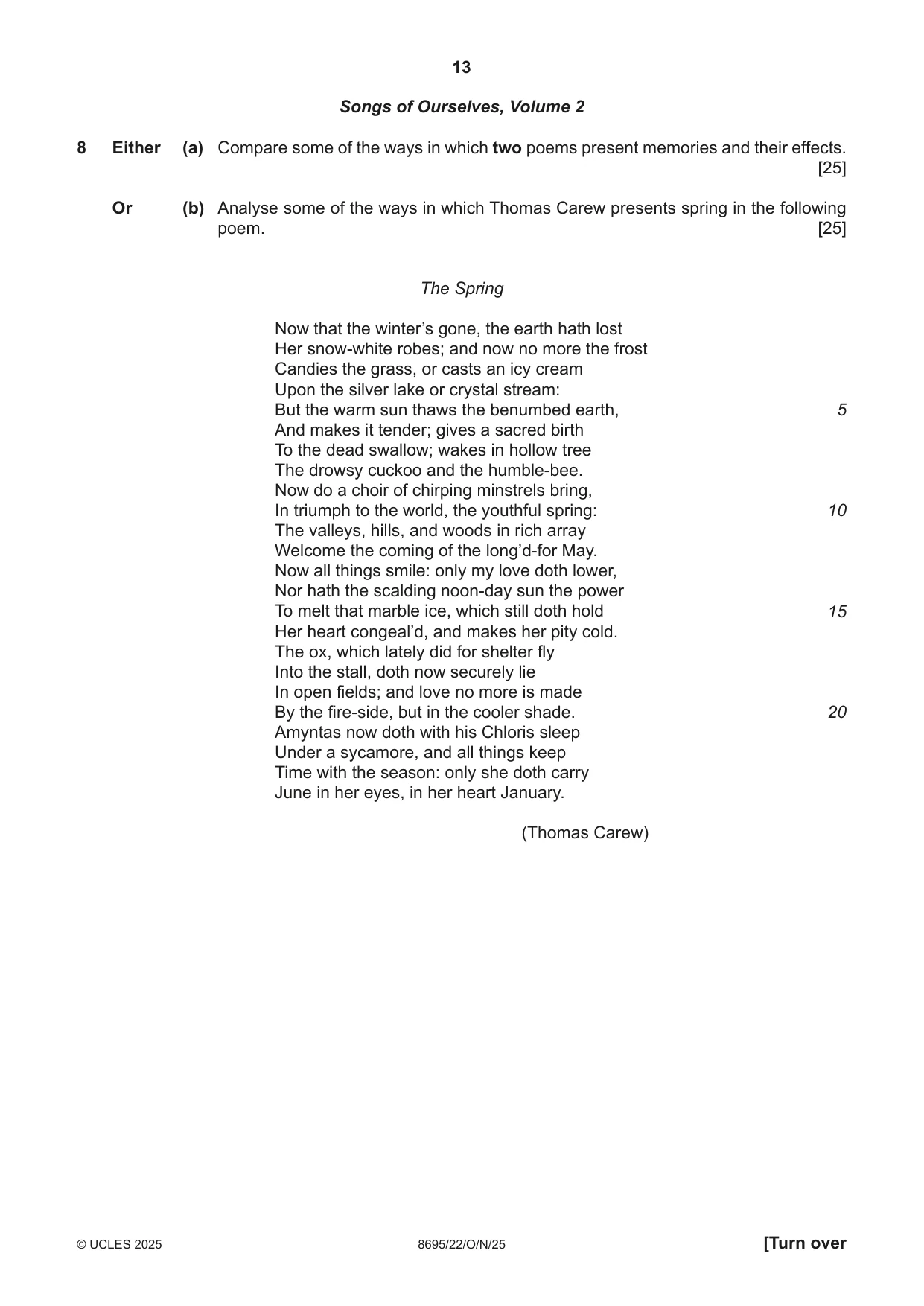
13 8695/22/O/N/25 © UCLES 2025 [Turn over Songs of Ourselves, Volume 2 8 Either (a) Compare some of the ways in which two poems present memories and their effects. [25] Or (b) Analyse some of the ways in which Thomas Carew presents spring in the following poem. [25] The Spring Now that the winter’s gone, the earth hath lost Her snow-white robes; and now no more the frost Candies the grass, or casts an icy cream Upon the silver lake or crystal stream: But the warm sun thaws the benumbed earth, And makes it tender; gives a sacred birth To the dead swallow; wakes in hollow tree The drowsy cuckoo and the humble-bee. Now do a choir of chirping minstrels bring, In triumph to the world, the youthful spring: The valleys, hills, and woods in rich array Welcome the coming of the long’d-for May. Now all things smile: only my love doth lower, Nor hath the scalding noon-day sun the power To melt that marble ice, which still doth hold Her heart congeal’d, and makes her pity cold. The ox, which lately did for shelter fly Into the stall, doth now securely lie In open fields; and love no more is made By the fire-side, but in the cooler shade. Amyntas now doth with his Chloris sleep Under a sycamore, and all things keep Time with the season: only she doth carry June in her eyes, in her heart January. (Thomas Carew) 5 10 15 20
Question paper, page 14
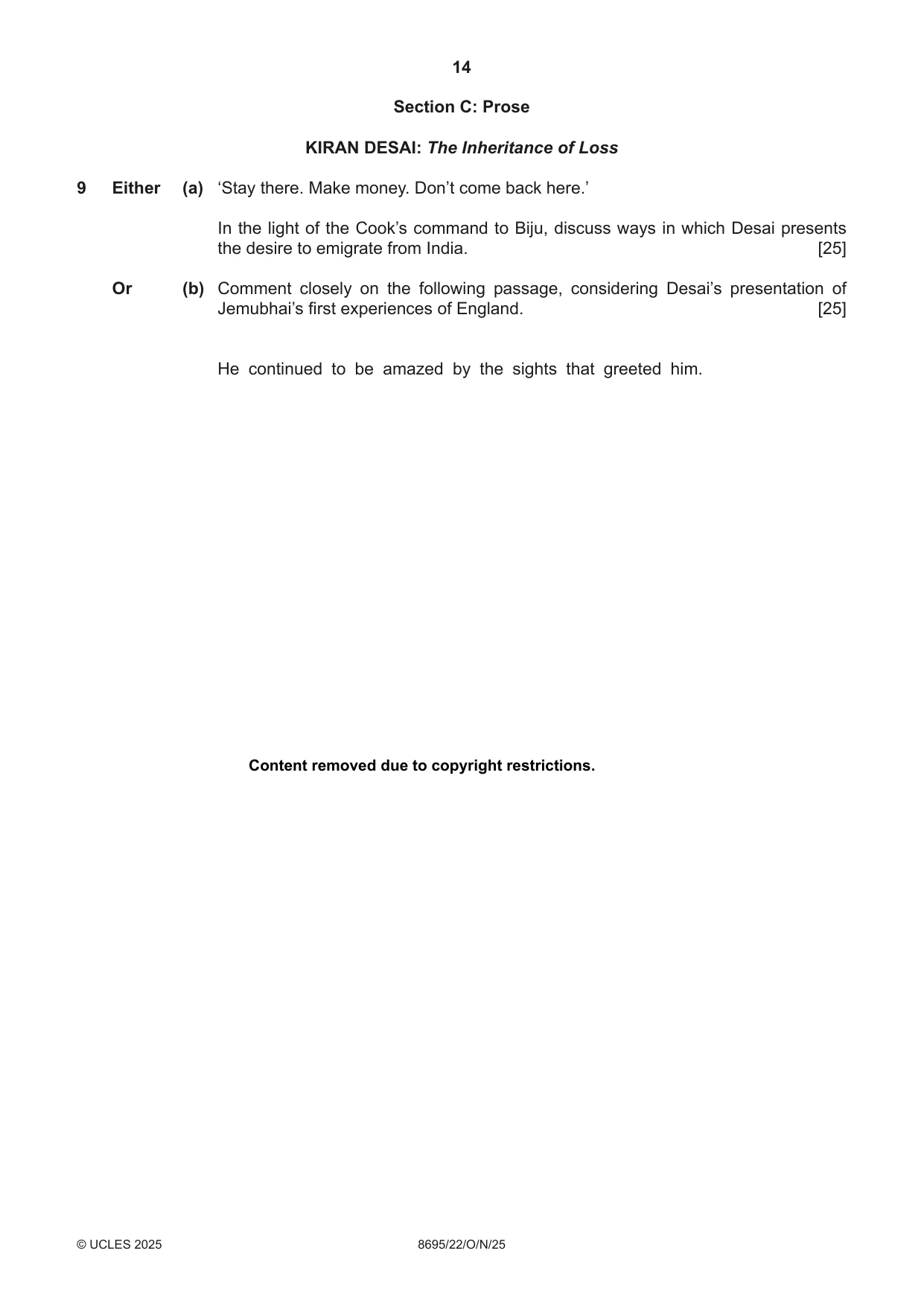
14 8695/22/O/N/25 © UCLES 2025 Section C: Prose KIRAN DESAI: The Inheritance of Loss 9 Either (a) ‘Stay there. Make money. Don’t come back here.’ In the light of the Cook’s command to Biju, discuss ways in which Desai presents the desire to emigrate from India. [25] Or (b) Comment closely on the following passage, considering Desai’s presentation of Jemubhai’s first experiences of England. [25] He continued to be amazed by the sights that greeted him. Content removed due to copyright restrictions.
Question paper, page 15
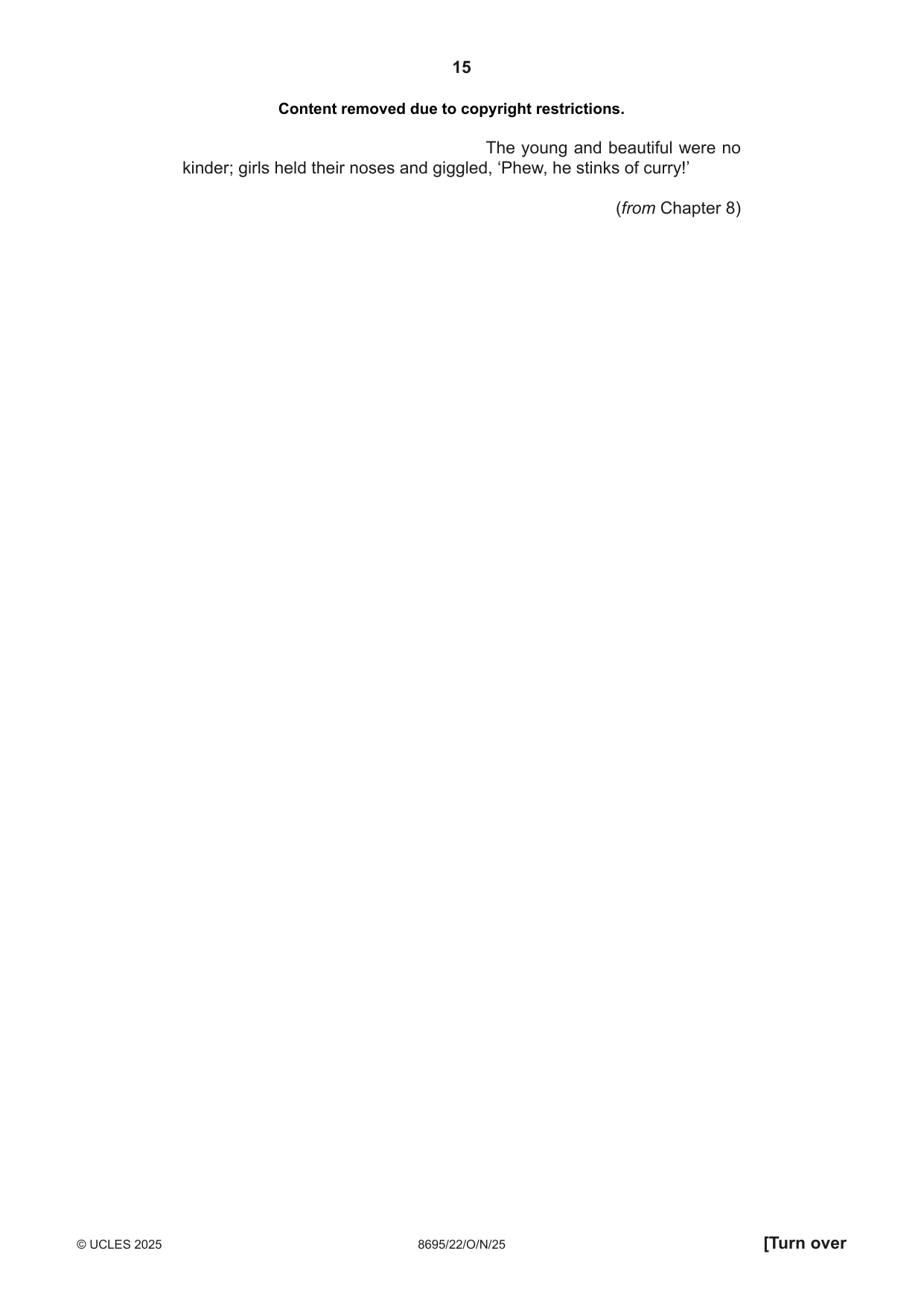
15 8695/22/O/N/25 © UCLES 2025 [Turn over The young and beautiful were no kinder; girls held their noses and giggled, ‘Phew, he stinks of curry!’ (from Chapter 8) Content removed due to copyright restrictions.
Question paper, page 16
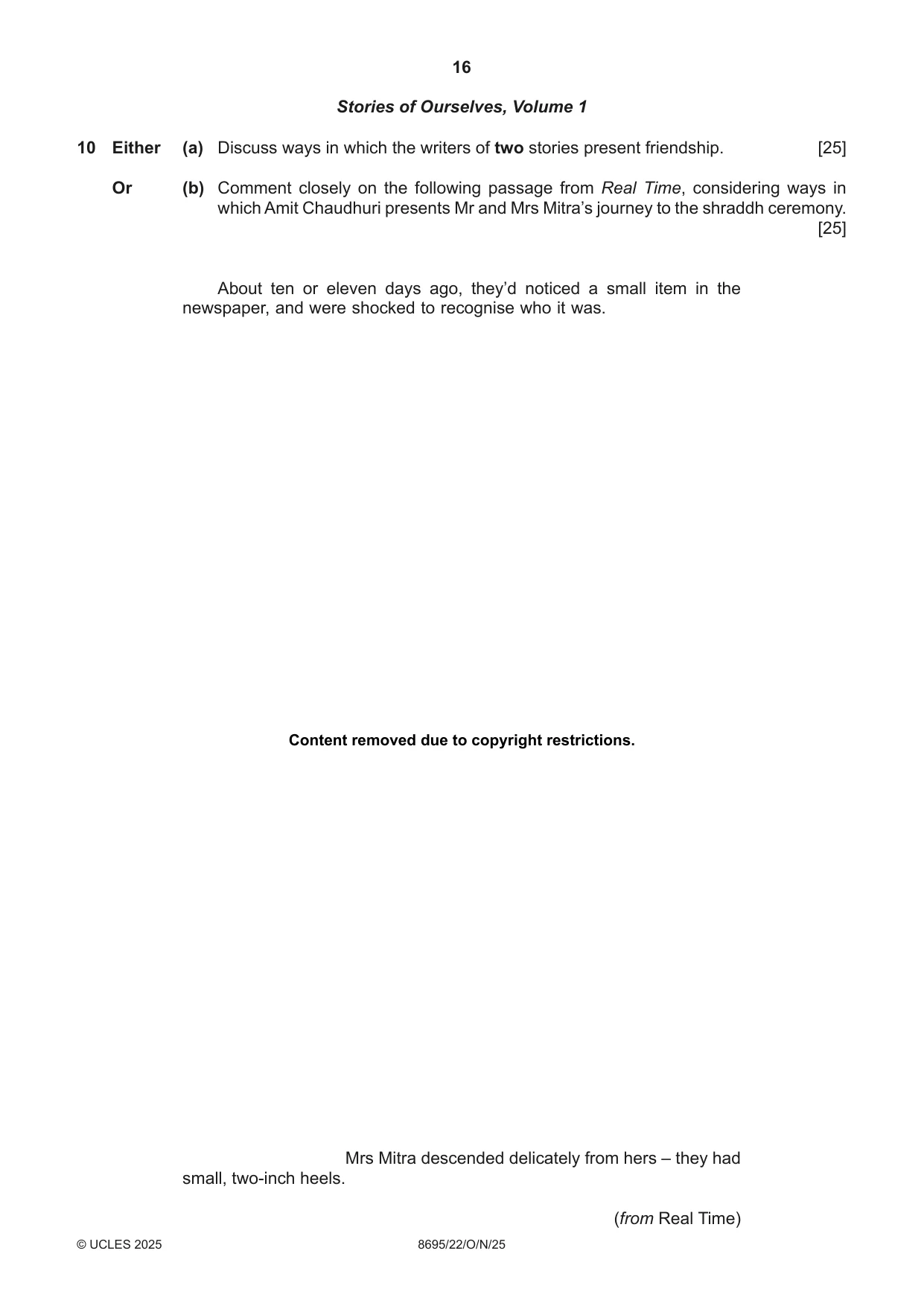
16 8695/22/O/N/25 © UCLES 2025 Stories of Ourselves, Volume 1 10 Either (a) Discuss ways in which the writers of two stories present friendship. [25] Or (b) Comment closely on the following passage from Real Time, considering ways in which Amit Chaudhuri presents Mr and Mrs Mitra’s journey to the shraddh ceremony. [25] About ten or eleven days ago, they’d noticed a small item in the newspaper, and were shocked to recognise who it was. Mrs Mitra descended delicately from hers – they had small, two-inch heels. (from Real Time) Content removed due to copyright restrictions.
Question paper, page 17
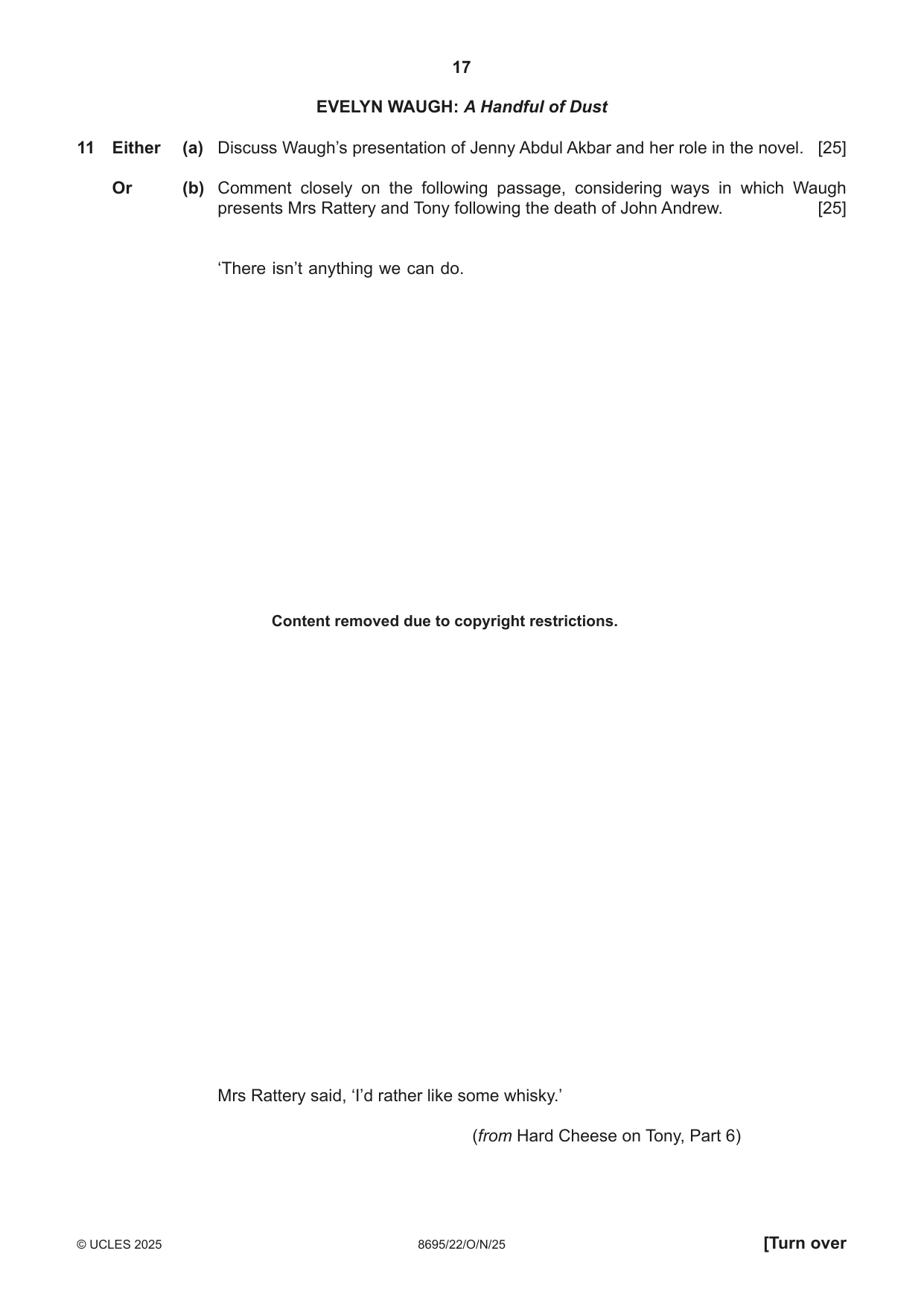
17 8695/22/O/N/25 © UCLES 2025 [Turn over EVELYN WAUGH: A Handful of Dust 11 Either (a) Discuss Waugh’s presentation of Jenny Abdul Akbar and her role in the novel. [25] Or (b) Comment closely on the following passage, considering ways in which Waugh presents Mrs Rattery and Tony following the death of John Andrew. [25] ‘There isn’t anything we can do. Mrs Rattery said, ‘I’d rather like some whisky.’ (from Hard Cheese on Tony, Part 6) Content removed due to copyright restrictions.
Question paper, page 18
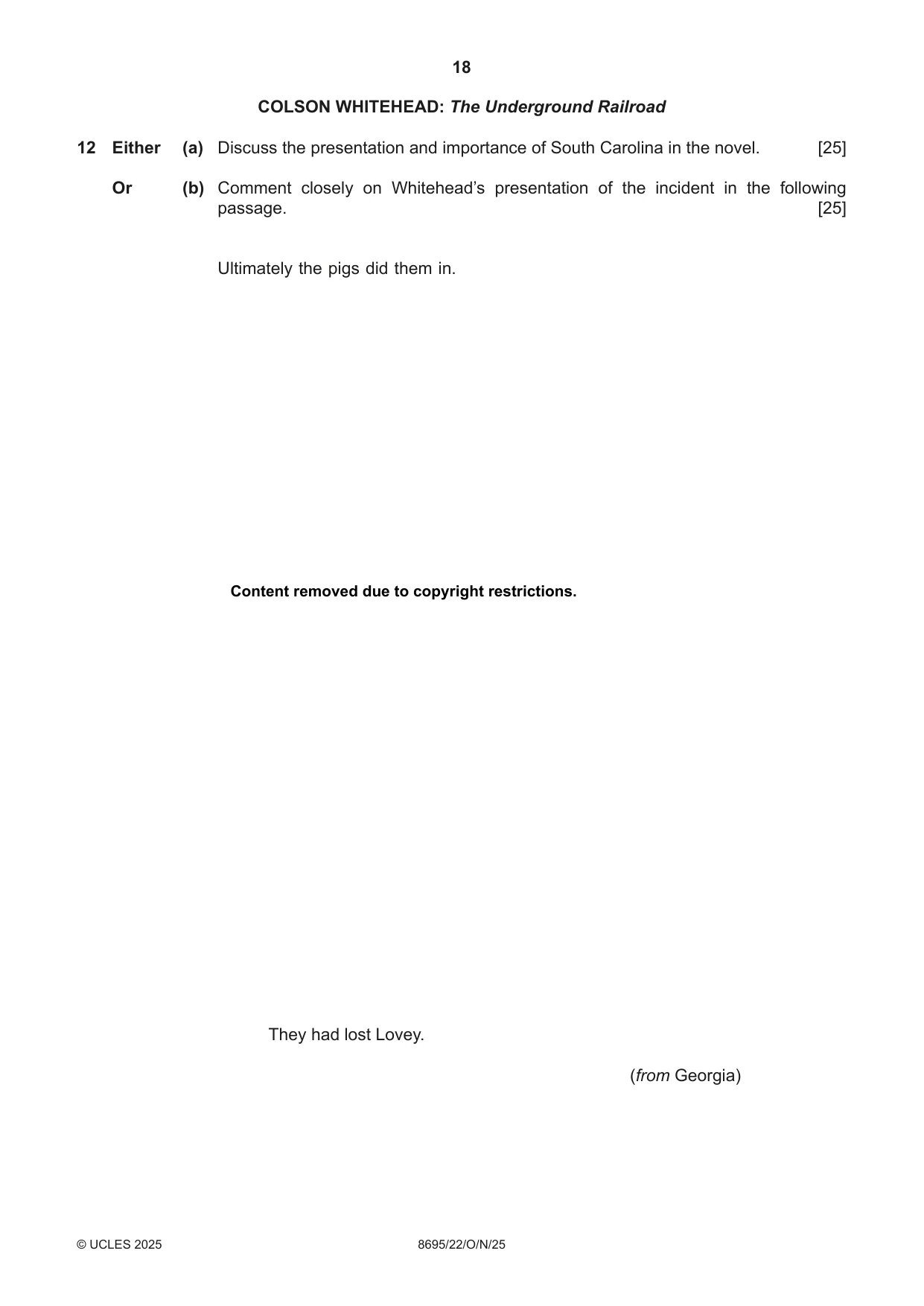
18 8695/22/O/N/25 © UCLES 2025 COLSON WHITEHEAD: The Underground Railroad 12 Either (a) Discuss the presentation and importance of South Carolina in the novel. [25] Or (b) Comment closely on Whitehead’s presentation of the incident in the following passage. [25] Ultimately the pigs did them in. They had lost Lovey. (from Georgia) Content removed due to copyright restrictions.
Question paper, page 19
19 8695/22/O/N/25 © UCLES 2025 BLANK PAGE
Question paper, page 20
20 8695/22/O/N/25 © UCLES 2025 Permission to reproduce items where third-party owned material protected by copyright is included has been sought and cleared where possible. Every reasonable effort has been made by the publisher (UCLES) to trace copyright holders, but if any items requiring clearance have unwittingly been included, the publisher will be pleased to make amends at the earliest possible opportunity. To avoid the issue of disclosure of answer-related information to candidates, all copyright acknowledgements are reproduced online in the Cambridge Assessment International Education Copyright Acknowledgements Booklet. This is produced for each series of examinations and is freely available to download at www.cambridgeinternational.org after the live examination series. Cambridge Assessment International Education is part of Cambridge Assessment. Cambridge Assessment is the brand name of the University of Cambridge Local Examinations Syndicate (UCLES), which is a department of the University of Cambridge. BLANK PAGE
Mark scheme, page 1
This document consists of 14 printed pages. © Cambridge University Press & Assessment 2025 [Turn over Cambridge International AS Level LANGUAGE AND LITERATURE IN ENGLISH 8695/22 Paper 2 Drama, Poetry and Prose October/November 2025 MARK SCHEME Maximum Mark: 50 Published This mark scheme is published as an aid to teachers and candidates, to indicate the requirements of the examination. It shows the basis on which Examiners were instructed to award marks. It does not indicate the details of the discussions that took place at an Examiners’ meeting before marking began, which would have considered the acceptability of alternative answers. Mark schemes should be read in conjunction with the question paper and the Principal Examiner Report for Teachers. Cambridge International will not enter into discussions about these mark schemes. Cambridge International is publishing the mark schemes for the October/November 2025 series for most Cambridge IGCSE, Cambridge International A and AS Level components, and some Cambridge O Level components.
Mark scheme, page 2
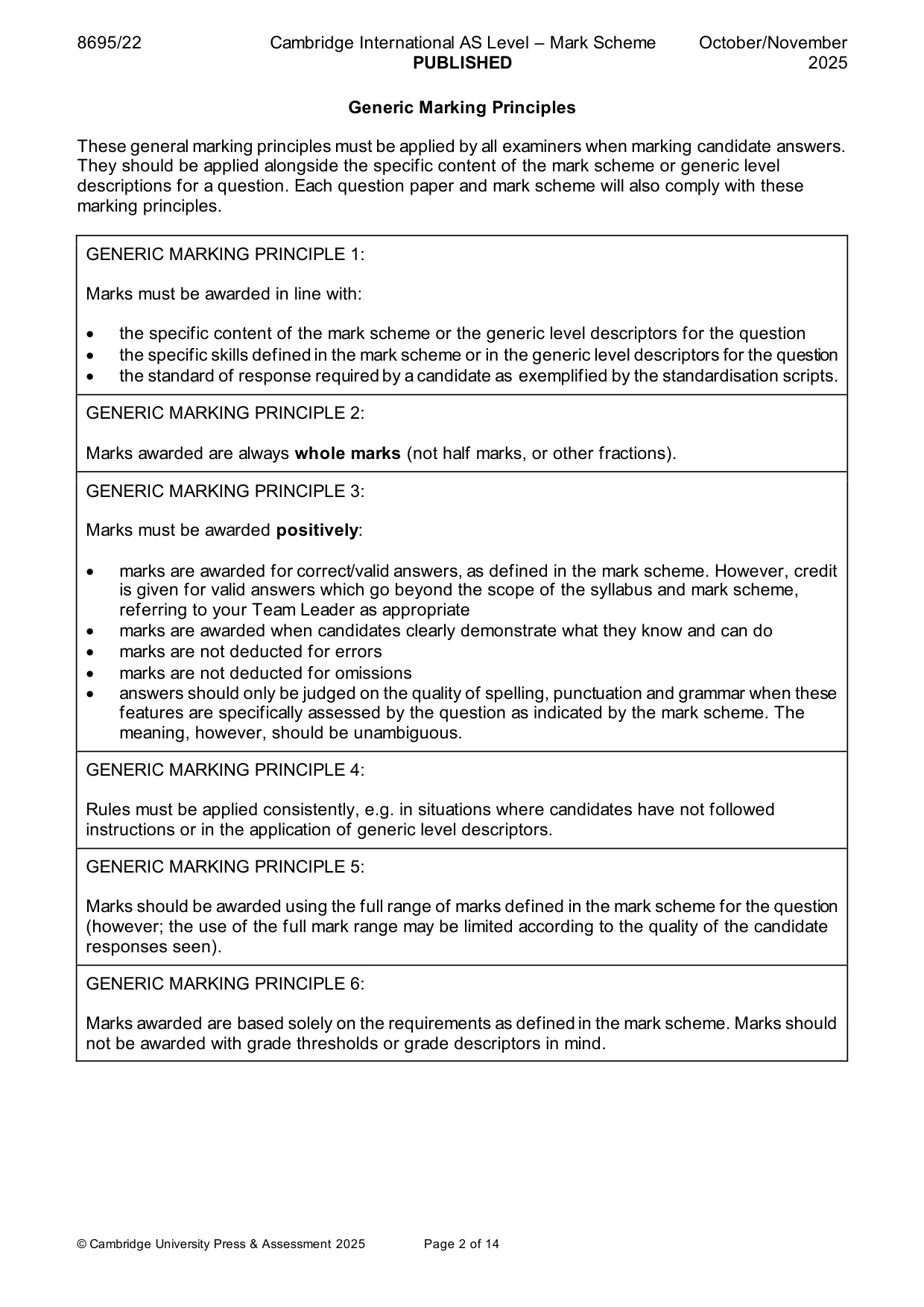
8695/22 Cambridge International AS Level – Mark Scheme PUBLISHED October/November 2025 © Cambridge University Press & Assessment 2025 Page 2 of 14 Generic Marking Principles These general marking principles must be applied by all examiners when marking candidate answers. They should be applied alongside the specific content of the mark scheme or generic level descriptions for a question. Each question paper and mark scheme will also comply with these marking principles. GENERIC MARKING PRINCIPLE 1: Marks must be awarded in line with: • the specific content of the mark scheme or the generic level descriptors for the question • the specific skills defined in the mark scheme or in the generic level descriptors for the question • the standard of response required by a candidate as exemplified by the standardisation scripts. GENERIC MARKING PRINCIPLE 2: Marks awarded are always whole marks (not half marks, or other fractions). GENERIC MARKING PRINCIPLE 3: Marks must be awarded positively: • marks are awarded for correct/valid answers, as defined in the mark scheme. However, credit is given for valid answers which go beyond the scope of the syllabus and mark scheme, referring to your Team Leader as appropriate • marks are awarded when candidates clearly demonstrate what they know and can do • marks are not deducted for errors • marks are not deducted for omissions • answers should only be judged on the quality of spelling, punctuation and grammar when these features are specifically assessed by the question as indicated by the mark scheme. The meaning, however, should be unambiguous. GENERIC MARKING PRINCIPLE 4: Rules must be applied consistently, e.g. in situations where candidates have not followed instructions or in the application of generic level descriptors. GENERIC MARKING PRINCIPLE 5: Marks should be awarded using the full range of marks defined in the mark scheme for the question (however; the use of the full mark range may be limited according to the quality of the candidate responses seen). GENERIC MARKING PRINCIPLE 6: Marks awarded are based solely on the requirements as defined in the mark scheme. Marks should not be awarded with grade thresholds or grade descriptors in mind.
Mark scheme, page 3
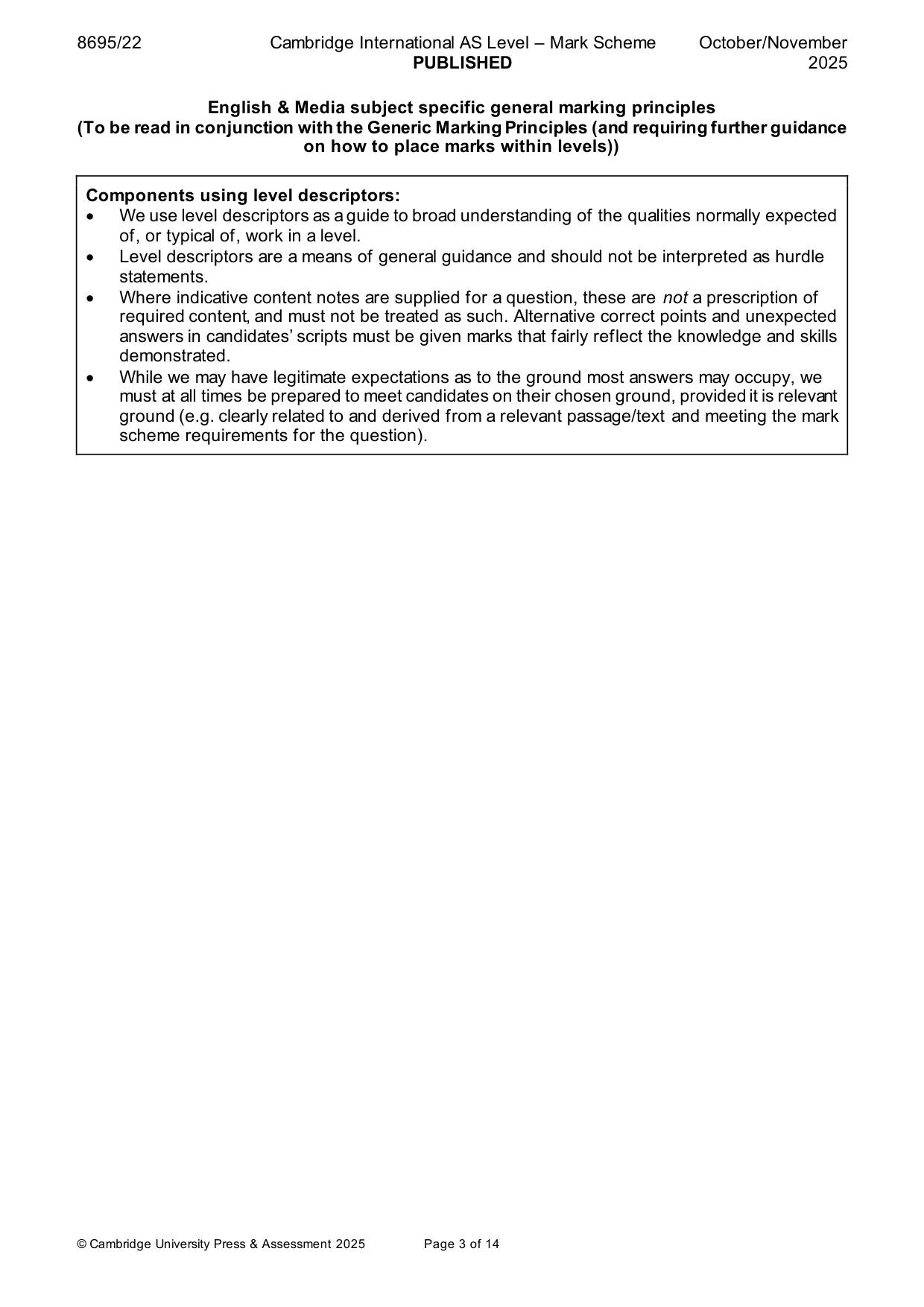
8695/22 Cambridge International AS Level – Mark Scheme PUBLISHED October/November 2025 © Cambridge University Press & Assessment 2025 Page 3 of 14 English & Media subject specific general marking principles (To be read in conjunction with the Generic Marking Principles (and requiring further guidance on how to place marks within levels)) Components using level descriptors: • We use level descriptors as a guide to broad understanding of the qualities normally expected of, or typical of, work in a level. • Level descriptors are a means of general guidance and should not be interpreted as hurdle statements. • Where indicative content notes are supplied for a question, these are not a prescription of required content, and must not be treated as such. Alternative correct points and unexpected answers in candidates’ scripts must be given marks that fairly reflect the knowledge and skills demonstrated. • While we may have legitimate expectations as to the ground most answers may occupy, we must at all times be prepared to meet candidates on their chosen ground, provided it is relevant ground (e.g. clearly related to and derived from a relevant passage/text and meeting the mark scheme requirements for the question).
Mark scheme, page 4
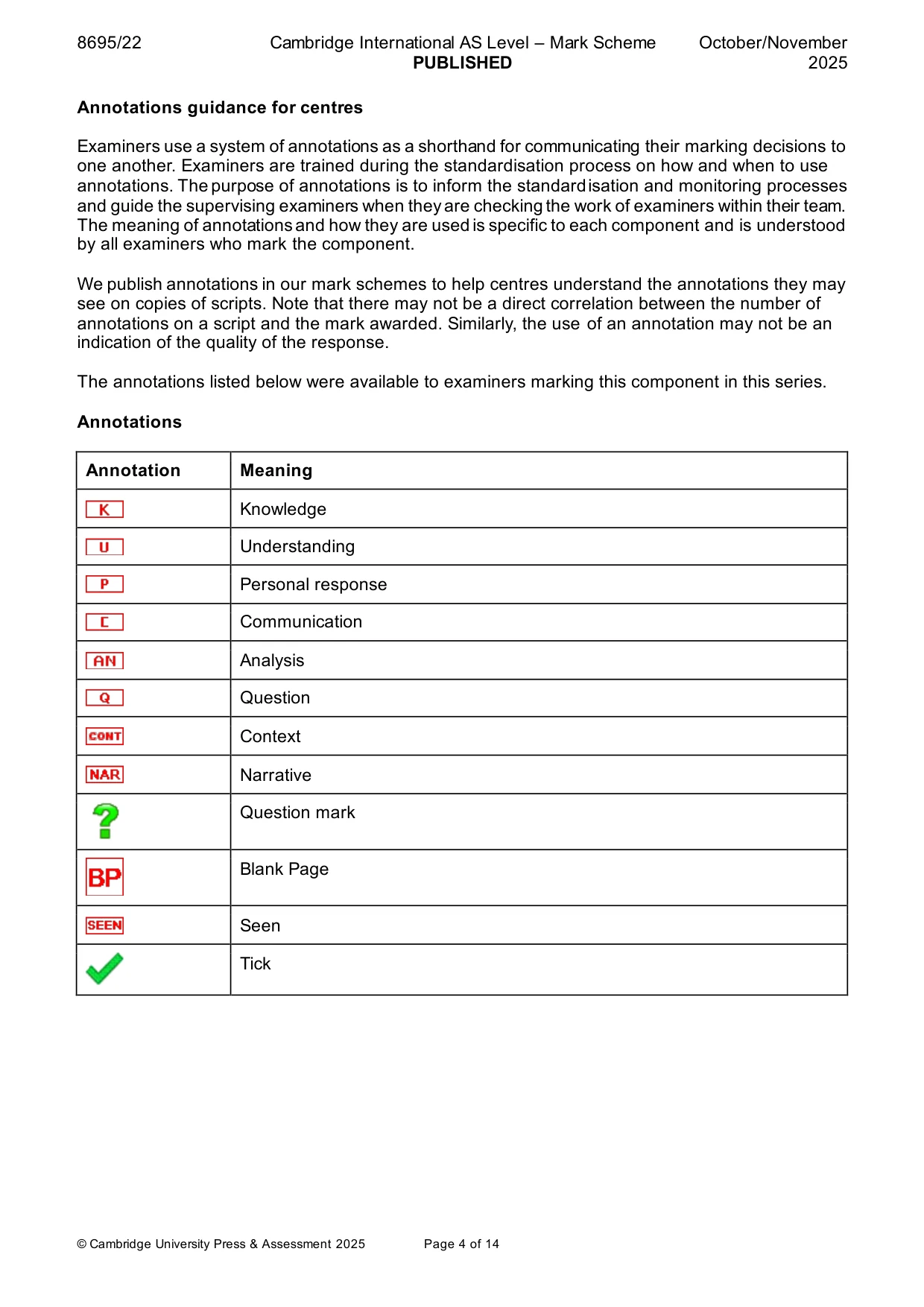
8695/22 Cambridge International AS Level – Mark Scheme PUBLISHED October/November 2025 © Cambridge University Press & Assessment 2025 Page 4 of 14 Annotations guidance for centres Examiners use a system of annotations as a shorthand for communicating their marking decisions to one another. Examiners are trained during the standardisation process on how and when to use annotations. The purpose of annotations is to inform the standardisation and monitoring processes and guide the supervising examiners when they are checking the work of examiners within their team. The meaning of annotations and how they are used is specific to each component and is understood by all examiners who mark the component. We publish annotations in our mark schemes to help centres understand the annotations they may see on copies of scripts. Note that there may not be a direct correlation between the number of annotations on a script and the mark awarded. Similarly, the use of an annotation may not be an indication of the quality of the response. The annotations listed below were available to examiners marking this component in this series. Annotations Annotation Meaning Knowledge Understanding Personal response Communication Analysis Question Context Narrative Question mark Blank Page Seen Tick
Mark scheme, page 5
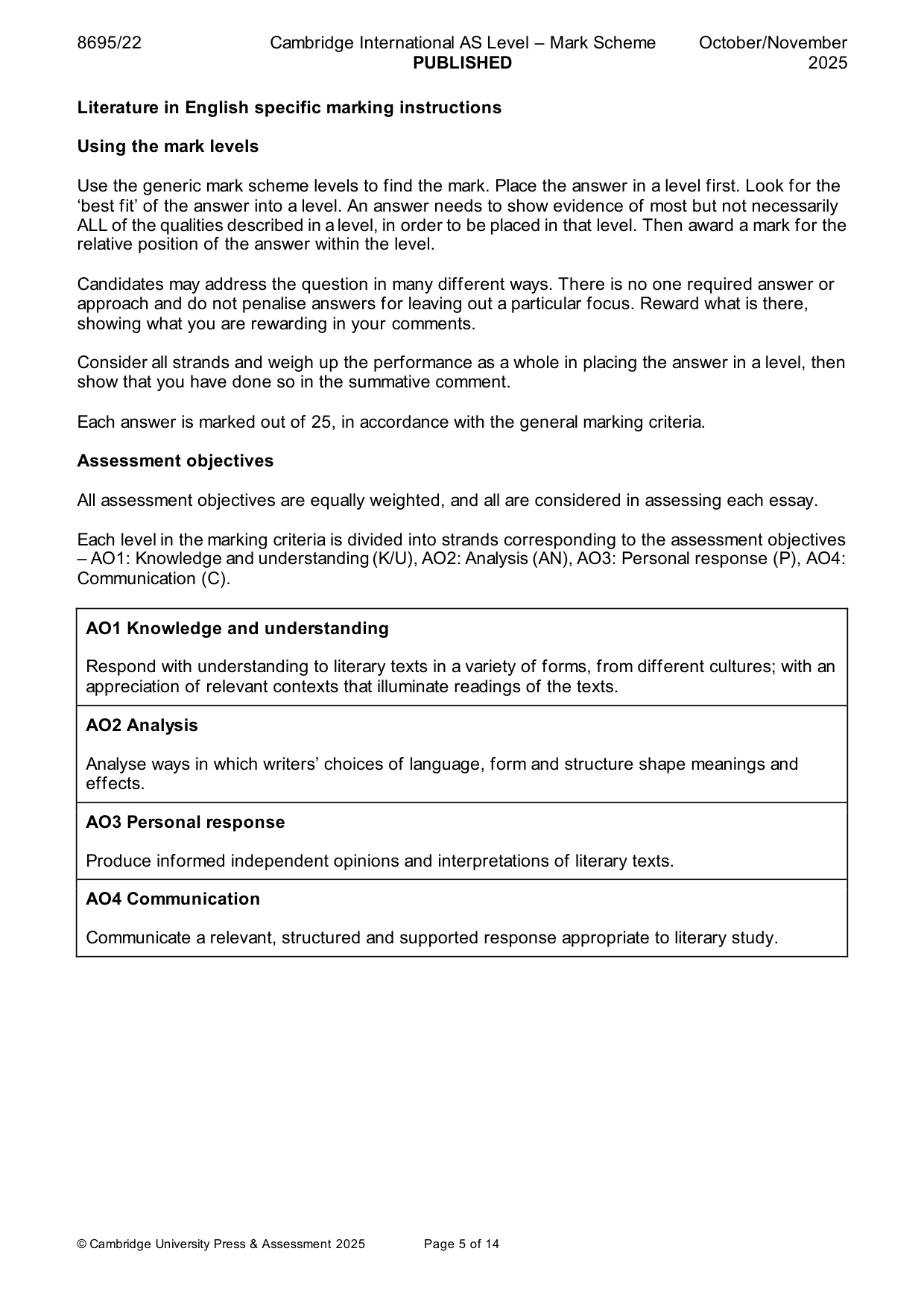
8695/22 Cambridge International AS Level – Mark Scheme PUBLISHED October/November 2025 © Cambridge University Press & Assessment 2025 Page 5 of 14 Literature in English specific marking instructions Using the mark levels Use the generic mark scheme levels to find the mark. Place the answer in a level first. Look for the ‘best fit’ of the answer into a level. An answer needs to show evidence of most but not necessarily ALL of the qualities described in a level, in order to be placed in that level. Then award a mark for the relative position of the answer within the level. Candidates may address the question in many different ways. There is no one required answer or approach and do not penalise answers for leaving out a particular focus. Reward what is there, showing what you are rewarding in your comments. Consider all strands and weigh up the performance as a whole in placing the answer in a level, then show that you have done so in the summative comment. Each answer is marked out of 25, in accordance with the general marking criteria. Assessment objectives All assessment objectives are equally weighted, and all are considered in assessing each essay. Each level in the marking criteria is divided into strands corresponding to the assessment objectives – AO1: Knowledge and understanding (K/U), AO2: Analysis (AN), AO3: Personal response (P), AO4: Communication (C). AO1 Knowledge and understanding Respond with understanding to literary texts in a variety of forms, from different cultures; with an appreciation of relevant contexts that illuminate readings of the texts. AO2 Analysis Analyse ways in which writers’ choices of language, form and structure shape meanings and effects. AO3 Personal response Produce informed independent opinions and interpretations of literary texts. AO4 Communication Communicate a relevant, structured and supported response appropriate to literary study.
Mark scheme, page 6
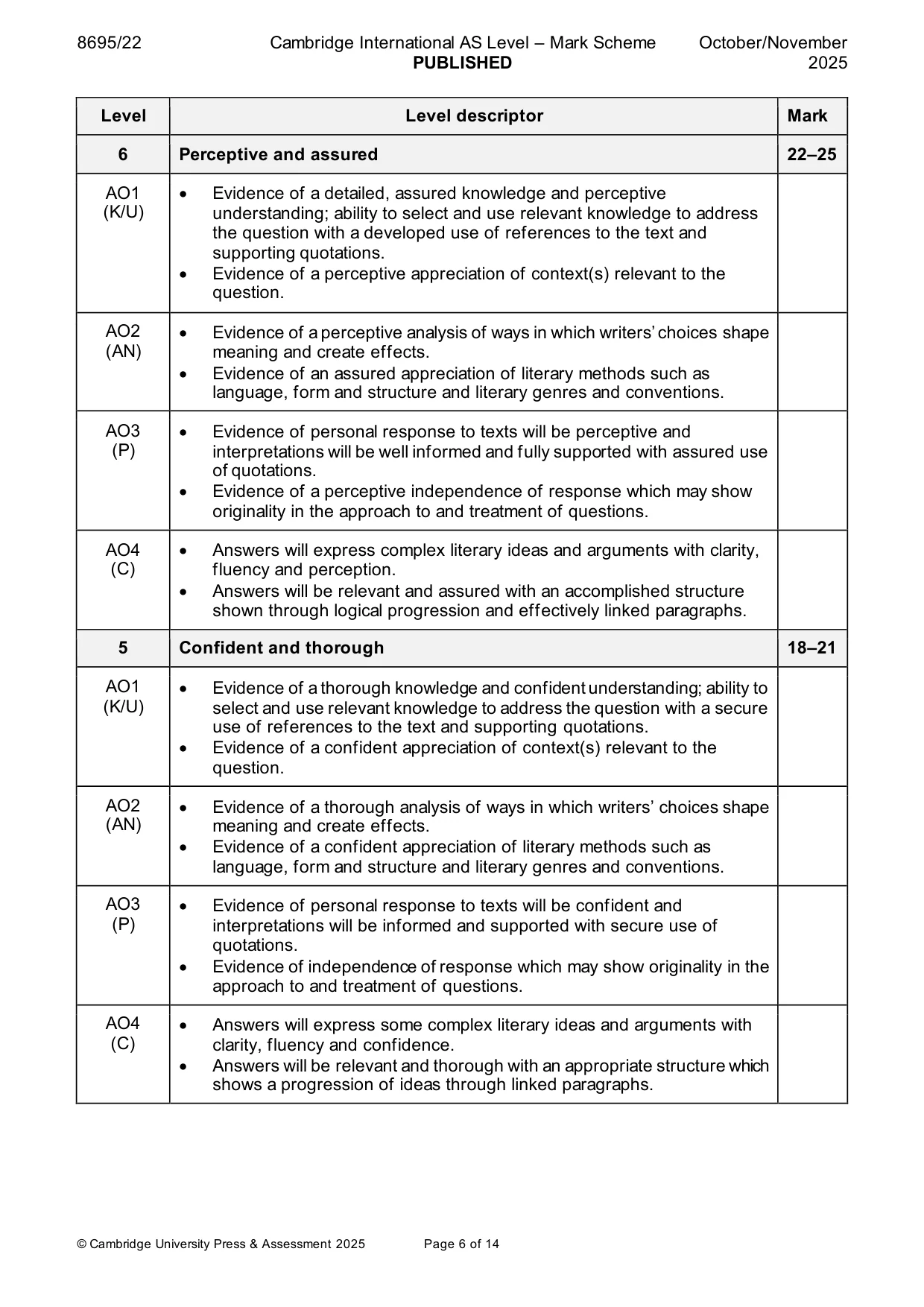
8695/22 Cambridge International AS Level – Mark Scheme PUBLISHED October/November 2025 © Cambridge University Press & Assessment 2025 Page 6 of 14 Level Level descriptor Mark 6 Perceptive and assured 22–25 AO1 (K/U) • Evidence of a detailed, assured knowledge and perceptive understanding; ability to select and use relevant knowledge to address the question with a developed use of references to the text and supporting quotations. • Evidence of a perceptive appreciation of context(s) relevant to the question. AO2 (AN) • Evidence of a perceptive analysis of ways in which writers’ choices shape meaning and create effects. • Evidence of an assured appreciation of literary methods such as language, form and structure and literary genres and conventions. AO3 (P) • Evidence of personal response to texts will be perceptive and interpretations will be well informed and fully supported with assured use of quotations. • Evidence of a perceptive independence of response which may show originality in the approach to and treatment of questions. AO4 (C) • Answers will express complex literary ideas and arguments with clarity, fluency and perception. • Answers will be relevant and assured with an accomplished structure shown through logical progression and effectively linked paragraphs. 5 Confident and thorough 18–21 AO1 (K/U) • Evidence of a thorough knowledge and confident understanding; ability to select and use relevant knowledge to address the question with a secure use of references to the text and supporting quotations. • Evidence of a confident appreciation of context(s) relevant to the question. AO2 (AN) • Evidence of a thorough analysis of ways in which writers’ choices shape meaning and create effects. • Evidence of a confident appreciation of literary methods such as language, form and structure and literary genres and conventions. AO3 (P) • Evidence of personal response to texts will be confident and interpretations will be informed and supported with secure use of quotations. • Evidence of independence of response which may show originality in the approach to and treatment of questions. AO4 (C) • Answers will express some complex literary ideas and arguments with clarity, fluency and confidence. • Answers will be relevant and thorough with an appropriate structure which shows a progression of ideas through linked paragraphs.
Mark scheme, page 7
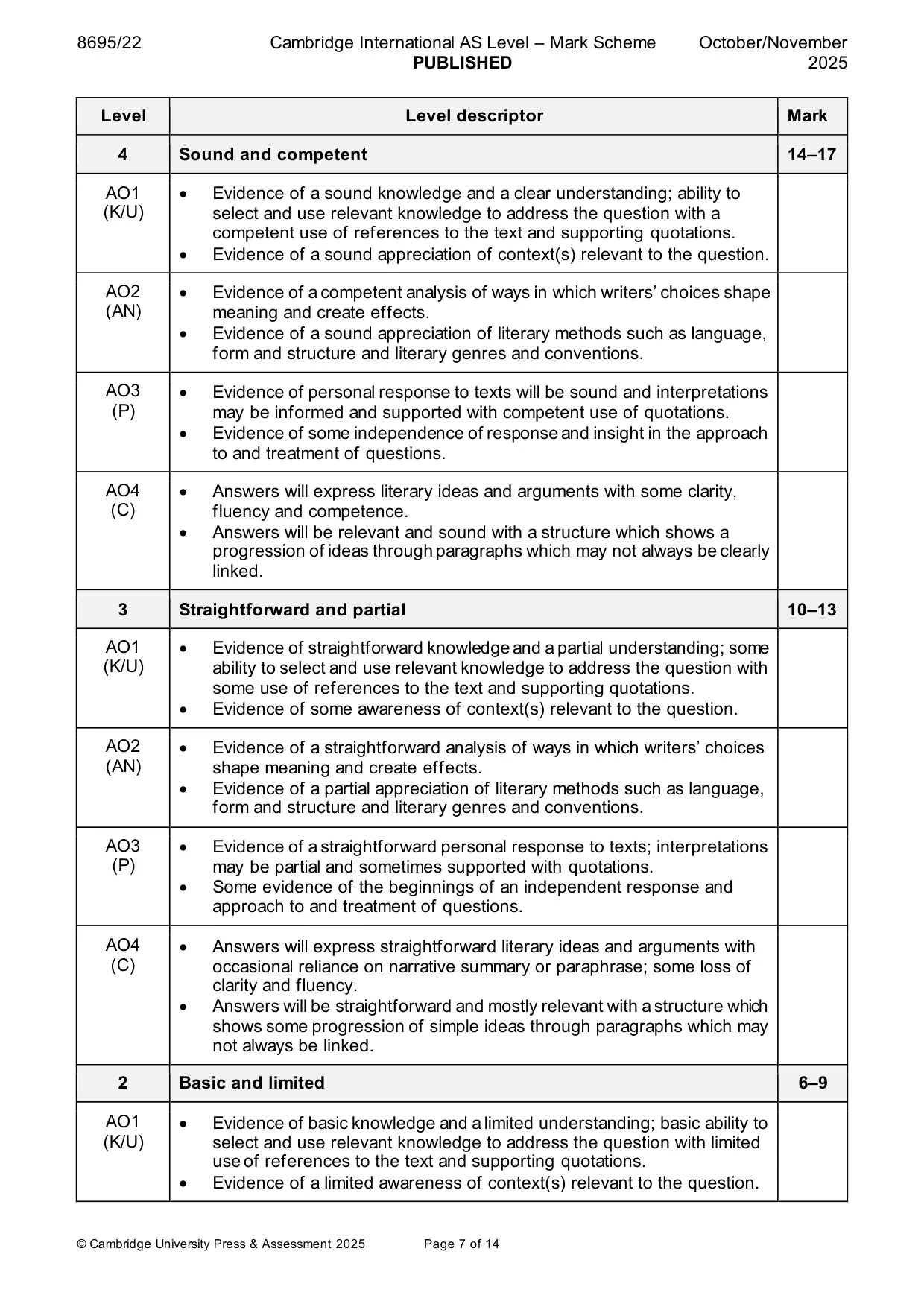
8695/22 Cambridge International AS Level – Mark Scheme PUBLISHED October/November 2025 © Cambridge University Press & Assessment 2025 Page 7 of 14 Level Level descriptor Mark 4 Sound and competent 14–17 AO1 (K/U) • Evidence of a sound knowledge and a clear understanding; ability to select and use relevant knowledge to address the question with a competent use of references to the text and supporting quotations. • Evidence of a sound appreciation of context(s) relevant to the question. AO2 (AN) • Evidence of a competent analysis of ways in which writers’ choices shape meaning and create effects. • Evidence of a sound appreciation of literary methods such as language, form and structure and literary genres and conventions. AO3 (P) • Evidence of personal response to texts will be sound and interpretations may be informed and supported with competent use of quotations. • Evidence of some independence of response and insight in the approach to and treatment of questions. AO4 (C) • Answers will express literary ideas and arguments with some clarity, fluency and competence. • Answers will be relevant and sound with a structure which shows a progression of ideas through paragraphs which may not always be clearly linked. 3 Straightforward and partial 10–13 AO1 (K/U) • Evidence of straightforward knowledge and a partial understanding; some ability to select and use relevant knowledge to address the question with some use of references to the text and supporting quotations. • Evidence of some awareness of context(s) relevant to the question. AO2 (AN) • Evidence of a straightforward analysis of ways in which writers’ choices shape meaning and create effects. • Evidence of a partial appreciation of literary methods such as language, form and structure and literary genres and conventions. AO3 (P) • Evidence of a straightforward personal response to texts; interpretations may be partial and sometimes supported with quotations. • Some evidence of the beginnings of an independent response and approach to and treatment of questions. AO4 (C) • Answers will express straightforward literary ideas and arguments with occasional reliance on narrative summary or paraphrase; some loss of clarity and fluency. • Answers will be straightforward and mostly relevant with a structure which shows some progression of simple ideas through paragraphs which may not always be linked. 2 Basic and limited 6–9 AO1 (K/U) • Evidence of basic knowledge and a limited understanding; basic ability to select and use relevant knowledge to address the question with limited use of references to the text and supporting quotations. • Evidence of a limited awareness of context(s) relevant to the question.
Mark scheme, page 8
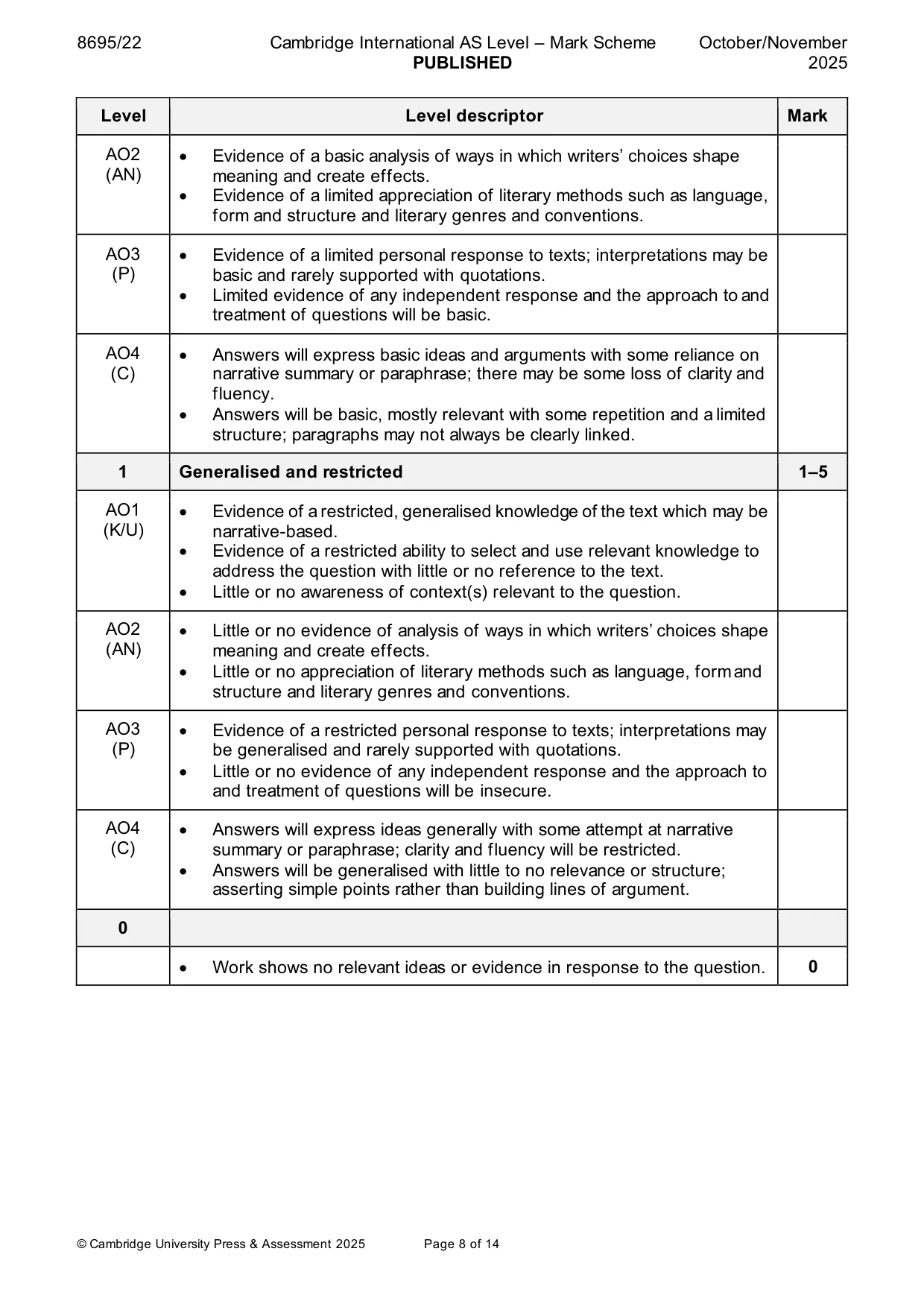
8695/22 Cambridge International AS Level – Mark Scheme PUBLISHED October/November 2025 © Cambridge University Press & Assessment 2025 Page 8 of 14 Level Level descriptor Mark AO2 (AN) • Evidence of a basic analysis of ways in which writers’ choices shape meaning and create effects. • Evidence of a limited appreciation of literary methods such as language, form and structure and literary genres and conventions. AO3 (P) • Evidence of a limited personal response to texts; interpretations may be basic and rarely supported with quotations. • Limited evidence of any independent response and the approach to and treatment of questions will be basic. AO4 (C) • Answers will express basic ideas and arguments with some reliance on narrative summary or paraphrase; there may be some loss of clarity and fluency. • Answers will be basic, mostly relevant with some repetition and a limited structure; paragraphs may not always be clearly linked. 1 Generalised and restricted 1–5 AO1 (K/U) • Evidence of a restricted, generalised knowledge of the text which may be narrative-based. • Evidence of a restricted ability to select and use relevant knowledge to address the question with little or no reference to the text. • Little or no awareness of context(s) relevant to the question. AO2 (AN) • Little or no evidence of analysis of ways in which writers’ choices shape meaning and create effects. • Little or no appreciation of literary methods such as language, form and structure and literary genres and conventions. AO3 (P) • Evidence of a restricted personal response to texts; interpretations may be generalised and rarely supported with quotations. • Little or no evidence of any independent response and the approach to and treatment of questions will be insecure. AO4 (C) • Answers will express ideas generally with some attempt at narrative summary or paraphrase; clarity and fluency will be restricted. • Answers will be generalised with little to no relevance or structure; asserting simple points rather than building lines of argument. 0 • Work shows no relevant ideas or evidence in response to the question. 0
Mark scheme, page 9
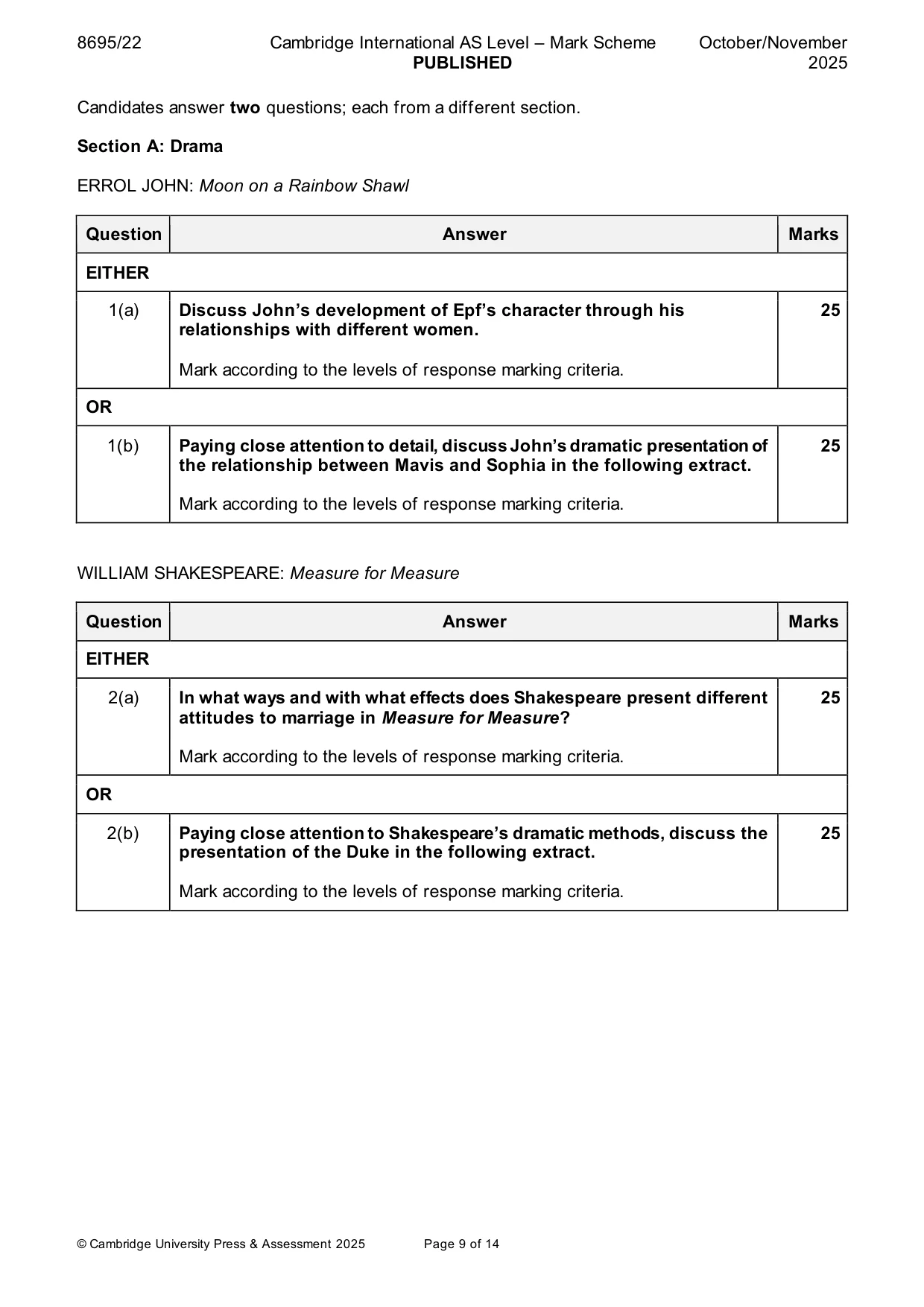
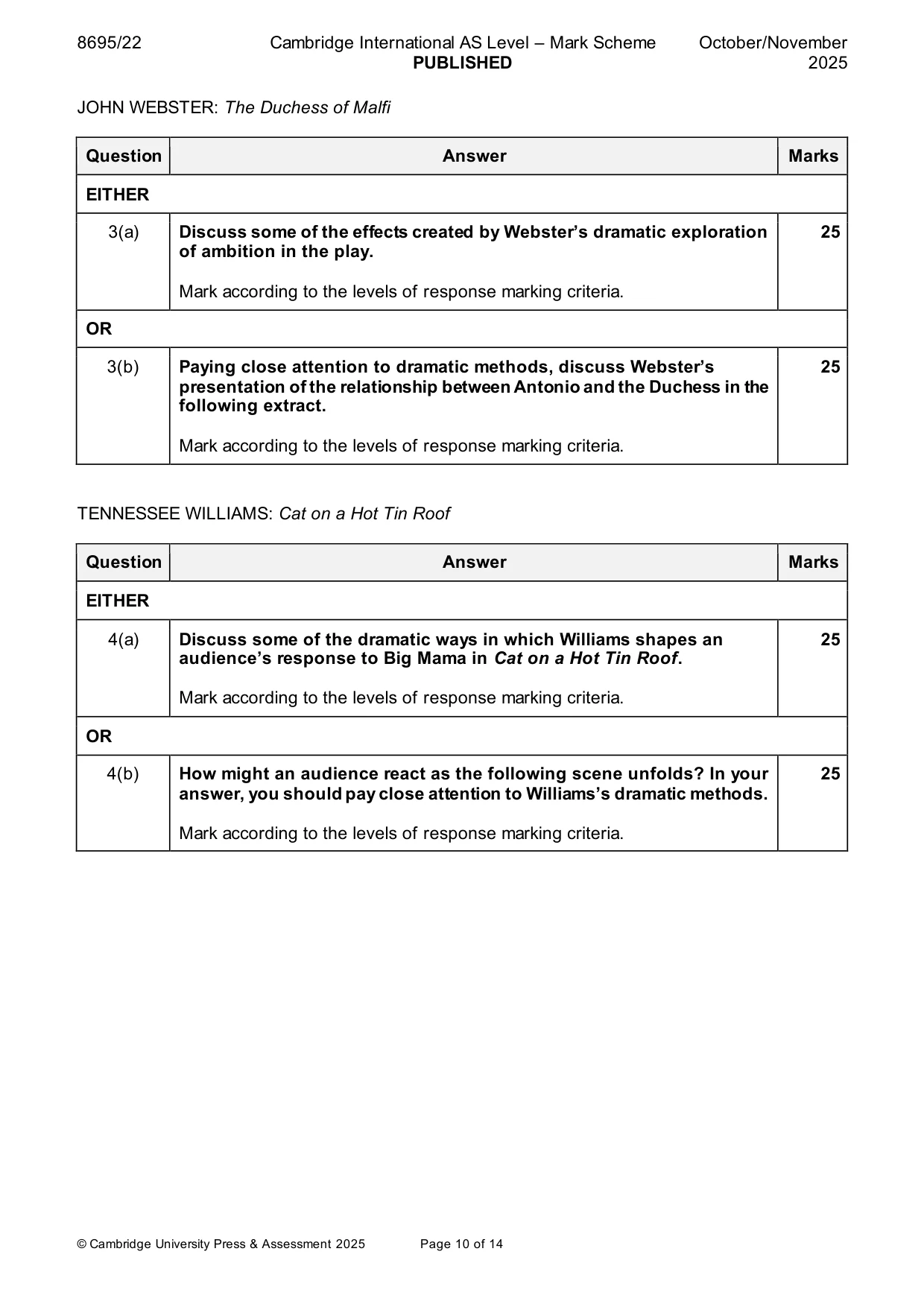
8695/22 Cambridge International AS Level – Mark Scheme PUBLISHED October/November 2025 © Cambridge University Press & Assessment 2025 Page 9 of 14 Candidates answer two questions; each from a different section. Section A: Drama ERROL JOHN: Moon on a Rainbow Shawl Question Answer Marks EITHER 1(a) Discuss John’s development of Epf’s character through his relationships with different women. Mark according to the levels of response marking criteria. 25 OR 1(b) Paying close attention to detail, discuss John’s dramatic presentation of the relationship between Mavis and Sophia in the following extract. Mark according to the levels of response marking criteria. 25 WILLIAM SHAKESPEARE: Measure for Measure Question Answer Marks EITHER 2(a) In what ways and with what effects does Shakespeare present different attitudes to marriage in Measure for Measure? Mark according to the levels of response marking criteria. 25 OR 2(b) Paying close attention to Shakespeare’s dramatic methods, discuss the presentation of the Duke in the following extract. Mark according to the levels of response marking criteria. 25
Mark scheme, page 10
8695/22 Cambridge International AS Level – Mark Scheme PUBLISHED October/November 2025 © Cambridge University Press & Assessment 2025 Page 10 of 14 JOHN WEBSTER: The Duchess of Malfi Question Answer Marks EITHER 3(a) Discuss some of the effects created by Webster’s dramatic exploration of ambition in the play. Mark according to the levels of response marking criteria. 25 OR 3(b) Paying close attention to dramatic methods, discuss Webster’s presentation of the relationship between Antonio and the Duchess in the following extract. Mark according to the levels of response marking criteria. 25 TENNESSEE WILLIAMS: Cat on a Hot Tin Roof Question Answer Marks EITHER 4(a) Discuss some of the dramatic ways in which Williams shapes an audience’s response to Big Mama in Cat on a Hot Tin Roof. Mark according to the levels of response marking criteria. 25 OR 4(b) How might an audience react as the following scene unfolds? In your answer, you should pay close attention to Williams’s dramatic methods. Mark according to the levels of response marking criteria. 25
Mark scheme, page 11
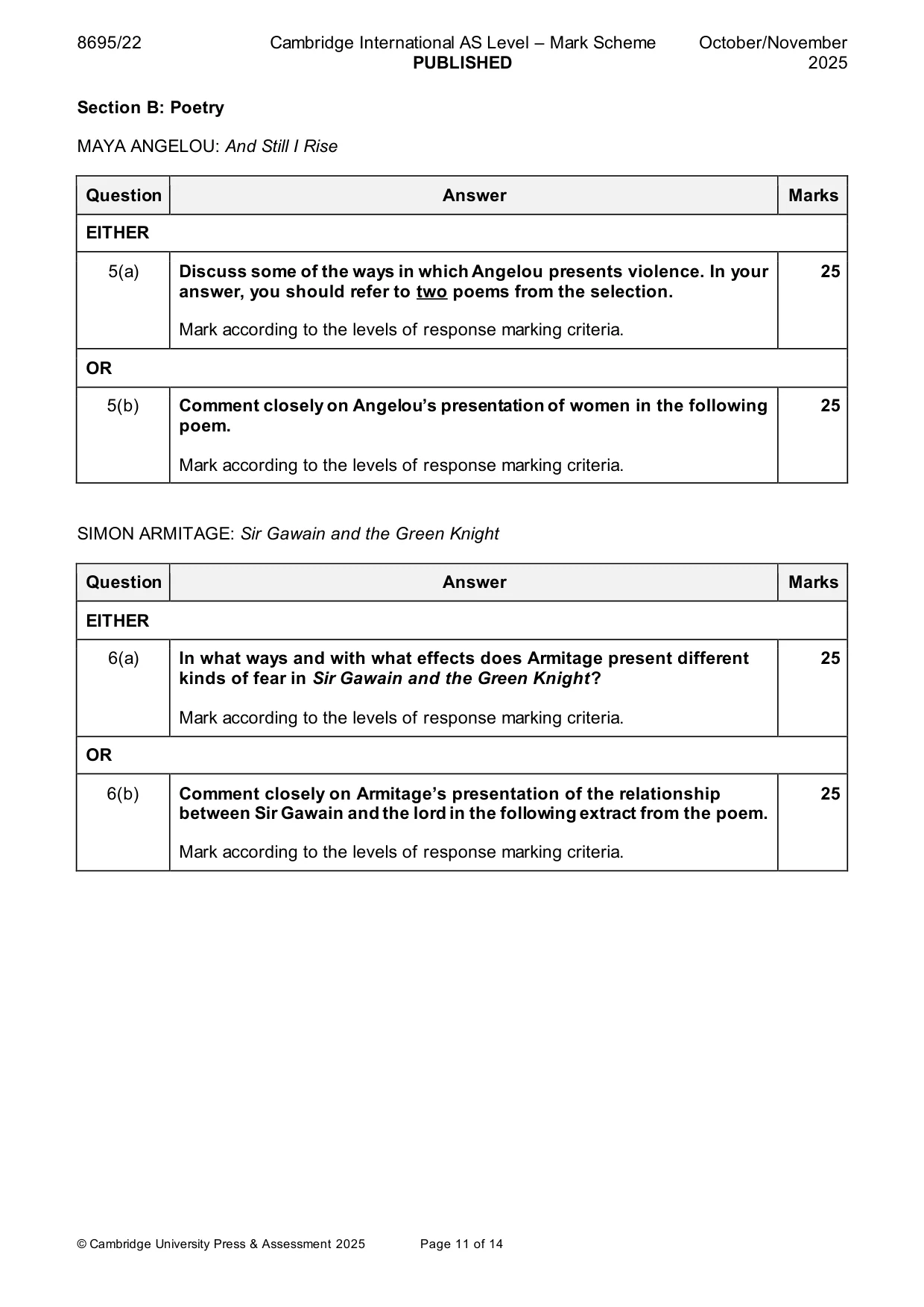
8695/22 Cambridge International AS Level – Mark Scheme PUBLISHED October/November 2025 © Cambridge University Press & Assessment 2025 Page 11 of 14 Section B: Poetry MAYA ANGELOU: And Still I Rise Question Answer Marks EITHER 5(a) Discuss some of the ways in which Angelou presents violence. In your answer, you should refer to two poems from the selection. Mark according to the levels of response marking criteria. 25 OR 5(b) Comment closely on Angelou’s presentation of women in the following poem. Mark according to the levels of response marking criteria. 25 SIMON ARMITAGE: Sir Gawain and the Green Knight Question Answer Marks EITHER 6(a) In what ways and with what effects does Armitage present different kinds of fear in Sir Gawain and the Green Knight? Mark according to the levels of response marking criteria. 25 OR 6(b) Comment closely on Armitage’s presentation of the relationship between Sir Gawain and the lord in the following extract from the poem. Mark according to the levels of response marking criteria. 25
Mark scheme, page 12
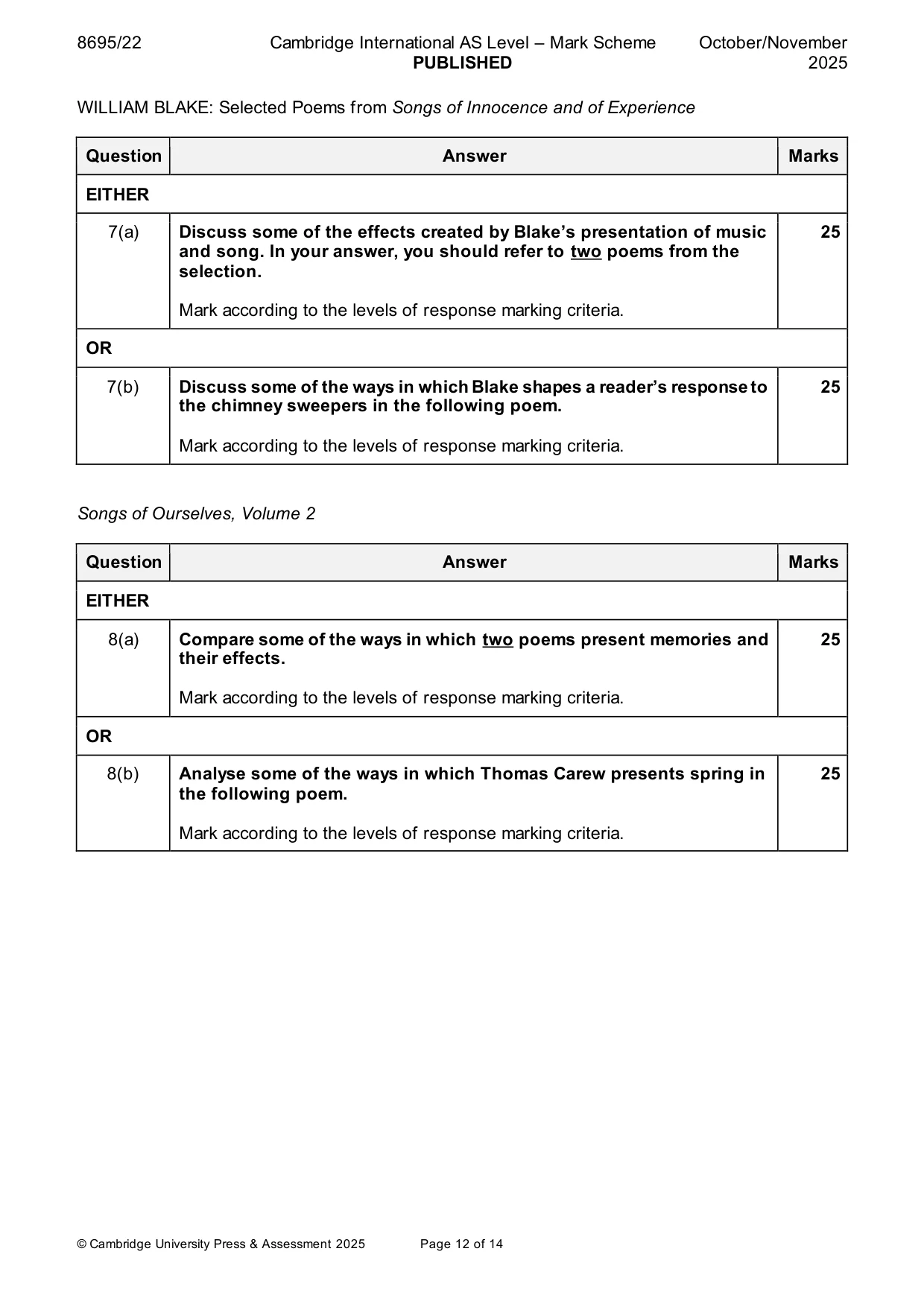
8695/22 Cambridge International AS Level – Mark Scheme PUBLISHED October/November 2025 © Cambridge University Press & Assessment 2025 Page 12 of 14 WILLIAM BLAKE: Selected Poems from Songs of Innocence and of Experience Question Answer Marks EITHER 7(a) Discuss some of the effects created by Blake’s presentation of music and song. In your answer, you should refer to two poems from the selection. Mark according to the levels of response marking criteria. 25 OR 7(b) Discuss some of the ways in which Blake shapes a reader’s response to the chimney sweepers in the following poem. Mark according to the levels of response marking criteria. 25 Songs of Ourselves, Volume 2 Question Answer Marks EITHER 8(a) Compare some of the ways in which two poems present memories and their effects. Mark according to the levels of response marking criteria. 25 OR 8(b) Analyse some of the ways in which Thomas Carew presents spring in the following poem. Mark according to the levels of response marking criteria. 25
Mark scheme, page 13
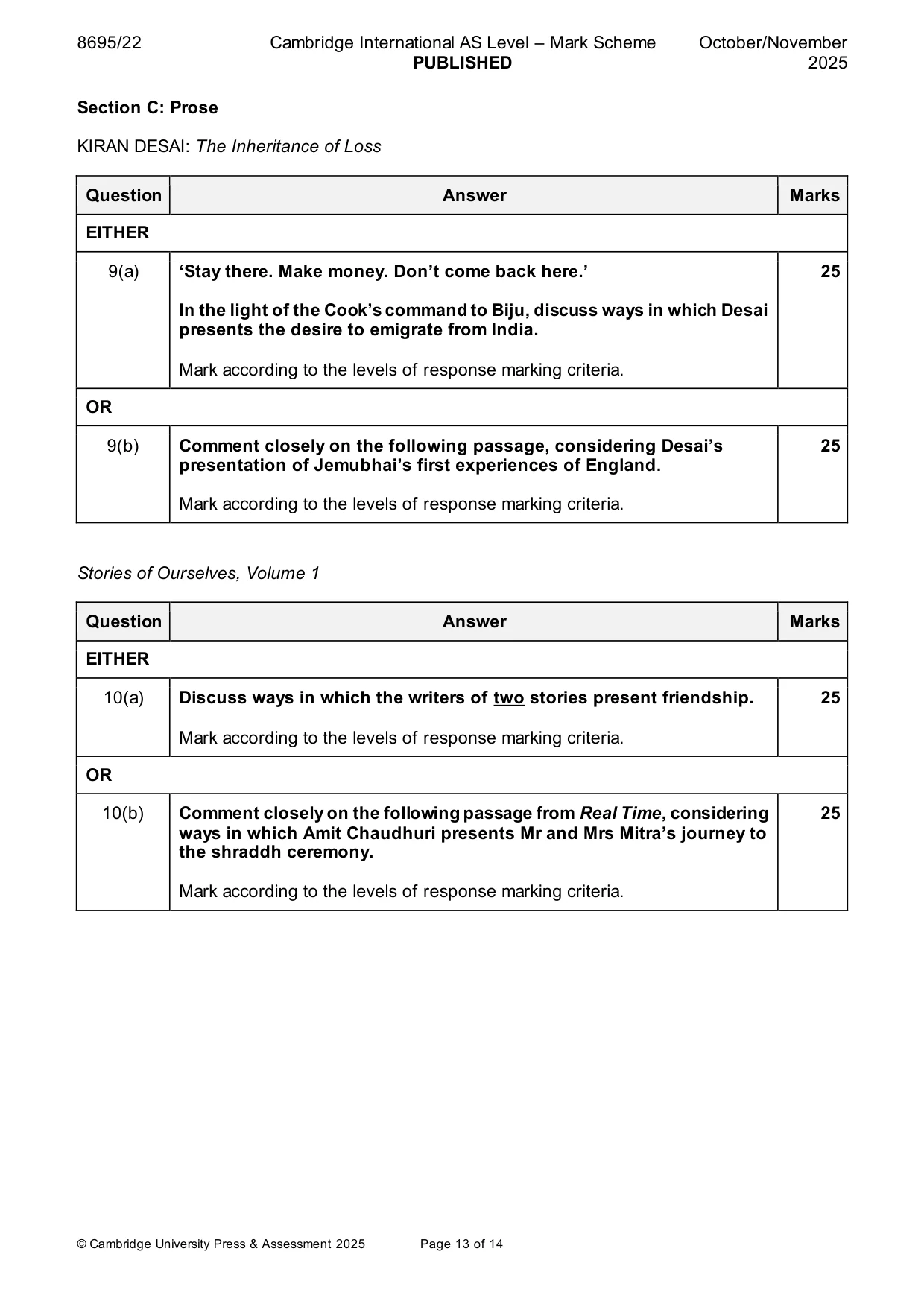
8695/22 Cambridge International AS Level – Mark Scheme PUBLISHED October/November 2025 © Cambridge University Press & Assessment 2025 Page 13 of 14 Section C: Prose KIRAN DESAI: The Inheritance of Loss Question Answer Marks EITHER 9(a) ‘Stay there. Make money. Don’t come back here.’ In the light of the Cook’s command to Biju, discuss ways in which Desai presents the desire to emigrate from India. Mark according to the levels of response marking criteria. 25 OR 9(b) Comment closely on the following passage, considering Desai’s presentation of Jemubhai’s first experiences of England. Mark according to the levels of response marking criteria. 25 Stories of Ourselves, Volume 1 Question Answer Marks EITHER 10(a) Discuss ways in which the writers of two stories present friendship. Mark according to the levels of response marking criteria. 25 OR 10(b) Comment closely on the following passage from Real Time, considering ways in which Amit Chaudhuri presents Mr and Mrs Mitra’s journey to the shraddh ceremony. Mark according to the levels of response marking criteria. 25
Mark scheme, page 14
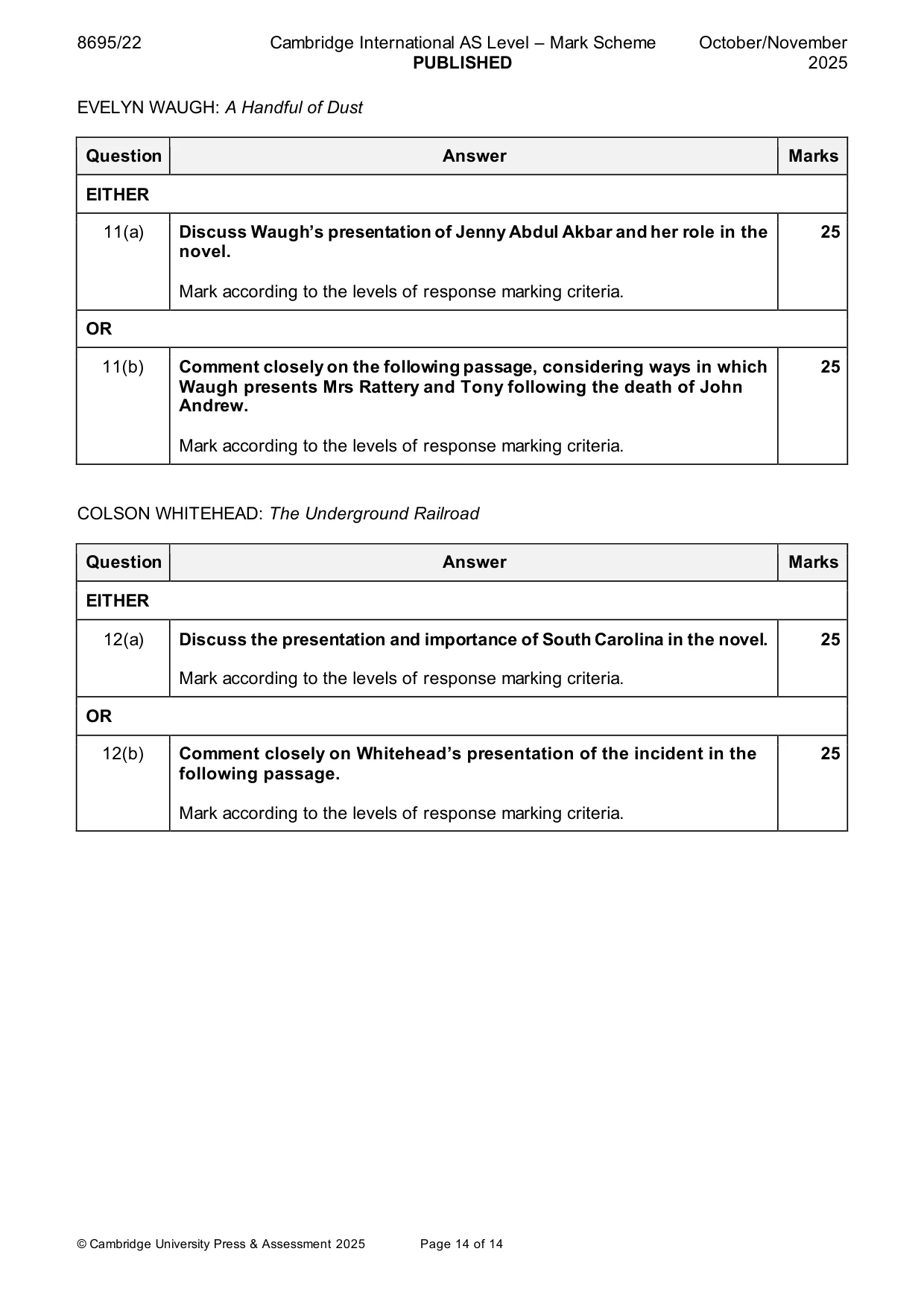
8695/22 Cambridge International AS Level – Mark Scheme PUBLISHED October/November 2025 © Cambridge University Press & Assessment 2025 Page 14 of 14 EVELYN WAUGH: A Handful of Dust Question Answer Marks EITHER 11(a) Discuss Waugh’s presentation of Jenny Abdul Akbar and her role in the novel. Mark according to the levels of response marking criteria. 25 OR 11(b) Comment closely on the following passage, considering ways in which Waugh presents Mrs Rattery and Tony following the death of John Andrew. Mark according to the levels of response marking criteria. 25 COLSON WHITEHEAD: The Underground Railroad Question Answer Marks EITHER 12(a) Discuss the presentation and importance of South Carolina in the novel. Mark according to the levels of response marking criteria. 25 OR 12(b) Comment closely on Whitehead’s presentation of the incident in the following passage. Mark according to the levels of response marking criteria. 25
What you needed in this session
Cambridge’s own grade thresholds for 2025 Oct/Nov, Paper 2 · Variant 2. A higher threshold means an easier paper — the bar moves with how the cohort did.