Cambridge A Level English - Language and Literature (AS Level only, from 2016) 8695 — 2025 May/June Paper 2 · Variant 3
8695/23/M/J/25 · 50 marks · 120 min
The question paper and its mark scheme, free to read here and free to download. This is Cambridge’s own paper, exactly as it was sat.
Question paper20 pages

Mark scheme14 pages
Answers below. Sit the paper first if you are practising.
Paper as text
Question paper, page 1
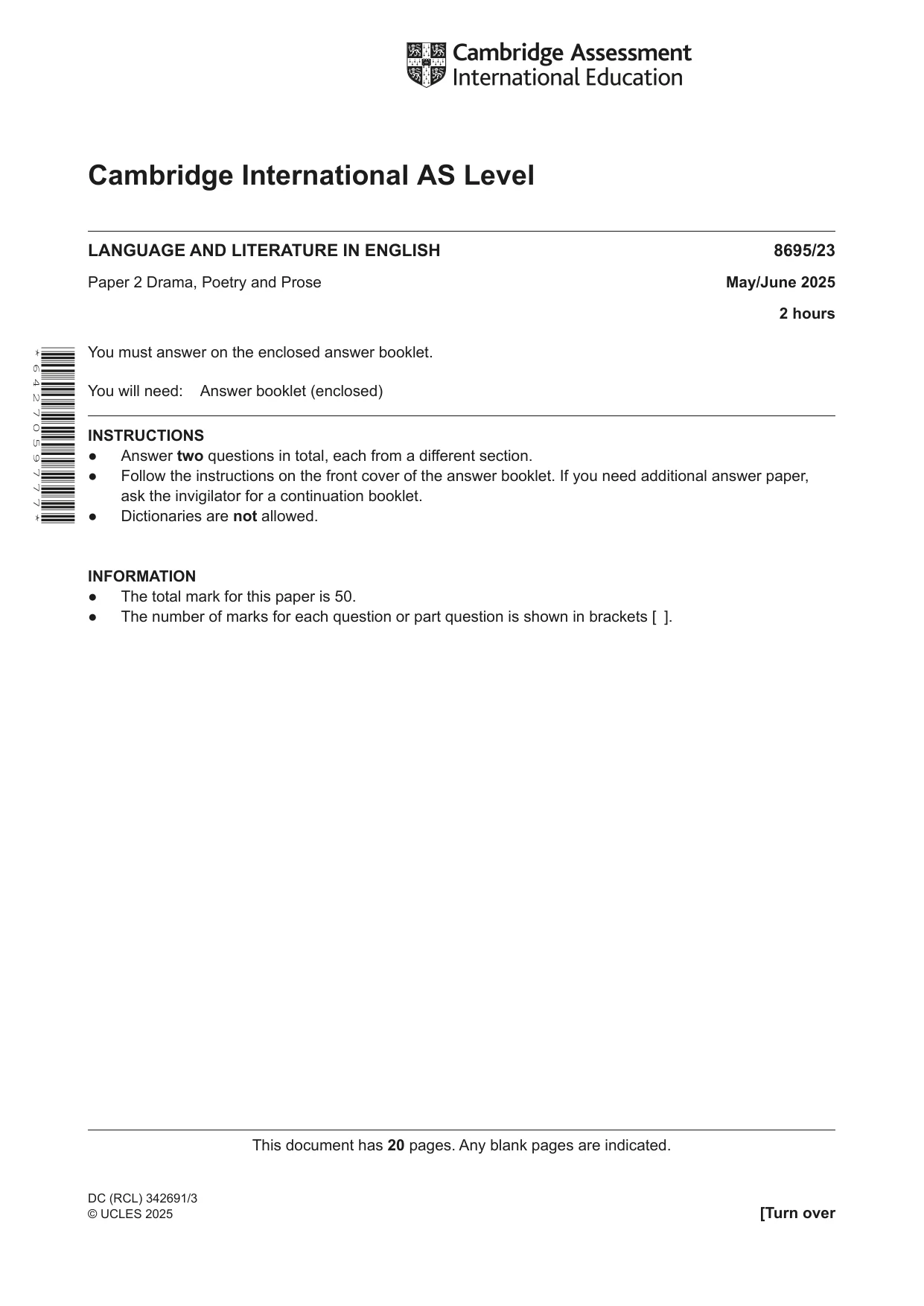
This document has 20 pages. Any blank pages are indicated. [Turn over Cambridge International AS Level * 6 4 2 7 0 5 9 7 7 7 * DC (RCL) 342691/3 © UCLES 2025 LANGUAGE AND LITERATURE IN ENGLISH 8695/23 Paper 2 Drama, Poetry and Prose May/June 2025 2 hours You must answer on the enclosed answer booklet. You will need: Answer booklet (enclosed) INSTRUCTIONS ● Answer two questions in total, each from a different section. ● Follow the instructions on the front cover of the answer booklet. If you need additional answer paper, ask the invigilator for a continuation booklet. ● Dictionaries are not allowed. INFORMATION ● The total mark for this paper is 50. ● The number of marks for each question or part question is shown in brackets [ ].
Question paper, page 2
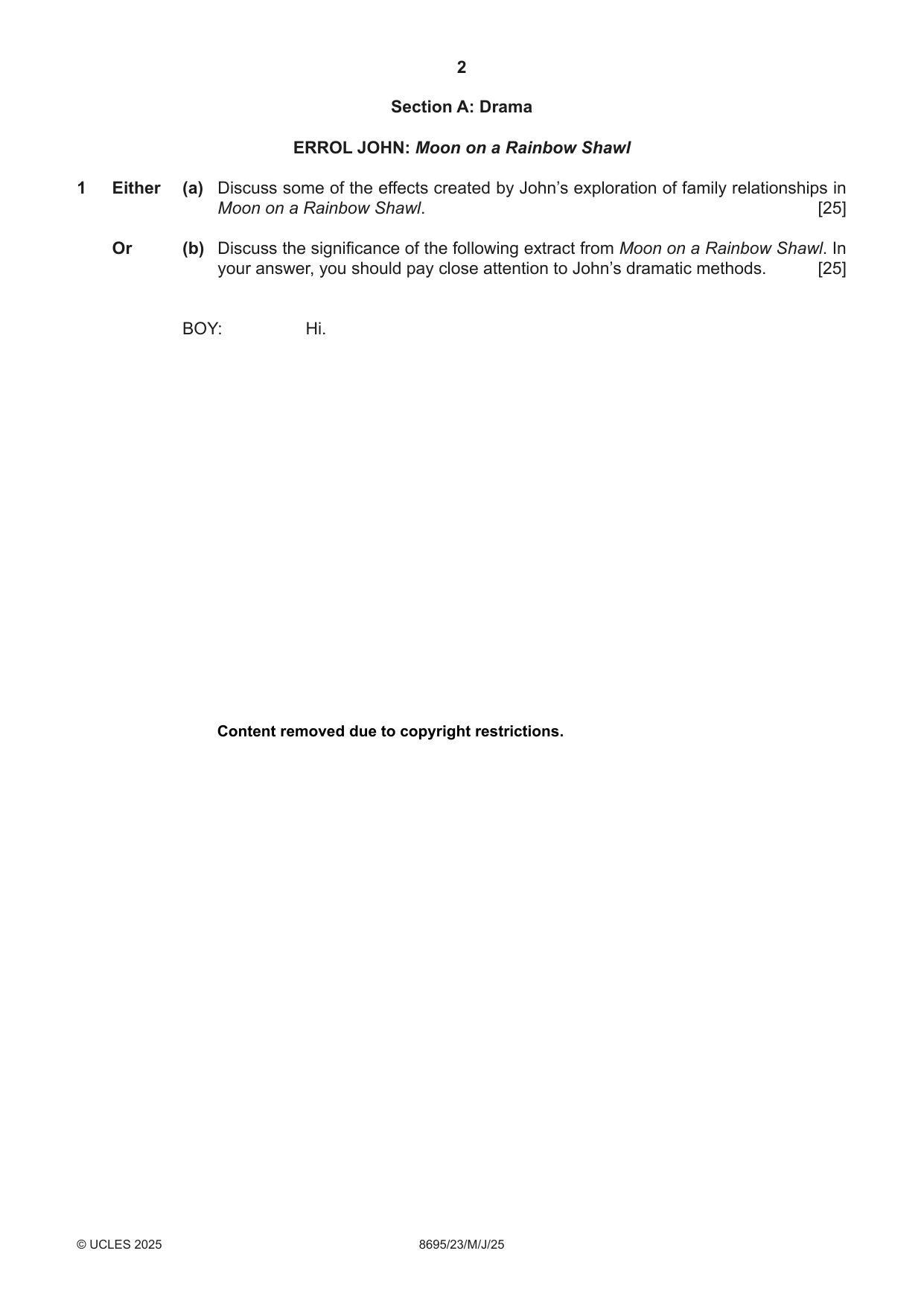
2 8695/23/M/J/25 © UCLES 2025 Section A: Drama ERROL JOHN: Moon on a Rainbow Shawl 1 Either (a) Discuss some of the effects created by John’s exploration of family relationships in Moon on a Rainbow Shawl. [25] Or (b) Discuss the significance of the following extract from Moon on a Rainbow Shawl. In your answer, you should pay close attention to John’s dramatic methods. [25] BOY: Hi. Content removed due to copyright restrictions.
Question paper, page 3
3 8695/23/M/J/25 © UCLES 2025 [Turn over So long, Mrs Adams, Esther. (from Act 3, Scene 1) Content removed due to copyright restrictions.
Question paper, page 4
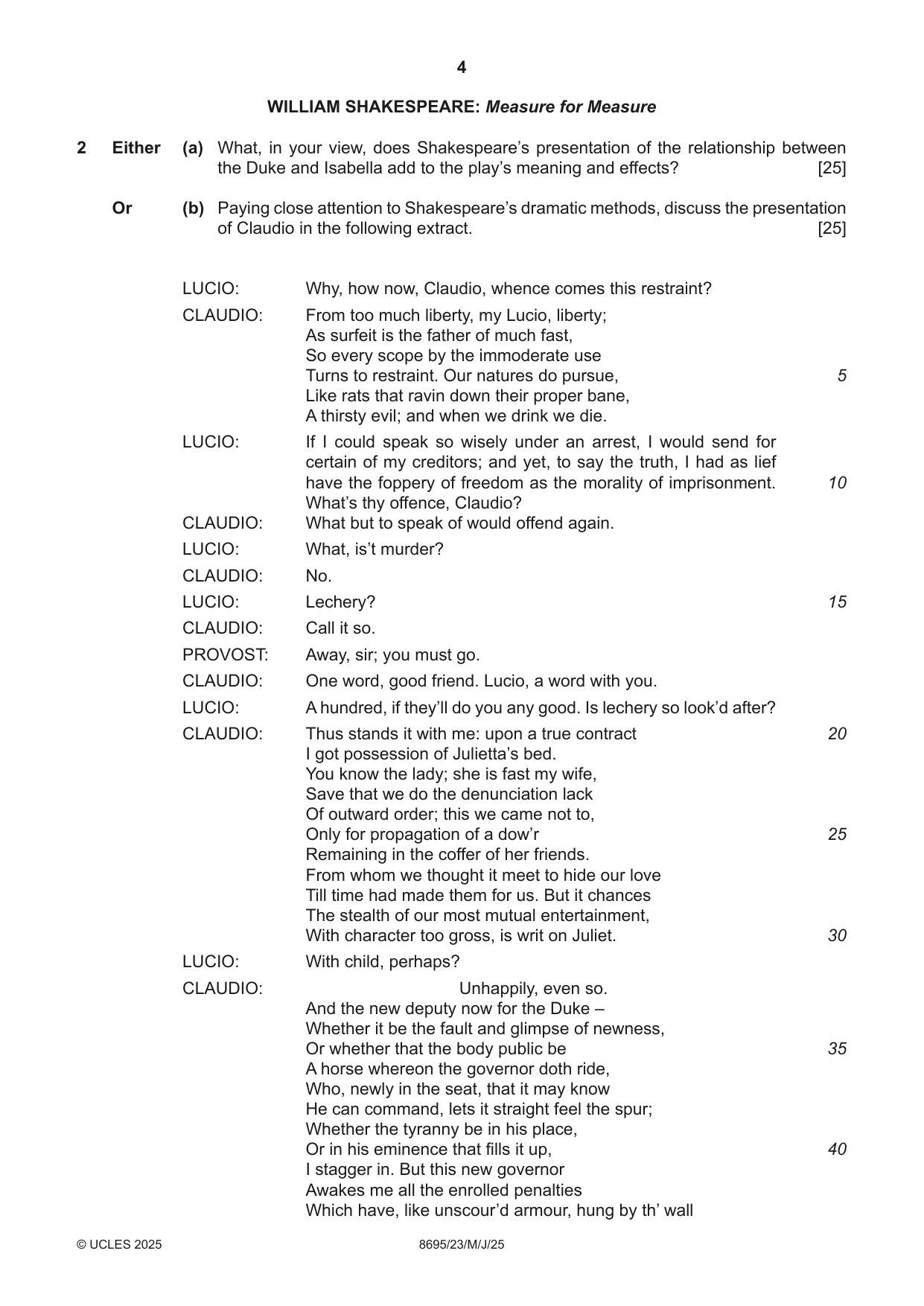
4 8695/23/M/J/25 © UCLES 2025 WILLIAM SHAKESPEARE: Measure for Measure 2 Either (a) What, in your view, does Shakespeare’s presentation of the relationship between the Duke and Isabella add to the play’s meaning and effects? [25] Or (b) Paying close attention to Shakespeare’s dramatic methods, discuss the presentation of Claudio in the following extract. [25] LUCIO: Why, how now, Claudio, whence comes this restraint? CLAUDIO: From too much liberty, my Lucio, liberty; As surfeit is the father of much fast, So every scope by the immoderate use Turns to restraint. Our natures do pursue, Like rats that ravin down their proper bane, A thirsty evil; and when we drink we die. LUCIO: If I could speak so wisely under an arrest, I would send for certain of my creditors; and yet, to say the truth, I had as lief have the foppery of freedom as the morality of imprisonment. What’s thy offence, Claudio? CLAUDIO: What but to speak of would offend again. LUCIO: What, is’t murder? CLAUDIO: No. LUCIO: Lechery? CLAUDIO: Call it so. PROVOST: Away, sir; you must go. CLAUDIO: One word, good friend. Lucio, a word with you. LUCIO: A hundred, if they’ll do you any good. Is lechery so look’d after? CLAUDIO: Thus stands it with me: upon a true contract I got possession of Julietta’s bed. You know the lady; she is fast my wife, Save that we do the denunciation lack Of outward order; this we came not to, Only for propagation of a dow’r Remaining in the coffer of her friends. From whom we thought it meet to hide our love Till time had made them for us. But it chances The stealth of our most mutual entertainment, With character too gross, is writ on Juliet. LUCIO: With child, perhaps? CLAUDIO: Unhappily, even so. And the new deputy now for the Duke – Whether it be the fault and glimpse of newness, Or whether that the body public be A horse whereon the governor doth ride, Who, newly in the seat, that it may know He can command, lets it straight feel the spur; Whether the tyranny be in his place, Or in his eminence that fills it up, I stagger in. But this new governor Awakes me all the enrolled penalties Which have, like unscour’d armour, hung by th’ wall 5 10 15 20 25 30 35 40
Question paper, page 5
5 8695/23/M/J/25 © UCLES 2025 [Turn over So long that nineteen zodiacs have gone round And none of them been worn; and, for a name, Now puts the drowsy and neglected act Freshly on me. ’Tis surely for a name. LUCIO: I warrant it is; and thy head stands so tickle on thy shoulders that a milkmaid, if she be in love, may sigh it off. Send after the Duke, and appeal to him. CLAUDIO: I have done so, but he’s not to be found. I prithee, Lucio, do me this kind service: This day my sister should the cloister enter, And there receive her approbation; Acquaint her with the danger of my state; Implore her, in my voice, that she make friends To the strict deputy; bid herself assay him. I have great hope in that; for in her youth There is a prone and speechless dialect Such as move men; beside, she hath prosperous art When she will play with reason and discourse, And well she can persuade. (from Act 1, Scene 2) 45 50 55 60
Question paper, page 6
6 8695/23/M/J/25 © UCLES 2025 JOHN WEBS ER: The Duchess of Malfi 3 Either (a) Cariola says of the Duchess: ‘Whether the spirit of greatness or of woman Reign most in her, I know not’. Discuss Webster’s presentation of the Duchess in the light of Cariola’s comment. [25] Or (b) Discuss the significance of the following extract from The Duchess of Malfi. In your answer, you should pay close attention to Webster’s dramatic methods. [25] CARDINAL: It hurries thee to ruin. I’ll not tell thee. Be well advised, and think what danger ’tis To receive a prince’s secrets; they that do, Had need have their breasts hooped with adamant To contain them. I pray thee yet be satisfied Examine thine own frailty; ’tis more easy To tie knots, than unloose them; ’tis a secret That, like a ling’ring poison, may chance lie Spread in thy veins, and kill thee seven year hence. JULIA: Now you dally with me. CARDINAL: No more, thou shalt know it. By my appointment the great Duchess of Malfi, And two of her young children, four nights since, Were strangled. JULIA: O heaven! Sir, what have you done? CARDINAL: How now? How settles this? Think you your bosom Will be a grave dark and obscure enough For such a secret? JULIA: You have undone yourself, sir. CARDINAL: Why? JULIA: It lies not in me to conceal it. CARDINAL: No? Come, I will swear you to’t upon this book. [He holds out a bible.] JULIA: Most religiously. CARDINAL: Kiss it. [She kisses it.] Now you shall never utter it; thy curiosity Hath undone thee: thou’rt poisoned with that book; Because I knew thou couldst not keep my counsel, I have bound thee to’t by death. [Enter BOSOLA.] BOSOLA: For pity’ sake, hold! CARDINAL: Ha, Bosola! JULIA: I forgive you This equal piece of justice you have done, For I betrayed your counsel to that fellow; He overheard it; that was the cause I said It lay not in me to conceal it. 5 10 15 20 25 30 35
Question paper, page 7
7 8695/23/M/J/25 © UCLES 2025 [Turn over BOSOLA: O foolish woman, Couldst not thou have poisoned him? JULIA: ’Tis weakness Too much to think what should have been done. I go, I know not whither. [JULIA dies.] CARDINAL: Wherefore com’st thou hither? BOSOLA: That I might find a great man, like yourself, Not out of his wits, as the Lord Ferdinand, To remember my service. CARDINAL: I’ll have thee hewed in pieces. BOSOLA: Make not yourself such a promise of that life Which is not yours to dispose of. CARDINAL: Who placed thee here? BOSOLA: Her lust, as she intended. CARDINAL: Very well; Now you know me for your fellow murderer. BOSOLA: And wherefore should you lay fair marble colours Upon your rotten purposes to me? Unless you imitate some that do plot great treasons, And when they have done, go hide themselves i’th’ graves Of those were actors in’t? CARDINAL: No more, there is a fortune attends thee. BOSOLA: Shall I go sue to Fortune any longer? ’Tis the fool’s pilgrimage. CARDINAL: I have honours in store for thee. BOSOLA: There are a many ways that conduct to seeming Honour, and some of them very dirty ones. CARDINAL: Throw to the devil Thy melancholy. The fire burns well, What need we keep a-stirring of’t, and make A greater smother? Thou wilt kill Antonio? BOSOLA: Yes. (from Act 5, Scene 2) 40 45 50 55 60 65 70
Question paper, page 8
8 8695/23/M/J/25 © UCLES 2025 TENNESSEE WILLIAMS: Cat on a Hot Tin Roof 4 Either (a) Discuss Williams’s presentation of different attitudes to children in Cat on a Hot Tin Roof. [25] Or (b) Comment closely on Williams’s exploration of Maggie’s relationship with Brick in the following extract. [25] BRICK: Maggie, being catty doesn’t help things any … Content removed due to copyright restrictions.
Question paper, page 9
9 8695/23/M/J/25 © UCLES 2025 [Turn over He remains grave for a moment, then grins and puts the chair down.] (from Act 1) Content removed due to copyright restrictions.
Question paper, page 10
10 8695/23/M/J/25 © UCLES 2025 Section B: Poetry MAYA ANGELOU: And Still I Rise 5 Either (a) In what ways and with what effects does Angelou explore powerful emotions? In your answer, you should refer to two poems from the selection. [25] Or (b) Analyse Angelou’s presentation of Willie in the following poem. [25] Willie Willie was a man without fame I am the Rhyme.’ Content removed due to copyright restrictions.
Question paper, page 11
11 8695/23/M/J/25 © UCLES 2025 [Turn over SIMON ARMITAGE: Sir Gawain and the Green Knight 6 Either (a) Discuss the uses and effects of Armitage’s presentation of religious faith in Sir Gawain and the Green Knight. [25] Or (b) Analyse ways in which Armitage presents the relationship between Sir Gawain and the lady in the following extract. [25] ‘Not so, beautiful sir,’ the sweet lady said. he countered, case by case. Content removed due to copyright restrictions.
Question paper, page 12
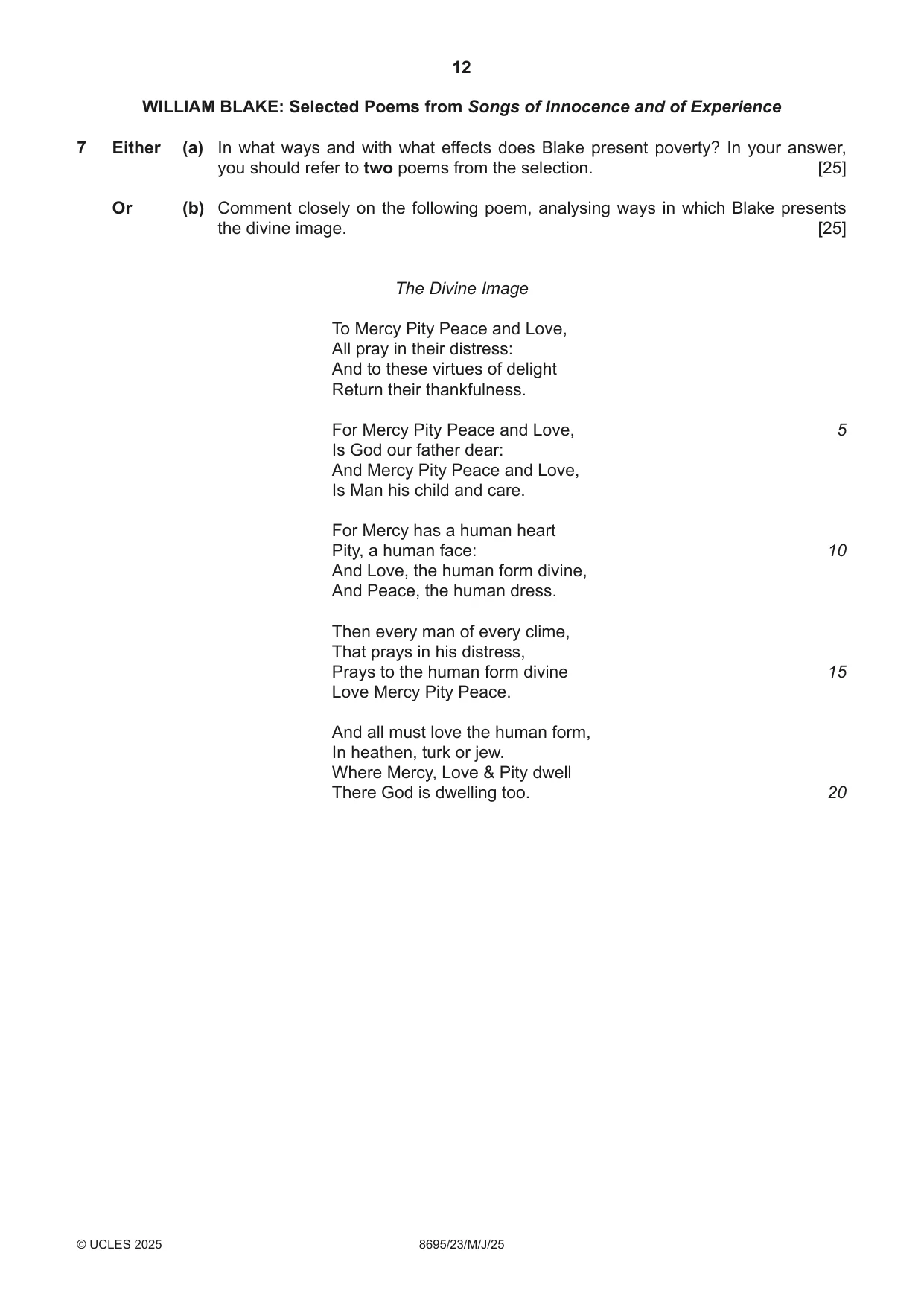
12 8695/23/M/J/25 © UCLES 2025 WILLIAM BLAKE: Selected Poems from Songs of Innocence and of Experience 7 Either (a) In what ways and with what effects does Blake present poverty? In your answer, you should refer to two poems from the selection. [25] Or (b) Comment closely on the following poem, analysing ways in which Blake presents the divine image. [25] The Divine Image To Mercy Pity Peace and Love, All pray in their distress: And to these virtues of delight Return their thankfulness. For Mercy Pity Peace and Love, Is God our father dear: And Mercy Pity Peace and Love, Is Man his child and care. For Mercy has a human heart Pity, a human face: And Love, the human form divine, And Peace, the human dress. Then every man of every clime, That prays in his distress, Prays to the human form divine Love Mercy Pity Peace. And all must love the human form, In heathen, turk or jew. Where Mercy, Love & Pity dwell There God is dwelling too. 5 10 15 20
Question paper, page 13
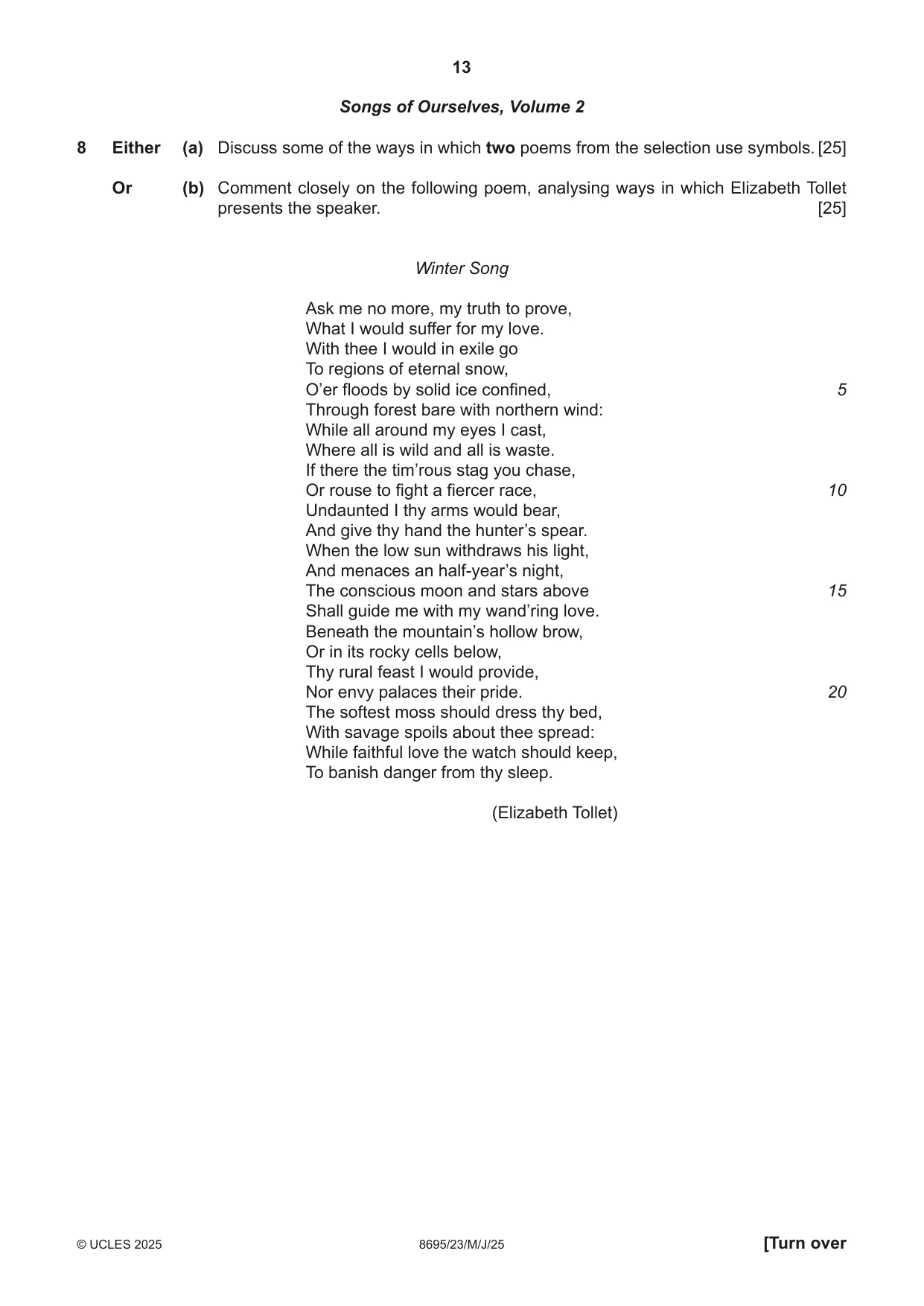
13 8695/23/M/J/25 © UCLES 2025 [Turn over Songs of Ourselves, Volume 2 8 Either (a) Discuss some of the ways in which two poems from the selection use symbols. [25] Or (b) Comment closely on the following poem, analysing ways in which Elizabeth Tollet presents the speaker. [25] Winter Song Ask me no more, my truth to prove, What I would suffer for my love. With thee I would in exile go To regions of eternal snow, O’er floods by solid ice confined, Through forest bare with northern wind: While all around my eyes I cast, Where all is wild and all is waste. If there the tim’rous stag you chase, Or rouse to fight a fiercer race, Undaunted I thy arms would bear, And give thy hand the hunter’s spear. When the low sun withdraws his light, And menaces an half-year’s night, The conscious moon and stars above Shall guide me with my wand’ring love. Beneath the mountain’s hollow brow, Or in its rocky cells below, Thy rural feast I would provide, Nor envy palaces their pride. The softest moss should dress thy bed, With savage spoils about thee spread: While faithful love the watch should keep, To banish danger from thy sleep. (Elizabeth Tollet) 5 10 15 20
Question paper, page 14
14 8695/23/M/J/25 © UCLES 2025 Section C: Prose KIRAN DESAI: The Inheritance of Loss 9 Either (a) Discuss Desai’s presentation of poverty and its significance in the novel. [25] Or (b) Comment closely on Desai’s presentation of Jemubhai’s exam success in the following passage. [25] When the results of the viva voce had been posted, he found his performance had earned him one hundred out of three hundred, the lowest qualifying mark. Content removed due to copyright restrictions.
Question paper, page 15
15 8695/23/M/J/25 © UCLES 2025 [Turn over A look of recognition had passed between them at first sight, but also the assurance that they wouldn’t reveal one another’s secrets, not even to each other. (from Chapter 18) Content removed due to copyright restrictions.
Question paper, page 16
16 8695/23/M/J/25 © UCLES 2025 Stories of Ourselves, Volume 1 10 Either (a) Discuss the presentation and significance of settings in two stories. [25] Or (b) Comment closely on the following passage from Of White Hairs and Cricket, considering ways in which Rohinton Mistry presents the friendship between the narrator and Viraf. [25] The car stopped at the far end of the compound. Content removed due to copyright restrictions.
Question paper, page 17
17 8695/23/M/J/25 © UCLES 2025 [Turn over He turned away without answering. (from Of White Hairs and Cricket) Content removed due to copyright restrictions.
Question paper, page 18
18 8695/23/M/J/25 © UCLES 2025 EVELYN WAUGH: A Handful of Dust 11 Either (a) Discuss ways in which Waugh presents ideas about love in the novel. [25] Or (b) Comment closely on the following passage, considering Waugh’s presentation of John Beaver and his mother. [25] John Beaver lived with his mother at the house in Sussex Gardens where they had moved after his father’s death. ‘Poor mumsy.’ (from Du Côté de Chez Beaver) Content removed due to copyright restrictions.
Question paper, page 19
19 8695/23/M/J/25 © UCLES 2025 COLSON WHITEHEAD: The Underground Railroad 12 Either (a) Discuss some of the ways in which Whitehead presents the attitudes of white people towards black people in The Underground Railroad. [25] Or (b) Comment closely on the following passage, considering ways in which Whitehead presents the women’s treatment of Cora. [25] Nag had never been close to Cora’s mother but that didn’t stop her from befriending the girl when she became a stray. ‘You sick and out of sight or you up and outside when Master Terrance come tomorrow.’ (from Georgia) Content removed due to copyright restrictions.
Question paper, page 20
20 8695/23/M/J/25 © UCLES 2025 Permission to reproduce items where third-party owned material protected by copyright is included has been sought and cleared where possible. Every reasonable effort has been made by the publisher (UCLES) to trace copyright holders, but if any items requiring clearance have unwittingly been included, the publisher will be pleased to make amends at the earliest possible opportunity. To avoid the issue of disclosure of answer-related information to candidates, all copyright acknowledgements are reproduced online in the Cambridge Assessment International Education Copyright Acknowledgements Booklet. This is produced for each series of examinations and is freely available to download at www.cambridgeinternational.org after the live examination series. Cambridge Assessment International Education is part of Cambridge Assessment. Cambridge Assessment is the brand name of the University of Cambridge Local Examinations Syndicate (UCLES), which is a department of the University of Cambridge. BLANK PAGE
Mark scheme, page 1
This document consists of 14 printed pages. © Cambridge University Press & Assessment 2025 [Turn over Cambridge International AS Level LANGUAGE AND LITERATURE IN ENGLISH 8695/23 Paper 2 Drama, Poetry and Prose May/June 2025 MARK SCHEME Maximum Mark: 50 Published This mark scheme is published as an aid to teachers and candidates, to indicate the requirements of the examination. It shows the basis on which Examiners were instructed to award marks. It does not indicate the details of the discussions that took place at an Examiners’ meeting before marking began, which would have considered the acceptability of alternative answers. Mark schemes should be read in conjunction with the question paper and the Principal Examiner Report for Teachers. Cambridge International will not enter into discussions about these mark schemes. Cambridge International is publishing the mark schemes for the May/June 2025 series for most Cambridge IGCSE, Cambridge International A and AS Level components, and some Cambridge O Level components.
Mark scheme, page 2
8695/23 Cambridge International AS Level – Mark Scheme PUBLISHED May/June 2025 © Cambridge University Press & Assessment 2025 Page 2 of 14 Generic Marking Principles These general marking principles must be applied by all examiners when marking candidate answers. They should be applied alongside the specific content of the mark scheme or generic level descriptions for a question. Each question paper and mark scheme will also comply with these marking principles. GENERIC MARKING PRINCIPLE 1: Marks must be awarded in line with: • the specific content of the mark scheme or the generic level descriptors for the question • the specific skills defined in the mark scheme or in the generic level descriptors for the question • the standard of response required by a candidate as exemplified by the standardisation scripts. GENERIC MARKING PRINCIPLE 2: Marks awarded are always whole marks (not half marks, or other fractions). GENERIC MARKING PRINCIPLE 3: Marks must be awarded positively: • marks are awarded for correct/valid answers, as defined in the mark scheme. However, credit is given for valid answers which go beyond the scope of the syllabus and mark scheme, referring to your Team Leader as appropriate • marks are awarded when candidates clearly demonstrate what they know and can do • marks are not deducted for errors • marks are not deducted for omissions • answers should only be judged on the quality of spelling, punctuation and grammar when these features are specifically assessed by the question as indicated by the mark scheme. The meaning, however, should be unambiguous. GENERIC MARKING PRINCIPLE 4: Rules must be applied consistently, e.g. in situations where candidates have not followed instructions or in the application of generic level descriptors. GENERIC MARKING PRINCIPLE 5: Marks should be awarded using the full range of marks defined in the mark scheme for the question (however; the use of the full mark range may be limited according to the quality of the candidate responses seen). GENERIC MARKING PRINCIPLE 6: Marks awarded are based solely on the requirements as defined in the mark scheme. Marks should not be awarded with grade thresholds or grade descriptors in mind.
Mark scheme, page 3
8695/23 Cambridge International AS Level – Mark Scheme PUBLISHED May/June 2025 © Cambridge University Press & Assessment 2025 Page 3 of 14 English & Media subject specific general marking principles (To be read in conjunction with the Generic Marking Principles (and requiring further guidance on how to place marks within levels)) Components using level descriptors: • We use level descriptors as a guide to broad understanding of the qualities normally expected of, or typical of, work in a level. • Level descriptors are a means of general guidance and should not be interpreted as hurdle statements. • Where indicative content notes are supplied for a question, these are not a prescription of required content, and must not be treated as such. Alternative correct points and unexpected answers in candidates’ scripts must be given marks that fairly reflect the knowledge and skills demonstrated. • While we may have legitimate expectations as to the ground most answers may occupy, we must at all times be prepared to meet candidates on their chosen ground, provided it is relevant ground (e.g. clearly related to and derived from a relevant passage/text and meeting the mark scheme requirements for the question).
Mark scheme, page 4
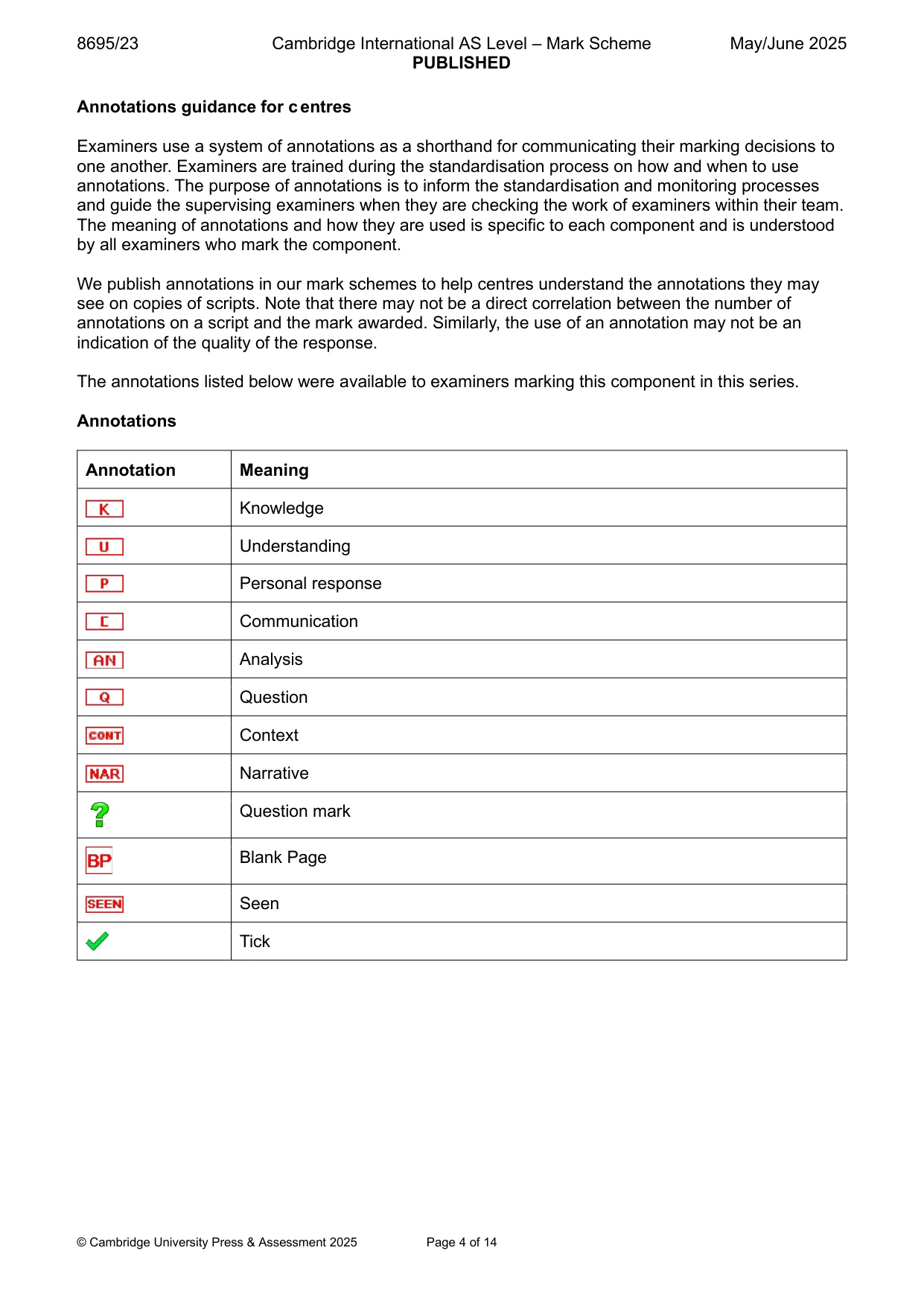
8695/23 Cambridge International AS Level – Mark Scheme PUBLISHED May/June 2025 © Cambridge University Press & Assessment 2025 Page 4 of 14 Annotations guidance for c entres Examiners use a system of annotations as a shorthand for communicating their marking decisions to one another. Examiners are trained during the standardisation process on how and when to use annotations. The purpose of annotations is to inform the standardisation and monitoring processes and guide the supervising examiners when they are checking the work of examiners within their team. The meaning of annotations and how they are used is specific to each component and is understood by all examiners who mark the component. We publish annotations in our mark schemes to help centres understand the annotations they may see on copies of scripts. Note that there may not be a direct correlation between the number of annotations on a script and the mark awarded. Similarly, the use of an annotation may not be an indication of the quality of the response. The annotations listed below were available to examiners marking this component in this series. Annotations Annotation Meaning Knowledge Understanding Personal response Communication Analysis Question Context Narrative Question mark Blank Page Seen Tick
Mark scheme, page 5
8695/23 Cambridge International AS Level – Mark Scheme PUBLISHED May/June 2025 © Cambridge University Press & Assessment 2025 Page 5 of 14 Literature in English specific marking instructions Using the mark levels Use the generic mark scheme levels to find the mark. Place the answer in a level first. Look for the ‘best fit’ of the answer into a level. An answer needs to show evidence of most but not necessarily ALL of the qualities described in a level, in order to be placed in that level. Then award a mark for the relative position of the answer within the level. Candidates may address the question in many different ways. There is no one required answer or approach and do not penalise answers for leaving out a particular focus. Reward what is there, showing what you are rewarding in your comments. Consider all strands and weigh up the performance as a whole in placing the answer in a level, then show that you have done so in the summative comment. Each answer is marked out of 25, in accordance with the general marking criteria. Assessment objectives All assessment objectives are equally weighted, and all are considered in assessing each essay. Each level in the marking criteria is divided into strands corresponding to the assessment objectives – AO1: Knowledge and understanding (K/U), AO2: Analysis (AN), AO3: Personal response (P), AO4: Communication (C). AO1 Knowledge and understanding Respond with understanding to literary texts in a variety of forms, from different cultures; with an appreciation of relevant contexts that illuminate readings of the texts. AO2 Analysis Analyse ways in which writers’ choices of language, form and structure shape meanings and effects. AO3 Personal response Produce informed independent opinions and interpretations of literary texts. AO4 Communication Communicate a relevant, structured and supported response appropriate to literary study.
Mark scheme, page 6
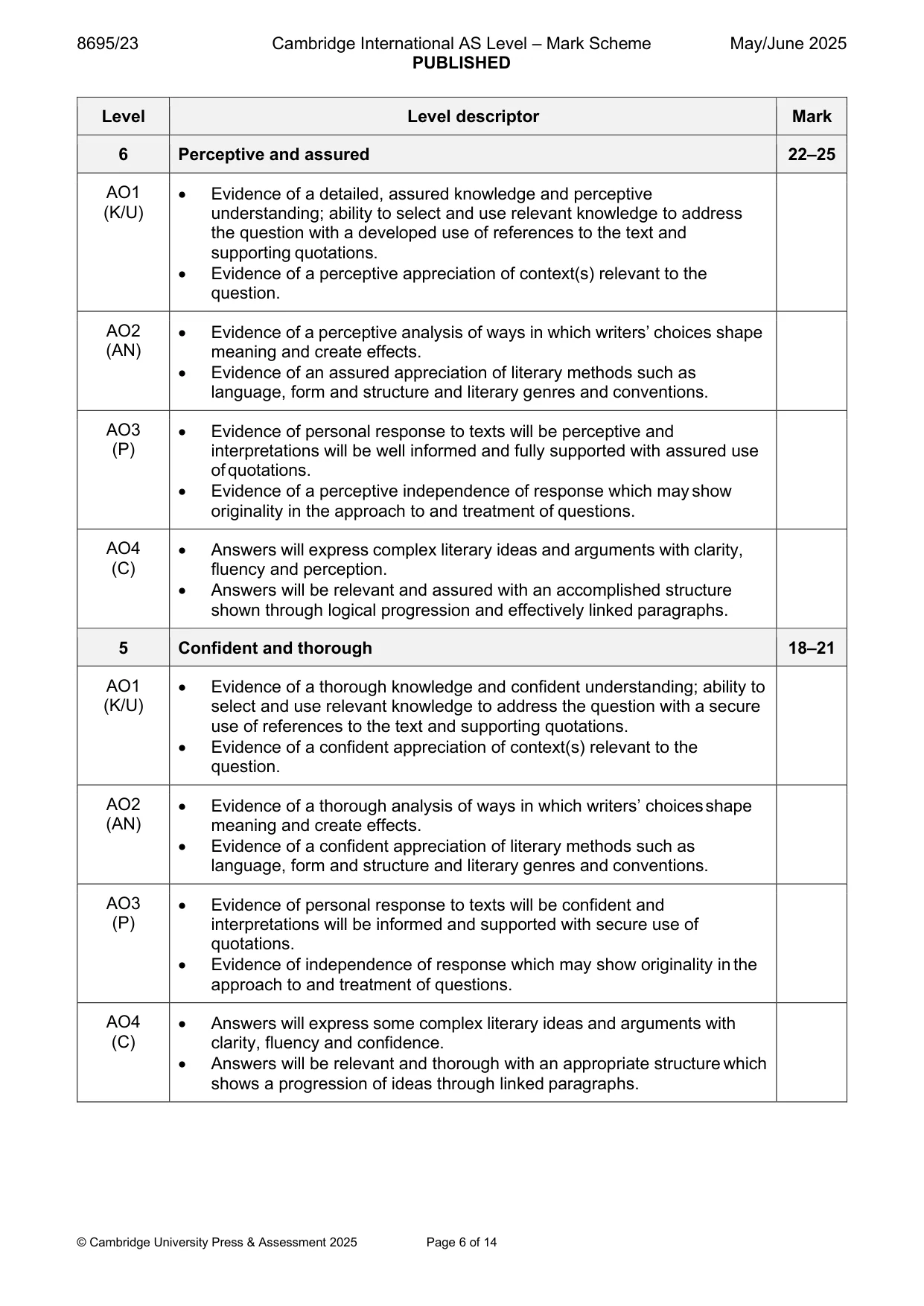
8695/23 Cambridge International AS Level – Mark Scheme PUBLISHED May/June 2025 © Cambridge University Press & Assessment 2025 Page 6 of 14 Level Level descriptor Mark 6 Perceptive and assured 22–25 AO1 (K/U) • Evidence of a detailed, assured knowledge and perceptive understanding; ability to select and use relevant knowledge to address the question with a developed use of references to the text and supporting quotations. • Evidence of a perceptive appreciation of context(s) relevant to the question. AO2 (AN) • Evidence of a perceptive analysis of ways in which writers’ choices shape meaning and create effects. • Evidence of an assured appreciation of literary methods such as language, form and structure and literary genres and conventions. AO3 (P) • Evidence of personal response to texts will be perceptive and interpretations will be well informed and fully supported with assured use of quotations. • Evidence of a perceptive independence of response which may show originality in the approach to and treatment of questions. AO4 (C) • Answers will express complex literary ideas and arguments with clarity, fluency and perception. • Answers will be relevant and assured with an accomplished structure shown through logical progression and effectively linked paragraphs. 5 Confident and thorough 18–21 AO1 (K/U) • Evidence of a thorough knowledge and confident understanding; ability to select and use relevant knowledge to address the question with a secure use of references to the text and supporting quotations. • Evidence of a confident appreciation of context(s) relevant to the question. AO2 (AN) • Evidence of a thorough analysis of ways in which writers’ choices shape meaning and create effects. • Evidence of a confident appreciation of literary methods such as language, form and structure and literary genres and conventions. AO3 (P) • Evidence of personal response to texts will be confident and interpretations will be informed and supported with secure use of quotations. • Evidence of independence of response which may show originality in the approach to and treatment of questions. AO4 (C) • Answers will express some complex literary ideas and arguments with clarity, fluency and confidence. • Answers will be relevant and thorough with an appropriate structure which shows a progression of ideas through linked paragraphs.
Mark scheme, page 7
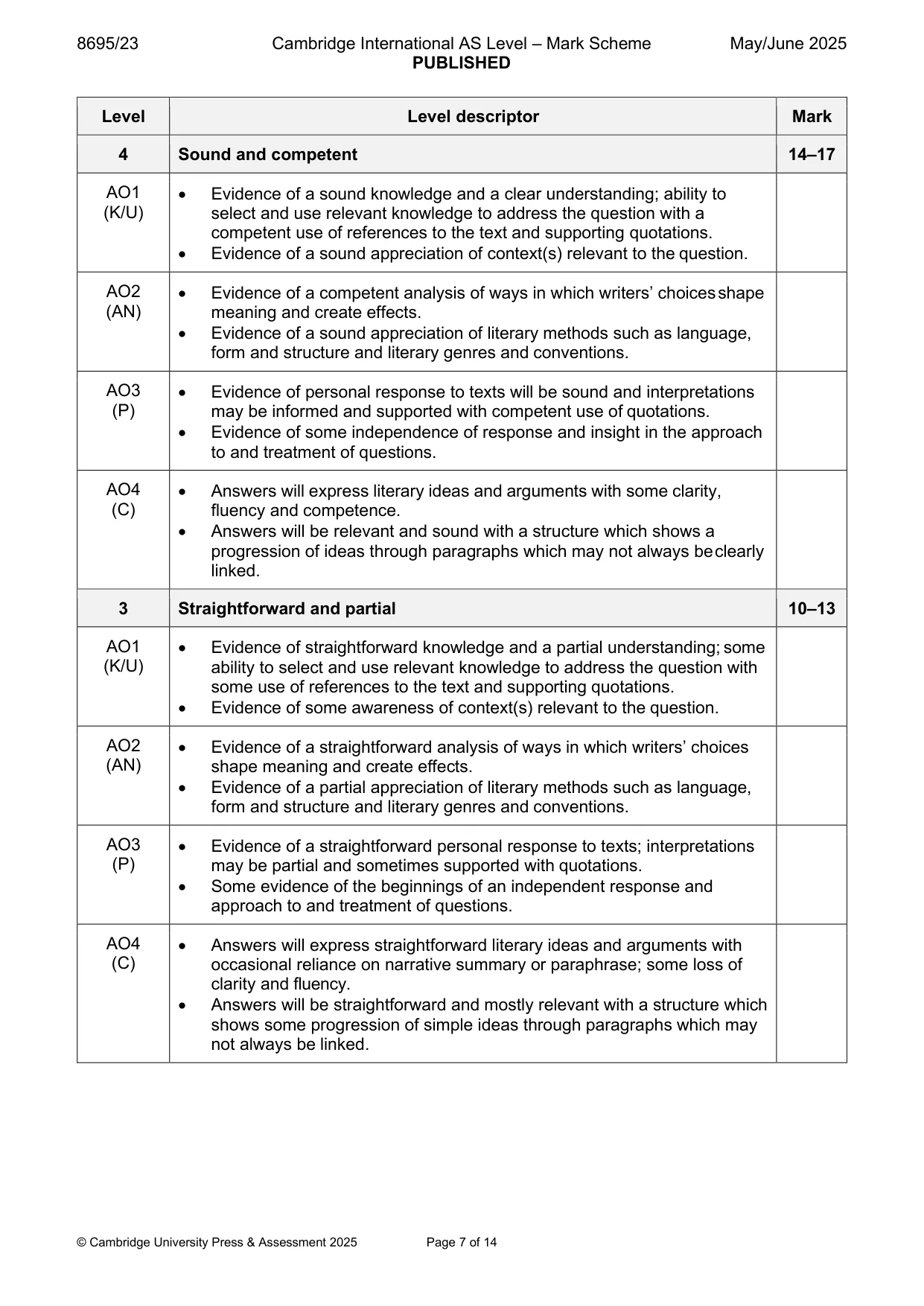
8695/23 Cambridge International AS Level – Mark Scheme PUBLISHED May/June 2025 © Cambridge University Press & Assessment 2025 Page 7 of 14 Level Level descriptor Mark 4 Sound and competent 14–17 AO1 (K/U) • Evidence of a sound knowledge and a clear understanding; ability to select and use relevant knowledge to address the question with a competent use of references to the text and supporting quotations. • Evidence of a sound appreciation of context(s) relevant to the question. AO2 (AN) • Evidence of a competent analysis of ways in which writers’ choices shape meaning and create effects. • Evidence of a sound appreciation of literary methods such as language, form and structure and literary genres and conventions. AO3 (P) • Evidence of personal response to texts will be sound and interpretations may be informed and supported with competent use of quotations. • Evidence of some independence of response and insight in the approach to and treatment of questions. AO4 (C) • Answers will express literary ideas and arguments with some clarity, fluency and competence. • Answers will be relevant and sound with a structure which shows a progression of ideas through paragraphs which may not always be clearly linked. 3 Straightforward and partial 10–13 AO1 (K/U) • Evidence of straightforward knowledge and a partial understanding; some ability to select and use relevant knowledge to address the question with some use of references to the text and supporting quotations. • Evidence of some awareness of context(s) relevant to the question. AO2 (AN) • Evidence of a straightforward analysis of ways in which writers’ choices shape meaning and create effects. • Evidence of a partial appreciation of literary methods such as language, form and structure and literary genres and conventions. AO3 (P) • Evidence of a straightforward personal response to texts; interpretations may be partial and sometimes supported with quotations. • Some evidence of the beginnings of an independent response and approach to and treatment of questions. AO4 (C) • Answers will express straightforward literary ideas and arguments with occasional reliance on narrative summary or paraphrase; some loss of clarity and fluency. • Answers will be straightforward and mostly relevant with a structure which shows some progression of simple ideas through paragraphs which may not always be linked.
Mark scheme, page 8
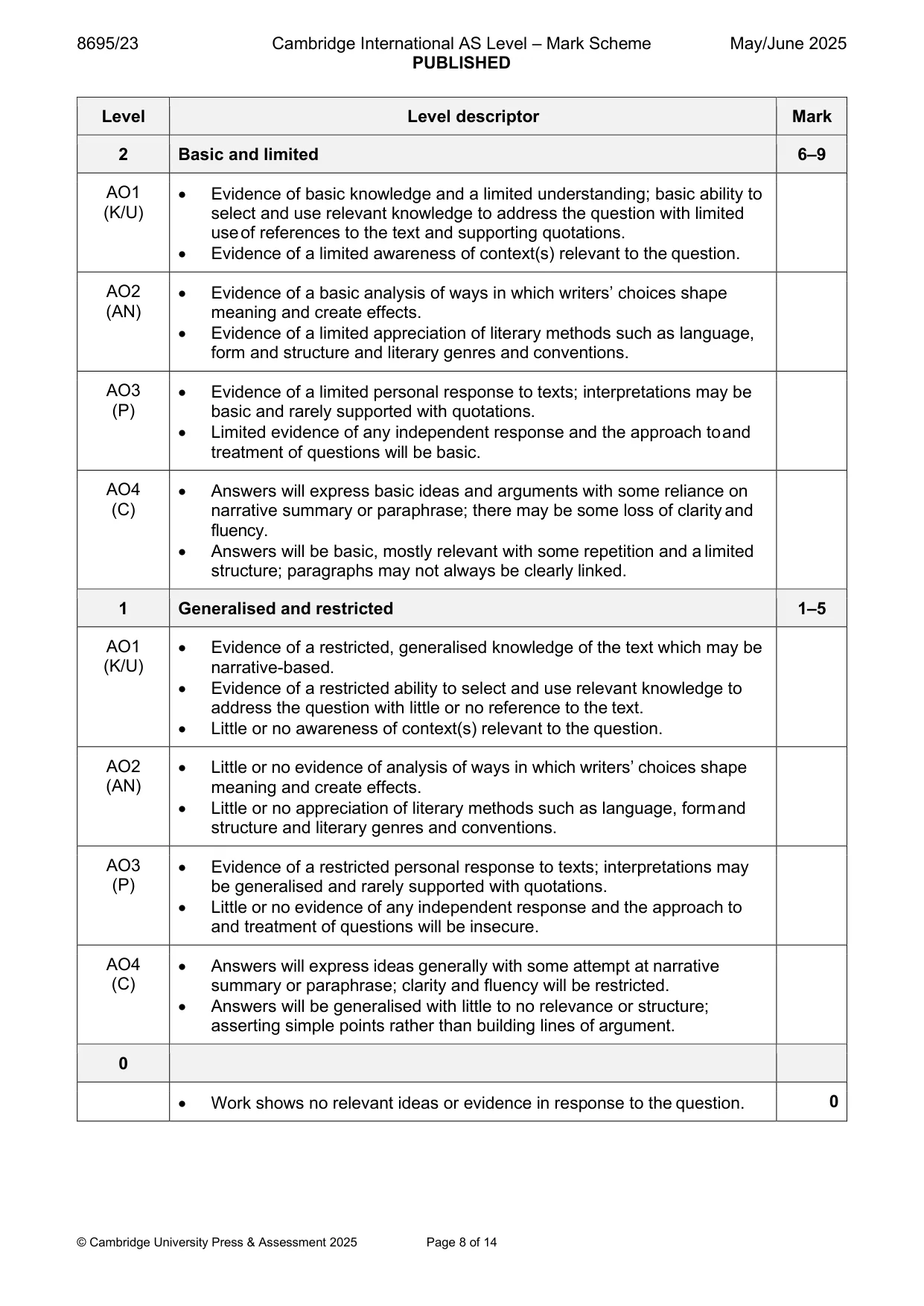
8695/23 Cambridge International AS Level – Mark Scheme PUBLISHED May/June 2025 © Cambridge University Press & Assessment 2025 Page 8 of 14 Level Level descriptor Mark 2 Basic and limited 6–9 AO1 (K/U) • Evidence of basic knowledge and a limited understanding; basic ability to select and use relevant knowledge to address the question with limited use of references to the text and supporting quotations. • Evidence of a limited awareness of context(s) relevant to the question. AO2 (AN) • Evidence of a basic analysis of ways in which writers’ choices shape meaning and create effects. • Evidence of a limited appreciation of literary methods such as language, form and structure and literary genres and conventions. AO3 (P) • Evidence of a limited personal response to texts; interpretations may be basic and rarely supported with quotations. • Limited evidence of any independent response and the approach to and treatment of questions will be basic. AO4 (C) • Answers will express basic ideas and arguments with some reliance on narrative summary or paraphrase; there may be some loss of clarity and fluency. • Answers will be basic, mostly relevant with some repetition and a limited structure; paragraphs may not always be clearly linked. 1 Generalised and restricted 1–5 AO1 (K/U) • Evidence of a restricted, generalised knowledge of the text which may be narrative-based. • Evidence of a restricted ability to select and use relevant knowledge to address the question with little or no reference to the text. • Little or no awareness of context(s) relevant to the question. AO2 (AN) • Little or no evidence of analysis of ways in which writers’ choices shape meaning and create effects. • Little or no appreciation of literary methods such as language, form and structure and literary genres and conventions. AO3 (P) • Evidence of a restricted personal response to texts; interpretations may be generalised and rarely supported with quotations. • Little or no evidence of any independent response and the approach to and treatment of questions will be insecure. AO4 (C) • Answers will express ideas generally with some attempt at narrative summary or paraphrase; clarity and fluency will be restricted. • Answers will be generalised with little to no relevance or structure; asserting simple points rather than building lines of argument. 0 • Work shows no relevant ideas or evidence in response to the question. 0
Mark scheme, page 9
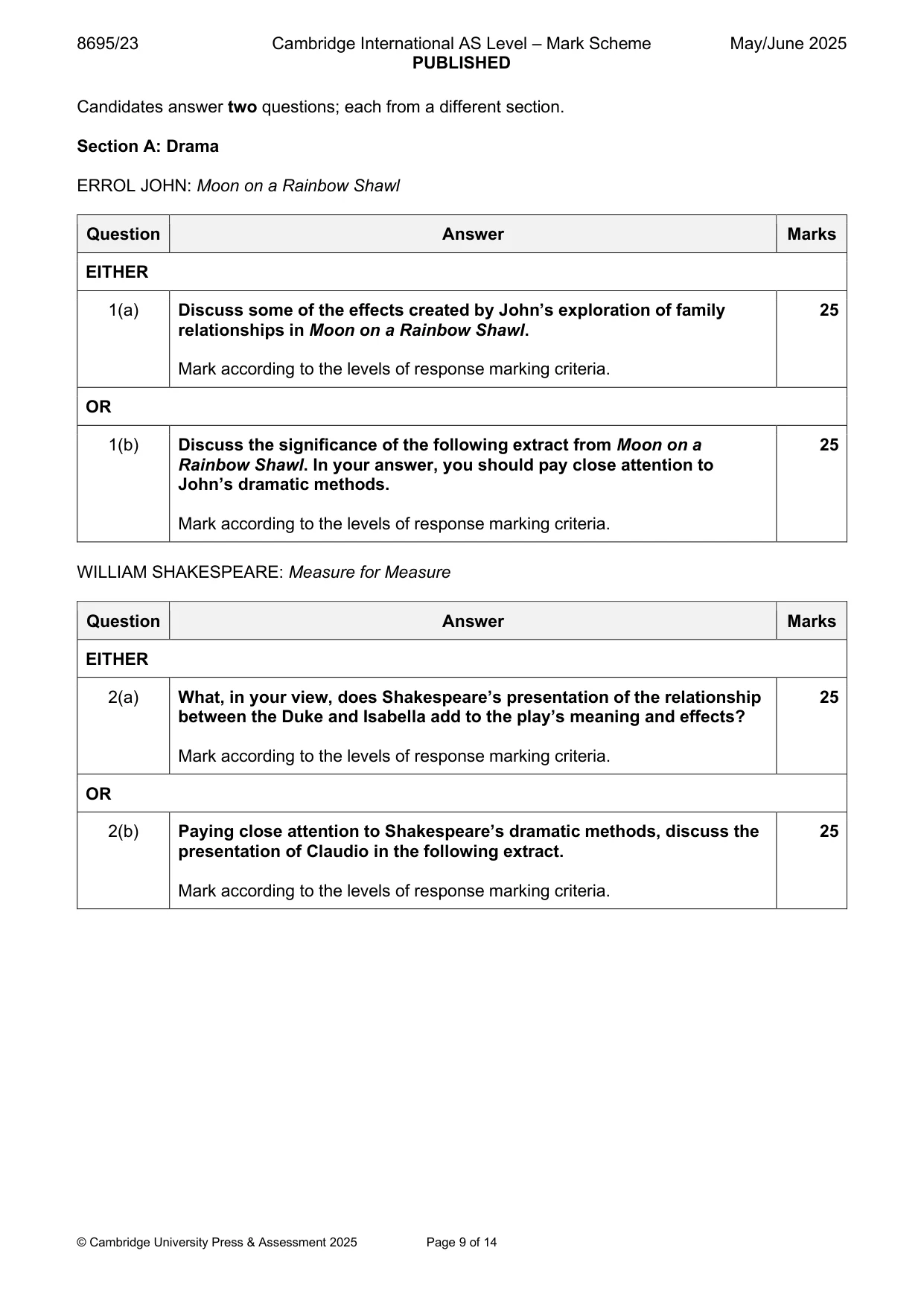
8695/23 Cambridge International AS Level – Mark Scheme PUBLISHED May/June 2025 © Cambridge University Press & Assessment 2025 Page 9 of 14 Candidates answer two questions; each from a different section. Section A: Drama ERROL JOHN: Moon on a Rainbow Shawl Question Answer Marks EITHER 1(a) Discuss some of the effects created by John’s exploration of family relationships in Moon on a Rainbow Shawl. Mark according to the levels of response marking criteria. 25 OR 1(b) Discuss the significance of the following extract from Moon on a Rainbow Shawl. In your answer, you should pay close attention to John’s dramatic methods. Mark according to the levels of response marking criteria. 25 WILLIAM SHAKESPEARE: Measure for Measure Question Answer Marks EITHER 2(a) What, in your view, does Shakespeare’s presentation of the relationship between the Duke and Isabella add to the play’s meaning and effects? Mark according to the levels of response marking criteria. 25 OR 2(b) Paying close attention to Shakespeare’s dramatic methods, discuss the presentation of Claudio in the following extract. Mark according to the levels of response marking criteria. 25
Mark scheme, page 10
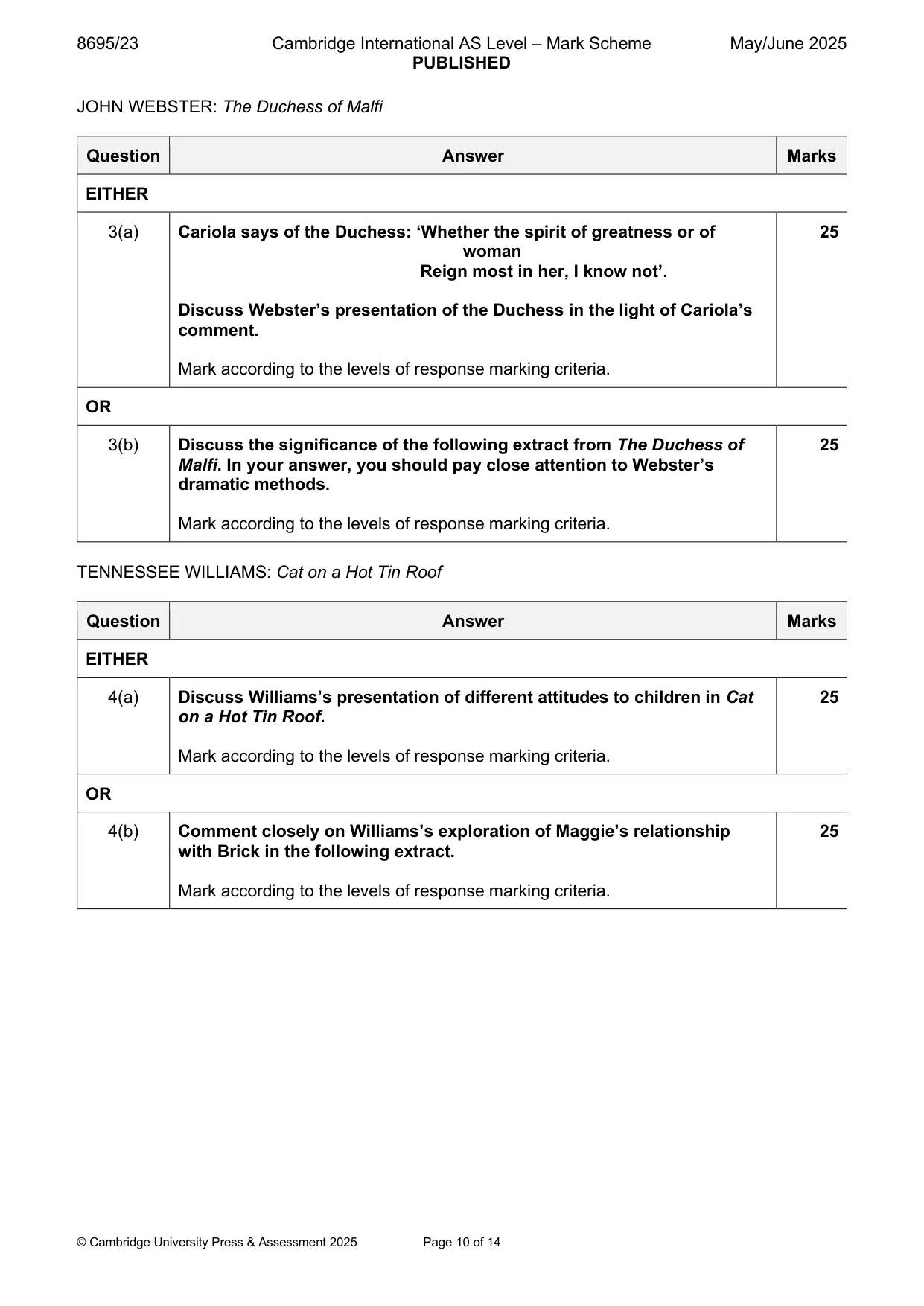
8695/23 Cambridge International AS Level – Mark Scheme PUBLISHED May/June 2025 © Cambridge University Press & Assessment 2025 Page 10 of 14 JOHN WEBSTER: The Duchess of Malfi Question Answer Marks EITHER 3(a) Cariola says of the Duchess: ‘Whether the spirit of greatness or of woman Reign most in her, I know not’. Discuss Webster’s presentation of the Duchess in the light of Cariola’s comment. Mark according to the levels of response marking criteria. 25 OR 3(b) Discuss the significance of the following extract from The Duchess of Malfi. In your answer, you should pay close attention to Webster’s dramatic methods. Mark according to the levels of response marking criteria. 25 TENNESSEE WILLIAMS: Cat on a Hot Tin Roof Question Answer Marks EITHER 4(a) Discuss Williams’s presentation of different attitudes to children in Cat on a Hot Tin Roof. Mark according to the levels of response marking criteria. 25 OR 4(b) Comment closely on Williams’s exploration of Maggie’s relationship with Brick in the following extract. Mark according to the levels of response marking criteria. 25
Mark scheme, page 11
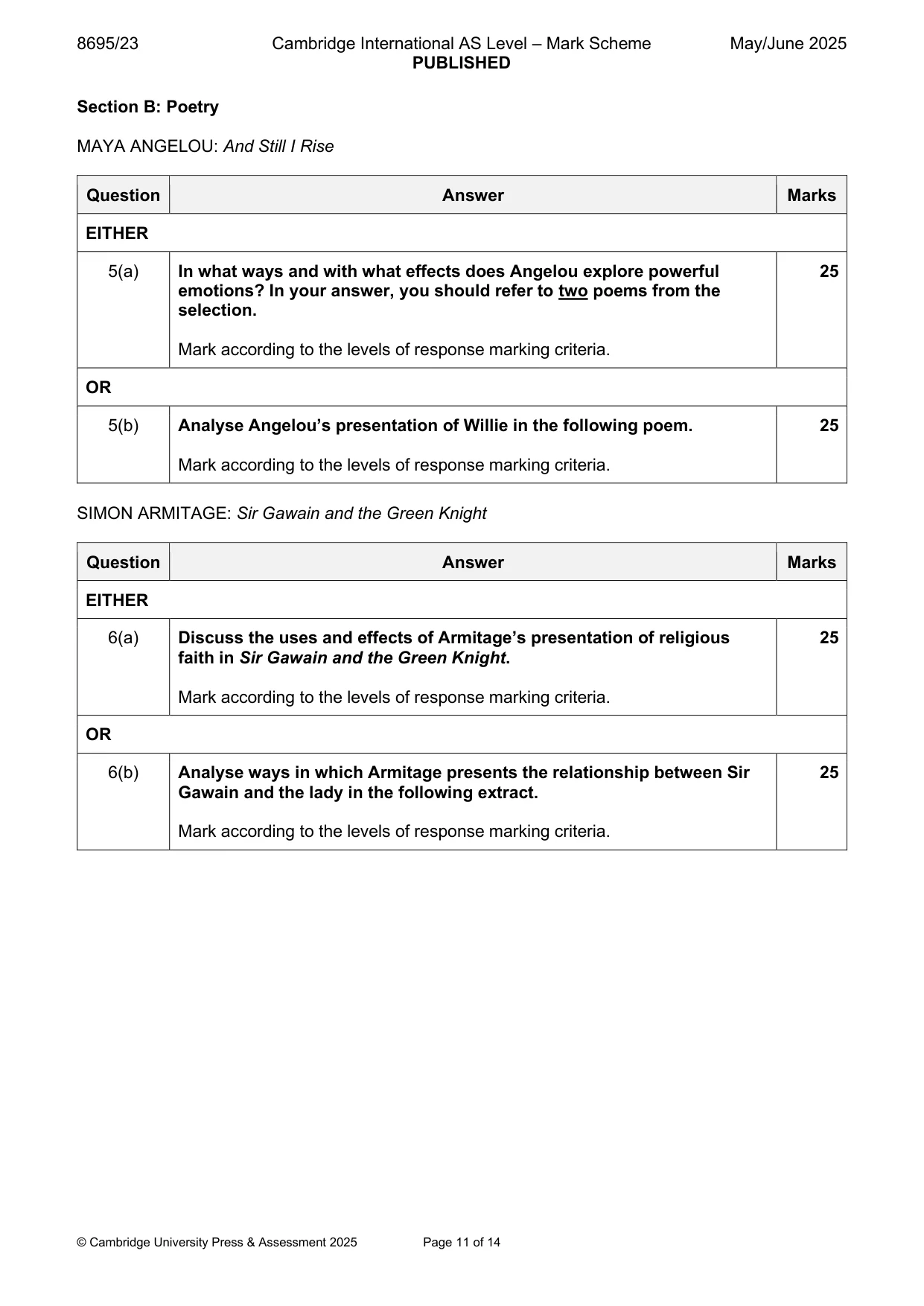
8695/23 Cambridge International AS Level – Mark Scheme PUBLISHED May/June 2025 © Cambridge University Press & Assessment 2025 Page 11 of 14 Section B: Poetry MAYA ANGELOU: And Still I Rise Question Answer Marks EITHER 5(a) In what ways and with what effects does Angelou explore powerful emotions? In your answer, you should refer to two poems from the selection. Mark according to the levels of response marking criteria. 25 OR 5(b) Analyse Angelou’s presentation of Willie in the following poem. Mark according to the levels of response marking criteria. 25 SIMON ARMITAGE: Sir Gawain and the Green Knight Question Answer Marks EITHER 6(a) Discuss the uses and effects of Armitage’s presentation of religious faith in Sir Gawain and the Green Knight. Mark according to the levels of response marking criteria. 25 OR 6(b) Analyse ways in which Armitage presents the relationship between Sir Gawain and the lady in the following extract. Mark according to the levels of response marking criteria. 25
Mark scheme, page 12
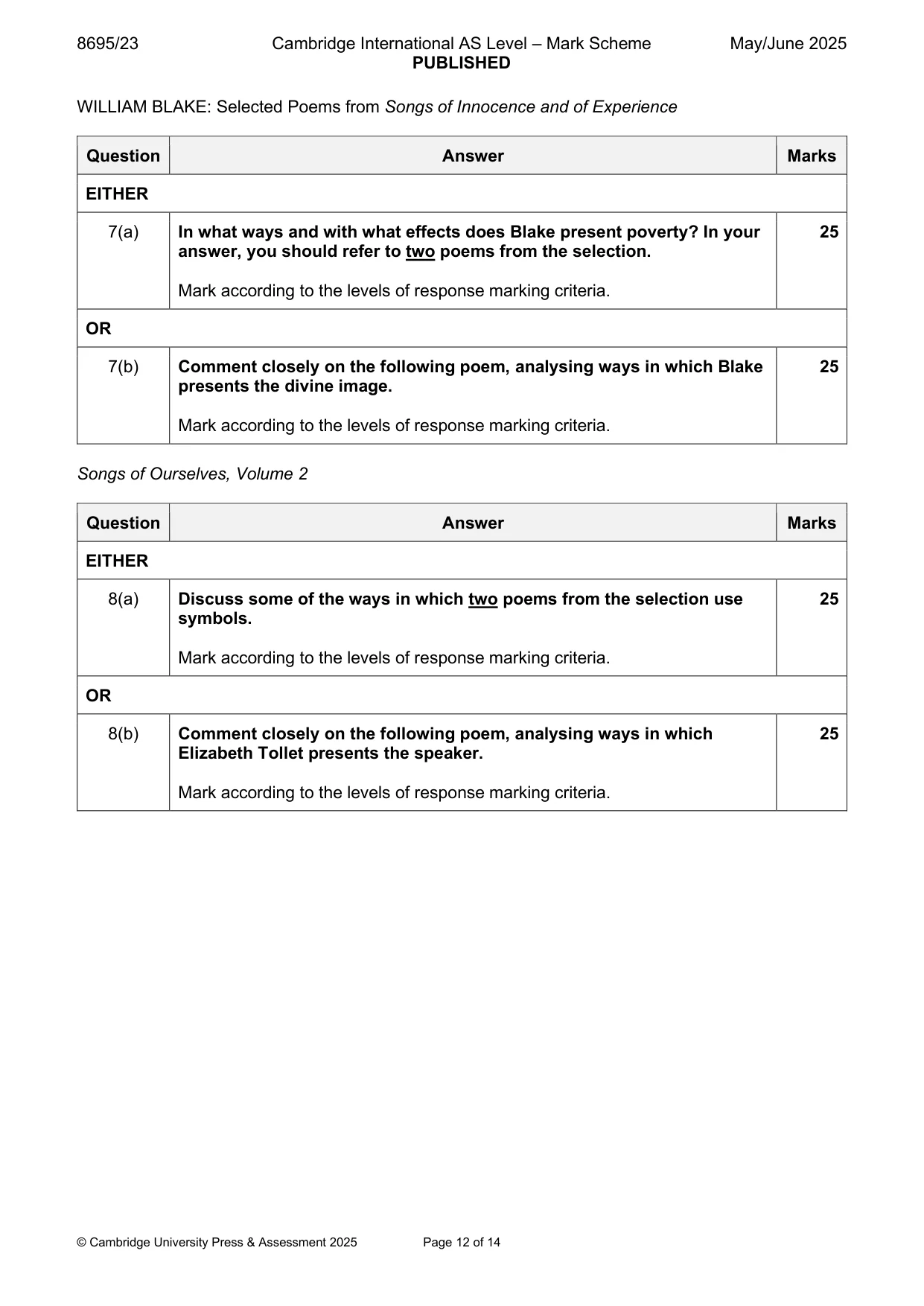
8695/23 Cambridge International AS Level – Mark Scheme PUBLISHED May/June 2025 © Cambridge University Press & Assessment 2025 Page 12 of 14 WILLIAM BLAKE: Selected Poems from Songs of Innocence and of Experience Question Answer Marks EITHER 7(a) In what ways and with what effects does Blake present poverty? In your answer, you should refer to two poems from the selection. Mark according to the levels of response marking criteria. 25 OR 7(b) Comment closely on the following poem, analysing ways in which Blake presents the divine image. Mark according to the levels of response marking criteria. 25 Songs of Ourselves, Volume 2 Question Answer Marks EITHER 8(a) Discuss some of the ways in which two poems from the selection use symbols. Mark according to the levels of response marking criteria. 25 OR 8(b) Comment closely on the following poem, analysing ways in which Elizabeth Tollet presents the speaker. Mark according to the levels of response marking criteria. 25
Mark scheme, page 13
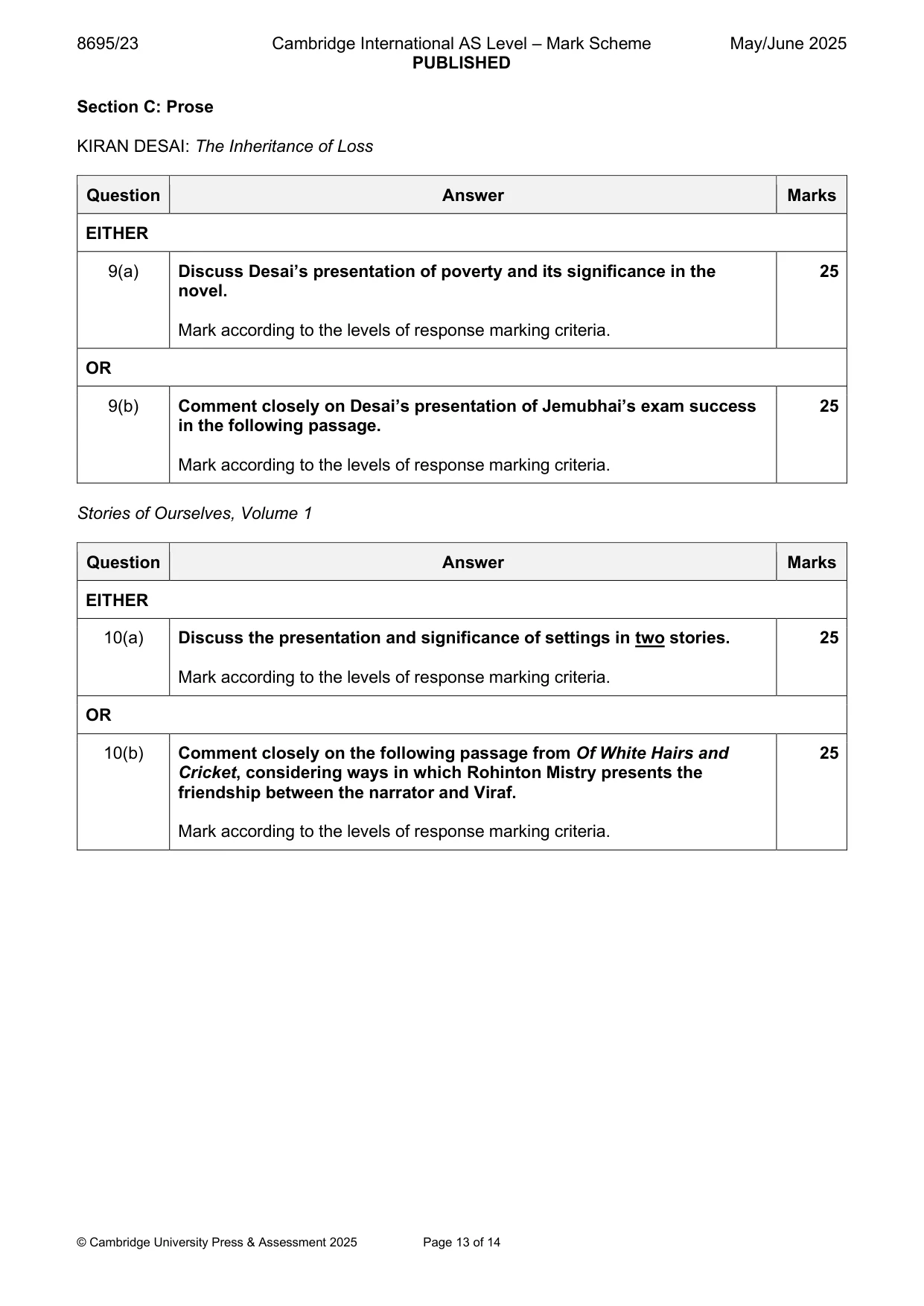
8695/23 Cambridge International AS Level – Mark Scheme PUBLISHED May/June 2025 © Cambridge University Press & Assessment 2025 Page 13 of 14 Section C: Prose KIRAN DESAI: The Inheritance of Loss Question Answer Marks EITHER 9(a) Discuss Desai’s presentation of poverty and its significance in the novel. Mark according to the levels of response marking criteria. 25 OR 9(b) Comment closely on Desai’s presentation of Jemubhai’s exam success in the following passage. Mark according to the levels of response marking criteria. 25 Stories of Ourselves, Volume 1 Question Answer Marks EITHER 10(a) Discuss the presentation and significance of settings in two stories. Mark according to the levels of response marking criteria. 25 OR 10(b) Comment closely on the following passage from Of White Hairs and Cricket, considering ways in which Rohinton Mistry presents the friendship between the narrator and Viraf. Mark according to the levels of response marking criteria. 25
Mark scheme, page 14
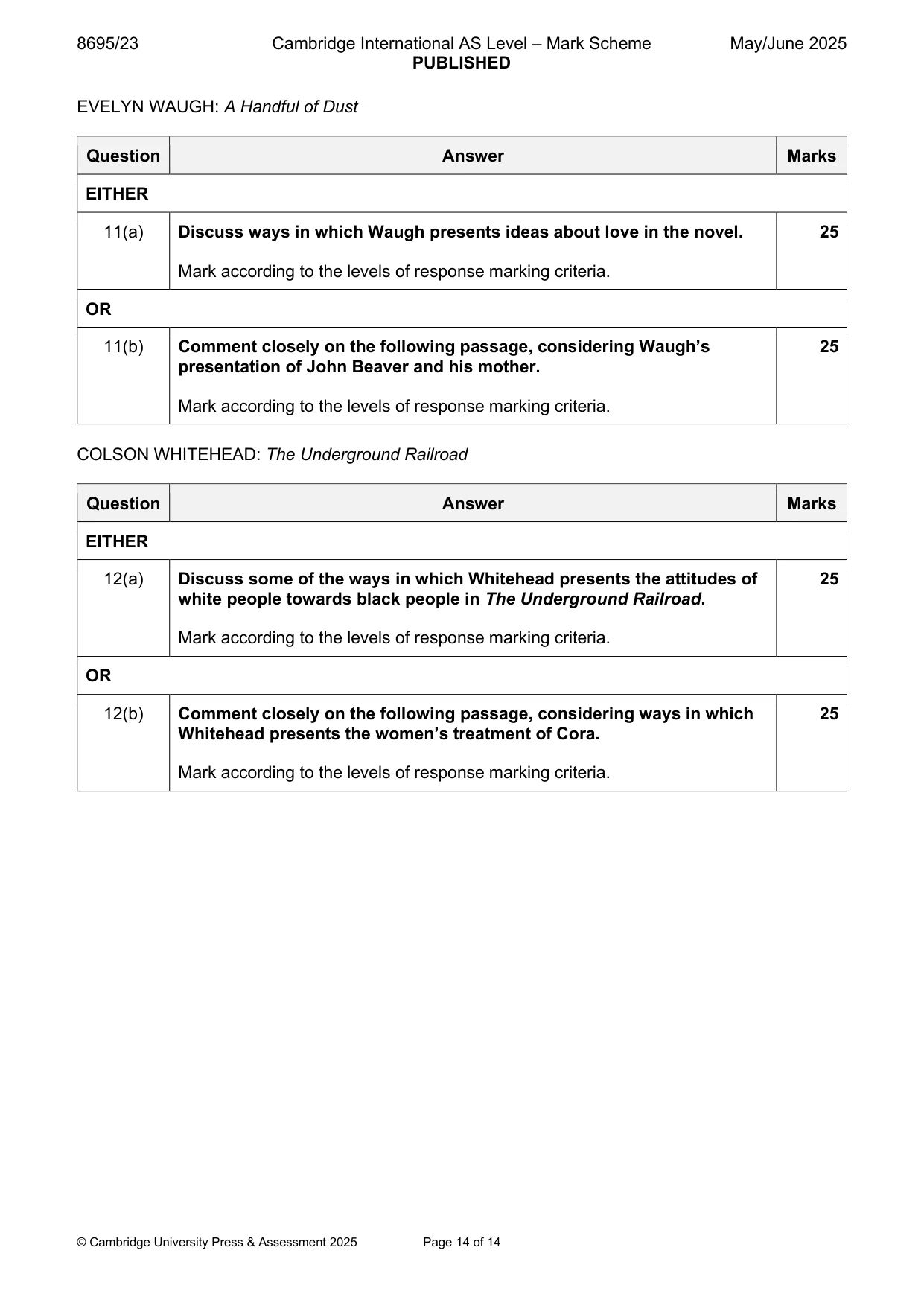
8695/23 Cambridge International AS Level – Mark Scheme PUBLISHED May/June 2025 © Cambridge University Press & Assessment 2025 Page 14 of 14 EVELYN WAUGH: A Handful of Dust Question Answer Marks EITHER 11(a) Discuss ways in which Waugh presents ideas about love in the novel. Mark according to the levels of response marking criteria. 25 OR 11(b) Comment closely on the following passage, considering Waugh’s presentation of John Beaver and his mother. Mark according to the levels of response marking criteria. 25 COLSON WHITEHEAD: The Underground Railroad Question Answer Marks EITHER 12(a) Discuss some of the ways in which Whitehead presents the attitudes of white people towards black people in The Underground Railroad. Mark according to the levels of response marking criteria. 25 OR 12(b) Comment closely on the following passage, considering ways in which Whitehead presents the women’s treatment of Cora. Mark according to the levels of response marking criteria. 25
What you needed in this session
Cambridge’s own grade thresholds for 2025 May/June, Paper 2 · Variant 3. A higher threshold means an easier paper — the bar moves with how the cohort did.