Cambridge A Level English - Language and Literature (AS Level only, from 2016) 8695 — 2022 May/June Paper 2 · Variant 3
8695/23/M/J/22 · 50 marks · ≈56 min
The question paper and its mark scheme, free to read here and free to download. This is Cambridge’s own paper, exactly as it was sat.
Question paper24 pages


Mark scheme13 pages
Answers below. Sit the paper first if you are practising.
Paper as text
Question paper, page 1
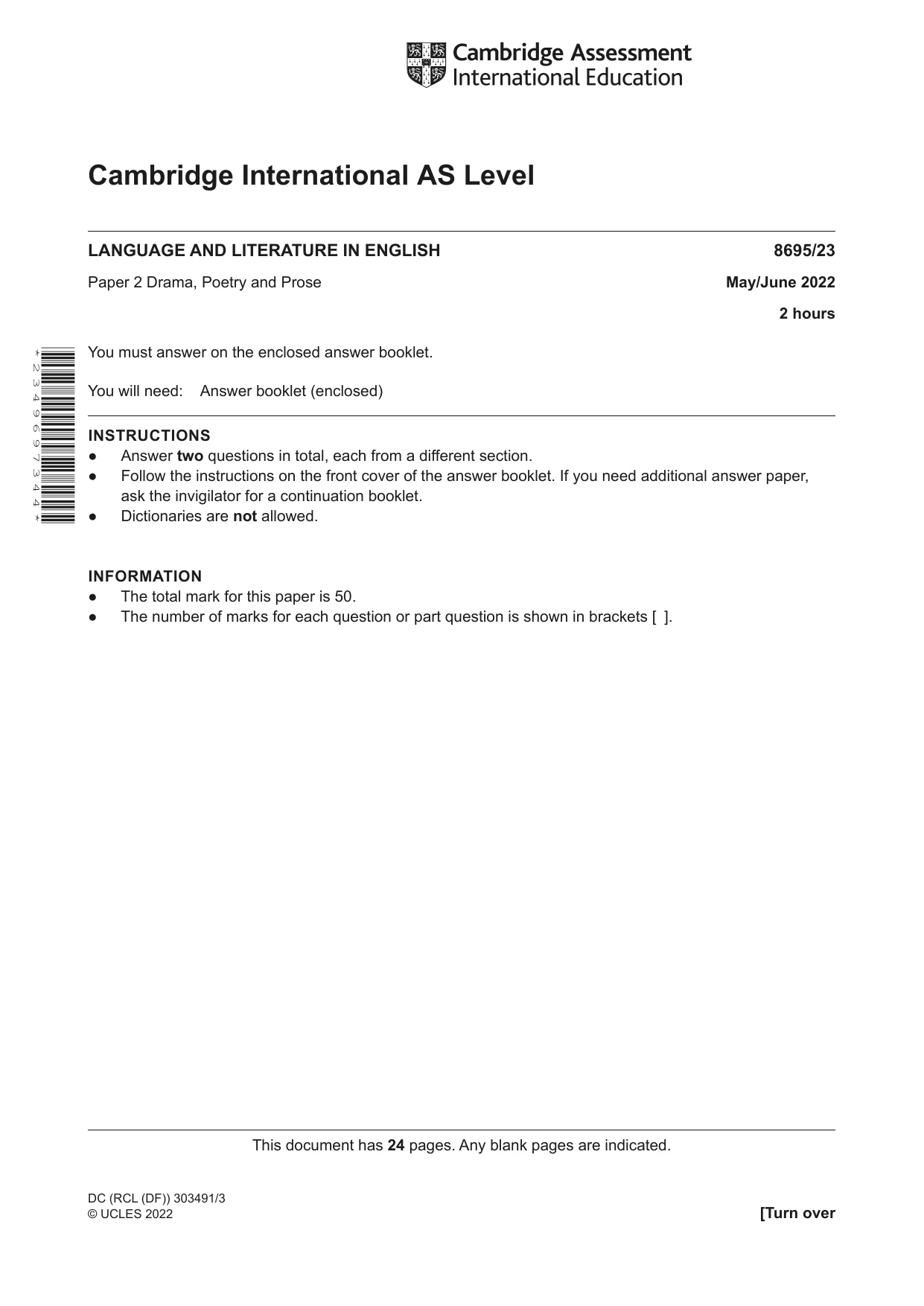
This document has 24 pages. Any blank pages are indicated. Cambridge International AS Level * 2 3 4 9 6 9 7 3 4 4 * LANGUAGE AND LITERATURE IN ENGLISH 8695/23 Paper 2 Drama, Poetry and Prose May/June 2022 2 hours You must answer on the enclosed answer booklet. You will need: Answer booklet (enclosed) INSTRUCTIONS ● Answer two questions in total, each from a different section. ● Follow the instructions on the front cover of the answer booklet. If you need additional answer paper, ask the invigilator for a continuation booklet. ● Dictionaries are not allowed. INFORMATION ● The total mark for this paper is 50. ● The number of marks for each question or part question is shown in brackets [ ]. DC (RCL (DF)) 303491/3 © UCLES 2022 [Turn over
Question paper, page 2
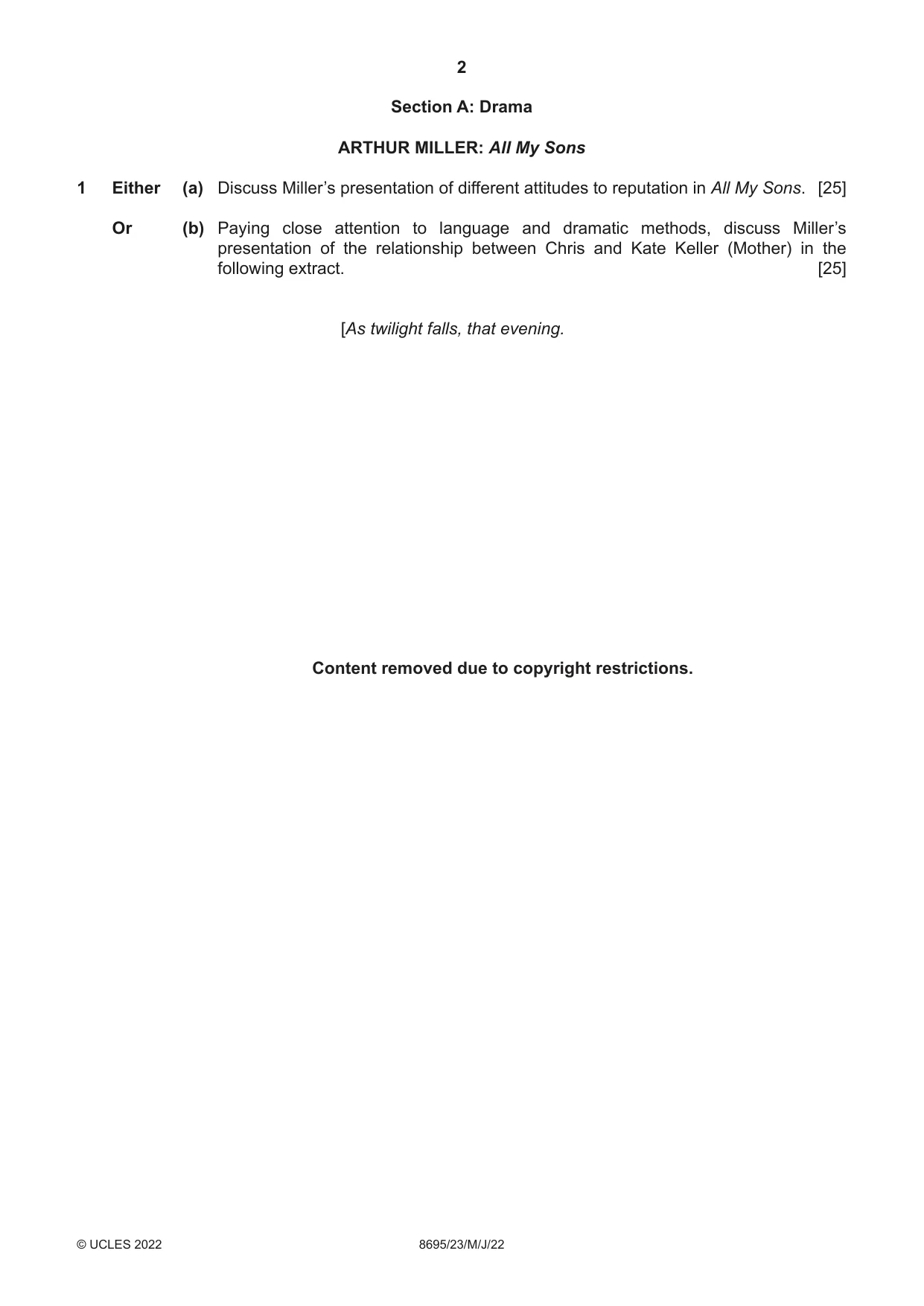
2 8695/23/M/J/22 © UCLES 2022 Section A: Drama ARTHUR MILLER: All My Sons 1 Either (a) Discuss Miller’s presentation of different attitudes to reputation in All My Sons. [25] Or (b) Paying close attention to language and dramatic methods, discuss Miller’s presentation of the relationship between Chris and Kate Keller (Mother) in the following extract. [25] [As twilight falls, that evening. Content removed due to copyright restrictions.
Question paper, page 3
3 8695/23/M/J/22 © UCLES 2022 [Turn over Chris: I’m relaxed. (from Act 2) Content removed due to copyright restrictions.
Question paper, page 4
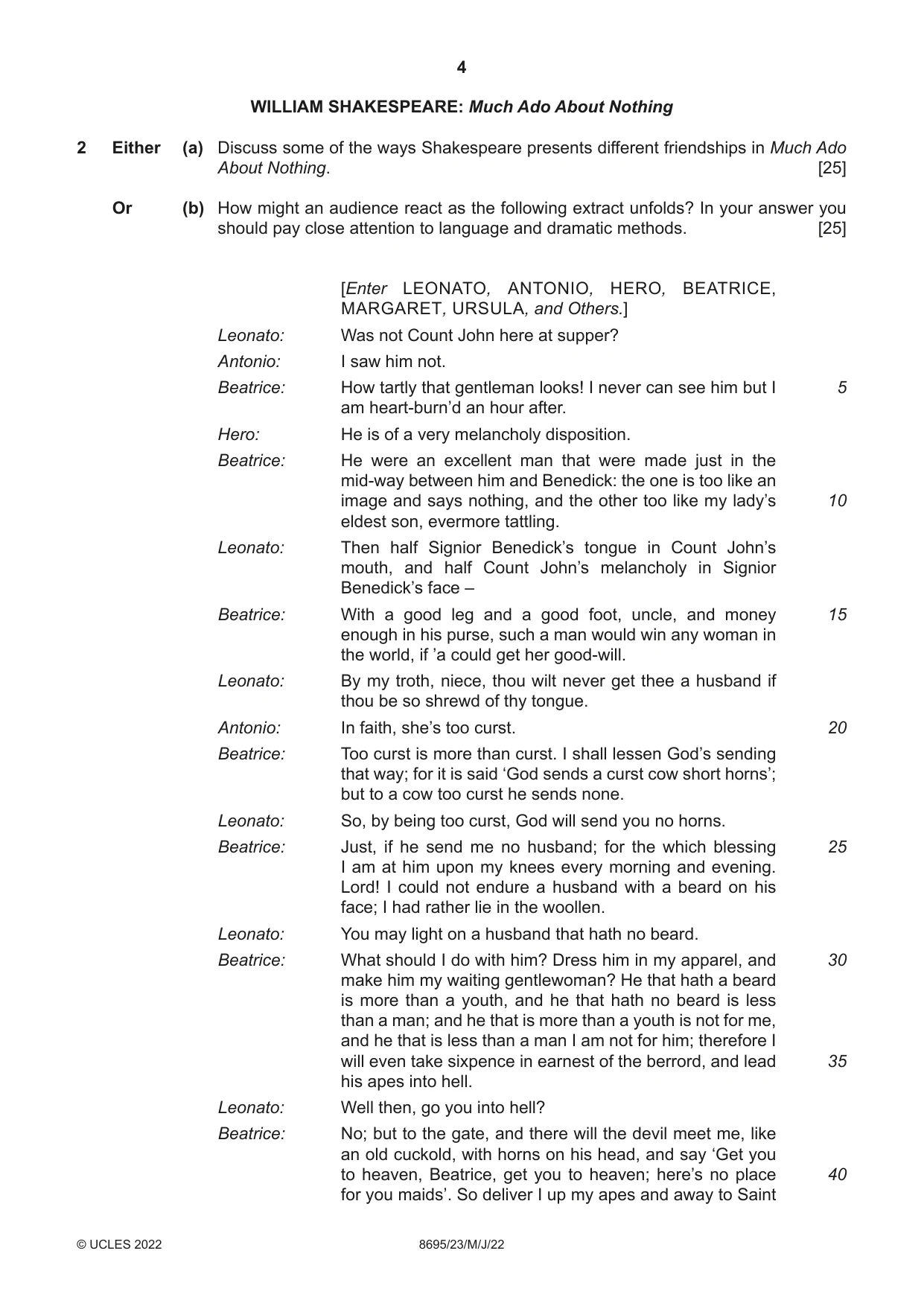
4 8695/23/M/J/22 © UCLES 2022 WILLIAM SHAKESPEARE: Much Ado About Nothing 2 Either (a) Discuss some of the ways Shakespeare presents different friendships in Much Ado About Nothing. [25] Or (b) How might an audience react as the following extract unfolds? In your answer you should pay close attention to language and dramatic methods. [25] [Enter LEONATO, ANTONIO, HERO, BEATRICE, MARGARET, URSULA, and Others.] Leonato: Was not Count John here at supper? Antonio: I saw him not. Beatrice: How tartly that gentleman looks! I never can see him but I am heart-burn’d an hour after. Hero: He is of a very melancholy disposition. Beatrice: He were an excellent man that were made just in the mid-way between him and Benedick: the one is too like an image and says nothing, and the other too like my lady’s eldest son, evermore tattling. Leonato: Then half Signior Benedick’s tongue in Count John’s mouth, and half Count John’s melancholy in Signior Benedick’s face – Beatrice: With a good leg and a good foot, uncle, and money enough in his purse, such a man would win any woman in the world, if ’a could get her good-will. Leonato: By my troth, niece, thou wilt never get thee a husband if thou be so shrewd of thy tongue. Antonio: In faith, she’s too curst. Beatrice: Too curst is more than curst. I shall lessen God’s sending that way; for it is said ‘God sends a curst cow short horns’; but to a cow too curst he sends none. Leonato: So, by being too curst, God will send you no horns. Beatrice: Just, if he send me no husband; for the which blessing I am at him upon my knees every morning and evening. Lord! I could not endure a husband with a beard on his face; I had rather lie in the woollen. Leonato: You may light on a husband that hath no beard. Beatrice: What should I do with him? Dress him in my apparel, and make him my waiting gentlewoman? He that hath a beard is more than a youth, and he that hath no beard is less than a man; and he that is more than a youth is not for me, and he that is less than a man I am not for him; therefore I will even take sixpence in earnest of the berrord, and lead his apes into hell. Leonato: Well then, go you into hell? Beatrice: No; but to the gate, and there will the devil meet me, like an old cuckold, with horns on his head, and say ‘Get you to heaven, Beatrice, get you to heaven; here’s no place for you maids’. So deliver I up my apes and away to Saint 5 10 15 20 25 30 35 40
Question paper, page 5
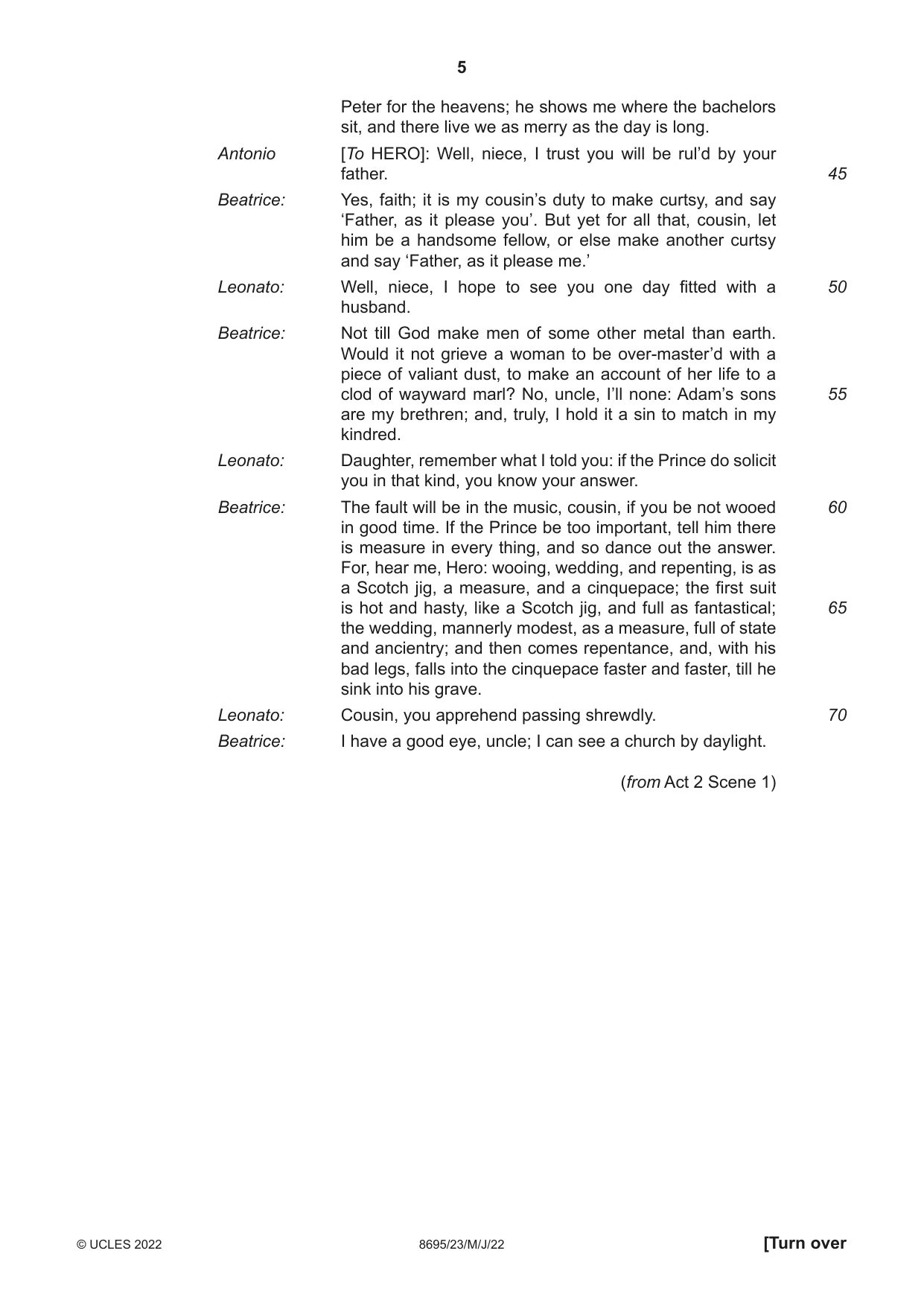
5 8695/23/M/J/22 © UCLES 2022 [Turn over Peter for the heavens; he shows me where the bachelors sit, and there live we as merry as the day is long. Antonio [To HERO]: Well, niece, I trust you will be rul’d by your father. Beatrice: Yes, faith; it is my cousin’s duty to make curtsy, and say ‘Father, as it please you’. But yet for all that, cousin, let him be a handsome fellow, or else make another curtsy and say ‘Father, as it please me.’ Leonato: Well, niece, I hope to see you one day fitted with a husband. Beatrice: Not till God make men of some other metal than earth. Would it not grieve a woman to be over-master’d with a piece of valiant dust, to make an account of her life to a clod of wayward marl? No, uncle, I’ll none: Adam’s sons are my brethren; and, truly, I hold it a sin to match in my kindred. Leonato: Daughter, remember what I told you: if the Prince do solicit you in that kind, you know your answer. Beatrice: The fault will be in the music, cousin, if you be not wooed in good time. If the Prince be too important, tell him there is measure in every thing, and so dance out the answer. For, hear me, Hero: wooing, wedding, and repenting, is as a Scotch jig, a measure, and a cinquepace; the first suit is hot and hasty, like a Scotch jig, and full as fantastical; the wedding, mannerly modest, as a measure, full of state and ancientry; and then comes repentance, and, with his bad legs, falls into the cinquepace faster and faster, till he sink into his grave. Leonato: Cousin, you apprehend passing shrewdly. Beatrice: I have a good eye, uncle; I can see a church by daylight. (from Act 2 Scene 1) 45 50 55 60 65 70
Question paper, page 6
6 8695/23/M/J/22 © UCLES 2022 WOLE SOYINKA: The Trials of Brother Jero and Jero’s Metamorphosis 3 Either (a) In what ways, and with what effects, does Soyinka present the relationship between Jero and Chume in these plays? [25] Or (b) Discuss Soyinka’s presentation of the prophets in the following extract from Jero’s Metamorphosis. In your answer you should pay close attention to dramatic methods and their effects. [25] Shadrach: We have heard all we need to know of the conspiracy against us. Content removed due to copyright restrictions.
Question paper, page 7
7 8695/23/M/J/22 © UCLES 2022 [Turn over [Roars off alone into laughter.] (from Jero’s Metamorphosis, Scene 3) Content removed due to copyright restrictions.
Question paper, page 8
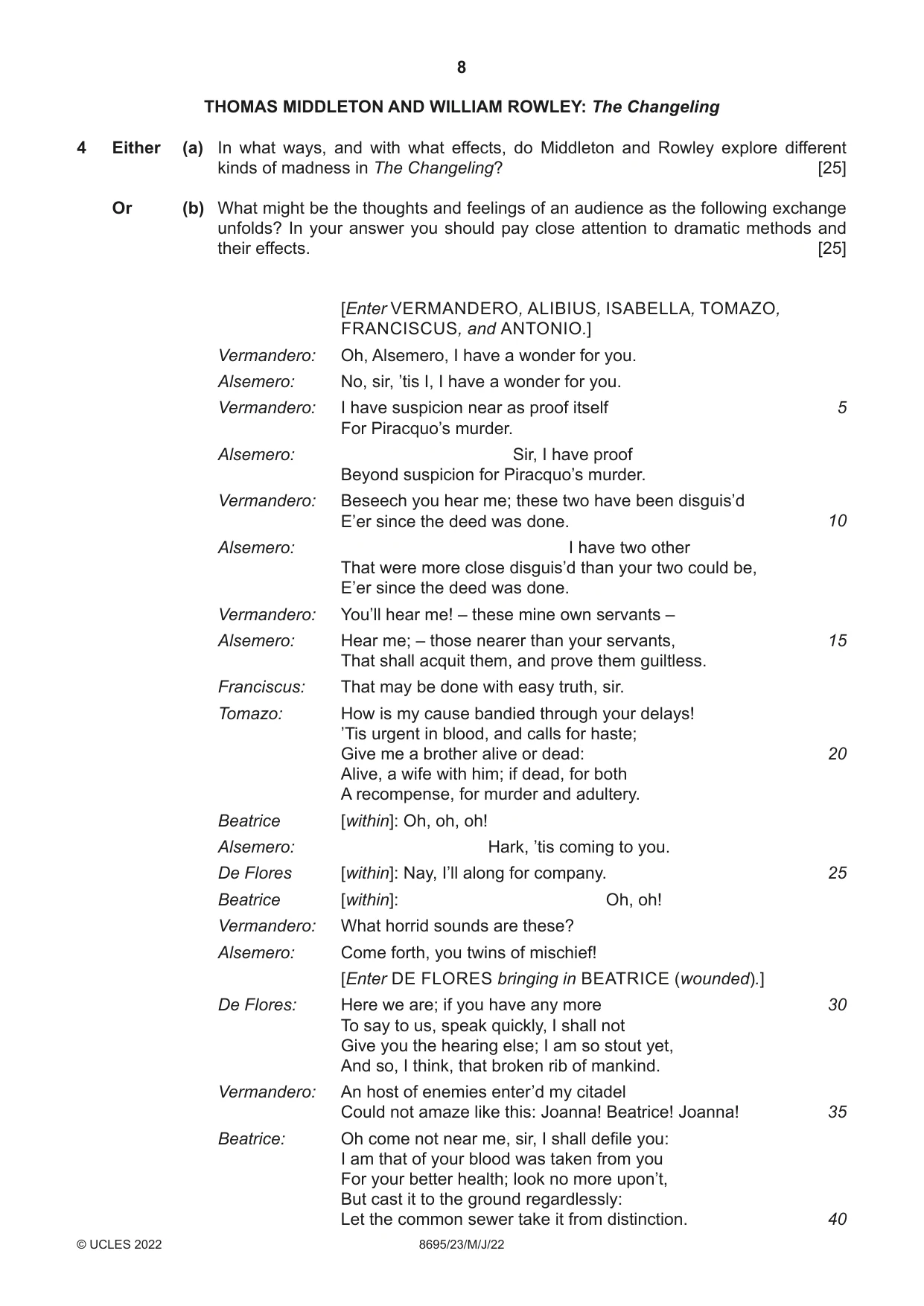
8 8695/23/M/J/22 © UCLES 2022 THOMAS MIDDLETON AND WILLIAM ROWLEY: The Changeling 4 Either (a) In what ways, and with what effects, do Middleton and Rowley explore different kinds of madness in The Changeling? [25] Or (b) What might be the thoughts and feelings of an audience as the following exchange unfolds? In your answer you should pay close attention to dramatic methods and their effects. [25] [Enter VERMANDERO, ALIBIUS, ISABELLA, TOMAZO, FRANCISCUS, and ANTONIO.] Vermandero: Oh, Alsemero, I have a wonder for you. Alsemero: No, sir, ’tis I, I have a wonder for you. Vermandero: I have suspicion near as proof itself For Piracquo’s murder. Alsemero: Sir, I have proof Beyond suspicion for Piracquo’s murder. Vermandero: Beseech you hear me; these two have been disguis’d E’er since the deed was done. Alsemero: I have two other That were more close disguis’d than your two could be, E’er since the deed was done. Vermandero: You’ll hear me! – these mine own servants – Alsemero: Hear me; – those nearer than your servants, That shall acquit them, and prove them guiltless. Franciscus: That may be done with easy truth, sir. Tomazo: How is my cause bandied through your delays! ’Tis urgent in blood, and calls for haste; Give me a brother alive or dead: Alive, a wife with him; if dead, for both A recompense, for murder and adultery. Beatrice [within]: Oh, oh, oh! Alsemero: Hark, ’tis coming to you. De Flores [within]: Nay, I’ll along for company. Beatrice [within]: Oh, oh! Vermandero: What horrid sounds are these? Alsemero: Come forth, you twins of mischief! [Enter DE FLORES bringing in BEATRICE (wounded).] De Flores: Here we are; if you have any more To say to us, speak quickly, I shall not Give you the hearing else; I am so stout yet, And so, I think, that broken rib of mankind. Vermandero: An host of enemies enter’d my citadel Could not amaze like this: Joanna! Beatrice! Joanna! Beatrice: Oh come not near me, sir, I shall defile you: I am that of your blood was taken from you For your better health; look no more upon’t, But cast it to the ground regardlessly: Let the common sewer take it from distinction. 5 10 15 20 25 30 35 40
Question paper, page 9
9 8695/23/M/J/22 © UCLES 2022 [Turn over Beneath the stars, upon yon meteor Ever hung my fate, ’mongst things corruptible; I ne’er could pluck it from him: my loathing Was prophet to the rest, but ne’er believ’d; Mine honour fell with him, and now my life. Alsemero, I am a stranger to your bed, Your bed was cozen’d on the nuptial night, For which your false bride died. Alsemero: Diaphanta! De Flores: Yes; and the while I coupled with your mate At barley-brake; now we are left in hell. Vermandero: We are all there, it circumscribes here. De Flores: I lov’d this woman in spite of her heart; Her love I earn’d out of Piracquo’s murder. Tomazo: Ha! My brother’s murderer! De Flores: Yes, and her honour’s prize Was my reward; I thank life for nothing But that pleasure: it was so sweet to me That I have drunk up all, left none behind For any man to pledge me. Vermandero: Horrid villain! Keep life in him for further tortures. De Flores: No! I can prevent you; here’s my penknife still. It is but one thread more, [stabs himself] – and now ’tis cut. Make haste, Joanna, by that token to thee: Canst not forget, so lately put in mind, I would not go to leave thee far behind. [Dies.] Beatrice: Forgive me, Alsemero, all forgive; ’Tis time to die, when ’tis a shame to live. [Dies.] (from Act 5 Scene 3) 45 50 55 60 65 70
Question paper, page 10
10 8695/23/M/J/22 © UCLES 2022 Section B: Poetry ROBERT BROWNING: Selected Poems 5 Either (a) In what ways, and with what effects, does Browning present conflict in two poems from your selection? [25] Or (b) Comment closely on Browning’s presentation of the relationship between the speaker and the girl in the following poem. [25] Confessions I What is he buzzing in my ears? ‘Now that I come to die, ‘Do I view the world as a vale of tears?’ Ah, reverend sir, not I! II What I viewed there once, what I view again Where the physic bottles stand On the table’s edge,––is a suburb lane, With a wall to my bedside hand. III That lane sloped, much as the bottles do, From a house you could descry O’er the garden-wall: is the curtain blue Or green to a healthy eye? IV To mine, it serves for the old June weather Blue above lane and wall; And that farthest bottle labelled ‘Ether’ Is the house o’ertopping all. V At a terrace, somewhere near the stopper, There watched for me, one June, A girl: I know, sir, it’s improper, My poor mind’s out of tune. VI Only there was a way … you crept Close by the side, to dodge Eyes in the house, two eyes except: They styled their house ‘The Lodge.’ VII What right had a lounger up their lane? But, by creeping very close, With the good wall’s help,––their eyes might strain And stretch themselves to Oes, 5 10 15 20 25 30 35
Question paper, page 11
11 8695/23/M/J/22 © UCLES 2022 [Turn over VIII Yet never catch her and me together, As she left the attic, there, By the rim of the bottle labelled ‘Ether,’ And stole from stair to stair, IX And stood by the rose-wreathed gate. Alas, We loved, sir––used to meet: How sad and bad and mad it was–– But then, how it was sweet! 40 45
Question paper, page 12
12 8695/23/M/J/22 © UCLES 2022 OWEN SHEERS: Skirrid Hill 6 Either (a) Compare ways in which Sheers explores love in two poems from Skirrid Hill. [25] Or (b) Comment closely on the following poem, analysing ways in which Sheers shapes a reader’s response to the events. [25] Liable to Floods ‘Liable to floods’ the farmer warned them. And on the map, the letters arcing down the valley in black and white but still the major wouldn’t listen – tipping back his cap with one finger and laying a fatherly hand on the farmer’s shoulder ‘Don’t you worry Jack,’ he said, ‘We’ve got this one covered.’ And so they made their camp, a thousand tents across the valley floor, but even then as the GI’s tapped the steel they felt the backbone of the rock, shallow beneath the soil. For the next two days they trained under Moel Siabod’s shoulder. Greenhorns from Kansas, Ohio and Iowa, sweeping in a line through the ditches, streams and bracken, preparing for the landings on Utah and Omaha pegged as yet to an unknown date hung somewhere just over the horizon. On the third night they slept to the sound of the rain’s fusillade and the artillery of thunder, while outside, under cover of darkness the river pulled herself up and spread her wings, bleeding through the camp like ink from a broken cartridge. The guards were woken by their tin cans and cups set afloat and clinking against each other like ghosts in celebration. They raised the alarm but it was already too late and the river, arming herself with their rifles, flushing out the latrines, swallowing the jeeps, gathered them all and ushered them off. And as their camp beds became rafts, gently lifted and spun, more than one GI woke from dreams of home to sense, just for a second, somewhere deep in the bone, 5 10 15 20 25 30 35
Question paper, page 13
13 8695/23/M/J/22 © UCLES 2022 [Turn over how suitable this was, as if the weather had finally caught up with their lives – this being taken at night without any say, this being borne, this being swept away. 40
Question paper, page 14
14 8695/23/M/J/22 © UCLES 2022 Songs of Ourselves, Volume 2 7 Either (a) Discuss ways in which two poems present women’s attitudes to men. [25] Or (b) Comment closely on the following poem, analysing ways in which Owen presents the effects of nature. [25] Futility Move him into the sun – Gently its touch awoke him once, At home, whispering of fields unsown. Always it woke him, even in France, Until this morning and this snow. If anything might rouse him now The kind old sun will know. Think how it wakes the seeds, – Woke, once, the clays of a cold star. Are limbs, so dear-achieved, are sides, Full-nerved – still warm – too hard to stir? Was it for this the clay grew tall? – O what made fatuous sunbeams toil To break earth’s sleep at all? (Wilfred Owen) 5 10
Question paper, page 15
15 8695/23/M/J/22 © UCLES 2022 [Turn over GILLIAN CLARKE: Selected Poems 8 Either (a) Discuss the writing and effects of two poems in which Clarke presents dead animals. [25] Or (b) Paying close attention to poetic methods, discuss ways Clarke shapes a reader’s response in the following poem. [25] Cold Knap Lake We once watched a crowd pull a drowned child from the lake. Blue-lipped and dressed in water’s long green silk she lay for dead. Then kneeling on the earth, a heroine, her red head bowed, her wartime cotton frock soaked, my mother gave a stranger’s child her breath. The crowd stood silent, drawn by the dread of it. The child breathed, bleating and rosy in my mother’s hands. My father took her home to a poor house and watched her thrashed for almost drowning. Was I there? Or is that troubled surface something else shadowy under the dipped fingers of willows where satiny mud blooms in cloudiness after the treading, heavy webs of swans as their wings beat and whistle on the air? All lost things lie under closing water in the lake with the poor man’s daughter. 5 10 15 20
Question paper, page 16
16 8695/23/M/J/22 © UCLES 2022 Section C: Prose IAN McEWAN: Atonement 9 Either (a) Discuss the effects of McEwan’s use of different time periods in the novel. [25] Or (b) Comment closely on the following passage, considering ways in which McEwan presents Briony’s experience. [25] She knew from her map that Balham lay at the far end of the Common, in the direction the vicar was walking. This was an interview she was preparing for, the post of beloved younger sister. (from Part 3) Content removed due to copyright restrictions.
Question paper, page 17
17 8695/23/M/J/22 © UCLES 2022 [Turn over BLANK PAGE TURN OVER FOR QUESTION 10.
Question paper, page 18
18 8695/23/M/J/22 © UCLES 2022 NGŨGĨ WA THIONG’O: Petals of Blood 10 Either (a) Discuss the presentation and significance of the Theng’eta drink in the novel. [25] Or (b) Comment closely on the presentation of Inspector Godfrey’s interrogation of Munira in the following passage. [25] There was a quiet but firm conviction in Munira’s voice that somehow carried Inspector Godfrey. Content removed due to copyright restrictions.
Question paper, page 19
19 8695/23/M/J/22 © UCLES 2022 [Turn over ‘Stop … wait … I’ve not finished.’ (from Chapter 12) Content removed due to copyright restrictions.
Question paper, page 20
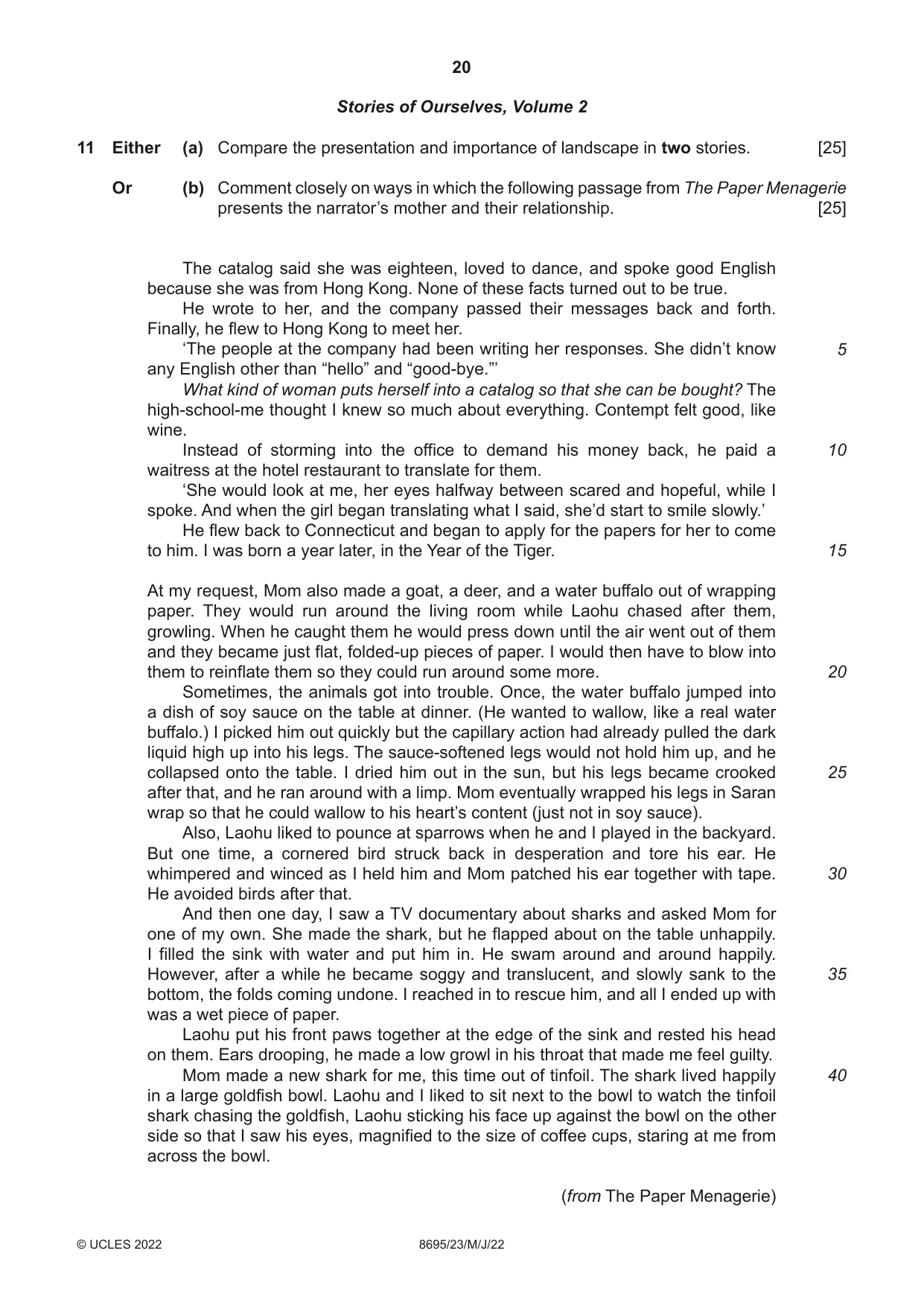
20 8695/23/M/J/22 © UCLES 2022 Stories of Ourselves, Volume 2 11 Either (a) Compare the presentation and importance of landscape in two stories. [25] Or (b) Comment closely on ways in which the following passage from The Paper Menagerie presents the narrator’s mother and their relationship. [25] The catalog said she was eighteen, loved to dance, and spoke good English because she was from Hong Kong. None of these facts turned out to be true. He wrote to her, and the company passed their messages back and forth. Finally, he flew to Hong Kong to meet her. ‘The people at the company had been writing her responses. She didn’t know any English other than “hello” and “good-bye.”’ What kind of woman puts herself into a catalog so that she can be bought? The high-school-me thought I knew so much about everything. Contempt felt good, like wine. Instead of storming into the office to demand his money back, he paid a waitress at the hotel restaurant to translate for them. ‘She would look at me, her eyes halfway between scared and hopeful, while I spoke. And when the girl began translating what I said, she’d start to smile slowly.’ He flew back to Connecticut and began to apply for the papers for her to come to him. I was born a year later, in the Year of the Tiger. At my request, Mom also made a goat, a deer, and a water buffalo out of wrapping paper. They would run around the living room while Laohu chased after them, growling. When he caught them he would press down until the air went out of them and they became just flat, folded-up pieces of paper. I would then have to blow into them to reinflate them so they could run around some more. Sometimes, the animals got into trouble. Once, the water buffalo jumped into a dish of soy sauce on the table at dinner. (He wanted to wallow, like a real water buffalo.) I picked him out quickly but the capillary action had already pulled the dark liquid high up into his legs. The sauce-softened legs would not hold him up, and he collapsed onto the table. I dried him out in the sun, but his legs became crooked after that, and he ran around with a limp. Mom eventually wrapped his legs in Saran wrap so that he could wallow to his heart’s content (just not in soy sauce). Also, Laohu liked to pounce at sparrows when he and I played in the backyard. But one time, a cornered bird struck back in desperation and tore his ear. He whimpered and winced as I held him and Mom patched his ear together with tape. He avoided birds after that. And then one day, I saw a TV documentary about sharks and asked Mom for one of my own. She made the shark, but he flapped about on the table unhappily. I filled the sink with water and put him in. He swam around and around happily. However, after a while he became soggy and translucent, and slowly sank to the bottom, the folds coming undone. I reached in to rescue him, and all I ended up with was a wet piece of paper. Laohu put his front paws together at the edge of the sink and rested his head on them. Ears drooping, he made a low growl in his throat that made me feel guilty. Mom made a new shark for me, this time out of tinfoil. The shark lived happily in a large goldfish bowl. Laohu and I liked to sit next to the bowl to watch the tinfoil shark chasing the goldfish, Laohu sticking his face up against the bowl on the other side so that I saw his eyes, magnified to the size of coffee cups, staring at me from across the bowl. (from The Paper Menagerie) 5 10 15 20 25 30 35 40
Question paper, page 21
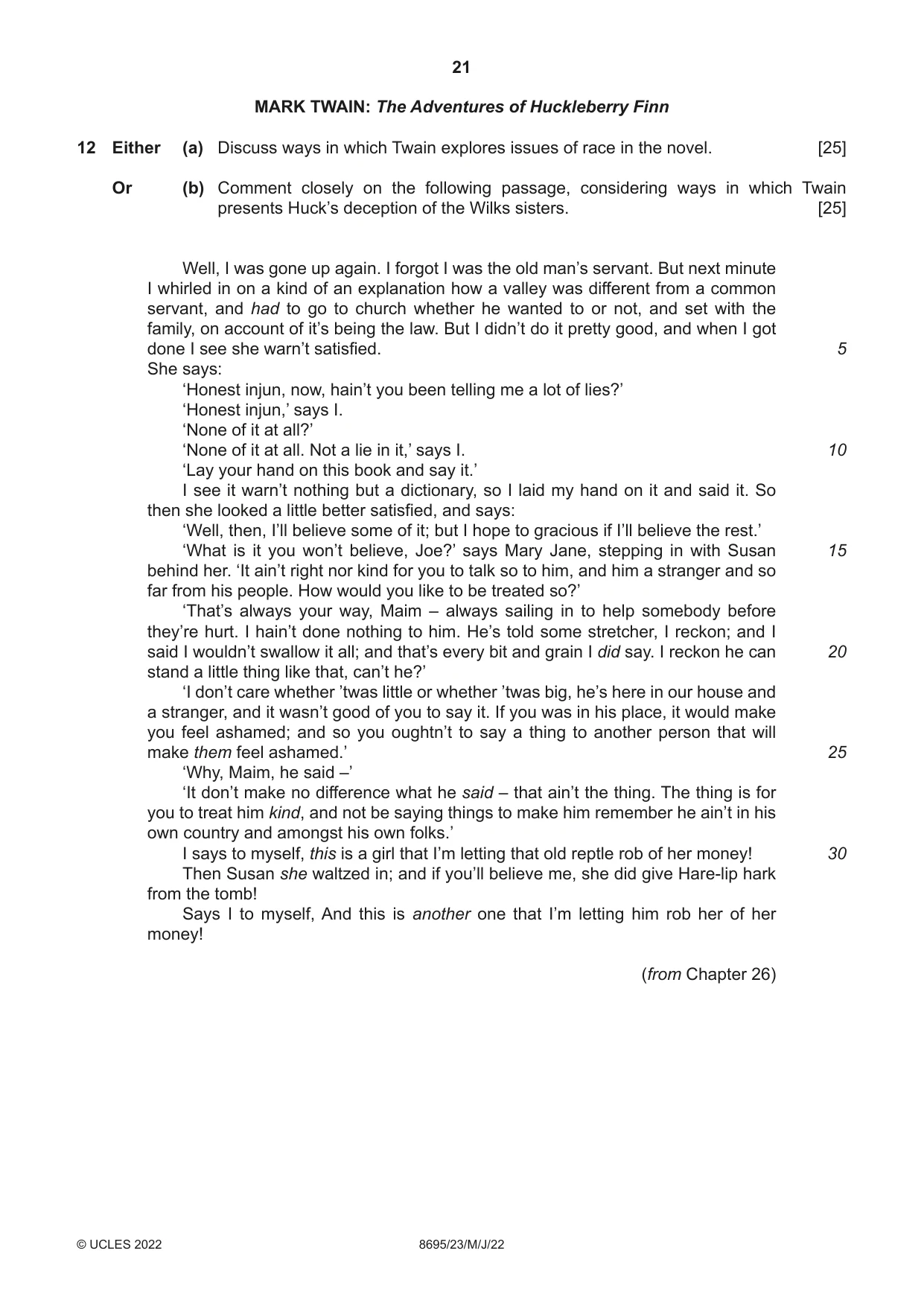
21 8695/23/M/J/22 © UCLES 2022 MARK TWAIN: The Adventures of Huckleberry Finn 12 Either (a) Discuss ways in which Twain explores issues of race in the novel. [25] Or (b) Comment closely on the following passage, considering ways in which Twain presents Huck’s deception of the Wilks sisters. [25] Well, I was gone up again. I forgot I was the old man’s servant. But next minute I whirled in on a kind of an explanation how a valley was different from a common servant, and had to go to church whether he wanted to or not, and set with the family, on account of it’s being the law. But I didn’t do it pretty good, and when I got done I see she warn’t satisfied. She says: ‘Honest injun, now, hain’t you been telling me a lot of lies?’ ‘Honest injun,’ says I. ‘None of it at all?’ ‘None of it at all. Not a lie in it,’ says I. ‘Lay your hand on this book and say it.’ I see it warn’t nothing but a dictionary, so I laid my hand on it and said it. So then she looked a little better satisfied, and says: ‘Well, then, I’ll believe some of it; but I hope to gracious if I’ll believe the rest.’ ‘What is it you won’t believe, Joe?’ says Mary Jane, stepping in with Susan behind her. ‘It ain’t right nor kind for you to talk so to him, and him a stranger and so far from his people. How would you like to be treated so?’ ‘That’s always your way, Maim – always sailing in to help somebody before they’re hurt. I hain’t done nothing to him. He’s told some stretcher, I reckon; and I said I wouldn’t swallow it all; and that’s every bit and grain I did say. I reckon he can stand a little thing like that, can’t he?’ ‘I don’t care whether ’twas little or whether ’twas big, he’s here in our house and a stranger, and it wasn’t good of you to say it. If you was in his place, it would make you feel ashamed; and so you oughtn’t to say a thing to another person that will make them feel ashamed.’ ‘Why, Maim, he said –’ ‘It don’t make no difference what he said – that ain’t the thing. The thing is for you to treat him kind, and not be saying things to make him remember he ain’t in his own country and amongst his own folks.’ I says to myself, this is a girl that I’m letting that old reptle rob of her money! Then Susan she waltzed in; and if you’ll believe me, she did give Hare-lip hark from the tomb! Says I to myself, And this is another one that I’m letting him rob her of her money! (from Chapter 26) 5 10 15 20 25 30
Question paper, page 22
22 8695/23/M/J/22 © UCLES 2022 BLANK PAGE
Question paper, page 23
23 8695/23/M/J/22 © UCLES 2022 BLANK PAGE
Question paper, page 24
24 8695/23/M/J/22 © UCLES 2022 Permission to reproduce items where third-party owned material protected by copyright is included has been sought and cleared where possible. Every reasonable effort has been made by the publisher (UCLES) to trace copyright holders, but if any items requiring clearance have unwittingly been included, the publisher will be pleased to make amends at the earliest possible opportunity. To avoid the issue of disclosure of answer-related information to candidates, all copyright acknowledgements are reproduced online in the Cambridge Assessment International Education Copyright Acknowledgements Booklet. This is produced for each series of examinations and is freely available to download at www.cambridgeinternational.org after the live examination series. Cambridge Assessment International Education is part of Cambridge Assessment. Cambridge Assessment is the brand name of the University of Cambridge Local Examinations Syndicate (UCLES), which is a department of the University of Cambridge. BLANK PAGE
Mark scheme, page 1
This document consists of 13 printed pages. © UCLES 2022 [Turn over Cambridge International AS Level LANGUAGE AND LITERATURE IN ENGLISH 8695/23 Paper 2 Drama, Poetry and Prose May/June 2022 MARK SCHEME Maximum Mark: 50 Published This mark scheme is published as an aid to teachers and candidates, to indicate the requirements of the examination. It shows the basis on which Examiners were instructed to award marks. It does not indicate the details of the discussions that took place at an Examiners’ meeting before marking began, which would have considered the acceptability of alternative answers. Mark schemes should be read in conjunction with the question paper and the Principal Examiner Report for Teachers. Cambridge International will not enter into discussions about these mark schemes. Cambridge International is publishing the mark schemes for the May/June 2022 series for most Cambridge IGCSE, Cambridge International A and AS Level and Cambridge Pre-U components, and some Cambridge O Level components.
Mark scheme, page 2
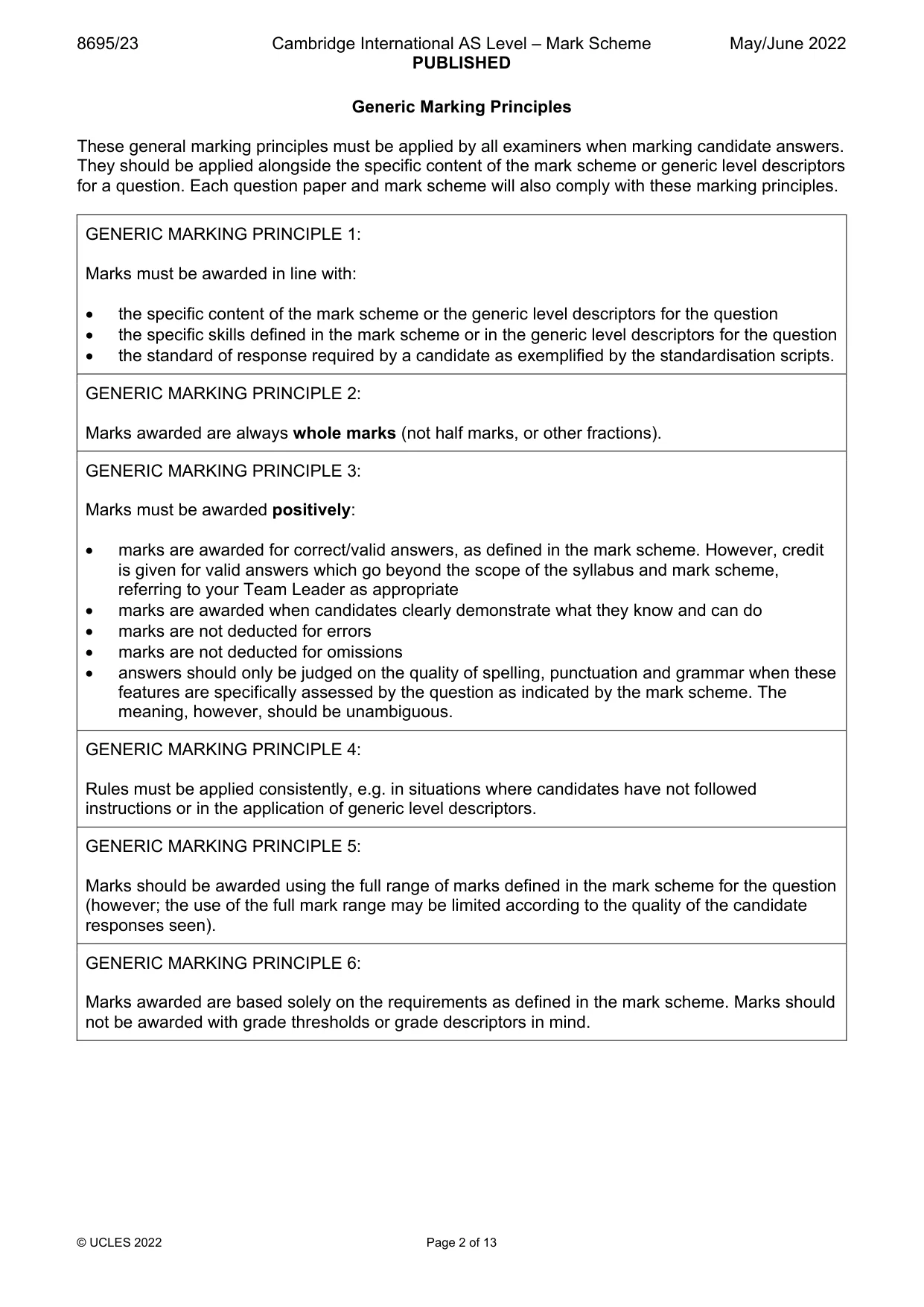
8695/23 Cambridge International AS Level – Mark Scheme PUBLISHED May/June 2022 © UCLES 2022 Page 2 of 13 Generic Marking Principles These general marking principles must be applied by all examiners when marking candidate answers. They should be applied alongside the specific content of the mark scheme or generic level descriptors for a question. Each question paper and mark scheme will also comply with these marking principles. GENERIC MARKING PRINCIPLE 1: Marks must be awarded in line with: the specific content of the mark scheme or the generic level descriptors for the question the specific skills defined in the mark scheme or in the generic level descriptors for the question the standard of response required by a candidate as exemplified by the standardisation scripts. GENERIC MARKING PRINCIPLE 2: Marks awarded are always whole marks (not half marks, or other fractions). GENERIC MARKING PRINCIPLE 3: Marks must be awarded positively: marks are awarded for correct/valid answers, as defined in the mark scheme. However, credit is given for valid answers which go beyond the scope of the syllabus and mark scheme, referring to your Team Leader as appropriate marks are awarded when candidates clearly demonstrate what they know and can do marks are not deducted for errors marks are not deducted for omissions answers should only be judged on the quality of spelling, punctuation and grammar when these features are specifically assessed by the question as indicated by the mark scheme. The meaning, however, should be unambiguous. GENERIC MARKING PRINCIPLE 4: Rules must be applied consistently, e.g. in situations where candidates have not followed instructions or in the application of generic level descriptors. GENERIC MARKING PRINCIPLE 5: Marks should be awarded using the full range of marks defined in the mark scheme for the question (however; the use of the full mark range may be limited according to the quality of the candidate responses seen). GENERIC MARKING PRINCIPLE 6: Marks awarded are based solely on the requirements as defined in the mark scheme. Marks should not be awarded with grade thresholds or grade descriptors in mind.
Mark scheme, page 3
8695/23 Cambridge International AS Level – Mark Scheme PUBLISHED May/June 2022 © UCLES 2022 Page 3 of 13 English & Media subject specific general marking principles (To be read in conjunction with the Generic Marking Principles (and requiring further guidance on how to place marks within levels)) Components using level descriptors: We use level descriptors as a guide to broad understanding of the qualities normally expected of, or typical of, work in a level. Level descriptors are a means of general guidance, and should not be interpreted as hurdle statements. Where indicative content notes are supplied for a question, these are not a prescription of required content, and must not be treated as such. Alternative correct points and unexpected answers in candidates’ scripts must be given marks that fairly reflect the knowledge and skills demonstrated. While we may have legitimate expectations as to the ground most answers may occupy, we must at all times be prepared to meet candidates on their chosen ground, provided it is relevant ground (e.g. clearly related to and derived from a relevant passage/text and meeting the mark scheme requirements for the question). Components using point-based marking: Point marking is often used to reward knowledge, understanding and application of skills. We give credit where the candidate’s answer shows relevant knowledge, understanding and application of skills in answering the question. We do not give credit where the answer shows confusion. From this it follows that we: a DO credit answers which are worded differently from the mark scheme if they clearly convey the same meaning (unless the mark scheme requires a specific term). b DO credit alternative answers/examples which are not written in the mark scheme if they are correct. c DO credit answers where candidates give more than one correct answer in one prompt/numbered/scaffolded space where extended writing is required rather than list-type answers. For example, questions that require n reasons (e.g. State two reasons…). d DO NOT credit answers simply for using a ‘key term’ unless that is all that is required. (Check for evidence it is understood and not used wrongly.). e DO NOT credit answers which are obviously self-contradicting or trying to cover all possibilities. f DO NOT give further credit for what is effectively repetition of a correct point already credited unless the language itself is being tested. This applies equally to ‘mirror statements’ (i.e. polluted/not polluted). g DO NOT require spellings to be correct, unless this is part of the test. However spellings of syllabus terms must allow for clear and unambiguous separation from other syllabus terms with which they may be confused (e.g. Corrasion/Corrosion).
Mark scheme, page 4
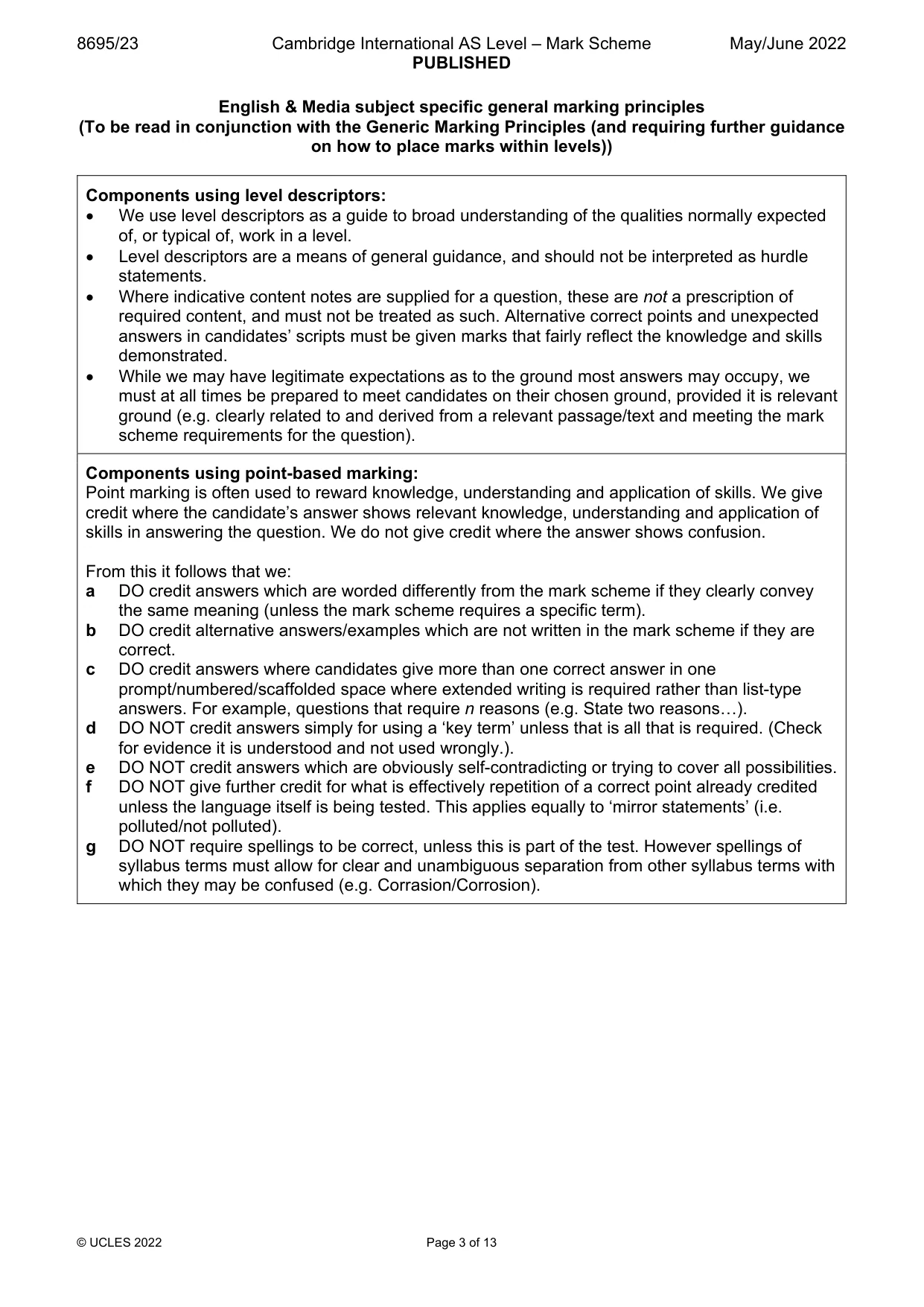
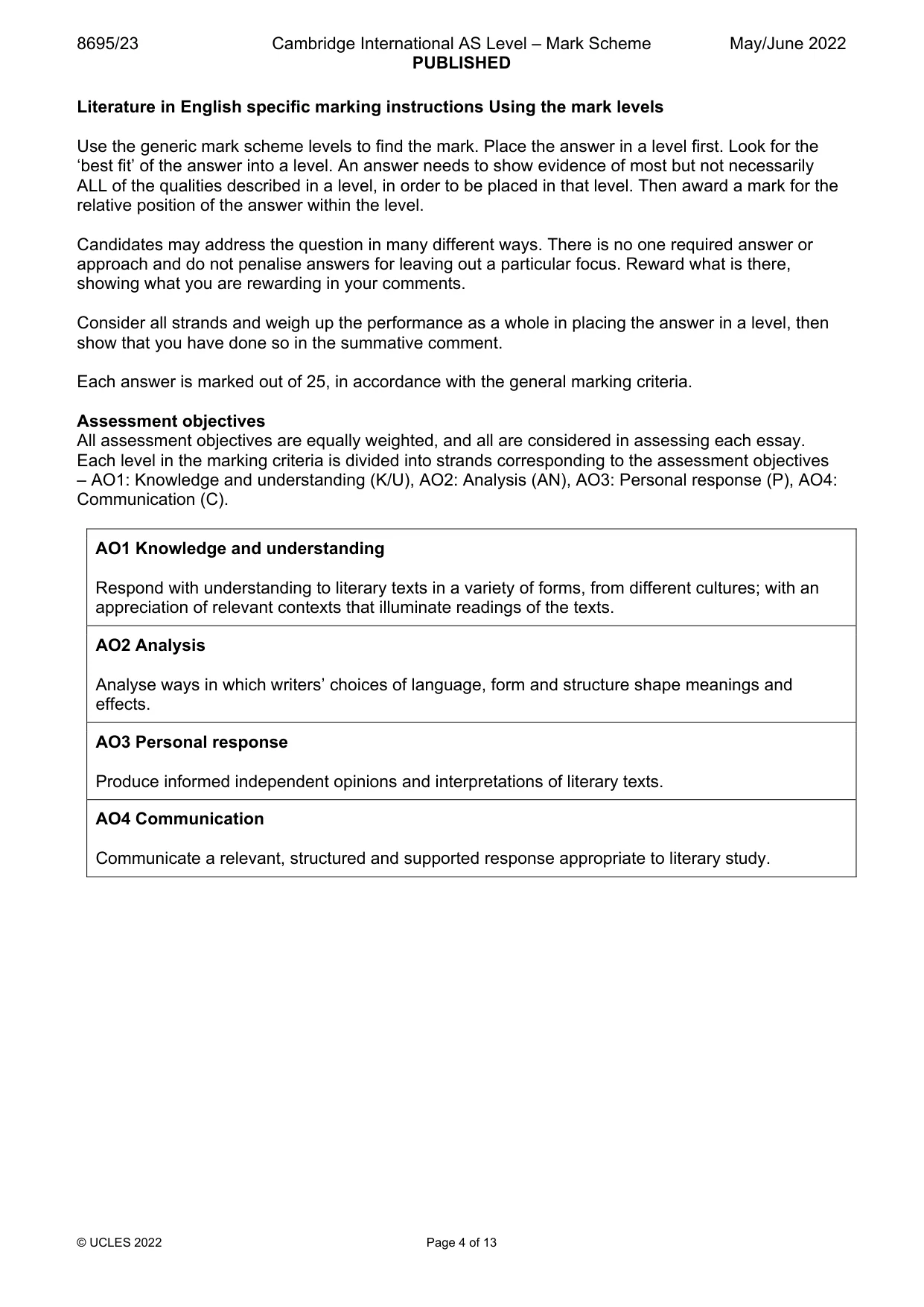
8695/23 Cambridge International AS Level – Mark Scheme PUBLISHED May/June 2022 © UCLES 2022 Page 4 of 13 Literature in English specific marking instructions Using the mark levels Use the generic mark scheme levels to find the mark. Place the answer in a level first. Look for the ‘best fit’ of the answer into a level. An answer needs to show evidence of most but not necessarily ALL of the qualities described in a level, in order to be placed in that level. Then award a mark for the relative position of the answer within the level. Candidates may address the question in many different ways. There is no one required answer or approach and do not penalise answers for leaving out a particular focus. Reward what is there, showing what you are rewarding in your comments. Consider all strands and weigh up the performance as a whole in placing the answer in a level, then show that you have done so in the summative comment. Each answer is marked out of 25, in accordance with the general marking criteria. Assessment objectives All assessment objectives are equally weighted, and all are considered in assessing each essay. Each level in the marking criteria is divided into strands corresponding to the assessment objectives – AO1: Knowledge and understanding (K/U), AO2: Analysis (AN), AO3: Personal response (P), AO4: Communication (C). AO1 Knowledge and understanding Respond with understanding to literary texts in a variety of forms, from different cultures; with an appreciation of relevant contexts that illuminate readings of the texts. AO2 Analysis Analyse ways in which writers’ choices of language, form and structure shape meanings and effects. AO3 Personal response Produce informed independent opinions and interpretations of literary texts. AO4 Communication Communicate a relevant, structured and supported response appropriate to literary study.
Mark scheme, page 5
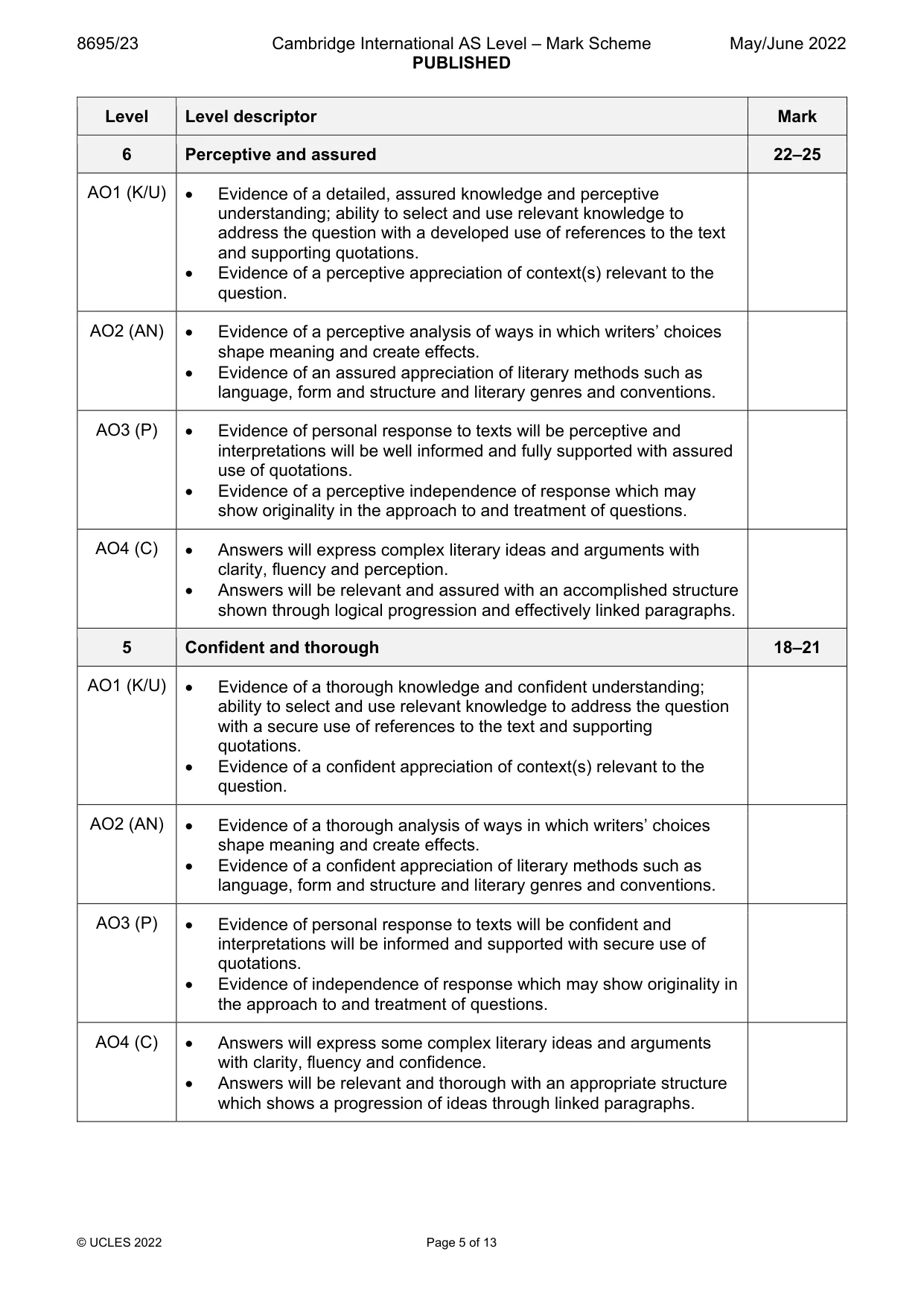
8695/23 Cambridge International AS Level – Mark Scheme PUBLISHED May/June 2022 © UCLES 2022 Page 5 of 13 Level Level descriptor Mark 6 Perceptive and assured 22–25 AO1 (K/U) Evidence of a detailed, assured knowledge and perceptive understanding; ability to select and use relevant knowledge to address the question with a developed use of references to the text and supporting quotations. Evidence of a perceptive appreciation of context(s) relevant to the question. AO2 (AN) Evidence of a perceptive analysis of ways in which writers’ choices shape meaning and create effects. Evidence of an assured appreciation of literary methods such as language, form and structure and literary genres and conventions. AO3 (P) Evidence of personal response to texts will be perceptive and interpretations will be well informed and fully supported with assured use of quotations. Evidence of a perceptive independence of response which may show originality in the approach to and treatment of questions. AO4 (C) Answers will express complex literary ideas and arguments with clarity, fluency and perception. Answers will be relevant and assured with an accomplished structure shown through logical progression and effectively linked paragraphs. 5 Confident and thorough 18–21 AO1 (K/U) Evidence of a thorough knowledge and confident understanding; ability to select and use relevant knowledge to address the question with a secure use of references to the text and supporting quotations. Evidence of a confident appreciation of context(s) relevant to the question. AO2 (AN) Evidence of a thorough analysis of ways in which writers’ choices shape meaning and create effects. Evidence of a confident appreciation of literary methods such as language, form and structure and literary genres and conventions. AO3 (P) Evidence of personal response to texts will be confident and interpretations will be informed and supported with secure use of quotations. Evidence of independence of response which may show originality in the approach to and treatment of questions. AO4 (C) Answers will express some complex literary ideas and arguments with clarity, fluency and confidence. Answers will be relevant and thorough with an appropriate structure which shows a progression of ideas through linked paragraphs.
Mark scheme, page 6
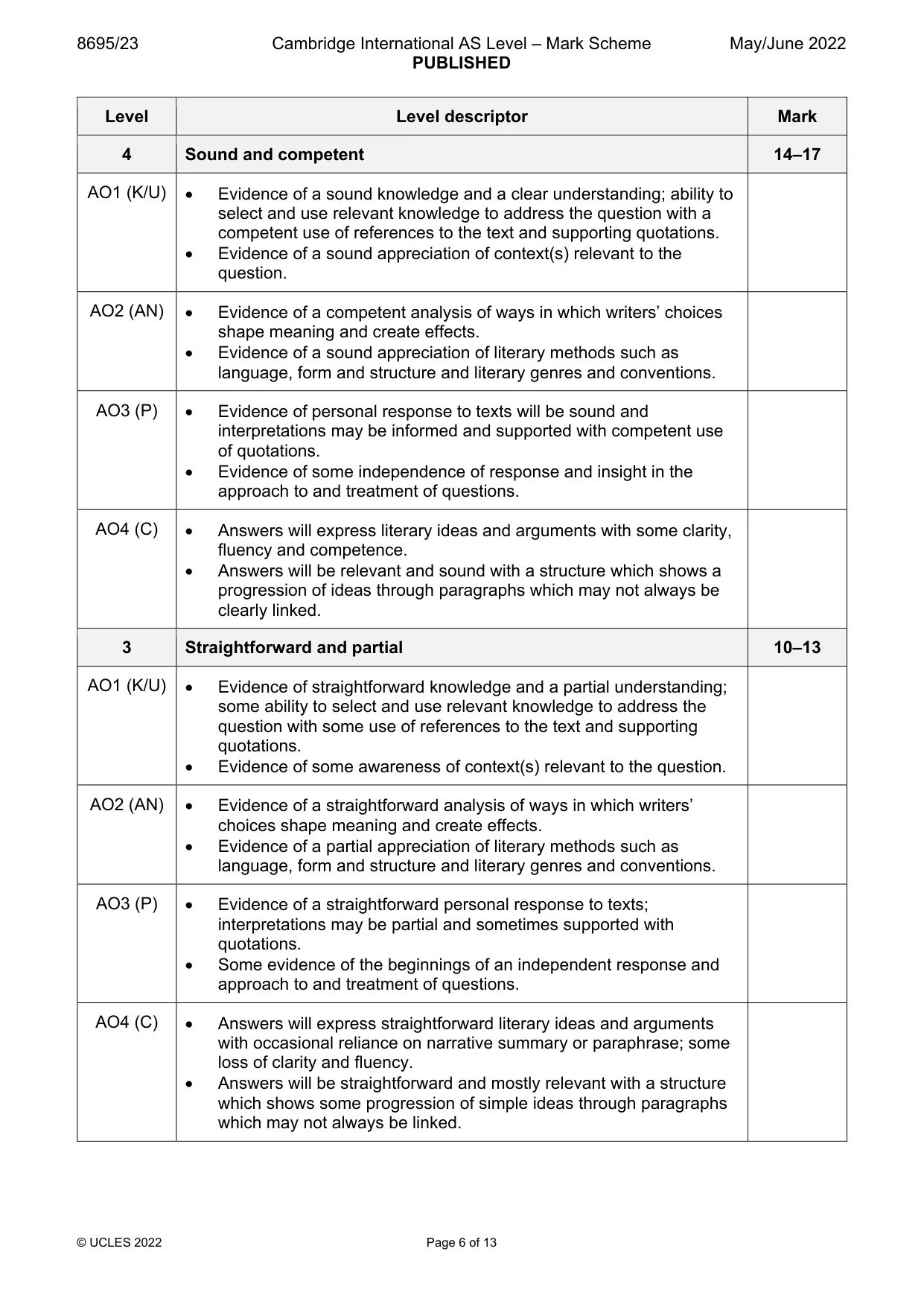
8695/23 Cambridge International AS Level – Mark Scheme PUBLISHED May/June 2022 © UCLES 2022 Page 6 of 13 Level Level descriptor Mark 4 Sound and competent 14–17 AO1 (K/U) Evidence of a sound knowledge and a clear understanding; ability to select and use relevant knowledge to address the question with a competent use of references to the text and supporting quotations. Evidence of a sound appreciation of context(s) relevant to the question. AO2 (AN) Evidence of a competent analysis of ways in which writers’ choices shape meaning and create effects. Evidence of a sound appreciation of literary methods such as language, form and structure and literary genres and conventions. AO3 (P) Evidence of personal response to texts will be sound and interpretations may be informed and supported with competent use of quotations. Evidence of some independence of response and insight in the approach to and treatment of questions. AO4 (C) Answers will express literary ideas and arguments with some clarity, fluency and competence. Answers will be relevant and sound with a structure which shows a progression of ideas through paragraphs which may not always be clearly linked. 3 Straightforward and partial 10–13 AO1 (K/U) Evidence of straightforward knowledge and a partial understanding; some ability to select and use relevant knowledge to address the question with some use of references to the text and supporting quotations. Evidence of some awareness of context(s) relevant to the question. AO2 (AN) Evidence of a straightforward analysis of ways in which writers’ choices shape meaning and create effects. Evidence of a partial appreciation of literary methods such as language, form and structure and literary genres and conventions. AO3 (P) Evidence of a straightforward personal response to texts; interpretations may be partial and sometimes supported with quotations. Some evidence of the beginnings of an independent response and approach to and treatment of questions. AO4 (C) Answers will express straightforward literary ideas and arguments with occasional reliance on narrative summary or paraphrase; some loss of clarity and fluency. Answers will be straightforward and mostly relevant with a structure which shows some progression of simple ideas through paragraphs which may not always be linked.
Mark scheme, page 7
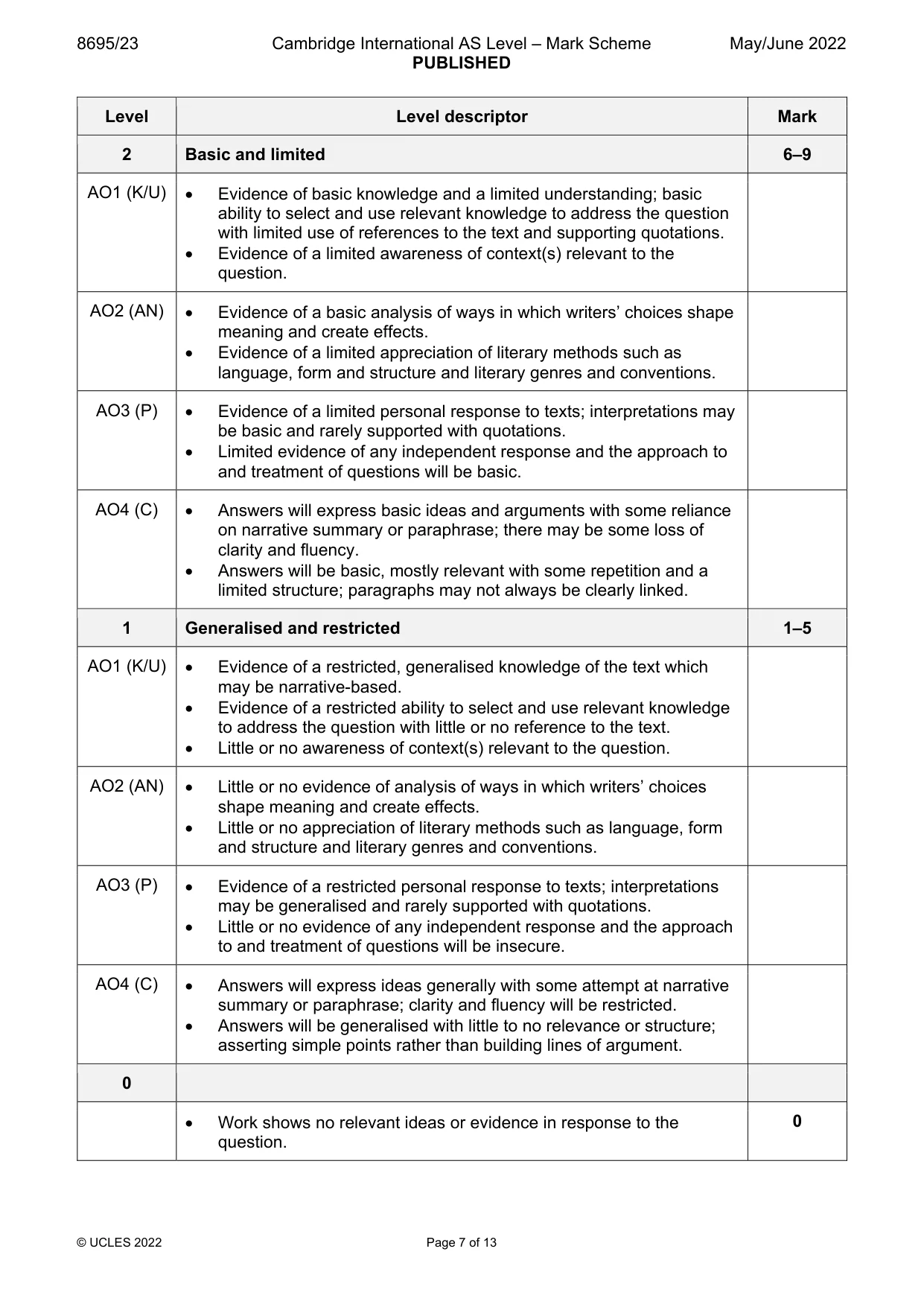
8695/23 Cambridge International AS Level – Mark Scheme PUBLISHED May/June 2022 © UCLES 2022 Page 7 of 13 Level Level descriptor Mark 2 Basic and limited 6–9 AO1 (K/U) Evidence of basic knowledge and a limited understanding; basic ability to select and use relevant knowledge to address the question with limited use of references to the text and supporting quotations. Evidence of a limited awareness of context(s) relevant to the question. AO2 (AN) Evidence of a basic analysis of ways in which writers’ choices shape meaning and create effects. Evidence of a limited appreciation of literary methods such as language, form and structure and literary genres and conventions. AO3 (P) Evidence of a limited personal response to texts; interpretations may be basic and rarely supported with quotations. Limited evidence of any independent response and the approach to and treatment of questions will be basic. AO4 (C) Answers will express basic ideas and arguments with some reliance on narrative summary or paraphrase; there may be some loss of clarity and fluency. Answers will be basic, mostly relevant with some repetition and a limited structure; paragraphs may not always be clearly linked. 1 Generalised and restricted 1–5 AO1 (K/U) Evidence of a restricted, generalised knowledge of the text which may be narrative-based. Evidence of a restricted ability to select and use relevant knowledge to address the question with little or no reference to the text. Little or no awareness of context(s) relevant to the question. AO2 (AN) Little or no evidence of analysis of ways in which writers’ choices shape meaning and create effects. Little or no appreciation of literary methods such as language, form and structure and literary genres and conventions. AO3 (P) Evidence of a restricted personal response to texts; interpretations may be generalised and rarely supported with quotations. Little or no evidence of any independent response and the approach to and treatment of questions will be insecure. AO4 (C) Answers will express ideas generally with some attempt at narrative summary or paraphrase; clarity and fluency will be restricted. Answers will be generalised with little to no relevance or structure; asserting simple points rather than building lines of argument. 0 Work shows no relevant ideas or evidence in response to the question. 0
Mark scheme, page 8
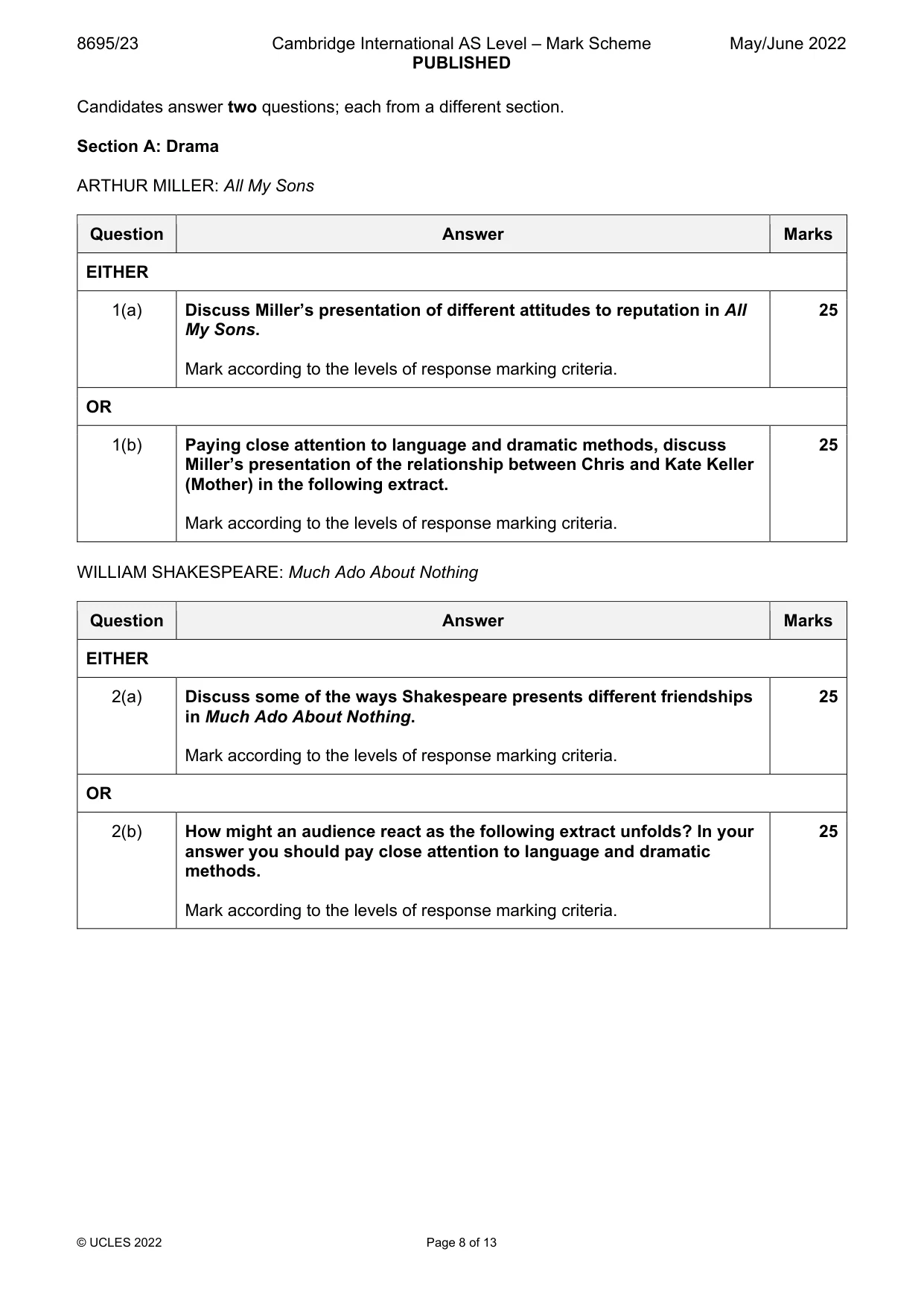
8695/23 Cambridge International AS Level – Mark Scheme PUBLISHED May/June 2022 © UCLES 2022 Page 8 of 13 Candidates answer two questions; each from a different section. Section A: Drama ARTHUR MILLER: All My Sons Question Answer Marks EITHER 1(a) Discuss Miller’s presentation of different attitudes to reputation in All My Sons. Mark according to the levels of response marking criteria. 25 OR 1(b) Paying close attention to language and dramatic methods, discuss Miller’s presentation of the relationship between Chris and Kate Keller (Mother) in the following extract. Mark according to the levels of response marking criteria. 25 WILLIAM SHAKESPEARE: Much Ado About Nothing Question Answer Marks EITHER 2(a) Discuss some of the ways Shakespeare presents different friendships in Much Ado About Nothing. Mark according to the levels of response marking criteria. 25 OR 2(b) How might an audience react as the following extract unfolds? In your answer you should pay close attention to language and dramatic methods. Mark according to the levels of response marking criteria. 25
Mark scheme, page 9
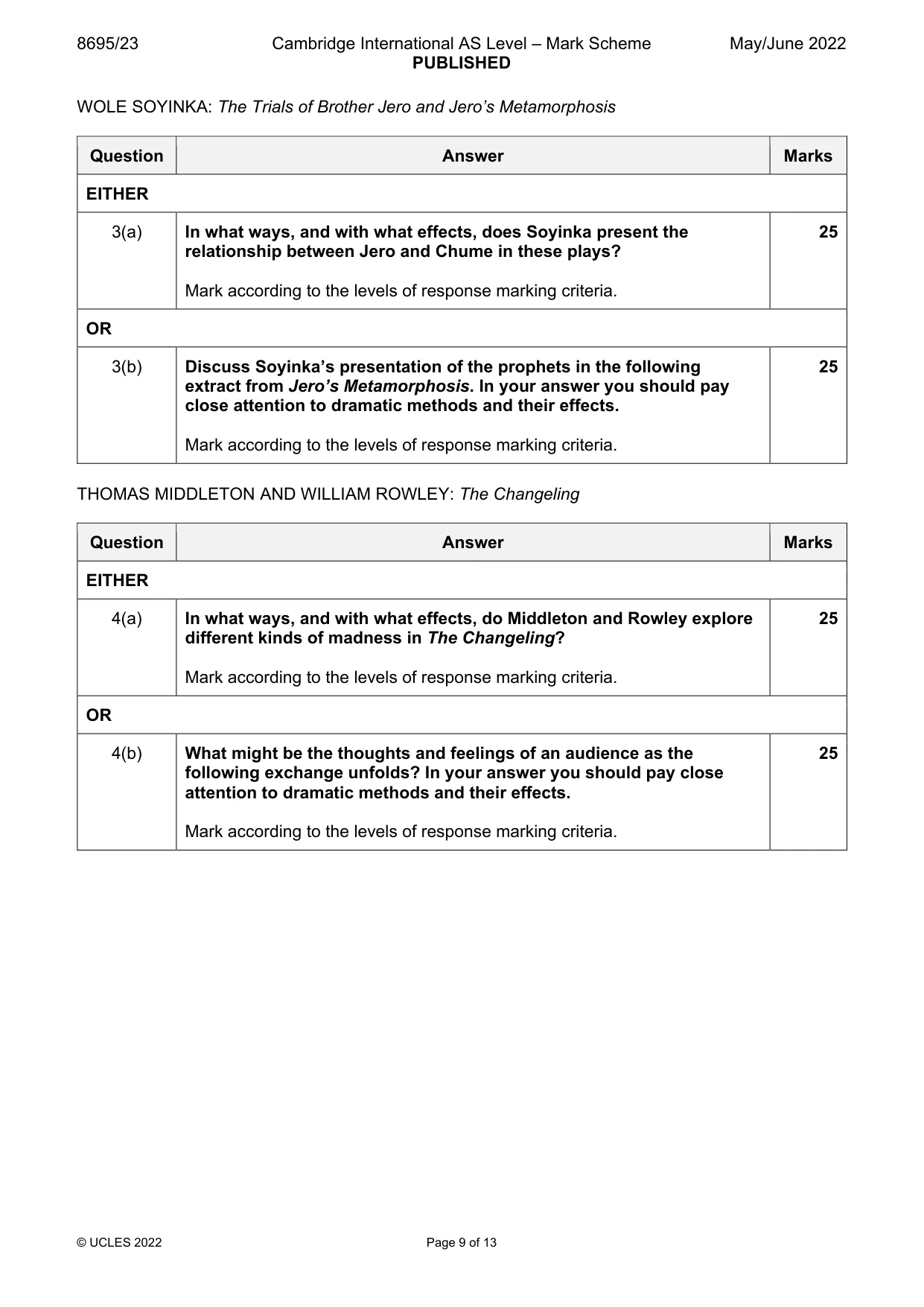
8695/23 Cambridge International AS Level – Mark Scheme PUBLISHED May/June 2022 © UCLES 2022 Page 9 of 13 WOLE SOYINKA: The Trials of Brother Jero and Jero’s Metamorphosis Question Answer Marks EITHER 3(a) In what ways, and with what effects, does Soyinka present the relationship between Jero and Chume in these plays? Mark according to the levels of response marking criteria. 25 OR 3(b) Discuss Soyinka’s presentation of the prophets in the following extract from Jero’s Metamorphosis. In your answer you should pay close attention to dramatic methods and their effects. Mark according to the levels of response marking criteria. 25 THOMAS MIDDLETON AND WILLIAM ROWLEY: The Changeling Question Answer Marks EITHER 4(a) In what ways, and with what effects, do Middleton and Rowley explore different kinds of madness in The Changeling? Mark according to the levels of response marking criteria. 25 OR 4(b) What might be the thoughts and feelings of an audience as the following exchange unfolds? In your answer you should pay close attention to dramatic methods and their effects. Mark according to the levels of response marking criteria. 25
Mark scheme, page 10
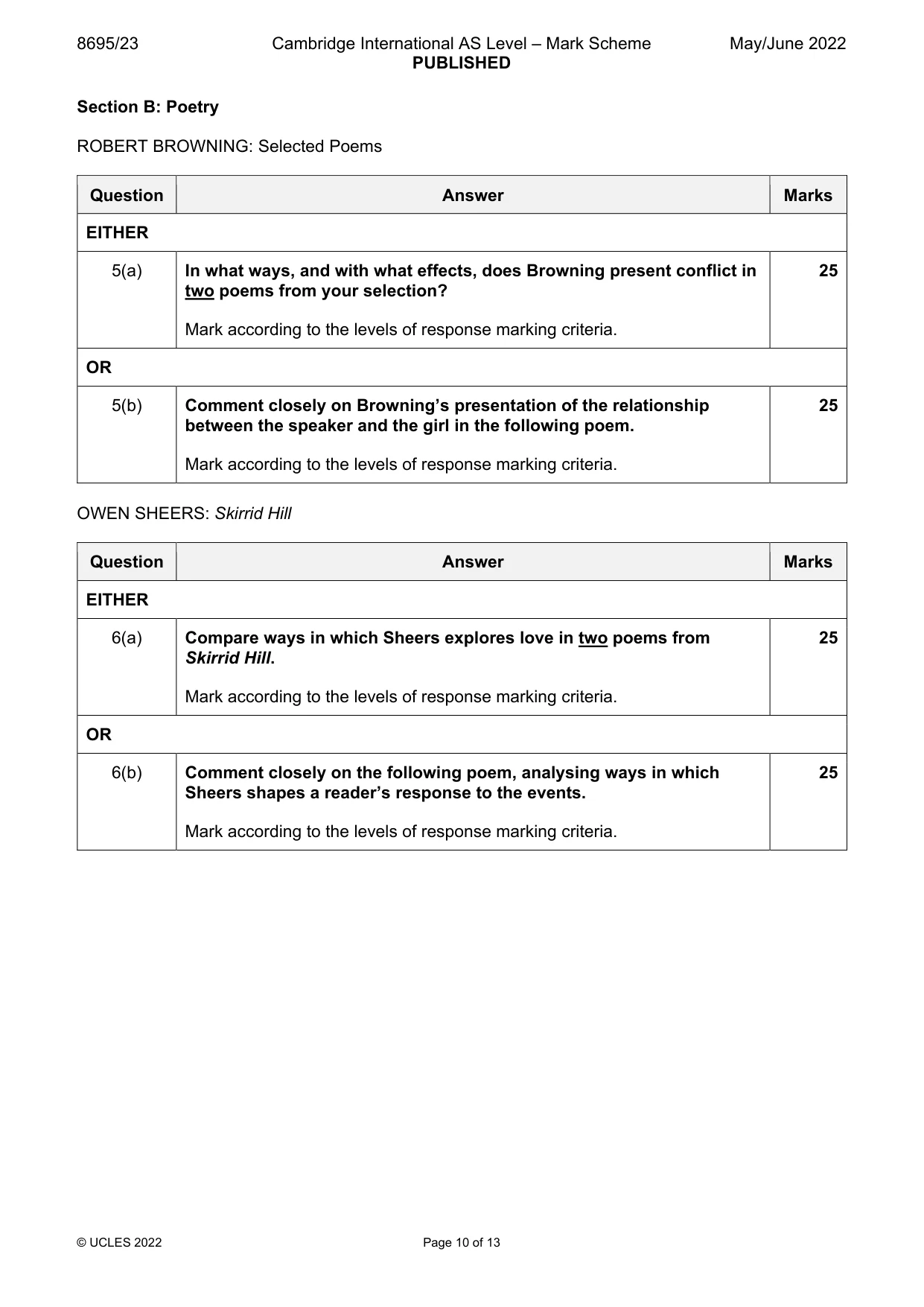
8695/23 Cambridge International AS Level – Mark Scheme PUBLISHED May/June 2022 © UCLES 2022 Page 10 of 13 Section B: Poetry ROBERT BROWNING: Selected Poems Question Answer Marks EITHER 5(a) In what ways, and with what effects, does Browning present conflict in two poems from your selection? Mark according to the levels of response marking criteria. 25 OR 5(b) Comment closely on Browning’s presentation of the relationship between the speaker and the girl in the following poem. Mark according to the levels of response marking criteria. 25 OWEN SHEERS: Skirrid Hill Question Answer Marks EITHER 6(a) Compare ways in which Sheers explores love in two poems from Skirrid Hill. Mark according to the levels of response marking criteria. 25 OR 6(b) Comment closely on the following poem, analysing ways in which Sheers shapes a reader’s response to the events. Mark according to the levels of response marking criteria. 25
Mark scheme, page 11
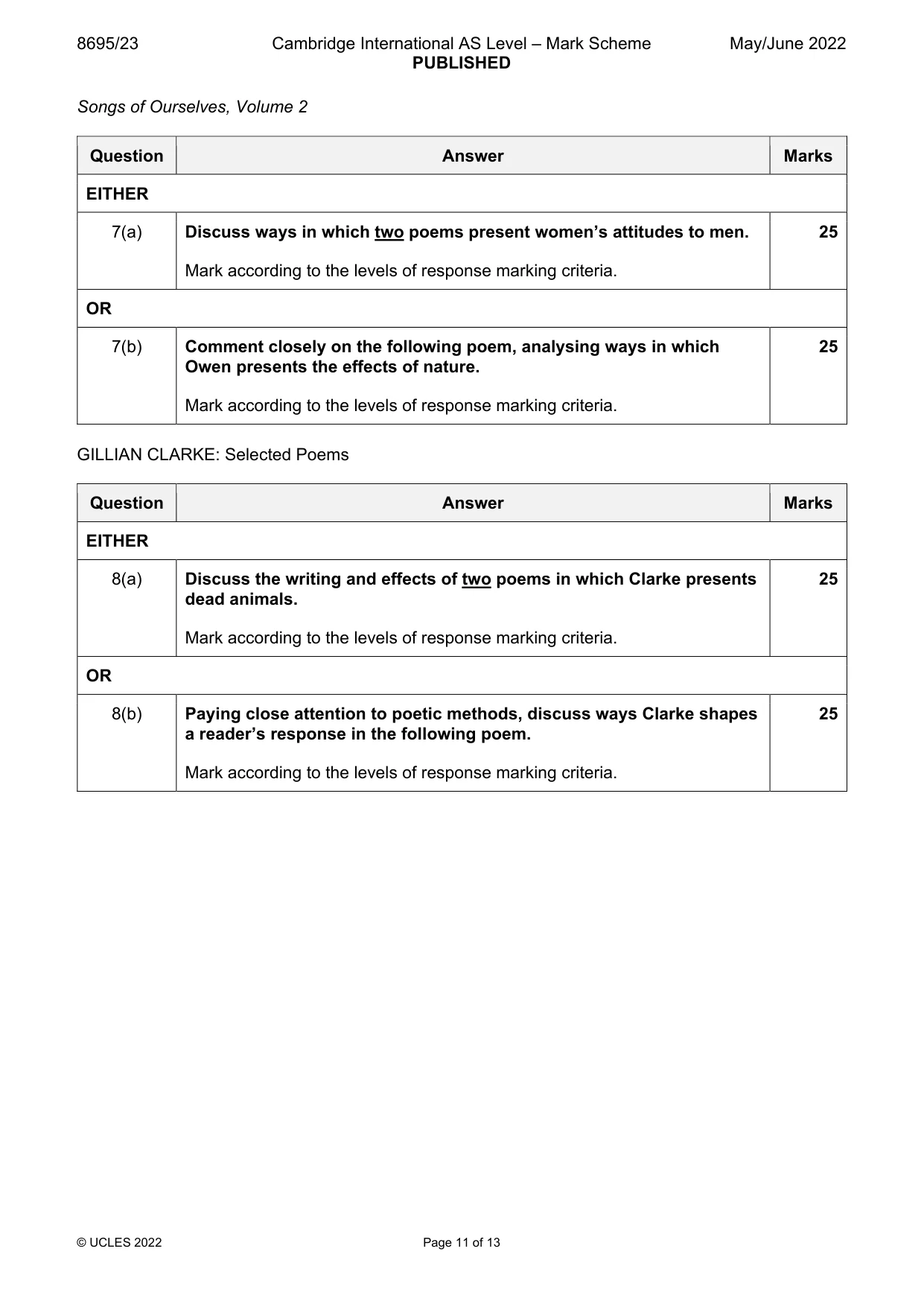
8695/23 Cambridge International AS Level – Mark Scheme PUBLISHED May/June 2022 © UCLES 2022 Page 11 of 13 Songs of Ourselves, Volume 2 Question Answer Marks EITHER 7(a) Discuss ways in which two poems present women’s attitudes to men. Mark according to the levels of response marking criteria. 25 OR 7(b) Comment closely on the following poem, analysing ways in which Owen presents the effects of nature. Mark according to the levels of response marking criteria. 25 GILLIAN CLARKE: Selected Poems Question Answer Marks EITHER 8(a) Discuss the writing and effects of two poems in which Clarke presents dead animals. Mark according to the levels of response marking criteria. 25 OR 8(b) Paying close attention to poetic methods, discuss ways Clarke shapes a reader’s response in the following poem. Mark according to the levels of response marking criteria. 25
Mark scheme, page 12
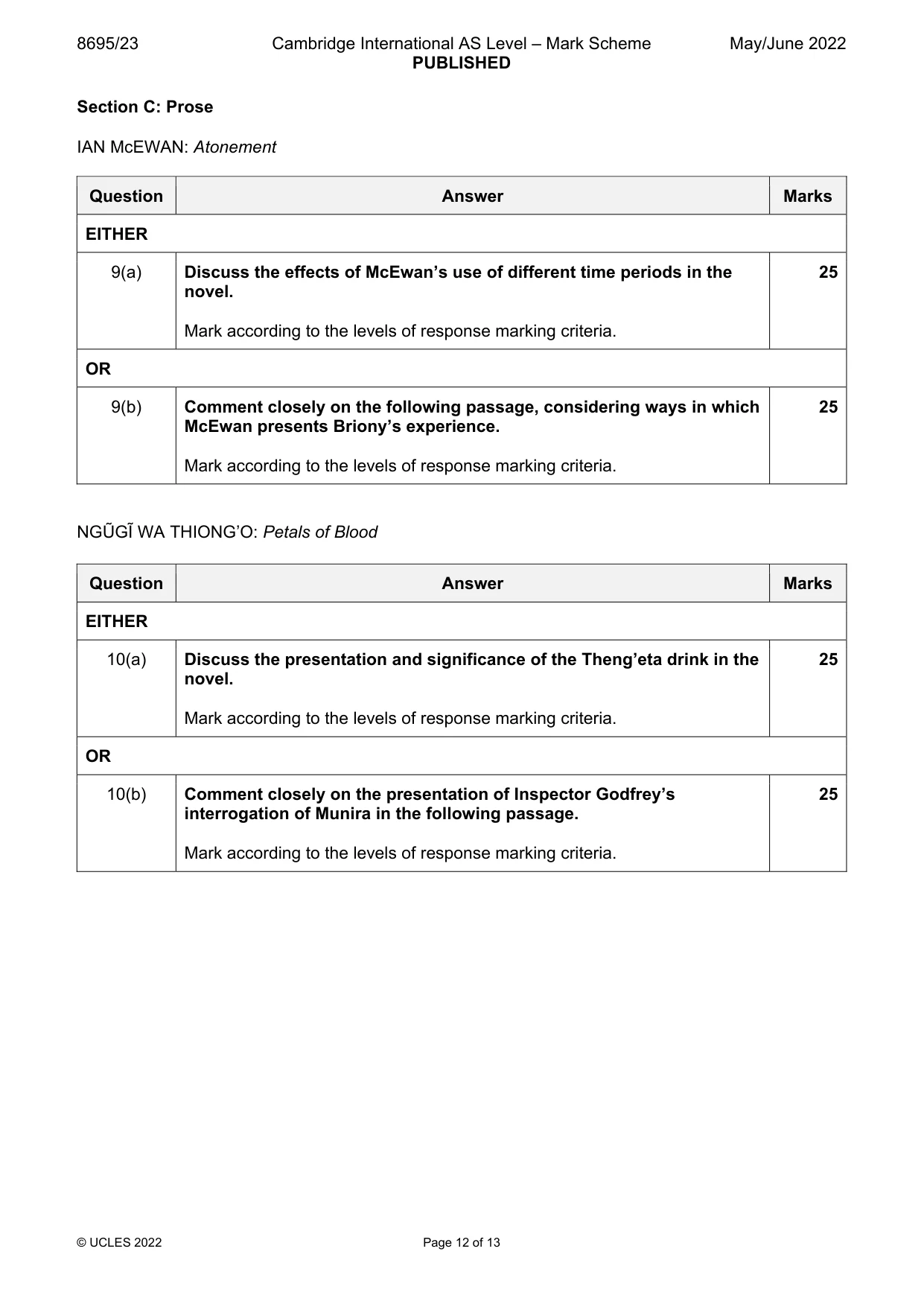
8695/23 Cambridge International AS Level – Mark Scheme PUBLISHED May/June 2022 © UCLES 2022 Page 12 of 13 Section C: Prose IAN McEWAN: Atonement Question Answer Marks EITHER 9(a) Discuss the effects of McEwan’s use of different time periods in the novel. Mark according to the levels of response marking criteria. 25 OR 9(b) Comment closely on the following passage, considering ways in which McEwan presents Briony’s experience. Mark according to the levels of response marking criteria. 25 NGŨGĨ WA THIONG’O: Petals of Blood Question Answer Marks EITHER 10(a) Discuss the presentation and significance of the Theng’eta drink in the novel. Mark according to the levels of response marking criteria. 25 OR 10(b) Comment closely on the presentation of Inspector Godfrey’s interrogation of Munira in the following passage. Mark according to the levels of response marking criteria. 25
Mark scheme, page 13
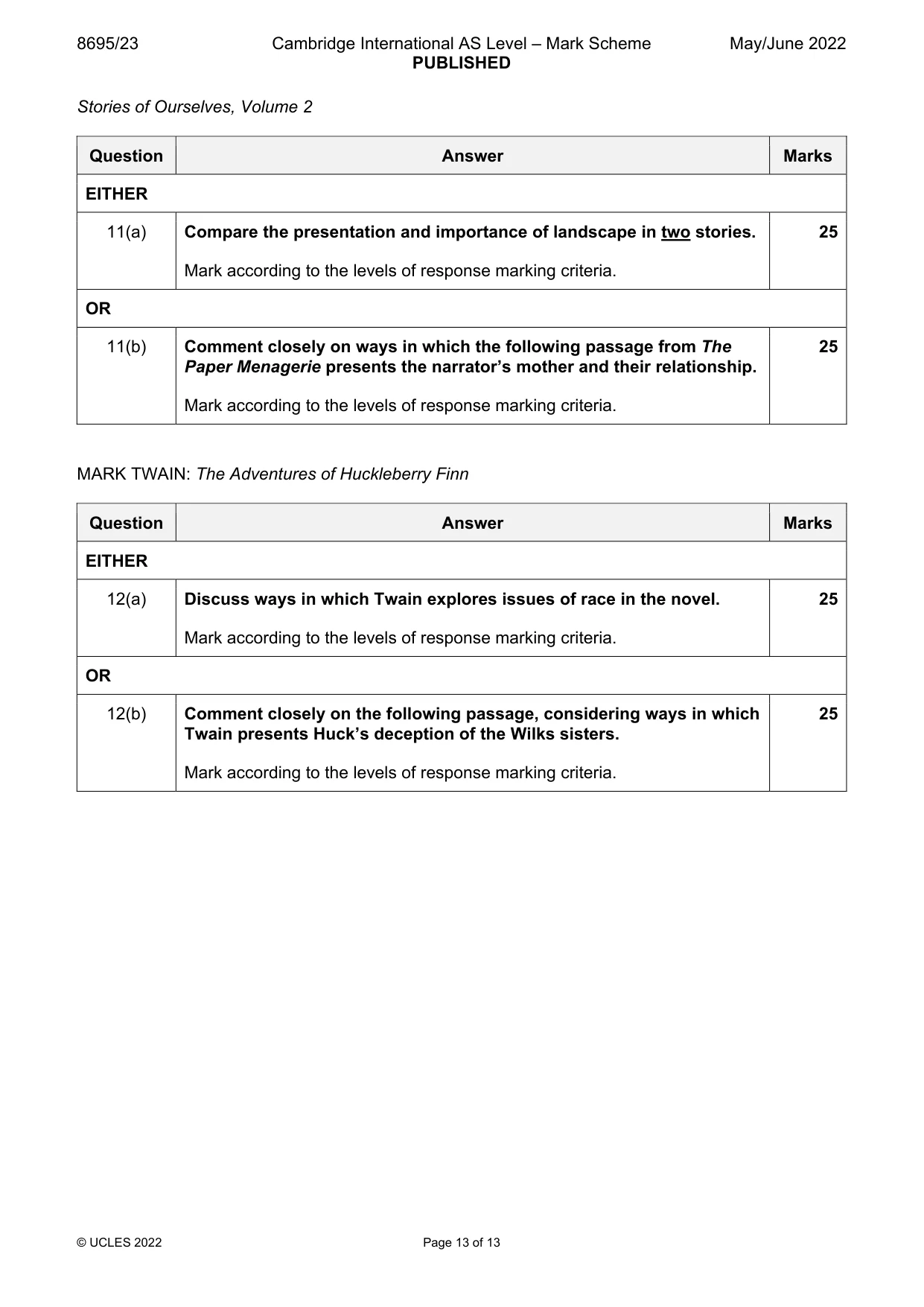
8695/23 Cambridge International AS Level – Mark Scheme PUBLISHED May/June 2022 © UCLES 2022 Page 13 of 13 Stories of Ourselves, Volume 2 Question Answer Marks EITHER 11(a) Compare the presentation and importance of landscape in two stories. Mark according to the levels of response marking criteria. 25 OR 11(b) Comment closely on ways in which the following passage from The Paper Menagerie presents the narrator’s mother and their relationship. Mark according to the levels of response marking criteria. 25 MARK TWAIN: The Adventures of Huckleberry Finn Question Answer Marks EITHER 12(a) Discuss ways in which Twain explores issues of race in the novel. Mark according to the levels of response marking criteria. 25 OR 12(b) Comment closely on the following passage, considering ways in which Twain presents Huck’s deception of the Wilks sisters. Mark according to the levels of response marking criteria. 25
What you needed in this session
Cambridge’s own grade thresholds for 2022 May/June, Paper 2 · Variant 3. A higher threshold means an easier paper — the bar moves with how the cohort did.