Cambridge A Level English - Language and Literature (AS Level only, from 2016) 8695 — 2025 May/June Paper 2 · Variant 2
8695/22/M/J/25 · 50 marks · 120 min
The question paper and its mark scheme, free to read here and free to download. This is Cambridge’s own paper, exactly as it was sat.
Question paper20 pages


Mark scheme14 pages
Answers below. Sit the paper first if you are practising.
Paper as text
Question paper, page 1
This document has 20 pages. Any blank pages are indicated. [Turn over Cambridge International AS Level * 6 4 6 7 0 5 3 9 2 1 * DC (RCL (DF)) 342690/3 © UCLES 2025 LANGUAGE AND LITERATURE IN ENGLISH 8695/22 Paper 2 Drama, Poetry and Prose May/June 2025 2 hours You must answer on the enclosed answer booklet. You will need: Answer booklet (enclosed) INSTRUCTIONS ● Answer two questions in total, each from a different section. ● Follow the instructions on the front cover of the answer booklet. If you need additional answer paper, ask the invigilator for a continuation booklet. ● Dictionaries are not allowed. INFORMATION ● The total mark for this paper is 50. ● The number of marks for each question or part question is shown in brackets [ ].
Question paper, page 2
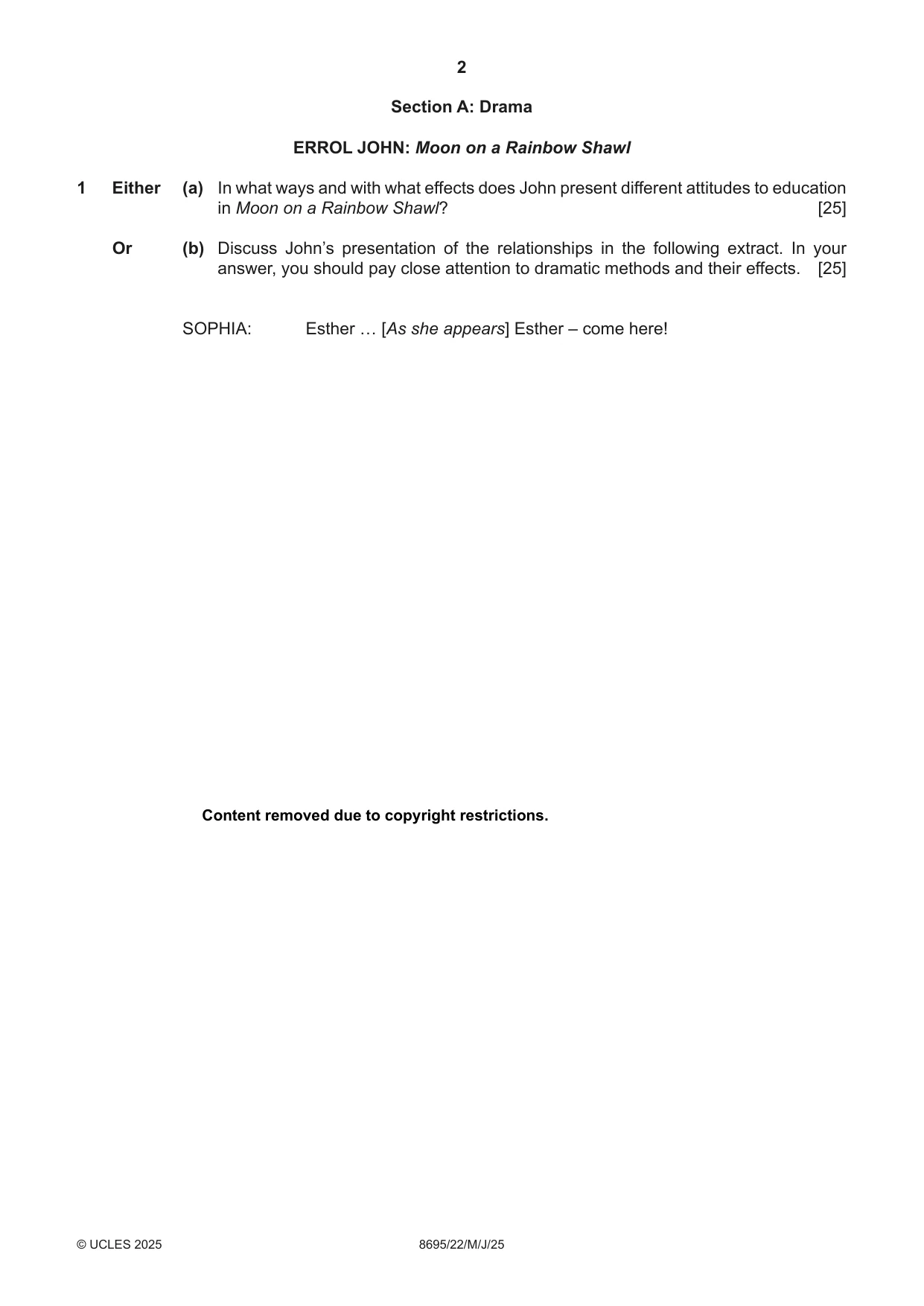
2 8695/22/M/J/25 © UCLES 2025 Section A: Drama ERROL JOHN: Moon on a Rainbow Shawl 1 Either (a) In what ways and with what effects does John present different attitudes to education in Moon on a Rainbow Shawl? [25] Or (b) Discuss John’s presentation of the relationships in the following extract. In your answer, you should pay close attention to dramatic methods and their effects. [25] SOPHIA: Esther … [As she appears] Esther – come here! Content removed due to copyright restrictions.
Question paper, page 3
3 8695/22/M/J/25 © UCLES 2025 [Turn over Then the last wash of rain and a roll of thunder grumbling itself away.] (from Act 3, Scene 1) Content removed due to copyright restrictions.
Question paper, page 4
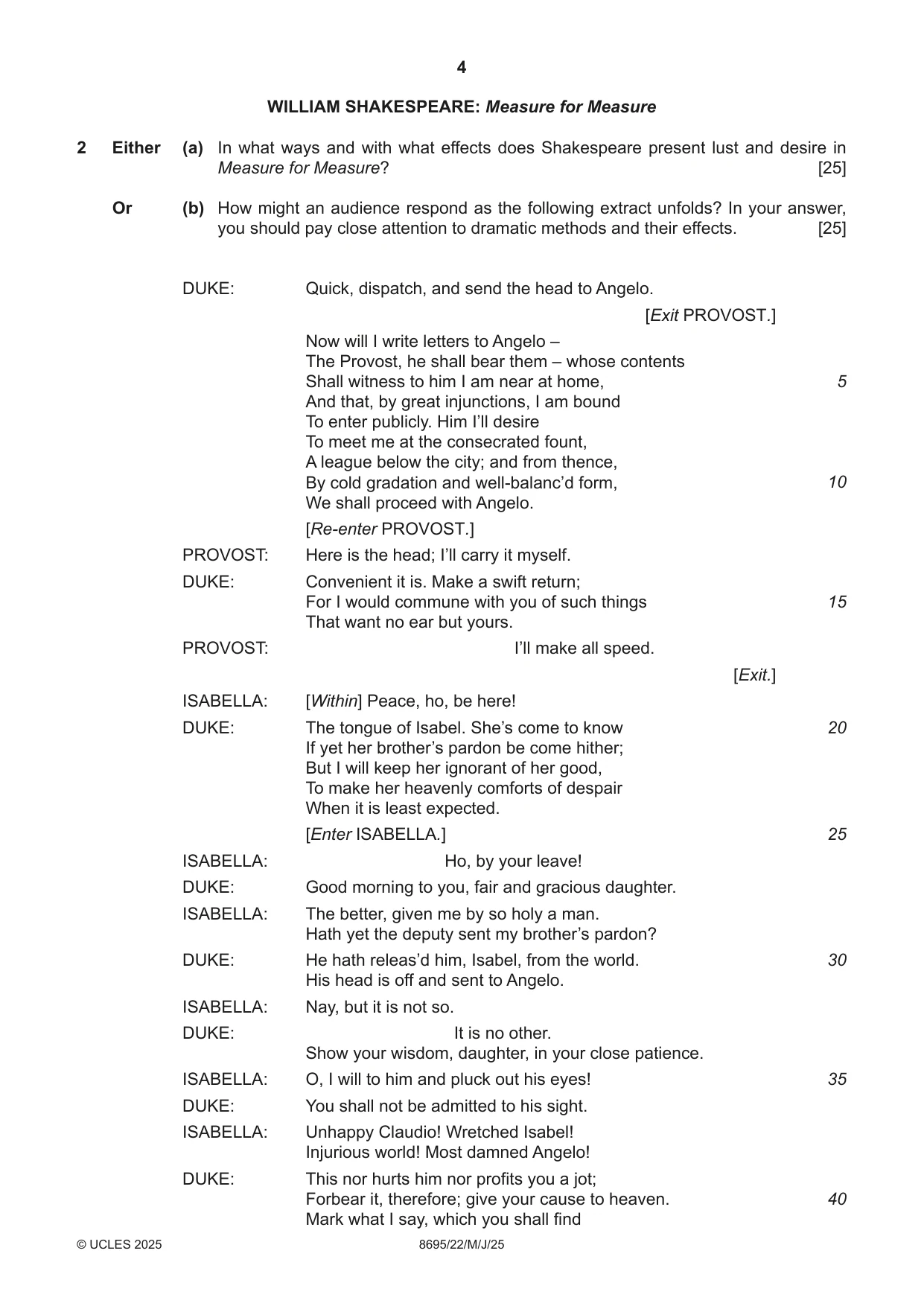
4 8695/22/M/J/25 © UCLES 2025 WILLIAM SHAKESPEARE: Measure for Measure 2 Either (a) In what ways and with what effects does Shakespeare present lust and desire in Measure for Measure? [25] Or (b) How might an audience respond as the following extract unfolds? In your answer, you should pay close attention to dramatic methods and their effects. [25] DUKE: Quick, dispatch, and send the head to Angelo. [Exit PROVOST.] Now will I write letters to Angelo – The Provost, he shall bear them – whose contents Shall witness to him I am near at home, And that, by great injunctions, I am bound To enter publicly. Him I’ll desire To meet me at the consecrated fount, A league below the city; and from thence, By cold gradation and well-balanc’d form, We shall proceed with Angelo. [Re-enter PROVOST.] PROVOST: Here is the head; I’ll carry it myself. DUKE: Convenient it is. Make a swift return; For I would commune with you of such things That want no ear but yours. PROVOST: I’ll make all speed. [Exit.] ISABELLA: [Within] Peace, ho, be here! DUKE: The tongue of Isabel. She’s come to know If yet her brother’s pardon be come hither; But I will keep her ignorant of her good, To make her heavenly comforts of despair When it is least expected. [Enter ISABELLA.] ISABELLA: Ho, by your leave! DUKE: Good morning to you, fair and gracious daughter. ISABELLA: The better, given me by so holy a man. Hath yet the deputy sent my brother’s pardon? DUKE: He hath releas’d him, Isabel, from the world. His head is off and sent to Angelo. ISABELLA: Nay, but it is not so. DUKE: It is no other. Show your wisdom, daughter, in your close patience. ISABELLA: O, I will to him and pluck out his eyes! DUKE: You shall not be admitted to his sight. ISABELLA: Unhappy Claudio! Wretched Isabel! Injurious world! Most damned Angelo! DUKE: This nor hurts him nor profits you a jot; Forbear it, therefore; give your cause to heaven. Mark what I say, which you shall find 5 10 15 20 25 30 35 40
Question paper, page 5
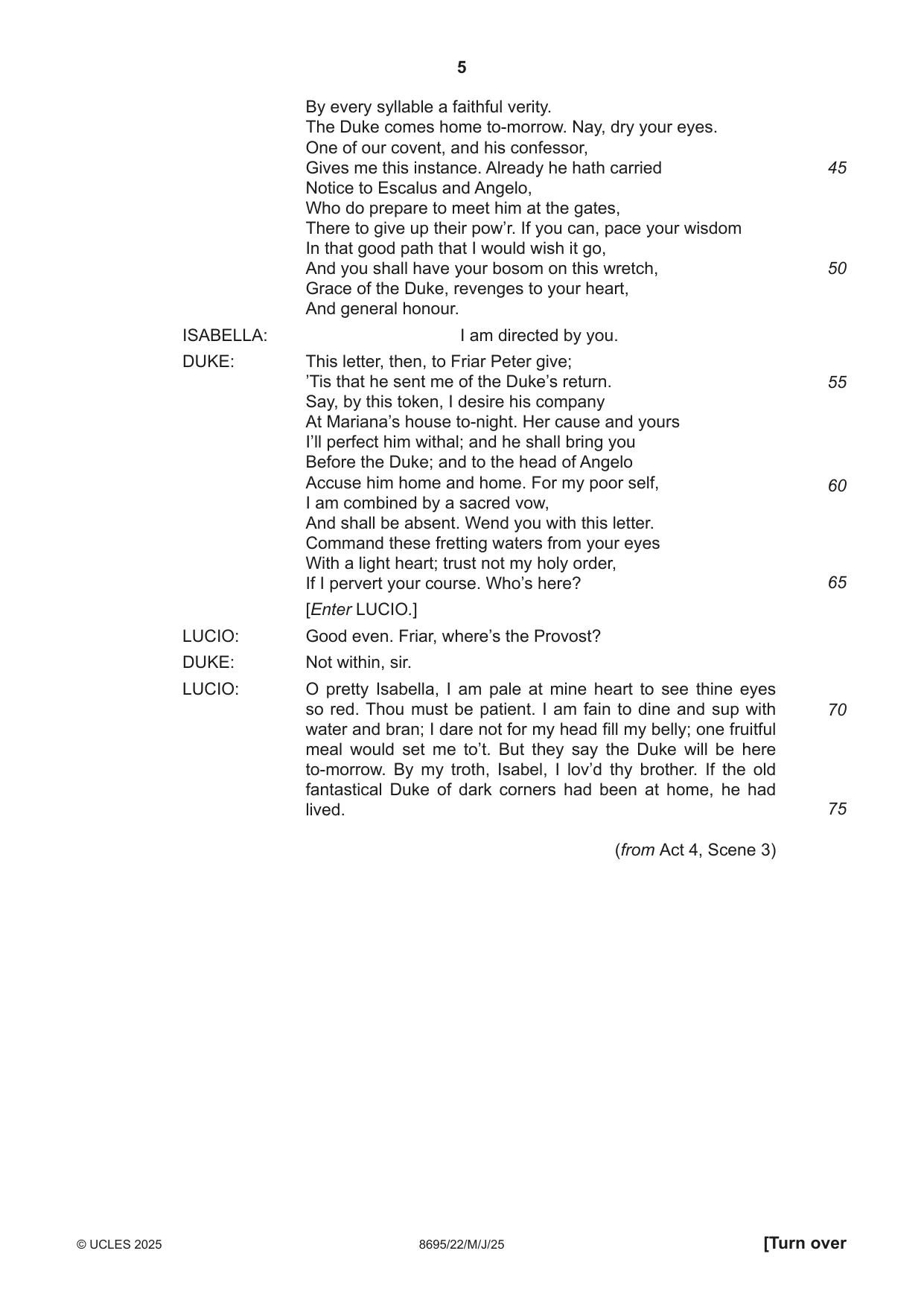
5 8695/22/M/J/25 © UCLES 2025 [Turn over By every syllable a faithful verity. The Duke comes home to-morrow. Nay, dry your eyes. One of our covent, and his confessor, Gives me this instance. Already he hath carried Notice to Escalus and Angelo, Who do prepare to meet him at the gates, There to give up their pow’r. If you can, pace your wisdom In that good path that I would wish it go, And you shall have your bosom on this wretch, Grace of the Duke, revenges to your heart, And general honour. ISABELLA: I am directed by you. DUKE: This letter, then, to Friar Peter give; ’Tis that he sent me of the Duke’s return. Say, by this token, I desire his company At Mariana’s house to-night. Her cause and yours I’ll perfect him withal; and he shall bring you Before the Duke; and to the head of Angelo Accuse him home and home. For my poor self, I am combined by a sacred vow, And shall be absent. Wend you with this letter. Command these fretting waters from your eyes With a light heart; trust not my holy order, If I pervert your course. Who’s here? [Enter LUCIO.] LUCIO: Good even. Friar, where’s the Provost? DUKE: Not within, sir. LUCIO: O pretty Isabella, I am pale at mine heart to see thine eyes so red. Thou must be patient. I am fain to dine and sup with water and bran; I dare not for my head fill my belly; one fruitful meal would set me to’t. But they say the Duke will be here to-morrow. By my troth, Isabel, I lov’d thy brother. If the old fantastical Duke of dark corners had been at home, he had lived. (from Act 4, Scene 3) 45 50 55 60 65 70 75
Question paper, page 6
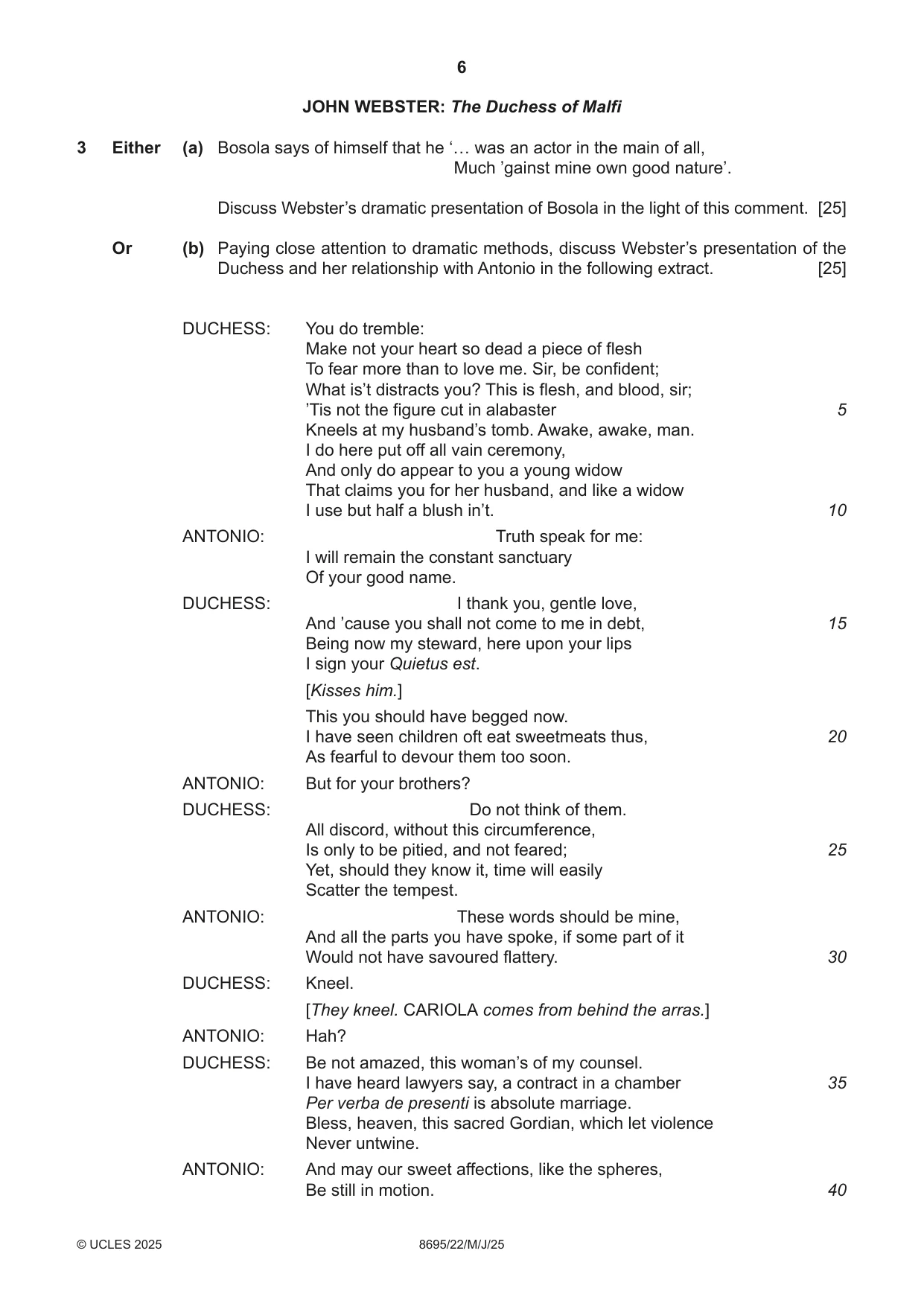
6 8695/22/M/J/25 © UCLES 2025 JOHN WEBSTER: The Duchess of Malfi 3 Either (a) Bosola says of himself that he ‘… was an actor in the main of all, Much ’gainst mine own good nature’. Discuss Webster’s dramatic presentation of Bosola in the light of this comment. [25] Or (b) Paying close attention to dramatic methods, discuss Webster’s presentation of the Duchess and her relationship with Antonio in the following extract. [25] DUCHESS: You do tremble: Make not your heart so dead a piece of flesh To fear more than to love me. Sir, be confident; What is’t distracts you? This is flesh, and blood, sir; ’Tis not the figure cut in alabaster Kneels at my husband’s tomb. Awake, awake, man. I do here put off all vain ceremony, And only do appear to you a young widow That claims you for her husband, and like a widow I use but half a blush in’t. ANTONIO: Truth speak for me: I will remain the constant sanctuary Of your good name. DUCHESS: I thank you, gentle love, And ’cause you shall not come to me in debt, Being now my steward, here upon your lips I sign your Quietus est. [Kisses him.] This you should have begged now. I have seen children oft eat sweetmeats thus, As fearful to devour them too soon. ANTONIO: But for your brothers? DUCHESS: Do not think of them. All discord, without this circumference, Is only to be pitied, and not feared; Yet, should they know it, time will easily Scatter the tempest. ANTONIO: These words should be mine, And all the parts you have spoke, if some part of it Would not have savoured flattery. DUCHESS: Kneel. [They kneel. CARIOLA comes from behind the arras.] ANTONIO: Hah? DUCHESS: Be not amazed, this woman’s of my counsel. I have heard lawyers say, a contract in a chamber Per verba de presenti is absolute marriage. Bless, heaven, this sacred Gordian, which let violence Never untwine. ANTONIO: And may our sweet affections, like the spheres, Be still in motion. 5 10 15 20 25 30 35 40
Question paper, page 7
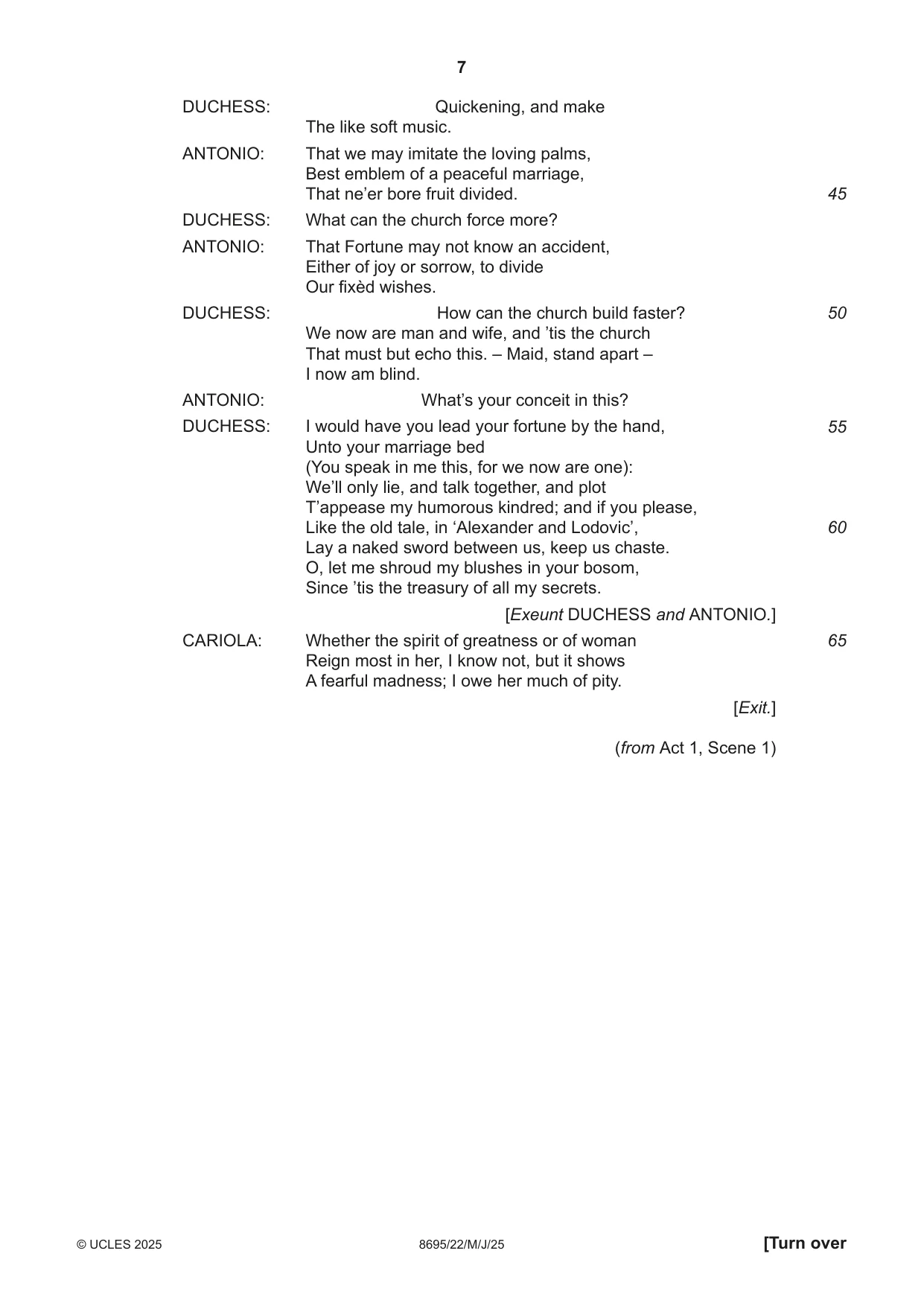
7 8695/22/M/J/25 © UCLES 2025 [Turn over DUCHESS: Quickening, and make The like soft music. ANTONIO: That we may imitate the loving palms, Best emblem of a peaceful marriage, That ne’er bore fruit divided. DUCHESS: What can the church force more? ANTONIO: That Fortune may not know an accident, Either of joy or sorrow, to divide Our fixèd wishes. DUCHESS: How can the church build faster? We now are man and wife, and ’tis the church That must but echo this. – Maid, stand apart – I now am blind. ANTONIO: What’s your conceit in this? DUCHESS: I would have you lead your fortune by the hand, Unto your marriage bed (You speak in me this, for we now are one): We’ll only lie, and talk together, and plot T’appease my humorous kindred; and if you please, Like the old tale, in ‘Alexander and Lodovic’, Lay a naked sword between us, keep us chaste. O, let me shroud my blushes in your bosom, Since ’tis the treasury of all my secrets. [Exeunt DUCHESS and ANTONIO.] CARIOLA: Whether the spirit of greatness or of woman Reign most in her, I know not, but it shows A fearful madness; I owe her much of pity. [Exit.] (from Act 1, Scene 1) 45 50 55 60 65
Question paper, page 8
8 8695/22/M/J/25 © UCLES 2025 TENNESSEE WILLIAMS: Cat on a Hot Tin Roof 4 Either (a) Discuss some of the effects of keeping secrets in Cat on a Hot Tin Roof. In your answer, you should pay close attention to Williams’s dramatic methods. [25] Or (b) Comment closely on Williams’s presentation of the family party in the following extract from the play. [25] BIG DADDY: [Uttering a loud barking laugh which is far from truly mirthful] Hey, Preach! Content removed due to copyright restrictions.
Question paper, page 9
9 8695/22/M/J/25 © UCLES 2025 [Turn over BIG DADDY has been regarding her with a steady grimace of chronic annoyance.] (from Act 2) Content removed due to copyright restrictions.
Question paper, page 10
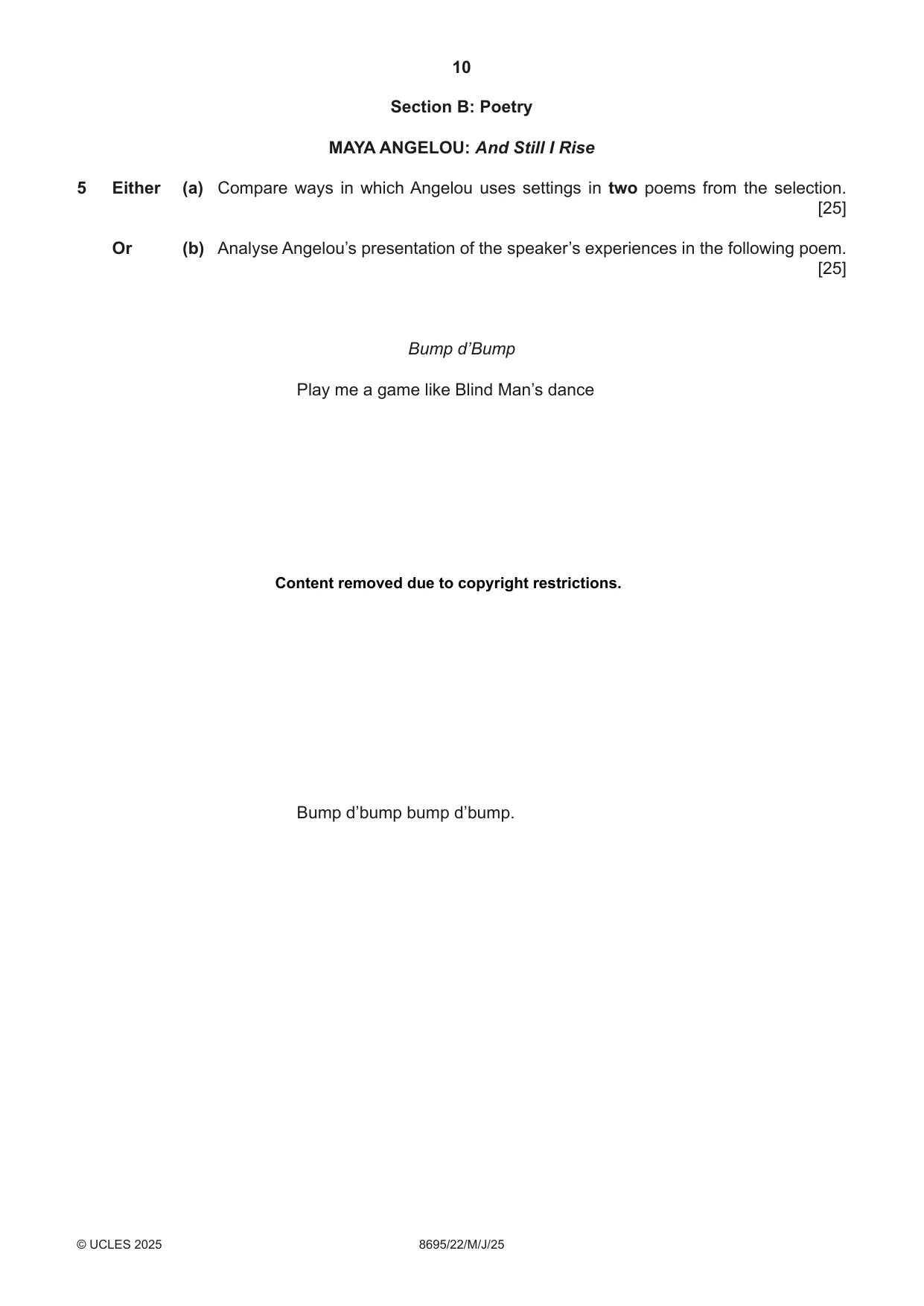
10 8695/22/M/J/25 © UCLES 2025 Section B: Poetry MAYA ANGELOU: And Still I Rise 5 Either (a) Compare ways in which Angelou uses settings in two poems from the selection. [25] Or (b) Analyse Angelou’s presentation of the speaker’s experiences in the following poem. [25] Bump d’Bump Play me a game like Blind Man’s dance Bump d’bump bump d’bump. Content removed due to copyright restrictions.
Question paper, page 11
11 8695/22/M/J/25 © UCLES 2025 [Turn over SIMON ARMITAGE: Sir Gawain and the Green Knight 6 Either (a) In what ways and with what effects does Armitage present different kinds of journey in Sir Gawain and the Green Knight? [25] Or (b) Comment closely on Armitage’s presentation of the women in the following extract. [25] Once dinner was done Gawain drew to his feet at her whose hand she held. Content removed due to copyright restrictions.
Question paper, page 12
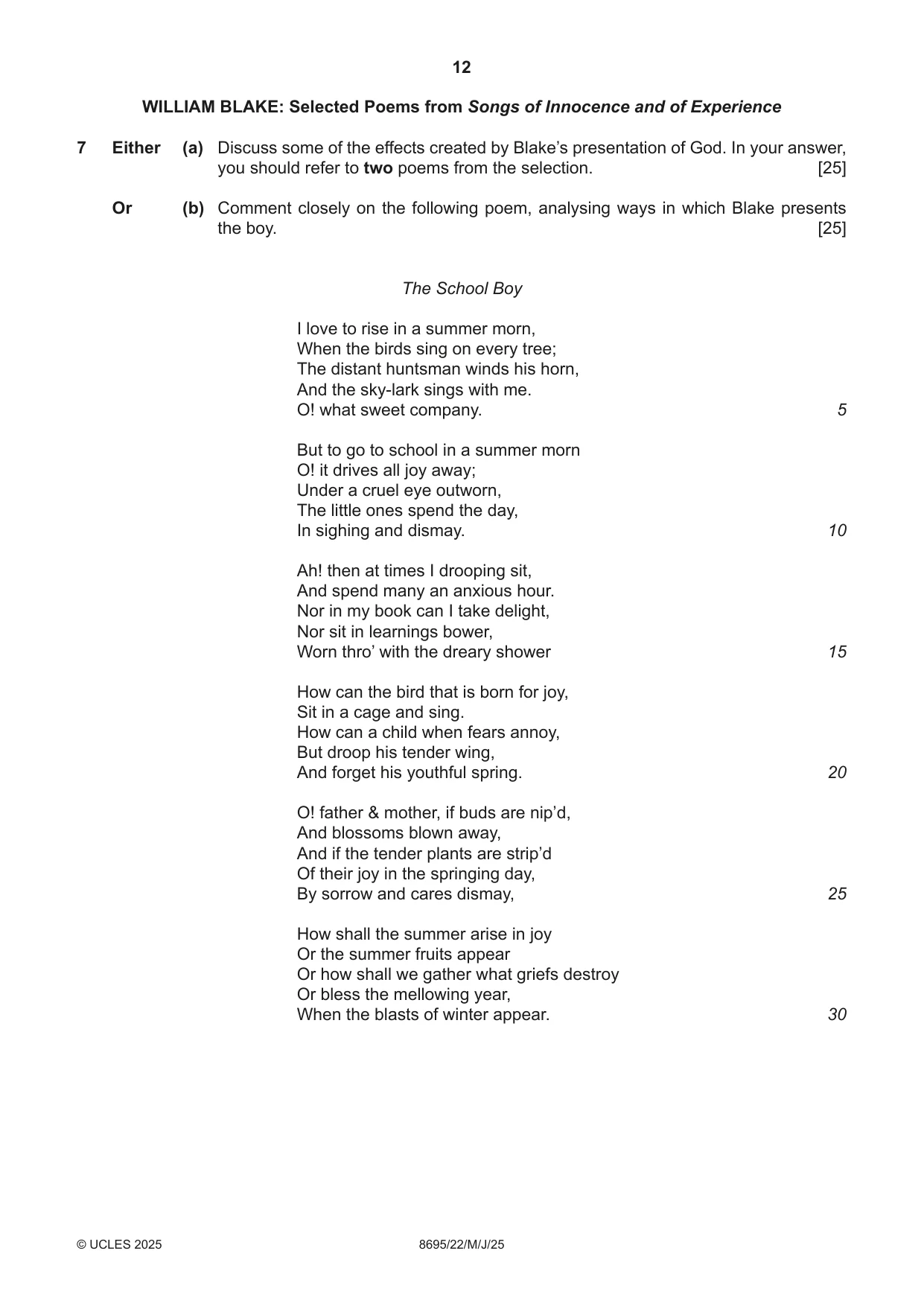
12 8695/22/M/J/25 © UCLES 2025 WILLIAM BLAKE: Selected Poems from Songs of Innocence and of Experience 7 Either (a) Discuss some of the effects created by Blake’s presentation of God. In your answer, you should refer to two poems from the selection. [25] Or (b) Comment closely on the following poem, analysing ways in which Blake presents the boy. [25] The School Boy I love to rise in a summer morn, When the birds sing on every tree; The distant huntsman winds his horn, And the sky-lark sings with me. O! what sweet company. But to go to school in a summer morn O! it drives all joy away; Under a cruel eye outworn, The little ones spend the day, In sighing and dismay. Ah! then at times I drooping sit, And spend many an anxious hour. Nor in my book can I take delight, Nor sit in learnings bower, Worn thro’ with the dreary shower How can the bird that is born for joy, Sit in a cage and sing. How can a child when fears annoy, But droop his tender wing, And forget his youthful spring. O! father & mother, if buds are nip’d, And blossoms blown away, And if the tender plants are strip’d Of their joy in the springing day, By sorrow and cares dismay, How shall the summer arise in joy Or the summer fruits appear Or how shall we gather what griefs destroy Or bless the mellowing year, When the blasts of winter appear. 5 10 15 20 25 30
Question paper, page 13
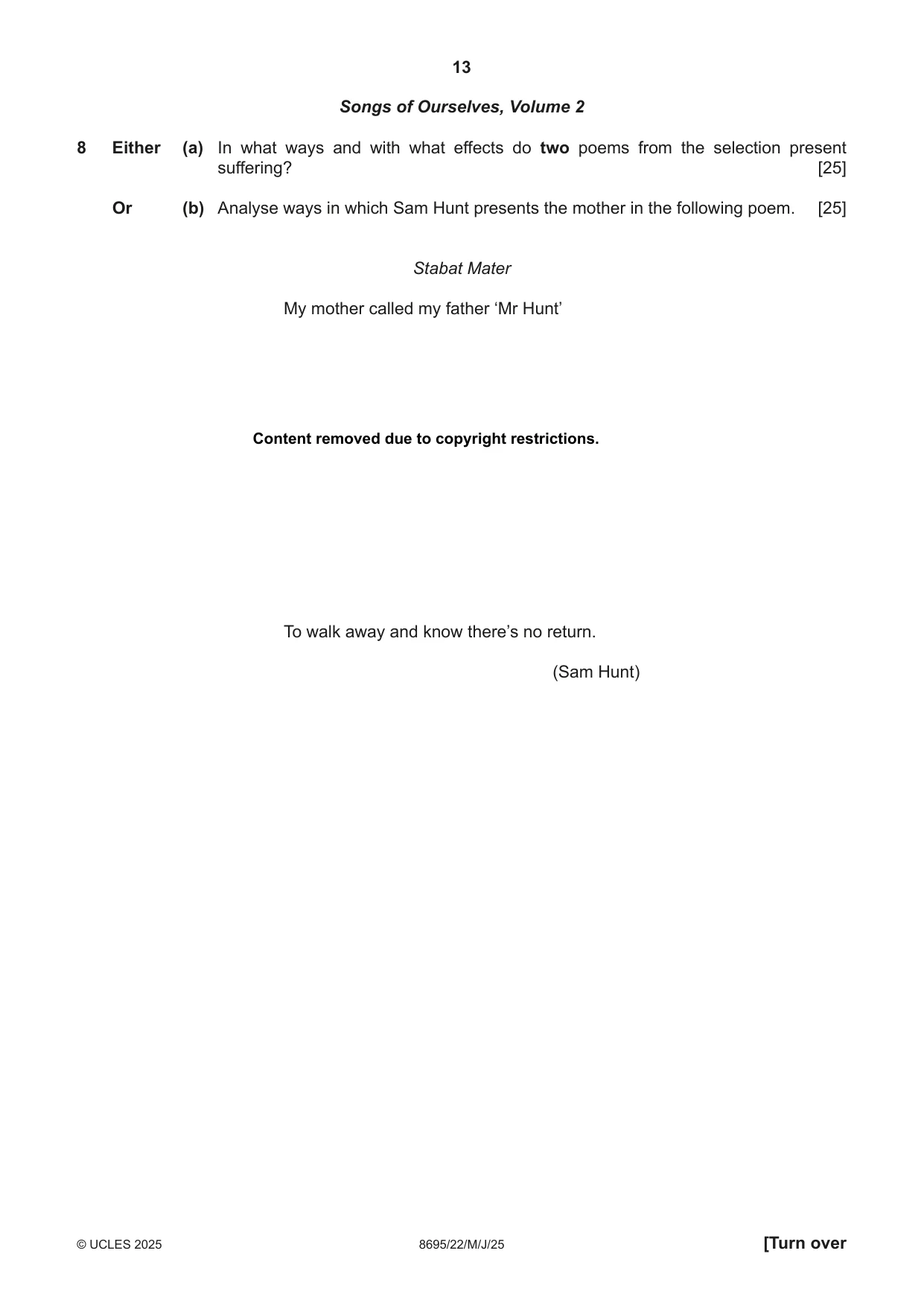
13 8695/22/M/J/25 © UCLES 2025 [Turn over Songs of Ourselves, Volume 2 8 Either (a) In what ways and with what effects do two poems from the selection present suffering? [25] Or (b) Analyse ways in which Sam Hunt presents the mother in the following poem. [25] Stabat Mater My mother called my father ‘Mr Hunt’ To walk away and know there’s no return. (Sam Hunt) Content removed due to copyright restrictions.
Question paper, page 14
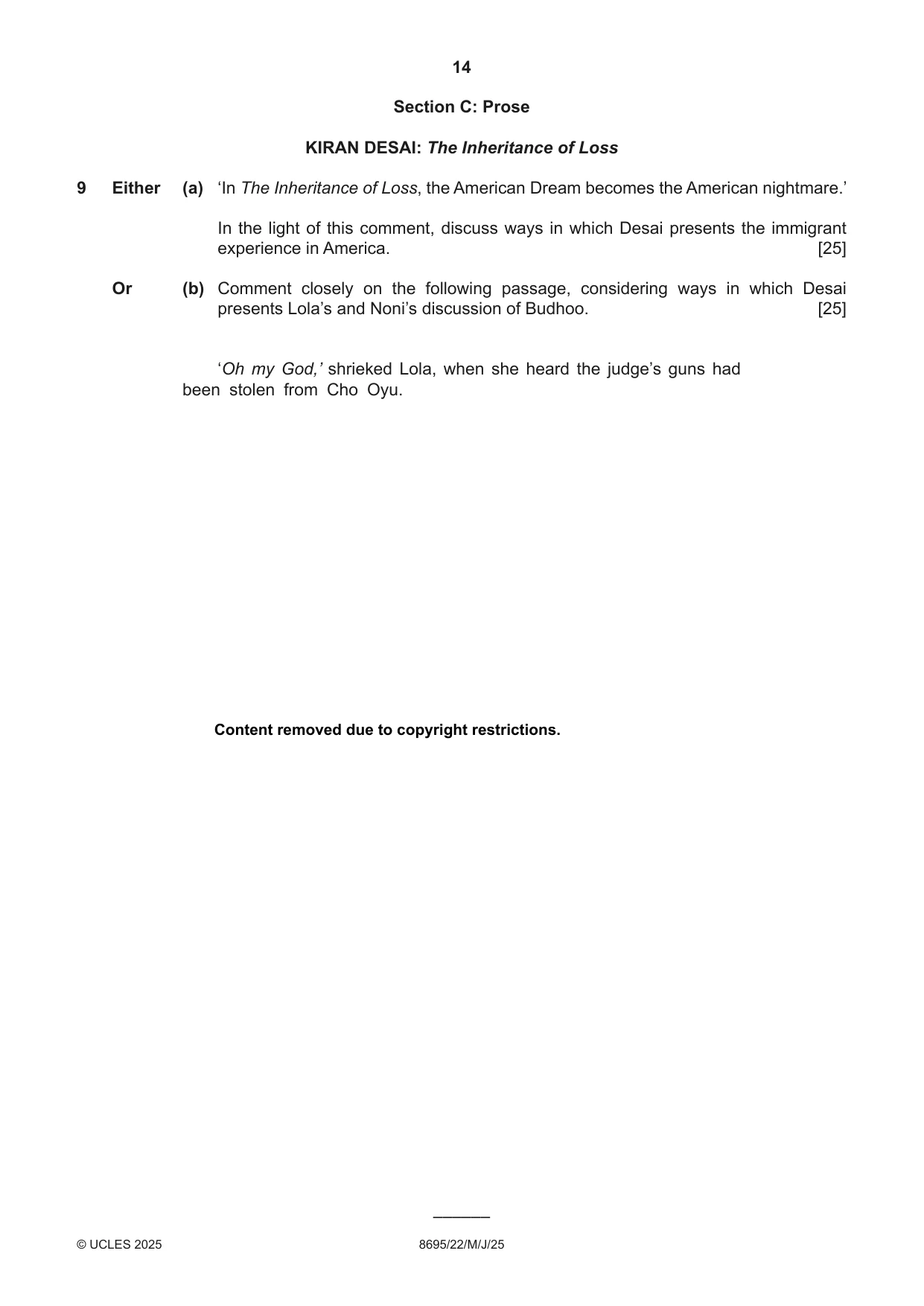
14 8695/22/M/J/25 © UCLES 2025 Section C: Prose KIRAN DESAI: The Inheritance of Loss 9 Either (a) ‘In The Inheritance of Loss, the American Dream becomes the American nightmare.’ In the light of this comment, discuss ways in which Desai presents the immigrant experience in America. [25] Or (b) Comment closely on the following passage, considering ways in which Desai presents Lola’s and Noni’s discussion of Budhoo. [25] ‘Oh my God,’ shrieked Lola, when she heard the judge’s guns had been stolen from Cho Oyu. –––––– Content removed due to copyright restrictions.
Question paper, page 15
15 8695/22/M/J/25 © UCLES 2025 [Turn over ‘Budhoo?’ the sisters would call from inside, sitting up in their beds, wrapped in Kulu shawls, sipping Sikkimese brandy, BBC news sputtering on the radio, falling over them in sparky explosions. (from Chapter 9) Content removed due to copyright restrictions.
Question paper, page 16
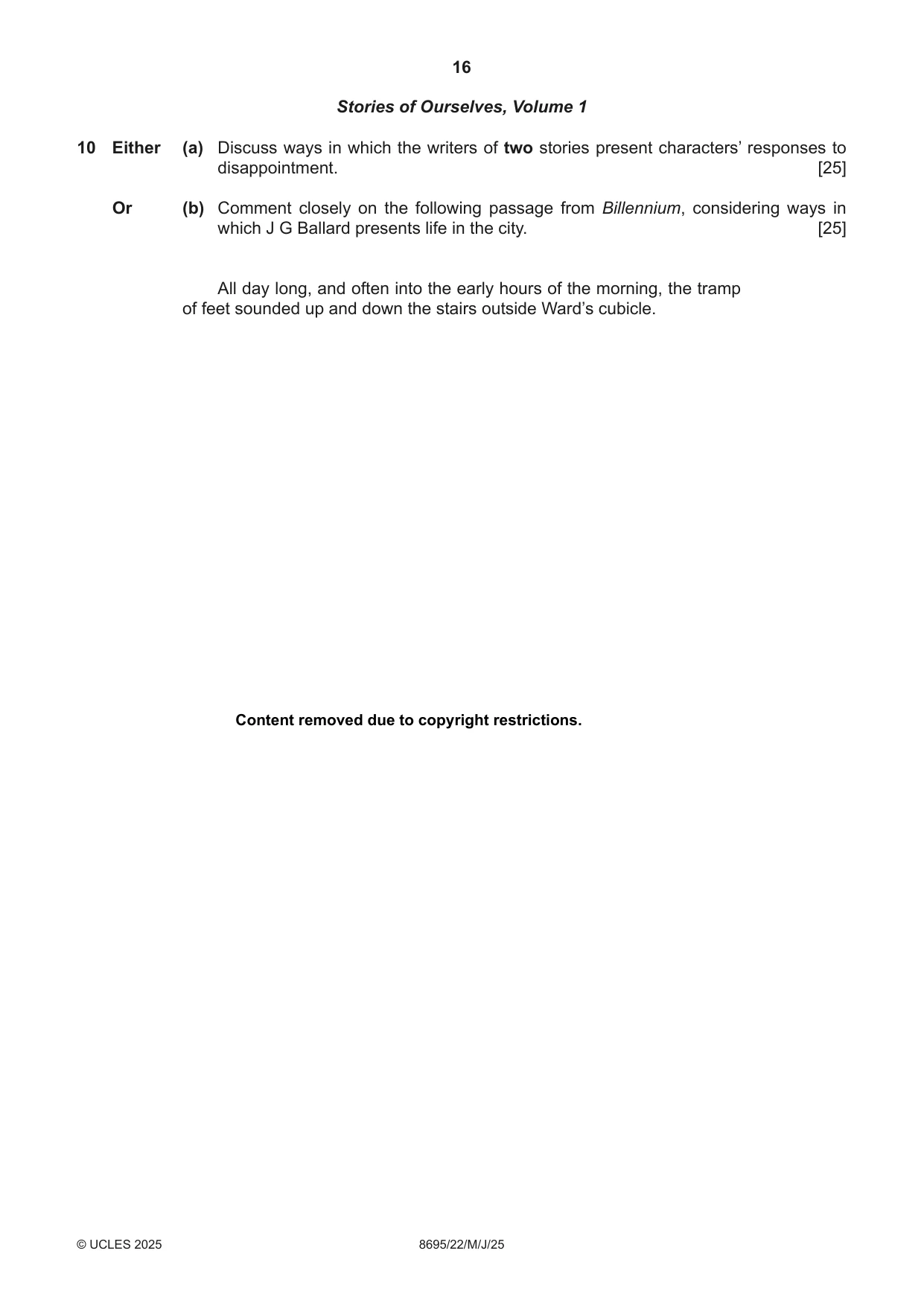
16 8695/22/M/J/25 © UCLES 2025 Stories of Ourselves, Volume 1 10 Either (a) Discuss ways in which the writers of two stories present characters’ responses to disappointment. [25] Or (b) Comment closely on the following passage from Billennium, considering ways in which J G Ballard presents life in the city. [25] All day long, and often into the early hours of the morning, the tramp of feet sounded up and down the stairs outside Ward’s cubicle. Content removed due to copyright restrictions.
Question paper, page 17
17 8695/22/M/J/25 © UCLES 2025 [Turn over The great banqueting room in the former City Hall had been split horizontally into four decks, each of these cut up into hundreds of cubicles. (from Billennium) Content removed due to copyright restrictions.
Question paper, page 18
18 8695/22/M/J/25 © UCLES 2025 EVELYN WAUGH: A Handful of Dust 11 Either (a) Discuss Waugh’s presentation of John Andrew, the son of Tony and Brenda, and the role he plays in the novel. [25] Or (b) Comment closely on the following passage, considering ways in which Waugh presents Tony’s relationship with the detectives. [25] Tony went down to the bar where he was pleased to find the two detectives. They’re mostly glad when Monday comes.’ (from English Gothic – 2, Part 2) Content removed due to copyright restrictions.
Question paper, page 19
19 8695/22/M/J/25 © UCLES 2025 COLSON WHITEHEAD: The Underground Railroad 12 Either (a) Discuss Whitehead’s presentation of Ethel and her role in the North Carolina section of novel. [25] Or (b) Comment closely on the following passage, considering ways in which Whitehead presents Cora’s attitude to Ajarry’s plot of land. [25] White men squabbled before judges over claims to this or that tract hundreds of miles away that had been carved up on a map. She handled them with good nature. (from Georgia) Content removed due copyright restrictions.
Question paper, page 20
20 8695/22/M/J/25 © UCLES 2025 Permission to reproduce items where third-party owned material protected by copyright is included has been sought and cleared where possible. Every reasonable effort has been made by the publisher (UCLES) to trace copyright holders, but if any items requiring clearance have unwittingly been included, the publisher will be pleased to make amends at the earliest possible opportunity. To avoid the issue of disclosure of answer-related information to candidates, all copyright acknowledgements are reproduced online in the Cambridge Assessment International Education Copyright Acknowledgements Booklet. This is produced for each series of examinations and is freely available to download at www.cambridgeinternational.org after the live examination series. Cambridge Assessment International Education is part of Cambridge Assessment. Cambridge Assessment is the brand name of the University of Cambridge Local Examinations Syndicate (UCLES), which is a department of the University of Cambridge. BLANK PAGE
Mark scheme, page 1
This document consists of 14 printed pages. © Cambridge University Press & Assessment 2025 [Turn over Cambridge International AS Level LANGUAGE AND LITERATURE IN ENGLISH 8695/22 Paper 2 Drama, Poetry and Prose May/June 2025 MARK SCHEME Maximum Mark: 50 Published This mark scheme is published as an aid to teachers and candidates, to indicate the requirements of the examination. It shows the basis on which Examiners were instructed to award marks. It does not indicate the details of the discussions that took place at an Examiners’ meeting before marking began, which would have considered the acceptability of alternative answers. Mark schemes should be read in conjunction with the question paper and the Principal Examiner Report for Teachers. Cambridge International will not enter into discussions about these mark schemes. Cambridge International is publishing the mark schemes for the May/June 2025 series for most Cambridge IGCSE, Cambridge International A and AS Level components, and some Cambridge O Level components.
Mark scheme, page 2
8695/22 Cambridge International AS Level – Mark Scheme PUBLISHED May/June 2025 © Cambridge University Press & Assessment 2025 Page 2 of 14 Generic Marking Principles These general marking principles must be applied by all examiners when marking candidate answers. They should be applied alongside the specific content of the mark scheme or generic level descriptions for a question. Each question paper and mark scheme will also comply with these marking principles. GENERIC MARKING PRINCIPLE 1: Marks must be awarded in line with: • the specific content of the mark scheme or the generic level descriptors for the question • the specific skills defined in the mark scheme or in the generic level descriptors for the question • the standard of response required by a candidate as exemplified by the standardisation scripts. GENERIC MARKING PRINCIPLE 2: Marks awarded are always whole marks (not half marks, or other fractions). GENERIC MARKING PRINCIPLE 3: Marks must be awarded positively: • marks are awarded for correct/valid answers, as defined in the mark scheme. However, credit is given for valid answers which go beyond the scope of the syllabus and mark scheme, referring to your Team Leader as appropriate • marks are awarded when candidates clearly demonstrate what they know and can do • marks are not deducted for errors • marks are not deducted for omissions • answers should only be judged on the quality of spelling, punctuation and grammar when these features are specifically assessed by the question as indicated by the mark scheme. The meaning, however, should be unambiguous. GENERIC MARKING PRINCIPLE 4: Rules must be applied consistently, e.g. in situations where candidates have not followed instructions or in the application of generic level descriptors. GENERIC MARKING PRINCIPLE 5: Marks should be awarded using the full range of marks defined in the mark scheme for the question (however; the use of the full mark range may be limited according to the quality of the candidate responses seen). GENERIC MARKING PRINCIPLE 6: Marks awarded are based solely on the requirements as defined in the mark scheme. Marks should not be awarded with grade thresholds or grade descriptors in mind.
Mark scheme, page 3
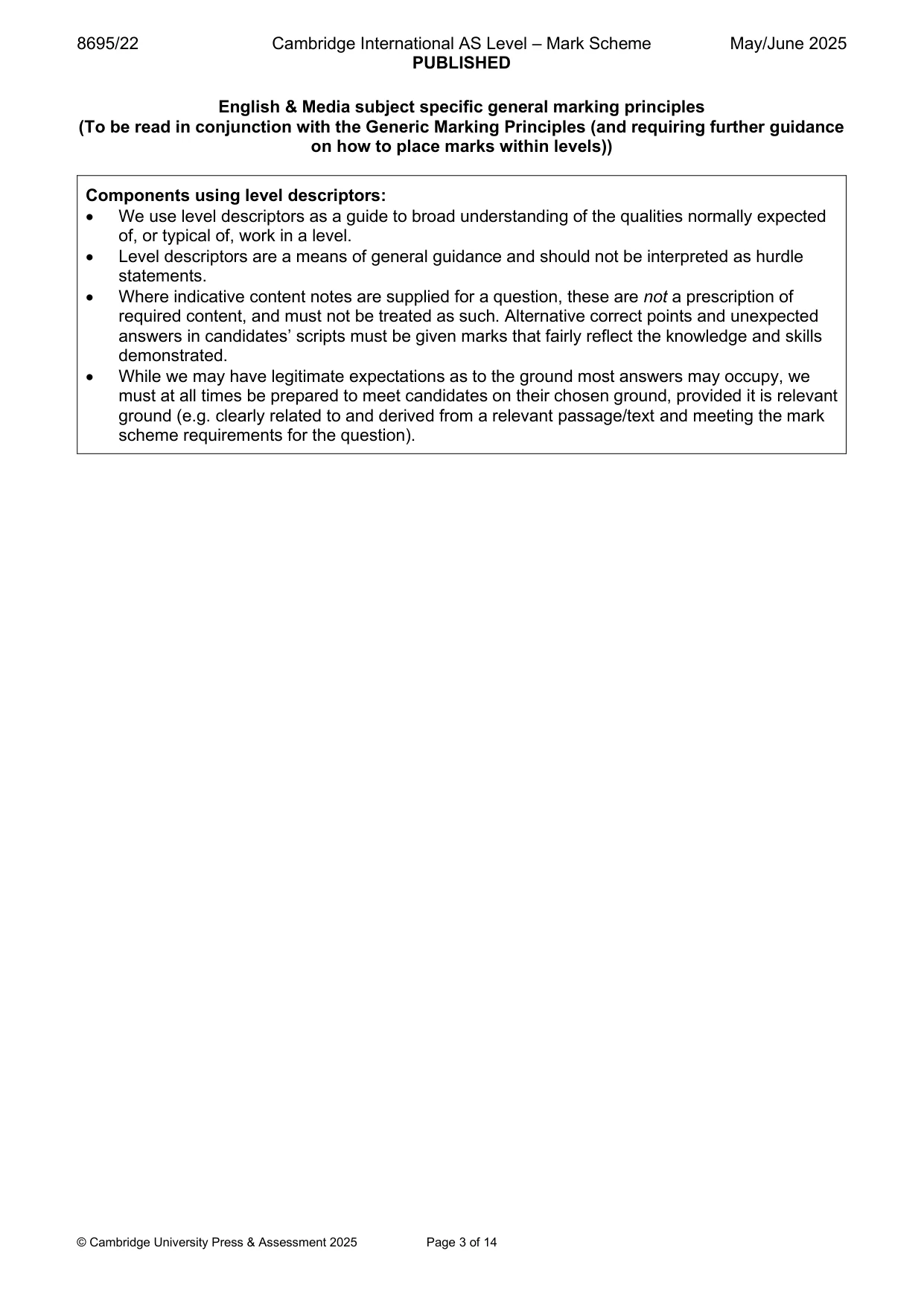
8695/22 Cambridge International AS Level – Mark Scheme PUBLISHED May/June 2025 © Cambridge University Press & Assessment 2025 Page 3 of 14 English & Media subject specific general marking principles (To be read in conjunction with the Generic Marking Principles (and requiring further guidance on how to place marks within levels)) Components using level descriptors: • We use level descriptors as a guide to broad understanding of the qualities normally expected of, or typical of, work in a level. • Level descriptors are a means of general guidance and should not be interpreted as hurdle statements. • Where indicative content notes are supplied for a question, these are not a prescription of required content, and must not be treated as such. Alternative correct points and unexpected answers in candidates’ scripts must be given marks that fairly reflect the knowledge and skills demonstrated. • While we may have legitimate expectations as to the ground most answers may occupy, we must at all times be prepared to meet candidates on their chosen ground, provided it is relevant ground (e.g. clearly related to and derived from a relevant passage/text and meeting the mark scheme requirements for the question).
Mark scheme, page 4
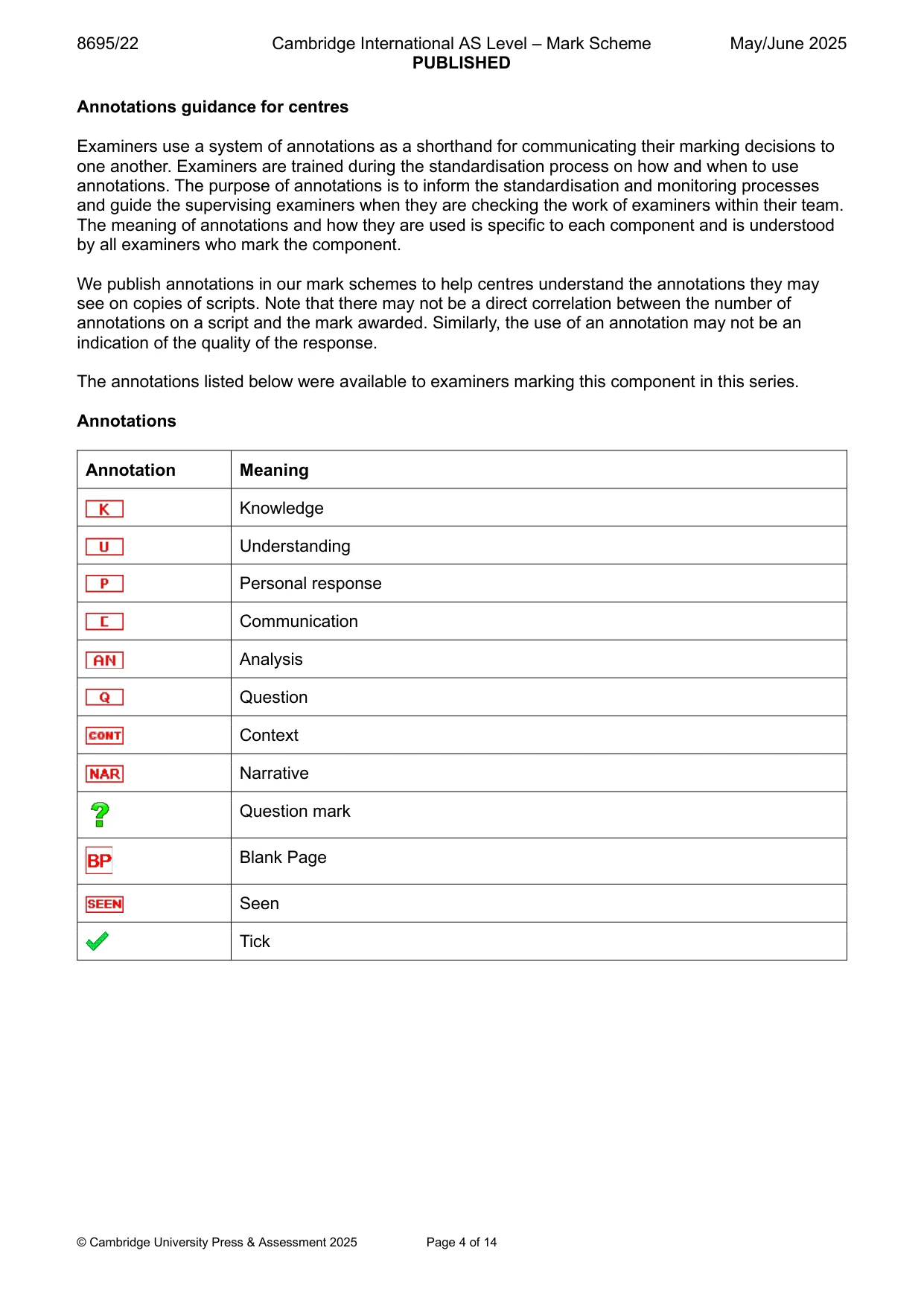
8695/22 Cambridge International AS Level – Mark Scheme PUBLISHED May/June 2025 © Cambridge University Press & Assessment 2025 Page 4 of 14 Annotations guidance for centres Examiners use a system of annotations as a shorthand for communicating their marking decisions to one another. Examiners are trained during the standardisation process on how and when to use annotations. The purpose of annotations is to inform the standardisation and monitoring processes and guide the supervising examiners when they are checking the work of examiners within their team. The meaning of annotations and how they are used is specific to each component and is understood by all examiners who mark the component. We publish annotations in our mark schemes to help centres understand the annotations they may see on copies of scripts. Note that there may not be a direct correlation between the number of annotations on a script and the mark awarded. Similarly, the use of an annotation may not be an indication of the quality of the response. The annotations listed below were available to examiners marking this component in this series. Annotations Annotation Meaning Knowledge Understanding Personal response Communication Analysis Question Context Narrative Question mark Blank Page Seen Tick
Mark scheme, page 5
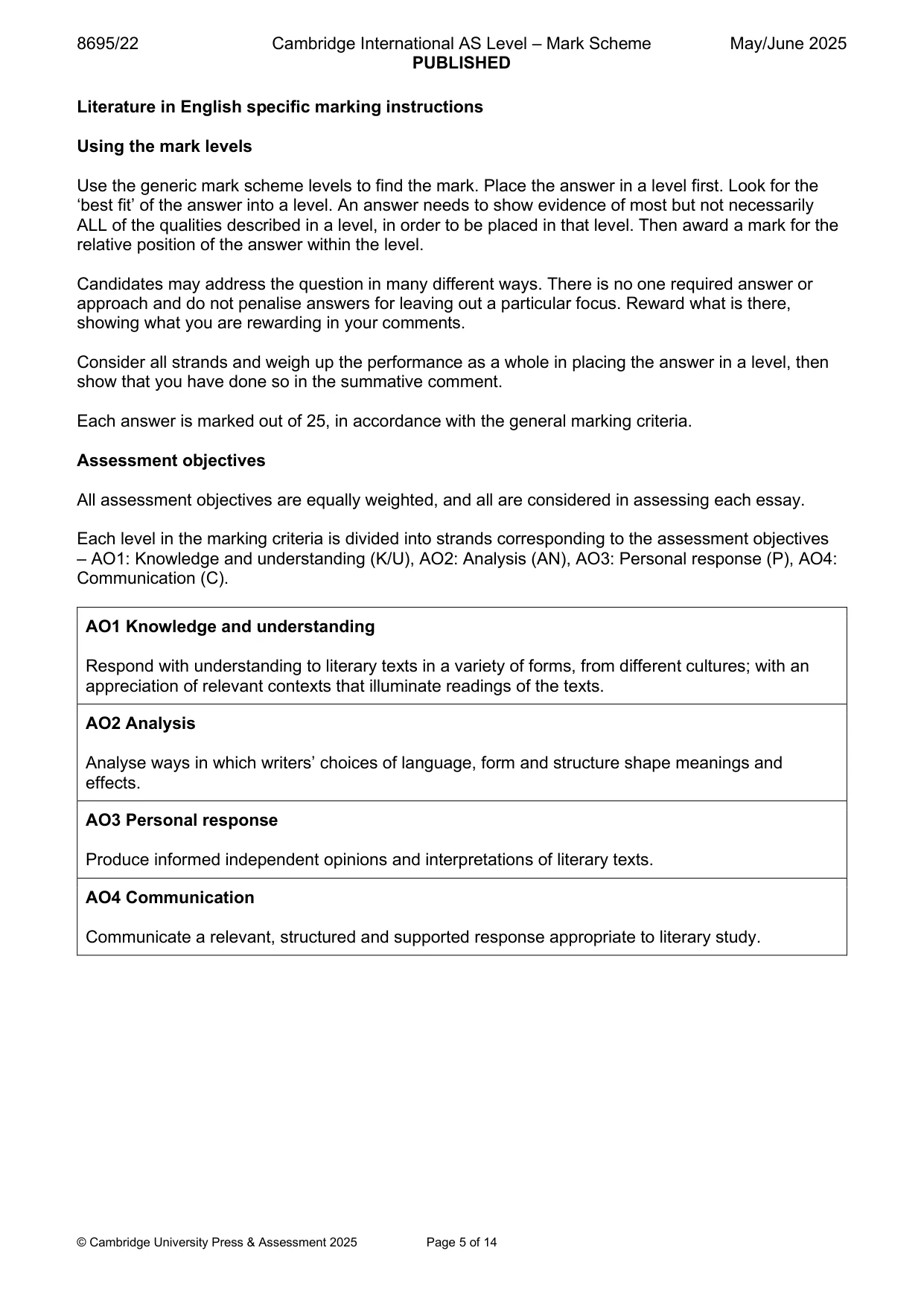
8695/22 Cambridge International AS Level – Mark Scheme PUBLISHED May/June 2025 © Cambridge University Press & Assessment 2025 Page 5 of 14 Literature in English specific marking instructions Using the mark levels Use the generic mark scheme levels to find the mark. Place the answer in a level first. Look for the ‘best fit’ of the answer into a level. An answer needs to show evidence of most but not necessarily ALL of the qualities described in a level, in order to be placed in that level. Then award a mark for the relative position of the answer within the level. Candidates may address the question in many different ways. There is no one required answer or approach and do not penalise answers for leaving out a particular focus. Reward what is there, showing what you are rewarding in your comments. Consider all strands and weigh up the performance as a whole in placing the answer in a level, then show that you have done so in the summative comment. Each answer is marked out of 25, in accordance with the general marking criteria. Assessment objectives All assessment objectives are equally weighted, and all are considered in assessing each essay. Each level in the marking criteria is divided into strands corresponding to the assessment objectives – AO1: Knowledge and understanding (K/U), AO2: Analysis (AN), AO3: Personal response (P), AO4: Communication (C). AO1 Knowledge and understanding Respond with understanding to literary texts in a variety of forms, from different cultures; with an appreciation of relevant contexts that illuminate readings of the texts. AO2 Analysis Analyse ways in which writers’ choices of language, form and structure shape meanings and effects. AO3 Personal response Produce informed independent opinions and interpretations of literary texts. AO4 Communication Communicate a relevant, structured and supported response appropriate to literary study.
Mark scheme, page 6
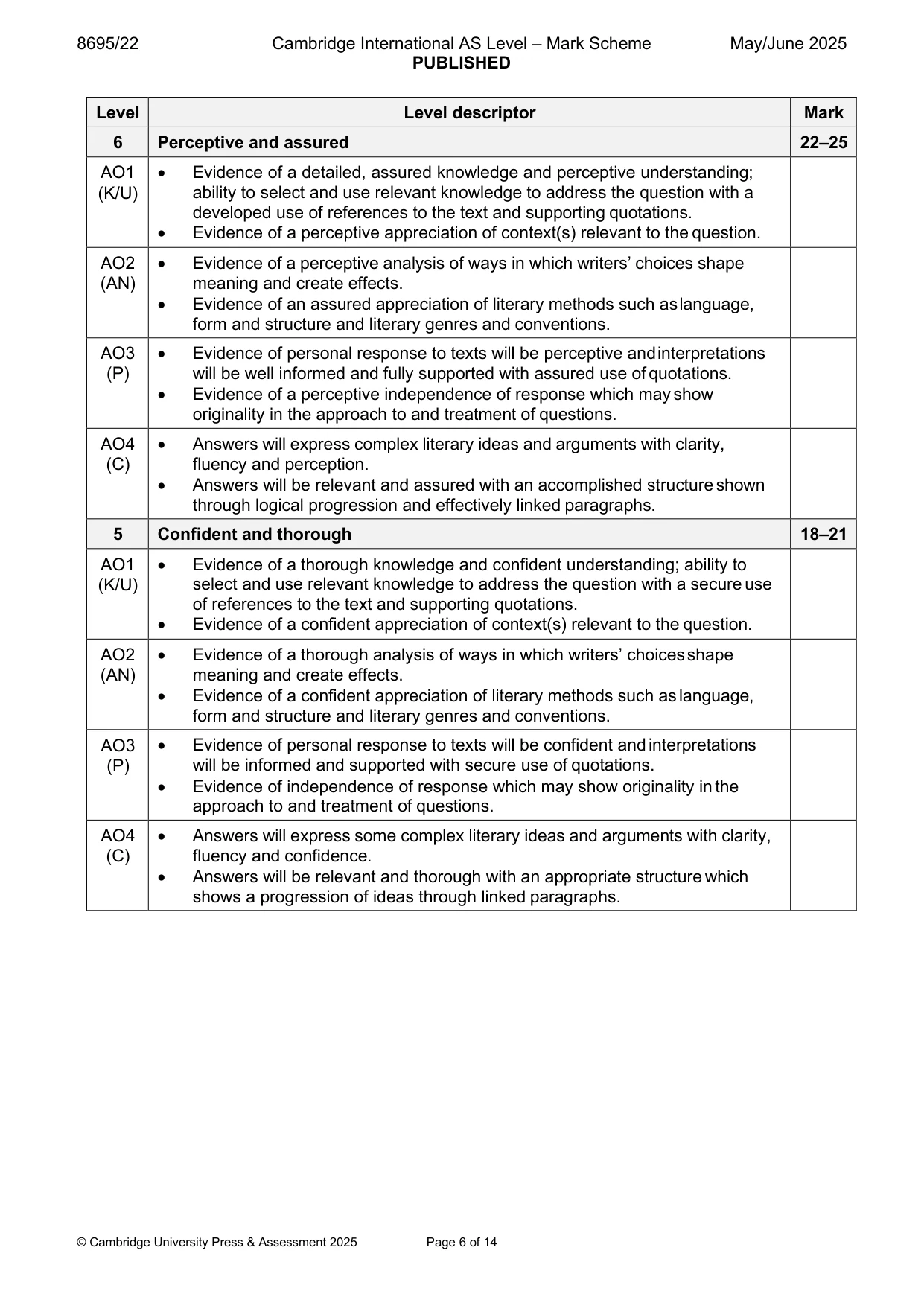
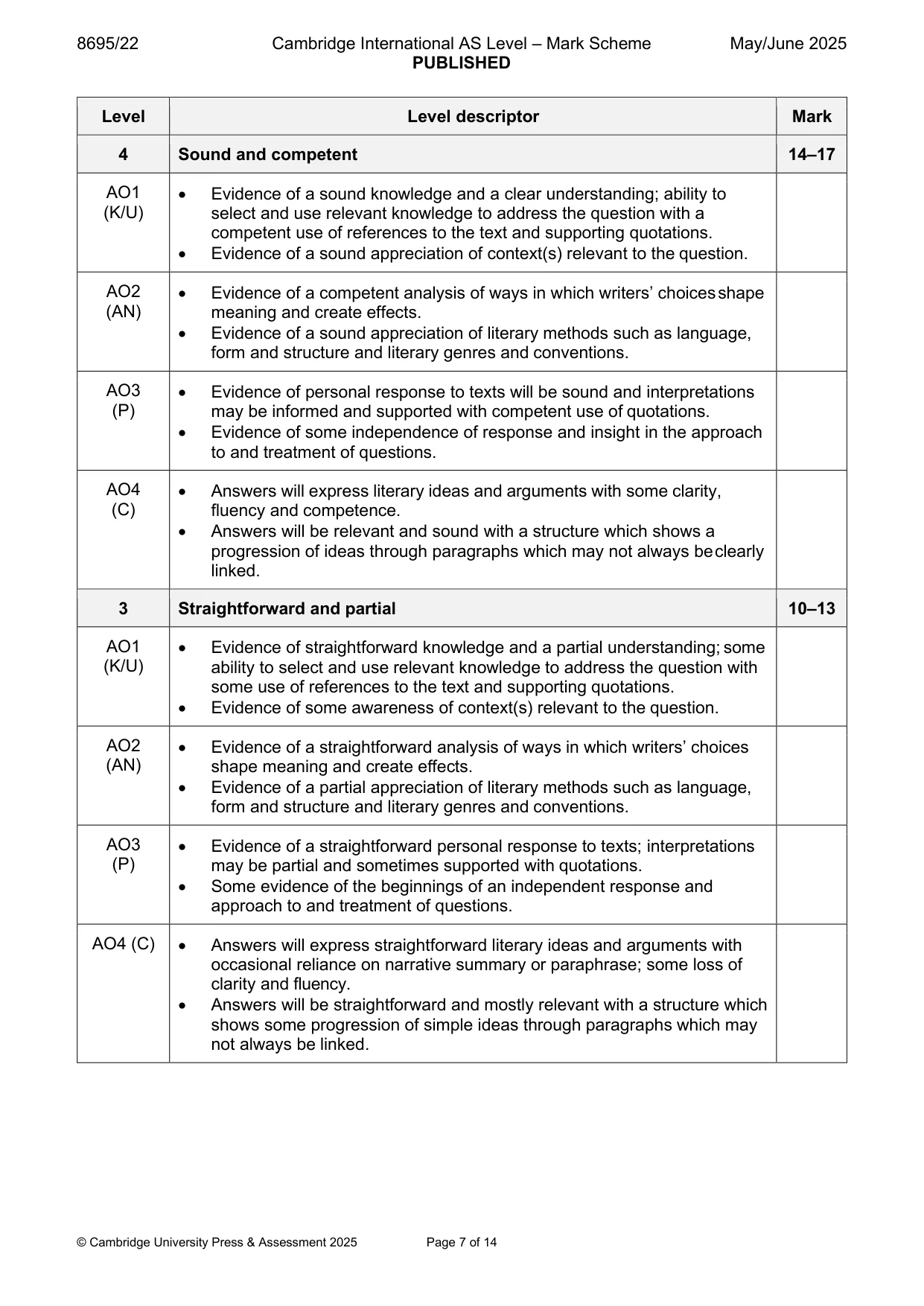
8695/22 Cambridge International AS Level – Mark Scheme PUBLISHED May/June 2025 © Cambridge University Press & Assessment 2025 Page 6 of 14 Level Level descriptor Mark 6 Perceptive and assured 22–25 AO1 (K/U) • Evidence of a detailed, assured knowledge and perceptive understanding; ability to select and use relevant knowledge to address the question with a developed use of references to the text and supporting quotations. • Evidence of a perceptive appreciation of context(s) relevant to the question. AO2 (AN) • Evidence of a perceptive analysis of ways in which writers’ choices shape meaning and create effects. • Evidence of an assured appreciation of literary methods such as language, form and structure and literary genres and conventions. AO3 (P) • Evidence of personal response to texts will be perceptive and interpretations will be well informed and fully supported with assured use of quotations. • Evidence of a perceptive independence of response which may show originality in the approach to and treatment of questions. AO4 (C) • Answers will express complex literary ideas and arguments with clarity, fluency and perception. • Answers will be relevant and assured with an accomplished structure shown through logical progression and effectively linked paragraphs. 5 Confident and thorough 18–21 AO1 (K/U) • Evidence of a thorough knowledge and confident understanding; ability to select and use relevant knowledge to address the question with a secure use of references to the text and supporting quotations. • Evidence of a confident appreciation of context(s) relevant to the question. AO2 (AN) • Evidence of a thorough analysis of ways in which writers’ choices shape meaning and create effects. • Evidence of a confident appreciation of literary methods such as language, form and structure and literary genres and conventions. AO3 (P) • Evidence of personal response to texts will be confident and interpretations will be informed and supported with secure use of quotations. • Evidence of independence of response which may show originality in the approach to and treatment of questions. AO4 (C) • Answers will express some complex literary ideas and arguments with clarity, fluency and confidence. • Answers will be relevant and thorough with an appropriate structure which shows a progression of ideas through linked paragraphs.
Mark scheme, page 7
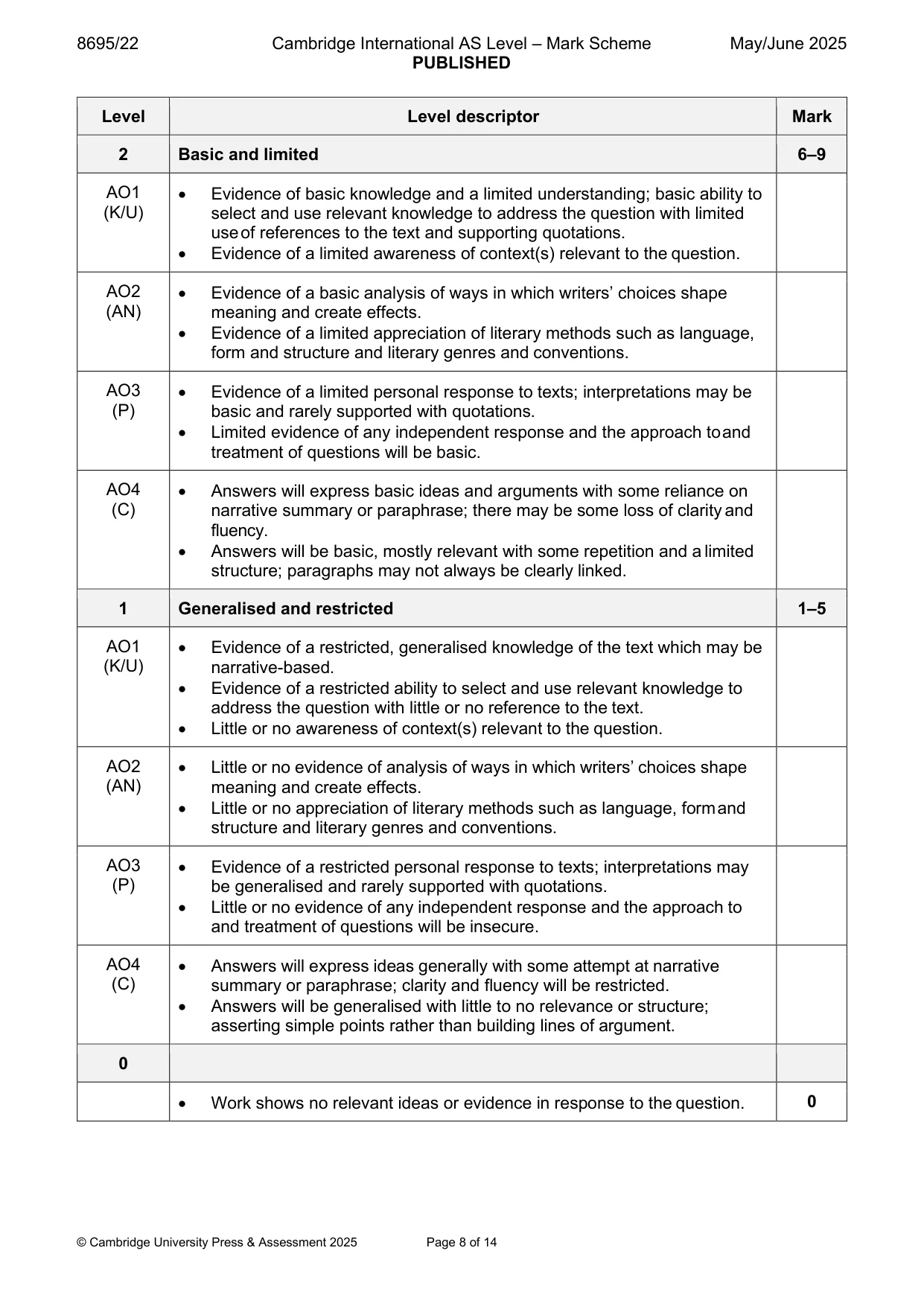
8695/22 Cambridge International AS Level – Mark Scheme PUBLISHED May/June 2025 © Cambridge University Press & Assessment 2025 Page 7 of 14 Level Level descriptor Mark 4 Sound and competent 14–17 AO1 (K/U) • Evidence of a sound knowledge and a clear understanding; ability to select and use relevant knowledge to address the question with a competent use of references to the text and supporting quotations. • Evidence of a sound appreciation of context(s) relevant to the question. AO2 (AN) • Evidence of a competent analysis of ways in which writers’ choices shape meaning and create effects. • Evidence of a sound appreciation of literary methods such as language, form and structure and literary genres and conventions. AO3 (P) • Evidence of personal response to texts will be sound and interpretations may be informed and supported with competent use of quotations. • Evidence of some independence of response and insight in the approach to and treatment of questions. AO4 (C) • Answers will express literary ideas and arguments with some clarity, fluency and competence. • Answers will be relevant and sound with a structure which shows a progression of ideas through paragraphs which may not always be clearly linked. 3 Straightforward and partial 10–13 AO1 (K/U) • Evidence of straightforward knowledge and a partial understanding; some ability to select and use relevant knowledge to address the question with some use of references to the text and supporting quotations. • Evidence of some awareness of context(s) relevant to the question. AO2 (AN) • Evidence of a straightforward analysis of ways in which writers’ choices shape meaning and create effects. • Evidence of a partial appreciation of literary methods such as language, form and structure and literary genres and conventions. AO3 (P) • Evidence of a straightforward personal response to texts; interpretations may be partial and sometimes supported with quotations. • Some evidence of the beginnings of an independent response and approach to and treatment of questions. AO4 (C) • Answers will express straightforward literary ideas and arguments with occasional reliance on narrative summary or paraphrase; some loss of clarity and fluency. • Answers will be straightforward and mostly relevant with a structure which shows some progression of simple ideas through paragraphs which may not always be linked.
Mark scheme, page 8
8695/22 Cambridge International AS Level – Mark Scheme PUBLISHED May/June 2025 © Cambridge University Press & Assessment 2025 Page 8 of 14 Level Level descriptor Mark 2 Basic and limited 6–9 AO1 (K/U) • Evidence of basic knowledge and a limited understanding; basic ability to select and use relevant knowledge to address the question with limited use of references to the text and supporting quotations. • Evidence of a limited awareness of context(s) relevant to the question. AO2 (AN) • Evidence of a basic analysis of ways in which writers’ choices shape meaning and create effects. • Evidence of a limited appreciation of literary methods such as language, form and structure and literary genres and conventions. AO3 (P) • Evidence of a limited personal response to texts; interpretations may be basic and rarely supported with quotations. • Limited evidence of any independent response and the approach to and treatment of questions will be basic. AO4 (C) • Answers will express basic ideas and arguments with some reliance on narrative summary or paraphrase; there may be some loss of clarity and fluency. • Answers will be basic, mostly relevant with some repetition and a limited structure; paragraphs may not always be clearly linked. 1 Generalised and restricted 1–5 AO1 (K/U) • Evidence of a restricted, generalised knowledge of the text which may be narrative-based. • Evidence of a restricted ability to select and use relevant knowledge to address the question with little or no reference to the text. • Little or no awareness of context(s) relevant to the question. AO2 (AN) • Little or no evidence of analysis of ways in which writers’ choices shape meaning and create effects. • Little or no appreciation of literary methods such as language, form and structure and literary genres and conventions. AO3 (P) • Evidence of a restricted personal response to texts; interpretations may be generalised and rarely supported with quotations. • Little or no evidence of any independent response and the approach to and treatment of questions will be insecure. AO4 (C) • Answers will express ideas generally with some attempt at narrative summary or paraphrase; clarity and fluency will be restricted. • Answers will be generalised with little to no relevance or structure; asserting simple points rather than building lines of argument. 0 • Work shows no relevant ideas or evidence in response to the question. 0
Mark scheme, page 9
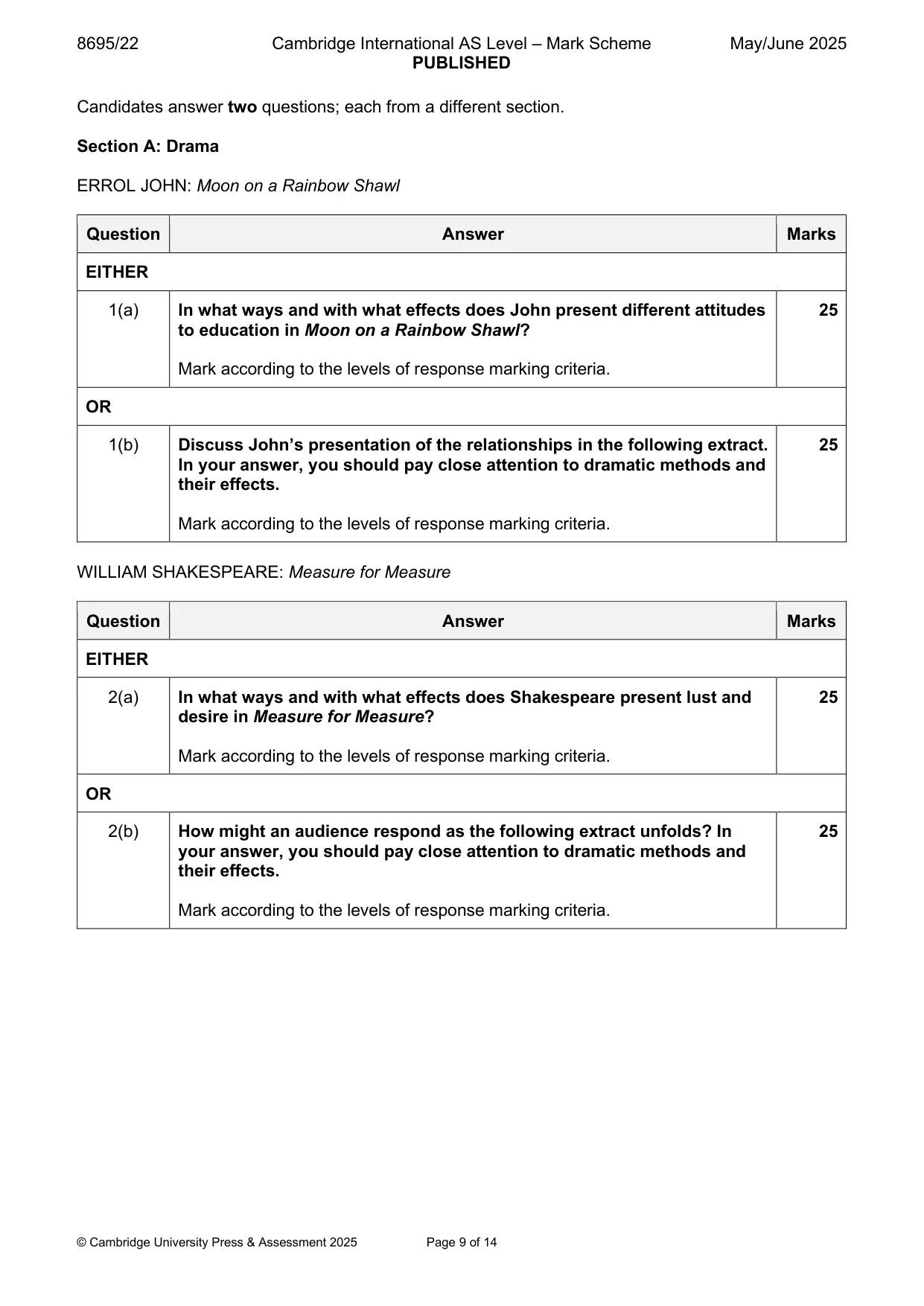
8695/22 Cambridge International AS Level – Mark Scheme PUBLISHED May/June 2025 © Cambridge University Press & Assessment 2025 Page 9 of 14 Candidates answer two questions; each from a different section. Section A: Drama ERROL JOHN: Moon on a Rainbow Shawl Question Answer Marks EITHER 1(a) In what ways and with what effects does John present different attitudes to education in Moon on a Rainbow Shawl? Mark according to the levels of response marking criteria. 25 OR 1(b) Discuss John’s presentation of the relationships in the following extract. In your answer, you should pay close attention to dramatic methods and their effects. Mark according to the levels of response marking criteria. 25 WILLIAM SHAKESPEARE: Measure for Measure Question Answer Marks EITHER 2(a) In what ways and with what effects does Shakespeare present lust and desire in Measure for Measure? Mark according to the levels of response marking criteria. 25 OR 2(b) How might an audience respond as the following extract unfolds? In your answer, you should pay close attention to dramatic methods and their effects. Mark according to the levels of response marking criteria. 25
Mark scheme, page 10
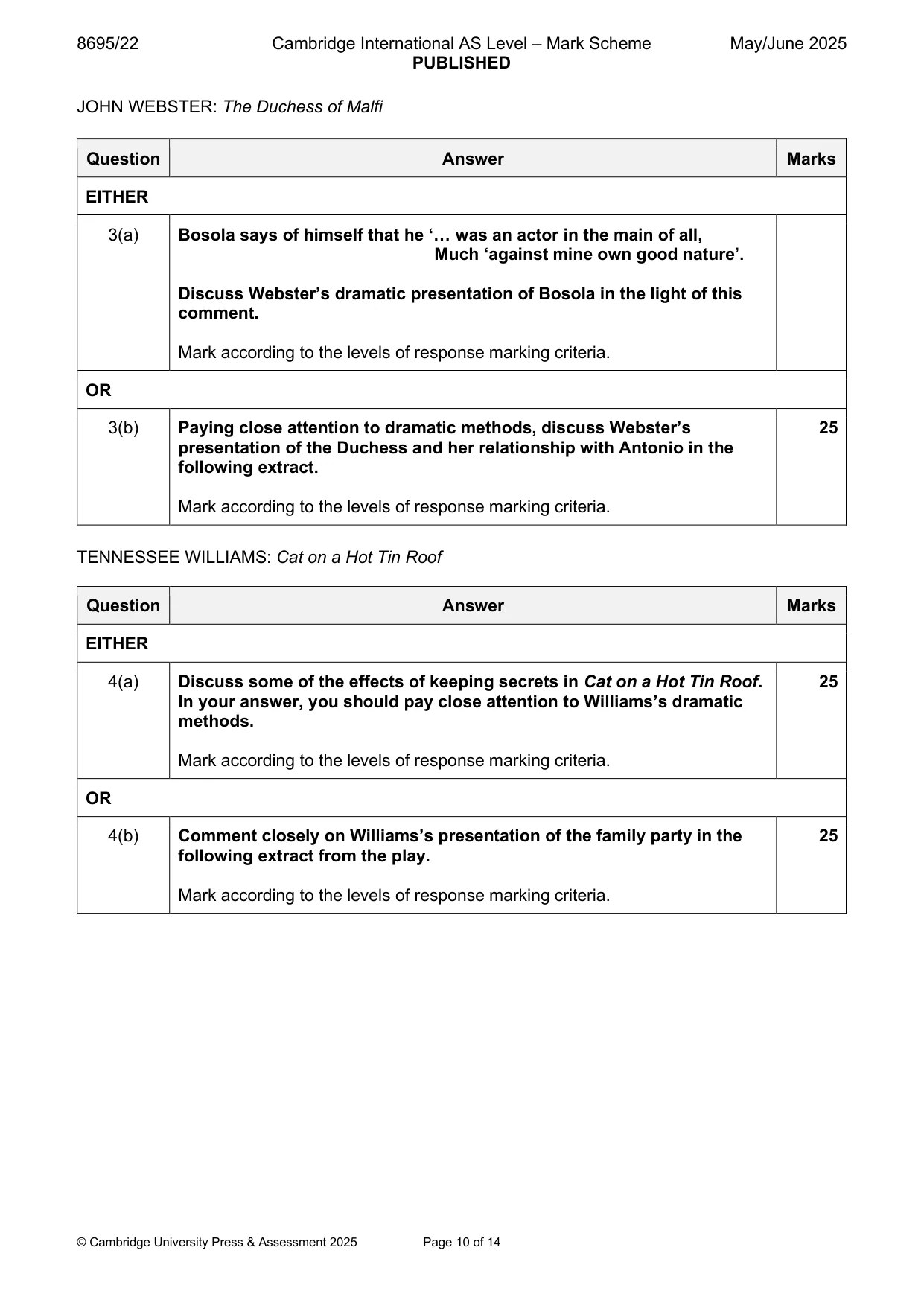
8695/22 Cambridge International AS Level – Mark Scheme PUBLISHED May/June 2025 © Cambridge University Press & Assessment 2025 Page 10 of 14 JOHN WEBSTER: The Duchess of Malfi Question Answer Marks EITHER 3(a) Bosola says of himself that he ‘… was an actor in the main of all, Much ‘against mine own good nature’. Discuss Webster’s dramatic presentation of Bosola in the light of this comment. Mark according to the levels of response marking criteria. OR 3(b) Paying close attention to dramatic methods, discuss Webster’s presentation of the Duchess and her relationship with Antonio in the following extract. Mark according to the levels of response marking criteria. 25 TENNESSEE WILLIAMS: Cat on a Hot Tin Roof Question Answer Marks EITHER 4(a) Discuss some of the effects of keeping secrets in Cat on a Hot Tin Roof. In your answer, you should pay close attention to Williams’s dramatic methods. Mark according to the levels of response marking criteria. 25 OR 4(b) Comment closely on Williams’s presentation of the family party in the following extract from the play. Mark according to the levels of response marking criteria. 25
Mark scheme, page 11
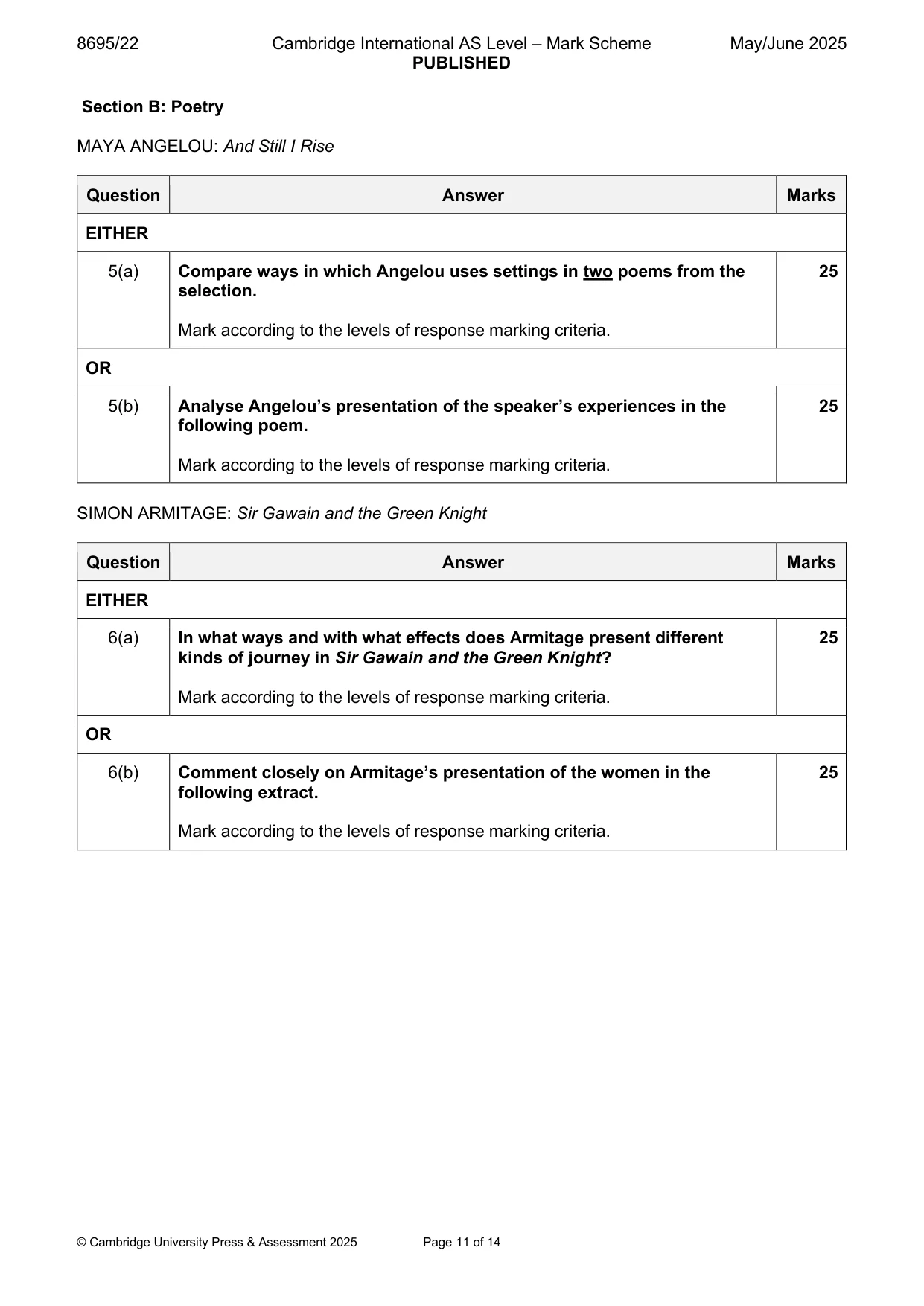
8695/22 Cambridge International AS Level – Mark Scheme PUBLISHED May/June 2025 © Cambridge University Press & Assessment 2025 Page 11 of 14 Section B: Poetry MAYA ANGELOU: And Still I Rise Question Answer Marks EITHER 5(a) Compare ways in which Angelou uses settings in two poems from the selection. Mark according to the levels of response marking criteria. 25 OR 5(b) Analyse Angelou’s presentation of the speaker’s experiences in the following poem. Mark according to the levels of response marking criteria. 25 SIMON ARMITAGE: Sir Gawain and the Green Knight Question Answer Marks EITHER 6(a) In what ways and with what effects does Armitage present different kinds of journey in Sir Gawain and the Green Knight? Mark according to the levels of response marking criteria. 25 OR 6(b) Comment closely on Armitage’s presentation of the women in the following extract. Mark according to the levels of response marking criteria. 25
Mark scheme, page 12
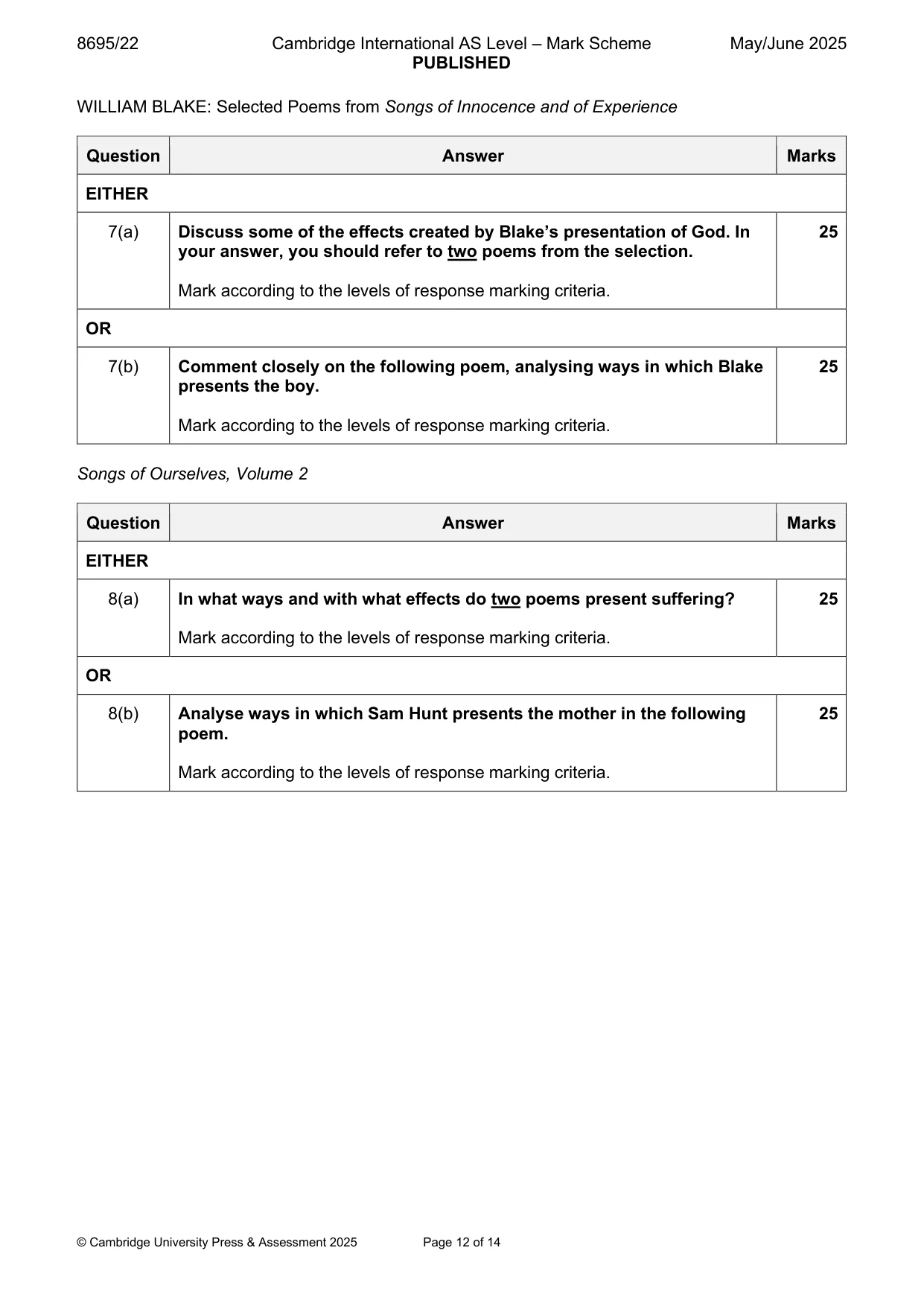
8695/22 Cambridge International AS Level – Mark Scheme PUBLISHED May/June 2025 © Cambridge University Press & Assessment 2025 Page 12 of 14 WILLIAM BLAKE: Selected Poems from Songs of Innocence and of Experience Question Answer Marks EITHER 7(a) Discuss some of the effects created by Blake’s presentation of God. In your answer, you should refer to two poems from the selection. Mark according to the levels of response marking criteria. 25 OR 7(b) Comment closely on the following poem, analysing ways in which Blake presents the boy. Mark according to the levels of response marking criteria. 25 Songs of Ourselves, Volume 2 Question Answer Marks EITHER 8(a) In what ways and with what effects do two poems present suffering? Mark according to the levels of response marking criteria. 25 OR 8(b) Analyse ways in which Sam Hunt presents the mother in the following poem. Mark according to the levels of response marking criteria. 25
Mark scheme, page 13
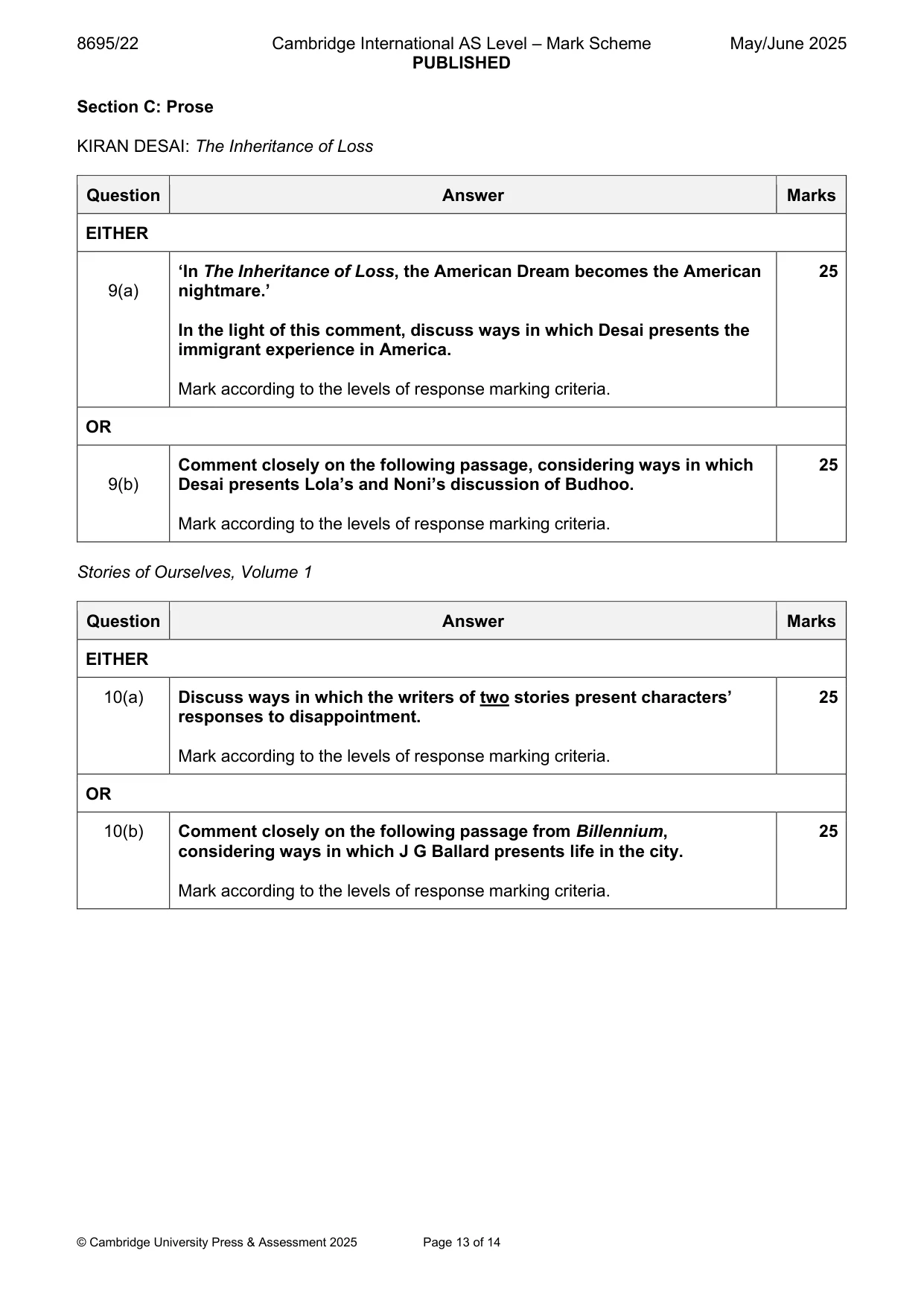
8695/22 Cambridge International AS Level – Mark Scheme PUBLISHED May/June 2025 © Cambridge University Press & Assessment 2025 Page 13 of 14 Section C: Prose KIRAN DESAI: The Inheritance of Loss Question Answer Marks EITHER 9(a) ‘In The Inheritance of Loss, the American Dream becomes the American nightmare.’ In the light of this comment, discuss ways in which Desai presents the immigrant experience in America. Mark according to the levels of response marking criteria. 25 OR 9(b) Comment closely on the following passage, considering ways in which Desai presents Lola’s and Noni’s discussion of Budhoo. Mark according to the levels of response marking criteria. 25 Stories of Ourselves, Volume 1 Question Answer Marks EITHER 10(a) Discuss ways in which the writers of two stories present characters’ responses to disappointment. Mark according to the levels of response marking criteria. 25 OR 10(b) Comment closely on the following passage from Billennium, considering ways in which J G Ballard presents life in the city. Mark according to the levels of response marking criteria. 25
Mark scheme, page 14
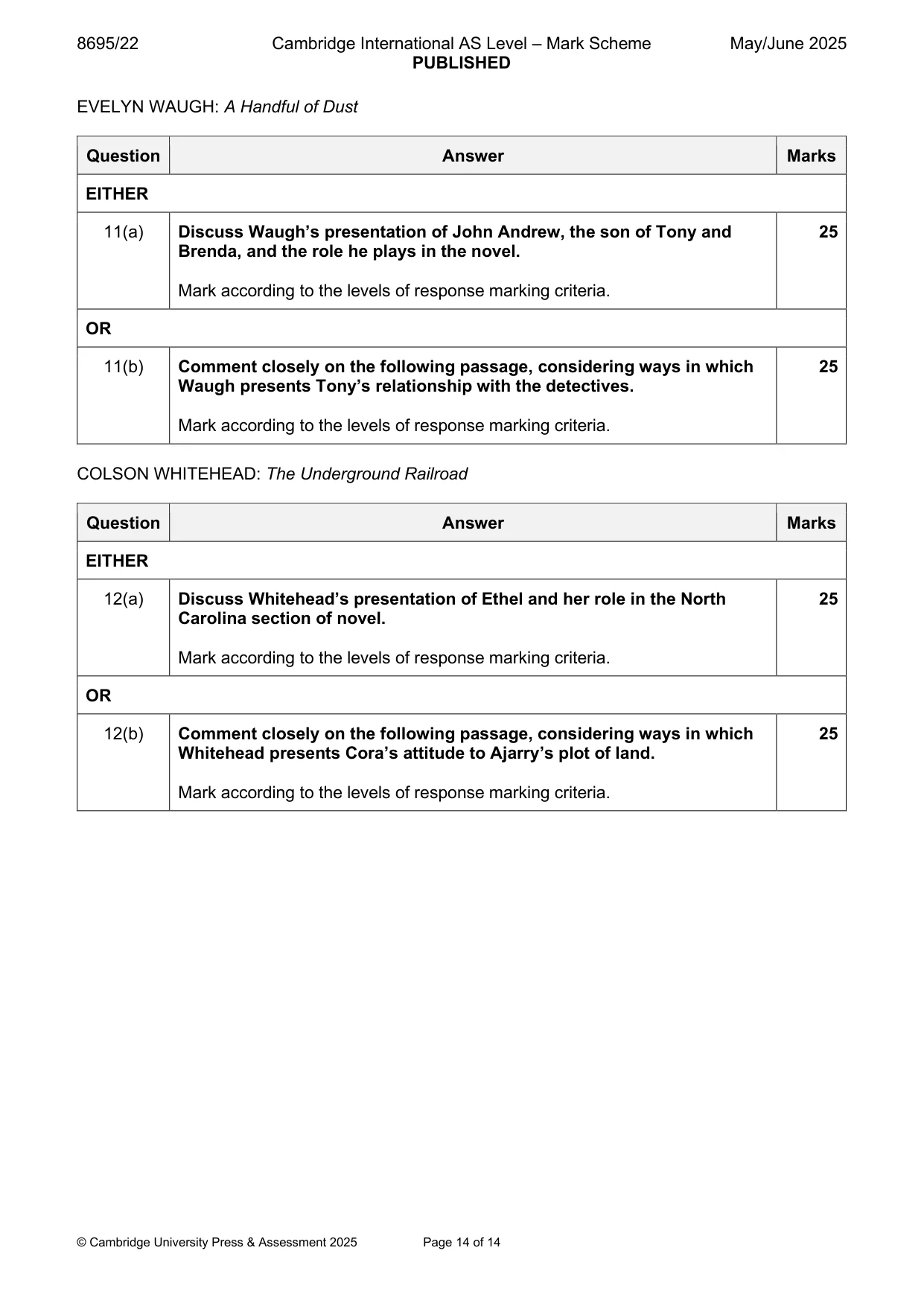
8695/22 Cambridge International AS Level – Mark Scheme PUBLISHED May/June 2025 © Cambridge University Press & Assessment 2025 Page 14 of 14 EVELYN WAUGH: A Handful of Dust Question Answer Marks EITHER 11(a) Discuss Waugh’s presentation of John Andrew, the son of Tony and Brenda, and the role he plays in the novel. Mark according to the levels of response marking criteria. 25 OR 11(b) Comment closely on the following passage, considering ways in which Waugh presents Tony’s relationship with the detectives. Mark according to the levels of response marking criteria. 25 COLSON WHITEHEAD: The Underground Railroad Question Answer Marks EITHER 12(a) Discuss Whitehead’s presentation of Ethel and her role in the North Carolina section of novel. Mark according to the levels of response marking criteria. 25 OR 12(b) Comment closely on the following passage, considering ways in which Whitehead presents Cora’s attitude to Ajarry’s plot of land. Mark according to the levels of response marking criteria. 25
What you needed in this session
Cambridge’s own grade thresholds for 2025 May/June, Paper 2 · Variant 2. A higher threshold means an easier paper — the bar moves with how the cohort did.