Cambridge A Level English - Language and Literature (AS Level only, from 2016) 8695 — 2023 Oct/Nov Paper 2 · Variant 2
8695/22/O/N/23 · 50 marks · ≈56 min
The question paper and its mark scheme, free to read here and free to download. This is Cambridge’s own paper, exactly as it was sat.
Question paper24 pages



Mark scheme13 pages
Answers below. Sit the paper first if you are practising.
Paper as text
Question paper, page 1
This document has 24 pages. Any blank pages are indicated. [Turn over Cambridge International AS Level * 3 8 3 7 2 2 9 1 7 6 * DC (RCL (DF)) 319513/2 © UCLES 2023 LANGUAGE AND LITERATURE IN ENGLISH 8695/22 Paper 2 Drama, Poetry and Prose October/November 2023 2 hours You must answer on the enclosed answer booklet. You will need: Answer booklet (enclosed) INSTRUCTIONS ● Answer two questions in total, each from a different section. ● Follow the instructions on the front cover of the answer booklet. If you need additional answer paper, ask the invigilator for a continuation booklet. ● Dictionaries are not allowed. INFORMATION ● The total mark for this paper is 50. ● The number of marks for each question or part question is shown in brackets [ ].
Question paper, page 2
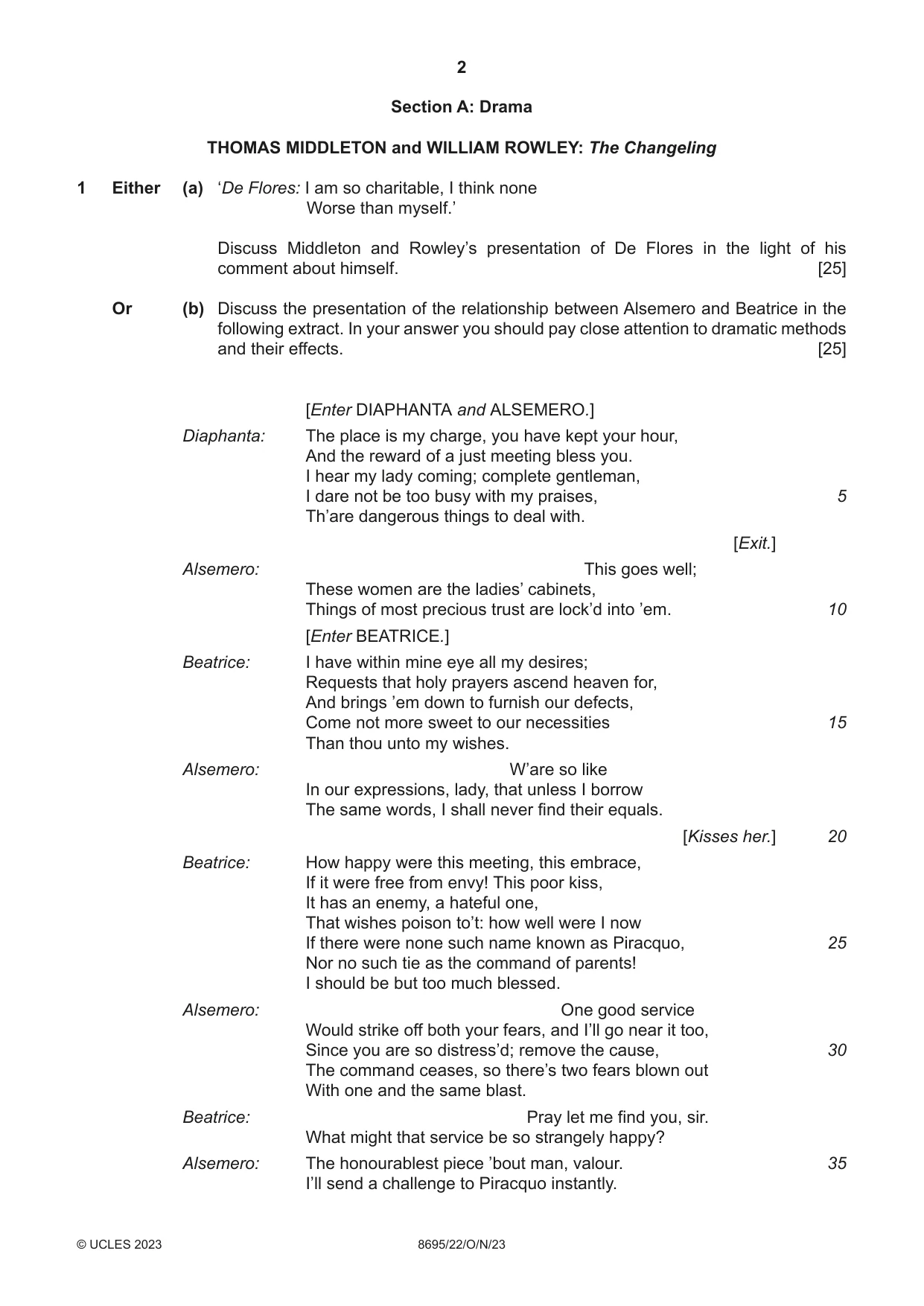
2 8695/22/O/N/23 © UCLES 2023 Section A: Drama THOMAS MIDDLETON and WILLIAM ROWLEY: The Changeling 1 Either (a) ‘De Flores: I am so charitable, I think none Worse than myself.’ Discuss Middleton and Rowley’s presentation of De Flores in the light of his comment about himself. [25] Or (b) Discuss the presentation of the relationship between Alsemero and Beatrice in the following extract. In your answer you should pay close attention to dramatic methods and their effects. [25] [Enter DIAPHANTA and ALSEMERO.] Diaphanta: The place is my charge, you have kept your hour, And the reward of a just meeting bless you. I hear my lady coming; complete gentleman, I dare not be too busy with my praises, Th’are dangerous things to deal with. [Exit.] Alsemero: This goes well; These women are the ladies’ cabinets, Things of most precious trust are lock’d into ’em. [Enter BEATRICE.] Beatrice: I have within mine eye all my desires; Requests that holy prayers ascend heaven for, And brings ’em down to furnish our defects, Come not more sweet to our necessities Than thou unto my wishes. Alsemero: W’are so like In our expressions, lady, that unless I borrow The same words, I shall never find their equals. [Kisses her.] Beatrice: How happy were this meeting, this embrace, If it were free from envy! This poor kiss, It has an enemy, a hateful one, That wishes poison to’t: how well were I now If there were none such name known as Piracquo, Nor no such tie as the command of parents! I should be but too much blessed. Alsemero: One good service Would strike off both your fears, and I’ll go near it too, Since you are so distress’d; remove the cause, The command ceases, so there’s two fears blown out With one and the same blast. Beatrice: Pray let me find you, sir. What might that service be so strangely happy? Alsemero: The honourablest piece ’bout man, valour. I’ll send a challenge to Piracquo instantly. 5 10 15 20 25 30 35
Question paper, page 3
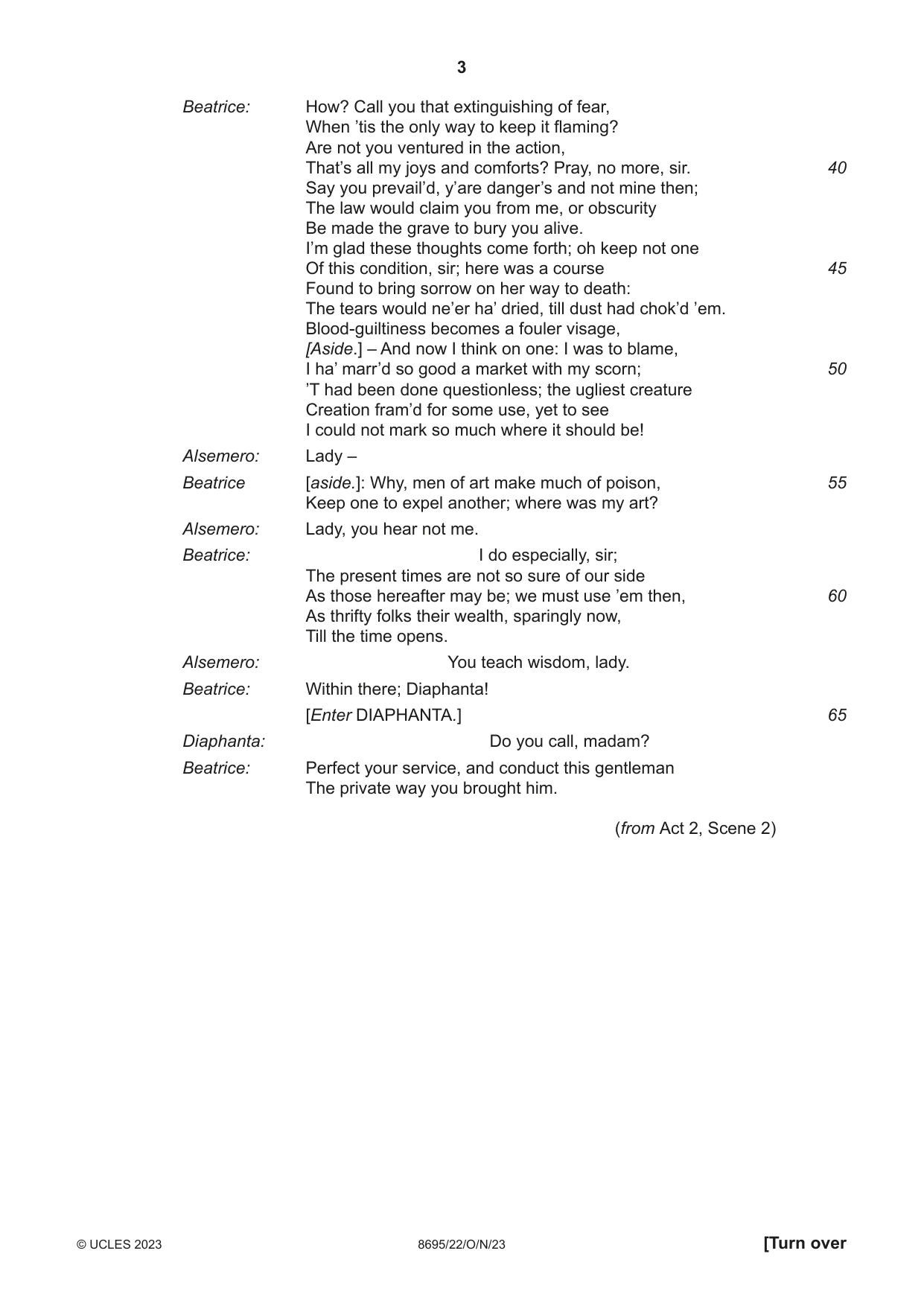
3 8695/22/O/N/23 © UCLES 2023 [Turn over Beatrice: How? Call you that extinguishing of fear, When ’tis the only way to keep it flaming? Are not you ventured in the action, That’s all my joys and comforts? Pray, no more, sir. Say you prevail’d, y’are danger’s and not mine then; The law would claim you from me, or obscurity Be made the grave to bury you alive. I’m glad these thoughts come forth; oh keep not one Of this condition, sir; here was a course Found to bring sorrow on her way to death: The tears would ne’er ha’ dried, till dust had chok’d ’em. Blood-guiltiness becomes a fouler visage, [Aside.] – And now I think on one: I was to blame, I ha’ marr’d so good a market with my scorn; ’T had been done questionless; the ugliest creature Creation fram’d for some use, yet to see I could not mark so much where it should be! Alsemero: Lady – Beatrice [aside.]: Why, men of art make much of poison, Keep one to expel another; where was my art? Alsemero: Lady, you hear not me. Beatrice: I do especially, sir; The present times are not so sure of our side As those hereafter may be; we must use ’em then, As thrifty folks their wealth, sparingly now, Till the time opens. Alsemero: You teach wisdom, lady. Beatrice: Within there; Diaphanta! [Enter DIAPHANTA.] Diaphanta: Do you call, madam? Beatrice: Perfect your service, and conduct this gentleman The private way you brought him. (from Act 2, Scene 2) 40 45 50 55 60 65
Question paper, page 4
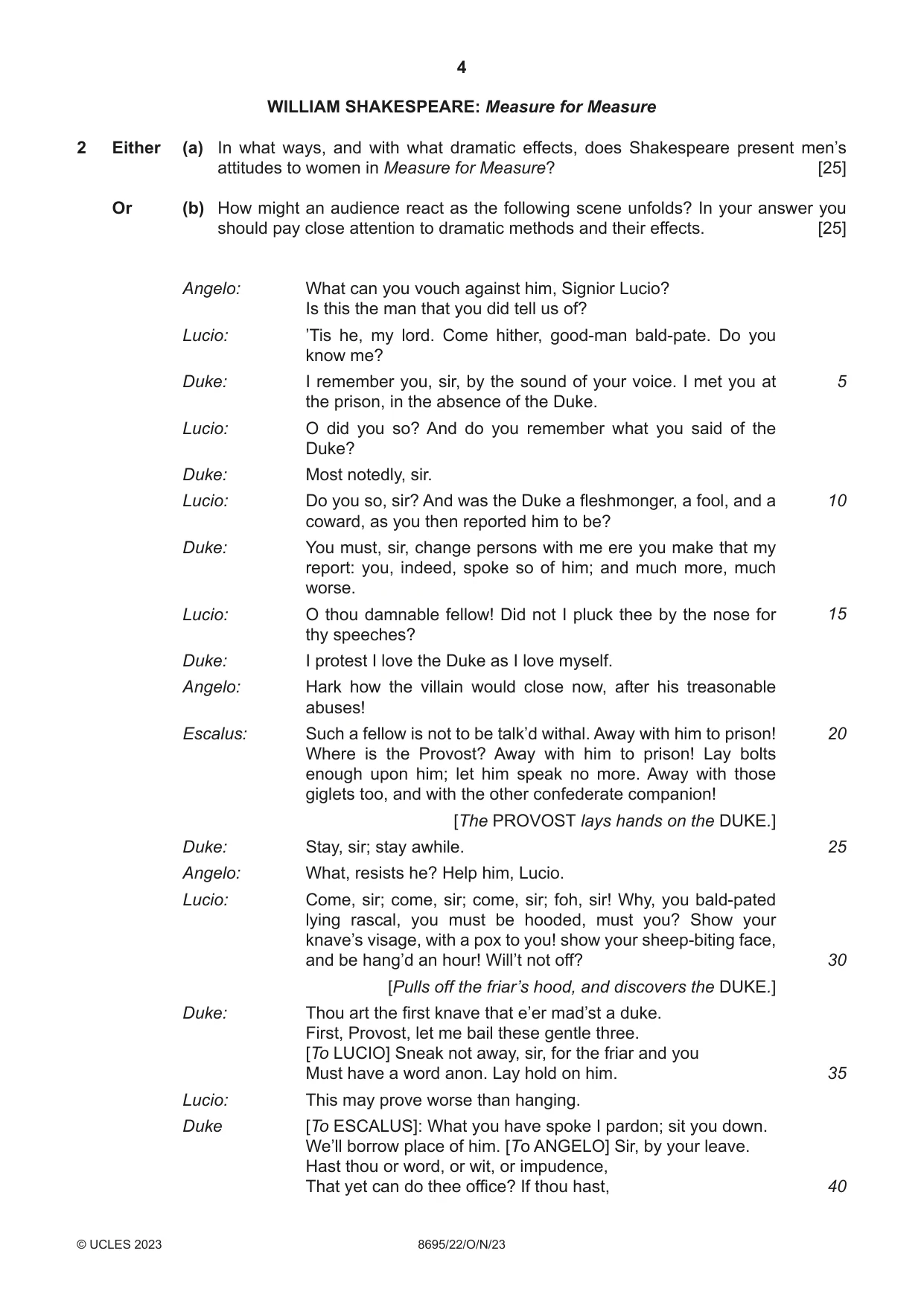
4 8695/22/O/N/23 © UCLES 2023 WILLIAM SHAKESPEARE: Measure for Measure 2 Either (a) In what ways, and with what dramatic effects, does Shakespeare present men’s attitudes to women in Measure for Measure? [25] Or (b) How might an audience react as the following scene unfolds? In your answer you should pay close attention to dramatic methods and their effects. [25] Angelo: What can you vouch against him, Signior Lucio? Is this the man that you did tell us of? Lucio: ’Tis he, my lord. Come hither, good-man bald-pate. Do you know me? Duke: I remember you, sir, by the sound of your voice. I met you at the prison, in the absence of the Duke. Lucio: O did you so? And do you remember what you said of the Duke? Duke: Most notedly, sir. Lucio: Do you so, sir? And was the Duke a fleshmonger, a fool, and a coward, as you then reported him to be? Duke: You must, sir, change persons with me ere you make that my report: you, indeed, spoke so of him; and much more, much worse. Lucio: O thou damnable fellow! Did not I pluck thee by the nose for thy speeches? Duke: I protest I love the Duke as I love myself. Angelo: Hark how the villain would close now, after his treasonable abuses! Escalus: Such a fellow is not to be talk’d withal. Away with him to prison! Where is the Provost? Away with him to prison! Lay bolts enough upon him; let him speak no more. Away with those giglets too, and with the other confederate companion! [The PROVOST lays hands on the DUKE.] Duke: Stay, sir; stay awhile. Angelo: What, resists he? Help him, Lucio. Lucio: Come, sir; come, sir; come, sir; foh, sir! Why, you bald-pated lying rascal, you must be hooded, must you? Show your knave’s visage, with a pox to you! show your sheep-biting face, and be hang’d an hour! Will’t not off? [Pulls off the friar’s hood, and discovers the DUKE.] Duke: Thou art the first knave that e’er mad’st a duke. First, Provost, let me bail these gentle three. [To LUCIO] Sneak not away, sir, for the friar and you Must have a word anon. Lay hold on him. Lucio: This may prove worse than hanging. Duke [To ESCALUS]: What you have spoke I pardon; sit you down. We’ll borrow place of him. [To ANGELO] Sir, by your leave. Hast thou or word, or wit, or impudence, That yet can do thee office? If thou hast, 5 10 15 20 25 30 35 40
Question paper, page 5
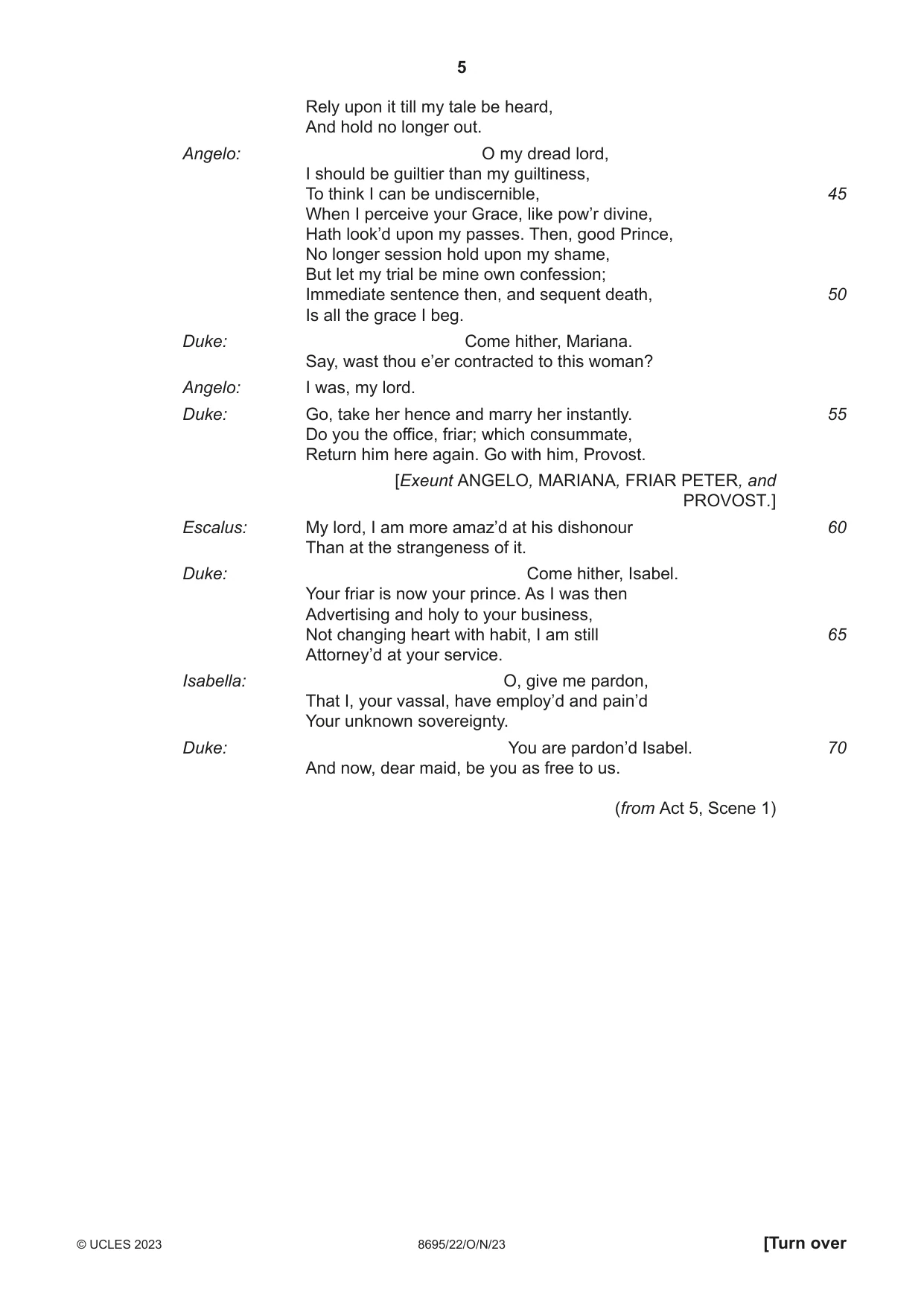
5 8695/22/O/N/23 © UCLES 2023 [Turn over Rely upon it till my tale be heard, And hold no longer out. Angelo: O my dread lord, I should be guiltier than my guiltiness, To think I can be undiscernible, When I perceive your Grace, like pow’r divine, Hath look’d upon my passes. Then, good Prince, No longer session hold upon my shame, But let my trial be mine own confession; Immediate sentence then, and sequent death, Is all the grace I beg. Duke: Come hither, Mariana. Say, wast thou e’er contracted to this woman? Angelo: I was, my lord. Duke: Go, take her hence and marry her instantly. Do you the office, friar; which consummate, Return him here again. Go with him, Provost. [Exeunt ANGELO, MARIANA, FRIAR PETER, and PROVOST.] Escalus: My lord, I am more amaz’d at his dishonour Than at the strangeness of it. Duke: Come hither, Isabel. Your friar is now your prince. As I was then Advertising and holy to your business, Not changing heart with habit, I am still Attorney’d at your service. Isabella: O, give me pardon, That I, your vassal, have employ’d and pain’d Your unknown sovereignty. Duke: You are pardon’d Isabel. And now, dear maid, be you as free to us. (from Act 5, Scene 1) 45 50 55 60 65 70
Question paper, page 6
6 8695/22/O/N/23 © UCLES 2023 WOLE SOYINKA: The Trials of Brother Jero and Jero’s Metamorphosis 3 Either (a) What, in your view, does Soyinka’s use of different settings add to the meaning and effects of the two plays? [25] Or (b) Discuss Soyinka’s presentation of the relationship between Jero and Chume in the following extract from The Trials of Brother Jero. In your answer you should pay close attention to dramatic methods and their effects. [25] [CHUME is silent for a while, then bursts out suddenly.] Content removed due to copyright restrictions.
Question paper, page 7
7 8695/22/O/N/23 © UCLES 2023 [Turn over Chume: All she gave me was abuse, abuse, abuse … (from The Trials of Brother Jero, Scene 3) Content removed due to copyright restrictions.
Question paper, page 8
8 8695/22/O/N/23 © UCLES 2023 TENNESSEE WILLIAMS: Cat on a Hot Tin Roof 4 Either (a) Discuss some of the dramatic ways Williams shapes an audience’s response to Brick in Cat on a Hot Tin Roof. [25] Or (b) Discuss the presentation of Big Mama in the following extract. In your answer you should pay close attention to dramatic methods and their effects. [25] [BIG MAMA calls through closed door.] Content removed due to copyright restrictions.
Question paper, page 9
9 8695/22/O/N/23 © UCLES 2023 [Turn over Took both doctors to haul me back on my feet! (from Act 1) Content removed due to copyright restrictions.
Question paper, page 10
10 8695/22/O/N/23 © UCLES 2023 Section B: Poetry SIMON ARMITAGE: Sir Gawain and the Green Knight 5 Either (a) In what ways, and with what effects, does Armitage present different kinds of conflict in Sir Gawain and the Green Knight? [25] Or (b) Analyse ways Armitage presents the Green Knight in the following extract from Sir Gawain and the Green Knight. [25] Now, on the subject of supper I’ll say no more and adorning the saddle, stitched onto silk. Content removed due to copyright restrictions.
Question paper, page 11
11 8695/22/O/N/23 © UCLES 2023 [Turn over TURN OVER FOR QUESTION 6.
Question paper, page 12
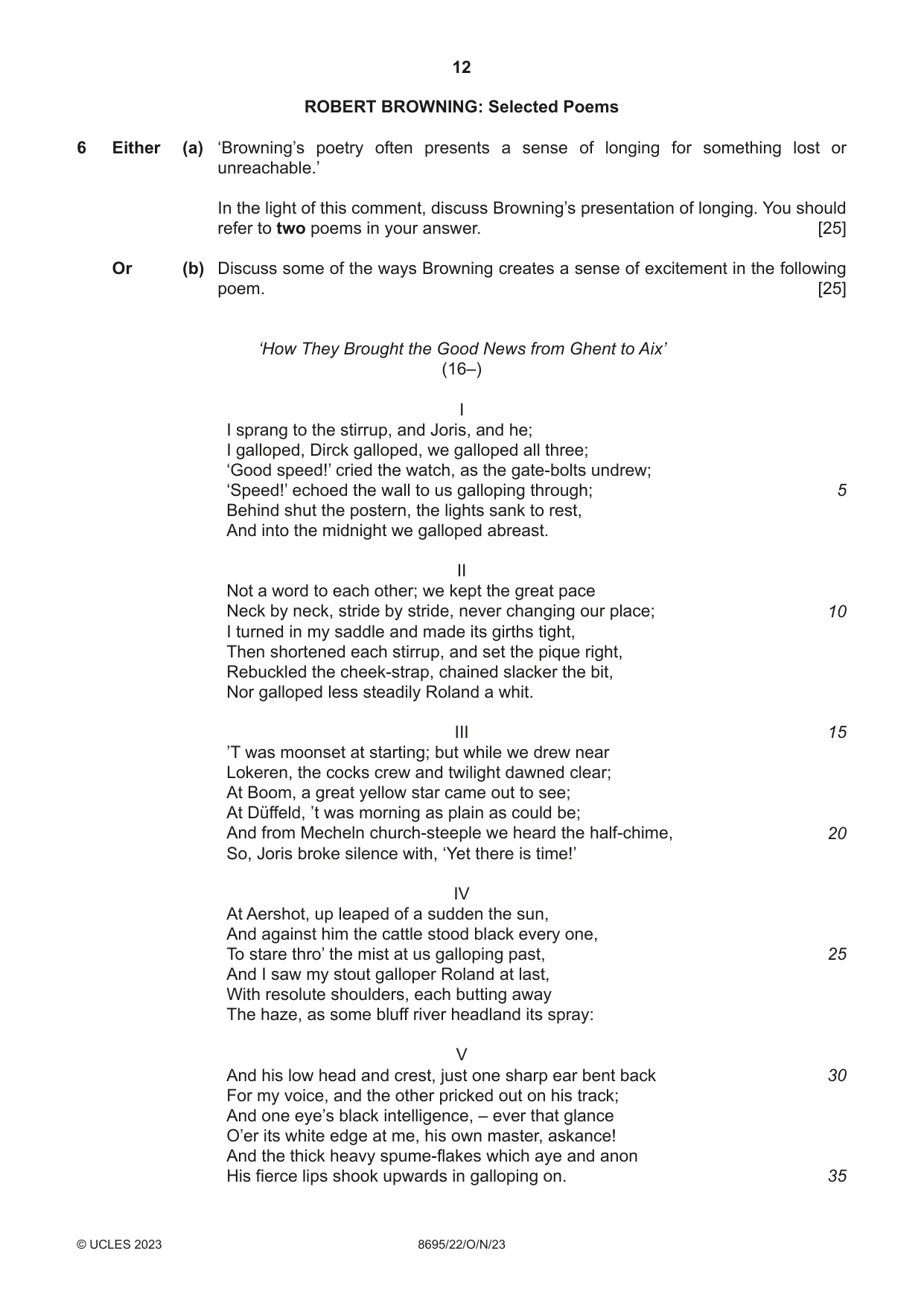
12 8695/22/O/N/23 © UCLES 2023 ROBERT BROWNING: Selected Poems 6 Either (a) ‘Browning’s poetry often presents a sense of longing for something lost or unreachable.’ In the light of this comment, discuss Browning’s presentation of longing. You should refer to two poems in your answer. [25] Or (b) Discuss some of the ways Browning creates a sense of excitement in the following poem. [25] ‘How They Brought the Good News from Ghent to Aix’ (16–) I I sprang to the stirrup, and Joris, and he; I galloped, Dirck galloped, we galloped all three; ‘Good speed!’ cried the watch, as the gate-bolts undrew; ‘Speed!’ echoed the wall to us galloping through; Behind shut the postern, the lights sank to rest, And into the midnight we galloped abreast. II Not a word to each other; we kept the great pace Neck by neck, stride by stride, never changing our place; I turned in my saddle and made its girths tight, Then shortened each stirrup, and set the pique right, Rebuckled the cheek-strap, chained slacker the bit, Nor galloped less steadily Roland a whit. III ’T was moonset at starting; but while we drew near Lokeren, the cocks crew and twilight dawned clear; At Boom, a great yellow star came out to see; At Düffeld, ’t was morning as plain as could be; And from Mecheln church-steeple we heard the half-chime, So, Joris broke silence with, ‘Yet there is time!’ IV At Aershot, up leaped of a sudden the sun, And against him the cattle stood black every one, To stare thro’ the mist at us galloping past, And I saw my stout galloper Roland at last, With resolute shoulders, each butting away The haze, as some bluff river headland its spray: V And his low head and crest, just one sharp ear bent back For my voice, and the other pricked out on his track; And one eye’s black intelligence, – ever that glance O’er its white edge at me, his own master, askance! And the thick heavy spume-flakes which aye and anon His fierce lips shook upwards in galloping on. 5 10 15 20 25 30 35
Question paper, page 13
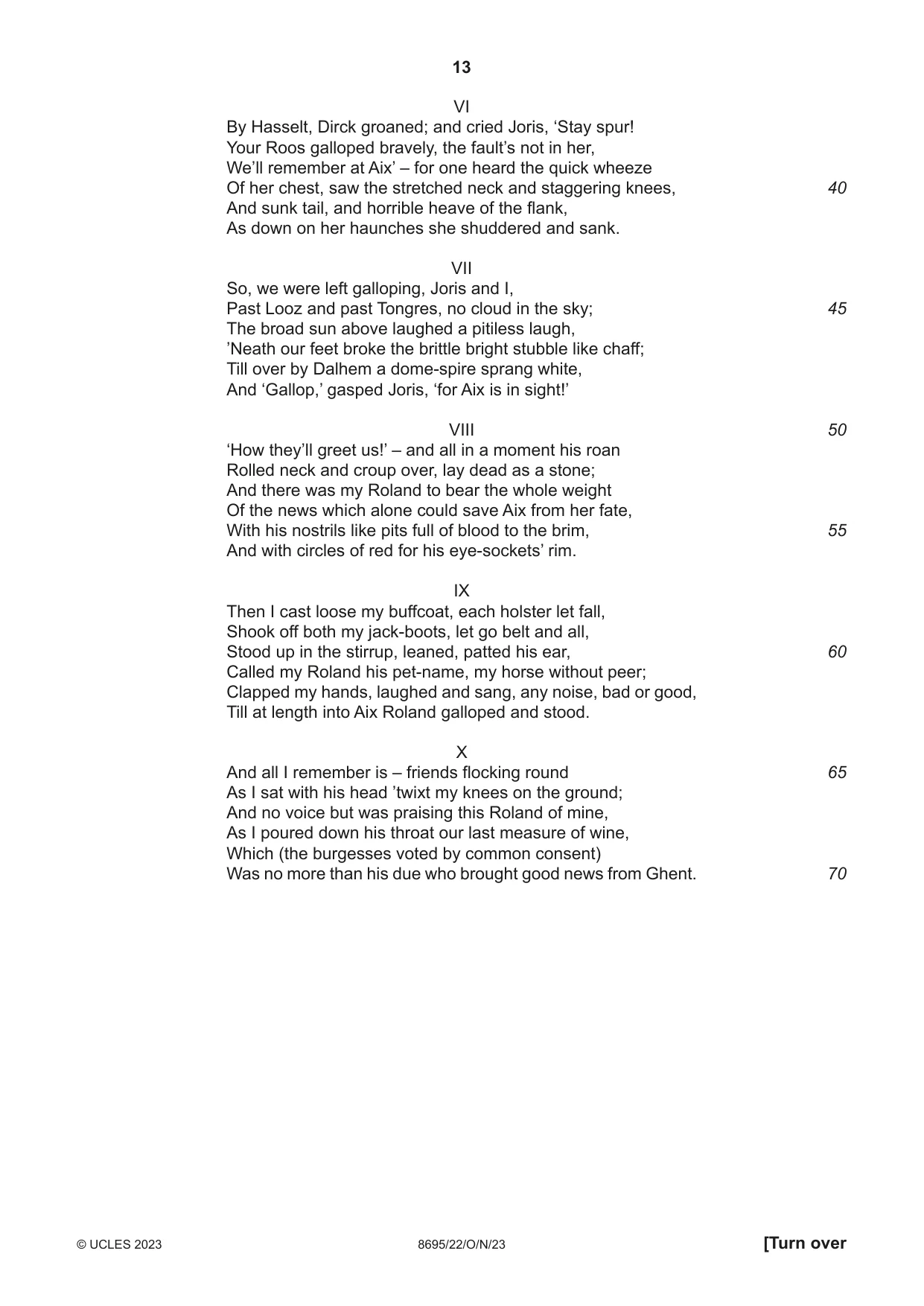
13 8695/22/O/N/23 © UCLES 2023 [Turn over VI By Hasselt, Dirck groaned; and cried Joris, ‘Stay spur! Your Roos galloped bravely, the fault’s not in her, We’ll remember at Aix’ – for one heard the quick wheeze Of her chest, saw the stretched neck and staggering knees, And sunk tail, and horrible heave of the flank, As down on her haunches she shuddered and sank. VII So, we were left galloping, Joris and I, Past Looz and past Tongres, no cloud in the sky; The broad sun above laughed a pitiless laugh, ’Neath our feet broke the brittle bright stubble like chaff; Till over by Dalhem a dome-spire sprang white, And ‘Gallop,’ gasped Joris, ‘for Aix is in sight!’ VIII ‘How they’ll greet us!’ – and all in a moment his roan Rolled neck and croup over, lay dead as a stone; And there was my Roland to bear the whole weight Of the news which alone could save Aix from her fate, With his nostrils like pits full of blood to the brim, And with circles of red for his eye-sockets’ rim. IX Then I cast loose my buffcoat, each holster let fall, Shook off both my jack-boots, let go belt and all, Stood up in the stirrup, leaned, patted his ear, Called my Roland his pet-name, my horse without peer; Clapped my hands, laughed and sang, any noise, bad or good, Till at length into Aix Roland galloped and stood. X And all I remember is – friends flocking round As I sat with his head ’twixt my knees on the ground; And no voice but was praising this Roland of mine, As I poured down his throat our last measure of wine, Which (the burgesses voted by common consent) Was no more than his due who brought good news from Ghent. 40 45 50 55 60 65 70
Question paper, page 14
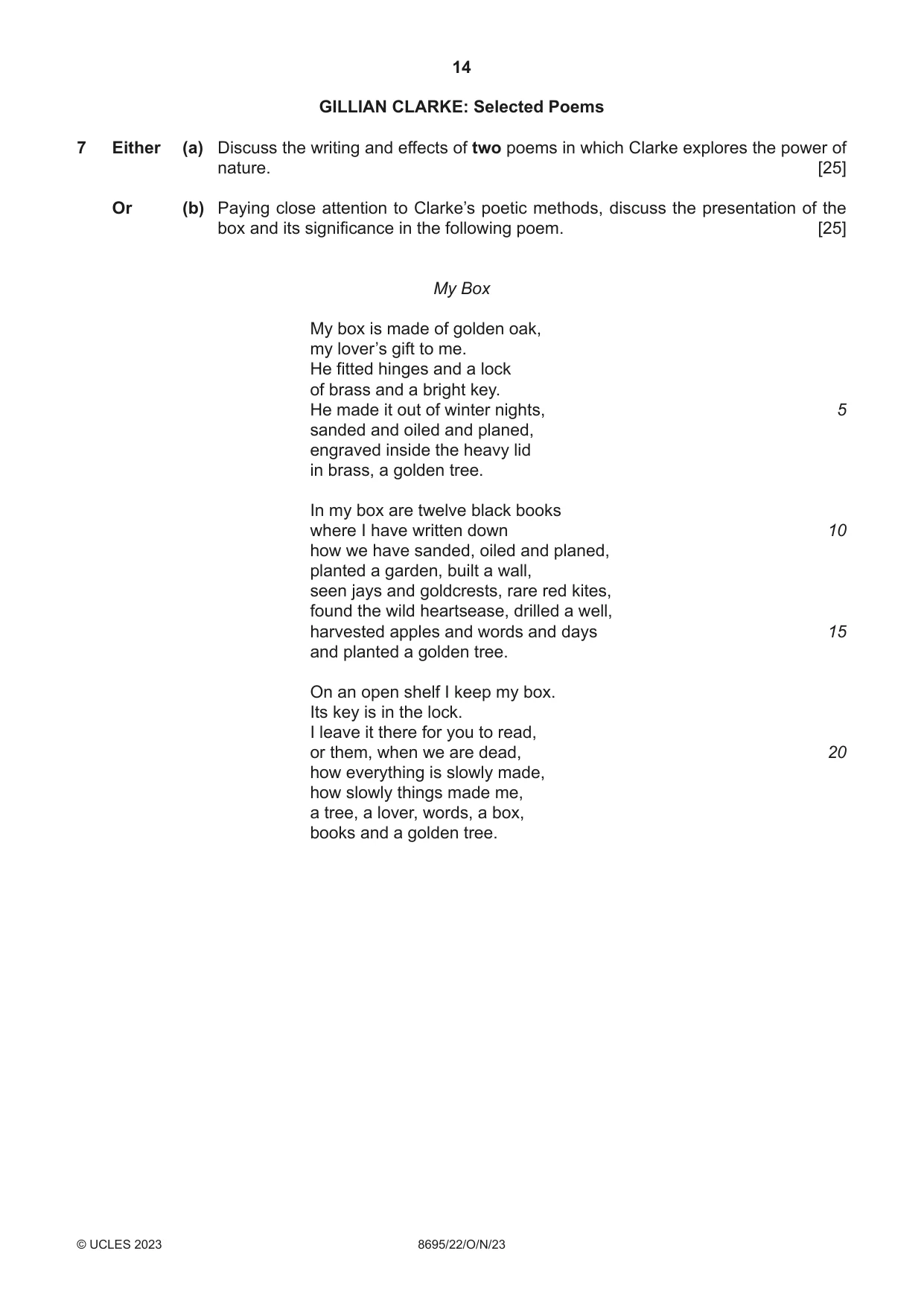
14 8695/22/O/N/23 © UCLES 2023 GILLIAN CLARKE: Selected Poems 7 Either (a) Discuss the writing and effects of two poems in which Clarke explores the power of nature. [25] Or (b) Paying close attention to Clarke’s poetic methods, discuss the presentation of the box and its significance in the following poem. [25] My Box My box is made of golden oak, my lover’s gift to me. He fitted hinges and a lock of brass and a bright key. He made it out of winter nights, sanded and oiled and planed, engraved inside the heavy lid in brass, a golden tree. In my box are twelve black books where I have written down how we have sanded, oiled and planed, planted a garden, built a wall, seen jays and goldcrests, rare red kites, found the wild heartsease, drilled a well, harvested apples and words and days and planted a golden tree. On an open shelf I keep my box. Its key is in the lock. I leave it there for you to read, or them, when we are dead, how everything is slowly made, how slowly things made me, a tree, a lover, words, a box, books and a golden tree. 5 10 15 20
Question paper, page 15
15 8695/22/O/N/23 © UCLES 2023 [Turn over Songs of Ourselves, Volume 2 8 Either (a) Compare some of the ways in which two poems present growing old and its effects. [25] Or (b) Discuss the writing and effects of the following poem, analysing ways in which Imtiaz Dharker presents water. [25] Blessing The skin cracks like a pod. over their small bones. (Imtiaz Dharker) Content removed due to copyright restrictions.
Question paper, page 16
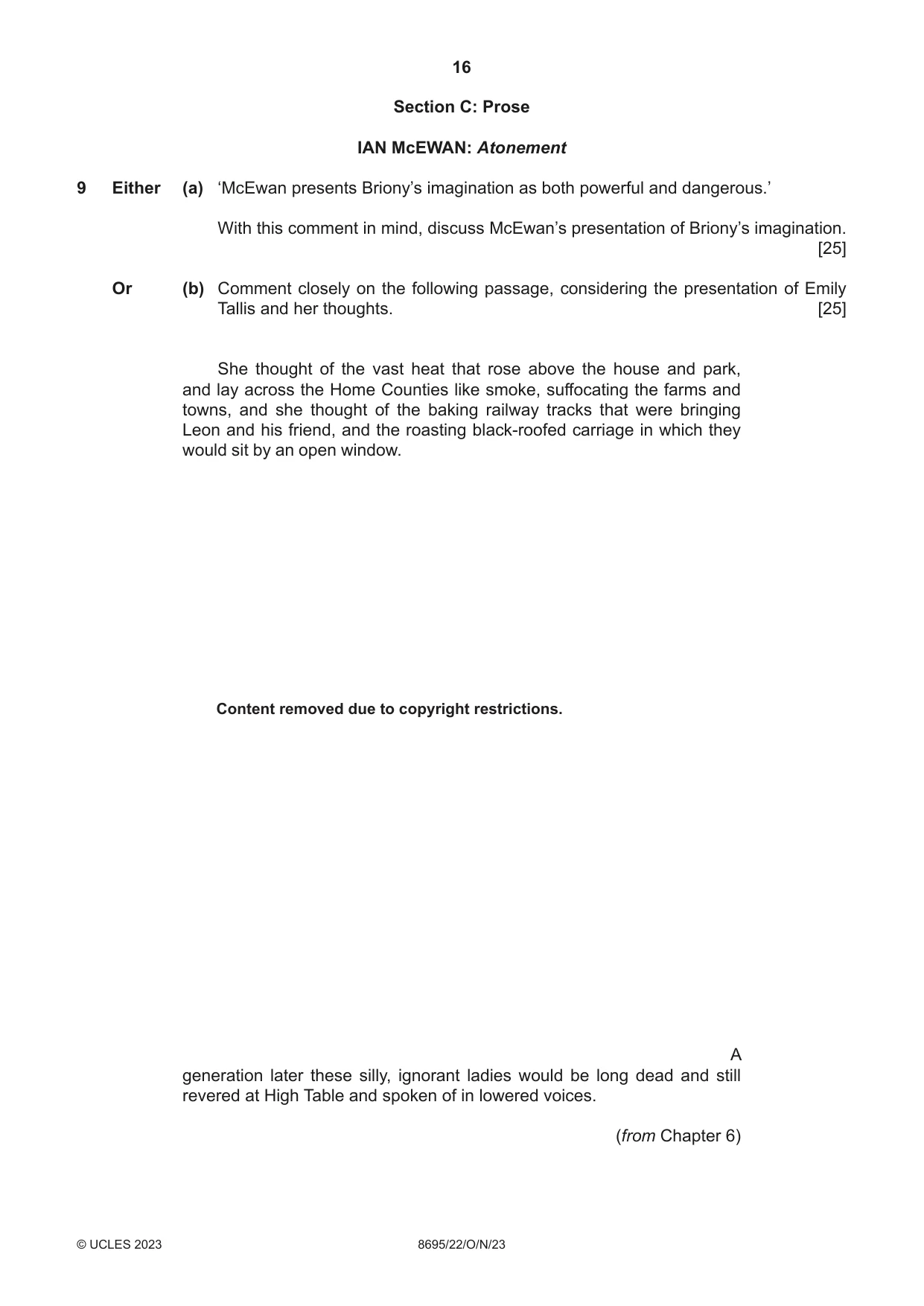
16 8695/22/O/N/23 © UCLES 2023 Section C: Prose IAN McEWAN: Atonement 9 Either (a) ‘McEwan presents Briony’s imagination as both powerful and dangerous.’ With this comment in mind, discuss McEwan’s presentation of Briony’s imagination. [25] Or (b) Comment closely on the following passage, considering the presentation of Emily Tallis and her thoughts. [25] She thought of the vast heat that rose above the house and park, and lay across the Home Counties like smoke, suffocating the farms and towns, and she thought of the baking railway tracks that were bringing Leon and his friend, and the roasting black-roofed carriage in which they would sit by an open window. A generation later these silly, ignorant ladies would be long dead and still revered at High Table and spoken of in lowered voices. (from Chapter 6) Content removed due to copyright restrictions.
Question paper, page 17
17 8695/22/O/N/23 © UCLES 2023 [Turn over TURN OVER FOR QUESTION 10.
Question paper, page 18
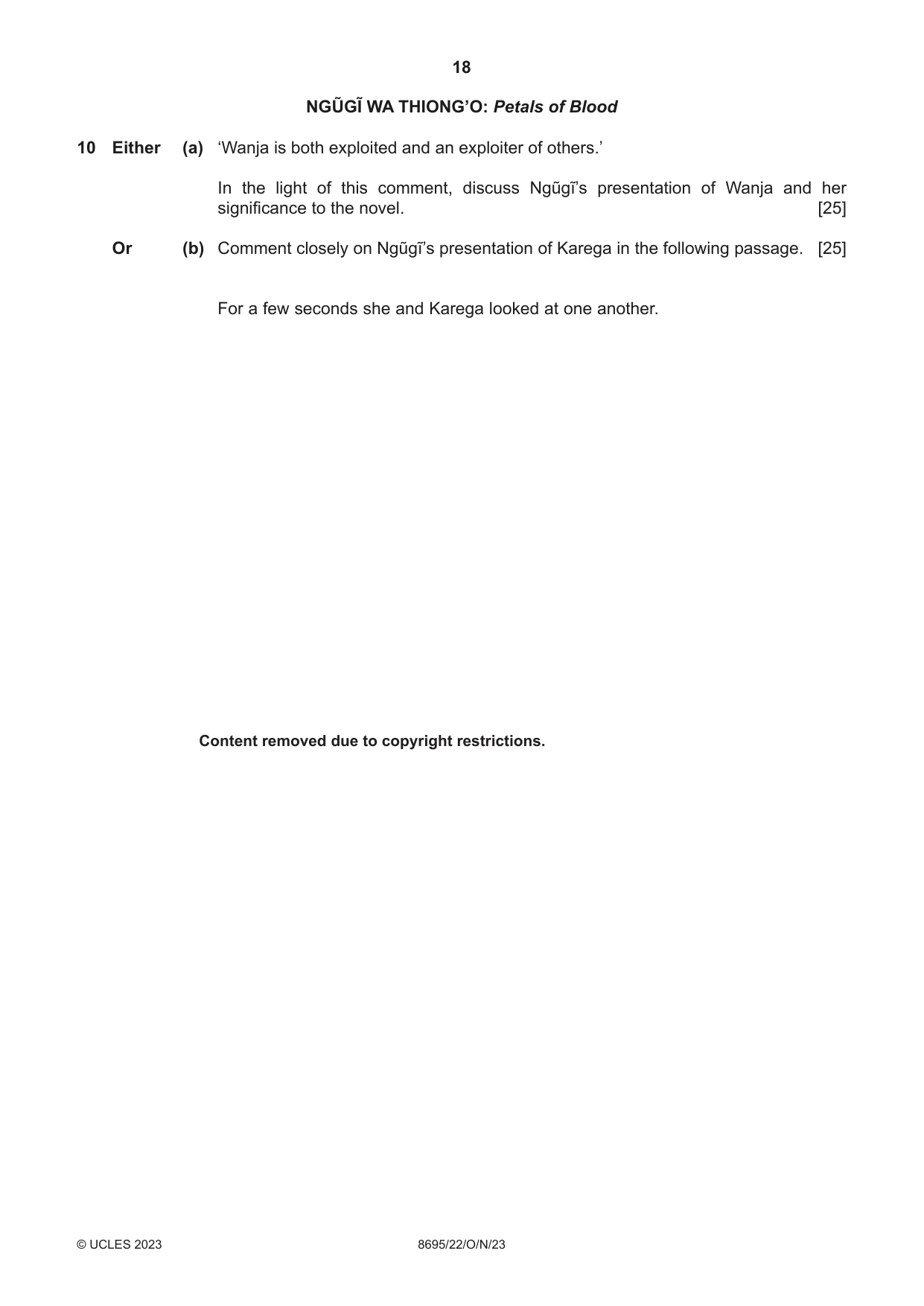
18 8695/22/O/N/23 © UCLES 2023 NGŨGĨ WA THIONG’O: Petals of Blood 10 Either (a) ‘Wanja is both exploited and an exploiter of others.’ In the light of this comment, discuss Ngũgĩ’s presentation of Wanja and her significance to the novel. [25] Or (b) Comment closely on Ngũgĩ’s presentation of Karega in the following passage. [25] For a few seconds she and Karega looked at one another. Content removed due to copyright restrictions.
Question paper, page 19
19 8695/22/O/N/23 © UCLES 2023 [Turn over I said to myself: “There must be another way … there must be another force that can be a match for the monster and its angels”.’ (from Chapter 11) Content removed due to copyright restrictions.
Question paper, page 20
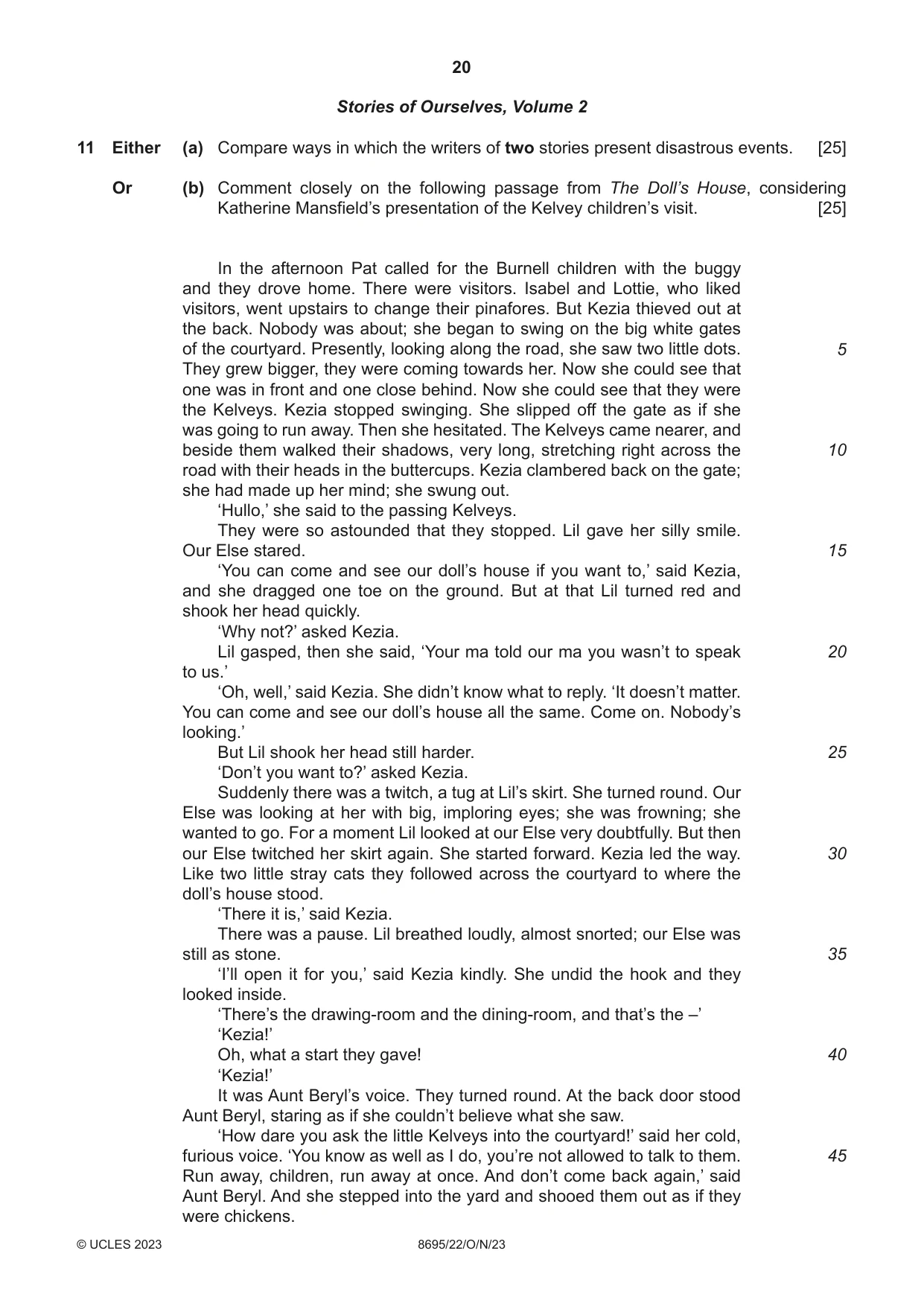
20 8695/22/O/N/23 © UCLES 2023 Stories of Ourselves, Volume 2 11 Either (a) Compare ways in which the writers of two stories present disastrous events. [25] Or (b) Comment closely on the following passage from The Doll’s House, considering Katherine Mansfield’s presentation of the Kelvey children’s visit. [25] In the afternoon Pat called for the Burnell children with the buggy and they drove home. There were visitors. Isabel and Lottie, who liked visitors, went upstairs to change their pinafores. But Kezia thieved out at the back. Nobody was about; she began to swing on the big white gates of the courtyard. Presently, looking along the road, she saw two little dots. They grew bigger, they were coming towards her. Now she could see that one was in front and one close behind. Now she could see that they were the Kelveys. Kezia stopped swinging. She slipped off the gate as if she was going to run away. Then she hesitated. The Kelveys came nearer, and beside them walked their shadows, very long, stretching right across the road with their heads in the buttercups. Kezia clambered back on the gate; she had made up her mind; she swung out. ‘Hullo,’ she said to the passing Kelveys. They were so astounded that they stopped. Lil gave her silly smile. Our Else stared. ‘You can come and see our doll’s house if you want to,’ said Kezia, and she dragged one toe on the ground. But at that Lil turned red and shook her head quickly. ‘Why not?’ asked Kezia. Lil gasped, then she said, ‘Your ma told our ma you wasn’t to speak to us.’ ‘Oh, well,’ said Kezia. She didn’t know what to reply. ‘It doesn’t matter. You can come and see our doll’s house all the same. Come on. Nobody’s looking.’ But Lil shook her head still harder. ‘Don’t you want to?’ asked Kezia. Suddenly there was a twitch, a tug at Lil’s skirt. She turned round. Our Else was looking at her with big, imploring eyes; she was frowning; she wanted to go. For a moment Lil looked at our Else very doubtfully. But then our Else twitched her skirt again. She started forward. Kezia led the way. Like two little stray cats they followed across the courtyard to where the doll’s house stood. ‘There it is,’ said Kezia. There was a pause. Lil breathed loudly, almost snorted; our Else was still as stone. ‘I’ll open it for you,’ said Kezia kindly. She undid the hook and they looked inside. ‘There’s the drawing-room and the dining-room, and that’s the –’ ‘Kezia!’ Oh, what a start they gave! ‘Kezia!’ It was Aunt Beryl’s voice. They turned round. At the back door stood Aunt Beryl, staring as if she couldn’t believe what she saw. ‘How dare you ask the little Kelveys into the courtyard!’ said her cold, furious voice. ‘You know as well as I do, you’re not allowed to talk to them. Run away, children, run away at once. And don’t come back again,’ said Aunt Beryl. And she stepped into the yard and shooed them out as if they were chickens. 5 10 15 20 25 30 35 40 45
Question paper, page 21
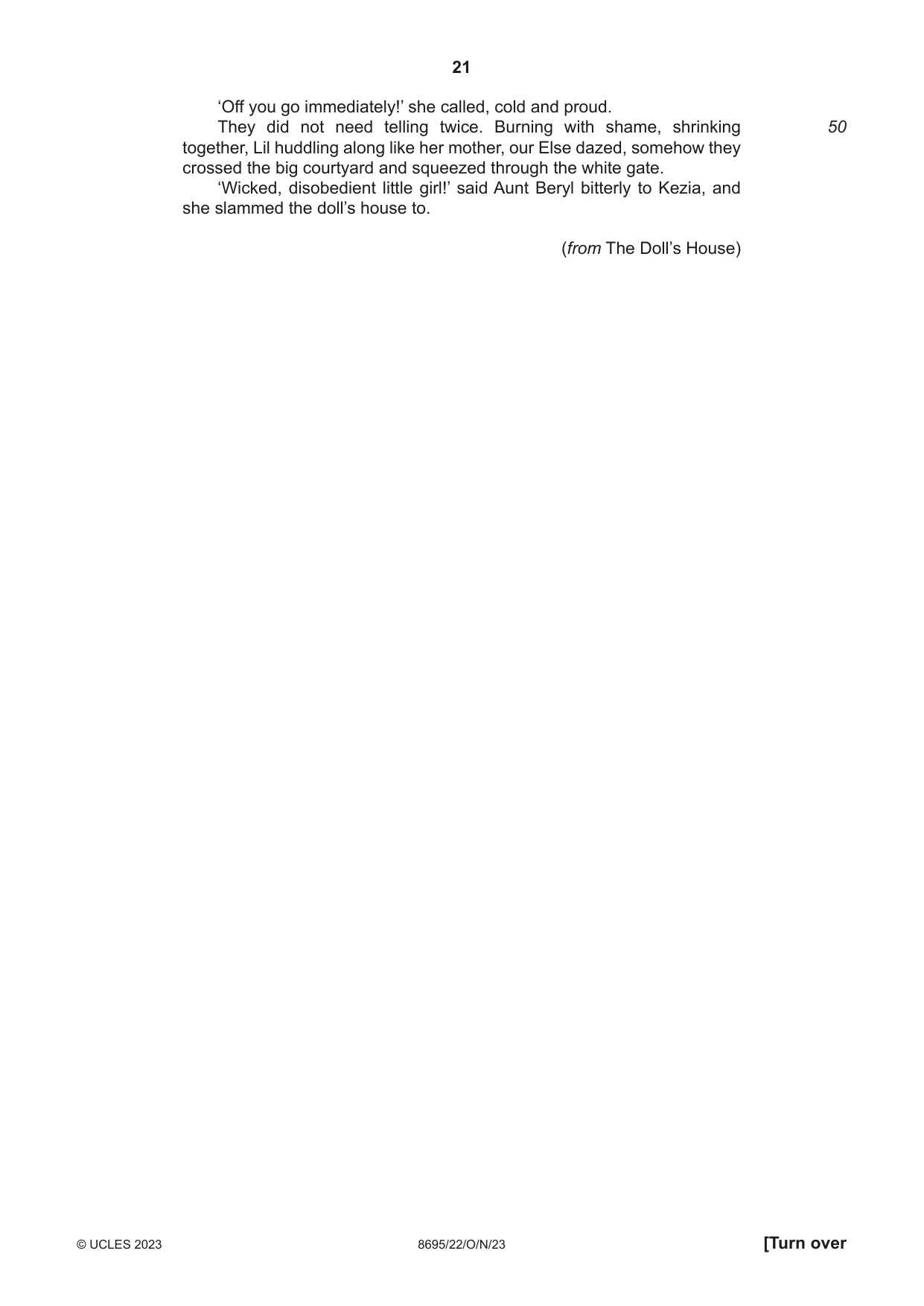
21 8695/22/O/N/23 © UCLES 2023 [Turn over ‘Off you go immediately!’ she called, cold and proud. They did not need telling twice. Burning with shame, shrinking together, Lil huddling along like her mother, our Else dazed, somehow they crossed the big courtyard and squeezed through the white gate. ‘Wicked, disobedient little girl!’ said Aunt Beryl bitterly to Kezia, and she slammed the doll’s house to. (from The Doll’s House) 50
Question paper, page 22
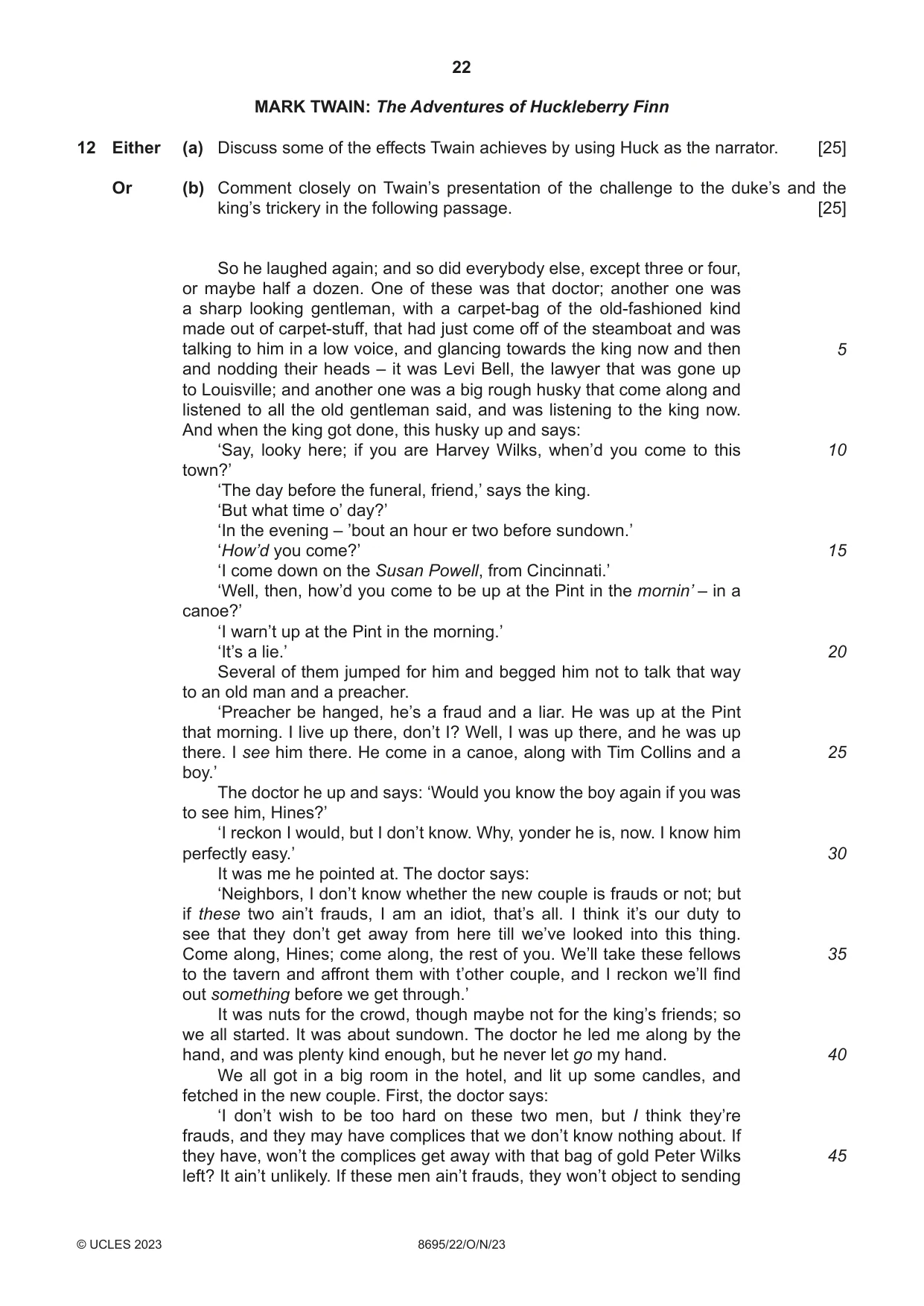
22 8695/22/O/N/23 © UCLES 2023 MARK TWAIN: The Adventures of Huckleberry Finn 12 Either (a) Discuss some of the effects Twain achieves by using Huck as the narrator. [25] Or (b) Comment closely on Twain’s presentation of the challenge to the duke’s and the king’s trickery in the following passage. [25] So he laughed again; and so did everybody else, except three or four, or maybe half a dozen. One of these was that doctor; another one was a sharp looking gentleman, with a carpet-bag of the old-fashioned kind made out of carpet-stuff, that had just come off of the steamboat and was talking to him in a low voice, and glancing towards the king now and then and nodding their heads – it was Levi Bell, the lawyer that was gone up to Louisville; and another one was a big rough husky that come along and listened to all the old gentleman said, and was listening to the king now. And when the king got done, this husky up and says: ‘Say, looky here; if you are Harvey Wilks, when’d you come to this town?’ ‘The day before the funeral, friend,’ says the king. ‘But what time o’ day?’ ‘In the evening – ’bout an hour er two before sundown.’ ‘How’d you come?’ ‘I come down on the Susan Powell, from Cincinnati.’ ‘Well, then, how’d you come to be up at the Pint in the mornin’ – in a canoe?’ ‘I warn’t up at the Pint in the morning.’ ‘It’s a lie.’ Several of them jumped for him and begged him not to talk that way to an old man and a preacher. ‘Preacher be hanged, he’s a fraud and a liar. He was up at the Pint that morning. I live up there, don’t I? Well, I was up there, and he was up there. I see him there. He come in a canoe, along with Tim Collins and a boy.’ The doctor he up and says: ‘Would you know the boy again if you was to see him, Hines?’ ‘I reckon I would, but I don’t know. Why, yonder he is, now. I know him perfectly easy.’ It was me he pointed at. The doctor says: ‘Neighbors, I don’t know whether the new couple is frauds or not; but if these two ain’t frauds, I am an idiot, that’s all. I think it’s our duty to see that they don’t get away from here till we’ve looked into this thing. Come along, Hines; come along, the rest of you. We’ll take these fellows to the tavern and affront them with t’other couple, and I reckon we’ll find out something before we get through.’ It was nuts for the crowd, though maybe not for the king’s friends; so we all started. It was about sundown. The doctor he led me along by the hand, and was plenty kind enough, but he never let go my hand. We all got in a big room in the hotel, and lit up some candles, and fetched in the new couple. First, the doctor says: ‘I don’t wish to be too hard on these two men, but I think they’re frauds, and they may have complices that we don’t know nothing about. If they have, won’t the complices get away with that bag of gold Peter Wilks left? It ain’t unlikely. If these men ain’t frauds, they won’t object to sending 5 10 15 20 25 30 35 40 45
Question paper, page 23
23 8695/22/O/N/23 © UCLES 2023 for that money and letting us keep it till they prove they’re all right – ain’t that so?’ (from Chapter 29)
Question paper, page 24
24 8695/22/O/N/23 © UCLES 2023 Permission to reproduce items where third-party owned material protected by copyright is included has been sought and cleared where possible. Every reasonable effort has been made by the publisher (UCLES) to trace copyright holders, but if any items requiring clearance have unwittingly been included, the publisher will be pleased to make amends at the earliest possible opportunity. To avoid the issue of disclosure of answer-related information to candidates, all copyright acknowledgements are reproduced online in the Cambridge Assessment International Education Copyright Acknowledgements Booklet. This is produced for each series of examinations and is freely available to download at www.cambridgeinternational.org after the live examination series. Cambridge Assessment International Education is part of Cambridge Assessment. Cambridge Assessment is the brand name of the University of Cambridge Local Examinations Syndicate (UCLES), which is a department of the University of Cambridge. BLANK PAGE
Mark scheme, page 1
This document consists of 13 printed pages. © UCLES 2023 [Turn over Cambridge International AS Level LANGUAGE AND LITERATURE IN ENGLISH 8695/22 Paper 2 Drama, Poetry and Prose October/November 2023 MARK SCHEME Maximum Mark: 50 Published This mark scheme is published as an aid to teachers and candidates, to indicate the requirements of the examination. It shows the basis on which Examiners were instructed to award marks. It does not indicate the details of the discussions that took place at an Examiners’ meeting before marking began, which would have considered the acceptability of alternative answers. Mark schemes should be read in conjunction with the question paper and the Principal Examiner Report for Teachers. Cambridge International will not enter into discussions about these mark schemes. Cambridge International is publishing the mark schemes for the October/November 2023 series for most Cambridge IGCSE, Cambridge International A and AS Level components, and some Cambridge O Level components.
Mark scheme, page 2
8695/22 Cambridge International AS Level – Mark Scheme PUBLISHED October/November 2023 © UCLES 2023 Page 2 of 13 Generic Marking Principles These general marking principles must be applied by all examiners when marking candidate answers. They should be applied alongside the specific content of the mark scheme or generic level descriptors for a question. Each question paper and mark scheme will also comply with these marking principles. GENERIC MARKING PRINCIPLE 1: Marks must be awarded in line with: • the specific content of the mark scheme or the generic level descriptors for the question • the specific skills defined in the mark scheme or in the generic level descriptors for the question • the standard of response required by a candidate as exemplified by the standardisation scripts. GENERIC MARKING PRINCIPLE 2: Marks awarded are always whole marks (not half marks, or other fractions). GENERIC MARKING PRINCIPLE 3: Marks must be awarded positively: • marks are awarded for correct/valid answers, as defined in the mark scheme. However, credit is given for valid answers which go beyond the scope of the syllabus and mark scheme, referring to your Team Leader as appropriate • marks are awarded when candidates clearly demonstrate what they know and can do • marks are not deducted for errors • marks are not deducted for omissions • answers should only be judged on the quality of spelling, punctuation and grammar when these features are specifically assessed by the question as indicated by the mark scheme. The meaning, however, should be unambiguous. GENERIC MARKING PRINCIPLE 4: Rules must be applied consistently, e.g. in situations where candidates have not followed instructions or in the application of generic level descriptors. GENERIC MARKING PRINCIPLE 5: Marks should be awarded using the full range of marks defined in the mark scheme for the question (however; the use of the full mark range may be limited according to the quality of the candidate responses seen). GENERIC MARKING PRINCIPLE 6: Marks awarded are based solely on the requirements as defined in the mark scheme. Marks should not be awarded with grade thresholds or grade descriptors in mind.
Mark scheme, page 3
8695/22 Cambridge International AS Level – Mark Scheme PUBLISHED October/November 2023 © UCLES 2023 Page 3 of 13 English & Media subject specific general marking principles (To be read in conjunction with the Generic Marking Principles (and requiring further guidance on how to place marks within levels)) Components using level descriptors: • We use level descriptors as a guide to broad understanding of the qualities normally expected of, or typical of, work in a level. • Level descriptors are a means of general guidance, and should not be interpreted as hurdle statements. • Where indicative content notes are supplied for a question, these are not a prescription of required content, and must not be treated as such. Alternative correct points and unexpected answers in candidates’ scripts must be given marks that fairly reflect the knowledge and skills demonstrated. • While we may have legitimate expectations as to the ground most answers may occupy, we must at all times be prepared to meet candidates on their chosen ground, provided it is relevant ground (e.g. clearly related to and derived from a relevant passage/text and meeting the mark scheme requirements for the question). Components using point-based marking: Point marking is often used to reward knowledge, understanding and application of skills. We give credit where the candidate’s answer shows relevant knowledge, understanding and application of skills in answering the question. We do not give credit where the answer shows confusion. From this it follows that we: a DO credit answers which are worded differently from the mark scheme if they clearly convey the same meaning (unless the mark scheme requires a specific term). b DO credit alternative answers/examples which are not written in the mark scheme if they are correct. c DO credit answers where candidates give more than one correct answer in one prompt/numbered/scaffolded space where extended writing is required rather than list-type answers. For example, questions that require n reasons (e.g. State two reasons…). d DO NOT credit answers simply for using a ‘key term’ unless that is all that is required. (Check for evidence it is understood and not used wrongly.) e DO NOT credit answers which are obviously self-contradicting or trying to cover all possibilities. f DO NOT give further credit for what is effectively repetition of a correct point already credited unless the language itself is being tested. This applies equally to ‘mirror statements’ (i.e. polluted/not polluted). g DO NOT require spellings to be correct, unless this is part of the test. However spellings of syllabus terms must allow for clear and unambiguous separation from other syllabus terms with which they may be confused (e.g. Corrasion/Corrosion).
Mark scheme, page 4
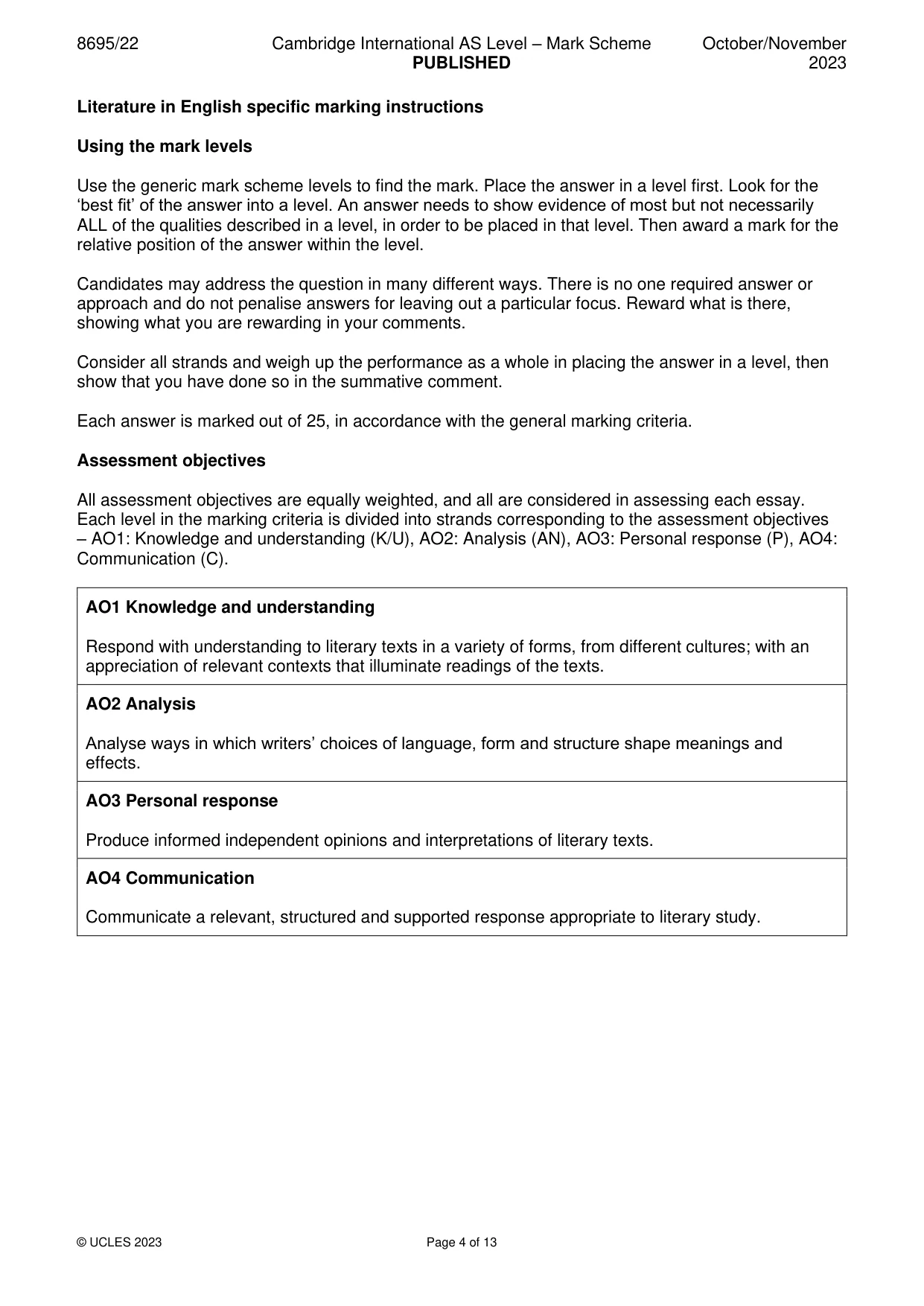
8695/22 Cambridge International AS Level – Mark Scheme PUBLISHED October/November 2023 © UCLES 2023 Page 4 of 13 Literature in English specific marking instructions Using the mark levels Use the generic mark scheme levels to find the mark. Place the answer in a level first. Look for the ‘best fit’ of the answer into a level. An answer needs to show evidence of most but not necessarily ALL of the qualities described in a level, in order to be placed in that level. Then award a mark for the relative position of the answer within the level. Candidates may address the question in many different ways. There is no one required answer or approach and do not penalise answers for leaving out a particular focus. Reward what is there, showing what you are rewarding in your comments. Consider all strands and weigh up the performance as a whole in placing the answer in a level, then show that you have done so in the summative comment. Each answer is marked out of 25, in accordance with the general marking criteria. Assessment objectives All assessment objectives are equally weighted, and all are considered in assessing each essay. Each level in the marking criteria is divided into strands corresponding to the assessment objectives – AO1: Knowledge and understanding (K/U), AO2: Analysis (AN), AO3: Personal response (P), AO4: Communication (C). AO1 Knowledge and understanding Respond with understanding to literary texts in a variety of forms, from different cultures; with an appreciation of relevant contexts that illuminate readings of the texts. AO2 Analysis Analyse ways in which writers’ choices of language, form and structure shape meanings and effects. AO3 Personal response Produce informed independent opinions and interpretations of literary texts. AO4 Communication Communicate a relevant, structured and supported response appropriate to literary study.
Mark scheme, page 5
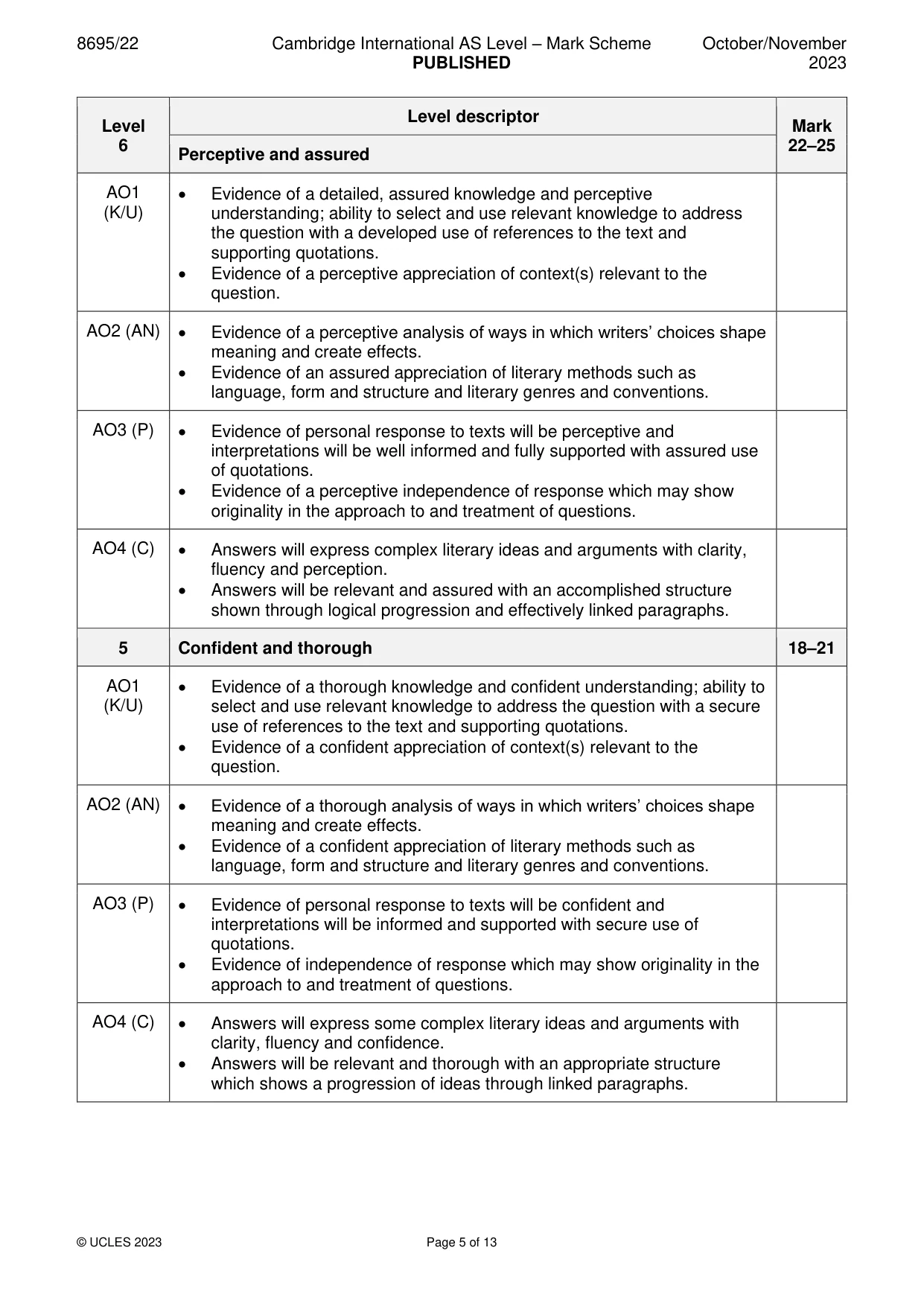
8695/22 Cambridge International AS Level – Mark Scheme PUBLISHED October/November 2023 © UCLES 2023 Page 5 of 13 Level 6 Level descriptor Mark 22–25 Perceptive and assured AO1 (K/U) • Evidence of a detailed, assured knowledge and perceptive understanding; ability to select and use relevant knowledge to address the question with a developed use of references to the text and supporting quotations. • Evidence of a perceptive appreciation of context(s) relevant to the question. AO2 (AN) • Evidence of a perceptive analysis of ways in which writers’ choices shape meaning and create effects. • Evidence of an assured appreciation of literary methods such as language, form and structure and literary genres and conventions. AO3 (P) • Evidence of personal response to texts will be perceptive and interpretations will be well informed and fully supported with assured use of quotations. • Evidence of a perceptive independence of response which may show originality in the approach to and treatment of questions. AO4 (C) • Answers will express complex literary ideas and arguments with clarity, fluency and perception. • Answers will be relevant and assured with an accomplished structure shown through logical progression and effectively linked paragraphs. 5 Confident and thorough 18–21 AO1 (K/U) • Evidence of a thorough knowledge and confident understanding; ability to select and use relevant knowledge to address the question with a secure use of references to the text and supporting quotations. • Evidence of a confident appreciation of context(s) relevant to the question. AO2 (AN) • Evidence of a thorough analysis of ways in which writers’ choices shape meaning and create effects. • Evidence of a confident appreciation of literary methods such as language, form and structure and literary genres and conventions. AO3 (P) • Evidence of personal response to texts will be confident and interpretations will be informed and supported with secure use of quotations. • Evidence of independence of response which may show originality in the approach to and treatment of questions. AO4 (C) • Answers will express some complex literary ideas and arguments with clarity, fluency and confidence. • Answers will be relevant and thorough with an appropriate structure which shows a progression of ideas through linked paragraphs.
Mark scheme, page 6
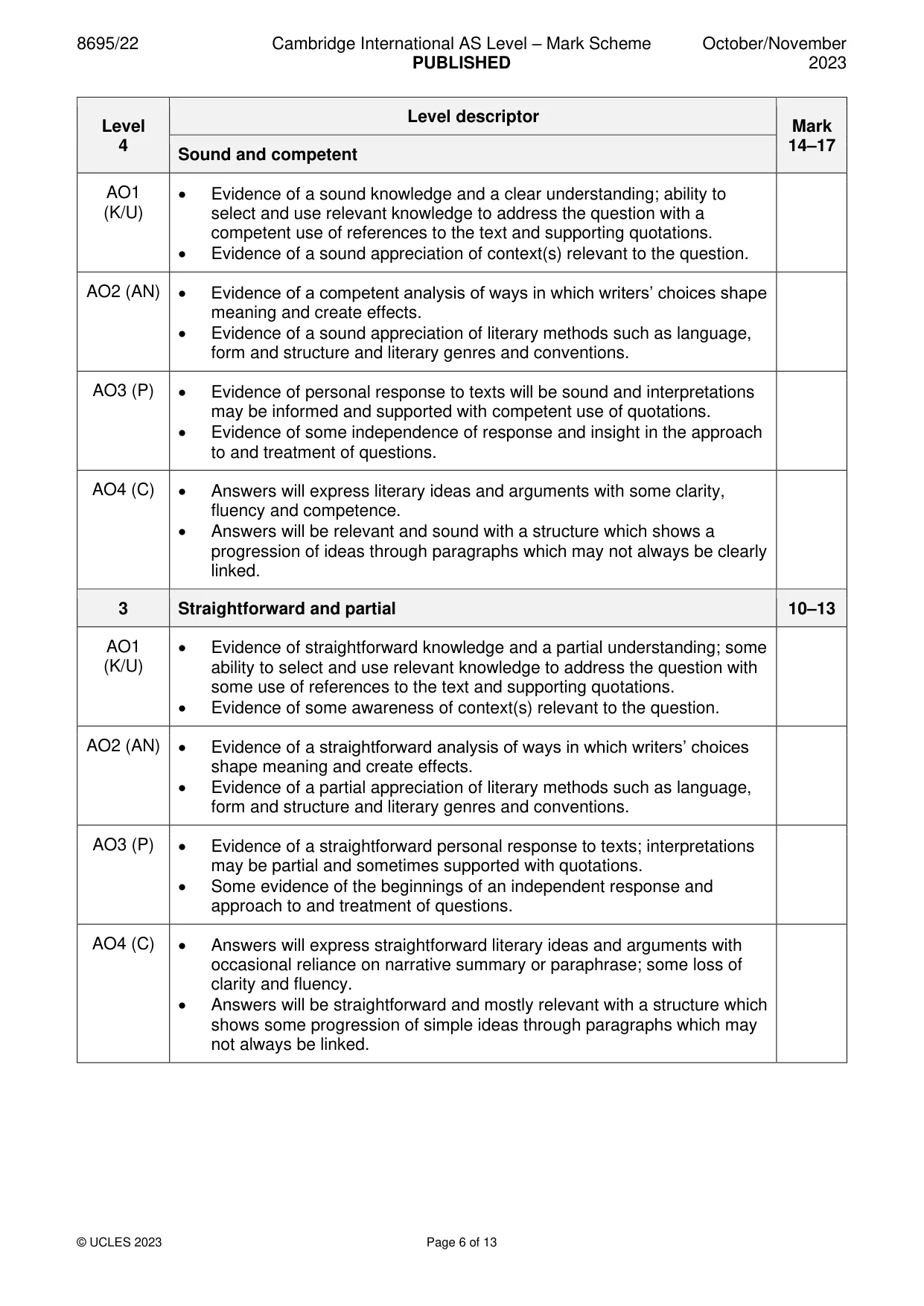
8695/22 Cambridge International AS Level – Mark Scheme PUBLISHED October/November 2023 © UCLES 2023 Page 6 of 13 Level 4 Level descriptor Mark 14–17 Sound and competent AO1 (K/U) • Evidence of a sound knowledge and a clear understanding; ability to select and use relevant knowledge to address the question with a competent use of references to the text and supporting quotations. • Evidence of a sound appreciation of context(s) relevant to the question. AO2 (AN) • Evidence of a competent analysis of ways in which writers’ choices shape meaning and create effects. • Evidence of a sound appreciation of literary methods such as language, form and structure and literary genres and conventions. AO3 (P) • Evidence of personal response to texts will be sound and interpretations may be informed and supported with competent use of quotations. • Evidence of some independence of response and insight in the approach to and treatment of questions. AO4 (C) • Answers will express literary ideas and arguments with some clarity, fluency and competence. • Answers will be relevant and sound with a structure which shows a progression of ideas through paragraphs which may not always be clearly linked. 3 Straightforward and partial 10–13 AO1 (K/U) • Evidence of straightforward knowledge and a partial understanding; some ability to select and use relevant knowledge to address the question with some use of references to the text and supporting quotations. • Evidence of some awareness of context(s) relevant to the question. AO2 (AN) • Evidence of a straightforward analysis of ways in which writers’ choices shape meaning and create effects. • Evidence of a partial appreciation of literary methods such as language, form and structure and literary genres and conventions. AO3 (P) • Evidence of a straightforward personal response to texts; interpretations may be partial and sometimes supported with quotations. • Some evidence of the beginnings of an independent response and approach to and treatment of questions. AO4 (C) • Answers will express straightforward literary ideas and arguments with occasional reliance on narrative summary or paraphrase; some loss of clarity and fluency. • Answers will be straightforward and mostly relevant with a structure which shows some progression of simple ideas through paragraphs which may not always be linked.
Mark scheme, page 7
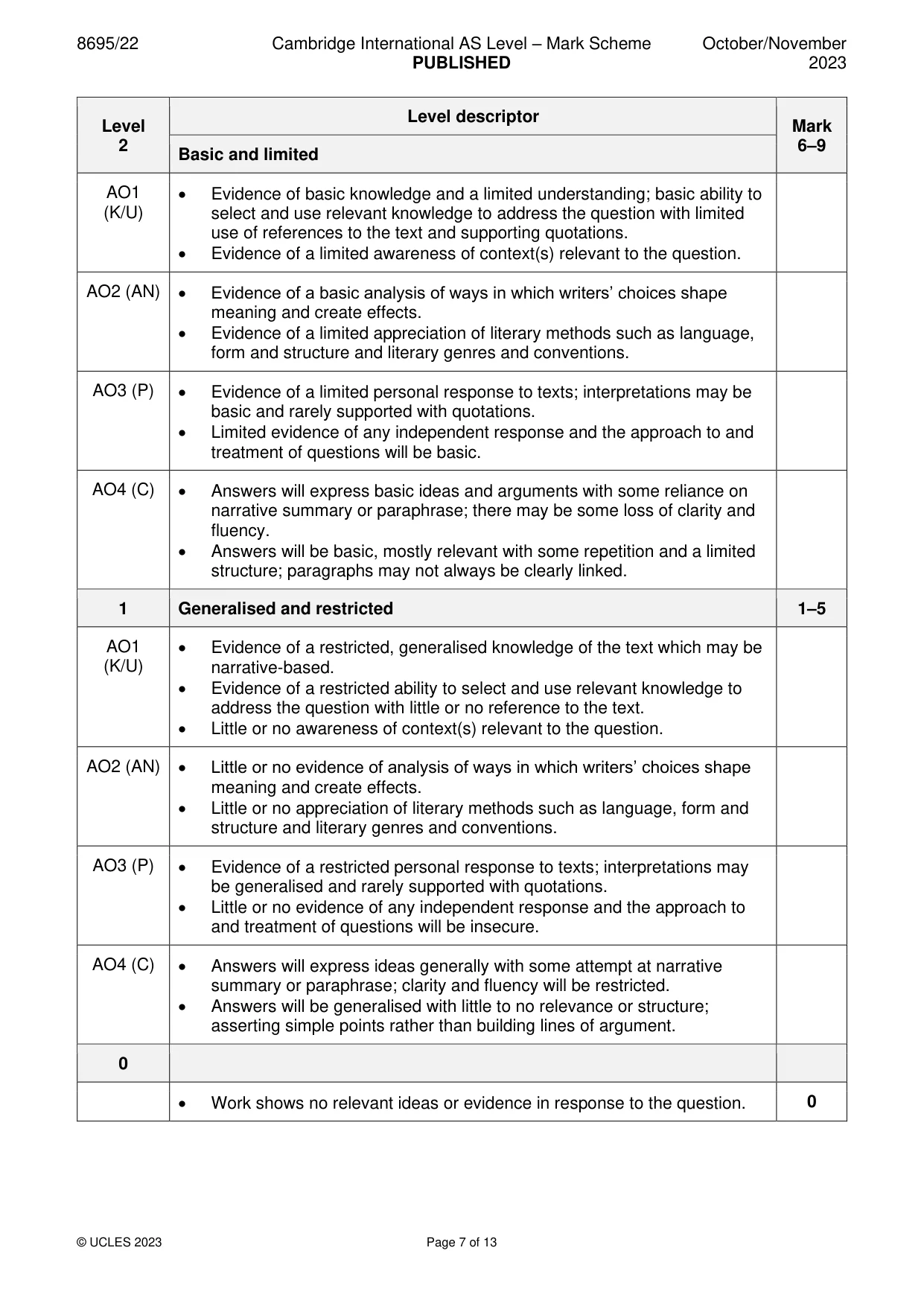
8695/22 Cambridge International AS Level – Mark Scheme PUBLISHED October/November 2023 © UCLES 2023 Page 7 of 13 Level 2 Level descriptor Mark 6–9 Basic and limited AO1 (K/U) • Evidence of basic knowledge and a limited understanding; basic ability to select and use relevant knowledge to address the question with limited use of references to the text and supporting quotations. • Evidence of a limited awareness of context(s) relevant to the question. AO2 (AN) • Evidence of a basic analysis of ways in which writers’ choices shape meaning and create effects. • Evidence of a limited appreciation of literary methods such as language, form and structure and literary genres and conventions. AO3 (P) • Evidence of a limited personal response to texts; interpretations may be basic and rarely supported with quotations. • Limited evidence of any independent response and the approach to and treatment of questions will be basic. AO4 (C) • Answers will express basic ideas and arguments with some reliance on narrative summary or paraphrase; there may be some loss of clarity and fluency. • Answers will be basic, mostly relevant with some repetition and a limited structure; paragraphs may not always be clearly linked. 1 Generalised and restricted 1–5 AO1 (K/U) • Evidence of a restricted, generalised knowledge of the text which may be narrative-based. • Evidence of a restricted ability to select and use relevant knowledge to address the question with little or no reference to the text. • Little or no awareness of context(s) relevant to the question. AO2 (AN) • Little or no evidence of analysis of ways in which writers’ choices shape meaning and create effects. • Little or no appreciation of literary methods such as language, form and structure and literary genres and conventions. AO3 (P) • Evidence of a restricted personal response to texts; interpretations may be generalised and rarely supported with quotations. • Little or no evidence of any independent response and the approach to and treatment of questions will be insecure. AO4 (C) • Answers will express ideas generally with some attempt at narrative summary or paraphrase; clarity and fluency will be restricted. • Answers will be generalised with little to no relevance or structure; asserting simple points rather than building lines of argument. 0 • Work shows no relevant ideas or evidence in response to the question. 0
Mark scheme, page 8
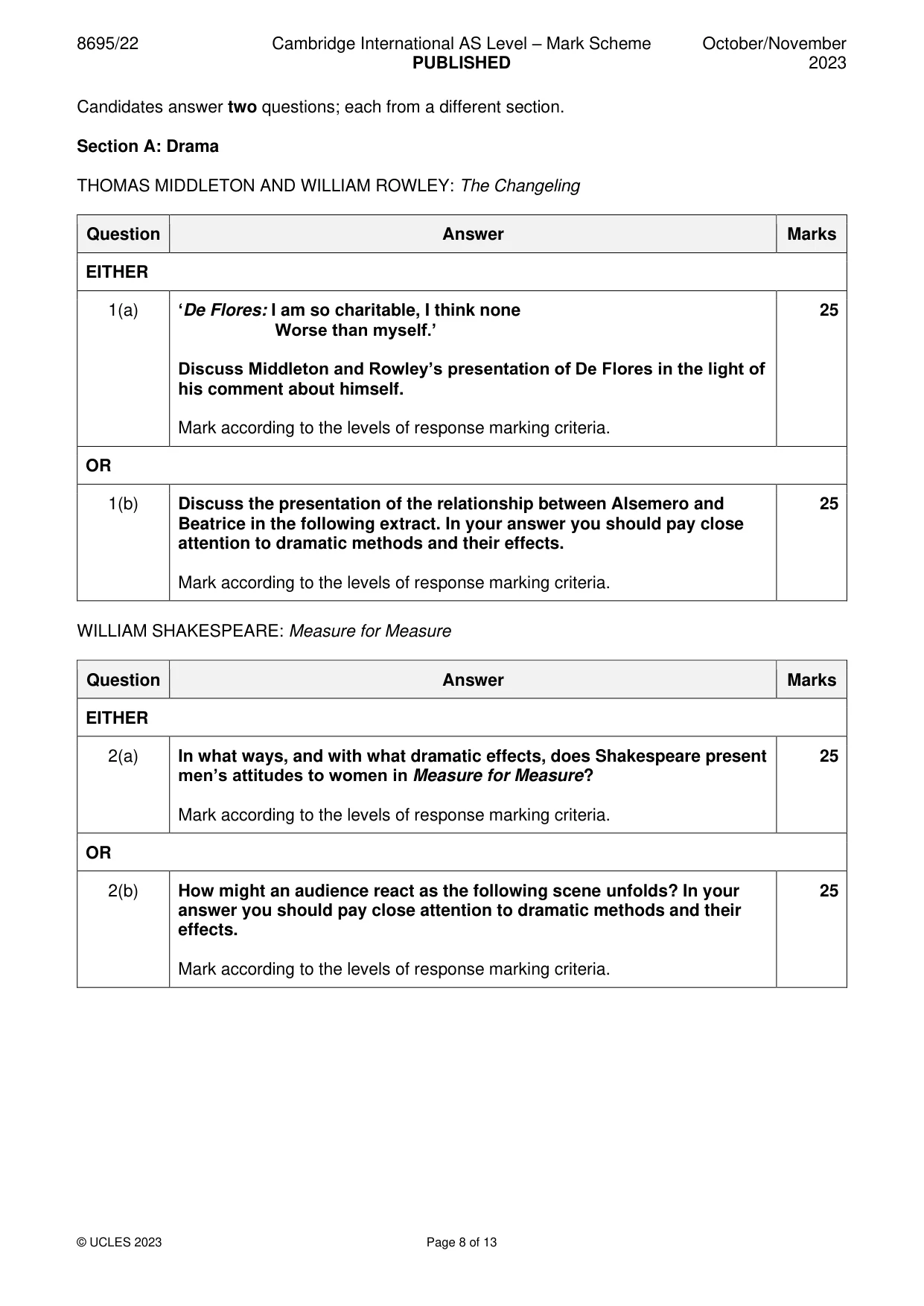
8695/22 Cambridge International AS Level – Mark Scheme PUBLISHED October/November 2023 © UCLES 2023 Page 8 of 13 Candidates answer two questions; each from a different section. Section A: Drama THOMAS MIDDLETON AND WILLIAM ROWLEY: The Changeling Question Answer Marks EITHER 1(a) ‘De Flores: I am so charitable, I think none Worse than myself.’ Discuss Middleton and Rowley’s presentation of De Flores in the light of his comment about himself. Mark according to the levels of response marking criteria. 25 OR 1(b) Discuss the presentation of the relationship between Alsemero and Beatrice in the following extract. In your answer you should pay close attention to dramatic methods and their effects. Mark according to the levels of response marking criteria. 25 WILLIAM SHAKESPEARE: Measure for Measure Question Answer Marks EITHER 2(a) In what ways, and with what dramatic effects, does Shakespeare present men’s attitudes to women in Measure for Measure? Mark according to the levels of response marking criteria. 25 OR 2(b) How might an audience react as the following scene unfolds? In your answer you should pay close attention to dramatic methods and their effects. Mark according to the levels of response marking criteria. 25
Mark scheme, page 9
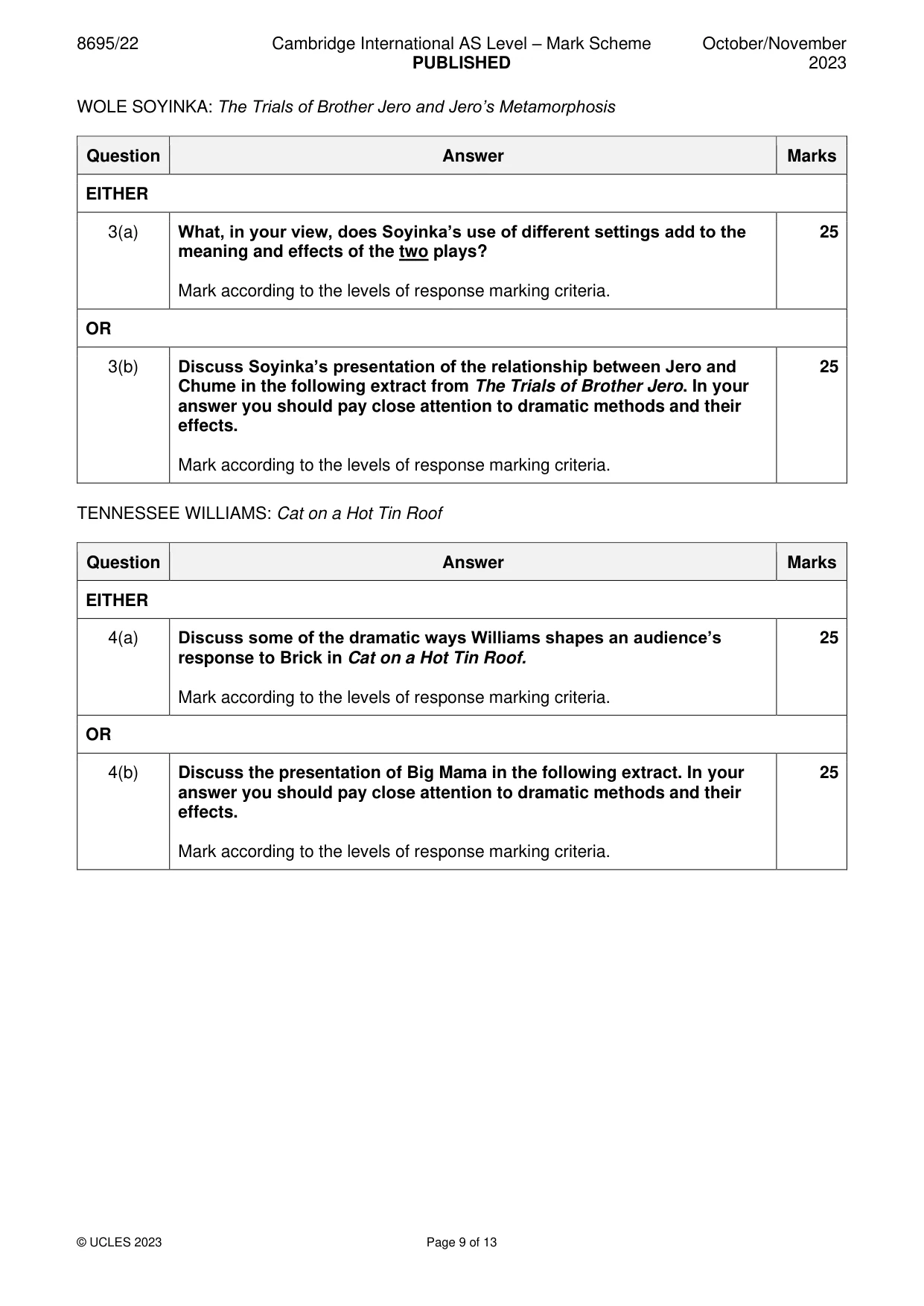
8695/22 Cambridge International AS Level – Mark Scheme PUBLISHED October/November 2023 © UCLES 2023 Page 9 of 13 WOLE SOYINKA: The Trials of Brother Jero and Jero’s Metamorphosis Question Answer Marks EITHER 3(a) What, in your view, does Soyinka’s use of different settings add to the meaning and effects of the two plays? Mark according to the levels of response marking criteria. 25 OR 3(b) Discuss Soyinka’s presentation of the relationship between Jero and Chume in the following extract from The Trials of Brother Jero. In your answer you should pay close attention to dramatic methods and their effects. Mark according to the levels of response marking criteria. 25 TENNESSEE WILLIAMS: Cat on a Hot Tin Roof Question Answer Marks EITHER 4(a) Discuss some of the dramatic ways Williams shapes an audience’s response to Brick in Cat on a Hot Tin Roof. Mark according to the levels of response marking criteria. 25 OR 4(b) Discuss the presentation of Big Mama in the following extract. In your answer you should pay close attention to dramatic methods and their effects. Mark according to the levels of response marking criteria. 25
Mark scheme, page 10
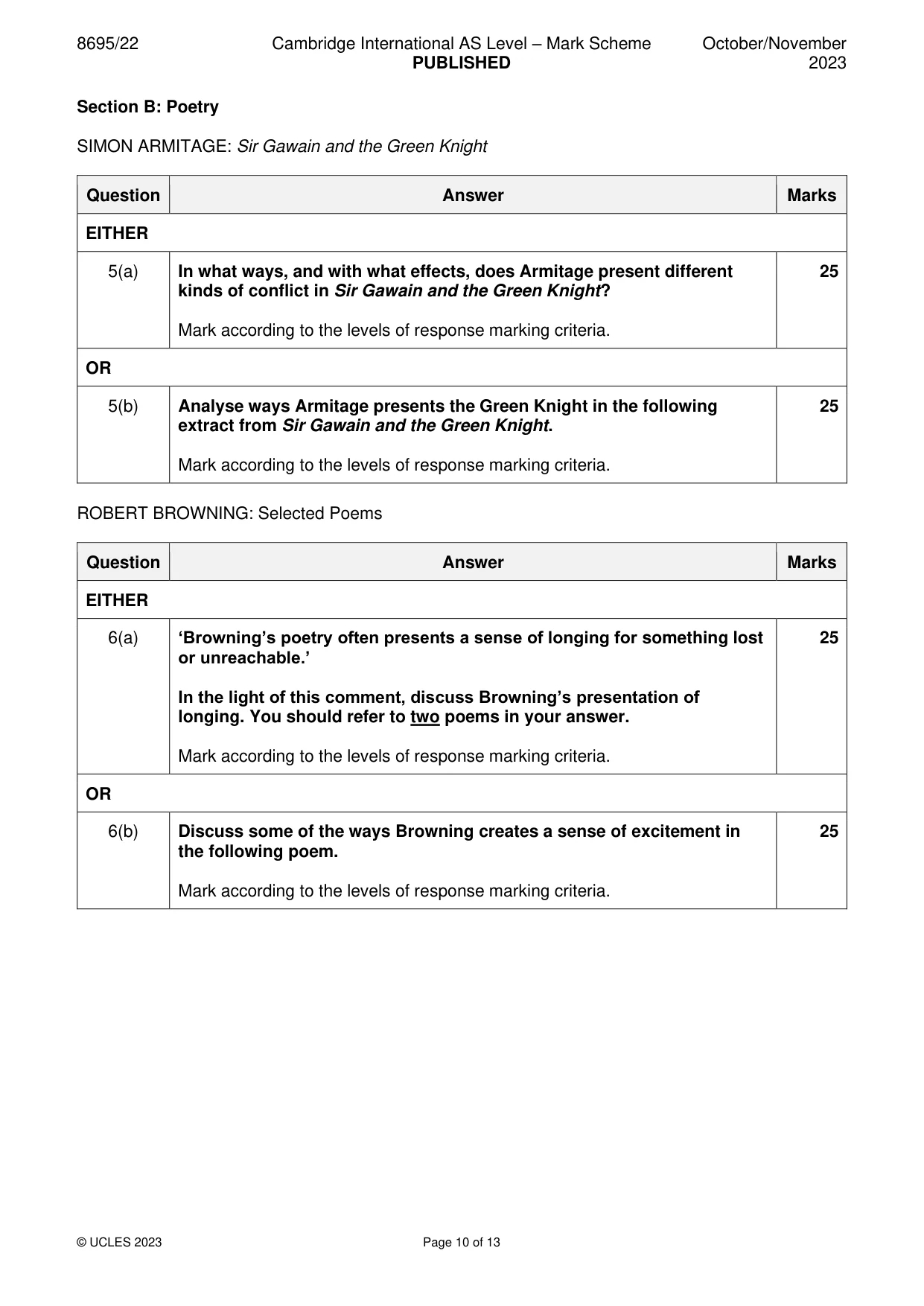
8695/22 Cambridge International AS Level – Mark Scheme PUBLISHED October/November 2023 © UCLES 2023 Page 10 of 13 Section B: Poetry SIMON ARMITAGE: Sir Gawain and the Green Knight Question Answer Marks EITHER 5(a) In what ways, and with what effects, does Armitage present different kinds of conflict in Sir Gawain and the Green Knight? Mark according to the levels of response marking criteria. 25 OR 5(b) Analyse ways Armitage presents the Green Knight in the following extract from Sir Gawain and the Green Knight. Mark according to the levels of response marking criteria. 25 ROBERT BROWNING: Selected Poems Question Answer Marks EITHER 6(a) ‘Browning’s poetry often presents a sense of longing for something lost or unreachable.’ In the light of this comment, discuss Browning’s presentation of longing. You should refer to two poems in your answer. Mark according to the levels of response marking criteria. 25 OR 6(b) Discuss some of the ways Browning creates a sense of excitement in the following poem. Mark according to the levels of response marking criteria. 25
Mark scheme, page 11
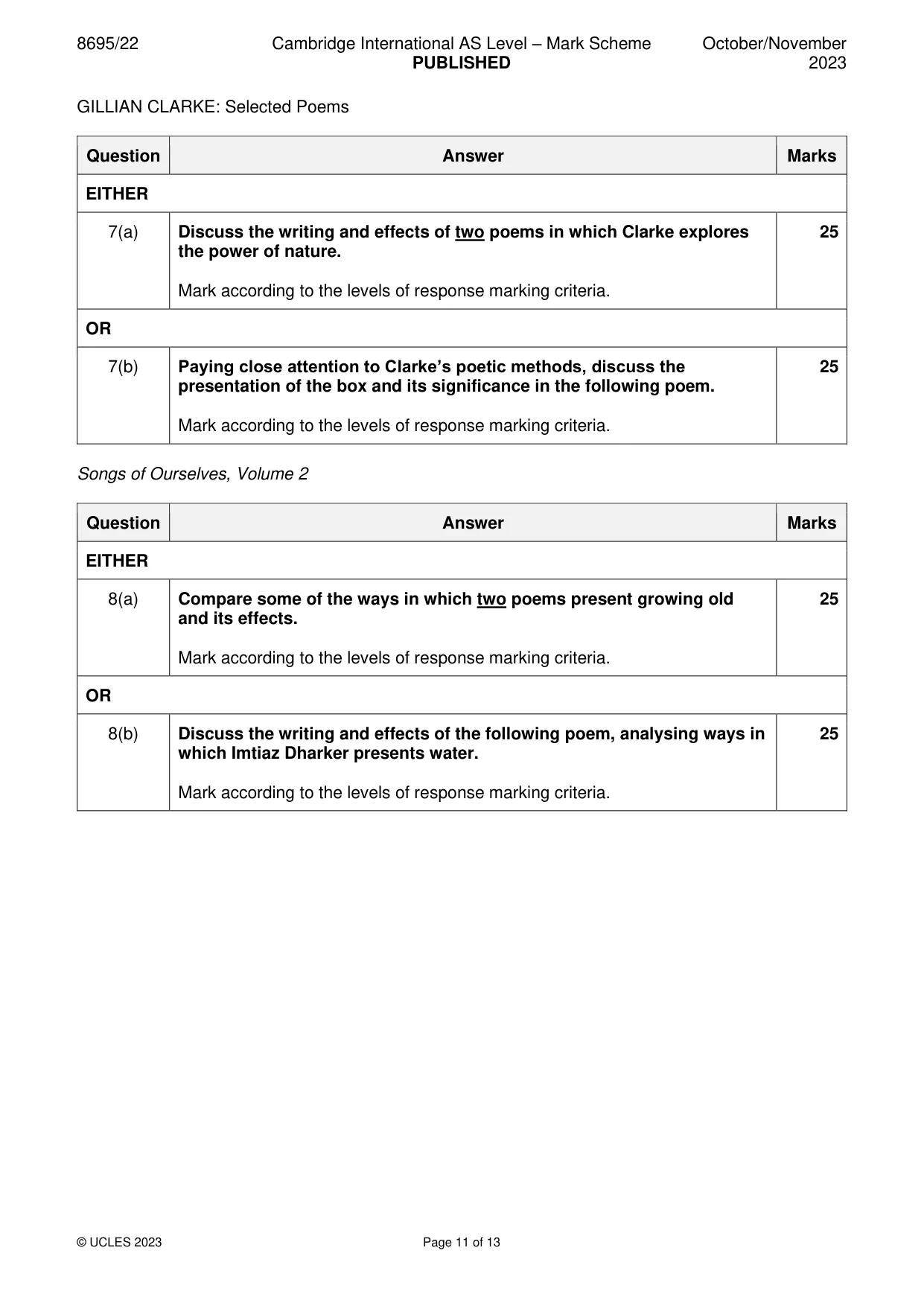
8695/22 Cambridge International AS Level – Mark Scheme PUBLISHED October/November 2023 © UCLES 2023 Page 11 of 13 GILLIAN CLARKE: Selected Poems Question Answer Marks EITHER 7(a) Discuss the writing and effects of two poems in which Clarke explores the power of nature. Mark according to the levels of response marking criteria. 25 OR 7(b) Paying close attention to Clarke’s poetic methods, discuss the presentation of the box and its significance in the following poem. Mark according to the levels of response marking criteria. 25 Songs of Ourselves, Volume 2 Question Answer Marks EITHER 8(a) Compare some of the ways in which two poems present growing old and its effects. Mark according to the levels of response marking criteria. 25 OR 8(b) Discuss the writing and effects of the following poem, analysing ways in which Imtiaz Dharker presents water. Mark according to the levels of response marking criteria. 25
Mark scheme, page 12
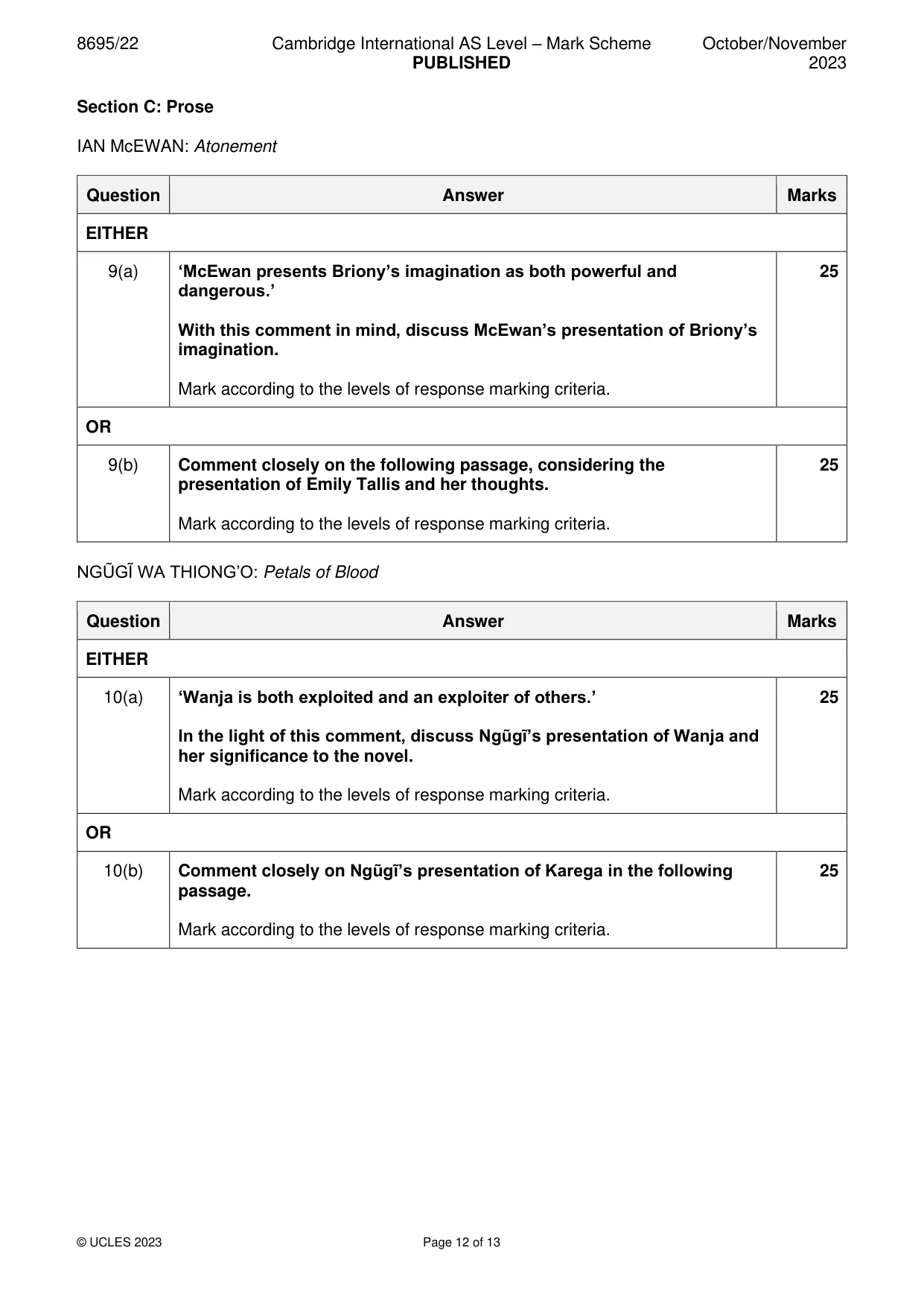
8695/22 Cambridge International AS Level – Mark Scheme PUBLISHED October/November 2023 © UCLES 2023 Page 12 of 13 Section C: Prose IAN McEWAN: Atonement Question Answer Marks EITHER 9(a) ‘McEwan presents Briony’s imagination as both powerful and dangerous.’ With this comment in mind, discuss McEwan’s presentation of Briony’s imagination. Mark according to the levels of response marking criteria. 25 OR 9(b) Comment closely on the following passage, considering the presentation of Emily Tallis and her thoughts. Mark according to the levels of response marking criteria. 25 NGŨGĨ WA THIONG’O: Petals of Blood Question Answer Marks EITHER 10(a) ‘Wanja is both exploited and an exploiter of others.’ In the light of this comment, discuss Ngũgĩ’s presentation of Wanja and her significance to the novel. Mark according to the levels of response marking criteria. 25 OR 10(b) Comment closely on Ngũgĩ’s presentation of Karega in the following passage. Mark according to the levels of response marking criteria. 25
Mark scheme, page 13
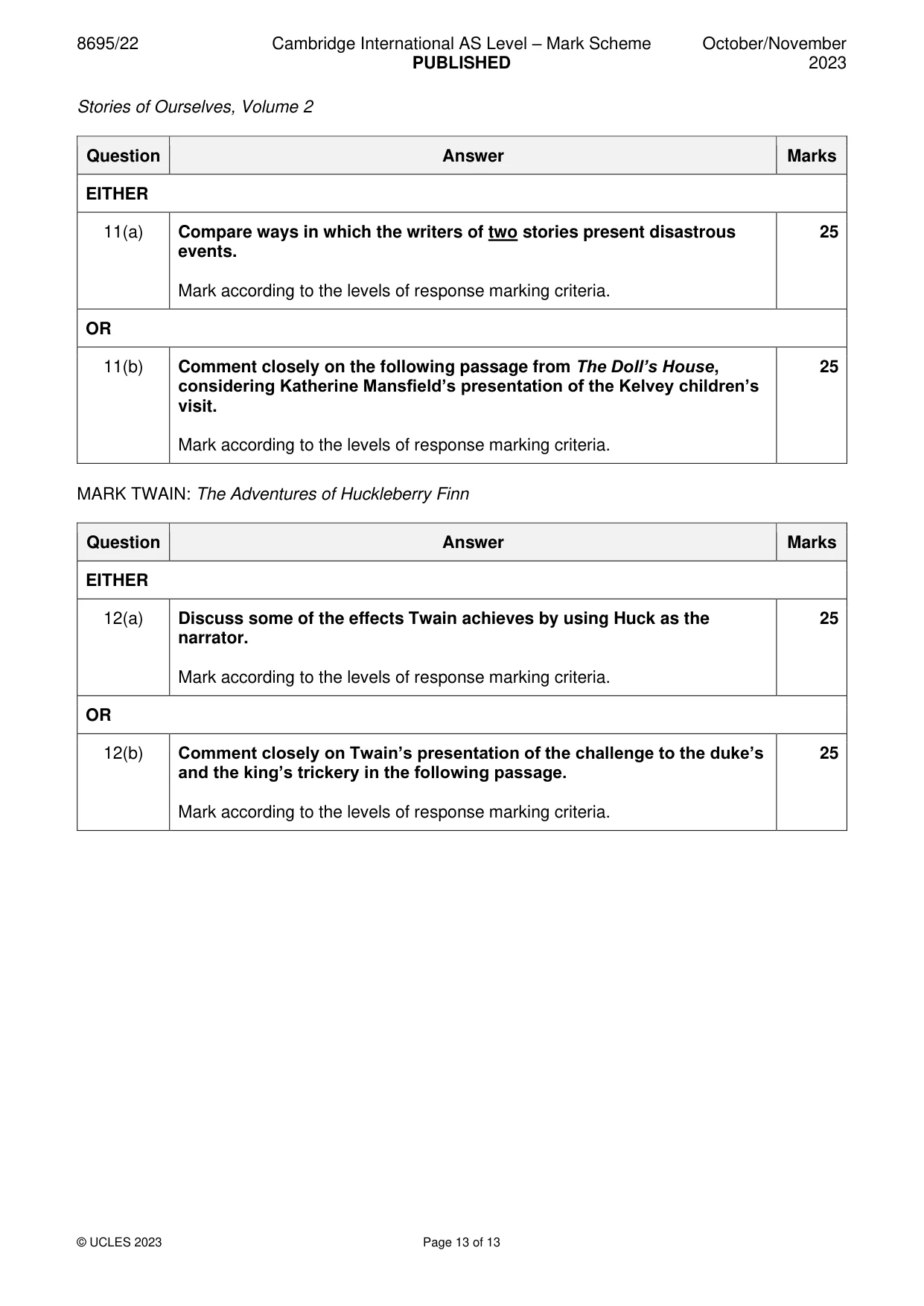
8695/22 Cambridge International AS Level – Mark Scheme PUBLISHED October/November 2023 © UCLES 2023 Page 13 of 13 Stories of Ourselves, Volume 2 Question Answer Marks EITHER 11(a) Compare ways in which the writers of two stories present disastrous events. Mark according to the levels of response marking criteria. 25 OR 11(b) Comment closely on the following passage from The Doll’s House, considering Katherine Mansfield’s presentation of the Kelvey children’s visit. Mark according to the levels of response marking criteria. 25 MARK TWAIN: The Adventures of Huckleberry Finn Question Answer Marks EITHER 12(a) Discuss some of the effects Twain achieves by using Huck as the narrator. Mark according to the levels of response marking criteria. 25 OR 12(b) Comment closely on Twain’s presentation of the challenge to the duke’s and the king’s trickery in the following passage. Mark according to the levels of response marking criteria. 25
What you needed in this session
Cambridge’s own grade thresholds for 2023 Oct/Nov, Paper 2 · Variant 2. A higher threshold means an easier paper — the bar moves with how the cohort did.