Cambridge A Level English - Language and Literature (AS Level only, from 2016) 8695 — 2024 Oct/Nov Paper 2 · Variant 2
8695/22/O/N/24 · 50 marks · 120 min
The question paper and its mark scheme, free to read here and free to download. This is Cambridge’s own paper, exactly as it was sat.
Question paper24 pages




Mark scheme13 pages
Answers below. Sit the paper first if you are practising.
Paper as text
Question paper, page 1
This document has 24 pages. Any blank pages are indicated. [Turn over Cambridge International AS Level DC (CE) 336616/4 © UCLES 2024 LANGUAGE AND LITERATURE IN ENGLISH 8695/22 Paper 2 Drama, Poetry and Prose October/November 2024 2 hours You must answer on the enclosed answer booklet. You will need: Answer booklet (enclosed) INSTRUCTIONS ● Answer two questions in total, each from a different section. ● Follow the instructions on the front cover of the answer booklet. If you need additional answer paper, ask the invigilator for a continuation booklet. ● Dictionaries are not allowed. INFORMATION ● The total mark for this paper is 50. ● The number of marks for each question or part question is shown in brackets [ ]. * 5 9 9 1 6 3 3 7 1 1 *
Question paper, page 2
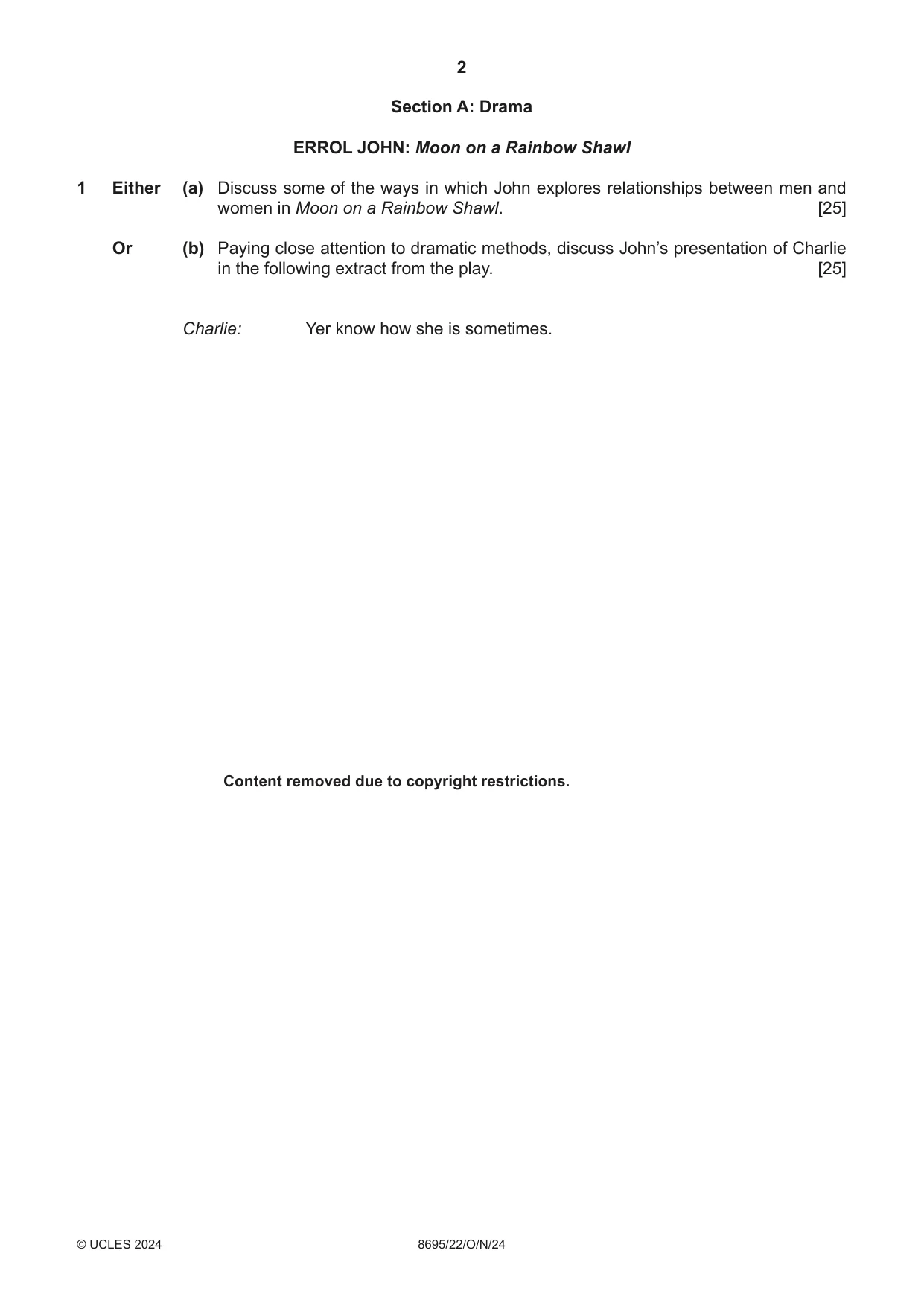
2 8695/22/O/N/24 © UCLES 2024 Section A: Drama ERROL JOHN: Moon on a Rainbow Shawl 1 Either (a) Discuss some of the ways in which John explores relationships between men and women in Moon on a Rainbow Shawl. [25] Or (b) Paying close attention to dramatic methods, discuss John’s presentation of Charlie in the following extract from the play. [25] Charlie: Yer know how she is sometimes. Content removed due to copyright restrictions.
Question paper, page 3
3 8695/22/O/N/24 © UCLES 2024 [Turn over You don’t know yet, boy – what life is like – when things start to slide from under yer. (from Act 2, Scene 2) Content removed due to copyright restrictions.
Question paper, page 4
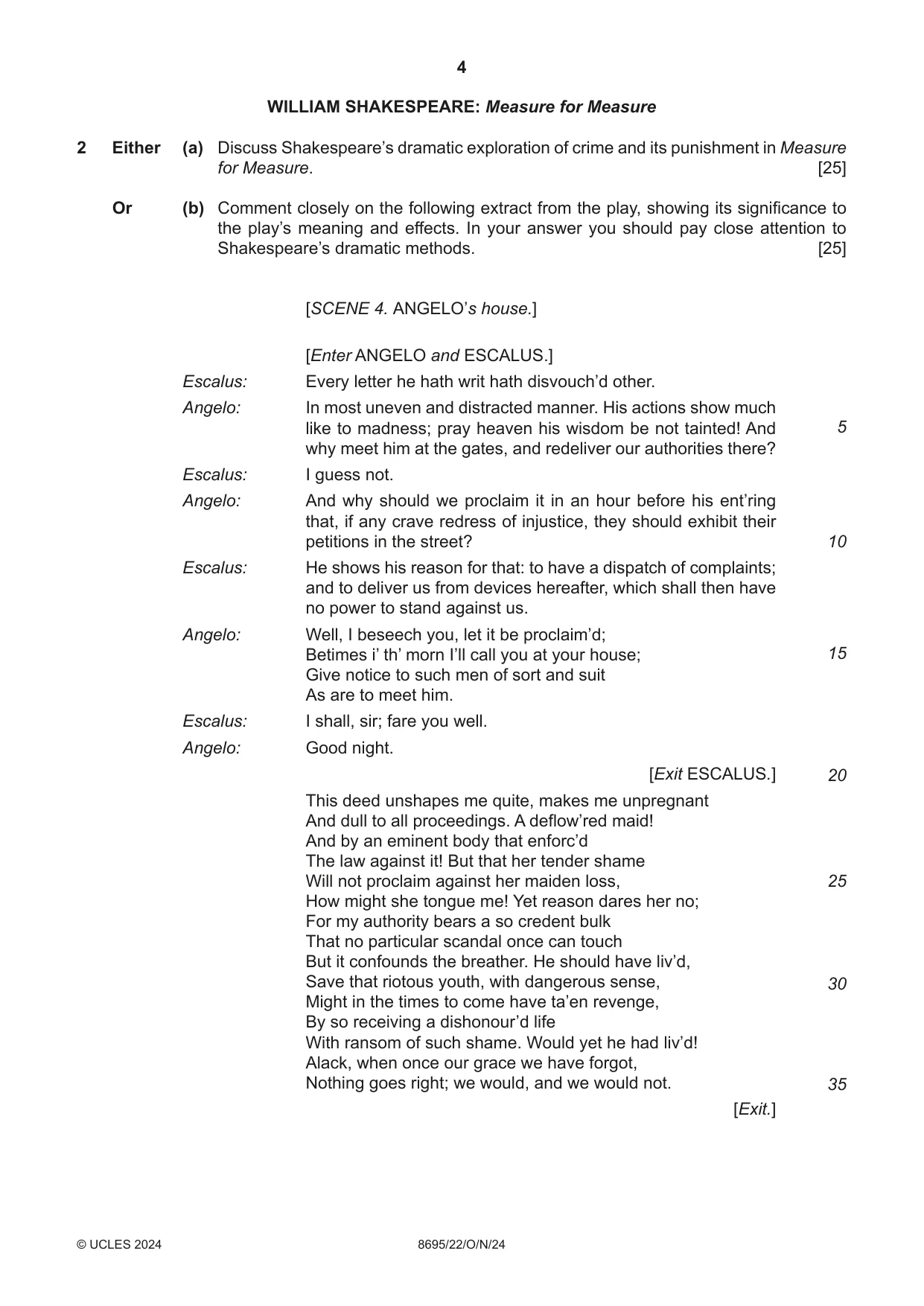
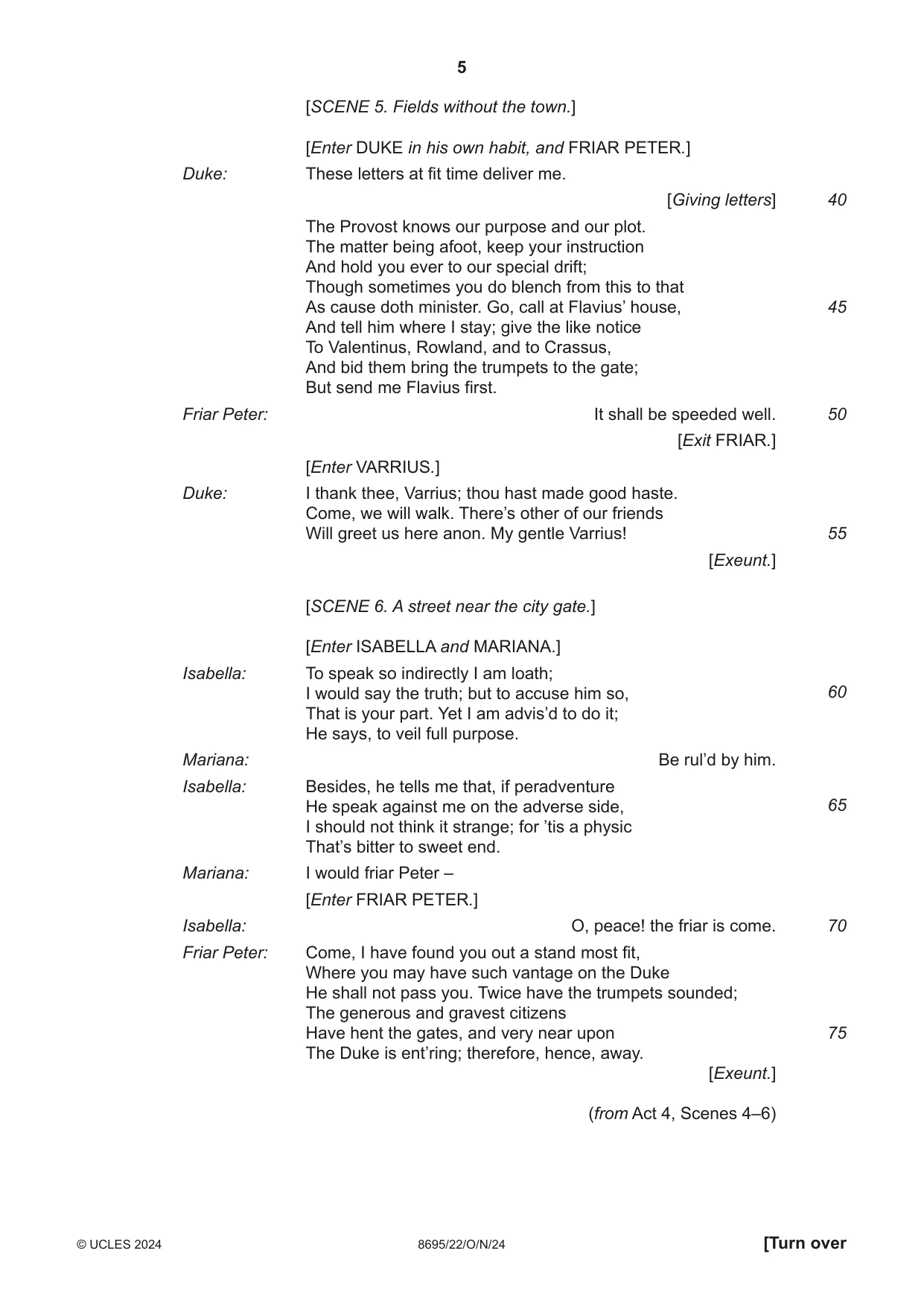
4 8695/22/O/N/24 © UCLES 2024 WILLIAM SHAKESPEARE: Measure for Measure 2 Either (a) Discuss Shakespeare’s dramatic exploration of crime and its punishment in Measure for Measure. [25] Or (b) Comment closely on the following extract from the play, showing its significance to the play’s meaning and effects. In your answer you should pay close attention to Shakespeare’s dramatic methods. [25] [SCENE 4. ANGELO’s house.] [Enter ANGELO and ESCALUS.] Escalus: Every letter he hath writ hath disvouch’d other. Angelo: In most uneven and distracted manner. His actions show much like to madness; pray heaven his wisdom be not tainted! And why meet him at the gates, and redeliver our authorities there? Escalus: I guess not. Angelo: And why should we proclaim it in an hour before his ent’ring that, if any crave redress of injustice, they should exhibit their petitions in the street? Escalus: He shows his reason for that: to have a dispatch of complaints; and to deliver us from devices hereafter, which shall then have no power to stand against us. Angelo: Well, I beseech you, let it be proclaim’d; Betimes i’ th’ morn I’ll call you at your house; Give notice to such men of sort and suit As are to meet him. Escalus: I shall, sir; fare you well. Angelo: Good night. [Exit ESCALUS.] This deed unshapes me quite, makes me unpregnant And dull to all proceedings. A deflow’red maid! And by an eminent body that enforc’d The law against it! But that her tender shame Will not proclaim against her maiden loss, How might she tongue me! Yet reason dares her no; For my authority bears a so credent bulk That no particular scandal once can touch But it confounds the breather. He should have liv’d, Save that riotous youth, with dangerous sense, Might in the times to come have ta’en revenge, By so receiving a dishonour’d life With ransom of such shame. Would yet he had liv’d! Alack, when once our grace we have forgot, Nothing goes right; we would, and we would not. [Exit.] 5 10 15 20 25 30 35
Question paper, page 5
5 8695/22/O/N/24 © UCLES 2024 [Turn over [SCENE 5. Fields without the town.] [Enter DUKE in his own habit, and FRIAR PETER.] Duke: These letters at fit time deliver me. [Giving letters] The Provost knows our purpose and our plot. The matter being afoot, keep your instruction And hold you ever to our special drift; Though sometimes you do blench from this to that As cause doth minister. Go, call at Flavius’ house, And tell him where I stay; give the like notice To Valentinus, Rowland, and to Crassus, And bid them bring the trumpets to the gate; But send me Flavius first. Friar Peter: It shall be speeded well. [Exit FRIAR.] [Enter VARRIUS.] Duke: I thank thee, Varrius; thou hast made good haste. Come, we will walk. There’s other of our friends Will greet us here anon. My gentle Varrius! [Exeunt.] [SCENE 6. A street near the city gate.] [Enter ISABELLA and MARIANA.] Isabella: To speak so indirectly I am loath; I would say the truth; but to accuse him so, That is your part. Yet I am advis’d to do it; He says, to veil full purpose. Mariana: Be rul’d by him. Isabella: Besides, he tells me that, if peradventure He speak against me on the adverse side, I should not think it strange; for ’tis a physic That’s bitter to sweet end. Mariana: I would friar Peter – [Enter FRIAR PETER.] Isabella: O, peace! the friar is come. Friar Peter: Come, I have found you out a stand most fit, Where you may have such vantage on the Duke He shall not pass you. Twice have the trumpets sounded; The generous and gravest citizens Have hent the gates, and very near upon The Duke is ent’ring; therefore, hence, away. [Exeunt.] (from Act 4, Scenes 4–6) 40 45 50 55 60 65 70 75
Question paper, page 6
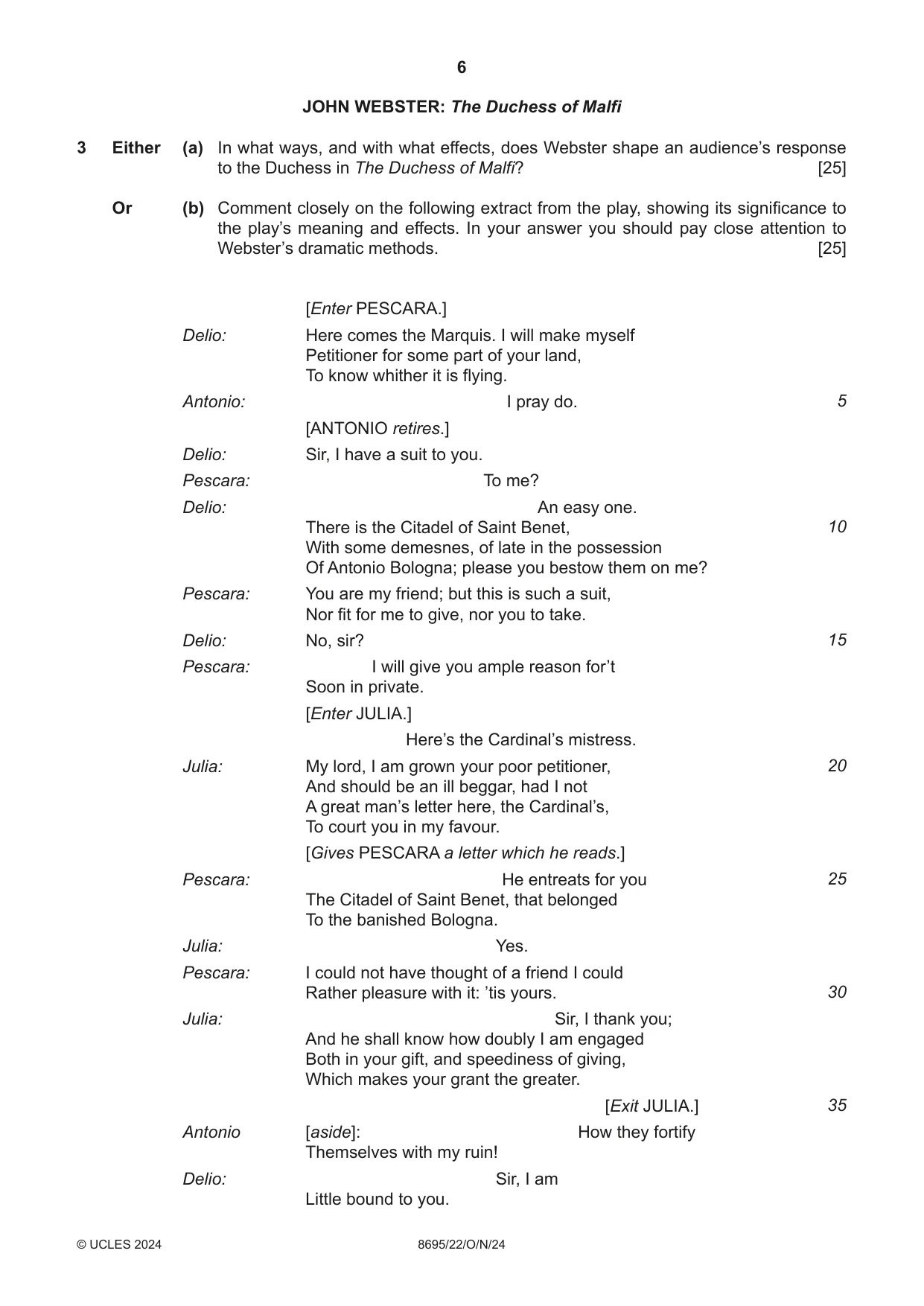
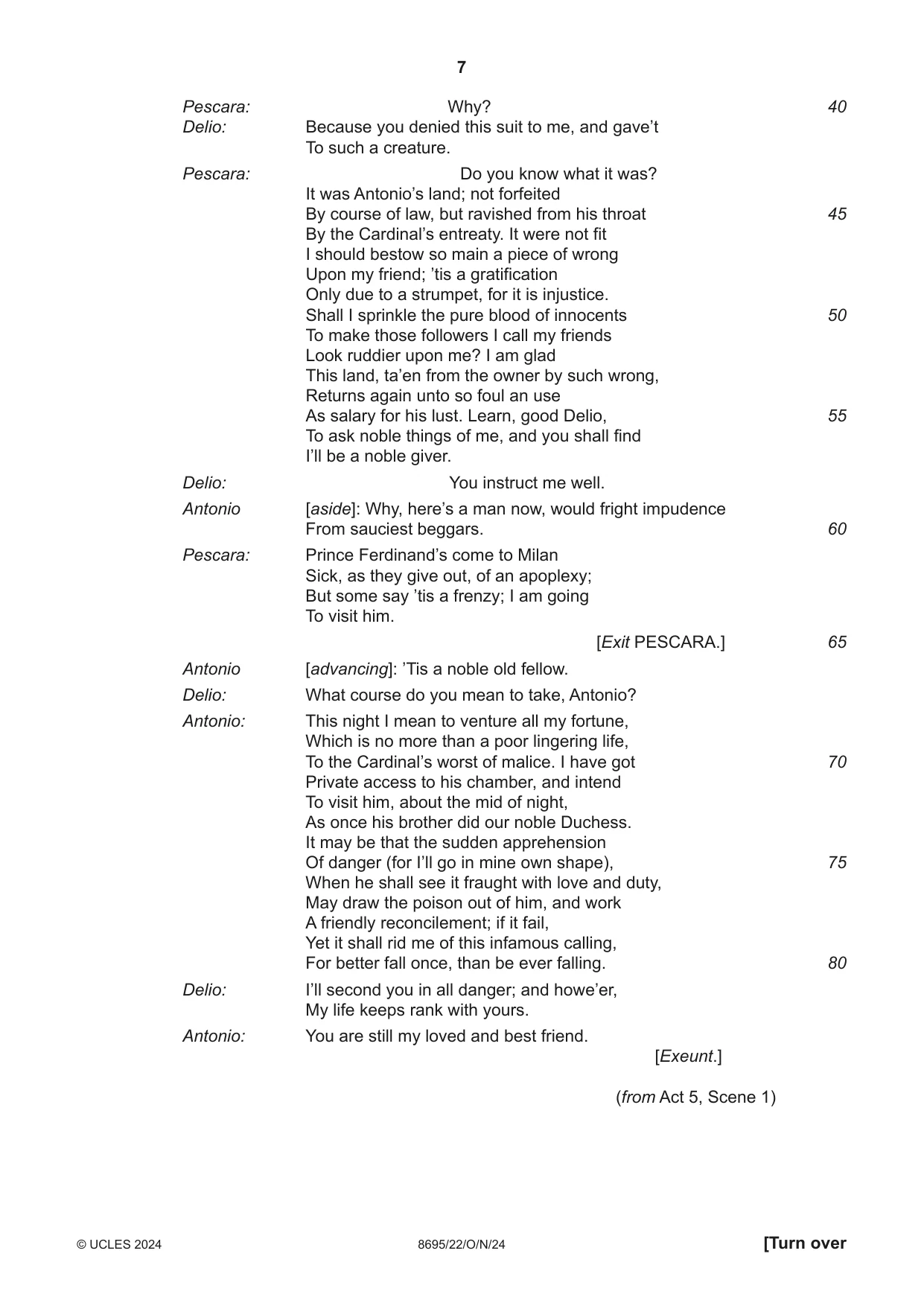
6 8695/22/O/N/24 © UCLES 2024 JOHN WEBSTER: The Duchess of Malfi 3 Either (a) In what ways, and with what effects, does Webster shape an audience’s response to the Duchess in The Duchess of Malfi? [25] Or (b) Comment closely on the following extract from the play, showing its significance to the play’s meaning and effects. In your answer you should pay close attention to Webster’s dramatic methods. [25] [Enter PESCARA.] Delio: Here comes the Marquis. I will make myself Petitioner for some part of your land, To know whither it is flying. Antonio: I pray do. [ANTONIO retires.] Delio: Sir, I have a suit to you. Pescara: To me? Delio: An easy one. There is the Citadel of Saint Benet, With some demesnes, of late in the possession Of Antonio Bologna; please you bestow them on me? Pescara: You are my friend; but this is such a suit, Nor fit for me to give, nor you to take. Delio: No, sir? Pescara: I will give you ample reason for’t Soon in private. [Enter JULIA.] Here’s the Cardinal’s mistress. Julia: My lord, I am grown your poor petitioner, And should be an ill beggar, had I not A great man’s letter here, the Cardinal’s, To court you in my favour. [Gives PESCARA a letter which he reads.] Pescara: He entreats for you The Citadel of Saint Benet, that belonged To the banished Bologna. Julia: Yes. Pescara: I could not have thought of a friend I could Rather pleasure with it: ’tis yours. Julia: Sir, I thank you; And he shall know how doubly I am engaged Both in your gift, and speediness of giving, Which makes your grant the greater. [Exit JULIA.] Antonio [aside]: How they fortify Themselves with my ruin! Delio: Sir, I am Little bound to you. 5 10 15 20 25 30 35
Question paper, page 7
7 8695/22/O/N/24 © UCLES 2024 [Turn over Pescara: Why? Delio: Because you denied this suit to me, and gave’t To such a creature. Pescara: Do you know what it was? It was Antonio’s land; not forfeited By course of law, but ravished from his throat By the Cardinal’s entreaty. It were not fit I should bestow so main a piece of wrong Upon my friend; ’tis a gratification Only due to a strumpet, for it is injustice. Shall I sprinkle the pure blood of innocents To make those followers I call my friends Look ruddier upon me? I am glad This land, ta’en from the owner by such wrong, Returns again unto so foul an use As salary for his lust. Learn, good Delio, To ask noble things of me, and you shall find I’ll be a noble giver. Delio: You instruct me well. Antonio [aside]: Why, here’s a man now, would fright impudence From sauciest beggars. Pescara: Prince Ferdinand’s come to Milan Sick, as they give out, of an apoplexy; But some say ’tis a frenzy; I am going To visit him. [Exit PESCARA.] Antonio [advancing]: ’Tis a noble old fellow. Delio: What course do you mean to take, Antonio? Antonio: This night I mean to venture all my fortune, Which is no more than a poor lingering life, To the Cardinal’s worst of malice. I have got Private access to his chamber, and intend To visit him, about the mid of night, As once his brother did our noble Duchess. It may be that the sudden apprehension Of danger (for I’ll go in mine own shape), When he shall see it fraught with love and duty, May draw the poison out of him, and work A friendly reconcilement; if it fail, Yet it shall rid me of this infamous calling, For better fall once, than be ever falling. Delio: I’ll second you in all danger; and howe’er, My life keeps rank with yours. Antonio: You are still my loved and best friend. [Exeunt.] (from Act 5, Scene 1) 40 45 50 55 60 65 70 75 80
Question paper, page 8
8 8695/22/O/N/24 © UCLES 2024 TENNESSEE WILLIAMS: Cat on a Hot Tin Roof 4 Either (a) In what ways, and with what dramatic effects, does Williams present different kinds of conflict in Cat on a Hot Tin Roof ? [25] Or (b) How might an audience respond to the following extract, the ending of the play? In your answer you should pay close attention to dramatic methods and their effects. [25] Brick: Give me that pillow in the big chair, Maggie. Content removed due to copyright restrictions.
Question paper, page 9
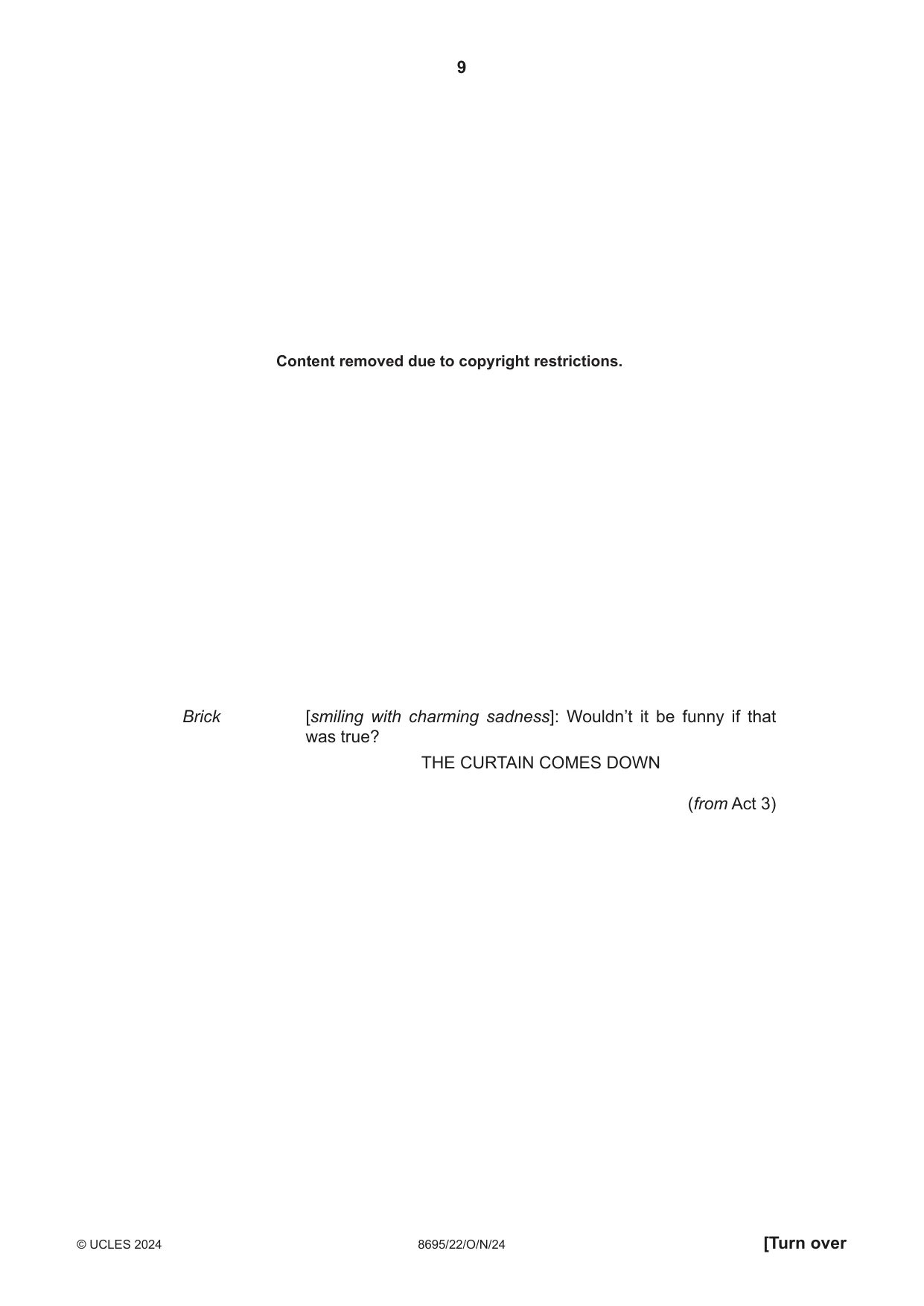
9 8695/22/O/N/24 © UCLES 2024 [Turn over Brick [smiling with charming sadness]: Wouldn’t it be funny if that was true? THE CURTAIN COMES DOWN (from Act 3) Content removed due to copyright restrictions.
Question paper, page 10
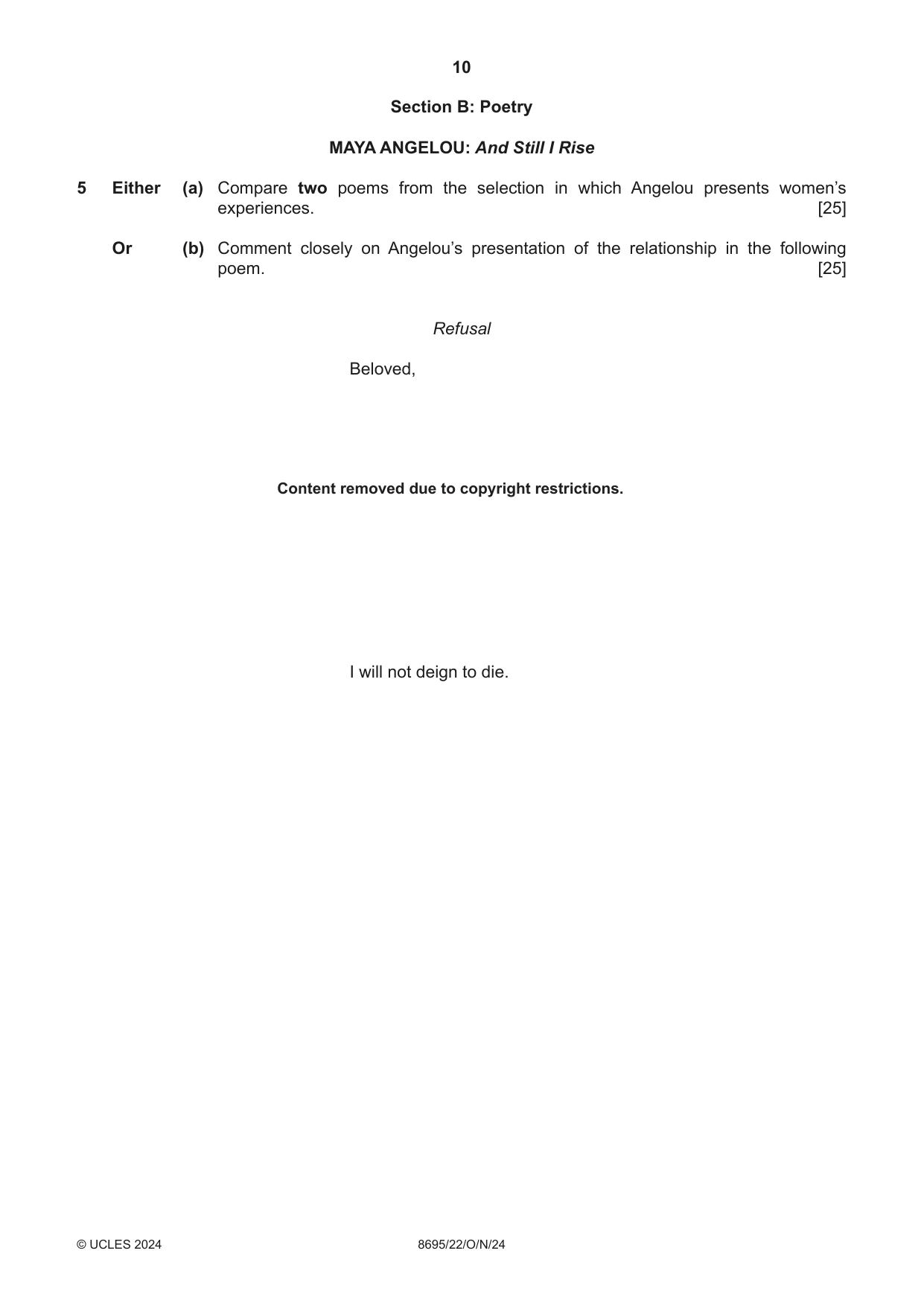
10 8695/22/O/N/24 © UCLES 2024 Section B: Poetry MAYA ANGELOU: And Still I Rise 5 Either (a) Compare two poems from the selection in which Angelou presents women’s experiences. [25] Or (b) Comment closely on Angelou’s presentation of the relationship in the following poem. [25] Refusal Beloved, I will not deign to die. Content removed due to copyright restrictions.
Question paper, page 11
11 8695/22/O/N/24 © UCLES 2024 [Turn over SIMON ARMITAGE: Sir Gawain and the Green Knight 6 Either (a) Discuss some of the ways in which Armitage shapes a reader’s response to Sir Gawain in the poem. [25] Or (b) In what ways, and with what effects, does Armitage present King Arthur and his court in the following extract from Sir Gawain and the Green Knight ? [25] But Arthur would not eat until all were served. plus beer or wine, or both! Content removed due to copyright restrictions.
Question paper, page 12
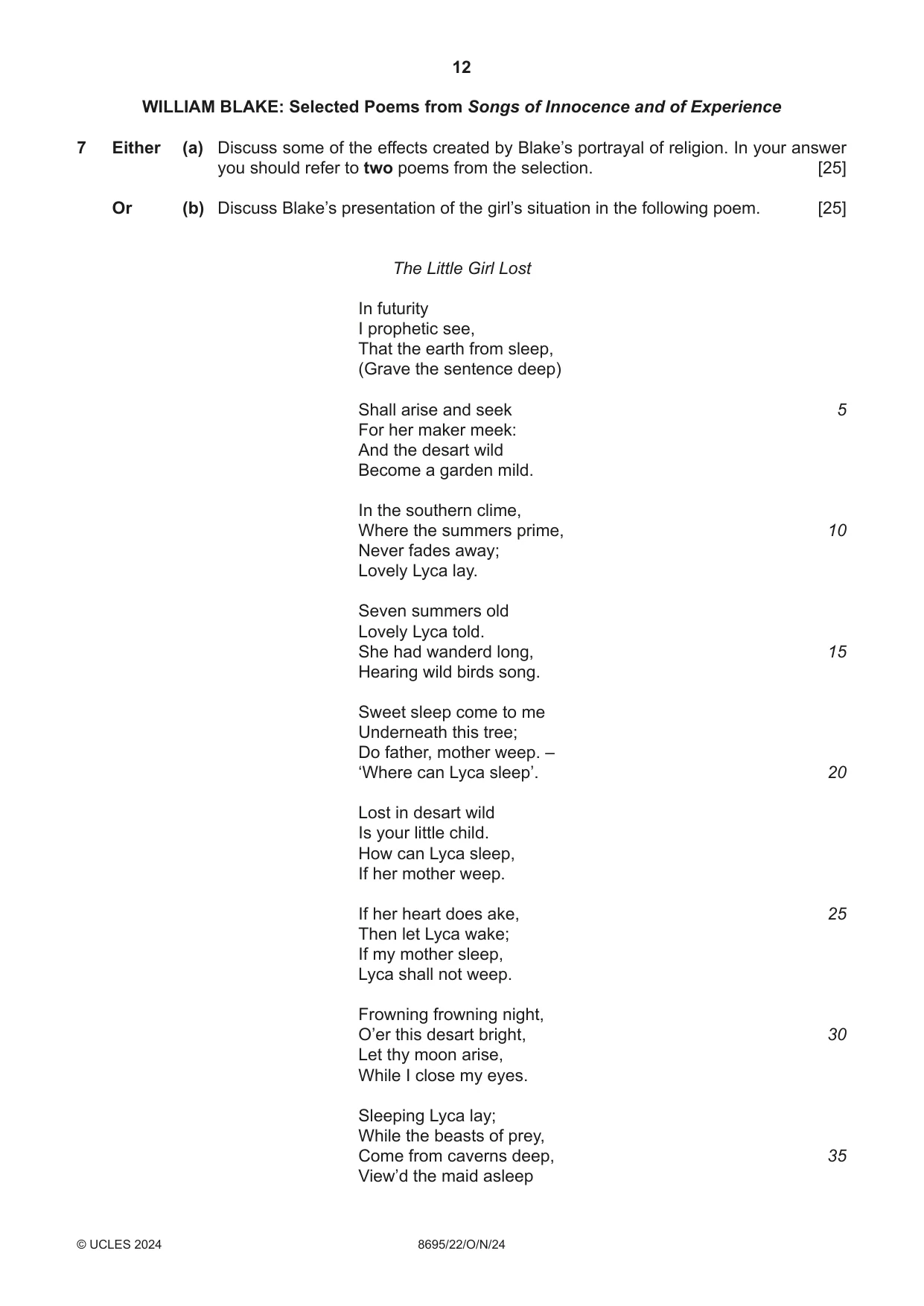
12 8695/22/O/N/24 © UCLES 2024 WILLIAM BLAKE: Selected Poems from Songs of Innocence and of Experience 7 Either (a) Discuss some of the effects created by Blake’s portrayal of religion. In your answer you should refer to two poems from the selection. [25] Or (b) Discuss Blake’s presentation of the girl’s situation in the following poem. [25] The Little Girl Lost In futurity I prophetic see, That the earth from sleep, (Grave the sentence deep) Shall arise and seek 5 For her maker meek: And the desart wild Become a garden mild. In the southern clime, Where the summers prime, 10 Never fades away; Lovely Lyca lay. Seven summers old Lovely Lyca told. She had wanderd long, 15 Hearing wild birds song. Sweet sleep come to me Underneath this tree; Do father, mother weep. – ‘Where can Lyca sleep’. 20 Lost in desart wild Is your little child. How can Lyca sleep, If her mother weep. If her heart does ake, 25 Then let Lyca wake; If my mother sleep, Lyca shall not weep. Frowning frowning night, O’er this desart bright, 30 Let thy moon arise, While I close my eyes. Sleeping Lyca lay; While the beasts of prey, Come from caverns deep, 35 View’d the maid asleep
Question paper, page 13
13 8695/22/O/N/24 © UCLES 2024 [Turn over The kingly lion stood And the virgin view’d, Then he gambold round O’er the hallowd ground: 40 Leopards, tygers play, Round her as she lay; While the lion old, Bow’d his mane of gold. And her bosom lick, 45 And upon her neck, From his eyes of flame, Ruby tears there came; While the lioness, Loos’d her slender dress, 50 And naked they convey’d To caves the sleeping maid.
Question paper, page 14
14 8695/22/O/N/24 © UCLES 2024 Songs of Ourselves, Volume 2 8 Either (a) Compare some of the ways in which two poems present living creatures. [25] Or (b) Discuss the meaning and effects of the following poem, analysing ways in which David C Ward presents the brother-in-law. [25] Surplus Value My Michigan brother-in-law was a tool and die guy, A machinist, fabricating parts in shops supplying Big Three Auto makers. A bantam with thick fingers, scarred hands He rode a Harley soft-tail, drank Iron City, and lived With his wife and kids in a house he mostly built himself. 5 During the heyday of Detroit metal, overtime and union Contracts paid for steaks and a cabin on an upstate lake For summer vacations and deer season hunting trips In the fall. He took his pride from his craft and skill Building something bigger than the Fords or Chevys 10 He pushed on down the line for America to drive. For twenty years of work, good times, and happy with it. But that road ran out. The union went south first (pension fraud; indictments; prison terms) and then The companies and their money men slashed and burned 15 Their way through labor and its costs in search of market Share. The work was sweated from the men for less and less return. From economy of scale, to one of scarcity: subcontracting, piecework, Ultimately the dole replaced a steady pay check and a bonus Twice a year. The Harley went and then the cabin; food stamps 20 Bought essentials, nothing more. Always quiet, he grew quieter From day to week to month to the years that stretched ahead, Bowing his neck each day as the scars grew deeper now, and inward. During the boom that no one thought would ever end, Heedless the factories flushed their waste straight into 25 The Saginaw River, so much so that it never iced, even In the depths of winter. Now it’s frozen all year long. (David C Ward)
Question paper, page 15
15 8695/22/O/N/24 © UCLES 2024 [Turn over BLANK PAGE
Question paper, page 16
16 8695/22/O/N/24 © UCLES 2024 Section C: Prose KIRAN DESAI: The Inheritance of Loss 9 Either (a) Discuss Desai’s presentation of the police and their actions in Kalimpong. [25] Or (b) Comment closely on Desai’s presentation of Biju’s experiences at the Gandhi Café in the following passage. [25] To add up the new numbers that came clinking in, Harish-Harry’s wife arrived on Sunday mornings after she had washed her hair. Content removed due to copyright restrictions.
Question paper, page 17
17 8695/22/O/N/24 © UCLES 2024 [Turn over At daybreak they shuffled back down before Harish arrived, ‘Chalo, chalo, another day, another dollar.’ (from Chapter 24) Content removed due to copyright restrictions.
Question paper, page 18
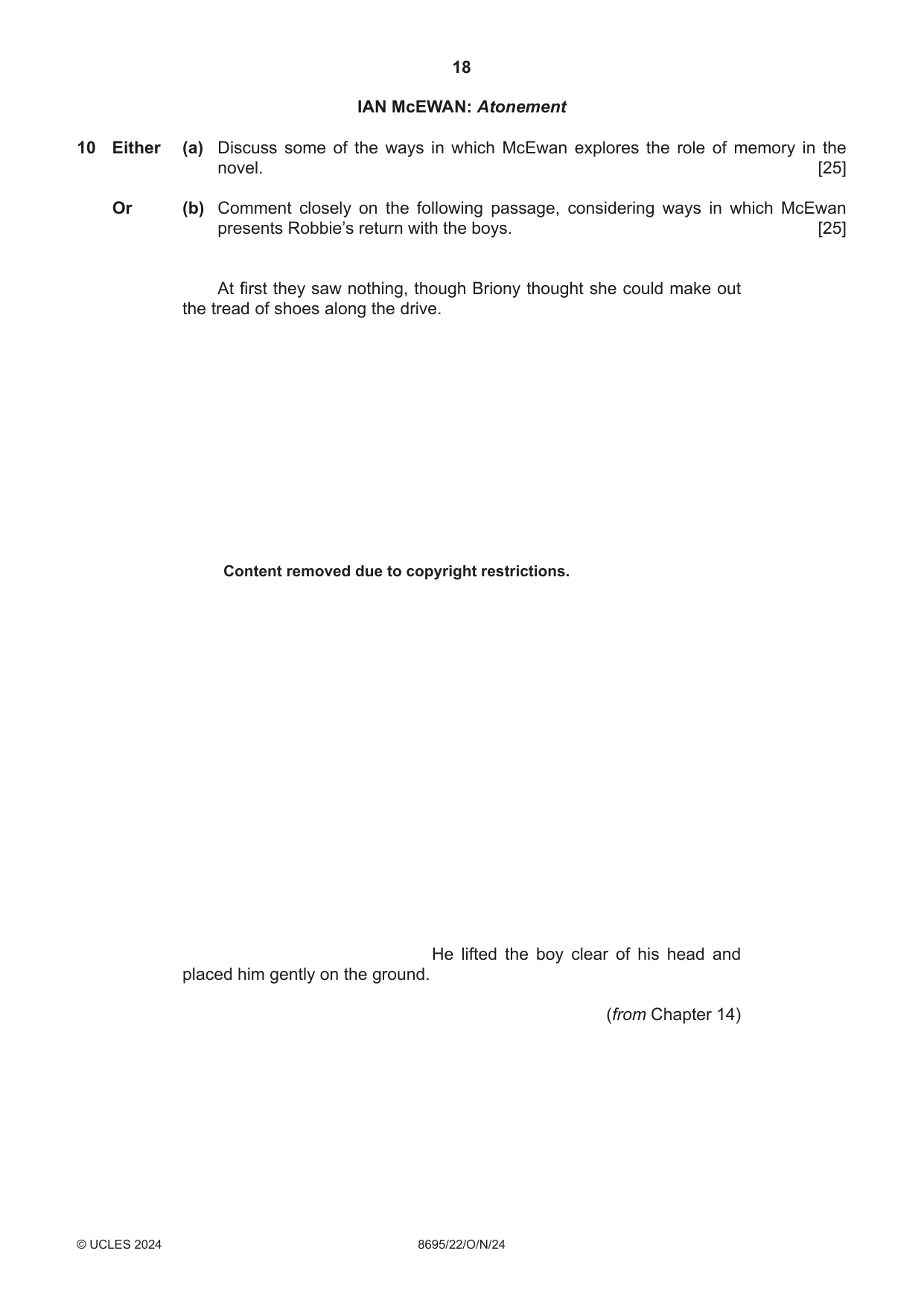
18 8695/22/O/N/24 © UCLES 2024 IAN McEWAN: Atonement 10 Either (a) Discuss some of the ways in which McEwan explores the role of memory in the novel. [25] Or (b) Comment closely on the following passage, considering ways in which McEwan presents Robbie’s return with the boys. [25] At first they saw nothing, though Briony thought she could make out the tread of shoes along the drive. He lifted the boy clear of his head and placed him gently on the ground. (from Chapter 14) Content removed due to copyright restrictions.
Question paper, page 19
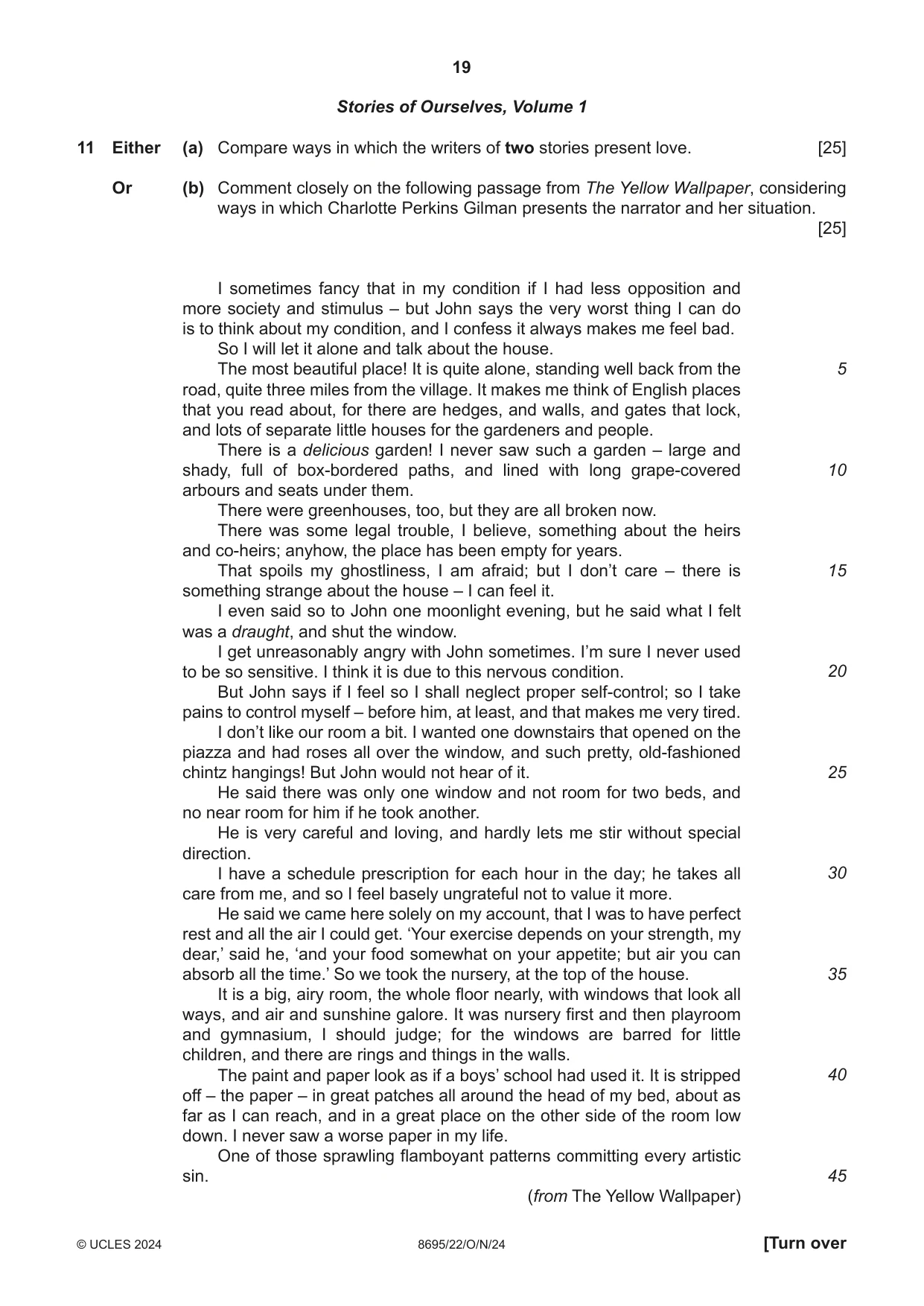
19 8695/22/O/N/24 © UCLES 2024 [Turn over Stories of Ourselves, Volume 1 11 Either (a) Compare ways in which the writers of two stories present love. [25] Or (b) Comment closely on the following passage from The Yellow Wallpaper, considering ways in which Charlotte Perkins Gilman presents the narrator and her situation. [25] I sometimes fancy that in my condition if I had less opposition and more society and stimulus – but John says the very worst thing I can do is to think about my condition, and I confess it always makes me feel bad. So I will let it alone and talk about the house. The most beautiful place! It is quite alone, standing well back from the road, quite three miles from the village. It makes me think of English places that you read about, for there are hedges, and walls, and gates that lock, and lots of separate little houses for the gardeners and people. There is a delicious garden! I never saw such a garden – large and shady, full of box-bordered paths, and lined with long grape-covered arbours and seats under them. There were greenhouses, too, but they are all broken now. There was some legal trouble, I believe, something about the heirs and co-heirs; anyhow, the place has been empty for years. That spoils my ghostliness, I am afraid; but I don’t care – there is something strange about the house – I can feel it. I even said so to John one moonlight evening, but he said what I felt was a draught, and shut the window. I get unreasonably angry with John sometimes. I’m sure I never used to be so sensitive. I think it is due to this nervous condition. But John says if I feel so I shall neglect proper self-control; so I take pains to control myself – before him, at least, and that makes me very tired. I don’t like our room a bit. I wanted one downstairs that opened on the piazza and had roses all over the window, and such pretty, old-fashioned chintz hangings! But John would not hear of it. He said there was only one window and not room for two beds, and no near room for him if he took another. He is very careful and loving, and hardly lets me stir without special direction. I have a schedule prescription for each hour in the day; he takes all care from me, and so I feel basely ungrateful not to value it more. He said we came here solely on my account, that I was to have perfect rest and all the air I could get. ‘Your exercise depends on your strength, my dear,’ said he, ‘and your food somewhat on your appetite; but air you can absorb all the time.’ So we took the nursery, at the top of the house. It is a big, airy room, the whole floor nearly, with windows that look all ways, and air and sunshine galore. It was nursery first and then playroom and gymnasium, I should judge; for the windows are barred for little children, and there are rings and things in the walls. The paint and paper look as if a boys’ school had used it. It is stripped off – the paper – in great patches all around the head of my bed, about as far as I can reach, and in a great place on the other side of the room low down. I never saw a worse paper in my life. One of those sprawling flamboyant patterns committing every artistic sin. (from The Yellow Wallpaper) 5 10 15 20 25 30 35 40 45
Question paper, page 20
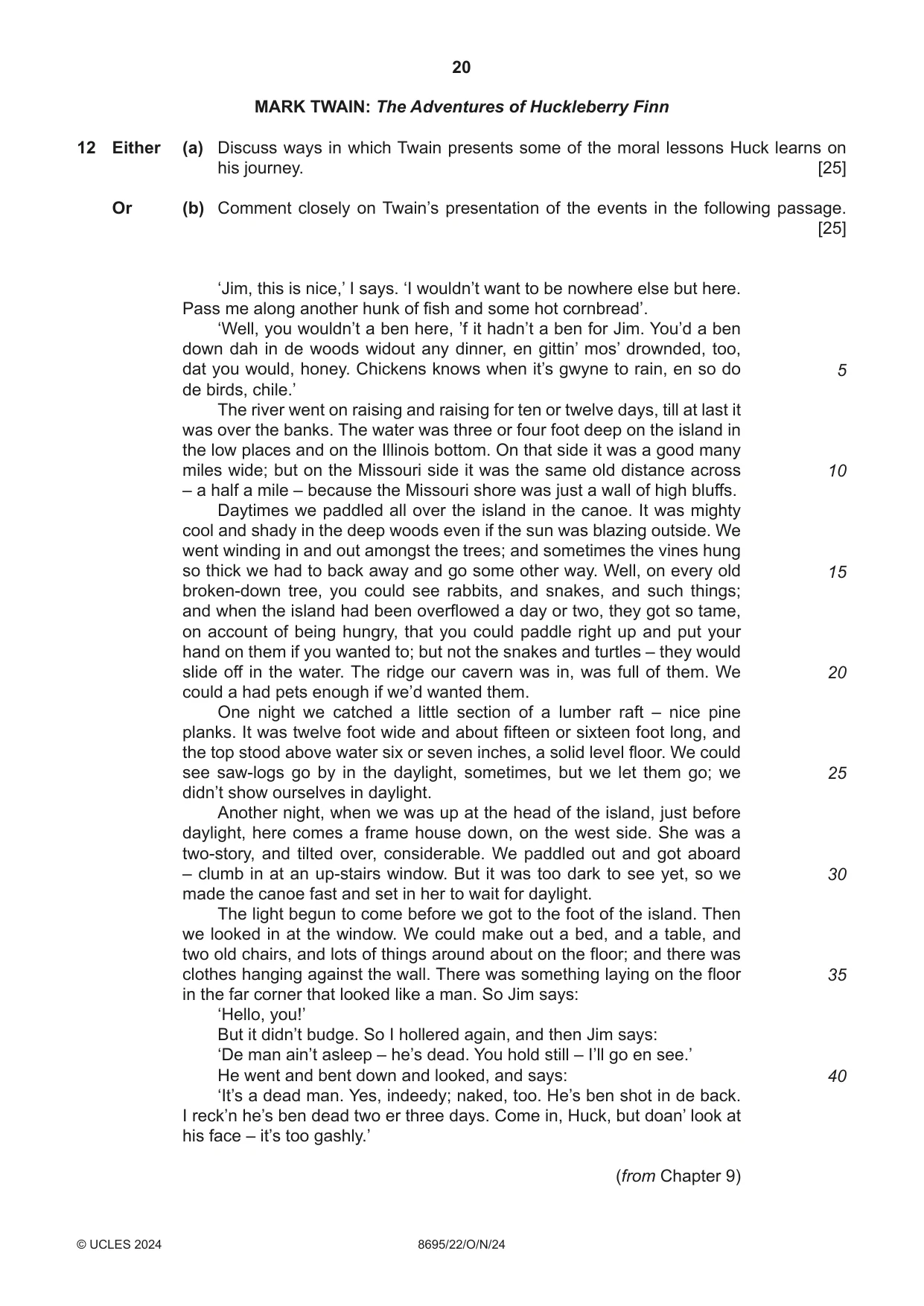
20 8695/22/O/N/24 © UCLES 2024 MARK TWAIN: The Adventures of Huckleberry Finn 12 Either (a) Discuss ways in which Twain presents some of the moral lessons Huck learns on his journey. [25] Or (b) Comment closely on Twain’s presentation of the events in the following passage. [25] ‘Jim, this is nice,’ I says. ‘I wouldn’t want to be nowhere else but here. Pass me along another hunk of fish and some hot cornbread’. ‘Well, you wouldn’t a ben here, ’f it hadn’t a ben for Jim. You’d a ben down dah in de woods widout any dinner, en gittin’ mos’ drownded, too, dat you would, honey. Chickens knows when it’s gwyne to rain, en so do de birds, chile.’ The river went on raising and raising for ten or twelve days, till at last it was over the banks. The water was three or four foot deep on the island in the low places and on the Illinois bottom. On that side it was a good many miles wide; but on the Missouri side it was the same old distance across – a half a mile – because the Missouri shore was just a wall of high bluffs. Daytimes we paddled all over the island in the canoe. It was mighty cool and shady in the deep woods even if the sun was blazing outside. We went winding in and out amongst the trees; and sometimes the vines hung so thick we had to back away and go some other way. Well, on every old broken-down tree, you could see rabbits, and snakes, and such things; and when the island had been overflowed a day or two, they got so tame, on account of being hungry, that you could paddle right up and put your hand on them if you wanted to; but not the snakes and turtles – they would slide off in the water. The ridge our cavern was in, was full of them. We could a had pets enough if we’d wanted them. One night we catched a little section of a lumber raft – nice pine planks. It was twelve foot wide and about fifteen or sixteen foot long, and the top stood above water six or seven inches, a solid level floor. We could see saw-logs go by in the daylight, sometimes, but we let them go; we didn’t show ourselves in daylight. Another night, when we was up at the head of the island, just before daylight, here comes a frame house down, on the west side. She was a two-story, and tilted over, considerable. We paddled out and got aboard – clumb in at an up-stairs window. But it was too dark to see yet, so we made the canoe fast and set in her to wait for daylight. The light begun to come before we got to the foot of the island. Then we looked in at the window. We could make out a bed, and a table, and two old chairs, and lots of things around about on the floor; and there was clothes hanging against the wall. There was something laying on the floor in the far corner that looked like a man. So Jim says: ‘Hello, you!’ But it didn’t budge. So I hollered again, and then Jim says: ‘De man ain’t asleep – he’s dead. You hold still – I’ll go en see.’ He went and bent down and looked, and says: ‘It’s a dead man. Yes, indeedy; naked, too. He’s ben shot in de back. I reck’n he’s ben dead two er three days. Come in, Huck, but doan’ look at his face – it’s too gashly.’ (from Chapter 9) 5 10 15 20 25 30 35 40
Question paper, page 21
21 8695/22/O/N/24 © UCLES 2024 BLANK PAGE
Question paper, page 22
22 8695/22/O/N/24 © UCLES 2024 BLANK PAGE
Question paper, page 23
23 8695/22/O/N/24 © UCLES 2024 BLANK PAGE
Question paper, page 24
24 8695/22/O/N/24 © UCLES 2024 Permission to reproduce items where third-party owned material protected by copyright is included has been sought and cleared where possible. Every reasonable effort has been made by the publisher (UCLES) to trace copyright holders, but if any items requiring clearance have unwittingly been included, the publisher will be pleased to make amends at the earliest possible opportunity. To avoid the issue of disclosure of answer-related information to candidates, all copyright acknowledgements are reproduced online in the Cambridge Assessment International Education Copyright Acknowledgements Booklet. This is produced for each series of examinations and is freely available to download at www.cambridgeinternational.org after the live examination series. Cambridge Assessment International Education is part of Cambridge Assessment. Cambridge Assessment is the brand name of the University of Cambridge Local Examinations Syndicate (UCLES), which is a department of the University of Cambridge. BLANK PAGE
Mark scheme, page 1
This document consists of 13 printed pages. © Cambridge University Press & Assessment 2024 [Turn over Cambridge International AS Level LANGUAGE AND LITERATURE IN ENGLISH 8695/22 Paper 2 Drama, Poetry and Prose October/November 2024 MARK SCHEME Maximum Mark: 50 Published This mark scheme is published as an aid to teachers and candidates, to indicate the requirements of the examination. It shows the basis on which Examiners were instructed to award marks. It does not indicate the details of the discussions that took place at an Examiners’ meeting before marking began, which would have considered the acceptability of alternative answers. Mark schemes should be read in conjunction with the question paper and the Principal Examiner Report for Teachers. Cambridge International will not enter into discussions about these mark schemes. Cambridge International is publishing the mark schemes for the October/November 2024 series for most Cambridge IGCSE, Cambridge International A and AS Level components, and some Cambridge O Level components.
Mark scheme, page 2
8695/22 Cambridge International AS Level – Mark Scheme PUBLISHED October/November 2024 © Cambridge University Press & Assessment 2024 Page 2 of 13 Generic Marking Principles These general marking principles must be applied by all examiners when marking candidate answers. They should be applied alongside the specific content of the mark scheme or generic level descriptions for a question. Each question paper and mark scheme will also comply with these marking principles. GENERIC MARKING PRINCIPLE 1: Marks must be awarded in line with: • the specific content of the mark scheme or the generic level descriptors for the question • the specific skills defined in the mark scheme or in the generic level descriptors for the question • the standard of response required by a candidate as exemplified by the standardisation scripts. GENERIC MARKING PRINCIPLE 2: Marks awarded are always whole marks (not half marks, or other fractions). GENERIC MARKING PRINCIPLE 3: Marks must be awarded positively: • marks are awarded for correct/valid answers, as defined in the mark scheme. However, credit is given for valid answers which go beyond the scope of the syllabus and mark scheme, referring to your Team Leader as appropriate • marks are awarded when candidates clearly demonstrate what they know and can do • marks are not deducted for errors • marks are not deducted for omissions • answers should only be judged on the quality of spelling, punctuation and grammar when these features are specifically assessed by the question as indicated by the mark scheme. The meaning, however, should be unambiguous. GENERIC MARKING PRINCIPLE 4: Rules must be applied consistently, e.g. in situations where candidates have not followed instructions or in the application of generic level descriptors. GENERIC MARKING PRINCIPLE 5: Marks should be awarded using the full range of marks defined in the mark scheme for the question (however; the use of the full mark range may be limited according to the quality of the candidate responses seen). GENERIC MARKING PRINCIPLE 6: Marks awarded are based solely on the requirements as defined in the mark scheme. Marks should not be awarded with grade thresholds or grade descriptors in mind.
Mark scheme, page 3
8695/22 Cambridge International AS Level – Mark Scheme PUBLISHED October/November 2024 © Cambridge University Press & Assessment 2024 Page 3 of 13 English & Media subject specific general marking principles (To be read in conjunction with the Generic Marking Principles (and requiring further guidance on how to place marks within levels)) Components using level descriptors: • We use level descriptors as a guide to broad understanding of the qualities normally expected of, or typical of, work in a level. • Level descriptors are a means of general guidance, and should not be interpreted as hurdle statements. • Where indicative content notes are supplied for a question, these are not a prescription of required content, and must not be treated as such. Alternative correct points and unexpected answers in candidates’ scripts must be given marks that fairly reflect the knowledge and skills demonstrated. • While we may have legitimate expectations as to the ground most answers may occupy, we must at all times be prepared to meet candidates on their chosen ground, provided it is relevant ground (e.g. clearly related to and derived from a relevant passage/text and meeting the mark scheme requirements for the question). Components using point-based marking: Point marking is often used to reward knowledge, understanding and application of skills. We give credit where the candidate’s answer shows relevant knowledge, understanding and application of skills in answering the question. We do not give credit where the answer shows confusion. From this it follows that we: a DO credit answers which are worded differently from the mark scheme if they clearly convey the same meaning (unless the mark scheme requires a specific term). b DO credit alternative answers/examples which are not written in the mark scheme if they are correct. c DO credit answers where candidates give more than one correct answer in one prompt/numbered/scaffolded space where extended writing is required rather than list-type answers. For example, questions that require n reasons (e.g. State two reasons…). d DO NOT credit answers simply for using a ‘key term’ unless that is all that is required. (Check for evidence it is understood and not used wrongly.) e DO NOT credit answers which are obviously self-contradicting or trying to cover all possibilities. f DO NOT give further credit for what is effectively repetition of a correct point already credited unless the language itself is being tested. This applies equally to ‘mirror statements’ (i.e. polluted/not polluted). g DO NOT require spellings to be correct, unless this is part of the test. However spellings of syllabus terms must allow for clear and unambiguous separation from other syllabus terms with which they may be confused (e.g. Corrasion/Corrosion).
Mark scheme, page 4
8695/22 Cambridge International AS Level – Mark Scheme PUBLISHED October/November 2024 © Cambridge University Press & Assessment 2024 Page 4 of 13 Literature in English specific marking instructions Using the mark levels Use the generic mark scheme levels to find the mark. Place the answer in a level first. Look for the ‘best fit’ of the answer into a level. An answer needs to show evidence of most but not necessarily ALL of the qualities described in a level, in order to be placed in that level. Then award a mark for the relative position of the answer within the level. Candidates may address the question in many different ways. There is no one required answer or approach and do not penalise answers for leaving out a particular focus. Reward what is there, showing what you are rewarding in your comments. Consider all strands and weigh up the performance as a whole in placing the answer in a level, then show that you have done so in the summative comment. Each answer is marked out of 25, in accordance with the general marking criteria. Assessment objectives All assessment objectives are equally weighted, and all are considered in assessing each essay. Each level in the marking criteria is divided into strands corresponding to the assessment objectives – AO1: Knowledge and understanding (K/U), AO2: Analysis (AN), AO3: Personal response (P), AO4: Communication (C). AO1 Knowledge and understanding Respond with understanding to literary texts in a variety of forms, from different cultures; with an appreciation of relevant contexts that illuminate readings of the texts. AO2 Analysis Analyse ways in which writers’ choices of language, form and structure shape meanings and effects. AO3 Personal response Produce informed independent opinions and interpretations of literary texts. AO4 Communication Communicate a relevant, structured and supported response appropriate to literary study.
Mark scheme, page 5
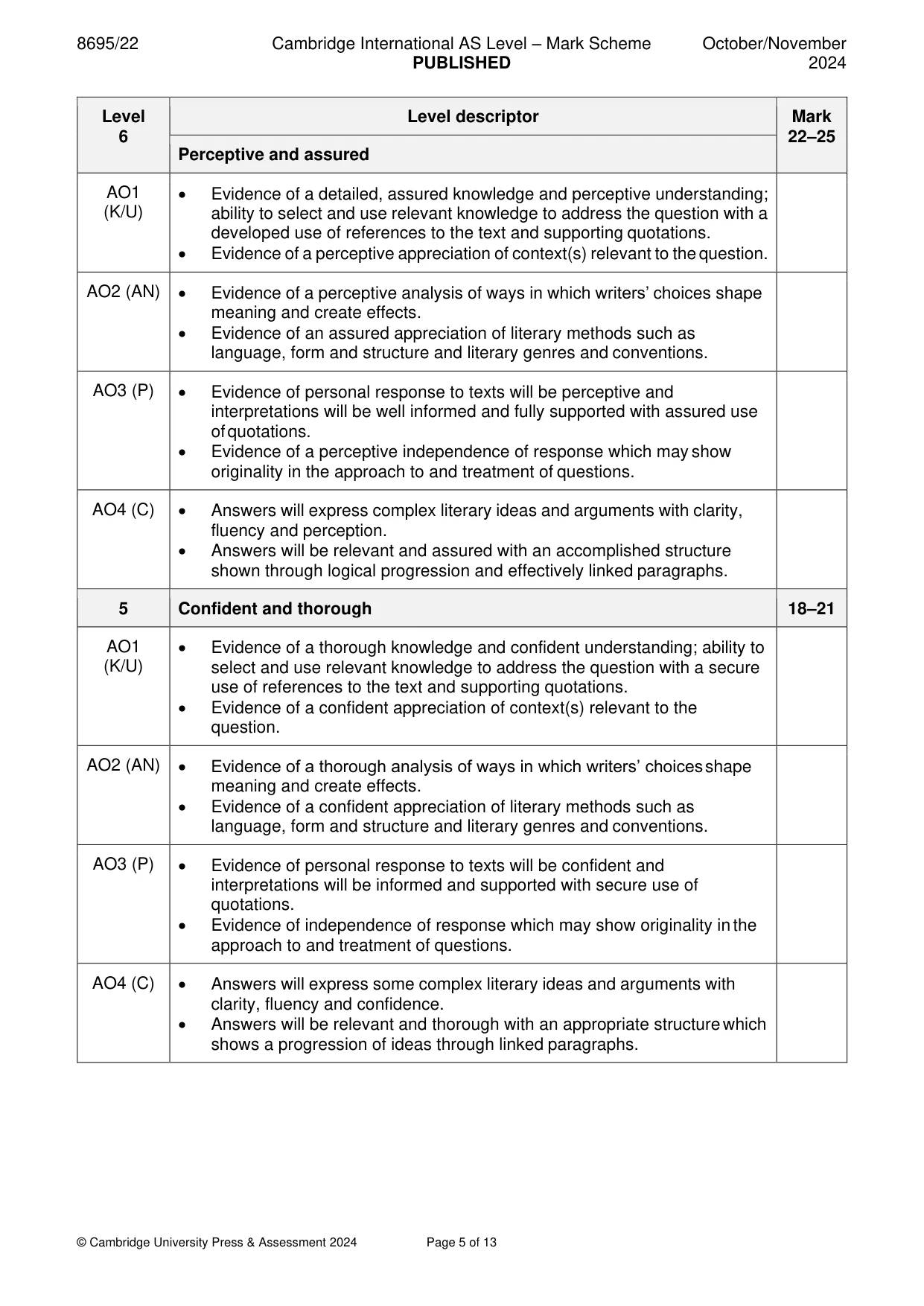
8695/22 Cambridge International AS Level – Mark Scheme PUBLISHED October/November 2024 © Cambridge University Press & Assessment 2024 Page 5 of 13 Level 6 Level descriptor Mark 22–25 Perceptive and assured AO1 (K/U) • Evidence of a detailed, assured knowledge and perceptive understanding; ability to select and use relevant knowledge to address the question with a developed use of references to the text and supporting quotations. • Evidence of a perceptive appreciation of context(s) relevant to the question. AO2 (AN) • Evidence of a perceptive analysis of ways in which writers’ choices shape meaning and create effects. • Evidence of an assured appreciation of literary methods such as language, form and structure and literary genres and conventions. AO3 (P) • Evidence of personal response to texts will be perceptive and interpretations will be well informed and fully supported with assured use of quotations. • Evidence of a perceptive independence of response which may show originality in the approach to and treatment of questions. AO4 (C) • Answers will express complex literary ideas and arguments with clarity, fluency and perception. • Answers will be relevant and assured with an accomplished structure shown through logical progression and effectively linked paragraphs. 5 Confident and thorough 18–21 AO1 (K/U) • Evidence of a thorough knowledge and confident understanding; ability to select and use relevant knowledge to address the question with a secure use of references to the text and supporting quotations. • Evidence of a confident appreciation of context(s) relevant to the question. AO2 (AN) • Evidence of a thorough analysis of ways in which writers’ choices shape meaning and create effects. • Evidence of a confident appreciation of literary methods such as language, form and structure and literary genres and conventions. AO3 (P) • Evidence of personal response to texts will be confident and interpretations will be informed and supported with secure use of quotations. • Evidence of independence of response which may show originality in the approach to and treatment of questions. AO4 (C) • Answers will express some complex literary ideas and arguments with clarity, fluency and confidence. • Answers will be relevant and thorough with an appropriate structure which shows a progression of ideas through linked paragraphs.
Mark scheme, page 6
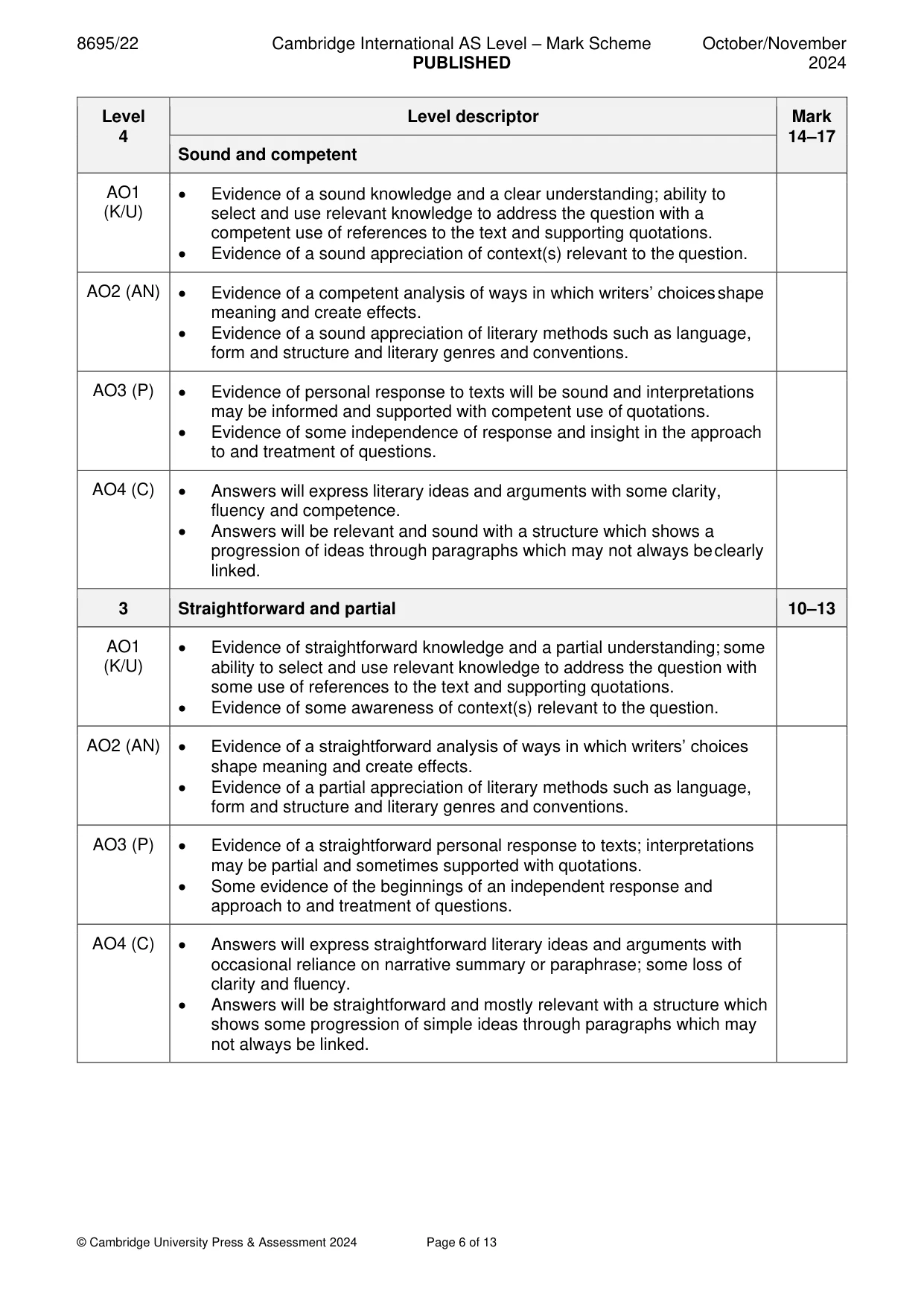
8695/22 Cambridge International AS Level – Mark Scheme PUBLISHED October/November 2024 © Cambridge University Press & Assessment 2024 Page 6 of 13 Level 4 Level descriptor Mark 14–17 Sound and competent AO1 (K/U) • Evidence of a sound knowledge and a clear understanding; ability to select and use relevant knowledge to address the question with a competent use of references to the text and supporting quotations. • Evidence of a sound appreciation of context(s) relevant to the question. AO2 (AN) • Evidence of a competent analysis of ways in which writers’ choices shape meaning and create effects. • Evidence of a sound appreciation of literary methods such as language, form and structure and literary genres and conventions. AO3 (P) • Evidence of personal response to texts will be sound and interpretations may be informed and supported with competent use of quotations. • Evidence of some independence of response and insight in the approach to and treatment of questions. AO4 (C) • Answers will express literary ideas and arguments with some clarity, fluency and competence. • Answers will be relevant and sound with a structure which shows a progression of ideas through paragraphs which may not always be clearly linked. 3 Straightforward and partial 10–13 AO1 (K/U) • Evidence of straightforward knowledge and a partial understanding; some ability to select and use relevant knowledge to address the question with some use of references to the text and supporting quotations. • Evidence of some awareness of context(s) relevant to the question. AO2 (AN) • Evidence of a straightforward analysis of ways in which writers’ choices shape meaning and create effects. • Evidence of a partial appreciation of literary methods such as language, form and structure and literary genres and conventions. AO3 (P) • Evidence of a straightforward personal response to texts; interpretations may be partial and sometimes supported with quotations. • Some evidence of the beginnings of an independent response and approach to and treatment of questions. AO4 (C) • Answers will express straightforward literary ideas and arguments with occasional reliance on narrative summary or paraphrase; some loss of clarity and fluency. • Answers will be straightforward and mostly relevant with a structure which shows some progression of simple ideas through paragraphs which may not always be linked.
Mark scheme, page 7
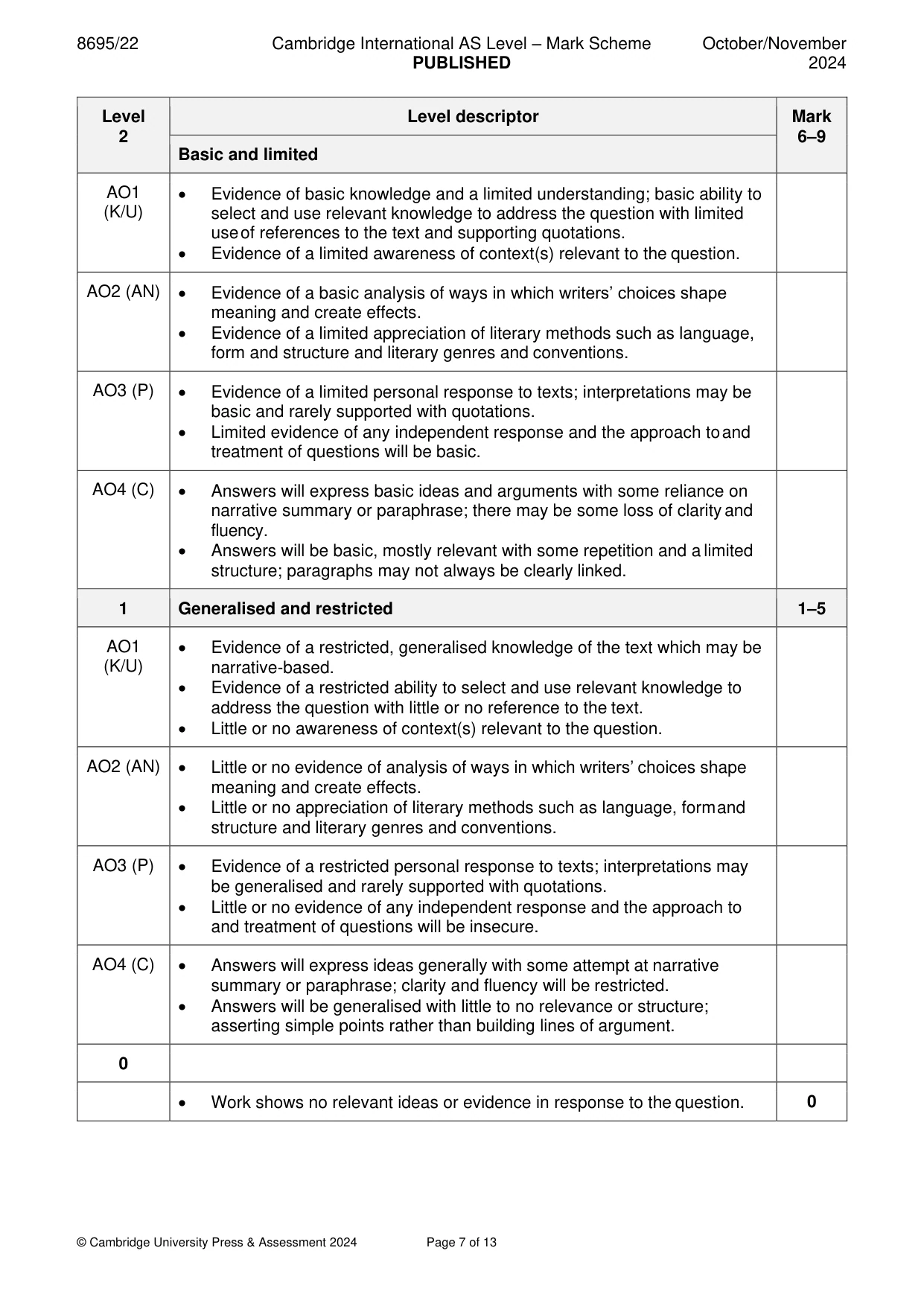
8695/22 Cambridge International AS Level – Mark Scheme PUBLISHED October/November 2024 © Cambridge University Press & Assessment 2024 Page 7 of 13 Level 2 Level descriptor Mark 6–9 Basic and limited AO1 (K/U) • Evidence of basic knowledge and a limited understanding; basic ability to select and use relevant knowledge to address the question with limited use of references to the text and supporting quotations. • Evidence of a limited awareness of context(s) relevant to the question. AO2 (AN) • Evidence of a basic analysis of ways in which writers’ choices shape meaning and create effects. • Evidence of a limited appreciation of literary methods such as language, form and structure and literary genres and conventions. AO3 (P) • Evidence of a limited personal response to texts; interpretations may be basic and rarely supported with quotations. • Limited evidence of any independent response and the approach to and treatment of questions will be basic. AO4 (C) • Answers will express basic ideas and arguments with some reliance on narrative summary or paraphrase; there may be some loss of clarity and fluency. • Answers will be basic, mostly relevant with some repetition and a limited structure; paragraphs may not always be clearly linked. 1 Generalised and restricted 1–5 AO1 (K/U) • Evidence of a restricted, generalised knowledge of the text which may be narrative-based. • Evidence of a restricted ability to select and use relevant knowledge to address the question with little or no reference to the text. • Little or no awareness of context(s) relevant to the question. AO2 (AN) • Little or no evidence of analysis of ways in which writers’ choices shape meaning and create effects. • Little or no appreciation of literary methods such as language, form and structure and literary genres and conventions. AO3 (P) • Evidence of a restricted personal response to texts; interpretations may be generalised and rarely supported with quotations. • Little or no evidence of any independent response and the approach to and treatment of questions will be insecure. AO4 (C) • Answers will express ideas generally with some attempt at narrative summary or paraphrase; clarity and fluency will be restricted. • Answers will be generalised with little to no relevance or structure; asserting simple points rather than building lines of argument. 0 • Work shows no relevant ideas or evidence in response to the question. 0
Mark scheme, page 8
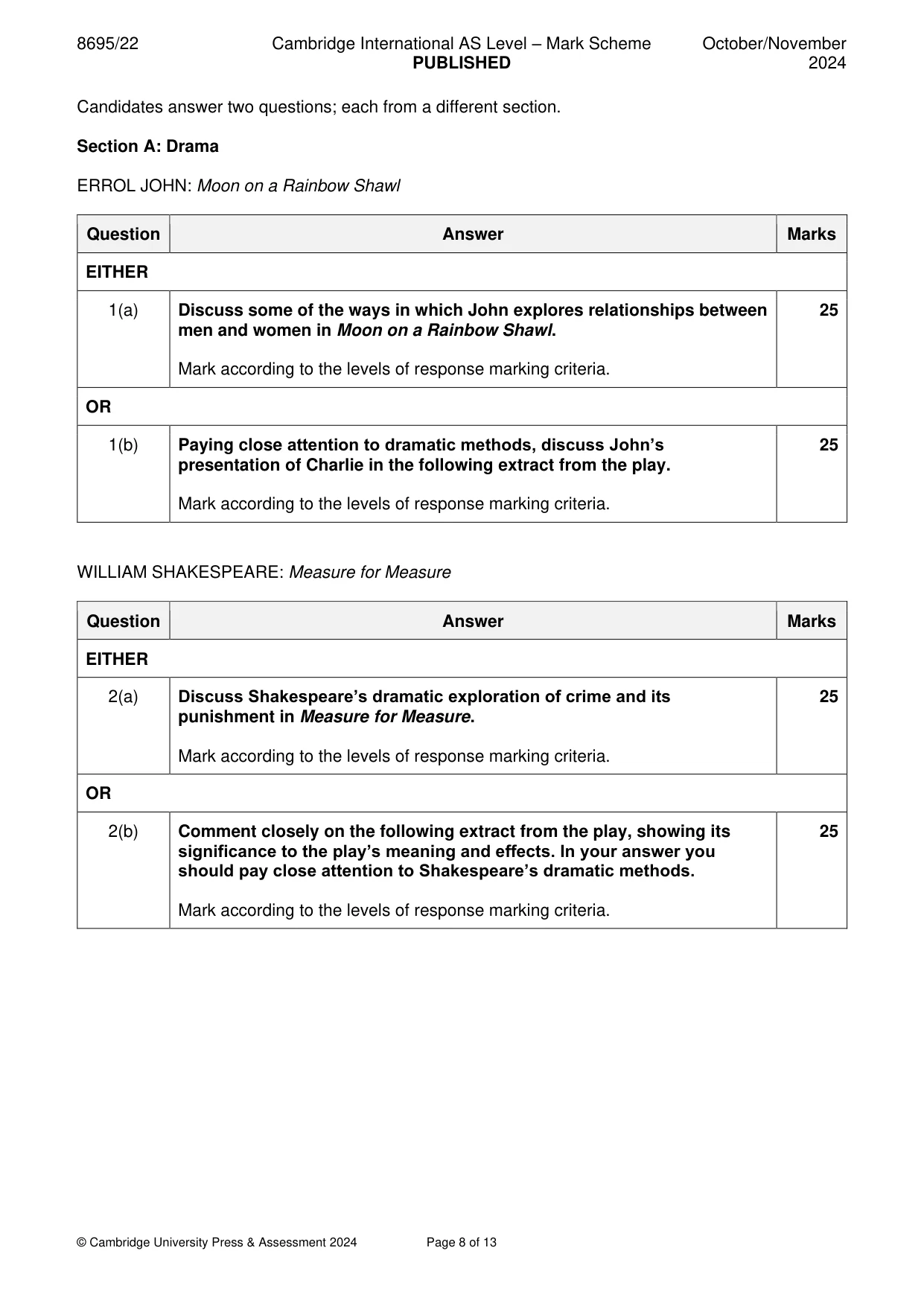
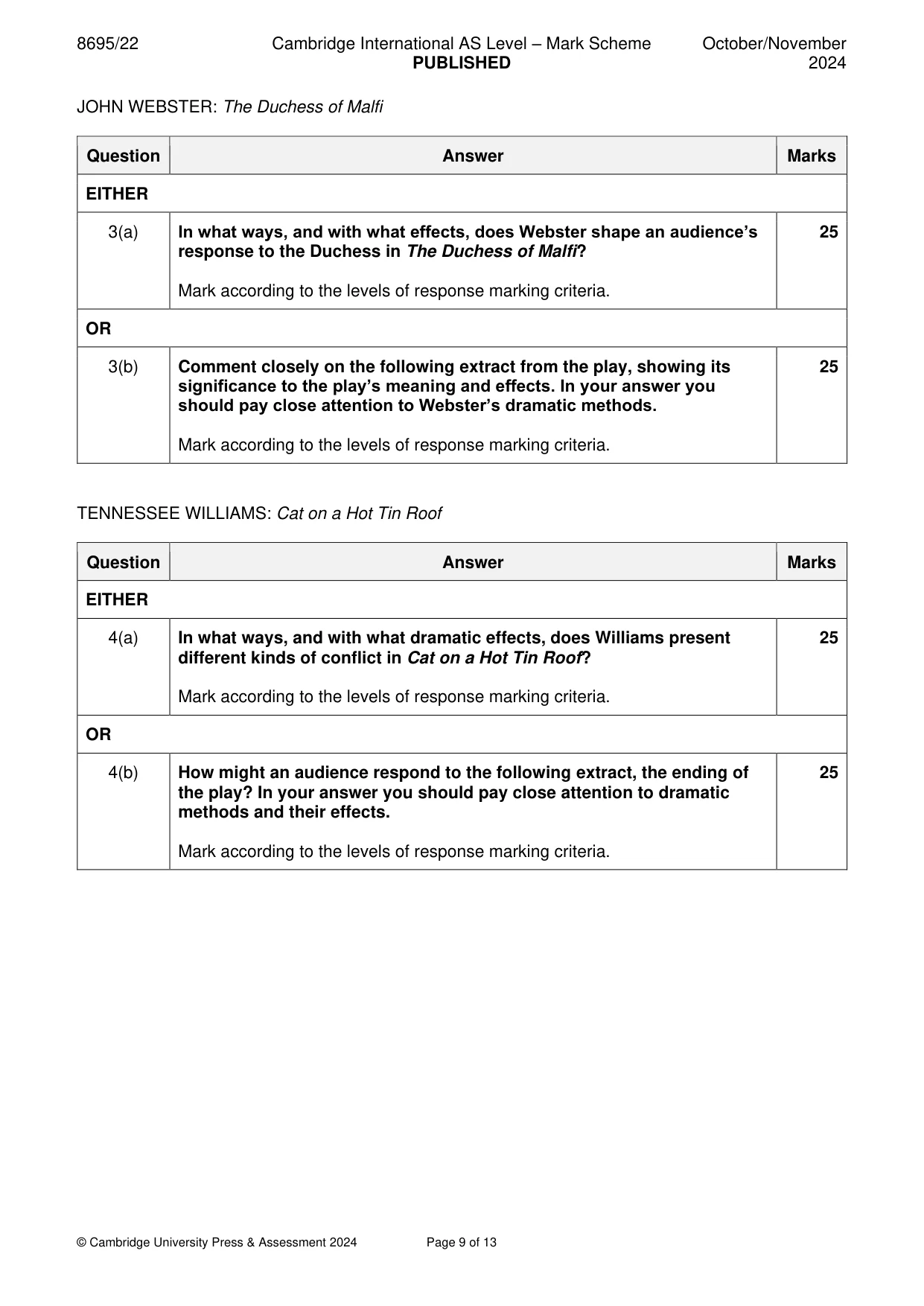
8695/22 Cambridge International AS Level – Mark Scheme PUBLISHED October/November 2024 © Cambridge University Press & Assessment 2024 Page 8 of 13 Candidates answer two questions; each from a different section. Section A: Drama ERROL JOHN: Moon on a Rainbow Shawl Question Answer Marks EITHER 1(a) Discuss some of the ways in which John explores relationships between men and women in Moon on a Rainbow Shawl. Mark according to the levels of response marking criteria. 25 OR 1(b) Paying close attention to dramatic methods, discuss John’s presentation of Charlie in the following extract from the play. Mark according to the levels of response marking criteria. 25 WILLIAM SHAKESPEARE: Measure for Measure Question Answer Marks EITHER 2(a) Discuss Shakespeare’s dramatic exploration of crime and its punishment in Measure for Measure. Mark according to the levels of response marking criteria. 25 OR 2(b) Comment closely on the following extract from the play, showing its significance to the play’s meaning and effects. In your answer you should pay close attention to Shakespeare’s dramatic methods. Mark according to the levels of response marking criteria. 25
Mark scheme, page 9
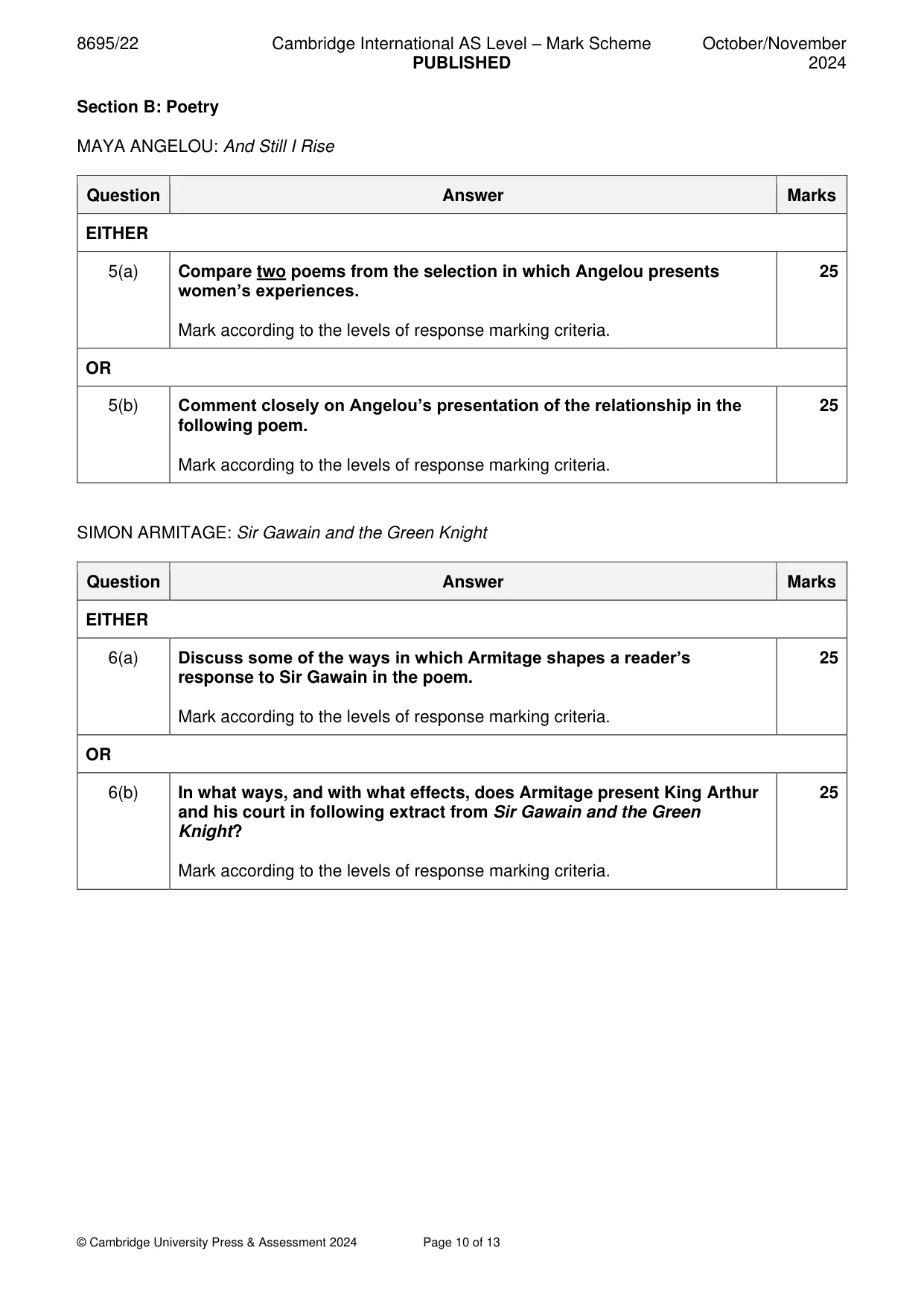
8695/22 Cambridge International AS Level – Mark Scheme PUBLISHED October/November 2024 © Cambridge University Press & Assessment 2024 Page 9 of 13 JOHN WEBSTER: The Duchess of Malfi Question Answer Marks EITHER 3(a) In what ways, and with what effects, does Webster shape an audience’s response to the Duchess in The Duchess of Malfi? Mark according to the levels of response marking criteria. 25 OR 3(b) Comment closely on the following extract from the play, showing its significance to the play’s meaning and effects. In your answer you should pay close attention to Webster’s dramatic methods. Mark according to the levels of response marking criteria. 25 TENNESSEE WILLIAMS: Cat on a Hot Tin Roof Question Answer Marks EITHER 4(a) In what ways, and with what dramatic effects, does Williams present different kinds of conflict in Cat on a Hot Tin Roof? Mark according to the levels of response marking criteria. 25 OR 4(b) How might an audience respond to the following extract, the ending of the play? In your answer you should pay close attention to dramatic methods and their effects. Mark according to the levels of response marking criteria. 25
Mark scheme, page 10
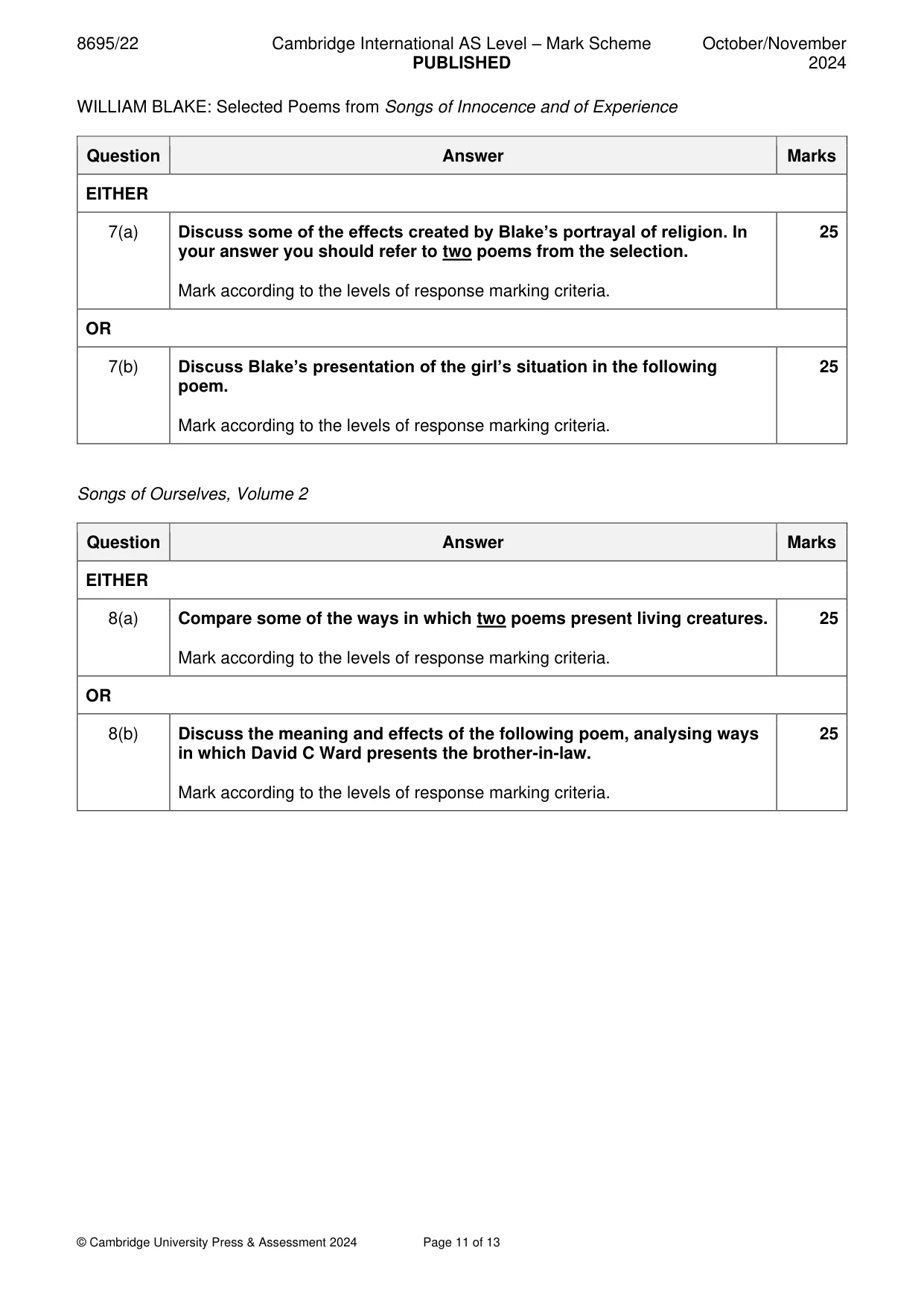
8695/22 Cambridge International AS Level – Mark Scheme PUBLISHED October/November 2024 © Cambridge University Press & Assessment 2024 Page 10 of 13 Section B: Poetry MAYA ANGELOU: And Still I Rise Question Answer Marks EITHER 5(a) Compare two poems from the selection in which Angelou presents women’s experiences. Mark according to the levels of response marking criteria. 25 OR 5(b) Comment closely on Angelou’s presentation of the relationship in the following poem. Mark according to the levels of response marking criteria. 25 SIMON ARMITAGE: Sir Gawain and the Green Knight Question Answer Marks EITHER 6(a) Discuss some of the ways in which Armitage shapes a reader’s response to Sir Gawain in the poem. Mark according to the levels of response marking criteria. 25 OR 6(b) In what ways, and with what effects, does Armitage present King Arthur and his court in following extract from Sir Gawain and the Green Knight? Mark according to the levels of response marking criteria. 25
Mark scheme, page 11
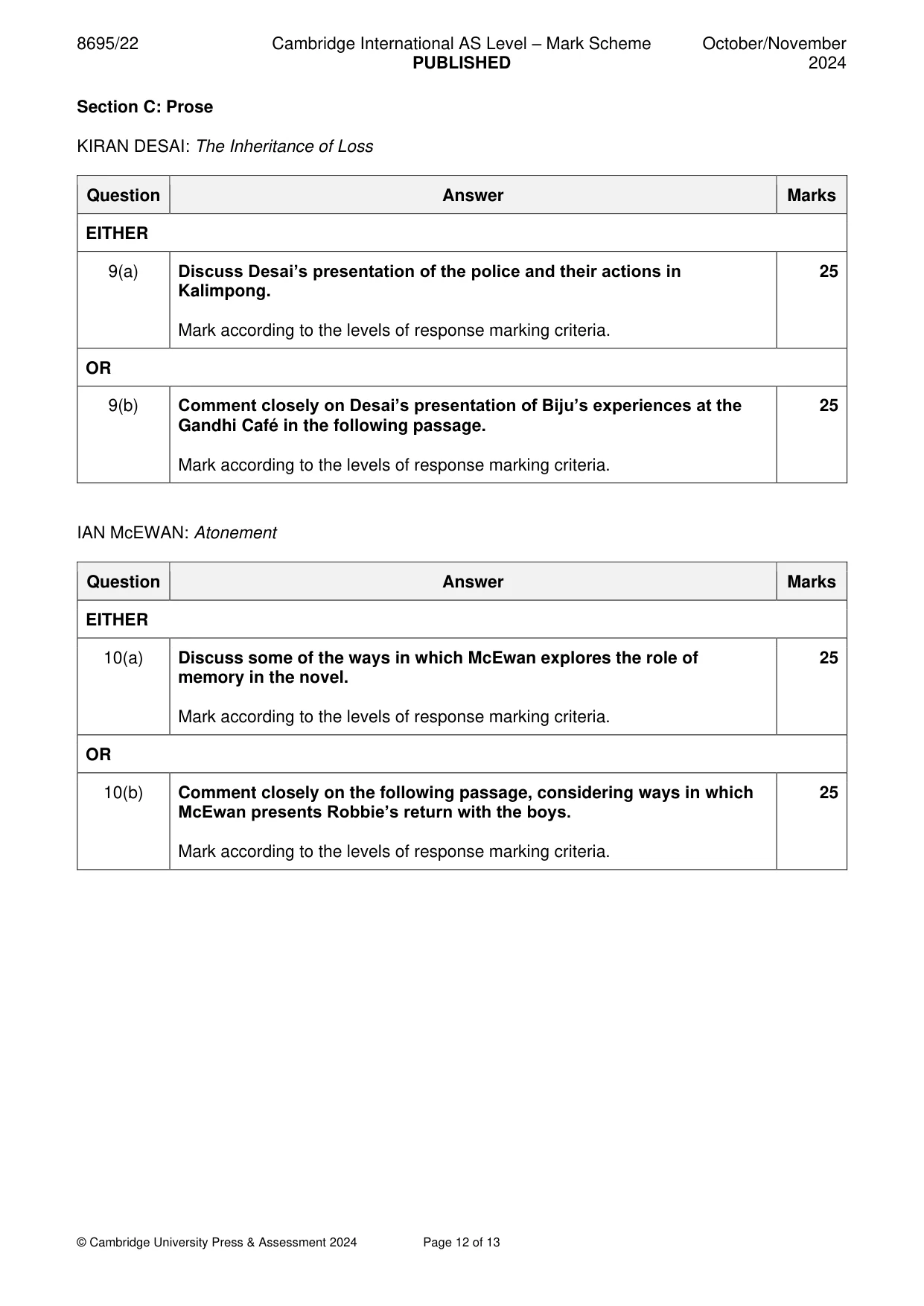
8695/22 Cambridge International AS Level – Mark Scheme PUBLISHED October/November 2024 © Cambridge University Press & Assessment 2024 Page 11 of 13 WILLIAM BLAKE: Selected Poems from Songs of Innocence and of Experience Question Answer Marks EITHER 7(a) Discuss some of the effects created by Blake’s portrayal of religion. In your answer you should refer to two poems from the selection. Mark according to the levels of response marking criteria. 25 OR 7(b) Discuss Blake’s presentation of the girl’s situation in the following poem. Mark according to the levels of response marking criteria. 25 Songs of Ourselves, Volume 2 Question Answer Marks EITHER 8(a) Compare some of the ways in which two poems present living creatures. Mark according to the levels of response marking criteria. 25 OR 8(b) Discuss the meaning and effects of the following poem, analysing ways in which David C Ward presents the brother-in-law. Mark according to the levels of response marking criteria. 25
Mark scheme, page 12
8695/22 Cambridge International AS Level – Mark Scheme PUBLISHED October/November 2024 © Cambridge University Press & Assessment 2024 Page 12 of 13 Section C: Prose KIRAN DESAI: The Inheritance of Loss Question Answer Marks EITHER 9(a) Discuss Desai’s presentation of the police and their actions in Kalimpong. Mark according to the levels of response marking criteria. 25 OR 9(b) Comment closely on Desai’s presentation of Biju’s experiences at the Gandhi Café in the following passage. Mark according to the levels of response marking criteria. 25 IAN McEWAN: Atonement Question Answer Marks EITHER 10(a) Discuss some of the ways in which McEwan explores the role of memory in the novel. Mark according to the levels of response marking criteria. 25 OR 10(b) Comment closely on the following passage, considering ways in which McEwan presents Robbie’s return with the boys. Mark according to the levels of response marking criteria. 25
Mark scheme, page 13
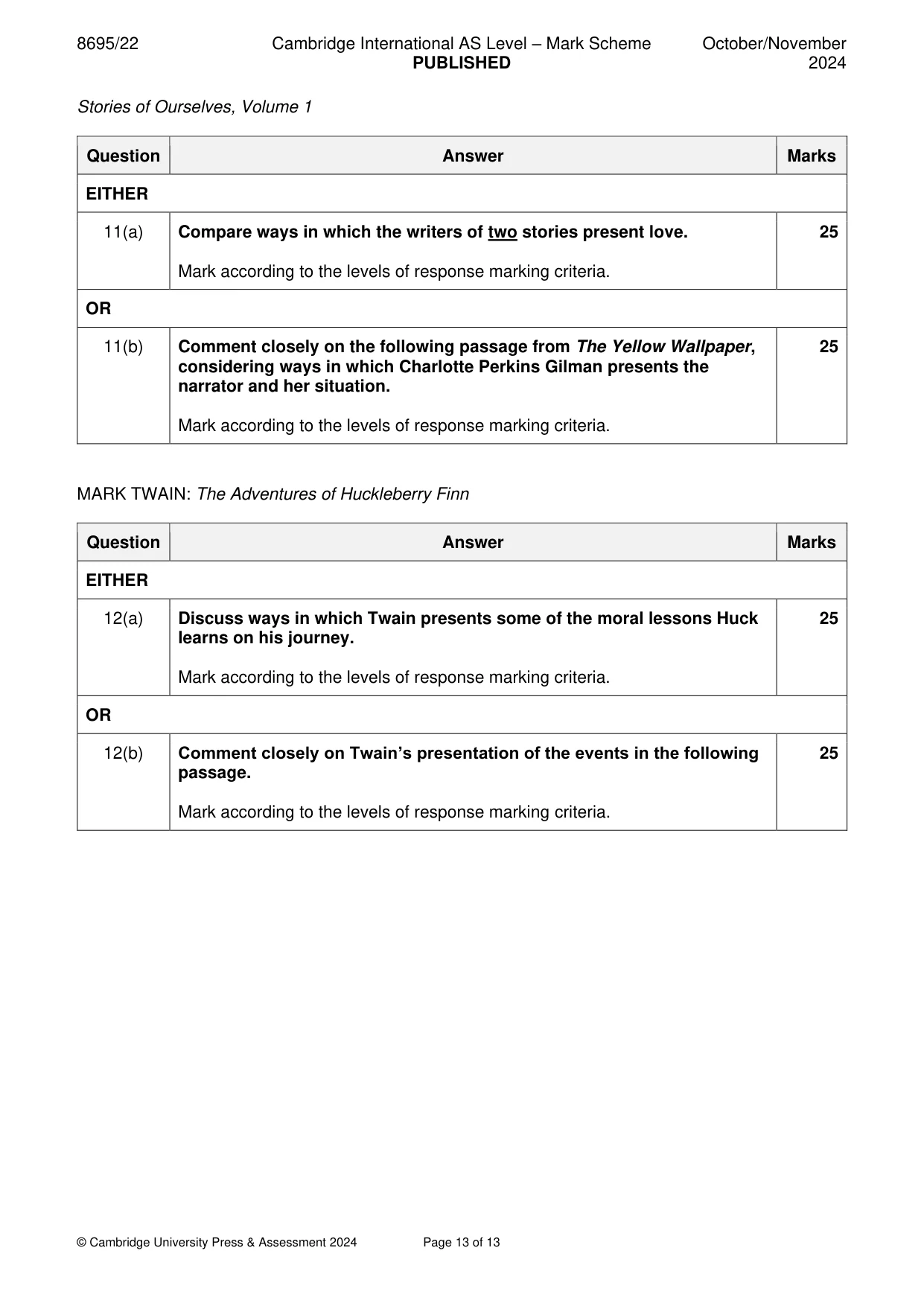
8695/22 Cambridge International AS Level – Mark Scheme PUBLISHED October/November 2024 © Cambridge University Press & Assessment 2024 Page 13 of 13 Stories of Ourselves, Volume 1 Question Answer Marks EITHER 11(a) Compare ways in which the writers of two stories present love. Mark according to the levels of response marking criteria. 25 OR 11(b) Comment closely on the following passage from The Yellow Wallpaper, considering ways in which Charlotte Perkins Gilman presents the narrator and her situation. Mark according to the levels of response marking criteria. 25 MARK TWAIN: The Adventures of Huckleberry Finn Question Answer Marks EITHER 12(a) Discuss ways in which Twain presents some of the moral lessons Huck learns on his journey. Mark according to the levels of response marking criteria. 25 OR 12(b) Comment closely on Twain’s presentation of the events in the following passage. Mark according to the levels of response marking criteria. 25
What you needed in this session
Cambridge’s own grade thresholds for 2024 Oct/Nov, Paper 2 · Variant 2. A higher threshold means an easier paper — the bar moves with how the cohort did.