Cambridge A Level English - Language and Literature (AS Level only, from 2016) 8695 — 2022 May/June Paper 2 · Variant 2
8695/22/M/J/22 · 50 marks · ≈56 min
The question paper and its mark scheme, free to read here and free to download. This is Cambridge’s own paper, exactly as it was sat.
Question paper24 pages



Mark scheme13 pages
Answers below. Sit the paper first if you are practising.
Paper as text
Question paper, page 1
This document has 24 pages. Any blank pages are indicated. Cambridge International AS Level * 4 1 9 1 9 1 7 7 0 5 * LANGUAGE AND LITERATURE IN ENGLISH 8695/22 Paper 2 Drama, Poetry and Prose May/June 2022 2 hours You must answer on the enclosed answer booklet. You will need: Answer booklet (enclosed) INSTRUCTIONS ● Answer two questions in total, each from a different section. ● Follow the instructions on the front cover of the answer booklet. If you need additional answer paper, ask the invigilator for a continuation booklet. ● Dictionaries are not allowed. INFORMATION ● The total mark for this paper is 50. ● The number of marks for each question or part question is shown in brackets [ ]. DC (RCL/DF) 303484/4 © UCLES 2022 [Turn over
Question paper, page 2
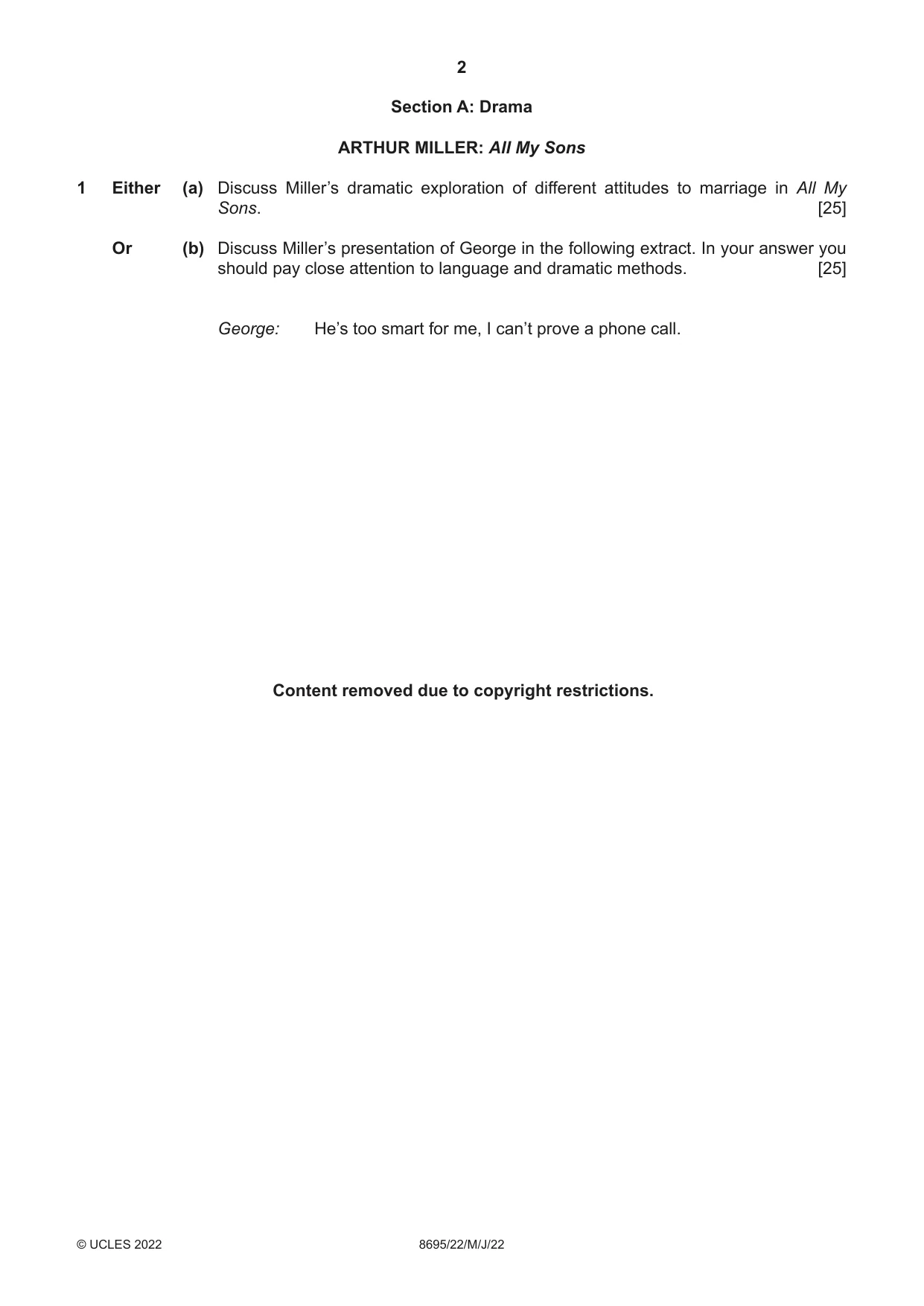
2 8695/22/M/J/22 © UCLES 2022 Section A: Drama ARTHUR MILLER: All My Sons 1 Either (a) Discuss Miller’s dramatic exploration of different attitudes to marriage in All My Sons. [25] Or (b) Discuss Miller’s presentation of George in the following extract. In your answer you should pay close attention to language and dramatic methods. [25] George: He’s too smart for me, I can’t prove a phone call. Content removed due to copyright restrictions.
Question paper, page 3
3 8695/22/M/J/22 © UCLES 2022 [Turn over Chris: The voice of God! (from Act 2) Content removed due to copyright restrictions.
Question paper, page 4
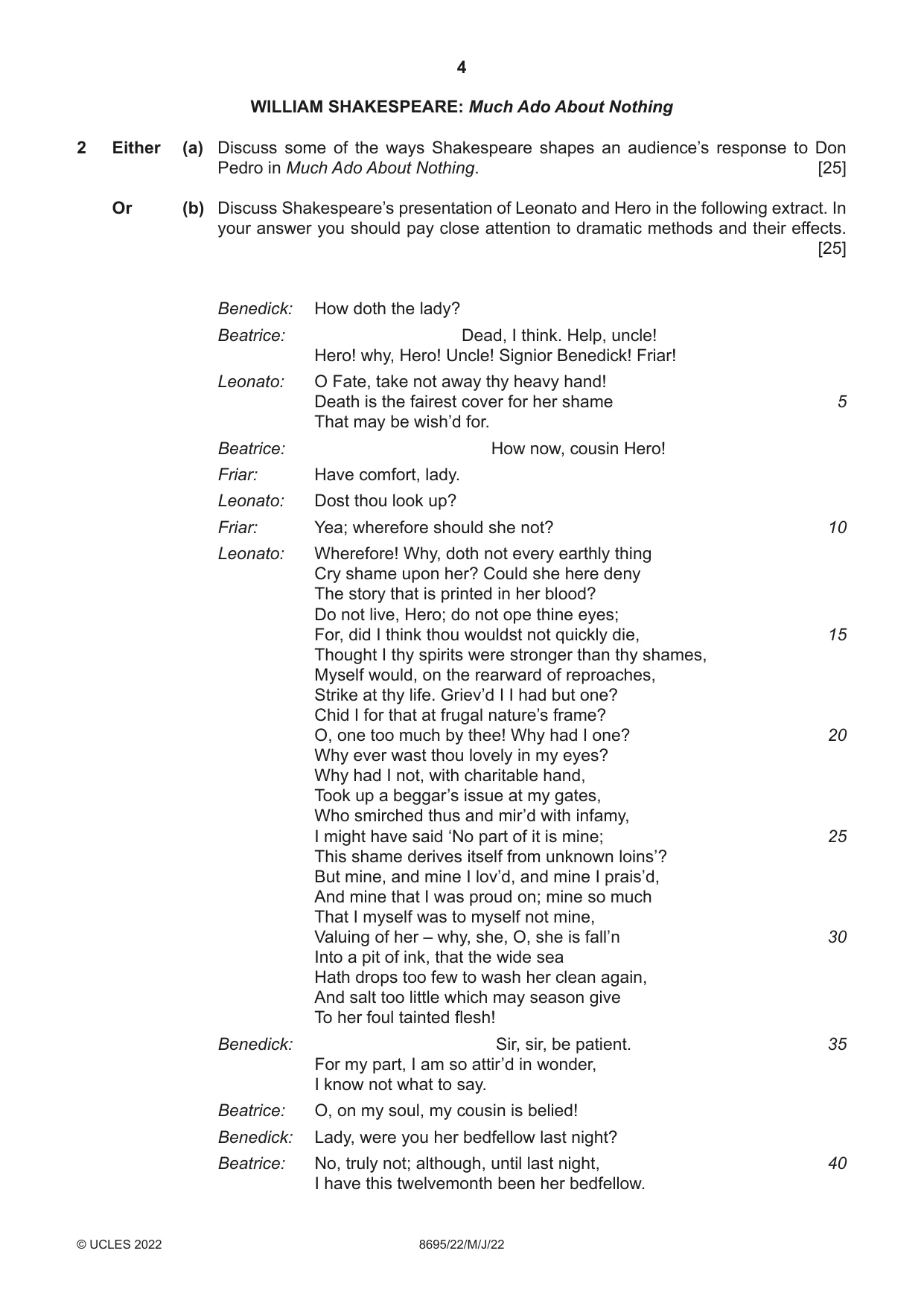
4 8695/22/M/J/22 © UCLES 2022 WILLIAM SHAKESPEARE: Much Ado About Nothing 2 Either (a) Discuss some of the ways Shakespeare shapes an audience’s response to Don Pedro in Much Ado About Nothing. [25] Or (b) Discuss Shakespeare’s presentation of Leonato and Hero in the following extract. In your answer you should pay close attention to dramatic methods and their effects. [25] Benedick: How doth the lady? Beatrice: Dead, I think. Help, uncle! Hero! why, Hero! Uncle! Signior Benedick! Friar! Leonato: O Fate, take not away thy heavy hand! Death is the fairest cover for her shame That may be wish’d for. Beatrice: How now, cousin Hero! Friar: Have comfort, lady. Leonato: Dost thou look up? Friar: Yea; wherefore should she not? Leonato: Wherefore! Why, doth not every earthly thing Cry shame upon her? Could she here deny The story that is printed in her blood? Do not live, Hero; do not ope thine eyes; For, did I think thou wouldst not quickly die, Thought I thy spirits were stronger than thy shames, Myself would, on the rearward of reproaches, Strike at thy life. Griev’d I I had but one? Chid I for that at frugal nature’s frame? O, one too much by thee! Why had I one? Why ever wast thou lovely in my eyes? Why had I not, with charitable hand, Took up a beggar’s issue at my gates, Who smirched thus and mir’d with infamy, I might have said ‘No part of it is mine; This shame derives itself from unknown loins’? But mine, and mine I lov’d, and mine I prais’d, And mine that I was proud on; mine so much That I myself was to myself not mine, Valuing of her – why, she, O, she is fall’n Into a pit of ink, that the wide sea Hath drops too few to wash her clean again, And salt too little which may season give To her foul tainted flesh! Benedick: Sir, sir, be patient. For my part, I am so attir’d in wonder, I know not what to say. Beatrice: O, on my soul, my cousin is belied! Benedick: Lady, were you her bedfellow last night? Beatrice: No, truly not; although, until last night, I have this twelvemonth been her bedfellow. 5 10 15 20 25 30 35 40
Question paper, page 5
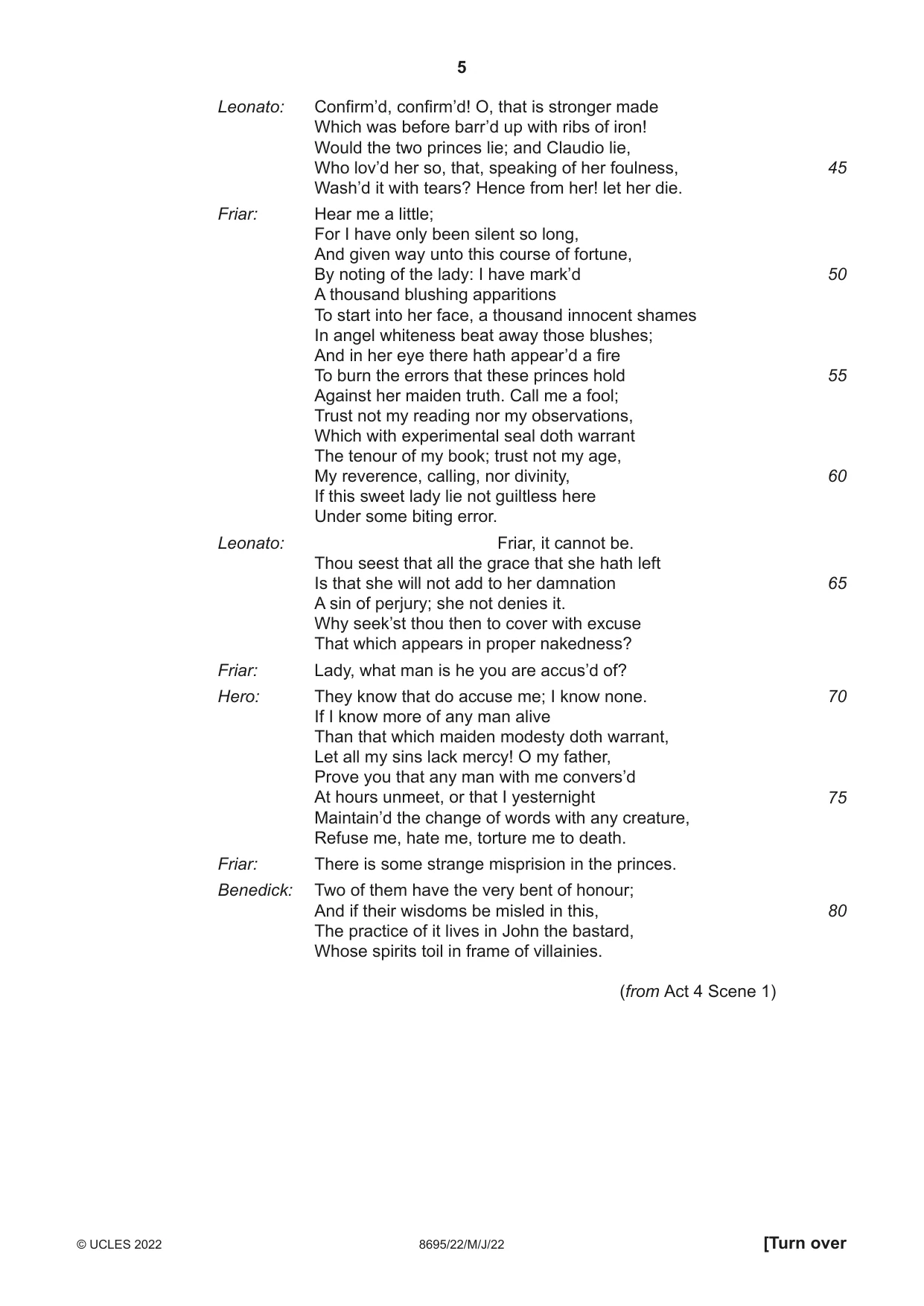
5 8695/22/M/J/22 © UCLES 2022 [Turn over Leonato: Confirm’d, confirm’d! O, that is stronger made Which was before barr’d up with ribs of iron! Would the two princes lie; and Claudio lie, Who lov’d her so, that, speaking of her foulness, Wash’d it with tears? Hence from her! let her die. Friar: Hear me a little; For I have only been silent so long, And given way unto this course of fortune, By noting of the lady: I have mark’d A thousand blushing apparitions To start into her face, a thousand innocent shames In angel whiteness beat away those blushes; And in her eye there hath appear’d a fire To burn the errors that these princes hold Against her maiden truth. Call me a fool; Trust not my reading nor my observations, Which with experimental seal doth warrant The tenour of my book; trust not my age, My reverence, calling, nor divinity, If this sweet lady lie not guiltless here Under some biting error. Leonato: Friar, it cannot be. Thou seest that all the grace that she hath left Is that she will not add to her damnation A sin of perjury; she not denies it. Why seek’st thou then to cover with excuse That which appears in proper nakedness? Friar: Lady, what man is he you are accus’d of? Hero: They know that do accuse me; I know none. If I know more of any man alive Than that which maiden modesty doth warrant, Let all my sins lack mercy! O my father, Prove you that any man with me convers’d At hours unmeet, or that I yesternight Maintain’d the change of words with any creature, Refuse me, hate me, torture me to death. Friar: There is some strange misprision in the princes. Benedick: Two of them have the very bent of honour; And if their wisdoms be misled in this, The practice of it lives in John the bastard, Whose spirits toil in frame of villainies. (from Act 4 Scene 1) 45 50 55 60 65 70 75 80
Question paper, page 6
6 8695/22/M/J/22 © UCLES 2022 WOLE SOYINKA: The Trials of Brother Jero and Jero’s Metamorphosis 3 Either (a) Discuss some of the ways Soyinka develops the role and character of Jero as these plays unfold. [25] Or (b) With close attention to detail of language and action, discuss Soyinka’s presentation of the relationship between Amope and Chume in the following extract from The Trials of Brother Jero. [25] [Early morning. Content removed due to copyright restrictions.
Question paper, page 7
7 8695/22/M/J/22 © UCLES 2022 [Turn over Just help me unload the things and place them against the wall … you know I wouldn’t ask if it wasn’t for the ankle. (from The Trials of Brother Jero, Scene 2) Content removed due to copyright restrictions.
Question paper, page 8
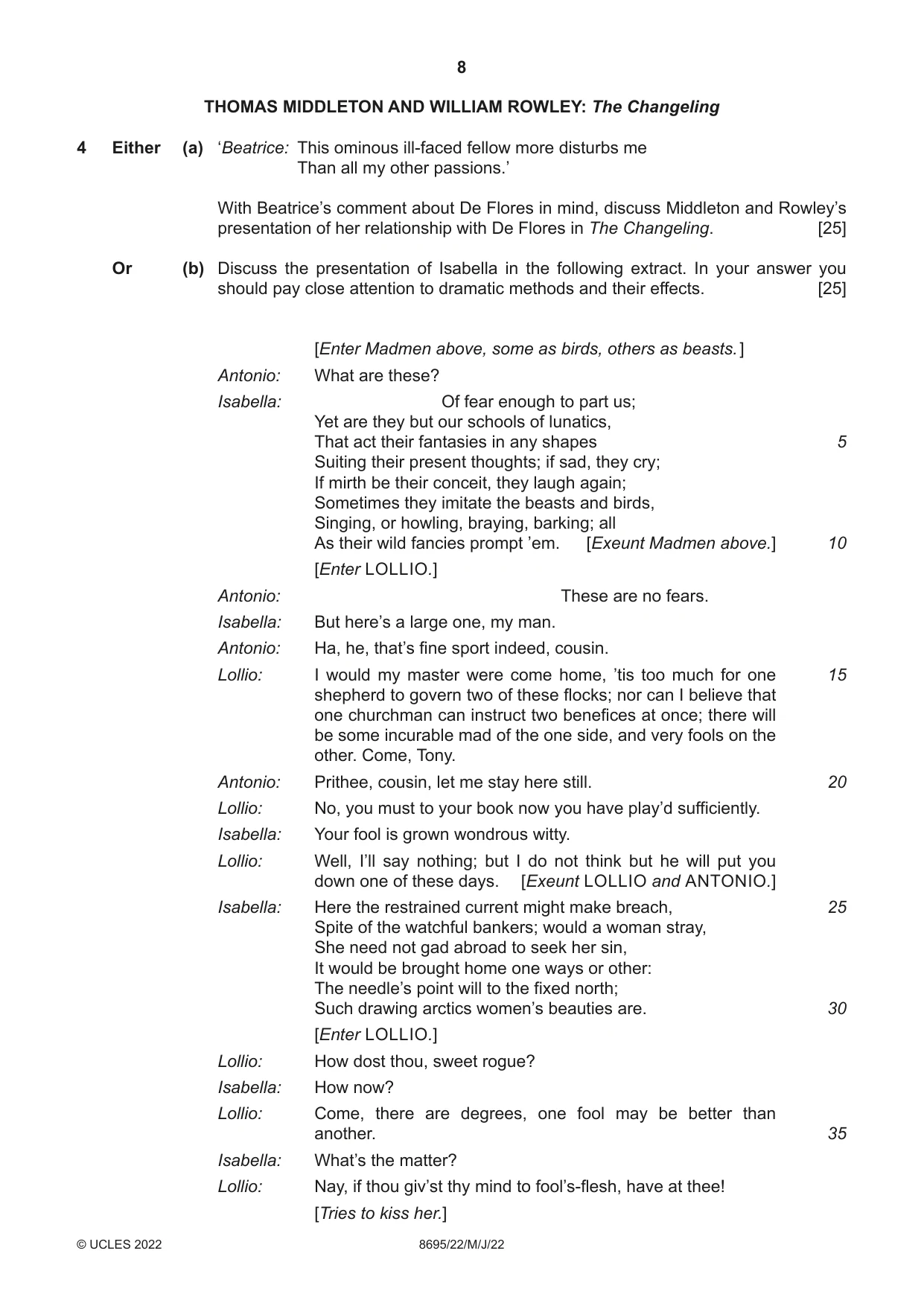
8 8695/22/M/J/22 © UCLES 2022 THOMAS MIDDLETON AND WILLIAM ROWLEY: The Changeling 4 Either (a) ‘Beatrice: This ominous ill-faced fellow more disturbs me Than all my other passions.’ With Beatrice’s comment about De Flores in mind, discuss Middleton and Rowley’s presentation of her relationship with De Flores in The Changeling. [25] Or (b) Discuss the presentation of Isabella in the following extract. In your answer you should pay close attention to dramatic methods and their effects. [25] [Enter Madmen above, some as birds, others as beasts. ] Antonio: What are these? Isabella: Of fear enough to part us; Yet are they but our schools of lunatics, That act their fantasies in any shapes Suiting their present thoughts; if sad, they cry; If mirth be their conceit, they laugh again; Sometimes they imitate the beasts and birds, Singing, or howling, braying, barking; all As their wild fancies prompt ’em. [Exeunt Madmen above.] [Enter LOLLIO.] Antonio: These are no fears. Isabella: But here’s a large one, my man. Antonio: Ha, he, that’s fine sport indeed, cousin. Lollio: I would my master were come home, ’tis too much for one shepherd to govern two of these flocks; nor can I believe that one churchman can instruct two benefices at once; there will be some incurable mad of the one side, and very fools on the other. Come, Tony. Antonio: Prithee, cousin, let me stay here still. Lollio: No, you must to your book now you have play’d sufficiently. Isabella: Your fool is grown wondrous witty. Lollio: Well, I’ll say nothing; but I do not think but he will put you down one of these days. [Exeunt LOLLIO and ANTONIO.] Isabella: Here the restrained current might make breach, Spite of the watchful bankers; would a woman stray, She need not gad abroad to seek her sin, It would be brought home one ways or other: The needle’s point will to the fixed north; Such drawing arctics women’s beauties are. [Enter LOLLIO.] Lollio: How dost thou, sweet rogue? Isabella: How now? Lollio: Come, there are degrees, one fool may be better than another. Isabella: What’s the matter? Lollio: Nay, if thou giv’st thy mind to fool’s-flesh, have at thee! [Tries to kiss her.] 5 10 15 20 25 30 35
Question paper, page 9
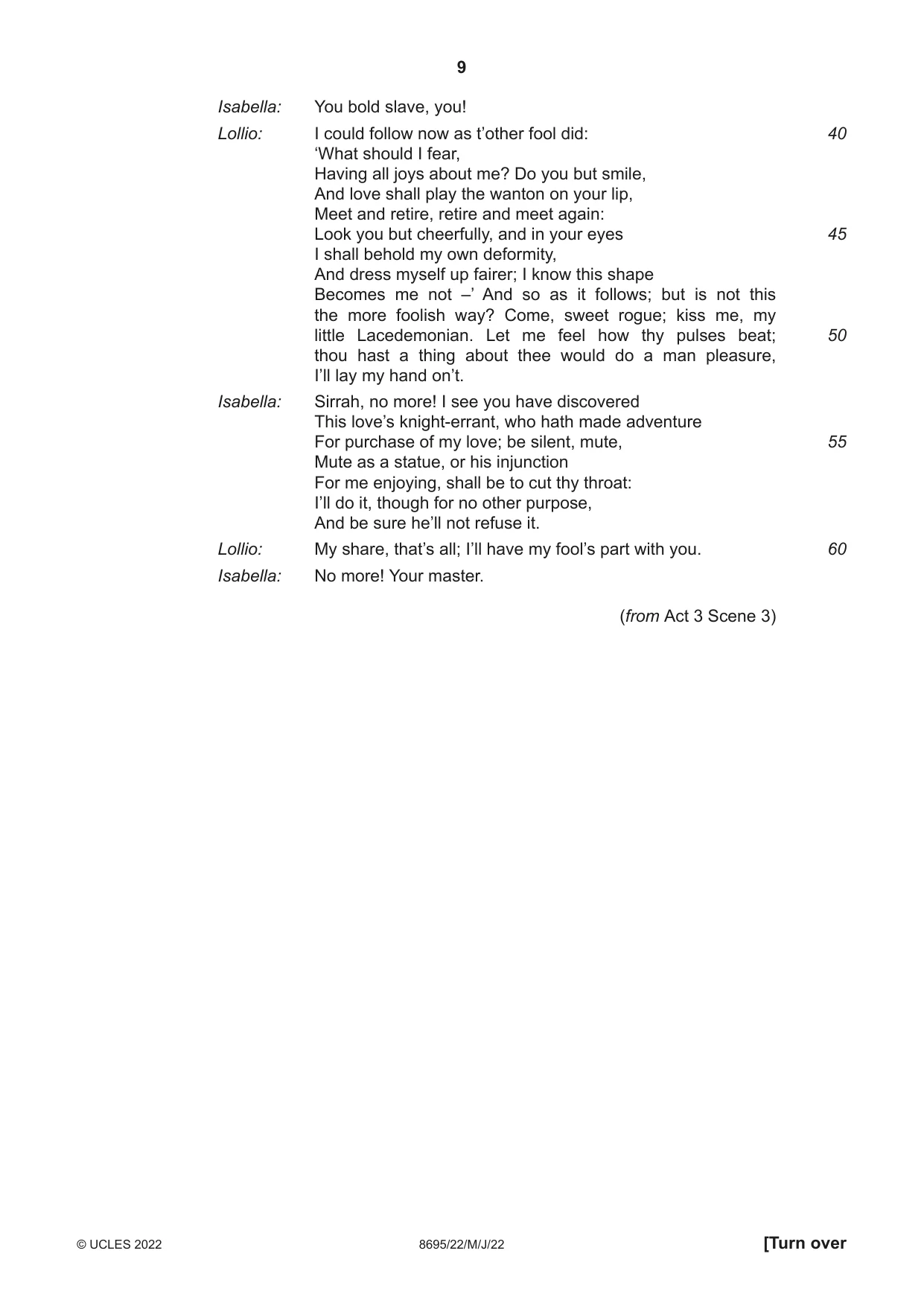
9 8695/22/M/J/22 © UCLES 2022 [Turn over Isabella: You bold slave, you! Lollio: I could follow now as t’other fool did: ‘What should I fear, Having all joys about me? Do you but smile, And love shall play the wanton on your lip, Meet and retire, retire and meet again: Look you but cheerfully, and in your eyes I shall behold my own deformity, And dress myself up fairer; I know this shape Becomes me not –’ And so as it follows; but is not this the more foolish way? Come, sweet rogue; kiss me, my little Lacedemonian. Let me feel how thy pulses beat; thou hast a thing about thee would do a man pleasure, I’ll lay my hand on’t. Isabella: Sirrah, no more! I see you have discovered This love’s knight-errant, who hath made adventure For purchase of my love; be silent, mute, Mute as a statue, or his injunction For me enjoying, shall be to cut thy throat: I’ll do it, though for no other purpose, And be sure he’ll not refuse it. Lollio: My share, that’s all; I’ll have my fool’s part with you. Isabella: No more! Your master. (from Act 3 Scene 3) 40 45 50 55 60
Question paper, page 10
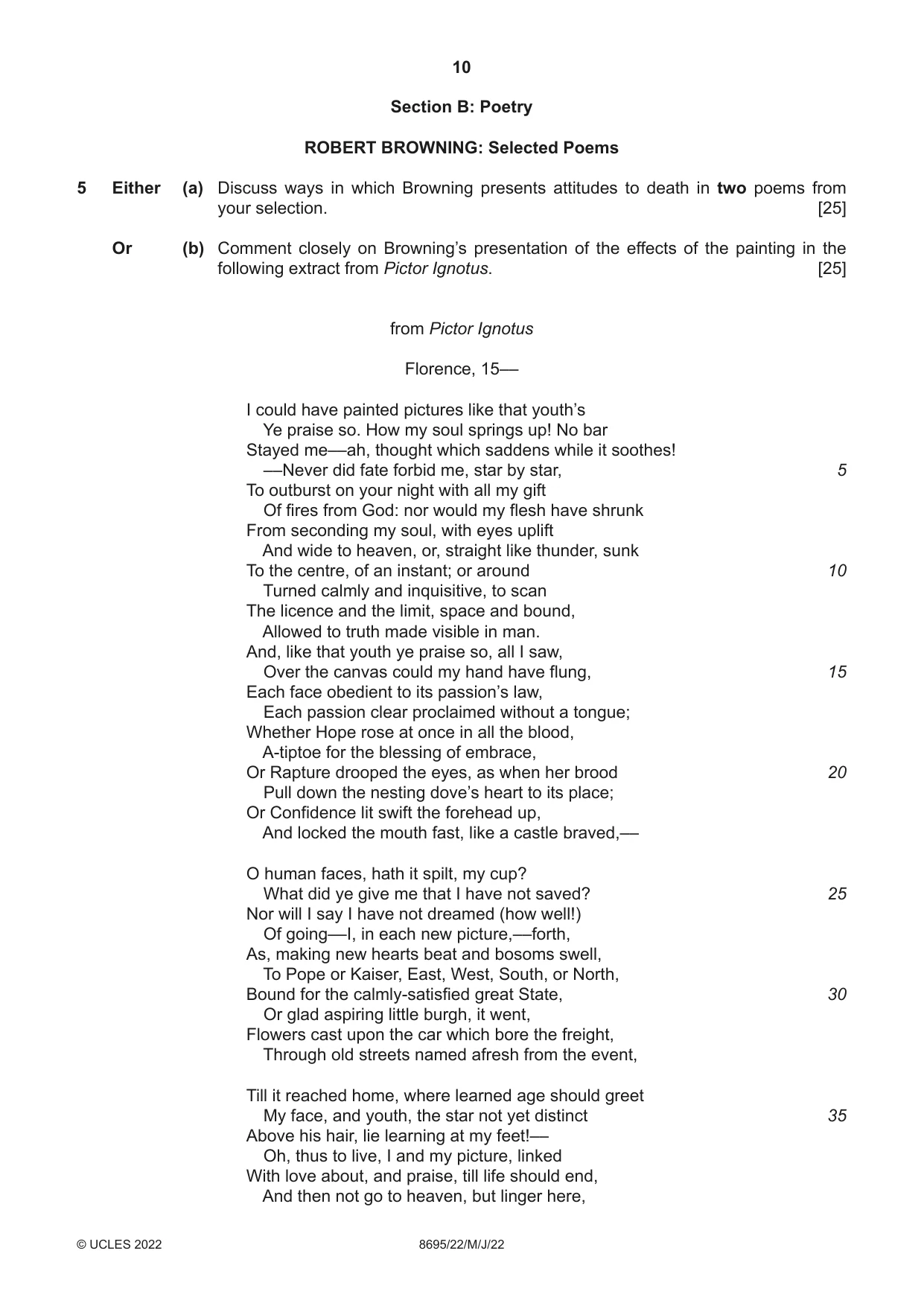
10 8695/22/M/J/22 © UCLES 2022 Section B: Poetry ROBERT BROWNING: Selected Poems 5 Either (a) Discuss ways in which Browning presents attitudes to death in two poems from your selection. [25] Or (b) Comment closely on Browning’s presentation of the effects of the painting in the following extract from Pictor Ignotus. [25] from Pictor Ignotus Florence, 15–– I could have painted pictures like that youth’s Ye praise so. How my soul springs up! No bar Stayed me––ah, thought which saddens while it soothes! ––Never did fate forbid me, star by star, To outburst on your night with all my gift Of fires from God: nor would my flesh have shrunk From seconding my soul, with eyes uplift And wide to heaven, or, straight like thunder, sunk To the centre, of an instant; or around Turned calmly and inquisitive, to scan The licence and the limit, space and bound, Allowed to truth made visible in man. And, like that youth ye praise so, all I saw, Over the canvas could my hand have flung, Each face obedient to its passion’s law, Each passion clear proclaimed without a tongue; Whether Hope rose at once in all the blood, Α-tiptoe for the blessing of embrace, Or Rapture drooped the eyes, as when her brood Pull down the nesting dove’s heart to its place; Or Confidence lit swift the forehead up, And locked the mouth fast, like a castle braved,–– O human faces, hath it spilt, my cup? What did ye give me that I have not saved? Nor will I say I have not dreamed (how well!) Of going––I, in each new picture,––forth, As, making new hearts beat and bosoms swell, To Pope or Kaiser, East, West, South, or North, Bound for the calmly-satisfied great State, Or glad aspiring little burgh, it went, Flowers cast upon the car which bore the freight, Through old streets named afresh from the event, Till it reached home, where learned age should greet My face, and youth, the star not yet distinct Above his hair, lie learning at my feet!–– Οh, thus to live, I and my picture, linked With love about, and praise, till life should end, And then not go to heaven, but linger here, 5 10 15 20 25 30 35
Question paper, page 11
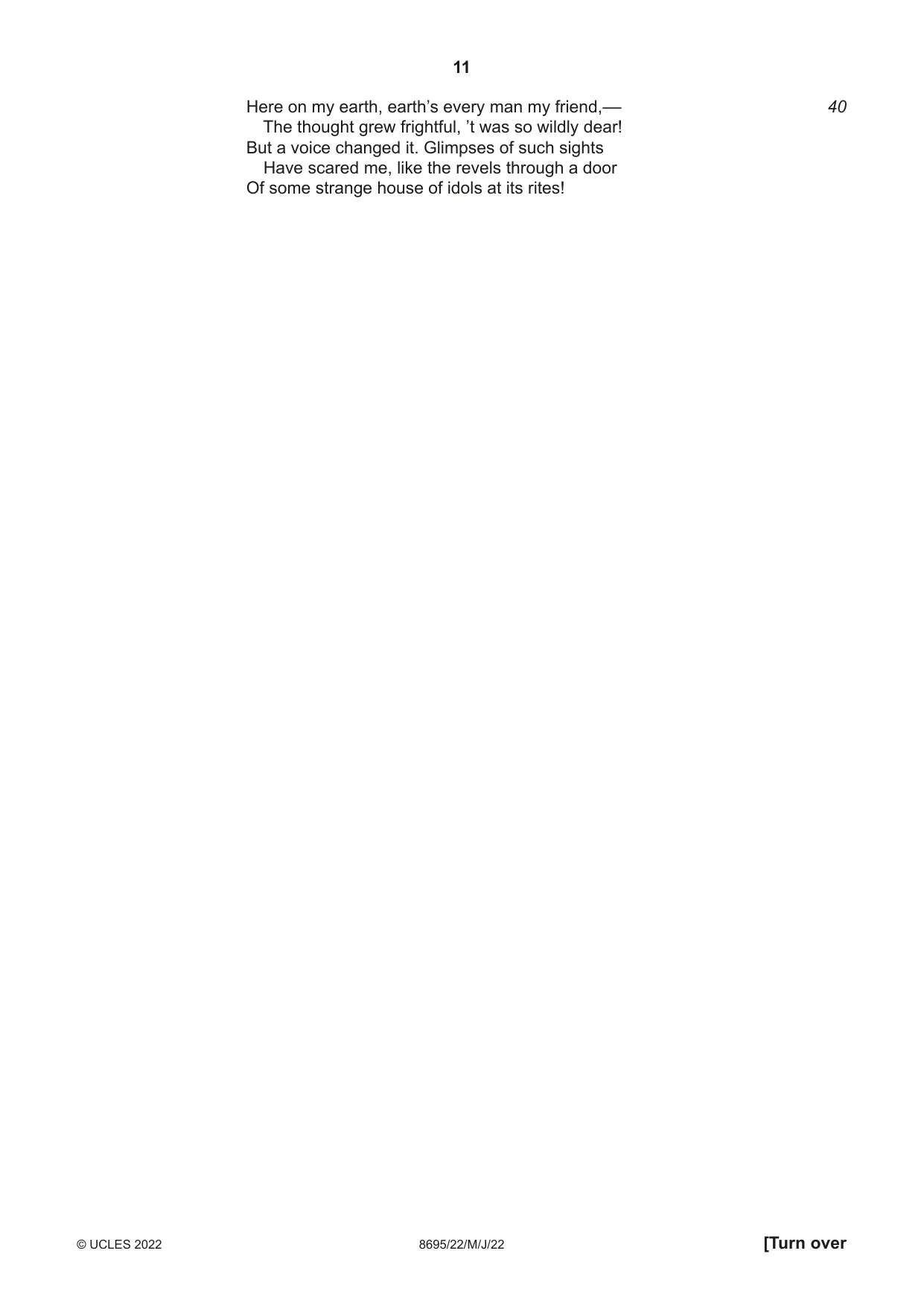
11 8695/22/M/J/22 © UCLES 2022 [Turn over Here on my earth, earth’s every man my friend,–– The thought grew frightful, ’t was so wildly dear! But a voice changed it. Glimpses of such sights Have scared me, like the revels through a door Of some strange house of idols at its rites! 40
Question paper, page 12
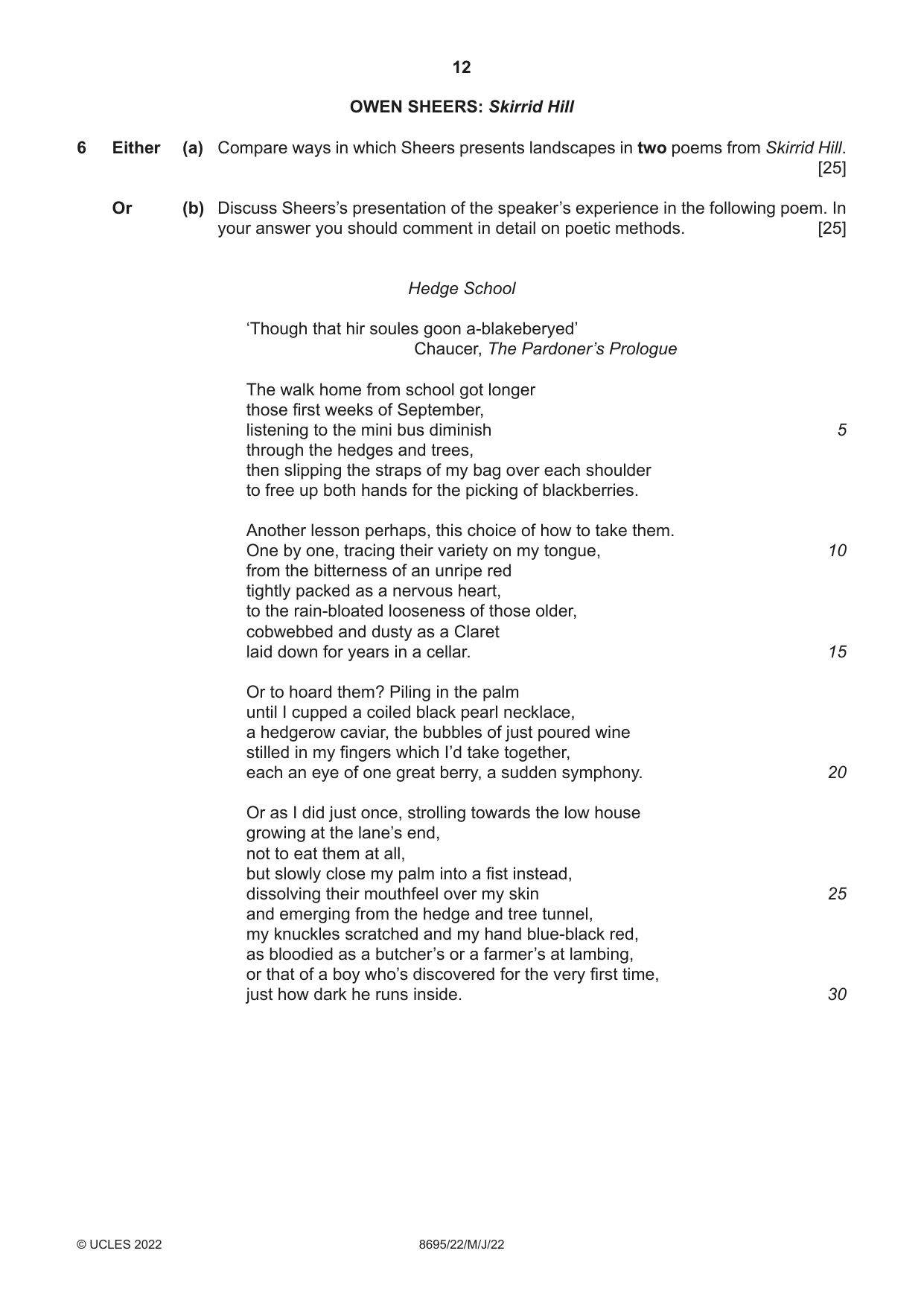
12 8695/22/M/J/22 © UCLES 2022 OWEN SHEERS: Skirrid Hill 6 Either (a) Compare ways in which Sheers presents landscapes in two poems from Skirrid Hill. [25] Or (b) Discuss Sheers’s presentation of the speaker’s experience in the following poem. In your answer you should comment in detail on poetic methods. [25] Hedge School ‘Though that hir soules goon a-blakeberyed’ Chaucer, The Pardoner’s Prologue The walk home from school got longer those first weeks of September, listening to the mini bus diminish through the hedges and trees, then slipping the straps of my bag over each shoulder to free up both hands for the picking of blackberries. Another lesson perhaps, this choice of how to take them. One by one, tracing their variety on my tongue, from the bitterness of an unripe red tightly packed as a nervous heart, to the rain-bloated looseness of those older, cobwebbed and dusty as a Claret laid down for years in a cellar. Or to hoard them? Piling in the palm until I cupped a coiled black pearl necklace, a hedgerow caviar, the bubbles of just poured wine stilled in my fingers which I’d take together, each an eye of one great berry, a sudden symphony. Or as I did just once, strolling towards the low house growing at the lane’s end, not to eat them at all, but slowly close my palm into a fist instead, dissolving their mouthfeel over my skin and emerging from the hedge and tree tunnel, my knuckles scratched and my hand blue-black red, as bloodied as a butcher’s or a farmer’s at lambing, or that of a boy who’s discovered for the very first time, just how dark he runs inside. 5 10 15 20 25 30
Question paper, page 13
13 8695/22/M/J/22 © UCLES 2022 [Turn over Songs of Ourselves, Volume 2 7 Either (a) Compare ways in which two poems present relationships coming to an end. [25] Or (b) Comment closely on ways in which the following poem presents the speaker’s feelings about the wedding. [25] The Wedding I expected a quiet wedding high above a lost city a marriage to balance on my head like a forest of sticks, a pot of water. The ceremony tasted of nothing had little colour – guests arrived stealthy as sandalwood smugglers. When they opened their suitcases England spilled out. They scratched at my veil like beggars on a car window. I insisted my dowry was simple – a smile, a shadow, a whisper, my house an incredible structure of stiffened rags and bamboo. We travelled along roads with English names, my bridegroom and I. Our eyes changed colour like traffic-lights, so they said. The time was not ripe for us to view each other. We stared straight ahead as if we could see through mountains breathe life into new cities. I wanted to marry a country take up a river for a veil sing in the Jinnah Gardens hold up my dream, tricky as a snake-charmer’s snake. Our thoughts half-submerged like buffaloes under dark water we turned and faced each other with turbulence and imprints like maps on our hands. (Moniza Alvi) 5 10 15 20 25 30
Question paper, page 14
14 8695/22/M/J/22 © UCLES 2022 GILLIAN CLARKE: Selected Poems 8 Either (a) In what ways, and with what effects, does Clarke present the relationship between humans and animals in two poems? [25] Or (b) Paying close attention to Clarke’s poetic methods, discuss the presentation of the dead body in the following poem. [25] Lunchtime Lecture And this from the second or third millennium B.C., a female, aged about twenty-two. A white, fine skull, full up with darkness As a shell with sea, drowned in the centuries. Small, perfect. The cranium would fit the palm Of a man’s hand. Some plague or violence Destroyed her, and her whiteness lay safe in a shroud Of silence, undisturbed, unrained on, dark For four thousand years. Till a tractor in summer Biting its way through the longcairn for supplies Of stone, broke open the grave and let a crowd of light Stare in at her, and she stared quietly back. As I look at her I feel none of the shock The farmer felt as, unprepared, he found her. Here in the Museum, like death in hospital, Reasons are given, labels, causes, catalogues. The smell of death is done. Left, only her bone Purity, the light and shade beauty that her man Was denied sight of, the perfect edge of the place Where the pieces join, with no mistakes, like boundaries. She’s a tree in winter, stripped white on a black sky, Leafless formality, brow, bough in fine relief. I, at some other season, illustrate the tree Fleshed, with woman’s hair and colours and the rustling Blood, the troubled mind that she has overthrown. We stare at each other, dark into sightless Dark, seeing only ourselves in the black pools, Gulping the risen sea that booms in the shell. 5 10 15 20 25
Question paper, page 15
15 8695/22/M/J/22 © UCLES 2022 [Turn over TURN OVER FOR SECTION C.
Question paper, page 16
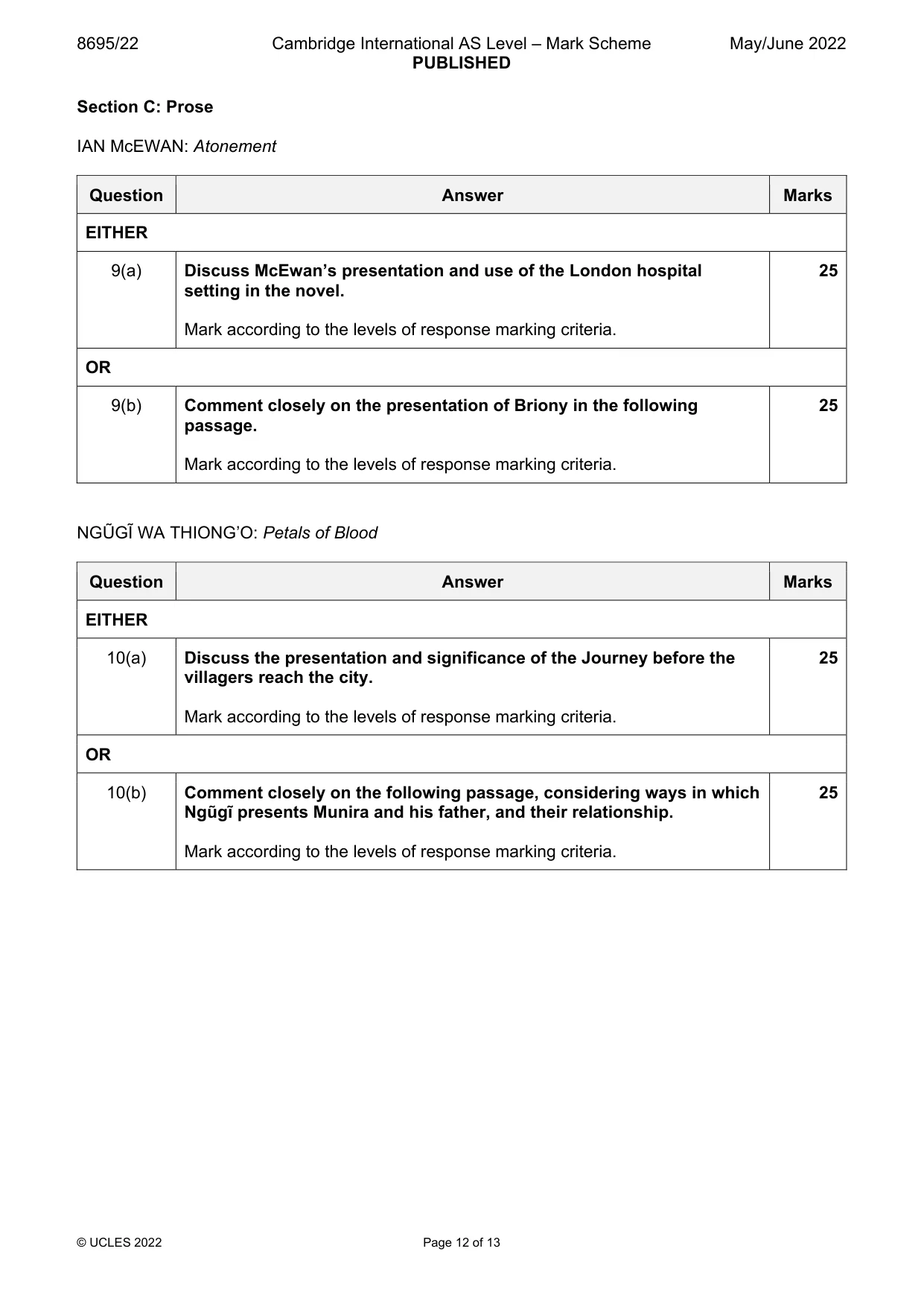
16 8695/22/M/J/22 © UCLES 2022 Section C: Prose IAN McEWAN: Atonement 9 Either (a) Discuss McEwan’s presentation and use of the London hospital setting in the novel. [25] Or (b) Comment closely on the presentation of Briony in the following passage. [25] Mrs Tallis read the seven pages of The Trials of Arabella in her bedroom, at her dressing table, with the author’s arm around her shoulder the whole while. In the box were treasures that dated back four years, to her ninth birthday when she began collecting: a mutant double acorn, fool’s gold, a rain-making spell bought at a funfair, a squirrel’s skull as light as a leaf. (from Part 1 Chapter 1) Content removed due to copyright restrictions.
Question paper, page 17
17 8695/22/M/J/22 © UCLES 2022 [Turn over NGŨGĨ WA THIONG’O: Petals of Blood 10 Either (a) Discuss the presentation and significance of the Journey before the villagers reach the city. [25] Or (b) Comment closely on the following passage, considering ways in which Ngũgĩ presents Munira and his father, and their relationship. [25] He stayed the night at Furaha house in Ruwa-ini. He was given as an example of ‘the recent trials and temptations of Brother Ezekiel’. (from Chapter 2) Content removed due to copyright restrictions.
Question paper, page 18
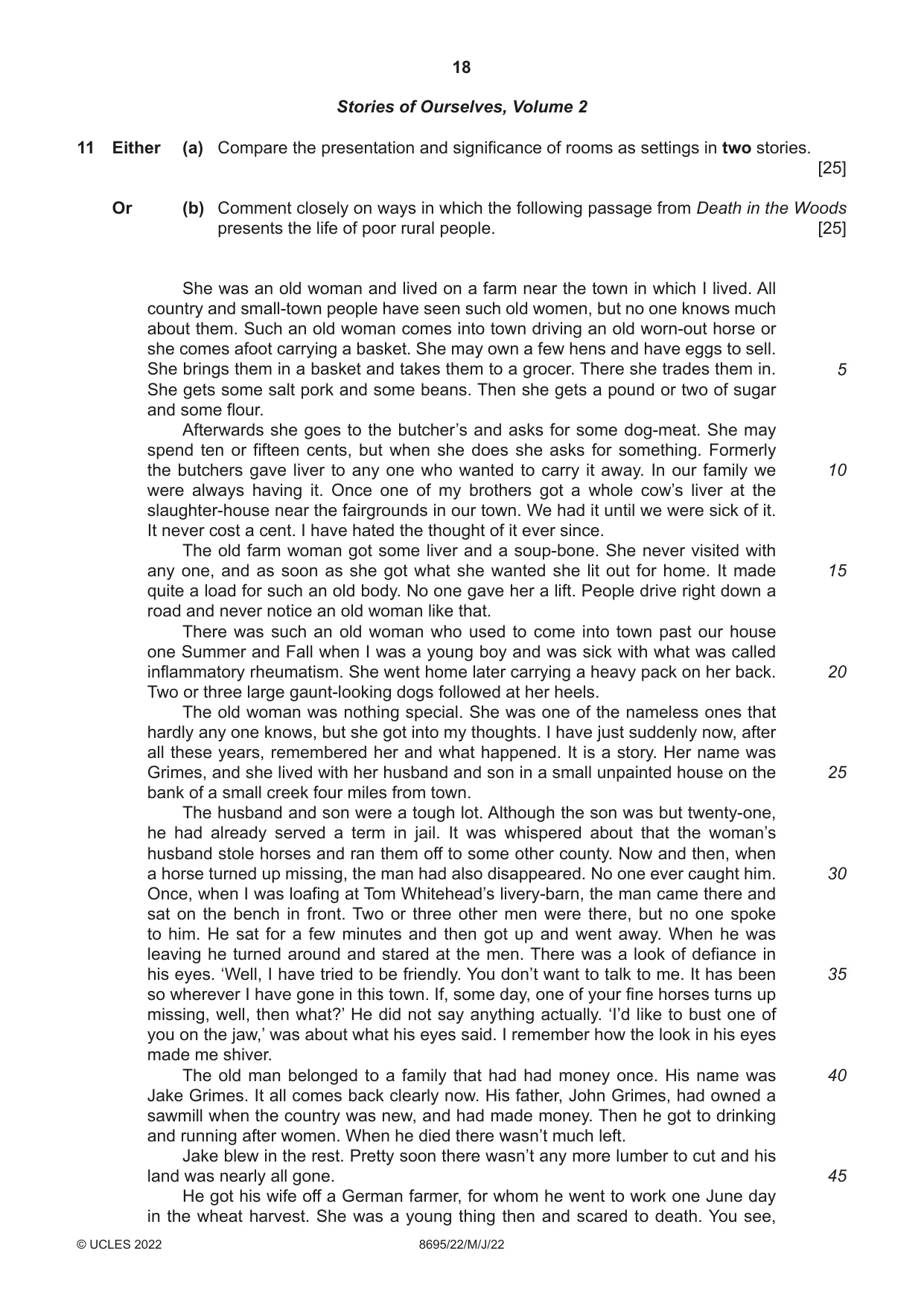
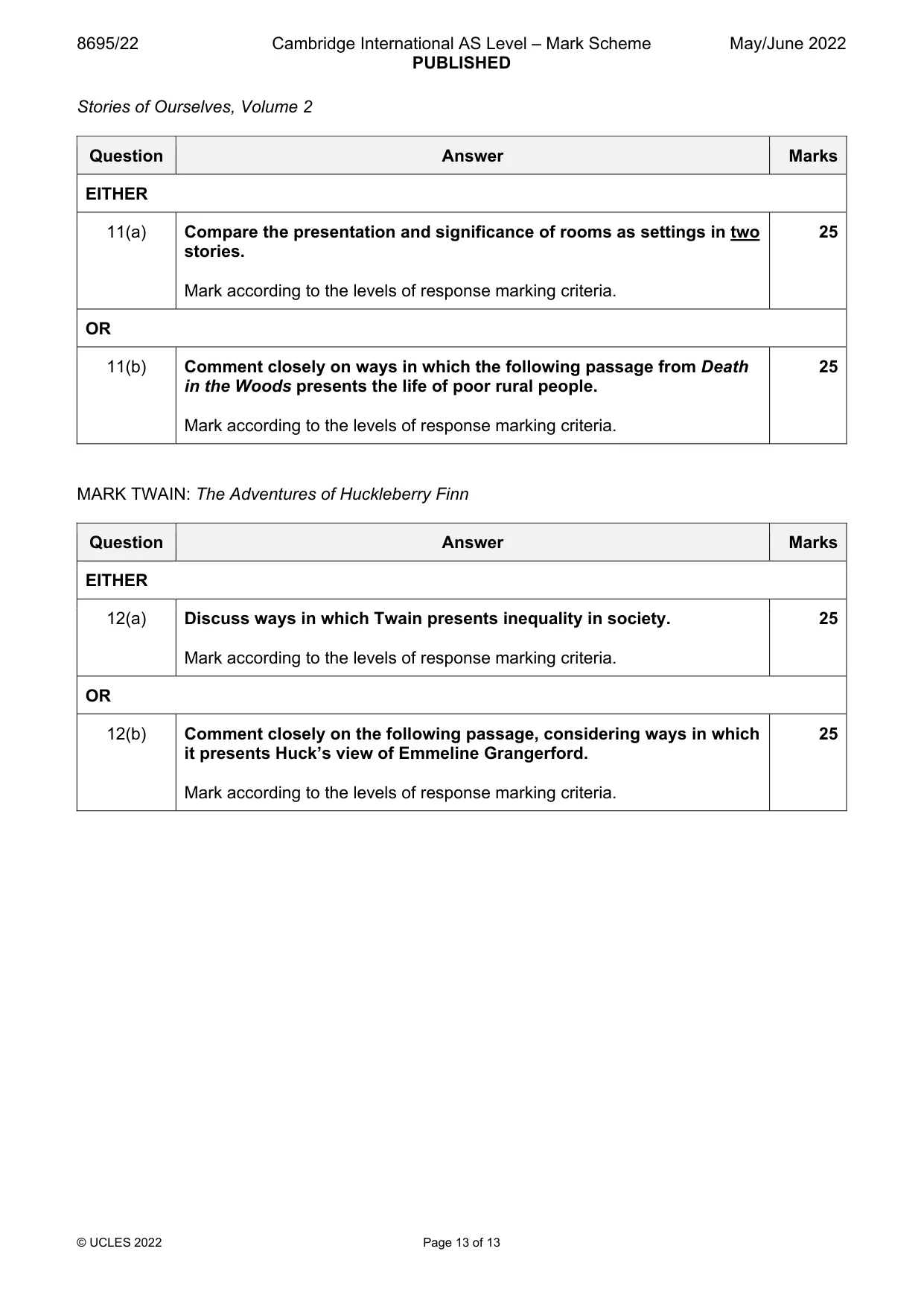
18 8695/22/M/J/22 © UCLES 2022 Stories of Ourselves, Volume 2 11 Either (a) Compare the presentation and significance of rooms as settings in two stories. [25] Or (b) Comment closely on ways in which the following passage from Death in the Woods presents the life of poor rural people. [25] She was an old woman and lived on a farm near the town in which I lived. All country and small-town people have seen such old women, but no one knows much about them. Such an old woman comes into town driving an old worn-out horse or she comes afoot carrying a basket. She may own a few hens and have eggs to sell. She brings them in a basket and takes them to a grocer. There she trades them in. She gets some salt pork and some beans. Then she gets a pound or two of sugar and some flour. Afterwards she goes to the butcher’s and asks for some dog-meat. She may spend ten or fifteen cents, but when she does she asks for something. Formerly the butchers gave liver to any one who wanted to carry it away. In our family we were always having it. Once one of my brothers got a whole cow’s liver at the slaughter-house near the fairgrounds in our town. We had it until we were sick of it. It never cost a cent. I have hated the thought of it ever since. The old farm woman got some liver and a soup-bone. She never visited with any one, and as soon as she got what she wanted she lit out for home. It made quite a load for such an old body. No one gave her a lift. People drive right down a road and never notice an old woman like that. There was such an old woman who used to come into town past our house one Summer and Fall when I was a young boy and was sick with what was called inflammatory rheumatism. She went home later carrying a heavy pack on her back. Two or three large gaunt-looking dogs followed at her heels. The old woman was nothing special. She was one of the nameless ones that hardly any one knows, but she got into my thoughts. I have just suddenly now, after all these years, remembered her and what happened. It is a story. Her name was Grimes, and she lived with her husband and son in a small unpainted house on the bank of a small creek four miles from town. The husband and son were a tough lot. Although the son was but twenty-one, he had already served a term in jail. It was whispered about that the woman’s husband stole horses and ran them off to some other county. Now and then, when a horse turned up missing, the man had also disappeared. No one ever caught him. Once, when I was loafing at Tom Whitehead’s livery-barn, the man came there and sat on the bench in front. Two or three other men were there, but no one spoke to him. He sat for a few minutes and then got up and went away. When he was leaving he turned around and stared at the men. There was a look of defiance in his eyes. ‘Well, I have tried to be friendly. You don’t want to talk to me. It has been so wherever I have gone in this town. If, some day, one of your fine horses turns up missing, well, then what?’ He did not say anything actually. ‘I’d like to bust one of you on the jaw,’ was about what his eyes said. I remember how the look in his eyes made me shiver. The old man belonged to a family that had had money once. His name was Jake Grimes. It all comes back clearly now. His father, John Grimes, had owned a sawmill when the country was new, and had made money. Then he got to drinking and running after women. When he died there wasn’t much left. Jake blew in the rest. Pretty soon there wasn’t any more lumber to cut and his land was nearly all gone. He got his wife off a German farmer, for whom he went to work one June day in the wheat harvest. She was a young thing then and scared to death. You see, 5 10 15 20 25 30 35 40 45
Question paper, page 19
19 8695/22/M/J/22 © UCLES 2022 [Turn over the farmer was up to something with the girl – she was, I think, a bound girl and his wife had her suspicions. She took it out on the girl when the man wasn’t around. Then, when the wife had to go off to town for supplies, the farmer got after her. She told young Jake that nothing really ever happened, but he didn’t know whether to believe it or not. (from Death in the Woods) 50
Question paper, page 20
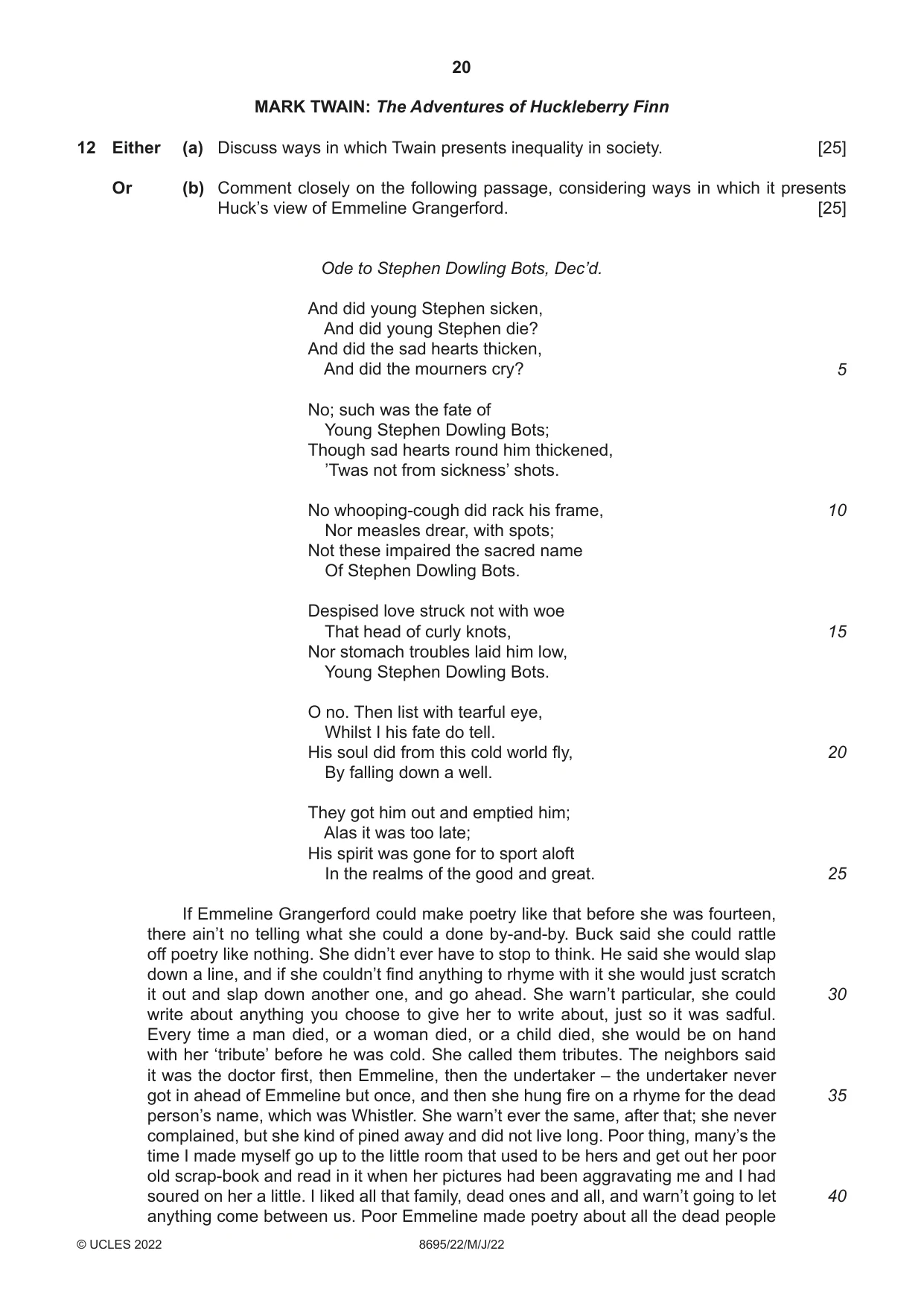
20 8695/22/M/J/22 © UCLES 2022 MARK TWAIN: The Adventures of Huckleberry Finn 12 Either (a) Discuss ways in which Twain presents inequality in society. [25] Or (b) Comment closely on the following passage, considering ways in which it presents Huck’s view of Emmeline Grangerford. [25] Ode to Stephen Dowling Bots, Dec’d. And did young Stephen sicken, And did young Stephen die? And did the sad hearts thicken, And did the mourners cry? No; such was the fate of Young Stephen Dowling Bots; Though sad hearts round him thickened, ’Twas not from sickness’ shots. No whooping-cough did rack his frame, Nor measles drear, with spots; Not these impaired the sacred name Of Stephen Dowling Bots. Despised love struck not with woe That head of curly knots, Nor stomach troubles laid him low, Young Stephen Dowling Bots. O no. Then list with tearful eye, Whilst I his fate do tell. His soul did from this cold world fly, By falling down a well. They got him out and emptied him; Alas it was too late; His spirit was gone for to sport aloft In the realms of the good and great. If Emmeline Grangerford could make poetry like that before she was fourteen, there ain’t no telling what she could a done by-and-by. Buck said she could rattle off poetry like nothing. She didn’t ever have to stop to think. He said she would slap down a line, and if she couldn’t find anything to rhyme with it she would just scratch it out and slap down another one, and go ahead. She warn’t particular, she could write about anything you choose to give her to write about, just so it was sadful. Every time a man died, or a woman died, or a child died, she would be on hand with her ‘tribute’ before he was cold. She called them tributes. The neighbors said it was the doctor first, then Emmeline, then the undertaker – the undertaker never got in ahead of Emmeline but once, and then she hung fire on a rhyme for the dead person’s name, which was Whistler. She warn’t ever the same, after that; she never complained, but she kind of pined away and did not live long. Poor thing, many’s the time I made myself go up to the little room that used to be hers and get out her poor old scrap-book and read in it when her pictures had been aggravating me and I had soured on her a little. I liked all that family, dead ones and all, and warn’t going to let anything come between us. Poor Emmeline made poetry about all the dead people 5 10 15 20 25 30 35 40
Question paper, page 21
21 8695/22/M/J/22 © UCLES 2022 when she was alive, and it didn’t seem right that there warn’t nobody to make some about her, now she was gone; so I tried to sweat out a verse or two myself, but I couldn’t seem to make it go, somehow. They kept Emmeline’s room trim and nice and all the things fixed in it just the way she liked to have them when she was alive, and nobody ever slept there. (from Chapter 17) 45
Question paper, page 22
22 8695/22/M/J/22 © UCLES 2022 BLANK PAGE
Question paper, page 23
23 8695/22/M/J/22 © UCLES 2022 BLANK PAGE
Question paper, page 24
24 8695/22/M/J/22 © UCLES 2022 Permission to reproduce items where third-party owned material protected by copyright is included has been sought and cleared where possible. Every reasonable effort has been made by the publisher (UCLES) to trace copyright holders, but if any items requiring clearance have unwittingly been included, the publisher will be pleased to make amends at the earliest possible opportunity. To avoid the issue of disclosure of answer-related information to candidates, all copyright acknowledgements are reproduced online in the Cambridge Assessment International Education Copyright Acknowledgements Booklet. This is produced for each series of examinations and is freely available to download at www.cambridgeinternational.org after the live examination series. Cambridge Assessment International Education is part of Cambridge Assessment. Cambridge Assessment is the brand name of the University of Cambridge Local Examinations Syndicate (UCLES), which is a department of the University of Cambridge. BLANK PAGE
Mark scheme, page 1
This document consists of 13 printed pages. © UCLES 2022 [Turn over Cambridge International AS Level LANGUAGE AND LITERATURE IN ENGLISH 8695/22 Paper 2 Drama, Poetry and Prose May/June 2022 MARK SCHEME Maximum Mark: 50 Published This mark scheme is published as an aid to teachers and candidates, to indicate the requirements of the examination. It shows the basis on which Examiners were instructed to award marks. It does not indicate the details of the discussions that took place at an Examiners’ meeting before marking began, which would have considered the acceptability of alternative answers. Mark schemes should be read in conjunction with the question paper and the Principal Examiner Report for Teachers. Cambridge International will not enter into discussions about these mark schemes. Cambridge International is publishing the mark schemes for the May/June 2022 series for most Cambridge IGCSE, Cambridge International A and AS Level and Cambridge Pre-U components, and some Cambridge O Level components.
Mark scheme, page 2
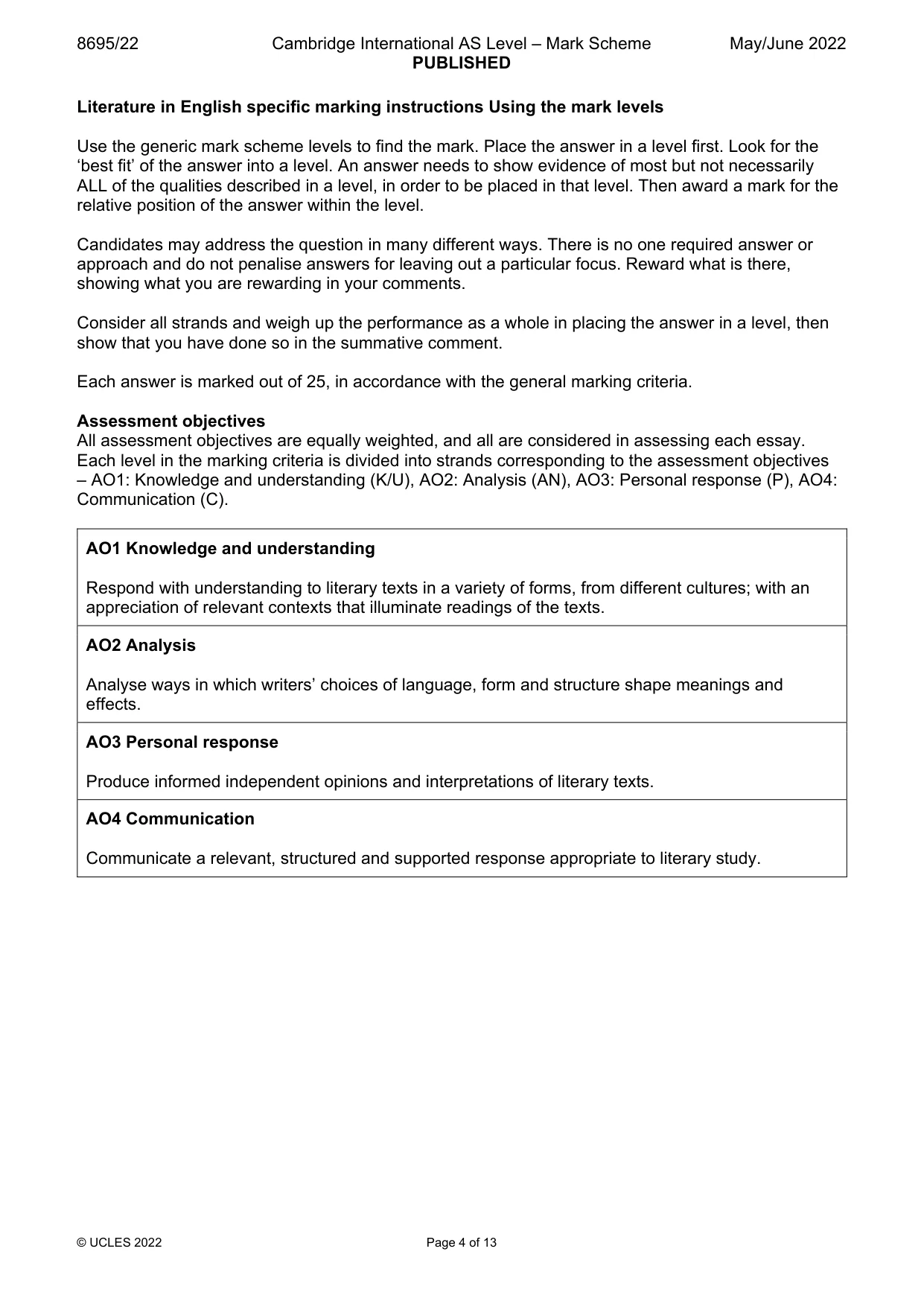
8695/22 Cambridge International AS Level – Mark Scheme PUBLISHED May/June 2022 © UCLES 2022 Page 2 of 13 Generic Marking Principles These general marking principles must be applied by all examiners when marking candidate answers. They should be applied alongside the specific content of the mark scheme or generic level descriptors for a question. Each question paper and mark scheme will also comply with these marking principles. GENERIC MARKING PRINCIPLE 1: Marks must be awarded in line with: the specific content of the mark scheme or the generic level descriptors for the question the specific skills defined in the mark scheme or in the generic level descriptors for the question the standard of response required by a candidate as exemplified by the standardisation scripts. GENERIC MARKING PRINCIPLE 2: Marks awarded are always whole marks (not half marks, or other fractions). GENERIC MARKING PRINCIPLE 3: Marks must be awarded positively: marks are awarded for correct/valid answers, as defined in the mark scheme. However, credit is given for valid answers which go beyond the scope of the syllabus and mark scheme, referring to your Team Leader as appropriate marks are awarded when candidates clearly demonstrate what they know and can do marks are not deducted for errors marks are not deducted for omissions answers should only be judged on the quality of spelling, punctuation and grammar when these features are specifically assessed by the question as indicated by the mark scheme. The meaning, however, should be unambiguous. GENERIC MARKING PRINCIPLE 4: Rules must be applied consistently, e.g. in situations where candidates have not followed instructions or in the application of generic level descriptors. GENERIC MARKING PRINCIPLE 5: Marks should be awarded using the full range of marks defined in the mark scheme for the question (however; the use of the full mark range may be limited according to the quality of the candidate responses seen). GENERIC MARKING PRINCIPLE 6: Marks awarded are based solely on the requirements as defined in the mark scheme. Marks should not be awarded with grade thresholds or grade descriptors in mind.
Mark scheme, page 3
8695/22 Cambridge International AS Level – Mark Scheme PUBLISHED May/June 2022 © UCLES 2022 Page 3 of 13 English & Media subject specific general marking principles (To be read in conjunction with the Generic Marking Principles (and requiring further guidance on how to place marks within levels)) Components using level descriptors: We use level descriptors as a guide to broad understanding of the qualities normally expected of, or typical of, work in a level. Level descriptors are a means of general guidance, and should not be interpreted as hurdle statements. Where indicative content notes are supplied for a question, these are not a prescription of required content, and must not be treated as such. Alternative correct points and unexpected answers in candidates’ scripts must be given marks that fairly reflect the knowledge and skills demonstrated. While we may have legitimate expectations as to the ground most answers may occupy, we must at all times be prepared to meet candidates on their chosen ground, provided it is relevant ground (e.g. clearly related to and derived from a relevant passage/text and meeting the mark scheme requirements for the question). Components using point-based marking: Point marking is often used to reward knowledge, understanding and application of skills. We give credit where the candidate’s answer shows relevant knowledge, understanding and application of skills in answering the question. We do not give credit where the answer shows confusion. From this it follows that we: a DO credit answers which are worded differently from the mark scheme if they clearly convey the same meaning (unless the mark scheme requires a specific term). b DO credit alternative answers/examples which are not written in the mark scheme if they are correct. c DO credit answers where candidates give more than one correct answer in one prompt/numbered/scaffolded space where extended writing is required rather than list-type answers. For example, questions that require n reasons (e.g. State two reasons…). d DO NOT credit answers simply for using a ‘key term’ unless that is all that is required. (Check for evidence it is understood and not used wrongly.). e DO NOT credit answers which are obviously self-contradicting or trying to cover all possibilities. f DO NOT give further credit for what is effectively repetition of a correct point already credited unless the language itself is being tested. This applies equally to ‘mirror statements’ (i.e. polluted/not polluted). g DO NOT require spellings to be correct, unless this is part of the test. However spellings of syllabus terms must allow for clear and unambiguous separation from other syllabus terms with which they may be confused (e.g. Corrasion/Corrosion).
Mark scheme, page 4
8695/22 Cambridge International AS Level – Mark Scheme PUBLISHED May/June 2022 © UCLES 2022 Page 4 of 13 Literature in English specific marking instructions Using the mark levels Use the generic mark scheme levels to find the mark. Place the answer in a level first. Look for the ‘best fit’ of the answer into a level. An answer needs to show evidence of most but not necessarily ALL of the qualities described in a level, in order to be placed in that level. Then award a mark for the relative position of the answer within the level. Candidates may address the question in many different ways. There is no one required answer or approach and do not penalise answers for leaving out a particular focus. Reward what is there, showing what you are rewarding in your comments. Consider all strands and weigh up the performance as a whole in placing the answer in a level, then show that you have done so in the summative comment. Each answer is marked out of 25, in accordance with the general marking criteria. Assessment objectives All assessment objectives are equally weighted, and all are considered in assessing each essay. Each level in the marking criteria is divided into strands corresponding to the assessment objectives – AO1: Knowledge and understanding (K/U), AO2: Analysis (AN), AO3: Personal response (P), AO4: Communication (C). AO1 Knowledge and understanding Respond with understanding to literary texts in a variety of forms, from different cultures; with an appreciation of relevant contexts that illuminate readings of the texts. AO2 Analysis Analyse ways in which writers’ choices of language, form and structure shape meanings and effects. AO3 Personal response Produce informed independent opinions and interpretations of literary texts. AO4 Communication Communicate a relevant, structured and supported response appropriate to literary study.
Mark scheme, page 5
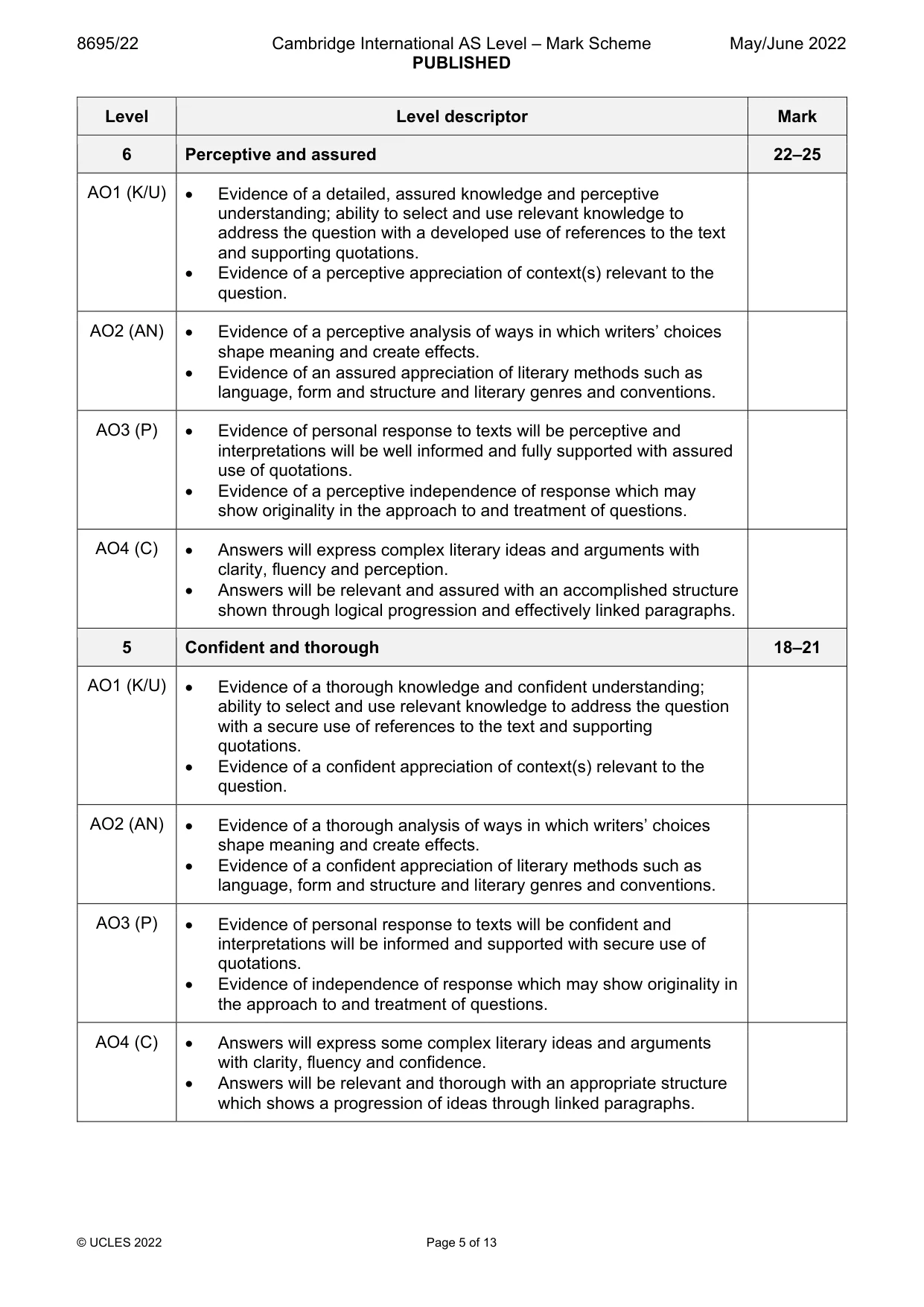
8695/22 Cambridge International AS Level – Mark Scheme PUBLISHED May/June 2022 © UCLES 2022 Page 5 of 13 Level Level descriptor Mark 6 Perceptive and assured 22–25 AO1 (K/U) Evidence of a detailed, assured knowledge and perceptive understanding; ability to select and use relevant knowledge to address the question with a developed use of references to the text and supporting quotations. Evidence of a perceptive appreciation of context(s) relevant to the question. AO2 (AN) Evidence of a perceptive analysis of ways in which writers’ choices shape meaning and create effects. Evidence of an assured appreciation of literary methods such as language, form and structure and literary genres and conventions. AO3 (P) Evidence of personal response to texts will be perceptive and interpretations will be well informed and fully supported with assured use of quotations. Evidence of a perceptive independence of response which may show originality in the approach to and treatment of questions. AO4 (C) Answers will express complex literary ideas and arguments with clarity, fluency and perception. Answers will be relevant and assured with an accomplished structure shown through logical progression and effectively linked paragraphs. 5 Confident and thorough 18–21 AO1 (K/U) Evidence of a thorough knowledge and confident understanding; ability to select and use relevant knowledge to address the question with a secure use of references to the text and supporting quotations. Evidence of a confident appreciation of context(s) relevant to the question. AO2 (AN) Evidence of a thorough analysis of ways in which writers’ choices shape meaning and create effects. Evidence of a confident appreciation of literary methods such as language, form and structure and literary genres and conventions. AO3 (P) Evidence of personal response to texts will be confident and interpretations will be informed and supported with secure use of quotations. Evidence of independence of response which may show originality in the approach to and treatment of questions. AO4 (C) Answers will express some complex literary ideas and arguments with clarity, fluency and confidence. Answers will be relevant and thorough with an appropriate structure which shows a progression of ideas through linked paragraphs.
Mark scheme, page 6
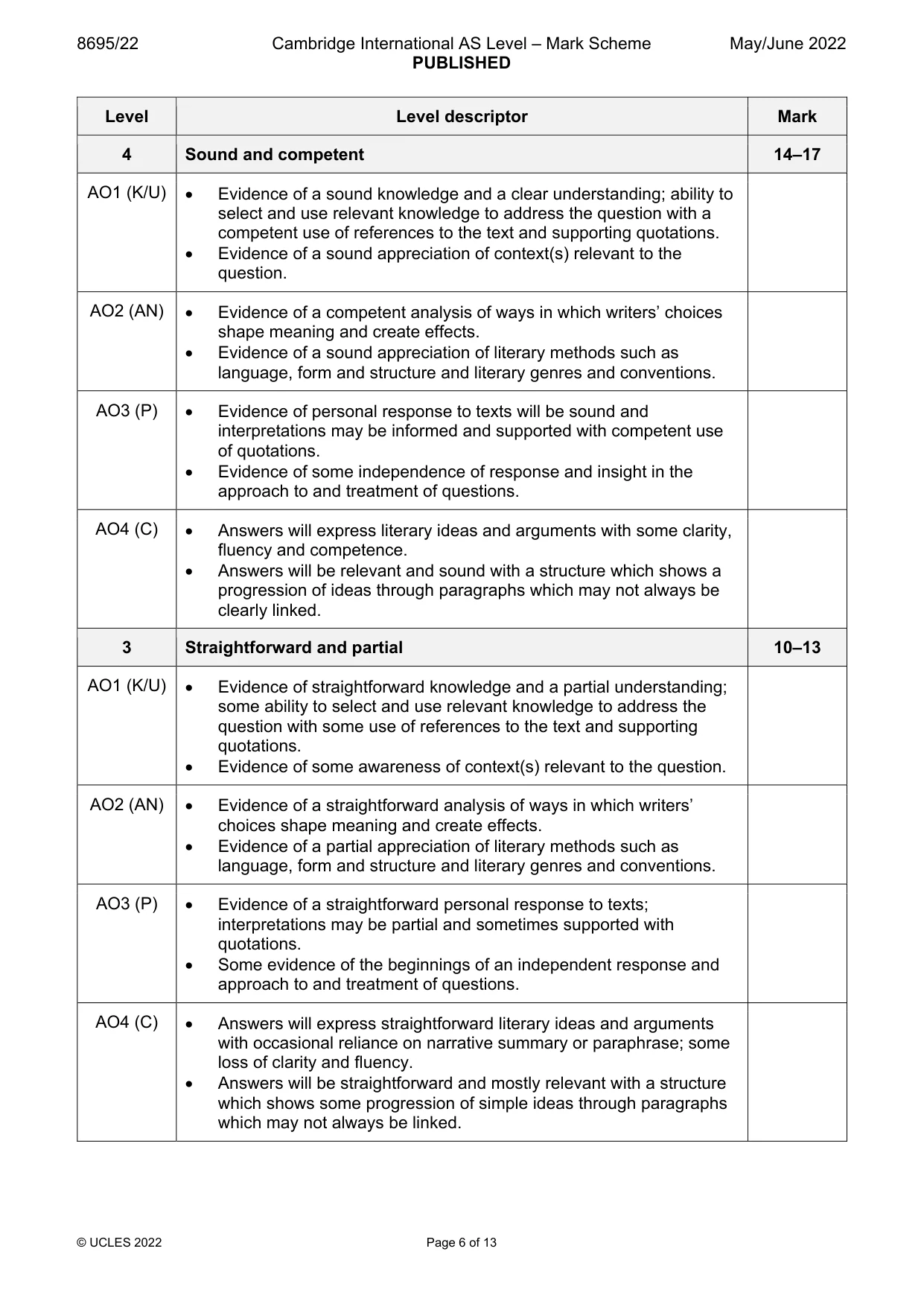
8695/22 Cambridge International AS Level – Mark Scheme PUBLISHED May/June 2022 © UCLES 2022 Page 6 of 13 Level Level descriptor Mark 4 Sound and competent 14–17 AO1 (K/U) Evidence of a sound knowledge and a clear understanding; ability to select and use relevant knowledge to address the question with a competent use of references to the text and supporting quotations. Evidence of a sound appreciation of context(s) relevant to the question. AO2 (AN) Evidence of a competent analysis of ways in which writers’ choices shape meaning and create effects. Evidence of a sound appreciation of literary methods such as language, form and structure and literary genres and conventions. AO3 (P) Evidence of personal response to texts will be sound and interpretations may be informed and supported with competent use of quotations. Evidence of some independence of response and insight in the approach to and treatment of questions. AO4 (C) Answers will express literary ideas and arguments with some clarity, fluency and competence. Answers will be relevant and sound with a structure which shows a progression of ideas through paragraphs which may not always be clearly linked. 3 Straightforward and partial 10–13 AO1 (K/U) Evidence of straightforward knowledge and a partial understanding; some ability to select and use relevant knowledge to address the question with some use of references to the text and supporting quotations. Evidence of some awareness of context(s) relevant to the question. AO2 (AN) Evidence of a straightforward analysis of ways in which writers’ choices shape meaning and create effects. Evidence of a partial appreciation of literary methods such as language, form and structure and literary genres and conventions. AO3 (P) Evidence of a straightforward personal response to texts; interpretations may be partial and sometimes supported with quotations. Some evidence of the beginnings of an independent response and approach to and treatment of questions. AO4 (C) Answers will express straightforward literary ideas and arguments with occasional reliance on narrative summary or paraphrase; some loss of clarity and fluency. Answers will be straightforward and mostly relevant with a structure which shows some progression of simple ideas through paragraphs which may not always be linked.
Mark scheme, page 7
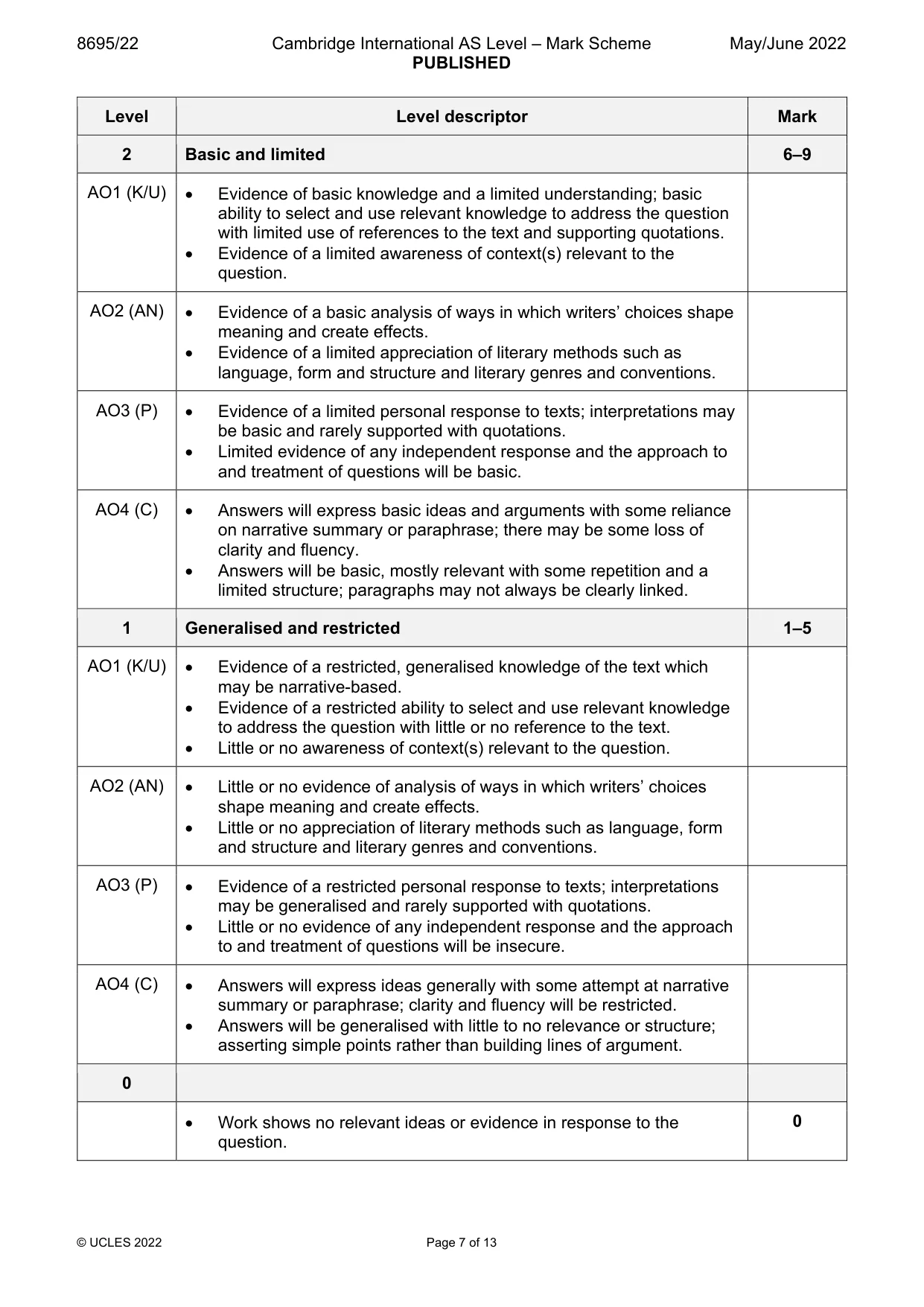
8695/22 Cambridge International AS Level – Mark Scheme PUBLISHED May/June 2022 © UCLES 2022 Page 7 of 13 Level Level descriptor Mark 2 Basic and limited 6–9 AO1 (K/U) Evidence of basic knowledge and a limited understanding; basic ability to select and use relevant knowledge to address the question with limited use of references to the text and supporting quotations. Evidence of a limited awareness of context(s) relevant to the question. AO2 (AN) Evidence of a basic analysis of ways in which writers’ choices shape meaning and create effects. Evidence of a limited appreciation of literary methods such as language, form and structure and literary genres and conventions. AO3 (P) Evidence of a limited personal response to texts; interpretations may be basic and rarely supported with quotations. Limited evidence of any independent response and the approach to and treatment of questions will be basic. AO4 (C) Answers will express basic ideas and arguments with some reliance on narrative summary or paraphrase; there may be some loss of clarity and fluency. Answers will be basic, mostly relevant with some repetition and a limited structure; paragraphs may not always be clearly linked. 1 Generalised and restricted 1–5 AO1 (K/U) Evidence of a restricted, generalised knowledge of the text which may be narrative-based. Evidence of a restricted ability to select and use relevant knowledge to address the question with little or no reference to the text. Little or no awareness of context(s) relevant to the question. AO2 (AN) Little or no evidence of analysis of ways in which writers’ choices shape meaning and create effects. Little or no appreciation of literary methods such as language, form and structure and literary genres and conventions. AO3 (P) Evidence of a restricted personal response to texts; interpretations may be generalised and rarely supported with quotations. Little or no evidence of any independent response and the approach to and treatment of questions will be insecure. AO4 (C) Answers will express ideas generally with some attempt at narrative summary or paraphrase; clarity and fluency will be restricted. Answers will be generalised with little to no relevance or structure; asserting simple points rather than building lines of argument. 0 Work shows no relevant ideas or evidence in response to the question. 0
Mark scheme, page 8
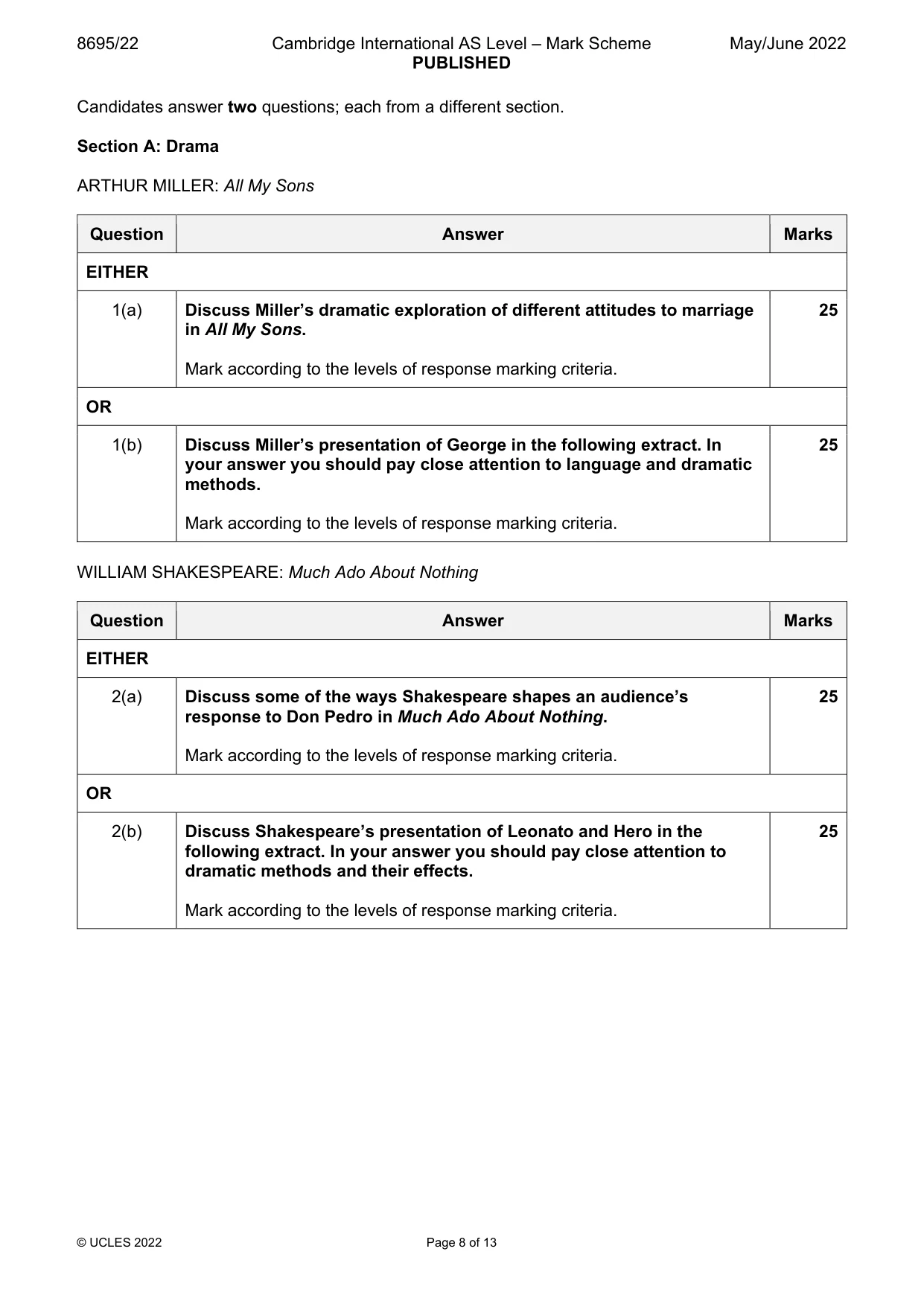
8695/22 Cambridge International AS Level – Mark Scheme PUBLISHED May/June 2022 © UCLES 2022 Page 8 of 13 Candidates answer two questions; each from a different section. Section A: Drama ARTHUR MILLER: All My Sons Question Answer Marks EITHER 1(a) Discuss Miller’s dramatic exploration of different attitudes to marriage in All My Sons. Mark according to the levels of response marking criteria. 25 OR 1(b) Discuss Miller’s presentation of George in the following extract. In your answer you should pay close attention to language and dramatic methods. Mark according to the levels of response marking criteria. 25 WILLIAM SHAKESPEARE: Much Ado About Nothing Question Answer Marks EITHER 2(a) Discuss some of the ways Shakespeare shapes an audience’s response to Don Pedro in Much Ado About Nothing. Mark according to the levels of response marking criteria. 25 OR 2(b) Discuss Shakespeare’s presentation of Leonato and Hero in the following extract. In your answer you should pay close attention to dramatic methods and their effects. Mark according to the levels of response marking criteria. 25
Mark scheme, page 9
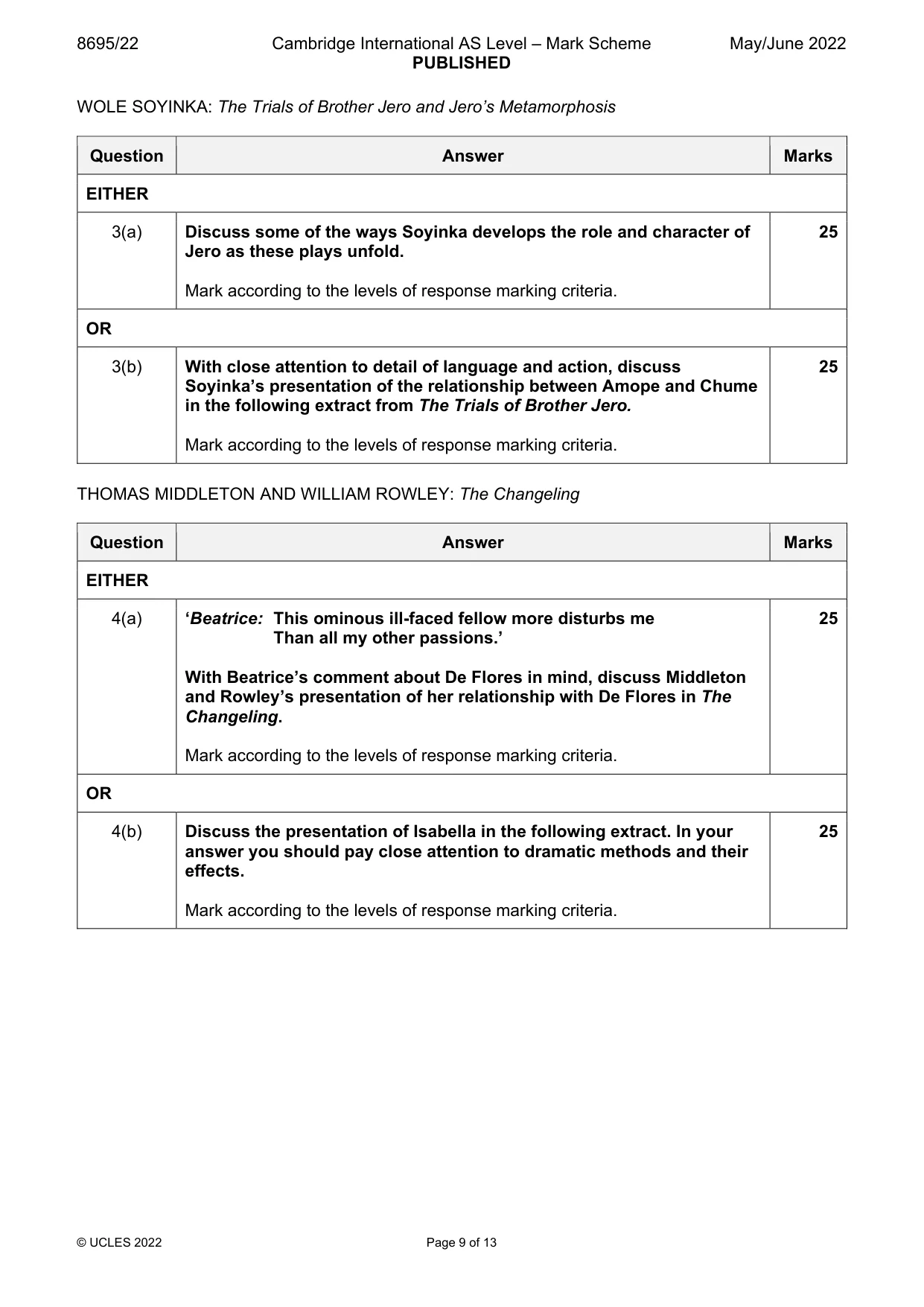
8695/22 Cambridge International AS Level – Mark Scheme PUBLISHED May/June 2022 © UCLES 2022 Page 9 of 13 WOLE SOYINKA: The Trials of Brother Jero and Jero’s Metamorphosis Question Answer Marks EITHER 3(a) Discuss some of the ways Soyinka develops the role and character of Jero as these plays unfold. Mark according to the levels of response marking criteria. 25 OR 3(b) With close attention to detail of language and action, discuss Soyinka’s presentation of the relationship between Amope and Chume in the following extract from The Trials of Brother Jero. Mark according to the levels of response marking criteria. 25 THOMAS MIDDLETON AND WILLIAM ROWLEY: The Changeling Question Answer Marks EITHER 4(a) ‘Beatrice: This ominous ill-faced fellow more disturbs me Than all my other passions.’ With Beatrice’s comment about De Flores in mind, discuss Middleton and Rowley’s presentation of her relationship with De Flores in The Changeling. Mark according to the levels of response marking criteria. 25 OR 4(b) Discuss the presentation of Isabella in the following extract. In your answer you should pay close attention to dramatic methods and their effects. Mark according to the levels of response marking criteria. 25
Mark scheme, page 10
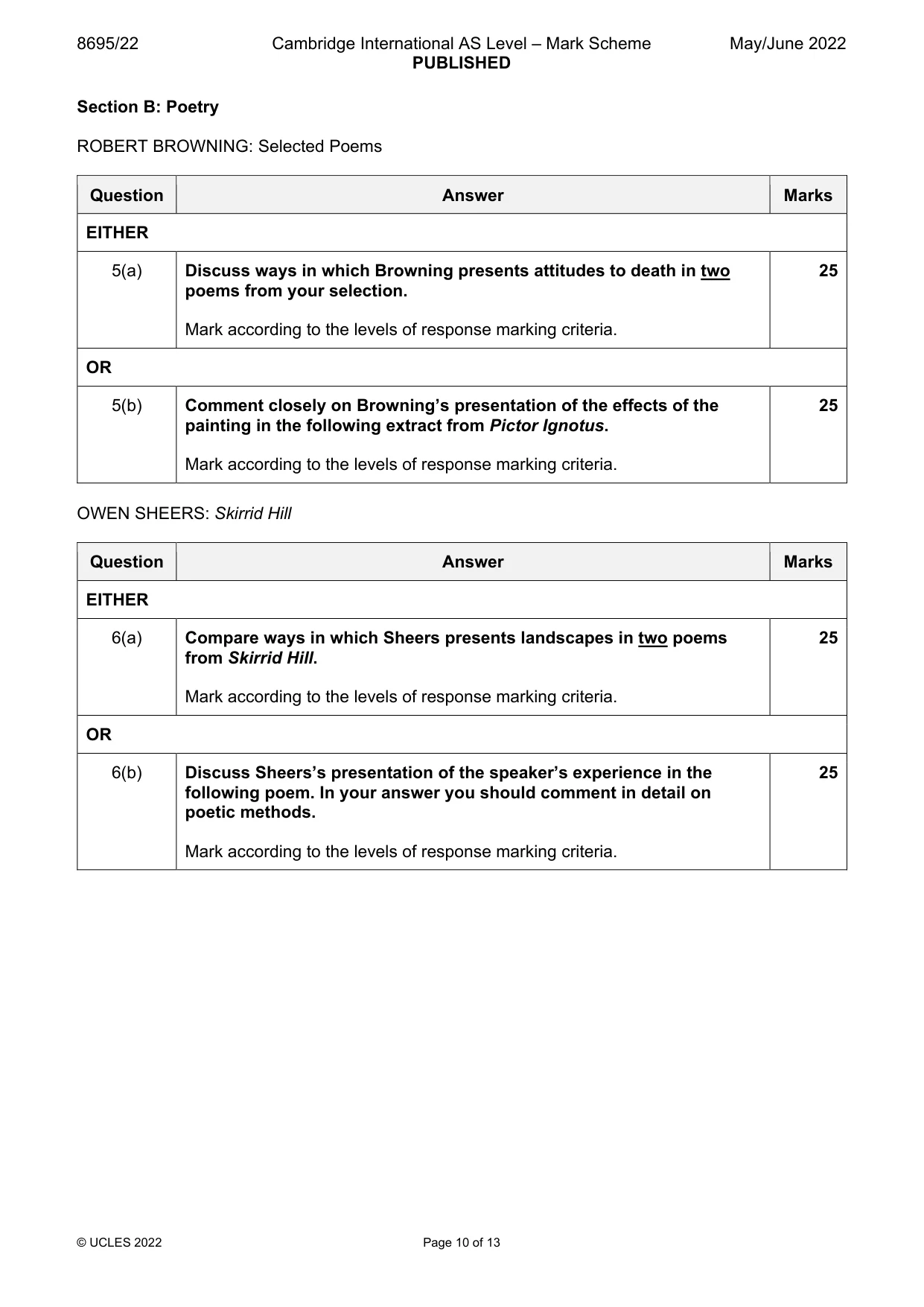
8695/22 Cambridge International AS Level – Mark Scheme PUBLISHED May/June 2022 © UCLES 2022 Page 10 of 13 Section B: Poetry ROBERT BROWNING: Selected Poems Question Answer Marks EITHER 5(a) Discuss ways in which Browning presents attitudes to death in two poems from your selection. Mark according to the levels of response marking criteria. 25 OR 5(b) Comment closely on Browning’s presentation of the effects of the painting in the following extract from Pictor Ignotus. Mark according to the levels of response marking criteria. 25 OWEN SHEERS: Skirrid Hill Question Answer Marks EITHER 6(a) Compare ways in which Sheers presents landscapes in two poems from Skirrid Hill. Mark according to the levels of response marking criteria. 25 OR 6(b) Discuss Sheers’s presentation of the speaker’s experience in the following poem. In your answer you should comment in detail on poetic methods. Mark according to the levels of response marking criteria. 25
Mark scheme, page 11
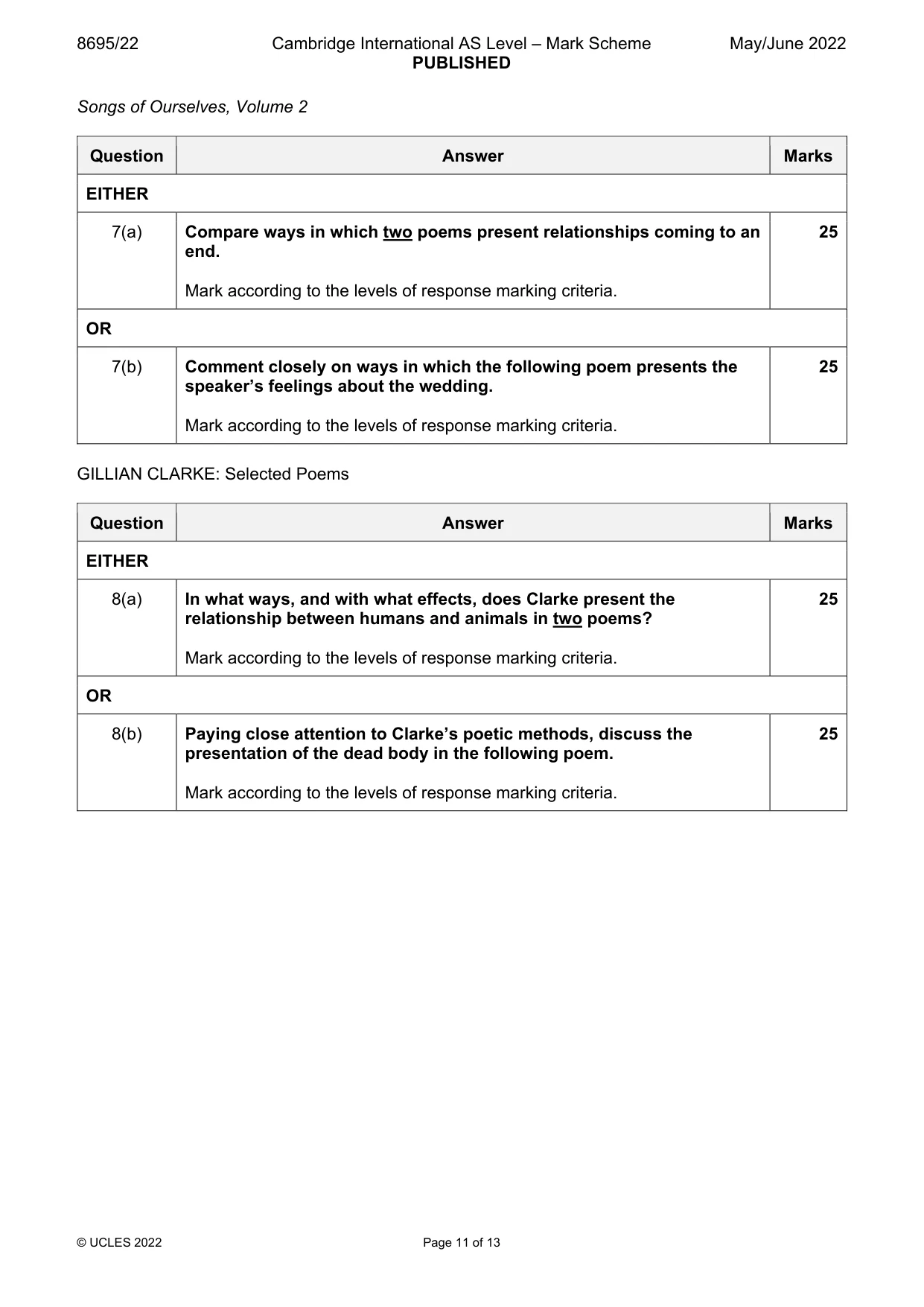
8695/22 Cambridge International AS Level – Mark Scheme PUBLISHED May/June 2022 © UCLES 2022 Page 11 of 13 Songs of Ourselves, Volume 2 Question Answer Marks EITHER 7(a) Compare ways in which two poems present relationships coming to an end. Mark according to the levels of response marking criteria. 25 OR 7(b) Comment closely on ways in which the following poem presents the speaker’s feelings about the wedding. Mark according to the levels of response marking criteria. 25 GILLIAN CLARKE: Selected Poems Question Answer Marks EITHER 8(a) In what ways, and with what effects, does Clarke present the relationship between humans and animals in two poems? Mark according to the levels of response marking criteria. 25 OR 8(b) Paying close attention to Clarke’s poetic methods, discuss the presentation of the dead body in the following poem. Mark according to the levels of response marking criteria. 25
Mark scheme, page 12
8695/22 Cambridge International AS Level – Mark Scheme PUBLISHED May/June 2022 © UCLES 2022 Page 12 of 13 Section C: Prose IAN McEWAN: Atonement Question Answer Marks EITHER 9(a) Discuss McEwan’s presentation and use of the London hospital setting in the novel. Mark according to the levels of response marking criteria. 25 OR 9(b) Comment closely on the presentation of Briony in the following passage. Mark according to the levels of response marking criteria. 25 NGŨGĨ WA THIONG’O: Petals of Blood Question Answer Marks EITHER 10(a) Discuss the presentation and significance of the Journey before the villagers reach the city. Mark according to the levels of response marking criteria. 25 OR 10(b) Comment closely on the following passage, considering ways in which Ngũgĩ presents Munira and his father, and their relationship. Mark according to the levels of response marking criteria. 25
Mark scheme, page 13
8695/22 Cambridge International AS Level – Mark Scheme PUBLISHED May/June 2022 © UCLES 2022 Page 13 of 13 Stories of Ourselves, Volume 2 Question Answer Marks EITHER 11(a) Compare the presentation and significance of rooms as settings in two stories. Mark according to the levels of response marking criteria. 25 OR 11(b) Comment closely on ways in which the following passage from Death in the Woods presents the life of poor rural people. Mark according to the levels of response marking criteria. 25 MARK TWAIN: The Adventures of Huckleberry Finn Question Answer Marks EITHER 12(a) Discuss ways in which Twain presents inequality in society. Mark according to the levels of response marking criteria. 25 OR 12(b) Comment closely on the following passage, considering ways in which it presents Huck’s view of Emmeline Grangerford. Mark according to the levels of response marking criteria. 25
What you needed in this session
Cambridge’s own grade thresholds for 2022 May/June, Paper 2 · Variant 2. A higher threshold means an easier paper — the bar moves with how the cohort did.