Cambridge A Level English - Language and Literature (AS Level only, from 2016) 8695 — 2023 May/June Paper 2 · Variant 2
8695/22/M/J/23 · 50 marks · ≈56 min
The question paper and its mark scheme, free to read here and free to download. This is Cambridge’s own paper, exactly as it was sat.
Question paper24 pages


Mark scheme13 pages
Answers below. Sit the paper first if you are practising.
Paper as text
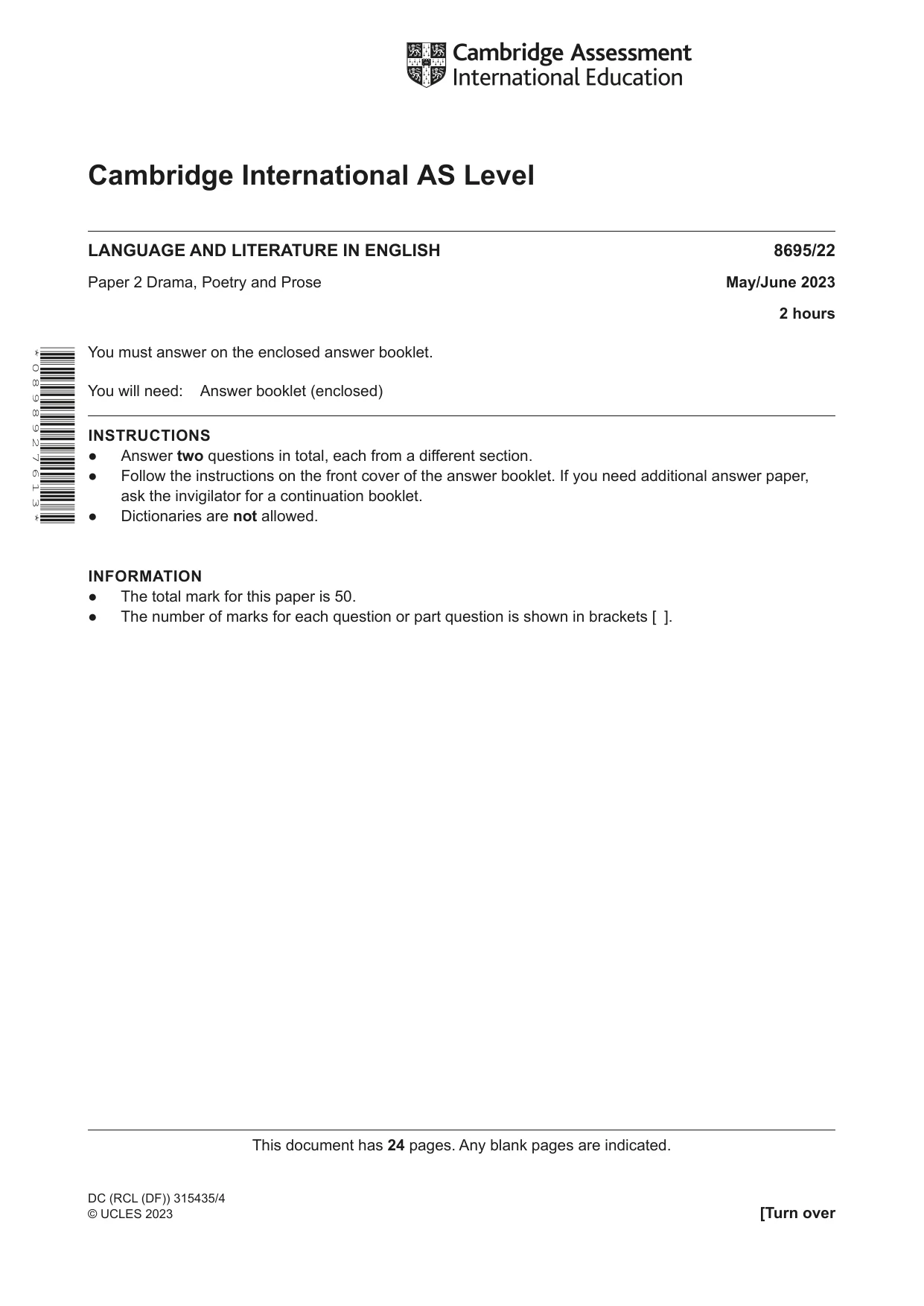
Question paper, page 1
This document has 24 pages. Any blank pages are indicated. [Turn over Cambridge International AS Level * 0 8 9 8 9 2 7 6 1 3 * DC (RCL (DF)) 315435/4 © UCLES 2023 LANGUAGE AND LITERATURE IN ENGLISH 8695/22 Paper 2 Drama, Poetry and Prose May/June 2023 2 hours You must answer on the enclosed answer booklet. You will need: Answer booklet (enclosed) INSTRUCTIONS ● Answer two questions in total, each from a different section. ● Follow the instructions on the front cover of the answer booklet. If you need additional answer paper, ask the invigilator for a continuation booklet. ● Dictionaries are not allowed. INFORMATION ● The total mark for this paper is 50. ● The number of marks for each question or part question is shown in brackets [ ].
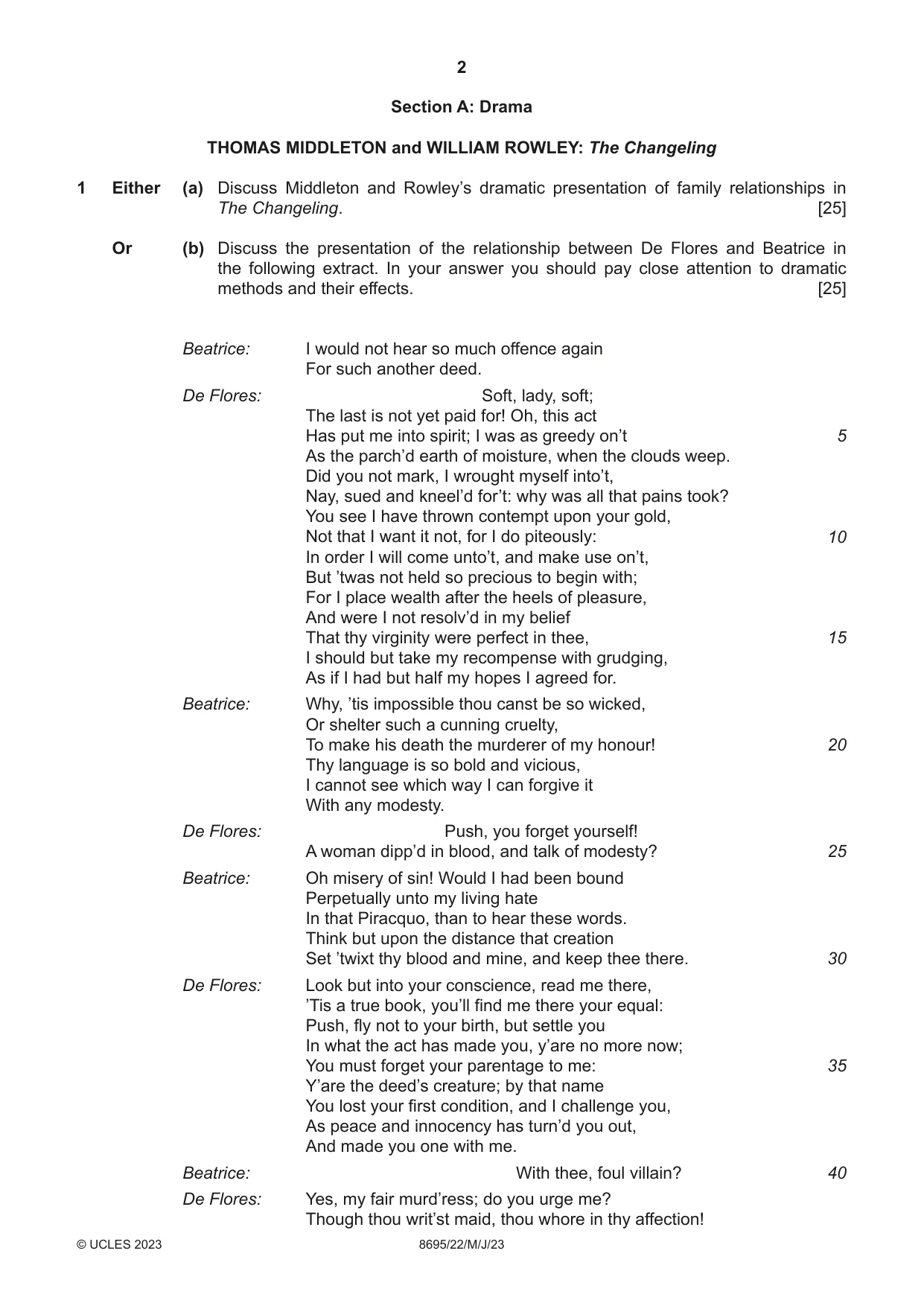
Question paper, page 2
2 8695/22/M/J/23 © UCLES 2023 Section A: Drama THOMAS MIDDLETON and WILLIAM ROWLEY: The Changeling 1 Either (a) Discuss Middleton and Rowley’s dramatic presentation of family relationships in The Changeling. [25] Or (b) Discuss the presentation of the relationship between De Flores and Beatrice in the following extract. In your answer you should pay close attention to dramatic methods and their effects. [25] Beatrice: I would not hear so much offence again For such another deed. De Flores: Soft, lady, soft; The last is not yet paid for! Oh, this act Has put me into spirit; I was as greedy on’t As the parch’d earth of moisture, when the clouds weep. Did you not mark, I wrought myself into’t, Nay, sued and kneel’d for’t: why was all that pains took? You see I have thrown contempt upon your gold, Not that I want it not, for I do piteously: In order I will come unto’t, and make use on’t, But ’twas not held so precious to begin with; For I place wealth after the heels of pleasure, And were I not resolv’d in my belief That thy virginity were perfect in thee, I should but take my recompense with grudging, As if I had but half my hopes I agreed for. Beatrice: Why, ’tis impossible thou canst be so wicked, Or shelter such a cunning cruelty, To make his death the murderer of my honour! Thy language is so bold and vicious, I cannot see which way I can forgive it With any modesty. De Flores: Push, you forget yourself! A woman dipp’d in blood, and talk of modesty? Beatrice: Oh misery of sin! Would I had been bound Perpetually unto my living hate In that Piracquo, than to hear these words. Think but upon the distance that creation Set ’twixt thy blood and mine, and keep thee there. De Flores: Look but into your conscience, read me there, ’Tis a true book, you’ll find me there your equal: Push, fly not to your birth, but settle you In what the act has made you, y’are no more now; You must forget your parentage to me: Y’are the deed’s creature; by that name You lost your first condition, and I challenge you, As peace and innocency has turn’d you out, And made you one with me. Beatrice: With thee, foul villain? De Flores: Yes, my fair murd’ress; do you urge me? Though thou writ’st maid, thou whore in thy affection! 5 10 15 20 25 30 35 40
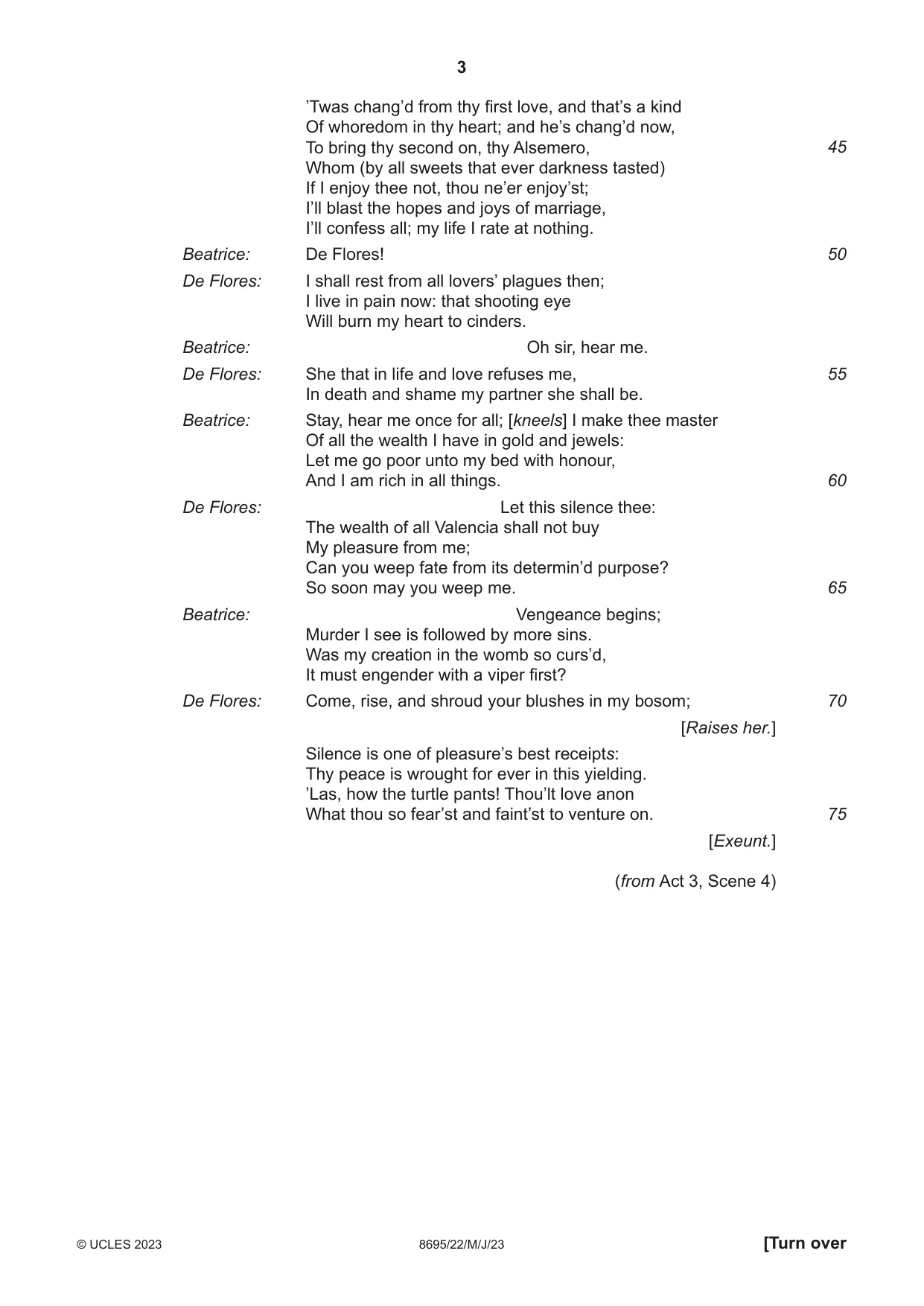
Question paper, page 3
3 8695/22/M/J/23 © UCLES 2023 [Turn over ’Twas chang’d from thy first love, and that’s a kind Of whoredom in thy heart; and he’s chang’d now, To bring thy second on, thy Alsemero, Whom (by all sweets that ever darkness tasted) If I enjoy thee not, thou ne’er enjoy’st; I’ll blast the hopes and joys of marriage, I’ll confess all; my life I rate at nothing. Beatrice: De Flores! De Flores: I shall rest from all lovers’ plagues then; I live in pain now: that shooting eye Will burn my heart to cinders. Beatrice: Oh sir, hear me. De Flores: She that in life and love refuses me, In death and shame my partner she shall be. Beatrice: Stay, hear me once for all; [kneels] I make thee master Of all the wealth I have in gold and jewels: Let me go poor unto my bed with honour, And I am rich in all things. De Flores: Let this silence thee: The wealth of all Valencia shall not buy My pleasure from me; Can you weep fate from its determin’d purpose? So soon may you weep me. Beatrice: Vengeance begins; Murder I see is followed by more sins. Was my creation in the womb so curs’d, It must engender with a viper first? De Flores: Come, rise, and shroud your blushes in my bosom; [Raises her.] Silence is one of pleasure’s best receipts: Thy peace is wrought for ever in this yielding. ’Las, how the turtle pants! Thou’lt love anon What thou so fear’st and faint’st to venture on. [Exeunt.] (from Act 3, Scene 4) 45 50 55 60 65 70 75
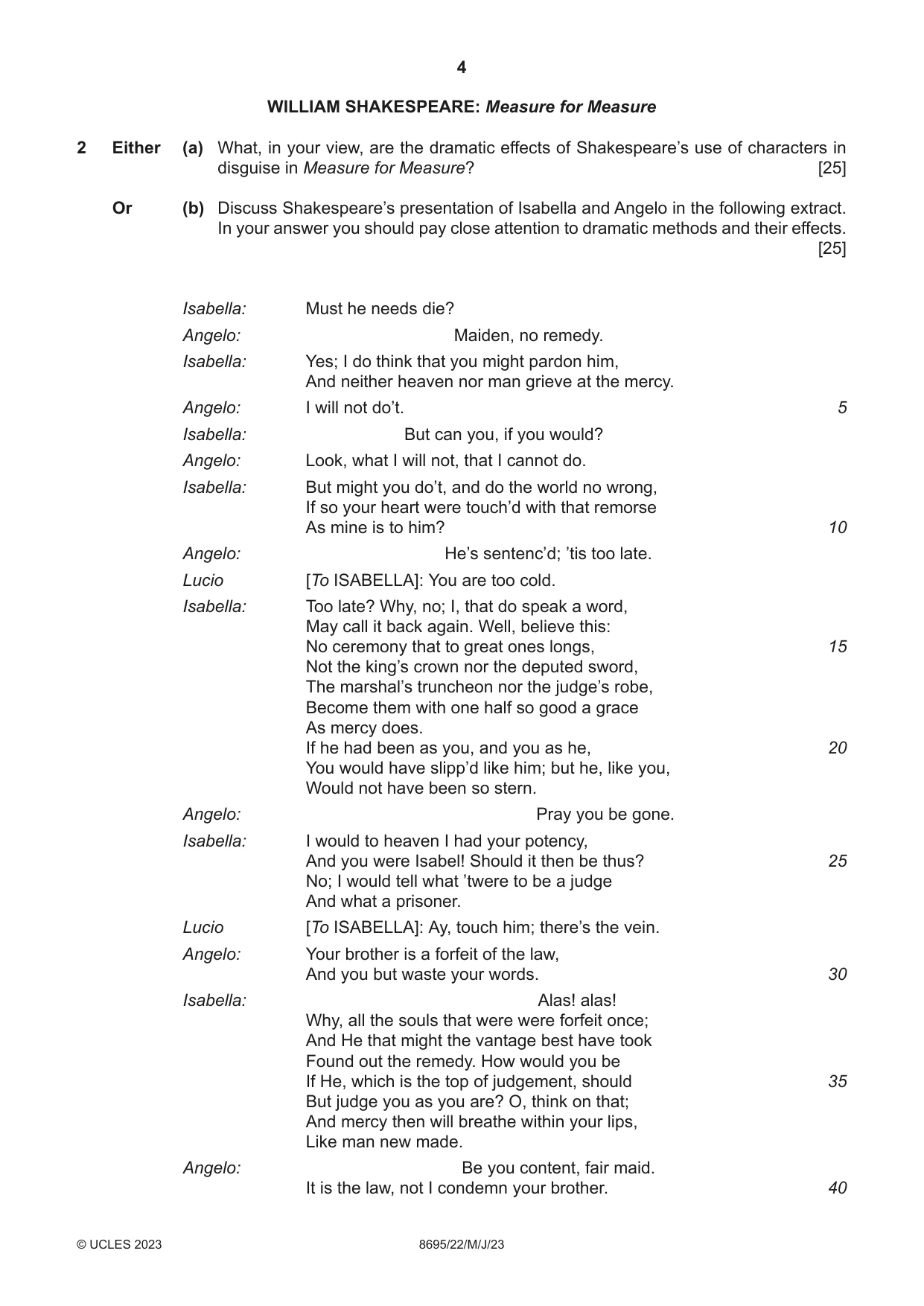
Question paper, page 4
4 8695/22/M/J/23 © UCLES 2023 WILLIAM SHAKESPEARE: Measure for Measure 2 Either (a) What, in your view, are the dramatic effects of Shakespeare’s use of characters in disguise in Measure for Measure? [25] Or (b) Discuss Shakespeare’s presentation of Isabella and Angelo in the following extract. In your answer you should pay close attention to dramatic methods and their effects. [25] Isabella: Must he needs die? Angelo: Maiden, no remedy. Isabella: Yes; I do think that you might pardon him, And neither heaven nor man grieve at the mercy. Angelo: I will not do’t. Isabella: But can you, if you would? Angelo: Look, what I will not, that I cannot do. Isabella: But might you do’t, and do the world no wrong, If so your heart were touch’d with that remorse As mine is to him? Angelo: He’s sentenc’d; ’tis too late. Lucio [To ISABELLA]: You are too cold. Isabella: Too late? Why, no; I, that do speak a word, May call it back again. Well, believe this: No ceremony that to great ones longs, Not the king’s crown nor the deputed sword, The marshal’s truncheon nor the judge’s robe, Become them with one half so good a grace As mercy does. If he had been as you, and you as he, You would have slipp’d like him; but he, like you, Would not have been so stern. Angelo: Pray you be gone. Isabella: I would to heaven I had your potency, And you were Isabel! Should it then be thus? No; I would tell what ’twere to be a judge And what a prisoner. Lucio [To ISABELLA]: Ay, touch him; there’s the vein. Angelo: Your brother is a forfeit of the law, And you but waste your words. Isabella: Alas! alas! Why, all the souls that were were forfeit once; And He that might the vantage best have took Found out the remedy. How would you be If He, which is the top of judgement, should But judge you as you are? O, think on that; And mercy then will breathe within your lips, Like man new made. Angelo: Be you content, fair maid. It is the law, not I condemn your brother. 5 10 15 20 25 30 35 40
Question paper, page 5
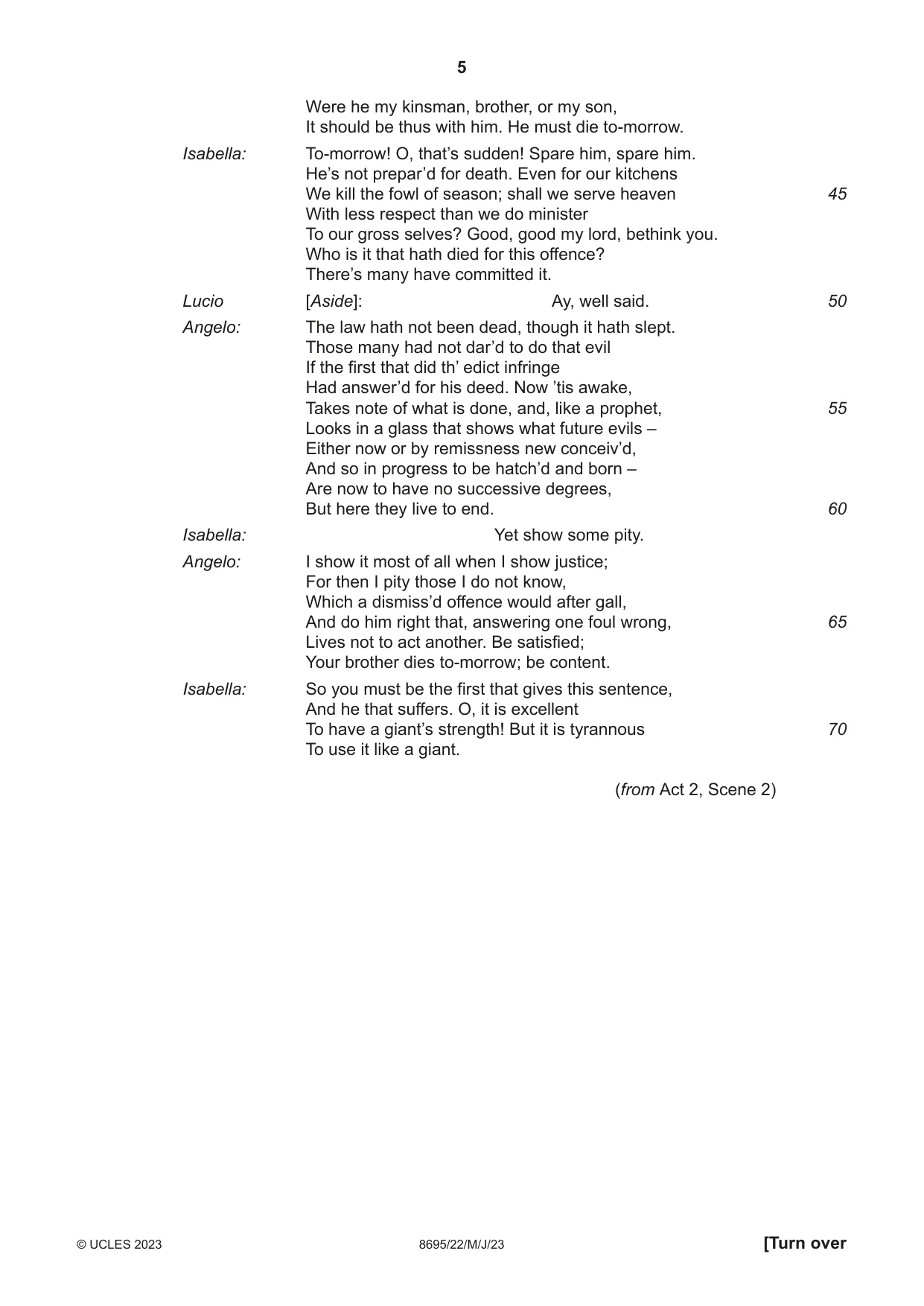
5 8695/22/M/J/23 © UCLES 2023 [Turn over Were he my kinsman, brother, or my son, It should be thus with him. He must die to-morrow. Isabella: To-morrow! O, that’s sudden! Spare him, spare him. He’s not prepar’d for death. Even for our kitchens We kill the fowl of season; shall we serve heaven With less respect than we do minister To our gross selves? Good, good my lord, bethink you. Who is it that hath died for this offence? There’s many have committed it. Lucio [Aside]: Ay, well said. Angelo: The law hath not been dead, though it hath slept. Those many had not dar’d to do that evil If the first that did th’ edict infringe Had answer’d for his deed. Now ’tis awake, Takes note of what is done, and, like a prophet, Looks in a glass that shows what future evils – Either now or by remissness new conceiv’d, And so in progress to be hatch’d and born – Are now to have no successive degrees, But here they live to end. Isabella: Yet show some pity. Angelo: I show it most of all when I show justice; For then I pity those I do not know, Which a dismiss’d offence would after gall, And do him right that, answering one foul wrong, Lives not to act another. Be satisfied; Your brother dies to-morrow; be content. Isabella: So you must be the first that gives this sentence, And he that suffers. O, it is excellent To have a giant’s strength! But it is tyrannous To use it like a giant. (from Act 2, Scene 2) 45 50 55 60 65 70
Question paper, page 6
6 8695/22/M/J/23 © UCLES 2023 WOLE SOYINKA: The Trials of Brother Jero and Jero’s Metamorphosis 3 Either (a) Discuss some of the ways Soyinka presents the importance of reputation in the two plays. [25] Or (b) Discuss Soyinka’s presentation of Jero in the following extract from The Trials of Brother Jero. In your answer you should pay close attention to dramatic methods and their effects. [25] [The Beach. Content removed due to copyright restrictions.
Question paper, page 7
7 8695/22/M/J/23 © UCLES 2023 [Turn over [The MEMBER turns round slowly.] (from The Trials of Brother Jero, Scene 5) Content removed due to copyright restrictions.
Question paper, page 8
8 8695/22/M/J/23 © UCLES 2023 TENNESSEE WILLIAMS: Cat on a Hot Tin Roof 4 Either (a) Discuss Williams’s dramatic presentation of parent and child relationships in Cat on a Hot Tin Roof. [25] Or (b) Discuss the presentation of Margaret in the following extract. In your answer you should pay close attention to dramatic methods and their effects. [25] Margaret: Did anyone ever tell you that you’re an ass-aching Puritan, Brick? Content removed due to copyright restrictions.
Question paper, page 9
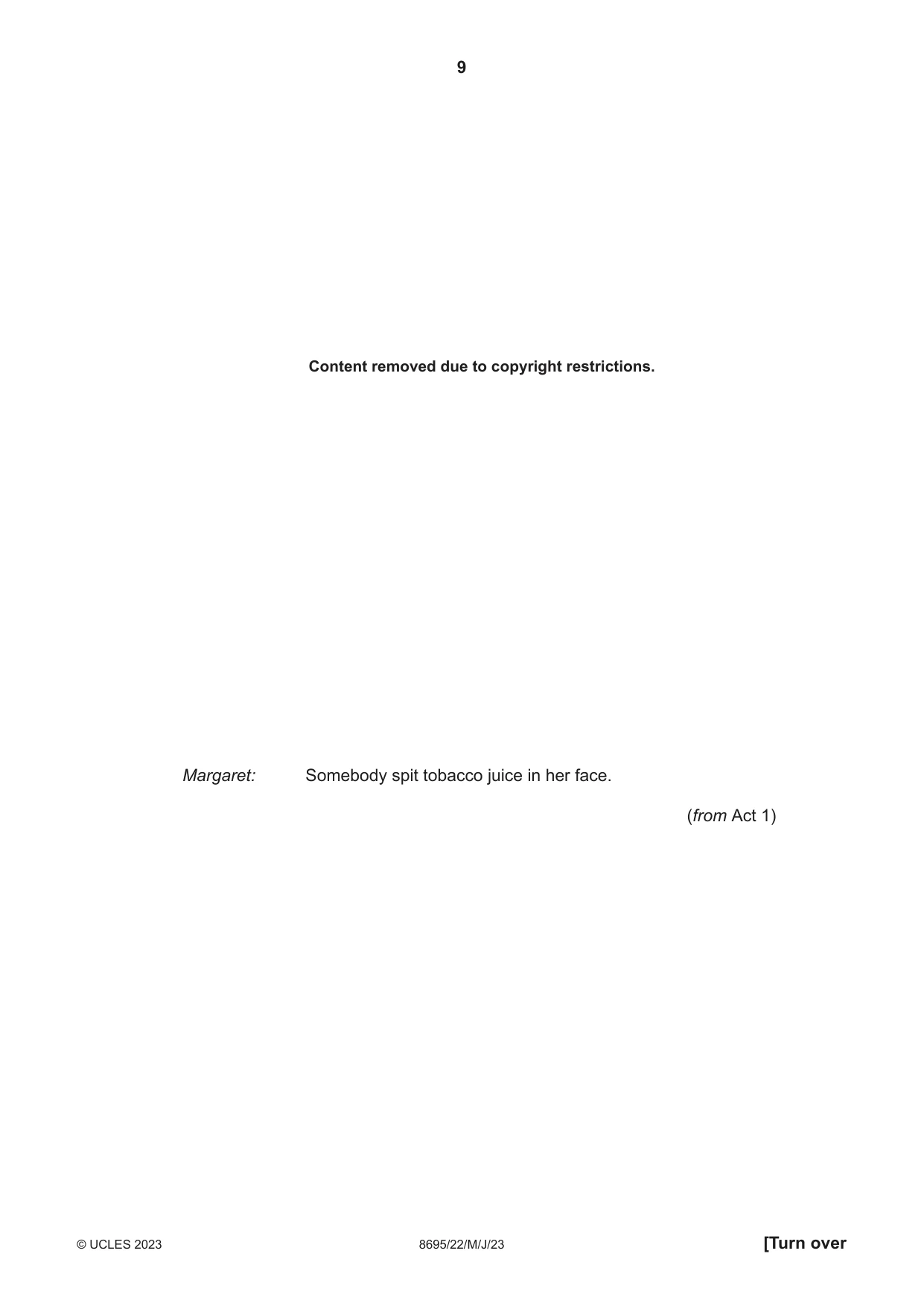
9 8695/22/M/J/23 © UCLES 2023 [Turn over Margaret: Somebody spit tobacco juice in her face. (from Act 1) Content removed due to copyright restrictions.
Question paper, page 10
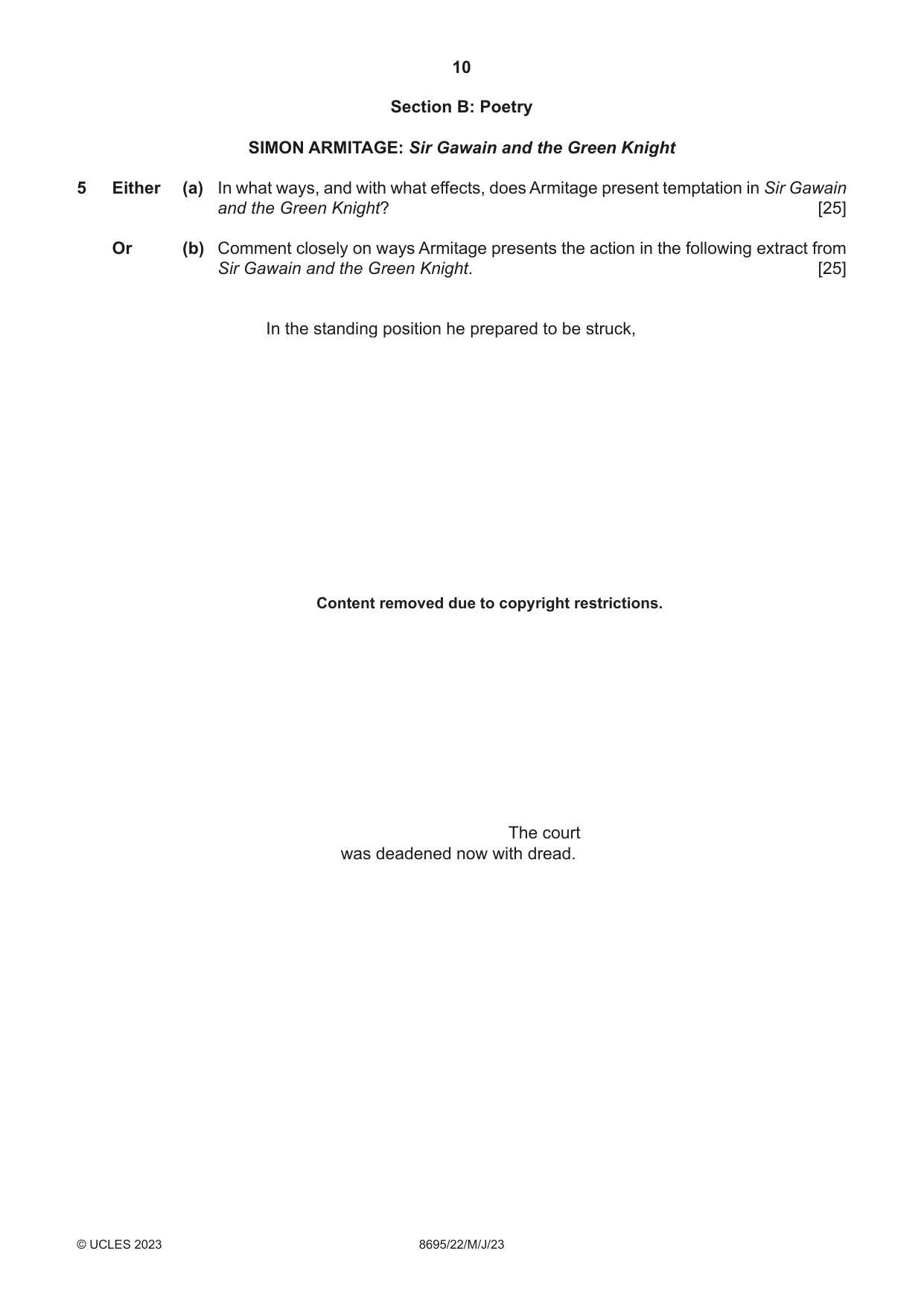
10 8695/22/M/J/23 © UCLES 2023 Section B: Poetry SIMON ARMITAGE: Sir Gawain and the Green Knight 5 Either (a) In what ways, and with what effects, does Armitage present temptation in Sir Gawain and the Green Knight? [25] Or (b) Comment closely on ways Armitage presents the action in the following extract from Sir Gawain and the Green Knight. [25] In the standing position he prepared to be struck, The court was deadened now with dread. Content removed due to copyright restrictions.
Question paper, page 11
11 8695/22/M/J/23 © UCLES 2023 [Turn over TURN OVER FOR QUESTION 6.
Question paper, page 12
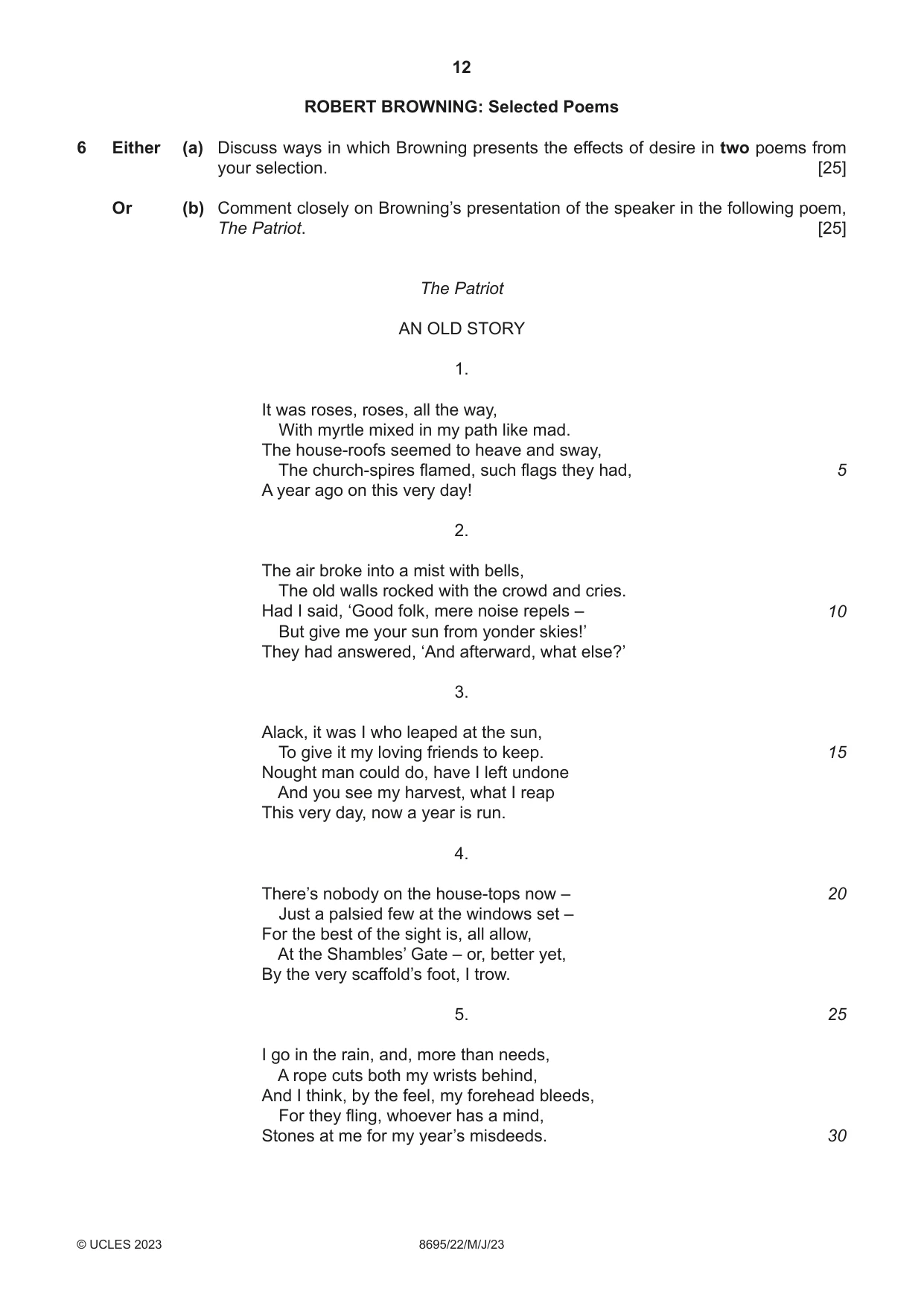
12 8695/22/M/J/23 © UCLES 2023 ROBERT BROWNING: Selected Poems 6 Either (a) Discuss ways in which Browning presents the effects of desire in two poems from your selection. [25] Or (b) Comment closely on Browning’s presentation of the speaker in the following poem, The Patriot. [25] The Patriot AN OLD STORY 1. It was roses, roses, all the way, With myrtle mixed in my path like mad. The house-roofs seemed to heave and sway, The church-spires flamed, such flags they had, A year ago on this very day! 2. The air broke into a mist with bells, The old walls rocked with the crowd and cries. Had I said, ‘Good folk, mere noise repels – But give me your sun from yonder skies!’ They had answered, ‘And afterward, what else?’ 3. Alack, it was I who leaped at the sun, To give it my loving friends to keep. Nought man could do, have I left undone And you see my harvest, what I reap This very day, now a year is run. 4. There’s nobody on the house-tops now – Just a palsied few at the windows set – For the best of the sight is, all allow, At the Shambles’ Gate – or, better yet, By the very scaffold’s foot, I trow. 5. I go in the rain, and, more than needs, A rope cuts both my wrists behind, And I think, by the feel, my forehead bleeds, For they fling, whoever has a mind, Stones at me for my year’s misdeeds. 5 10 15 20 25 30
Question paper, page 13
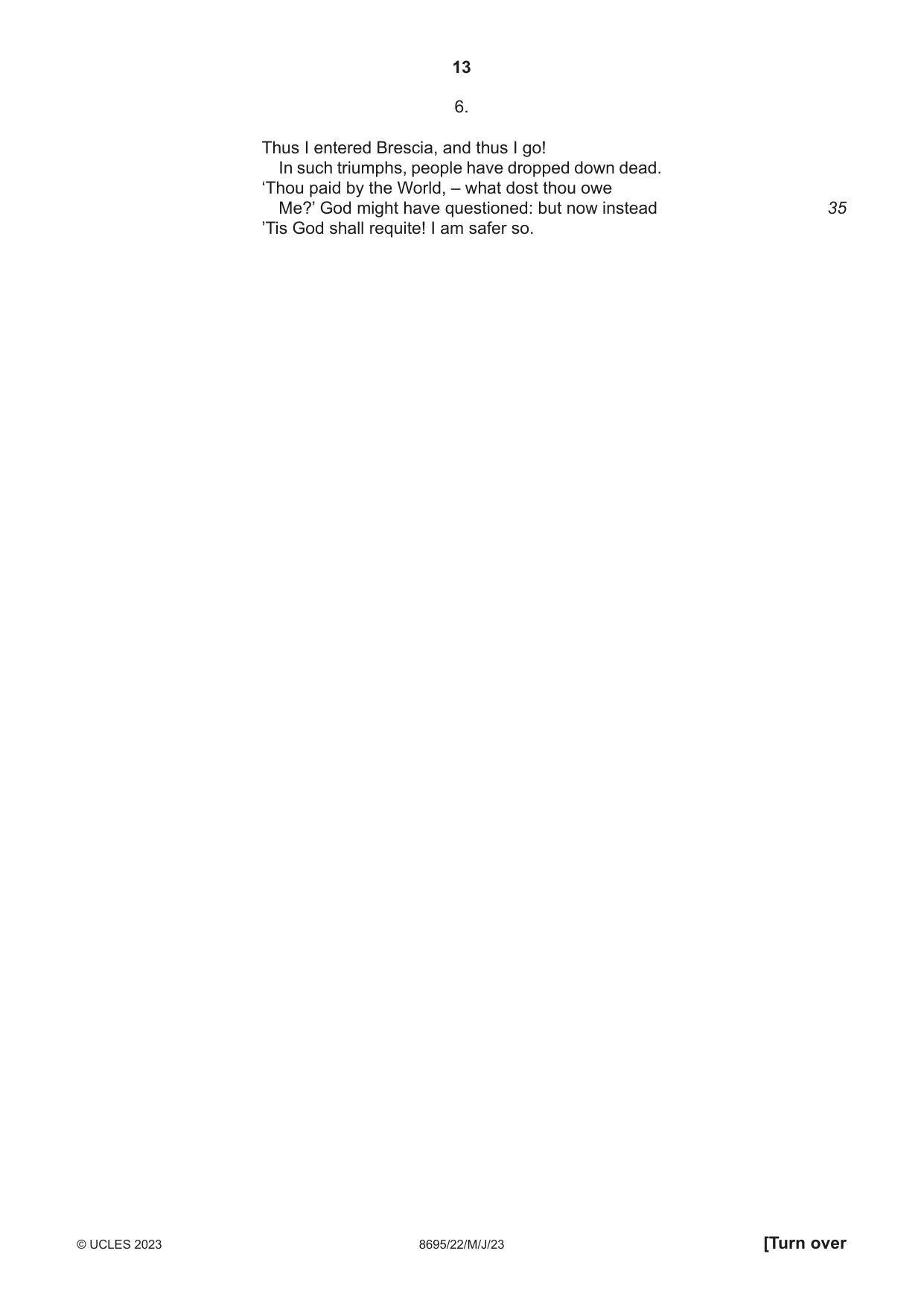
13 8695/22/M/J/23 © UCLES 2023 [Turn over 6. Thus I entered Brescia, and thus I go! In such triumphs, people have dropped down dead. ‘Thou paid by the World, – what dost thou owe Me?’ God might have questioned: but now instead ’Tis God shall requite! I am safer so. 35
Question paper, page 14
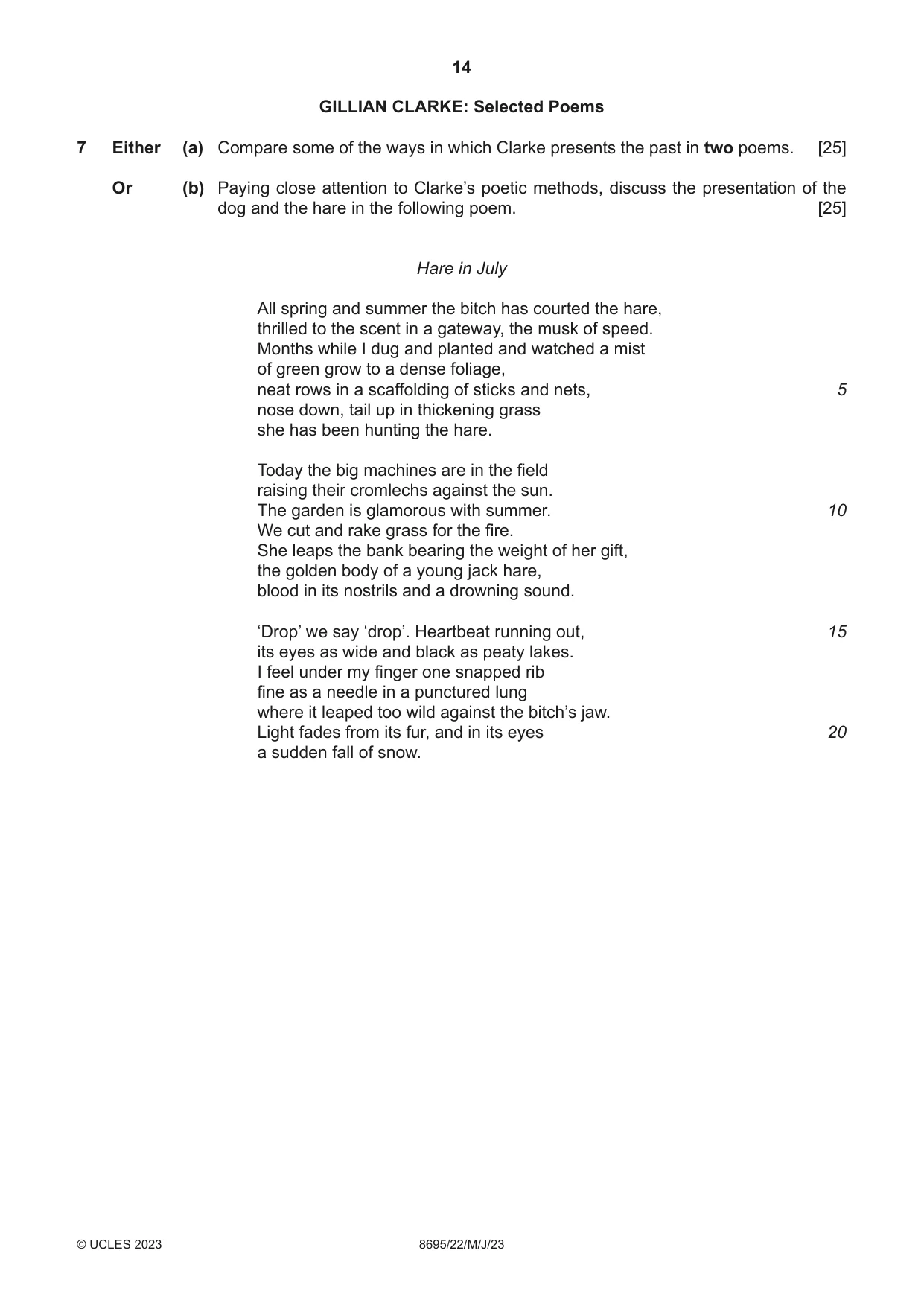
14 8695/22/M/J/23 © UCLES 2023 GILLIAN CLARKE: Selected Poems 7 Either (a) Compare some of the ways in which Clarke presents the past in two poems. [25] Or (b) Paying close attention to Clarke’s poetic methods, discuss the presentation of the dog and the hare in the following poem. [25] Hare in July All spring and summer the bitch has courted the hare, thrilled to the scent in a gateway, the musk of speed. Months while I dug and planted and watched a mist of green grow to a dense foliage, neat rows in a scaffolding of sticks and nets, nose down, tail up in thickening grass she has been hunting the hare. Today the big machines are in the field raising their cromlechs against the sun. The garden is glamorous with summer. We cut and rake grass for the fire. She leaps the bank bearing the weight of her gift, the golden body of a young jack hare, blood in its nostrils and a drowning sound. ‘Drop’ we say ‘drop’. Heartbeat running out, its eyes as wide and black as peaty lakes. I feel under my finger one snapped rib fine as a needle in a punctured lung where it leaped too wild against the bitch’s jaw. Light fades from its fur, and in its eyes a sudden fall of snow. 5 10 15 20
Question paper, page 15
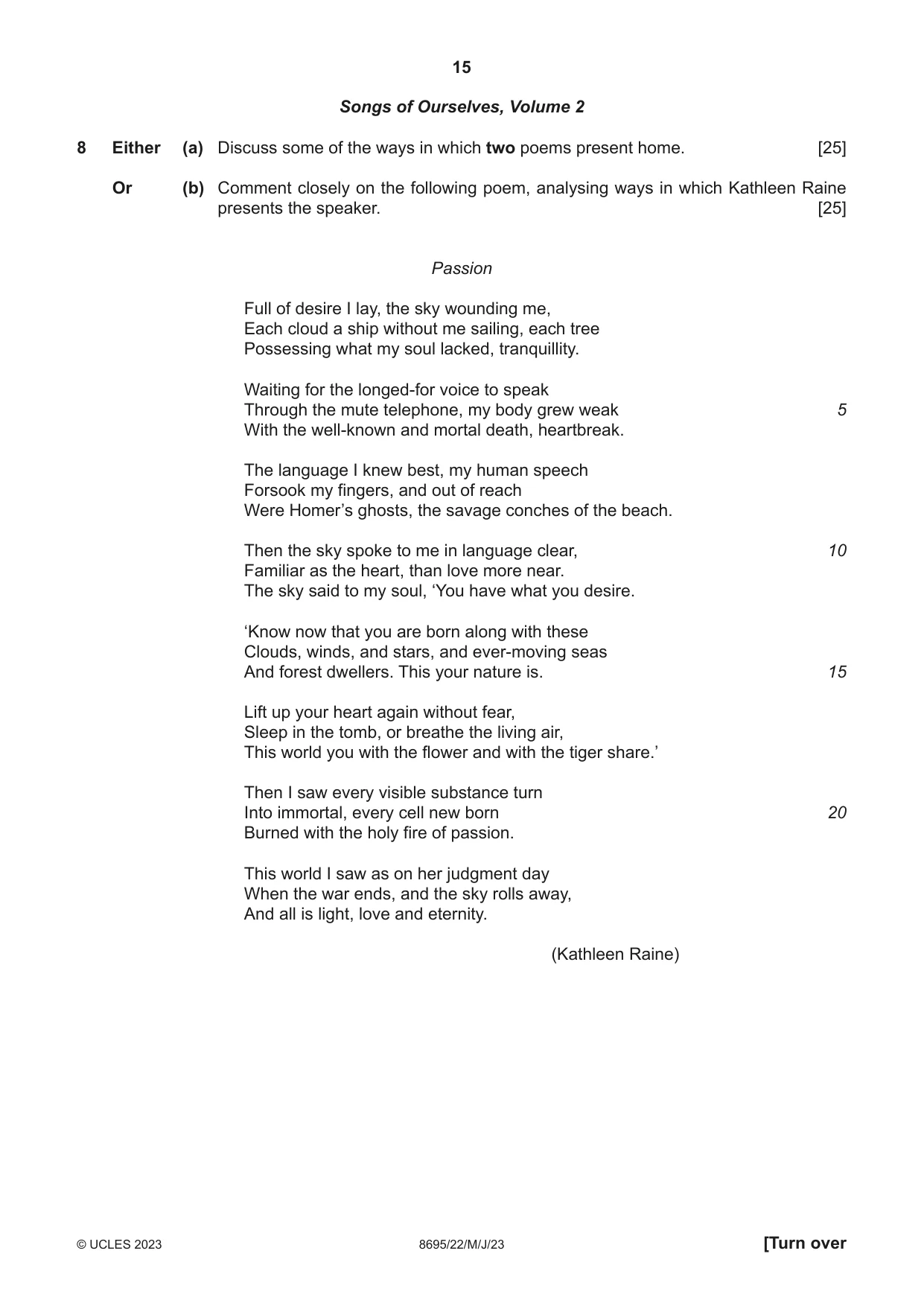
15 8695/22/M/J/23 © UCLES 2023 [Turn over Songs of Ourselves, Volume 2 8 Either (a) Discuss some of the ways in which two poems present home. [25] Or (b) Comment closely on the following poem, analysing ways in which Kathleen Raine presents the speaker. [25] Passion Full of desire I lay, the sky wounding me, Each cloud a ship without me sailing, each tree Possessing what my soul lacked, tranquillity. Waiting for the longed-for voice to speak Through the mute telephone, my body grew weak With the well-known and mortal death, heartbreak. The language I knew best, my human speech Forsook my fingers, and out of reach Were Homer’s ghosts, the savage conches of the beach. Then the sky spoke to me in language clear, Familiar as the heart, than love more near. The sky said to my soul, ‘You have what you desire. ‘Know now that you are born along with these Clouds, winds, and stars, and ever-moving seas And forest dwellers. This your nature is. Lift up your heart again without fear, Sleep in the tomb, or breathe the living air, This world you with the flower and with the tiger share.’ Then I saw every visible substance turn Into immortal, every cell new born Burned with the holy fire of passion. This world I saw as on her judgment day When the war ends, and the sky rolls away, And all is light, love and eternity. (Kathleen Raine) 5 10 15 20
Question paper, page 16
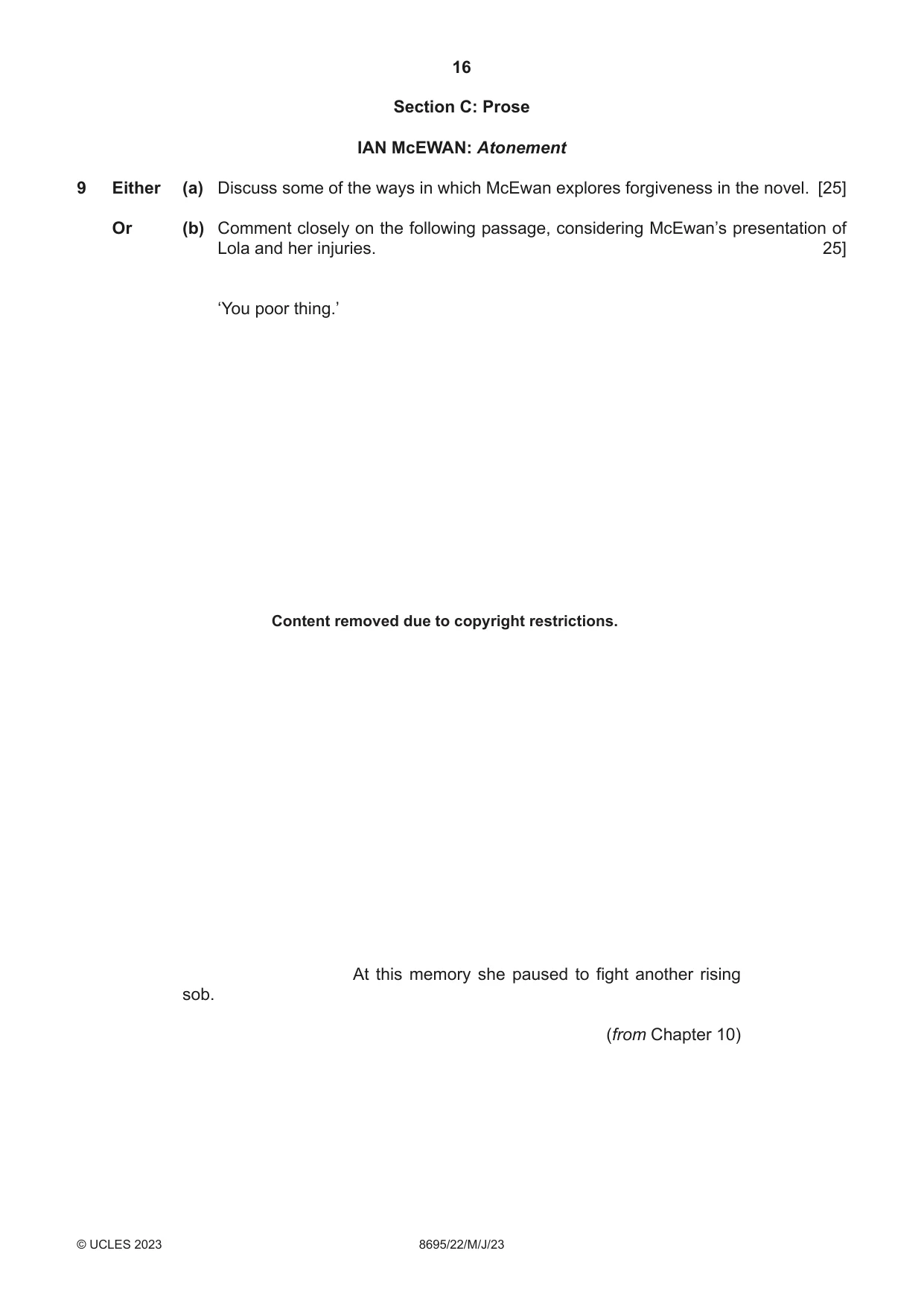
16 8695/22/M/J/23 © UCLES 2023 Section C: Prose IAN McEWAN: Atonement 9 Either (a) Discuss some of the ways in which McEwan explores forgiveness in the novel. [25] Or (b) Comment closely on the following passage, considering McEwan’s presentation of Lola and her injuries. 25] ‘You poor thing.’ At this memory she paused to fight another rising sob. (from Chapter 10) Content removed due to copyright restrictions.
Question paper, page 17
17 8695/22/M/J/23 © UCLES 2023 [Turn over TURN OVER FOR QUESTION 10.
Question paper, page 18
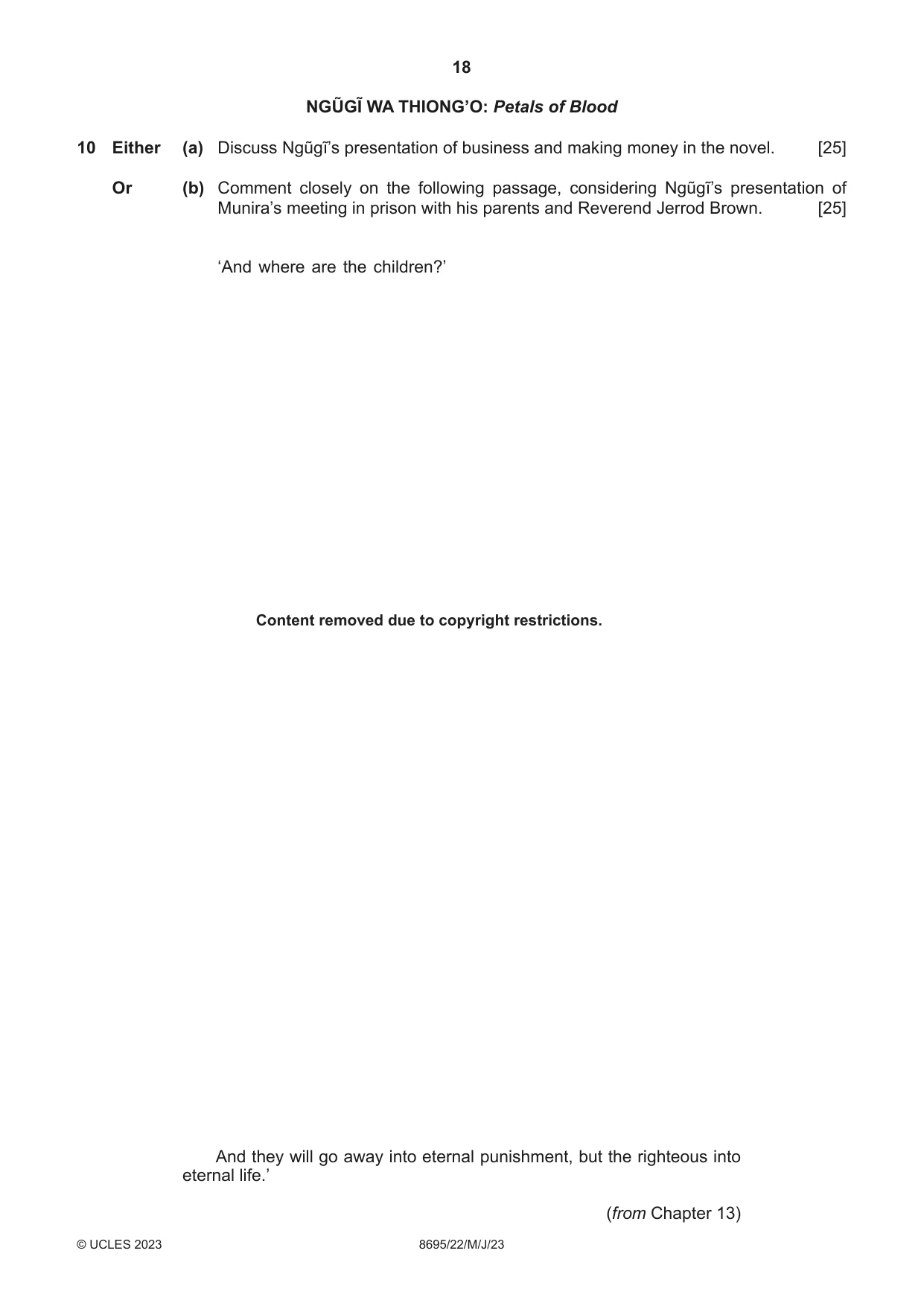
18 8695/22/M/J/23 © UCLES 2023 NGŨGĨ WA THIONG’O: Petals of Blood 10 Either (a) Discuss Ngũgĩ’s presentation of business and making money in the novel. [25] Or (b) Comment closely on the following passage, considering Ngũgĩ’s presentation of Munira’s meeting in prison with his parents and Reverend Jerrod Brown. [25] ‘And where are the children?’ And they will go away into eternal punishment, but the righteous into eternal life.’ (from Chapter 13) Content removed due to copyright restrictions.
Question paper, page 19
19 8695/22/M/J/23 © UCLES 2023 [Turn over TURN OVER FOR QUESTION 11.
Question paper, page 20
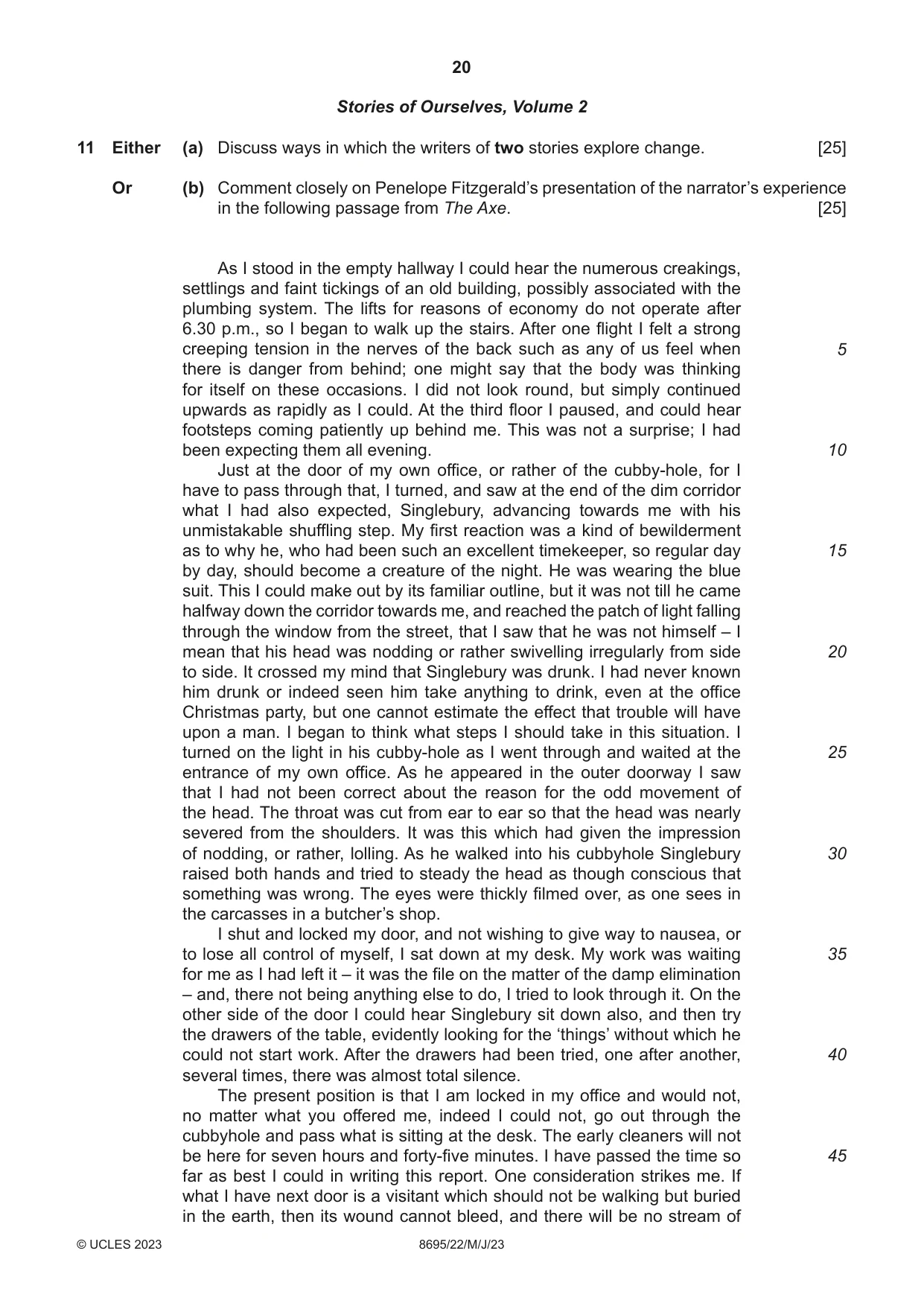
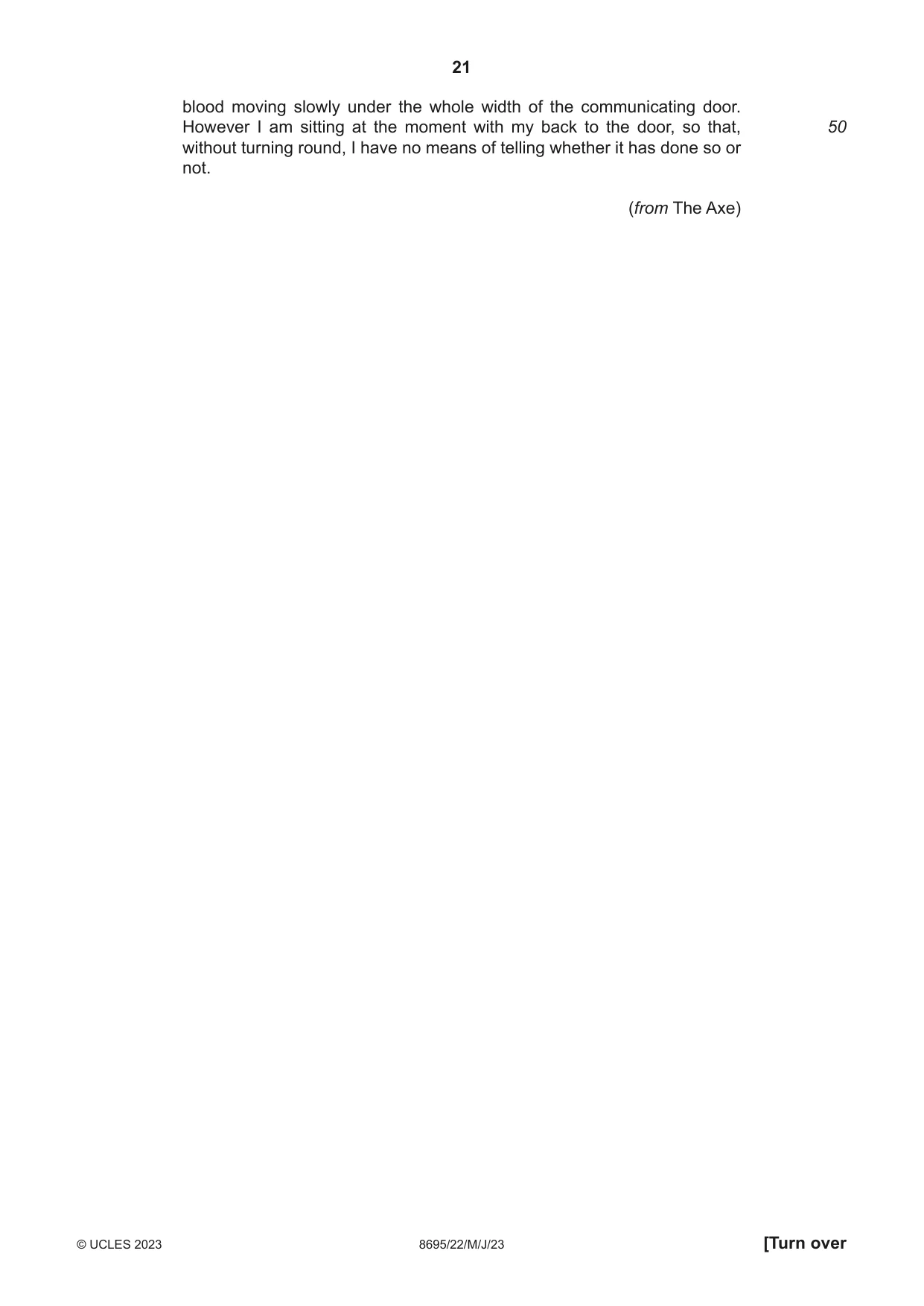
20 8695/22/M/J/23 © UCLES 2023 Stories of Ourselves, Volume 2 11 Either (a) Discuss ways in which the writers of two stories explore change. [25] Or (b) Comment closely on Penelope Fitzgerald’s presentation of the narrator’s experience in the following passage from The Axe. [25] As I stood in the empty hallway I could hear the numerous creakings, settlings and faint tickings of an old building, possibly associated with the plumbing system. The lifts for reasons of economy do not operate after 6.30 p.m., so I began to walk up the stairs. After one flight I felt a strong creeping tension in the nerves of the back such as any of us feel when there is danger from behind; one might say that the body was thinking for itself on these occasions. I did not look round, but simply continued upwards as rapidly as I could. At the third floor I paused, and could hear footsteps coming patiently up behind me. This was not a surprise; I had been expecting them all evening. Just at the door of my own office, or rather of the cubby-hole, for I have to pass through that, I turned, and saw at the end of the dim corridor what I had also expected, Singlebury, advancing towards me with his unmistakable shuffling step. My first reaction was a kind of bewilderment as to why he, who had been such an excellent timekeeper, so regular day by day, should become a creature of the night. He was wearing the blue suit. This I could make out by its familiar outline, but it was not till he came halfway down the corridor towards me, and reached the patch of light falling through the window from the street, that I saw that he was not himself – I mean that his head was nodding or rather swivelling irregularly from side to side. It crossed my mind that Singlebury was drunk. I had never known him drunk or indeed seen him take anything to drink, even at the office Christmas party, but one cannot estimate the effect that trouble will have upon a man. I began to think what steps I should take in this situation. I turned on the light in his cubby-hole as I went through and waited at the entrance of my own office. As he appeared in the outer doorway I saw that I had not been correct about the reason for the odd movement of the head. The throat was cut from ear to ear so that the head was nearly severed from the shoulders. It was this which had given the impression of nodding, or rather, lolling. As he walked into his cubbyhole Singlebury raised both hands and tried to steady the head as though conscious that something was wrong. The eyes were thickly filmed over, as one sees in the carcasses in a butcher’s shop. I shut and locked my door, and not wishing to give way to nausea, or to lose all control of myself, I sat down at my desk. My work was waiting for me as I had left it – it was the file on the matter of the damp elimination – and, there not being anything else to do, I tried to look through it. On the other side of the door I could hear Singlebury sit down also, and then try the drawers of the table, evidently looking for the ‘things’ without which he could not start work. After the drawers had been tried, one after another, several times, there was almost total silence. The present position is that I am locked in my office and would not, no matter what you offered me, indeed I could not, go out through the cubbyhole and pass what is sitting at the desk. The early cleaners will not be here for seven hours and forty-five minutes. I have passed the time so far as best I could in writing this report. One consideration strikes me. If what I have next door is a visitant which should not be walking but buried in the earth, then its wound cannot bleed, and there will be no stream of 5 10 15 20 25 30 35 40 45
Question paper, page 21
21 8695/22/M/J/23 © UCLES 2023 [Turn over blood moving slowly under the whole width of the communicating door. However I am sitting at the moment with my back to the door, so that, without turning round, I have no means of telling whether it has done so or not. (from The Axe) 50
Question paper, page 22
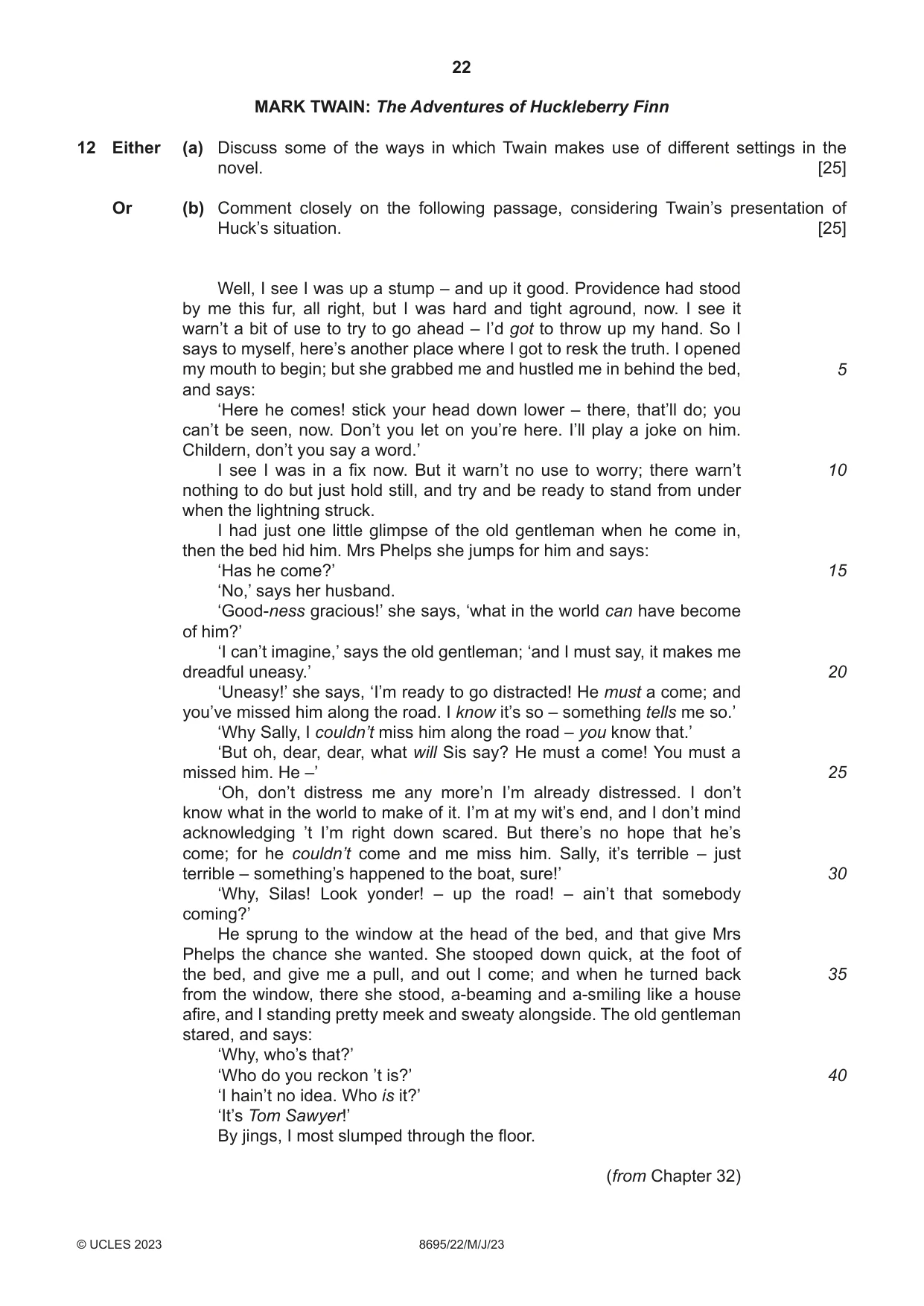
22 8695/22/M/J/23 © UCLES 2023 MARK TWAIN: The Adventures of Huckleberry Finn 12 Either (a) Discuss some of the ways in which Twain makes use of different settings in the novel. [25] Or (b) Comment closely on the following passage, considering Twain’s presentation of Huck’s situation. [25] Well, I see I was up a stump – and up it good. Providence had stood by me this fur, all right, but I was hard and tight aground, now. I see it warn’t a bit of use to try to go ahead – I’d got to throw up my hand. So I says to myself, here’s another place where I got to resk the truth. I opened my mouth to begin; but she grabbed me and hustled me in behind the bed, and says: ‘Here he comes! stick your head down lower – there, that’ll do; you can’t be seen, now. Don’t you let on you’re here. I’ll play a joke on him. Childern, don’t you say a word.’ I see I was in a fix now. But it warn’t no use to worry; there warn’t nothing to do but just hold still, and try and be ready to stand from under when the lightning struck. I had just one little glimpse of the old gentleman when he come in, then the bed hid him. Mrs Phelps she jumps for him and says: ‘Has he come?’ ‘No,’ says her husband. ‘Good-ness gracious!’ she says, ‘what in the world can have become of him?’ ‘I can’t imagine,’ says the old gentleman; ‘and I must say, it makes me dreadful uneasy.’ ‘Uneasy!’ she says, ‘I’m ready to go distracted! He must a come; and you’ve missed him along the road. I know it’s so – something tells me so.’ ‘Why Sally, I couldn’t miss him along the road – you know that.’ ‘But oh, dear, dear, what will Sis say? He must a come! You must a missed him. He –’ ‘Oh, don’t distress me any more’n I’m already distressed. I don’t know what in the world to make of it. I’m at my wit’s end, and I don’t mind acknowledging ’t I’m right down scared. But there’s no hope that he’s come; for he couldn’t come and me miss him. Sally, it’s terrible – just terrible – something’s happened to the boat, sure!’ ‘Why, Silas! Look yonder! – up the road! – ain’t that somebody coming?’ He sprung to the window at the head of the bed, and that give Mrs Phelps the chance she wanted. She stooped down quick, at the foot of the bed, and give me a pull, and out I come; and when he turned back from the window, there she stood, a-beaming and a-smiling like a house afire, and I standing pretty meek and sweaty alongside. The old gentleman stared, and says: ‘Why, who’s that?’ ‘Who do you reckon ’t is?’ ‘I hain’t no idea. Who is it?’ ‘It’s Tom Sawyer!’ By jings, I most slumped through the floor. (from Chapter 32) 5 10 15 20 25 30 35 40
Question paper, page 23
23 8695/22/M/J/23 © UCLES 2023 BLANK PAGE
Question paper, page 24
24 8695/22/M/J/23 © UCLES 2023 Permission to reproduce items where third-party owned material protected by copyright is included has been sought and cleared where possible. Every reasonable effort has been made by the publisher (UCLES) to trace copyright holders, but if any items requiring clearance have unwittingly been included, the publisher will be pleased to make amends at the earliest possible opportunity. To avoid the issue of disclosure of answer-related information to candidates, all copyright acknowledgements are reproduced online in the Cambridge Assessment International Education Copyright Acknowledgements Booklet. This is produced for each series of examinations and is freely available to download at www.cambridgeinternational.org after the live examination series. Cambridge Assessment International Education is part of Cambridge Assessment. Cambridge Assessment is the brand name of the University of Cambridge Local Examinations Syndicate (UCLES), which is a department of the University of Cambridge. BLANK PAGE
Mark scheme, page 1
This document consists of 13 printed pages. © UCLES 2023 [Turn over Cambridge International AS Level LANGUAGE AND LITERATURE IN ENGLISH 8695/22 Paper 2 Drama, Poetry and Prose May/June 2023 MARK SCHEME Maximum Mark: 50 Published This mark scheme is published as an aid to teachers and candidates, to indicate the requirements of the examination. It shows the basis on which Examiners were instructed to award marks. It does not indicate the details of the discussions that took place at an Examiners’ meeting before marking began, which would have considered the acceptability of alternative answers. Mark schemes should be read in conjunction with the question paper and the Principal Examiner Report for Teachers. Cambridge International will not enter into discussions about these mark schemes. Cambridge International is publishing the mark schemes for the May/June 2023 series for most Cambridge IGCSE, Cambridge International A and AS Level and Cambridge Pre-U components, and some Cambridge O Level components.
Mark scheme, page 2
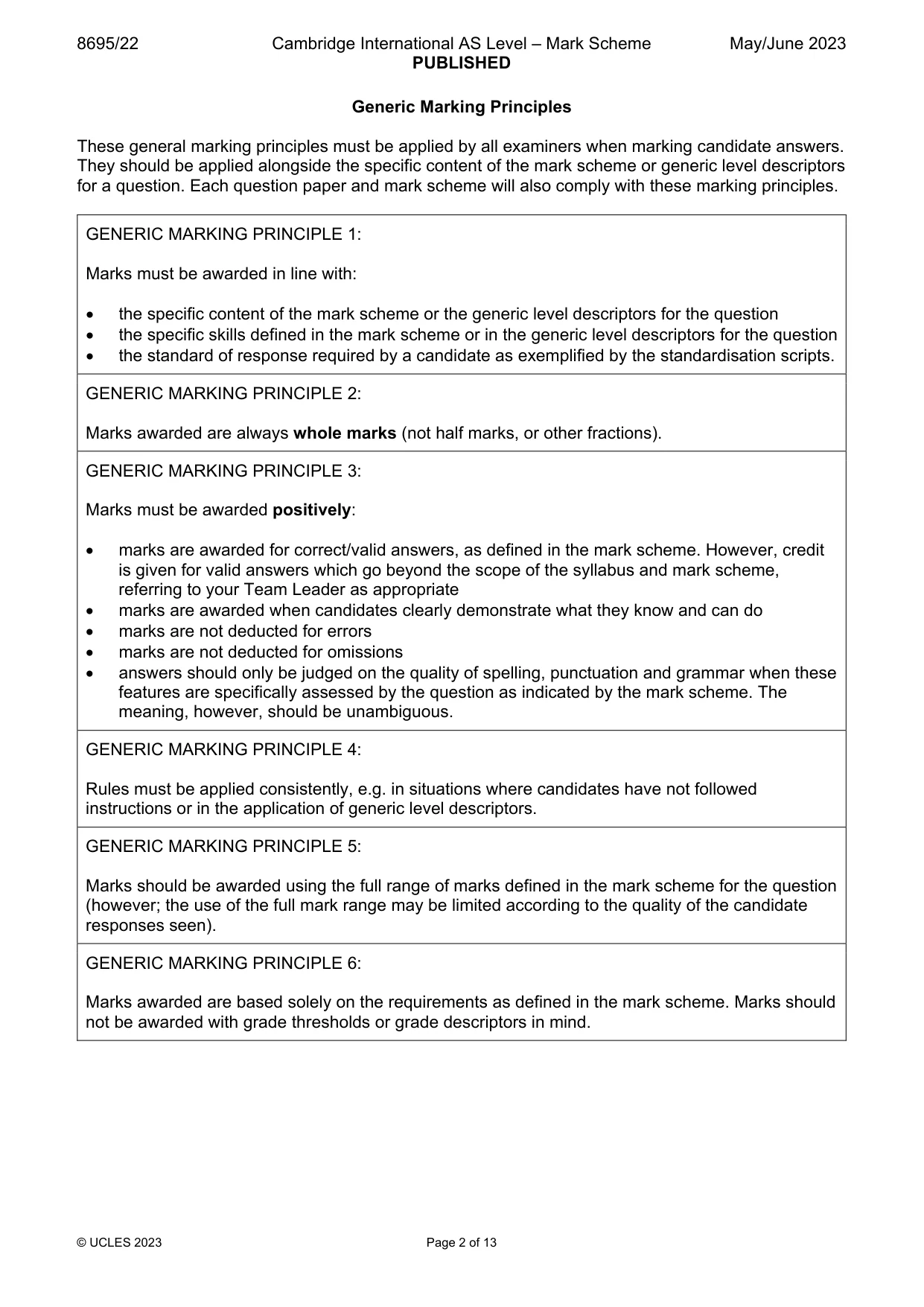
8695/22 Cambridge International AS Level – Mark Scheme PUBLISHED May/June 2023 © UCLES 2023 Page 2 of 13 Generic Marking Principles These general marking principles must be applied by all examiners when marking candidate answers. They should be applied alongside the specific content of the mark scheme or generic level descriptors for a question. Each question paper and mark scheme will also comply with these marking principles. GENERIC MARKING PRINCIPLE 1: Marks must be awarded in line with: the specific content of the mark scheme or the generic level descriptors for the question the specific skills defined in the mark scheme or in the generic level descriptors for the question the standard of response required by a candidate as exemplified by the standardisation scripts. GENERIC MARKING PRINCIPLE 2: Marks awarded are always whole marks (not half marks, or other fractions). GENERIC MARKING PRINCIPLE 3: Marks must be awarded positively: marks are awarded for correct/valid answers, as defined in the mark scheme. However, credit is given for valid answers which go beyond the scope of the syllabus and mark scheme, referring to your Team Leader as appropriate marks are awarded when candidates clearly demonstrate what they know and can do marks are not deducted for errors marks are not deducted for omissions answers should only be judged on the quality of spelling, punctuation and grammar when these features are specifically assessed by the question as indicated by the mark scheme. The meaning, however, should be unambiguous. GENERIC MARKING PRINCIPLE 4: Rules must be applied consistently, e.g. in situations where candidates have not followed instructions or in the application of generic level descriptors. GENERIC MARKING PRINCIPLE 5: Marks should be awarded using the full range of marks defined in the mark scheme for the question (however; the use of the full mark range may be limited according to the quality of the candidate responses seen). GENERIC MARKING PRINCIPLE 6: Marks awarded are based solely on the requirements as defined in the mark scheme. Marks should not be awarded with grade thresholds or grade descriptors in mind.
Mark scheme, page 3
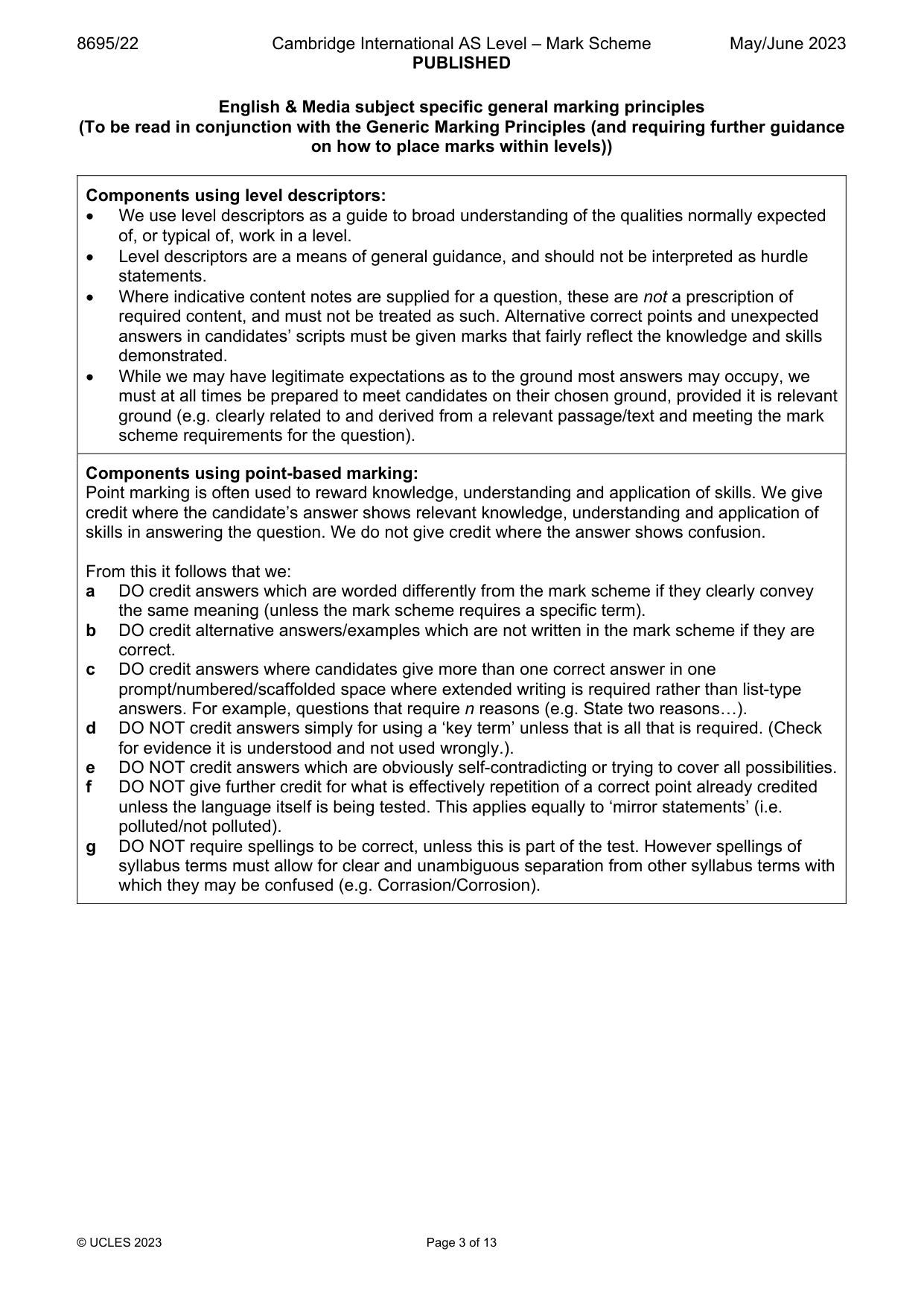
8695/22 Cambridge International AS Level – Mark Scheme PUBLISHED May/June 2023 © UCLES 2023 Page 3 of 13 English & Media subject specific general marking principles (To be read in conjunction with the Generic Marking Principles (and requiring further guidance on how to place marks within levels)) Components using level descriptors: We use level descriptors as a guide to broad understanding of the qualities normally expected of, or typical of, work in a level. Level descriptors are a means of general guidance, and should not be interpreted as hurdle statements. Where indicative content notes are supplied for a question, these are not a prescription of required content, and must not be treated as such. Alternative correct points and unexpected answers in candidates’ scripts must be given marks that fairly reflect the knowledge and skills demonstrated. While we may have legitimate expectations as to the ground most answers may occupy, we must at all times be prepared to meet candidates on their chosen ground, provided it is relevant ground (e.g. clearly related to and derived from a relevant passage/text and meeting the mark scheme requirements for the question). Components using point-based marking: Point marking is often used to reward knowledge, understanding and application of skills. We give credit where the candidate’s answer shows relevant knowledge, understanding and application of skills in answering the question. We do not give credit where the answer shows confusion. From this it follows that we: a DO credit answers which are worded differently from the mark scheme if they clearly convey the same meaning (unless the mark scheme requires a specific term). b DO credit alternative answers/examples which are not written in the mark scheme if they are correct. c DO credit answers where candidates give more than one correct answer in one prompt/numbered/scaffolded space where extended writing is required rather than list-type answers. For example, questions that require n reasons (e.g. State two reasons…). d DO NOT credit answers simply for using a ‘key term’ unless that is all that is required. (Check for evidence it is understood and not used wrongly.). e DO NOT credit answers which are obviously self-contradicting or trying to cover all possibilities. f DO NOT give further credit for what is effectively repetition of a correct point already credited unless the language itself is being tested. This applies equally to ‘mirror statements’ (i.e. polluted/not polluted). g DO NOT require spellings to be correct, unless this is part of the test. However spellings of syllabus terms must allow for clear and unambiguous separation from other syllabus terms with which they may be confused (e.g. Corrasion/Corrosion).
Mark scheme, page 4
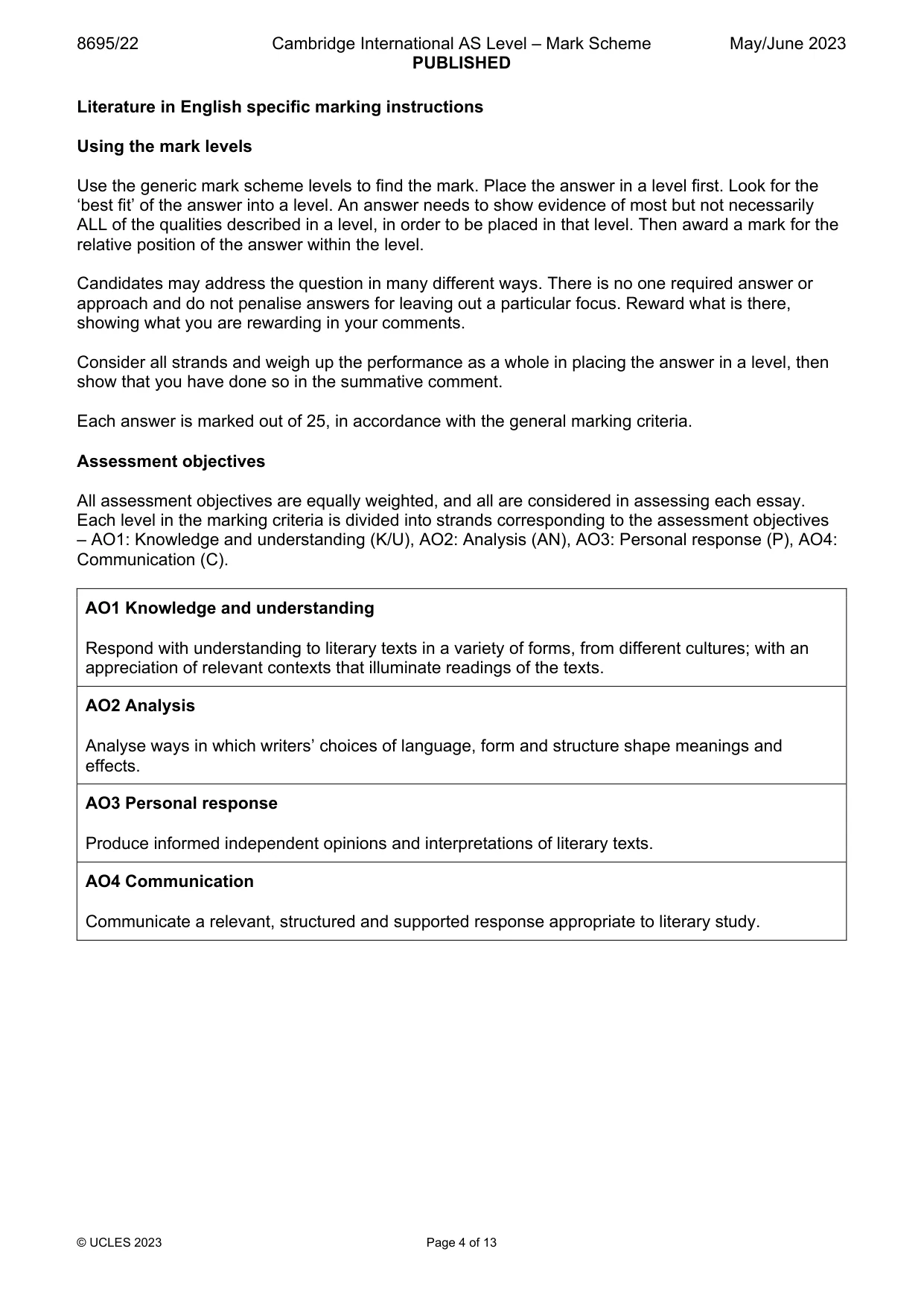
8695/22 Cambridge International AS Level – Mark Scheme PUBLISHED May/June 2023 © UCLES 2023 Page 4 of 13 Literature in English specific marking instructions Using the mark levels Use the generic mark scheme levels to find the mark. Place the answer in a level first. Look for the ‘best fit’ of the answer into a level. An answer needs to show evidence of most but not necessarily ALL of the qualities described in a level, in order to be placed in that level. Then award a mark for the relative position of the answer within the level. Candidates may address the question in many different ways. There is no one required answer or approach and do not penalise answers for leaving out a particular focus. Reward what is there, showing what you are rewarding in your comments. Consider all strands and weigh up the performance as a whole in placing the answer in a level, then show that you have done so in the summative comment. Each answer is marked out of 25, in accordance with the general marking criteria. Assessment objectives All assessment objectives are equally weighted, and all are considered in assessing each essay. Each level in the marking criteria is divided into strands corresponding to the assessment objectives – AO1: Knowledge and understanding (K/U), AO2: Analysis (AN), AO3: Personal response (P), AO4: Communication (C). AO1 Knowledge and understanding Respond with understanding to literary texts in a variety of forms, from different cultures; with an appreciation of relevant contexts that illuminate readings of the texts. AO2 Analysis Analyse ways in which writers’ choices of language, form and structure shape meanings and effects. AO3 Personal response Produce informed independent opinions and interpretations of literary texts. AO4 Communication Communicate a relevant, structured and supported response appropriate to literary study.
Mark scheme, page 5
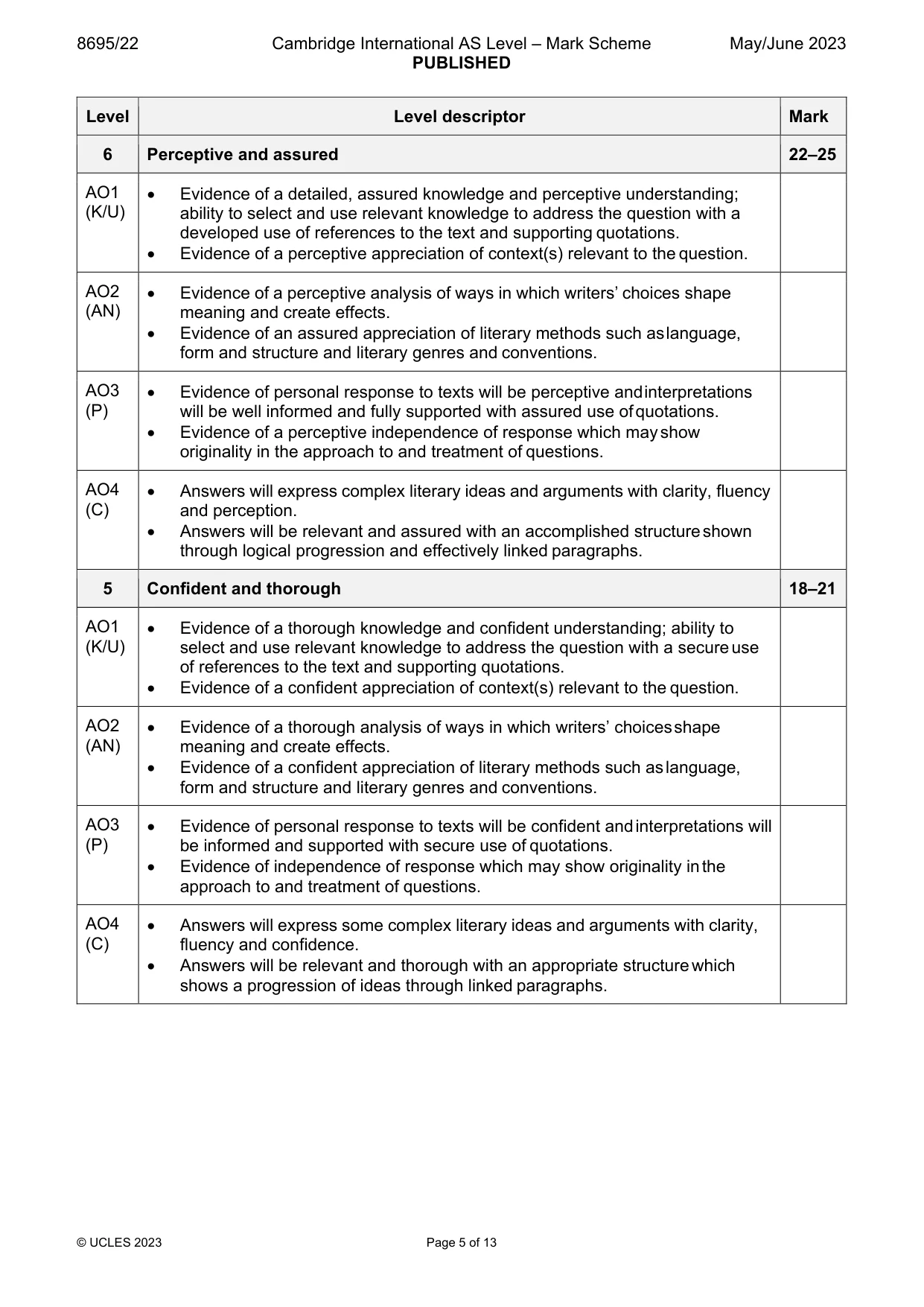
8695/22 Cambridge International AS Level – Mark Scheme PUBLISHED May/June 2023 © UCLES 2023 Page 5 of 13 Level Level descriptor Mark 6 Perceptive and assured 22–25 AO1 (K/U) Evidence of a detailed, assured knowledge and perceptive understanding; ability to select and use relevant knowledge to address the question with a developed use of references to the text and supporting quotations. Evidence of a perceptive appreciation of context(s) relevant to the question. AO2 (AN) Evidence of a perceptive analysis of ways in which writers’ choices shape meaning and create effects. Evidence of an assured appreciation of literary methods such as language, form and structure and literary genres and conventions. AO3 (P) Evidence of personal response to texts will be perceptive and interpretations will be well informed and fully supported with assured use of quotations. Evidence of a perceptive independence of response which may show originality in the approach to and treatment of questions. AO4 (C) Answers will express complex literary ideas and arguments with clarity, fluency and perception. Answers will be relevant and assured with an accomplished structure shown through logical progression and effectively linked paragraphs. 5 Confident and thorough 18–21 AO1 (K/U) Evidence of a thorough knowledge and confident understanding; ability to select and use relevant knowledge to address the question with a secure use of references to the text and supporting quotations. Evidence of a confident appreciation of context(s) relevant to the question. AO2 (AN) Evidence of a thorough analysis of ways in which writers’ choices shape meaning and create effects. Evidence of a confident appreciation of literary methods such as language, form and structure and literary genres and conventions. AO3 (P) Evidence of personal response to texts will be confident and interpretations will be informed and supported with secure use of quotations. Evidence of independence of response which may show originality in the approach to and treatment of questions. AO4 (C) Answers will express some complex literary ideas and arguments with clarity, fluency and confidence. Answers will be relevant and thorough with an appropriate structure which shows a progression of ideas through linked paragraphs.
Mark scheme, page 6
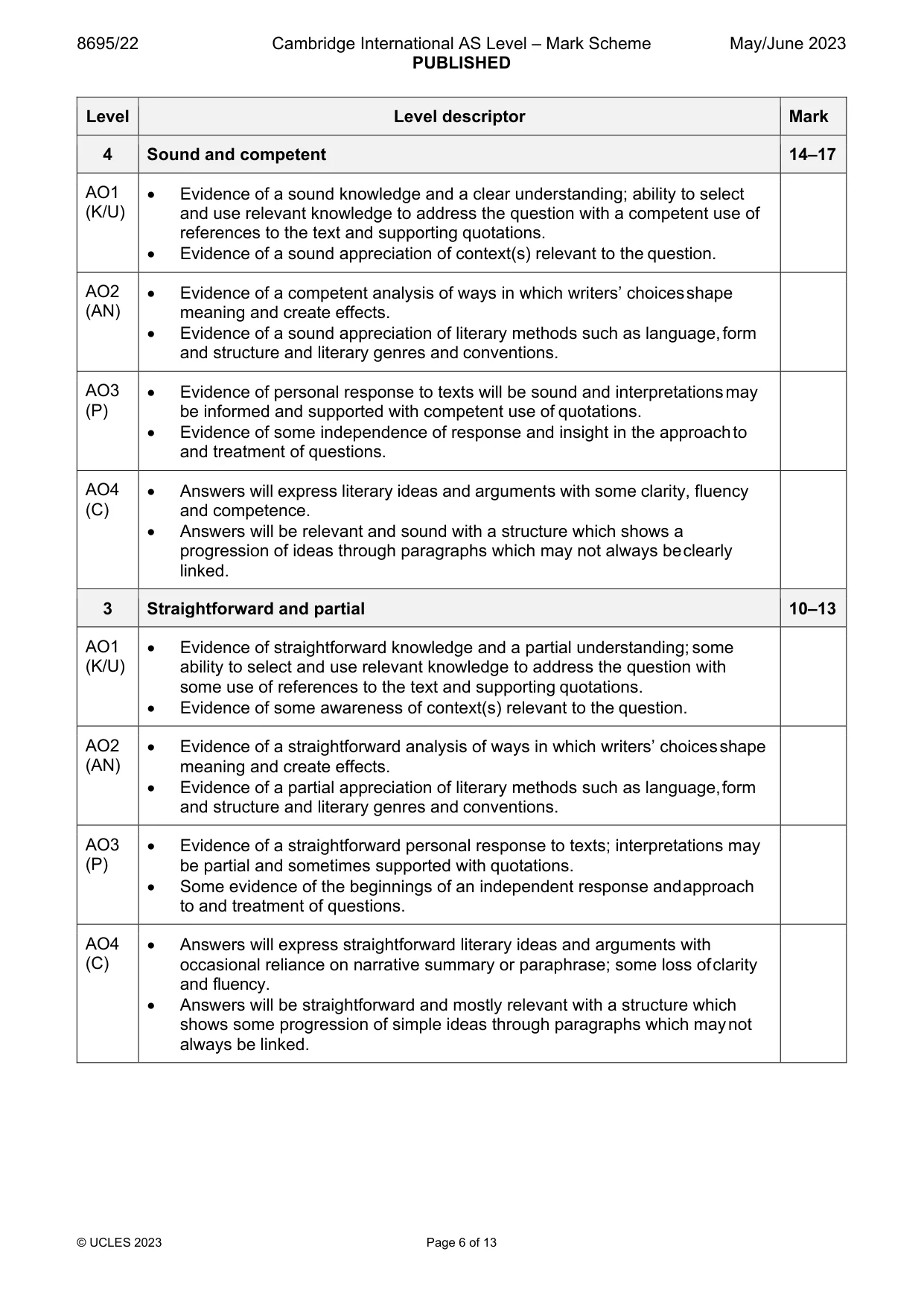
8695/22 Cambridge International AS Level – Mark Scheme PUBLISHED May/June 2023 © UCLES 2023 Page 6 of 13 Level Level descriptor Mark 4 Sound and competent 14–17 AO1 (K/U) Evidence of a sound knowledge and a clear understanding; ability to select and use relevant knowledge to address the question with a competent use of references to the text and supporting quotations. Evidence of a sound appreciation of context(s) relevant to the question. AO2 (AN) Evidence of a competent analysis of ways in which writers’ choices shape meaning and create effects. Evidence of a sound appreciation of literary methods such as language, form and structure and literary genres and conventions. AO3 (P) Evidence of personal response to texts will be sound and interpretations may be informed and supported with competent use of quotations. Evidence of some independence of response and insight in the approach to and treatment of questions. AO4 (C) Answers will express literary ideas and arguments with some clarity, fluency and competence. Answers will be relevant and sound with a structure which shows a progression of ideas through paragraphs which may not always be clearly linked. 3 Straightforward and partial 10–13 AO1 (K/U) Evidence of straightforward knowledge and a partial understanding; some ability to select and use relevant knowledge to address the question with some use of references to the text and supporting quotations. Evidence of some awareness of context(s) relevant to the question. AO2 (AN) Evidence of a straightforward analysis of ways in which writers’ choices shape meaning and create effects. Evidence of a partial appreciation of literary methods such as language, form and structure and literary genres and conventions. AO3 (P) Evidence of a straightforward personal response to texts; interpretations may be partial and sometimes supported with quotations. Some evidence of the beginnings of an independent response and approach to and treatment of questions. AO4 (C) Answers will express straightforward literary ideas and arguments with occasional reliance on narrative summary or paraphrase; some loss of clarity and fluency. Answers will be straightforward and mostly relevant with a structure which shows some progression of simple ideas through paragraphs which may not always be linked.
Mark scheme, page 7
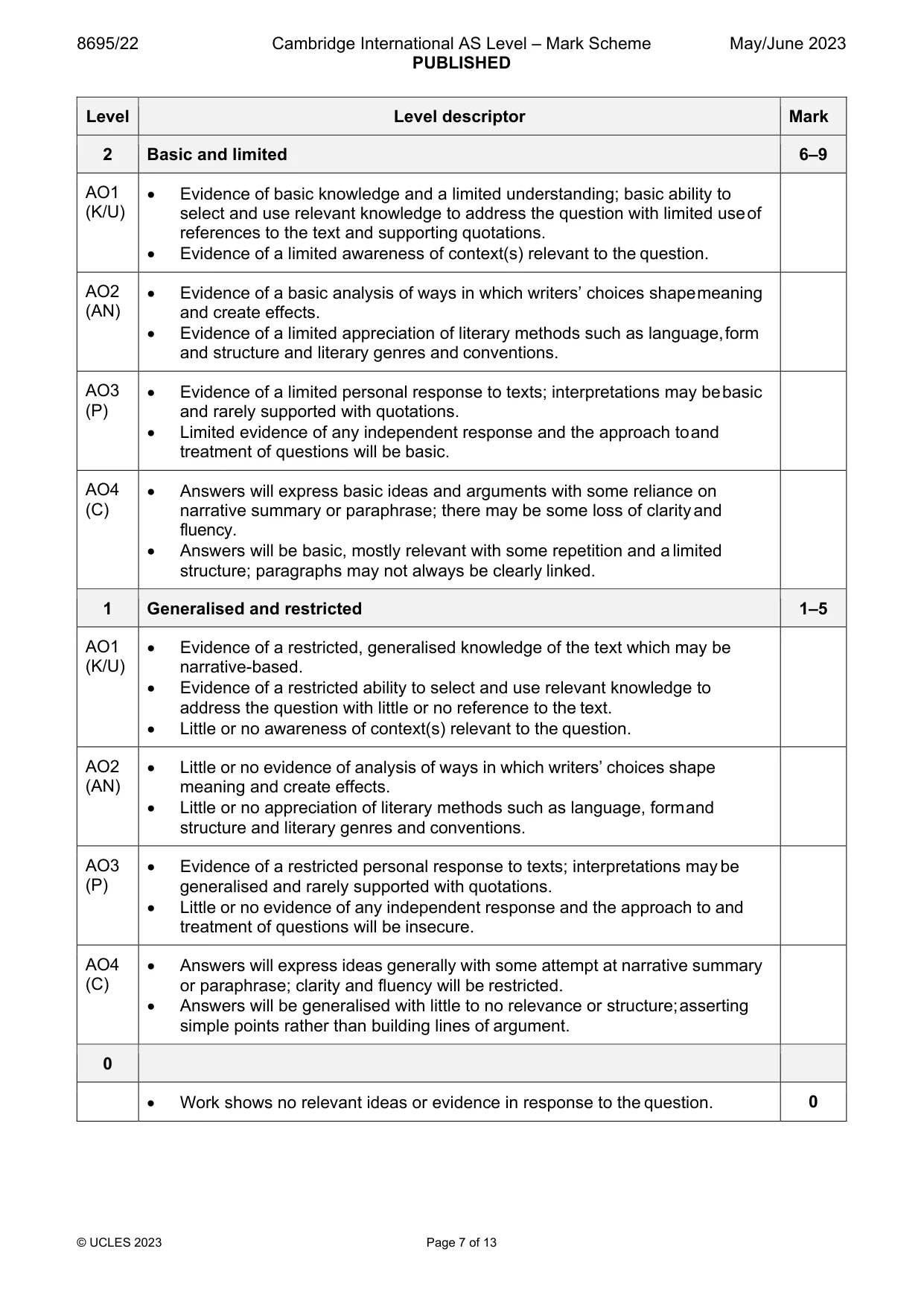
8695/22 Cambridge International AS Level – Mark Scheme PUBLISHED May/June 2023 © UCLES 2023 Page 7 of 13 Level Level descriptor Mark 2 Basic and limited 6–9 AO1 (K/U) Evidence of basic knowledge and a limited understanding; basic ability to select and use relevant knowledge to address the question with limited use of references to the text and supporting quotations. Evidence of a limited awareness of context(s) relevant to the question. AO2 (AN) Evidence of a basic analysis of ways in which writers’ choices shape meaning and create effects. Evidence of a limited appreciation of literary methods such as language, form and structure and literary genres and conventions. AO3 (P) Evidence of a limited personal response to texts; interpretations may be basic and rarely supported with quotations. Limited evidence of any independent response and the approach to and treatment of questions will be basic. AO4 (C) Answers will express basic ideas and arguments with some reliance on narrative summary or paraphrase; there may be some loss of clarity and fluency. Answers will be basic, mostly relevant with some repetition and a limited structure; paragraphs may not always be clearly linked. 1 Generalised and restricted 1–5 AO1 (K/U) Evidence of a restricted, generalised knowledge of the text which may be narrative-based. Evidence of a restricted ability to select and use relevant knowledge to address the question with little or no reference to the text. Little or no awareness of context(s) relevant to the question. AO2 (AN) Little or no evidence of analysis of ways in which writers’ choices shape meaning and create effects. Little or no appreciation of literary methods such as language, form and structure and literary genres and conventions. AO3 (P) Evidence of a restricted personal response to texts; interpretations may be generalised and rarely supported with quotations. Little or no evidence of any independent response and the approach to and treatment of questions will be insecure. AO4 (C) Answers will express ideas generally with some attempt at narrative summary or paraphrase; clarity and fluency will be restricted. Answers will be generalised with little to no relevance or structure; asserting simple points rather than building lines of argument. 0 Work shows no relevant ideas or evidence in response to the question. 0
Mark scheme, page 8
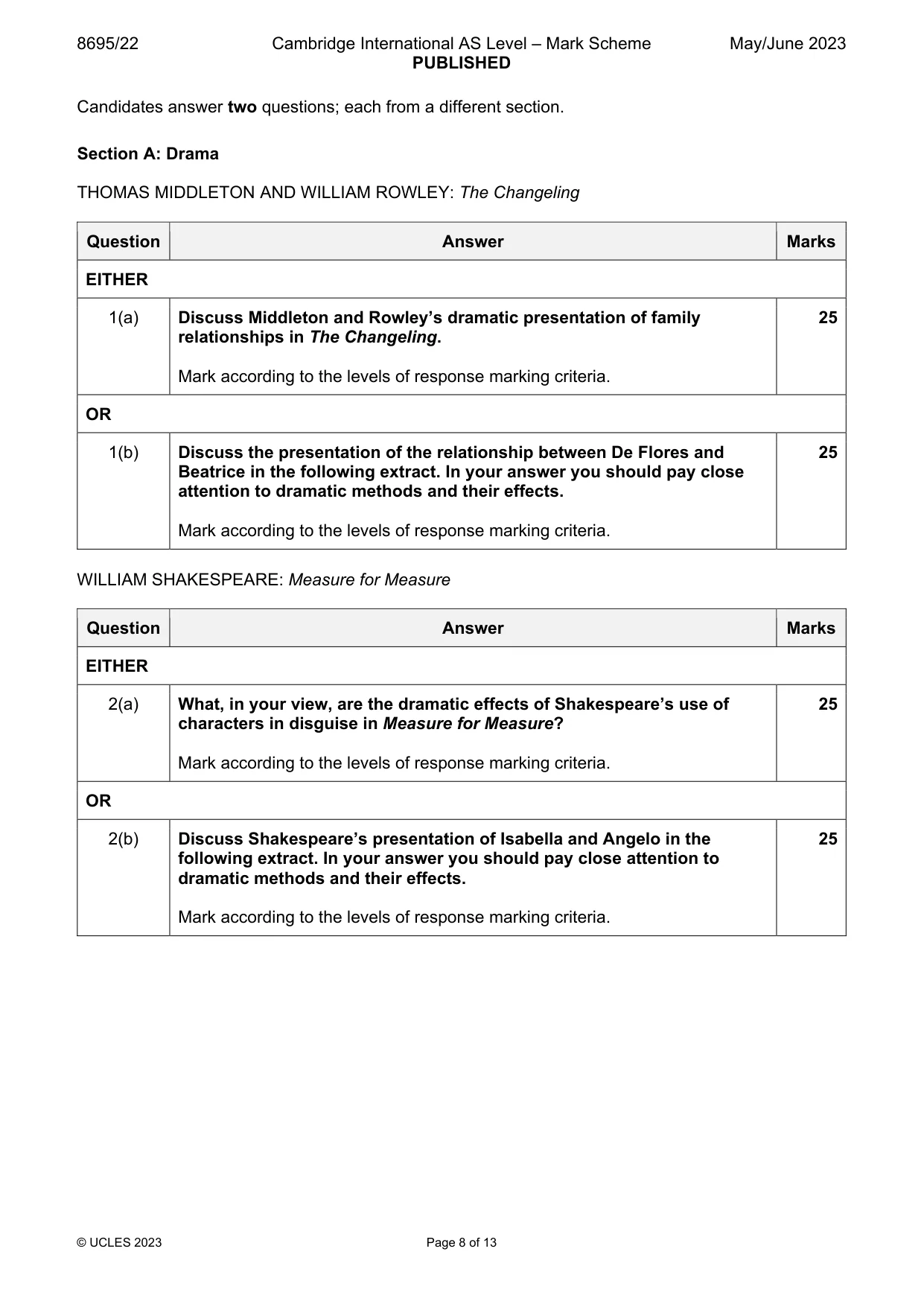
8695/22 Cambridge International AS Level – Mark Scheme PUBLISHED May/June 2023 © UCLES 2023 Page 8 of 13 Candidates answer two questions; each from a different section. Section A: Drama THOMAS MIDDLETON AND WILLIAM ROWLEY: The Changeling Question Answer Marks EITHER 1(a) Discuss Middleton and Rowley’s dramatic presentation of family relationships in The Changeling. Mark according to the levels of response marking criteria. 25 OR 1(b) Discuss the presentation of the relationship between De Flores and Beatrice in the following extract. In your answer you should pay close attention to dramatic methods and their effects. Mark according to the levels of response marking criteria. 25 WILLIAM SHAKESPEARE: Measure for Measure Question Answer Marks EITHER 2(a) What, in your view, are the dramatic effects of Shakespeare’s use of characters in disguise in Measure for Measure? Mark according to the levels of response marking criteria. 25 OR 2(b) Discuss Shakespeare’s presentation of Isabella and Angelo in the following extract. In your answer you should pay close attention to dramatic methods and their effects. Mark according to the levels of response marking criteria. 25
Mark scheme, page 9
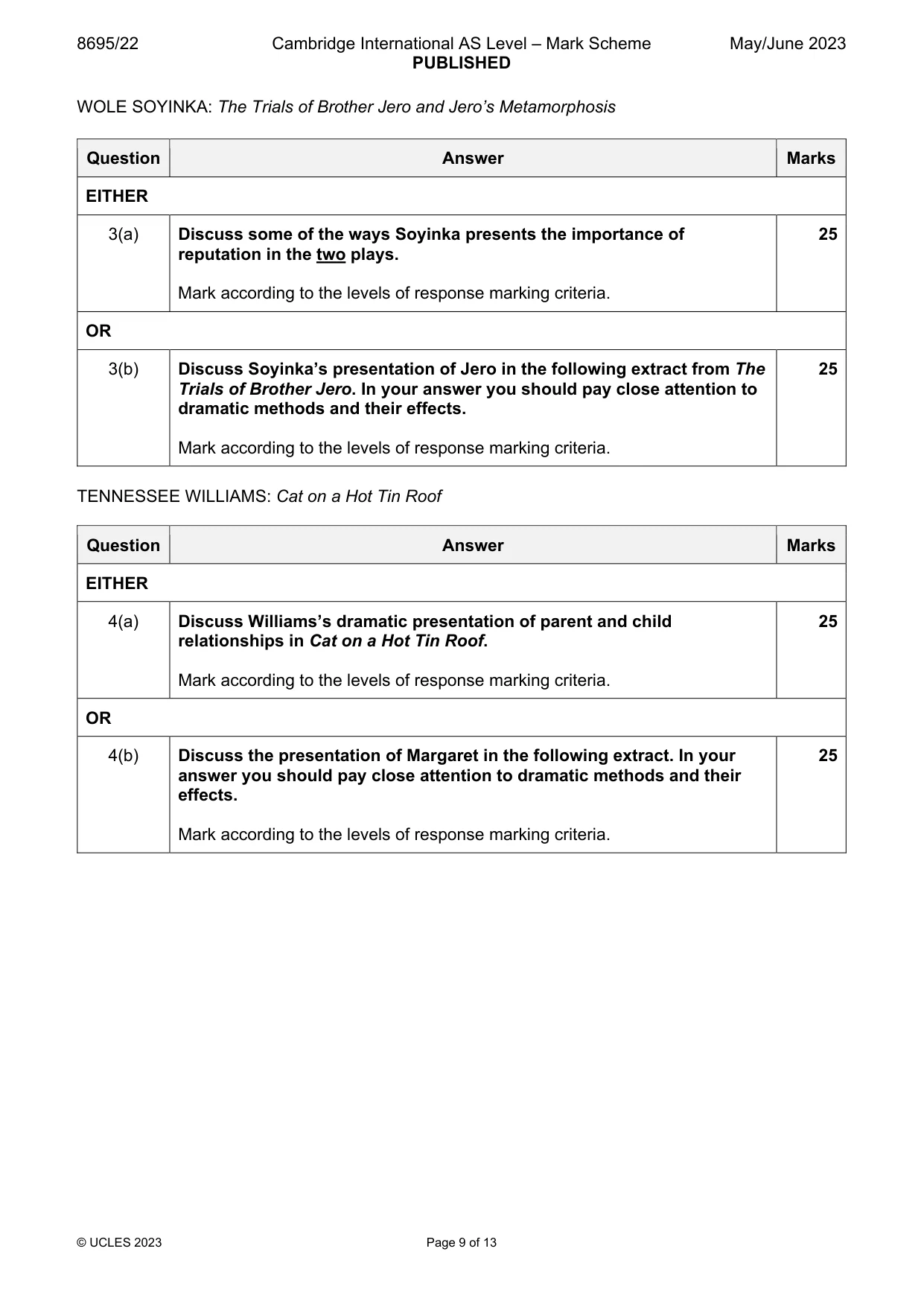
8695/22 Cambridge International AS Level – Mark Scheme PUBLISHED May/June 2023 © UCLES 2023 Page 9 of 13 WOLE SOYINKA: The Trials of Brother Jero and Jero’s Metamorphosis Question Answer Marks EITHER 3(a) Discuss some of the ways Soyinka presents the importance of reputation in the two plays. Mark according to the levels of response marking criteria. 25 OR 3(b) Discuss Soyinka’s presentation of Jero in the following extract from The Trials of Brother Jero. In your answer you should pay close attention to dramatic methods and their effects. Mark according to the levels of response marking criteria. 25 TENNESSEE WILLIAMS: Cat on a Hot Tin Roof Question Answer Marks EITHER 4(a) Discuss Williams’s dramatic presentation of parent and child relationships in Cat on a Hot Tin Roof. Mark according to the levels of response marking criteria. 25 OR 4(b) Discuss the presentation of Margaret in the following extract. In your answer you should pay close attention to dramatic methods and their effects. Mark according to the levels of response marking criteria. 25
Mark scheme, page 10
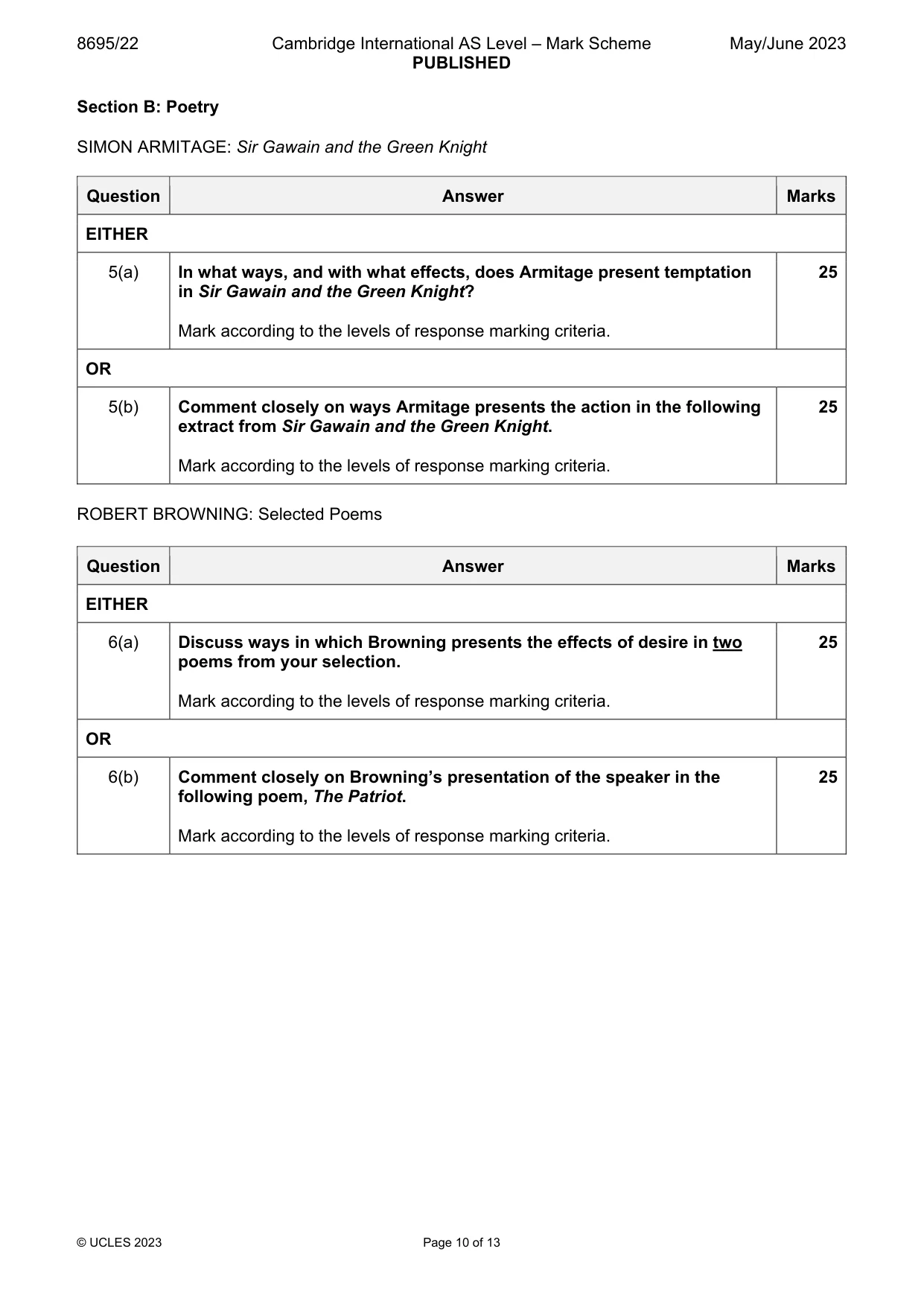
8695/22 Cambridge International AS Level – Mark Scheme PUBLISHED May/June 2023 © UCLES 2023 Page 10 of 13 Section B: Poetry SIMON ARMITAGE: Sir Gawain and the Green Knight Question Answer Marks EITHER 5(a) In what ways, and with what effects, does Armitage present temptation in Sir Gawain and the Green Knight? Mark according to the levels of response marking criteria. 25 OR 5(b) Comment closely on ways Armitage presents the action in the following extract from Sir Gawain and the Green Knight. Mark according to the levels of response marking criteria. 25 ROBERT BROWNING: Selected Poems Question Answer Marks EITHER 6(a) Discuss ways in which Browning presents the effects of desire in two poems from your selection. Mark according to the levels of response marking criteria. 25 OR 6(b) Comment closely on Browning’s presentation of the speaker in the following poem, The Patriot. Mark according to the levels of response marking criteria. 25
Mark scheme, page 11
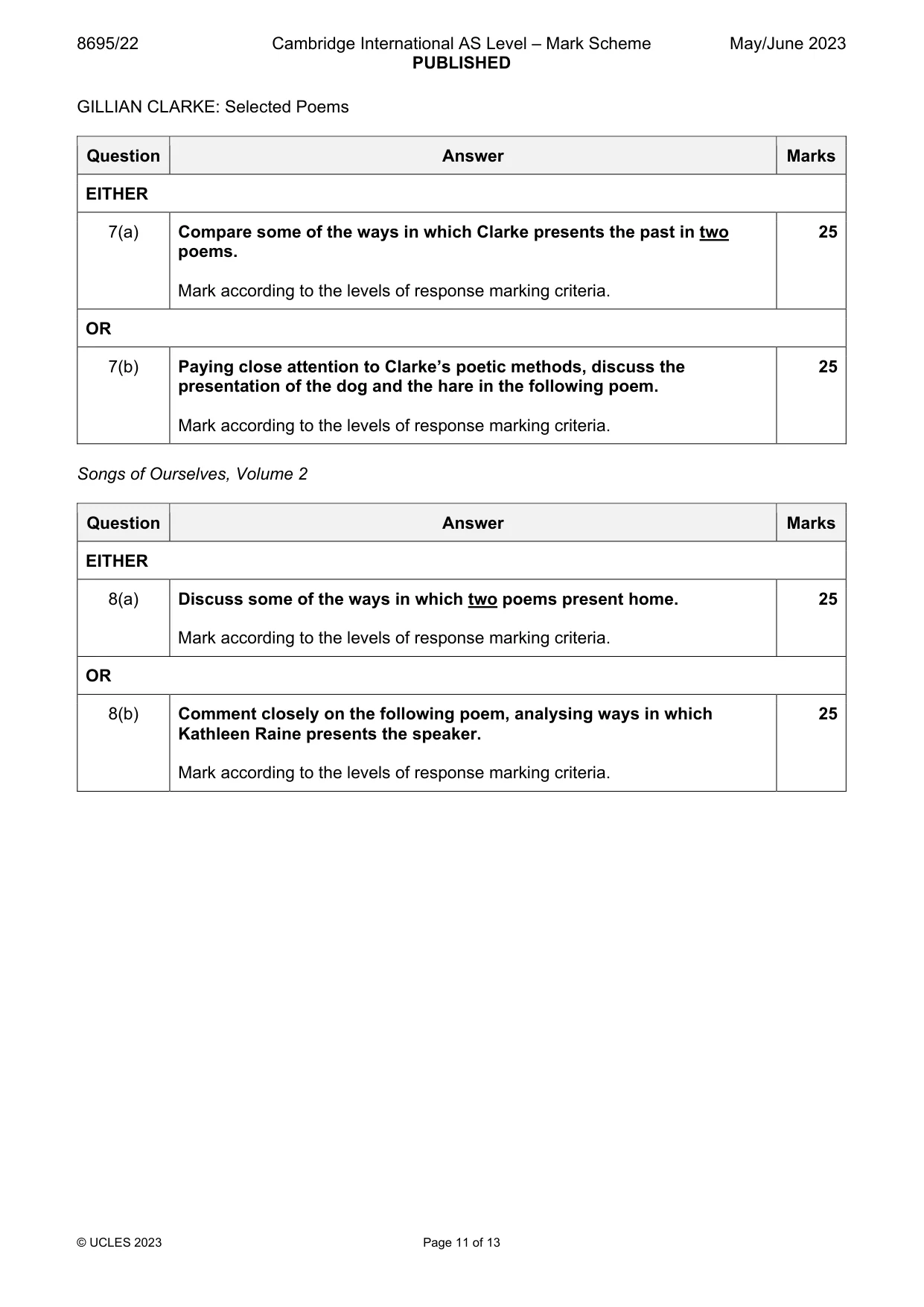
8695/22 Cambridge International AS Level – Mark Scheme PUBLISHED May/June 2023 © UCLES 2023 Page 11 of 13 GILLIAN CLARKE: Selected Poems Question Answer Marks EITHER 7(a) Compare some of the ways in which Clarke presents the past in two poems. Mark according to the levels of response marking criteria. 25 OR 7(b) Paying close attention to Clarke’s poetic methods, discuss the presentation of the dog and the hare in the following poem. Mark according to the levels of response marking criteria. 25 Songs of Ourselves, Volume 2 Question Answer Marks EITHER 8(a) Discuss some of the ways in which two poems present home. Mark according to the levels of response marking criteria. 25 OR 8(b) Comment closely on the following poem, analysing ways in which Kathleen Raine presents the speaker. Mark according to the levels of response marking criteria. 25
Mark scheme, page 12
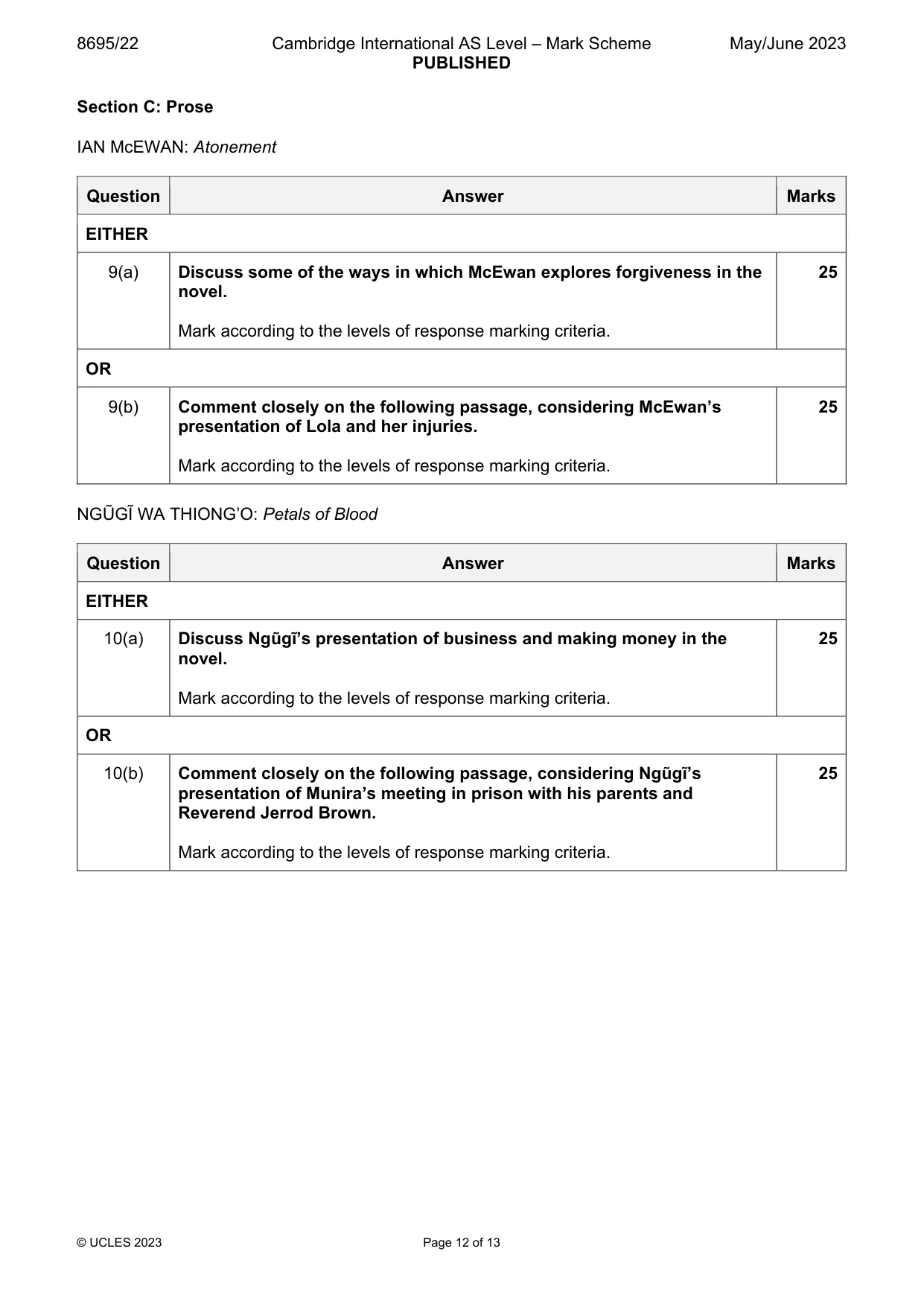
8695/22 Cambridge International AS Level – Mark Scheme PUBLISHED May/June 2023 © UCLES 2023 Page 12 of 13 Section C: Prose IAN McEWAN: Atonement Question Answer Marks EITHER 9(a) Discuss some of the ways in which McEwan explores forgiveness in the novel. Mark according to the levels of response marking criteria. 25 OR 9(b) Comment closely on the following passage, considering McEwan’s presentation of Lola and her injuries. Mark according to the levels of response marking criteria. 25 NGŨGĨ WA THIONG’O: Petals of Blood Question Answer Marks EITHER 10(a) Discuss Ngũgĩ’s presentation of business and making money in the novel. Mark according to the levels of response marking criteria. 25 OR 10(b) Comment closely on the following passage, considering Ngũgĩ’s presentation of Munira’s meeting in prison with his parents and Reverend Jerrod Brown. Mark according to the levels of response marking criteria. 25
Mark scheme, page 13
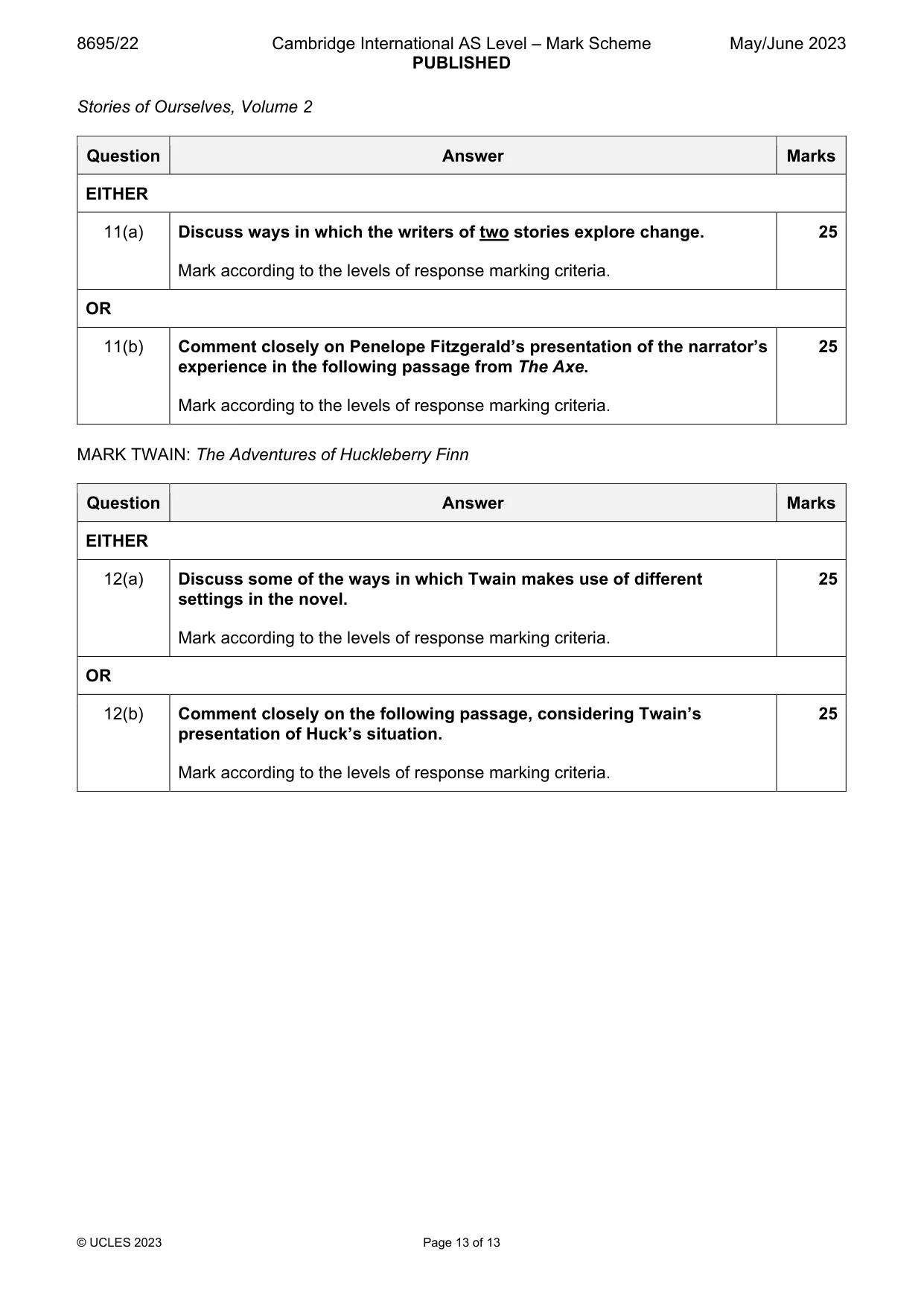
8695/22 Cambridge International AS Level – Mark Scheme PUBLISHED May/June 2023 © UCLES 2023 Page 13 of 13 Stories of Ourselves, Volume 2 Question Answer Marks EITHER 11(a) Discuss ways in which the writers of two stories explore change. Mark according to the levels of response marking criteria. 25 OR 11(b) Comment closely on Penelope Fitzgerald’s presentation of the narrator’s experience in the following passage from The Axe. Mark according to the levels of response marking criteria. 25 MARK TWAIN: The Adventures of Huckleberry Finn Question Answer Marks EITHER 12(a) Discuss some of the ways in which Twain makes use of different settings in the novel. Mark according to the levels of response marking criteria. 25 OR 12(b) Comment closely on the following passage, considering Twain’s presentation of Huck’s situation. Mark according to the levels of response marking criteria. 25
What you needed in this session
Cambridge’s own grade thresholds for 2023 May/June, Paper 2 · Variant 2. A higher threshold means an easier paper — the bar moves with how the cohort did.