Cambridge A Level English - Language and Literature (AS Level only, from 2016) 8695 — 2024 May/June Paper 2 · Variant 2
8695/22/M/J/24 · 50 marks · 120 min
The question paper and its mark scheme, free to read here and free to download. This is Cambridge’s own paper, exactly as it was sat.
Question paper24 pages

Mark scheme13 pages
Answers below. Sit the paper first if you are practising.
Paper as text
Question paper, page 1
This document has 24 pages. Any blank pages are indicated. [Turn over Cambridge International AS Level * 1 8 6 3 3 4 5 2 6 5 * DC (RCL (DF)) 329887/3 © UCLES 2024 LANGUAGE AND LITERATURE IN ENGLISH 8695/22 Paper 2 Drama, Poetry and Prose May/June 2024 2 hours You must answer on the enclosed answer booklet. You will need: Answer booklet (enclosed) INSTRUCTIONS ● Answer two questions in total, each from a different section. ● Follow the instructions on the front cover of the answer booklet. If you need additional answer paper, ask the invigilator for a continuation booklet. ● Dictionaries are not allowed. INFORMATION ● The total mark for this paper is 50. ● The number of marks for each question or part question is shown in brackets [ ].
Question paper, page 2
2 8695/22/M/J/24 © UCLES 2024 Section A: Drama ERROL JOHN: Moon on a Rainbow Shawl 1 Either (a) Discuss some of the ways John shapes an audience’s response to Epf in Moon on a Rainbow Shawl. [25] Or (b) Paying close attention to dramatic methods, discuss John’s presentation of the relationship between Mavis and Prince in the following extract from the play. [25] [PRINCE comes quietly in from the street, ducks under the clothes line and calls softly: ‘Mavis.’] Content removed due to copyright restrictions.
Question paper, page 3
3 8695/22/M/J/24 © UCLES 2024 [Turn over [The SOLDIER goes out.] (from Act 2, Scene 2) Content removed due to copyright restrictions.
Question paper, page 4
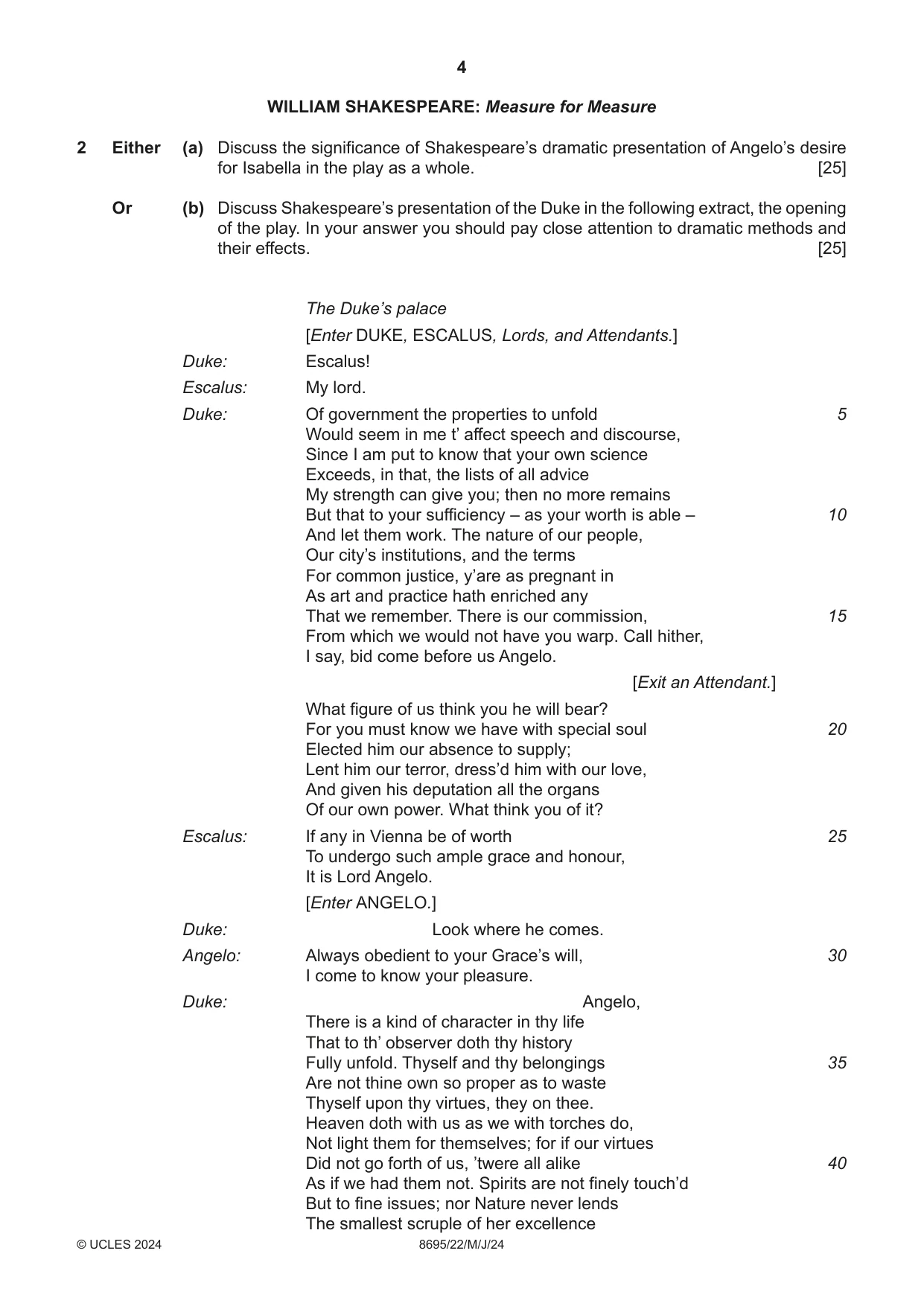
4 8695/22/M/J/24 © UCLES 2024 WILLIAM SHAKESPEARE: Measure for Measure 2 Either (a) Discuss the significance of Shakespeare’s dramatic presentation of Angelo’s desire for Isabella in the play as a whole. [25] Or (b) Discuss Shakespeare’s presentation of the Duke in the following extract, the opening of the play. In your answer you should pay close attention to dramatic methods and their effects. [25] The Duke’s palace [Enter DUKE, ESCALUS, Lords, and Attendants.] Duke: Escalus! Escalus: My lord. Duke: Of government the properties to unfold Would seem in me t’ affect speech and discourse, Since I am put to know that your own science Exceeds, in that, the lists of all advice My strength can give you; then no more remains But that to your sufficiency – as your worth is able – And let them work. The nature of our people, Our city’s institutions, and the terms For common justice, y’are as pregnant in As art and practice hath enriched any That we remember. There is our commission, From which we would not have you warp. Call hither, I say, bid come before us Angelo. [Exit an Attendant.] What figure of us think you he will bear? For you must know we have with special soul Elected him our absence to supply; Lent him our terror, dress’d him with our love, And given his deputation all the organs Of our own power. What think you of it? Escalus: If any in Vienna be of worth To undergo such ample grace and honour, It is Lord Angelo. [Enter ANGELO.] Duke: Look where he comes. Angelo: Always obedient to your Grace’s will, I come to know your pleasure. Duke: Angelo, Τhere is a kind of character in thy life That to th’ observer doth thy history Fully unfold. Thyself and thy belongings Are not thine own so proper as to waste Thyself upon thy virtues, they on thee. Heaven doth with us as we with torches do, Not light them for themselves; for if our virtues Did not go forth of us, ’twere all alike As if we had them not. Spirits are not finely touch’d But to fine issues; nor Nature never lends The smallest scruple of her excellence 5 10 15 20 25 30 35 40
Question paper, page 5
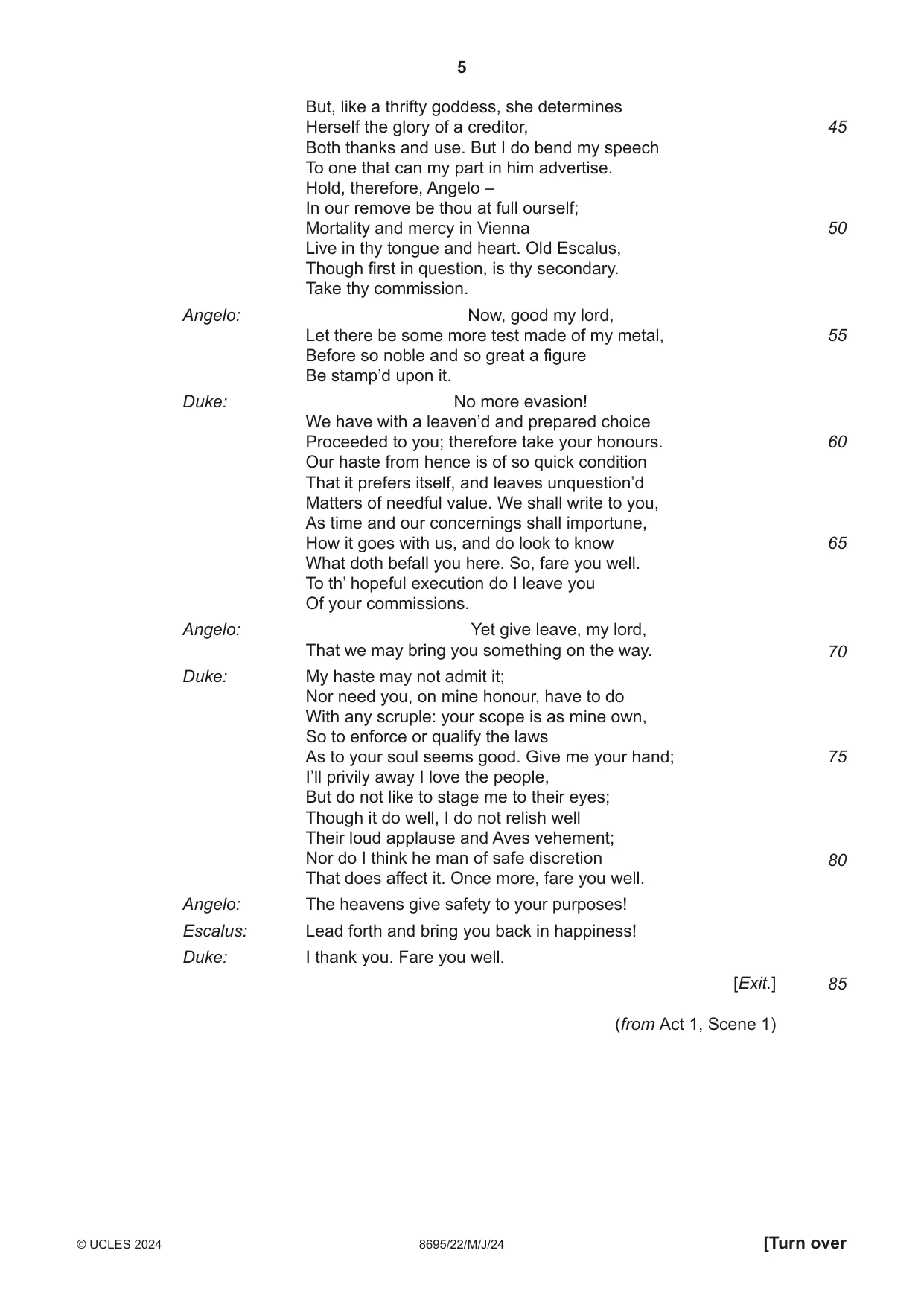
5 8695/22/M/J/24 © UCLES 2024 [Turn over But, like a thrifty goddess, she determines Herself the glory of a creditor, Both thanks and use. But I do bend my speech To one that can my part in him advertise. Hold, therefore, Angelo – In our remove be thou at full ourself; Mortality and mercy in Vienna Live in thy tongue and heart. Old Escalus, Though first in question, is thy secondary. Take thy commission. Angelo: Now, good my lord, Let there be some more test made of my metal, Before so noble and so great a figure Be stamp’d upon it. Duke: No more evasion! We have with a leaven’d and prepared choice Proceeded to you; therefore take your honours. Our haste from hence is of so quick condition That it prefers itself, and leaves unquestion’d Matters of needful value. We shall write to you, As time and our concernings shall importune, How it goes with us, and do look to know What doth befall you here. So, fare you well. To th’ hopeful execution do I leave you Of your commissions. Angelo: Yet give leave, my lord, That we may bring you something on the way. Duke: My haste may not admit it; Nor need you, on mine honour, have to do With any scruple: your scope is as mine own, So to enforce or qualify the laws As to your soul seems good. Give me your hand; I’ll privily away I love the people, But do not like to stage me to their eyes; Though it do well, I do not relish well Their loud applause and Aves vehement; Nor do I think he man of safe discretion That does affect it. Once more, fare you well. Angelo: The heavens give safety to your purposes! Escalus: Lead forth and bring you back in happiness! Duke: I thank you. Fare you well. [Exit.] (from Act 1, Scene 1) 45 50 55 60 65 70 75 80 85
Question paper, page 6
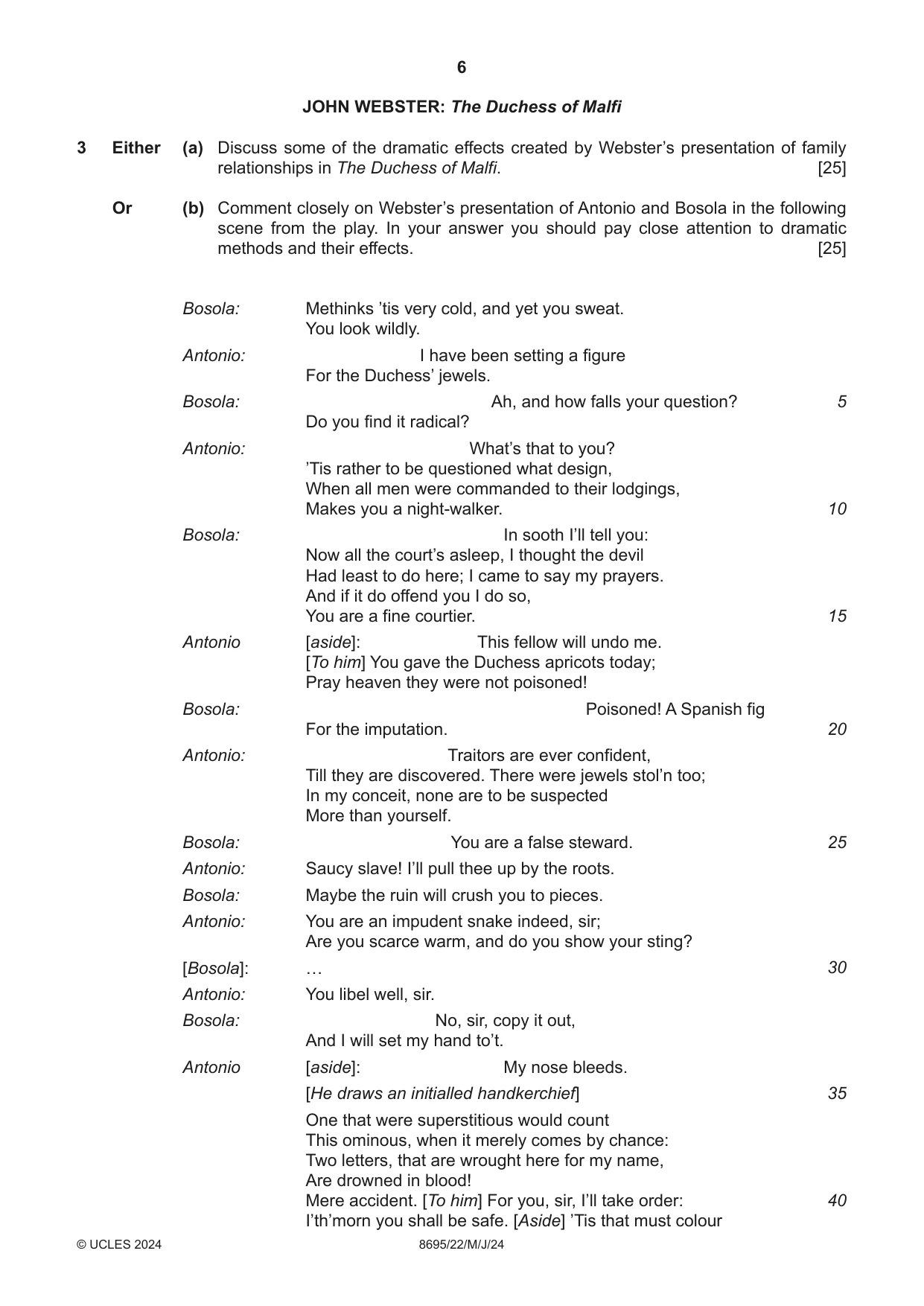
6 8695/22/M/J/24 © UCLES 2024 JOHN WEBSTER: The Duchess of Malfi 3 Either (a) Discuss some of the dramatic effects created by Webster’s presentation of family relationships in The Duchess of Malfi. [25] Or (b) Comment closely on Webster’s presentation of Antonio and Bosola in the following scene from the play. In your answer you should pay close attention to dramatic methods and their effects. [25] Bosola: Methinks ’tis very cold, and yet you sweat. You look wildly. Antonio: I have been setting a figure For the Duchess’ jewels. Bosola: Ah, and how falls your question? Do you find it radical? Antonio: What’s that to you? ’Tis rather to be questioned what design, When all men were commanded to their lodgings, Makes you a night-walker. Bosola: In sooth I’ll tell you: Now all the court’s asleep, I thought the devil Had least to do here; I came to say my prayers. And if it do offend you I do so, You are a fine courtier. Antonio [aside]: This fellow will undo me. [To him] You gave the Duchess apricots today; Pray heaven they were not poisoned! Bosola: Poisoned! A Spanish fig For the imputation. Antonio: Traitors are ever confident, Till they are discovered. There were jewels stol’n too; In my conceit, none are to be suspected More than yourself. Bosola: You are a false steward. Antonio: Saucy slave! I’ll pull thee up by the roots. Bosola: Maybe the ruin will crush you to pieces. Antonio: You are an impudent snake indeed, sir; Are you scarce warm, and do you show your sting? [Bosola]: … Antonio: You libel well, sir. Bosola: No, sir, copy it out, And I will set my hand to’t. Antonio [aside]: My nose bleeds. [He draws an initialled handkerchief] One that were superstitious would count This ominous, when it merely comes by chance: Two letters, that are wrought here for my name, Are drowned in blood! Mere accident. [To him] For you, sir, I’ll take order: I’th’morn you shall be safe. [Aside] ’Tis that must colour 5 10 15 20 25 30 35 40
Question paper, page 7
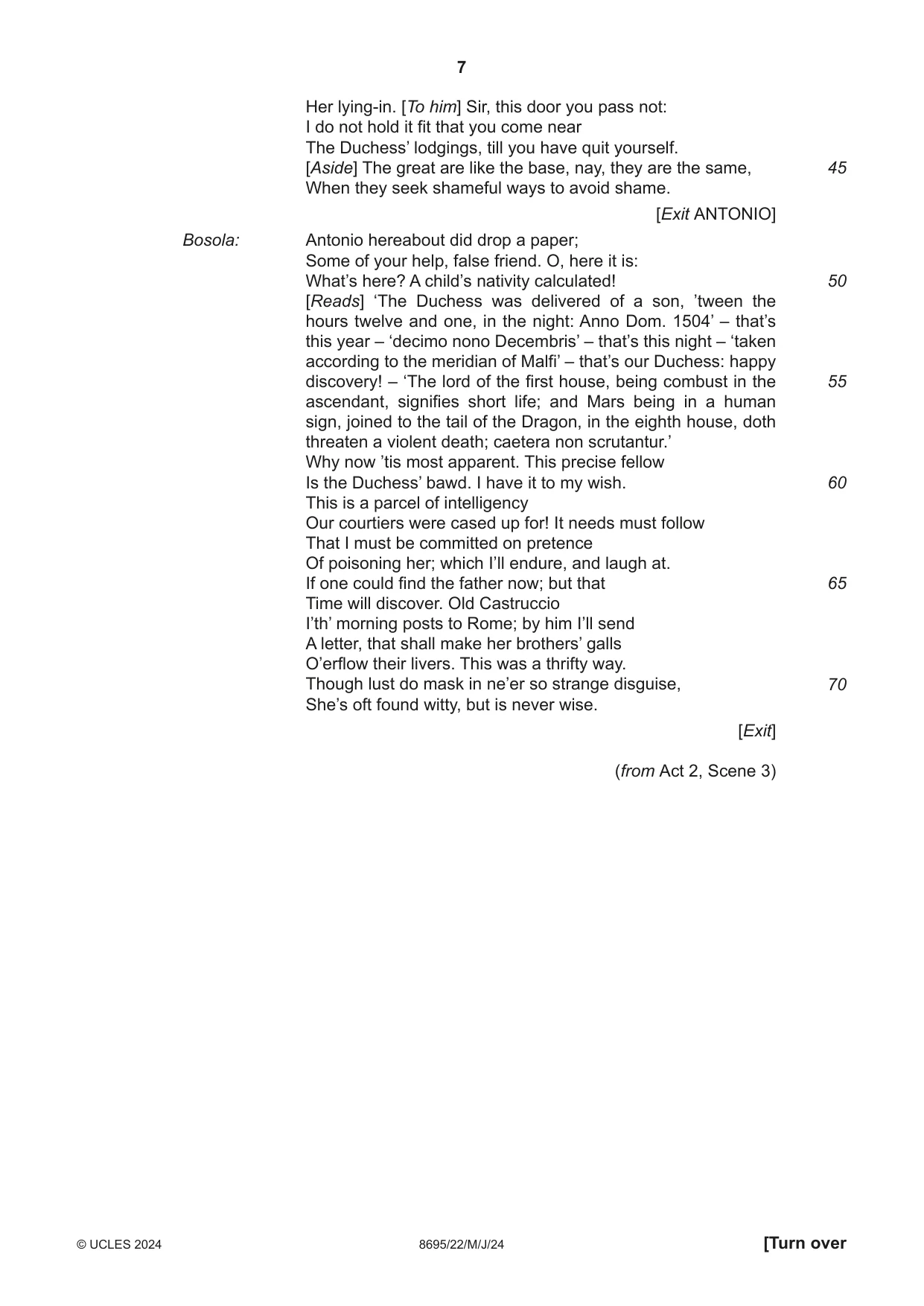
7 8695/22/M/J/24 © UCLES 2024 [Turn over Her lying-in. [To him] Sir, this door you pass not: I do not hold it fit that you come near The Duchess’ lodgings, till you have quit yourself. [Aside] The great are like the base, nay, they are the same, When they seek shameful ways to avoid shame. [Exit ANTONIO] Bosola: Antonio hereabout did drop a paper; Some of your help, false friend. O, here it is: What’s here? A child’s nativity calculated! [Reads] ‘The Duchess was delivered of a son, ’tween the hours twelve and one, in the night: Anno Dom. 1504’ – that’s this year – ‘decimo nono Decembris’ – that’s this night – ‘taken according to the meridian of Malfi’ – that’s our Duchess: happy discovery! – ‘The lord of the first house, being combust in the ascendant, signifies short life; and Mars being in a human sign, joined to the tail of the Dragon, in the eighth house, doth threaten a violent death; caetera non scrutantur.’ Why now ’tis most apparent. This precise fellow Is the Duchess’ bawd. I have it to my wish. This is a parcel of intelligency Our courtiers were cased up for! It needs must follow That I must be committed on pretence Of poisoning her; which I’ll endure, and laugh at. If one could find the father now; but that Time will discover. Old Castruccio I’th’ morning posts to Rome; by him I’ll send A letter, that shall make her brothers’ galls O’erflow their livers. This was a thrifty way. Though lust do mask in ne’er so strange disguise, She’s oft found witty, but is never wise. [Exit] (from Act 2, Scene 3) 45 50 55 60 65 70
Question paper, page 8
8 8695/22/M/J/24 © UCLES 2024 TENNESSEE WILLIAMS: Cat on a Hot Tin Roof 4 Either (a) ‘Marriage in Cat on a Hot Tin Roof is presented as a relationship between two people who don’t understand each other.’ With this comment in mind, discuss Williams’s presentation of marriage in the play. [25] Or (b) Paying close attention to dramatic methods, analyse the following extract from Cat on a Hot Tin Roof, showing its significance to the play. [25] Big Daddy: Brick, you know, I swear to God, I don’t know the way it happens. Content removed due to copyright restrictions.
Question paper, page 9
9 8695/22/M/J/24 © UCLES 2024 [Turn over Brick: Yes, sir, yes, I know. (from Act 2) Content removed due to copyright restrictions
Question paper, page 10
10 8695/22/M/J/24 © UCLES 2024 Section B: Poetry MAYA ANGELOU: And Still I Rise 5 Either (a) Discuss some of the ways in which Angelou explores racial tensions. In your answer you should refer to two poems from the selection. [25] Or (b) Discuss Angelou’s presentation of the speaker in the following poem. [25] Where We Belong, A Duet In every town and village, Now I’m where I belong. Content removed due to copyright restrictions.
Question paper, page 11
11 8695/22/M/J/24 © UCLES 2024 [Turn over TURN OVER FOR QUESTION 6.
Question paper, page 12
12 8695/22/M/J/24 © UCLES 2024 SIMON ARMITAGE: Sir Gawain and the Green Knight 6 Either (a) Discuss some of the effects created by Armitage’s presentation of violence in Sir Gawain and the Green Knight. [25] Or (b) Analyse ways in which Armitage develops a reader’s response to the relationship between Sir Gawain and the Green Knight in the following extract from the poem. [25] The green lord laughed, and leniently replied: Content removed due to copyright restrictions.
Question paper, page 13
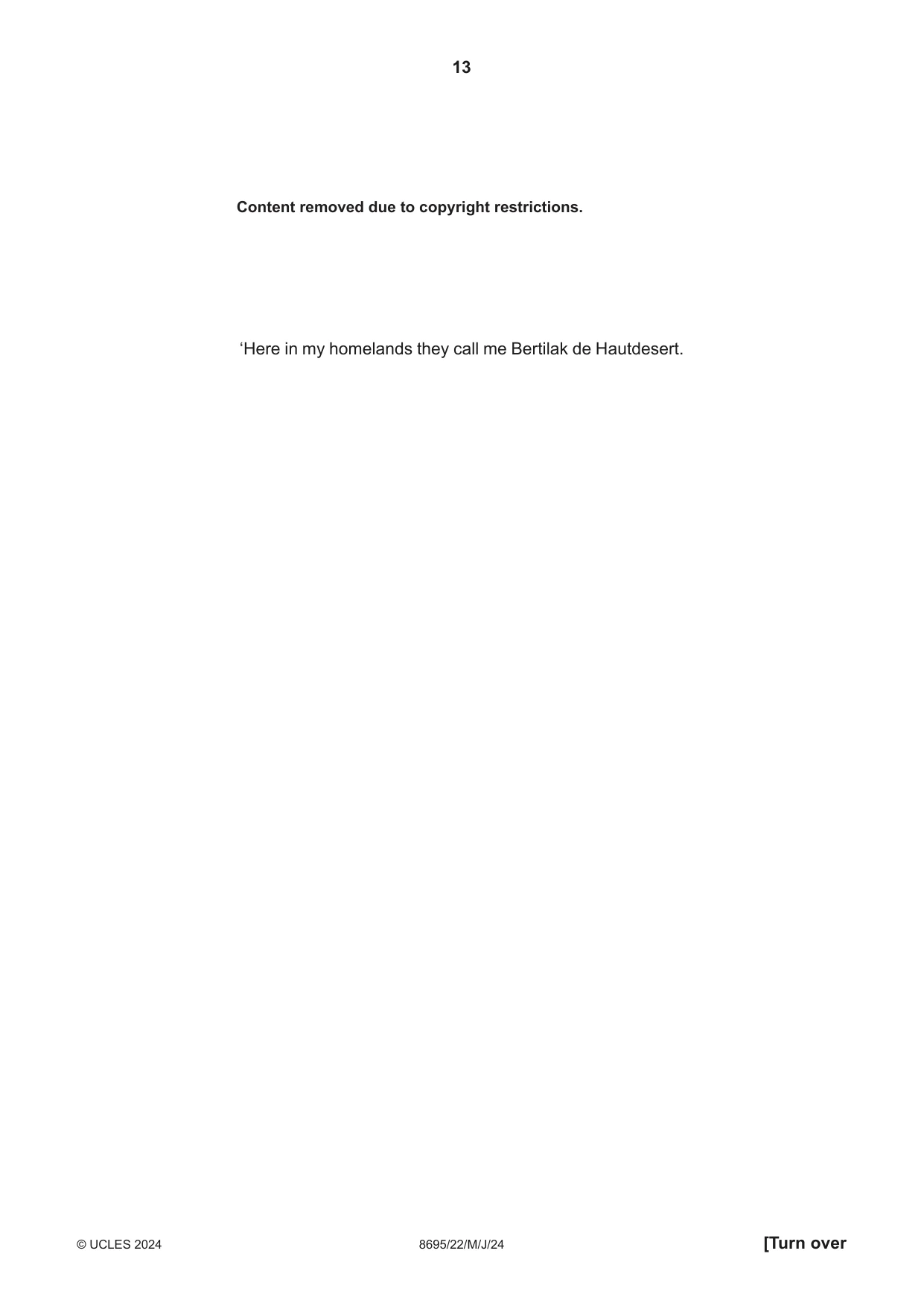
13 8695/22/M/J/24 © UCLES 2024 [Turn over ‘Here in my homelands they call me Bertilak de Hautdesert. Content removed due to copyright restrictions.
Question paper, page 14
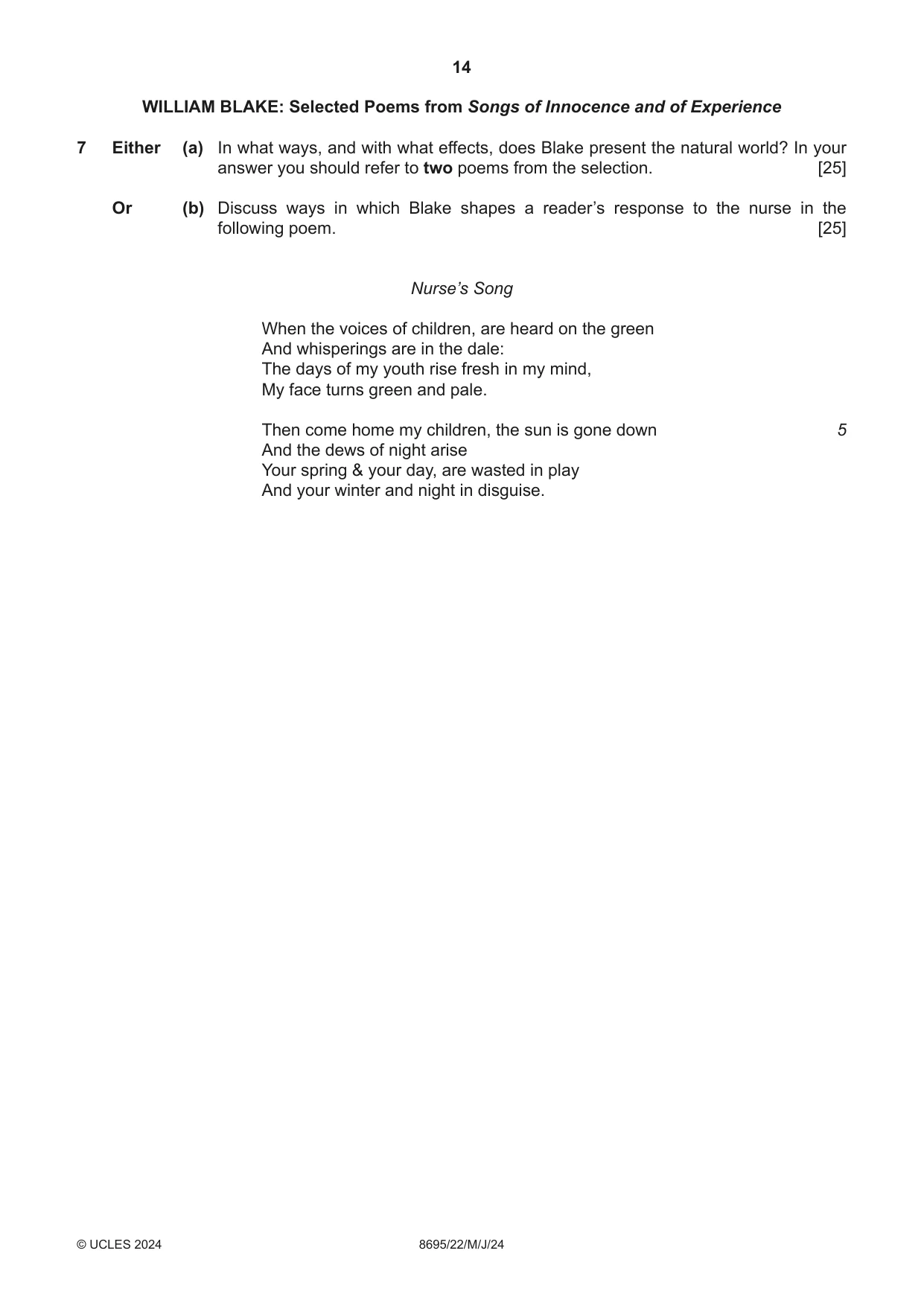
14 8695/22/M/J/24 © UCLES 2024 WILLIAM BLAKE: Selected Poems from Songs of Innocence and of Experience 7 Either (a) In what ways, and with what effects, does Blake present the natural world? In your answer you should refer to two poems from the selection. [25] Or (b) Discuss ways in which Blake shapes a reader’s response to the nurse in the following poem. [25] Nurse’s Song When the voices of children, are heard on the green And whisperings are in the dale: The days of my youth rise fresh in my mind, My face turns green and pale. Then come home my children, the sun is gone down And the dews of night arise Your spring & your day, are wasted in play And your winter and night in disguise. 5
Question paper, page 15
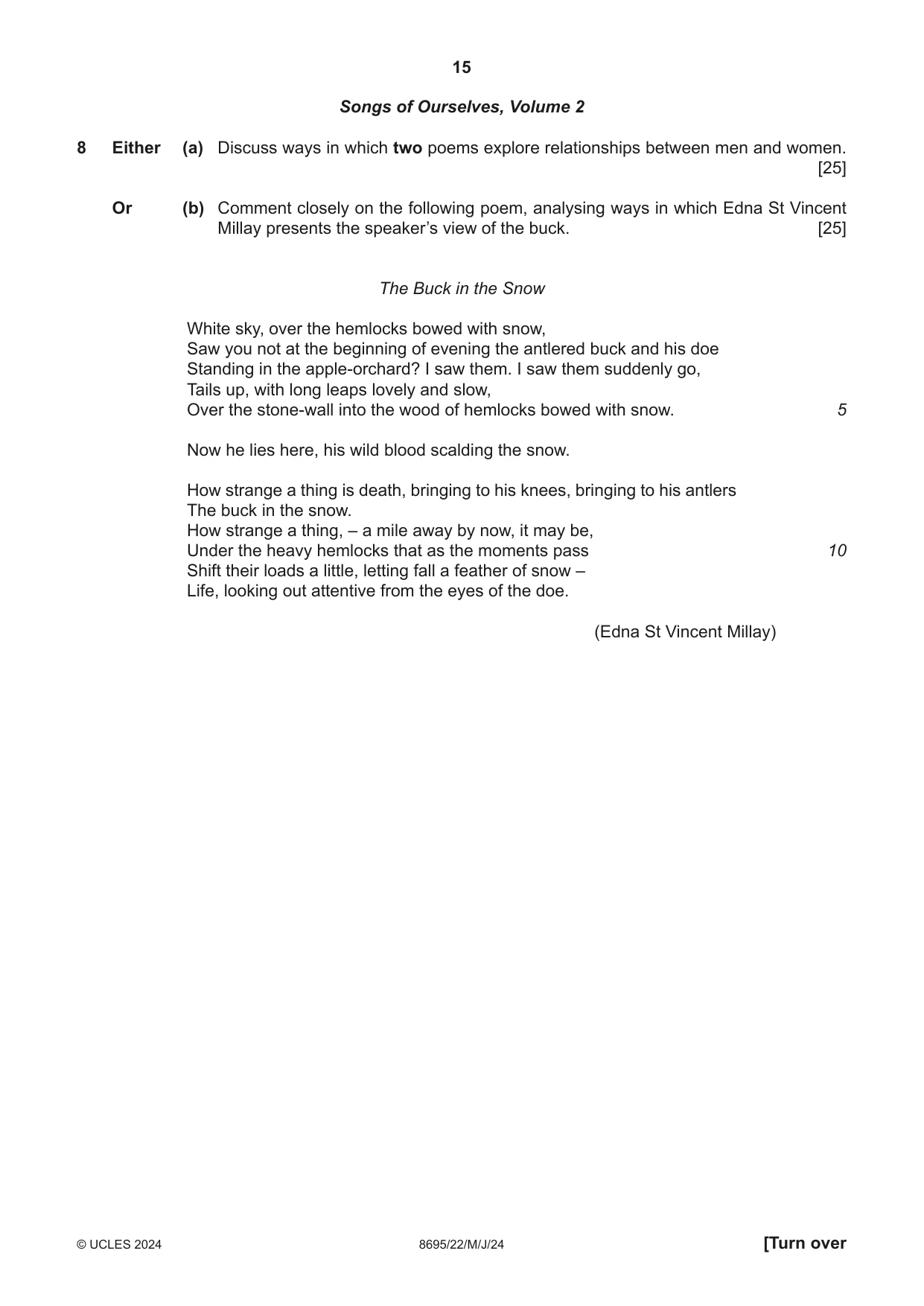
15 8695/22/M/J/24 © UCLES 2024 [Turn over Songs of Ourselves, Volume 2 8 Either (a) Discuss ways in which two poems explore relationships between men and women. [25] Or (b) Comment closely on the following poem, analysing ways in which Edna St Vincent Millay presents the speaker’s view of the buck. [25] The Buck in the Snow White sky, over the hemlocks bowed with snow, Saw you not at the beginning of evening the antlered buck and his doe Standing in the apple-orchard? I saw them. I saw them suddenly go, Tails up, with long leaps lovely and slow, Over the stone-wall into the wood of hemlocks bowed with snow. Now he lies here, his wild blood scalding the snow. How strange a thing is death, bringing to his knees, bringing to his antlers The buck in the snow. How strange a thing, – a mile away by now, it may be, Under the heavy hemlocks that as the moments pass Shift their loads a little, letting fall a feather of snow – Life, looking out attentive from the eyes of the doe. (Edna St Vincent Millay) 5 10
Question paper, page 16
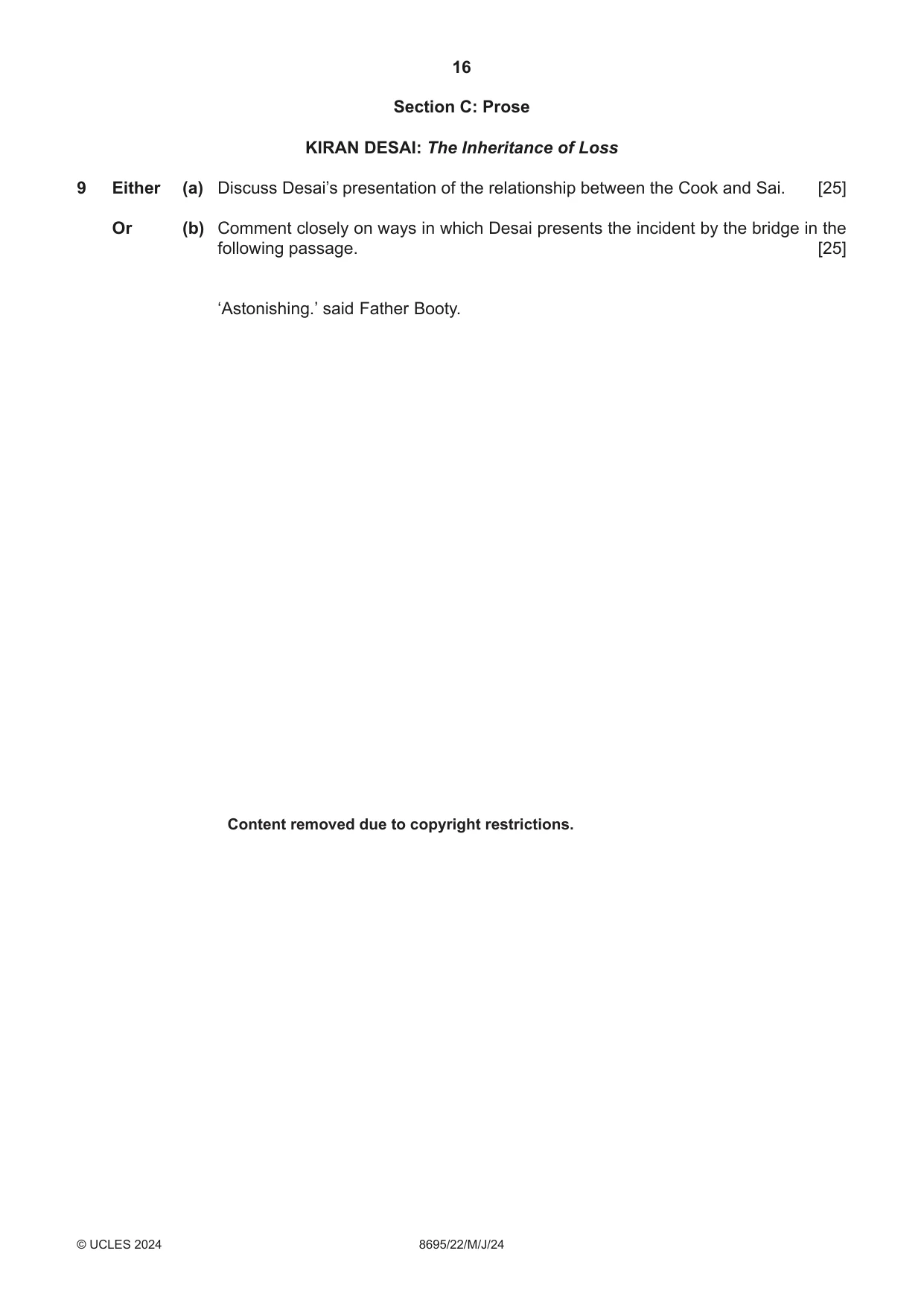
16 8695/22/M/J/24 © UCLES 2024 Section C: Prose KIRAN DESAI: The Inheritance of Loss 9 Either (a) Discuss Desai’s presentation of the relationship between the Cook and Sai. [25] Or (b) Comment closely on ways in which Desai presents the incident by the bridge in the following passage. [25] ‘Astonishing.’ said Father Booty. Content removed due to copyright restrictions.
Question paper, page 17
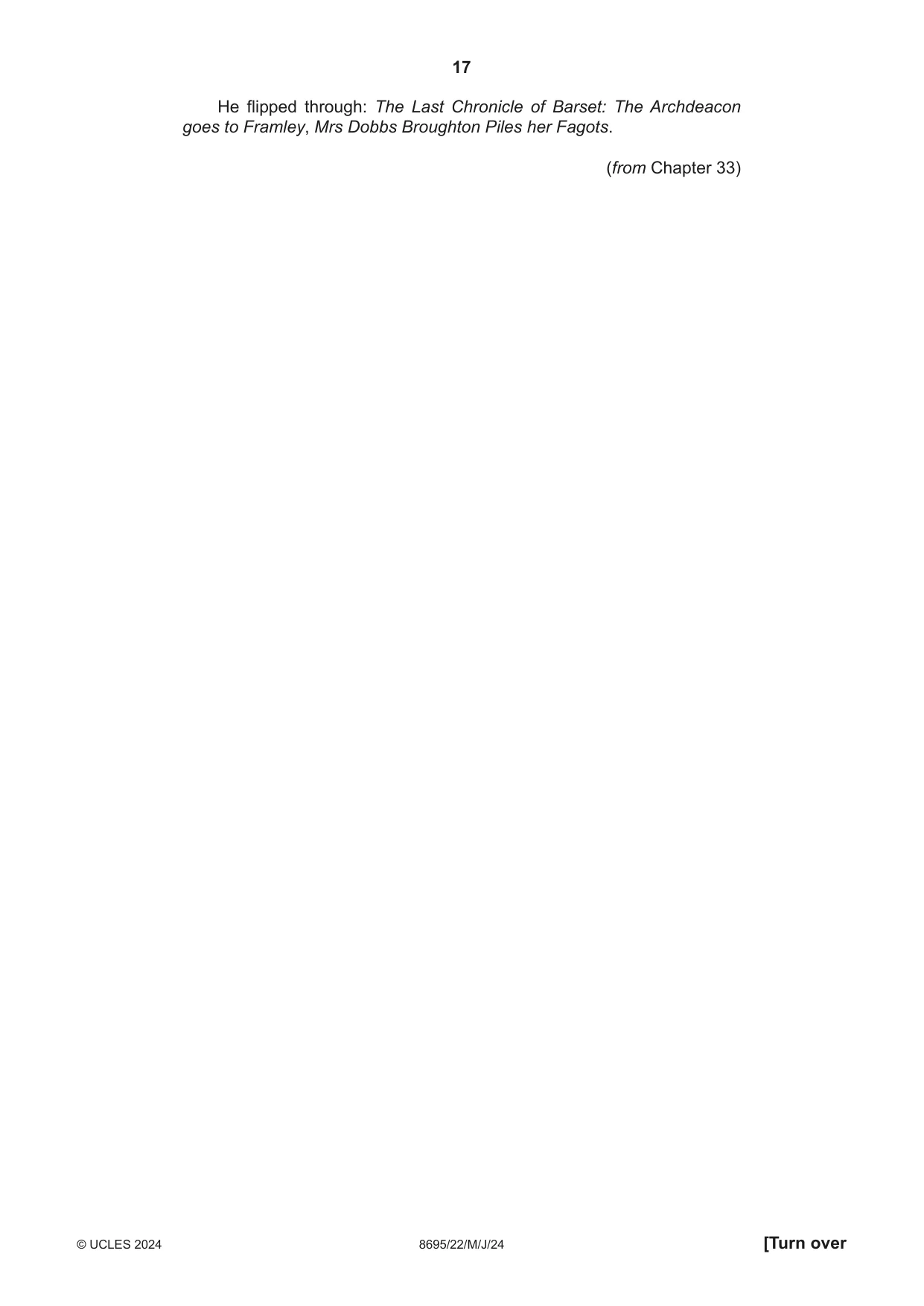
17 8695/22/M/J/24 © UCLES 2024 [Turn over He flipped through: The Last Chronicle of Barset: The Archdeacon goes to Framley, Mrs Dobbs Broughton Piles her Fagots. (from Chapter 33)
Question paper, page 18
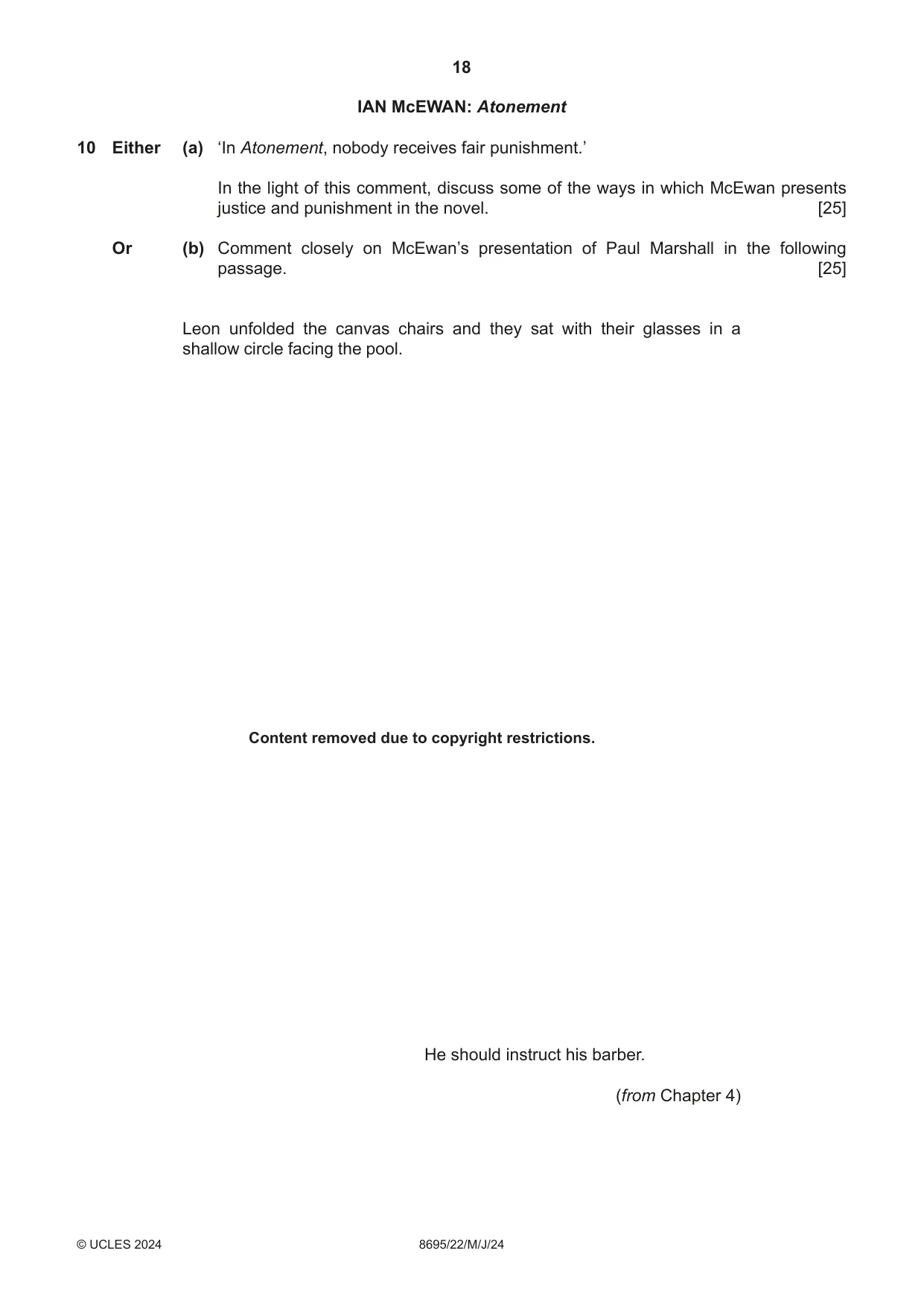
18 8695/22/M/J/24 © UCLES 2024 IAN McEWAN: Atonement 10 Either (a) ‘In Atonement, nobody receives fair punishment.’ In the light of this comment, discuss some of the ways in which McEwan presents justice and punishment in the novel. [25] Or (b) Comment closely on McEwan’s presentation of Paul Marshall in the following passage. [25] Leon unfolded the canvas chairs and they sat with their glasses in a shallow circle facing the pool. He should instruct his barber. (from Chapter 4) Content removed due to copyright restrictions.
Question paper, page 19
19 8695/22/M/J/24 © UCLES 2024 [Turn over TURN OVER FOR QUESTION 11.
Question paper, page 20
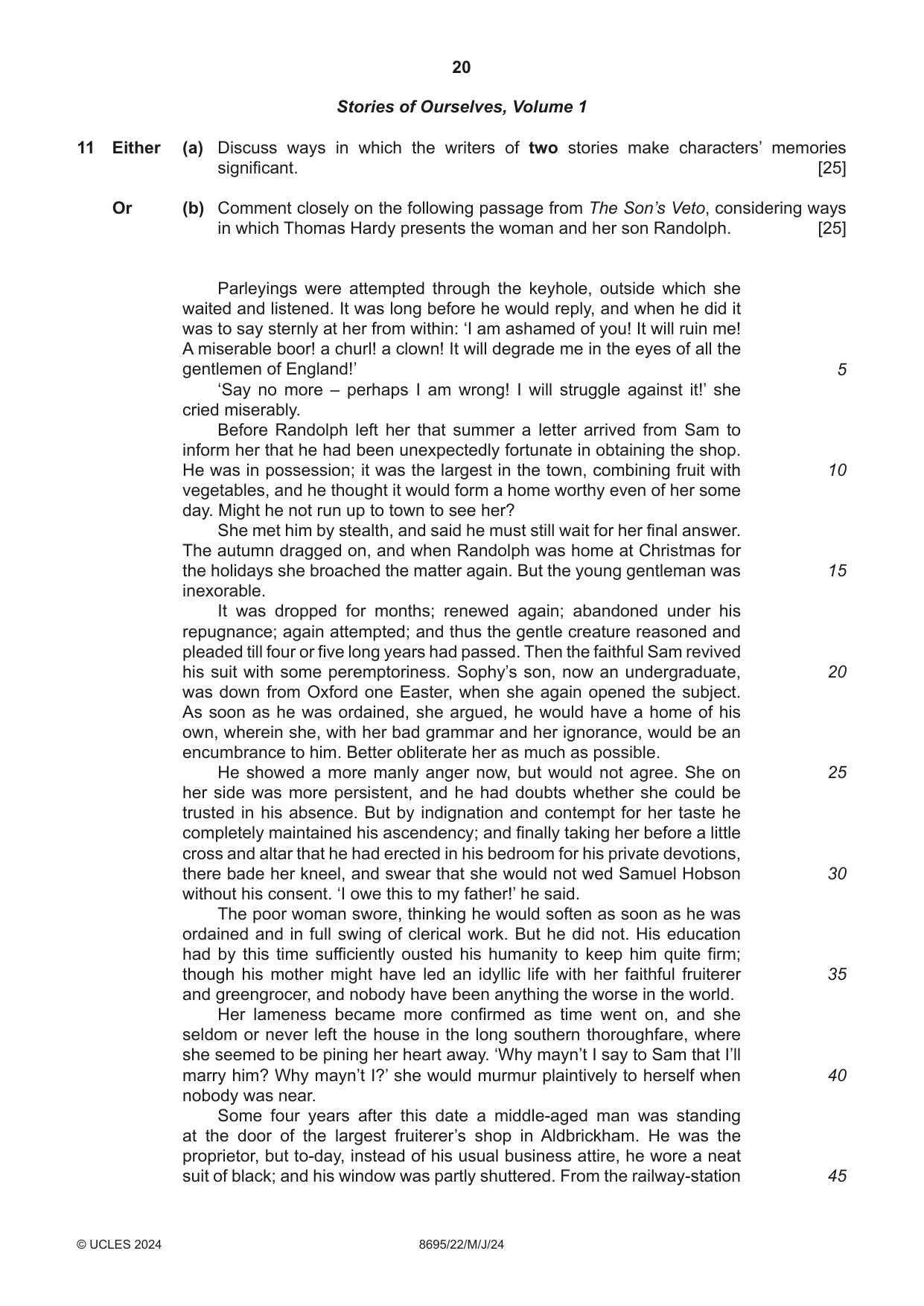
20 8695/22/M/J/24 © UCLES 2024 Stories of Ourselves, Volume 1 11 Either (a) Discuss ways in which the writers of two stories make characters’ memories significant. [25] Or (b) Comment closely on the following passage from The Son’s Veto, considering ways in which Thomas Hardy presents the woman and her son Randolph. [25] Parleyings were attempted through the keyhole, outside which she waited and listened. It was long before he would reply, and when he did it was to say sternly at her from within: ‘I am ashamed of you! It will ruin me! A miserable boor! a churl! a clown! It will degrade me in the eyes of all the gentlemen of England!’ ‘Say no more – perhaps I am wrong! I will struggle against it!’ she cried miserably. Before Randolph left her that summer a letter arrived from Sam to inform her that he had been unexpectedly fortunate in obtaining the shop. He was in possession; it was the largest in the town, combining fruit with vegetables, and he thought it would form a home worthy even of her some day. Might he not run up to town to see her? She met him by stealth, and said he must still wait for her final answer. The autumn dragged on, and when Randolph was home at Christmas for the holidays she broached the matter again. But the young gentleman was inexorable. It was dropped for months; renewed again; abandoned under his repugnance; again attempted; and thus the gentle creature reasoned and pleaded till four or five long years had passed. Then the faithful Sam revived his suit with some peremptoriness. Sophy’s son, now an undergraduate, was down from Oxford one Easter, when she again opened the subject. As soon as he was ordained, she argued, he would have a home of his own, wherein she, with her bad grammar and her ignorance, would be an encumbrance to him. Better obliterate her as much as possible. He showed a more manly anger now, but would not agree. She on her side was more persistent, and he had doubts whether she could be trusted in his absence. But by indignation and contempt for her taste he completely maintained his ascendency; and finally taking her before a little cross and altar that he had erected in his bedroom for his private devotions, there bade her kneel, and swear that she would not wed Samuel Hobson without his consent. ‘I owe this to my father!’ he said. The poor woman swore, thinking he would soften as soon as he was ordained and in full swing of clerical work. But he did not. His education had by this time sufficiently ousted his humanity to keep him quite firm; though his mother might have led an idyllic life with her faithful fruiterer and greengrocer, and nobody have been anything the worse in the world. Her lameness became more confirmed as time went on, and she seldom or never left the house in the long southern thoroughfare, where she seemed to be pining her heart away. ‘Why mayn’t I say to Sam that I’ll marry him? Why mayn’t I?’ she would murmur plaintively to herself when nobody was near. Some four years after this date a middle-aged man was standing at the door of the largest fruiterer’s shop in Aldbrickham. He was the proprietor, but to-day, instead of his usual business attire, he wore a neat suit of black; and his window was partly shuttered. From the railway-station 5 10 15 20 25 30 35 40 45
Question paper, page 21
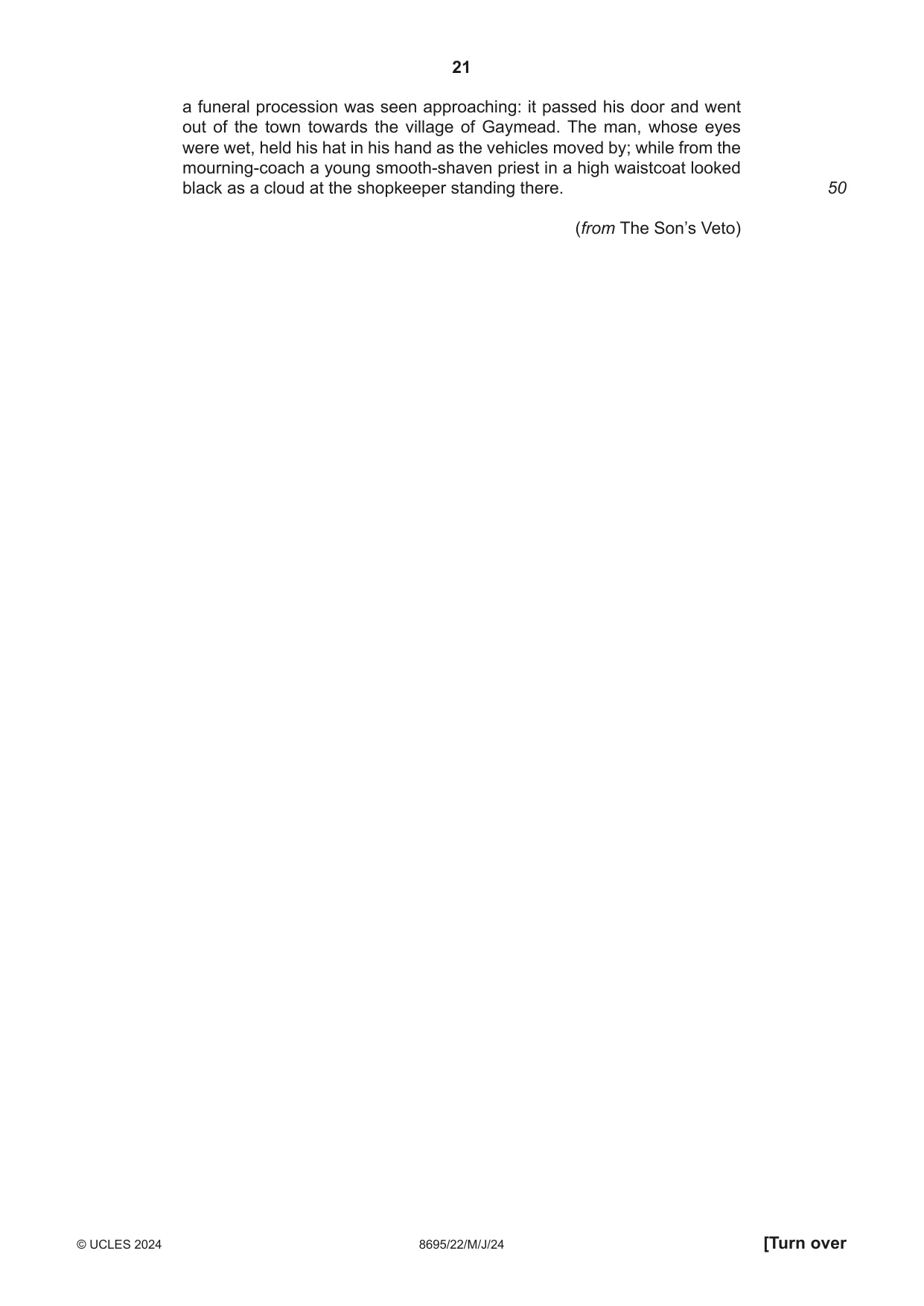
21 8695/22/M/J/24 © UCLES 2024 [Turn over a funeral procession was seen approaching: it passed his door and went out of the town towards the village of Gaymead. The man, whose eyes were wet, held his hat in his hand as the vehicles moved by; while from the mourning-coach a young smooth-shaven priest in a high waistcoat looked black as a cloud at the shopkeeper standing there. (from The Son’s Veto) 50
Question paper, page 22
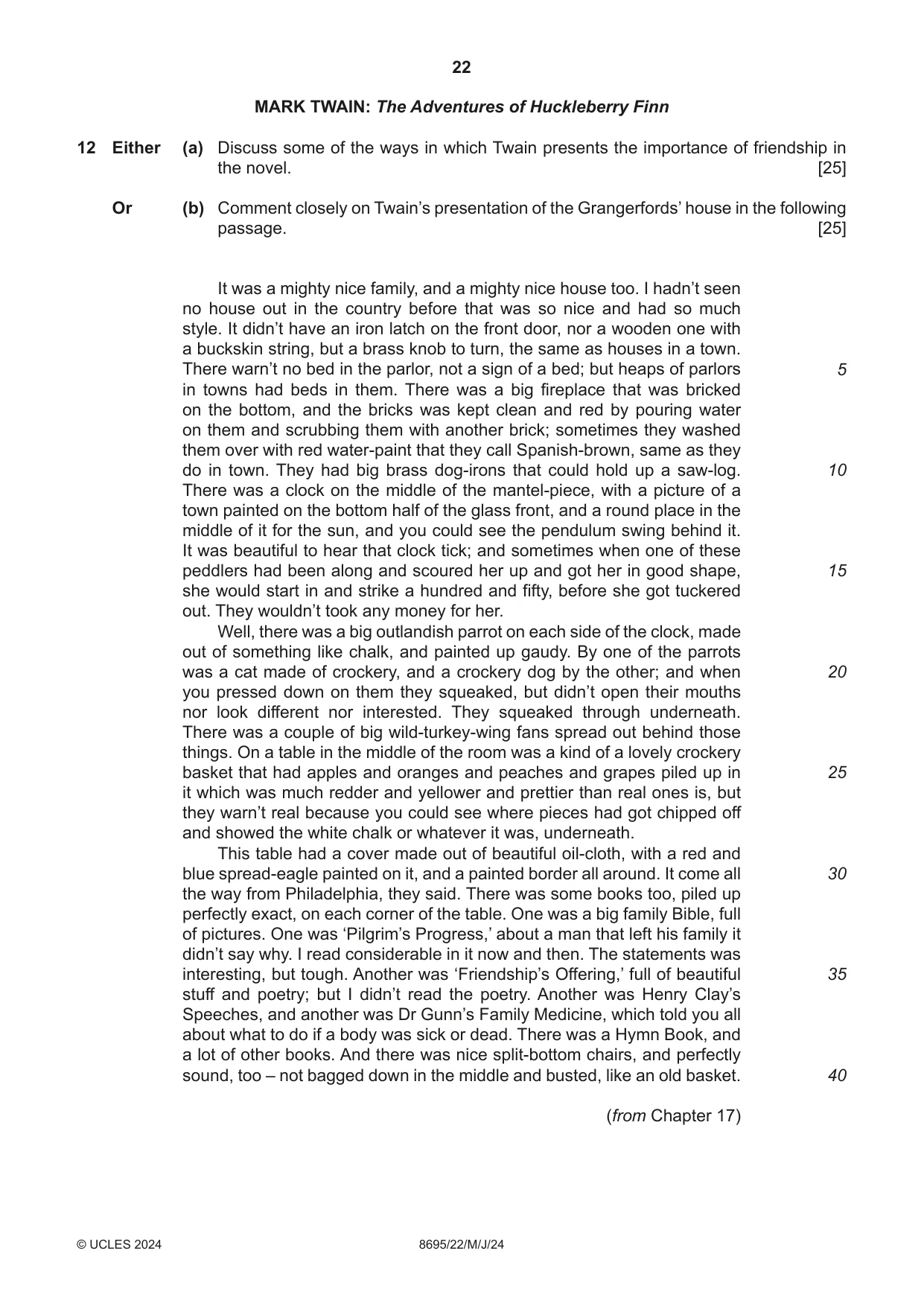
22 8695/22/M/J/24 © UCLES 2024 MARK TWAIN: The Adventures of Huckleberry Finn 12 Either (a) Discuss some of the ways in which Twain presents the importance of friendship in the novel. [25] Or (b) Comment closely on Twain’s presentation of the Grangerfords’ house in the following passage. [25] It was a mighty nice family, and a mighty nice house too. I hadn’t seen no house out in the country before that was so nice and had so much style. It didn’t have an iron latch on the front door, nor a wooden one with a buckskin string, but a brass knob to turn, the same as houses in a town. There warn’t no bed in the parlor, not a sign of a bed; but heaps of parlors in towns had beds in them. There was a big fireplace that was bricked on the bottom, and the bricks was kept clean and red by pouring water on them and scrubbing them with another brick; sometimes they washed them over with red water-paint that they call Spanish-brown, same as they do in town. They had big brass dog-irons that could hold up a saw-log. There was a clock on the middle of the mantel-piece, with a picture of a town painted on the bottom half of the glass front, and a round place in the middle of it for the sun, and you could see the pendulum swing behind it. It was beautiful to hear that clock tick; and sometimes when one of these peddlers had been along and scoured her up and got her in good shape, she would start in and strike a hundred and fifty, before she got tuckered out. They wouldn’t took any money for her. Well, there was a big outlandish parrot on each side of the clock, made out of something like chalk, and painted up gaudy. By one of the parrots was a cat made of crockery, and a crockery dog by the other; and when you pressed down on them they squeaked, but didn’t open their mouths nor look different nor interested. They squeaked through underneath. There was a couple of big wild-turkey-wing fans spread out behind those things. On a table in the middle of the room was a kind of a lovely crockery basket that had apples and oranges and peaches and grapes piled up in it which was much redder and yellower and prettier than real ones is, but they warn’t real because you could see where pieces had got chipped off and showed the white chalk or whatever it was, underneath. This table had a cover made out of beautiful oil-cloth, with a red and blue spread-eagle painted on it, and a painted border all around. It come all the way from Philadelphia, they said. There was some books too, piled up perfectly exact, on each corner of the table. One was a big family Bible, full of pictures. One was ‘Pilgrim’s Progress,’ about a man that left his family it didn’t say why. I read considerable in it now and then. The statements was interesting, but tough. Another was ‘Friendship’s Offering,’ full of beautiful stuff and poetry; but I didn’t read the poetry. Another was Henry Clay’s Speeches, and another was Dr Gunn’s Family Medicine, which told you all about what to do if a body was sick or dead. There was a Hymn Book, and a lot of other books. And there was nice split-bottom chairs, and perfectly sound, too – not bagged down in the middle and busted, like an old basket. (from Chapter 17) 5 10 15 20 25 30 35 40
Question paper, page 23
23 8695/22/M/J/24 © UCLES 2024 BLANK PAGE
Question paper, page 24
24 8695/22/M/J/24 © UCLES 2024 Permission to reproduce items where third-party owned material protected by copyright is included has been sought and cleared where possible. Every reasonable effort has been made by the publisher (UCLES) to trace copyright holders, but if any items requiring clearance have unwittingly been included, the publisher will be pleased to make amends at the earliest possible opportunity. To avoid the issue of disclosure of answer-related information to candidates, all copyright acknowledgements are reproduced online in the Cambridge Assessment International Education Copyright Acknowledgements Booklet. This is produced for each series of examinations and is freely available to download at www.cambridgeinternational.org after the live examination series. Cambridge Assessment International Education is part of Cambridge Assessment. Cambridge Assessment is the brand name of the University of Cambridge Local Examinations Syndicate (UCLES), which is a department of the University of Cambridge. BLANK PAGE
Mark scheme, page 1
This document consists of 13 printed pages. © Cambridge University Press & Assessment 2024 [Turn over Cambridge International AS Level LANGUAGE AND LITERATURE IN ENGLISH 8695/22 Paper 2 Drama, Poetry and Prose May/June 2024 MARK SCHEME Maximum Mark: 50 Published This mark scheme is published as an aid to teachers and candidates, to indicate the requirements of the examination. It shows the basis on which Examiners were instructed to award marks. It does not indicate the details of the discussions that took place at an Examiners’ meeting before marking began, which would have considered the acceptability of alternative answers. Mark schemes should be read in conjunction with the question paper and the Principal Examiner Report for Teachers. Cambridge International will not enter into discussions about these mark schemes. Cambridge International is publishing the mark schemes for the May/June 2024 series for most Cambridge IGCSE, Cambridge International A and AS Level and Cambridge Pre-U components, and some Cambridge O Level components.
Mark scheme, page 2
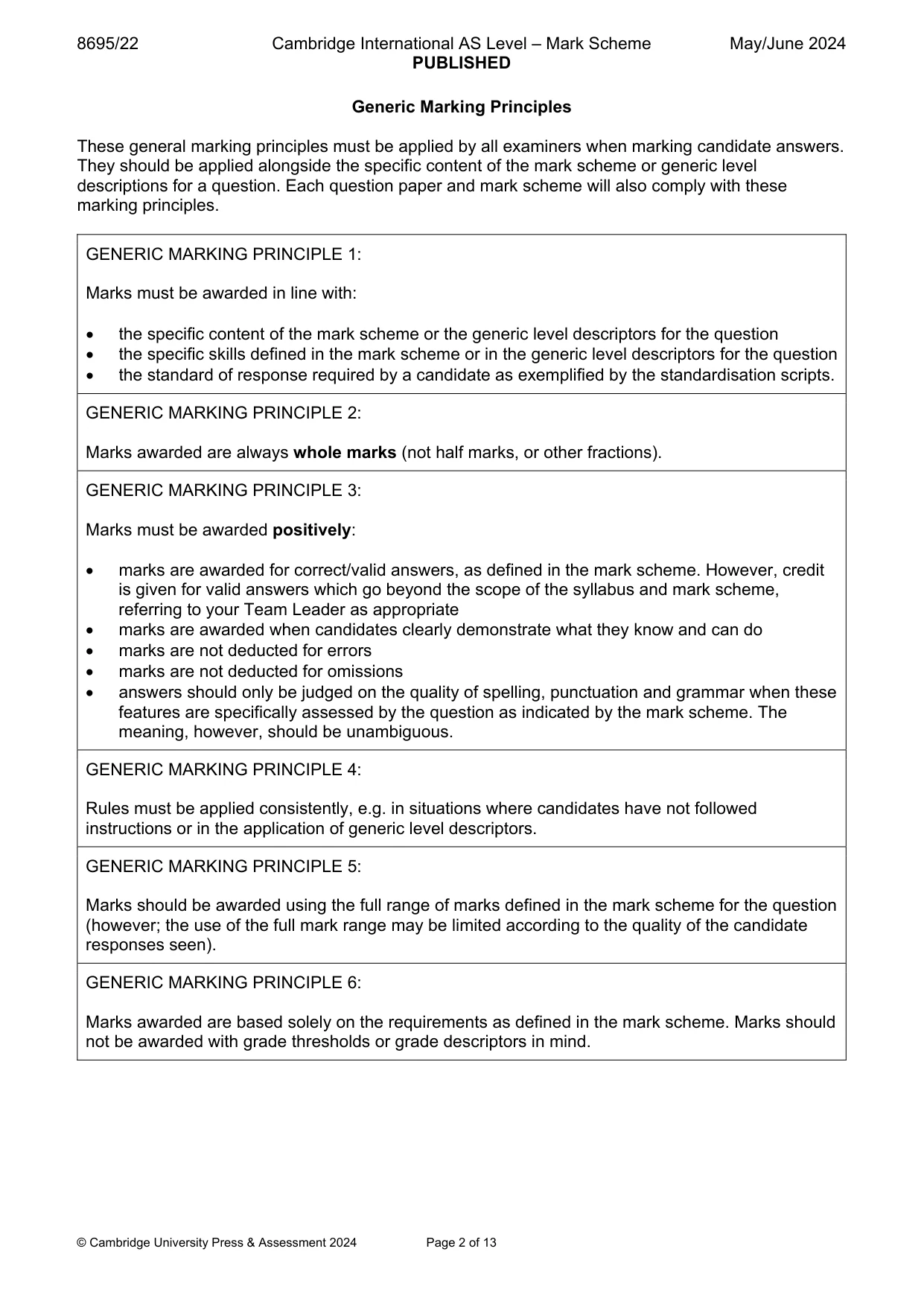
8695/22 Cambridge International AS Level – Mark Scheme PUBLISHED May/June 2024 © Cambridge University Press & Assessment 2024 Page 2 of 13 Generic Marking Principles These general marking principles must be applied by all examiners when marking candidate answers. They should be applied alongside the specific content of the mark scheme or generic level descriptions for a question. Each question paper and mark scheme will also comply with these marking principles. GENERIC MARKING PRINCIPLE 1: Marks must be awarded in line with: the specific content of the mark scheme or the generic level descriptors for the question the specific skills defined in the mark scheme or in the generic level descriptors for the question the standard of response required by a candidate as exemplified by the standardisation scripts. GENERIC MARKING PRINCIPLE 2: Marks awarded are always whole marks (not half marks, or other fractions). GENERIC MARKING PRINCIPLE 3: Marks must be awarded positively: marks are awarded for correct/valid answers, as defined in the mark scheme. However, credit is given for valid answers which go beyond the scope of the syllabus and mark scheme, referring to your Team Leader as appropriate marks are awarded when candidates clearly demonstrate what they know and can do marks are not deducted for errors marks are not deducted for omissions answers should only be judged on the quality of spelling, punctuation and grammar when these features are specifically assessed by the question as indicated by the mark scheme. The meaning, however, should be unambiguous. GENERIC MARKING PRINCIPLE 4: Rules must be applied consistently, e.g. in situations where candidates have not followed instructions or in the application of generic level descriptors. GENERIC MARKING PRINCIPLE 5: Marks should be awarded using the full range of marks defined in the mark scheme for the question (however; the use of the full mark range may be limited according to the quality of the candidate responses seen). GENERIC MARKING PRINCIPLE 6: Marks awarded are based solely on the requirements as defined in the mark scheme. Marks should not be awarded with grade thresholds or grade descriptors in mind.
Mark scheme, page 3
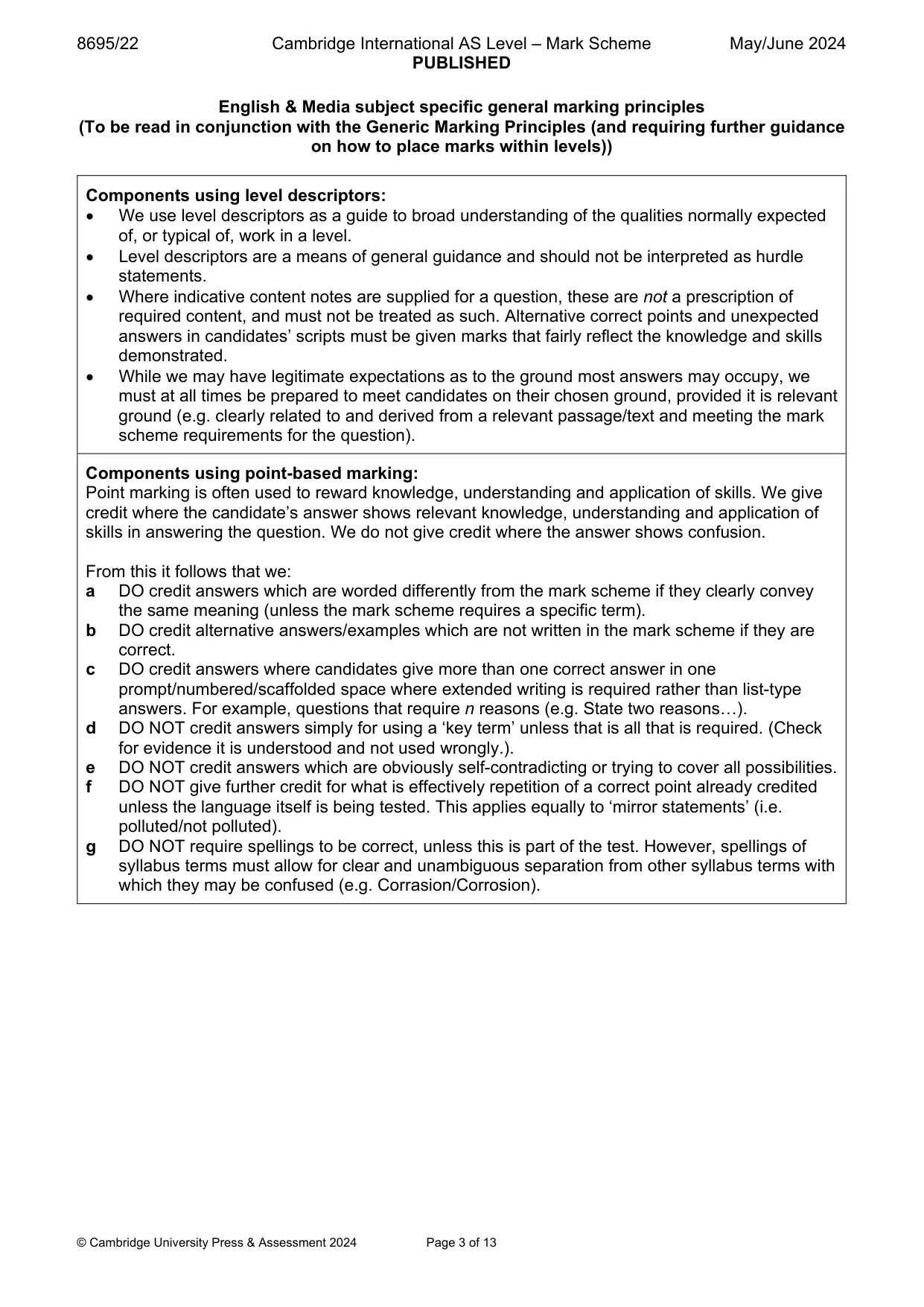
8695/22 Cambridge International AS Level – Mark Scheme PUBLISHED May/June 2024 © Cambridge University Press & Assessment 2024 Page 3 of 13 English & Media subject specific general marking principles (To be read in conjunction with the Generic Marking Principles (and requiring further guidance on how to place marks within levels)) Components using level descriptors: We use level descriptors as a guide to broad understanding of the qualities normally expected of, or typical of, work in a level. Level descriptors are a means of general guidance and should not be interpreted as hurdle statements. Where indicative content notes are supplied for a question, these are not a prescription of required content, and must not be treated as such. Alternative correct points and unexpected answers in candidates’ scripts must be given marks that fairly reflect the knowledge and skills demonstrated. While we may have legitimate expectations as to the ground most answers may occupy, we must at all times be prepared to meet candidates on their chosen ground, provided it is relevant ground (e.g. clearly related to and derived from a relevant passage/text and meeting the mark scheme requirements for the question). Components using point-based marking: Point marking is often used to reward knowledge, understanding and application of skills. We give credit where the candidate’s answer shows relevant knowledge, understanding and application of skills in answering the question. We do not give credit where the answer shows confusion. From this it follows that we: a DO credit answers which are worded differently from the mark scheme if they clearly convey the same meaning (unless the mark scheme requires a specific term). b DO credit alternative answers/examples which are not written in the mark scheme if they are correct. c DO credit answers where candidates give more than one correct answer in one prompt/numbered/scaffolded space where extended writing is required rather than list-type answers. For example, questions that require n reasons (e.g. State two reasons…). d DO NOT credit answers simply for using a ‘key term’ unless that is all that is required. (Check for evidence it is understood and not used wrongly.). e DO NOT credit answers which are obviously self-contradicting or trying to cover all possibilities. f DO NOT give further credit for what is effectively repetition of a correct point already credited unless the language itself is being tested. This applies equally to ‘mirror statements’ (i.e. polluted/not polluted). g DO NOT require spellings to be correct, unless this is part of the test. However, spellings of syllabus terms must allow for clear and unambiguous separation from other syllabus terms with which they may be confused (e.g. Corrasion/Corrosion).
Mark scheme, page 4
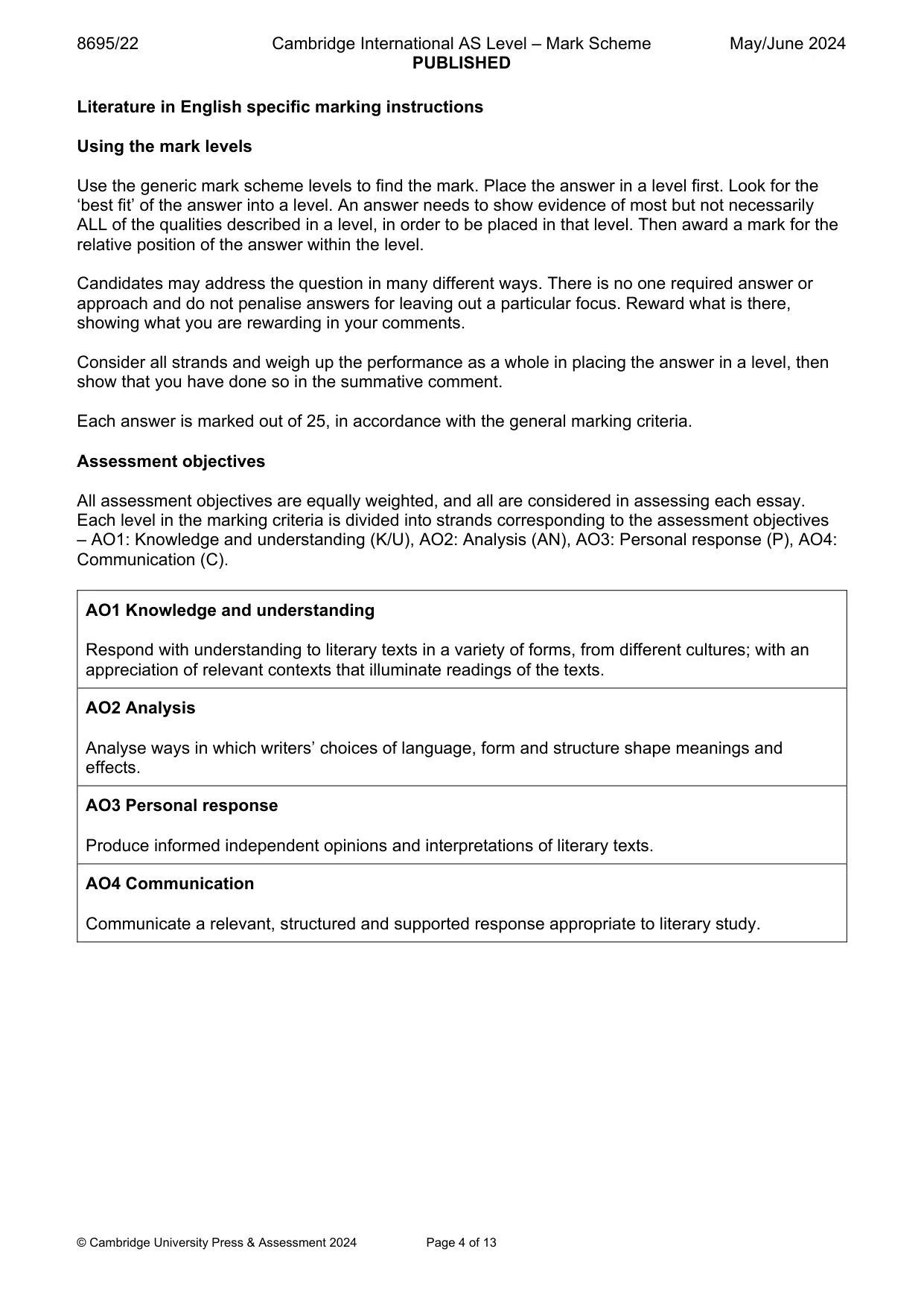
8695/22 Cambridge International AS Level – Mark Scheme PUBLISHED May/June 2024 © Cambridge University Press & Assessment 2024 Page 4 of 13 Literature in English specific marking instructions Using the mark levels Use the generic mark scheme levels to find the mark. Place the answer in a level first. Look for the ‘best fit’ of the answer into a level. An answer needs to show evidence of most but not necessarily ALL of the qualities described in a level, in order to be placed in that level. Then award a mark for the relative position of the answer within the level. Candidates may address the question in many different ways. There is no one required answer or approach and do not penalise answers for leaving out a particular focus. Reward what is there, showing what you are rewarding in your comments. Consider all strands and weigh up the performance as a whole in placing the answer in a level, then show that you have done so in the summative comment. Each answer is marked out of 25, in accordance with the general marking criteria. Assessment objectives All assessment objectives are equally weighted, and all are considered in assessing each essay. Each level in the marking criteria is divided into strands corresponding to the assessment objectives – AO1: Knowledge and understanding (K/U), AO2: Analysis (AN), AO3: Personal response (P), AO4: Communication (C). AO1 Knowledge and understanding Respond with understanding to literary texts in a variety of forms, from different cultures; with an appreciation of relevant contexts that illuminate readings of the texts. AO2 Analysis Analyse ways in which writers’ choices of language, form and structure shape meanings and effects. AO3 Personal response Produce informed independent opinions and interpretations of literary texts. AO4 Communication Communicate a relevant, structured and supported response appropriate to literary study.
Mark scheme, page 5
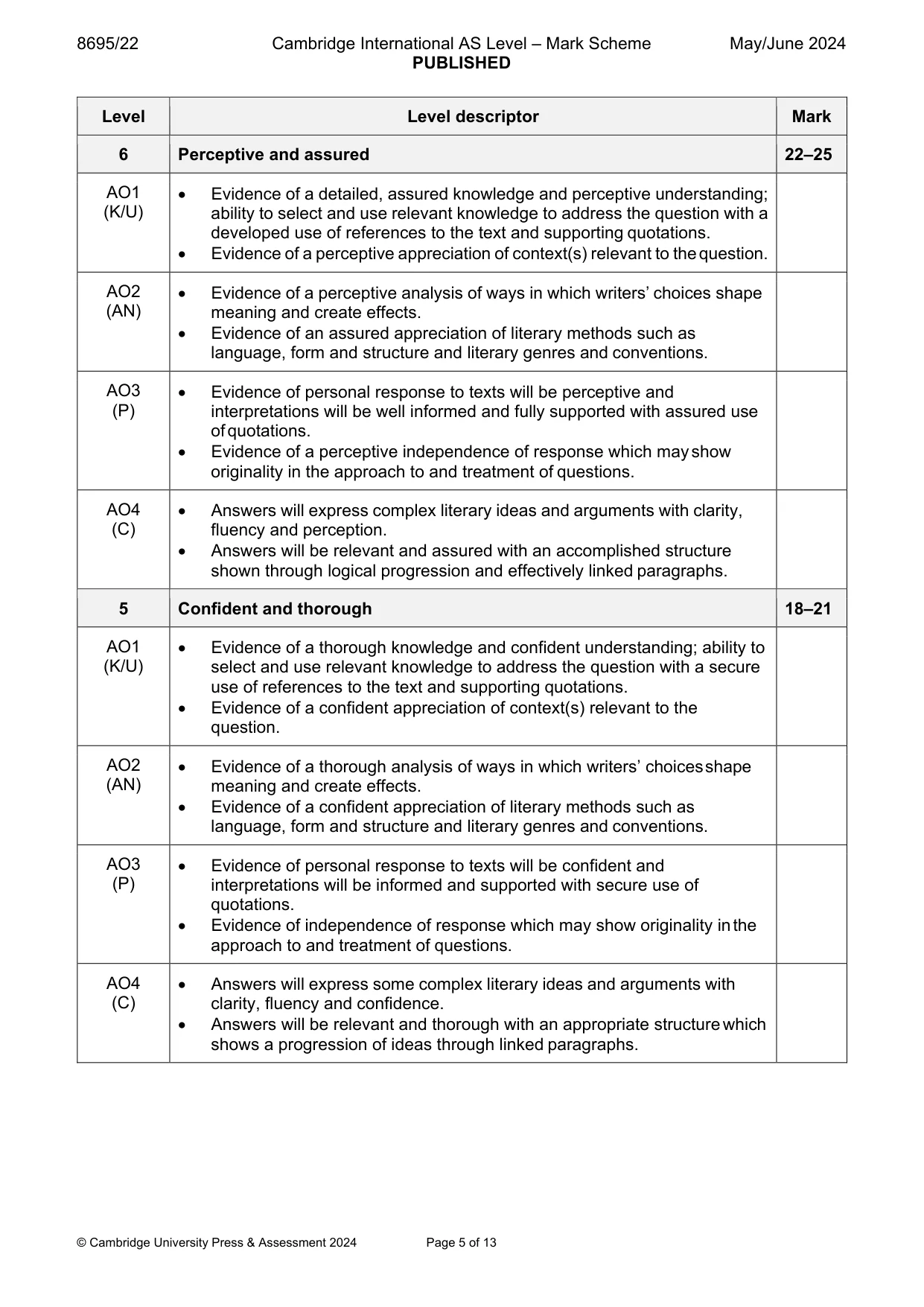
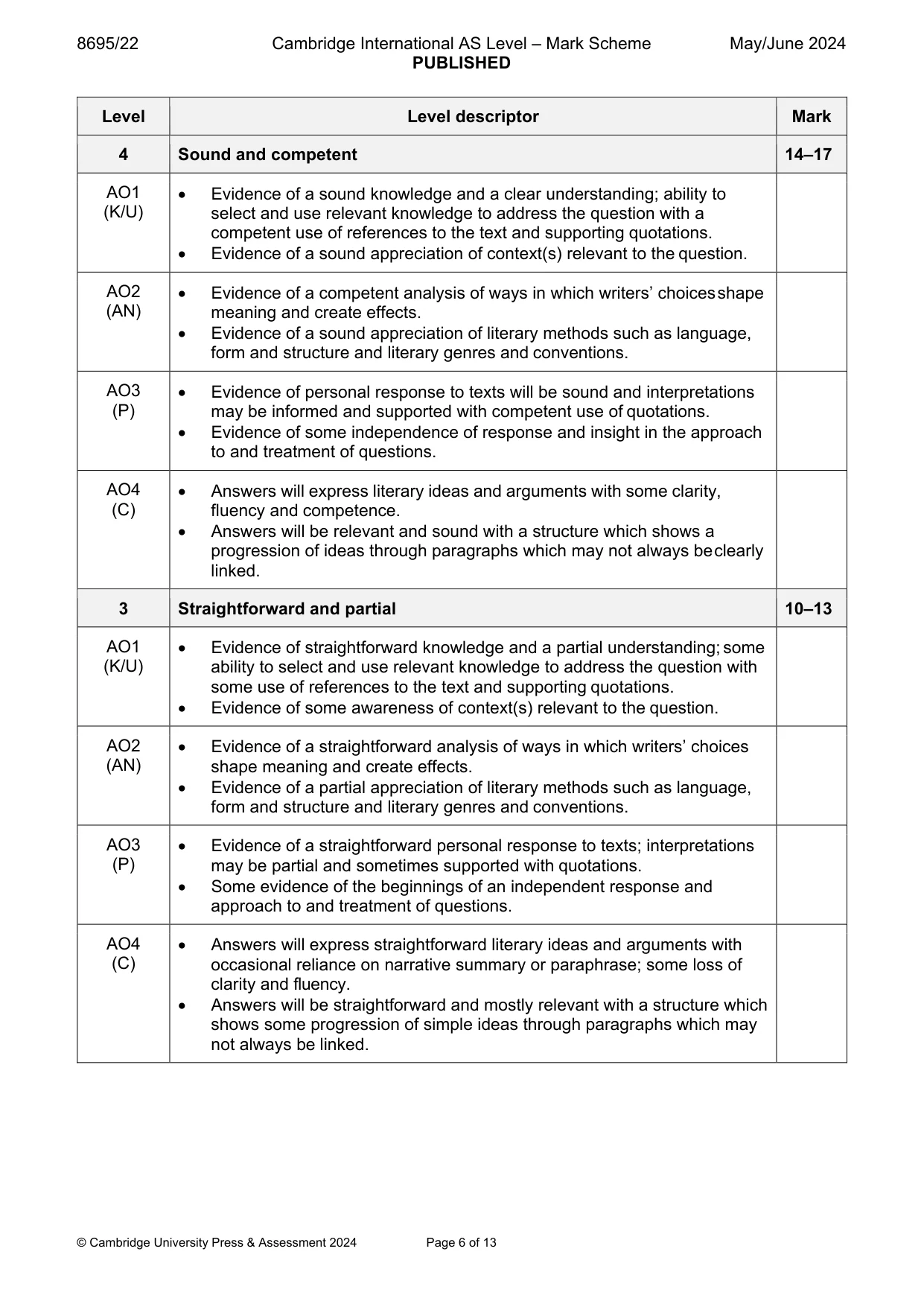
8695/22 Cambridge International AS Level – Mark Scheme PUBLISHED May/June 2024 © Cambridge University Press & Assessment 2024 Page 5 of 13 Level Level descriptor Mark 6 Perceptive and assured 22–25 AO1 (K/U) Evidence of a detailed, assured knowledge and perceptive understanding; ability to select and use relevant knowledge to address the question with a developed use of references to the text and supporting quotations. Evidence of a perceptive appreciation of context(s) relevant to the question. AO2 (AN) Evidence of a perceptive analysis of ways in which writers’ choices shape meaning and create effects. Evidence of an assured appreciation of literary methods such as language, form and structure and literary genres and conventions. AO3 (P) Evidence of personal response to texts will be perceptive and interpretations will be well informed and fully supported with assured use of quotations. Evidence of a perceptive independence of response which may show originality in the approach to and treatment of questions. AO4 (C) Answers will express complex literary ideas and arguments with clarity, fluency and perception. Answers will be relevant and assured with an accomplished structure shown through logical progression and effectively linked paragraphs. 5 Confident and thorough 18–21 AO1 (K/U) Evidence of a thorough knowledge and confident understanding; ability to select and use relevant knowledge to address the question with a secure use of references to the text and supporting quotations. Evidence of a confident appreciation of context(s) relevant to the question. AO2 (AN) Evidence of a thorough analysis of ways in which writers’ choices shape meaning and create effects. Evidence of a confident appreciation of literary methods such as language, form and structure and literary genres and conventions. AO3 (P) Evidence of personal response to texts will be confident and interpretations will be informed and supported with secure use of quotations. Evidence of independence of response which may show originality in the approach to and treatment of questions. AO4 (C) Answers will express some complex literary ideas and arguments with clarity, fluency and confidence. Answers will be relevant and thorough with an appropriate structure which shows a progression of ideas through linked paragraphs.
Mark scheme, page 6
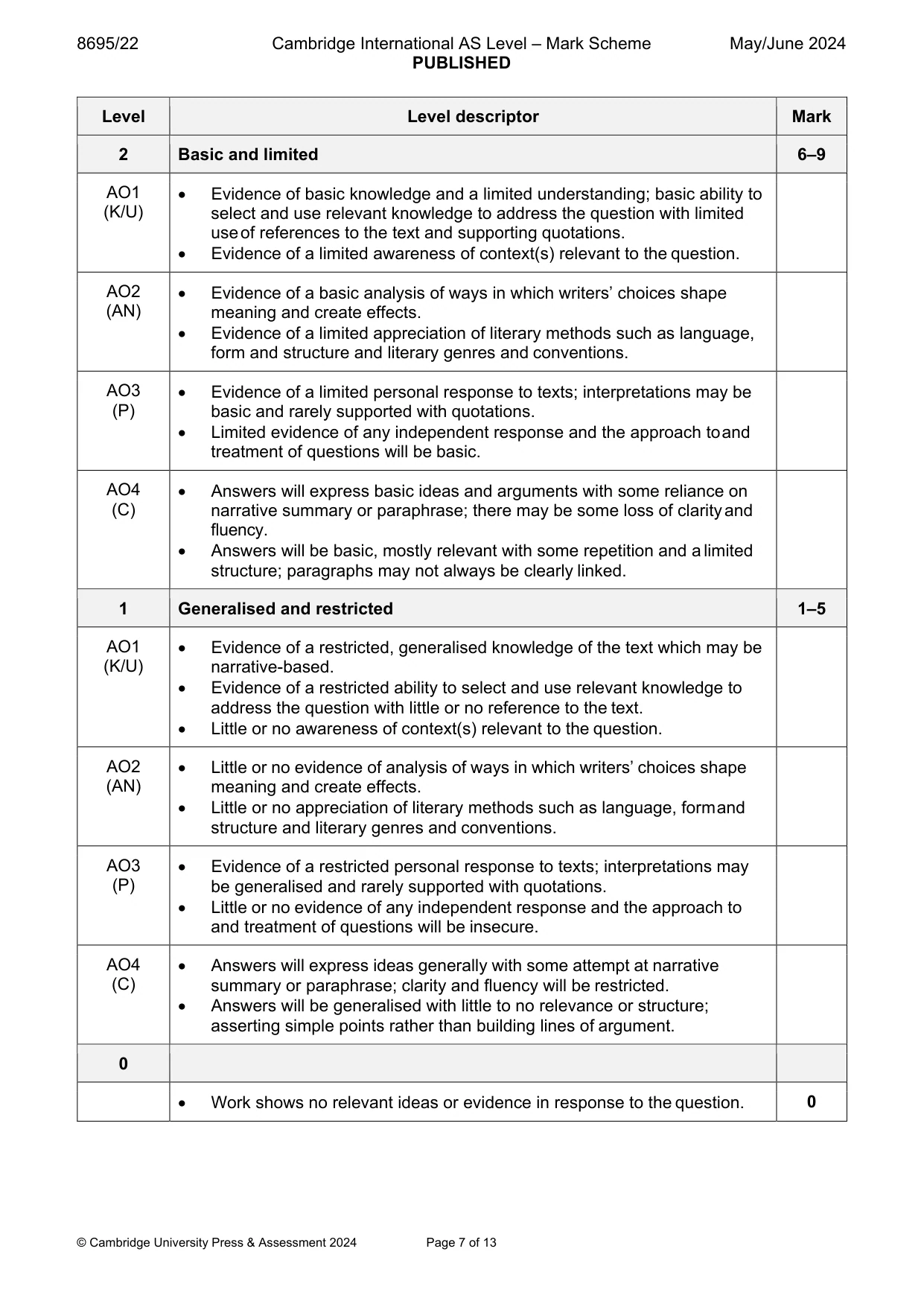
8695/22 Cambridge International AS Level – Mark Scheme PUBLISHED May/June 2024 © Cambridge University Press & Assessment 2024 Page 6 of 13 Level Level descriptor Mark 4 Sound and competent 14–17 AO1 (K/U) Evidence of a sound knowledge and a clear understanding; ability to select and use relevant knowledge to address the question with a competent use of references to the text and supporting quotations. Evidence of a sound appreciation of context(s) relevant to the question. AO2 (AN) Evidence of a competent analysis of ways in which writers’ choices shape meaning and create effects. Evidence of a sound appreciation of literary methods such as language, form and structure and literary genres and conventions. AO3 (P) Evidence of personal response to texts will be sound and interpretations may be informed and supported with competent use of quotations. Evidence of some independence of response and insight in the approach to and treatment of questions. AO4 (C) Answers will express literary ideas and arguments with some clarity, fluency and competence. Answers will be relevant and sound with a structure which shows a progression of ideas through paragraphs which may not always be clearly linked. 3 Straightforward and partial 10–13 AO1 (K/U) Evidence of straightforward knowledge and a partial understanding; some ability to select and use relevant knowledge to address the question with some use of references to the text and supporting quotations. Evidence of some awareness of context(s) relevant to the question. AO2 (AN) Evidence of a straightforward analysis of ways in which writers’ choices shape meaning and create effects. Evidence of a partial appreciation of literary methods such as language, form and structure and literary genres and conventions. AO3 (P) Evidence of a straightforward personal response to texts; interpretations may be partial and sometimes supported with quotations. Some evidence of the beginnings of an independent response and approach to and treatment of questions. AO4 (C) Answers will express straightforward literary ideas and arguments with occasional reliance on narrative summary or paraphrase; some loss of clarity and fluency. Answers will be straightforward and mostly relevant with a structure which shows some progression of simple ideas through paragraphs which may not always be linked.
Mark scheme, page 7
8695/22 Cambridge International AS Level – Mark Scheme PUBLISHED May/June 2024 © Cambridge University Press & Assessment 2024 Page 7 of 13 Level Level descriptor Mark 2 Basic and limited 6–9 AO1 (K/U) Evidence of basic knowledge and a limited understanding; basic ability to select and use relevant knowledge to address the question with limited use of references to the text and supporting quotations. Evidence of a limited awareness of context(s) relevant to the question. AO2 (AN) Evidence of a basic analysis of ways in which writers’ choices shape meaning and create effects. Evidence of a limited appreciation of literary methods such as language, form and structure and literary genres and conventions. AO3 (P) Evidence of a limited personal response to texts; interpretations may be basic and rarely supported with quotations. Limited evidence of any independent response and the approach to and treatment of questions will be basic. AO4 (C) Answers will express basic ideas and arguments with some reliance on narrative summary or paraphrase; there may be some loss of clarity and fluency. Answers will be basic, mostly relevant with some repetition and a limited structure; paragraphs may not always be clearly linked. 1 Generalised and restricted 1–5 AO1 (K/U) Evidence of a restricted, generalised knowledge of the text which may be narrative-based. Evidence of a restricted ability to select and use relevant knowledge to address the question with little or no reference to the text. Little or no awareness of context(s) relevant to the question. AO2 (AN) Little or no evidence of analysis of ways in which writers’ choices shape meaning and create effects. Little or no appreciation of literary methods such as language, form and structure and literary genres and conventions. AO3 (P) Evidence of a restricted personal response to texts; interpretations may be generalised and rarely supported with quotations. Little or no evidence of any independent response and the approach to and treatment of questions will be insecure. AO4 (C) Answers will express ideas generally with some attempt at narrative summary or paraphrase; clarity and fluency will be restricted. Answers will be generalised with little to no relevance or structure; asserting simple points rather than building lines of argument. 0 Work shows no relevant ideas or evidence in response to the question. 0
Mark scheme, page 8
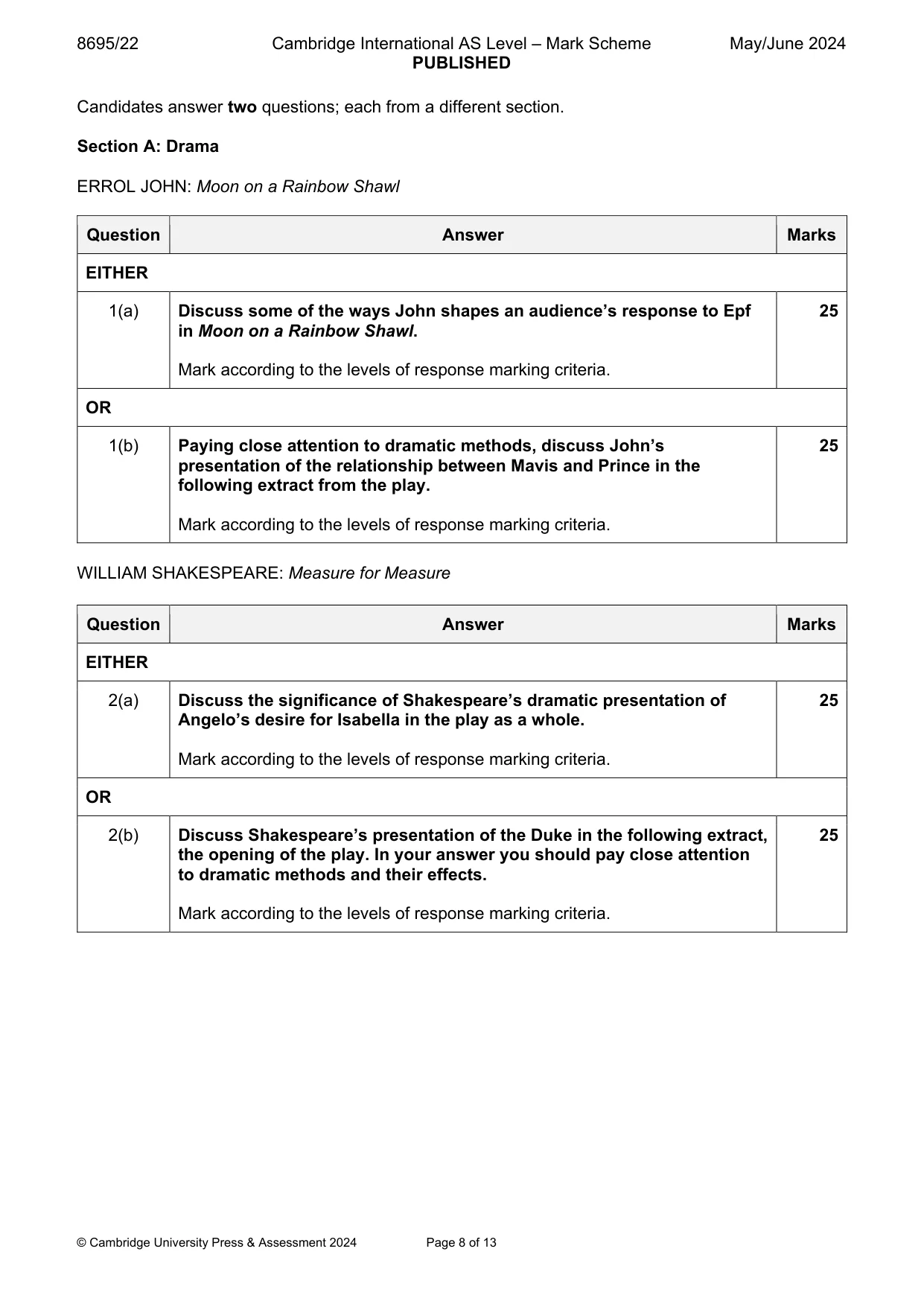
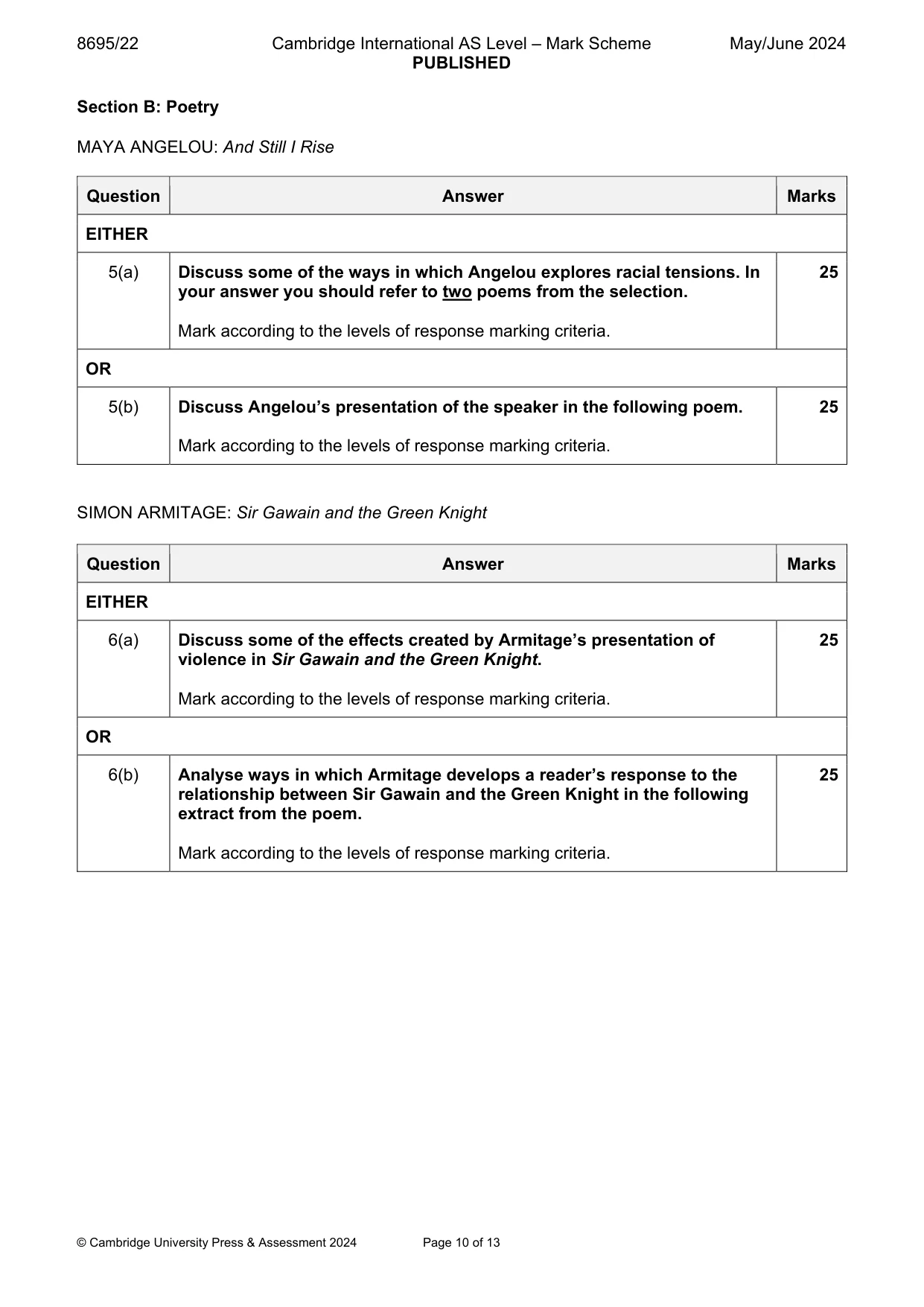
8695/22 Cambridge International AS Level – Mark Scheme PUBLISHED May/June 2024 © Cambridge University Press & Assessment 2024 Page 8 of 13 Candidates answer two questions; each from a different section. Section A: Drama ERROL JOHN: Moon on a Rainbow Shawl Question Answer Marks EITHER 1(a) Discuss some of the ways John shapes an audience’s response to Epf in Moon on a Rainbow Shawl. Mark according to the levels of response marking criteria. 25 OR 1(b) Paying close attention to dramatic methods, discuss John’s presentation of the relationship between Mavis and Prince in the following extract from the play. Mark according to the levels of response marking criteria. 25 WILLIAM SHAKESPEARE: Measure for Measure Question Answer Marks EITHER 2(a) Discuss the significance of Shakespeare’s dramatic presentation of Angelo’s desire for Isabella in the play as a whole. Mark according to the levels of response marking criteria. 25 OR 2(b) Discuss Shakespeare’s presentation of the Duke in the following extract, the opening of the play. In your answer you should pay close attention to dramatic methods and their effects. Mark according to the levels of response marking criteria. 25
Mark scheme, page 9
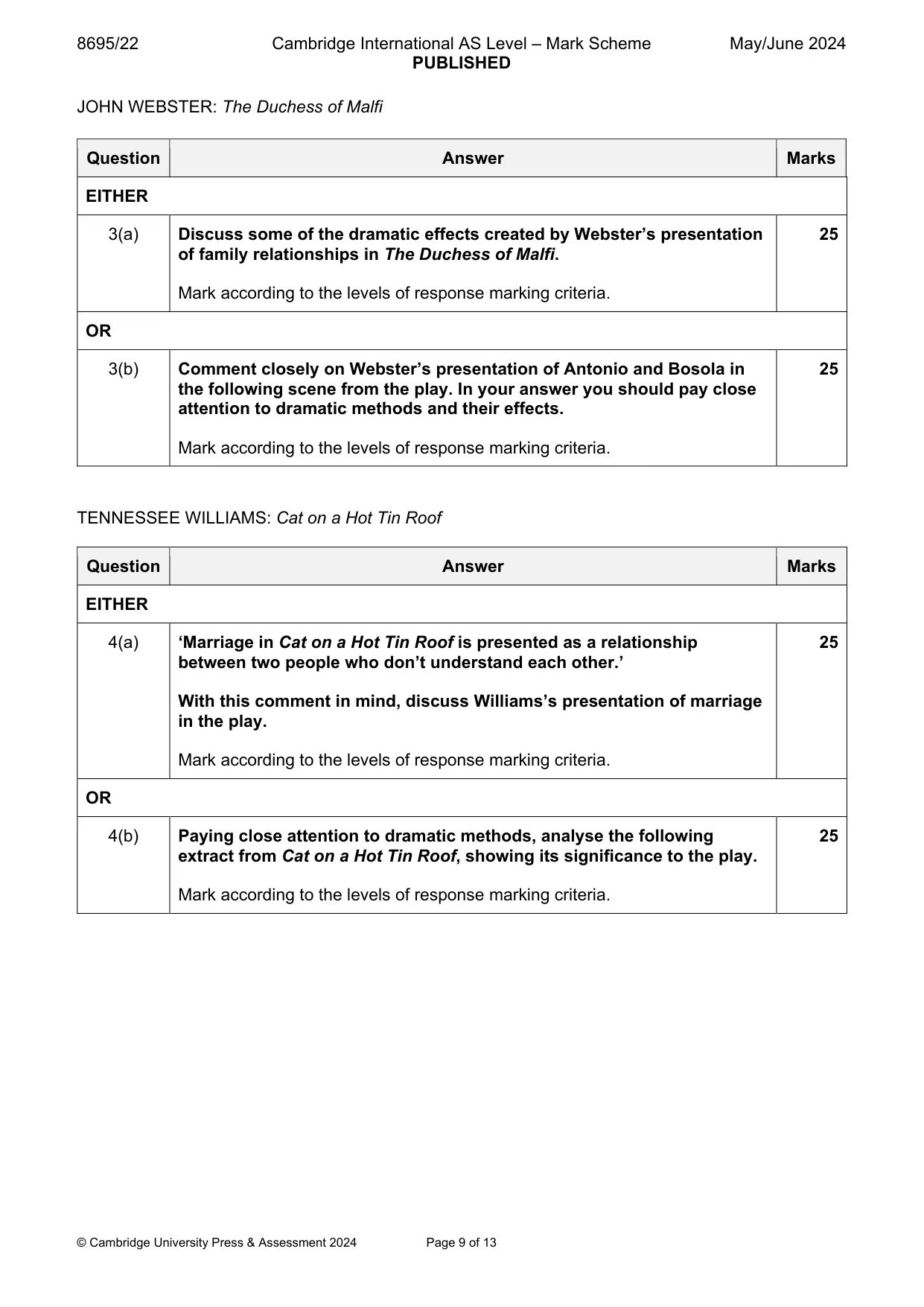
8695/22 Cambridge International AS Level – Mark Scheme PUBLISHED May/June 2024 © Cambridge University Press & Assessment 2024 Page 9 of 13 JOHN WEBSTER: The Duchess of Malfi Question Answer Marks EITHER 3(a) Discuss some of the dramatic effects created by Webster’s presentation of family relationships in The Duchess of Malfi. Mark according to the levels of response marking criteria. 25 OR 3(b) Comment closely on Webster’s presentation of Antonio and Bosola in the following scene from the play. In your answer you should pay close attention to dramatic methods and their effects. Mark according to the levels of response marking criteria. 25 TENNESSEE WILLIAMS: Cat on a Hot Tin Roof Question Answer Marks EITHER 4(a) ‘Marriage in Cat on a Hot Tin Roof is presented as a relationship between two people who don’t understand each other.’ With this comment in mind, discuss Williams’s presentation of marriage in the play. Mark according to the levels of response marking criteria. 25 OR 4(b) Paying close attention to dramatic methods, analyse the following extract from Cat on a Hot Tin Roof, showing its significance to the play. Mark according to the levels of response marking criteria. 25
Mark scheme, page 10
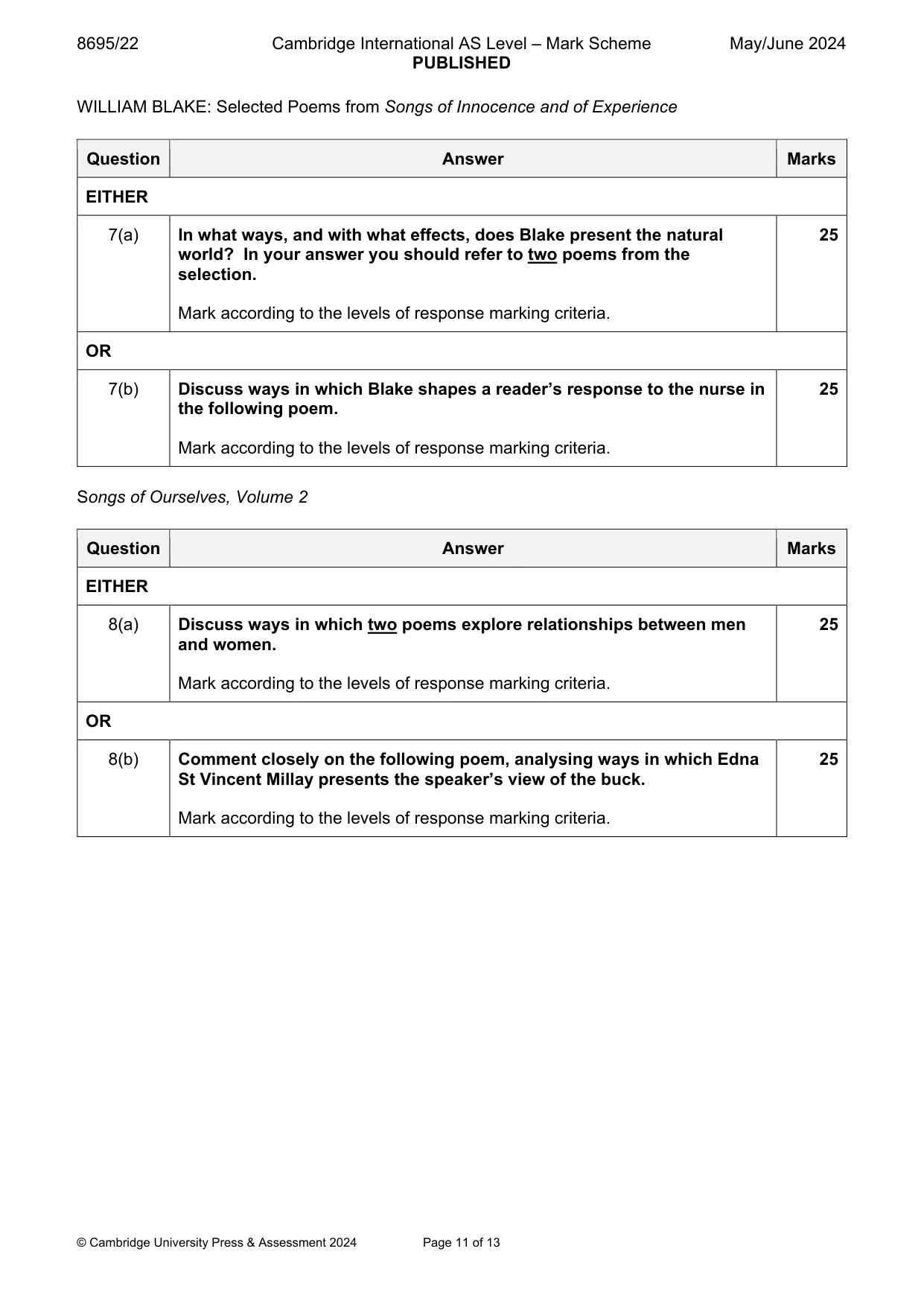
8695/22 Cambridge International AS Level – Mark Scheme PUBLISHED May/June 2024 © Cambridge University Press & Assessment 2024 Page 10 of 13 Section B: Poetry MAYA ANGELOU: And Still I Rise Question Answer Marks EITHER 5(a) Discuss some of the ways in which Angelou explores racial tensions. In your answer you should refer to two poems from the selection. Mark according to the levels of response marking criteria. 25 OR 5(b) Discuss Angelou’s presentation of the speaker in the following poem. Mark according to the levels of response marking criteria. 25 SIMON ARMITAGE: Sir Gawain and the Green Knight Question Answer Marks EITHER 6(a) Discuss some of the effects created by Armitage’s presentation of violence in Sir Gawain and the Green Knight. Mark according to the levels of response marking criteria. 25 OR 6(b) Analyse ways in which Armitage develops a reader’s response to the relationship between Sir Gawain and the Green Knight in the following extract from the poem. Mark according to the levels of response marking criteria. 25
Mark scheme, page 11
8695/22 Cambridge International AS Level – Mark Scheme PUBLISHED May/June 2024 © Cambridge University Press & Assessment 2024 Page 11 of 13 WILLIAM BLAKE: Selected Poems from Songs of Innocence and of Experience Question Answer Marks EITHER 7(a) In what ways, and with what effects, does Blake present the natural world? In your answer you should refer to two poems from the selection. Mark according to the levels of response marking criteria. 25 OR 7(b) Discuss ways in which Blake shapes a reader’s response to the nurse in the following poem. Mark according to the levels of response marking criteria. 25 Songs of Ourselves, Volume 2 Question Answer Marks EITHER 8(a) Discuss ways in which two poems explore relationships between men and women. Mark according to the levels of response marking criteria. 25 OR 8(b) Comment closely on the following poem, analysing ways in which Edna St Vincent Millay presents the speaker’s view of the buck. Mark according to the levels of response marking criteria. 25
Mark scheme, page 12
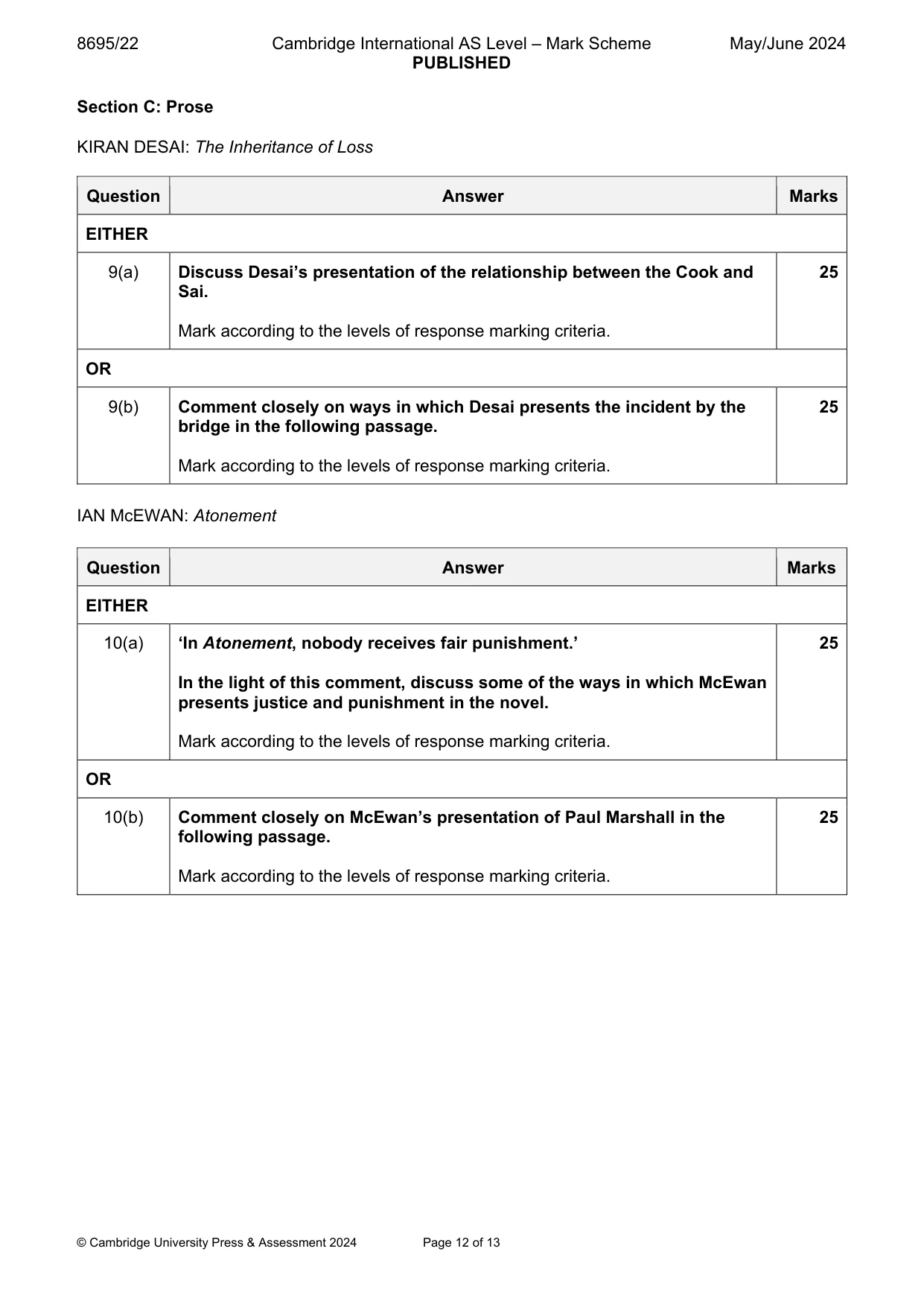
8695/22 Cambridge International AS Level – Mark Scheme PUBLISHED May/June 2024 © Cambridge University Press & Assessment 2024 Page 12 of 13 Section C: Prose KIRAN DESAI: The Inheritance of Loss Question Answer Marks EITHER 9(a) Discuss Desai’s presentation of the relationship between the Cook and Sai. Mark according to the levels of response marking criteria. 25 OR 9(b) Comment closely on ways in which Desai presents the incident by the bridge in the following passage. Mark according to the levels of response marking criteria. 25 IAN McEWAN: Atonement Question Answer Marks EITHER 10(a) ‘In Atonement, nobody receives fair punishment.’ In the light of this comment, discuss some of the ways in which McEwan presents justice and punishment in the novel. Mark according to the levels of response marking criteria. 25 OR 10(b) Comment closely on McEwan’s presentation of Paul Marshall in the following passage. Mark according to the levels of response marking criteria. 25
Mark scheme, page 13
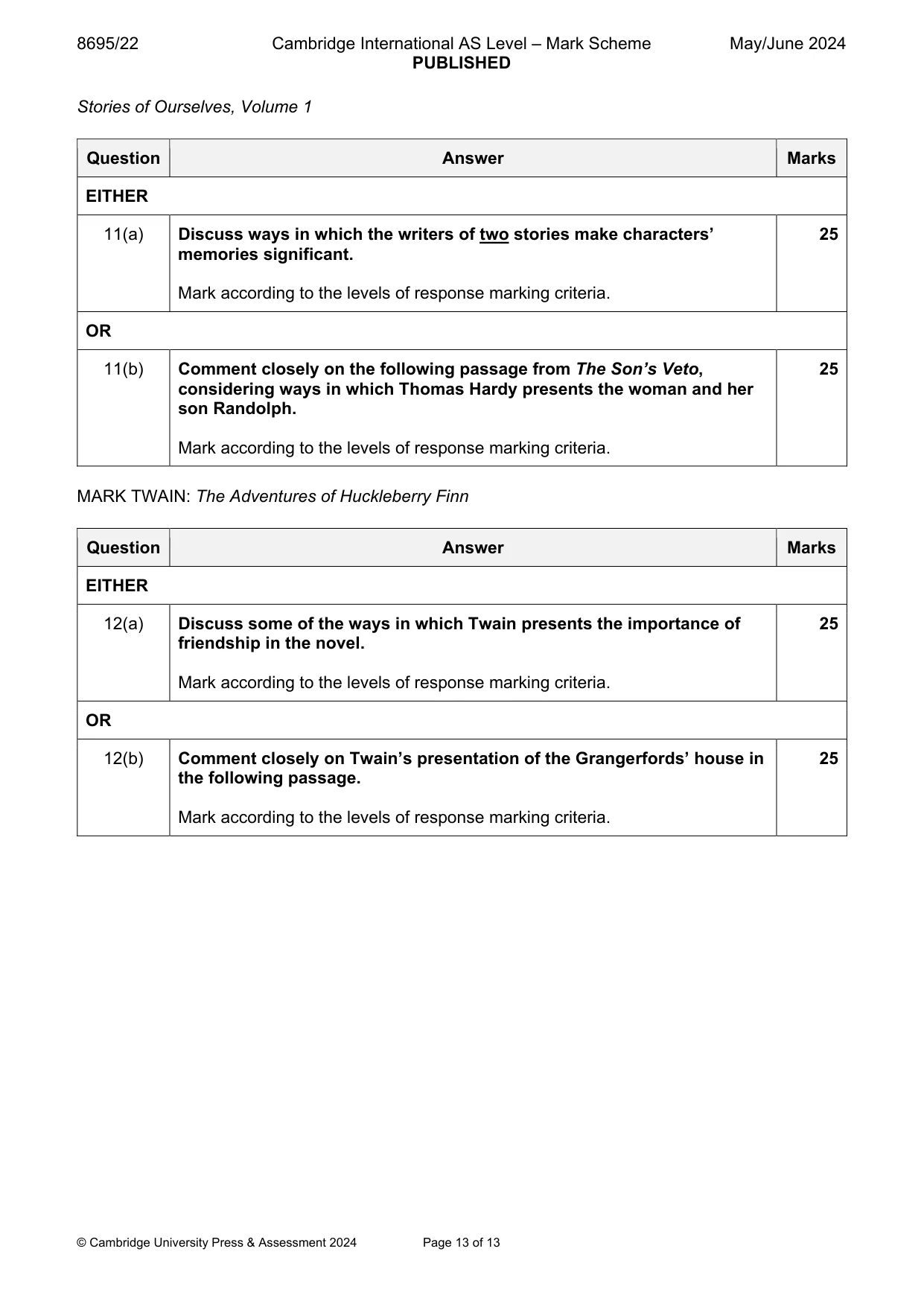
8695/22 Cambridge International AS Level – Mark Scheme PUBLISHED May/June 2024 © Cambridge University Press & Assessment 2024 Page 13 of 13 Stories of Ourselves, Volume 1 Question Answer Marks EITHER 11(a) Discuss ways in which the writers of two stories make characters’ memories significant. Mark according to the levels of response marking criteria. 25 OR 11(b) Comment closely on the following passage from The Son’s Veto, considering ways in which Thomas Hardy presents the woman and her son Randolph. Mark according to the levels of response marking criteria. 25 MARK TWAIN: The Adventures of Huckleberry Finn Question Answer Marks EITHER 12(a) Discuss some of the ways in which Twain presents the importance of friendship in the novel. Mark according to the levels of response marking criteria. 25 OR 12(b) Comment closely on Twain’s presentation of the Grangerfords’ house in the following passage. Mark according to the levels of response marking criteria. 25
What you needed in this session
Cambridge’s own grade thresholds for 2024 May/June, Paper 2 · Variant 2. A higher threshold means an easier paper — the bar moves with how the cohort did.