Cambridge A Level English - Language and Literature (AS Level only, from 2016) 8695 — 2024 Oct/Nov Paper 2 · Variant 1
8695/21/O/N/24 · 50 marks · 120 min
The question paper and its mark scheme, free to read here and free to download. This is Cambridge’s own paper, exactly as it was sat.
Question paper24 pages




Mark scheme13 pages
Answers below. Sit the paper first if you are practising.
Paper as text
Question paper, page 1
This document has 24 pages. Any blank pages are indicated. [Turn over Cambridge International AS Level * 9 9 3 8 0 6 6 3 5 3 * DC (RCL (DF)) 336137/4 © UCLES 2024 LANGUAGE AND LITERATURE IN ENGLISH 8695/21 Paper 2 Drama, Poetry and Prose October/November 2024 2 hours You must answer on the enclosed answer booklet. You will need: Answer booklet (enclosed) INSTRUCTIONS ● Answer two questions in total, each from a different section. ● Follow the instructions on the front cover of the answer booklet. If you need additional answer paper, ask the invigilator for a continuation booklet. ● Dictionaries are not allowed. INFORMATION ● The total mark for this paper is 50. ● The number of marks for each question or part question is shown in brackets [ ].
Question paper, page 2
2 8695/21/O/N/24 © UCLES 2024 Section A: Drama ERROL JOHN: Moon on a Rainbow Shawl 1 Either (a) In what ways, and with what dramatic effects, does John present different attitudes to authority in Moon on a Rainbow Shawl? [25] Or (b) Paying close attention to dramatic methods, discuss John’s presentation of Old Mack in the following extract from the play. [25] [OLD MACK and ROSA come into the backyard from the street.] Content removed due to copyright restrictions.
Question paper, page 3
3 8695/21/O/N/24 © UCLES 2024 [Turn over [A car starts up and drives away.] (from Act 1, Scene 1) Content removed due to copyright restrictions.
Question paper, page 4
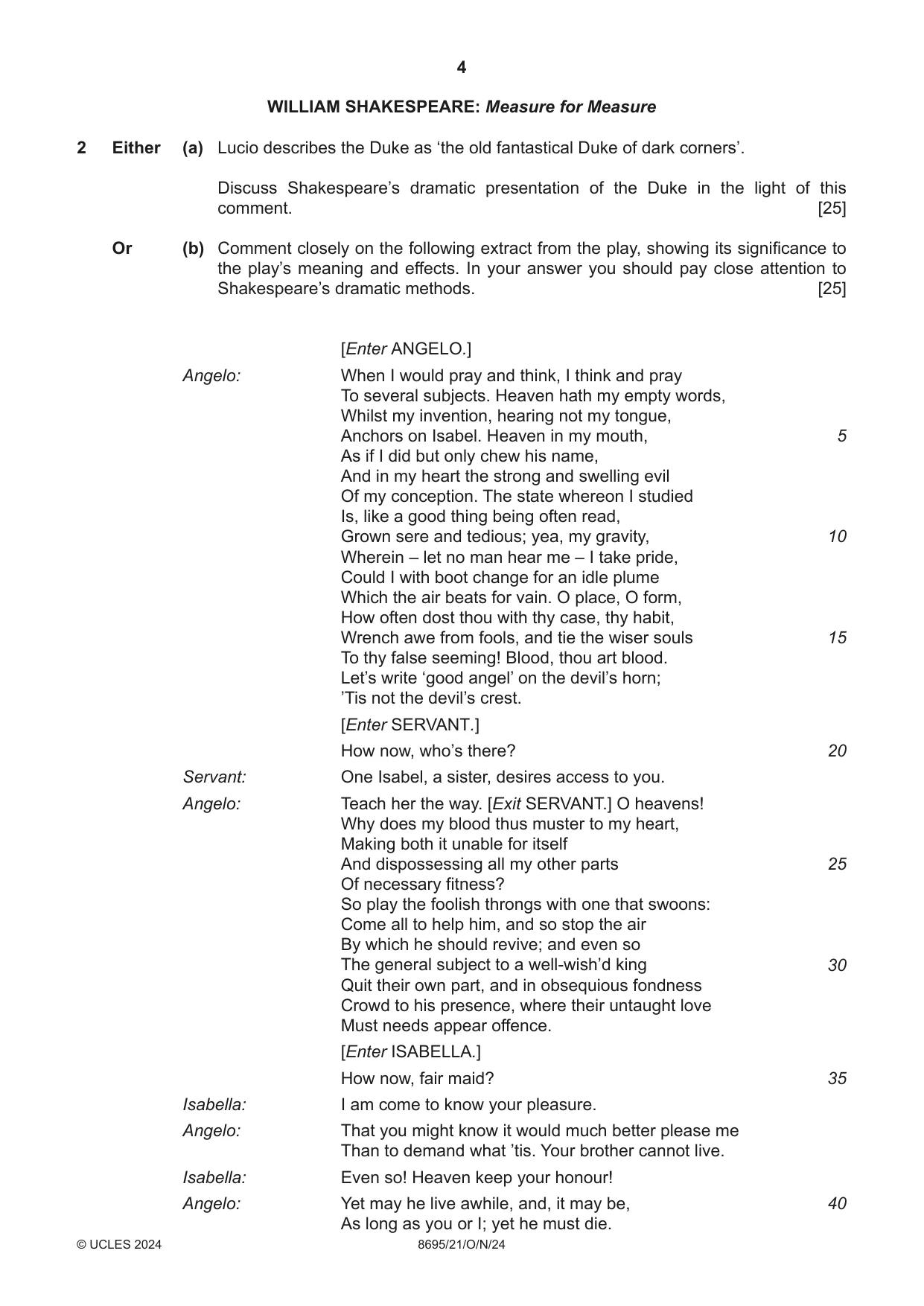
4 8695/21/O/N/24 © UCLES 2024 WILLIAM SHAKESPEARE: Measure for Measure 2 Either (a) Lucio describes the Duke as ‘the old fantastical Duke of dark corners’. Discuss Shakespeare’s dramatic presentation of the Duke in the light of this comment. [25] Or (b) Comment closely on the following extract from the play, showing its significance to the play’s meaning and effects. In your answer you should pay close attention to Shakespeare’s dramatic methods. [25] [Enter ANGELO.] Angelo: When I would pray and think, I think and pray To several subjects. Heaven hath my empty words, Whilst my invention, hearing not my tongue, Anchors on Isabel. Heaven in my mouth, As if I did but only chew his name, And in my heart the strong and swelling evil Of my conception. The state whereon I studied Is, like a good thing being often read, Grown sere and tedious; yea, my gravity, Wherein – let no man hear me – I take pride, Could I with boot change for an idle plume Which the air beats for vain. O place, O form, How often dost thou with thy case, thy habit, Wrench awe from fools, and tie the wiser souls To thy false seeming! Blood, thou art blood. Let’s write ‘good angel’ on the devil’s horn; ’Tis not the devil’s crest. [Enter SERVANT.] How now, who’s there? Servant: One Isabel, a sister, desires access to you. Angelo: Teach her the way. [Exit SERVANT.] O heavens! Why does my blood thus muster to my heart, Making both it unable for itself And dispossessing all my other parts Of necessary fitness? So play the foolish throngs with one that swoons: Come all to help him, and so stop the air By which he should revive; and even so The general subject to a well-wish’d king Quit their own part, and in obsequious fondness Crowd to his presence, where their untaught love Must needs appear offence. [Enter ISABELLA.] How now, fair maid? Isabella: I am come to know your pleasure. Angelo: That you might know it would much better please me Than to demand what ’tis. Your brother cannot live. Isabella: Even so! Heaven keep your honour! Angelo: Yet may he live awhile, and, it may be, As long as you or I; yet he must die. 5 10 15 20 25 30 35 40
Question paper, page 5
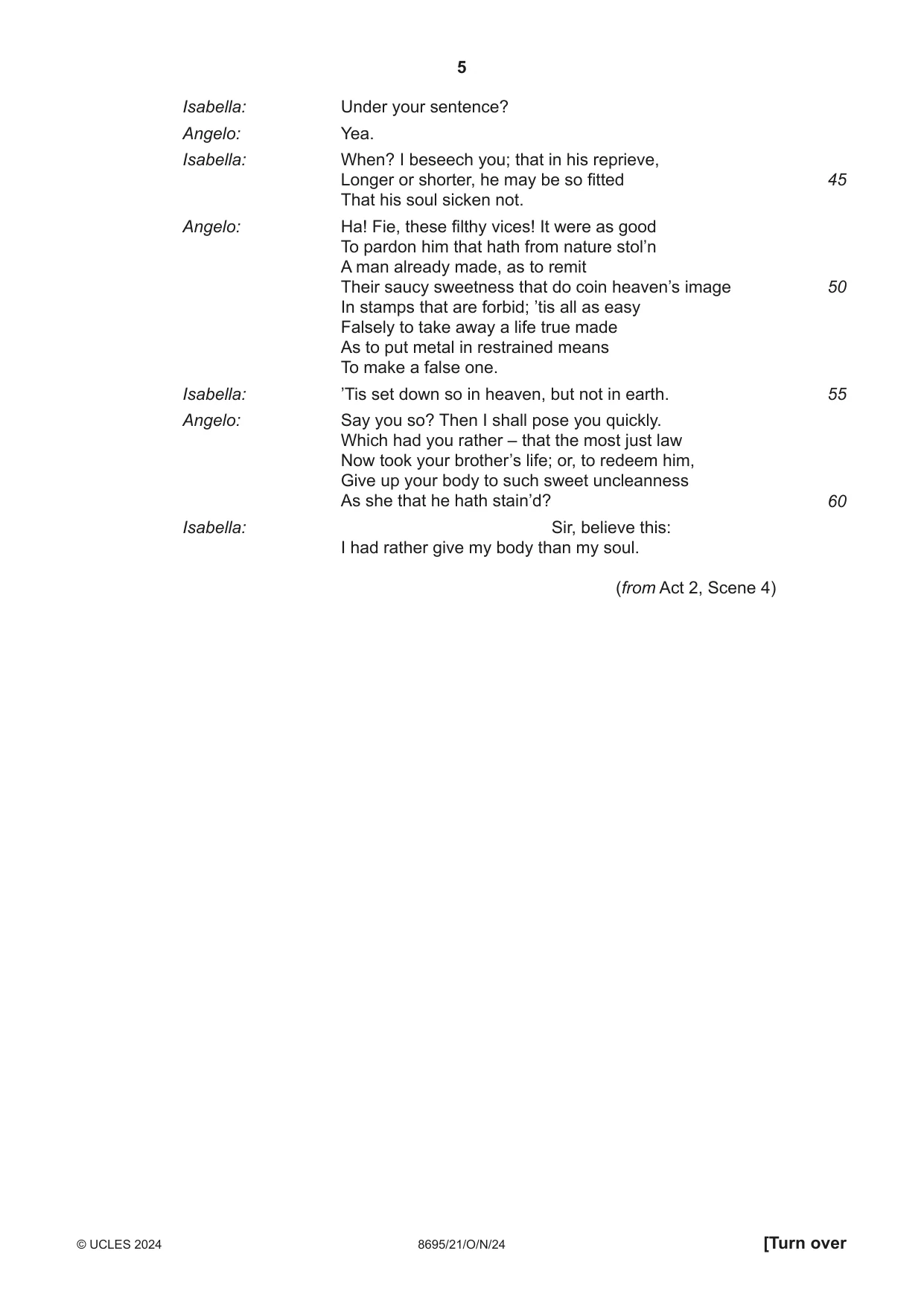
5 8695/21/O/N/24 © UCLES 2024 [Turn over Isabella: Under your sentence? Angelo: Yea. Isabella: When? I beseech you; that in his reprieve, Longer or shorter, he may be so fitted That his soul sicken not. Angelo: Ha! Fie, these filthy vices! It were as good To pardon him that hath from nature stol’n A man already made, as to remit Their saucy sweetness that do coin heaven’s image In stamps that are forbid; ’tis all as easy Falsely to take away a life true made As to put metal in restrained means To make a false one. Isabella: ’Tis set down so in heaven, but not in earth. Angelo: Say you so? Then I shall pose you quickly. Which had you rather – that the most just law Now took your brother’s life; or, to redeem him, Give up your body to such sweet uncleanness As she that he hath stain’d? Isabella: Sir, believe this: I had rather give my body than my soul. (from Act 2, Scene 4) 45 50 55 60
Question paper, page 6
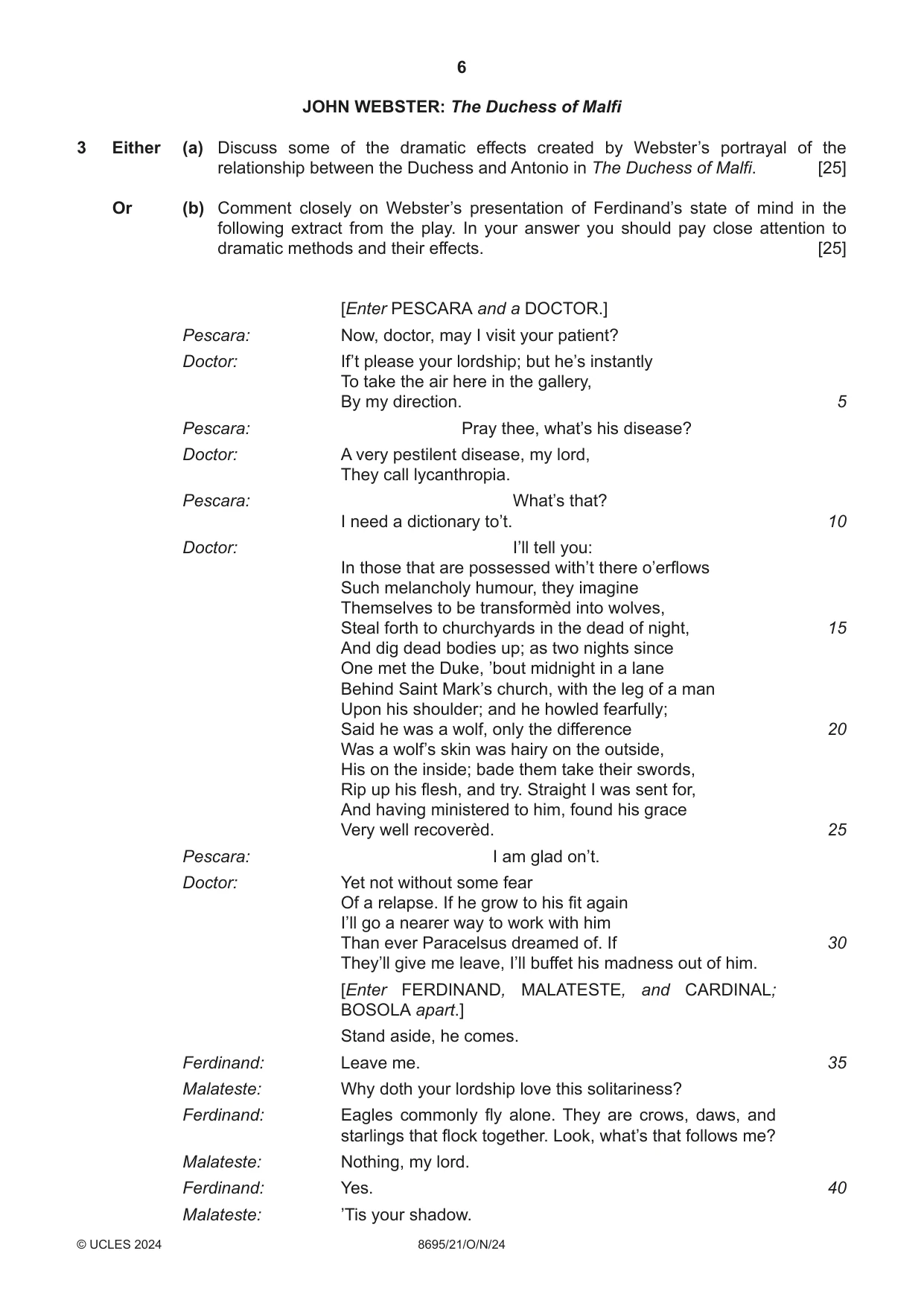
6 8695/21/O/N/24 © UCLES 2024 JOHN WEBSTER: The Duchess of Malfi 3 Either (a) Discuss some of the dramatic effects created by Webster’s portrayal of the relationship between the Duchess and Antonio in The Duchess of Malfi. [25] Or (b) Comment closely on Webster’s presentation of Ferdinand’s state of mind in the following extract from the play. In your answer you should pay close attention to dramatic methods and their effects. [25] [Enter PESCARA and a DOCTOR.] Pescara: Now, doctor, may I visit your patient? Doctor: If’t please your lordship; but he’s instantly To take the air here in the gallery, By my direction. Pescara: Pray thee, what’s his disease? Doctor: A very pestilent disease, my lord, They call lycanthropia. Pescara: What’s that? I need a dictionary to’t. Doctor: I’ll tell you: In those that are possessed with’t there o’erflows Such melancholy humour, they imagine Themselves to be transformèd into wolves, Steal forth to churchyards in the dead of night, And dig dead bodies up; as two nights since One met the Duke, ’bout midnight in a lane Behind Saint Mark’s church, with the leg of a man Upon his shoulder; and he howled fearfully; Said he was a wolf, only the difference Was a wolf’s skin was hairy on the outside, His on the inside; bade them take their swords, Rip up his flesh, and try. Straight I was sent for, And having ministered to him, found his grace Very well recoverèd. Pescara: I am glad on’t. Doctor: Yet not without some fear Of a relapse. If he grow to his fit again I’ll go a nearer way to work with him Than ever Paracelsus dreamed of. If They’ll give me leave, I’ll buffet his madness out of him. [Enter FERDINAND, MALATESTE, and CARDINAL; BOSOLA apart.] Stand aside, he comes. Ferdinand: Leave me. Malateste: Why doth your lordship love this solitariness? Ferdinand: Eagles commonly fly alone. They are crows, daws, and starlings that flock together. Look, what’s that follows me? Malateste: Nothing, my lord. Ferdinand: Yes. Malateste: ’Tis your shadow. 5 10 15 20 25 30 35 40
Question paper, page 7
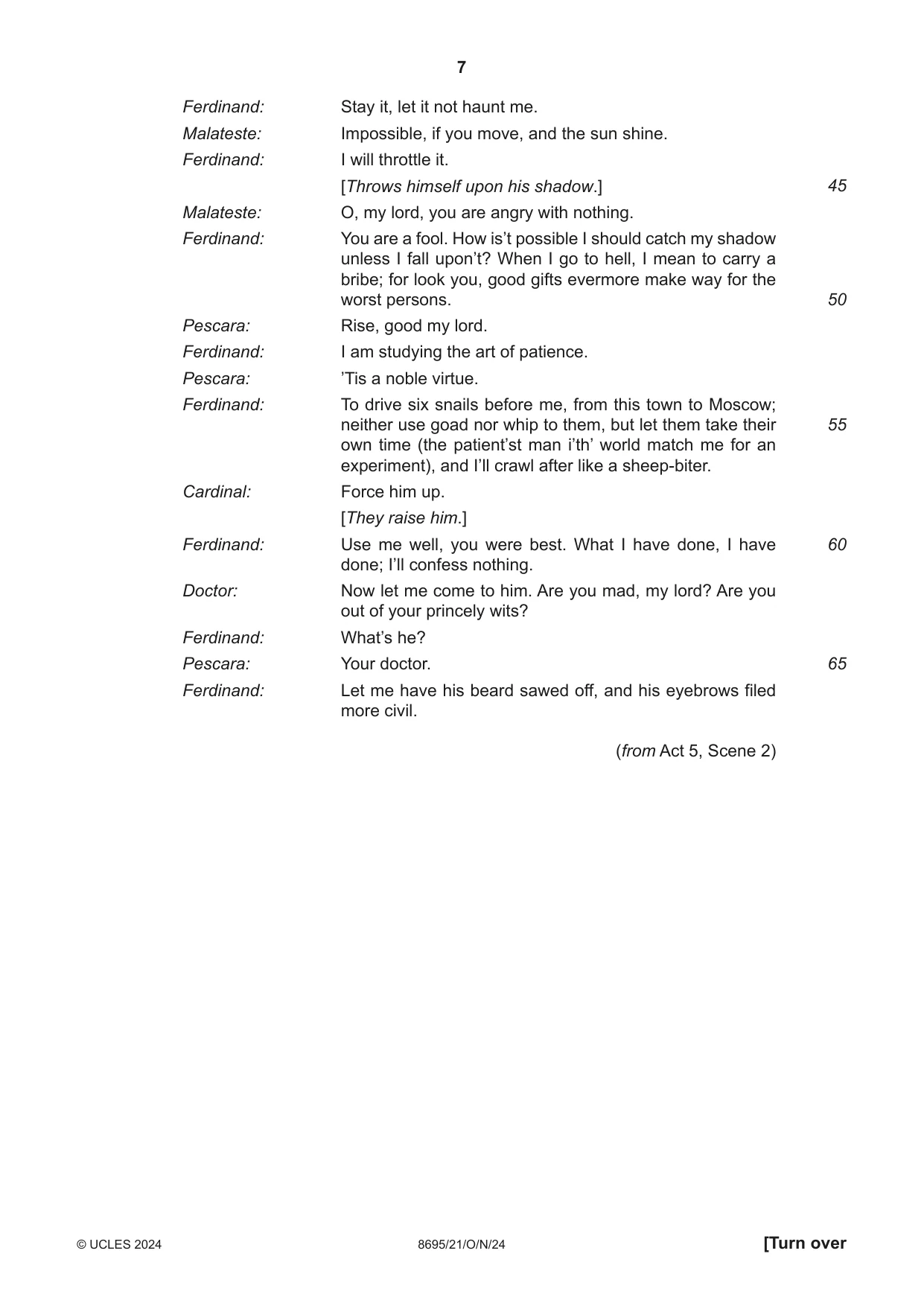
7 8695/21/O/N/24 © UCLES 2024 [Turn over Ferdinand: Stay it, let it not haunt me. Malateste: Impossible, if you move, and the sun shine. Ferdinand: I will throttle it. [Throws himself upon his shadow.] Malateste: O, my lord, you are angry with nothing. Ferdinand: You are a fool. How is’t possible I should catch my shadow unless I fall upon’t? When I go to hell, I mean to carry a bribe; for look you, good gifts evermore make way for the worst persons. Pescara: Rise, good my lord. Ferdinand: I am studying the art of patience. Pescara: ’Tis a noble virtue. Ferdinand: To drive six snails before me, from this town to Moscow; neither use goad nor whip to them, but let them take their own time (the patient’st man i’th’ world match me for an experiment), and I’ll crawl after like a sheep-biter. Cardinal: Force him up. [They raise him.] Ferdinand: Use me well, you were best. What I have done, I have done; I’ll confess nothing. Doctor: Now let me come to him. Are you mad, my lord? Are you out of your princely wits? Ferdinand: What’s he? Pescara: Your doctor. Ferdinand: Let me have his beard sawed off, and his eyebrows filed more civil. (from Act 5, Scene 2) 45 50 55 60 65
Question paper, page 8
8 8695/21/O/N/24 © UCLES 2024 TENNESSEE WILLIAMS: Cat on a Hot Tin Roof 4 Either (a) What, in your view, does the relationship between Brick and Big Daddy contribute to the play’s meaning and effects? [25] Or (b) Discuss Williams’s portrayal of family tensions in the following extract. In your answer you should pay close attention to dramatic methods and their effects. [25] Doctor Baugh: I never have seen a more thorough examination than Big Daddy Pollitt was given in all my experience with the Ochsner Clinic. Content removed due to copyright restrictions.
Question paper, page 9
9 8695/21/O/N/24 © UCLES 2024 [Turn over Mae [as if terribly shocked]: That’s not TRUE! (from Act 3) Content removed due to copyright restrictions.
Question paper, page 10
10 8695/21/O/N/24 © UCLES 2024 Section B: Poetry MAYA ANGELOU: And Still I Rise 5 Either (a) In what ways, and with what effects, does Angelou present desire? In your answer you should refer to two poems from the selection. [25] Or (b) Discuss Angelou’s presentation of the speaker’s feelings in the following poem. [25] Life Doesn’t Frighten Me Shadows on the wall Content removed due to copyright restrictions.
Question paper, page 11
11 8695/21/O/N/24 © UCLES 2024 [Turn over Life doesn’t frighten me at all. Content removed due to copyright restrictions.
Question paper, page 12
12 8695/21/O/N/24 © UCLES 2024 SIMON ARMITAGE: Sir Gawain and the Green Knight 6 Either (a) In what ways, and with what effects, does Armitage explore honour in Sir Gawain and the Green Knight? [25] Or (b) Analyse ways in which Armitage presents Sir Gawain in the following passage. [25] He remained all that day and in the morning he dressed, Content removed due to copyright restrictions.
Question paper, page 13
13 8695/21/O/N/24 © UCLES 2024 [Turn over both clear and smoked, it seemed. Content removed due to copyright restrictions.
Question paper, page 14
14 8695/21/O/N/24 © UCLES 2024 WILLIAM BLAKE: Selected Poems from Songs of Innocence and of Experience 7 Either (a) Discuss some of the ways in which Blake presents relationships between adults and children. In your answer you should refer to two poems from the selection. [25] Or (b) Comment closely on Blake’s presentation of the city in the following poem. [25] London I wander thro’ each charter’d street, Near where the charter’d Thames does flow. And mark in every face I meet Marks of weakness, marks of woe. In every cry of every Man, In every Infants cry of fear, In every voice: in every ban, The mind-forg’d manacles I hear How the Chimney-sweepers cry Every blackning Church appalls, And the hapless Soldiers sigh, Runs in blood down Palace walls But most thro’ midnight streets I hear How the youthful Harlots curse Blasts the new-born Infants tear And blights with plagues the Marriage hearse 5 10 15
Question paper, page 15
15 8695/21/O/N/24 © UCLES 2024 [Turn over Songs of Ourselves, Volume 2 8 Either (a) Discuss ways in which two poems explore loss and its effects. [25] Or (b) Comment closely on the following poem, analysing ways in which Nancy Fotheringham Cato presents the journey. [25] The Road I made the rising moon go back behind the shouldering hill, I raced along the eastern track till time itself stood still. The stars swarmed on behind the trees, but I sped fast at they, I could have made the sun arise, and night turn back to day. And like a long black carpet behind the wheels, the night unrolled across the countryside, but all ahead was bright. The fence-posts whizzed along wires like days that fly too fast, and telephone poles loomed up like years and slipped into the past. And light and movement, sky and road and life and time were one, while through the night I rushed and sped, I drove towards the sun. (Nancy Fotheringham Cato) 5 10 15 20
Question paper, page 16
16 8695/21/O/N/24 © UCLES 2024 Section C: Prose KIRAN DESAI: The Inheritance of Loss 9 Either (a) At the end of the novel, Sai feels ‘a glimmer of strength’. In the light of this quotation, how optimistic do you find the end of The Inheritance of Loss? [25] Or (b) Comment closely on ways in which Desai presents the experience at the Gymkhana dining hall in the following passage. [25] Then the judge burst out, despite himself: ‘YES! ‘Yes, I already told you, didn’t I?’ (from Chapter 32) Content removed due to copyright restrictions.
Question paper, page 17
17 8695/21/O/N/24 © UCLES 2024 [Turn over IAN McEWAN: Atonement 10 Either (a) Discuss ways in which McEwan presents London during the war. [25] Or (b) Comment closely on the following passage, considering ways in which McEwan presents Robbie’s thoughts. [25] He had known her since they were children, and he had never looked at her. Humiliation. (from Chapter 8) Content removed due to copyright restrictions.
Question paper, page 18
18 8695/21/O/N/24 © UCLES 2024 Stories of Ourselves, Volume 1 11 Either (a) Compare ways in which the writers of two stories present tension between men and women. [25] Or (b) Comment closely on the following passage from The Door in the Wall, considering ways in which H G Wells shapes the ending of the story. [25] ‘“And suppose I vanish now? – Amazing disappearance of a prominent politician!” That weighed with me. A thousand inconceivable petty worldlinesses weighed with me in that crisis.’ Then he turned on me with a sorrowful smile, and, speaking slowly, ‘Here I am!’ he said. ‘Here I am!’ he repeated, ‘and my chance has gone from me. Three times in one year the door has been offered me – that door that goes into peace, into delight, into a beauty beyond dreaming, a kindness no man on earth can know. And I have rejected it, Redmond, and it has gone – ’ ‘How do you know?’ ‘I know, I know. I am left now to work it out, to stick to the tasks that held me so strongly when my moments came. You say I have success – this vulgar, tawdry, irksome, envied thing. I have it.’ He had a walnut in his big hand. ‘If that was my success,’ he said, and crushed it, and held it out for me to see. ‘Let me tell you something, Redmond. This loss is destroying me. For two months, for ten weeks nearly now, I have done no work at all, except the most necessary and urgent duties. My soul is full of inappeasable regrets. At nights – when it is less likely I shall be recognised – I go out. I wander. Yes. I wonder what people would think of that if they knew. A Cabinet Minister, the responsible head of that most vital of all departments, wandering alone – grieving – sometimes near audibly lamenting – for a door, for a garden!’ 4 I can see now his rather pallid face, and the unfamiliar sombre fire that had come into his eyes. I see him very vividly tonight. I sit recalling his words, his tones, and last evening’s Westminster Gazette still lies on my sofa, containing the notice of his death. At lunch today the club was busy with his death. We talked of nothing else. They found his body very early yesterday morning in a deep excavation near East Kensington Station. It is one of two shafts that have been made in connection with an extension of the railway southward. It is protected from the intrusion of the public by a hoarding upon the high road, in which a small doorway has been cut for the convenience of some of the workmen who live in that direction. The doorway was left unfastened through a misunderstanding between two gangers, and through it he made his way. My mind is darkened with questions and riddles. It would seem he walked all the way from the House that night – he has frequently walked home during the past Session – and so it is I figure his dark form coming along the late and empty streets, wrapped up, intent. And then did the pale electric lights near the station cheat the rough planking into a semblance of white? Did that fatal unfastened door awaken some memory? Was there, after all, ever any green door in the wall at all? I do not know. I have told his story as he told it to me. There are 5 10 15 20 25 30 35 40 45
Question paper, page 19
19 8695/21/O/N/24 © UCLES 2024 [Turn over times when I believe that Wallace was no more than the victim of the coincidence between a rare but not unprecedented type of hallucination and a careless trap, but that indeed is not my profoundest belief. You may think me superstitious, if you will, and foolish; but, indeed, I am more than half convinced that he had, in truth, an abnormal gift, and a sense, something – I know not what – that in the guise of a wall and door offered him an outlet, a secret and peculiar passage of escape into another and altogether more beautiful world. At any rate, you will say, it betrayed him in the end. But did it betray him? There you touch the inmost mystery of these dreamers, these men of vision and the imagination. We see our world fair and common, the hoarding and the pit. By our daylight standard he walked out of security into darkness, danger, and death. But did he see like that? (from The Door in the Wall) 50 55
Question paper, page 20
20 8695/21/O/N/24 © UCLES 2024 MARK TWAIN: The Adventures of Huckleberry Finn 12 Either (a) Discuss Twain’s characterisation of the duke and the king, considering their roles in the novel. [25] Or (b) Comment closely on ways in which Twain presents Huck tricking Jim in the following passage. [25] I made fast and laid down under Jim’s nose on the raft, and begun to gap, and stretch my fists out against Jim, and says: ‘Hello, Jim, have I been asleep? Why didn’t you stir me up?’ ‘Goodness gracious, is dat you, Huck? En you ain’ dead – you ain’ drownded – you’s back agin? It’s too good for true, honey, it’s too good for true. Lemme look at you, chile, lemme feel o’ you. No, you ain’ dead! you’s back agin, ’live en soun’, jis de same ole Huck – de same ole Huck, thanks to goodness!’ ‘What’s the matter with you, Jim? You been a drinking?’ ‘Drinkin’? Has I ben a drinkin’? Has I had a chance to be a drinkin’?’ ‘Well, then, what makes you talk so wild?’ ‘How does I talk wild?’ ‘How? why, hain’t you been talking about my coming back, and all that stuff, as if I’d been gone away?’ ‘Huck – Huck Finn, you look me in de eye; look me in de eye. Hain’t you ben gone away?’ ‘Gone away? Why, what in the nation do you mean? I hain’t been gone anywheres. Where would I go to?’ ‘Well, looky here, boss, dey’s sumf’n wrong, dey is. Is I me, or who is I? Is I heah, or whah is I? Now dat’s what I wants to know.’ ‘Well, I think you’re here, plain enough, but I think you’re a tangle-headed old fool, Jim.’ ‘I is, is I? Well you answer me dis. Didn’t you tote out de line in de canoe, fer to make fas’ to de tow-head?’ ‘No, I didn’t. What tow-head? I hain’t seen no tow-head.’ ‘You hain’t seen no tow-head? Looky here – didn’t de line pull loose en de raf’ go a hummin’ down de river, en leave you en de canoe behine in de fog?’ ‘What fog?’ ‘Why de fog. De fog dat’s ben aroun’ all night. End didn’t you whoop, en didn’t I whoop, tell we got mix’ up in de islands en one un us got los’ en ’tother one was jis’ as good as los’, ’kase he didn’t know whah he wuz? En didn’t I bust up agin a lot er dem islands en have a turrible time en mos’ git drownded? Now ain’ dat so, boss – ain’t it so? You answer me dat.’ ‘Well, this is too many for me, Jim. I hain’t seen no fog, nor no islands, nor no troubles, nor nothing. I been setting here talking with you all night till you went to sleep about ten minutes ago, and I reckon I done the same. You couldn’t a got drunk in that time, so of course you’ve been dreaming.’ ‘Dad fetch it, how is gwyne to dream all dat in ten minutes?’ ‘Well, hang it all, you did dream it, because there didn’t any of it happen.’ ‘But Huck, it’s all jis’ as plain to me as –’ ‘It don’t make no difference how plain it is, there ain’t nothing in it. I know, because I’ve been here all the time.’ Jim didn’t say nothing for about five minutes, but set there studying over it. (from Chapter 15) 5 10 15 20 25 30 35 40 45
Question paper, page 21
21 8695/21/O/N/24 © UCLES 2024 BLANK PAGE
Question paper, page 22
22 8695/21/O/N/24 © UCLES 2024 BLANK PAGE
Question paper, page 23
23 8695/21/O/N/24 © UCLES 2024 BLANK PAGE
Question paper, page 24
24 8695/21/O/N/24 © UCLES 2024 Permission to reproduce items where third-party owned material protected by copyright is included has been sought and cleared where possible. Every reasonable effort has been made by the publisher (UCLES) to trace copyright holders, but if any items requiring clearance have unwittingly been included, the publisher will be pleased to make amends at the earliest possible opportunity. To avoid the issue of disclosure of answer-related information to candidates, all copyright acknowledgements are reproduced online in the Cambridge Assessment International Education Copyright Acknowledgements Booklet. This is produced for each series of examinations and is freely available to download at www.cambridgeinternational.org after the live examination series. Cambridge Assessment International Education is part of Cambridge Assessment. Cambridge Assessment is the brand name of the University of Cambridge Local Examinations Syndicate (UCLES), which is a department of the University of Cambridge. BLANK PAGE
Mark scheme, page 1
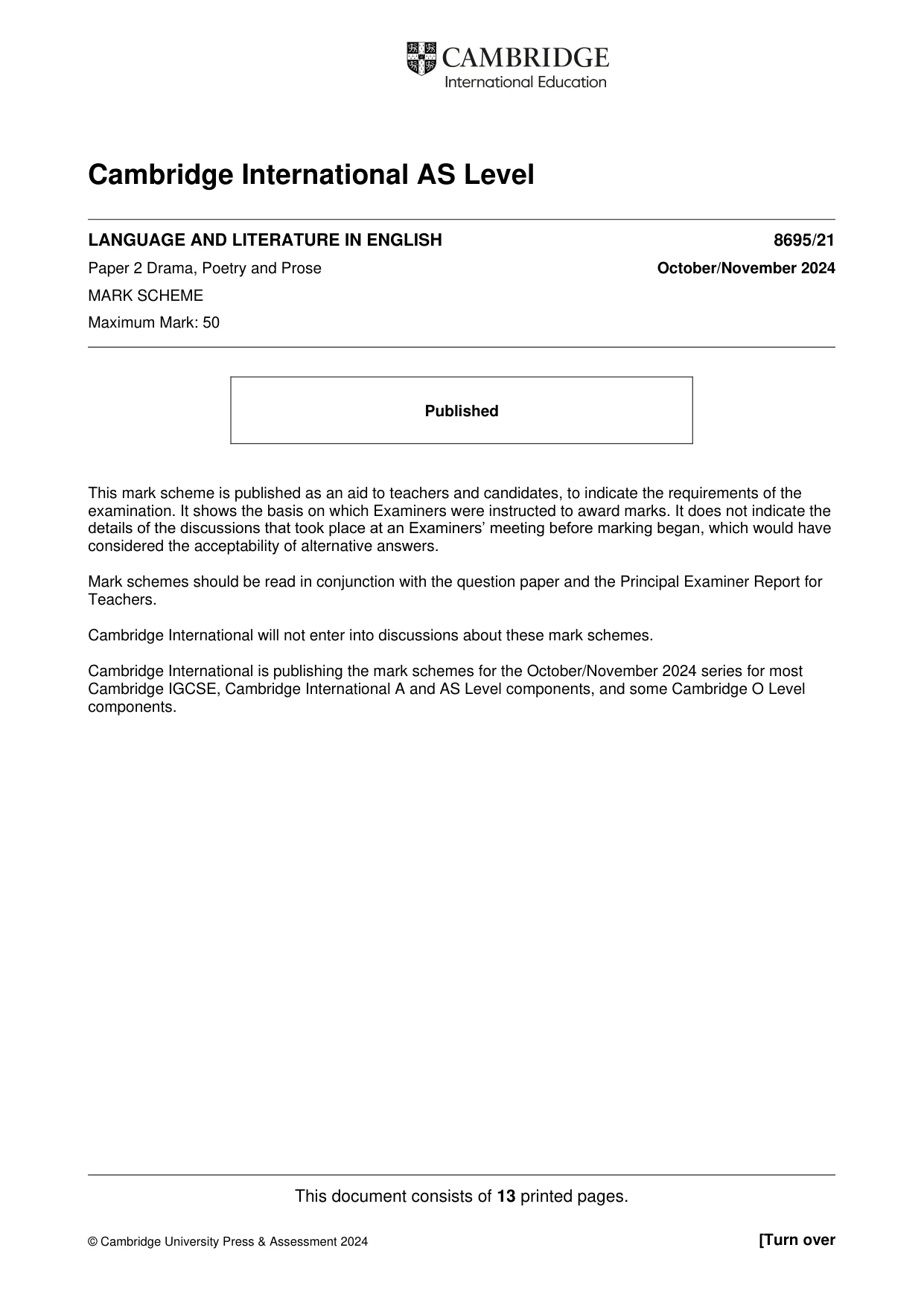
This document consists of 13 printed pages. © Cambridge University Press & Assessment 2024 [Turn over Cambridge International AS Level LANGUAGE AND LITERATURE IN ENGLISH 8695/21 Paper 2 Drama, Poetry and Prose October/November 2024 MARK SCHEME Maximum Mark: 50 Published This mark scheme is published as an aid to teachers and candidates, to indicate the requirements of the examination. It shows the basis on which Examiners were instructed to award marks. It does not indicate the details of the discussions that took place at an Examiners’ meeting before marking began, which would have considered the acceptability of alternative answers. Mark schemes should be read in conjunction with the question paper and the Principal Examiner Report for Teachers. Cambridge International will not enter into discussions about these mark schemes. Cambridge International is publishing the mark schemes for the October/November 2024 series for most Cambridge IGCSE, Cambridge International A and AS Level components, and some Cambridge O Level components.
Mark scheme, page 2
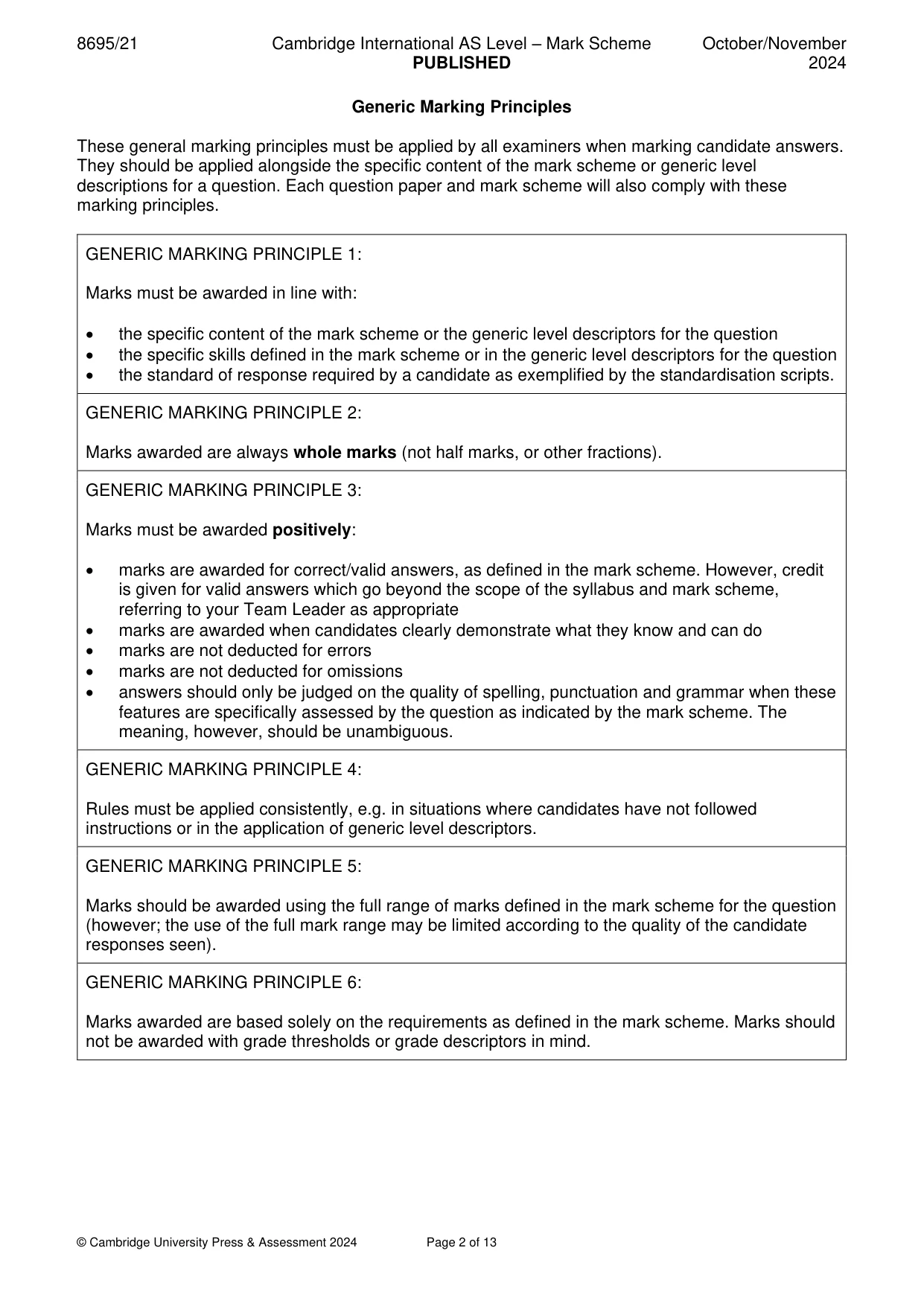
8695/21 Cambridge International AS Level – Mark Scheme PUBLISHED October/November 2024 © Cambridge University Press & Assessment 2024 Page 2 of 13 Generic Marking Principles These general marking principles must be applied by all examiners when marking candidate answers. They should be applied alongside the specific content of the mark scheme or generic level descriptions for a question. Each question paper and mark scheme will also comply with these marking principles. GENERIC MARKING PRINCIPLE 1: Marks must be awarded in line with: • the specific content of the mark scheme or the generic level descriptors for the question • the specific skills defined in the mark scheme or in the generic level descriptors for the question • the standard of response required by a candidate as exemplified by the standardisation scripts. GENERIC MARKING PRINCIPLE 2: Marks awarded are always whole marks (not half marks, or other fractions). GENERIC MARKING PRINCIPLE 3: Marks must be awarded positively: • marks are awarded for correct/valid answers, as defined in the mark scheme. However, credit is given for valid answers which go beyond the scope of the syllabus and mark scheme, referring to your Team Leader as appropriate • marks are awarded when candidates clearly demonstrate what they know and can do • marks are not deducted for errors • marks are not deducted for omissions • answers should only be judged on the quality of spelling, punctuation and grammar when these features are specifically assessed by the question as indicated by the mark scheme. The meaning, however, should be unambiguous. GENERIC MARKING PRINCIPLE 4: Rules must be applied consistently, e.g. in situations where candidates have not followed instructions or in the application of generic level descriptors. GENERIC MARKING PRINCIPLE 5: Marks should be awarded using the full range of marks defined in the mark scheme for the question (however; the use of the full mark range may be limited according to the quality of the candidate responses seen). GENERIC MARKING PRINCIPLE 6: Marks awarded are based solely on the requirements as defined in the mark scheme. Marks should not be awarded with grade thresholds or grade descriptors in mind.
Mark scheme, page 3
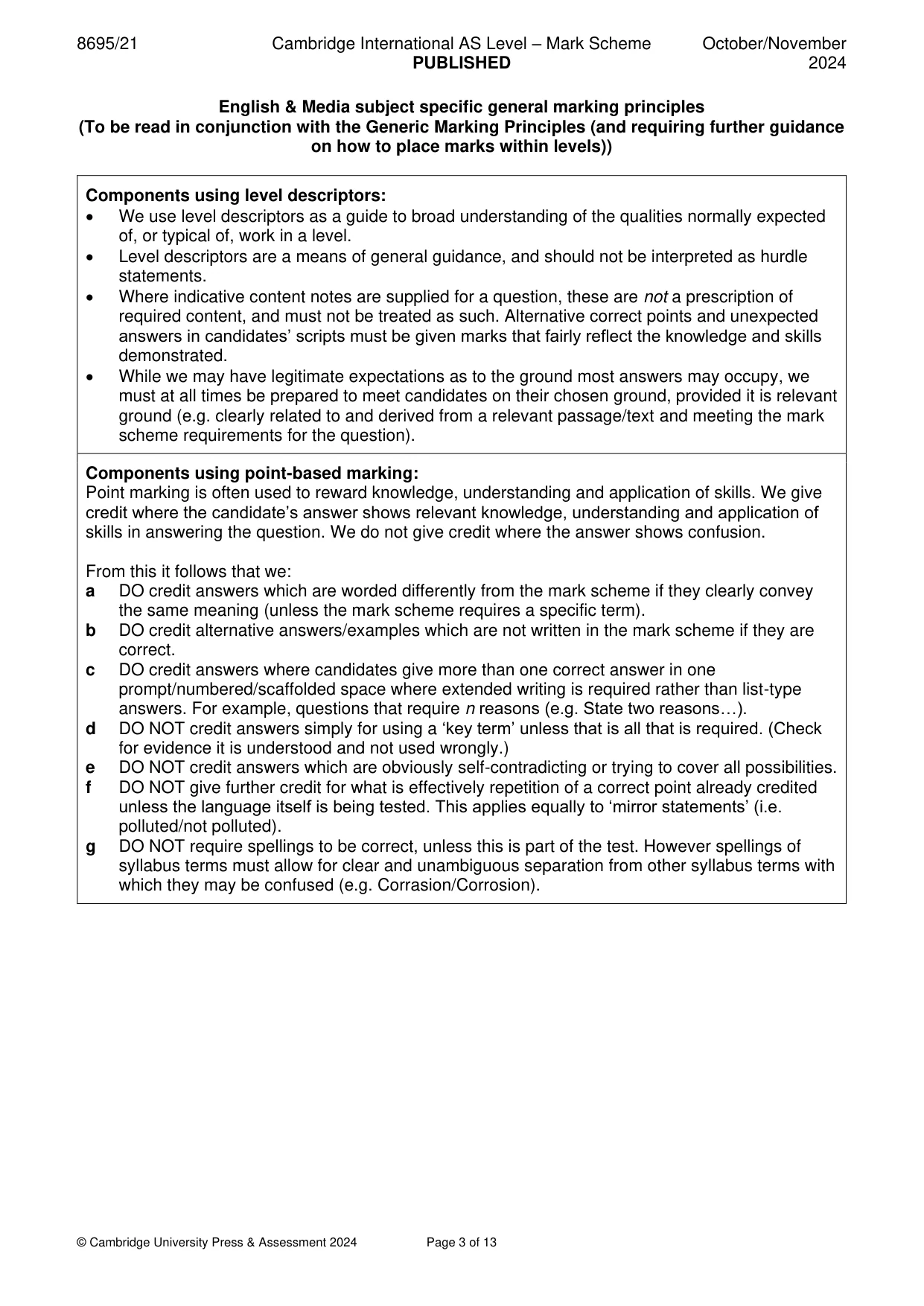
8695/21 Cambridge International AS Level – Mark Scheme PUBLISHED October/November 2024 © Cambridge University Press & Assessment 2024 Page 3 of 13 English & Media subject specific general marking principles (To be read in conjunction with the Generic Marking Principles (and requiring further guidance on how to place marks within levels)) Components using level descriptors: • We use level descriptors as a guide to broad understanding of the qualities normally expected of, or typical of, work in a level. • Level descriptors are a means of general guidance, and should not be interpreted as hurdle statements. • Where indicative content notes are supplied for a question, these are not a prescription of required content, and must not be treated as such. Alternative correct points and unexpected answers in candidates’ scripts must be given marks that fairly reflect the knowledge and skills demonstrated. • While we may have legitimate expectations as to the ground most answers may occupy, we must at all times be prepared to meet candidates on their chosen ground, provided it is relevant ground (e.g. clearly related to and derived from a relevant passage/text and meeting the mark scheme requirements for the question). Components using point-based marking: Point marking is often used to reward knowledge, understanding and application of skills. We give credit where the candidate’s answer shows relevant knowledge, understanding and application of skills in answering the question. We do not give credit where the answer shows confusion. From this it follows that we: a DO credit answers which are worded differently from the mark scheme if they clearly convey the same meaning (unless the mark scheme requires a specific term). b DO credit alternative answers/examples which are not written in the mark scheme if they are correct. c DO credit answers where candidates give more than one correct answer in one prompt/numbered/scaffolded space where extended writing is required rather than list-type answers. For example, questions that require n reasons (e.g. State two reasons…). d DO NOT credit answers simply for using a ‘key term’ unless that is all that is required. (Check for evidence it is understood and not used wrongly.) e DO NOT credit answers which are obviously self-contradicting or trying to cover all possibilities. f DO NOT give further credit for what is effectively repetition of a correct point already credited unless the language itself is being tested. This applies equally to ‘mirror statements’ (i.e. polluted/not polluted). g DO NOT require spellings to be correct, unless this is part of the test. However spellings of syllabus terms must allow for clear and unambiguous separation from other syllabus terms with which they may be confused (e.g. Corrasion/Corrosion).
Mark scheme, page 4
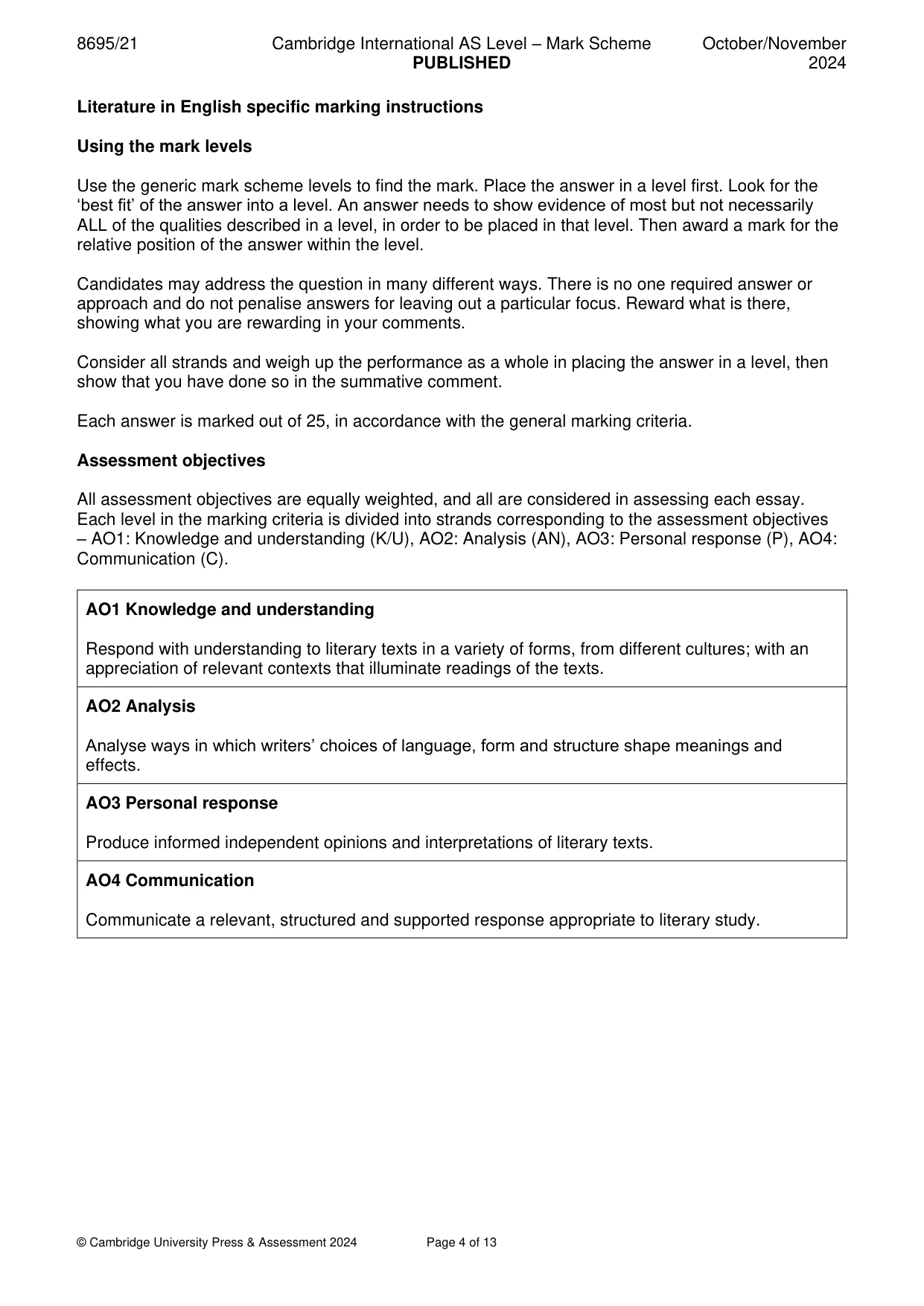
8695/21 Cambridge International AS Level – Mark Scheme PUBLISHED October/November 2024 © Cambridge University Press & Assessment 2024 Page 4 of 13 Literature in English specific marking instructions Using the mark levels Use the generic mark scheme levels to find the mark. Place the answer in a level first. Look for the ‘best fit’ of the answer into a level. An answer needs to show evidence of most but not necessarily ALL of the qualities described in a level, in order to be placed in that level. Then award a mark for the relative position of the answer within the level. Candidates may address the question in many different ways. There is no one required answer or approach and do not penalise answers for leaving out a particular focus. Reward what is there, showing what you are rewarding in your comments. Consider all strands and weigh up the performance as a whole in placing the answer in a level, then show that you have done so in the summative comment. Each answer is marked out of 25, in accordance with the general marking criteria. Assessment objectives All assessment objectives are equally weighted, and all are considered in assessing each essay. Each level in the marking criteria is divided into strands corresponding to the assessment objectives – AO1: Knowledge and understanding (K/U), AO2: Analysis (AN), AO3: Personal response (P), AO4: Communication (C). AO1 Knowledge and understanding Respond with understanding to literary texts in a variety of forms, from different cultures; with an appreciation of relevant contexts that illuminate readings of the texts. AO2 Analysis Analyse ways in which writers’ choices of language, form and structure shape meanings and effects. AO3 Personal response Produce informed independent opinions and interpretations of literary texts. AO4 Communication Communicate a relevant, structured and supported response appropriate to literary study.
Mark scheme, page 5
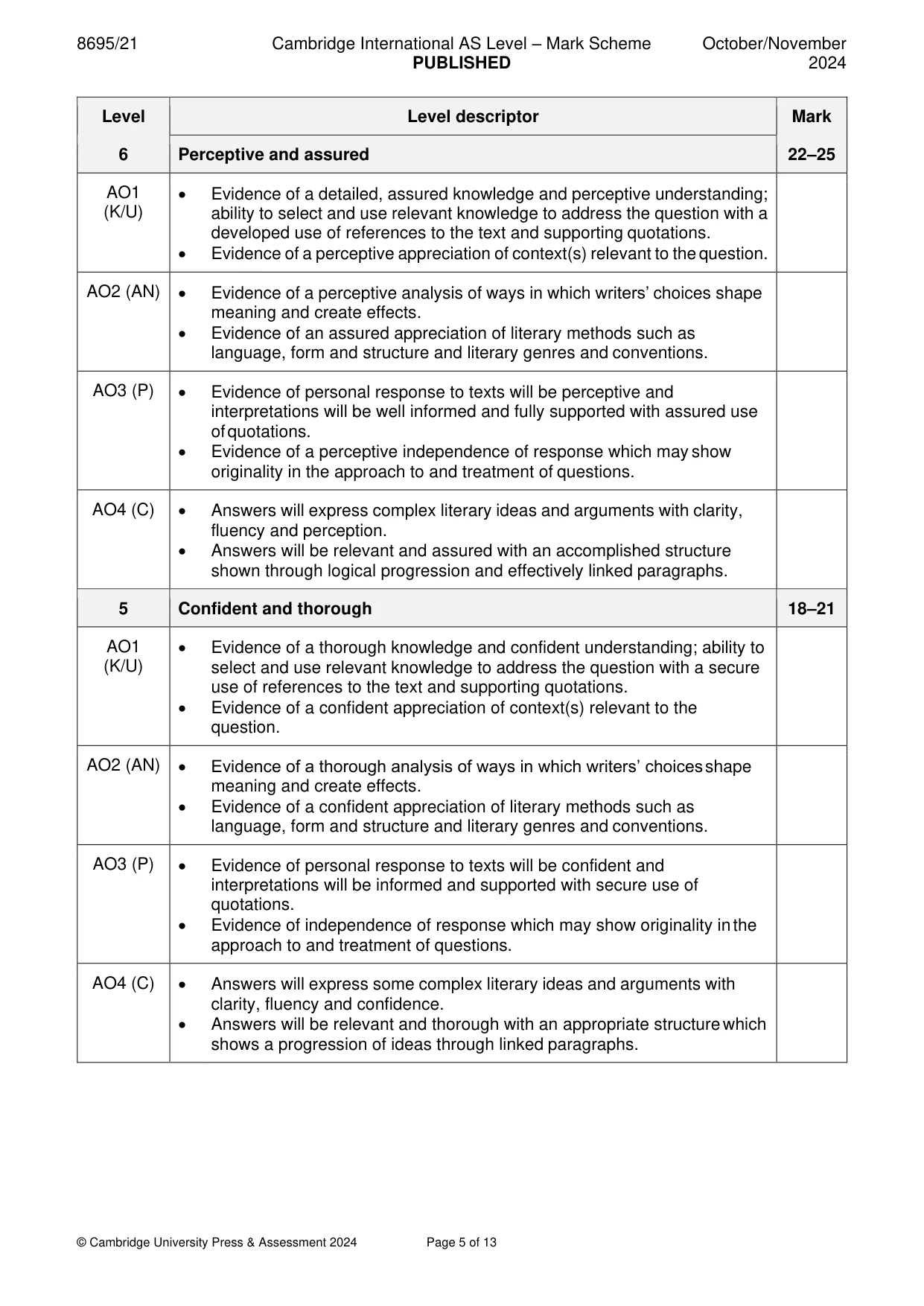
8695/21 Cambridge International AS Level – Mark Scheme PUBLISHED October/November 2024 © Cambridge University Press & Assessment 2024 Page 5 of 13 Level Level descriptor Mark 6 Perceptive and assured 22–25 AO1 (K/U) • Evidence of a detailed, assured knowledge and perceptive understanding; ability to select and use relevant knowledge to address the question with a developed use of references to the text and supporting quotations. • Evidence of a perceptive appreciation of context(s) relevant to the question. AO2 (AN) • Evidence of a perceptive analysis of ways in which writers’ choices shape meaning and create effects. • Evidence of an assured appreciation of literary methods such as language, form and structure and literary genres and conventions. AO3 (P) • Evidence of personal response to texts will be perceptive and interpretations will be well informed and fully supported with assured use of quotations. • Evidence of a perceptive independence of response which may show originality in the approach to and treatment of questions. AO4 (C) • Answers will express complex literary ideas and arguments with clarity, fluency and perception. • Answers will be relevant and assured with an accomplished structure shown through logical progression and effectively linked paragraphs. 5 Confident and thorough 18–21 AO1 (K/U) • Evidence of a thorough knowledge and confident understanding; ability to select and use relevant knowledge to address the question with a secure use of references to the text and supporting quotations. • Evidence of a confident appreciation of context(s) relevant to the question. AO2 (AN) • Evidence of a thorough analysis of ways in which writers’ choices shape meaning and create effects. • Evidence of a confident appreciation of literary methods such as language, form and structure and literary genres and conventions. AO3 (P) • Evidence of personal response to texts will be confident and interpretations will be informed and supported with secure use of quotations. • Evidence of independence of response which may show originality in the approach to and treatment of questions. AO4 (C) • Answers will express some complex literary ideas and arguments with clarity, fluency and confidence. • Answers will be relevant and thorough with an appropriate structure which shows a progression of ideas through linked paragraphs.
Mark scheme, page 6
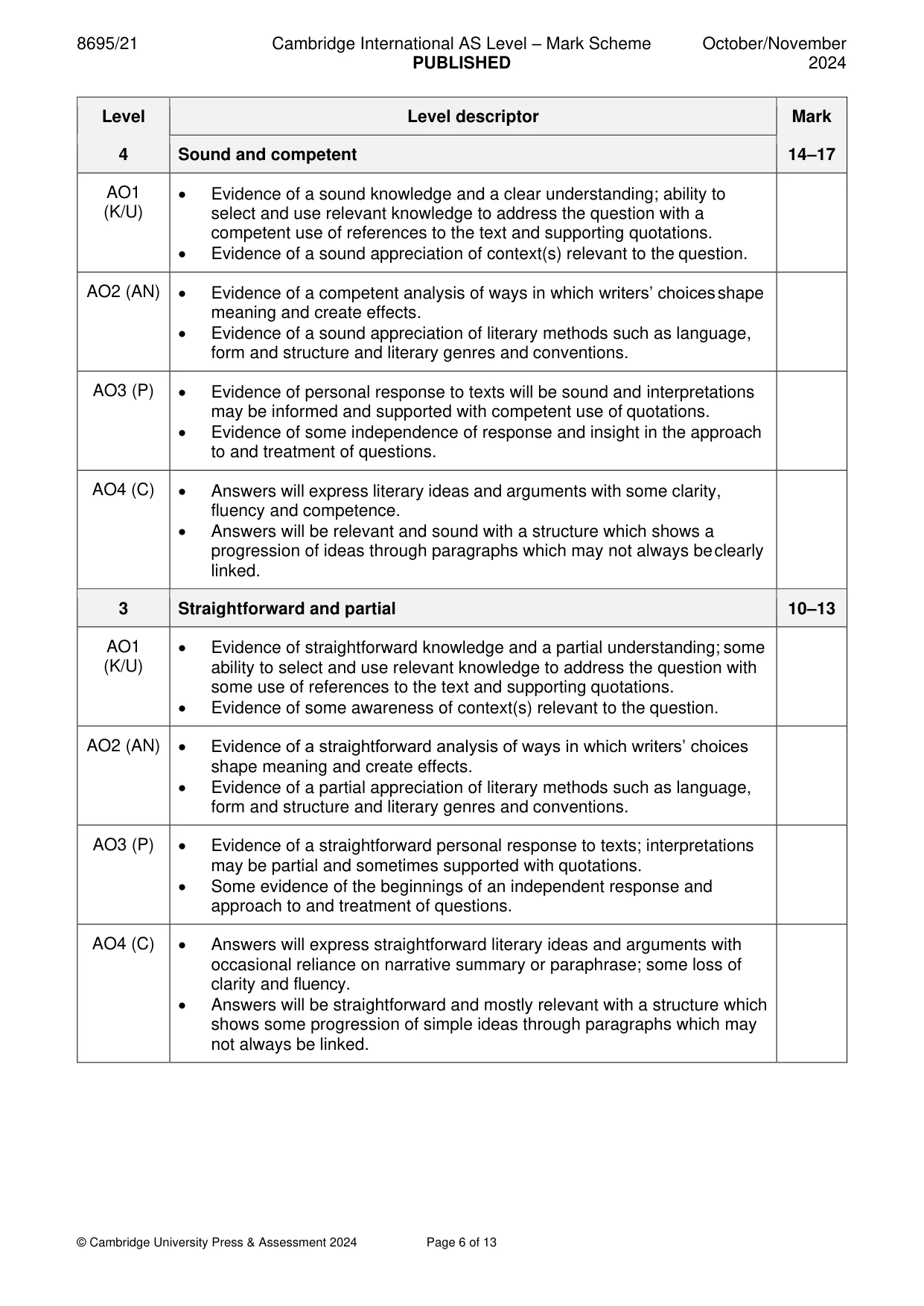
8695/21 Cambridge International AS Level – Mark Scheme PUBLISHED October/November 2024 © Cambridge University Press & Assessment 2024 Page 6 of 13 Level Level descriptor Mark 4 Sound and competent 14–17 AO1 (K/U) • Evidence of a sound knowledge and a clear understanding; ability to select and use relevant knowledge to address the question with a competent use of references to the text and supporting quotations. • Evidence of a sound appreciation of context(s) relevant to the question. AO2 (AN) • Evidence of a competent analysis of ways in which writers’ choices shape meaning and create effects. • Evidence of a sound appreciation of literary methods such as language, form and structure and literary genres and conventions. AO3 (P) • Evidence of personal response to texts will be sound and interpretations may be informed and supported with competent use of quotations. • Evidence of some independence of response and insight in the approach to and treatment of questions. AO4 (C) • Answers will express literary ideas and arguments with some clarity, fluency and competence. • Answers will be relevant and sound with a structure which shows a progression of ideas through paragraphs which may not always be clearly linked. 3 Straightforward and partial 10–13 AO1 (K/U) • Evidence of straightforward knowledge and a partial understanding; some ability to select and use relevant knowledge to address the question with some use of references to the text and supporting quotations. • Evidence of some awareness of context(s) relevant to the question. AO2 (AN) • Evidence of a straightforward analysis of ways in which writers’ choices shape meaning and create effects. • Evidence of a partial appreciation of literary methods such as language, form and structure and literary genres and conventions. AO3 (P) • Evidence of a straightforward personal response to texts; interpretations may be partial and sometimes supported with quotations. • Some evidence of the beginnings of an independent response and approach to and treatment of questions. AO4 (C) • Answers will express straightforward literary ideas and arguments with occasional reliance on narrative summary or paraphrase; some loss of clarity and fluency. • Answers will be straightforward and mostly relevant with a structure which shows some progression of simple ideas through paragraphs which may not always be linked.
Mark scheme, page 7
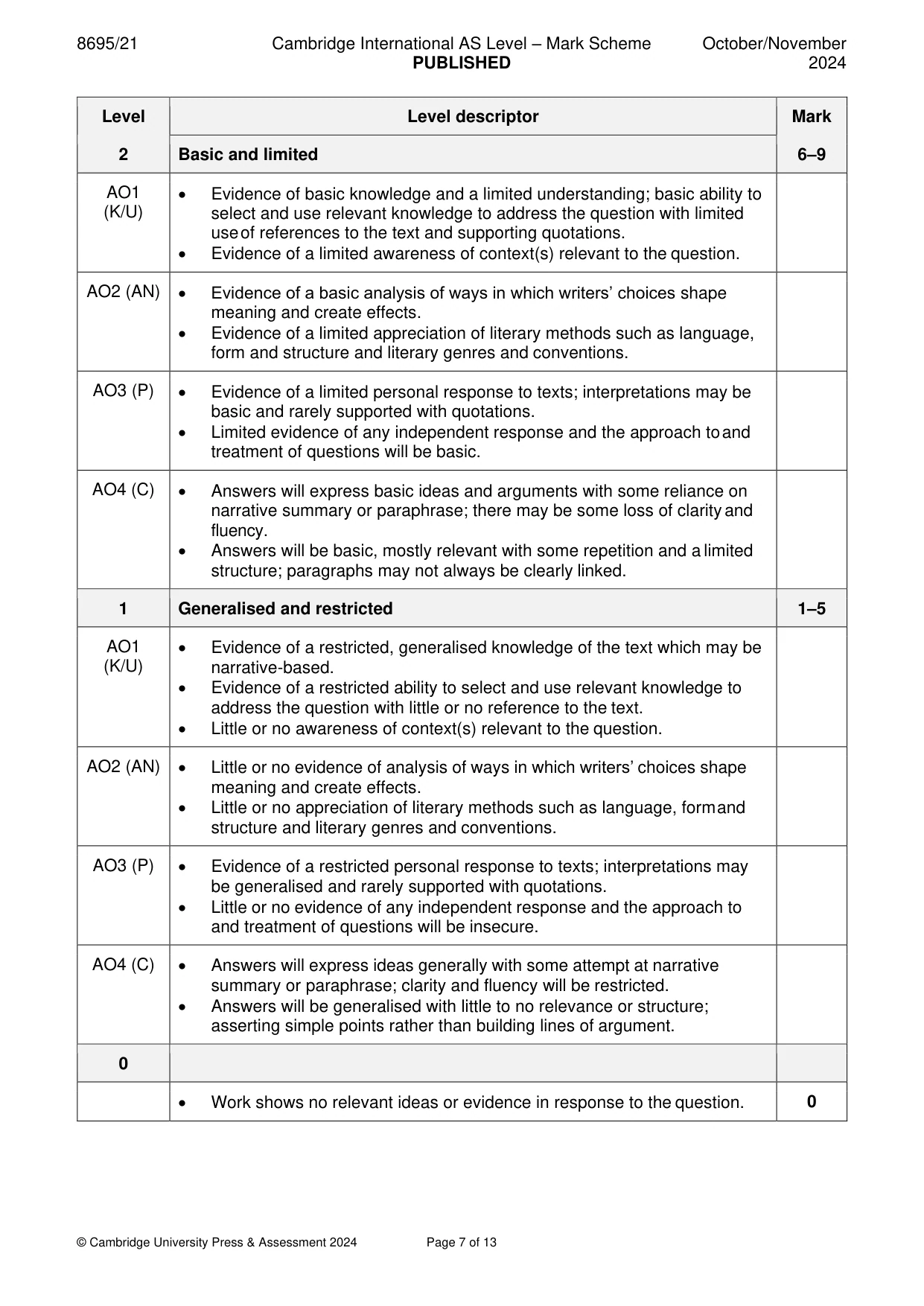
8695/21 Cambridge International AS Level – Mark Scheme PUBLISHED October/November 2024 © Cambridge University Press & Assessment 2024 Page 7 of 13 Level Level descriptor Mark 2 Basic and limited 6–9 AO1 (K/U) • Evidence of basic knowledge and a limited understanding; basic ability to select and use relevant knowledge to address the question with limited use of references to the text and supporting quotations. • Evidence of a limited awareness of context(s) relevant to the question. AO2 (AN) • Evidence of a basic analysis of ways in which writers’ choices shape meaning and create effects. • Evidence of a limited appreciation of literary methods such as language, form and structure and literary genres and conventions. AO3 (P) • Evidence of a limited personal response to texts; interpretations may be basic and rarely supported with quotations. • Limited evidence of any independent response and the approach to and treatment of questions will be basic. AO4 (C) • Answers will express basic ideas and arguments with some reliance on narrative summary or paraphrase; there may be some loss of clarity and fluency. • Answers will be basic, mostly relevant with some repetition and a limited structure; paragraphs may not always be clearly linked. 1 Generalised and restricted 1–5 AO1 (K/U) • Evidence of a restricted, generalised knowledge of the text which may be narrative-based. • Evidence of a restricted ability to select and use relevant knowledge to address the question with little or no reference to the text. • Little or no awareness of context(s) relevant to the question. AO2 (AN) • Little or no evidence of analysis of ways in which writers’ choices shape meaning and create effects. • Little or no appreciation of literary methods such as language, form and structure and literary genres and conventions. AO3 (P) • Evidence of a restricted personal response to texts; interpretations may be generalised and rarely supported with quotations. • Little or no evidence of any independent response and the approach to and treatment of questions will be insecure. AO4 (C) • Answers will express ideas generally with some attempt at narrative summary or paraphrase; clarity and fluency will be restricted. • Answers will be generalised with little to no relevance or structure; asserting simple points rather than building lines of argument. 0 • Work shows no relevant ideas or evidence in response to the question. 0
Mark scheme, page 8
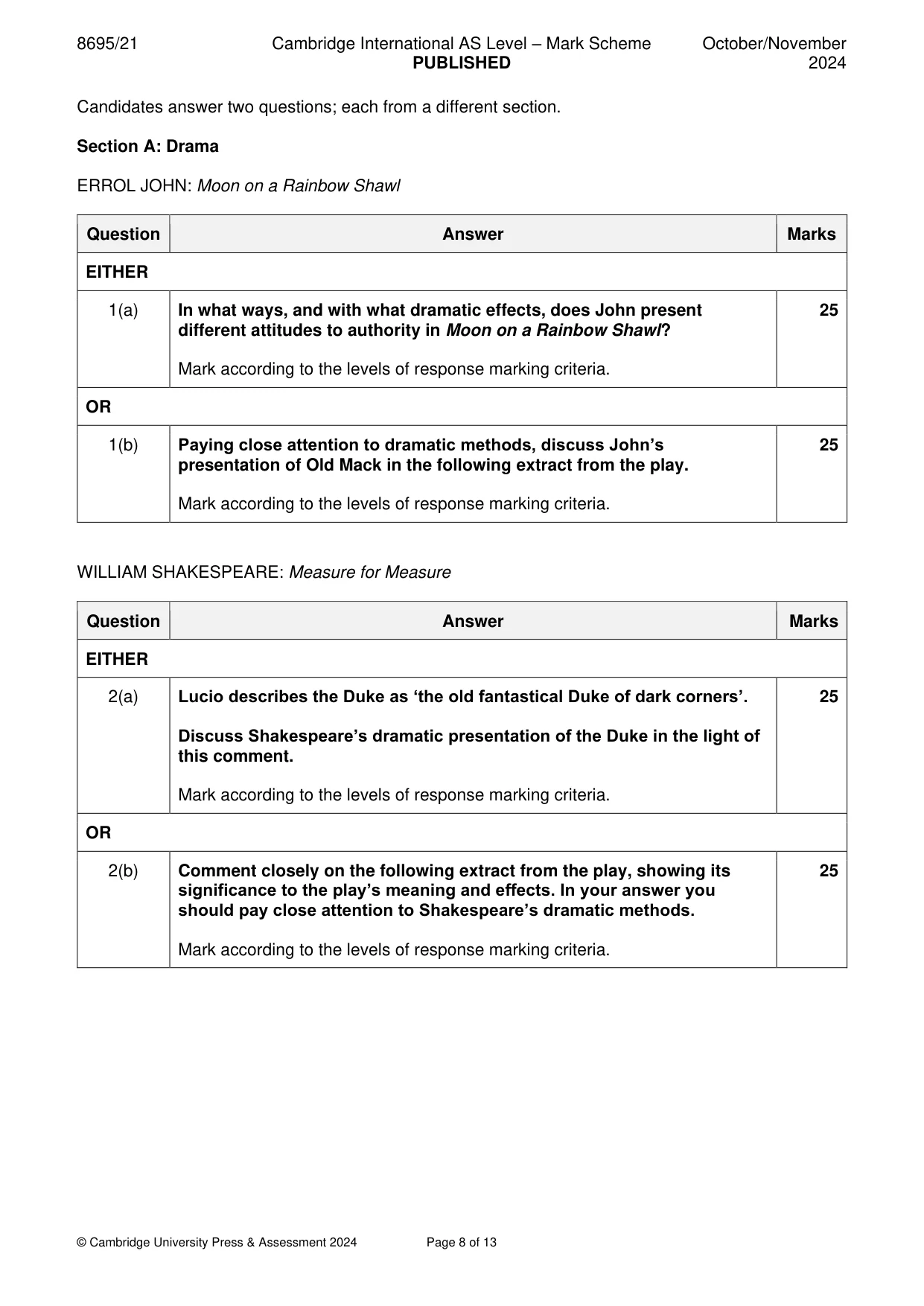
8695/21 Cambridge International AS Level – Mark Scheme PUBLISHED October/November 2024 © Cambridge University Press & Assessment 2024 Page 8 of 13 Candidates answer two questions; each from a different section. Section A: Drama ERROL JOHN: Moon on a Rainbow Shawl Question Answer Marks EITHER 1(a) In what ways, and with what dramatic effects, does John present different attitudes to authority in Moon on a Rainbow Shawl? Mark according to the levels of response marking criteria. 25 OR 1(b) Paying close attention to dramatic methods, discuss John’s presentation of Old Mack in the following extract from the play. Mark according to the levels of response marking criteria. 25 WILLIAM SHAKESPEARE: Measure for Measure Question Answer Marks EITHER 2(a) Lucio describes the Duke as ‘the old fantastical Duke of dark corners’. Discuss Shakespeare’s dramatic presentation of the Duke in the light of this comment. Mark according to the levels of response marking criteria. 25 OR 2(b) Comment closely on the following extract from the play, showing its significance to the play’s meaning and effects. In your answer you should pay close attention to Shakespeare’s dramatic methods. Mark according to the levels of response marking criteria. 25
Mark scheme, page 9
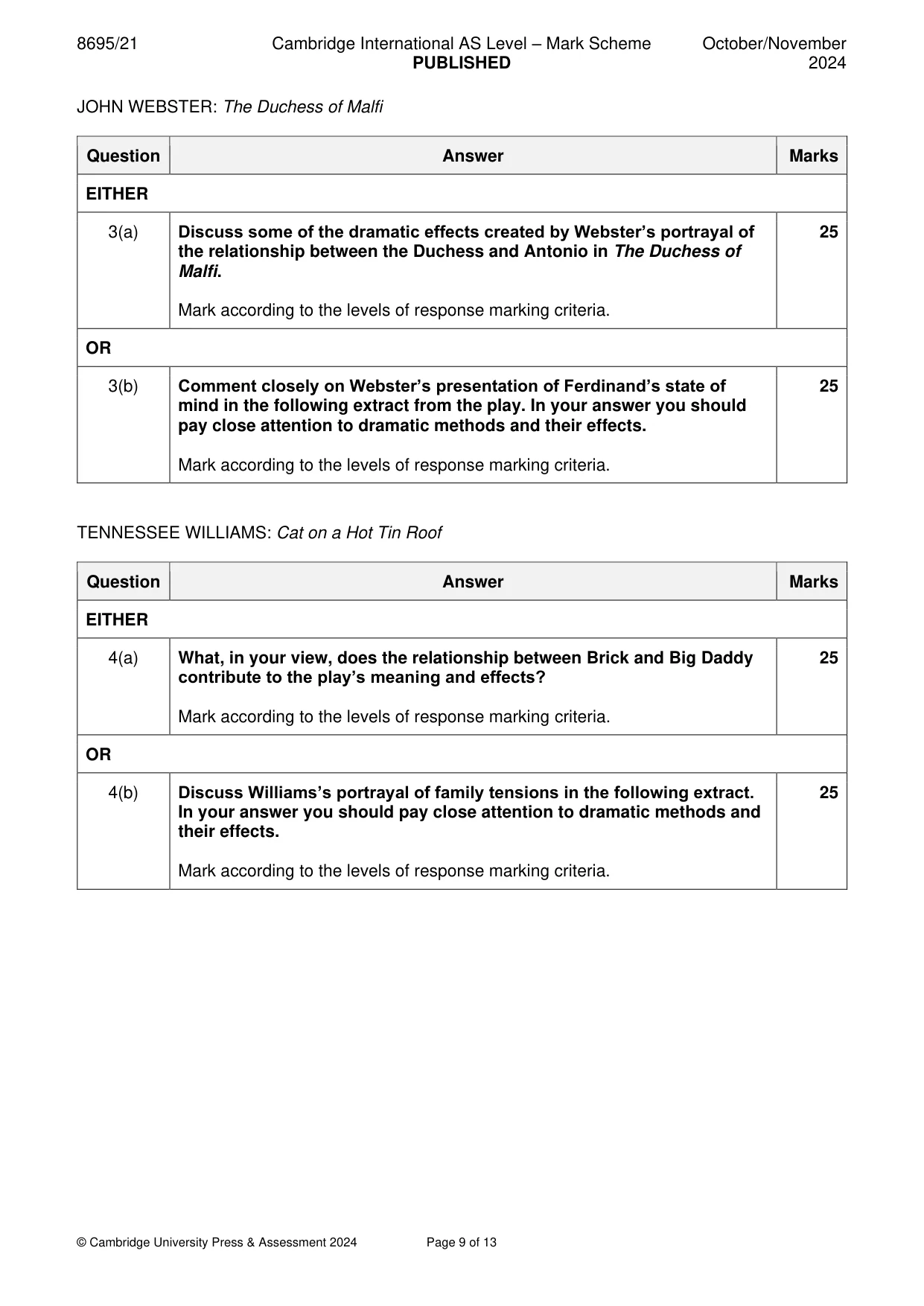
8695/21 Cambridge International AS Level – Mark Scheme PUBLISHED October/November 2024 © Cambridge University Press & Assessment 2024 Page 9 of 13 JOHN WEBSTER: The Duchess of Malfi Question Answer Marks EITHER 3(a) Discuss some of the dramatic effects created by Webster’s portrayal of the relationship between the Duchess and Antonio in The Duchess of Malfi. Mark according to the levels of response marking criteria. 25 OR 3(b) Comment closely on Webster’s presentation of Ferdinand’s state of mind in the following extract from the play. In your answer you should pay close attention to dramatic methods and their effects. Mark according to the levels of response marking criteria. 25 TENNESSEE WILLIAMS: Cat on a Hot Tin Roof Question Answer Marks EITHER 4(a) What, in your view, does the relationship between Brick and Big Daddy contribute to the play’s meaning and effects? Mark according to the levels of response marking criteria. 25 OR 4(b) Discuss Williams’s portrayal of family tensions in the following extract. In your answer you should pay close attention to dramatic methods and their effects. Mark according to the levels of response marking criteria. 25
Mark scheme, page 10
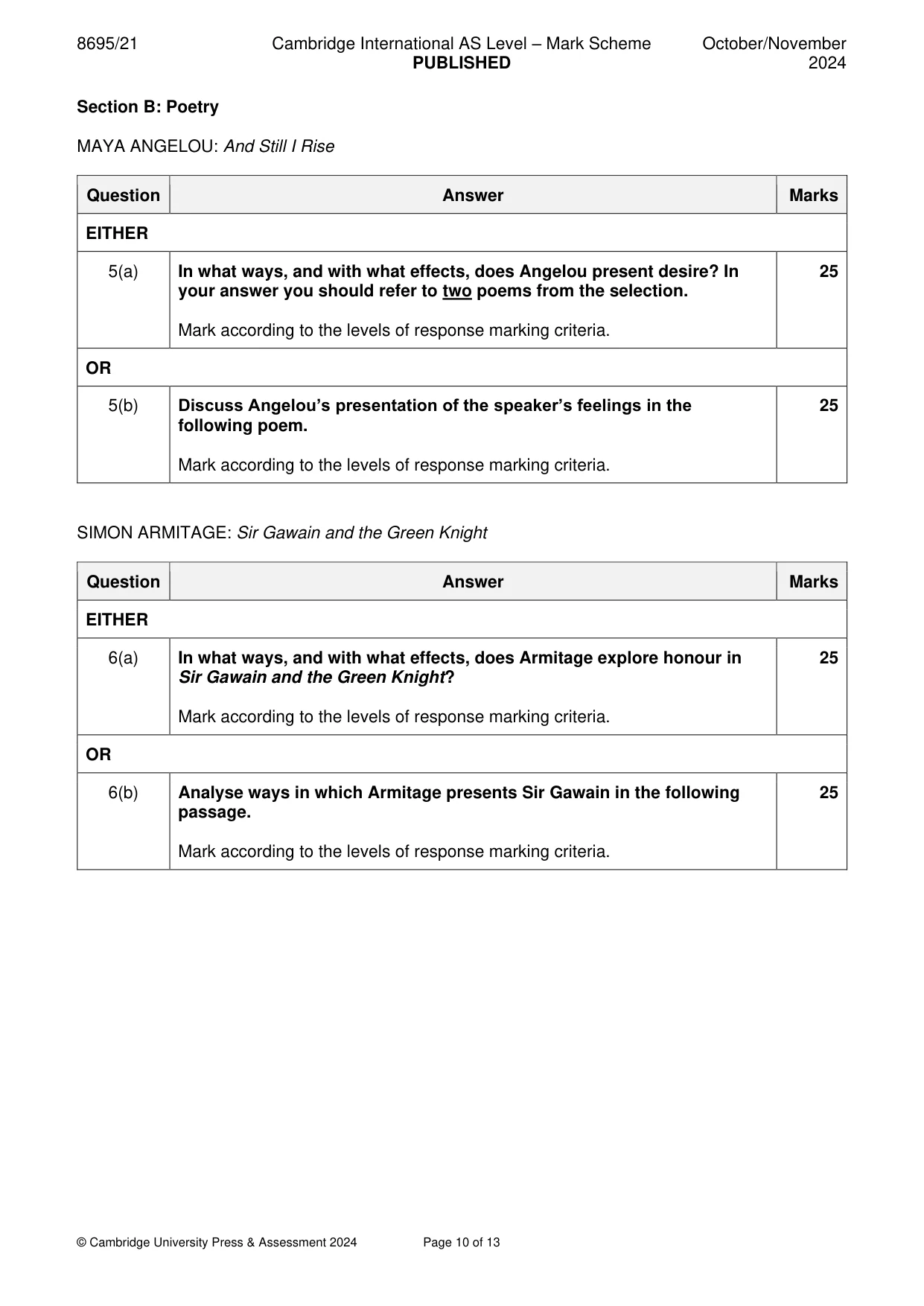
8695/21 Cambridge International AS Level – Mark Scheme PUBLISHED October/November 2024 © Cambridge University Press & Assessment 2024 Page 10 of 13 Section B: Poetry MAYA ANGELOU: And Still I Rise Question Answer Marks EITHER 5(a) In what ways, and with what effects, does Angelou present desire? In your answer you should refer to two poems from the selection. Mark according to the levels of response marking criteria. 25 OR 5(b) Discuss Angelou’s presentation of the speaker’s feelings in the following poem. Mark according to the levels of response marking criteria. 25 SIMON ARMITAGE: Sir Gawain and the Green Knight Question Answer Marks EITHER 6(a) In what ways, and with what effects, does Armitage explore honour in Sir Gawain and the Green Knight? Mark according to the levels of response marking criteria. 25 OR 6(b) Analyse ways in which Armitage presents Sir Gawain in the following passage. Mark according to the levels of response marking criteria. 25
Mark scheme, page 11
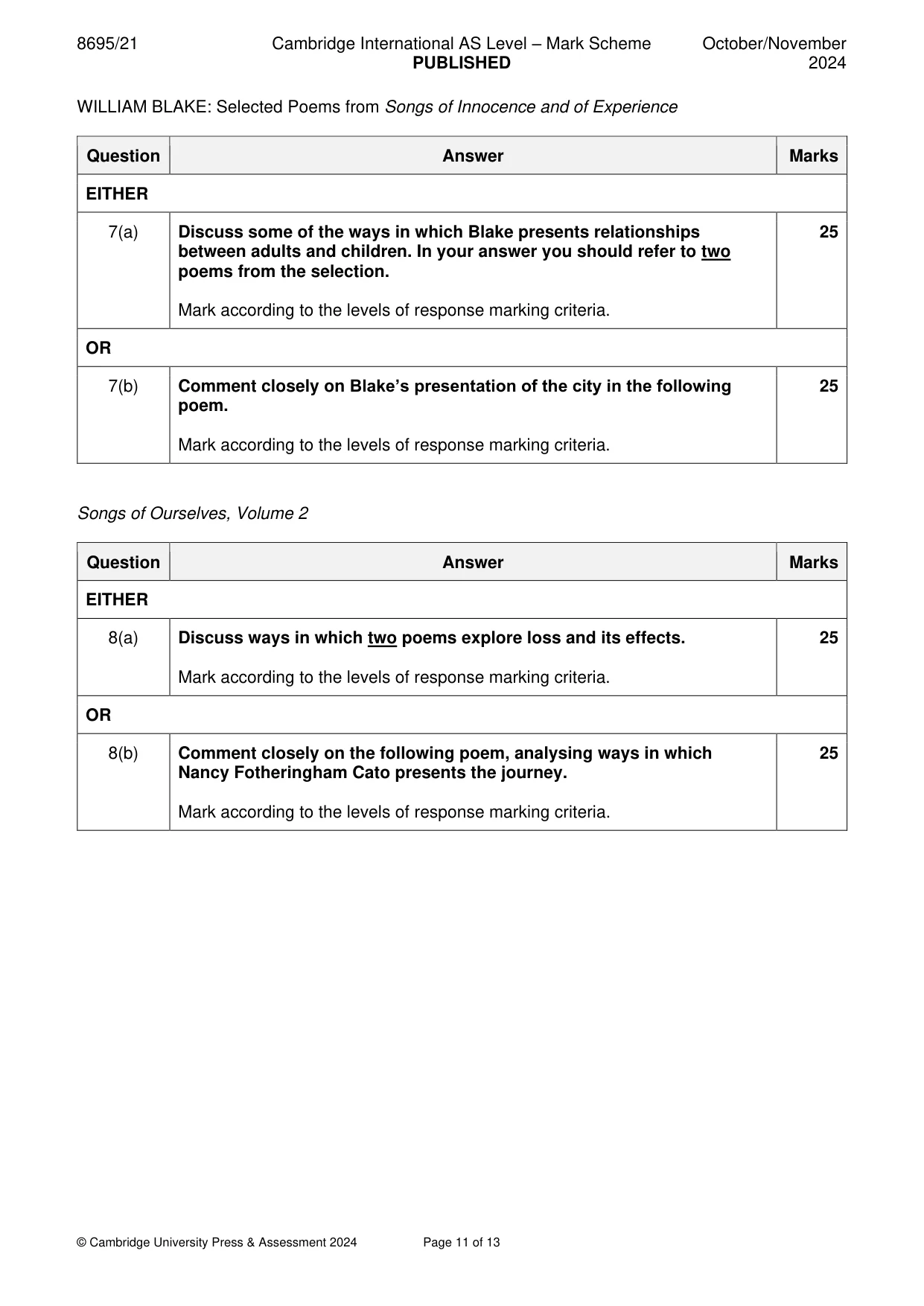
8695/21 Cambridge International AS Level – Mark Scheme PUBLISHED October/November 2024 © Cambridge University Press & Assessment 2024 Page 11 of 13 WILLIAM BLAKE: Selected Poems from Songs of Innocence and of Experience Question Answer Marks EITHER 7(a) Discuss some of the ways in which Blake presents relationships between adults and children. In your answer you should refer to two poems from the selection. Mark according to the levels of response marking criteria. 25 OR 7(b) Comment closely on Blake’s presentation of the city in the following poem. Mark according to the levels of response marking criteria. 25 Songs of Ourselves, Volume 2 Question Answer Marks EITHER 8(a) Discuss ways in which two poems explore loss and its effects. Mark according to the levels of response marking criteria. 25 OR 8(b) Comment closely on the following poem, analysing ways in which Nancy Fotheringham Cato presents the journey. Mark according to the levels of response marking criteria. 25
Mark scheme, page 12
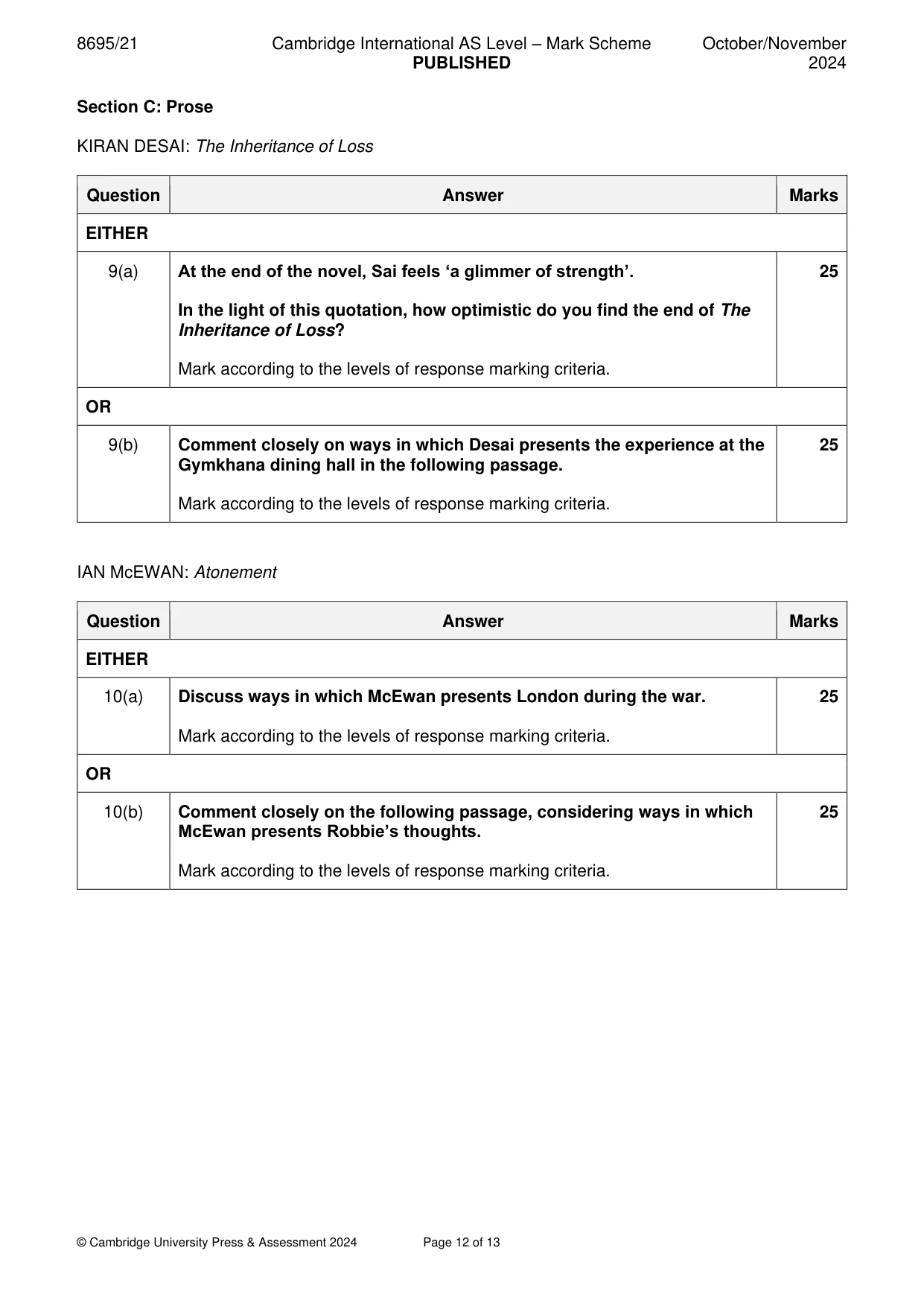
8695/21 Cambridge International AS Level – Mark Scheme PUBLISHED October/November 2024 © Cambridge University Press & Assessment 2024 Page 12 of 13 Section C: Prose KIRAN DESAI: The Inheritance of Loss Question Answer Marks EITHER 9(a) At the end of the novel, Sai feels ‘a glimmer of strength’. In the light of this quotation, how optimistic do you find the end of The Inheritance of Loss? Mark according to the levels of response marking criteria. 25 OR 9(b) Comment closely on ways in which Desai presents the experience at the Gymkhana dining hall in the following passage. Mark according to the levels of response marking criteria. 25 IAN McEWAN: Atonement Question Answer Marks EITHER 10(a) Discuss ways in which McEwan presents London during the war. Mark according to the levels of response marking criteria. 25 OR 10(b) Comment closely on the following passage, considering ways in which McEwan presents Robbie’s thoughts. Mark according to the levels of response marking criteria. 25
Mark scheme, page 13
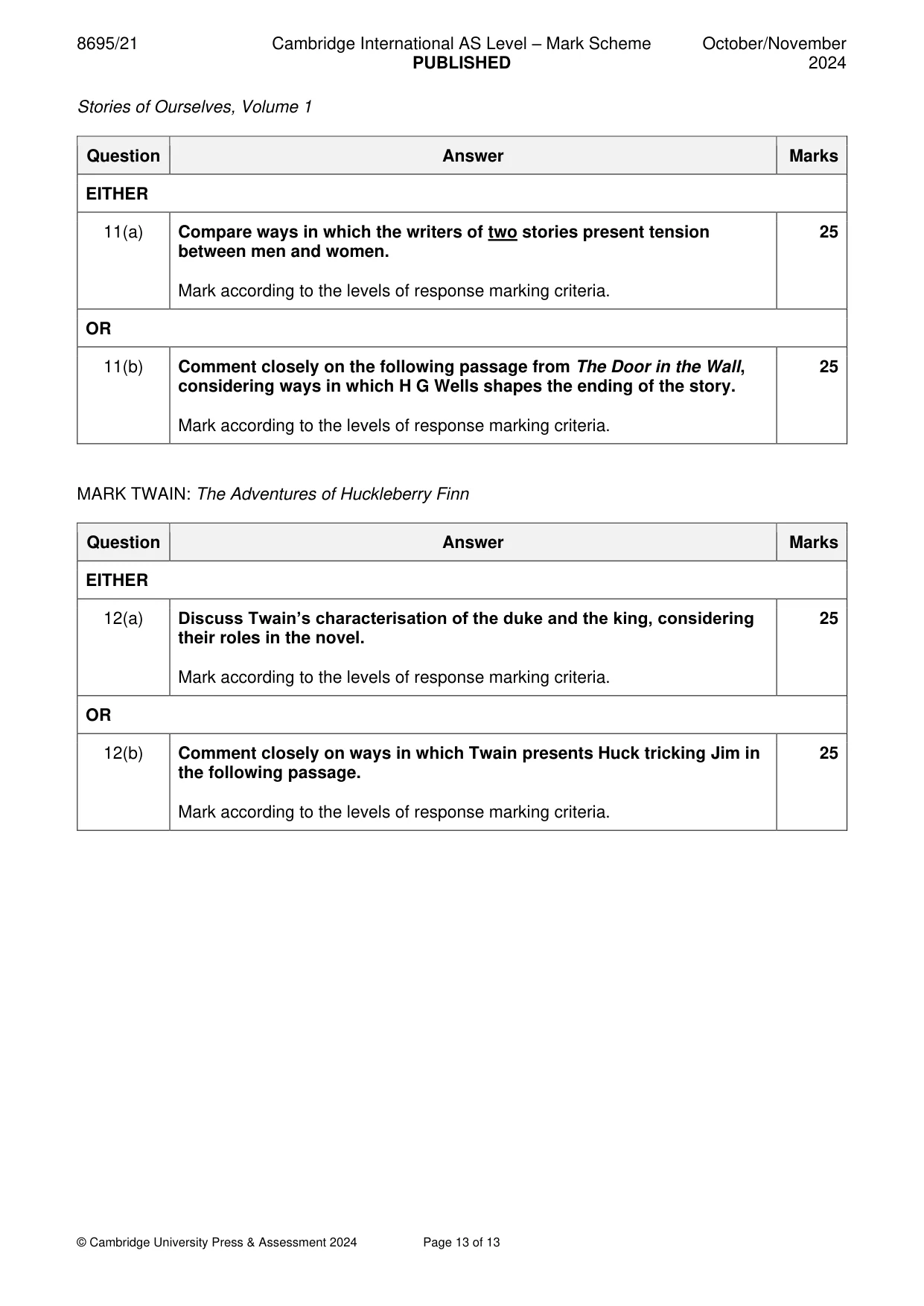
8695/21 Cambridge International AS Level – Mark Scheme PUBLISHED October/November 2024 © Cambridge University Press & Assessment 2024 Page 13 of 13 Stories of Ourselves, Volume 1 Question Answer Marks EITHER 11(a) Compare ways in which the writers of two stories present tension between men and women. Mark according to the levels of response marking criteria. 25 OR 11(b) Comment closely on the following passage from The Door in the Wall, considering ways in which H G Wells shapes the ending of the story. Mark according to the levels of response marking criteria. 25 MARK TWAIN: The Adventures of Huckleberry Finn Question Answer Marks EITHER 12(a) Discuss Twain’s characterisation of the duke and the king, considering their roles in the novel. Mark according to the levels of response marking criteria. 25 OR 12(b) Comment closely on ways in which Twain presents Huck tricking Jim in the following passage. Mark according to the levels of response marking criteria. 25
What you needed in this session
Cambridge’s own grade thresholds for 2024 Oct/Nov, Paper 2 · Variant 1. A higher threshold means an easier paper — the bar moves with how the cohort did.