Cambridge A Level English - Language and Literature (AS Level only, from 2016) 8695 — 2025 May/June Paper 2 · Variant 1
8695/21/M/J/25 · 50 marks · 120 min
The question paper and its mark scheme, free to read here and free to download. This is Cambridge’s own paper, exactly as it was sat.
Question paper20 pages


Mark scheme14 pages
Answers below. Sit the paper first if you are practising.
Paper as text
Question paper, page 1
This document has 20 pages. Any blank pages are indicated. [Turn over Cambridge International AS Level * 7 7 9 9 7 5 8 4 6 6 * DC RCL (DF) 342671/3 © UCLES 2025 LANGUAGE AND LITERATURE IN ENGLISH 8695/21 Paper 2 Drama, Poetry and Prose May/June 2025 2 hours You must answer on the enclosed answer booklet. You will need: Answer booklet (enclosed) INSTRUCTIONS ● Answer two questions in total, each from a different section. ● Follow the instructions on the front cover of the answer booklet. If you need additional answer paper, ask the invigilator for a continuation booklet. ● Dictionaries are not allowed. INFORMATION ● The total mark for this paper is 50. ● The number of marks for each question or part question is shown in brackets [ ].
Question paper, page 2
2 8695/21/M/J/25 © UCLES 2025 Section A: Drama ERROL JOHN: Moon on a Rainbow Shawl 1 Either (a) In Act 1, Sophia says to Rosa: ‘you … look at life too simple.’ How far and in what ways does John’s presentation of Rosa in the play support this view? [25] Or (b) Comment closely on John’s dramatic presentation of Charlie in the following extract from the play. [25] [OLD MACK and ROSA go out. Content removed due to copyright restrictions.
Question paper, page 3
3 8695/21/M/J/25 © UCLES 2025 [Turn over Curtain.] (from Act 2, Scene 2) Content removed due to copyright restrictions.
Question paper, page 4
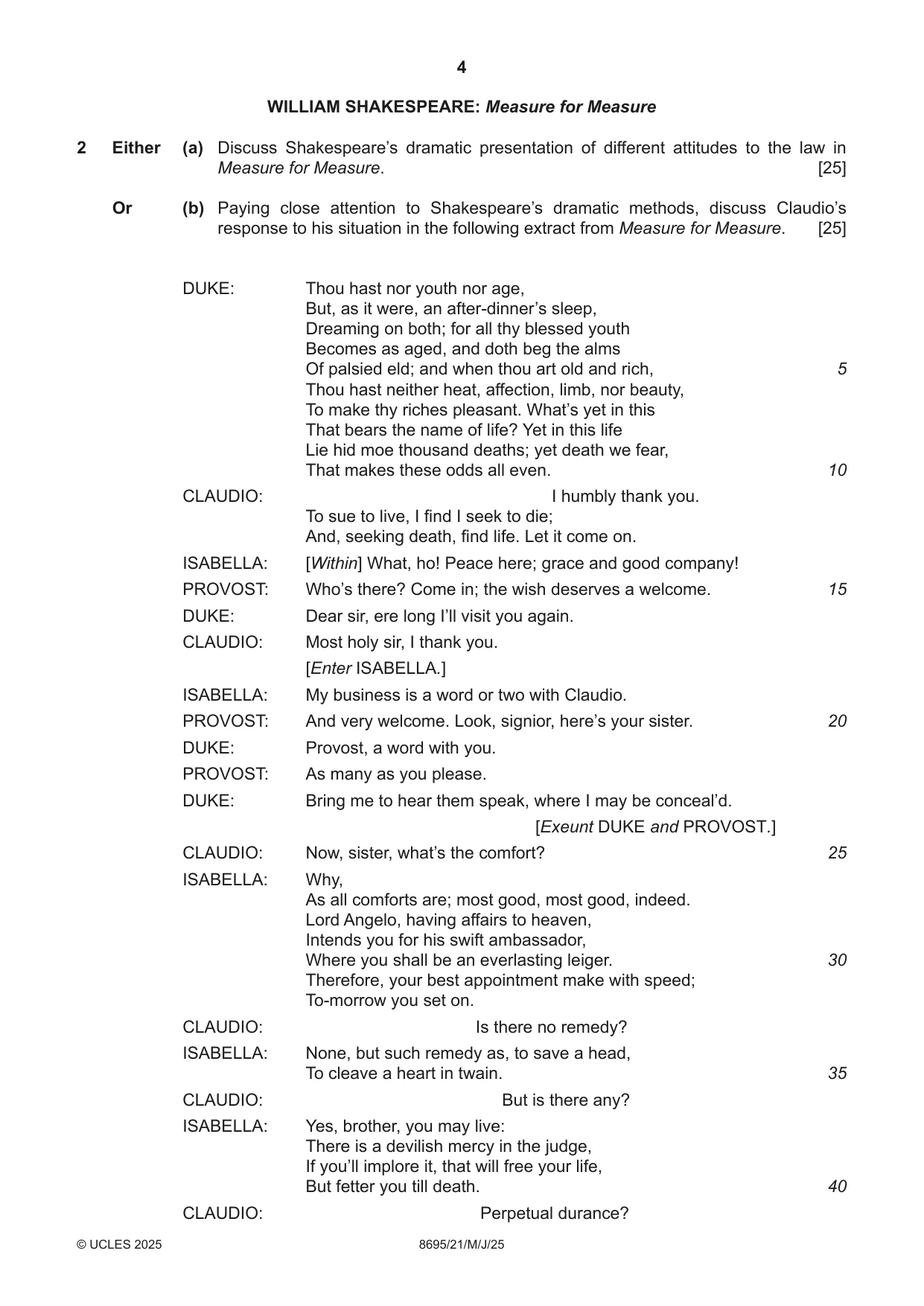
4 8695/21/M/J/25 © UCLES 2025 WILLIAM SHAKESPEARE: Measure for Measure 2 Either (a) Discuss Shakespeare’s dramatic presentation of different attitudes to the law in Measure for Measure. [25] Or (b) Paying close attention to Shakespeare’s dramatic methods, discuss Claudio’s response to his situation in the following extract from Measure for Measure. [25] DUKE: Thou hast nor youth nor age, But, as it were, an after-dinner’s sleep, Dreaming on both; for all thy blessed youth Becomes as aged, and doth beg the alms Of palsied eld; and when thou art old and rich, Thou hast neither heat, affection, limb, nor beauty, To make thy riches pleasant. What’s yet in this That bears the name of life? Yet in this life Lie hid moe thousand deaths; yet death we fear, That makes these odds all even. CLAUDIO: I humbly thank you. To sue to live, I find I seek to die; And, seeking death, find life. Let it come on. ISABELLA: [Within] What, ho! Peace here; grace and good company! PROVOST: Who’s there? Come in; the wish deserves a welcome. DUKE: Dear sir, ere long I’ll visit you again. CLAUDIO: Most holy sir, I thank you. [Enter ISABELLA.] ISABELLA: My business is a word or two with Claudio. PROVOST: And very welcome. Look, signior, here’s your sister. DUKE: Provost, a word with you. PROVOST: As many as you please. DUKE: Bring me to hear them speak, where I may be conceal’d. [Exeunt DUKE and PROVOST.] CLAUDIO: Now, sister, what’s the comfort? ISABELLA: Why, As all comforts are; most good, most good, indeed. Lord Angelo, having affairs to heaven, Intends you for his swift ambassador, Where you shall be an everlasting leiger. Therefore, your best appointment make with speed; To-morrow you set on. CLAUDIO: Is there no remedy? ISABELLA: None, but such remedy as, to save a head, To cleave a heart in twain. CLAUDIO: But is there any? ISABELLA: Yes, brother, you may live: There is a devilish mercy in the judge, If you’ll implore it, that will free your life, But fetter you till death. CLAUDIO: Perpetual durance? 5 10 15 20 25 30 35 40
Question paper, page 5
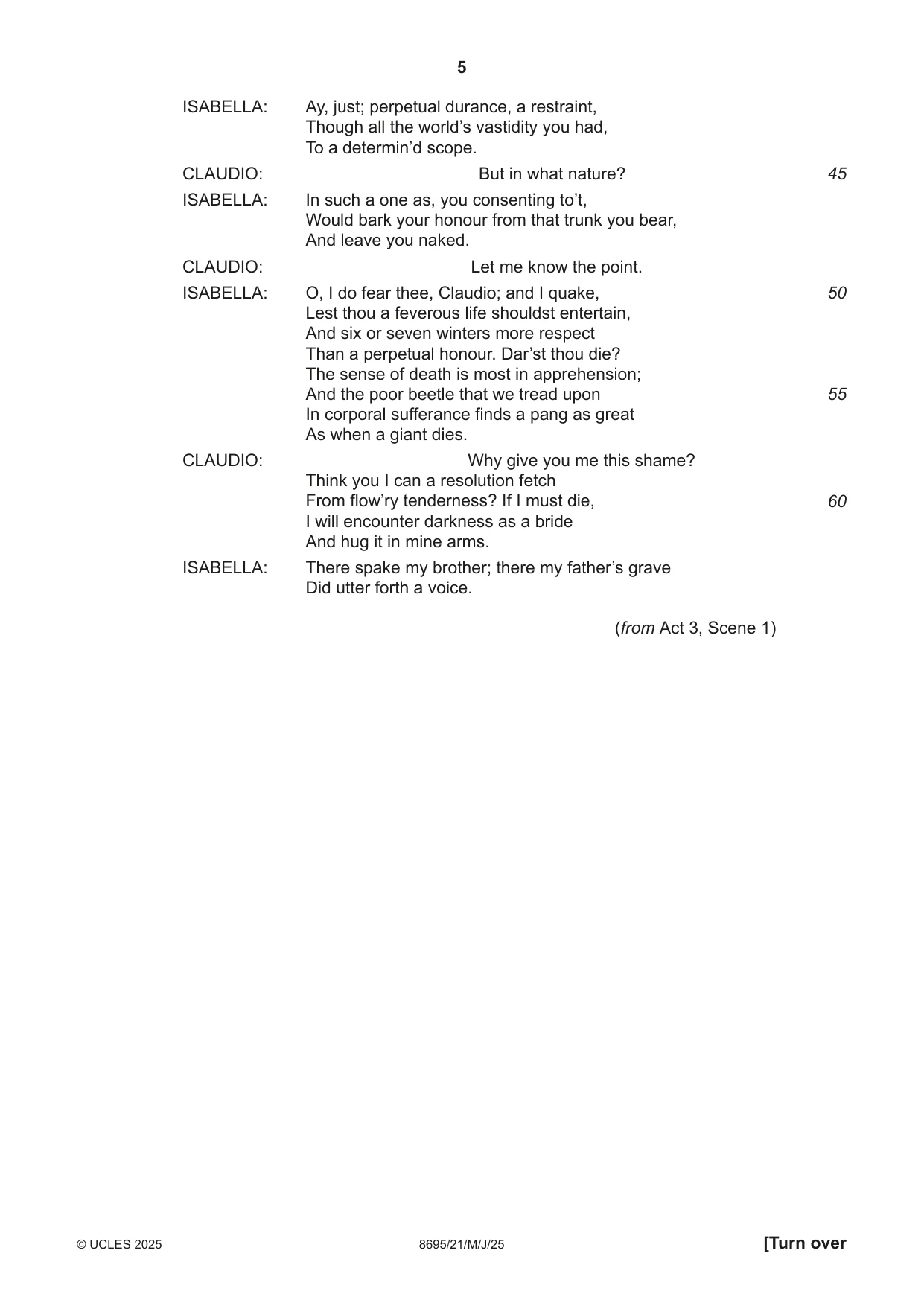
5 8695/21/M/J/25 © UCLES 2025 [Turn over ISABELLA: Ay, just; perpetual durance, a restraint, Though all the world’s vastidity you had, To a determin’d scope. CLAUDIO: But in what nature? ISABELLA: In such a one as, you consenting to’t, Would bark your honour from that trunk you bear, And leave you naked. CLAUDIO: Let me know the point. ISABELLA: O, I do fear thee, Claudio; and I quake, Lest thou a feverous life shouldst entertain, And six or seven winters more respect Than a perpetual honour. Dar’st thou die? The sense of death is most in apprehension; And the poor beetle that we tread upon In corporal sufferance finds a pang as great As when a giant dies. CLAUDIO: Why give you me this shame? Think you I can a resolution fetch From flow’ry tenderness? If I must die, I will encounter darkness as a bride And hug it in mine arms. ISABELLA: There spake my brother; there my father’s grave Did utter forth a voice. (from Act 3, Scene 1) 45 50 55 60
Question paper, page 6
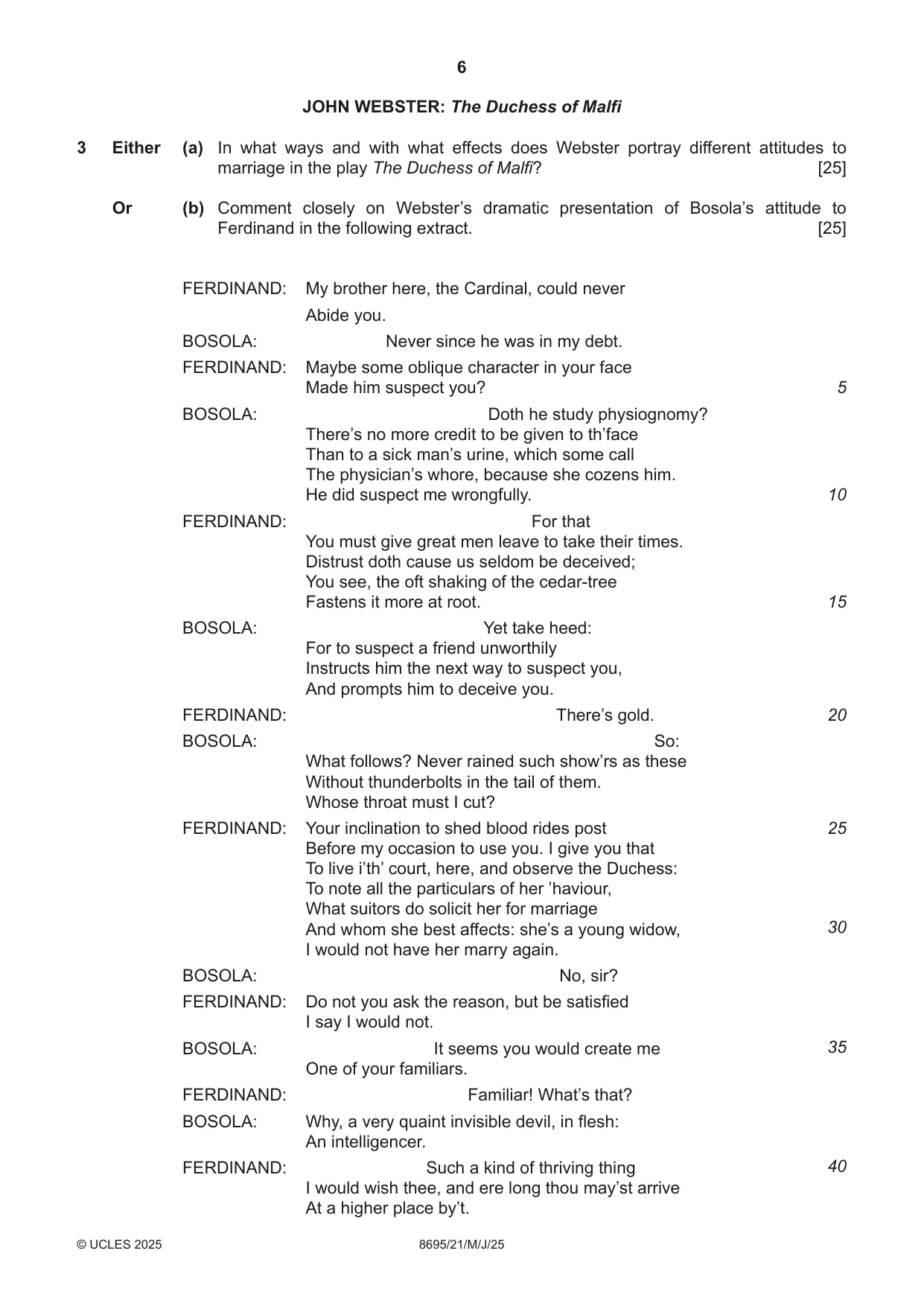
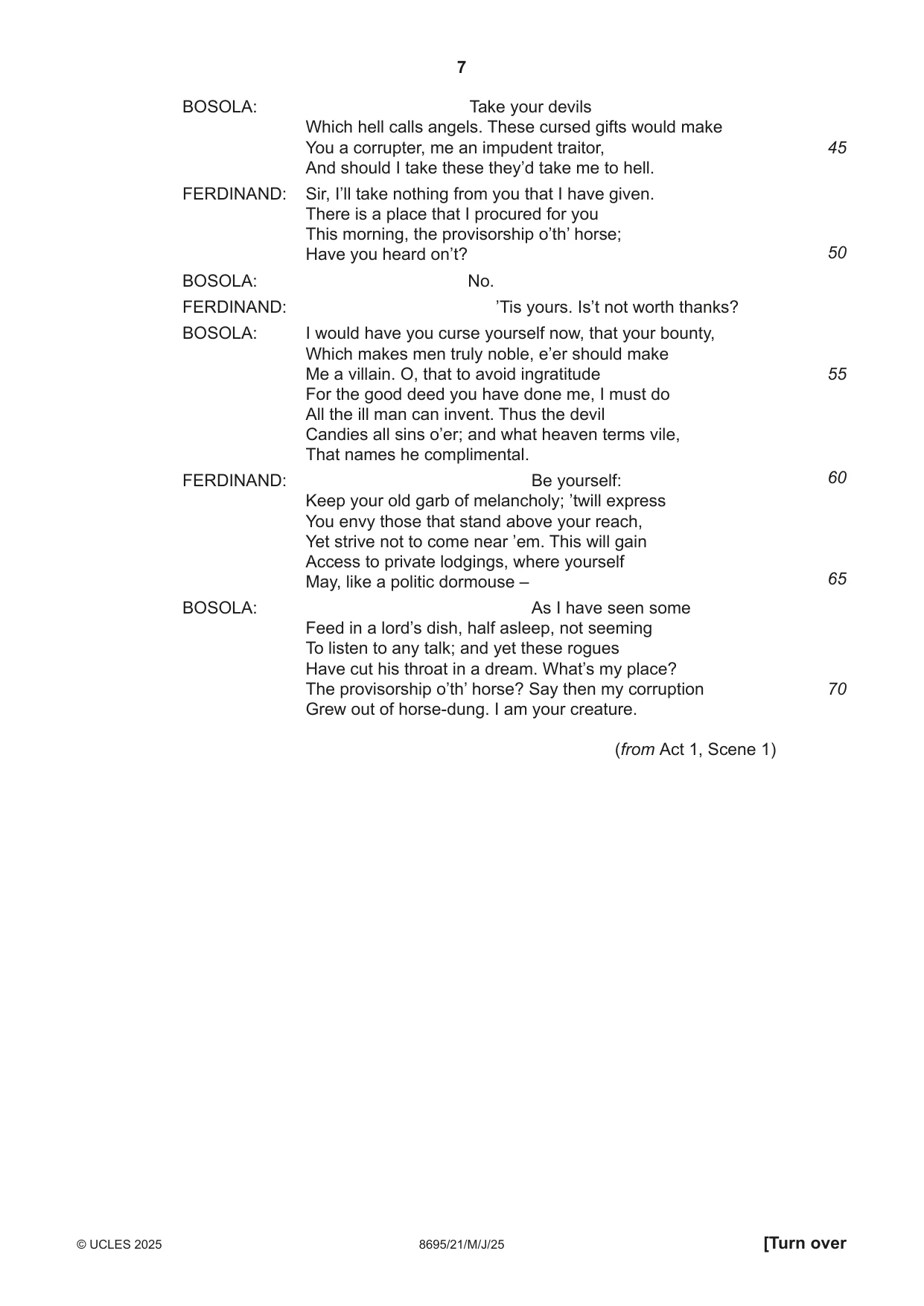
6 8695/21/M/J/25 © UCLES 2025 JOHN WEBSTER: The Duchess of Malfi 3 Either (a) In what ways and with what effects does Webster portray different attitudes to marriage in the play The Duchess of Malfi? [25] Or (b) Comment closely on Webster’s dramatic presentation of Bosola’s attitude to Ferdinand in the following extract. [25] FERDINAND: My brother here, the Cardinal, could never Abide you. BOSOLA: Never since he was in my debt. FERDINAND: Maybe some oblique character in your face Made him suspect you? BOSOLA: Doth he study physiognomy? There’s no more credit to be given to th’face Than to a sick man’s urine, which some call The physician’s whore, because she cozens him. He did suspect me wrongfully. FERDINAND: For that You must give great men leave to take their times. Distrust doth cause us seldom be deceived; You see, the oft shaking of the cedar-tree Fastens it more at root. BOSOLA: Yet take heed: For to suspect a friend unworthily Instructs him the next way to suspect you, And prompts him to deceive you. FERDINAND: There’s gold. BOSOLA: So: What follows? Never rained such show’rs as these Without thunderbolts in the tail of them. Whose throat must I cut? FERDINAND: Your inclination to shed blood rides post Before my occasion to use you. I give you that To live i’th’ court, here, and observe the Duchess: To note all the particulars of her ’haviour, What suitors do solicit her for marriage And whom she best affects: she’s a young widow, I would not have her marry again. BOSOLA: No, sir? FERDINAND: Do not you ask the reason, but be satisfied I say I would not. BOSOLA: It seems you would create me One of your familiars. FERDINAND: Familiar! What’s that? BOSOLA: Why, a very quaint invisible devil, in flesh: An intelligencer. FERDINAND: Such a kind of thriving thing I would wish thee, and ere long thou may’st arrive At a higher place by’t. 5 10 15 20 25 30 35 40
Question paper, page 7
7 8695/21/M/J/25 © UCLES 2025 [Turn over BOSOLA: Take your devils Which hell calls angels. These cursed gifts would make You a corrupter, me an impudent traitor, And should I take these they’d take me to hell. FERDINAND: Sir, I’ll take nothing from you that I have given. There is a place that I procured for you This morning, the provisorship o’th’ horse; Have you heard on’t? BOSOLA: No. FERDINAND: ’Tis yours. Is’t not worth thanks? BOSOLA: I would have you curse yourself now, that your bounty, Which makes men truly noble, e’er should make Me a villain. O, that to avoid ingratitude For the good deed you have done me, I must do All the ill man can invent. Thus the devil Candies all sins o’er; and what heaven terms vile, That names he complimental. FERDINAND: Be yourself: Keep your old garb of melancholy; ’twill express You envy those that stand above your reach, Yet strive not to come near ’em. This will gain Access to private lodgings, where yourself May, like a politic dormouse – BOSOLA: As I have seen some Feed in a lord’s dish, half asleep, not seeming To listen to any talk; and yet these rogues Have cut his throat in a dream. What’s my place? The provisorship o’th’ horse? Say then my corruption Grew out of horse-dung. I am your creature. (from Act 1, Scene 1) 45 50 55 60 65 70
Question paper, page 8
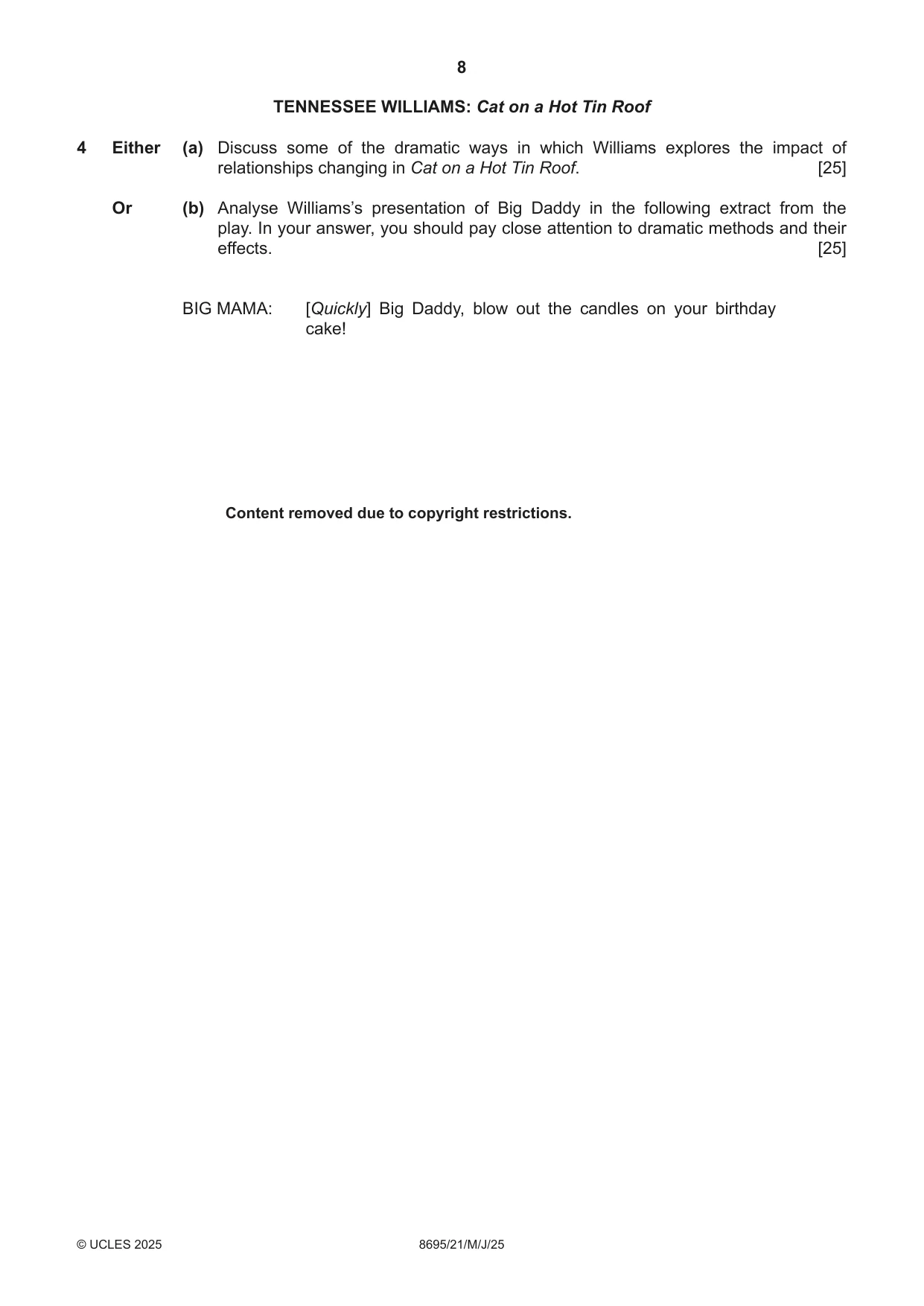
8 8695/21/M/J/25 © UCLES 2025 TENNESSEE WILLIAMS: Cat on a Hot Tin Roof 4 Either (a) Discuss some of the dramatic ways in which Williams explores the impact of relationships changing in Cat on a Hot Tin Roof. [25] Or (b) Analyse Williams’s presentation of Big Daddy in the following extract from the play. In your answer, you should pay close attention to dramatic methods and their effects. [25] BIG MAMA: [Quickly] Big Daddy, blow out the candles on your birthday cake! Content removed due to copyright restrictions.
Question paper, page 9
9 8695/21/M/J/25 © UCLES 2025 [Turn over I made this place! (from Act 2) Content removed due to copyright restrictions.
Question paper, page 10
10 8695/21/M/J/25 © UCLES 2025 Section B: Poetry MAYA ANGELOU: And Still I Rise 5 Either (a) Discuss some of the ways in which Angelou presents different attitudes to sex. In your answer, you should refer to two poems from the selection. [25] Or (b) Comment closely on Angelou’s presentation of the relationship in the following poem. [25] Kin for Bailey We were entwined in red rings An Arkansas twilight. Content removed due to copyright restrictions.
Question paper, page 11
11 8695/21/M/J/25 © UCLES 2025 [Turn over SIMON ARMITAGE: Sir Gawain and the Green Knight 6 Either (a) Discuss some of the ways in which Armitage explores deception and its effects in Sir Gawain and the Green Knight. [25] Or (b) Comment closely on Armitage’s presentation of the lord and Sir Gawain in the following extract. [25] Now the lord is loud with words and laughter all night. Content removed due to copyright restrictions.
Question paper, page 12
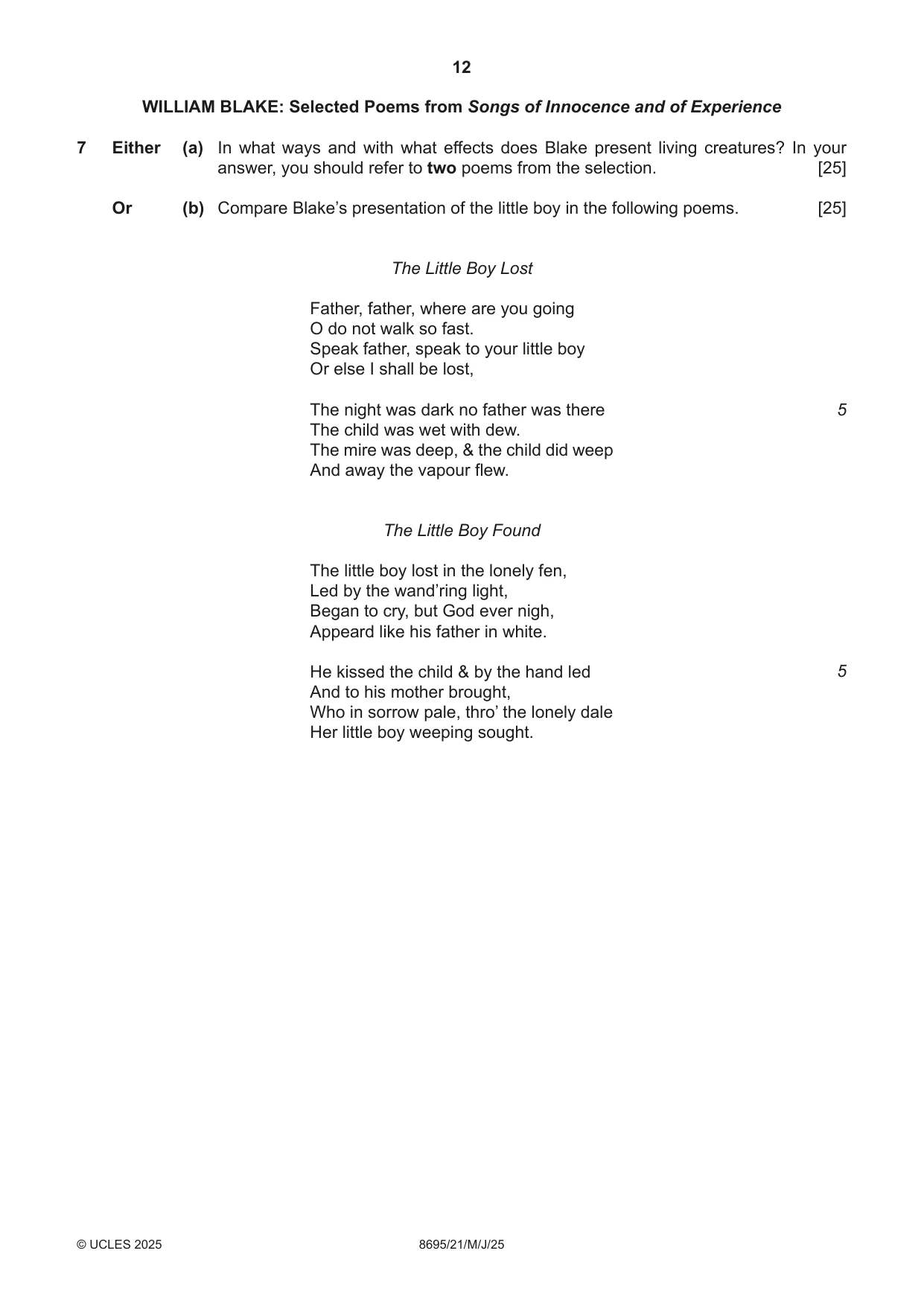
12 8695/21/M/J/25 © UCLES 2025 WILLIAM BLAKE: Selected Poems from Songs of Innocence and of Experience 7 Either (a) In what ways and with what effects does Blake present living creatures? In your answer, you should refer to two poems from the selection. [25] Or (b) Compare Blake’s presentation of the little boy in the following poems. [25] The Little Boy Lost Father, father, where are you going O do not walk so fast. Speak father, speak to your little boy Or else I shall be lost, The night was dark no father was there The child was wet with dew. The mire was deep, & the child did weep And away the vapour flew. The Little Boy Found The little boy lost in the lonely fen, Led by the wand’ring light, Began to cry, but God ever nigh, Appeard like his father in white. He kissed the child & by the hand led And to his mother brought, Who in sorrow pale, thro’ the lonely dale Her little boy weeping sought. 5 5
Question paper, page 13
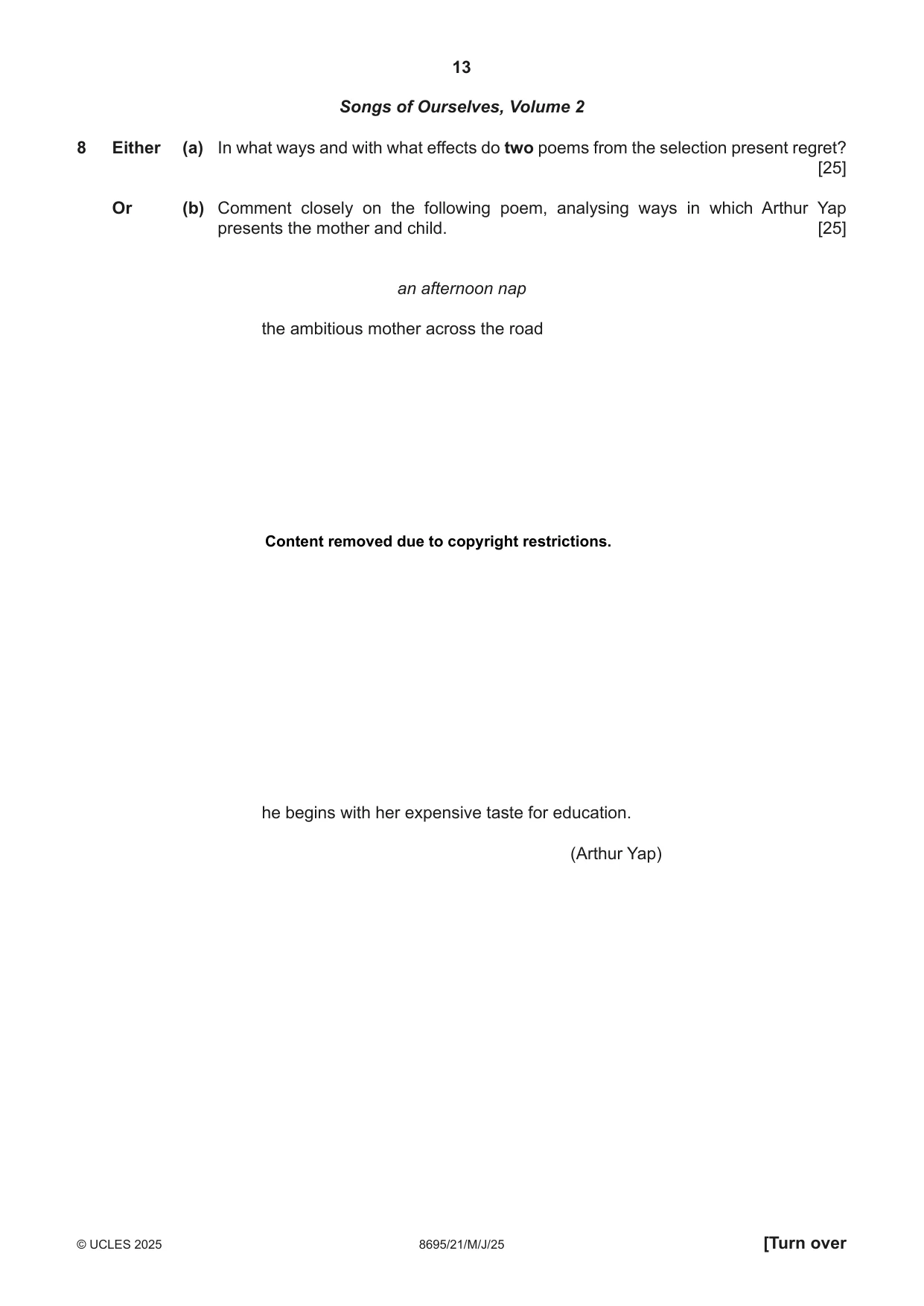
13 8695/21/M/J/25 © UCLES 2025 [Turn over Songs of Ourselves, Volume 2 8 Either (a) In what ways and with what effects do two poems from the selection present regret? [25] Or (b) Comment closely on the following poem, analysing ways in which Arthur Yap presents the mother and child. [25] an afternoon nap the ambitious mother across the road he begins with her expensive taste for education. (Arthur Yap) Content removed due to copyright restrictions.
Question paper, page 14
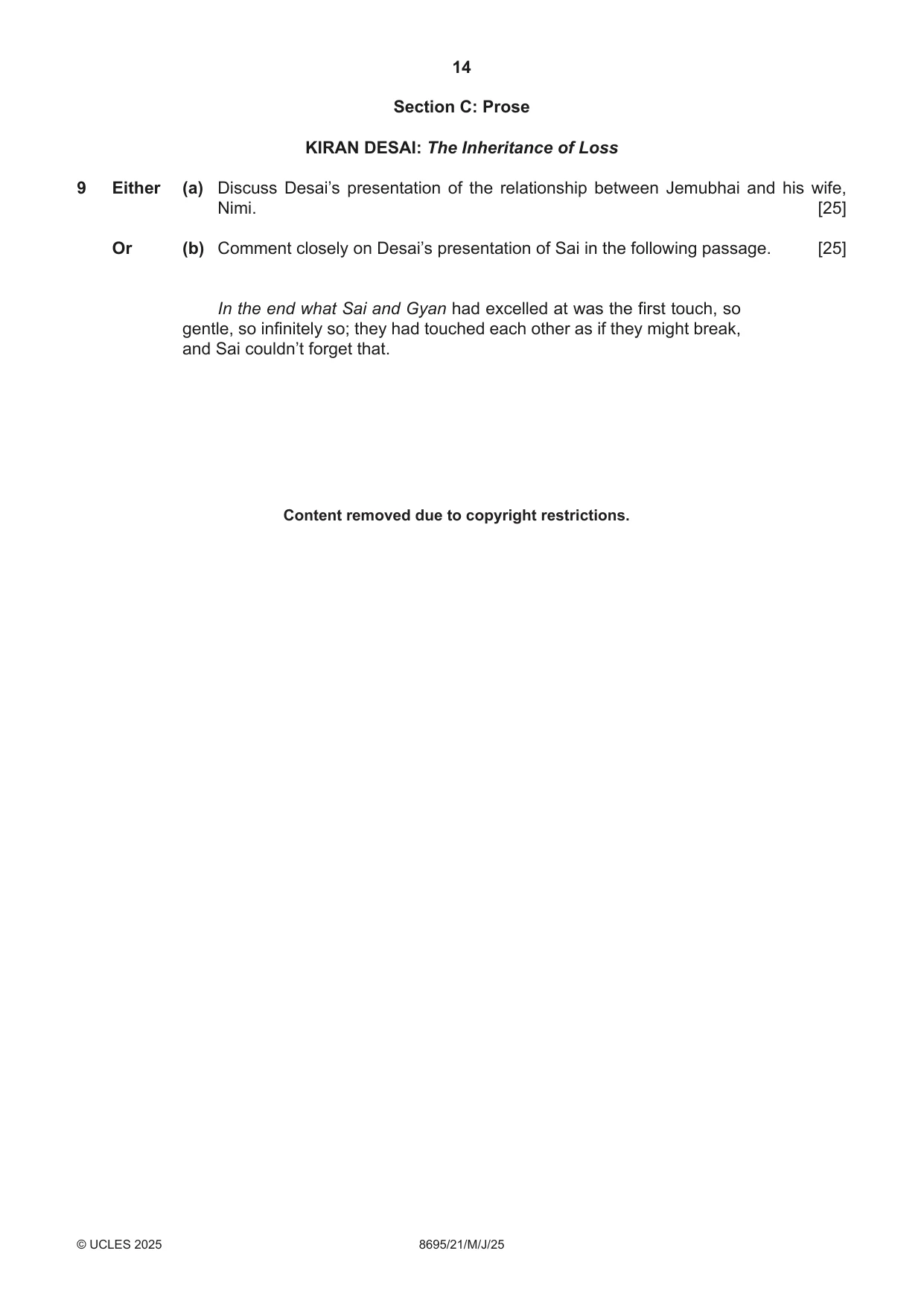
14 8695/21/M/J/25 © UCLES 2025 Section C: Prose KIRAN DESAI: The Inheritance of Loss 9 Either (a) Discuss Desai’s presentation of the relationship between Jemubhai and his wife, [25] Or [25] Nimi. (b) Comment closely on Desai’s presentation of Sai in the following passage. In the end what Sai and Gyan had excelled at was the first touch, so gentle, so infinitely so; they had touched each other as if they might break, and Sai couldn’t forget that. Content removed due to copyright restrictions.
Question paper, page 15
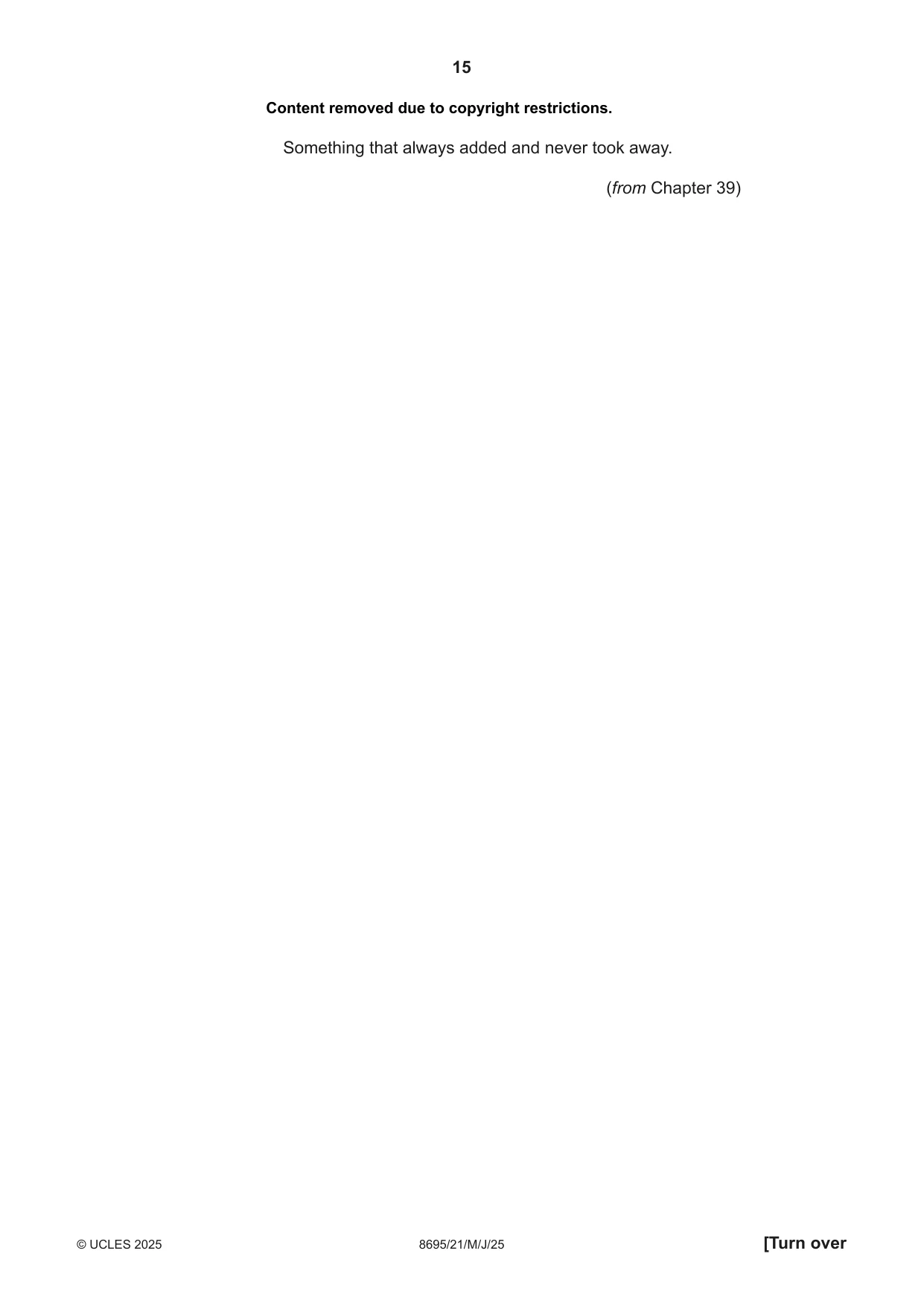
15 8695/21/M/J/25 © UCLES 2025 [Turn over Something that always added and never took away. (from Chapter 39) Content removed due to copyright restrictions.
Question paper, page 16
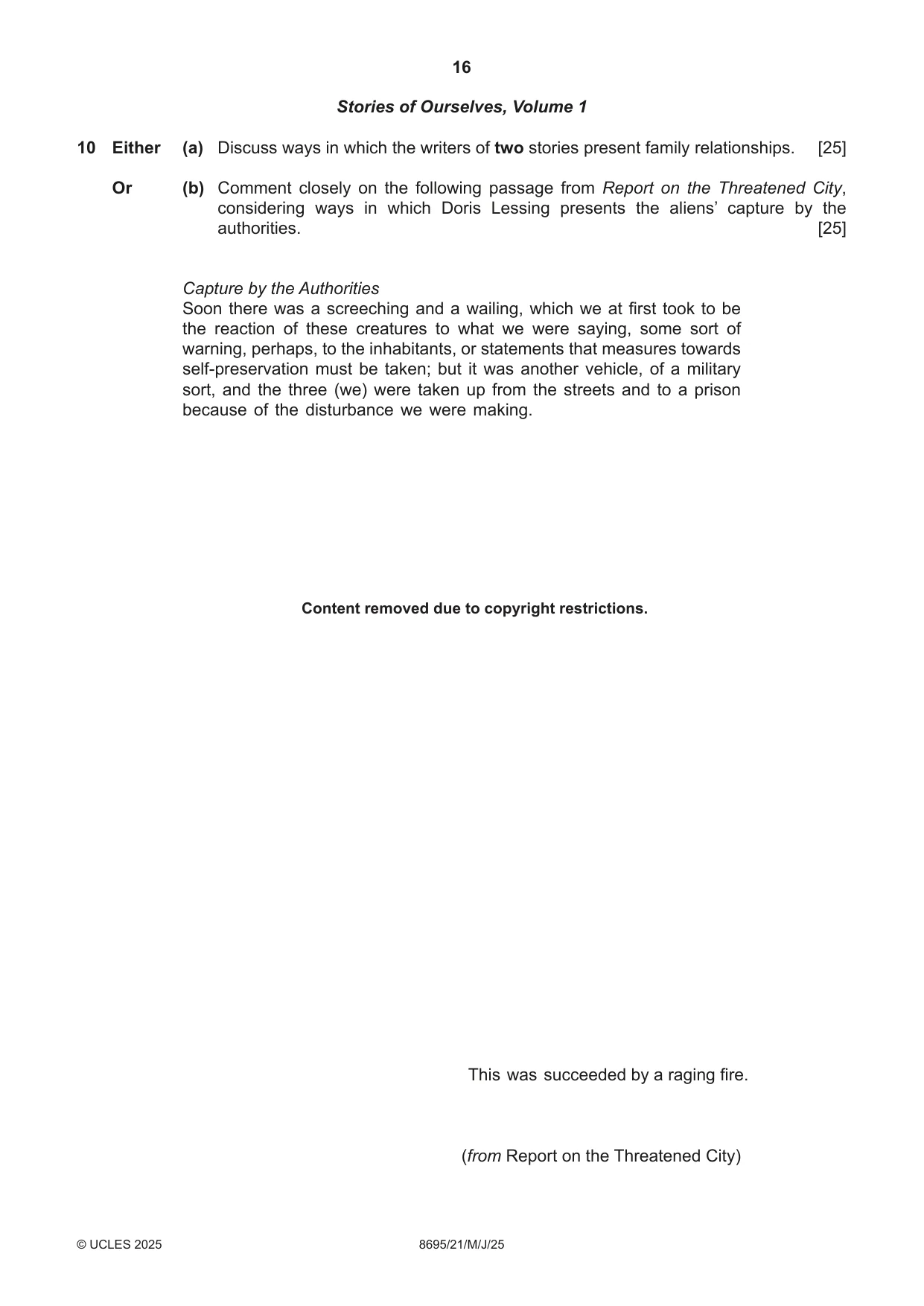
16 8695/21/M/J/25 © UCLES 2025 Stories of Ourselves, Volume 1 10 Either (a) Discuss ways in which the writers of two stories present family relationships. [25] Or (b) Comment closely on the following passage from Report on the Threatened City, considering ways in which Doris Lessing presents the aliens’ capture by the authorities. [25] Capture by the Authorities Soon there was a screeching and a wailing, which we at first took to be the reaction of these creatures to what we were saying, some sort of warning, perhaps, to the inhabitants, or statements that measures towards self-preservation must be taken; but it was another vehicle, of a military sort, and the three (we) were taken up from the streets and to a prison because of the disturbance we were making. This was succeeded by a raging fire. (from Report on the Threatened City) Content removed due to copyright restrictions.
Question paper, page 17
17 8695/21/M/J/25 © UCLES 2025 [Turn over EVELYN WAUGH: A Handful of Dust 11 Either (a) ‘Tony, don’t make me feel a beast.’ With Brenda’s words in mind, discuss ways in which Waugh presents the breakdown of her marriage with Tony. [25] Or (b) Comment closely on Waugh’s characterisation of Dr Messinger in the following passage. [25] Dr Messinger lunched off apples and a rice pudding. Before Tony left the Greville that day, he tore up his sheaf of cruise prospectuses, for he had arranged to join Dr Messinger in his expedition. (from In Search of a City, Part 1) Content removed due to copyright restrictions.
Question paper, page 18
18 8695/21/M/J/25 © UCLES 2025 COLSON WHITEHEAD: The Underground Railroad 12 Either (a) Discuss some of the ways in which Whitehead presents the station agents and drivers of the underground railroad. [25] Or (b) Comment closely on ways in which Whitehead presents Cora’s grandmother, Ajarry, in the following passage. [25] Her [Ajarry’s] first husband developed a hankering for corn whiskey and started using his big hands to make big fists. To escape the boundary of the plantation was to escape the fundamental principles of your existence: impossible. (from Ajarry) Content removed due to copyright restrictions.
Question paper, page 19
19 8695/21/M/J/25 © UCLES 2025 BLANK PAGE
Question paper, page 20
20 8695/21/M/J/25 © UCLES 2025 Permission to reproduce items where third-party owned material protected by copyright is included has been sought and cleared where possible. Every reasonable effort has been made by the publisher (UCLES) to trace copyright holders, but if any items requiring clearance have unwittingly been included, the publisher will be pleased to make amends at the earliest possible opportunity. To avoid the issue of disclosure of answer-related information to candidates, all copyright acknowledgements are reproduced online in the Cambridge Assessment International Education Copyright Acknowledgements Booklet. This is produced for each series of examinations and is freely available to download at www.cambridgeinternational.org after the live examination series. Cambridge Assessment International Education is part of Cambridge Assessment. Cambridge Assessment is the brand name of the University of Cambridge Local Examinations Syndicate (UCLES), which is a department of the University of Cambridge. BLANK PAGE
Mark scheme, page 1
This document consists of 14 printed pages. © Cambridge University Press & Assessment 2025 [Turn over Cambridge International AS Level LANGUAGE AND LITERATURE IN ENGLISH 8695/21 Paper 2 Drama, Poetry and Prose May/June 2025 MARK SCHEME Maximum Mark: 50 Published This mark scheme is published as an aid to teachers and candidates, to indicate the requirements of the examination. It shows the basis on which Examiners were instructed to award marks. It does not indicate the details of the discussions that took place at an Examiners’ meeting before marking began, which would have considered the acceptability of alternative answers. Mark schemes should be read in conjunction with the question paper and the Principal Examiner Report for Teachers. Cambridge International will not enter into discussions about these mark schemes. Cambridge International is publishing the mark schemes for the May/June 2025 series for most Cambridge IGCSE, Cambridge International A and AS Level components, and some Cambridge O Level components.
Mark scheme, page 2
8695/21 Cambridge International AS Level – Mark Scheme PUBLISHED May/June 2025 © Cambridge University Press & Assessment 2025 Page 2 of 14 Generic Marking Principles These general marking principles must be applied by all examiners when marking candidate answers. They should be applied alongside the specific content of the mark scheme or generic level descriptions for a question. Each question paper and mark scheme will also comply with these marking principles. GENERIC MARKING PRINCIPLE 1: Marks must be awarded in line with: • the specific content of the mark scheme or the generic level descriptors for the question • the specific skills defined in the mark scheme or in the generic level descriptors for the question • the standard of response required by a candidate as exemplified by the standardisation scripts. GENERIC MARKING PRINCIPLE 2: Marks awarded are always whole marks (not half marks, or other fractions). GENERIC MARKING PRINCIPLE 3: Marks must be awarded positively: • marks are awarded for correct/valid answers, as defined in the mark scheme. However, credit is given for valid answers which go beyond the scope of the syllabus and mark scheme, referring to your Team Leader as appropriate • marks are awarded when candidates clearly demonstrate what they know and can do • marks are not deducted for errors • marks are not deducted for omissions • answers should only be judged on the quality of spelling, punctuation and grammar when these features are specifically assessed by the question as indicated by the mark scheme. The meaning, however, should be unambiguous. GENERIC MARKING PRINCIPLE 4: Rules must be applied consistently, e.g. in situations where candidates have not followed instructions or in the application of generic level descriptors. GENERIC MARKING PRINCIPLE 5: Marks should be awarded using the full range of marks defined in the mark scheme for the question (however; the use of the full mark range may be limited according to the quality of the candidate responses seen). GENERIC MARKING PRINCIPLE 6: Marks awarded are based solely on the requirements as defined in the mark scheme. Marks should not be awarded with grade thresholds or grade descriptors in mind.
Mark scheme, page 3
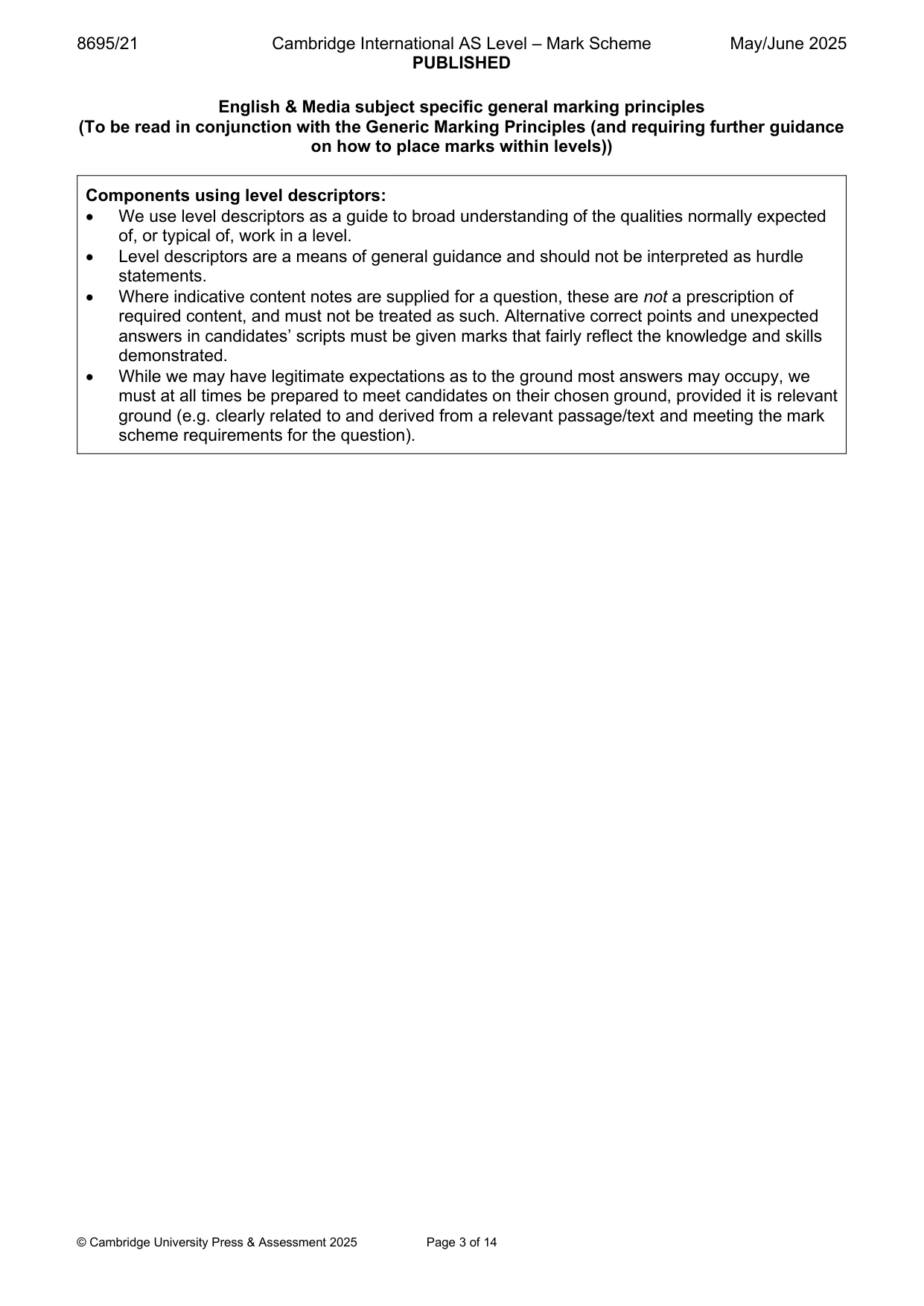
8695/21 Cambridge International AS Level – Mark Scheme PUBLISHED May/June 2025 © Cambridge University Press & Assessment 2025 Page 3 of 14 English & Media subject specific general marking principles (To be read in conjunction with the Generic Marking Principles (and requiring further guidance on how to place marks within levels)) Components using level descriptors: • We use level descriptors as a guide to broad understanding of the qualities normally expected of, or typical of, work in a level. • Level descriptors are a means of general guidance and should not be interpreted as hurdle statements. • Where indicative content notes are supplied for a question, these are not a prescription of required content, and must not be treated as such. Alternative correct points and unexpected answers in candidates’ scripts must be given marks that fairly reflect the knowledge and skills demonstrated. • While we may have legitimate expectations as to the ground most answers may occupy, we must at all times be prepared to meet candidates on their chosen ground, provided it is relevant ground (e.g. clearly related to and derived from a relevant passage/text and meeting the mark scheme requirements for the question).
Mark scheme, page 4
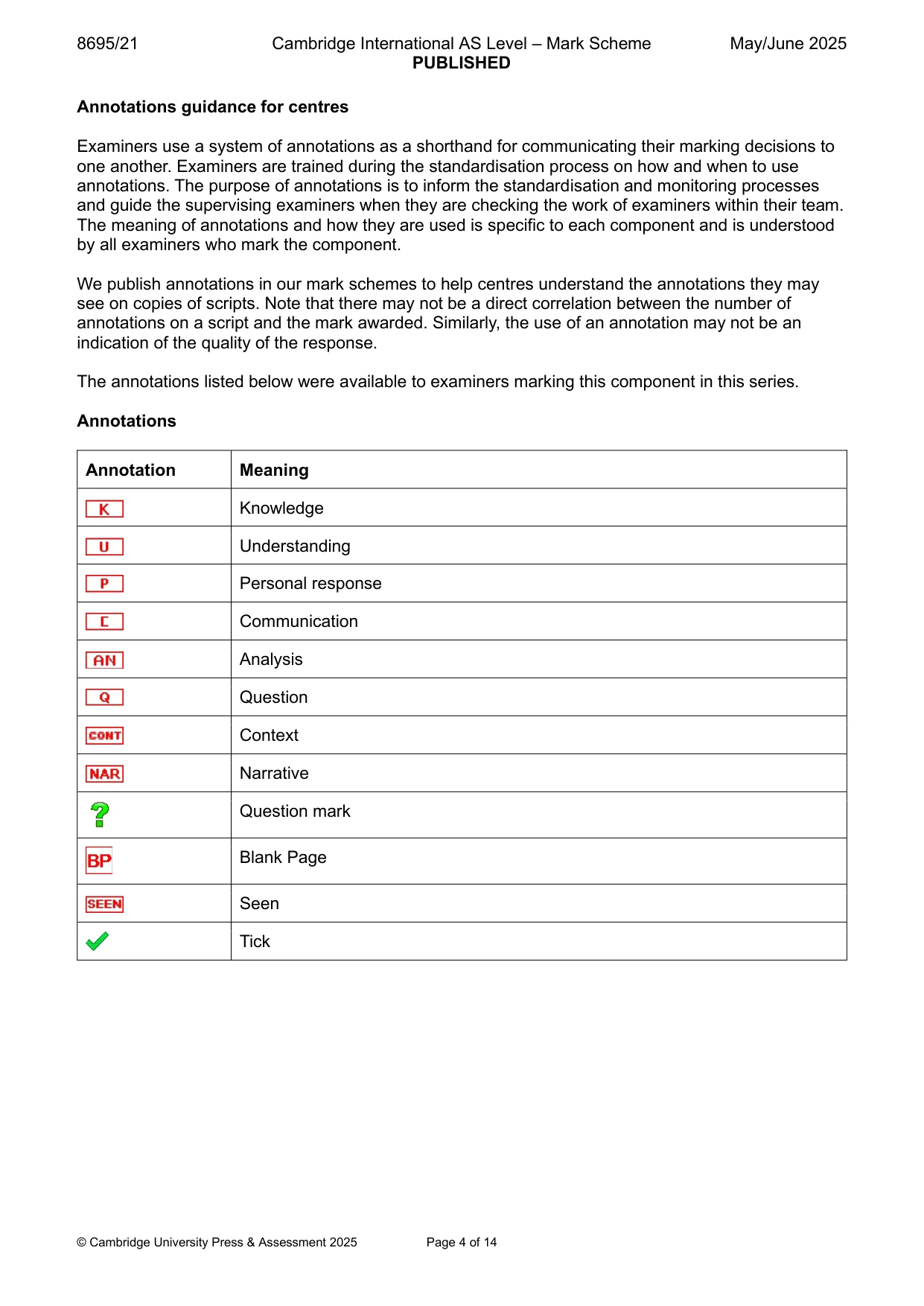
8695/21 Cambridge International AS Level – Mark Scheme PUBLISHED May/June 2025 © Cambridge University Press & Assessment 2025 Page 4 of 14 Annotations guidance for centres Examiners use a system of annotations as a shorthand for communicating their marking decisions to one another. Examiners are trained during the standardisation process on how and when to use annotations. The purpose of annotations is to inform the standardisation and monitoring processes and guide the supervising examiners when they are checking the work of examiners within their team. The meaning of annotations and how they are used is specific to each component and is understood by all examiners who mark the component. We publish annotations in our mark schemes to help centres understand the annotations they may see on copies of scripts. Note that there may not be a direct correlation between the number of annotations on a script and the mark awarded. Similarly, the use of an annotation may not be an indication of the quality of the response. The annotations listed below were available to examiners marking this component in this series. Annotations Annotation Meaning Knowledge Understanding Personal response Communication Analysis Question Context Narrative Question mark Blank Page Seen Tick
Mark scheme, page 5
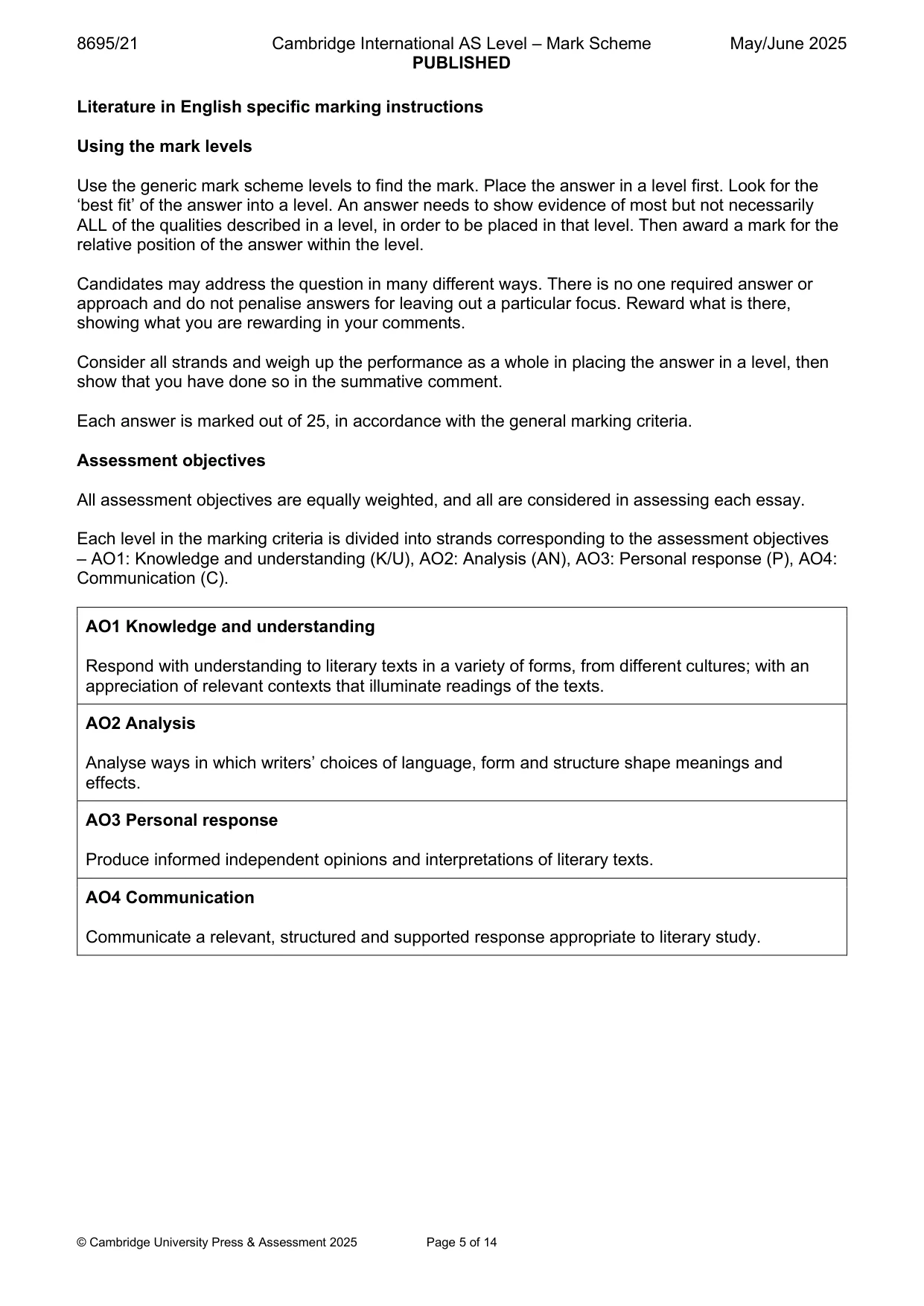
8695/21 Cambridge International AS Level – Mark Scheme PUBLISHED May/June 2025 © Cambridge University Press & Assessment 2025 Page 5 of 14 Literature in English specific marking instructions Using the mark levels Use the generic mark scheme levels to find the mark. Place the answer in a level first. Look for the ‘best fit’ of the answer into a level. An answer needs to show evidence of most but not necessarily ALL of the qualities described in a level, in order to be placed in that level. Then award a mark for the relative position of the answer within the level. Candidates may address the question in many different ways. There is no one required answer or approach and do not penalise answers for leaving out a particular focus. Reward what is there, showing what you are rewarding in your comments. Consider all strands and weigh up the performance as a whole in placing the answer in a level, then show that you have done so in the summative comment. Each answer is marked out of 25, in accordance with the general marking criteria. Assessment objectives All assessment objectives are equally weighted, and all are considered in assessing each essay. Each level in the marking criteria is divided into strands corresponding to the assessment objectives – AO1: Knowledge and understanding (K/U), AO2: Analysis (AN), AO3: Personal response (P), AO4: Communication (C). AO1 Knowledge and understanding Respond with understanding to literary texts in a variety of forms, from different cultures; with an appreciation of relevant contexts that illuminate readings of the texts. AO2 Analysis Analyse ways in which writers’ choices of language, form and structure shape meanings and effects. AO3 Personal response Produce informed independent opinions and interpretations of literary texts. AO4 Communication Communicate a relevant, structured and supported response appropriate to literary study.
Mark scheme, page 6
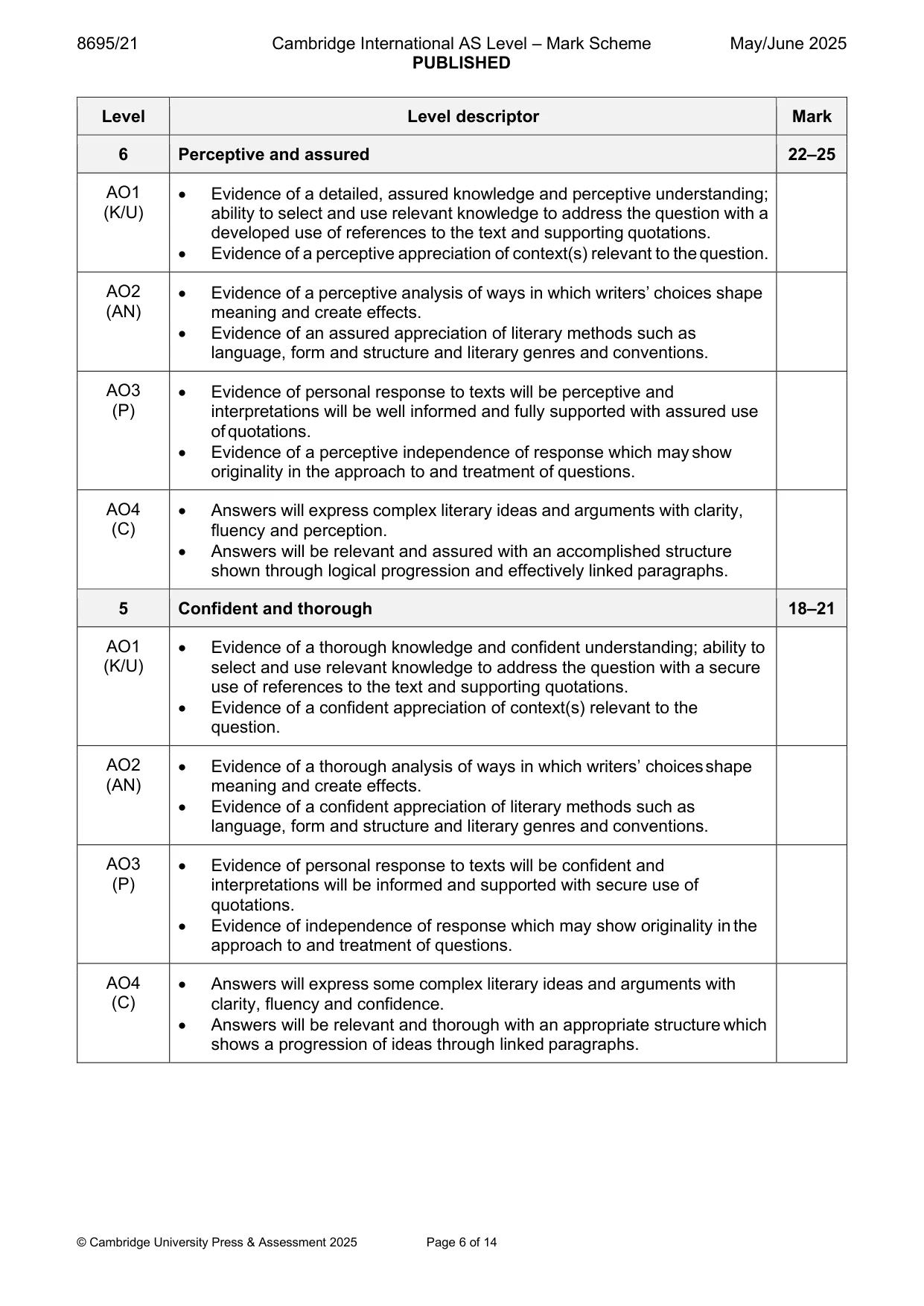
8695/21 Cambridge International AS Level – Mark Scheme PUBLISHED May/June 2025 © Cambridge University Press & Assessment 2025 Page 6 of 14 Level Level descriptor Mark 6 Perceptive and assured 22–25 AO1 (K/U) • Evidence of a detailed, assured knowledge and perceptive understanding; ability to select and use relevant knowledge to address the question with a developed use of references to the text and supporting quotations. • Evidence of a perceptive appreciation of context(s) relevant to the question. AO2 (AN) • Evidence of a perceptive analysis of ways in which writers’ choices shape meaning and create effects. • Evidence of an assured appreciation of literary methods such as language, form and structure and literary genres and conventions. AO3 (P) • Evidence of personal response to texts will be perceptive and interpretations will be well informed and fully supported with assured use of quotations. • Evidence of a perceptive independence of response which may show originality in the approach to and treatment of questions. AO4 (C) • Answers will express complex literary ideas and arguments with clarity, fluency and perception. • Answers will be relevant and assured with an accomplished structure shown through logical progression and effectively linked paragraphs. 5 Confident and thorough 18–21 AO1 (K/U) • Evidence of a thorough knowledge and confident understanding; ability to select and use relevant knowledge to address the question with a secure use of references to the text and supporting quotations. • Evidence of a confident appreciation of context(s) relevant to the question. AO2 (AN) • Evidence of a thorough analysis of ways in which writers’ choices shape meaning and create effects. • Evidence of a confident appreciation of literary methods such as language, form and structure and literary genres and conventions. AO3 (P) • Evidence of personal response to texts will be confident and interpretations will be informed and supported with secure use of quotations. • Evidence of independence of response which may show originality in the approach to and treatment of questions. AO4 (C) • Answers will express some complex literary ideas and arguments with clarity, fluency and confidence. • Answers will be relevant and thorough with an appropriate structure which shows a progression of ideas through linked paragraphs.
Mark scheme, page 7
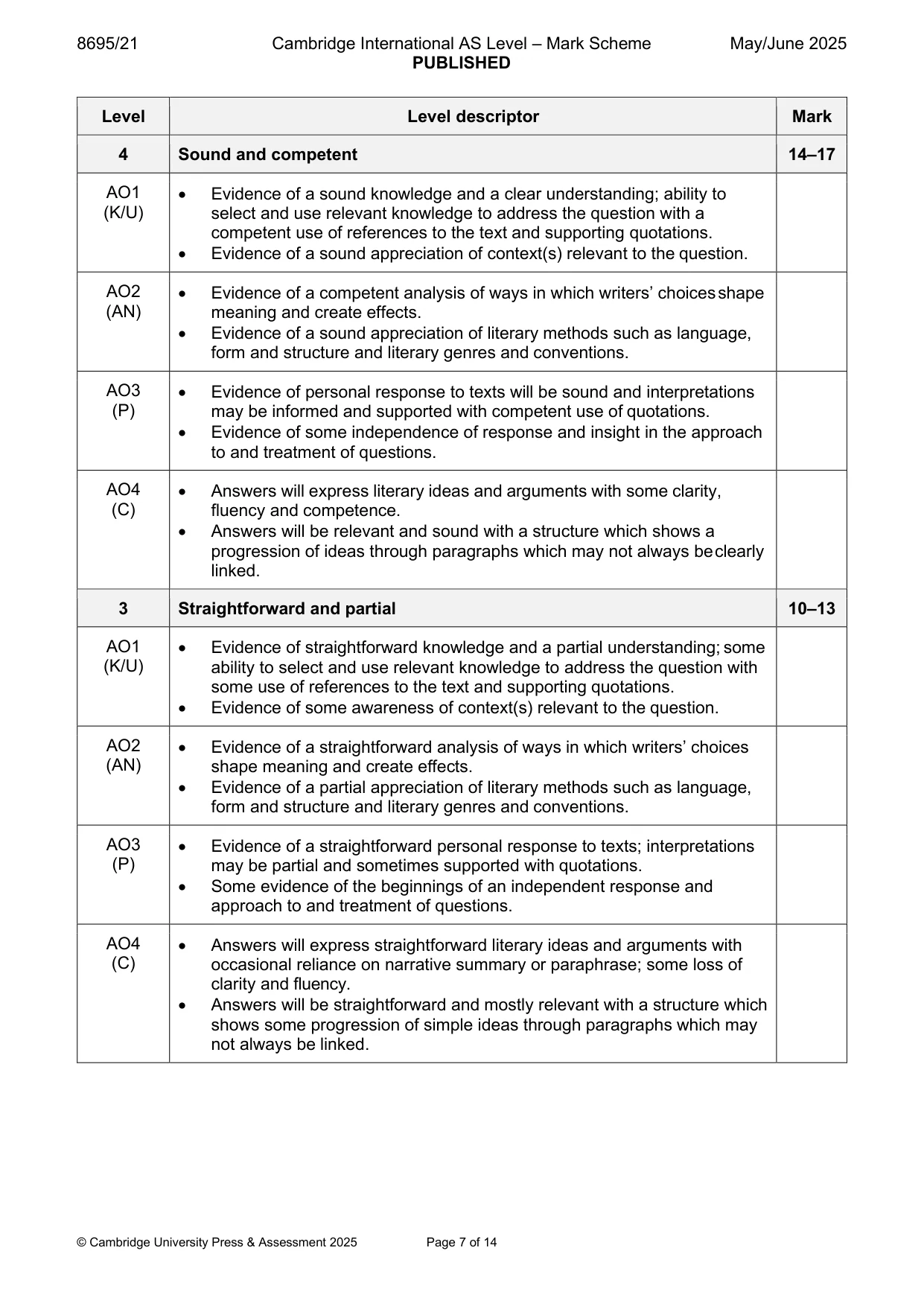
8695/21 Cambridge International AS Level – Mark Scheme PUBLISHED May/June 2025 © Cambridge University Press & Assessment 2025 Page 7 of 14 Level Level descriptor Mark 4 Sound and competent 14–17 AO1 (K/U) • Evidence of a sound knowledge and a clear understanding; ability to select and use relevant knowledge to address the question with a competent use of references to the text and supporting quotations. • Evidence of a sound appreciation of context(s) relevant to the question. AO2 (AN) • Evidence of a competent analysis of ways in which writers’ choices shape meaning and create effects. • Evidence of a sound appreciation of literary methods such as language, form and structure and literary genres and conventions. AO3 (P) • Evidence of personal response to texts will be sound and interpretations may be informed and supported with competent use of quotations. • Evidence of some independence of response and insight in the approach to and treatment of questions. AO4 (C) • Answers will express literary ideas and arguments with some clarity, fluency and competence. • Answers will be relevant and sound with a structure which shows a progression of ideas through paragraphs which may not always be clearly linked. 3 Straightforward and partial 10–13 AO1 (K/U) • Evidence of straightforward knowledge and a partial understanding; some ability to select and use relevant knowledge to address the question with some use of references to the text and supporting quotations. • Evidence of some awareness of context(s) relevant to the question. AO2 (AN) • Evidence of a straightforward analysis of ways in which writers’ choices shape meaning and create effects. • Evidence of a partial appreciation of literary methods such as language, form and structure and literary genres and conventions. AO3 (P) • Evidence of a straightforward personal response to texts; interpretations may be partial and sometimes supported with quotations. • Some evidence of the beginnings of an independent response and approach to and treatment of questions. AO4 (C) • Answers will express straightforward literary ideas and arguments with occasional reliance on narrative summary or paraphrase; some loss of clarity and fluency. • Answers will be straightforward and mostly relevant with a structure which shows some progression of simple ideas through paragraphs which may not always be linked.
Mark scheme, page 8
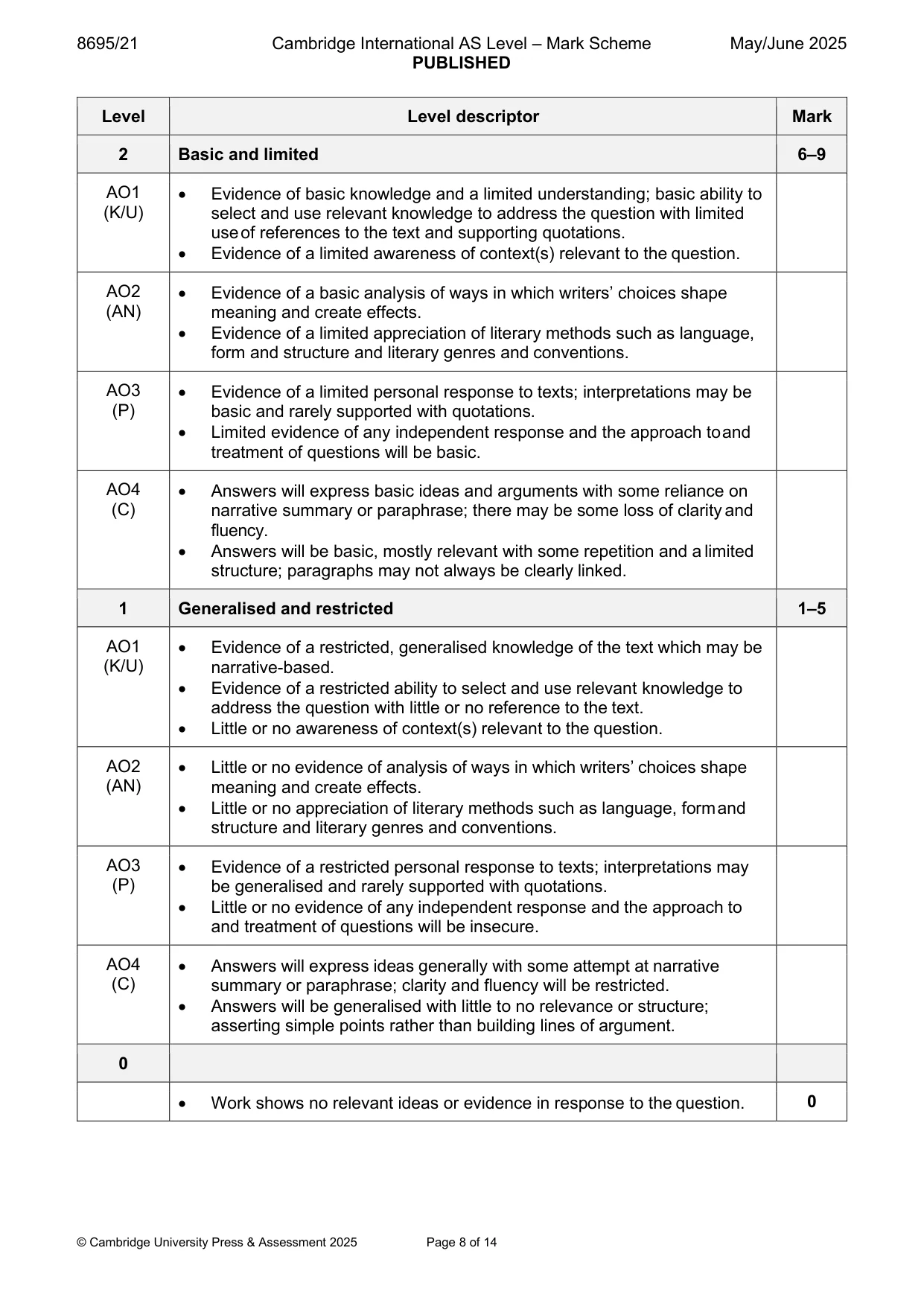
8695/21 Cambridge International AS Level – Mark Scheme PUBLISHED May/June 2025 © Cambridge University Press & Assessment 2025 Page 8 of 14 Level Level descriptor Mark 2 Basic and limited 6–9 AO1 (K/U) • Evidence of basic knowledge and a limited understanding; basic ability to select and use relevant knowledge to address the question with limited use of references to the text and supporting quotations. • Evidence of a limited awareness of context(s) relevant to the question. AO2 (AN) • Evidence of a basic analysis of ways in which writers’ choices shape meaning and create effects. • Evidence of a limited appreciation of literary methods such as language, form and structure and literary genres and conventions. AO3 (P) • Evidence of a limited personal response to texts; interpretations may be basic and rarely supported with quotations. • Limited evidence of any independent response and the approach to and treatment of questions will be basic. AO4 (C) • Answers will express basic ideas and arguments with some reliance on narrative summary or paraphrase; there may be some loss of clarity and fluency. • Answers will be basic, mostly relevant with some repetition and a limited structure; paragraphs may not always be clearly linked. 1 Generalised and restricted 1–5 AO1 (K/U) • Evidence of a restricted, generalised knowledge of the text which may be narrative-based. • Evidence of a restricted ability to select and use relevant knowledge to address the question with little or no reference to the text. • Little or no awareness of context(s) relevant to the question. AO2 (AN) • Little or no evidence of analysis of ways in which writers’ choices shape meaning and create effects. • Little or no appreciation of literary methods such as language, form and structure and literary genres and conventions. AO3 (P) • Evidence of a restricted personal response to texts; interpretations may be generalised and rarely supported with quotations. • Little or no evidence of any independent response and the approach to and treatment of questions will be insecure. AO4 (C) • Answers will express ideas generally with some attempt at narrative summary or paraphrase; clarity and fluency will be restricted. • Answers will be generalised with little to no relevance or structure; asserting simple points rather than building lines of argument. 0 • Work shows no relevant ideas or evidence in response to the question. 0
Mark scheme, page 9
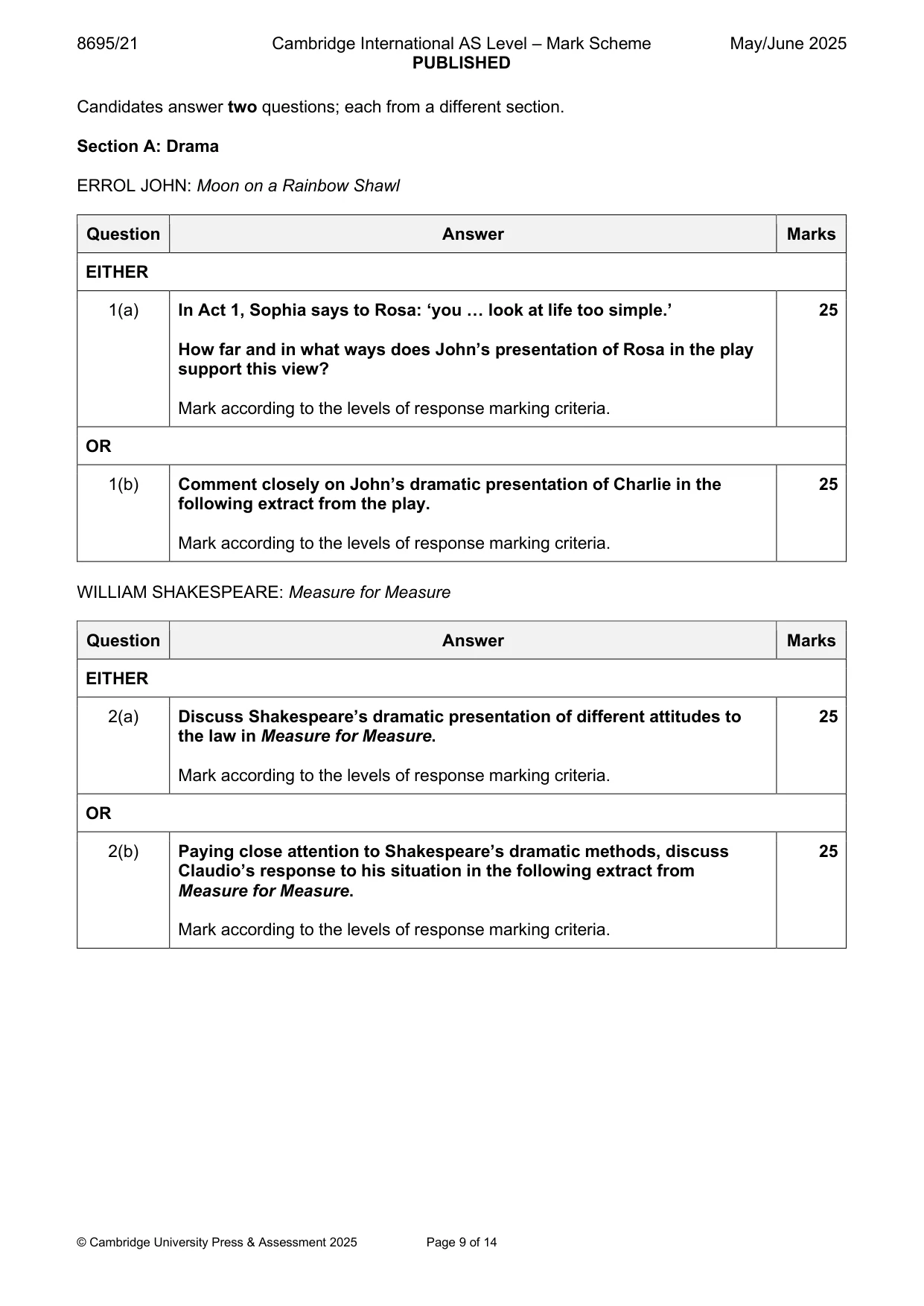
8695/21 Cambridge International AS Level – Mark Scheme PUBLISHED May/June 2025 © Cambridge University Press & Assessment 2025 Page 9 of 14 Candidates answer two questions; each from a different section. Section A: Drama ERROL JOHN: Moon on a Rainbow Shawl Question Answer Marks EITHER 1(a) In Act 1, Sophia says to Rosa: ‘you … look at life too simple.’ How far and in what ways does John’s presentation of Rosa in the play support this view? Mark according to the levels of response marking criteria. 25 OR 1(b) Comment closely on John’s dramatic presentation of Charlie in the following extract from the play. Mark according to the levels of response marking criteria. 25 WILLIAM SHAKESPEARE: Measure for Measure Question Answer Marks EITHER 2(a) Discuss Shakespeare’s dramatic presentation of different attitudes to the law in Measure for Measure. Mark according to the levels of response marking criteria. 25 OR 2(b) Paying close attention to Shakespeare’s dramatic methods, discuss Claudio’s response to his situation in the following extract from Measure for Measure. Mark according to the levels of response marking criteria. 25
Mark scheme, page 10
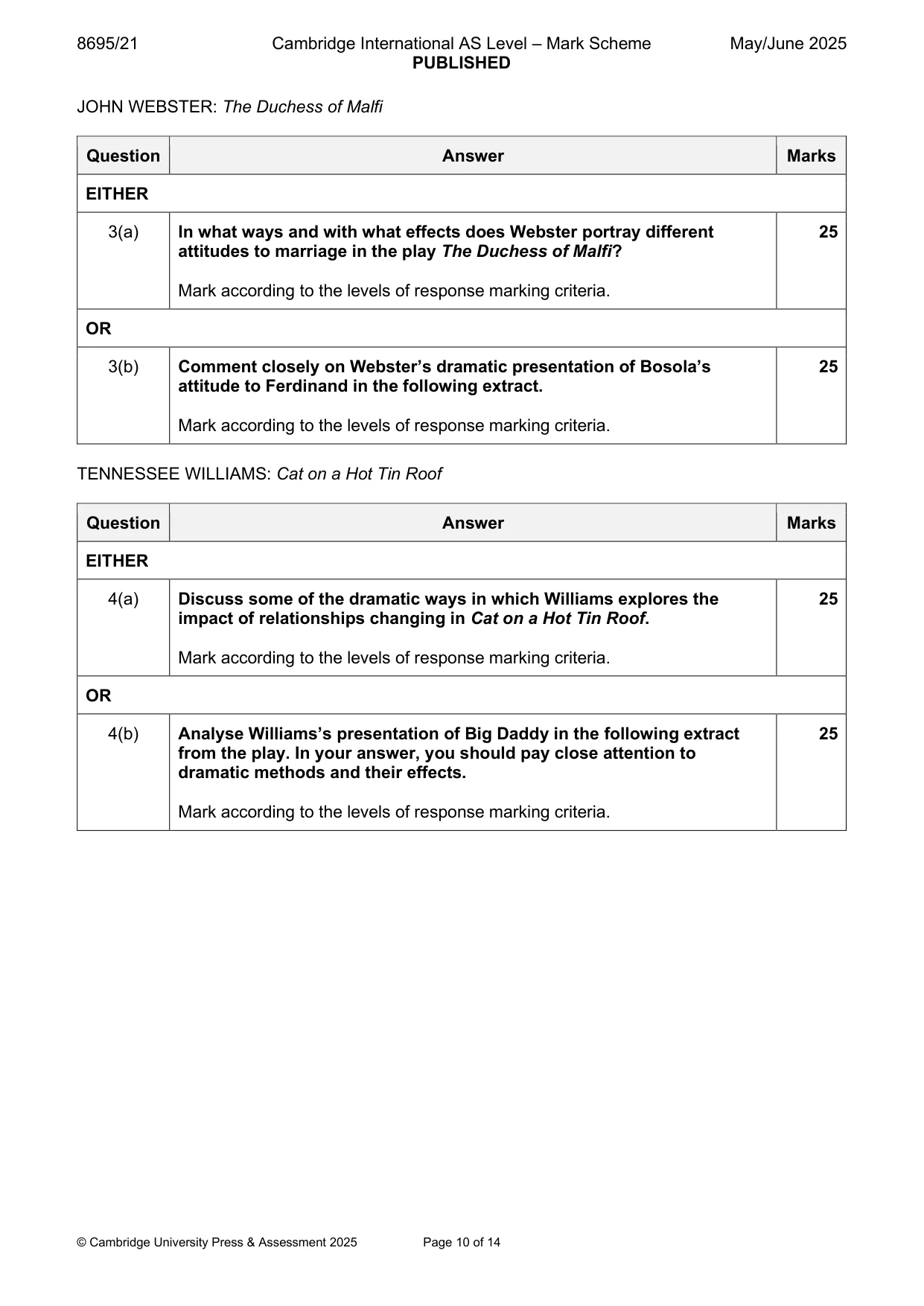
8695/21 Cambridge International AS Level – Mark Scheme PUBLISHED May/June 2025 © Cambridge University Press & Assessment 2025 Page 10 of 14 JOHN WEBSTER: The Duchess of Malfi Question Answer Marks EITHER 3(a) In what ways and with what effects does Webster portray different attitudes to marriage in the play The Duchess of Malfi? Mark according to the levels of response marking criteria. 25 OR 3(b) Comment closely on Webster’s dramatic presentation of Bosola’s attitude to Ferdinand in the following extract. Mark according to the levels of response marking criteria. 25 TENNESSEE WILLIAMS: Cat on a Hot Tin Roof Question Answer Marks EITHER 4(a) Discuss some of the dramatic ways in which Williams explores the impact of relationships changing in Cat on a Hot Tin Roof. Mark according to the levels of response marking criteria. 25 OR 4(b) Analyse Williams’s presentation of Big Daddy in the following extract from the play. In your answer, you should pay close attention to dramatic methods and their effects. Mark according to the levels of response marking criteria. 25
Mark scheme, page 11
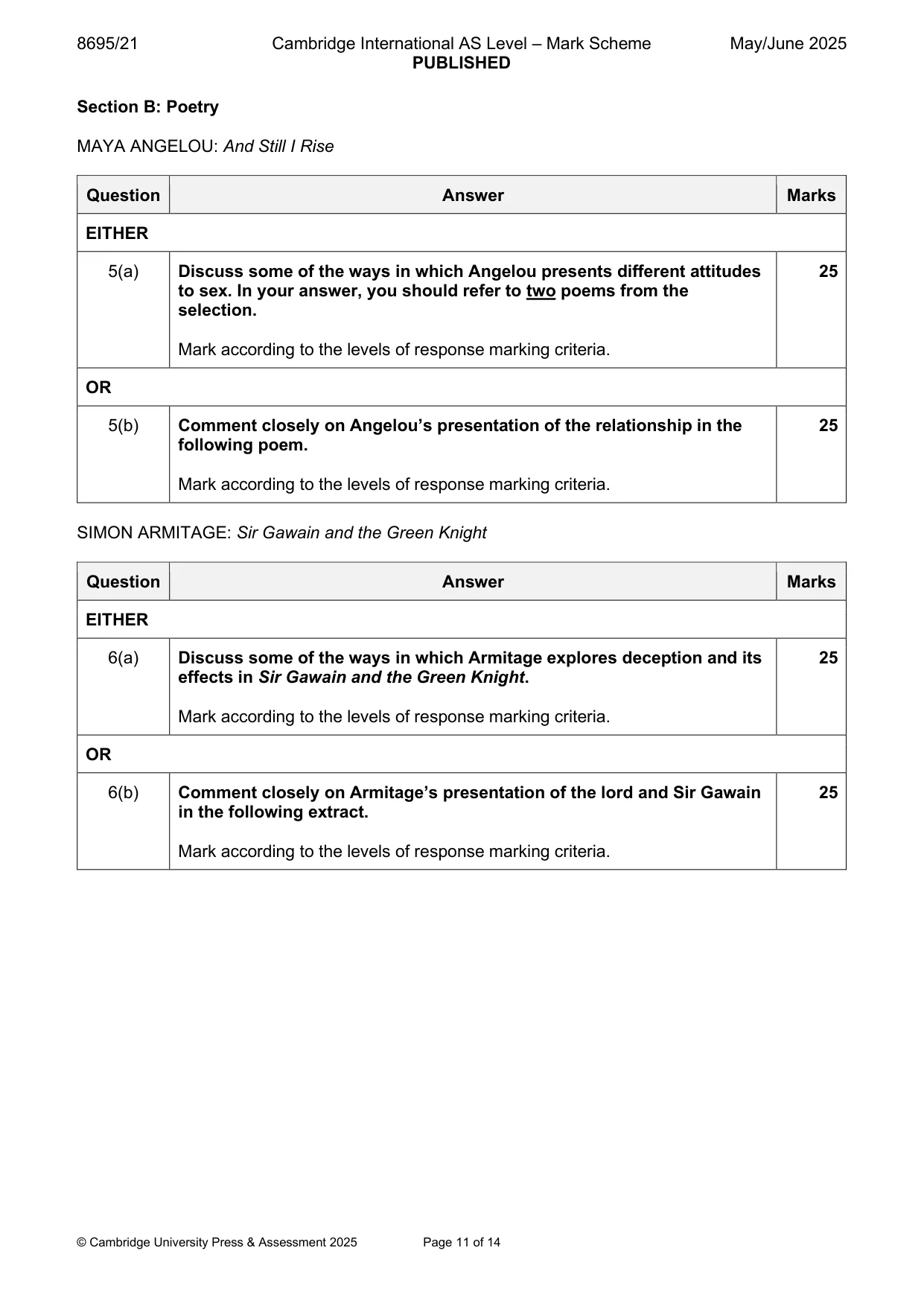
8695/21 Cambridge International AS Level – Mark Scheme PUBLISHED May/June 2025 © Cambridge University Press & Assessment 2025 Page 11 of 14 Section B: Poetry MAYA ANGELOU: And Still I Rise Question Answer Marks EITHER 5(a) Discuss some of the ways in which Angelou presents different attitudes to sex. In your answer, you should refer to two poems from the selection. Mark according to the levels of response marking criteria. 25 OR 5(b) Comment closely on Angelou’s presentation of the relationship in the following poem. Mark according to the levels of response marking criteria. 25 SIMON ARMITAGE: Sir Gawain and the Green Knight Question Answer Marks EITHER 6(a) Discuss some of the ways in which Armitage explores deception and its effects in Sir Gawain and the Green Knight. Mark according to the levels of response marking criteria. 25 OR 6(b) Comment closely on Armitage’s presentation of the lord and Sir Gawain in the following extract. Mark according to the levels of response marking criteria. 25
Mark scheme, page 12
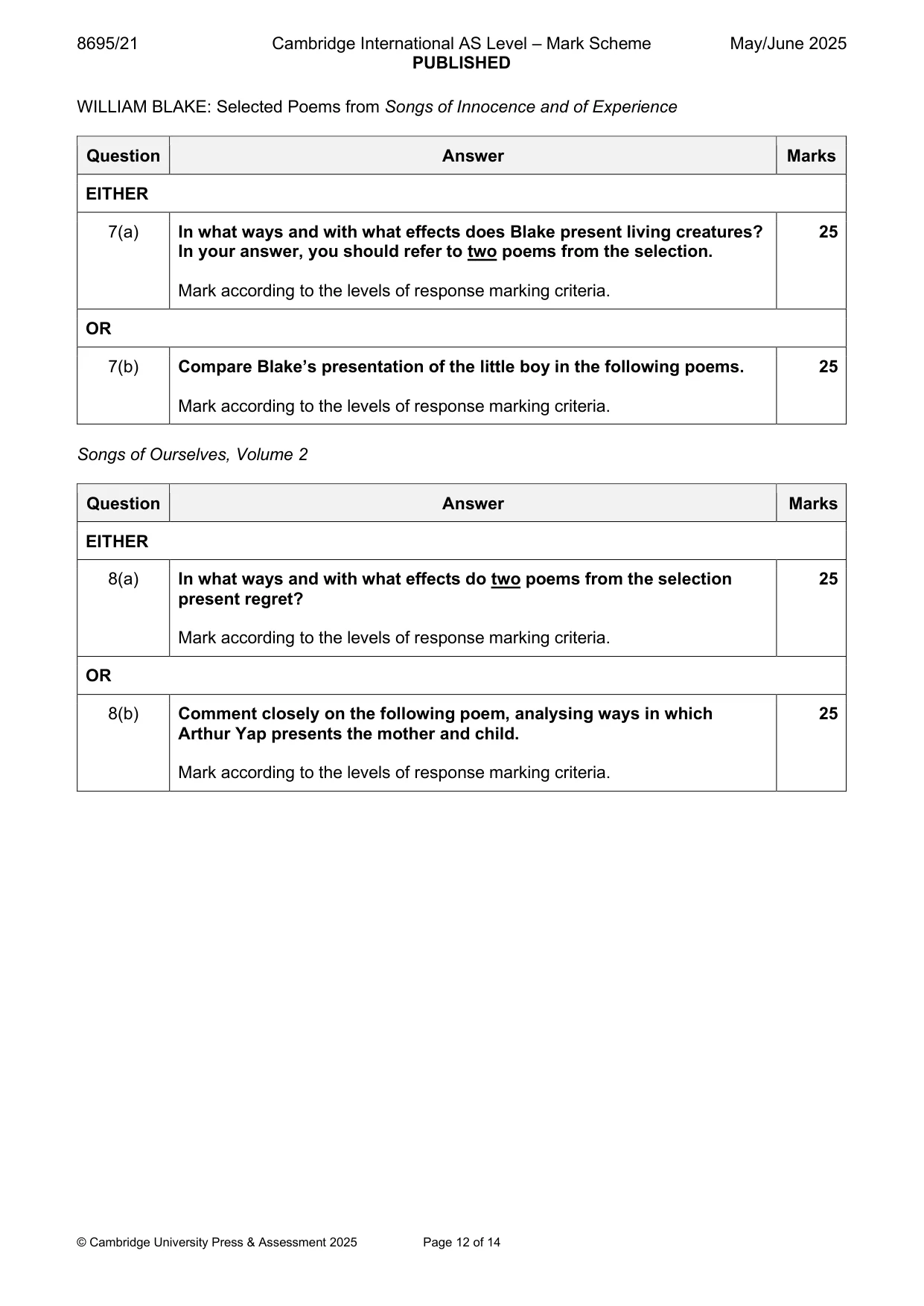
8695/21 Cambridge International AS Level – Mark Scheme PUBLISHED May/June 2025 © Cambridge University Press & Assessment 2025 Page 12 of 14 WILLIAM BLAKE: Selected Poems from Songs of Innocence and of Experience Question Answer Marks EITHER 7(a) In what ways and with what effects does Blake present living creatures? In your answer, you should refer to two poems from the selection. Mark according to the levels of response marking criteria. 25 OR 7(b) Compare Blake’s presentation of the little boy in the following poems. Mark according to the levels of response marking criteria. 25 Songs of Ourselves, Volume 2 Question Answer Marks EITHER 8(a) In what ways and with what effects do two poems from the selection present regret? Mark according to the levels of response marking criteria. 25 OR 8(b) Comment closely on the following poem, analysing ways in which Arthur Yap presents the mother and child. Mark according to the levels of response marking criteria. 25
Mark scheme, page 13
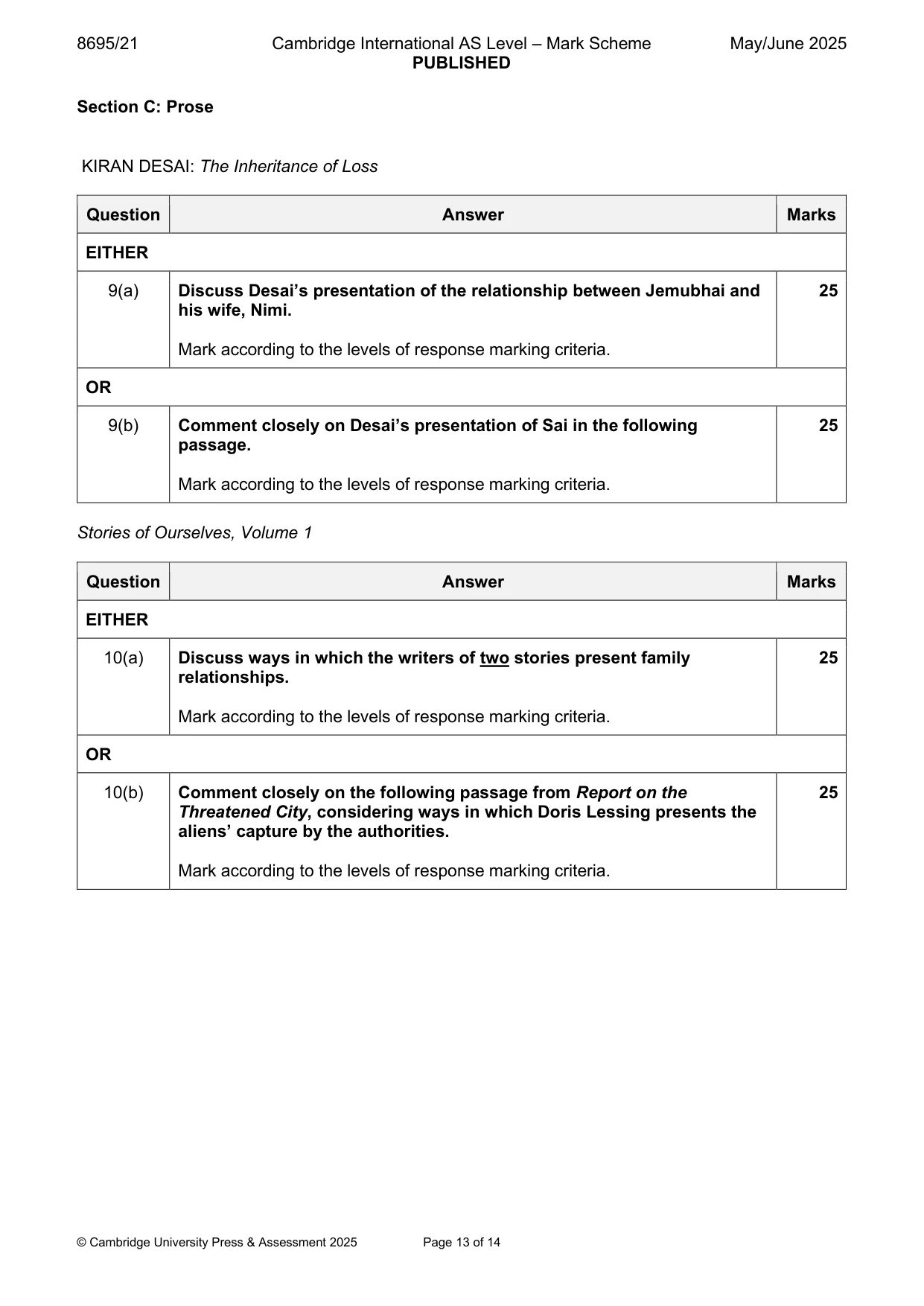
8695/21 Cambridge International AS Level – Mark Scheme PUBLISHED May/June 2025 © Cambridge University Press & Assessment 2025 Page 13 of 14 Section C: Prose KIRAN DESAI: The Inheritance of Loss Question Answer Marks EITHER 9(a) Discuss Desai’s presentation of the relationship between Jemubhai and his wife, Nimi. Mark according to the levels of response marking criteria. 25 OR 9(b) Comment closely on Desai’s presentation of Sai in the following passage. Mark according to the levels of response marking criteria. 25 Stories of Ourselves, Volume 1 Question Answer Marks EITHER 10(a) Discuss ways in which the writers of two stories present family relationships. Mark according to the levels of response marking criteria. 25 OR 10(b) Comment closely on the following passage from Report on the Threatened City, considering ways in which Doris Lessing presents the aliens’ capture by the authorities. Mark according to the levels of response marking criteria. 25
Mark scheme, page 14
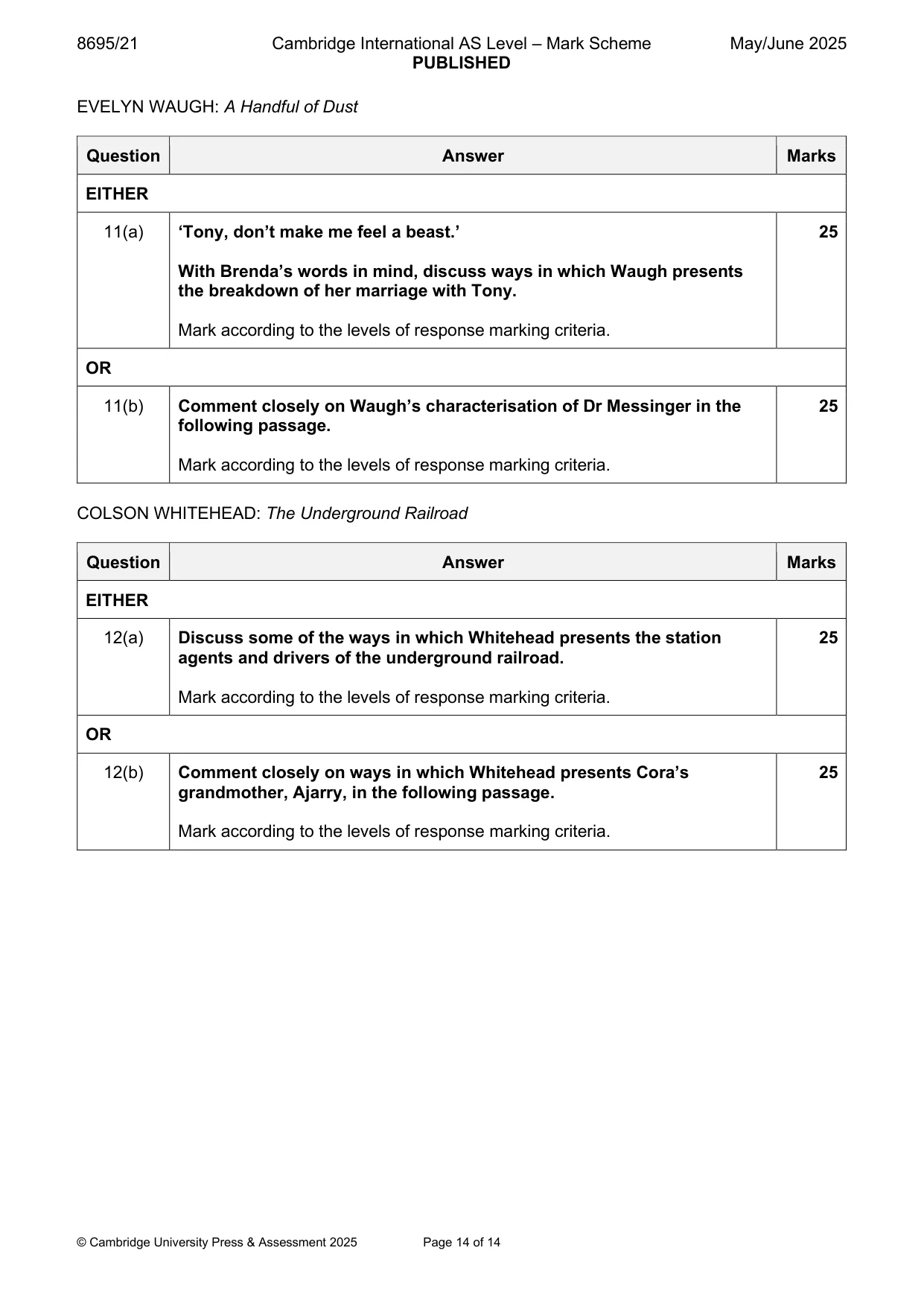
8695/21 Cambridge International AS Level – Mark Scheme PUBLISHED May/June 2025 © Cambridge University Press & Assessment 2025 Page 14 of 14 EVELYN WAUGH: A Handful of Dust Question Answer Marks EITHER 11(a) ‘Tony, don’t make me feel a beast.’ With Brenda’s words in mind, discuss ways in which Waugh presents the breakdown of her marriage with Tony. Mark according to the levels of response marking criteria. 25 OR 11(b) Comment closely on Waugh’s characterisation of Dr Messinger in the following passage. Mark according to the levels of response marking criteria. 25 COLSON WHITEHEAD: The Underground Railroad Question Answer Marks EITHER 12(a) Discuss some of the ways in which Whitehead presents the station agents and drivers of the underground railroad. Mark according to the levels of response marking criteria. 25 OR 12(b) Comment closely on ways in which Whitehead presents Cora’s grandmother, Ajarry, in the following passage. Mark according to the levels of response marking criteria. 25
What you needed in this session
Cambridge’s own grade thresholds for 2025 May/June, Paper 2 · Variant 1. A higher threshold means an easier paper — the bar moves with how the cohort did.