Cambridge A Level English - Language and Literature (AS Level only, from 2016) 8695 — 2024 May/June Paper 2 · Variant 1
8695/21/M/J/24 · 50 marks · 120 min
The question paper and its mark scheme, free to read here and free to download. This is Cambridge’s own paper, exactly as it was sat.
Question paper24 pages




Mark scheme13 pages
Answers below. Sit the paper first if you are practising.
Paper as text
Question paper, page 1
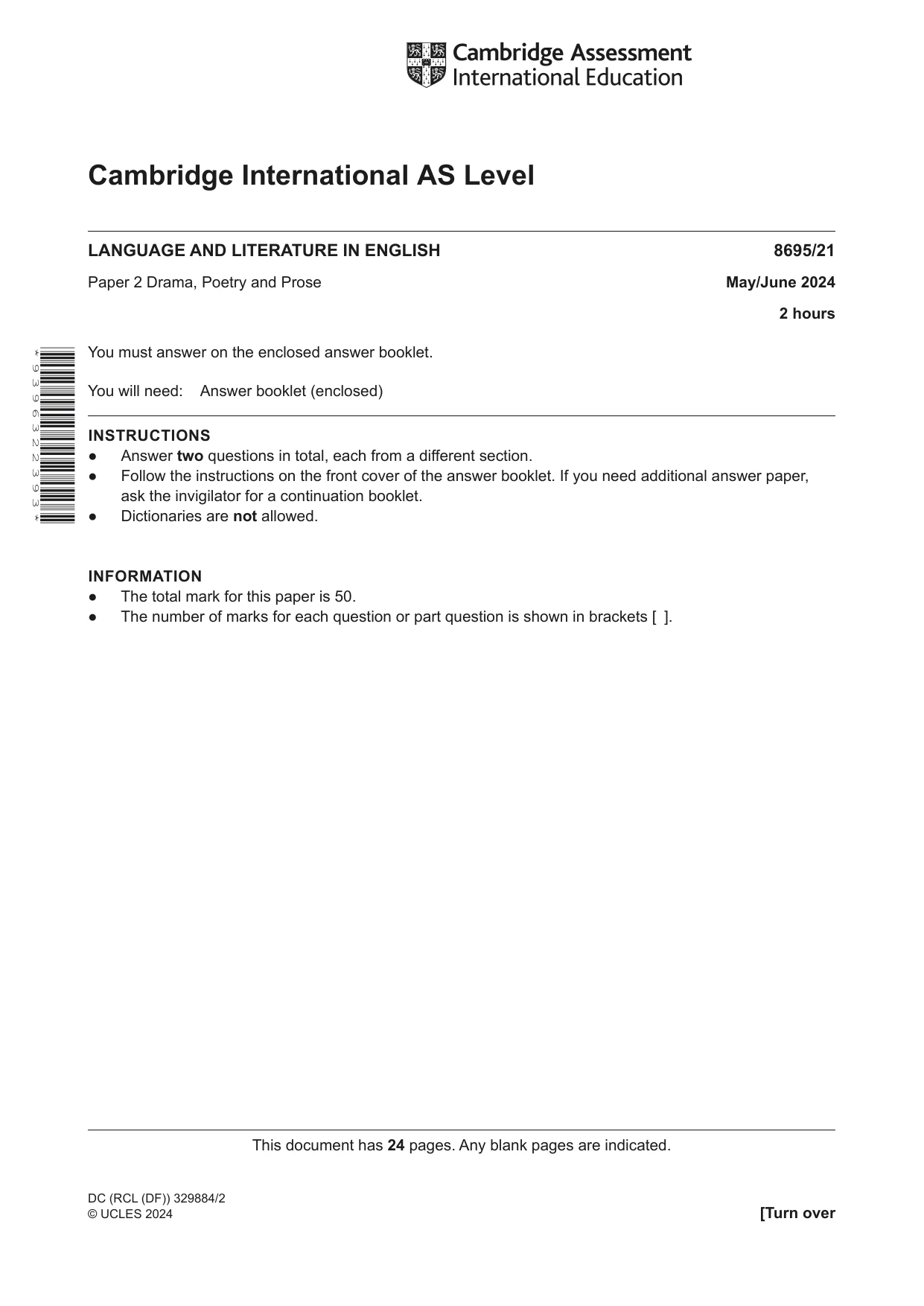
This document has 24 pages. Any blank pages are indicated. [Turn over Cambridge International AS Level * 9 3 9 6 3 2 2 3 9 3 * DC (RCL (DF)) 329884/2 © UCLES 2024 LANGUAGE AND LITERATURE IN ENGLISH 8695/21 Paper 2 Drama, Poetry and Prose May/June 2024 2 hours You must answer on the enclosed answer booklet. You will need: Answer booklet (enclosed) INSTRUCTIONS ● Answer two questions in total, each from a different section. ● Follow the instructions on the front cover of the answer booklet. If you need additional answer paper, ask the invigilator for a continuation booklet. ● Dictionaries are not allowed. INFORMATION ● The total mark for this paper is 50. ● The number of marks for each question or part question is shown in brackets [ ].
Question paper, page 2
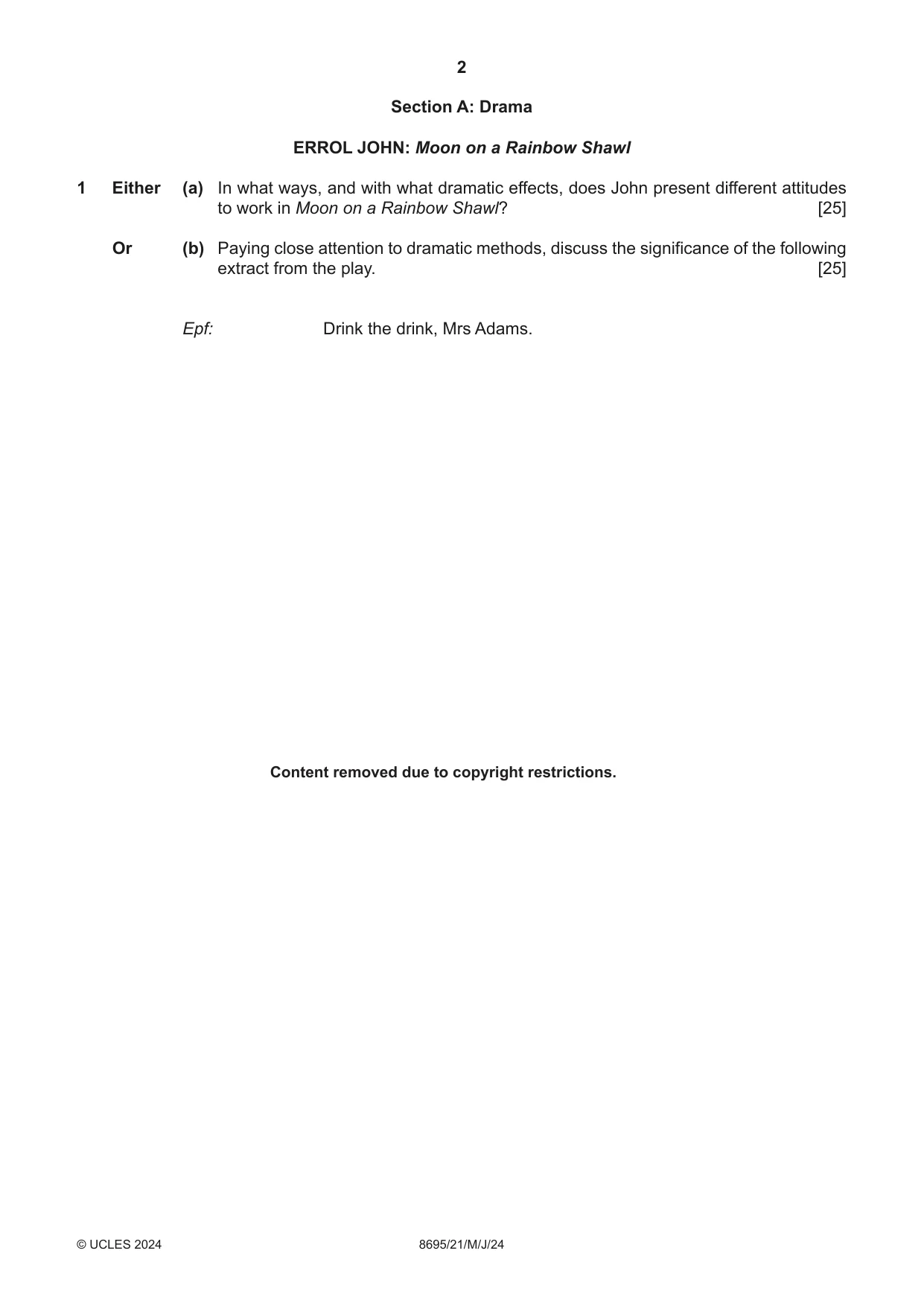
2 8695/21/M/J/24 © UCLES 2024 Section A: Drama ERROL JOHN: Moon on a Rainbow Shawl 1 Either (a) In what ways, and with what dramatic effects, does John present different attitudes to work in Moon on a Rainbow Shawl? [25] Or (b) Paying close attention to dramatic methods, discuss the significance of the following extract from the play. [25] Epf: Drink the drink, Mrs Adams. Content removed due to copyright restrictions.
Question paper, page 3
3 8695/21/M/J/24 © UCLES 2024 [Turn over Hey, Ephraim! (from Act 3, Scene 2) Content removed due to copyright restrictions.
Question paper, page 4
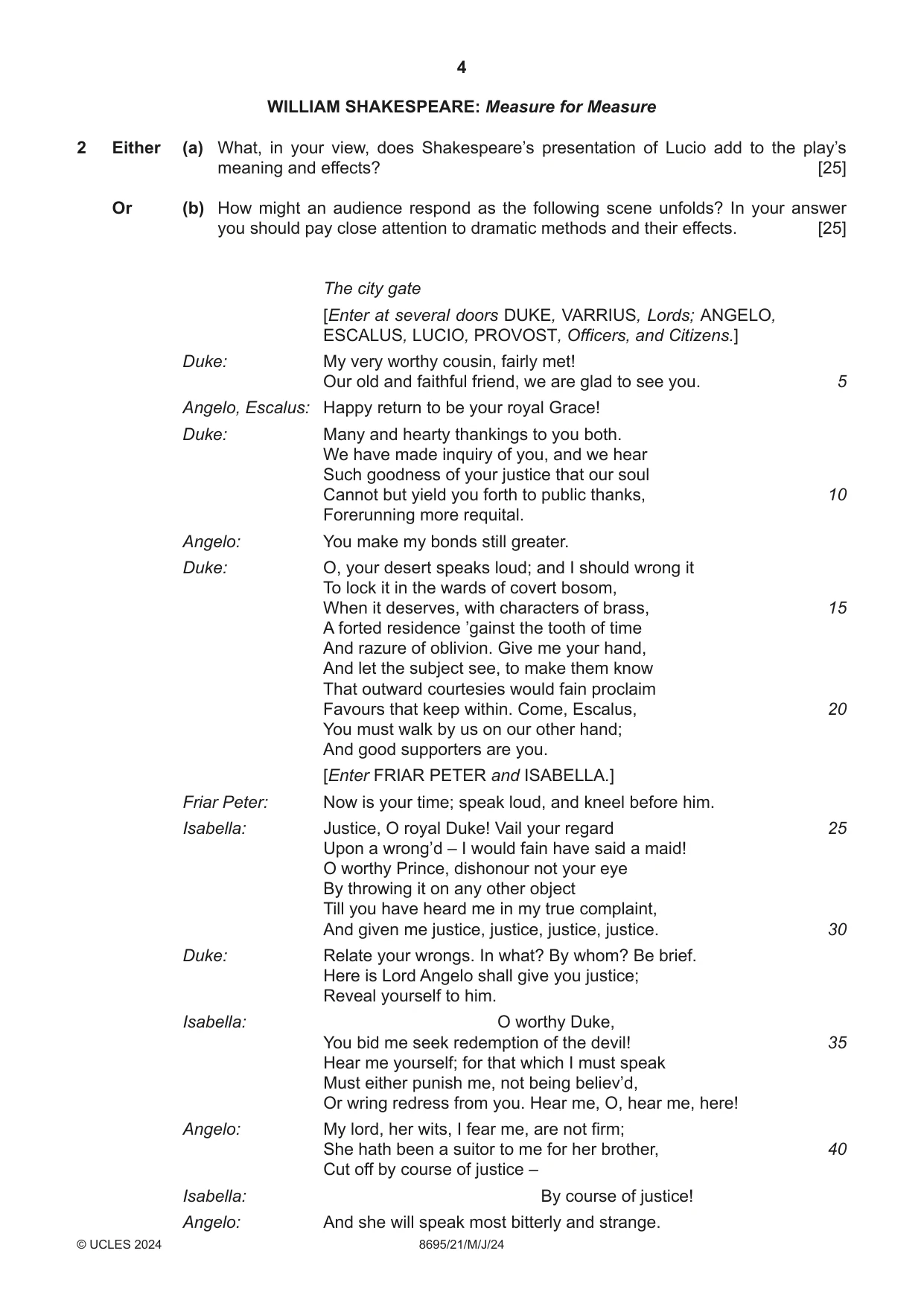
4 8695/21/M/J/24 © UCLES 2024 WILLIAM SHAKESPEARE: Measure for Measure 2 Either (a) What, in your view, does Shakespeare’s presentation of Lucio add to the play’s meaning and effects? [25] Or (b) How might an audience respond as the following scene unfolds? In your answer you should pay close attention to dramatic methods and their effects. [25] The city gate [Enter at several doors DUKE, VARRIUS, Lords; ANGELO, ESCALUS, LUCIO, PROVOST, Officers, and Citizens.] Duke: My very worthy cousin, fairly met! Our old and faithful friend, we are glad to see you. Angelo, Escalus: Happy return to be your royal Grace! Duke: Many and hearty thankings to you both. We have made inquiry of you, and we hear Such goodness of your justice that our soul Cannot but yield you forth to public thanks, Forerunning more requital. Angelo: You make my bonds still greater. Duke: O, your desert speaks loud; and I should wrong it To lock it in the wards of covert bosom, When it deserves, with characters of brass, A forted residence ’gainst the tooth of time And razure of oblivion. Give me your hand, And let the subject see, to make them know That outward courtesies would fain proclaim Favours that keep within. Come, Escalus, You must walk by us on our other hand; And good supporters are you. [Enter FRIAR PETER and ISABELLA.] Friar Peter: Now is your time; speak loud, and kneel before him. Isabella: Justice, O royal Duke! Vail your regard Upon a wrong’d – I would fain have said a maid! O worthy Prince, dishonour not your eye By throwing it on any other object Till you have heard me in my true complaint, And given me justice, justice, justice, justice. Duke: Relate your wrongs. In what? By whom? Be brief. Here is Lord Angelo shall give you justice; Reveal yourself to him. Isabella: O worthy Duke, You bid me seek redemption of the devil! Hear me yourself; for that which I must speak Must either punish me, not being believ’d, Or wring redress from you. Hear me, O, hear me, here! Angelo: My lord, her wits, I fear me, are not firm; She hath been a suitor to me for her brother, Cut off by course of justice – Isabella: By course of justice! Angelo: And she will speak most bitterly and strange. 5 10 15 20 25 30 35 40
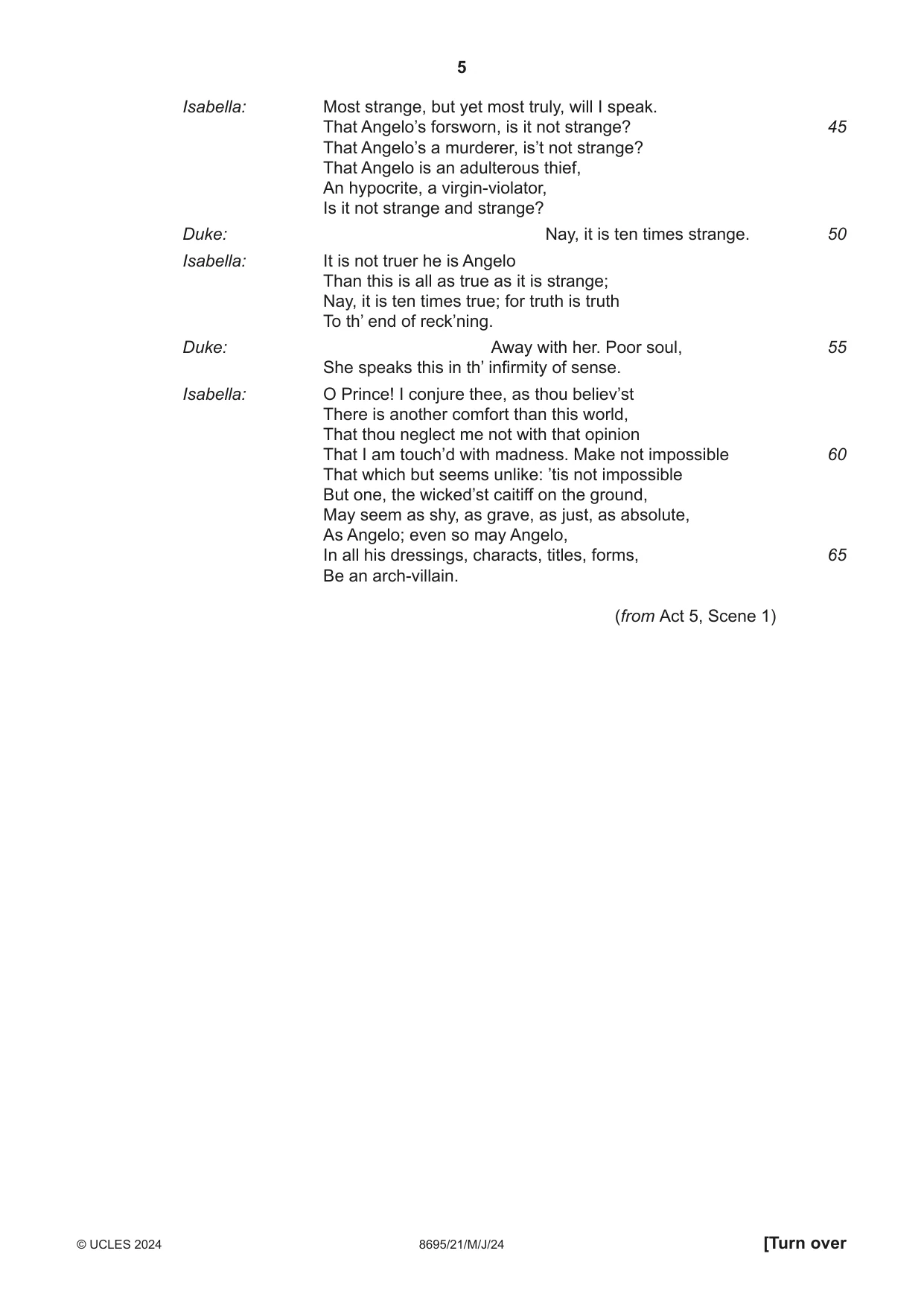
Question paper, page 5
5 8695/21/M/J/24 © UCLES 2024 [Turn over Isabella: Most strange, but yet most truly, will I speak. That Angelo’s forsworn, is it not strange? That Angelo’s a murderer, is’t not strange? That Angelo is an adulterous thief, An hypocrite, a virgin-violator, Is it not strange and strange? Duke: Nay, it is ten times strange. Isabella: It is not truer he is Angelo Than this is all as true as it is strange; Nay, it is ten times true; for truth is truth To th’ end of reck’ning. Duke: Away with her. Poor soul, She speaks this in th’ infirmity of sense. Isabella: O Prince! I conjure thee, as thou believ’st There is another comfort than this world, That thou neglect me not with that opinion That I am touch’d with madness. Make not impossible That which but seems unlike: ’tis not impossible But one, the wicked’st caitiff on the ground, May seem as shy, as grave, as just, as absolute, As Angelo; even so may Angelo, In all his dressings, characts, titles, forms, Be an arch-villain. (from Act 5, Scene 1) 45 50 55 60 65
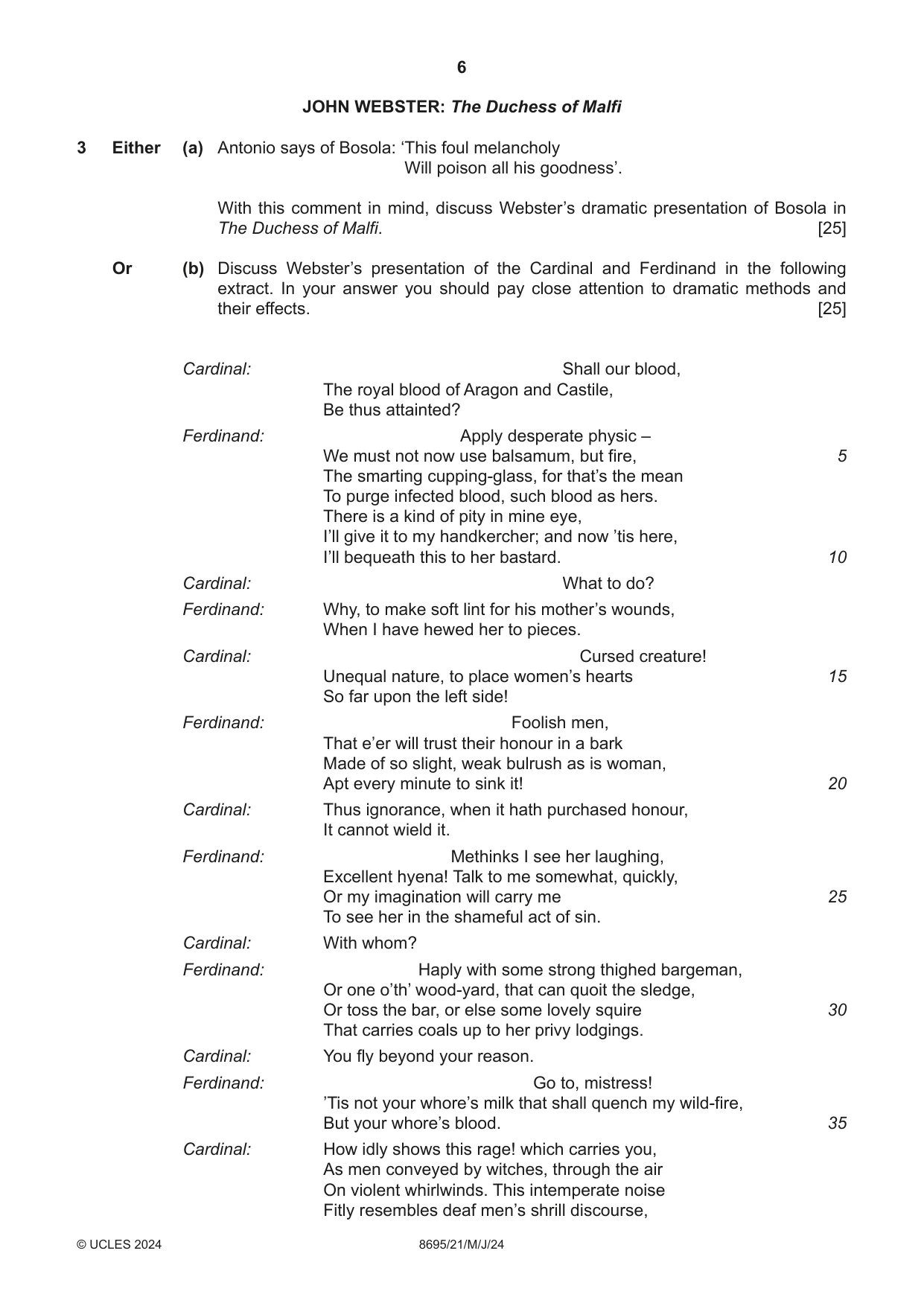
Question paper, page 6
6 8695/21/M/J/24 © UCLES 2024 JOHN WEBSTER: The Duchess of Malfi 3 Either (a) Antonio says of Bosola: ‘ This foul melancholy Will poison all his goodness’. With this comment in mind, discuss Webster’s dramatic presentation of Bosola in The Duchess of Malfi. [25] Or (b) Discuss Webster’s presentation of the Cardinal and Ferdinand in the following extract. In your answer you should pay close attention to dramatic methods and their effects. [25] Cardinal: Shall our blood, The royal blood of Aragon and Castile, Be thus attainted? Ferdinand: Apply desperate physic – We must not now use balsamum, but fire, The smarting cupping-glass, for that’s the mean To purge infected blood, such blood as hers. There is a kind of pity in mine eye, I’ll give it to my handkercher; and now ’tis here, I’ll bequeath this to her bastard. Cardinal: What to do? Ferdinand: Why, to make soft lint for his mother’s wounds, When I have hewed her to pieces. Cardinal: Cursed creature! Unequal nature, to place women’s hearts So far upon the left side! Ferdinand: Foolish men, That e’er will trust their honour in a bark Made of so slight, weak bulrush as is woman, Apt every minute to sink it! Cardinal: Thus ignorance, when it hath purchased honour, It cannot wield it. Ferdinand: Methinks I see her laughing, Excellent hyena! Talk to me somewhat, quickly, Or my imagination will carry me To see her in the shameful act of sin. Cardinal: With whom? Ferdinand: Haply with some strong thighed bargeman, Or one o’th’ wood-yard, that can quoit the sledge, Or toss the bar, or else some lovely squire That carries coals up to her privy lodgings. Cardinal: You fly beyond your reason. Ferdinand: Go to, mistress! ’Tis not your whore’s milk that shall quench my wild-fire, But your whore’s blood. Cardinal: How idly shows this rage! which carries you, As men conveyed by witches, through the air On violent whirlwinds. This intemperate noise Fitly resembles deaf men’s shrill discourse, 5 10 15 20 25 30 35
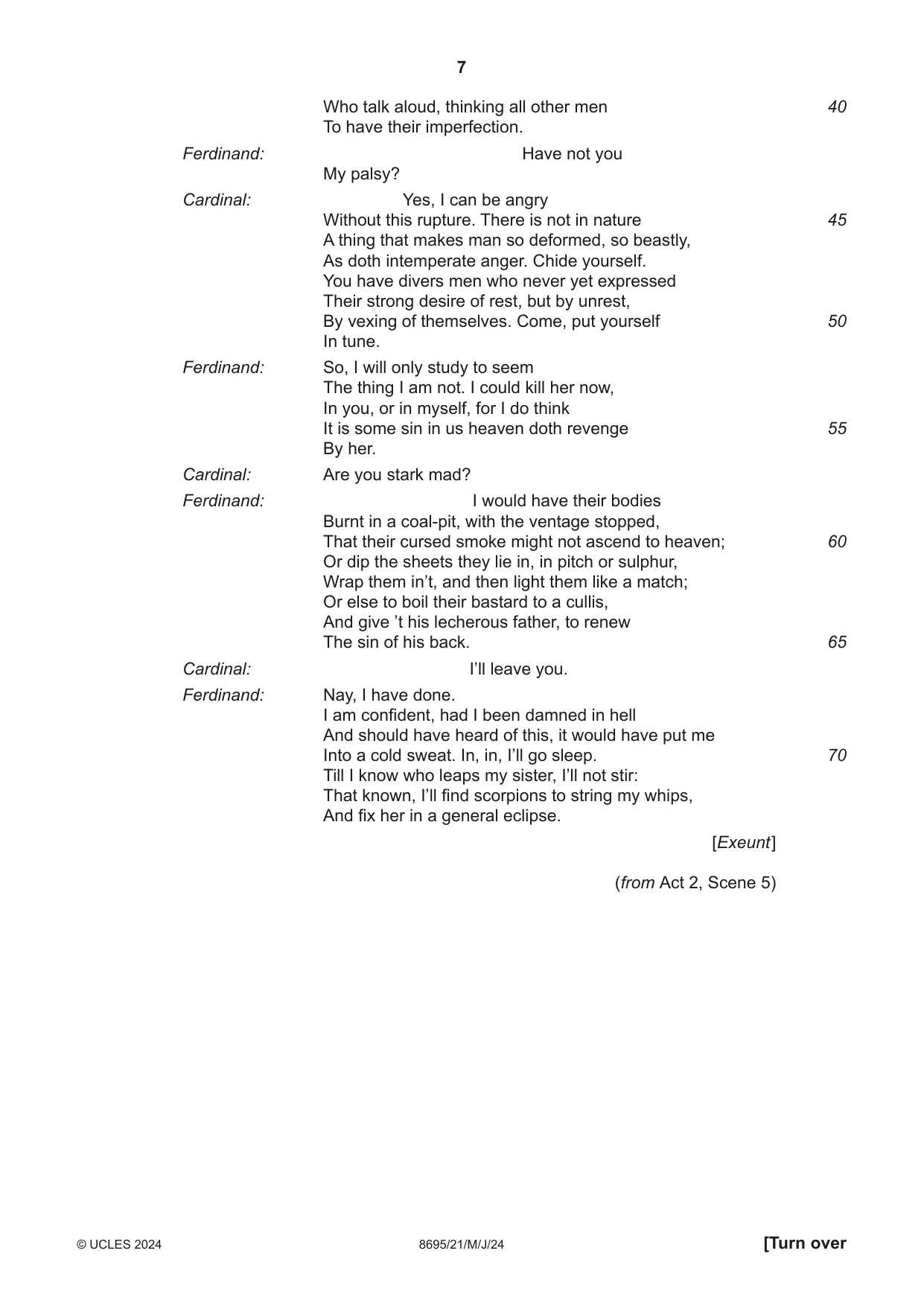
Question paper, page 7
7 8695/21/M/J/24 © UCLES 2024 [Turn over Who talk aloud, thinking all other men To have their imperfection. Ferdinand: Have not you My palsy? Cardinal: Yes, I can be angry Without this rupture. There is not in nature A thing that makes man so deformed, so beastly, As doth intemperate anger. Chide yourself. You have divers men who never yet expressed Their strong desire of rest, but by unrest, By vexing of themselves. Come, put yourself In tune. Ferdinand: So, I will only study to seem The thing I am not. I could kill her now, In you, or in myself, for I do think It is some sin in us heaven doth revenge By her. Cardinal: Are you stark mad? Ferdinand: I would have their bodies Burnt in a coal-pit, with the ventage stopped, That their cursed smoke might not ascend to heaven; Or dip the sheets they lie in, in pitch or sulphur, Wrap them in’t, and then light them like a match; Or else to boil their bastard to a cullis, And give ’t his lecherous father, to renew The sin of his back. Cardinal: I’ll leave you. Ferdinand: Nay, I have done. I am confident, had I been damned in hell And should have heard of this, it would have put me Into a cold sweat. In, in, I’ll go sleep. Till I know who leaps my sister, I’ll not stir: That known, I’ll find scorpions to string my whips, And fix her in a general eclipse. [Exeunt ] (from Act 2, Scene 5) 40 45 50 55 60 65 70
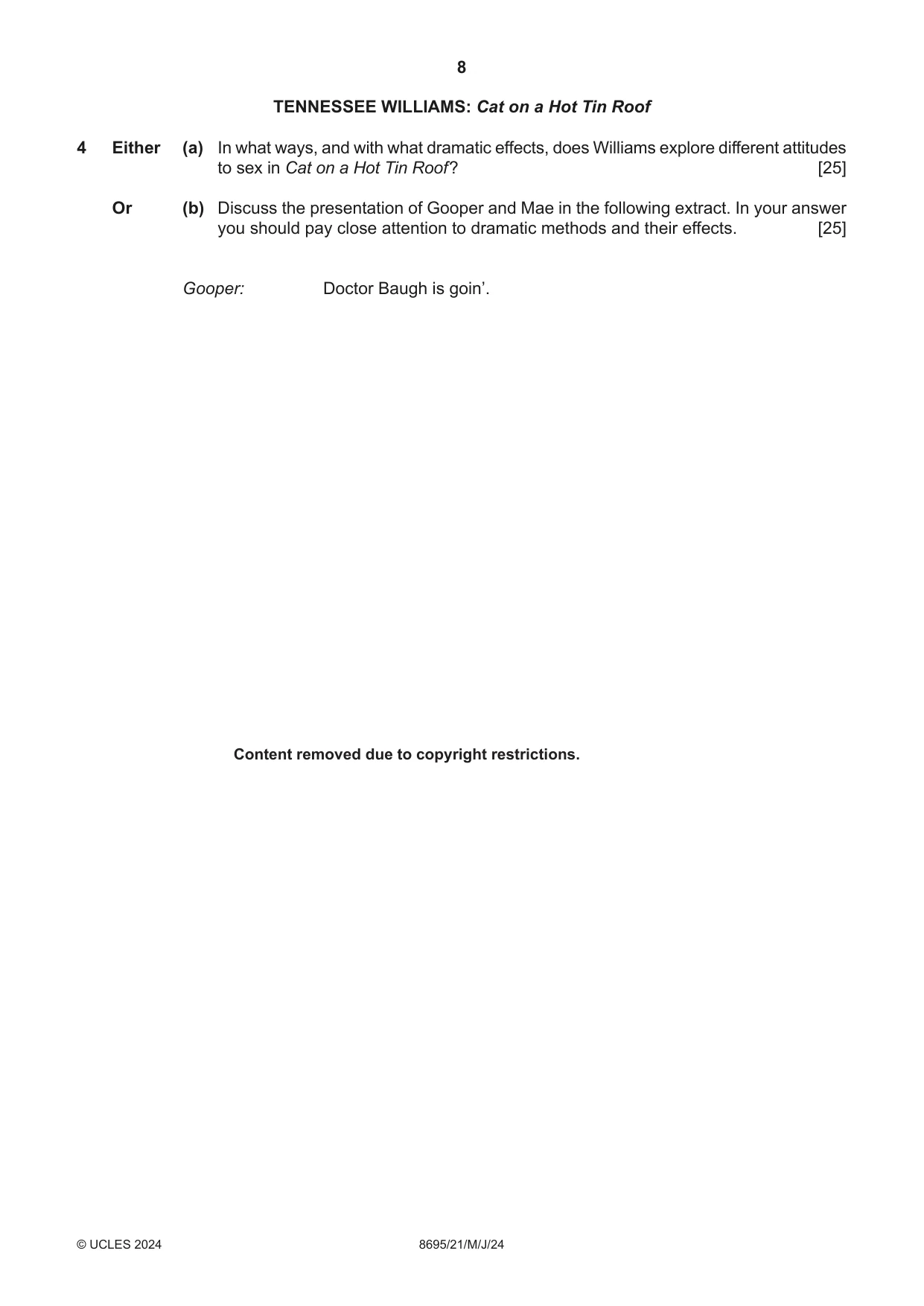
Question paper, page 8
8 8695/21/M/J/24 © UCLES 2024 TENNESSEE WILLIAMS: Cat on a Hot Tin Roof 4 Either (a) In what ways, and with what dramatic effects, does Williams explore different attitudes to sex in Cat on a Hot Tin Roof ? [25] Or (b) Discuss the presentation of Gooper and Mae in the following extract. In your answer you should pay close attention to dramatic methods and their effects. [25] Gooper: Doctor Baugh is goin’. Content removed due to copyright restrictions.
Question paper, page 9
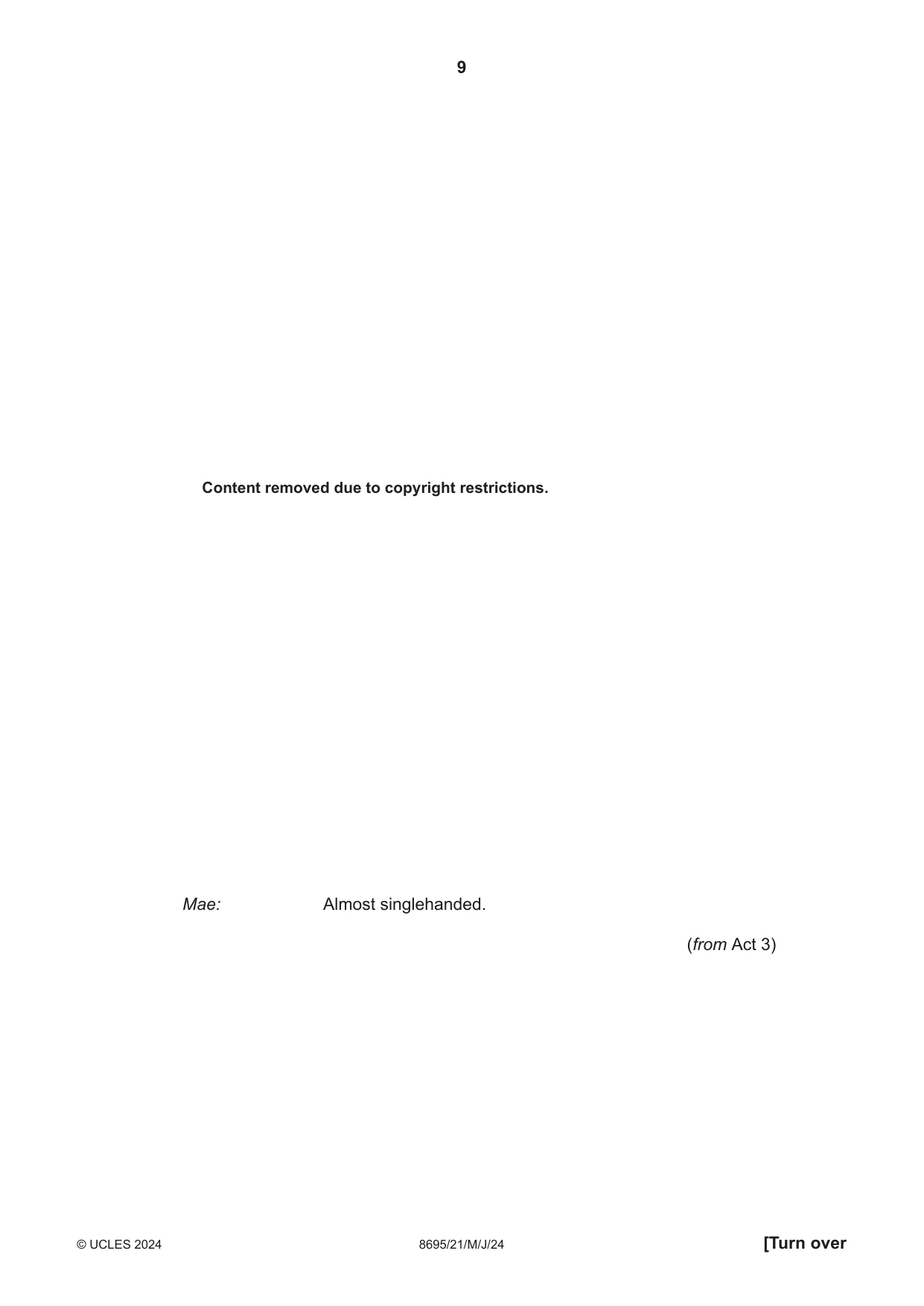
9 8695/21/M/J/24 © UCLES 2024 [Turn over Mae: Almost singlehanded. (from Act 3) Content removed due to copyright restrictions.
Question paper, page 10
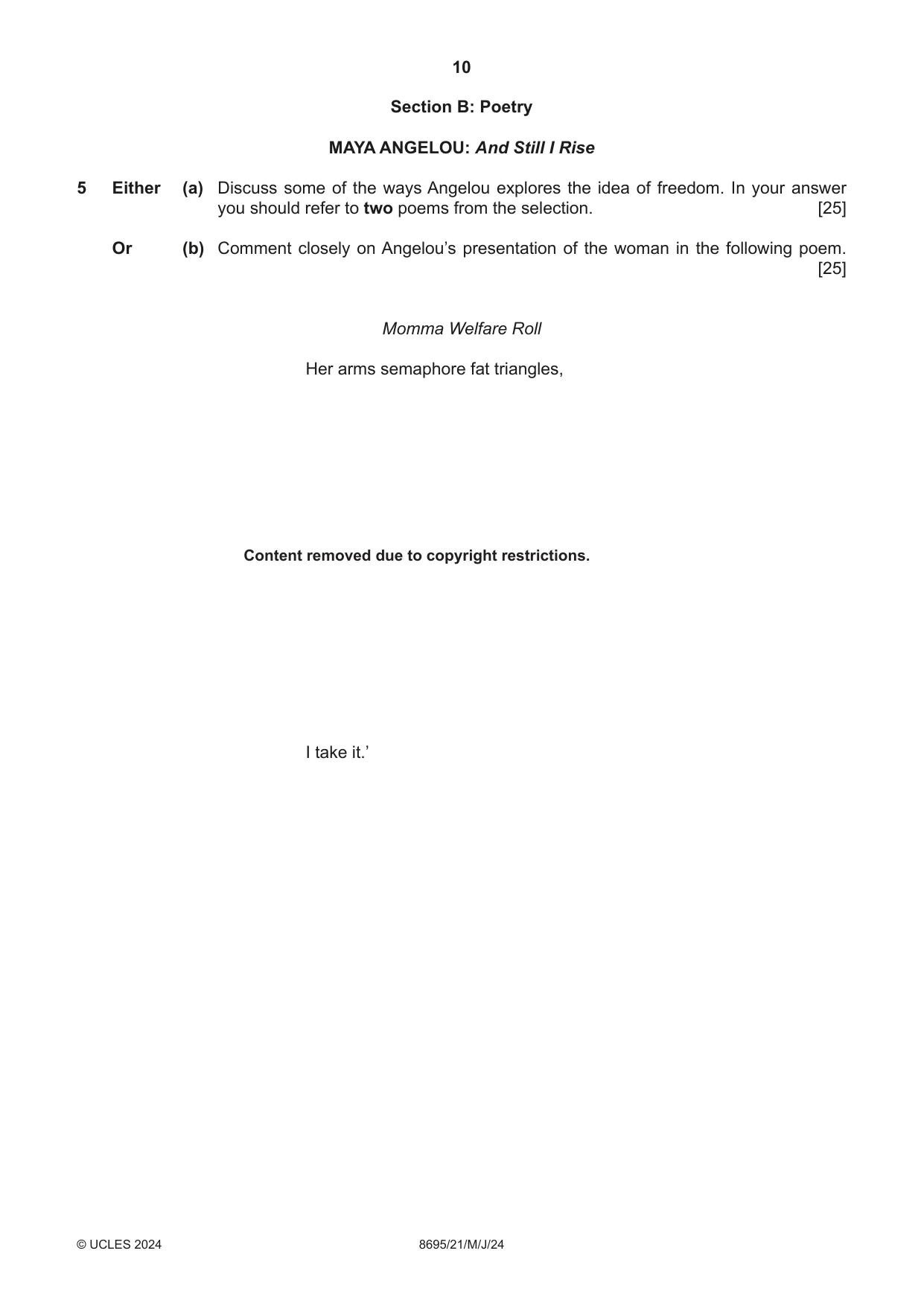
10 8695/21/M/J/24 © UCLES 2024 Section B: Poetry MAYA ANGELOU: And Still I Rise 5 Either (a) Discuss some of the ways Angelou explores the idea of freedom. In your answer you should refer to two poems from the selection. [25] Or (b) Comment closely on Angelou’s presentation of the woman in the following poem. [25] Momma Welfare Roll Her arms semaphore fat triangles, I take it.’ Content removed due to copyright restrictions.
Question paper, page 11
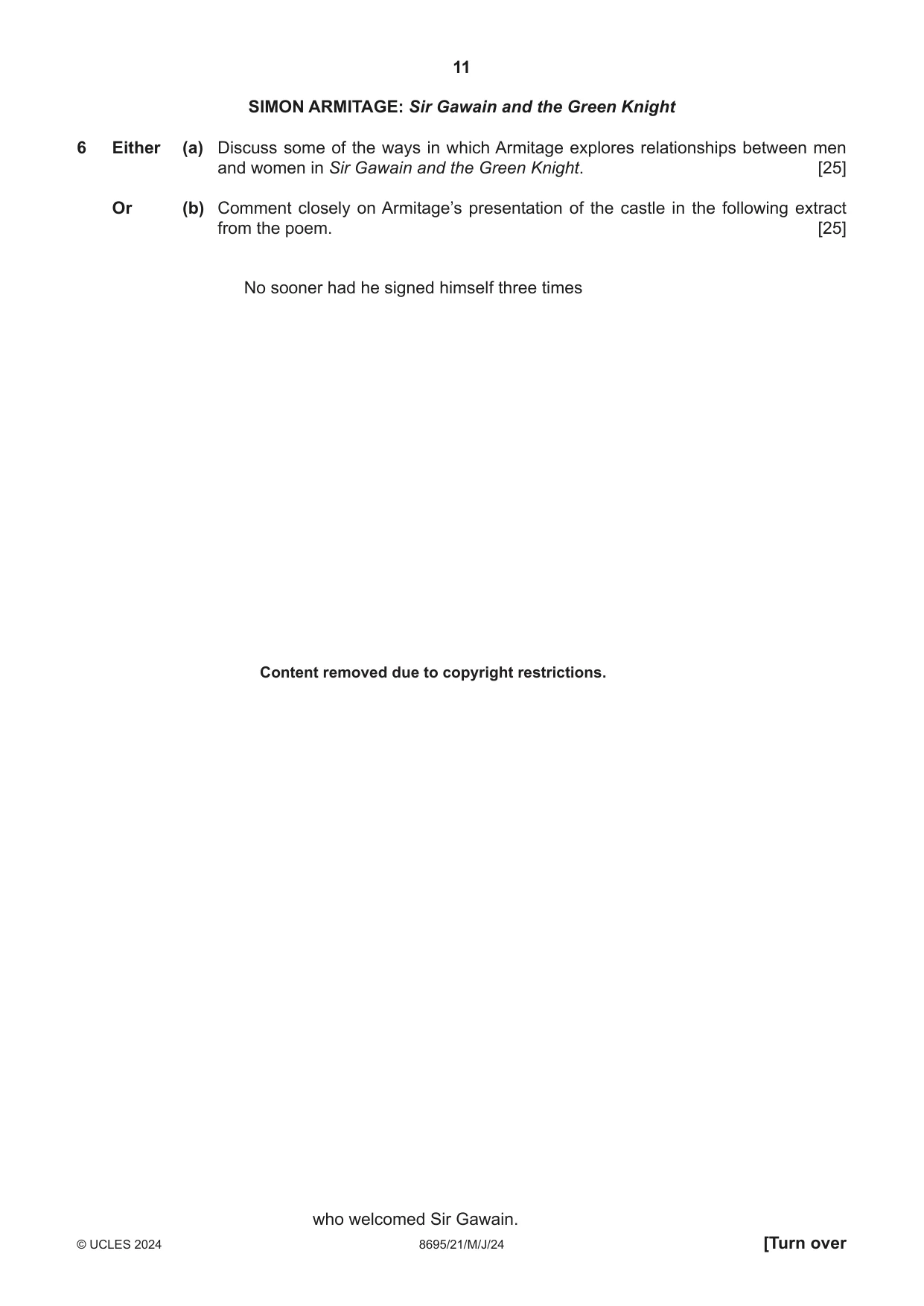
11 8695/21/M/J/24 © UCLES 2024 [Turn over SIMON ARMITAGE: Sir Gawain and the Green Knight 6 Either (a) Discuss some of the ways in which Armitage explores relationships between men and women in Sir Gawain and the Green Knight. [25] Or (b) Comment closely on Armitage’s presentation of the castle in the following extract from the poem. [25] No sooner had he signed himself three times who welcomed Sir Gawain. Content removed due to copyright restrictions.
Question paper, page 12
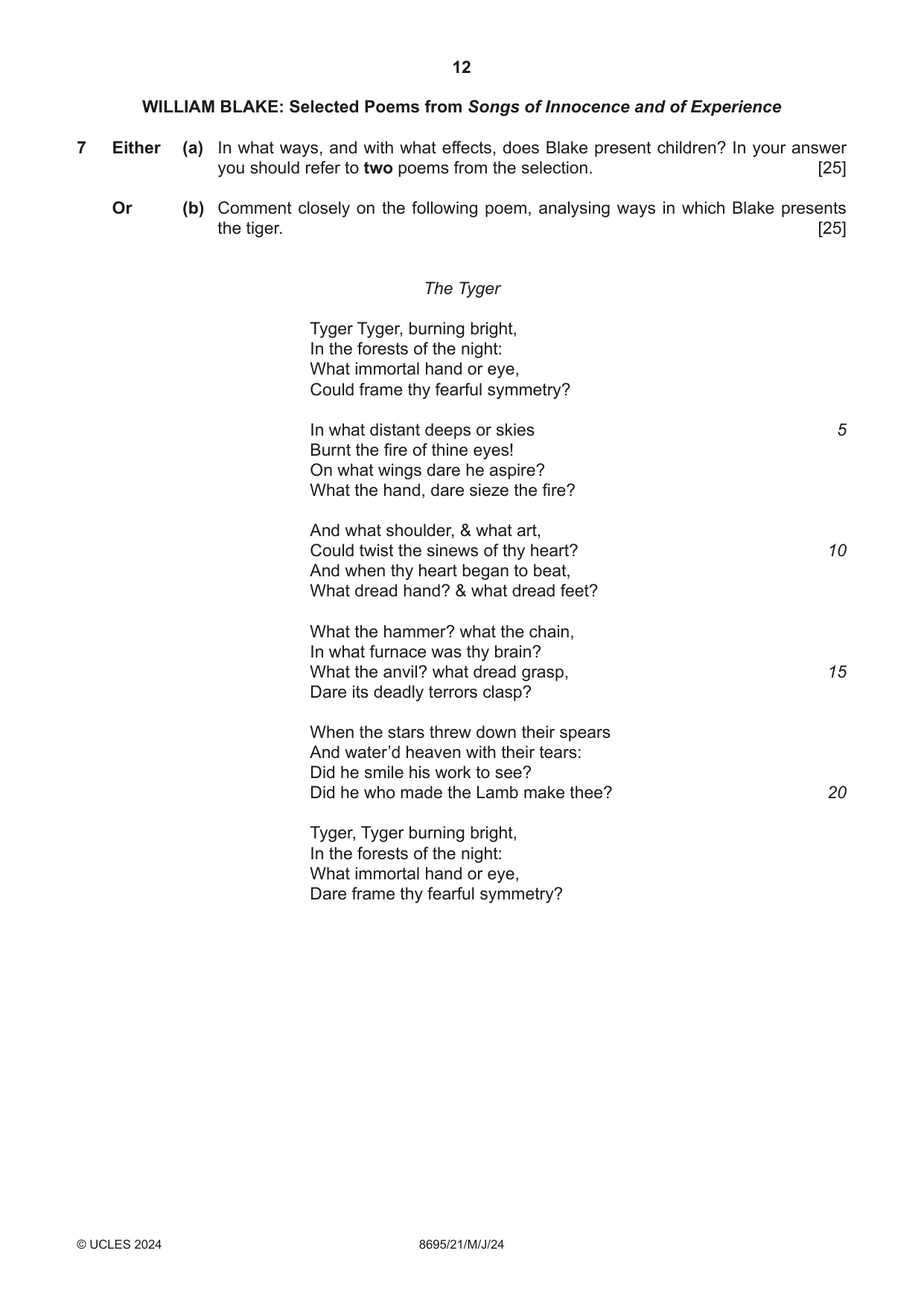
12 8695/21/M/J/24 © UCLES 2024 WILLIAM BLAKE: Selected Poems from Songs of Innocence and of Experience 7 Either (a) In what ways, and with what effects, does Blake present children? In your answer you should refer to two poems from the selection. [25] Or (b) Comment closely on the following poem, analysing ways in which Blake presents the tiger. [25] The Tyger Tyger Tyger, burning bright, In the forests of the night: What immortal hand or eye, Could frame thy fearful symmetry? In what distant deeps or skies Burnt the fire of thine eyes! On what wings dare he aspire? What the hand, dare sieze the fire? And what shoulder, & what art, Could twist the sinews of thy heart? And when thy heart began to beat, What dread hand? & what dread feet? What the hammer? what the chain, In what furnace was thy brain? What the anvil? what dread grasp, Dare its deadly terrors clasp? When the stars threw down their spears And water’d heaven with their tears: Did he smile his work to see? Did he who made the Lamb make thee? Tyger, Tyger burning bright, In the forests of the night: What immortal hand or eye, Dare frame thy fearful symmetry? 5 10 15 20
Question paper, page 13
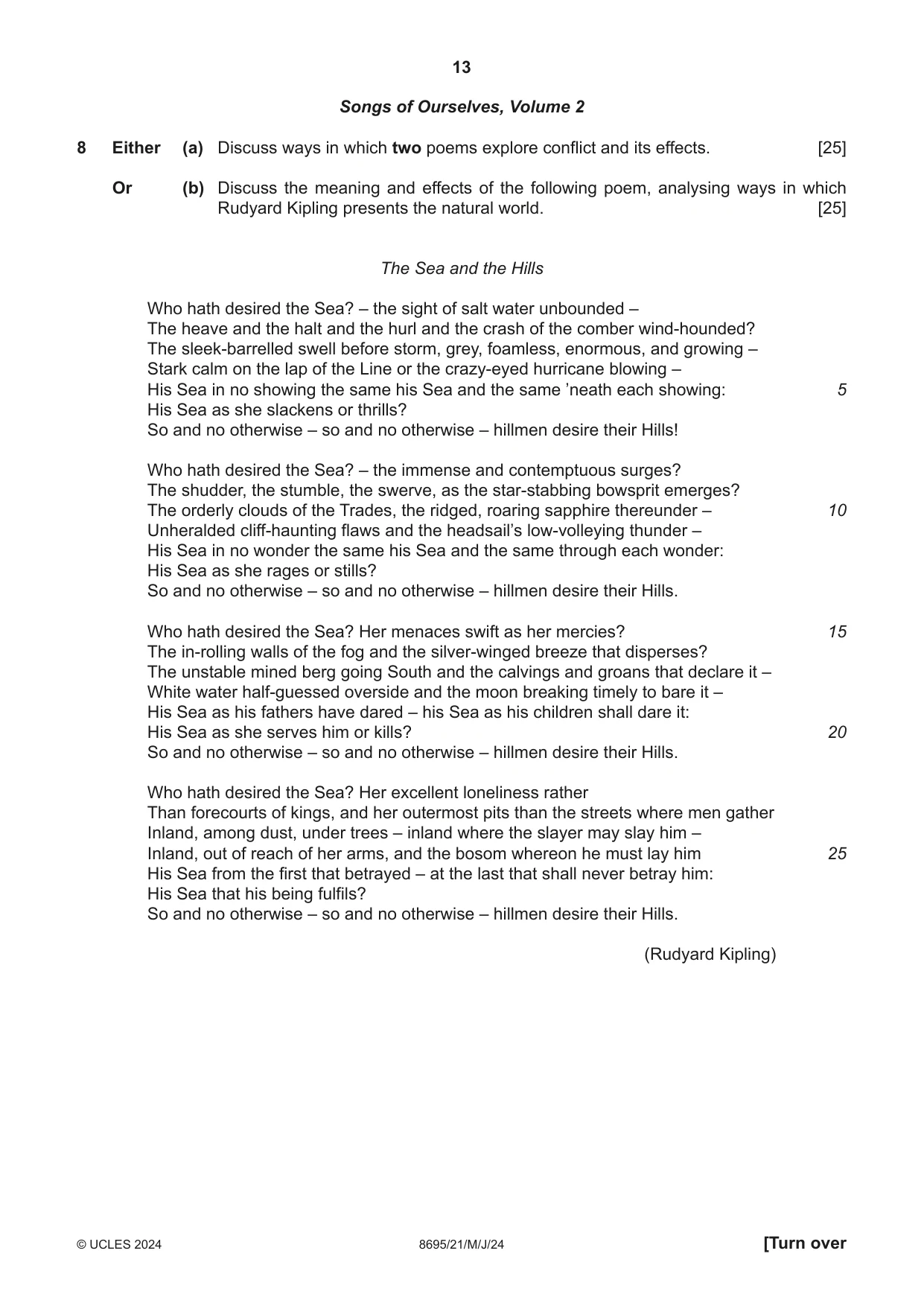
13 8695/21/M/J/24 © UCLES 2024 [Turn over Songs of Ourselves, Volume 2 8 Either (a) Discuss ways in which two poems explore conflict and its effects. [25] Or (b) Discuss the meaning and effects of the following poem, analysing ways in which Rudyard Kipling presents the natural world. [25] The Sea and the Hills Who hath desired the Sea? – the sight of salt water unbounded – The heave and the halt and the hurl and the crash of the comber wind-hounded? The sleek-barrelled swell before storm, grey, foamless, enormous, and growing – Stark calm on the lap of the Line or the crazy-eyed hurricane blowing – His Sea in no showing the same his Sea and the same ’neath each showing: His Sea as she slackens or thrills? So and no otherwise – so and no otherwise – hillmen desire their Hills! Who hath desired the Sea? – the immense and contemptuous surges? The shudder, the stumble, the swerve, as the star-stabbing bowsprit emerges? The orderly clouds of the Trades, the ridged, roaring sapphire thereunder – Unheralded cliff-haunting flaws and the headsail’s low-volleying thunder – His Sea in no wonder the same his Sea and the same through each wonder: His Sea as she rages or stills? So and no otherwise – so and no otherwise – hillmen desire their Hills. Who hath desired the Sea? Her menaces swift as her mercies? The in-rolling walls of the fog and the silver-winged breeze that disperses? The unstable mined berg going South and the calvings and groans that declare it – White water half-guessed overside and the moon breaking timely to bare it – His Sea as his fathers have dared – his Sea as his children shall dare it: His Sea as she serves him or kills? So and no otherwise – so and no otherwise – hillmen desire their Hills. Who hath desired the Sea? Her excellent loneliness rather Than forecourts of kings, and her outermost pits than the streets where men gather Inland, among dust, under trees – inland where the slayer may slay him – Inland, out of reach of her arms, and the bosom whereon he must lay him His Sea from the first that betrayed – at the last that shall never betray him: His Sea that his being fulfils? So and no otherwise – so and no otherwise – hillmen desire their Hills. (Rudyard Kipling) 5 10 15 20 25
Question paper, page 14
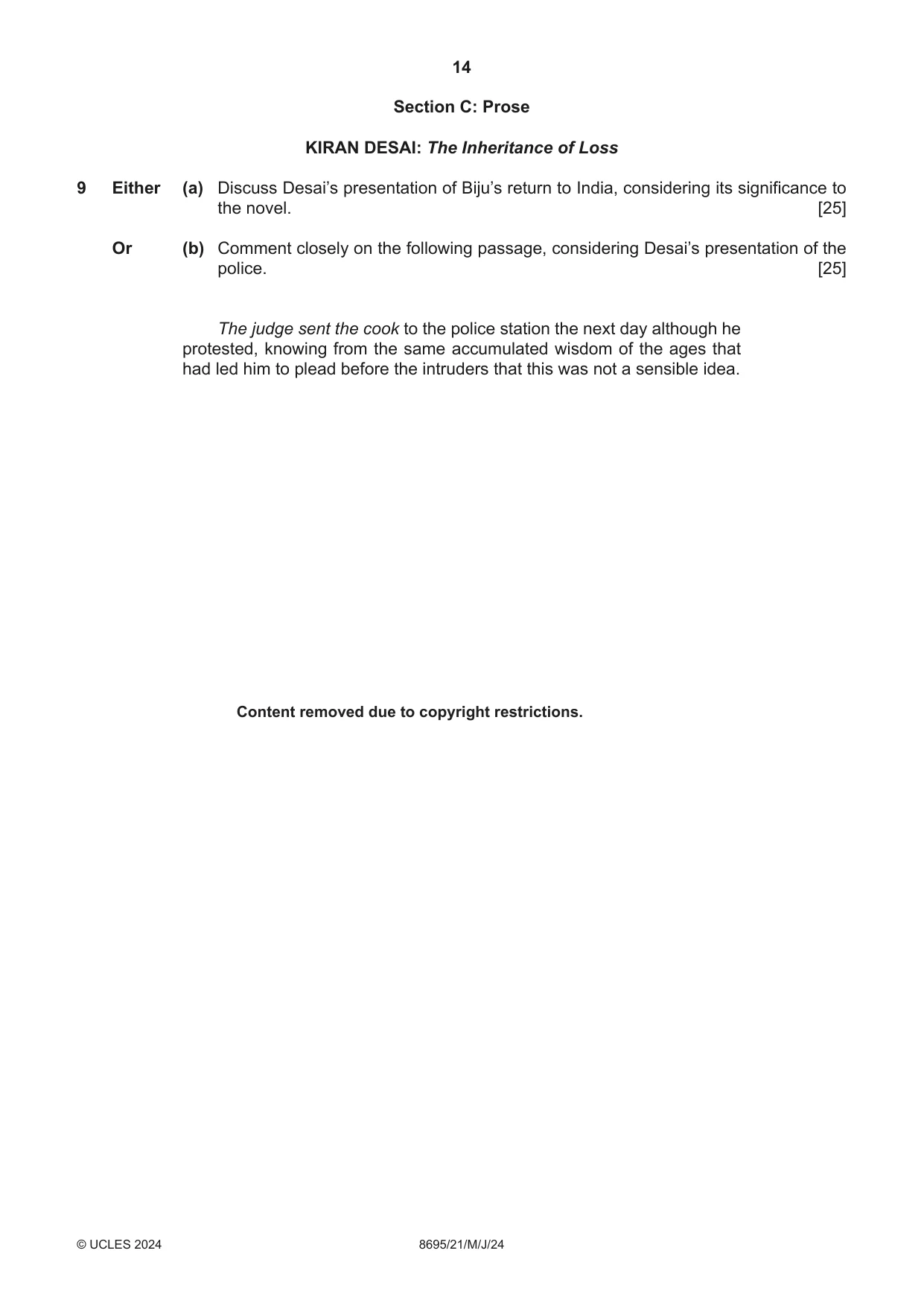
14 8695/21/M/J/24 © UCLES 2024 Section C: Prose KIRAN DESAI: The Inheritance of Loss 9 Either (a) Discuss Desai’s presentation of Biju’s return to India, considering its significance to the novel. [25] Or (b) Comment closely on the following passage, considering Desai’s presentation of the police. [25] The judge sent the cook to the police station the next day although he protested, knowing from the same accumulated wisdom of the ages that had led him to plead before the intruders that this was not a sensible idea. Content removed due to copyright restrictions.
Question paper, page 15
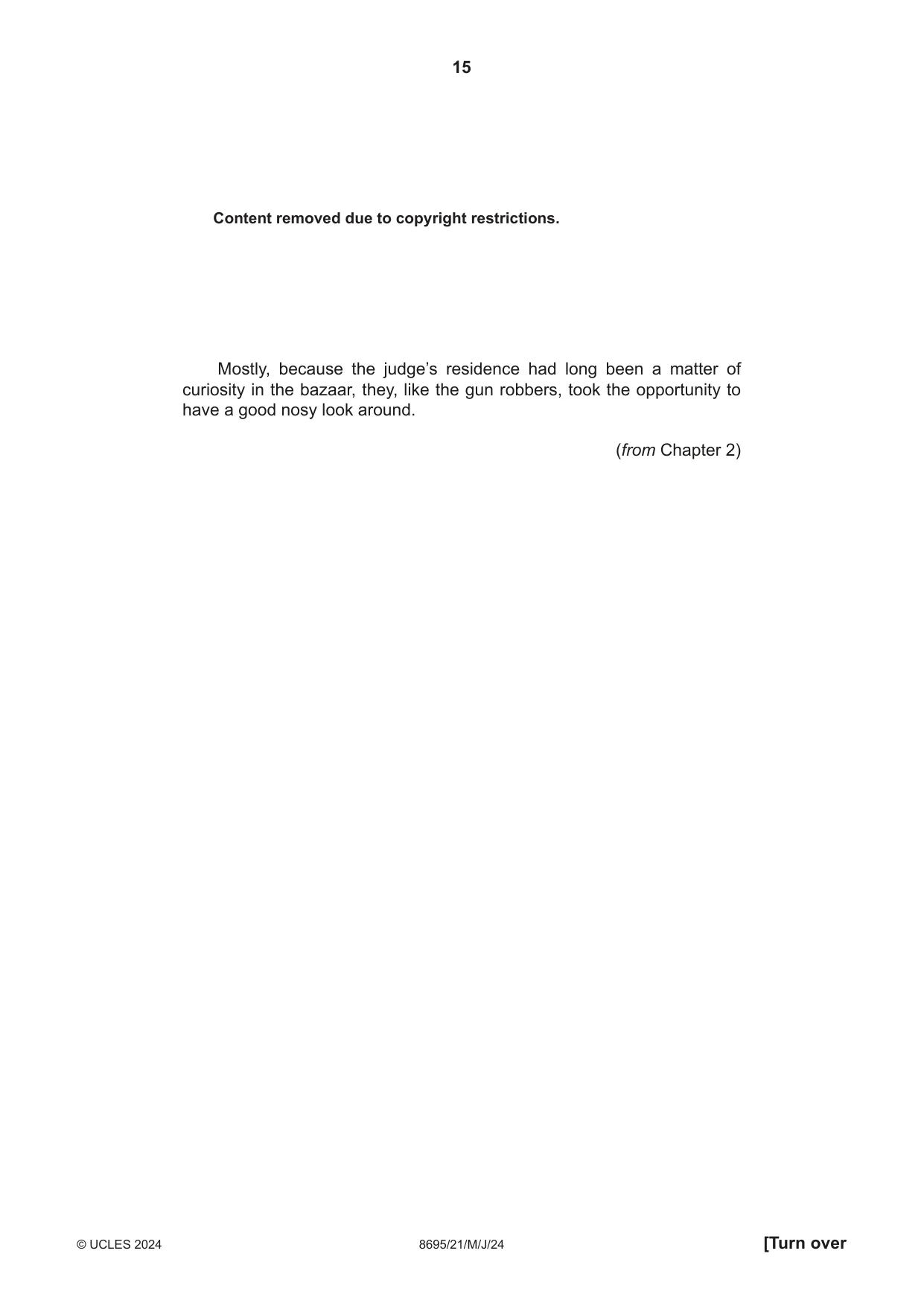
15 8695/21/M/J/24 © UCLES 2024 [Turn over Mostly, because the judge’s residence had long been a matter of curiosity in the bazaar, they, like the gun robbers, took the opportunity to have a good nosy look around. (from Chapter 2) Content removed due to copyright restrictions.
Question paper, page 16
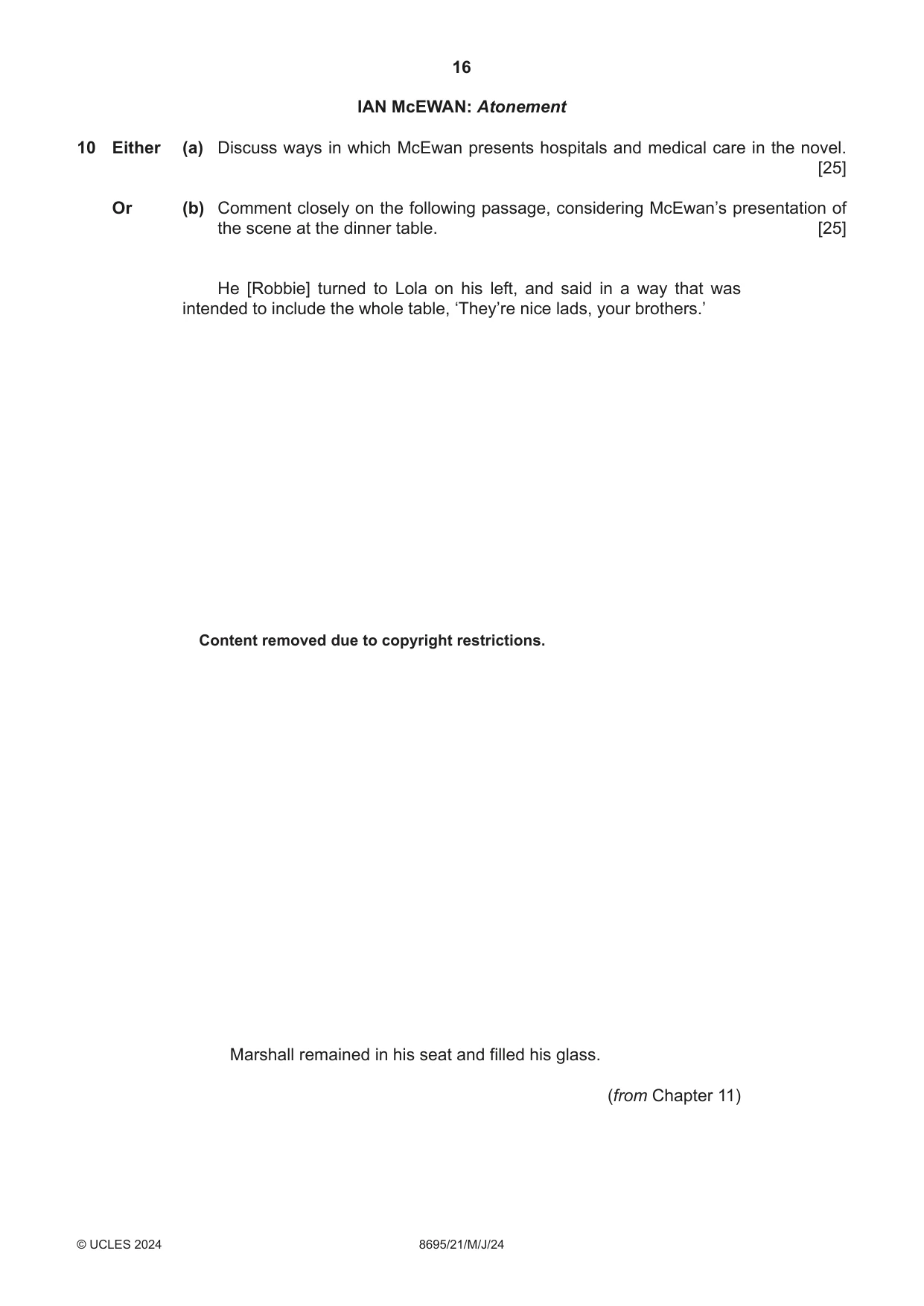
16 8695/21/M/J/24 © UCLES 2024 IAN McEWAN: Atonement 10 Either (a) Discuss ways in which McEwan presents hospitals and medical care in the novel. [25] Or (b) Comment closely on the following passage, considering McEwan’s presentation of the scene at the dinner table. [25] He [Robbie] turned to Lola on his left, and said in a way that was intended to include the whole table, ‘They’re nice lads, your brothers.’ Marshall remained in his seat and filled his glass. (from Chapter 11) Content removed due to copyright restrictions.
Question paper, page 17
17 8695/21/M/J/24 © UCLES 2024 [Turn over TURN OVER FOR QUESTION 11.
Question paper, page 18
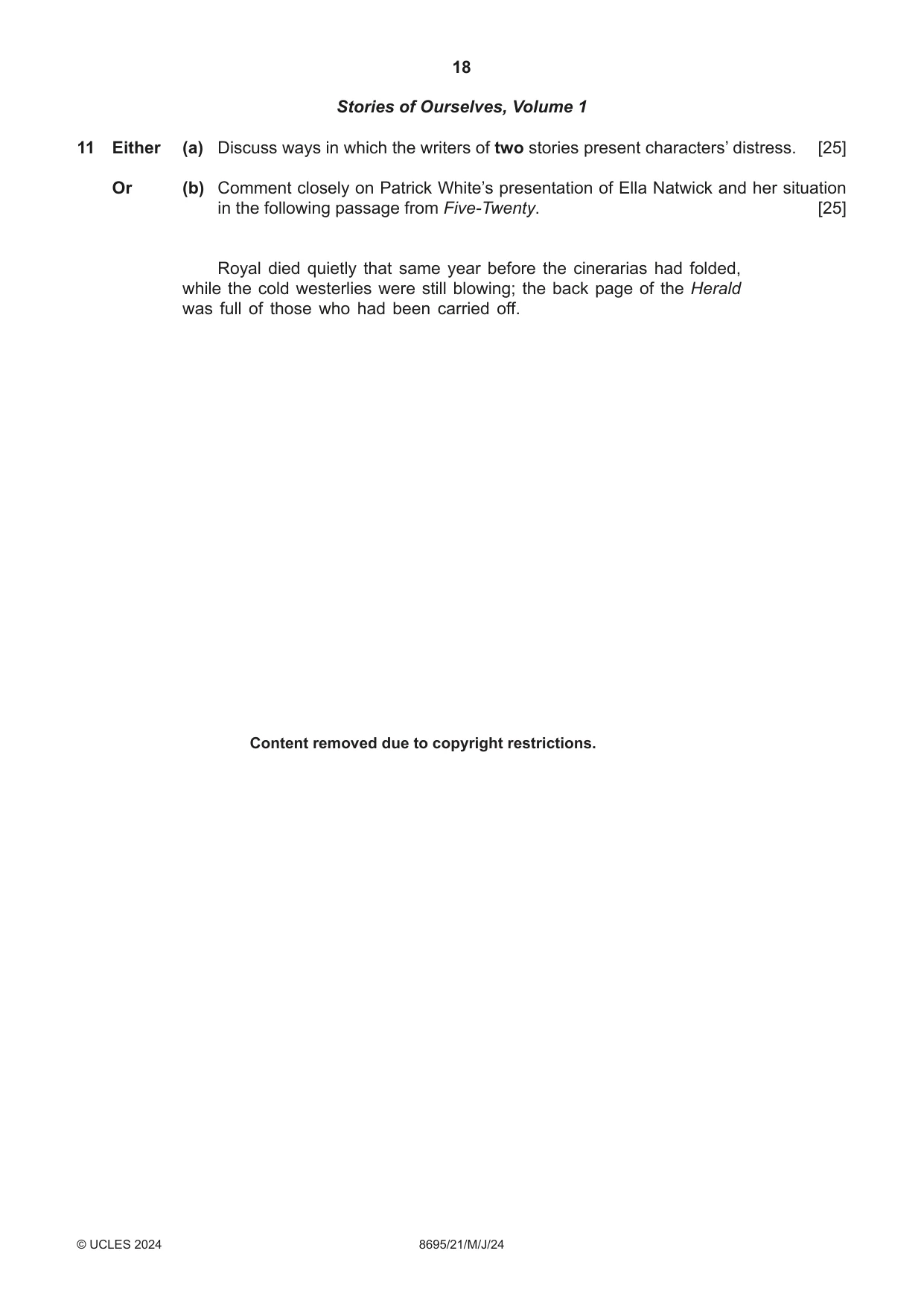
18 8695/21/M/J/24 © UCLES 2024 Stories of Ourselves, Volume 1 11 Either (a) Discuss ways in which the writers of two stories present characters’ distress. [25] Or (b) Comment closely on Patrick White’s presentation of Ella Natwick and her situation in the following passage from Five-Twenty. [25] Royal died quietly that same year before the cinerarias had folded, while the cold westerlies were still blowing; the back page of the Herald was full of those who had been carried off. Content removed due to copyright restrictions.
Question paper, page 19
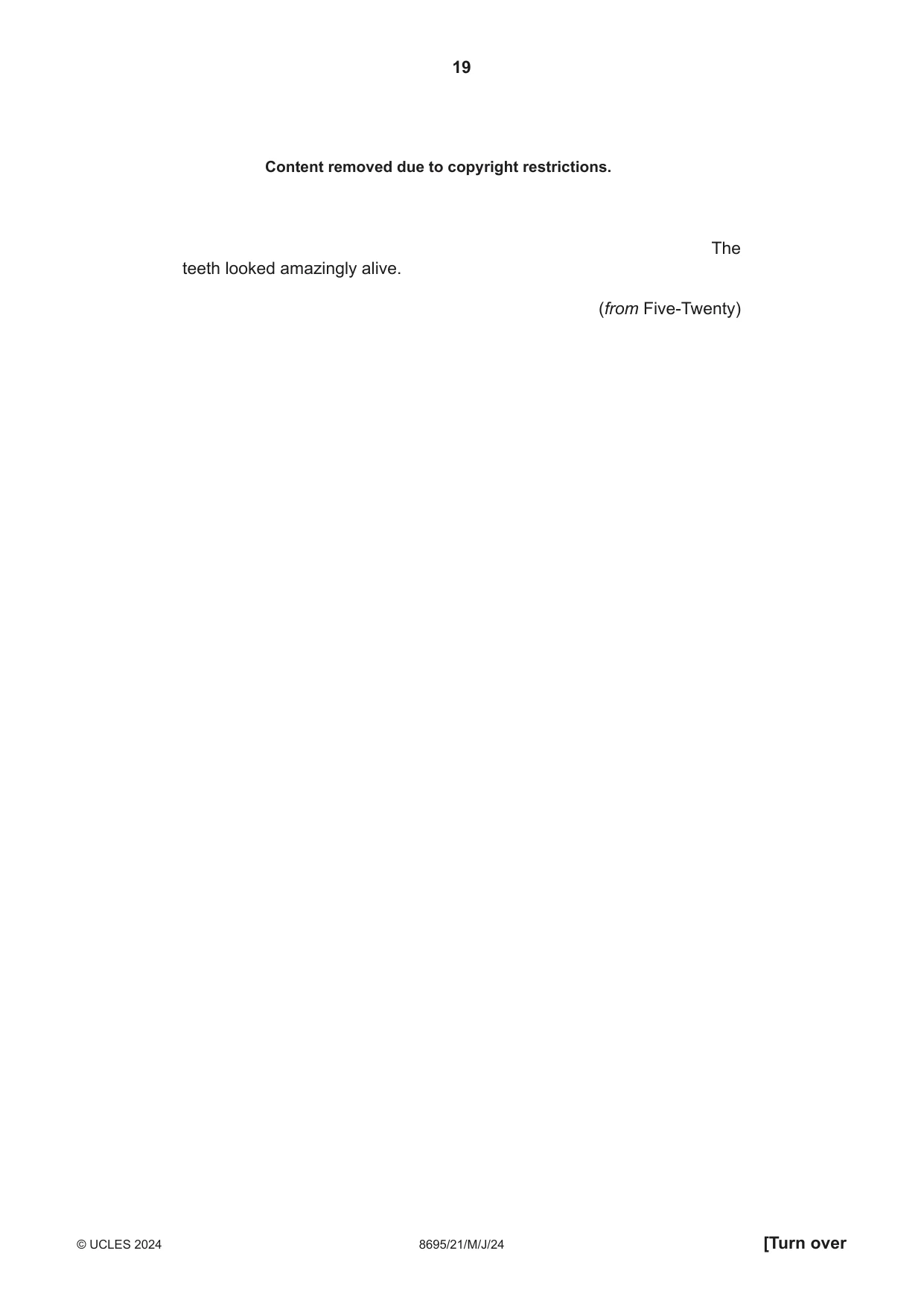
19 8695/21/M/J/24 © UCLES 2024 [Turn over The teeth looked amazingly alive. (from Five-Twenty) Content removed due to copyright restrictions.
Question paper, page 20
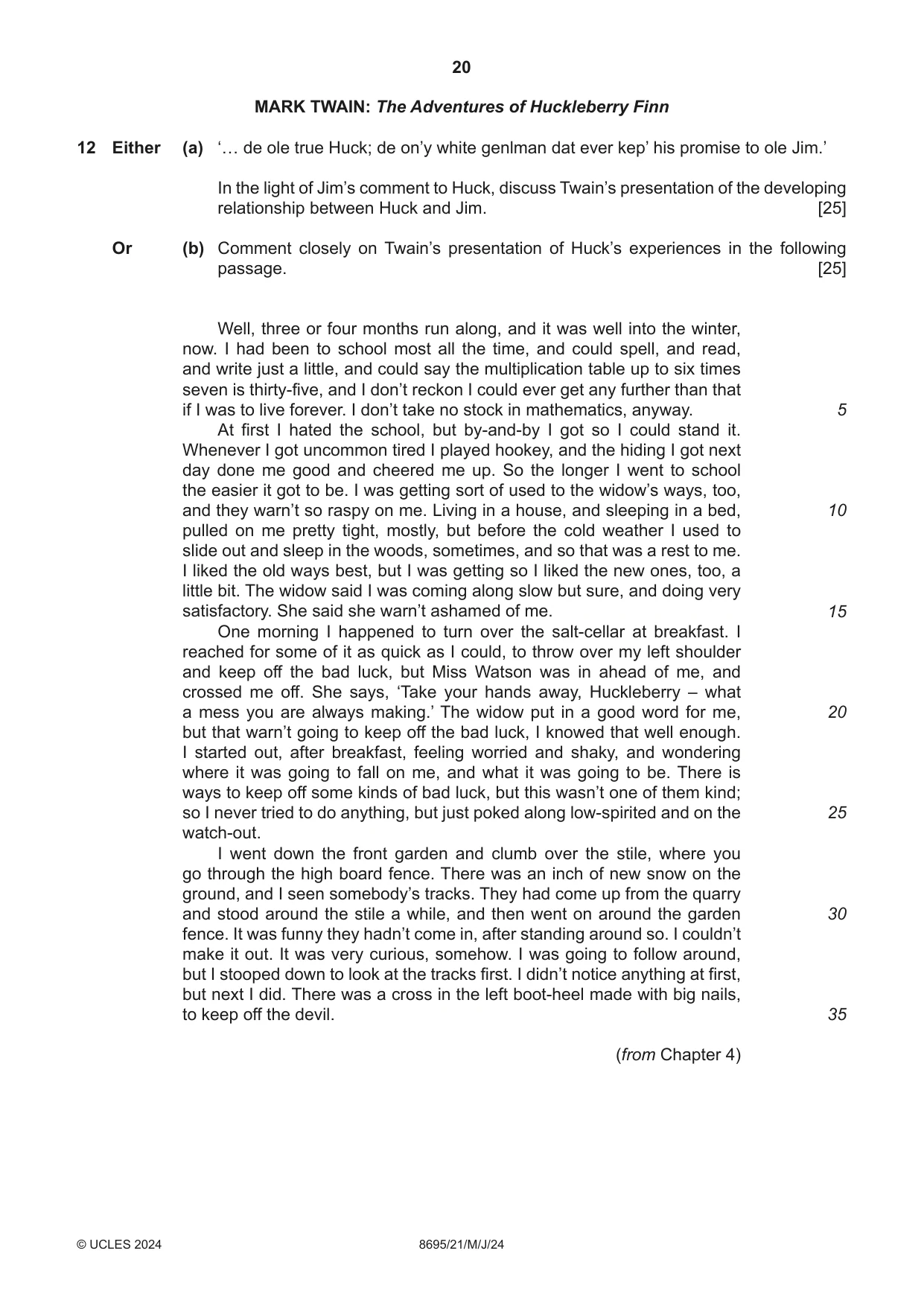
20 8695/21/M/J/24 © UCLES 2024 MARK TWAIN: The Adventures of Huckleberry Finn 12 Either (a) ‘… de ole true Huck; de on’y white genlman dat ever kep’ his promise to ole Jim.’ In the light of Jim’s comment to Huck, discuss Twain’s presentation of the developing relationship between Huck and Jim. [25] Or (b) Comment closely on Twain’s presentation of Huck’s experiences in the following passage. [25] Well, three or four months run along, and it was well into the winter, now. I had been to school most all the time, and could spell, and read, and write just a little, and could say the multiplication table up to six times seven is thirty-five, and I don’t reckon I could ever get any further than that if I was to live forever. I don’t take no stock in mathematics, anyway. At first I hated the school, but by-and-by I got so I could stand it. Whenever I got uncommon tired I played hookey, and the hiding I got next day done me good and cheered me up. So the longer I went to school the easier it got to be. I was getting sort of used to the widow’s ways, too, and they warn’t so raspy on me. Living in a house, and sleeping in a bed, pulled on me pretty tight, mostly, but before the cold weather I used to slide out and sleep in the woods, sometimes, and so that was a rest to me. I liked the old ways best, but I was getting so I liked the new ones, too, a little bit. The widow said I was coming along slow but sure, and doing very satisfactory. She said she warn’t ashamed of me. One morning I happened to turn over the salt-cellar at breakfast. I reached for some of it as quick as I could, to throw over my left shoulder and keep off the bad luck, but Miss Watson was in ahead of me, and crossed me off. She says, ‘Take your hands away, Huckleberry – what a mess you are always making.’ The widow put in a good word for me, but that warn’t going to keep off the bad luck, I knowed that well enough. I started out, after breakfast, feeling worried and shaky, and wondering where it was going to fall on me, and what it was going to be. There is ways to keep off some kinds of bad luck, but this wasn’t one of them kind; so I never tried to do anything, but just poked along low-spirited and on the watch-out. I went down the front garden and clumb over the stile, where you go through the high board fence. There was an inch of new snow on the ground, and I seen somebody’s tracks. They had come up from the quarry and stood around the stile a while, and then went on around the garden fence. It was funny they hadn’t come in, after standing around so. I couldn’t make it out. It was very curious, somehow. I was going to follow around, but I stooped down to look at the tracks first. I didn’t notice anything at first, but next I did. There was a cross in the left boot-heel made with big nails, to keep off the devil. (from Chapter 4) 5 10 15 20 25 30 35
Question paper, page 21
21 8695/21/M/J/24 © UCLES 2024 BLANK PAGE
Question paper, page 22
22 8695/21/M/J/24 © UCLES 2024 BLANK PAGE
Question paper, page 23
23 8695/21/M/J/24 © UCLES 2024 BLANK PAGE
Question paper, page 24
24 8695/21/M/J/24 © UCLES 2024 Permission to reproduce items where third-party owned material protected by copyright is included has been sought and cleared where possible. Every reasonable effort has been made by the publisher (UCLES) to trace copyright holders, but if any items requiring clearance have unwittingly been included, the publisher will be pleased to make amends at the earliest possible opportunity. To avoid the issue of disclosure of answer-related information to candidates, all copyright acknowledgements are reproduced online in the Cambridge Assessment International Education Copyright Acknowledgements Booklet. This is produced for each series of examinations and is freely available to download at www.cambridgeinternational.org after the live examination series. Cambridge Assessment International Education is part of Cambridge Assessment. Cambridge Assessment is the brand name of the University of Cambridge Local Examinations Syndicate (UCLES), which is a department of the University of Cambridge. BLANK PAGE
Mark scheme, page 1
This document consists of 13 printed pages. © Cambridge University Press & Assessment 2024 [Turn over Cambridge International AS Level LANGUAGE AND LITERATURE IN ENGLISH 8695/21 Paper 2 Drama, Poetry and Prose May/June 2024 MARK SCHEME Maximum Mark: 50 Published This mark scheme is published as an aid to teachers and candidates, to indicate the requirements of the examination. It shows the basis on which Examiners were instructed to award marks. It does not indicate the details of the discussions that took place at an Examiners’ meeting before marking began, which would have considered the acceptability of alternative answers. Mark schemes should be read in conjunction with the question paper and the Principal Examiner Report for Teachers. Cambridge International will not enter into discussions about these mark schemes. Cambridge International is publishing the mark schemes for the May/June 2024 series for most Cambridge IGCSE, Cambridge International A and AS Level and Cambridge Pre-U components, and some Cambridge O Level components.
Mark scheme, page 2
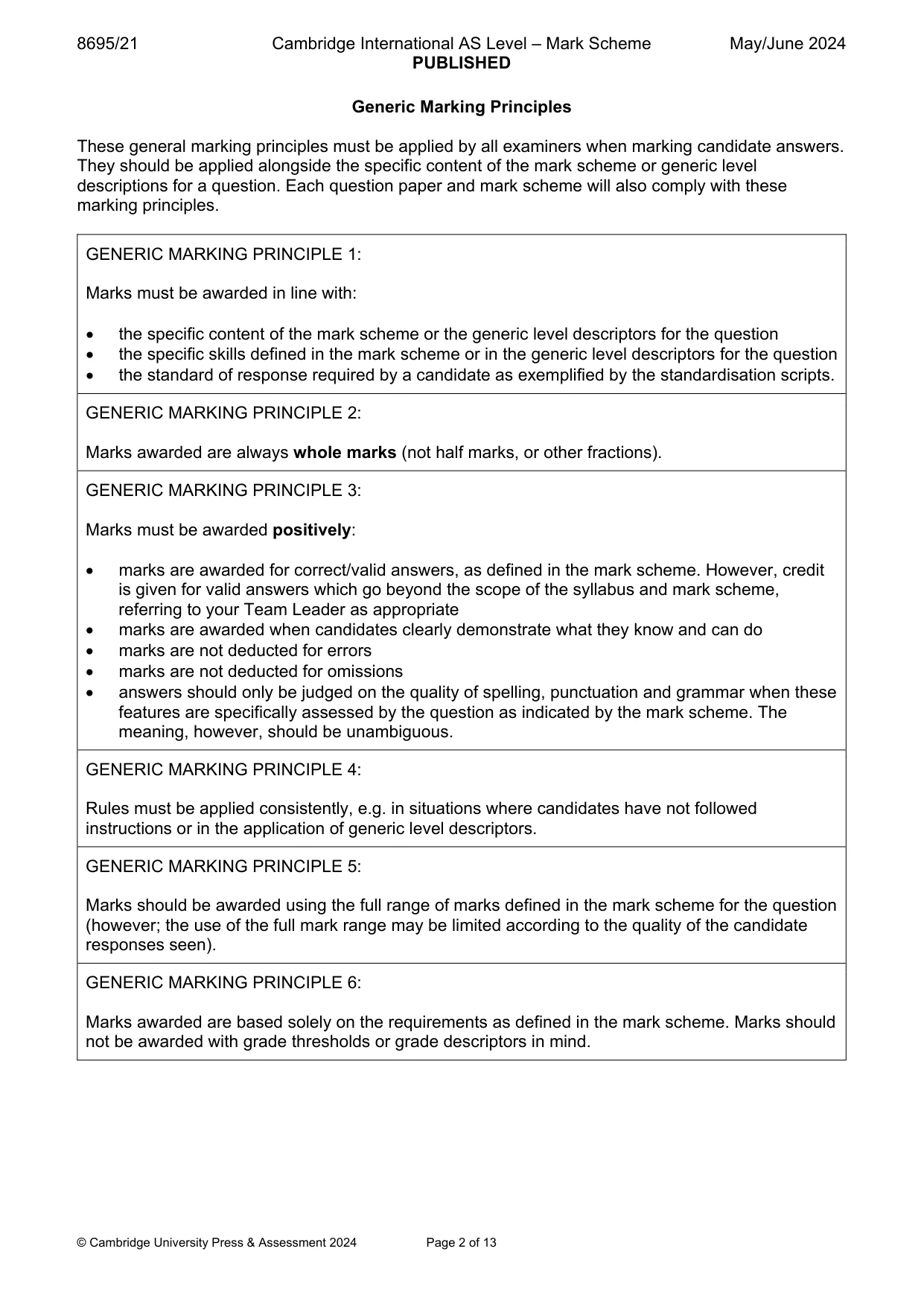
8695/21 Cambridge International AS Level – Mark Scheme PUBLISHED May/June 2024 © Cambridge University Press & Assessment 2024 Page 2 of 13 Generic Marking Principles These general marking principles must be applied by all examiners when marking candidate answers. They should be applied alongside the specific content of the mark scheme or generic level descriptions for a question. Each question paper and mark scheme will also comply with these marking principles. GENERIC MARKING PRINCIPLE 1: Marks must be awarded in line with: the specific content of the mark scheme or the generic level descriptors for the question the specific skills defined in the mark scheme or in the generic level descriptors for the question the standard of response required by a candidate as exemplified by the standardisation scripts. GENERIC MARKING PRINCIPLE 2: Marks awarded are always whole marks (not half marks, or other fractions). GENERIC MARKING PRINCIPLE 3: Marks must be awarded positively: marks are awarded for correct/valid answers, as defined in the mark scheme. However, credit is given for valid answers which go beyond the scope of the syllabus and mark scheme, referring to your Team Leader as appropriate marks are awarded when candidates clearly demonstrate what they know and can do marks are not deducted for errors marks are not deducted for omissions answers should only be judged on the quality of spelling, punctuation and grammar when these features are specifically assessed by the question as indicated by the mark scheme. The meaning, however, should be unambiguous. GENERIC MARKING PRINCIPLE 4: Rules must be applied consistently, e.g. in situations where candidates have not followed instructions or in the application of generic level descriptors. GENERIC MARKING PRINCIPLE 5: Marks should be awarded using the full range of marks defined in the mark scheme for the question (however; the use of the full mark range may be limited according to the quality of the candidate responses seen). GENERIC MARKING PRINCIPLE 6: Marks awarded are based solely on the requirements as defined in the mark scheme. Marks should not be awarded with grade thresholds or grade descriptors in mind.
Mark scheme, page 3
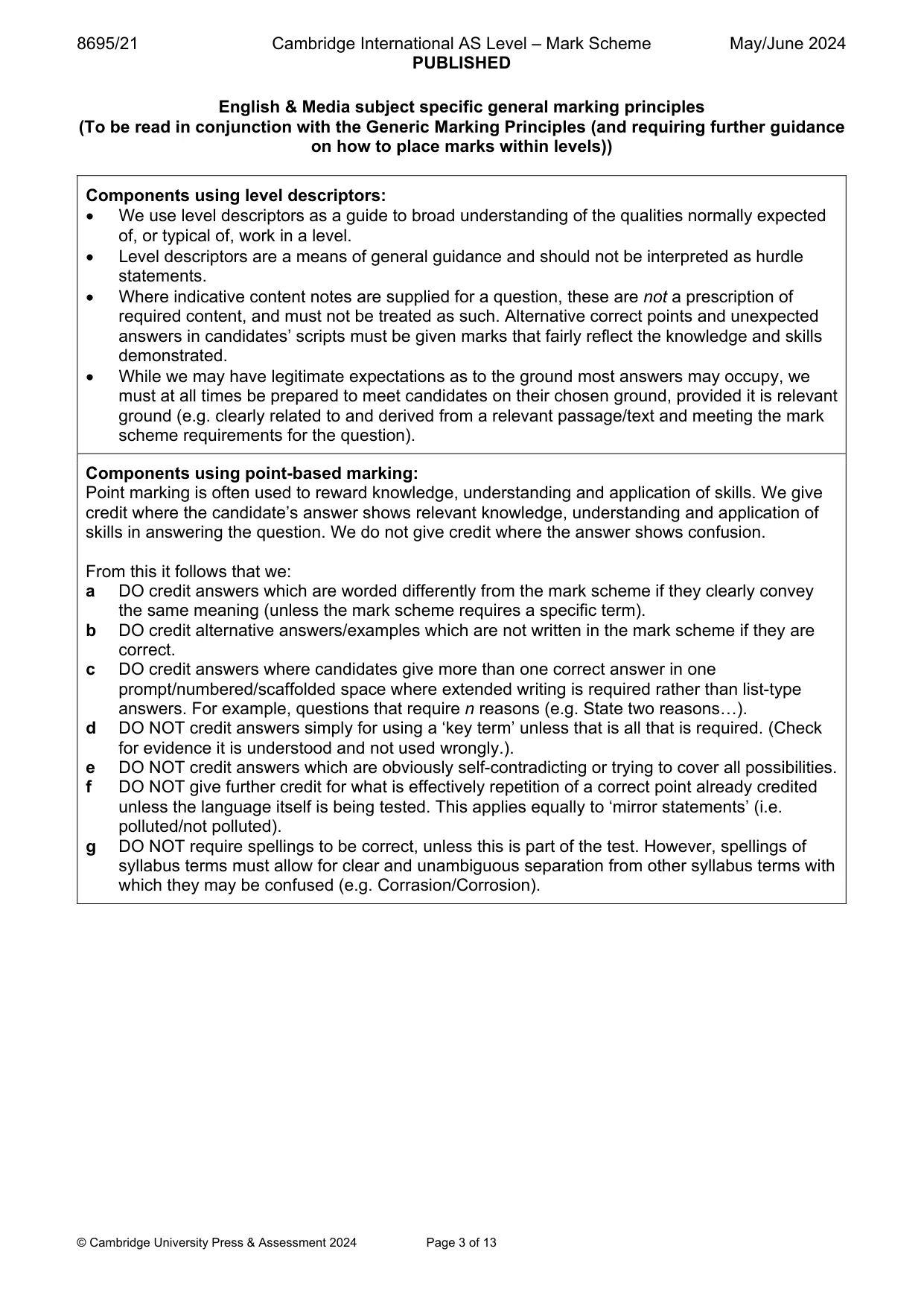
8695/21 Cambridge International AS Level – Mark Scheme PUBLISHED May/June 2024 © Cambridge University Press & Assessment 2024 Page 3 of 13 English & Media subject specific general marking principles (To be read in conjunction with the Generic Marking Principles (and requiring further guidance on how to place marks within levels)) Components using level descriptors: We use level descriptors as a guide to broad understanding of the qualities normally expected of, or typical of, work in a level. Level descriptors are a means of general guidance and should not be interpreted as hurdle statements. Where indicative content notes are supplied for a question, these are not a prescription of required content, and must not be treated as such. Alternative correct points and unexpected answers in candidates’ scripts must be given marks that fairly reflect the knowledge and skills demonstrated. While we may have legitimate expectations as to the ground most answers may occupy, we must at all times be prepared to meet candidates on their chosen ground, provided it is relevant ground (e.g. clearly related to and derived from a relevant passage/text and meeting the mark scheme requirements for the question). Components using point-based marking: Point marking is often used to reward knowledge, understanding and application of skills. We give credit where the candidate’s answer shows relevant knowledge, understanding and application of skills in answering the question. We do not give credit where the answer shows confusion. From this it follows that we: a DO credit answers which are worded differently from the mark scheme if they clearly convey the same meaning (unless the mark scheme requires a specific term). b DO credit alternative answers/examples which are not written in the mark scheme if they are correct. c DO credit answers where candidates give more than one correct answer in one prompt/numbered/scaffolded space where extended writing is required rather than list-type answers. For example, questions that require n reasons (e.g. State two reasons…). d DO NOT credit answers simply for using a ‘key term’ unless that is all that is required. (Check for evidence it is understood and not used wrongly.). e DO NOT credit answers which are obviously self-contradicting or trying to cover all possibilities. f DO NOT give further credit for what is effectively repetition of a correct point already credited unless the language itself is being tested. This applies equally to ‘mirror statements’ (i.e. polluted/not polluted). g DO NOT require spellings to be correct, unless this is part of the test. However, spellings of syllabus terms must allow for clear and unambiguous separation from other syllabus terms with which they may be confused (e.g. Corrasion/Corrosion).
Mark scheme, page 4
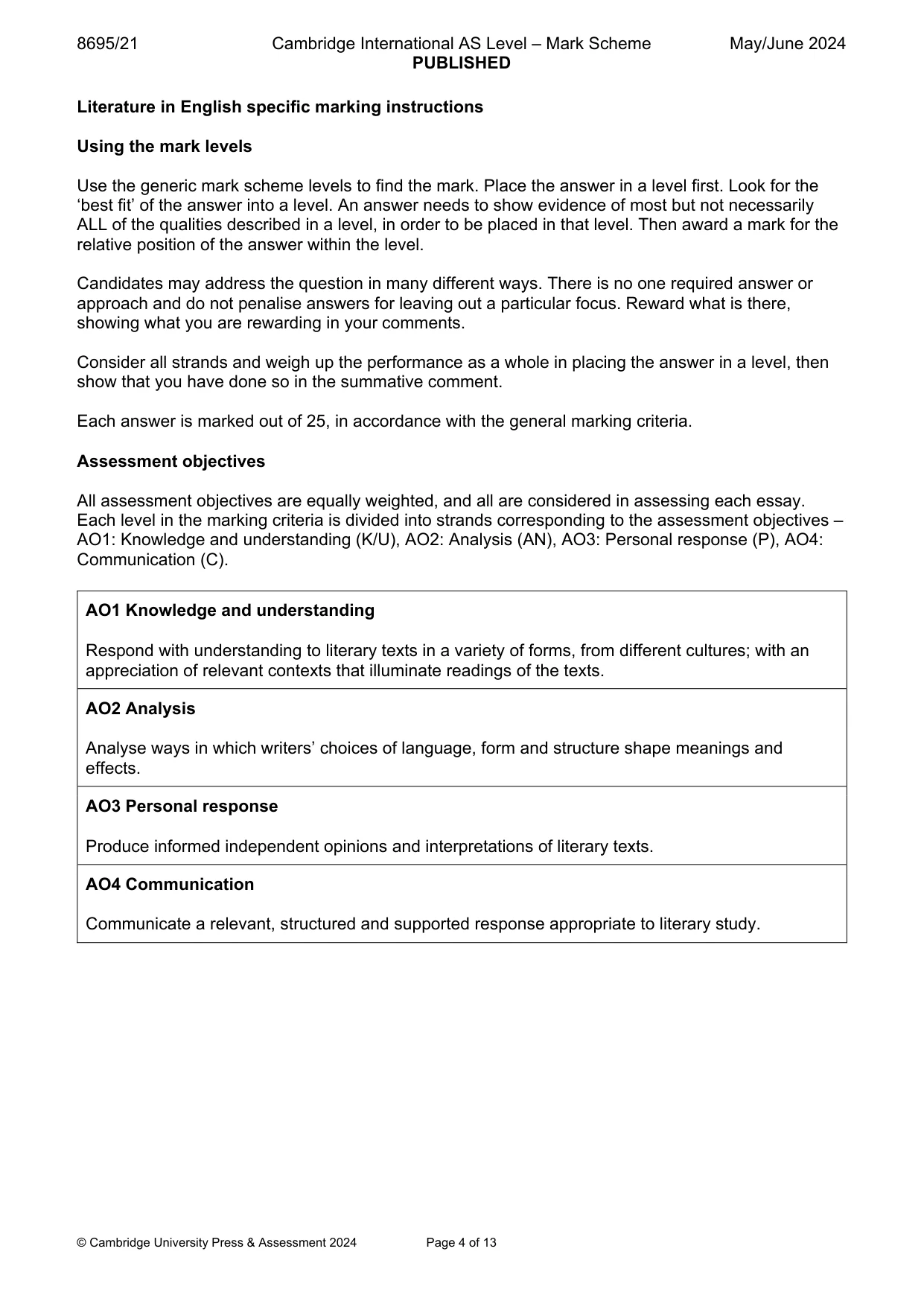
8695/21 Cambridge International AS Level – Mark Scheme PUBLISHED May/June 2024 © Cambridge University Press & Assessment 2024 Page 4 of 13 Literature in English specific marking instructions Using the mark levels Use the generic mark scheme levels to find the mark. Place the answer in a level first. Look for the ‘best fit’ of the answer into a level. An answer needs to show evidence of most but not necessarily ALL of the qualities described in a level, in order to be placed in that level. Then award a mark for the relative position of the answer within the level. Candidates may address the question in many different ways. There is no one required answer or approach and do not penalise answers for leaving out a particular focus. Reward what is there, showing what you are rewarding in your comments. Consider all strands and weigh up the performance as a whole in placing the answer in a level, then show that you have done so in the summative comment. Each answer is marked out of 25, in accordance with the general marking criteria. Assessment objectives All assessment objectives are equally weighted, and all are considered in assessing each essay. Each level in the marking criteria is divided into strands corresponding to the assessment objectives – AO1: Knowledge and understanding (K/U), AO2: Analysis (AN), AO3: Personal response (P), AO4: Communication (C). AO1 Knowledge and understanding Respond with understanding to literary texts in a variety of forms, from different cultures; with an appreciation of relevant contexts that illuminate readings of the texts. AO2 Analysis Analyse ways in which writers’ choices of language, form and structure shape meanings and effects. AO3 Personal response Produce informed independent opinions and interpretations of literary texts. AO4 Communication Communicate a relevant, structured and supported response appropriate to literary study.
Mark scheme, page 5
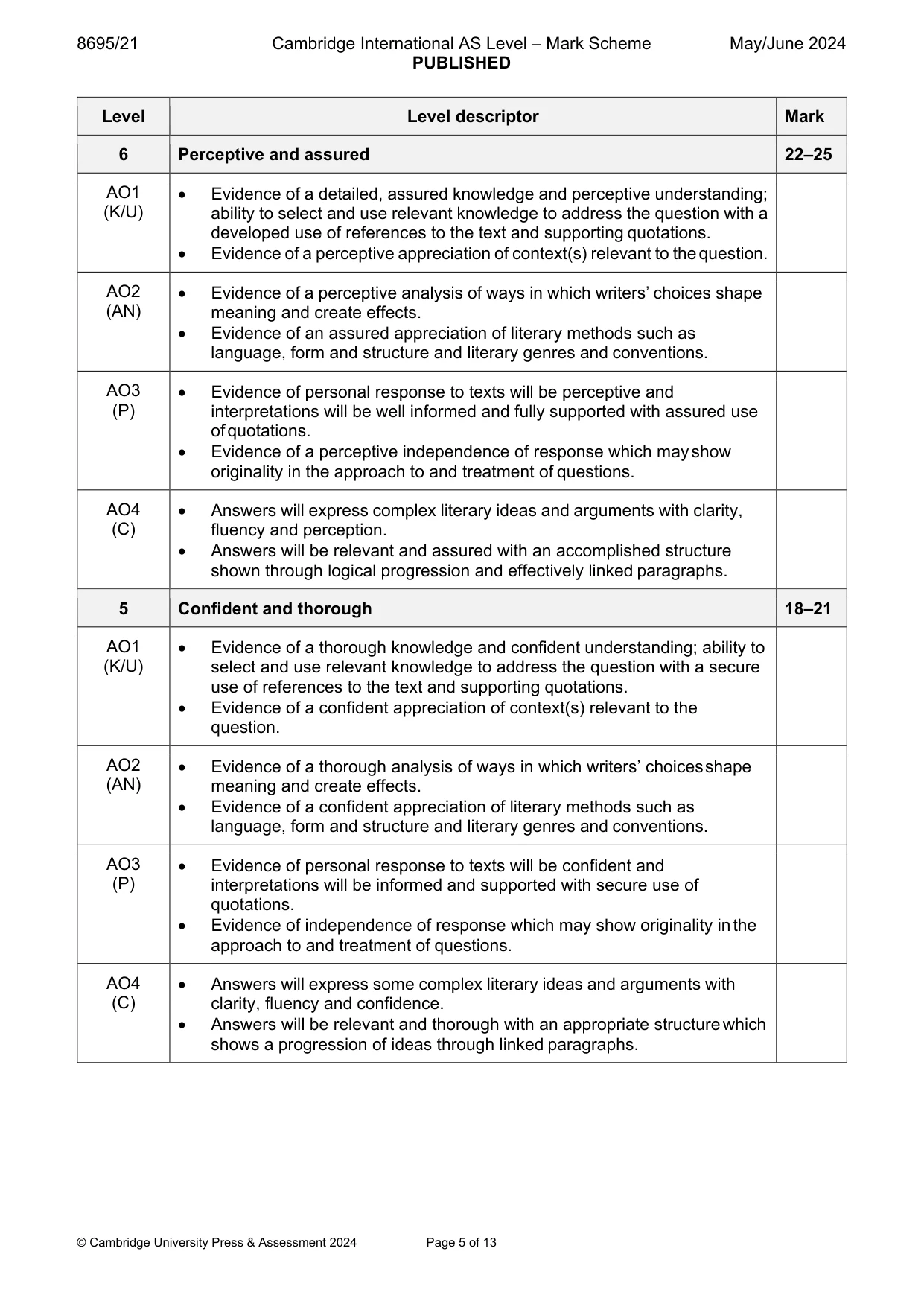
8695/21 Cambridge International AS Level – Mark Scheme PUBLISHED May/June 2024 © Cambridge University Press & Assessment 2024 Page 5 of 13 Level Level descriptor Mark 6 Perceptive and assured 22–25 AO1 (K/U) Evidence of a detailed, assured knowledge and perceptive understanding; ability to select and use relevant knowledge to address the question with a developed use of references to the text and supporting quotations. Evidence of a perceptive appreciation of context(s) relevant to the question. AO2 (AN) Evidence of a perceptive analysis of ways in which writers’ choices shape meaning and create effects. Evidence of an assured appreciation of literary methods such as language, form and structure and literary genres and conventions. AO3 (P) Evidence of personal response to texts will be perceptive and interpretations will be well informed and fully supported with assured use of quotations. Evidence of a perceptive independence of response which may show originality in the approach to and treatment of questions. AO4 (C) Answers will express complex literary ideas and arguments with clarity, fluency and perception. Answers will be relevant and assured with an accomplished structure shown through logical progression and effectively linked paragraphs. 5 Confident and thorough 18–21 AO1 (K/U) Evidence of a thorough knowledge and confident understanding; ability to select and use relevant knowledge to address the question with a secure use of references to the text and supporting quotations. Evidence of a confident appreciation of context(s) relevant to the question. AO2 (AN) Evidence of a thorough analysis of ways in which writers’ choices shape meaning and create effects. Evidence of a confident appreciation of literary methods such as language, form and structure and literary genres and conventions. AO3 (P) Evidence of personal response to texts will be confident and interpretations will be informed and supported with secure use of quotations. Evidence of independence of response which may show originality in the approach to and treatment of questions. AO4 (C) Answers will express some complex literary ideas and arguments with clarity, fluency and confidence. Answers will be relevant and thorough with an appropriate structure which shows a progression of ideas through linked paragraphs.
Mark scheme, page 6
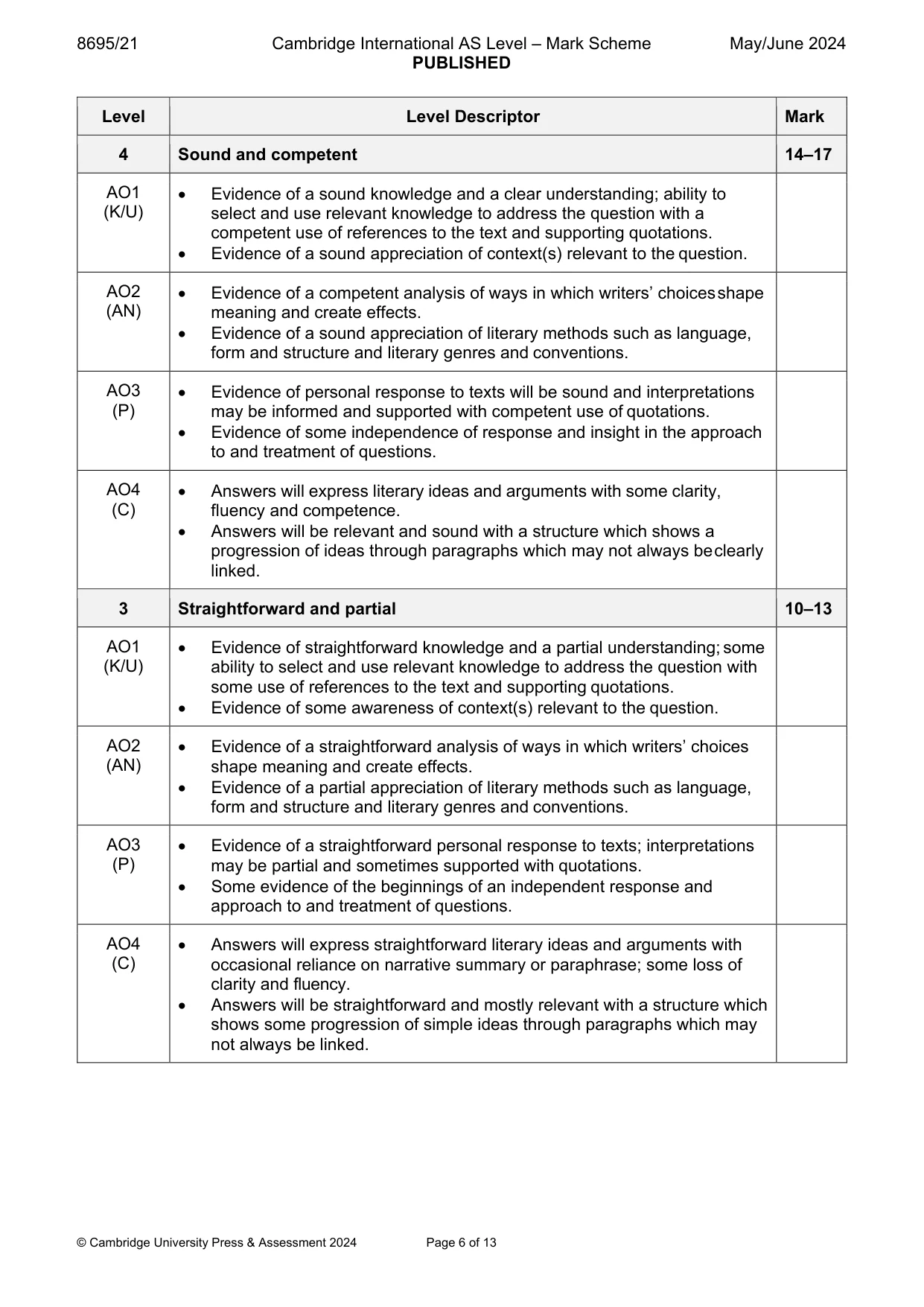
8695/21 Cambridge International AS Level – Mark Scheme PUBLISHED May/June 2024 © Cambridge University Press & Assessment 2024 Page 6 of 13 Level Level Descriptor Mark 4 Sound and competent 14–17 AO1 (K/U) Evidence of a sound knowledge and a clear understanding; ability to select and use relevant knowledge to address the question with a competent use of references to the text and supporting quotations. Evidence of a sound appreciation of context(s) relevant to the question. AO2 (AN) Evidence of a competent analysis of ways in which writers’ choices shape meaning and create effects. Evidence of a sound appreciation of literary methods such as language, form and structure and literary genres and conventions. AO3 (P) Evidence of personal response to texts will be sound and interpretations may be informed and supported with competent use of quotations. Evidence of some independence of response and insight in the approach to and treatment of questions. AO4 (C) Answers will express literary ideas and arguments with some clarity, fluency and competence. Answers will be relevant and sound with a structure which shows a progression of ideas through paragraphs which may not always be clearly linked. 3 Straightforward and partial 10–13 AO1 (K/U) Evidence of straightforward knowledge and a partial understanding; some ability to select and use relevant knowledge to address the question with some use of references to the text and supporting quotations. Evidence of some awareness of context(s) relevant to the question. AO2 (AN) Evidence of a straightforward analysis of ways in which writers’ choices shape meaning and create effects. Evidence of a partial appreciation of literary methods such as language, form and structure and literary genres and conventions. AO3 (P) Evidence of a straightforward personal response to texts; interpretations may be partial and sometimes supported with quotations. Some evidence of the beginnings of an independent response and approach to and treatment of questions. AO4 (C) Answers will express straightforward literary ideas and arguments with occasional reliance on narrative summary or paraphrase; some loss of clarity and fluency. Answers will be straightforward and mostly relevant with a structure which shows some progression of simple ideas through paragraphs which may not always be linked.
Mark scheme, page 7
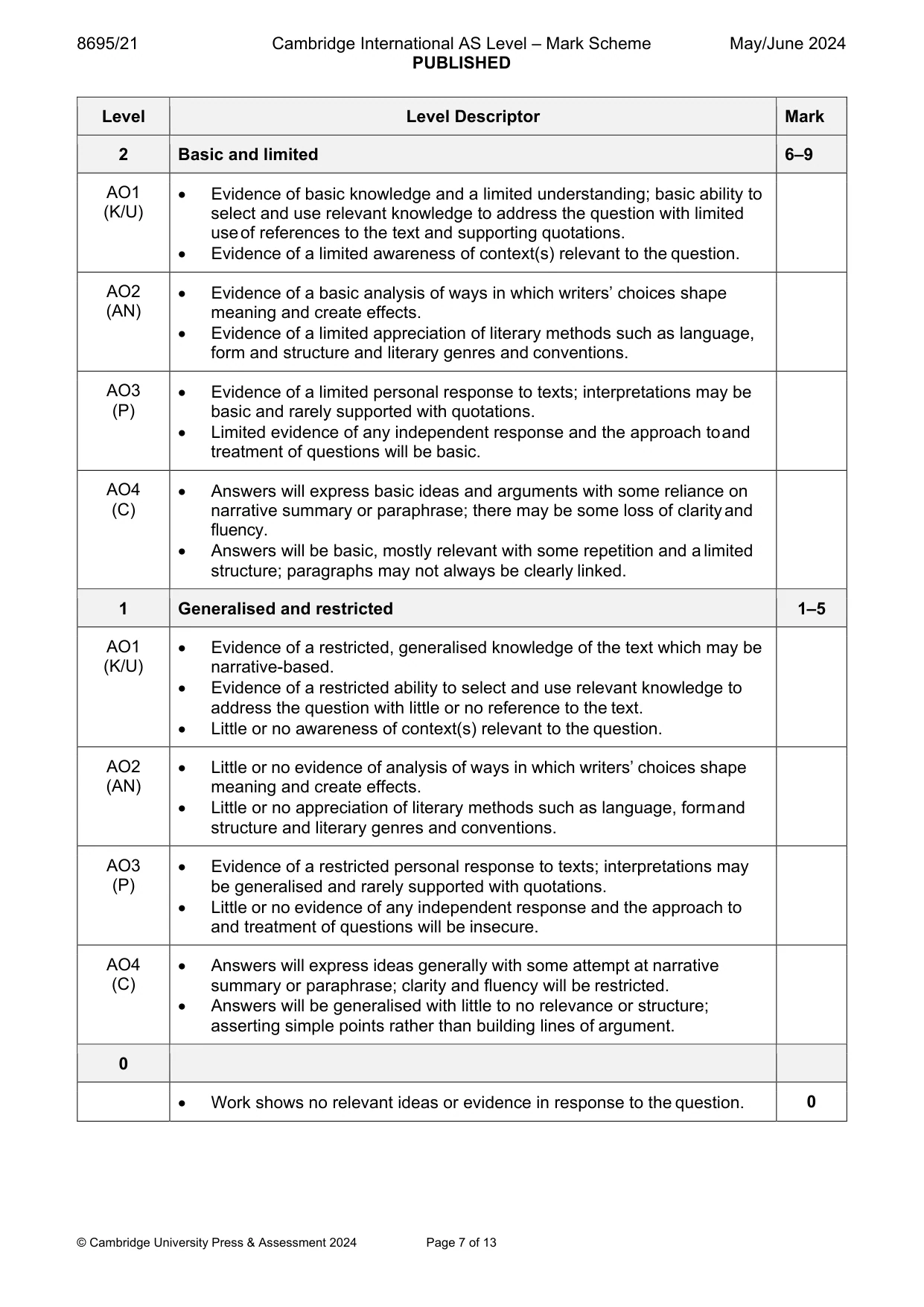
8695/21 Cambridge International AS Level – Mark Scheme PUBLISHED May/June 2024 © Cambridge University Press & Assessment 2024 Page 7 of 13 Level Level Descriptor Mark 2 Basic and limited 6–9 AO1 (K/U) Evidence of basic knowledge and a limited understanding; basic ability to select and use relevant knowledge to address the question with limited use of references to the text and supporting quotations. Evidence of a limited awareness of context(s) relevant to the question. AO2 (AN) Evidence of a basic analysis of ways in which writers’ choices shape meaning and create effects. Evidence of a limited appreciation of literary methods such as language, form and structure and literary genres and conventions. AO3 (P) Evidence of a limited personal response to texts; interpretations may be basic and rarely supported with quotations. Limited evidence of any independent response and the approach to and treatment of questions will be basic. AO4 (C) Answers will express basic ideas and arguments with some reliance on narrative summary or paraphrase; there may be some loss of clarity and fluency. Answers will be basic, mostly relevant with some repetition and a limited structure; paragraphs may not always be clearly linked. 1 Generalised and restricted 1–5 AO1 (K/U) Evidence of a restricted, generalised knowledge of the text which may be narrative-based. Evidence of a restricted ability to select and use relevant knowledge to address the question with little or no reference to the text. Little or no awareness of context(s) relevant to the question. AO2 (AN) Little or no evidence of analysis of ways in which writers’ choices shape meaning and create effects. Little or no appreciation of literary methods such as language, form and structure and literary genres and conventions. AO3 (P) Evidence of a restricted personal response to texts; interpretations may be generalised and rarely supported with quotations. Little or no evidence of any independent response and the approach to and treatment of questions will be insecure. AO4 (C) Answers will express ideas generally with some attempt at narrative summary or paraphrase; clarity and fluency will be restricted. Answers will be generalised with little to no relevance or structure; asserting simple points rather than building lines of argument. 0 Work shows no relevant ideas or evidence in response to the question. 0
Mark scheme, page 8
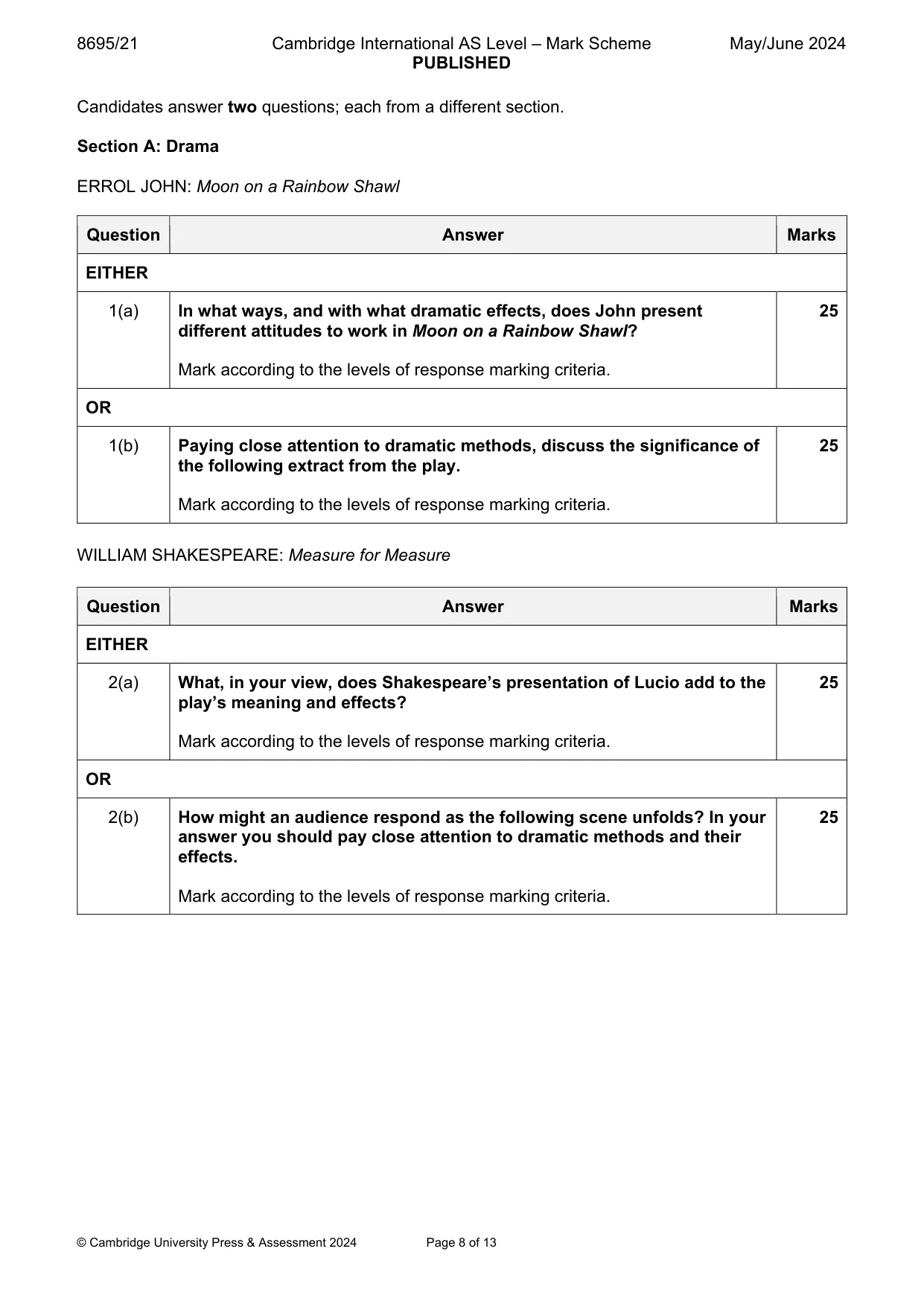
8695/21 Cambridge International AS Level – Mark Scheme PUBLISHED May/June 2024 © Cambridge University Press & Assessment 2024 Page 8 of 13 Candidates answer two questions; each from a different section. Section A: Drama ERROL JOHN: Moon on a Rainbow Shawl Question Answer Marks EITHER 1(a) In what ways, and with what dramatic effects, does John present different attitudes to work in Moon on a Rainbow Shawl? Mark according to the levels of response marking criteria. 25 OR 1(b) Paying close attention to dramatic methods, discuss the significance of the following extract from the play. Mark according to the levels of response marking criteria. 25 WILLIAM SHAKESPEARE: Measure for Measure Question Answer Marks EITHER 2(a) What, in your view, does Shakespeare’s presentation of Lucio add to the play’s meaning and effects? Mark according to the levels of response marking criteria. 25 OR 2(b) How might an audience respond as the following scene unfolds? In your answer you should pay close attention to dramatic methods and their effects. Mark according to the levels of response marking criteria. 25
Mark scheme, page 9
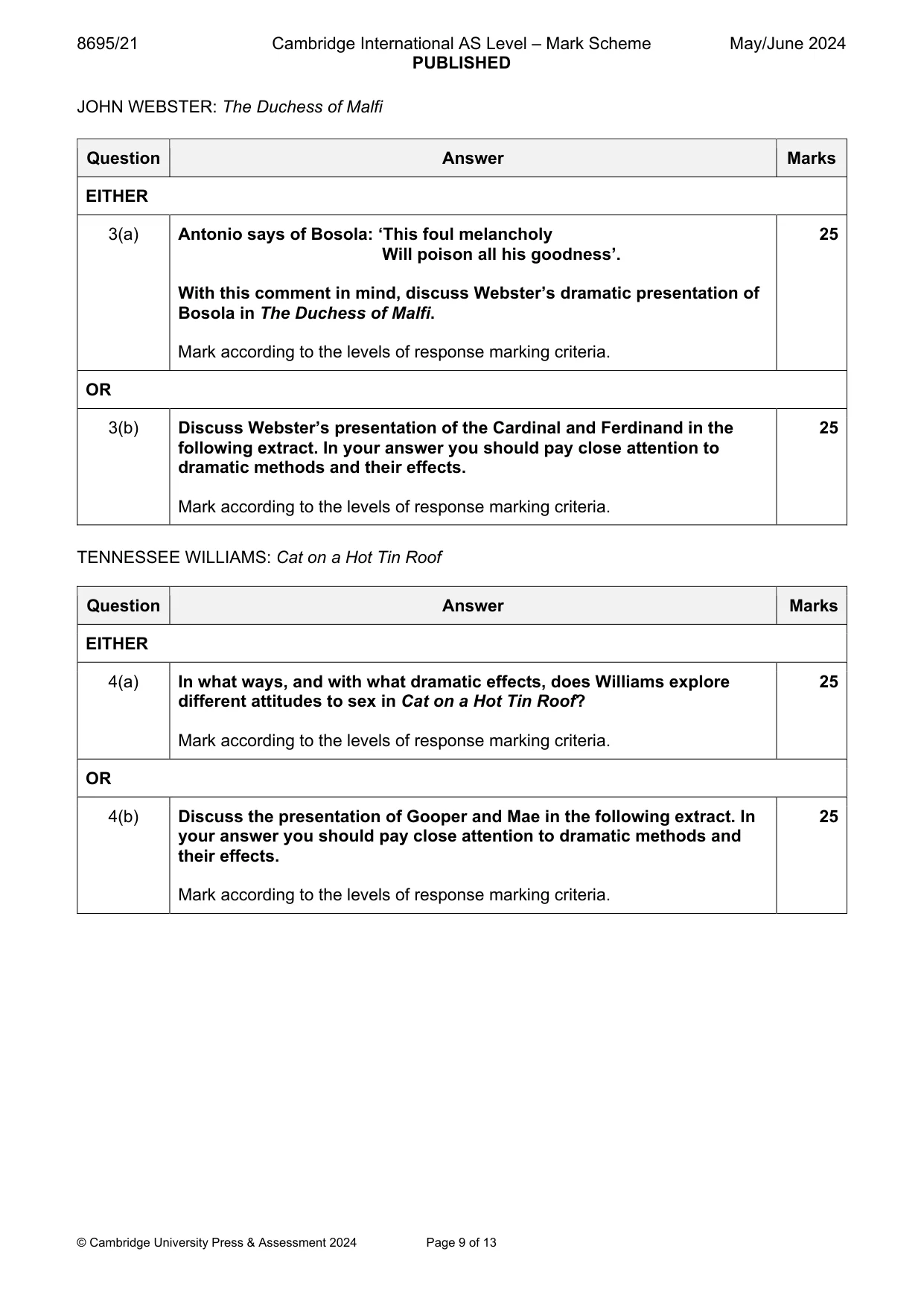
8695/21 Cambridge International AS Level – Mark Scheme PUBLISHED May/June 2024 © Cambridge University Press & Assessment 2024 Page 9 of 13 JOHN WEBSTER: The Duchess of Malfi Question Answer Marks EITHER 3(a) Antonio says of Bosola: ‘This foul melancholy Will poison all his goodness’. With this comment in mind, discuss Webster’s dramatic presentation of Bosola in The Duchess of Malfi. Mark according to the levels of response marking criteria. 25 OR 3(b) Discuss Webster’s presentation of the Cardinal and Ferdinand in the following extract. In your answer you should pay close attention to dramatic methods and their effects. Mark according to the levels of response marking criteria. 25 TENNESSEE WILLIAMS: Cat on a Hot Tin Roof Question Answer Marks EITHER 4(a) In what ways, and with what dramatic effects, does Williams explore different attitudes to sex in Cat on a Hot Tin Roof? Mark according to the levels of response marking criteria. 25 OR 4(b) Discuss the presentation of Gooper and Mae in the following extract. In your answer you should pay close attention to dramatic methods and their effects. Mark according to the levels of response marking criteria. 25
Mark scheme, page 10
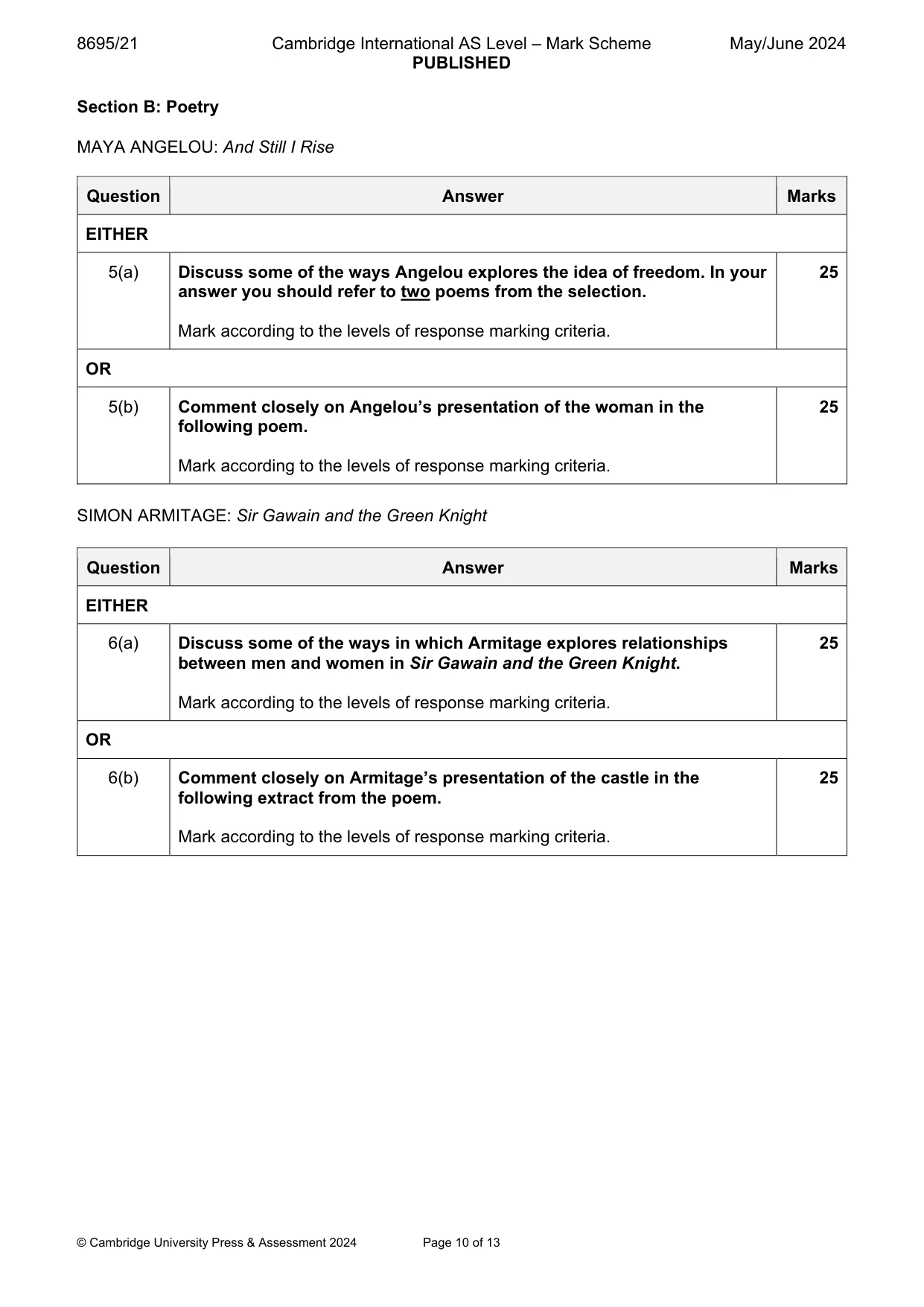
8695/21 Cambridge International AS Level – Mark Scheme PUBLISHED May/June 2024 © Cambridge University Press & Assessment 2024 Page 10 of 13 Section B: Poetry MAYA ANGELOU: And Still I Rise Question Answer Marks EITHER 5(a) Discuss some of the ways Angelou explores the idea of freedom. In your answer you should refer to two poems from the selection. Mark according to the levels of response marking criteria. 25 OR 5(b) Comment closely on Angelou’s presentation of the woman in the following poem. Mark according to the levels of response marking criteria. 25 SIMON ARMITAGE: Sir Gawain and the Green Knight Question Answer Marks EITHER 6(a) Discuss some of the ways in which Armitage explores relationships between men and women in Sir Gawain and the Green Knight. Mark according to the levels of response marking criteria. 25 OR 6(b) Comment closely on Armitage’s presentation of the castle in the following extract from the poem. Mark according to the levels of response marking criteria. 25
Mark scheme, page 11
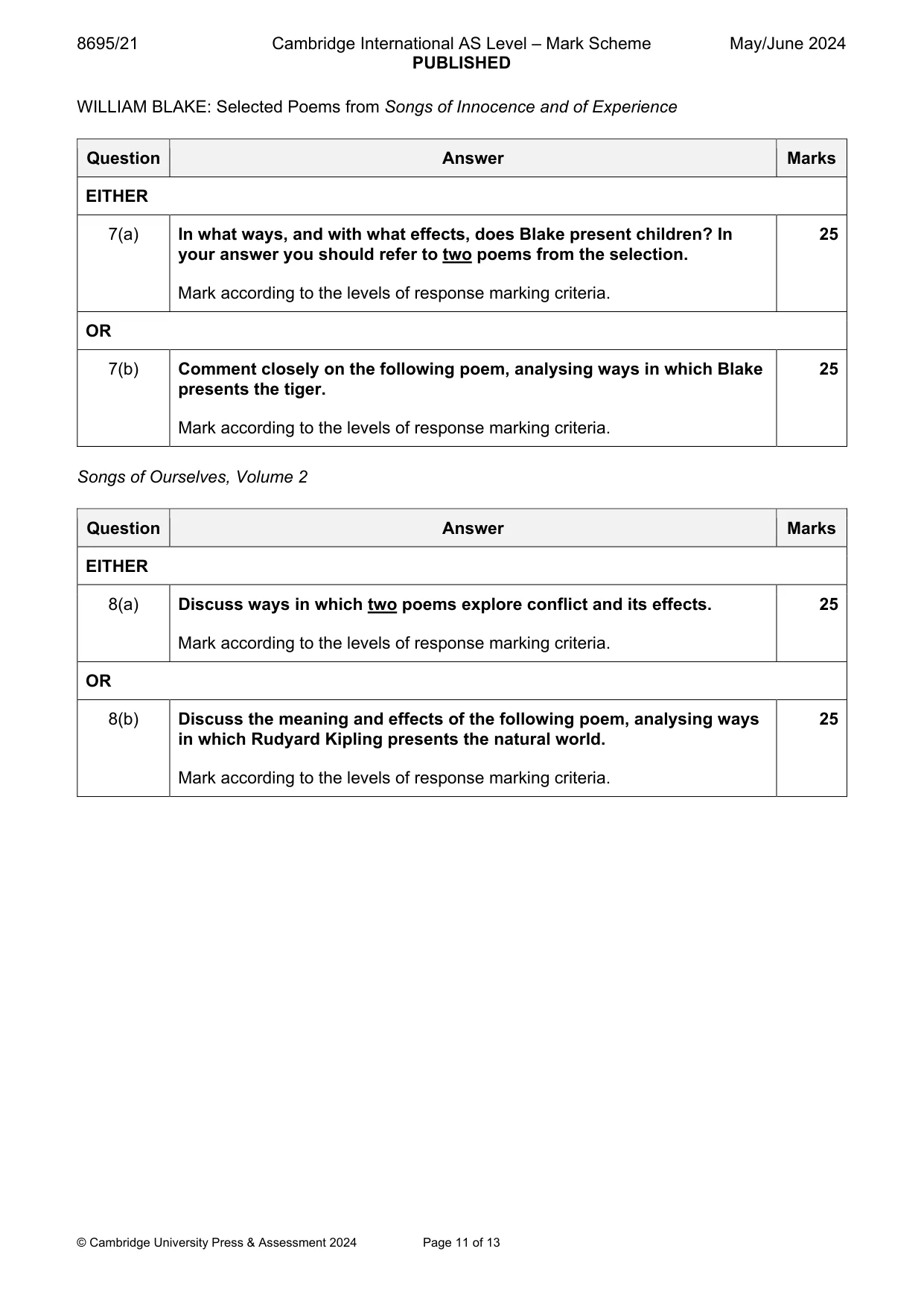
8695/21 Cambridge International AS Level – Mark Scheme PUBLISHED May/June 2024 © Cambridge University Press & Assessment 2024 Page 11 of 13 WILLIAM BLAKE: Selected Poems from Songs of Innocence and of Experience Question Answer Marks EITHER 7(a) In what ways, and with what effects, does Blake present children? In your answer you should refer to two poems from the selection. Mark according to the levels of response marking criteria. 25 OR 7(b) Comment closely on the following poem, analysing ways in which Blake presents the tiger. Mark according to the levels of response marking criteria. 25 Songs of Ourselves, Volume 2 Question Answer Marks EITHER 8(a) Discuss ways in which two poems explore conflict and its effects. Mark according to the levels of response marking criteria. 25 OR 8(b) Discuss the meaning and effects of the following poem, analysing ways in which Rudyard Kipling presents the natural world. Mark according to the levels of response marking criteria. 25
Mark scheme, page 12
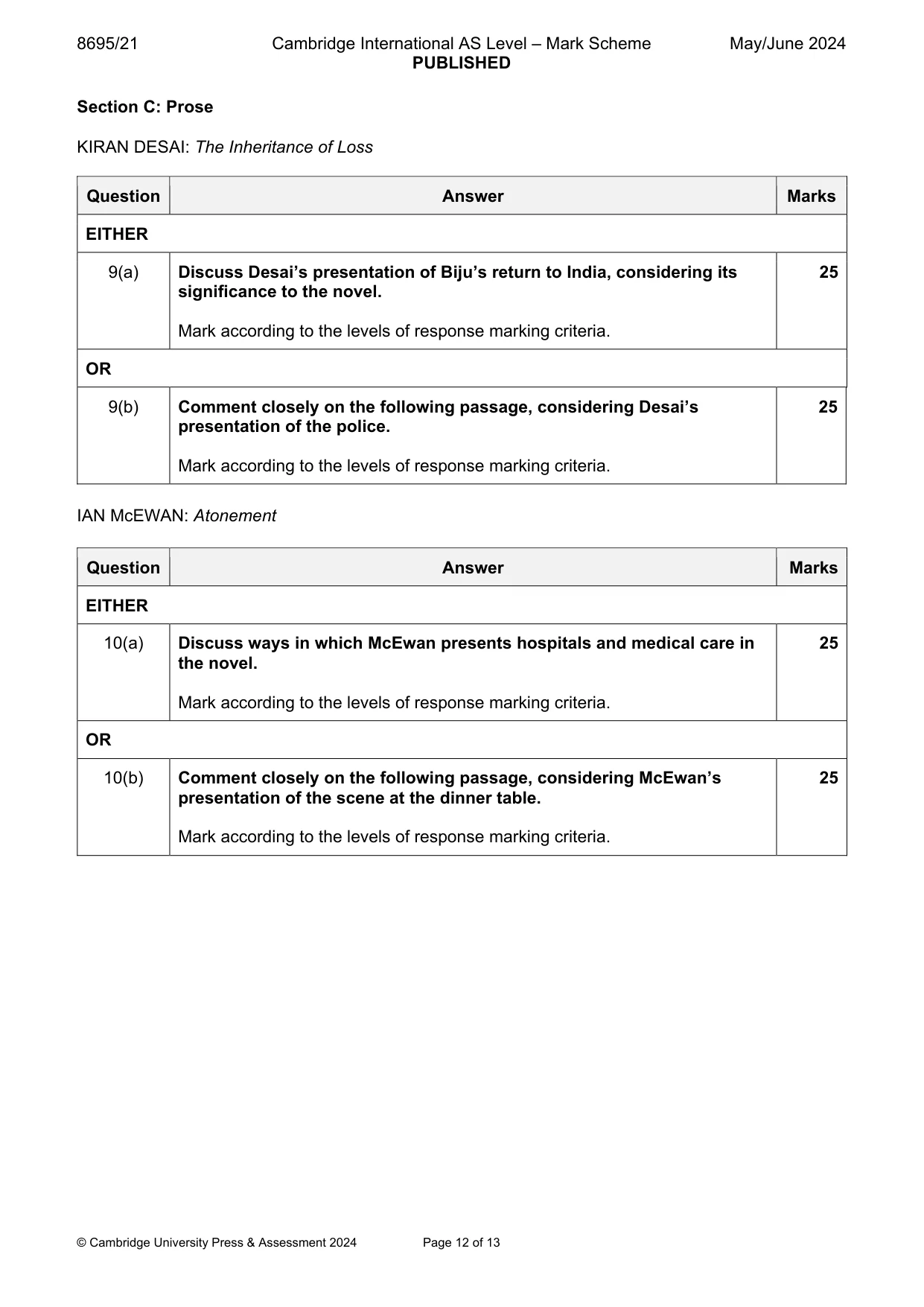
8695/21 Cambridge International AS Level – Mark Scheme PUBLISHED May/June 2024 © Cambridge University Press & Assessment 2024 Page 12 of 13 Section C: Prose KIRAN DESAI: The Inheritance of Loss Question Answer Marks EITHER 9(a) Discuss Desai’s presentation of Biju’s return to India, considering its significance to the novel. Mark according to the levels of response marking criteria. 25 OR 9(b) Comment closely on the following passage, considering Desai’s presentation of the police. Mark according to the levels of response marking criteria. 25 IAN McEWAN: Atonement Question Answer Marks EITHER 10(a) Discuss ways in which McEwan presents hospitals and medical care in the novel. Mark according to the levels of response marking criteria. 25 OR 10(b) Comment closely on the following passage, considering McEwan’s presentation of the scene at the dinner table. Mark according to the levels of response marking criteria. 25
Mark scheme, page 13
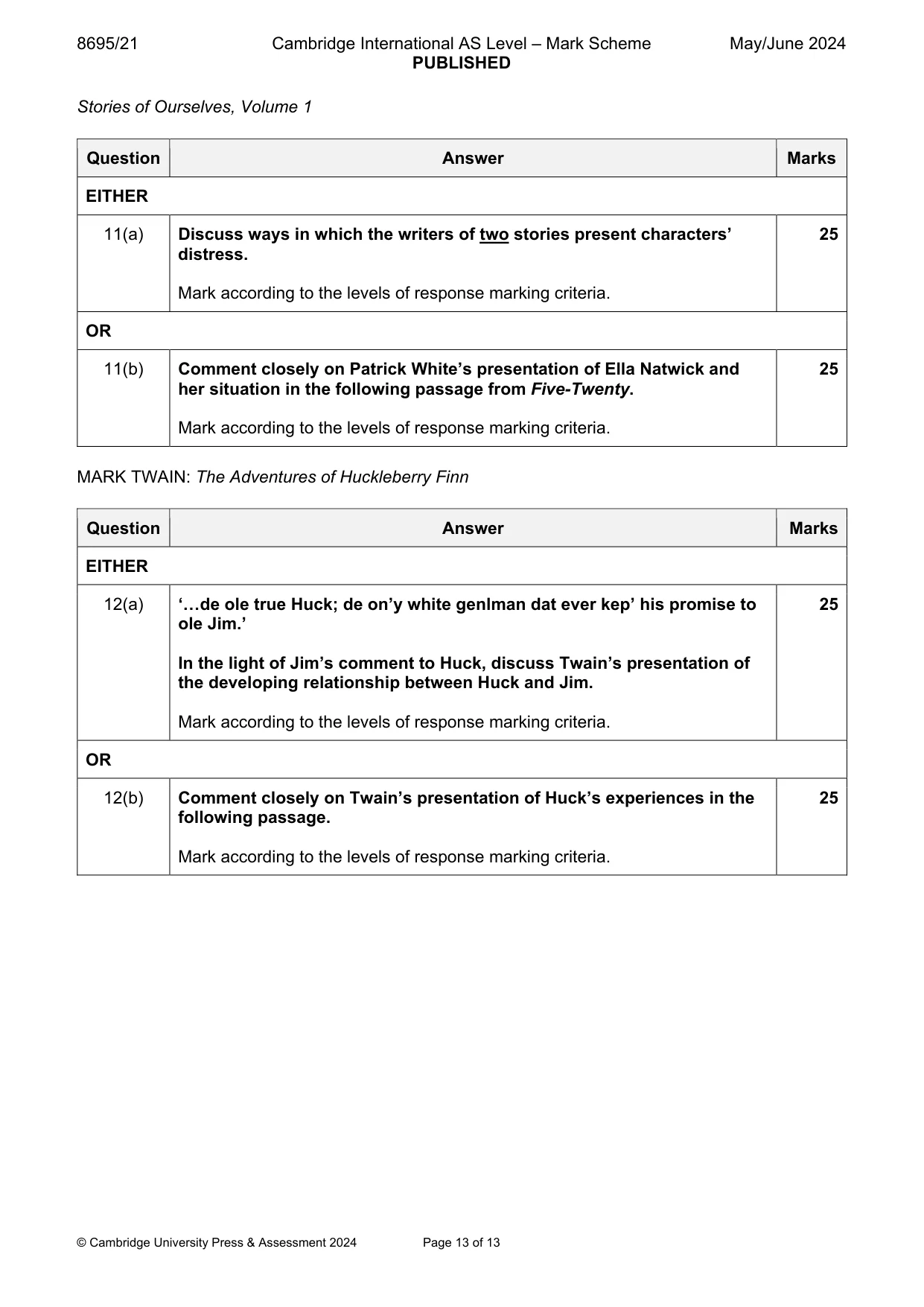
8695/21 Cambridge International AS Level – Mark Scheme PUBLISHED May/June 2024 © Cambridge University Press & Assessment 2024 Page 13 of 13 Stories of Ourselves, Volume 1 Question Answer Marks EITHER 11(a) Discuss ways in which the writers of two stories present characters’ distress. Mark according to the levels of response marking criteria. 25 OR 11(b) Comment closely on Patrick White’s presentation of Ella Natwick and her situation in the following passage from Five-Twenty. Mark according to the levels of response marking criteria. 25 MARK TWAIN: The Adventures of Huckleberry Finn Question Answer Marks EITHER 12(a) ‘…de ole true Huck; de on’y white genlman dat ever kep’ his promise to ole Jim.’ In the light of Jim’s comment to Huck, discuss Twain’s presentation of the developing relationship between Huck and Jim. Mark according to the levels of response marking criteria. 25 OR 12(b) Comment closely on Twain’s presentation of Huck’s experiences in the following passage. Mark according to the levels of response marking criteria. 25
What you needed in this session
Cambridge’s own grade thresholds for 2024 May/June, Paper 2 · Variant 1. A higher threshold means an easier paper — the bar moves with how the cohort did.