Cambridge A Level English - Language and Literature (AS Level only, from 2016) 8695 — 2022 May/June Paper 2 · Variant 1
8695/21/M/J/22 · 50 marks · ≈56 min
The question paper and its mark scheme, free to read here and free to download. This is Cambridge’s own paper, exactly as it was sat.
Question paper24 pages




Mark scheme13 pages
Answers below. Sit the paper first if you are practising.
Paper as text
Question paper, page 1
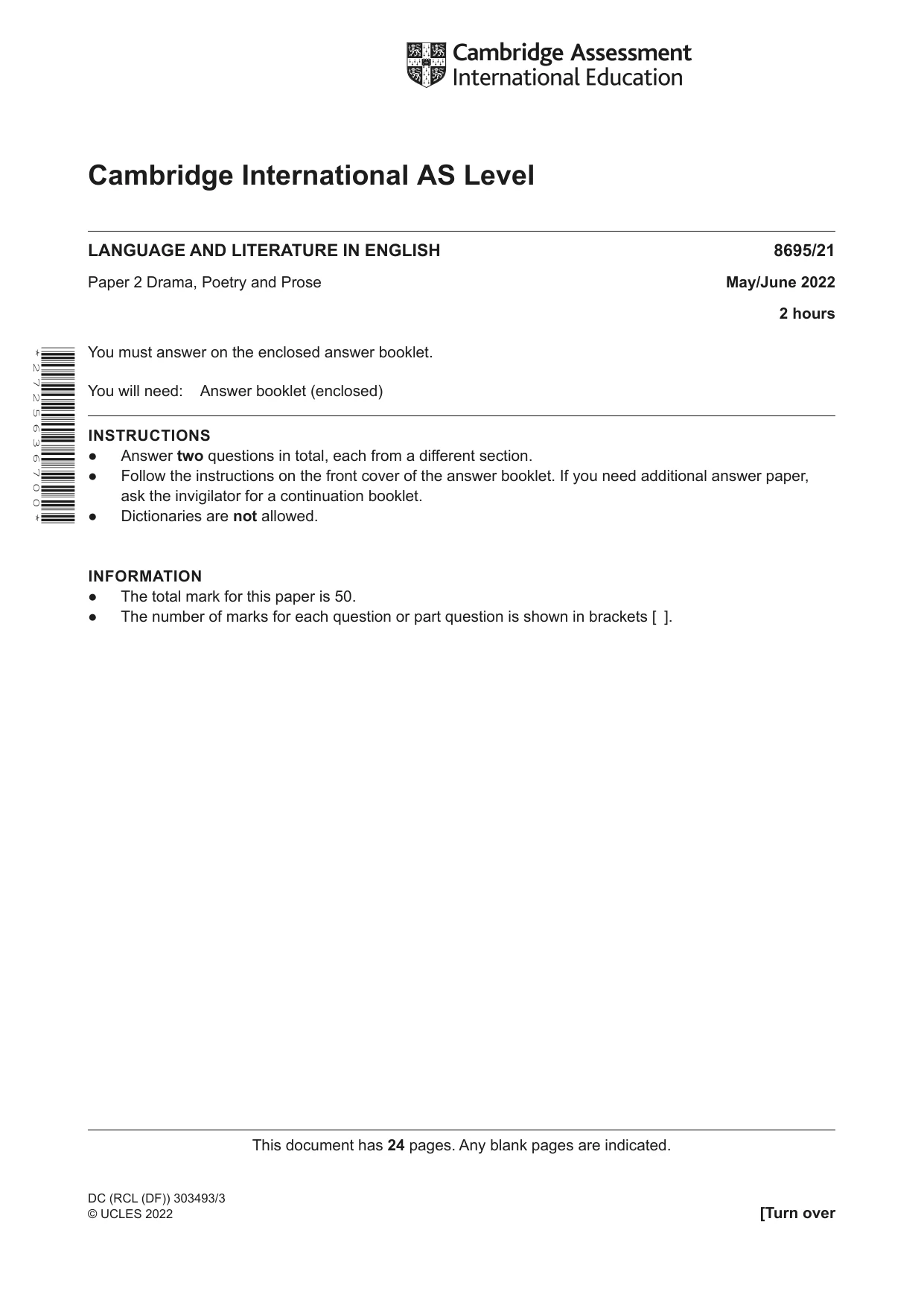
This document has 24 pages. Any blank pages are indicated. Cambridge International AS Level * 2 7 2 5 6 3 6 7 0 0 * LANGUAGE AND LITERATURE IN ENGLISH 8695/21 Paper 2 Drama, Poetry and Prose May/June 2022 2 hours You must answer on the enclosed answer booklet. You will need: Answer booklet (enclosed) INSTRUCTIONS ● Answer two questions in total, each from a different section. ● Follow the instructions on the front cover of the answer booklet. If you need additional answer paper, ask the invigilator for a continuation booklet. ● Dictionaries are not allowed. INFORMATION ● The total mark for this paper is 50. ● The number of marks for each question or part question is shown in brackets [ ]. DC (RCL (DF)) 303493/3 © UCLES 2022 [Turn over
Question paper, page 2
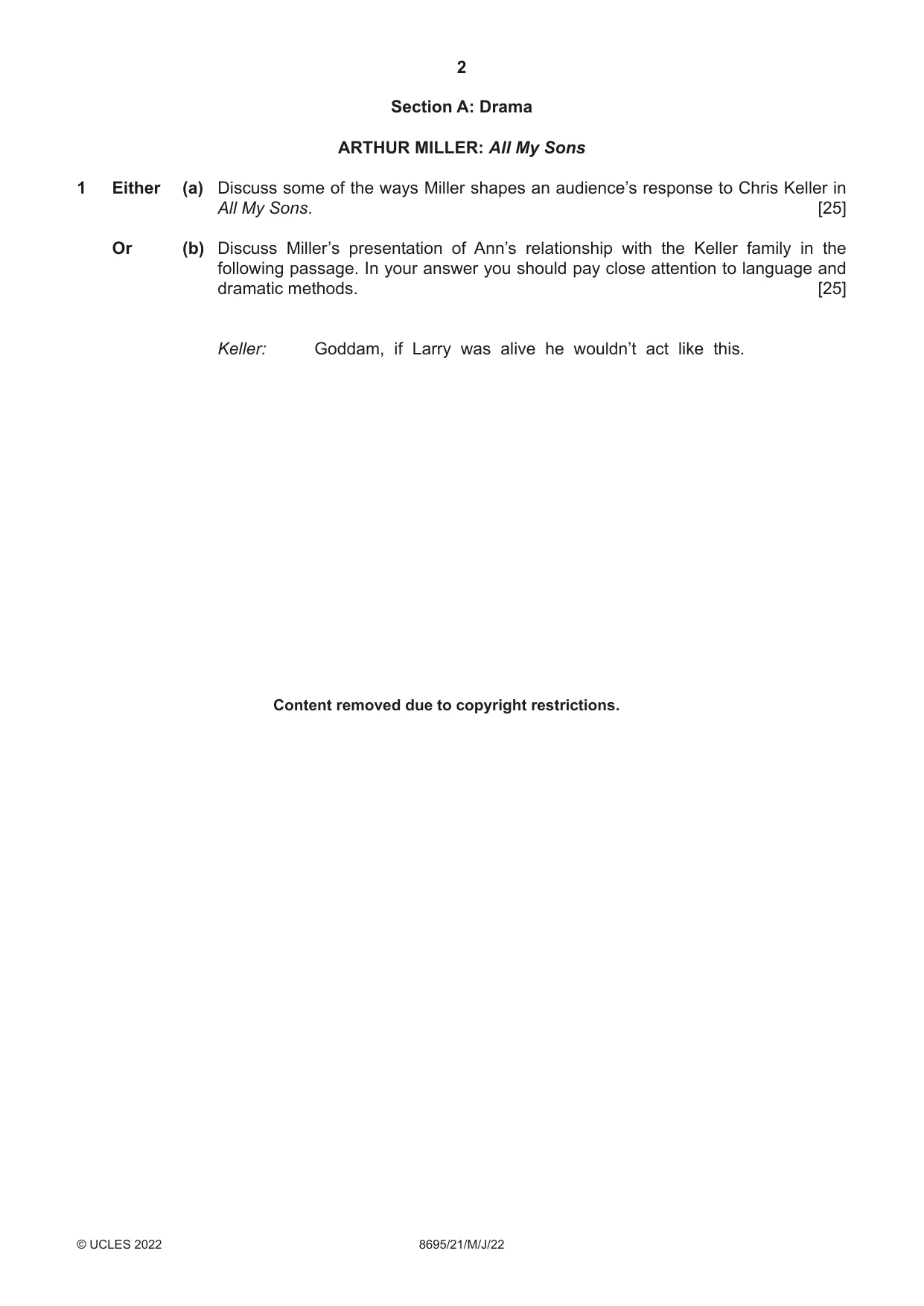
2 8695/21/M/J/22 © UCLES 2022 Section A: Drama ARTHUR MILLER: All My Sons 1 Either (a) Discuss some of the ways Miller shapes an audience’s response to Chris Keller in All My Sons. [25] Or (b) Discuss Miller’s presentation of Ann’s relationship with the Keller family in the following passage. In your answer you should pay close attention to language and dramatic methods. [25] Keller: Goddam, if Larry was alive he wouldn’t act like this. Content removed due to copyright restrictions.
Question paper, page 3
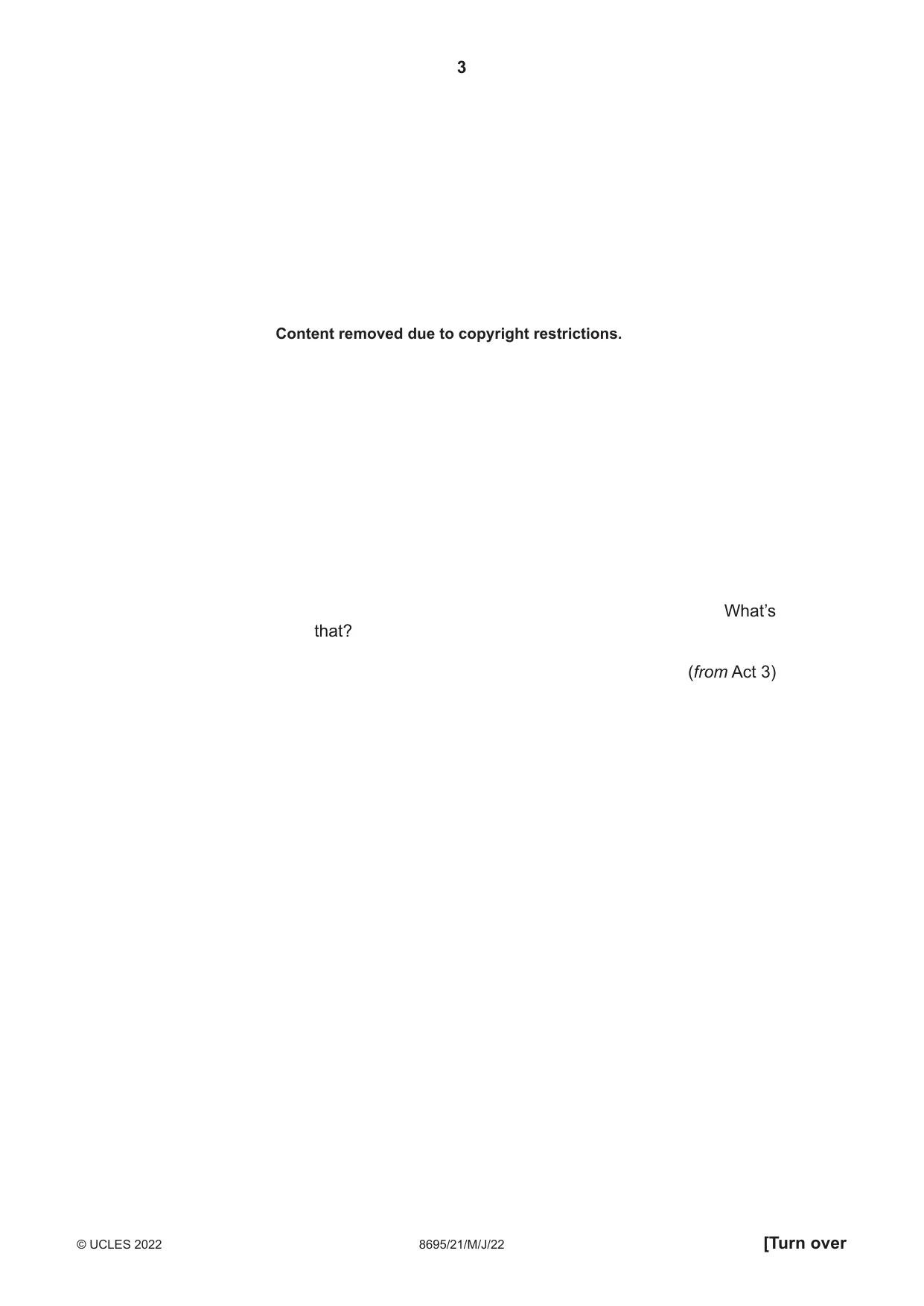
3 8695/21/M/J/22 © UCLES 2022 [Turn over What’s that? (from Act 3) Content removed due to copyright restrictions.
Question paper, page 4
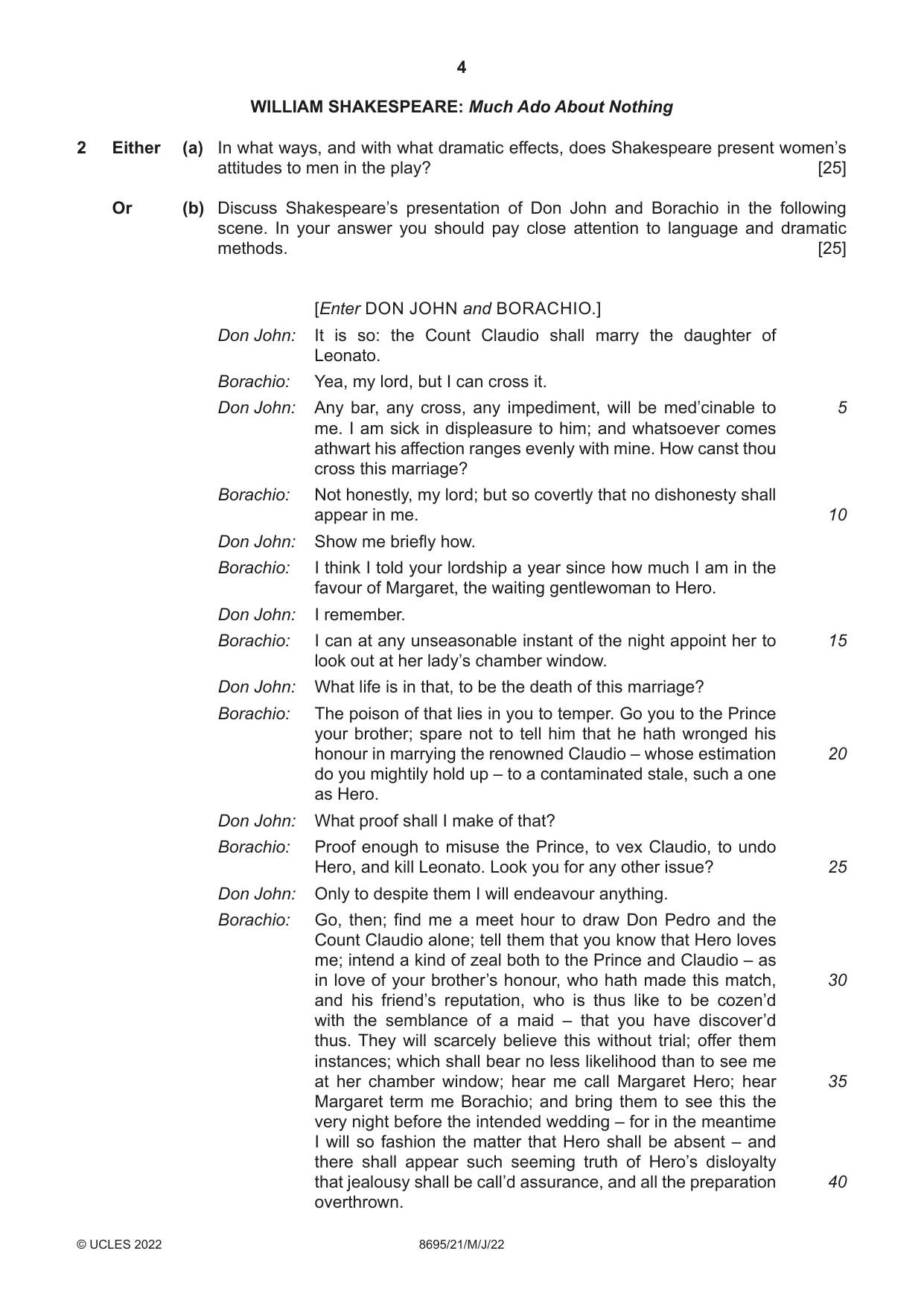
4 8695/21/M/J/22 © UCLES 2022 WILLIAM SHAKESPEARE: Much Ado About Nothing 2 Either (a) In what ways, and with what dramatic effects, does Shakespeare present women’s attitudes to men in the play? [25] Or (b) Discuss Shakespeare’s presentation of Don John and Borachio in the following scene. In your answer you should pay close attention to language and dramatic methods. [25] [Enter DON JOHN and BORACHIO.] Don John: It is so: the Count Claudio shall marry the daughter of Leonato. Borachio: Yea, my lord, but I can cross it. Don John: Any bar, any cross, any impediment, will be med’cinable to me. I am sick in displeasure to him; and whatsoever comes athwart his affection ranges evenly with mine. How canst thou cross this marriage? Borachio: Not honestly, my lord; but so covertly that no dishonesty shall appear in me. Don John: Show me briefly how. Borachio: I think I told your lordship a year since how much I am in the favour of Margaret, the waiting gentlewoman to Hero. Don John: I remember. Borachio: I can at any unseasonable instant of the night appoint her to look out at her lady’s chamber window. Don John: What life is in that, to be the death of this marriage? Borachio: The poison of that lies in you to temper. Go you to the Prince your brother; spare not to tell him that he hath wronged his honour in marrying the renowned Claudio – whose estimation do you mightily hold up – to a contaminated stale, such a one as Hero. Don John: What proof shall I make of that? Borachio: Proof enough to misuse the Prince, to vex Claudio, to undo Hero, and kill Leonato. Look you for any other issue? Don John: Only to despite them I will endeavour anything. Borachio: Go, then; find me a meet hour to draw Don Pedro and the Count Claudio alone; tell them that you know that Hero loves me; intend a kind of zeal both to the Prince and Claudio – as in love of your brother’s honour, who hath made this match, and his friend’s reputation, who is thus like to be cozen’d with the semblance of a maid – that you have discover’d thus. They will scarcely believe this without trial; offer them instances; which shall bear no less likelihood than to see me at her chamber window; hear me call Margaret Hero; hear Margaret term me Borachio; and bring them to see this the very night before the intended wedding – for in the meantime I will so fashion the matter that Hero shall be absent – and there shall appear such seeming truth of Hero’s disloyalty that jealousy shall be call’d assurance, and all the preparation overthrown. 5 10 15 20 25 30 35 40
Question paper, page 5
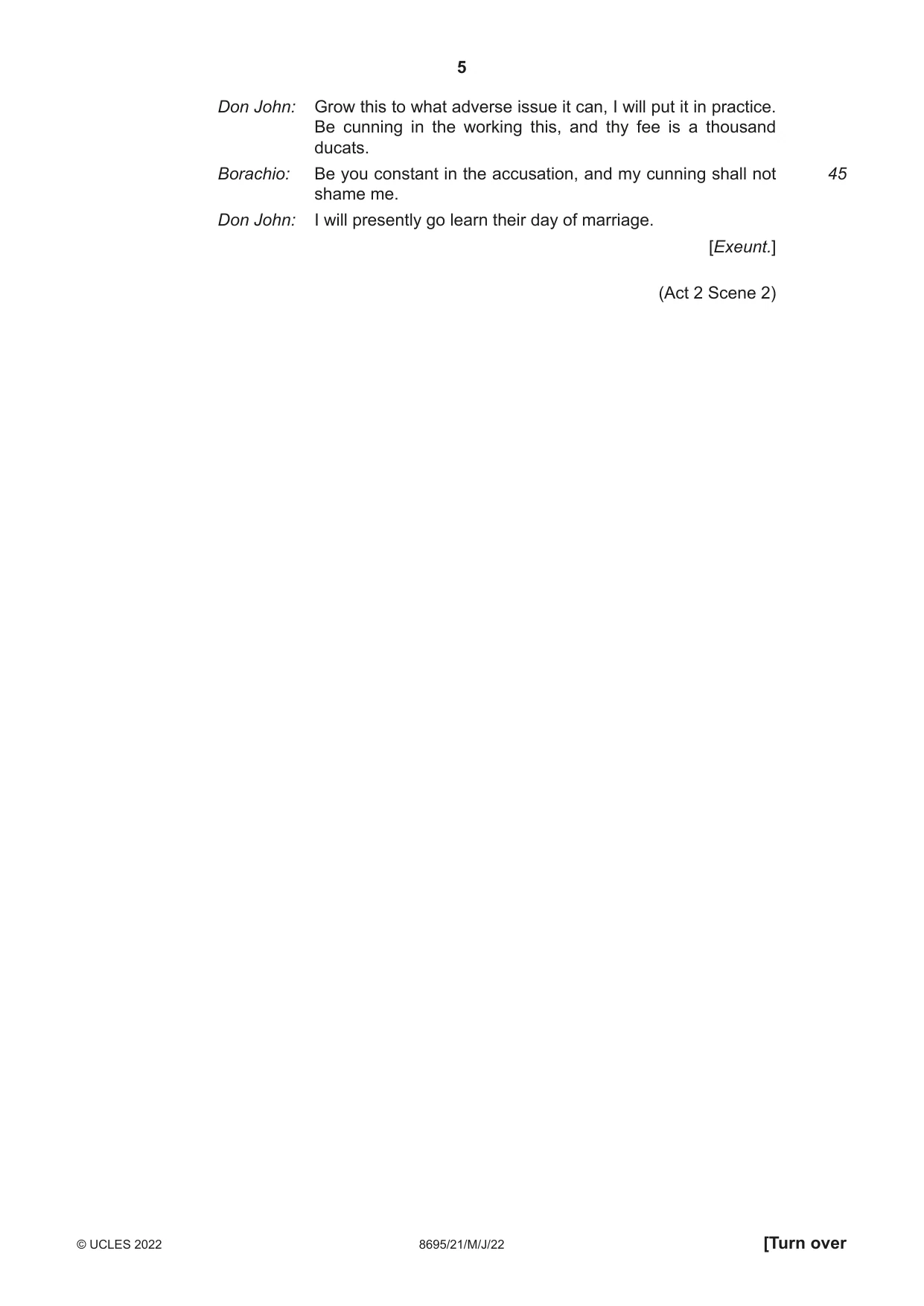
5 8695/21/M/J/22 © UCLES 2022 [Turn over Don John: Grow this to what adverse issue it can, I will put it in practice. Be cunning in the working this, and thy fee is a thousand ducats. Borachio: Be you constant in the accusation, and my cunning shall not shame me. Don John: I will presently go learn their day of marriage. [Exeunt.] (Act 2 Scene 2) 45
Question paper, page 6
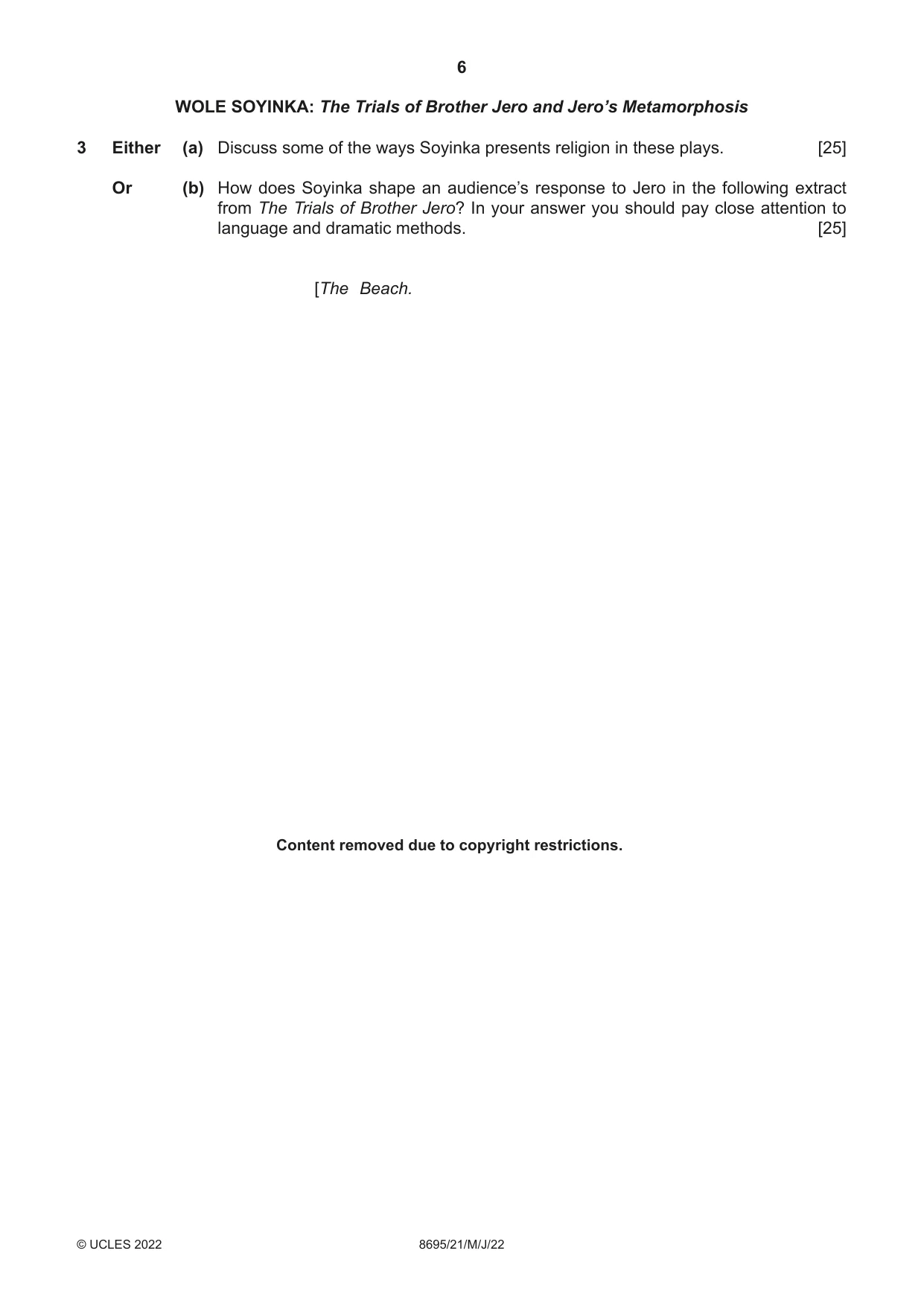
6 8695/21/M/J/22 © UCLES 2022 WOLE SOYINKA: The Trials of Brother Jero and Jero’s Metamorphosis 3 Either (a) Discuss some of the ways Soyinka presents religion in these plays. [25] Or (b) How does Soyinka shape an audience’s response to Jero in the following extract from The Trials of Brother Jero? In your answer you should pay close attention to language and dramatic methods. [25] [The Beach. Content removed due to copyright restrictions.
Question paper, page 7
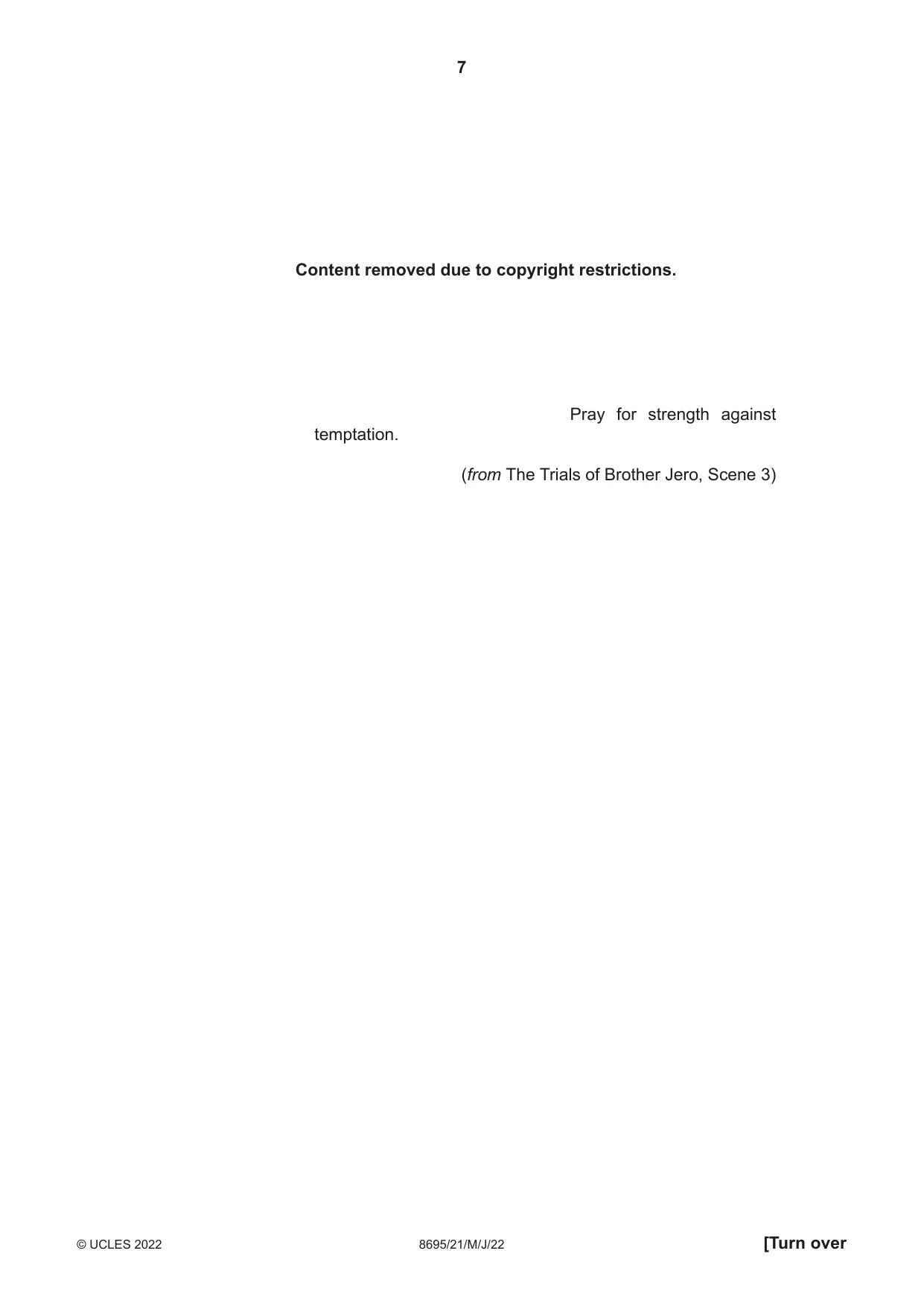
7 8695/21/M/J/22 © UCLES 2022 [Turn over Pray for strength against temptation. (from The Trials of Brother Jero, Scene 3) Content removed due to copyright restrictions.
Question paper, page 8
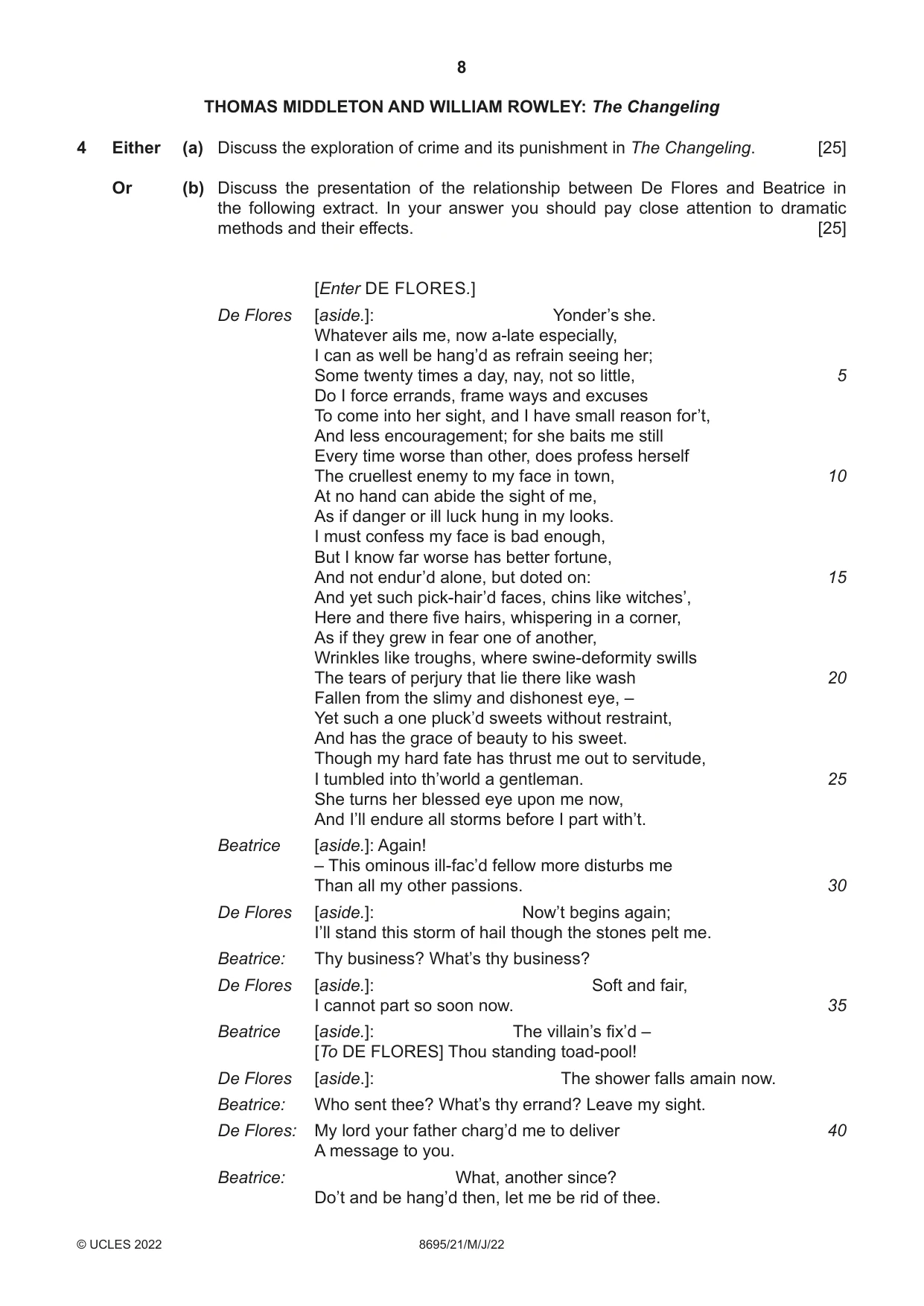
8 8695/21/M/J/22 © UCLES 2022 THOMAS MIDDLETON AND WILLIAM ROWLEY: The Changeling 4 Either (a) Discuss the exploration of crime and its punishment in The Changeling. [25] Or (b) Discuss the presentation of the relationship between De Flores and Beatrice in the following extract. In your answer you should pay close attention to dramatic methods and their effects. [25] [Enter DE FLORES.] De Flores [aside.]: Yonder’s she. Whatever ails me, now a-late especially, I can as well be hang’d as refrain seeing her; Some twenty times a day, nay, not so little, Do I force errands, frame ways and excuses To come into her sight, and I have small reason for’t, And less encouragement; for she baits me still Every time worse than other, does profess herself The cruellest enemy to my face in town, At no hand can abide the sight of me, As if danger or ill luck hung in my looks. I must confess my face is bad enough, But I know far worse has better fortune, And not endur’d alone, but doted on: And yet such pick-hair’d faces, chins like witches’, Here and there five hairs, whispering in a corner, As if they grew in fear one of another, Wrinkles like troughs, where swine-deformity swills The tears of perjury that lie there like wash Fallen from the slimy and dishonest eye, – Yet such a one pluck’d sweets without restraint, And has the grace of beauty to his sweet. Though my hard fate has thrust me out to servitude, I tumbled into th’world a gentleman. She turns her blessed eye upon me now, And I’ll endure all storms before I part with’t. Beatrice [aside.]: Again! – This ominous ill-fac’d fellow more disturbs me Than all my other passions. De Flores [aside.]: Now’t begins again; I’ll stand this storm of hail though the stones pelt me. Beatrice: Thy business? What’s thy business? De Flores [aside.]: Soft and fair, I cannot part so soon now. Beatrice [aside.]: The villain’s fix’d – [To DE FLORES] Thou standing toad-pool! De Flores [aside.]: The shower falls amain now. Beatrice: Who sent thee? What’s thy errand? Leave my sight. De Flores: My lord your father charg’d me to deliver A message to you. Beatrice: What, another since? Do’t and be hang’d then, let me be rid of thee. 5 10 15 20 25 30 35 40
Question paper, page 9
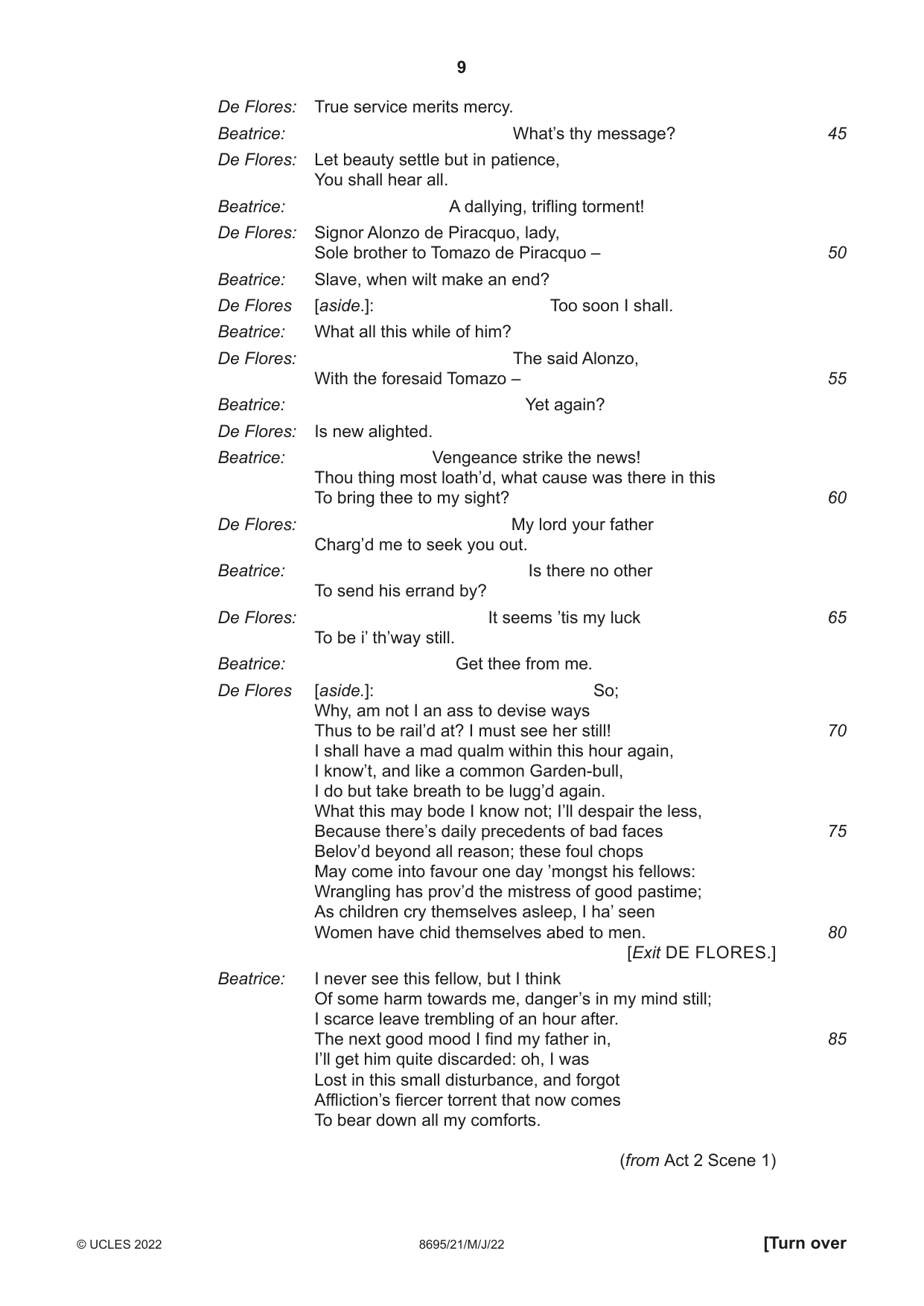
9 8695/21/M/J/22 © UCLES 2022 [Turn over De Flores: True service merits mercy. Beatrice: What’s thy message? De Flores: Let beauty settle but in patience, You shall hear all. Beatrice: A dallying, trifling torment! De Flores: Signor Alonzo de Piracquo, lady, Sole brother to Tomazo de Piracquo – Beatrice: Slave, when wilt make an end? De Flores [aside.]: Too soon I shall. Beatrice: What all this while of him? De Flores: The said Alonzo, With the foresaid Tomazo – Beatrice: Yet again? De Flores: Is new alighted. Beatrice: Vengeance strike the news! Thou thing most loath’d, what cause was there in this To bring thee to my sight? De Flores: My lord your father Charg’d me to seek you out. Beatrice: Is there no other To send his errand by? De Flores: It seems ’tis my luck To be i’ th’way still. Beatrice: Get thee from me. De Flores [aside.]: So; Why, am not I an ass to devise ways Thus to be rail’d at? I must see her still! I shall have a mad qualm within this hour again, I know’t, and like a common Garden-bull, I do but take breath to be lugg’d again. What this may bode I know not; I’ll despair the less, Because there’s daily precedents of bad faces Belov’d beyond all reason; these foul chops May come into favour one day ’mongst his fellows: Wrangling has prov’d the mistress of good pastime; As children cry themselves asleep, I ha’ seen Women have chid themselves abed to men. [Exit DE FLORES.] Beatrice: I never see this fellow, but I think Of some harm towards me, danger’s in my mind still; I scarce leave trembling of an hour after. The next good mood I find my father in, I’ll get him quite discarded: oh, I was Lost in this small disturbance, and forgot Affliction’s fiercer torrent that now comes To bear down all my comforts. (from Act 2 Scene 1) 45 50 55 60 65 70 75 80 85
Question paper, page 10
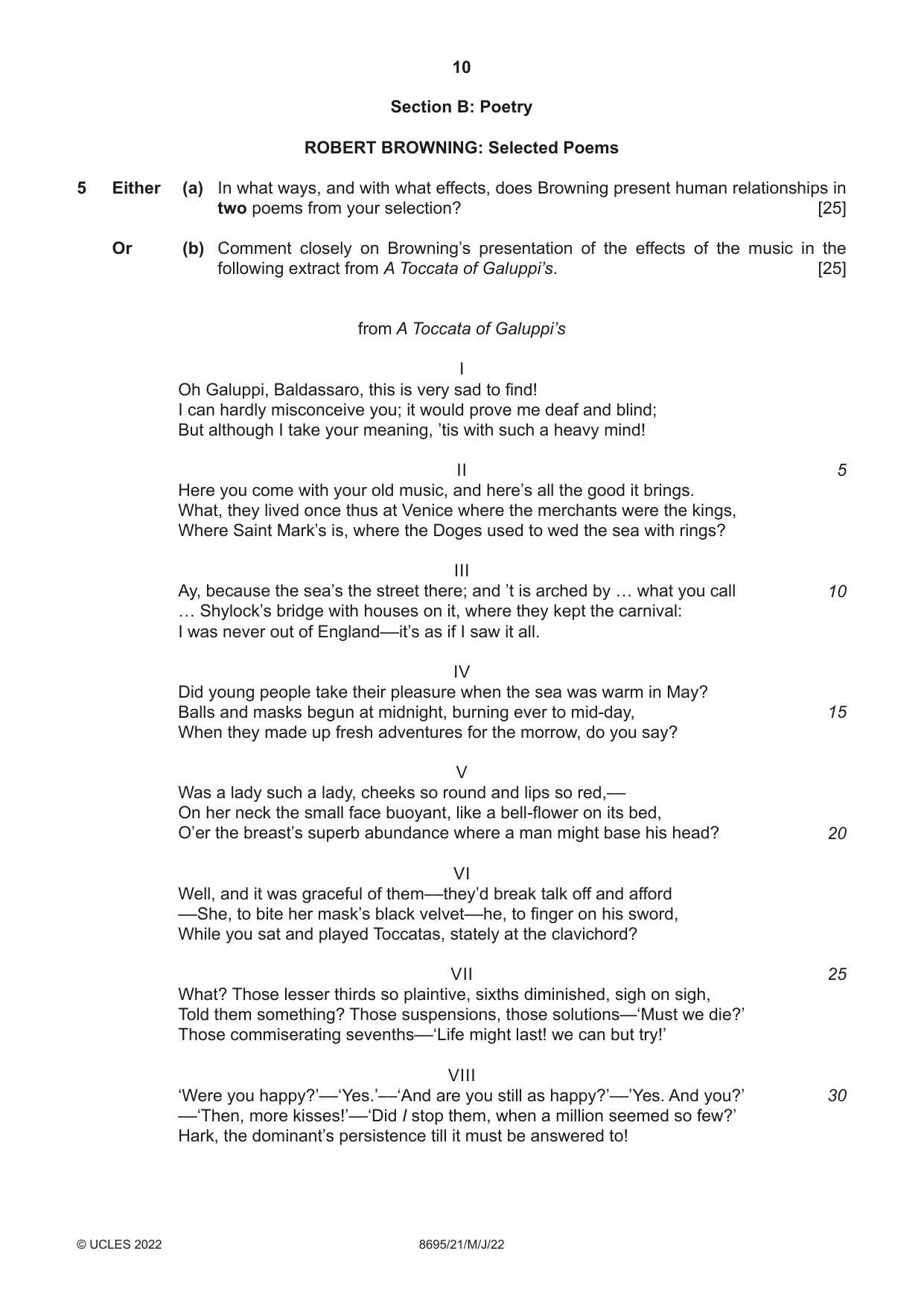
10 8695/21/M/J/22 © UCLES 2022 Section B: Poetry ROBERT BROWNING: Selected Poems 5 Either (a) In what ways, and with what effects, does Browning present human relationships in two poems from your selection? [25] Or (b) Comment closely on Browning’s presentation of the effects of the music in the following extract from A Toccata of Galuppi’s. [25] from A Toccata of Galuppi’s I Oh Galuppi, Baldassaro, this is very sad to find! I can hardly misconceive you; it would prove me deaf and blind; But although I take your meaning, ’tis with such a heavy mind! II Here you come with your old music, and here’s all the good it brings. What, they lived once thus at Venice where the merchants were the kings, Where Saint Mark’s is, where the Doges used to wed the sea with rings? III Ay, because the sea’s the street there; and ’t is arched by … what you call … Shylock’s bridge with houses on it, where they kept the carnival: I was never out of England––it’s as if I saw it all. IV Did young people take their pleasure when the sea was warm in May? Balls and masks begun at midnight, burning ever to mid-day, When they made up fresh adventures for the morrow, do you say? V Was a lady such a lady, cheeks so round and lips so red,–– On her neck the small face buoyant, like a bell-flower on its bed, O’er the breast’s superb abundance where a man might base his head? VI Well, and it was graceful of them––they’d break talk off and afford ––She, to bite her mask’s black velvet––he, to finger on his sword, While you sat and played Toccatas, stately at the clavichord? VII What? Those lesser thirds so plaintive, sixths diminished, sigh on sigh, Told them something? Those suspensions, those solutions—‘Must we die?’ Those commiserating sevenths––‘Life might last! we can but try!’ VIII ‘Were you happy?’––‘Yes.’––‘And are you still as happy?’––’Yes. And you?’ ––‘Then, more kisses!’––‘Did I stop them, when a million seemed so few?’ Hark, the dominant’s persistence till it must be answered to! 5 10 15 20 25 30
Question paper, page 11
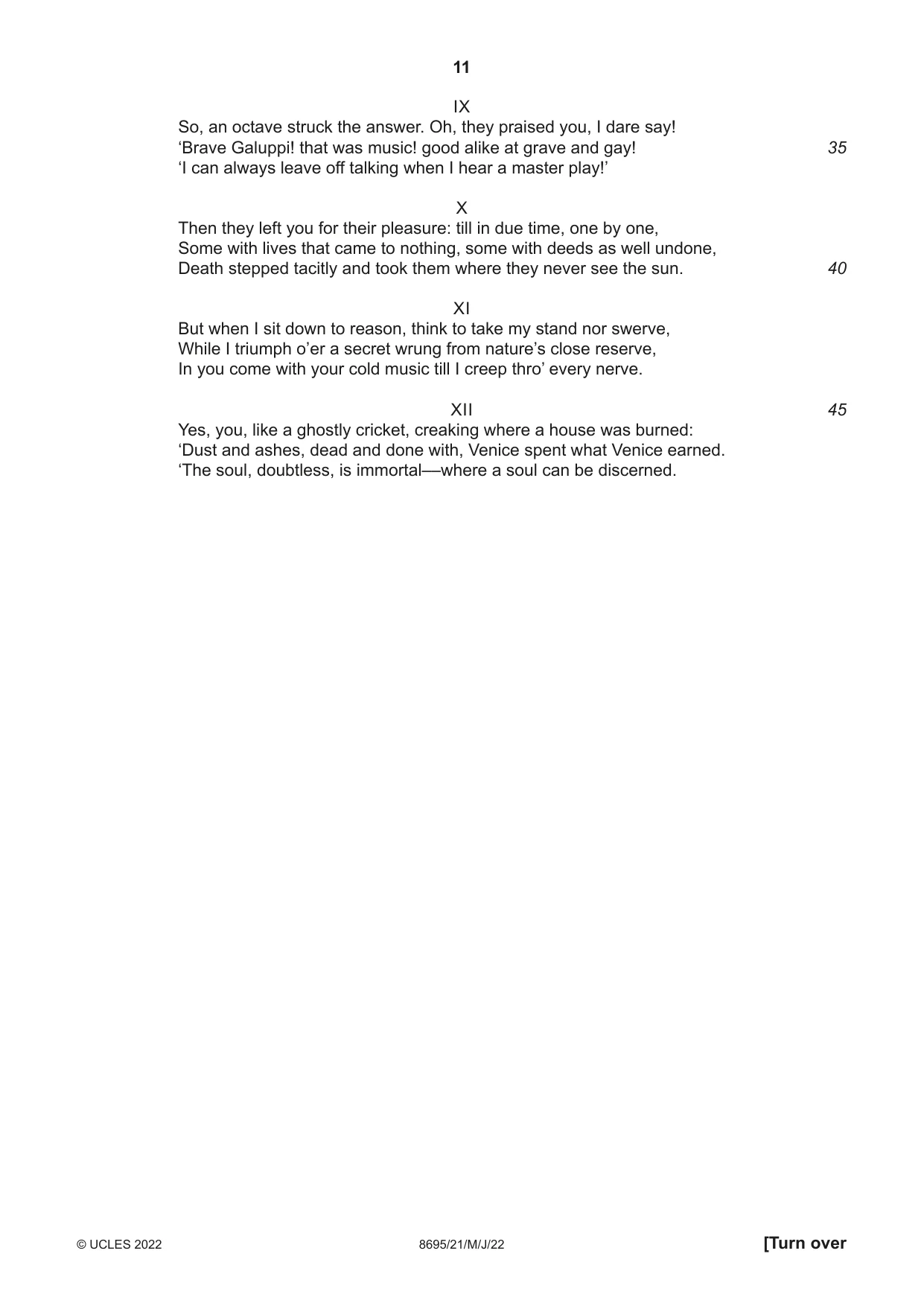
11 8695/21/M/J/22 © UCLES 2022 [Turn over IX So, an octave struck the answer. Oh, they praised you, I dare say! ‘Brave Galuppi! that was music! good alike at grave and gay! ‘I can always leave off talking when I hear a master play!’ X Then they left you for their pleasure: till in due time, one by one, Some with lives that came to nothing, some with deeds as well undone, Death stepped tacitly and took them where they never see the sun. XI But when I sit down to reason, think to take my stand nor swerve, While I triumph o’er a secret wrung from nature’s close reserve, In you come with your cold music till I creep thro’ every nerve. XII Yes, you, like a ghostly cricket, creaking where a house was burned: ‘Dust and ashes, dead and done with, Venice spent what Venice earned. ‘The soul, doubtless, is immortal––where a soul can be discerned. 35 40 45
Question paper, page 12
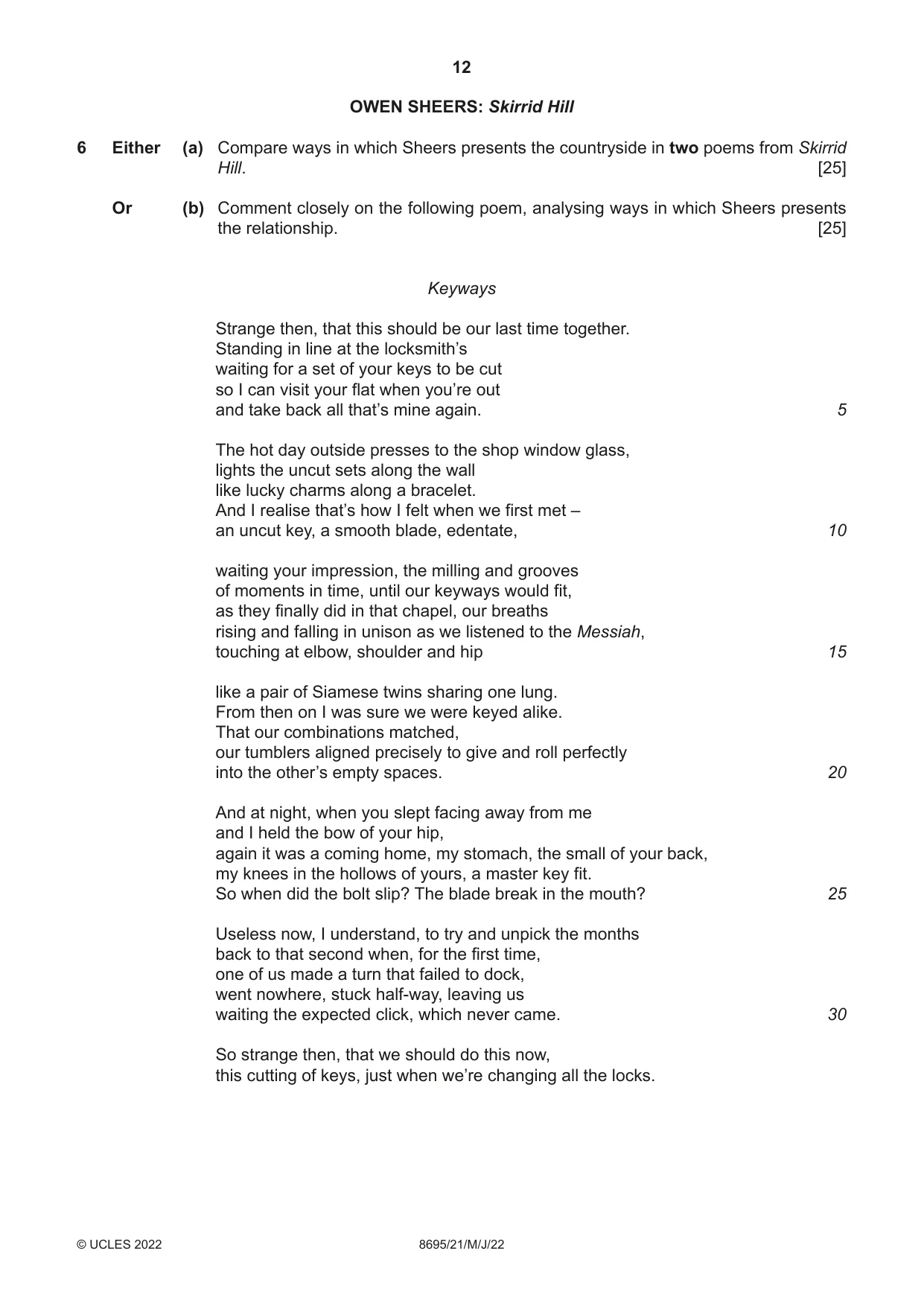
12 8695/21/M/J/22 © UCLES 2022 OWEN SHEERS: Skirrid Hill 6 Either (a) Compare ways in which Sheers presents the countryside in two poems from Skirrid Hill. [25] Or (b) Comment closely on the following poem, analysing ways in which Sheers presents the relationship. [25] Keyways Strange then, that this should be our last time together. Standing in line at the locksmith’s waiting for a set of your keys to be cut so I can visit your flat when you’re out and take back all that’s mine again. The hot day outside presses to the shop window glass, lights the uncut sets along the wall like lucky charms along a bracelet. And I realise that’s how I felt when we first met – an uncut key, a smooth blade, edentate, waiting your impression, the milling and grooves of moments in time, until our keyways would fit, as they finally did in that chapel, our breaths rising and falling in unison as we listened to the Messiah, touching at elbow, shoulder and hip like a pair of Siamese twins sharing one lung. From then on I was sure we were keyed alike. That our combinations matched, our tumblers aligned precisely to give and roll perfectly into the other’s empty spaces. And at night, when you slept facing away from me and I held the bow of your hip, again it was a coming home, my stomach, the small of your back, my knees in the hollows of yours, a master key fit. So when did the bolt slip? The blade break in the mouth? Useless now, I understand, to try and unpick the months back to that second when, for the first time, one of us made a turn that failed to dock, went nowhere, stuck half-way, leaving us waiting the expected click, which never came. So strange then, that we should do this now, this cutting of keys, just when we’re changing all the locks. 5 10 15 20 25 30
Question paper, page 13
13 8695/21/M/J/22 © UCLES 2022 [Turn over Songs of Ourselves, Volume 2 7 Either (a) Discuss ways in which two poems explore sadness. [25] Or (b) Comment closely on the following extract from Darkness, analysing ways in which Byron creates atmosphere. [25] from Darkness I had a dream, which was not all a dream. The bright sun was extinguish’d, and the stars Did wander darkling in the eternal space, Rayless, and pathless, and the icy earth Swung blind and blackening in the moonless air; Morn came, and went—and came, and brought no day, And men forgot their passions in the dread Of this their desolation; and all hearts Were chill’d into a selfish prayer for light: And they did live by watchfires—and the thrones, The palaces of crowned kings—the huts, The habitations of all things which dwell, Were burnt for beacons; cities were consumed, And men were gathered round their blazing homes To look once more into each other’s face; Happy were those who dwelt within the eye Of the volcanos, and their mountain-torch: A fearful hope was all the world contain’d; Forests were set on fire—but hour by hour They fell and faded—and the crackling trunks Extinguish’d with a crash—and all was black. (George Gordon, Lord Byron) 5 10 15 20
Question paper, page 14
14 8695/21/M/J/22 © UCLES 2022 GILLIAN CLARKE: Selected Poems 8 Either (a) Discuss ways in which Clarke explores the effects of time passing in two poems. [25] Or (b) Paying close attention to Clarke’s poetic methods, discuss the presentation of the speaker’s feelings about the baby in the following poem. [25] Baby-sitting I am sitting in a strange room listening For the wrong baby. I don’t love This baby. She is sleeping a snuffly Roseate, bubbling sleep; she is fair; She is a perfectly acceptable child. I am afraid of her. If she wakes She will hate me. She will shout Her hot midnight rage, her nose Will stream disgustingly and the perfume Of her breath will fail to enchant me. To her I will represent absolute Abandonment. For her it will be worse Than for the lover cold in lonely Sheets; worse than for the woman who waits A moment to collect her dignity Beside the bleached bone in the terminal ward. As she rises sobbing from the monstrous land Stretching for milk-familiar comforting, She will find me and between us two It will not come. It will not come. 5 10 15 20
Question paper, page 15
15 8695/21/M/J/22 © UCLES 2022 [Turn over BLANK PAGE TURN OVER FOR SECTION C.
Question paper, page 16
16 8695/21/M/J/22 © UCLES 2022 Section C: Prose IAN McEWAN: Atonement 9 Either (a) Discuss some of the effects of McEwan’s use of the four-part structure of the novel. [25] Or (b) Comment closely on the following passage, considering ways in which it presents the relationship between Robbie and Cecilia. [25] But there was one external development, one shadow that he had to refer to. Cee.’ (from Part 2) Content removed due to copyright restrictions.
Question paper, page 17
17 8695/21/M/J/22 © UCLES 2022 [Turn over NGŨGĨ WA THIONG’O: Petals of Blood 10 Either (a) Discuss Ngũgĩ’s presentation of the villagers’ arrival in the city after the Journey. [25] Or (b) Comment closely on the presentation of Wanja’s experience in the following passage. [25] ‘At about this time a certain man came and bought a plot very near our home, and he put up a stone building with a huge iron tank for catching rainwater. I became a little more studious and even endured the leering triumphant laughter and snide comments of the maths teacher. (from Chapter 2) Content removed due to copyright restrictions.
Question paper, page 18
18 8695/21/M/J/22 © UCLES 2022 Stories of Ourselves, Volume 2 11 Either (a) Compare ways in which two stories present the death of a character. [25] Or (b) Comment closely on ways in which the following passage from The Plantation presents Namidi and the plantation. [25] The plantation grew from the moist underbelly of the Jesse swamps. That place where a luxuriant mesh of greenery blocked away the sun and surrounded everything in sight; just as it surrounded Namidi that morning as he moved about to inspect his trees and traps. He walked across the winding tract of grassy soil – beaten out of the forest at the onset of planting seasons by the young men of the village, with hoes and machetes, spurred on by the bullish power of the native beer. It was the harmattan season; the parching land breeze charged at him from the rubber trees and made the hairs on his skin bristle. This place was an emblem of life to him – the high-pitched whistle of the birds; the cold drizzle of early morning dew; the soft, earthy, muskiness of the air; the endless reams of foliage and the rubber trees that glistened with sap. The plantation seemed to glow with a curious mysteriousness which followed him about as he moved abstractedly, slashing at the banners of plant-leaves that heaved across his path, his face a picture of dark brooding. There followed a small moment of prickling silence, when it seemed as if the murmur of the plantation was suspended in a state of waiting; as though giving audience to some novelty event. Namidi’s nostrils picked up an odd, sickly smell that set his stomach on edge as he moved about; and with it floated an alien, trickling sound. He paused in mid-stride and cocked his ears at the trees. He stood still for a long time, listening, watching and sniffing, until, perhaps touched by an uncertain impulse, he looked behind a thicket a few feet away. If the trees had started talking to him he would not have been more surprised. A stream of fluid burst forth from the ground and splashed all around in a wayward arc. It flowed across the adjoining greenery, which seemed to shrink away from the onslaught. He watched as a puddle of fluid gathered around him and washed across the plantation. With his senses invaded by the strong stench, he realized it was petrol. Once, many years ago, some men from the city in khaki uniforms had come to the village with long pipes and heavy trucks. Their spectacle had held the attention of the village people for many days. They had dug across the village grounds, through the plantation and the nearby forests; buried the pipes and then left. A pipe must have broken, was the first thought that came to Namidi; he must ask the village head to do something about it. But such noble thoughts soon evaporated as he turned the matter over in his mind. Yes, it was surely petrol, but of what benefit would this be to him? There was an opportunity here, if only the meddling of the villagers would let him. Then a small grin lit up his face. Yes, he knew what to do. He filled the rubber gourd with some petrol and then started towards the village. When he emerged from the plantation the early morning sun was rising confidently in the skies. He walked on, scarcely responding to the greetings of the village women going to their farms. He, who usually lingered over greetings, now wished the women would all disappear and leave him alone. ‘Greetings, Sir,’ a group of women rallied at him. ‘Greetings, good women,’ he replied and hurried on without a glance in their direction. ‘What is wrong with him?’ one of them asked as they appraised the retreating figure. Namidi was moving briskly on the narrow path, his head thrust forward, like it was going to fall away from his neck. 5 10 15 20 25 30 35 40 45
Question paper, page 19
19 8695/21/M/J/22 © UCLES 2022 [Turn over ‘He looks like he has seen a ghost,’ another said, clapping her hands excitedly. ‘And he has this smell around him,’ another one added. ‘It smells like something they use with their rubber,’ said another one. They stared at the departing figure and shook their heads in puzzlement. (from The Plantation) 50
Question paper, page 20
20 8695/21/M/J/22 © UCLES 2022 MARK TWAIN: The Adventures of Huckleberry Finn 12 Either (a) Discuss ways in which Twain presents slavery in the novel. [25] Or (b) Comment closely on the presentation of Huck’s experience in the fog in the following passage. [25] I did wish the fool would think to beat a tin pan, and beat it all the time, but he never did, and it was the still places between the whoops that was making the trouble for me. Well, I fought along, and directly I hears the whoop behind me. I was tangled good, now. That was somebody else’s whoop, or else I was turned around. I throwed the paddle down. I heard the whoop again; it was behind me yet, but in a different place; it kept coming, and kept changing its place, and I kept answering, till by-and-by it was in front of me again and I knowed the current had swung the canoe’s head down stream and I was all right, if that was Jim and not some other raftsman hollering. I couldn’t tell nothing about voices in a fog, for nothing don’t look natural nor sound natural in a fog. The whooping went on, and in about a minute I come a booming down on a cut bank with smoky ghosts of big trees on it, and the current throwed me off to the left and shot by, amongst a lot of snags that fairly roared, the current was tearing by them so swift. In another second or two it was solid white and still again. I set perfectly still, then, listening to my heart thump, and I reckon I didn’t draw a breath while it thumped a hundred. I just give up, then. I knowed what the matter was. That cut bank was an island, and Jim had gone down ’tother side of it. It warn’t no tow-head, that you could float by in ten minutes. It had the big timber of a regular island; it might be five or six mile long and more than a half a mile wide. I kept quiet, with my ears cocked, about fifteen minutes, I reckon. I was floating along, of course, four or five mile an hour; but you don’t ever think of that. No, you feel like you are laying dead still on the water; and if a little glimpse of a snag slips by, you don’t think to yourself how fast you’re going, but you catch your breath and think, my! how that snag’s tearing along. If you think it ain’t dismal and lonesome out in a fog that way, by yourself, in the night, you try it once – you’ll see. Next, for about a half an hour, I whoops now and then; at last I hears the answer a long ways off, and tries to follow it, but I couldn’t do it, and directly I judged I’d got into a nest of tow-heads, for I had little dim glimpses of them on both sides of me, sometimes just a narrow channel between; and some that I couldn’t see, I knowed was there, because I’d hear the wash of the current against the old dead brush and trash that hung over the banks. Well, I warn’t long losing the whoops, down amongst the tow-heads; and I only tried to chase them a little while, anyway, because it was worse than chasing a Jack-o-lantern. You never knowed a sound dodge around so, and swap places so quick and so much. I had to claw away from the bank pretty lively, four or five times, to keep from knocking the islands out of the river; and so I judged the raft must be butting into the bank every now and then, or else it would get further ahead and clear out of hearing – it was floating a little faster than what I was. (from Chapter 15) 5 10 15 20 25 30 35 40
Question paper, page 21
21 8695/21/M/J/22 © UCLES 2022 BLANK PAGE
Question paper, page 22
22 8695/21/M/J/22 © UCLES 2022 BLANK PAGE
Question paper, page 23
23 8695/21/M/J/22 © UCLES 2022 BLANK PAGE
Question paper, page 24
24 8695/21/M/J/22 © UCLES 2022 Permission to reproduce items where third-party owned material protected by copyright is included has been sought and cleared where possible. Every reasonable effort has been made by the publisher (UCLES) to trace copyright holders, but if any items requiring clearance have unwittingly been included, the publisher will be pleased to make amends at the earliest possible opportunity. To avoid the issue of disclosure of answer-related information to candidates, all copyright acknowledgements are reproduced online in the Cambridge Assessment International Education Copyright Acknowledgements Booklet. This is produced for each series of examinations and is freely available to download at www.cambridgeinternational.org after the live examination series. Cambridge Assessment International Education is part of Cambridge Assessment. Cambridge Assessment is the brand name of the University of Cambridge Local Examinations Syndicate (UCLES), which is a department of the University of Cambridge. BLANK PAGE
Mark scheme, page 1
This document consists of 13 printed pages. © UCLES 2022 [Turn over Cambridge International AS Level LANGUAGE AND LITERATURE IN ENGLISH 8695/21 Paper 2 Drama, Poetry and Prose May/June 2022 MARK SCHEME Maximum Mark: 50 Published This mark scheme is published as an aid to teachers and candidates, to indicate the requirements of the examination. It shows the basis on which Examiners were instructed to award marks. It does not indicate the details of the discussions that took place at an Examiners’ meeting before marking began, which would have considered the acceptability of alternative answers. Mark schemes should be read in conjunction with the question paper and the Principal Examiner Report for Teachers. Cambridge International will not enter into discussions about these mark schemes. Cambridge International is publishing the mark schemes for the May/June 2022 series for most Cambridge IGCSE, Cambridge International A and AS Level and Cambridge Pre-U components, and some Cambridge O Level components.
Mark scheme, page 2
8695/21 Cambridge International AS Level – Mark Scheme PUBLISHED May/June 2022 © UCLES 2022 Page 2 of 13 Generic Marking Principles These general marking principles must be applied by all examiners when marking candidate answers. They should be applied alongside the specific content of the mark scheme or generic level descriptors for a question. Each question paper and mark scheme will also comply with these marking principles. GENERIC MARKING PRINCIPLE 1: Marks must be awarded in line with: the specific content of the mark scheme or the generic level descriptors for the question the specific skills defined in the mark scheme or in the generic level descriptors for the question the standard of response required by a candidate as exemplified by the standardisation scripts. GENERIC MARKING PRINCIPLE 2: Marks awarded are always whole marks (not half marks, or other fractions). GENERIC MARKING PRINCIPLE 3: Marks must be awarded positively: marks are awarded for correct/valid answers, as defined in the mark scheme. However, credit is given for valid answers which go beyond the scope of the syllabus and mark scheme, referring to your Team Leader as appropriate marks are awarded when candidates clearly demonstrate what they know and can do marks are not deducted for errors marks are not deducted for omissions answers should only be judged on the quality of spelling, punctuation and grammar when these features are specifically assessed by the question as indicated by the mark scheme. The meaning, however, should be unambiguous. GENERIC MARKING PRINCIPLE 4: Rules must be applied consistently, e.g. in situations where candidates have not followed instructions or in the application of generic level descriptors. GENERIC MARKING PRINCIPLE 5: Marks should be awarded using the full range of marks defined in the mark scheme for the question (however; the use of the full mark range may be limited according to the quality of the candidate responses seen). GENERIC MARKING PRINCIPLE 6: Marks awarded are based solely on the requirements as defined in the mark scheme. Marks should not be awarded with grade thresholds or grade descriptors in mind.
Mark scheme, page 3
8695/21 Cambridge International AS Level – Mark Scheme PUBLISHED May/June 2022 © UCLES 2022 Page 3 of 13 English & Media subject specific general marking principles (To be read in conjunction with the Generic Marking Principles (and requiring further guidance on how to place marks within levels)) Components using level descriptors: We use level descriptors as a guide to broad understanding of the qualities normally expected of, or typical of, work in a level. Level descriptors are a means of general guidance, and should not be interpreted as hurdle statements. Where indicative content notes are supplied for a question, these are not a prescription of required content, and must not be treated as such. Alternative correct points and unexpected answers in candidates’ scripts must be given marks that fairly reflect the knowledge and skills demonstrated. While we may have legitimate expectations as to the ground most answers may occupy, we must at all times be prepared to meet candidates on their chosen ground, provided it is relevant ground (e.g. clearly related to and derived from a relevant passage/text and meeting the mark scheme requirements for the question). Components using point-based marking: Point marking is often used to reward knowledge, understanding and application of skills. We give credit where the candidate’s answer shows relevant knowledge, understanding and application of skills in answering the question. We do not give credit where the answer shows confusion. From this it follows that we: a DO credit answers which are worded differently from the mark scheme if they clearly convey the same meaning (unless the mark scheme requires a specific term). b DO credit alternative answers/examples which are not written in the mark scheme if they are correct. c DO credit answers where candidates give more than one correct answer in one prompt/numbered/scaffolded space where extended writing is required rather than list-type answers. For example, questions that require n reasons (e.g. State two reasons…). d DO NOT credit answers simply for using a ‘key term’ unless that is all that is required. (Check for evidence it is understood and not used wrongly.). e DO NOT credit answers which are obviously self-contradicting or trying to cover all possibilities. f DO NOT give further credit for what is effectively repetition of a correct point already credited unless the language itself is being tested. This applies equally to ‘mirror statements’ (i.e. polluted/not polluted). g DO NOT require spellings to be correct, unless this is part of the test. However spellings of syllabus terms must allow for clear and unambiguous separation from other syllabus terms with which they may be confused (e.g. Corrasion/Corrosion).
Mark scheme, page 4
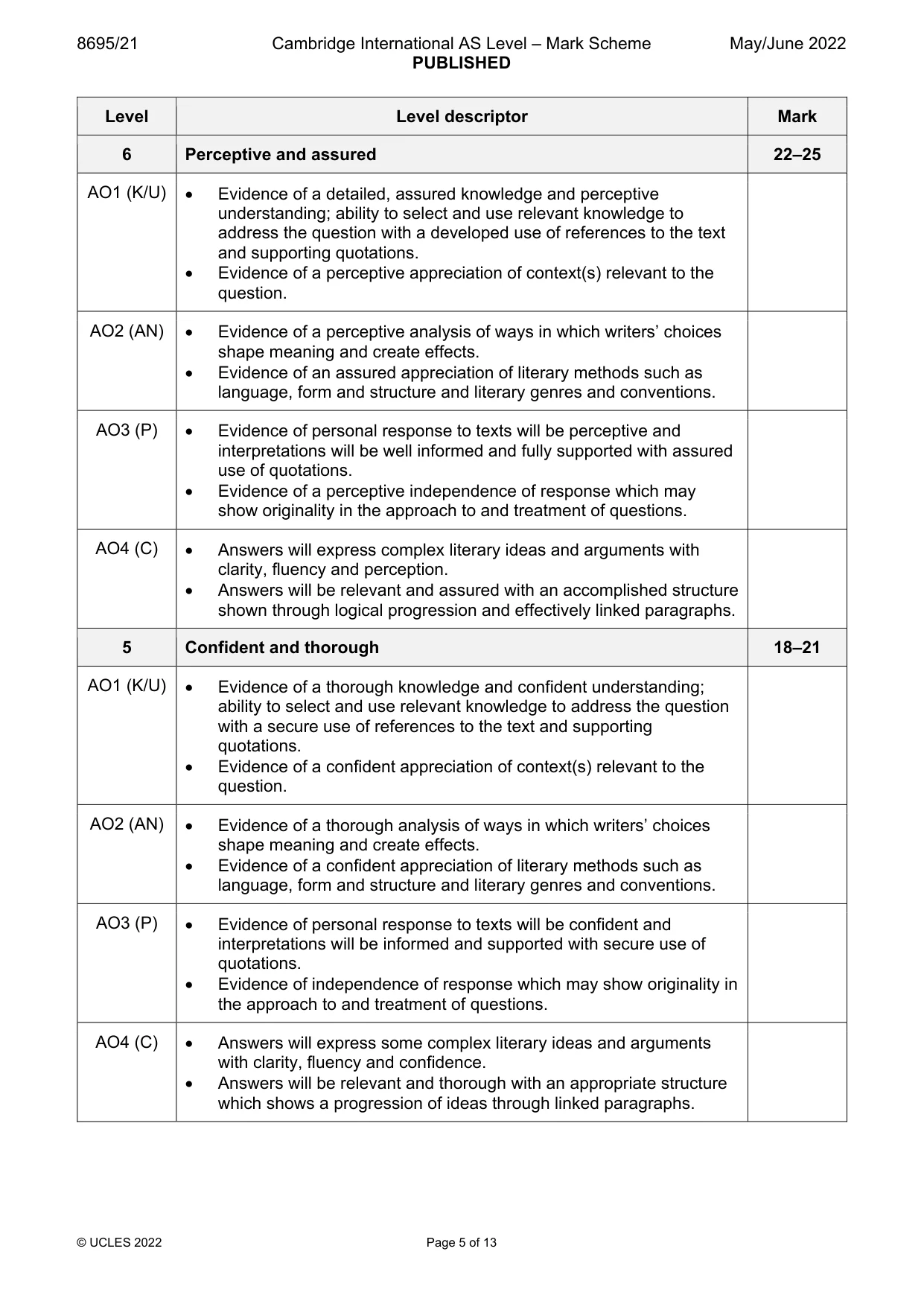
8695/21 Cambridge International AS Level – Mark Scheme PUBLISHED May/June 2022 © UCLES 2022 Page 4 of 13 Literature in English specific marking instructions Using the mark levels Use the generic mark scheme levels to find the mark. Place the answer in a level first. Look for the ‘best fit’ of the answer into a level. An answer needs to show evidence of most but not necessarily ALL of the qualities described in a level, in order to be placed in that level. Then award a mark for the relative position of the answer within the level. Candidates may address the question in many different ways. There is no one required answer or approach and do not penalise answers for leaving out a particular focus. Reward what is there, showing what you are rewarding in your comments. Consider all strands and weigh up the performance as a whole in placing the answer in a level, then show that you have done so in the summative comment. Each answer is marked out of 25, in accordance with the general marking criteria. Assessment objectives All assessment objectives are equally weighted, and all are considered in assessing each essay. Each level in the marking criteria is divided into strands corresponding to the assessment objectives – AO1: Knowledge and understanding (K/U), AO2: Analysis (AN), AO3: Personal response (P), AO4: Communication (C). AO1 Knowledge and understanding Respond with understanding to literary texts in a variety of forms, from different cultures; with an appreciation of relevant contexts that illuminate readings of the texts. AO2 Analysis Analyse ways in which writers’ choices of language, form and structure shape meanings and effects. AO3 Personal response Produce informed independent opinions and interpretations of literary texts. AO4 Communication Communicate a relevant, structured and supported response appropriate to literary study.
Mark scheme, page 5
8695/21 Cambridge International AS Level – Mark Scheme PUBLISHED May/June 2022 © UCLES 2022 Page 5 of 13 Level Level descriptor Mark 6 Perceptive and assured 22–25 AO1 (K/U) Evidence of a detailed, assured knowledge and perceptive understanding; ability to select and use relevant knowledge to address the question with a developed use of references to the text and supporting quotations. Evidence of a perceptive appreciation of context(s) relevant to the question. AO2 (AN) Evidence of a perceptive analysis of ways in which writers’ choices shape meaning and create effects. Evidence of an assured appreciation of literary methods such as language, form and structure and literary genres and conventions. AO3 (P) Evidence of personal response to texts will be perceptive and interpretations will be well informed and fully supported with assured use of quotations. Evidence of a perceptive independence of response which may show originality in the approach to and treatment of questions. AO4 (C) Answers will express complex literary ideas and arguments with clarity, fluency and perception. Answers will be relevant and assured with an accomplished structure shown through logical progression and effectively linked paragraphs. 5 Confident and thorough 18–21 AO1 (K/U) Evidence of a thorough knowledge and confident understanding; ability to select and use relevant knowledge to address the question with a secure use of references to the text and supporting quotations. Evidence of a confident appreciation of context(s) relevant to the question. AO2 (AN) Evidence of a thorough analysis of ways in which writers’ choices shape meaning and create effects. Evidence of a confident appreciation of literary methods such as language, form and structure and literary genres and conventions. AO3 (P) Evidence of personal response to texts will be confident and interpretations will be informed and supported with secure use of quotations. Evidence of independence of response which may show originality in the approach to and treatment of questions. AO4 (C) Answers will express some complex literary ideas and arguments with clarity, fluency and confidence. Answers will be relevant and thorough with an appropriate structure which shows a progression of ideas through linked paragraphs.
Mark scheme, page 6
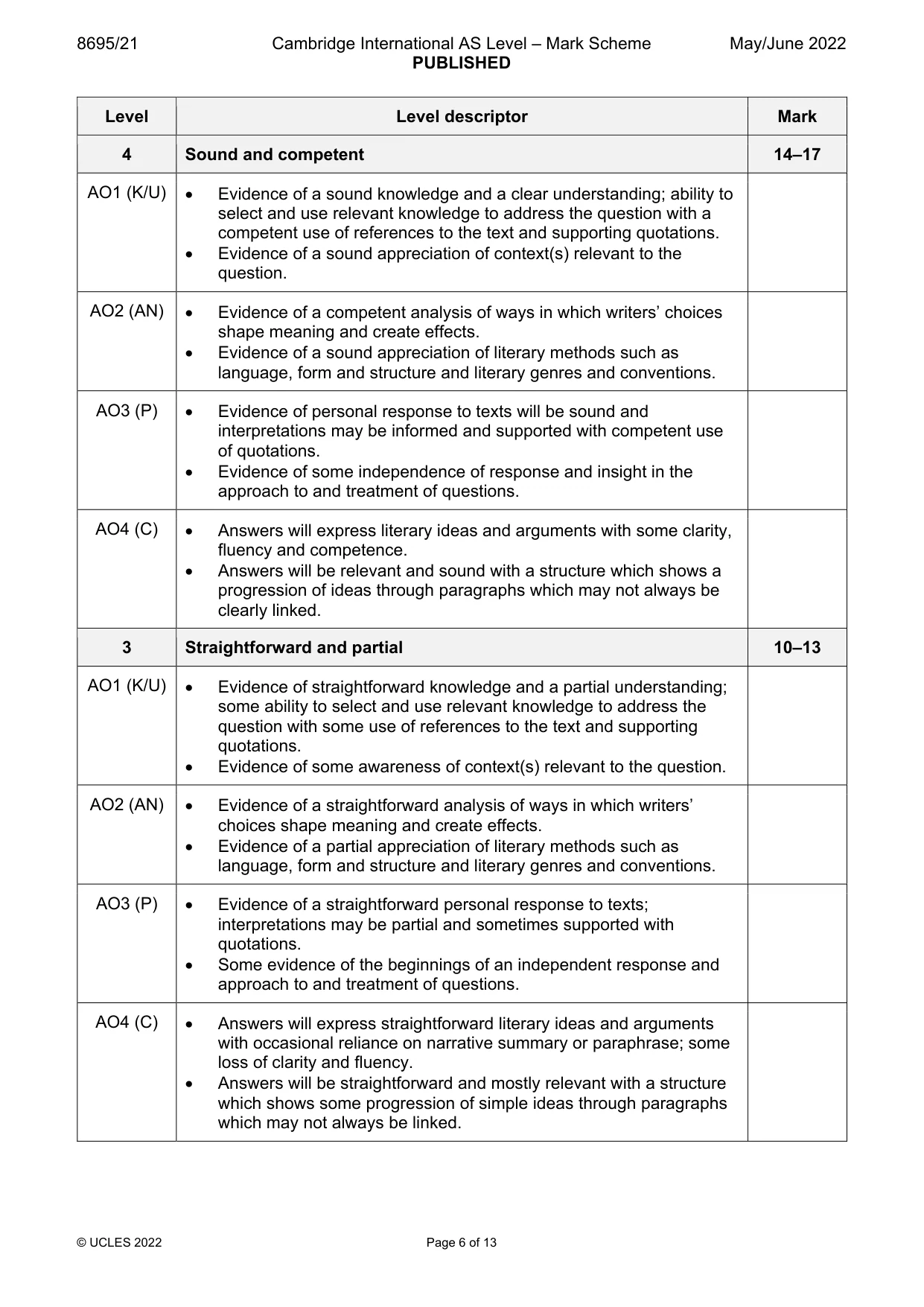
8695/21 Cambridge International AS Level – Mark Scheme PUBLISHED May/June 2022 © UCLES 2022 Page 6 of 13 Level Level descriptor Mark 4 Sound and competent 14–17 AO1 (K/U) Evidence of a sound knowledge and a clear understanding; ability to select and use relevant knowledge to address the question with a competent use of references to the text and supporting quotations. Evidence of a sound appreciation of context(s) relevant to the question. AO2 (AN) Evidence of a competent analysis of ways in which writers’ choices shape meaning and create effects. Evidence of a sound appreciation of literary methods such as language, form and structure and literary genres and conventions. AO3 (P) Evidence of personal response to texts will be sound and interpretations may be informed and supported with competent use of quotations. Evidence of some independence of response and insight in the approach to and treatment of questions. AO4 (C) Answers will express literary ideas and arguments with some clarity, fluency and competence. Answers will be relevant and sound with a structure which shows a progression of ideas through paragraphs which may not always be clearly linked. 3 Straightforward and partial 10–13 AO1 (K/U) Evidence of straightforward knowledge and a partial understanding; some ability to select and use relevant knowledge to address the question with some use of references to the text and supporting quotations. Evidence of some awareness of context(s) relevant to the question. AO2 (AN) Evidence of a straightforward analysis of ways in which writers’ choices shape meaning and create effects. Evidence of a partial appreciation of literary methods such as language, form and structure and literary genres and conventions. AO3 (P) Evidence of a straightforward personal response to texts; interpretations may be partial and sometimes supported with quotations. Some evidence of the beginnings of an independent response and approach to and treatment of questions. AO4 (C) Answers will express straightforward literary ideas and arguments with occasional reliance on narrative summary or paraphrase; some loss of clarity and fluency. Answers will be straightforward and mostly relevant with a structure which shows some progression of simple ideas through paragraphs which may not always be linked.
Mark scheme, page 7
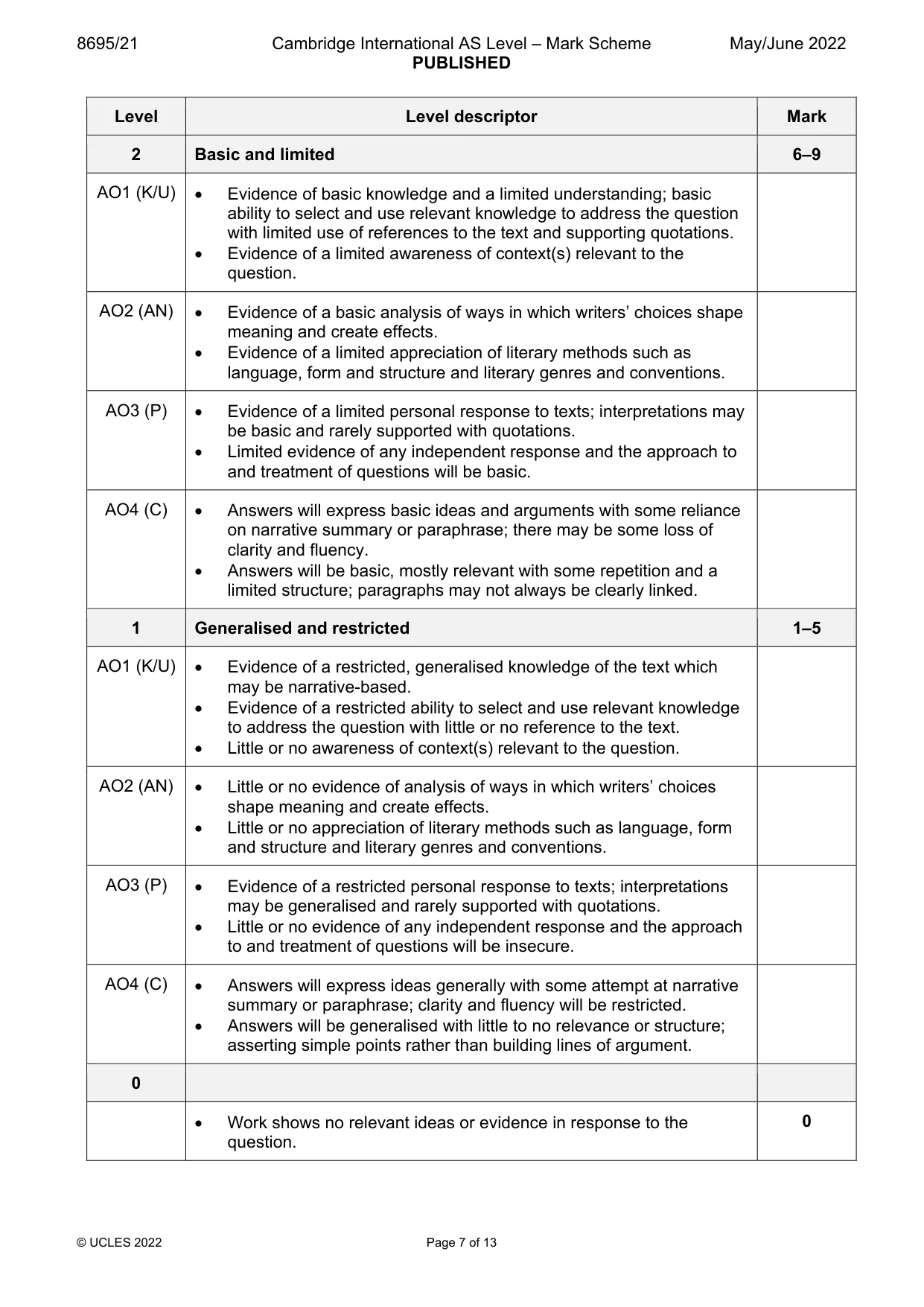
8695/21 Cambridge International AS Level – Mark Scheme PUBLISHED May/June 2022 © UCLES 2022 Page 7 of 13 Level Level descriptor Mark 2 Basic and limited 6–9 AO1 (K/U) Evidence of basic knowledge and a limited understanding; basic ability to select and use relevant knowledge to address the question with limited use of references to the text and supporting quotations. Evidence of a limited awareness of context(s) relevant to the question. AO2 (AN) Evidence of a basic analysis of ways in which writers’ choices shape meaning and create effects. Evidence of a limited appreciation of literary methods such as language, form and structure and literary genres and conventions. AO3 (P) Evidence of a limited personal response to texts; interpretations may be basic and rarely supported with quotations. Limited evidence of any independent response and the approach to and treatment of questions will be basic. AO4 (C) Answers will express basic ideas and arguments with some reliance on narrative summary or paraphrase; there may be some loss of clarity and fluency. Answers will be basic, mostly relevant with some repetition and a limited structure; paragraphs may not always be clearly linked. 1 Generalised and restricted 1–5 AO1 (K/U) Evidence of a restricted, generalised knowledge of the text which may be narrative-based. Evidence of a restricted ability to select and use relevant knowledge to address the question with little or no reference to the text. Little or no awareness of context(s) relevant to the question. AO2 (AN) Little or no evidence of analysis of ways in which writers’ choices shape meaning and create effects. Little or no appreciation of literary methods such as language, form and structure and literary genres and conventions. AO3 (P) Evidence of a restricted personal response to texts; interpretations may be generalised and rarely supported with quotations. Little or no evidence of any independent response and the approach to and treatment of questions will be insecure. AO4 (C) Answers will express ideas generally with some attempt at narrative summary or paraphrase; clarity and fluency will be restricted. Answers will be generalised with little to no relevance or structure; asserting simple points rather than building lines of argument. 0 Work shows no relevant ideas or evidence in response to the question. 0
Mark scheme, page 8
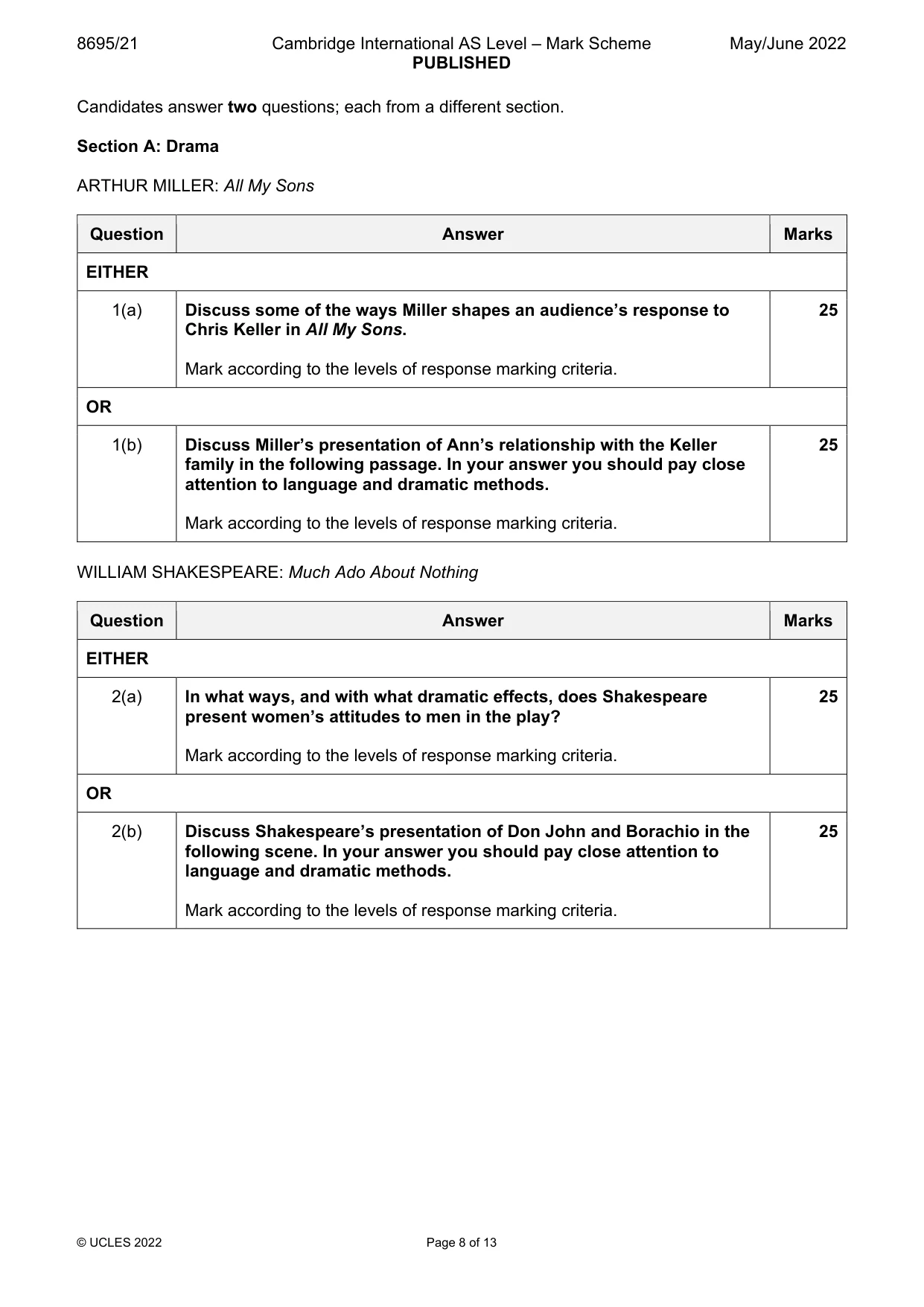
8695/21 Cambridge International AS Level – Mark Scheme PUBLISHED May/June 2022 © UCLES 2022 Page 8 of 13 Candidates answer two questions; each from a different section. Section A: Drama ARTHUR MILLER: All My Sons Question Answer Marks EITHER 1(a) Discuss some of the ways Miller shapes an audience’s response to Chris Keller in All My Sons. Mark according to the levels of response marking criteria. 25 OR 1(b) Discuss Miller’s presentation of Ann’s relationship with the Keller family in the following passage. In your answer you should pay close attention to language and dramatic methods. Mark according to the levels of response marking criteria. 25 WILLIAM SHAKESPEARE: Much Ado About Nothing Question Answer Marks EITHER 2(a) In what ways, and with what dramatic effects, does Shakespeare present women’s attitudes to men in the play? Mark according to the levels of response marking criteria. 25 OR 2(b) Discuss Shakespeare’s presentation of Don John and Borachio in the following scene. In your answer you should pay close attention to language and dramatic methods. Mark according to the levels of response marking criteria. 25
Mark scheme, page 9
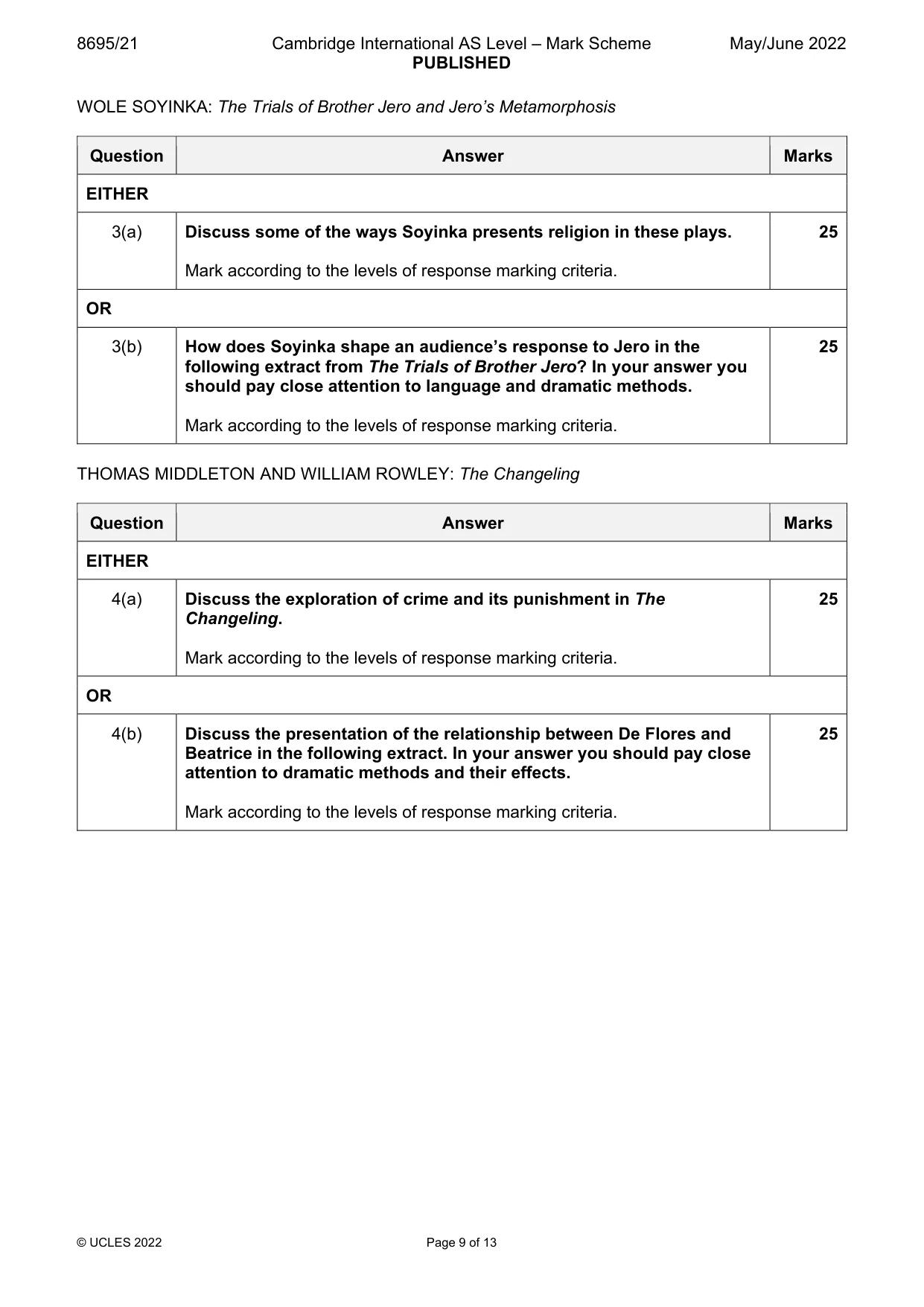
8695/21 Cambridge International AS Level – Mark Scheme PUBLISHED May/June 2022 © UCLES 2022 Page 9 of 13 WOLE SOYINKA: The Trials of Brother Jero and Jero’s Metamorphosis Question Answer Marks EITHER 3(a) Discuss some of the ways Soyinka presents religion in these plays. Mark according to the levels of response marking criteria. 25 OR 3(b) How does Soyinka shape an audience’s response to Jero in the following extract from The Trials of Brother Jero? In your answer you should pay close attention to language and dramatic methods. Mark according to the levels of response marking criteria. 25 THOMAS MIDDLETON AND WILLIAM ROWLEY: The Changeling Question Answer Marks EITHER 4(a) Discuss the exploration of crime and its punishment in The Changeling. Mark according to the levels of response marking criteria. 25 OR 4(b) Discuss the presentation of the relationship between De Flores and Beatrice in the following extract. In your answer you should pay close attention to dramatic methods and their effects. Mark according to the levels of response marking criteria. 25
Mark scheme, page 10
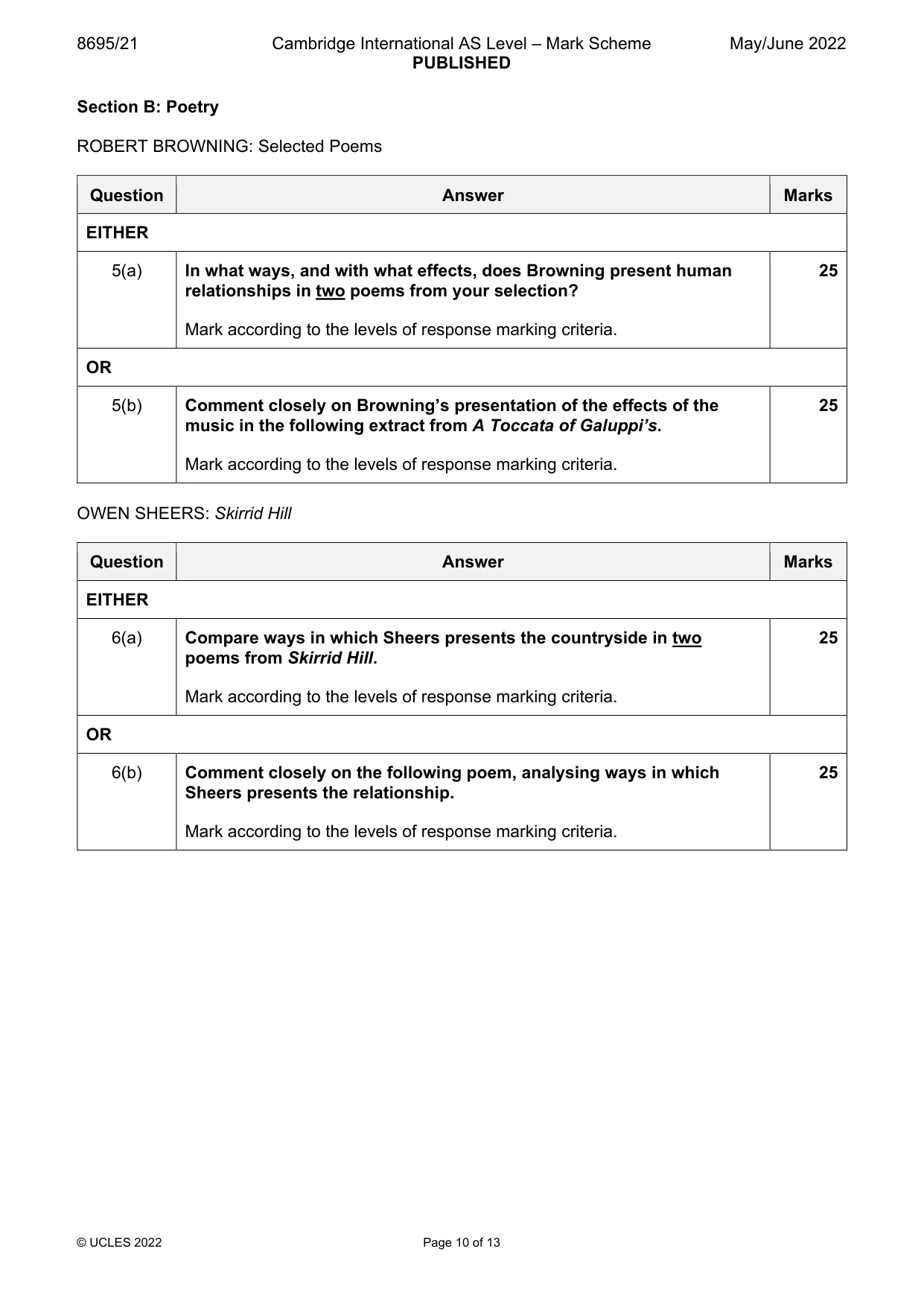
8695/21 Cambridge International AS Level – Mark Scheme PUBLISHED May/June 2022 © UCLES 2022 Page 10 of 13 Section B: Poetry ROBERT BROWNING: Selected Poems Question Answer Marks EITHER 5(a) In what ways, and with what effects, does Browning present human relationships in two poems from your selection? Mark according to the levels of response marking criteria. 25 OR 5(b) Comment closely on Browning’s presentation of the effects of the music in the following extract from A Toccata of Galuppi’s. Mark according to the levels of response marking criteria. 25 OWEN SHEERS: Skirrid Hill Question Answer Marks EITHER 6(a) Compare ways in which Sheers presents the countryside in two poems from Skirrid Hill. Mark according to the levels of response marking criteria. 25 OR 6(b) Comment closely on the following poem, analysing ways in which Sheers presents the relationship. Mark according to the levels of response marking criteria. 25
Mark scheme, page 11
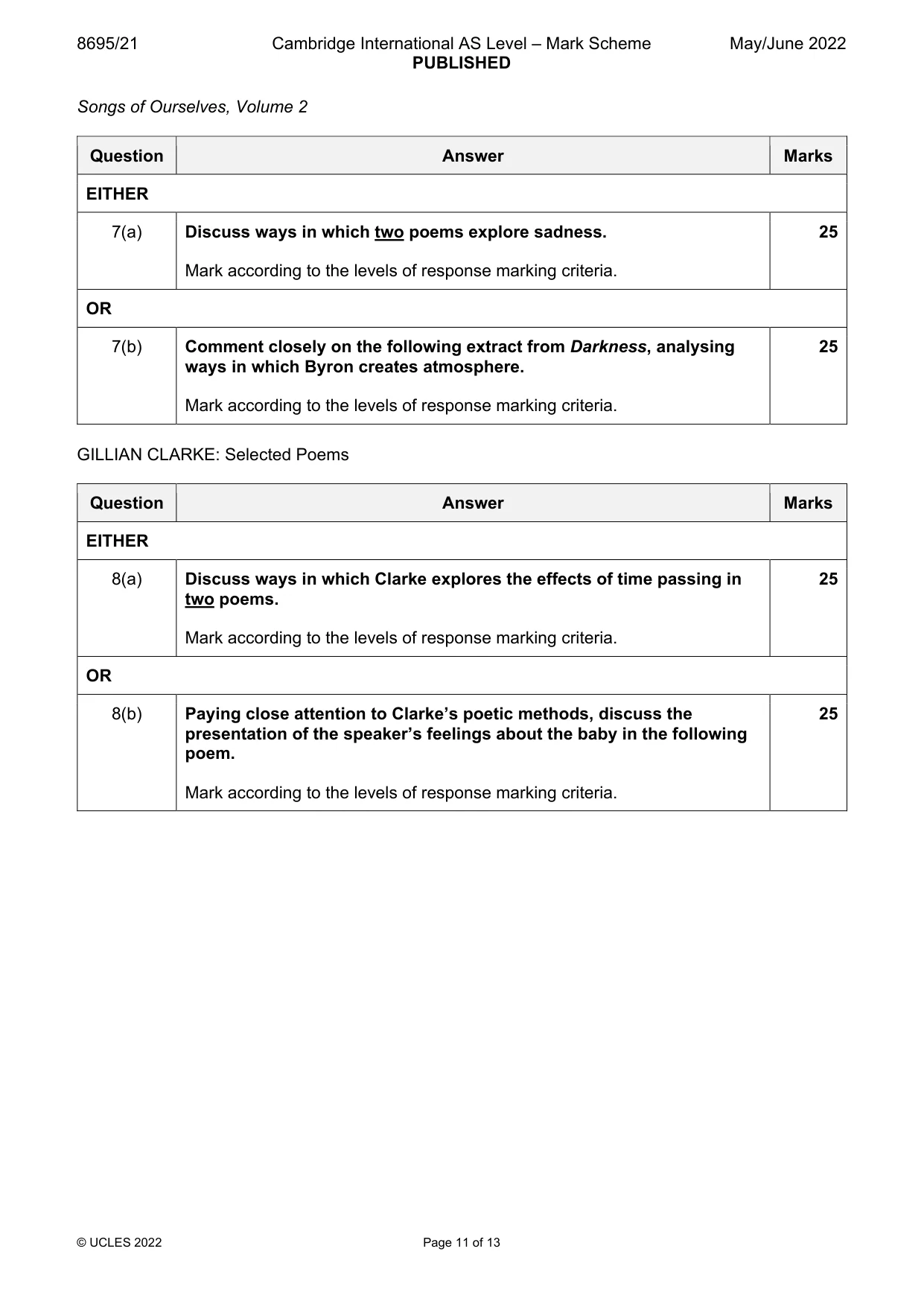
8695/21 Cambridge International AS Level – Mark Scheme PUBLISHED May/June 2022 © UCLES 2022 Page 11 of 13 Songs of Ourselves, Volume 2 Question Answer Marks EITHER 7(a) Discuss ways in which two poems explore sadness. Mark according to the levels of response marking criteria. 25 OR 7(b) Comment closely on the following extract from Darkness, analysing ways in which Byron creates atmosphere. Mark according to the levels of response marking criteria. 25 GILLIAN CLARKE: Selected Poems Question Answer Marks EITHER 8(a) Discuss ways in which Clarke explores the effects of time passing in two poems. Mark according to the levels of response marking criteria. 25 OR 8(b) Paying close attention to Clarke’s poetic methods, discuss the presentation of the speaker’s feelings about the baby in the following poem. Mark according to the levels of response marking criteria. 25
Mark scheme, page 12
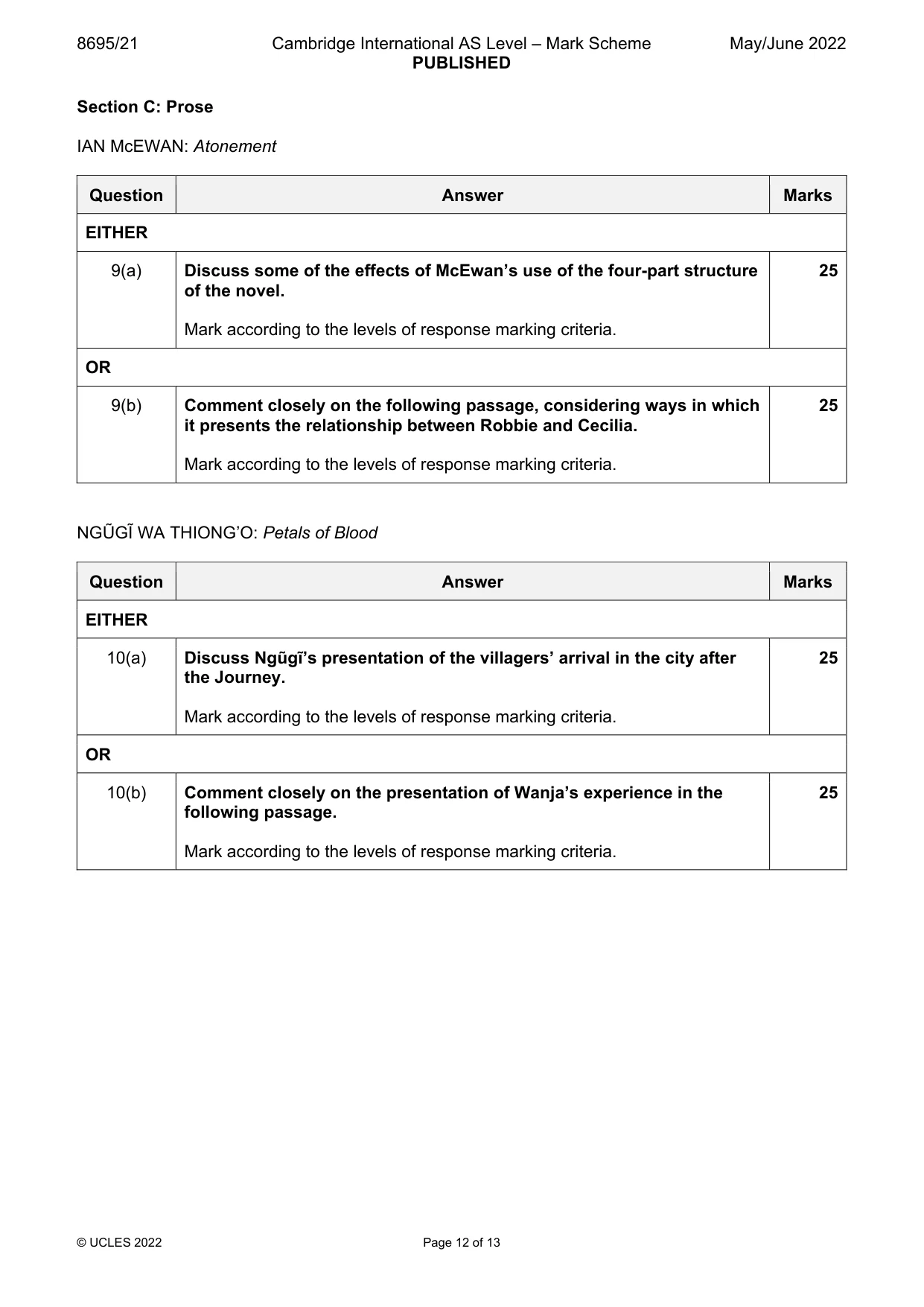
8695/21 Cambridge International AS Level – Mark Scheme PUBLISHED May/June 2022 © UCLES 2022 Page 12 of 13 Section C: Prose IAN McEWAN: Atonement Question Answer Marks EITHER 9(a) Discuss some of the effects of McEwan’s use of the four-part structure of the novel. Mark according to the levels of response marking criteria. 25 OR 9(b) Comment closely on the following passage, considering ways in which it presents the relationship between Robbie and Cecilia. Mark according to the levels of response marking criteria. 25 NGŨGĨ WA THIONG’O: Petals of Blood Question Answer Marks EITHER 10(a) Discuss Ngũgĩ’s presentation of the villagers’ arrival in the city after the Journey. Mark according to the levels of response marking criteria. 25 OR 10(b) Comment closely on the presentation of Wanja’s experience in the following passage. Mark according to the levels of response marking criteria. 25
Mark scheme, page 13
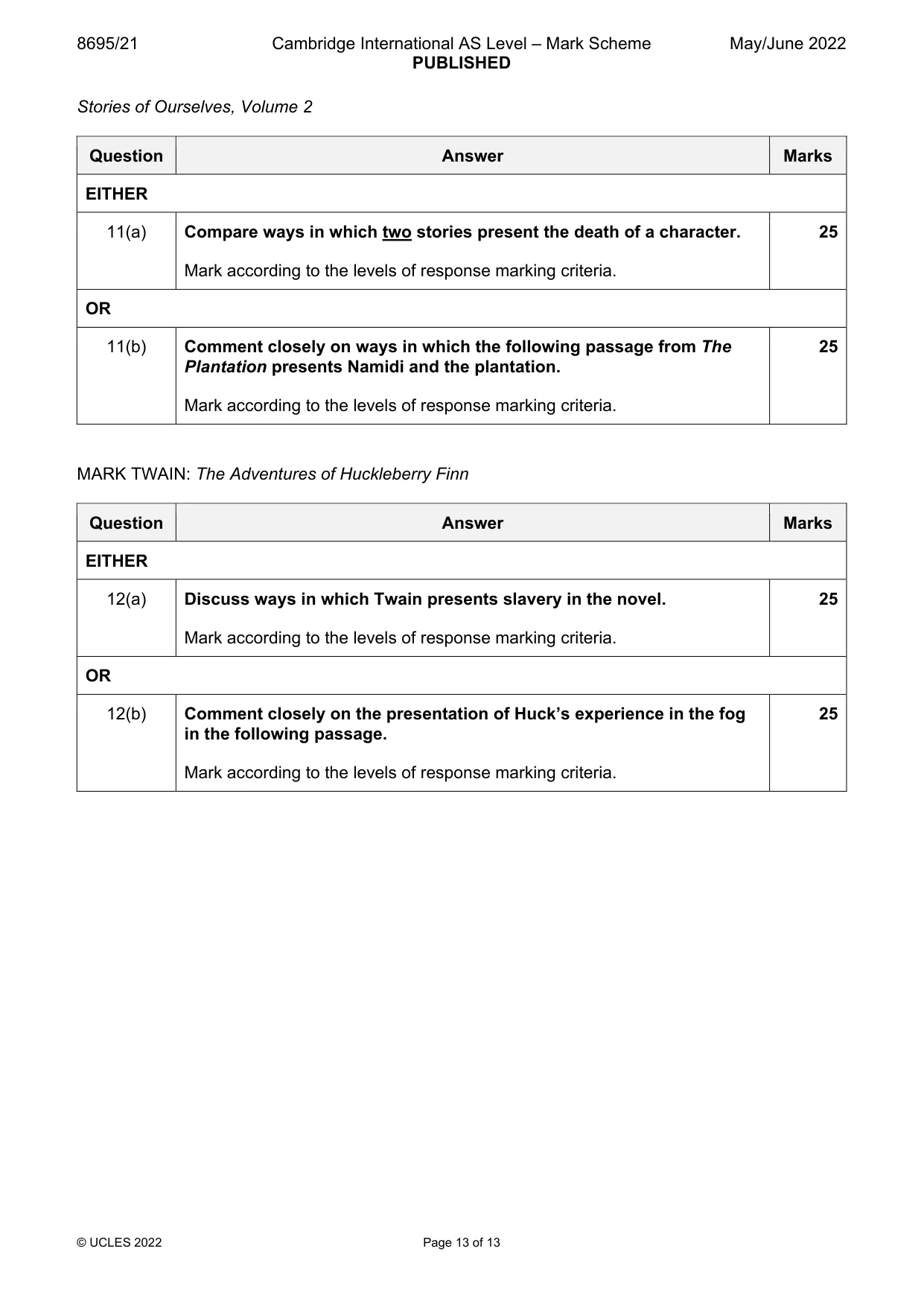
8695/21 Cambridge International AS Level – Mark Scheme PUBLISHED May/June 2022 © UCLES 2022 Page 13 of 13 Stories of Ourselves, Volume 2 Question Answer Marks EITHER 11(a) Compare ways in which two stories present the death of a character. Mark according to the levels of response marking criteria. 25 OR 11(b) Comment closely on ways in which the following passage from The Plantation presents Namidi and the plantation. Mark according to the levels of response marking criteria. 25 MARK TWAIN: The Adventures of Huckleberry Finn Question Answer Marks EITHER 12(a) Discuss ways in which Twain presents slavery in the novel. Mark according to the levels of response marking criteria. 25 OR 12(b) Comment closely on the presentation of Huck’s experience in the fog in the following passage. Mark according to the levels of response marking criteria. 25
What you needed in this session
Cambridge’s own grade thresholds for 2022 May/June, Paper 2 · Variant 1. A higher threshold means an easier paper — the bar moves with how the cohort did.