Cambridge A Level English - Language and Literature (AS Level only, from 2016) 8695 — 2023 May/June Paper 2 · Variant 1
8695/21/M/J/23 · 50 marks · ≈56 min
The question paper and its mark scheme, free to read here and free to download. This is Cambridge’s own paper, exactly as it was sat.
Question paper24 pages



Mark scheme13 pages
Answers below. Sit the paper first if you are practising.
Paper as text
Question paper, page 1
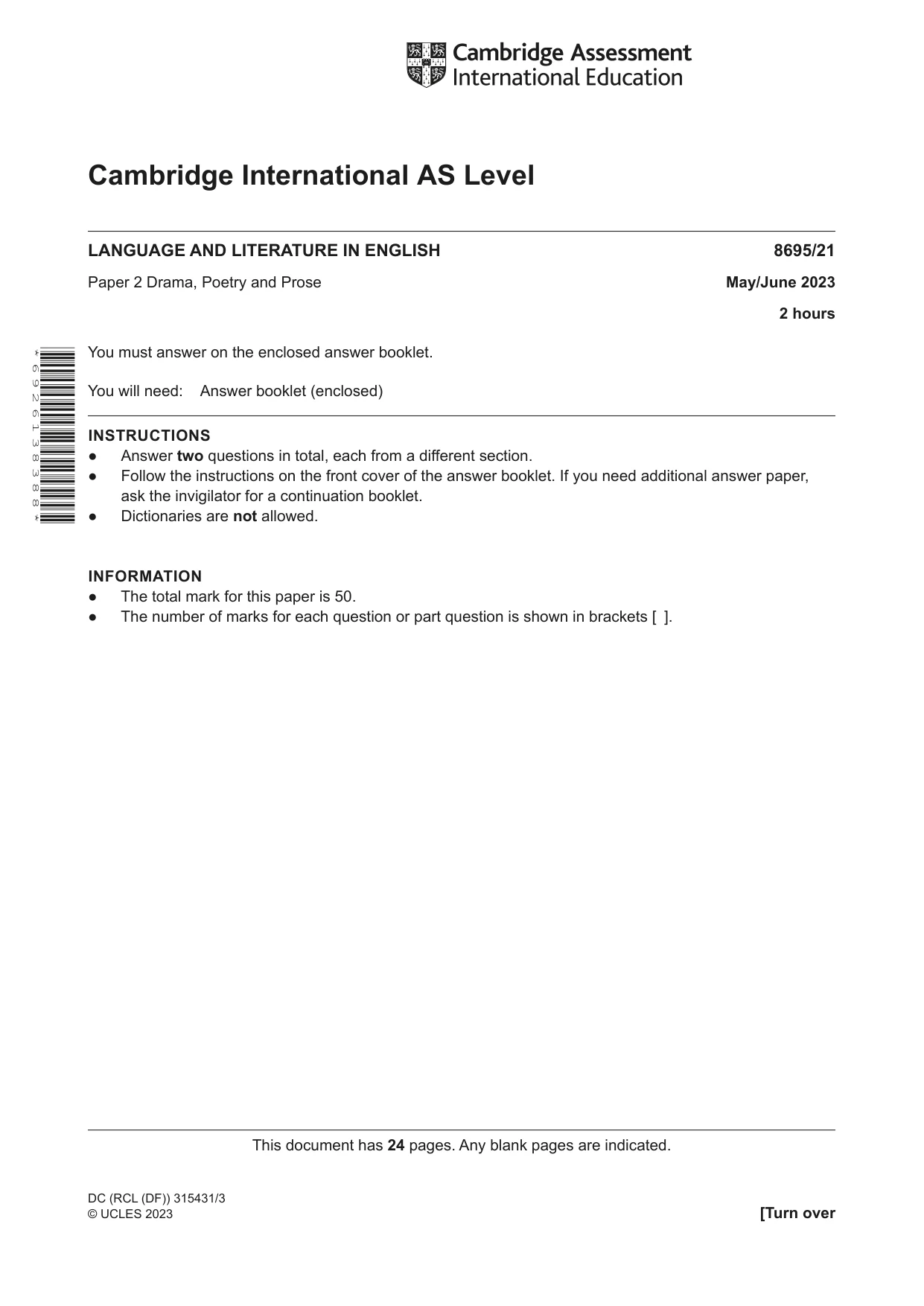
This document has 24 pages. Any blank pages are indicated. [Turn over Cambridge International AS Level * 6 9 2 6 1 3 8 3 8 8 * DC (RCL (DF)) 315431/3 © UCLES 2023 LANGUAGE AND LITERATURE IN ENGLISH 8695/21 Paper 2 Drama, Poetry and Prose May/June 2023 2 hours You must answer on the enclosed answer booklet. You will need: Answer booklet (enclosed) INSTRUCTIONS ● Answer two questions in total, each from a different section. ● Follow the instructions on the front cover of the answer booklet. If you need additional answer paper, ask the invigilator for a continuation booklet. ● Dictionaries are not allowed. INFORMATION ● The total mark for this paper is 50. ● The number of marks for each question or part question is shown in brackets [ ].
Question paper, page 2
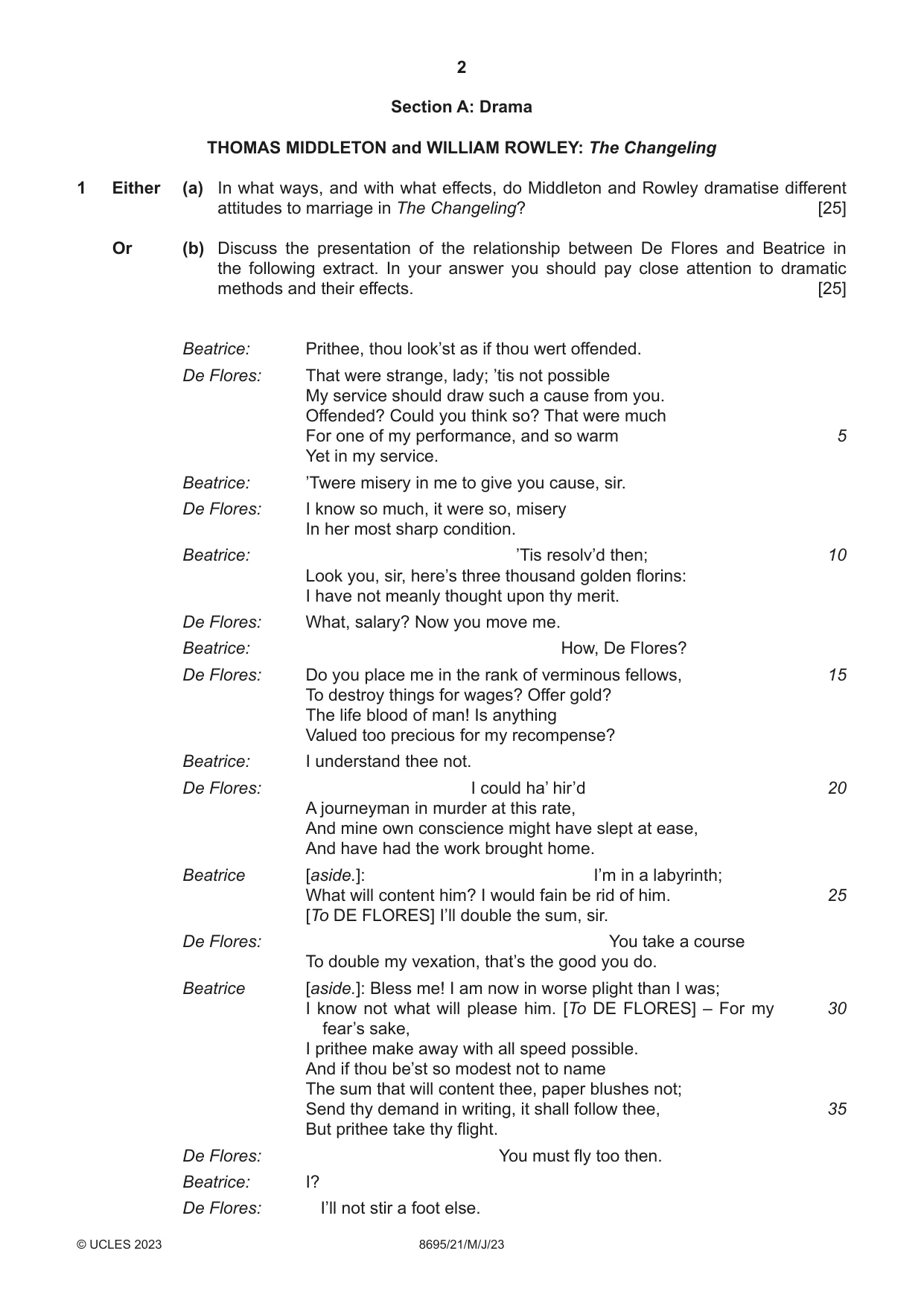
2 8695/21/M/J/23 © UCLES 2023 Section A: Drama THOMAS MIDDLETON and WILLIAM ROWLEY: The Changeling 1 Either (a) In what ways, and with what effects, do Middleton and Rowley dramatise different attitudes to marriage in The Changeling? [25] Or (b) Discuss the presentation of the relationship between De Flores and Beatrice in the following extract. In your answer you should pay close attention to dramatic methods and their effects. [25] Beatrice: Prithee, thou look’st as if thou wert offended. De Flores: That were strange, lady; ’tis not possible My service should draw such a cause from you. Offended? Could you think so? That were much For one of my performance, and so warm Yet in my service. Beatrice: ’Twere misery in me to give you cause, sir. De Flores: I know so much, it were so, misery In her most sharp condition. Beatrice: ’Tis resolv’d then; Look you, sir, here’s three thousand golden florins: I have not meanly thought upon thy merit. De Flores: What, salary? Now you move me. Beatrice: How, De Flores? De Flores: Do you place me in the rank of verminous fellows, To destroy things for wages? Offer gold? The life blood of man! Is anything Valued too precious for my recompense? Beatrice: I understand thee not. De Flores: I could ha’ hir’d A journeyman in murder at this rate, And mine own conscience might have slept at ease, And have had the work brought home. Beatrice [aside.]: I’m in a labyrinth; What will content him? I would fain be rid of him. [To DE FLORES] I’ll double the sum, sir. De Flores: You take a course To double my vexation, that’s the good you do. Beatrice [aside.]: Bless me! I am now in worse plight than I was; I know not what will please him. [To DE FLORES] – For my fear’s sake, I prithee make away with all speed possible. And if thou be’st so modest not to name The sum that will content thee, paper blushes not; Send thy demand in writing, it shall follow thee, But prithee take thy flight. De Flores: You must fly too then. Beatrice: I? De Flores: I’ll not stir a foot else. 5 10 15 20 25 30 35
Question paper, page 3
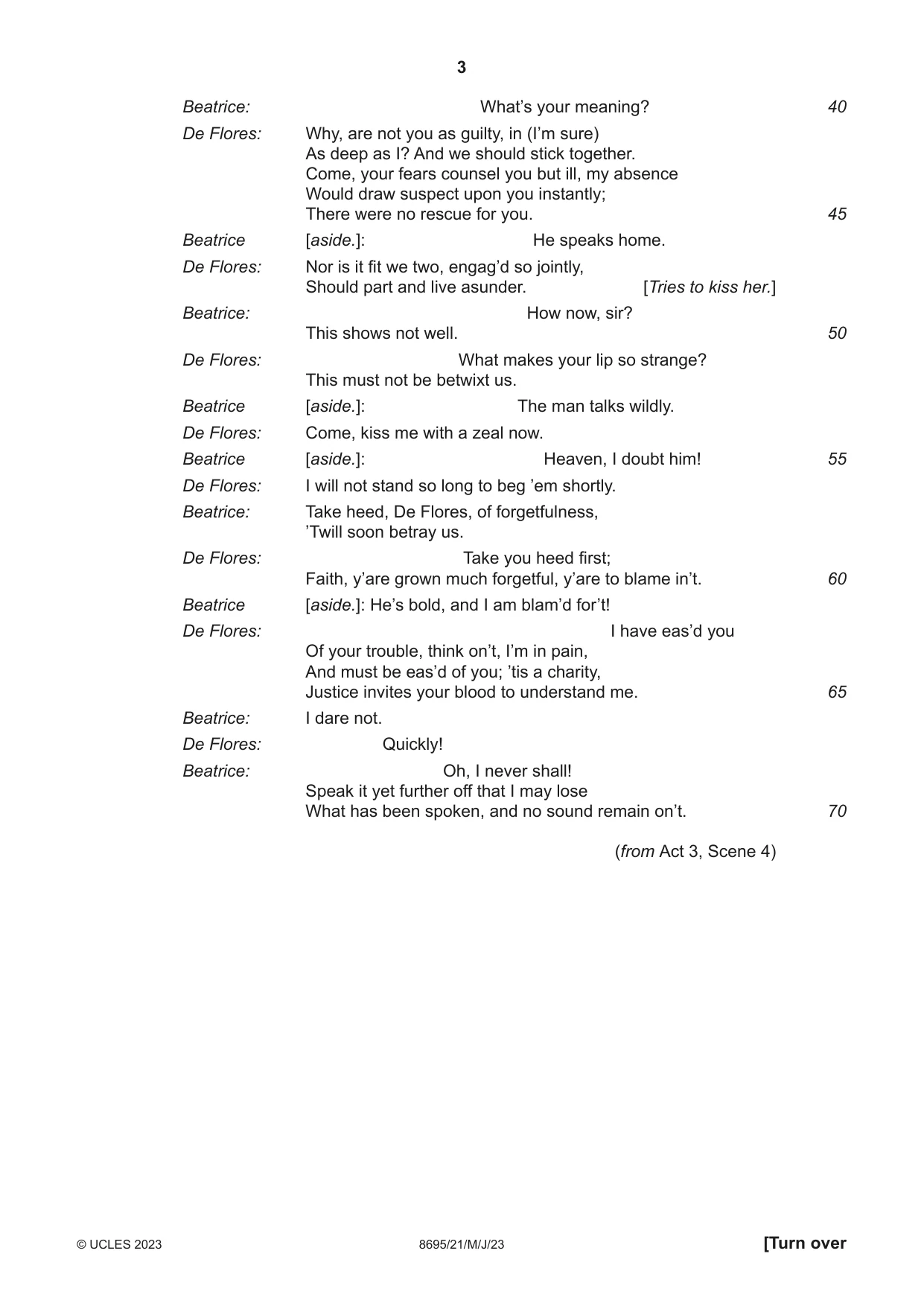
3 8695/21/M/J/23 © UCLES 2023 [Turn over Beatrice: What’s your meaning? De Flores: Why, are not you as guilty, in (I’m sure) As deep as I? And we should stick together. Come, your fears counsel you but ill, my absence Would draw suspect upon you instantly; There were no rescue for you. Beatrice [aside.]: He speaks home. De Flores: Nor is it fit we two, engag’d so jointly, Should part and live asunder. [Tries to kiss her.] Beatrice: How now, sir? This shows not well. De Flores: What makes your lip so strange? This must not be betwixt us. Beatrice [aside.]: The man talks wildly. De Flores: Come, kiss me with a zeal now. Beatrice [aside.]: Heaven, I doubt him! De Flores: I will not stand so long to beg ’em shortly. Beatrice: Take heed, De Flores, of forgetfulness, ’Twill soon betray us. De Flores: Take you heed first; Faith, y’are grown much forgetful, y’are to blame in’t. Beatrice [aside.]: He’s bold, and I am blam’d for’t! De Flores: I have eas’d you Of your trouble, think on’t, I’m in pain, And must be eas’d of you; ’tis a charity, Justice invites your blood to understand me. Beatrice: I dare not. De Flores: Quickly! Beatrice: Oh, I never shall! Speak it yet further off that I may lose What has been spoken, and no sound remain on’t. (from Act 3, Scene 4) 40 45 50 55 60 65 70
Question paper, page 4
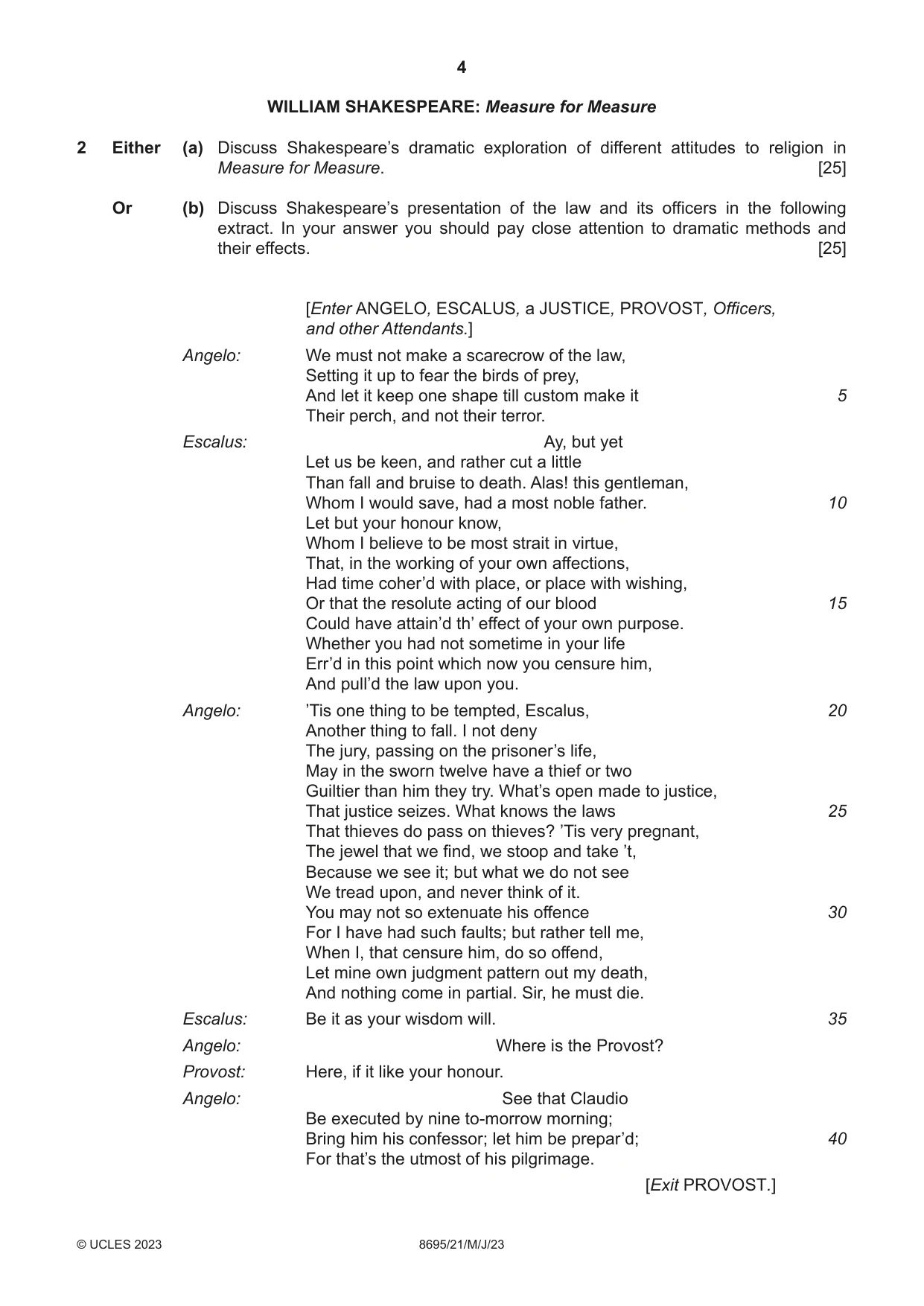
4 8695/21/M/J/23 © UCLES 2023 WILLIAM SHAKESPEARE: Measure for Measure 2 Either (a) Discuss Shakespeare’s dramatic exploration of different attitudes to religion in Measure for Measure. [25] Or (b) Discuss Shakespeare’s presentation of the law and its officers in the following extract. In your answer you should pay close attention to dramatic methods and their effects. [25] [Enter ANGELO, ESCALUS, a JUSTICE, PROVOST, Officers, and other Attendants.] Angelo: We must not make a scarecrow of the law, Setting it up to fear the birds of prey, And let it keep one shape till custom make it Their perch, and not their terror. Escalus: Ay, but yet Let us be keen, and rather cut a little Than fall and bruise to death. Alas! this gentleman, Whom I would save, had a most noble father. Let but your honour know, Whom I believe to be most strait in virtue, That, in the working of your own affections, Had time coher’d with place, or place with wishing, Or that the resolute acting of our blood Could have attain’d th’ effect of your own purpose. Whether you had not sometime in your life Err’d in this point which now you censure him, And pull’d the law upon you. Angelo: ’Tis one thing to be tempted, Escalus, Another thing to fall. I not deny The jury, passing on the prisoner’s life, May in the sworn twelve have a thief or two Guiltier than him they try. What’s open made to justice, That justice seizes. What knows the laws That thieves do pass on thieves? ’Tis very pregnant, The jewel that we find, we stoop and take ’t, Because we see it; but what we do not see We tread upon, and never think of it. You may not so extenuate his offence For I have had such faults; but rather tell me, When I, that censure him, do so offend, Let mine own judgment pattern out my death, And nothing come in partial. Sir, he must die. Escalus: Be it as your wisdom will. Angelo: Where is the Provost? Provost: Here, if it like your honour. Angelo: See that Claudio Be executed by nine to-morrow morning; Bring him his confessor; let him be prepar’d; For that’s the utmost of his pilgrimage. [Exit PROVOST.] 5 10 15 20 25 30 35 40
Question paper, page 5
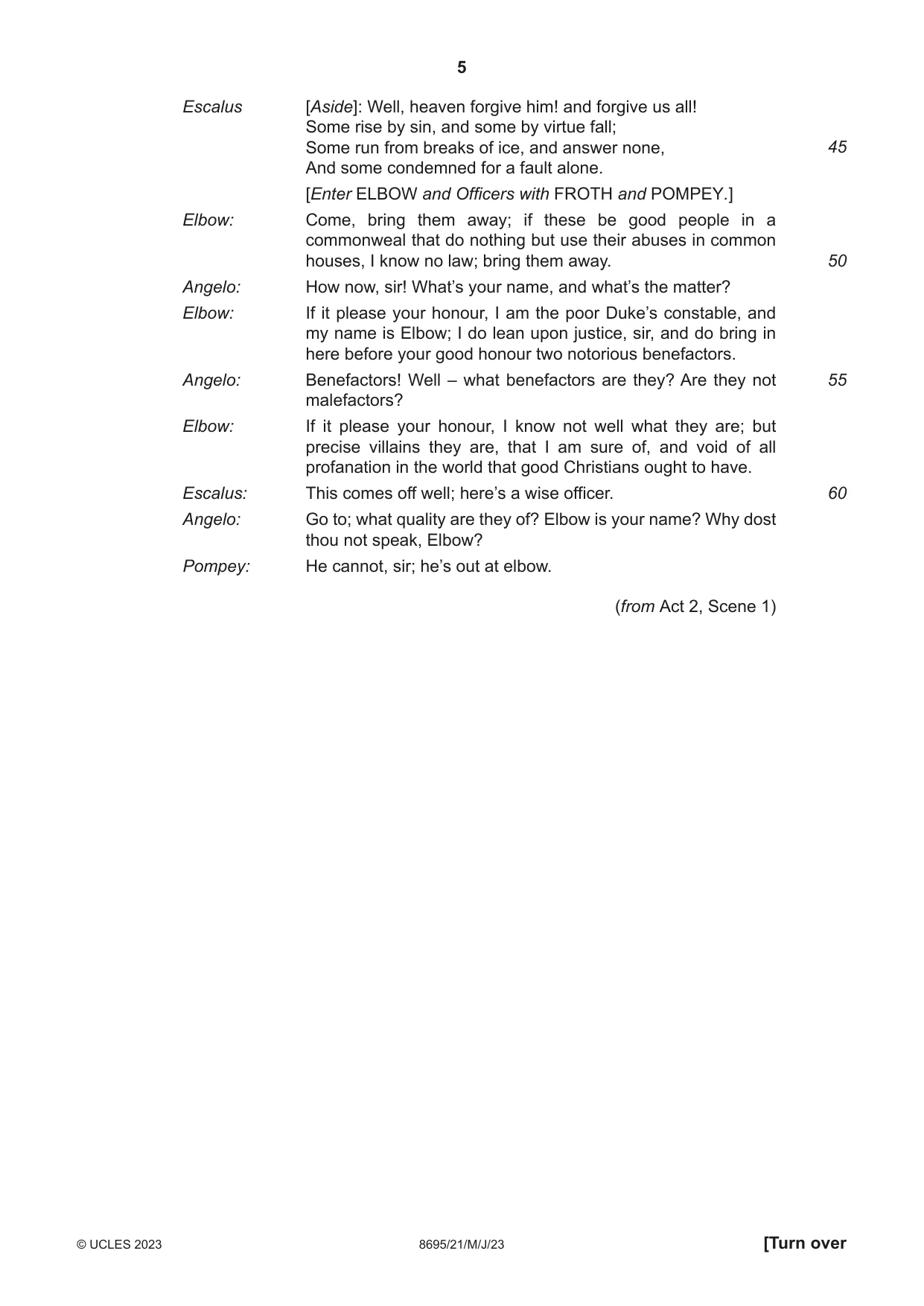
5 8695/21/M/J/23 © UCLES 2023 [Turn over Escalus [Aside]: Well, heaven forgive him! and forgive us all! Some rise by sin, and some by virtue fall; Some run from breaks of ice, and answer none, And some condemned for a fault alone. [Enter ELBOW and Officers with FROTH and POMPEY.] Elbow: Come, bring them away; if these be good people in a commonweal that do nothing but use their abuses in common houses, I know no law; bring them away. Angelo: How now, sir! What’s your name, and what’s the matter? Elbow: If it please your honour, I am the poor Duke’s constable, and my name is Elbow; I do lean upon justice, sir, and do bring in here before your good honour two notorious benefactors. Angelo: Benefactors! Well – what benefactors are they? Are they not malefactors? Elbow: If it please your honour, I know not well what they are; but precise villains they are, that I am sure of, and void of all profanation in the world that good Christians ought to have. Escalus: This comes off well; here’s a wise officer. Angelo: Go to; what quality are they of? Elbow is your name? Why dost thou not speak, Elbow? Pompey: He cannot, sir; he’s out at elbow. (from Act 2, Scene 1) 45 50 55 60
Question paper, page 6
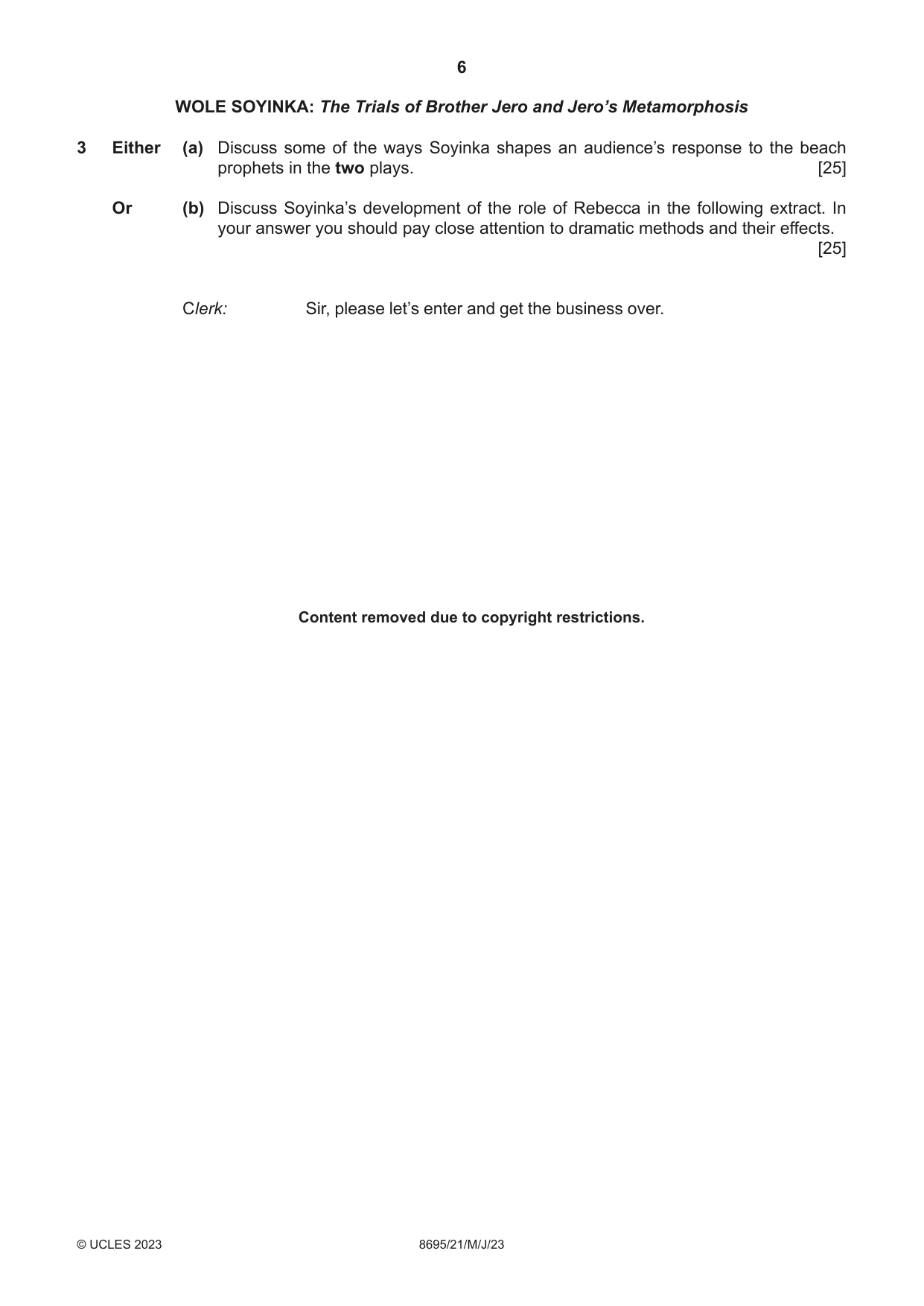
6 8695/21/M/J/23 © UCLES 2023 WOLE SOYINKA: The Trials of Brother Jero and Jero’s Metamorphosis 3 Either (a) Discuss some of the ways Soyinka shapes an audience’s response to the beach prophets in the two plays. [25] Or (b) Discuss Soyinka’s development of the role of Rebecca in the following extract. In your answer you should pay close attention to dramatic methods and their effects. [25] Clerk: Sir, please let’s enter and get the business over. Content removed due to copyright restrictions.
Question paper, page 7
7 8695/21/M/J/23 © UCLES 2023 [Turn over Rebecca: I was never more clearly within my senses as now. (from Jero’s Metamorphosis, Scene 1) Content removed due to copyright restrictions.
Question paper, page 8
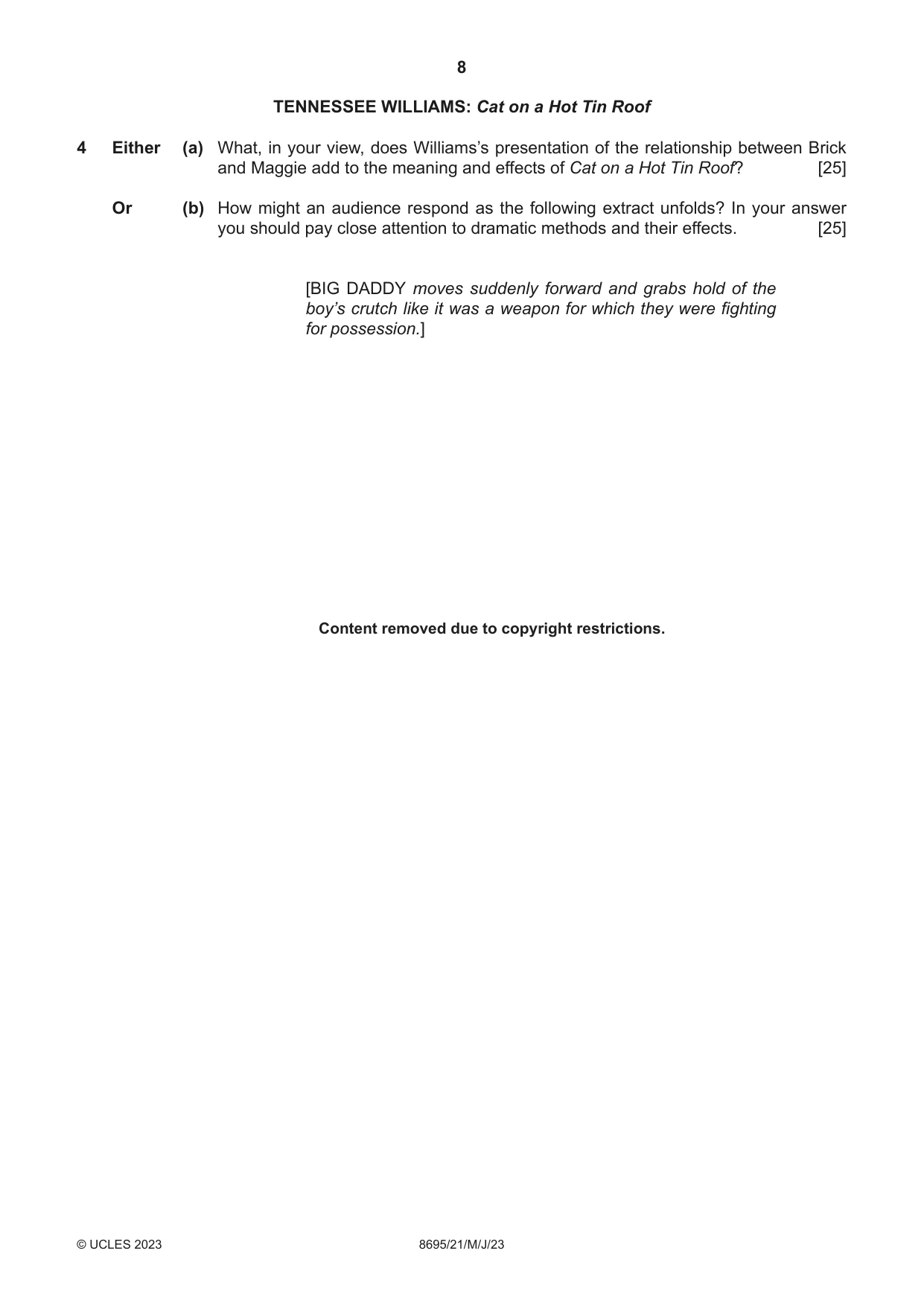
8 8695/21/M/J/23 © UCLES 2023 TENNESSEE WILLIAMS: Cat on a Hot Tin Roof 4 Either (a) What, in your view, does Williams’s presentation of the relationship between Brick and Maggie add to the meaning and effects of Cat on a Hot Tin Roof? [25] Or (b) How might an audience respond as the following extract unfolds? In your answer you should pay close attention to dramatic methods and their effects. [25] [BIG DADDY moves suddenly forward and grabs hold of the boy’s crutch like it was a weapon for which they were fighting for possession.] Content removed due to copyright restrictions.
Question paper, page 9
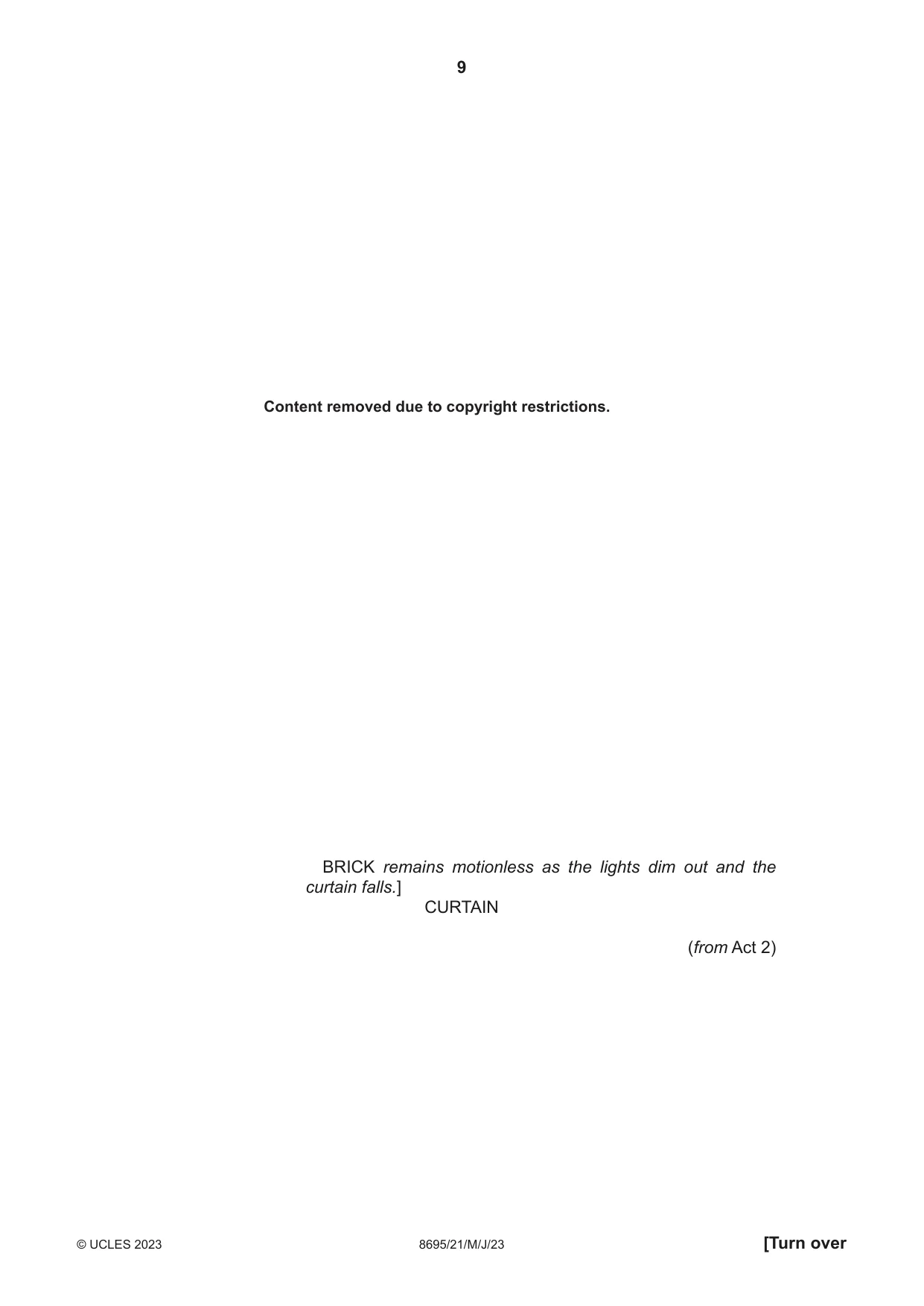
9 8695/21/M/J/23 © UCLES 2023 [Turn over BRICK remains motionless as the lights dim out and the curtain falls.] CURTAIN (from Act 2) Content removed due to copyright restrictions.
Question paper, page 10
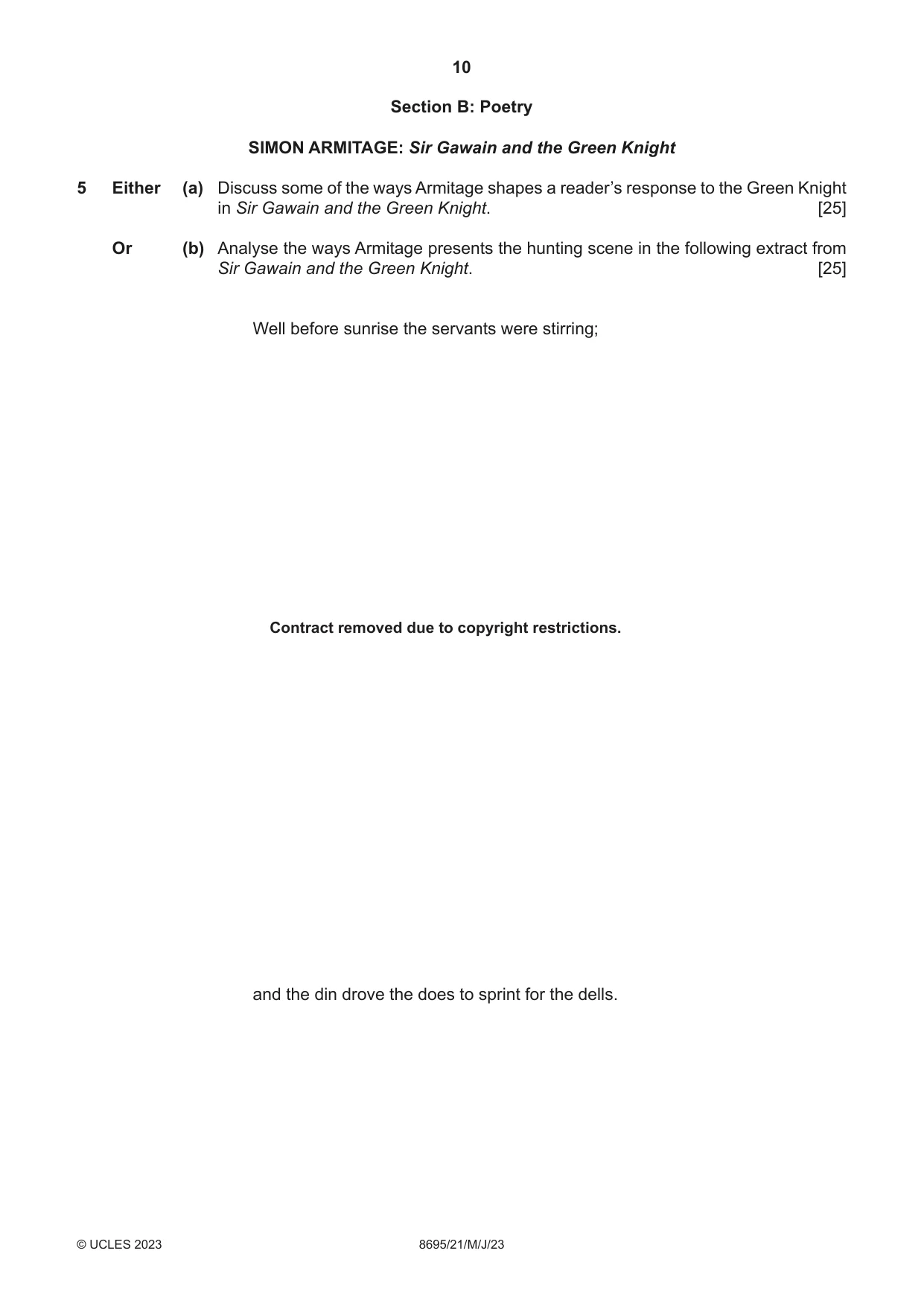
10 8695/21/M/J/23 © UCLES 2023 Section B: Poetry SIMON ARMITAGE: Sir Gawain and the Green Knight 5 Either (a) Discuss some of the ways Armitage shapes a reader’s response to the Green Knight in Sir Gawain and the Green Knight. [25] Or (b) Analyse the ways Armitage presents the hunting scene in the following extract from Sir Gawain and the Green Knight. [25] Well before sunrise the servants were stirring; and the din drove the does to sprint for the dells. Contract removed due to copyright restrictions.
Question paper, page 11
11 8695/21/M/J/23 © UCLES 2023 [Turn over TURN OVER FOR QUESTION 6.
Question paper, page 12
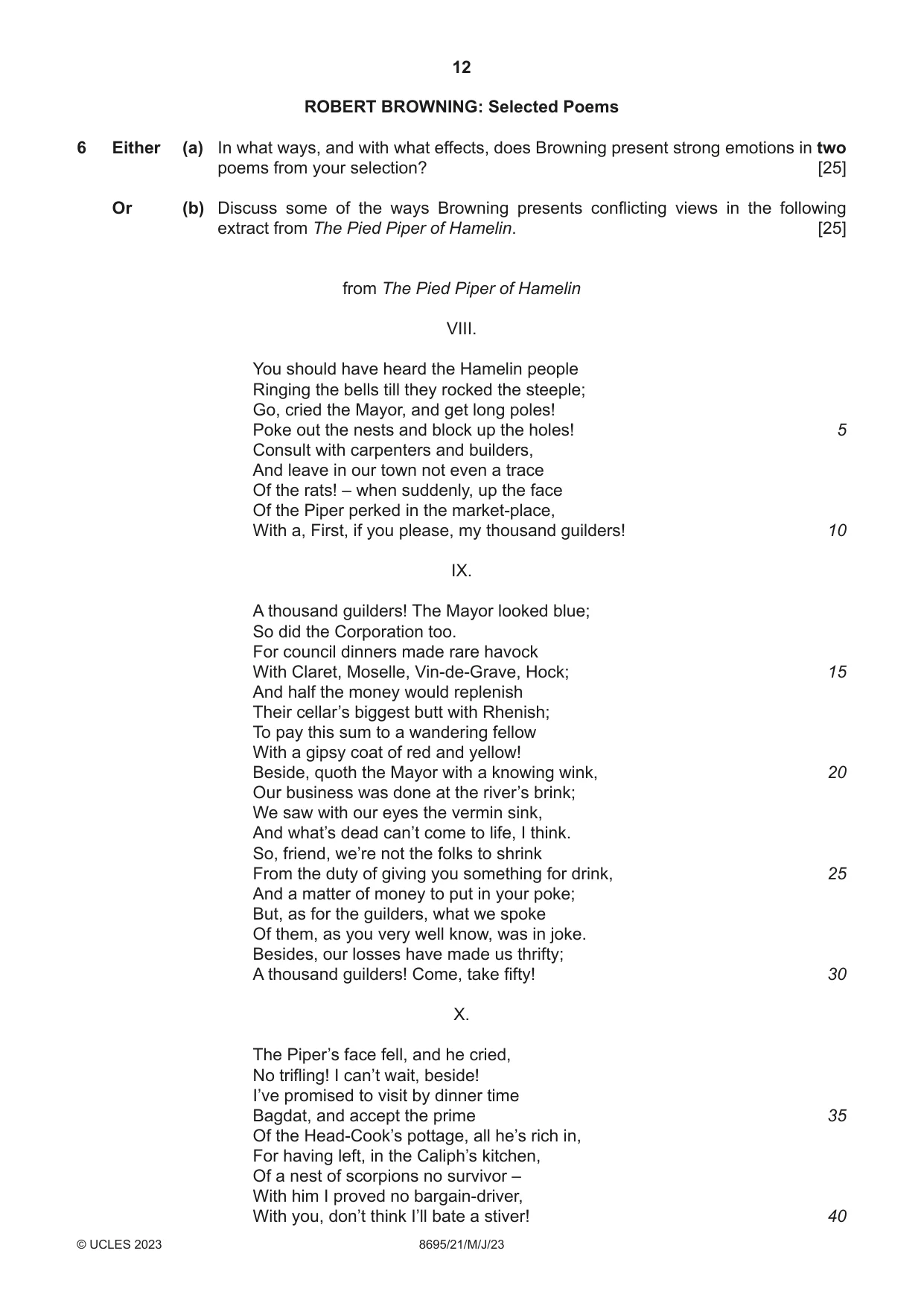
12 8695/21/M/J/23 © UCLES 2023 ROBERT BROWNING: Selected Poems 6 Either (a) In what ways, and with what effects, does Browning present strong emotions in two poems from your selection? [25] Or (b) Discuss some of the ways Browning presents conflicting views in the following extract from The Pied Piper of Hamelin. [25] from The Pied Piper of Hamelin VIII. You should have heard the Hamelin people Ringing the bells till they rocked the steeple; Go, cried the Mayor, and get long poles! Poke out the nests and block up the holes! Consult with carpenters and builders, And leave in our town not even a trace Of the rats! – when suddenly, up the face Of the Piper perked in the market-place, With a, First, if you please, my thousand guilders! IX. A thousand guilders! The Mayor looked blue; So did the Corporation too. For council dinners made rare havock With Claret, Moselle, Vin-de-Grave, Hock; And half the money would replenish Their cellar’s biggest butt with Rhenish; To pay this sum to a wandering fellow With a gipsy coat of red and yellow! Beside, quoth the Mayor with a knowing wink, Our business was done at the river’s brink; We saw with our eyes the vermin sink, And what’s dead can’t come to life, I think. So, friend, we’re not the folks to shrink From the duty of giving you something for drink, And a matter of money to put in your poke; But, as for the guilders, what we spoke Of them, as you very well know, was in joke. Besides, our losses have made us thrifty; A thousand guilders! Come, take fifty! X. The Piper’s face fell, and he cried, No trifling! I can’t wait, beside! I’ve promised to visit by dinner time Bagdat, and accept the prime Of the Head-Cook’s pottage, all he’s rich in, For having left, in the Caliph’s kitchen, Of a nest of scorpions no survivor – With him I proved no bargain-driver, With you, don’t think I’ll bate a stiver! 5 10 15 20 25 30 35 40
Question paper, page 13
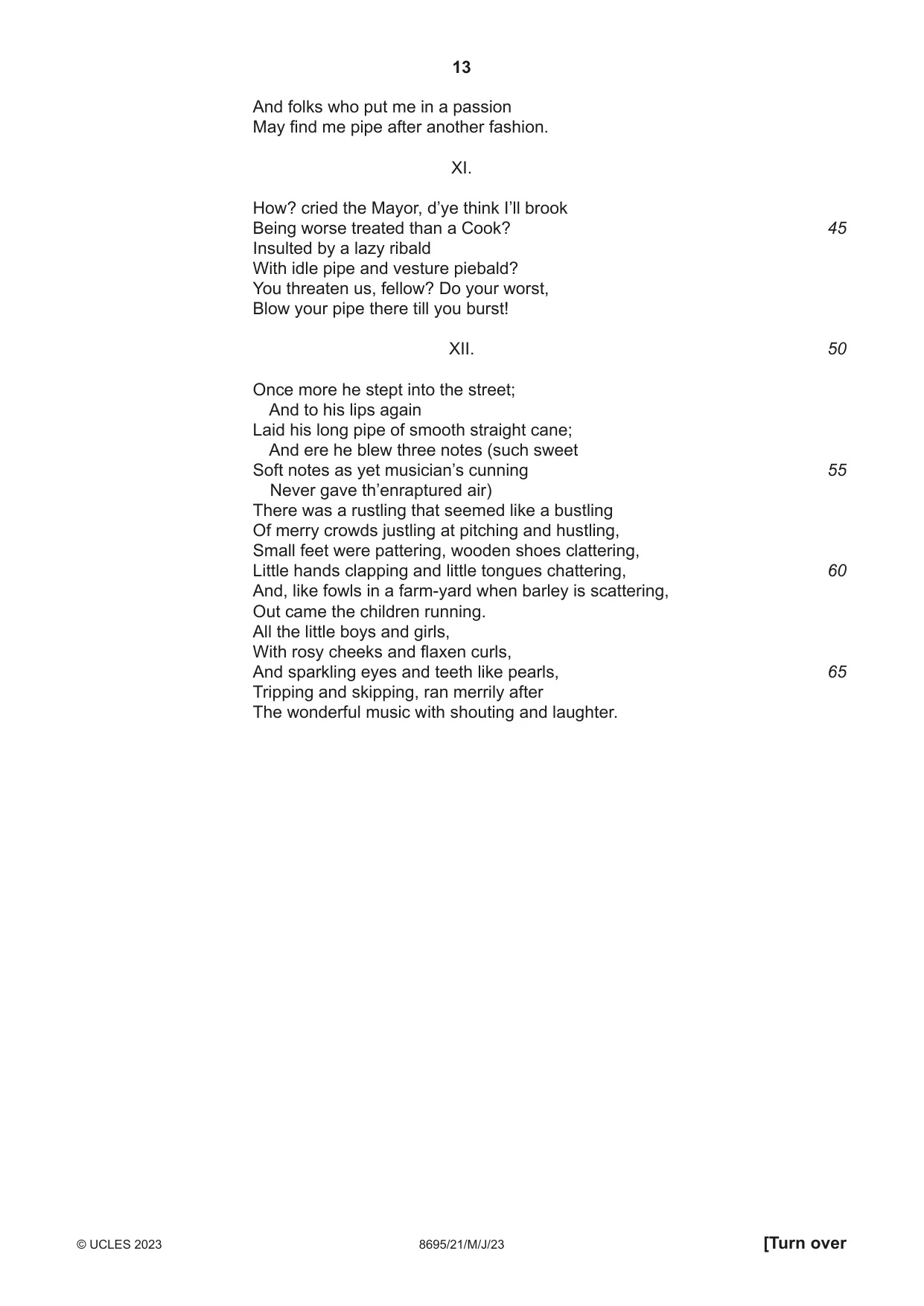
13 8695/21/M/J/23 © UCLES 2023 [Turn over And folks who put me in a passion May find me pipe after another fashion. XI. How? cried the Mayor, d’ye think I’ll brook Being worse treated than a Cook? Insulted by a lazy ribald With idle pipe and vesture piebald? You threaten us, fellow? Do your worst, Blow your pipe there till you burst! XII. Once more he stept into the street; And to his lips again Laid his long pipe of smooth straight cane; And ere he blew three notes (such sweet Soft notes as yet musician’s cunning Never gave th’enraptured air) There was a rustling that seemed like a bustling Of merry crowds justling at pitching and hustling, Small feet were pattering, wooden shoes clattering, Little hands clapping and little tongues chattering, And, like fowls in a farm-yard when barley is scattering, Out came the children running. All the little boys and girls, With rosy cheeks and flaxen curls, And sparkling eyes and teeth like pearls, Tripping and skipping, ran merrily after The wonderful music with shouting and laughter. 45 50 55 60 65
Question paper, page 14
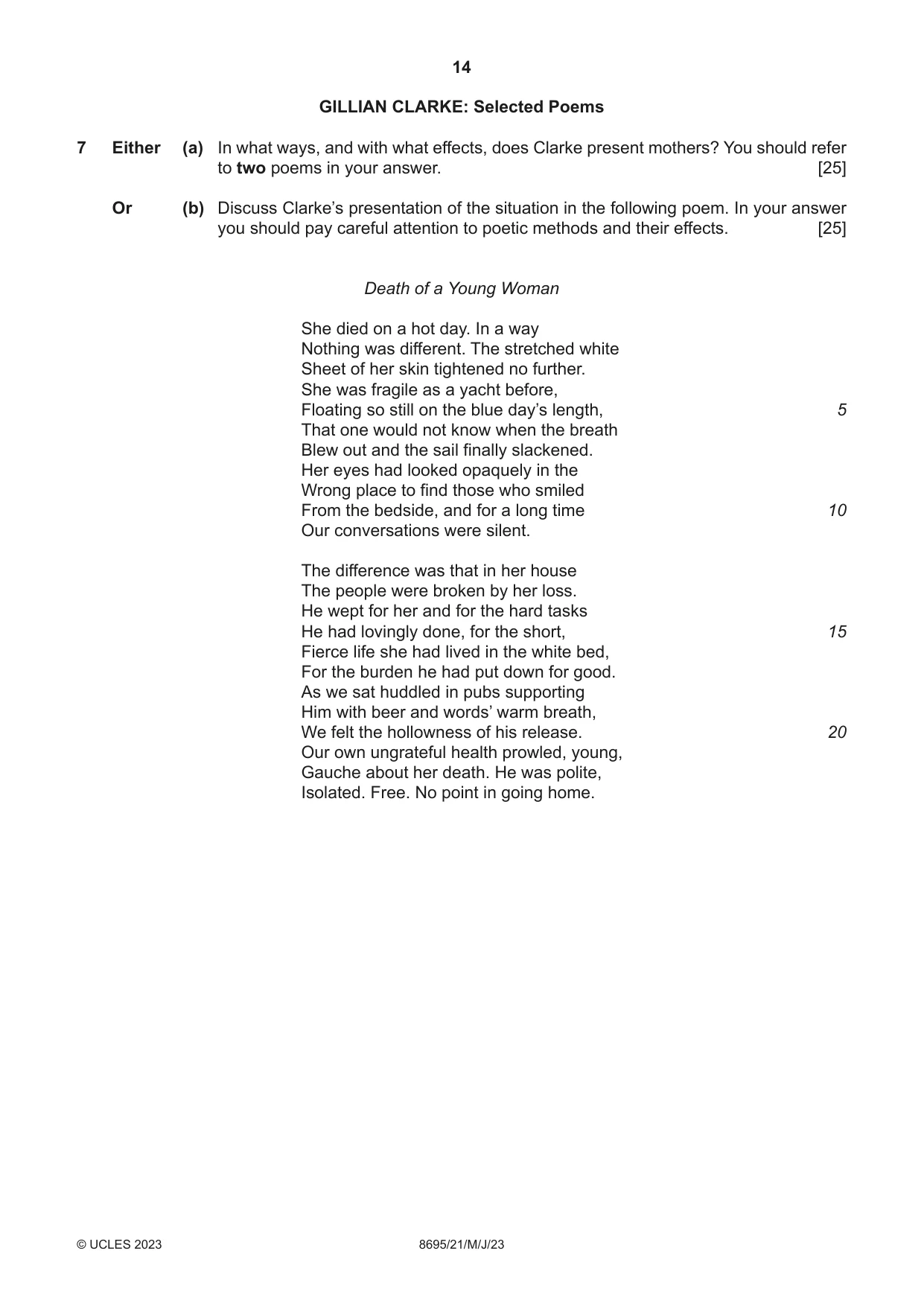
14 8695/21/M/J/23 © UCLES 2023 GILLIAN CLARKE: Selected Poems 7 Either (a) In what ways, and with what effects, does Clarke present mothers? You should refer to two poems in your answer. [25] Or (b) Discuss Clarke’s presentation of the situation in the following poem. In your answer you should pay careful attention to poetic methods and their effects. [25] Death of a Young Woman She died on a hot day. In a way Nothing was different. The stretched white Sheet of her skin tightened no further. She was fragile as a yacht before, Floating so still on the blue day’s length, That one would not know when the breath Blew out and the sail finally slackened. Her eyes had looked opaquely in the Wrong place to find those who smiled From the bedside, and for a long time Our conversations were silent. The difference was that in her house The people were broken by her loss. He wept for her and for the hard tasks He had lovingly done, for the short, Fierce life she had lived in the white bed, For the burden he had put down for good. As we sat huddled in pubs supporting Him with beer and words’ warm breath, We felt the hollowness of his release. Our own ungrateful health prowled, young, Gauche about her death. He was polite, Isolated. Free. No point in going home. 5 10 15 20
Question paper, page 15
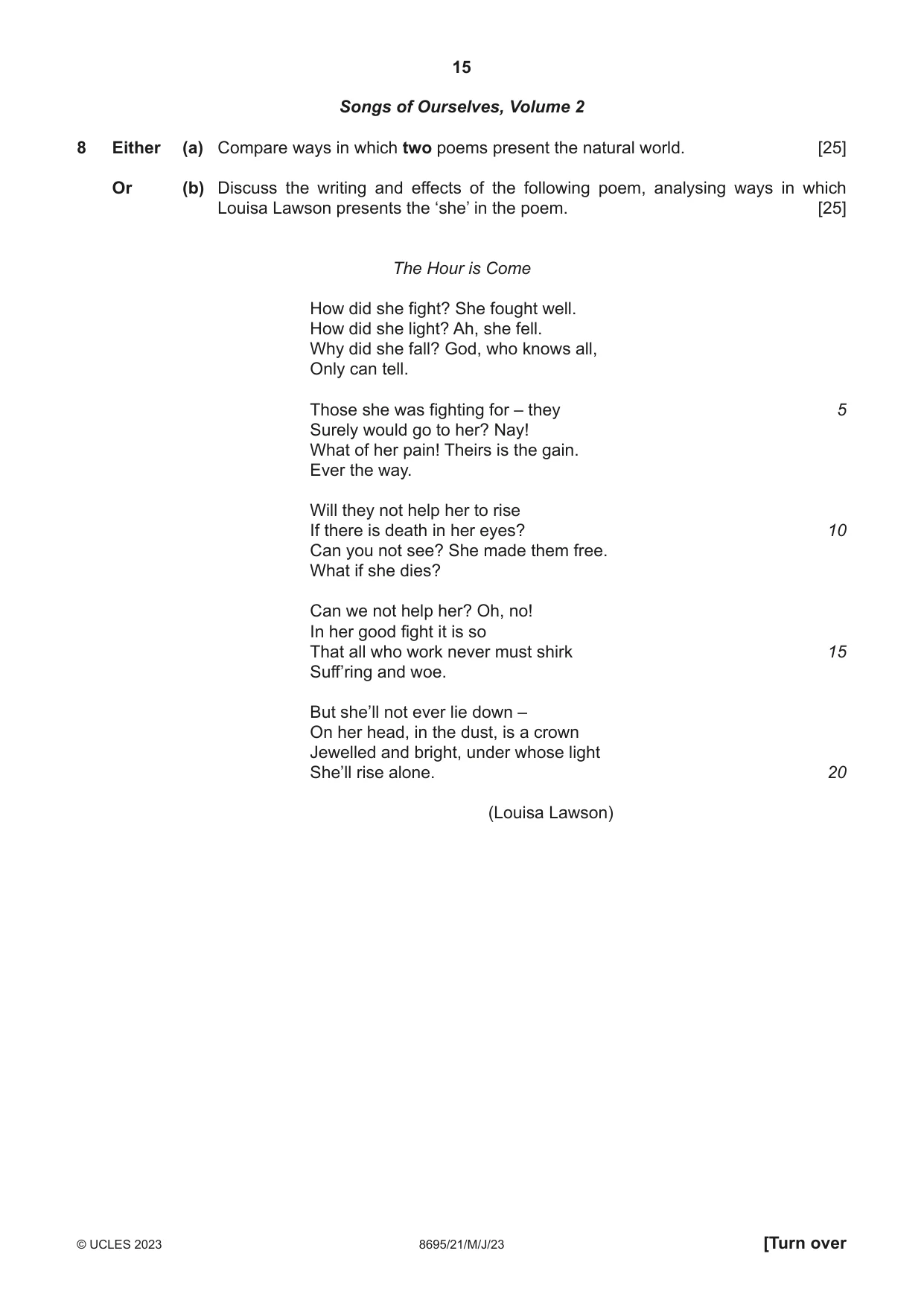
15 8695/21/M/J/23 © UCLES 2023 [Turn over Songs of Ourselves, Volume 2 8 Either (a) Compare ways in which two poems present the natural world. [25] Or (b) Discuss the writing and effects of the following poem, analysing ways in which Louisa Lawson presents the ‘she’ in the poem. [25] The Hour is Come How did she fight? She fought well. How did she light? Ah, she fell. Why did she fall? God, who knows all, Only can tell. Those she was fighting for – they Surely would go to her? Nay! What of her pain! Theirs is the gain. Ever the way. Will they not help her to rise If there is death in her eyes? Can you not see? She made them free. What if she dies? Can we not help her? Oh, no! In her good fight it is so That all who work never must shirk Suff’ring and woe. But she’ll not ever lie down – On her head, in the dust, is a crown Jewelled and bright, under whose light She’ll rise alone. (Louisa Lawson) 5 10 15 20
Question paper, page 16
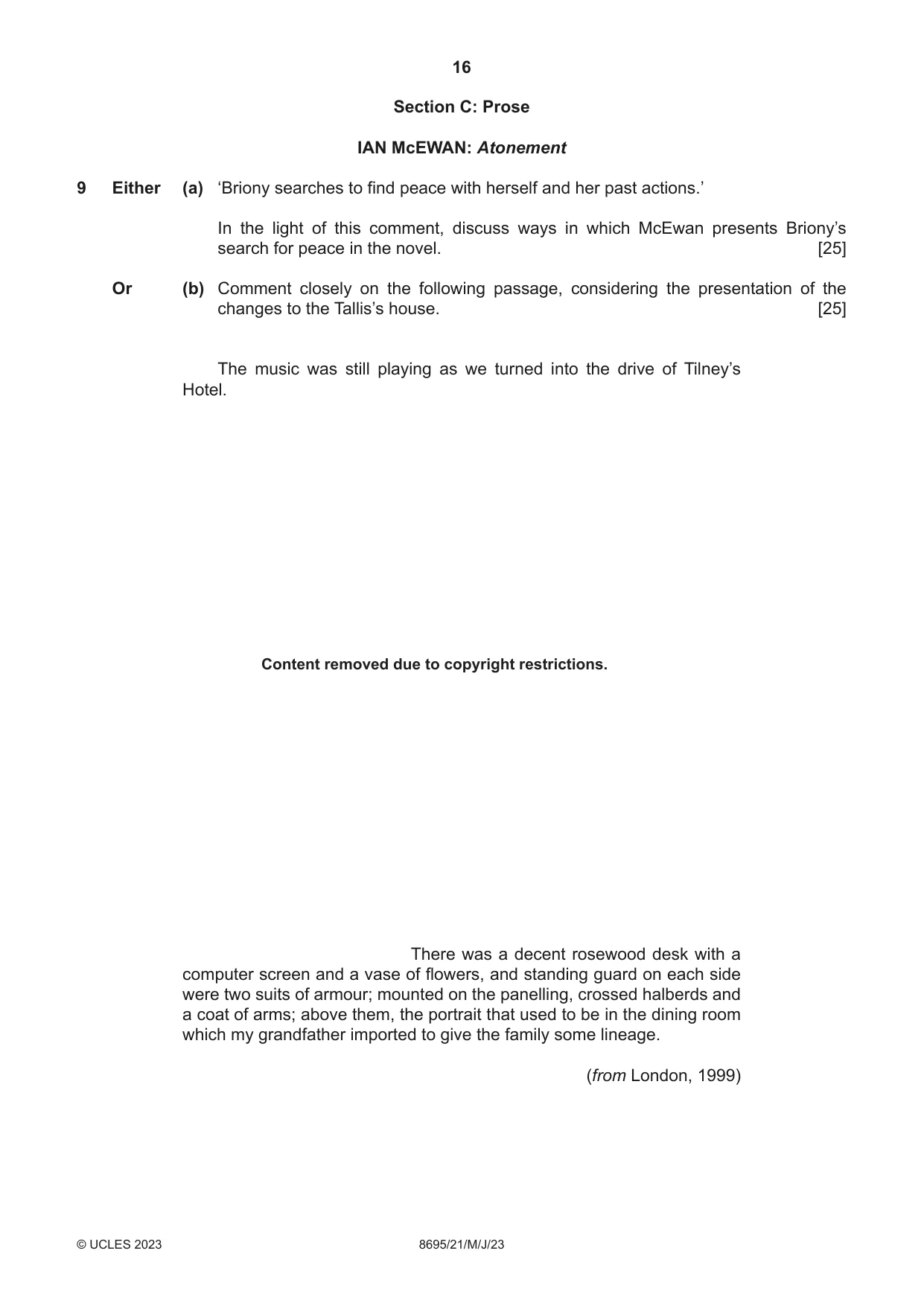
16 8695/21/M/J/23 © UCLES 2023 Section C: Prose IAN McEWAN: Atonement 9 Either (a) ‘Briony searches to find peace with herself and her past actions.’ In the light of this comment, discuss ways in which McEwan presents Briony’s search for peace in the novel. [25] Or (b) Comment closely on the following passage, considering the presentation of the changes to the Tallis’s house. [25] The music was still playing as we turned into the drive of Tilney’s Hotel. There was a decent rosewood desk with a computer screen and a vase of flowers, and standing guard on each side were two suits of armour; mounted on the panelling, crossed halberds and a coat of arms; above them, the portrait that used to be in the dining room which my grandfather imported to give the family some lineage. (from London, 1999) Content removed due to copyright restrictions.
Question paper, page 17
17 8695/21/M/J/23 © UCLES 2023 [Turn over TURN OVER FOR QUESTION 10.
Question paper, page 18
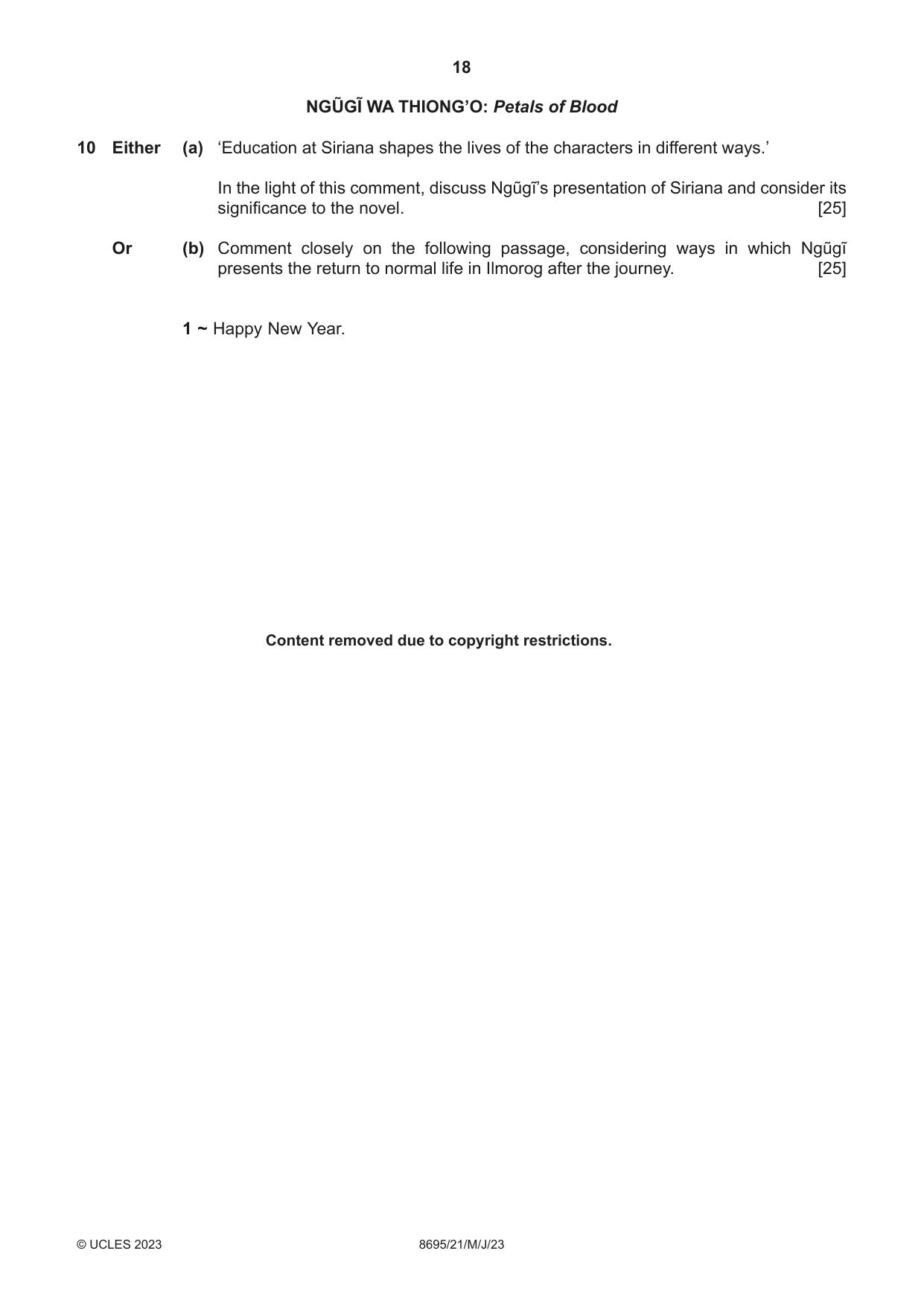
18 8695/21/M/J/23 © UCLES 2023 NGŨGĨ WA THIONG’O: Petals of Blood 10 Either (a) ‘Education at Siriana shapes the lives of the characters in different ways.’ In the light of this comment, discuss Ngũgĩ’s presentation of Siriana and consider its significance to the novel. [25] Or (b) Comment closely on the following passage, considering ways in which Ngũgĩ presents the return to normal life in Ilmorog after the journey. [25] 1 ~ Happy New Year. Content removed due to copyright restrictions.
Question paper, page 19
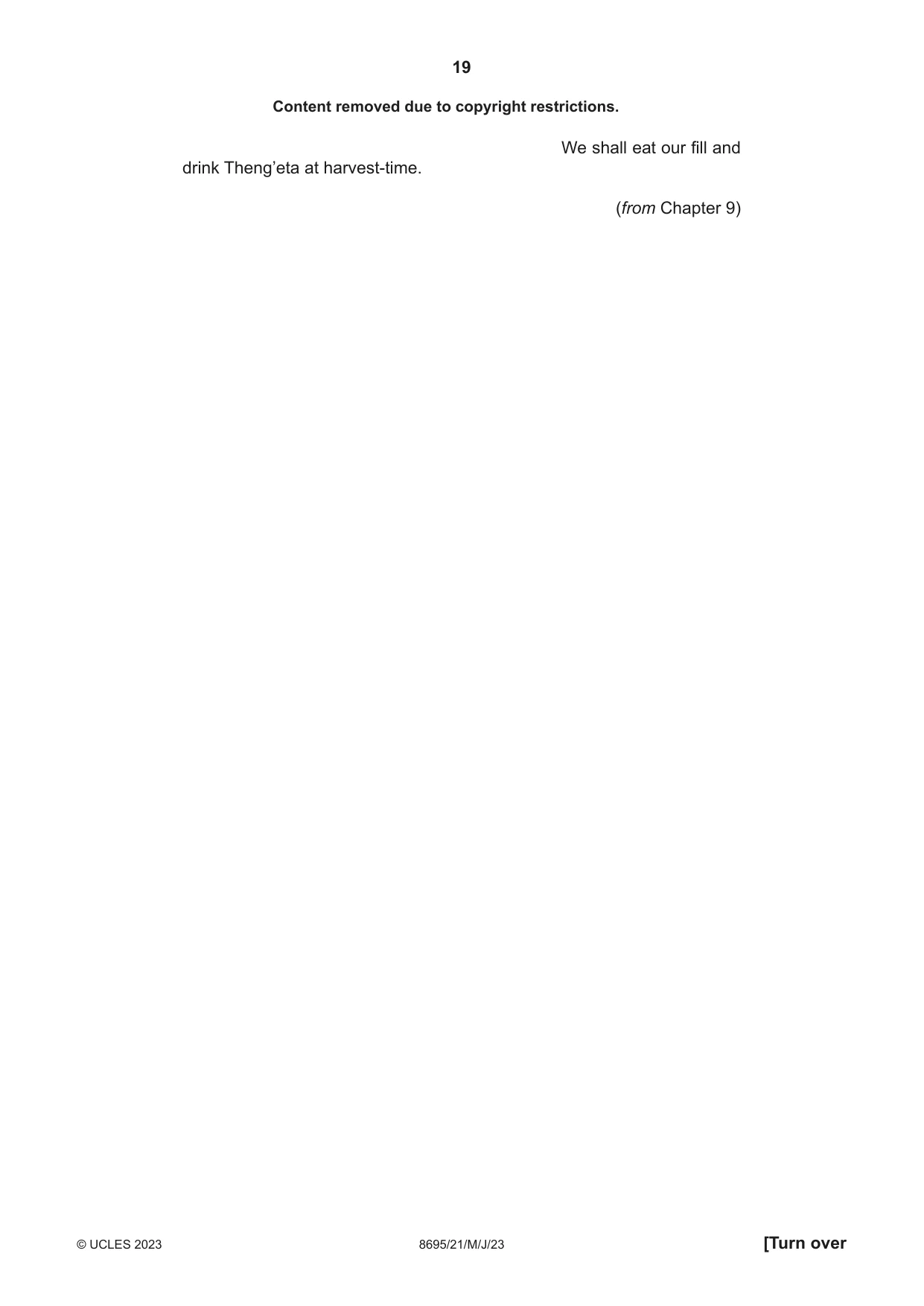
19 8695/21/M/J/23 © UCLES 2023 [Turn over We shall eat our fill and drink Theng’eta at harvest-time. (from Chapter 9) Content removed due to copyright restrictions.
Question paper, page 20
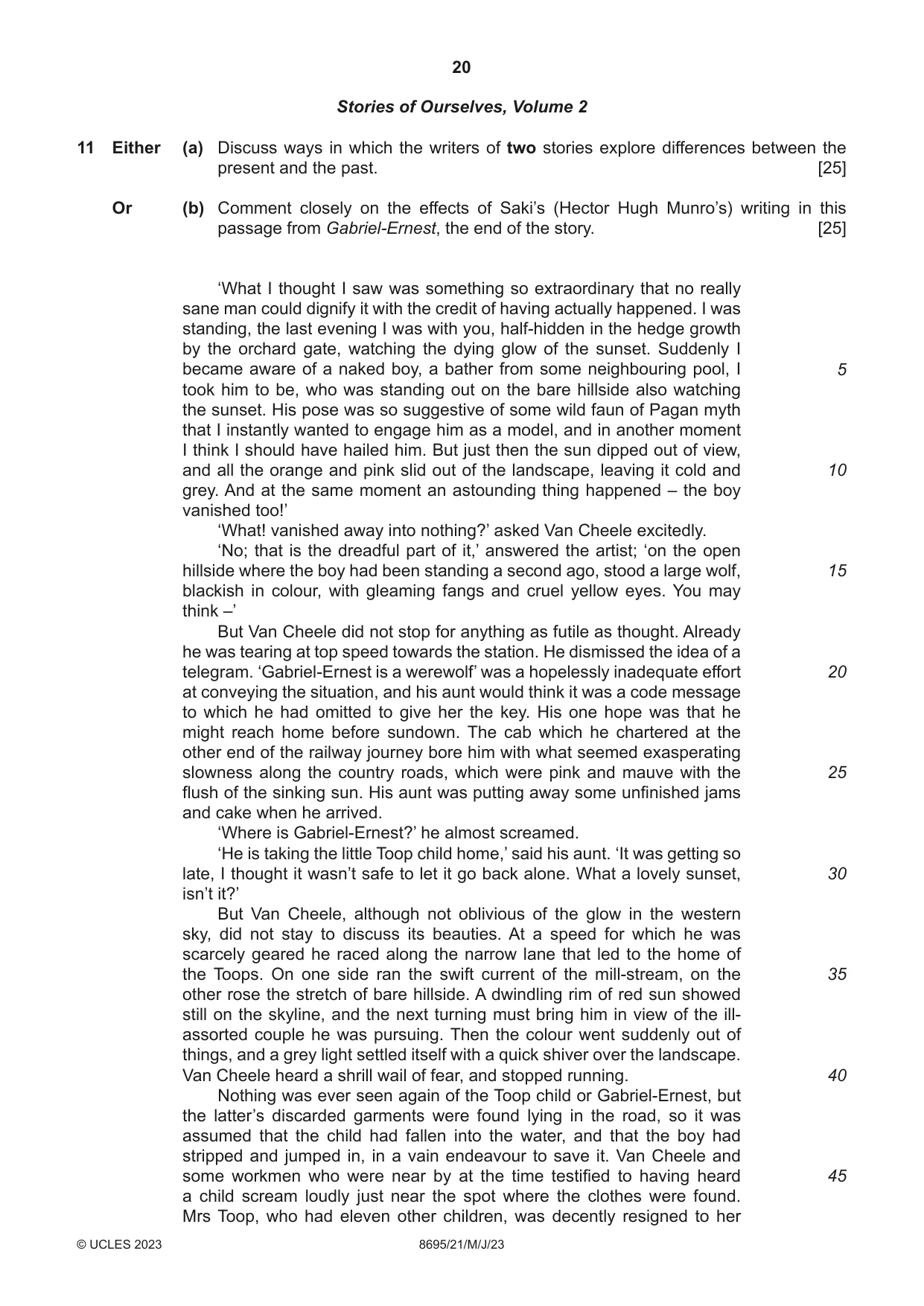
20 8695/21/M/J/23 © UCLES 2023 Stories of Ourselves, Volume 2 11 Either (a) Discuss ways in which the writers of two stories explore differences between the present and the past. [25] Or (b) Comment closely on the effects of Saki’s (Hector Hugh Munro’s) writing in this passage from Gabriel-Ernest, the end of the story. [25] ‘What I thought I saw was something so extraordinary that no really sane man could dignify it with the credit of having actually happened. I was standing, the last evening I was with you, half-hidden in the hedge growth by the orchard gate, watching the dying glow of the sunset. Suddenly I became aware of a naked boy, a bather from some neighbouring pool, I took him to be, who was standing out on the bare hillside also watching the sunset. His pose was so suggestive of some wild faun of Pagan myth that I instantly wanted to engage him as a model, and in another moment I think I should have hailed him. But just then the sun dipped out of view, and all the orange and pink slid out of the landscape, leaving it cold and grey. And at the same moment an astounding thing happened – the boy vanished too!’ ‘What! vanished away into nothing?’ asked Van Cheele excitedly. ‘No; that is the dreadful part of it,’ answered the artist; ‘on the open hillside where the boy had been standing a second ago, stood a large wolf, blackish in colour, with gleaming fangs and cruel yellow eyes. You may think –’ But Van Cheele did not stop for anything as futile as thought. Already he was tearing at top speed towards the station. He dismissed the idea of a telegram. ‘Gabriel-Ernest is a werewolf’ was a hopelessly inadequate effort at conveying the situation, and his aunt would think it was a code message to which he had omitted to give her the key. His one hope was that he might reach home before sundown. The cab which he chartered at the other end of the railway journey bore him with what seemed exasperating slowness along the country roads, which were pink and mauve with the flush of the sinking sun. His aunt was putting away some unfinished jams and cake when he arrived. ‘Where is Gabriel-Ernest?’ he almost screamed. ‘He is taking the little Toop child home,’ said his aunt. ‘It was getting so late, I thought it wasn’t safe to let it go back alone. What a lovely sunset, isn’t it?’ But Van Cheele, although not oblivious of the glow in the western sky, did not stay to discuss its beauties. At a speed for which he was scarcely geared he raced along the narrow lane that led to the home of the Toops. On one side ran the swift current of the mill-stream, on the other rose the stretch of bare hillside. A dwindling rim of red sun showed still on the skyline, and the next turning must bring him in view of the ill- assorted couple he was pursuing. Then the colour went suddenly out of things, and a grey light settled itself with a quick shiver over the landscape. Van Cheele heard a shrill wail of fear, and stopped running. Nothing was ever seen again of the Toop child or Gabriel-Ernest, but the latter’s discarded garments were found lying in the road, so it was assumed that the child had fallen into the water, and that the boy had stripped and jumped in, in a vain endeavour to save it. Van Cheele and some workmen who were near by at the time testified to having heard a child scream loudly just near the spot where the clothes were found. Mrs Toop, who had eleven other children, was decently resigned to her 5 10 15 20 25 30 35 40 45
Question paper, page 21
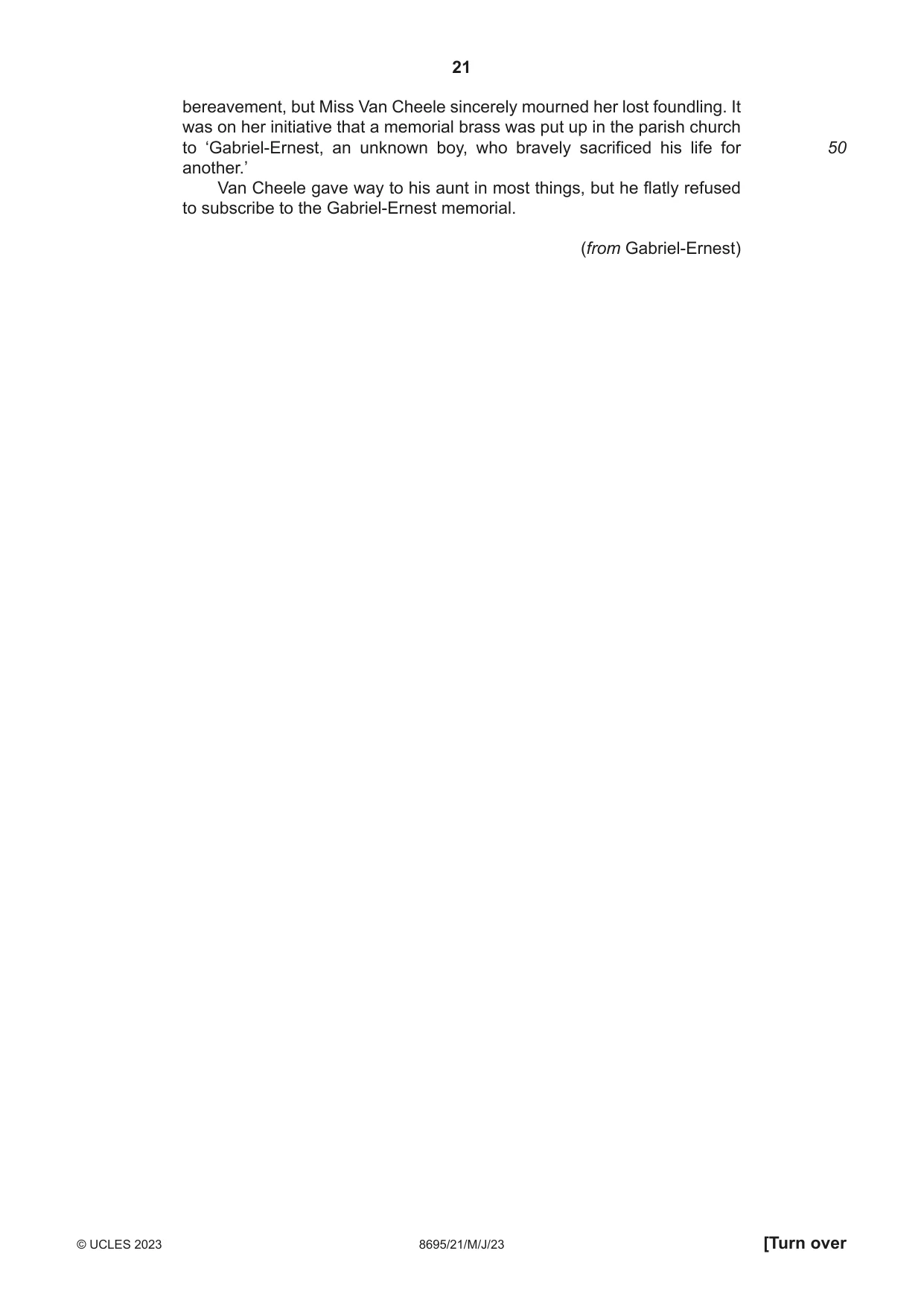
21 8695/21/M/J/23 © UCLES 2023 [Turn over bereavement, but Miss Van Cheele sincerely mourned her lost foundling. It was on her initiative that a memorial brass was put up in the parish church to ‘Gabriel-Ernest, an unknown boy, who bravely sacrificed his life for another.’ Van Cheele gave way to his aunt in most things, but he flatly refused to subscribe to the Gabriel-Ernest memorial. (from Gabriel-Ernest) 50
Question paper, page 22
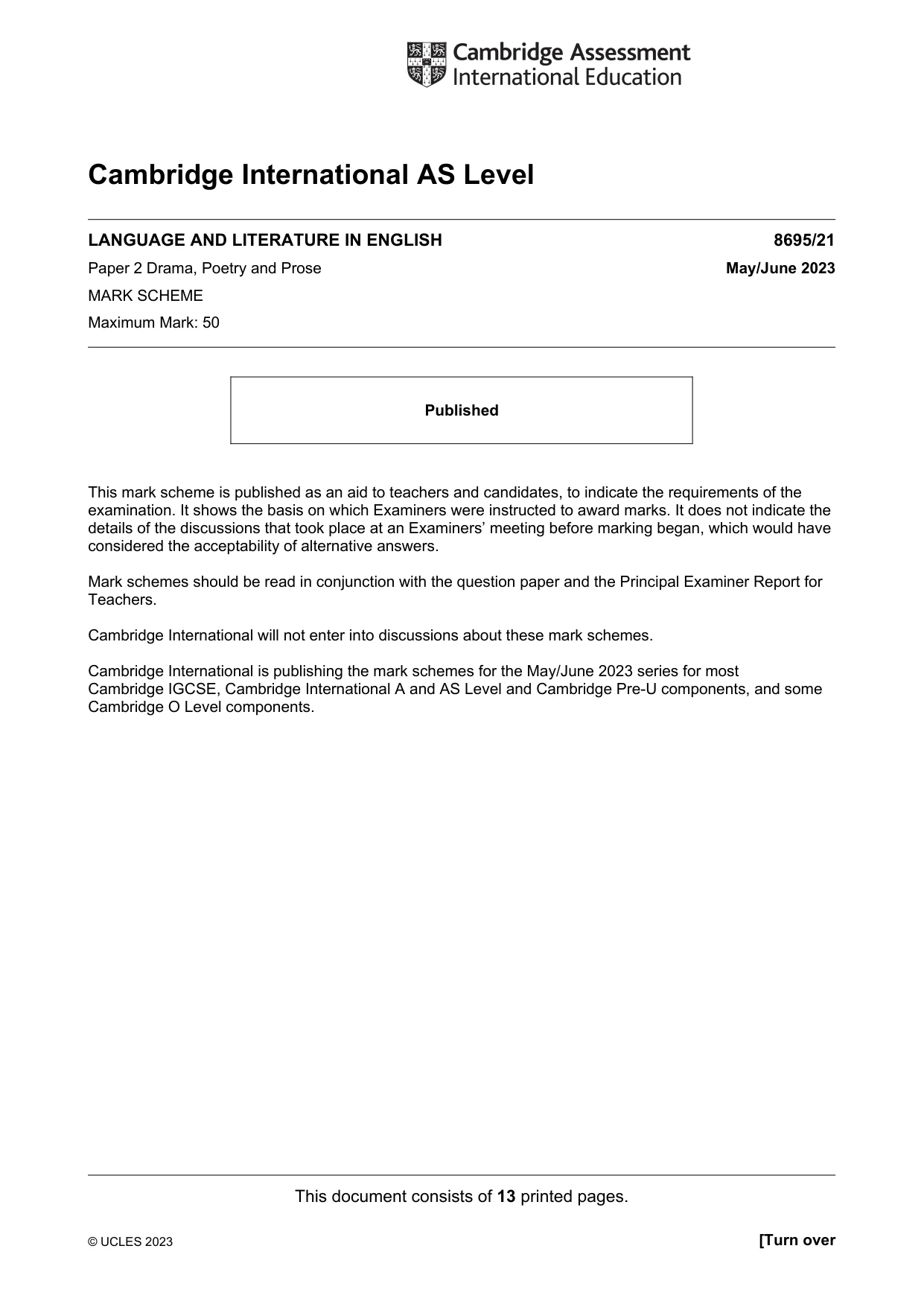
22 8695/21/M/J/23 © UCLES 2023 MARK TWAIN: The Adventures of Huckleberry Finn 12 Either (a) Discuss ways in which Twain presents the natural world in the novel. [25] Or (b) Comment closely on Twain’s presentation of Huck’s situation in the following passage. [25] ‘You just march into that setting-room and stay there till I come. You been up to something you no business to, and I lay I’ll find out what it is before I’m done with you.’ So she went away as I opened the door and walked into the setting- room. My, but there was a crowd there! Fifteen farmers, and every one of them had a gun. I was most powerful sick, and slunk to a chair and set down. They was setting around, some of them talking a little, in a low voice, and all of them fidgety and uneasy, but trying to look like they warn’t; but I knowed they was, because they was always taking off their hats, and putting them on, and scratching their heads, and changing their seats, and fumbling with their buttons. I warn’t easy myself, but I didn’t take my hat off, all the same. I did wish Aunt Sally would come, and get done with me, and lick me, if she wanted to, and let me get away and tell Tom how we’d overdone this thing, and what a thundering hornet’s nest we’d got ourselves into, so we could stop fooling around, straight off, and clear out with Jim before these rips got out of patience and come for us. At last she come, and begun to ask me questions, but I couldn’t answer them straight, I didn’t know which end of me was up; because these men was in such a fidget now, that some was wanting to start right now and lay for them desperadoes, and saying it warn’t but a few minutes to midnight; and others was trying to get them to hold on and wait for the sheep-signal; and here was aunty pegging away at the questions, and me a shaking all over and ready to sink down in my tracks I was that scared; and the place getting hotter and hotter, and the butter beginning to melt and run down my neck and behind my ears: and pretty soon, when one of them says, ‘I’m for going and getting in the cabin first, and right now, and catching them when they come,’ I most dropped; and a streak of butter come a trickling down my forehead, and Aunt Sally she see it, and turns white as a sheet, and says: ‘For the land’s sake what is the matter with the child! – he’s got the brain fever as shore as you’re born, and they’re oozing out!’ And everybody runs to see, and she snatches off my hat, and out comes the bread, and what was left of the butter, and she grabbed me, and hugged me, and says: ‘Oh, what a turn you did give me! and how glad and grateful I am it ain’t no worse; for luck’s against us, and it never rains but it pours, and when I see that truck I thought we’d lost you, for I knowed by the color and all, it was just like your brains would be if – Dear, dear, whyd’nt you tell me that was what you’d been down there for, I wouldn’t a cared. Now cler out to bed, and don’t lemme see no more of you till morning!’ (from Chapter 40) 5 10 15 20 25 30 35 40
Question paper, page 23
23 8695/21/M/J/23 © UCLES 2023 BLANK PAGE
Question paper, page 24
24 8695/21/M/J/23 © UCLES 2023 Permission to reproduce items where third-party owned material protected by copyright is included has been sought and cleared where possible. Every reasonable effort has been made by the publisher (UCLES) to trace copyright holders, but if any items requiring clearance have unwittingly been included, the publisher will be pleased to make amends at the earliest possible opportunity. To avoid the issue of disclosure of answer-related information to candidates, all copyright acknowledgements are reproduced online in the Cambridge Assessment International Education Copyright Acknowledgements Booklet. This is produced for each series of examinations and is freely available to download at www.cambridgeinternational.org after the live examination series. Cambridge Assessment International Education is part of Cambridge Assessment. Cambridge Assessment is the brand name of the University of Cambridge Local Examinations Syndicate (UCLES), which is a department of the University of Cambridge. BLANK PAGE
Mark scheme, page 1
This document consists of 13 printed pages. © UCLES 2023 [Turn over Cambridge International AS Level LANGUAGE AND LITERATURE IN ENGLISH 8695/21 Paper 2 Drama, Poetry and Prose May/June 2023 MARK SCHEME Maximum Mark: 50 Published This mark scheme is published as an aid to teachers and candidates, to indicate the requirements of the examination. It shows the basis on which Examiners were instructed to award marks. It does not indicate the details of the discussions that took place at an Examiners’ meeting before marking began, which would have considered the acceptability of alternative answers. Mark schemes should be read in conjunction with the question paper and the Principal Examiner Report for Teachers. Cambridge International will not enter into discussions about these mark schemes. Cambridge International is publishing the mark schemes for the May/June 2023 series for most Cambridge IGCSE, Cambridge International A and AS Level and Cambridge Pre-U components, and some Cambridge O Level components.
Mark scheme, page 2
8695/21 Cambridge International AS Level – Mark Scheme PUBLISHED May/June 2023 © UCLES 2023 Page 2 of 13 Generic Marking Principles These general marking principles must be applied by all examiners when marking candidate answers. They should be applied alongside the specific content of the mark scheme or generic level descriptors for a question. Each question paper and mark scheme will also comply with these marking principles. GENERIC MARKING PRINCIPLE 1: Marks must be awarded in line with: the specific content of the mark scheme or the generic level descriptors for the question the specific skills defined in the mark scheme or in the generic level descriptors for the question the standard of response required by a candidate as exemplified by the standardisation scripts. GENERIC MARKING PRINCIPLE 2: Marks awarded are always whole marks (not half marks, or other fractions). GENERIC MARKING PRINCIPLE 3: Marks must be awarded positively: marks are awarded for correct/valid answers, as defined in the mark scheme. However, credit is given for valid answers which go beyond the scope of the syllabus and mark scheme, referring to your Team Leader as appropriate marks are awarded when candidates clearly demonstrate what they know and can do marks are not deducted for errors marks are not deducted for omissions answers should only be judged on the quality of spelling, punctuation and grammar when these features are specifically assessed by the question as indicated by the mark scheme. The meaning, however, should be unambiguous. GENERIC MARKING PRINCIPLE 4: Rules must be applied consistently, e.g. in situations where candidates have not followed instructions or in the application of generic level descriptors. GENERIC MARKING PRINCIPLE 5: Marks should be awarded using the full range of marks defined in the mark scheme for the question (however; the use of the full mark range may be limited according to the quality of the candidate responses seen). GENERIC MARKING PRINCIPLE 6: Marks awarded are based solely on the requirements as defined in the mark scheme. Marks should not be awarded with grade thresholds or grade descriptors in mind.
Mark scheme, page 3
8695/21 Cambridge International AS Level – Mark Scheme PUBLISHED May/June 2023 © UCLES 2023 Page 3 of 13 English & Media subject specific general marking principles (To be read in conjunction with the Generic Marking Principles (and requiring further guidance on how to place marks within levels)) Components using level descriptors: We use level descriptors as a guide to broad understanding of the qualities normally expected of, or typical of, work in a level. Level descriptors are a means of general guidance, and should not be interpreted as hurdle statements. Where indicative content notes are supplied for a question, these are not a prescription of required content, and must not be treated as such. Alternative correct points and unexpected answers in candidates’ scripts must be given marks that fairly reflect the knowledge and skills demonstrated. While we may have legitimate expectations as to the ground most answers may occupy, we must at all times be prepared to meet candidates on their chosen ground, provided it is relevant ground (e.g. clearly related to and derived from a relevant passage/text and meeting the mark scheme requirements for the question). Components using point-based marking: Point marking is often used to reward knowledge, understanding and application of skills. We give credit where the candidate’s answer shows relevant knowledge, understanding and application of skills in answering the question. We do not give credit where the answer shows confusion. From this it follows that we: a DO credit answers which are worded differently from the mark scheme if they clearly convey the same meaning (unless the mark scheme requires a specific term). b DO credit alternative answers/examples which are not written in the mark scheme if they are correct. c DO credit answers where candidates give more than one correct answer in one prompt/numbered/scaffolded space where extended writing is required rather than list-type answers. For example, questions that require n reasons (e.g. State two reasons…). d DO NOT credit answers simply for using a ‘key term’ unless that is all that is required. (Check for evidence it is understood and not used wrongly.). e DO NOT credit answers which are obviously self-contradicting or trying to cover all possibilities. f DO NOT give further credit for what is effectively repetition of a correct point already credited unless the language itself is being tested. This applies equally to ‘mirror statements’ (i.e. polluted/not polluted). g DO NOT require spellings to be correct, unless this is part of the test. However spellings of syllabus terms must allow for clear and unambiguous separation from other syllabus terms with which they may be confused (e.g. Corrasion/Corrosion).
Mark scheme, page 4
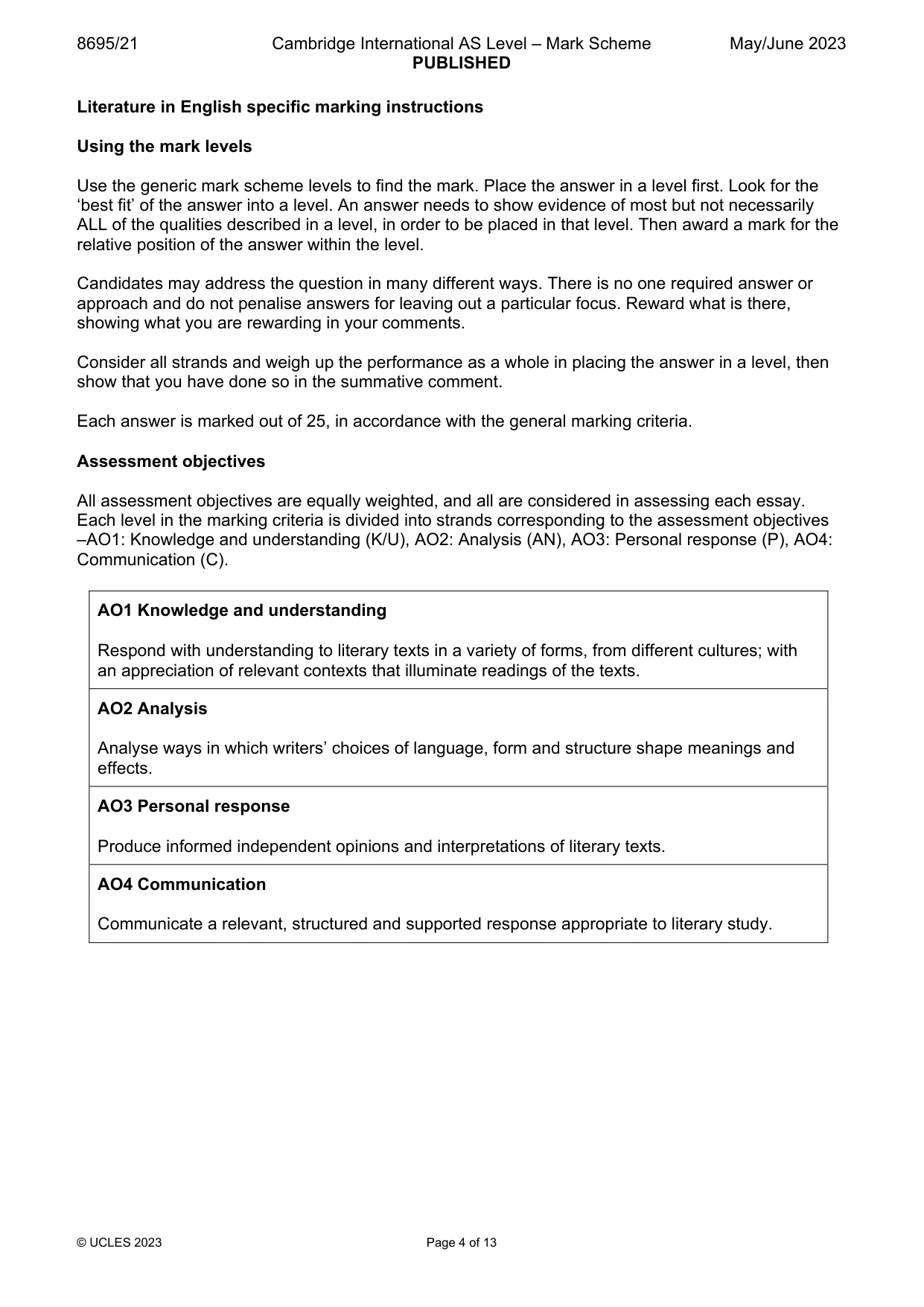
8695/21 Cambridge International AS Level – Mark Scheme PUBLISHED May/June 2023 © UCLES 2023 Page 4 of 13 Literature in English specific marking instructions Using the mark levels Use the generic mark scheme levels to find the mark. Place the answer in a level first. Look for the ‘best fit’ of the answer into a level. An answer needs to show evidence of most but not necessarily ALL of the qualities described in a level, in order to be placed in that level. Then award a mark for the relative position of the answer within the level. Candidates may address the question in many different ways. There is no one required answer or approach and do not penalise answers for leaving out a particular focus. Reward what is there, showing what you are rewarding in your comments. Consider all strands and weigh up the performance as a whole in placing the answer in a level, then show that you have done so in the summative comment. Each answer is marked out of 25, in accordance with the general marking criteria. Assessment objectives All assessment objectives are equally weighted, and all are considered in assessing each essay. Each level in the marking criteria is divided into strands corresponding to the assessment objectives –AO1: Knowledge and understanding (K/U), AO2: Analysis (AN), AO3: Personal response (P), AO4: Communication (C). AO1 Knowledge and understanding Respond with understanding to literary texts in a variety of forms, from different cultures; with an appreciation of relevant contexts that illuminate readings of the texts. AO2 Analysis Analyse ways in which writers’ choices of language, form and structure shape meanings and effects. AO3 Personal response Produce informed independent opinions and interpretations of literary texts. AO4 Communication Communicate a relevant, structured and supported response appropriate to literary study.
Mark scheme, page 5
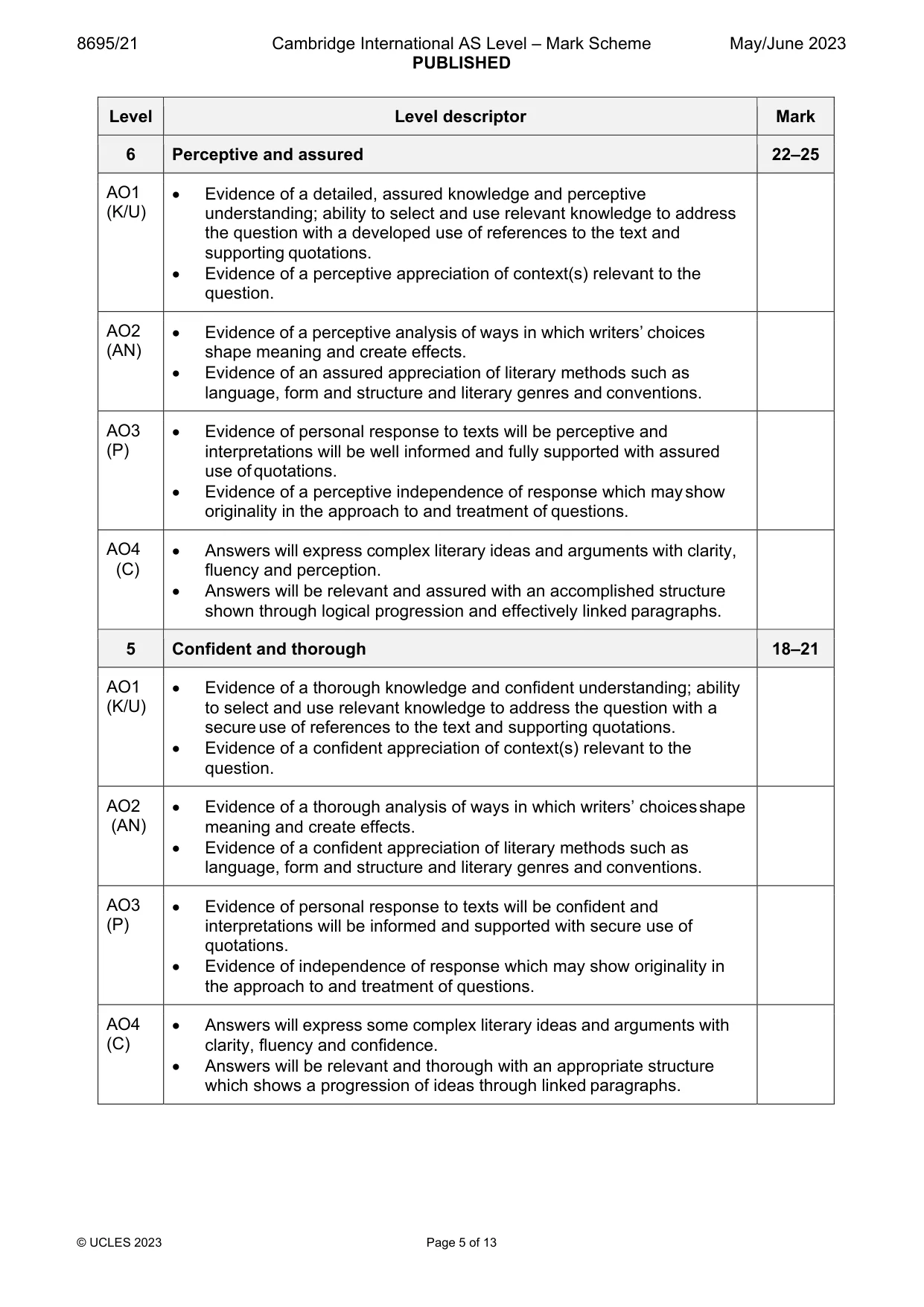
8695/21 Cambridge International AS Level – Mark Scheme PUBLISHED May/June 2023 © UCLES 2023 Page 5 of 13 Level Level descriptor Mark 6 Perceptive and assured 22–25 AO1 (K/U) Evidence of a detailed, assured knowledge and perceptive understanding; ability to select and use relevant knowledge to address the question with a developed use of references to the text and supporting quotations. Evidence of a perceptive appreciation of context(s) relevant to the question. AO2 (AN) Evidence of a perceptive analysis of ways in which writers’ choices shape meaning and create effects. Evidence of an assured appreciation of literary methods such as language, form and structure and literary genres and conventions. AO3 (P) Evidence of personal response to texts will be perceptive and interpretations will be well informed and fully supported with assured use of quotations. Evidence of a perceptive independence of response which may show originality in the approach to and treatment of questions. AO4 (C) Answers will express complex literary ideas and arguments with clarity, fluency and perception. Answers will be relevant and assured with an accomplished structure shown through logical progression and effectively linked paragraphs. 5 Confident and thorough 18–21 AO1 (K/U) Evidence of a thorough knowledge and confident understanding; ability to select and use relevant knowledge to address the question with a secure use of references to the text and supporting quotations. Evidence of a confident appreciation of context(s) relevant to the question. AO2 (AN) Evidence of a thorough analysis of ways in which writers’ choices shape meaning and create effects. Evidence of a confident appreciation of literary methods such as language, form and structure and literary genres and conventions. AO3 (P) Evidence of personal response to texts will be confident and interpretations will be informed and supported with secure use of quotations. Evidence of independence of response which may show originality in the approach to and treatment of questions. AO4 (C) Answers will express some complex literary ideas and arguments with clarity, fluency and confidence. Answers will be relevant and thorough with an appropriate structure which shows a progression of ideas through linked paragraphs.
Mark scheme, page 6
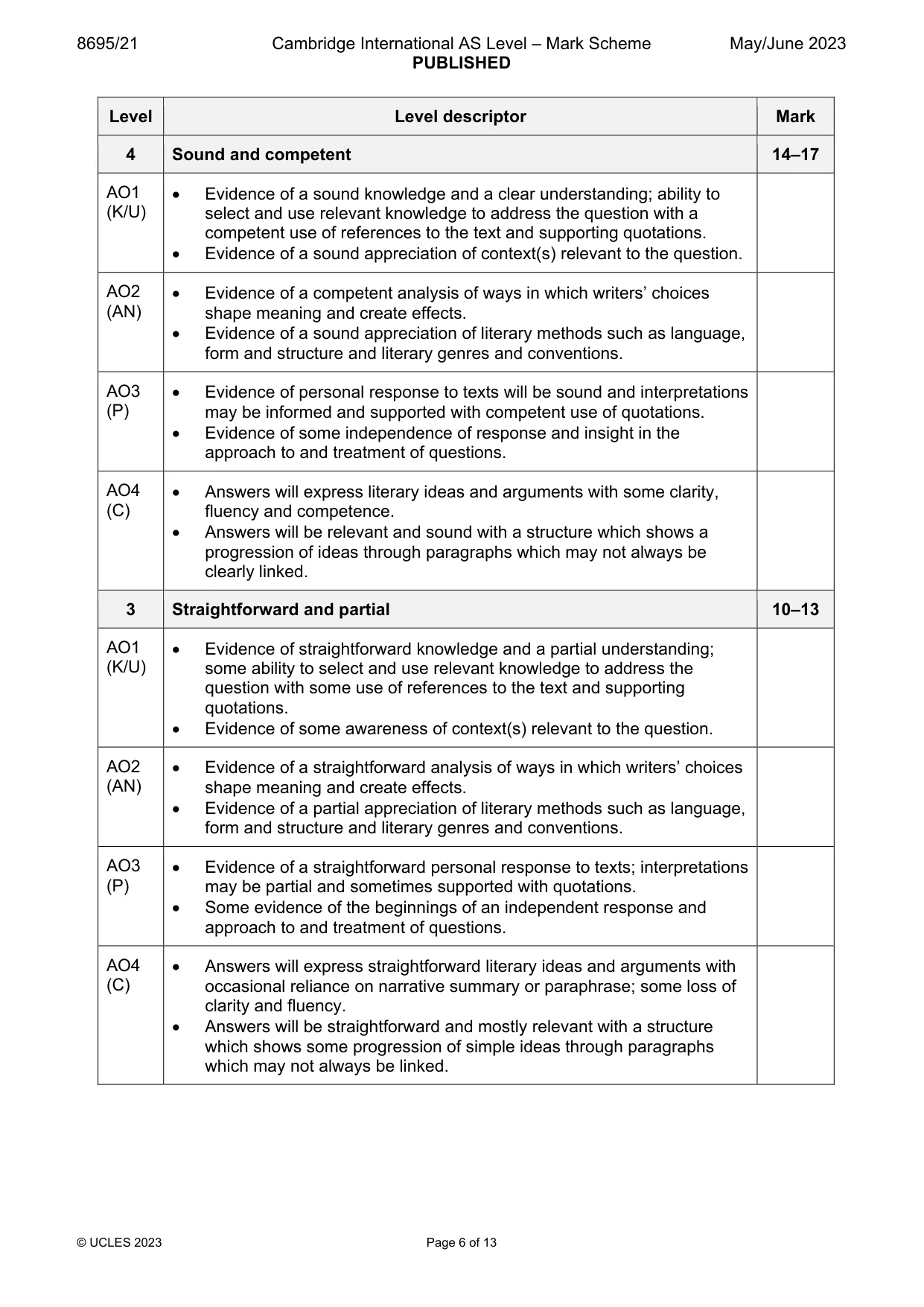
8695/21 Cambridge International AS Level – Mark Scheme PUBLISHED May/June 2023 © UCLES 2023 Page 6 of 13 Level Level descriptor Mark 4 Sound and competent 14–17 AO1 (K/U) Evidence of a sound knowledge and a clear understanding; ability to select and use relevant knowledge to address the question with a competent use of references to the text and supporting quotations. Evidence of a sound appreciation of context(s) relevant to the question. AO2 (AN) Evidence of a competent analysis of ways in which writers’ choices shape meaning and create effects. Evidence of a sound appreciation of literary methods such as language, form and structure and literary genres and conventions. AO3 (P) Evidence of personal response to texts will be sound and interpretations may be informed and supported with competent use of quotations. Evidence of some independence of response and insight in the approach to and treatment of questions. AO4 (C) Answers will express literary ideas and arguments with some clarity, fluency and competence. Answers will be relevant and sound with a structure which shows a progression of ideas through paragraphs which may not always be clearly linked. 3 Straightforward and partial 10–13 AO1 (K/U) Evidence of straightforward knowledge and a partial understanding; some ability to select and use relevant knowledge to address the question with some use of references to the text and supporting quotations. Evidence of some awareness of context(s) relevant to the question. AO2 (AN) Evidence of a straightforward analysis of ways in which writers’ choices shape meaning and create effects. Evidence of a partial appreciation of literary methods such as language, form and structure and literary genres and conventions. AO3 (P) Evidence of a straightforward personal response to texts; interpretations may be partial and sometimes supported with quotations. Some evidence of the beginnings of an independent response and approach to and treatment of questions. AO4 (C) Answers will express straightforward literary ideas and arguments with occasional reliance on narrative summary or paraphrase; some loss of clarity and fluency. Answers will be straightforward and mostly relevant with a structure which shows some progression of simple ideas through paragraphs which may not always be linked.
Mark scheme, page 7
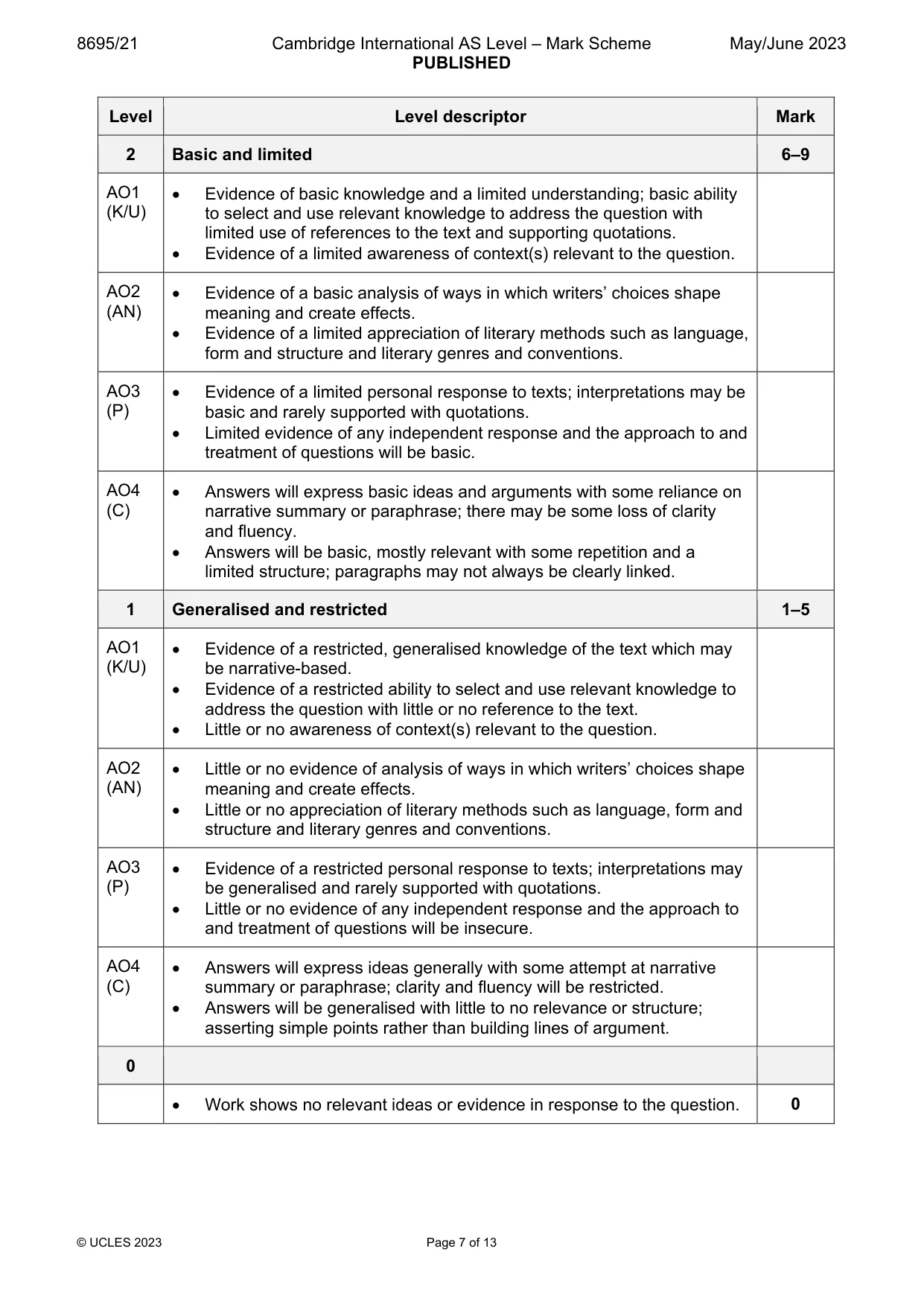
8695/21 Cambridge International AS Level – Mark Scheme PUBLISHED May/June 2023 © UCLES 2023 Page 7 of 13 Level Level descriptor Mark 2 Basic and limited 6–9 AO1 (K/U) Evidence of basic knowledge and a limited understanding; basic ability to select and use relevant knowledge to address the question with limited use of references to the text and supporting quotations. Evidence of a limited awareness of context(s) relevant to the question. AO2 (AN) Evidence of a basic analysis of ways in which writers’ choices shape meaning and create effects. Evidence of a limited appreciation of literary methods such as language, form and structure and literary genres and conventions. AO3 (P) Evidence of a limited personal response to texts; interpretations may be basic and rarely supported with quotations. Limited evidence of any independent response and the approach to and treatment of questions will be basic. AO4 (C) Answers will express basic ideas and arguments with some reliance on narrative summary or paraphrase; there may be some loss of clarity and fluency. Answers will be basic, mostly relevant with some repetition and a limited structure; paragraphs may not always be clearly linked. 1 Generalised and restricted 1–5 AO1 (K/U) Evidence of a restricted, generalised knowledge of the text which may be narrative-based. Evidence of a restricted ability to select and use relevant knowledge to address the question with little or no reference to the text. Little or no awareness of context(s) relevant to the question. AO2 (AN) Little or no evidence of analysis of ways in which writers’ choices shape meaning and create effects. Little or no appreciation of literary methods such as language, form and structure and literary genres and conventions. AO3 (P) Evidence of a restricted personal response to texts; interpretations may be generalised and rarely supported with quotations. Little or no evidence of any independent response and the approach to and treatment of questions will be insecure. AO4 (C) Answers will express ideas generally with some attempt at narrative summary or paraphrase; clarity and fluency will be restricted. Answers will be generalised with little to no relevance or structure; asserting simple points rather than building lines of argument. 0 Work shows no relevant ideas or evidence in response to the question. 0
Mark scheme, page 8
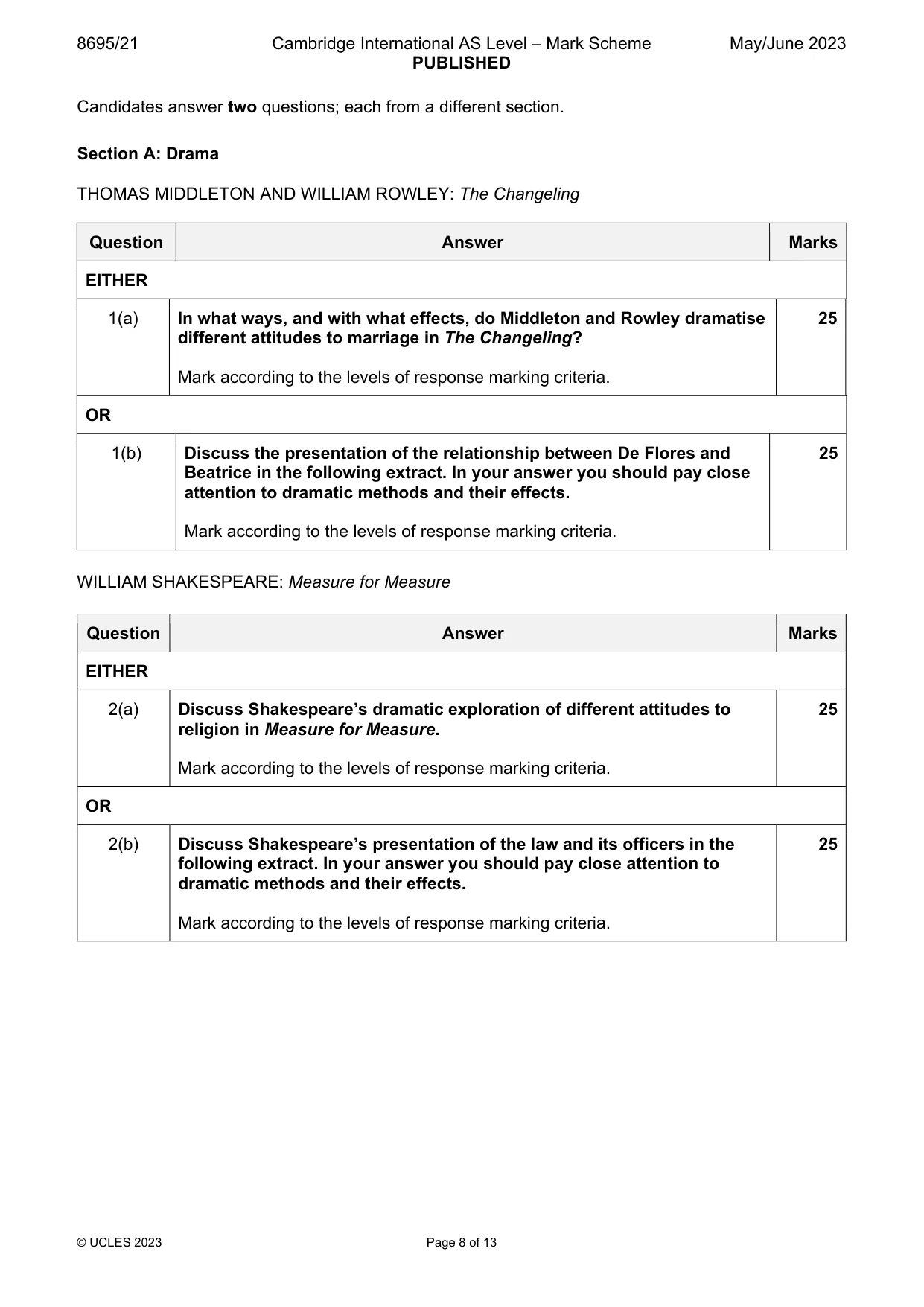
8695/21 Cambridge International AS Level – Mark Scheme PUBLISHED May/June 2023 © UCLES 2023 Page 8 of 13 Candidates answer two questions; each from a different section. Section A: Drama THOMAS MIDDLETON AND WILLIAM ROWLEY: The Changeling Question Answer Marks EITHER 1(a) In what ways, and with what effects, do Middleton and Rowley dramatise different attitudes to marriage in The Changeling? Mark according to the levels of response marking criteria. 25 OR 1(b) Discuss the presentation of the relationship between De Flores and Beatrice in the following extract. In your answer you should pay close attention to dramatic methods and their effects. Mark according to the levels of response marking criteria. 25 WILLIAM SHAKESPEARE: Measure for Measure Question Answer Marks EITHER 2(a) Discuss Shakespeare’s dramatic exploration of different attitudes to religion in Measure for Measure. Mark according to the levels of response marking criteria. 25 OR 2(b) Discuss Shakespeare’s presentation of the law and its officers in the following extract. In your answer you should pay close attention to dramatic methods and their effects. Mark according to the levels of response marking criteria. 25
Mark scheme, page 9
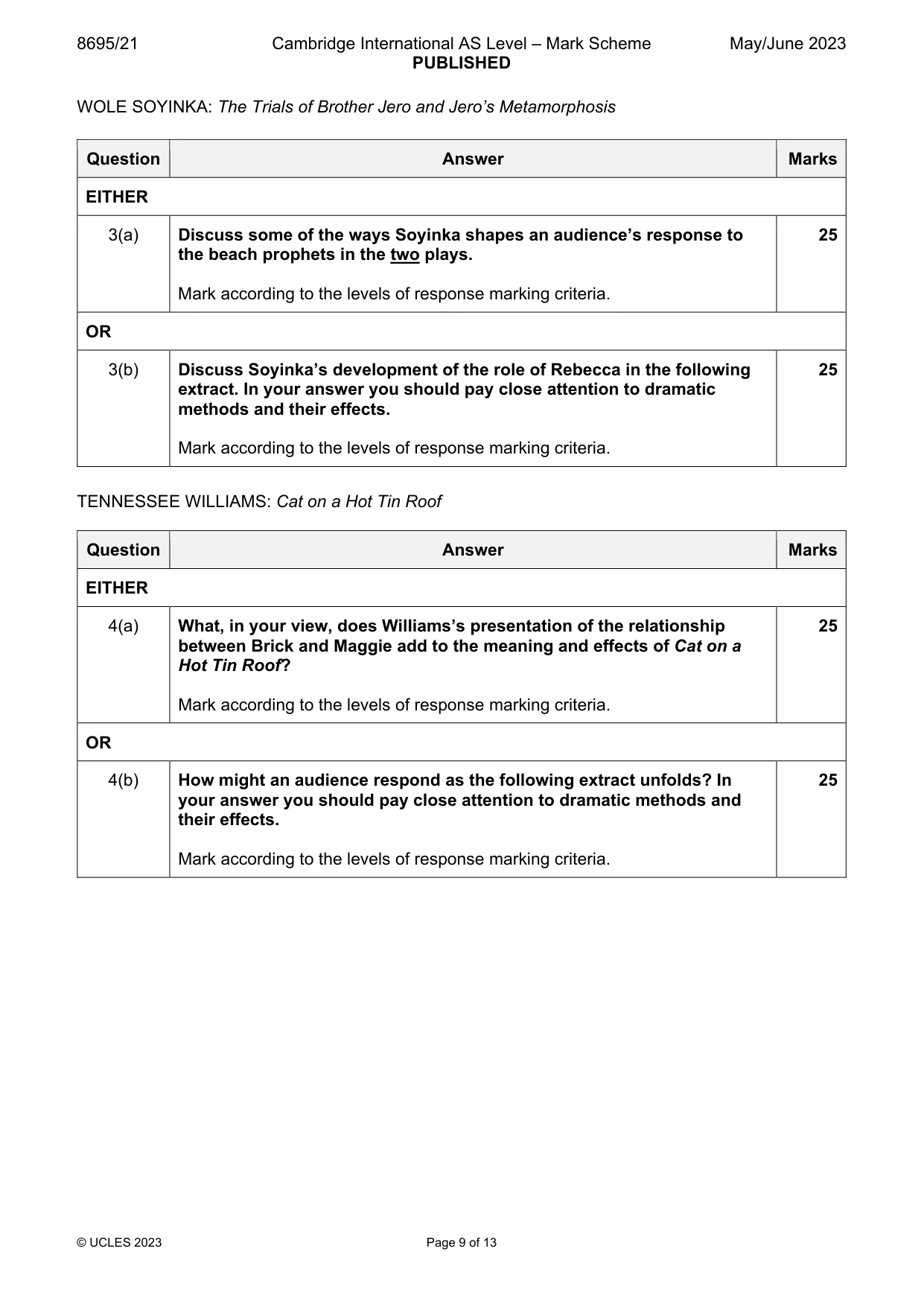
8695/21 Cambridge International AS Level – Mark Scheme PUBLISHED May/June 2023 © UCLES 2023 Page 9 of 13 WOLE SOYINKA: The Trials of Brother Jero and Jero’s Metamorphosis Question Answer Marks EITHER 3(a) Discuss some of the ways Soyinka shapes an audience’s response to the beach prophets in the two plays. Mark according to the levels of response marking criteria. 25 OR 3(b) Discuss Soyinka’s development of the role of Rebecca in the following extract. In your answer you should pay close attention to dramatic methods and their effects. Mark according to the levels of response marking criteria. 25 TENNESSEE WILLIAMS: Cat on a Hot Tin Roof Question Answer Marks EITHER 4(a) What, in your view, does Williams’s presentation of the relationship between Brick and Maggie add to the meaning and effects of Cat on a Hot Tin Roof? Mark according to the levels of response marking criteria. 25 OR 4(b) How might an audience respond as the following extract unfolds? In your answer you should pay close attention to dramatic methods and their effects. Mark according to the levels of response marking criteria. 25
Mark scheme, page 10
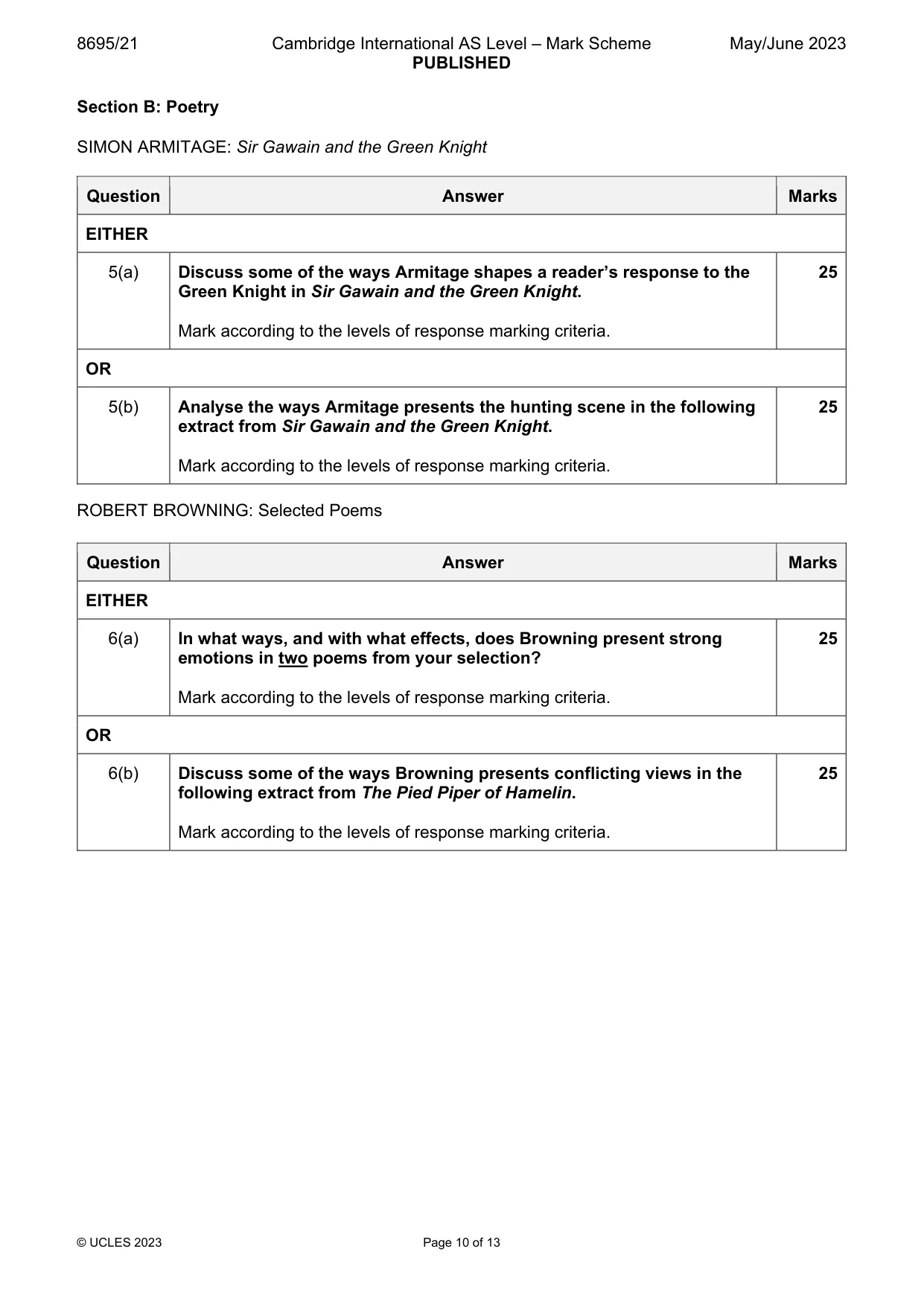
8695/21 Cambridge International AS Level – Mark Scheme PUBLISHED May/June 2023 © UCLES 2023 Page 10 of 13 Section B: Poetry SIMON ARMITAGE: Sir Gawain and the Green Knight Question Answer Marks EITHER 5(a) Discuss some of the ways Armitage shapes a reader’s response to the Green Knight in Sir Gawain and the Green Knight. Mark according to the levels of response marking criteria. 25 OR 5(b) Analyse the ways Armitage presents the hunting scene in the following extract from Sir Gawain and the Green Knight. Mark according to the levels of response marking criteria. 25 ROBERT BROWNING: Selected Poems Question Answer Marks EITHER 6(a) In what ways, and with what effects, does Browning present strong emotions in two poems from your selection? Mark according to the levels of response marking criteria. 25 OR 6(b) Discuss some of the ways Browning presents conflicting views in the following extract from The Pied Piper of Hamelin. Mark according to the levels of response marking criteria. 25
Mark scheme, page 11
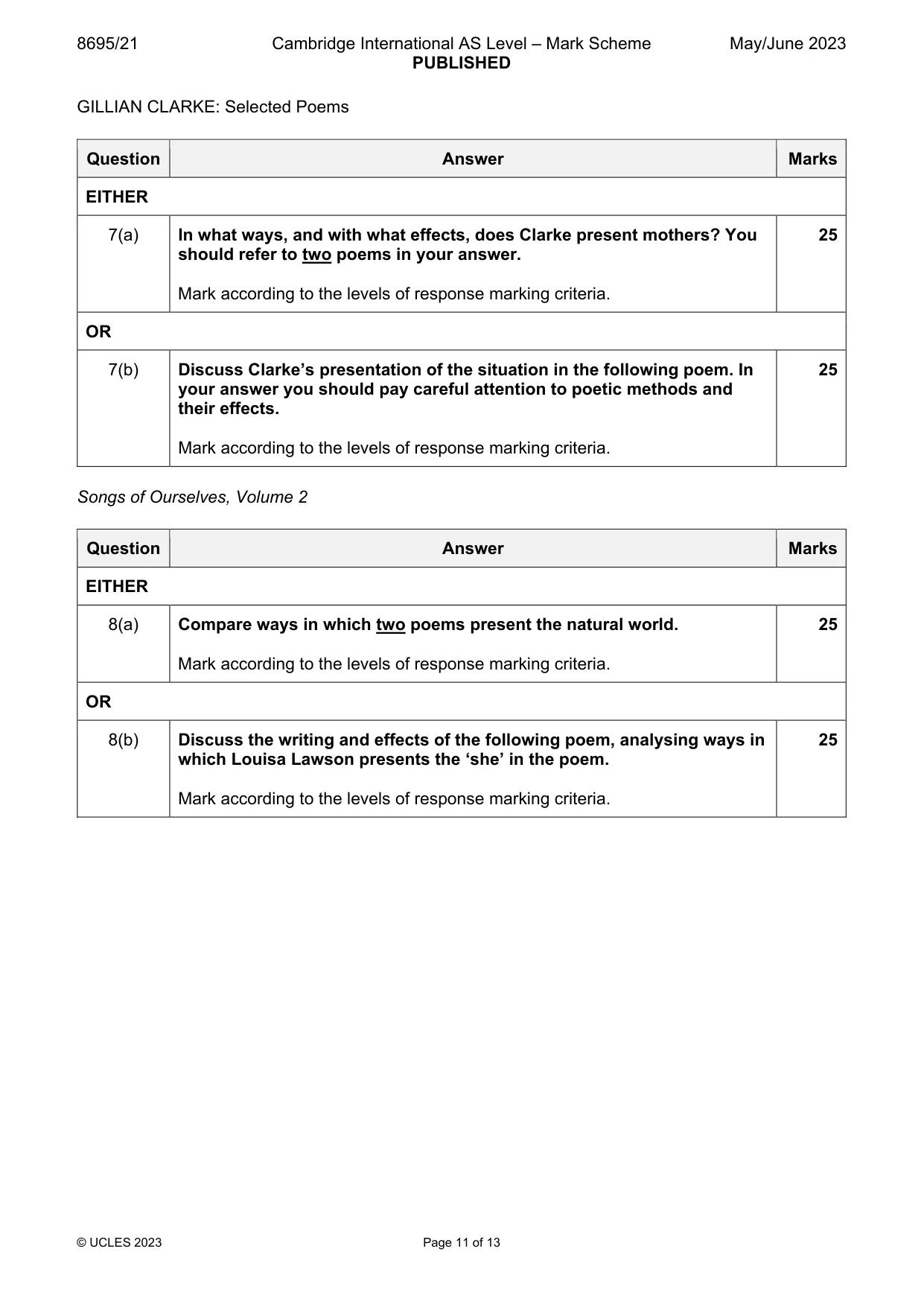
8695/21 Cambridge International AS Level – Mark Scheme PUBLISHED May/June 2023 © UCLES 2023 Page 11 of 13 GILLIAN CLARKE: Selected Poems Question Answer Marks EITHER 7(a) In what ways, and with what effects, does Clarke present mothers? You should refer to two poems in your answer. Mark according to the levels of response marking criteria. 25 OR 7(b) Discuss Clarke’s presentation of the situation in the following poem. In your answer you should pay careful attention to poetic methods and their effects. Mark according to the levels of response marking criteria. 25 Songs of Ourselves, Volume 2 Question Answer Marks EITHER 8(a) Compare ways in which two poems present the natural world. Mark according to the levels of response marking criteria. 25 OR 8(b) Discuss the writing and effects of the following poem, analysing ways in which Louisa Lawson presents the ‘she’ in the poem. Mark according to the levels of response marking criteria. 25
Mark scheme, page 12
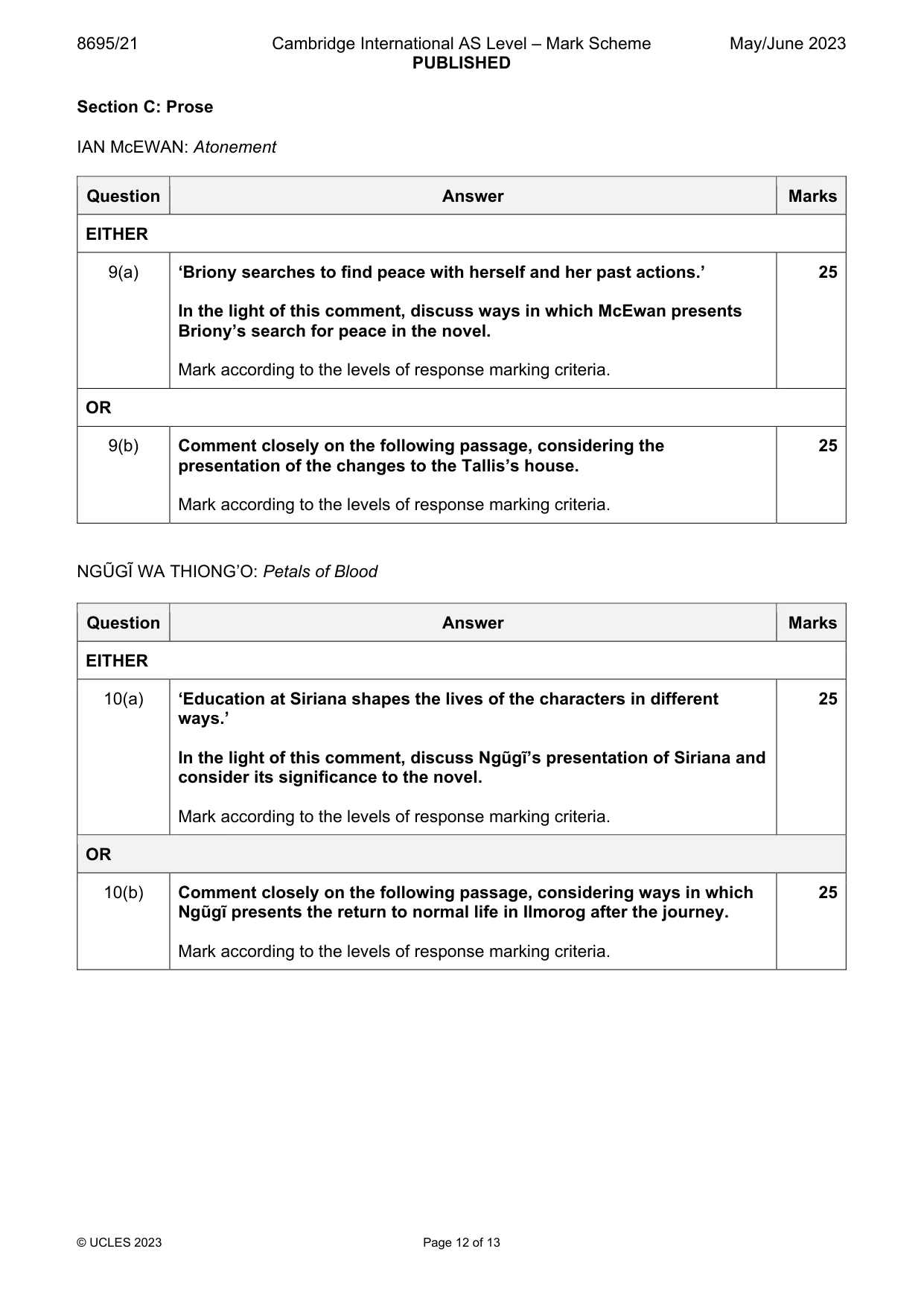
8695/21 Cambridge International AS Level – Mark Scheme PUBLISHED May/June 2023 © UCLES 2023 Page 12 of 13 Section C: Prose IAN McEWAN: Atonement Question Answer Marks EITHER 9(a) ‘Briony searches to find peace with herself and her past actions.’ In the light of this comment, discuss ways in which McEwan presents Briony’s search for peace in the novel. Mark according to the levels of response marking criteria. 25 OR 9(b) Comment closely on the following passage, considering the presentation of the changes to the Tallis’s house. Mark according to the levels of response marking criteria. 25 NGŨGĨ WA THIONG’O: Petals of Blood Question Answer Marks EITHER 10(a) ‘Education at Siriana shapes the lives of the characters in different ways.’ In the light of this comment, discuss Ngũgĩ’s presentation of Siriana and consider its significance to the novel. Mark according to the levels of response marking criteria. 25 OR 10(b) Comment closely on the following passage, considering ways in which Ngũgĩ presents the return to normal life in Ilmorog after the journey. Mark according to the levels of response marking criteria. 25
Mark scheme, page 13
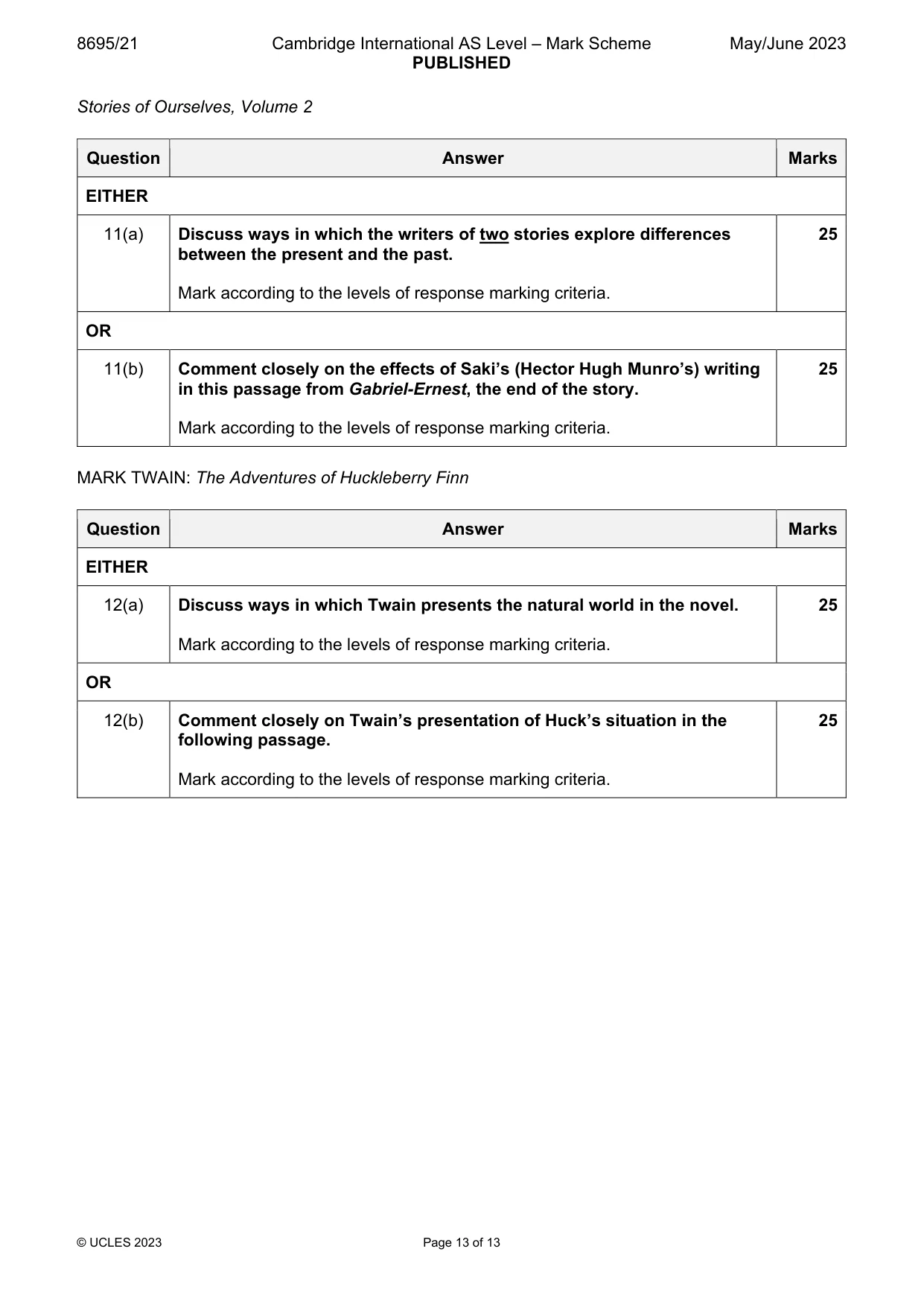
8695/21 Cambridge International AS Level – Mark Scheme PUBLISHED May/June 2023 © UCLES 2023 Page 13 of 13 Stories of Ourselves, Volume 2 Question Answer Marks EITHER 11(a) Discuss ways in which the writers of two stories explore differences between the present and the past. Mark according to the levels of response marking criteria. 25 OR 11(b) Comment closely on the effects of Saki’s (Hector Hugh Munro’s) writing in this passage from Gabriel-Ernest, the end of the story. Mark according to the levels of response marking criteria. 25 MARK TWAIN: The Adventures of Huckleberry Finn Question Answer Marks EITHER 12(a) Discuss ways in which Twain presents the natural world in the novel. Mark according to the levels of response marking criteria. 25 OR 12(b) Comment closely on Twain’s presentation of Huck’s situation in the following passage. Mark according to the levels of response marking criteria. 25
What you needed in this session
Cambridge’s own grade thresholds for 2023 May/June, Paper 2 · Variant 1. A higher threshold means an easier paper — the bar moves with how the cohort did.