Cambridge A Level English - Language and Literature (AS Level only, from 2016) 8695 — 2023 Oct/Nov Paper 2 · Variant 1
8695/21/O/N/23 · 50 marks · ≈56 min
The question paper and its mark scheme, free to read here and free to download. This is Cambridge’s own paper, exactly as it was sat.
Question paper24 pages




Mark scheme13 pages
Answers below. Sit the paper first if you are practising.
Paper as text
Question paper, page 1
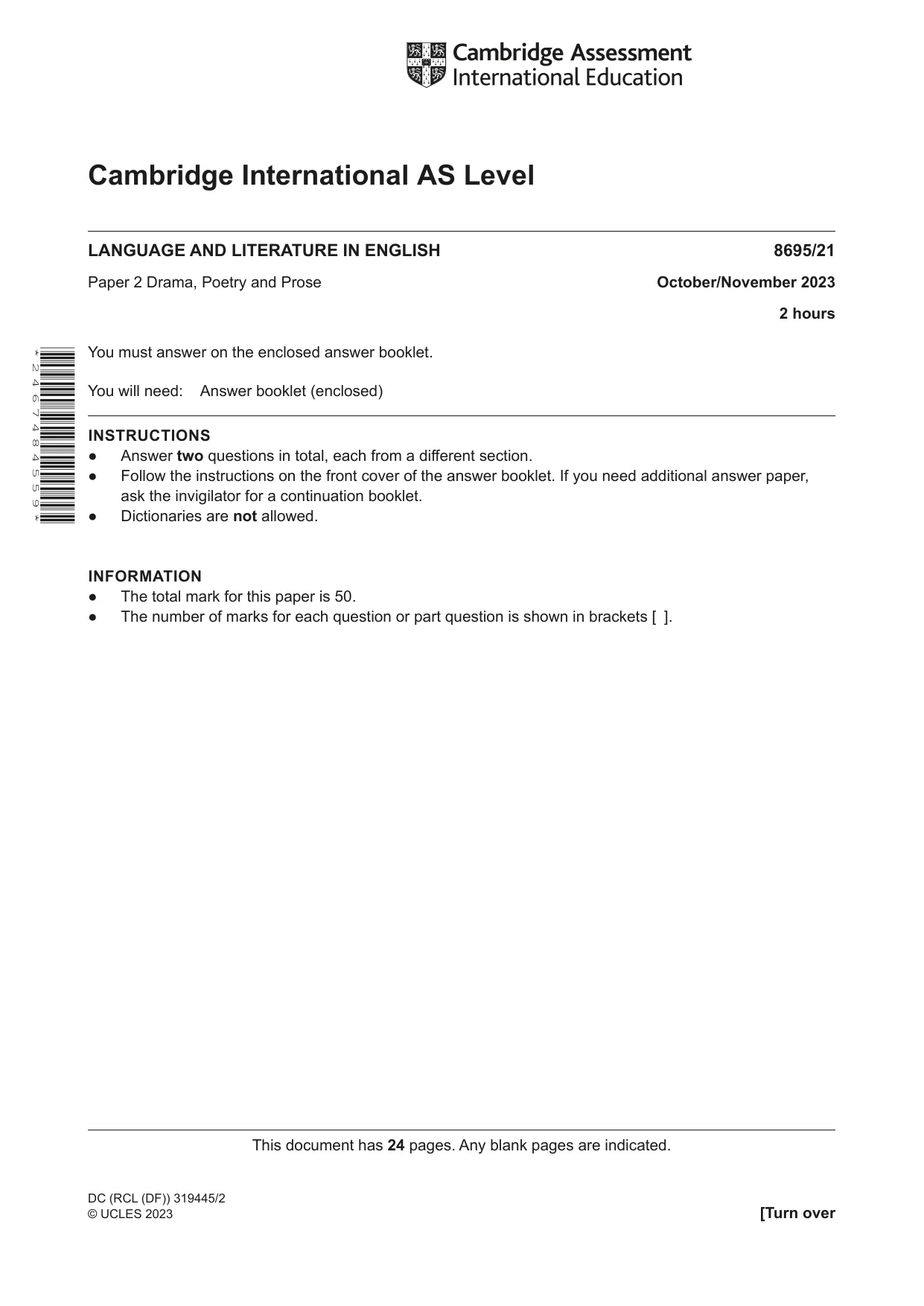
This document has 24 pages. Any blank pages are indicated. [Turn over Cambridge International AS Level * 2 4 6 7 4 8 4 5 5 9 * DC (RCL (DF)) 319445/2 © UCLES 2023 LANGUAGE AND LITERATURE IN ENGLISH 8695/21 Paper 2 Drama, Poetry and Prose October/November 2023 2 hours You must answer on the enclosed answer booklet. You will need: Answer booklet (enclosed) INSTRUCTIONS ● Answer two questions in total, each from a different section. ● Follow the instructions on the front cover of the answer booklet. If you need additional answer paper, ask the invigilator for a continuation booklet. ● Dictionaries are not allowed. INFORMATION ● The total mark for this paper is 50. ● The number of marks for each question or part question is shown in brackets [ ].
Question paper, page 2
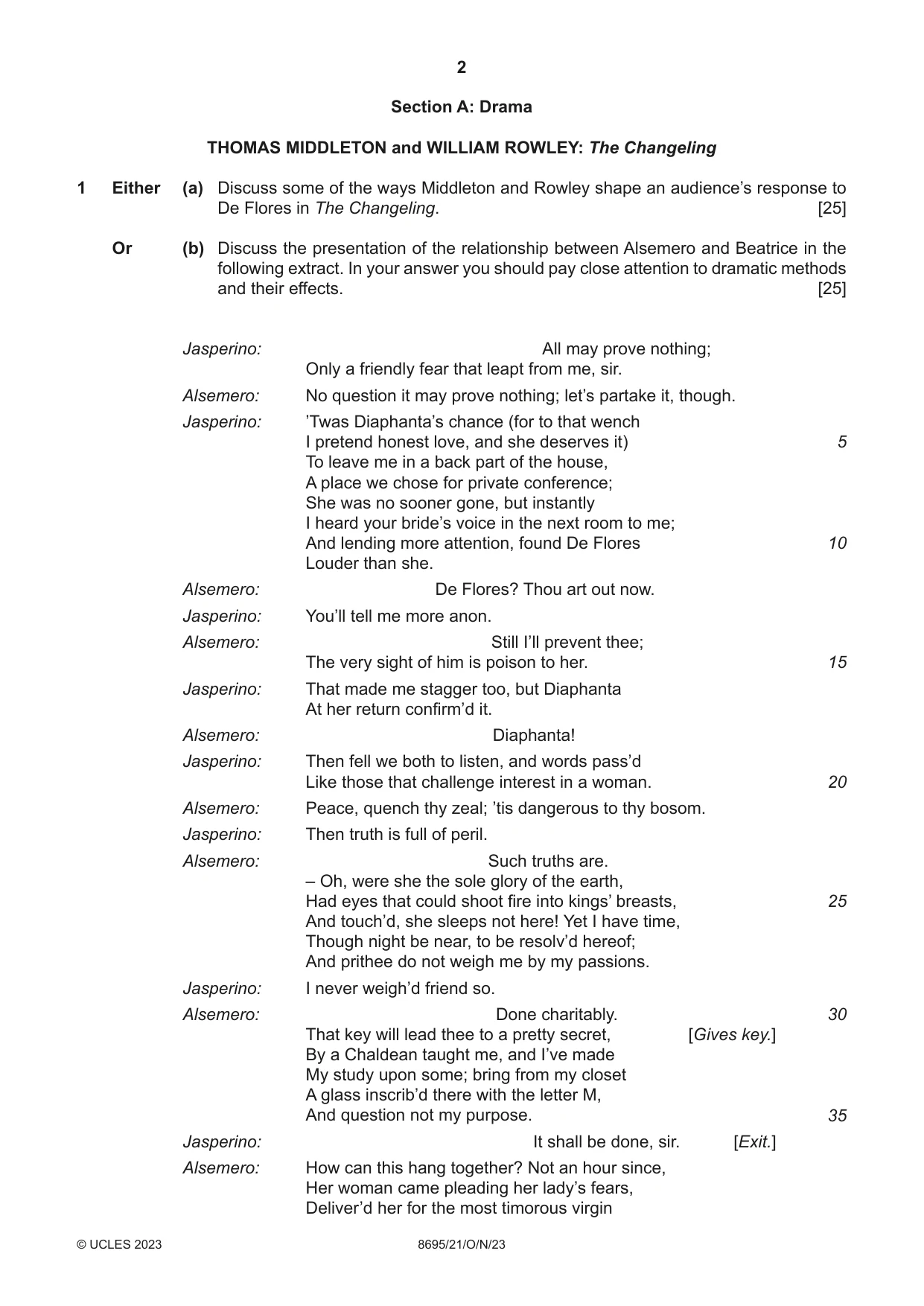
2 8695/21/O/N/23 © UCLES 2023 Section A: Drama THOMAS MIDDLETON and WILLIAM ROWLEY: The Changeling 1 Either (a) Discuss some of the ways Middleton and Rowley shape an audience’s response to De Flores in The Changeling. [25] Or (b) Discuss the presentation of the relationship between Alsemero and Beatrice in the following extract. In your answer you should pay close attention to dramatic methods and their effects. [25] Jasperino: All may prove nothing; Only a friendly fear that leapt from me, sir. Alsemero: No question it may prove nothing; let’s partake it, though. Jasperino: ’Twas Diaphanta’s chance (for to that wench I pretend honest love, and she deserves it) To leave me in a back part of the house, A place we chose for private conference; She was no sooner gone, but instantly I heard your bride’s voice in the next room to me; And lending more attention, found De Flores Louder than she. Alsemero: De Flores? Thou art out now. Jasperino: You’ll tell me more anon. Alsemero: Still I’ll prevent thee; The very sight of him is poison to her. Jasperino: That made me stagger too, but Diaphanta At her return confirm’d it. Alsemero: Diaphanta! Jasperino: Then fell we both to listen, and words pass’d Like those that challenge interest in a woman. Alsemero: Peace, quench thy zeal; ’tis dangerous to thy bosom. Jasperino: Then truth is full of peril. Alsemero: Such truths are. – Oh, were she the sole glory of the earth, Had eyes that could shoot fire into kings’ breasts, And touch’d, she sleeps not here! Yet I have time, Though night be near, to be resolv’d hereof; And prithee do not weigh me by my passions. Jasperino: I never weigh’d friend so. Alsemero: Done charitably. That key will lead thee to a pretty secret, [Gives key.] By a Chaldean taught me, and I’ve made My study upon some; bring from my closet A glass inscrib’d there with the letter M, And question not my purpose. Jasperino: It shall be done, sir. [Exit.] Alsemero: How can this hang together? Not an hour since, Her woman came pleading her lady’s fears, Deliver’d her for the most timorous virgin 5 10 15 20 25 30 35
Question paper, page 3
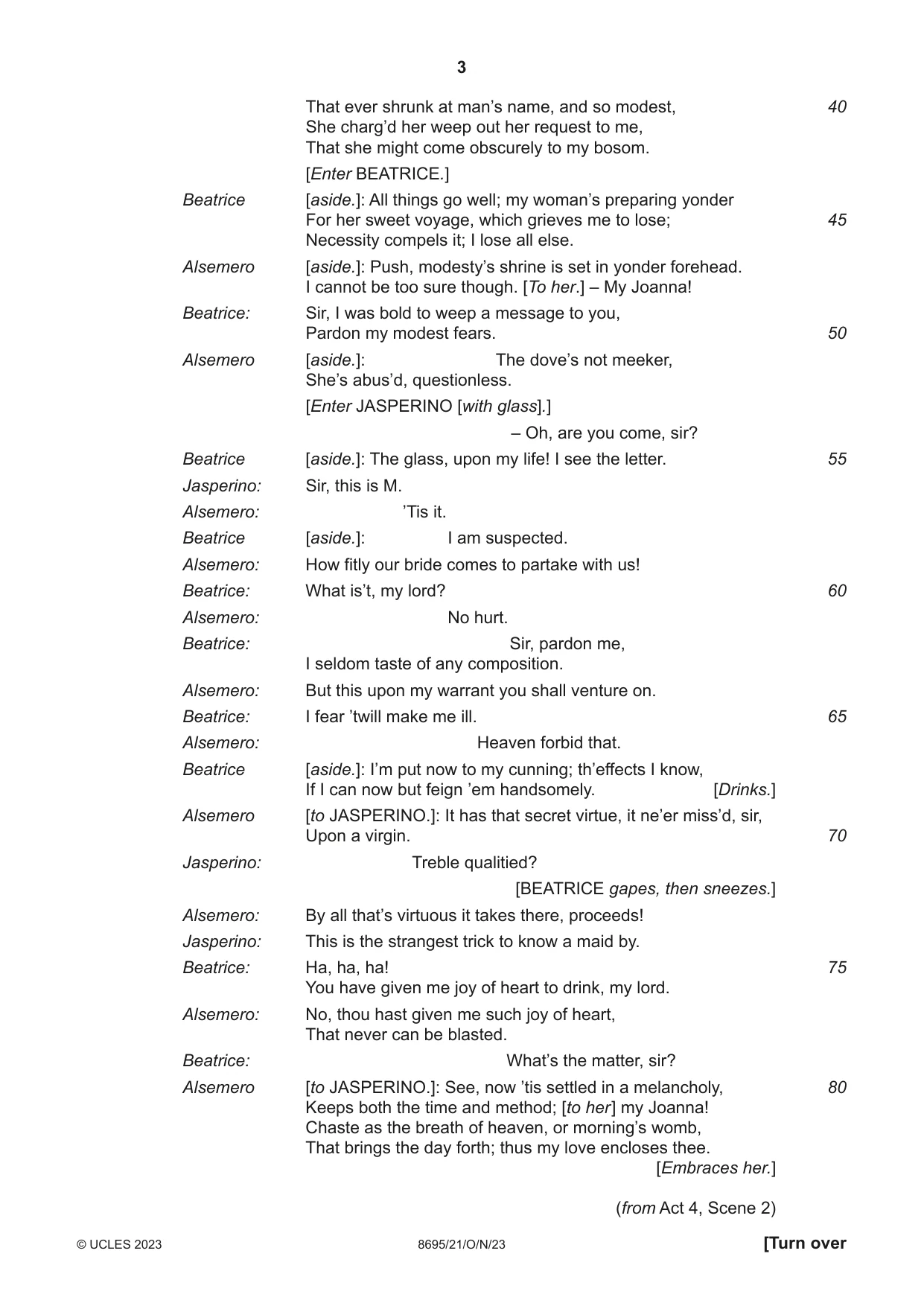
3 8695/21/O/N/23 © UCLES 2023 [Turn over That ever shrunk at man’s name, and so modest, She charg’d her weep out her request to me, That she might come obscurely to my bosom. [Enter BEATRICE.] Beatrice [aside.]: All things go well; my woman’s preparing yonder For her sweet voyage, which grieves me to lose; Necessity compels it; I lose all else. Alsemero [aside.]: Push, modesty’s shrine is set in yonder forehead. I cannot be too sure though. [To her.] – My Joanna! Beatrice: Sir, I was bold to weep a message to you, Pardon my modest fears. Alsemero [aside.]: The dove’s not meeker, She’s abus’d, questionless. [Enter JASPERINO [with glass].] – Oh, are you come, sir? Beatrice [aside.]: The glass, upon my life! I see the letter. Jasperino: Sir, this is M. Alsemero: ’Tis it. Beatrice [aside.]: I am suspected. Alsemero: How fitly our bride comes to partake with us! Beatrice: What is’t, my lord? Alsemero: No hurt. Beatrice: Sir, pardon me, I seldom taste of any composition. Alsemero: But this upon my warrant you shall venture on. Beatrice: I fear ’twill make me ill. Alsemero: Heaven forbid that. Beatrice [aside.]: I’m put now to my cunning; th’effects I know, If I can now but feign ’em handsomely. [Drinks.] Alsemero [to JASPERINO.]: It has that secret virtue, it ne’er miss’d, sir, Upon a virgin. Jasperino: Treble qualitied? [BEATRICE gapes, then sneezes.] Alsemero: By all that’s virtuous it takes there, proceeds! Jasperino: This is the strangest trick to know a maid by. Beatrice: Ha, ha, ha! You have given me joy of heart to drink, my lord. Alsemero: No, thou hast given me such joy of heart, That never can be blasted. Beatrice: What’s the matter, sir? Alsemero [to JASPERINO.]: See, now ’tis settled in a melancholy, Keeps both the time and method; [to her] my Joanna! Chaste as the breath of heaven, or morning’s womb, That brings the day forth; thus my love encloses thee. [Embraces her.] (from Act 4, Scene 2) 40 45 50 55 60 65 70 75 80
Question paper, page 4
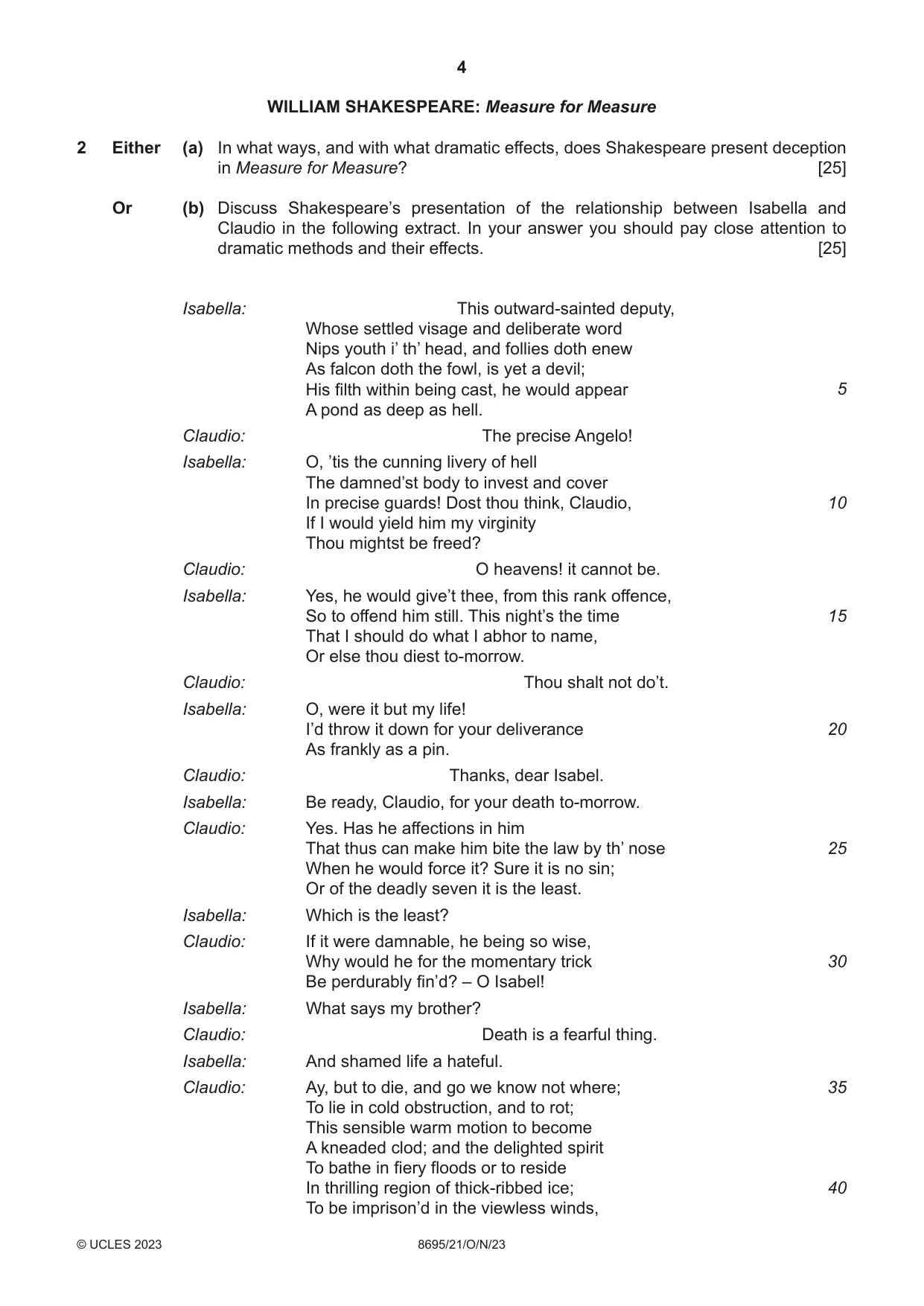
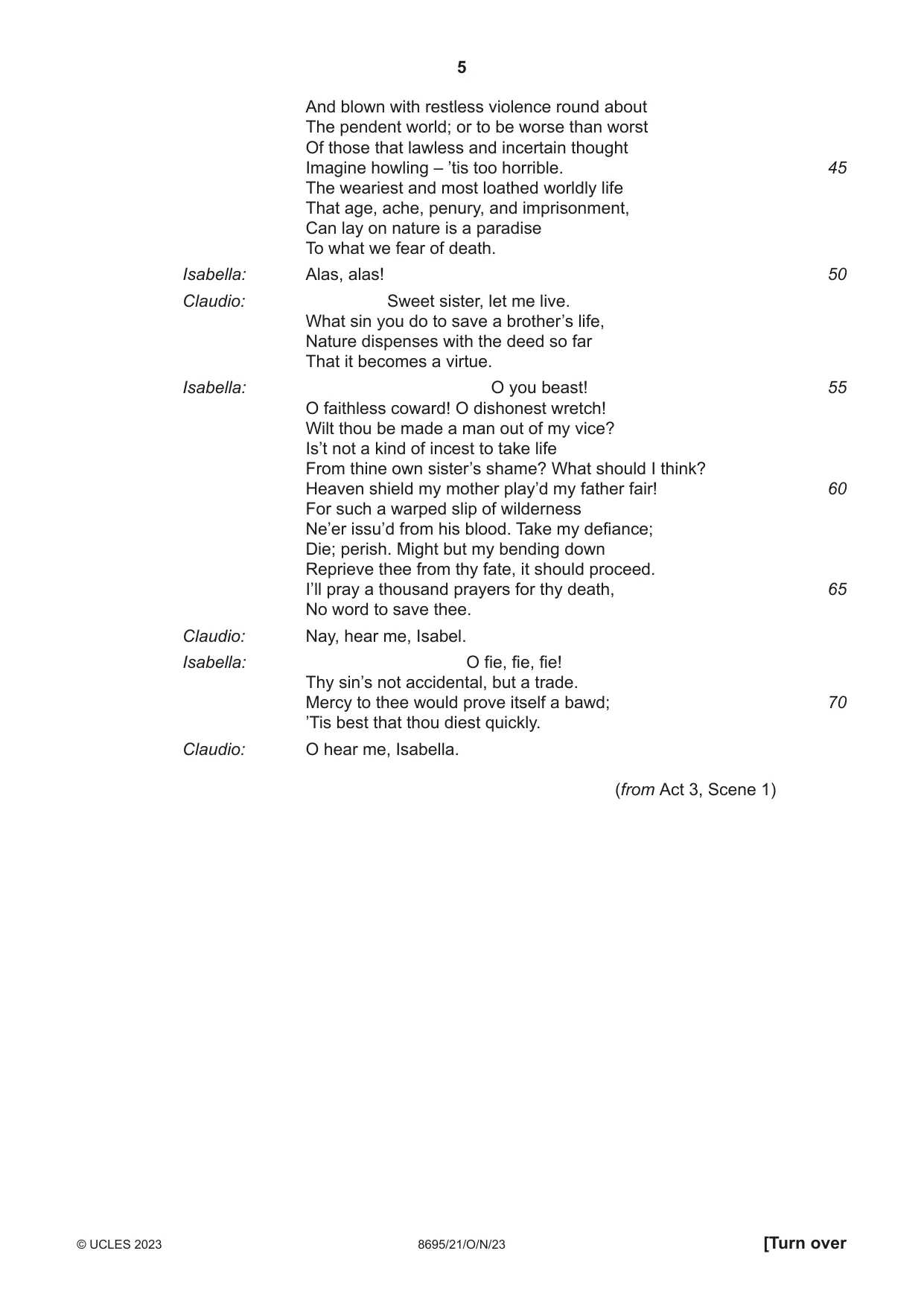
4 8695/21/O/N/23 © UCLES 2023 WILLIAM SHAKESPEARE: Measure for Measure 2 Either (a) In what ways, and with what dramatic effects, does Shakespeare present deception in Measure for Measure? [25] Or (b) Discuss Shakespeare’s presentation of the relationship between Isabella and Claudio in the following extract. In your answer you should pay close attention to dramatic methods and their effects. [25] Isabella: This outward-sainted deputy, Whose settled visage and deliberate word Nips youth i’ th’ head, and follies doth enew As falcon doth the fowl, is yet a devil; His filth within being cast, he would appear A pond as deep as hell. Claudio: The precise Angelo! Isabella: O, ’tis the cunning livery of hell The damned’st body to invest and cover In precise guards! Dost thou think, Claudio, If I would yield him my virginity Thou mightst be freed? Claudio: O heavens! it cannot be. Isabella: Yes, he would give’t thee, from this rank offence, So to offend him still. This night’s the time That I should do what I abhor to name, Or else thou diest to-morrow. Claudio: Thou shalt not do’t. Isabella: O, were it but my life! I’d throw it down for your deliverance As frankly as a pin. Claudio: Thanks, dear Isabel. Isabella: Be ready, Claudio, for your death to-morrow. Claudio: Yes. Has he affections in him That thus can make him bite the law by th’ nose When he would force it? Sure it is no sin; Or of the deadly seven it is the least. Isabella: Which is the least? Claudio: If it were damnable, he being so wise, Why would he for the momentary trick Be perdurably fin’d? – O Isabel! Isabella: What says my brother? Claudio: Death is a fearful thing. Isabella: And shamed life a hateful. Claudio: Ay, but to die, and go we know not where; To lie in cold obstruction, and to rot; This sensible warm motion to become A kneaded clod; and the delighted spirit To bathe in fiery floods or to reside In thrilling region of thick-ribbed ice; To be imprison’d in the viewless winds, 5 10 15 20 25 30 35 40
Question paper, page 5
5 8695/21/O/N/23 © UCLES 2023 [Turn over And blown with restless violence round about The pendent world; or to be worse than worst Of those that lawless and incertain thought Imagine howling – ’tis too horrible. The weariest and most loathed worldly life That age, ache, penury, and imprisonment, Can lay on nature is a paradise To what we fear of death. Isabella: Alas, alas! Claudio: Sweet sister, let me live. What sin you do to save a brother’s life, Nature dispenses with the deed so far That it becomes a virtue. Isabella: O you beast! O faithless coward! O dishonest wretch! Wilt thou be made a man out of my vice? Is’t not a kind of incest to take life From thine own sister’s shame? What should I think? Heaven shield my mother play’d my father fair! For such a warped slip of wilderness Ne’er issu’d from his blood. Take my defiance; Die; perish. Might but my bending down Reprieve thee from thy fate, it should proceed. I’ll pray a thousand prayers for thy death, No word to save thee. Claudio: Nay, hear me, Isabel. Isabella: O fie, fie, fie! Thy sin’s not accidental, but a trade. Mercy to thee would prove itself a bawd; ’Tis best that thou diest quickly. Claudio: O hear me, Isabella. (from Act 3, Scene 1) 45 50 55 60 65 70
Question paper, page 6
6 8695/21/O/N/23 © UCLES 2023 WOLE SOYINKA: The Trials of Brother Jero and Jero’s Metamorphosis 3 Either (a) Discuss Soyinka’s presentation of struggles for power in the two plays. [25] Or (b) How might an audience respond to the following extract, the end of the play? In your answer you should pay close attention to Soyinka’s dramatic methods and their effects. [25] [CHUME rushes in, brandishing a cutlass.] Content removed due to copyright restrictions.
Question paper, page 7
8695/21/O/N/23 © UCLES 2023 [Turn over [Blackout.] THE END (from The Trials of Brother Jero, Scene 5) Content removed due to copyright restrictions.
Question paper, page 8
8 8695/21/O/N/23 © UCLES 2023 TENNESSEE WILLIAMS: Cat on a Hot Tin Roof 4 Either (a) In what ways, and with what dramatic effects, does Williams present friendship in Cat on a Hot Tin Roof? [25] Or (b) Discuss the presentation of the relationship between Brick and Big Daddy in the following extract. In your answer you should pay close attention to dramatic methods and their effects. [25] [He goes over and touches BRICK’s shoulder.] Content removed due to copyright restrictions.
Question paper, page 9
9 8695/21/O/N/23 © UCLES 2023 [Turn over You’re my son, and I’m going to straighten you out; now that I’m straightened out, I’m going to straighten you out! (from Act 2) 70 Content removed due to copyright restrictions.
Question paper, page 10
10 8695/21/O/N/23 © UCLES 2023 Section B: Poetry SIMON ARMITAGE: Sir Gawain and the Green Knight 5 Either (a) Discuss some of the ways Armitage presents desire and its effects in Sir Gawain and the Green Knight. [25] Or (b) Analyse ways Armitage presents the Green Knight in the following extract from Sir Gawain and the Green Knight. [25] Yet he wore no helmet and no hauberk either, a miracle or magic, or so they imagined. Content removed due to copyright restrictions.
Question paper, page 11
11 8695/21/O/N/23 © UCLES 2023 [Turn over TURN OVER FOR QUESTION 6.
Question paper, page 12
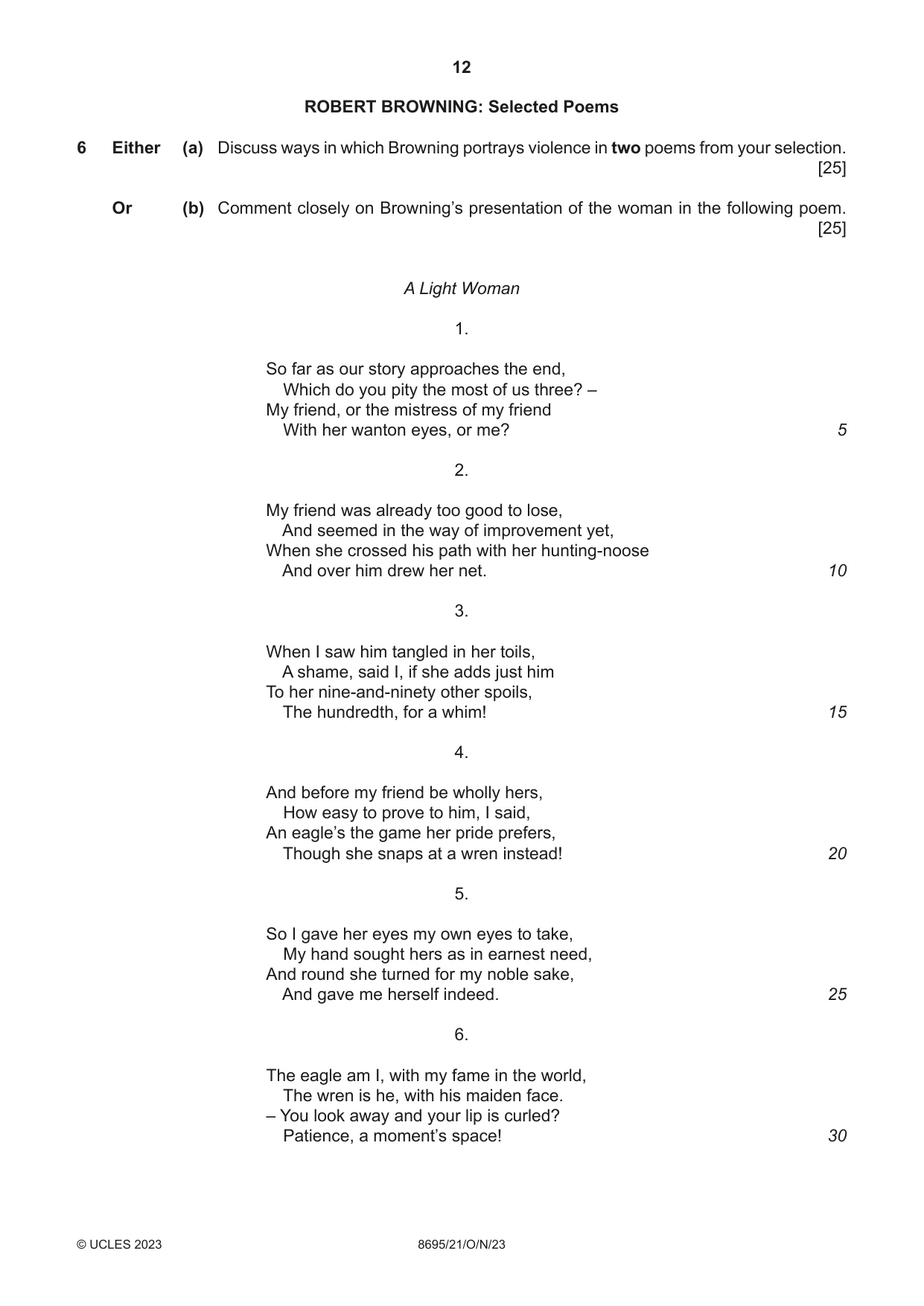
12 8695/21/O/N/23 © UCLES 2023 ROBERT BROWNING: Selected Poems 6 Either (a) Discuss ways in which Browning portrays violence in two poems from your selection. [25] Or (b) Comment closely on Browning’s presentation of the woman in the following poem. [25] A Light Woman 1. So far as our story approaches the end, Which do you pity the most of us three? – My friend, or the mistress of my friend With her wanton eyes, or me? 2. My friend was already too good to lose, And seemed in the way of improvement yet, When she crossed his path with her hunting-noose And over him drew her net. 3. When I saw him tangled in her toils, A shame, said I, if she adds just him To her nine-and-ninety other spoils, The hundredth, for a whim! 4. And before my friend be wholly hers, How easy to prove to him, I said, An eagle’s the game her pride prefers, Though she snaps at a wren instead! 5. So I gave her eyes my own eyes to take, My hand sought hers as in earnest need, And round she turned for my noble sake, And gave me herself indeed. 6. The eagle am I, with my fame in the world, The wren is he, with his maiden face. – You look away and your lip is curled? Patience, a moment’s space! 5 10 15 20 25 30
Question paper, page 13
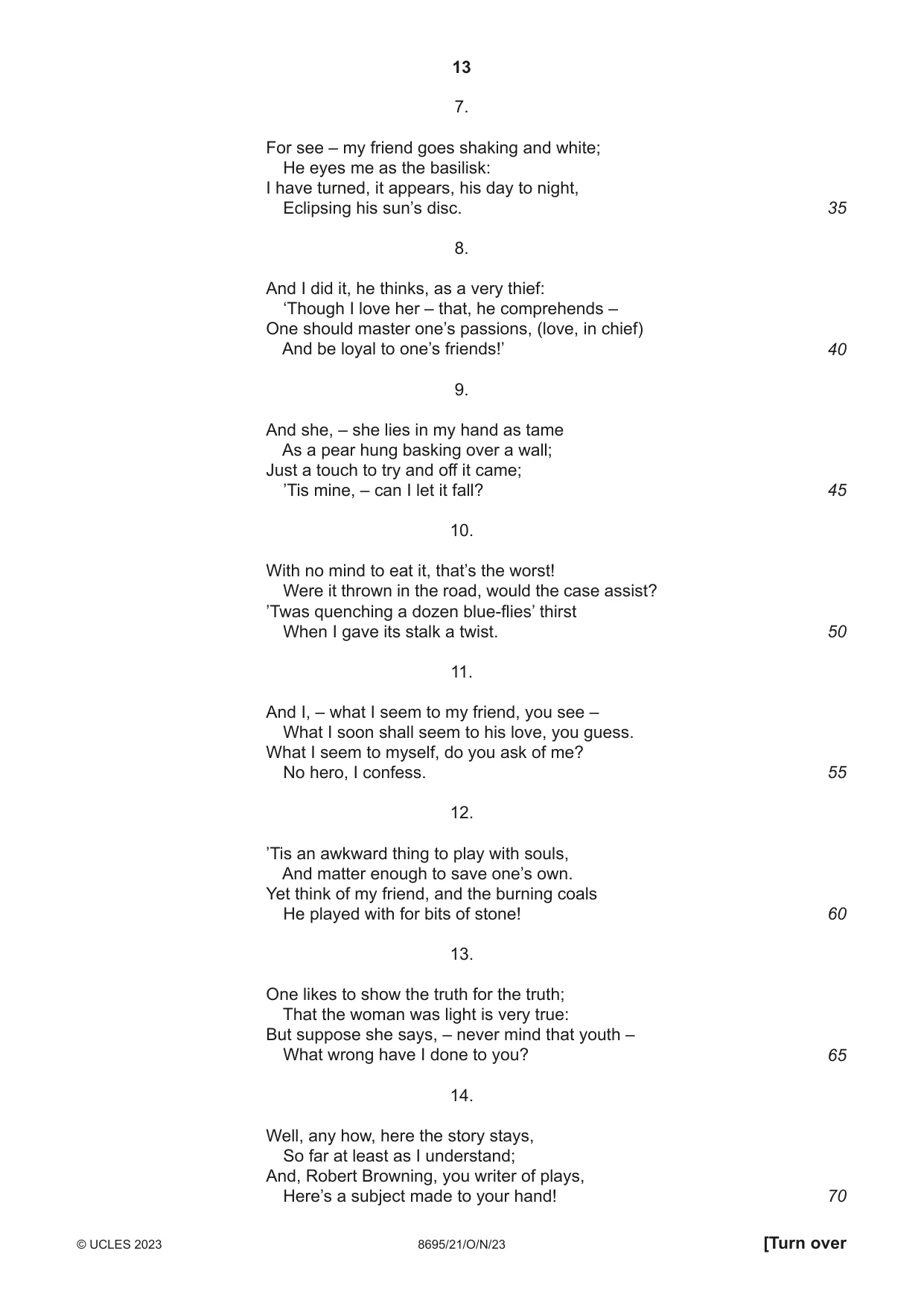
13 8695/21/O/N/23 © UCLES 2023 [Turn over 7. For see – my friend goes shaking and white; He eyes me as the basilisk: I have turned, it appears, his day to night, Eclipsing his sun’s disc. 8. And I did it, he thinks, as a very thief: ‘Though I love her – that, he comprehends – One should master one’s passions, (love, in chief) And be loyal to one’s friends!’ 9. And she, – she lies in my hand as tame As a pear hung basking over a wall; Just a touch to try and off it came; ’Tis mine, – can I let it fall? 10. With no mind to eat it, that’s the worst! Were it thrown in the road, would the case assist? ’Twas quenching a dozen blue-flies’ thirst When I gave its stalk a twist. 11. And I, – what I seem to my friend, you see – What I soon shall seem to his love, you guess. What I seem to myself, do you ask of me? No hero, I confess. 12. ’Tis an awkward thing to play with souls, And matter enough to save one’s own. Yet think of my friend, and the burning coals He played with for bits of stone! 13. One likes to show the truth for the truth; That the woman was light is very true: But suppose she says, – never mind that youth – What wrong have I done to you? 14. Well, any how, here the story stays, So far at least as I understand; And, Robert Browning, you writer of plays, Here’s a subject made to your hand! 35 40 45 50 55 60 65 70
Question paper, page 14
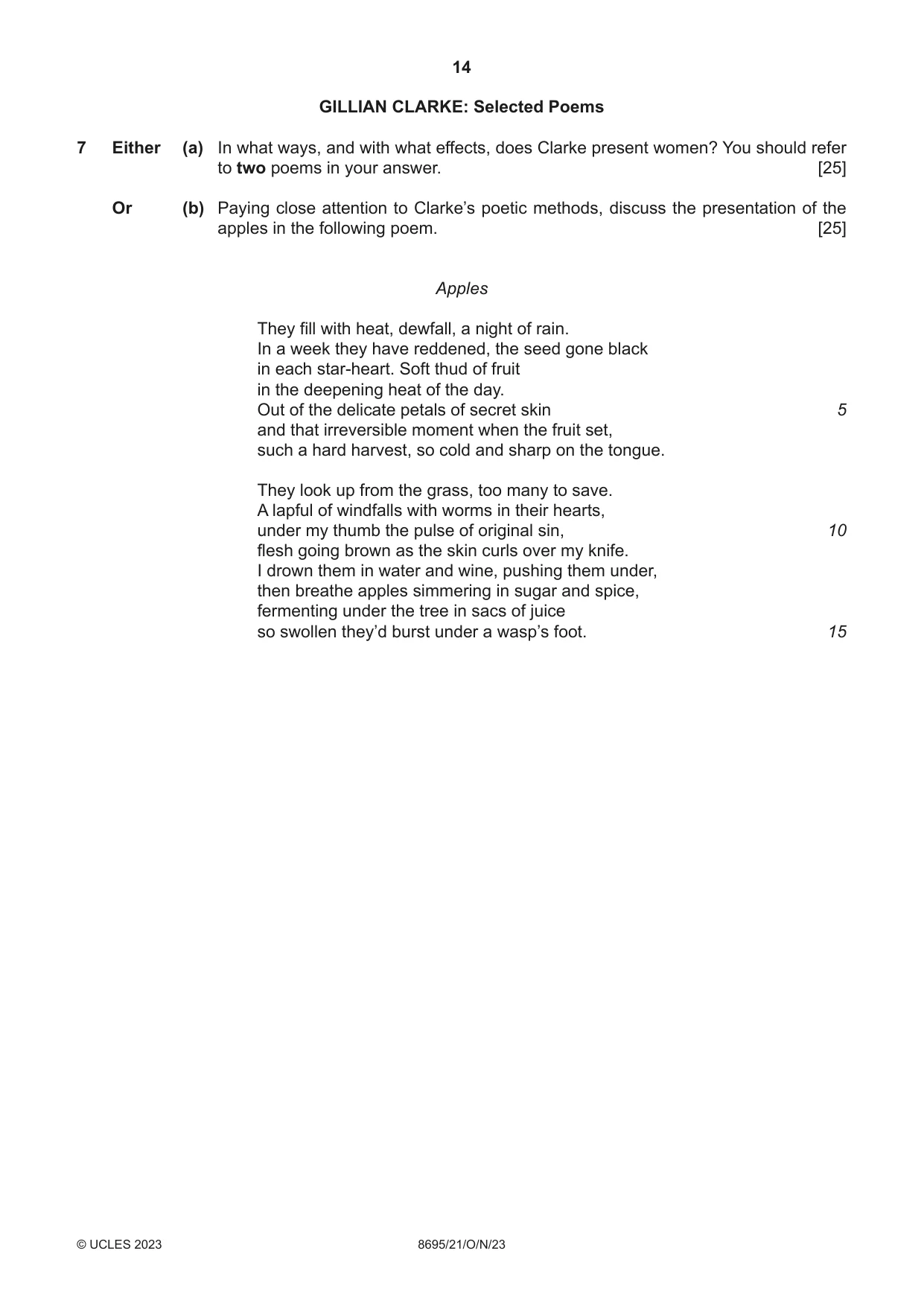
14 8695/21/O/N/23 © UCLES 2023 GILLIAN CLARKE: Selected Poems 7 Either (a) In what ways, and with what effects, does Clarke present women? You should refer to two poems in your answer. [25] Or (b) Paying close attention to Clarke’s poetic methods, discuss the presentation of the apples in the following poem. [25] Apples They fill with heat, dewfall, a night of rain. In a week they have reddened, the seed gone black in each star-heart. Soft thud of fruit in the deepening heat of the day. Out of the delicate petals of secret skin and that irreversible moment when the fruit set, such a hard harvest, so cold and sharp on the tongue. They look up from the grass, too many to save. A lapful of windfalls with worms in their hearts, under my thumb the pulse of original sin, flesh going brown as the skin curls over my knife. I drown them in water and wine, pushing them under, then breathe apples simmering in sugar and spice, fermenting under the tree in sacs of juice so swollen they’d burst under a wasp’s foot. 5 10 15
Question paper, page 15
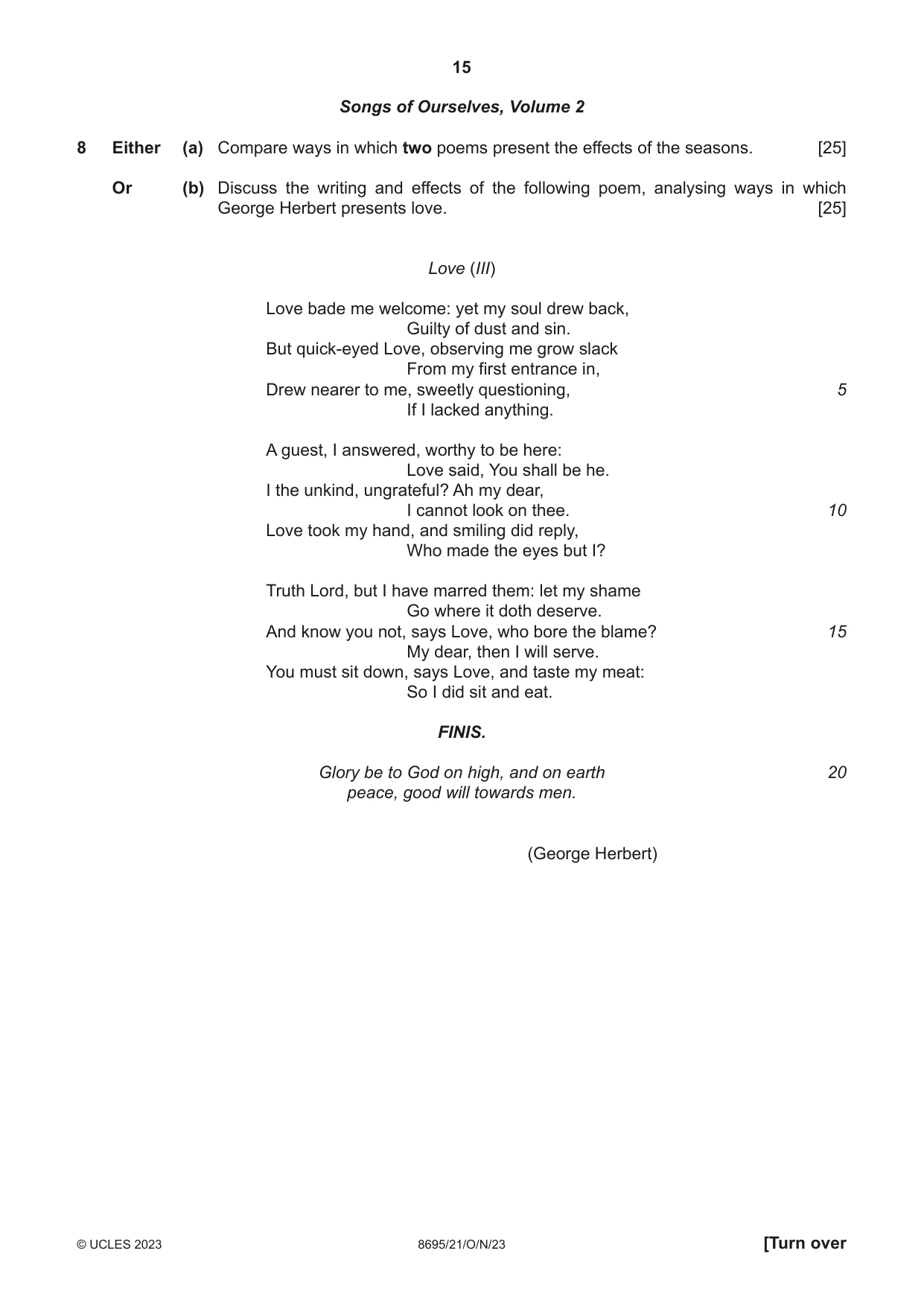
15 8695/21/O/N/23 © UCLES 2023 [Turn over Songs of Ourselves, Volume 2 8 Either (a) Compare ways in which two poems present the effects of the seasons. [25] Or (b) Discuss the writing and effects of the following poem, analysing ways in which George Herbert presents love. [25] Love (III) Love bade me welcome: yet my soul drew back, Guilty of dust and sin. But quick-eyed Love, observing me grow slack From my first entrance in, Drew nearer to me, sweetly questioning, If I lacked anything. A guest, I answered, worthy to be here: Love said, You shall be he. I the unkind, ungrateful? Ah my dear, I cannot look on thee. Love took my hand, and smiling did reply, Who made the eyes but I? Truth Lord, but I have marred them: let my shame Go where it doth deserve. And know you not, says Love, who bore the blame? My dear, then I will serve. You must sit down, says Love, and taste my meat: So I did sit and eat. FINIS. Glory be to God on high, and on earth peace, good will towards men. (George Herbert) 5 10 15 20
Question paper, page 16
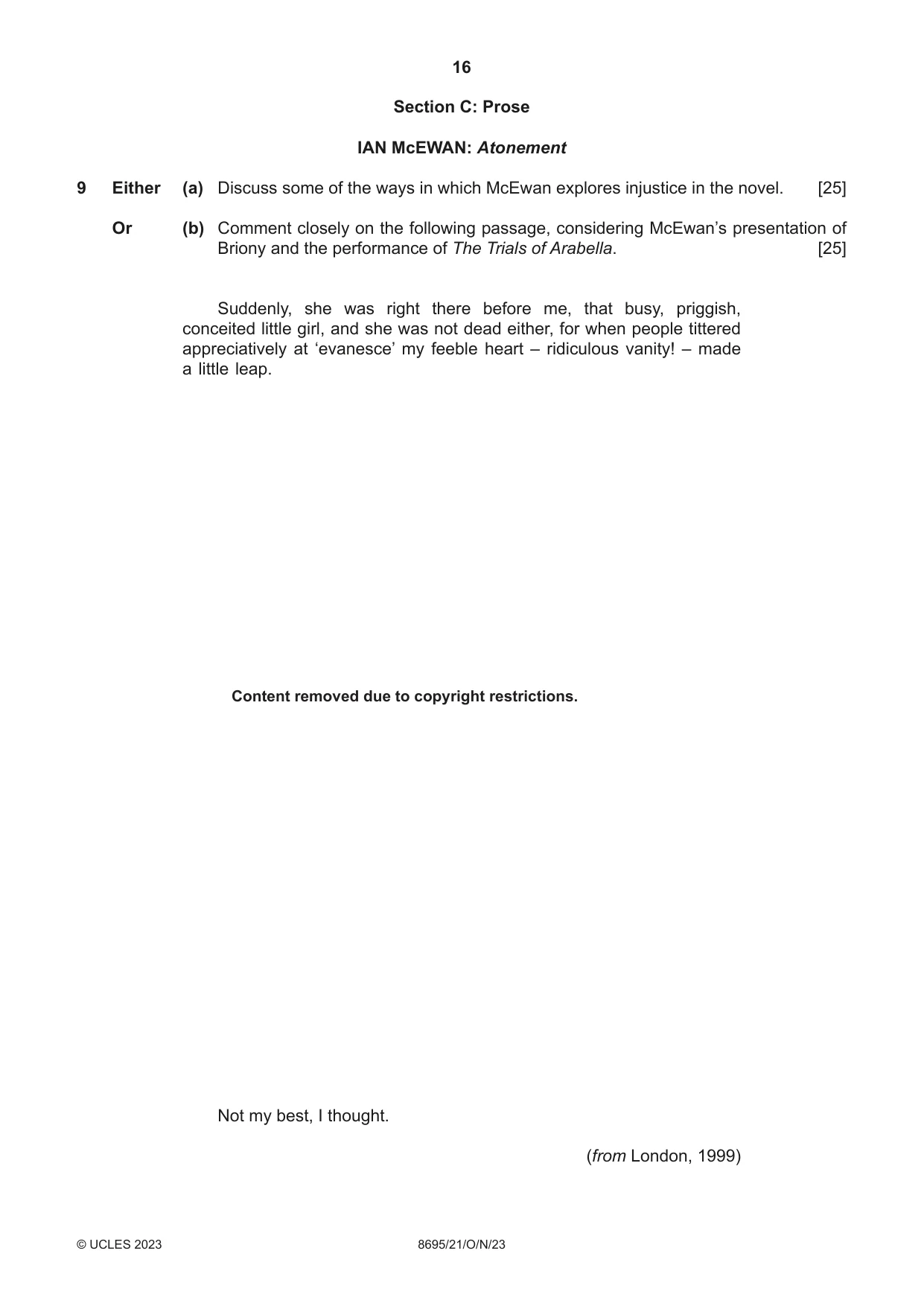
16 8695/21/O/N/23 © UCLES 2023 Section C: Prose IAN McEWAN: Atonement 9 Either (a) Discuss some of the ways in which McEwan explores injustice in the novel. [25] Or (b) Comment closely on the following passage, considering McEwan’s presentation of Briony and the performance of The Trials of Arabella. [25] Suddenly, she was right there before me, that busy, priggish, conceited little girl, and she was not dead either, for when people tittered appreciatively at ‘evanesce’ my feeble heart – ridiculous vanity! – made a little leap. Not my best, I thought. (from London, 1999) Content removed due to copyright restrictions.
Question paper, page 17
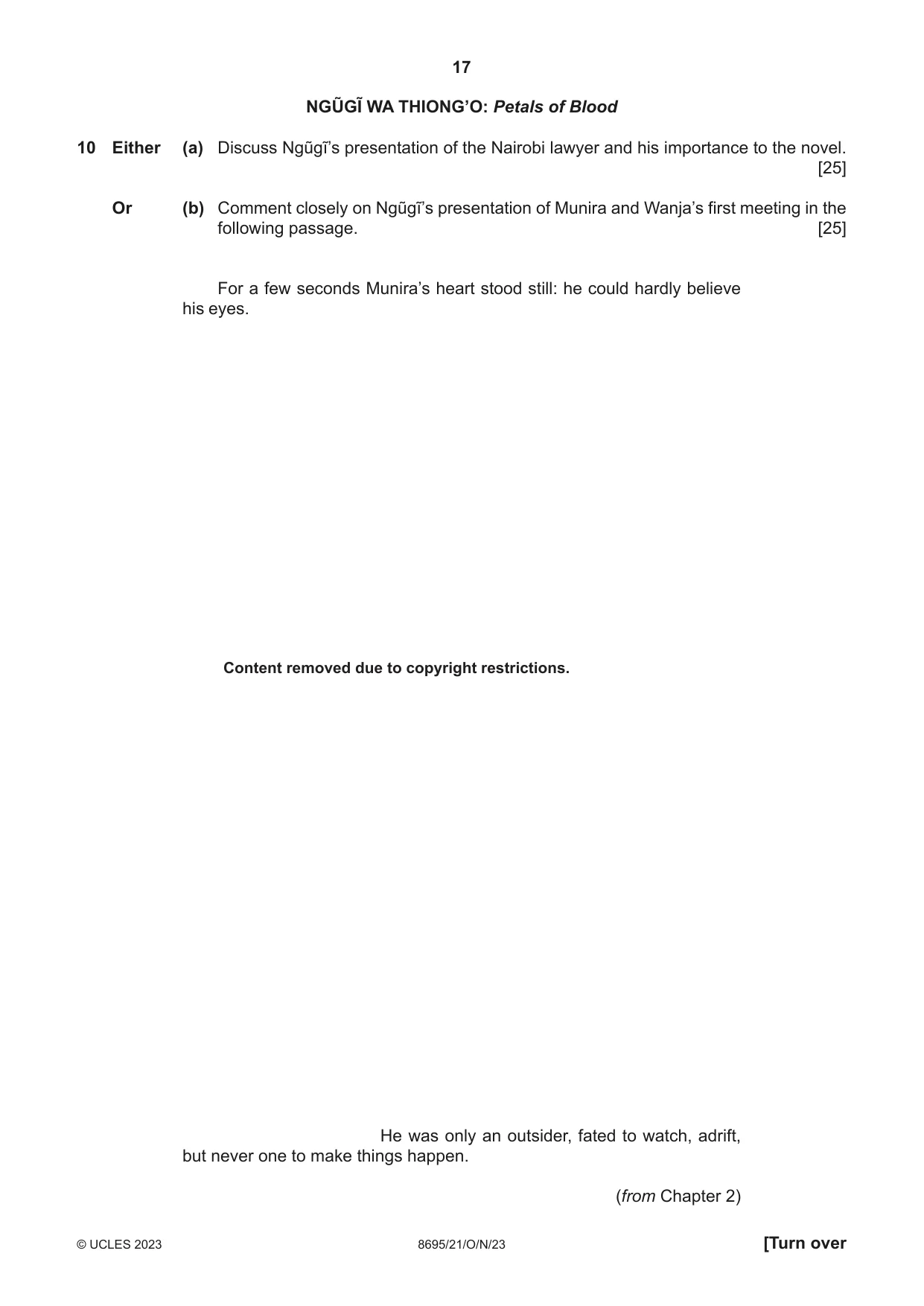
17 8695/21/O/N/23 © UCLES 2023 [Turn over NGŨGĨ WA THIONG’O: Petals of Blood 10 Either (a) Discuss Ngũgĩ’s presentation of the Nairobi lawyer and his importance to the novel. [25] Or (b) Comment closely on Ngũgĩ’s presentation of Munira and Wanja’s first meeting in the following passage. [25] For a few seconds Munira’s heart stood still: he could hardly believe his eyes. He was only an outsider, fated to watch, adrift, but never one to make things happen. (from Chapter 2) Content removed due to copyright restrictions.
Question paper, page 18
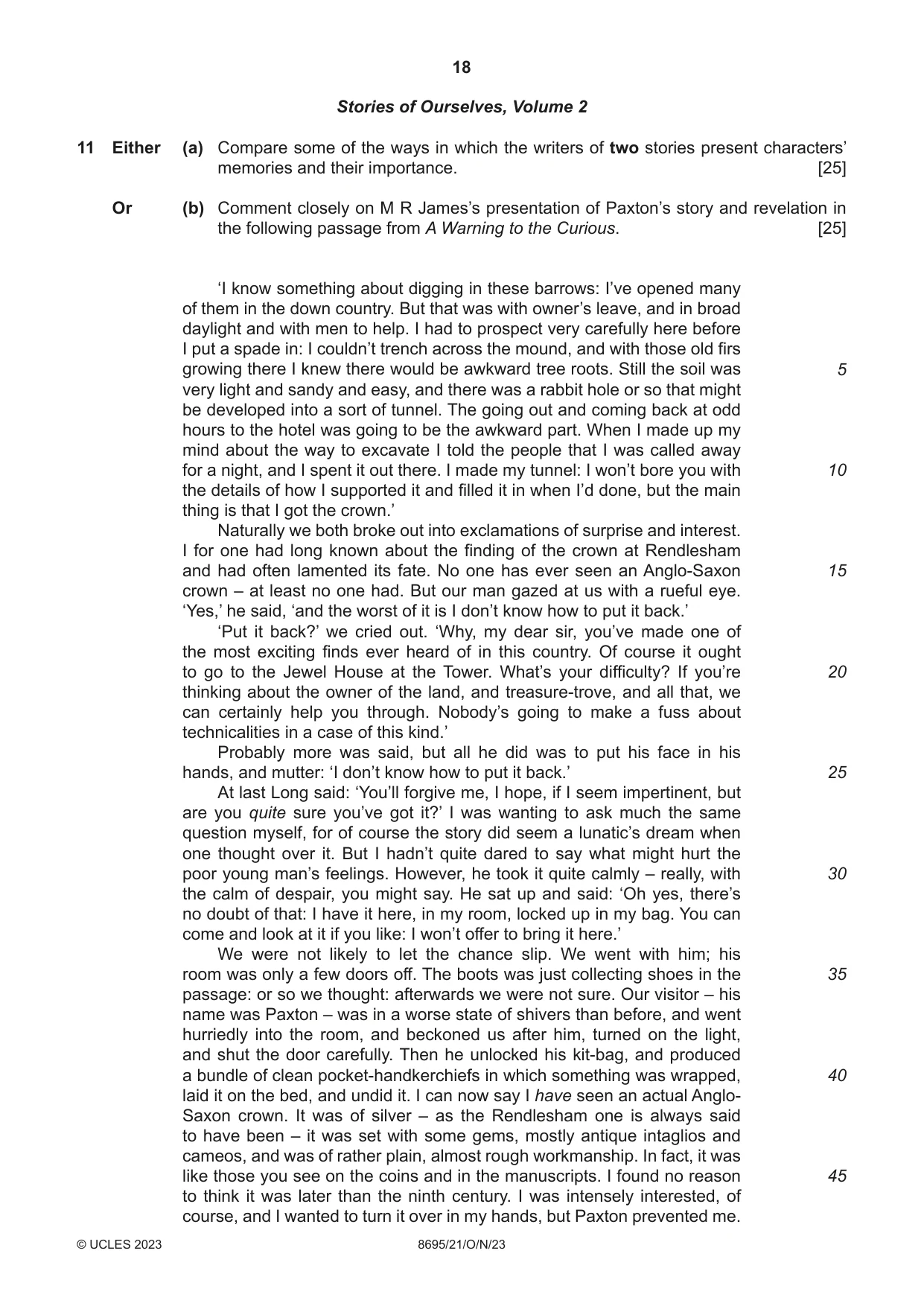
18 8695/21/O/N/23 © UCLES 2023 Stories of Ourselves, Volume 2 11 Either (a) Compare some of the ways in which the writers of two stories present characters’ memories and their importance. [25] Or (b) Comment closely on M R James’s presentation of Paxton’s story and revelation in the following passage from A Warning to the Curious. [25] ‘I know something about digging in these barrows: I’ve opened many of them in the down country. But that was with owner’s leave, and in broad daylight and with men to help. I had to prospect very carefully here before I put a spade in: I couldn’t trench across the mound, and with those old firs growing there I knew there would be awkward tree roots. Still the soil was very light and sandy and easy, and there was a rabbit hole or so that might be developed into a sort of tunnel. The going out and coming back at odd hours to the hotel was going to be the awkward part. When I made up my mind about the way to excavate I told the people that I was called away for a night, and I spent it out there. I made my tunnel: I won’t bore you with the details of how I supported it and filled it in when I’d done, but the main thing is that I got the crown.’ Naturally we both broke out into exclamations of surprise and interest. I for one had long known about the finding of the crown at Rendlesham and had often lamented its fate. No one has ever seen an Anglo-Saxon crown – at least no one had. But our man gazed at us with a rueful eye. ‘Yes,’ he said, ‘and the worst of it is I don’t know how to put it back.’ ‘Put it back?’ we cried out. ‘Why, my dear sir, you’ve made one of the most exciting finds ever heard of in this country. Of course it ought to go to the Jewel House at the Tower. What’s your difficulty? If you’re thinking about the owner of the land, and treasure-trove, and all that, we can certainly help you through. Nobody’s going to make a fuss about technicalities in a case of this kind.’ Probably more was said, but all he did was to put his face in his hands, and mutter: ‘I don’t know how to put it back.’ At last Long said: ‘You’ll forgive me, I hope, if I seem impertinent, but are you quite sure you’ve got it?’ I was wanting to ask much the same question myself, for of course the story did seem a lunatic’s dream when one thought over it. But I hadn’t quite dared to say what might hurt the poor young man’s feelings. However, he took it quite calmly – really, with the calm of despair, you might say. He sat up and said: ‘Oh yes, there’s no doubt of that: I have it here, in my room, locked up in my bag. You can come and look at it if you like: I won’t offer to bring it here.’ We were not likely to let the chance slip. We went with him; his room was only a few doors off. The boots was just collecting shoes in the passage: or so we thought: afterwards we were not sure. Our visitor – his name was Paxton – was in a worse state of shivers than before, and went hurriedly into the room, and beckoned us after him, turned on the light, and shut the door carefully. Then he unlocked his kit-bag, and produced a bundle of clean pocket-handkerchiefs in which something was wrapped, laid it on the bed, and undid it. I can now say I have seen an actual Anglo- Saxon crown. It was of silver – as the Rendlesham one is always said to have been – it was set with some gems, mostly antique intaglios and cameos, and was of rather plain, almost rough workmanship. In fact, it was like those you see on the coins and in the manuscripts. I found no reason to think it was later than the ninth century. I was intensely interested, of course, and I wanted to turn it over in my hands, but Paxton prevented me. 5 10 15 20 25 30 35 40 45
Question paper, page 19
19 8695/21/O/N/23 © UCLES 2023 [Turn over ‘Don’t you touch it,’ he said, ‘I’ll do that.’ And with a sigh that was, I declare to you, dreadful to hear, he took it up and turned it about so that we could see every part of it. ‘Seen enough?’ he said at last, and we nodded. (from A Warning to the Curious) 50
Question paper, page 20
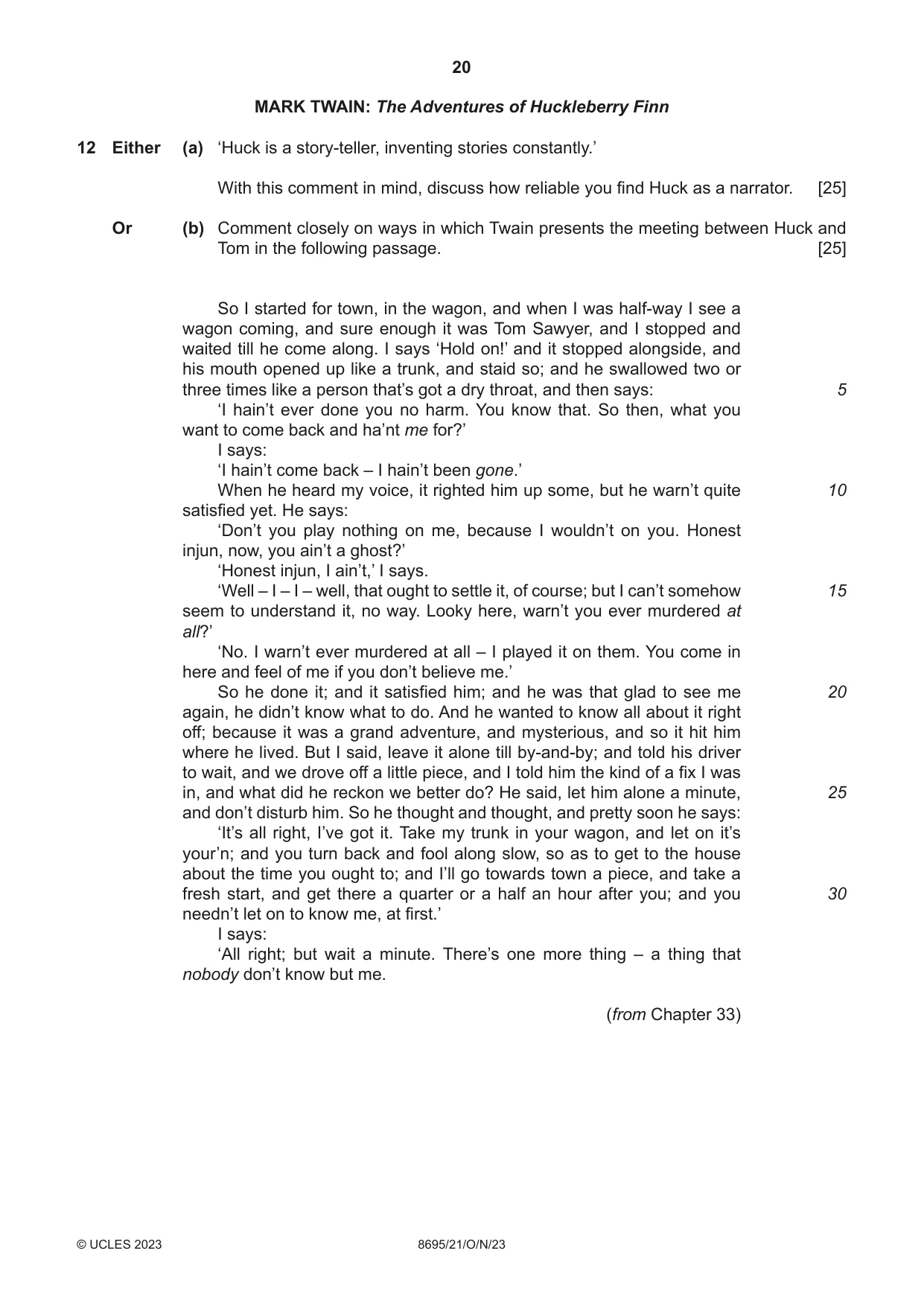
20 8695/21/O/N/23 © UCLES 2023 MARK TWAIN: The Adventures of Huckleberry Finn 12 Either (a) ‘Huck is a story-teller, inventing stories constantly.’ With this comment in mind, discuss how reliable you find Huck as a narrator. [25] Or (b) Comment closely on ways in which Twain presents the meeting between Huck and Tom in the following passage. [25] So I started for town, in the wagon, and when I was half-way I see a wagon coming, and sure enough it was Tom Sawyer, and I stopped and waited till he come along. I says ‘Hold on!’ and it stopped alongside, and his mouth opened up like a trunk, and staid so; and he swallowed two or three times like a person that’s got a dry throat, and then says: ‘I hain’t ever done you no harm. You know that. So then, what you want to come back and ha’nt me for?’ I says: ‘I hain’t come back – I hain’t been gone.’ When he heard my voice, it righted him up some, but he warn’t quite satisfied yet. He says: ‘Don’t you play nothing on me, because I wouldn’t on you. Honest injun, now, you ain’t a ghost?’ ‘Honest injun, I ain’t,’ I says. ‘Well – I – I – well, that ought to settle it, of course; but I can’t somehow seem to understand it, no way. Looky here, warn’t you ever murdered at all?’ ‘No. I warn’t ever murdered at all – I played it on them. You come in here and feel of me if you don’t believe me.’ So he done it; and it satisfied him; and he was that glad to see me again, he didn’t know what to do. And he wanted to know all about it right off; because it was a grand adventure, and mysterious, and so it hit him where he lived. But I said, leave it alone till by-and-by; and told his driver to wait, and we drove off a little piece, and I told him the kind of a fix I was in, and what did he reckon we better do? He said, let him alone a minute, and don’t disturb him. So he thought and thought, and pretty soon he says: ‘It’s all right, I’ve got it. Take my trunk in your wagon, and let on it’s your’n; and you turn back and fool along slow, so as to get to the house about the time you ought to; and I’ll go towards town a piece, and take a fresh start, and get there a quarter or a half an hour after you; and you needn’t let on to know me, at first.’ I says: ‘All right; but wait a minute. There’s one more thing – a thing that nobody don’t know but me. (from Chapter 33) 5 10 15 20 25 30
Question paper, page 21
21 8695/21/O/N/23 © UCLES 2023 BLANK PAGE
Question paper, page 22
22 8695/21/O/N/23 © UCLES 2023 BLANK PAGE
Question paper, page 23
23 8695/21/O/N/23 © UCLES 2023 BLANK PAGE
Question paper, page 24
24 8695/21/O/N/23 © UCLES 2023 Permission to reproduce items where third-party owned material protected by copyright is included has been sought and cleared where possible. Every reasonable effort has been made by the publisher (UCLES) to trace copyright holders, but if any items requiring clearance have unwittingly been included, the publisher will be pleased to make amends at the earliest possible opportunity. To avoid the issue of disclosure of answer-related information to candidates, all copyright acknowledgements are reproduced online in the Cambridge Assessment International Education Copyright Acknowledgements Booklet. This is produced for each series of examinations and is freely available to download at www.cambridgeinternational.org after the live examination series. Cambridge Assessment International Education is part of Cambridge Assessment. Cambridge Assessment is the brand name of the University of Cambridge Local Examinations Syndicate (UCLES), which is a department of the University of Cambridge. BLANK PAGE
Mark scheme, page 1
This document consists of 13 printed pages. © UCLES 2023 [Turn over Cambridge International AS Level LANGUAGE AND LITERATURE IN ENGLISH 8695/21 Paper 2 Drama, Poetry and Prose October/November 2023 MARK SCHEME Maximum Mark: 50 Published This mark scheme is published as an aid to teachers and candidates, to indicate the requirements of the examination. It shows the basis on which Examiners were instructed to award marks. It does not indicate the details of the discussions that took place at an Examiners’ meeting before marking began, which would have considered the acceptability of alternative answers. Mark schemes should be read in conjunction with the question paper and the Principal Examiner Report for Teachers. Cambridge International will not enter into discussions about these mark schemes. Cambridge International is publishing the mark schemes for the October/November 2023 series for most Cambridge IGCSE, Cambridge International A and AS Level components, and some Cambridge O Level components.
Mark scheme, page 2
8695/21 Cambridge International AS Level – Mark Scheme PUBLISHED October/November 2023 © UCLES 2023 Page 2 of 13 Generic Marking Principles These general marking principles must be applied by all examiners when marking candidate answers. They should be applied alongside the specific content of the mark scheme or generic level descriptors for a question. Each question paper and mark scheme will also comply with these marking principles. GENERIC MARKING PRINCIPLE 1: Marks must be awarded in line with: • the specific content of the mark scheme or the generic level descriptors for the question • the specific skills defined in the mark scheme or in the generic level descriptors for the question • the standard of response required by a candidate as exemplified by the standardisation scripts. GENERIC MARKING PRINCIPLE 2: Marks awarded are always whole marks (not half marks, or other fractions). GENERIC MARKING PRINCIPLE 3: Marks must be awarded positively: • marks are awarded for correct/valid answers, as defined in the mark scheme. However, credit is given for valid answers which go beyond the scope of the syllabus and mark scheme, referring to your Team Leader as appropriate • marks are awarded when candidates clearly demonstrate what they know and can do • marks are not deducted for errors • marks are not deducted for omissions • answers should only be judged on the quality of spelling, punctuation and grammar when these features are specifically assessed by the question as indicated by the mark scheme. The meaning, however, should be unambiguous. GENERIC MARKING PRINCIPLE 4: Rules must be applied consistently, e.g. in situations where candidates have not followed instructions or in the application of generic level descriptors. GENERIC MARKING PRINCIPLE 5: Marks should be awarded using the full range of marks defined in the mark scheme for the question (however; the use of the full mark range may be limited according to the quality of the candidate responses seen). GENERIC MARKING PRINCIPLE 6: Marks awarded are based solely on the requirements as defined in the mark scheme. Marks should not be awarded with grade thresholds or grade descriptors in mind.
Mark scheme, page 3
8695/21 Cambridge International AS Level – Mark Scheme PUBLISHED October/November 2023 © UCLES 2023 Page 3 of 13 English & Media subject specific general marking principles (To be read in conjunction with the Generic Marking Principles (and requiring further guidance on how to place marks within levels)) Components using level descriptors: • We use level descriptors as a guide to broad understanding of the qualities normally expected of, or typical of, work in a level. • Level descriptors are a means of general guidance, and should not be interpreted as hurdle statements. • Where indicative content notes are supplied for a question, these are not a prescription of required content, and must not be treated as such. Alternative correct points and unexpected answers in candidates’ scripts must be given marks that fairly reflect the knowledge and skills demonstrated. • While we may have legitimate expectations as to the ground most answers may occupy, we must at all times be prepared to meet candidates on their chosen ground, provided it is relevant ground (e.g. clearly related to and derived from a relevant passage/text and meeting the mark scheme requirements for the question). Components using point-based marking: Point marking is often used to reward knowledge, understanding and application of skills. We give credit where the candidate’s answer shows relevant knowledge, understanding and application of skills in answering the question. We do not give credit where the answer shows confusion. From this it follows that we: a DO credit answers which are worded differently from the mark scheme if they clearly convey the same meaning (unless the mark scheme requires a specific term). b DO credit alternative answers/examples which are not written in the mark scheme if they are correct. c DO credit answers where candidates give more than one correct answer in one prompt/numbered/scaffolded space where extended writing is required rather than list-type answers. For example, questions that require n reasons (e.g. State two reasons…). d DO NOT credit answers simply for using a ‘key term’ unless that is all that is required. (Check for evidence it is understood and not used wrongly.) e DO NOT credit answers which are obviously self-contradicting or trying to cover all possibilities. f DO NOT give further credit for what is effectively repetition of a correct point already credited unless the language itself is being tested. This applies equally to ‘mirror statements’ (i.e. polluted/not polluted). g DO NOT require spellings to be correct, unless this is part of the test. However spellings of syllabus terms must allow for clear and unambiguous separation from other syllabus terms with which they may be confused (e.g. Corrasion/Corrosion).
Mark scheme, page 4
8695/21 Cambridge International AS Level – Mark Scheme PUBLISHED October/November 2023 © UCLES 2023 Page 4 of 13 Literature in English specific marking instructions Using the mark levels Use the generic mark scheme levels to find the mark. Place the answer in a level first. Look for the ‘best fit’ of the answer into a level. An answer needs to show evidence of most but not necessarily ALL of the qualities described in a level, in order to be placed in that level. Then award a mark for the relative position of the answer within the level. Candidates may address the question in many different ways. There is no one required answer or approach and do not penalise answers for leaving out a particular focus. Reward what is there, showing what you are rewarding in your comments. Consider all strands and weigh up the performance as a whole in placing the answer in a level, then show that you have done so in the summative comment. Each answer is marked out of 25, in accordance with the general marking criteria. Assessment objectives All assessment objectives are equally weighted, and all are considered in assessing each essay. Each level in the marking criteria is divided into strands corresponding to the assessment objectives – AO1: Knowledge and understanding (K/U), AO2: Analysis (AN), AO3: Personal response (P), AO4: Communication (C). AO1 Knowledge and understanding Respond with understanding to literary texts in a variety of forms, from different cultures; with an appreciation of relevant contexts that illuminate readings of the texts. AO2 Analysis Analyse ways in which writers’ choices of language, form and structure shape meanings and effects. AO3 Personal response Produce informed independent opinions and interpretations of literary texts. AO4 Communication Communicate a relevant, structured and supported response appropriate to literary study.
Mark scheme, page 5
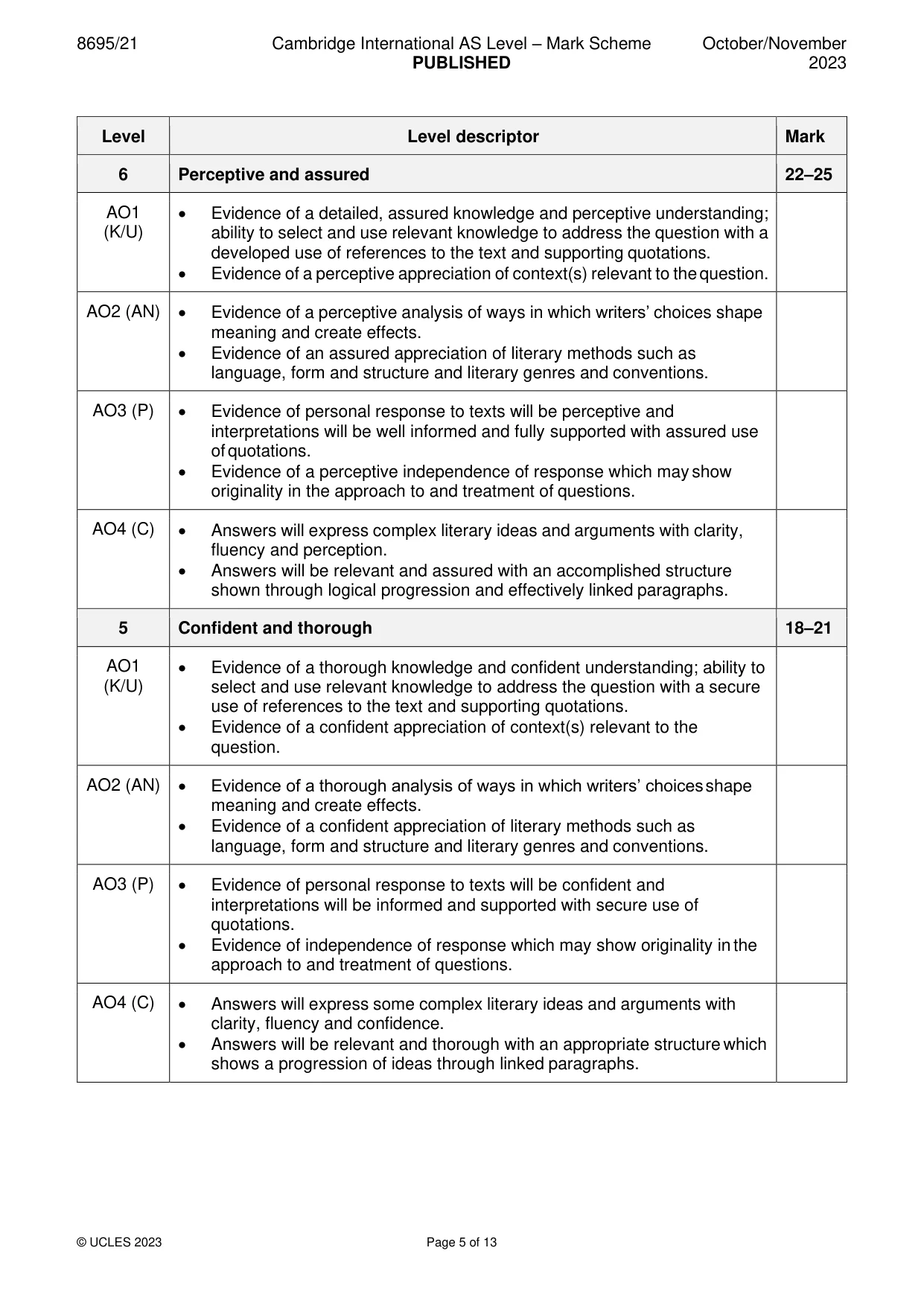
8695/21 Cambridge International AS Level – Mark Scheme PUBLISHED October/November 2023 © UCLES 2023 Page 5 of 13 Level Level descriptor Mark 6 Perceptive and assured 22–25 AO1 (K/U) • Evidence of a detailed, assured knowledge and perceptive understanding; ability to select and use relevant knowledge to address the question with a developed use of references to the text and supporting quotations. • Evidence of a perceptive appreciation of context(s) relevant to the question. AO2 (AN) • Evidence of a perceptive analysis of ways in which writers’ choices shape meaning and create effects. • Evidence of an assured appreciation of literary methods such as language, form and structure and literary genres and conventions. AO3 (P) • Evidence of personal response to texts will be perceptive and interpretations will be well informed and fully supported with assured use of quotations. • Evidence of a perceptive independence of response which may show originality in the approach to and treatment of questions. AO4 (C) • Answers will express complex literary ideas and arguments with clarity, fluency and perception. • Answers will be relevant and assured with an accomplished structure shown through logical progression and effectively linked paragraphs. 5 Confident and thorough 18–21 AO1 (K/U) • Evidence of a thorough knowledge and confident understanding; ability to select and use relevant knowledge to address the question with a secure use of references to the text and supporting quotations. • Evidence of a confident appreciation of context(s) relevant to the question. AO2 (AN) • Evidence of a thorough analysis of ways in which writers’ choices shape meaning and create effects. • Evidence of a confident appreciation of literary methods such as language, form and structure and literary genres and conventions. AO3 (P) • Evidence of personal response to texts will be confident and interpretations will be informed and supported with secure use of quotations. • Evidence of independence of response which may show originality in the approach to and treatment of questions. AO4 (C) • Answers will express some complex literary ideas and arguments with clarity, fluency and confidence. • Answers will be relevant and thorough with an appropriate structure which shows a progression of ideas through linked paragraphs.
Mark scheme, page 6
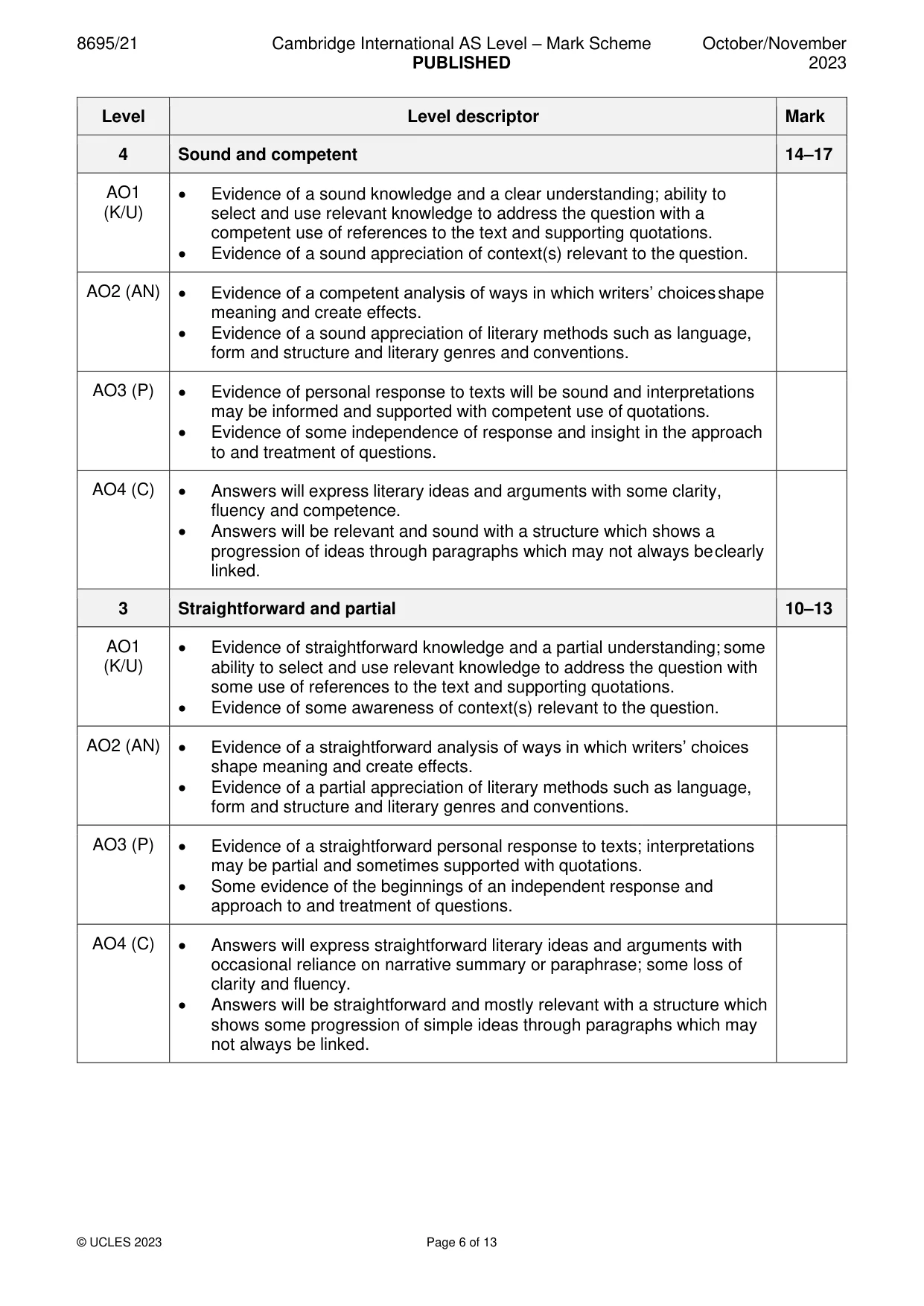
8695/21 Cambridge International AS Level – Mark Scheme PUBLISHED October/November 2023 © UCLES 2023 Page 6 of 13 Level Level descriptor Mark 4 Sound and competent 14–17 AO1 (K/U) • Evidence of a sound knowledge and a clear understanding; ability to select and use relevant knowledge to address the question with a competent use of references to the text and supporting quotations. • Evidence of a sound appreciation of context(s) relevant to the question. AO2 (AN) • Evidence of a competent analysis of ways in which writers’ choices shape meaning and create effects. • Evidence of a sound appreciation of literary methods such as language, form and structure and literary genres and conventions. AO3 (P) • Evidence of personal response to texts will be sound and interpretations may be informed and supported with competent use of quotations. • Evidence of some independence of response and insight in the approach to and treatment of questions. AO4 (C) • Answers will express literary ideas and arguments with some clarity, fluency and competence. • Answers will be relevant and sound with a structure which shows a progression of ideas through paragraphs which may not always be clearly linked. 3 Straightforward and partial 10–13 AO1 (K/U) • Evidence of straightforward knowledge and a partial understanding; some ability to select and use relevant knowledge to address the question with some use of references to the text and supporting quotations. • Evidence of some awareness of context(s) relevant to the question. AO2 (AN) • Evidence of a straightforward analysis of ways in which writers’ choices shape meaning and create effects. • Evidence of a partial appreciation of literary methods such as language, form and structure and literary genres and conventions. AO3 (P) • Evidence of a straightforward personal response to texts; interpretations may be partial and sometimes supported with quotations. • Some evidence of the beginnings of an independent response and approach to and treatment of questions. AO4 (C) • Answers will express straightforward literary ideas and arguments with occasional reliance on narrative summary or paraphrase; some loss of clarity and fluency. • Answers will be straightforward and mostly relevant with a structure which shows some progression of simple ideas through paragraphs which may not always be linked.
Mark scheme, page 7
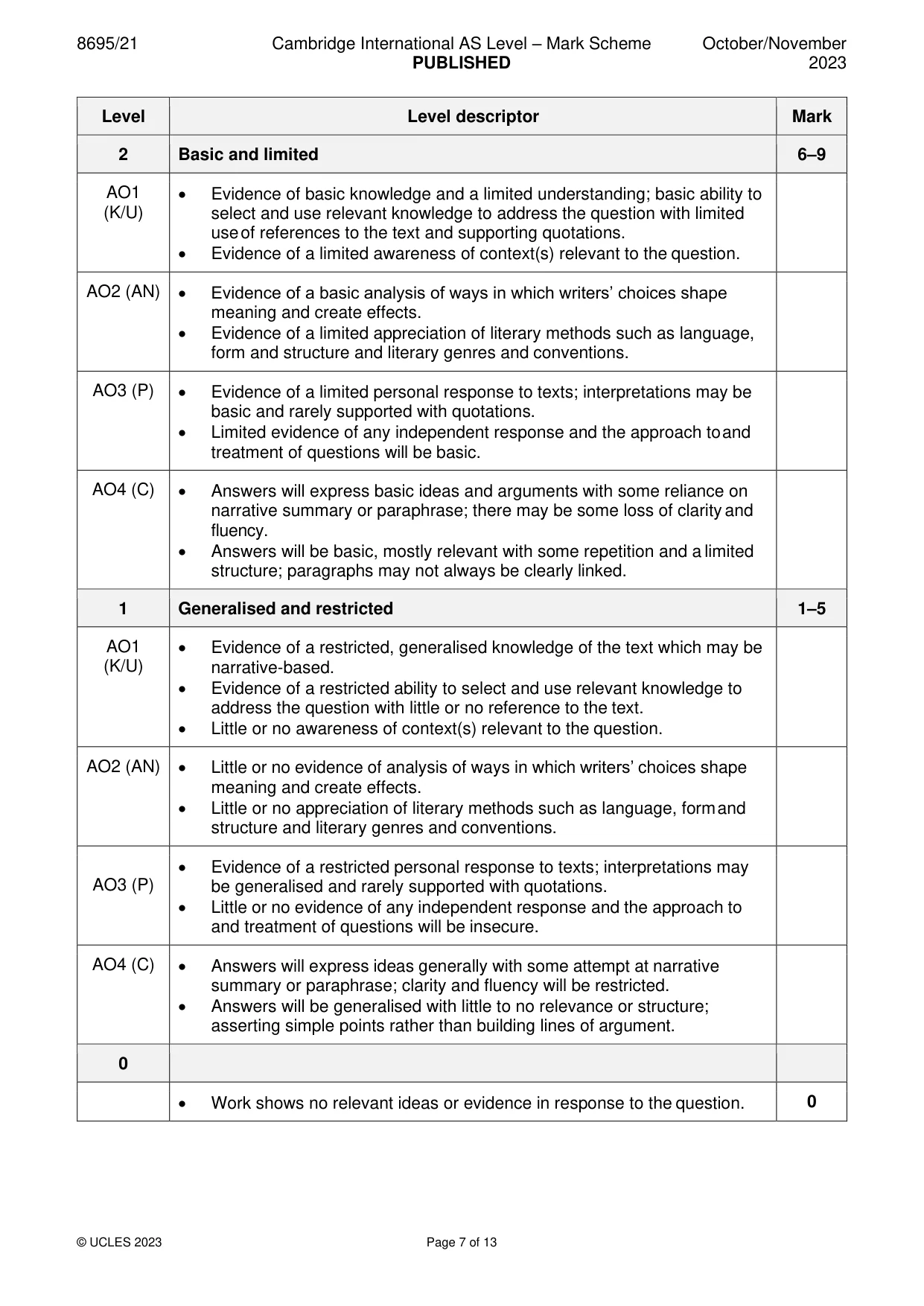
8695/21 Cambridge International AS Level – Mark Scheme PUBLISHED October/November 2023 © UCLES 2023 Page 7 of 13 Level Level descriptor Mark 2 Basic and limited 6–9 AO1 (K/U) • Evidence of basic knowledge and a limited understanding; basic ability to select and use relevant knowledge to address the question with limited use of references to the text and supporting quotations. • Evidence of a limited awareness of context(s) relevant to the question. AO2 (AN) • Evidence of a basic analysis of ways in which writers’ choices shape meaning and create effects. • Evidence of a limited appreciation of literary methods such as language, form and structure and literary genres and conventions. AO3 (P) • Evidence of a limited personal response to texts; interpretations may be basic and rarely supported with quotations. • Limited evidence of any independent response and the approach to and treatment of questions will be basic. AO4 (C) • Answers will express basic ideas and arguments with some reliance on narrative summary or paraphrase; there may be some loss of clarity and fluency. • Answers will be basic, mostly relevant with some repetition and a limited structure; paragraphs may not always be clearly linked. 1 Generalised and restricted 1–5 AO1 (K/U) • Evidence of a restricted, generalised knowledge of the text which may be narrative-based. • Evidence of a restricted ability to select and use relevant knowledge to address the question with little or no reference to the text. • Little or no awareness of context(s) relevant to the question. AO2 (AN) • Little or no evidence of analysis of ways in which writers’ choices shape meaning and create effects. • Little or no appreciation of literary methods such as language, form and structure and literary genres and conventions. AO3 (P) • Evidence of a restricted personal response to texts; interpretations may be generalised and rarely supported with quotations. • Little or no evidence of any independent response and the approach to and treatment of questions will be insecure. AO4 (C) • Answers will express ideas generally with some attempt at narrative summary or paraphrase; clarity and fluency will be restricted. • Answers will be generalised with little to no relevance or structure; asserting simple points rather than building lines of argument. 0 • Work shows no relevant ideas or evidence in response to the question. 0
Mark scheme, page 8
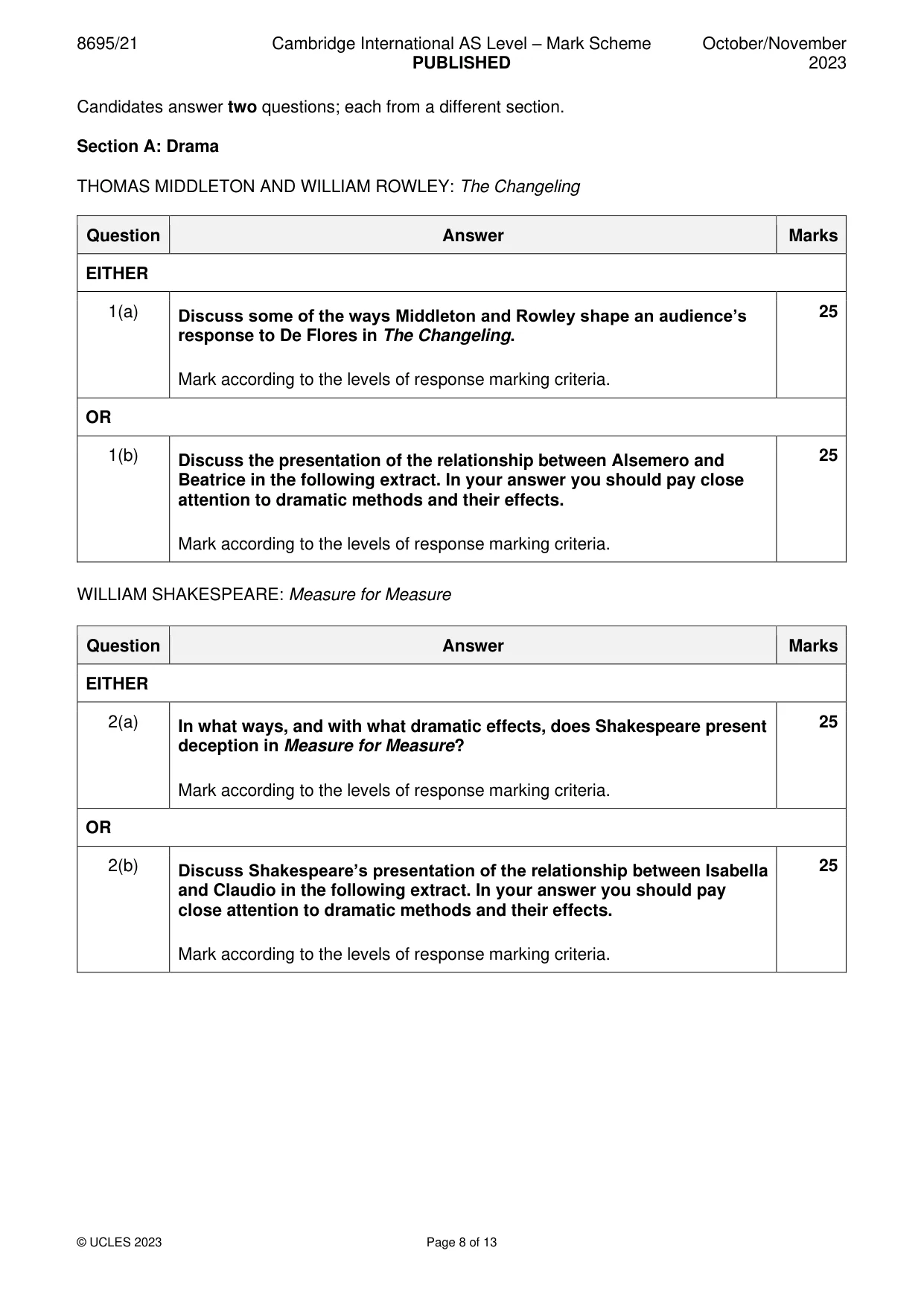
8695/21 Cambridge International AS Level – Mark Scheme PUBLISHED October/November 2023 © UCLES 2023 Page 8 of 13 Candidates answer two questions; each from a different section. Section A: Drama THOMAS MIDDLETON AND WILLIAM ROWLEY: The Changeling Question Answer Marks EITHER 1(a) Discuss some of the ways Middleton and Rowley shape an audience’s response to De Flores in The Changeling. Mark according to the levels of response marking criteria. 25 OR 1(b) Discuss the presentation of the relationship between Alsemero and Beatrice in the following extract. In your answer you should pay close attention to dramatic methods and their effects. Mark according to the levels of response marking criteria. 25 WILLIAM SHAKESPEARE: Measure for Measure Question Answer Marks EITHER 2(a) In what ways, and with what dramatic effects, does Shakespeare present deception in Measure for Measure? Mark according to the levels of response marking criteria. 25 OR 2(b) Discuss Shakespeare’s presentation of the relationship between Isabella and Claudio in the following extract. In your answer you should pay close attention to dramatic methods and their effects. Mark according to the levels of response marking criteria. 25
Mark scheme, page 9
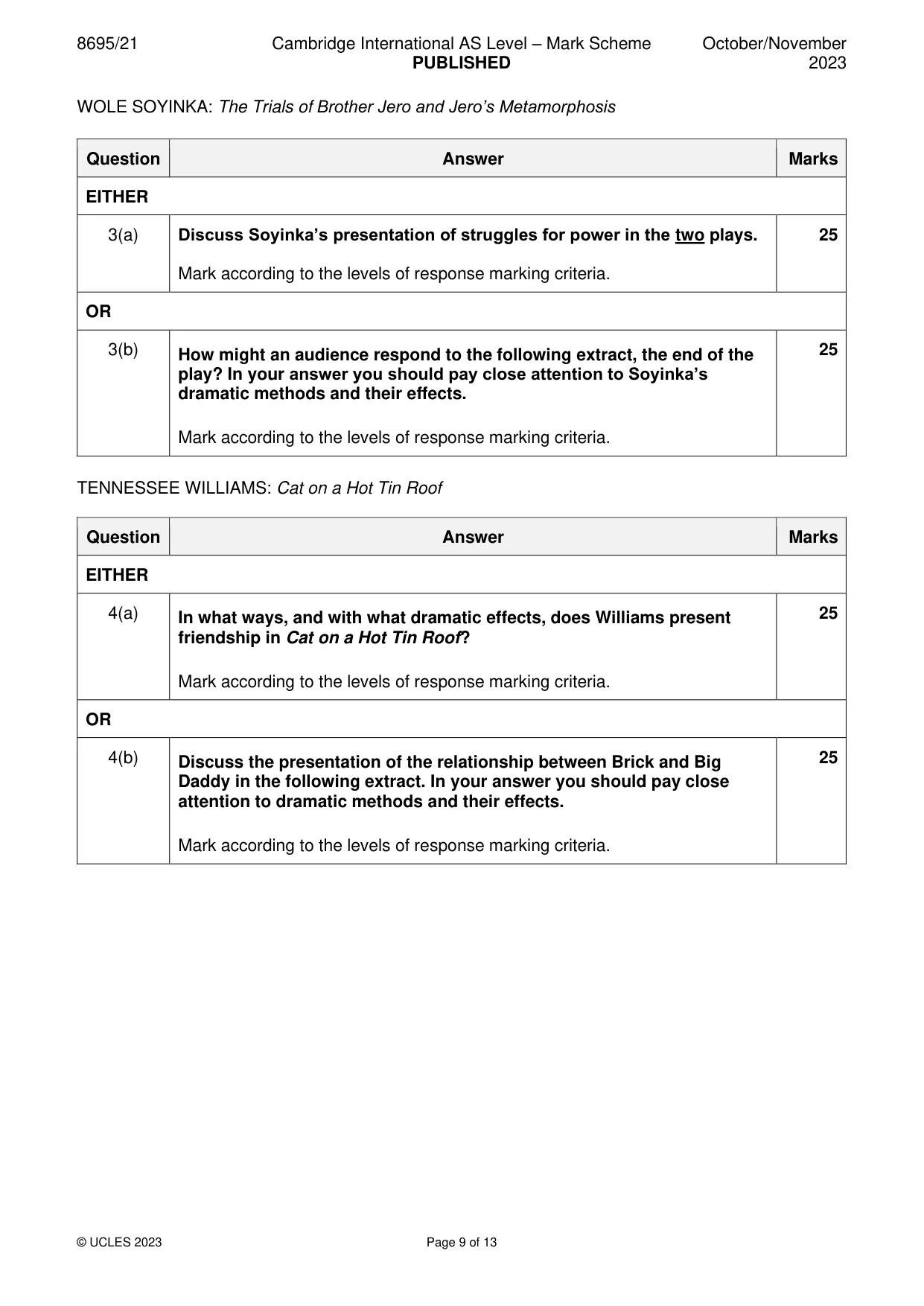
8695/21 Cambridge International AS Level – Mark Scheme PUBLISHED October/November 2023 © UCLES 2023 Page 9 of 13 WOLE SOYINKA: The Trials of Brother Jero and Jero’s Metamorphosis Question Answer Marks EITHER 3(a) Discuss Soyinka’s presentation of struggles for power in the two plays. Mark according to the levels of response marking criteria. 25 OR 3(b) How might an audience respond to the following extract, the end of the play? In your answer you should pay close attention to Soyinka’s dramatic methods and their effects. Mark according to the levels of response marking criteria. 25 TENNESSEE WILLIAMS: Cat on a Hot Tin Roof Question Answer Marks EITHER 4(a) In what ways, and with what dramatic effects, does Williams present friendship in Cat on a Hot Tin Roof? Mark according to the levels of response marking criteria. 25 OR 4(b) Discuss the presentation of the relationship between Brick and Big Daddy in the following extract. In your answer you should pay close attention to dramatic methods and their effects. Mark according to the levels of response marking criteria. 25
Mark scheme, page 10
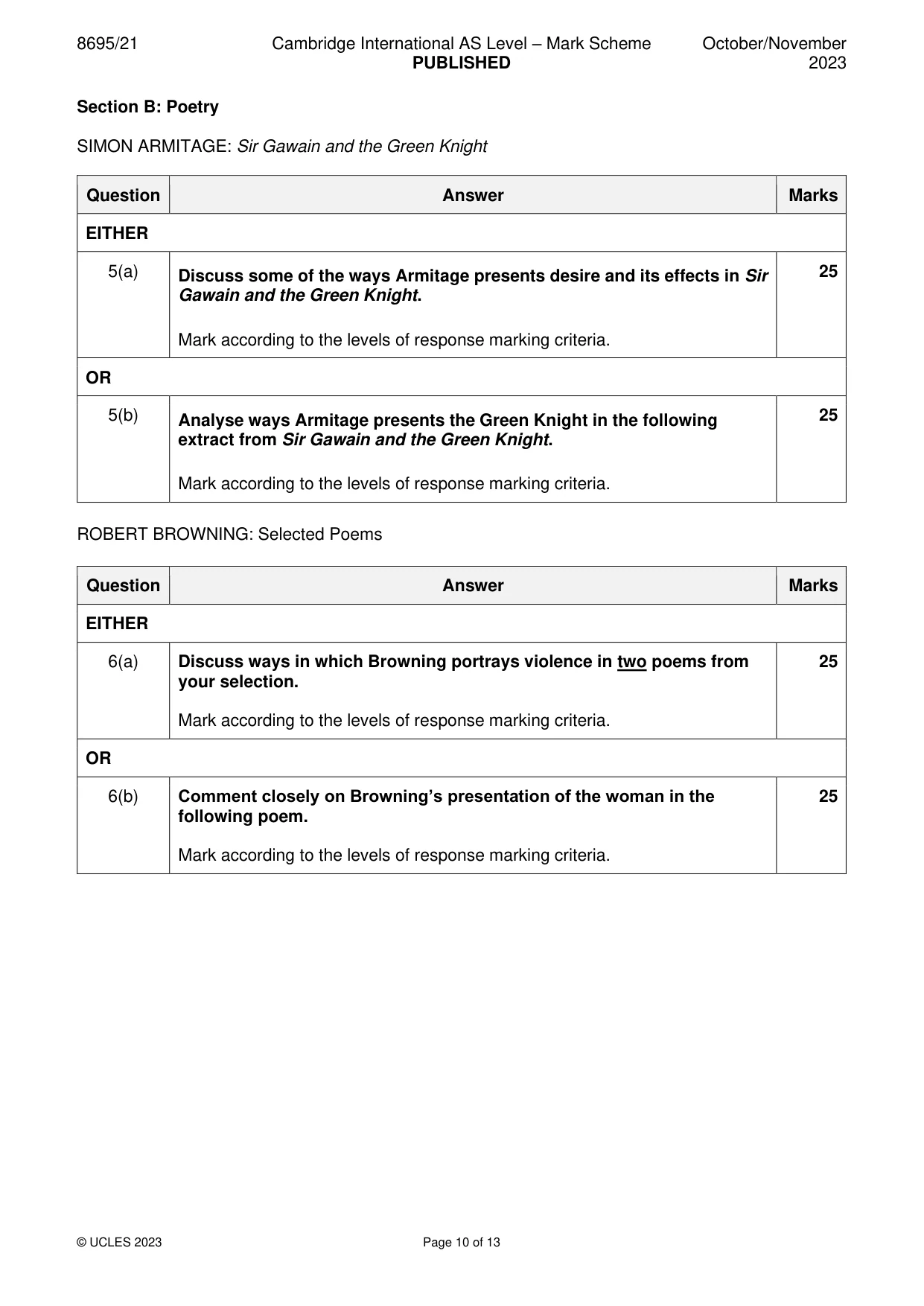
8695/21 Cambridge International AS Level – Mark Scheme PUBLISHED October/November 2023 © UCLES 2023 Page 10 of 13 Section B: Poetry SIMON ARMITAGE: Sir Gawain and the Green Knight Question Answer Marks EITHER 5(a) Discuss some of the ways Armitage presents desire and its effects in Sir Gawain and the Green Knight. Mark according to the levels of response marking criteria. 25 OR 5(b) Analyse ways Armitage presents the Green Knight in the following extract from Sir Gawain and the Green Knight. Mark according to the levels of response marking criteria. 25 ROBERT BROWNING: Selected Poems Question Answer Marks EITHER 6(a) Discuss ways in which Browning portrays violence in two poems from your selection. Mark according to the levels of response marking criteria. 25 OR 6(b) Comment closely on Browning’s presentation of the woman in the following poem. Mark according to the levels of response marking criteria. 25
Mark scheme, page 11
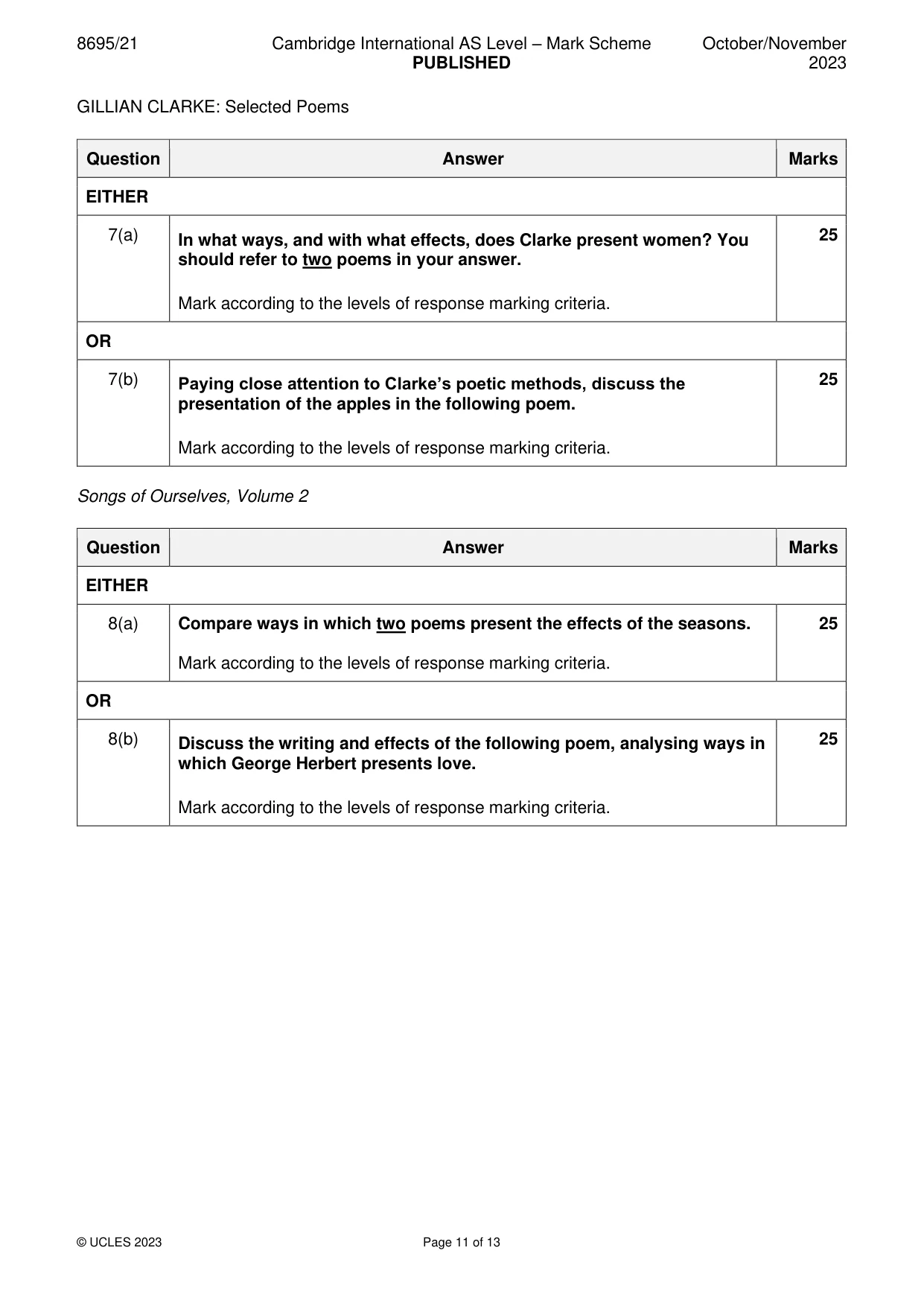
8695/21 Cambridge International AS Level – Mark Scheme PUBLISHED October/November 2023 © UCLES 2023 Page 11 of 13 GILLIAN CLARKE: Selected Poems Question Answer Marks EITHER 7(a) In what ways, and with what effects, does Clarke present women? You should refer to two poems in your answer. Mark according to the levels of response marking criteria. 25 OR 7(b) Paying close attention to Clarke’s poetic methods, discuss the presentation of the apples in the following poem. Mark according to the levels of response marking criteria. 25 Songs of Ourselves, Volume 2 Question Answer Marks EITHER 8(a) Compare ways in which two poems present the effects of the seasons. Mark according to the levels of response marking criteria. 25 OR 8(b) Discuss the writing and effects of the following poem, analysing ways in which George Herbert presents love. Mark according to the levels of response marking criteria. 25
Mark scheme, page 12
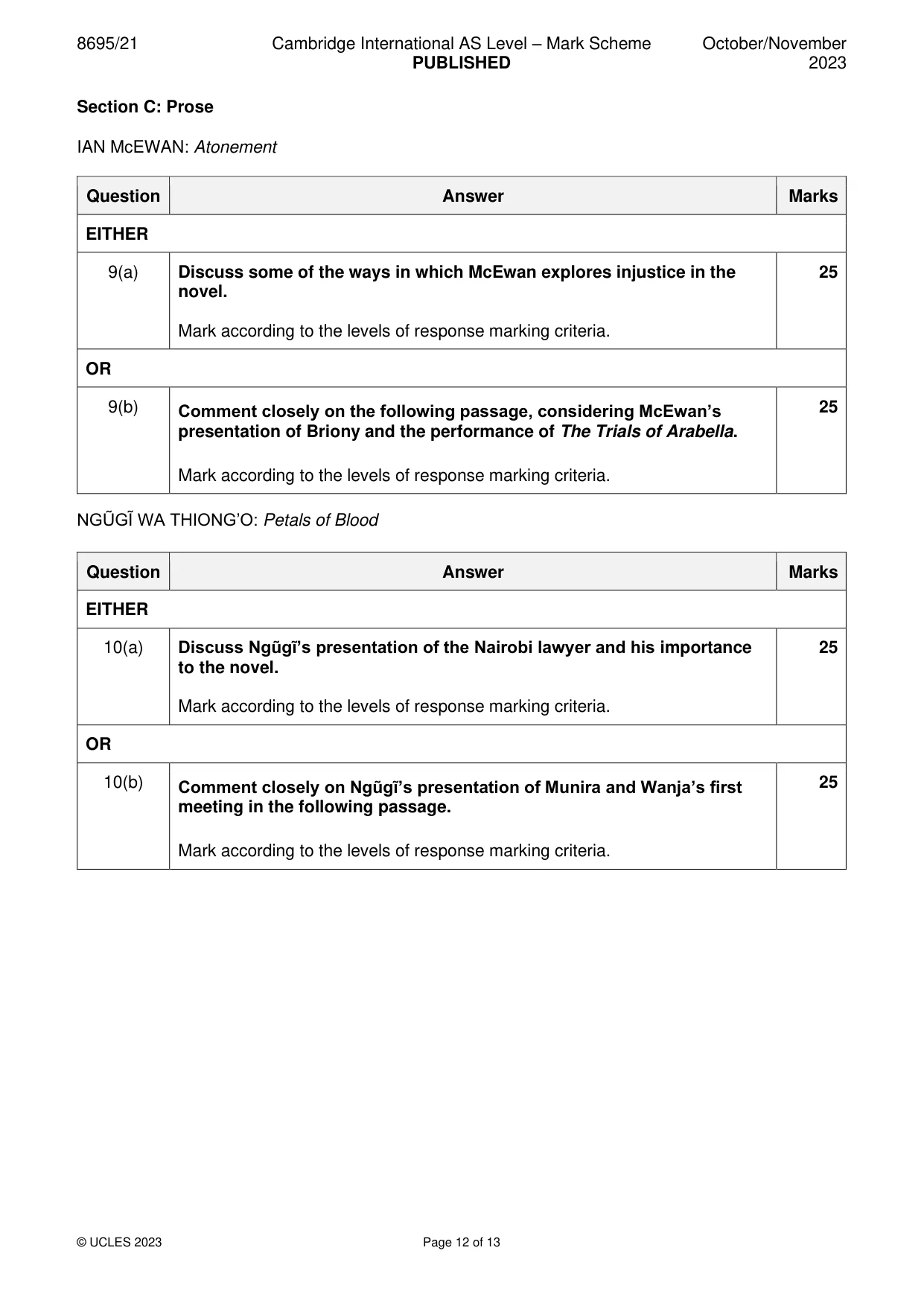
8695/21 Cambridge International AS Level – Mark Scheme PUBLISHED October/November 2023 © UCLES 2023 Page 12 of 13 Section C: Prose IAN McEWAN: Atonement Question Answer Marks EITHER 9(a) Discuss some of the ways in which McEwan explores injustice in the novel. Mark according to the levels of response marking criteria. 25 OR 9(b) Comment closely on the following passage, considering McEwan’s presentation of Briony and the performance of The Trials of Arabella. Mark according to the levels of response marking criteria. 25 NGŨGĨ WA THIONG’O: Petals of Blood Question Answer Marks EITHER 10(a) Discuss Ngũgĩ’s presentation of the Nairobi lawyer and his importance to the novel. Mark according to the levels of response marking criteria. 25 OR 10(b) Comment closely on Ngũgĩ’s presentation of Munira and Wanja’s first meeting in the following passage. Mark according to the levels of response marking criteria. 25
Mark scheme, page 13
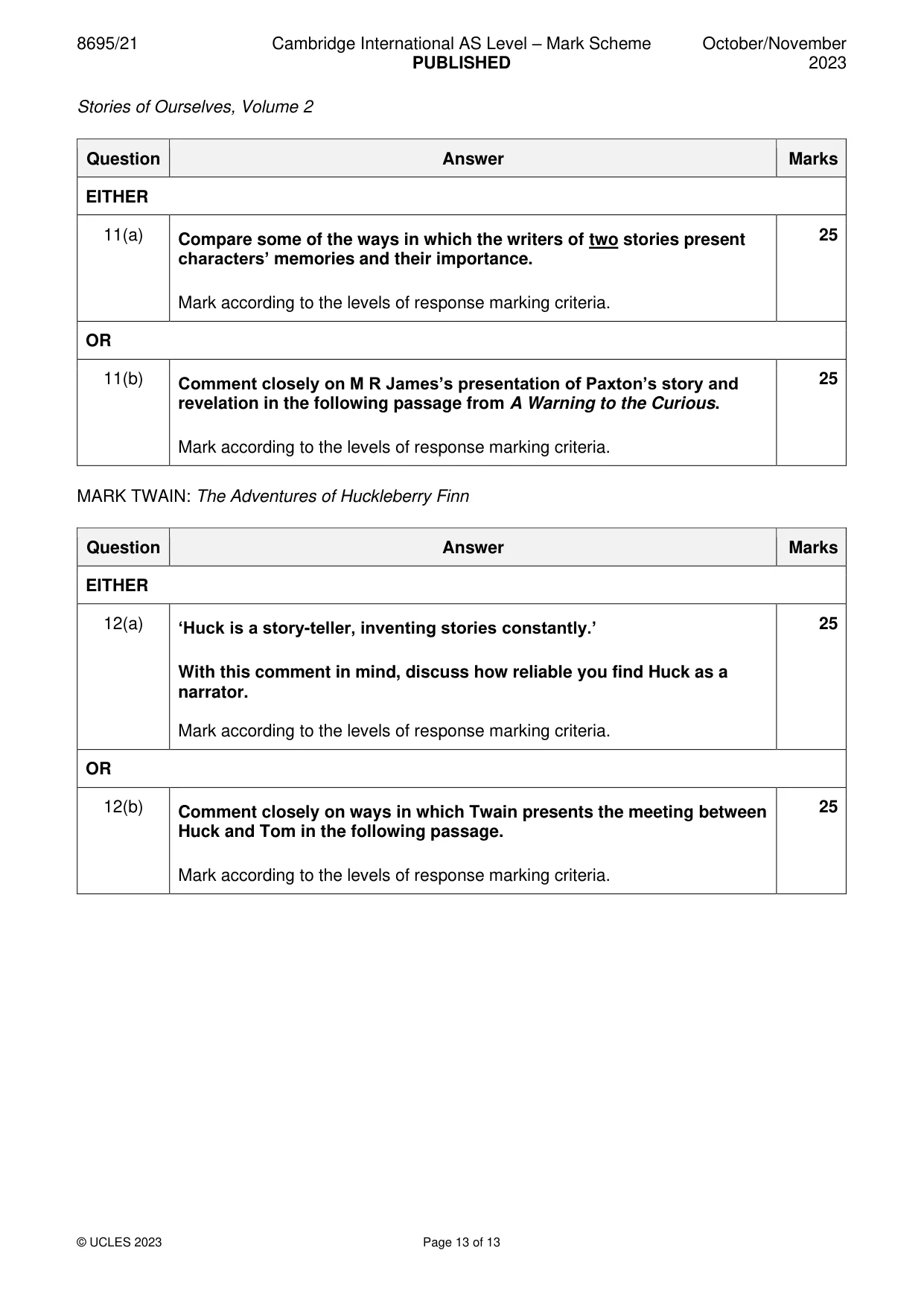
8695/21 Cambridge International AS Level – Mark Scheme PUBLISHED October/November 2023 © UCLES 2023 Page 13 of 13 Stories of Ourselves, Volume 2 Question Answer Marks EITHER 11(a) Compare some of the ways in which the writers of two stories present characters’ memories and their importance. Mark according to the levels of response marking criteria. 25 OR 11(b) Comment closely on M R James’s presentation of Paxton’s story and revelation in the following passage from A Warning to the Curious. Mark according to the levels of response marking criteria. 25 MARK TWAIN: The Adventures of Huckleberry Finn Question Answer Marks EITHER 12(a) ‘Huck is a story-teller, inventing stories constantly.’ With this comment in mind, discuss how reliable you find Huck as a narrator. Mark according to the levels of response marking criteria. 25 OR 12(b) Comment closely on ways in which Twain presents the meeting between Huck and Tom in the following passage. Mark according to the levels of response marking criteria. 25
What you needed in this session
Cambridge’s own grade thresholds for 2023 Oct/Nov, Paper 2 · Variant 1. A higher threshold means an easier paper — the bar moves with how the cohort did.