Cambridge A Level English - Language and Literature (AS Level only, from 2016) 8695 — 2022 Oct/Nov Paper 2 · Variant 3
8695/23/O/N/22 · 50 marks · ≈56 min
The question paper and its mark scheme, free to read here and free to download. This is Cambridge’s own paper, exactly as it was sat.
Question paper24 pages



Mark scheme13 pages
Answers below. Sit the paper first if you are practising.
Paper as text
Question paper, page 1
This document has 24 pages. Any blank pages are indicated. Cambridge International AS Level * 3 3 1 1 1 1 2 7 2 6 * LANGUAGE AND LITERATURE IN ENGLISH 8695/23 Paper 2 Drama, Poetry and Prose October/November 2022 2 hours You must answer on the enclosed answer booklet. You will need: Answer booklet (enclosed) INSTRUCTIONS ● Answer two questions in total, each from a different section. ● Follow the instructions on the front cover of the answer booklet. If you need additional answer paper, ask the invigilator for a continuation booklet. ● Dictionaries are not allowed. INFORMATION ● The total mark for this paper is 50. ● The number of marks for each question or part question is shown in brackets [ ]. DC (RCL (DF)) 303473/3 © UCLES 2022 [Turn over
Question paper, page 2
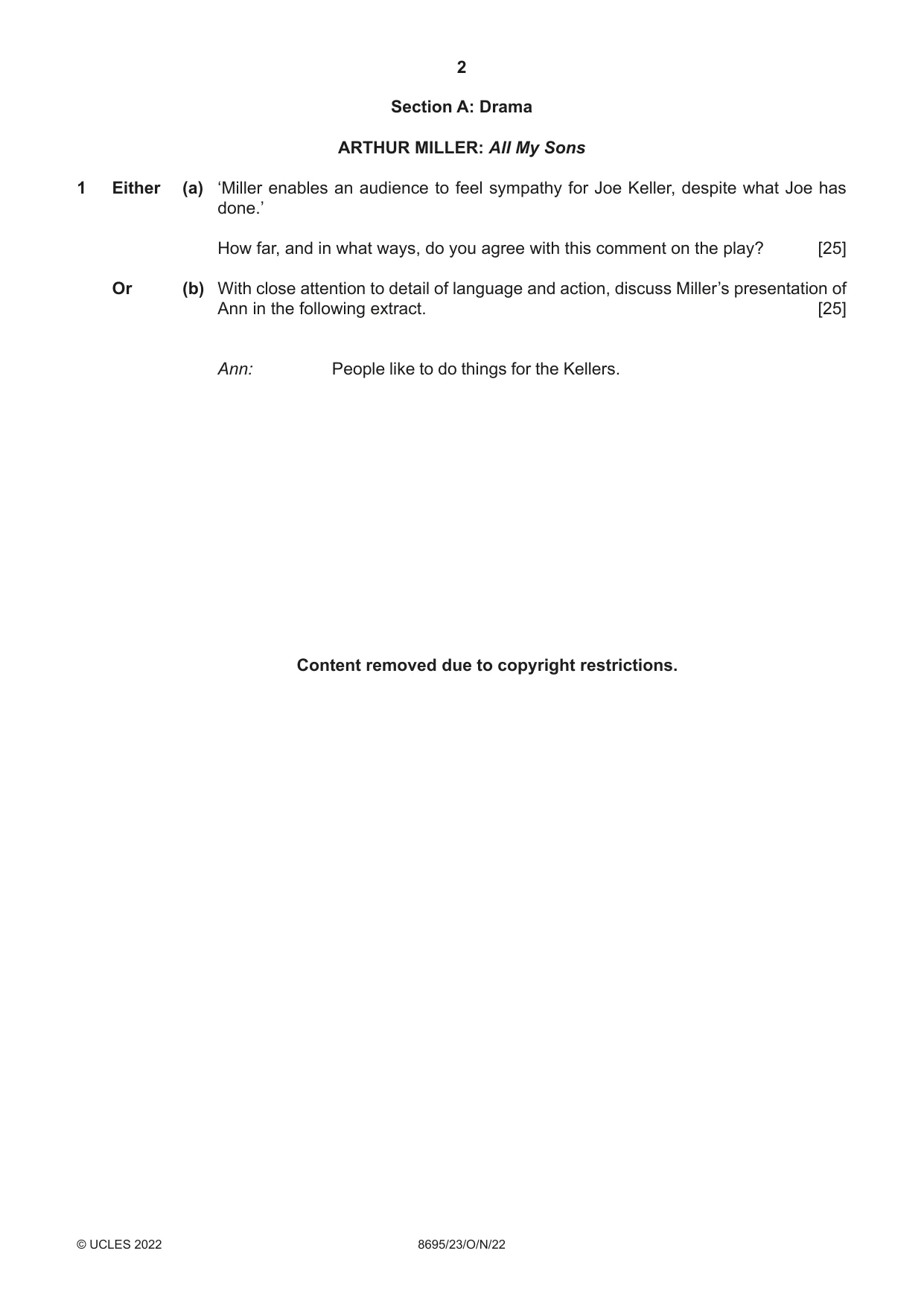
2 8695/23/O/N/22 © UCLES 2022 Section A: Drama ARTHUR MILLER: All My Sons 1 Either (a) ‘Miller enables an audience to feel sympathy for Joe Keller, despite what Joe has done.’ How far, and in what ways, do you agree with this comment on the play? [25] Or (b) With close attention to detail of language and action, discuss Miller’s presentation of Ann in the following extract. [25] Ann: People like to do things for the Kellers. Content removed due to copyright restrictions.
Question paper, page 3
3 8695/23/O/N/22 © UCLES 2022 [Turn over I resent everything you’ve said. (from Act 2) Content removed due to copyright restrictions.
Question paper, page 4
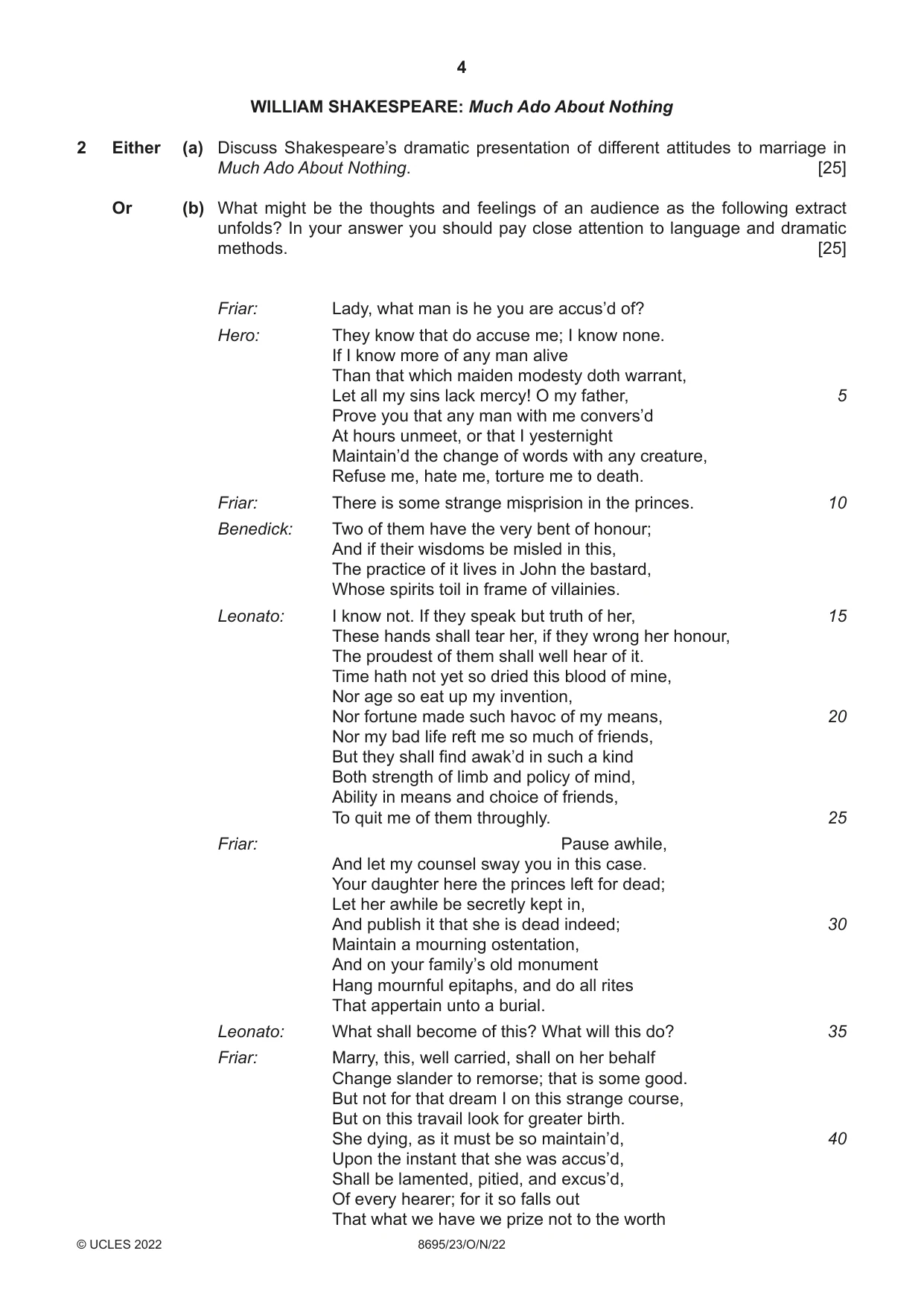
4 8695/23/O/N/22 © UCLES 2022 WILLIAM SHAKESPEARE: Much Ado About Nothing 2 Either (a) Discuss Shakespeare’s dramatic presentation of different attitudes to marriage in Much Ado About Nothing. [25] Or (b) What might be the thoughts and feelings of an audience as the following extract unfolds? In your answer you should pay close attention to language and dramatic methods. [25] Friar: Lady, what man is he you are accus’d of? Hero: They know that do accuse me; I know none. If I know more of any man alive Than that which maiden modesty doth warrant, Let all my sins lack mercy! O my father, Prove you that any man with me convers’d At hours unmeet, or that I yesternight Maintain’d the change of words with any creature, Refuse me, hate me, torture me to death. Friar: There is some strange misprision in the princes. Benedick: Two of them have the very bent of honour; And if their wisdoms be misled in this, The practice of it lives in John the bastard, Whose spirits toil in frame of villainies. Leonato: I know not. If they speak but truth of her, These hands shall tear her, if they wrong her honour, The proudest of them shall well hear of it. Time hath not yet so dried this blood of mine, Nor age so eat up my invention, Nor fortune made such havoc of my means, Nor my bad life reft me so much of friends, But they shall find awak’d in such a kind Both strength of limb and policy of mind, Ability in means and choice of friends, To quit me of them throughly. Friar: Pause awhile, And let my counsel sway you in this case. Your daughter here the princes left for dead; Let her awhile be secretly kept in, And publish it that she is dead indeed; Maintain a mourning ostentation, And on your family’s old monument Hang mournful epitaphs, and do all rites That appertain unto a burial. Leonato: What shall become of this? What will this do? Friar: Marry, this, well carried, shall on her behalf Change slander to remorse; that is some good. But not for that dream I on this strange course, But on this travail look for greater birth. She dying, as it must be so maintain’d, Upon the instant that she was accus’d, Shall be lamented, pitied, and excus’d, Of every hearer; for it so falls out That what we have we prize not to the worth 5 10 15 20 25 30 35 40
Question paper, page 5
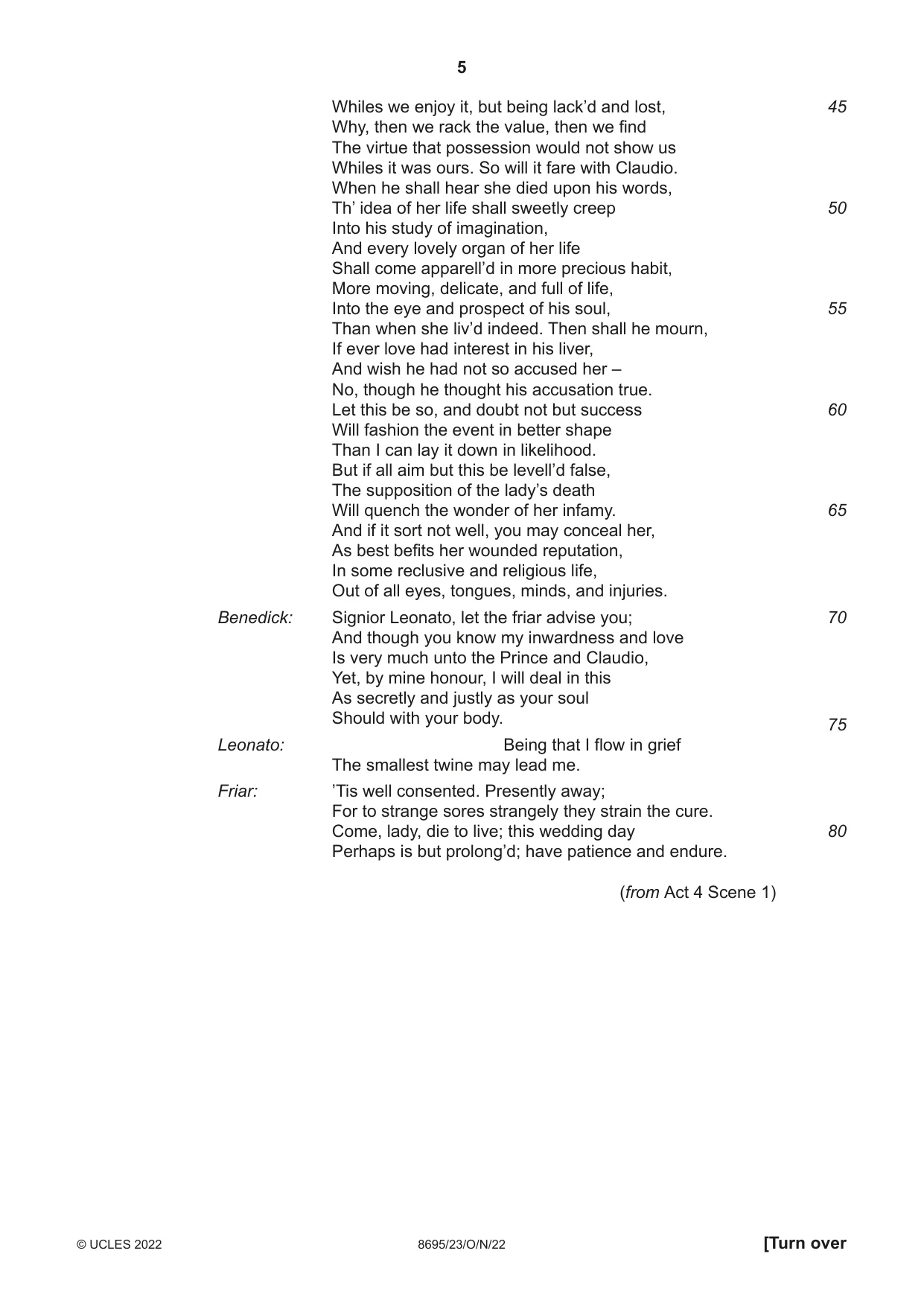
5 8695/23/O/N/22 © UCLES 2022 [Turn over Whiles we enjoy it, but being lack’d and lost, Why, then we rack the value, then we find The virtue that possession would not show us Whiles it was ours. So will it fare with Claudio. When he shall hear she died upon his words, Th’ idea of her life shall sweetly creep Into his study of imagination, And every lovely organ of her life Shall come apparell’d in more precious habit, More moving, delicate, and full of life, Into the eye and prospect of his soul, Than when she liv’d indeed. Then shall he mourn, If ever love had interest in his liver, And wish he had not so accused her – No, though he thought his accusation true. Let this be so, and doubt not but success Will fashion the event in better shape Than I can lay it down in likelihood. But if all aim but this be levell’d false, The supposition of the lady’s death Will quench the wonder of her infamy. And if it sort not well, you may conceal her, As best befits her wounded reputation, In some reclusive and religious life, Out of all eyes, tongues, minds, and injuries. Benedick: Signior Leonato, let the friar advise you; And though you know my inwardness and love Is very much unto the Prince and Claudio, Yet, by mine honour, I will deal in this As secretly and justly as your soul Should with your body. Leonato: Being that I flow in grief The smallest twine may lead me. Friar: ’Tis well consented. Presently away; For to strange sores strangely they strain the cure. Come, lady, die to live; this wedding day Perhaps is but prolong’d; have patience and endure. (from Act 4 Scene 1) 45 50 55 60 65 70 75 80
Question paper, page 6
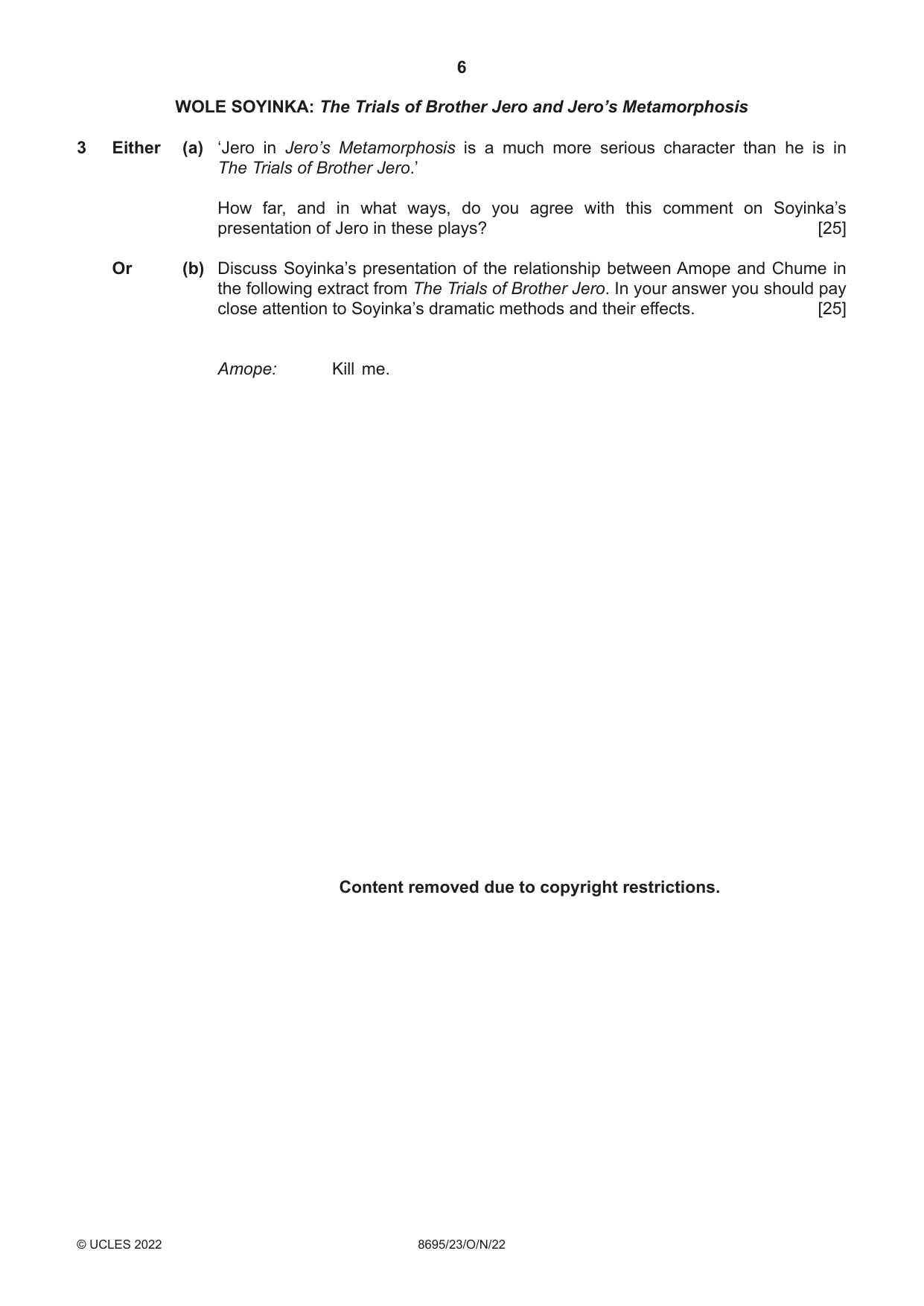
6 8695/23/O/N/22 © UCLES 2022 WOLE SOYINKA: The Trials of Brother Jero and Jero’s Metamorphosis 3 Either (a) ‘Jero in Jero’s Metamorphosis is a much more serious character than he is in The Trials of Brother Jero.’ How far, and in what ways, do you agree with this comment on Soyinka’s presentation of Jero in these plays? [25] Or (b) Discuss Soyinka’s presentation of the relationship between Amope and Chume in the following extract from The Trials of Brother Jero. In your answer you should pay close attention to Soyinka’s dramatic methods and their effects. [25] Amope: Kill me. Content removed due to copyright restrictions.
Question paper, page 7
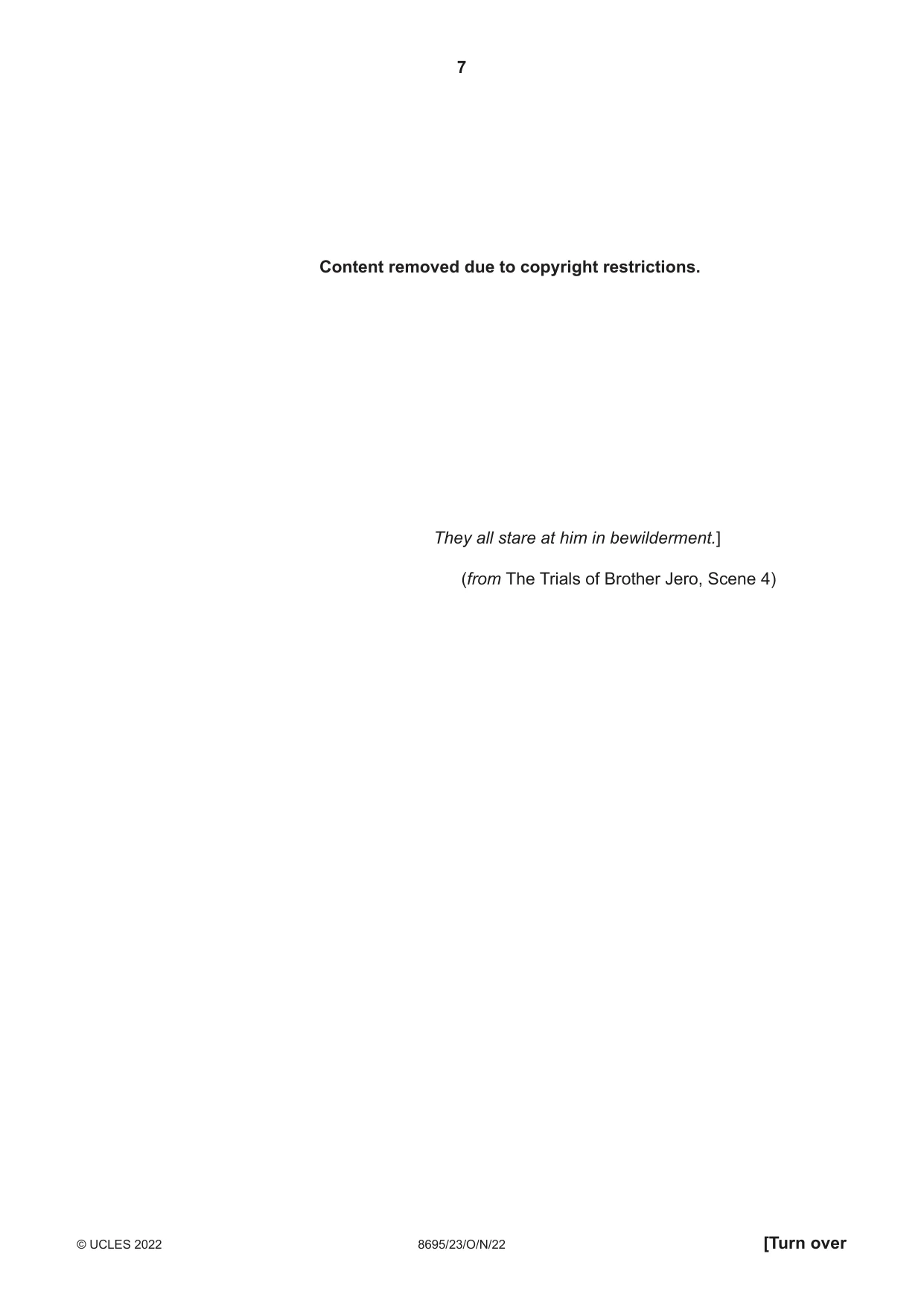
7 8695/23/O/N/22 © UCLES 2022 [Turn over They all stare at him in bewilderment.] (from The Trials of Brother Jero, Scene 4) Content removed due to copyright restrictions.
Question paper, page 8
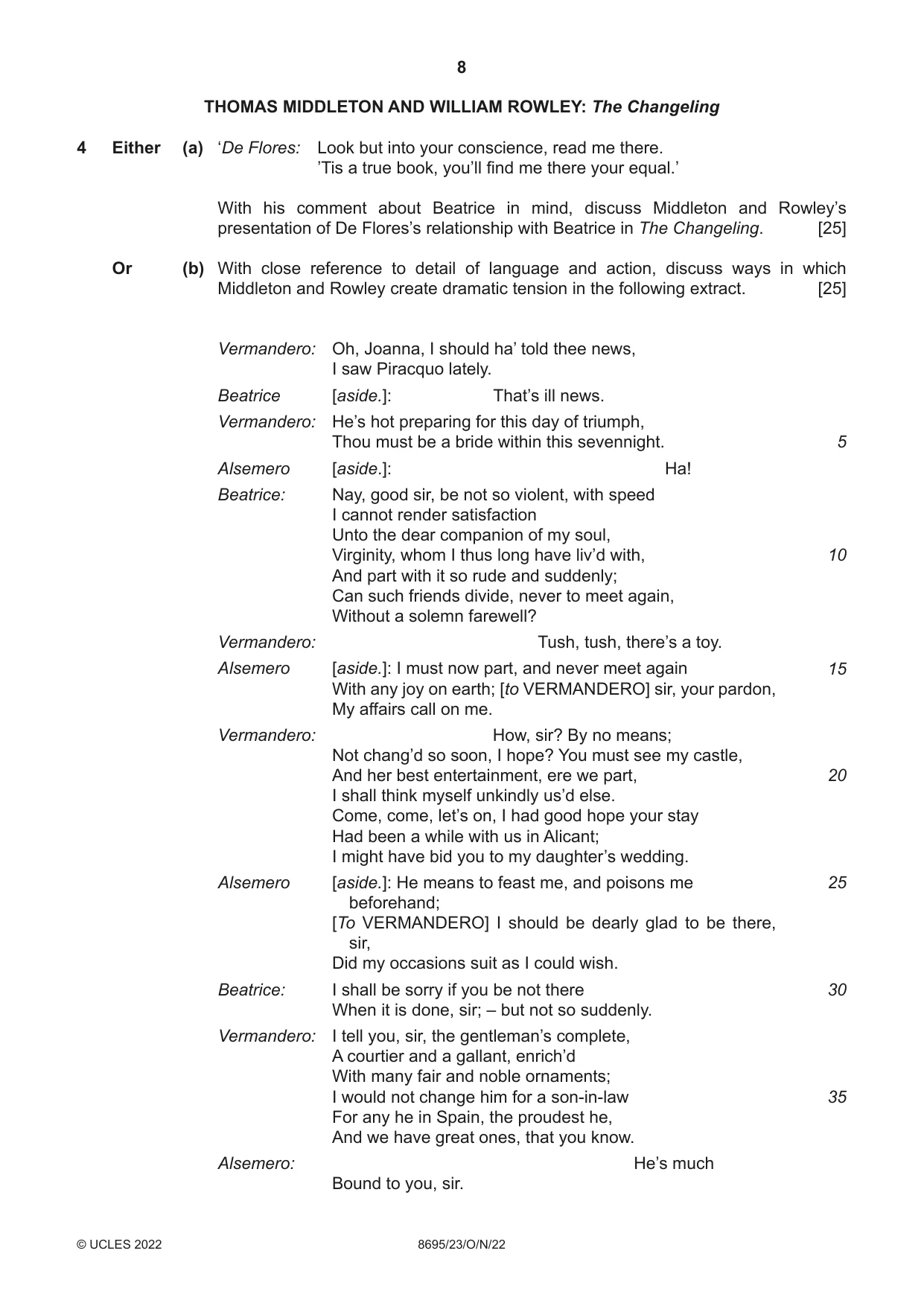
8 8695/23/O/N/22 © UCLES 2022 THOMAS MIDDLETON AND WILLIAM ROWLEY: The Changeling 4 Either (a) ‘De Flores: Look but into your conscience, read me there. ’Tis a true book, you’ll find me there your equal.’ With his comment about Beatrice in mind, discuss Middleton and Rowley’s presentation of De Flores’s relationship with Beatrice in The Changeling. [25] Or (b) With close reference to detail of language and action, discuss ways in which Middleton and Rowley create dramatic tension in the following extract. [25] Vermandero: Oh, Joanna, I should ha’ told thee news, I saw Piracquo lately. Beatrice [aside.]: That’s ill news. Vermandero: He’s hot preparing for this day of triumph, Thou must be a bride within this sevennight. Alsemero [aside.]: Ha! Beatrice: Nay, good sir, be not so violent, with speed I cannot render satisfaction Unto the dear companion of my soul, Virginity, whom I thus long have liv’d with, And part with it so rude and suddenly; Can such friends divide, never to meet again, Without a solemn farewell? Vermandero: Tush, tush, there’s a toy. Alsemero [aside.]: I must now part, and never meet again With any joy on earth; [to VERMANDERO] sir, your pardon, My affairs call on me. Vermandero: How, sir? By no means; Not chang’d so soon, I hope? You must see my castle, And her best entertainment, ere we part, I shall think myself unkindly us’d else. Come, come, let’s on, I had good hope your stay Had been a while with us in Alicant; I might have bid you to my daughter’s wedding. Alsemero [aside.]: He means to feast me, and poisons me beforehand; [To VERMANDERO] I should be dearly glad to be there, sir, Did my occasions suit as I could wish. Beatrice: I shall be sorry if you be not there When it is done, sir; – but not so suddenly. Vermandero: I tell you, sir, the gentleman’s complete, A courtier and a gallant, enrich’d With many fair and noble ornaments; I would not change him for a son-in-law For any he in Spain, the proudest he, And we have great ones, that you know. Alsemero: He’s much Bound to you, sir. 5 10 15 20 25 30 35
Question paper, page 9
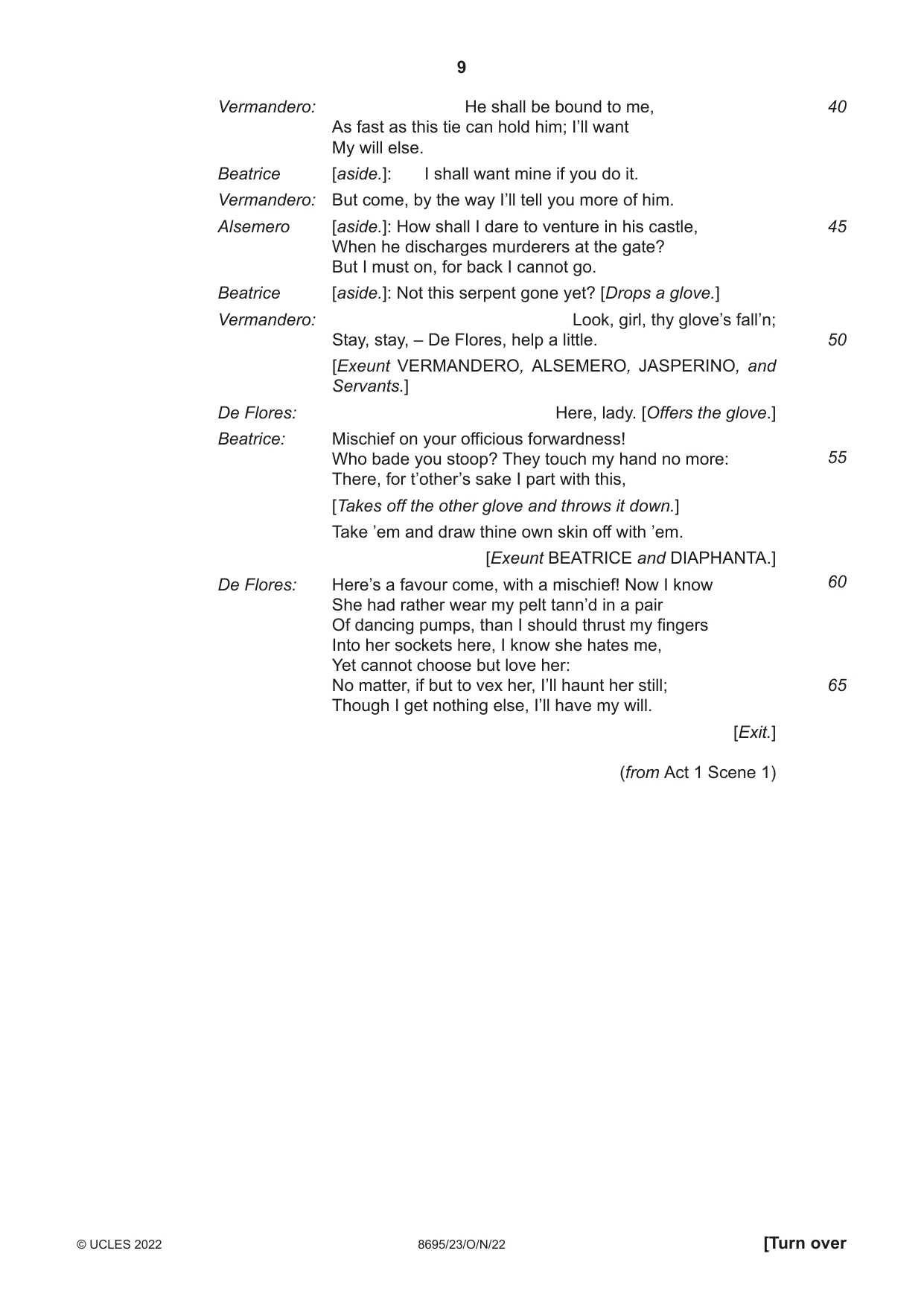
9 8695/23/O/N/22 © UCLES 2022 [Turn over Vermandero: He shall be bound to me, As fast as this tie can hold him; I’ll want My will else. Beatrice [aside.]: I shall want mine if you do it. Vermandero: But come, by the way I’ll tell you more of him. Alsemero [aside.]: How shall I dare to venture in his castle, When he discharges murderers at the gate? But I must on, for back I cannot go. Beatrice [aside.]: Not this serpent gone yet? [Drops a glove.] Vermandero: Look, girl, thy glove’s fall’n; Stay, stay, – De Flores, help a little. [Exeunt VERMANDERO, ALSEMERO, JASPERINO, and Servants.] De Flores: Here, lady. [Offers the glove.] Beatrice: Mischief on your officious forwardness! Who bade you stoop? They touch my hand no more: There, for t’other’s sake I part with this, [Takes off the other glove and throws it down.] Take ’em and draw thine own skin off with ’em. [Exeunt BEATRICE and DIAPHANTA.] De Flores: Here’s a favour come, with a mischief! Now I know She had rather wear my pelt tann’d in a pair Of dancing pumps, than I should thrust my fingers Into her sockets here, I know she hates me, Yet cannot choose but love her: No matter, if but to vex her, I’ll haunt her still; Though I get nothing else, I’ll have my will. [Exit.] (from Act 1 Scene 1) 40 45 50 55 60 65
Question paper, page 10
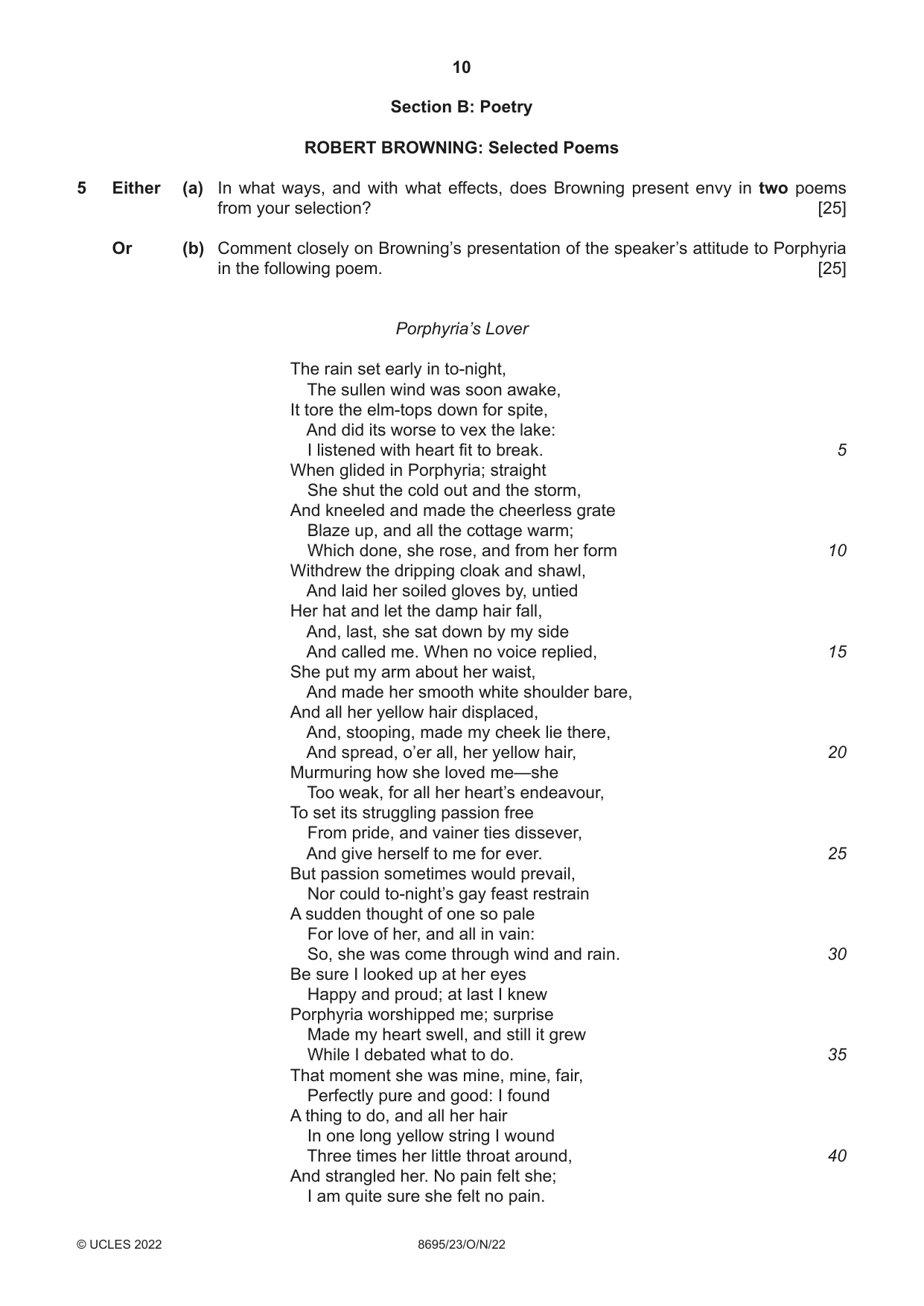
10 8695/23/O/N/22 © UCLES 2022 Section B: Poetry ROBERT BROWNING: Selected Poems 5 Either (a) In what ways, and with what effects, does Browning present envy in two poems from your selection? [25] Or (b) Comment closely on Browning’s presentation of the speaker’s attitude to Porphyria in the following poem. [25] Porphyria’s Lover The rain set early in to-night, The sullen wind was soon awake, It tore the elm-tops down for spite, And did its worse to vex the lake: I listened with heart fit to break. When glided in Porphyria; straight She shut the cold out and the storm, And kneeled and made the cheerless grate Blaze up, and all the cottage warm; Which done, she rose, and from her form Withdrew the dripping cloak and shawl, And laid her soiled gloves by, untied Her hat and let the damp hair fall, And, last, she sat down by my side And called me. When no voice replied, She put my arm about her waist, And made her smooth white shoulder bare, And all her yellow hair displaced, And, stooping, made my cheek lie there, And spread, o’er all, her yellow hair, Murmuring how she loved me—she Too weak, for all her heart’s endeavour, To set its struggling passion free From pride, and vainer ties dissever, And give herself to me for ever. But passion sometimes would prevail, Nor could to-night’s gay feast restrain A sudden thought of one so pale For love of her, and all in vain: So, she was come through wind and rain. Be sure I looked up at her eyes Happy and proud; at last I knew Porphyria worshipped me; surprise Made my heart swell, and still it grew While I debated what to do. That moment she was mine, mine, fair, Perfectly pure and good: I found A thing to do, and all her hair In one long yellow string I wound Three times her little throat around, And strangled her. No pain felt she; I am quite sure she felt no pain. 5 10 15 20 25 30 35 40
Question paper, page 11
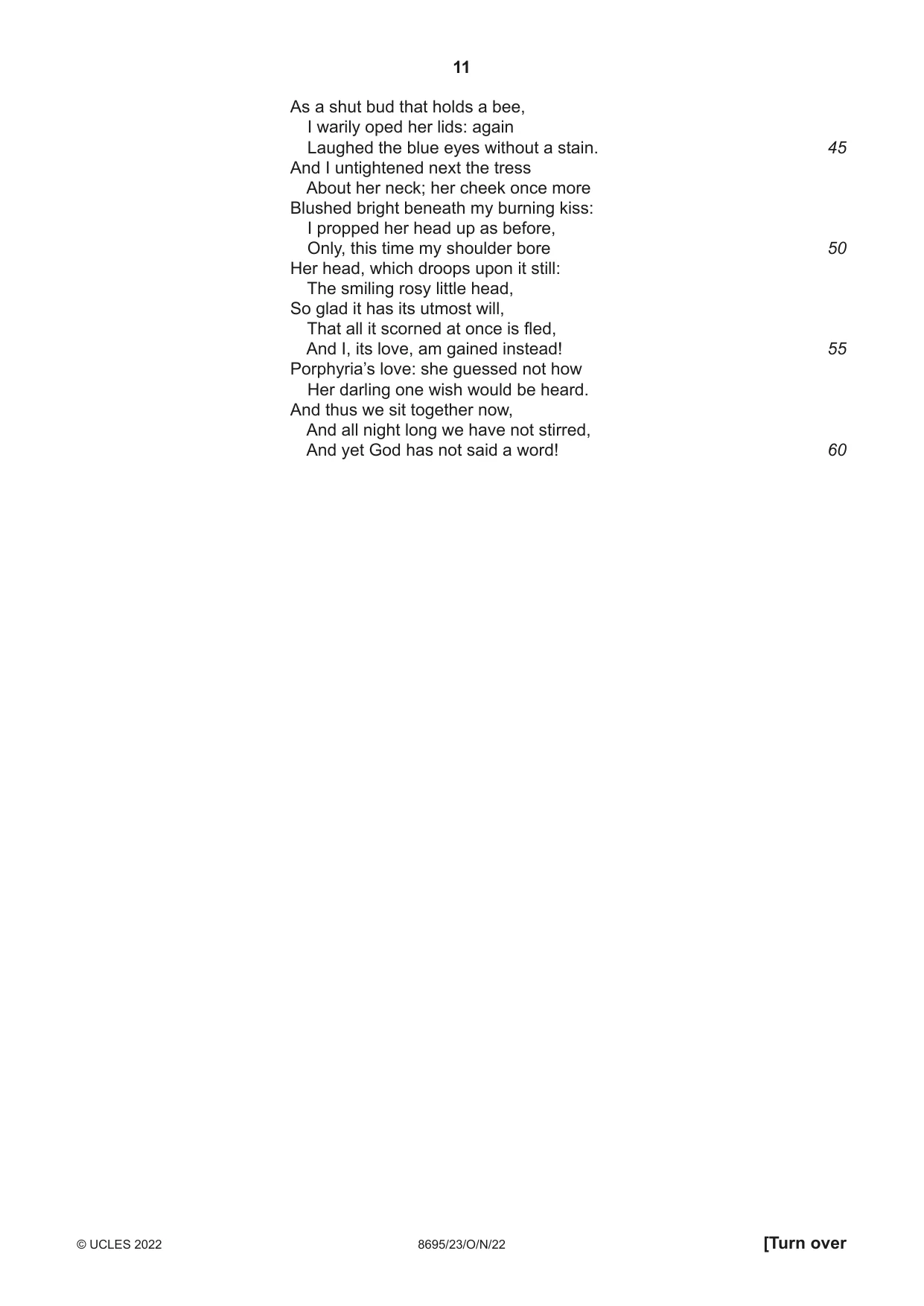
11 8695/23/O/N/22 © UCLES 2022 [Turn over As a shut bud that holds a bee, I warily oped her lids: again Laughed the blue eyes without a stain. And I untightened next the tress About her neck; her cheek once more Blushed bright beneath my burning kiss: I propped her head up as before, Only, this time my shoulder bore Her head, which droops upon it still: The smiling rosy little head, So glad it has its utmost will, That all it scorned at once is fled, And I, its love, am gained instead! Porphyria’s love: she guessed not how Her darling one wish would be heard. And thus we sit together now, And all night long we have not stirred, And yet God has not said a word! 45 50 55 60
Question paper, page 12
12 8695/23/O/N/22 © UCLES 2022 OWEN SHEERS: Skirrid Hill 6 Either (a) Discuss the writing and effects of two poems from Skirrid Hill which present family life. [25] Or (b) Comment closely on the following poem, analysing ways in which Sheers presents the steelworks. [25] The Steelworks, except it doesn’t anymore. across a brushed-metal sky. Ebbw Vale, 2002 Content removed due to copyright restrictions.
Question paper, page 13
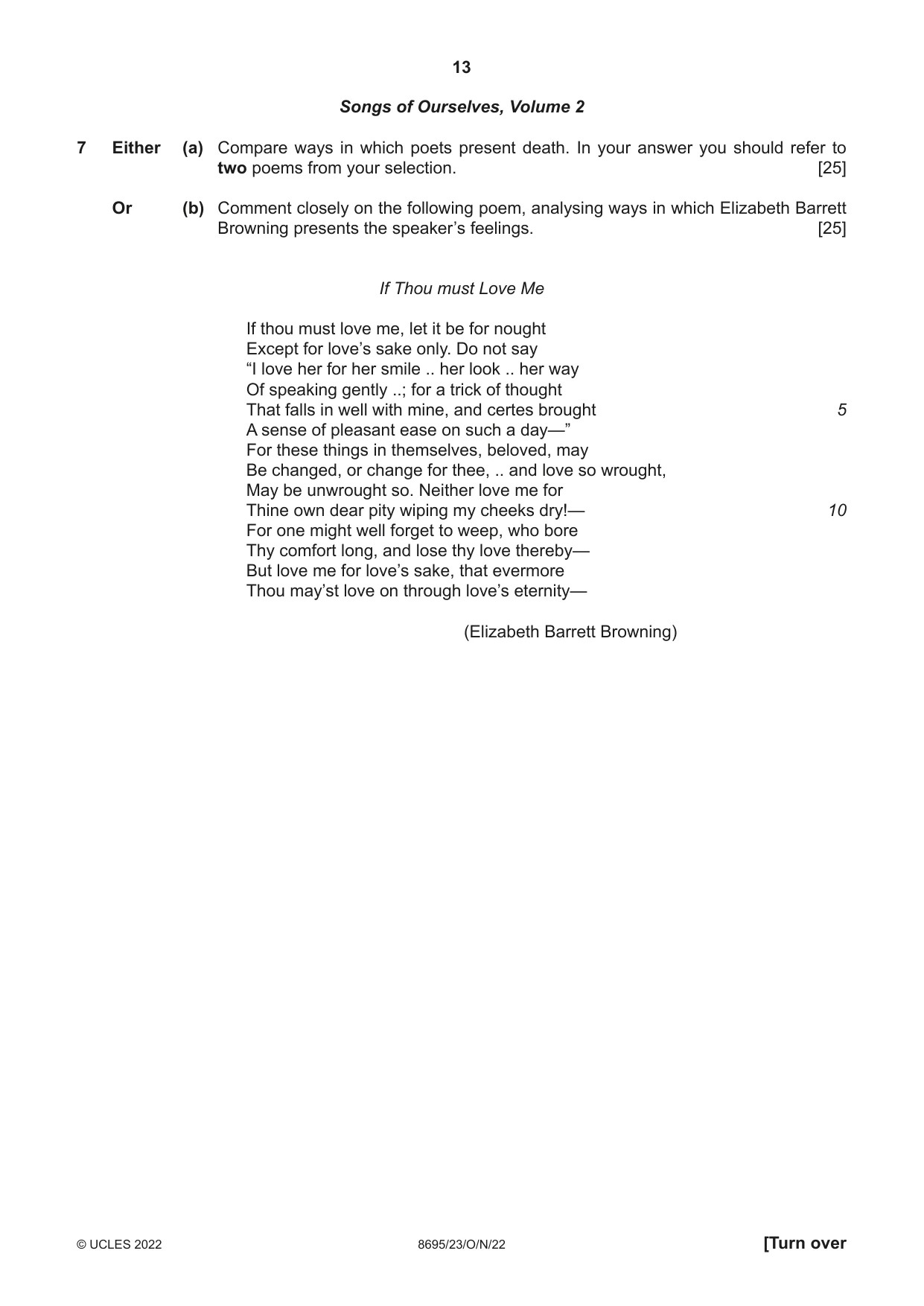
13 8695/23/O/N/22 © UCLES 2022 [Turn over Songs of Ourselves, Volume 2 7 Either (a) Compare ways in which poets present death. In your answer you should refer to two poems from your selection. [25] Or (b) Comment closely on the following poem, analysing ways in which Elizabeth Barrett Browning presents the speaker’s feelings. [25] If Thou must Love Me If thou must love me, let it be for nought Except for love’s sake only. Do not say “I love her for her smile .. her look .. her way Of speaking gently ..; for a trick of thought That falls in well with mine, and certes brought A sense of pleasant ease on such a day—” For these things in themselves, beloved, may Be changed, or change for thee, .. and love so wrought, May be unwrought so. Neither love me for Thine own dear pity wiping my cheeks dry!— For one might well forget to weep, who bore Thy comfort long, and lose thy love thereby— But love me for love’s sake, that evermore Thou may’st love on through love’s eternity— (Elizabeth Barrett Browning) 5 10
Question paper, page 14
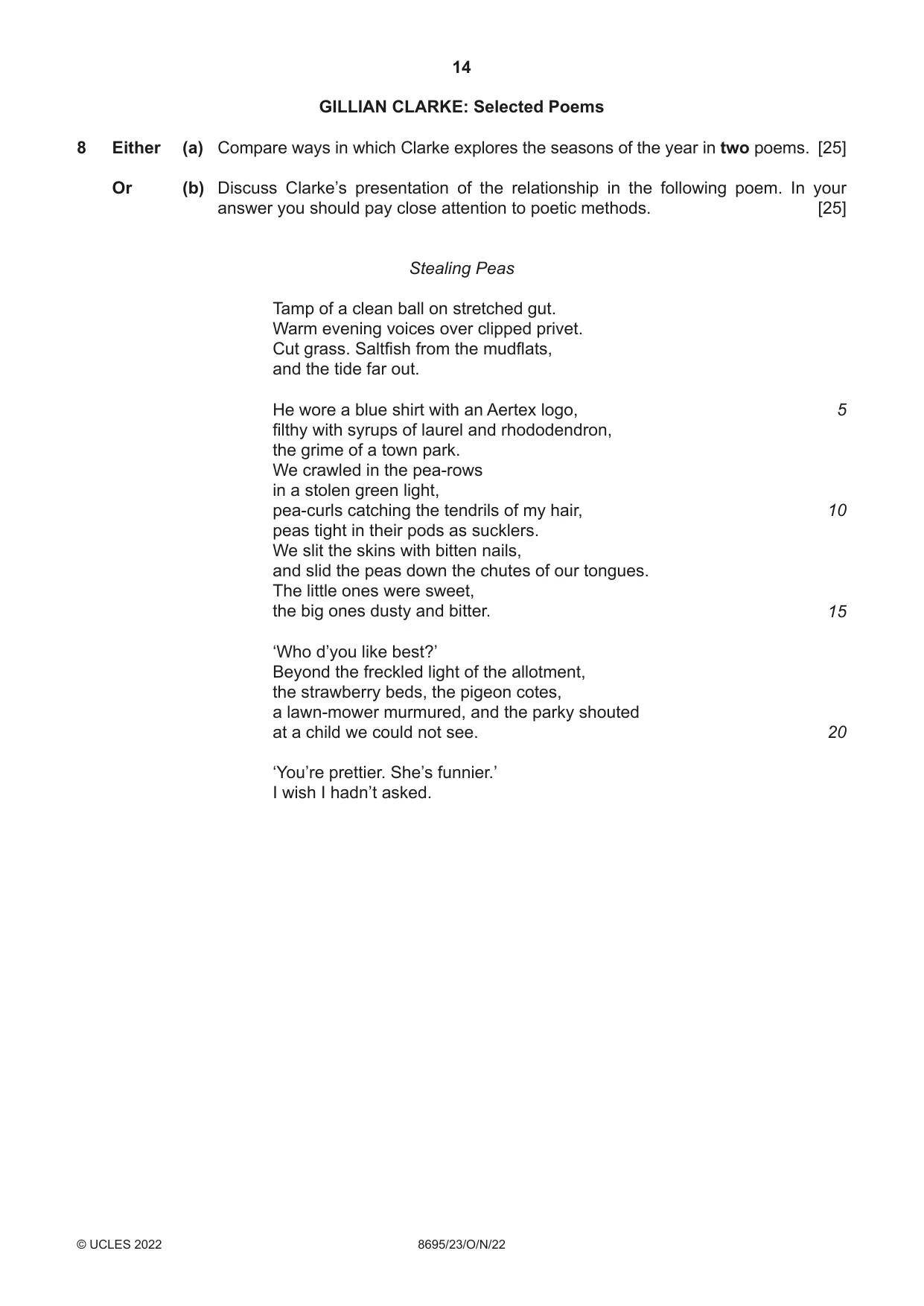
14 8695/23/O/N/22 © UCLES 2022 GILLIAN CLARKE: Selected Poems 8 Either (a) Compare ways in which Clarke explores the seasons of the year in two poems. [25] Or (b) Discuss Clarke’s presentation of the relationship in the following poem. In your answer you should pay close attention to poetic methods. [25] Stealing Peas Tamp of a clean ball on stretched gut. Warm evening voices over clipped privet. Cut grass. Saltfish from the mudflats, and the tide far out. He wore a blue shirt with an Aertex logo, filthy with syrups of laurel and rhododendron, the grime of a town park. We crawled in the pea-rows in a stolen green light, pea-curls catching the tendrils of my hair, peas tight in their pods as sucklers. We slit the skins with bitten nails, and slid the peas down the chutes of our tongues. The little ones were sweet, the big ones dusty and bitter. ‘Who d’you like best?’ Beyond the freckled light of the allotment, the strawberry beds, the pigeon cotes, a lawn-mower murmured, and the parky shouted at a child we could not see. ‘You’re prettier. She’s funnier.’ I wish I hadn’t asked. 5 10 15 20
Question paper, page 15
15 8695/23/O/N/22 © UCLES 2022 [Turn over TURN OVER FOR SECTION C.
Question paper, page 16
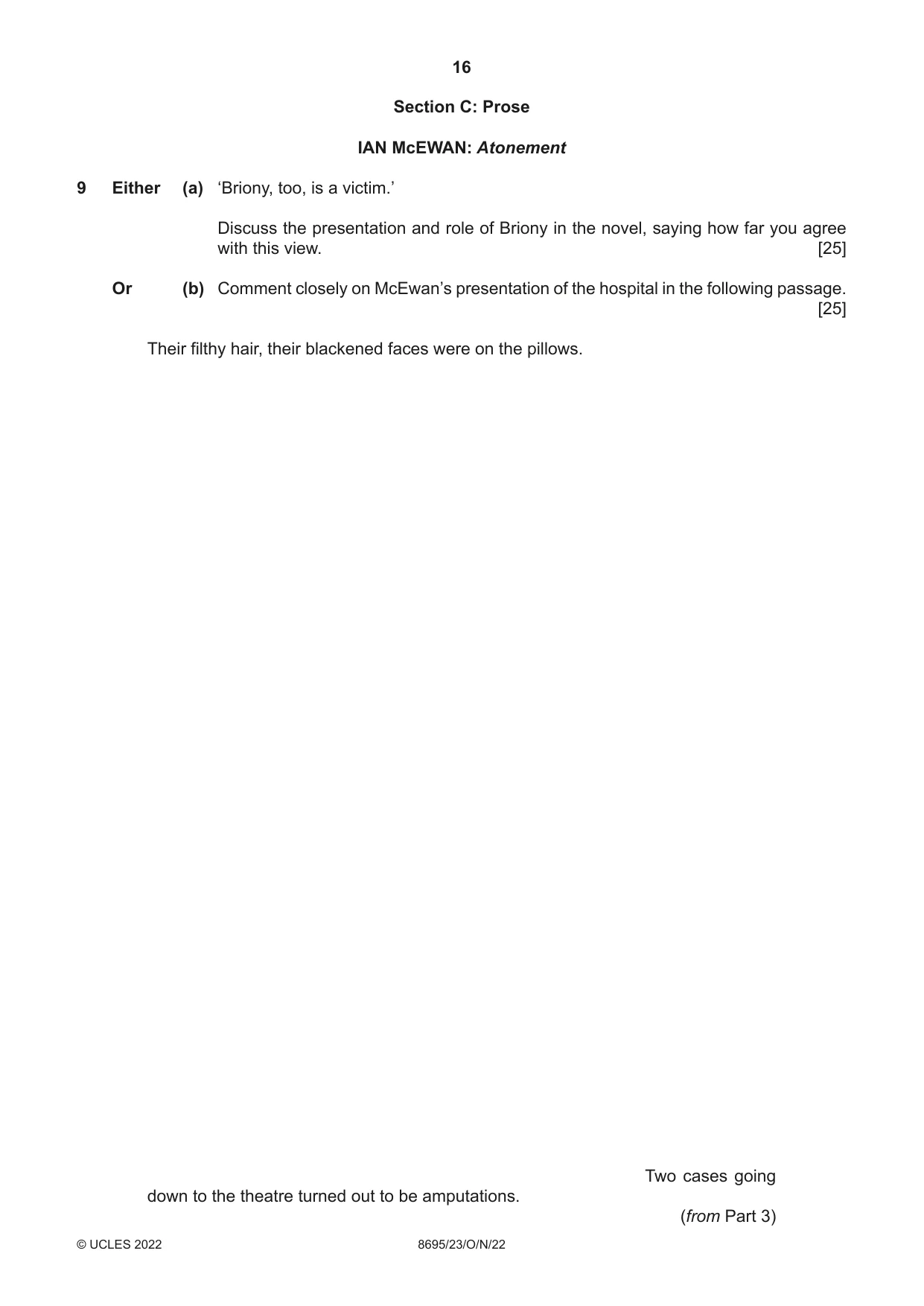
16 8695/23/O/N/22 © UCLES 2022 Section C: Prose IAN McEWAN: Atonement 9 Either (a) ‘Briony, too, is a victim.’ Discuss the presentation and role of Briony in the novel, saying how far you agree with this view. [25] Or (b) Comment closely on McEwan’s presentation of the hospital in the following passage. [25] Their filthy hair, their blackened faces were on the pillows. Two cases going down to the theatre turned out to be amputations. (from Part 3)
Question paper, page 17
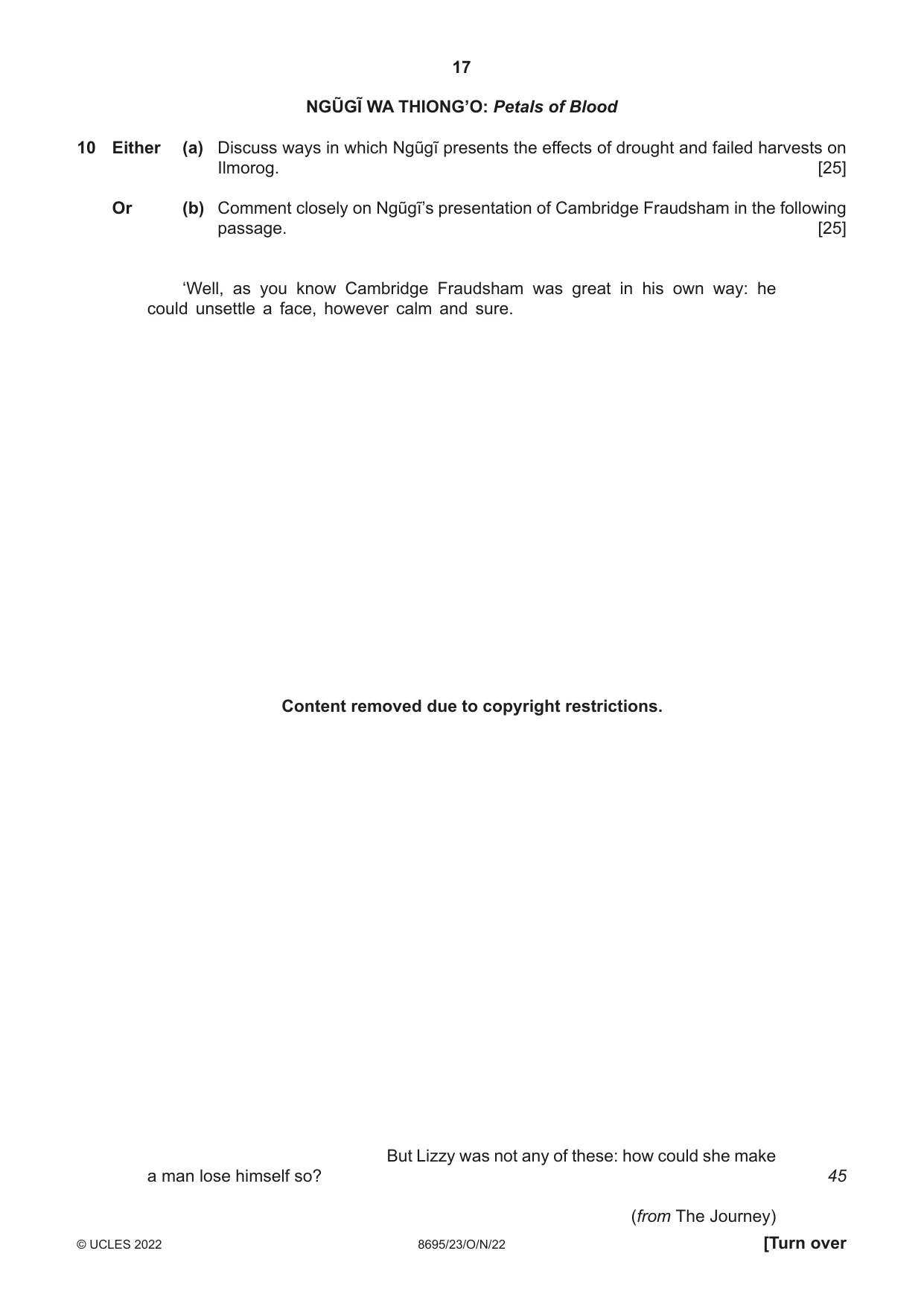
17 8695/23/O/N/22 © UCLES 2022 [Turn over NGŨGĨ WA THIONG’O: Petals of Blood 10 Either (a) Discuss ways in which Ngũgĩ presents the effects of drought and failed harvests on Ilmorog. [25] Or (b) Comment closely on Ngũgĩ’s presentation of Cambridge Fraudsham in the following passage. [25] ‘Well, as you know Cambridge Fraudsham was great in his own way: he could unsettle a face, however calm and sure. But Lizzy was not any of these: how could she make a man lose himself so? (from The Journey) 45 Content removed due to copyright restrictions.
Question paper, page 18
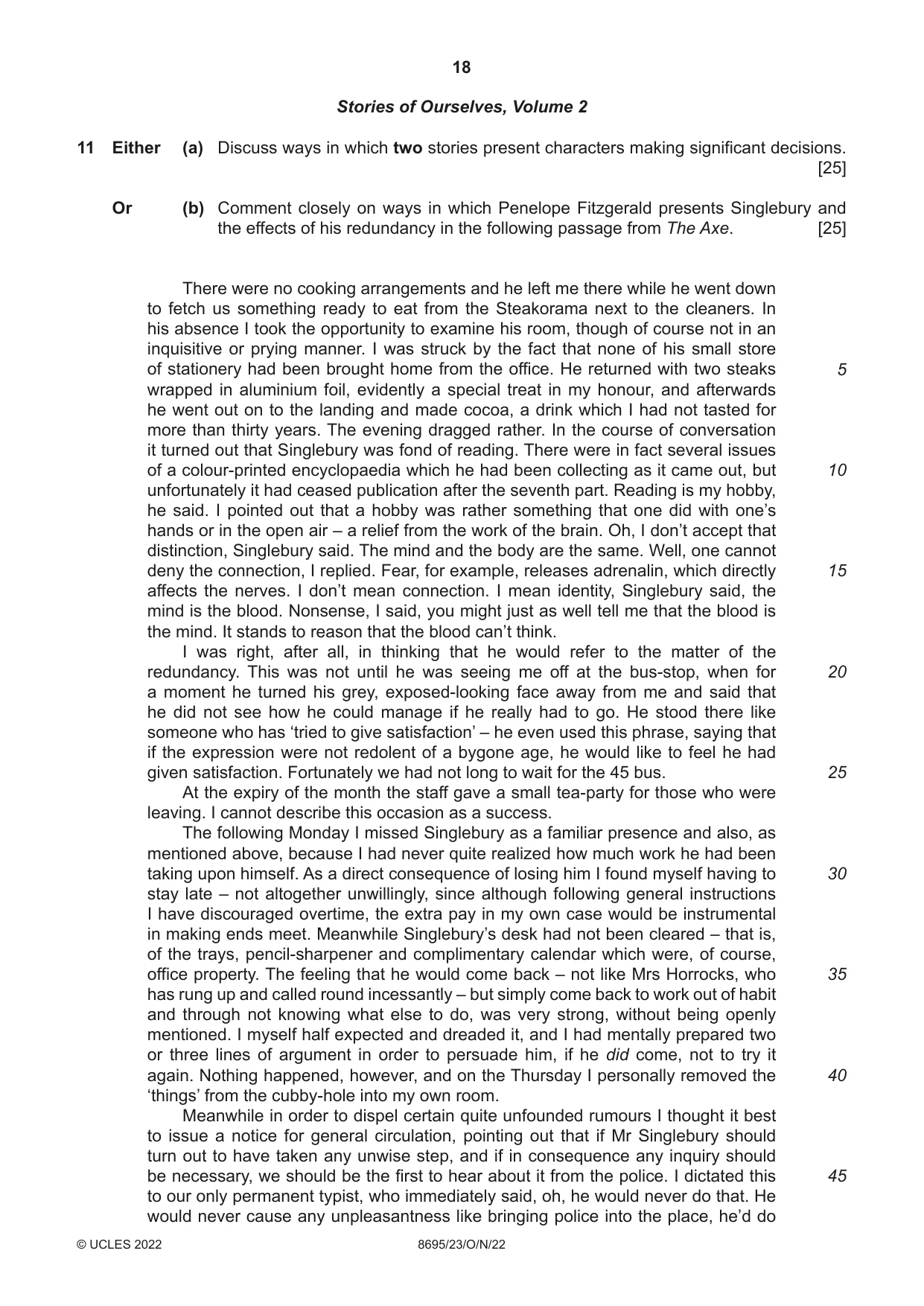
18 8695/23/O/N/22 © UCLES 2022 Stories of Ourselves, Volume 2 11 Either (a) Discuss ways in which two stories present characters making significant decisions. [25] Or (b) Comment closely on ways in which Penelope Fitzgerald presents Singlebury and the effects of his redundancy in the following passage from The Axe. [25] There were no cooking arrangements and he left me there while he went down to fetch us something ready to eat from the Steakorama next to the cleaners. In his absence I took the opportunity to examine his room, though of course not in an inquisitive or prying manner. I was struck by the fact that none of his small store of stationery had been brought home from the office. He returned with two steaks wrapped in aluminium foil, evidently a special treat in my honour, and afterwards he went out on to the landing and made cocoa, a drink which I had not tasted for more than thirty years. The evening dragged rather. In the course of conversation it turned out that Singlebury was fond of reading. There were in fact several issues of a colour-printed encyclopaedia which he had been collecting as it came out, but unfortunately it had ceased publication after the seventh part. Reading is my hobby, he said. I pointed out that a hobby was rather something that one did with one’s hands or in the open air – a relief from the work of the brain. Oh, I don’t accept that distinction, Singlebury said. The mind and the body are the same. Well, one cannot deny the connection, I replied. Fear, for example, releases adrenalin, which directly affects the nerves. I don’t mean connection. I mean identity, Singlebury said, the mind is the blood. Nonsense, I said, you might just as well tell me that the blood is the mind. It stands to reason that the blood can’t think. I was right, after all, in thinking that he would refer to the matter of the redundancy. This was not until he was seeing me off at the bus-stop, when for a moment he turned his grey, exposed-looking face away from me and said that he did not see how he could manage if he really had to go. He stood there like someone who has ‘tried to give satisfaction’ – he even used this phrase, saying that if the expression were not redolent of a bygone age, he would like to feel he had given satisfaction. Fortunately we had not long to wait for the 45 bus. At the expiry of the month the staff gave a small tea-party for those who were leaving. I cannot describe this occasion as a success. The following Monday I missed Singlebury as a familiar presence and also, as mentioned above, because I had never quite realized how much work he had been taking upon himself. As a direct consequence of losing him I found myself having to stay late – not altogether unwillingly, since although following general instructions I have discouraged overtime, the extra pay in my own case would be instrumental in making ends meet. Meanwhile Singlebury’s desk had not been cleared – that is, of the trays, pencil-sharpener and complimentary calendar which were, of course, office property. The feeling that he would come back – not like Mrs Horrocks, who has rung up and called round incessantly – but simply come back to work out of habit and through not knowing what else to do, was very strong, without being openly mentioned. I myself half expected and dreaded it, and I had mentally prepared two or three lines of argument in order to persuade him, if he did come, not to try it again. Nothing happened, however, and on the Thursday I personally removed the ‘things’ from the cubby-hole into my own room. Meanwhile in order to dispel certain quite unfounded rumours I thought it best to issue a notice for general circulation, pointing out that if Mr Singlebury should turn out to have taken any unwise step, and if in consequence any inquiry should be necessary, we should be the first to hear about it from the police. I dictated this to our only permanent typist, who immediately said, oh, he would never do that. He would never cause any unpleasantness like bringing police into the place, he’d do 5 10 15 20 25 30 35 40 45
Question paper, page 19
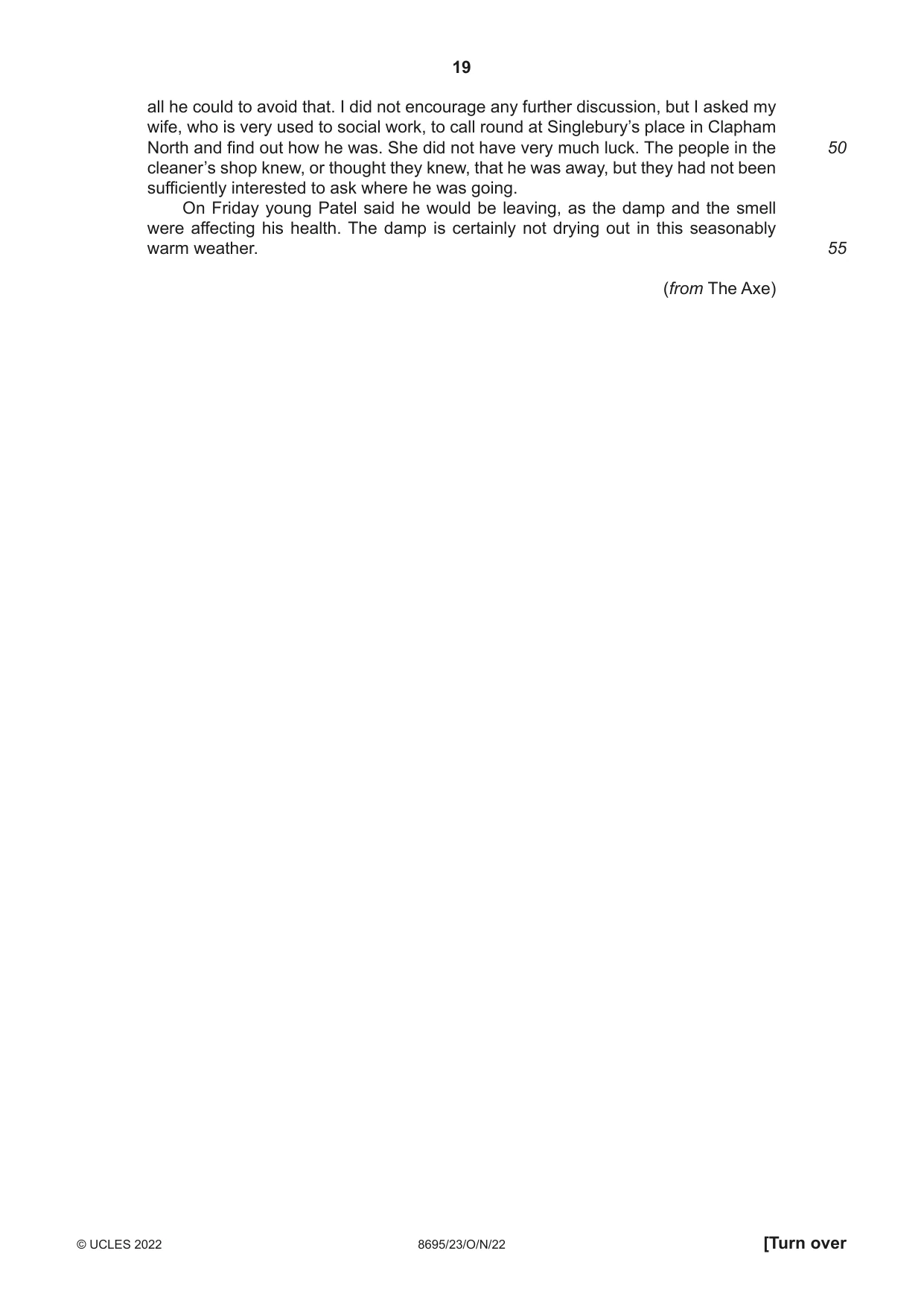
19 8695/23/O/N/22 © UCLES 2022 [Turn over all he could to avoid that. I did not encourage any further discussion, but I asked my wife, who is very used to social work, to call round at Singlebury’s place in Clapham North and find out how he was. She did not have very much luck. The people in the cleaner’s shop knew, or thought they knew, that he was away, but they had not been sufficiently interested to ask where he was going. On Friday young Patel said he would be leaving, as the damp and the smell were affecting his health. The damp is certainly not drying out in this seasonably warm weather. (from The Axe) 50 55
Question paper, page 20
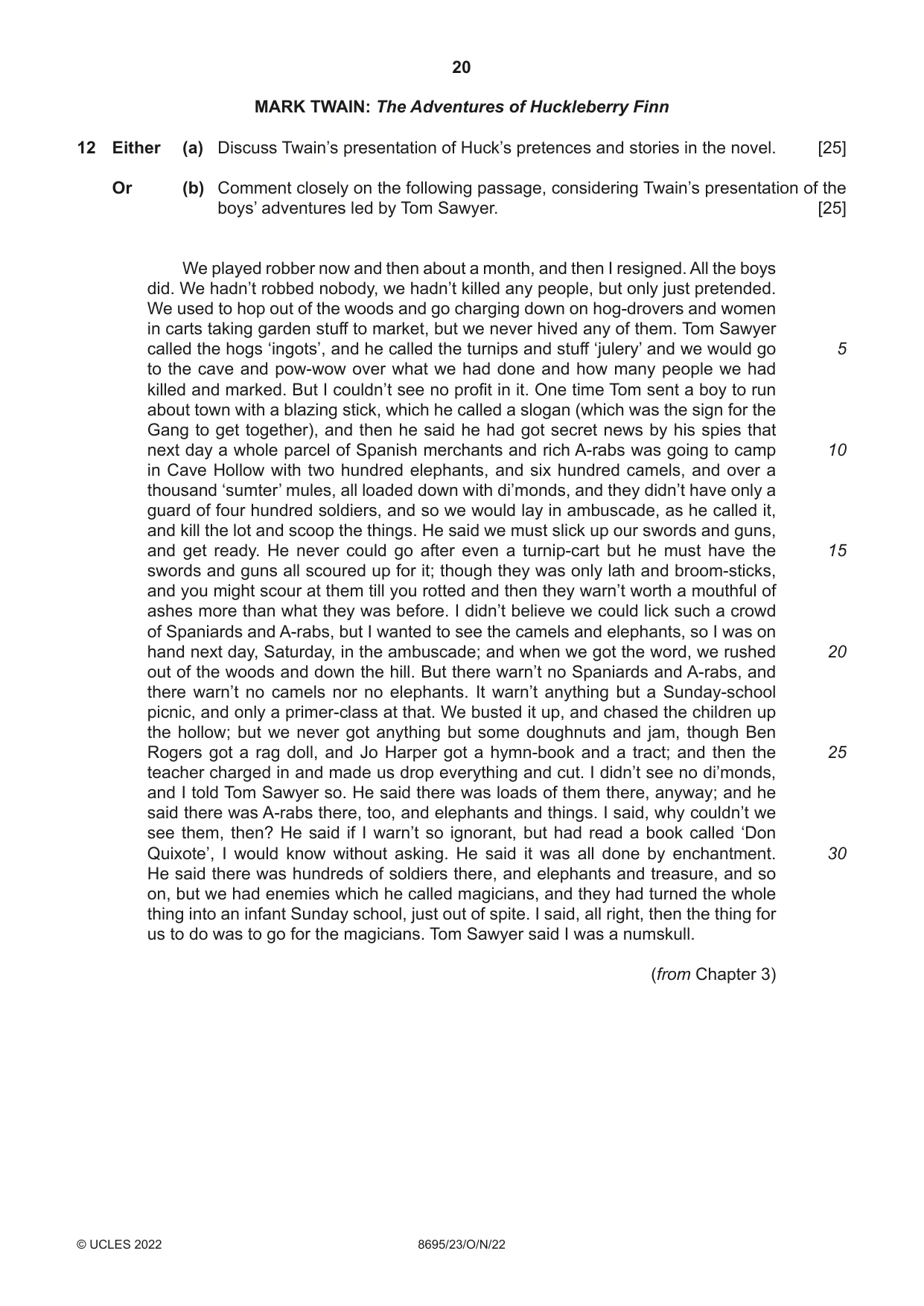
20 8695/23/O/N/22 © UCLES 2022 MARK TWAIN: The Adventures of Huckleberry Finn 12 Either (a) Discuss Twain’s presentation of Huck’s pretences and stories in the novel. [25] Or (b) Comment closely on the following passage, considering Twain’s presentation of the boys’ adventures led by Tom Sawyer. [25] We played robber now and then about a month, and then I resigned. All the boys did. We hadn’t robbed nobody, we hadn’t killed any people, but only just pretended. We used to hop out of the woods and go charging down on hog-drovers and women in carts taking garden stuff to market, but we never hived any of them. Tom Sawyer called the hogs ‘ingots’, and he called the turnips and stuff ‘julery’ and we would go to the cave and pow-wow over what we had done and how many people we had killed and marked. But I couldn’t see no profit in it. One time Tom sent a boy to run about town with a blazing stick, which he called a slogan (which was the sign for the Gang to get together), and then he said he had got secret news by his spies that next day a whole parcel of Spanish merchants and rich A-rabs was going to camp in Cave Hollow with two hundred elephants, and six hundred camels, and over a thousand ‘sumter’ mules, all loaded down with di’monds, and they didn’t have only a guard of four hundred soldiers, and so we would lay in ambuscade, as he called it, and kill the lot and scoop the things. He said we must slick up our swords and guns, and get ready. He never could go after even a turnip-cart but he must have the swords and guns all scoured up for it; though they was only lath and broom-sticks, and you might scour at them till you rotted and then they warn’t worth a mouthful of ashes more than what they was before. I didn’t believe we could lick such a crowd of Spaniards and A-rabs, but I wanted to see the camels and elephants, so I was on hand next day, Saturday, in the ambuscade; and when we got the word, we rushed out of the woods and down the hill. But there warn’t no Spaniards and A-rabs, and there warn’t no camels nor no elephants. It warn’t anything but a Sunday-school picnic, and only a primer-class at that. We busted it up, and chased the children up the hollow; but we never got anything but some doughnuts and jam, though Ben Rogers got a rag doll, and Jo Harper got a hymn-book and a tract; and then the teacher charged in and made us drop everything and cut. I didn’t see no di’monds, and I told Tom Sawyer so. He said there was loads of them there, anyway; and he said there was A-rabs there, too, and elephants and things. I said, why couldn’t we see them, then? He said if I warn’t so ignorant, but had read a book called ‘Don Quixote’, I would know without asking. He said it was all done by enchantment. He said there was hundreds of soldiers there, and elephants and treasure, and so on, but we had enemies which he called magicians, and they had turned the whole thing into an infant Sunday school, just out of spite. I said, all right, then the thing for us to do was to go for the magicians. Tom Sawyer said I was a numskull. (from Chapter 3) 5 10 15 20 25 30
Question paper, page 21
21 8695/23/O/N/22 © UCLES 2022 BLANK PAGE
Question paper, page 22
22 8695/23/O/N/22 © UCLES 2022 BLANK PAGE
Question paper, page 23
23 8695/23/O/N/22 © UCLES 2022 BLANK PAGE
Question paper, page 24
24 8695/23/O/N/22 © UCLES 2022 Permission to reproduce items where third-party owned material protected by copyright is included has been sought and cleared where possible. Every reasonable effort has been made by the publisher (UCLES) to trace copyright holders, but if any items requiring clearance have unwittingly been included, the publisher will be pleased to make amends at the earliest possible opportunity. To avoid the issue of disclosure of answer-related information to candidates, all copyright acknowledgements are reproduced online in the Cambridge Assessment International Education Copyright Acknowledgements Booklet. This is produced for each series of examinations and is freely available to download at www.cambridgeinternational.org after the live examination series. Cambridge Assessment International Education is part of Cambridge Assessment. Cambridge Assessment is the brand name of the University of Cambridge Local Examinations Syndicate (UCLES), which is a department of the University of Cambridge. BLANK PAGE
Mark scheme, page 1
This document consists of 13 printed pages. © UCLES 2022 [Turn over Cambridge International AS Level LANGUAGE AND LITERATURE IN ENGLISH 8695/23 Paper 2 Drama, Poetry and Prose October/November 2022 MARK SCHEME Maximum Mark: 50 Published This mark scheme is published as an aid to teachers and candidates, to indicate the requirements of the examination. It shows the basis on which Examiners were instructed to award marks. It does not indicate the details of the discussions that took place at an Examiners’ meeting before marking began, which would have considered the acceptability of alternative answers. Mark schemes should be read in conjunction with the question paper and the Principal Examiner Report for Teachers. Cambridge International will not enter into discussions about these mark schemes. Cambridge International is publishing the mark schemes for the October/November 2022 series for most Cambridge IGCSE™, Cambridge International A and AS Level components and some Cambridge O Level components.
Mark scheme, page 2
8695/23 Cambridge International AS Level – Mark Scheme PUBLISHED October/November 2022 © UCLES 2022 Page 2 of 13 Generic Marking Principles These general marking principles must be applied by all examiners when marking candidate answers. They should be applied alongside the specific content of the mark scheme or generic level descriptors for a question. Each question paper and mark scheme will also comply with these marking principles. GENERIC MARKING PRINCIPLE 1: Marks must be awarded in line with: • the specific content of the mark scheme or the generic level descriptors for the question • the specific skills defined in the mark scheme or in the generic level descriptors for the question • the standard of response required by a candidate as exemplified by the standardisation scripts. GENERIC MARKING PRINCIPLE 2: Marks awarded are always whole marks (not half marks, or other fractions). GENERIC MARKING PRINCIPLE 3: Marks must be awarded positively: • marks are awarded for correct/valid answers, as defined in the mark scheme. However, credit is given for valid answers which go beyond the scope of the syllabus and mark scheme, referring to your Team Leader as appropriate • marks are awarded when candidates clearly demonstrate what they know and can do • marks are not deducted for errors • marks are not deducted for omissions • answers should only be judged on the quality of spelling, punctuation and grammar when these features are specifically assessed by the question as indicated by the mark scheme. The meaning, however, should be unambiguous. GENERIC MARKING PRINCIPLE 4: Rules must be applied consistently, e.g. in situations where candidates have not followed instructions or in the application of generic level descriptors. GENERIC MARKING PRINCIPLE 5: Marks should be awarded using the full range of marks defined in the mark scheme for the question (however; the use of the full mark range may be limited according to the quality of the candidate responses seen). GENERIC MARKING PRINCIPLE 6: Marks awarded are based solely on the requirements as defined in the mark scheme. Marks should not be awarded with grade thresholds or grade descriptors in mind.
Mark scheme, page 3
8695/23 Cambridge International AS Level – Mark Scheme PUBLISHED October/November 2022 © UCLES 2022 Page 3 of 13 English & Media subject specific general marking principles (To be read in conjunction with the Generic Marking Principles (and requiring further guidance on how to place marks within levels)) Components using level descriptors: • We use level descriptors as a guide to broad understanding of the qualities normally expected of, or typical of, work in a level. • Level descriptors are a means of general guidance, and should not be interpreted as hurdle statements. • Where indicative content notes are supplied for a question, these are not a prescription of required content, and must not be treated as such. Alternative correct points and unexpected answers in candidates’ scripts must be given marks that fairly reflect the knowledge and skills demonstrated. • While we may have legitimate expectations as to the ground most answers may occupy, we must at all times be prepared to meet candidates on their chosen ground, provided it is relevant ground (e.g. clearly related to and derived from a relevant passage/text and meeting the mark scheme requirements for the question). Components using point-based marking: Point marking is often used to reward knowledge, understanding and application of skills. We give credit where the candidate’s answer shows relevant knowledge, understanding and application of skills in answering the question. We do not give credit where the answer shows confusion. From this it follows that we: a DO credit answers which are worded differently from the mark scheme if they clearly convey the same meaning (unless the mark scheme requires a specific term). b DO credit alternative answers/examples which are not written in the mark scheme if they are correct. c DO credit answers where candidates give more than one correct answer in one prompt/numbered/scaffolded space where extended writing is required rather than list-type answers. For example, questions that require n reasons (e.g. State two reasons…). d DO NOT credit answers simply for using a ‘key term’ unless that is all that is required. (Check for evidence it is understood and not used wrongly.). e DO NOT credit answers which are obviously self-contradicting or trying to cover all possibilities. f DO NOT give further credit for what is effectively repetition of a correct point already credited unless the language itself is being tested. This applies equally to ‘mirror statements’ (i.e. polluted/not polluted). g DO NOT require spellings to be correct, unless this is part of the test. However spellings of syllabus terms must allow for clear and unambiguous separation from other syllabus terms with which they may be confused (e.g. Corrasion/Corrosion).
Mark scheme, page 4
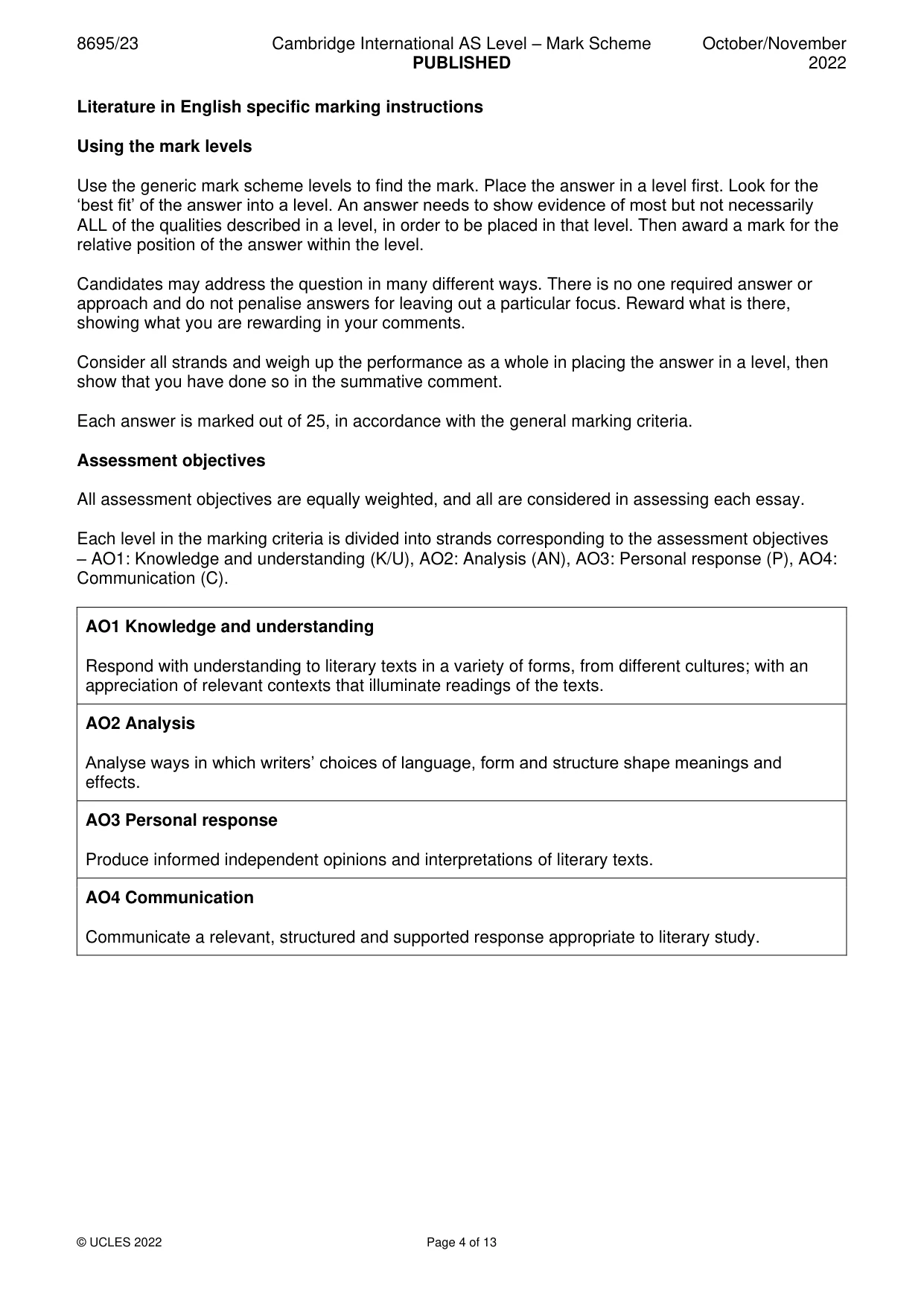
8695/23 Cambridge International AS Level – Mark Scheme PUBLISHED October/November 2022 © UCLES 2022 Page 4 of 13 Literature in English specific marking instructions Using the mark levels Use the generic mark scheme levels to find the mark. Place the answer in a level first. Look for the ‘best fit’ of the answer into a level. An answer needs to show evidence of most but not necessarily ALL of the qualities described in a level, in order to be placed in that level. Then award a mark for the relative position of the answer within the level. Candidates may address the question in many different ways. There is no one required answer or approach and do not penalise answers for leaving out a particular focus. Reward what is there, showing what you are rewarding in your comments. Consider all strands and weigh up the performance as a whole in placing the answer in a level, then show that you have done so in the summative comment. Each answer is marked out of 25, in accordance with the general marking criteria. Assessment objectives All assessment objectives are equally weighted, and all are considered in assessing each essay. Each level in the marking criteria is divided into strands corresponding to the assessment objectives – AO1: Knowledge and understanding (K/U), AO2: Analysis (AN), AO3: Personal response (P), AO4: Communication (C). AO1 Knowledge and understanding Respond with understanding to literary texts in a variety of forms, from different cultures; with an appreciation of relevant contexts that illuminate readings of the texts. AO2 Analysis Analyse ways in which writers’ choices of language, form and structure shape meanings and effects. AO3 Personal response Produce informed independent opinions and interpretations of literary texts. AO4 Communication Communicate a relevant, structured and supported response appropriate to literary study.
Mark scheme, page 5
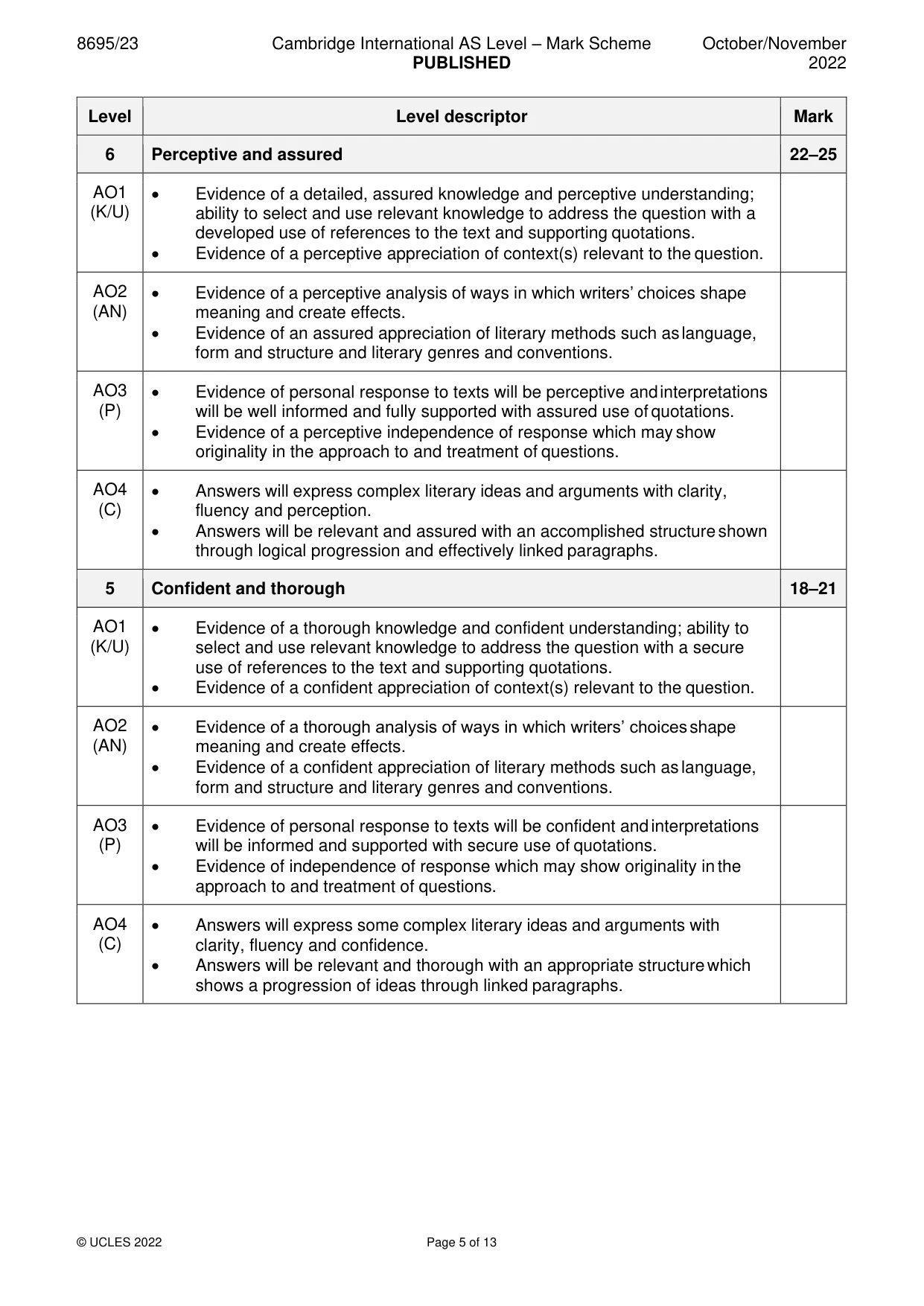
8695/23 Cambridge International AS Level – Mark Scheme PUBLISHED October/November 2022 © UCLES 2022 Page 5 of 13 Level Level descriptor Mark 6 Perceptive and assured 22–25 AO1 (K/U) • Evidence of a detailed, assured knowledge and perceptive understanding; ability to select and use relevant knowledge to address the question with a developed use of references to the text and supporting quotations. • Evidence of a perceptive appreciation of context(s) relevant to the question. AO2 (AN) • Evidence of a perceptive analysis of ways in which writers’ choices shape meaning and create effects. • Evidence of an assured appreciation of literary methods such as language, form and structure and literary genres and conventions. AO3 (P) • Evidence of personal response to texts will be perceptive and interpretations will be well informed and fully supported with assured use of quotations. • Evidence of a perceptive independence of response which may show originality in the approach to and treatment of questions. AO4 (C) • Answers will express complex literary ideas and arguments with clarity, fluency and perception. • Answers will be relevant and assured with an accomplished structure shown through logical progression and effectively linked paragraphs. 5 Confident and thorough 18–21 AO1 (K/U) • Evidence of a thorough knowledge and confident understanding; ability to select and use relevant knowledge to address the question with a secure use of references to the text and supporting quotations. • Evidence of a confident appreciation of context(s) relevant to the question. AO2 (AN) • Evidence of a thorough analysis of ways in which writers’ choices shape meaning and create effects. • Evidence of a confident appreciation of literary methods such as language, form and structure and literary genres and conventions. AO3 (P) • Evidence of personal response to texts will be confident and interpretations will be informed and supported with secure use of quotations. • Evidence of independence of response which may show originality in the approach to and treatment of questions. AO4 (C) • Answers will express some complex literary ideas and arguments with clarity, fluency and confidence. • Answers will be relevant and thorough with an appropriate structure which shows a progression of ideas through linked paragraphs.
Mark scheme, page 6
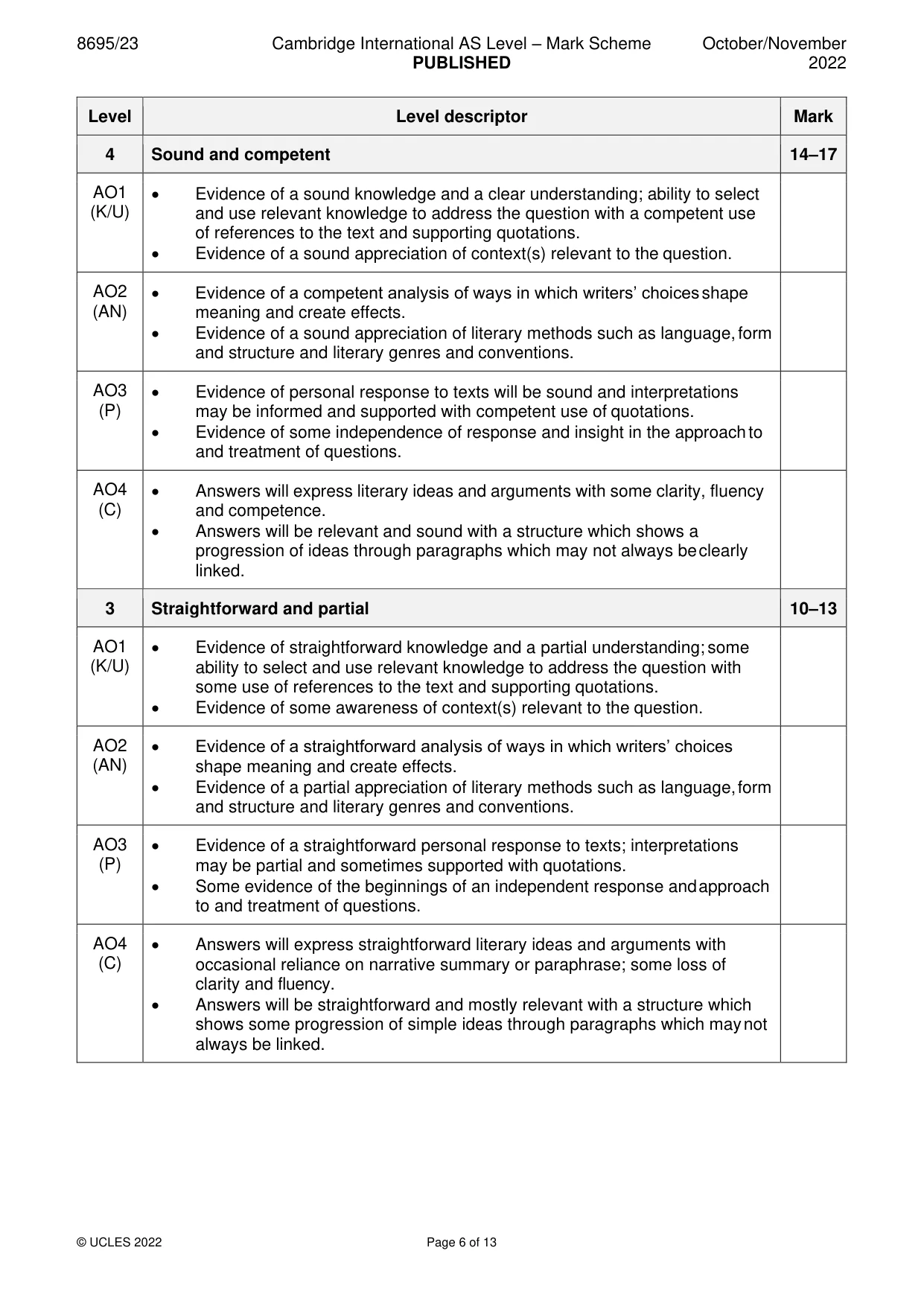
8695/23 Cambridge International AS Level – Mark Scheme PUBLISHED October/November 2022 © UCLES 2022 Page 6 of 13 Level Level descriptor Mark 4 Sound and competent 14–17 AO1 (K/U) • Evidence of a sound knowledge and a clear understanding; ability to select and use relevant knowledge to address the question with a competent use of references to the text and supporting quotations. • Evidence of a sound appreciation of context(s) relevant to the question. AO2 (AN) • Evidence of a competent analysis of ways in which writers’ choices shape meaning and create effects. • Evidence of a sound appreciation of literary methods such as language, form and structure and literary genres and conventions. AO3 (P) • Evidence of personal response to texts will be sound and interpretations may be informed and supported with competent use of quotations. • Evidence of some independence of response and insight in the approach to and treatment of questions. AO4 (C) • Answers will express literary ideas and arguments with some clarity, fluency and competence. • Answers will be relevant and sound with a structure which shows a progression of ideas through paragraphs which may not always be clearly linked. 3 Straightforward and partial 10–13 AO1 (K/U) • Evidence of straightforward knowledge and a partial understanding; some ability to select and use relevant knowledge to address the question with some use of references to the text and supporting quotations. • Evidence of some awareness of context(s) relevant to the question. AO2 (AN) • Evidence of a straightforward analysis of ways in which writers’ choices shape meaning and create effects. • Evidence of a partial appreciation of literary methods such as language, form and structure and literary genres and conventions. AO3 (P) • Evidence of a straightforward personal response to texts; interpretations may be partial and sometimes supported with quotations. • Some evidence of the beginnings of an independent response and approach to and treatment of questions. AO4 (C) • Answers will express straightforward literary ideas and arguments with occasional reliance on narrative summary or paraphrase; some loss of clarity and fluency. • Answers will be straightforward and mostly relevant with a structure which shows some progression of simple ideas through paragraphs which may not always be linked.
Mark scheme, page 7
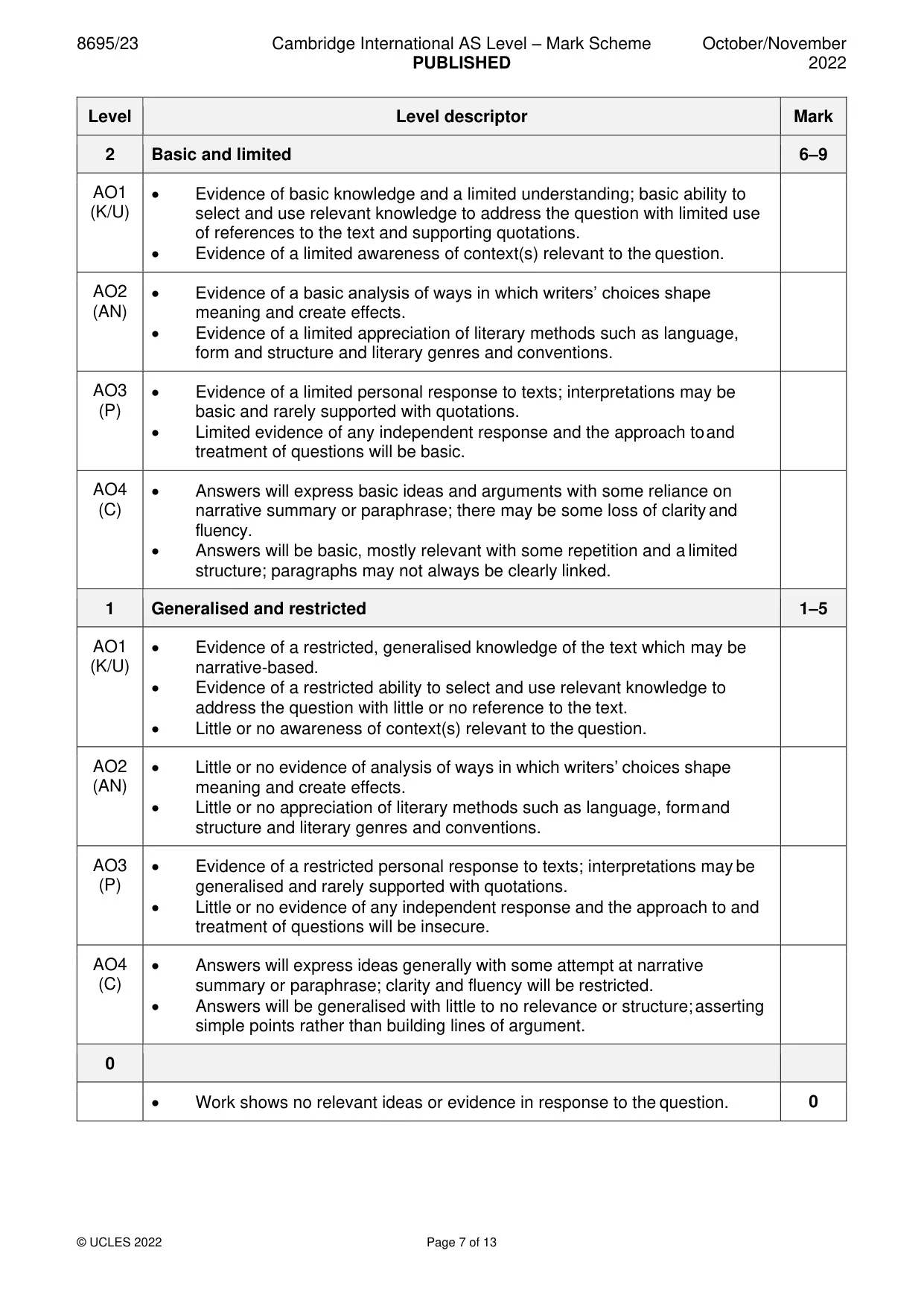
8695/23 Cambridge International AS Level – Mark Scheme PUBLISHED October/November 2022 © UCLES 2022 Page 7 of 13 Level Level descriptor Mark 2 Basic and limited 6–9 AO1 (K/U) • Evidence of basic knowledge and a limited understanding; basic ability to select and use relevant knowledge to address the question with limited use of references to the text and supporting quotations. • Evidence of a limited awareness of context(s) relevant to the question. AO2 (AN) • Evidence of a basic analysis of ways in which writers’ choices shape meaning and create effects. • Evidence of a limited appreciation of literary methods such as language, form and structure and literary genres and conventions. AO3 (P) • Evidence of a limited personal response to texts; interpretations may be basic and rarely supported with quotations. • Limited evidence of any independent response and the approach to and treatment of questions will be basic. AO4 (C) • Answers will express basic ideas and arguments with some reliance on narrative summary or paraphrase; there may be some loss of clarity and fluency. • Answers will be basic, mostly relevant with some repetition and a limited structure; paragraphs may not always be clearly linked. 1 Generalised and restricted 1–5 AO1 (K/U) • Evidence of a restricted, generalised knowledge of the text which may be narrative-based. • Evidence of a restricted ability to select and use relevant knowledge to address the question with little or no reference to the text. • Little or no awareness of context(s) relevant to the question. AO2 (AN) • Little or no evidence of analysis of ways in which writers’ choices shape meaning and create effects. • Little or no appreciation of literary methods such as language, form and structure and literary genres and conventions. AO3 (P) • Evidence of a restricted personal response to texts; interpretations may be generalised and rarely supported with quotations. • Little or no evidence of any independent response and the approach to and treatment of questions will be insecure. AO4 (C) • Answers will express ideas generally with some attempt at narrative summary or paraphrase; clarity and fluency will be restricted. • Answers will be generalised with little to no relevance or structure; asserting simple points rather than building lines of argument. 0 • Work shows no relevant ideas or evidence in response to the question. 0
Mark scheme, page 8
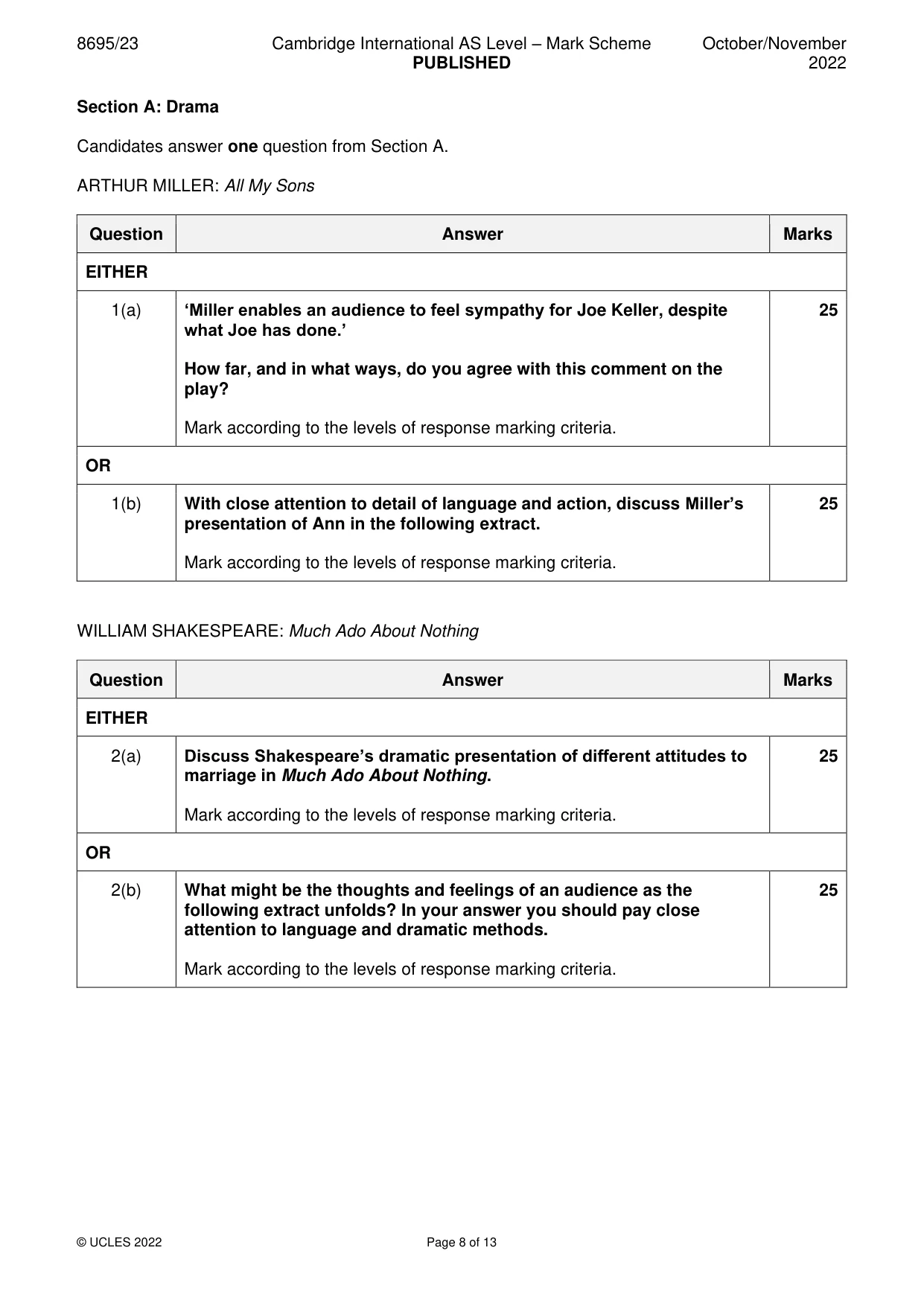
8695/23 Cambridge International AS Level – Mark Scheme PUBLISHED October/November 2022 © UCLES 2022 Page 8 of 13 Section A: Drama Candidates answer one question from Section A. ARTHUR MILLER: All My Sons Question Answer Marks EITHER 1(a) ‘Miller enables an audience to feel sympathy for Joe Keller, despite what Joe has done.’ How far, and in what ways, do you agree with this comment on the play? Mark according to the levels of response marking criteria. 25 OR 1(b) With close attention to detail of language and action, discuss Miller’s presentation of Ann in the following extract. Mark according to the levels of response marking criteria. 25 WILLIAM SHAKESPEARE: Much Ado About Nothing Question Answer Marks EITHER 2(a) Discuss Shakespeare’s dramatic presentation of different attitudes to marriage in Much Ado About Nothing. Mark according to the levels of response marking criteria. 25 OR 2(b) What might be the thoughts and feelings of an audience as the following extract unfolds? In your answer you should pay close attention to language and dramatic methods. Mark according to the levels of response marking criteria. 25
Mark scheme, page 9
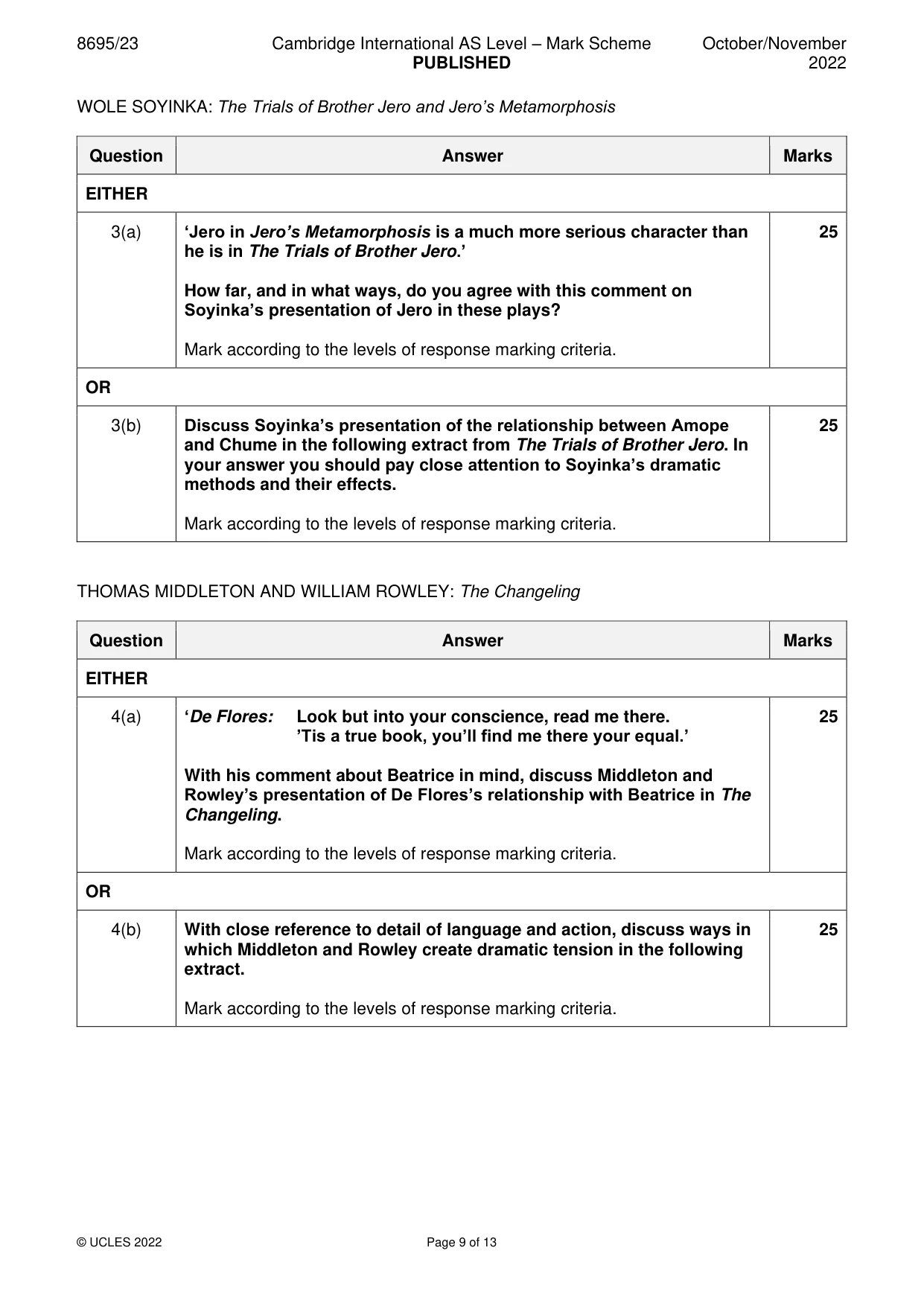
8695/23 Cambridge International AS Level – Mark Scheme PUBLISHED October/November 2022 © UCLES 2022 Page 9 of 13 WOLE SOYINKA: The Trials of Brother Jero and Jero’s Metamorphosis Question Answer Marks EITHER 3(a) ‘Jero in Jero’s Metamorphosis is a much more serious character than he is in The Trials of Brother Jero.’ How far, and in what ways, do you agree with this comment on Soyinka’s presentation of Jero in these plays? Mark according to the levels of response marking criteria. 25 OR 3(b) Discuss Soyinka’s presentation of the relationship between Amope and Chume in the following extract from The Trials of Brother Jero. In your answer you should pay close attention to Soyinka’s dramatic methods and their effects. Mark according to the levels of response marking criteria. 25 THOMAS MIDDLETON AND WILLIAM ROWLEY: The Changeling Question Answer Marks EITHER 4(a) ‘De Flores: Look but into your conscience, read me there. ’Tis a true book, you’ll find me there your equal.’ With his comment about Beatrice in mind, discuss Middleton and Rowley’s presentation of De Flores’s relationship with Beatrice in The Changeling. Mark according to the levels of response marking criteria. 25 OR 4(b) With close reference to detail of language and action, discuss ways in which Middleton and Rowley create dramatic tension in the following extract. Mark according to the levels of response marking criteria. 25
Mark scheme, page 10
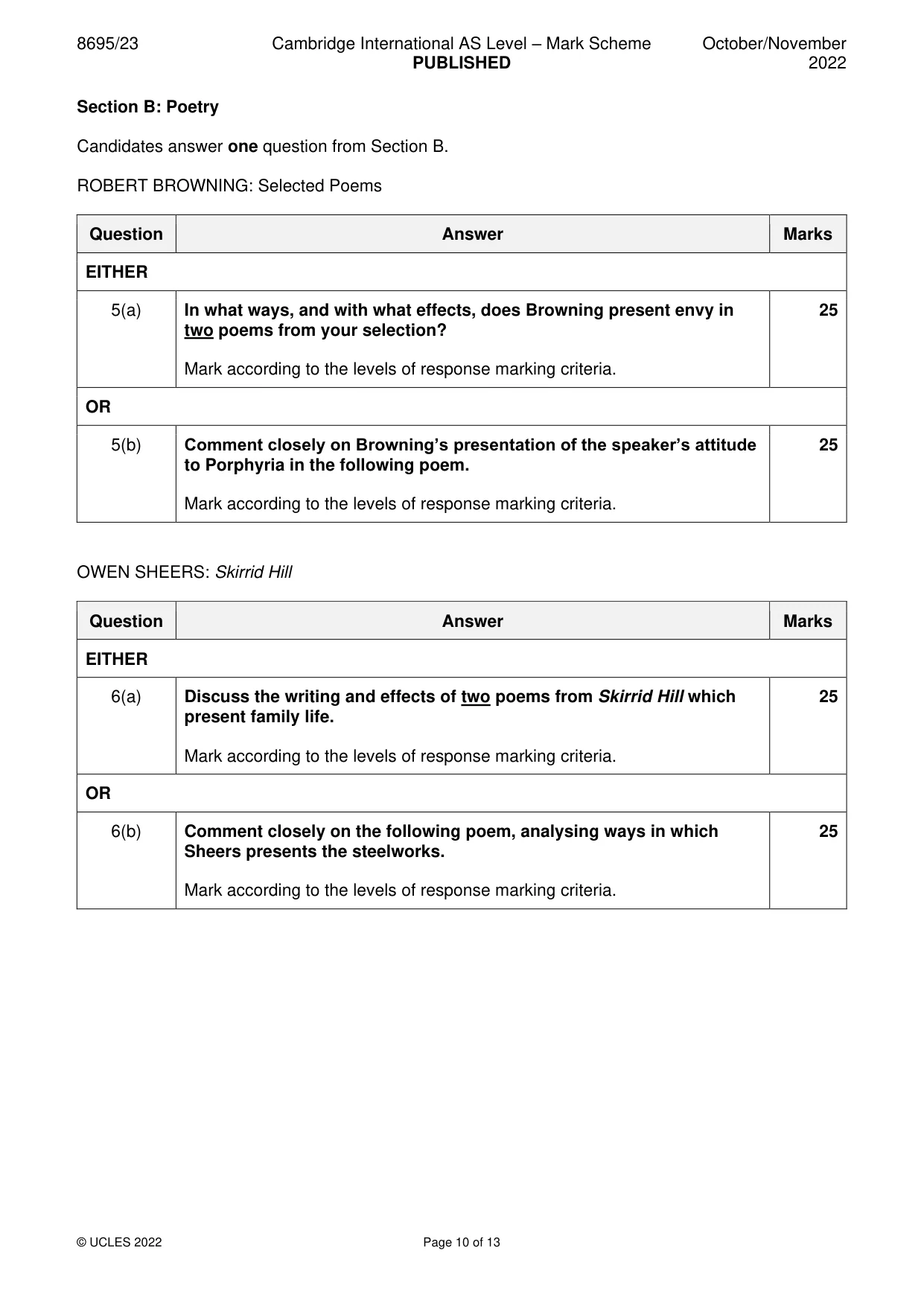
8695/23 Cambridge International AS Level – Mark Scheme PUBLISHED October/November 2022 © UCLES 2022 Page 10 of 13 Section B: Poetry Candidates answer one question from Section B. ROBERT BROWNING: Selected Poems Question Answer Marks EITHER 5(a) In what ways, and with what effects, does Browning present envy in two poems from your selection? Mark according to the levels of response marking criteria. 25 OR 5(b) Comment closely on Browning’s presentation of the speaker’s attitude to Porphyria in the following poem. Mark according to the levels of response marking criteria. 25 OWEN SHEERS: Skirrid Hill Question Answer Marks EITHER 6(a) Discuss the writing and effects of two poems from Skirrid Hill which present family life. Mark according to the levels of response marking criteria. 25 OR 6(b) Comment closely on the following poem, analysing ways in which Sheers presents the steelworks. Mark according to the levels of response marking criteria. 25
Mark scheme, page 11
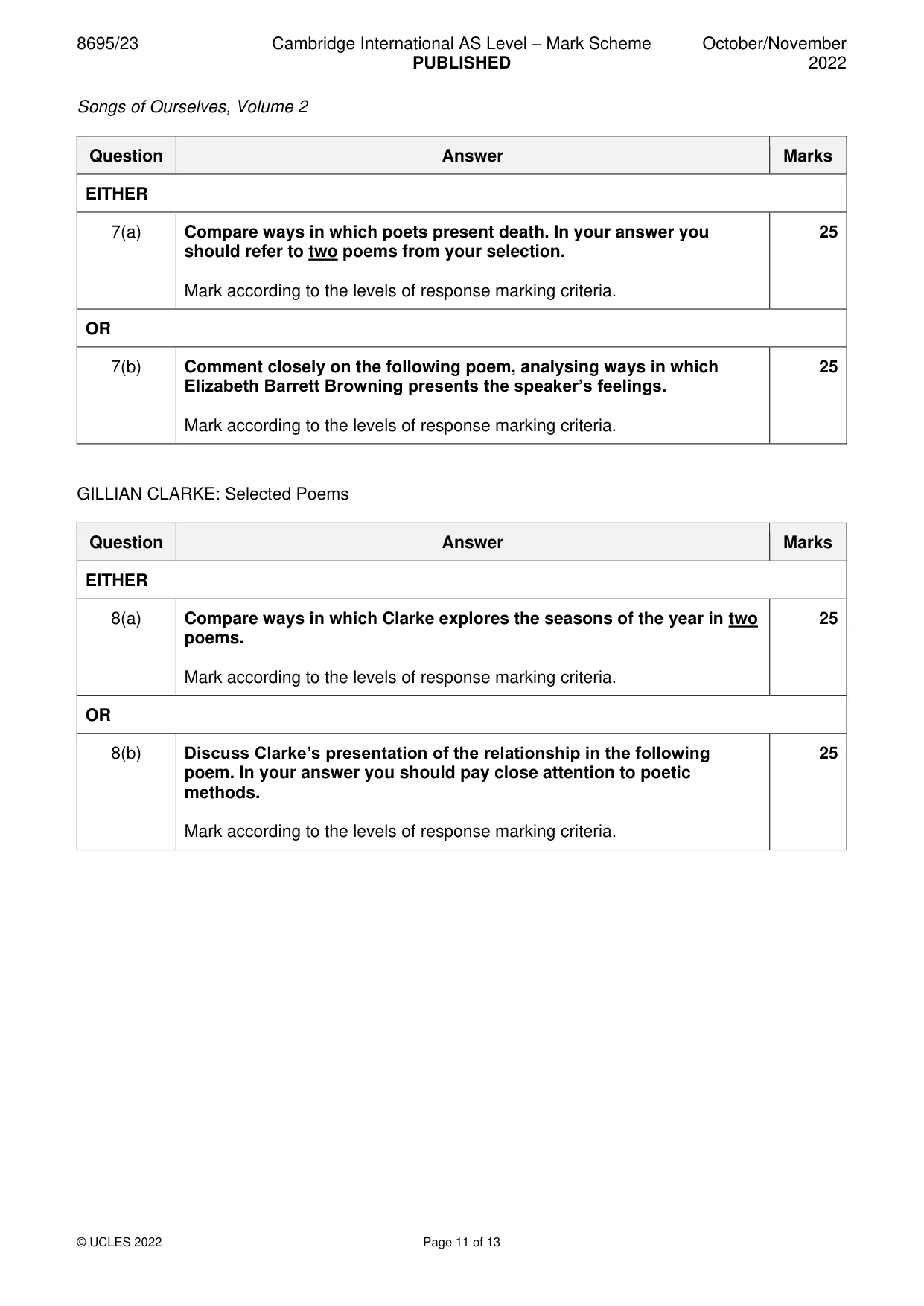
8695/23 Cambridge International AS Level – Mark Scheme PUBLISHED October/November 2022 © UCLES 2022 Page 11 of 13 Songs of Ourselves, Volume 2 Question Answer Marks EITHER 7(a) Compare ways in which poets present death. In your answer you should refer to two poems from your selection. Mark according to the levels of response marking criteria. 25 OR 7(b) Comment closely on the following poem, analysing ways in which Elizabeth Barrett Browning presents the speaker’s feelings. Mark according to the levels of response marking criteria. 25 GILLIAN CLARKE: Selected Poems Question Answer Marks EITHER 8(a) Compare ways in which Clarke explores the seasons of the year in two poems. Mark according to the levels of response marking criteria. 25 OR 8(b) Discuss Clarke’s presentation of the relationship in the following poem. In your answer you should pay close attention to poetic methods. Mark according to the levels of response marking criteria. 25
Mark scheme, page 12
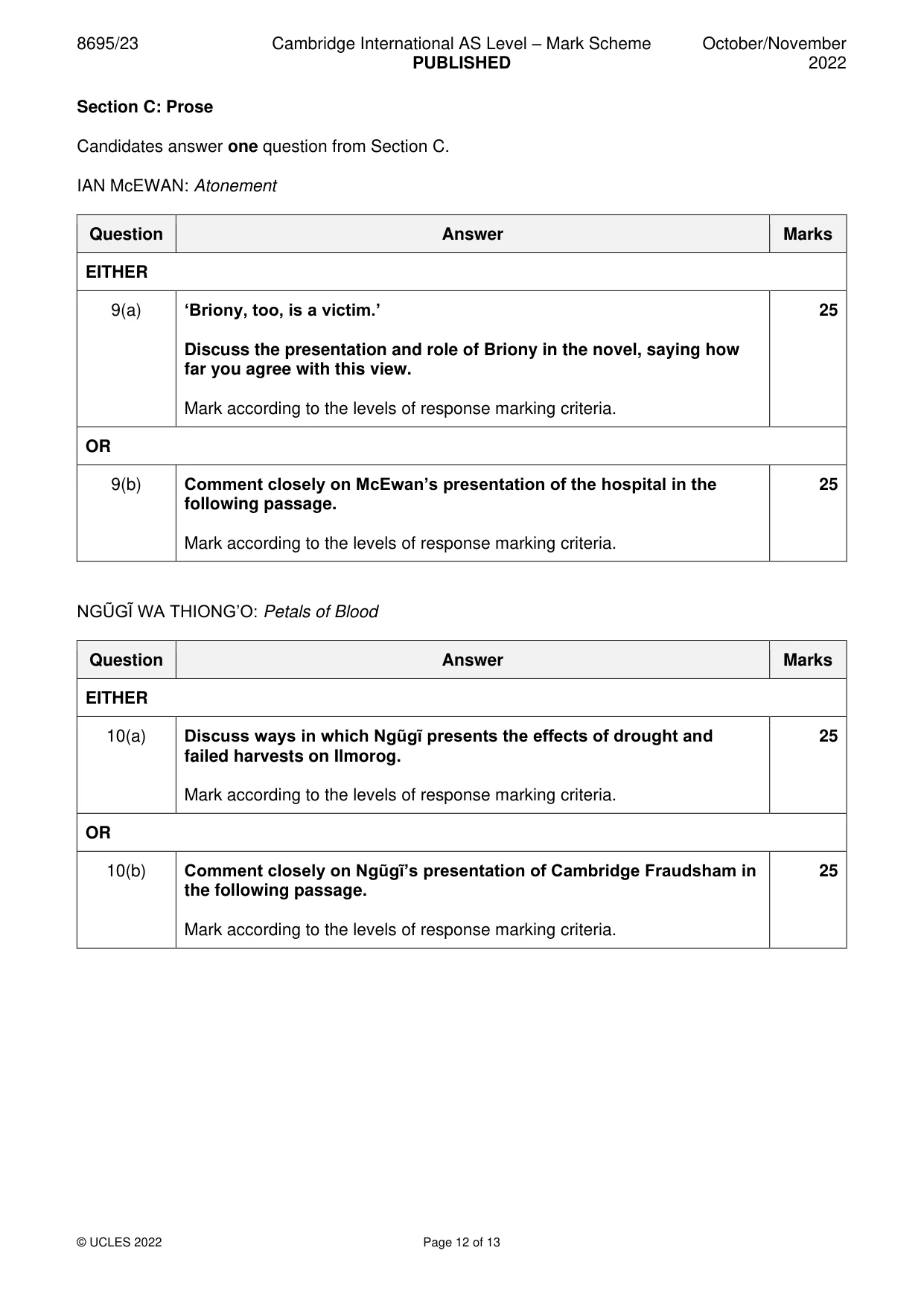
8695/23 Cambridge International AS Level – Mark Scheme PUBLISHED October/November 2022 © UCLES 2022 Page 12 of 13 Section C: Prose Candidates answer one question from Section C. IAN McEWAN: Atonement Question Answer Marks EITHER 9(a) ‘Briony, too, is a victim.’ Discuss the presentation and role of Briony in the novel, saying how far you agree with this view. Mark according to the levels of response marking criteria. 25 OR 9(b) Comment closely on McEwan’s presentation of the hospital in the following passage. Mark according to the levels of response marking criteria. 25 NGŨGĨ WA THIONG’O: Petals of Blood Question Answer Marks EITHER 10(a) Discuss ways in which Ngũgĩ presents the effects of drought and failed harvests on Ilmorog. Mark according to the levels of response marking criteria. 25 OR 10(b) Comment closely on Ngũgĩ’s presentation of Cambridge Fraudsham in the following passage. Mark according to the levels of response marking criteria. 25
Mark scheme, page 13
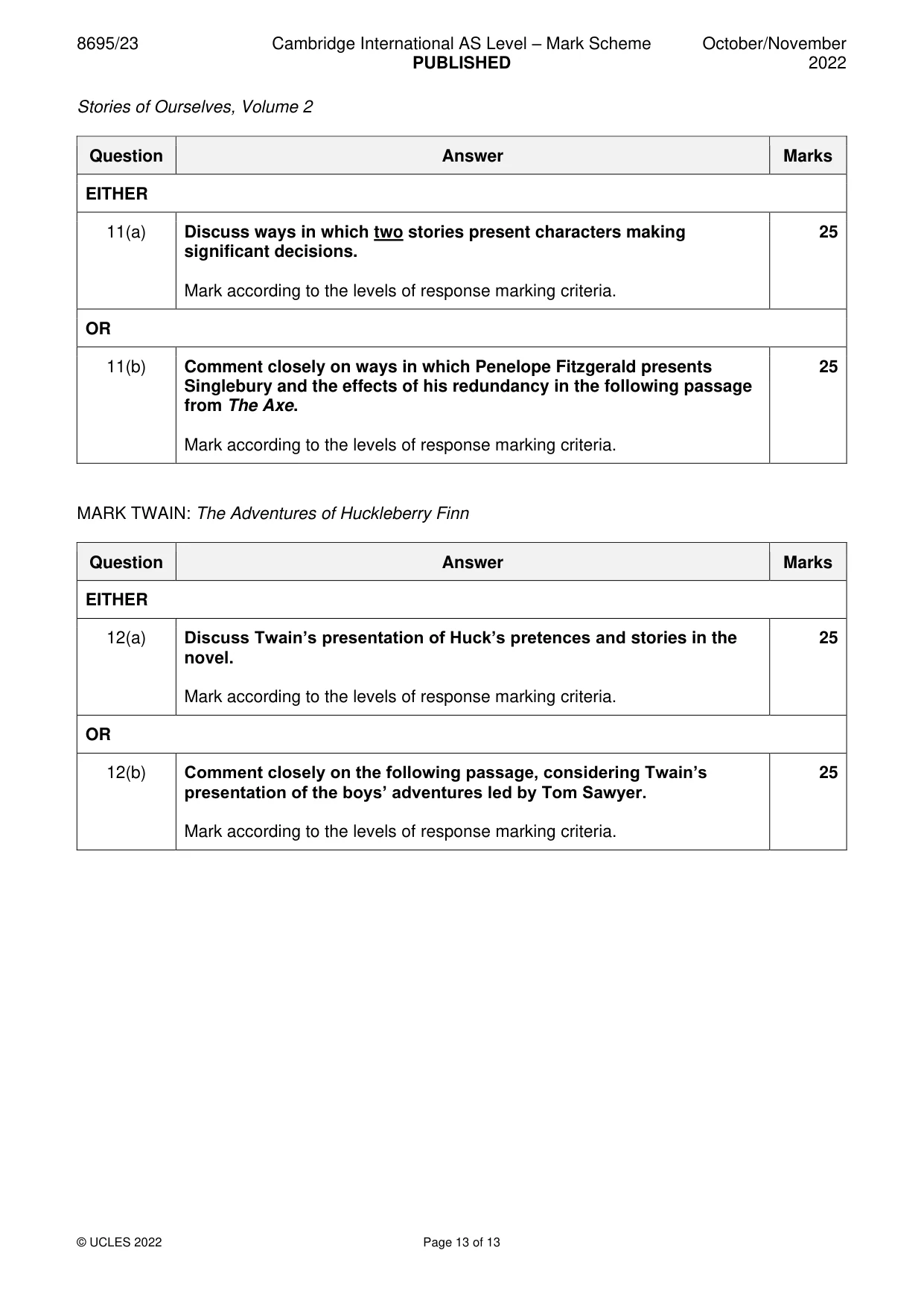
8695/23 Cambridge International AS Level – Mark Scheme PUBLISHED October/November 2022 © UCLES 2022 Page 13 of 13 Stories of Ourselves, Volume 2 Question Answer Marks EITHER 11(a) Discuss ways in which two stories present characters making significant decisions. Mark according to the levels of response marking criteria. 25 OR 11(b) Comment closely on ways in which Penelope Fitzgerald presents Singlebury and the effects of his redundancy in the following passage from The Axe. Mark according to the levels of response marking criteria. 25 MARK TWAIN: The Adventures of Huckleberry Finn Question Answer Marks EITHER 12(a) Discuss Twain’s presentation of Huck’s pretences and stories in the novel. Mark according to the levels of response marking criteria. 25 OR 12(b) Comment closely on the following passage, considering Twain’s presentation of the boys’ adventures led by Tom Sawyer. Mark according to the levels of response marking criteria. 25
What you needed in this session
Cambridge’s own grade thresholds for 2022 Oct/Nov, Paper 2 · Variant 3. A higher threshold means an easier paper — the bar moves with how the cohort did.