Cambridge A Level English - Language and Literature (AS Level only, from 2016) 8695 — 2022 Oct/Nov Paper 2 · Variant 1
8695/21/O/N/22 · 50 marks · ≈56 min
The question paper and its mark scheme, free to read here and free to download. This is Cambridge’s own paper, exactly as it was sat.
Question paper24 pages



Mark scheme13 pages
Answers below. Sit the paper first if you are practising.
Paper as text
Question paper, page 1
This document has 24 pages. Any blank pages are indicated. Cambridge International AS Level * 5 3 2 4 8 0 8 0 9 4 * LANGUAGE AND LITERATURE IN ENGLISH 8695/21 Paper 2 Drama, Poetry and Prose October/November 2022 2 hours You must answer on the enclosed answer booklet. You will need: Answer booklet (enclosed) INSTRUCTIONS ● Answer two questions in total, each from a different section. ● Follow the instructions on the front cover of the answer booklet. If you need additional answer paper, ask the invigilator for a continuation booklet. ● Dictionaries are not allowed. INFORMATION ● The total mark for this paper is 50. ● The number of marks for each question or part question is shown in brackets [ ]. DC (RCL (DF)) 303497/3 © UCLES 2022 [Turn over
Question paper, page 2
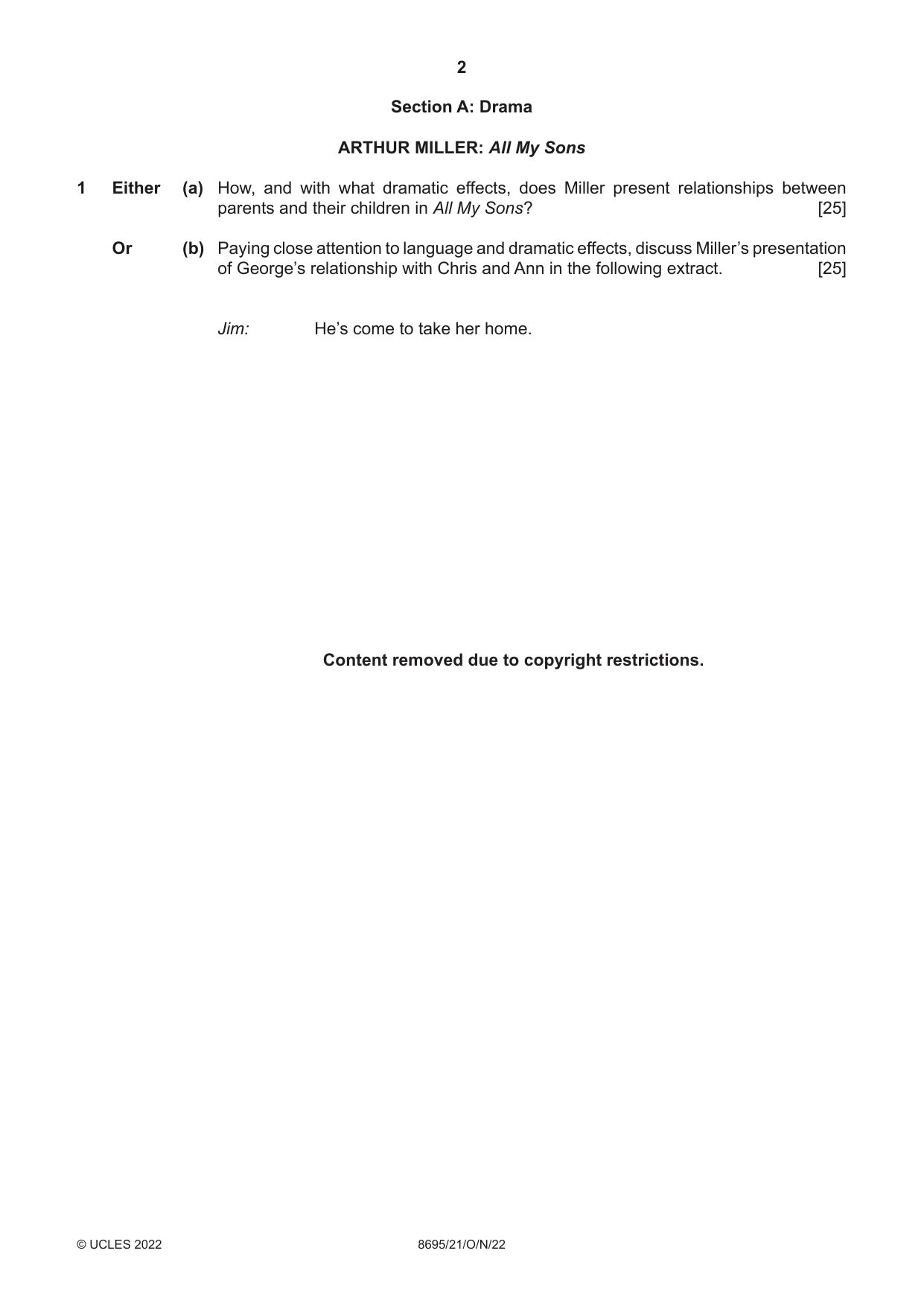
2 8695/21/O/N/22 © UCLES 2022 Section A: Drama ARTHUR MILLER: All My Sons 1 Either (a) How, and with what dramatic effects, does Miller present relationships between parents and their children in All My Sons? [25] Or (b) Paying close attention to language and dramatic effects, discuss Miller’s presentation of George’s relationship with Chris and Ann in the following extract. [25] Jim: He’s come to take her home. Content removed due to copyright restrictions.
Question paper, page 3
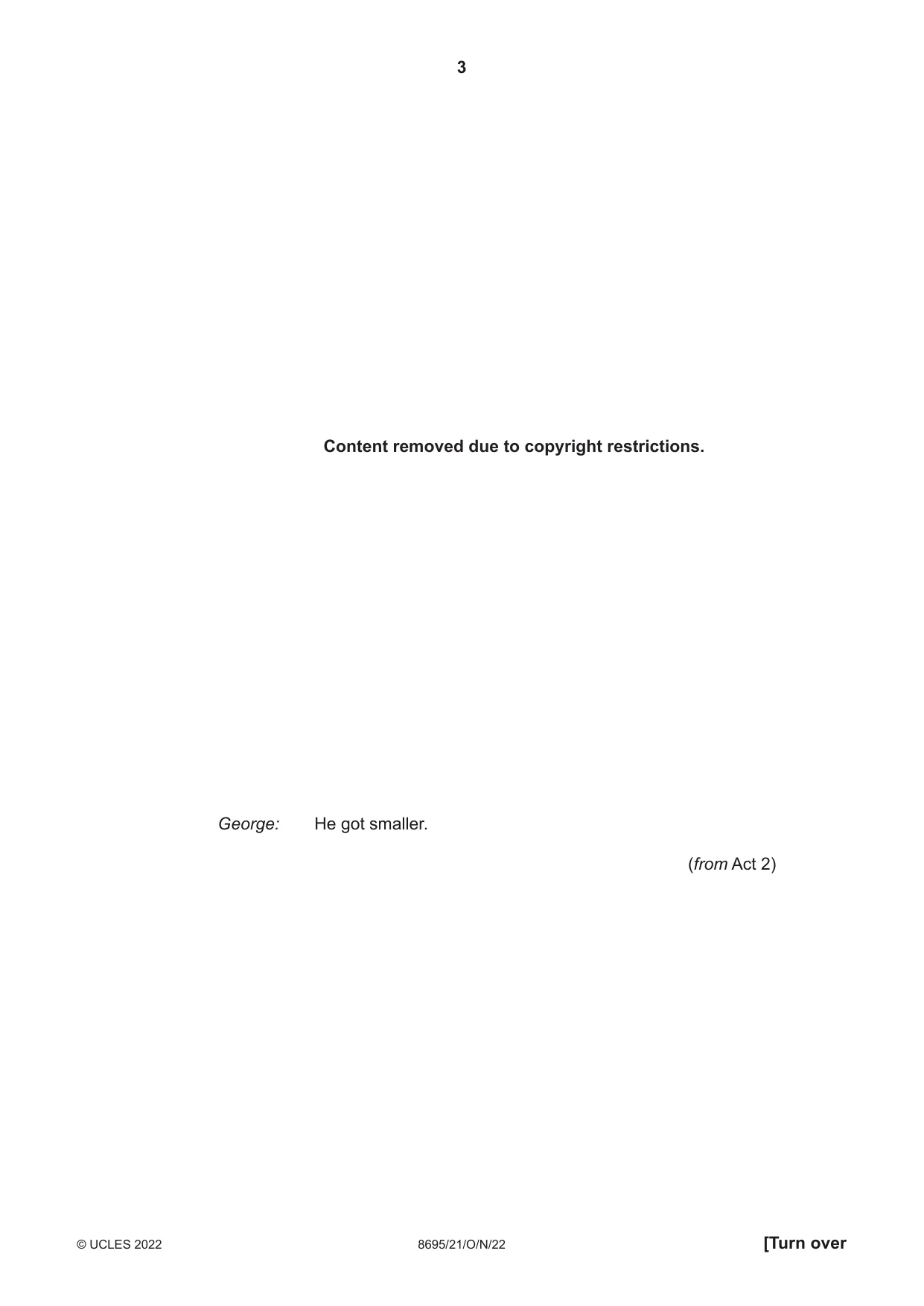
3 8695/21/O/N/22 © UCLES 2022 [Turn over George: He got smaller. (from Act 2) Content removed due to copyright restrictions.
Question paper, page 4
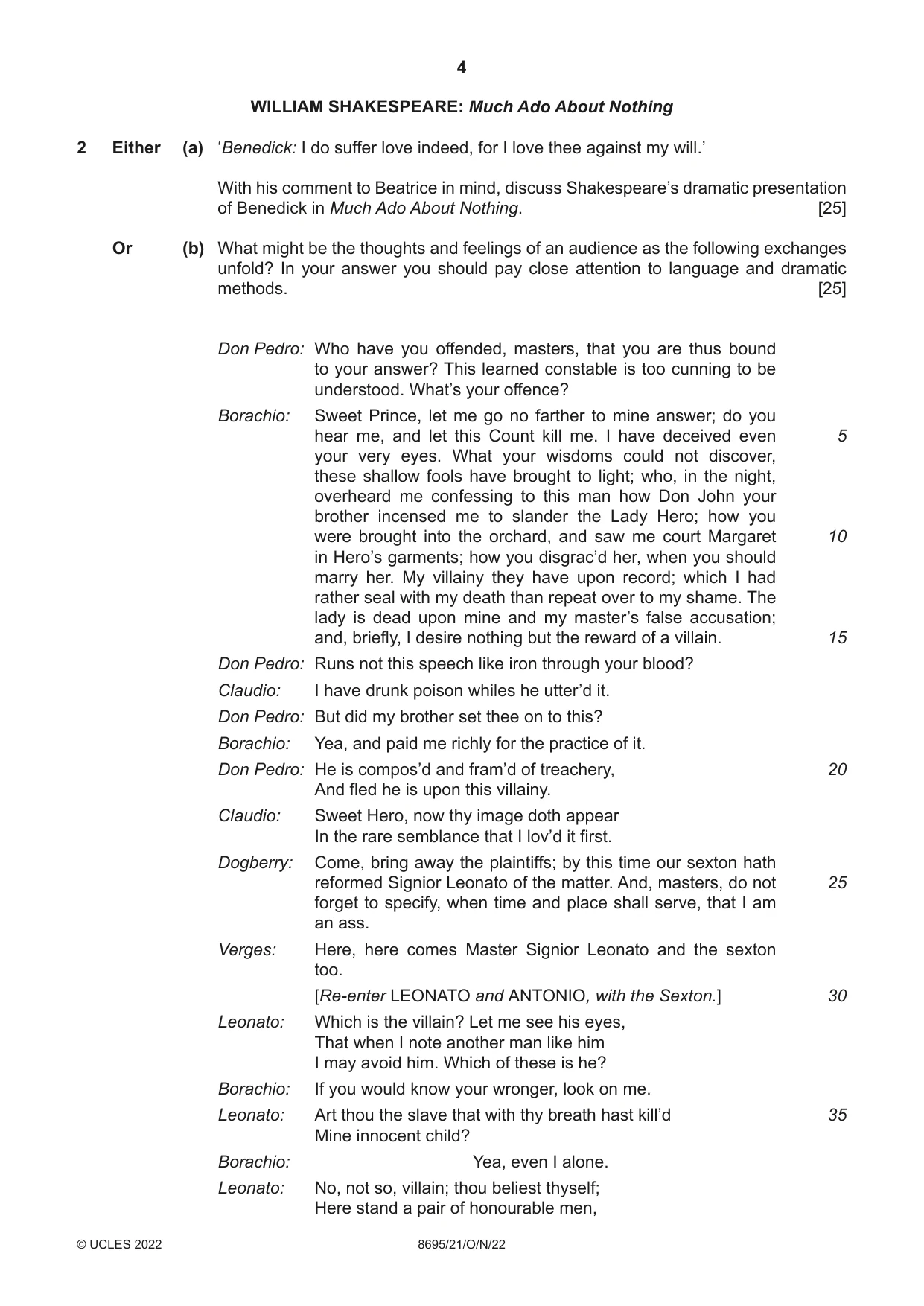
4 8695/21/O/N/22 © UCLES 2022 WILLIAM SHAKESPEARE: Much Ado About Nothing 2 Either (a) ‘Benedick: I do suffer love indeed, for I love thee against my will.’ With his comment to Beatrice in mind, discuss Shakespeare’s dramatic presentation of Benedick in Much Ado About Nothing. [25] Or (b) What might be the thoughts and feelings of an audience as the following exchanges unfold? In your answer you should pay close attention to language and dramatic methods. [25] Don Pedro: Who have you offended, masters, that you are thus bound to your answer? This learned constable is too cunning to be understood. What’s your offence? Borachio: Sweet Prince, let me go no farther to mine answer; do you hear me, and let this Count kill me. I have deceived even your very eyes. What your wisdoms could not discover, these shallow fools have brought to light; who, in the night, overheard me confessing to this man how Don John your brother incensed me to slander the Lady Hero; how you were brought into the orchard, and saw me court Margaret in Hero’s garments; how you disgrac’d her, when you should marry her. My villainy they have upon record; which I had rather seal with my death than repeat over to my shame. The lady is dead upon mine and my master’s false accusation; and, briefly, I desire nothing but the reward of a villain. Don Pedro: Runs not this speech like iron through your blood? Claudio: I have drunk poison whiles he utter’d it. Don Pedro: But did my brother set thee on to this? Borachio: Yea, and paid me richly for the practice of it. Don Pedro: He is compos’d and fram’d of treachery, And fled he is upon this villainy. Claudio: Sweet Hero, now thy image doth appear In the rare semblance that I lov’d it first. Dogberry: Come, bring away the plaintiffs; by this time our sexton hath reformed Signior Leonato of the matter. And, masters, do not forget to specify, when time and place shall serve, that I am an ass. Verges: Here, here comes Master Signior Leonato and the sexton too. [Re-enter LEONATO and ANTONIO, with the Sexton.] Leonato: Which is the villain? Let me see his eyes, That when I note another man like him I may avoid him. Which of these is he? Borachio: If you would know your wronger, look on me. Leonato: Art thou the slave that with thy breath hast kill’d Mine innocent child? Borachio: Yea, even I alone. Leonato: No, not so, villain; thou beliest thyself; Here stand a pair of honourable men, 5 10 15 20 25 30 35
Question paper, page 5
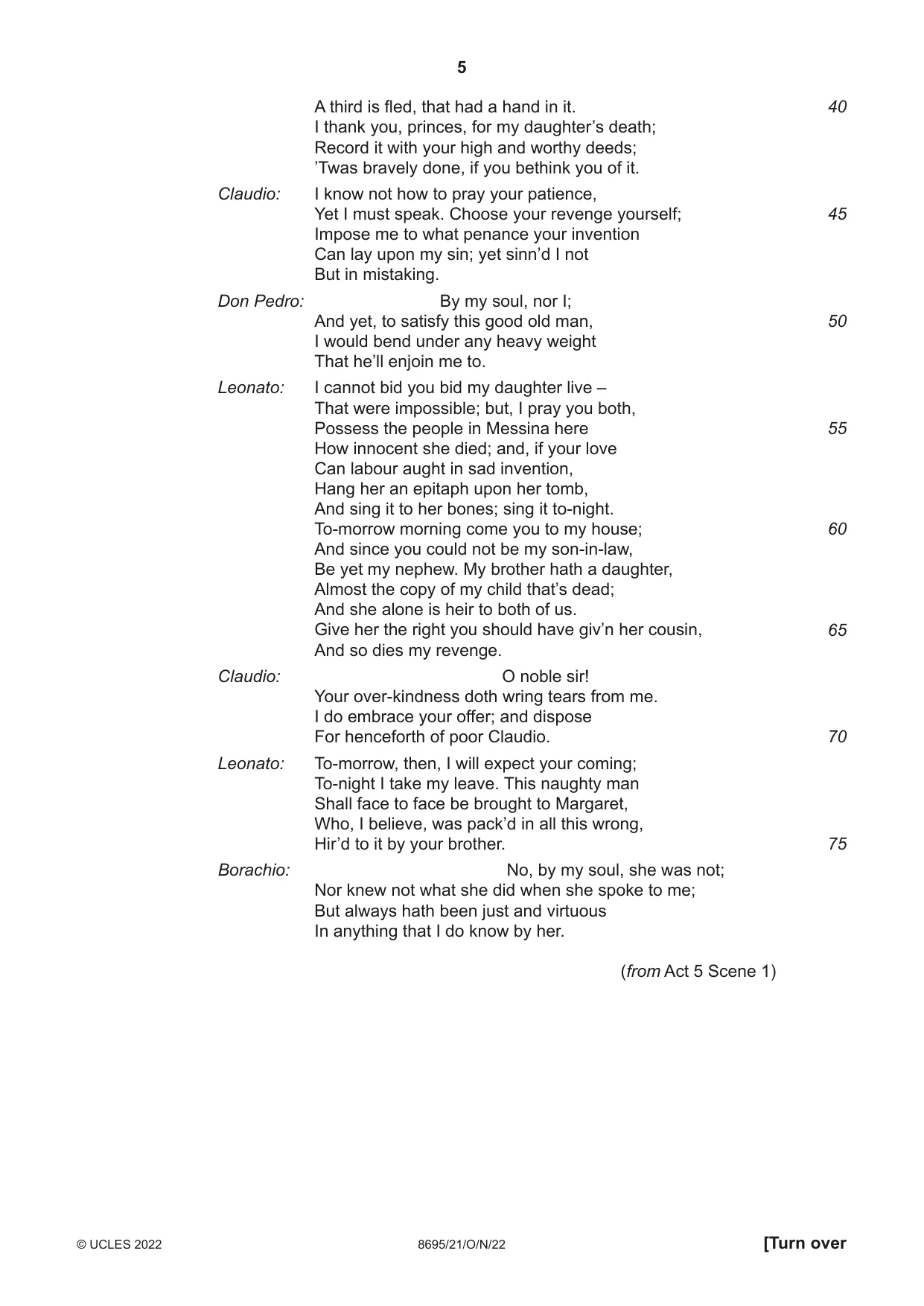
5 8695/21/O/N/22 © UCLES 2022 [Turn over A third is fled, that had a hand in it. I thank you, princes, for my daughter’s death; Record it with your high and worthy deeds; ’Twas bravely done, if you bethink you of it. Claudio: I know not how to pray your patience, Yet I must speak. Choose your revenge yourself; Impose me to what penance your invention Can lay upon my sin; yet sinn’d I not But in mistaking. Don Pedro: By my soul, nor I; And yet, to satisfy this good old man, I would bend under any heavy weight That he’ll enjoin me to. Leonato: I cannot bid you bid my daughter live – That were impossible; but, I pray you both, Possess the people in Messina here How innocent she died; and, if your love Can labour aught in sad invention, Hang her an epitaph upon her tomb, And sing it to her bones; sing it to-night. To-morrow morning come you to my house; And since you could not be my son-in-law, Be yet my nephew. My brother hath a daughter, Almost the copy of my child that’s dead; And she alone is heir to both of us. Give her the right you should have giv’n her cousin, And so dies my revenge. Claudio: O noble sir! Your over-kindness doth wring tears from me. I do embrace your offer; and dispose For henceforth of poor Claudio. Leonato: To-morrow, then, I will expect your coming; To-night I take my leave. This naughty man Shall face to face be brought to Margaret, Who, I believe, was pack’d in all this wrong, Hir’d to it by your brother. Borachio: No, by my soul, she was not; Nor knew not what she did when she spoke to me; But always hath been just and virtuous In anything that I do know by her. (from Act 5 Scene 1) 40 45 50 55 60 65 70 75
Question paper, page 6
6 8695/21/O/N/22 © UCLES 2022 WOLE SOYINKA: The Trials of Brother Jero and Jero’s Metamorphosis 3 Either (a) In what ways, and with what dramatic effects, does Soyinka explore social status in these plays? [25] Or (b) With close reference to detail of language and action, discuss Soyinka’s dramatic presentation of Amope in the following extract. [25] Amope: It might help if you first told me what you have. Content removed due to copyright restrictions.
Question paper, page 7
7 8695/21/O/N/22 © UCLES 2022 [Turn over [Lights fade.] (from The Trials of Brother Jero, Scene 2) Content removed due to copyright restrictions.
Question paper, page 8
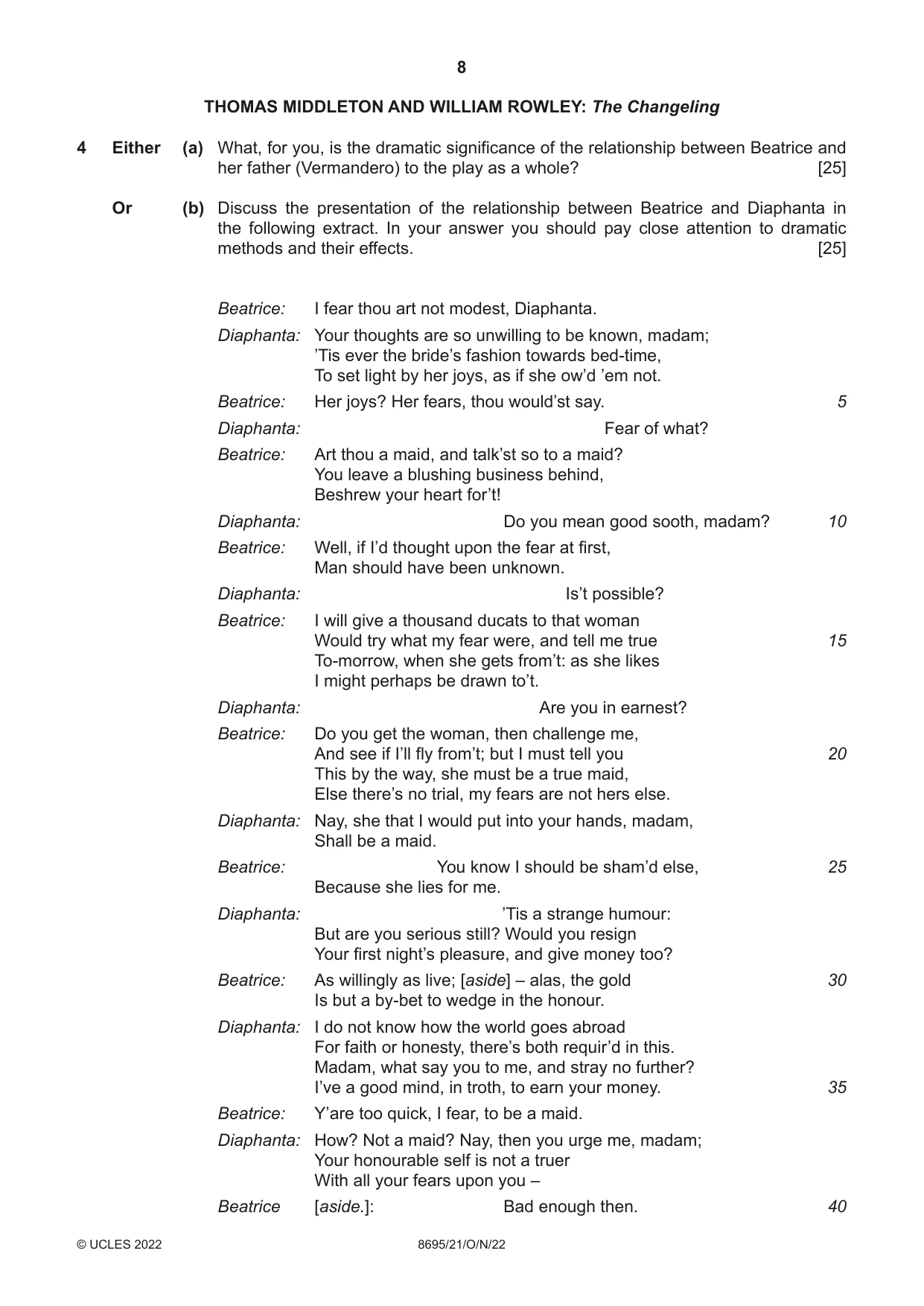
8 8695/21/O/N/22 © UCLES 2022 THOMAS MIDDLETON AND WILLIAM ROWLEY: The Changeling 4 Either (a) What, for you, is the dramatic significance of the relationship between Beatrice and her father (Vermandero) to the play as a whole? [25] Or (b) Discuss the presentation of the relationship between Beatrice and Diaphanta in the following extract. In your answer you should pay close attention to dramatic methods and their effects. [25] Beatrice: I fear thou art not modest, Diaphanta. Diaphanta: Your thoughts are so unwilling to be known, madam; ’Tis ever the bride’s fashion towards bed-time, To set light by her joys, as if she ow’d ’em not. Beatrice: Her joys? Her fears, thou would’st say. Diaphanta: Fear of what? Beatrice: Art thou a maid, and talk’st so to a maid? You leave a blushing business behind, Beshrew your heart for’t! Diaphanta: Do you mean good sooth, madam? Beatrice: Well, if I’d thought upon the fear at first, Man should have been unknown. Diaphanta: Is’t possible? Beatrice: I will give a thousand ducats to that woman Would try what my fear were, and tell me true To-morrow, when she gets from’t: as she likes I might perhaps be drawn to’t. Diaphanta: Are you in earnest? Beatrice: Do you get the woman, then challenge me, And see if I’ll fly from’t; but I must tell you This by the way, she must be a true maid, Else there’s no trial, my fears are not hers else. Diaphanta: Nay, she that I would put into your hands, madam, Shall be a maid. Beatrice: You know I should be sham’d else, Because she lies for me. Diaphanta: ’Tis a strange humour: But are you serious still? Would you resign Your first night’s pleasure, and give money too? Beatrice: As willingly as live; [aside] – alas, the gold Is but a by-bet to wedge in the honour. Diaphanta: I do not know how the world goes abroad For faith or honesty, there’s both requir’d in this. Madam, what say you to me, and stray no further? I’ve a good mind, in troth, to earn your money. Beatrice: Y’are too quick, I fear, to be a maid. Diaphanta: How? Not a maid? Nay, then you urge me, madam; Your honourable self is not a truer With all your fears upon you – Beatrice [aside.]: Bad enough then. 5 10 15 20 25 30 35 40
Question paper, page 9
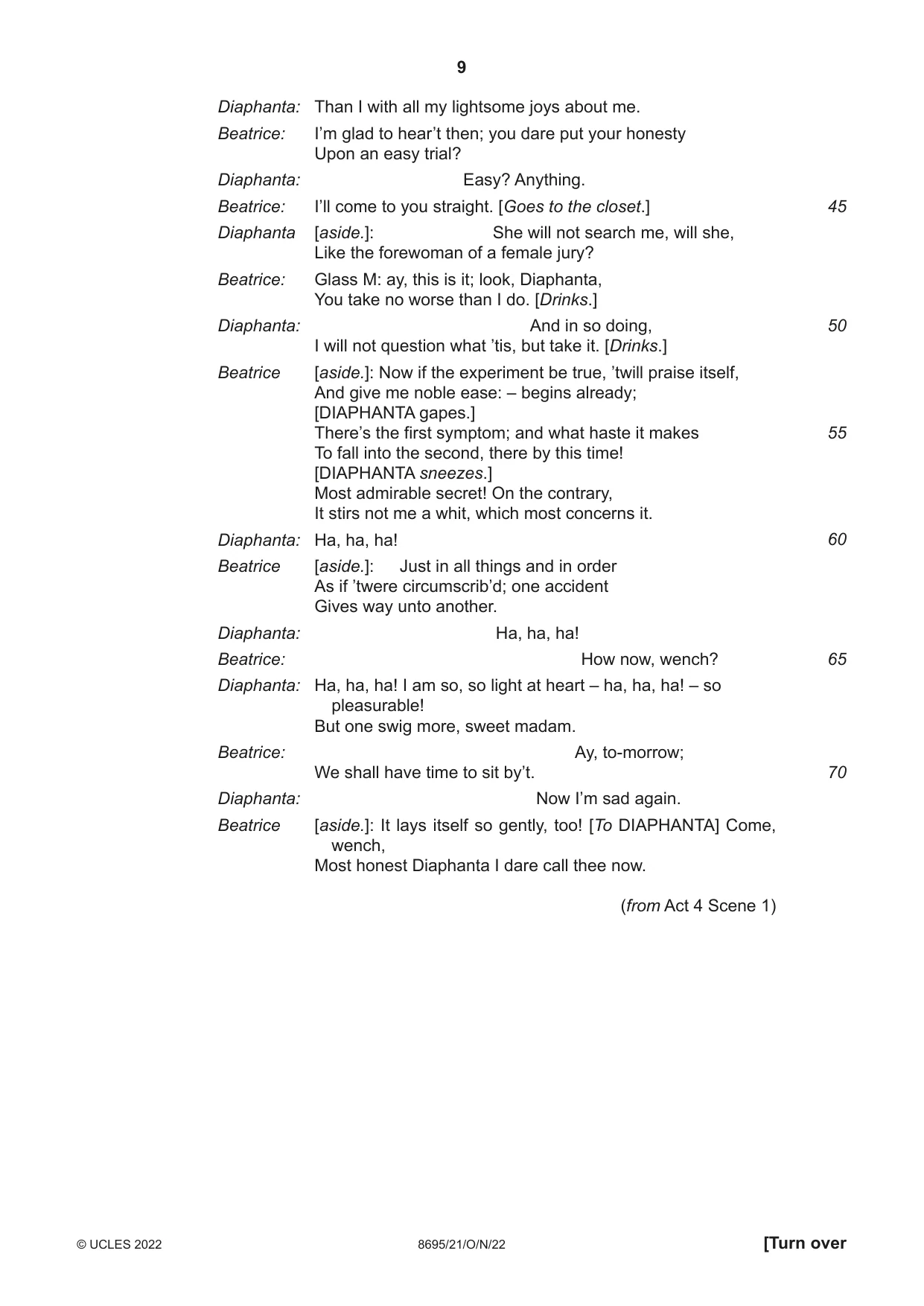
9 8695/21/O/N/22 © UCLES 2022 [Turn over Diaphanta: Than I with all my lightsome joys about me. Beatrice: I’m glad to hear’t then; you dare put your honesty Upon an easy trial? Diaphanta: Easy? Anything. Beatrice: I’ll come to you straight. [Goes to the closet.] Diaphanta [aside.]: She will not search me, will she, Like the forewoman of a female jury? Beatrice: Glass M: ay, this is it; look, Diaphanta, You take no worse than I do. [Drinks.] Diaphanta: And in so doing, I will not question what ’tis, but take it. [Drinks.] Beatrice [aside.]: Now if the experiment be true, ’twill praise itself, And give me noble ease: – begins already; [DIAPHANTA gapes.] There’s the first symptom; and what haste it makes To fall into the second, there by this time! [DIAPHANTA sneezes.] Most admirable secret! On the contrary, It stirs not me a whit, which most concerns it. Diaphanta: Ha, ha, ha! Beatrice [aside.]: Just in all things and in order As if ’twere circumscrib’d; one accident Gives way unto another. Diaphanta: Ha, ha, ha! Beatrice: How now, wench? Diaphanta: Ha, ha, ha! I am so, so light at heart – ha, ha, ha! – so pleasurable! But one swig more, sweet madam. Beatrice: Ay, to-morrow; We shall have time to sit by’t. Diaphanta: Now I’m sad again. Beatrice [aside.]: It lays itself so gently, too! [To DIAPHANTA] Come, wench, Most honest Diaphanta I dare call thee now. (from Act 4 Scene 1) 45 50 55 60 65 70
Question paper, page 10
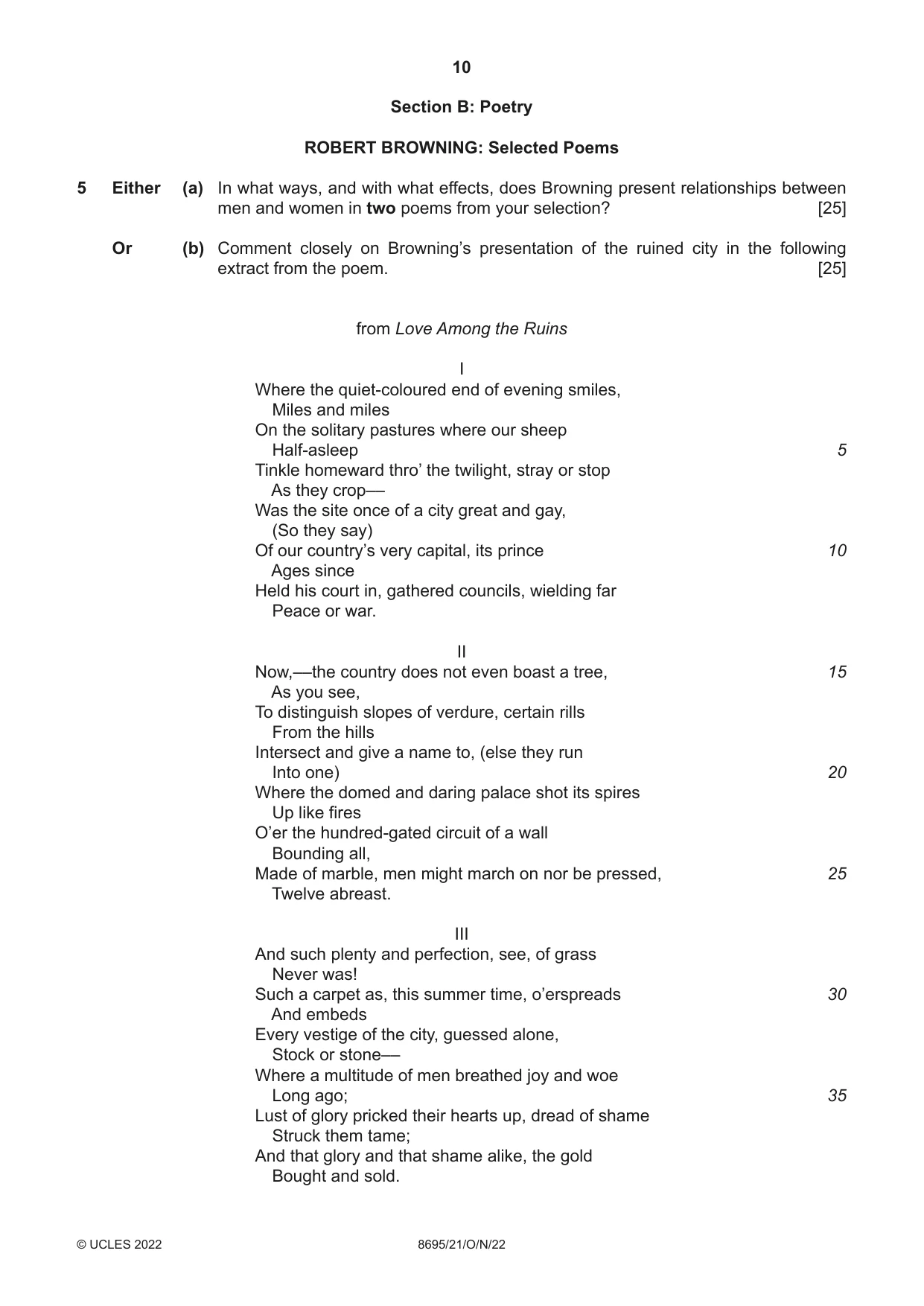
10 8695/21/O/N/22 © UCLES 2022 Section B: Poetry ROBERT BROWNING: Selected Poems 5 Either (a) In what ways, and with what effects, does Browning present relationships between men and women in two poems from your selection? [25] Or (b) Comment closely on Browning’s presentation of the ruined city in the following extract from the poem. [25] from Love Among the Ruins I Where the quiet-coloured end of evening smiles, Miles and miles On the solitary pastures where our sheep Half-asleep Tinkle homeward thro’ the twilight, stray or stop As they crop–– Was the site once of a city great and gay, (So they say) Of our country’s very capital, its prince Ages since Held his court in, gathered councils, wielding far Peace or war. II Now,––the country does not even boast a tree, As you see, To distinguish slopes of verdure, certain rills From the hills Intersect and give a name to, (else they run Into one) Where the domed and daring palace shot its spires Up like fires O’er the hundred-gated circuit of a wall Bounding all, Made of marble, men might march on nor be pressed, Twelve abreast. III And such plenty and perfection, see, of grass Never was! Such a carpet as, this summer time, o’erspreads And embeds Every vestige of the city, guessed alone, Stock or stone–– Where a multitude of men breathed joy and woe Long ago; Lust of glory pricked their hearts up, dread of shame Struck them tame; And that glory and that shame alike, the gold Bought and sold. 5 10 15 20 25 30 35
Question paper, page 11
11 8695/21/O/N/22 © UCLES 2022 [Turn over IV Now,––the single little turret that remains On the plains, By the caper overrooted, by the gourd Overscored, While the patching houseleek’s head of blossom winks Through the chinks–– Marks the basement whence a tower in ancient time Sprang sublime, And a burning ring, all round, the chariots traced As they raced, And the monarch and his minions and his dames Viewed the games. 40 45 50
Question paper, page 12
12 8695/21/O/N/22 © UCLES 2022 OWEN SHEERS: Skirrid Hill 6 Either (a) Discuss ways in which Sheers uses memories in two poems from Skirrid Hill. [25] Or (b) Comment closely on the following poem, analysing ways in which Sheers presents Dr ‘Hitler’ Hunzvi. [25] Drinking with Hitler* Harare, Zimbabwe, July 2000 He wears his power like an aftershave, with one slow blink of her blue-painted eyes. Content removed due to copyright restrictions.
Question paper, page 13
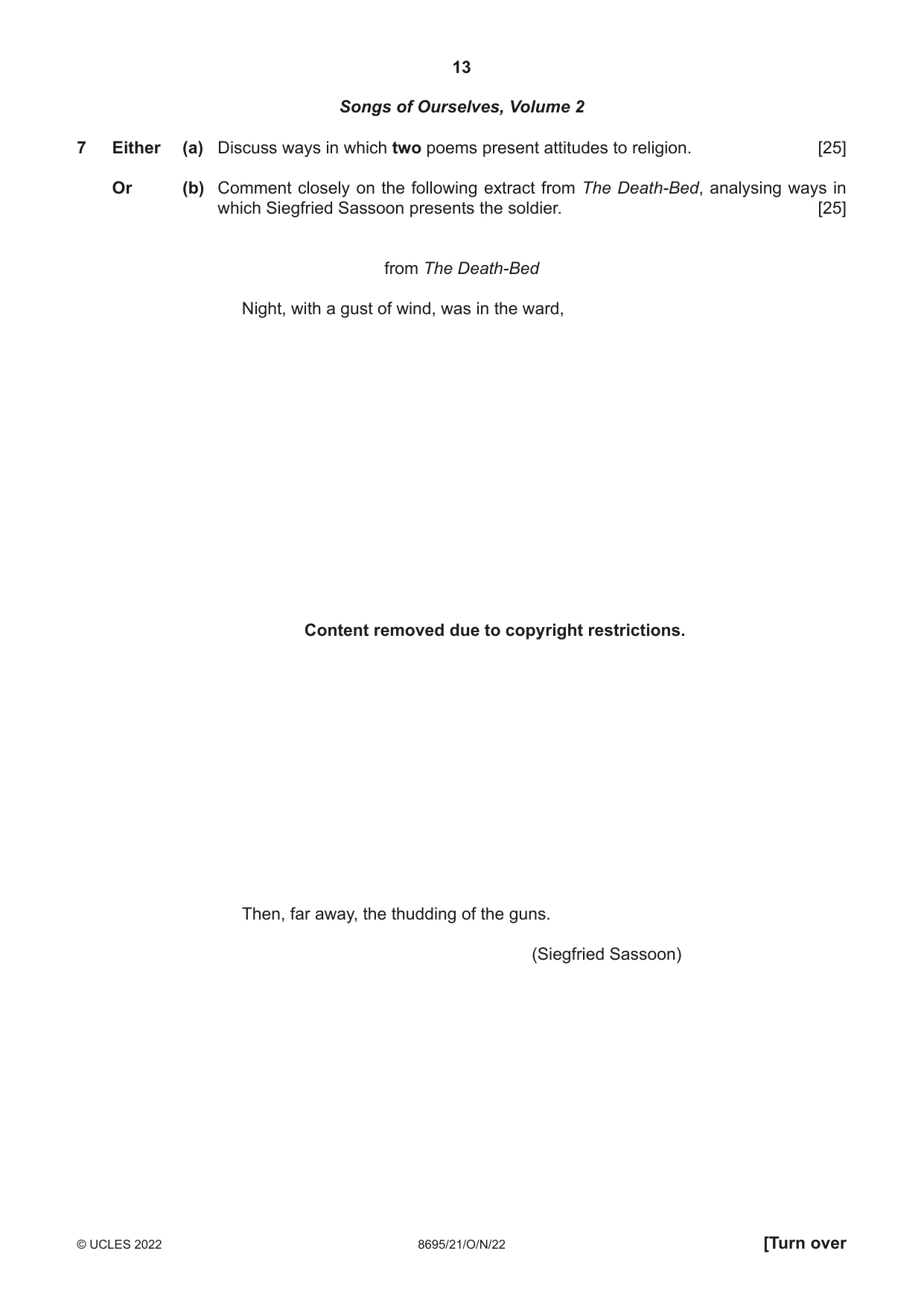
13 8695/21/O/N/22 © UCLES 2022 [Turn over Songs of Ourselves, Volume 2 7 Either (a) Discuss ways in which two poems present attitudes to religion. [25] Or (b) Comment closely on the following extract from The Death-Bed, analysing ways in which Siegfried Sassoon presents the soldier. [25] from The Death-Bed Night, with a gust of wind, was in the ward, Then, far away, the thudding of the guns. (Siegfried Sassoon) Content removed due to copyright restrictions.
Question paper, page 14
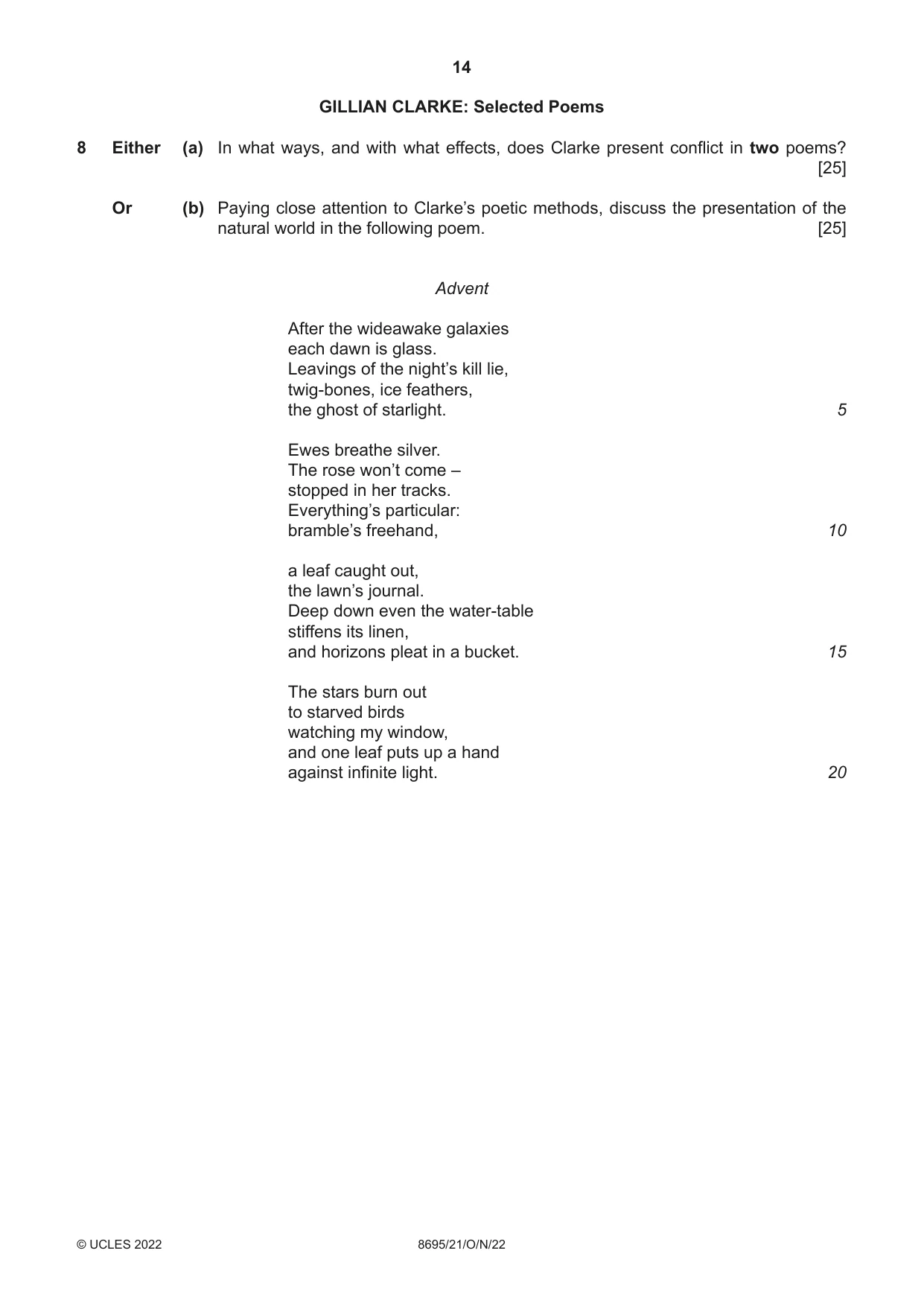
14 8695/21/O/N/22 © UCLES 2022 GILLIAN CLARKE: Selected Poems 8 Either (a) In what ways, and with what effects, does Clarke present conflict in two poems? [25] Or (b) Paying close attention to Clarke’s poetic methods, discuss the presentation of the natural world in the following poem. [25] Advent After the wideawake galaxies each dawn is glass. Leavings of the night’s kill lie, twig-bones, ice feathers, the ghost of starlight. Ewes breathe silver. The rose won’t come – stopped in her tracks. Everything’s particular: bramble’s freehand, a leaf caught out, the lawn’s journal. Deep down even the water-table stiffens its linen, and horizons pleat in a bucket. The stars burn out to starved birds watching my window, and one leaf puts up a hand against infinite light. 5 10 15 20
Question paper, page 15
15 8695/21/O/N/22 © UCLES 2022 [Turn over TURN OVER FOR SECTION C.
Question paper, page 16
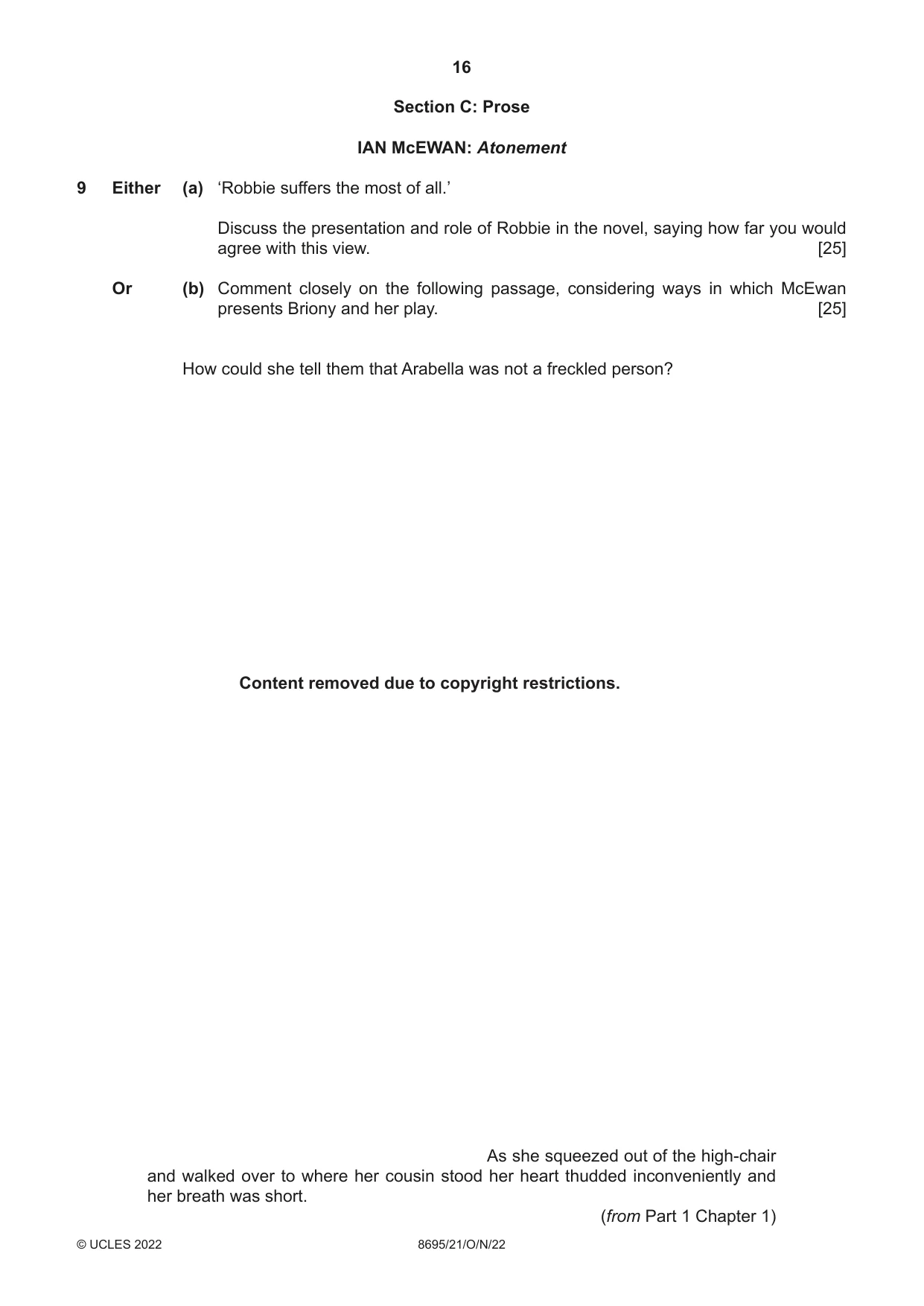
16 8695/21/O/N/22 © UCLES 2022 Section C: Prose IAN McEWAN: Atonement 9 Either (a) ‘Robbie suffers the most of all.’ Discuss the presentation and role of Robbie in the novel, saying how far you would agree with this view. [25] Or (b) Comment closely on the following passage, considering ways in which McEwan presents Briony and her play. [25] How could she tell them that Arabella was not a freckled person? As she squeezed out of the high-chair and walked over to where her cousin stood her heart thudded inconveniently and her breath was short. (from Part 1 Chapter 1) Content removed due to copyright restrictions.
Question paper, page 17
17 8695/21/O/N/22 © UCLES 2022 [Turn over NGŨGĨ WA THIONG’O: Petals of Blood 10 Either (a) Discuss ways in which Ngũgĩ presents wealth and the wealthy in the novel. [25] Or (b) Discuss ways in which the following extract, from chapters 1 and 2, presents Ilmorog and Munira’s arrival. [25] 5 ~ One newspaper, the Daily Mouthpiece, brought out a special issue with a banner headline: MZIGO, CHUI, KIMERIA MURDERED. The pupils were mostly shepherd boys, who often did not finish a term but followed their fathers in search of new pastures and water for their cattle. (from Chapters 1 and 2) Content removed due to copyright restrictions.
Question paper, page 18
18 8695/21/O/N/22 © UCLES 2022 Stories of Ourselves, Volume 2 11 Either (a) Discuss ways in which two stories present a significant discovery. [25] Or (b) Comment closely on ways in which the following passage from When It Happens presents the deteriorating situation. [25] The telephone wires are blown down in a storm and no one comes to fix them; or this is what Mrs Burridge deduces. At any rate, the phone goes dead. Mrs Burridge doesn’t particularly mind, she never liked using the phone much anyway, but it does make her feel cut off. About now men begin to appear on the back road, the gravel road that goes past the gate, walking usually by themselves, sometimes in pairs. They seem to be heading north. Most of them are young, in their twenties, Mrs Burridge would guess. They are not dressed like the men around here. It’s been so long since she has seen anyone walking along this road that she becomes alarmed. She begins leaving the dogs off their chains, she has kept them chained at night ever since one of them bit a Jehovah’s Witness early one Sunday morning. Mrs Burridge doesn’t hold with the Witnesses – she is United – but she respects their perseverance, at least they have the courage of their convictions which is more than you can say for some members of her own church, and she always buys a Watchtower. Maybe they have been right all along. It is about this time too that she takes one of the guns, she thinks it will be the shotgun as she will have a better chance of hitting something, and hides it, along with the shells, under a piece of roofing behind the barn. She does not tell Frank; he will have the twenty-two. She has already picked out the spot. They do not want to waste the little gasoline they still have left in the pump so they do not make unnecessary trips. They begin to eat the chickens, which Mrs Burridge does not look forward to. She hates cleaning and plucking them, and the angriest she ever got at Frank was the time he and Henry Clarke decided to go into turkey farming. They did it too, despite all she had to say against it, and she had to cope with the turkeys escaping and scratching in the garden and impossible to catch, in her opinion they were the stupidest birds in God’s creation, and she had to clean and pluck a turkey a week until luckily the blackhead wiped out a third of the flock, which was enough to discourage them, they sold off the rest at a loss. It was the only time she was actually glad to see Frank lose money on one of his ventures. Mrs Burridge will feel things are getting serious on the day the electricity goes off and does not come back on. She knows, with a kind of fatalism, that this will happen in November, when the freezer is full of the vegetables but before it is cold enough to keep the packages frozen outside. She stands and looks at the Pliofilm bags of beans and corn and spinach and carrots, melting and sodden, and thinks, Why couldn’t they have waited till spring? It is the waste, of food and also of her hard work, that aggravates her the most. She salvages what she can. During the Depression, she remembers, they used to say those on farms were better off than those in the city, because at least they had food; if you could keep the farm, that is; but she is no longer sure this is true. She feels beleaguered, isolated, like someone shut up inside a fortress, though no one has bothered them, in fact no one has passed their way for days, not even the solitary walking men. With the electricity off they can no longer get the television. The radio stations, when they broadcast at all, give out nothing but soothing music, which Mrs Burridge does not find soothing in the least. One morning she goes to the back door and looks out and there are the columns of smoke, right where she’s been expecting to see them, off to the south. She calls Frank and they stand watching. The smoke is thick and black, oily, as 5 10 15 20 25 30 35 40 45
Question paper, page 19
19 8695/21/O/N/22 © UCLES 2022 [Turn over though something has exploded. She does not know what Frank is thinking; she herself is wondering about the children. She has had no news of them in weeks, but how could she? They stopped delivering mail some time now. (from When It Happens) 50
Question paper, page 20
20 8695/21/O/N/22 © UCLES 2022 MARK TWAIN: The Adventures of Huckleberry Finn 12 Either (a) Discuss ways in which Twain presents characters’ lies and their effects in the novel. [25] Or (b) Comment closely on Twain’s presentation of the interactions between the characters in the following passage. [25] Well, the duke allowed he would take my bed; but the king allowed he wouldn’t. He says – ‘I should a reckoned the difference in rank would a sejested to you that a corn-shuck bed warn’t just fitten for me to sleep on. Your Grace’ll take the shuck bed yourself.’ Jim and me was in a sweat again, for a minute, being afraid there was going to be some more trouble amongst them; so we was pretty glad when the duke says – ‘’Tis my fate to be always ground into the mire under the iron heel of oppression. Misfortune has broken my once haughty spirit; I yield, I submit; ’tis my fate. I am alone in the world – let me suffer; I can bear it.’ We got away as soon as it was good and dark. The king told us to stand well out towards the middle of the river, and not show a light till we got a long ways below the town. We come in sight of the little bunch of lights by-and-by – that was the town, you know – and slid by, about a half a mile out, all right. When we was three-quarters of a mile below, we hoisted up our signal lantern; and about ten o’clock it come on to rain and blow and thunder and lighten like everything; so the king told us to both stay on watch till the weather got better; then him and the duke crawled into the wigwam and turned in for the night. It was my watch below, till twelve, but I wouldn’t a turned in, anyway, if I’d had a bed; because a body don’t see such a storm as that every day in the week, not by a long sight. My souls, how the wind did scream along! And every second or two there’d come a glare that lit up the white-caps for a half a mile around, and you’d see the islands looking dusty through the rain, and the trees thrashing around in the wind; then comes a h-wack! – bum! bum! bumble-umble-um-bum-bum-bum-bum – and the thunder would go rumbling and grumbling away, and quit – and then rip comes another flash and another sockdolager. The waves most washed me off the raft, sometimes, but I hadn’t any clothes on, and didn’t mind. We didn’t have no trouble about snags; the lightning was glaring and flittering around so constant that we could see them plenty soon enough to throw her head this way or that and miss them. I had the middle watch, you know, but I was pretty sleepy by that time, so Jim he said he would stand the first half of it for me; he was always mighty good, that way, Jim was. I crawled into the wigwam, but the king and the duke had their legs sprawled around so there warn’t no show for me; so I laid outside – I didn’t mind the rain, because it was warm, and the waves warn’t running so high, now. About two they come up again, though, and Jim was going to call me, but he changed his mind because he reckoned they warn’t high enough yet to do any harm; but he was mistaken about that, for pretty soon all of a sudden along comes a regular ripper, and washed me overboard. It most killed Jim a-laughing. (from Chapter 20) 5 10 15 20 25 30 35 40
Question paper, page 21
21 8695/21/O/N/22 © UCLES 2022 BLANK PAGE
Question paper, page 22
22 8695/21/O/N/22 © UCLES 2022 BLANK PAGE
Question paper, page 23
23 8695/21/O/N/22 © UCLES 2022 BLANK PAGE
Question paper, page 24
24 8695/21/O/N/22 © UCLES 2022 Permission to reproduce items where third-party owned material protected by copyright is included has been sought and cleared where possible. Every reasonable effort has been made by the publisher (UCLES) to trace copyright holders, but if any items requiring clearance have unwittingly been included, the publisher will be pleased to make amends at the earliest possible opportunity. To avoid the issue of disclosure of answer-related information to candidates, all copyright acknowledgements are reproduced online in the Cambridge Assessment International Education Copyright Acknowledgements Booklet. This is produced for each series of examinations and is freely available to download at www.cambridgeinternational.org after the live examination series. Cambridge Assessment International Education is part of Cambridge Assessment. Cambridge Assessment is the brand name of the University of Cambridge Local Examinations Syndicate (UCLES), which is a department of the University of Cambridge. BLANK PAGE
Mark scheme, page 1
This document consists of 13 printed pages. © UCLES 2022 [Turn over Cambridge International AS Level LANGUAGE AND LITERATURE IN ENGLISH 8695/21 Paper 2 Drama, Poetry and Prose October/November 2022 MARK SCHEME Maximum Mark: 50 Published This mark scheme is published as an aid to teachers and candidates, to indicate the requirements of the examination. It shows the basis on which Examiners were instructed to award marks. It does not indicate the details of the discussions that took place at an Examiners’ meeting before marking began, which would have considered the acceptability of alternative answers. Mark schemes should be read in conjunction with the question paper and the Principal Examiner Report for Teachers. Cambridge International will not enter into discussions about these mark schemes. Cambridge International is publishing the mark schemes for the October/November 2022 series for most Cambridge IGCSE™, Cambridge International A and AS Level components and some Cambridge O Level components.
Mark scheme, page 2
8695/21 Cambridge International AS Level – Mark Scheme PUBLISHED October/November 2022 © UCLES 2022 Page 2 of 13 Generic Marking Principles These general marking principles must be applied by all examiners when marking candidate answers. They should be applied alongside the specific content of the mark scheme or generic level descriptors for a question. Each question paper and mark scheme will also comply with these marking principles. GENERIC MARKING PRINCIPLE 1: Marks must be awarded in line with: • the specific content of the mark scheme or the generic level descriptors for the question • the specific skills defined in the mark scheme or in the generic level descriptors for the question • the standard of response required by a candidate as exemplified by the standardisation scripts. GENERIC MARKING PRINCIPLE 2: Marks awarded are always whole marks (not half marks, or other fractions). GENERIC MARKING PRINCIPLE 3: Marks must be awarded positively: • marks are awarded for correct/valid answers, as defined in the mark scheme. However, credit is given for valid answers which go beyond the scope of the syllabus and mark scheme, referring to your Team Leader as appropriate • marks are awarded when candidates clearly demonstrate what they know and can do • marks are not deducted for errors • marks are not deducted for omissions • answers should only be judged on the quality of spelling, punctuation and grammar when these features are specifically assessed by the question as indicated by the mark scheme. The meaning, however, should be unambiguous. GENERIC MARKING PRINCIPLE 4: Rules must be applied consistently, e.g. in situations where candidates have not followed instructions or in the application of generic level descriptors. GENERIC MARKING PRINCIPLE 5: Marks should be awarded using the full range of marks defined in the mark scheme for the question (however; the use of the full mark range may be limited according to the quality of the candidate responses seen). GENERIC MARKING PRINCIPLE 6: Marks awarded are based solely on the requirements as defined in the mark scheme. Marks should not be awarded with grade thresholds or grade descriptors in mind.
Mark scheme, page 3
8695/21 Cambridge International AS Level – Mark Scheme PUBLISHED October/November 2022 © UCLES 2022 Page 3 of 13 English & Media subject specific general marking principles (To be read in conjunction with the Generic Marking Principles (and requiring further guidance on how to place marks within levels)) Components using level descriptors: • We use level descriptors as a guide to broad understanding of the qualities normally expected of, or typical of, work in a level. • Level descriptors are a means of general guidance, and should not be interpreted as hurdle statements. • Where indicative content notes are supplied for a question, these are not a prescription of required content, and must not be treated as such. Alternative correct points and unexpected answers in candidates’ scripts must be given marks that fairly reflect the knowledge and skills demonstrated. • While we may have legitimate expectations as to the ground most answers may occupy, we must at all times be prepared to meet candidates on their chosen ground, provided it is relevant ground (e.g. clearly related to and derived from a relevant passage/text and meeting the mark scheme requirements for the question). Components using point-based marking: Point marking is often used to reward knowledge, understanding and application of skills. We give credit where the candidate’s answer shows relevant knowledge, understanding and application of skills in answering the question. We do not give credit where the answer shows confusion. From this it follows that we: a DO credit answers which are worded differently from the mark scheme if they clearly convey the same meaning (unless the mark scheme requires a specific term). b DO credit alternative answers/examples which are not written in the mark scheme if they are correct. c DO credit answers where candidates give more than one correct answer in one prompt/numbered/scaffolded space where extended writing is required rather than list-type answers. For example, questions that require n reasons (e.g. State two reasons…). d DO NOT credit answers simply for using a ‘key term’ unless that is all that is required. (Check for evidence it is understood and not used wrongly.). e DO NOT credit answers which are obviously self-contradicting or trying to cover all possibilities. f DO NOT give further credit for what is effectively repetition of a correct point already credited unless the language itself is being tested. This applies equally to ‘mirror statements’ (i.e. polluted/not polluted). g DO NOT require spellings to be correct, unless this is part of the test. However spellings of syllabus terms must allow for clear and unambiguous separation from other syllabus terms with which they may be confused (e.g. Corrasion/Corrosion).
Mark scheme, page 4
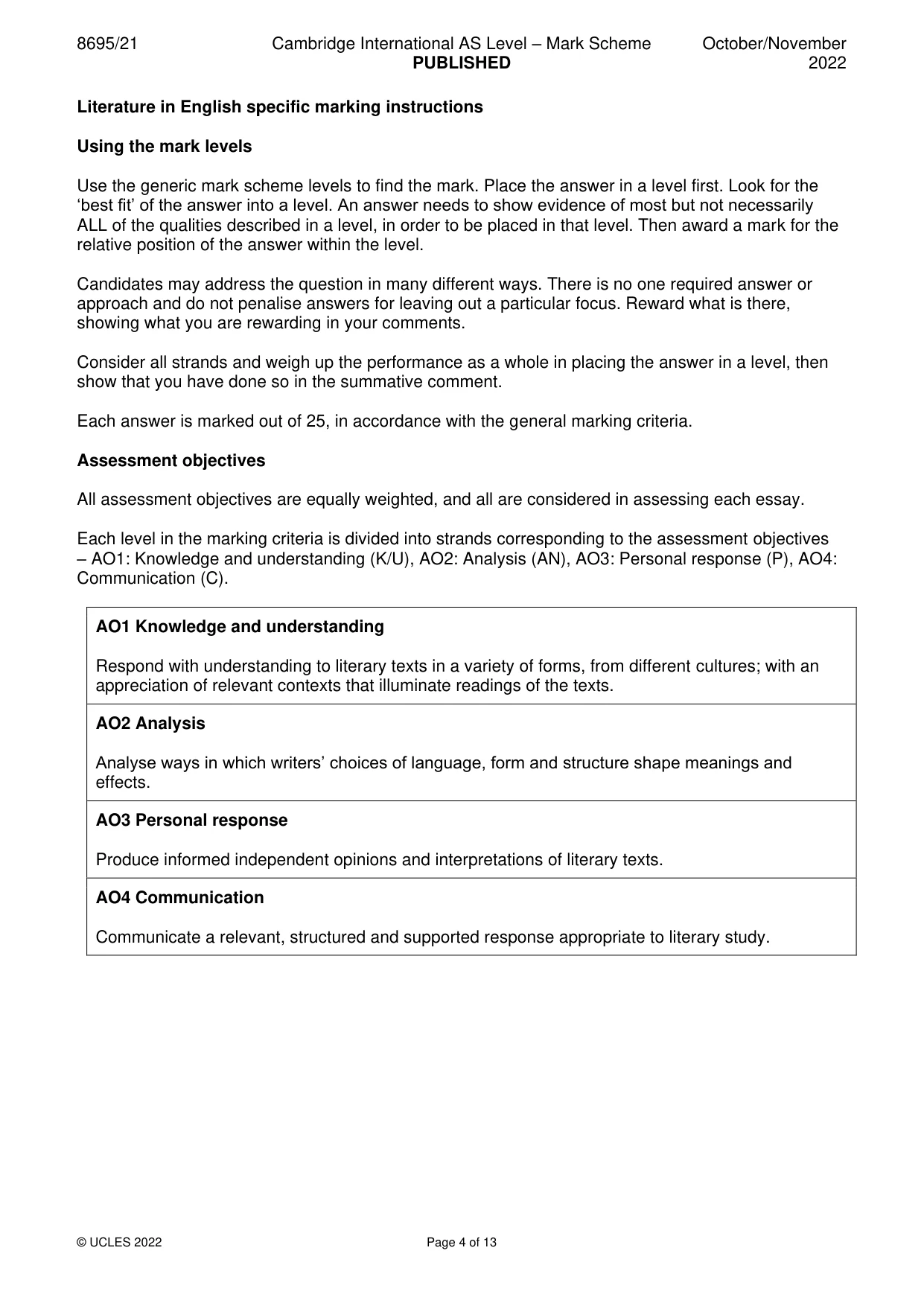
8695/21 Cambridge International AS Level – Mark Scheme PUBLISHED October/November 2022 © UCLES 2022 Page 4 of 13 Literature in English specific marking instructions Using the mark levels Use the generic mark scheme levels to find the mark. Place the answer in a level first. Look for the ‘best fit’ of the answer into a level. An answer needs to show evidence of most but not necessarily ALL of the qualities described in a level, in order to be placed in that level. Then award a mark for the relative position of the answer within the level. Candidates may address the question in many different ways. There is no one required answer or approach and do not penalise answers for leaving out a particular focus. Reward what is there, showing what you are rewarding in your comments. Consider all strands and weigh up the performance as a whole in placing the answer in a level, then show that you have done so in the summative comment. Each answer is marked out of 25, in accordance with the general marking criteria. Assessment objectives All assessment objectives are equally weighted, and all are considered in assessing each essay. Each level in the marking criteria is divided into strands corresponding to the assessment objectives – AO1: Knowledge and understanding (K/U), AO2: Analysis (AN), AO3: Personal response (P), AO4: Communication (C). AO1 Knowledge and understanding Respond with understanding to literary texts in a variety of forms, from different cultures; with an appreciation of relevant contexts that illuminate readings of the texts. AO2 Analysis Analyse ways in which writers’ choices of language, form and structure shape meanings and effects. AO3 Personal response Produce informed independent opinions and interpretations of literary texts. AO4 Communication Communicate a relevant, structured and supported response appropriate to literary study.
Mark scheme, page 5
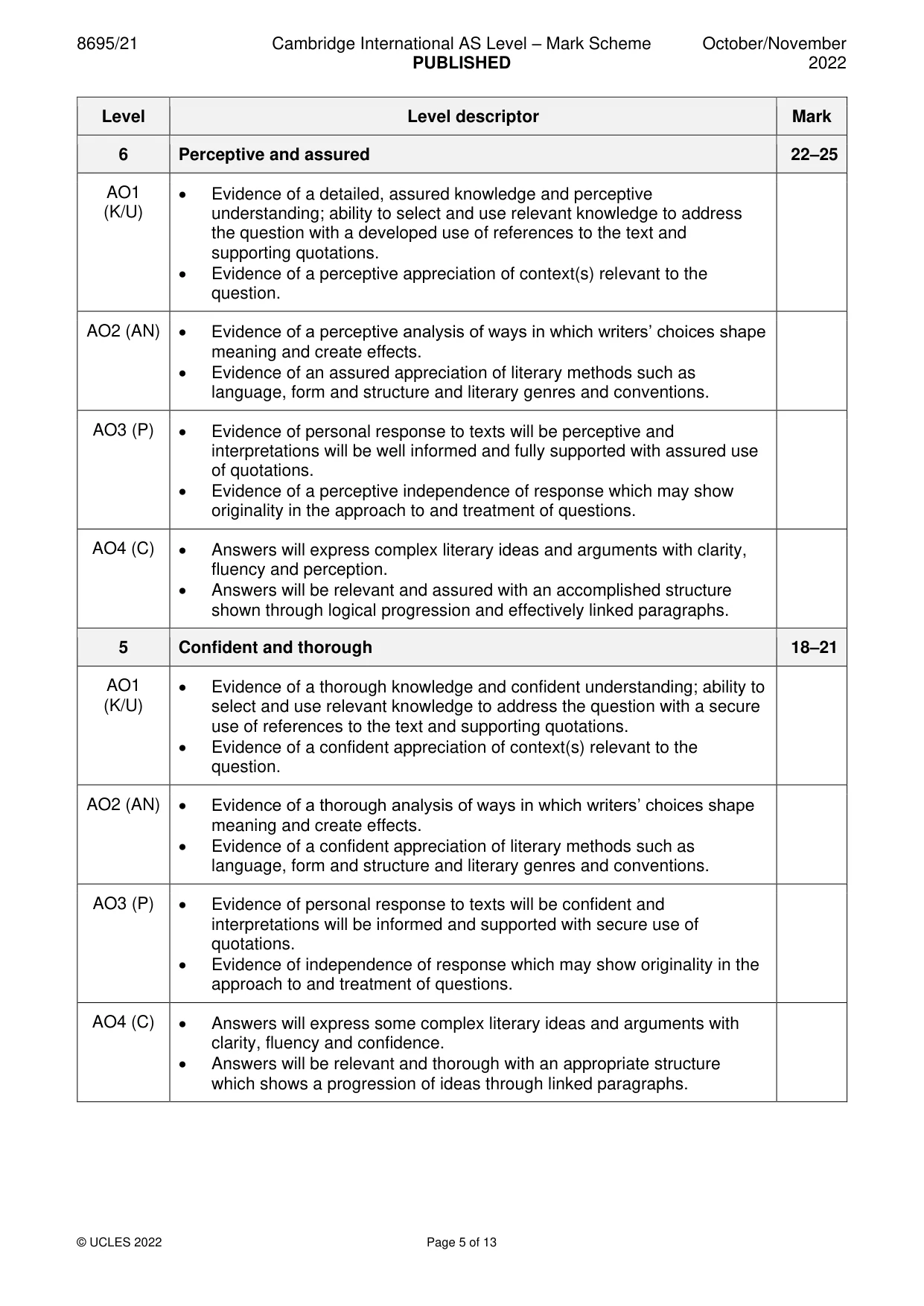
8695/21 Cambridge International AS Level – Mark Scheme PUBLISHED October/November 2022 © UCLES 2022 Page 5 of 13 Level Level descriptor Mark 6 Perceptive and assured 22–25 AO1 (K/U) • Evidence of a detailed, assured knowledge and perceptive understanding; ability to select and use relevant knowledge to address the question with a developed use of references to the text and supporting quotations. • Evidence of a perceptive appreciation of context(s) relevant to the question. AO2 (AN) • Evidence of a perceptive analysis of ways in which writers’ choices shape meaning and create effects. • Evidence of an assured appreciation of literary methods such as language, form and structure and literary genres and conventions. AO3 (P) • Evidence of personal response to texts will be perceptive and interpretations will be well informed and fully supported with assured use of quotations. • Evidence of a perceptive independence of response which may show originality in the approach to and treatment of questions. AO4 (C) • Answers will express complex literary ideas and arguments with clarity, fluency and perception. • Answers will be relevant and assured with an accomplished structure shown through logical progression and effectively linked paragraphs. 5 Confident and thorough 18–21 AO1 (K/U) • Evidence of a thorough knowledge and confident understanding; ability to select and use relevant knowledge to address the question with a secure use of references to the text and supporting quotations. • Evidence of a confident appreciation of context(s) relevant to the question. AO2 (AN) • Evidence of a thorough analysis of ways in which writers’ choices shape meaning and create effects. • Evidence of a confident appreciation of literary methods such as language, form and structure and literary genres and conventions. AO3 (P) • Evidence of personal response to texts will be confident and interpretations will be informed and supported with secure use of quotations. • Evidence of independence of response which may show originality in the approach to and treatment of questions. AO4 (C) • Answers will express some complex literary ideas and arguments with clarity, fluency and confidence. • Answers will be relevant and thorough with an appropriate structure which shows a progression of ideas through linked paragraphs.
Mark scheme, page 6
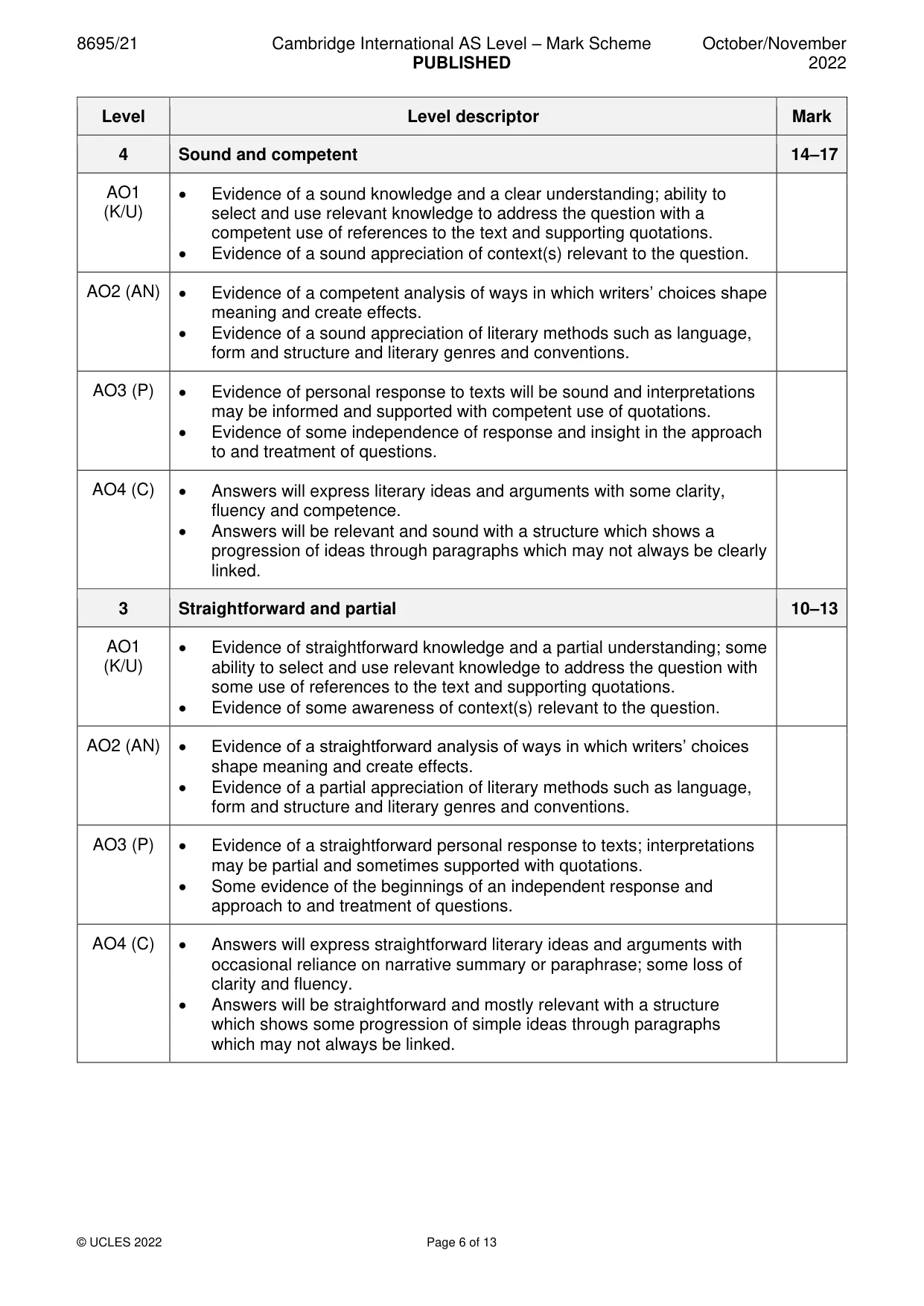
8695/21 Cambridge International AS Level – Mark Scheme PUBLISHED October/November 2022 © UCLES 2022 Page 6 of 13 Level Level descriptor Mark 4 Sound and competent 14–17 AO1 (K/U) • Evidence of a sound knowledge and a clear understanding; ability to select and use relevant knowledge to address the question with a competent use of references to the text and supporting quotations. • Evidence of a sound appreciation of context(s) relevant to the question. AO2 (AN) • Evidence of a competent analysis of ways in which writers’ choices shape meaning and create effects. • Evidence of a sound appreciation of literary methods such as language, form and structure and literary genres and conventions. AO3 (P) • Evidence of personal response to texts will be sound and interpretations may be informed and supported with competent use of quotations. • Evidence of some independence of response and insight in the approach to and treatment of questions. AO4 (C) • Answers will express literary ideas and arguments with some clarity, fluency and competence. • Answers will be relevant and sound with a structure which shows a progression of ideas through paragraphs which may not always be clearly linked. 3 Straightforward and partial 10–13 AO1 (K/U) • Evidence of straightforward knowledge and a partial understanding; some ability to select and use relevant knowledge to address the question with some use of references to the text and supporting quotations. • Evidence of some awareness of context(s) relevant to the question. AO2 (AN) • Evidence of a straightforward analysis of ways in which writers’ choices shape meaning and create effects. • Evidence of a partial appreciation of literary methods such as language, form and structure and literary genres and conventions. AO3 (P) • Evidence of a straightforward personal response to texts; interpretations may be partial and sometimes supported with quotations. • Some evidence of the beginnings of an independent response and approach to and treatment of questions. AO4 (C) • Answers will express straightforward literary ideas and arguments with occasional reliance on narrative summary or paraphrase; some loss of clarity and fluency. • Answers will be straightforward and mostly relevant with a structure which shows some progression of simple ideas through paragraphs which may not always be linked.
Mark scheme, page 7
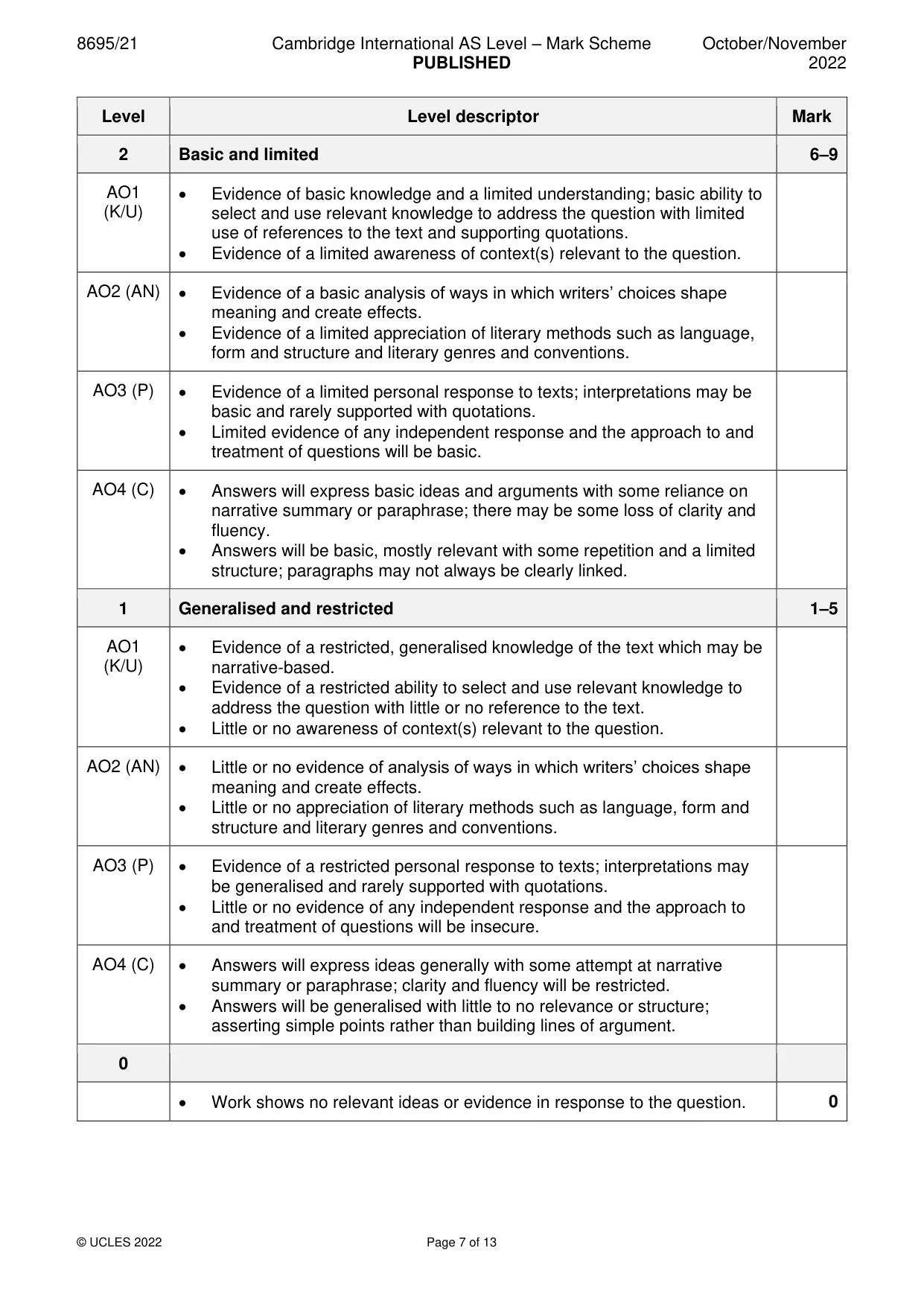
8695/21 Cambridge International AS Level – Mark Scheme PUBLISHED October/November 2022 © UCLES 2022 Page 7 of 13 Level Level descriptor Mark 2 Basic and limited 6–9 AO1 (K/U) • Evidence of basic knowledge and a limited understanding; basic ability to select and use relevant knowledge to address the question with limited use of references to the text and supporting quotations. • Evidence of a limited awareness of context(s) relevant to the question. AO2 (AN) • Evidence of a basic analysis of ways in which writers’ choices shape meaning and create effects. • Evidence of a limited appreciation of literary methods such as language, form and structure and literary genres and conventions. AO3 (P) • Evidence of a limited personal response to texts; interpretations may be basic and rarely supported with quotations. • Limited evidence of any independent response and the approach to and treatment of questions will be basic. AO4 (C) • Answers will express basic ideas and arguments with some reliance on narrative summary or paraphrase; there may be some loss of clarity and fluency. • Answers will be basic, mostly relevant with some repetition and a limited structure; paragraphs may not always be clearly linked. 1 Generalised and restricted 1–5 AO1 (K/U) • Evidence of a restricted, generalised knowledge of the text which may be narrative-based. • Evidence of a restricted ability to select and use relevant knowledge to address the question with little or no reference to the text. • Little or no awareness of context(s) relevant to the question. AO2 (AN) • Little or no evidence of analysis of ways in which writers’ choices shape meaning and create effects. • Little or no appreciation of literary methods such as language, form and structure and literary genres and conventions. AO3 (P) • Evidence of a restricted personal response to texts; interpretations may be generalised and rarely supported with quotations. • Little or no evidence of any independent response and the approach to and treatment of questions will be insecure. AO4 (C) • Answers will express ideas generally with some attempt at narrative summary or paraphrase; clarity and fluency will be restricted. • Answers will be generalised with little to no relevance or structure; asserting simple points rather than building lines of argument. 0 • Work shows no relevant ideas or evidence in response to the question. 0
Mark scheme, page 8
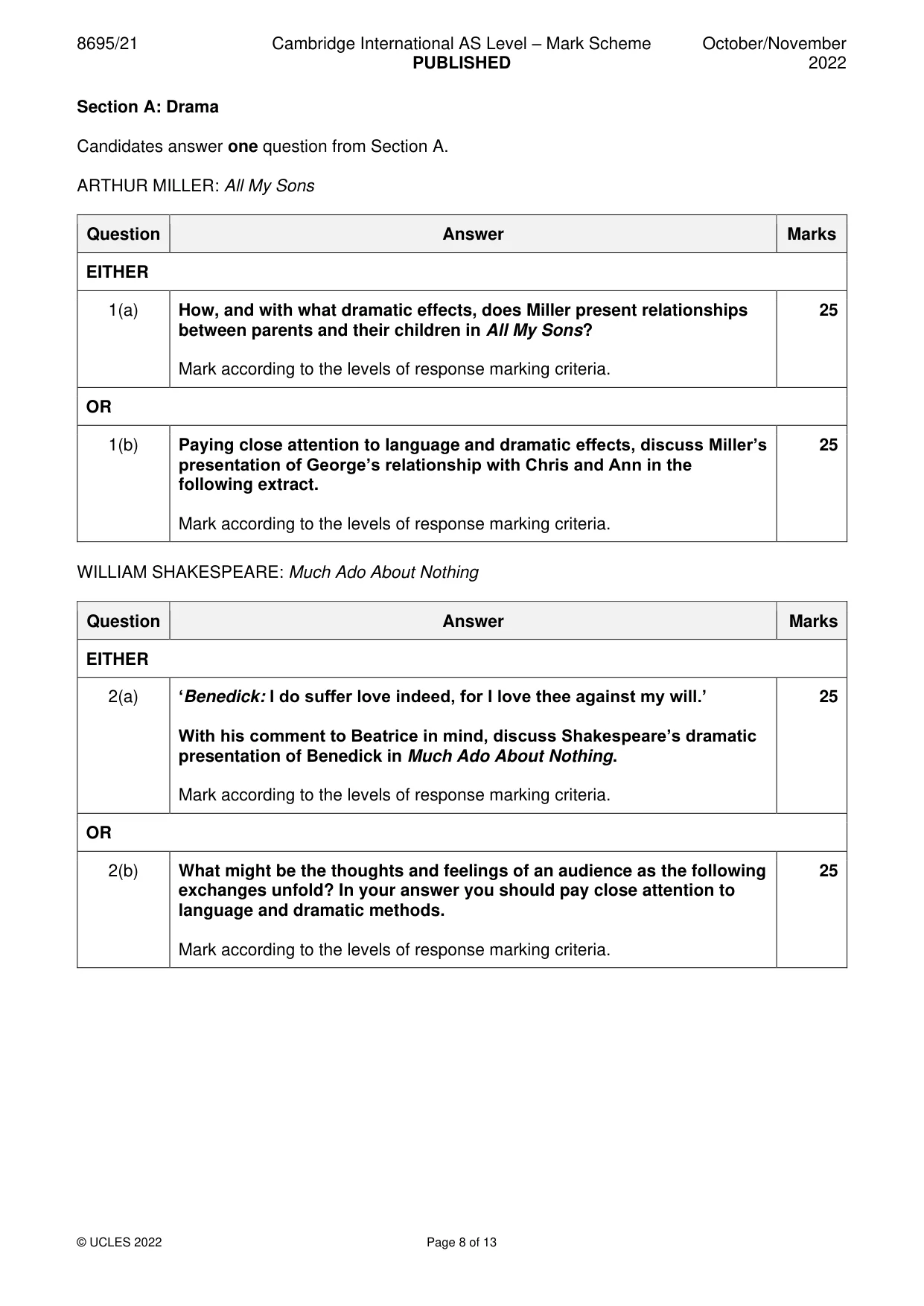
8695/21 Cambridge International AS Level – Mark Scheme PUBLISHED October/November 2022 © UCLES 2022 Page 8 of 13 Section A: Drama Candidates answer one question from Section A. ARTHUR MILLER: All My Sons Question Answer Marks EITHER 1(a) How, and with what dramatic effects, does Miller present relationships between parents and their children in All My Sons? Mark according to the levels of response marking criteria. 25 OR 1(b) Paying close attention to language and dramatic effects, discuss Miller’s presentation of George’s relationship with Chris and Ann in the following extract. Mark according to the levels of response marking criteria. 25 WILLIAM SHAKESPEARE: Much Ado About Nothing Question Answer Marks EITHER 2(a) ‘Benedick: I do suffer love indeed, for I love thee against my will.’ With his comment to Beatrice in mind, discuss Shakespeare’s dramatic presentation of Benedick in Much Ado About Nothing. Mark according to the levels of response marking criteria. 25 OR 2(b) What might be the thoughts and feelings of an audience as the following exchanges unfold? In your answer you should pay close attention to language and dramatic methods. Mark according to the levels of response marking criteria. 25
Mark scheme, page 9
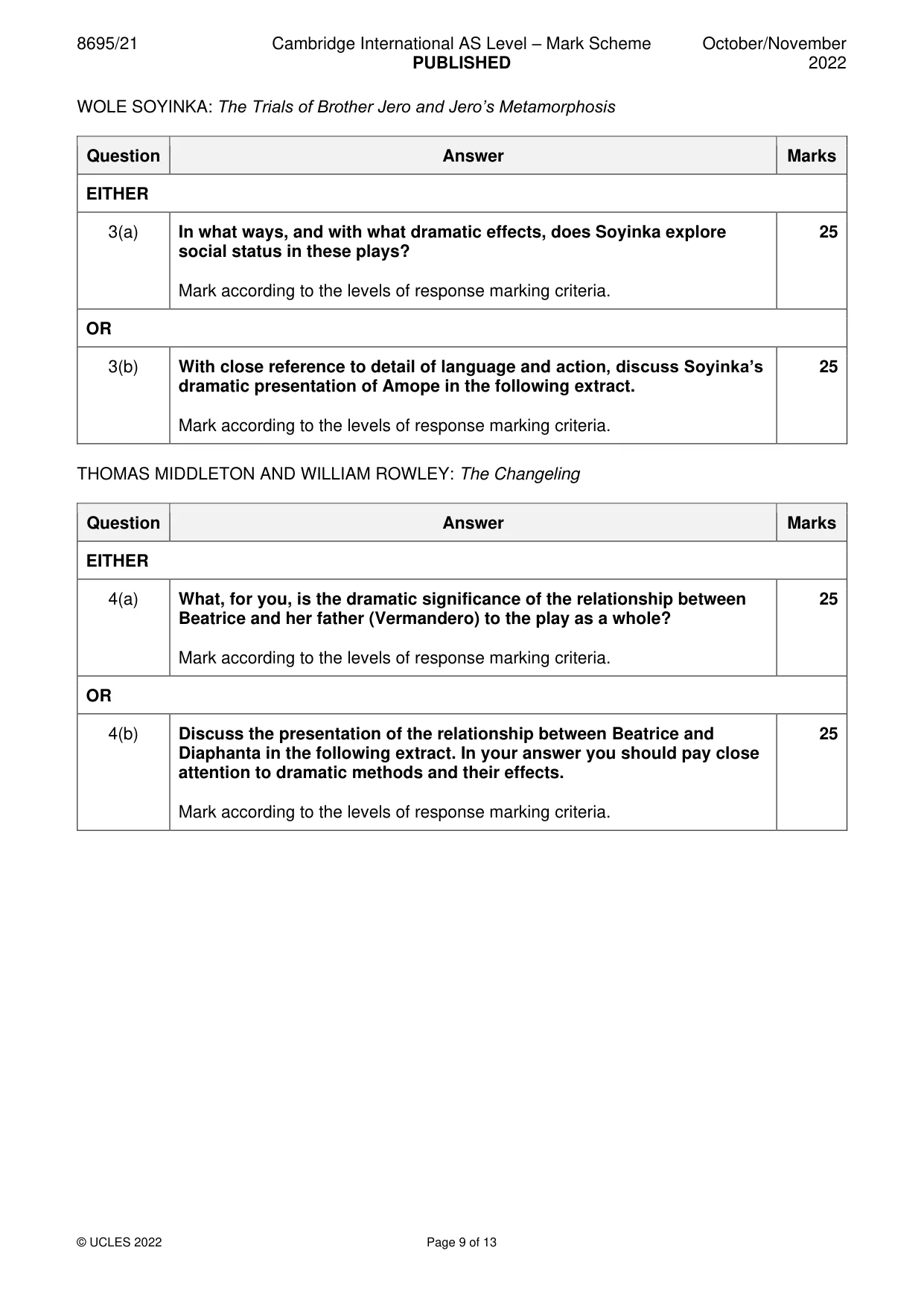
8695/21 Cambridge International AS Level – Mark Scheme PUBLISHED October/November 2022 © UCLES 2022 Page 9 of 13 WOLE SOYINKA: The Trials of Brother Jero and Jero’s Metamorphosis Question Answer Marks EITHER 3(a) In what ways, and with what dramatic effects, does Soyinka explore social status in these plays? Mark according to the levels of response marking criteria. 25 OR 3(b) With close reference to detail of language and action, discuss Soyinka’s dramatic presentation of Amope in the following extract. Mark according to the levels of response marking criteria. 25 THOMAS MIDDLETON AND WILLIAM ROWLEY: The Changeling Question Answer Marks EITHER 4(a) What, for you, is the dramatic significance of the relationship between Beatrice and her father (Vermandero) to the play as a whole? Mark according to the levels of response marking criteria. 25 OR 4(b) Discuss the presentation of the relationship between Beatrice and Diaphanta in the following extract. In your answer you should pay close attention to dramatic methods and their effects. Mark according to the levels of response marking criteria. 25
Mark scheme, page 10
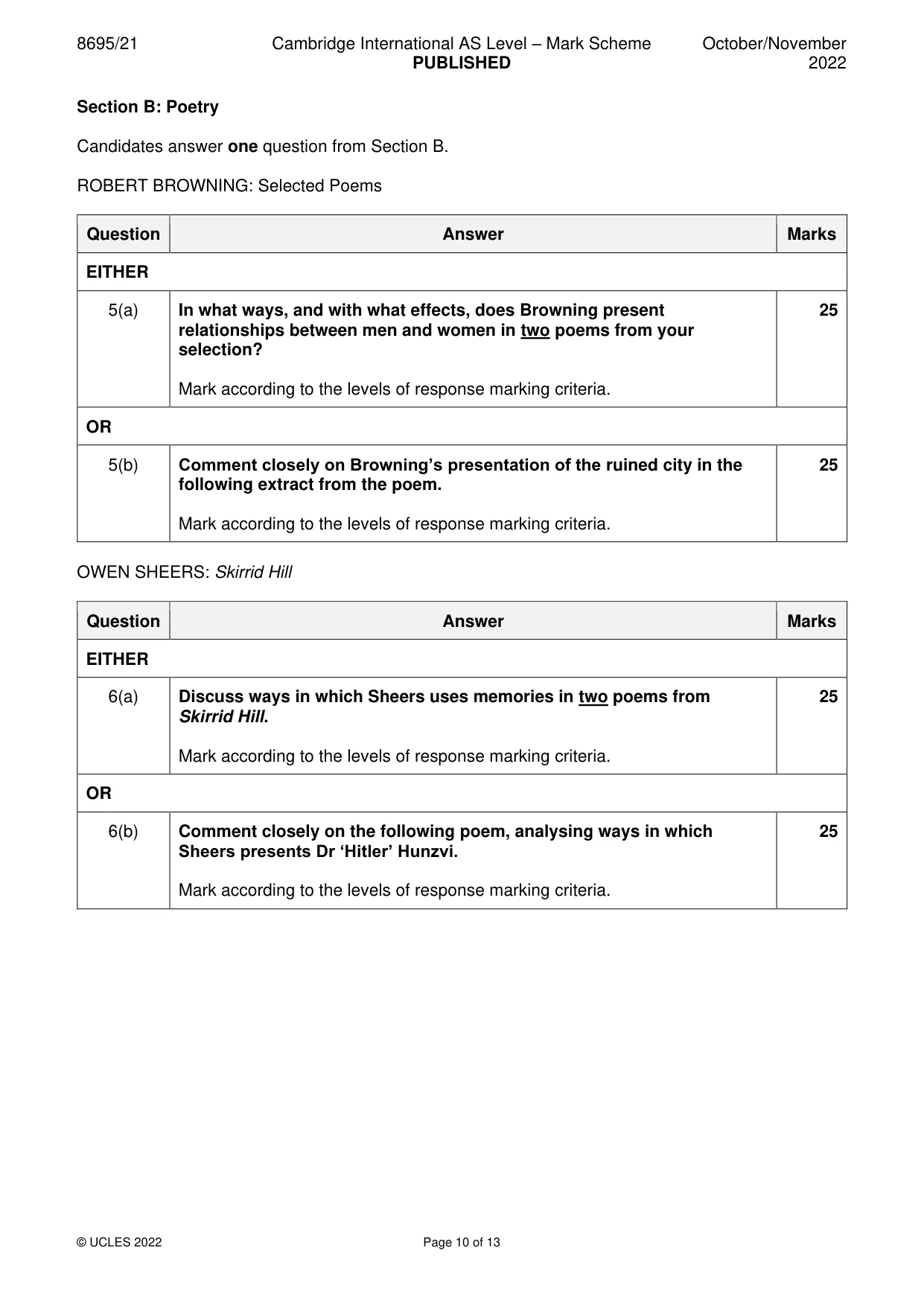
8695/21 Cambridge International AS Level – Mark Scheme PUBLISHED October/November 2022 © UCLES 2022 Page 10 of 13 Section B: Poetry Candidates answer one question from Section B. ROBERT BROWNING: Selected Poems Question Answer Marks EITHER 5(a) In what ways, and with what effects, does Browning present relationships between men and women in two poems from your selection? Mark according to the levels of response marking criteria. 25 OR 5(b) Comment closely on Browning’s presentation of the ruined city in the following extract from the poem. Mark according to the levels of response marking criteria. 25 OWEN SHEERS: Skirrid Hill Question Answer Marks EITHER 6(a) Discuss ways in which Sheers uses memories in two poems from Skirrid Hill. Mark according to the levels of response marking criteria. 25 OR 6(b) Comment closely on the following poem, analysing ways in which Sheers presents Dr ‘Hitler’ Hunzvi. Mark according to the levels of response marking criteria. 25
Mark scheme, page 11
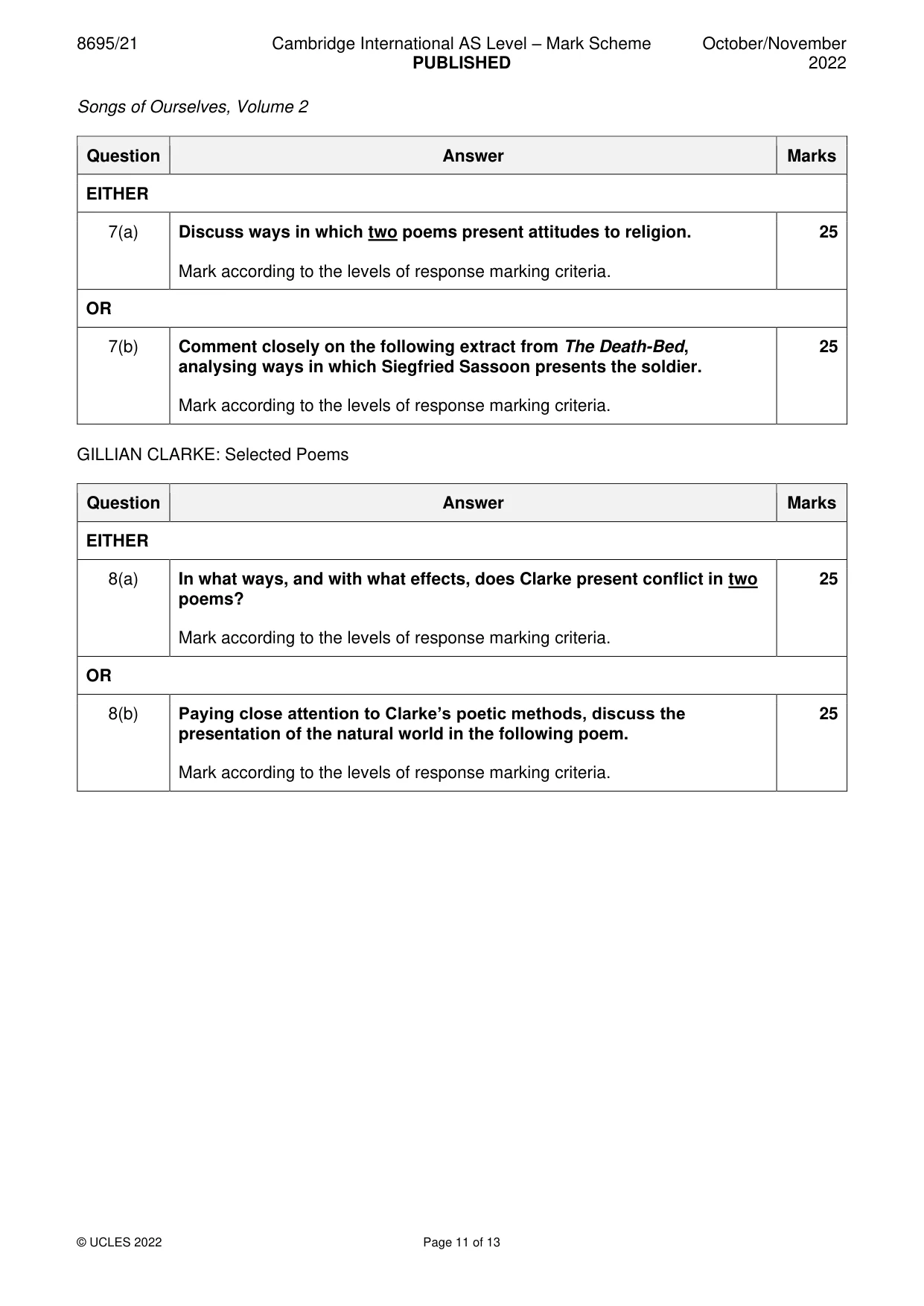
8695/21 Cambridge International AS Level – Mark Scheme PUBLISHED October/November 2022 © UCLES 2022 Page 11 of 13 Songs of Ourselves, Volume 2 Question Answer Marks EITHER 7(a) Discuss ways in which two poems present attitudes to religion. Mark according to the levels of response marking criteria. 25 OR 7(b) Comment closely on the following extract from The Death-Bed, analysing ways in which Siegfried Sassoon presents the soldier. Mark according to the levels of response marking criteria. 25 GILLIAN CLARKE: Selected Poems Question Answer Marks EITHER 8(a) In what ways, and with what effects, does Clarke present conflict in two poems? Mark according to the levels of response marking criteria. 25 OR 8(b) Paying close attention to Clarke’s poetic methods, discuss the presentation of the natural world in the following poem. Mark according to the levels of response marking criteria. 25
Mark scheme, page 12
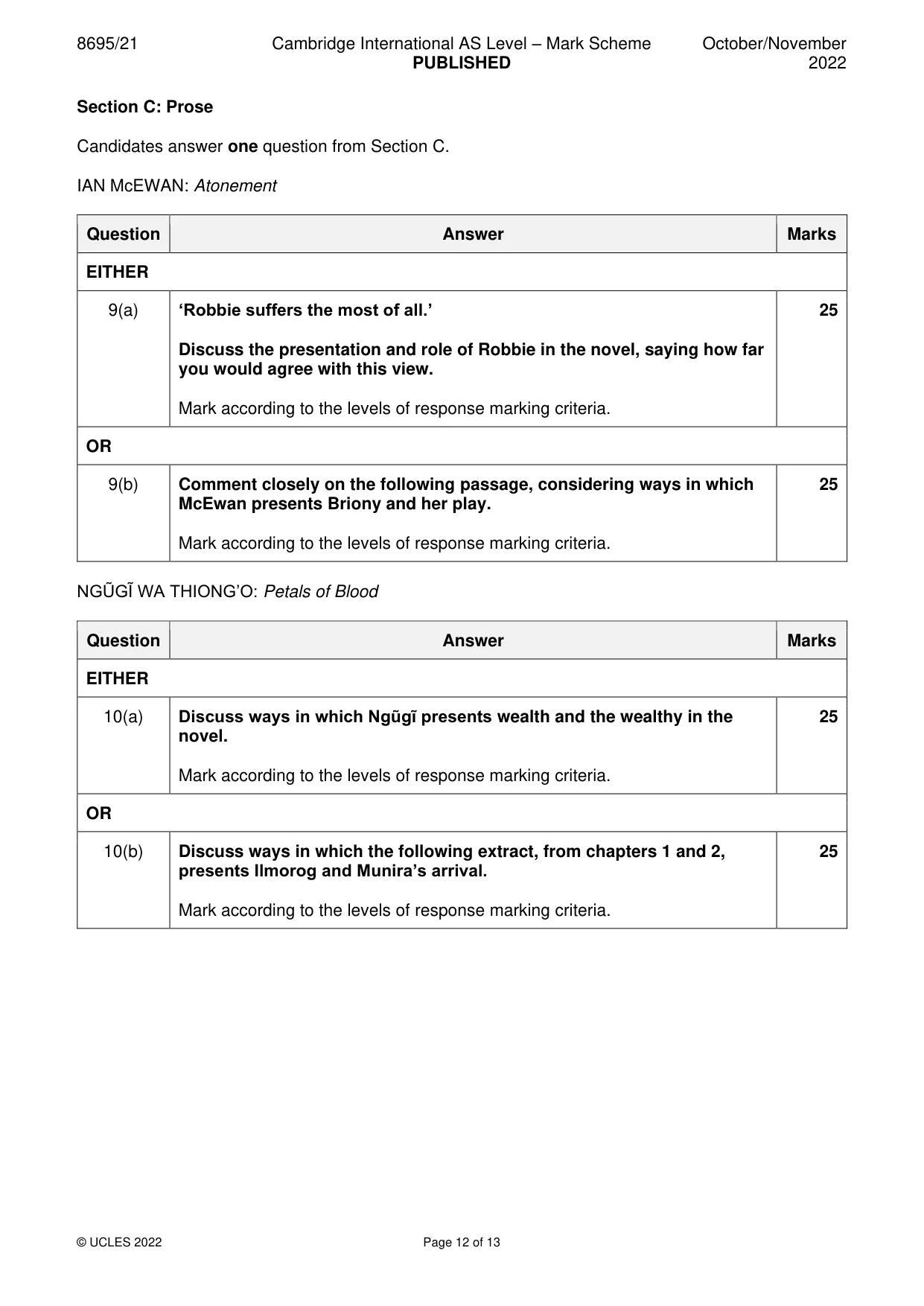
8695/21 Cambridge International AS Level – Mark Scheme PUBLISHED October/November 2022 © UCLES 2022 Page 12 of 13 Section C: Prose Candidates answer one question from Section C. IAN McEWAN: Atonement Question Answer Marks EITHER 9(a) ‘Robbie suffers the most of all.’ Discuss the presentation and role of Robbie in the novel, saying how far you would agree with this view. Mark according to the levels of response marking criteria. 25 OR 9(b) Comment closely on the following passage, considering ways in which McEwan presents Briony and her play. Mark according to the levels of response marking criteria. 25 NGŨGĨ WA THIONG’O: Petals of Blood Question Answer Marks EITHER 10(a) Discuss ways in which Ngũgĩ presents wealth and the wealthy in the novel. Mark according to the levels of response marking criteria. 25 OR 10(b) Discuss ways in which the following extract, from chapters 1 and 2, presents Ilmorog and Munira’s arrival. Mark according to the levels of response marking criteria. 25
Mark scheme, page 13
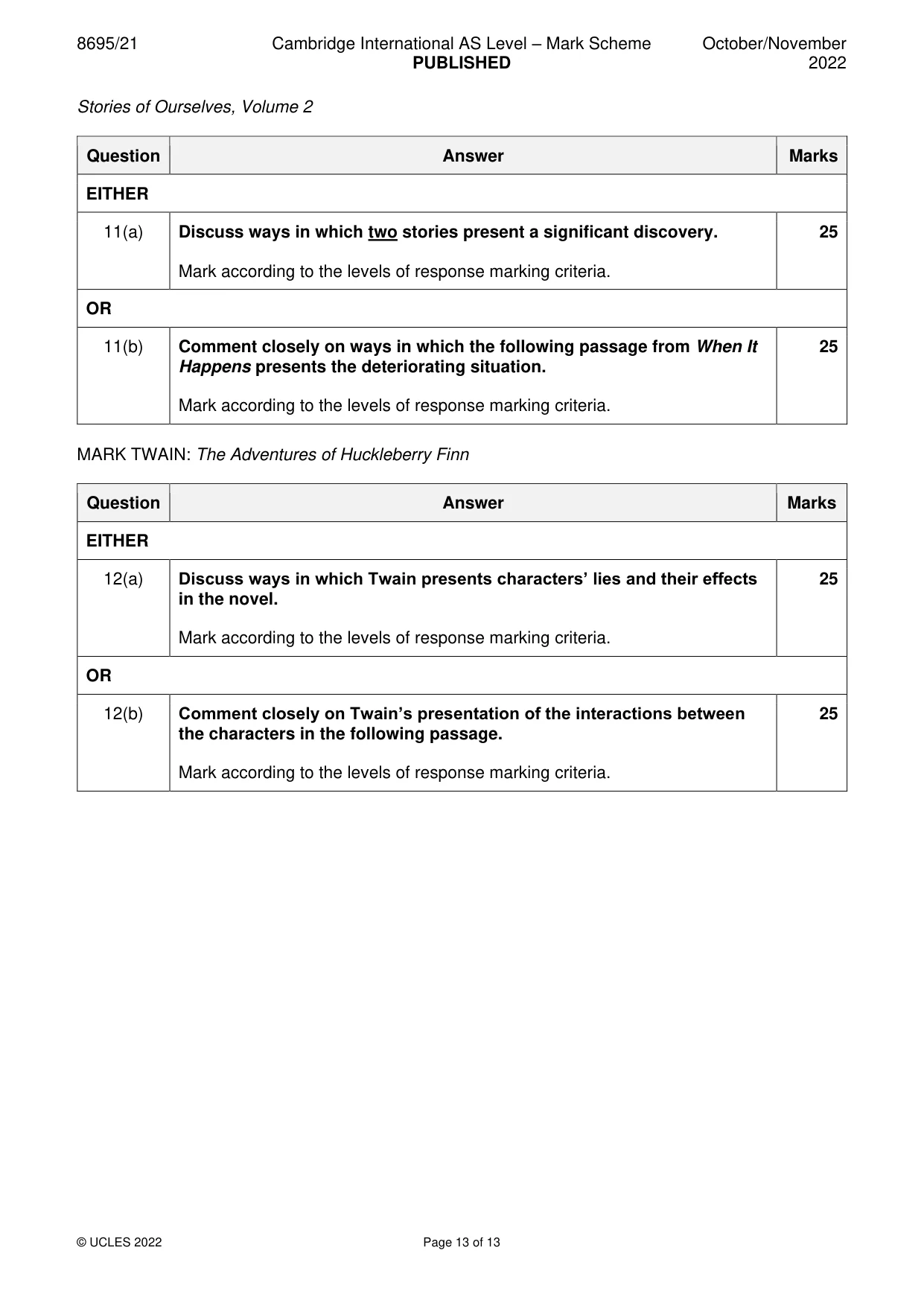
8695/21 Cambridge International AS Level – Mark Scheme PUBLISHED October/November 2022 © UCLES 2022 Page 13 of 13 Stories of Ourselves, Volume 2 Question Answer Marks EITHER 11(a) Discuss ways in which two stories present a significant discovery. Mark according to the levels of response marking criteria. 25 OR 11(b) Comment closely on ways in which the following passage from When It Happens presents the deteriorating situation. Mark according to the levels of response marking criteria. 25 MARK TWAIN: The Adventures of Huckleberry Finn Question Answer Marks EITHER 12(a) Discuss ways in which Twain presents characters’ lies and their effects in the novel. Mark according to the levels of response marking criteria. 25 OR 12(b) Comment closely on Twain’s presentation of the interactions between the characters in the following passage. Mark according to the levels of response marking criteria. 25
What you needed in this session
Cambridge’s own grade thresholds for 2022 Oct/Nov, Paper 2 · Variant 1. A higher threshold means an easier paper — the bar moves with how the cohort did.