Cambridge A Level English - Language and Literature (AS Level only, from 2016) 8695 — 2022 Oct/Nov Paper 2 · Variant 2
8695/22/O/N/22 · 50 marks · ≈56 min
The question paper and its mark scheme, free to read here and free to download. This is Cambridge’s own paper, exactly as it was sat.
Question paper24 pages





Mark scheme13 pages
Answers below. Sit the paper first if you are practising.
Paper as text
Question paper, page 1
This document has 24 pages. Any blank pages are indicated. Cambridge International AS Level * 5 9 9 2 7 6 6 8 7 4 * LANGUAGE AND LITERATURE IN ENGLISH 8695/22 Paper 2 Drama, Poetry and Prose October/November 2022 2 hours You must answer on the enclosed answer booklet. You will need: Answer booklet (enclosed) INSTRUCTIONS ● Answer two questions in total, each from a different section. ● Follow the instructions on the front cover of the answer booklet. If you need additional answer paper, ask the invigilator for a continuation booklet. ● Dictionaries are not allowed. INFORMATION ● The total mark for this paper is 50. ● The number of marks for each question or part question is shown in brackets [ ]. DC (RCL (DF)) 303477/3 © UCLES 2022 [Turn over
Question paper, page 2
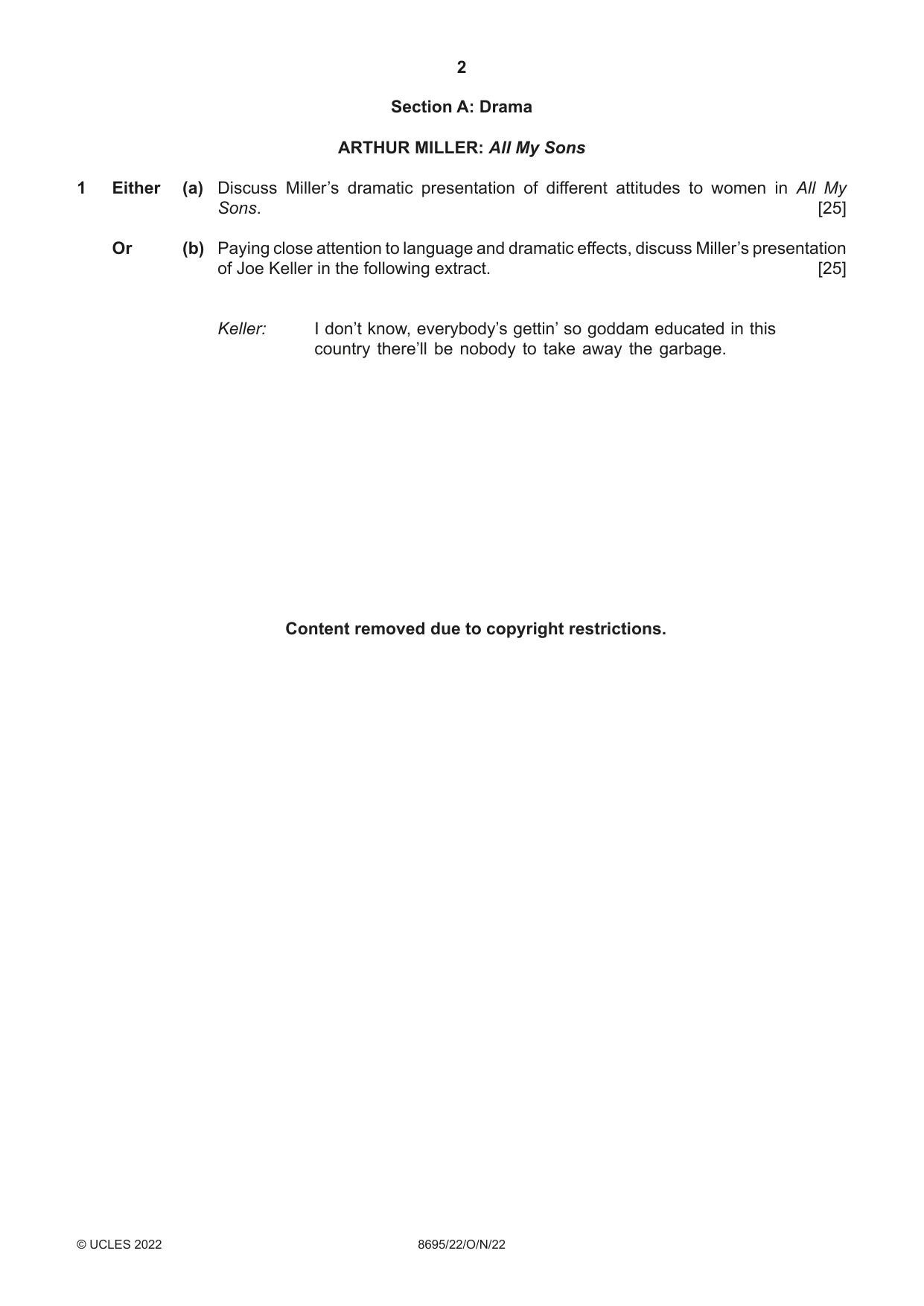
2 8695/22/O/N/22 © UCLES 2022 Section A: Drama ARTHUR MILLER: All My Sons 1 Either (a) Discuss Miller’s dramatic presentation of different attitudes to women in All My Sons. [25] Or (b) Paying close attention to language and dramatic effects, discuss Miller’s presentation of Joe Keller in the following extract. [25] Keller: I don’t know, everybody’s gettin’ so goddam educated in this country there’ll be nobody to take away the garbage. Content removed due to copyright restrictions.
Question paper, page 3
3 8695/22/O/N/22 © UCLES 2022 [Turn over Keller: Right again. (from Act 2) Content removed due to copyright restrictions.
Question paper, page 4
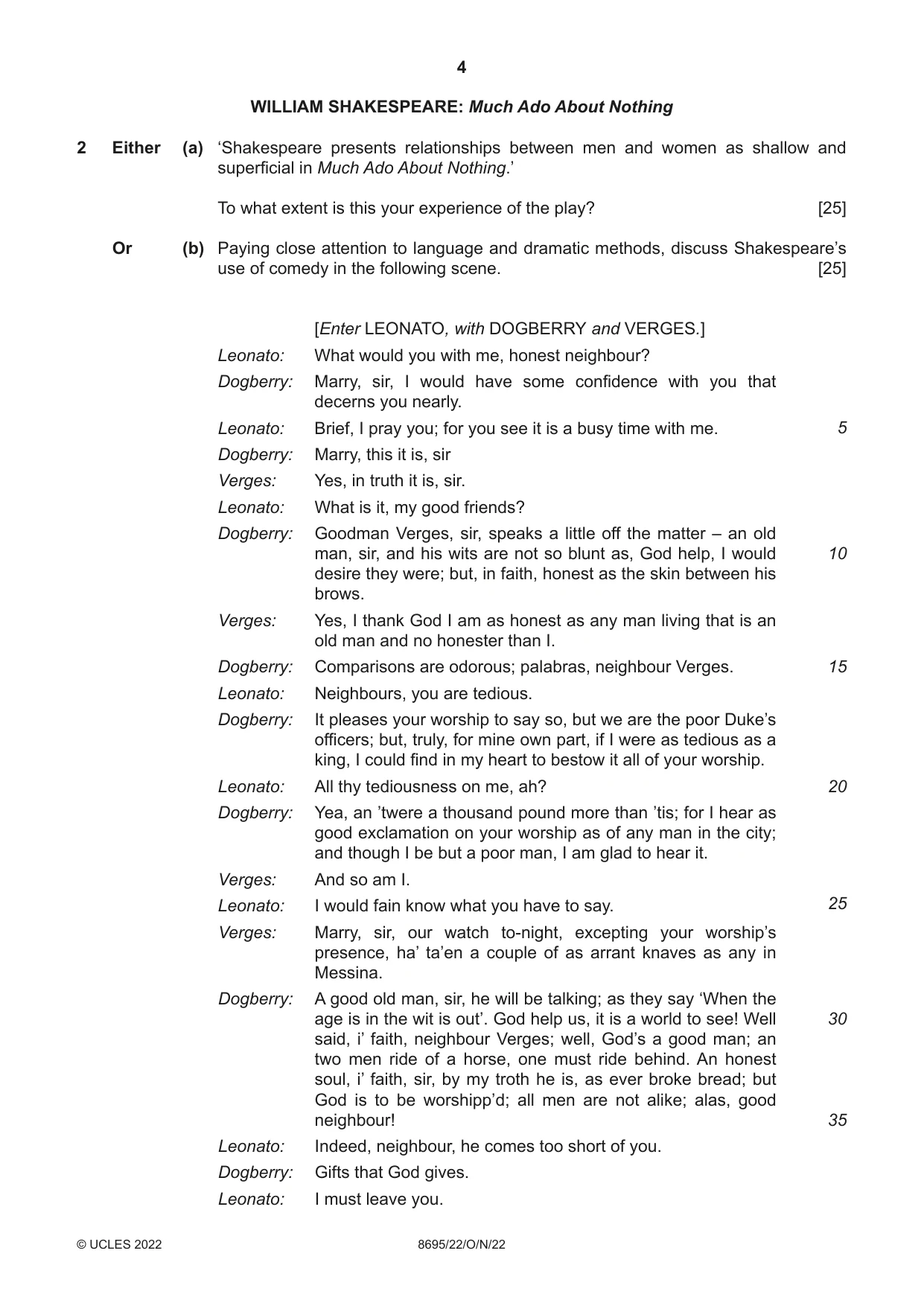
4 8695/22/O/N/22 © UCLES 2022 WILLIAM SHAKESPEARE: Much Ado About Nothing 2 Either (a) ‘Shakespeare presents relationships between men and women as shallow and superficial in Much Ado About Nothing.’ To what extent is this your experience of the play? [25] Or (b) Paying close attention to language and dramatic methods, discuss Shakespeare’s use of comedy in the following scene. [25] [Enter LEONATO, with DOGBERRY and VERGES.] Leonato: What would you with me, honest neighbour? Dogberry: Marry, sir, I would have some confidence with you that decerns you nearly. Leonato: Brief, I pray you; for you see it is a busy time with me. Dogberry: Marry, this it is, sir Verges: Yes, in truth it is, sir. Leonato: What is it, my good friends? Dogberry: Goodman Verges, sir, speaks a little off the matter – an old man, sir, and his wits are not so blunt as, God help, I would desire they were; but, in faith, honest as the skin between his brows. Verges: Yes, I thank God I am as honest as any man living that is an old man and no honester than I. Dogberry: Comparisons are odorous; palabras, neighbour Verges. Leonato: Neighbours, you are tedious. Dogberry: It pleases your worship to say so, but we are the poor Duke’s officers; but, truly, for mine own part, if I were as tedious as a king, I could find in my heart to bestow it all of your worship. Leonato: All thy tediousness on me, ah? Dogberry: Yea, an ’twere a thousand pound more than ’tis; for I hear as good exclamation on your worship as of any man in the city; and though I be but a poor man, I am glad to hear it. Verges: And so am I. Leonato: I would fain know what you have to say. Verges: Marry, sir, our watch to-night, excepting your worship’s presence, ha’ ta’en a couple of as arrant knaves as any in Messina. Dogberry: A good old man, sir, he will be talking; as they say ‘When the age is in the wit is out’. God help us, it is a world to see! Well said, i’ faith, neighbour Verges; well, God’s a good man; an two men ride of a horse, one must ride behind. An honest soul, i’ faith, sir, by my troth he is, as ever broke bread; but God is to be worshipp’d; all men are not alike; alas, good neighbour! Leonato: Indeed, neighbour, he comes too short of you. Dogberry: Gifts that God gives. Leonato: I must leave you. 5 10 15 20 25 30 35
Question paper, page 5
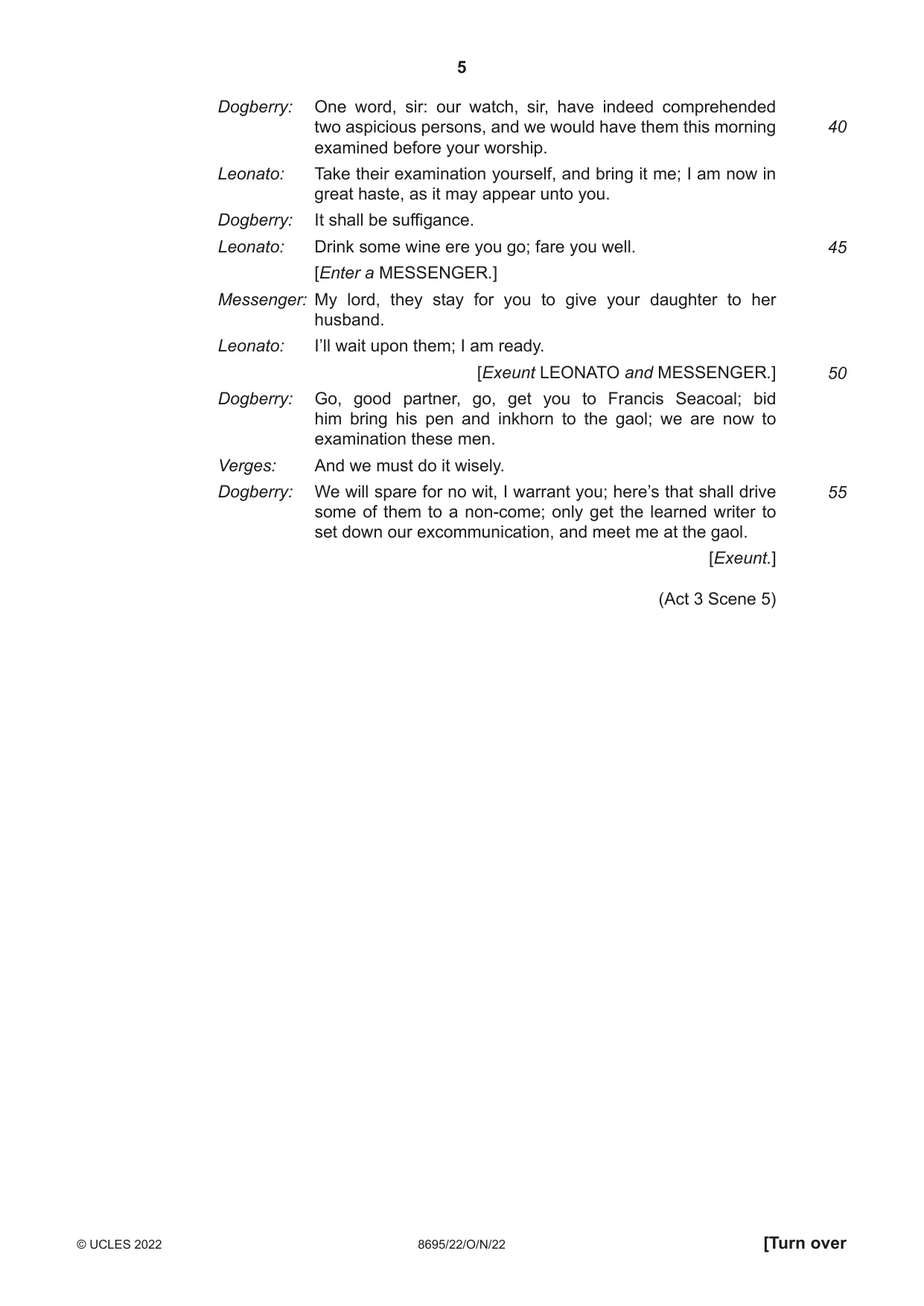
5 8695/22/O/N/22 © UCLES 2022 [Turn over Dogberry: One word, sir: our watch, sir, have indeed comprehended two aspicious persons, and we would have them this morning examined before your worship. Leonato: Take their examination yourself, and bring it me; I am now in great haste, as it may appear unto you. Dogberry: It shall be suffigance. Leonato: Drink some wine ere you go; fare you well. [Enter a MESSENGER.] Messenger: My lord, they stay for you to give your daughter to her husband. Leonato: I’ll wait upon them; I am ready. [Exeunt LEONATO and MESSENGER.] Dogberry: Go, good partner, go, get you to Francis Seacoal; bid him bring his pen and inkhorn to the gaol; we are now to examination these men. Verges: And we must do it wisely. Dogberry: We will spare for no wit, I warrant you; here’s that shall drive some of them to a non-come; only get the learned writer to set down our excommunication, and meet me at the gaol. [Exeunt.] (Act 3 Scene 5) 40 45 50 55
Question paper, page 6
6 8695/22/O/N/22 © UCLES 2022 WOLE SOYINKA: The Trials of Brother Jero and Jero’s Metamorphosis 3 Either (a) In what ways, and with what dramatic effects, does Soyinka present deception in these plays? [25] Or (b) Discuss Soyinka’s presentation of Rebecca in the following extract from Jero’s Metamorphosis. In your answer you should pay close attention to dramatic methods and their effects. [25] Rebecca [pitying]: It is the devil which speaks in you sir, it’s the devil which makes you call Prophet Jeroboam all those bad names. Content removed due to copyright restrictions.
Question paper, page 7
7 8695/22/O/N/22 © UCLES 2022 [Turn over Ananaias: And this sinner, lord, and this sinner! (from Jero’s Metamorphosis, Scene 1) Content removed due to copyright restrictions.
Question paper, page 8
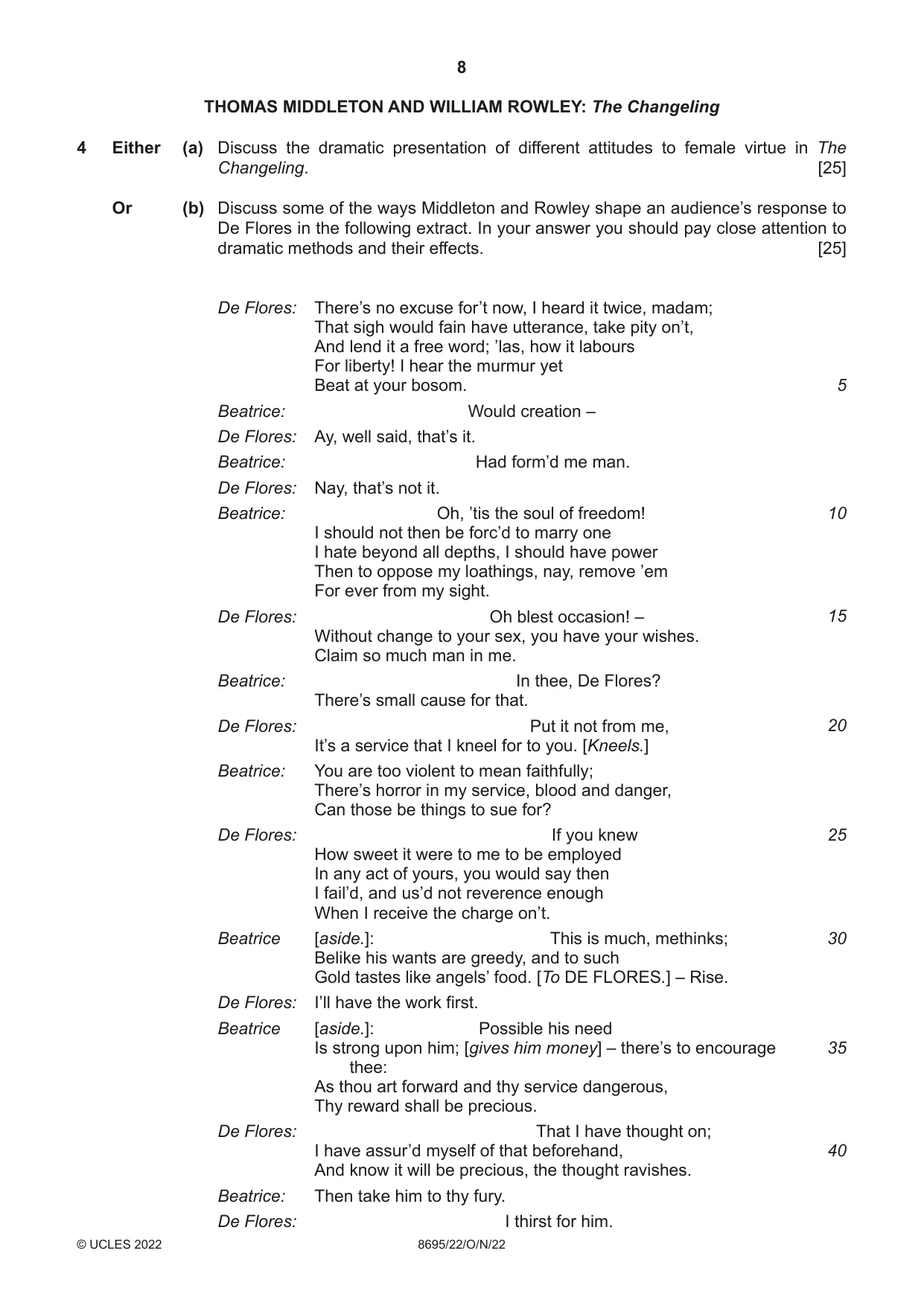
8 8695/22/O/N/22 © UCLES 2022 THOMAS MIDDLETON AND WILLIAM ROWLEY: The Changeling 4 Either (a) Discuss the dramatic presentation of different attitudes to female virtue in The Changeling. [25] Or (b) Discuss some of the ways Middleton and Rowley shape an audience’s response to De Flores in the following extract. In your answer you should pay close attention to dramatic methods and their effects. [25] De Flores: There’s no excuse for’t now, I heard it twice, madam; That sigh would fain have utterance, take pity on’t, And lend it a free word; ’las, how it labours For liberty! I hear the murmur yet Beat at your bosom. Beatrice: Would creation – De Flores: Ay, well said, that’s it. Beatrice: Had form’d me man. De Flores: Nay, that’s not it. Beatrice: Oh, ’tis the soul of freedom! I should not then be forc’d to marry one I hate beyond all depths, I should have power Then to oppose my loathings, nay, remove ’em For ever from my sight. De Flores: Oh blest occasion! – Without change to your sex, you have your wishes. Claim so much man in me. Beatrice: In thee, De Flores? There’s small cause for that. De Flores: Put it not from me, It’s a service that I kneel for to you. [Kneels.] Beatrice: You are too violent to mean faithfully; There’s horror in my service, blood and danger, Can those be things to sue for? De Flores: If you knew How sweet it were to me to be employed In any act of yours, you would say then I fail’d, and us’d not reverence enough When I receive the charge on’t. Beatrice [aside.]: This is much, methinks; Belike his wants are greedy, and to such Gold tastes like angels’ food. [To DE FLORES.] – Rise. De Flores: I’ll have the work first. Beatrice [aside.]: Possible his need Is strong upon him; [gives him money] – there’s to encourage thee: As thou art forward and thy service dangerous, Thy reward shall be precious. De Flores: That I have thought on; I have assur’d myself of that beforehand, And know it will be precious, the thought ravishes. Beatrice: Then take him to thy fury. De Flores: I thirst for him. 5 10 15 20 25 30 35 40
Question paper, page 9
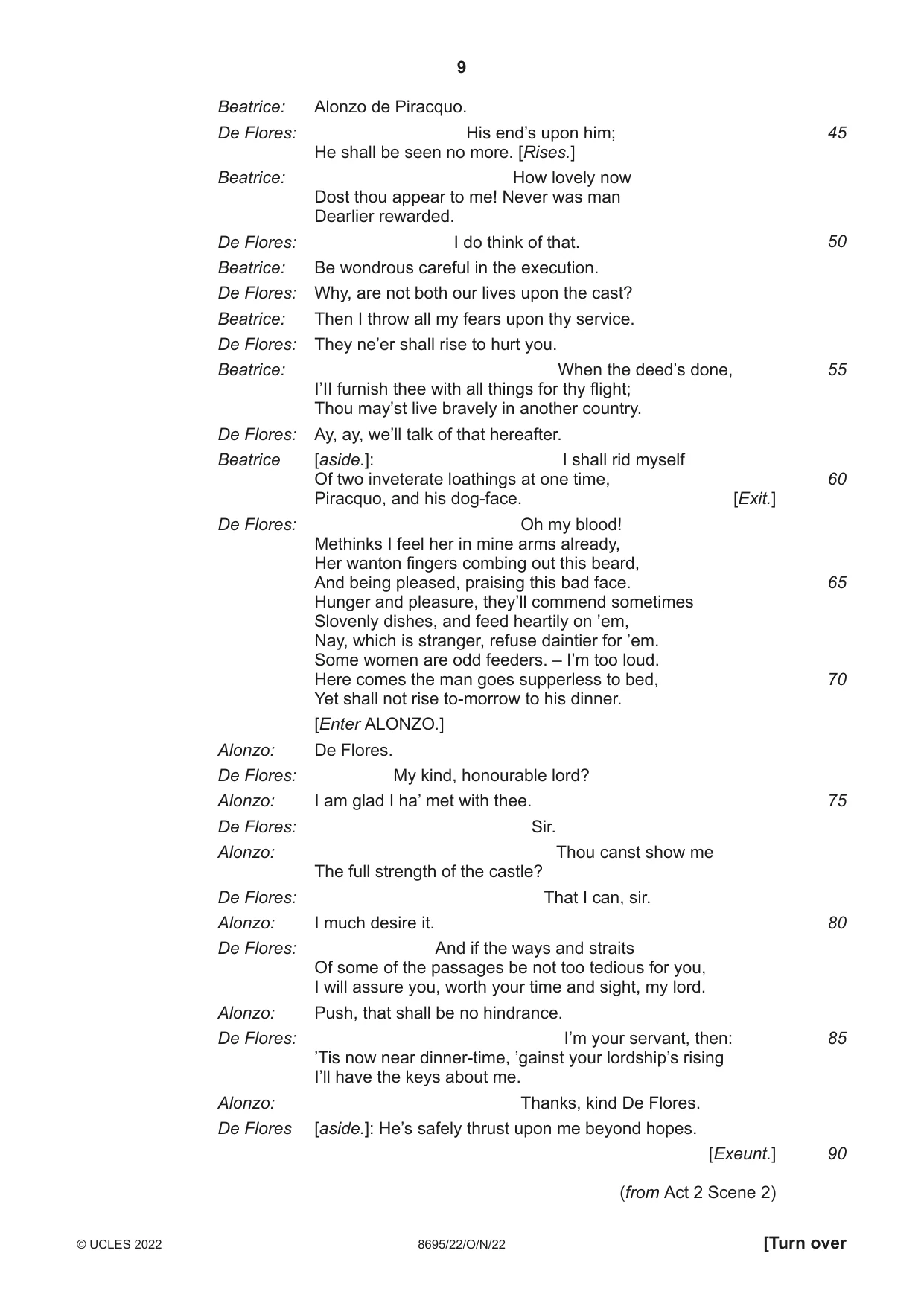
9 8695/22/O/N/22 © UCLES 2022 [Turn over Beatrice: Alonzo de Piracquo. De Flores: His end’s upon him; He shall be seen no more. [Rises.] Beatrice: How lovely now Dost thou appear to me! Never was man Dearlier rewarded. De Flores: Ι do think of that. Beatrice: Be wondrous careful in the execution. De Flores: Why, are not both our lives upon the cast? Beatrice: Then I throw all my fears upon thy service. De Flores: They ne’er shall rise to hurt you. Beatrice: When the deed’s done, I’II furnish thee with all things for thy flight; Thou may’st live bravely in another country. De Flores: Ay, ay, we’ll talk of that hereafter. Beatrice [aside.]: I shall rid myself Of two inveterate loathings at one time, Piracquo, and his dog-face. [Exit.] De Flores: Oh my blood! Methinks I feel her in mine arms already, Her wanton fingers combing out this beard, And being pleased, praising this bad face. Hunger and pleasure, they’ll commend sometimes Slovenly dishes, and feed heartily on ’em, Nay, which is stranger, refuse daintier for ’em. Some women are odd feeders. – I’m too loud. Here comes the man goes supperless to bed, Yet shall not rise to-morrow to his dinner. [Enter ALONZO.] Alonzo: De Flores. De Flores: My kind, honourable lord? Alonzo: I am glad I ha’ met with thee. De Flores: Sir. Alonzo: Thou canst show me The full strength of the castle? De Flores: That I can, sir. Alonzo: I much desire it. De Flores: And if the ways and straits Of some of the passages be not too tedious for you, I will assure you, worth your time and sight, my lord. Alonzo: Push, that shall be no hindrance. De Flores: I’m your servant, then: ’Tis now near dinner-time, ’gainst your lordship’s rising I’ll have the keys about me. Alonzo: Thanks, kind De Flores. De Flores [aside.]: He’s safely thrust upon me beyond hopes. [Exeunt.] (from Act 2 Scene 2) 45 50 55 60 65 70 75 80 85 90
Question paper, page 10
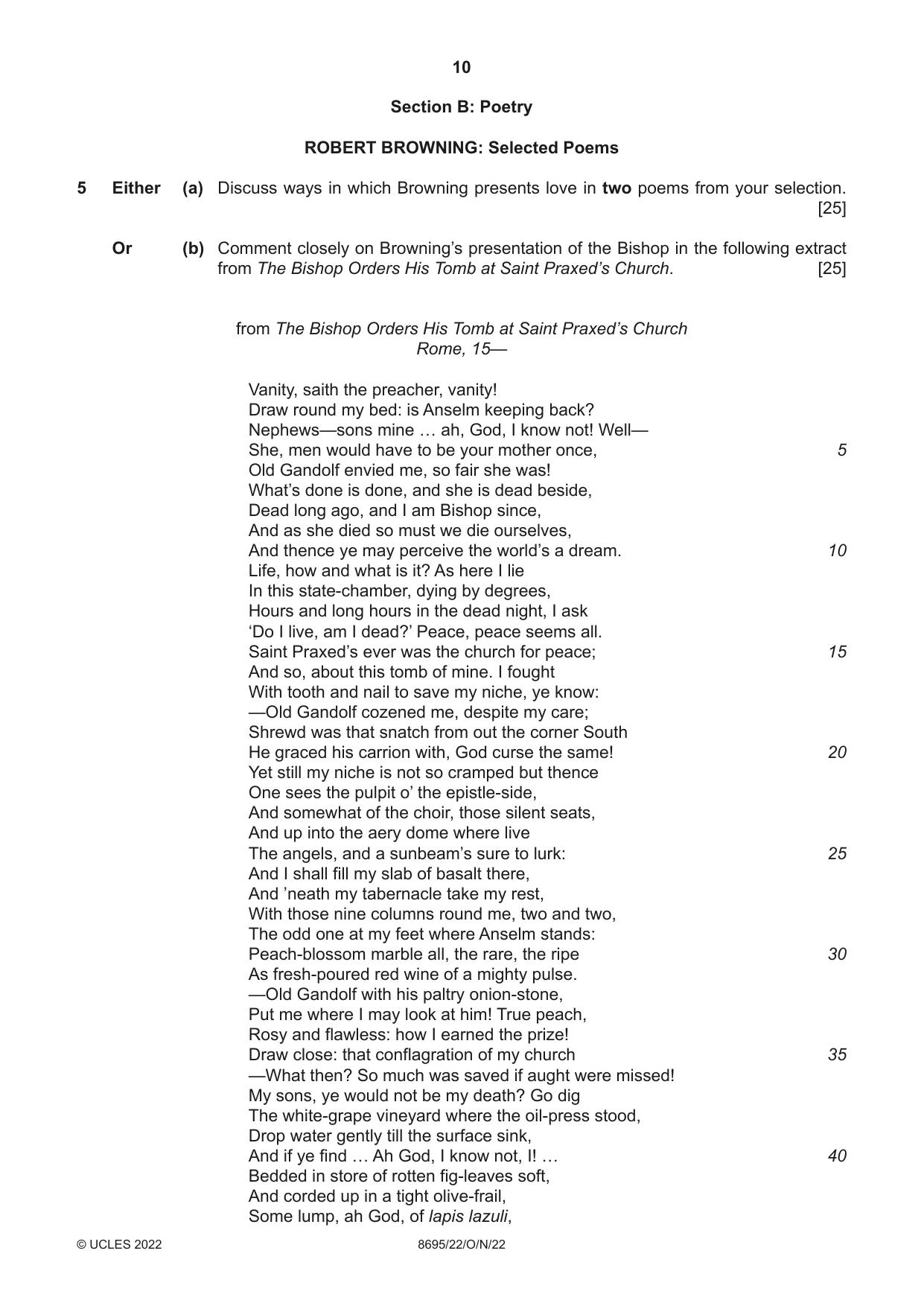
10 8695/22/O/N/22 © UCLES 2022 Section B: Poetry ROBERT BROWNING: Selected Poems 5 Either (a) Discuss ways in which Browning presents love in two poems from your selection. [25] Or (b) Comment closely on Browning’s presentation of the Bishop in the following extract from The Bishop Orders His Tomb at Saint Praxed’s Church. [25] from The Bishop Orders His Tomb at Saint Praxed’s Church Rome, 15— Vanity, saith the preacher, vanity! Draw round my bed: is Anselm keeping back? Nephews—sons mine … ah, God, I know not! Well— She, men would have to be your mother once, Old Gandolf envied me, so fair she was! What’s done is done, and she is dead beside, Dead long ago, and I am Bishop since, And as she died so must we die ourselves, And thence ye may perceive the world’s a dream. Life, how and what is it? As here I lie In this state-chamber, dying by degrees, Hours and long hours in the dead night, I ask ‘Do I live, am I dead?’ Peace, peace seems all. Saint Praxed’s ever was the church for peace; And so, about this tomb of mine. I fought With tooth and nail to save my niche, ye know: —Old Gandolf cozened me, despite my care; Shrewd was that snatch from out the corner South He graced his carrion with, God curse the same! Yet still my niche is not so cramped but thence One sees the pulpit o’ the epistle-side, And somewhat of the choir, those silent seats, And up into the aery dome where live The angels, and a sunbeam’s sure to lurk: And I shall fill my slab of basalt there, And ’neath my tabernacle take my rest, With those nine columns round me, two and two, The odd one at my feet where Anselm stands: Peach-blossom marble all, the rare, the ripe As fresh-poured red wine of a mighty pulse. —Old Gandolf with his paltry onion-stone, Put me where I may look at him! True peach, Rosy and flawless: how I earned the prize! Draw close: that conflagration of my church —What then? So much was saved if aught were missed! My sons, ye would not be my death? Go dig The white-grape vineyard where the oil-press stood, Drop water gently till the surface sink, And if ye find … Ah God, I know not, I! … Bedded in store of rotten fig-leaves soft, And corded up in a tight olive-frail, Some lump, ah God, of lapis lazuli, 5 10 15 20 25 30 35 40
Question paper, page 11
11 8695/22/O/N/22 © UCLES 2022 [Turn over Big as a Jew’s head cut off at the nape, Blue as a vein o’er the Madonna’s breast … Sons, all have I bequeathed you, villas, all, That brave Frascati villa with its bath, So, let the blue lump poise between my knees, Like God the Father’s globe on both his hands Ye worship in the Jesu Church so gay, For Gandolf shall not choose but see and burst! 45 50
Question paper, page 12
12 8695/22/O/N/22 © UCLES 2022 OWEN SHEERS: Skirrid Hill 6 Either (a) Discuss the writing and effects of two poems from Skirrid Hill, in which Sheers explores human responses to the natural world. [25] Or (b) Discuss Sheers’s presentation of the relationship in the following poem. In your answer you should comment in detail on poetic methods. [25] Night Windows That night we turned some of them off trailing the dress of your shadow behind you. Content removed due to copyright restrictions.
Question paper, page 13
13 8695/22/O/N/22 © UCLES 2022 [Turn over Songs of Ourselves, Volume 2 7 Either (a) Discuss ways in which two poems present relationships between men and women. [25] Or (b) Comment closely on the following poem, analysing ways in which Jonathan Swift presents Jove. [25] On the Day of Judgement With a whirl of thought oppressed, I sink from reverie to rest. An horrid vision seized my head, I saw the graves give up their dead. Jove, armed with terrors, burst the skies, And thunder roars, and light’ning flies! Amazed, confused, its fate unknown, The world stands trembling at his throne. While each pale sinner hangs his head, Jove, nodding, shook the heav’ns, and said, ‘Offending race of human kind, By nature, reason, learning, blind; You who through frailty stepped aside, And you who never fell—through pride; You who in different sects have shammed, And come to see each other damned; (So some folks told you, but they knew No more of Jove’s designs than you); The world’s mad business now is o’er, And I resent these pranks no more. I to such blockheads set my wit! I damn such fools!—Go, go, you’re bit.’ (Jonathan Swift) 5 10 15 20
Question paper, page 14
14 8695/22/O/N/22 © UCLES 2022 GILLIAN CLARKE: Selected Poems 8 Either (a) Discuss the writing and effects of two poems in which Clarke presents family life. [25] Or (b) Comment closely on the following poem, considering ways in which Clarke presents the mother and daughter. [25] Catrin I can remember you, child, As I stood in a hot, white Room at the window watching The people and cars taking Turn at the traffic lights. I can remember you, our first Fierce confrontation, the tight Red rope of love which we both Fought over. It was a square Environmental blank, disinfected Of paintings or toys. I wrote All over the walls with my Words, coloured the clean squares With the wild, tender circles Of our struggle to become Separate. We want, we shouted, To be two, to be ourselves. Neither won nor lost the struggle In the glass tank clouded with feelings Which changed us both. Still I am fighting You off, as you stand there With your straight, strong, long Brown hair and your rosy, Defiant glare, bringing up From the heart’s pool that old rope, Tightening about my life, Trailing love and conflict, As you ask may you skate In the dark, for one more hour. 5 10 15 20 25
Question paper, page 15
15 8695/22/O/N/22 © UCLES 2022 [Turn over TURN OVER FOR SECTION C.
Question paper, page 16
16 8695/22/O/N/22 © UCLES 2022 Section C: Prose IAN McEWAN: Atonement 9 Either (a) ‘Lola is central to the novel, but McEwan never gives her point of view.’ Discuss the presentation and role of Lola in the light of this comment. [25] Or (b) Comment closely on the following passage, considering McEwan’s presentation of Briony’s attitudes towards her writing. [25] But she knew very well that if she had not stood when she did, the scene would still have happened, for it was not about her at all. She also knew that whatever actually happened drew its significance from her published work and would not have been remembered without it. (from Part 1 Chapter 3) Content removed due to copyright restrictions.
Question paper, page 17
17 8695/22/O/N/22 © UCLES 2022 [Turn over NGŨGĨ WA THIONG’O: Petals of Blood 10 Either (a) Discuss ways in which Ngũgĩ presents the KCO and their ‘invitations to tea’, considering their significance to the novel. [25] Or (b) Comment closely on the following passage, considering ways in which Ngũgĩ presents Wanja and her influence on others. [25] She had turned her energy and time, after Karega had disappeared, into work. Dreams of love returned. (from Chapter 11) Content removed due to copyright restrictions.
Question paper, page 18
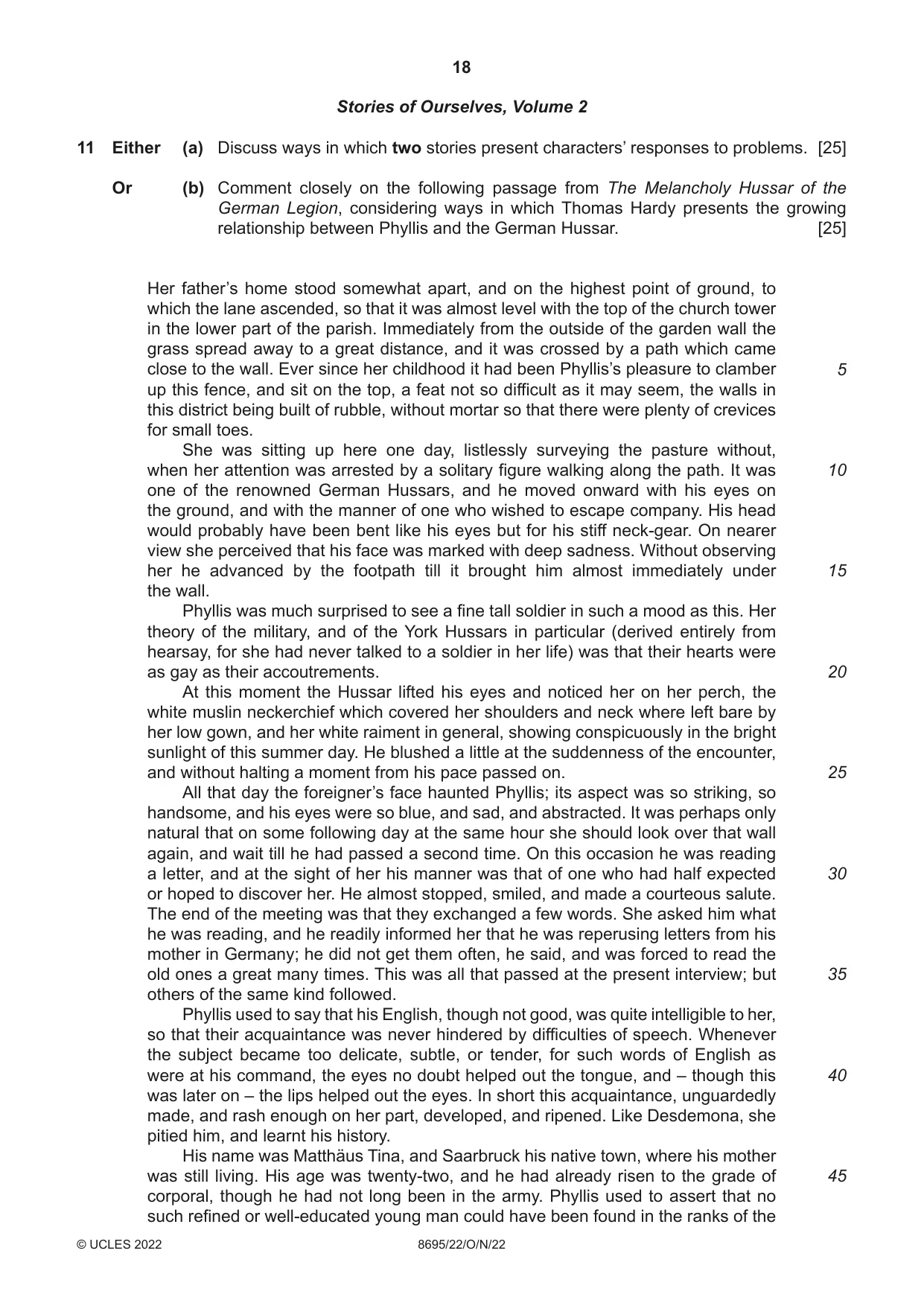
18 8695/22/O/N/22 © UCLES 2022 Stories of Ourselves, Volume 2 11 Either (a) Discuss ways in which two stories present characters’ responses to problems. [25] Or (b) Comment closely on the following passage from The Melancholy Hussar of the German Legion, considering ways in which Thomas Hardy presents the growing relationship between Phyllis and the German Hussar. [25] Her father’s home stood somewhat apart, and on the highest point of ground, to which the lane ascended, so that it was almost level with the top of the church tower in the lower part of the parish. Immediately from the outside of the garden wall the grass spread away to a great distance, and it was crossed by a path which came close to the wall. Ever since her childhood it had been Phyllis’s pleasure to clamber up this fence, and sit on the top, a feat not so difficult as it may seem, the walls in this district being built of rubble, without mortar so that there were plenty of crevices for small toes. She was sitting up here one day, listlessly surveying the pasture without, when her attention was arrested by a solitary figure walking along the path. It was one of the renowned German Hussars, and he moved onward with his eyes on the ground, and with the manner of one who wished to escape company. His head would probably have been bent like his eyes but for his stiff neck-gear. On nearer view she perceived that his face was marked with deep sadness. Without observing her he advanced by the footpath till it brought him almost immediately under the wall. Phyllis was much surprised to see a fine tall soldier in such a mood as this. Her theory of the military, and of the York Hussars in particular (derived entirely from hearsay, for she had never talked to a soldier in her life) was that their hearts were as gay as their accoutrements. At this moment the Hussar lifted his eyes and noticed her on her perch, the white muslin neckerchief which covered her shoulders and neck where left bare by her low gown, and her white raiment in general, showing conspicuously in the bright sunlight of this summer day. He blushed a little at the suddenness of the encounter, and without halting a moment from his pace passed on. All that day the foreigner’s face haunted Phyllis; its aspect was so striking, so handsome, and his eyes were so blue, and sad, and abstracted. It was perhaps only natural that on some following day at the same hour she should look over that wall again, and wait till he had passed a second time. On this occasion he was reading a letter, and at the sight of her his manner was that of one who had half expected or hoped to discover her. He almost stopped, smiled, and made a courteous salute. The end of the meeting was that they exchanged a few words. She asked him what he was reading, and he readily informed her that he was reperusing letters from his mother in Germany; he did not get them often, he said, and was forced to read the old ones a great many times. This was all that passed at the present interview; but others of the same kind followed. Phyllis used to say that his English, though not good, was quite intelligible to her, so that their acquaintance was never hindered by difficulties of speech. Whenever the subject became too delicate, subtle, or tender, for such words of English as were at his command, the eyes no doubt helped out the tongue, and – though this was later on – the lips helped out the eyes. In short this acquaintance, unguardedly made, and rash enough on her part, developed, and ripened. Like Desdemona, she pitied him, and learnt his history. His name was Matthäus Tina, and Saarbruck his native town, where his mother was still living. His age was twenty-two, and he had already risen to the grade of corporal, though he had not long been in the army. Phyllis used to assert that no such refined or well-educated young man could have been found in the ranks of the 5 10 15 20 25 30 35 40 45
Question paper, page 19
19 8695/22/O/N/22 © UCLES 2022 [Turn over purely English regiments, some of these foreign soldiers having rather the graceful manner and presence of our native officers than of our rank and file. She by degrees learnt from her foreign friend a circumstance about himself and his comrades which Phyllis would least have expected of the York Hussars. So far from being as gay as its uniform the regiment was pervaded by a dreadful melancholy, a chronic home-sickness, which depressed many of the men to such an extent that they could hardly attend to their drill. The worst sufferers were the younger soldiers who had not been over here long. (from The Melancholy Hussar of the German Legion) 50 55
Question paper, page 20
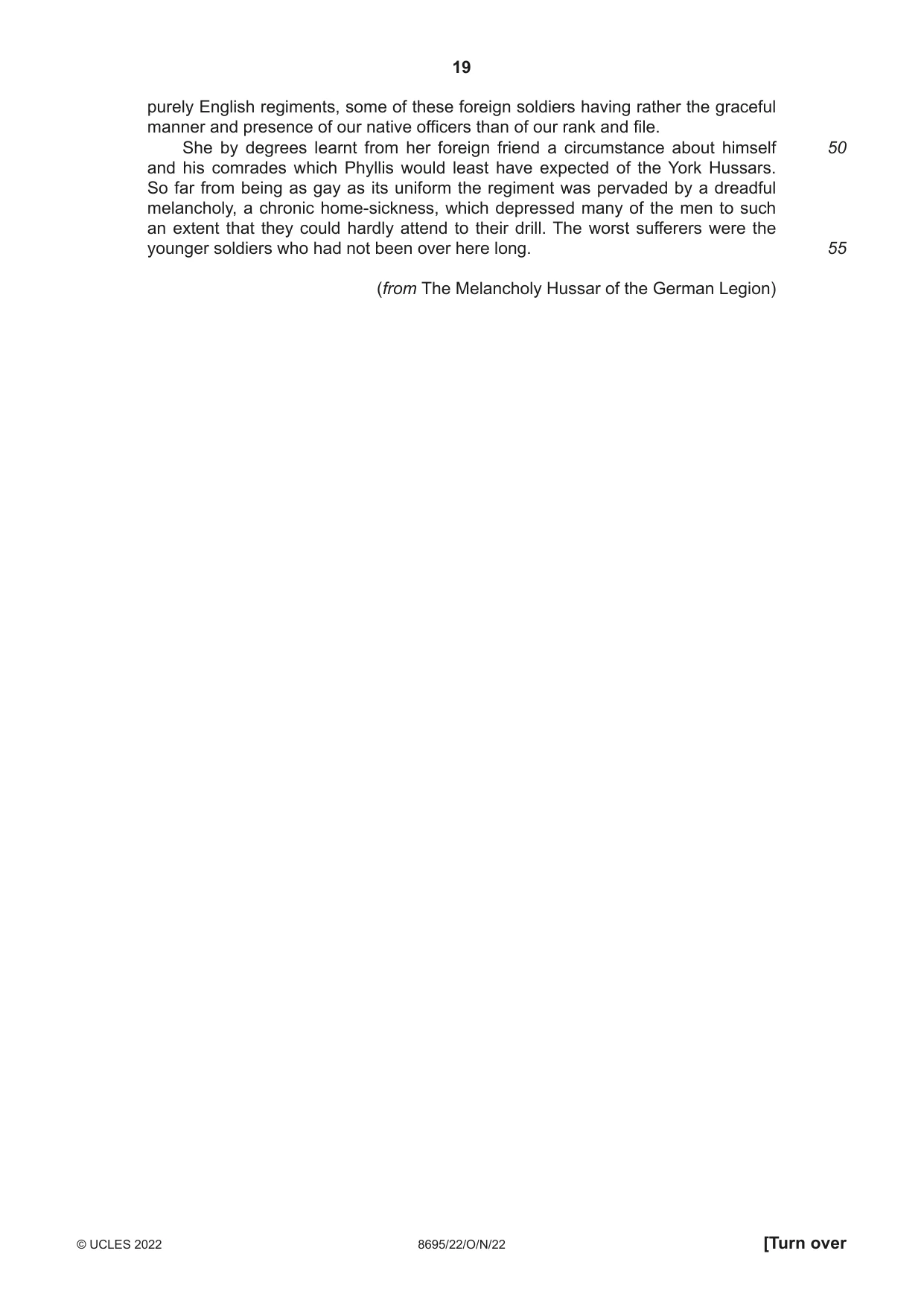
20 8695/22/O/N/22 © UCLES 2022 MARK TWAIN: The Adventures of Huckleberry Finn 12 Either (a) Discuss ways in which Twain presents deception in the novel. [25] Or (b) Comment closely on ways in which Twain presents the developing relationship between Huck and Jim in the following passage. [25] ‘Well, den, I reck’n I did dream it, Huck; but dog my cats ef it ain’t de powerfullest dream I ever see. En I hain’t ever had no dream b’fo’ dat’s tired me like dis one.’ ‘Oh, well, that’s all right, because a dream does tire a body like everything, sometimes. But this one was a staving dream – tell me all about it, Jim.’ So Jim went to work and told me the whole thing right through, just as it happened, only he painted it up considerable. Then he said he must start in and ‘’terpret’ it, because it was sent for a warning. He said the first tow-head stood for a man that would try to do us some good, but the current was another man that would get us away from him. The whoops was warnings that would come to us every now and then, and if we didn’t try hard to make out to understand them they’d just take us into bad luck, ’stead of keeping us out of it. The lot of tow-heads was troubles we was going to get into with quarrelsome people and all kinds of mean folks, but if we minded our business and didn’t talk back and aggravate them, we would pull through and get out of the fog and into the big clear river, which was the free States, and wouldn’t have no more trouble. It had clouded up pretty dark just after I got onto the raft, but it was clearing up again, now. ‘Oh, well, that’s all interpreted well enough, as far as it goes, Jim,’ I says; ‘but what does these things stand for?’ It was the leaves and rubbish on the raft, and the smashed oar. You could see them first rate, now. Jim looked at the trash, and then looked at me, and back at the trash again. He had got the dream fixed so strong in his head that he couldn’t seem to shake it loose and get the facts back into its place again, right away. But when he did get the thing straightened around, he looked at me steady, without ever smiling, and says: ‘What do dey stan’ for? I’s gwyne to tell you. When I got all wore out wid work, en wid de callin’ for you, en went to sleep, my heart wuz mos’ broke bekase you wuz los’, en I didn’ k’yer no mo’ what become er me en de raf’. En when I wake up en fine you back again’, all safe en soun’, de tears come en I could a got down on my knees en kiss’ yo’ foot I’s so thankful. En all you wuz thinkin ’bout wuz how you could make a fool uv ole Jim wid a lie. Dat truck dah is trash; en trash is what people is dat puts dirt on de head er dey fren’s en makes ’em ashamed.’ Then he got up slow, and walked to the wigwam, and went in there, without saying anything but that. But that was enough. It made me feel so mean I could almost kissed his foot to get him to take it back. It was fifteen minutes before I could work myself up to go and humble myself to a nigger – but I done it, and I warn’t ever sorry for it afterwards, neither. I didn’t do him no more mean tricks, and I wouldn’t done that one if I’d a knowed it would make him feel that way. (from Chapter 15) 5 10 15 20 25 30 35
Question paper, page 21
21 8695/22/O/N/22 © UCLES 2022 BLANK PAGE
Question paper, page 22
22 8695/22/O/N/22 © UCLES 2022 BLANK PAGE
Question paper, page 23
23 8695/22/O/N/22 © UCLES 2022 BLANK PAGE
Question paper, page 24
24 8695/22/O/N/22 © UCLES 2022 Permission to reproduce items where third-party owned material protected by copyright is included has been sought and cleared where possible. Every reasonable effort has been made by the publisher (UCLES) to trace copyright holders, but if any items requiring clearance have unwittingly been included, the publisher will be pleased to make amends at the earliest possible opportunity. To avoid the issue of disclosure of answer-related information to candidates, all copyright acknowledgements are reproduced online in the Cambridge Assessment International Education Copyright Acknowledgements Booklet. This is produced for each series of examinations and is freely available to download at www.cambridgeinternational.org after the live examination series. Cambridge Assessment International Education is part of Cambridge Assessment. Cambridge Assessment is the brand name of the University of Cambridge Local Examinations Syndicate (UCLES), which is a department of the University of Cambridge. BLANK PAGE
Mark scheme, page 1
This document consists of 13 printed pages. © UCLES 2022 [Turn over Cambridge International AS Level LANGUAGE AND LITERATURE IN ENGLISH 8695/22 Paper 2 Drama, Poetry and Prose October/November 2022 MARK SCHEME Maximum Mark: 50 Published This mark scheme is published as an aid to teachers and candidates, to indicate the requirements of the examination. It shows the basis on which Examiners were instructed to award marks. It does not indicate the details of the discussions that took place at an Examiners’ meeting before marking began, which would have considered the acceptability of alternative answers. Mark schemes should be read in conjunction with the question paper and the Principal Examiner Report for Teachers. Cambridge International will not enter into discussions about these mark schemes. Cambridge International is publishing the mark schemes for the October/November 2022 series for most Cambridge IGCSE™, Cambridge International A and AS Level components and some Cambridge O Level components.
Mark scheme, page 2
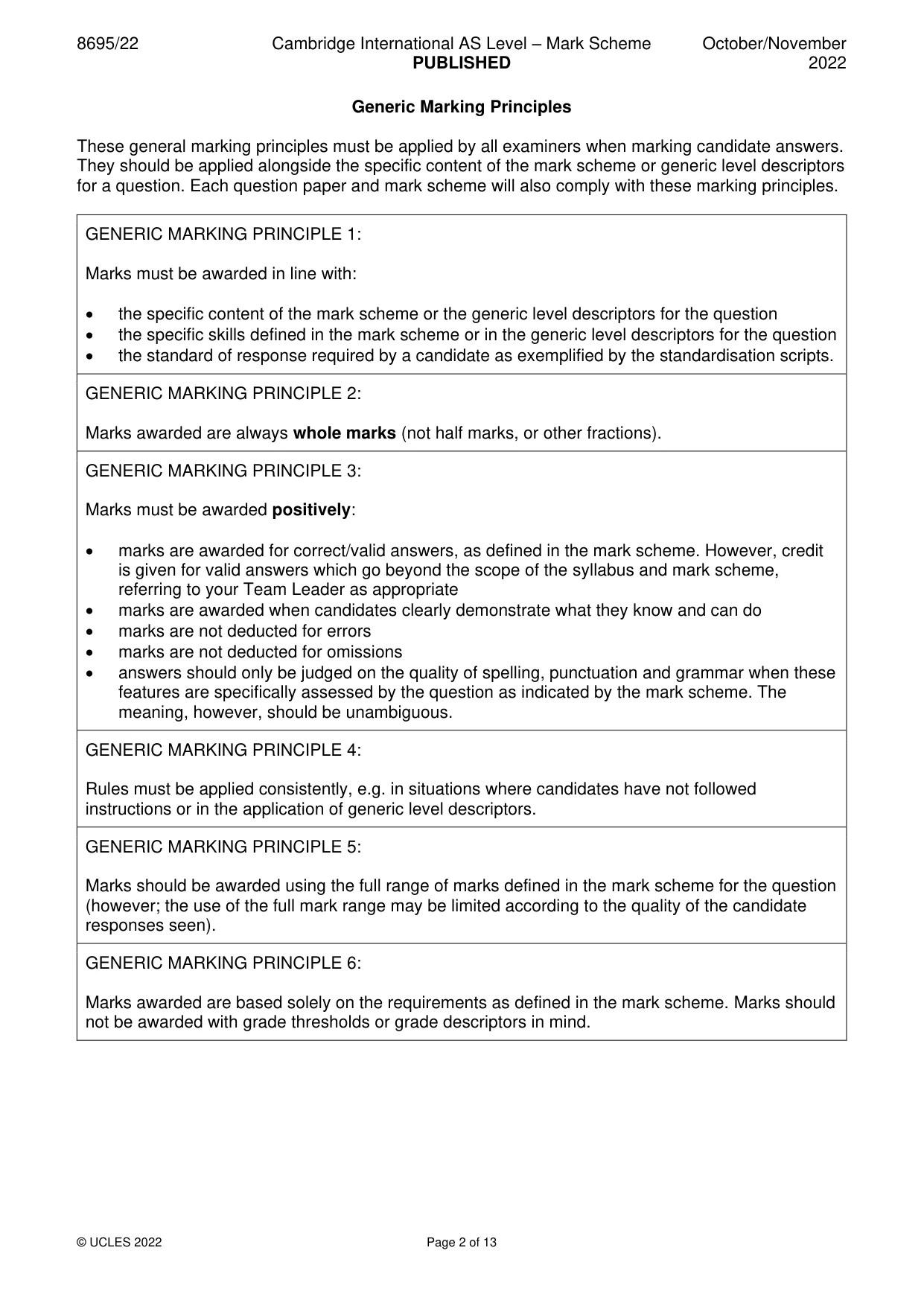
8695/22 Cambridge International AS Level – Mark Scheme PUBLISHED October/November 2022 © UCLES 2022 Page 2 of 13 Generic Marking Principles These general marking principles must be applied by all examiners when marking candidate answers. They should be applied alongside the specific content of the mark scheme or generic level descriptors for a question. Each question paper and mark scheme will also comply with these marking principles. GENERIC MARKING PRINCIPLE 1: Marks must be awarded in line with: • the specific content of the mark scheme or the generic level descriptors for the question • the specific skills defined in the mark scheme or in the generic level descriptors for the question • the standard of response required by a candidate as exemplified by the standardisation scripts. GENERIC MARKING PRINCIPLE 2: Marks awarded are always whole marks (not half marks, or other fractions). GENERIC MARKING PRINCIPLE 3: Marks must be awarded positively: • marks are awarded for correct/valid answers, as defined in the mark scheme. However, credit is given for valid answers which go beyond the scope of the syllabus and mark scheme, referring to your Team Leader as appropriate • marks are awarded when candidates clearly demonstrate what they know and can do • marks are not deducted for errors • marks are not deducted for omissions • answers should only be judged on the quality of spelling, punctuation and grammar when these features are specifically assessed by the question as indicated by the mark scheme. The meaning, however, should be unambiguous. GENERIC MARKING PRINCIPLE 4: Rules must be applied consistently, e.g. in situations where candidates have not followed instructions or in the application of generic level descriptors. GENERIC MARKING PRINCIPLE 5: Marks should be awarded using the full range of marks defined in the mark scheme for the question (however; the use of the full mark range may be limited according to the quality of the candidate responses seen). GENERIC MARKING PRINCIPLE 6: Marks awarded are based solely on the requirements as defined in the mark scheme. Marks should not be awarded with grade thresholds or grade descriptors in mind.
Mark scheme, page 3
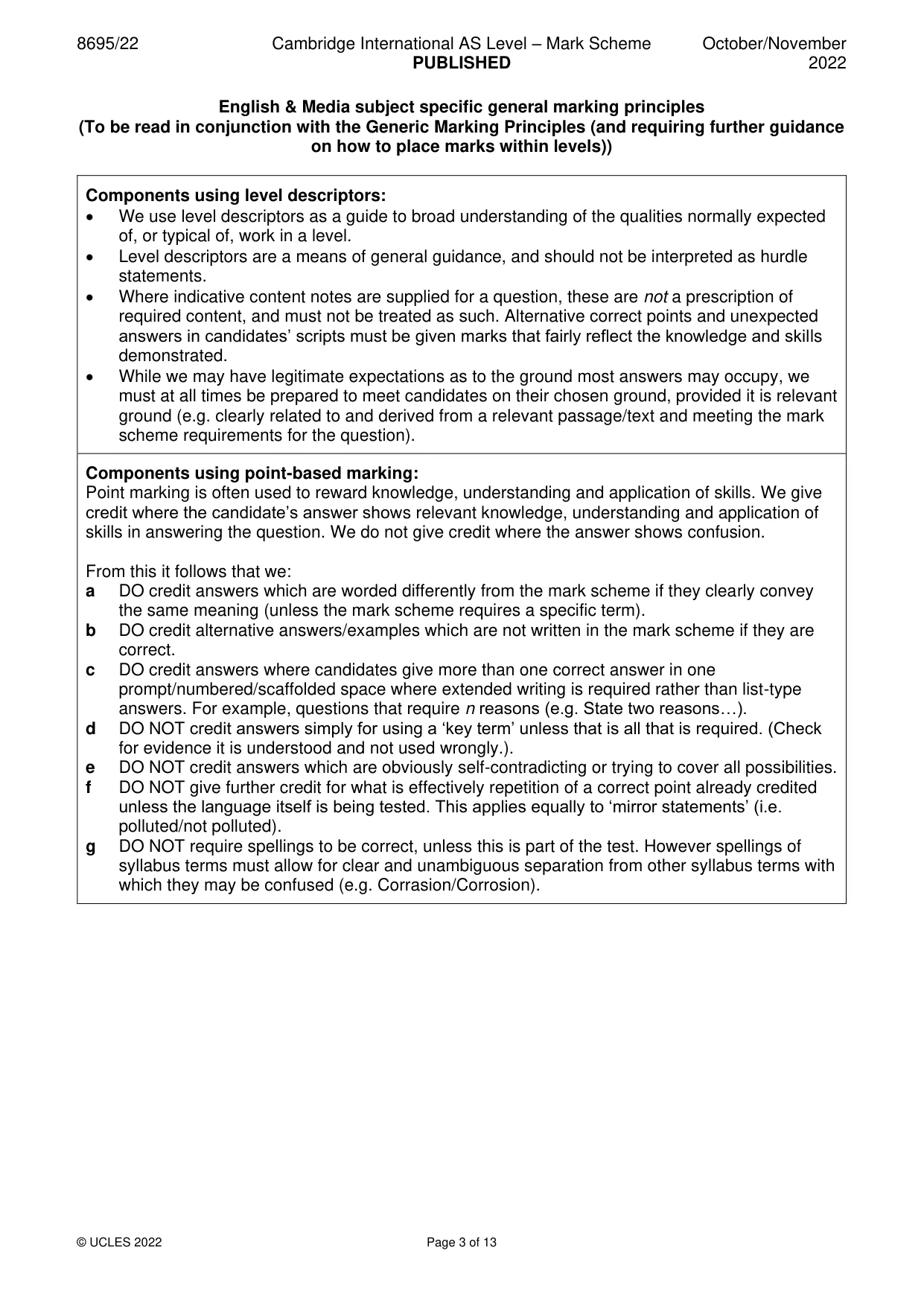
8695/22 Cambridge International AS Level – Mark Scheme PUBLISHED October/November 2022 © UCLES 2022 Page 3 of 13 English & Media subject specific general marking principles (To be read in conjunction with the Generic Marking Principles (and requiring further guidance on how to place marks within levels)) Components using level descriptors: • We use level descriptors as a guide to broad understanding of the qualities normally expected of, or typical of, work in a level. • Level descriptors are a means of general guidance, and should not be interpreted as hurdle statements. • Where indicative content notes are supplied for a question, these are not a prescription of required content, and must not be treated as such. Alternative correct points and unexpected answers in candidates’ scripts must be given marks that fairly reflect the knowledge and skills demonstrated. • While we may have legitimate expectations as to the ground most answers may occupy, we must at all times be prepared to meet candidates on their chosen ground, provided it is relevant ground (e.g. clearly related to and derived from a relevant passage/text and meeting the mark scheme requirements for the question). Components using point-based marking: Point marking is often used to reward knowledge, understanding and application of skills. We give credit where the candidate’s answer shows relevant knowledge, understanding and application of skills in answering the question. We do not give credit where the answer shows confusion. From this it follows that we: a DO credit answers which are worded differently from the mark scheme if they clearly convey the same meaning (unless the mark scheme requires a specific term). b DO credit alternative answers/examples which are not written in the mark scheme if they are correct. c DO credit answers where candidates give more than one correct answer in one prompt/numbered/scaffolded space where extended writing is required rather than list-type answers. For example, questions that require n reasons (e.g. State two reasons…). d DO NOT credit answers simply for using a ‘key term’ unless that is all that is required. (Check for evidence it is understood and not used wrongly.). e DO NOT credit answers which are obviously self-contradicting or trying to cover all possibilities. f DO NOT give further credit for what is effectively repetition of a correct point already credited unless the language itself is being tested. This applies equally to ‘mirror statements’ (i.e. polluted/not polluted). g DO NOT require spellings to be correct, unless this is part of the test. However spellings of syllabus terms must allow for clear and unambiguous separation from other syllabus terms with which they may be confused (e.g. Corrasion/Corrosion).
Mark scheme, page 4
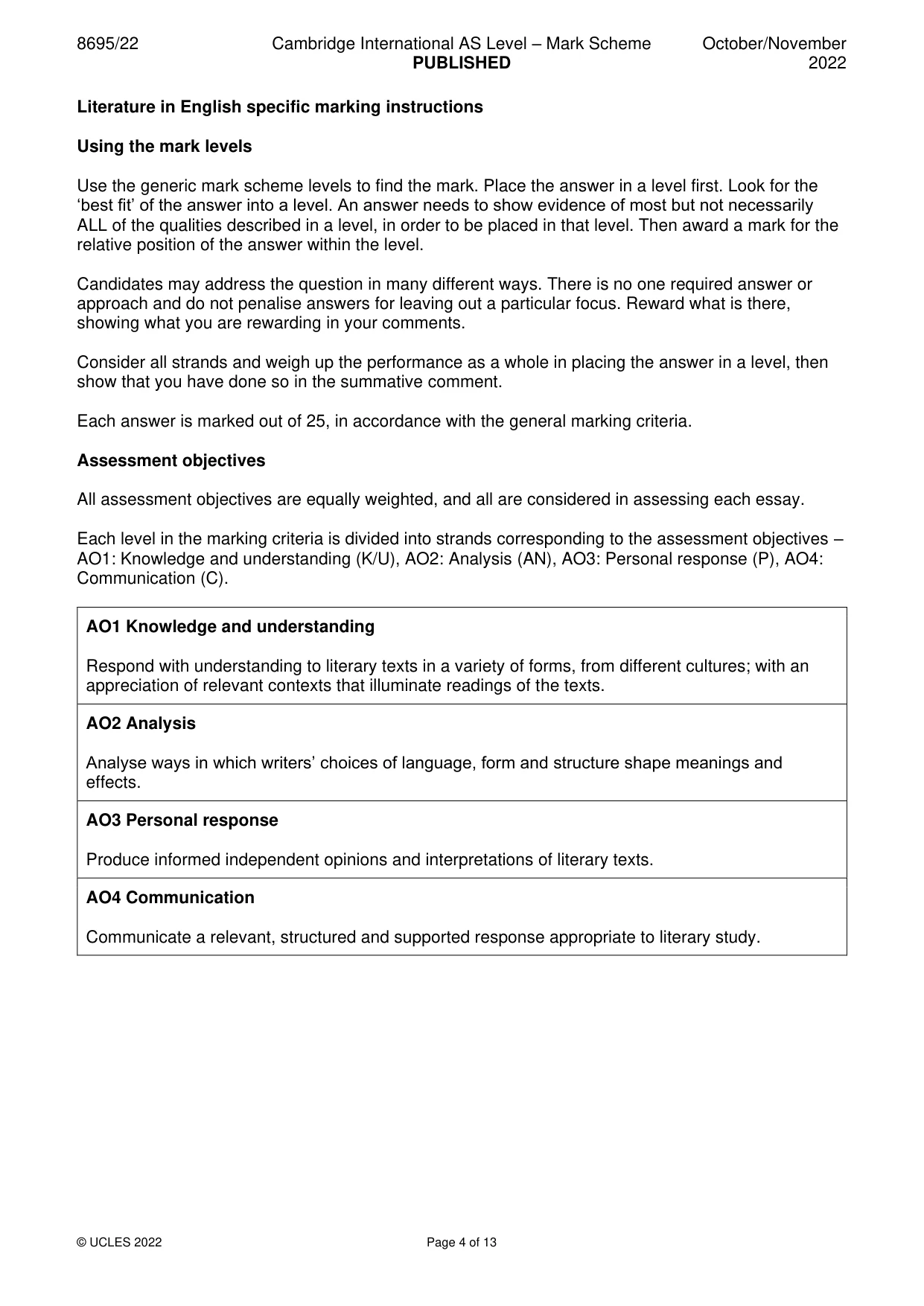
8695/22 Cambridge International AS Level – Mark Scheme PUBLISHED October/November 2022 © UCLES 2022 Page 4 of 13 Literature in English specific marking instructions Using the mark levels Use the generic mark scheme levels to find the mark. Place the answer in a level first. Look for the ‘best fit’ of the answer into a level. An answer needs to show evidence of most but not necessarily ALL of the qualities described in a level, in order to be placed in that level. Then award a mark for the relative position of the answer within the level. Candidates may address the question in many different ways. There is no one required answer or approach and do not penalise answers for leaving out a particular focus. Reward what is there, showing what you are rewarding in your comments. Consider all strands and weigh up the performance as a whole in placing the answer in a level, then show that you have done so in the summative comment. Each answer is marked out of 25, in accordance with the general marking criteria. Assessment objectives All assessment objectives are equally weighted, and all are considered in assessing each essay. Each level in the marking criteria is divided into strands corresponding to the assessment objectives – AO1: Knowledge and understanding (K/U), AO2: Analysis (AN), AO3: Personal response (P), AO4: Communication (C). AO1 Knowledge and understanding Respond with understanding to literary texts in a variety of forms, from different cultures; with an appreciation of relevant contexts that illuminate readings of the texts. AO2 Analysis Analyse ways in which writers’ choices of language, form and structure shape meanings and effects. AO3 Personal response Produce informed independent opinions and interpretations of literary texts. AO4 Communication Communicate a relevant, structured and supported response appropriate to literary study.
Mark scheme, page 5
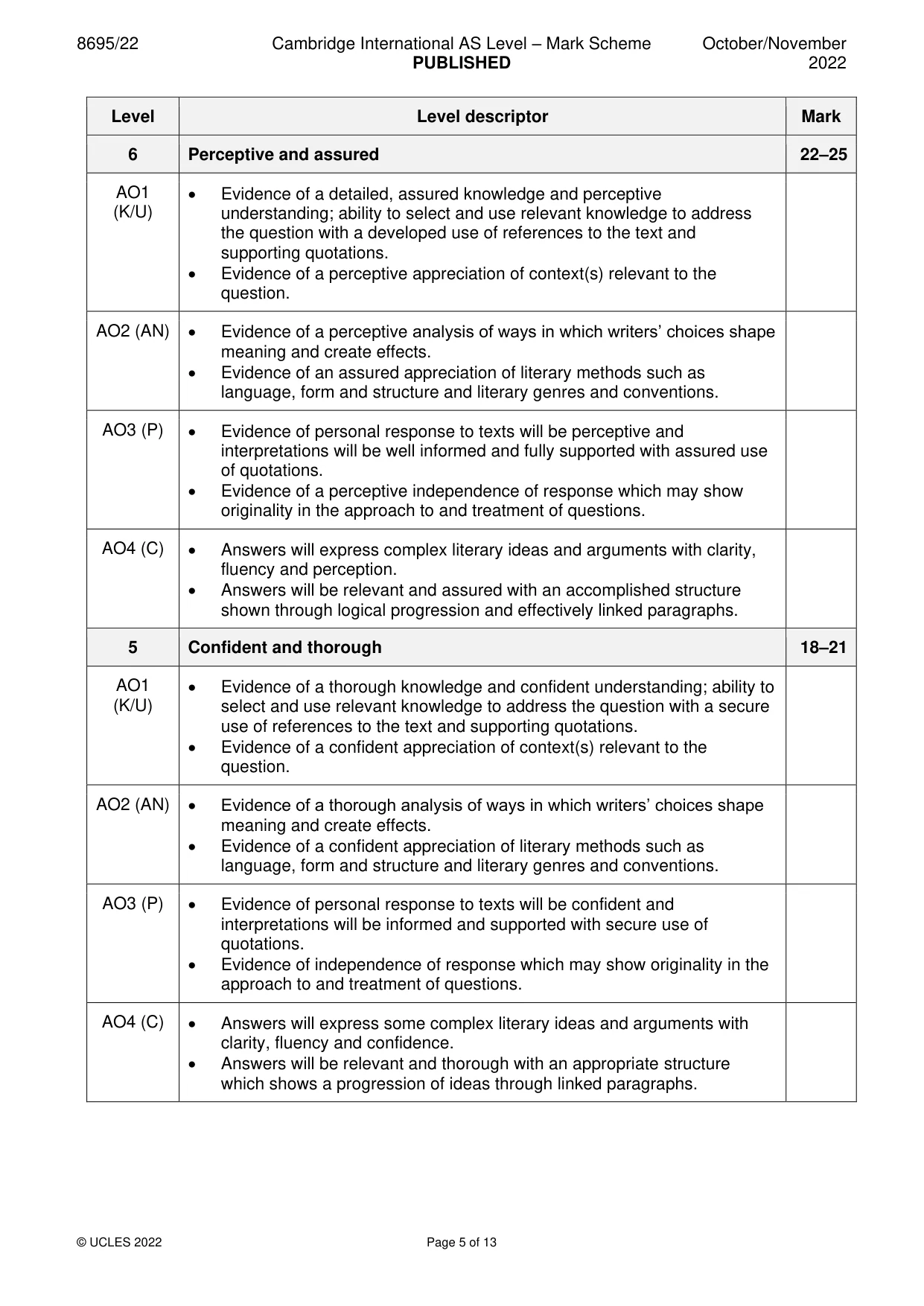
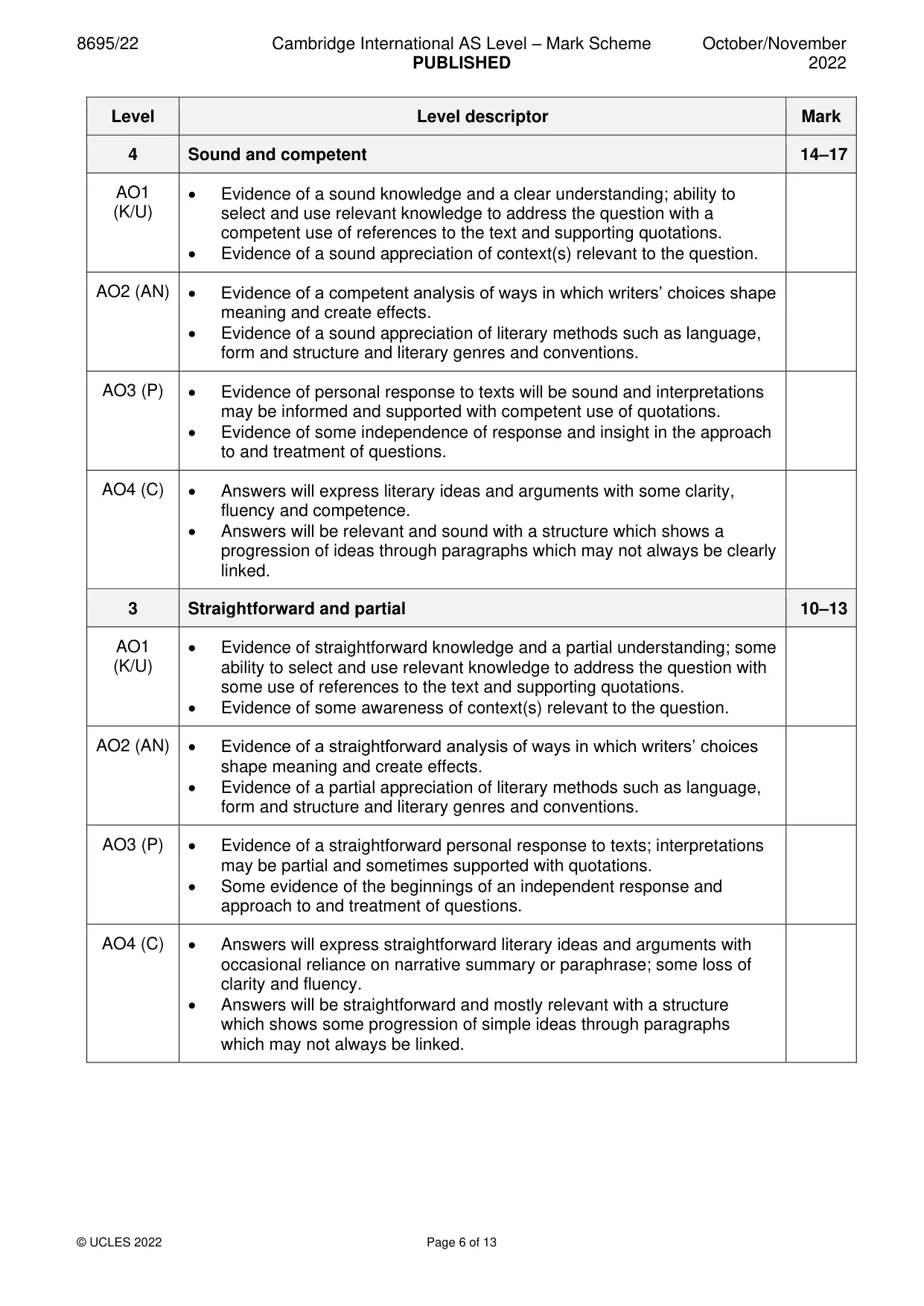
8695/22 Cambridge International AS Level – Mark Scheme PUBLISHED October/November 2022 © UCLES 2022 Page 5 of 13 Level Level descriptor Mark 6 Perceptive and assured 22–25 AO1 (K/U) • Evidence of a detailed, assured knowledge and perceptive understanding; ability to select and use relevant knowledge to address the question with a developed use of references to the text and supporting quotations. • Evidence of a perceptive appreciation of context(s) relevant to the question. AO2 (AN) • Evidence of a perceptive analysis of ways in which writers’ choices shape meaning and create effects. • Evidence of an assured appreciation of literary methods such as language, form and structure and literary genres and conventions. AO3 (P) • Evidence of personal response to texts will be perceptive and interpretations will be well informed and fully supported with assured use of quotations. • Evidence of a perceptive independence of response which may show originality in the approach to and treatment of questions. AO4 (C) • Answers will express complex literary ideas and arguments with clarity, fluency and perception. • Answers will be relevant and assured with an accomplished structure shown through logical progression and effectively linked paragraphs. 5 Confident and thorough 18–21 AO1 (K/U) • Evidence of a thorough knowledge and confident understanding; ability to select and use relevant knowledge to address the question with a secure use of references to the text and supporting quotations. • Evidence of a confident appreciation of context(s) relevant to the question. AO2 (AN) • Evidence of a thorough analysis of ways in which writers’ choices shape meaning and create effects. • Evidence of a confident appreciation of literary methods such as language, form and structure and literary genres and conventions. AO3 (P) • Evidence of personal response to texts will be confident and interpretations will be informed and supported with secure use of quotations. • Evidence of independence of response which may show originality in the approach to and treatment of questions. AO4 (C) • Answers will express some complex literary ideas and arguments with clarity, fluency and confidence. • Answers will be relevant and thorough with an appropriate structure which shows a progression of ideas through linked paragraphs.
Mark scheme, page 6
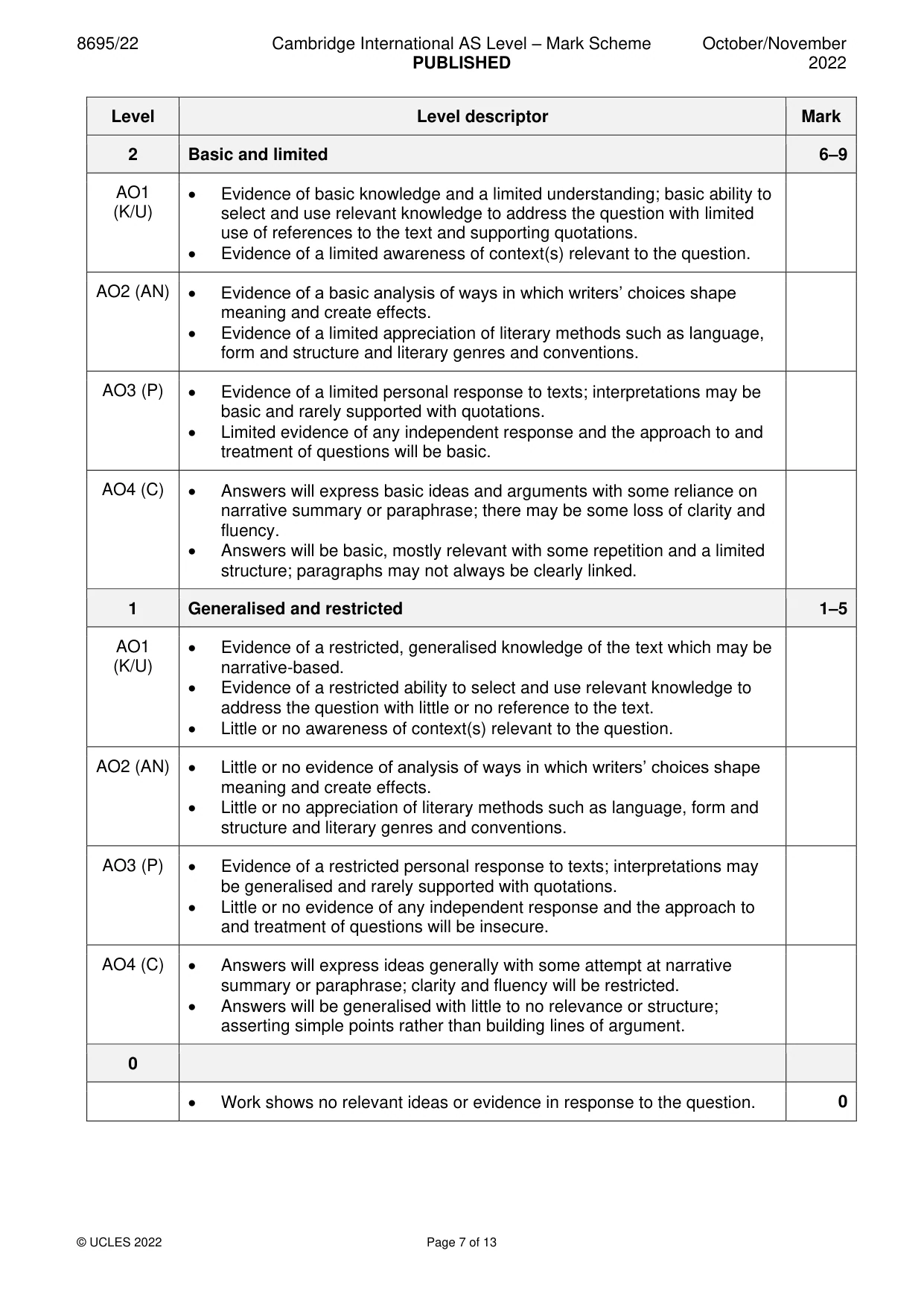
8695/22 Cambridge International AS Level – Mark Scheme PUBLISHED October/November 2022 © UCLES 2022 Page 6 of 13 Level Level descriptor Mark 4 Sound and competent 14–17 AO1 (K/U) • Evidence of a sound knowledge and a clear understanding; ability to select and use relevant knowledge to address the question with a competent use of references to the text and supporting quotations. • Evidence of a sound appreciation of context(s) relevant to the question. AO2 (AN) • Evidence of a competent analysis of ways in which writers’ choices shape meaning and create effects. • Evidence of a sound appreciation of literary methods such as language, form and structure and literary genres and conventions. AO3 (P) • Evidence of personal response to texts will be sound and interpretations may be informed and supported with competent use of quotations. • Evidence of some independence of response and insight in the approach to and treatment of questions. AO4 (C) • Answers will express literary ideas and arguments with some clarity, fluency and competence. • Answers will be relevant and sound with a structure which shows a progression of ideas through paragraphs which may not always be clearly linked. 3 Straightforward and partial 10–13 AO1 (K/U) • Evidence of straightforward knowledge and a partial understanding; some ability to select and use relevant knowledge to address the question with some use of references to the text and supporting quotations. • Evidence of some awareness of context(s) relevant to the question. AO2 (AN) • Evidence of a straightforward analysis of ways in which writers’ choices shape meaning and create effects. • Evidence of a partial appreciation of literary methods such as language, form and structure and literary genres and conventions. AO3 (P) • Evidence of a straightforward personal response to texts; interpretations may be partial and sometimes supported with quotations. • Some evidence of the beginnings of an independent response and approach to and treatment of questions. AO4 (C) • Answers will express straightforward literary ideas and arguments with occasional reliance on narrative summary or paraphrase; some loss of clarity and fluency. • Answers will be straightforward and mostly relevant with a structure which shows some progression of simple ideas through paragraphs which may not always be linked.
Mark scheme, page 7
8695/22 Cambridge International AS Level – Mark Scheme PUBLISHED October/November 2022 © UCLES 2022 Page 7 of 13 Level Level descriptor Mark 2 Basic and limited 6–9 AO1 (K/U) • Evidence of basic knowledge and a limited understanding; basic ability to select and use relevant knowledge to address the question with limited use of references to the text and supporting quotations. • Evidence of a limited awareness of context(s) relevant to the question. AO2 (AN) • Evidence of a basic analysis of ways in which writers’ choices shape meaning and create effects. • Evidence of a limited appreciation of literary methods such as language, form and structure and literary genres and conventions. AO3 (P) • Evidence of a limited personal response to texts; interpretations may be basic and rarely supported with quotations. • Limited evidence of any independent response and the approach to and treatment of questions will be basic. AO4 (C) • Answers will express basic ideas and arguments with some reliance on narrative summary or paraphrase; there may be some loss of clarity and fluency. • Answers will be basic, mostly relevant with some repetition and a limited structure; paragraphs may not always be clearly linked. 1 Generalised and restricted 1–5 AO1 (K/U) • Evidence of a restricted, generalised knowledge of the text which may be narrative-based. • Evidence of a restricted ability to select and use relevant knowledge to address the question with little or no reference to the text. • Little or no awareness of context(s) relevant to the question. AO2 (AN) • Little or no evidence of analysis of ways in which writers’ choices shape meaning and create effects. • Little or no appreciation of literary methods such as language, form and structure and literary genres and conventions. AO3 (P) • Evidence of a restricted personal response to texts; interpretations may be generalised and rarely supported with quotations. • Little or no evidence of any independent response and the approach to and treatment of questions will be insecure. AO4 (C) • Answers will express ideas generally with some attempt at narrative summary or paraphrase; clarity and fluency will be restricted. • Answers will be generalised with little to no relevance or structure; asserting simple points rather than building lines of argument. 0 • Work shows no relevant ideas or evidence in response to the question. 0
Mark scheme, page 8
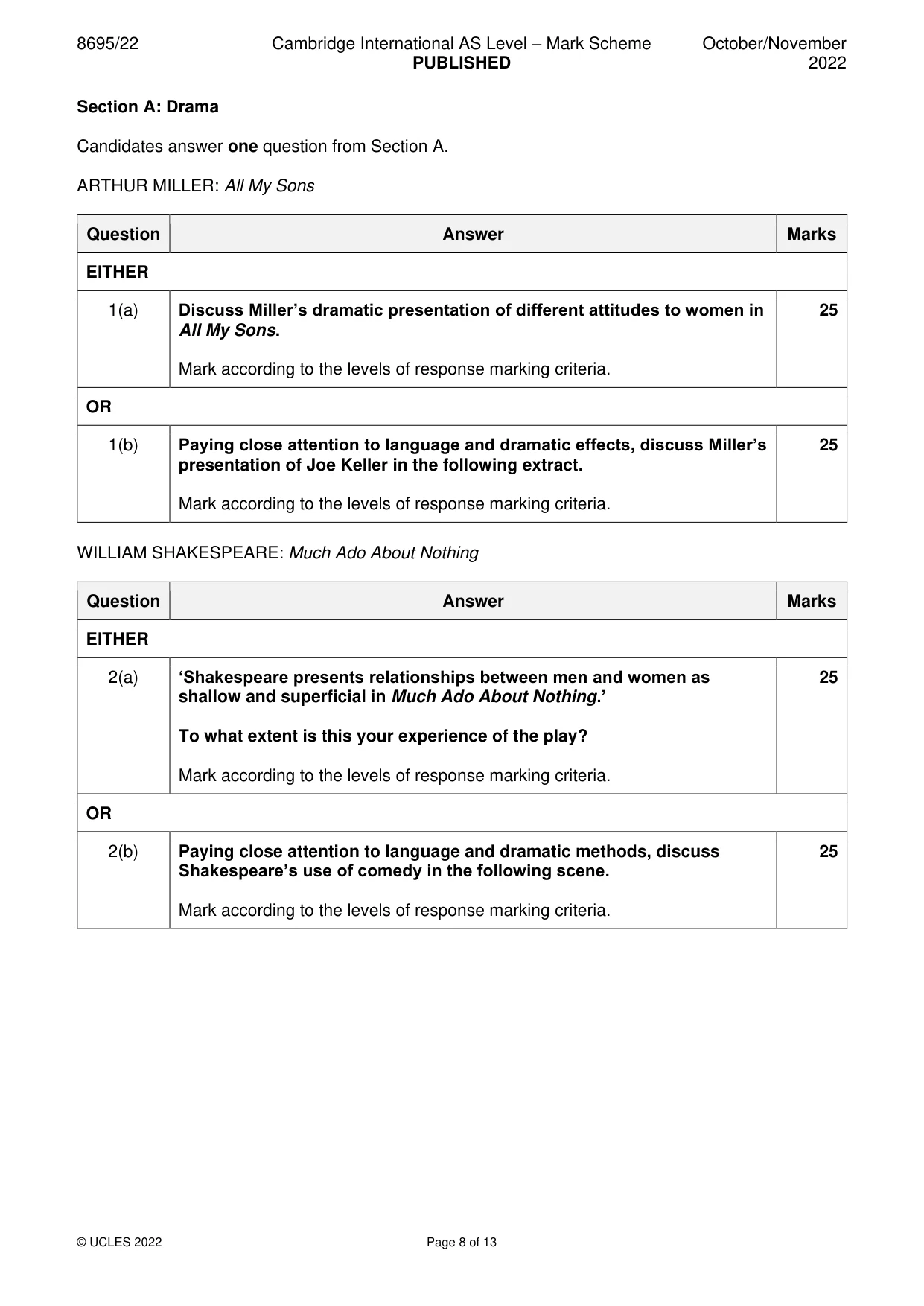
8695/22 Cambridge International AS Level – Mark Scheme PUBLISHED October/November 2022 © UCLES 2022 Page 8 of 13 Section A: Drama Candidates answer one question from Section A. ARTHUR MILLER: All My Sons Question Answer Marks EITHER 1(a) Discuss Miller’s dramatic presentation of different attitudes to women in All My Sons. Mark according to the levels of response marking criteria. 25 OR 1(b) Paying close attention to language and dramatic effects, discuss Miller’s presentation of Joe Keller in the following extract. Mark according to the levels of response marking criteria. 25 WILLIAM SHAKESPEARE: Much Ado About Nothing Question Answer Marks EITHER 2(a) ‘Shakespeare presents relationships between men and women as shallow and superficial in Much Ado About Nothing.’ To what extent is this your experience of the play? Mark according to the levels of response marking criteria. 25 OR 2(b) Paying close attention to language and dramatic methods, discuss Shakespeare’s use of comedy in the following scene. Mark according to the levels of response marking criteria. 25
Mark scheme, page 9
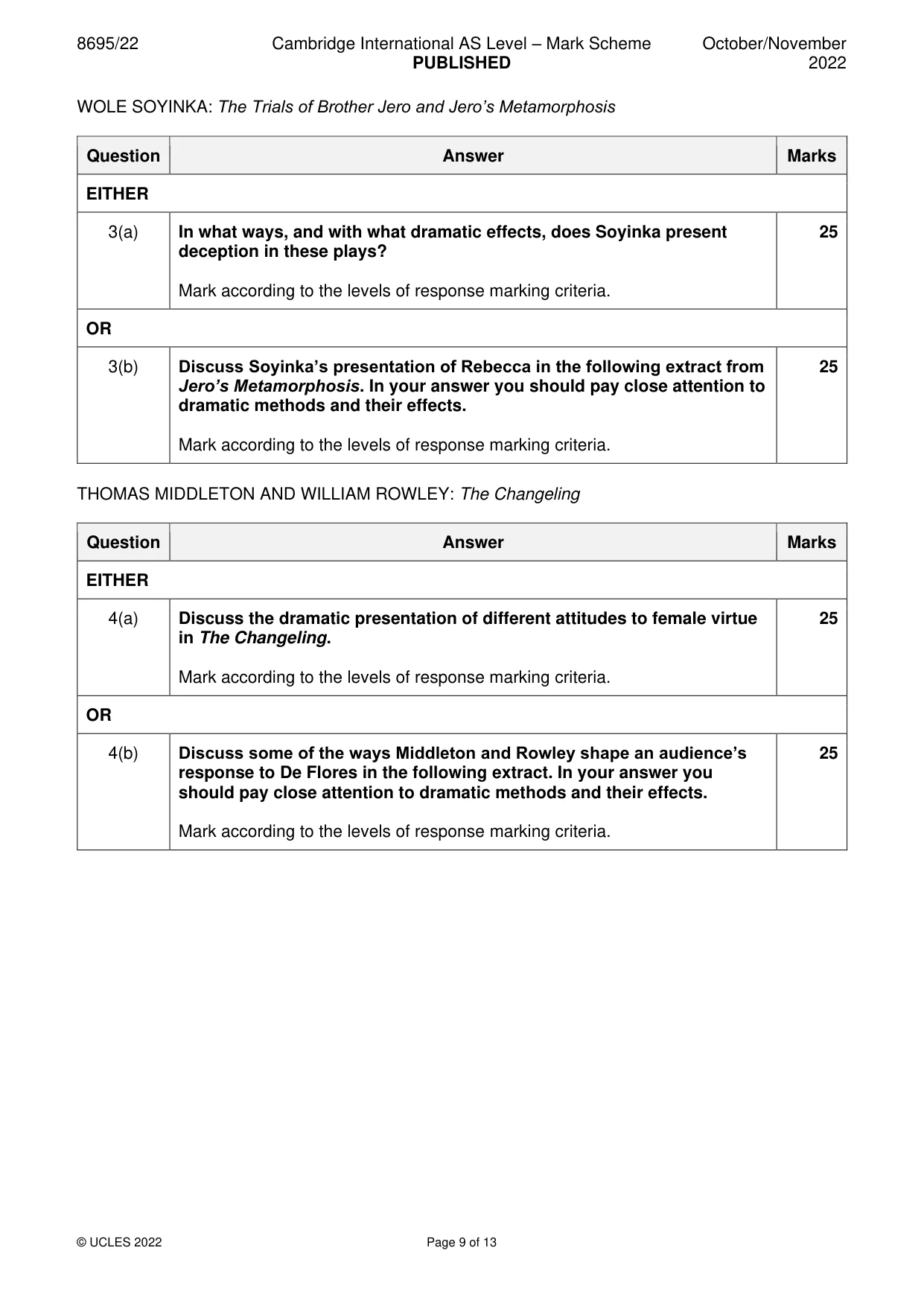
8695/22 Cambridge International AS Level – Mark Scheme PUBLISHED October/November 2022 © UCLES 2022 Page 9 of 13 WOLE SOYINKA: The Trials of Brother Jero and Jero’s Metamorphosis Question Answer Marks EITHER 3(a) In what ways, and with what dramatic effects, does Soyinka present deception in these plays? Mark according to the levels of response marking criteria. 25 OR 3(b) Discuss Soyinka’s presentation of Rebecca in the following extract from Jero’s Metamorphosis. In your answer you should pay close attention to dramatic methods and their effects. Mark according to the levels of response marking criteria. 25 THOMAS MIDDLETON AND WILLIAM ROWLEY: The Changeling Question Answer Marks EITHER 4(a) Discuss the dramatic presentation of different attitudes to female virtue in The Changeling. Mark according to the levels of response marking criteria. 25 OR 4(b) Discuss some of the ways Middleton and Rowley shape an audience’s response to De Flores in the following extract. In your answer you should pay close attention to dramatic methods and their effects. Mark according to the levels of response marking criteria. 25
Mark scheme, page 10
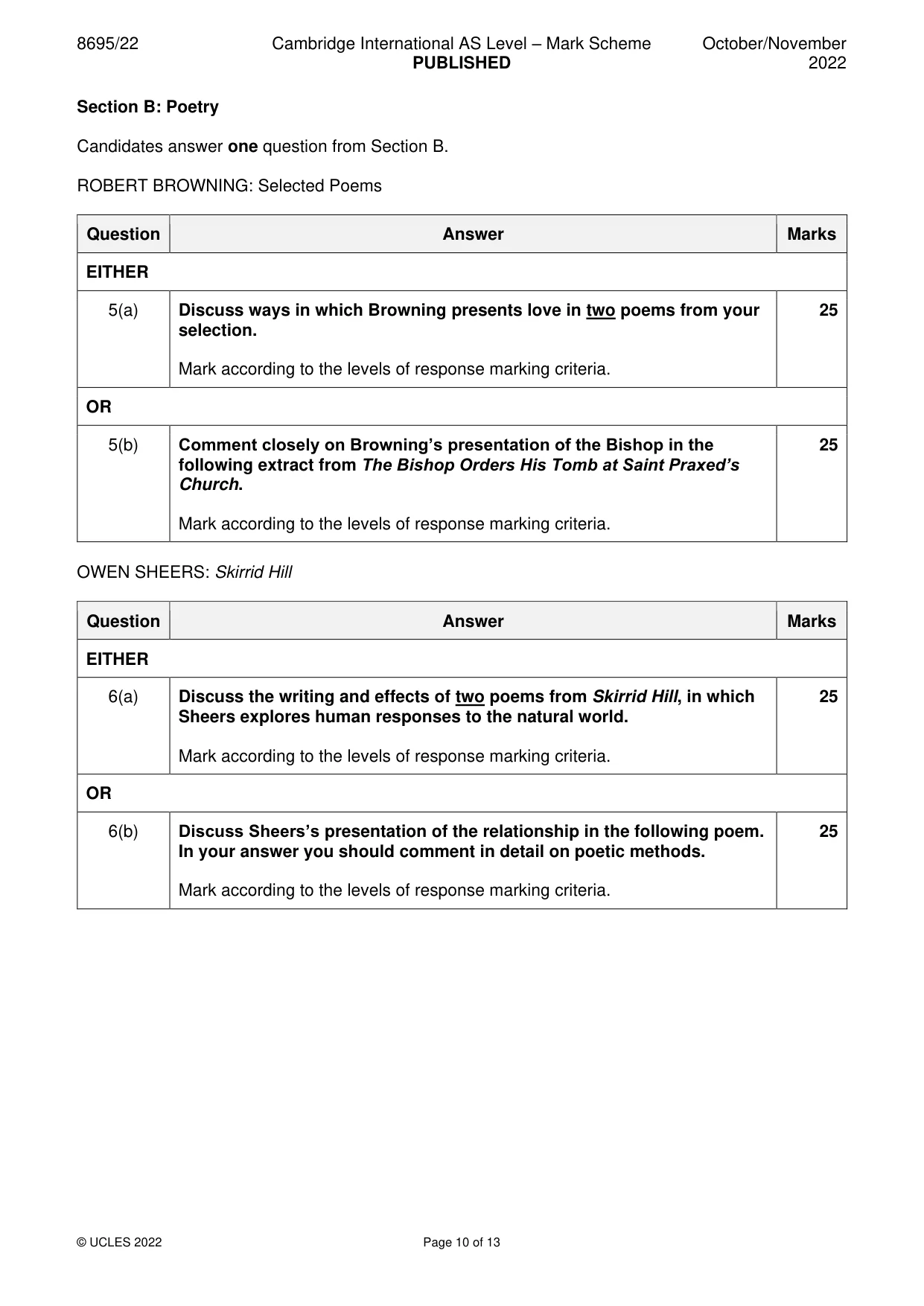
8695/22 Cambridge International AS Level – Mark Scheme PUBLISHED October/November 2022 © UCLES 2022 Page 10 of 13 Section B: Poetry Candidates answer one question from Section B. ROBERT BROWNING: Selected Poems Question Answer Marks EITHER 5(a) Discuss ways in which Browning presents love in two poems from your selection. Mark according to the levels of response marking criteria. 25 OR 5(b) Comment closely on Browning’s presentation of the Bishop in the following extract from The Bishop Orders His Tomb at Saint Praxed’s Church. Mark according to the levels of response marking criteria. 25 OWEN SHEERS: Skirrid Hill Question Answer Marks EITHER 6(a) Discuss the writing and effects of two poems from Skirrid Hill, in which Sheers explores human responses to the natural world. Mark according to the levels of response marking criteria. 25 OR 6(b) Discuss Sheers’s presentation of the relationship in the following poem. In your answer you should comment in detail on poetic methods. Mark according to the levels of response marking criteria. 25
Mark scheme, page 11
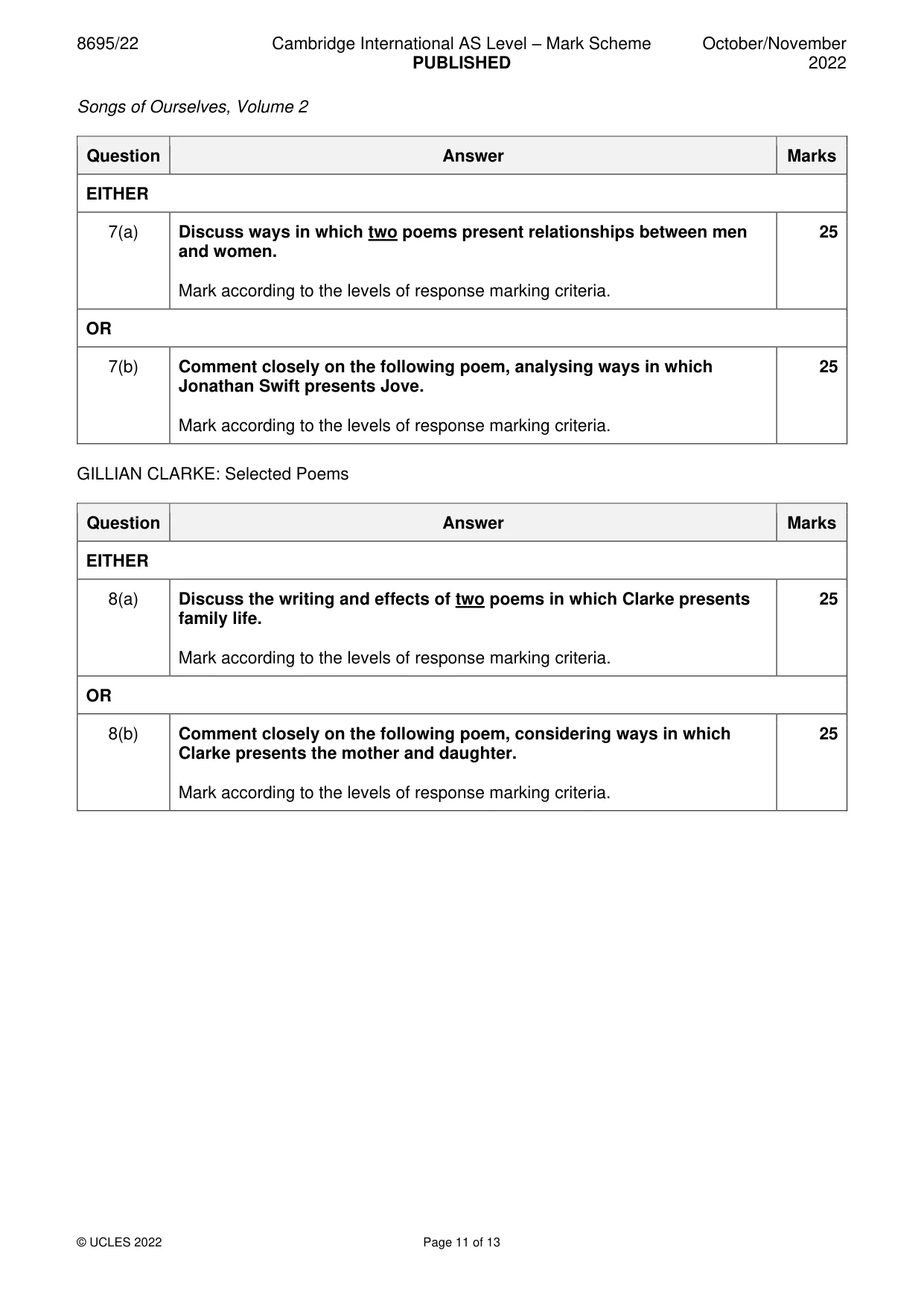
8695/22 Cambridge International AS Level – Mark Scheme PUBLISHED October/November 2022 © UCLES 2022 Page 11 of 13 Songs of Ourselves, Volume 2 Question Answer Marks EITHER 7(a) Discuss ways in which two poems present relationships between men and women. Mark according to the levels of response marking criteria. 25 OR 7(b) Comment closely on the following poem, analysing ways in which Jonathan Swift presents Jove. Mark according to the levels of response marking criteria. 25 GILLIAN CLARKE: Selected Poems Question Answer Marks EITHER 8(a) Discuss the writing and effects of two poems in which Clarke presents family life. Mark according to the levels of response marking criteria. 25 OR 8(b) Comment closely on the following poem, considering ways in which Clarke presents the mother and daughter. Mark according to the levels of response marking criteria. 25
Mark scheme, page 12
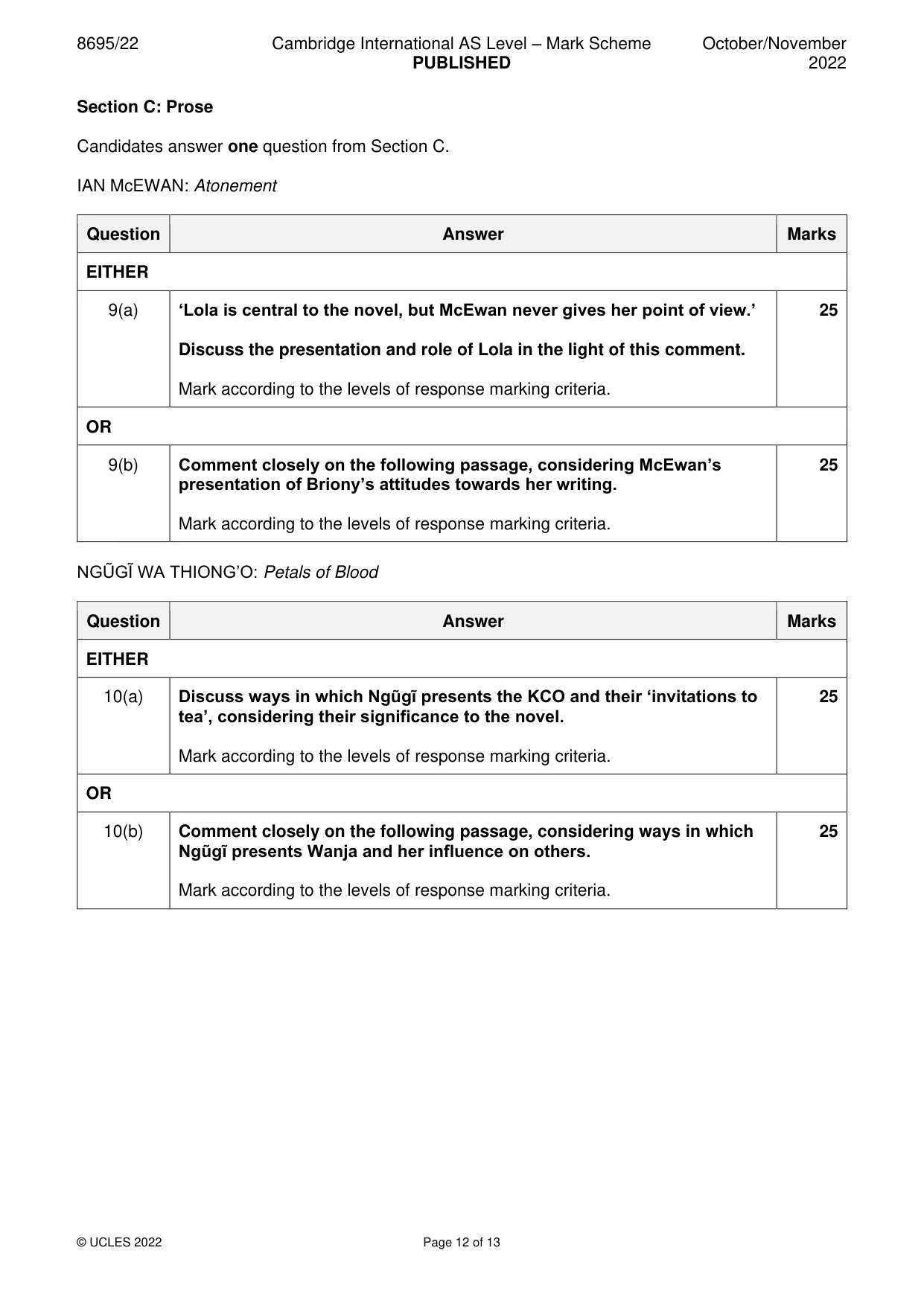
8695/22 Cambridge International AS Level – Mark Scheme PUBLISHED October/November 2022 © UCLES 2022 Page 12 of 13 Section C: Prose Candidates answer one question from Section C. IAN McEWAN: Atonement Question Answer Marks EITHER 9(a) ‘Lola is central to the novel, but McEwan never gives her point of view.’ Discuss the presentation and role of Lola in the light of this comment. Mark according to the levels of response marking criteria. 25 OR 9(b) Comment closely on the following passage, considering McEwan’s presentation of Briony’s attitudes towards her writing. Mark according to the levels of response marking criteria. 25 NGŨGĨ WA THIONG’O: Petals of Blood Question Answer Marks EITHER 10(a) Discuss ways in which Ngũgĩ presents the KCO and their ‘invitations to tea’, considering their significance to the novel. Mark according to the levels of response marking criteria. 25 OR 10(b) Comment closely on the following passage, considering ways in which Ngũgĩ presents Wanja and her influence on others. Mark according to the levels of response marking criteria. 25
Mark scheme, page 13
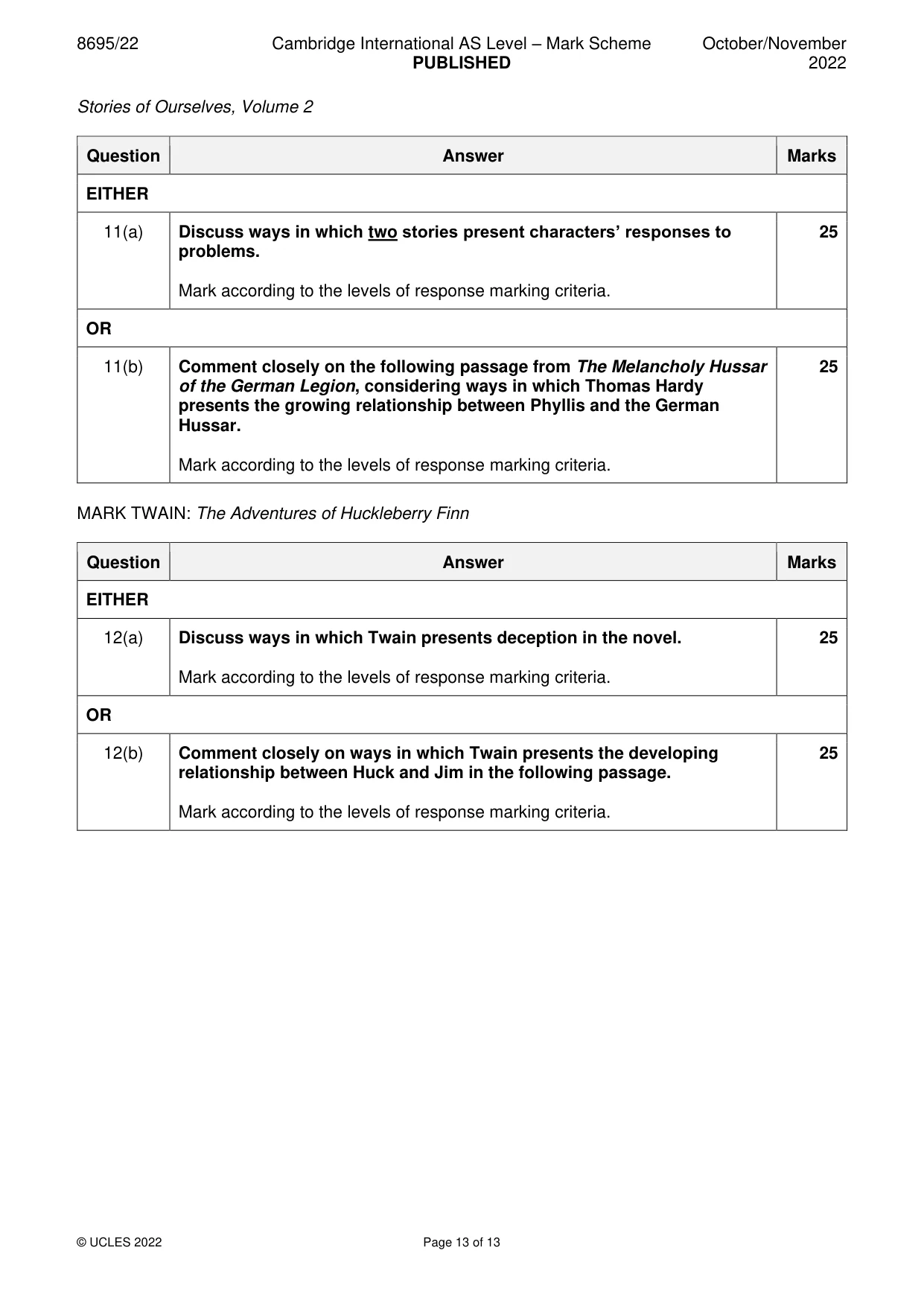
8695/22 Cambridge International AS Level – Mark Scheme PUBLISHED October/November 2022 © UCLES 2022 Page 13 of 13 Stories of Ourselves, Volume 2 Question Answer Marks EITHER 11(a) Discuss ways in which two stories present characters’ responses to problems. Mark according to the levels of response marking criteria. 25 OR 11(b) Comment closely on the following passage from The Melancholy Hussar of the German Legion, considering ways in which Thomas Hardy presents the growing relationship between Phyllis and the German Hussar. Mark according to the levels of response marking criteria. 25 MARK TWAIN: The Adventures of Huckleberry Finn Question Answer Marks EITHER 12(a) Discuss ways in which Twain presents deception in the novel. Mark according to the levels of response marking criteria. 25 OR 12(b) Comment closely on ways in which Twain presents the developing relationship between Huck and Jim in the following passage. Mark according to the levels of response marking criteria. 25
What you needed in this session
Cambridge’s own grade thresholds for 2022 Oct/Nov, Paper 2 · Variant 2. A higher threshold means an easier paper — the bar moves with how the cohort did.