Cambridge A Level English - Language and Literature (AS Level only, from 2016) 8695 — 2021 Oct/Nov Paper 2 · Variant 3
8695/23/O/N/21 · 50 marks · ≈56 min
The question paper and its mark scheme, free to read here and free to download. This is Cambridge’s own paper, exactly as it was sat.
Question paper20 pages



Mark scheme11 pages
Answers below. Sit the paper first if you are practising.
Paper as text
Question paper, page 1
This document has 20 pages. Any blank pages are indicated. DC (RCL/DF) 201399/4 © UCLES 2021 [Turn over * 3 4 9 6 9 0 0 6 5 5 * Cambridge International AS Level LANGUAGE AND LITERATURE IN ENGLISH 8695/23 Paper 2 Drama, Poetry and Prose October/November 2021 2 hours You must answer on the enclosed answer booklet. You will need: Answer booklet (enclosed) INSTRUCTIONS ● Answer two questions in total, each from a different section. ● Follow the instructions on the front cover of the answer booklet. If you need additional answer paper, ask the invigilator for a continuation booklet. ● Dictionaries are not allowed. INFORMATION ● The total mark for this paper is 50. ● The number of marks for each question or part question is shown in brackets [ ].
Question paper, page 2
2 8695/23/O/N/21 © UCLES 2021 Section A: Drama ARTHUR MILLER: All My Sons 1 Either (a) How, and with what dramatic effects, does Miller explore justice in the play? [25] Or (b) Discuss Miller’s dramatic presentation of family tensions at this point in the play. In your answer you should pay close attention to Miller’s use of language and action. [25] Chris: All right, all right, listen to me. Content removed due to copyright restrictions.
Question paper, page 3
3 8695/23/O/N/21 © UCLES 2021 [Turn over Chris: Then help me stay here. (from Act 1) Content removed due to copyright restrictions.
Question paper, page 4
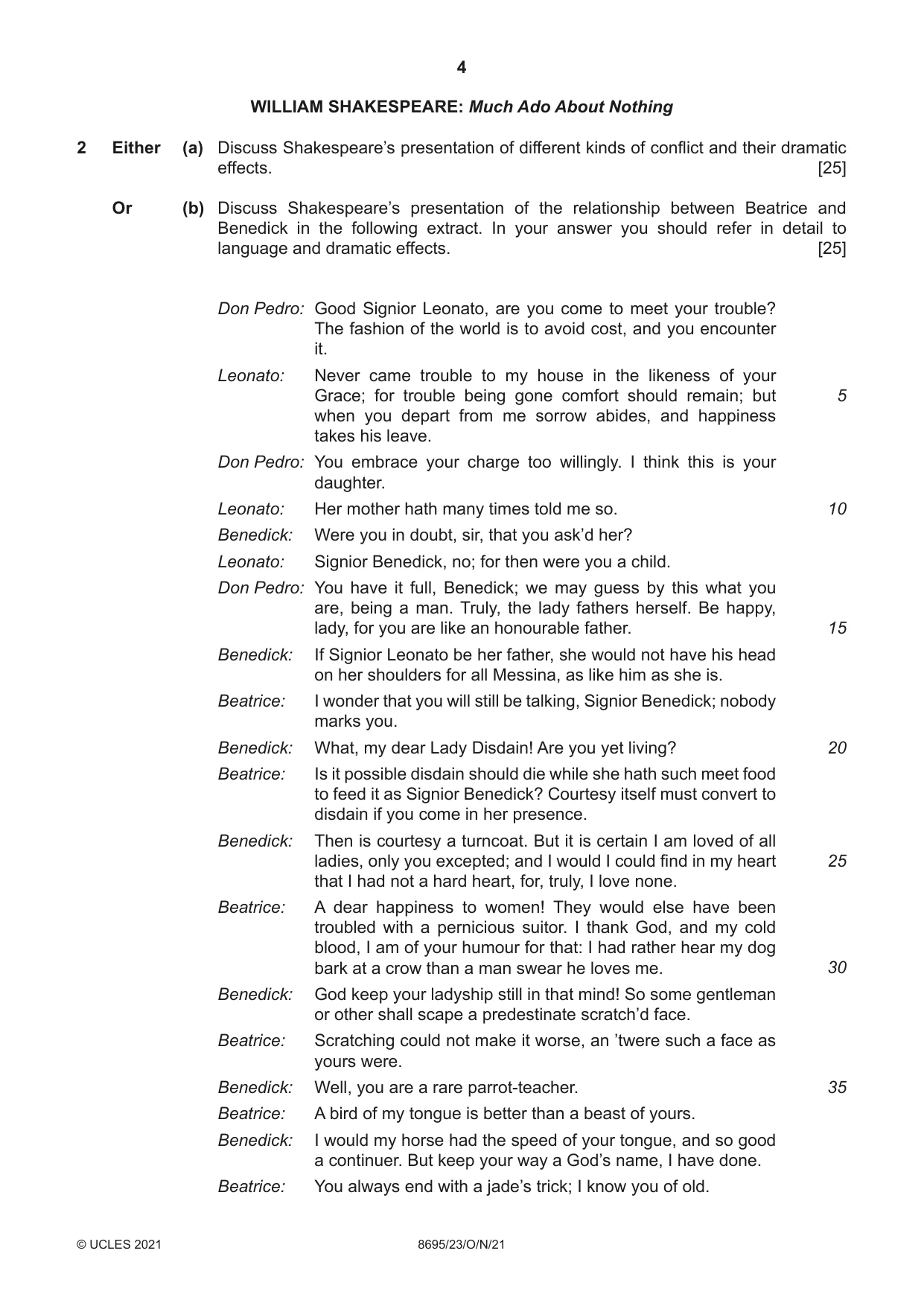
4 8695/23/O/N/21 © UCLES 2021 WILLIAM SHAKESPEARE: Much Ado About Nothing 2 Either (a) Discuss Shakespeare’s presentation of different kinds of conflict and their dramatic effects. [25] Or (b) Discuss Shakespeare’s presentation of the relationship between Beatrice and Benedick in the following extract. In your answer you should refer in detail to language and dramatic effects. [25] Don Pedro: Good Signior Leonato, are you come to meet your trouble? The fashion of the world is to avoid cost, and you encounter it. Leonato: Never came trouble to my house in the likeness of your Grace; for trouble being gone comfort should remain; but when you depart from me sorrow abides, and happiness takes his leave. Don Pedro: You embrace your charge too willingly. I think this is your daughter. Leonato: Her mother hath many times told me so. Benedick: Were you in doubt, sir, that you ask’d her? Leonato: Signior Benedick, no; for then were you a child. Don Pedro: You have it full, Benedick; we may guess by this what you are, being a man. Truly, the lady fathers herself. Be happy, lady, for you are like an honourable father. Benedick: If Signior Leonato be her father, she would not have his head on her shoulders for all Messina, as like him as she is. Beatrice: I wonder that you will still be talking, Signior Benedick; nobody marks you. Benedick: What, my dear Lady Disdain! Are you yet living? Beatrice: Is it possible disdain should die while she hath such meet food to feed it as Signior Benedick? Courtesy itself must convert to disdain if you come in her presence. Benedick: Then is courtesy a turncoat. But it is certain I am loved of all ladies, only you excepted; and I would I could find in my heart that I had not a hard heart, for, truly, I love none. Beatrice: A dear happiness to women! They would else have been troubled with a pernicious suitor. I thank God, and my cold blood, I am of your humour for that: I had rather hear my dog bark at a crow than a man swear he loves me. Benedick: God keep your ladyship still in that mind! So some gentleman or other shall scape a predestinate scratch’d face. Beatrice: Scratching could not make it worse, an ’twere such a face as yours were. Benedick: Well, you are a rare parrot-teacher. Beatrice: A bird of my tongue is better than a beast of yours. Benedick: I would my horse had the speed of your tongue, and so good a continuer. But keep your way a God’s name, I have done. Beatrice: You always end with a jade’s trick; I know you of old. 5 10 15 20 25 30 35
Question paper, page 5
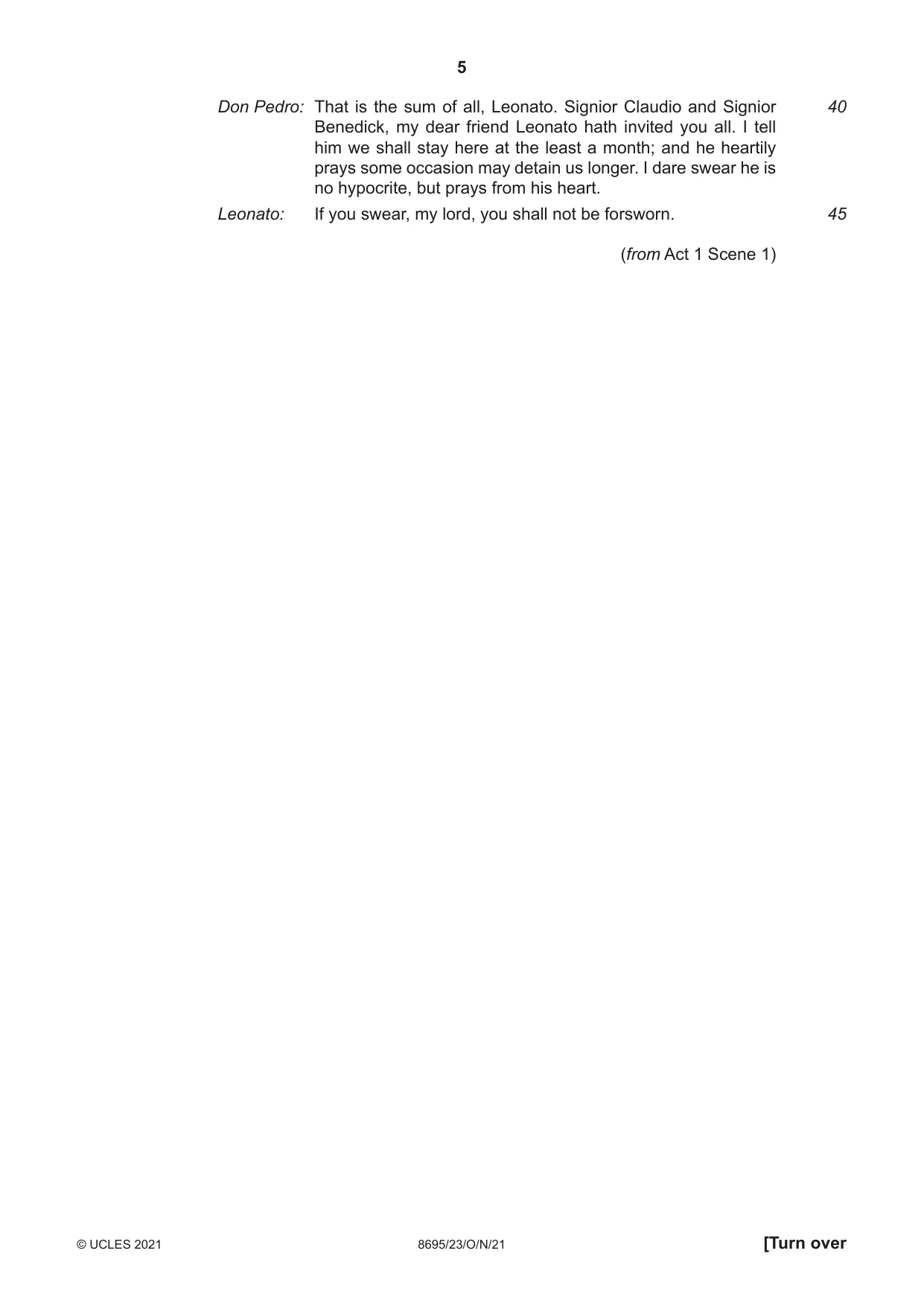
5 8695/23/O/N/21 © UCLES 2021 [Turn over Don Pedro: That is the sum of all, Leonato. Signior Claudio and Signior Benedick, my dear friend Leonato hath invited you all. I tell him we shall stay here at the least a month; and he heartily prays some occasion may detain us longer. I dare swear he is no hypocrite, but prays from his heart. Leonato: If you swear, my lord, you shall not be forsworn. (from Act 1 Scene 1) 40 45
Question paper, page 6
6 8695/23/O/N/21 © UCLES 2021 WOLE SOYINKA: The Trials of Brother Jero and Jero’s Metamorphosis 3 Either (a) In what ways, and with what effects, does Soyinka present faith in the two plays? [25] Or (b) How does Soyinka shape an audience’s impressions of Jero in the following extract, his first appearance in The Trials of Brother Jero? You should pay close attention to dramatic methods and their effects in your answer. [25] [The stage is completely dark. It shook me quite a bit, but … the Lord protects his own … (from The Trials of Brother Jero, Scene 1) Content removed due to copyright restrictions.
Question paper, page 7
7 8695/23/O/N/21 © UCLES 2021 [Turn over TURN OVER FOR QUESTION 4.
Question paper, page 8
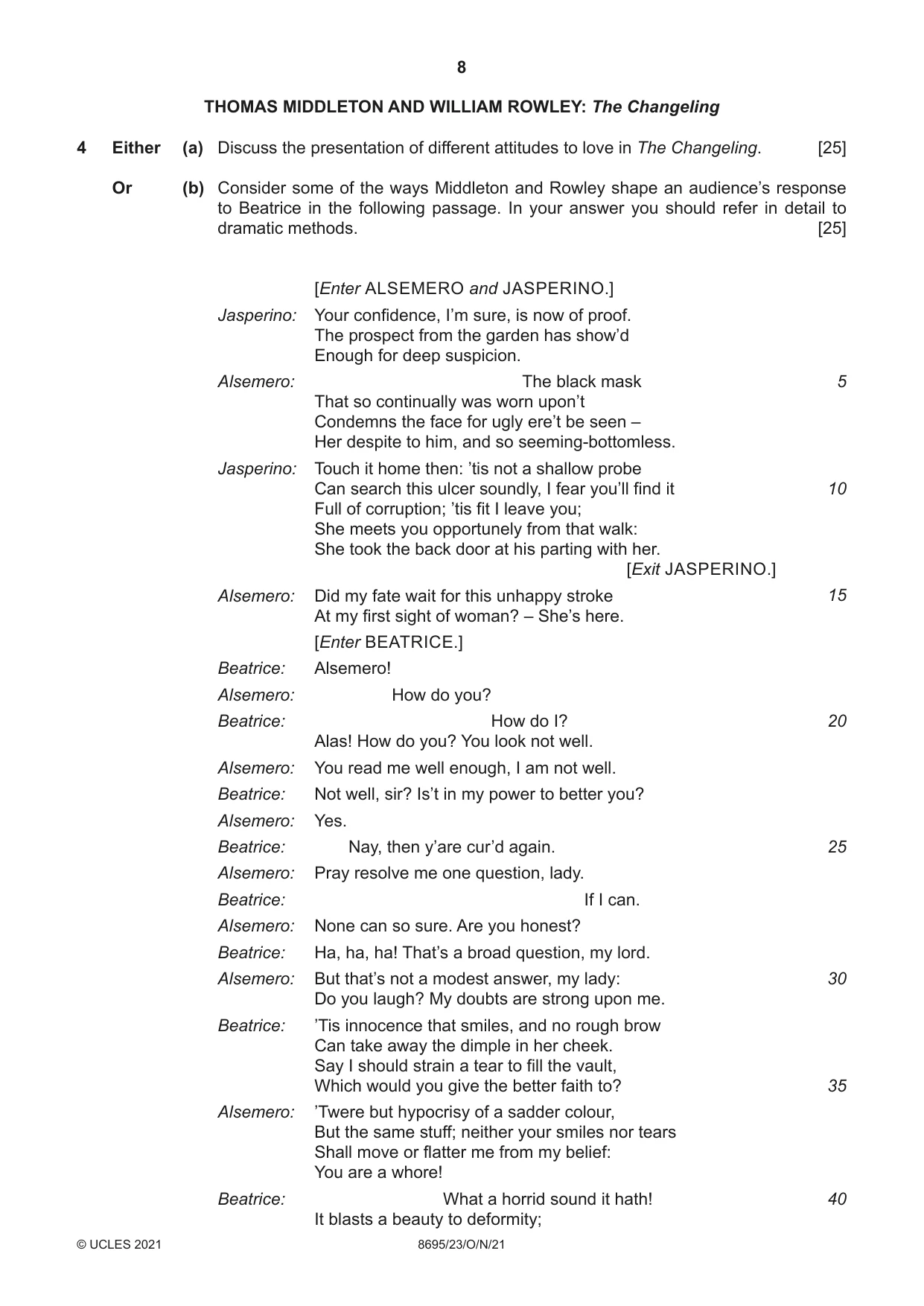
8 8695/23/O/N/21 © UCLES 2021 THOMAS MIDDLETON AND WILLIAM ROWLEY: The Changeling 4 Either (a) Discuss the presentation of different attitudes to love in The Changeling. [25] Or (b) Consider some of the ways Middleton and Rowley shape an audience’s response to Beatrice in the following passage. In your answer you should refer in detail to dramatic methods. [25] [Enter ALSEMERO and JASPERINO.] Jasperino: Your confidence, I’m sure, is now of proof. The prospect from the garden has show’d Enough for deep suspicion. Alsemero: The black mask That so continually was worn upon’t Condemns the face for ugly ere’t be seen – Her despite to him, and so seeming-bottomless. Jasperino: Touch it home then: ’tis not a shallow probe Can search this ulcer soundly, I fear you’ll find it Full of corruption; ’tis fit I leave you; She meets you opportunely from that walk: She took the back door at his parting with her. [Exit JASPERINO.] Alsemero: Did my fate wait for this unhappy stroke At my first sight of woman? – She’s here. [Enter BEATRICE.] Beatrice: Alsemero! Alsemero: How do you? Beatrice: How do I? Alas! How do you? You look not well. Alsemero: You read me well enough, I am not well. Beatrice: Not well, sir? Is’t in my power to better you? Alsemero: Yes. Beatrice: Nay, then y’are cur’d again. Alsemero: Pray resolve me one question, lady. Beatrice: If I can. Alsemero: None can so sure. Are you honest? Beatrice: Ha, ha, ha! That’s a broad question, my lord. Alsemero: But that’s not a modest answer, my lady: Do you laugh? My doubts are strong upon me. Beatrice: ’Tis innocence that smiles, and no rough brow Can take away the dimple in her cheek. Say I should strain a tear to fill the vault, Which would you give the better faith to? Alsemero: ’Twere but hypocrisy of a sadder colour, But the same stuff; neither your smiles nor tears Shall move or flatter me from my belief: You are a whore! Beatrice: What a horrid sound it hath! It blasts a beauty to deformity; 5 10 15 20 25 30 35 40
Question paper, page 9
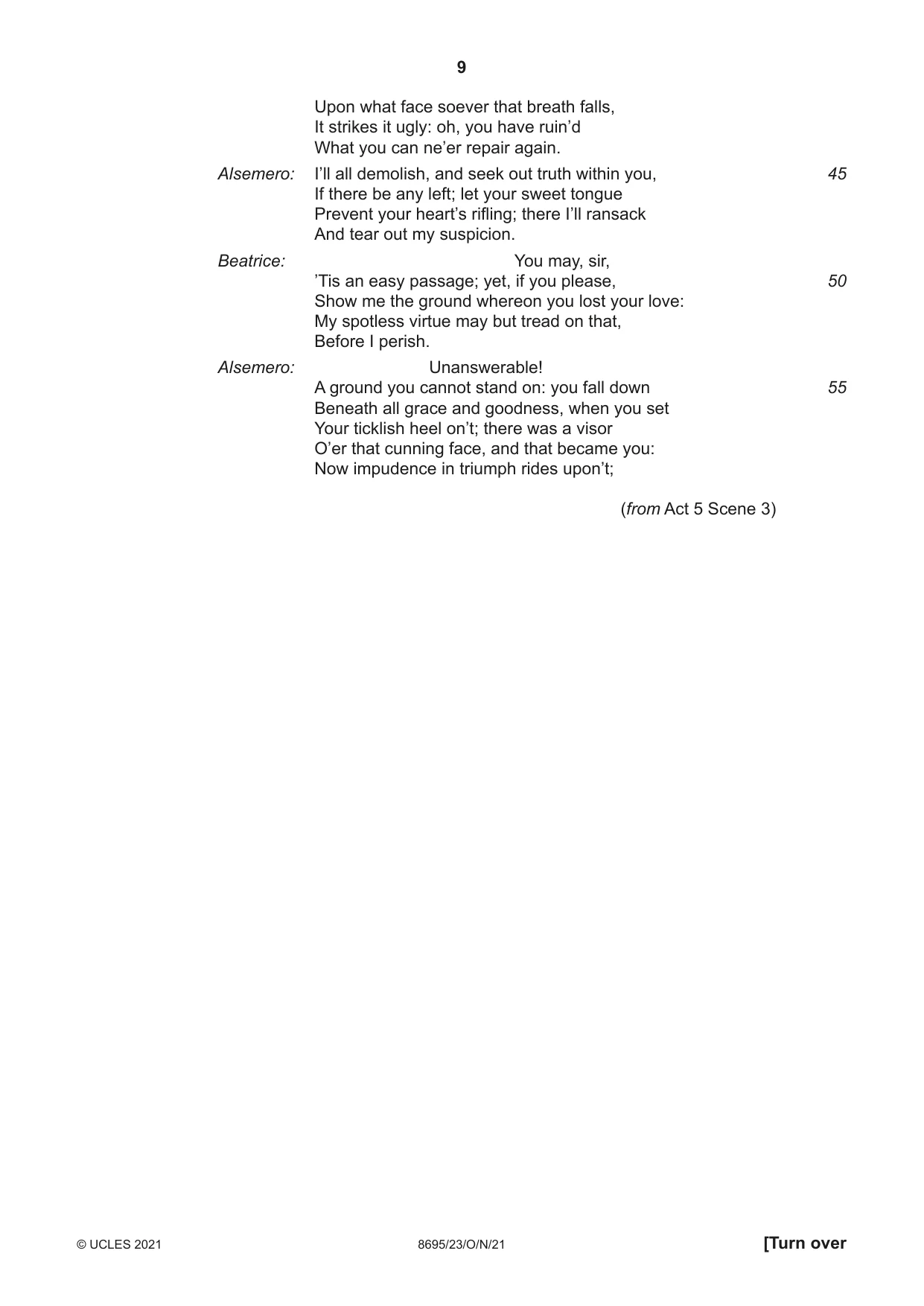
9 8695/23/O/N/21 © UCLES 2021 [Turn over Upon what face soever that breath falls, It strikes it ugly: oh, you have ruin’d What you can ne’er repair again. Alsemero: I’ll all demolish, and seek out truth within you, If there be any left; let your sweet tongue Prevent your heart’s rifling; there I’ll ransack And tear out my suspicion. Beatrice: You may, sir, ’Tis an easy passage; yet, if you please, Show me the ground whereon you lost your love: My spotless virtue may but tread on that, Before I perish. Alsemero: Unanswerable! A ground you cannot stand on: you fall down Beneath all grace and goodness, when you set Your ticklish heel on’t; there was a visor O’er that cunning face, and that became you: Now impudence in triumph rides upon’t; (from Act 5 Scene 3) 45 50 55
Question paper, page 10
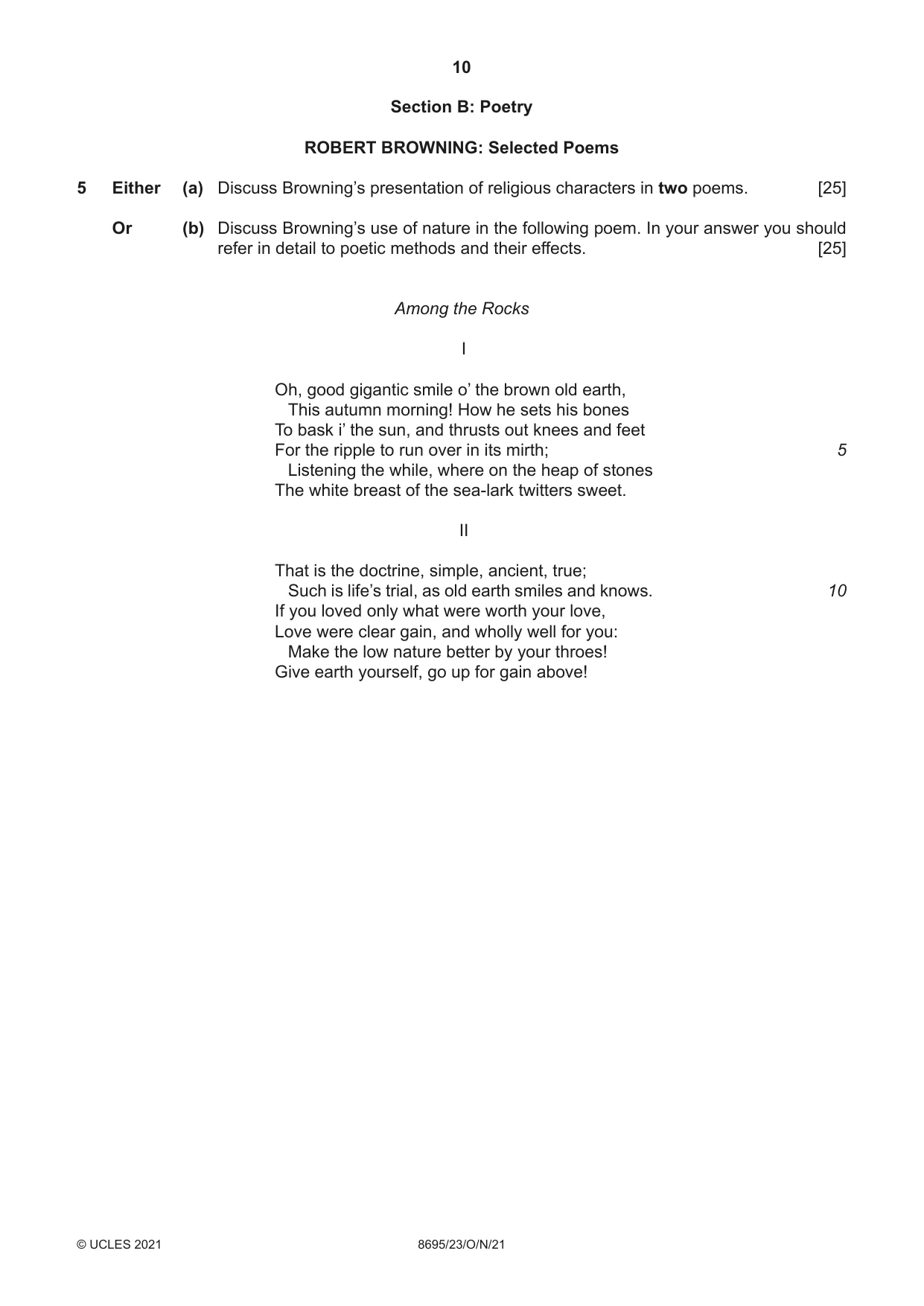
10 8695/23/O/N/21 © UCLES 2021 Section B: Poetry ROBERT BROWNING: Selected Poems 5 Either (a) Discuss Browning’s presentation of religious characters in two poems. [25] Or (b) Discuss Browning’s use of nature in the following poem. In your answer you should refer in detail to poetic methods and their effects. [25] Among the Rocks I Oh, good gigantic smile o’ the brown old earth, This autumn morning! How he sets his bones To bask i’ the sun, and thrusts out knees and feet For the ripple to run over in its mirth; Listening the while, where on the heap of stones The white breast of the sea-lark twitters sweet. II That is the doctrine, simple, ancient, true; Such is life’s trial, as old earth smiles and knows. If you loved only what were worth your love, Love were clear gain, and wholly well for you: Make the low nature better by your throes! Give earth yourself, go up for gain above! 5 10
Question paper, page 11
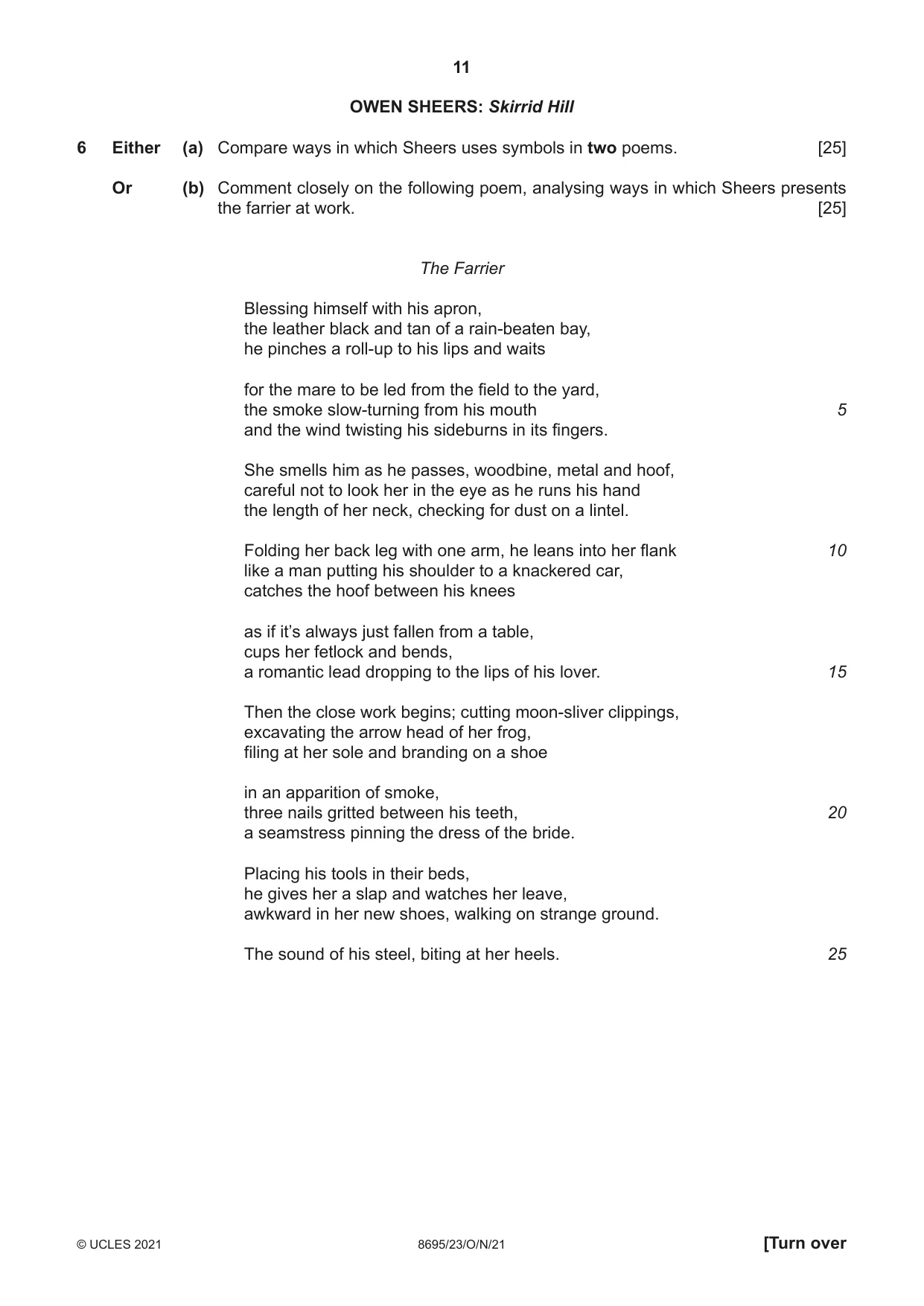
11 8695/23/O/N/21 © UCLES 2021 [Turn over OWEN SHEERS: Skirrid Hill 6 Either (a) Compare ways in which Sheers uses symbols in two poems. [25] Or (b) Comment closely on the following poem, analysing ways in which Sheers presents the farrier at work. [25] The Farrier Blessing himself with his apron, the leather black and tan of a rain-beaten bay, he pinches a roll-up to his lips and waits for the mare to be led from the field to the yard, the smoke slow-turning from his mouth and the wind twisting his sideburns in its fingers. She smells him as he passes, woodbine, metal and hoof, careful not to look her in the eye as he runs his hand the length of her neck, checking for dust on a lintel. Folding her back leg with one arm, he leans into her flank like a man putting his shoulder to a knackered car, catches the hoof between his knees as if it’s always just fallen from a table, cups her fetlock and bends, a romantic lead dropping to the lips of his lover. Then the close work begins; cutting moon-sliver clippings, excavating the arrow head of her frog, filing at her sole and branding on a shoe in an apparition of smoke, three nails gritted between his teeth, a seamstress pinning the dress of the bride. Placing his tools in their beds, he gives her a slap and watches her leave, awkward in her new shoes, walking on strange ground. The sound of his steel, biting at her heels. 5 10 15 20 25
Question paper, page 12
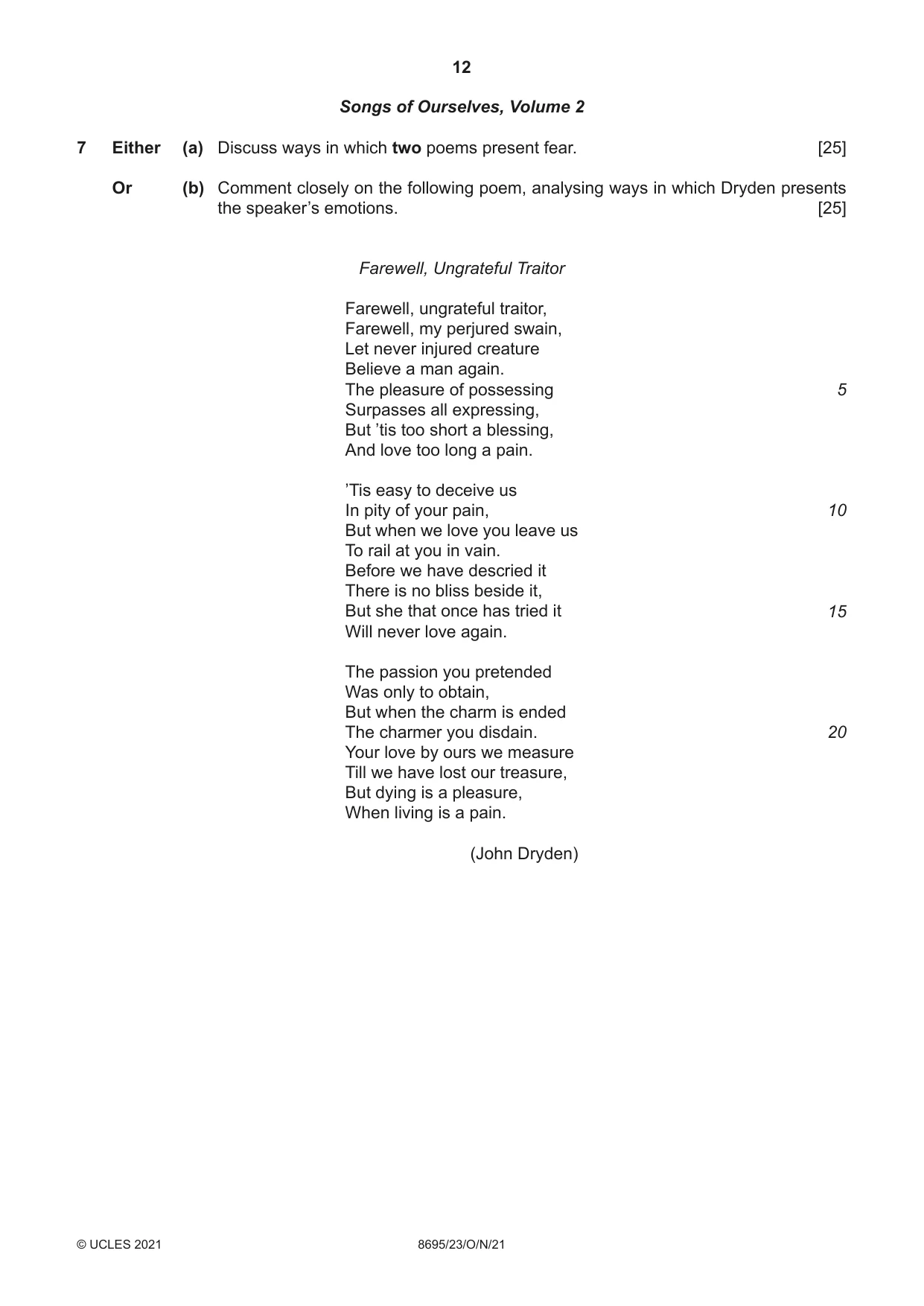
12 8695/23/O/N/21 © UCLES 2021 Songs of Ourselves, Volume 2 7 Either (a) Discuss ways in which two poems present fear. [25] Or (b) Comment closely on the following poem, analysing ways in which Dryden presents the speaker’s emotions. [25] Farewell, Ungrateful Traitor Farewell, ungrateful traitor, Farewell, my perjured swain, Let never injured creature Believe a man again. The pleasure of possessing Surpasses all expressing, But ’tis too short a blessing, And love too long a pain. ’Tis easy to deceive us In pity of your pain, But when we love you leave us To rail at you in vain. Before we have descried it There is no bliss beside it, But she that once has tried it Will never love again. The passion you pretended Was only to obtain, But when the charm is ended The charmer you disdain. Your love by ours we measure Till we have lost our treasure, But dying is a pleasure, When living is a pain. (John Dryden) 5 10 15 20
Question paper, page 13
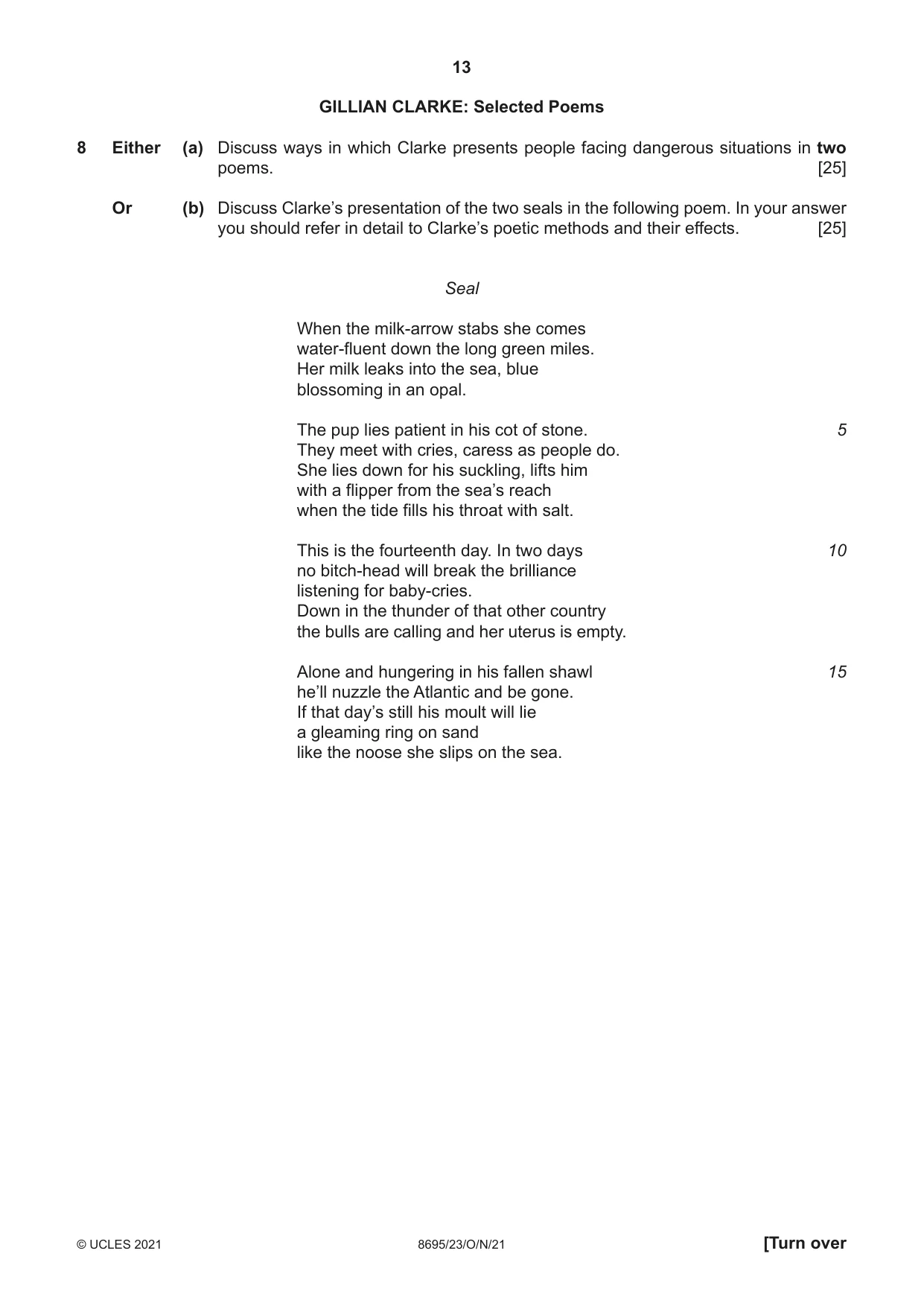
13 8695/23/O/N/21 © UCLES 2021 [Turn over GILLIAN CLARKE: Selected Poems 8 Either (a) Discuss ways in which Clarke presents people facing dangerous situations in two poems. [25] Or (b) Discuss Clarke’s presentation of the two seals in the following poem. In your answer you should refer in detail to Clarke’s poetic methods and their effects. [25] Seal When the milk-arrow stabs she comes water-fluent down the long green miles. Her milk leaks into the sea, blue blossoming in an opal. The pup lies patient in his cot of stone. They meet with cries, caress as people do. She lies down for his suckling, lifts him with a flipper from the sea’s reach when the tide fills his throat with salt. This is the fourteenth day. In two days no bitch-head will break the brilliance listening for baby-cries. Down in the thunder of that other country the bulls are calling and her uterus is empty. Alone and hungering in his fallen shawl he’ll nuzzle the Atlantic and be gone. If that day’s still his moult will lie a gleaming ring on sand like the noose she slips on the sea. 5 10 15
Question paper, page 14
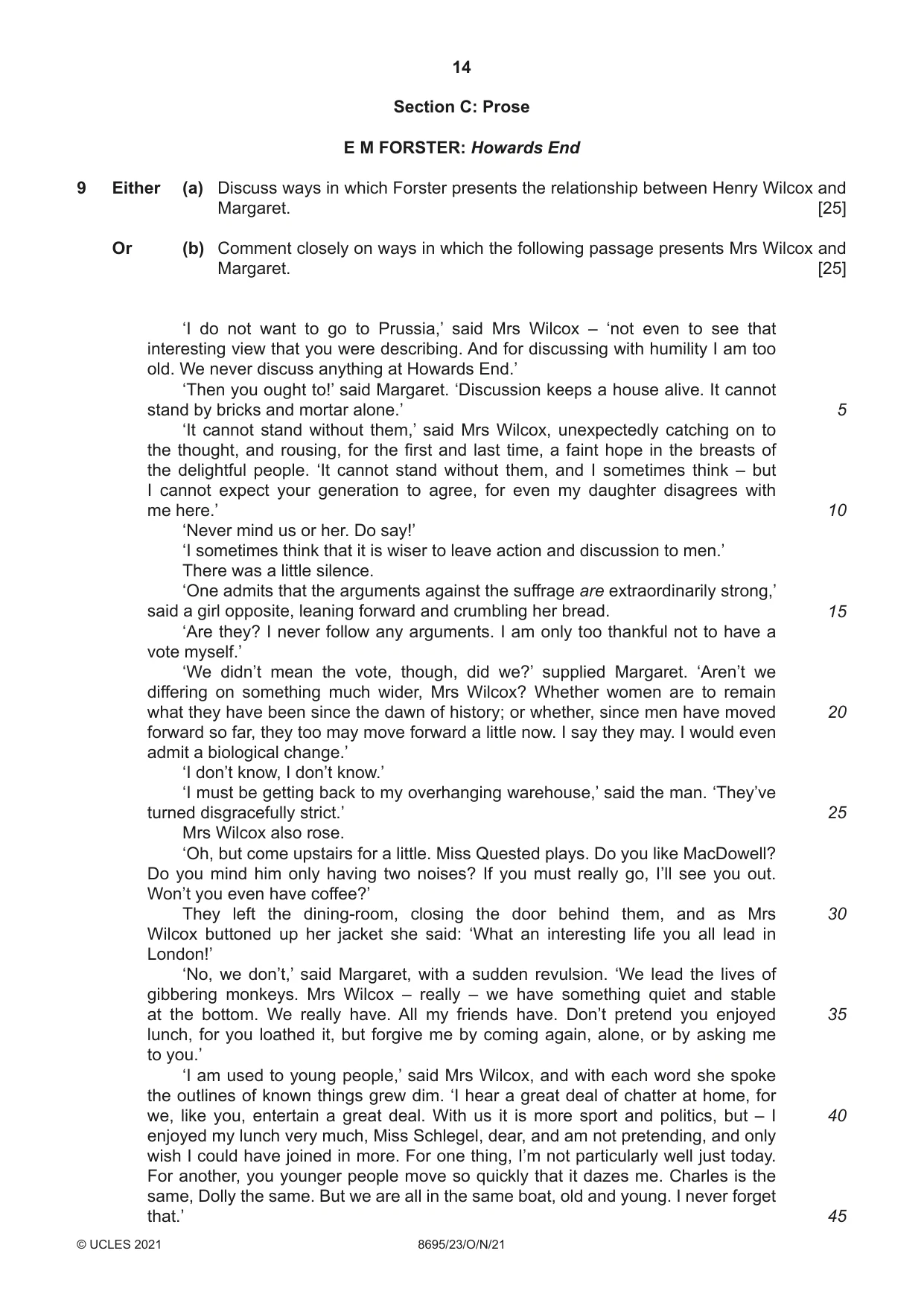
14 8695/23/O/N/21 © UCLES 2021 Section C: Prose E M FORSTER: Howards End 9 Either (a) Discuss ways in which Forster presents the relationship between Henry Wilcox and Margaret. [25] Or (b) Comment closely on ways in which the following passage presents Mrs Wilcox and Margaret. [25] ‘I do not want to go to Prussia,’ said Mrs Wilcox – ‘not even to see that interesting view that you were describing. And for discussing with humility I am too old. We never discuss anything at Howards End.’ ‘Then you ought to!’ said Margaret. ‘Discussion keeps a house alive. It cannot stand by bricks and mortar alone.’ ‘It cannot stand without them,’ said Mrs Wilcox, unexpectedly catching on to the thought, and rousing, for the first and last time, a faint hope in the breasts of the delightful people. ‘It cannot stand without them, and I sometimes think – but I cannot expect your generation to agree, for even my daughter disagrees with me here.’ ‘Never mind us or her. Do say!’ ‘I sometimes think that it is wiser to leave action and discussion to men.’ There was a little silence. ‘One admits that the arguments against the suffrage are extraordinarily strong,’ said a girl opposite, leaning forward and crumbling her bread. ‘Are they? I never follow any arguments. I am only too thankful not to have a vote myself.’ ‘We didn’t mean the vote, though, did we?’ supplied Margaret. ‘Aren’t we differing on something much wider, Mrs Wilcox? Whether women are to remain what they have been since the dawn of history; or whether, since men have moved forward so far, they too may move forward a little now. I say they may. I would even admit a biological change.’ ‘I don’t know, I don’t know.’ ‘I must be getting back to my overhanging warehouse,’ said the man. ‘They’ve turned disgracefully strict.’ Mrs Wilcox also rose. ‘Oh, but come upstairs for a little. Miss Quested plays. Do you like MacDowell? Do you mind him only having two noises? If you must really go, I’ll see you out. Won’t you even have coffee?’ They left the dining-room, closing the door behind them, and as Mrs Wilcox buttoned up her jacket she said: ‘What an interesting life you all lead in London!’ ‘No, we don’t,’ said Margaret, with a sudden revulsion. ‘We lead the lives of gibbering monkeys. Mrs Wilcox – really – we have something quiet and stable at the bottom. We really have. All my friends have. Don’t pretend you enjoyed lunch, for you loathed it, but forgive me by coming again, alone, or by asking me to you.’ ‘I am used to young people,’ said Mrs Wilcox, and with each word she spoke the outlines of known things grew dim. ‘I hear a great deal of chatter at home, for we, like you, entertain a great deal. With us it is more sport and politics, but – I enjoyed my lunch very much, Miss Schlegel, dear, and am not pretending, and only wish I could have joined in more. For one thing, I’m not particularly well just today. For another, you younger people move so quickly that it dazes me. Charles is the same, Dolly the same. But we are all in the same boat, old and young. I never forget that.’ 5 10 15 20 25 30 35 40 45
Question paper, page 15
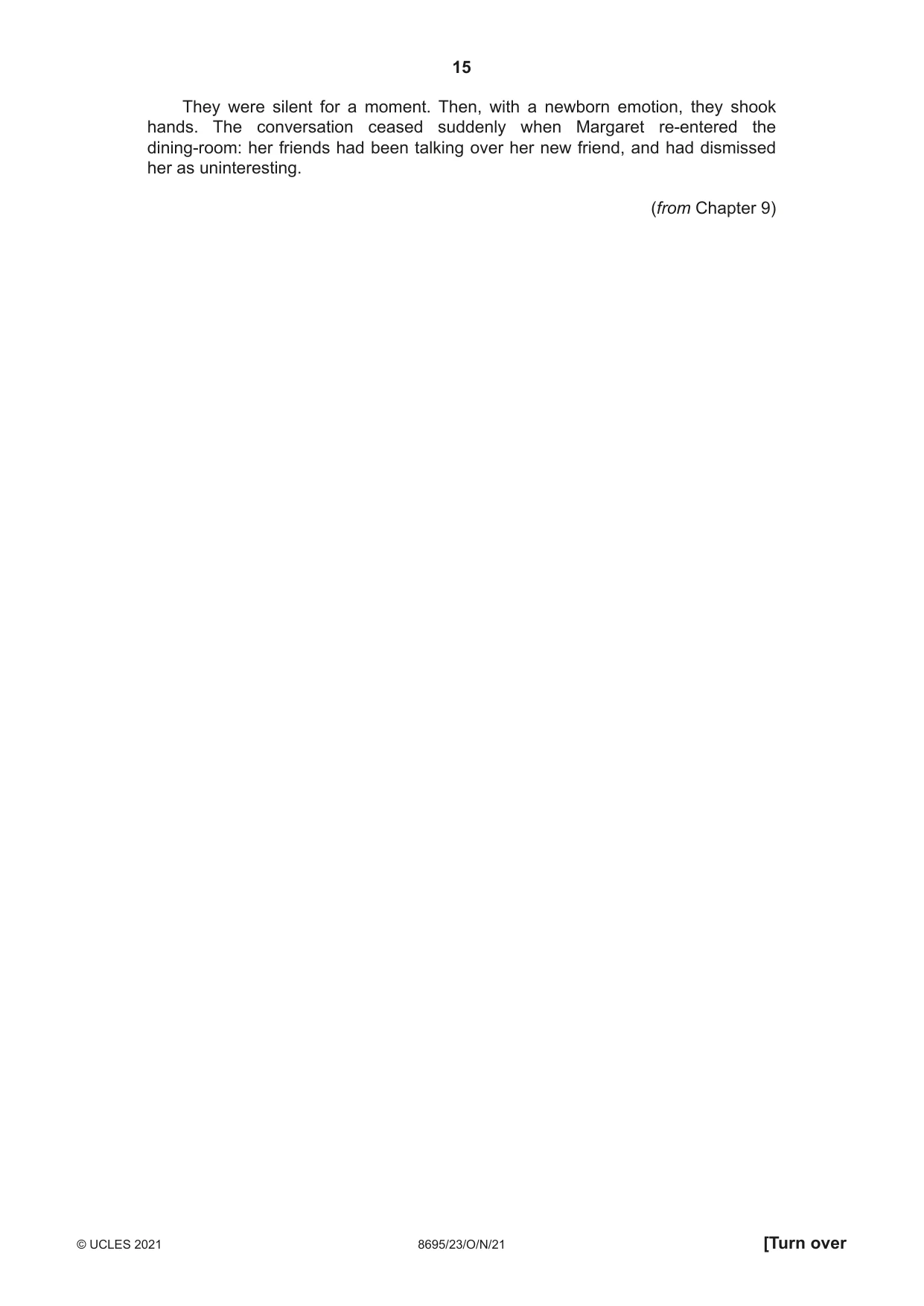
15 8695/23/O/N/21 © UCLES 2021 [Turn over They were silent for a moment. Then, with a newborn emotion, they shook hands. The conversation ceased suddenly when Margaret re-entered the dining-room: her friends had been talking over her new friend, and had dismissed her as uninteresting. (from Chapter 9)
Question paper, page 16
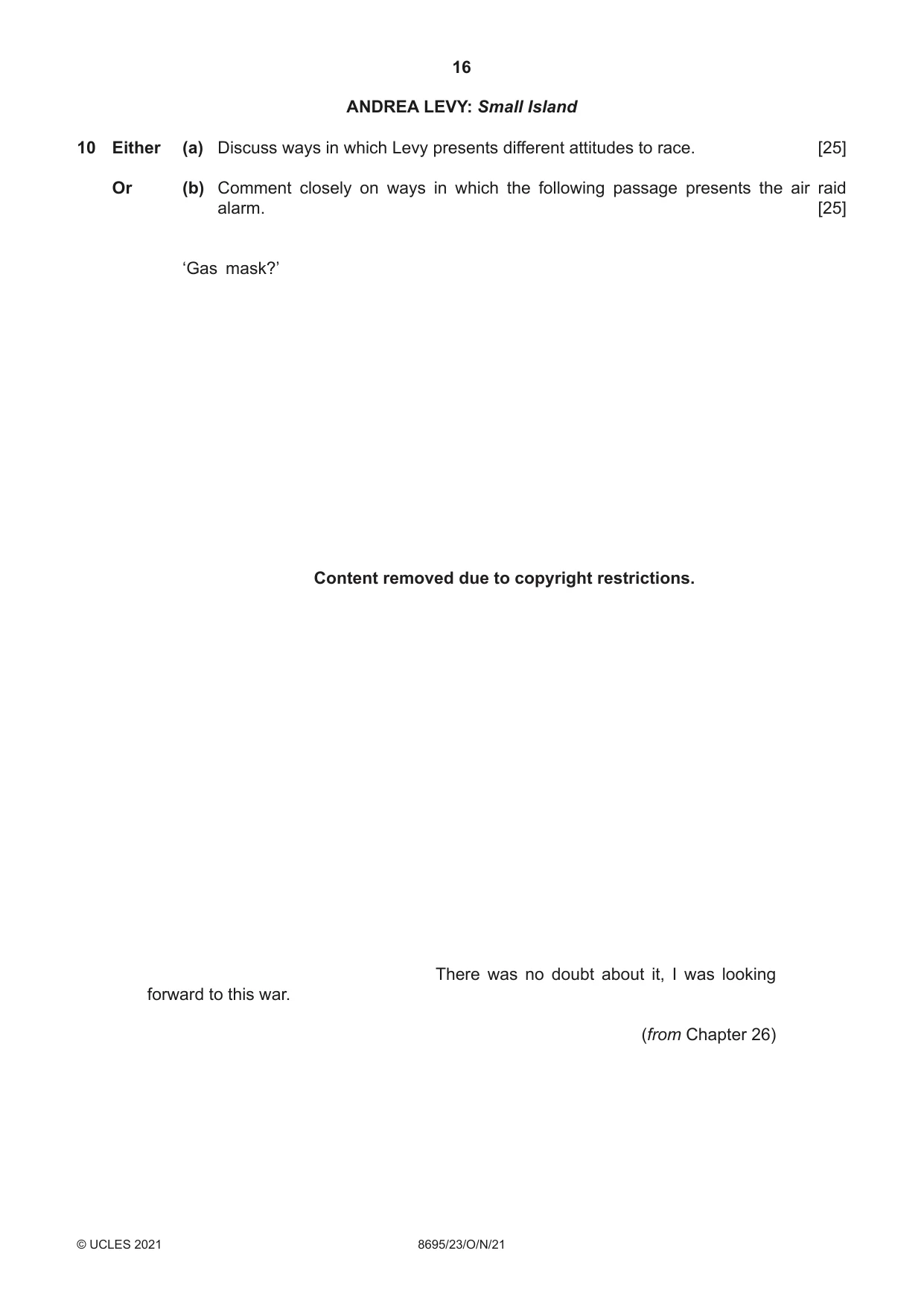
16 8695/23/O/N/21 © UCLES 2021 ANDREA LEVY: Small Island 10 Either (a) Discuss ways in which Levy presents different attitudes to race. [25] Or (b) Comment closely on ways in which the following passage presents the air raid alarm. [25] ‘Gas mask?’ There was no doubt about it, I was looking forward to this war. (from Chapter 26) Content removed due to copyright restrictions.
Question paper, page 17
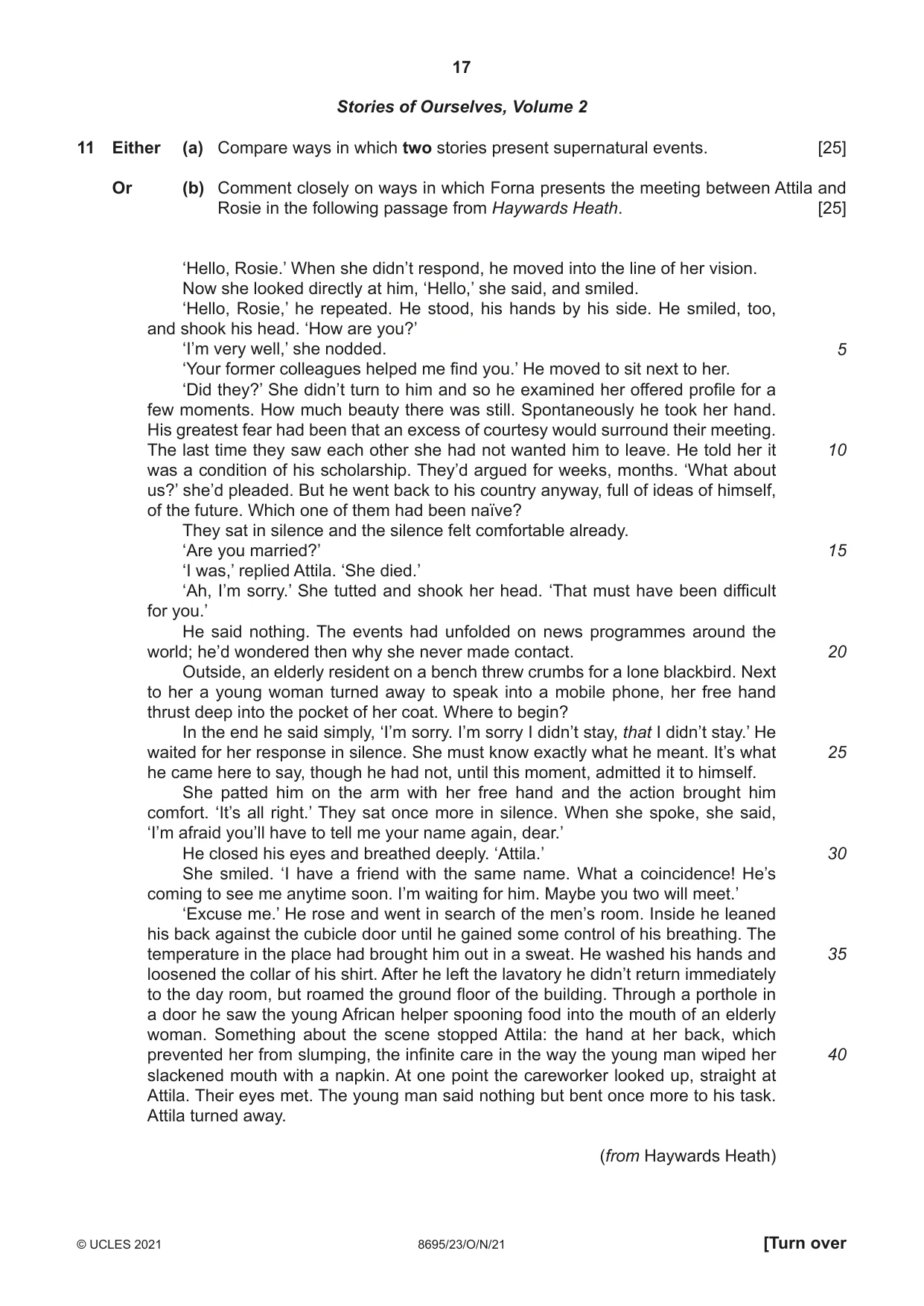
17 8695/23/O/N/21 © UCLES 2021 [Turn over Stories of Ourselves, Volume 2 11 Either (a) Compare ways in which two stories present supernatural events. [25] Or (b) Comment closely on ways in which Forna presents the meeting between Attila and Rosie in the following passage from Haywards Heath. [25] ‘Hello, Rosie.’ When she didn’t respond, he moved into the line of her vision. Now she looked directly at him, ‘Hello,’ she said, and smiled. ‘Hello, Rosie,’ he repeated. He stood, his hands by his side. He smiled, too, and shook his head. ‘How are you?’ ‘I’m very well,’ she nodded. ‘Your former colleagues helped me find you.’ He moved to sit next to her. ‘Did they?’ She didn’t turn to him and so he examined her offered profile for a few moments. How much beauty there was still. Spontaneously he took her hand. His greatest fear had been that an excess of courtesy would surround their meeting. The last time they saw each other she had not wanted him to leave. He told her it was a condition of his scholarship. They’d argued for weeks, months. ‘What about us?’ she’d pleaded. But he went back to his country anyway, full of ideas of himself, of the future. Which one of them had been naïve? They sat in silence and the silence felt comfortable already. ‘Are you married?’ ‘I was,’ replied Attila. ‘She died.’ ‘Ah, I’m sorry.’ She tutted and shook her head. ‘That must have been difficult for you.’ He said nothing. The events had unfolded on news programmes around the world; he’d wondered then why she never made contact. Outside, an elderly resident on a bench threw crumbs for a lone blackbird. Next to her a young woman turned away to speak into a mobile phone, her free hand thrust deep into the pocket of her coat. Where to begin? In the end he said simply, ‘I’m sorry. I’m sorry I didn’t stay, that I didn’t stay.’ He waited for her response in silence. She must know exactly what he meant. It’s what he came here to say, though he had not, until this moment, admitted it to himself. She patted him on the arm with her free hand and the action brought him comfort. ‘It’s all right.’ They sat once more in silence. When she spoke, she said, ‘I’m afraid you’ll have to tell me your name again, dear.’ He closed his eyes and breathed deeply. ‘Attila.’ She smiled. ‘I have a friend with the same name. What a coincidence! He’s coming to see me anytime soon. I’m waiting for him. Maybe you two will meet.’ ‘Excuse me.’ He rose and went in search of the men’s room. Inside he leaned his back against the cubicle door until he gained some control of his breathing. The temperature in the place had brought him out in a sweat. He washed his hands and loosened the collar of his shirt. After he left the lavatory he didn’t return immediately to the day room, but roamed the ground floor of the building. Through a porthole in a door he saw the young African helper spooning food into the mouth of an elderly woman. Something about the scene stopped Attila: the hand at her back, which prevented her from slumping, the infinite care in the way the young man wiped her slackened mouth with a napkin. At one point the careworker looked up, straight at Attila. Their eyes met. The young man said nothing but bent once more to his task. Attila turned away. (from Haywards Heath) 5 10 15 20 25 30 35 40
Question paper, page 18
18 8695/23/O/N/21 © UCLES 2021 NGŨGĨ WA THIONG’O: Petals of Blood 12 Either (a) Discuss some of the ways in which Ngũgĩ presents corruption and its effects in the novel. [25] Or (b) Comment closely on Ngũgĩ’s presentation of the drought in the following passage. [25] For Ilmorog the year saw yet another rain shortage. ‘Mwathi wa Mugo seems to be losing his power over the rains,’ he added with an ironic smile, without looking at Muturi. (from Chapter 5) Content removed due to copyright restrictions.
Question paper, page 19
19 8695/23/O/N/21 © UCLES 2021 BLANK PAGE
Question paper, page 20
20 8695/23/O/N/21 © UCLES 2021 Permission to reproduce items where third-party owned material protected by copyright is included has been sought and cleared where possible. Every reasonable effort has been made by the publisher (UCLES) to trace copyright holders, but if any items requiring clearance have unwittingly been included, the publisher will be pleased to make amends at the earliest possible opportunity. To avoid the issue of disclosure of answer-related information to candidates, all copyright acknowledgements are reproduced online in the Cambridge Assessment International Education Copyright Acknowledgements Booklet. This is produced for each series of examinations and is freely available to download at www.cambridgeinternational.org after the live examination series. Cambridge Assessment International Education is part of the Cambridge Assessment Group. Cambridge Assessment is the brand name of the University of Cambridge Local Examinations Syndicate (UCLES), which itself is a department of the University of Cambridge. BLANK PAGE
Mark scheme, page 1
This document consists of 11 printed pages. © UCLES 2021 [Turn over Cambridge International AS Level LANGUAGE AND LITERATURE IN ENGLISH 8695/23 Paper 2 Drama, Poetry and Prose October/November 2021 MARK SCHEME Maximum Mark: 50 Published This mark scheme is published as an aid to teachers and candidates, to indicate the requirements of the examination. It shows the basis on which Examiners were instructed to award marks. It does not indicate the details of the discussions that took place at an Examiners’ meeting before marking began, which would have considered the acceptability of alternative answers. Mark schemes should be read in conjunction with the question paper and the Principal Examiner Report for Teachers. Cambridge International will not enter into discussions about these mark schemes. Cambridge International is publishing the mark schemes for the October/November 2021 series for most Cambridge IGCSE™, Cambridge International A and AS Level components and some Cambridge O Level components.
Mark scheme, page 2
8695/23 Cambridge International AS Level – Mark Scheme PUBLISHED October/November 2021 © UCLES 2021 Page 2 of 11 Generic Marking Principles These general marking principles must be applied by all examiners when marking candidate answers. They should be applied alongside the specific content of the mark scheme or generic level descriptors for a question. Each question paper and mark scheme will also comply with these marking principles. GENERIC MARKING PRINCIPLE 1: Marks must be awarded in line with: • the specific content of the mark scheme or the generic level descriptors for the question • the specific skills defined in the mark scheme or in the generic level descriptors for the question • the standard of response required by a candidate as exemplified by the standardisation scripts. GENERIC MARKING PRINCIPLE 2: Marks awarded are always whole marks (not half marks, or other fractions). GENERIC MARKING PRINCIPLE 3: Marks must be awarded positively: • marks are awarded for correct/valid answers, as defined in the mark scheme. However, credit is given for valid answers which go beyond the scope of the syllabus and mark scheme, referring to your Team Leader as appropriate • marks are awarded when candidates clearly demonstrate what they know and can do • marks are not deducted for errors • marks are not deducted for omissions • answers should only be judged on the quality of spelling, punctuation and grammar when these features are specifically assessed by the question as indicated by the mark scheme. The meaning, however, should be unambiguous. GENERIC MARKING PRINCIPLE 4: Rules must be applied consistently, e.g. in situations where candidates have not followed instructions or in the application of generic level descriptors. GENERIC MARKING PRINCIPLE 5: Marks should be awarded using the full range of marks defined in the mark scheme for the question (however; the use of the full mark range may be limited according to the quality of the candidate responses seen). GENERIC MARKING PRINCIPLE 6: Marks awarded are based solely on the requirements as defined in the mark scheme. Marks should not be awarded with grade thresholds or grade descriptors in mind.
Mark scheme, page 3
8695/23 Cambridge International AS Level – Mark Scheme PUBLISHED October/November 2021 © UCLES 2021 Page 3 of 11 English & Media subject-specific general marking principles (To be read in conjunction with the Generic Marking Principles (and requiring further guidance on how to place marks within levels)) Components using level descriptors: • We use level descriptors as a guide to broad understanding of the qualities normally expected of, or typical of, work in a level. • Level descriptors are a means of general guidance, and should not be interpreted as hurdle statements. • Where indicative content notes are supplied for a question, these are not a prescription of required content, and must not be treated as such. Alternative correct points and unexpected answers in candidates’ scripts must be given marks that fairly reflect the knowledge and skills demonstrated. • While we may have legitimate expectations as to the ground most answers may occupy, we must at all times be prepared to meet candidates on their chosen ground, provided it is relevant ground (e.g. clearly related to and derived from a relevant passage/text and meeting the mark scheme requirements for the question). Components using point-based marking: Point marking is often used to reward knowledge, understanding and application of skills. We give credit where the candidate’s answer shows relevant knowledge, understanding and application of skills in answering the question. We do not give credit where the answer shows confusion. From this it follows that we: a DO credit answers which are worded differently from the mark scheme if they clearly convey the same meaning (unless the mark scheme requires a specific term). b DO credit alternative answers/examples which are not written in the mark scheme if they are correct. c DO credit answers where candidates give more than one correct answer in one prompt/numbered/scaffolded space where extended writing is required rather than list-type answers. For example, questions that require n reasons (e.g. State two reasons…). d DO NOT credit answers simply for using a ‘key term’ unless that is all that is required. (Check for evidence it is understood and not used wrongly.). e DO NOT credit answers which are obviously self-contradicting or trying to cover all possibilities. f DO NOT give further credit for what is effectively repetition of a correct point already credited unless the language itself is being tested. This applies equally to ‘mirror statements’ (i.e. polluted/not polluted). g DO NOT require spellings to be correct, unless this is part of the test. However spellings of syllabus terms must allow for clear and unambiguous separation from other syllabus terms with which they may be confused (e.g. Corrasion/Corrosion).
Mark scheme, page 4
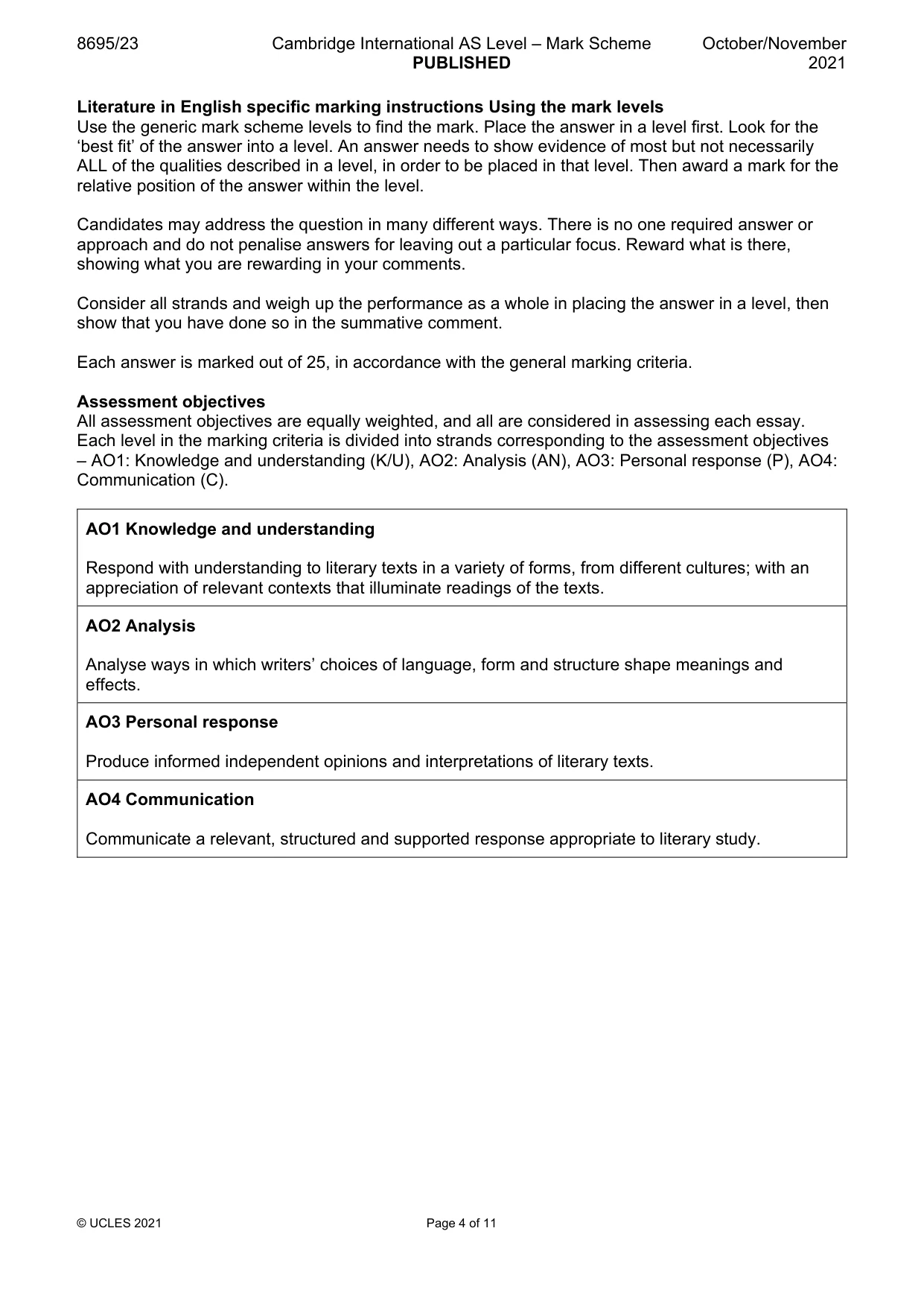
8695/23 Cambridge International AS Level – Mark Scheme PUBLISHED October/November 2021 © UCLES 2021 Page 4 of 11 Literature in English specific marking instructions Using the mark levels Use the generic mark scheme levels to find the mark. Place the answer in a level first. Look for the ‘best fit’ of the answer into a level. An answer needs to show evidence of most but not necessarily ALL of the qualities described in a level, in order to be placed in that level. Then award a mark for the relative position of the answer within the level. Candidates may address the question in many different ways. There is no one required answer or approach and do not penalise answers for leaving out a particular focus. Reward what is there, showing what you are rewarding in your comments. Consider all strands and weigh up the performance as a whole in placing the answer in a level, then show that you have done so in the summative comment. Each answer is marked out of 25, in accordance with the general marking criteria. Assessment objectives All assessment objectives are equally weighted, and all are considered in assessing each essay. Each level in the marking criteria is divided into strands corresponding to the assessment objectives – AO1: Knowledge and understanding (K/U), AO2: Analysis (AN), AO3: Personal response (P), AO4: Communication (C). AO1 Knowledge and understanding Respond with understanding to literary texts in a variety of forms, from different cultures; with an appreciation of relevant contexts that illuminate readings of the texts. AO2 Analysis Analyse ways in which writers’ choices of language, form and structure shape meanings and effects. AO3 Personal response Produce informed independent opinions and interpretations of literary texts. AO4 Communication Communicate a relevant, structured and supported response appropriate to literary study.
Mark scheme, page 5
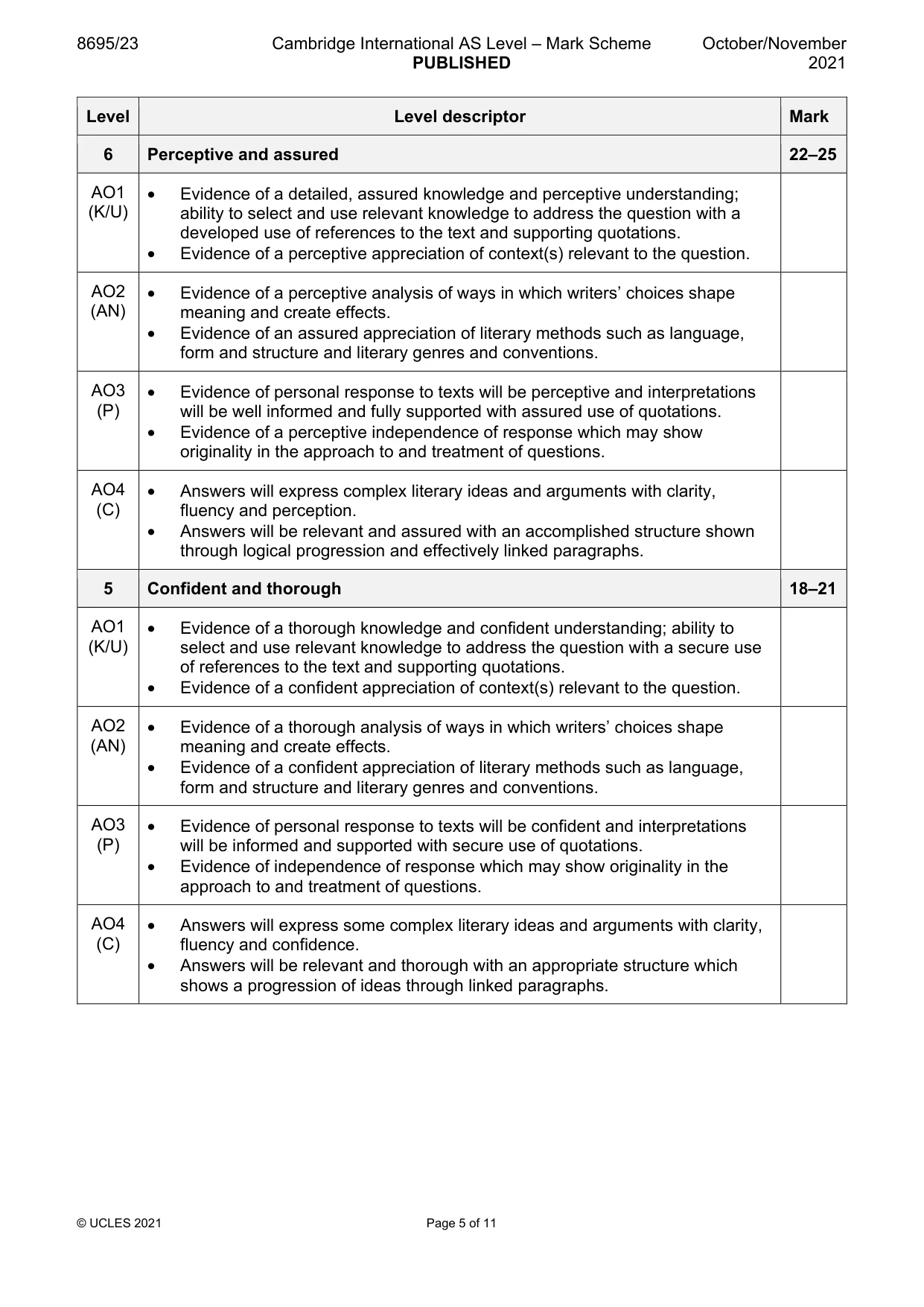
8695/23 Cambridge International AS Level – Mark Scheme PUBLISHED October/November 2021 © UCLES 2021 Page 5 of 11 Level Level descriptor Mark 6 Perceptive and assured 22–25 AO1 (K/U) • Evidence of a detailed, assured knowledge and perceptive understanding; ability to select and use relevant knowledge to address the question with a developed use of references to the text and supporting quotations. • Evidence of a perceptive appreciation of context(s) relevant to the question. AO2 (AN) • Evidence of a perceptive analysis of ways in which writers’ choices shape meaning and create effects. • Evidence of an assured appreciation of literary methods such as language, form and structure and literary genres and conventions. AO3 (P) • Evidence of personal response to texts will be perceptive and interpretations will be well informed and fully supported with assured use of quotations. • Evidence of a perceptive independence of response which may show originality in the approach to and treatment of questions. AO4 (C) • Answers will express complex literary ideas and arguments with clarity, fluency and perception. • Answers will be relevant and assured with an accomplished structure shown through logical progression and effectively linked paragraphs. 5 Confident and thorough 18–21 AO1 (K/U) • Evidence of a thorough knowledge and confident understanding; ability to select and use relevant knowledge to address the question with a secure use of references to the text and supporting quotations. • Evidence of a confident appreciation of context(s) relevant to the question. AO2 (AN) • Evidence of a thorough analysis of ways in which writers’ choices shape meaning and create effects. • Evidence of a confident appreciation of literary methods such as language, form and structure and literary genres and conventions. AO3 (P) • Evidence of personal response to texts will be confident and interpretations will be informed and supported with secure use of quotations. • Evidence of independence of response which may show originality in the approach to and treatment of questions. AO4 (C) • Answers will express some complex literary ideas and arguments with clarity, fluency and confidence. • Answers will be relevant and thorough with an appropriate structure which shows a progression of ideas through linked paragraphs.
Mark scheme, page 6
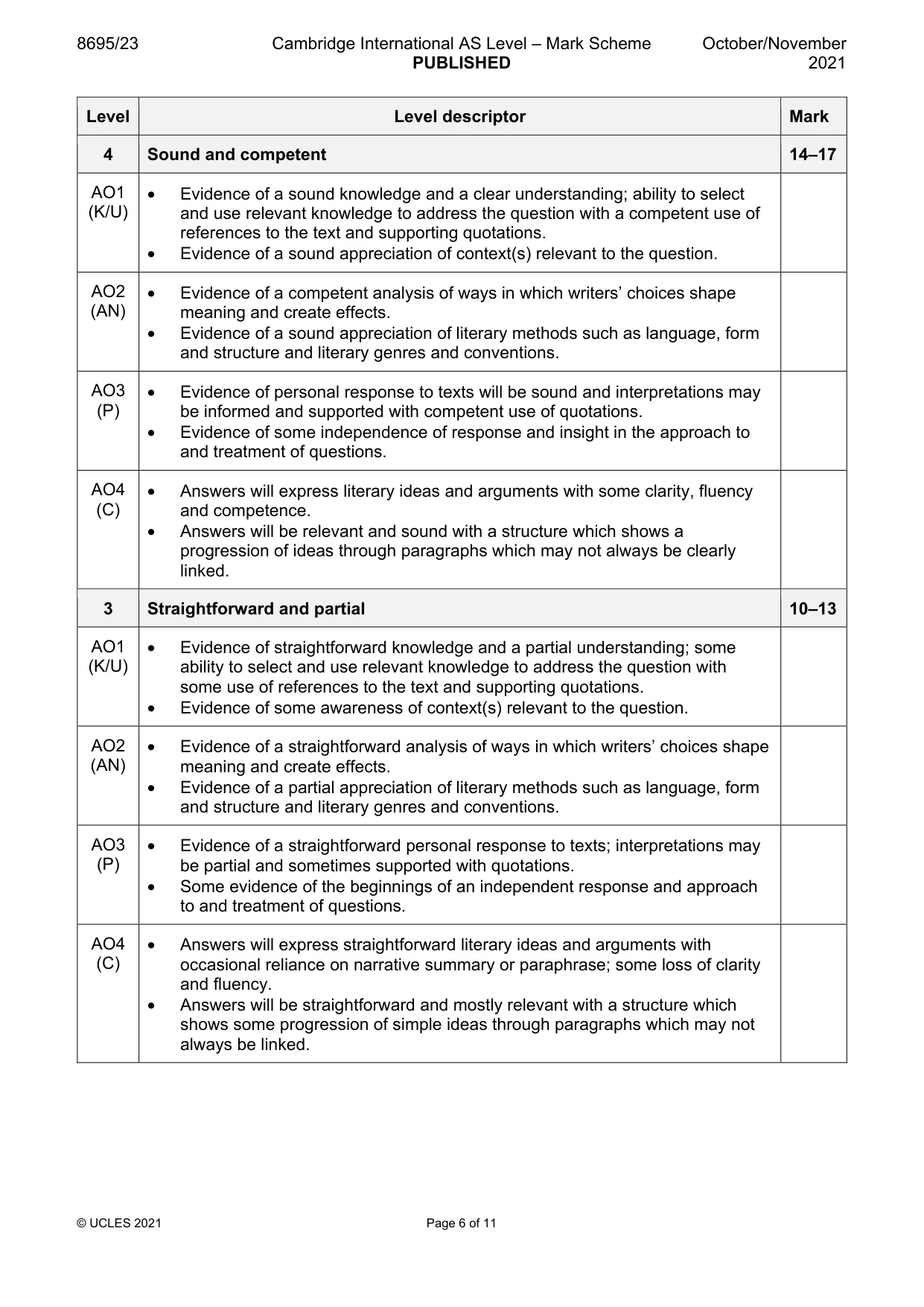
8695/23 Cambridge International AS Level – Mark Scheme PUBLISHED October/November 2021 © UCLES 2021 Page 6 of 11 Level Level descriptor Mark 4 Sound and competent 14–17 AO1 (K/U) • Evidence of a sound knowledge and a clear understanding; ability to select and use relevant knowledge to address the question with a competent use of references to the text and supporting quotations. • Evidence of a sound appreciation of context(s) relevant to the question. AO2 (AN) • Evidence of a competent analysis of ways in which writers’ choices shape meaning and create effects. • Evidence of a sound appreciation of literary methods such as language, form and structure and literary genres and conventions. AO3 (P) • Evidence of personal response to texts will be sound and interpretations may be informed and supported with competent use of quotations. • Evidence of some independence of response and insight in the approach to and treatment of questions. AO4 (C) • Answers will express literary ideas and arguments with some clarity, fluency and competence. • Answers will be relevant and sound with a structure which shows a progression of ideas through paragraphs which may not always be clearly linked. 3 Straightforward and partial 10–13 AO1 (K/U) • Evidence of straightforward knowledge and a partial understanding; some ability to select and use relevant knowledge to address the question with some use of references to the text and supporting quotations. • Evidence of some awareness of context(s) relevant to the question. AO2 (AN) • Evidence of a straightforward analysis of ways in which writers’ choices shape meaning and create effects. • Evidence of a partial appreciation of literary methods such as language, form and structure and literary genres and conventions. AO3 (P) • Evidence of a straightforward personal response to texts; interpretations may be partial and sometimes supported with quotations. • Some evidence of the beginnings of an independent response and approach to and treatment of questions. AO4 (C) • Answers will express straightforward literary ideas and arguments with occasional reliance on narrative summary or paraphrase; some loss of clarity and fluency. • Answers will be straightforward and mostly relevant with a structure which shows some progression of simple ideas through paragraphs which may not always be linked.
Mark scheme, page 7
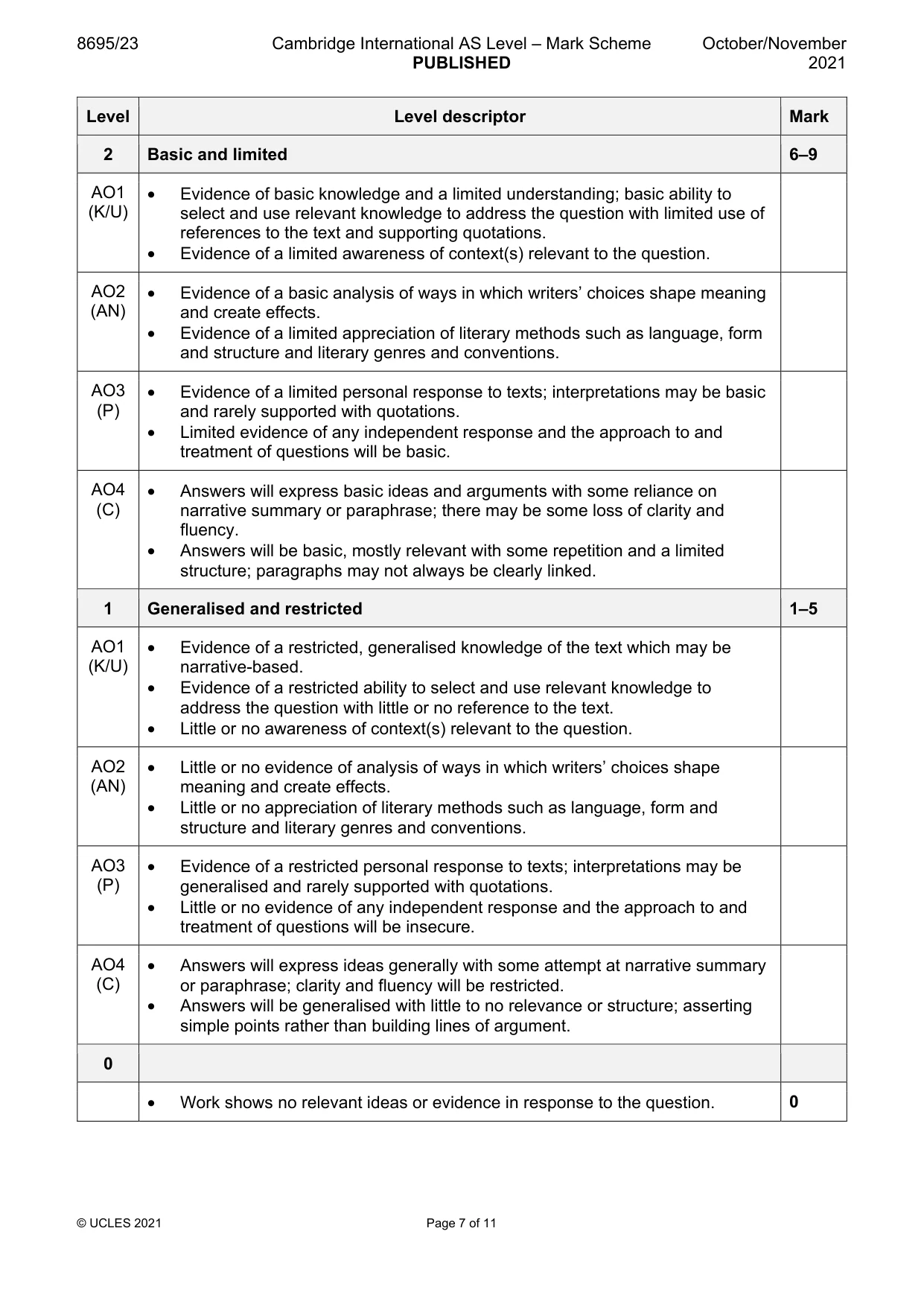
8695/23 Cambridge International AS Level – Mark Scheme PUBLISHED October/November 2021 © UCLES 2021 Page 7 of 11 Level Level descriptor Mark 2 Basic and limited 6–9 AO1 (K/U) • Evidence of basic knowledge and a limited understanding; basic ability to select and use relevant knowledge to address the question with limited use of references to the text and supporting quotations. • Evidence of a limited awareness of context(s) relevant to the question. AO2 (AN) • Evidence of a basic analysis of ways in which writers’ choices shape meaning and create effects. • Evidence of a limited appreciation of literary methods such as language, form and structure and literary genres and conventions. AO3 (P) • Evidence of a limited personal response to texts; interpretations may be basic and rarely supported with quotations. • Limited evidence of any independent response and the approach to and treatment of questions will be basic. AO4 (C) • Answers will express basic ideas and arguments with some reliance on narrative summary or paraphrase; there may be some loss of clarity and fluency. • Answers will be basic, mostly relevant with some repetition and a limited structure; paragraphs may not always be clearly linked. 1 Generalised and restricted 1–5 AO1 (K/U) • Evidence of a restricted, generalised knowledge of the text which may be narrative-based. • Evidence of a restricted ability to select and use relevant knowledge to address the question with little or no reference to the text. • Little or no awareness of context(s) relevant to the question. AO2 (AN) • Little or no evidence of analysis of ways in which writers’ choices shape meaning and create effects. • Little or no appreciation of literary methods such as language, form and structure and literary genres and conventions. AO3 (P) • Evidence of a restricted personal response to texts; interpretations may be generalised and rarely supported with quotations. • Little or no evidence of any independent response and the approach to and treatment of questions will be insecure. AO4 (C) • Answers will express ideas generally with some attempt at narrative summary or paraphrase; clarity and fluency will be restricted. • Answers will be generalised with little to no relevance or structure; asserting simple points rather than building lines of argument. 0 • Work shows no relevant ideas or evidence in response to the question. 0
Mark scheme, page 8
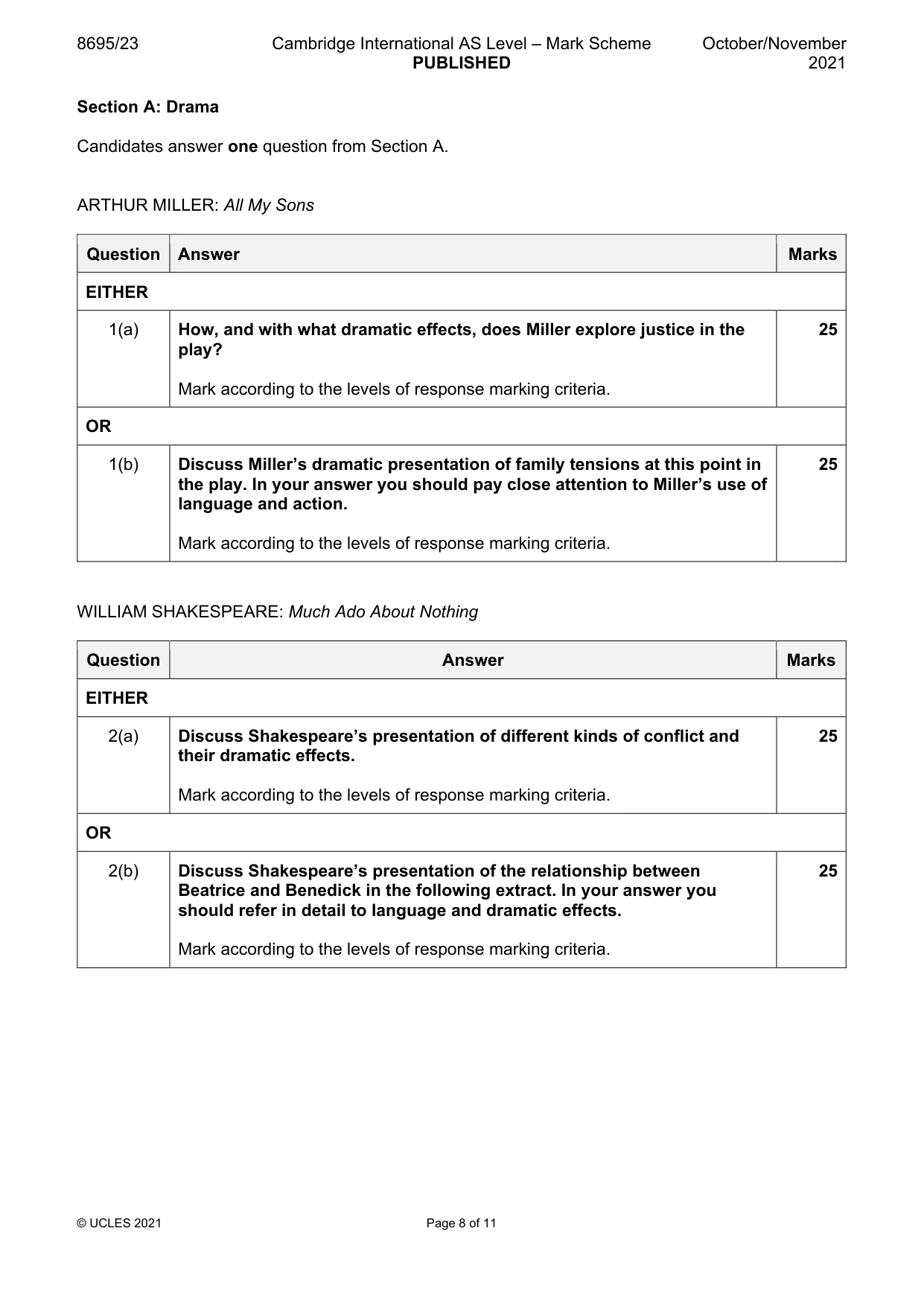
8695/23 Cambridge International AS Level – Mark Scheme PUBLISHED October/November 2021 © UCLES 2021 Page 8 of 11 Section A: Drama Candidates answer one question from Section A. ARTHUR MILLER: All My Sons Question Answer Marks EITHER 1(a) How, and with what dramatic effects, does Miller explore justice in the play? Mark according to the levels of response marking criteria. 25 OR 1(b) Discuss Miller’s dramatic presentation of family tensions at this point in the play. In your answer you should pay close attention to Miller’s use of language and action. Mark according to the levels of response marking criteria. 25 WILLIAM SHAKESPEARE: Much Ado About Nothing Question Answer Marks EITHER 2(a) Discuss Shakespeare’s presentation of different kinds of conflict and their dramatic effects. Mark according to the levels of response marking criteria. 25 OR 2(b) Discuss Shakespeare’s presentation of the relationship between Beatrice and Benedick in the following extract. In your answer you should refer in detail to language and dramatic effects. Mark according to the levels of response marking criteria. 25
Mark scheme, page 9
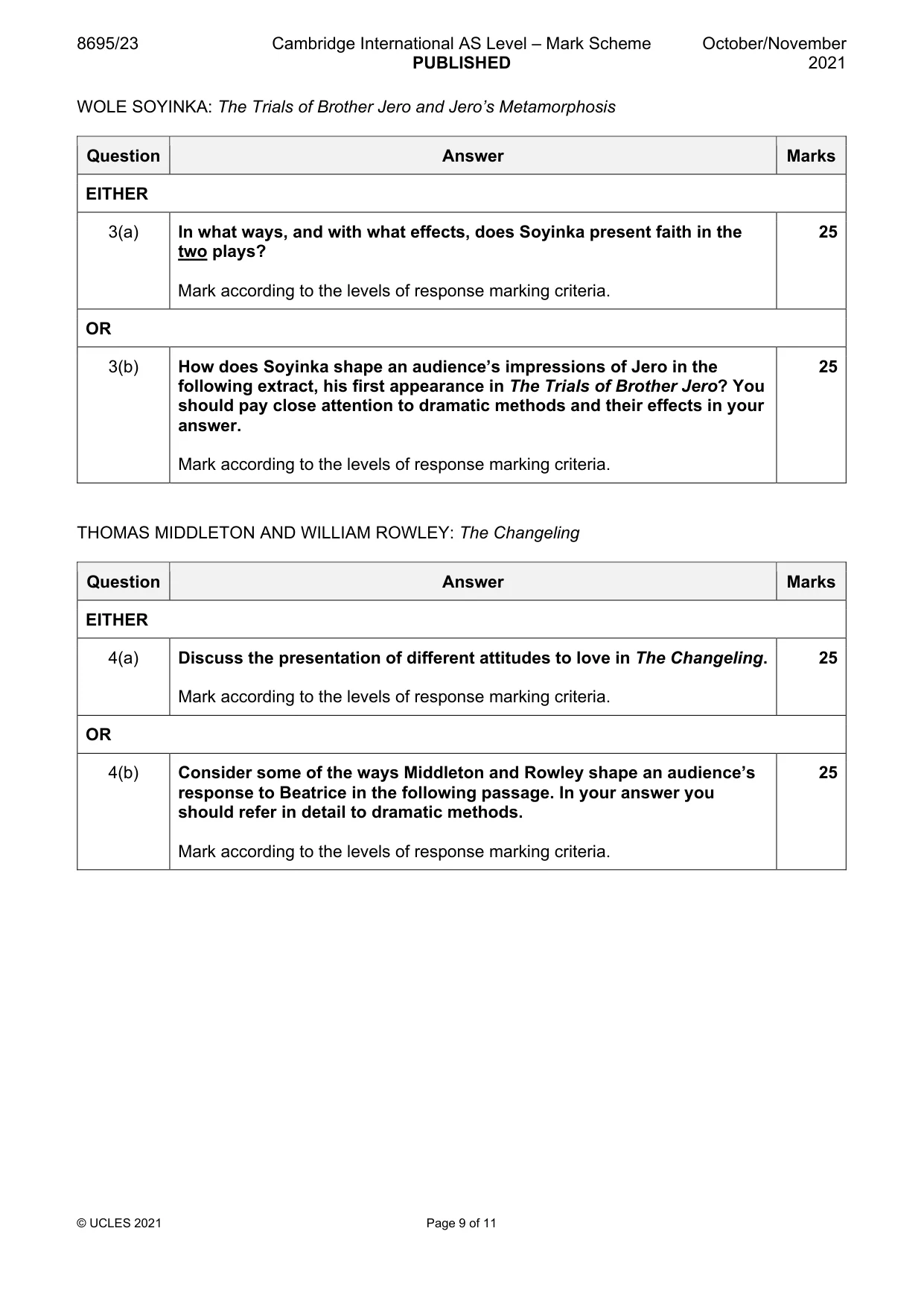
8695/23 Cambridge International AS Level – Mark Scheme PUBLISHED October/November 2021 © UCLES 2021 Page 9 of 11 WOLE SOYINKA: The Trials of Brother Jero and Jero’s Metamorphosis Question Answer Marks EITHER 3(a) In what ways, and with what effects, does Soyinka present faith in the two plays? Mark according to the levels of response marking criteria. 25 OR 3(b) How does Soyinka shape an audience’s impressions of Jero in the following extract, his first appearance in The Trials of Brother Jero? You should pay close attention to dramatic methods and their effects in your answer. Mark according to the levels of response marking criteria. 25 THOMAS MIDDLETON AND WILLIAM ROWLEY: The Changeling Question Answer Marks EITHER 4(a) Discuss the presentation of different attitudes to love in The Changeling. Mark according to the levels of response marking criteria. 25 OR 4(b) Consider some of the ways Middleton and Rowley shape an audience’s response to Beatrice in the following passage. In your answer you should refer in detail to dramatic methods. Mark according to the levels of response marking criteria. 25
Mark scheme, page 10
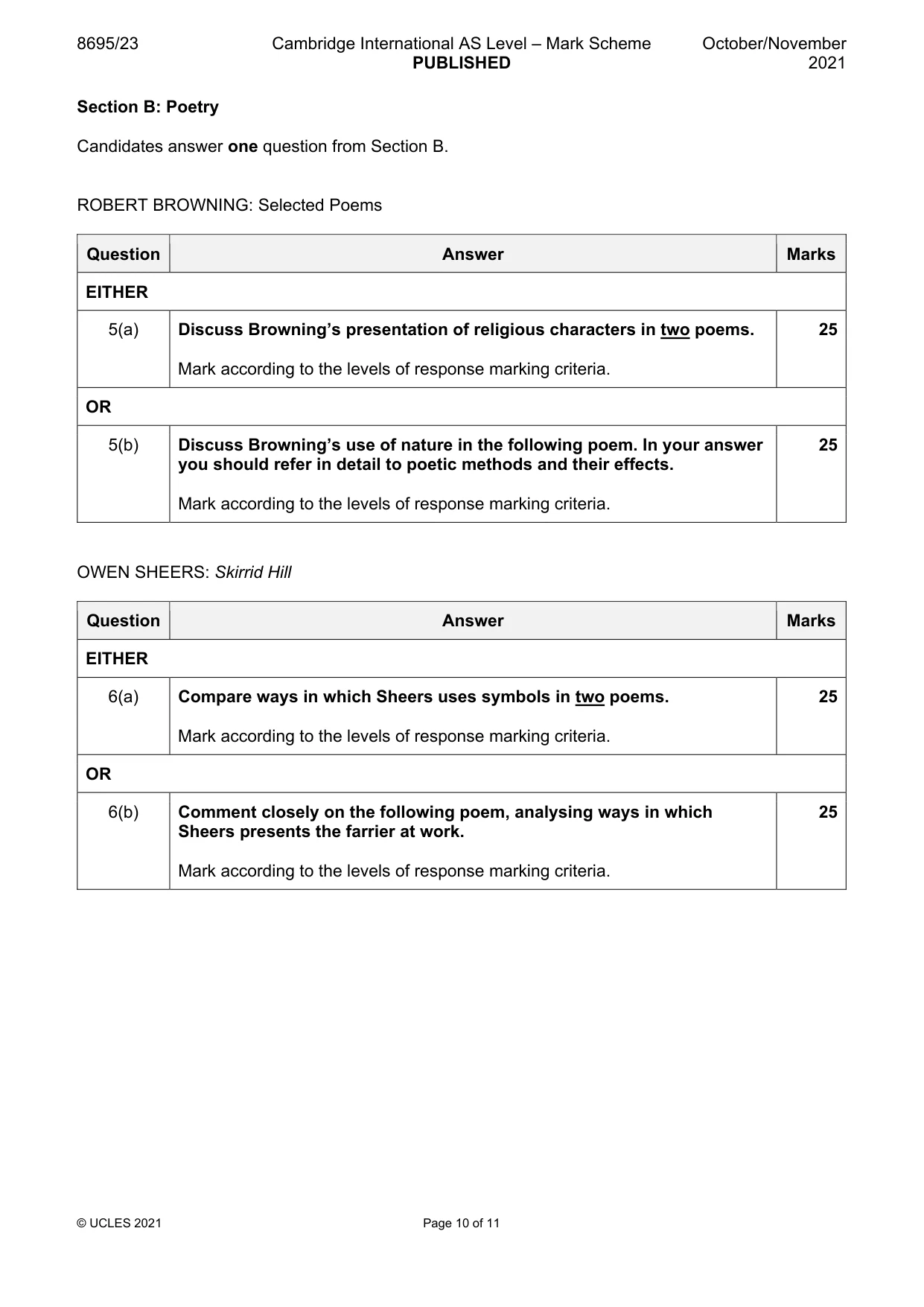
8695/23 Cambridge International AS Level – Mark Scheme PUBLISHED October/November 2021 © UCLES 2021 Page 10 of 11 Section B: Poetry Candidates answer one question from Section B. ROBERT BROWNING: Selected Poems Question Answer Marks EITHER 5(a) Discuss Browning’s presentation of religious characters in two poems. Mark according to the levels of response marking criteria. 25 OR 5(b) Discuss Browning’s use of nature in the following poem. In your answer you should refer in detail to poetic methods and their effects. Mark according to the levels of response marking criteria. 25 OWEN SHEERS: Skirrid Hill Question Answer Marks EITHER 6(a) Compare ways in which Sheers uses symbols in two poems. Mark according to the levels of response marking criteria. 25 OR 6(b) Comment closely on the following poem, analysing ways in which Sheers presents the farrier at work. Mark according to the levels of response marking criteria. 25
Mark scheme, page 11
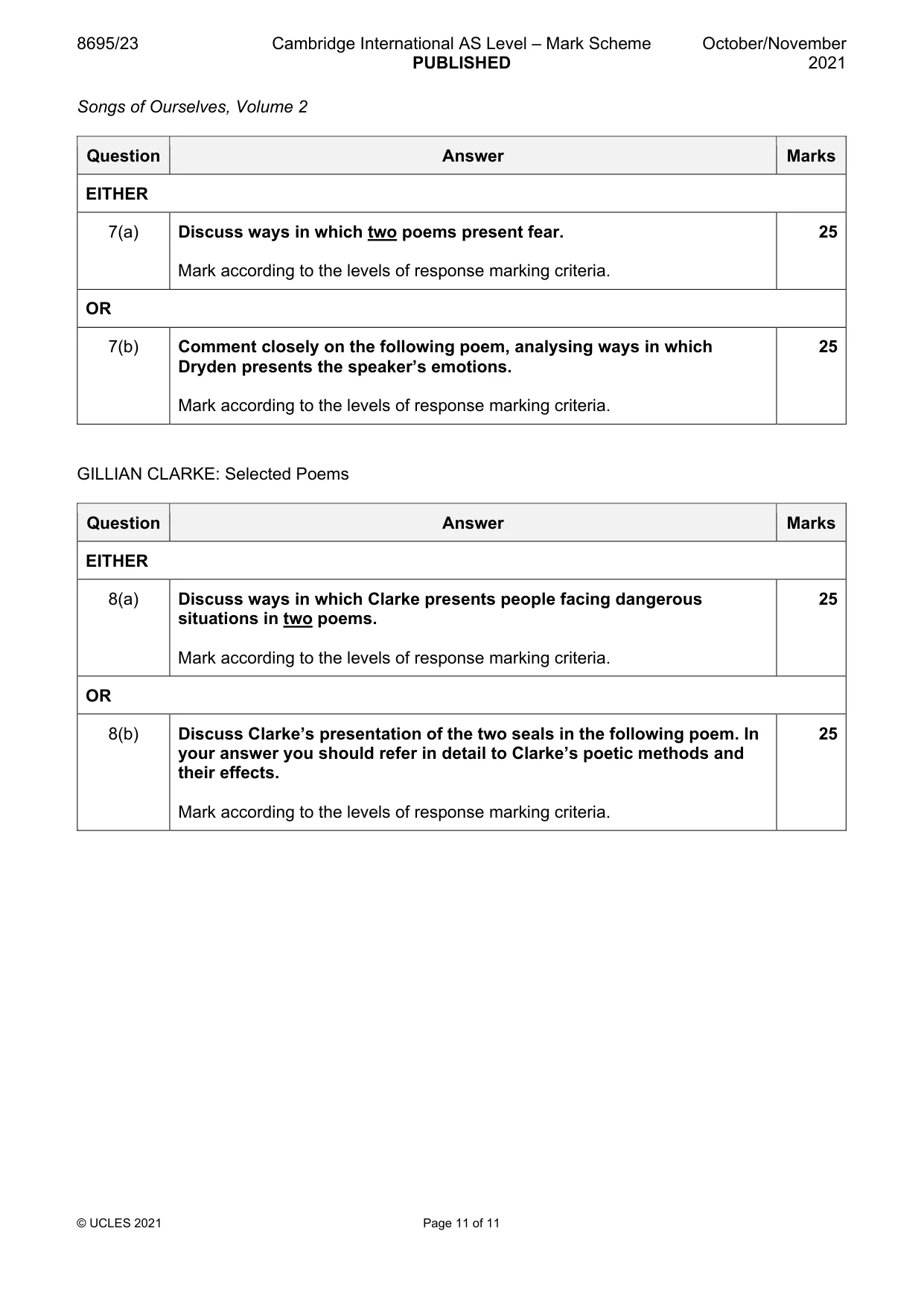
8695/23 Cambridge International AS Level – Mark Scheme PUBLISHED October/November 2021 © UCLES 2021 Page 11 of 11 Songs of Ourselves, Volume 2 Question Answer Marks EITHER 7(a) Discuss ways in which two poems present fear. Mark according to the levels of response marking criteria. 25 OR 7(b) Comment closely on the following poem, analysing ways in which Dryden presents the speaker’s emotions. Mark according to the levels of response marking criteria. 25 GILLIAN CLARKE: Selected Poems Question Answer Marks EITHER 8(a) Discuss ways in which Clarke presents people facing dangerous situations in two poems. Mark according to the levels of response marking criteria. 25 OR 8(b) Discuss Clarke’s presentation of the two seals in the following poem. In your answer you should refer in detail to Clarke’s poetic methods and their effects. Mark according to the levels of response marking criteria. 25
What you needed in this session
Cambridge’s own grade thresholds for 2021 Oct/Nov, Paper 2 · Variant 3. A higher threshold means an easier paper — the bar moves with how the cohort did.