Cambridge A Level English - Language and Literature (AS Level only, from 2016) 8695 — 2021 Oct/Nov Paper 2 · Variant 2
8695/22/O/N/21 · 50 marks · ≈56 min
The question paper and its mark scheme, free to read here and free to download. This is Cambridge’s own paper, exactly as it was sat.
Question paper20 pages

Mark scheme11 pages
Answers below. Sit the paper first if you are practising.
Paper as text
Question paper, page 1
This document has 20 pages. Any blank pages are indicated. * 5 5 5 4 5 9 4 7 2 9 * Cambridge International AS Level LANGUAGE AND LITERATURE IN ENGLISH 8695/22 Paper 2 Drama, Poetry and Prose October/November 2021 2 hours You must answer on the enclosed answer booklet. You will need: Answer booklet (enclosed) INSTRUCTIONS ● Answer two questions in total, each from a different section. ● Follow the instructions on the front cover of the answer booklet. If you need additional answer paper, ask the invigilator for a continuation booklet. ● Dictionaries are not allowed. INFORMATION ● The total mark for this paper is 50. ● The number of marks for each question or part question is shown in brackets [ ]. DC (RCL (DF)) 201398/3 © UCLES 2021 [Turn over
Question paper, page 2
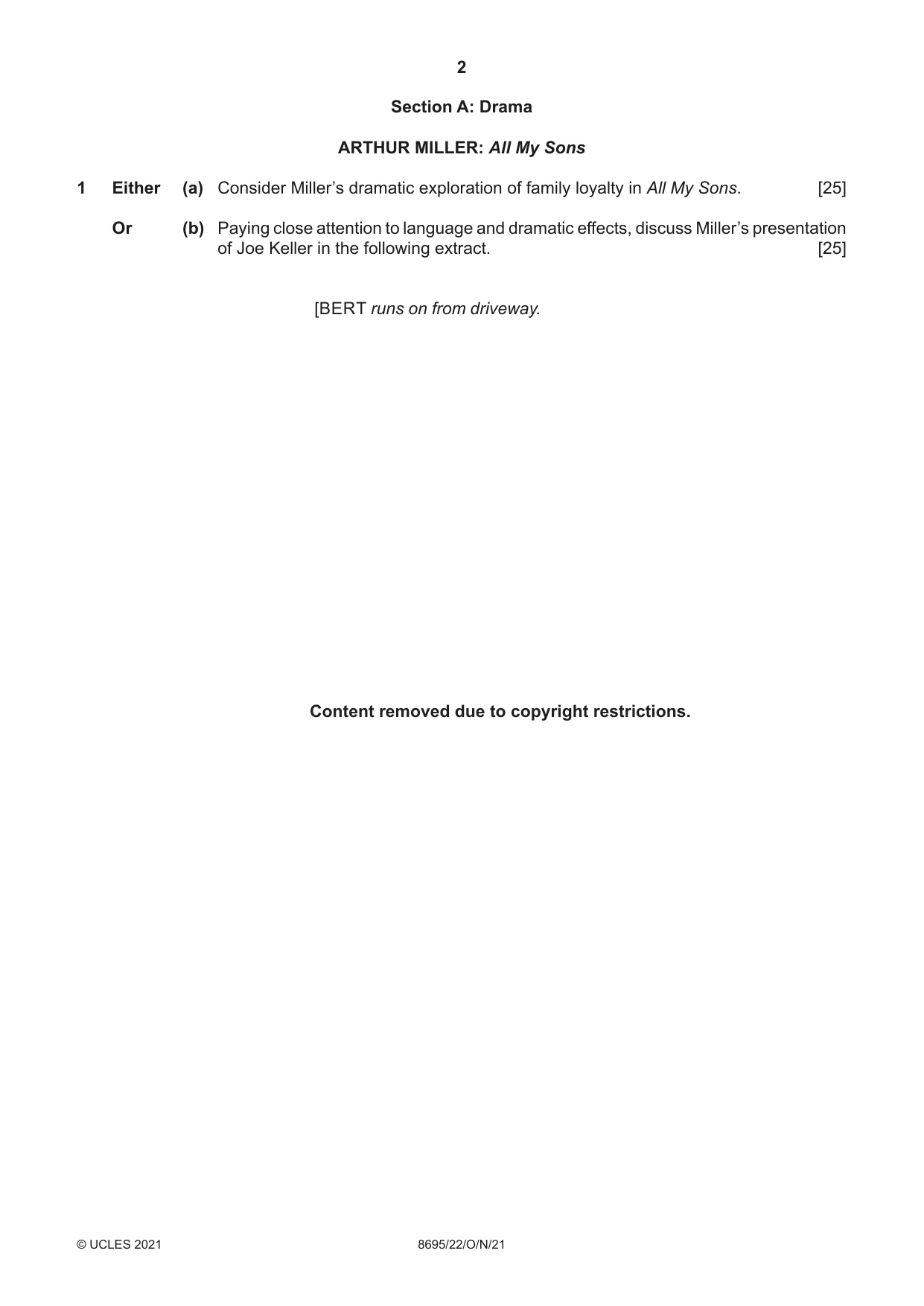
2 8695/22/O/N/21 © UCLES 2021 Section A: Drama ARTHUR MILLER: All My Sons 1 Either (a) Consider Miller’s dramatic exploration of family loyalty in All My Sons. [25] Or (b) Paying close attention to language and dramatic effects, discuss Miller’s presentation of Joe Keller in the following extract. [25] [BERT runs on from driveway. Content removed due to copyright restrictions.
Question paper, page 3
3 8695/22/O/N/21 © UCLES 2021 [Turn over Chris: One of these days, they’ll all come in here and beat your brains out. (from Act 1) Content removed due to copyright restrictions.
Question paper, page 4
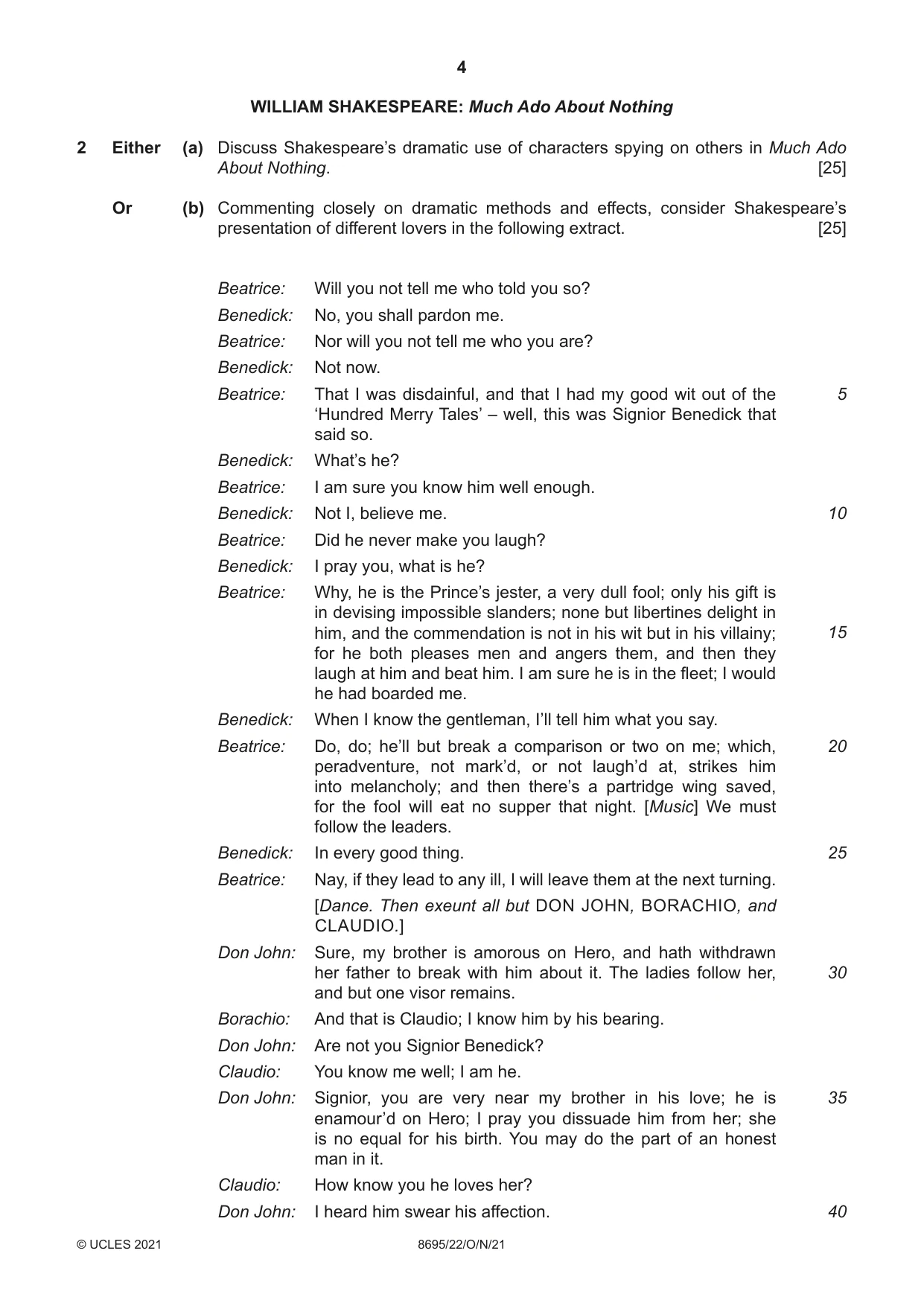
4 8695/22/O/N/21 © UCLES 2021 WILLIAM SHAKESPEARE: Much Ado About Nothing 2 Either (a) Discuss Shakespeare’s dramatic use of characters spying on others in Much Ado About Nothing. [25] Or (b) Commenting closely on dramatic methods and effects, consider Shakespeare’s presentation of different lovers in the following extract. [25] Beatrice: Will you not tell me who told you so? Benedick: No, you shall pardon me. Beatrice: Nor will you not tell me who you are? Benedick: Not now. Beatrice: That I was disdainful, and that I had my good wit out of the ‘Hundred Merry Tales’ – well, this was Signior Benedick that said so. Benedick: What’s he? Beatrice: I am sure you know him well enough. Benedick: Not I, believe me. Beatrice: Did he never make you laugh? Benedick: I pray you, what is he? Beatrice: Why, he is the Prince’s jester, a very dull fool; only his gift is in devising impossible slanders; none but libertines delight in him, and the commendation is not in his wit but in his villainy; for he both pleases men and angers them, and then they laugh at him and beat him. I am sure he is in the fleet; I would he had boarded me. Benedick: When I know the gentleman, I’ll tell him what you say. Beatrice: Do, do; he’ll but break a comparison or two on me; which, peradventure, not mark’d, or not laugh’d at, strikes him into melancholy; and then there’s a partridge wing saved, for the fool will eat no supper that night. [Music] We must follow the leaders. Benedick: In every good thing. Beatrice: Nay, if they lead to any ill, I will leave them at the next turning. [Dance. Then exeunt all but DON JOHN, BORACHIO, and CLAUDIO.] Don John: Sure, my brother is amorous on Hero, and hath withdrawn her father to break with him about it. The ladies follow her, and but one visor remains. Borachio: And that is Claudio; I know him by his bearing. Don John: Are not you Signior Benedick? Claudio: You know me well; I am he. Don John: Signior, you are very near my brother in his love; he is enamour’d on Hero; I pray you dissuade him from her; she is no equal for his birth. You may do the part of an honest man in it. Claudio: How know you he loves her? Don John: I heard him swear his affection. 5 10 15 20 25 30 35 40
Question paper, page 5
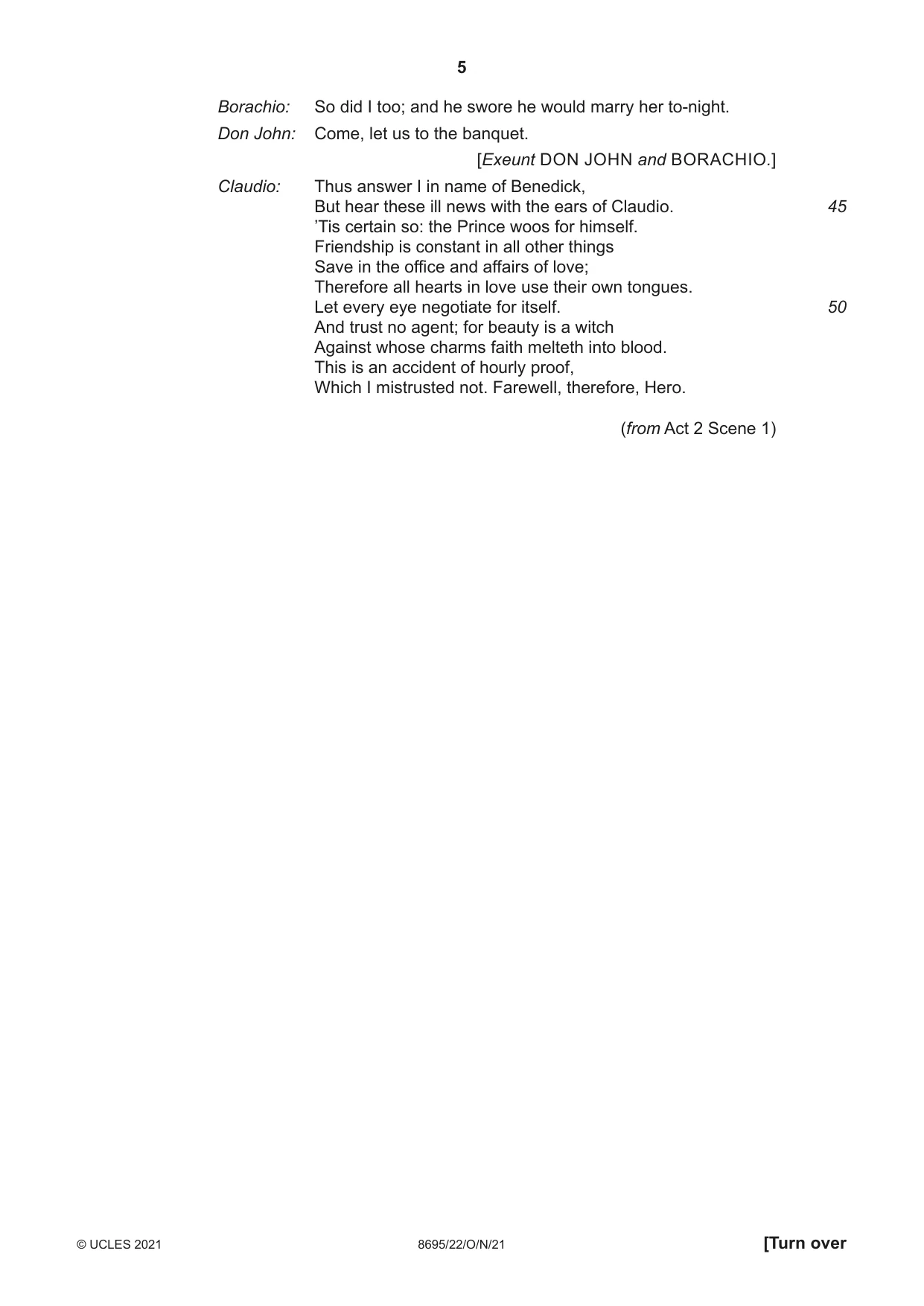
5 8695/22/O/N/21 © UCLES 2021 [Turn over Borachio: So did I too; and he swore he would marry her to-night. Don John: Come, let us to the banquet. [Exeunt DON JOHN and BORACHIO.] Claudio: Thus answer I in name of Benedick, But hear these ill news with the ears of Claudio. ’Tis certain so: the Prince woos for himself. Friendship is constant in all other things Save in the office and affairs of love; Therefore all hearts in love use their own tongues. Let every eye negotiate for itself. And trust no agent; for beauty is a witch Against whose charms faith melteth into blood. This is an accident of hourly proof, Which I mistrusted not. Farewell, therefore, Hero. (from Act 2 Scene 1) 45 50
Question paper, page 6
6 8695/22/O/N/21 © UCLES 2021 WOLE SOYINKA: The Trials of Brother Jero and Jero’s Metamorphosis 3 Either (a) Discuss some of the effects created by Soyinka’s presentation of different attitudes to women in the two plays. [25] Or (b) In what ways, and with what dramatic effects, does Soyinka shape an audience’s response to the prophets in the following extract from Jero’s Metamorphosis? [25] [The front space of BROTHER JERO’s headquarters. Content removed due to copyright restrictions.
Question paper, page 7
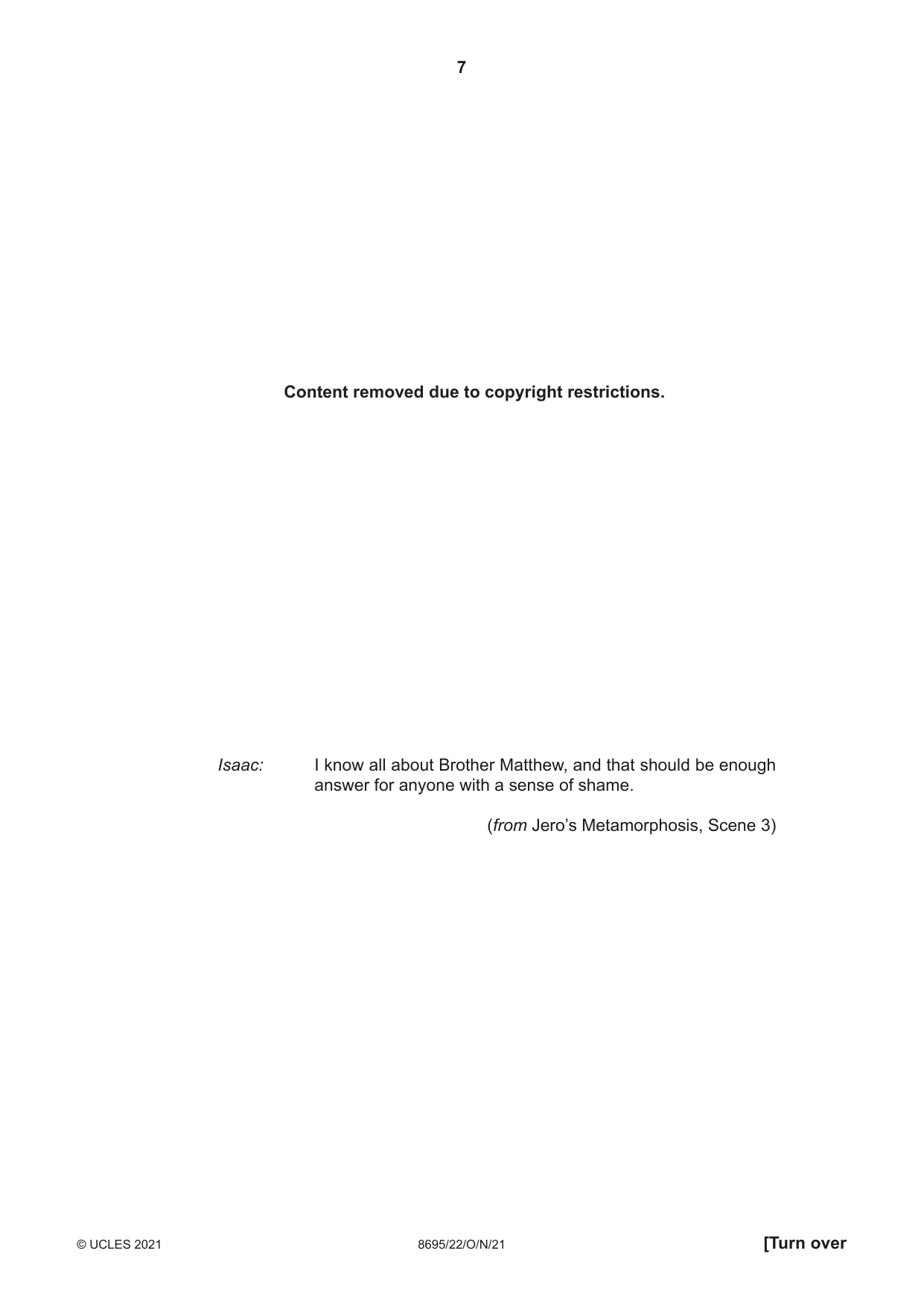
7 8695/22/O/N/21 © UCLES 2021 [Turn over Isaac: I know all about Brother Matthew, and that should be enough answer for anyone with a sense of shame. (from Jero’s Metamorphosis, Scene 3) Content removed due to copyright restrictions.
Question paper, page 8
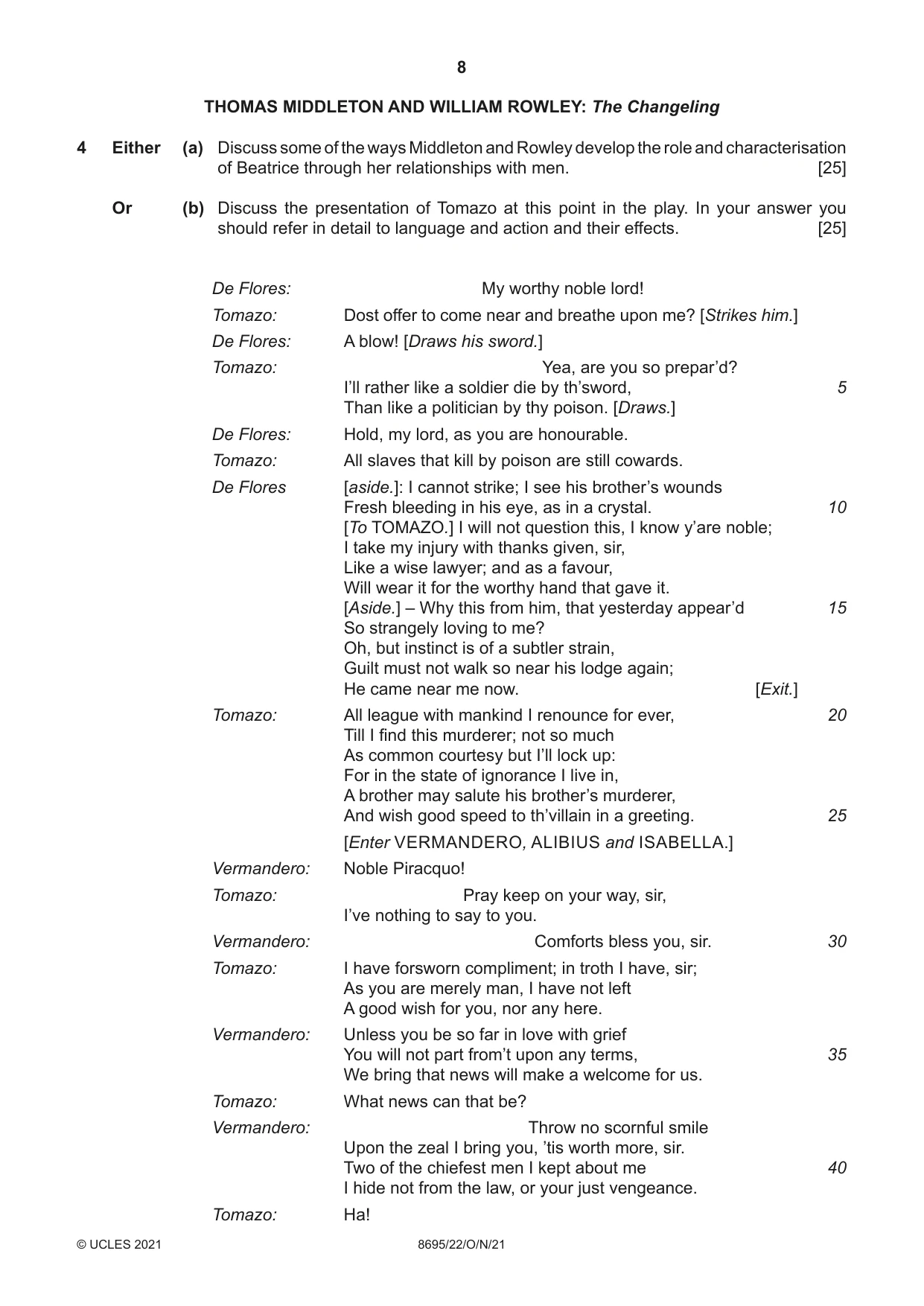
8 8695/22/O/N/21 © UCLES 2021 THOMAS MIDDLETON AND WILLIAM ROWLEY: The Changeling 4 Either (a) Discuss some of the ways Middleton and Rowley develop the role and characterisation of Beatrice through her relationships with men. [25] Or (b) Discuss the presentation of Tomazo at this point in the play. In your answer you should refer in detail to language and action and their effects. [25] De Flores: My worthy noble lord! Tomazo: Dost offer to come near and breathe upon me? [Strikes him.] De Flores: A blow! [Draws his sword.] Tomazo: Yea, are you so prepar’d? I’ll rather like a soldier die by th’sword, Than like a politician by thy poison. [Draws.] De Flores: Hold, my lord, as you are honourable. Tomazo: All slaves that kill by poison are still cowards. De Flores [aside.]: I cannot strike; I see his brother’s wounds Fresh bleeding in his eye, as in a crystal. [To TOMAZO.] I will not question this, I know y’are noble; I take my injury with thanks given, sir, Like a wise lawyer; and as a favour, Will wear it for the worthy hand that gave it. [Aside.] – Why this from him, that yesterday appear’d So strangely loving to me? Oh, but instinct is of a subtler strain, Guilt must not walk so near his lodge again; He came near me now. [Exit.] Tomazo: All league with mankind I renounce for ever, Till I find this murderer; not so much As common courtesy but I’ll lock up: For in the state of ignorance I live in, A brother may salute his brother’s murderer, And wish good speed to th’villain in a greeting. [Enter VERMANDERO, ALIBIUS and ISABELLA.] Vermandero: Noble Piracquo! Tomazo: Pray keep on your way, sir, I’ve nothing to say to you. Vermandero: Comforts bless you, sir. Tomazo: I have forsworn compliment; in troth I have, sir; As you are merely man, I have not left A good wish for you, nor any here. Vermandero: Unless you be so far in love with grief You will not part from’t upon any terms, We bring that news will make a welcome for us. Tomazo: What news can that be? Vermandero: Throw no scornful smile Upon the zeal I bring you, ’tis worth more, sir. Two of the chiefest men I kept about me I hide not from the law, or your just vengeance. Tomazo: Ha! 5 10 15 20 25 30 35 40
Question paper, page 9
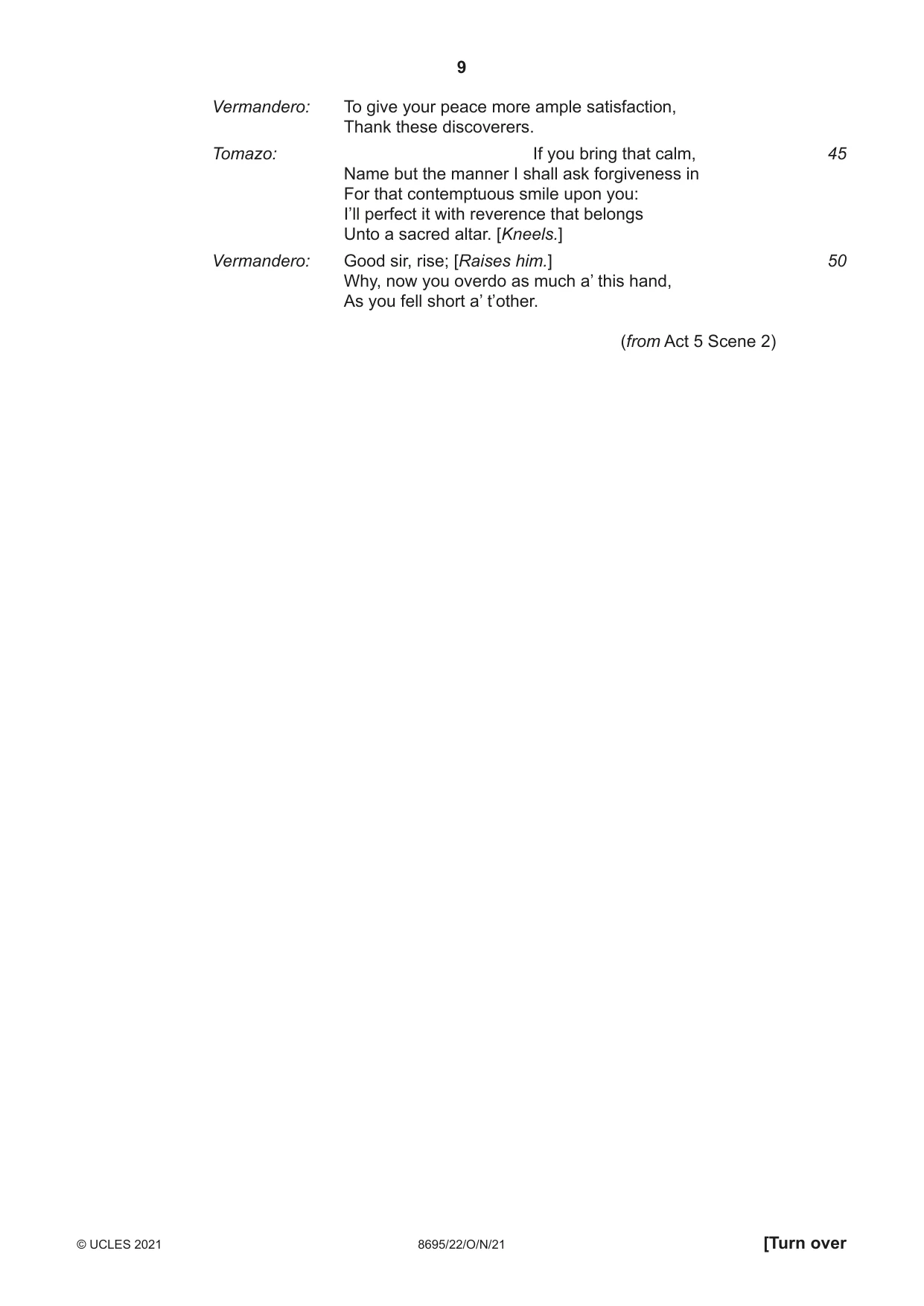
9 8695/22/O/N/21 © UCLES 2021 [Turn over Vermandero: To give your peace more ample satisfaction, Thank these discoverers. Tomazo: If you bring that calm, Name but the manner I shall ask forgiveness in For that contemptuous smile upon you: I’ll perfect it with reverence that belongs Unto a sacred altar. [Kneels.] Vermandero: Good sir, rise; [Raises him.] Why, now you overdo as much a’ this hand, As you fell short a’ t’other. (from Act 5 Scene 2) 45 50
Question paper, page 10
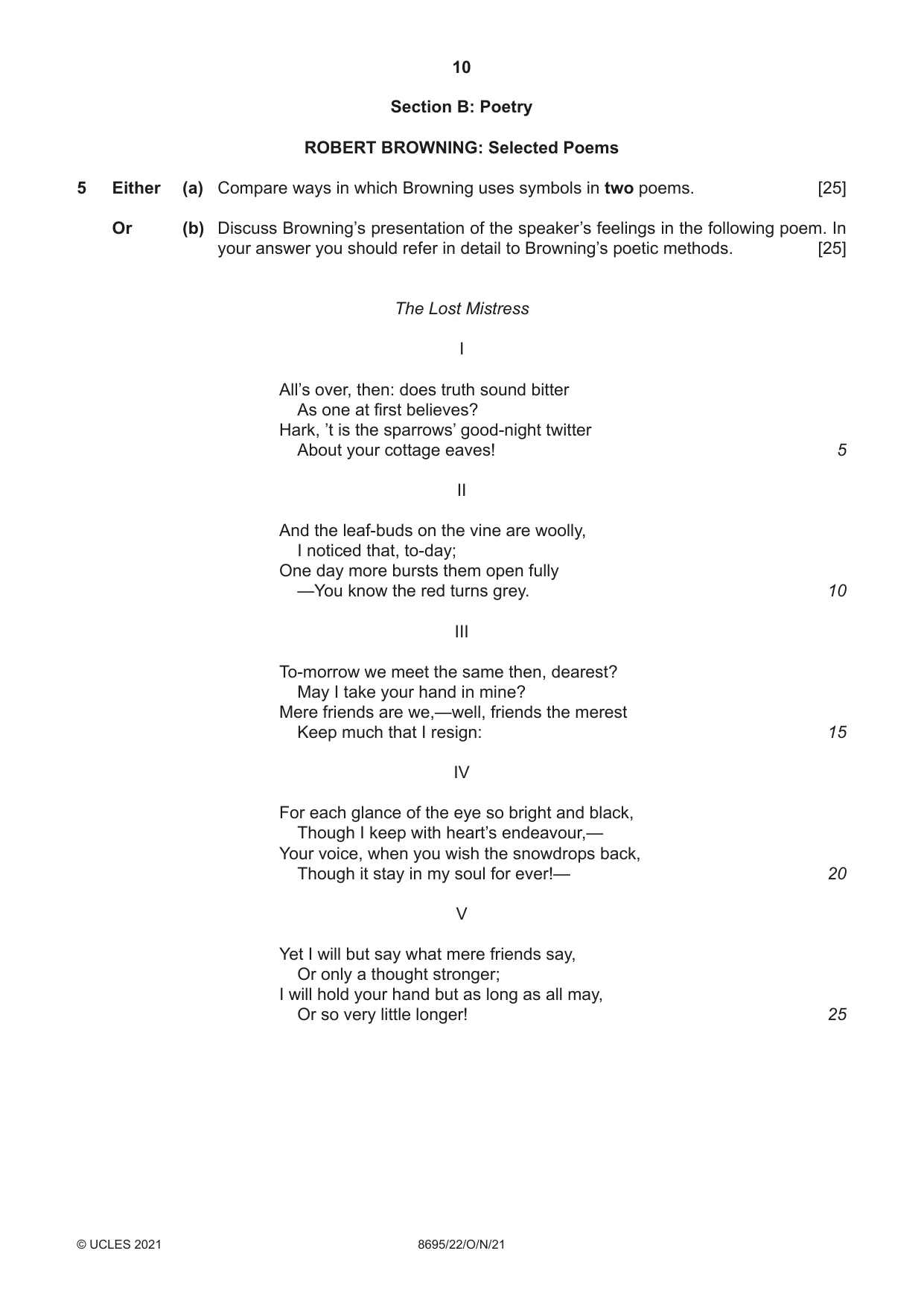
10 8695/22/O/N/21 © UCLES 2021 Section B: Poetry ROBERT BROWNING: Selected Poems 5 Either (a) Compare ways in which Browning uses symbols in two poems. [25] Or (b) Discuss Browning’s presentation of the speaker’s feelings in the following poem. In your answer you should refer in detail to Browning’s poetic methods. [25] The Lost Mistress I All’s over, then: does truth sound bitter As one at first believes? Hark, ’t is the sparrows’ good-night twitter About your cottage eaves! II And the leaf-buds on the vine are woolly, I noticed that, to-day; One day more bursts them open fully —You know the red turns grey. III To-morrow we meet the same then, dearest? May I take your hand in mine? Mere friends are we,—well, friends the merest Keep much that I resign: IV For each glance of the eye so bright and black, Though I keep with heart’s endeavour,— Your voice, when you wish the snowdrops back, Though it stay in my soul for ever!— V Yet I will but say what mere friends say, Or only a thought stronger; I will hold your hand but as long as all may, Or so very little longer! 5 10 15 20 25
Question paper, page 11
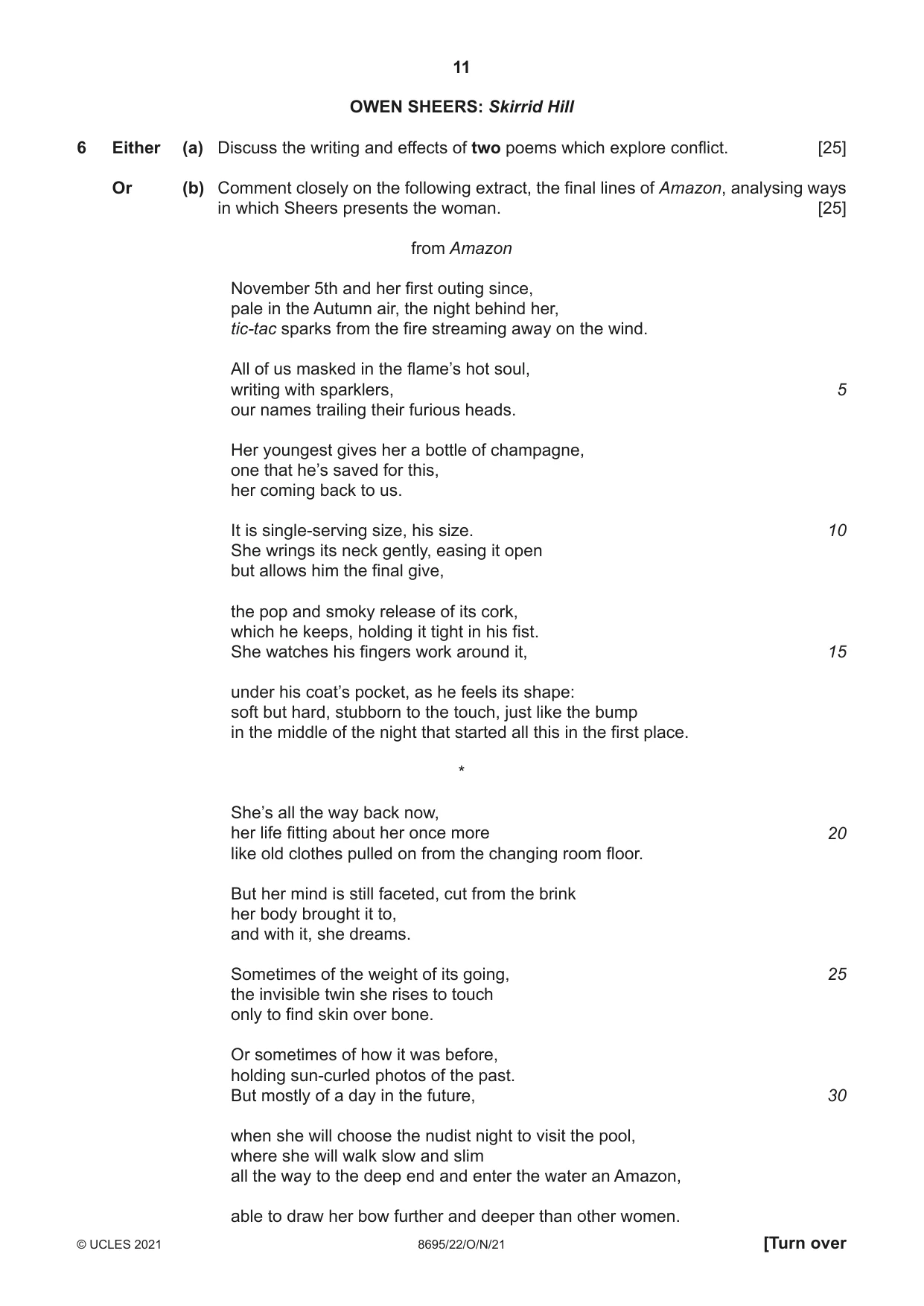
11 8695/22/O/N/21 © UCLES 2021 [Turn over OWEN SHEERS: Skirrid Hill 6 Either (a) Discuss the writing and effects of two poems which explore conflict. [25] Or (b) Comment closely on the following extract, the final lines of Amazon, analysing ways in which Sheers presents the woman. [25] from Amazon November 5th and her first outing since, pale in the Autumn air, the night behind her, tic-tac sparks from the fire streaming away on the wind. All of us masked in the flame’s hot soul, writing with sparklers, our names trailing their furious heads. Her youngest gives her a bottle of champagne, one that he’s saved for this, her coming back to us. It is single-serving size, his size. She wrings its neck gently, easing it open but allows him the final give, the pop and smoky release of its cork, which he keeps, holding it tight in his fist. She watches his fingers work around it, under his coat’s pocket, as he feels its shape: soft but hard, stubborn to the touch, just like the bump in the middle of the night that started all this in the first place. * She’s all the way back now, her life fitting about her once more like old clothes pulled on from the changing room floor. But her mind is still faceted, cut from the brink her body brought it to, and with it, she dreams. Sometimes of the weight of its going, the invisible twin she rises to touch only to find skin over bone. Or sometimes of how it was before, holding sun-curled photos of the past. But mostly of a day in the future, when she will choose the nudist night to visit the pool, where she will walk slow and slim all the way to the deep end and enter the water an Amazon, able to draw her bow further and deeper than other women. 5 10 15 20 25 30
Question paper, page 12
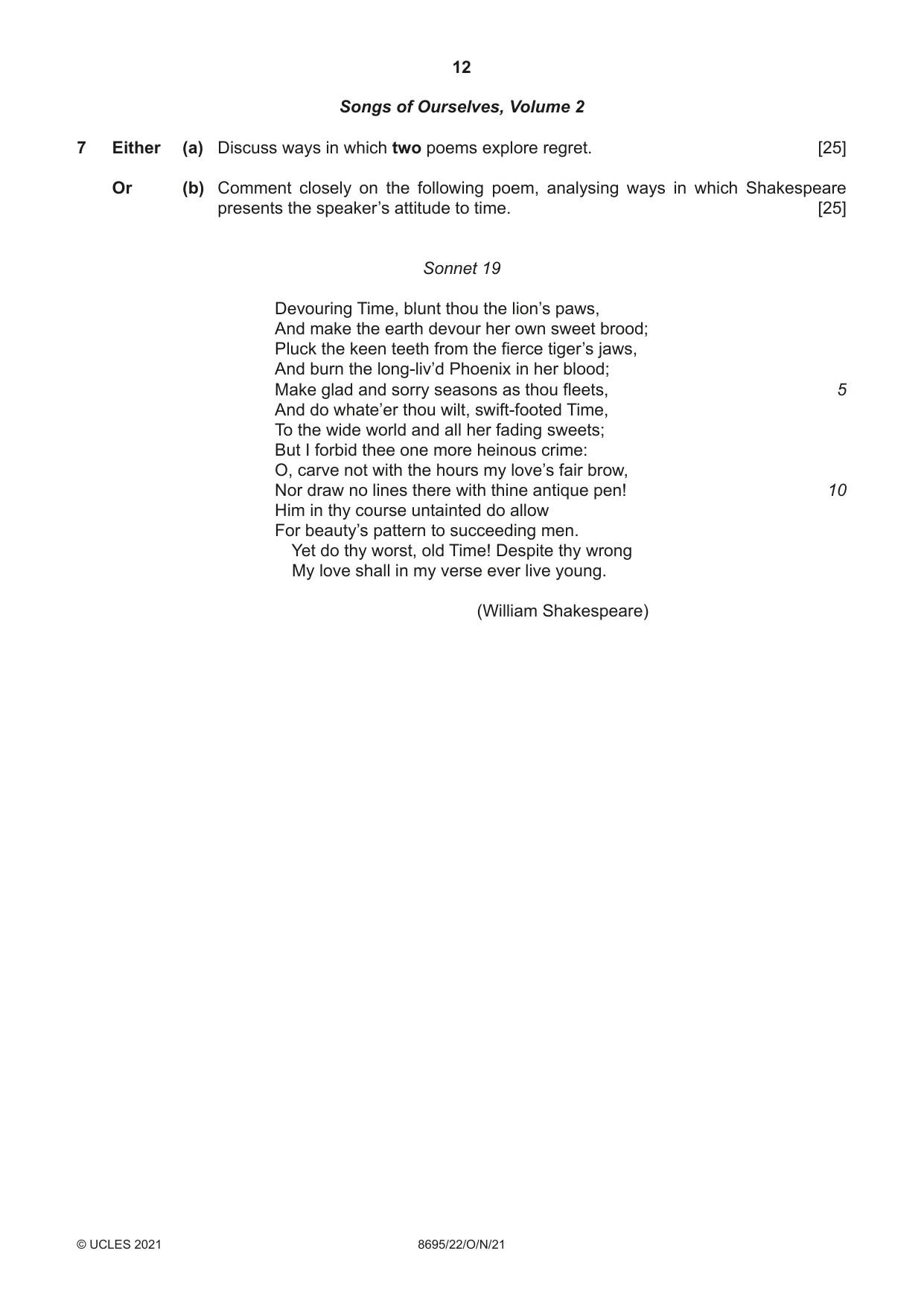
12 8695/22/O/N/21 © UCLES 2021 Songs of Ourselves, Volume 2 7 Either (a) Discuss ways in which two poems explore regret. [25] Or (b) Comment closely on the following poem, analysing ways in which Shakespeare presents the speaker’s attitude to time. [25] Sonnet 19 Devouring Time, blunt thou the lion’s paws, And make the earth devour her own sweet brood; Pluck the keen teeth from the fierce tiger’s jaws, And burn the long-liv’d Phoenix in her blood; Make glad and sorry seasons as thou fleets, And do whate’er thou wilt, swift-footed Time, To the wide world and all her fading sweets; But I forbid thee one more heinous crime: O, carve not with the hours my love’s fair brow, Nor draw no lines there with thine antique pen! Him in thy course untainted do allow For beauty’s pattern to succeeding men. Yet do thy worst, old Time! Despite thy wrong My love shall in my verse ever live young. (William Shakespeare) 5 10
Question paper, page 13
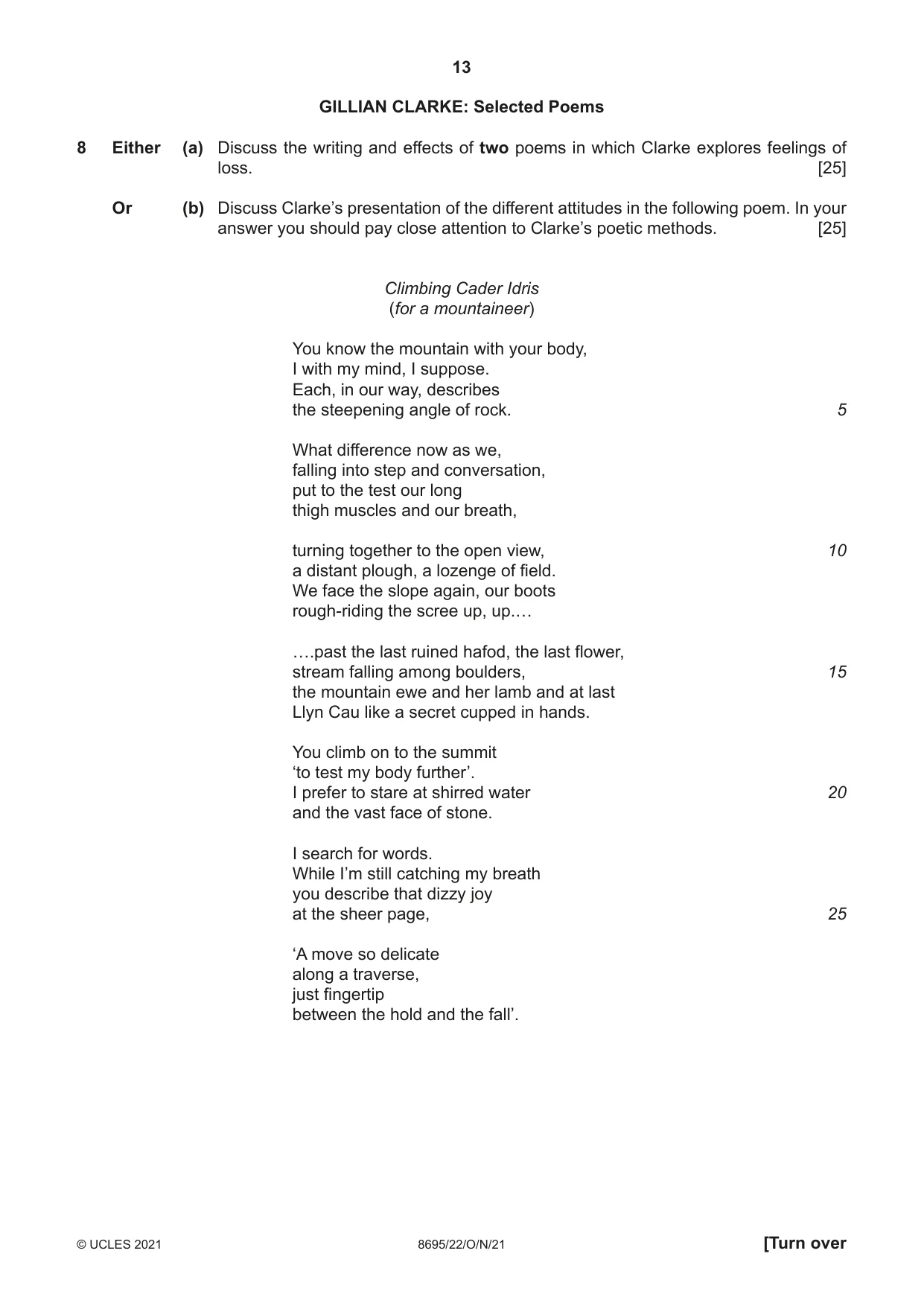
13 8695/22/O/N/21 © UCLES 2021 [Turn over GILLIAN CLARKE: Selected Poems 8 Either (a) Discuss the writing and effects of two poems in which Clarke explores feelings of loss. [25] Or (b) Discuss Clarke’s presentation of the different attitudes in the following poem. In your answer you should pay close attention to Clarke’s poetic methods. [25] Climbing Cader Idris (for a mountaineer) You know the mountain with your body, I with my mind, I suppose. Each, in our way, describes the steepening angle of rock. What difference now as we, falling into step and conversation, put to the test our long thigh muscles and our breath, turning together to the open view, a distant plough, a lozenge of field. We face the slope again, our boots rough-riding the scree up, up.… ….past the last ruined hafod, the last flower, stream falling among boulders, the mountain ewe and her lamb and at last Llyn Cau like a secret cupped in hands. You climb on to the summit ‘to test my body further’. I prefer to stare at shirred water and the vast face of stone. I search for words. While I’m still catching my breath you describe that dizzy joy at the sheer page, ‘A move so delicate along a traverse, just fingertip between the hold and the fall’. 5 10 15 20 25
Question paper, page 14
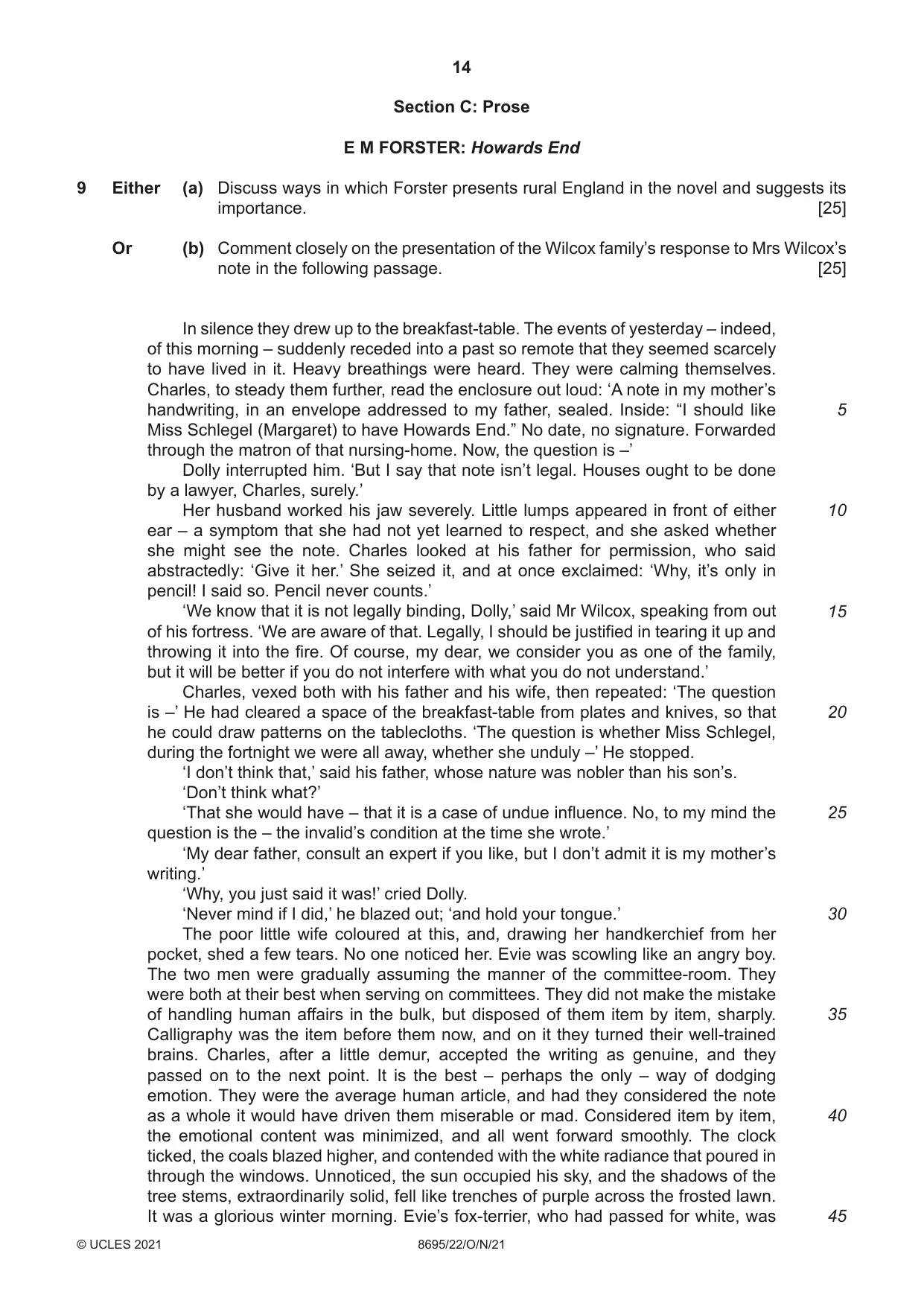
14 8695/22/O/N/21 © UCLES 2021 Section C: Prose E M FORSTER: Howards End 9 Either (a) Discuss ways in which Forster presents rural England in the novel and suggests its importance. [25] Or (b) Comment closely on the presentation of the Wilcox family’s response to Mrs Wilcox’s note in the following passage. [25] In silence they drew up to the breakfast-table. The events of yesterday – indeed, of this morning – suddenly receded into a past so remote that they seemed scarcely to have lived in it. Heavy breathings were heard. They were calming themselves. Charles, to steady them further, read the enclosure out loud: ‘A note in my mother’s handwriting, in an envelope addressed to my father, sealed. Inside: “I should like Miss Schlegel (Margaret) to have Howards End.” No date, no signature. Forwarded through the matron of that nursing-home. Now, the question is –’ Dolly interrupted him. ‘But I say that note isn’t legal. Houses ought to be done by a lawyer, Charles, surely.’ Her husband worked his jaw severely. Little lumps appeared in front of either ear – a symptom that she had not yet learned to respect, and she asked whether she might see the note. Charles looked at his father for permission, who said abstractedly: ‘Give it her.’ She seized it, and at once exclaimed: ‘Why, it’s only in pencil! I said so. Pencil never counts.’ ‘We know that it is not legally binding, Dolly,’ said Mr Wilcox, speaking from out of his fortress. ‘We are aware of that. Legally, I should be justified in tearing it up and throwing it into the fire. Of course, my dear, we consider you as one of the family, but it will be better if you do not interfere with what you do not understand.’ Charles, vexed both with his father and his wife, then repeated: ‘The question is –’ He had cleared a space of the breakfast-table from plates and knives, so that he could draw patterns on the tablecloths. ‘The question is whether Miss Schlegel, during the fortnight we were all away, whether she unduly –’ He stopped. ‘I don’t think that,’ said his father, whose nature was nobler than his son’s. ‘Don’t think what?’ ‘That she would have – that it is a case of undue influence. No, to my mind the question is the – the invalid’s condition at the time she wrote.’ ‘My dear father, consult an expert if you like, but I don’t admit it is my mother’s writing.’ ‘Why, you just said it was!’ cried Dolly. ‘Never mind if I did,’ he blazed out; ‘and hold your tongue.’ The poor little wife coloured at this, and, drawing her handkerchief from her pocket, shed a few tears. No one noticed her. Evie was scowling like an angry boy. The two men were gradually assuming the manner of the committee-room. They were both at their best when serving on committees. They did not make the mistake of handling human affairs in the bulk, but disposed of them item by item, sharply. Calligraphy was the item before them now, and on it they turned their well-trained brains. Charles, after a little demur, accepted the writing as genuine, and they passed on to the next point. It is the best – perhaps the only – way of dodging emotion. They were the average human article, and had they considered the note as a whole it would have driven them miserable or mad. Considered item by item, the emotional content was minimized, and all went forward smoothly. The clock ticked, the coals blazed higher, and contended with the white radiance that poured in through the windows. Unnoticed, the sun occupied his sky, and the shadows of the tree stems, extraordinarily solid, fell like trenches of purple across the frosted lawn. It was a glorious winter morning. Evie’s fox-terrier, who had passed for white, was 5 10 15 20 25 30 35 40 45
Question paper, page 15
15 8695/22/O/N/21 © UCLES 2021 [Turn over only a dirty gray dog now, so intense was the purity that surrounded him. He was discredited, but the blackbirds that he was chasing glowed with Arabian darkness, for all the conventional colouring of life had been altered. Inside, the clock struck ten with a rich and confident note. Other clocks confirmed it, and the discussion moved towards its close. (from Chapter 11) 50
Question paper, page 16
16 8695/22/O/N/21 © UCLES 2021 ANDREA LEVY: Small Island 10 Either (a) Discuss some of the ways in which Levy presents changing social attitudes in Britain. [25] Or (b) Comment closely on ways in which Levy presents the Principal of the teacher training college in the following passage. [25] Outside this room there was great commotion – the older pupils going about their business as raucous and shrill as parrots on a branch. For a brief moment she paused as if in prayer – her hands splayed chord-shaped over the keys – before we new girls were ordered, by some imperceptible yet demanding movement of her eyebrow, to stand. (from Chapter 4) Content removed due to copyright restrictions.
Question paper, page 17
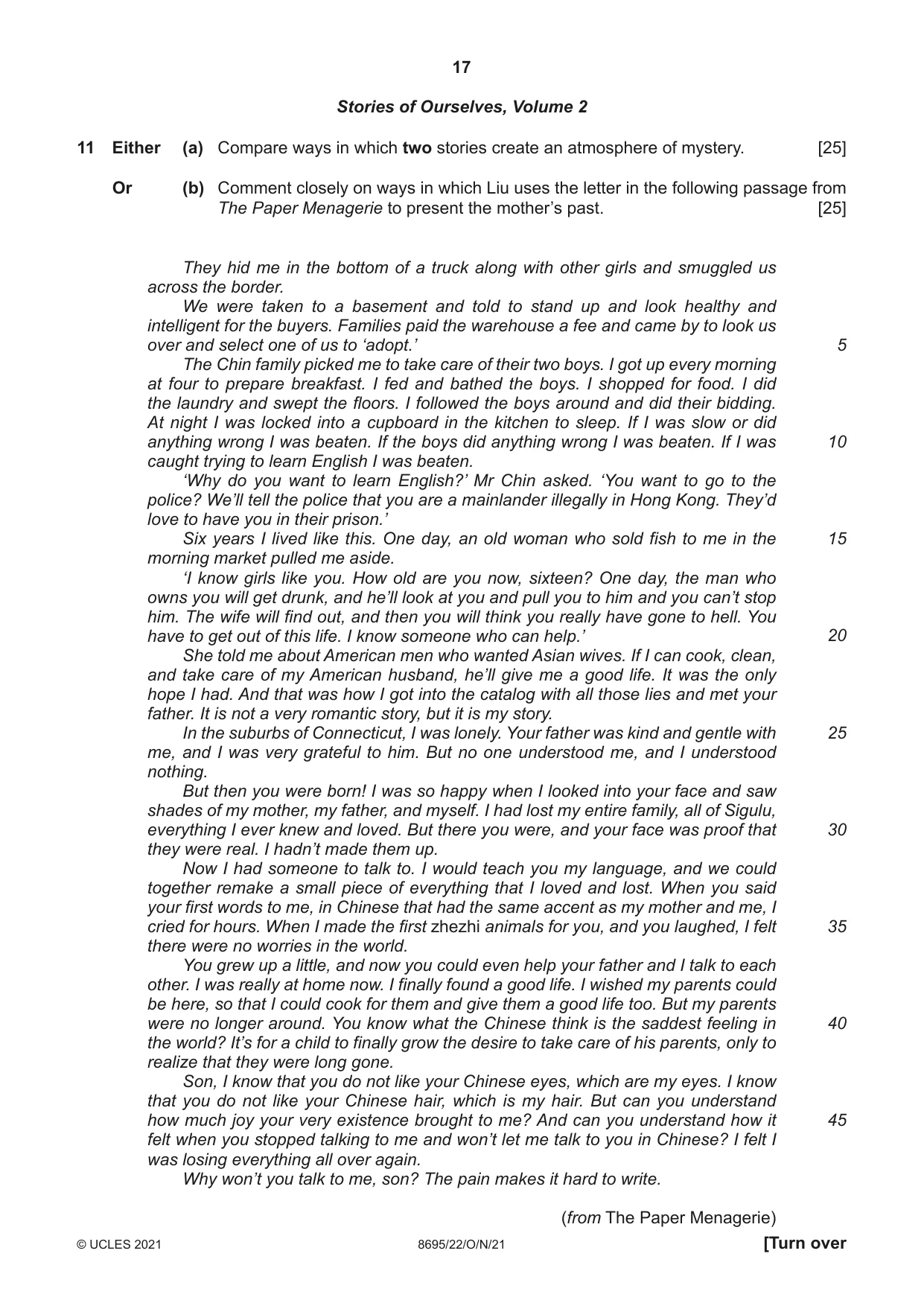
17 8695/22/O/N/21 © UCLES 2021 [Turn over Stories of Ourselves, Volume 2 11 Either (a) Compare ways in which two stories create an atmosphere of mystery. [25] Or (b) Comment closely on ways in which Liu uses the letter in the following passage from The Paper Menagerie to present the mother’s past. [25] They hid me in the bottom of a truck along with other girls and smuggled us across the border. We were taken to a basement and told to stand up and look healthy and intelligent for the buyers. Families paid the warehouse a fee and came by to look us over and select one of us to ‘adopt.’ The Chin family picked me to take care of their two boys. I got up every morning at four to prepare breakfast. I fed and bathed the boys. I shopped for food. I did the laundry and swept the floors. I followed the boys around and did their bidding. At night I was locked into a cupboard in the kitchen to sleep. If I was slow or did anything wrong I was beaten. If the boys did anything wrong I was beaten. If I was caught trying to learn English I was beaten. ‘Why do you want to learn English?’ Mr Chin asked. ‘You want to go to the police? We’ll tell the police that you are a mainlander illegally in Hong Kong. They’d love to have you in their prison.’ Six years I lived like this. One day, an old woman who sold fish to me in the morning market pulled me aside. ‘I know girls like you. How old are you now, sixteen? One day, the man who owns you will get drunk, and he’ll look at you and pull you to him and you can’t stop him. The wife will find out, and then you will think you really have gone to hell. You have to get out of this life. I know someone who can help.’ She told me about American men who wanted Asian wives. If I can cook, clean, and take care of my American husband, he’ll give me a good life. It was the only hope I had. And that was how I got into the catalog with all those lies and met your father. It is not a very romantic story, but it is my story. In the suburbs of Connecticut, I was lonely. Your father was kind and gentle with me, and I was very grateful to him. But no one understood me, and I understood nothing. But then you were born! I was so happy when I looked into your face and saw shades of my mother, my father, and myself. I had lost my entire family, all of Sigulu, everything I ever knew and loved. But there you were, and your face was proof that they were real. I hadn’t made them up. Now I had someone to talk to. I would teach you my language, and we could together remake a small piece of everything that I loved and lost. When you said your first words to me, in Chinese that had the same accent as my mother and me, I cried for hours. When I made the first zhezhi animals for you, and you laughed, I felt there were no worries in the world. You grew up a little, and now you could even help your father and I talk to each other. I was really at home now. I finally found a good life. I wished my parents could be here, so that I could cook for them and give them a good life too. But my parents were no longer around. You know what the Chinese think is the saddest feeling in the world? It’s for a child to finally grow the desire to take care of his parents, only to realize that they were long gone. Son, I know that you do not like your Chinese eyes, which are my eyes. I know that you do not like your Chinese hair, which is my hair. But can you understand how much joy your very existence brought to me? And can you understand how it felt when you stopped talking to me and won’t let me talk to you in Chinese? I felt I was losing everything all over again. Why won’t you talk to me, son? The pain makes it hard to write. (from The Paper Menagerie) 5 10 15 20 25 30 35 40 45
Question paper, page 18
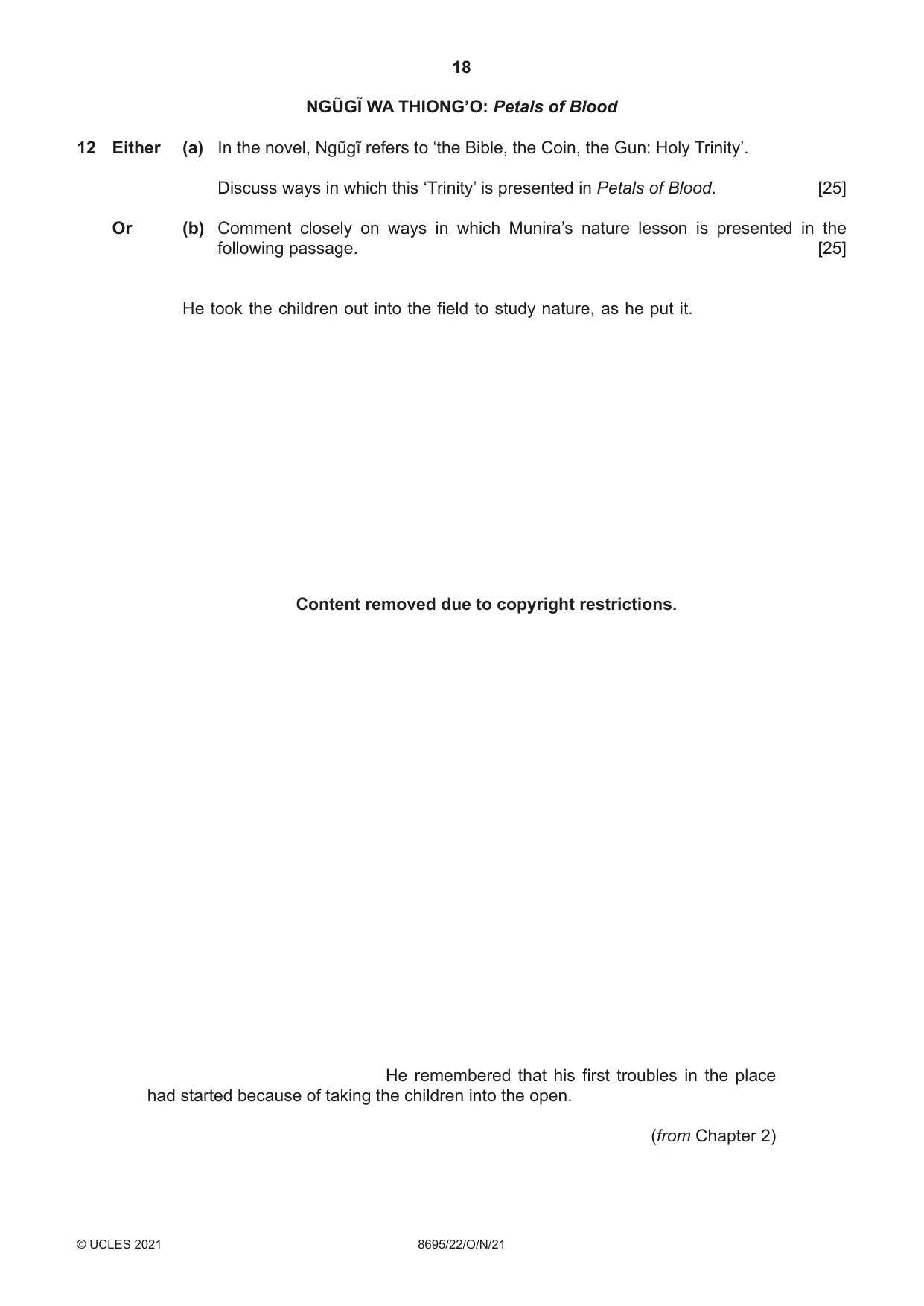
18 8695/22/O/N/21 © UCLES 2021 NGŨGĨ WA THIONG’O: Petals of Blood 12 Either (a) In the novel, Ngũgĩ refers to ‘the Bible, the Coin, the Gun: Holy Trinity’. Discuss ways in which this ‘Trinity’ is presented in Petals of Blood. [25] Or (b) Comment closely on ways in which Munira’s nature lesson is presented in the following passage. [25] He took the children out into the field to study nature, as he put it. He remembered that his first troubles in the place had started because of taking the children into the open. (from Chapter 2) Content removed due to copyright restrictions.
Question paper, page 19
19 8695/22/O/N/21 © UCLES 2021 BLANK PAGE
Question paper, page 20
20 8695/22/O/N/21 © UCLES 2021 Permission to reproduce items where third-party owned material protected by copyright is included has been sought and cleared where possible. Every reasonable effort has been made by the publisher (UCLES) to trace copyright holders, but if any items requiring clearance have unwittingly been included, the publisher will be pleased to make amends at the earliest possible opportunity. To avoid the issue of disclosure of answer-related information to candidates, all copyright acknowledgements are reproduced online in the Cambridge Assessment International Education Copyright Acknowledgements Booklet. This is produced for each series of examinations and is freely available to download at www.cambridgeinternational.org after the live examination series. Cambridge Assessment International Education is part of the Cambridge Assessment Group. Cambridge Assessment is the brand name of the University of Cambridge Local Examinations Syndicate (UCLES), which itself is a department of the University of Cambridge. BLANK PAGE
Mark scheme, page 1
This document consists of 11 printed pages. © UCLES 2021 [Turn over Cambridge International AS Level LANGUAGE AND LITERATURE IN ENGLISH 8695/22 Paper 2 Drama, Poetry and Prose October/November 2021 MARK SCHEME Maximum Mark: 50 Published This mark scheme is published as an aid to teachers and candidates, to indicate the requirements of the examination. It shows the basis on which Examiners were instructed to award marks. It does not indicate the details of the discussions that took place at an Examiners’ meeting before marking began, which would have considered the acceptability of alternative answers. Mark schemes should be read in conjunction with the question paper and the Principal Examiner Report for Teachers. Cambridge International will not enter into discussions about these mark schemes. Cambridge International is publishing the mark schemes for the October/November 2021 series for most Cambridge IGCSE™, Cambridge International A and AS Level components and some Cambridge O Level components.
Mark scheme, page 2
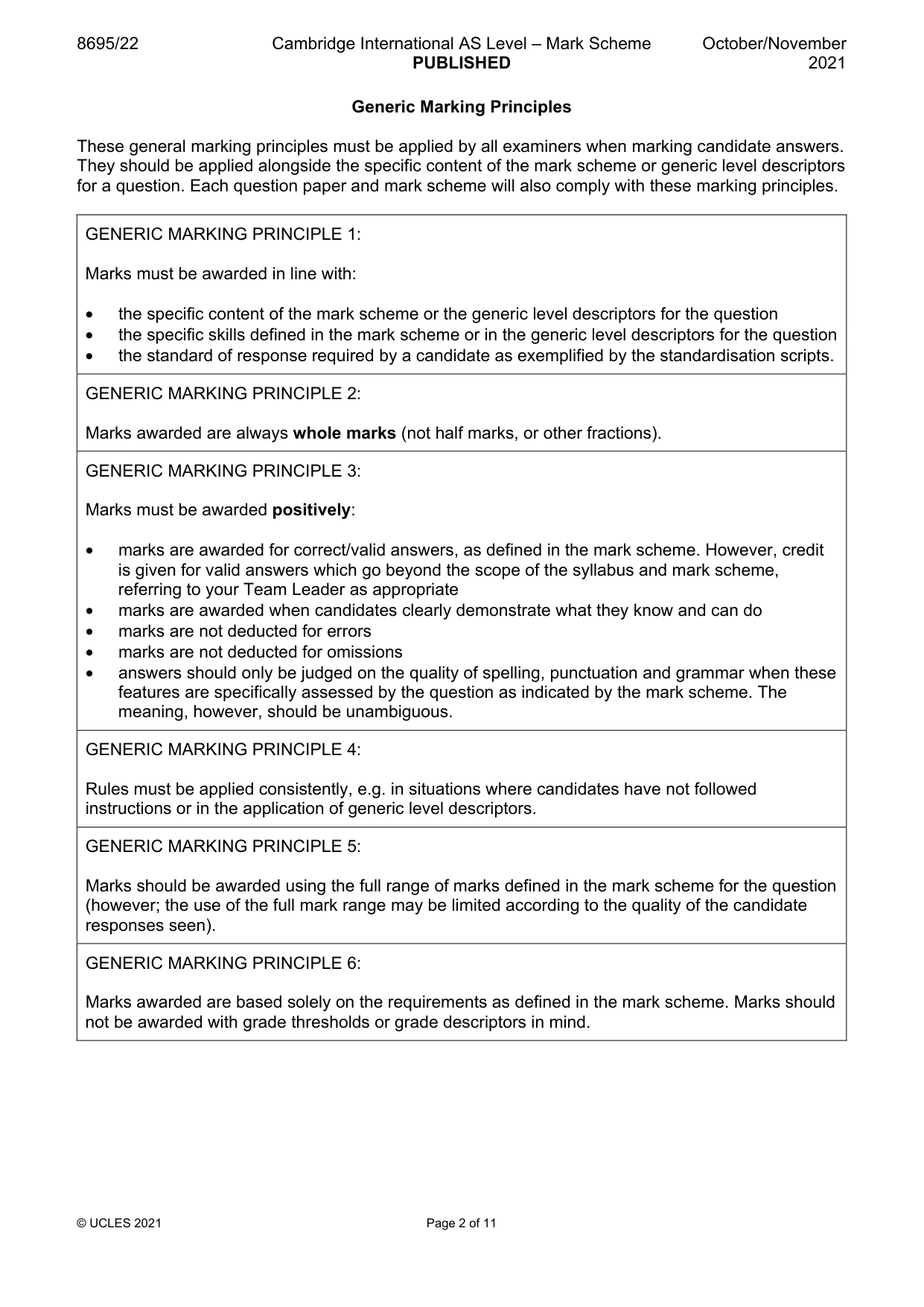
8695/22 Cambridge International AS Level – Mark Scheme PUBLISHED October/November 2021 © UCLES 2021 Page 2 of 11 Generic Marking Principles These general marking principles must be applied by all examiners when marking candidate answers. They should be applied alongside the specific content of the mark scheme or generic level descriptors for a question. Each question paper and mark scheme will also comply with these marking principles. GENERIC MARKING PRINCIPLE 1: Marks must be awarded in line with: • the specific content of the mark scheme or the generic level descriptors for the question • the specific skills defined in the mark scheme or in the generic level descriptors for the question • the standard of response required by a candidate as exemplified by the standardisation scripts. GENERIC MARKING PRINCIPLE 2: Marks awarded are always whole marks (not half marks, or other fractions). GENERIC MARKING PRINCIPLE 3: Marks must be awarded positively: • marks are awarded for correct/valid answers, as defined in the mark scheme. However, credit is given for valid answers which go beyond the scope of the syllabus and mark scheme, referring to your Team Leader as appropriate • marks are awarded when candidates clearly demonstrate what they know and can do • marks are not deducted for errors • marks are not deducted for omissions • answers should only be judged on the quality of spelling, punctuation and grammar when these features are specifically assessed by the question as indicated by the mark scheme. The meaning, however, should be unambiguous. GENERIC MARKING PRINCIPLE 4: Rules must be applied consistently, e.g. in situations where candidates have not followed instructions or in the application of generic level descriptors. GENERIC MARKING PRINCIPLE 5: Marks should be awarded using the full range of marks defined in the mark scheme for the question (however; the use of the full mark range may be limited according to the quality of the candidate responses seen). GENERIC MARKING PRINCIPLE 6: Marks awarded are based solely on the requirements as defined in the mark scheme. Marks should not be awarded with grade thresholds or grade descriptors in mind.
Mark scheme, page 3
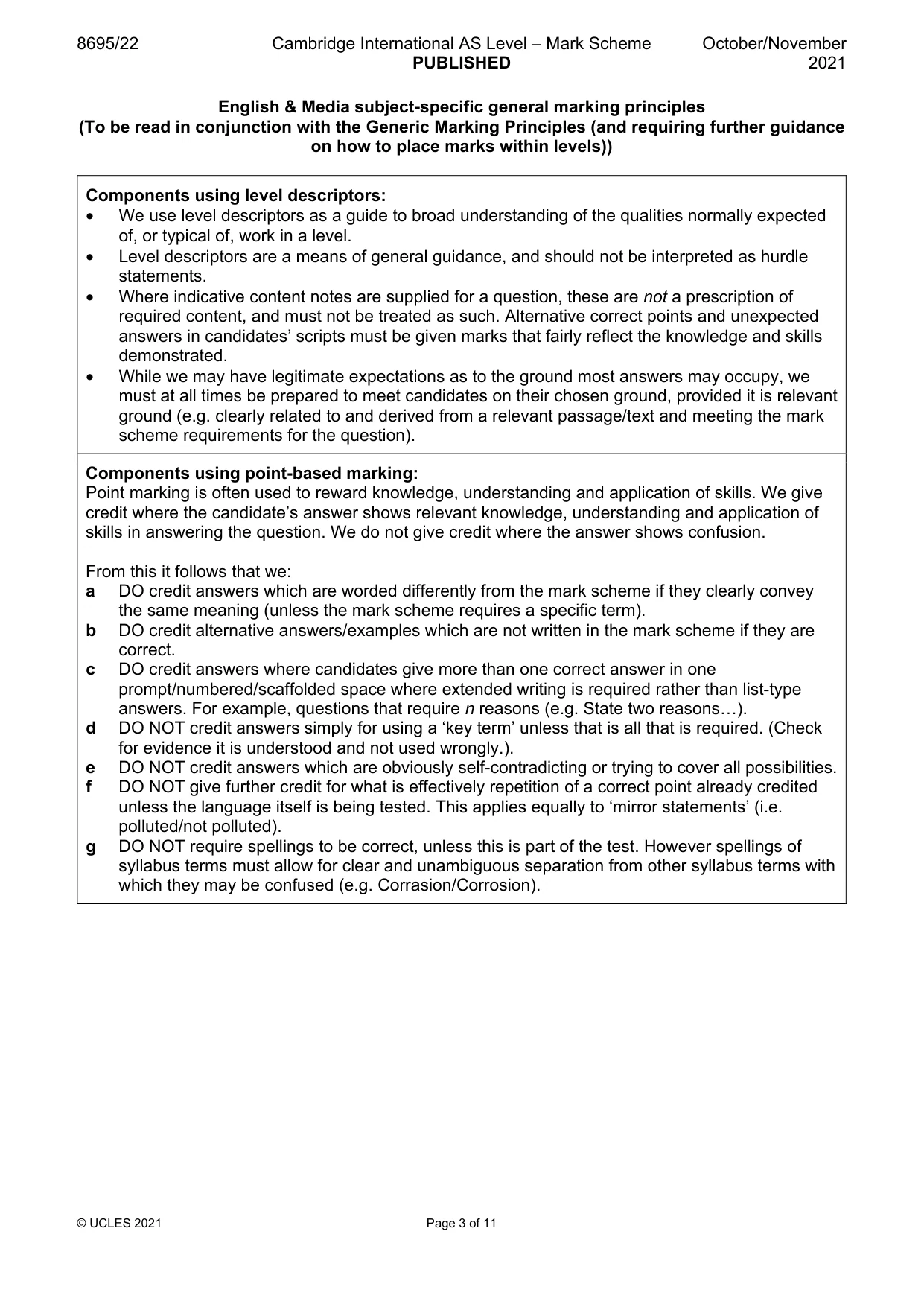
8695/22 Cambridge International AS Level – Mark Scheme PUBLISHED October/November 2021 © UCLES 2021 Page 3 of 11 English & Media subject-specific general marking principles (To be read in conjunction with the Generic Marking Principles (and requiring further guidance on how to place marks within levels)) Components using level descriptors: • We use level descriptors as a guide to broad understanding of the qualities normally expected of, or typical of, work in a level. • Level descriptors are a means of general guidance, and should not be interpreted as hurdle statements. • Where indicative content notes are supplied for a question, these are not a prescription of required content, and must not be treated as such. Alternative correct points and unexpected answers in candidates’ scripts must be given marks that fairly reflect the knowledge and skills demonstrated. • While we may have legitimate expectations as to the ground most answers may occupy, we must at all times be prepared to meet candidates on their chosen ground, provided it is relevant ground (e.g. clearly related to and derived from a relevant passage/text and meeting the mark scheme requirements for the question). Components using point-based marking: Point marking is often used to reward knowledge, understanding and application of skills. We give credit where the candidate’s answer shows relevant knowledge, understanding and application of skills in answering the question. We do not give credit where the answer shows confusion. From this it follows that we: a DO credit answers which are worded differently from the mark scheme if they clearly convey the same meaning (unless the mark scheme requires a specific term). b DO credit alternative answers/examples which are not written in the mark scheme if they are correct. c DO credit answers where candidates give more than one correct answer in one prompt/numbered/scaffolded space where extended writing is required rather than list-type answers. For example, questions that require n reasons (e.g. State two reasons…). d DO NOT credit answers simply for using a ‘key term’ unless that is all that is required. (Check for evidence it is understood and not used wrongly.). e DO NOT credit answers which are obviously self-contradicting or trying to cover all possibilities. f DO NOT give further credit for what is effectively repetition of a correct point already credited unless the language itself is being tested. This applies equally to ‘mirror statements’ (i.e. polluted/not polluted). g DO NOT require spellings to be correct, unless this is part of the test. However spellings of syllabus terms must allow for clear and unambiguous separation from other syllabus terms with which they may be confused (e.g. Corrasion/Corrosion).
Mark scheme, page 4
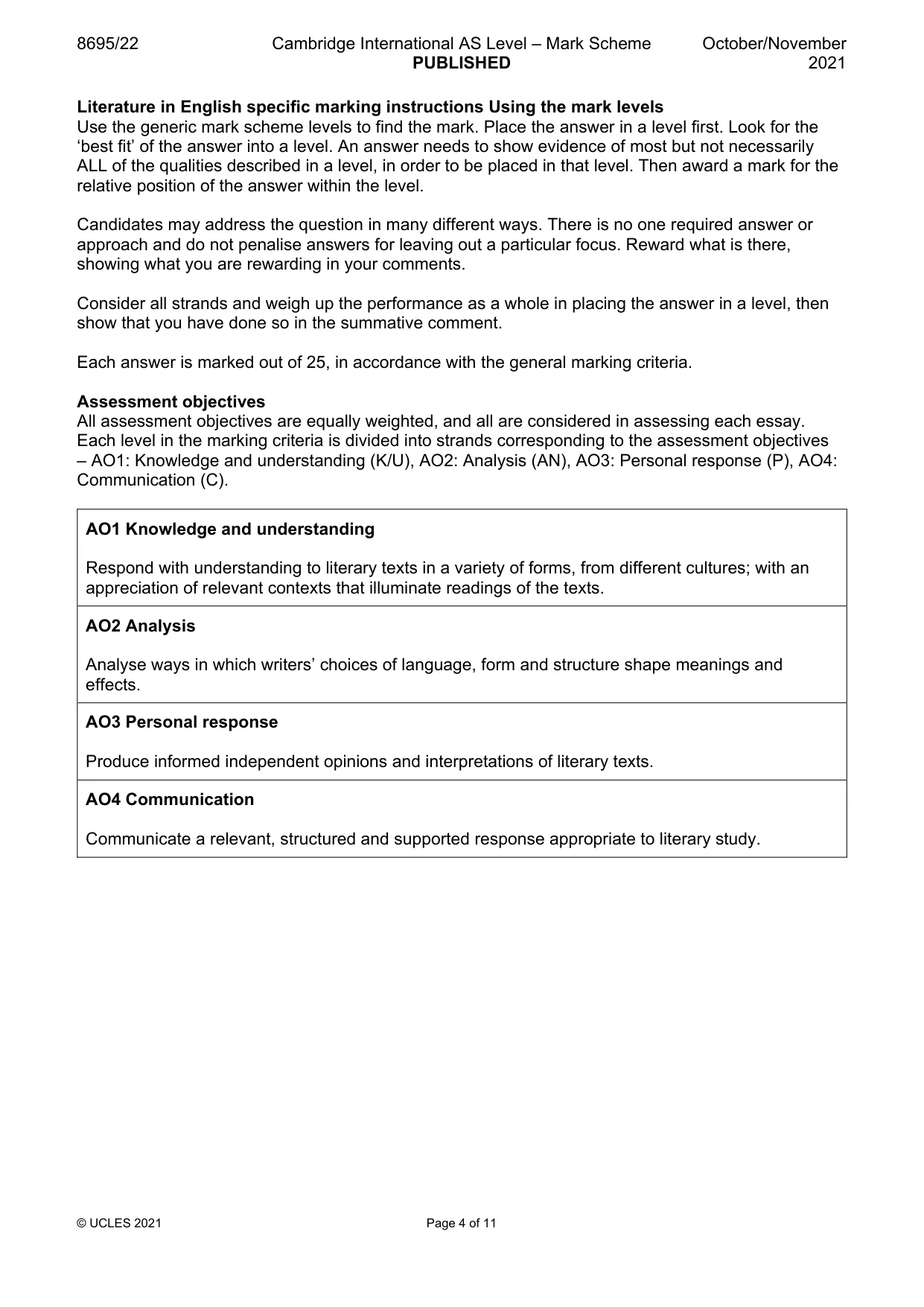
8695/22 Cambridge International AS Level – Mark Scheme PUBLISHED October/November 2021 © UCLES 2021 Page 4 of 11 Literature in English specific marking instructions Using the mark levels Use the generic mark scheme levels to find the mark. Place the answer in a level first. Look for the ‘best fit’ of the answer into a level. An answer needs to show evidence of most but not necessarily ALL of the qualities described in a level, in order to be placed in that level. Then award a mark for the relative position of the answer within the level. Candidates may address the question in many different ways. There is no one required answer or approach and do not penalise answers for leaving out a particular focus. Reward what is there, showing what you are rewarding in your comments. Consider all strands and weigh up the performance as a whole in placing the answer in a level, then show that you have done so in the summative comment. Each answer is marked out of 25, in accordance with the general marking criteria. Assessment objectives All assessment objectives are equally weighted, and all are considered in assessing each essay. Each level in the marking criteria is divided into strands corresponding to the assessment objectives – AO1: Knowledge and understanding (K/U), AO2: Analysis (AN), AO3: Personal response (P), AO4: Communication (C). AO1 Knowledge and understanding Respond with understanding to literary texts in a variety of forms, from different cultures; with an appreciation of relevant contexts that illuminate readings of the texts. AO2 Analysis Analyse ways in which writers’ choices of language, form and structure shape meanings and effects. AO3 Personal response Produce informed independent opinions and interpretations of literary texts. AO4 Communication Communicate a relevant, structured and supported response appropriate to literary study.
Mark scheme, page 5
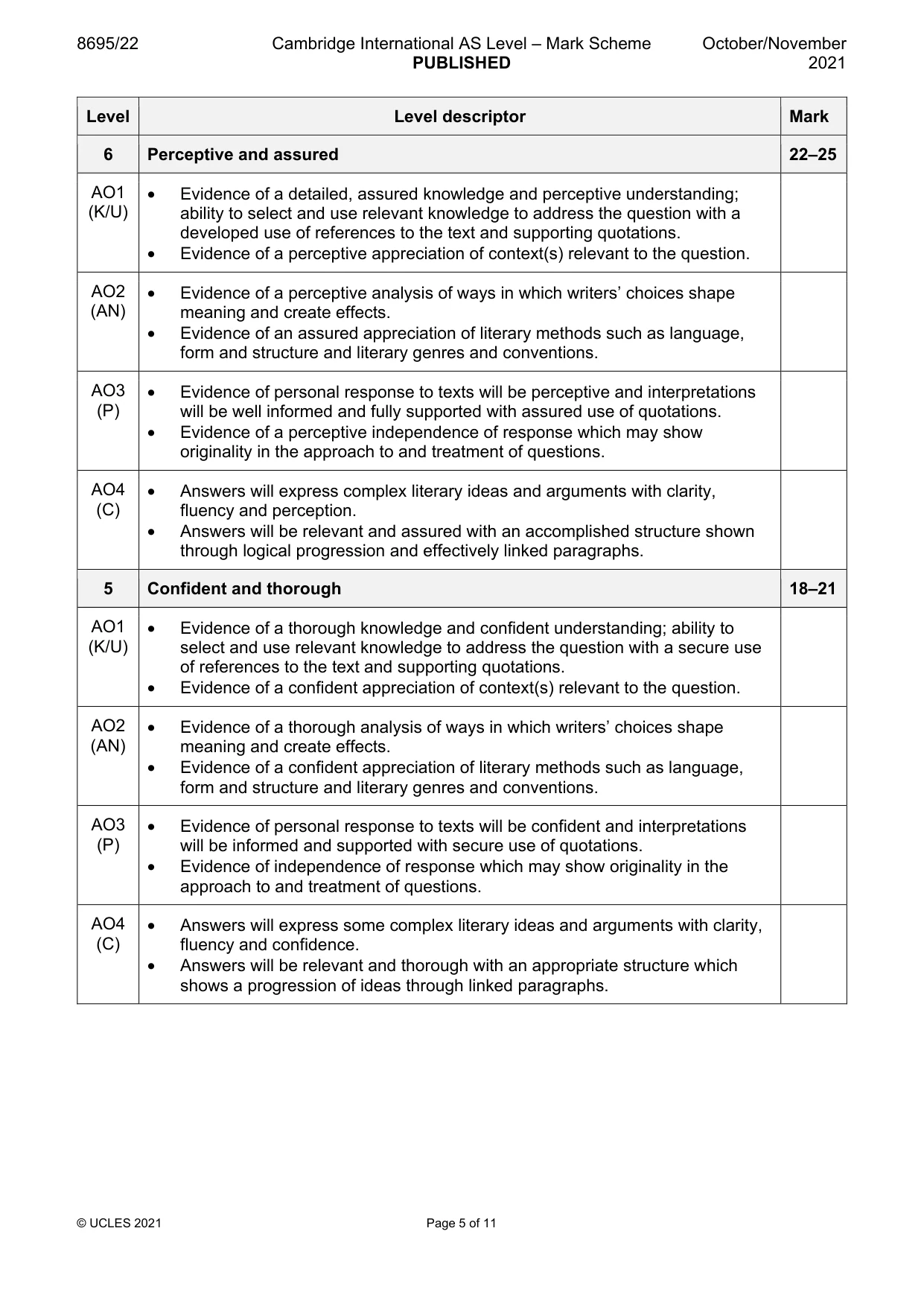
8695/22 Cambridge International AS Level – Mark Scheme PUBLISHED October/November 2021 © UCLES 2021 Page 5 of 11 Level Level descriptor Mark 6 Perceptive and assured 22–25 AO1 (K/U) • Evidence of a detailed, assured knowledge and perceptive understanding; ability to select and use relevant knowledge to address the question with a developed use of references to the text and supporting quotations. • Evidence of a perceptive appreciation of context(s) relevant to the question. AO2 (AN) • Evidence of a perceptive analysis of ways in which writers’ choices shape meaning and create effects. • Evidence of an assured appreciation of literary methods such as language, form and structure and literary genres and conventions. AO3 (P) • Evidence of personal response to texts will be perceptive and interpretations will be well informed and fully supported with assured use of quotations. • Evidence of a perceptive independence of response which may show originality in the approach to and treatment of questions. AO4 (C) • Answers will express complex literary ideas and arguments with clarity, fluency and perception. • Answers will be relevant and assured with an accomplished structure shown through logical progression and effectively linked paragraphs. 5 Confident and thorough 18–21 AO1 (K/U) • Evidence of a thorough knowledge and confident understanding; ability to select and use relevant knowledge to address the question with a secure use of references to the text and supporting quotations. • Evidence of a confident appreciation of context(s) relevant to the question. AO2 (AN) • Evidence of a thorough analysis of ways in which writers’ choices shape meaning and create effects. • Evidence of a confident appreciation of literary methods such as language, form and structure and literary genres and conventions. AO3 (P) • Evidence of personal response to texts will be confident and interpretations will be informed and supported with secure use of quotations. • Evidence of independence of response which may show originality in the approach to and treatment of questions. AO4 (C) • Answers will express some complex literary ideas and arguments with clarity, fluency and confidence. • Answers will be relevant and thorough with an appropriate structure which shows a progression of ideas through linked paragraphs.
Mark scheme, page 6
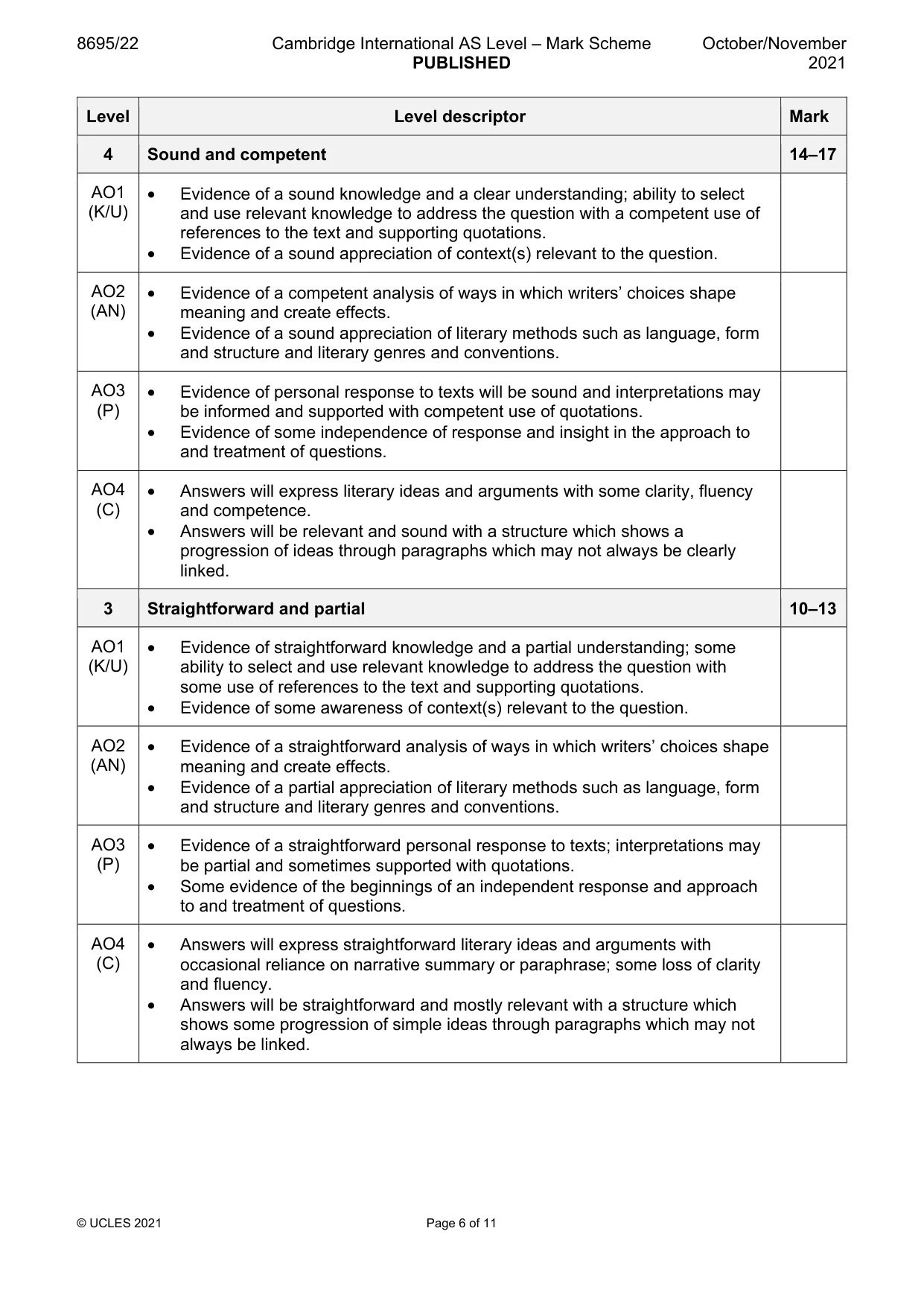
8695/22 Cambridge International AS Level – Mark Scheme PUBLISHED October/November 2021 © UCLES 2021 Page 6 of 11 Level Level descriptor Mark 4 Sound and competent 14–17 AO1 (K/U) • Evidence of a sound knowledge and a clear understanding; ability to select and use relevant knowledge to address the question with a competent use of references to the text and supporting quotations. • Evidence of a sound appreciation of context(s) relevant to the question. AO2 (AN) • Evidence of a competent analysis of ways in which writers’ choices shape meaning and create effects. • Evidence of a sound appreciation of literary methods such as language, form and structure and literary genres and conventions. AO3 (P) • Evidence of personal response to texts will be sound and interpretations may be informed and supported with competent use of quotations. • Evidence of some independence of response and insight in the approach to and treatment of questions. AO4 (C) • Answers will express literary ideas and arguments with some clarity, fluency and competence. • Answers will be relevant and sound with a structure which shows a progression of ideas through paragraphs which may not always be clearly linked. 3 Straightforward and partial 10–13 AO1 (K/U) • Evidence of straightforward knowledge and a partial understanding; some ability to select and use relevant knowledge to address the question with some use of references to the text and supporting quotations. • Evidence of some awareness of context(s) relevant to the question. AO2 (AN) • Evidence of a straightforward analysis of ways in which writers’ choices shape meaning and create effects. • Evidence of a partial appreciation of literary methods such as language, form and structure and literary genres and conventions. AO3 (P) • Evidence of a straightforward personal response to texts; interpretations may be partial and sometimes supported with quotations. • Some evidence of the beginnings of an independent response and approach to and treatment of questions. AO4 (C) • Answers will express straightforward literary ideas and arguments with occasional reliance on narrative summary or paraphrase; some loss of clarity and fluency. • Answers will be straightforward and mostly relevant with a structure which shows some progression of simple ideas through paragraphs which may not always be linked.
Mark scheme, page 7
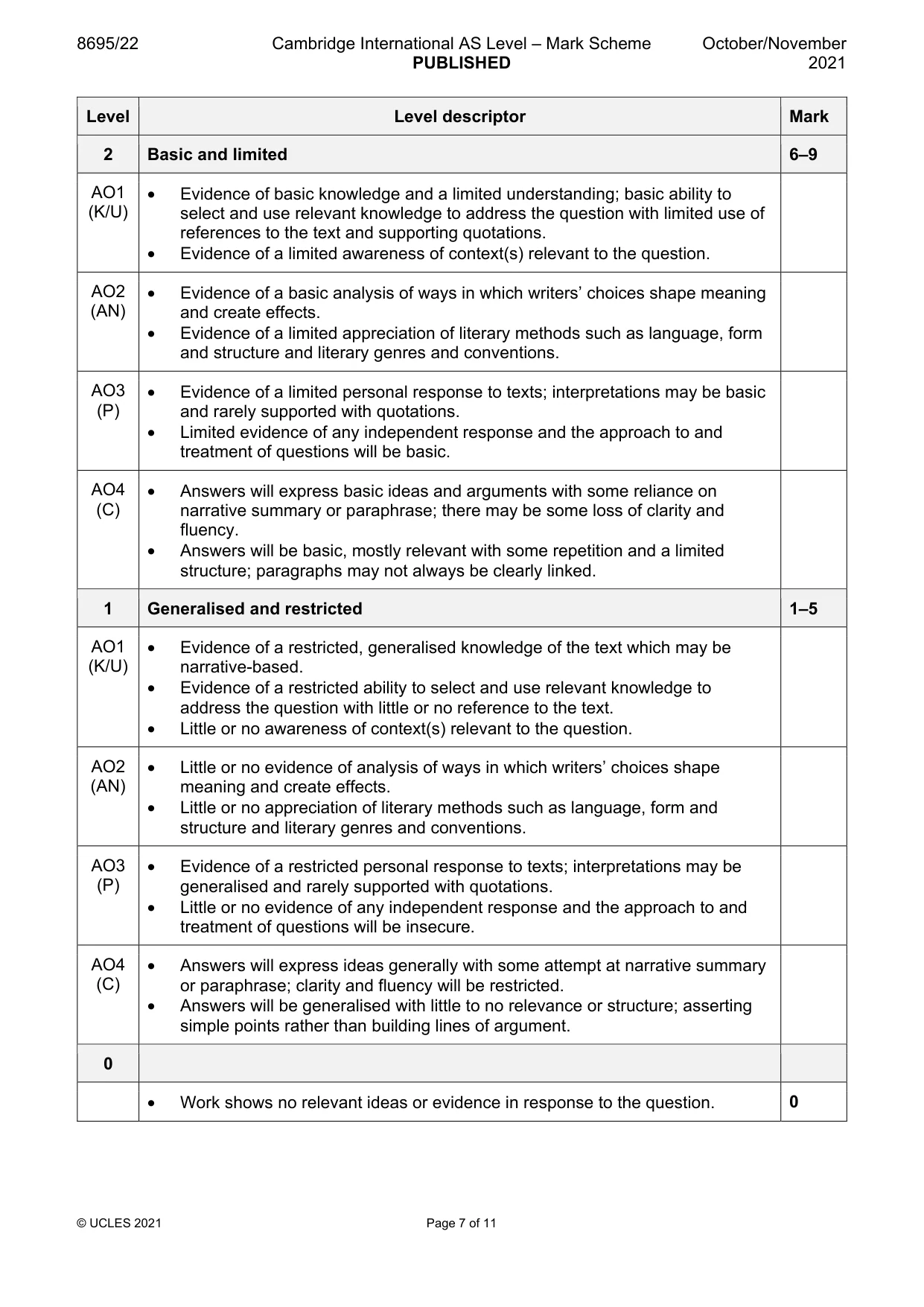
8695/22 Cambridge International AS Level – Mark Scheme PUBLISHED October/November 2021 © UCLES 2021 Page 7 of 11 Level Level descriptor Mark 2 Basic and limited 6–9 AO1 (K/U) • Evidence of basic knowledge and a limited understanding; basic ability to select and use relevant knowledge to address the question with limited use of references to the text and supporting quotations. • Evidence of a limited awareness of context(s) relevant to the question. AO2 (AN) • Evidence of a basic analysis of ways in which writers’ choices shape meaning and create effects. • Evidence of a limited appreciation of literary methods such as language, form and structure and literary genres and conventions. AO3 (P) • Evidence of a limited personal response to texts; interpretations may be basic and rarely supported with quotations. • Limited evidence of any independent response and the approach to and treatment of questions will be basic. AO4 (C) • Answers will express basic ideas and arguments with some reliance on narrative summary or paraphrase; there may be some loss of clarity and fluency. • Answers will be basic, mostly relevant with some repetition and a limited structure; paragraphs may not always be clearly linked. 1 Generalised and restricted 1–5 AO1 (K/U) • Evidence of a restricted, generalised knowledge of the text which may be narrative-based. • Evidence of a restricted ability to select and use relevant knowledge to address the question with little or no reference to the text. • Little or no awareness of context(s) relevant to the question. AO2 (AN) • Little or no evidence of analysis of ways in which writers’ choices shape meaning and create effects. • Little or no appreciation of literary methods such as language, form and structure and literary genres and conventions. AO3 (P) • Evidence of a restricted personal response to texts; interpretations may be generalised and rarely supported with quotations. • Little or no evidence of any independent response and the approach to and treatment of questions will be insecure. AO4 (C) • Answers will express ideas generally with some attempt at narrative summary or paraphrase; clarity and fluency will be restricted. • Answers will be generalised with little to no relevance or structure; asserting simple points rather than building lines of argument. 0 • Work shows no relevant ideas or evidence in response to the question. 0
Mark scheme, page 8
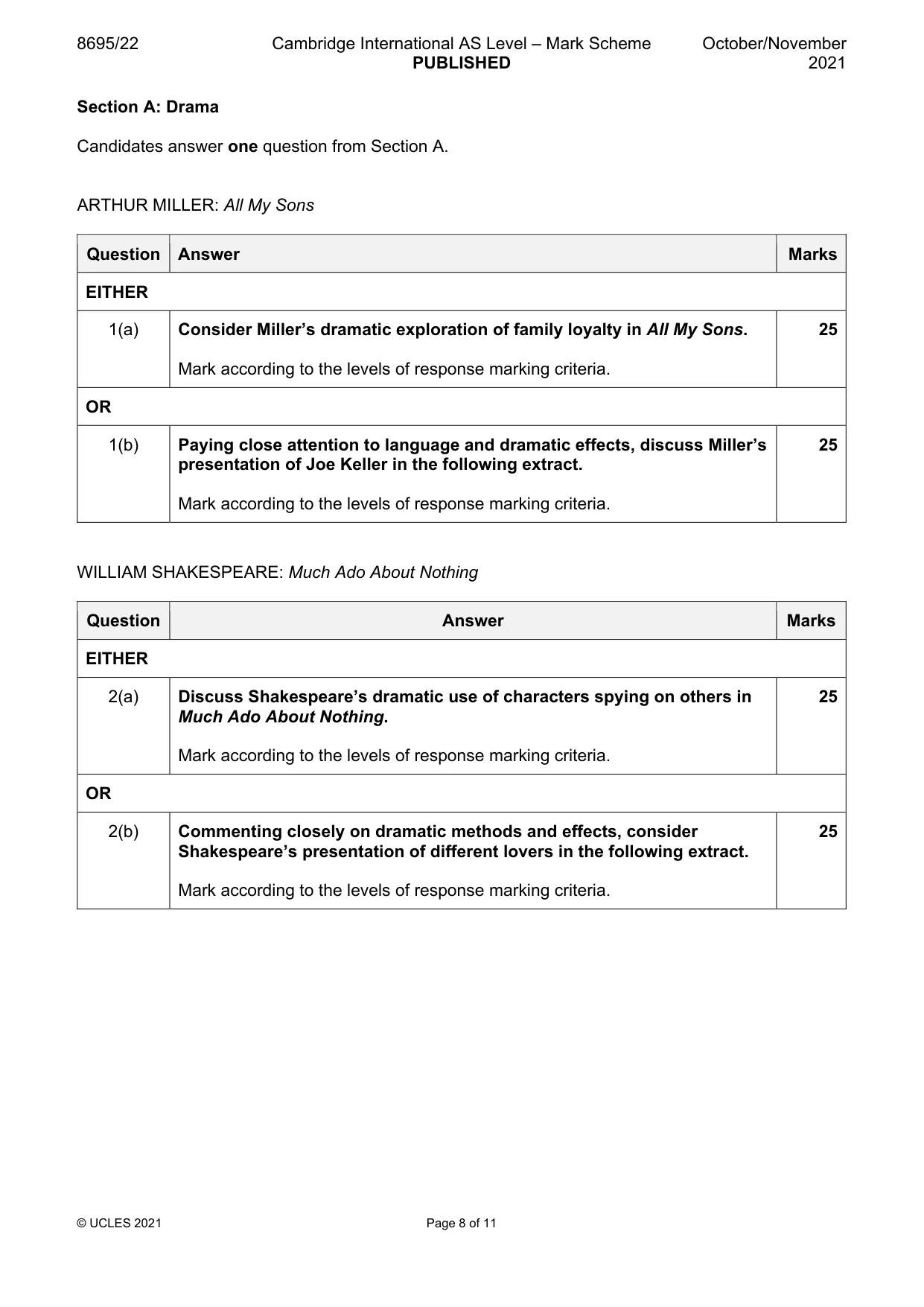
8695/22 Cambridge International AS Level – Mark Scheme PUBLISHED October/November 2021 © UCLES 2021 Page 8 of 11 Section A: Drama Candidates answer one question from Section A. ARTHUR MILLER: All My Sons Question Answer Marks EITHER 1(a) Consider Miller’s dramatic exploration of family loyalty in All My Sons. Mark according to the levels of response marking criteria. 25 OR 1(b) Paying close attention to language and dramatic effects, discuss Miller’s presentation of Joe Keller in the following extract. Mark according to the levels of response marking criteria. 25 WILLIAM SHAKESPEARE: Much Ado About Nothing Question Answer Marks EITHER 2(a) Discuss Shakespeare’s dramatic use of characters spying on others in Much Ado About Nothing. Mark according to the levels of response marking criteria. 25 OR 2(b) Commenting closely on dramatic methods and effects, consider Shakespeare’s presentation of different lovers in the following extract. Mark according to the levels of response marking criteria. 25
Mark scheme, page 9
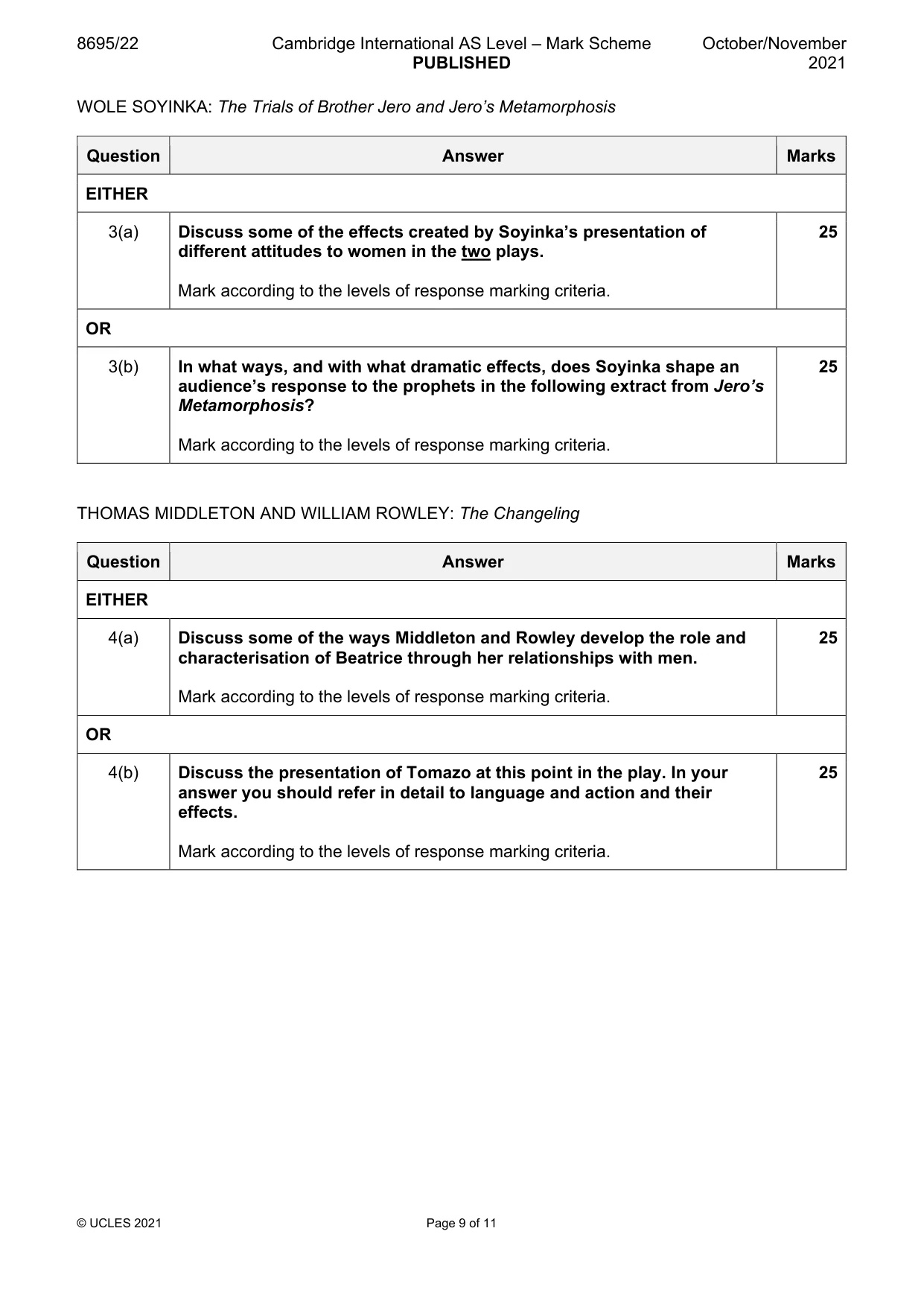
8695/22 Cambridge International AS Level – Mark Scheme PUBLISHED October/November 2021 © UCLES 2021 Page 9 of 11 WOLE SOYINKA: The Trials of Brother Jero and Jero’s Metamorphosis Question Answer Marks EITHER 3(a) Discuss some of the effects created by Soyinka’s presentation of different attitudes to women in the two plays. Mark according to the levels of response marking criteria. 25 OR 3(b) In what ways, and with what dramatic effects, does Soyinka shape an audience’s response to the prophets in the following extract from Jero’s Metamorphosis? Mark according to the levels of response marking criteria. 25 THOMAS MIDDLETON AND WILLIAM ROWLEY: The Changeling Question Answer Marks EITHER 4(a) Discuss some of the ways Middleton and Rowley develop the role and characterisation of Beatrice through her relationships with men. Mark according to the levels of response marking criteria. 25 OR 4(b) Discuss the presentation of Tomazo at this point in the play. In your answer you should refer in detail to language and action and their effects. Mark according to the levels of response marking criteria. 25
Mark scheme, page 10
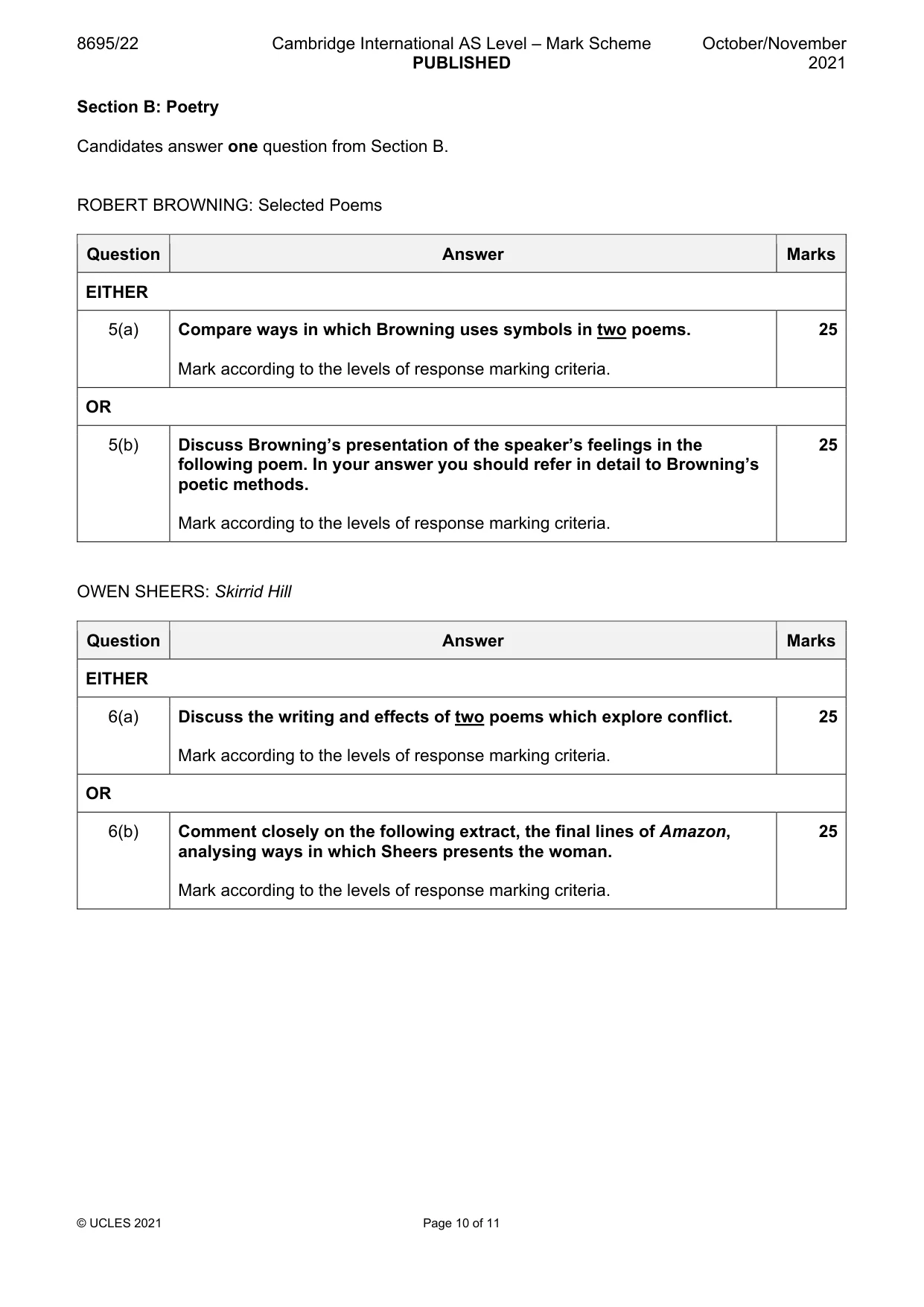
8695/22 Cambridge International AS Level – Mark Scheme PUBLISHED October/November 2021 © UCLES 2021 Page 10 of 11 Section B: Poetry Candidates answer one question from Section B. ROBERT BROWNING: Selected Poems Question Answer Marks EITHER 5(a) Compare ways in which Browning uses symbols in two poems. Mark according to the levels of response marking criteria. 25 OR 5(b) Discuss Browning’s presentation of the speaker’s feelings in the following poem. In your answer you should refer in detail to Browning’s poetic methods. Mark according to the levels of response marking criteria. 25 OWEN SHEERS: Skirrid Hill Question Answer Marks EITHER 6(a) Discuss the writing and effects of two poems which explore conflict. Mark according to the levels of response marking criteria. 25 OR 6(b) Comment closely on the following extract, the final lines of Amazon, analysing ways in which Sheers presents the woman. Mark according to the levels of response marking criteria. 25
Mark scheme, page 11
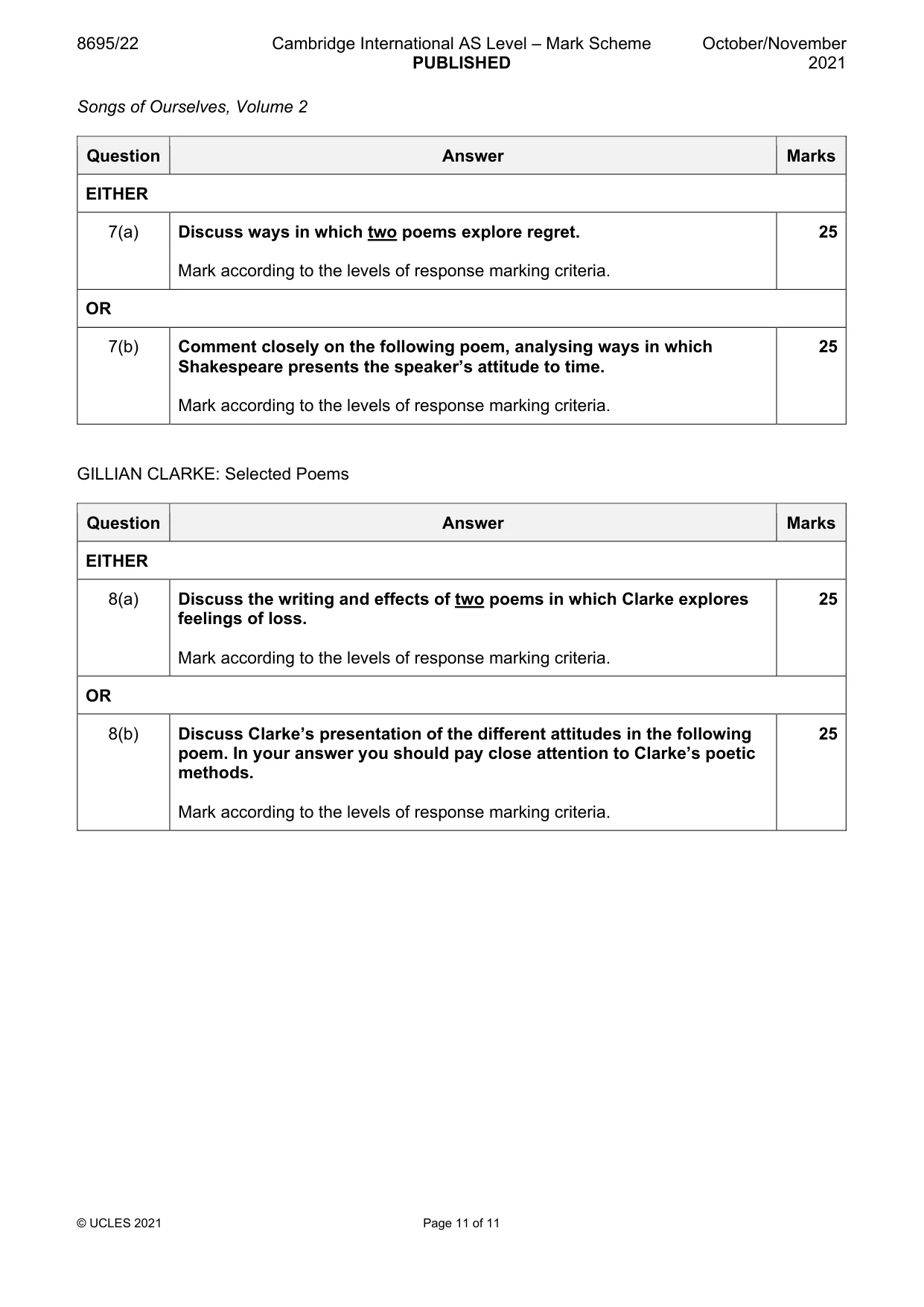
8695/22 Cambridge International AS Level – Mark Scheme PUBLISHED October/November 2021 © UCLES 2021 Page 11 of 11 Songs of Ourselves, Volume 2 Question Answer Marks EITHER 7(a) Discuss ways in which two poems explore regret. Mark according to the levels of response marking criteria. 25 OR 7(b) Comment closely on the following poem, analysing ways in which Shakespeare presents the speaker’s attitude to time. Mark according to the levels of response marking criteria. 25 GILLIAN CLARKE: Selected Poems Question Answer Marks EITHER 8(a) Discuss the writing and effects of two poems in which Clarke explores feelings of loss. Mark according to the levels of response marking criteria. 25 OR 8(b) Discuss Clarke’s presentation of the different attitudes in the following poem. In your answer you should pay close attention to Clarke’s poetic methods. Mark according to the levels of response marking criteria. 25
What you needed in this session
Cambridge’s own grade thresholds for 2021 Oct/Nov, Paper 2 · Variant 2. A higher threshold means an easier paper — the bar moves with how the cohort did.