Cambridge A Level English - Language and Literature (AS Level only, from 2016) 8695 — 2021 Oct/Nov Paper 2 · Variant 1
8695/21/O/N/21 · 50 marks · ≈56 min
The question paper and its mark scheme, free to read here and free to download. This is Cambridge’s own paper, exactly as it was sat.
Question paper24 pages




Mark scheme11 pages
Answers below. Sit the paper first if you are practising.
Paper as text
Question paper, page 1
This document has 24 pages. Any blank pages are indicated. DC (RCL/DF) 201397/4 © UCLES 2021 [Turn over Cambridge International AS Level LANGUAGE AND LITERATURE IN ENGLISH 8695/21 Paper 2 Drama, Poetry and Prose October/November 2021 2 hours You must answer on the enclosed answer booklet. You will need: Answer booklet (enclosed) INSTRUCTIONS ● Answer two questions in total, each from a different section. ● Follow the instructions on the front cover of the answer booklet. If you need additional answer paper, ask the invigilator for a continuation booklet. ● Dictionaries are not allowed. INFORMATION ● The total mark for this paper is 50. ● The number of marks for each question or part question is shown in brackets [ ]. * 1 2 1 0 1 7 1 4 5 8 *
Question paper, page 2
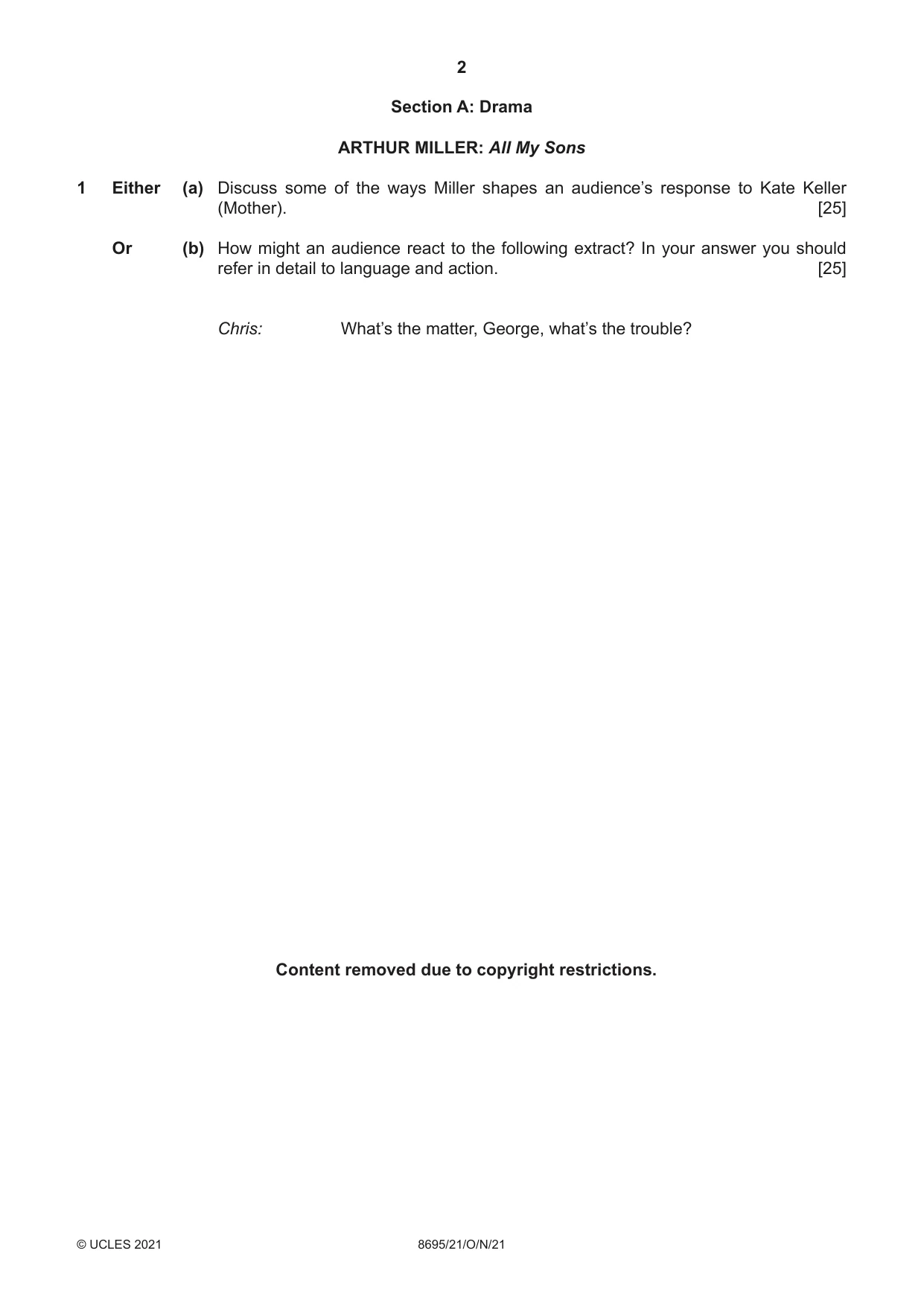
2 8695/21/O/N/21 © UCLES 2021 Section A: Drama ARTHUR MILLER: All My Sons 1 Either (a) Discuss some of the ways Miller shapes an audience’s response to Kate Keller (Mother). [25] Or (b) How might an audience react to the following extract? In your answer you should refer in detail to language and action. [25] Chris: What’s the matter, George, what’s the trouble? Content removed due to copyright restrictions.
Question paper, page 3
3 8695/21/O/N/21 © UCLES 2021 [Turn over Chris: What’re you going to do, George? (from Act 2) Content removed due to copyright restrictions.
Question paper, page 4
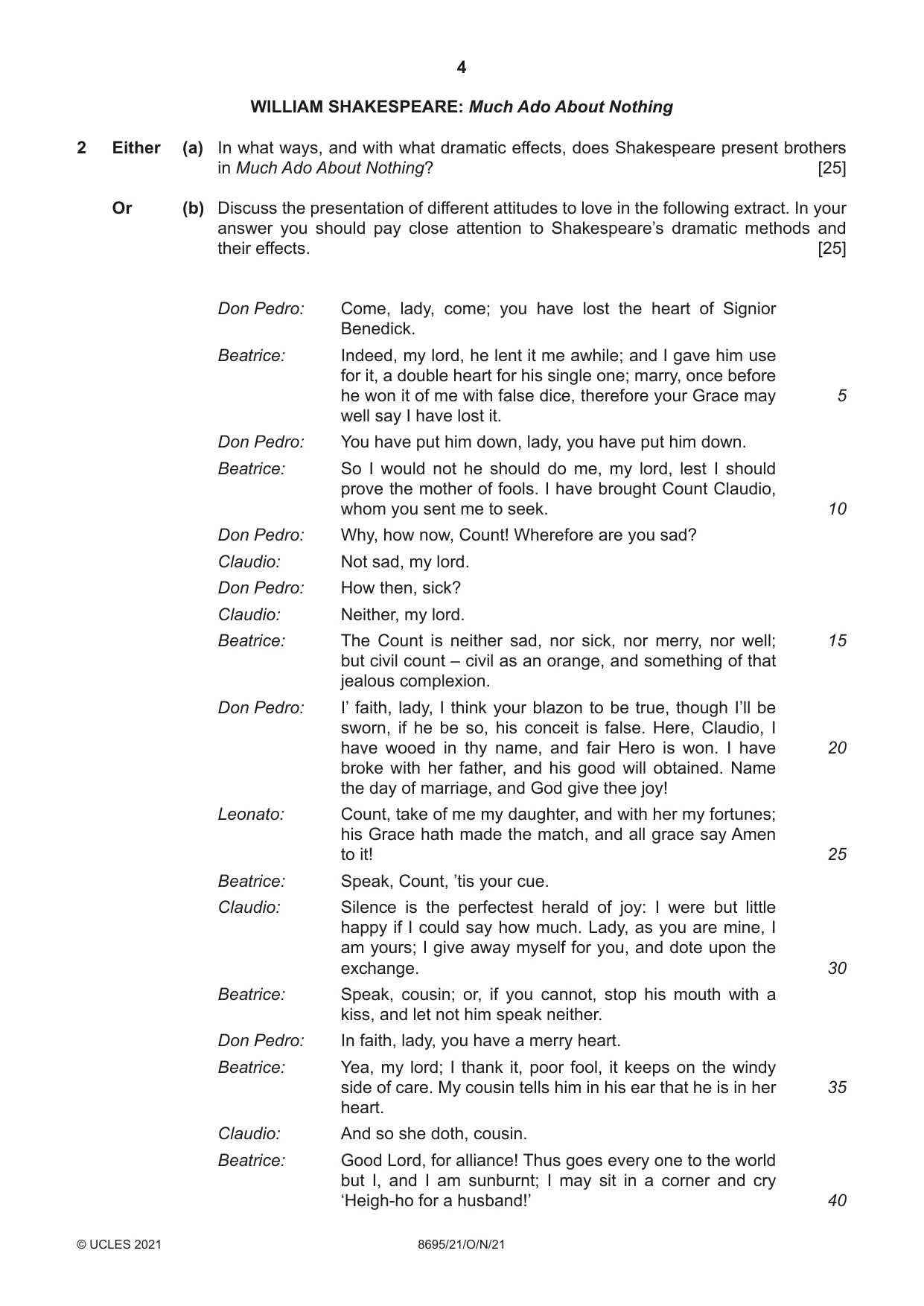
4 8695/21/O/N/21 © UCLES 2021 WILLIAM SHAKESPEARE: Much Ado About Nothing 2 Either (a) In what ways, and with what dramatic effects, does Shakespeare present brothers in Much Ado About Nothing? [25] Or (b) Discuss the presentation of different attitudes to love in the following extract. In your answer you should pay close attention to Shakespeare’s dramatic methods and their effects. [25] Don Pedro: Come, lady, come; you have lost the heart of Signior Benedick. Beatrice: Indeed, my lord, he lent it me awhile; and I gave him use for it, a double heart for his single one; marry, once before he won it of me with false dice, therefore your Grace may well say I have lost it. Don Pedro: You have put him down, lady, you have put him down. Beatrice: So I would not he should do me, my lord, lest I should prove the mother of fools. I have brought Count Claudio, whom you sent me to seek. Don Pedro: Why, how now, Count! Wherefore are you sad? Claudio: Not sad, my lord. Don Pedro: How then, sick? Claudio: Neither, my lord. Beatrice: The Count is neither sad, nor sick, nor merry, nor well; but civil count – civil as an orange, and something of that jealous complexion. Don Pedro: I’ faith, lady, I think your blazon to be true, though I’ll be sworn, if he be so, his conceit is false. Here, Claudio, I have wooed in thy name, and fair Hero is won. I have broke with her father, and his good will obtained. Name the day of marriage, and God give thee joy! Leonato: Count, take of me my daughter, and with her my fortunes; his Grace hath made the match, and all grace say Amen to it! Beatrice: Speak, Count, ’tis your cue. Claudio: Silence is the perfectest herald of joy: I were but little happy if I could say how much. Lady, as you are mine, I am yours; I give away myself for you, and dote upon the exchange. Beatrice: Speak, cousin; or, if you cannot, stop his mouth with a kiss, and let not him speak neither. Don Pedro: In faith, lady, you have a merry heart. Beatrice: Yea, my lord; I thank it, poor fool, it keeps on the windy side of care. My cousin tells him in his ear that he is in her heart. Claudio: And so she doth, cousin. Beatrice: Good Lord, for alliance! Thus goes every one to the world but I, and I am sunburnt; I may sit in a corner and cry ‘Heigh-ho for a husband!’ 5 10 15 20 25 30 35 40
Question paper, page 5
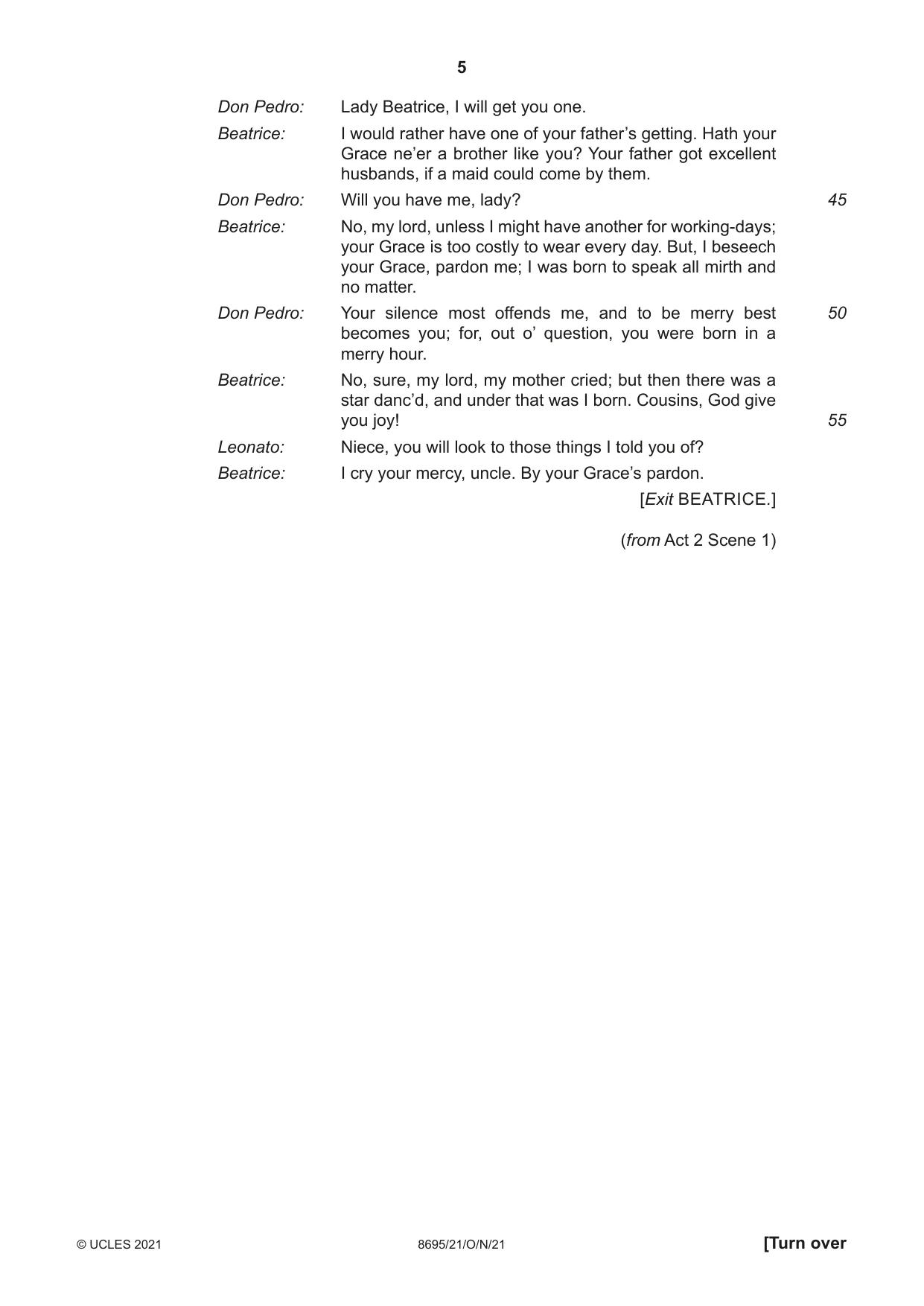
5 8695/21/O/N/21 © UCLES 2021 [Turn over Don Pedro: Lady Beatrice, I will get you one. Beatrice: I would rather have one of your father’s getting. Hath your Grace ne’er a brother like you? Your father got excellent husbands, if a maid could come by them. Don Pedro: Will you have me, lady? Beatrice: No, my lord, unless I might have another for working-days; your Grace is too costly to wear every day. But, I beseech your Grace, pardon me; I was born to speak all mirth and no matter. Don Pedro: Your silence most offends me, and to be merry best becomes you; for, out o’ question, you were born in a merry hour. Beatrice: No, sure, my lord, my mother cried; but then there was a star danc’d, and under that was I born. Cousins, God give you joy! Leonato: Niece, you will look to those things I told you of? Beatrice: I cry your mercy, uncle. By your Grace’s pardon. [Exit BEATRICE.] (from Act 2 Scene 1) 45 50 55
Question paper, page 6
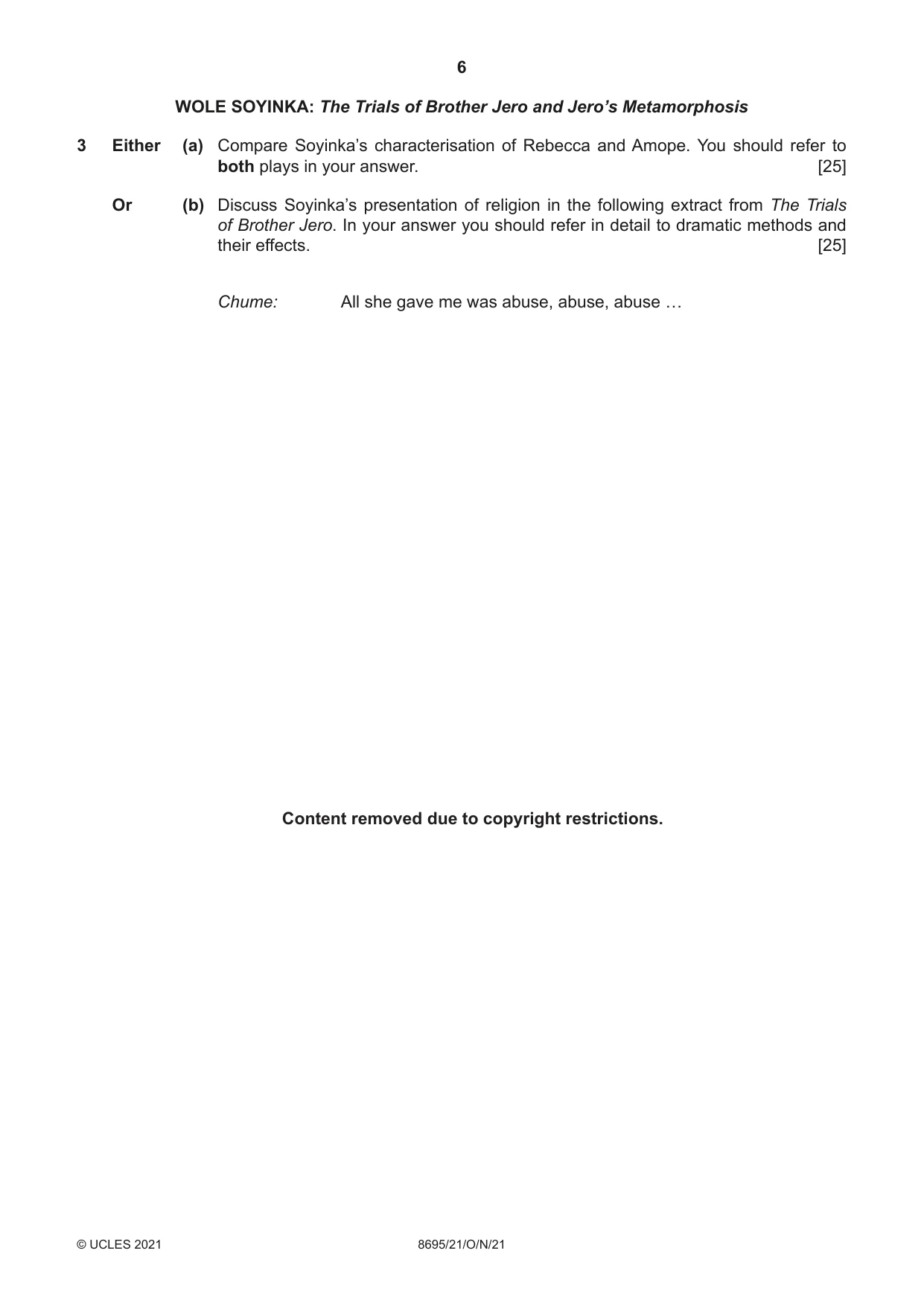
6 8695/21/O/N/21 © UCLES 2021 WOLE SOYINKA: The Trials of Brother Jero and Jero’s Metamorphosis 3 Either (a) Compare Soyinka’s characterisation of Rebecca and Amope. You should refer to both plays in your answer. [25] Or (b) Discuss Soyinka’s presentation of religion in the following extract from The Trials of Brother Jero. In your answer you should refer in detail to dramatic methods and their effects. [25] Chume: All she gave me was abuse, abuse, abuse … Content removed due to copyright restrictions.
Question paper, page 7
7 8695/21/O/N/21 © UCLES 2021 [Turn over Congregation: Alleluia. (from The Trials of Brother Jero, Scene 3) Content removed due to copyright restrictions.
Question paper, page 8
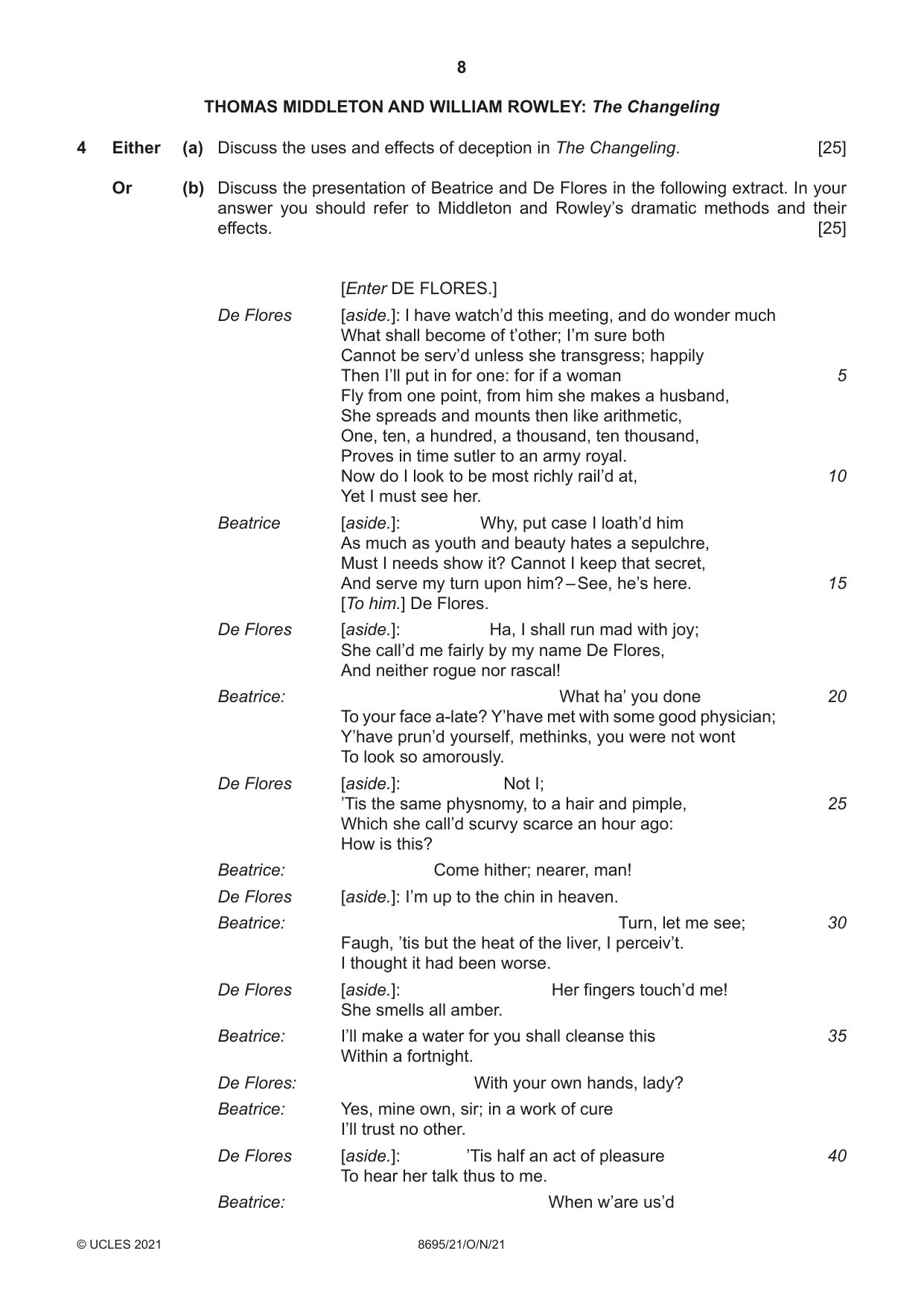
8 8695/21/O/N/21 © UCLES 2021 THOMAS MIDDLETON AND WILLIAM ROWLEY: The Changeling 4 Either (a) Discuss the uses and effects of deception in The Changeling. [25] Or (b) Discuss the presentation of Beatrice and De Flores in the following extract. In your answer you should refer to Middleton and Rowley’s dramatic methods and their effects. [25] [Enter DE FLORES.] De Flores [aside.]: I have watch’d this meeting, and do wonder much What shall become of t’other; I’m sure both Cannot be serv’d unless she transgress; happily Then I’ll put in for one: for if a woman Fly from one point, from him she makes a husband, She spreads and mounts then like arithmetic, One, ten, a hundred, a thousand, ten thousand, Proves in time sutler to an army royal. Now do I look to be most richly rail’d at, Yet I must see her. Beatrice [aside.]: Why, put case I loath’d him As much as youth and beauty hates a sepulchre, Must I needs show it? Cannot I keep that secret, And serve my turn upon him? – See, he’s here. [To him.] De Flores. De Flores [aside.]: Ha, I shall run mad with joy; She call’d me fairly by my name De Flores, And neither rogue nor rascal! Beatrice: What ha’ you done To your face a-late? Y’have met with some good physician; Y’have prun’d yourself, methinks, you were not wont To look so amorously. De Flores [aside.]: Not I; ’Tis the same physnomy, to a hair and pimple, Which she call’d scurvy scarce an hour ago: How is this? Beatrice: Come hither; nearer, man! De Flores [aside.]: I’m up to the chin in heaven. Beatrice: Turn, let me see; Faugh, ’tis but the heat of the liver, I perceiv’t. I thought it had been worse. De Flores [aside.]: Her fingers touch’d me! She smells all amber. Beatrice: I’ll make a water for you shall cleanse this Within a fortnight. De Flores: With your own hands, lady? Beatrice: Yes, mine own, sir; in a work of cure I’ll trust no other. De Flores [aside.]: ’Tis half an act of pleasure To hear her talk thus to me. Beatrice: When w’are us’d 5 10 15 20 25 30 35 40
Question paper, page 9
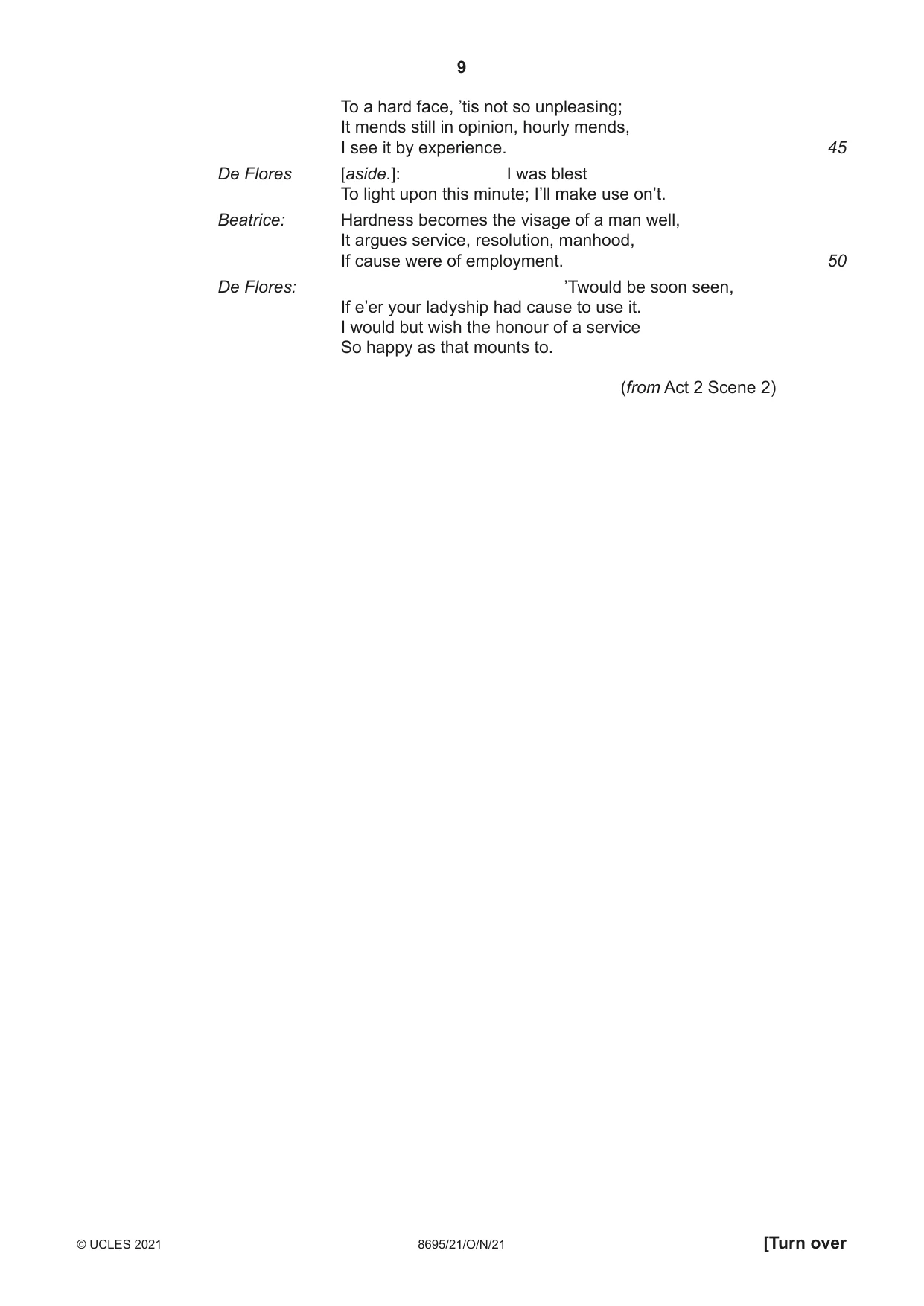
9 8695/21/O/N/21 © UCLES 2021 [Turn over To a hard face, ’tis not so unpleasing; It mends still in opinion, hourly mends, I see it by experience. De Flores [aside.]: I was blest To light upon this minute; I’ll make use on’t. Beatrice: Hardness becomes the visage of a man well, It argues service, resolution, manhood, If cause were of employment. De Flores: ’Twould be soon seen, If e’er your ladyship had cause to use it. I would but wish the honour of a service So happy as that mounts to. (from Act 2 Scene 2) 45 50
Question paper, page 10
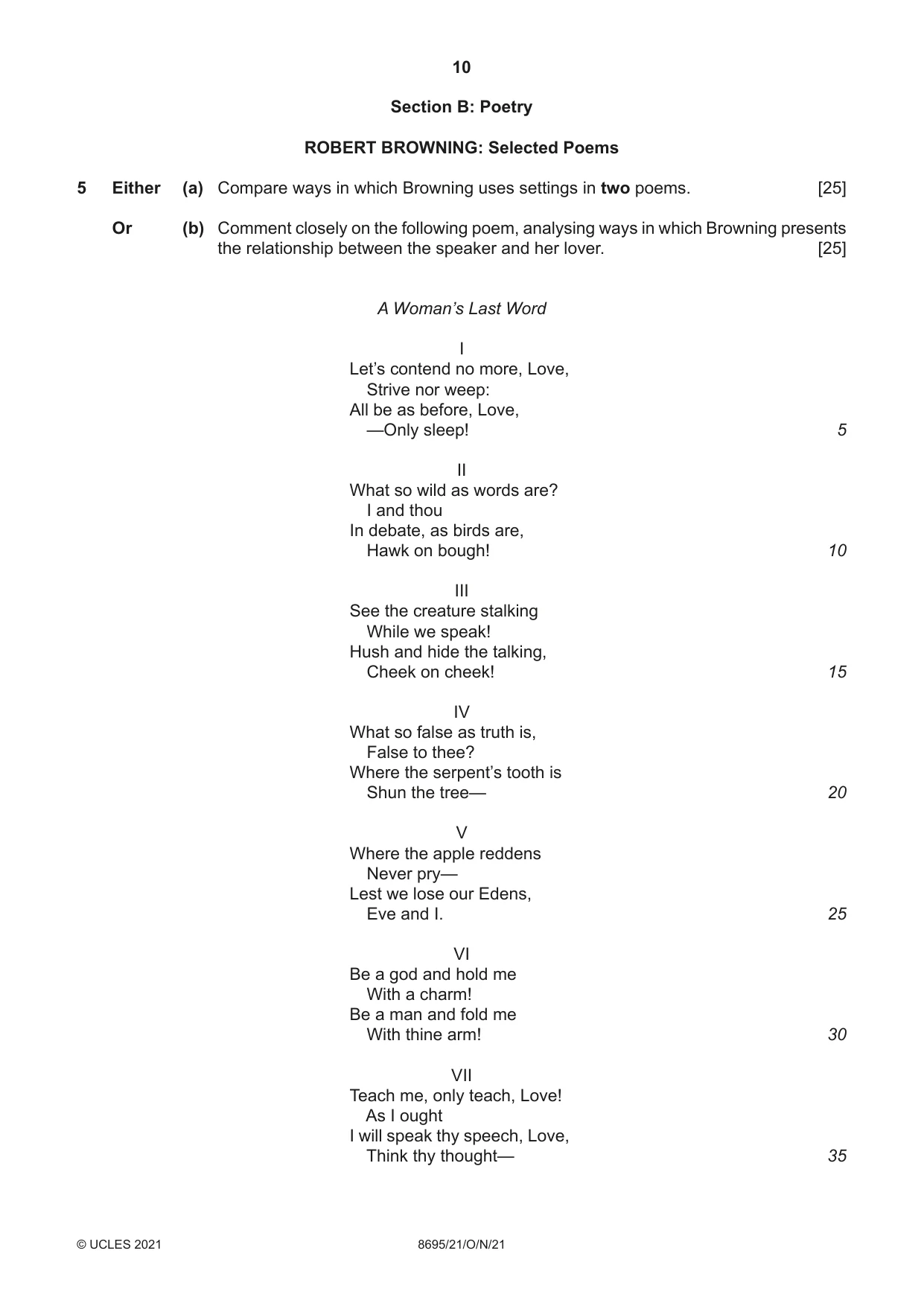
10 8695/21/O/N/21 © UCLES 2021 Section B: Poetry ROBERT BROWNING: Selected Poems 5 Either (a) Compare ways in which Browning uses settings in two poems. [25] Or (b) Comment closely on the following poem, analysing ways in which Browning presents the relationship between the speaker and her lover. [25] A Woman’s Last Word I Let’s contend no more, Love, Strive nor weep: All be as before, Love, —Only sleep! II What so wild as words are? I and thou In debate, as birds are, Hawk on bough! III See the creature stalking While we speak! Hush and hide the talking, Cheek on cheek! IV What so false as truth is, False to thee? Where the serpent’s tooth is Shun the tree— V Where the apple reddens Never pry— Lest we lose our Edens, Eve and I. VI Be a god and hold me With a charm! Be a man and fold me With thine arm! VII Teach me, only teach, Love! As I ought I will speak thy speech, Love, Think thy thought— 5 10 15 20 25 30 35
Question paper, page 11
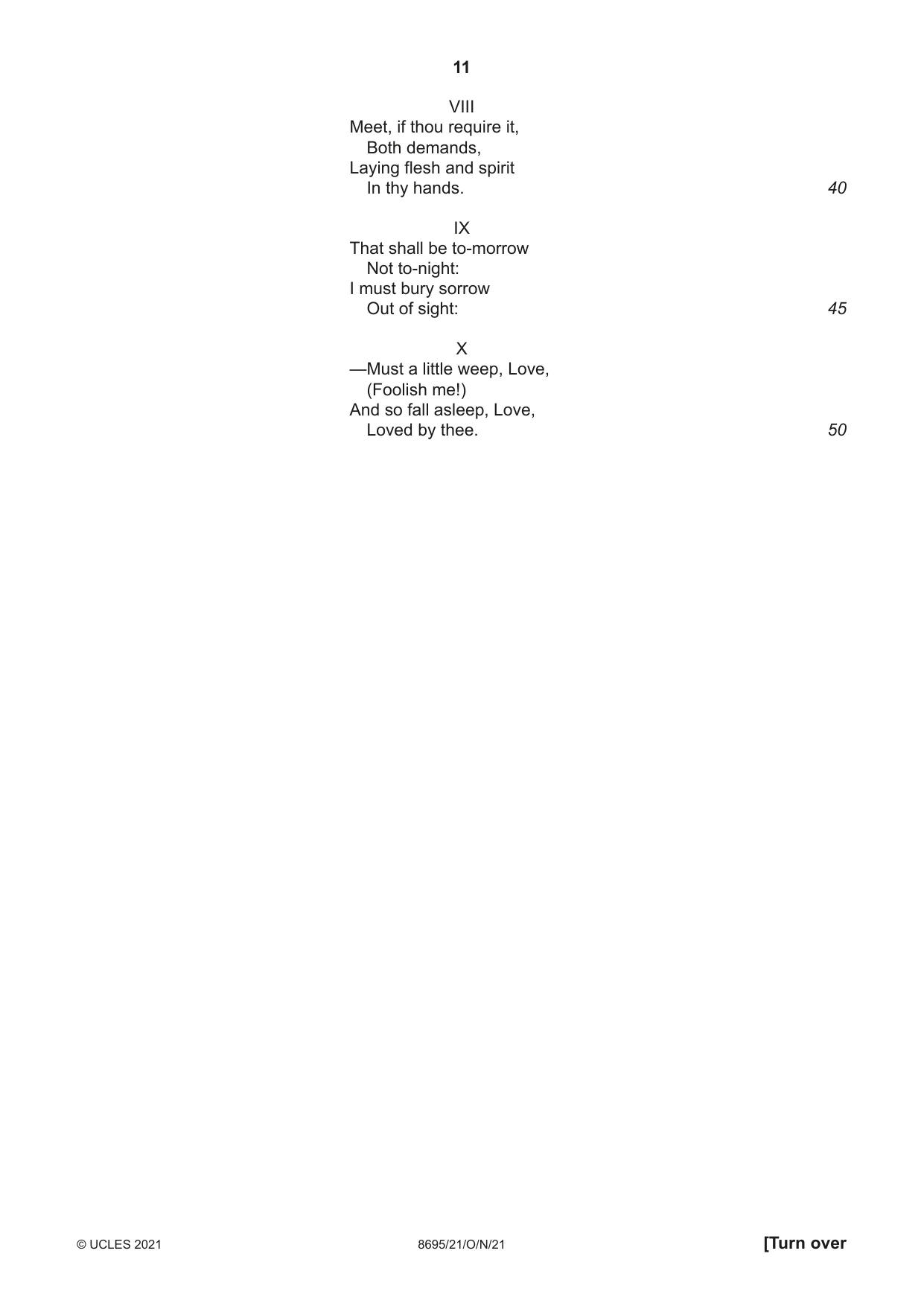
11 8695/21/O/N/21 © UCLES 2021 [Turn over VIII Meet, if thou require it, Both demands, Laying flesh and spirit In thy hands. IX That shall be to-morrow Not to-night: I must bury sorrow Out of sight: X —Must a little weep, Love, (Foolish me!) And so fall asleep, Love, Loved by thee. 40 45 50
Question paper, page 12
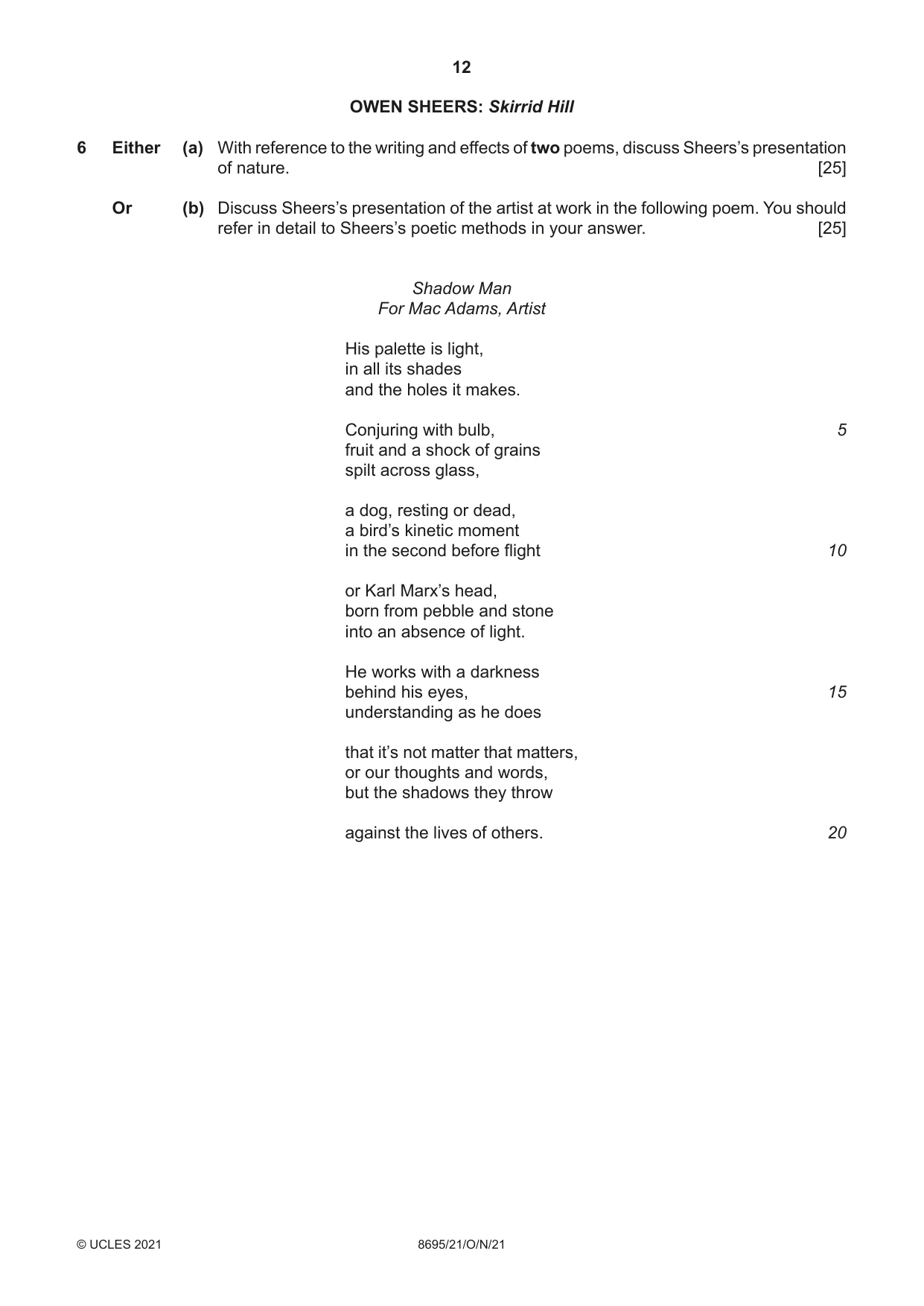
12 8695/21/O/N/21 © UCLES 2021 OWEN SHEERS: Skirrid Hill 6 Either (a) With reference to the writing and effects of two poems, discuss Sheers’s presentation of nature. [25] Or (b) Discuss Sheers’s presentation of the artist at work in the following poem. You should refer in detail to Sheers’s poetic methods in your answer. [25] Shadow Man For Mac Adams, Artist His palette is light, in all its shades and the holes it makes. Conjuring with bulb, fruit and a shock of grains spilt across glass, a dog, resting or dead, a bird’s kinetic moment in the second before flight or Karl Marx’s head, born from pebble and stone into an absence of light. He works with a darkness behind his eyes, understanding as he does that it’s not matter that matters, or our thoughts and words, but the shadows they throw against the lives of others. 5 10 15 20
Question paper, page 13
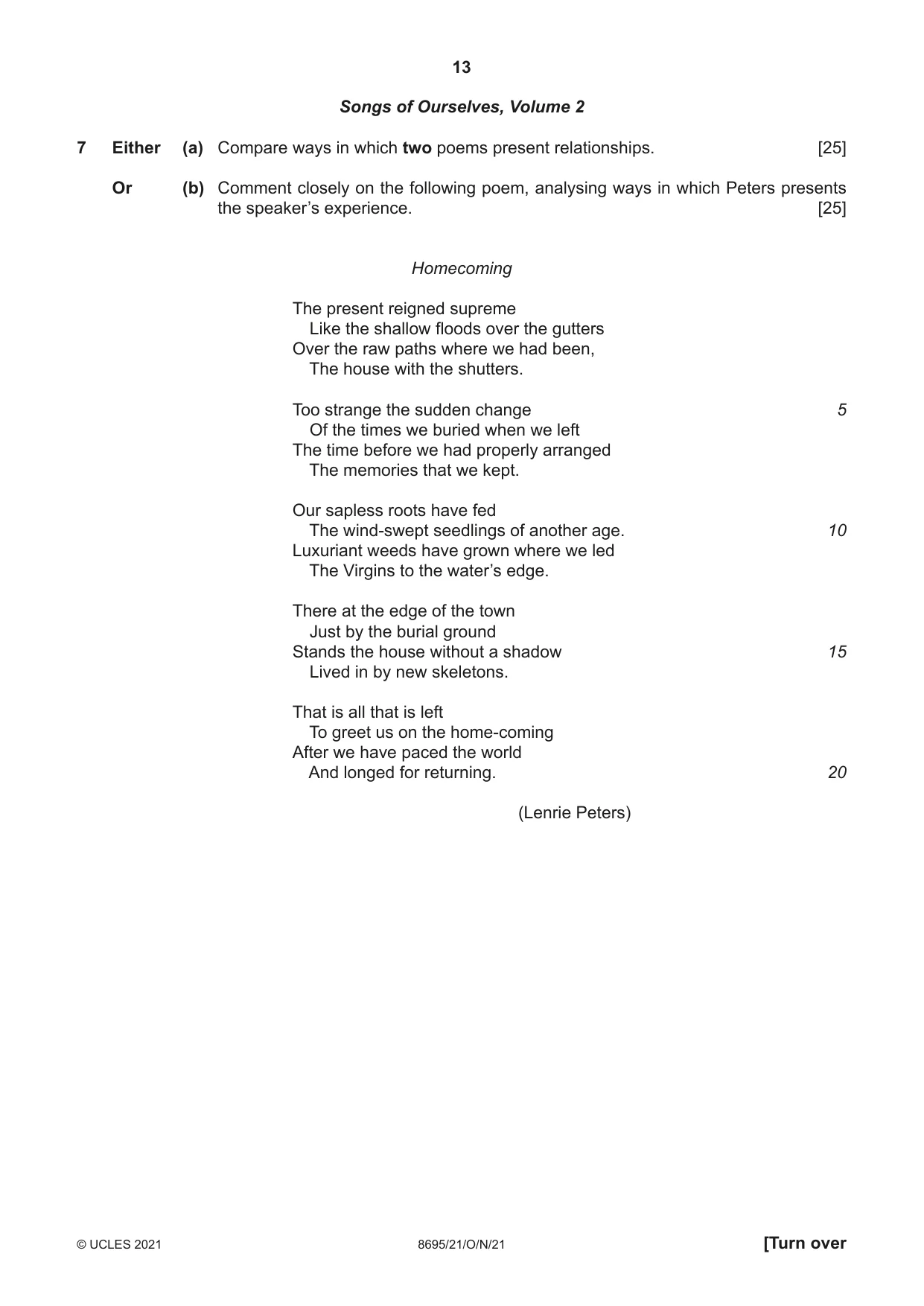
13 8695/21/O/N/21 © UCLES 2021 [Turn over Songs of Ourselves, Volume 2 7 Either (a) Compare ways in which two poems present relationships. [25] Or (b) Comment closely on the following poem, analysing ways in which Peters presents the speaker’s experience. [25] Homecoming The present reigned supreme Like the shallow floods over the gutters Over the raw paths where we had been, The house with the shutters. Too strange the sudden change Of the times we buried when we left The time before we had properly arranged The memories that we kept. Our sapless roots have fed The wind-swept seedlings of another age. Luxuriant weeds have grown where we led The Virgins to the water’s edge. There at the edge of the town Just by the burial ground Stands the house without a shadow Lived in by new skeletons. That is all that is left To greet us on the home-coming After we have paced the world And longed for returning. (Lenrie Peters) 5 10 15 20
Question paper, page 14
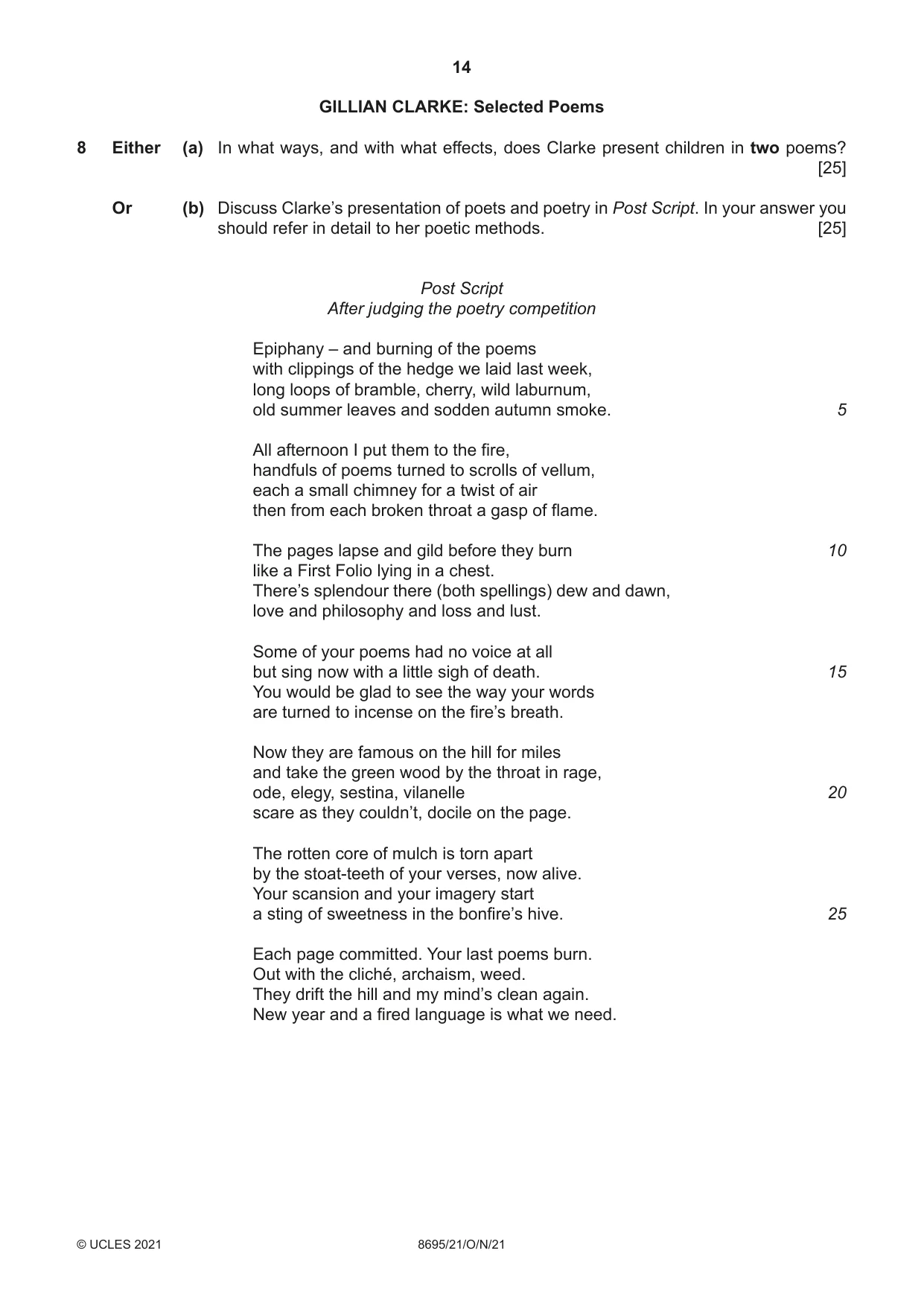
14 8695/21/O/N/21 © UCLES 2021 GILLIAN CLARKE: Selected Poems 8 Either (a) In what ways, and with what effects, does Clarke present children in two poems? [25] Or (b) Discuss Clarke’s presentation of poets and poetry in Post Script. In your answer you should refer in detail to her poetic methods. [25] Post Script After judging the poetry competition Epiphany – and burning of the poems with clippings of the hedge we laid last week, long loops of bramble, cherry, wild laburnum, old summer leaves and sodden autumn smoke. All afternoon I put them to the fire, handfuls of poems turned to scrolls of vellum, each a small chimney for a twist of air then from each broken throat a gasp of flame. The pages lapse and gild before they burn like a First Folio lying in a chest. There’s splendour there (both spellings) dew and dawn, love and philosophy and loss and lust. Some of your poems had no voice at all but sing now with a little sigh of death. You would be glad to see the way your words are turned to incense on the fire’s breath. Now they are famous on the hill for miles and take the green wood by the throat in rage, ode, elegy, sestina, vilanelle scare as they couldn’t, docile on the page. The rotten core of mulch is torn apart by the stoat-teeth of your verses, now alive. Your scansion and your imagery start a sting of sweetness in the bonfire’s hive. Each page committed. Your last poems burn. Out with the cliché, archaism, weed. They drift the hill and my mind’s clean again. New year and a fired language is what we need. 5 10 15 20 25
Question paper, page 15
15 8695/21/O/N/21 © UCLES 2021 [Turn over TURN OVER FOR SECTION C.
Question paper, page 16
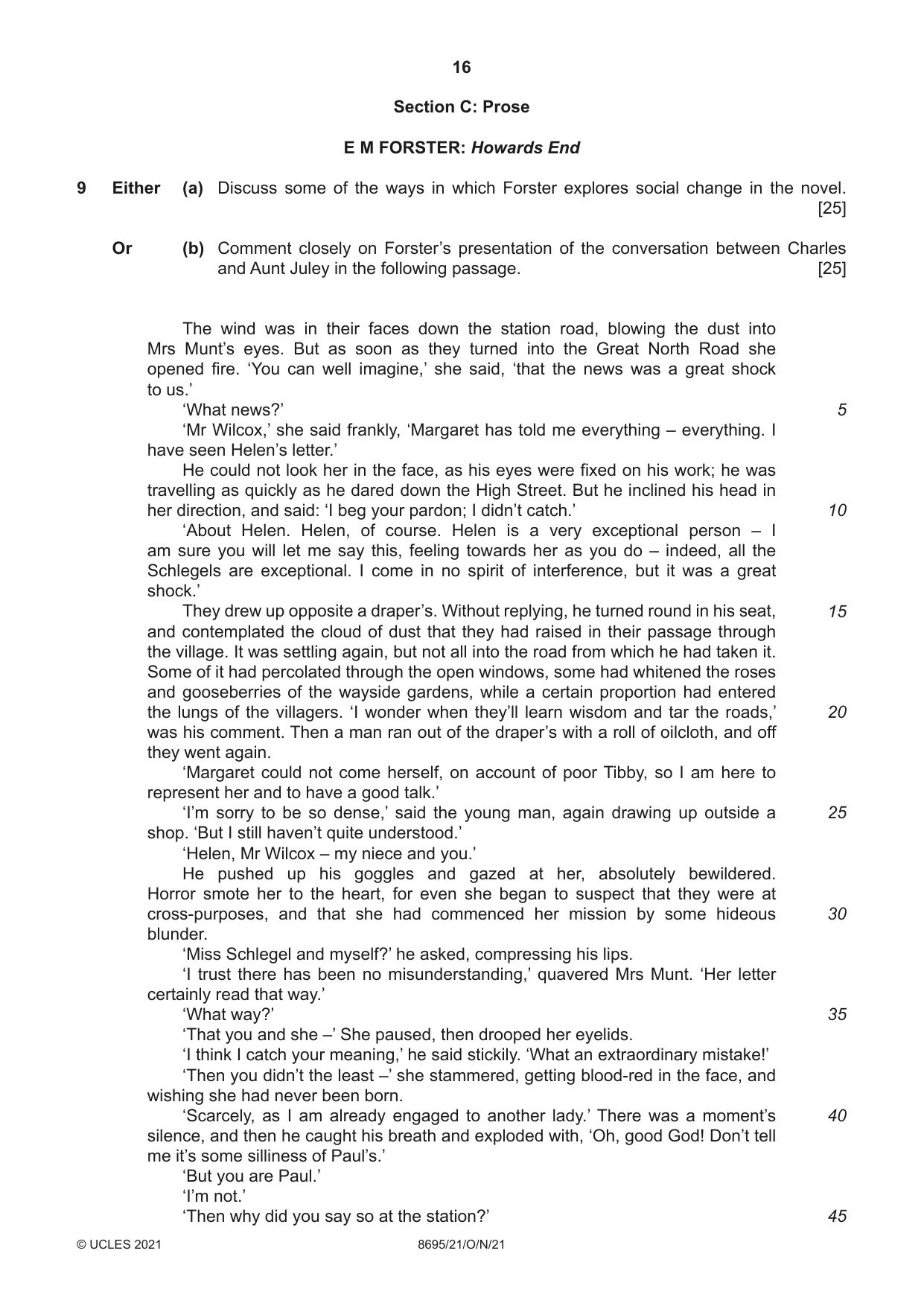
16 8695/21/O/N/21 © UCLES 2021 Section C: Prose E M FORSTER: Howards End 9 Either (a) Discuss some of the ways in which Forster explores social change in the novel. [25] Or (b) Comment closely on Forster’s presentation of the conversation between Charles and Aunt Juley in the following passage. [25] The wind was in their faces down the station road, blowing the dust into Mrs Munt’s eyes. But as soon as they turned into the Great North Road she opened fire. ‘You can well imagine,’ she said, ‘that the news was a great shock to us.’ ‘What news?’ ‘Mr Wilcox,’ she said frankly, ‘Margaret has told me everything – everything. I have seen Helen’s letter.’ He could not look her in the face, as his eyes were fixed on his work; he was travelling as quickly as he dared down the High Street. But he inclined his head in her direction, and said: ‘I beg your pardon; I didn’t catch.’ ‘About Helen. Helen, of course. Helen is a very exceptional person – I am sure you will let me say this, feeling towards her as you do – indeed, all the Schlegels are exceptional. I come in no spirit of interference, but it was a great shock.’ They drew up opposite a draper’s. Without replying, he turned round in his seat, and contemplated the cloud of dust that they had raised in their passage through the village. It was settling again, but not all into the road from which he had taken it. Some of it had percolated through the open windows, some had whitened the roses and gooseberries of the wayside gardens, while a certain proportion had entered the lungs of the villagers. ‘I wonder when they’ll learn wisdom and tar the roads,’ was his comment. Then a man ran out of the draper’s with a roll of oilcloth, and off they went again. ‘Margaret could not come herself, on account of poor Tibby, so I am here to represent her and to have a good talk.’ ‘I’m sorry to be so dense,’ said the young man, again drawing up outside a shop. ‘But I still haven’t quite understood.’ ‘Helen, Mr Wilcox – my niece and you.’ He pushed up his goggles and gazed at her, absolutely bewildered. Horror smote her to the heart, for even she began to suspect that they were at cross-purposes, and that she had commenced her mission by some hideous blunder. ‘Miss Schlegel and myself?’ he asked, compressing his lips. ‘I trust there has been no misunderstanding,’ quavered Mrs Munt. ‘Her letter certainly read that way.’ ‘What way?’ ‘That you and she –’ She paused, then drooped her eyelids. ‘I think I catch your meaning,’ he said stickily. ‘What an extraordinary mistake!’ ‘Then you didn’t the least –’ she stammered, getting blood-red in the face, and wishing she had never been born. ‘Scarcely, as I am already engaged to another lady.’ There was a moment’s silence, and then he caught his breath and exploded with, ‘Oh, good God! Don’t tell me it’s some silliness of Paul’s.’ ‘But you are Paul.’ ‘I’m not.’ ‘Then why did you say so at the station?’ 5 10 15 20 25 30 35 40 45
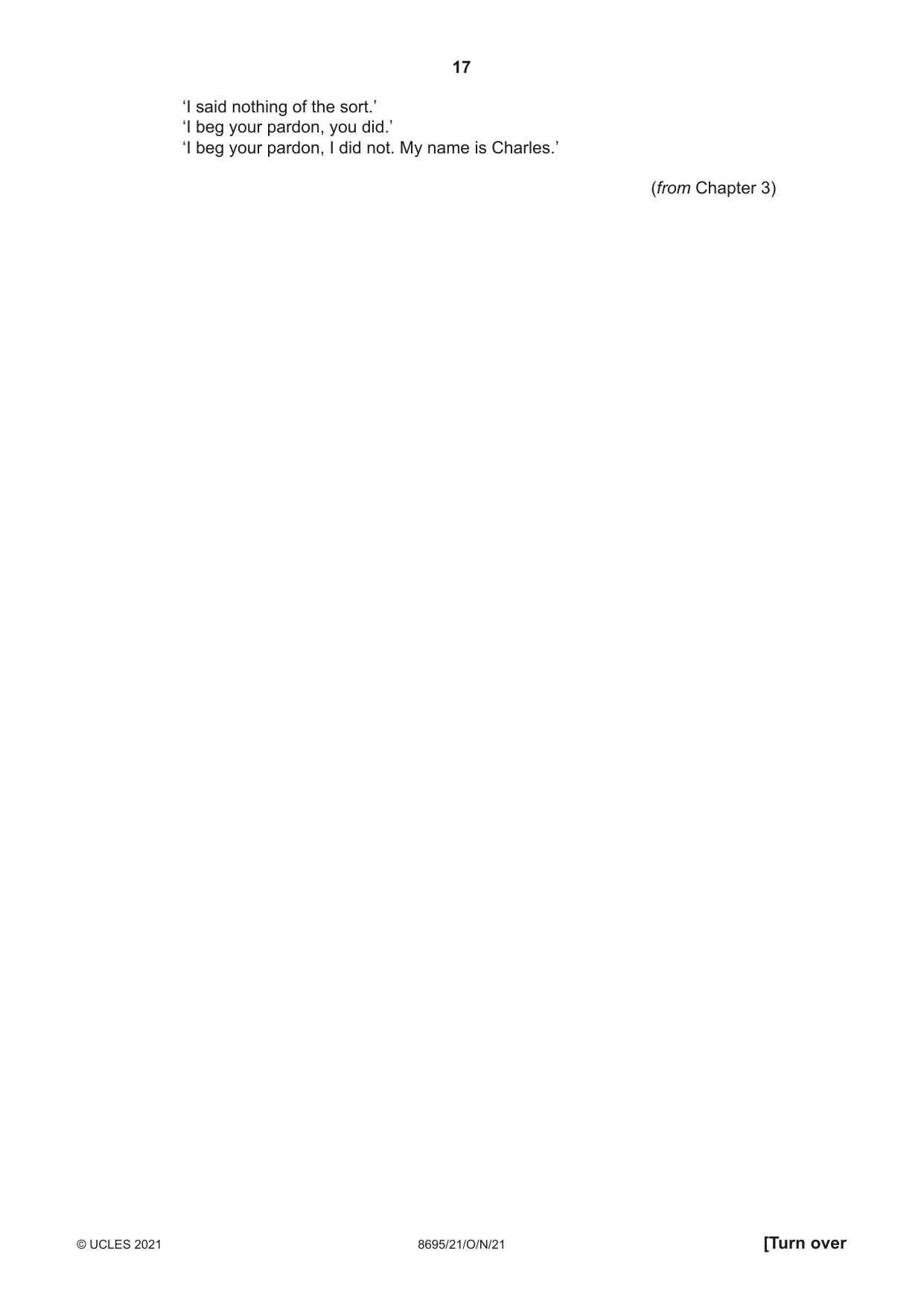
Question paper, page 17
17 8695/21/O/N/21 © UCLES 2021 [Turn over ‘I said nothing of the sort.’ ‘I beg your pardon, you did.’ ‘I beg your pardon, I did not. My name is Charles.’ (from Chapter 3)
Question paper, page 18
18 8695/21/O/N/21 © UCLES 2021 ANDREA LEVY: Small Island 10 Either (a) Discuss ways in which Levy presents characters’ experiences of migration to England. [25] Or (b) Comment closely on ways in which the riot is presented in the following passage. [25] As spores to the wind everyone was scattered before the MPs. Come on, get back there!’ (from Chapter 17) Content removed due to copyright restrictions.
Question paper, page 19
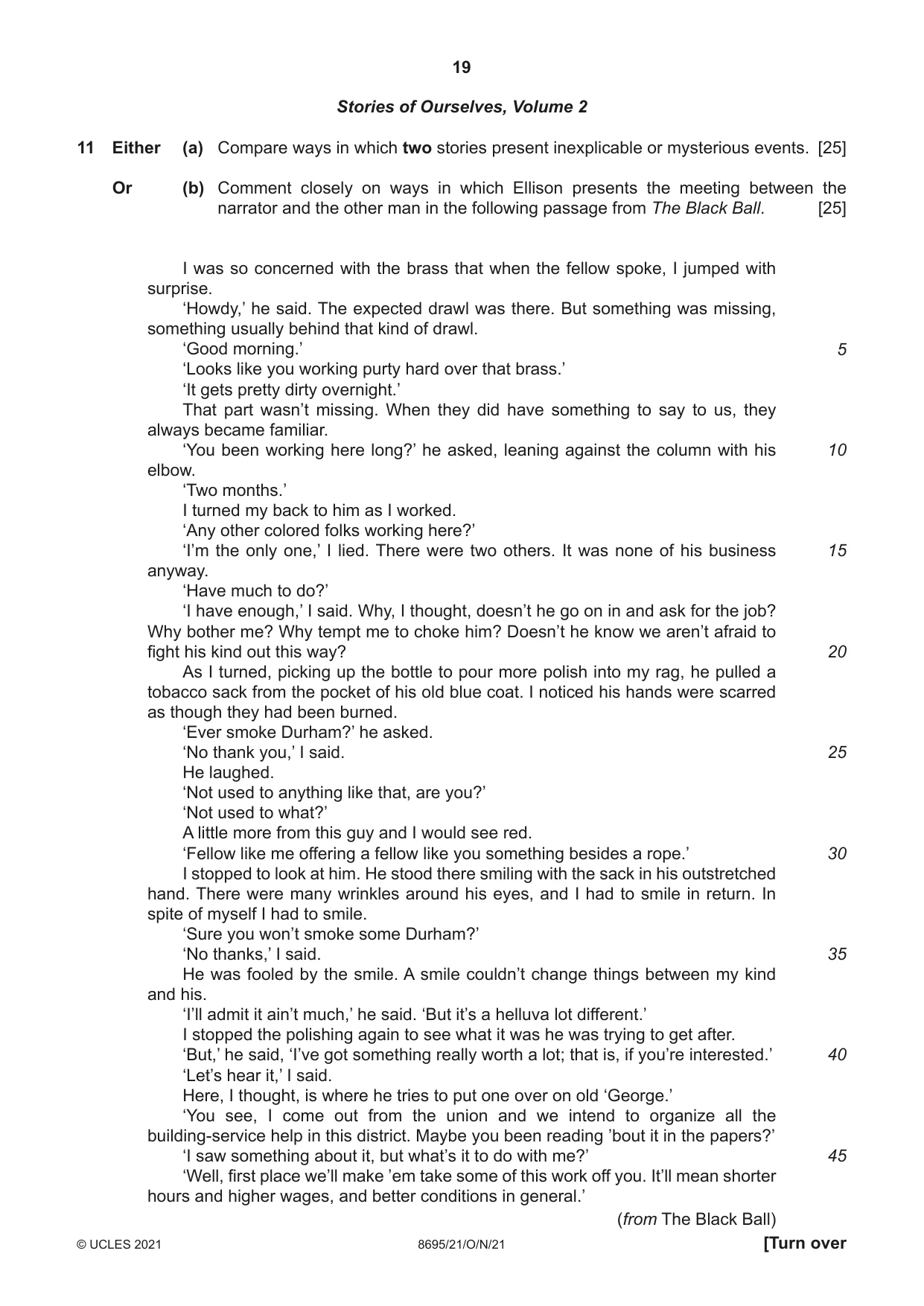
19 8695/21/O/N/21 © UCLES 2021 [Turn over Stories of Ourselves, Volume 2 11 Either (a) Compare ways in which two stories present inexplicable or mysterious events. [25] Or (b) Comment closely on ways in which Ellison presents the meeting between the narrator and the other man in the following passage from The Black Ball. [25] I was so concerned with the brass that when the fellow spoke, I jumped with surprise. ‘Howdy,’ he said. The expected drawl was there. But something was missing, something usually behind that kind of drawl. ‘Good morning.’ ‘Looks like you working purty hard over that brass.’ ‘It gets pretty dirty overnight.’ That part wasn’t missing. When they did have something to say to us, they always became familiar. ‘You been working here long?’ he asked, leaning against the column with his elbow. ‘Two months.’ I turned my back to him as I worked. ‘Any other colored folks working here?’ ‘I’m the only one,’ I lied. There were two others. It was none of his business anyway. ‘Have much to do?’ ‘I have enough,’ I said. Why, I thought, doesn’t he go on in and ask for the job? Why bother me? Why tempt me to choke him? Doesn’t he know we aren’t afraid to fight his kind out this way? As I turned, picking up the bottle to pour more polish into my rag, he pulled a tobacco sack from the pocket of his old blue coat. I noticed his hands were scarred as though they had been burned. ‘Ever smoke Durham?’ he asked. ‘No thank you,’ I said. He laughed. ‘Not used to anything like that, are you?’ ‘Not used to what?’ A little more from this guy and I would see red. ‘Fellow like me offering a fellow like you something besides a rope.’ I stopped to look at him. He stood there smiling with the sack in his outstretched hand. There were many wrinkles around his eyes, and I had to smile in return. In spite of myself I had to smile. ‘Sure you won’t smoke some Durham?’ ‘No thanks,’ I said. He was fooled by the smile. A smile couldn’t change things between my kind and his. ‘I’ll admit it ain’t much,’ he said. ‘But it’s a helluva lot different.’ I stopped the polishing again to see what it was he was trying to get after. ‘But,’ he said, ‘I’ve got something really worth a lot; that is, if you’re interested.’ ‘Let’s hear it,’ I said. Here, I thought, is where he tries to put one over on old ‘George.’ ‘You see, I come out from the union and we intend to organize all the building-service help in this district. Maybe you been reading ’bout it in the papers?’ ‘I saw something about it, but what’s it to do with me?’ ‘Well, first place we’ll make ’em take some of this work off you. It’ll mean shorter hours and higher wages, and better conditions in general.’ (from The Black Ball) 5 10 15 20 25 30 35 40 45
Question paper, page 20
20 8695/21/O/N/21 © UCLES 2021 NGŨGĨ WA THIONG’O: Petals of Blood 12 Either (a) Discuss ways in which Ngũgĩ presents Kenya’s fight for freedom from colonial rule in the novel. [25] Or (b) Comment closely on the presentation of Karega’s interrogation in the following passage. [25] ‘Oh, that’s a good one, Mr Karega. Out with him.’ (from Chapter 12) Content removed due to copyright restrictions.
Question paper, page 21
21 8695/21/O/N/21 © UCLES 2021 BLANK PAGE
Question paper, page 22
22 8695/21/O/N/21 © UCLES 2021 BLANK PAGE
Question paper, page 23
23 8695/21/O/N/21 © UCLES 2021 BLANK PAGE
Question paper, page 24
24 8695/21/O/N/21 © UCLES 2021 Permission to reproduce items where third-party owned material protected by copyright is included has been sought and cleared where possible. Every reasonable effort has been made by the publisher (UCLES) to trace copyright holders, but if any items requiring clearance have unwittingly been included, the publisher will be pleased to make amends at the earliest possible opportunity. To avoid the issue of disclosure of answer-related information to candidates, all copyright acknowledgements are reproduced online in the Cambridge Assessment International Education Copyright Acknowledgements Booklet. This is produced for each series of examinations and is freely available to download at www.cambridgeinternational.org after the live examination series. Cambridge Assessment International Education is part of the Cambridge Assessment Group. Cambridge Assessment is the brand name of the University of Cambridge Local Examinations Syndicate (UCLES), which itself is a department of the University of Cambridge. BLANK PAGE
Mark scheme, page 1
This document consists of 11 printed pages. © UCLES 2021 [Turn over Cambridge International AS Level LANGUAGE AND LITERATURE IN ENGLISH 8695/21 Paper 2 Drama, Poetry and Prose October/November 2021 MARK SCHEME Maximum Mark: 50 Published This mark scheme is published as an aid to teachers and candidates, to indicate the requirements of the examination. It shows the basis on which Examiners were instructed to award marks. It does not indicate the details of the discussions that took place at an Examiners’ meeting before marking began, which would have considered the acceptability of alternative answers. Mark schemes should be read in conjunction with the question paper and the Principal Examiner Report for Teachers. Cambridge International will not enter into discussions about these mark schemes. Cambridge International is publishing the mark schemes for the October/November 2021 series for most Cambridge IGCSE™, Cambridge International A and AS Level components and some Cambridge O Level components.
Mark scheme, page 2
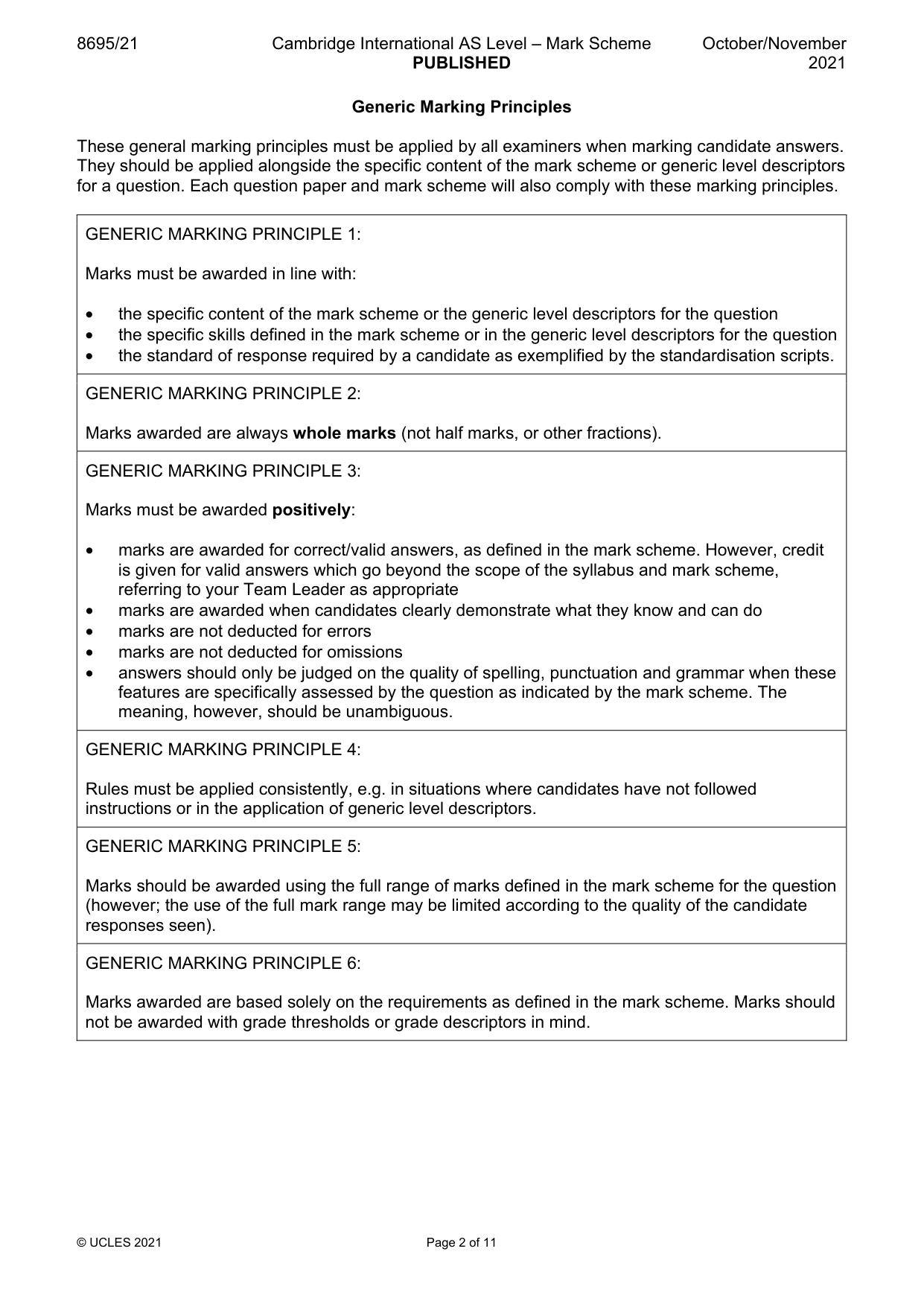
8695/21 Cambridge International AS Level – Mark Scheme PUBLISHED October/November 2021 © UCLES 2021 Page 2 of 11 Generic Marking Principles These general marking principles must be applied by all examiners when marking candidate answers. They should be applied alongside the specific content of the mark scheme or generic level descriptors for a question. Each question paper and mark scheme will also comply with these marking principles. GENERIC MARKING PRINCIPLE 1: Marks must be awarded in line with: • the specific content of the mark scheme or the generic level descriptors for the question • the specific skills defined in the mark scheme or in the generic level descriptors for the question • the standard of response required by a candidate as exemplified by the standardisation scripts. GENERIC MARKING PRINCIPLE 2: Marks awarded are always whole marks (not half marks, or other fractions). GENERIC MARKING PRINCIPLE 3: Marks must be awarded positively: • marks are awarded for correct/valid answers, as defined in the mark scheme. However, credit is given for valid answers which go beyond the scope of the syllabus and mark scheme, referring to your Team Leader as appropriate • marks are awarded when candidates clearly demonstrate what they know and can do • marks are not deducted for errors • marks are not deducted for omissions • answers should only be judged on the quality of spelling, punctuation and grammar when these features are specifically assessed by the question as indicated by the mark scheme. The meaning, however, should be unambiguous. GENERIC MARKING PRINCIPLE 4: Rules must be applied consistently, e.g. in situations where candidates have not followed instructions or in the application of generic level descriptors. GENERIC MARKING PRINCIPLE 5: Marks should be awarded using the full range of marks defined in the mark scheme for the question (however; the use of the full mark range may be limited according to the quality of the candidate responses seen). GENERIC MARKING PRINCIPLE 6: Marks awarded are based solely on the requirements as defined in the mark scheme. Marks should not be awarded with grade thresholds or grade descriptors in mind.
Mark scheme, page 3
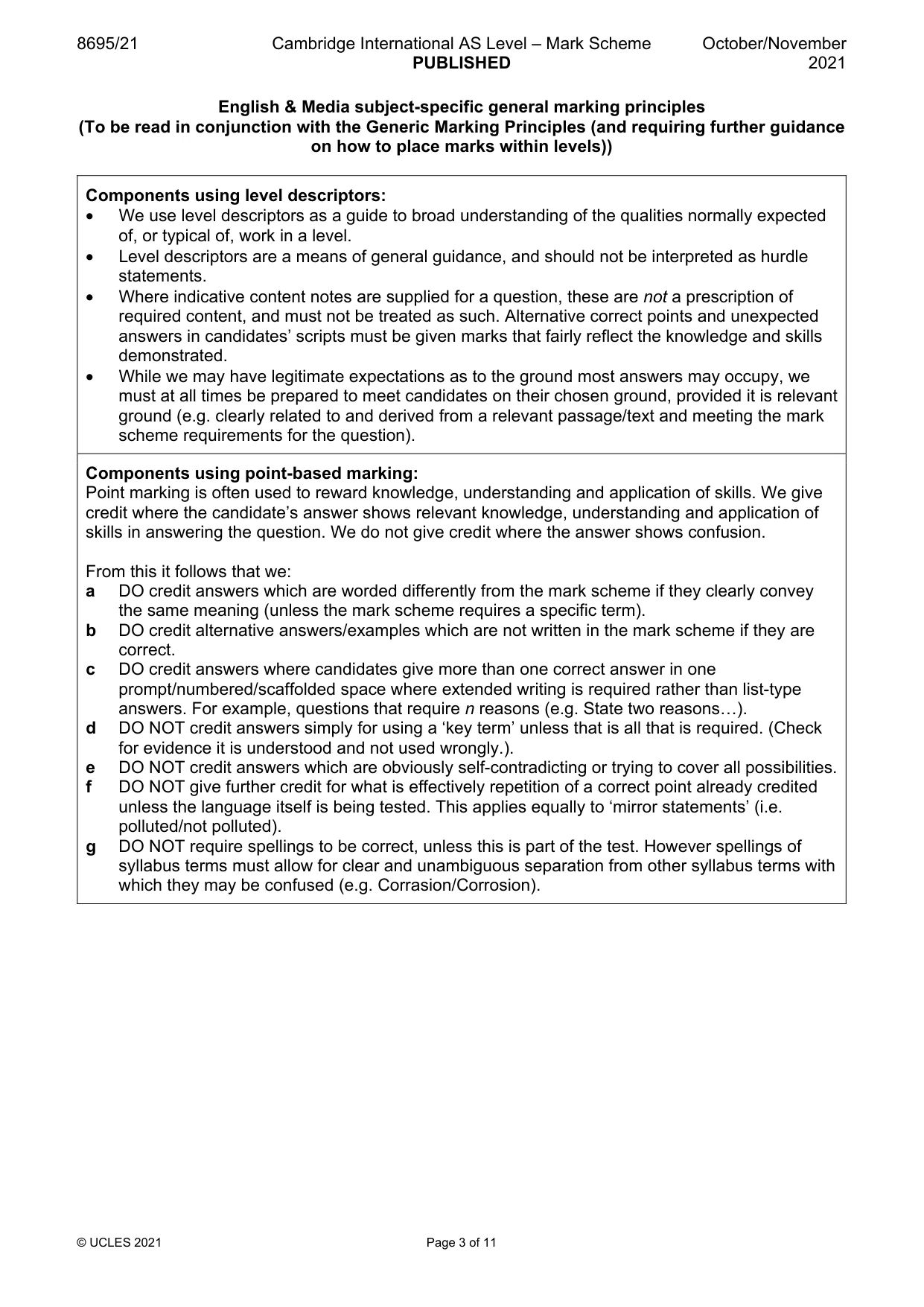
8695/21 Cambridge International AS Level – Mark Scheme PUBLISHED October/November 2021 © UCLES 2021 Page 3 of 11 English & Media subject-specific general marking principles (To be read in conjunction with the Generic Marking Principles (and requiring further guidance on how to place marks within levels)) Components using level descriptors: • We use level descriptors as a guide to broad understanding of the qualities normally expected of, or typical of, work in a level. • Level descriptors are a means of general guidance, and should not be interpreted as hurdle statements. • Where indicative content notes are supplied for a question, these are not a prescription of required content, and must not be treated as such. Alternative correct points and unexpected answers in candidates’ scripts must be given marks that fairly reflect the knowledge and skills demonstrated. • While we may have legitimate expectations as to the ground most answers may occupy, we must at all times be prepared to meet candidates on their chosen ground, provided it is relevant ground (e.g. clearly related to and derived from a relevant passage/text and meeting the mark scheme requirements for the question). Components using point-based marking: Point marking is often used to reward knowledge, understanding and application of skills. We give credit where the candidate’s answer shows relevant knowledge, understanding and application of skills in answering the question. We do not give credit where the answer shows confusion. From this it follows that we: a DO credit answers which are worded differently from the mark scheme if they clearly convey the same meaning (unless the mark scheme requires a specific term). b DO credit alternative answers/examples which are not written in the mark scheme if they are correct. c DO credit answers where candidates give more than one correct answer in one prompt/numbered/scaffolded space where extended writing is required rather than list-type answers. For example, questions that require n reasons (e.g. State two reasons…). d DO NOT credit answers simply for using a ‘key term’ unless that is all that is required. (Check for evidence it is understood and not used wrongly.). e DO NOT credit answers which are obviously self-contradicting or trying to cover all possibilities. f DO NOT give further credit for what is effectively repetition of a correct point already credited unless the language itself is being tested. This applies equally to ‘mirror statements’ (i.e. polluted/not polluted). g DO NOT require spellings to be correct, unless this is part of the test. However spellings of syllabus terms must allow for clear and unambiguous separation from other syllabus terms with which they may be confused (e.g. Corrasion/Corrosion).
Mark scheme, page 4
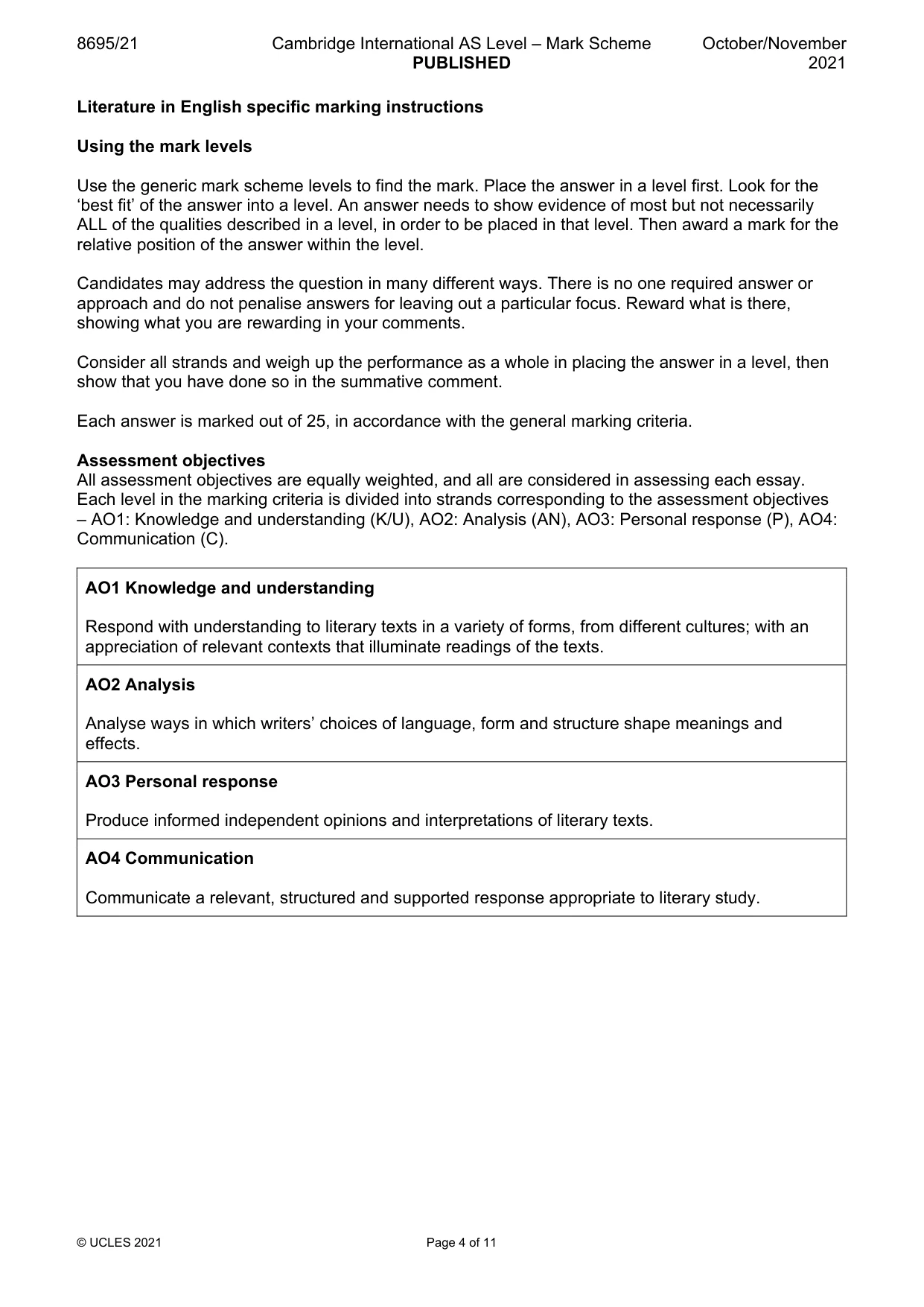
8695/21 Cambridge International AS Level – Mark Scheme PUBLISHED October/November 2021 © UCLES 2021 Page 4 of 11 Literature in English specific marking instructions Using the mark levels Use the generic mark scheme levels to find the mark. Place the answer in a level first. Look for the ‘best fit’ of the answer into a level. An answer needs to show evidence of most but not necessarily ALL of the qualities described in a level, in order to be placed in that level. Then award a mark for the relative position of the answer within the level. Candidates may address the question in many different ways. There is no one required answer or approach and do not penalise answers for leaving out a particular focus. Reward what is there, showing what you are rewarding in your comments. Consider all strands and weigh up the performance as a whole in placing the answer in a level, then show that you have done so in the summative comment. Each answer is marked out of 25, in accordance with the general marking criteria. Assessment objectives All assessment objectives are equally weighted, and all are considered in assessing each essay. Each level in the marking criteria is divided into strands corresponding to the assessment objectives – AO1: Knowledge and understanding (K/U), AO2: Analysis (AN), AO3: Personal response (P), AO4: Communication (C). AO1 Knowledge and understanding Respond with understanding to literary texts in a variety of forms, from different cultures; with an appreciation of relevant contexts that illuminate readings of the texts. AO2 Analysis Analyse ways in which writers’ choices of language, form and structure shape meanings and effects. AO3 Personal response Produce informed independent opinions and interpretations of literary texts. AO4 Communication Communicate a relevant, structured and supported response appropriate to literary study.
Mark scheme, page 5
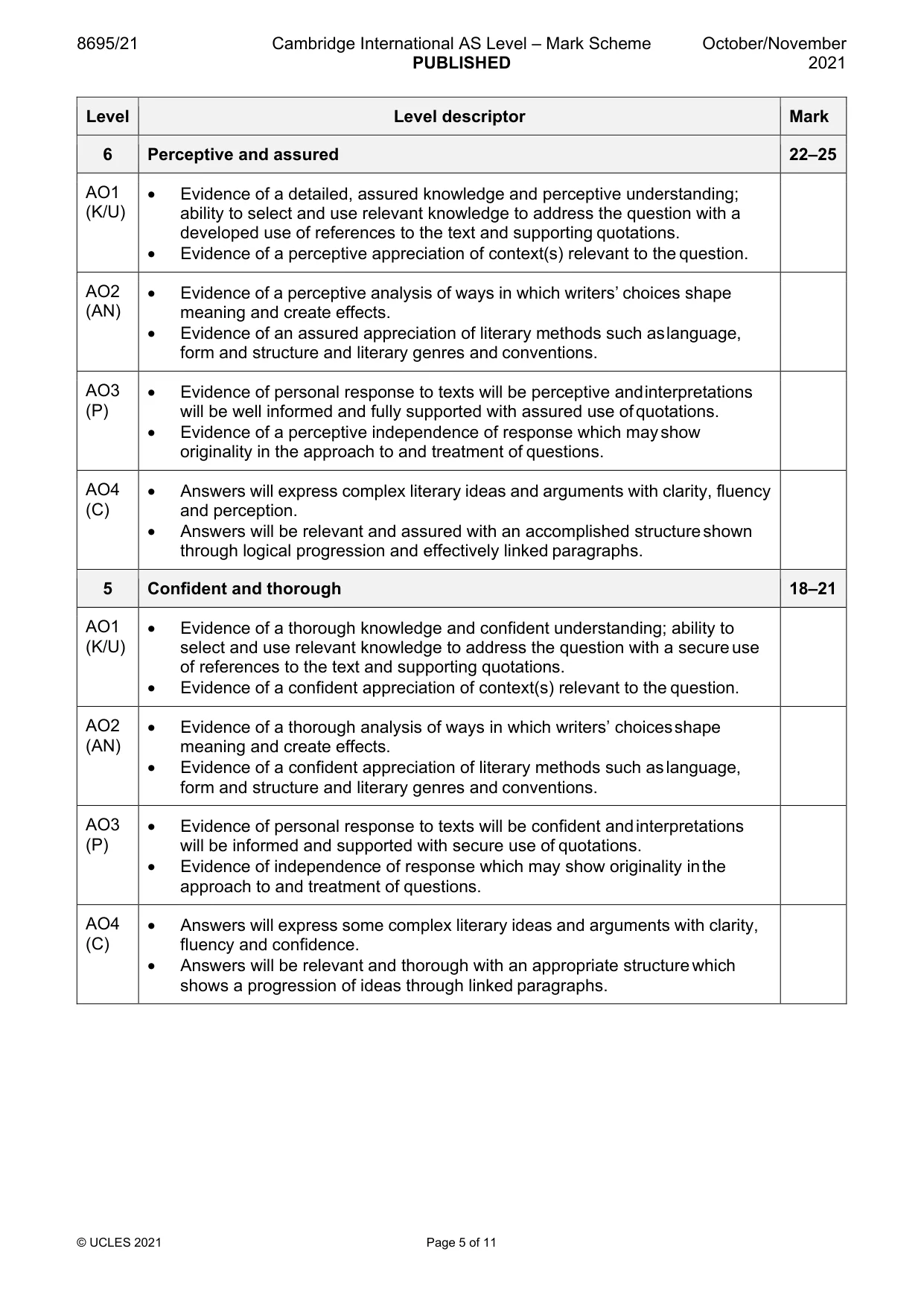
8695/21 Cambridge International AS Level – Mark Scheme PUBLISHED October/November 2021 © UCLES 2021 Page 5 of 11 Level Level descriptor Mark 6 Perceptive and assured 22–25 AO1 (K/U) • Evidence of a detailed, assured knowledge and perceptive understanding; ability to select and use relevant knowledge to address the question with a developed use of references to the text and supporting quotations. • Evidence of a perceptive appreciation of context(s) relevant to the question. AO2 (AN) • Evidence of a perceptive analysis of ways in which writers’ choices shape meaning and create effects. • Evidence of an assured appreciation of literary methods such as language, form and structure and literary genres and conventions. AO3 (P) • Evidence of personal response to texts will be perceptive and interpretations will be well informed and fully supported with assured use of quotations. • Evidence of a perceptive independence of response which may show originality in the approach to and treatment of questions. AO4 (C) • Answers will express complex literary ideas and arguments with clarity, fluency and perception. • Answers will be relevant and assured with an accomplished structure shown through logical progression and effectively linked paragraphs. 5 Confident and thorough 18–21 AO1 (K/U) • Evidence of a thorough knowledge and confident understanding; ability to select and use relevant knowledge to address the question with a secure use of references to the text and supporting quotations. • Evidence of a confident appreciation of context(s) relevant to the question. AO2 (AN) • Evidence of a thorough analysis of ways in which writers’ choices shape meaning and create effects. • Evidence of a confident appreciation of literary methods such as language, form and structure and literary genres and conventions. AO3 (P) • Evidence of personal response to texts will be confident and interpretations will be informed and supported with secure use of quotations. • Evidence of independence of response which may show originality in the approach to and treatment of questions. AO4 (C) • Answers will express some complex literary ideas and arguments with clarity, fluency and confidence. • Answers will be relevant and thorough with an appropriate structure which shows a progression of ideas through linked paragraphs.
Mark scheme, page 6
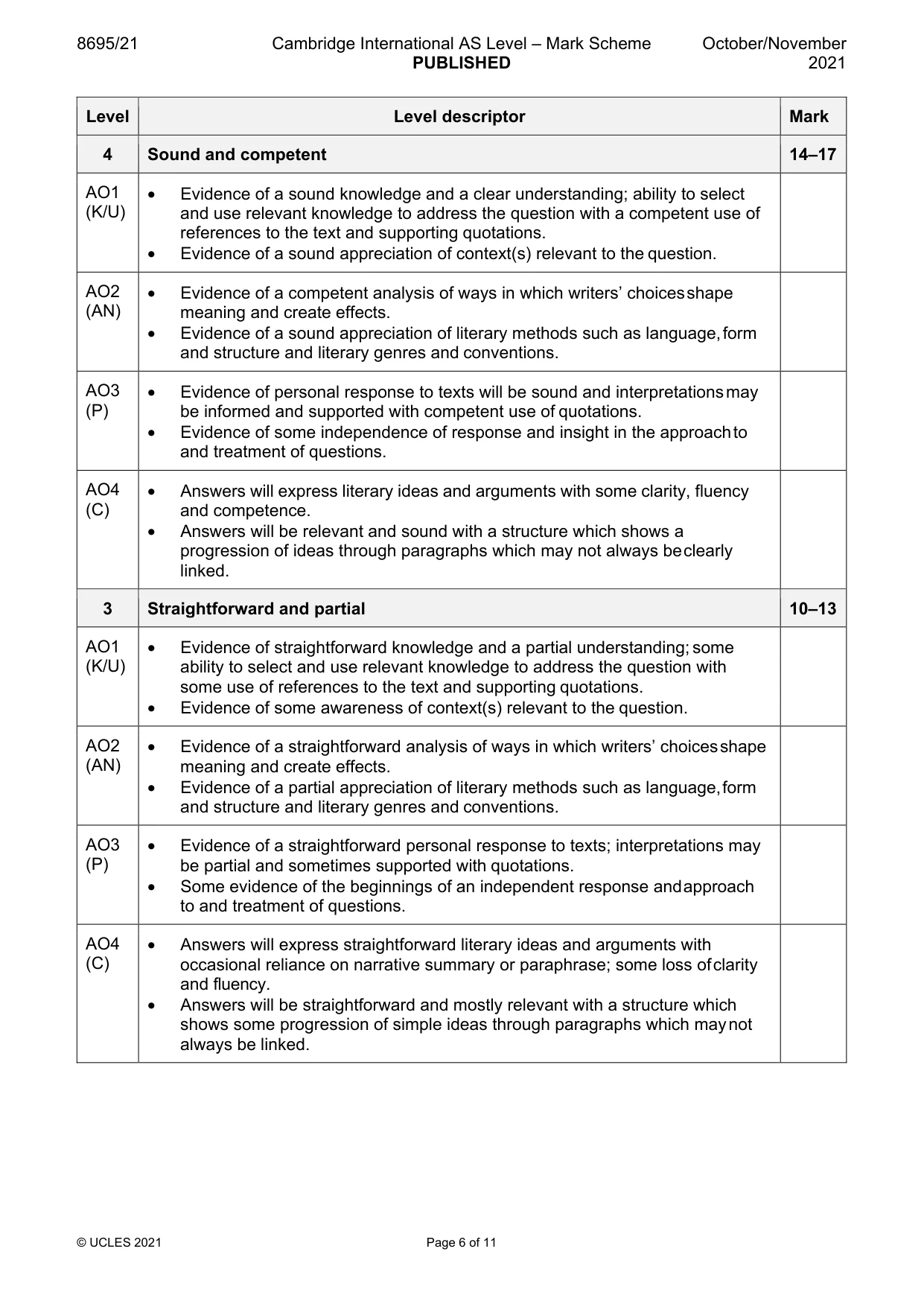
8695/21 Cambridge International AS Level – Mark Scheme PUBLISHED October/November 2021 © UCLES 2021 Page 6 of 11 Level Level descriptor Mark 4 Sound and competent 14–17 AO1 (K/U) • Evidence of a sound knowledge and a clear understanding; ability to select and use relevant knowledge to address the question with a competent use of references to the text and supporting quotations. • Evidence of a sound appreciation of context(s) relevant to the question. AO2 (AN) • Evidence of a competent analysis of ways in which writers’ choices shape meaning and create effects. • Evidence of a sound appreciation of literary methods such as language, form and structure and literary genres and conventions. AO3 (P) • Evidence of personal response to texts will be sound and interpretations may be informed and supported with competent use of quotations. • Evidence of some independence of response and insight in the approach to and treatment of questions. AO4 (C) • Answers will express literary ideas and arguments with some clarity, fluency and competence. • Answers will be relevant and sound with a structure which shows a progression of ideas through paragraphs which may not always be clearly linked. 3 Straightforward and partial 10–13 AO1 (K/U) • Evidence of straightforward knowledge and a partial understanding; some ability to select and use relevant knowledge to address the question with some use of references to the text and supporting quotations. • Evidence of some awareness of context(s) relevant to the question. AO2 (AN) • Evidence of a straightforward analysis of ways in which writers’ choices shape meaning and create effects. • Evidence of a partial appreciation of literary methods such as language, form and structure and literary genres and conventions. AO3 (P) • Evidence of a straightforward personal response to texts; interpretations may be partial and sometimes supported with quotations. • Some evidence of the beginnings of an independent response and approach to and treatment of questions. AO4 (C) • Answers will express straightforward literary ideas and arguments with occasional reliance on narrative summary or paraphrase; some loss of clarity and fluency. • Answers will be straightforward and mostly relevant with a structure which shows some progression of simple ideas through paragraphs which may not always be linked.
Mark scheme, page 7
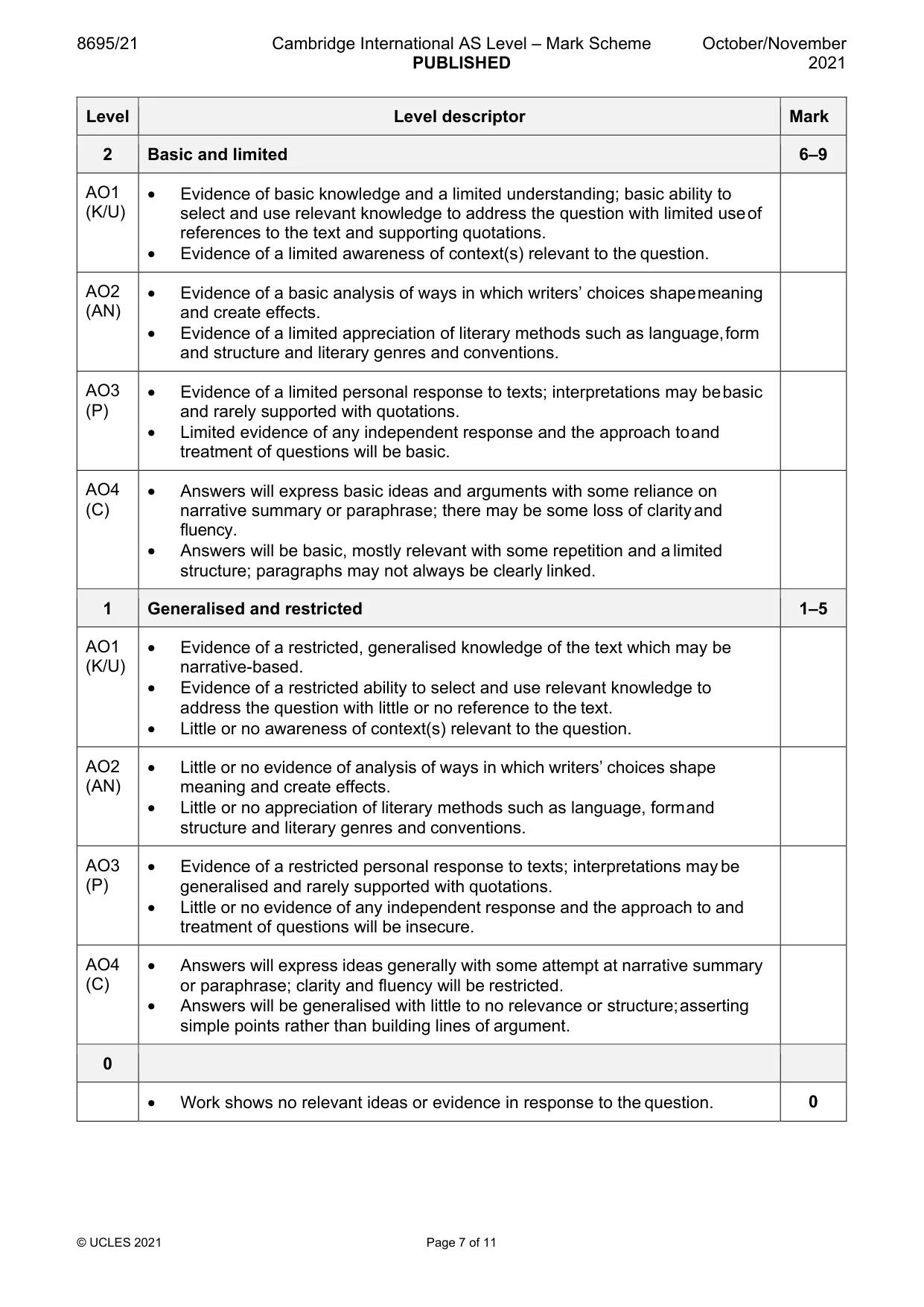
8695/21 Cambridge International AS Level – Mark Scheme PUBLISHED October/November 2021 © UCLES 2021 Page 7 of 11 Level Level descriptor Mark 2 Basic and limited 6–9 AO1 (K/U) • Evidence of basic knowledge and a limited understanding; basic ability to select and use relevant knowledge to address the question with limited use of references to the text and supporting quotations. • Evidence of a limited awareness of context(s) relevant to the question. AO2 (AN) • Evidence of a basic analysis of ways in which writers’ choices shape meaning and create effects. • Evidence of a limited appreciation of literary methods such as language, form and structure and literary genres and conventions. AO3 (P) • Evidence of a limited personal response to texts; interpretations may be basic and rarely supported with quotations. • Limited evidence of any independent response and the approach to and treatment of questions will be basic. AO4 (C) • Answers will express basic ideas and arguments with some reliance on narrative summary or paraphrase; there may be some loss of clarity and fluency. • Answers will be basic, mostly relevant with some repetition and a limited structure; paragraphs may not always be clearly linked. 1 Generalised and restricted 1–5 AO1 (K/U) • Evidence of a restricted, generalised knowledge of the text which may be narrative-based. • Evidence of a restricted ability to select and use relevant knowledge to address the question with little or no reference to the text. • Little or no awareness of context(s) relevant to the question. AO2 (AN) • Little or no evidence of analysis of ways in which writers’ choices shape meaning and create effects. • Little or no appreciation of literary methods such as language, form and structure and literary genres and conventions. AO3 (P) • Evidence of a restricted personal response to texts; interpretations may be generalised and rarely supported with quotations. • Little or no evidence of any independent response and the approach to and treatment of questions will be insecure. AO4 (C) • Answers will express ideas generally with some attempt at narrative summary or paraphrase; clarity and fluency will be restricted. • Answers will be generalised with little to no relevance or structure; asserting simple points rather than building lines of argument. 0 • Work shows no relevant ideas or evidence in response to the question. 0
Mark scheme, page 8
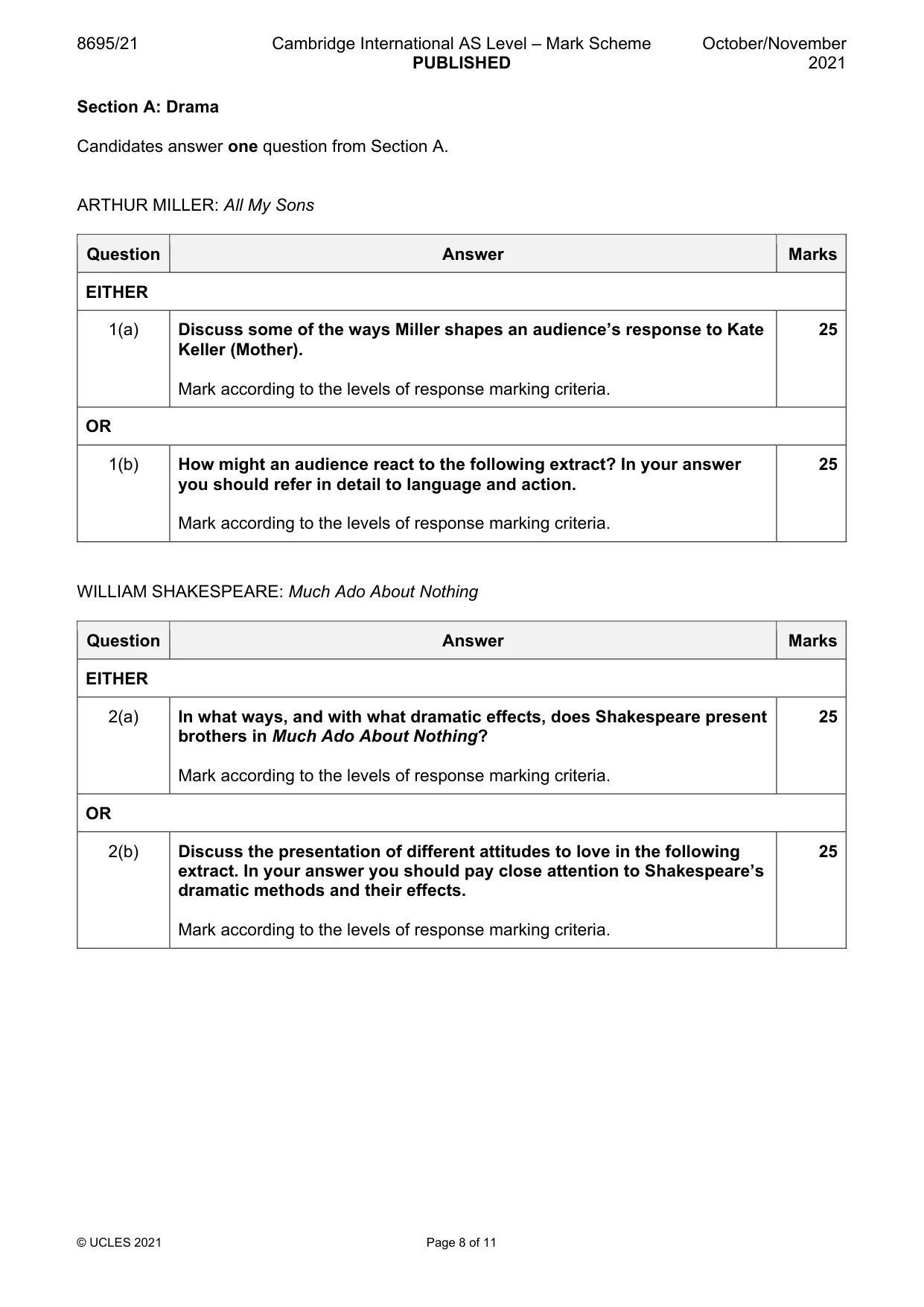
8695/21 Cambridge International AS Level – Mark Scheme PUBLISHED October/November 2021 © UCLES 2021 Page 8 of 11 Section A: Drama Candidates answer one question from Section A. ARTHUR MILLER: All My Sons Question Answer Marks EITHER 1(a) Discuss some of the ways Miller shapes an audience’s response to Kate Keller (Mother). Mark according to the levels of response marking criteria. 25 OR 1(b) How might an audience react to the following extract? In your answer you should refer in detail to language and action. Mark according to the levels of response marking criteria. 25 WILLIAM SHAKESPEARE: Much Ado About Nothing Question Answer Marks EITHER 2(a) In what ways, and with what dramatic effects, does Shakespeare present brothers in Much Ado About Nothing? Mark according to the levels of response marking criteria. 25 OR 2(b) Discuss the presentation of different attitudes to love in the following extract. In your answer you should pay close attention to Shakespeare’s dramatic methods and their effects. Mark according to the levels of response marking criteria. 25
Mark scheme, page 9
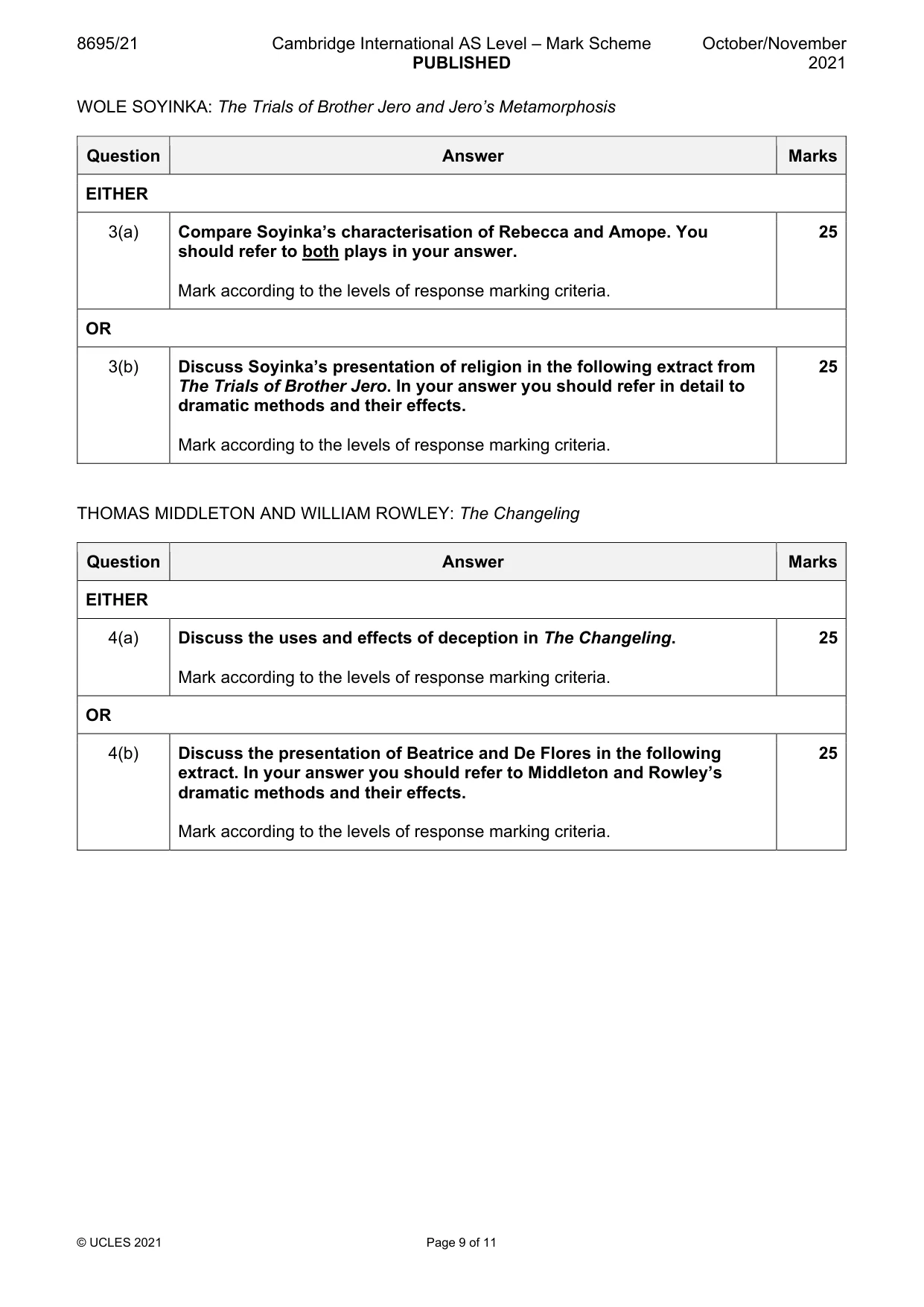
8695/21 Cambridge International AS Level – Mark Scheme PUBLISHED October/November 2021 © UCLES 2021 Page 9 of 11 WOLE SOYINKA: The Trials of Brother Jero and Jero’s Metamorphosis Question Answer Marks EITHER 3(a) Compare Soyinka’s characterisation of Rebecca and Amope. You should refer to both plays in your answer. Mark according to the levels of response marking criteria. 25 OR 3(b) Discuss Soyinka’s presentation of religion in the following extract from The Trials of Brother Jero. In your answer you should refer in detail to dramatic methods and their effects. Mark according to the levels of response marking criteria. 25 THOMAS MIDDLETON AND WILLIAM ROWLEY: The Changeling Question Answer Marks EITHER 4(a) Discuss the uses and effects of deception in The Changeling. Mark according to the levels of response marking criteria. 25 OR 4(b) Discuss the presentation of Beatrice and De Flores in the following extract. In your answer you should refer to Middleton and Rowley’s dramatic methods and their effects. Mark according to the levels of response marking criteria. 25
Mark scheme, page 10
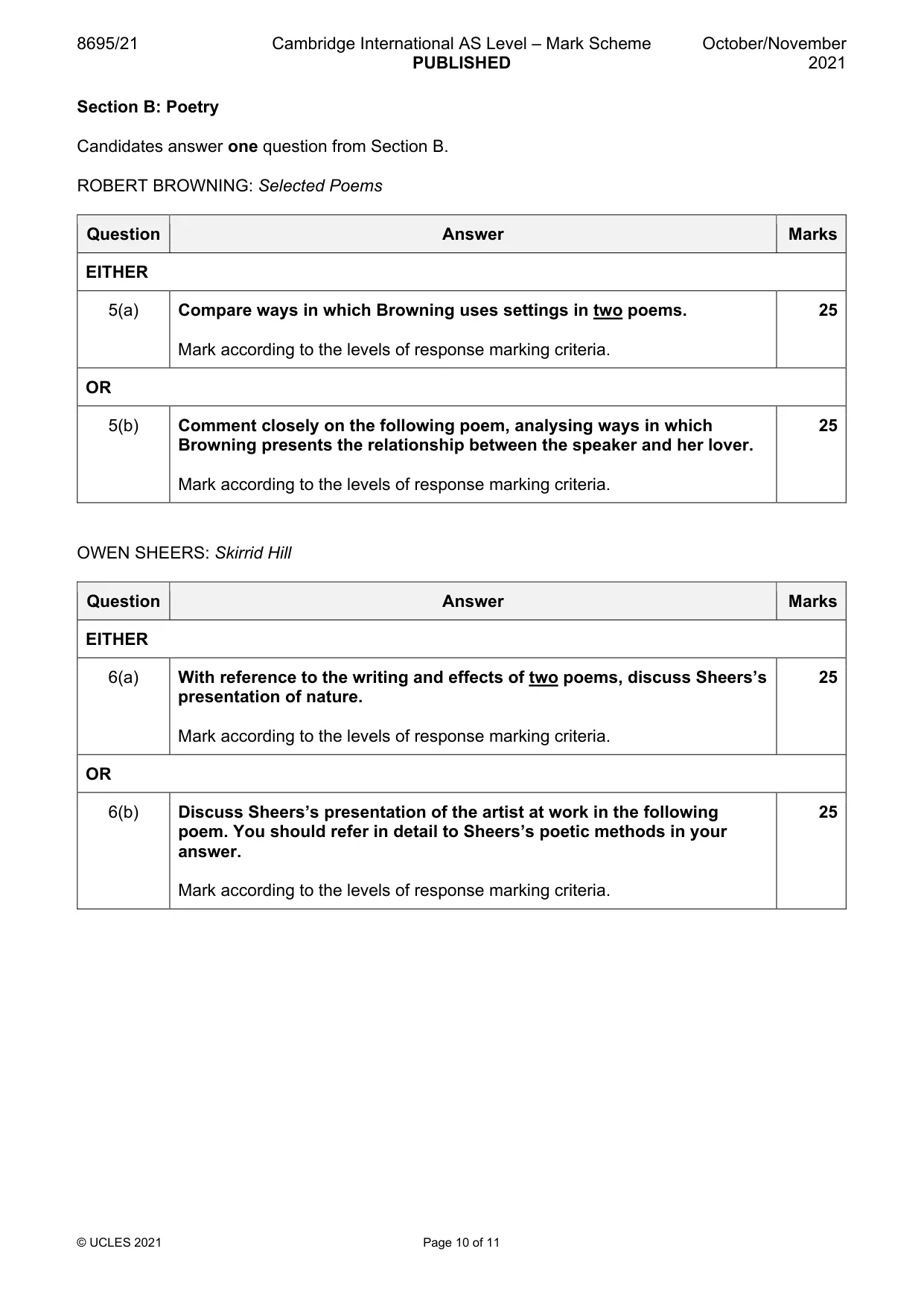
8695/21 Cambridge International AS Level – Mark Scheme PUBLISHED October/November 2021 © UCLES 2021 Page 10 of 11 Section B: Poetry Candidates answer one question from Section B. ROBERT BROWNING: Selected Poems Question Answer Marks EITHER 5(a) Compare ways in which Browning uses settings in two poems. Mark according to the levels of response marking criteria. 25 OR 5(b) Comment closely on the following poem, analysing ways in which Browning presents the relationship between the speaker and her lover. Mark according to the levels of response marking criteria. 25 OWEN SHEERS: Skirrid Hill Question Answer Marks EITHER 6(a) With reference to the writing and effects of two poems, discuss Sheers’s presentation of nature. Mark according to the levels of response marking criteria. 25 OR 6(b) Discuss Sheers’s presentation of the artist at work in the following poem. You should refer in detail to Sheers’s poetic methods in your answer. Mark according to the levels of response marking criteria. 25
Mark scheme, page 11
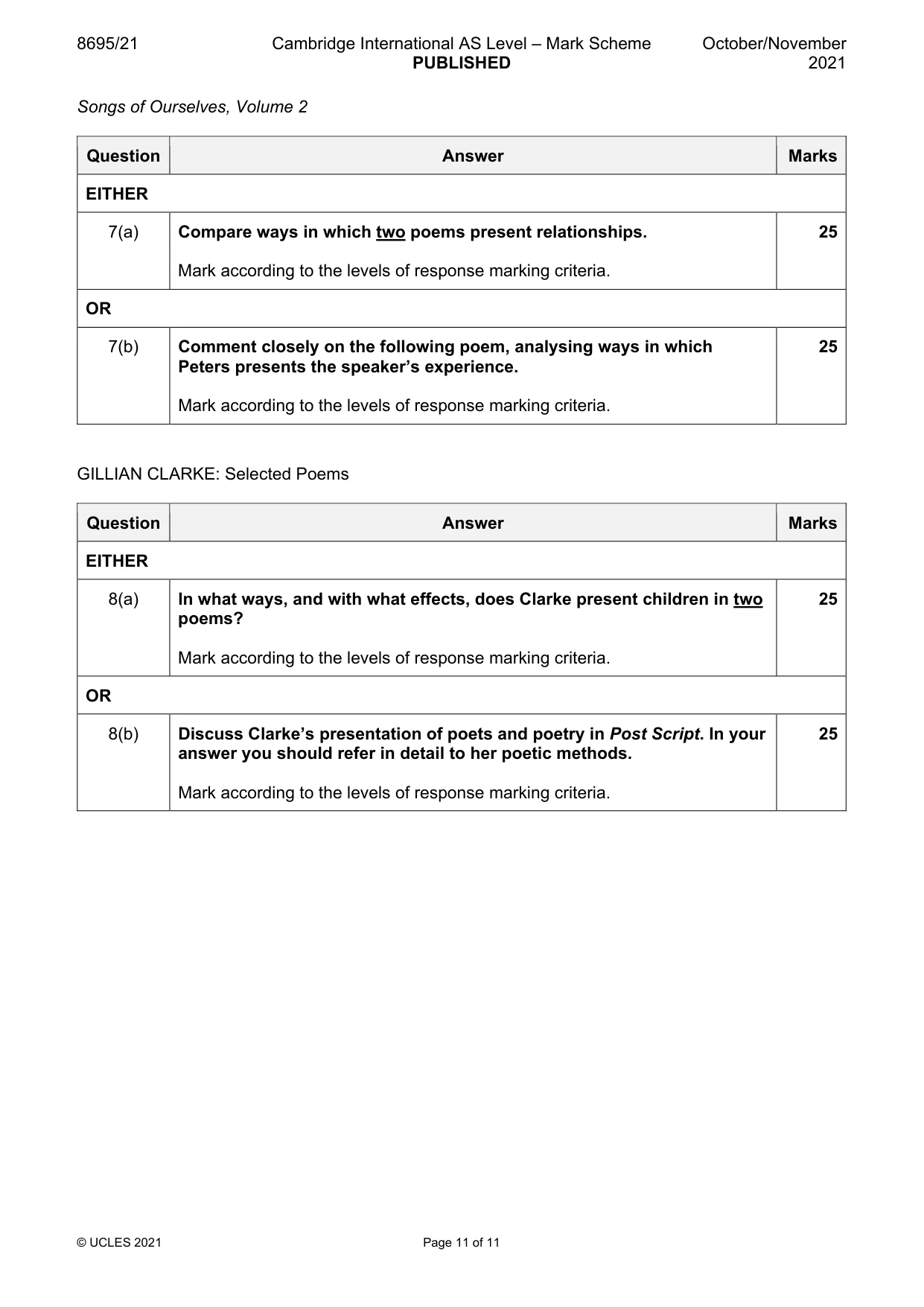
8695/21 Cambridge International AS Level – Mark Scheme PUBLISHED October/November 2021 © UCLES 2021 Page 11 of 11 Songs of Ourselves, Volume 2 Question Answer Marks EITHER 7(a) Compare ways in which two poems present relationships. Mark according to the levels of response marking criteria. 25 OR 7(b) Comment closely on the following poem, analysing ways in which Peters presents the speaker’s experience. Mark according to the levels of response marking criteria. 25 GILLIAN CLARKE: Selected Poems Question Answer Marks EITHER 8(a) In what ways, and with what effects, does Clarke present children in two poems? Mark according to the levels of response marking criteria. 25 OR 8(b) Discuss Clarke’s presentation of poets and poetry in Post Script. In your answer you should refer in detail to her poetic methods. Mark according to the levels of response marking criteria. 25
What you needed in this session
Cambridge’s own grade thresholds for 2021 Oct/Nov, Paper 2 · Variant 1. A higher threshold means an easier paper — the bar moves with how the cohort did.