Cambridge A Level English - Language and Literature (AS Level only, from 2016) 8695 — 2020 Oct/Nov Paper 9 · Variant 3
8695/93/O/N/20 · 50 marks · ≈56 min
The question paper and its mark scheme, free to read here and free to download. This is Cambridge’s own paper, exactly as it was sat.
Question paper20 pages




Mark scheme7 pages
Answers below. Sit the paper first if you are practising.
Paper as text
Question paper, page 1
This document has 20 pages. Blank pages are indicated. Cambridge International AS Level * 9 5 2 4 9 5 8 1 6 8 * LANGUAGE AND LITERATURE IN ENGLISH 8695/93 Paper 9 Poetry, Prose and Drama October/November 2020 2 hours You must answer on the enclosed answer booklet. You will need: Answer booklet (enclosed) INSTRUCTIONS ● Answer two questions, each from a different section. ● Follow the instructions on the front cover of the answer booklet. If you need additional answer paper, ask the invigilator for a continuation booklet. ● You are reminded of the need for good English and clear presentation in your answers. INFORMATION ● The total mark for this paper is 50. ● All questions are worth equal marks. DC (RCL (GO)) 181981/3 © UCLES 2020 [Turn over Cambridge International AS Level
Question paper, page 2
2 8695/93/O/N/20 © UCLES 2020 Section A: Poetry ROBERT FROST: Selected Poems 1 Either (a) ‘Even in poems depicting nature, Frost’s subject is humankind.’ With reference to the writing and effects of two poems, say how far you find this to be true. Or (b) Comment closely on the presentation of Silas in the following extract from The Death of the Hired Man. ‘Well, those days trouble Silas like a dream. Content removed due to copyright restrictions.
Question paper, page 3
3 8695/93/O/N/20 © UCLES 2020 [Turn over ‘Yes, what else but home?’ from The Death of the Hired Man Content removed due to copyright restrictions.
Question paper, page 4
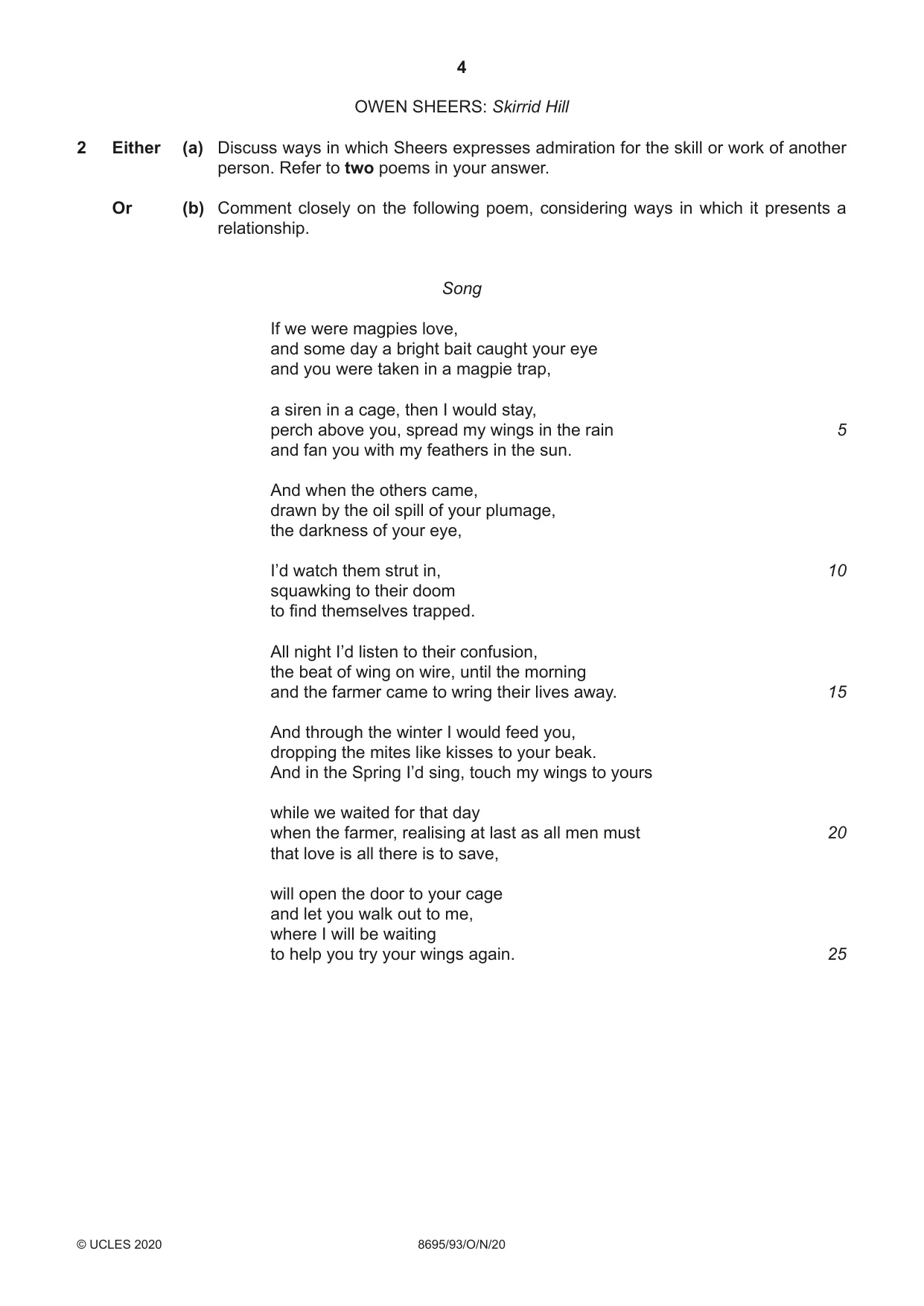
4 8695/93/O/N/20 © UCLES 2020 OWEN SHEERS: Skirrid Hill 2 Either (a) Discuss ways in which Sheers expresses admiration for the skill or work of another person. Refer to two poems in your answer. Or (b) Comment closely on the following poem, considering ways in which it presents a relationship. Song If we were magpies love, and some day a bright bait caught your eye and you were taken in a magpie trap, a siren in a cage, then I would stay, perch above you, spread my wings in the rain and fan you with my feathers in the sun. And when the others came, drawn by the oil spill of your plumage, the darkness of your eye, I’d watch them strut in, squawking to their doom to find themselves trapped. All night I’d listen to their confusion, the beat of wing on wire, until the morning and the farmer came to wring their lives away. And through the winter I would feed you, dropping the mites like kisses to your beak. And in the Spring I’d sing, touch my wings to yours while we waited for that day when the farmer, realising at last as all men must that love is all there is to save, will open the door to your cage and let you walk out to me, where I will be waiting to help you try your wings again. 5 10 15 20 25
Question paper, page 5
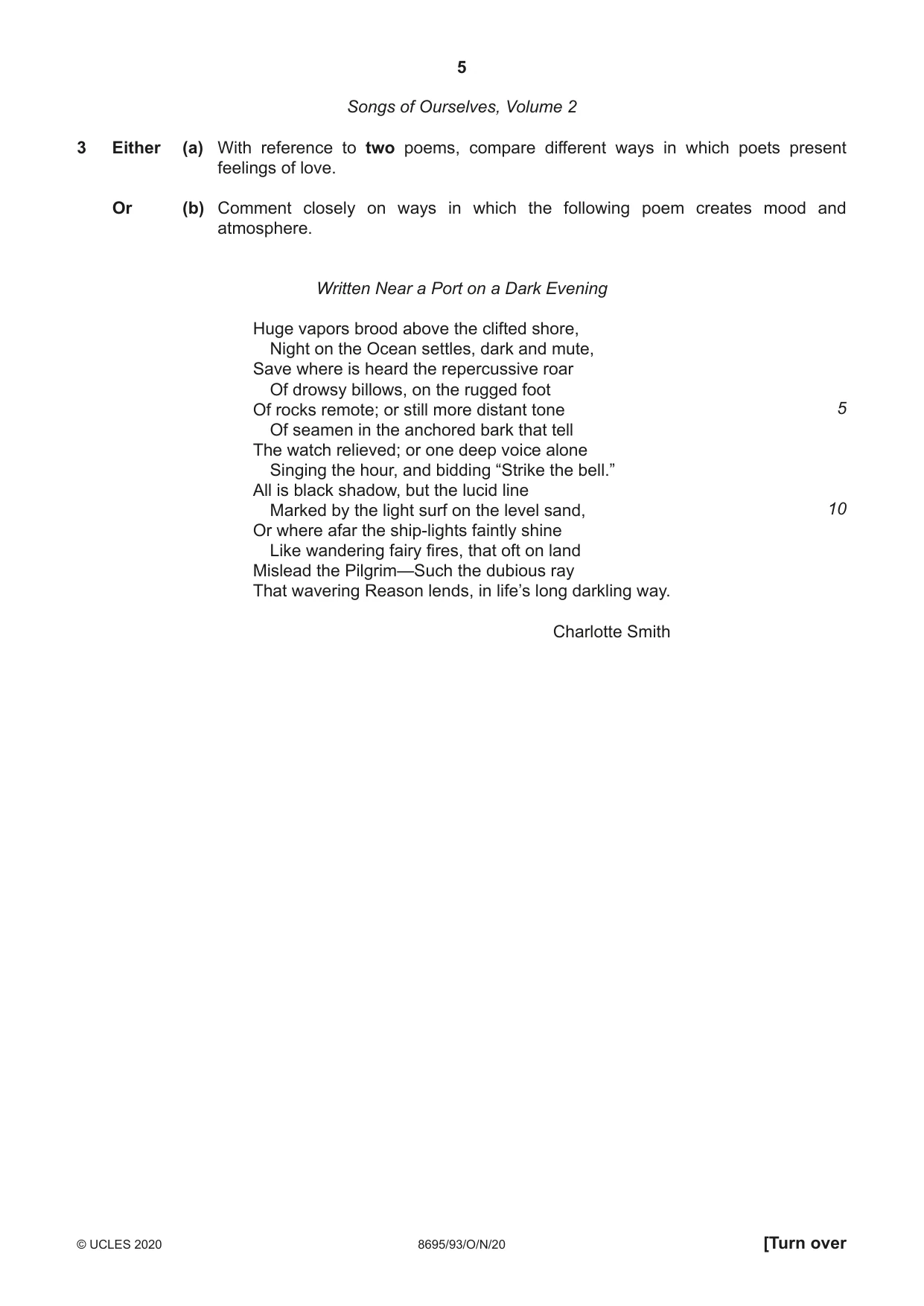
5 8695/93/O/N/20 © UCLES 2020 [Turn over Songs of Ourselves, Volume 2 3 Either (a) With reference to two poems, compare different ways in which poets present feelings of love. Or (b) Comment closely on ways in which the following poem creates mood and atmosphere. Written Near a Port on a Dark Evening Huge vapors brood above the clifted shore, Night on the Ocean settles, dark and mute, Save where is heard the repercussive roar Of drowsy billows, on the rugged foot Of rocks remote; or still more distant tone Of seamen in the anchored bark that tell The watch relieved; or one deep voice alone Singing the hour, and bidding “Strike the bell.” All is black shadow, but the lucid line Marked by the light surf on the level sand, Or where afar the ship-lights faintly shine Like wandering fairy fires, that oft on land Mislead the Pilgrim—Such the dubious ray That wavering Reason lends, in life’s long darkling way. Charlotte Smith 5 10
Question paper, page 6
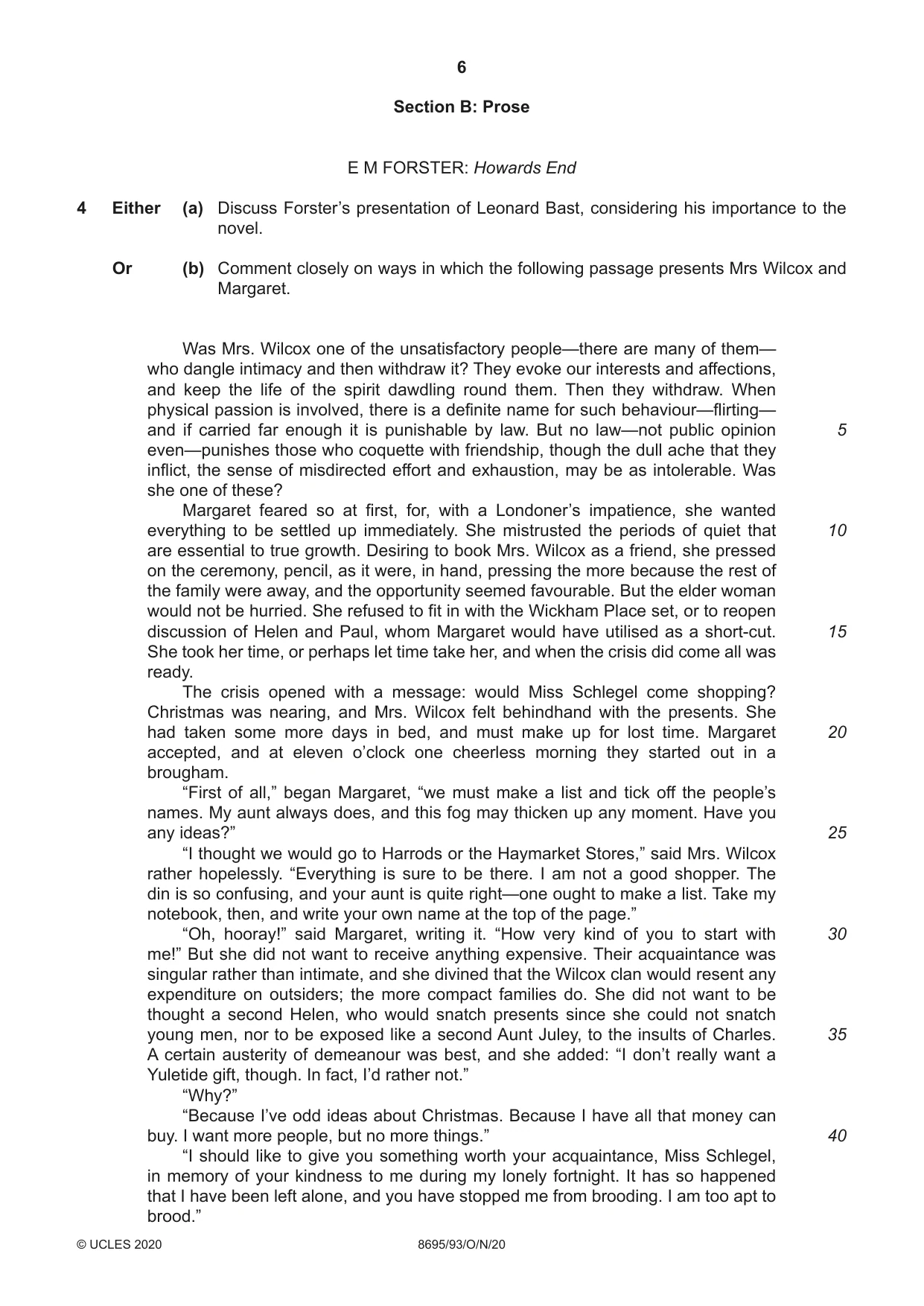
6 8695/93/O/N/20 © UCLES 2020 Section B: Prose E M FORSTER: Howards End 4 Either (a) Discuss Forster’s presentation of Leonard Bast, considering his importance to the novel. Or (b) Comment closely on ways in which the following passage presents Mrs Wilcox and Margaret. Was Mrs. Wilcox one of the unsatisfactory people—there are many of them— who dangle intimacy and then withdraw it? They evoke our interests and affections, and keep the life of the spirit dawdling round them. Then they withdraw. When physical passion is involved, there is a definite name for such behaviour—flirting— and if carried far enough it is punishable by law. But no law—not public opinion even—punishes those who coquette with friendship, though the dull ache that they inflict, the sense of misdirected effort and exhaustion, may be as intolerable. Was she one of these? Margaret feared so at first, for, with a Londoner’s impatience, she wanted everything to be settled up immediately. She mistrusted the periods of quiet that are essential to true growth. Desiring to book Mrs. Wilcox as a friend, she pressed on the ceremony, pencil, as it were, in hand, pressing the more because the rest of the family were away, and the opportunity seemed favourable. But the elder woman would not be hurried. She refused to fit in with the Wickham Place set, or to reopen discussion of Helen and Paul, whom Margaret would have utilised as a short-cut. She took her time, or perhaps let time take her, and when the crisis did come all was ready. The crisis opened with a message: would Miss Schlegel come shopping? Christmas was nearing, and Mrs. Wilcox felt behindhand with the presents. She had taken some more days in bed, and must make up for lost time. Margaret accepted, and at eleven o’clock one cheerless morning they started out in a brougham. “First of all,” began Margaret, “we must make a list and tick off the people’s names. My aunt always does, and this fog may thicken up any moment. Have you any ideas?” “I thought we would go to Harrods or the Haymarket Stores,” said Mrs. Wilcox rather hopelessly. “Everything is sure to be there. I am not a good shopper. The din is so confusing, and your aunt is quite right—one ought to make a list. Take my notebook, then, and write your own name at the top of the page.” “Oh, hooray!” said Margaret, writing it. “How very kind of you to start with me!” But she did not want to receive anything expensive. Their acquaintance was singular rather than intimate, and she divined that the Wilcox clan would resent any expenditure on outsiders; the more compact families do. She did not want to be thought a second Helen, who would snatch presents since she could not snatch young men, nor to be exposed like a second Aunt Juley, to the insults of Charles. A certain austerity of demeanour was best, and she added: “I don’t really want a Yuletide gift, though. In fact, I’d rather not.” “Why?” “Because I’ve odd ideas about Christmas. Because I have all that money can buy. I want more people, but no more things.” “I should like to give you something worth your acquaintance, Miss Schlegel, in memory of your kindness to me during my lonely fortnight. It has so happened that I have been left alone, and you have stopped me from brooding. I am too apt to brood.” 5 10 15 20 25 30 35 40
Question paper, page 7
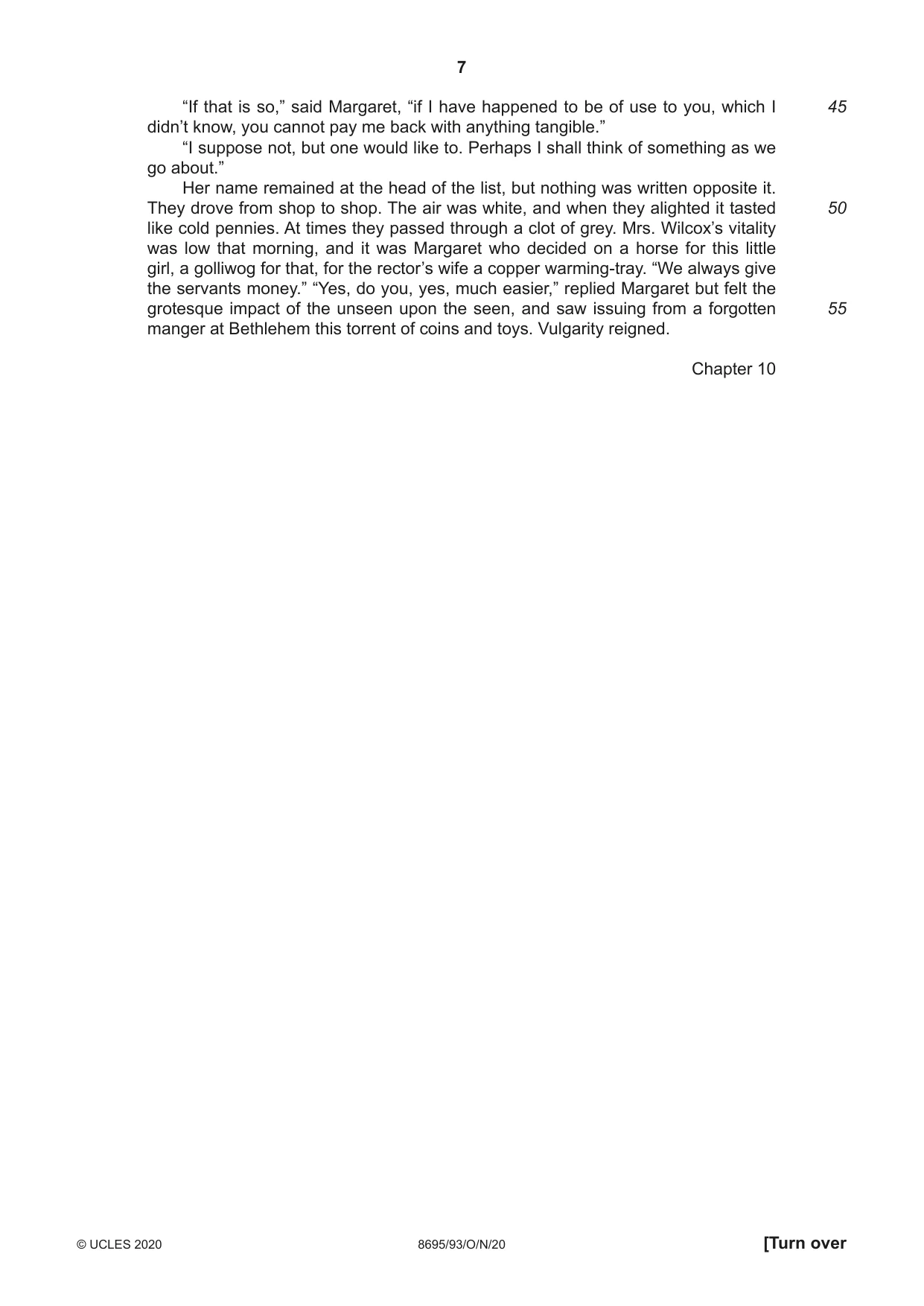
7 8695/93/O/N/20 © UCLES 2020 [Turn over “If that is so,” said Margaret, “if I have happened to be of use to you, which I didn’t know, you cannot pay me back with anything tangible.” “I suppose not, but one would like to. Perhaps I shall think of something as we go about.” Her name remained at the head of the list, but nothing was written opposite it. They drove from shop to shop. The air was white, and when they alighted it tasted like cold pennies. At times they passed through a clot of grey. Mrs. Wilcox’s vitality was low that morning, and it was Margaret who decided on a horse for this little girl, a golliwog for that, for the rector’s wife a copper warming-tray. “We always give the servants money.” “Yes, do you, yes, much easier,” replied Margaret but felt the grotesque impact of the unseen upon the seen, and saw issuing from a forgotten manger at Bethlehem this torrent of coins and toys. Vulgarity reigned. Chapter 10 45 50 55
Question paper, page 8
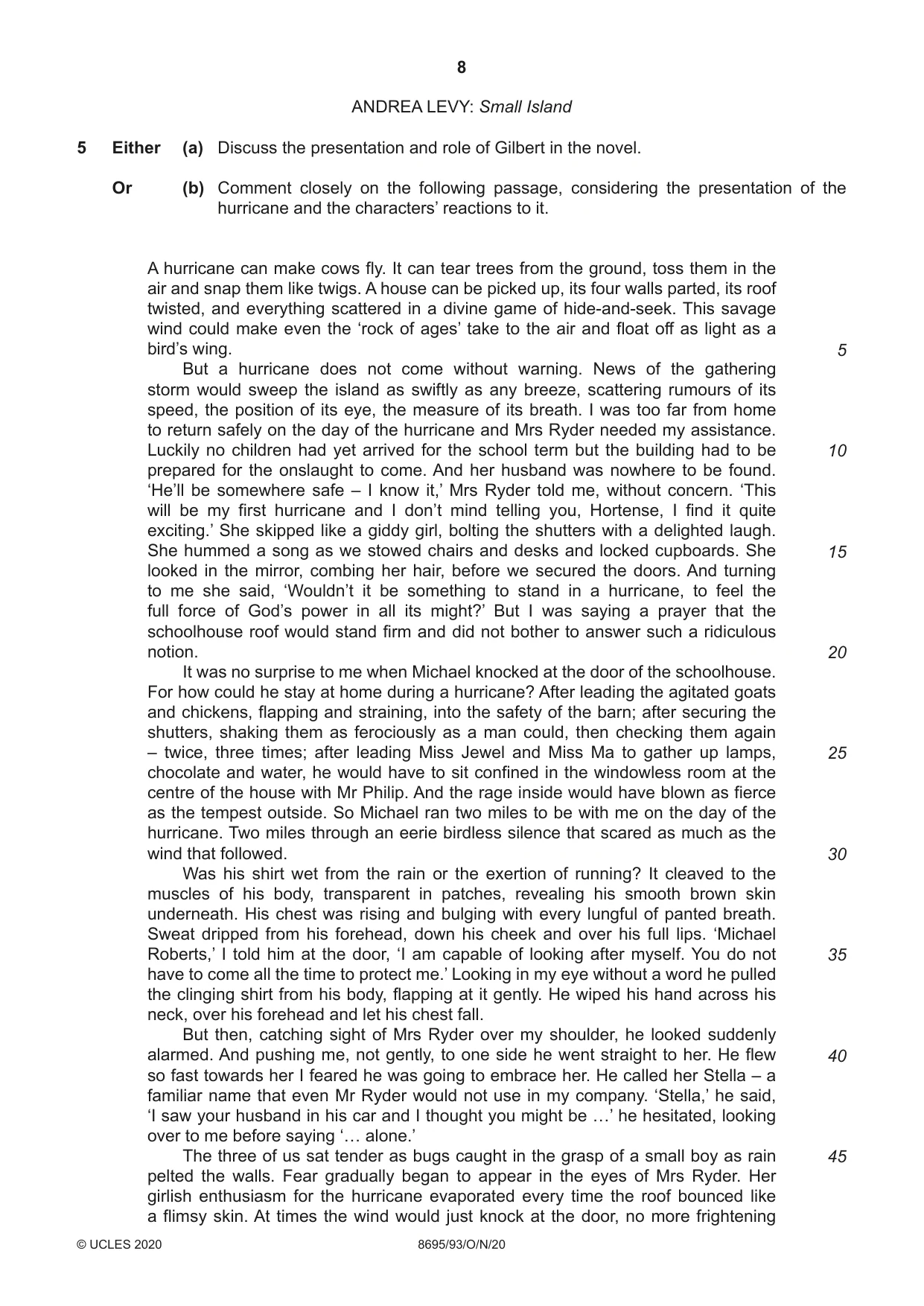
8 8695/93/O/N/20 © UCLES 2020 ANDREA LEVY: Small Island 5 Either (a) Discuss the presentation and role of Gilbert in the novel. Or (b) Comment closely on the following passage, considering the presentation of the hurricane and the characters’ reactions to it. A hurricane can make cows fly. It can tear trees from the ground, toss them in the air and snap them like twigs. A house can be picked up, its four walls parted, its roof twisted, and everything scattered in a divine game of hide-and-seek. This savage wind could make even the ‘rock of ages’ take to the air and float off as light as a bird’s wing. But a hurricane does not come without warning. News of the gathering storm would sweep the island as swiftly as any breeze, scattering rumours of its speed, the position of its eye, the measure of its breath. I was too far from home to return safely on the day of the hurricane and Mrs Ryder needed my assistance. Luckily no children had yet arrived for the school term but the building had to be prepared for the onslaught to come. And her husband was nowhere to be found. ‘He’ll be somewhere safe – I know it,’ Mrs Ryder told me, without concern. ‘This will be my first hurricane and I don’t mind telling you, Hortense, I find it quite exciting.’ She skipped like a giddy girl, bolting the shutters with a delighted laugh. She hummed a song as we stowed chairs and desks and locked cupboards. She looked in the mirror, combing her hair, before we secured the doors. And turning to me she said, ‘Wouldn’t it be something to stand in a hurricane, to feel the full force of God’s power in all its might?’ But I was saying a prayer that the schoolhouse roof would stand firm and did not bother to answer such a ridiculous notion. It was no surprise to me when Michael knocked at the door of the schoolhouse. For how could he stay at home during a hurricane? After leading the agitated goats and chickens, flapping and straining, into the safety of the barn; after securing the shutters, shaking them as ferociously as a man could, then checking them again – twice, three times; after leading Miss Jewel and Miss Ma to gather up lamps, chocolate and water, he would have to sit confined in the windowless room at the centre of the house with Mr Philip. And the rage inside would have blown as fierce as the tempest outside. So Michael ran two miles to be with me on the day of the hurricane. Two miles through an eerie birdless silence that scared as much as the wind that followed. Was his shirt wet from the rain or the exertion of running? It cleaved to the muscles of his body, transparent in patches, revealing his smooth brown skin underneath. His chest was rising and bulging with every lungful of panted breath. Sweat dripped from his forehead, down his cheek and over his full lips. ‘Michael Roberts,’ I told him at the door, ‘I am capable of looking after myself. You do not have to come all the time to protect me.’ Looking in my eye without a word he pulled the clinging shirt from his body, flapping at it gently. He wiped his hand across his neck, over his forehead and let his chest fall. But then, catching sight of Mrs Ryder over my shoulder, he looked suddenly alarmed. And pushing me, not gently, to one side he went straight to her. He flew so fast towards her I feared he was going to embrace her. He called her Stella – a familiar name that even Mr Ryder would not use in my company. ‘Stella,’ he said, ‘I saw your husband in his car and I thought you might be …’ he hesitated, looking over to me before saying ‘… alone.’ The three of us sat tender as bugs caught in the grasp of a small boy as rain pelted the walls. Fear gradually began to appear in the eyes of Mrs Ryder. Her girlish enthusiasm for the hurricane evaporated every time the roof bounced like a flimsy skin. At times the wind would just knock at the door, no more frightening 5 10 15 20 25 30 35 40 45
Question paper, page 9
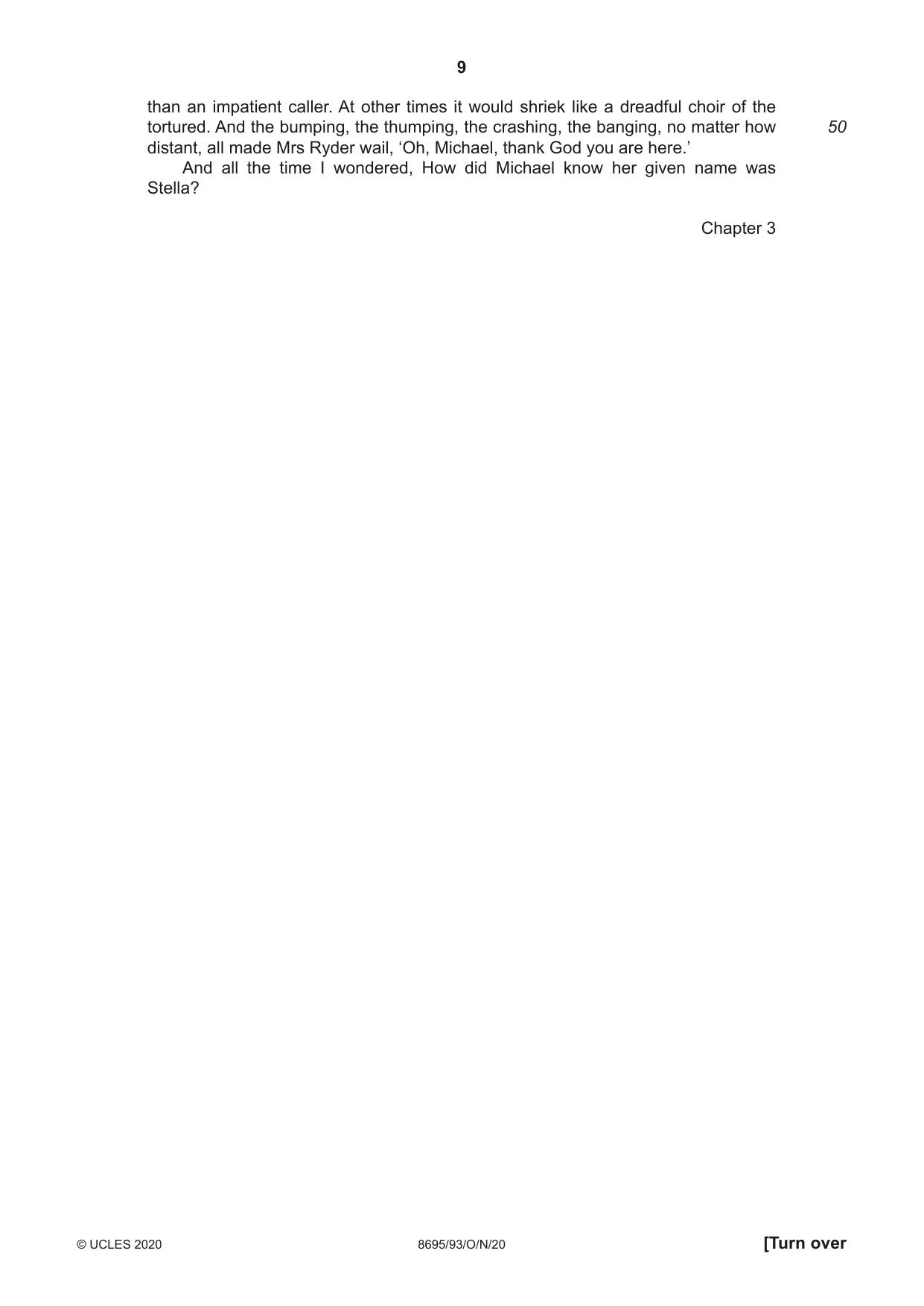
9 8695/93/O/N/20 © UCLES 2020 [Turn over than an impatient caller. At other times it would shriek like a dreadful choir of the tortured. And the bumping, the thumping, the crashing, the banging, no matter how distant, all made Mrs Ryder wail, ‘Oh, Michael, thank God you are here.’ And all the time I wondered, How did Michael know her given name was Stella? Chapter 3 50
Question paper, page 10
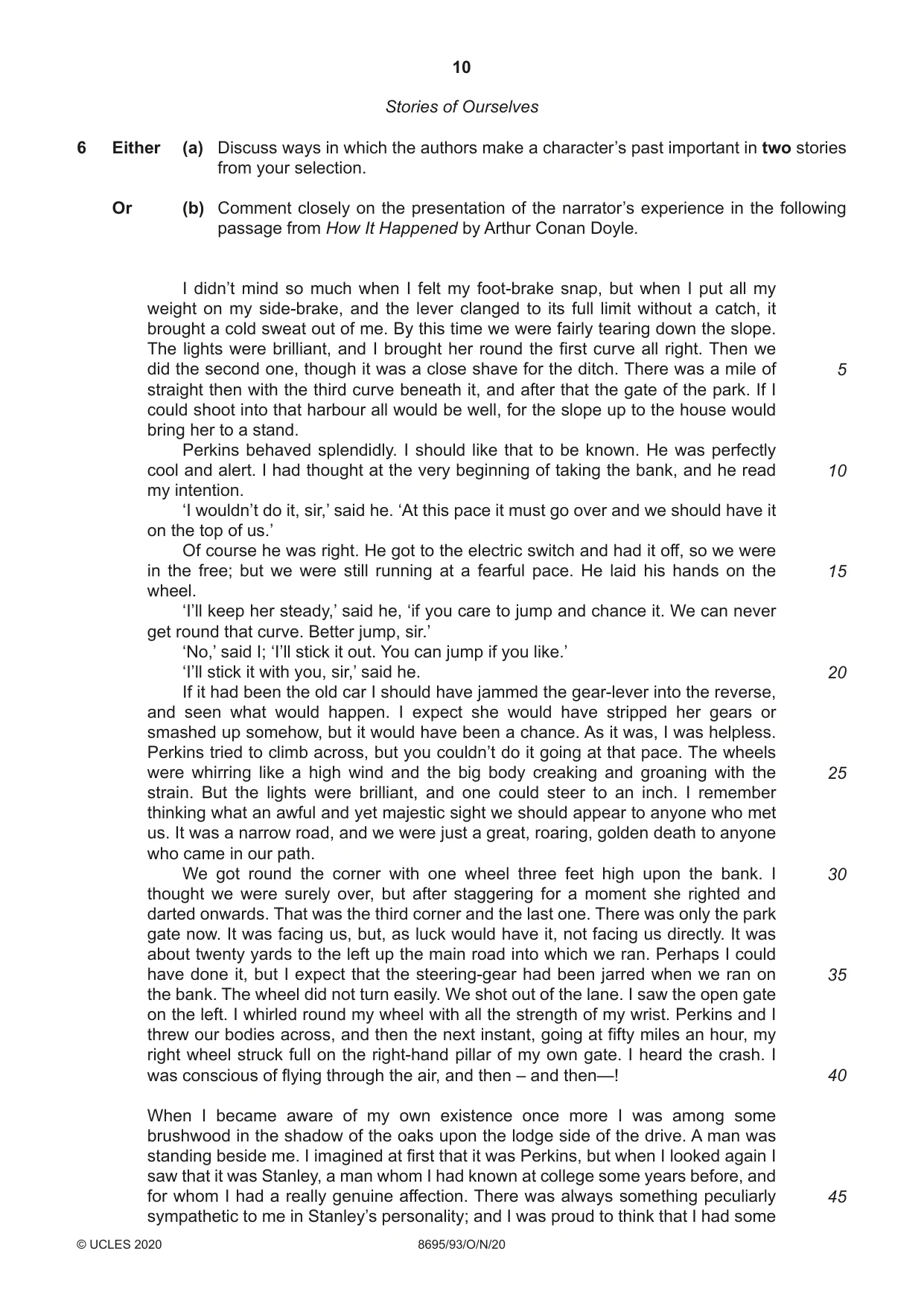
10 8695/93/O/N/20 © UCLES 2020 Stories of Ourselves 6 Either (a) Discuss ways in which the authors make a character’s past important in two stories from your selection. Or (b) Comment closely on the presentation of the narrator’s experience in the following passage from How It Happened by Arthur Conan Doyle. I didn’t mind so much when I felt my foot-brake snap, but when I put all my weight on my side-brake, and the lever clanged to its full limit without a catch, it brought a cold sweat out of me. By this time we were fairly tearing down the slope. The lights were brilliant, and I brought her round the first curve all right. Then we did the second one, though it was a close shave for the ditch. There was a mile of straight then with the third curve beneath it, and after that the gate of the park. If I could shoot into that harbour all would be well, for the slope up to the house would bring her to a stand. Perkins behaved splendidly. I should like that to be known. He was perfectly cool and alert. I had thought at the very beginning of taking the bank, and he read my intention. ‘I wouldn’t do it, sir,’ said he. ‘At this pace it must go over and we should have it on the top of us.’ Of course he was right. He got to the electric switch and had it off, so we were in the free; but we were still running at a fearful pace. He laid his hands on the wheel. ‘I’ll keep her steady,’ said he, ‘if you care to jump and chance it. We can never get round that curve. Better jump, sir.’ ‘No,’ said I; ‘I’ll stick it out. You can jump if you like.’ ‘I’ll stick it with you, sir,’ said he. If it had been the old car I should have jammed the gear-lever into the reverse, and seen what would happen. I expect she would have stripped her gears or smashed up somehow, but it would have been a chance. As it was, I was helpless. Perkins tried to climb across, but you couldn’t do it going at that pace. The wheels were whirring like a high wind and the big body creaking and groaning with the strain. But the lights were brilliant, and one could steer to an inch. I remember thinking what an awful and yet majestic sight we should appear to anyone who met us. It was a narrow road, and we were just a great, roaring, golden death to anyone who came in our path. We got round the corner with one wheel three feet high upon the bank. I thought we were surely over, but after staggering for a moment she righted and darted onwards. That was the third corner and the last one. There was only the park gate now. It was facing us, but, as luck would have it, not facing us directly. It was about twenty yards to the left up the main road into which we ran. Perhaps I could have done it, but I expect that the steering-gear had been jarred when we ran on the bank. The wheel did not turn easily. We shot out of the lane. I saw the open gate on the left. I whirled round my wheel with all the strength of my wrist. Perkins and I threw our bodies across, and then the next instant, going at fifty miles an hour, my right wheel struck full on the right-hand pillar of my own gate. I heard the crash. I was conscious of flying through the air, and then – and then—! When I became aware of my own existence once more I was among some brushwood in the shadow of the oaks upon the lodge side of the drive. A man was standing beside me. I imagined at first that it was Perkins, but when I looked again I saw that it was Stanley, a man whom I had known at college some years before, and for whom I had a really genuine affection. There was always something peculiarly sympathetic to me in Stanley’s personality; and I was proud to think that I had some 5 10 15 20 25 30 35 40 45
Question paper, page 11
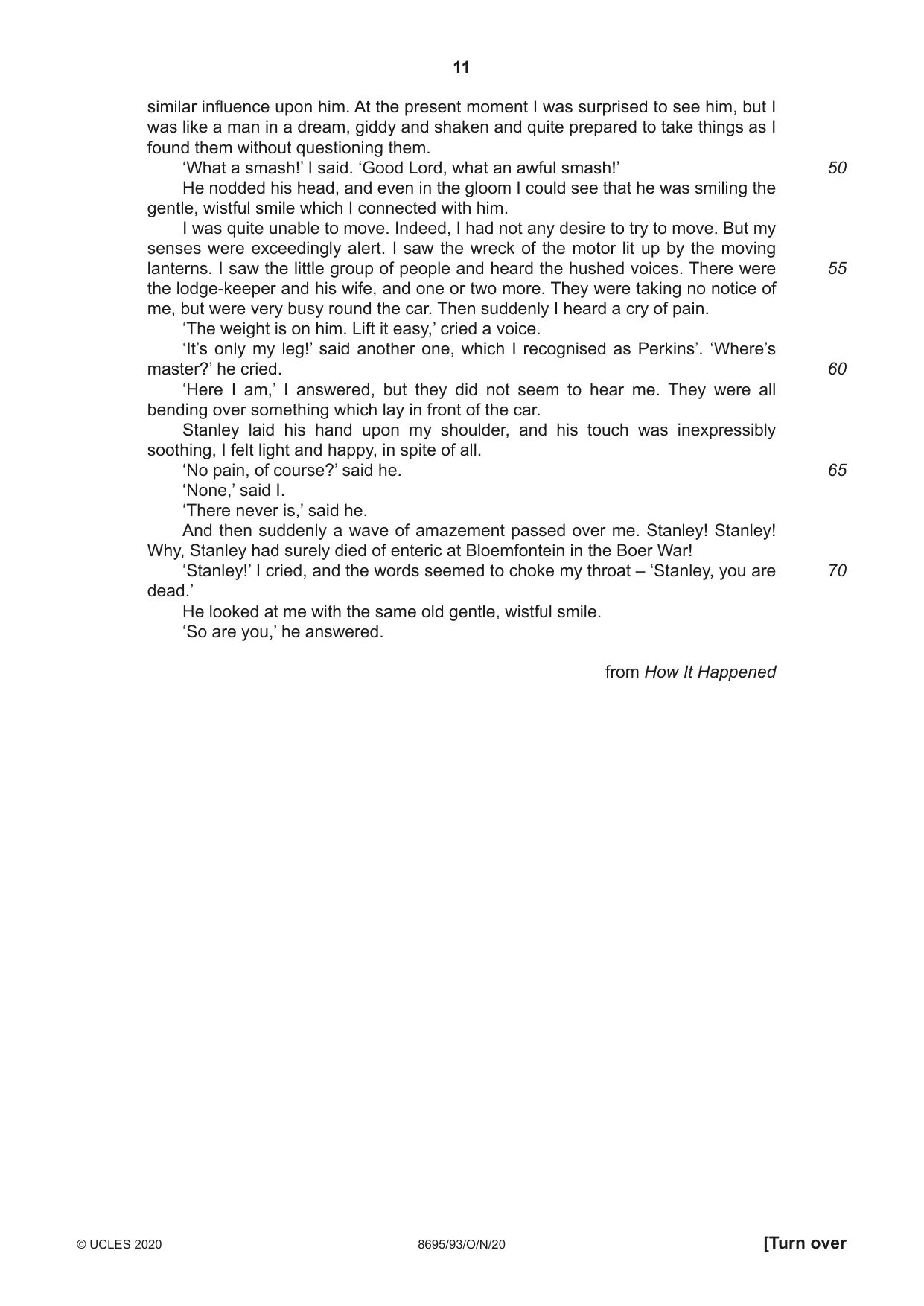
11 8695/93/O/N/20 © UCLES 2020 [Turn over similar influence upon him. At the present moment I was surprised to see him, but I was like a man in a dream, giddy and shaken and quite prepared to take things as I found them without questioning them. ‘What a smash!’ I said. ‘Good Lord, what an awful smash!’ He nodded his head, and even in the gloom I could see that he was smiling the gentle, wistful smile which I connected with him. I was quite unable to move. Indeed, I had not any desire to try to move. But my senses were exceedingly alert. I saw the wreck of the motor lit up by the moving lanterns. I saw the little group of people and heard the hushed voices. There were the lodge-keeper and his wife, and one or two more. They were taking no notice of me, but were very busy round the car. Then suddenly I heard a cry of pain. ‘The weight is on him. Lift it easy,’ cried a voice. ‘It’s only my leg!’ said another one, which I recognised as Perkins’. ‘Where’s master?’ he cried. ‘Here I am,’ I answered, but they did not seem to hear me. They were all bending over something which lay in front of the car. Stanley laid his hand upon my shoulder, and his touch was inexpressibly soothing, I felt light and happy, in spite of all. ‘No pain, of course?’ said he. ‘None,’ said I. ‘There never is,’ said he. And then suddenly a wave of amazement passed over me. Stanley! Stanley! Why, Stanley had surely died of enteric at Bloemfontein in the Boer War! ‘Stanley!’ I cried, and the words seemed to choke my throat – ‘Stanley, you are dead.’ He looked at me with the same old gentle, wistful smile. ‘So are you,’ he answered. from How It Happened 50 55 60 65 70
Question paper, page 12
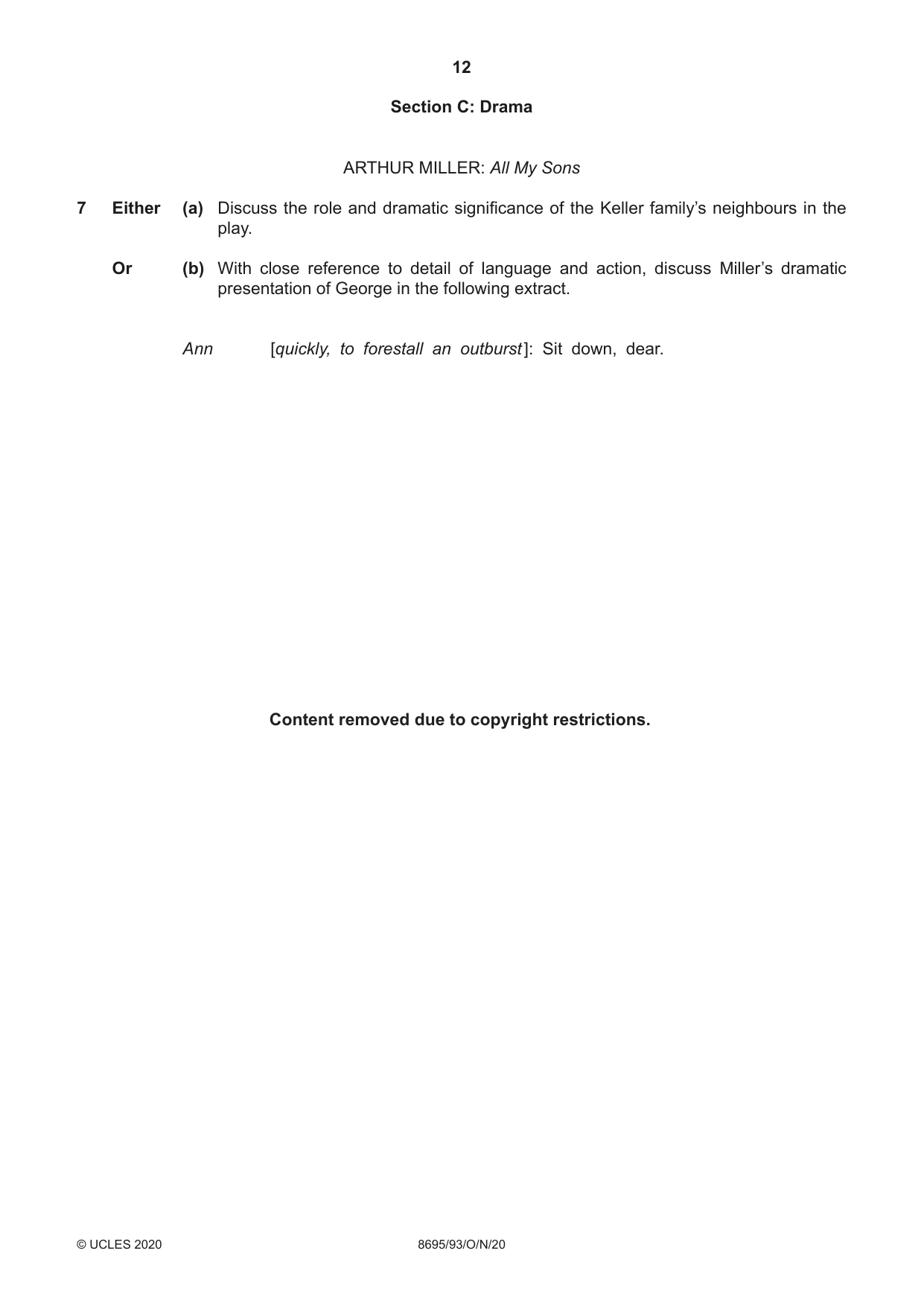
12 8695/93/O/N/20 © UCLES 2020 Section C: Drama ARTHUR MILLER: All My Sons 7 Either (a) Discuss the role and dramatic significance of the Keller family’s neighbours in the play. Or (b) With close reference to detail of language and action, discuss Miller’s dramatic presentation of George in the following extract. Ann [quickly, to forestall an outburst ]: Sit down, dear. Content removed due to copyright restrictions.
Question paper, page 13
13 8695/93/O/N/20 © UCLES 2020 [Turn over You know how quick he can lie. Act 2 Content removed due to copyright restrictions.
Question paper, page 14
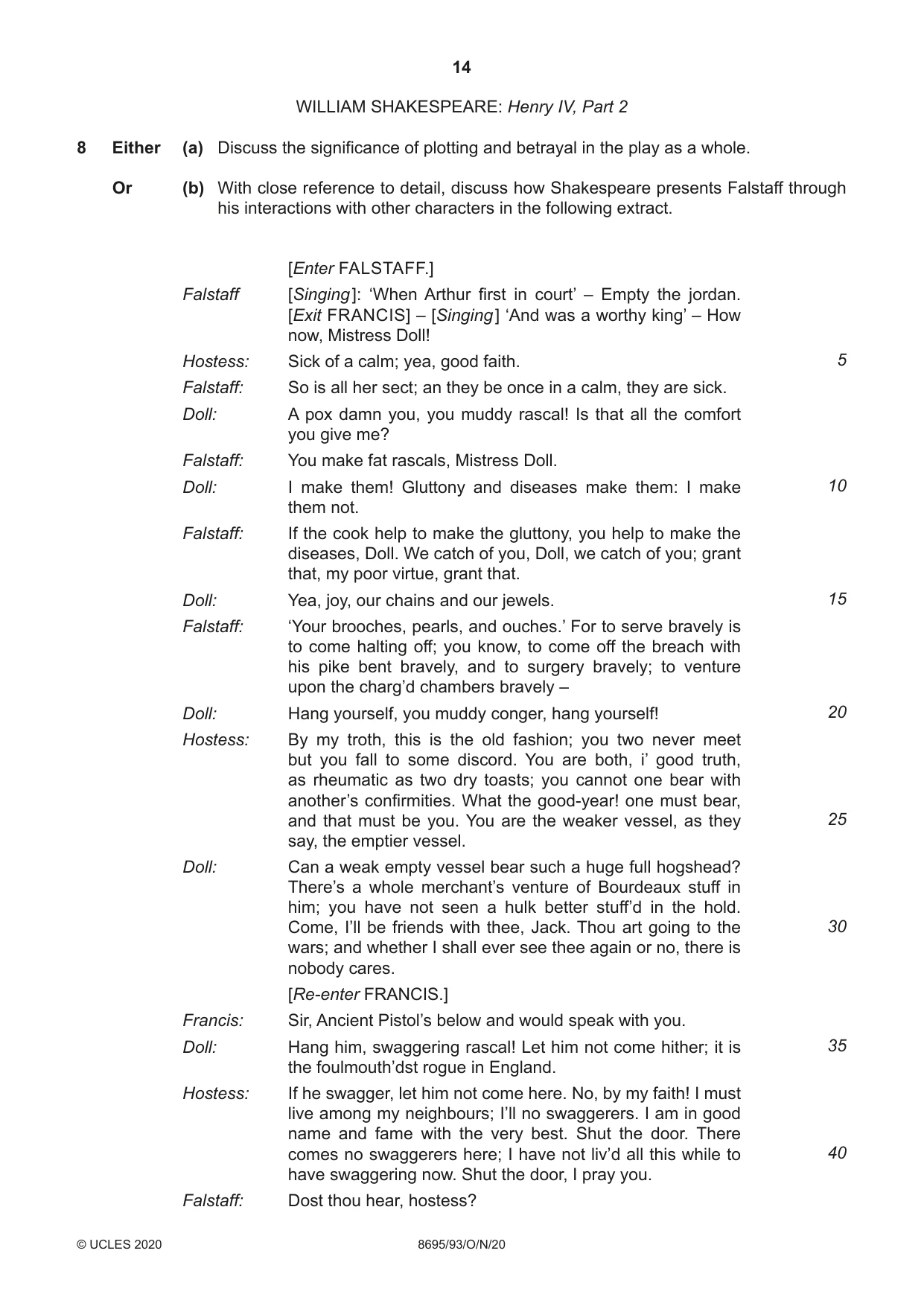
14 8695/93/O/N/20 © UCLES 2020 WILLIAM SHAKESPEARE: Henry IV, Part 2 8 Either (a) Discuss the significance of plotting and betrayal in the play as a whole. Or (b) With close reference to detail, discuss how Shakespeare presents Falstaff through his interactions with other characters in the following extract. [Enter FALSTAFF.] Falstaff [Singing ]: ‘When Arthur first in court’ – Empty the jordan. [Exit FRANCIS] – [Singing ] ‘And was a worthy king’ – How now, Mistress Doll! Hostess: Sick of a calm; yea, good faith. Falstaff: So is all her sect; an they be once in a calm, they are sick. Doll: A pox damn you, you muddy rascal! Is that all the comfort you give me? Falstaff: You make fat rascals, Mistress Doll. Doll: I make them! Gluttony and diseases make them: I make them not. Falstaff: If the cook help to make the gluttony, you help to make the diseases, Doll. We catch of you, Doll, we catch of you; grant that, my poor virtue, grant that. Doll: Yea, joy, our chains and our jewels. Falstaff: ‘Your brooches, pearls, and ouches.’ For to serve bravely is to come halting off; you know, to come off the breach with his pike bent bravely, and to surgery bravely; to venture upon the charg’d chambers bravely – Doll: Hang yourself, you muddy conger, hang yourself! Hostess: By my troth, this is the old fashion; you two never meet but you fall to some discord. You are both, i’ good truth, as rheumatic as two dry toasts; you cannot one bear with another’s confirmities. What the good-year! one must bear, and that must be you. You are the weaker vessel, as they say, the emptier vessel. Doll: Can a weak empty vessel bear such a huge full hogshead? There’s a whole merchant’s venture of Bourdeaux stuff in him; you have not seen a hulk better stuff’d in the hold. Come, I’ll be friends with thee, Jack. Thou art going to the wars; and whether I shall ever see thee again or no, there is nobody cares. [Re-enter FRANCIS.] Francis: Sir, Ancient Pistol’s below and would speak with you. Doll: Hang him, swaggering rascal! Let him not come hither; it is the foulmouth’dst rogue in England. Hostess: If he swagger, let him not come here. No, by my faith! I must live among my neighbours; I’ll no swaggerers. I am in good name and fame with the very best. Shut the door. There comes no swaggerers here; I have not liv’d all this while to have swaggering now. Shut the door, I pray you. Falstaff: Dost thou hear, hostess? 5 10 15 20 25 30 35 40
Question paper, page 15
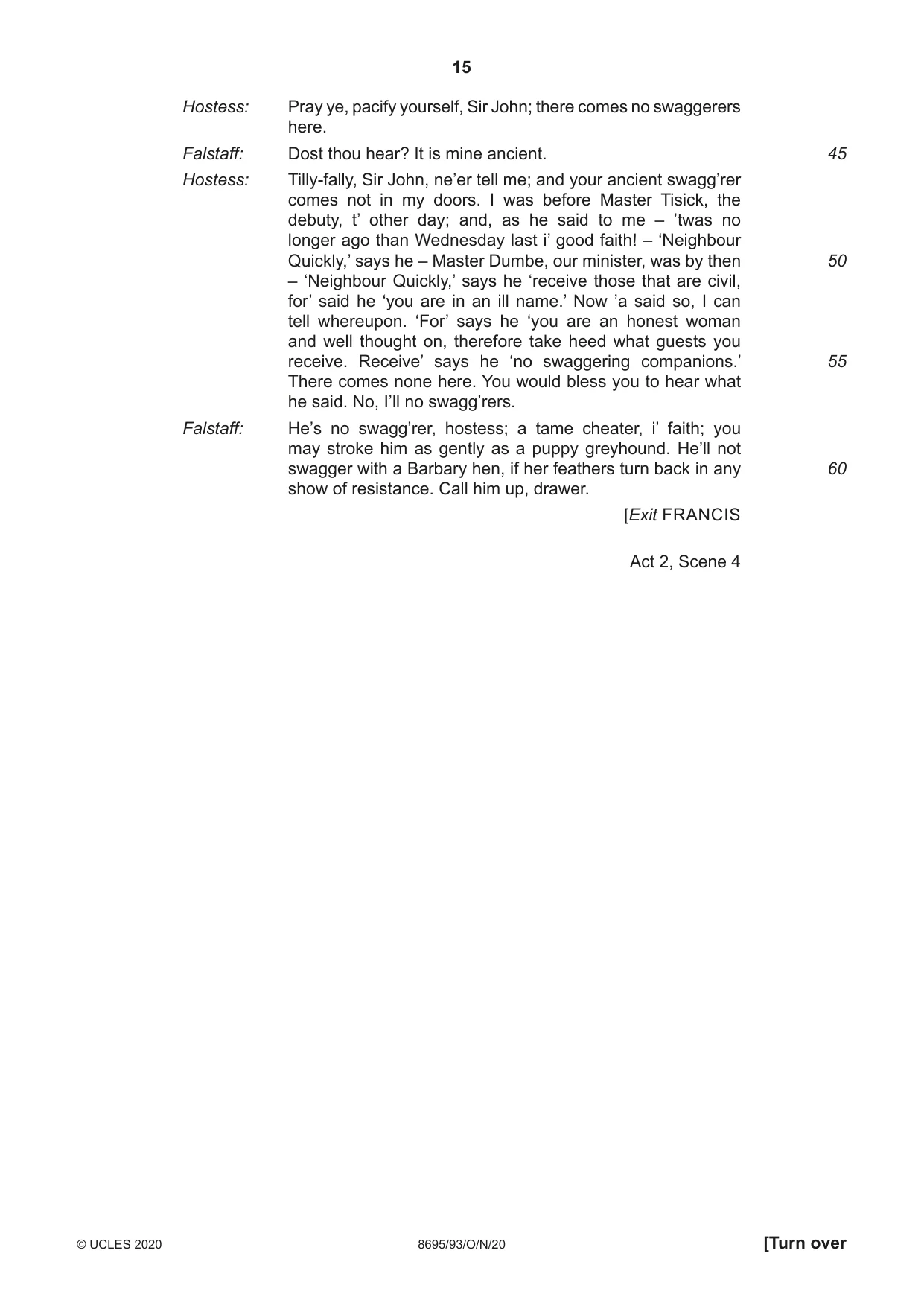
15 8695/93/O/N/20 © UCLES 2020 [Turn over Hostess: Pray ye, pacify yourself, Sir John; there comes no swaggerers here. Falstaff: Dost thou hear? It is mine ancient. Hostess: Tilly-fally, Sir John, ne’er tell me; and your ancient swagg’rer comes not in my doors. I was before Master Tisick, the debuty, t’ other day; and, as he said to me – ’twas no longer ago than Wednesday last i’ good faith! – ‘Neighbour Quickly,’ says he – Master Dumbe, our minister, was by then – ‘Neighbour Quickly,’ says he ‘receive those that are civil, for’ said he ‘you are in an ill name.’ Now ’a said so, I can tell whereupon. ‘For’ says he ‘you are an honest woman and well thought on, therefore take heed what guests you receive. Receive’ says he ‘no swaggering companions.’ There comes none here. You would bless you to hear what he said. No, I’ll no swagg’rers. Falstaff: He’s no swagg’rer, hostess; a tame cheater, i’ faith; you may stroke him as gently as a puppy greyhound. He’ll not swagger with a Barbary hen, if her feathers turn back in any show of resistance. Call him up, drawer. [Exit FRANCIS Act 2, Scene 4 45 50 55 60
Question paper, page 16
16 8695/93/O/N/20 © UCLES 2020 WOLE SOYINKA: Death and the King’s Horseman 9 Either (a) In what ways, and with what dramatic effects, does Soyinka present the conflict between the expectations of society and the desires of the individual? Or (b) With close reference to detail of language and action, discuss Soyinka’s presentation of Jane and Simon Pilkings and their attitudes in the following episode. [A few moments later PILKINGS emerges, picks up the pad and reads.] Pilkings: Jane! Content removed due to copyright restrictions.
Question paper, page 17
17 8695/93/O/N/20 © UCLES 2020 Pilkings [in a resigned way ]: I know. Scene 2 Content removed due to copyright restrictions.
Question paper, page 18
18 8695/93/O/N/20 © UCLES 2020 BLANK PAGE
Question paper, page 19
19 8695/93/O/N/20 © UCLES 2020 BLANK PAGE
Question paper, page 20
20 8695/93/O/N/20 © UCLES 2020 Permission to reproduce items where third-party owned material protected by copyright is included has been sought and cleared where possible. Every reasonable effort has been made by the publisher (UCLES) to trace copyright holders, but if any items requiring clearance have unwittingly been included, the publisher will be pleased to make amends at the earliest possible opportunity. To avoid the issue of disclosure of answer-related information to candidates, all copyright acknowledgements are reproduced online in the Cambridge Assessment International Education Copyright Acknowledgements Booklet. This is produced for each series of examinations and is freely available to download at www.cambridgeinternational.org after the live examination series. Cambridge Assessment International Education is part of the Cambridge Assessment Group. Cambridge Assessment is the brand name of the University of Cambridge Local Examinations Syndicate (UCLES), which itself is a department of the University of Cambridge. BLANK PAGE
Mark scheme, page 1
This document consists of 7 printed pages. © UCLES 2020 [Turn over Cambridge International AS & A Level LITERATURE IN ENGLISH 8695/93 Paper 9 Poetry, Prose and Drama October/November 2020 MARK SCHEME Maximum Mark: 50 Published This mark scheme is published as an aid to teachers and candidates, to indicate the requirements of the examination. It shows the basis on which Examiners were instructed to award marks. It does not indicate the details of the discussions that took place at an Examiners’ meeting before marking began, which would have considered the acceptability of alternative answers. Mark schemes should be read in conjunction with the question paper and the Principal Examiner Report for Teachers. Cambridge International will not enter into discussions about these mark schemes. Cambridge International is publishing the mark schemes for the October/November 2020 series for most Cambridge IGCSE™, Cambridge International A and AS Level and Cambridge Pre-U components, and some Cambridge O Level components.
Mark scheme, page 2
8695/93 Cambridge International AS & A Level – Mark Scheme PUBLISHED October/November 2020 © UCLES 2020 Page 2 of 7 Generic Marking Principles These general marking principles must be applied by all examiners when marking candidate answers. They should be applied alongside the specific content of the mark scheme or generic level descriptors for a question. Each question paper and mark scheme will also comply with these marking principles. GENERIC MARKING PRINCIPLE 1: Marks must be awarded in line with: • the specific content of the mark scheme or the generic level descriptors for the question • the specific skills defined in the mark scheme or in the generic level descriptors for the question • the standard of response required by a candidate as exemplified by the standardisation scripts. GENERIC MARKING PRINCIPLE 2: Marks awarded are always whole marks (not half marks, or other fractions). GENERIC MARKING PRINCIPLE 3: Marks must be awarded positively: • marks are awarded for correct/valid answers, as defined in the mark scheme. However, credit is given for valid answers which go beyond the scope of the syllabus and mark scheme, referring to your Team Leader as appropriate • marks are awarded when candidates clearly demonstrate what they know and can do • marks are not deducted for errors • marks are not deducted for omissions • answers should only be judged on the quality of spelling, punctuation and grammar when these features are specifically assessed by the question as indicated by the mark scheme. The meaning, however, should be unambiguous. GENERIC MARKING PRINCIPLE 4: Rules must be applied consistently, e.g. in situations where candidates have not followed instructions or in the application of generic level descriptors. GENERIC MARKING PRINCIPLE 5: Marks should be awarded using the full range of marks defined in the mark scheme for the question (however; the use of the full mark range may be limited according to the quality of the candidate responses seen). GENERIC MARKING PRINCIPLE 6: Marks awarded are based solely on the requirements as defined in the mark scheme. Marks should not be awarded with grade thresholds or grade descriptors in mind.
Mark scheme, page 3
8695/93 Cambridge International AS & A Level – Mark Scheme PUBLISHED October/November 2020 © UCLES 2020 Page 3 of 7 Introduction For general administrative guidance, see Notes for Examiners Handbook. Assessment objectives: AO3 The ability to respond to texts in the three main forms (Prose, Poetry and Drama), of different types and from different cultures. AO4 An understanding of how writers’ choices of form, structure and language shape meanings. AO5 The ability to produce informed, independent opinions and judgements on literary texts. AO6 The ability to communicate clearly the knowledge, understanding and insight appropriate to literary study. Each answer is marked out of 25, in accordance with the levels mark scheme. Each level is divided into strands: Knowledge (K), Understanding (U), Personal Response (P) and Communication (C). Principles of Annotation Annotating English Literature scripts has the following purposes: • to follow best practice in assessing English Literature essays • to record the comments and developing thought of the examiner doing the work of assessment • to facilitate the summative comments and overall mark given to an essay. The annotations made on scripts become public property following marking and may be cited as evidence in case of appeal. Annotations are therefore vital, not just in ensuring the mark given is what the student deserves, but also in making the marking process demonstrably clear to any potential reader. Using the levels mark scheme Place the answer in a level first. Look for the “best fit” of the answer into a level. An answer needs to show evidence of most but not necessarily ALL of the qualities described in a level, in order to be placed in that level. Then award a mark for the relative position of the answer within the level. Candidates may address the question in many different ways. Do not expect any particular focus or approach and do not penalise answers for leaving out a particular focus. Reward what is there, showing what you are rewarding, in your comments. Consider all strands and weigh up the performance as a whole in placing the answer in a level, then show that you have done so in the summative comment, e.g. ‘Level 3: A solid “K” of the text, with a “U” of the ways in which Forster uses form and language. The beginnings of “P” personal response shown and supported by the text. “C” is clear and appropriate throughout.’
Mark scheme, page 4
8695/93 Cambridge International AS & A Level – Mark Scheme PUBLISHED October/November 2020 © UCLES 2020 Page 4 of 7 Rubric Infringements In response to 8695/91–93 candidates answer two questions: from either a Poetry text (Section A) and/or a Prose text (Section B) and/or a Drama text. Candidates can answer any combination of questions from two sections. Where a rubric infringement has been committed, examiners mark all responses. Scoris then automatically checks and calculates marks for rubric infringements, but this makes it extremely important that examiners ensure that the correct mark is recorded against the correct question number. Candidates frequently mis-number or mislabel questions under the pressure of timed conditions. Thus it is vital that examiners check the question and question number which candidates have answered against the question paper. Level 6 22–25 Very good work – do not reserve this level for the very best work you see but ensure you put scripts into this level which fulfil the requirements described below. There will always be some candidates who are at a standard over the top of the mark scheme. K Evidence of a very good ability to select relevant knowledge to address the question with effective use of references and quotation. There may be evidence of sensitive awareness of the contexts in which the literary works studied were written and understood. U Evidence of very good understanding of ways in which writers’ choices of structure, form and language shape meanings with sustained analysis and sensitive appreciation of literary methods and effects and contexts, possibly including literary genres and conventions. P Personal response to texts will be perceptive, often freshly personal, fully supported with quotation, and may show originality in approach to and treatment of questions. C Candidates will express complex literary ideas and arguments with clarity and fluency. Answers will have a coherent structure, with logical progression and effectively linked paragraphs. Expression will be accomplished and appropriate. In answers to passage-based questions, work will sustain an appropriate balance between critical appreciation of given extracts, based on detailed critical analysis, and consideration of the broader textual issues raised by the questions, and relate part of a text to its whole and vice versa in a seamless argument. There will be a very good appreciation of the effects of the literary features of the text, with detailed analysis supported by relevant examples from the passage and the wider text, where appropriate. There will be a very good knowledge of the appropriate context of the extract or work.
Mark scheme, page 5
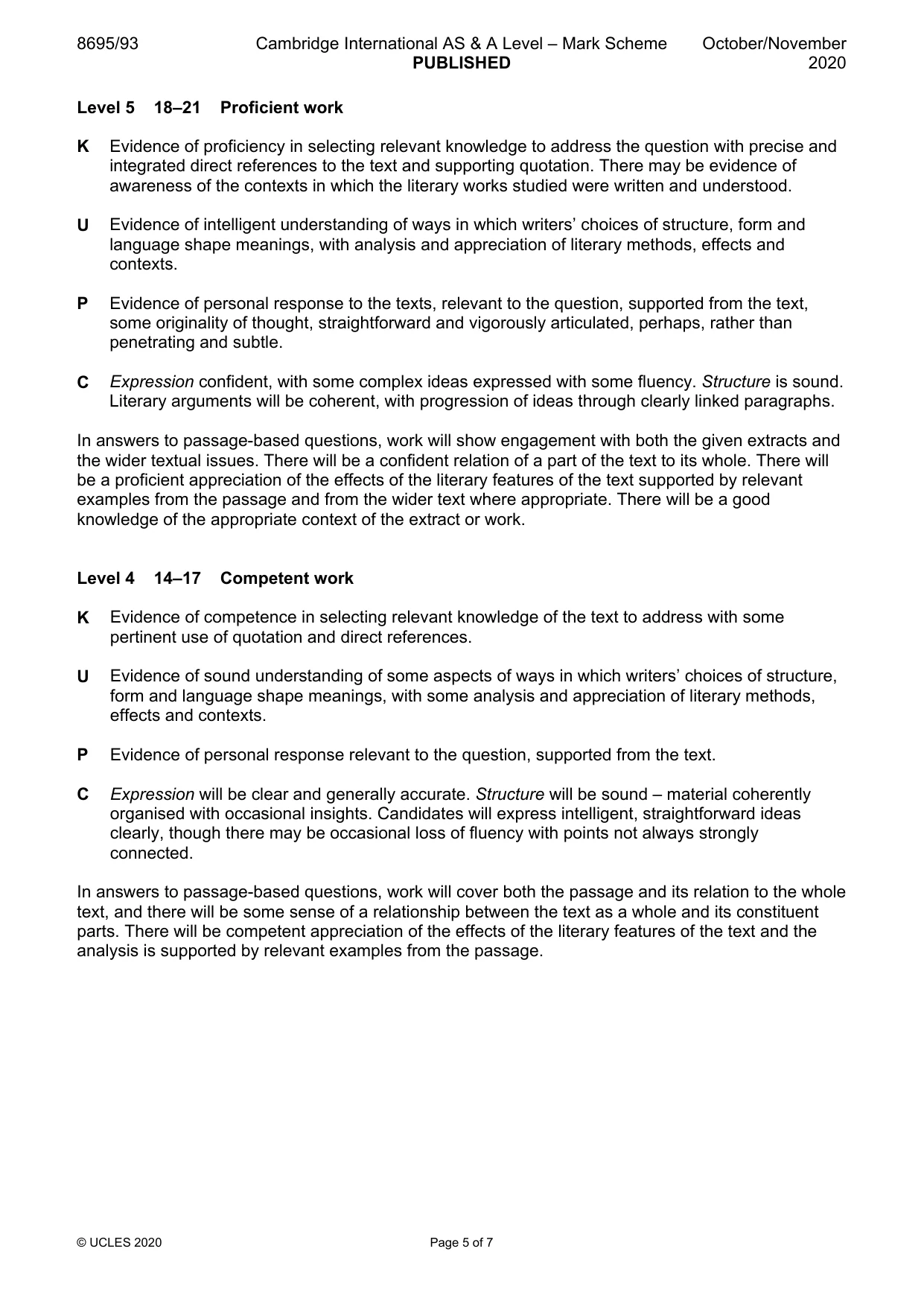
8695/93 Cambridge International AS & A Level – Mark Scheme PUBLISHED October/November 2020 © UCLES 2020 Page 5 of 7 Level 5 18–21 Proficient work K Evidence of proficiency in selecting relevant knowledge to address the question with precise and integrated direct references to the text and supporting quotation. There may be evidence of awareness of the contexts in which the literary works studied were written and understood. U Evidence of intelligent understanding of ways in which writers’ choices of structure, form and language shape meanings, with analysis and appreciation of literary methods, effects and contexts. P Evidence of personal response to the texts, relevant to the question, supported from the text, some originality of thought, straightforward and vigorously articulated, perhaps, rather than penetrating and subtle. C Expression confident, with some complex ideas expressed with some fluency. Structure is sound. Literary arguments will be coherent, with progression of ideas through clearly linked paragraphs. In answers to passage-based questions, work will show engagement with both the given extracts and the wider textual issues. There will be a confident relation of a part of the text to its whole. There will be a proficient appreciation of the effects of the literary features of the text supported by relevant examples from the passage and from the wider text where appropriate. There will be a good knowledge of the appropriate context of the extract or work. Level 4 14–17 Competent work K Evidence of competence in selecting relevant knowledge of the text to address with some pertinent use of quotation and direct references. U Evidence of sound understanding of some aspects of ways in which writers’ choices of structure, form and language shape meanings, with some analysis and appreciation of literary methods, effects and contexts. P Evidence of personal response relevant to the question, supported from the text. C Expression will be clear and generally accurate. Structure will be sound – material coherently organised with occasional insights. Candidates will express intelligent, straightforward ideas clearly, though there may be occasional loss of fluency with points not always strongly connected. In answers to passage-based questions, work will cover both the passage and its relation to the whole text, and there will be some sense of a relationship between the text as a whole and its constituent parts. There will be competent appreciation of the effects of the literary features of the text and the analysis is supported by relevant examples from the passage.
Mark scheme, page 6
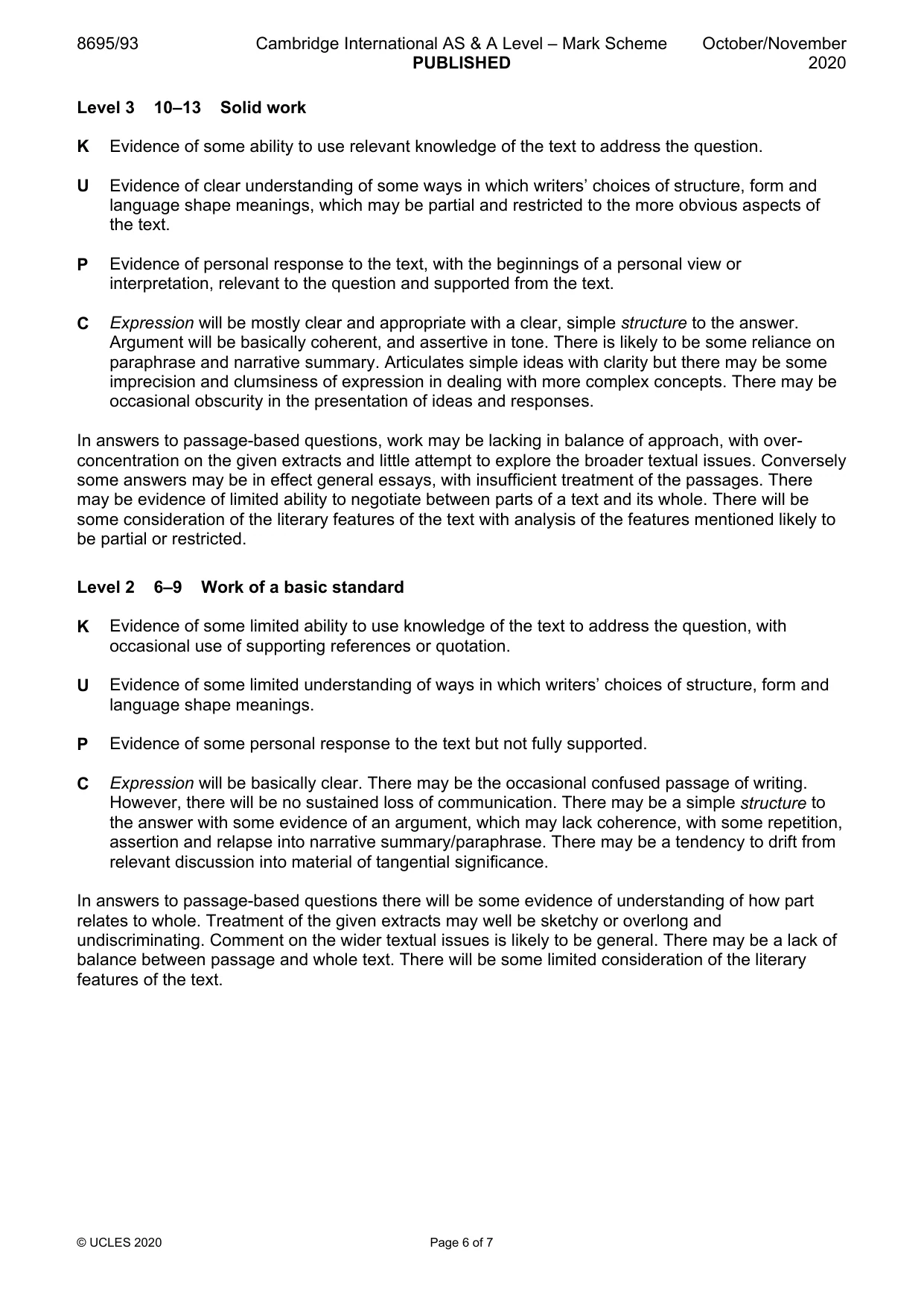
8695/93 Cambridge International AS & A Level – Mark Scheme PUBLISHED October/November 2020 © UCLES 2020 Page 6 of 7 Level 3 10–13 Solid work K Evidence of some ability to use relevant knowledge of the text to address the question. U Evidence of clear understanding of some ways in which writers’ choices of structure, form and language shape meanings, which may be partial and restricted to the more obvious aspects of the text. P Evidence of personal response to the text, with the beginnings of a personal view or interpretation, relevant to the question and supported from the text. C Expression will be mostly clear and appropriate with a clear, simple structure to the answer. Argument will be basically coherent, and assertive in tone. There is likely to be some reliance on paraphrase and narrative summary. Articulates simple ideas with clarity but there may be some imprecision and clumsiness of expression in dealing with more complex concepts. There may be occasional obscurity in the presentation of ideas and responses. In answers to passage-based questions, work may be lacking in balance of approach, with over- concentration on the given extracts and little attempt to explore the broader textual issues. Conversely some answers may be in effect general essays, with insufficient treatment of the passages. There may be evidence of limited ability to negotiate between parts of a text and its whole. There will be some consideration of the literary features of the text with analysis of the features mentioned likely to be partial or restricted. Level 2 6–9 Work of a basic standard K Evidence of some limited ability to use knowledge of the text to address the question, with occasional use of supporting references or quotation. U Evidence of some limited understanding of ways in which writers’ choices of structure, form and language shape meanings. P Evidence of some personal response to the text but not fully supported. C Expression will be basically clear. There may be the occasional confused passage of writing. However, there will be no sustained loss of communication. There may be a simple structure to the answer with some evidence of an argument, which may lack coherence, with some repetition, assertion and relapse into narrative summary/paraphrase. There may be a tendency to drift from relevant discussion into material of tangential significance. In answers to passage-based questions there will be some evidence of understanding of how part relates to whole. Treatment of the given extracts may well be sketchy or overlong and undiscriminating. Comment on the wider textual issues is likely to be general. There may be a lack of balance between passage and whole text. There will be some limited consideration of the literary features of the text.
Mark scheme, page 7
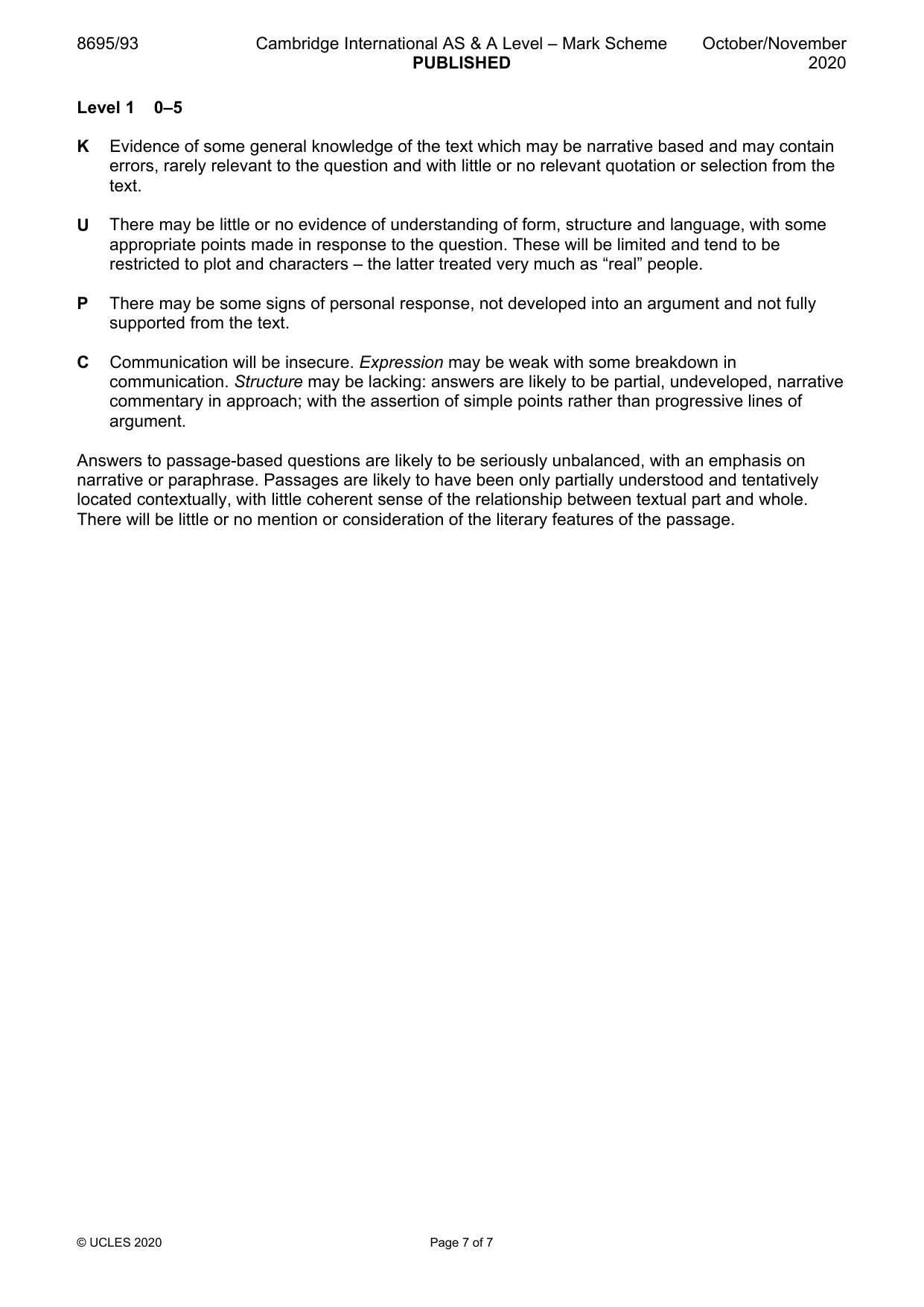
8695/93 Cambridge International AS & A Level – Mark Scheme PUBLISHED October/November 2020 © UCLES 2020 Page 7 of 7 Level 1 0–5 K Evidence of some general knowledge of the text which may be narrative based and may contain errors, rarely relevant to the question and with little or no relevant quotation or selection from the text. U There may be little or no evidence of understanding of form, structure and language, with some appropriate points made in response to the question. These will be limited and tend to be restricted to plot and characters – the latter treated very much as “real” people. P There may be some signs of personal response, not developed into an argument and not fully supported from the text. C Communication will be insecure. Expression may be weak with some breakdown in communication. Structure may be lacking: answers are likely to be partial, undeveloped, narrative commentary in approach; with the assertion of simple points rather than progressive lines of argument. Answers to passage-based questions are likely to be seriously unbalanced, with an emphasis on narrative or paraphrase. Passages are likely to have been only partially understood and tentatively located contextually, with little coherent sense of the relationship between textual part and whole. There will be little or no mention or consideration of the literary features of the passage.
What you needed in this session
Cambridge’s own grade thresholds for 2020 Oct/Nov, Paper 9 · Variant 3. A higher threshold means an easier paper — the bar moves with how the cohort did.