Cambridge A Level English - Language and Literature (AS Level only, from 2016) 8695 — 2019 Oct/Nov Paper 9 · Variant 3
8695/93/O/N/19 · 50 marks · ≈56 min
The question paper and its mark scheme, free to read here and free to download. This is Cambridge’s own paper, exactly as it was sat.
Question paper20 pages





Mark scheme6 pages
Answers below. Sit the paper first if you are practising.
Paper as text
Question paper, page 1
This document consists of 17 printed pages, 3 blank pages and 1 Insert. DC (RCL (GO)) 166011/1 © UCLES 2019 [Turn over Cambridge Assessment International Education Cambridge International Advanced Subsidiary Level LANGUAGE AND LITERATURE IN ENGLISH 8695/93 Paper 9 Poetry, Prose and Drama October/November 2019 2 hours No Additional Materials are required. READ THESE INSTRUCTIONS FIRST An answer booklet is provided inside this question paper. You should follow the instructions on the front cover of the answer booklet. If you need additional answer paper ask the invigilator for a continuation booklet. Answer two questions, each from a different section. You are reminded of the need for good English and clear presentation in your answers. All questions in this paper carry equal marks. * 6 6 5 0 1 8 8 7 0 2 *
Question paper, page 2
2 8695/93/O/N/19 © UCLES 2019 Section A: Poetry ROBERT FROST: Selected Poems 1 Either (a) Discuss Frost’s presentation of rural life. You should refer to two poems in your answer. Or (b) Comment closely on ways in which Frost presents the encounter and its significance in the following poem. An Encounter Once on the kind of day called “weather breeder,” Half looking for the orchid Calypso.” Content removed due to copyright restrictions.
Question paper, page 3
3 8695/93/O/N/19 © UCLES 2019 [Turn over ELIZABETH JENNINGS: Selected Poems 2 Either (a) With reference to two poems, discuss ways in which Jennings presents individual people. Or (b) Comment closely on ways in which the following poem explores changing attitudes to fear and terror. Warning to Parents Save them from terror; do not let them see The ghost behind the stairs, the hidden crime. They will, no doubt, grow out of this in time And be impervious as you and me. Be sure there is a night-light close at hand; The plot of that old film may well come back, The ceiling, with its long, uneven crack, May hint at things no child can understand. You do all this and are surprised one day When you discover how the child can gloat On Belsen and on tortures—things remote To him. You find it hard to watch him play With thoughts like these, and find it harder still To think back to the times when you also Caught from the cruel past a childish glow And felt along your veins the wish to kill. Fears are more personal than we had guessed— We only need ourselves; time does the rest. 5 10 15
Question paper, page 4
4 8695/93/O/N/19 © UCLES 2019 Songs of Ourselves, Volume 2 3 Either (a) Compare ways in which poets present peace or rest in two poems. Or (b) Comment closely on ways in which the following poem presents feelings of anger. The White House Your door is shut against my tightened face, And I am sharp as steel with discontent; But I possess the courage and the grace To bear my anger proudly and unbent. The pavement slabs burn loose beneath my feet, A chafing savage, down the decent street; And passion rends my vitals as I pass, Where boldly shines your shuttered door of glass. Oh, I must search for wisdom every hour, Deep in my wrathful bosom sore and raw, And find in it the superhuman power To hold me to the letter of your law! Oh, I must keep my heart inviolate Against the potent poison of your hate. Claude McKay 5 10
Question paper, page 5
5 8695/93/O/N/19 © UCLES 2019 [Turn over Turn over for Section B.
Question paper, page 6
6 8695/93/O/N/19 © UCLES 2019 Section B: Prose E.M. FORSTER: Howards End 4 Either (a) Mrs Wilcox comments: ‘I sometimes think it is wise to leave action and discussion to men.’ Discuss ways in which this view is challenged in the novel. Or (b) Comment closely on ways in which the following passage presents Margaret Schlegel and Henry Wilcox. Expelled from his old fortress, Mr. Wilcox was building a new one. He could no longer appear respectable to her, so he defended himself instead in a lurid past. It was not true repentance. “Leave it where you will, boy. It’s not going to trouble us; I know what I’m talking about, and it will make no difference.” “No difference?” he inquired. “No difference, when you find that I am not the fellow you thought?” He was annoyed with Miss Schlegel here. He would have preferred her to be prostrated by the blow, or even to rage. Against the tide of his sin flowed the feeling that she was not altogether womanly. Her eyes gazed too straight; they had read books that are suitable for men only. And though he had dreaded a scene, and though she had determined against one, there was a scene, all the same. It was somehow imperative. “I am unworthy of you,” he began. “Had I been worthy, I should not have released you from your engagement. I know what I am talking about. I can’t bear to talk of such things. We had better leave it.” She kissed his hand. He jerked it from her, and, rising to his feet, went on: “You, with your sheltered life, and refined pursuits, and friends, and books, you and your sister, and women like you—I say, how can you guess the temptations that lie round a man?” “It is difficult for us,” said Margaret; “but if we are worth marrying, we do guess.” “Cut off from decent society and family ties, what do you suppose happens to thousands of young fellows overseas? Isolated. No one near. I know by bitter experience, and yet you say it makes ‘no difference.’” “Not to me.” He laughed bitterly. Margaret went to the sideboard and helped herself to one of the breakfast dishes. Being the last down, she turned out the spirit-lamp that kept them warm. She was tender, but grave. She knew that Henry was not so much confessing his soul as pointing out the gulf between the male soul and the female, and she did not desire to hear him on this point. “Did Helen come?” she asked. He shook his head. “But that won’t do at all, at all! We don’t want her gossiping with Mrs. Bast.” “Good God! no!” he exclaimed, suddenly natural. Then he caught himself up. “Let them gossip, my game’s up, though I thank you for your unselfishness—little as my thanks are worth.” “Didn’t she send me a message or anything?” “I heard of none.” “Would you ring the bell, please?” “What to do?” “Why, to inquire.” He swaggered up to it tragically, and sounded a peal. Margaret poured herself out some coffee. The butler came, and said that Miss Schlegel had slept at the George, so far as he had heard. Should he go round to the George? 5 10 15 20 25 30 35 40
Question paper, page 7
7 8695/93/O/N/19 © UCLES 2019 [Turn over “I’ll go, thank you,” said Margaret, and dismissed him. “It is no good,” said Henry. “Those things leak out; you cannot stop a story once it has started. I have known cases of other men—I despised them once, I thought that I’m different, I shall never be tempted. Oh, Margaret—” He came and sat down near her, improvising emotion. She could not bear to listen to him. “We fellows all come to grief once in our time. Will you believe that? There are moments when the strongest man—‘Let him who standeth, take heed lest he fall.’ That’s true, isn’t it? If you knew all, you would excuse me. I was far from good influences—far even from England. I was very, very lonely, and longed for a woman’s voice. That’s enough. I have told you too much already for you to forgive me now.” “Yes, that’s enough, dear.” “I have”—he lowered his voice—“I have been through hell.” Gravely she considered this claim. Had he? Had he suffered tortures of remorse, or had it been, “There! that’s over. Now for respectable life again”? The latter, if she read him rightly. A man who has been through hell does not boast of his virility. He is humble and hides it, if, indeed, it still exists. Only in legend does the sinner come forth penitent, but terrible, to conquer pure woman by his resistless power. Henry was anxious to be terrible, but had not got it in him. He was a good average Englishman, who had slipped. The really culpable point—his faithlessness to Mrs. Wilcox—never seemed to strike him. She longed to mention Mrs. Wilcox. Chapter 29 45 50 55 60
Question paper, page 8
8 8695/93/O/N/19 © UCLES 2019 ANDREA LEVY: Small Island 5 Either (a) Discuss the presentation and role of the American soldiers in the novel. Or (b) Comment closely on Gilbert’s account of his experience of England in the following passage. Now tell me, have you ever seen a dog with a gecko? We had a dog at home – Blackie – my boyhood friend. Wrestling Blackie from the smothering arms of my sisters, removing the baby’s hat from his head, the mittens from his back paws and returning to him his scruffy canine dignity, I would find one of those little lizards to deliberately place in Blackie’s path. A gecko sensing a dog remains as still as death. Blackie seeing a gecko is suddenly caught by passionate curiosity. Up with his ears, his eyes popping wide. Fearing the unexpected he moves stealthily round the creature, never – even for a second – taking his gaze from it. Carefully, closer, pat the air above it with a paw and jump back. Circling round. Sniff the air. Closer, closer. Skip forward, leap back, wait. That gecko could not even move one of its prehistoric eyes without that dog’s awareness. This could go on nearly all day until eventually Blackie would pluck up the courage to slowly crouch down low, wiggle his back end, and pounce at the gecko. Sometimes he almost caught it but usually the gecko ran away, being skilful and faster than my silly dog. You might want to know why I am telling you this. But patience. Now see this, a fine day: a weak, heatless sun resting in a blue sky. We are out of the camp for the first time, six maybe seven of the boys and me. Walking in our RAF blue through the English village of Hunmanby. No order to follow, no command to hear, just us boys. We are remarking on the pretty neatness of the gardens – a flower still in bloom, which someone, I forget who, insists they know the name of. Shutting his eye and biting his lip he tries to recall it. ‘A rose,’ he says. ‘Cha, that is not a rose,’ someone else says. ‘Every flower is rose to you.’ ‘That is a rose.’ ‘It is not a rose.’ This argument is going on as we walk on past the post office and shop. The display in the window, piled up high with tins and boxes, still manages to proclaim that there is a lot of nothing to buy inside. Hubert is trying to persuade James, a strict Presbyterian and teetotal, to come into the pub. ‘You think one little beer gonna keep you outta heaven?’ It was I who first noticed. Leaning urgently into our group I whispered, ‘Man, everyone looking at us.’ The entire village had come out to play dog with gecko. Staring out from dusty windows, gawping from shop doors, gaping at the edge of the pavement, craning at gates and peering round corners. The villagers kept their distance but held that gaze of curious trepidation firmly on we West Indian RAF volunteers. Under this scrutiny we darkies moved with the awkwardness of thieves caught in a sunbeam. ‘Gilbert, ask them what the problem,’ Hubert told me. From every point of the compass eyes were on us. ‘You have a megaphone for me, man?’ I said. When I scratched my head the whole village knew. If any one of those people had a stick long enough, I swear they would have poked us with it. It was some while before the more daring among them took cautious steps toward us, the unfamiliar. A young woman – curling brunette hair, dark eyes, pretty and plump at the hips – finally stood within an arm’s distance to ask, ‘Are you lot American?’ She had her mind on feeling some nylon stockings on her graceful leg. Which, as she stood pert and feminine before us, every one of us boys had our mind on too. ‘No, we are from Jamaica,’ I told her. Chapter 12 5 10 15 20 25 30 35 40 45
Question paper, page 9
9 8695/93/O/N/19 © UCLES 2019 [Turn over Turn over for Question 6.
Question paper, page 10
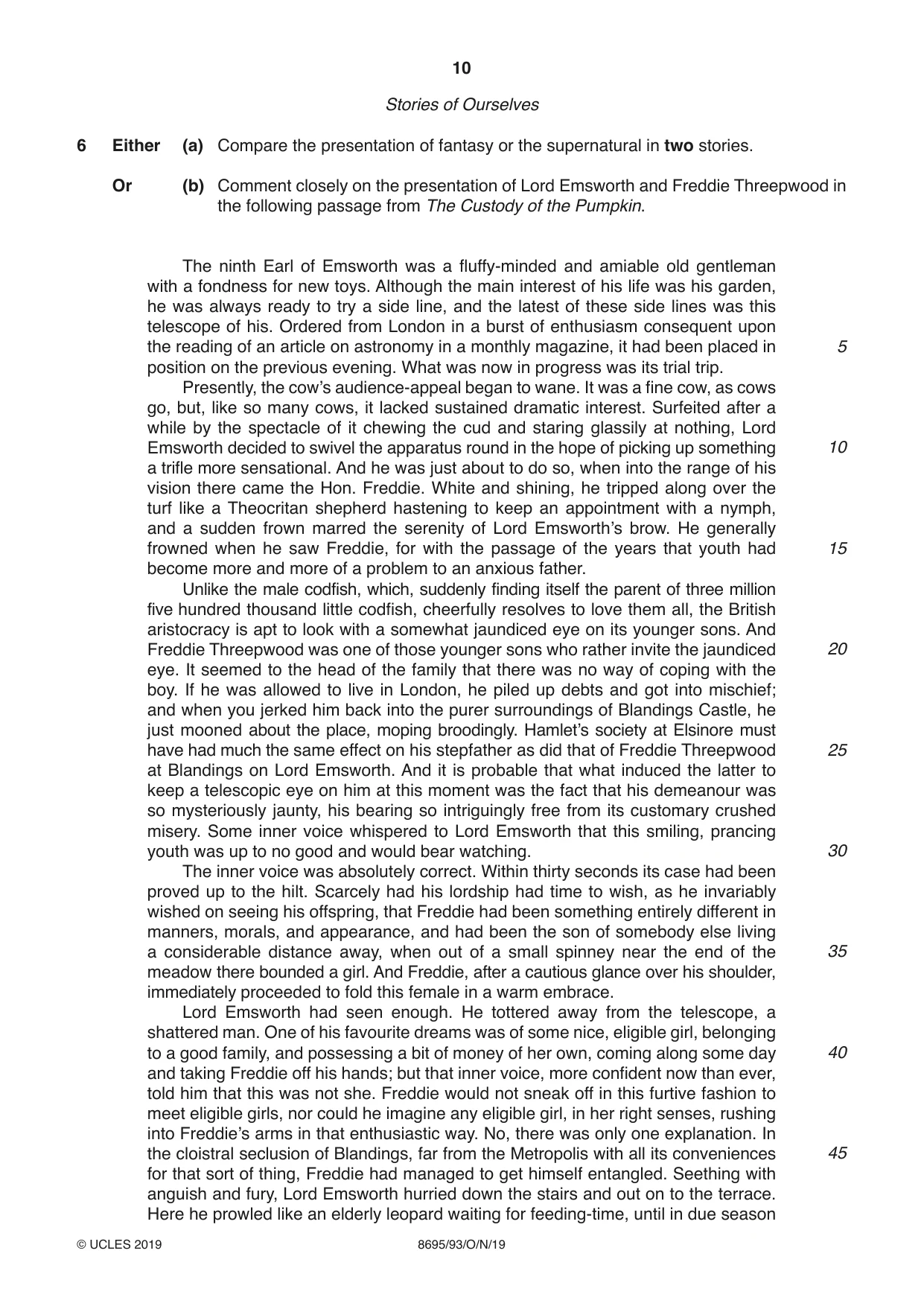
10 8695/93/O/N/19 © UCLES 2019 Stories of Ourselves 6 Either (a) Compare the presentation of fantasy or the supernatural in two stories. Or (b) Comment closely on the presentation of Lord Emsworth and Freddie Threepwood in the following passage from The Custody of the Pumpkin. The ninth Earl of Emsworth was a fluffy-minded and amiable old gentleman with a fondness for new toys. Although the main interest of his life was his garden, he was always ready to try a side line, and the latest of these side lines was this telescope of his. Ordered from London in a burst of enthusiasm consequent upon the reading of an article on astronomy in a monthly magazine, it had been placed in position on the previous evening. What was now in progress was its trial trip. Presently, the cow’s audience-appeal began to wane. It was a fine cow, as cows go, but, like so many cows, it lacked sustained dramatic interest. Surfeited after a while by the spectacle of it chewing the cud and staring glassily at nothing, Lord Emsworth decided to swivel the apparatus round in the hope of picking up something a trifle more sensational. And he was just about to do so, when into the range of his vision there came the Hon. Freddie. White and shining, he tripped along over the turf like a Theocritan shepherd hastening to keep an appointment with a nymph, and a sudden frown marred the serenity of Lord Emsworth’s brow. He generally frowned when he saw Freddie, for with the passage of the years that youth had become more and more of a problem to an anxious father. Unlike the male codfish, which, suddenly finding itself the parent of three million five hundred thousand little codfish, cheerfully resolves to love them all, the British aristocracy is apt to look with a somewhat jaundiced eye on its younger sons. And Freddie Threepwood was one of those younger sons who rather invite the jaundiced eye. It seemed to the head of the family that there was no way of coping with the boy. If he was allowed to live in London, he piled up debts and got into mischief; and when you jerked him back into the purer surroundings of Blandings Castle, he just mooned about the place, moping broodingly. Hamlet’s society at Elsinore must have had much the same effect on his stepfather as did that of Freddie Threepwood at Blandings on Lord Emsworth. And it is probable that what induced the latter to keep a telescopic eye on him at this moment was the fact that his demeanour was so mysteriously jaunty, his bearing so intriguingly free from its customary crushed misery. Some inner voice whispered to Lord Emsworth that this smiling, prancing youth was up to no good and would bear watching. The inner voice was absolutely correct. Within thirty seconds its case had been proved up to the hilt. Scarcely had his lordship had time to wish, as he invariably wished on seeing his offspring, that Freddie had been something entirely different in manners, morals, and appearance, and had been the son of somebody else living a considerable distance away, when out of a small spinney near the end of the meadow there bounded a girl. And Freddie, after a cautious glance over his shoulder, immediately proceeded to fold this female in a warm embrace. Lord Emsworth had seen enough. He tottered away from the telescope, a shattered man. One of his favourite dreams was of some nice, eligible girl, belonging to a good family, and possessing a bit of money of her own, coming along some day and taking Freddie off his hands; but that inner voice, more confident now than ever, told him that this was not she. Freddie would not sneak off in this furtive fashion to meet eligible girls, nor could he imagine any eligible girl, in her right senses, rushing into Freddie’s arms in that enthusiastic way. No, there was only one explanation. In the cloistral seclusion of Blandings, far from the Metropolis with all its conveniences for that sort of thing, Freddie had managed to get himself entangled. Seething with anguish and fury, Lord Emsworth hurried down the stairs and out on to the terrace. Here he prowled like an elderly leopard waiting for feeding-time, until in due season 5 10 15 20 25 30 35 40 45
Question paper, page 11
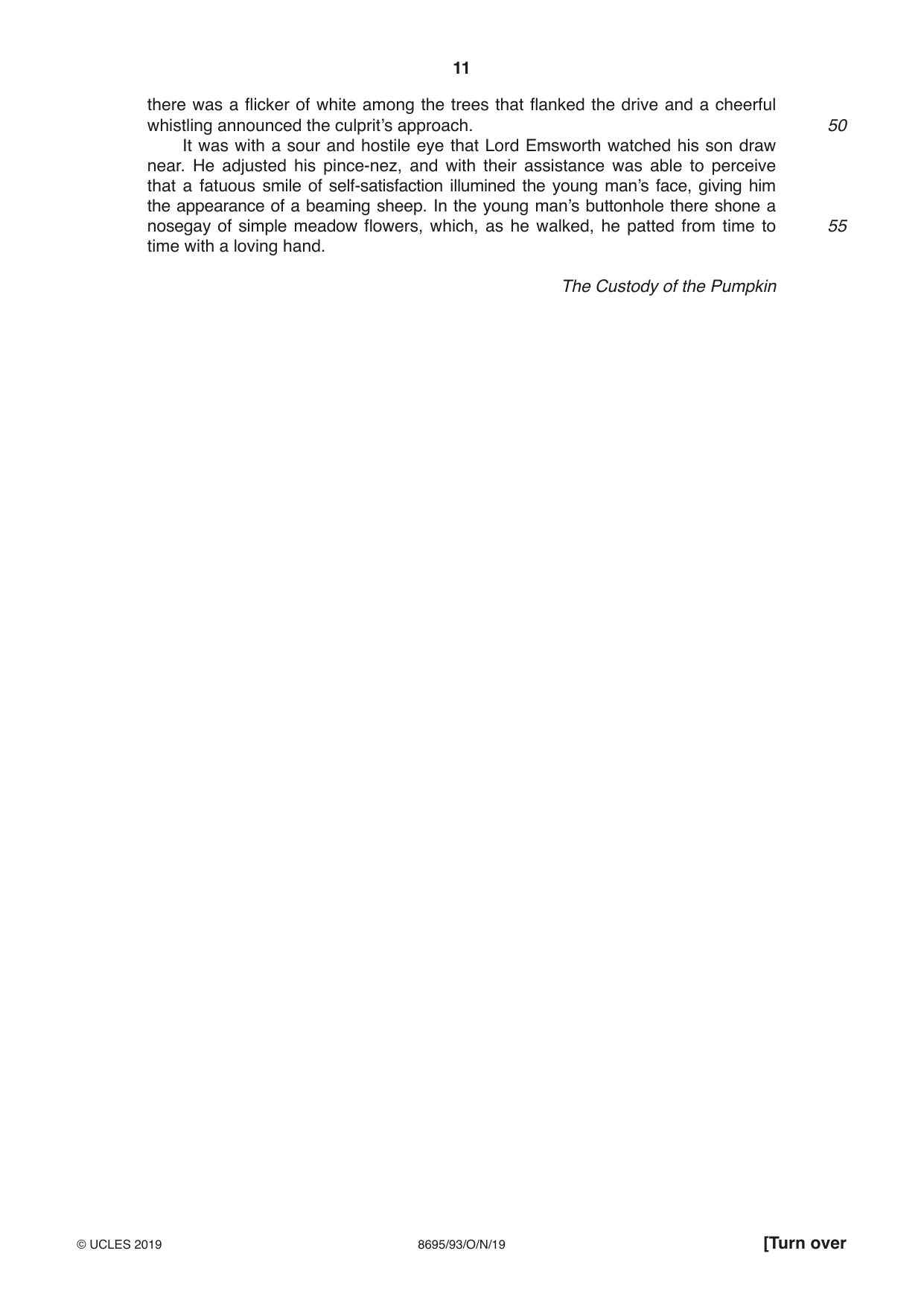
11 8695/93/O/N/19 © UCLES 2019 [Turn over there was a flicker of white among the trees that flanked the drive and a cheerful whistling announced the culprit’s approach. It was with a sour and hostile eye that Lord Emsworth watched his son draw near. He adjusted his pince-nez, and with their assistance was able to perceive that a fatuous smile of self-satisfaction illumined the young man’s face, giving him the appearance of a beaming sheep. In the young man’s buttonhole there shone a nosegay of simple meadow flowers, which, as he walked, he patted from time to time with a loving hand. The Custody of the Pumpkin 50 55
Question paper, page 12
12 8695/93/O/N/19 © UCLES 2019 Section C: Drama WOLE SOYINKA: Death and the King’s Horseman 7 Either (a) In what ways, and with what effects, does Soyinka present different types of leadership in the play? Or (b) Discuss Soyinka’s presentation of Elesin’s relationship with his community in the following extract. You should pay careful attention to both language and action. Elesin: Stop! Enough of that! Content removed due to copyright restrictions.
Question paper, page 13
13 8695/93/O/N/19 © UCLES 2019 [Turn over But a curse remains behind. Scene 1 Content removed due to copyright restrictions.
Question paper, page 14
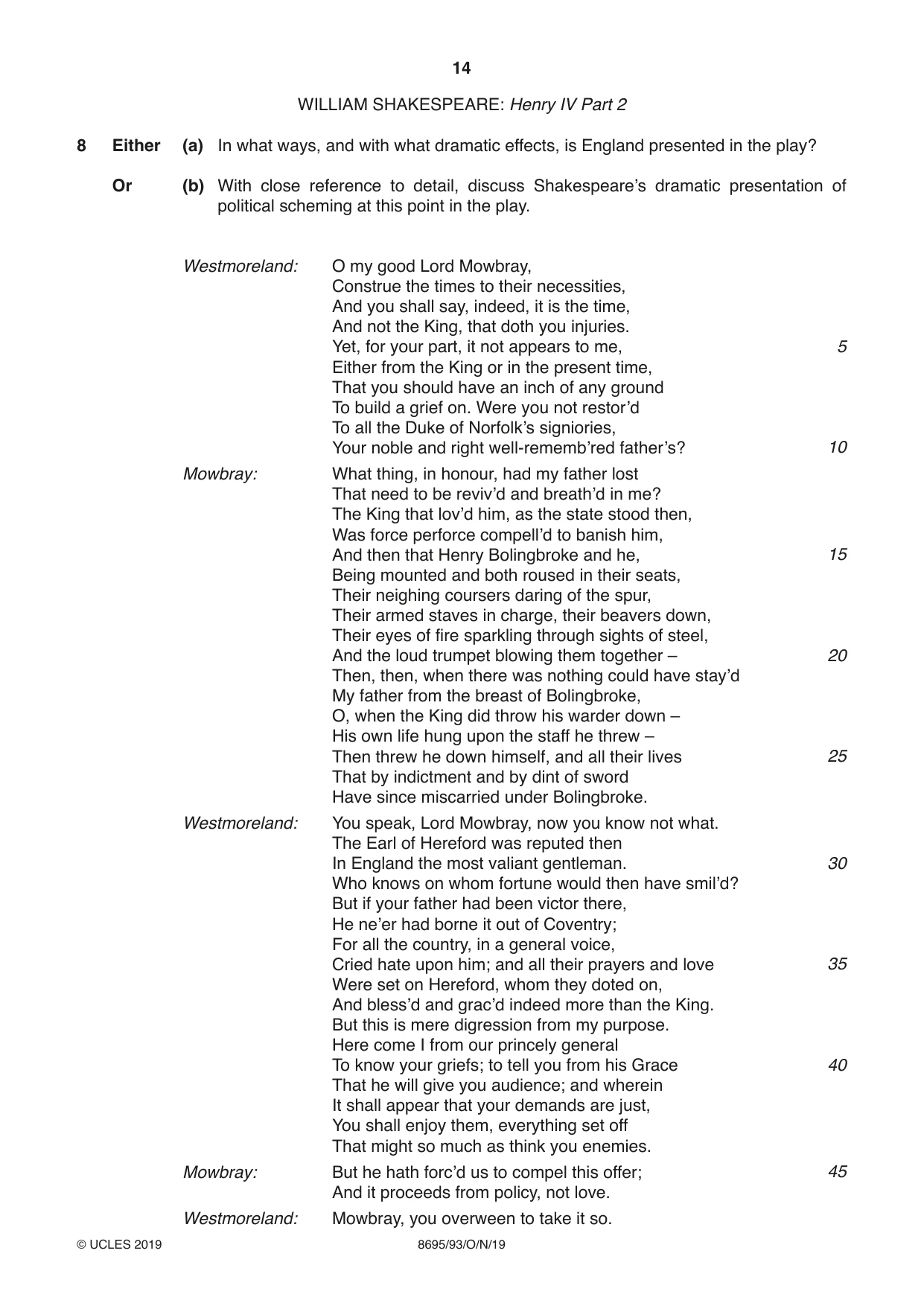
14 8695/93/O/N/19 © UCLES 2019 WILLIAM SHAKESPEARE: Henry IV Part 2 8 Either (a) In what ways, and with what dramatic effects, is England presented in the play? Or (b) With close reference to detail, discuss Shakespeare’s dramatic presentation of political scheming at this point in the play. Westmoreland: O my good Lord Mowbray, Construe the times to their necessities, And you shall say, indeed, it is the time, And not the King, that doth you injuries. Yet, for your part, it not appears to me, Either from the King or in the present time, That you should have an inch of any ground To build a grief on. Were you not restor’d To all the Duke of Norfolk’s signiories, Your noble and right well-rememb’red father’s? Mowbray: What thing, in honour, had my father lost That need to be reviv’d and breath’d in me? The King that lov’d him, as the state stood then, Was force perforce compell’d to banish him, And then that Henry Bolingbroke and he, Being mounted and both roused in their seats, Their neighing coursers daring of the spur, Their armed staves in charge, their beavers down, Their eyes of fire sparkling through sights of steel, And the loud trumpet blowing them together – Then, then, when there was nothing could have stay’d My father from the breast of Bolingbroke, O, when the King did throw his warder down – His own life hung upon the staff he threw – Then threw he down himself, and all their lives That by indictment and by dint of sword Have since miscarried under Bolingbroke. Westmoreland: You speak, Lord Mowbray, now you know not what. The Earl of Hereford was reputed then In England the most valiant gentleman. Who knows on whom fortune would then have smil’d? But if your father had been victor there, He ne’er had borne it out of Coventry; For all the country, in a general voice, Cried hate upon him; and all their prayers and love Were set on Hereford, whom they doted on, And bless’d and grac’d indeed more than the King. But this is mere digression from my purpose. Here come I from our princely general To know your griefs; to tell you from his Grace That he will give you audience; and wherein It shall appear that your demands are just, You shall enjoy them, everything set off That might so much as think you enemies. Mowbray: But he hath forc’d us to compel this offer; And it proceeds from policy, not love. Westmoreland: Mowbray, you overween to take it so. 5 10 15 20 25 30 35 40 45
Question paper, page 15
15 8695/93/O/N/19 © UCLES 2019 [Turn over This offer comes from mercy, not from fear; For, lo! within a ken our army lies – Upon mine honour, all too confident To give admittance to a thought of fear. Our battle is more full of names than yours, Our men more perfect in the use of arms, Our armour all as strong, our cause the best; Then reason will our hearts should be as good. Say you not, then, our offer is compell’d. Mowbray: Well, by my will we shall admit no parley. Westmoreland: That argues but the shame of your offence: A rotten case abides no handling. Hastings: Hath the Prince John a full commission, In very ample virtue of his father, To hear and absolutely to determine Of what conditions we shall stand upon? Westmoreland: That is intended in the general’s name. I muse you make so slight a question. Archbishop: Then take, my Lord of Westmoreland, this schedule, For this contains our general grievances. Each several article herein redress’d, All members of our cause, both here and hence, That are insinewed to this action, Acquitted by a true substantial form, And present execution of our wills To us and to our purposes confin’d – We come within our awful banks again, And knit our powers to the arm of peace. Westmoreland: This will I show the general. Please you, lords, In sight of both our battles we may meet; And either end in peace – which God so frame! – Or to the place of diff’rence call the swords Which must decide it. Archbishop: My lord, we will do so. [Exit WESTMORELAND. Act 4, Scene 1 50 55 60 65 70 75 80
Question paper, page 16
16 8695/93/O/N/19 © UCLES 2019 BRIAN FRIEL: Philadelphia, Here I Come! 9 Either (a) Discuss the dramatic significance and effects of the time shifts in the play. Or (b) In what ways, and with what effects, does Friel contrast Boyle with Gar in the following extract? You should pay close attention to details of language and action. Boyle: You’re doing the right thing, of course. Content removed due to copyright restrictions.
Question paper, page 17
17 8695/93/O/N/19 © UCLES 2019 Public: I’ll do that. Episode 1 Content removed due to copyright restrictions.
Question paper, page 18
18 8695/93/O/N/19 © UCLES 2019 BLANK PAGE
Question paper, page 19
19 8695/93/O/N/19 © UCLES 2019 BLANK PAGE
Question paper, page 20
20 8695/93/O/N/19 © UCLES 2019 BLANK PAGE Permission to reproduce items where third-party owned material protected by copyright is included has been sought and cleared where possible. Every reasonable effort has been made by the publisher (UCLES) to trace copyright holders, but if any items requiring clearance have unwittingly been included, the publisher will be pleased to make amends at the earliest possible opportunity. To avoid the issue of disclosure of answer-related information to candidates, all copyright acknowledgements are reproduced online in the Cambridge Assessment International Education Copyright Acknowledgements Booklet. This is produced for each series of examinations and is freely available to download at www.cambridgeinternational.org after the live examination series. Cambridge Assessment International Education is part of the Cambridge Assessment Group. Cambridge Assessment is the brand name of the University of Cambridge Local Examinations Syndicate (UCLES), which itself is a department of the University of Cambridge.
Mark scheme, page 1
This document consists of 6 printed pages. © UCLES 2019 [Turn over Cambridge Assessment International Education Cambridge International Advanced Subsidiary Level LANGUAGE AND LITERATURE IN ENGLISH 8695/93 Paper 9 Poetry, Prose and Drama October/November 2019 MARK SCHEME Maximum Mark: 50 Published This mark scheme is published as an aid to teachers and candidates, to indicate the requirements of the examination. It shows the basis on which Examiners were instructed to award marks. It does not indicate the details of the discussions that took place at an Examiners’ meeting before marking began, which would have considered the acceptability of alternative answers. Mark schemes should be read in conjunction with the question paper and the Principal Examiner Report for Teachers. Cambridge International will not enter into discussions about these mark schemes. Cambridge International is publishing the mark schemes for the October/November 2019 series for most Cambridge IGCSE™, Cambridge International A and AS Level components and some Cambridge O Level components.
Mark scheme, page 2
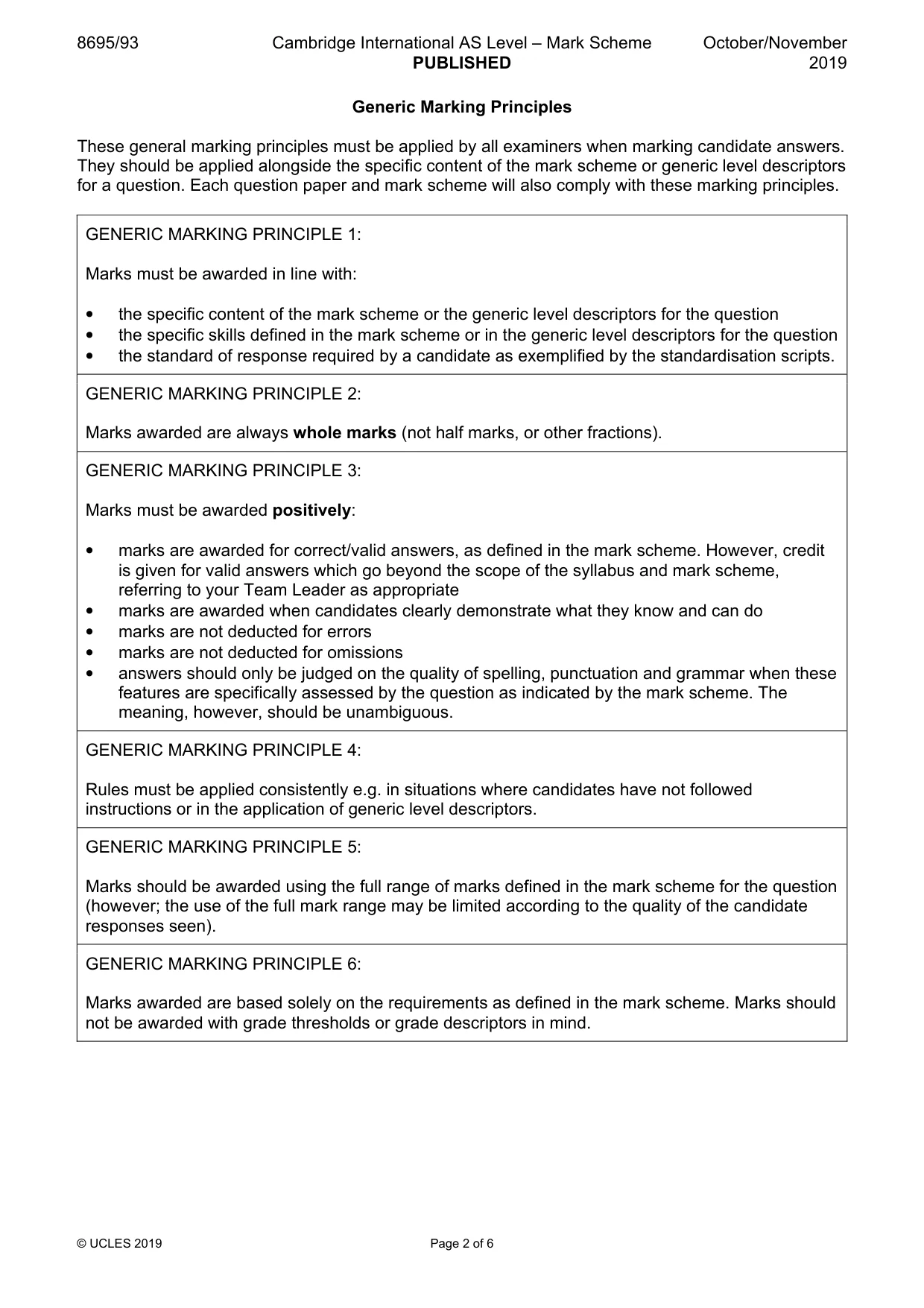
8695/93 Cambridge International AS Level – Mark Scheme PUBLISHED October/November 2019 © UCLES 2019 Page 2 of 6 Generic Marking Principles These general marking principles must be applied by all examiners when marking candidate answers. They should be applied alongside the specific content of the mark scheme or generic level descriptors for a question. Each question paper and mark scheme will also comply with these marking principles. GENERIC MARKING PRINCIPLE 1: Marks must be awarded in line with: • the specific content of the mark scheme or the generic level descriptors for the question • the specific skills defined in the mark scheme or in the generic level descriptors for the question • the standard of response required by a candidate as exemplified by the standardisation scripts. GENERIC MARKING PRINCIPLE 2: Marks awarded are always whole marks (not half marks, or other fractions). GENERIC MARKING PRINCIPLE 3: Marks must be awarded positively: • marks are awarded for correct/valid answers, as defined in the mark scheme. However, credit is given for valid answers which go beyond the scope of the syllabus and mark scheme, referring to your Team Leader as appropriate • marks are awarded when candidates clearly demonstrate what they know and can do • marks are not deducted for errors • marks are not deducted for omissions • answers should only be judged on the quality of spelling, punctuation and grammar when these features are specifically assessed by the question as indicated by the mark scheme. The meaning, however, should be unambiguous. GENERIC MARKING PRINCIPLE 4: Rules must be applied consistently e.g. in situations where candidates have not followed instructions or in the application of generic level descriptors. GENERIC MARKING PRINCIPLE 5: Marks should be awarded using the full range of marks defined in the mark scheme for the question (however; the use of the full mark range may be limited according to the quality of the candidate responses seen). GENERIC MARKING PRINCIPLE 6: Marks awarded are based solely on the requirements as defined in the mark scheme. Marks should not be awarded with grade thresholds or grade descriptors in mind.
Mark scheme, page 3
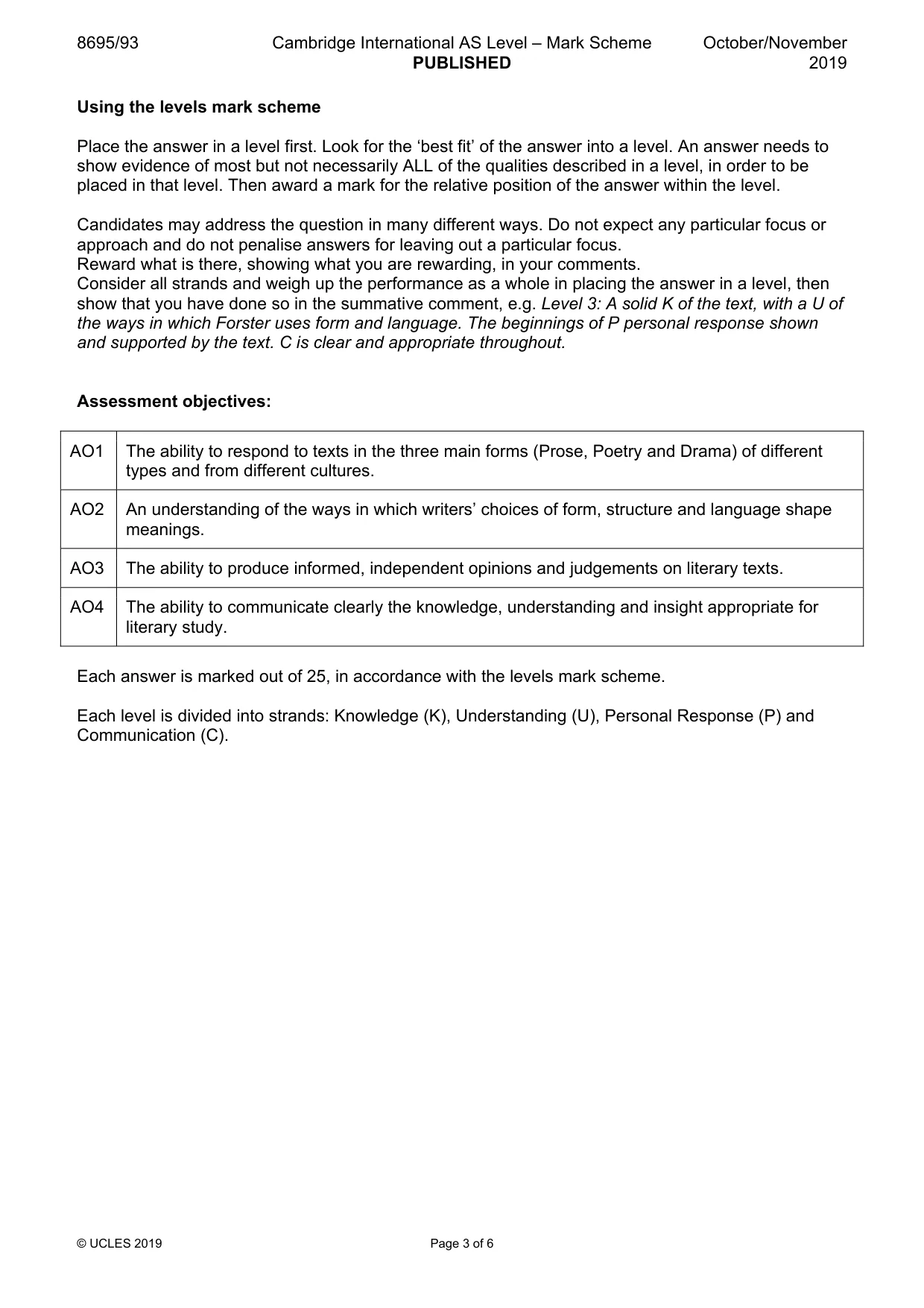
8695/93 Cambridge International AS Level – Mark Scheme PUBLISHED October/November 2019 © UCLES 2019 Page 3 of 6 Using the levels mark scheme Place the answer in a level first. Look for the ‘best fit’ of the answer into a level. An answer needs to show evidence of most but not necessarily ALL of the qualities described in a level, in order to be placed in that level. Then award a mark for the relative position of the answer within the level. Candidates may address the question in many different ways. Do not expect any particular focus or approach and do not penalise answers for leaving out a particular focus. Reward what is there, showing what you are rewarding, in your comments. Consider all strands and weigh up the performance as a whole in placing the answer in a level, then show that you have done so in the summative comment, e.g. Level 3: A solid K of the text, with a U of the ways in which Forster uses form and language. The beginnings of P personal response shown and supported by the text. C is clear and appropriate throughout. Assessment objectives: AO1 The ability to respond to texts in the three main forms (Prose, Poetry and Drama) of different types and from different cultures. AO2 An understanding of the ways in which writers’ choices of form, structure and language shape meanings. AO3 The ability to produce informed, independent opinions and judgements on literary texts. AO4 The ability to communicate clearly the knowledge, understanding and insight appropriate for literary study. Each answer is marked out of 25, in accordance with the levels mark scheme. Each level is divided into strands: Knowledge (K), Understanding (U), Personal Response (P) and Communication (C).
Mark scheme, page 4
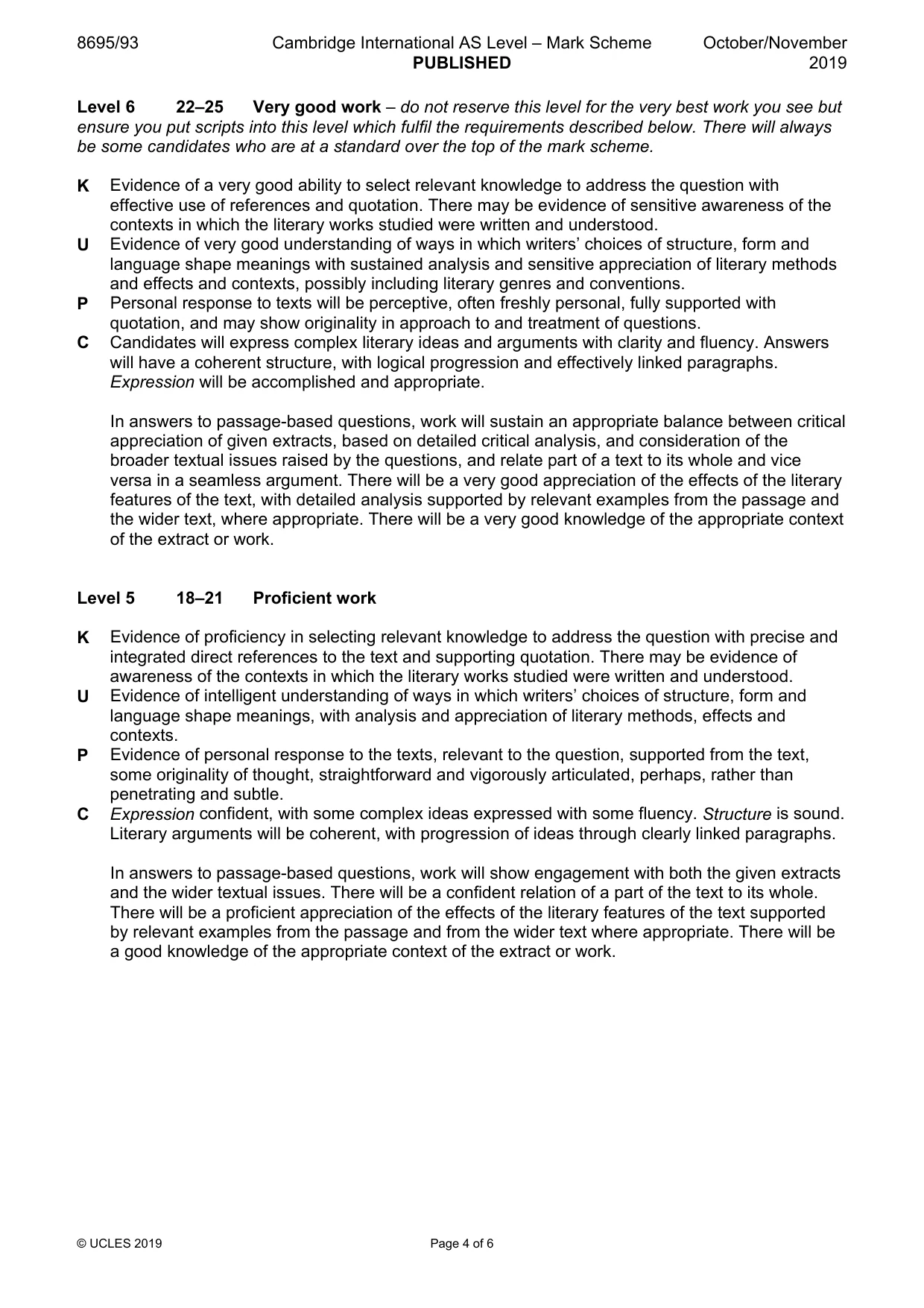
8695/93 Cambridge International AS Level – Mark Scheme PUBLISHED October/November 2019 © UCLES 2019 Page 4 of 6 Level 6 22–25 Very good work – do not reserve this level for the very best work you see but ensure you put scripts into this level which fulfil the requirements described below. There will always be some candidates who are at a standard over the top of the mark scheme. K Evidence of a very good ability to select relevant knowledge to address the question with effective use of references and quotation. There may be evidence of sensitive awareness of the contexts in which the literary works studied were written and understood. U Evidence of very good understanding of ways in which writers’ choices of structure, form and language shape meanings with sustained analysis and sensitive appreciation of literary methods and effects and contexts, possibly including literary genres and conventions. P Personal response to texts will be perceptive, often freshly personal, fully supported with quotation, and may show originality in approach to and treatment of questions. C Candidates will express complex literary ideas and arguments with clarity and fluency. Answers will have a coherent structure, with logical progression and effectively linked paragraphs. Expression will be accomplished and appropriate. In answers to passage-based questions, work will sustain an appropriate balance between critical appreciation of given extracts, based on detailed critical analysis, and consideration of the broader textual issues raised by the questions, and relate part of a text to its whole and vice versa in a seamless argument. There will be a very good appreciation of the effects of the literary features of the text, with detailed analysis supported by relevant examples from the passage and the wider text, where appropriate. There will be a very good knowledge of the appropriate context of the extract or work. Level 5 18–21 Proficient work K Evidence of proficiency in selecting relevant knowledge to address the question with precise and integrated direct references to the text and supporting quotation. There may be evidence of awareness of the contexts in which the literary works studied were written and understood. U Evidence of intelligent understanding of ways in which writers’ choices of structure, form and language shape meanings, with analysis and appreciation of literary methods, effects and contexts. P Evidence of personal response to the texts, relevant to the question, supported from the text, some originality of thought, straightforward and vigorously articulated, perhaps, rather than penetrating and subtle. C Expression confident, with some complex ideas expressed with some fluency. Structure is sound. Literary arguments will be coherent, with progression of ideas through clearly linked paragraphs. In answers to passage-based questions, work will show engagement with both the given extracts and the wider textual issues. There will be a confident relation of a part of the text to its whole. There will be a proficient appreciation of the effects of the literary features of the text supported by relevant examples from the passage and from the wider text where appropriate. There will be a good knowledge of the appropriate context of the extract or work.
Mark scheme, page 5
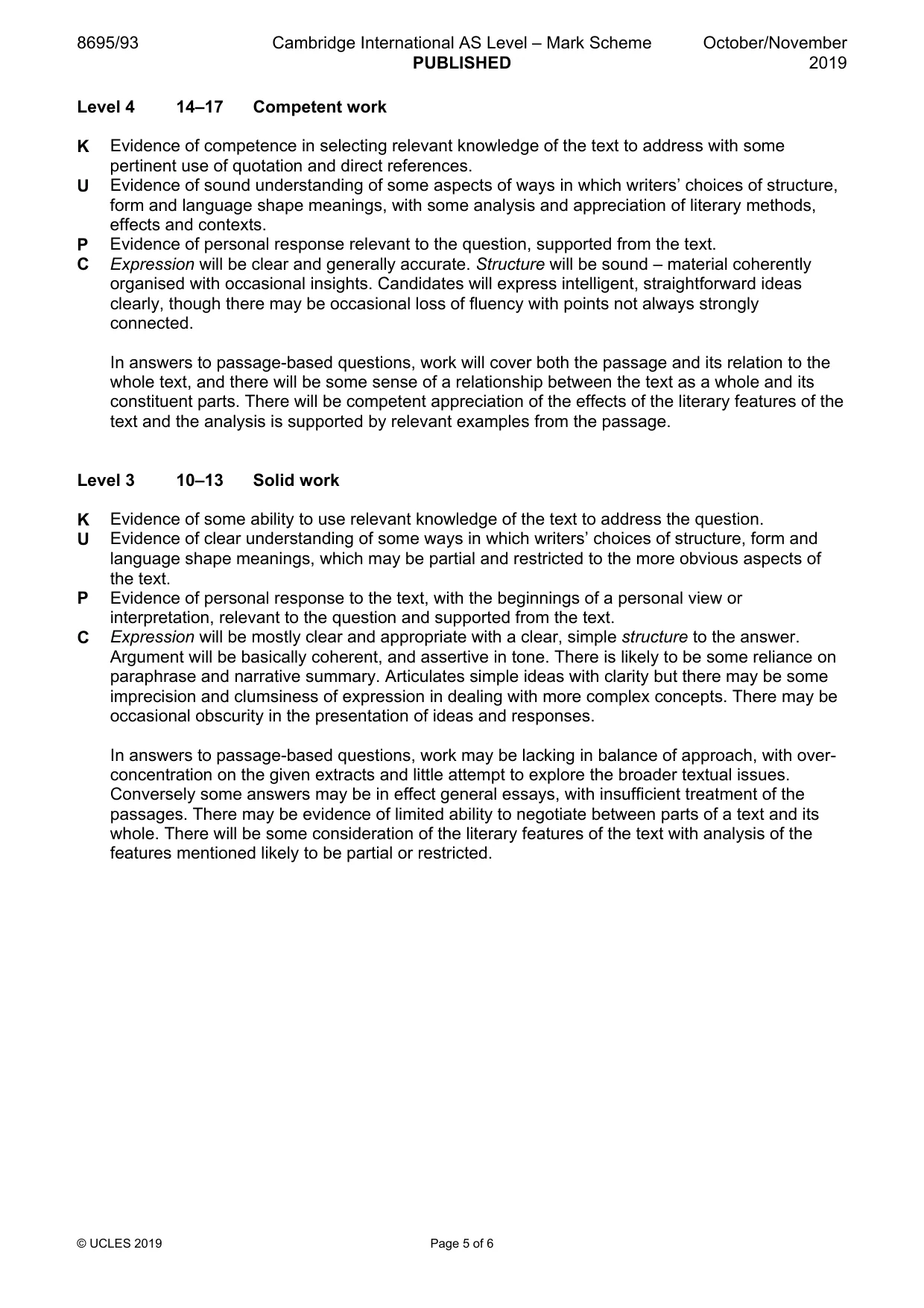
8695/93 Cambridge International AS Level – Mark Scheme PUBLISHED October/November 2019 © UCLES 2019 Page 5 of 6 Level 4 14–17 Competent work K Evidence of competence in selecting relevant knowledge of the text to address with some pertinent use of quotation and direct references. U Evidence of sound understanding of some aspects of ways in which writers’ choices of structure, form and language shape meanings, with some analysis and appreciation of literary methods, effects and contexts. P Evidence of personal response relevant to the question, supported from the text. C Expression will be clear and generally accurate. Structure will be sound – material coherently organised with occasional insights. Candidates will express intelligent, straightforward ideas clearly, though there may be occasional loss of fluency with points not always strongly connected. In answers to passage-based questions, work will cover both the passage and its relation to the whole text, and there will be some sense of a relationship between the text as a whole and its constituent parts. There will be competent appreciation of the effects of the literary features of the text and the analysis is supported by relevant examples from the passage. Level 3 10–13 Solid work K Evidence of some ability to use relevant knowledge of the text to address the question. U Evidence of clear understanding of some ways in which writers’ choices of structure, form and language shape meanings, which may be partial and restricted to the more obvious aspects of the text. P Evidence of personal response to the text, with the beginnings of a personal view or interpretation, relevant to the question and supported from the text. C Expression will be mostly clear and appropriate with a clear, simple structure to the answer. Argument will be basically coherent, and assertive in tone. There is likely to be some reliance on paraphrase and narrative summary. Articulates simple ideas with clarity but there may be some imprecision and clumsiness of expression in dealing with more complex concepts. There may be occasional obscurity in the presentation of ideas and responses. In answers to passage-based questions, work may be lacking in balance of approach, with over- concentration on the given extracts and little attempt to explore the broader textual issues. Conversely some answers may be in effect general essays, with insufficient treatment of the passages. There may be evidence of limited ability to negotiate between parts of a text and its whole. There will be some consideration of the literary features of the text with analysis of the features mentioned likely to be partial or restricted.
Mark scheme, page 6
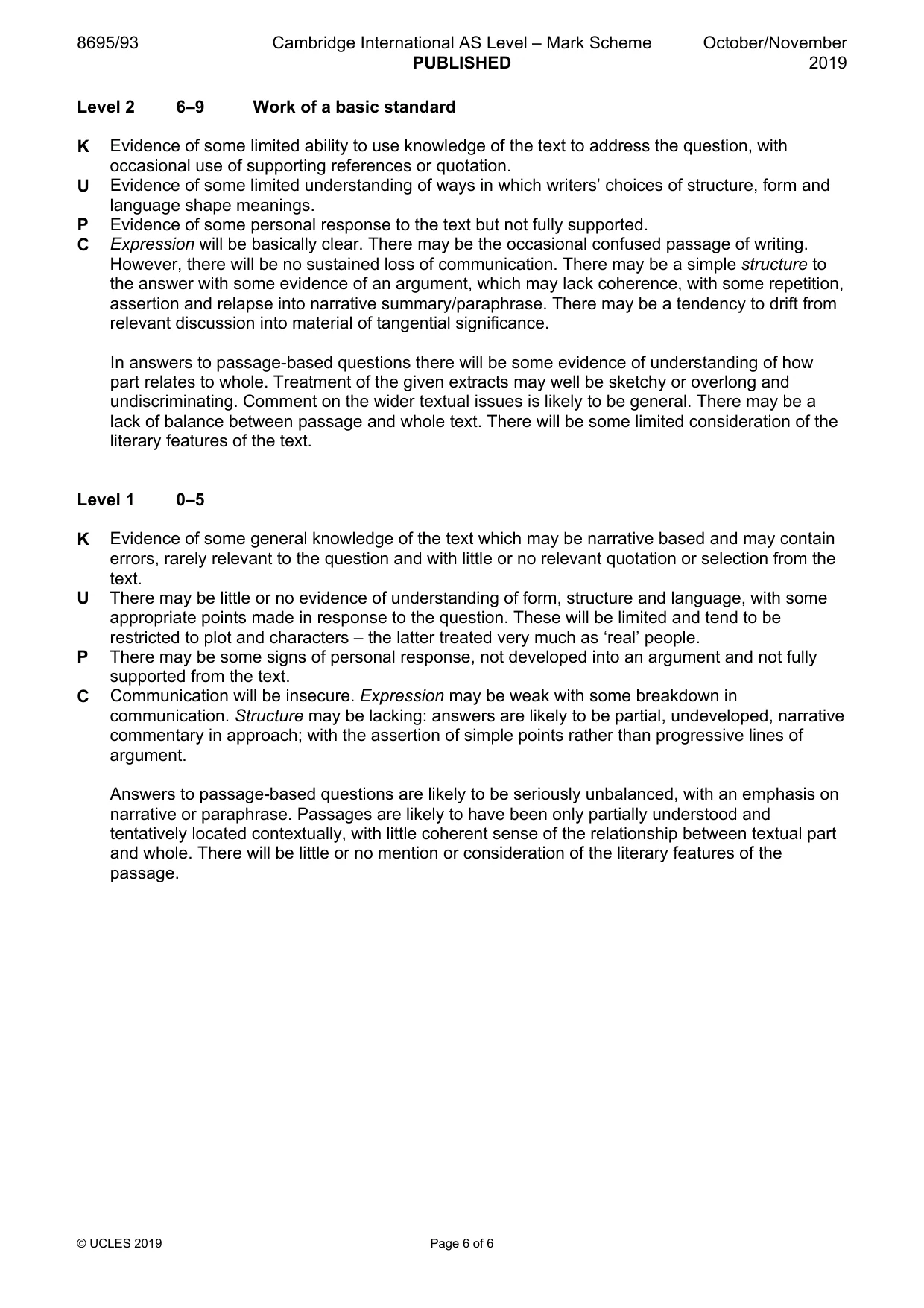
8695/93 Cambridge International AS Level – Mark Scheme PUBLISHED October/November 2019 © UCLES 2019 Page 6 of 6 Level 2 6–9 Work of a basic standard K Evidence of some limited ability to use knowledge of the text to address the question, with occasional use of supporting references or quotation. U Evidence of some limited understanding of ways in which writers’ choices of structure, form and language shape meanings. P Evidence of some personal response to the text but not fully supported. C Expression will be basically clear. There may be the occasional confused passage of writing. However, there will be no sustained loss of communication. There may be a simple structure to the answer with some evidence of an argument, which may lack coherence, with some repetition, assertion and relapse into narrative summary/paraphrase. There may be a tendency to drift from relevant discussion into material of tangential significance. In answers to passage-based questions there will be some evidence of understanding of how part relates to whole. Treatment of the given extracts may well be sketchy or overlong and undiscriminating. Comment on the wider textual issues is likely to be general. There may be a lack of balance between passage and whole text. There will be some limited consideration of the literary features of the text. Level 1 0–5 K Evidence of some general knowledge of the text which may be narrative based and may contain errors, rarely relevant to the question and with little or no relevant quotation or selection from the text. U There may be little or no evidence of understanding of form, structure and language, with some appropriate points made in response to the question. These will be limited and tend to be restricted to plot and characters – the latter treated very much as ‘real’ people. P There may be some signs of personal response, not developed into an argument and not fully supported from the text. C Communication will be insecure. Expression may be weak with some breakdown in communication. Structure may be lacking: answers are likely to be partial, undeveloped, narrative commentary in approach; with the assertion of simple points rather than progressive lines of argument. Answers to passage-based questions are likely to be seriously unbalanced, with an emphasis on narrative or paraphrase. Passages are likely to have been only partially understood and tentatively located contextually, with little coherent sense of the relationship between textual part and whole. There will be little or no mention or consideration of the literary features of the passage.
What you needed in this session
Cambridge’s own grade thresholds for 2019 Oct/Nov, Paper 9 · Variant 3. A higher threshold means an easier paper — the bar moves with how the cohort did.