Cambridge A Level English - Language and Literature (AS Level only, from 2016) 8695 — 2017 May/June Paper 9 · Variant 3
8695/93/M/J/17 · 50 marks · ≈56 min
The question paper and its mark scheme, free to read here and free to download. This is Cambridge’s own paper, exactly as it was sat.
Question paper20 pages






Mark scheme5 pages
Answers below. Sit the paper first if you are practising.
Paper as text
Question paper, page 1
This document consists of 16 printed pages, 4 blank pages and 1 insert. DC (RCL/KM) 128638/4 © UCLES 2017 [Turn over Cambridge International Examinations Cambridge International Advanced Subsidiary Level * 1 1 9 9 4 7 0 1 9 5 * LANGUAGE AND LITERATURE IN ENGLISH 8695/93 Paper 9 Poetry, Prose and Drama May/June 2017 2 hours No Additional Materials are required. READ THESE INSTRUCTIONS FIRST An answer booklet is provided inside this question paper. You should follow the instructions on the front cover of the answer booklet. If you need additional answer paper ask the invigilator for a continuation booklet. Answer two questions, each from a different section. You are reminded of the need for good English and clear presentation in your answers. All questions in this paper carry equal marks.
Question paper, page 2
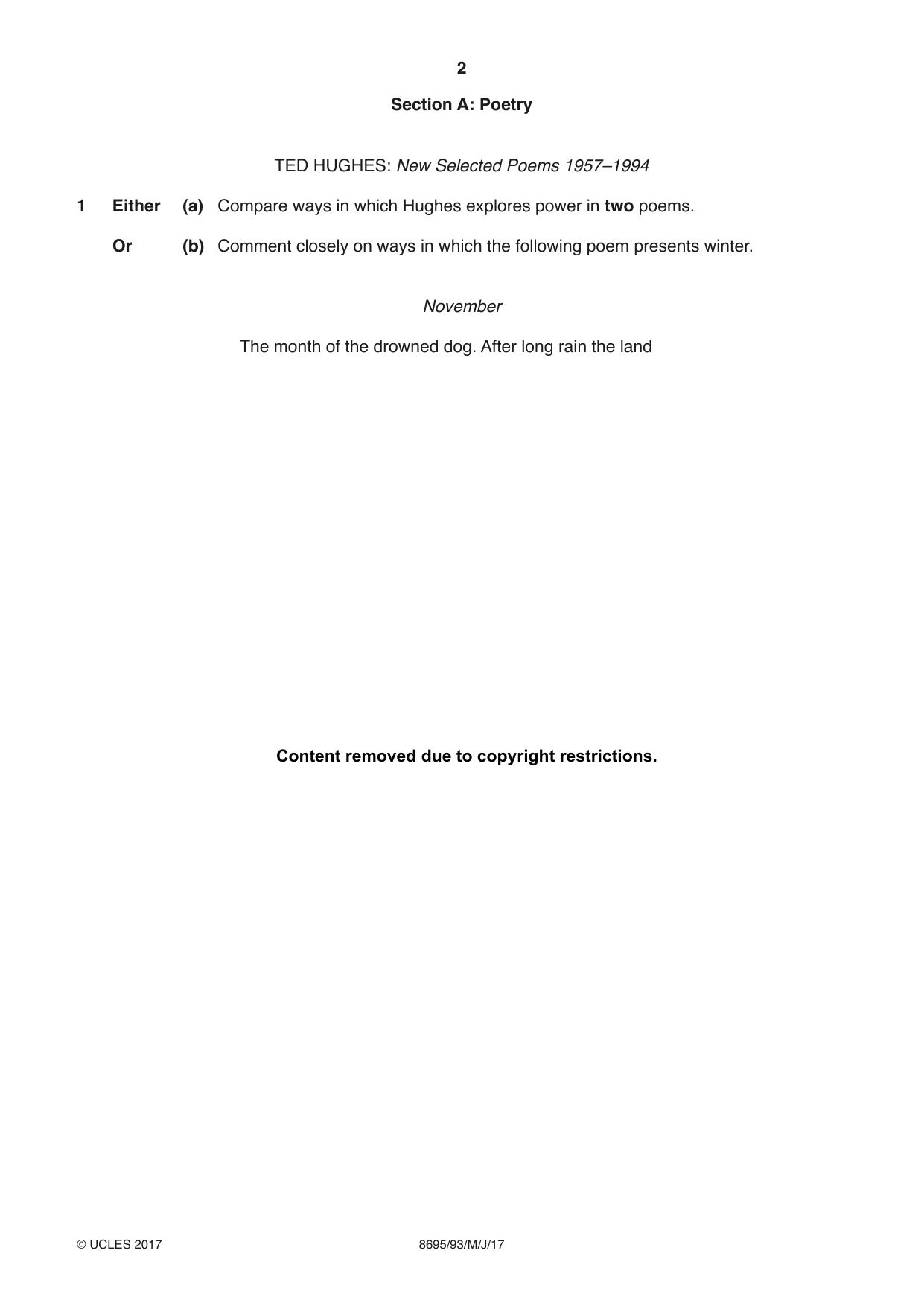
2 8695/93/M/J/17 © UCLES 2017 Section A: Poetry TED HUGHES: New Selected Poems 1957–1994 1 Either (a) Compare ways in which Hughes explores power in two poems. Or (b) Comment closely on ways in which the following poem presents winter. November The month of the drowned dog. After long rain the land Content removed due to copyright restrictions.
Question paper, page 3
3 8695/93/M/J/17 © UCLES 2017 [Turn over Their crowns bare and dripped from their feet. Content removed due to copyright restrictions.
Question paper, page 4
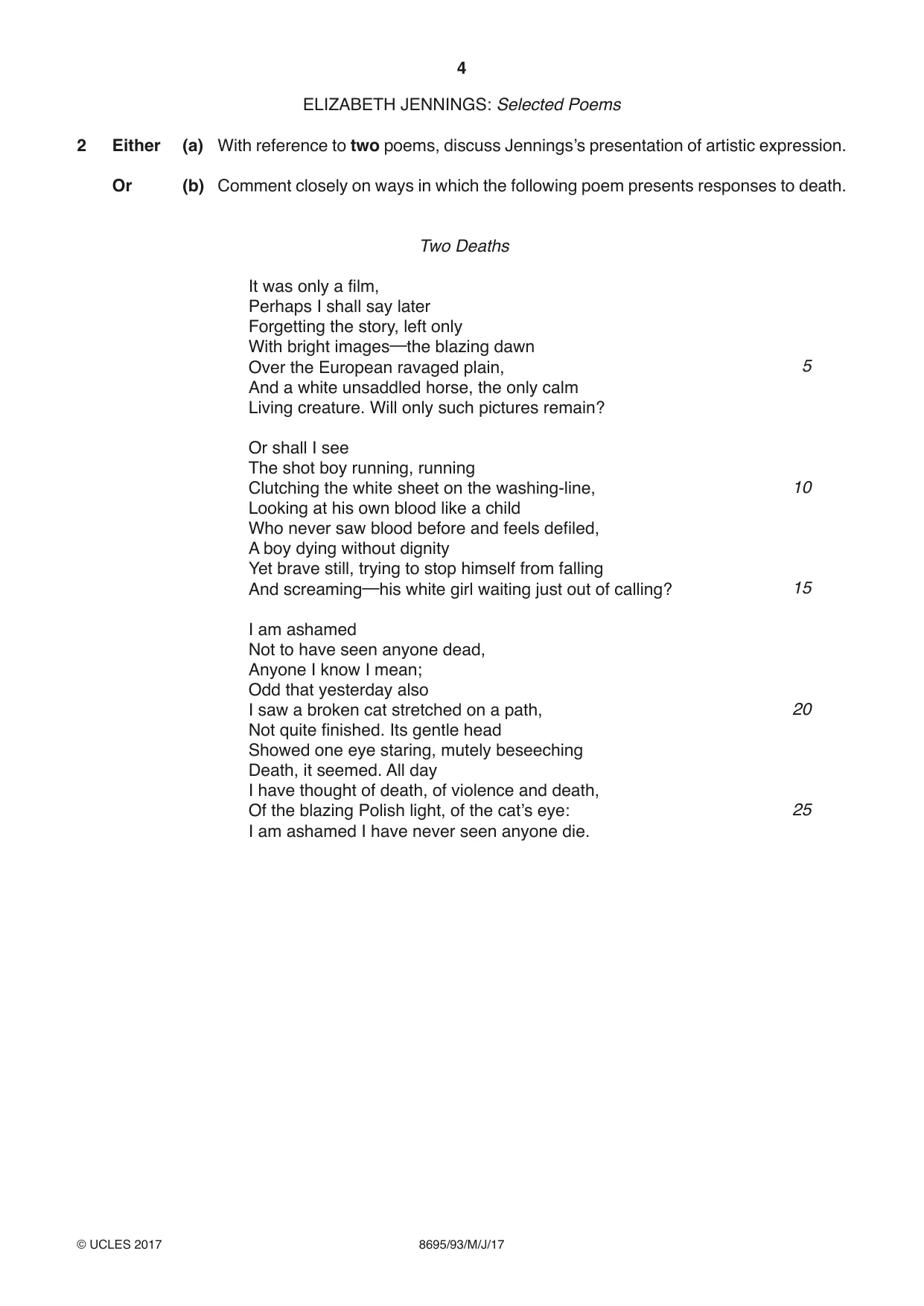
4 8695/93/M/J/17 © UCLES 2017 ELIZABETH JENNINGS: Selected Poems 2 Either (a) With reference to two poems, discuss Jennings’s presentation of artistic expression. Or (b) Comment closely on ways in which the following poem presents responses to death. Two Deaths It was only a film, Perhaps I shall say later Forgetting the story, left only With bright images─the blazing dawn Over the European ravaged plain, And a white unsaddled horse, the only calm Living creature. Will only such pictures remain? Or shall I see The shot boy running, running Clutching the white sheet on the washing-line, Looking at his own blood like a child Who never saw blood before and feels defiled, A boy dying without dignity Yet brave still, trying to stop himself from falling And screaming─his white girl waiting just out of calling? I am ashamed Not to have seen anyone dead, Anyone I know I mean; Odd that yesterday also I saw a broken cat stretched on a path, Not quite finished. Its gentle head Showed one eye staring, mutely beseeching Death, it seemed. All day I have thought of death, of violence and death, Of the blazing Polish light, of the cat’s eye: I am ashamed I have never seen anyone die. 5 10 15 20 25
Question paper, page 5
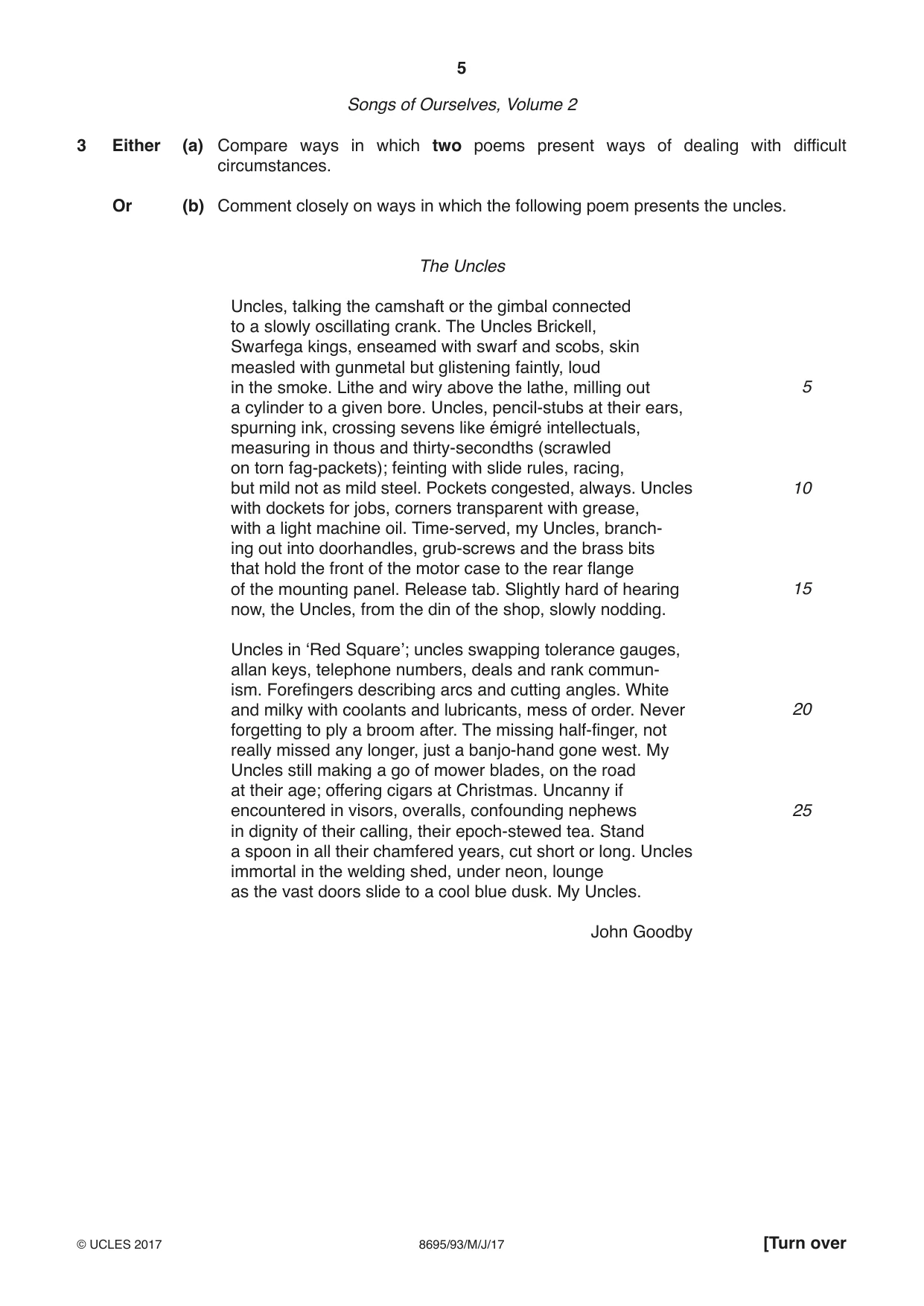
5 8695/93/M/J/17 © UCLES 2017 [Turn over Songs of Ourselves, Volume 2 3 Either (a) Compare ways in which two poems present ways of dealing with difficult circumstances. Or (b) Comment closely on ways in which the following poem presents the uncles. The Uncles Uncles, talking the camshaft or the gimbal connected to a slowly oscillating crank. The Uncles Brickell, Swarfega kings, enseamed with swarf and scobs, skin measled with gunmetal but glistening faintly, loud in the smoke. Lithe and wiry above the lathe, milling out a cylinder to a given bore. Uncles, pencil-stubs at their ears, spurning ink, crossing sevens like émigré intellectuals, measuring in thous and thirty-secondths (scrawled on torn fag-packets); feinting with slide rules, racing, but mild not as mild steel. Pockets congested, always. Uncles with dockets for jobs, corners transparent with grease, with a light machine oil. Time-served, my Uncles, branch- ing out into doorhandles, grub-screws and the brass bits that hold the front of the motor case to the rear flange of the mounting panel. Release tab. Slightly hard of hearing now, the Uncles, from the din of the shop, slowly nodding. Uncles in ‘Red Square’; uncles swapping tolerance gauges, allan keys, telephone numbers, deals and rank commun- ism. Forefingers describing arcs and cutting angles. White and milky with coolants and lubricants, mess of order. Never forgetting to ply a broom after. The missing half-finger, not really missed any longer, just a banjo-hand gone west. My Uncles still making a go of mower blades, on the road at their age; offering cigars at Christmas. Uncanny if encountered in visors, overalls, confounding nephews in dignity of their calling, their epoch-stewed tea. Stand a spoon in all their chamfered years, cut short or long. Uncles immortal in the welding shed, under neon, lounge as the vast doors slide to a cool blue dusk. My Uncles. John Goodby 5 10 15 20 25
Question paper, page 6
6 8695/93/M/J/17 © UCLES 2017 BLANK PAGE
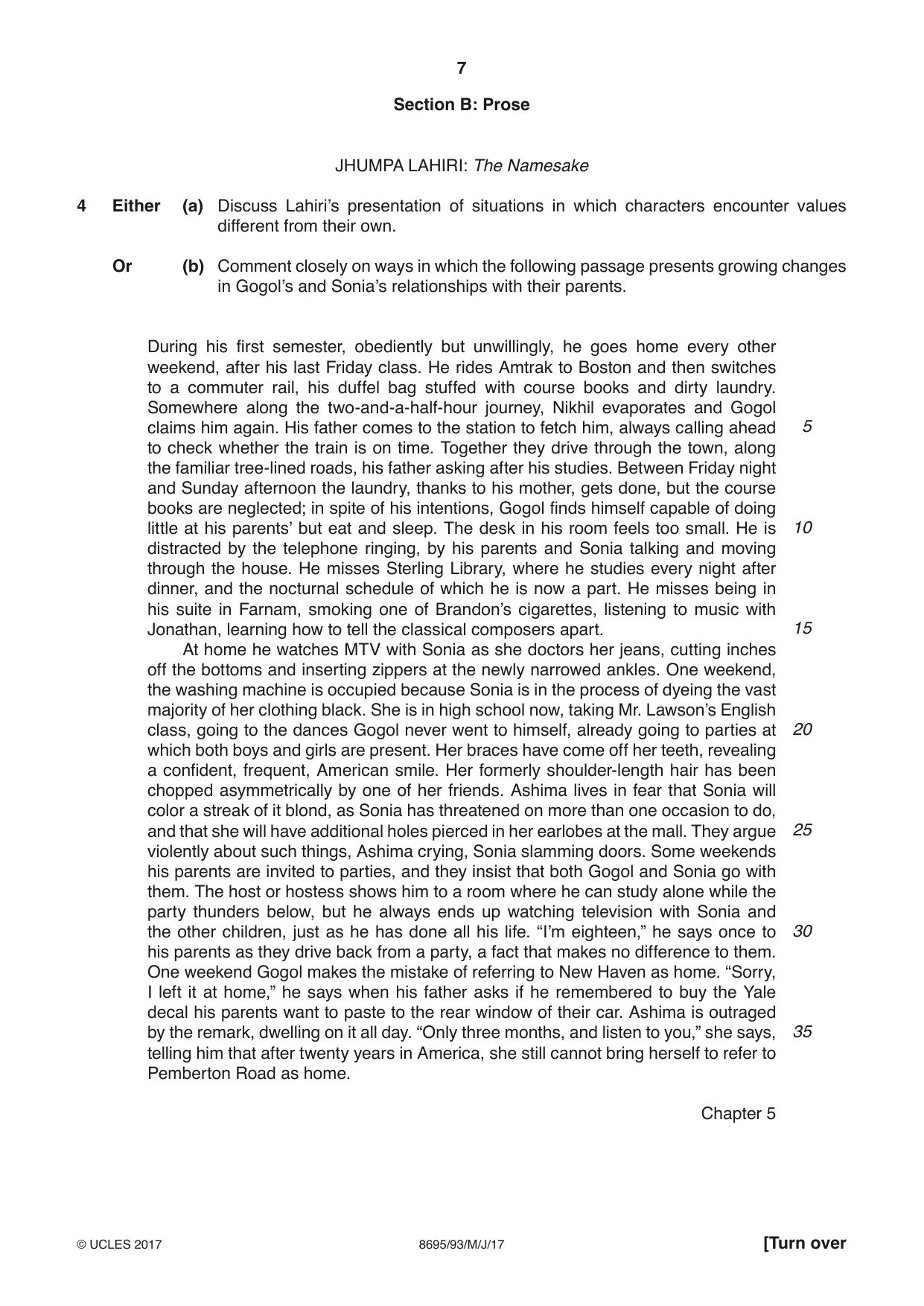
Question paper, page 7
7 8695/93/M/J/17 © UCLES 2017 [Turn over Section B: Prose JHUMPA LAHIRI: The Namesake 4 Either (a) Discuss Lahiri’s presentation of situations in which characters encounter values different from their own. Or (b) Comment closely on ways in which the following passage presents growing changes in Gogol’s and Sonia’s relationships with their parents. During his first semester, obediently but unwillingly, he goes home every other weekend, after his last Friday class. He rides Amtrak to Boston and then switches to a commuter rail, his duffel bag stuffed with course books and dirty laundry. Somewhere along the two-and-a-half-hour journey, Nikhil evaporates and Gogol claims him again. His father comes to the station to fetch him, always calling ahead to check whether the train is on time. Together they drive through the town, along the familiar tree-lined roads, his father asking after his studies. Between Friday night and Sunday afternoon the laundry, thanks to his mother, gets done, but the course books are neglected; in spite of his intentions, Gogol finds himself capable of doing little at his parents’ but eat and sleep. The desk in his room feels too small. He is distracted by the telephone ringing, by his parents and Sonia talking and moving through the house. He misses Sterling Library, where he studies every night after dinner, and the nocturnal schedule of which he is now a part. He misses being in his suite in Farnam, smoking one of Brandon’s cigarettes, listening to music with Jonathan, learning how to tell the classical composers apart. At home he watches MTV with Sonia as she doctors her jeans, cutting inches off the bottoms and inserting zippers at the newly narrowed ankles. One weekend, the washing machine is occupied because Sonia is in the process of dyeing the vast majority of her clothing black. She is in high school now, taking Mr. Lawson’s English class, going to the dances Gogol never went to himself, already going to parties at which both boys and girls are present. Her braces have come off her teeth, revealing a confident, frequent, American smile. Her formerly shoulder-length hair has been chopped asymmetrically by one of her friends. Ashima lives in fear that Sonia will color a streak of it blond, as Sonia has threatened on more than one occasion to do, and that she will have additional holes pierced in her earlobes at the mall. They argue violently about such things, Ashima crying, Sonia slamming doors. Some weekends his parents are invited to parties, and they insist that both Gogol and Sonia go with them. The host or hostess shows him to a room where he can study alone while the party thunders below, but he always ends up watching television with Sonia and the other children, just as he has done all his life. “I’m eighteen,” he says once to his parents as they drive back from a party, a fact that makes no difference to them. One weekend Gogol makes the mistake of referring to New Haven as home. “Sorry, I left it at home,” he says when his father asks if he remembered to buy the Yale decal his parents want to paste to the rear window of their car. Ashima is outraged by the remark, dwelling on it all day. “Only three months, and listen to you,” she says, telling him that after twenty years in America, she still cannot bring herself to refer to Pemberton Road as home. Chapter 5 5 10 15 20 25 30 35
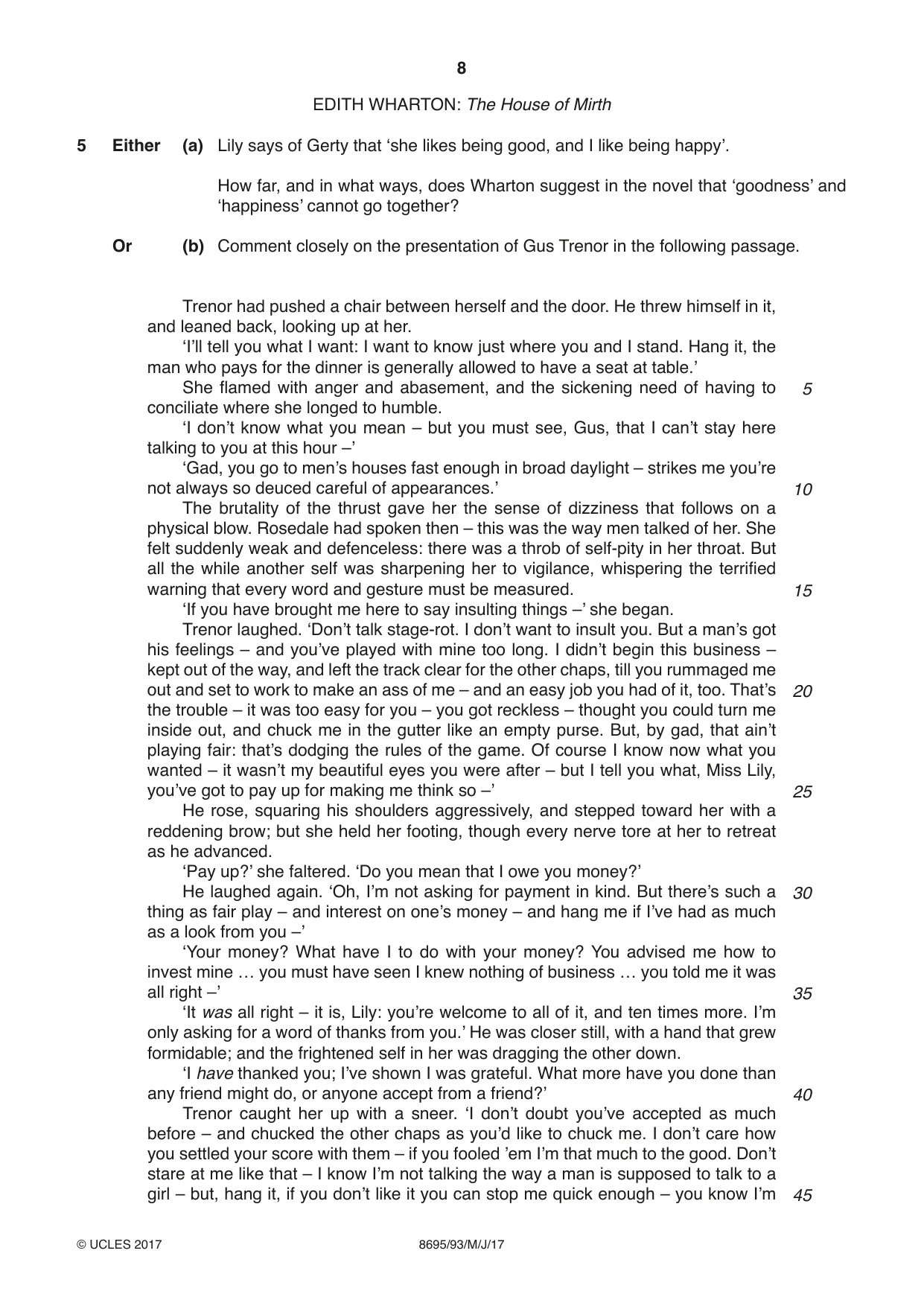
Question paper, page 8
8 8695/93/M/J/17 © UCLES 2017 EDITH WHARTON: The House of Mirth 5 Either (a) Lily says of Gerty that ‘she likes being good, and I like being happy’. How far, and in what ways, does Wharton suggest in the novel that ‘goodness’ and ‘happiness’ cannot go together? Or (b) Comment closely on the presentation of Gus Trenor in the following passage. Trenor had pushed a chair between herself and the door. He threw himself in it, and leaned back, looking up at her. ‘I’ll tell you what I want: I want to know just where you and I stand. Hang it, the man who pays for the dinner is generally allowed to have a seat at table.’ She flamed with anger and abasement, and the sickening need of having to conciliate where she longed to humble. ‘I don’t know what you mean – but you must see, Gus, that I can’t stay here talking to you at this hour –’ ‘Gad, you go to men’s houses fast enough in broad daylight – strikes me you’re not always so deuced careful of appearances.’ The brutality of the thrust gave her the sense of dizziness that follows on a physical blow. Rosedale had spoken then – this was the way men talked of her. She felt suddenly weak and defenceless: there was a throb of self-pity in her throat. But all the while another self was sharpening her to vigilance, whispering the terrified warning that every word and gesture must be measured. ‘If you have brought me here to say insulting things –’ she began. Trenor laughed. ‘Don’t talk stage-rot. I don’t want to insult you. But a man’s got his feelings – and you’ve played with mine too long. I didn’t begin this business – kept out of the way, and left the track clear for the other chaps, till you rummaged me out and set to work to make an ass of me – and an easy job you had of it, too. That’s the trouble – it was too easy for you – you got reckless – thought you could turn me inside out, and chuck me in the gutter like an empty purse. But, by gad, that ain’t playing fair: that’s dodging the rules of the game. Of course I know now what you wanted – it wasn’t my beautiful eyes you were after – but I tell you what, Miss Lily, you’ve got to pay up for making me think so –’ He rose, squaring his shoulders aggressively, and stepped toward her with a reddening brow; but she held her footing, though every nerve tore at her to retreat as he advanced. ‘Pay up?’ she faltered. ‘Do you mean that I owe you money?’ He laughed again. ‘Oh, I’m not asking for payment in kind. But there’s such a thing as fair play – and interest on one’s money – and hang me if I’ve had as much as a look from you –’ ‘Your money? What have I to do with your money? You advised me how to invest mine … you must have seen I knew nothing of business … you told me it was all right –’ ‘It was all right – it is, Lily: you’re welcome to all of it, and ten times more. I’m only asking for a word of thanks from you.’ He was closer still, with a hand that grew formidable; and the frightened self in her was dragging the other down. ‘I have thanked you; I’ve shown I was grateful. What more have you done than any friend might do, or anyone accept from a friend?’ Trenor caught her up with a sneer. ‘I don’t doubt you’ve accepted as much before – and chucked the other chaps as you’d like to chuck me. I don’t care how you settled your score with them – if you fooled ’em I’m that much to the good. Don’t stare at me like that – I know I’m not talking the way a man is supposed to talk to a girl – but, hang it, if you don’t like it you can stop me quick enough – you know I’m 5 10 15 20 25 30 35 40 45
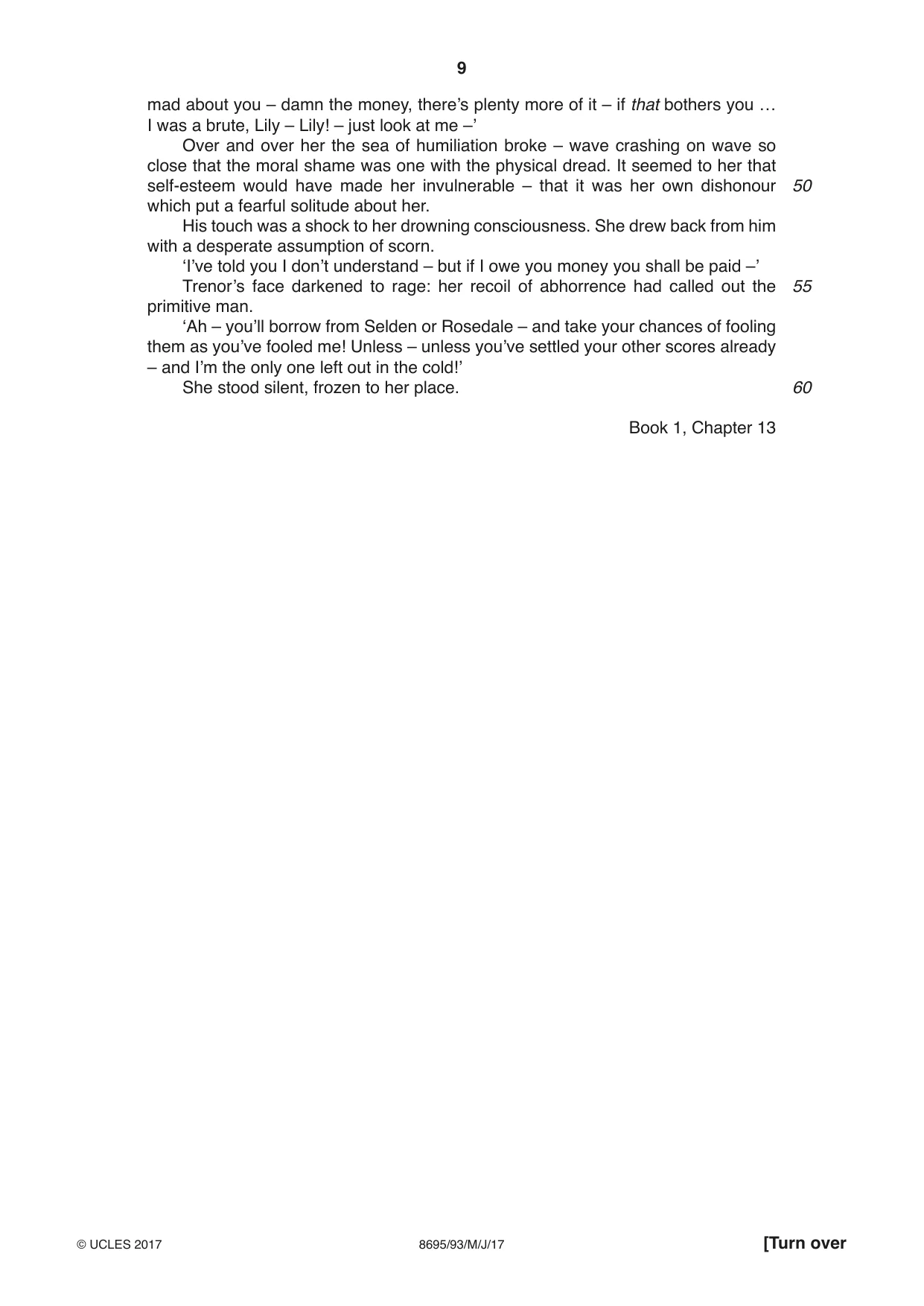
Question paper, page 9
9 8695/93/M/J/17 © UCLES 2017 [Turn over mad about you – damn the money, there’s plenty more of it – if that bothers you … I was a brute, Lily – Lily! – just look at me –’ Over and over her the sea of humiliation broke – wave crashing on wave so close that the moral shame was one with the physical dread. It seemed to her that self-esteem would have made her invulnerable – that it was her own dishonour which put a fearful solitude about her. His touch was a shock to her drowning consciousness. She drew back from him with a desperate assumption of scorn. ‘I’ve told you I don’t understand – but if I owe you money you shall be paid –’ Trenor’s face darkened to rage: her recoil of abhorrence had called out the primitive man. ‘Ah – you’ll borrow from Selden or Rosedale – and take your chances of fooling them as you’ve fooled me! Unless – unless you’ve settled your other scores already – and I’m the only one left out in the cold!’ She stood silent, frozen to her place. Book 1, Chapter 13 50 55 60
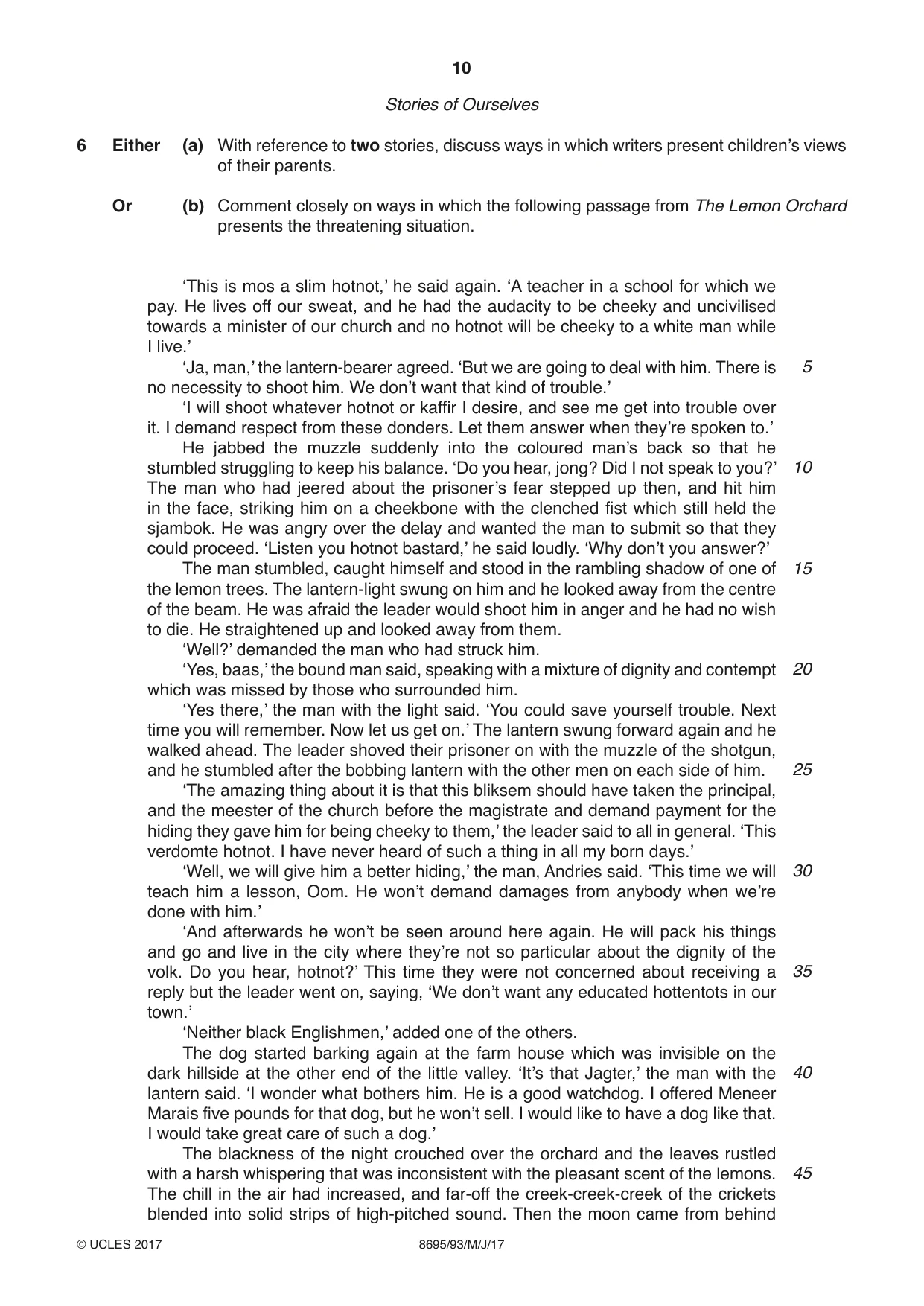
Question paper, page 10
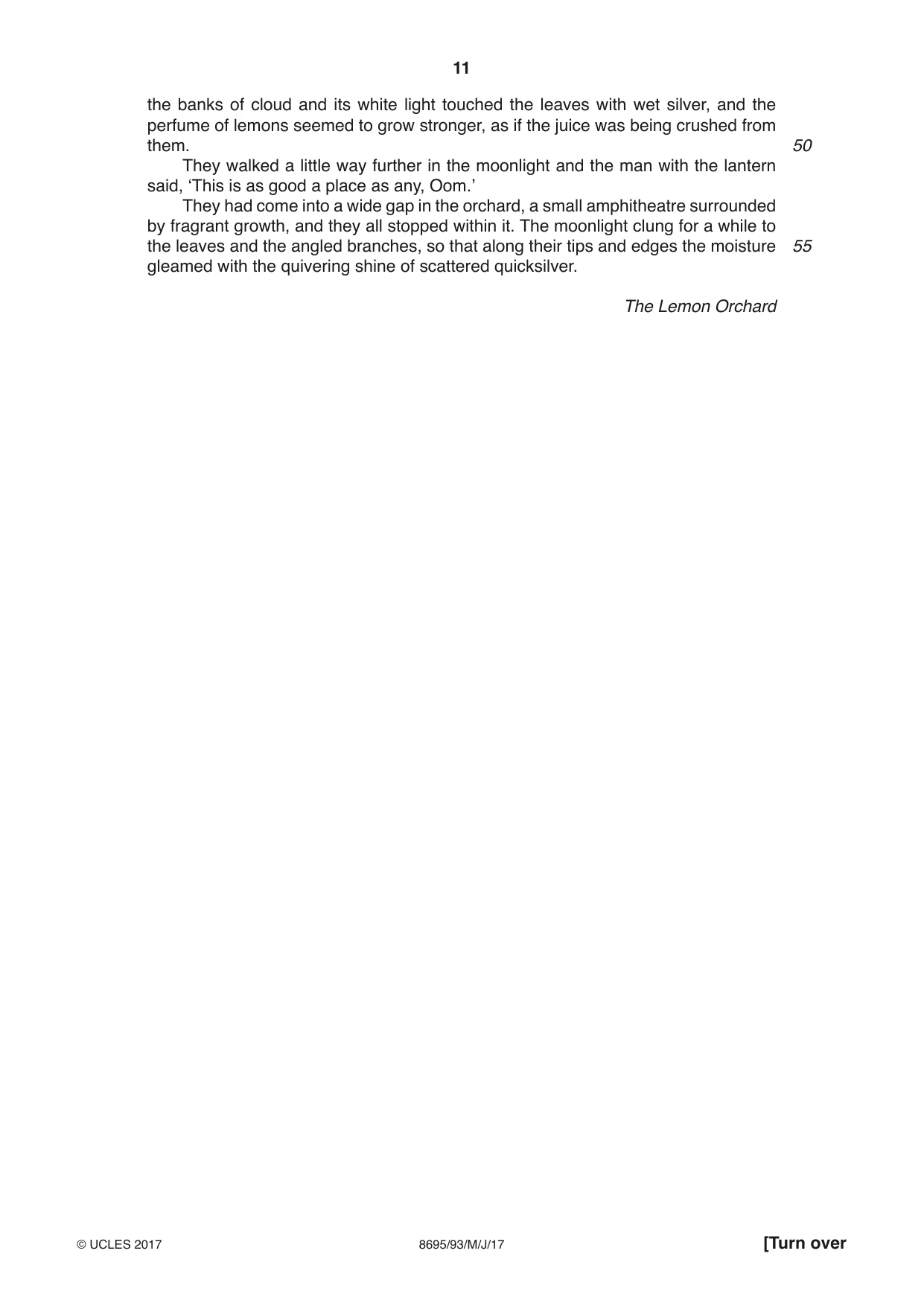
10 8695/93/M/J/17 © UCLES 2017 Stories of Ourselves 6 Either (a) With reference to two stories, discuss ways in which writers present children’s views of their parents. Or (b) Comment closely on ways in which the following passage from The Lemon Orchard presents the threatening situation. ‘This is mos a slim hotnot,’ he said again. ‘A teacher in a school for which we pay. He lives off our sweat, and he had the audacity to be cheeky and uncivilised towards a minister of our church and no hotnot will be cheeky to a white man while I live.’ ‘Ja, man,’ the lantern-bearer agreed. ‘But we are going to deal with him. There is no necessity to shoot him. We don’t want that kind of trouble.’ ‘I will shoot whatever hotnot or kaffir I desire, and see me get into trouble over it. I demand respect from these donders. Let them answer when they’re spoken to.’ He jabbed the muzzle suddenly into the coloured man’s back so that he stumbled struggling to keep his balance. ‘Do you hear, jong? Did I not speak to you?’ The man who had jeered about the prisoner’s fear stepped up then, and hit him in the face, striking him on a cheekbone with the clenched fist which still held the sjambok. He was angry over the delay and wanted the man to submit so that they could proceed. ‘Listen you hotnot bastard,’ he said loudly. ‘Why don’t you answer?’ The man stumbled, caught himself and stood in the rambling shadow of one of the lemon trees. The lantern-light swung on him and he looked away from the centre of the beam. He was afraid the leader would shoot him in anger and he had no wish to die. He straightened up and looked away from them. ‘Well?’ demanded the man who had struck him. ‘Yes, baas,’ the bound man said, speaking with a mixture of dignity and contempt which was missed by those who surrounded him. ‘Yes there,’ the man with the light said. ‘You could save yourself trouble. Next time you will remember. Now let us get on.’ The lantern swung forward again and he walked ahead. The leader shoved their prisoner on with the muzzle of the shotgun, and he stumbled after the bobbing lantern with the other men on each side of him. ‘The amazing thing about it is that this bliksem should have taken the principal, and the meester of the church before the magistrate and demand payment for the hiding they gave him for being cheeky to them,’ the leader said to all in general. ‘This verdomte hotnot. I have never heard of such a thing in all my born days.’ ‘Well, we will give him a better hiding,’ the man, Andries said. ‘This time we will teach him a lesson, Oom. He won’t demand damages from anybody when we’re done with him.’ ‘And afterwards he won’t be seen around here again. He will pack his things and go and live in the city where they’re not so particular about the dignity of the volk. Do you hear, hotnot?’ This time they were not concerned about receiving a reply but the leader went on, saying, ‘We don’t want any educated hottentots in our town.’ ‘Neither black Englishmen,’ added one of the others. The dog started barking again at the farm house which was invisible on the dark hillside at the other end of the little valley. ‘It’s that Jagter,’ the man with the lantern said. ‘I wonder what bothers him. He is a good watchdog. I offered Meneer Marais five pounds for that dog, but he won’t sell. I would like to have a dog like that. I would take great care of such a dog.’ The blackness of the night crouched over the orchard and the leaves rustled with a harsh whispering that was inconsistent with the pleasant scent of the lemons. The chill in the air had increased, and far-off the creek-creek-creek of the crickets blended into solid strips of high-pitched sound. Then the moon came from behind 5 10 15 20 25 30 35 40 45
Question paper, page 11
11 8695/93/M/J/17 © UCLES 2017 [Turn over the banks of cloud and its white light touched the leaves with wet silver, and the perfume of lemons seemed to grow stronger, as if the juice was being crushed from them. They walked a little way further in the moonlight and the man with the lantern said, ‘This is as good a place as any, Oom.’ They had come into a wide gap in the orchard, a small amphitheatre surrounded by fragrant growth, and they all stopped within it. The moonlight clung for a while to the leaves and the angled branches, so that along their tips and edges the moisture gleamed with the quivering shine of scattered quicksilver. The Lemon Orchard 50 55
Question paper, page 12
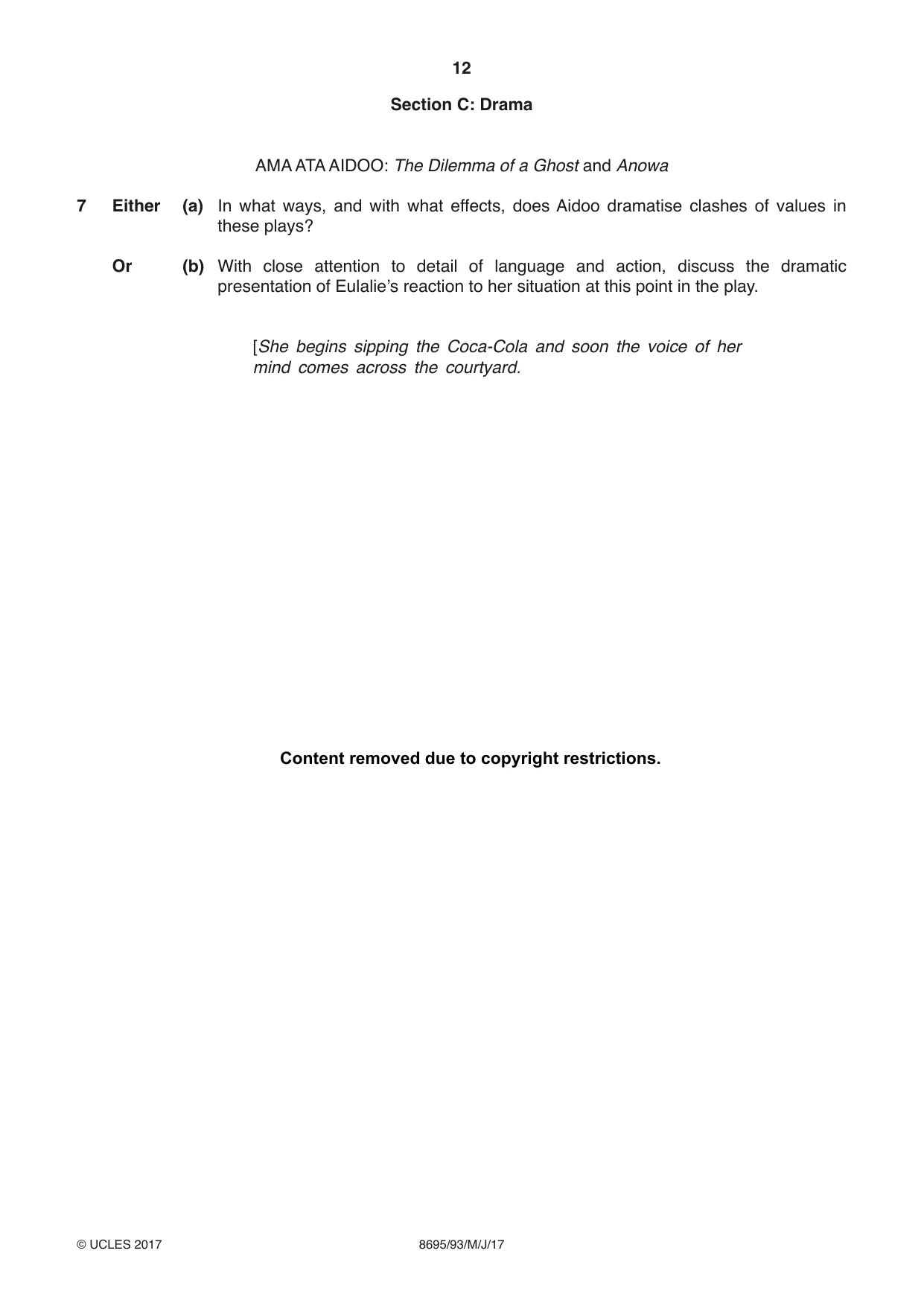
12 8695/93/M/J/17 © UCLES 2017 Section C: Drama AMA ATA AIDOO: The Dilemma of a Ghost and Anowa 7 Either (a) In what ways, and with what effects, does Aidoo dramatise clashes of values in these plays? Or (b) With close attention to detail of language and action, discuss the dramatic presentation of Eulalie’s reaction to her situation at this point in the play. [She begins sipping the Coca-Cola and soon the voice of her mind comes across the courtyard. Content removed due to copyright restrictions.
Question paper, page 13
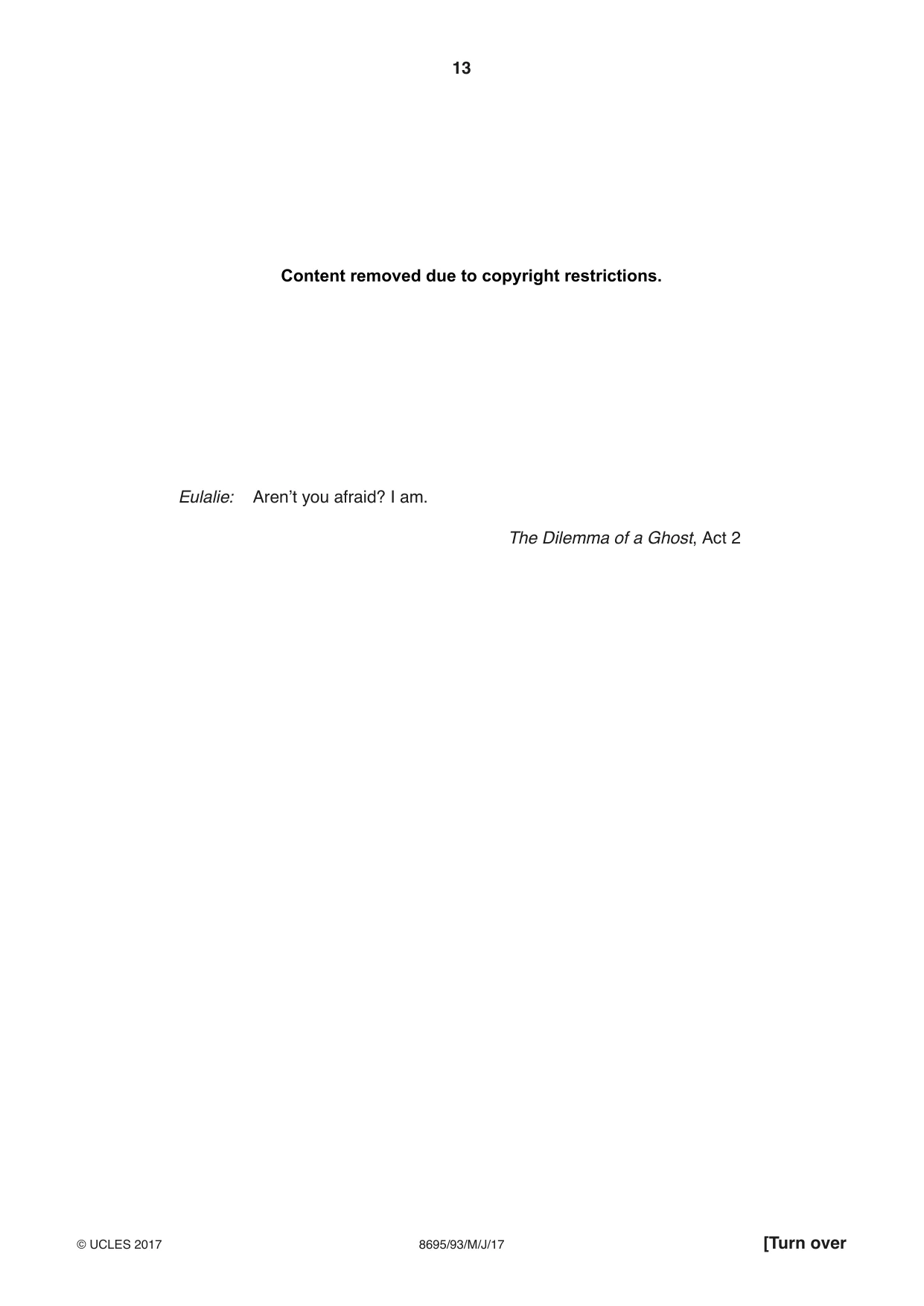
13 8695/93/M/J/17 © UCLES 2017 [Turn over Eulalie: Aren’t you afraid? I am. The Dilemma of a Ghost, Act 2 Content removed due to copyright restrictions.
Question paper, page 14
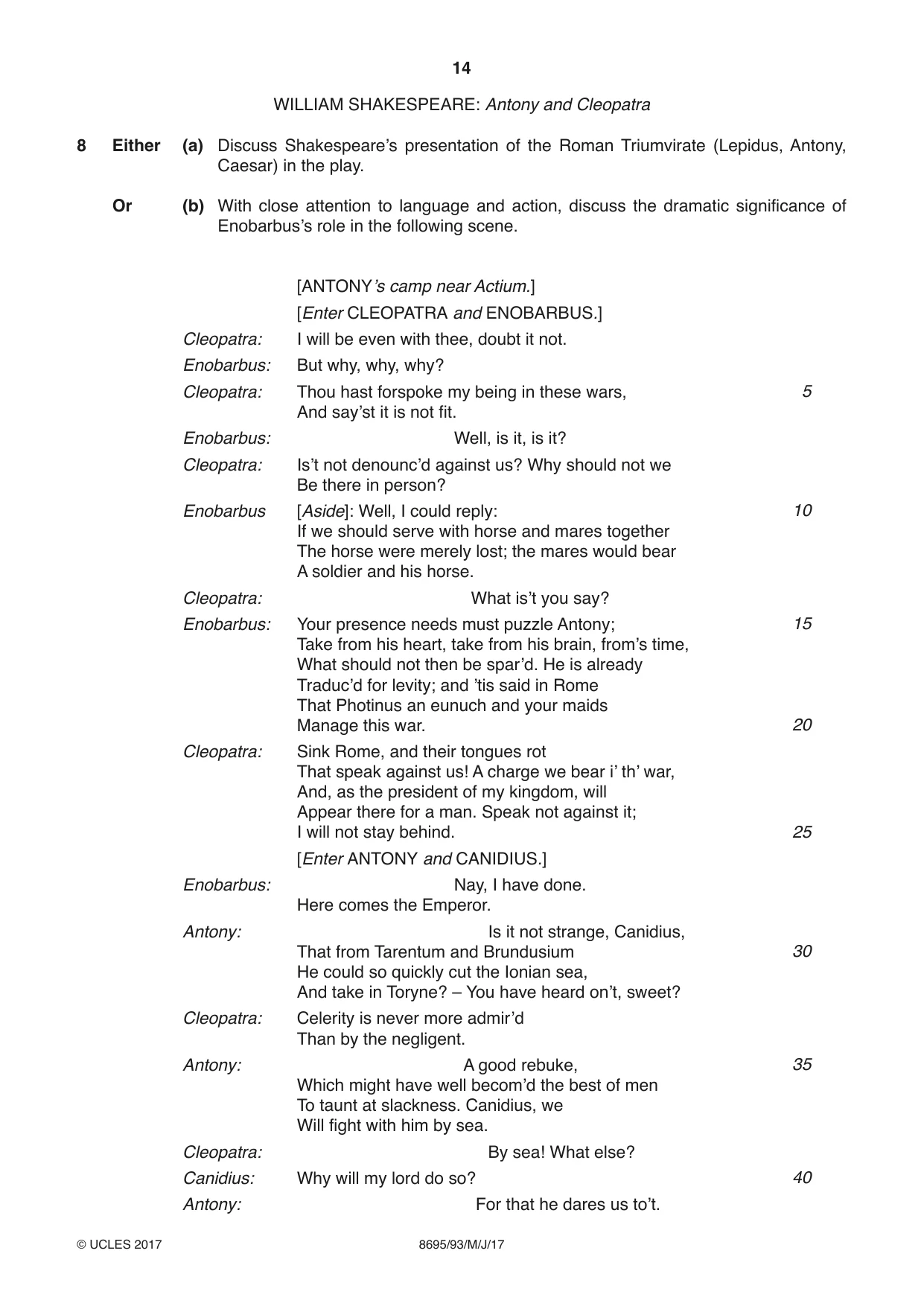
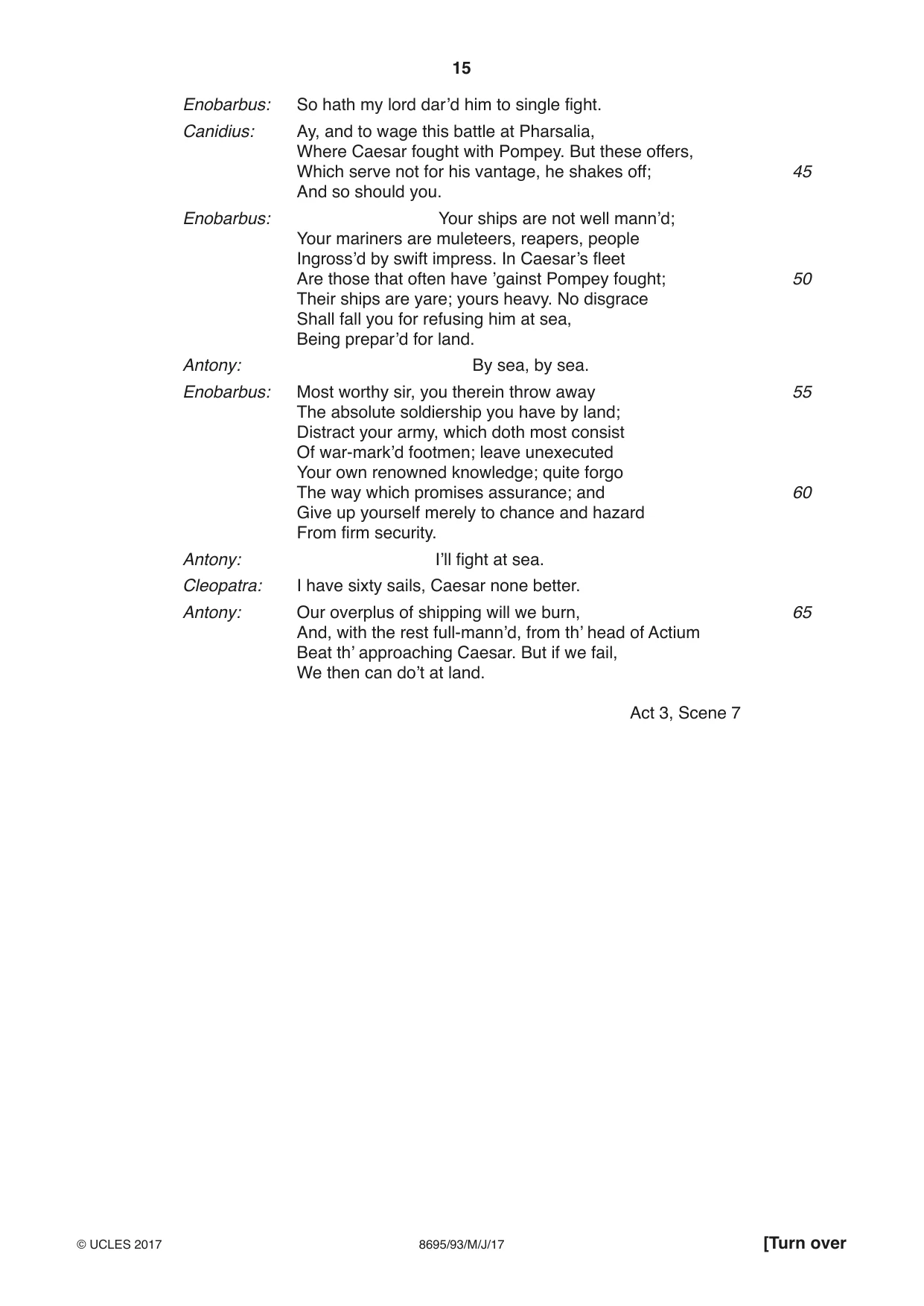
14 8695/93/M/J/17 © UCLES 2017 WILLIAM SHAKESPEARE: Antony and Cleopatra 8 Either (a) Discuss Shakespeare’s presentation of the Roman Triumvirate (Lepidus, Antony, Caesar) in the play. Or (b) With close attention to language and action, discuss the dramatic significance of Enobarbus’s role in the following scene. [ANTONY’s camp near Actium.] [Enter CLEOPATRA and ENOBARBUS.] Cleopatra: I will be even with thee, doubt it not. Enobarbus: But why, why, why? Cleopatra: Thou hast forspoke my being in these wars, And say’st it is not fit. Enobarbus: Well, is it, is it? Cleopatra: Is’t not denounc’d against us? Why should not we Be there in person? Enobarbus [Aside]: Well, I could reply: If we should serve with horse and mares together The horse were merely lost; the mares would bear A soldier and his horse. Cleopatra: What is’t you say? Enobarbus: Your presence needs must puzzle Antony; Take from his heart, take from his brain, from’s time, What should not then be spar’d. He is already Traduc’d for levity; and ’tis said in Rome That Photinus an eunuch and your maids Manage this war. Cleopatra: Sink Rome, and their tongues rot That speak against us! A charge we bear i’ th’ war, And, as the president of my kingdom, will Appear there for a man. Speak not against it; I will not stay behind. [Enter ANTONY and CANIDIUS.] Enobarbus: Nay, I have done. Here comes the Emperor. Antony: Is it not strange, Canidius, That from Tarentum and Brundusium He could so quickly cut the Ionian sea, And take in Toryne? – You have heard on’t, sweet? Cleopatra: Celerity is never more admir’d Than by the negligent. Antony: A good rebuke, Which might have well becom’d the best of men To taunt at slackness. Canidius, we Will fight with him by sea. Cleopatra: By sea! What else? Canidius: Why will my lord do so? Antony: For that he dares us to’t. 5 10 15 20 25 30 35 40
Question paper, page 15
15 8695/93/M/J/17 © UCLES 2017 [Turn over Enobarbus: So hath my lord dar’d him to single fight. Canidius: Ay, and to wage this battle at Pharsalia, Where Caesar fought with Pompey. But these offers, Which serve not for his vantage, he shakes off; And so should you. Enobarbus: Your ships are not well mann’d; Your mariners are muleteers, reapers, people Ingross’d by swift impress. In Caesar’s fleet Are those that often have ’gainst Pompey fought; Their ships are yare; yours heavy. No disgrace Shall fall you for refusing him at sea, Being prepar’d for land. Antony: By sea, by sea. Enobarbus: Most worthy sir, you therein throw away The absolute soldiership you have by land; Distract your army, which doth most consist Of war-mark’d footmen; leave unexecuted Your own renowned knowledge; quite forgo The way which promises assurance; and Give up yourself merely to chance and hazard From firm security. Antony: I’ll fight at sea. Cleopatra: I have sixty sails, Caesar none better. Antony: Our overplus of shipping will we burn, And, with the rest full-mann’d, from th’ head of Actium Beat th’ approaching Caesar. But if we fail, We then can do’t at land. Act 3, Scene 7 45 50 55 60 65
Question paper, page 16
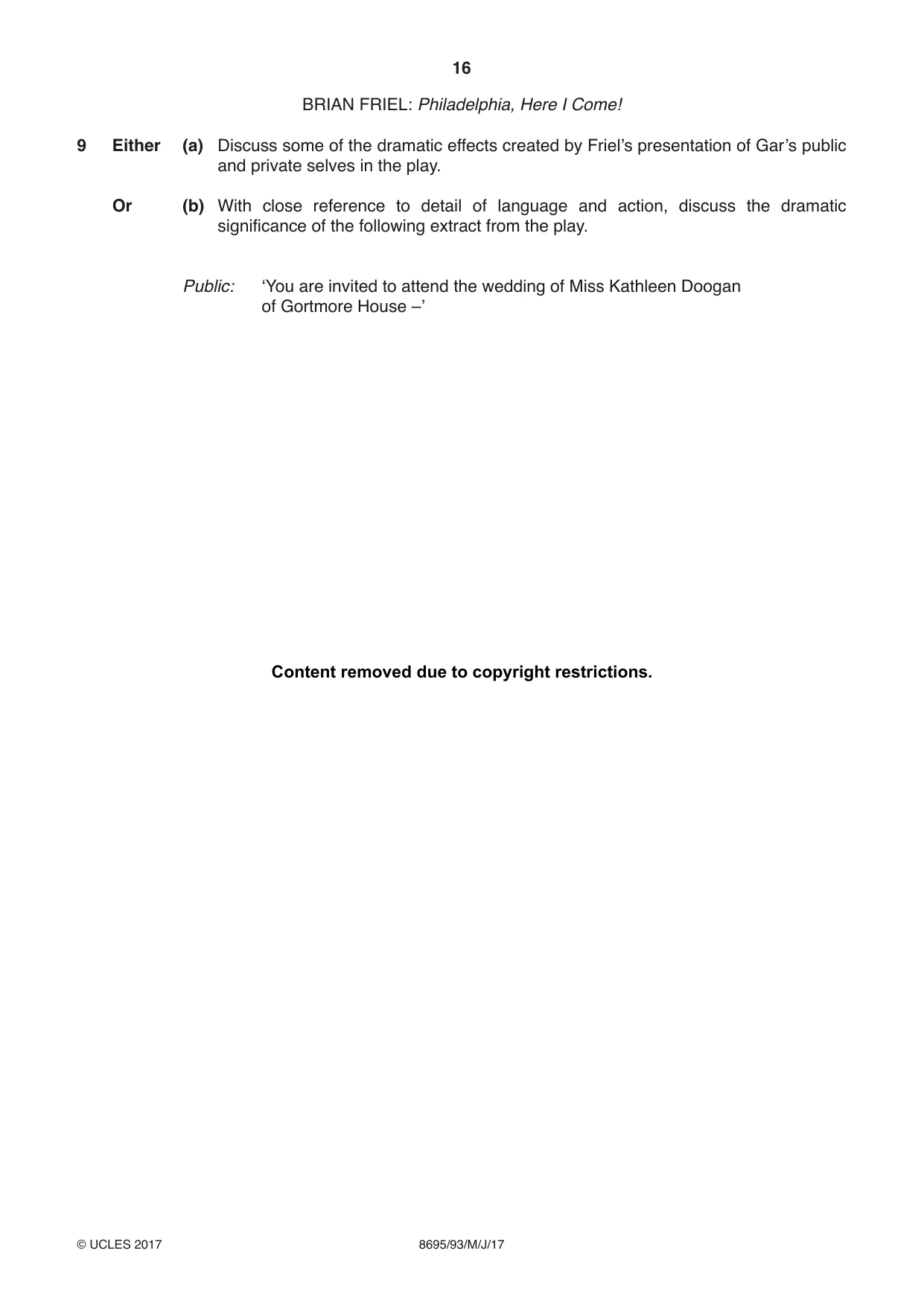
16 8695/93/M/J/17 © UCLES 2017 BRIAN FRIEL: Philadelphia, Here I Come! 9 Either (a) Discuss some of the dramatic effects created by Friel’s presentation of Gar’s public and private selves in the play. Or (b) With close reference to detail of language and action, discuss the dramatic significance of the following extract from the play. Public: ‘You are invited to attend the wedding of Miss Kathleen Doogan of Gortmore House –’ Content removed due to copyright restrictions.
Question paper, page 17
17 8695/93/M/J/17 © UCLES 2017 Con: Right. Episode 2 Content removed due to copyright restrictions.
Question paper, page 18
18 8695/93/M/J/17 © UCLES 2017 BLANK PAGE
Question paper, page 19
19 8695/93/M/J/17 © UCLES 2017 BLANK PAGE
Question paper, page 20
20 8695/93/M/J/17 © UCLES 2017 BLANK PAGE Permission to reproduce items where third-party owned material protected by copyright is included has been sought and cleared where possible. Every reasonable effort has been made by the publisher (UCLES) to trace copyright holders, but if any items requiring clearance have unwittingly been included, the publisher will be pleased to make amends at the earliest possible opportunity. To avoid the issue of disclosure of answer-related information to candidates, all copyright acknowledgements are reproduced online in the Cambridge International Examinations Copyright Acknowledgements Booklet. This is produced for each series of examinations and is freely available to download at www.cie.org.uk after the live examination series. Cambridge International Examinations is part of the Cambridge Assessment Group. Cambridge Assessment is the brand name of University of Cambridge Local Examinations Syndicate (UCLES), which is itself a department of the University of Cambridge.
Mark scheme, page 1
® IGCSE is a registered trademark. This document consists of 5 printed pages. © UCLES 2017 [Turn over Cambridge International Examinations Cambridge International Advanced Subsidiary Level LANGUAGE AND LITERATURE IN ENGLISH 8695/93 Paper 9 Poetry, Prose and Drama May/June 2017 MARK SCHEME Maximum Mark: 50 Published This mark scheme is published as an aid to teachers and candidates, to indicate the requirements of the examination. It shows the basis on which Examiners were instructed to award marks. It does not indicate the details of the discussions that took place at an Examiners’ meeting before marking began, which would have considered the acceptability of alternative answers. Mark schemes should be read in conjunction with the question paper and the Principal Examiner Report for Teachers. Cambridge will not enter into discussions about these mark schemes. Cambridge is publishing the mark schemes for the May/June 2017 series for most Cambridge IGCSE®, Cambridge International A and AS Level and Cambridge Pre-U components, and some Cambridge O Level components.
Mark scheme, page 2
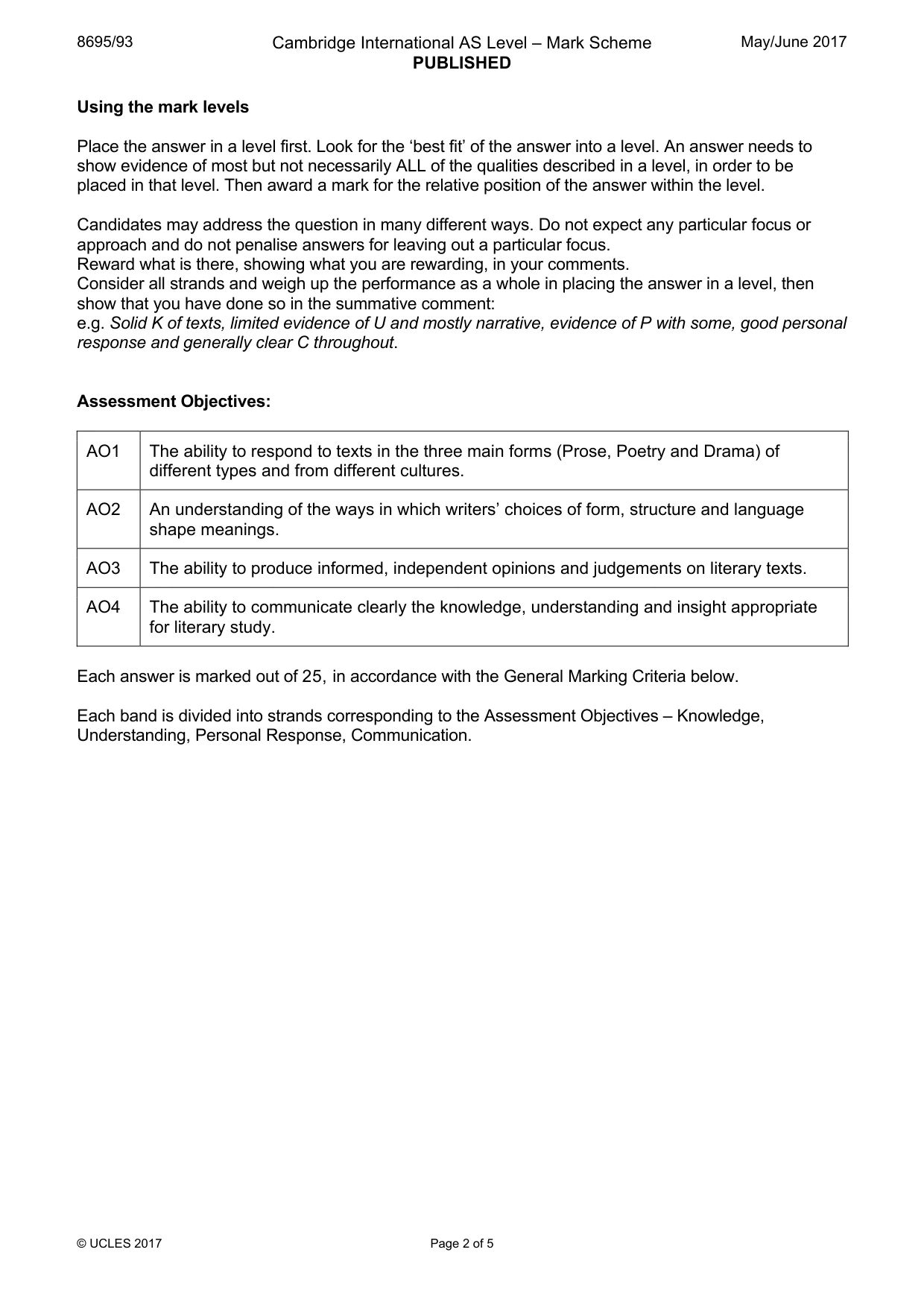
8695/93 Cambridge International AS Level – Mark Scheme PUBLISHED May/June 2017 © UCLES 2017 Page 2 of 5 Using the mark levels Place the answer in a level first. Look for the ‘best fit’ of the answer into a level. An answer needs to show evidence of most but not necessarily ALL of the qualities described in a level, in order to be placed in that level. Then award a mark for the relative position of the answer within the level. Candidates may address the question in many different ways. Do not expect any particular focus or approach and do not penalise answers for leaving out a particular focus. Reward what is there, showing what you are rewarding, in your comments. Consider all strands and weigh up the performance as a whole in placing the answer in a level, then show that you have done so in the summative comment: e.g. Solid K of texts, limited evidence of U and mostly narrative, evidence of P with some, good personal response and generally clear C throughout. Assessment Objectives: AO1 The ability to respond to texts in the three main forms (Prose, Poetry and Drama) of different types and from different cultures. AO2 An understanding of the ways in which writers’ choices of form, structure and language shape meanings. AO3 The ability to produce informed, independent opinions and judgements on literary texts. AO4 The ability to communicate clearly the knowledge, understanding and insight appropriate for literary study. Each answer is marked out of 25, in accordance with the General Marking Criteria below. Each band is divided into strands corresponding to the Assessment Objectives – Knowledge, Understanding, Personal Response, Communication.
Mark scheme, page 3
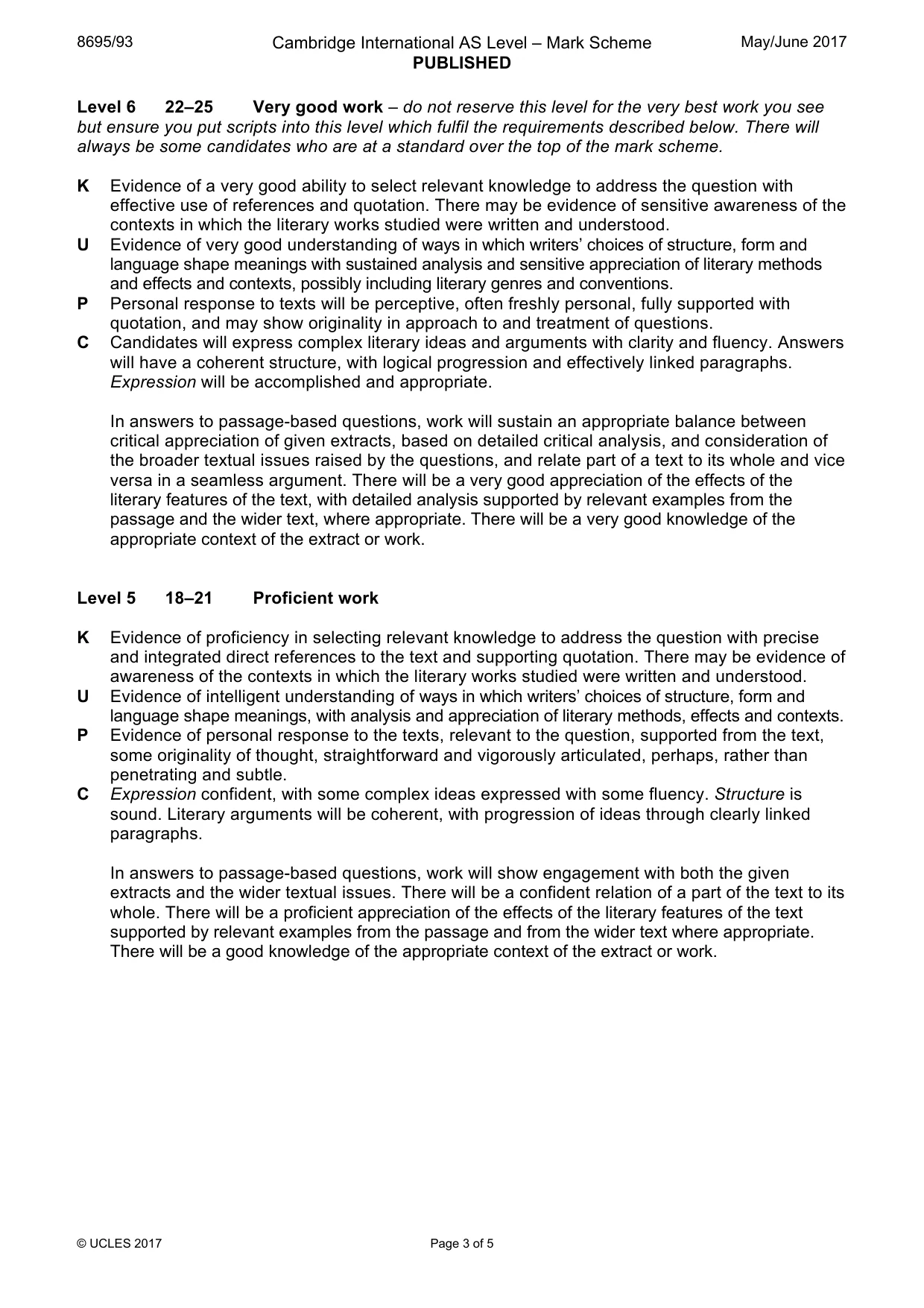
8695/93 Cambridge International AS Level – Mark Scheme PUBLISHED May/June 2017 © UCLES 2017 Page 3 of 5 Level 6 22–25 Very good work – do not reserve this level for the very best work you see but ensure you put scripts into this level which fulfil the requirements described below. There will always be some candidates who are at a standard over the top of the mark scheme. K Evidence of a very good ability to select relevant knowledge to address the question with effective use of references and quotation. There may be evidence of sensitive awareness of the contexts in which the literary works studied were written and understood. U Evidence of very good understanding of ways in which writers’ choices of structure, form and language shape meanings with sustained analysis and sensitive appreciation of literary methods and effects and contexts, possibly including literary genres and conventions. P Personal response to texts will be perceptive, often freshly personal, fully supported with quotation, and may show originality in approach to and treatment of questions. C Candidates will express complex literary ideas and arguments with clarity and fluency. Answers will have a coherent structure, with logical progression and effectively linked paragraphs. Expression will be accomplished and appropriate. In answers to passage-based questions, work will sustain an appropriate balance between critical appreciation of given extracts, based on detailed critical analysis, and consideration of the broader textual issues raised by the questions, and relate part of a text to its whole and vice versa in a seamless argument. There will be a very good appreciation of the effects of the literary features of the text, with detailed analysis supported by relevant examples from the passage and the wider text, where appropriate. There will be a very good knowledge of the appropriate context of the extract or work. Level 5 18–21 Proficient work K Evidence of proficiency in selecting relevant knowledge to address the question with precise and integrated direct references to the text and supporting quotation. There may be evidence of awareness of the contexts in which the literary works studied were written and understood. U Evidence of intelligent understanding of ways in which writers’ choices of structure, form and language shape meanings, with analysis and appreciation of literary methods, effects and contexts. P Evidence of personal response to the texts, relevant to the question, supported from the text, some originality of thought, straightforward and vigorously articulated, perhaps, rather than penetrating and subtle. C Expression confident, with some complex ideas expressed with some fluency. Structure is sound. Literary arguments will be coherent, with progression of ideas through clearly linked paragraphs. In answers to passage-based questions, work will show engagement with both the given extracts and the wider textual issues. There will be a confident relation of a part of the text to its whole. There will be a proficient appreciation of the effects of the literary features of the text supported by relevant examples from the passage and from the wider text where appropriate. There will be a good knowledge of the appropriate context of the extract or work.
Mark scheme, page 4
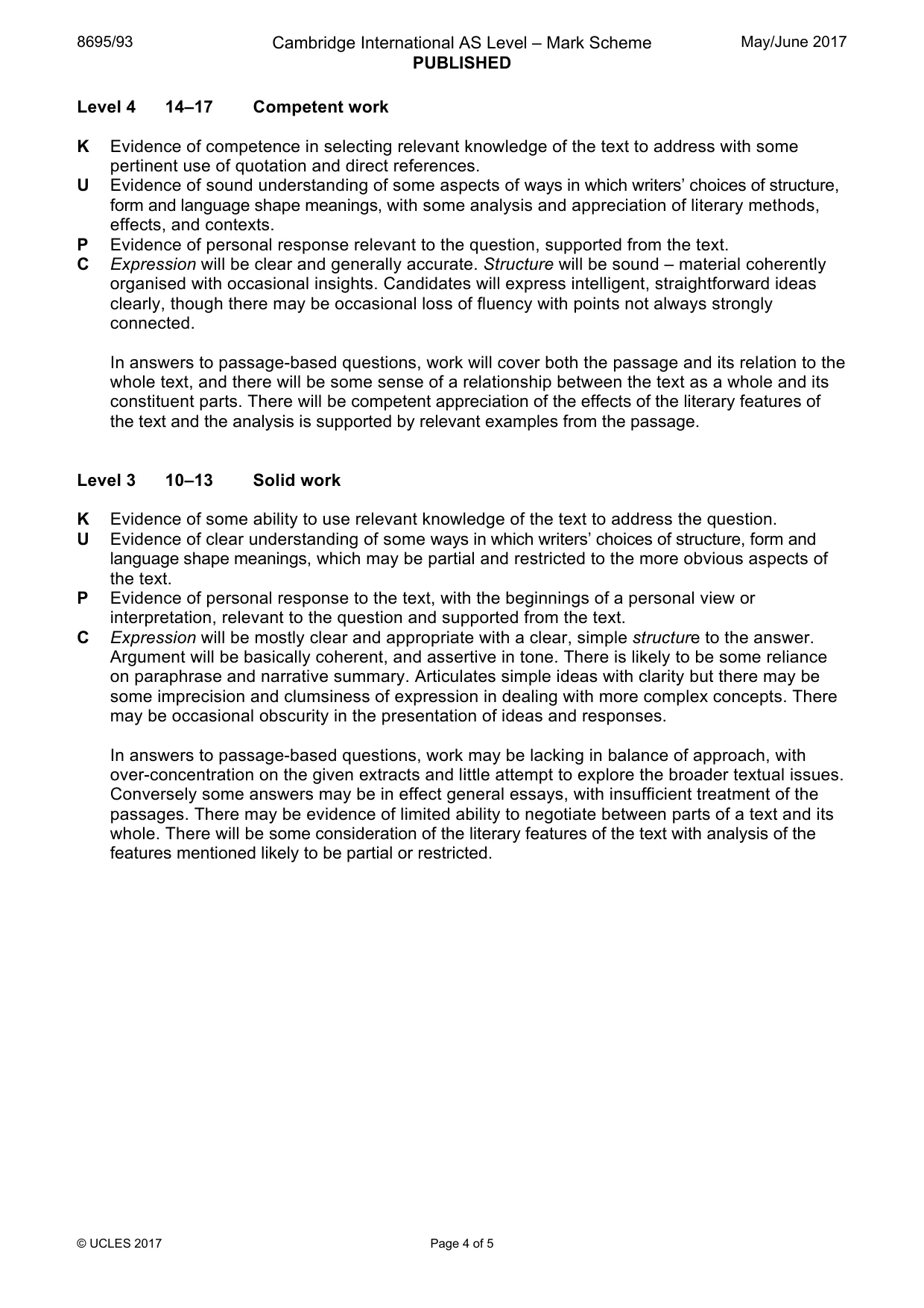
8695/93 Cambridge International AS Level – Mark Scheme PUBLISHED May/June 2017 © UCLES 2017 Page 4 of 5 Level 4 14–17 Competent work K Evidence of competence in selecting relevant knowledge of the text to address with some pertinent use of quotation and direct references. U Evidence of sound understanding of some aspects of ways in which writers’ choices of structure, form and language shape meanings, with some analysis and appreciation of literary methods, effects, and contexts. P Evidence of personal response relevant to the question, supported from the text. C Expression will be clear and generally accurate. Structure will be sound – material coherently organised with occasional insights. Candidates will express intelligent, straightforward ideas clearly, though there may be occasional loss of fluency with points not always strongly connected. In answers to passage-based questions, work will cover both the passage and its relation to the whole text, and there will be some sense of a relationship between the text as a whole and its constituent parts. There will be competent appreciation of the effects of the literary features of the text and the analysis is supported by relevant examples from the passage. Level 3 10–13 Solid work K Evidence of some ability to use relevant knowledge of the text to address the question. U Evidence of clear understanding of some ways in which writers’ choices of structure, form and language shape meanings, which may be partial and restricted to the more obvious aspects of the text. P Evidence of personal response to the text, with the beginnings of a personal view or interpretation, relevant to the question and supported from the text. C Expression will be mostly clear and appropriate with a clear, simple structure to the answer. Argument will be basically coherent, and assertive in tone. There is likely to be some reliance on paraphrase and narrative summary. Articulates simple ideas with clarity but there may be some imprecision and clumsiness of expression in dealing with more complex concepts. There may be occasional obscurity in the presentation of ideas and responses. In answers to passage-based questions, work may be lacking in balance of approach, with over-concentration on the given extracts and little attempt to explore the broader textual issues. Conversely some answers may be in effect general essays, with insufficient treatment of the passages. There may be evidence of limited ability to negotiate between parts of a text and its whole. There will be some consideration of the literary features of the text with analysis of the features mentioned likely to be partial or restricted.
Mark scheme, page 5
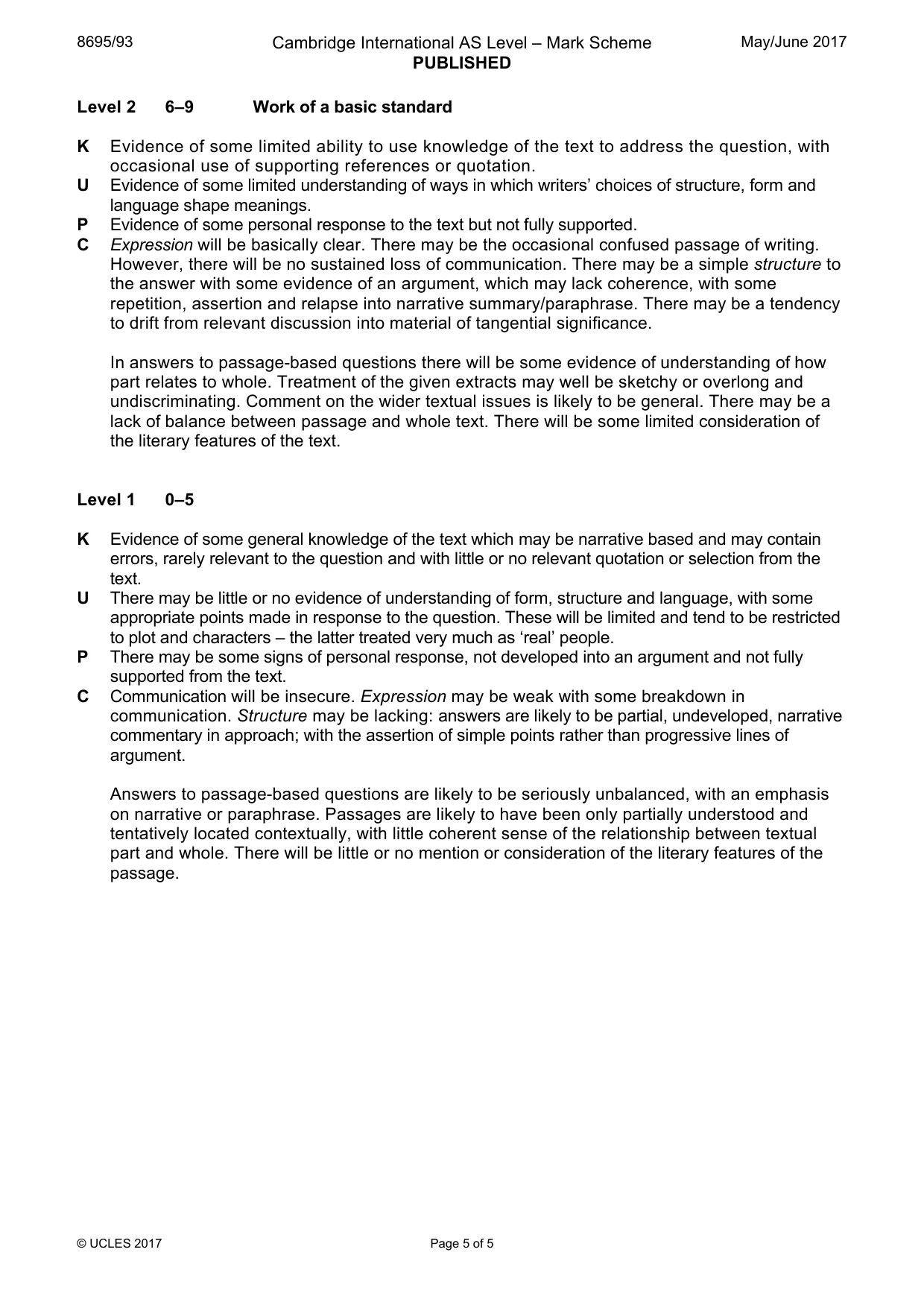
8695/93 Cambridge International AS Level – Mark Scheme PUBLISHED May/June 2017 © UCLES 2017 Page 5 of 5 Level 2 6–9 Work of a basic standard K Evidence of some limited ability to use knowledge of the text to address the question, with occasional use of supporting references or quotation. U Evidence of some limited understanding of ways in which writers’ choices of structure, form and language shape meanings. P Evidence of some personal response to the text but not fully supported. C Expression will be basically clear. There may be the occasional confused passage of writing. However, there will be no sustained loss of communication. There may be a simple structure to the answer with some evidence of an argument, which may lack coherence, with some repetition, assertion and relapse into narrative summary/paraphrase. There may be a tendency to drift from relevant discussion into material of tangential significance. In answers to passage-based questions there will be some evidence of understanding of how part relates to whole. Treatment of the given extracts may well be sketchy or overlong and undiscriminating. Comment on the wider textual issues is likely to be general. There may be a lack of balance between passage and whole text. There will be some limited consideration of the literary features of the text. Level 1 0–5 K Evidence of some general knowledge of the text which may be narrative based and may contain errors, rarely relevant to the question and with little or no relevant quotation or selection from the text. U There may be little or no evidence of understanding of form, structure and language, with some appropriate points made in response to the question. These will be limited and tend to be restricted to plot and characters – the latter treated very much as ‘real’ people. P There may be some signs of personal response, not developed into an argument and not fully supported from the text. C Communication will be insecure. Expression may be weak with some breakdown in communication. Structure may be lacking: answers are likely to be partial, undeveloped, narrative commentary in approach; with the assertion of simple points rather than progressive lines of argument. Answers to passage-based questions are likely to be seriously unbalanced, with an emphasis on narrative or paraphrase. Passages are likely to have been only partially understood and tentatively located contextually, with little coherent sense of the relationship between textual part and whole. There will be little or no mention or consideration of the literary features of the passage.
What you needed in this session
Cambridge’s own grade thresholds for 2017 May/June, Paper 9 · Variant 3. A higher threshold means an easier paper — the bar moves with how the cohort did.