Cambridge A Level English - Language and Literature (AS Level only, from 2016) 8695 — 2020 May/June Paper 9 · Variant 3
8695/93/M/J/20
The question paper and its mark scheme, free to read here and free to download. This is Cambridge’s own paper, exactly as it was sat.
Question paper20 pages






Mark scheme6 pages
Answers below. Sit the paper first if you are practising.
Paper as text
Question paper, page 1
* 7 0 0 5 6 2 9 6 0 0 * DC (RCL/GO) 181986/1 © UCLES 2020 [Turn over This document has 20 pages. Blank pages are indicated. LANGUAGE AND LITERATURE IN ENGLISH 8695/93 Paper 9 Poetry, Prose and Drama May/June 2020 2 hours You must answer on the enclosed answer booklet. You will need: Answer booklet (enclosed) INSTRUCTIONS ● Answer two questions, each from a different section. ● Follow the instructions on the front cover of the answer booklet. If you need additional answer paper, ask the invigilator for a continuation booklet. ● You are reminded of the need for good English and clear presentation in your answers. INFORMATION ● The total mark for this paper is 50. ● All questions are worth equal marks. Cambridge International AS Level
Question paper, page 2
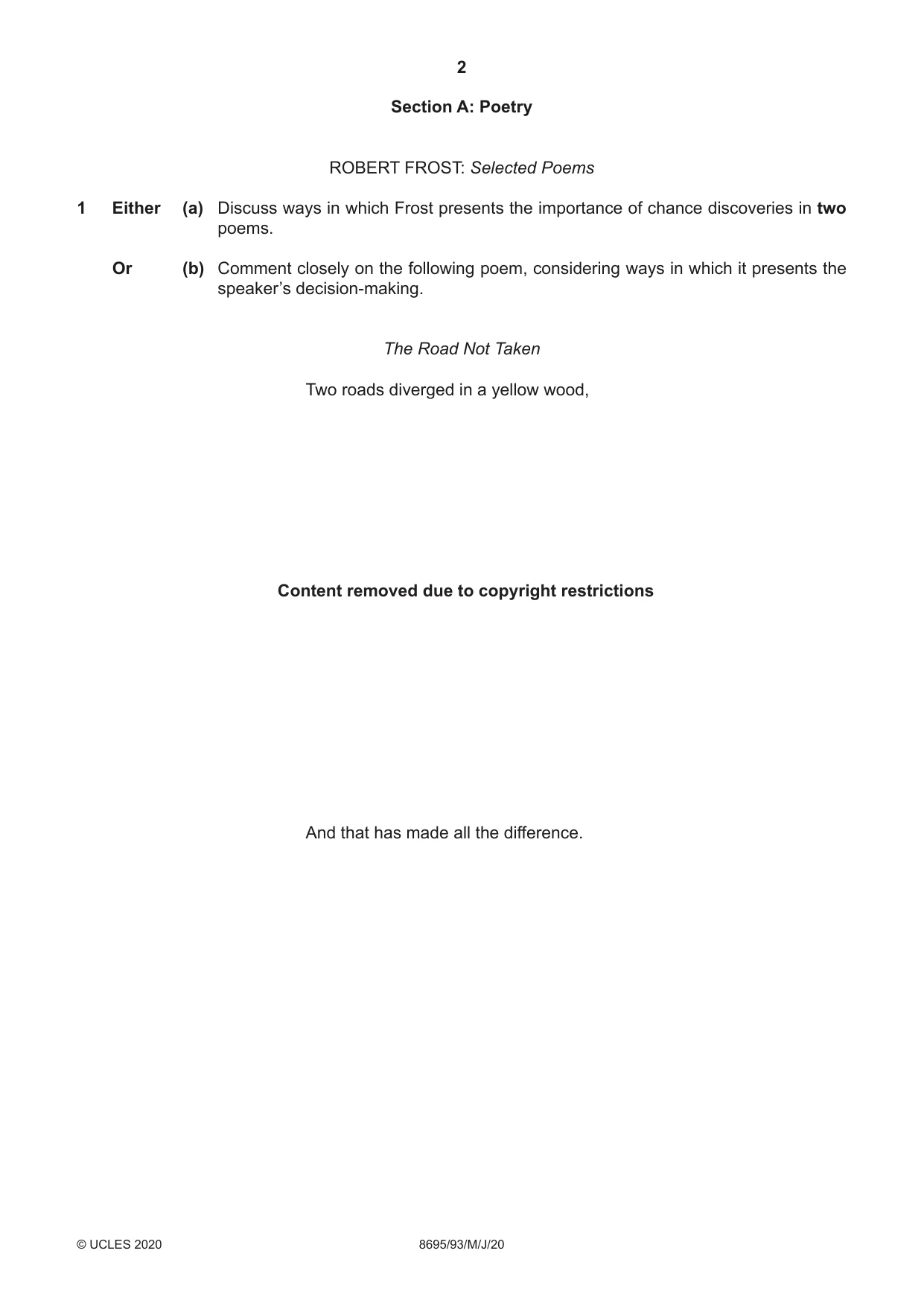
2 8695/93/M/J/20 © UCLES 2020 Section A: Poetry ROBERT FROST: Selected Poems 1 Either (a) Discuss ways in which Frost presents the importance of chance discoveries in two poems. Or (b) Comment closely on the following poem, considering ways in which it presents the speaker’s decision-making. The Road Not Taken Two roads diverged in a yellow wood, And that has made all the difference. Content removed due to copyright restrictions
Question paper, page 3
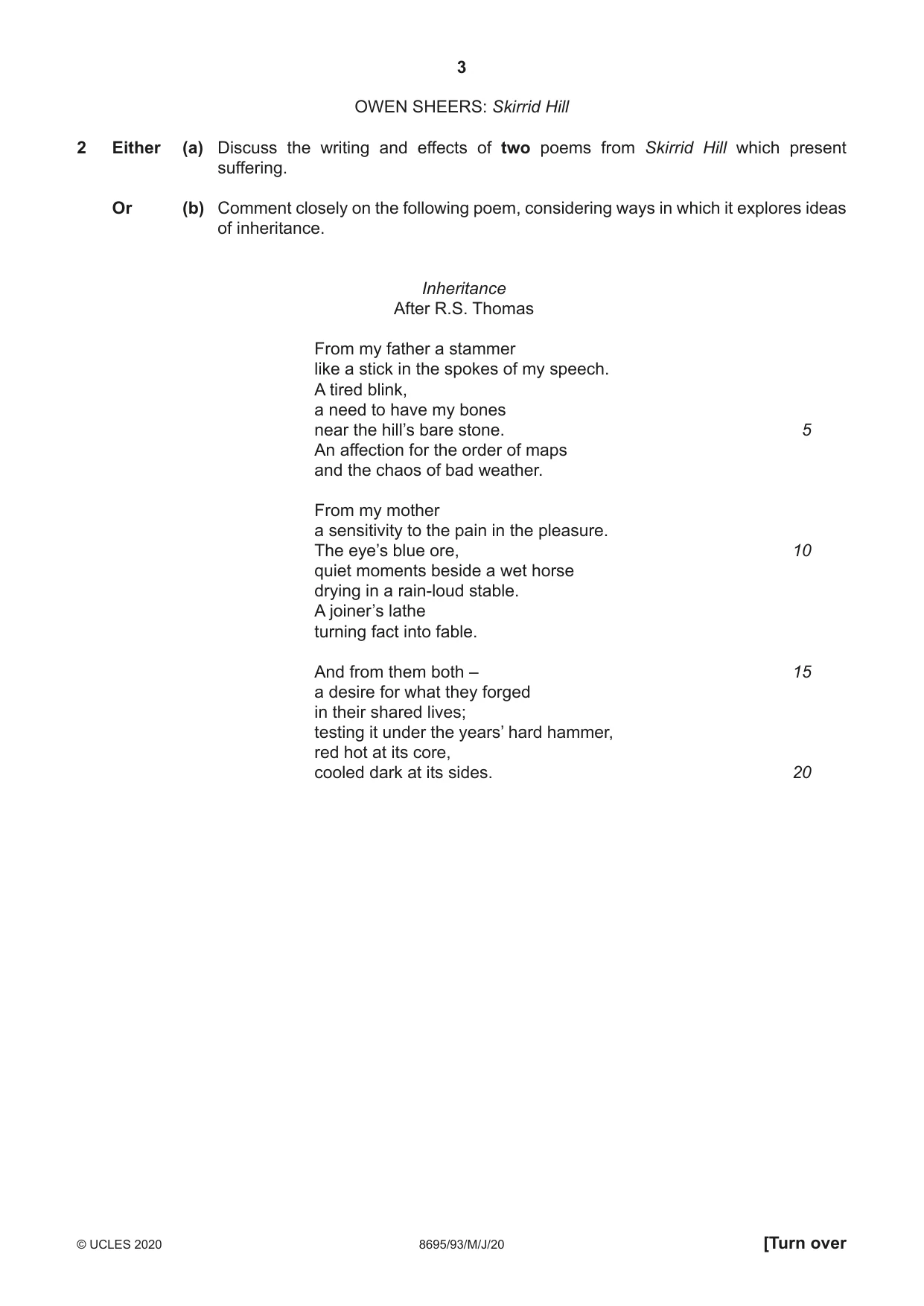
3 8695/93/M/J/20 © UCLES 2020 [Turn over OWEN SHEERS: Skirrid Hill 2 Either (a) Discuss the writing and effects of two poems from Skirrid Hill which present suffering. Or (b) Comment closely on the following poem, considering ways in which it explores ideas of inheritance. Inheritance After R.S. Thomas From my father a stammer like a stick in the spokes of my speech. A tired blink, a need to have my bones near the hill’s bare stone. An affection for the order of maps and the chaos of bad weather. From my mother a sensitivity to the pain in the pleasure. The eye’s blue ore, quiet moments beside a wet horse drying in a rain-loud stable. A joiner’s lathe turning fact into fable. And from them both – a desire for what they forged in their shared lives; testing it under the years’ hard hammer, red hot at its core, cooled dark at its sides. 5 10 15 20
Question paper, page 4
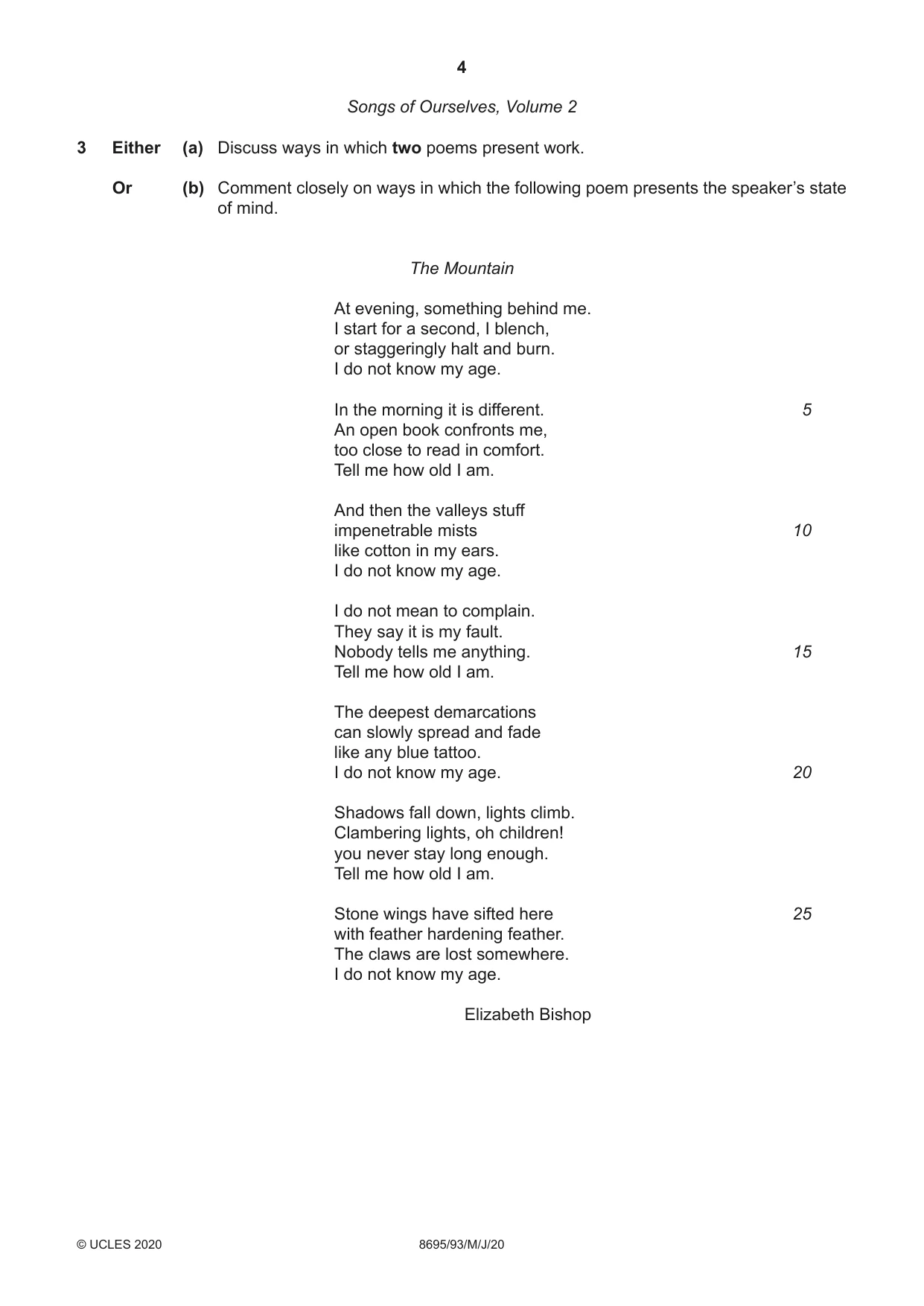
4 8695/93/M/J/20 © UCLES 2020 Songs of Ourselves, Volume 2 3 Either (a) Discuss ways in which two poems present work. Or (b) Comment closely on ways in which the following poem presents the speaker’s state of mind. The Mountain At evening, something behind me. I start for a second, I blench, or staggeringly halt and burn. I do not know my age. In the morning it is different. An open book confronts me, too close to read in comfort. Tell me how old I am. And then the valleys stuff impenetrable mists like cotton in my ears. I do not know my age. I do not mean to complain. They say it is my fault. Nobody tells me anything. Tell me how old I am. The deepest demarcations can slowly spread and fade like any blue tattoo. I do not know my age. Shadows fall down, lights climb. Clambering lights, oh children! you never stay long enough. Tell me how old I am. Stone wings have sifted here with feather hardening feather. The claws are lost somewhere. I do not know my age. Elizabeth Bishop 5 10 15 20 25
Question paper, page 5
5 8695/93/M/J/20 © UCLES 2020 [Turn over Turn over for Section B.
Question paper, page 6
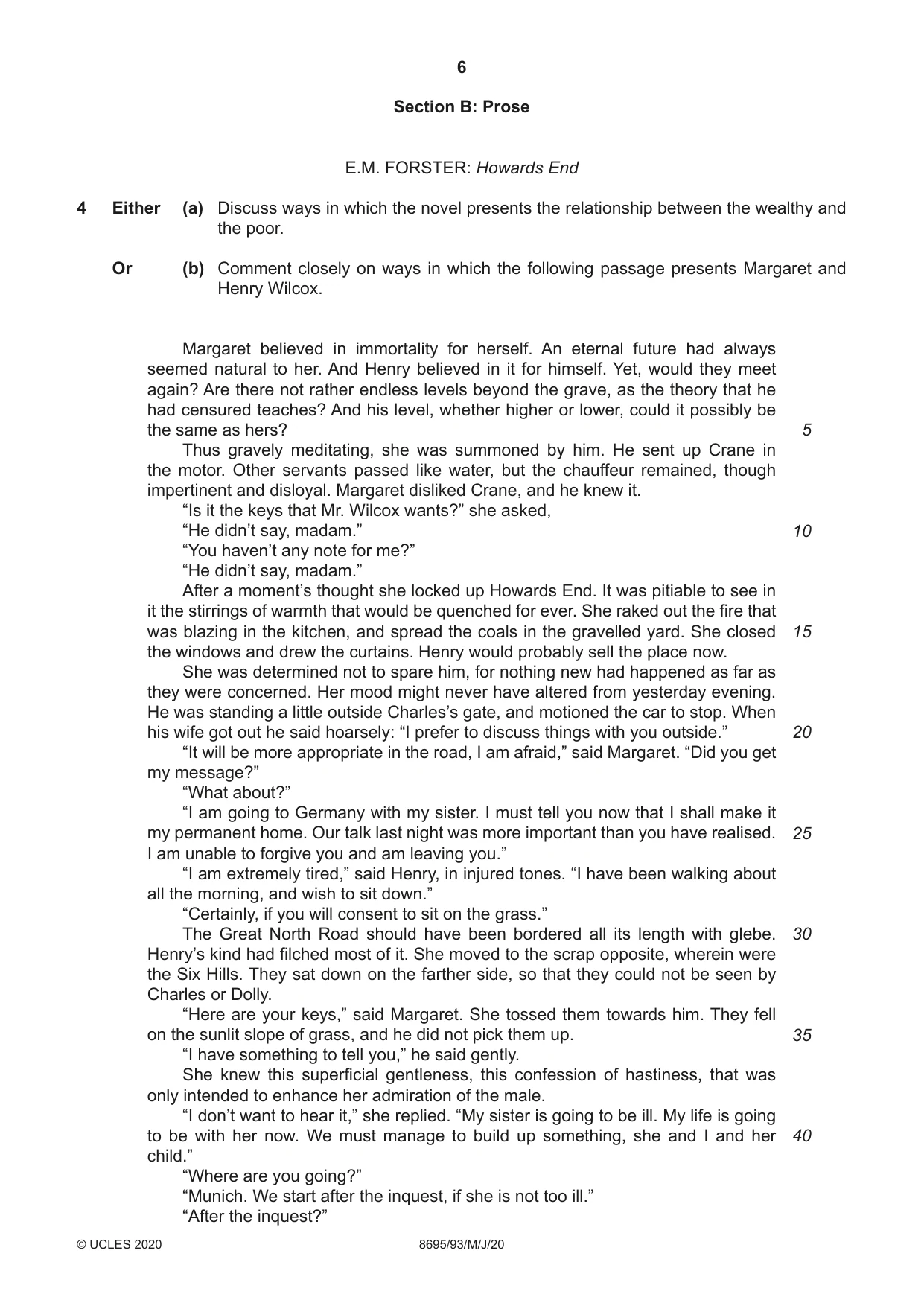
6 8695/93/M/J/20 © UCLES 2020 Section B: Prose E.M. FORSTER: Howards End 4 Either (a) Discuss ways in which the novel presents the relationship between the wealthy and the poor. Or (b) Comment closely on ways in which the following passage presents Margaret and Henry Wilcox. Margaret believed in immortality for herself. An eternal future had always seemed natural to her. And Henry believed in it for himself. Yet, would they meet again? Are there not rather endless levels beyond the grave, as the theory that he had censured teaches? And his level, whether higher or lower, could it possibly be the same as hers? Thus gravely meditating, she was summoned by him. He sent up Crane in the motor. Other servants passed like water, but the chauffeur remained, though impertinent and disloyal. Margaret disliked Crane, and he knew it. “Is it the keys that Mr. Wilcox wants?” she asked, “He didn’t say, madam.” “You haven’t any note for me?” “He didn’t say, madam.” After a moment’s thought she locked up Howards End. It was pitiable to see in it the stirrings of warmth that would be quenched for ever. She raked out the fire that was blazing in the kitchen, and spread the coals in the gravelled yard. She closed the windows and drew the curtains. Henry would probably sell the place now. She was determined not to spare him, for nothing new had happened as far as they were concerned. Her mood might never have altered from yesterday evening. He was standing a little outside Charles’s gate, and motioned the car to stop. When his wife got out he said hoarsely: “I prefer to discuss things with you outside.” “It will be more appropriate in the road, I am afraid,” said Margaret. “Did you get my message?” “What about?” “I am going to Germany with my sister. I must tell you now that I shall make it my permanent home. Our talk last night was more important than you have realised. I am unable to forgive you and am leaving you.” “I am extremely tired,” said Henry, in injured tones. “I have been walking about all the morning, and wish to sit down.” “Certainly, if you will consent to sit on the grass.” The Great North Road should have been bordered all its length with glebe. Henry’s kind had filched most of it. She moved to the scrap opposite, wherein were the Six Hills. They sat down on the farther side, so that they could not be seen by Charles or Dolly. “Here are your keys,” said Margaret. She tossed them towards him. They fell on the sunlit slope of grass, and he did not pick them up. “I have something to tell you,” he said gently. She knew this superficial gentleness, this confession of hastiness, that was only intended to enhance her admiration of the male. “I don’t want to hear it,” she replied. “My sister is going to be ill. My life is going to be with her now. We must manage to build up something, she and I and her child.” “Where are you going?” “Munich. We start after the inquest, if she is not too ill.” “After the inquest?” 5 10 15 20 25 30 35 40
Question paper, page 7
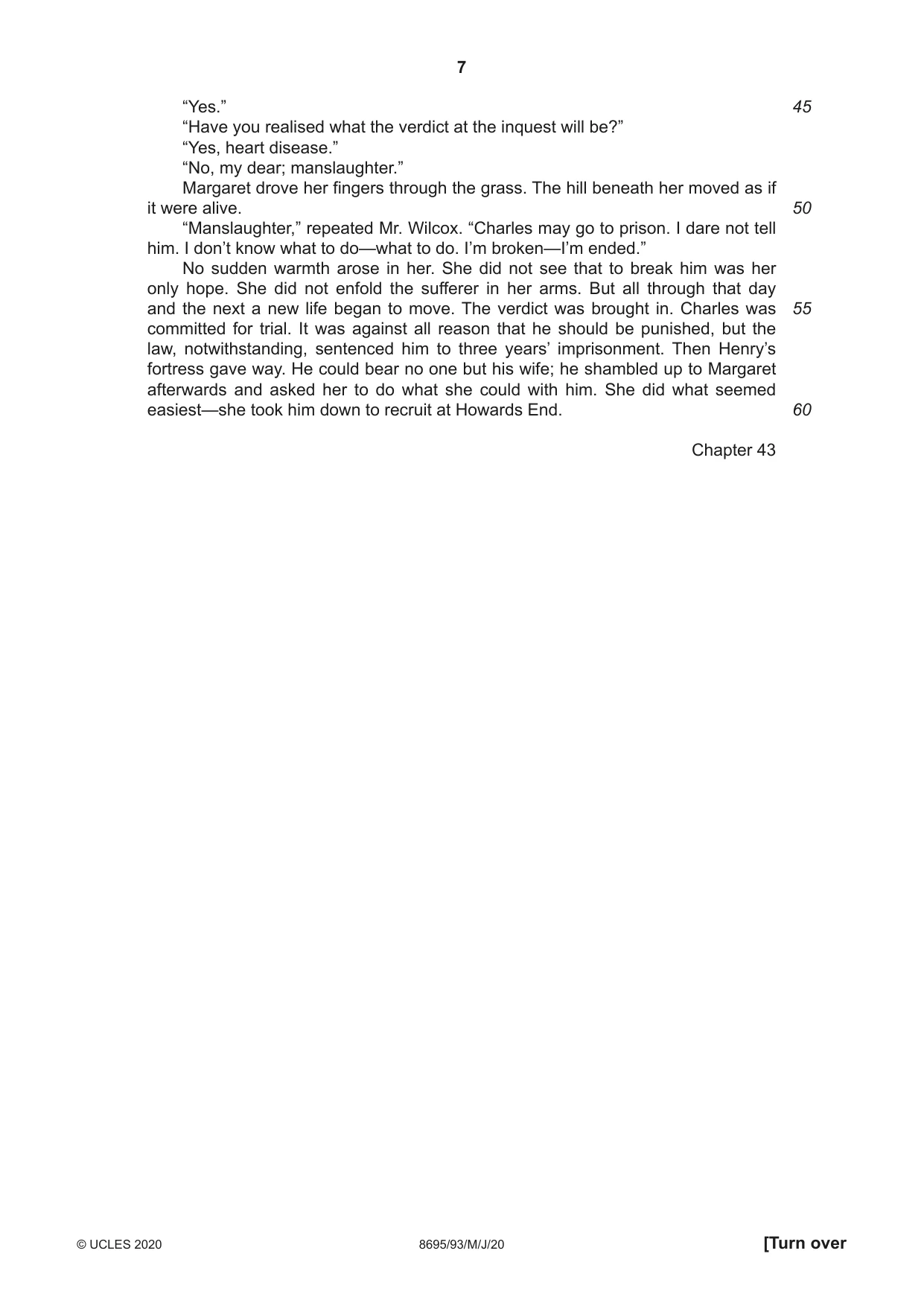
7 8695/93/M/J/20 © UCLES 2020 [Turn over “Yes.” “Have you realised what the verdict at the inquest will be?” “Yes, heart disease.” “No, my dear; manslaughter.” Margaret drove her fingers through the grass. The hill beneath her moved as if it were alive. “Manslaughter,” repeated Mr. Wilcox. “Charles may go to prison. I dare not tell him. I don’t know what to do—what to do. I’m broken—I’m ended.” No sudden warmth arose in her. She did not see that to break him was her only hope. She did not enfold the sufferer in her arms. But all through that day and the next a new life began to move. The verdict was brought in. Charles was committed for trial. It was against all reason that he should be punished, but the law, notwithstanding, sentenced him to three years’ imprisonment. Then Henry’s fortress gave way. He could bear no one but his wife; he shambled up to Margaret afterwards and asked her to do what she could with him. She did what seemed easiest—she took him down to recruit at Howards End. Chapter 43 45 50 55 60
Question paper, page 8
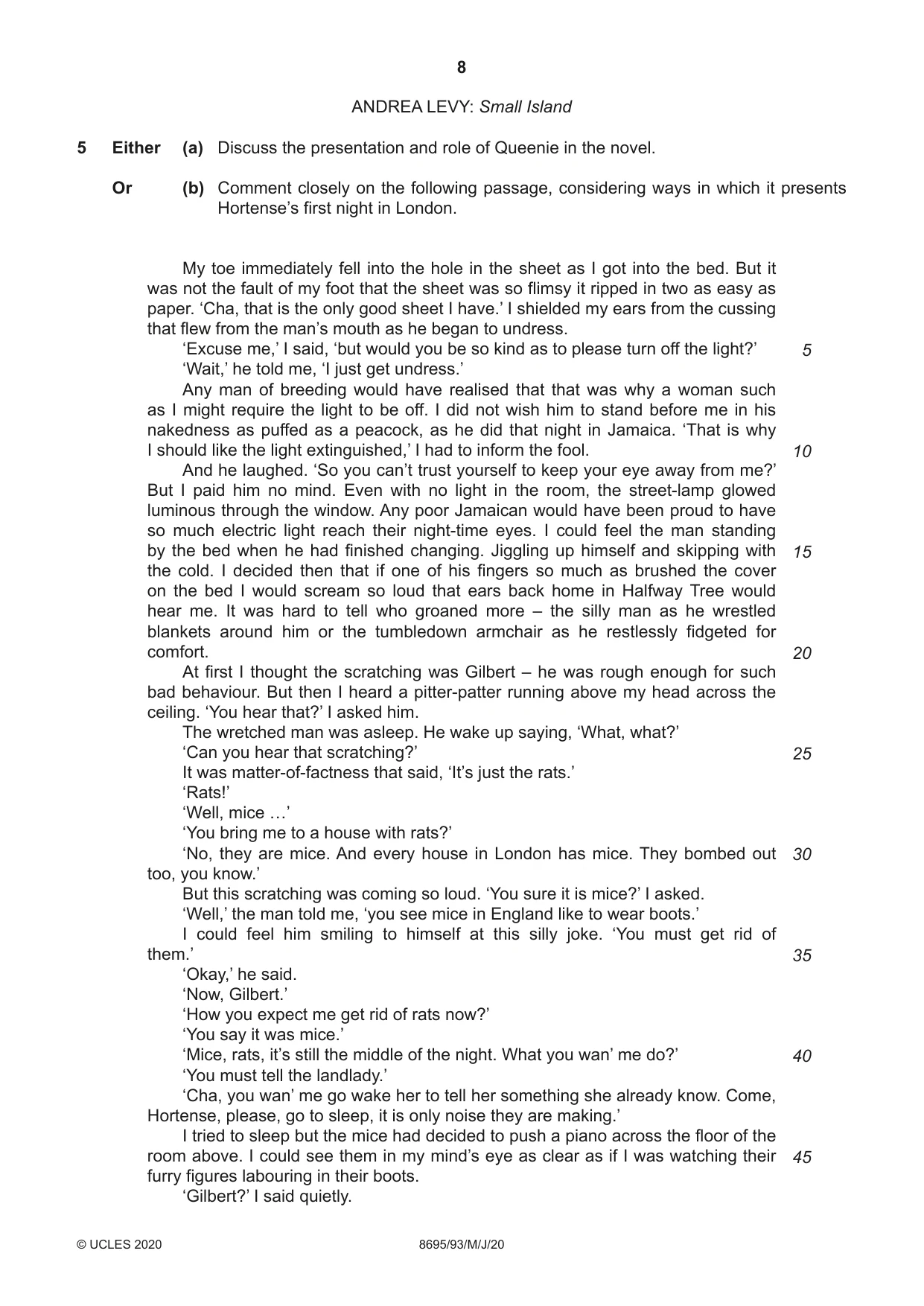
8 8695/93/M/J/20 © UCLES 2020 ANDREA LEVY: Small Island 5 Either (a) Discuss the presentation and role of Queenie in the novel. Or (b) Comment closely on the following passage, considering ways in which it presents Hortense’s first night in London. My toe immediately fell into the hole in the sheet as I got into the bed. But it was not the fault of my foot that the sheet was so flimsy it ripped in two as easy as paper. ‘Cha, that is the only good sheet I have.’ I shielded my ears from the cussing that flew from the man’s mouth as he began to undress. ‘Excuse me,’ I said, ‘but would you be so kind as to please turn off the light?’ ‘Wait,’ he told me, ‘I just get undress.’ Any man of breeding would have realised that that was why a woman such as I might require the light to be off. I did not wish him to stand before me in his nakedness as puffed as a peacock, as he did that night in Jamaica. ‘That is why I should like the light extinguished,’ I had to inform the fool. And he laughed. ‘So you can’t trust yourself to keep your eye away from me?’ But I paid him no mind. Even with no light in the room, the street-lamp glowed luminous through the window. Any poor Jamaican would have been proud to have so much electric light reach their night-time eyes. I could feel the man standing by the bed when he had finished changing. Jiggling up himself and skipping with the cold. I decided then that if one of his fingers so much as brushed the cover on the bed I would scream so loud that ears back home in Halfway Tree would hear me. It was hard to tell who groaned more – the silly man as he wrestled blankets around him or the tumbledown armchair as he restlessly fidgeted for comfort. At first I thought the scratching was Gilbert – he was rough enough for such bad behaviour. But then I heard a pitter-patter running above my head across the ceiling. ‘You hear that?’ I asked him. The wretched man was asleep. He wake up saying, ‘What, what?’ ‘Can you hear that scratching?’ It was matter-of-factness that said, ‘It’s just the rats.’ ‘Rats!’ ‘Well, mice …’ ‘You bring me to a house with rats?’ ‘No, they are mice. And every house in London has mice. They bombed out too, you know.’ But this scratching was coming so loud. ‘You sure it is mice?’ I asked. ‘Well,’ the man told me, ‘you see mice in England like to wear boots.’ I could feel him smiling to himself at this silly joke. ‘You must get rid of them.’ ‘Okay,’ he said. ‘Now, Gilbert.’ ‘How you expect me get rid of rats now?’ ‘You say it was mice.’ ‘Mice, rats, it’s still the middle of the night. What you wan’ me do?’ ‘You must tell the landlady.’ ‘Cha, you wan’ me go wake her to tell her something she already know. Come, Hortense, please, go to sleep, it is only noise they are making.’ I tried to sleep but the mice had decided to push a piano across the floor of the room above. I could see them in my mind’s eye as clear as if I was watching their furry figures labouring in their boots. ‘Gilbert?’ I said quietly. 5 10 15 20 25 30 35 40 45
Question paper, page 9
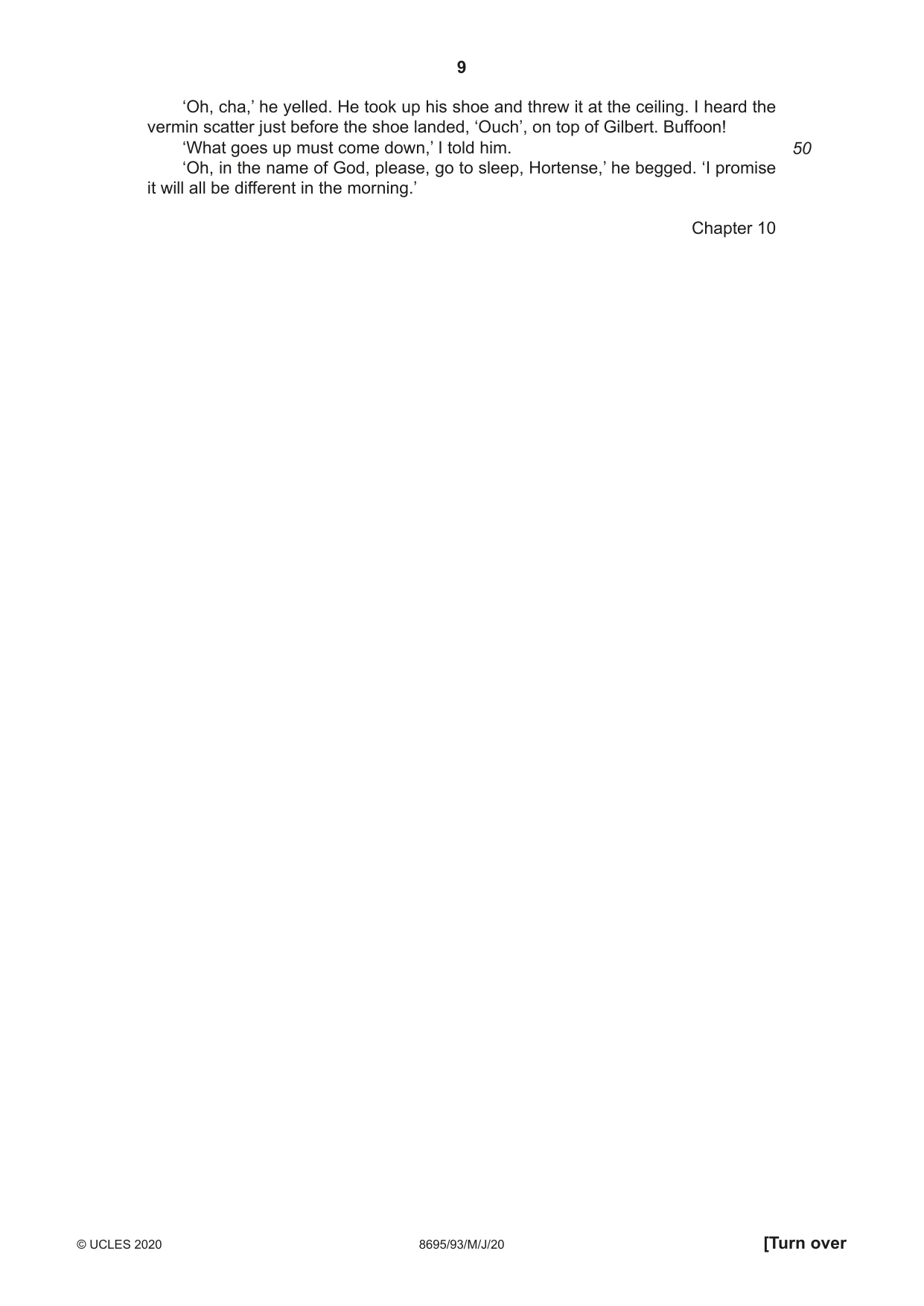
9 8695/93/M/J/20 © UCLES 2020 [Turn over ‘Oh, cha,’ he yelled. He took up his shoe and threw it at the ceiling. I heard the vermin scatter just before the shoe landed, ‘Ouch’, on top of Gilbert. Buffoon! ‘What goes up must come down,’ I told him. ‘Oh, in the name of God, please, go to sleep, Hortense,’ he begged. ‘I promise it will all be different in the morning.’ Chapter 10 50
Question paper, page 10
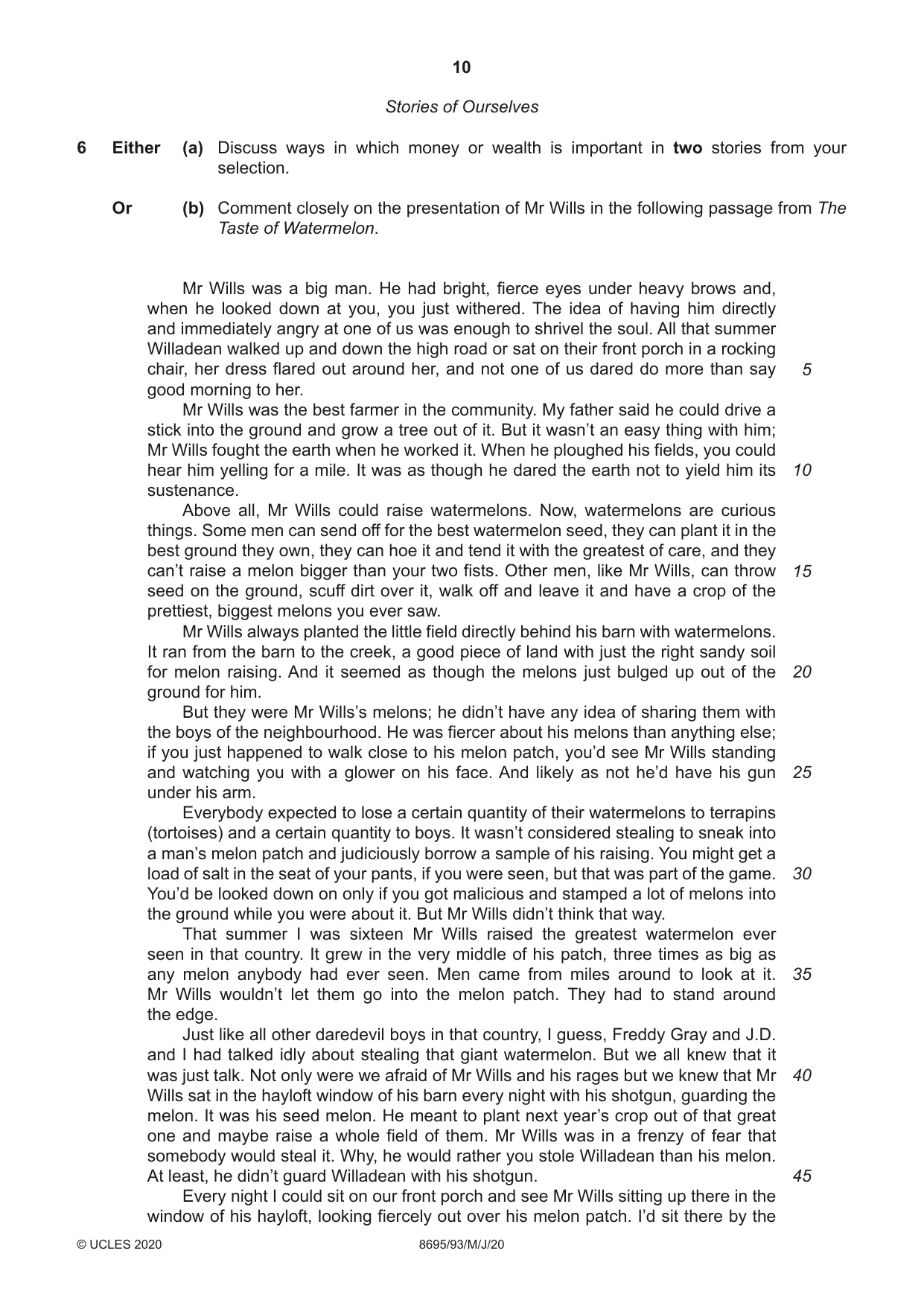
10 8695/93/M/J/20 © UCLES 2020 Stories of Ourselves 6 Either (a) Discuss ways in which money or wealth is important in two stories from your selection. Or (b) Comment closely on the presentation of Mr Wills in the following passage from The Taste of Watermelon. Mr Wills was a big man. He had bright, fierce eyes under heavy brows and, when he looked down at you, you just withered. The idea of having him directly and immediately angry at one of us was enough to shrivel the soul. All that summer Willadean walked up and down the high road or sat on their front porch in a rocking chair, her dress flared out around her, and not one of us dared do more than say good morning to her. Mr Wills was the best farmer in the community. My father said he could drive a stick into the ground and grow a tree out of it. But it wasn’t an easy thing with him; Mr Wills fought the earth when he worked it. When he ploughed his fields, you could hear him yelling for a mile. It was as though he dared the earth not to yield him its sustenance. Above all, Mr Wills could raise watermelons. Now, watermelons are curious things. Some men can send off for the best watermelon seed, they can plant it in the best ground they own, they can hoe it and tend it with the greatest of care, and they can’t raise a melon bigger than your two fists. Other men, like Mr Wills, can throw seed on the ground, scuff dirt over it, walk off and leave it and have a crop of the prettiest, biggest melons you ever saw. Mr Wills always planted the little field directly behind his barn with watermelons. It ran from the barn to the creek, a good piece of land with just the right sandy soil for melon raising. And it seemed as though the melons just bulged up out of the ground for him. But they were Mr Wills’s melons; he didn’t have any idea of sharing them with the boys of the neighbourhood. He was fiercer about his melons than anything else; if you just happened to walk close to his melon patch, you’d see Mr Wills standing and watching you with a glower on his face. And likely as not he’d have his gun under his arm. Everybody expected to lose a certain quantity of their watermelons to terrapins (tortoises) and a certain quantity to boys. It wasn’t considered stealing to sneak into a man’s melon patch and judiciously borrow a sample of his raising. You might get a load of salt in the seat of your pants, if you were seen, but that was part of the game. You’d be looked down on only if you got malicious and stamped a lot of melons into the ground while you were about it. But Mr Wills didn’t think that way. That summer I was sixteen Mr Wills raised the greatest watermelon ever seen in that country. It grew in the very middle of his patch, three times as big as any melon anybody had ever seen. Men came from miles around to look at it. Mr Wills wouldn’t let them go into the melon patch. They had to stand around the edge. Just like all other daredevil boys in that country, I guess, Freddy Gray and J.D. and I had talked idly about stealing that giant watermelon. But we all knew that it was just talk. Not only were we afraid of Mr Wills and his rages but we knew that Mr Wills sat in the hayloft window of his barn every night with his shotgun, guarding the melon. It was his seed melon. He meant to plant next year’s crop out of that great one and maybe raise a whole field of them. Mr Wills was in a frenzy of fear that somebody would steal it. Why, he would rather you stole Willadean than his melon. At least, he didn’t guard Willadean with his shotgun. Every night I could sit on our front porch and see Mr Wills sitting up there in the window of his hayloft, looking fiercely out over his melon patch. I’d sit there by the 5 10 15 20 25 30 35 40 45
Question paper, page 11
11 8695/93/M/J/20 © UCLES 2020 [Turn over hour and watch him, the shotgun cradled in his arm, and feel the tremors of fear and excitement chasing up and down my spine. ‘Look at him,’ my father would say. ‘Scared to death somebody will steal his seed melon. Wouldn’t anybody steal a man’s seed melon.’ ‘He ought to be in the house taking care of that wife of his,’ my mother would say tartly. ‘She’s been poorly all year.’ You hardly ever saw Mrs Wills. She was a wraith of a woman, pale as a butter bean. Sometimes she would sit for an hour or two on their porch in the cool of the day. They didn’t visit back and forth with anybody though. The Taste of Watermelon 50 55
Question paper, page 12
12 8695/93/M/J/20 © UCLES 2020 Section C: Drama ARTHUR MILLER: All My Sons 7 Either (a) Discuss Miller’s presentation of self-deception in the play. Or (b) With close attention to detail of language and action, discuss Miller’s dramatic presentation of Kate (Mother) and Joe Keller at this point in the play. Keller [coming down]: What does he want here? Content removed due to copyright restrictions.
Question paper, page 13
13 8695/93/M/J/20 © UCLES 2020 [Turn over Mother: Joe, Joe … It don’t excuse it that you did it for the family. Act 3 Content removed due to copyright restrictions.
Question paper, page 14
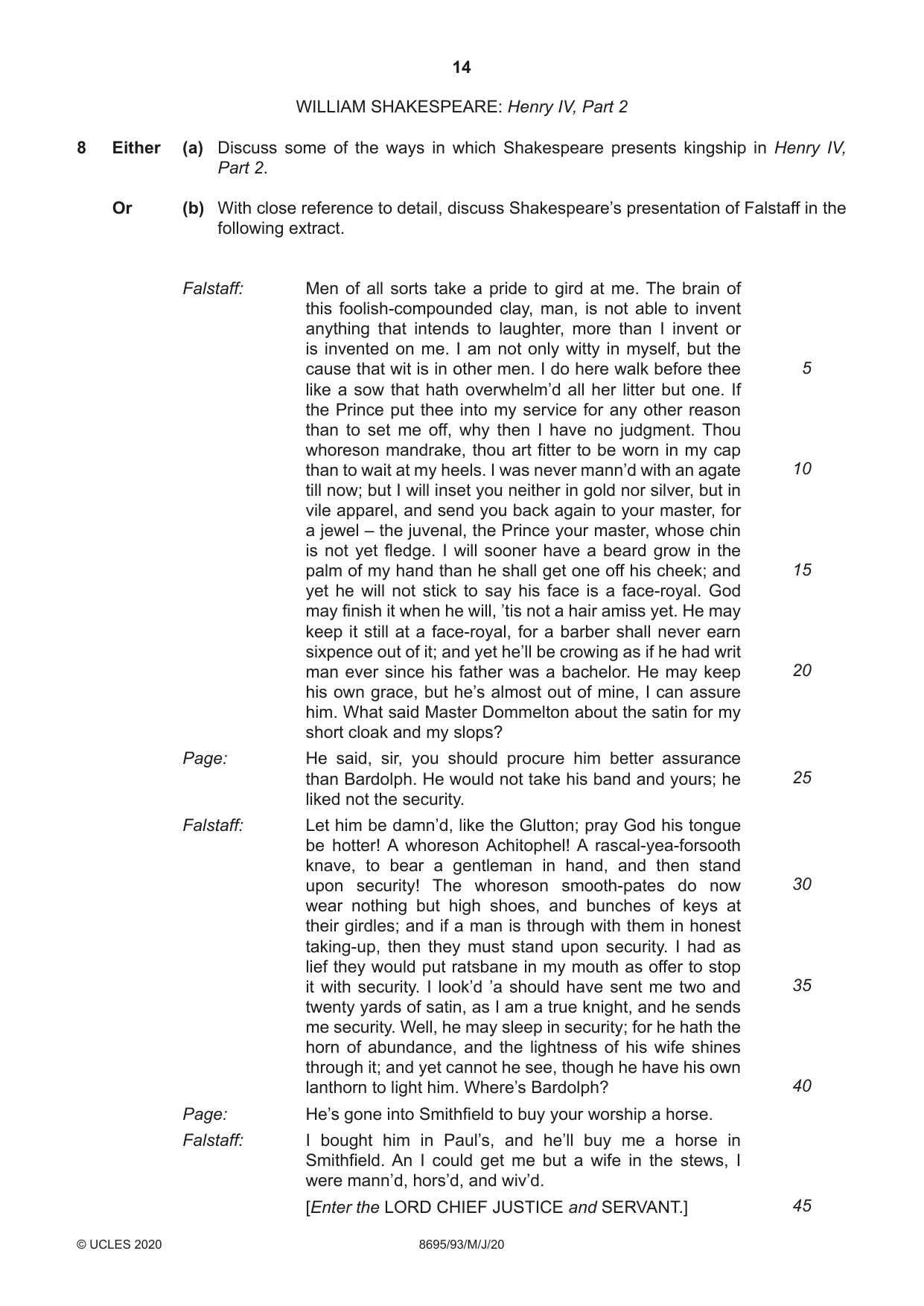
14 8695/93/M/J/20 © UCLES 2020 WILLIAM SHAKESPEARE: Henry IV, Part 2 8 Either (a) Discuss some of the ways in which Shakespeare presents kingship in Henry IV, Part 2. Or (b) With close reference to detail, discuss Shakespeare’s presentation of Falstaff in the following extract. Falstaff: Men of all sorts take a pride to gird at me. The brain of this foolish-compounded clay, man, is not able to invent anything that intends to laughter, more than I invent or is invented on me. I am not only witty in myself, but the cause that wit is in other men. I do here walk before thee like a sow that hath overwhelm’d all her litter but one. If the Prince put thee into my service for any other reason than to set me off, why then I have no judgment. Thou whoreson mandrake, thou art fitter to be worn in my cap than to wait at my heels. I was never mann’d with an agate till now; but I will inset you neither in gold nor silver, but in vile apparel, and send you back again to your master, for a jewel – the juvenal, the Prince your master, whose chin is not yet fledge. I will sooner have a beard grow in the palm of my hand than he shall get one off his cheek; and yet he will not stick to say his face is a face-royal. God may finish it when he will, ’tis not a hair amiss yet. He may keep it still at a face-royal, for a barber shall never earn sixpence out of it; and yet he’ll be crowing as if he had writ man ever since his father was a bachelor. He may keep his own grace, but he’s almost out of mine, I can assure him. What said Master Dommelton about the satin for my short cloak and my slops? Page: He said, sir, you should procure him better assurance than Bardolph. He would not take his band and yours; he liked not the security. Falstaff: Let him be damn’d, like the Glutton; pray God his tongue be hotter! A whoreson Achitophel! A rascal-yea-forsooth knave, to bear a gentleman in hand, and then stand upon security! The whoreson smooth-pates do now wear nothing but high shoes, and bunches of keys at their girdles; and if a man is through with them in honest taking-up, then they must stand upon security. I had as lief they would put ratsbane in my mouth as offer to stop it with security. I look’d ’a should have sent me two and twenty yards of satin, as I am a true knight, and he sends me security. Well, he may sleep in security; for he hath the horn of abundance, and the lightness of his wife shines through it; and yet cannot he see, though he have his own lanthorn to light him. Where’s Bardolph? Page: He’s gone into Smithfield to buy your worship a horse. Falstaff: I bought him in Paul’s, and he’ll buy me a horse in Smithfield. An I could get me but a wife in the stews, I were mann’d, hors’d, and wiv’d. [Enter the LORD CHIEF JUSTICE and SERVANT.] 5 10 15 20 25 30 35 40 45
Question paper, page 15
15 8695/93/M/J/20 © UCLES 2020 [Turn over Page: Sir, here comes the nobleman that committed the Prince for striking him about Bardolph. Falstaff: Wait close; I will not see him. Chief Justice: What’s he that goes there? Servant: Falstaff, an’t please your lordship. Chief Justice: He that was in question for the robb’ry? Servant: He, my lord; but he hath since done good service at Shrewsbury, and, as I hear, is now going with some charge to the Lord John of Lancaster. Chief Justice: What, to York? Call him back again. Servant: Sir John Falstaff! Falstaff: Boy, tell him I am deaf. Page: You must speak louder; my master is deaf. Chief Justice: I am sure he is, to the hearing of anything good. Go, pluck him by the elbow; I must speak with him. Servant: Sir John! Falstaff: What! a young knave, and begging! Is there not wars? Is there not employment? Doth not the King lack subjects? Do not the rebels need soldiers? Though it be a shame to be on any side but one, it is worse shame to beg than to be on the worst side, were it worse than the name of rebellion can tell how to make it. Servant: You mistake me, sir. Falstaff: Why, sir, did I say you were an honest man? Setting my knighthood and my soldiership aside, I had lied in my throat if I had said so. Servant: I pray you, sir, then set your knighthood and your soldiership aside; and give me leave to tell you you lie in your throat, if you say I am any other than an honest man. Falstaff: I give thee leave to tell me so! I lay aside that which grows to me! If thou get’st any leave of me, hang me; if thou tak’st leave, thou wert better be hang’d. You hunt counter. Hence! Avaunt! Act 1, Scene 2 50 55 60 65 70 75
Question paper, page 16
16 8695/93/M/J/20 © UCLES 2020 WOLE SOYINKA: Death and the King’s Horseman 9 Either (a) Discuss some of the ways in which Soyinka presents cultural misunderstandings in the play. Or (b) With close reference to detail of language and action, discuss Soyinka’s presentation of Elesin in the following extract. [ELESIN stands resplendent in rich clothes, cap, shawl, etc. Content removed due to copyright restrictions.
Question paper, page 17
17 8695/93/M/J/20 © UCLES 2020 Elesin: Enough, enough, you all have cause To know me well. Scene Content removed due to copyright restrictions.
Question paper, page 18
18 8695/93/M/J/20 © UCLES 2020 BLANK PAGE
Question paper, page 19
19 8695/93/M/J/20 © UCLES 2020 BLANK PAGE
Question paper, page 20
20 8695/93/M/J/20 © UCLES 2020 Permission to reproduce items where third-party owned material protected by copyright is included has been sought and cleared where possible. Every reasonable effort has been made by the publisher (UCLES) to trace copyright holders, but if any items requiring clearance have unwittingly been included, the publisher will be pleased to make amends at the earliest possible opportunity. To avoid the issue of disclosure of answer-related information to candidates, all copyright acknowledgements are reproduced online in the Cambridge Assessment International Education Copyright Acknowledgements Booklet. This is produced for each series of examinations and is freely available to download at www.cambridgeinternational.org after the live examination series. Cambridge Assessment International Education is part of the Cambridge Assessment Group. Cambridge Assessment is the brand name of the University of Cambridge Local Examinations Syndicate (UCLES), which itself is a department of the University of Cambridge. BLANK PAGE
Mark scheme, page 1
This document consists of 6 printed pages. © UCLES 2020 [Turn over Cambridge International AS Level LANGUAGE AND LITERATURE IN ENGLISH 8695/93 Paper 9 Poetry, Prose and Drama May/June 2020 MARK SCHEME Maximum Mark: 50 Published Students did not sit exam papers in the June 2020 series due to the Covid-19 global pandemic. This mark scheme is published to support teachers and students and should be read together with the question paper. It shows the requirements of the exam. The answer column of the mark scheme shows the proposed basis on which Examiners would award marks for this exam. Where appropriate, this column also provides the most likely acceptable alternative responses expected from students. Examiners usually review the mark scheme after they have seen student responses and update the mark scheme if appropriate. In the June series, Examiners were unable to consider the acceptability of alternative responses, as there were no student responses to consider. Mark schemes should usually be read together with the Principal Examiner Report for Teachers. However, because students did not sit exam papers, there is no Principal Examiner Report for Teachers for the June 2020 series. Cambridge International will not enter into discussions about these mark schemes. Cambridge International is publishing the mark schemes for the June 2020 series for most Cambridge IGCSE™ and Cambridge International A & AS Level components, and some Cambridge O Level components.
Mark scheme, page 2
8695/93 Cambridge International AS Level – Mark Scheme PUBLISHED May/June 2020 © UCLES 2020 Page 2 of 6 Generic Marking Principles These general marking principles must be applied by all examiners when marking candidate answers. They should be applied alongside the specific content of the mark scheme or generic level descriptors for a question. Each question paper and mark scheme will also comply with these marking principles. GENERIC MARKING PRINCIPLE 1: Marks must be awarded in line with: • the specific content of the mark scheme or the generic level descriptors for the question • the specific skills defined in the mark scheme or in the generic level descriptors for the question • the standard of response required by a candidate as exemplified by the standardisation scripts. GENERIC MARKING PRINCIPLE 2: Marks awarded are always whole marks (not half marks, or other fractions). GENERIC MARKING PRINCIPLE 3: Marks must be awarded positively: • marks are awarded for correct/valid answers, as defined in the mark scheme. However, credit is given for valid answers which go beyond the scope of the syllabus and mark scheme, referring to your Team Leader as appropriate • marks are awarded when candidates clearly demonstrate what they know and can do • marks are not deducted for errors • marks are not deducted for omissions • answers should only be judged on the quality of spelling, punctuation and grammar when these features are specifically assessed by the question as indicated by the mark scheme. The meaning, however, should be unambiguous. GENERIC MARKING PRINCIPLE 4: Rules must be applied consistently e.g. in situations where candidates have not followed instructions or in the application of generic level descriptors. GENERIC MARKING PRINCIPLE 5: Marks should be awarded using the full range of marks defined in the mark scheme for the question (however; the use of the full mark range may be limited according to the quality of the candidate responses seen). GENERIC MARKING PRINCIPLE 6: Marks awarded are based solely on the requirements as defined in the mark scheme. Marks should not be awarded with grade thresholds or grade descriptors in mind.
Mark scheme, page 3
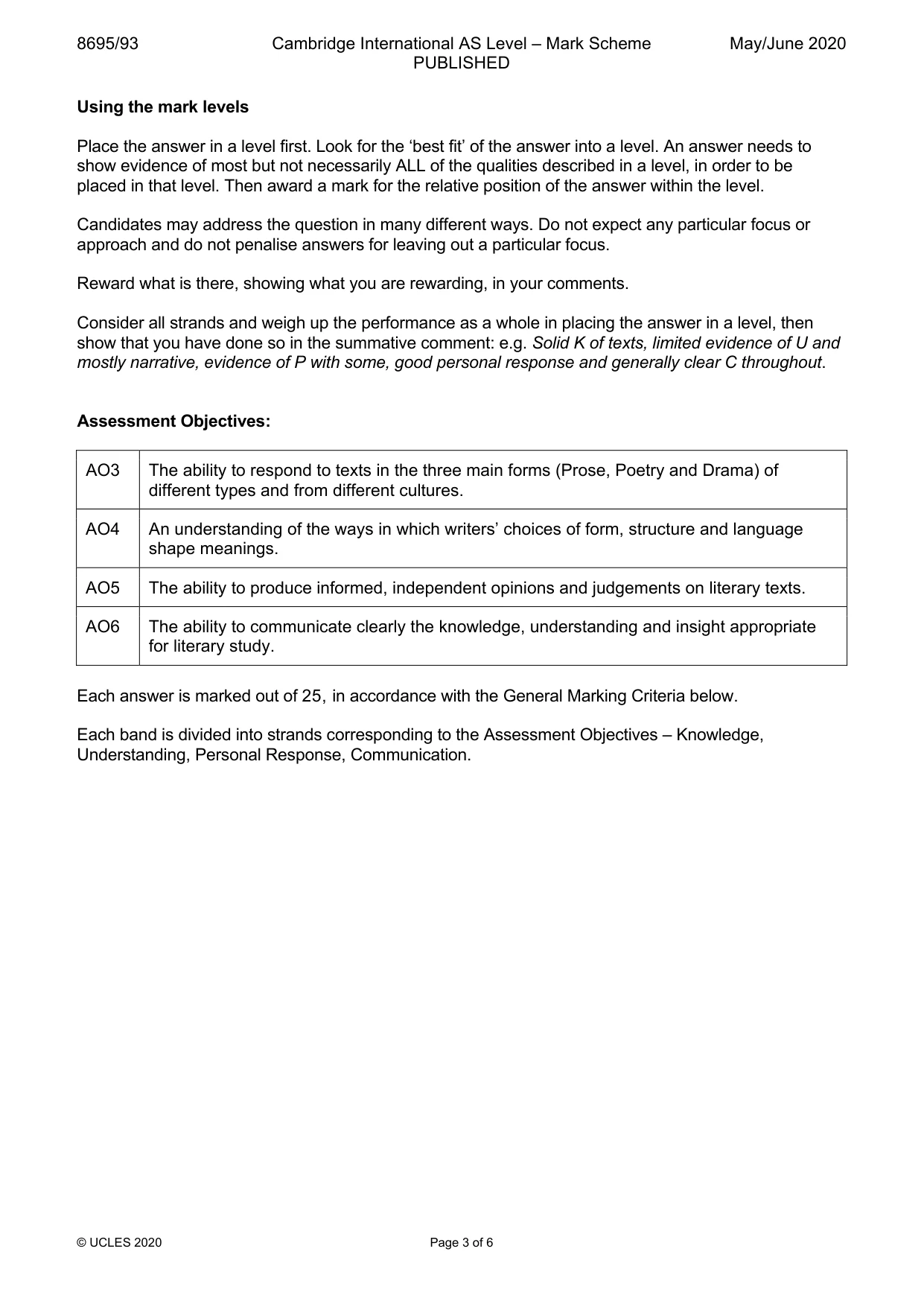
8695/93 Cambridge International AS Level – Mark Scheme PUBLISHED May/June 2020 © UCLES 2020 Page 3 of 6 Using the mark levels Place the answer in a level first. Look for the ‘best fit’ of the answer into a level. An answer needs to show evidence of most but not necessarily ALL of the qualities described in a level, in order to be placed in that level. Then award a mark for the relative position of the answer within the level. Candidates may address the question in many different ways. Do not expect any particular focus or approach and do not penalise answers for leaving out a particular focus. Reward what is there, showing what you are rewarding, in your comments. Consider all strands and weigh up the performance as a whole in placing the answer in a level, then show that you have done so in the summative comment: e.g. Solid K of texts, limited evidence of U and mostly narrative, evidence of P with some, good personal response and generally clear C throughout. Assessment Objectives: AO3 The ability to respond to texts in the three main forms (Prose, Poetry and Drama) of different types and from different cultures. AO4 An understanding of the ways in which writers’ choices of form, structure and language shape meanings. AO5 The ability to produce informed, independent opinions and judgements on literary texts. AO6 The ability to communicate clearly the knowledge, understanding and insight appropriate for literary study. Each answer is marked out of 25, in accordance with the General Marking Criteria below. Each band is divided into strands corresponding to the Assessment Objectives – Knowledge, Understanding, Personal Response, Communication.
Mark scheme, page 4
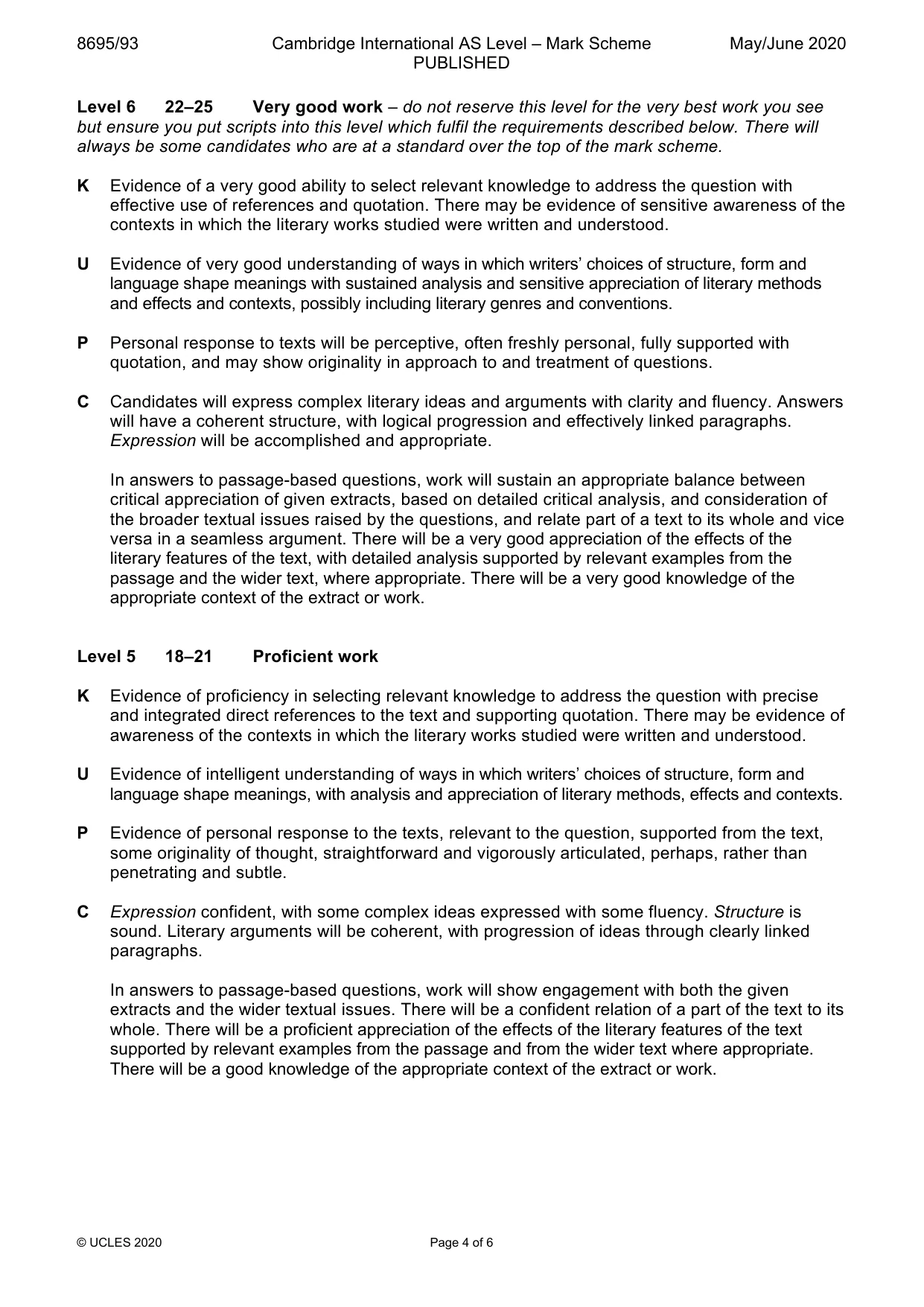
8695/93 Cambridge International AS Level – Mark Scheme PUBLISHED May/June 2020 © UCLES 2020 Page 4 of 6 Level 6 22–25 Very good work – do not reserve this level for the very best work you see but ensure you put scripts into this level which fulfil the requirements described below. There will always be some candidates who are at a standard over the top of the mark scheme. K Evidence of a very good ability to select relevant knowledge to address the question with effective use of references and quotation. There may be evidence of sensitive awareness of the contexts in which the literary works studied were written and understood. U Evidence of very good understanding of ways in which writers’ choices of structure, form and language shape meanings with sustained analysis and sensitive appreciation of literary methods and effects and contexts, possibly including literary genres and conventions. P Personal response to texts will be perceptive, often freshly personal, fully supported with quotation, and may show originality in approach to and treatment of questions. C Candidates will express complex literary ideas and arguments with clarity and fluency. Answers will have a coherent structure, with logical progression and effectively linked paragraphs. Expression will be accomplished and appropriate. In answers to passage-based questions, work will sustain an appropriate balance between critical appreciation of given extracts, based on detailed critical analysis, and consideration of the broader textual issues raised by the questions, and relate part of a text to its whole and vice versa in a seamless argument. There will be a very good appreciation of the effects of the literary features of the text, with detailed analysis supported by relevant examples from the passage and the wider text, where appropriate. There will be a very good knowledge of the appropriate context of the extract or work. Level 5 18–21 Proficient work K Evidence of proficiency in selecting relevant knowledge to address the question with precise and integrated direct references to the text and supporting quotation. There may be evidence of awareness of the contexts in which the literary works studied were written and understood. U Evidence of intelligent understanding of ways in which writers’ choices of structure, form and language shape meanings, with analysis and appreciation of literary methods, effects and contexts. P Evidence of personal response to the texts, relevant to the question, supported from the text, some originality of thought, straightforward and vigorously articulated, perhaps, rather than penetrating and subtle. C Expression confident, with some complex ideas expressed with some fluency. Structure is sound. Literary arguments will be coherent, with progression of ideas through clearly linked paragraphs. In answers to passage-based questions, work will show engagement with both the given extracts and the wider textual issues. There will be a confident relation of a part of the text to its whole. There will be a proficient appreciation of the effects of the literary features of the text supported by relevant examples from the passage and from the wider text where appropriate. There will be a good knowledge of the appropriate context of the extract or work.
Mark scheme, page 5
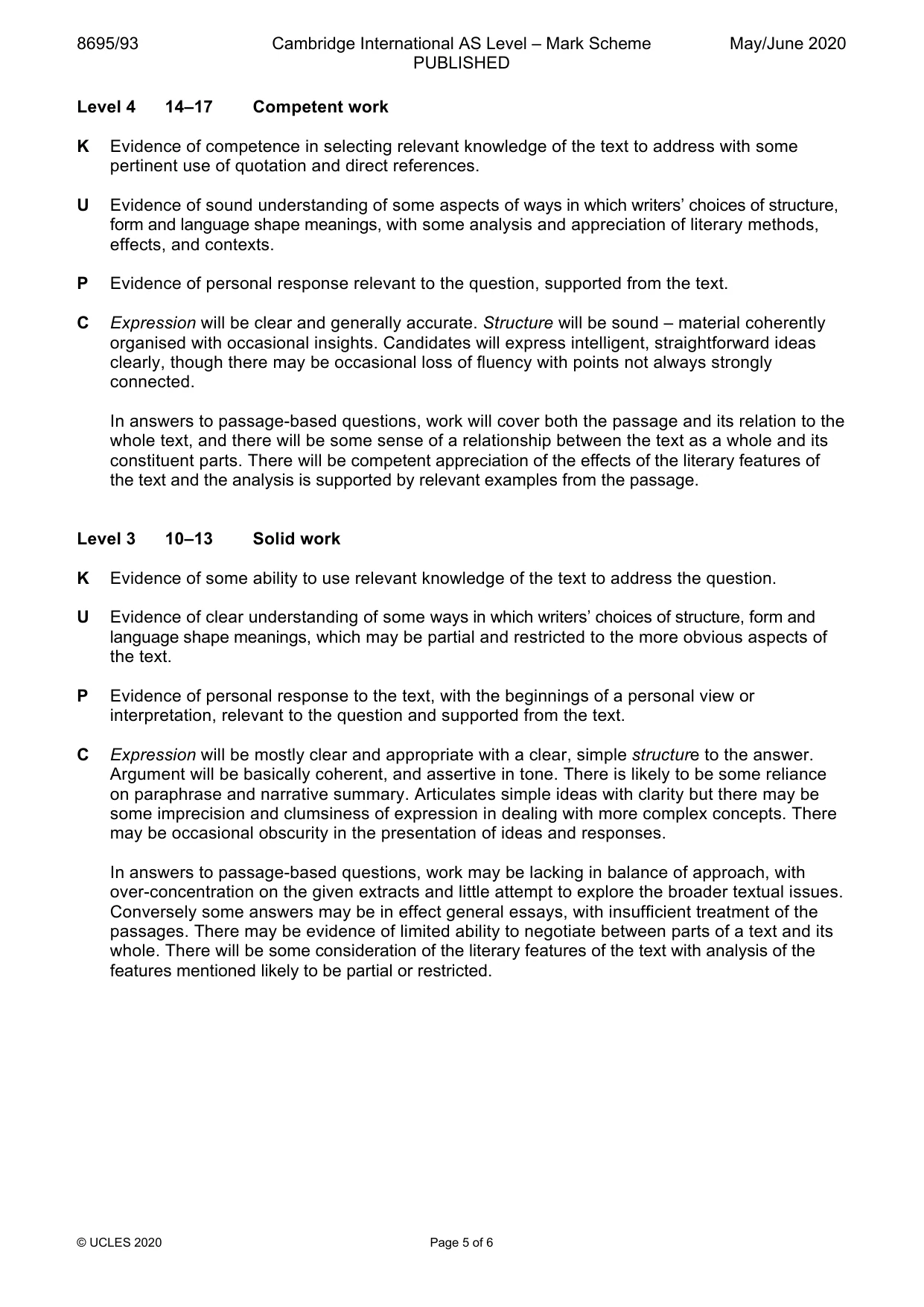
8695/93 Cambridge International AS Level – Mark Scheme PUBLISHED May/June 2020 © UCLES 2020 Page 5 of 6 Level 4 14–17 Competent work K Evidence of competence in selecting relevant knowledge of the text to address with some pertinent use of quotation and direct references. U Evidence of sound understanding of some aspects of ways in which writers’ choices of structure, form and language shape meanings, with some analysis and appreciation of literary methods, effects, and contexts. P Evidence of personal response relevant to the question, supported from the text. C Expression will be clear and generally accurate. Structure will be sound – material coherently organised with occasional insights. Candidates will express intelligent, straightforward ideas clearly, though there may be occasional loss of fluency with points not always strongly connected. In answers to passage-based questions, work will cover both the passage and its relation to the whole text, and there will be some sense of a relationship between the text as a whole and its constituent parts. There will be competent appreciation of the effects of the literary features of the text and the analysis is supported by relevant examples from the passage. Level 3 10–13 Solid work K Evidence of some ability to use relevant knowledge of the text to address the question. U Evidence of clear understanding of some ways in which writers’ choices of structure, form and language shape meanings, which may be partial and restricted to the more obvious aspects of the text. P Evidence of personal response to the text, with the beginnings of a personal view or interpretation, relevant to the question and supported from the text. C Expression will be mostly clear and appropriate with a clear, simple structure to the answer. Argument will be basically coherent, and assertive in tone. There is likely to be some reliance on paraphrase and narrative summary. Articulates simple ideas with clarity but there may be some imprecision and clumsiness of expression in dealing with more complex concepts. There may be occasional obscurity in the presentation of ideas and responses. In answers to passage-based questions, work may be lacking in balance of approach, with over-concentration on the given extracts and little attempt to explore the broader textual issues. Conversely some answers may be in effect general essays, with insufficient treatment of the passages. There may be evidence of limited ability to negotiate between parts of a text and its whole. There will be some consideration of the literary features of the text with analysis of the features mentioned likely to be partial or restricted.
Mark scheme, page 6
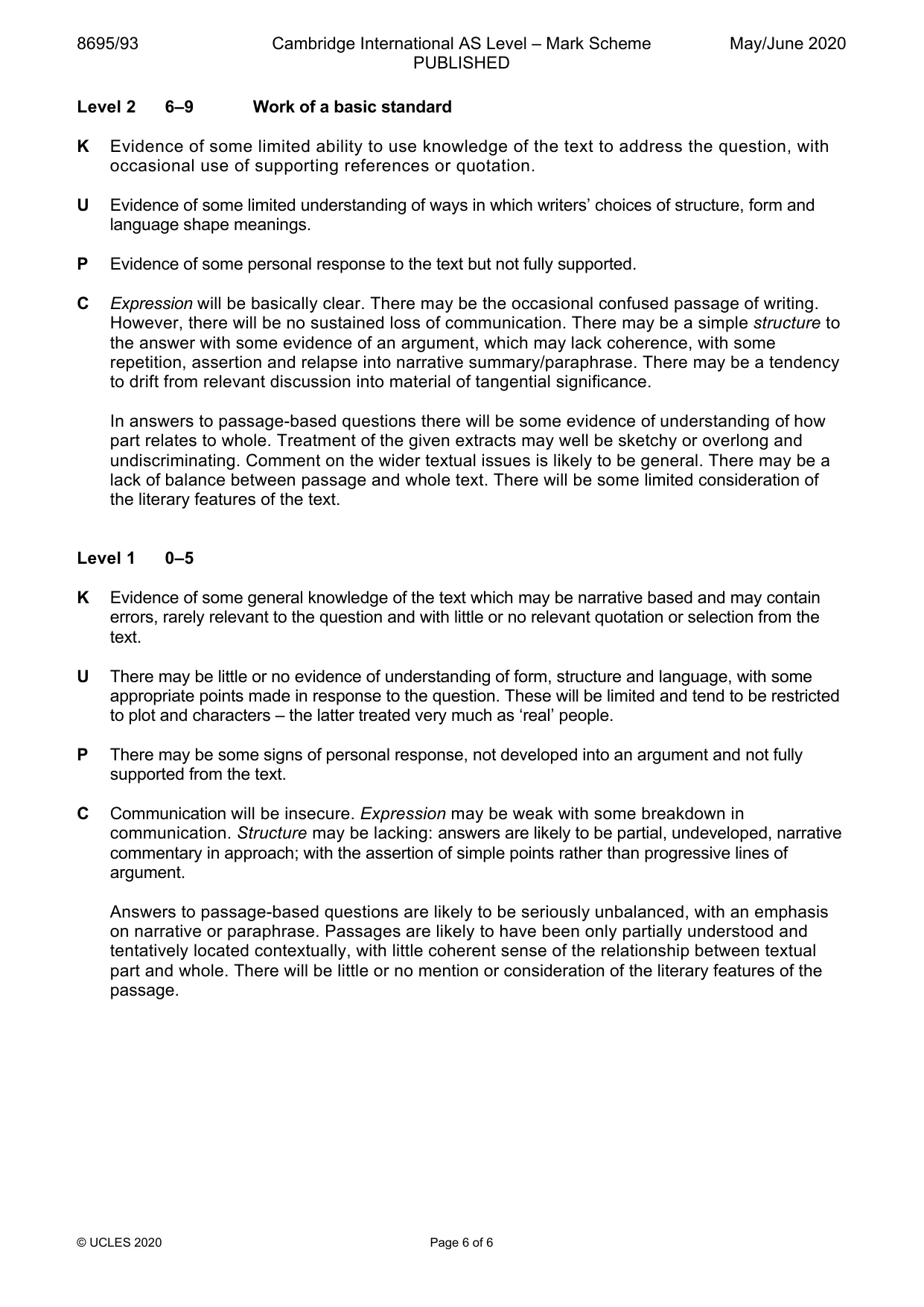
8695/93 Cambridge International AS Level – Mark Scheme PUBLISHED May/June 2020 © UCLES 2020 Page 6 of 6 Level 2 6–9 Work of a basic standard K Evidence of some limited ability to use knowledge of the text to address the question, with occasional use of supporting references or quotation. U Evidence of some limited understanding of ways in which writers’ choices of structure, form and language shape meanings. P Evidence of some personal response to the text but not fully supported. C Expression will be basically clear. There may be the occasional confused passage of writing. However, there will be no sustained loss of communication. There may be a simple structure to the answer with some evidence of an argument, which may lack coherence, with some repetition, assertion and relapse into narrative summary/paraphrase. There may be a tendency to drift from relevant discussion into material of tangential significance. In answers to passage-based questions there will be some evidence of understanding of how part relates to whole. Treatment of the given extracts may well be sketchy or overlong and undiscriminating. Comment on the wider textual issues is likely to be general. There may be a lack of balance between passage and whole text. There will be some limited consideration of the literary features of the text. Level 1 0–5 K Evidence of some general knowledge of the text which may be narrative based and may contain errors, rarely relevant to the question and with little or no relevant quotation or selection from the text. U There may be little or no evidence of understanding of form, structure and language, with some appropriate points made in response to the question. These will be limited and tend to be restricted to plot and characters – the latter treated very much as ‘real’ people. P There may be some signs of personal response, not developed into an argument and not fully supported from the text. C Communication will be insecure. Expression may be weak with some breakdown in communication. Structure may be lacking: answers are likely to be partial, undeveloped, narrative commentary in approach; with the assertion of simple points rather than progressive lines of argument. Answers to passage-based questions are likely to be seriously unbalanced, with an emphasis on narrative or paraphrase. Passages are likely to have been only partially understood and tentatively located contextually, with little coherent sense of the relationship between textual part and whole. There will be little or no mention or consideration of the literary features of the passage.