Cambridge A Level English - Language and Literature (AS Level only, from 2016) 8695 — 2020 Oct/Nov Paper 9 · Variant 1
8695/91/O/N/20 · 50 marks · ≈56 min
The question paper and its mark scheme, free to read here and free to download. This is Cambridge’s own paper, exactly as it was sat.
Question paper20 pages



Mark scheme7 pages
Answers below. Sit the paper first if you are practising.
Paper as text
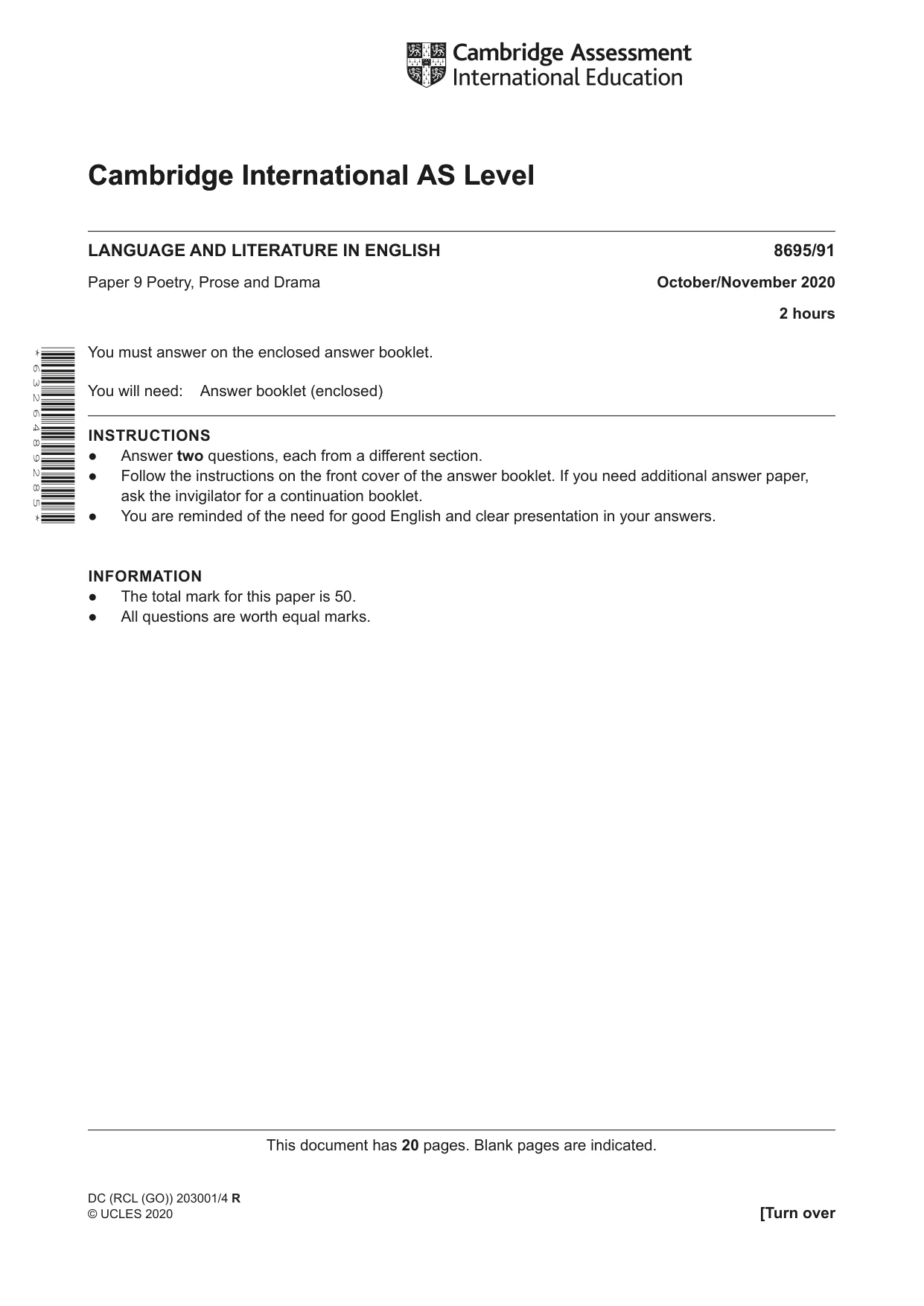
Question paper, page 1
This document has 20 pages. Blank pages are indicated. Cambridge International AS Level LANGUAGE AND LITERATURE IN ENGLISH 8695/91 Paper 9 Poetry, Prose and Drama October/November 2020 2 hours You must answer on the enclosed answer booklet. You will need: Answer booklet (enclosed) INSTRUCTIONS ● Answer two questions, each from a different section. ● Follow the instructions on the front cover of the answer booklet. If you need additional answer paper, ask the invigilator for a continuation booklet. ● You are reminded of the need for good English and clear presentation in your answers. INFORMATION ● The total mark for this paper is 50. ● All questions are worth equal marks. * 6 3 2 6 4 8 9 2 8 5 * DC (RCL (GO)) 203001/4 R © UCLES 2020 [Turn over Cambridge International AS Level
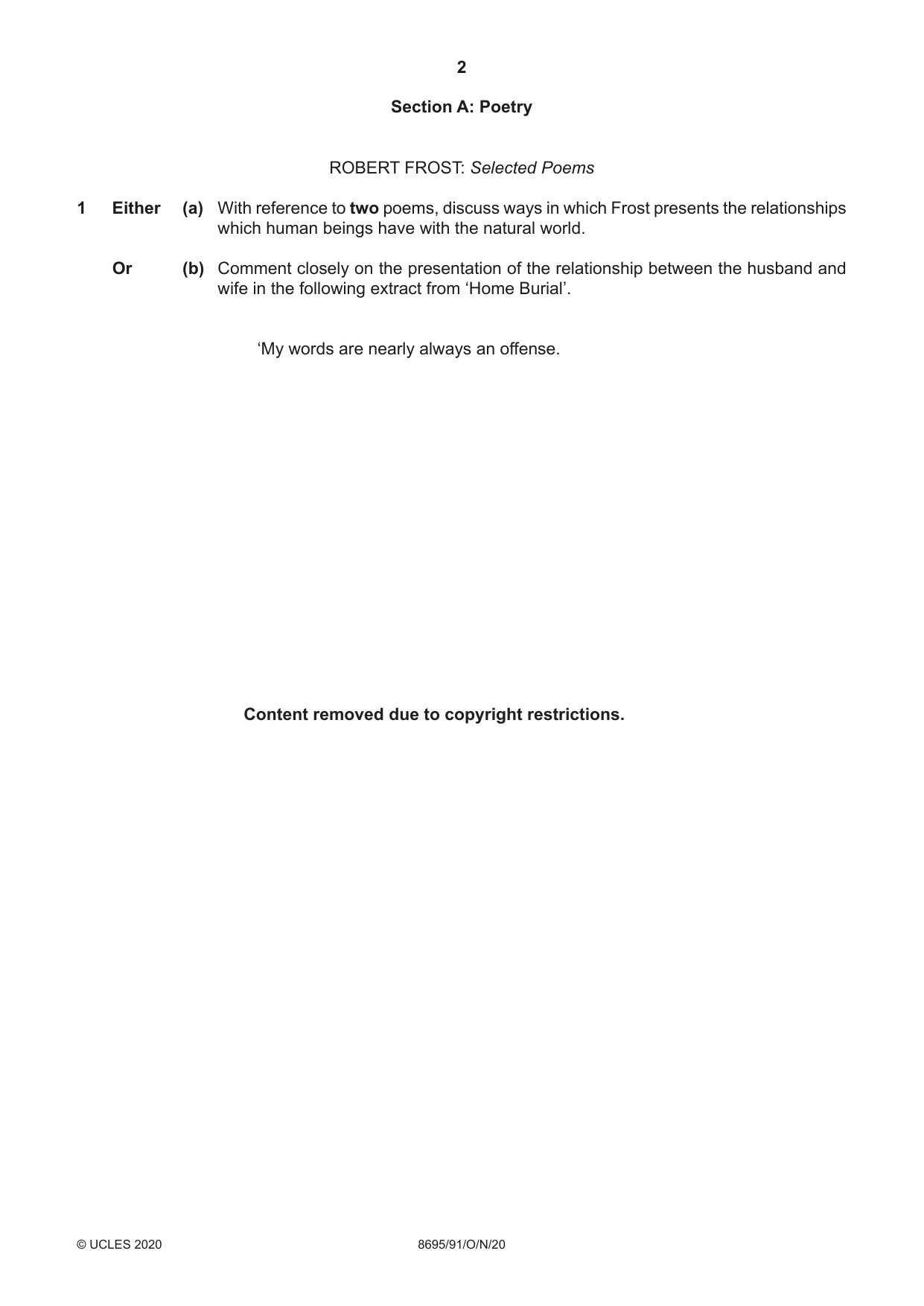
Question paper, page 2
2 8695/91/O/N/20 © UCLES 2020 Section A: Poetry ROBERT FROST: Selected Poems 1 Either (a) With reference to two poems, discuss ways in which Frost presents the relationships which human beings have with the natural world. Or (b) Comment closely on the presentation of the relationship between the husband and wife in the following extract from ‘Home Burial’. ‘My words are nearly always an offense. Content removed due to copyright restrictions.
Question paper, page 3
3 8695/91/O/N/20 © UCLES 2020 [Turn over Outside there in the entry, for I saw it.’ from Home Burial Content removed due to copyright restrictions.
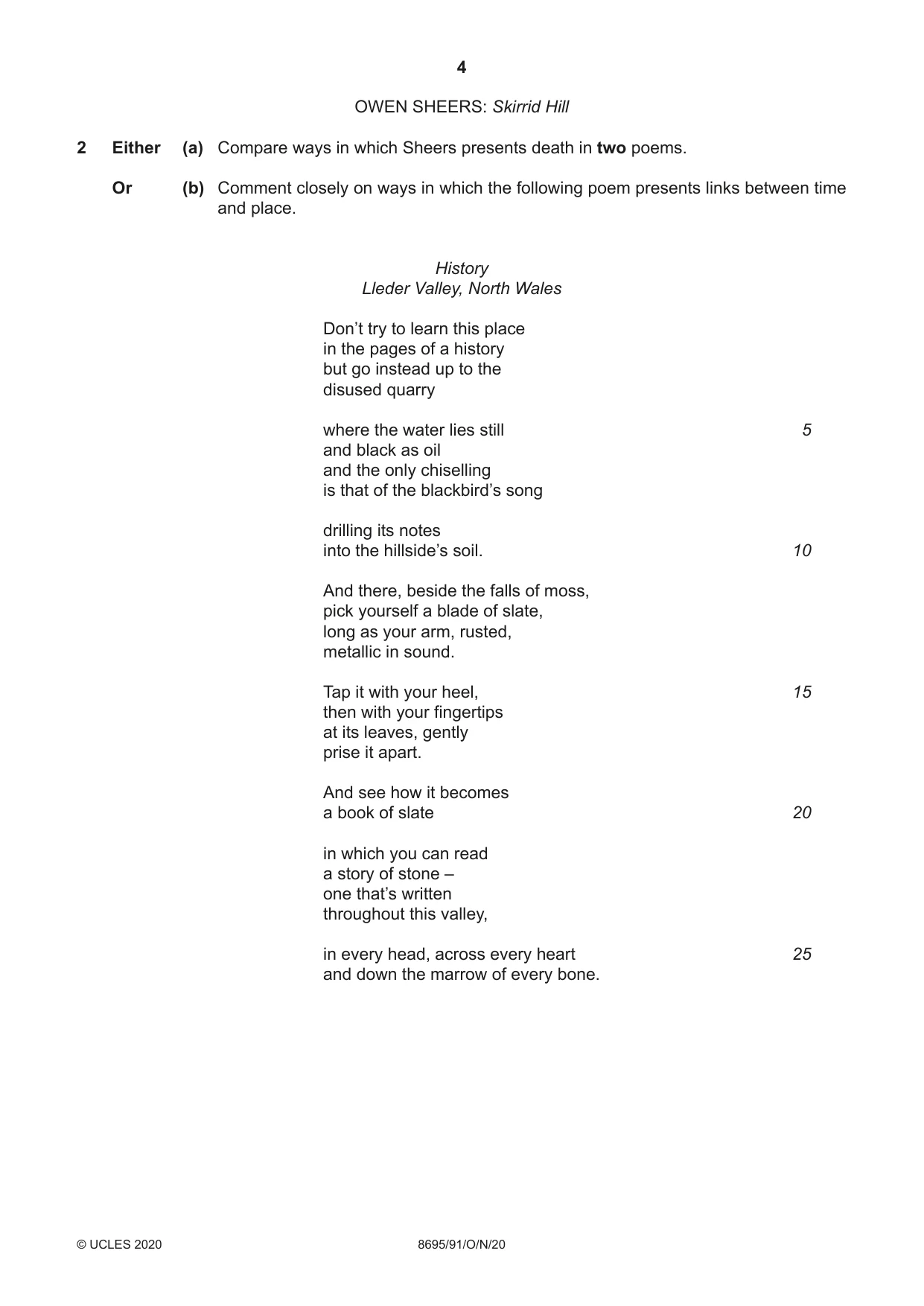
Question paper, page 4
4 8695/91/O/N/20 © UCLES 2020 OWEN SHEERS: Skirrid Hill 2 Either (a) Compare ways in which Sheers presents death in two poems. Or (b) Comment closely on ways in which the following poem presents links between time and place. History Lleder Valley, North Wales Don’t try to learn this place in the pages of a history but go instead up to the disused quarry where the water lies still and black as oil and the only chiselling is that of the blackbird’s song drilling its notes into the hillside’s soil. And there, beside the falls of moss, pick yourself a blade of slate, long as your arm, rusted, metallic in sound. Tap it with your heel, then with your fingertips at its leaves, gently prise it apart. And see how it becomes a book of slate in which you can read a story of stone – one that’s written throughout this valley, in every head, across every heart and down the marrow of every bone. 5 10 15 20 25
Question paper, page 5
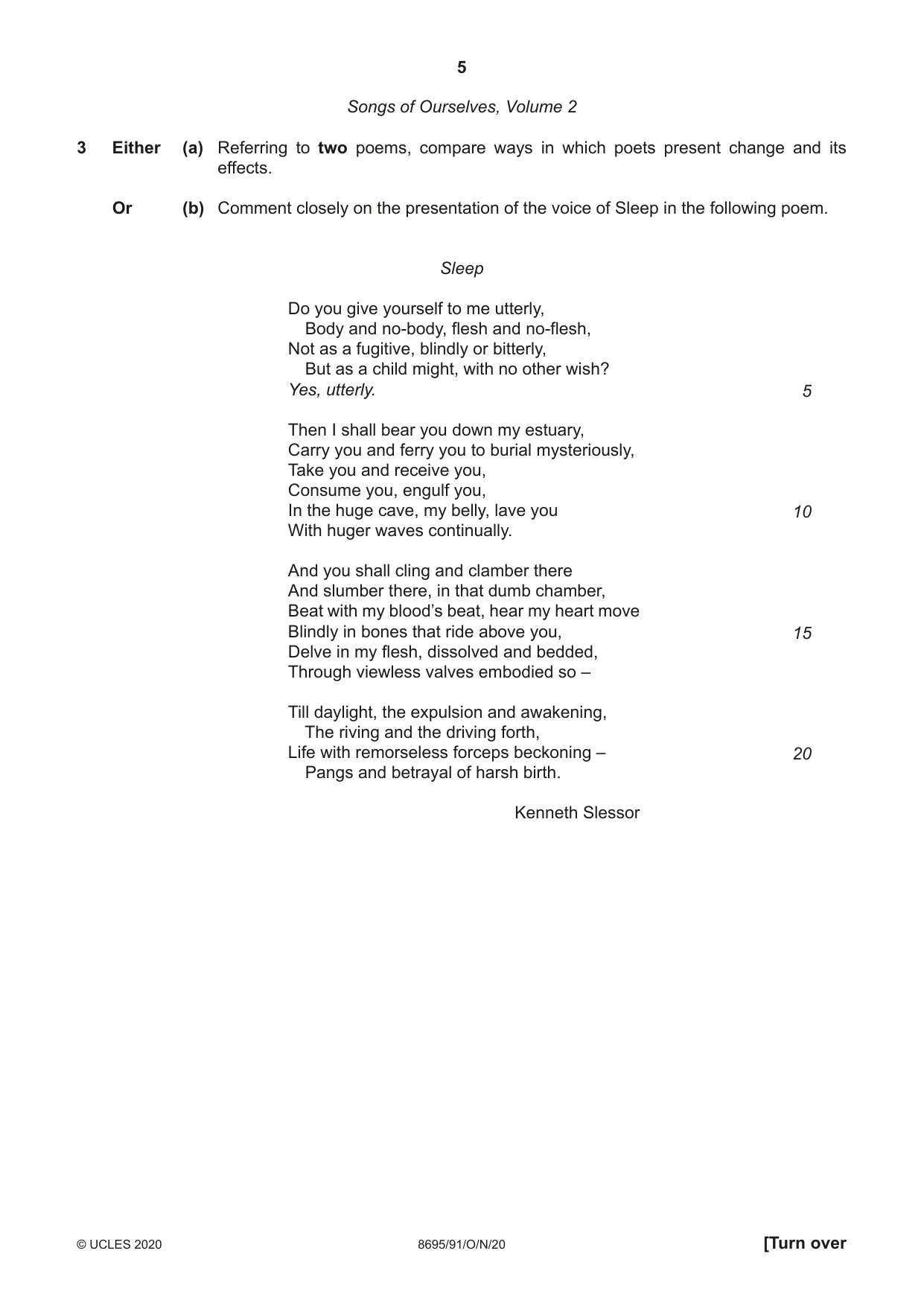
5 8695/91/O/N/20 © UCLES 2020 [Turn over Songs of Ourselves, Volume 2 3 Either (a) Referring to two poems, compare ways in which poets present change and its effects. Or (b) Comment closely on the presentation of the voice of Sleep in the following poem. Sleep Do you give yourself to me utterly, Body and no-body, flesh and no-flesh, Not as a fugitive, blindly or bitterly, But as a child might, with no other wish? Yes, utterly. Then I shall bear you down my estuary, Carry you and ferry you to burial mysteriously, Take you and receive you, Consume you, engulf you, In the huge cave, my belly, lave you With huger waves continually. And you shall cling and clamber there And slumber there, in that dumb chamber, Beat with my blood’s beat, hear my heart move Blindly in bones that ride above you, Delve in my flesh, dissolved and bedded, Through viewless valves embodied so – Till daylight, the expulsion and awakening, The riving and the driving forth, Life with remorseless forceps beckoning – Pangs and betrayal of harsh birth. Kenneth Slessor 5 10 15 20
Question paper, page 6
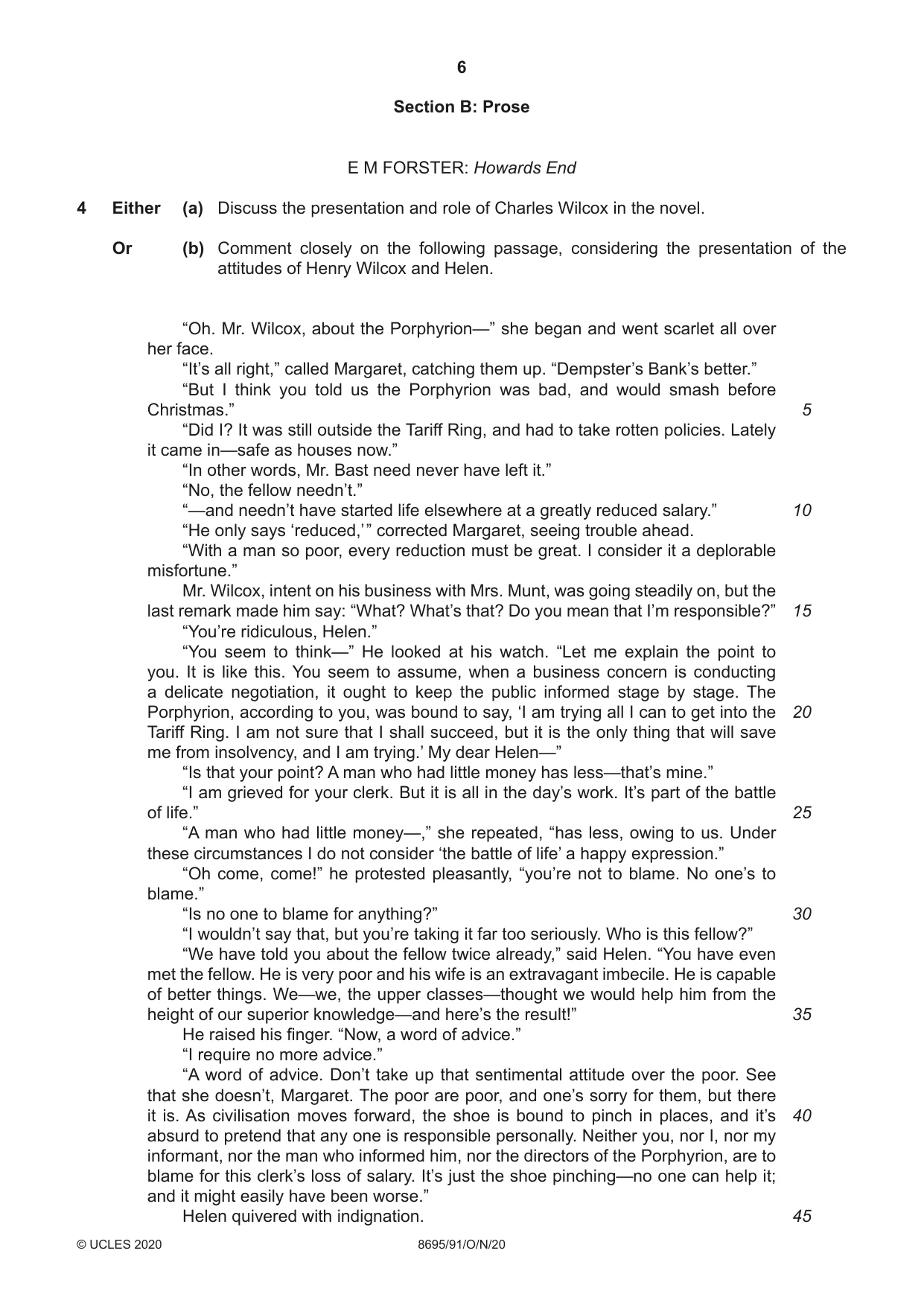
6 8695/91/O/N/20 © UCLES 2020 Section B: Prose E M FORSTER: Howards End 4 Either (a) Discuss the presentation and role of Charles Wilcox in the novel. Or (b) Comment closely on the following passage, considering the presentation of the attitudes of Henry Wilcox and Helen. “Oh. Mr. Wilcox, about the Porphyrion—” she began and went scarlet all over her face. “It’s all right,” called Margaret, catching them up. “Dempster’s Bank’s better.” “But I think you told us the Porphyrion was bad, and would smash before Christmas.” “Did I? It was still outside the Tariff Ring, and had to take rotten policies. Lately it came in—safe as houses now.” “In other words, Mr. Bast need never have left it.” “No, the fellow needn’t.” “—and needn’t have started life elsewhere at a greatly reduced salary.” “He only says ‘reduced,’ ” corrected Margaret, seeing trouble ahead. “With a man so poor, every reduction must be great. I consider it a deplorable misfortune.” Mr. Wilcox, intent on his business with Mrs. Munt, was going steadily on, but the last remark made him say: “What? What’s that? Do you mean that I’m responsible?” “You’re ridiculous, Helen.” “You seem to think—” He looked at his watch. “Let me explain the point to you. It is like this. You seem to assume, when a business concern is conducting a delicate negotiation, it ought to keep the public informed stage by stage. The Porphyrion, according to you, was bound to say, ‘I am trying all I can to get into the Tariff Ring. I am not sure that I shall succeed, but it is the only thing that will save me from insolvency, and I am trying.’ My dear Helen—” “Is that your point? A man who had little money has less—that’s mine.” “I am grieved for your clerk. But it is all in the day’s work. It’s part of the battle of life.” “A man who had little money—,” she repeated, “has less, owing to us. Under these circumstances I do not consider ‘the battle of life’ a happy expression.” “Oh come, come!” he protested pleasantly, “you’re not to blame. No one’s to blame.” “Is no one to blame for anything?” “I wouldn’t say that, but you’re taking it far too seriously. Who is this fellow?” “We have told you about the fellow twice already,” said Helen. “You have even met the fellow. He is very poor and his wife is an extravagant imbecile. He is capable of better things. We—we, the upper classes—thought we would help him from the height of our superior knowledge—and here’s the result!” He raised his finger. “Now, a word of advice.” “I require no more advice.” “A word of advice. Don’t take up that sentimental attitude over the poor. See that she doesn’t, Margaret. The poor are poor, and one’s sorry for them, but there it is. As civilisation moves forward, the shoe is bound to pinch in places, and it’s absurd to pretend that any one is responsible personally. Neither you, nor I, nor my informant, nor the man who informed him, nor the directors of the Porphyrion, are to blame for this clerk’s loss of salary. It’s just the shoe pinching—no one can help it; and it might easily have been worse.” Helen quivered with indignation. 5 10 15 20 25 30 35 40 45
Question paper, page 7
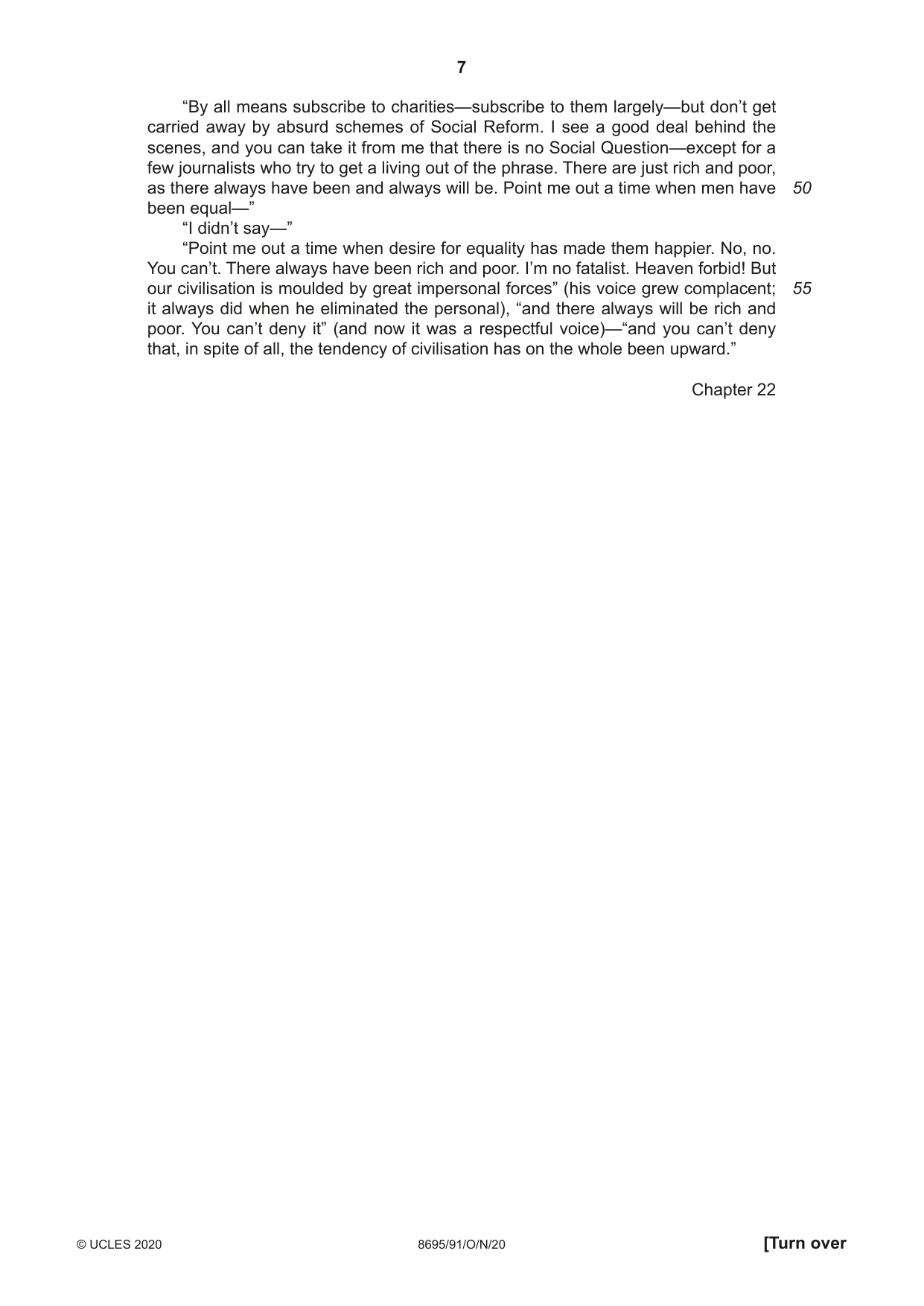
7 8695/91/O/N/20 © UCLES 2020 [Turn over “By all means subscribe to charities—subscribe to them largely—but don’t get carried away by absurd schemes of Social Reform. I see a good deal behind the scenes, and you can take it from me that there is no Social Question—except for a few journalists who try to get a living out of the phrase. There are just rich and poor, as there always have been and always will be. Point me out a time when men have been equal—” “I didn’t say—” “Point me out a time when desire for equality has made them happier. No, no. You can’t. There always have been rich and poor. I’m no fatalist. Heaven forbid! But our civilisation is moulded by great impersonal forces” (his voice grew complacent; it always did when he eliminated the personal), “and there always will be rich and poor. You can’t deny it” (and now it was a respectful voice)—“and you can’t deny that, in spite of all, the tendency of civilisation has on the whole been upward.” Chapter 22 50 55
Question paper, page 8
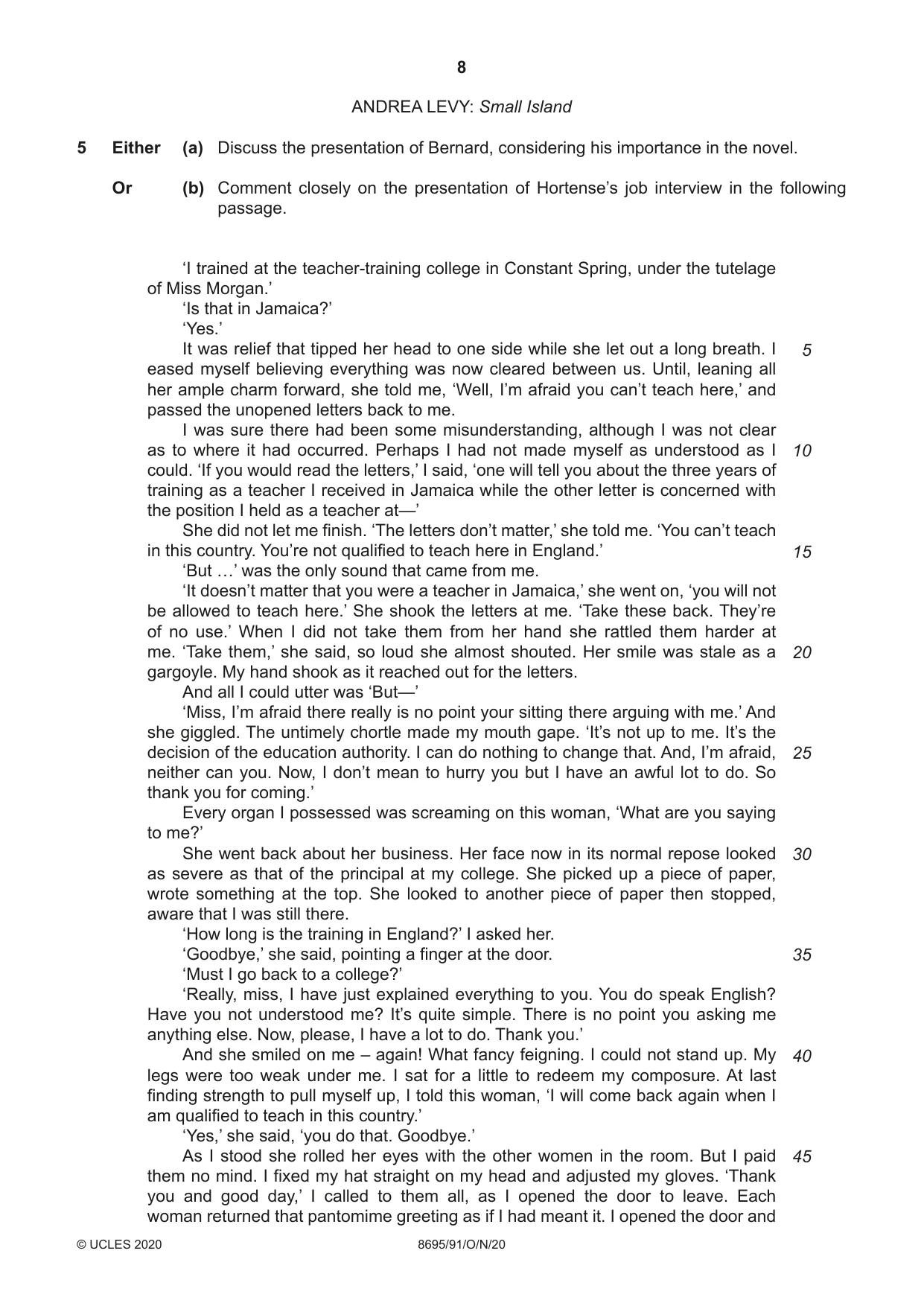
8 8695/91/O/N/20 © UCLES 2020 ANDREA LEVY: Small Island 5 Either (a) Discuss the presentation of Bernard, considering his importance in the novel. Or (b) Comment closely on the presentation of Hortense’s job interview in the following passage. ‘I trained at the teacher-training college in Constant Spring, under the tutelage of Miss Morgan.’ ‘Is that in Jamaica?’ ‘Yes.’ It was relief that tipped her head to one side while she let out a long breath. I eased myself believing everything was now cleared between us. Until, leaning all her ample charm forward, she told me, ‘Well, I’m afraid you can’t teach here,’ and passed the unopened letters back to me. I was sure there had been some misunderstanding, although I was not clear as to where it had occurred. Perhaps I had not made myself as understood as I could. ‘If you would read the letters,’ I said, ‘one will tell you about the three years of training as a teacher I received in Jamaica while the other letter is concerned with the position I held as a teacher at—’ She did not let me finish. ‘The letters don’t matter,’ she told me. ‘You can’t teach in this country. You’re not qualified to teach here in England.’ ‘But …’ was the only sound that came from me. ‘It doesn’t matter that you were a teacher in Jamaica,’ she went on, ‘you will not be allowed to teach here.’ She shook the letters at me. ‘Take these back. They’re of no use.’ When I did not take them from her hand she rattled them harder at me. ‘Take them,’ she said, so loud she almost shouted. Her smile was stale as a gargoyle. My hand shook as it reached out for the letters. And all I could utter was ‘But—’ ‘Miss, I’m afraid there really is no point your sitting there arguing with me.’ And she giggled. The untimely chortle made my mouth gape. ‘It’s not up to me. It’s the decision of the education authority. I can do nothing to change that. And, I’m afraid, neither can you. Now, I don’t mean to hurry you but I have an awful lot to do. So thank you for coming.’ Every organ I possessed was screaming on this woman, ‘What are you saying to me?’ She went back about her business. Her face now in its normal repose looked as severe as that of the principal at my college. She picked up a piece of paper, wrote something at the top. She looked to another piece of paper then stopped, aware that I was still there. ‘How long is the training in England?’ I asked her. ‘Goodbye,’ she said, pointing a finger at the door. ‘Must I go back to a college?’ ‘Really, miss, I have just explained everything to you. You do speak English? Have you not understood me? It’s quite simple. There is no point you asking me anything else. Now, please, I have a lot to do. Thank you.’ And she smiled on me – again! What fancy feigning. I could not stand up. My legs were too weak under me. I sat for a little to redeem my composure. At last finding strength to pull myself up, I told this woman, ‘I will come back again when I am qualified to teach in this country.’ ‘Yes,’ she said, ‘you do that. Goodbye.’ As I stood she rolled her eyes with the other women in the room. But I paid them no mind. I fixed my hat straight on my head and adjusted my gloves. ‘Thank you and good day,’ I called to them all, as I opened the door to leave. Each woman returned that pantomime greeting as if I had meant it. I opened the door and 5 10 15 20 25 30 35 40 45
Question paper, page 9
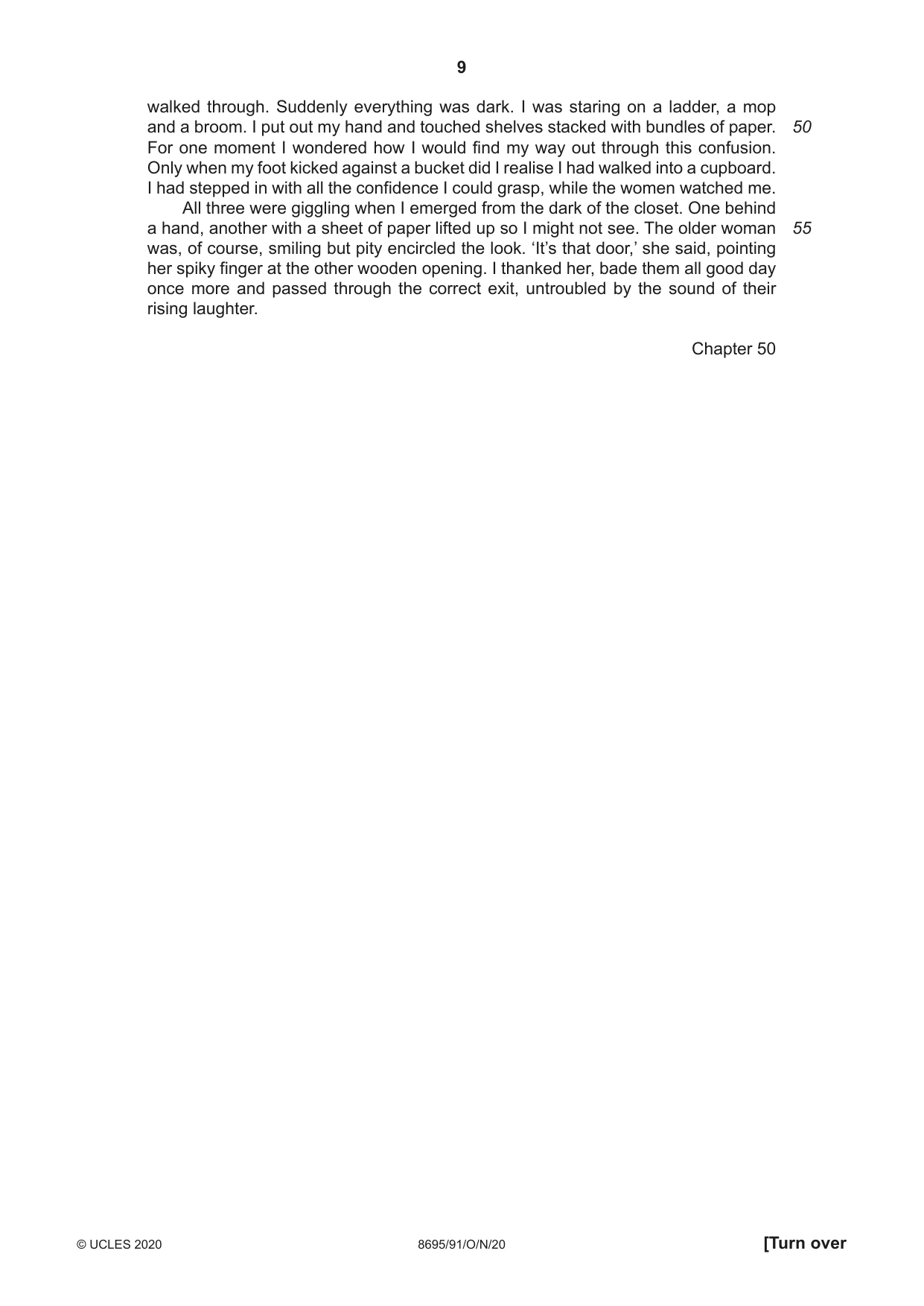
9 8695/91/O/N/20 © UCLES 2020 [Turn over walked through. Suddenly everything was dark. I was staring on a ladder, a mop and a broom. I put out my hand and touched shelves stacked with bundles of paper. For one moment I wondered how I would find my way out through this confusion. Only when my foot kicked against a bucket did I realise I had walked into a cupboard. I had stepped in with all the confidence I could grasp, while the women watched me. All three were giggling when I emerged from the dark of the closet. One behind a hand, another with a sheet of paper lifted up so I might not see. The older woman was, of course, smiling but pity encircled the look. ‘It’s that door,’ she said, pointing her spiky finger at the other wooden opening. I thanked her, bade them all good day once more and passed through the correct exit, untroubled by the sound of their rising laughter. Chapter 50 50 55
Question paper, page 10
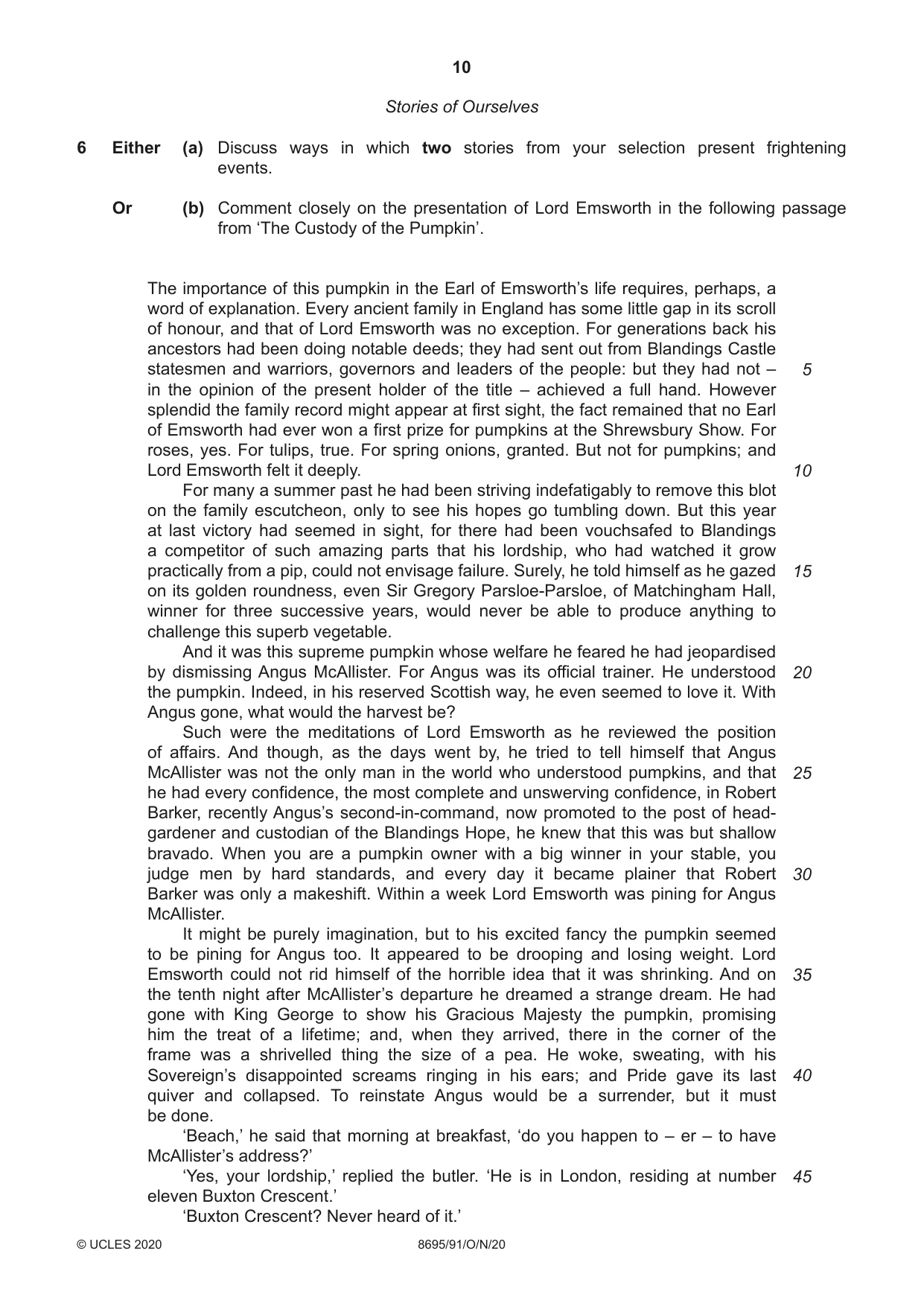
10 8695/91/O/N/20 © UCLES 2020 Stories of Ourselves 6 Either (a) Discuss ways in which two stories from your selection present frightening events. Or (b) Comment closely on the presentation of Lord Emsworth in the following passage from ‘The Custody of the Pumpkin’. The importance of this pumpkin in the Earl of Emsworth’s life requires, perhaps, a word of explanation. Every ancient family in England has some little gap in its scroll of honour, and that of Lord Emsworth was no exception. For generations back his ancestors had been doing notable deeds; they had sent out from Blandings Castle statesmen and warriors, governors and leaders of the people: but they had not – in the opinion of the present holder of the title – achieved a full hand. However splendid the family record might appear at first sight, the fact remained that no Earl of Emsworth had ever won a first prize for pumpkins at the Shrewsbury Show. For roses, yes. For tulips, true. For spring onions, granted. But not for pumpkins; and Lord Emsworth felt it deeply. For many a summer past he had been striving indefatigably to remove this blot on the family escutcheon, only to see his hopes go tumbling down. But this year at last victory had seemed in sight, for there had been vouchsafed to Blandings a competitor of such amazing parts that his lordship, who had watched it grow practically from a pip, could not envisage failure. Surely, he told himself as he gazed on its golden roundness, even Sir Gregory Parsloe-Parsloe, of Matchingham Hall, winner for three successive years, would never be able to produce anything to challenge this superb vegetable. And it was this supreme pumpkin whose welfare he feared he had jeopardised by dismissing Angus McAllister. For Angus was its official trainer. He understood the pumpkin. Indeed, in his reserved Scottish way, he even seemed to love it. With Angus gone, what would the harvest be? Such were the meditations of Lord Emsworth as he reviewed the position of affairs. And though, as the days went by, he tried to tell himself that Angus McAllister was not the only man in the world who understood pumpkins, and that he had every confidence, the most complete and unswerving confidence, in Robert Barker, recently Angus’s second-in-command, now promoted to the post of head- gardener and custodian of the Blandings Hope, he knew that this was but shallow bravado. When you are a pumpkin owner with a big winner in your stable, you judge men by hard standards, and every day it became plainer that Robert Barker was only a makeshift. Within a week Lord Emsworth was pining for Angus McAllister. It might be purely imagination, but to his excited fancy the pumpkin seemed to be pining for Angus too. It appeared to be drooping and losing weight. Lord Emsworth could not rid himself of the horrible idea that it was shrinking. And on the tenth night after McAllister’s departure he dreamed a strange dream. He had gone with King George to show his Gracious Majesty the pumpkin, promising him the treat of a lifetime; and, when they arrived, there in the corner of the frame was a shrivelled thing the size of a pea. He woke, sweating, with his Sovereign’s disappointed screams ringing in his ears; and Pride gave its last quiver and collapsed. To reinstate Angus would be a surrender, but it must be done. ‘Beach,’ he said that morning at breakfast, ‘do you happen to – er – to have McAllister’s address?’ ‘Yes, your lordship,’ replied the butler. ‘He is in London, residing at number eleven Buxton Crescent.’ ‘Buxton Crescent? Never heard of it.’ 5 10 15 20 25 30 35 40 45
Question paper, page 11
11 8695/91/O/N/20 © UCLES 2020 [Turn over ‘It is, I fancy, your lordship, a boarding-house or some such establishment off the Cromwell Road. McAllister was accustomed to make it his headquarters whenever he visited the Metropolis on account of its handiness for Kensington Gardens. He liked,’ said Beach with respectful reproach, for Angus had been a friend of his for nine years, ‘to be near the flowers, your lordship.’ The Custody of the Pumpkin 50
Question paper, page 12
12 8695/91/O/N/20 © UCLES 2020 Section C: Drama ARTHUR MILLER: All My Sons 7 Either (a) George: Oh, Chris, you’re a liar to yourself. In the light of George’s comment, discuss the ways in which Miller presents Chris in the play. Or (b) With close reference to detail of language and action, discuss Miller’s presentation of the Kellers in the following extract. [MOTHER appears on porch. She is in her early fifties, a woman of uncontrolled inspirations and an overwhelming capacity for love.] Mother: Joe? Content removed due to copyright restrictions.
Question paper, page 13
13 8695/91/O/N/20 © UCLES 2020 [Turn over I haven’t seen it in a century. Act 1 Content removed due to copyright restrictions.
Question paper, page 14
14 8695/91/O/N/20 © UCLES 2020 WILLIAM SHAKESPEARE: Henry IV, Part 2 8 Either (a) Discuss Shakespeare’s presentation of the rebels and rebellion in the play. Or (b) With close reference to detail, discuss Shakespeare’s presentation of Falstaff in the following extract. Falstaff: Is thy name Mouldy? Mouldy: Yea, an’t please you. Falstaff: ‘Tis the more time thou wert us’d. Shallow: Ha, ha, ha! most excellent, i’ faith! Things that are mouldy lack use. Very singular good! In faith, well said, Sir John; very well said. Falstaff: Prick him. Mouldy: I was prick’d well enough before, an you could have let me alone. My old dame will be undone now for one to do her husbandry and her drudgery. You need not to have prick’d me; there are other men fitter to go out than I. Falstaff: Go to; peace, Mouldy; you shall go. Mouldy, it is time you were spent. Mouldy: Spent! Shallow: Peace, fellow, peace; stand aside; know you where you are? For th’ other, Sir John – let me see. Simon Shadow! Falstaff: Yea, marry, let me have him to sit under. He’s like to be a cold soldier. Shallow: Where’s Shadow? Shadow: Here, sir. Falstaff: Shadow, whose son art thou? Shadow: My mother’s son, sir. Falstaff: Thy mother’s son! Like enough; and thy father’s shadow. So the son of the female is the shadow of the male. It is often so indeed; but much of the father’s substance! Shallow: Do you like him, Sir John? Falstaff: Shadow will serve for summer. Prick him; for we have a number of shadows fill up the muster-book. Shallow: Thomas Wart! Falstaff: Where’s he? Wart: Here, sir. Falstaff: Is thy name Wart? Wart: Yea, sir. Falstaff: Thou art a very ragged wart. Shallow: Shall I prick him, Sir John? Falstaff: It were superfluous; for his apparel is built upon his back, and the whole frame stands upon pins. Prick him no more. Shallow: Ha, ha, ha! You can do it, sir; you can do it. I commend you well. Francis Feeble! Feeble: Here, Sir. 5 10 15 20 25 30 35 40
Question paper, page 15
15 8695/91/O/N/20 © UCLES 2020 [Turn over Falstaff: What trade art thou, Feeble? Feeble: A woman’s tailor, sir. Shallow: Shall I prick him, sir? Falstaff: You may; but if he had been a man’s tailor, he’d ha’ prick’d you. Wilt thou make as many holes in an enemy’s battle as thou hast done in a woman’s petticoat? Feeble: I will do my good will, sir; you can have no more. Falstaff: Well said, good woman’s tailor! well said, courageous Feeble! Thou wilt be as valiant as the wrathful dove or most magnanimous mouse. Prick the woman’s tailor – well, Master Shallow, deep, Master Shallow. Feeble: I would Wart might have gone, sir. Falstaff: I would thou wert a man’s tailor, that thou mightst mend him and make him fit to go. I cannot put him to a private soldier, that is the leader of so many thousands. Let that suffice, most forcible Feeble. Feeble: It shall suffice, sir. Falstaff: I am bound to thee, reverend Feeble. Who is next? Shallow: Peter Bullcalf o’ th’ green! Falstaff: Yea, marry, let’s see Bullcalf. Bullcalf: Here, sir. Falstaff: Fore God, a likely fellow! Come, prick me Bullcalf till he roar again. Bullcalf: O Lord! good my lord captain – Falstaff: What, dost thou roar before thou art prick’d? Bullcalf: O Lord, sir! I am a diseased man. Falstaff: What disease hast thou? Bullcalf: A whoreson cold, sir, a cough, sir, which I caught with ringing in the King’s affairs upon his coronation day, sir. Falstaff: Come, thou shalt go to the wars in a gown. We will have away thy cold; and I will take such order that thy friends shall ring for thee. Is here all? Shallow: Here is two more call’d than your number. You must have but four here, sir; and so, I pray you, go in with me to dinner. Falstaff: Come, I will go drink with you, but I cannot tarry dinner. I am glad to see you, by my troth, Master Shallow. Act 3, Scene 2 45 50 55 60 65 70 75
Question paper, page 16
16 8695/91/O/N/20 © UCLES 2020 WOLE SOYINKA: Death and the King’s Horseman 9 Either (a) In what ways, and with what dramatic effects, does Soyinka present the attitudes of Simon Pilkings to Yoruban culture in the play? Or (b) With close reference to detail of language and action, discuss Soyinka’s presentation of tension between Amusa and the women in the following episode. [The WOMEN come on stage, borne backwards by the determined progress of Sergeant AMUSA and his two constables who already have their batons out and use them as a pressure against the WOMEN. At the edge of the cloth-covered floor, however, the WOMEN take a determined stand and block all further progress of the men. They begin to tease them mercilessly.] Amusa: I am tell you women for last time to commot my road. Content removed due to copyright restrictions.
Question paper, page 17
17 8695/91/O/N/20 © UCLES 2020 If you don’t know what a marriage is, go and ask him to tell you. Scene 3 Content removed due to copyright restrictions.
Question paper, page 18
18 8695/91/O/N/20 © UCLES 2020 BLANK PAGE
Question paper, page 19
19 8695/91/O/N/20 © UCLES 2020 BLANK PAGE
Question paper, page 20
20 8695/91/O/N/20 © UCLES 2020 Permission to reproduce items where third-party owned material protected by copyright is included has been sought and cleared where possible. Every reasonable effort has been made by the publisher (UCLES) to trace copyright holders, but if any items requiring clearance have unwittingly been included, the publisher will be pleased to make amends at the earliest possible opportunity. To avoid the issue of disclosure of answer-related information to candidates, all copyright acknowledgements are reproduced online in the Cambridge Assessment International Education Copyright Acknowledgements Booklet. This is produced for each series of examinations and is freely available to download at www.cambridgeinternational.org after the live examination series. Cambridge Assessment International Education is part of the Cambridge Assessment Group. Cambridge Assessment is the brand name of the University of Cambridge Local Examinations Syndicate (UCLES), which itself is a department of the University of Cambridge. BLANK PAGE
Mark scheme, page 1
This document consists of 7 printed pages. © UCLES 2020 [Turn over Cambridge International AS & A Level LITERATURE IN ENGLISH 8695/91 Paper 9 Poetry, Prose and Drama October/November 2020 MARK SCHEME Maximum Mark: 50 Published This mark scheme is published as an aid to teachers and candidates, to indicate the requirements of the examination. It shows the basis on which Examiners were instructed to award marks. It does not indicate the details of the discussions that took place at an Examiners’ meeting before marking began, which would have considered the acceptability of alternative answers. Mark schemes should be read in conjunction with the question paper and the Principal Examiner Report for Teachers. Cambridge International will not enter into discussions about these mark schemes. Cambridge International is publishing the mark schemes for the October/November 2020 series for most Cambridge IGCSE™, Cambridge International A and AS Level and Cambridge Pre-U components, and some Cambridge O Level components.
Mark scheme, page 2
8695/91 Cambridge International AS & A Level – Mark Scheme PUBLISHED October/November 2020 © UCLES 2020 Page 2 of 7 Generic Marking Principles These general marking principles must be applied by all examiners when marking candidate answers. They should be applied alongside the specific content of the mark scheme or generic level descriptors for a question. Each question paper and mark scheme will also comply with these marking principles. GENERIC MARKING PRINCIPLE 1: Marks must be awarded in line with: • the specific content of the mark scheme or the generic level descriptors for the question • the specific skills defined in the mark scheme or in the generic level descriptors for the question • the standard of response required by a candidate as exemplified by the standardisation scripts. GENERIC MARKING PRINCIPLE 2: Marks awarded are always whole marks (not half marks, or other fractions). GENERIC MARKING PRINCIPLE 3: Marks must be awarded positively: • marks are awarded for correct/valid answers, as defined in the mark scheme. However, credit is given for valid answers which go beyond the scope of the syllabus and mark scheme, referring to your Team Leader as appropriate • marks are awarded when candidates clearly demonstrate what they know and can do • marks are not deducted for errors • marks are not deducted for omissions • answers should only be judged on the quality of spelling, punctuation and grammar when these features are specifically assessed by the question as indicated by the mark scheme. The meaning, however, should be unambiguous. GENERIC MARKING PRINCIPLE 4: Rules must be applied consistently, e.g. in situations where candidates have not followed instructions or in the application of generic level descriptors. GENERIC MARKING PRINCIPLE 5: Marks should be awarded using the full range of marks defined in the mark scheme for the question (however; the use of the full mark range may be limited according to the quality of the candidate responses seen). GENERIC MARKING PRINCIPLE 6: Marks awarded are based solely on the requirements as defined in the mark scheme. Marks should not be awarded with grade thresholds or grade descriptors in mind.
Mark scheme, page 3
8695/91 Cambridge International AS & A Level – Mark Scheme PUBLISHED October/November 2020 © UCLES 2020 Page 3 of 7 Introduction For general administrative guidance, see Notes for Examiners Handbook. Assessment objectives: AO3 The ability to respond to texts in the three main forms (Prose, Poetry and Drama), of different types and from different cultures. AO4 An understanding of how writers’ choices of form, structure and language shape meanings. AO5 The ability to produce informed, independent opinions and judgements on literary texts. AO6 The ability to communicate clearly the knowledge, understanding and insight appropriate to literary study. Each answer is marked out of 25, in accordance with the levels mark scheme. Each level is divided into strands: Knowledge (K), Understanding (U), Personal Response (P) and Communication (C). Principles of Annotation Annotating English Literature scripts has the following purposes: • to follow best practice in assessing English Literature essays • to record the comments and developing thought of the examiner doing the work of assessment • to facilitate the summative comments and overall mark given to an essay. The annotations made on scripts become public property following marking and may be cited as evidence in case of appeal. Annotations are therefore vital, not just in ensuring the mark given is what the student deserves, but also in making the marking process demonstrably clear to any potential reader. Using the levels mark scheme Place the answer in a level first. Look for the “best fit” of the answer into a level. An answer needs to show evidence of most but not necessarily ALL of the qualities described in a level, in order to be placed in that level. Then award a mark for the relative position of the answer within the level. Candidates may address the question in many different ways. Do not expect any particular focus or approach and do not penalise answers for leaving out a particular focus. Reward what is there, showing what you are rewarding, in your comments. Consider all strands and weigh up the performance as a whole in placing the answer in a level, then show that you have done so in the summative comment, e.g. ‘Level 3: A solid “K” of the text, with a “U” of the ways in which Forster uses form and language. The beginnings of “P” personal response shown and supported by the text. “C” is clear and appropriate throughout.’
Mark scheme, page 4
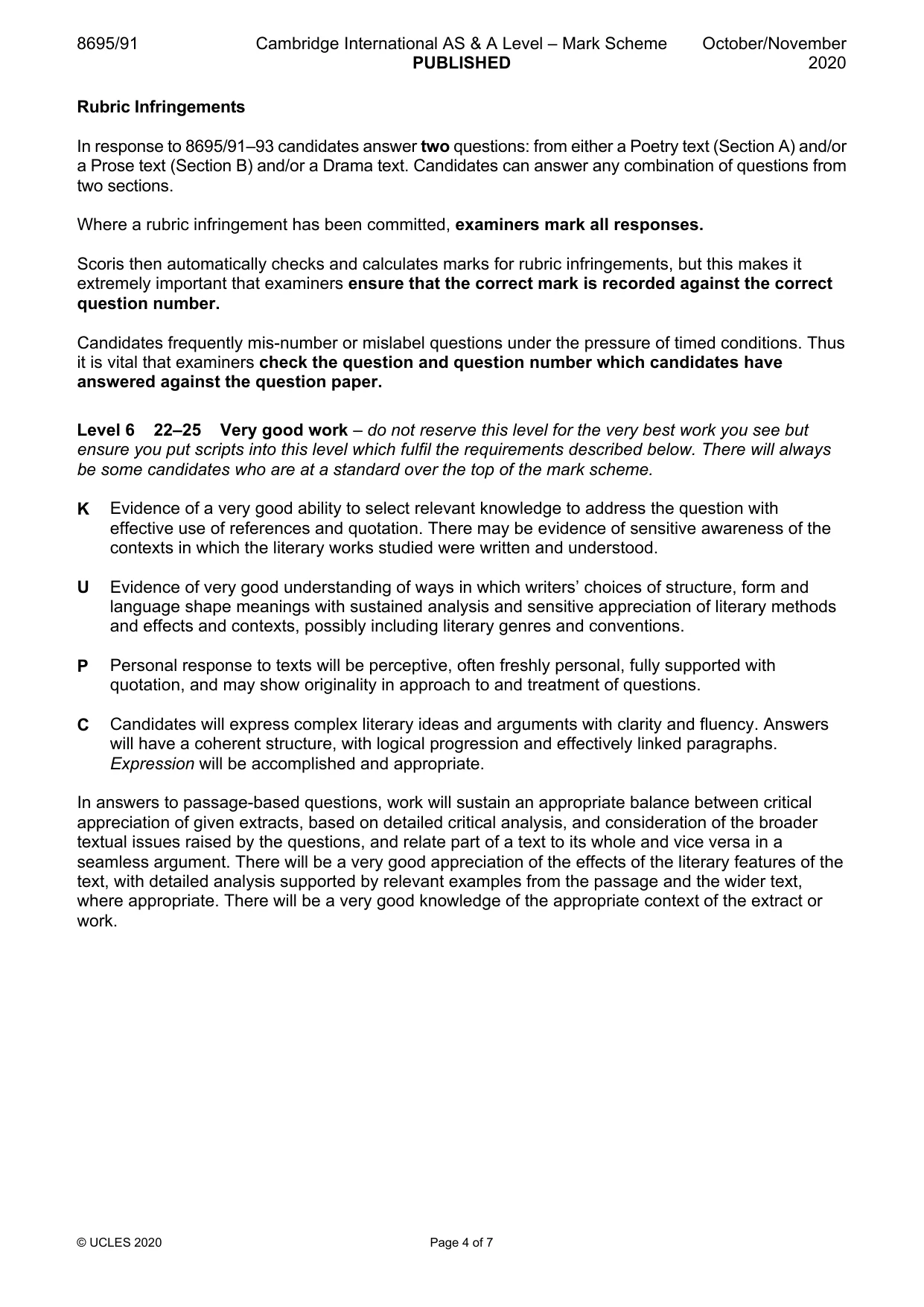
8695/91 Cambridge International AS & A Level – Mark Scheme PUBLISHED October/November 2020 © UCLES 2020 Page 4 of 7 Rubric Infringements In response to 8695/91–93 candidates answer two questions: from either a Poetry text (Section A) and/or a Prose text (Section B) and/or a Drama text. Candidates can answer any combination of questions from two sections. Where a rubric infringement has been committed, examiners mark all responses. Scoris then automatically checks and calculates marks for rubric infringements, but this makes it extremely important that examiners ensure that the correct mark is recorded against the correct question number. Candidates frequently mis-number or mislabel questions under the pressure of timed conditions. Thus it is vital that examiners check the question and question number which candidates have answered against the question paper. Level 6 22–25 Very good work – do not reserve this level for the very best work you see but ensure you put scripts into this level which fulfil the requirements described below. There will always be some candidates who are at a standard over the top of the mark scheme. K Evidence of a very good ability to select relevant knowledge to address the question with effective use of references and quotation. There may be evidence of sensitive awareness of the contexts in which the literary works studied were written and understood. U Evidence of very good understanding of ways in which writers’ choices of structure, form and language shape meanings with sustained analysis and sensitive appreciation of literary methods and effects and contexts, possibly including literary genres and conventions. P Personal response to texts will be perceptive, often freshly personal, fully supported with quotation, and may show originality in approach to and treatment of questions. C Candidates will express complex literary ideas and arguments with clarity and fluency. Answers will have a coherent structure, with logical progression and effectively linked paragraphs. Expression will be accomplished and appropriate. In answers to passage-based questions, work will sustain an appropriate balance between critical appreciation of given extracts, based on detailed critical analysis, and consideration of the broader textual issues raised by the questions, and relate part of a text to its whole and vice versa in a seamless argument. There will be a very good appreciation of the effects of the literary features of the text, with detailed analysis supported by relevant examples from the passage and the wider text, where appropriate. There will be a very good knowledge of the appropriate context of the extract or work.
Mark scheme, page 5
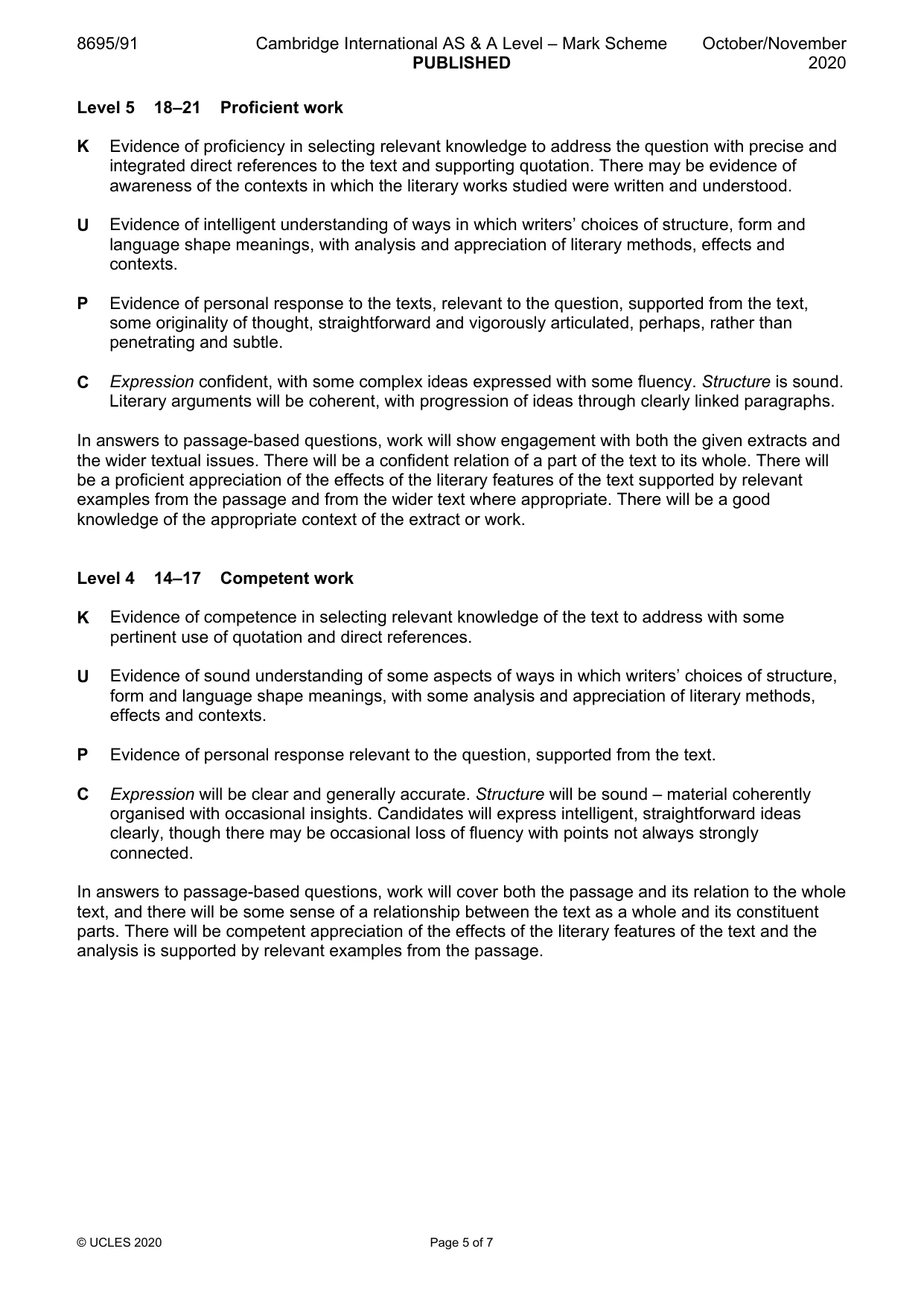
8695/91 Cambridge International AS & A Level – Mark Scheme PUBLISHED October/November 2020 © UCLES 2020 Page 5 of 7 Level 5 18–21 Proficient work K Evidence of proficiency in selecting relevant knowledge to address the question with precise and integrated direct references to the text and supporting quotation. There may be evidence of awareness of the contexts in which the literary works studied were written and understood. U Evidence of intelligent understanding of ways in which writers’ choices of structure, form and language shape meanings, with analysis and appreciation of literary methods, effects and contexts. P Evidence of personal response to the texts, relevant to the question, supported from the text, some originality of thought, straightforward and vigorously articulated, perhaps, rather than penetrating and subtle. C Expression confident, with some complex ideas expressed with some fluency. Structure is sound. Literary arguments will be coherent, with progression of ideas through clearly linked paragraphs. In answers to passage-based questions, work will show engagement with both the given extracts and the wider textual issues. There will be a confident relation of a part of the text to its whole. There will be a proficient appreciation of the effects of the literary features of the text supported by relevant examples from the passage and from the wider text where appropriate. There will be a good knowledge of the appropriate context of the extract or work. Level 4 14–17 Competent work K Evidence of competence in selecting relevant knowledge of the text to address with some pertinent use of quotation and direct references. U Evidence of sound understanding of some aspects of ways in which writers’ choices of structure, form and language shape meanings, with some analysis and appreciation of literary methods, effects and contexts. P Evidence of personal response relevant to the question, supported from the text. C Expression will be clear and generally accurate. Structure will be sound – material coherently organised with occasional insights. Candidates will express intelligent, straightforward ideas clearly, though there may be occasional loss of fluency with points not always strongly connected. In answers to passage-based questions, work will cover both the passage and its relation to the whole text, and there will be some sense of a relationship between the text as a whole and its constituent parts. There will be competent appreciation of the effects of the literary features of the text and the analysis is supported by relevant examples from the passage.
Mark scheme, page 6
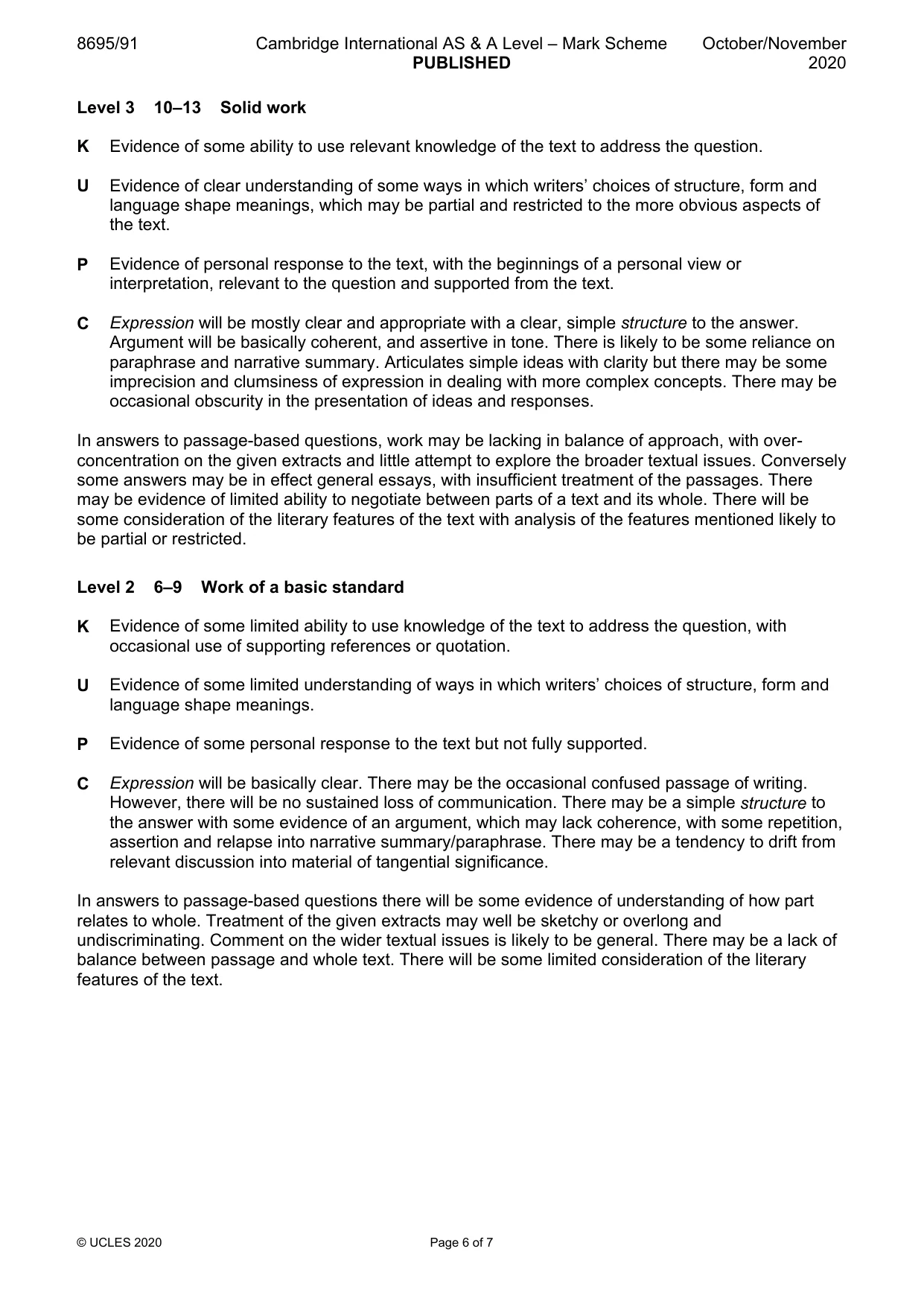
8695/91 Cambridge International AS & A Level – Mark Scheme PUBLISHED October/November 2020 © UCLES 2020 Page 6 of 7 Level 3 10–13 Solid work K Evidence of some ability to use relevant knowledge of the text to address the question. U Evidence of clear understanding of some ways in which writers’ choices of structure, form and language shape meanings, which may be partial and restricted to the more obvious aspects of the text. P Evidence of personal response to the text, with the beginnings of a personal view or interpretation, relevant to the question and supported from the text. C Expression will be mostly clear and appropriate with a clear, simple structure to the answer. Argument will be basically coherent, and assertive in tone. There is likely to be some reliance on paraphrase and narrative summary. Articulates simple ideas with clarity but there may be some imprecision and clumsiness of expression in dealing with more complex concepts. There may be occasional obscurity in the presentation of ideas and responses. In answers to passage-based questions, work may be lacking in balance of approach, with over- concentration on the given extracts and little attempt to explore the broader textual issues. Conversely some answers may be in effect general essays, with insufficient treatment of the passages. There may be evidence of limited ability to negotiate between parts of a text and its whole. There will be some consideration of the literary features of the text with analysis of the features mentioned likely to be partial or restricted. Level 2 6–9 Work of a basic standard K Evidence of some limited ability to use knowledge of the text to address the question, with occasional use of supporting references or quotation. U Evidence of some limited understanding of ways in which writers’ choices of structure, form and language shape meanings. P Evidence of some personal response to the text but not fully supported. C Expression will be basically clear. There may be the occasional confused passage of writing. However, there will be no sustained loss of communication. There may be a simple structure to the answer with some evidence of an argument, which may lack coherence, with some repetition, assertion and relapse into narrative summary/paraphrase. There may be a tendency to drift from relevant discussion into material of tangential significance. In answers to passage-based questions there will be some evidence of understanding of how part relates to whole. Treatment of the given extracts may well be sketchy or overlong and undiscriminating. Comment on the wider textual issues is likely to be general. There may be a lack of balance between passage and whole text. There will be some limited consideration of the literary features of the text.
Mark scheme, page 7
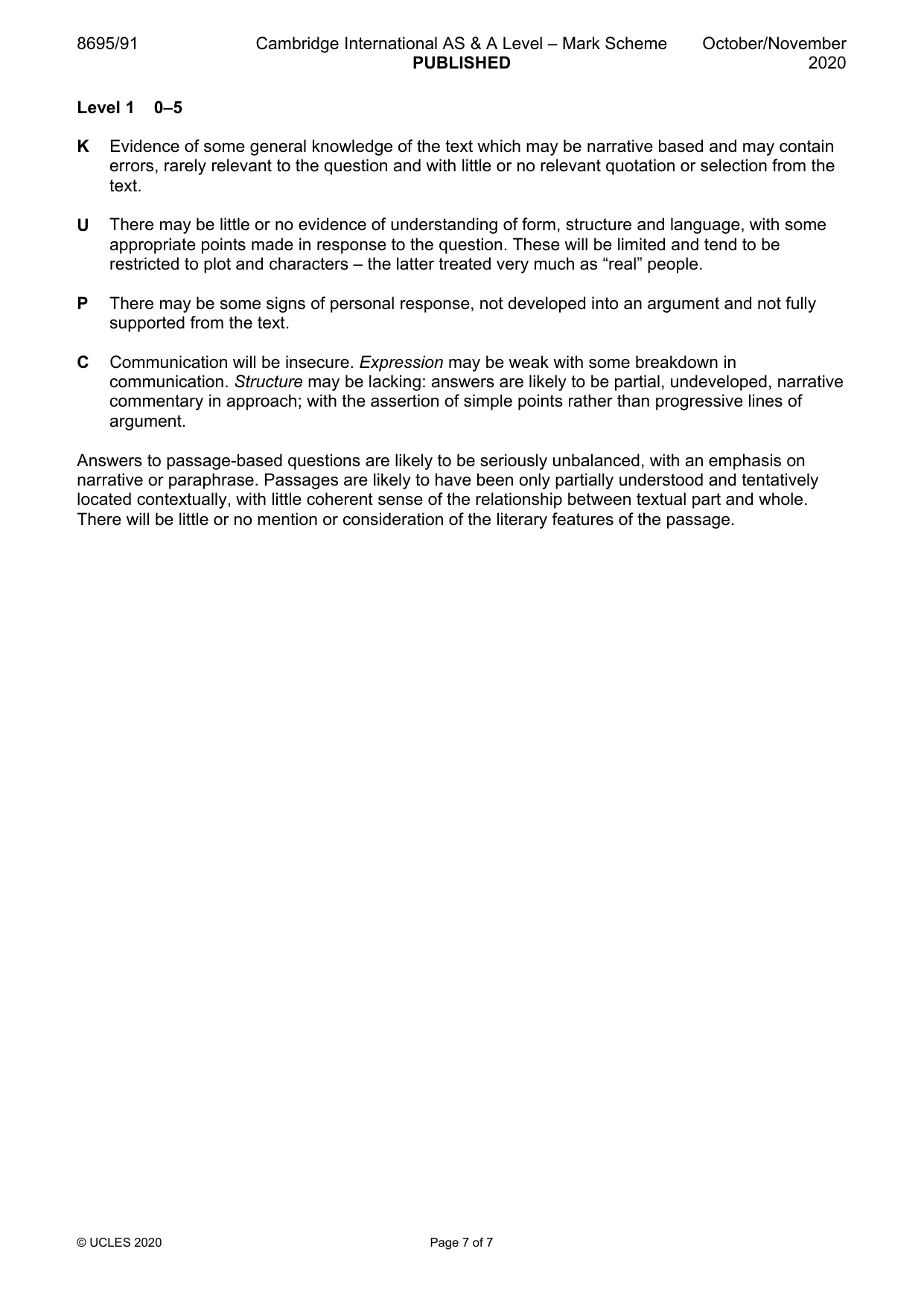
8695/91 Cambridge International AS & A Level – Mark Scheme PUBLISHED October/November 2020 © UCLES 2020 Page 7 of 7 Level 1 0–5 K Evidence of some general knowledge of the text which may be narrative based and may contain errors, rarely relevant to the question and with little or no relevant quotation or selection from the text. U There may be little or no evidence of understanding of form, structure and language, with some appropriate points made in response to the question. These will be limited and tend to be restricted to plot and characters – the latter treated very much as “real” people. P There may be some signs of personal response, not developed into an argument and not fully supported from the text. C Communication will be insecure. Expression may be weak with some breakdown in communication. Structure may be lacking: answers are likely to be partial, undeveloped, narrative commentary in approach; with the assertion of simple points rather than progressive lines of argument. Answers to passage-based questions are likely to be seriously unbalanced, with an emphasis on narrative or paraphrase. Passages are likely to have been only partially understood and tentatively located contextually, with little coherent sense of the relationship between textual part and whole. There will be little or no mention or consideration of the literary features of the passage.
What you needed in this session
Cambridge’s own grade thresholds for 2020 Oct/Nov, Paper 9 · Variant 1. A higher threshold means an easier paper — the bar moves with how the cohort did.