Cambridge A Level English - Language and Literature (AS Level only, from 2016) 8695 — 2018 May/June Paper 9 · Variant 3
8695/93/M/J/18 · 50 marks · ≈56 min
The question paper and its mark scheme, free to read here and free to download. This is Cambridge’s own paper, exactly as it was sat.
Question paper16 pages


Mark scheme6 pages
Answers below. Sit the paper first if you are practising.
Paper as text
Question paper, page 1
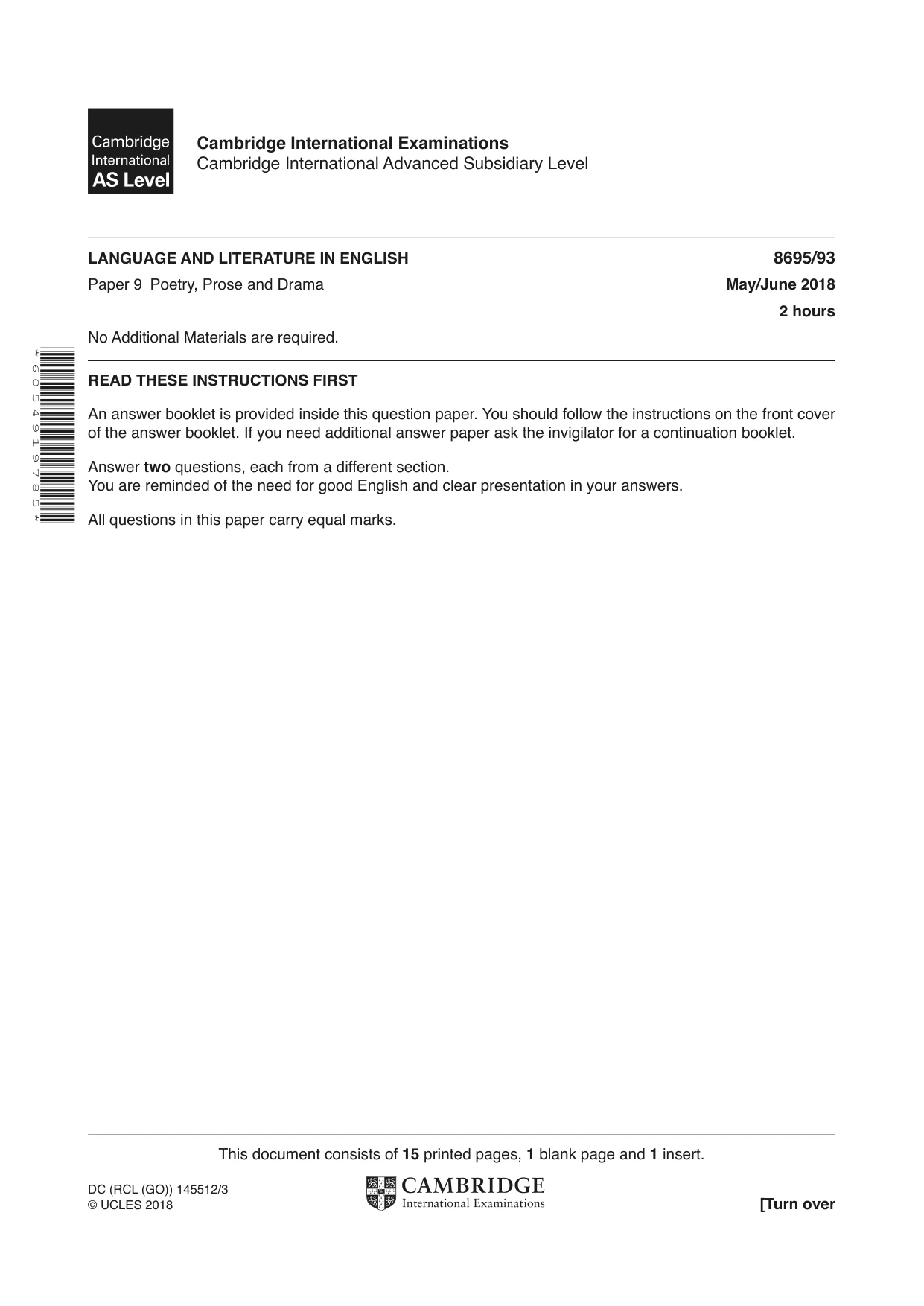
This document consists of 15 printed pages, 1 blank page and 1 insert. DC (RCL (GO)) 145512/3 © UCLES 2018 [Turn over Cambridge International Examinations Cambridge International Advanced Subsidiary Level * 6 0 5 4 9 1 9 7 8 5 * LANGUAGE AND LITERATURE IN ENGLISH 8695/93 Paper 9 Poetry, Prose and Drama May/June 2018 2 hours No Additional Materials are required. READ THESE INSTRUCTIONS FIRST An answer booklet is provided inside this question paper. You should follow the instructions on the front cover of the answer booklet. If you need additional answer paper ask the invigilator for a continuation booklet. Answer two questions, each from a different section. You are reminded of the need for good English and clear presentation in your answers. All questions in this paper carry equal marks.
Question paper, page 2
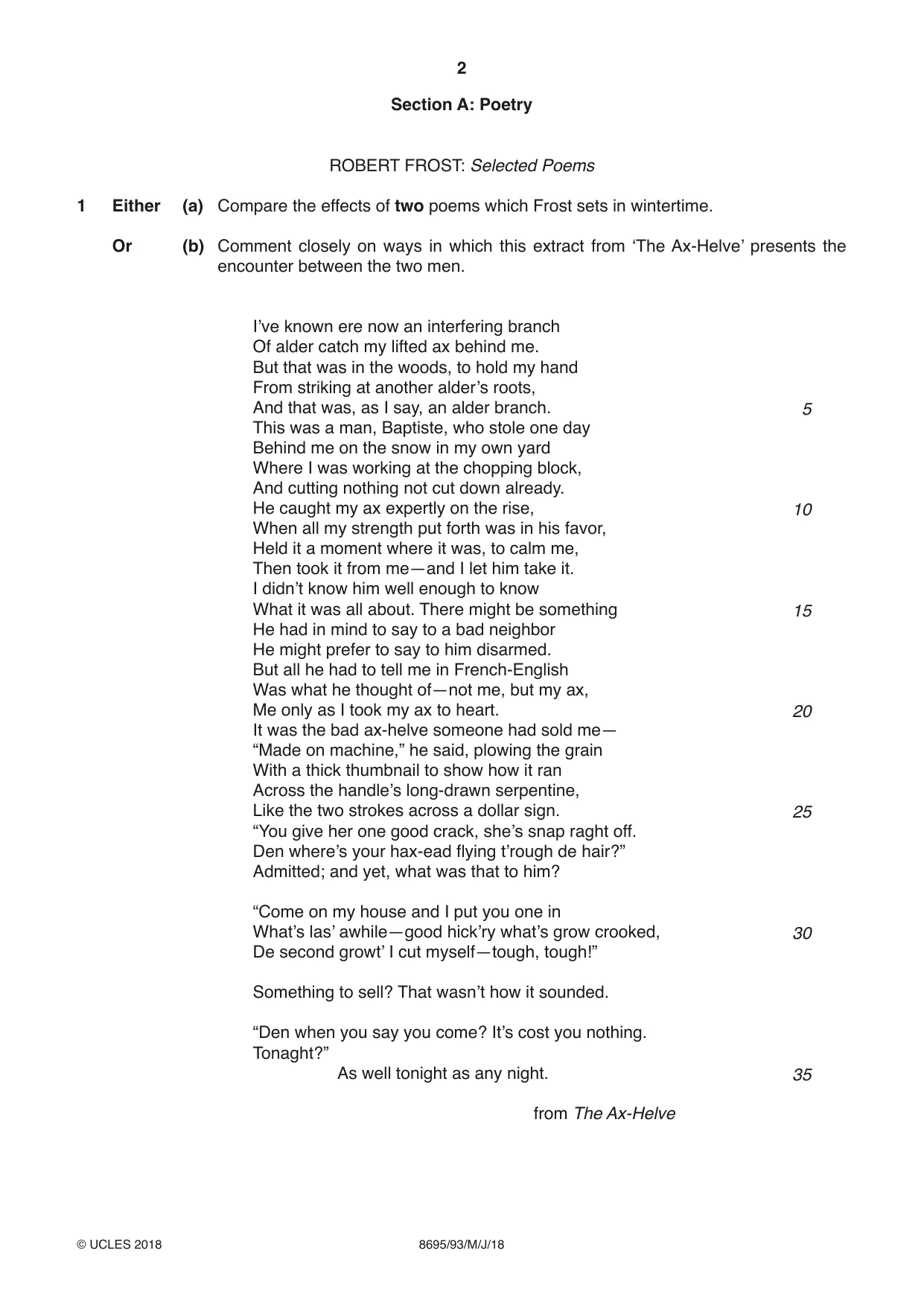
2 8695/93/M/J/18 © UCLES 2018 Section A: Poetry ROBERT FROST: Selected Poems 1 Either (a) Compare the effects of two poems which Frost sets in wintertime. Or (b) Comment closely on ways in which this extract from ‘The Ax-Helve’ presents the encounter between the two men. I’ve known ere now an interfering branch Of alder catch my lifted ax behind me. But that was in the woods, to hold my hand From striking at another alder’s roots, And that was, as I say, an alder branch. This was a man, Baptiste, who stole one day Behind me on the snow in my own yard Where I was working at the chopping block, And cutting nothing not cut down already. He caught my ax expertly on the rise, When all my strength put forth was in his favor, Held it a moment where it was, to calm me, Then took it from me—and I let him take it. I didn’t know him well enough to know What it was all about. There might be something He had in mind to say to a bad neighbor He might prefer to say to him disarmed. But all he had to tell me in French-English Was what he thought of—not me, but my ax, Me only as I took my ax to heart. It was the bad ax-helve someone had sold me— “Made on machine,” he said, plowing the grain With a thick thumbnail to show how it ran Across the handle’s long-drawn serpentine, Like the two strokes across a dollar sign. “You give her one good crack, she’s snap raght off. Den where’s your hax-ead flying t’rough de hair?” Admitted; and yet, what was that to him? “Come on my house and I put you one in What’s las’ awhile—good hick’ry what’s grow crooked, De second growt’ I cut myself—tough, tough!” Something to sell? That wasn’t how it sounded. “Den when you say you come? It’s cost you nothing. Tonaght?” As well tonight as any night. from The Ax-Helve 5 10 15 20 25 30 35
Question paper, page 3
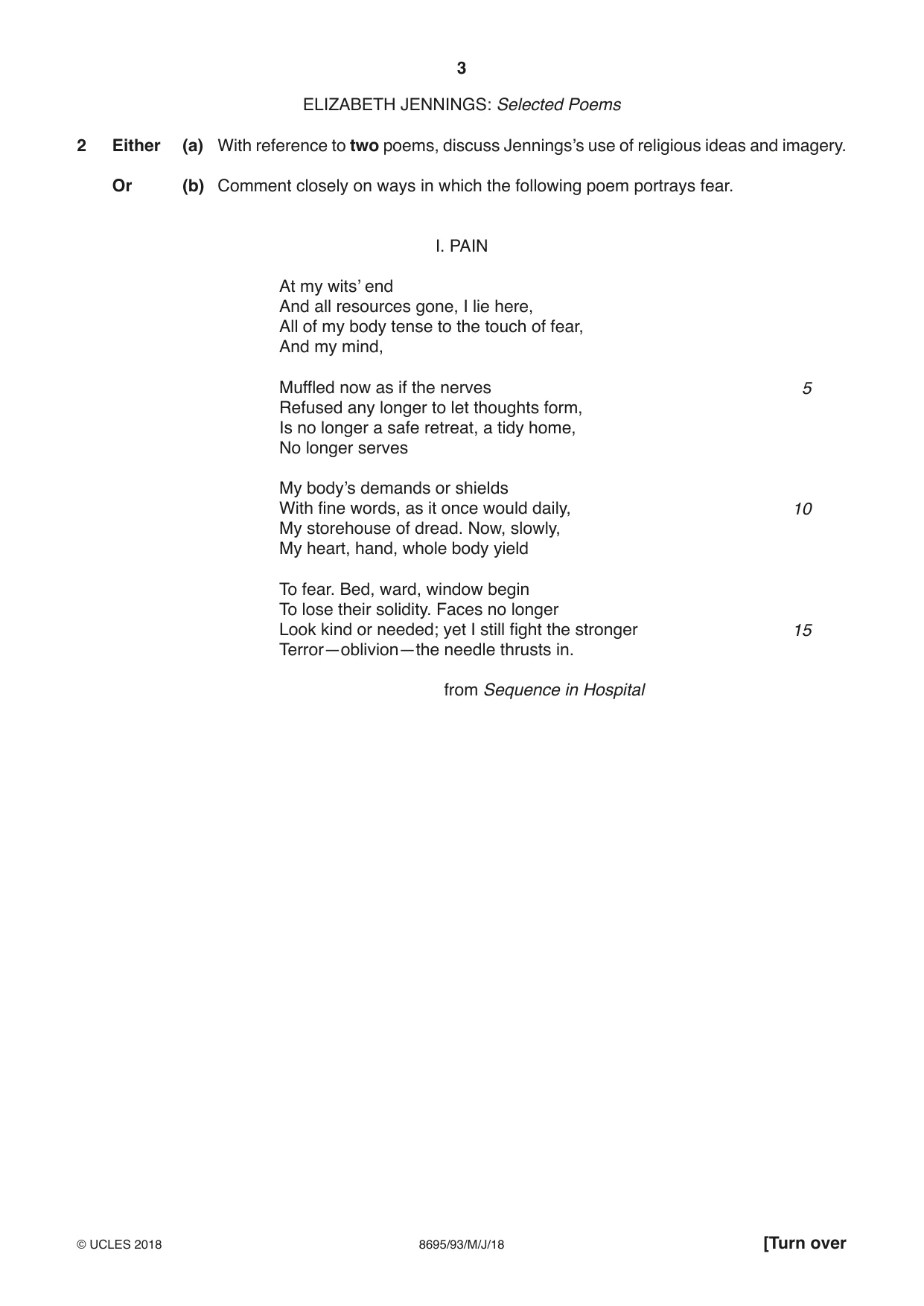
3 8695/93/M/J/18 © UCLES 2018 [Turn over ELIZABETH JENNINGS: Selected Poems 2 Either (a) With reference to two poems, discuss Jennings’s use of religious ideas and imagery. Or (b) Comment closely on ways in which the following poem portrays fear. I. PAIN At my wits’ end And all resources gone, I lie here, All of my body tense to the touch of fear, And my mind, Muffled now as if the nerves Refused any longer to let thoughts form, Is no longer a safe retreat, a tidy home, No longer serves My body’s demands or shields With fine words, as it once would daily, My storehouse of dread. Now, slowly, My heart, hand, whole body yield To fear. Bed, ward, window begin To lose their solidity. Faces no longer Look kind or needed; yet I still fight the stronger Terror—oblivion—the needle thrusts in. from Sequence in Hospital 5 10 15
Question paper, page 4
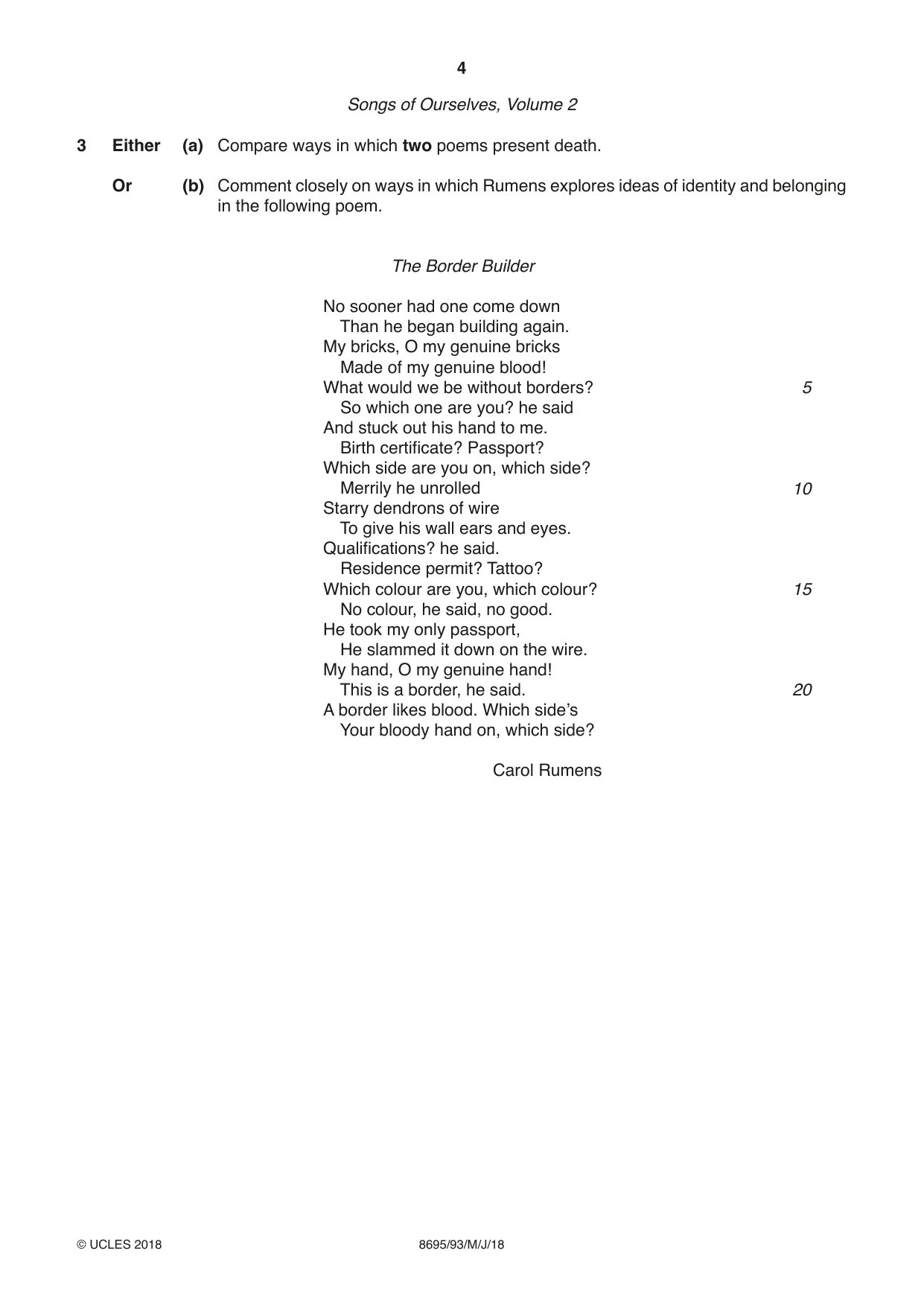
4 8695/93/M/J/18 © UCLES 2018 Songs of Ourselves, Volume 2 3 Either (a) Compare ways in which two poems present death. Or (b) Comment closely on ways in which Rumens explores ideas of identity and belonging in the following poem. The Border Builder No sooner had one come down Than he began building again. My bricks, O my genuine bricks Made of my genuine blood! What would we be without borders? So which one are you? he said And stuck out his hand to me. Birth certificate? Passport? Which side are you on, which side? Merrily he unrolled Starry dendrons of wire To give his wall ears and eyes. Qualifications? he said. Residence permit? Tattoo? Which colour are you, which colour? No colour, he said, no good. He took my only passport, He slammed it down on the wire. My hand, O my genuine hand! This is a border, he said. A border likes blood. Which side’s Your bloody hand on, which side? Carol Rumens 5 10 15 20
Question paper, page 5
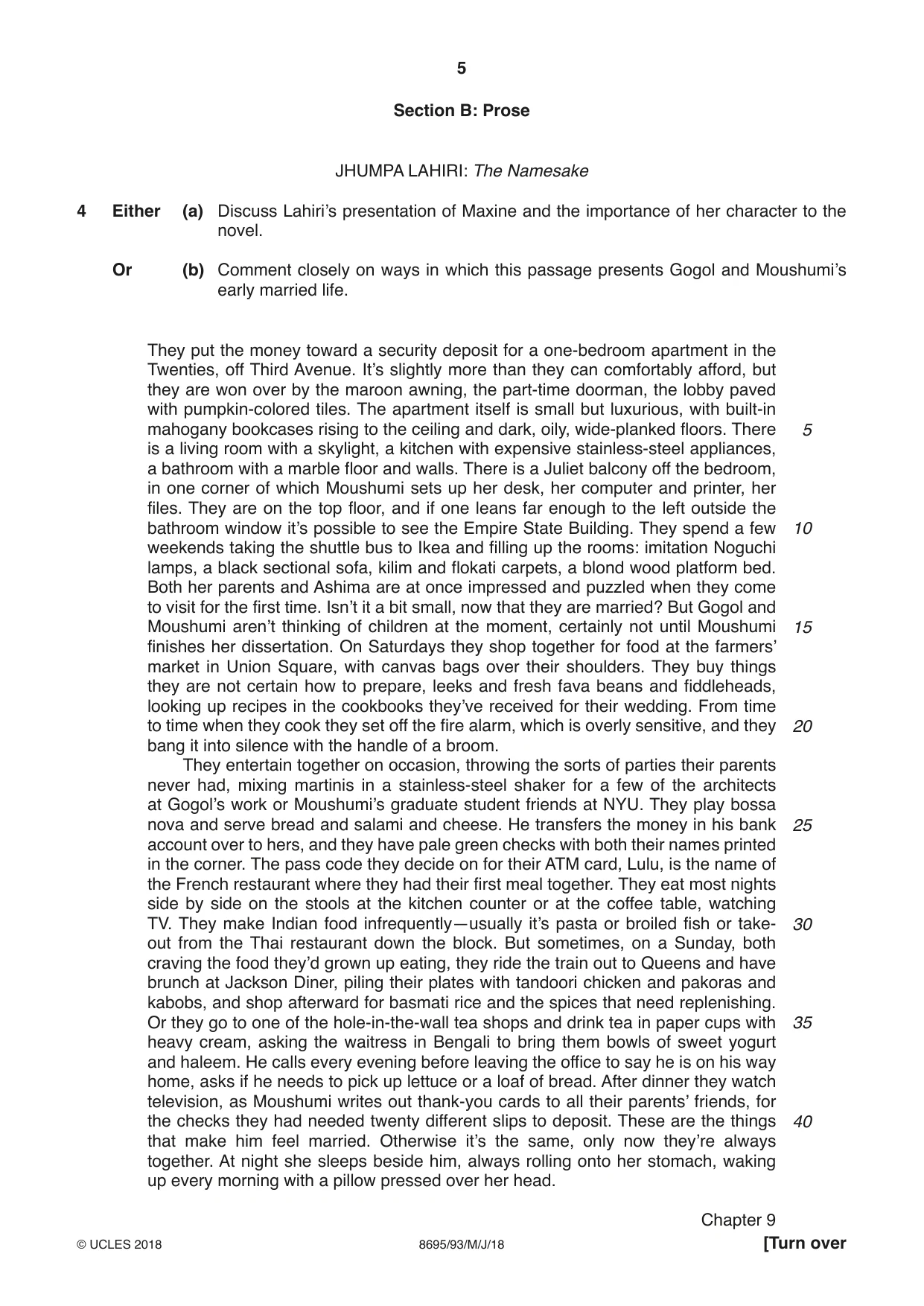
5 8695/93/M/J/18 © UCLES 2018 [Turn over Section B: Prose JHUMPA LAHIRI: The Namesake 4 Either (a) Discuss Lahiri’s presentation of Maxine and the importance of her character to the novel. Or (b) Comment closely on ways in which this passage presents Gogol and Moushumi’s early married life. They put the money toward a security deposit for a one-bedroom apartment in the Twenties, off Third Avenue. It’s slightly more than they can comfortably afford, but they are won over by the maroon awning, the part-time doorman, the lobby paved with pumpkin-colored tiles. The apartment itself is small but luxurious, with built-in mahogany bookcases rising to the ceiling and dark, oily, wide-planked floors. There is a living room with a skylight, a kitchen with expensive stainless-steel appliances, a bathroom with a marble floor and walls. There is a Juliet balcony off the bedroom, in one corner of which Moushumi sets up her desk, her computer and printer, her files. They are on the top floor, and if one leans far enough to the left outside the bathroom window it’s possible to see the Empire State Building. They spend a few weekends taking the shuttle bus to Ikea and filling up the rooms: imitation Noguchi lamps, a black sectional sofa, kilim and flokati carpets, a blond wood platform bed. Both her parents and Ashima are at once impressed and puzzled when they come to visit for the first time. Isn’t it a bit small, now that they are married? But Gogol and Moushumi aren’t thinking of children at the moment, certainly not until Moushumi finishes her dissertation. On Saturdays they shop together for food at the farmers’ market in Union Square, with canvas bags over their shoulders. They buy things they are not certain how to prepare, leeks and fresh fava beans and fiddleheads, looking up recipes in the cookbooks they’ve received for their wedding. From time to time when they cook they set off the fire alarm, which is overly sensitive, and they bang it into silence with the handle of a broom. They entertain together on occasion, throwing the sorts of parties their parents never had, mixing martinis in a stainless-steel shaker for a few of the architects at Gogol’s work or Moushumi’s graduate student friends at NYU. They play bossa nova and serve bread and salami and cheese. He transfers the money in his bank account over to hers, and they have pale green checks with both their names printed in the corner. The pass code they decide on for their ATM card, Lulu, is the name of the French restaurant where they had their first meal together. They eat most nights side by side on the stools at the kitchen counter or at the coffee table, watching TV. They make Indian food infrequently—usually it’s pasta or broiled fish or take- out from the Thai restaurant down the block. But sometimes, on a Sunday, both craving the food they’d grown up eating, they ride the train out to Queens and have brunch at Jackson Diner, piling their plates with tandoori chicken and pakoras and kabobs, and shop afterward for basmati rice and the spices that need replenishing. Or they go to one of the hole-in-the-wall tea shops and drink tea in paper cups with heavy cream, asking the waitress in Bengali to bring them bowls of sweet yogurt and haleem. He calls every evening before leaving the office to say he is on his way home, asks if he needs to pick up lettuce or a loaf of bread. After dinner they watch television, as Moushumi writes out thank-you cards to all their parents’ friends, for the checks they had needed twenty different slips to deposit. These are the things that make him feel married. Otherwise it’s the same, only now they’re always together. At night she sleeps beside him, always rolling onto her stomach, waking up every morning with a pillow pressed over her head. Chapter 9 5 10 15 20 25 30 35 40
Question paper, page 6
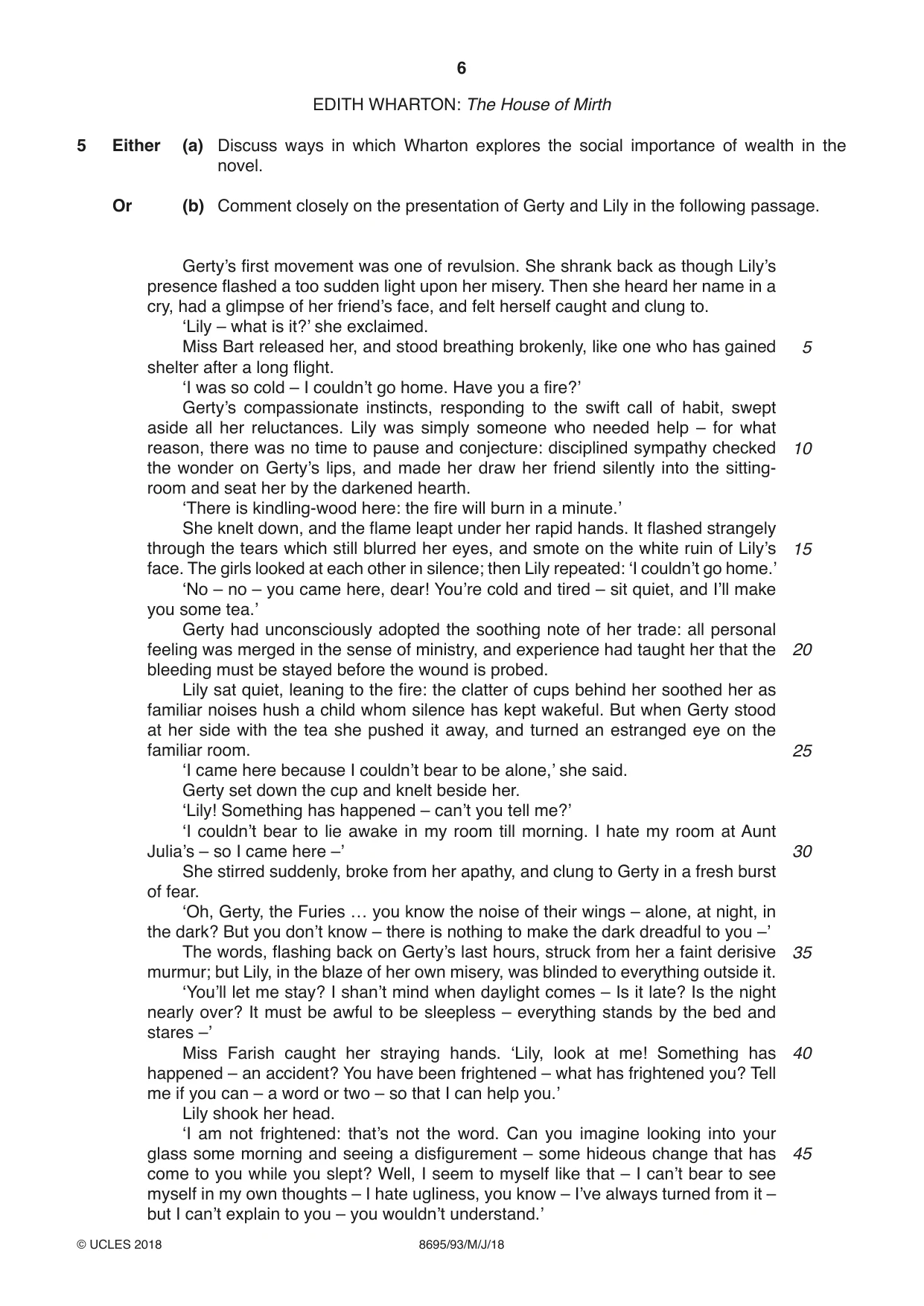
6 8695/93/M/J/18 © UCLES 2018 EDITH WHARTON: The House of Mirth 5 Either (a) Discuss ways in which Wharton explores the social importance of wealth in the novel. Or (b) Comment closely on the presentation of Gerty and Lily in the following passage. Gerty’s first movement was one of revulsion. She shrank back as though Lily’s presence flashed a too sudden light upon her misery. Then she heard her name in a cry, had a glimpse of her friend’s face, and felt herself caught and clung to. ‘Lily – what is it?’ she exclaimed. Miss Bart released her, and stood breathing brokenly, like one who has gained shelter after a long flight. ‘I was so cold – I couldn’t go home. Have you a fire?’ Gerty’s compassionate instincts, responding to the swift call of habit, swept aside all her reluctances. Lily was simply someone who needed help – for what reason, there was no time to pause and conjecture: disciplined sympathy checked the wonder on Gerty’s lips, and made her draw her friend silently into the sitting- room and seat her by the darkened hearth. ‘There is kindling-wood here: the fire will burn in a minute.’ She knelt down, and the flame leapt under her rapid hands. It flashed strangely through the tears which still blurred her eyes, and smote on the white ruin of Lily’s face. The girls looked at each other in silence; then Lily repeated: ‘I couldn’t go home.’ ‘No – no – you came here, dear! You’re cold and tired – sit quiet, and I’ll make you some tea.’ Gerty had unconsciously adopted the soothing note of her trade: all personal feeling was merged in the sense of ministry, and experience had taught her that the bleeding must be stayed before the wound is probed. Lily sat quiet, leaning to the fire: the clatter of cups behind her soothed her as familiar noises hush a child whom silence has kept wakeful. But when Gerty stood at her side with the tea she pushed it away, and turned an estranged eye on the familiar room. ‘I came here because I couldn’t bear to be alone,’ she said. Gerty set down the cup and knelt beside her. ‘Lily! Something has happened – can’t you tell me?’ ‘I couldn’t bear to lie awake in my room till morning. I hate my room at Aunt Julia’s – so I came here –’ She stirred suddenly, broke from her apathy, and clung to Gerty in a fresh burst of fear. ‘Oh, Gerty, the Furies … you know the noise of their wings – alone, at night, in the dark? But you don’t know – there is nothing to make the dark dreadful to you –’ The words, flashing back on Gerty’s last hours, struck from her a faint derisive murmur; but Lily, in the blaze of her own misery, was blinded to everything outside it. ‘You’ll let me stay? I shan’t mind when daylight comes – Is it late? Is the night nearly over? It must be awful to be sleepless – everything stands by the bed and stares –’ Miss Farish caught her straying hands. ‘Lily, look at me! Something has happened – an accident? You have been frightened – what has frightened you? Tell me if you can – a word or two – so that I can help you.’ Lily shook her head. ‘I am not frightened: that’s not the word. Can you imagine looking into your glass some morning and seeing a disfigurement – some hideous change that has come to you while you slept? Well, I seem to myself like that – I can’t bear to see myself in my own thoughts – I hate ugliness, you know – I’ve always turned from it – but I can’t explain to you – you wouldn’t understand.’ 5 10 15 20 25 30 35 40 45
Question paper, page 7
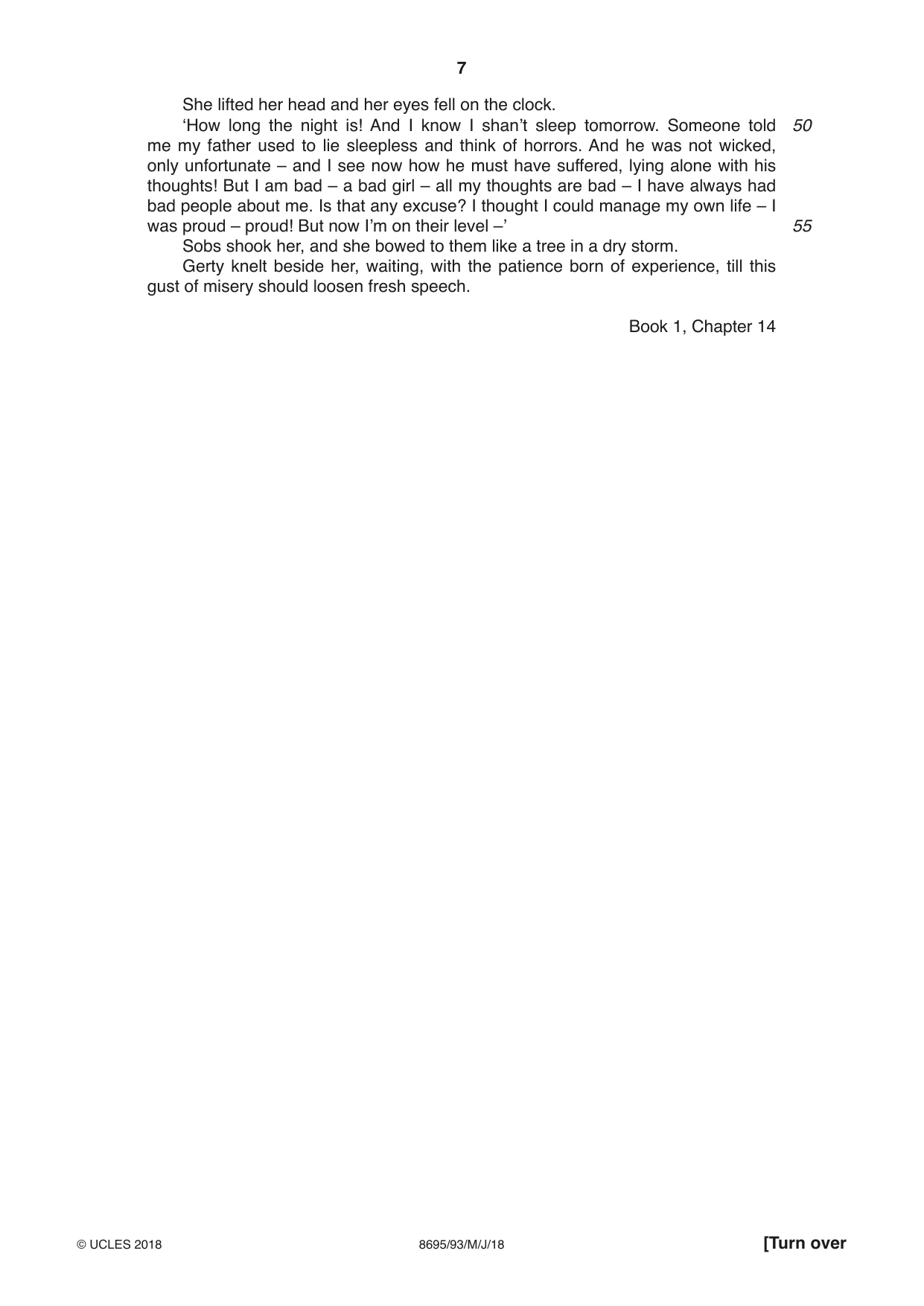
7 8695/93/M/J/18 © UCLES 2018 [Turn over She lifted her head and her eyes fell on the clock. ‘How long the night is! And I know I shan’t sleep tomorrow. Someone told me my father used to lie sleepless and think of horrors. And he was not wicked, only unfortunate – and I see now how he must have suffered, lying alone with his thoughts! But I am bad – a bad girl – all my thoughts are bad – I have always had bad people about me. Is that any excuse? I thought I could manage my own life – I was proud – proud! But now I’m on their level –’ Sobs shook her, and she bowed to them like a tree in a dry storm. Gerty knelt beside her, waiting, with the patience born of experience, till this gust of misery should loosen fresh speech. Book 1, Chapter 14 50 55
Question paper, page 8
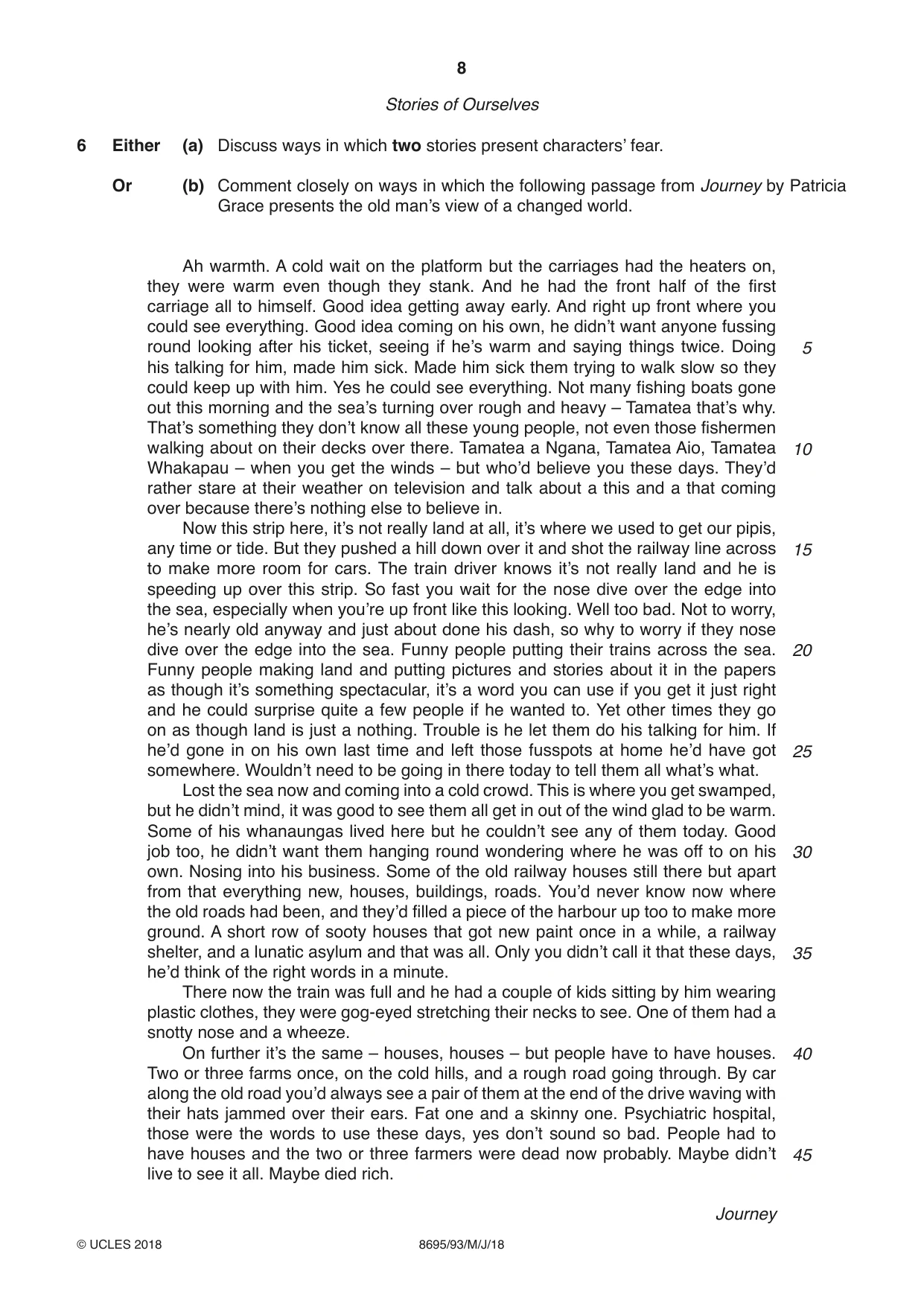
8 8695/93/M/J/18 © UCLES 2018 Stories of Ourselves 6 Either (a) Discuss ways in which two stories present characters’ fear. Or (b) Comment closely on ways in which the following passage from Journey by Patricia Grace presents the old man’s view of a changed world. Ah warmth. A cold wait on the platform but the carriages had the heaters on, they were warm even though they stank. And he had the front half of the first carriage all to himself. Good idea getting away early. And right up front where you could see everything. Good idea coming on his own, he didn’t want anyone fussing round looking after his ticket, seeing if he’s warm and saying things twice. Doing his talking for him, made him sick. Made him sick them trying to walk slow so they could keep up with him. Yes he could see everything. Not many fishing boats gone out this morning and the sea’s turning over rough and heavy – Tamatea that’s why. That’s something they don’t know all these young people, not even those fishermen walking about on their decks over there. Tamatea a Ngana, Tamatea Aio, Tamatea Whakapau – when you get the winds – but who’d believe you these days. They’d rather stare at their weather on television and talk about a this and a that coming over because there’s nothing else to believe in. Now this strip here, it’s not really land at all, it’s where we used to get our pipis, any time or tide. But they pushed a hill down over it and shot the railway line across to make more room for cars. The train driver knows it’s not really land and he is speeding up over this strip. So fast you wait for the nose dive over the edge into the sea, especially when you’re up front like this looking. Well too bad. Not to worry, he’s nearly old anyway and just about done his dash, so why to worry if they nose dive over the edge into the sea. Funny people putting their trains across the sea. Funny people making land and putting pictures and stories about it in the papers as though it’s something spectacular, it’s a word you can use if you get it just right and he could surprise quite a few people if he wanted to. Yet other times they go on as though land is just a nothing. Trouble is he let them do his talking for him. If he’d gone in on his own last time and left those fusspots at home he’d have got somewhere. Wouldn’t need to be going in there today to tell them all what’s what. Lost the sea now and coming into a cold crowd. This is where you get swamped, but he didn’t mind, it was good to see them all get in out of the wind glad to be warm. Some of his whanaungas lived here but he couldn’t see any of them today. Good job too, he didn’t want them hanging round wondering where he was off to on his own. Nosing into his business. Some of the old railway houses still there but apart from that everything new, houses, buildings, roads. You’d never know now where the old roads had been, and they’d filled a piece of the harbour up too to make more ground. A short row of sooty houses that got new paint once in a while, a railway shelter, and a lunatic asylum and that was all. Only you didn’t call it that these days, he’d think of the right words in a minute. There now the train was full and he had a couple of kids sitting by him wearing plastic clothes, they were gog-eyed stretching their necks to see. One of them had a snotty nose and a wheeze. On further it’s the same – houses, houses – but people have to have houses. Two or three farms once, on the cold hills, and a rough road going through. By car along the old road you’d always see a pair of them at the end of the drive waving with their hats jammed over their ears. Fat one and a skinny one. Psychiatric hospital, those were the words to use these days, yes don’t sound so bad. People had to have houses and the two or three farmers were dead now probably. Maybe didn’t live to see it all. Maybe died rich. Journey 5 10 15 20 25 30 35 40 45
Question paper, page 9
9 8695/93/M/J/18 © UCLES 2018 [Turn over Turn over for Section C.
Question paper, page 10
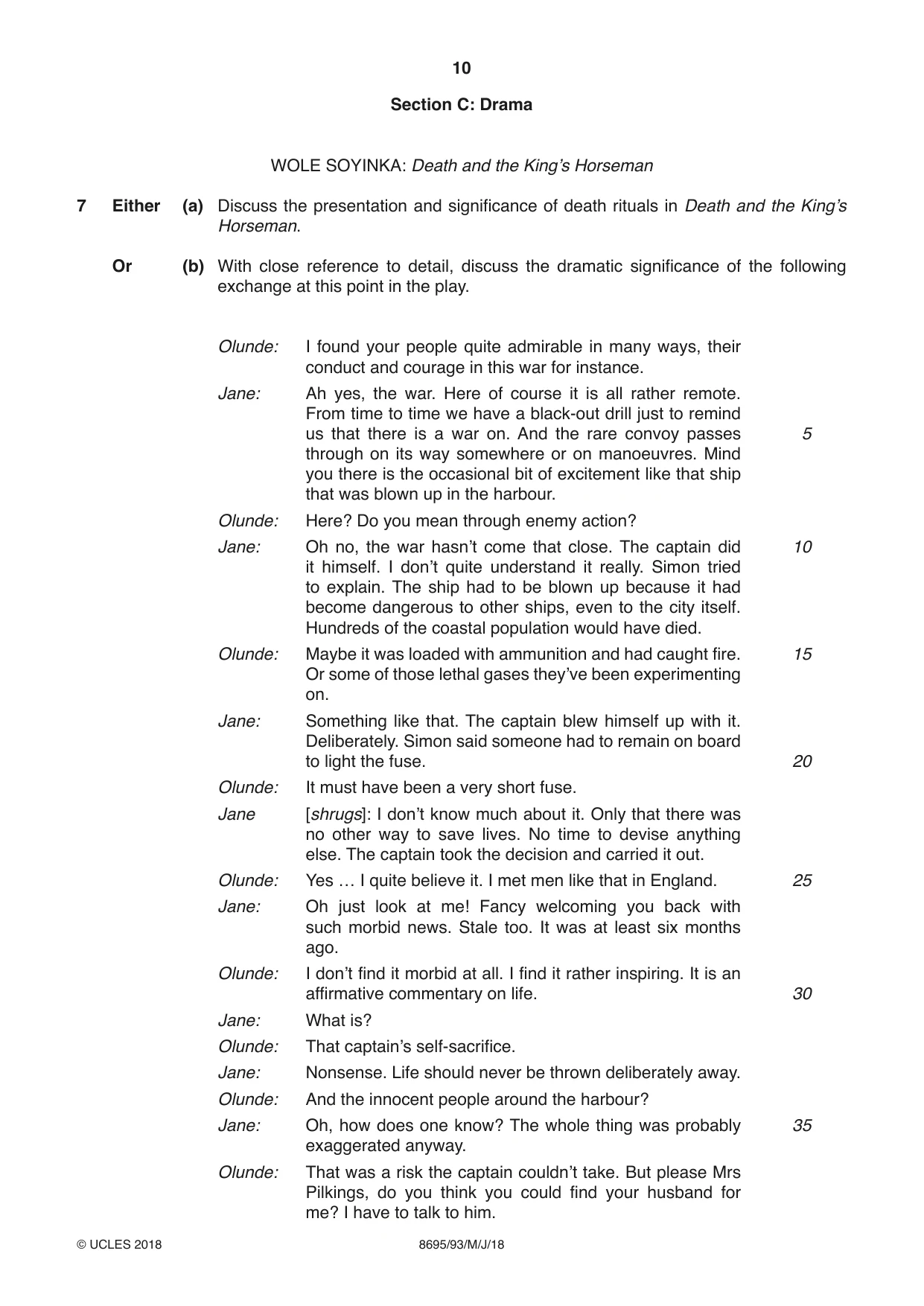
10 8695/93/M/J/18 © UCLES 2018 Section C: Drama WOLE SOYINKA: Death and the King’s Horseman 7 Either (a) Discuss the presentation and significance of death rituals in Death and the King’s Horseman. Or (b) With close reference to detail, discuss the dramatic significance of the following exchange at this point in the play. Olunde: I found your people quite admirable in many ways, their conduct and courage in this war for instance. Jane: Ah yes, the war. Here of course it is all rather remote. From time to time we have a black-out drill just to remind us that there is a war on. And the rare convoy passes through on its way somewhere or on manoeuvres. Mind you there is the occasional bit of excitement like that ship that was blown up in the harbour. Olunde: Here? Do you mean through enemy action? Jane: Oh no, the war hasn’t come that close. The captain did it himself. I don’t quite understand it really. Simon tried to explain. The ship had to be blown up because it had become dangerous to other ships, even to the city itself. Hundreds of the coastal population would have died. Olunde: Maybe it was loaded with ammunition and had caught fire. Or some of those lethal gases they’ve been experimenting on. Jane: Something like that. The captain blew himself up with it. Deliberately. Simon said someone had to remain on board to light the fuse. Olunde: It must have been a very short fuse. Jane [shrugs]: I don’t know much about it. Only that there was no other way to save lives. No time to devise anything else. The captain took the decision and carried it out. Olunde: Yes … I quite believe it. I met men like that in England. Jane: Oh just look at me! Fancy welcoming you back with such morbid news. Stale too. It was at least six months ago. Olunde: I don’t find it morbid at all. I find it rather inspiring. It is an affirmative commentary on life. Jane: What is? Olunde: That captain’s self-sacrifice. Jane: Nonsense. Life should never be thrown deliberately away. Olunde: And the innocent people around the harbour? Jane: Oh, how does one know? The whole thing was probably exaggerated anyway. Olunde: That was a risk the captain couldn’t take. But please Mrs Pilkings, do you think you could find your husband for me? I have to talk to him. 5 10 15 20 25 30 35
Question paper, page 11
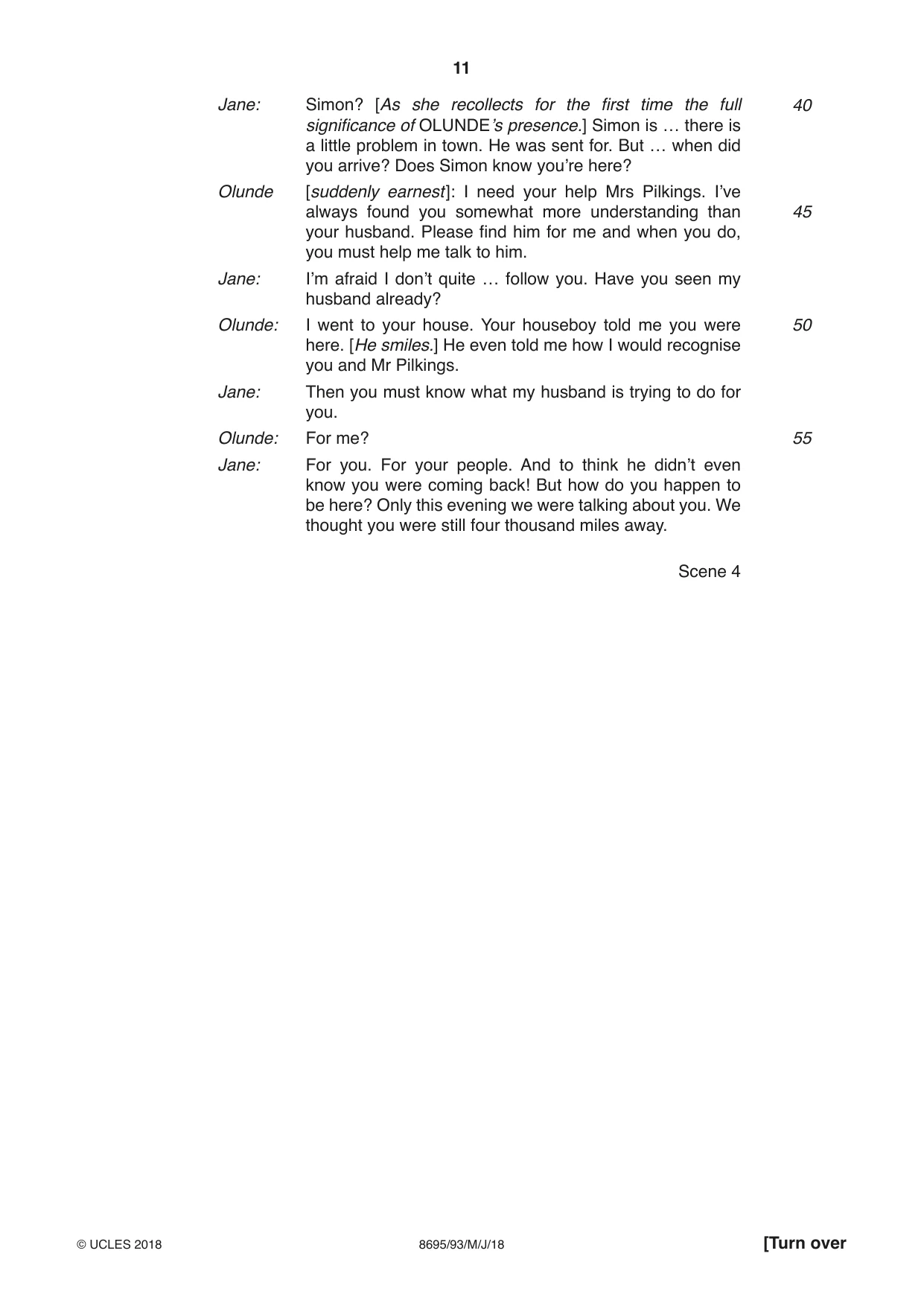
11 8695/93/M/J/18 © UCLES 2018 [Turn over Jane: Simon? [As she recollects for the first time the full significance of OLUNDE’s presence.] Simon is … there is a little problem in town. He was sent for. But … when did you arrive? Does Simon know you’re here? Olunde [suddenly earnest]: I need your help Mrs Pilkings. I’ve always found you somewhat more understanding than your husband. Please find him for me and when you do, you must help me talk to him. Jane: I’m afraid I don’t quite … follow you. Have you seen my husband already? Olunde: I went to your house. Your houseboy told me you were here. [He smiles.] He even told me how I would recognise you and Mr Pilkings. Jane: Then you must know what my husband is trying to do for you. Olunde: For me? Jane: For you. For your people. And to think he didn’t even know you were coming back! But how do you happen to be here? Only this evening we were talking about you. We thought you were still four thousand miles away. Scene 4 40 45 50 55
Question paper, page 12
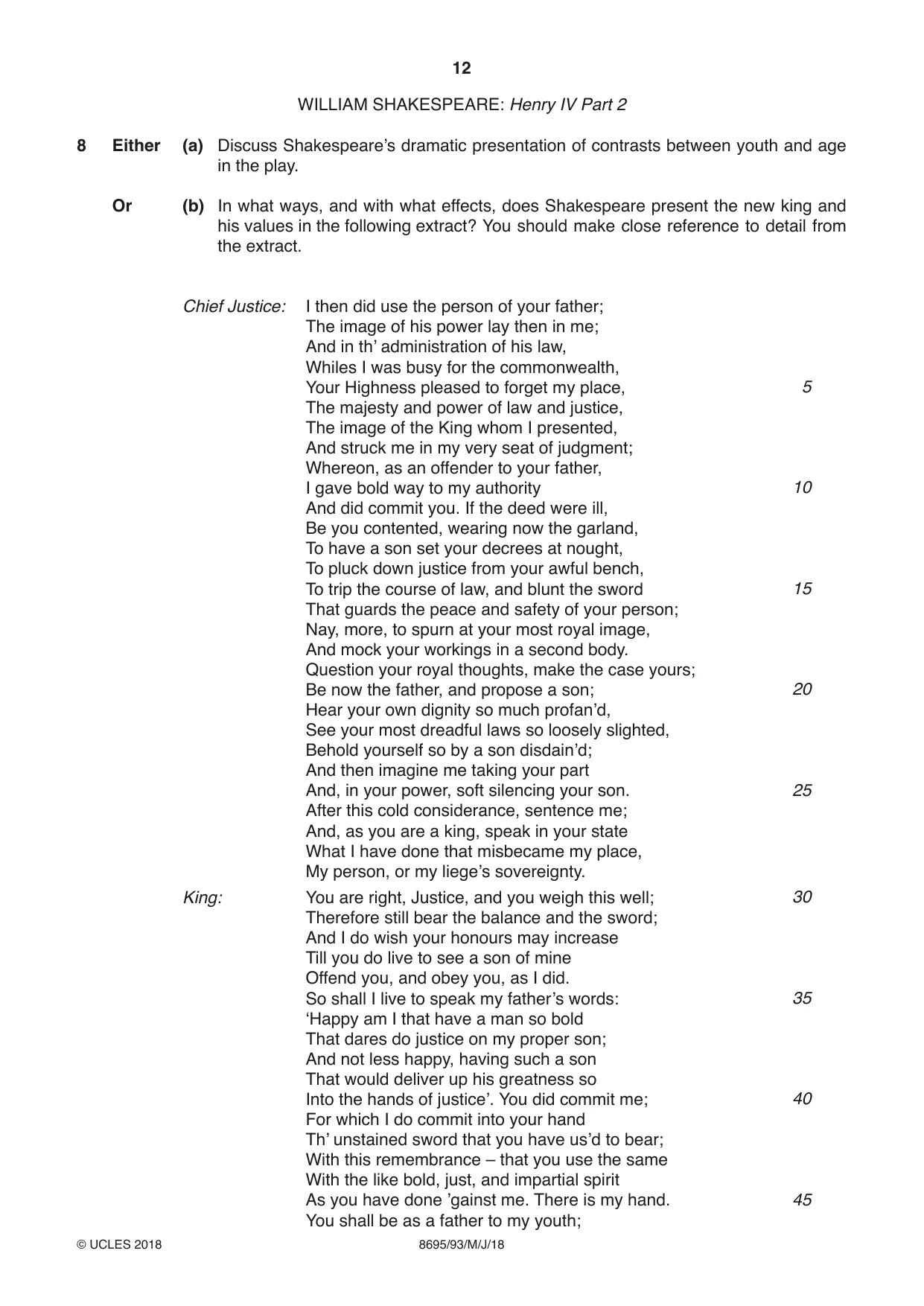
12 8695/93/M/J/18 © UCLES 2018 WILLIAM SHAKESPEARE: Henry IV Part 2 8 Either (a) Discuss Shakespeare’s dramatic presentation of contrasts between youth and age in the play. Or (b) In what ways, and with what effects, does Shakespeare present the new king and his values in the following extract? You should make close reference to detail from the extract. Chief Justice: I then did use the person of your father; The image of his power lay then in me; And in th’ administration of his law, Whiles I was busy for the commonwealth, Your Highness pleased to forget my place, The majesty and power of law and justice, The image of the King whom I presented, And struck me in my very seat of judgment; Whereon, as an offender to your father, I gave bold way to my authority And did commit you. If the deed were ill, Be you contented, wearing now the garland, To have a son set your decrees at nought, To pluck down justice from your awful bench, To trip the course of law, and blunt the sword That guards the peace and safety of your person; Nay, more, to spurn at your most royal image, And mock your workings in a second body. Question your royal thoughts, make the case yours; Be now the father, and propose a son; Hear your own dignity so much profan’d, See your most dreadful laws so loosely slighted, Behold yourself so by a son disdain’d; And then imagine me taking your part And, in your power, soft silencing your son. After this cold considerance, sentence me; And, as you are a king, speak in your state What I have done that misbecame my place, My person, or my liege’s sovereignty. King: You are right, Justice, and you weigh this well; Therefore still bear the balance and the sword; And I do wish your honours may increase Till you do live to see a son of mine Offend you, and obey you, as I did. So shall I live to speak my father’s words: ‘Happy am I that have a man so bold That dares do justice on my proper son; And not less happy, having such a son That would deliver up his greatness so Into the hands of justice’. You did commit me; For which I do commit into your hand Th’ unstained sword that you have us’d to bear; With this remembrance – that you use the same With the like bold, just, and impartial spirit As you have done ’gainst me. There is my hand. You shall be as a father to my youth; 5 10 15 20 25 30 35 40 45
Question paper, page 13
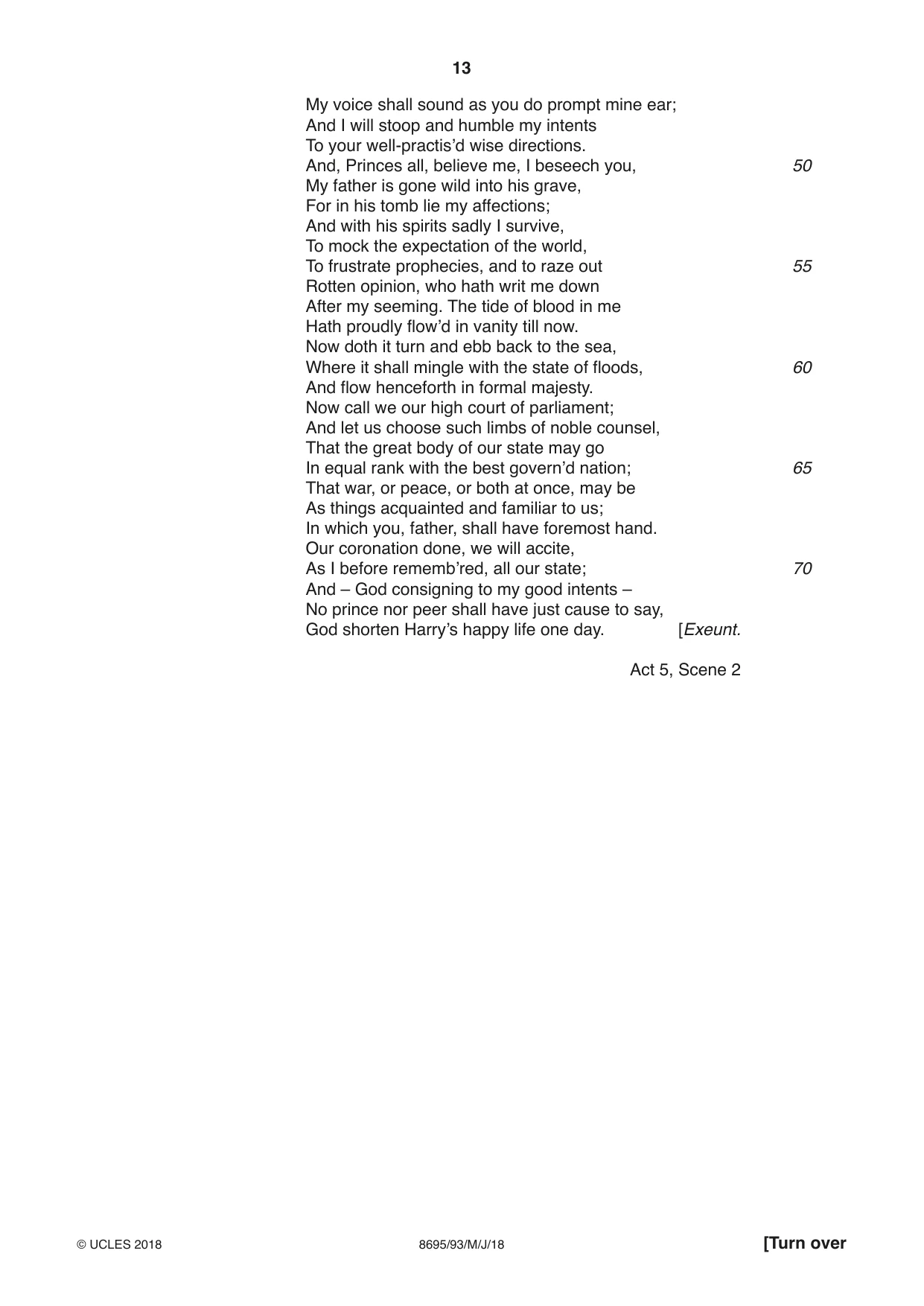
13 8695/93/M/J/18 © UCLES 2018 [Turn over My voice shall sound as you do prompt mine ear; And I will stoop and humble my intents To your well-practis’d wise directions. And, Princes all, believe me, I beseech you, My father is gone wild into his grave, For in his tomb lie my affections; And with his spirits sadly I survive, To mock the expectation of the world, To frustrate prophecies, and to raze out Rotten opinion, who hath writ me down After my seeming. The tide of blood in me Hath proudly flow’d in vanity till now. Now doth it turn and ebb back to the sea, Where it shall mingle with the state of floods, And flow henceforth in formal majesty. Now call we our high court of parliament; And let us choose such limbs of noble counsel, That the great body of our state may go In equal rank with the best govern’d nation; That war, or peace, or both at once, may be As things acquainted and familiar to us; In which you, father, shall have foremost hand. Our coronation done, we will accite, As I before rememb’red, all our state; And – God consigning to my good intents – No prince nor peer shall have just cause to say, God shorten Harry’s happy life one day. [Exeunt. Act 5, Scene 2 50 55 60 65 70
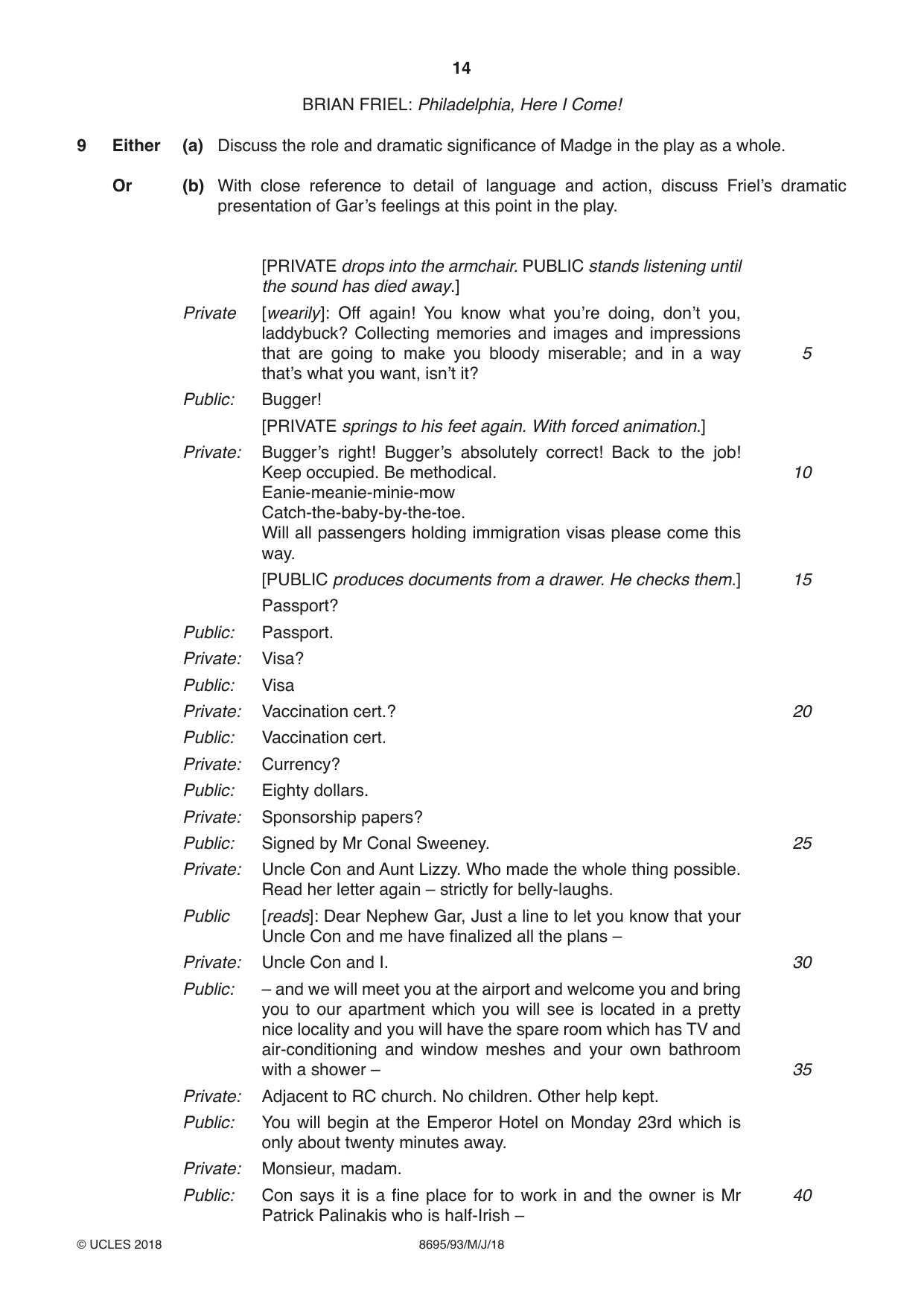
Question paper, page 14
14 8695/93/M/J/18 © UCLES 2018 BRIAN FRIEL: Philadelphia, Here I Come! 9 Either (a) Discuss the role and dramatic significance of Madge in the play as a whole. Or (b) With close reference to detail of language and action, discuss Friel’s dramatic presentation of Gar’s feelings at this point in the play. [PRIVATE drops into the armchair. PUBLIC stands listening until the sound has died away.] Private [wearily]: Off again! You know what you’re doing, don’t you, laddybuck? Collecting memories and images and impressions that are going to make you bloody miserable; and in a way that’s what you want, isn’t it? Public: Bugger! [PRIVATE springs to his feet again. With forced animation.] Private: Bugger’s right! Bugger’s absolutely correct! Back to the job! Keep occupied. Be methodical. Eanie-meanie-minie-mow Catch-the-baby-by-the-toe. Will all passengers holding immigration visas please come this way. [PUBLIC produces documents from a drawer. He checks them.] Passport? Public: Passport. Private: Visa? Public: Visa Private: Vaccination cert.? Public: Vaccination cert. Private: Currency? Public: Eighty dollars. Private: Sponsorship papers? Public: Signed by Mr Conal Sweeney. Private: Uncle Con and Aunt Lizzy. Who made the whole thing possible. Read her letter again – strictly for belly-laughs. Public [reads]: Dear Nephew Gar, Just a line to let you know that your Uncle Con and me have finalized all the plans – Private: Uncle Con and I. Public: – and we will meet you at the airport and welcome you and bring you to our apartment which you will see is located in a pretty nice locality and you will have the spare room which has TV and air-conditioning and window meshes and your own bathroom with a shower – Private: Adjacent to RC church. No children. Other help kept. Public: You will begin at the Emperor Hotel on Monday 23rd which is only about twenty minutes away. Private: Monsieur, madam. Public: Con says it is a fine place for to work in and the owner is Mr Patrick Palinakis who is half-Irish – 5 10 15 20 25 30 35 40
Question paper, page 15
15 8695/93/M/J/18 © UCLES 2018 Private: Patrick. Public: – and half-Greek. Private: Palinakis. Public: His grandfather came from County Mayo. Private: By the hokey! The Greek from Belmullet! Public: We know you will like it here and work hard. Private [rapidly ]: Monsieur-madam-monsieur-madam-monsieur-madam – Public: We remember our short trip to Ireland last September with happy thoughts and look forward to seeing you again. Sorry we missed your father that day. We had Ben Burton in to dinner last evening. He sends his regards. Private: Right sort, Ben. Public: Until we see you at the airport, all love, Elise. Episode 2 45 50
Question paper, page 16
16 8695/93/M/J/18 © UCLES 2018 BLANK PAGE Permission to reproduce items where third-party owned material protected by copyright is included has been sought and cleared where possible. Every reasonable effort has been made by the publisher (UCLES) to trace copyright holders, but if any items requiring clearance have unwittingly been included, the publisher will be pleased to make amends at the earliest possible opportunity. To avoid the issue of disclosure of answer-related information to candidates, all copyright acknowledgements are reproduced online in the Cambridge International Examinations Copyright Acknowledgements Booklet. This is produced for each series of examinations and is freely available to download at www.cie.org.uk after the live examination series. Cambridge International Examinations is part of the Cambridge Assessment Group. Cambridge Assessment is the brand name of University of Cambridge Local Examinations Syndicate (UCLES), which is itself a department of the University of Cambridge.
Mark scheme, page 1
IGCSE™ is a registered trademark. This document consists of 6 printed pages. © UCLES 2018 [Turn over Cambridge Assessment International Education Cambridge International Advanced Subsidiary Level LANGUAGE AND LITERATURE IN ENGLISH 8695/93 Paper 9 Poetry, Prose and Drama May/June 2018 MARK SCHEME Maximum Mark: 50 Published This mark scheme is published as an aid to teachers and candidates, to indicate the requirements of the examination. It shows the basis on which Examiners were instructed to award marks. It does not indicate the details of the discussions that took place at an Examiners’ meeting before marking began, which would have considered the acceptability of alternative answers. Mark schemes should be read in conjunction with the question paper and the Principal Examiner Report for Teachers. Cambridge International will not enter into discussions about these mark schemes. Cambridge International is publishing the mark schemes for the May/June 2018 series for most Cambridge IGCSE™, Cambridge International A and AS Level and Cambridge Pre-U components, and some Cambridge O Level components.
Mark scheme, page 2
8695/93 Cambridge International AS Level – Mark Scheme PUBLISHED May/June 2018 © UCLES 2018 Page 2 of 6 Generic Marking Principles These general marking principles must be applied by all examiners when marking candidate answers. They should be applied alongside the specific content of the mark scheme or generic level descriptors for a question. Each question paper and mark scheme will also comply with these marking principles. GENERIC MARKING PRINCIPLE 1: Marks must be awarded in line with: • the specific content of the mark scheme or the generic level descriptors for the question • the specific skills defined in the mark scheme or in the generic level descriptors for the question • the standard of response required by a candidate as exemplified by the standardisation scripts. GENERIC MARKING PRINCIPLE 2: Marks awarded are always whole marks (not half marks, or other fractions). GENERIC MARKING PRINCIPLE 3: Marks must be awarded positively: • marks are awarded for correct/valid answers, as defined in the mark scheme. However, credit is given for valid answers which go beyond the scope of the syllabus and mark scheme, referring to your Team Leader as appropriate • marks are awarded when candidates clearly demonstrate what they know and can do • marks are not deducted for errors • marks are not deducted for omissions • answers should only be judged on the quality of spelling, punctuation and grammar when these features are specifically assessed by the question as indicated by the mark scheme. The meaning, however, should be unambiguous. GENERIC MARKING PRINCIPLE 4: Rules must be applied consistently e.g. in situations where candidates have not followed instructions or in the application of generic level descriptors. GENERIC MARKING PRINCIPLE 5: Marks should be awarded using the full range of marks defined in the mark scheme for the question (however; the use of the full mark range may be limited according to the quality of the candidate responses seen). GENERIC MARKING PRINCIPLE 6: Marks awarded are based solely on the requirements as defined in the mark scheme. Marks should not be awarded with grade thresholds or grade descriptors in mind.
Mark scheme, page 3
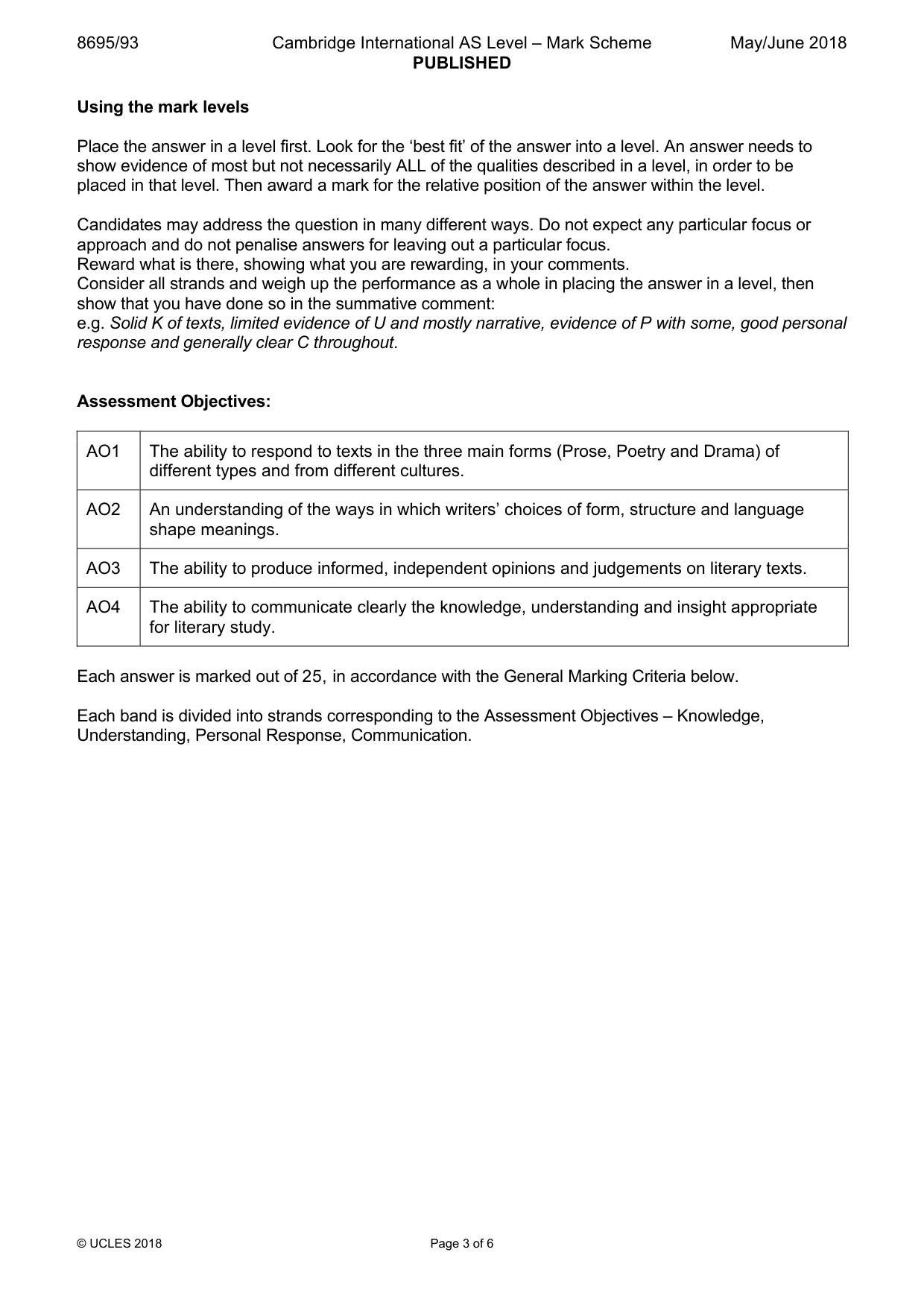
8695/93 Cambridge International AS Level – Mark Scheme PUBLISHED May/June 2018 © UCLES 2018 Page 3 of 6 Using the mark levels Place the answer in a level first. Look for the ‘best fit’ of the answer into a level. An answer needs to show evidence of most but not necessarily ALL of the qualities described in a level, in order to be placed in that level. Then award a mark for the relative position of the answer within the level. Candidates may address the question in many different ways. Do not expect any particular focus or approach and do not penalise answers for leaving out a particular focus. Reward what is there, showing what you are rewarding, in your comments. Consider all strands and weigh up the performance as a whole in placing the answer in a level, then show that you have done so in the summative comment: e.g. Solid K of texts, limited evidence of U and mostly narrative, evidence of P with some, good personal response and generally clear C throughout. Assessment Objectives: AO1 The ability to respond to texts in the three main forms (Prose, Poetry and Drama) of different types and from different cultures. AO2 An understanding of the ways in which writers’ choices of form, structure and language shape meanings. AO3 The ability to produce informed, independent opinions and judgements on literary texts. AO4 The ability to communicate clearly the knowledge, understanding and insight appropriate for literary study. Each answer is marked out of 25, in accordance with the General Marking Criteria below. Each band is divided into strands corresponding to the Assessment Objectives – Knowledge, Understanding, Personal Response, Communication.
Mark scheme, page 4
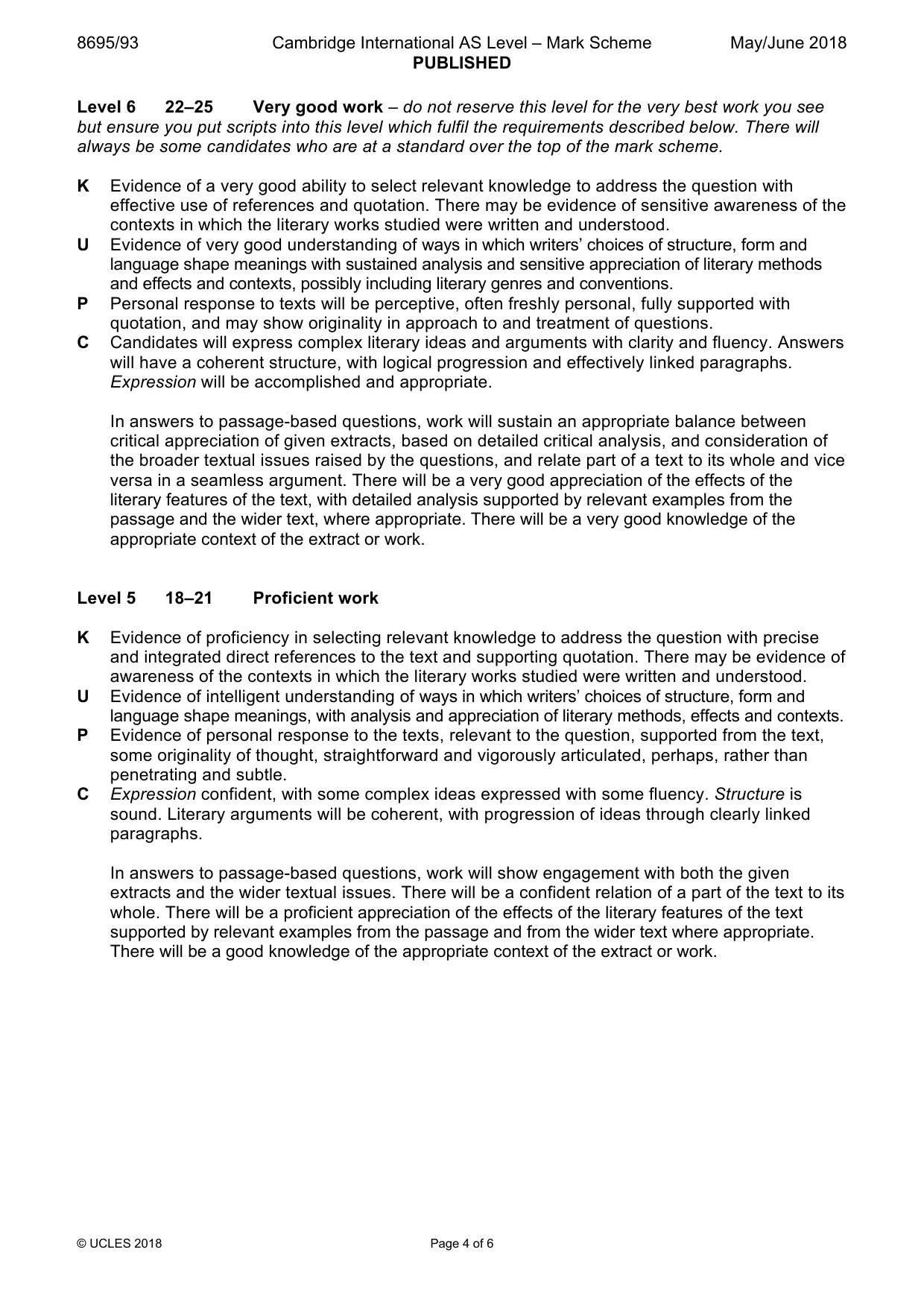
8695/93 Cambridge International AS Level – Mark Scheme PUBLISHED May/June 2018 © UCLES 2018 Page 4 of 6 Level 6 22–25 Very good work – do not reserve this level for the very best work you see but ensure you put scripts into this level which fulfil the requirements described below. There will always be some candidates who are at a standard over the top of the mark scheme. K Evidence of a very good ability to select relevant knowledge to address the question with effective use of references and quotation. There may be evidence of sensitive awareness of the contexts in which the literary works studied were written and understood. U Evidence of very good understanding of ways in which writers’ choices of structure, form and language shape meanings with sustained analysis and sensitive appreciation of literary methods and effects and contexts, possibly including literary genres and conventions. P Personal response to texts will be perceptive, often freshly personal, fully supported with quotation, and may show originality in approach to and treatment of questions. C Candidates will express complex literary ideas and arguments with clarity and fluency. Answers will have a coherent structure, with logical progression and effectively linked paragraphs. Expression will be accomplished and appropriate. In answers to passage-based questions, work will sustain an appropriate balance between critical appreciation of given extracts, based on detailed critical analysis, and consideration of the broader textual issues raised by the questions, and relate part of a text to its whole and vice versa in a seamless argument. There will be a very good appreciation of the effects of the literary features of the text, with detailed analysis supported by relevant examples from the passage and the wider text, where appropriate. There will be a very good knowledge of the appropriate context of the extract or work. Level 5 18–21 Proficient work K Evidence of proficiency in selecting relevant knowledge to address the question with precise and integrated direct references to the text and supporting quotation. There may be evidence of awareness of the contexts in which the literary works studied were written and understood. U Evidence of intelligent understanding of ways in which writers’ choices of structure, form and language shape meanings, with analysis and appreciation of literary methods, effects and contexts. P Evidence of personal response to the texts, relevant to the question, supported from the text, some originality of thought, straightforward and vigorously articulated, perhaps, rather than penetrating and subtle. C Expression confident, with some complex ideas expressed with some fluency. Structure is sound. Literary arguments will be coherent, with progression of ideas through clearly linked paragraphs. In answers to passage-based questions, work will show engagement with both the given extracts and the wider textual issues. There will be a confident relation of a part of the text to its whole. There will be a proficient appreciation of the effects of the literary features of the text supported by relevant examples from the passage and from the wider text where appropriate. There will be a good knowledge of the appropriate context of the extract or work.
Mark scheme, page 5
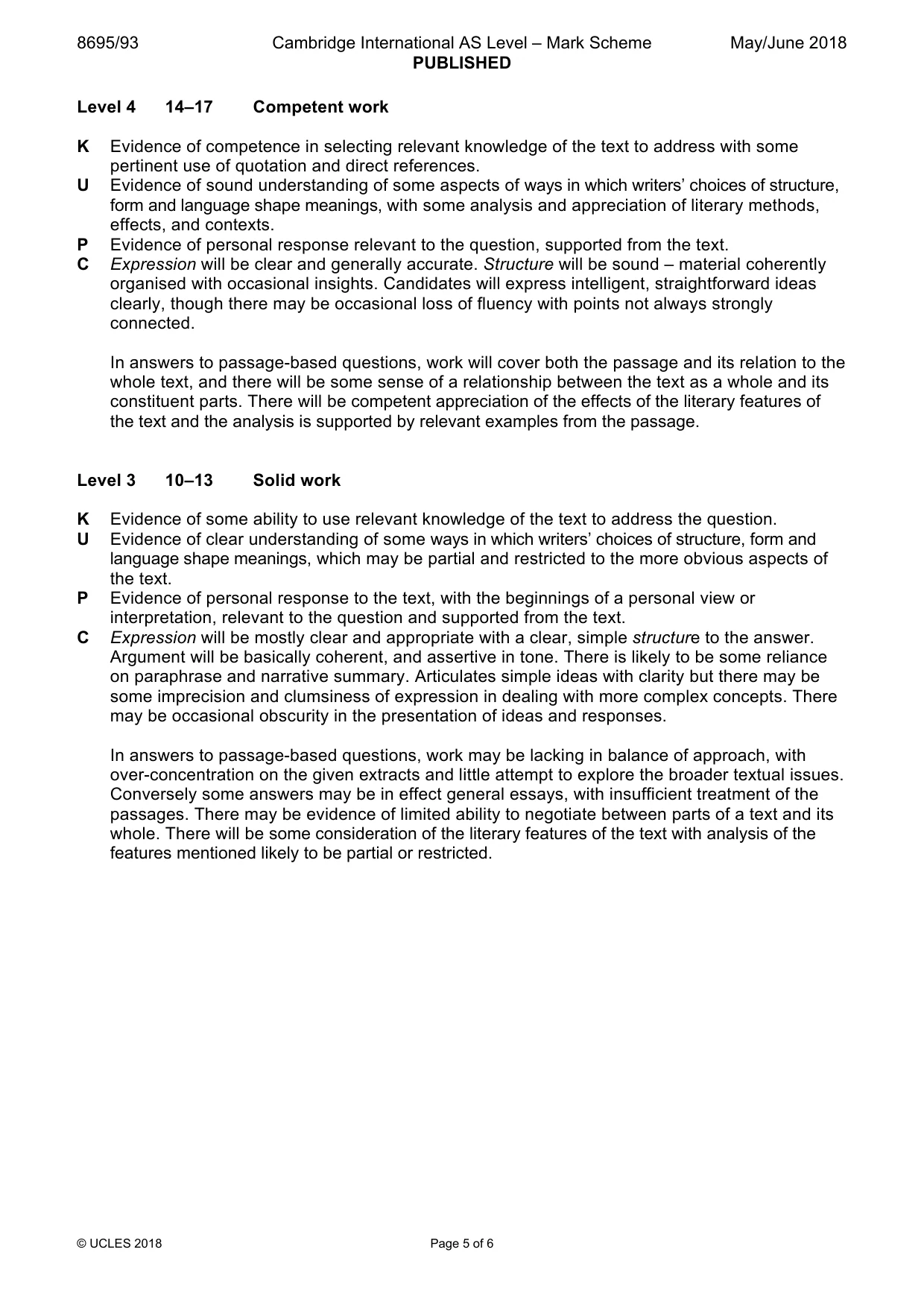
8695/93 Cambridge International AS Level – Mark Scheme PUBLISHED May/June 2018 © UCLES 2018 Page 5 of 6 Level 4 14–17 Competent work K Evidence of competence in selecting relevant knowledge of the text to address with some pertinent use of quotation and direct references. U Evidence of sound understanding of some aspects of ways in which writers’ choices of structure, form and language shape meanings, with some analysis and appreciation of literary methods, effects, and contexts. P Evidence of personal response relevant to the question, supported from the text. C Expression will be clear and generally accurate. Structure will be sound – material coherently organised with occasional insights. Candidates will express intelligent, straightforward ideas clearly, though there may be occasional loss of fluency with points not always strongly connected. In answers to passage-based questions, work will cover both the passage and its relation to the whole text, and there will be some sense of a relationship between the text as a whole and its constituent parts. There will be competent appreciation of the effects of the literary features of the text and the analysis is supported by relevant examples from the passage. Level 3 10–13 Solid work K Evidence of some ability to use relevant knowledge of the text to address the question. U Evidence of clear understanding of some ways in which writers’ choices of structure, form and language shape meanings, which may be partial and restricted to the more obvious aspects of the text. P Evidence of personal response to the text, with the beginnings of a personal view or interpretation, relevant to the question and supported from the text. C Expression will be mostly clear and appropriate with a clear, simple structure to the answer. Argument will be basically coherent, and assertive in tone. There is likely to be some reliance on paraphrase and narrative summary. Articulates simple ideas with clarity but there may be some imprecision and clumsiness of expression in dealing with more complex concepts. There may be occasional obscurity in the presentation of ideas and responses. In answers to passage-based questions, work may be lacking in balance of approach, with over-concentration on the given extracts and little attempt to explore the broader textual issues. Conversely some answers may be in effect general essays, with insufficient treatment of the passages. There may be evidence of limited ability to negotiate between parts of a text and its whole. There will be some consideration of the literary features of the text with analysis of the features mentioned likely to be partial or restricted.
Mark scheme, page 6
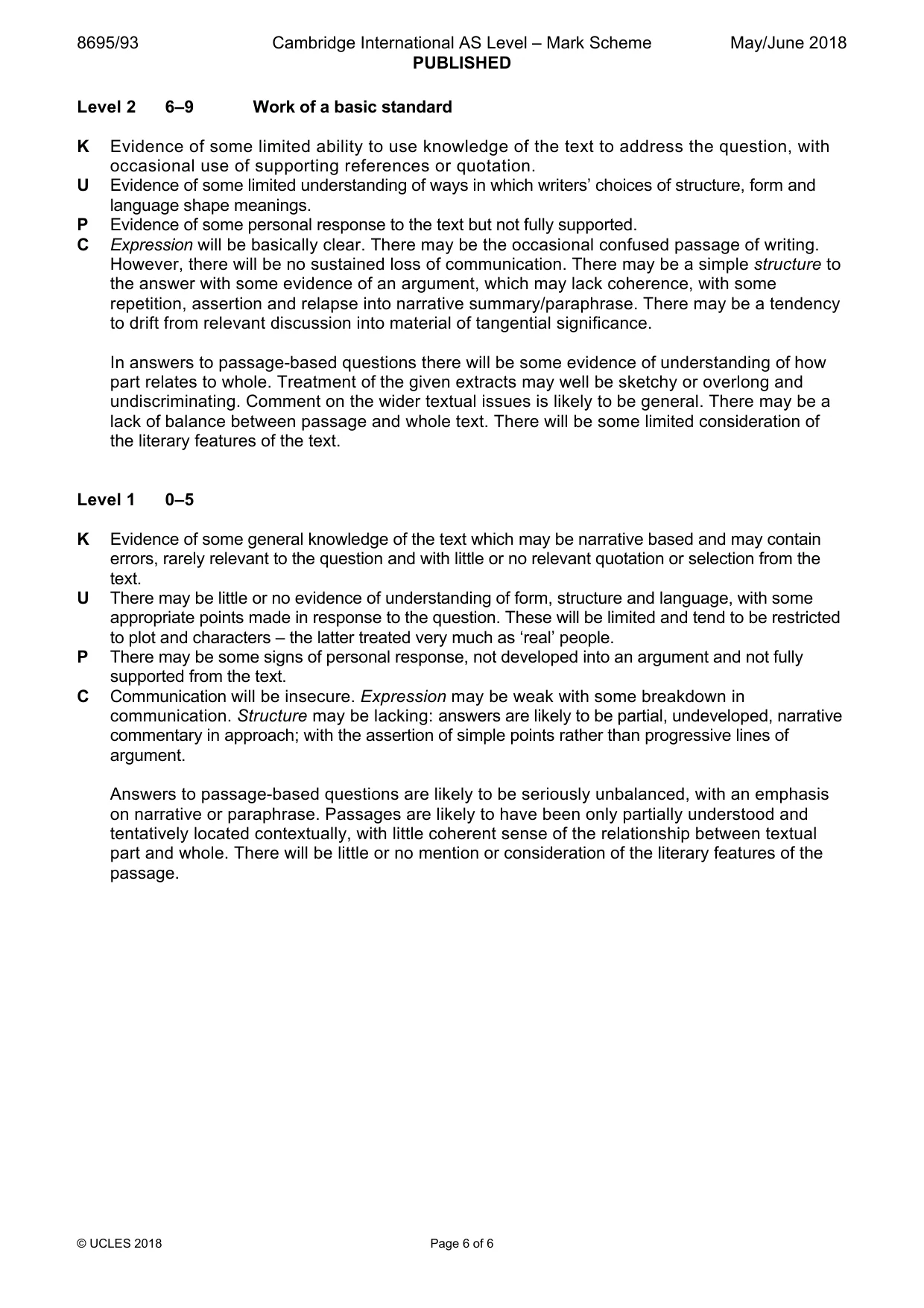
8695/93 Cambridge International AS Level – Mark Scheme PUBLISHED May/June 2018 © UCLES 2018 Page 6 of 6 Level 2 6–9 Work of a basic standard K Evidence of some limited ability to use knowledge of the text to address the question, with occasional use of supporting references or quotation. U Evidence of some limited understanding of ways in which writers’ choices of structure, form and language shape meanings. P Evidence of some personal response to the text but not fully supported. C Expression will be basically clear. There may be the occasional confused passage of writing. However, there will be no sustained loss of communication. There may be a simple structure to the answer with some evidence of an argument, which may lack coherence, with some repetition, assertion and relapse into narrative summary/paraphrase. There may be a tendency to drift from relevant discussion into material of tangential significance. In answers to passage-based questions there will be some evidence of understanding of how part relates to whole. Treatment of the given extracts may well be sketchy or overlong and undiscriminating. Comment on the wider textual issues is likely to be general. There may be a lack of balance between passage and whole text. There will be some limited consideration of the literary features of the text. Level 1 0–5 K Evidence of some general knowledge of the text which may be narrative based and may contain errors, rarely relevant to the question and with little or no relevant quotation or selection from the text. U There may be little or no evidence of understanding of form, structure and language, with some appropriate points made in response to the question. These will be limited and tend to be restricted to plot and characters – the latter treated very much as ‘real’ people. P There may be some signs of personal response, not developed into an argument and not fully supported from the text. C Communication will be insecure. Expression may be weak with some breakdown in communication. Structure may be lacking: answers are likely to be partial, undeveloped, narrative commentary in approach; with the assertion of simple points rather than progressive lines of argument. Answers to passage-based questions are likely to be seriously unbalanced, with an emphasis on narrative or paraphrase. Passages are likely to have been only partially understood and tentatively located contextually, with little coherent sense of the relationship between textual part and whole. There will be little or no mention or consideration of the literary features of the passage.
What you needed in this session
Cambridge’s own grade thresholds for 2018 May/June, Paper 9 · Variant 3. A higher threshold means an easier paper — the bar moves with how the cohort did.