Cambridge A Level English - Language and Literature (AS Level only, from 2016) 8695 — 2019 May/June Paper 9 · Variant 3
8695/93/M/J/19 · 50 marks · ≈56 min
The question paper and its mark scheme, free to read here and free to download. This is Cambridge’s own paper, exactly as it was sat.
Question paper20 pages





Mark scheme6 pages
Answers below. Sit the paper first if you are practising.
Paper as text
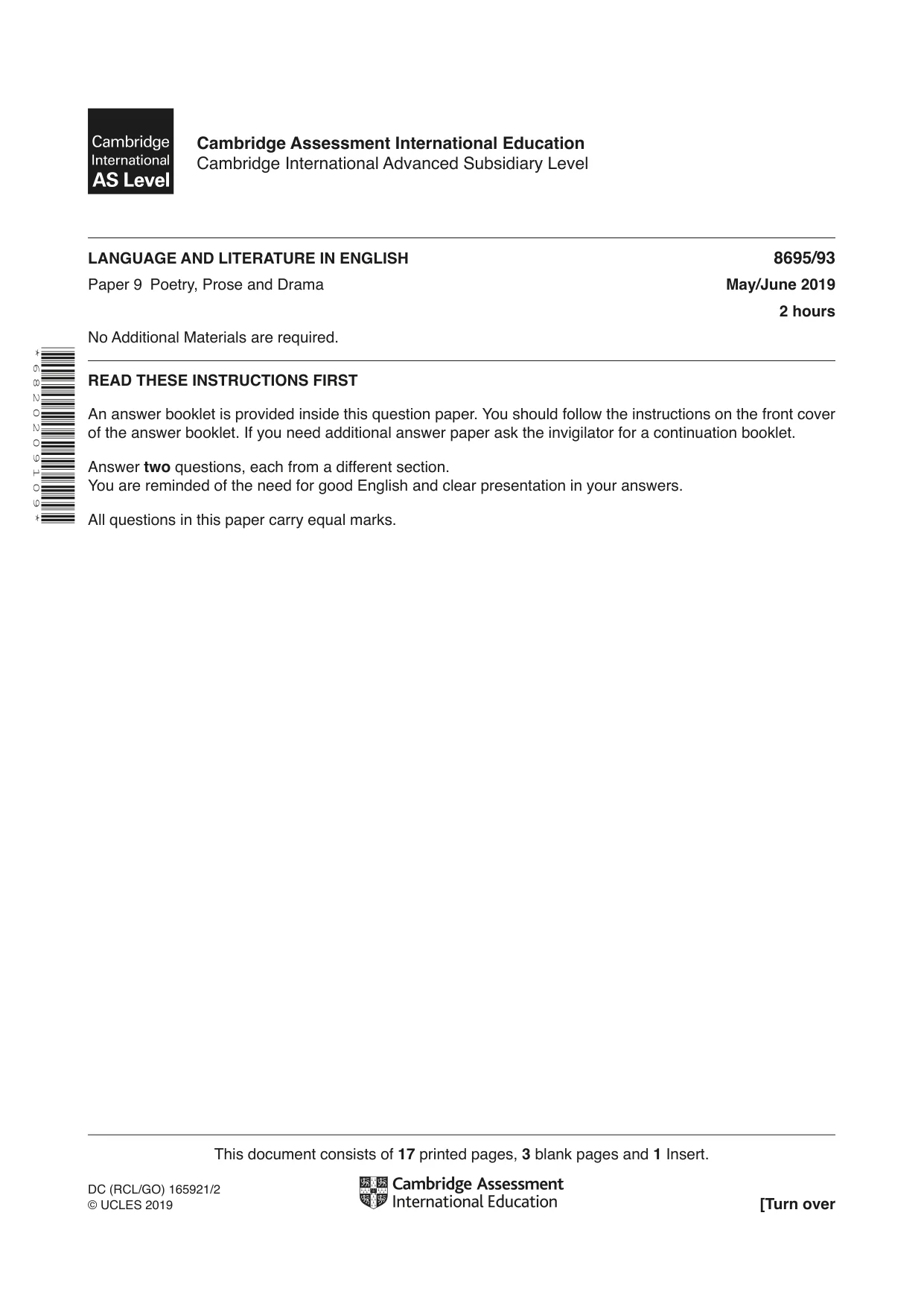
Question paper, page 1
This document consists of 17 printed pages, 3 blank pages and 1 Insert. DC (RCL/GO) 165921/2 © UCLES 2019 [Turn over Cambridge Assessment International Education Cambridge International Advanced Subsidiary Level LANGUAGE AND LITERATURE IN ENGLISH 8695/93 Paper 9 Poetry, Prose and Drama May/June 2019 2 hours No Additional Materials are required. READ THESE INSTRUCTIONS FIRST An answer booklet is provided inside this question paper. You should follow the instructions on the front cover of the answer booklet. If you need additional answer paper ask the invigilator for a continuation booklet. Answer two questions, each from a different section. You are reminded of the need for good English and clear presentation in your answers. All questions in this paper carry equal marks. * 6 8 2 0 2 0 9 1 0 9 *
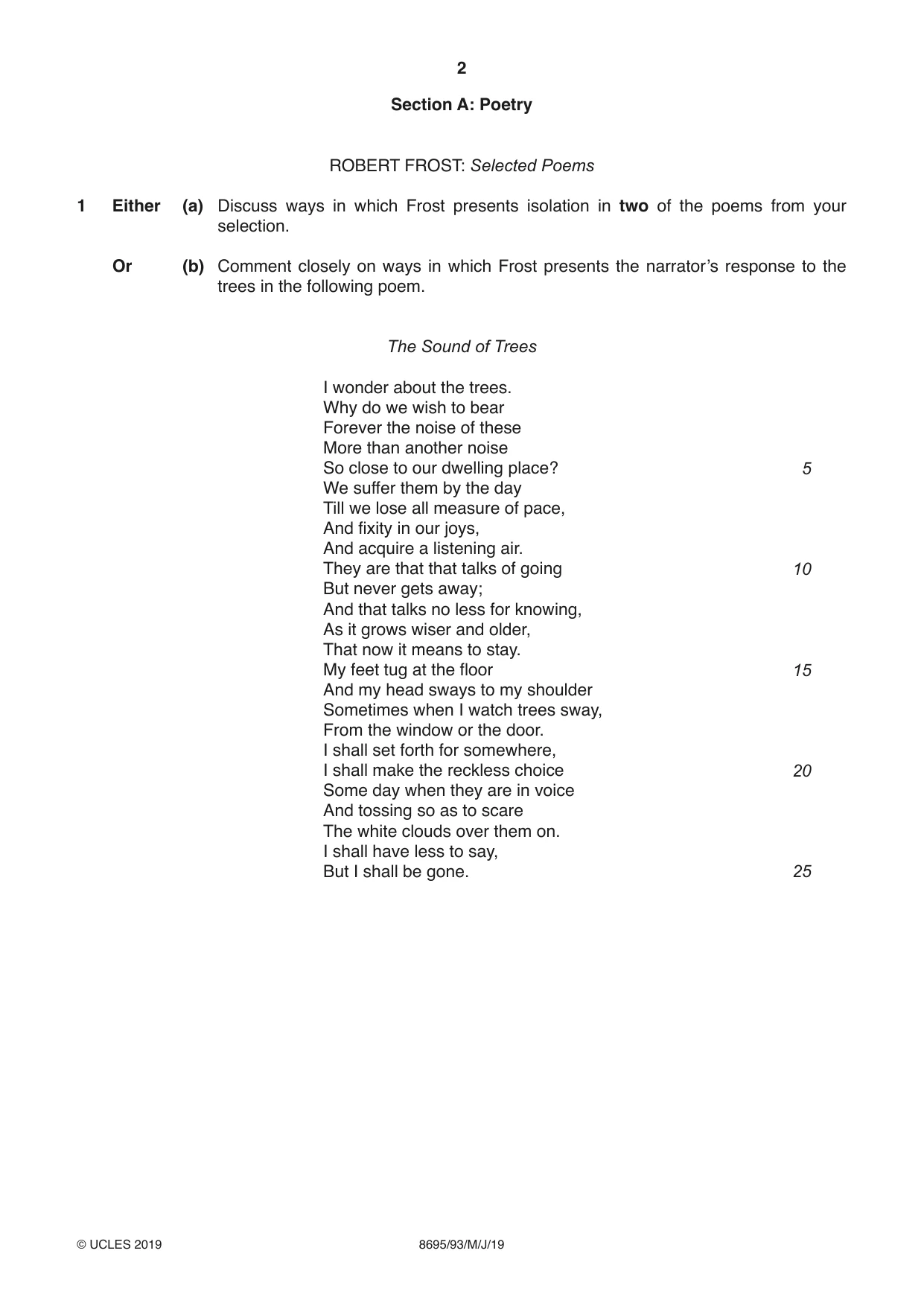
Question paper, page 2
2 8695/93/M/J/19 © UCLES 2019 Section A: Poetry ROBERT FROST: Selected Poems 1 Either (a) Discuss ways in which Frost presents isolation in two of the poems from your selection. Or (b) Comment closely on ways in which Frost presents the narrator’s response to the trees in the following poem. The Sound of Trees I wonder about the trees. Why do we wish to bear Forever the noise of these More than another noise So close to our dwelling place? We suffer them by the day Till we lose all measure of pace, And fixity in our joys, And acquire a listening air. They are that that talks of going But never gets away; And that talks no less for knowing, As it grows wiser and older, That now it means to stay. My feet tug at the floor And my head sways to my shoulder Sometimes when I watch trees sway, From the window or the door. I shall set forth for somewhere, I shall make the reckless choice Some day when they are in voice And tossing so as to scare The white clouds over them on. I shall have less to say, But I shall be gone. 5 10 15 20 25
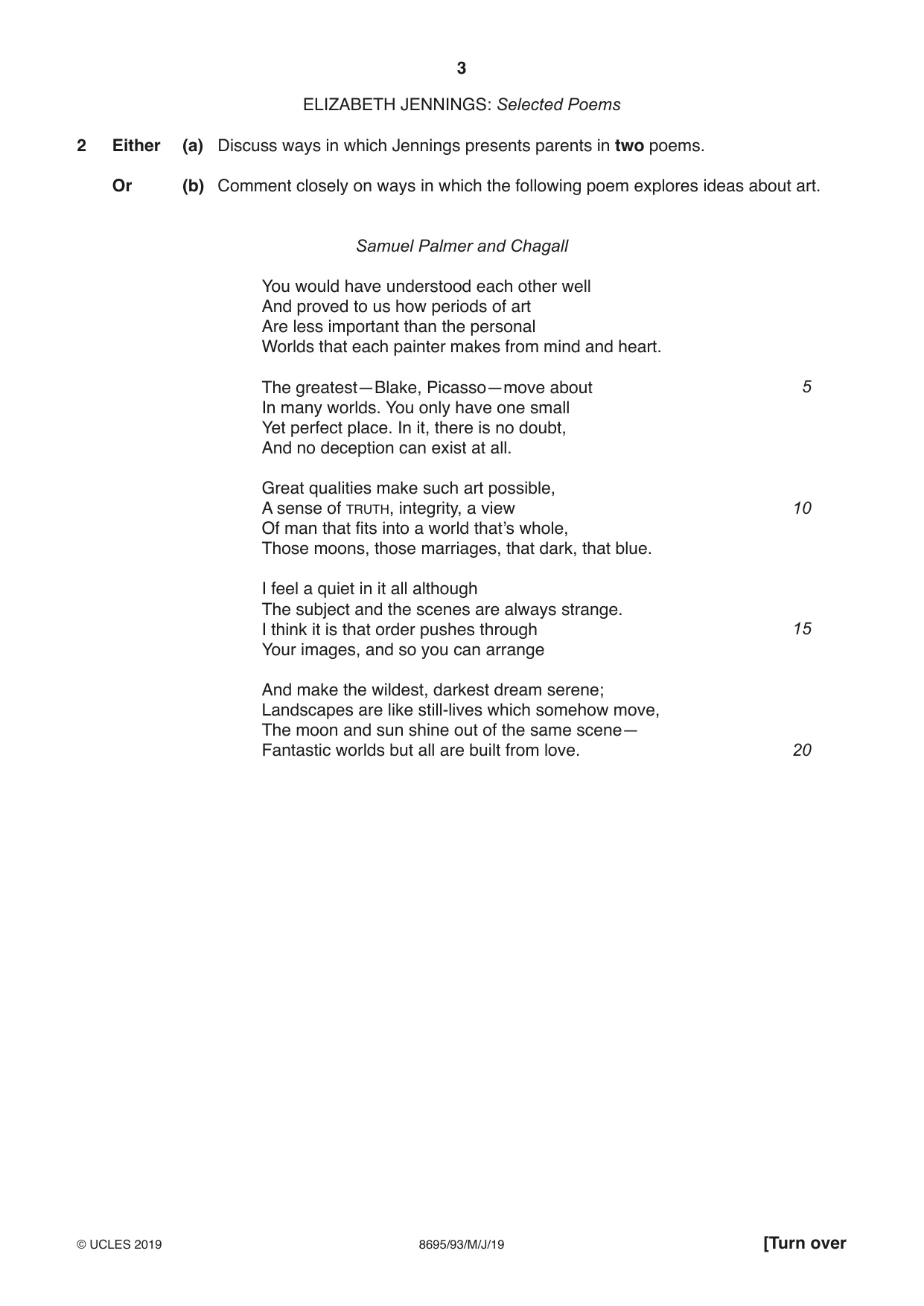
Question paper, page 3
3 8695/93/M/J/19 © UCLES 2019 [Turn over ELIZABETH JENNINGS: Selected Poems 2 Either (a) Discuss ways in which Jennings presents parents in two poems. Or (b) Comment closely on ways in which the following poem explores ideas about art. Samuel Palmer and Chagall You would have understood each other well And proved to us how periods of art Are less important than the personal Worlds that each painter makes from mind and heart. The greatest—Blake, Picasso—move about In many worlds. You only have one small Yet perfect place. In it, there is no doubt, And no deception can exist at all. Great qualities make such art possible, A sense of truth, integrity, a view Of man that fits into a world that’s whole, Those moons, those marriages, that dark, that blue. I feel a quiet in it all although The subject and the scenes are always strange. I think it is that order pushes through Your images, and so you can arrange And make the wildest, darkest dream serene; Landscapes are like still-lives which somehow move, The moon and sun shine out of the same scene— Fantastic worlds but all are built from love. 5 10 15 20
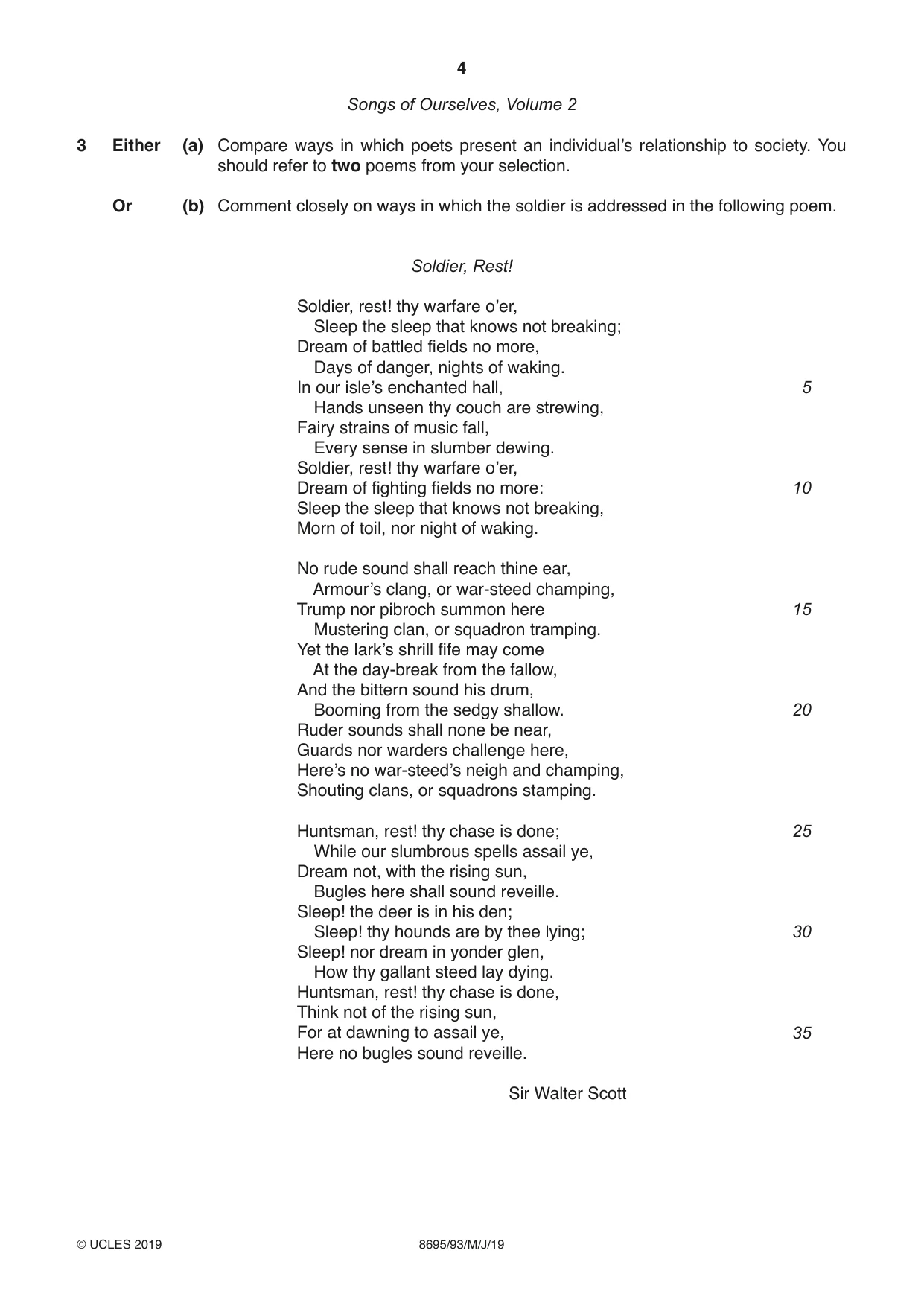
Question paper, page 4
4 8695/93/M/J/19 © UCLES 2019 Songs of Ourselves, Volume 2 3 Either (a) Compare ways in which poets present an individual’s relationship to society. You should refer to two poems from your selection. Or (b) Comment closely on ways in which the soldier is addressed in the following poem. Soldier, Rest! Soldier, rest! thy warfare o’er, Sleep the sleep that knows not breaking; Dream of battled fields no more, Days of danger, nights of waking. In our isle’s enchanted hall, Hands unseen thy couch are strewing, Fairy strains of music fall, Every sense in slumber dewing. Soldier, rest! thy warfare o’er, Dream of fighting fields no more: Sleep the sleep that knows not breaking, Morn of toil, nor night of waking. No rude sound shall reach thine ear, Armour’s clang, or war-steed champing, Trump nor pibroch summon here Mustering clan, or squadron tramping. Yet the lark’s shrill fife may come At the day-break from the fallow, And the bittern sound his drum, Booming from the sedgy shallow. Ruder sounds shall none be near, Guards nor warders challenge here, Here’s no war-steed’s neigh and champing, Shouting clans, or squadrons stamping. Huntsman, rest! thy chase is done; While our slumbrous spells assail ye, Dream not, with the rising sun, Bugles here shall sound reveille. Sleep! the deer is in his den; Sleep! thy hounds are by thee lying; Sleep! nor dream in yonder glen, How thy gallant steed lay dying. Huntsman, rest! thy chase is done, Think not of the rising sun, For at dawning to assail ye, Here no bugles sound reveille. Sir Walter Scott 5 10 15 20 25 30 35
Question paper, page 5
5 8695/93/M/J/19 © UCLES 2019 [Turn over Turn over for Section B.
Question paper, page 6
6 8695/93/M/J/19 © UCLES 2019 Section B: Prose E.M. FORSTER: Howards End 4 Either (a) Discuss the presentation of the house at Oniton and its significance to the characters. Or (b) Comment closely on ways in which the following passage presents Leonard Bast. Then through the mists of his culture came a hard fact, hard as a pebble. “I walked all the Saturday night,” said Leonard. “I walked.” A thrill of approval ran through the sisters. But culture closed in again. He asked whether they had ever read E. V. Lucas’s Open Road. Said Helen, “No doubt it’s another beautiful book, but I’d rather hear about your road.” “Oh, I walked.” “How far?” “I don’t know, nor for how long. It got too dark to see my watch.” “Were you walking alone, may I ask?” “Yes,” he said, straightening himself; “but we’d been talking it over at the office. There’s been a lot of talk at the office lately about these things. The fellows there said one steers by the Pole Star, and I looked it up in the celestial atlas, but once out of doors everything gets so mixed.” “Don’t talk to me about the Pole Star,” interrupted Helen, who was becoming interested. “I know its little ways. It goes round and round, and you go round after it.” “Well, I lost it entirely. First of all the street lamps, then the trees, and towards morning it got cloudy.” Tibby, who preferred his comedy undiluted, slipped from the room. He knew that this fellow would never attain to poetry, and did not want to hear him trying. Margaret and Helen remained. Their brother influenced them more than they knew; in his absence they were stirred to enthusiasm more easily. “Where did you start from?” cried Margaret. “Do tell us more.” “I took the Underground to Wimbledon. As I came out of the office I said to myself, ‘I must have a walk once in a way. If I don’t take this walk now, I shall never take it.’ I had a bit of dinner at Wimbledon, and then—” “But not good country there, is it?” “It was gas-lamps for hours. Still, I had all the night, and being out was the great thing. I did get into woods, too, presently.” “Yes, go on,” said Helen. “You’ve no idea how difficult uneven ground is when it’s dark.” “Did you actually go off the roads?” “Oh yes. I always meant to go off the roads, but the worst of it is that it’s more difficult to find one’s way.” “Mr. Bast, you’re a born adventurer,” laughed Margaret. “No professional athlete would have attempted what you’ve done. It’s a wonder your walk didn’t end in a broken neck. Whatever did your wife say?” “Professional athletes never move without lanterns and compasses,” said Helen. “Besides, they can’t walk. It tires them. Go on.” “I felt like R. L. S. You probably remember how in Virginibus—” “Yes, but the wood. This ’ere wood. How did you get out of it?” “I managed one wood, and found a road the other side which went a good bit uphill. I rather fancy it was those North Downs, for the road went off into grass, and I got into another wood. That was awful, with gorse bushes. I did wish I’d never come, but suddenly it got light—just while I seemed going under one tree. Then I found a road down to a station, and took the first train I could back to London.” 5 10 15 20 25 30 35 40 45
Question paper, page 7
7 8695/93/M/J/19 © UCLES 2019 [Turn over “But was the dawn wonderful?” asked Helen. With unforgettable sincerity he replied, “No.” The word flew again like a pebble from the sling. Down toppled all that had seemed ignoble or literary in his talk, down toppled tiresome R. L. S. and the “love of the earth” and his silk top-hat. In the presence of these women Leonard had arrived, and he spoke with a flow, an exultation, that he had seldom known. “The dawn was only grey, it was nothing to mention.” “Just a grey evening turned upside down. I know.” “—and I was too tired to lift up my head to look at it, and so cold too. I’m glad I did it, and yet at the time it bored me more than I can say. And besides—you can believe me or not as you choose—I was very hungry.” Chapter 14 50 55
Question paper, page 8
8 8695/93/M/J/19 © UCLES 2019 ANDREA LEVY: Small Island 5 Either (a) Discuss some of the effects Levy achieves by using a range of contrasting locations in the novel. Or (b) Comment closely on the following passage, considering ways in which it presents Bernard on his return to England. England had shrunk. It was smaller than the place I’d left. Streets, shops, houses bore down like crowds, stifling even the feeble light that got through. I had to stare out at the sea just to catch a breath. And behind every face I saw were trapped the rememberings of war. Guarded by a smile. Shrouded in a frown. But everyone had them. Private conflicts. Scarring where touched. No point dwelling on your own pitiful story. Chap next to you was worse off. The man over there far more tragic. Silence was the only balm that healed. I never doubted I was doing the right thing. Even on days when the longing for familiar was as substantial as hunger. To lie with Queenie. To sit with Pa. To gaze on objects that communed in memories. I had no idea how long the awful disease would take to claim me. No thought of doctors or cures. Shame saw to that. My only worry was that I would lose my mind. Do something rash without sanity’s firm hand. But in waiting to die I felt fit. Found employment, cleaning tables in a café. Kept my head down, had a job to do, just got on with it. Proprietor, rather dim fellow, needed a hand with his bookkeeping. He was tickled pink when his worthless waiter turned out to be useful. I helped him out. He told all his chums. Soon I had a few of them calling on my services. Became quite a little business. All very informal but regular. I stopped being a waiter. Double-entry bookkeeping earned me enough for board and lodging. I found Maxi’s house, of course. Up near the station. A modest house. Painted pale blue, its bow-front window hung with thick yellowing nets. I walked his street often, my footsteps marking the pavement where Maxi’s should have been going about their business. Rushing to work. A pint or two in the pub. A game of football in the park. Or cricket. Maybe even church with his family on Sunday. There was a graveyard nearby. I sat on the bench there. Saw his two sons coming out from the house. His wife tying a headscarf against the wind, calling for the boys to wait. Them, boisterous, running up the street. Clambering up walls to walk balancing along their length. As the younger one passed me he dropped his model car. I picked it up for him. Got a faint smile. Little chap staring at me. Spit of his father. A natural successor. He grabbed the car from my hand and ran. Maxi had never seen this younger son. I felt like a thief, stealing a sight that should have been his. They soon got used to seeing me sitting in the graveyard. His wife would nod to me. Some days she’d raise up her brown eyes to say, ‘Lovely day.’ Attractive woman, her black hair always hidden by scarves. Short. Not much taller than the elder boy. I only spoke to her in polite greeting. Silly, I know, but I was anxious not to befriend, just to watch over. I never told them I knew Maxi. Scared she’d ask the unanswerable. Want to know what befell us all out east. With the war over, even the truth seemed sordid. Loving memory was the best resting place for George Maximillian. It was Mrs Bliss who called the doctor. My temperature raged, sweating my sheets sodden as freshly used bath towels. I could feel every bone in my body. Even the smallest of them ached. Any movement – to roll in the bed, even to blink an eye – felt impossibly exhausting. I told her not to bother but she brushed me off with a ‘Nonsense.’ Couldn’t blame her. Must have been a pitiful sight. Chapter 46 5 10 15 20 25 30 35 40 45
Question paper, page 9
9 8695/93/M/J/19 © UCLES 2019 [Turn over Turn over for Question 6.
Question paper, page 10
10 8695/93/M/J/19 © UCLES 2019 Stories of Ourselves 6 Either (a) Discuss the presentation of relationships between young people and the older generation in two stories. Or (b) Comment closely on ways in which the following passage from The Rain Horse presents the encounter with the horse. All around him the boughs angled down, glistening, black as iron. From their tips and elbows the drops hurried steadily, and the channels of the bark pulsed and gleamed. For a time he amused himself calculating the variation in the rainfall by the variations in a dribble of water from a trembling twig-end two feet in front of his nose. He studied the twig, bringing dwarfs and continents and animals out of its scurfy bark. Beyond the boughs the blue shoal of the town was rising and falling, and darkening and fading again, in the pale, swaying backdrop of rain. He wanted this rain to go on for ever. Whenever it seemed to be drawing off he listened anxiously until it closed in again. As long as it lasted he was suspended from life and time. He didn’t want to return to his sodden shoes and his possibly ruined suit and the walk back over that land of mud. All at once he shivered. He hugged his knees to squeeze out the cold and found himself thinking of the horse. The hair on the nape of his neck prickled slightly. He remembered how it had run up to the crest and showed against the sky. He tried to dismiss the thought. Horses wander about the countryside often enough. But the image of the horse as it had appeared against the sky stuck in his mind. It must have come over the crest just above the wood in which he was now sitting. To clear his mind, he twisted around and looked up the wood between the tree stems, to his left. At the wood top, with the silvered grey light coming in behind it, the black horse was standing under the oaks, its head high and alert, its ears pricked, watching him. A horse sheltering from the rain generally goes into a sort of stupor, tilts a hind hoof and hangs its head and lets its eyelids droop, and so it stays as long as the rain lasts. This horse was nothing like that. It was watching him intently, standing perfectly still, its soaked neck and flank shining in the hard light. He turned back. His scalp went icy and he shivered. What was he to do? Ridiculous to try driving it away. And to leave the wood, with the rain still coming down full pelt was out of the question. Meanwhile the idea of being watched became more and more unsettling until at last he had to twist around again, to see if the horse had moved. It stood exactly as before. This was absurd. He took control of himself and turned back deliberately, determined not to give the horse one more thought. If it wanted to share the wood with him, let it. If it wanted to stare at him, let it. He was nestling firmly into these resolutions when the ground shook and he heard the crash of a heavy body coming down the wood. Like lightning his legs bounded him upright and about face. The horse was almost on top of him, its head stretching forward, ears flattened and lips lifted back from the long yellow teeth. He got one snapshot glimpse of the red- veined eyeball as he flung himself backwards around the tree. Then he was away up the slope, whipped by oak twigs as he leapt the brambles and brushwood, twisting between the close trees till he tripped and sprawled. As he fell the warning flashed through his head that he must at all costs keep his suit out of the leaf-mould, but a more urgent instinct was already rolling him violently sideways. He spun around, sat up and looked back, ready to scramble off in a flash to one side. He was panting from the sudden excitement and effort. The horse had disappeared. The wood was empty except for the drumming, slant grey rain, dancing the bracken and glittering from the branches. 5 10 15 20 25 30 35 40 45
Question paper, page 11
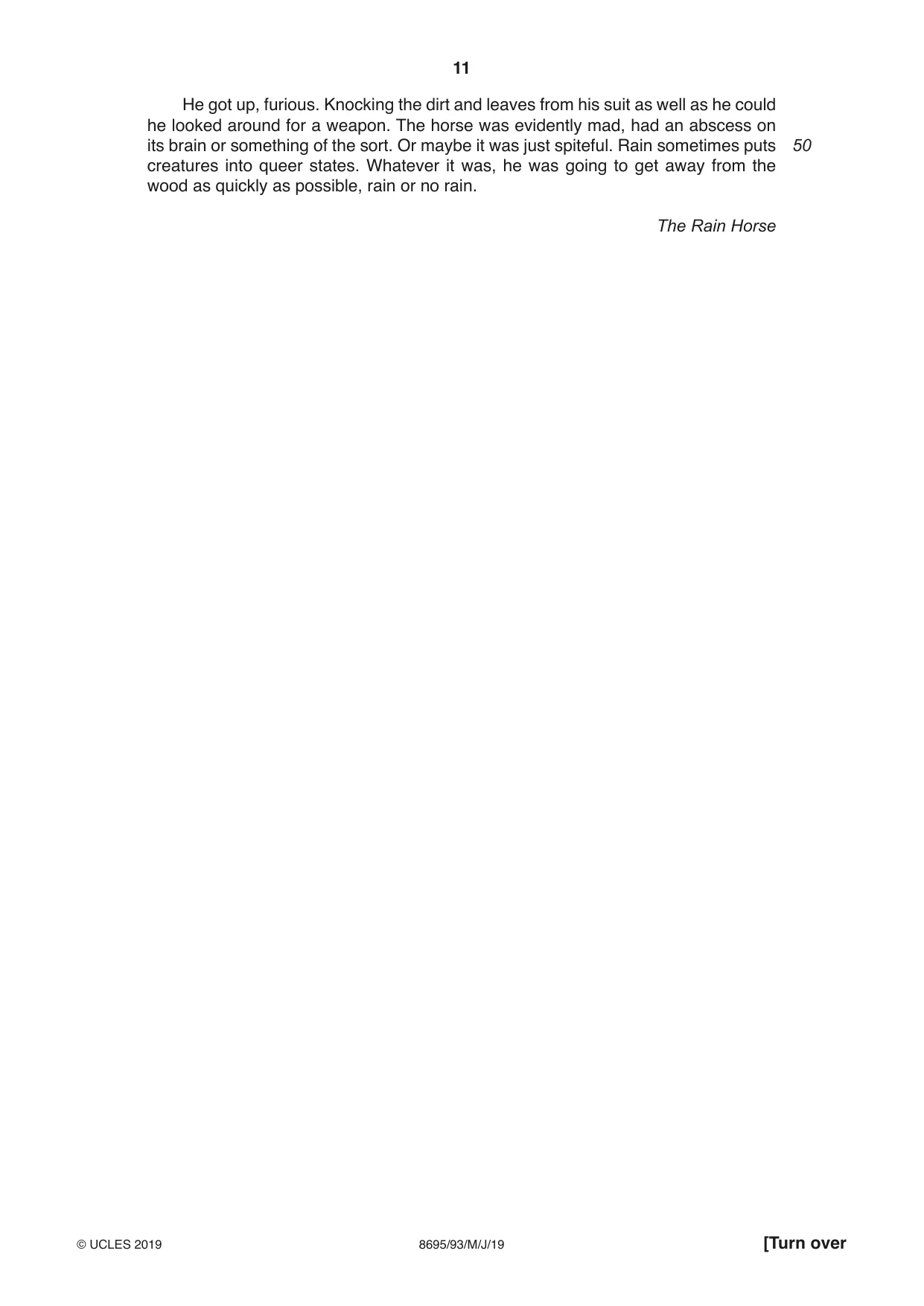
11 8695/93/M/J/19 © UCLES 2019 [Turn over He got up, furious. Knocking the dirt and leaves from his suit as well as he could he looked around for a weapon. The horse was evidently mad, had an abscess on its brain or something of the sort. Or maybe it was just spiteful. Rain sometimes puts creatures into queer states. Whatever it was, he was going to get away from the wood as quickly as possible, rain or no rain. The Rain Horse 50
Question paper, page 12
12 8695/93/M/J/19 © UCLES 2019 Section C: Drama WOLE SOYINKA: Death and the King’s Horseman 7 Either (a) In what ways, and with what dramatic effects, is Olunde presented as being torn between Yoruban and European ideas and beliefs in the play? Or (b) Discuss Soyinka’s presentation of death in the following scene, the end of the play. You should pay careful attention to both language and action. Elesin: I cannot approach. Content removed due to copyright restrictions.
Question paper, page 13
13 8695/93/M/J/19 © UCLES 2019 [Turn over Lights fade to a blackout.] Scene 5 Content removed due to copyright restrictions.
Question paper, page 14
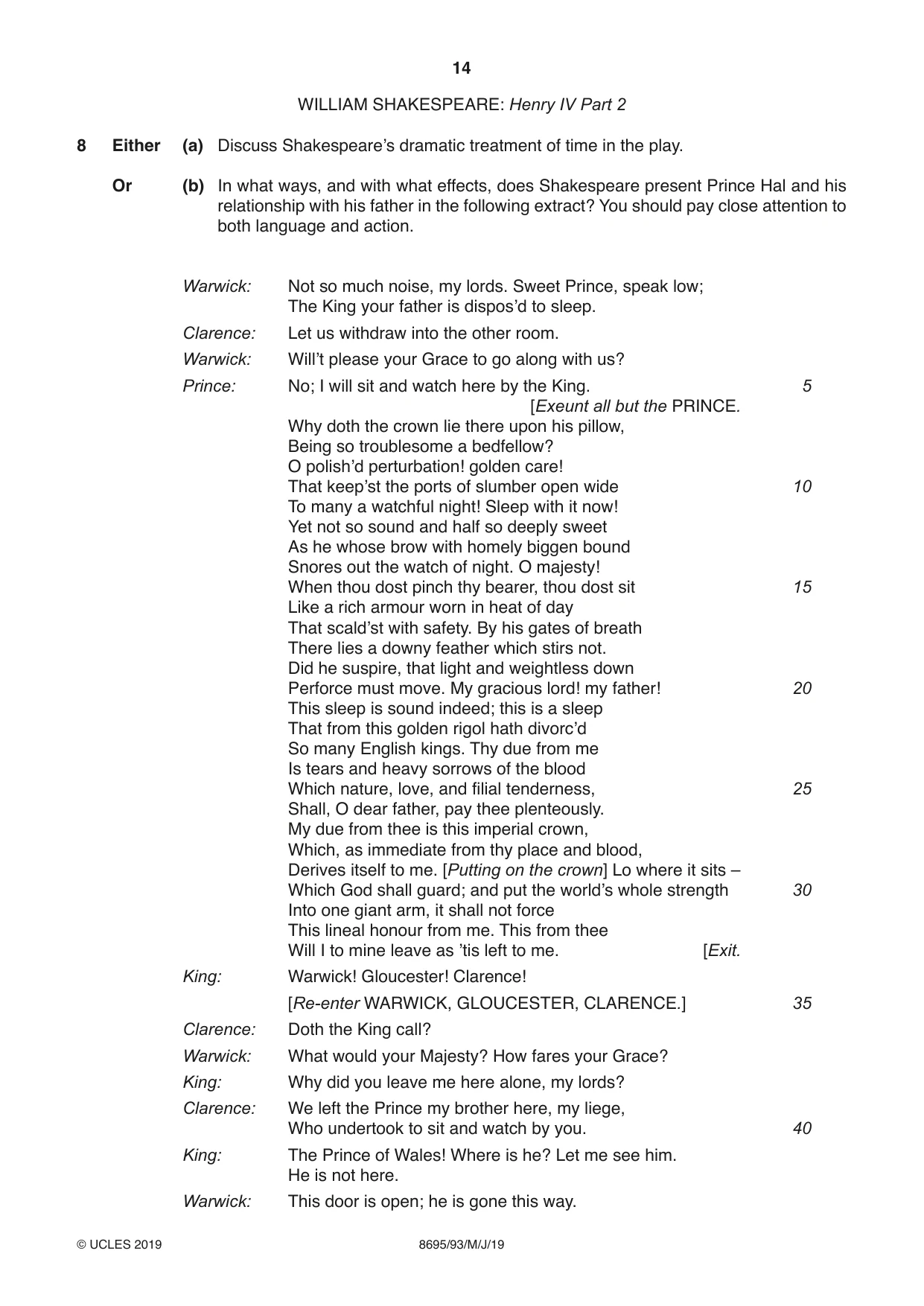
14 8695/93/M/J/19 © UCLES 2019 WILLIAM SHAKESPEARE: Henry IV Part 2 8 Either (a) Discuss Shakespeare’s dramatic treatment of time in the play. Or (b) In what ways, and with what effects, does Shakespeare present Prince Hal and his relationship with his father in the following extract? You should pay close attention to both language and action. Warwick: Not so much noise, my lords. Sweet Prince, speak low; The King your father is dispos’d to sleep. Clarence: Let us withdraw into the other room. Warwick: Will’t please your Grace to go along with us? Prince: No; I will sit and watch here by the King. [Exeunt all but the PRINCE. Why doth the crown lie there upon his pillow, Being so troublesome a bedfellow? O polish’d perturbation! golden care! That keep’st the ports of slumber open wide To many a watchful night! Sleep with it now! Yet not so sound and half so deeply sweet As he whose brow with homely biggen bound Snores out the watch of night. O majesty! When thou dost pinch thy bearer, thou dost sit Like a rich armour worn in heat of day That scald’st with safety. By his gates of breath There lies a downy feather which stirs not. Did he suspire, that light and weightless down Perforce must move. My gracious lord! my father! This sleep is sound indeed; this is a sleep That from this golden rigol hath divorc’d So many English kings. Thy due from me Is tears and heavy sorrows of the blood Which nature, love, and filial tenderness, Shall, O dear father, pay thee plenteously. My due from thee is this imperial crown, Which, as immediate from thy place and blood, Derives itself to me. [Putting on the crown] Lo where it sits – Which God shall guard; and put the world’s whole strength Into one giant arm, it shall not force This lineal honour from me. This from thee Will I to mine leave as ’tis left to me. [Exit. King: Warwick! Gloucester! Clarence! [Re-enter WARWICK, GLOUCESTER, CLARENCE.] Clarence: Doth the King call? Warwick: What would your Majesty? How fares your Grace? King: Why did you leave me here alone, my lords? Clarence: We left the Prince my brother here, my liege, Who undertook to sit and watch by you. King: The Prince of Wales! Where is he? Let me see him. He is not here. Warwick: This door is open; he is gone this way. 5 10 15 20 25 30 35 40
Question paper, page 15
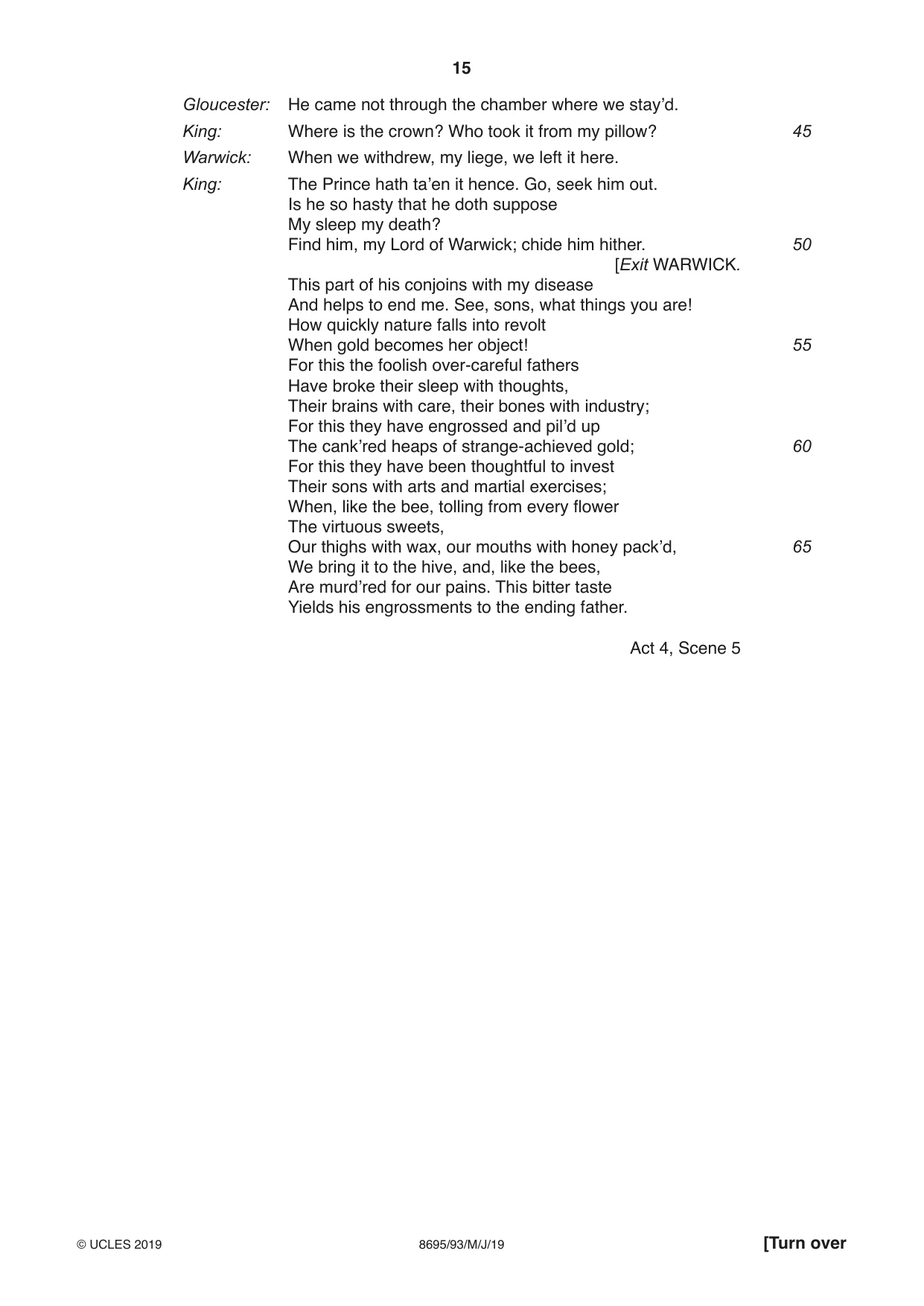
15 8695/93/M/J/19 © UCLES 2019 [Turn over Gloucester: He came not through the chamber where we stay’d. King: Where is the crown? Who took it from my pillow? Warwick: When we withdrew, my liege, we left it here. King: The Prince hath ta’en it hence. Go, seek him out. Is he so hasty that he doth suppose My sleep my death? Find him, my Lord of Warwick; chide him hither. [Exit WARWICK. This part of his conjoins with my disease And helps to end me. See, sons, what things you are! How quickly nature falls into revolt When gold becomes her object! For this the foolish over-careful fathers Have broke their sleep with thoughts, Their brains with care, their bones with industry; For this they have engrossed and pil’d up The cank’red heaps of strange-achieved gold; For this they have been thoughtful to invest Their sons with arts and martial exercises; When, like the bee, tolling from every flower The virtuous sweets, Our thighs with wax, our mouths with honey pack’d, We bring it to the hive, and, like the bees, Are murd’red for our pains. This bitter taste Yields his engrossments to the ending father. Act 4, Scene 5 45 50 55 60 65
Question paper, page 16
16 © UCLES 2019 BRIAN FRIEL: Philadelphia, Here I Come! 9 Either (a) In what ways, and with what dramatic effects, does Friel create a sense of place in the play? Or (b) With close reference to language and action, discuss Friel’s dramatic presentation of Gar’s state of mind at this point in the play. [He breaks off suddenly when PRIVATE addresses him in sombre tones of a judge.] 8695/93/M/J/19 Content removed due to copyright restrictions.
Question paper, page 17
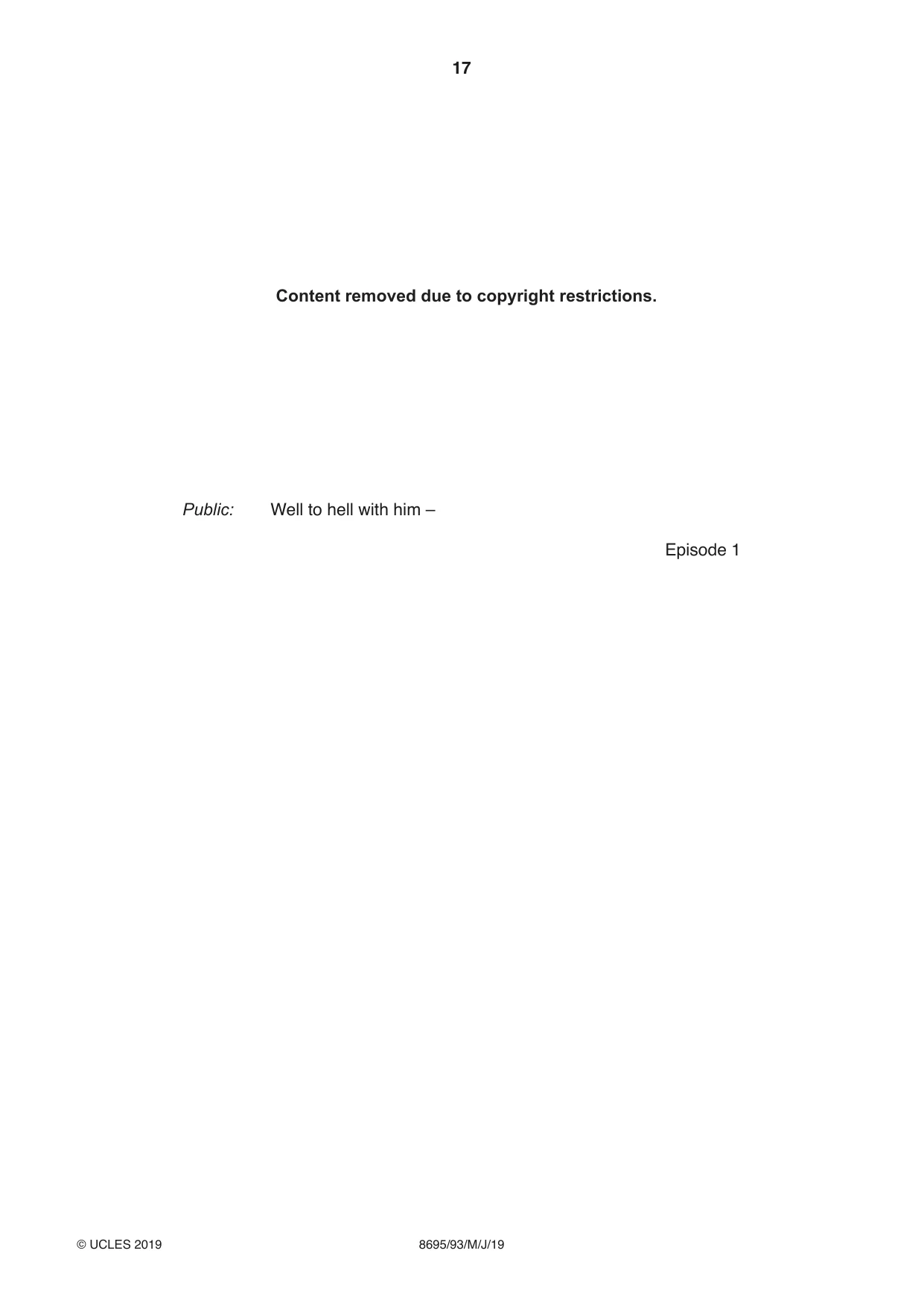
17 8695/93/M/J/19 © UCLES 2019 Public: Well to hell with him – Episode 1 Content removed due to copyright restrictions.
Question paper, page 18
18 8695/93/M/J/19 © UCLES 2019 BLANK PAGE
Question paper, page 19
19 8695/93/M/J/19 © UCLES 2019 BLANK PAGE
Question paper, page 20
20 8695/93/M/J/19 © UCLES 2019 Permission to reproduce items where third-party owned material protected by copyright is included has been sought and cleared where possible. Every reasonable effort has been made by the publisher (UCLES) to trace copyright holders, but if any items requiring clearance have unwittingly been included, the publisher will be pleased to make amends at the earliest possible opportunity. To avoid the issue of disclosure of answer-related information to candidates, all copyright acknowledgements are reproduced online in the Cambridge Assessment International Education Copyright Acknowledgements Booklet. This is produced for each series of examinations and is freely available to download at www.cambridgeinternational.org after the live examination series. Cambridge Assessment International Education is part of the Cambridge Assessment Group. Cambridge Assessment is the brand name of the University of Cambridge Local Examinations Syndicate (UCLES), which itself is a department of the University of Cambridge. BLANK PAGE
Mark scheme, page 1
This document consists of 6 printed pages. © UCLES 2019 [Turn over Cambridge Assessment International Education Cambridge International Advanced Subsidiary Level LANGUAGE AND LITERATURE IN ENGLISH 8695/93 Paper 9 Poetry, Prose and Drama May/June 2019 MARK SCHEME Maximum Mark: 50 Published This mark scheme is published as an aid to teachers and candidates, to indicate the requirements of the examination. It shows the basis on which Examiners were instructed to award marks. It does not indicate the details of the discussions that took place at an Examiners’ meeting before marking began, which would have considered the acceptability of alternative answers. Mark schemes should be read in conjunction with the question paper and the Principal Examiner Report for Teachers. Cambridge International will not enter into discussions about these mark schemes. Cambridge International is publishing the mark schemes for the May/June 2019 series for most Cambridge IGCSE™, Cambridge International A and AS Level and Cambridge Pre-U components, and some Cambridge O Level components.
Mark scheme, page 2
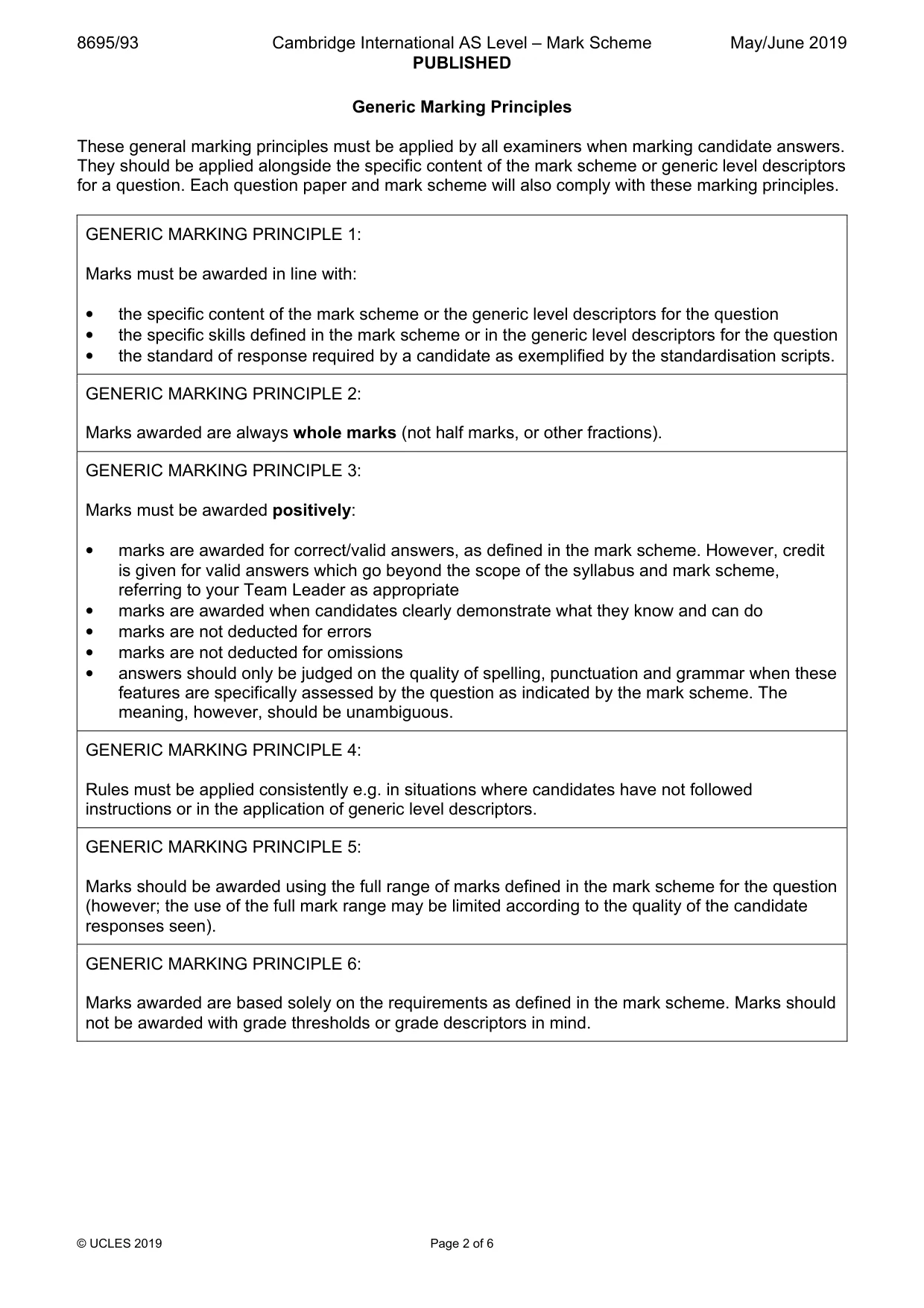
8695/93 Cambridge International AS Level – Mark Scheme PUBLISHED May/June 2019 © UCLES 2019 Page 2 of 6 Generic Marking Principles These general marking principles must be applied by all examiners when marking candidate answers. They should be applied alongside the specific content of the mark scheme or generic level descriptors for a question. Each question paper and mark scheme will also comply with these marking principles. GENERIC MARKING PRINCIPLE 1: Marks must be awarded in line with: • the specific content of the mark scheme or the generic level descriptors for the question • the specific skills defined in the mark scheme or in the generic level descriptors for the question • the standard of response required by a candidate as exemplified by the standardisation scripts. GENERIC MARKING PRINCIPLE 2: Marks awarded are always whole marks (not half marks, or other fractions). GENERIC MARKING PRINCIPLE 3: Marks must be awarded positively: • marks are awarded for correct/valid answers, as defined in the mark scheme. However, credit is given for valid answers which go beyond the scope of the syllabus and mark scheme, referring to your Team Leader as appropriate • marks are awarded when candidates clearly demonstrate what they know and can do • marks are not deducted for errors • marks are not deducted for omissions • answers should only be judged on the quality of spelling, punctuation and grammar when these features are specifically assessed by the question as indicated by the mark scheme. The meaning, however, should be unambiguous. GENERIC MARKING PRINCIPLE 4: Rules must be applied consistently e.g. in situations where candidates have not followed instructions or in the application of generic level descriptors. GENERIC MARKING PRINCIPLE 5: Marks should be awarded using the full range of marks defined in the mark scheme for the question (however; the use of the full mark range may be limited according to the quality of the candidate responses seen). GENERIC MARKING PRINCIPLE 6: Marks awarded are based solely on the requirements as defined in the mark scheme. Marks should not be awarded with grade thresholds or grade descriptors in mind.
Mark scheme, page 3
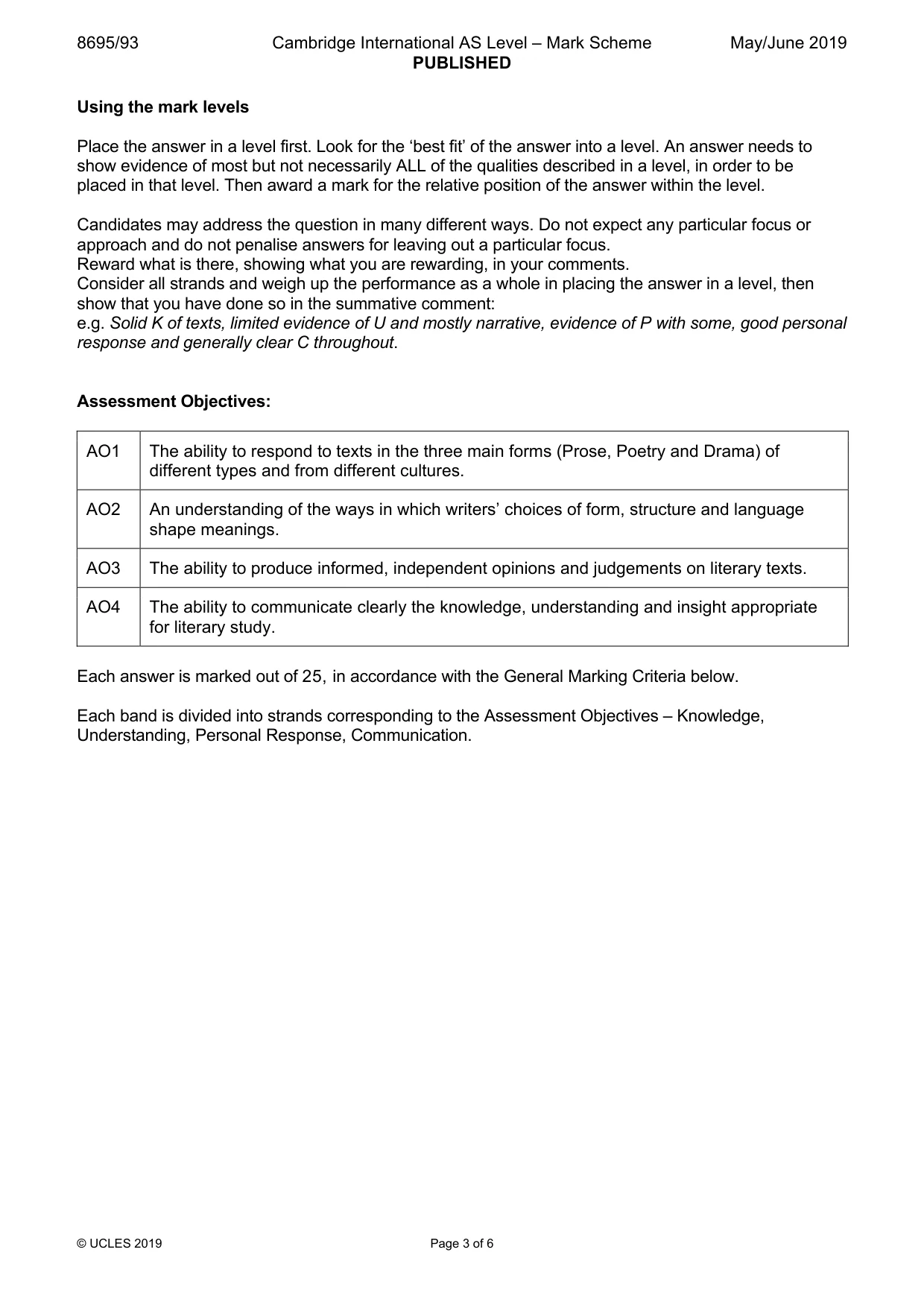
8695/93 Cambridge International AS Level – Mark Scheme PUBLISHED May/June 2019 © UCLES 2019 Page 3 of 6 Using the mark levels Place the answer in a level first. Look for the ‘best fit’ of the answer into a level. An answer needs to show evidence of most but not necessarily ALL of the qualities described in a level, in order to be placed in that level. Then award a mark for the relative position of the answer within the level. Candidates may address the question in many different ways. Do not expect any particular focus or approach and do not penalise answers for leaving out a particular focus. Reward what is there, showing what you are rewarding, in your comments. Consider all strands and weigh up the performance as a whole in placing the answer in a level, then show that you have done so in the summative comment: e.g. Solid K of texts, limited evidence of U and mostly narrative, evidence of P with some, good personal response and generally clear C throughout. Assessment Objectives: AO1 The ability to respond to texts in the three main forms (Prose, Poetry and Drama) of different types and from different cultures. AO2 An understanding of the ways in which writers’ choices of form, structure and language shape meanings. AO3 The ability to produce informed, independent opinions and judgements on literary texts. AO4 The ability to communicate clearly the knowledge, understanding and insight appropriate for literary study. Each answer is marked out of 25, in accordance with the General Marking Criteria below. Each band is divided into strands corresponding to the Assessment Objectives – Knowledge, Understanding, Personal Response, Communication.
Mark scheme, page 4
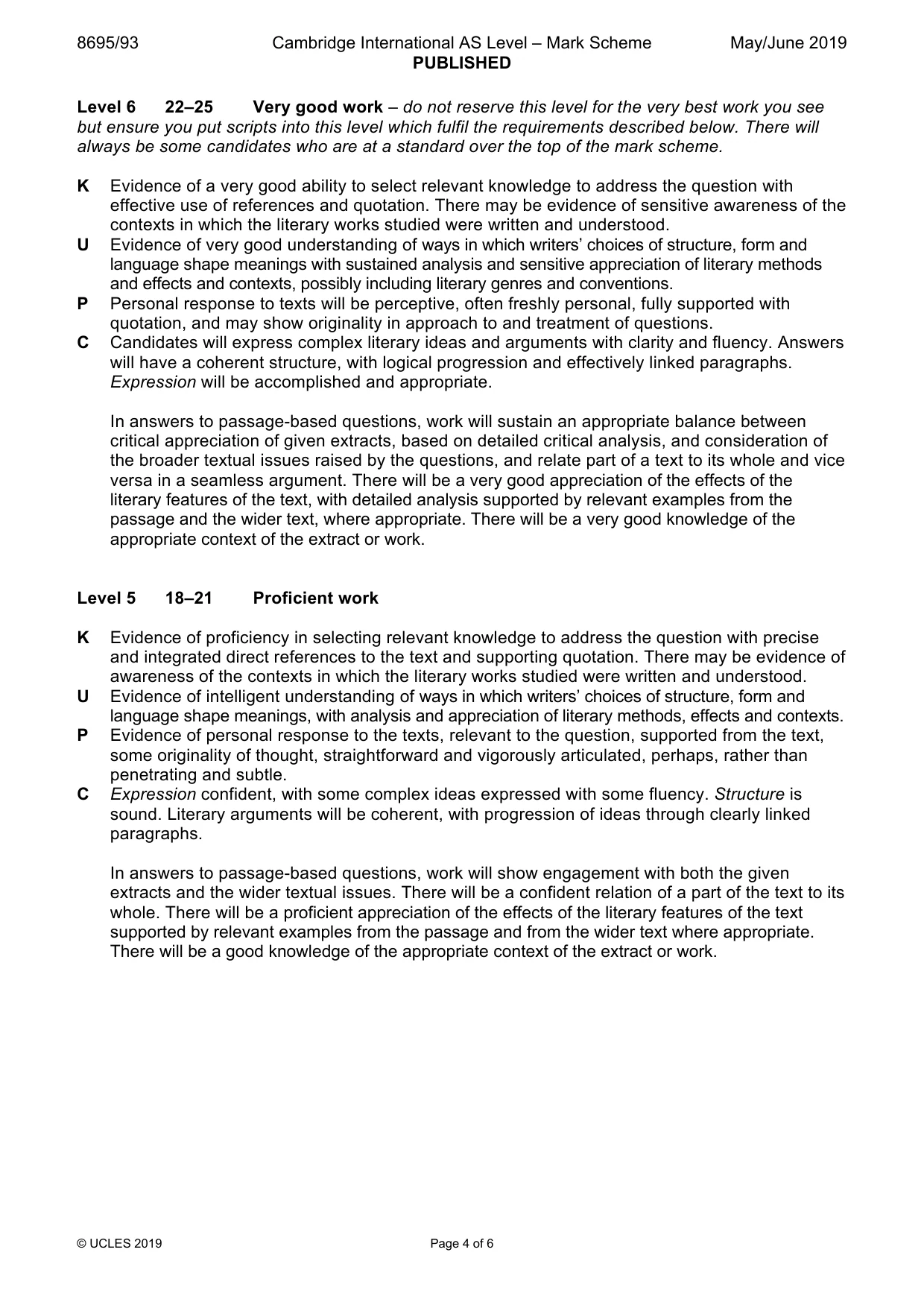
8695/93 Cambridge International AS Level – Mark Scheme PUBLISHED May/June 2019 © UCLES 2019 Page 4 of 6 Level 6 22–25 Very good work – do not reserve this level for the very best work you see but ensure you put scripts into this level which fulfil the requirements described below. There will always be some candidates who are at a standard over the top of the mark scheme. K Evidence of a very good ability to select relevant knowledge to address the question with effective use of references and quotation. There may be evidence of sensitive awareness of the contexts in which the literary works studied were written and understood. U Evidence of very good understanding of ways in which writers’ choices of structure, form and language shape meanings with sustained analysis and sensitive appreciation of literary methods and effects and contexts, possibly including literary genres and conventions. P Personal response to texts will be perceptive, often freshly personal, fully supported with quotation, and may show originality in approach to and treatment of questions. C Candidates will express complex literary ideas and arguments with clarity and fluency. Answers will have a coherent structure, with logical progression and effectively linked paragraphs. Expression will be accomplished and appropriate. In answers to passage-based questions, work will sustain an appropriate balance between critical appreciation of given extracts, based on detailed critical analysis, and consideration of the broader textual issues raised by the questions, and relate part of a text to its whole and vice versa in a seamless argument. There will be a very good appreciation of the effects of the literary features of the text, with detailed analysis supported by relevant examples from the passage and the wider text, where appropriate. There will be a very good knowledge of the appropriate context of the extract or work. Level 5 18–21 Proficient work K Evidence of proficiency in selecting relevant knowledge to address the question with precise and integrated direct references to the text and supporting quotation. There may be evidence of awareness of the contexts in which the literary works studied were written and understood. U Evidence of intelligent understanding of ways in which writers’ choices of structure, form and language shape meanings, with analysis and appreciation of literary methods, effects and contexts. P Evidence of personal response to the texts, relevant to the question, supported from the text, some originality of thought, straightforward and vigorously articulated, perhaps, rather than penetrating and subtle. C Expression confident, with some complex ideas expressed with some fluency. Structure is sound. Literary arguments will be coherent, with progression of ideas through clearly linked paragraphs. In answers to passage-based questions, work will show engagement with both the given extracts and the wider textual issues. There will be a confident relation of a part of the text to its whole. There will be a proficient appreciation of the effects of the literary features of the text supported by relevant examples from the passage and from the wider text where appropriate. There will be a good knowledge of the appropriate context of the extract or work.
Mark scheme, page 5
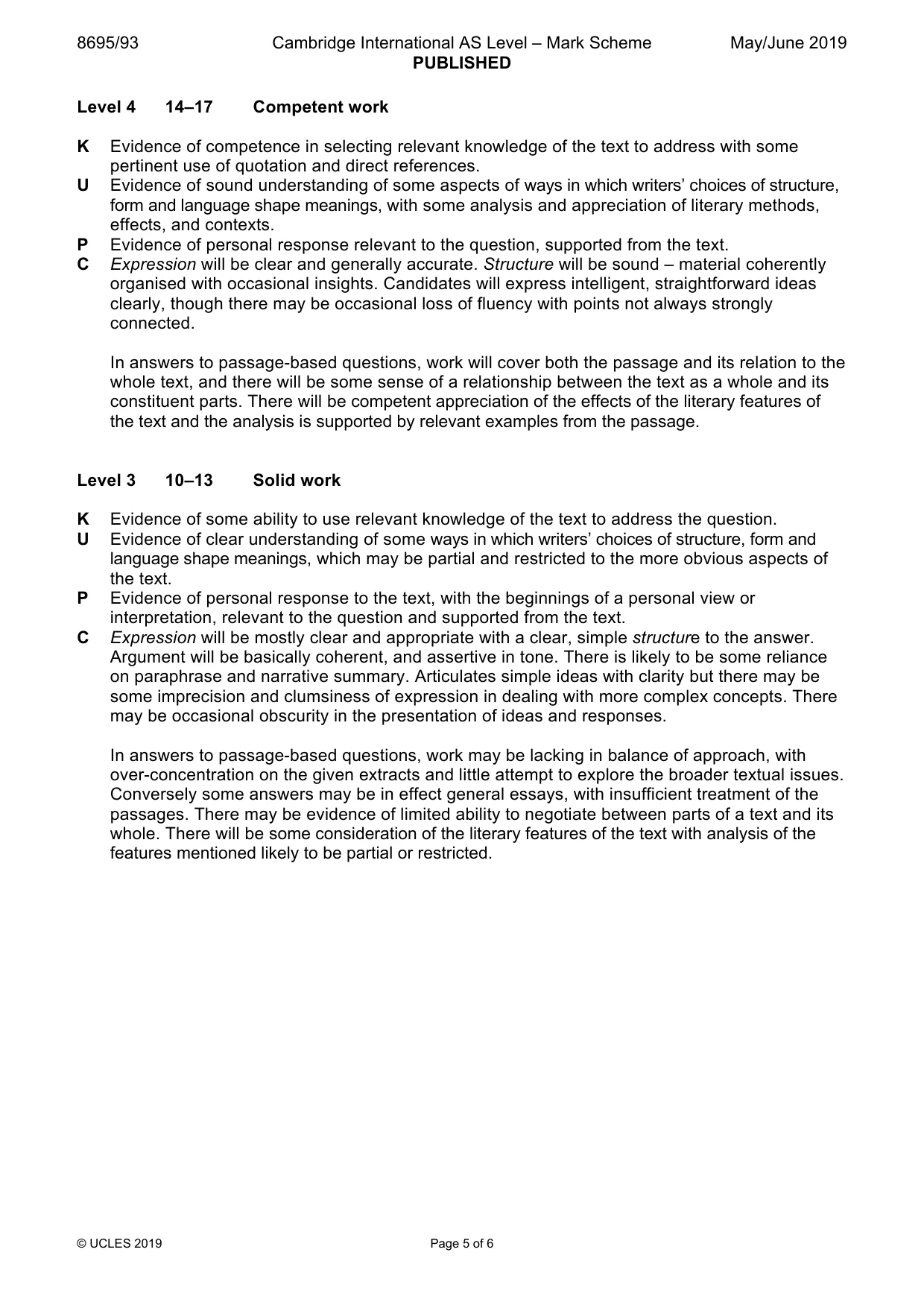
8695/93 Cambridge International AS Level – Mark Scheme PUBLISHED May/June 2019 © UCLES 2019 Page 5 of 6 Level 4 14–17 Competent work K Evidence of competence in selecting relevant knowledge of the text to address with some pertinent use of quotation and direct references. U Evidence of sound understanding of some aspects of ways in which writers’ choices of structure, form and language shape meanings, with some analysis and appreciation of literary methods, effects, and contexts. P Evidence of personal response relevant to the question, supported from the text. C Expression will be clear and generally accurate. Structure will be sound – material coherently organised with occasional insights. Candidates will express intelligent, straightforward ideas clearly, though there may be occasional loss of fluency with points not always strongly connected. In answers to passage-based questions, work will cover both the passage and its relation to the whole text, and there will be some sense of a relationship between the text as a whole and its constituent parts. There will be competent appreciation of the effects of the literary features of the text and the analysis is supported by relevant examples from the passage. Level 3 10–13 Solid work K Evidence of some ability to use relevant knowledge of the text to address the question. U Evidence of clear understanding of some ways in which writers’ choices of structure, form and language shape meanings, which may be partial and restricted to the more obvious aspects of the text. P Evidence of personal response to the text, with the beginnings of a personal view or interpretation, relevant to the question and supported from the text. C Expression will be mostly clear and appropriate with a clear, simple structure to the answer. Argument will be basically coherent, and assertive in tone. There is likely to be some reliance on paraphrase and narrative summary. Articulates simple ideas with clarity but there may be some imprecision and clumsiness of expression in dealing with more complex concepts. There may be occasional obscurity in the presentation of ideas and responses. In answers to passage-based questions, work may be lacking in balance of approach, with over-concentration on the given extracts and little attempt to explore the broader textual issues. Conversely some answers may be in effect general essays, with insufficient treatment of the passages. There may be evidence of limited ability to negotiate between parts of a text and its whole. There will be some consideration of the literary features of the text with analysis of the features mentioned likely to be partial or restricted.
Mark scheme, page 6
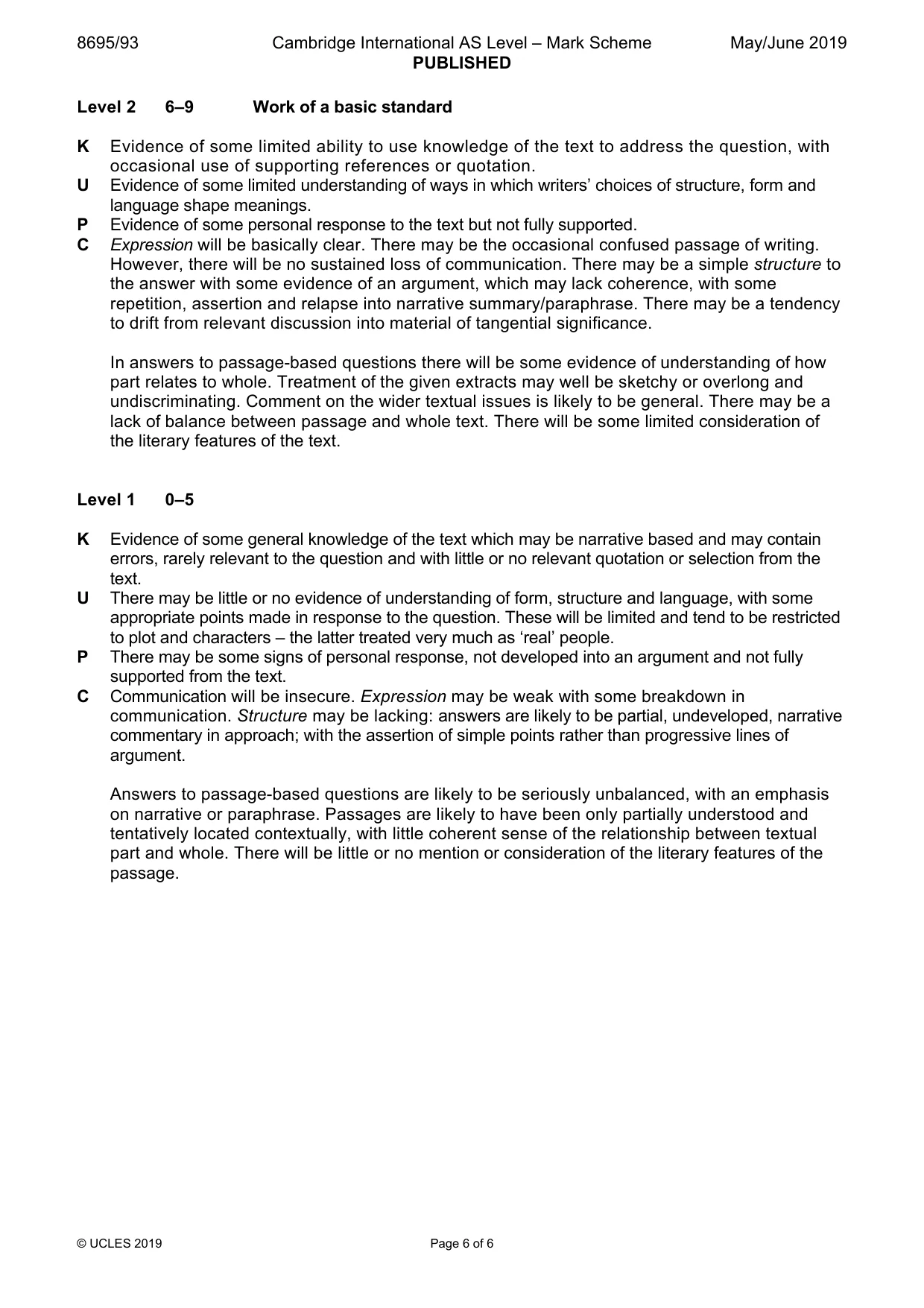
8695/93 Cambridge International AS Level – Mark Scheme PUBLISHED May/June 2019 © UCLES 2019 Page 6 of 6 Level 2 6–9 Work of a basic standard K Evidence of some limited ability to use knowledge of the text to address the question, with occasional use of supporting references or quotation. U Evidence of some limited understanding of ways in which writers’ choices of structure, form and language shape meanings. P Evidence of some personal response to the text but not fully supported. C Expression will be basically clear. There may be the occasional confused passage of writing. However, there will be no sustained loss of communication. There may be a simple structure to the answer with some evidence of an argument, which may lack coherence, with some repetition, assertion and relapse into narrative summary/paraphrase. There may be a tendency to drift from relevant discussion into material of tangential significance. In answers to passage-based questions there will be some evidence of understanding of how part relates to whole. Treatment of the given extracts may well be sketchy or overlong and undiscriminating. Comment on the wider textual issues is likely to be general. There may be a lack of balance between passage and whole text. There will be some limited consideration of the literary features of the text. Level 1 0–5 K Evidence of some general knowledge of the text which may be narrative based and may contain errors, rarely relevant to the question and with little or no relevant quotation or selection from the text. U There may be little or no evidence of understanding of form, structure and language, with some appropriate points made in response to the question. These will be limited and tend to be restricted to plot and characters – the latter treated very much as ‘real’ people. P There may be some signs of personal response, not developed into an argument and not fully supported from the text. C Communication will be insecure. Expression may be weak with some breakdown in communication. Structure may be lacking: answers are likely to be partial, undeveloped, narrative commentary in approach; with the assertion of simple points rather than progressive lines of argument. Answers to passage-based questions are likely to be seriously unbalanced, with an emphasis on narrative or paraphrase. Passages are likely to have been only partially understood and tentatively located contextually, with little coherent sense of the relationship between textual part and whole. There will be little or no mention or consideration of the literary features of the passage.
What you needed in this session
Cambridge’s own grade thresholds for 2019 May/June, Paper 9 · Variant 3. A higher threshold means an easier paper — the bar moves with how the cohort did.