Cambridge A Level English - Language and Literature (AS Level only, from 2016) 8695 — 2020 Oct/Nov Paper 9 · Variant 2
8695/92/O/N/20 · 50 marks · ≈56 min
The question paper and its mark scheme, free to read here and free to download. This is Cambridge’s own paper, exactly as it was sat.
Question paper20 pages




Mark scheme7 pages
Answers below. Sit the paper first if you are practising.
Paper as text
Question paper, page 1
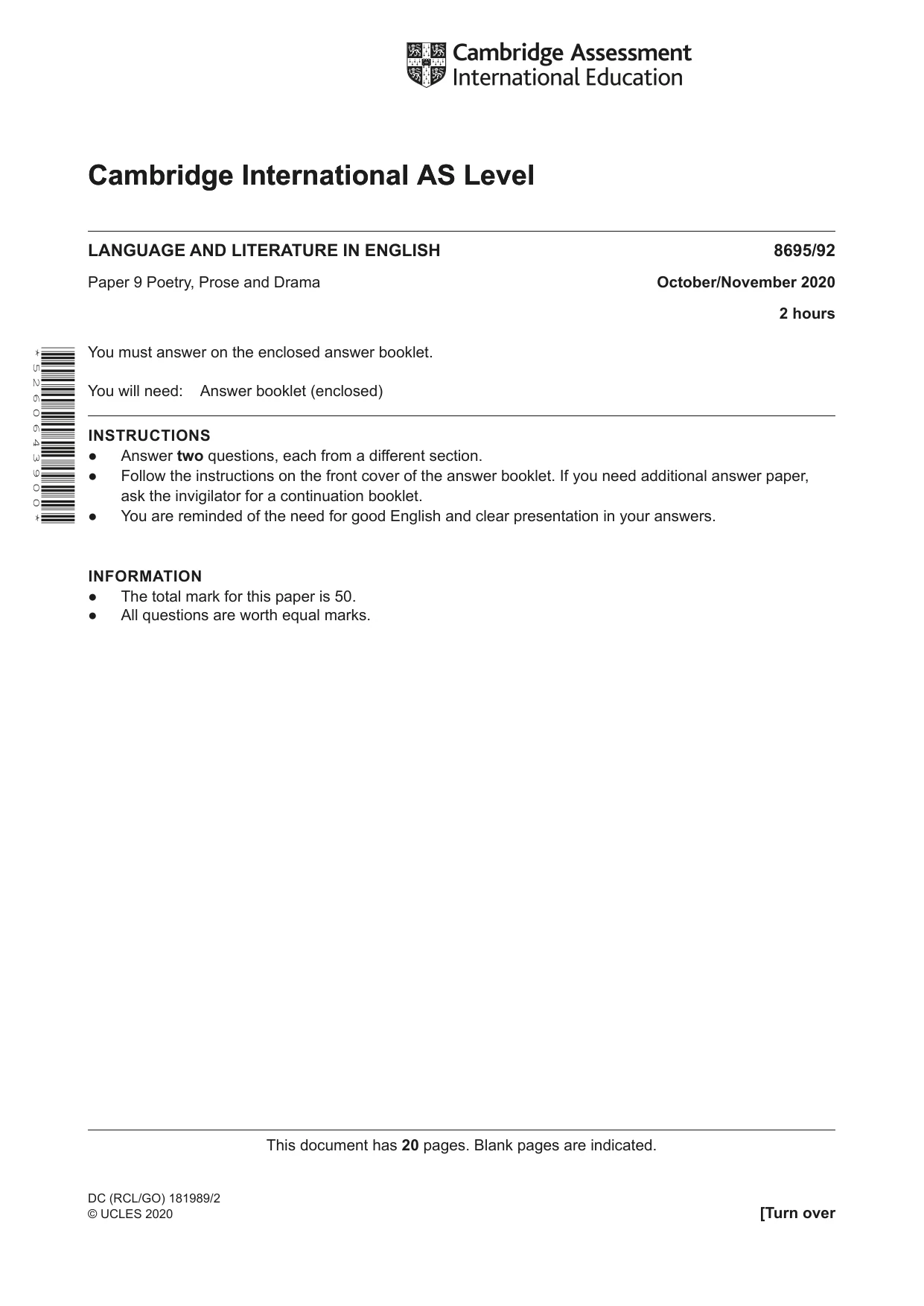
* 5 2 6 0 6 4 3 9 0 0 * DC (RCL/GO) 181989/2 © UCLES 2020 [Turn over This document has 20 pages. Blank pages are indicated. LANGUAGE AND LITERATURE IN ENGLISH 8695/92 Paper 9 Poetry, Prose and Drama October/November 2020 2 hours You must answer on the enclosed answer booklet. You will need: Answer booklet (enclosed) INSTRUCTIONS ● Answer two questions, each from a different section. ● Follow the instructions on the front cover of the answer booklet. If you need additional answer paper, ask the invigilator for a continuation booklet. ● You are reminded of the need for good English and clear presentation in your answers. INFORMATION ● The total mark for this paper is 50. ● All questions are worth equal marks. Cambridge International AS Level Cambridge International AS Level
Question paper, page 2
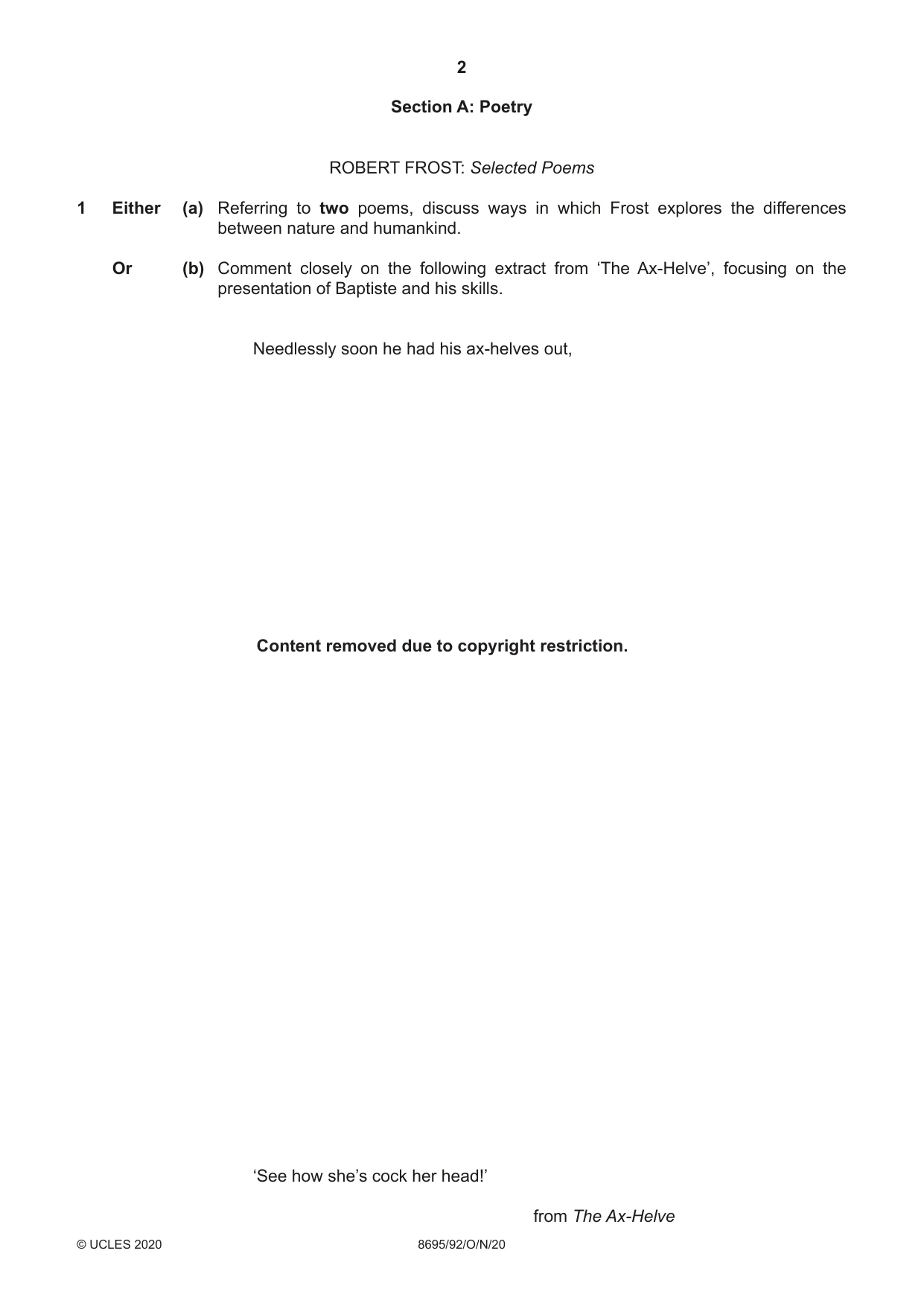
2 8695/92/O/N/20 © UCLES 2020 Section A: Poetry ROBERT FROST: Selected Poems 1 Either (a) Referring to two poems, discuss ways in which Frost explores the differences between nature and humankind. Or (b) Comment closely on the following extract from ‘The Ax-Helve’, focusing on the presentation of Baptiste and his skills. Needlessly soon he had his ax-helves out, ‘See how she’s cock her head!’ from The Ax-Helve Content removed due to copyright restriction.
Question paper, page 3
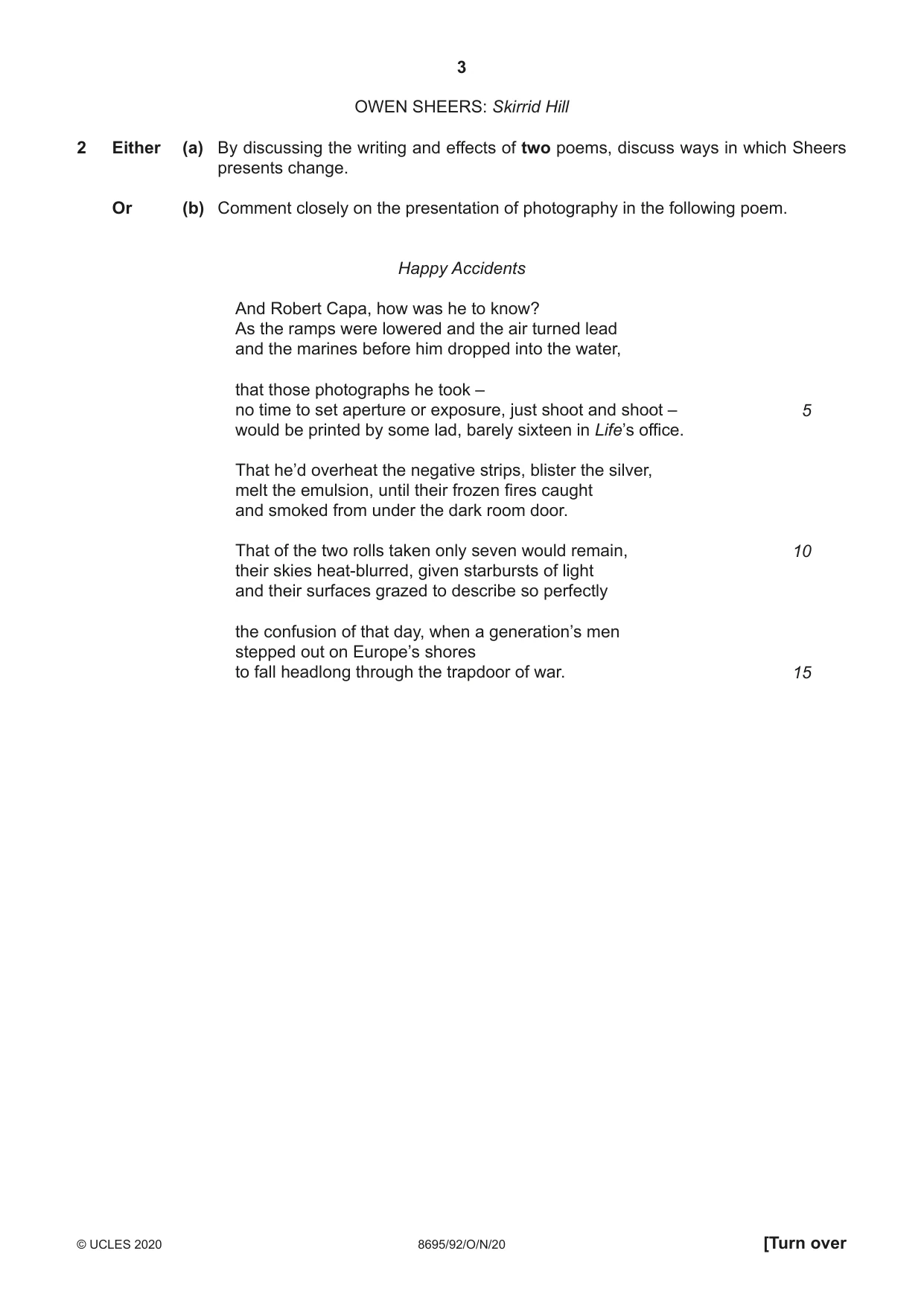
3 8695/92/O/N/20 © UCLES 2020 [Turn over OWEN SHEERS: Skirrid Hill 2 Either (a) By discussing the writing and effects of two poems, discuss ways in which Sheers presents change. Or (b) Comment closely on the presentation of photography in the following poem. Happy Accidents And Robert Capa, how was he to know? As the ramps were lowered and the air turned lead and the marines before him dropped into the water, that those photographs he took – no time to set aperture or exposure, just shoot and shoot – would be printed by some lad, barely sixteen in Life’s office. That he’d overheat the negative strips, blister the silver, melt the emulsion, until their frozen fires caught and smoked from under the dark room door. That of the two rolls taken only seven would remain, their skies heat-blurred, given starbursts of light and their surfaces grazed to describe so perfectly the confusion of that day, when a generation’s men stepped out on Europe’s shores to fall headlong through the trapdoor of war. 5 10 15
Question paper, page 4
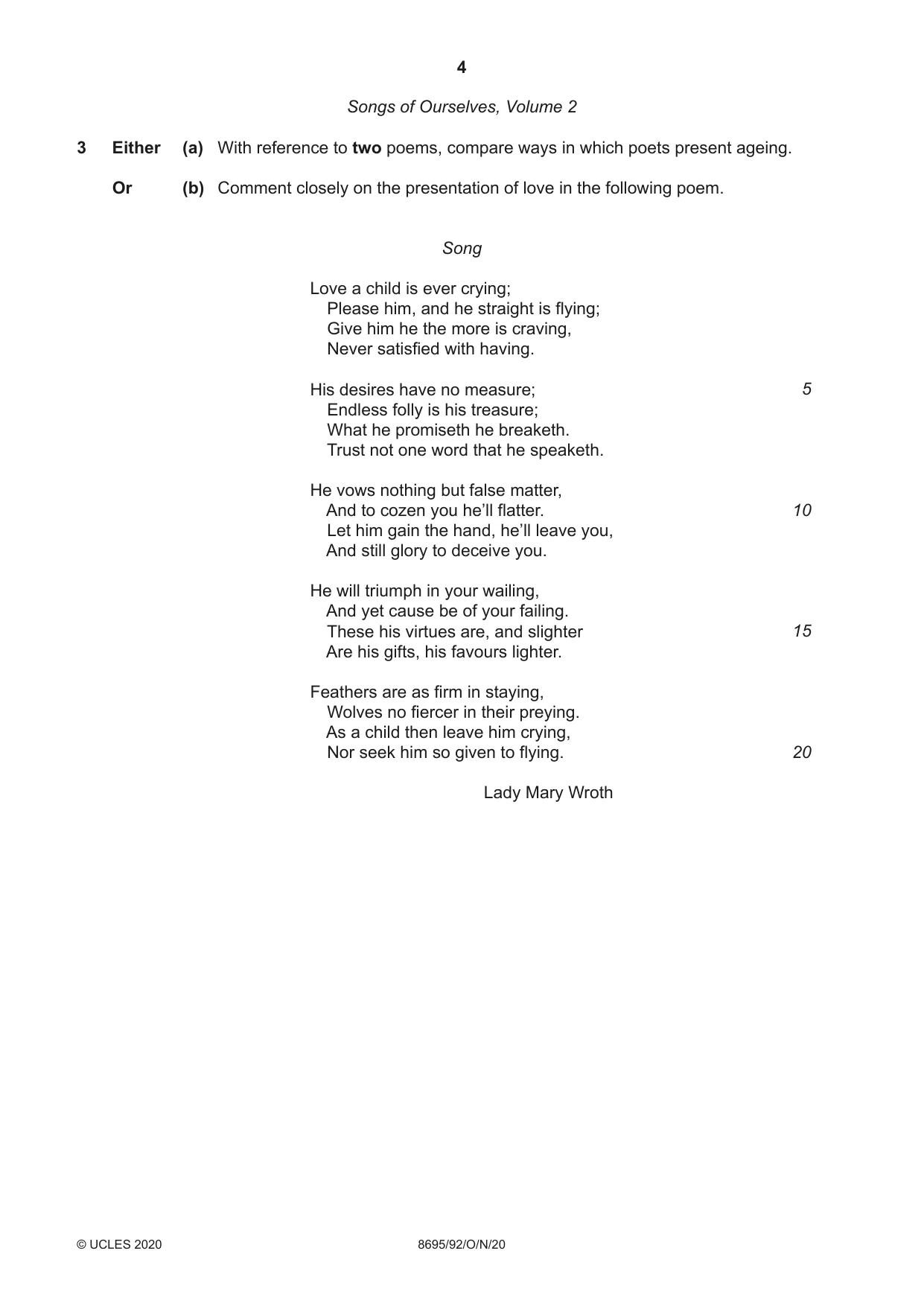
4 8695/92/O/N/20 © UCLES 2020 Songs of Ourselves, Volume 2 3 Either (a) With reference to two poems, compare ways in which poets present ageing. Or (b) Comment closely on the presentation of love in the following poem. Song Love a child is ever crying; Please him, and he straight is flying; Give him he the more is craving, Never satisfied with having. His desires have no measure; Endless folly is his treasure; What he promiseth he breaketh. Trust not one word that he speaketh. He vows nothing but false matter, And to cozen you he’ll flatter. Let him gain the hand, he’ll leave you, And still glory to deceive you. He will triumph in your wailing, And yet cause be of your failing. These his virtues are, and slighter Are his gifts, his favours lighter. Feathers are as firm in staying, Wolves no fiercer in their preying. As a child then leave him crying, Nor seek him so given to flying. Lady Mary Wroth 5 10 15 20
Question paper, page 5
5 8695/92/O/N/20 © UCLES 2020 [Turn over Turn over for Section B.
Question paper, page 6
6 8695/92/O/N/20 © UCLES 2020 Section B: Prose E M FORSTER: Howards End 4 Either (a) Helen says of Henry Wilcox: ‘I definitely dislike him…’ In the light of Helen’s comment, discuss ways in which Forster shapes your response to Henry Wilcox. Or (b) Comment closely on the following passage, considering its presentation of Leonard and his home. The sitting-room contained, besides the armchair, two other chairs, a piano, a three-legged table, and a cosy corner. Of the walls, one was occupied by the window, the other by a draped mantelshelf bristling with Cupids. Opposite the window was the door, and beside the door a bookcase, while over the piano there extended one of the masterpieces of Maud Goodman. It was an amorous and not unpleasant little hole when the curtains were drawn, and the lights turned on, and the gas-stove unlit. But it struck that shallow makeshift note that is so often heard in the modern dwelling-place. It had been too easily gained, and could be relinquished too easily. As Leonard was kicking off his boots he jarred the three-legged table, and a photograph frame, honourably poised upon it, slid sideways, fell off into the fireplace, and smashed. He swore in a colourless sort of way, and picked the photograph up. It represented a young lady called Jacky, and had been taken at the time when young ladies called Jacky were often photographed with their mouths open. Teeth of dazzling whiteness extended along either of Jacky’s jaws, and positively weighed her head sideways, so large were they and so numerous. Take my word for it, that smile was simply stunning, and it is only you and I who will be fastidious, and complain that true joy begins in the eyes, and that the eyes of Jacky did not accord with her smile, but were anxious and hungry. Leonard tried to pull out the fragments of glass, and cut his fingers and swore again. A drop of blood fell on the frame, another followed, spilling over on to the exposed photograph. He swore more vigorously, and dashed into the kitchen, where he bathed his hands. The kitchen was the same size as the sitting-room; through it was a bedroom. This completed his home. He was renting the flat furnished; of all the objects that encumbered it none were his own except the photograph frame, the Cupids, and the books. “Damn, damn, damnation!” he murmured, together with such other words as he had learnt from older men. Then he raised his hand to his forehead and said, “Oh, damn it all—” which meant something different. He pulled himself together. He drank a little tea, black and silent, that still survived upon an upper shelf. He swallowed some dusty crumbs of a cake. Then he went back to the sitting-room, settled himself anew, and began to read a volume of Ruskin. “Seven miles to the north of Venice—” How perfectly the famous chapter opens! How supreme its command of admonition and of poetry! The rich man is speaking to us from his gondola. “Seven miles to the north of Venice the banks of sand which nearer the city rise little above low-water mark attain by degrees a higher level, and knit themselves at last into fields of salt morass, raised here and there into shapeless mounds, and intercepted by narrow creeks of sea.” Leonard was trying to form his style on Ruskin; he understood him to be the greatest master of English Prose. He read forward steadily, occasionally making a few notes. 5 10 15 20 25 30 35 40
Question paper, page 7
7 8695/92/O/N/20 © UCLES 2020 [Turn over “Let us consider a little each of these characters in succession, and first (for of the shafts enough has been said already), what is very peculiar to this church—its luminousness.” Was there anything to be learnt from this fine sentence? Could he adapt it to the needs of daily life? Could he introduce it, with modifications, when he next wrote a letter to his brother, the lay-reader? For example— “Let us consider a little each of these characters in succession, and first (for of the absence of ventilation enough has been said already), what is very peculiar to this flat—its obscurity.” Something told him that the modifications would not do; and that something, had he known it, was the spirit of English Prose. “My flat is dark as well as stuffy.” Those were the words for him. Chapter 6 45 50
Question paper, page 8
8 8695/92/O/N/20 © UCLES 2020 ANDREA LEVY: Small Island 5 Either (a) Discuss ways in which Levy presents immigrants’ work and search for work in the novel. Or (b) Comment closely on ways in which the following passage presents the birth of Queenie’s baby. It was with politeness and – it would be wrong to say otherwise – reluctance, that I asked her, ‘Please could you open your legs a little wider, Mrs Bligh?’ ‘Call me blinking Queenie, for Christ’s sake,’ she shouted, just before she started to cry. ‘Okay,’ I told her, ‘I will call you Queenie, Mrs Bligh. There is no need for tears.’ ‘I’m crying ’cause it bloody hurts!’ she screamed. I was learning that Englishwomen can behave in a peculiar fashion. And this one was conspiring to be the oddest one I had ever met. Suddenly she was smiling again, ‘Oh, what’s happening, Hortense? Tell me,’ and seeming to all the world like she was pleased to be having this baby. So I looked. What a thing was this! A wondrous sight perhaps – for there was the round head complete with curly dark hair matted in blood pushing out from within her. A new life for this world. But it was quite the ugliest sight I had ever beheld. Only a few days before this pretty white woman was going about her business – collecting her shopping, hanging washing on a line, passing the time of day with neighbours – now, prostrated by nature, she was simply the vessel for the Lord to do His work. This woman’s private parts had lost all notion of being of the human kind. Surely they could not stretch wide enough to let the creature pass. Cha, all this straining, squeezing and screaming. I would not presume to tell the Lord His business but, come, the laying of an egg by a hen was, without doubt, the more civilised method of creation. Every tissue in my body was tingling with repulsion. But for the sake of this woman’s well-being, not even an actor on a stage could have held a gaze of rapt wonder more steadily. ‘The baby is on its way,’ I told her. ‘The head is there.’ ‘It’s crowning,’ she said. ‘Can you see it?’ The noise she then created brought to mind the relieving of constipation. I was wearing my good white wedding dress. What consternation befell me as I realised I would have no chance to cover myself. For this baby, like an erupting pustule, was squeezing further and further out. Soon its eyes were blinking into the dim light. I tenderly held my fingers to its warm, slippery head. ‘You must push, Mrs Bligh,’ I said. And with one venomous yell of ‘Queenie, call me bloody Queenie,’ the head of the baby popped full out. ‘I have the head,’ I told her. For there it was, cradled in my hand, in this obscene resting place. Crumpled as discarded paper. Dark hair, nose with two nostrils and lips that waved in a perfect bow. Suddenly that fresh mouth sprang open to deliver forth a mighty shrill scream. I lifted my head to tell her, ‘One more push, Mrs Bligh.’ This baby’s head then began to twist round – turning without aid from me. No further injunction was necessary before, in one slippery rush, I found myself holding the whole baby. ‘It’s here,’ I said. ‘I have it. I have it here.’ But she had fallen back upon her pillows. ‘It is born, Mrs Bligh – it is here.’ I lifted the baby carefully so she might see. She held out her arms. The slimy purple pink of a robust earthworm, with skin smeared in blood and wrinkled as the day it would die, and yet still Mrs Bligh’s eyes alighted on this grumpy-faced child 5 10 15 20 25 30 35 40 45
Question paper, page 9
9 8695/92/O/N/20 © UCLES 2020 [Turn over and saw it as someone she could love. This was truly the miracle to behold. Leaning forward she enclosed this baby in two grateful hands. ‘Oh, my God, oh, my God.’ And luckily my dress had remained clean. Chapter 53 50
Question paper, page 10
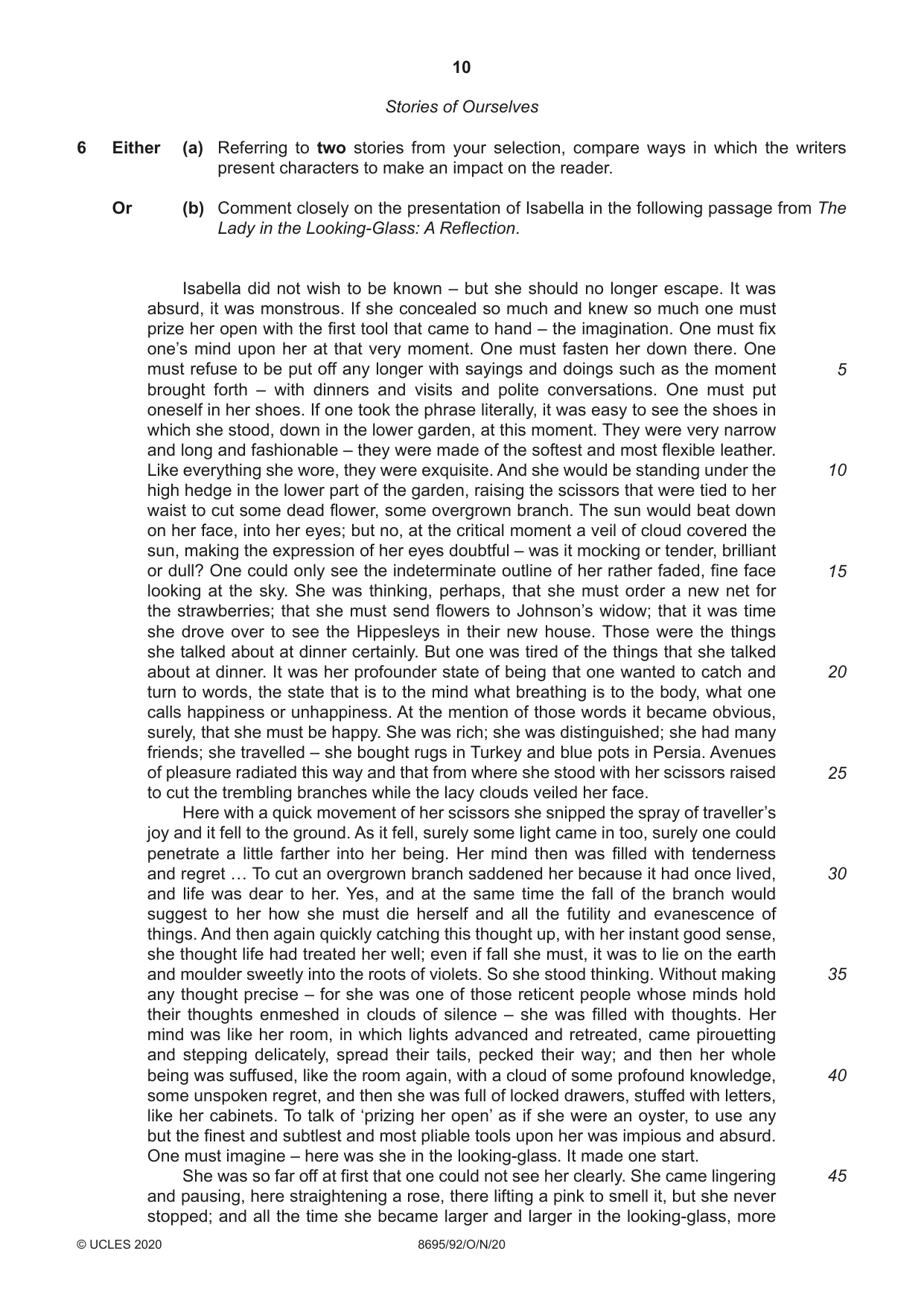
10 8695/92/O/N/20 © UCLES 2020 Stories of Ourselves 6 Either (a) Referring to two stories from your selection, compare ways in which the writers present characters to make an impact on the reader. Or (b) Comment closely on the presentation of Isabella in the following passage from The Lady in the Looking-Glass: A Reflection. Isabella did not wish to be known – but she should no longer escape. It was absurd, it was monstrous. If she concealed so much and knew so much one must prize her open with the first tool that came to hand – the imagination. One must fix one’s mind upon her at that very moment. One must fasten her down there. One must refuse to be put off any longer with sayings and doings such as the moment brought forth – with dinners and visits and polite conversations. One must put oneself in her shoes. If one took the phrase literally, it was easy to see the shoes in which she stood, down in the lower garden, at this moment. They were very narrow and long and fashionable – they were made of the softest and most flexible leather. Like everything she wore, they were exquisite. And she would be standing under the high hedge in the lower part of the garden, raising the scissors that were tied to her waist to cut some dead flower, some overgrown branch. The sun would beat down on her face, into her eyes; but no, at the critical moment a veil of cloud covered the sun, making the expression of her eyes doubtful – was it mocking or tender, brilliant or dull? One could only see the indeterminate outline of her rather faded, fine face looking at the sky. She was thinking, perhaps, that she must order a new net for the strawberries; that she must send flowers to Johnson’s widow; that it was time she drove over to see the Hippesleys in their new house. Those were the things she talked about at dinner certainly. But one was tired of the things that she talked about at dinner. It was her profounder state of being that one wanted to catch and turn to words, the state that is to the mind what breathing is to the body, what one calls happiness or unhappiness. At the mention of those words it became obvious, surely, that she must be happy. She was rich; she was distinguished; she had many friends; she travelled – she bought rugs in Turkey and blue pots in Persia. Avenues of pleasure radiated this way and that from where she stood with her scissors raised to cut the trembling branches while the lacy clouds veiled her face. Here with a quick movement of her scissors she snipped the spray of traveller’s joy and it fell to the ground. As it fell, surely some light came in too, surely one could penetrate a little farther into her being. Her mind then was filled with tenderness and regret … To cut an overgrown branch saddened her because it had once lived, and life was dear to her. Yes, and at the same time the fall of the branch would suggest to her how she must die herself and all the futility and evanescence of things. And then again quickly catching this thought up, with her instant good sense, she thought life had treated her well; even if fall she must, it was to lie on the earth and moulder sweetly into the roots of violets. So she stood thinking. Without making any thought precise – for she was one of those reticent people whose minds hold their thoughts enmeshed in clouds of silence – she was filled with thoughts. Her mind was like her room, in which lights advanced and retreated, came pirouetting and stepping delicately, spread their tails, pecked their way; and then her whole being was suffused, like the room again, with a cloud of some profound knowledge, some unspoken regret, and then she was full of locked drawers, stuffed with letters, like her cabinets. To talk of ‘prizing her open’ as if she were an oyster, to use any but the finest and subtlest and most pliable tools upon her was impious and absurd. One must imagine – here was she in the looking-glass. It made one start. She was so far off at first that one could not see her clearly. She came lingering and pausing, here straightening a rose, there lifting a pink to smell it, but she never stopped; and all the time she became larger and larger in the looking-glass, more 5 10 15 20 25 30 35 40 45
Question paper, page 11
11 8695/92/O/N/20 © UCLES 2020 [Turn over and more completely the person into whose mind one had been trying to penetrate. One verified her by degrees – fitted the qualities one had discovered into this visible body. There were her grey-green dress, and her long shoes, her basket, and something sparkling at her throat. She came so gradually that she did not seem to derange the pattern in the glass, but only to bring in some new element which gently moved and altered the other objects as if asking them, courteously, to make room for her. The Lady in the Looking-Glass: A Reflection 50
Question paper, page 12
12 8695/92/O/N/20 © UCLES 2020 Section C: Drama ARTHUR MILLER: All My Sons 7 Either (a) In what ways, and with what dramatic effects, does Miller explore the relationship between George and Ann Deever in the play? Or (b) With close reference to detail of language and action, discuss Miller’s dramatic presentation of Kate Keller (Mother) in the following extract. Mother: And you? Content removed due to copyright restrictions.
Question paper, page 13
13 8695/92/O/N/20 © UCLES 2020 [Turn over Mother: I have to have some tea. [FRANK appears, carrying ladder.] Act 1 Content removed due to copyright restrictions.
Question paper, page 14
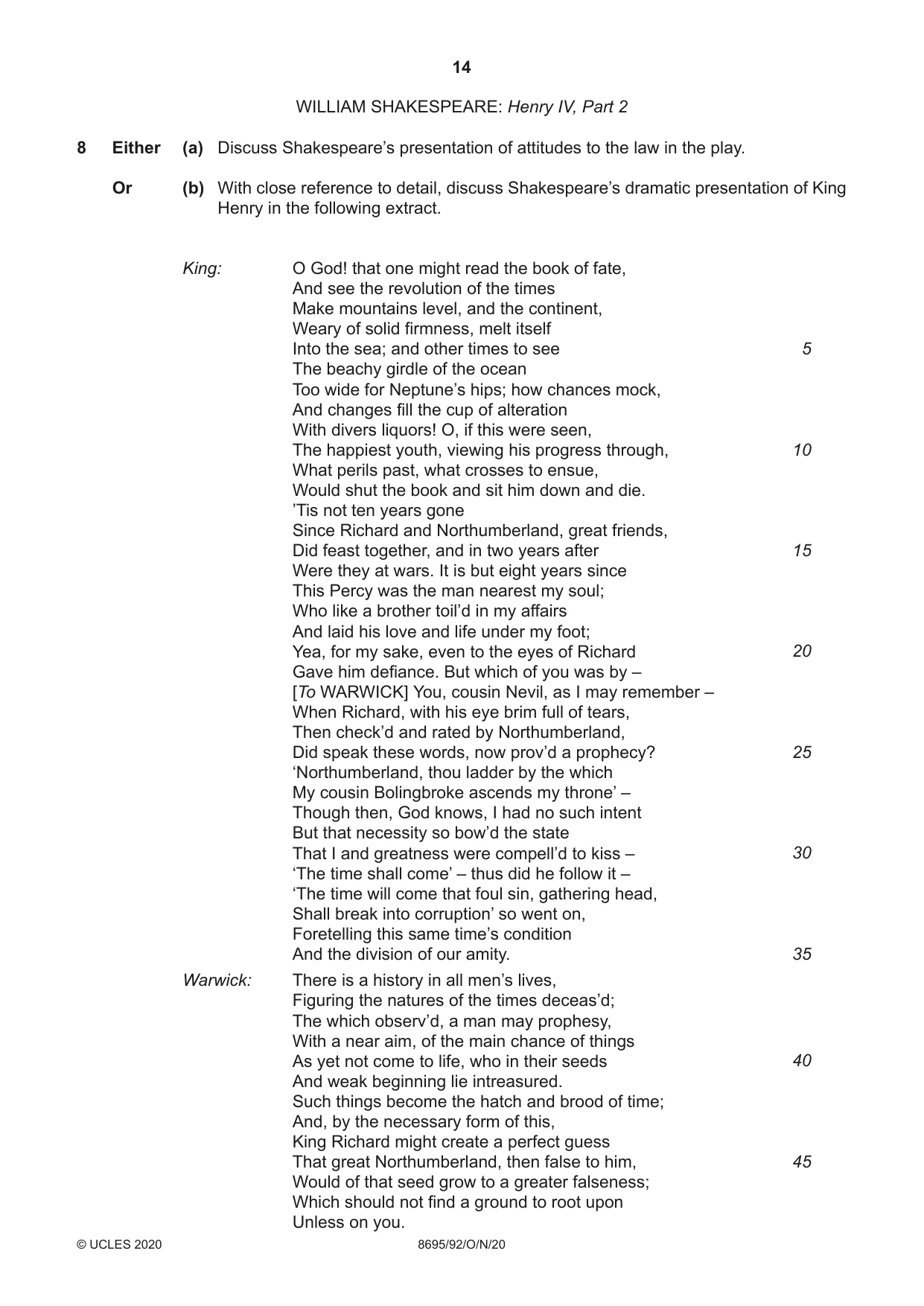
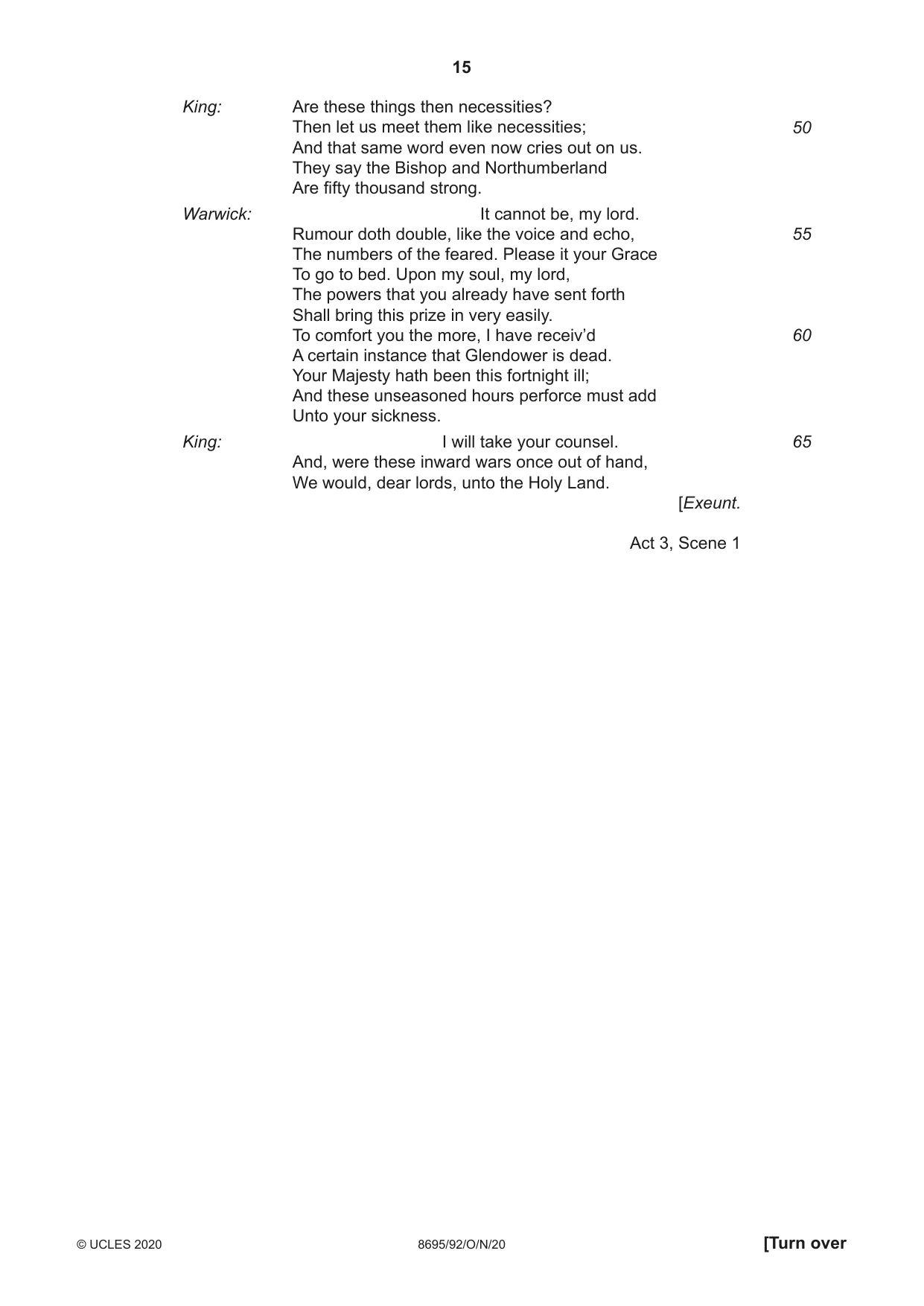
14 8695/92/O/N/20 © UCLES 2020 WILLIAM SHAKESPEARE: Henry IV, Part 2 8 Either (a) Discuss Shakespeare’s presentation of attitudes to the law in the play. Or (b) With close reference to detail, discuss Shakespeare’s dramatic presentation of King Henry in the following extract. King: O God! that one might read the book of fate, And see the revolution of the times Make mountains level, and the continent, Weary of solid firmness, melt itself Into the sea; and other times to see The beachy girdle of the ocean Too wide for Neptune’s hips; how chances mock, And changes fill the cup of alteration With divers liquors! O, if this were seen, The happiest youth, viewing his progress through, What perils past, what crosses to ensue, Would shut the book and sit him down and die. ’Tis not ten years gone Since Richard and Northumberland, great friends, Did feast together, and in two years after Were they at wars. It is but eight years since This Percy was the man nearest my soul; Who like a brother toil’d in my affairs And laid his love and life under my foot; Yea, for my sake, even to the eyes of Richard Gave him defiance. But which of you was by – [To WARWICK] You, cousin Nevil, as I may remember – When Richard, with his eye brim full of tears, Then check’d and rated by Northumberland, Did speak these words, now prov’d a prophecy? ‘Northumberland, thou ladder by the which My cousin Bolingbroke ascends my throne’ – Though then, God knows, I had no such intent But that necessity so bow’d the state That I and greatness were compell’d to kiss – ‘The time shall come’ – thus did he follow it – ‘The time will come that foul sin, gathering head, Shall break into corruption’ so went on, Foretelling this same time’s condition And the division of our amity. Warwick: There is a history in all men’s lives, Figuring the natures of the times deceas’d; The which observ’d, a man may prophesy, With a near aim, of the main chance of things As yet not come to life, who in their seeds And weak beginning lie intreasured. Such things become the hatch and brood of time; And, by the necessary form of this, King Richard might create a perfect guess That great Northumberland, then false to him, Would of that seed grow to a greater falseness; Which should not find a ground to root upon Unless on you. 5 10 15 20 25 30 35 40 45
Question paper, page 15
15 8695/92/O/N/20 © UCLES 2020 [Turn over King: Are these things then necessities? Then let us meet them like necessities; And that same word even now cries out on us. They say the Bishop and Northumberland Are fifty thousand strong. Warwick: It cannot be, my lord. Rumour doth double, like the voice and echo, The numbers of the feared. Please it your Grace To go to bed. Upon my soul, my lord, The powers that you already have sent forth Shall bring this prize in very easily. To comfort you the more, I have receiv’d A certain instance that Glendower is dead. Your Majesty hath been this fortnight ill; And these unseasoned hours perforce must add Unto your sickness. King: I will take your counsel. And, were these inward wars once out of hand, We would, dear lords, unto the Holy Land. [Exeunt. Act 3, Scene 1 50 55 60 65
Question paper, page 16
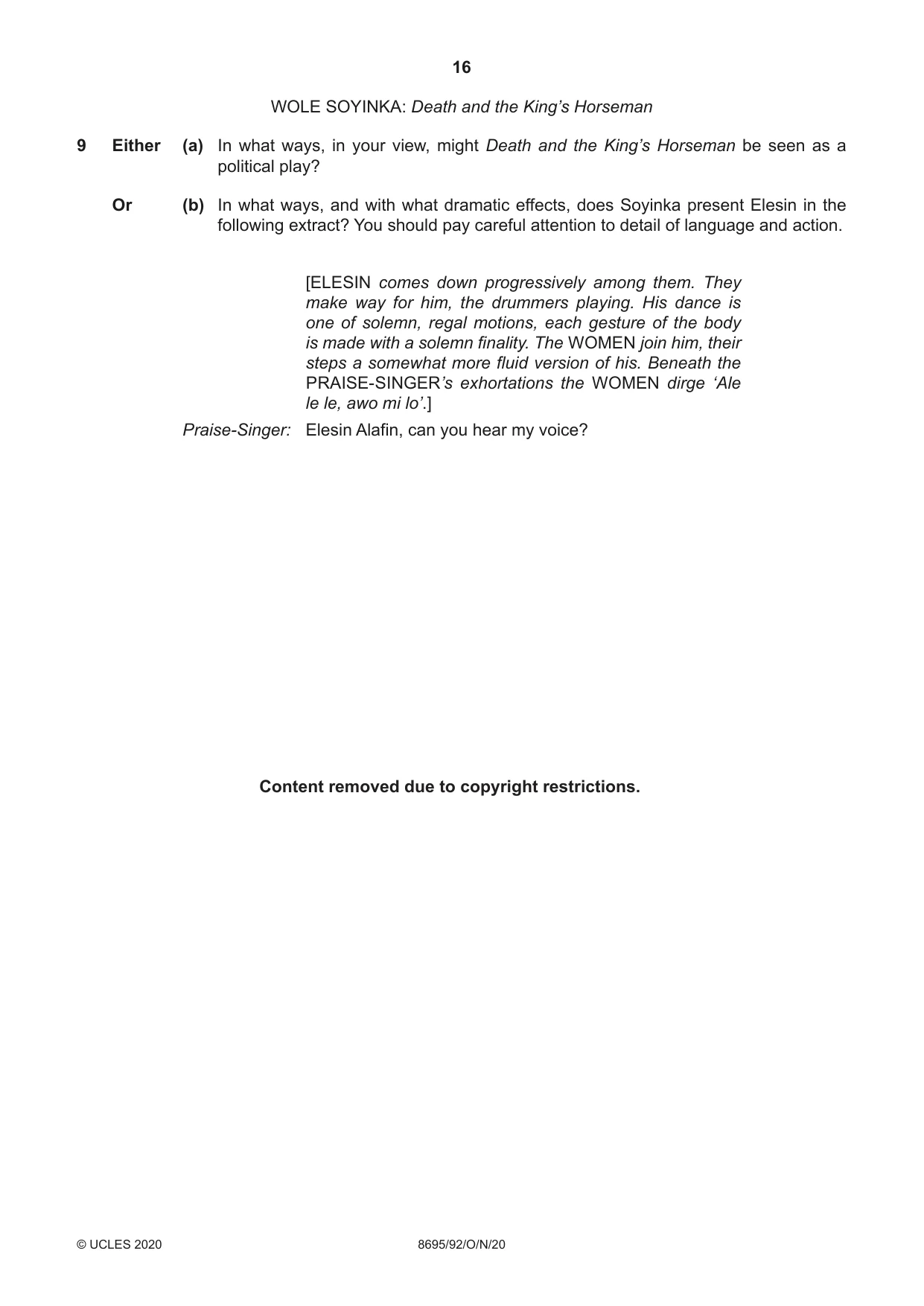
16 8695/92/O/N/20 © UCLES 2020 WOLE SOYINKA: Death and the King’s Horseman 9 Either (a) In what ways, in your view, might Death and the King’s Horseman be seen as a political play? Or (b) In what ways, and with what dramatic effects, does Soyinka present Elesin in the following extract? You should pay careful attention to detail of language and action. [ELESIN comes down progressively among them. They make way for him, the drummers playing. His dance is one of solemn, regal motions, each gesture of the body is made with a solemn finality. The WOMEN join him, their steps a somewhat more fluid version of his. Beneath the PRAISE-SINGER’s exhortations the WOMEN dirge ‘Ale le le, awo mi lo’.] Praise-Singer: Elesin Alafin, can you hear my voice? Content removed due to copyright restrictions.
Question paper, page 17
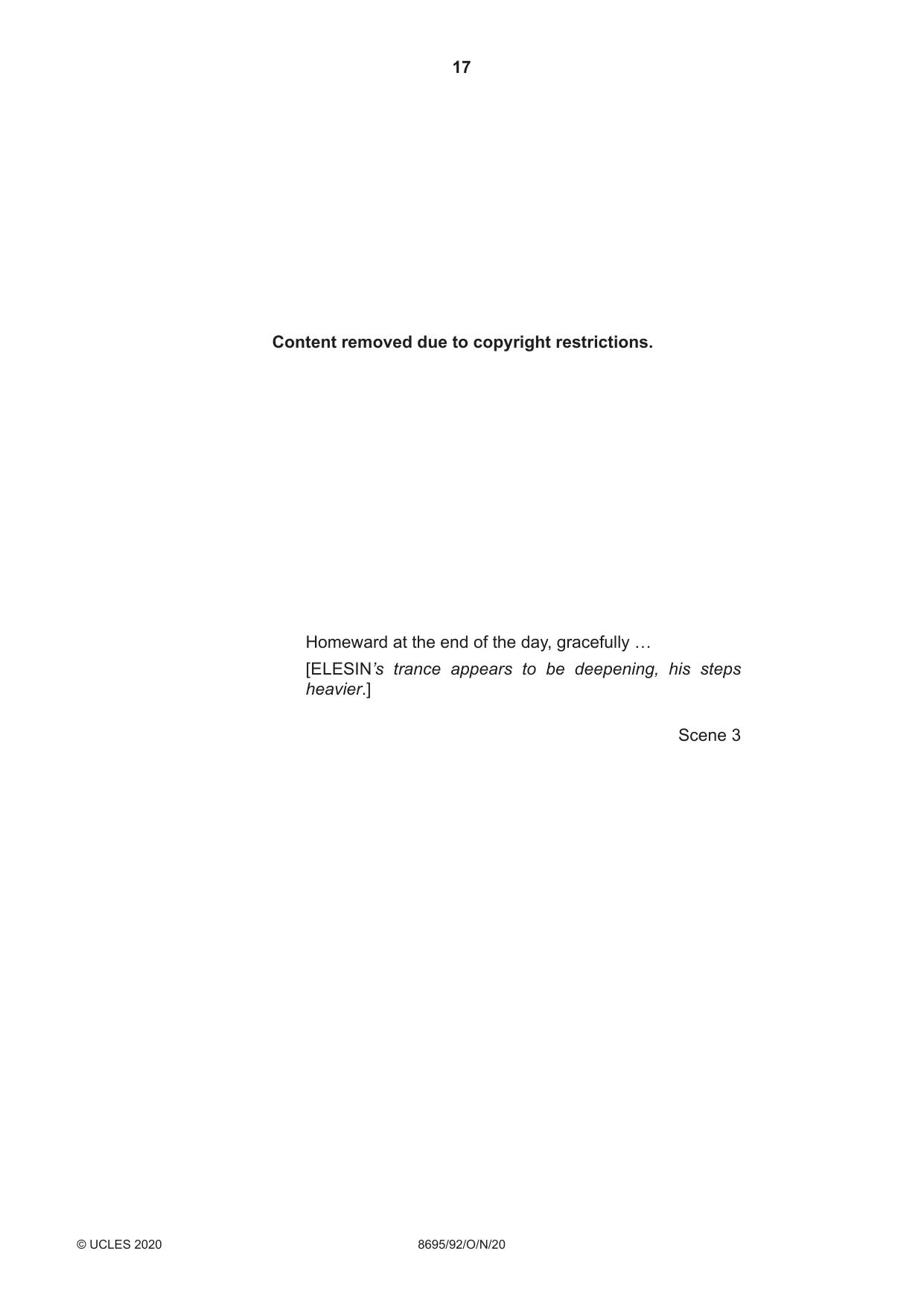
17 8695/92/O/N/20 © UCLES 2020 Homeward at the end of the day, gracefully … [ELESIN’s trance appears to be deepening, his steps heavier.] Scene 3 Content removed due to copyright restrictions.
Question paper, page 18
18 8695/92/O/N/20 © UCLES 2020 BLANK PAGE
Question paper, page 19
19 8695/92/O/N/20 © UCLES 2020 BLANK PAGE
Question paper, page 20
20 8695/92/O/N/20 © UCLES 2020 Permission to reproduce items where third-party owned material protected by copyright is included has been sought and cleared where possible. Every reasonable effort has been made by the publisher (UCLES) to trace copyright holders, but if any items requiring clearance have unwittingly been included, the publisher will be pleased to make amends at the earliest possible opportunity. To avoid the issue of disclosure of answer-related information to candidates, all copyright acknowledgements are reproduced online in the Cambridge Assessment International Education Copyright Acknowledgements Booklet. This is produced for each series of examinations and is freely available to download at www.cambridgeinternational.org after the live examination series. Cambridge Assessment International Education is part of the Cambridge Assessment Group. Cambridge Assessment is the brand name of the University of Cambridge Local Examinations Syndicate (UCLES), which itself is a department of the University of Cambridge. BLANK PAGE
Mark scheme, page 1
This document consists of 7 printed pages. © UCLES 2020 [Turn over Cambridge International AS & A Level LITERATURE IN ENGLISH 8695/92 Paper 9 Poetry, Prose and Drama October/November 2020 MARK SCHEME Maximum Mark: 50 Published This mark scheme is published as an aid to teachers and candidates, to indicate the requirements of the examination. It shows the basis on which Examiners were instructed to award marks. It does not indicate the details of the discussions that took place at an Examiners’ meeting before marking began, which would have considered the acceptability of alternative answers. Mark schemes should be read in conjunction with the question paper and the Principal Examiner Report for Teachers. Cambridge International will not enter into discussions about these mark schemes. Cambridge International is publishing the mark schemes for the October/November 2020 series for most Cambridge IGCSE™, Cambridge International A and AS Level and Cambridge Pre-U components, and some Cambridge O Level components.
Mark scheme, page 2
8695/92 Cambridge International AS & A Level – Mark Scheme PUBLISHED October/November 2020 © UCLES 2020 Page 2 of 7 Generic Marking Principles These general marking principles must be applied by all examiners when marking candidate answers. They should be applied alongside the specific content of the mark scheme or generic level descriptors for a question. Each question paper and mark scheme will also comply with these marking principles. GENERIC MARKING PRINCIPLE 1: Marks must be awarded in line with: • the specific content of the mark scheme or the generic level descriptors for the question • the specific skills defined in the mark scheme or in the generic level descriptors for the question • the standard of response required by a candidate as exemplified by the standardisation scripts. GENERIC MARKING PRINCIPLE 2: Marks awarded are always whole marks (not half marks, or other fractions). GENERIC MARKING PRINCIPLE 3: Marks must be awarded positively: • marks are awarded for correct/valid answers, as defined in the mark scheme. However, credit is given for valid answers which go beyond the scope of the syllabus and mark scheme, referring to your Team Leader as appropriate • marks are awarded when candidates clearly demonstrate what they know and can do • marks are not deducted for errors • marks are not deducted for omissions • answers should only be judged on the quality of spelling, punctuation and grammar when these features are specifically assessed by the question as indicated by the mark scheme. The meaning, however, should be unambiguous. GENERIC MARKING PRINCIPLE 4: Rules must be applied consistently, e.g. in situations where candidates have not followed instructions or in the application of generic level descriptors. GENERIC MARKING PRINCIPLE 5: Marks should be awarded using the full range of marks defined in the mark scheme for the question (however; the use of the full mark range may be limited according to the quality of the candidate responses seen). GENERIC MARKING PRINCIPLE 6: Marks awarded are based solely on the requirements as defined in the mark scheme. Marks should not be awarded with grade thresholds or grade descriptors in mind.
Mark scheme, page 3
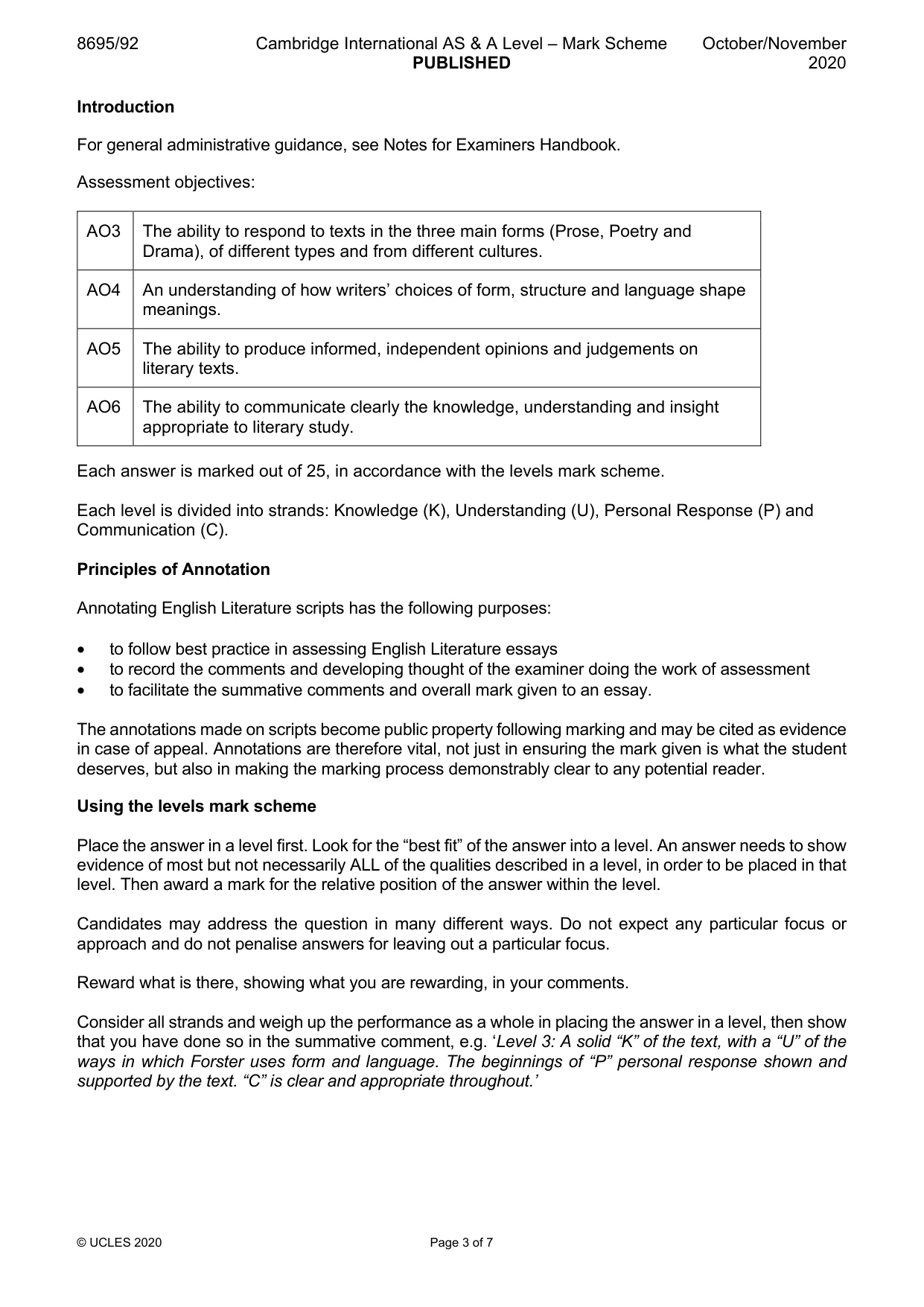
8695/92 Cambridge International AS & A Level – Mark Scheme PUBLISHED October/November 2020 © UCLES 2020 Page 3 of 7 Introduction For general administrative guidance, see Notes for Examiners Handbook. Assessment objectives: AO3 The ability to respond to texts in the three main forms (Prose, Poetry and Drama), of different types and from different cultures. AO4 An understanding of how writers’ choices of form, structure and language shape meanings. AO5 The ability to produce informed, independent opinions and judgements on literary texts. AO6 The ability to communicate clearly the knowledge, understanding and insight appropriate to literary study. Each answer is marked out of 25, in accordance with the levels mark scheme. Each level is divided into strands: Knowledge (K), Understanding (U), Personal Response (P) and Communication (C). Principles of Annotation Annotating English Literature scripts has the following purposes: • to follow best practice in assessing English Literature essays • to record the comments and developing thought of the examiner doing the work of assessment • to facilitate the summative comments and overall mark given to an essay. The annotations made on scripts become public property following marking and may be cited as evidence in case of appeal. Annotations are therefore vital, not just in ensuring the mark given is what the student deserves, but also in making the marking process demonstrably clear to any potential reader. Using the levels mark scheme Place the answer in a level first. Look for the “best fit” of the answer into a level. An answer needs to show evidence of most but not necessarily ALL of the qualities described in a level, in order to be placed in that level. Then award a mark for the relative position of the answer within the level. Candidates may address the question in many different ways. Do not expect any particular focus or approach and do not penalise answers for leaving out a particular focus. Reward what is there, showing what you are rewarding, in your comments. Consider all strands and weigh up the performance as a whole in placing the answer in a level, then show that you have done so in the summative comment, e.g. ‘Level 3: A solid “K” of the text, with a “U” of the ways in which Forster uses form and language. The beginnings of “P” personal response shown and supported by the text. “C” is clear and appropriate throughout.’
Mark scheme, page 4
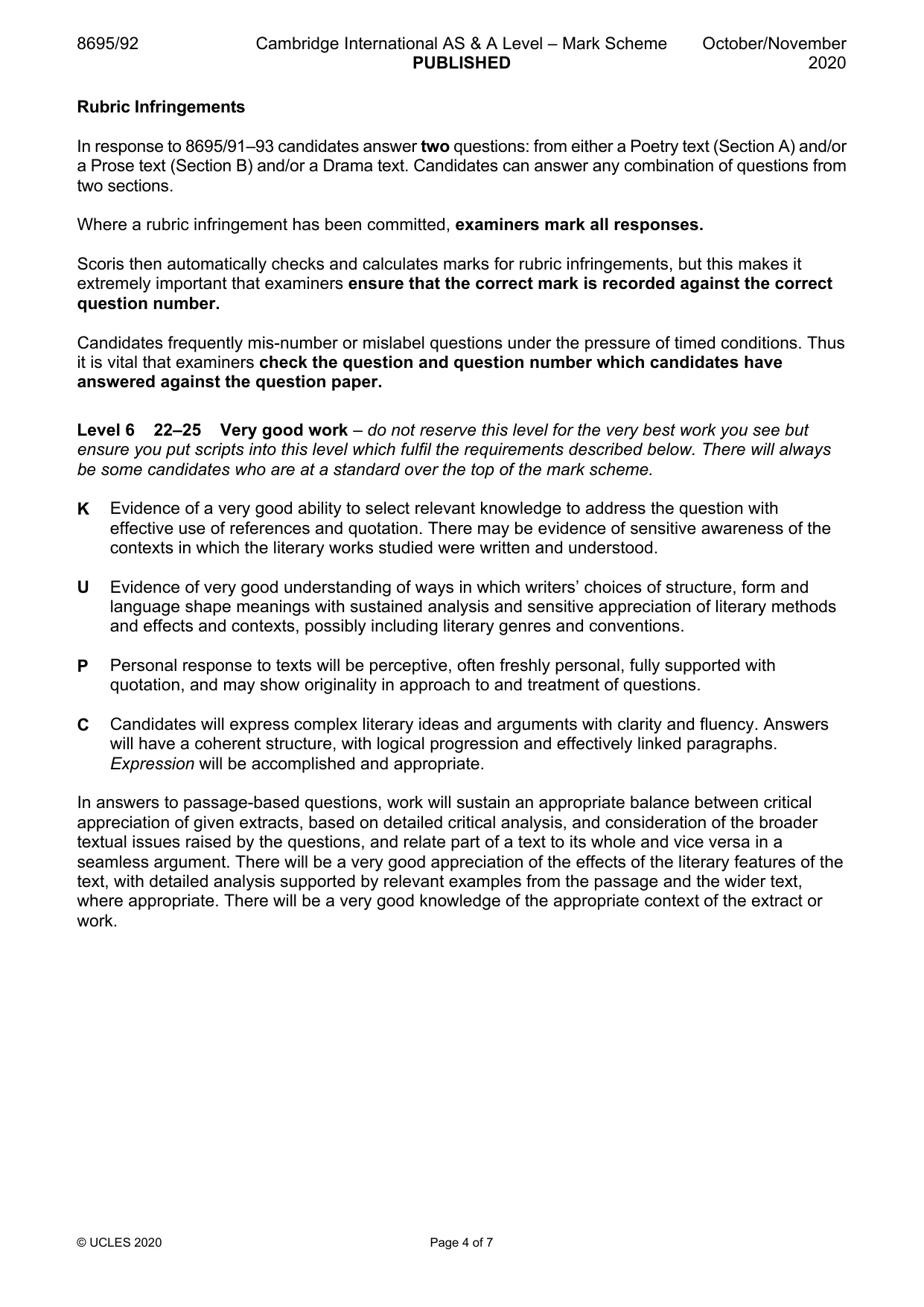
8695/92 Cambridge International AS & A Level – Mark Scheme PUBLISHED October/November 2020 © UCLES 2020 Page 4 of 7 Rubric Infringements In response to 8695/91–93 candidates answer two questions: from either a Poetry text (Section A) and/or a Prose text (Section B) and/or a Drama text. Candidates can answer any combination of questions from two sections. Where a rubric infringement has been committed, examiners mark all responses. Scoris then automatically checks and calculates marks for rubric infringements, but this makes it extremely important that examiners ensure that the correct mark is recorded against the correct question number. Candidates frequently mis-number or mislabel questions under the pressure of timed conditions. Thus it is vital that examiners check the question and question number which candidates have answered against the question paper. Level 6 22–25 Very good work – do not reserve this level for the very best work you see but ensure you put scripts into this level which fulfil the requirements described below. There will always be some candidates who are at a standard over the top of the mark scheme. K Evidence of a very good ability to select relevant knowledge to address the question with effective use of references and quotation. There may be evidence of sensitive awareness of the contexts in which the literary works studied were written and understood. U Evidence of very good understanding of ways in which writers’ choices of structure, form and language shape meanings with sustained analysis and sensitive appreciation of literary methods and effects and contexts, possibly including literary genres and conventions. P Personal response to texts will be perceptive, often freshly personal, fully supported with quotation, and may show originality in approach to and treatment of questions. C Candidates will express complex literary ideas and arguments with clarity and fluency. Answers will have a coherent structure, with logical progression and effectively linked paragraphs. Expression will be accomplished and appropriate. In answers to passage-based questions, work will sustain an appropriate balance between critical appreciation of given extracts, based on detailed critical analysis, and consideration of the broader textual issues raised by the questions, and relate part of a text to its whole and vice versa in a seamless argument. There will be a very good appreciation of the effects of the literary features of the text, with detailed analysis supported by relevant examples from the passage and the wider text, where appropriate. There will be a very good knowledge of the appropriate context of the extract or work.
Mark scheme, page 5
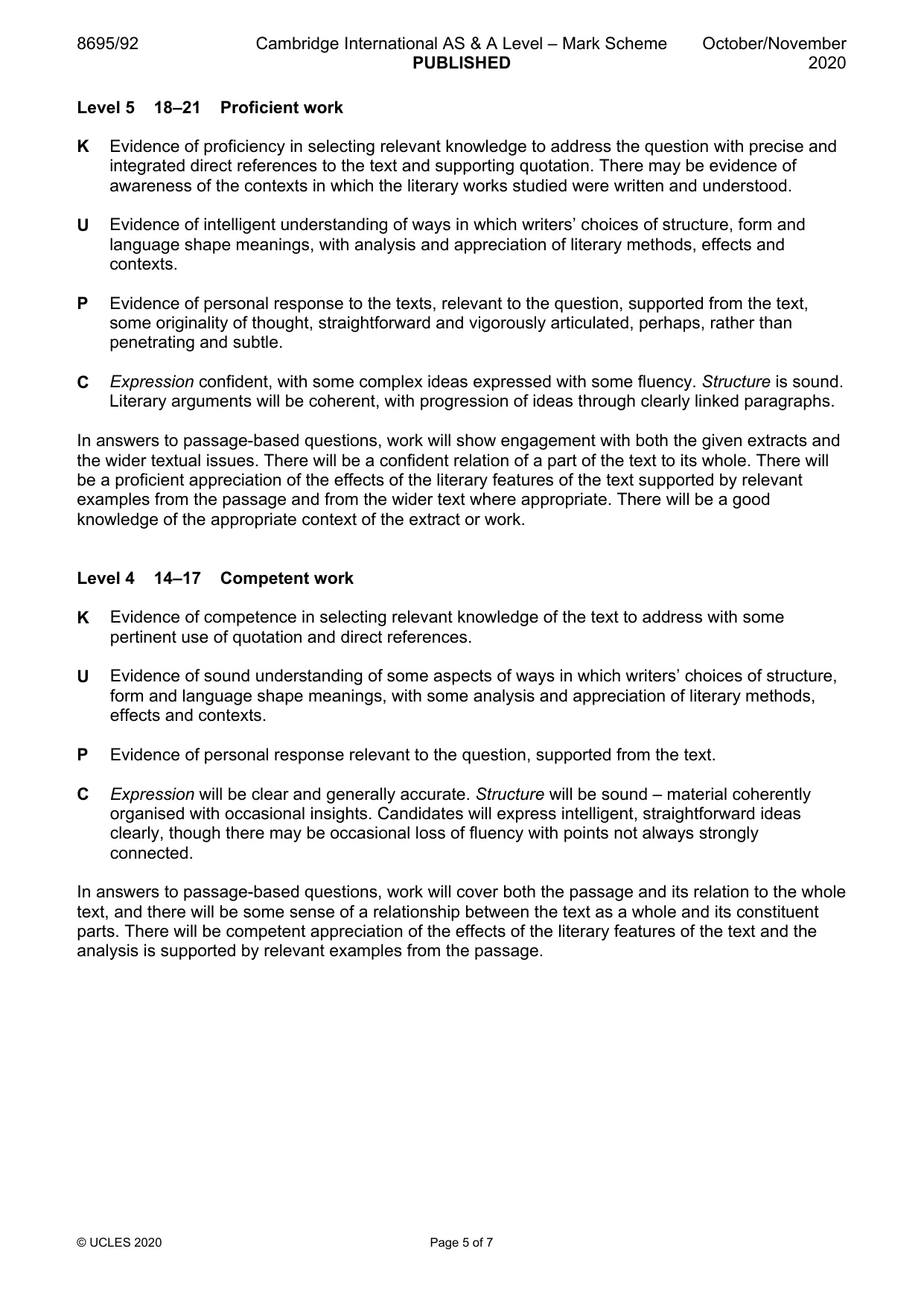
8695/92 Cambridge International AS & A Level – Mark Scheme PUBLISHED October/November 2020 © UCLES 2020 Page 5 of 7 Level 5 18–21 Proficient work K Evidence of proficiency in selecting relevant knowledge to address the question with precise and integrated direct references to the text and supporting quotation. There may be evidence of awareness of the contexts in which the literary works studied were written and understood. U Evidence of intelligent understanding of ways in which writers’ choices of structure, form and language shape meanings, with analysis and appreciation of literary methods, effects and contexts. P Evidence of personal response to the texts, relevant to the question, supported from the text, some originality of thought, straightforward and vigorously articulated, perhaps, rather than penetrating and subtle. C Expression confident, with some complex ideas expressed with some fluency. Structure is sound. Literary arguments will be coherent, with progression of ideas through clearly linked paragraphs. In answers to passage-based questions, work will show engagement with both the given extracts and the wider textual issues. There will be a confident relation of a part of the text to its whole. There will be a proficient appreciation of the effects of the literary features of the text supported by relevant examples from the passage and from the wider text where appropriate. There will be a good knowledge of the appropriate context of the extract or work. Level 4 14–17 Competent work K Evidence of competence in selecting relevant knowledge of the text to address with some pertinent use of quotation and direct references. U Evidence of sound understanding of some aspects of ways in which writers’ choices of structure, form and language shape meanings, with some analysis and appreciation of literary methods, effects and contexts. P Evidence of personal response relevant to the question, supported from the text. C Expression will be clear and generally accurate. Structure will be sound – material coherently organised with occasional insights. Candidates will express intelligent, straightforward ideas clearly, though there may be occasional loss of fluency with points not always strongly connected. In answers to passage-based questions, work will cover both the passage and its relation to the whole text, and there will be some sense of a relationship between the text as a whole and its constituent parts. There will be competent appreciation of the effects of the literary features of the text and the analysis is supported by relevant examples from the passage.
Mark scheme, page 6
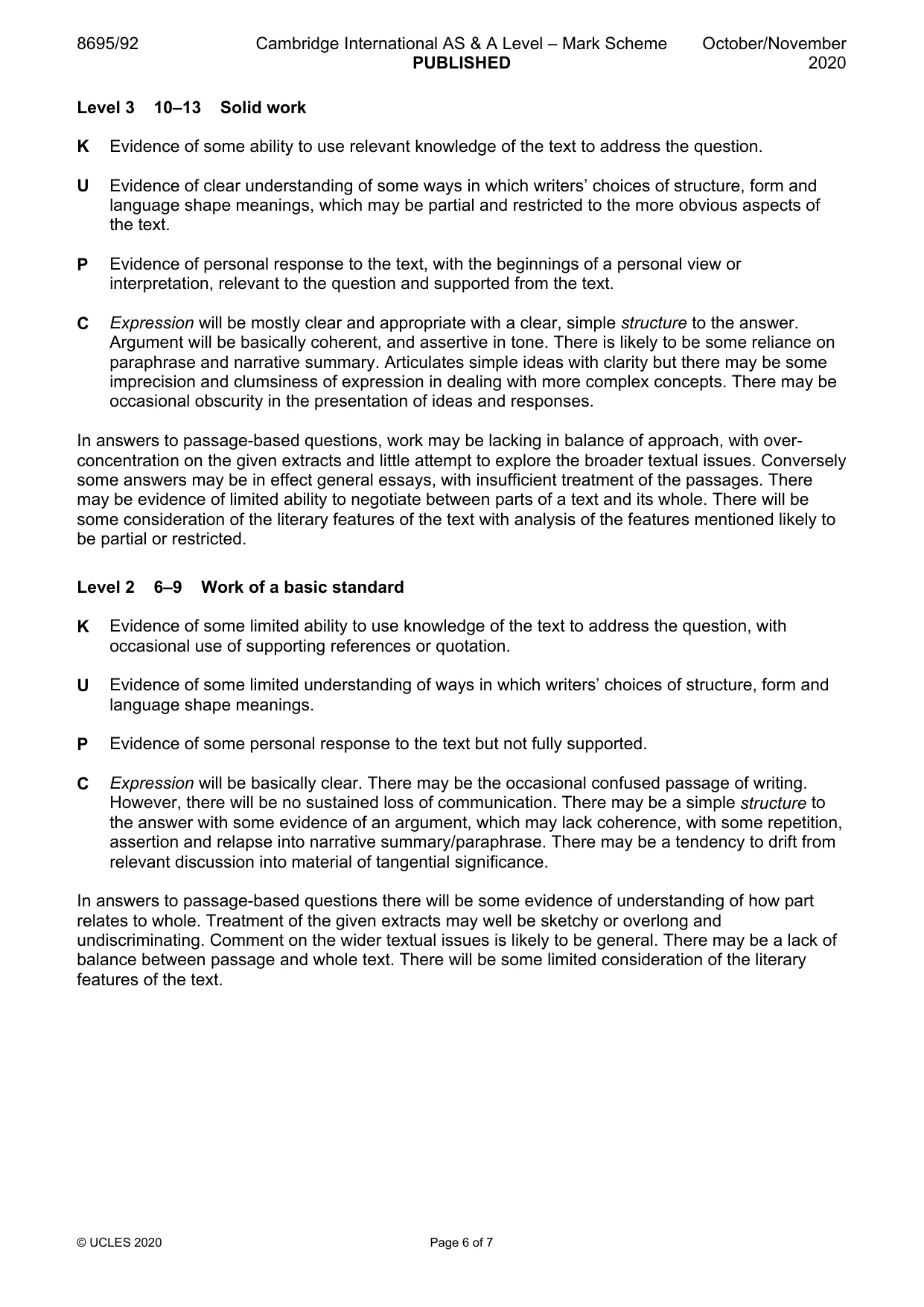
8695/92 Cambridge International AS & A Level – Mark Scheme PUBLISHED October/November 2020 © UCLES 2020 Page 6 of 7 Level 3 10–13 Solid work K Evidence of some ability to use relevant knowledge of the text to address the question. U Evidence of clear understanding of some ways in which writers’ choices of structure, form and language shape meanings, which may be partial and restricted to the more obvious aspects of the text. P Evidence of personal response to the text, with the beginnings of a personal view or interpretation, relevant to the question and supported from the text. C Expression will be mostly clear and appropriate with a clear, simple structure to the answer. Argument will be basically coherent, and assertive in tone. There is likely to be some reliance on paraphrase and narrative summary. Articulates simple ideas with clarity but there may be some imprecision and clumsiness of expression in dealing with more complex concepts. There may be occasional obscurity in the presentation of ideas and responses. In answers to passage-based questions, work may be lacking in balance of approach, with over- concentration on the given extracts and little attempt to explore the broader textual issues. Conversely some answers may be in effect general essays, with insufficient treatment of the passages. There may be evidence of limited ability to negotiate between parts of a text and its whole. There will be some consideration of the literary features of the text with analysis of the features mentioned likely to be partial or restricted. Level 2 6–9 Work of a basic standard K Evidence of some limited ability to use knowledge of the text to address the question, with occasional use of supporting references or quotation. U Evidence of some limited understanding of ways in which writers’ choices of structure, form and language shape meanings. P Evidence of some personal response to the text but not fully supported. C Expression will be basically clear. There may be the occasional confused passage of writing. However, there will be no sustained loss of communication. There may be a simple structure to the answer with some evidence of an argument, which may lack coherence, with some repetition, assertion and relapse into narrative summary/paraphrase. There may be a tendency to drift from relevant discussion into material of tangential significance. In answers to passage-based questions there will be some evidence of understanding of how part relates to whole. Treatment of the given extracts may well be sketchy or overlong and undiscriminating. Comment on the wider textual issues is likely to be general. There may be a lack of balance between passage and whole text. There will be some limited consideration of the literary features of the text.
Mark scheme, page 7
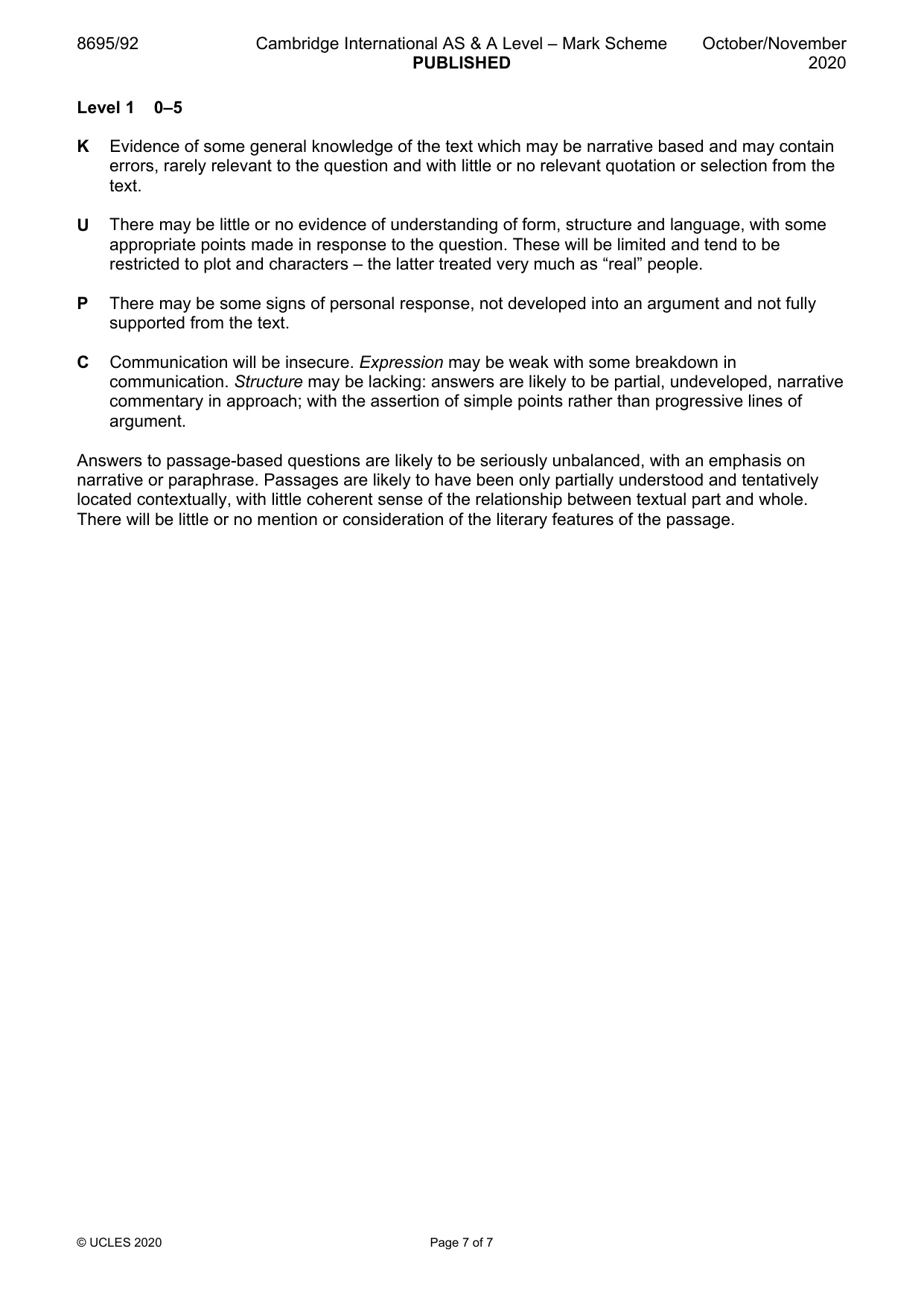
8695/92 Cambridge International AS & A Level – Mark Scheme PUBLISHED October/November 2020 © UCLES 2020 Page 7 of 7 Level 1 0–5 K Evidence of some general knowledge of the text which may be narrative based and may contain errors, rarely relevant to the question and with little or no relevant quotation or selection from the text. U There may be little or no evidence of understanding of form, structure and language, with some appropriate points made in response to the question. These will be limited and tend to be restricted to plot and characters – the latter treated very much as “real” people. P There may be some signs of personal response, not developed into an argument and not fully supported from the text. C Communication will be insecure. Expression may be weak with some breakdown in communication. Structure may be lacking: answers are likely to be partial, undeveloped, narrative commentary in approach; with the assertion of simple points rather than progressive lines of argument. Answers to passage-based questions are likely to be seriously unbalanced, with an emphasis on narrative or paraphrase. Passages are likely to have been only partially understood and tentatively located contextually, with little coherent sense of the relationship between textual part and whole. There will be little or no mention or consideration of the literary features of the passage.
What you needed in this session
Cambridge’s own grade thresholds for 2020 Oct/Nov, Paper 9 · Variant 2. A higher threshold means an easier paper — the bar moves with how the cohort did.