Cambridge A Level English - Language and Literature (AS Level only, from 2016) 8695 — 2017 Oct/Nov Paper 9 · Variant 3
8695/93/O/N/17 · 50 marks · ≈56 min
The question paper and its mark scheme, free to read here and free to download. This is Cambridge’s own paper, exactly as it was sat.
Question paper16 pages
Mark scheme5 pages
Answers below. Sit the paper first if you are practising.
Paper as text
Question paper, page 1
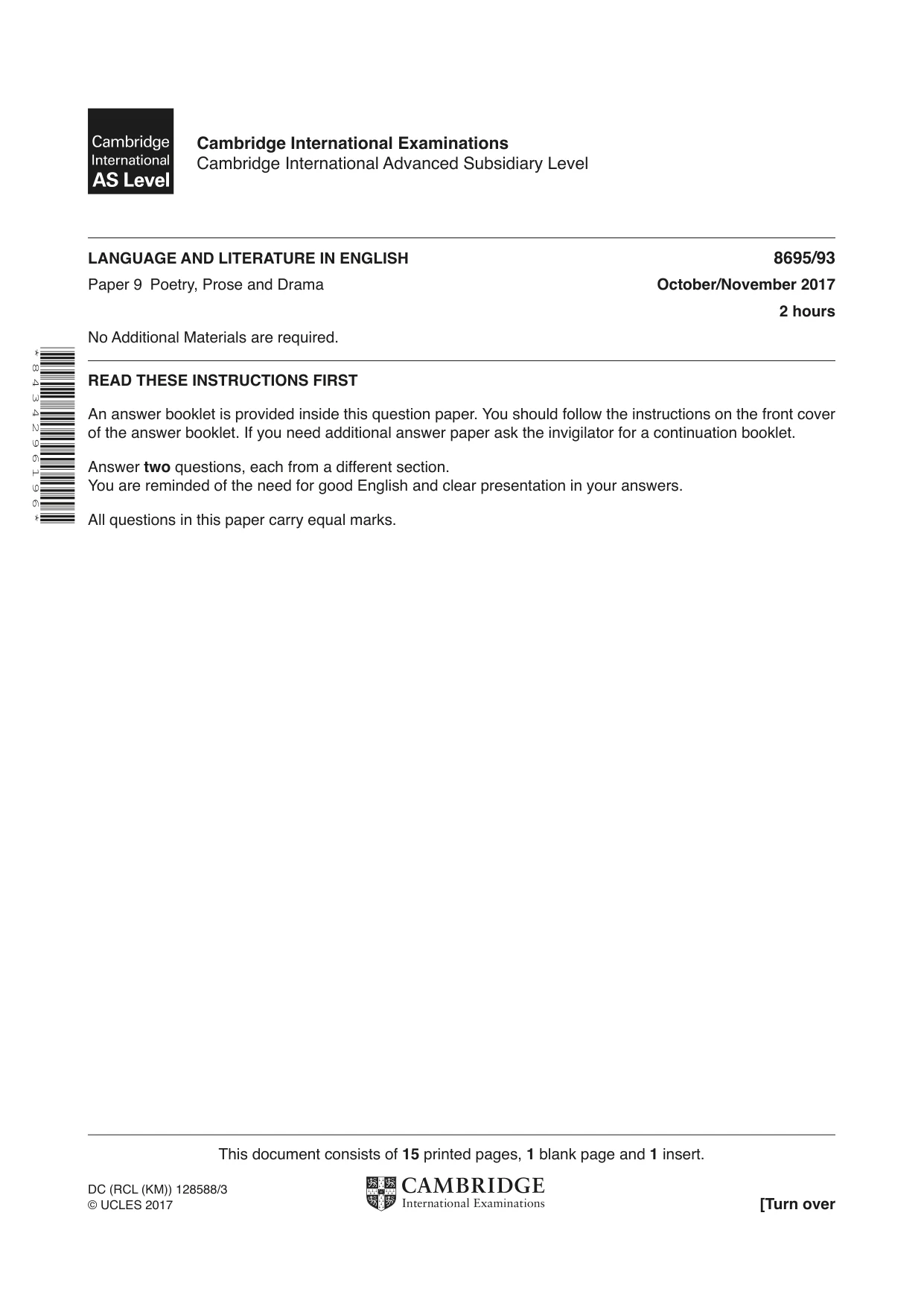
This document consists of 15 printed pages, 1 blank page and 1 insert. DC (RCL (KM)) 128588/3 © UCLES 2017 [Turn over Cambridge International Examinations Cambridge International Advanced Subsidiary Level * 8 4 3 4 2 9 6 1 9 6 * LANGUAGE AND LITERATURE IN ENGLISH 8695/93 Paper 9 Poetry, Prose and Drama October/November 2017 2 hours No Additional Materials are required. READ THESE INSTRUCTIONS FIRST An answer booklet is provided inside this question paper. You should follow the instructions on the front cover of the answer booklet. If you need additional answer paper ask the invigilator for a continuation booklet. Answer two questions, each from a different section. You are reminded of the need for good English and clear presentation in your answers. All questions in this paper carry equal marks.
Question paper, page 2
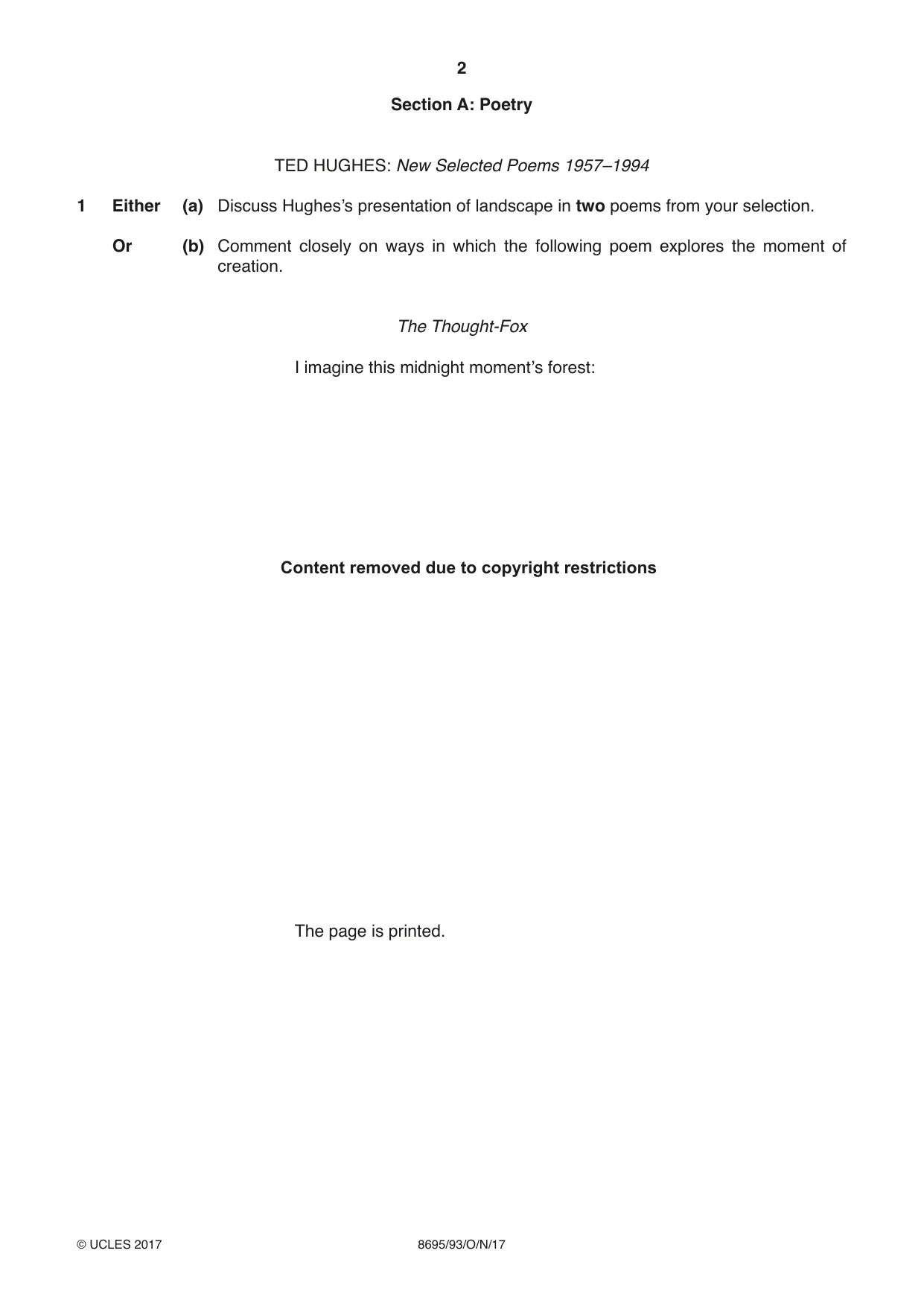
2 8695/93/O/N/17 © UCLES 2017 Section A: Poetry TED HUGHES: New Selected Poems 1957–1994 1 Either (a) Discuss Hughes’s presentation of landscape in two poems from your selection. Or (b) Comment closely on ways in which the following poem explores the moment of creation. The Thought-Fox I imagine this midnight moment’s forest: Content removed due to copyright restrictions The page is printed.
Question paper, page 3
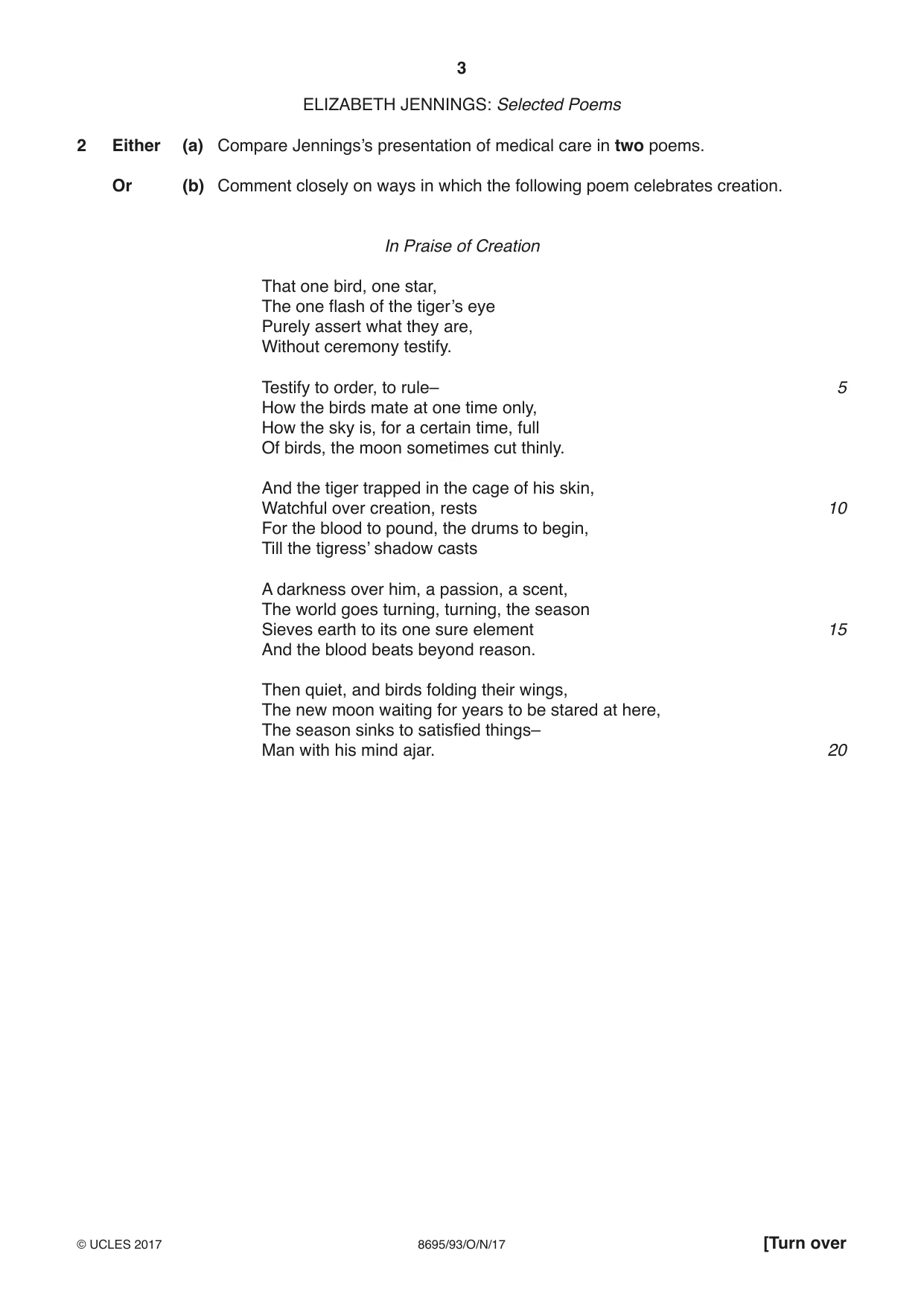
3 8695/93/O/N/17 © UCLES 2017 [Turn over ELIZABETH JENNINGS: Selected Poems 2 Either (a) Compare Jennings’s presentation of medical care in two poems. Or (b) Comment closely on ways in which the following poem celebrates creation. In Praise of Creation That one bird, one star, The one flash of the tiger’s eye Purely assert what they are, Without ceremony testify. Testify to order, to rule– How the birds mate at one time only, How the sky is, for a certain time, full Of birds, the moon sometimes cut thinly. And the tiger trapped in the cage of his skin, Watchful over creation, rests For the blood to pound, the drums to begin, Till the tigress’ shadow casts A darkness over him, a passion, a scent, The world goes turning, turning, the season Sieves earth to its one sure element And the blood beats beyond reason. Then quiet, and birds folding their wings, The new moon waiting for years to be stared at here, The season sinks to satisfied things– Man with his mind ajar. 5 10 15 20
Question paper, page 4
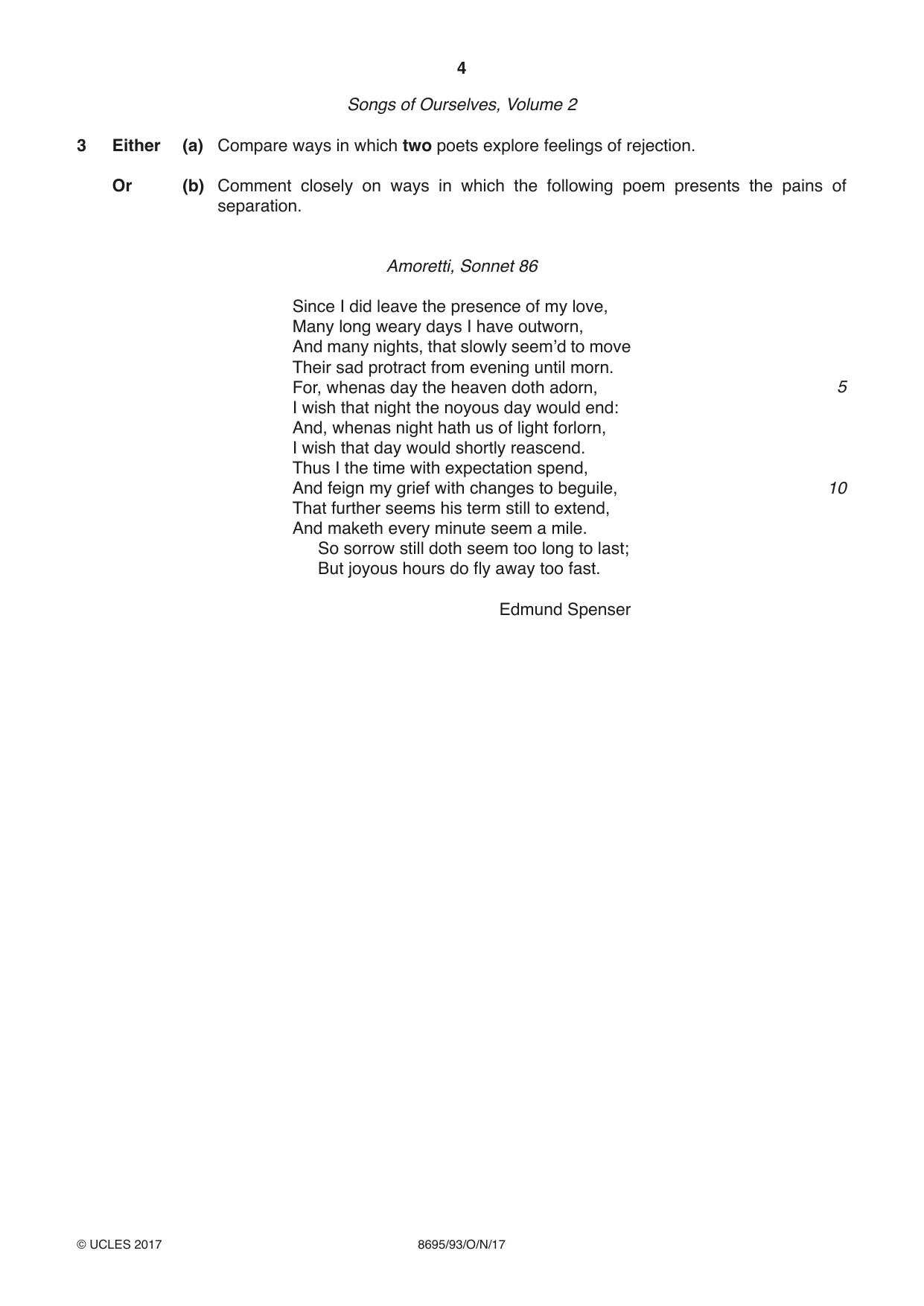
4 8695/93/O/N/17 © UCLES 2017 Songs of Ourselves, Volume 2 3 Either (a) Compare ways in which two poets explore feelings of rejection. Or (b) Comment closely on ways in which the following poem presents the pains of separation. Amoretti, Sonnet 86 Since I did leave the presence of my love, Many long weary days I have outworn, And many nights, that slowly seem’d to move Their sad protract from evening until morn. For, whenas day the heaven doth adorn, I wish that night the noyous day would end: And, whenas night hath us of light forlorn, I wish that day would shortly reascend. Thus I the time with expectation spend, And feign my grief with changes to beguile, That further seems his term still to extend, And maketh every minute seem a mile. So sorrow still doth seem too long to last; But joyous hours do fly away too fast. Edmund Spenser 5 10
Question paper, page 5
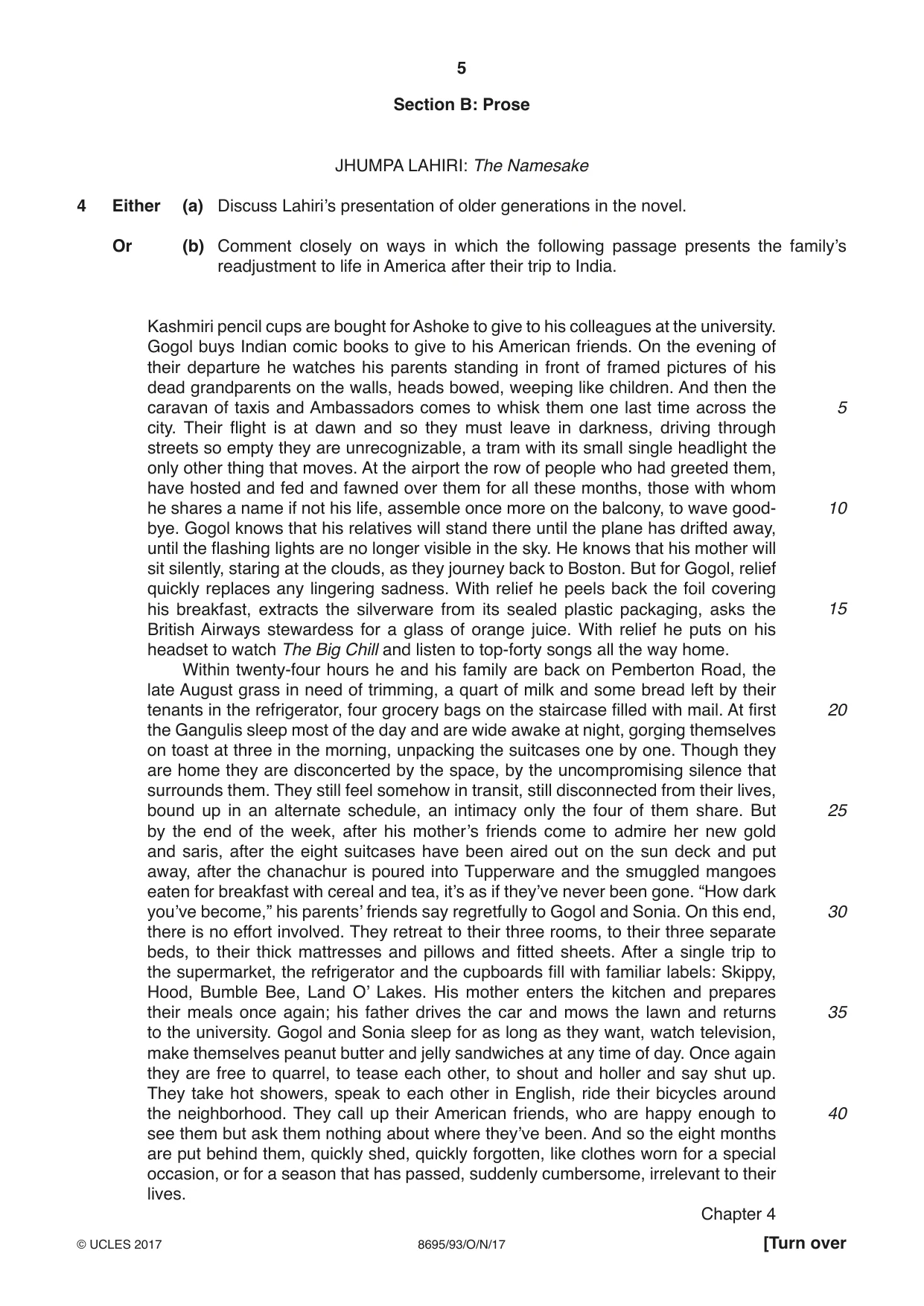
5 8695/93/O/N/17 © UCLES 2017 [Turn over Section B: Prose JHUMPA LAHIRI: The Namesake 4 Either (a) Discuss Lahiri’s presentation of older generations in the novel. Or (b) Comment closely on ways in which the following passage presents the family’s readjustment to life in America after their trip to India. Kashmiri pencil cups are bought for Ashoke to give to his colleagues at the university. Gogol buys Indian comic books to give to his American friends. On the evening of their departure he watches his parents standing in front of framed pictures of his dead grandparents on the walls, heads bowed, weeping like children. And then the caravan of taxis and Ambassadors comes to whisk them one last time across the city. Their flight is at dawn and so they must leave in darkness, driving through streets so empty they are unrecognizable, a tram with its small single headlight the only other thing that moves. At the airport the row of people who had greeted them, have hosted and fed and fawned over them for all these months, those with whom he shares a name if not his life, assemble once more on the balcony, to wave good- bye. Gogol knows that his relatives will stand there until the plane has drifted away, until the flashing lights are no longer visible in the sky. He knows that his mother will sit silently, staring at the clouds, as they journey back to Boston. But for Gogol, relief quickly replaces any lingering sadness. With relief he peels back the foil covering his breakfast, extracts the silverware from its sealed plastic packaging, asks the British Airways stewardess for a glass of orange juice. With relief he puts on his headset to watch The Big Chill and listen to top-forty songs all the way home. Within twenty-four hours he and his family are back on Pemberton Road, the late August grass in need of trimming, a quart of milk and some bread left by their tenants in the refrigerator, four grocery bags on the staircase filled with mail. At first the Gangulis sleep most of the day and are wide awake at night, gorging themselves on toast at three in the morning, unpacking the suitcases one by one. Though they are home they are disconcerted by the space, by the uncompromising silence that surrounds them. They still feel somehow in transit, still disconnected from their lives, bound up in an alternate schedule, an intimacy only the four of them share. But by the end of the week, after his mother’s friends come to admire her new gold and saris, after the eight suitcases have been aired out on the sun deck and put away, after the chanachur is poured into Tupperware and the smuggled mangoes eaten for breakfast with cereal and tea, it’s as if they’ve never been gone. “How dark you’ve become,” his parents’ friends say regretfully to Gogol and Sonia. On this end, there is no effort involved. They retreat to their three rooms, to their three separate beds, to their thick mattresses and pillows and fitted sheets. After a single trip to the supermarket, the refrigerator and the cupboards fill with familiar labels: Skippy, Hood, Bumble Bee, Land O’ Lakes. His mother enters the kitchen and prepares their meals once again; his father drives the car and mows the lawn and returns to the university. Gogol and Sonia sleep for as long as they want, watch television, make themselves peanut butter and jelly sandwiches at any time of day. Once again they are free to quarrel, to tease each other, to shout and holler and say shut up. They take hot showers, speak to each other in English, ride their bicycles around the neighborhood. They call up their American friends, who are happy enough to see them but ask them nothing about where they’ve been. And so the eight months are put behind them, quickly shed, quickly forgotten, like clothes worn for a special occasion, or for a season that has passed, suddenly cumbersome, irrelevant to their lives. Chapter 4 5 10 15 20 25 30 35 40
Question paper, page 6
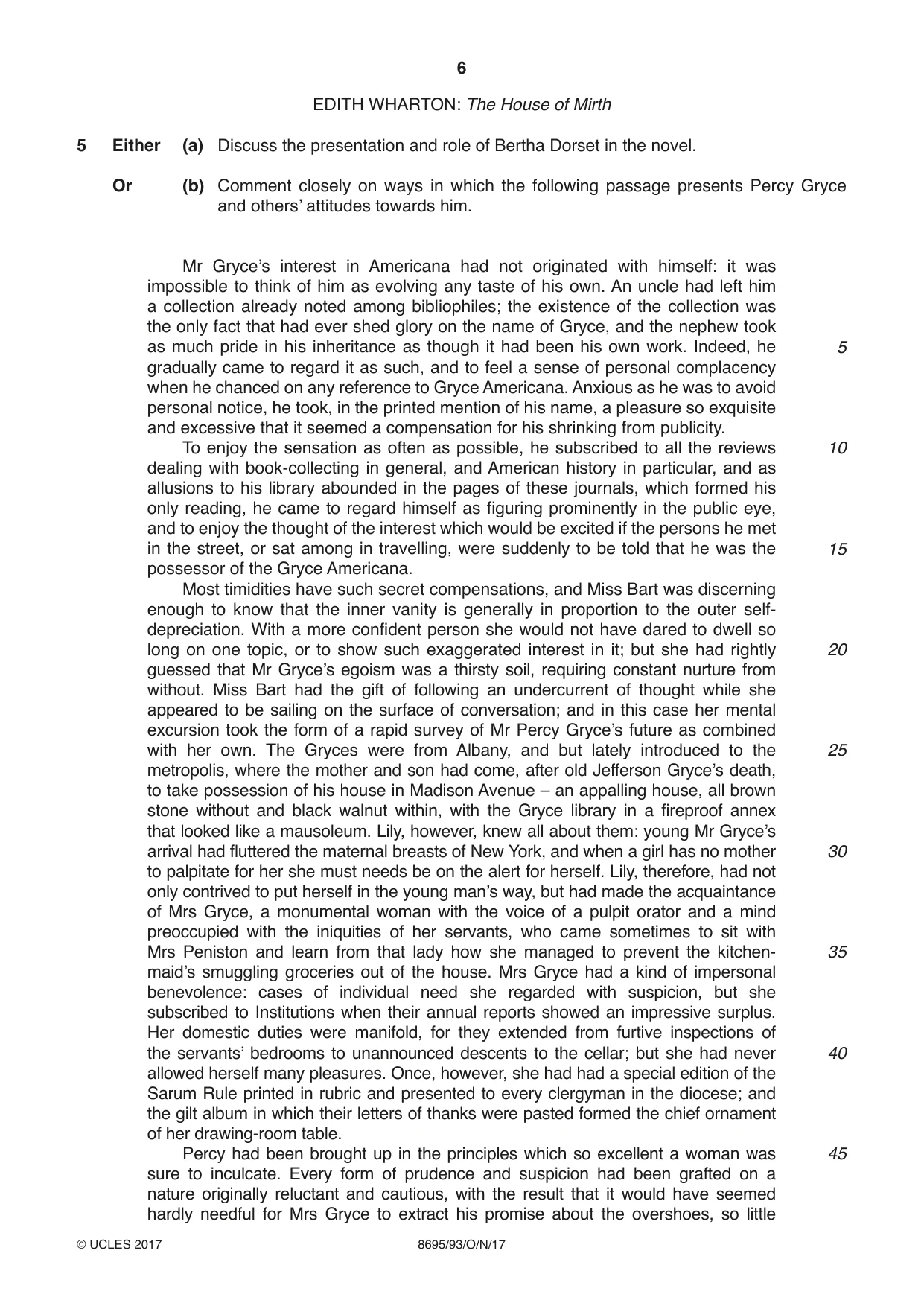
6 8695/93/O/N/17 © UCLES 2017 EDITH WHARTON: The House of Mirth 5 Either (a) Discuss the presentation and role of Bertha Dorset in the novel. Or (b) Comment closely on ways in which the following passage presents Percy Gryce and others’ attitudes towards him. Mr Gryce’s interest in Americana had not originated with himself: it was impossible to think of him as evolving any taste of his own. An uncle had left him a collection already noted among bibliophiles; the existence of the collection was the only fact that had ever shed glory on the name of Gryce, and the nephew took as much pride in his inheritance as though it had been his own work. Indeed, he gradually came to regard it as such, and to feel a sense of personal complacency when he chanced on any reference to Gryce Americana. Anxious as he was to avoid personal notice, he took, in the printed mention of his name, a pleasure so exquisite and excessive that it seemed a compensation for his shrinking from publicity. To enjoy the sensation as often as possible, he subscribed to all the reviews dealing with book-collecting in general, and American history in particular, and as allusions to his library abounded in the pages of these journals, which formed his only reading, he came to regard himself as figuring prominently in the public eye, and to enjoy the thought of the interest which would be excited if the persons he met in the street, or sat among in travelling, were suddenly to be told that he was the possessor of the Gryce Americana. Most timidities have such secret compensations, and Miss Bart was discerning enough to know that the inner vanity is generally in proportion to the outer self- depreciation. With a more confident person she would not have dared to dwell so long on one topic, or to show such exaggerated interest in it; but she had rightly guessed that Mr Gryce’s egoism was a thirsty soil, requiring constant nurture from without. Miss Bart had the gift of following an undercurrent of thought while she appeared to be sailing on the surface of conversation; and in this case her mental excursion took the form of a rapid survey of Mr Percy Gryce’s future as combined with her own. The Gryces were from Albany, and but lately introduced to the metropolis, where the mother and son had come, after old Jefferson Gryce’s death, to take possession of his house in Madison Avenue – an appalling house, all brown stone without and black walnut within, with the Gryce library in a fireproof annex that looked like a mausoleum. Lily, however, knew all about them: young Mr Gryce’s arrival had fluttered the maternal breasts of New York, and when a girl has no mother to palpitate for her she must needs be on the alert for herself. Lily, therefore, had not only contrived to put herself in the young man’s way, but had made the acquaintance of Mrs Gryce, a monumental woman with the voice of a pulpit orator and a mind preoccupied with the iniquities of her servants, who came sometimes to sit with Mrs Peniston and learn from that lady how she managed to prevent the kitchen- maid’s smuggling groceries out of the house. Mrs Gryce had a kind of impersonal benevolence: cases of individual need she regarded with suspicion, but she subscribed to Institutions when their annual reports showed an impressive surplus. Her domestic duties were manifold, for they extended from furtive inspections of the servants’ bedrooms to unannounced descents to the cellar; but she had never allowed herself many pleasures. Once, however, she had had a special edition of the Sarum Rule printed in rubric and presented to every clergyman in the diocese; and the gilt album in which their letters of thanks were pasted formed the chief ornament of her drawing-room table. Percy had been brought up in the principles which so excellent a woman was sure to inculcate. Every form of prudence and suspicion had been grafted on a nature originally reluctant and cautious, with the result that it would have seemed hardly needful for Mrs Gryce to extract his promise about the overshoes, so little 5 10 15 20 25 30 35 40 45
Question paper, page 7
7 8695/93/O/N/17 © UCLES 2017 [Turn over likely was he to hazard himself abroad in the rain. After attaining his majority, and coming into the fortune which the late Mr Gryce had made out of a patent device for excluding fresh air from hotels, the young man continued to live with his mother in Albany, but on Jefferson Gryce’s death, when another large property passed into her son’s hands, Mrs Gryce thought that what she called his ‘interests’ demanded his presence in New York. She accordingly installed herself in the Madison Avenue house, and Percy, whose sense of duty was not inferior to his mother’s, spent all his weekdays in the handsome Broad Street office where a batch of pale men on small salaries had grown grey in the management of the Gryce estate, and where he was initiated with becoming reverence into every detail of the art of accumulation. Book 1, Chapter 2 50 55
Question paper, page 8
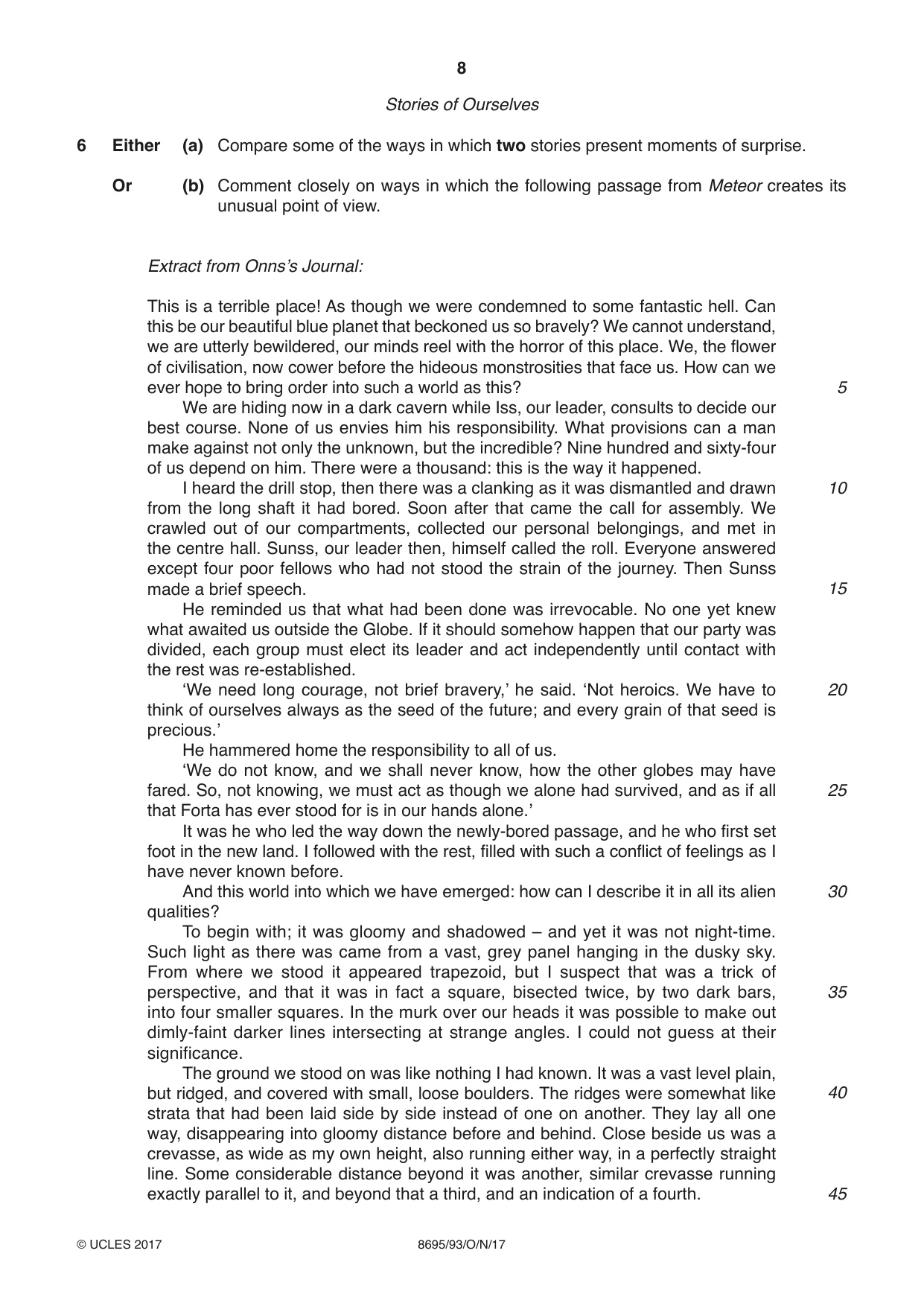
8 8695/93/O/N/17 © UCLES 2017 Stories of Ourselves 6 Either (a) Compare some of the ways in which two stories present moments of surprise. Or (b) Comment closely on ways in which the following passage from Meteor creates its unusual point of view. Extract from Onns’s Journal: This is a terrible place! As though we were condemned to some fantastic hell. Can this be our beautiful blue planet that beckoned us so bravely? We cannot understand, we are utterly bewildered, our minds reel with the horror of this place. We, the flower of civilisation, now cower before the hideous monstrosities that face us. How can we ever hope to bring order into such a world as this? We are hiding now in a dark cavern while Iss, our leader, consults to decide our best course. None of us envies him his responsibility. What provisions can a man make against not only the unknown, but the incredible? Nine hundred and sixty-four of us depend on him. There were a thousand: this is the way it happened. I heard the drill stop, then there was a clanking as it was dismantled and drawn from the long shaft it had bored. Soon after that came the call for assembly. We crawled out of our compartments, collected our personal belongings, and met in the centre hall. Sunss, our leader then, himself called the roll. Everyone answered except four poor fellows who had not stood the strain of the journey. Then Sunss made a brief speech. He reminded us that what had been done was irrevocable. No one yet knew what awaited us outside the Globe. If it should somehow happen that our party was divided, each group must elect its leader and act independently until contact with the rest was re-established. ‘We need long courage, not brief bravery,’ he said. ‘Not heroics. We have to think of ourselves always as the seed of the future; and every grain of that seed is precious.’ He hammered home the responsibility to all of us. ‘We do not know, and we shall never know, how the other globes may have fared. So, not knowing, we must act as though we alone had survived, and as if all that Forta has ever stood for is in our hands alone.’ It was he who led the way down the newly-bored passage, and he who first set foot in the new land. I followed with the rest, filled with such a conflict of feelings as I have never known before. And this world into which we have emerged: how can I describe it in all its alien qualities? To begin with; it was gloomy and shadowed – and yet it was not night-time. Such light as there was came from a vast, grey panel hanging in the dusky sky. From where we stood it appeared trapezoid, but I suspect that was a trick of perspective, and that it was in fact a square, bisected twice, by two dark bars, into four smaller squares. In the murk over our heads it was possible to make out dimly-faint darker lines intersecting at strange angles. I could not guess at their significance. The ground we stood on was like nothing I had known. It was a vast level plain, but ridged, and covered with small, loose boulders. The ridges were somewhat like strata that had been laid side by side instead of one on another. They lay all one way, disappearing into gloomy distance before and behind. Close beside us was a crevasse, as wide as my own height, also running either way, in a perfectly straight line. Some considerable distance beyond it was another, similar crevasse running exactly parallel to it, and beyond that a third, and an indication of a fourth. 5 10 15 20 25 30 35 40 45
Question paper, page 9
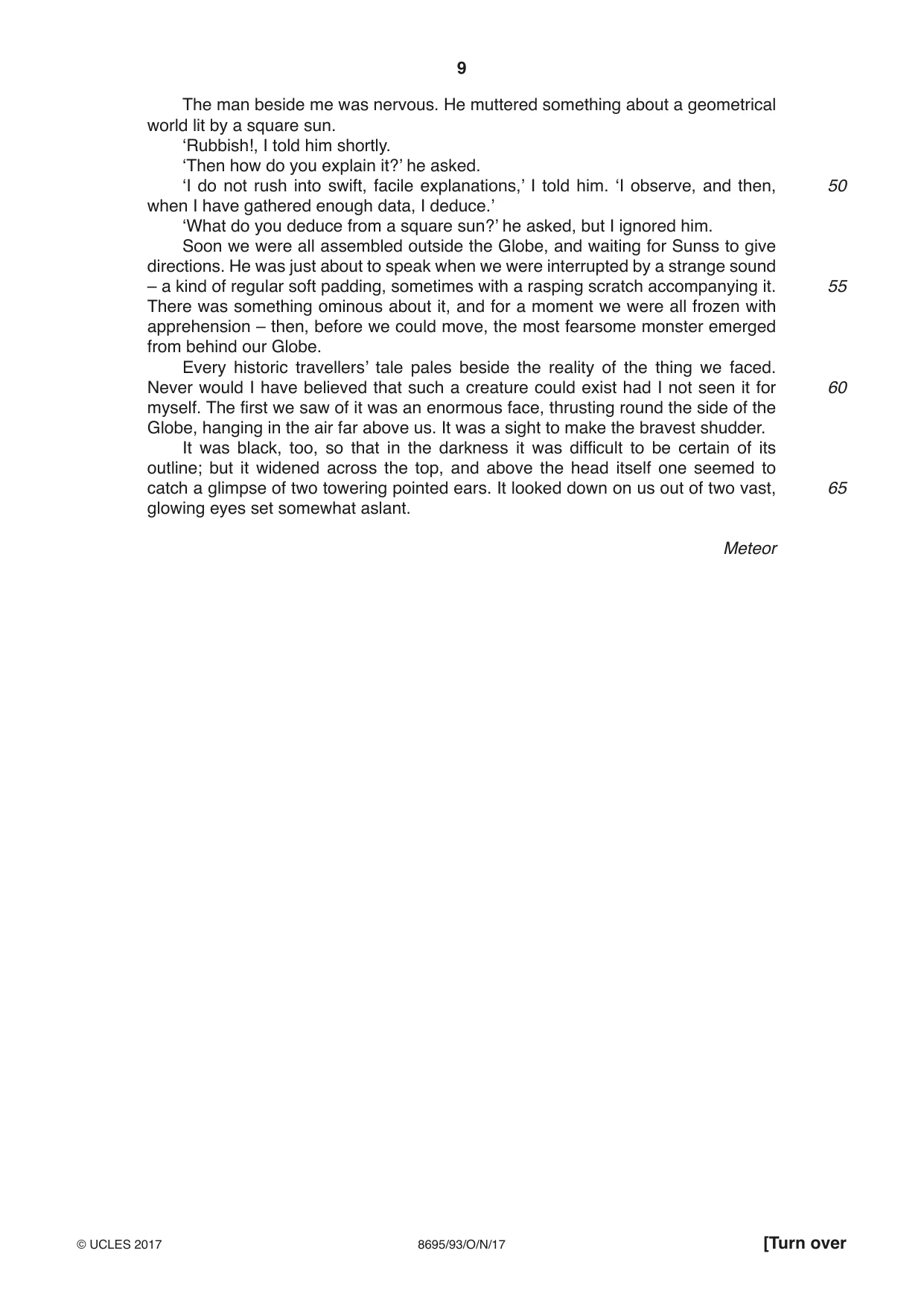
9 8695/93/O/N/17 © UCLES 2017 [Turn over The man beside me was nervous. He muttered something about a geometrical world lit by a square sun. ‘Rubbish!, I told him shortly. ‘Then how do you explain it?’ he asked. ‘I do not rush into swift, facile explanations,’ I told him. ‘I observe, and then, when I have gathered enough data, I deduce.’ ‘What do you deduce from a square sun?’ he asked, but I ignored him. Soon we were all assembled outside the Globe, and waiting for Sunss to give directions. He was just about to speak when we were interrupted by a strange sound – a kind of regular soft padding, sometimes with a rasping scratch accompanying it. There was something ominous about it, and for a moment we were all frozen with apprehension – then, before we could move, the most fearsome monster emerged from behind our Globe. Every historic travellers’ tale pales beside the reality of the thing we faced. Never would I have believed that such a creature could exist had I not seen it for myself. The first we saw of it was an enormous face, thrusting round the side of the Globe, hanging in the air far above us. It was a sight to make the bravest shudder. It was black, too, so that in the darkness it was difficult to be certain of its outline; but it widened across the top, and above the head itself one seemed to catch a glimpse of two towering pointed ears. It looked down on us out of two vast, glowing eyes set somewhat aslant. Meteor 50 55 60 65
Question paper, page 10
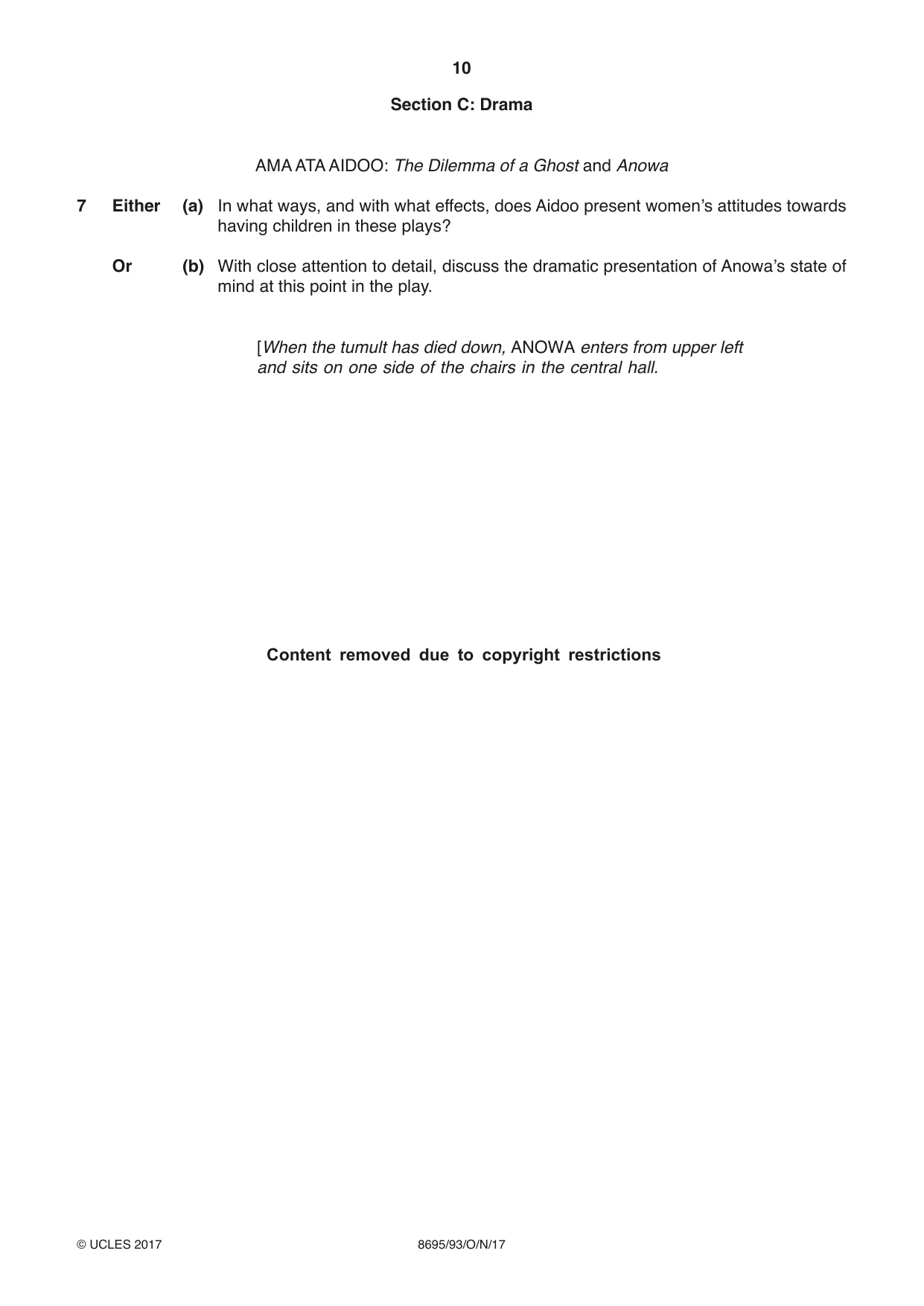
10 8695/93/O/N/17 © UCLES 2017 Section C: Drama AMA ATA AIDOO: The Dilemma of a Ghost and Anowa 7 Either (a) In what ways, and with what effects, does Aidoo present women’s attitudes towards having children in these plays? Or (b) With close attention to detail, discuss the dramatic presentation of Anowa’s state of mind at this point in the play. Content removed due to copyright restrictions [When the tumult has died down, ANOWA enters from upper left and sits on one side of the chairs in the central hall.
Question paper, page 11
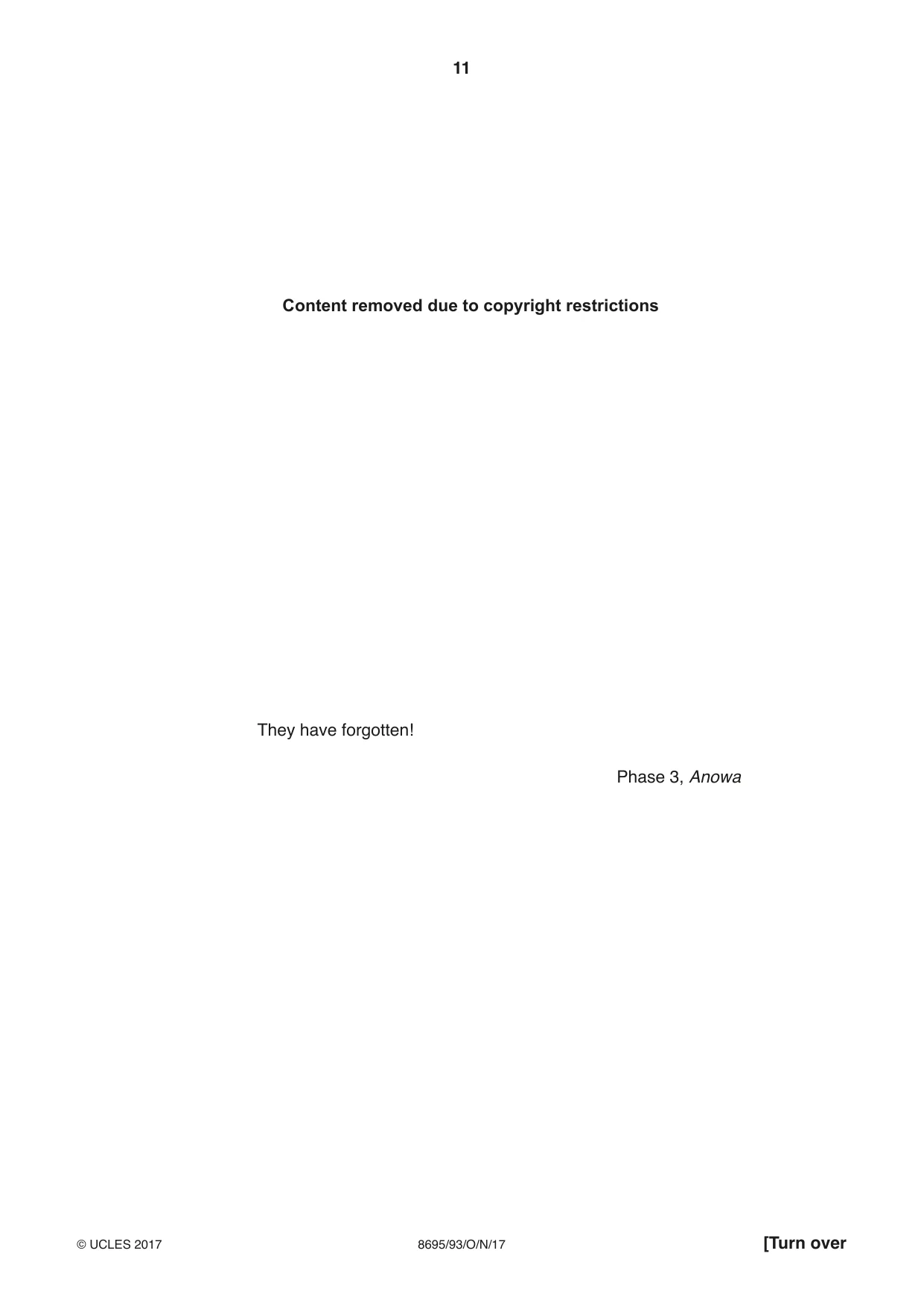
11 8695/93/O/N/17 © UCLES 2017 [Turn over Content removed due to copyright restrictions They have forgotten! Phase 3, Anowa
Question paper, page 12
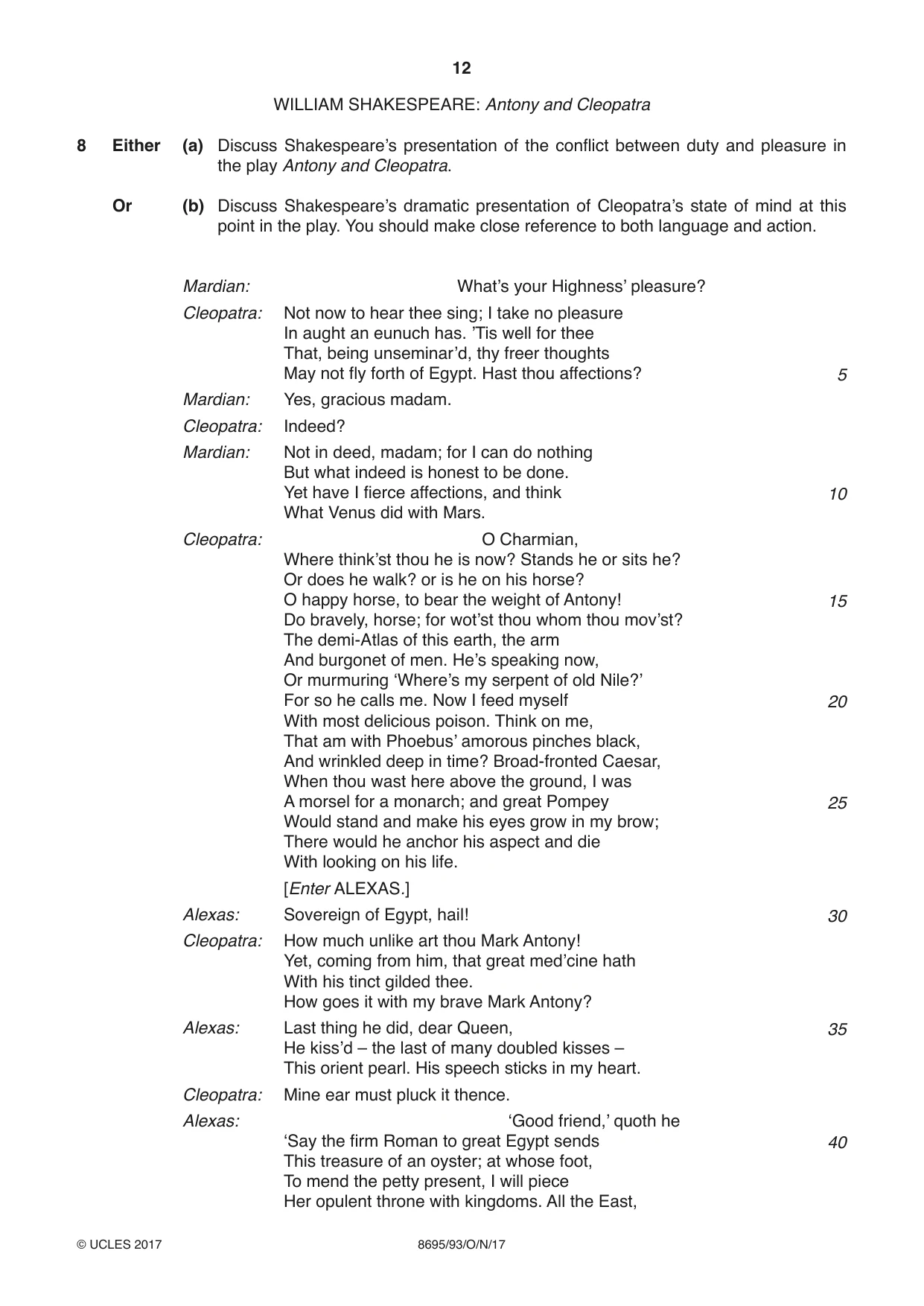
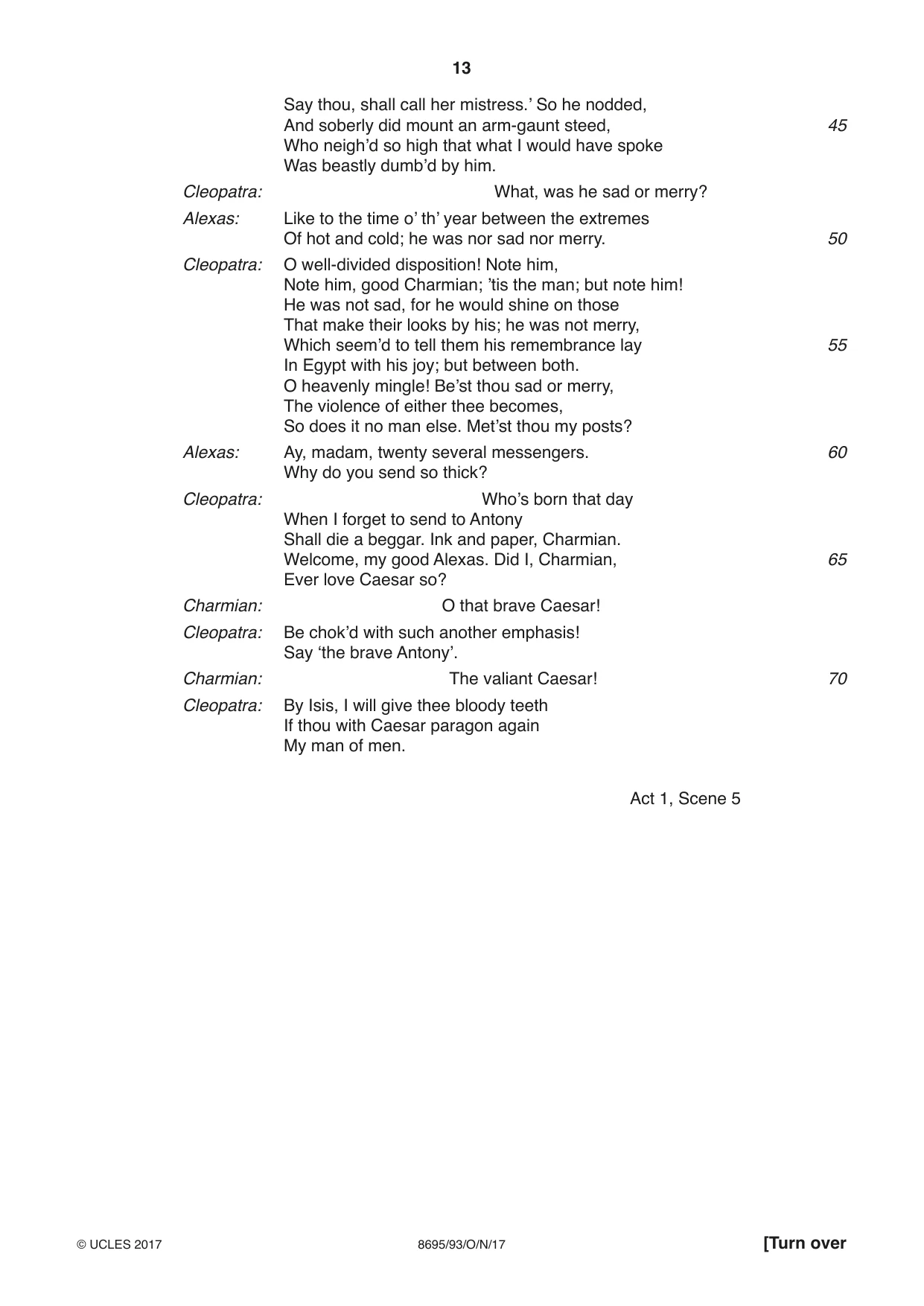
12 8695/93/O/N/17 © UCLES 2017 WILLIAM SHAKESPEARE: Antony and Cleopatra 8 Either (a) Discuss Shakespeare’s presentation of the conflict between duty and pleasure in the play Antony and Cleopatra. Or (b) Discuss Shakespeare’s dramatic presentation of Cleopatra’s state of mind at this point in the play. You should make close reference to both language and action. Mardian: What’s your Highness’ pleasure? Cleopatra: Not now to hear thee sing; I take no pleasure In aught an eunuch has. ’Tis well for thee That, being unseminar’d, thy freer thoughts May not fly forth of Egypt. Hast thou affections? Mardian: Yes, gracious madam. Cleopatra: Indeed? Mardian: Not in deed, madam; for I can do nothing But what indeed is honest to be done. Yet have I fierce affections, and think What Venus did with Mars. Cleopatra: O Charmian, Where think’st thou he is now? Stands he or sits he? Or does he walk? or is he on his horse? O happy horse, to bear the weight of Antony! Do bravely, horse; for wot’st thou whom thou mov’st? The demi-Atlas of this earth, the arm And burgonet of men. He’s speaking now, Or murmuring ‘Where’s my serpent of old Nile?’ For so he calls me. Now I feed myself With most delicious poison. Think on me, That am with Phoebus’ amorous pinches black, And wrinkled deep in time? Broad-fronted Caesar, When thou wast here above the ground, I was A morsel for a monarch; and great Pompey Would stand and make his eyes grow in my brow; There would he anchor his aspect and die With looking on his life. [Enter ALEXAS.] Alexas: Sovereign of Egypt, hail! Cleopatra: How much unlike art thou Mark Antony! Yet, coming from him, that great med’cine hath With his tinct gilded thee. How goes it with my brave Mark Antony? Alexas: Last thing he did, dear Queen, He kiss’d – the last of many doubled kisses – This orient pearl. His speech sticks in my heart. Cleopatra: Mine ear must pluck it thence. Alexas: ‘Good friend,’ quoth he ‘Say the firm Roman to great Egypt sends This treasure of an oyster; at whose foot, To mend the petty present, I will piece Her opulent throne with kingdoms. All the East, 5 10 15 20 25 30 35 40
Question paper, page 13
13 8695/93/O/N/17 © UCLES 2017 [Turn over Say thou, shall call her mistress.’ So he nodded, And soberly did mount an arm-gaunt steed, Who neigh’d so high that what I would have spoke Was beastly dumb’d by him. Cleopatra: What, was he sad or merry? Alexas: Like to the time o’ th’ year between the extremes Of hot and cold; he was nor sad nor merry. Cleopatra: O well-divided disposition! Note him, Note him, good Charmian; ’tis the man; but note him! He was not sad, for he would shine on those That make their looks by his; he was not merry, Which seem’d to tell them his remembrance lay In Egypt with his joy; but between both. O heavenly mingle! Be’st thou sad or merry, The violence of either thee becomes, So does it no man else. Met’st thou my posts? Alexas: Ay, madam, twenty several messengers. Why do you send so thick? Cleopatra: Who’s born that day When I forget to send to Antony Shall die a beggar. Ink and paper, Charmian. Welcome, my good Alexas. Did I, Charmian, Ever love Caesar so? Charmian: O that brave Caesar! Cleopatra: Be chok’d with such another emphasis! Say ‘the brave Antony’. Charmian: The valiant Caesar! Cleopatra: By Isis, I will give thee bloody teeth If thou with Caesar paragon again My man of men. Act 1, Scene 5 45 50 55 60 65 70
Question paper, page 14
14 8695/93/O/N/17 © UCLES 2017 BRIAN FRIEL: Philadelphia, Here I Come! 9 Either (a) Discuss Friel’s dramatic presentation of Ireland in the play. Or (b) How, and with what dramatic effects, does Friel present Gar’s situation at this point in the play? You should comment closely on both the language and the action. [Kitchen in the home of County Councillor S. B. O’Donnell who owns a general shop. Content removed due to copyright restrictions
Question paper, page 15
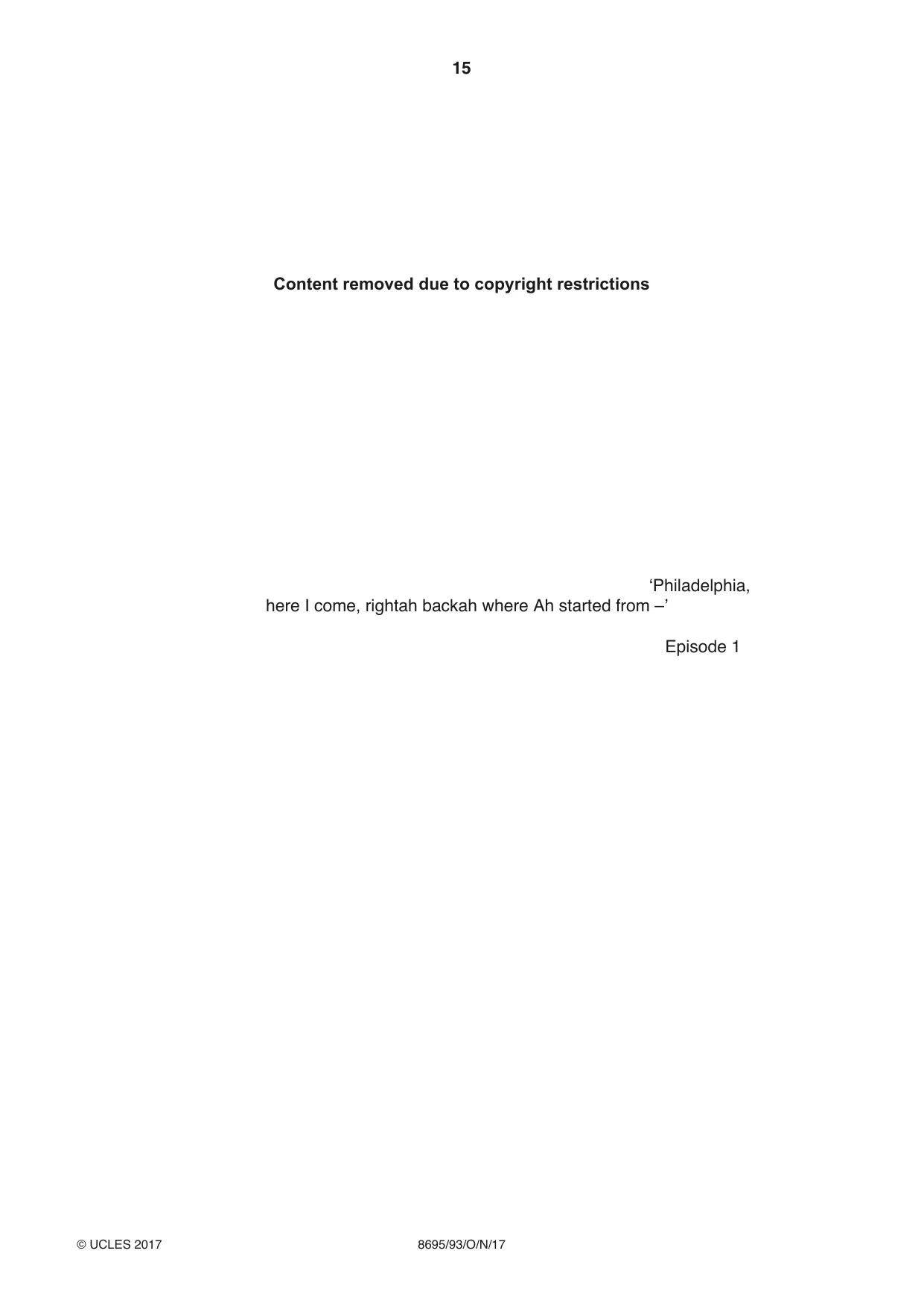
15 8695/93/O/N/17 © UCLES 2017 Content removed due to copyright restrictions and does a few exuberant steps as he sings – ] ‘Philadelphia, here I come, rightah backah where Ah started from –’ Episode 1
Question paper, page 16
16 8695/93/O/N/17 © UCLES 2017 BLANK PAGE Permission to reproduce items where third-party owned material protected by copyright is included has been sought and cleared where possible. Every reasonable effort has been made by the publisher (UCLES) to trace copyright holders, but if any items requiring clearance have unwittingly been included, the publisher will be pleased to make amends at the earliest possible opportunity. To avoid the issue of disclosure of answer-related information to candidates, all copyright acknowledgements are reproduced online in the Cambridge International Examinations Copyright Acknowledgements Booklet. This is produced for each series of examinations and is freely available to download at www.cie.org.uk after the live examination series. Cambridge International Examinations is part of the Cambridge Assessment Group. Cambridge Assessment is the brand name of University of Cambridge Local Examinations Syndicate (UCLES), which is itself a department of the University of Cambridge.
Mark scheme, page 1
® IGCSE is a registered trademark. This document consists of 5 printed pages. © UCLES 2017 [Turn over Cambridge Assessment International Education Cambridge International Advanced Subsidiary Level LANGUAGE AND LITERATURE IN ENGLISH 8695/93 Paper 9 Poetry, Prose and Drama October/November 2017 MARK SCHEME Maximum Mark: 50 Published This mark scheme is published as an aid to teachers and candidates, to indicate the requirements of the examination. It shows the basis on which Examiners were instructed to award marks. It does not indicate the details of the discussions that took place at an Examiners’ meeting before marking began, which would have considered the acceptability of alternative answers. Mark schemes should be read in conjunction with the question paper and the Principal Examiner Report for Teachers. Cambridge International will not enter into discussions about these mark schemes. Cambridge International is publishing the mark schemes for the October/November 2017 series for most Cambridge IGCSE®, Cambridge International A and AS Level components and some Cambridge O Level components.
Mark scheme, page 2
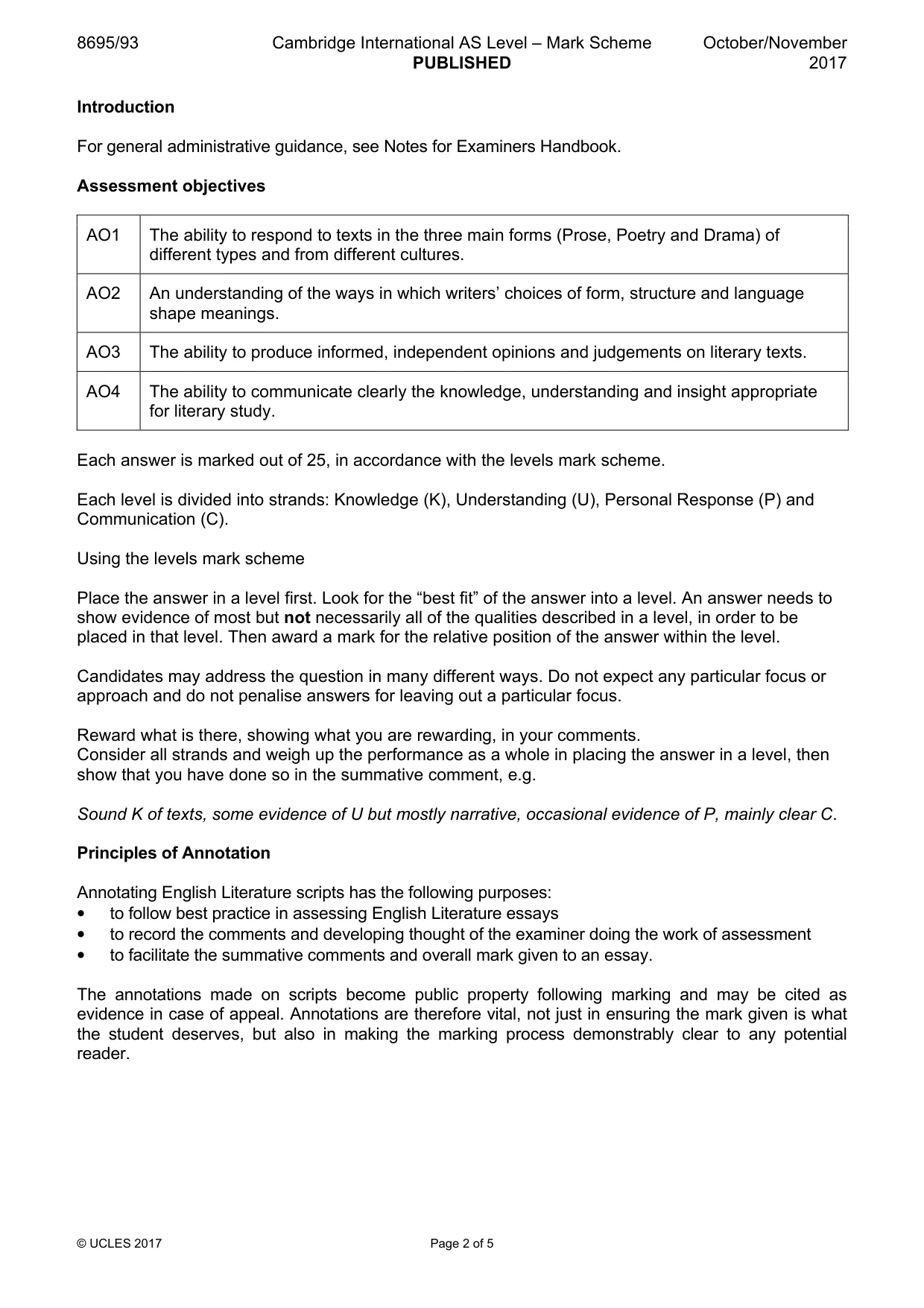
8695/93 Cambridge International AS Level – Mark Scheme PUBLISHED October/November 2017 © UCLES 2017 Page 2 of 5 Introduction For general administrative guidance, see Notes for Examiners Handbook. Assessment objectives AO1 The ability to respond to texts in the three main forms (Prose, Poetry and Drama) of different types and from different cultures. AO2 An understanding of the ways in which writers’ choices of form, structure and language shape meanings. AO3 The ability to produce informed, independent opinions and judgements on literary texts. AO4 The ability to communicate clearly the knowledge, understanding and insight appropriate for literary study. Each answer is marked out of 25, in accordance with the levels mark scheme. Each level is divided into strands: Knowledge (K), Understanding (U), Personal Response (P) and Communication (C). Using the levels mark scheme Place the answer in a level first. Look for the “best fit” of the answer into a level. An answer needs to show evidence of most but not necessarily all of the qualities described in a level, in order to be placed in that level. Then award a mark for the relative position of the answer within the level. Candidates may address the question in many different ways. Do not expect any particular focus or approach and do not penalise answers for leaving out a particular focus. Reward what is there, showing what you are rewarding, in your comments. Consider all strands and weigh up the performance as a whole in placing the answer in a level, then show that you have done so in the summative comment, e.g. Sound K of texts, some evidence of U but mostly narrative, occasional evidence of P, mainly clear C. Principles of Annotation Annotating English Literature scripts has the following purposes: • to follow best practice in assessing English Literature essays • to record the comments and developing thought of the examiner doing the work of assessment • to facilitate the summative comments and overall mark given to an essay. The annotations made on scripts become public property following marking and may be cited as evidence in case of appeal. Annotations are therefore vital, not just in ensuring the mark given is what the student deserves, but also in making the marking process demonstrably clear to any potential reader.
Mark scheme, page 3
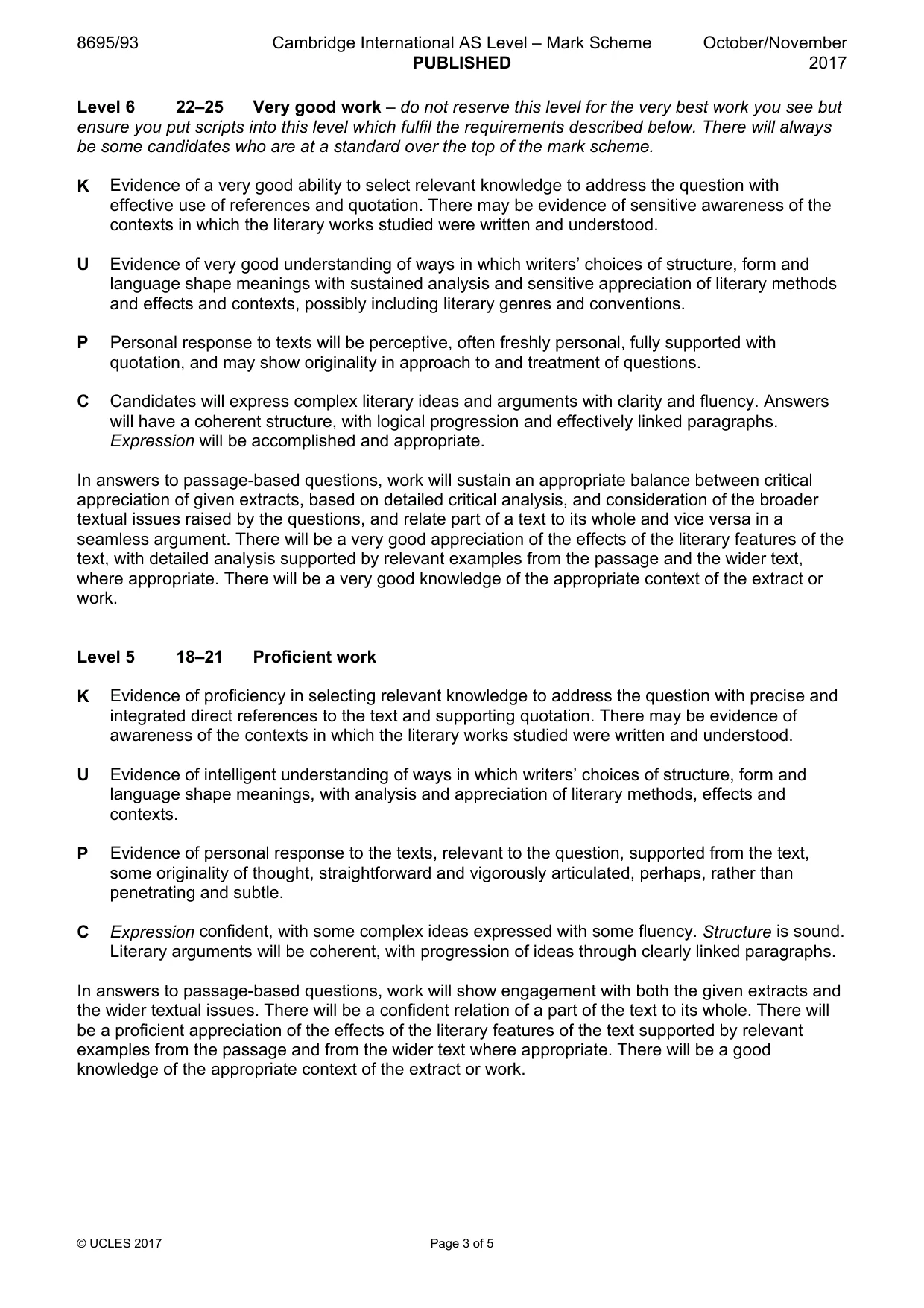
8695/93 Cambridge International AS Level – Mark Scheme PUBLISHED October/November 2017 © UCLES 2017 Page 3 of 5 Level 6 22–25 Very good work – do not reserve this level for the very best work you see but ensure you put scripts into this level which fulfil the requirements described below. There will always be some candidates who are at a standard over the top of the mark scheme. K Evidence of a very good ability to select relevant knowledge to address the question with effective use of references and quotation. There may be evidence of sensitive awareness of the contexts in which the literary works studied were written and understood. U Evidence of very good understanding of ways in which writers’ choices of structure, form and language shape meanings with sustained analysis and sensitive appreciation of literary methods and effects and contexts, possibly including literary genres and conventions. P Personal response to texts will be perceptive, often freshly personal, fully supported with quotation, and may show originality in approach to and treatment of questions. C Candidates will express complex literary ideas and arguments with clarity and fluency. Answers will have a coherent structure, with logical progression and effectively linked paragraphs. Expression will be accomplished and appropriate. In answers to passage-based questions, work will sustain an appropriate balance between critical appreciation of given extracts, based on detailed critical analysis, and consideration of the broader textual issues raised by the questions, and relate part of a text to its whole and vice versa in a seamless argument. There will be a very good appreciation of the effects of the literary features of the text, with detailed analysis supported by relevant examples from the passage and the wider text, where appropriate. There will be a very good knowledge of the appropriate context of the extract or work. Level 5 18–21 Proficient work K Evidence of proficiency in selecting relevant knowledge to address the question with precise and integrated direct references to the text and supporting quotation. There may be evidence of awareness of the contexts in which the literary works studied were written and understood. U Evidence of intelligent understanding of ways in which writers’ choices of structure, form and language shape meanings, with analysis and appreciation of literary methods, effects and contexts. P Evidence of personal response to the texts, relevant to the question, supported from the text, some originality of thought, straightforward and vigorously articulated, perhaps, rather than penetrating and subtle. C Expression confident, with some complex ideas expressed with some fluency. Structure is sound. Literary arguments will be coherent, with progression of ideas through clearly linked paragraphs. In answers to passage-based questions, work will show engagement with both the given extracts and the wider textual issues. There will be a confident relation of a part of the text to its whole. There will be a proficient appreciation of the effects of the literary features of the text supported by relevant examples from the passage and from the wider text where appropriate. There will be a good knowledge of the appropriate context of the extract or work.
Mark scheme, page 4
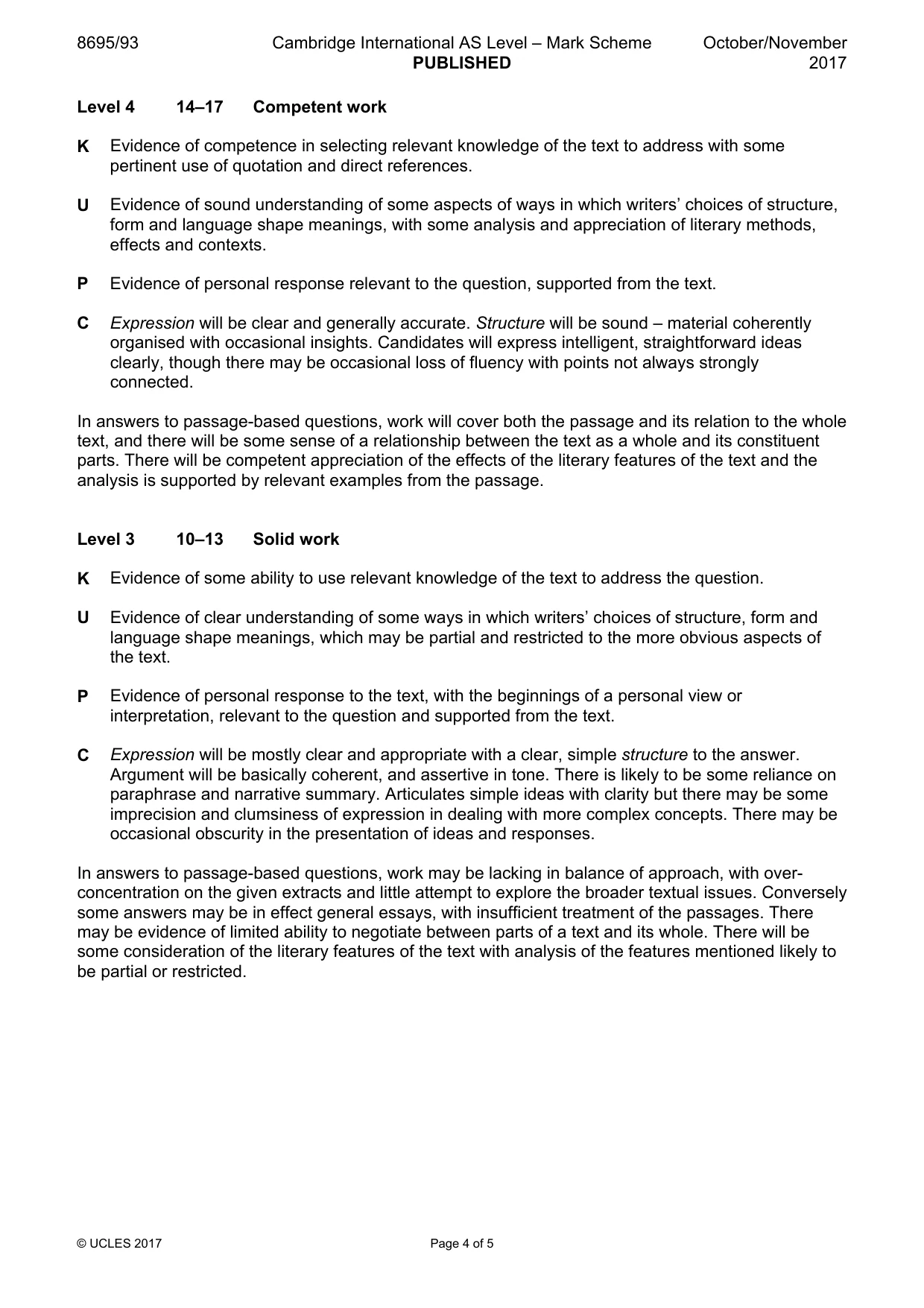
8695/93 Cambridge International AS Level – Mark Scheme PUBLISHED October/November 2017 © UCLES 2017 Page 4 of 5 Level 4 14–17 Competent work K Evidence of competence in selecting relevant knowledge of the text to address with some pertinent use of quotation and direct references. U Evidence of sound understanding of some aspects of ways in which writers’ choices of structure, form and language shape meanings, with some analysis and appreciation of literary methods, effects and contexts. P Evidence of personal response relevant to the question, supported from the text. C Expression will be clear and generally accurate. Structure will be sound – material coherently organised with occasional insights. Candidates will express intelligent, straightforward ideas clearly, though there may be occasional loss of fluency with points not always strongly connected. In answers to passage-based questions, work will cover both the passage and its relation to the whole text, and there will be some sense of a relationship between the text as a whole and its constituent parts. There will be competent appreciation of the effects of the literary features of the text and the analysis is supported by relevant examples from the passage. Level 3 10–13 Solid work K Evidence of some ability to use relevant knowledge of the text to address the question. U Evidence of clear understanding of some ways in which writers’ choices of structure, form and language shape meanings, which may be partial and restricted to the more obvious aspects of the text. P Evidence of personal response to the text, with the beginnings of a personal view or interpretation, relevant to the question and supported from the text. C Expression will be mostly clear and appropriate with a clear, simple structure to the answer. Argument will be basically coherent, and assertive in tone. There is likely to be some reliance on paraphrase and narrative summary. Articulates simple ideas with clarity but there may be some imprecision and clumsiness of expression in dealing with more complex concepts. There may be occasional obscurity in the presentation of ideas and responses. In answers to passage-based questions, work may be lacking in balance of approach, with over- concentration on the given extracts and little attempt to explore the broader textual issues. Conversely some answers may be in effect general essays, with insufficient treatment of the passages. There may be evidence of limited ability to negotiate between parts of a text and its whole. There will be some consideration of the literary features of the text with analysis of the features mentioned likely to be partial or restricted.
Mark scheme, page 5
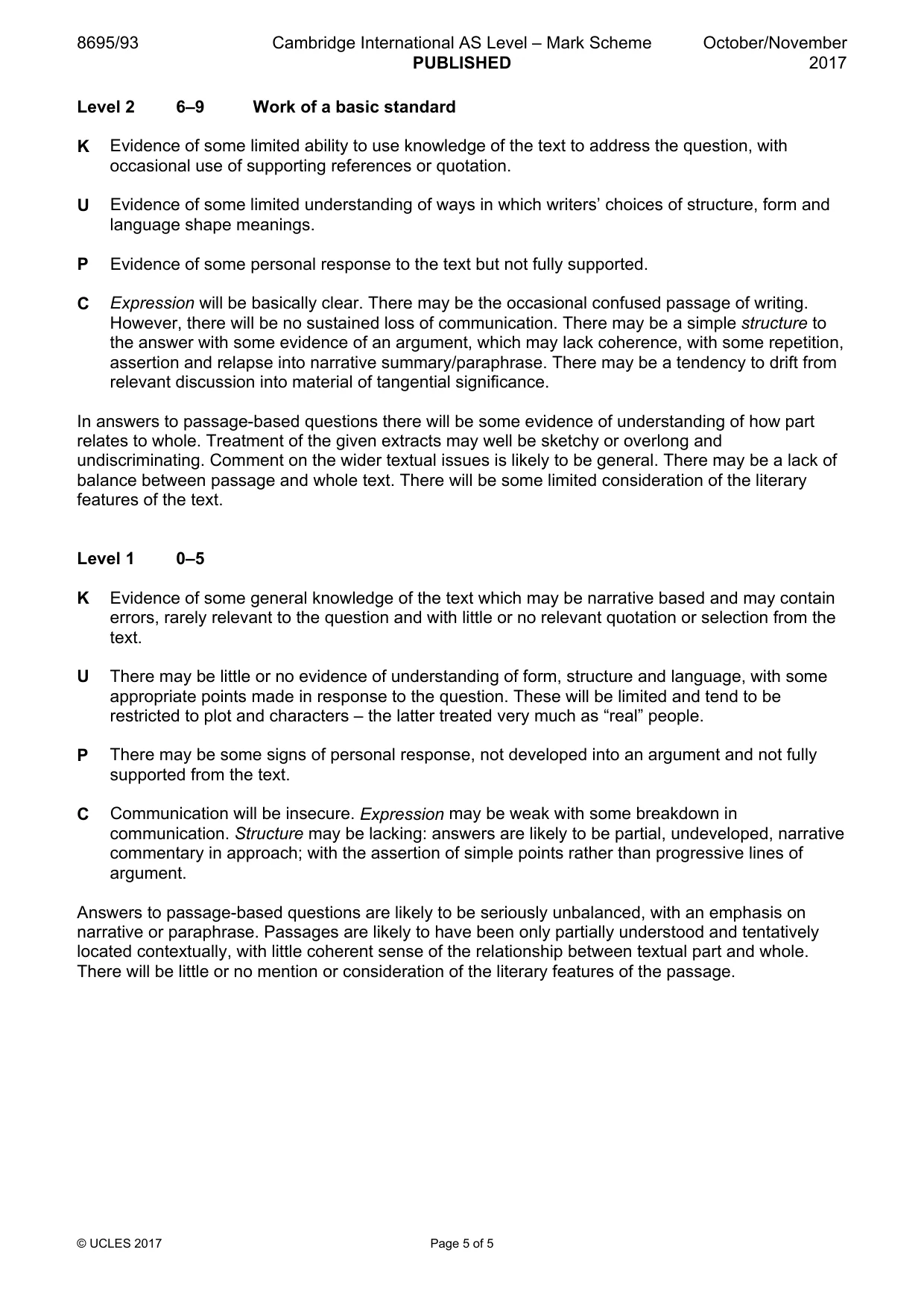
8695/93 Cambridge International AS Level – Mark Scheme PUBLISHED October/November 2017 © UCLES 2017 Page 5 of 5 Level 2 6–9 Work of a basic standard K Evidence of some limited ability to use knowledge of the text to address the question, with occasional use of supporting references or quotation. U Evidence of some limited understanding of ways in which writers’ choices of structure, form and language shape meanings. P Evidence of some personal response to the text but not fully supported. C Expression will be basically clear. There may be the occasional confused passage of writing. However, there will be no sustained loss of communication. There may be a simple structure to the answer with some evidence of an argument, which may lack coherence, with some repetition, assertion and relapse into narrative summary/paraphrase. There may be a tendency to drift from relevant discussion into material of tangential significance. In answers to passage-based questions there will be some evidence of understanding of how part relates to whole. Treatment of the given extracts may well be sketchy or overlong and undiscriminating. Comment on the wider textual issues is likely to be general. There may be a lack of balance between passage and whole text. There will be some limited consideration of the literary features of the text. Level 1 0–5 K Evidence of some general knowledge of the text which may be narrative based and may contain errors, rarely relevant to the question and with little or no relevant quotation or selection from the text. U There may be little or no evidence of understanding of form, structure and language, with some appropriate points made in response to the question. These will be limited and tend to be restricted to plot and characters – the latter treated very much as “real” people. P There may be some signs of personal response, not developed into an argument and not fully supported from the text. C Communication will be insecure. Expression may be weak with some breakdown in communication. Structure may be lacking: answers are likely to be partial, undeveloped, narrative commentary in approach; with the assertion of simple points rather than progressive lines of argument. Answers to passage-based questions are likely to be seriously unbalanced, with an emphasis on narrative or paraphrase. Passages are likely to have been only partially understood and tentatively located contextually, with little coherent sense of the relationship between textual part and whole. There will be little or no mention or consideration of the literary features of the passage.
What you needed in this session
Cambridge’s own grade thresholds for 2017 Oct/Nov, Paper 9 · Variant 3. A higher threshold means an easier paper — the bar moves with how the cohort did.