Cambridge A Level English - Language and Literature (AS Level only, from 2016) 8695 — 2019 May/June Paper 9 · Variant 2
8695/92/M/J/19 · 50 marks · ≈56 min
The question paper and its mark scheme, free to read here and free to download. This is Cambridge’s own paper, exactly as it was sat.
Question paper20 pages




Mark scheme6 pages
Answers below. Sit the paper first if you are practising.
Paper as text
Question paper, page 1
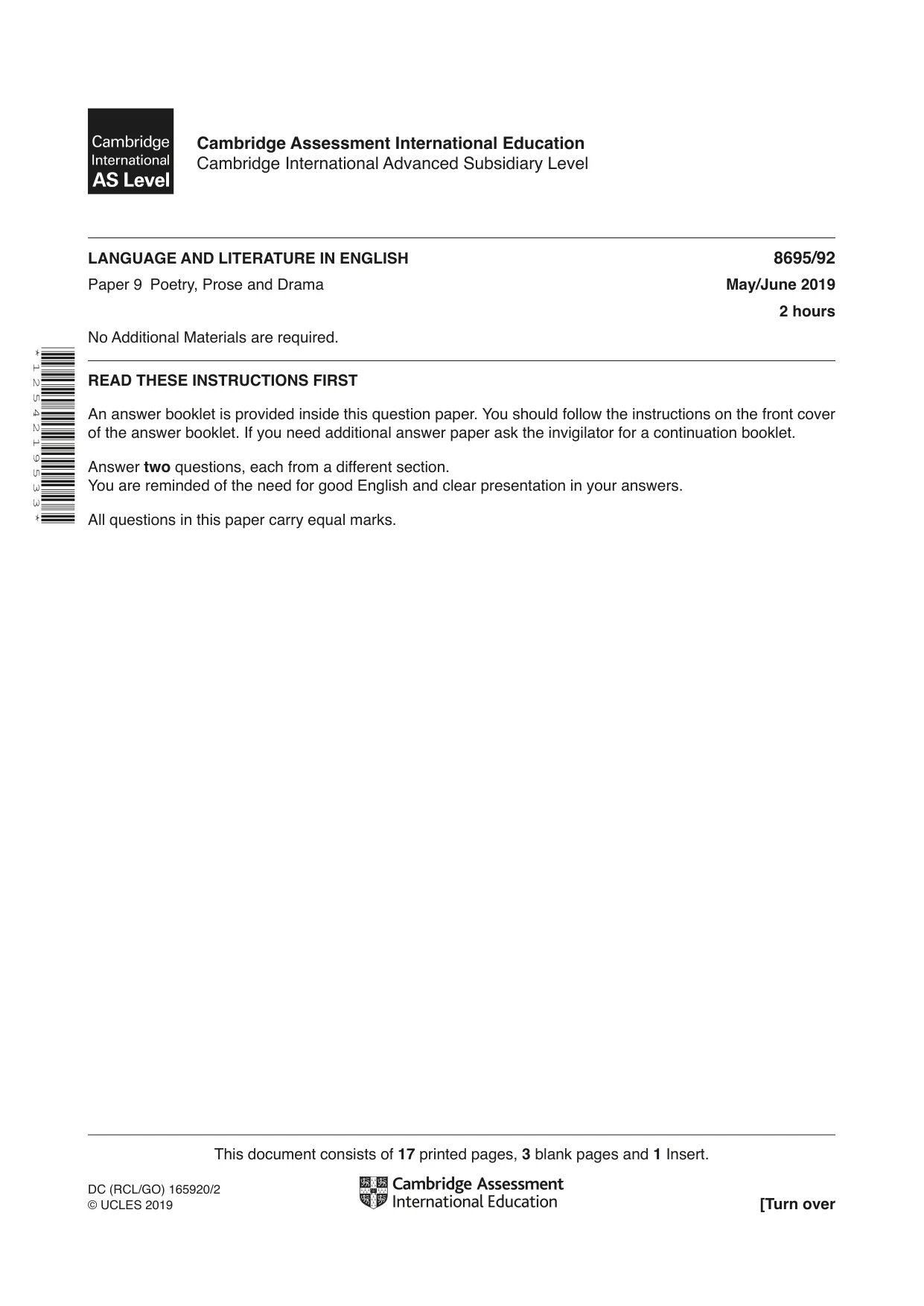
This document consists of 17 printed pages, 3 blank pages and 1 Insert. DC (RCL/GO) 165920/2 © UCLES 2019 [Turn over Cambridge Assessment International Education Cambridge International Advanced Subsidiary Level LANGUAGE AND LITERATURE IN ENGLISH 8695/92 Paper 9 Poetry, Prose and Drama May/June 2019 2 hours No Additional Materials are required. READ THESE INSTRUCTIONS FIRST An answer booklet is provided inside this question paper. You should follow the instructions on the front cover of the answer booklet. If you need additional answer paper ask the invigilator for a continuation booklet. Answer two questions, each from a different section. You are reminded of the need for good English and clear presentation in your answers. All questions in this paper carry equal marks. * 1 2 5 4 2 1 9 5 3 3 *
Question paper, page 2
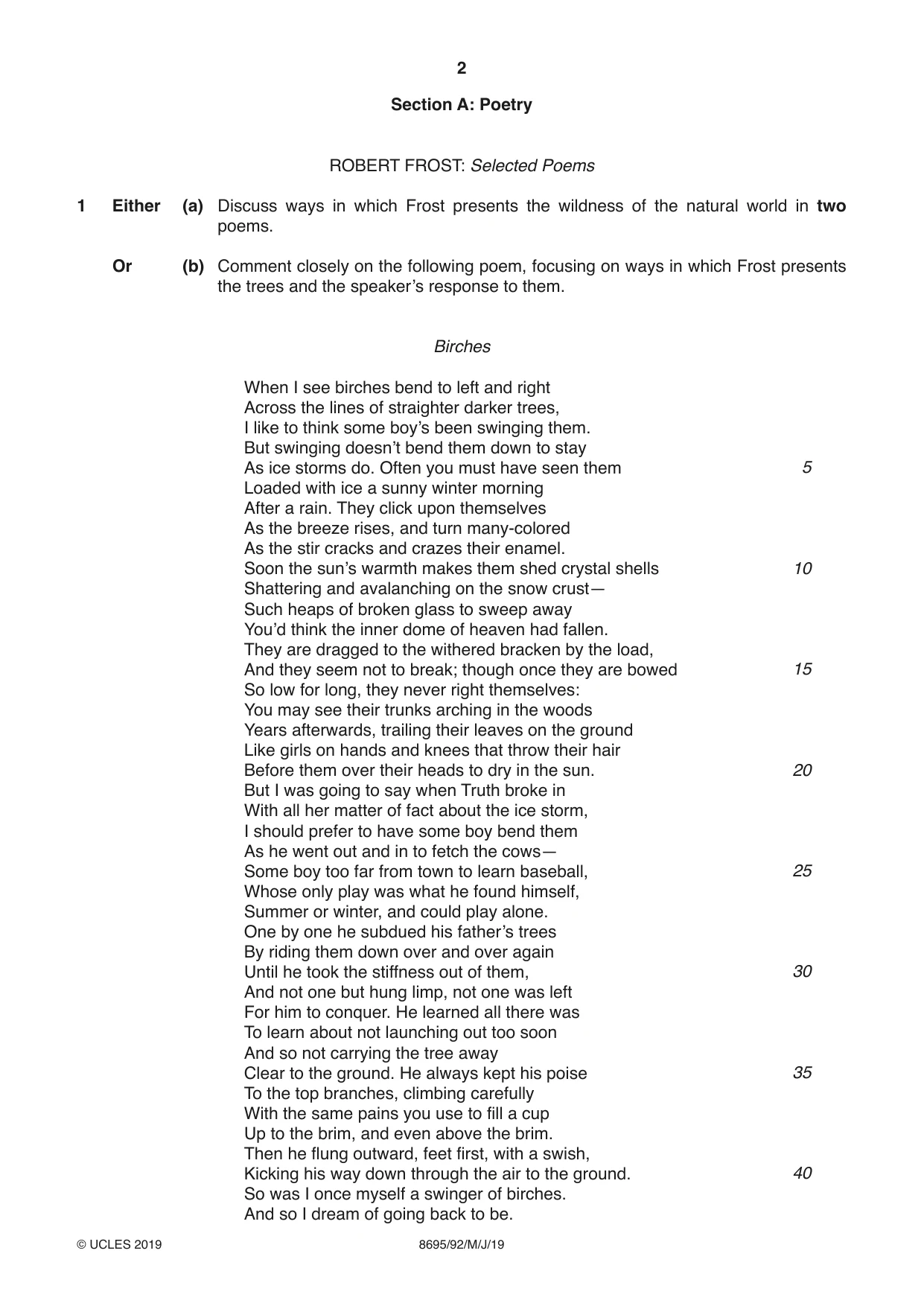
2 8695/92/M/J/19 © UCLES 2019 Section A: Poetry ROBERT FROST: Selected Poems 1 Either (a) Discuss ways in which Frost presents the wildness of the natural world in two poems. Or (b) Comment closely on the following poem, focusing on ways in which Frost presents the trees and the speaker’s response to them. Birches When I see birches bend to left and right Across the lines of straighter darker trees, I like to think some boy’s been swinging them. But swinging doesn’t bend them down to stay As ice storms do. Often you must have seen them Loaded with ice a sunny winter morning After a rain. They click upon themselves As the breeze rises, and turn many-colored As the stir cracks and crazes their enamel. Soon the sun’s warmth makes them shed crystal shells Shattering and avalanching on the snow crust— Such heaps of broken glass to sweep away You’d think the inner dome of heaven had fallen. They are dragged to the withered bracken by the load, And they seem not to break; though once they are bowed So low for long, they never right themselves: You may see their trunks arching in the woods Years afterwards, trailing their leaves on the ground Like girls on hands and knees that throw their hair Before them over their heads to dry in the sun. But I was going to say when Truth broke in With all her matter of fact about the ice storm, I should prefer to have some boy bend them As he went out and in to fetch the cows— Some boy too far from town to learn baseball, Whose only play was what he found himself, Summer or winter, and could play alone. One by one he subdued his father’s trees By riding them down over and over again Until he took the stiffness out of them, And not one but hung limp, not one was left For him to conquer. He learned all there was To learn about not launching out too soon And so not carrying the tree away Clear to the ground. He always kept his poise To the top branches, climbing carefully With the same pains you use to fill a cup Up to the brim, and even above the brim. Then he flung outward, feet first, with a swish, Kicking his way down through the air to the ground. So was I once myself a swinger of birches. And so I dream of going back to be. 5 10 15 20 25 30 35 40
Question paper, page 3
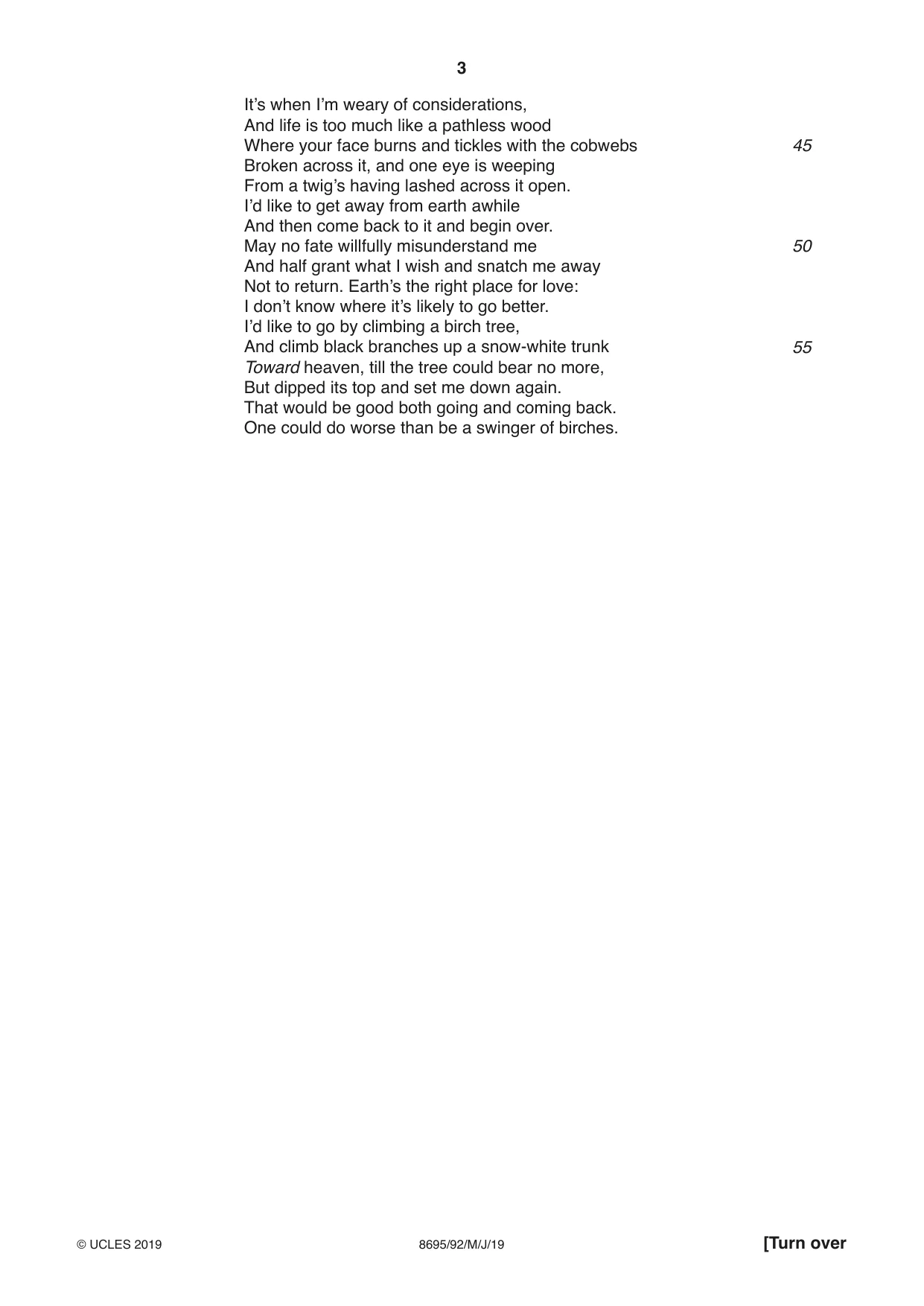
3 8695/92/M/J/19 © UCLES 2019 [Turn over It’s when I’m weary of considerations, And life is too much like a pathless wood Where your face burns and tickles with the cobwebs Broken across it, and one eye is weeping From a twig’s having lashed across it open. I’d like to get away from earth awhile And then come back to it and begin over. May no fate willfully misunderstand me And half grant what I wish and snatch me away Not to return. Earth’s the right place for love: I don’t know where it’s likely to go better. I’d like to go by climbing a birch tree, And climb black branches up a snow-white trunk Toward heaven, till the tree could bear no more, But dipped its top and set me down again. That would be good both going and coming back. One could do worse than be a swinger of birches. 45 50 55
Question paper, page 4
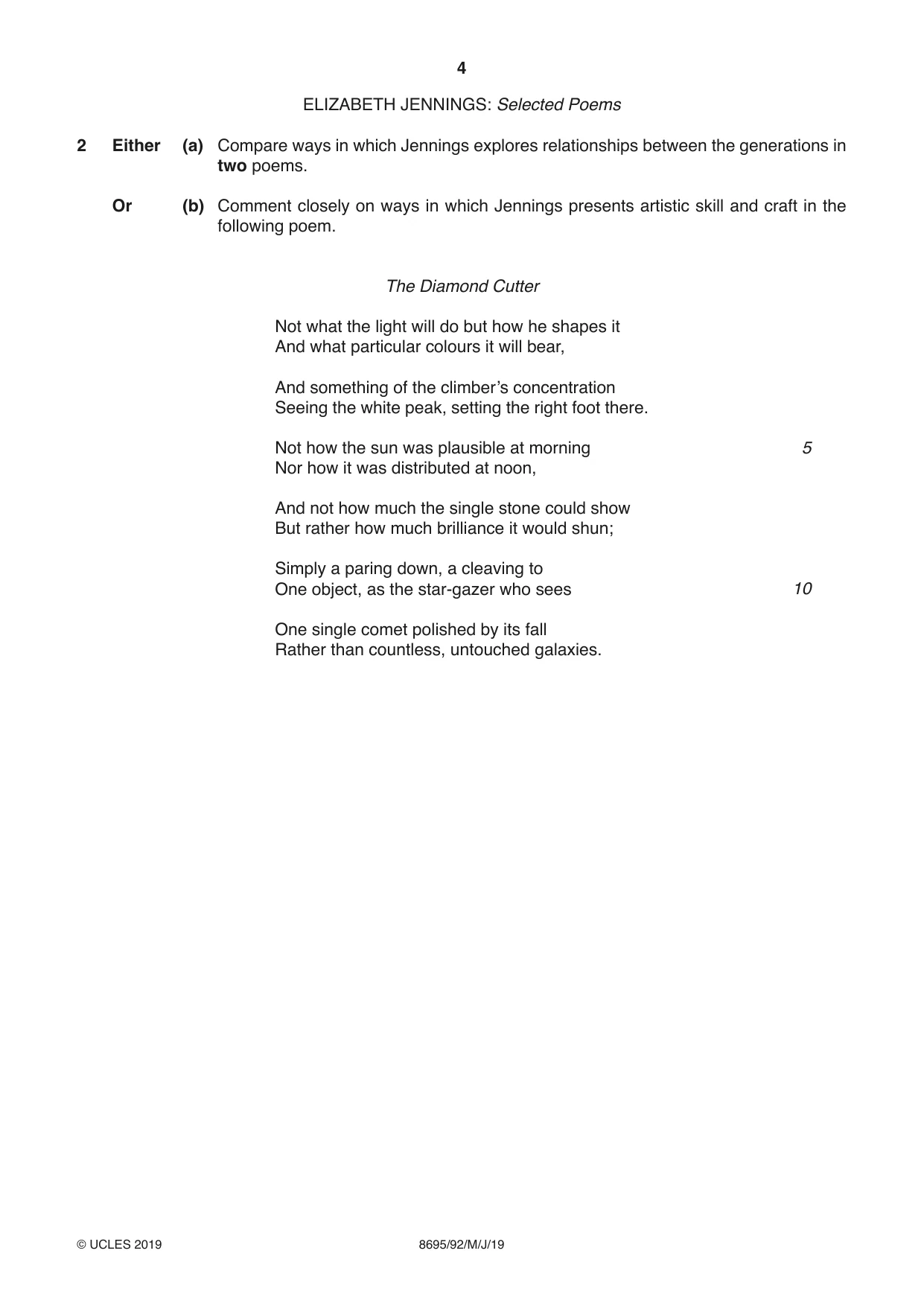
4 8695/92/M/J/19 © UCLES 2019 ELIZABETH JENNINGS: Selected Poems 2 Either (a) Compare ways in which Jennings explores relationships between the generations in two poems. Or (b) Comment closely on ways in which Jennings presents artistic skill and craft in the following poem. The Diamond Cutter Not what the light will do but how he shapes it And what particular colours it will bear, And something of the climber’s concentration Seeing the white peak, setting the right foot there. Not how the sun was plausible at morning Nor how it was distributed at noon, And not how much the single stone could show But rather how much brilliance it would shun; Simply a paring down, a cleaving to One object, as the star-gazer who sees One single comet polished by its fall Rather than countless, untouched galaxies. 5 10
Question paper, page 5
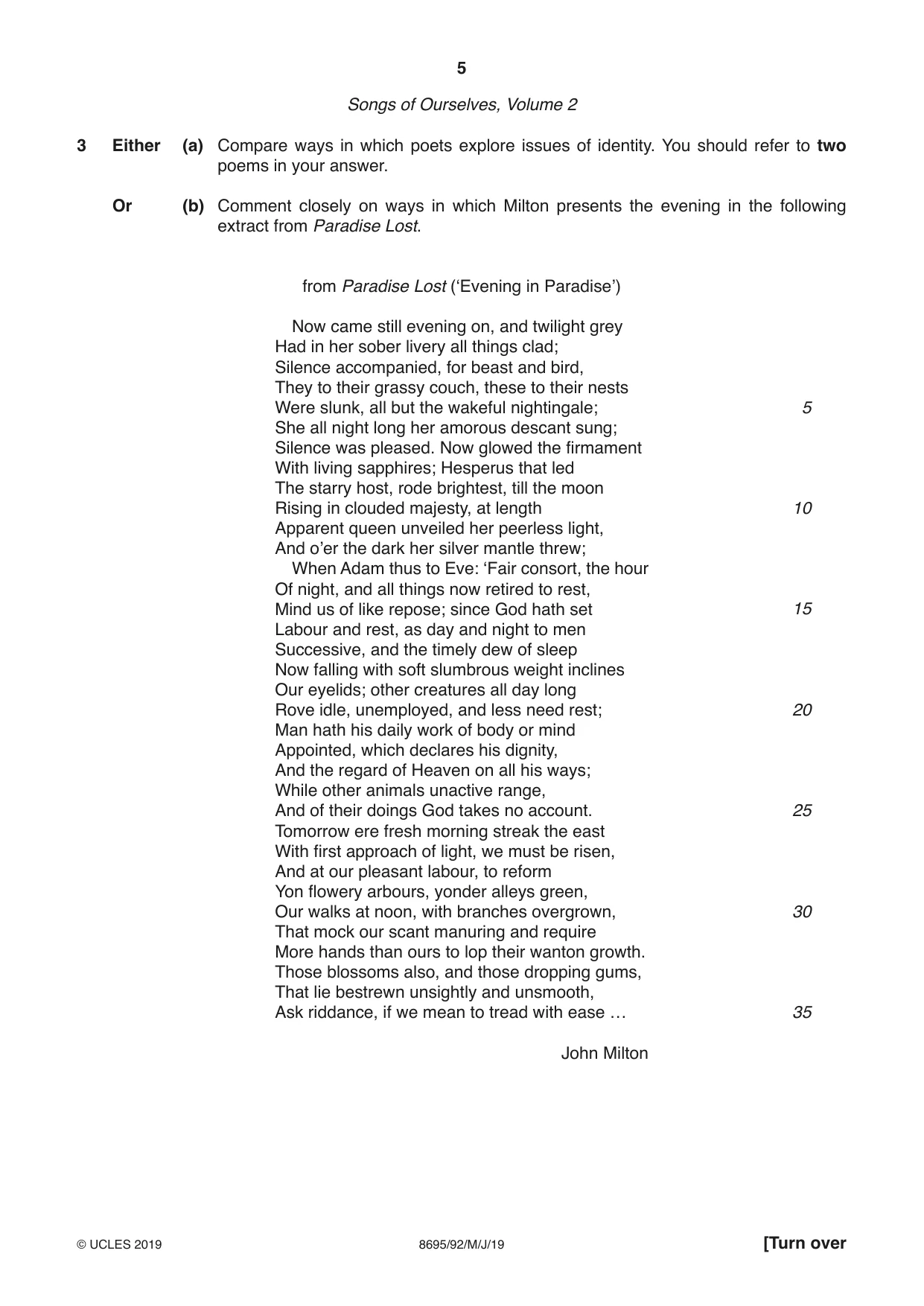
5 8695/92/M/J/19 © UCLES 2019 [Turn over Songs of Ourselves, Volume 2 3 Either (a) Compare ways in which poets explore issues of identity. You should refer to two poems in your answer. Or (b) Comment closely on ways in which Milton presents the evening in the following extract from Paradise Lost. from Paradise Lost (‘Evening in Paradise’) Now came still evening on, and twilight grey Had in her sober livery all things clad; Silence accompanied, for beast and bird, They to their grassy couch, these to their nests Were slunk, all but the wakeful nightingale; She all night long her amorous descant sung; Silence was pleased. Now glowed the firmament With living sapphires; Hesperus that led The starry host, rode brightest, till the moon Rising in clouded majesty, at length Apparent queen unveiled her peerless light, And o’er the dark her silver mantle threw; When Adam thus to Eve: ‘Fair consort, the hour Of night, and all things now retired to rest, Mind us of like repose; since God hath set Labour and rest, as day and night to men Successive, and the timely dew of sleep Now falling with soft slumbrous weight inclines Our eyelids; other creatures all day long Rove idle, unemployed, and less need rest; Man hath his daily work of body or mind Appointed, which declares his dignity, And the regard of Heaven on all his ways; While other animals unactive range, And of their doings God takes no account. Tomorrow ere fresh morning streak the east With first approach of light, we must be risen, And at our pleasant labour, to reform Yon flowery arbours, yonder alleys green, Our walks at noon, with branches overgrown, That mock our scant manuring and require More hands than ours to lop their wanton growth. Those blossoms also, and those dropping gums, That lie bestrewn unsightly and unsmooth, Ask riddance, if we mean to tread with ease … John Milton 5 10 15 20 25 30 35
Question paper, page 6
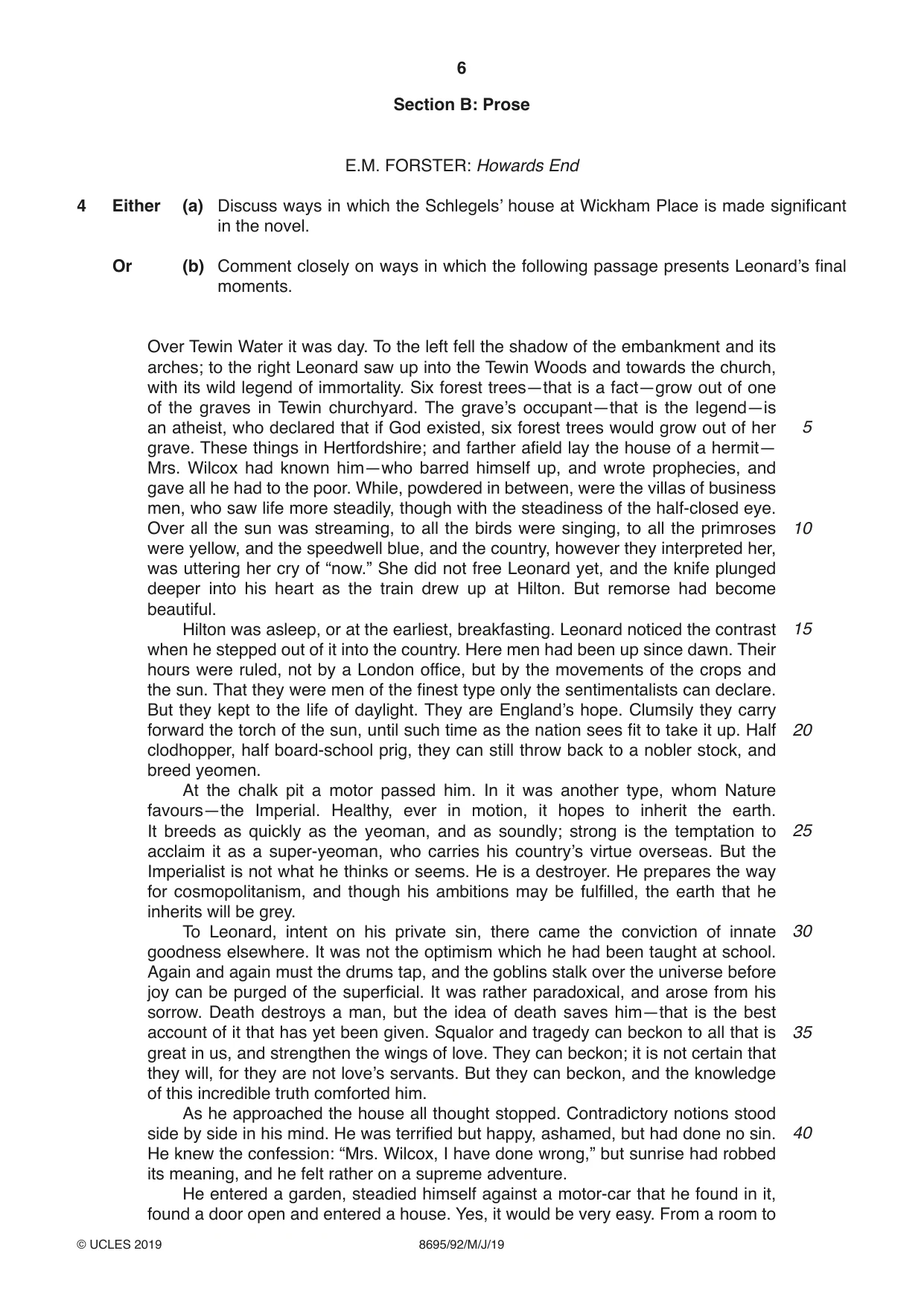
6 8695/92/M/J/19 © UCLES 2019 Section B: Prose E.M. FORSTER: Howards End 4 Either (a) Discuss ways in which the Schlegels’ house at Wickham Place is made significant in the novel. Or (b) Comment closely on ways in which the following passage presents Leonard’s final moments. Over Tewin Water it was day. To the left fell the shadow of the embankment and its arches; to the right Leonard saw up into the Tewin Woods and towards the church, with its wild legend of immortality. Six forest trees—that is a fact—grow out of one of the graves in Tewin churchyard. The grave’s occupant—that is the legend—is an atheist, who declared that if God existed, six forest trees would grow out of her grave. These things in Hertfordshire; and farther afield lay the house of a hermit— Mrs. Wilcox had known him—who barred himself up, and wrote prophecies, and gave all he had to the poor. While, powdered in between, were the villas of business men, who saw life more steadily, though with the steadiness of the half-closed eye. Over all the sun was streaming, to all the birds were singing, to all the primroses were yellow, and the speedwell blue, and the country, however they interpreted her, was uttering her cry of “now.” She did not free Leonard yet, and the knife plunged deeper into his heart as the train drew up at Hilton. But remorse had become beautiful. Hilton was asleep, or at the earliest, breakfasting. Leonard noticed the contrast when he stepped out of it into the country. Here men had been up since dawn. Their hours were ruled, not by a London office, but by the movements of the crops and the sun. That they were men of the finest type only the sentimentalists can declare. But they kept to the life of daylight. They are England’s hope. Clumsily they carry forward the torch of the sun, until such time as the nation sees fit to take it up. Half clodhopper, half board-school prig, they can still throw back to a nobler stock, and breed yeomen. At the chalk pit a motor passed him. In it was another type, whom Nature favours—the Imperial. Healthy, ever in motion, it hopes to inherit the earth. It breeds as quickly as the yeoman, and as soundly; strong is the temptation to acclaim it as a super-yeoman, who carries his country’s virtue overseas. But the Imperialist is not what he thinks or seems. He is a destroyer. He prepares the way for cosmopolitanism, and though his ambitions may be fulfilled, the earth that he inherits will be grey. To Leonard, intent on his private sin, there came the conviction of innate goodness elsewhere. It was not the optimism which he had been taught at school. Again and again must the drums tap, and the goblins stalk over the universe before joy can be purged of the superficial. It was rather paradoxical, and arose from his sorrow. Death destroys a man, but the idea of death saves him—that is the best account of it that has yet been given. Squalor and tragedy can beckon to all that is great in us, and strengthen the wings of love. They can beckon; it is not certain that they will, for they are not love’s servants. But they can beckon, and the knowledge of this incredible truth comforted him. As he approached the house all thought stopped. Contradictory notions stood side by side in his mind. He was terrified but happy, ashamed, but had done no sin. He knew the confession: “Mrs. Wilcox, I have done wrong,” but sunrise had robbed its meaning, and he felt rather on a supreme adventure. He entered a garden, steadied himself against a motor-car that he found in it, found a door open and entered a house. Yes, it would be very easy. From a room to 5 10 15 20 25 30 35 40
Question paper, page 7
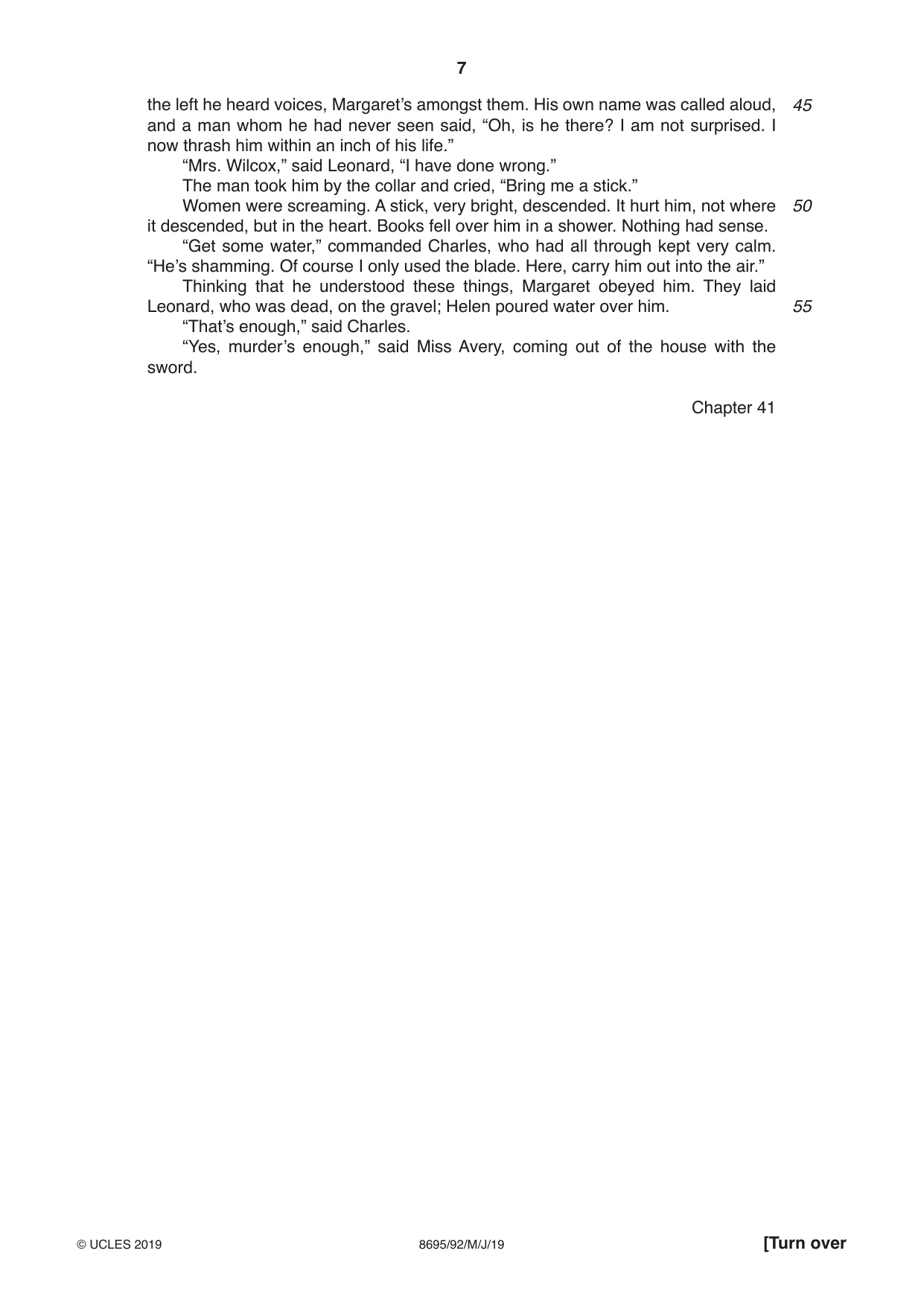
7 8695/92/M/J/19 © UCLES 2019 [Turn over the left he heard voices, Margaret’s amongst them. His own name was called aloud, and a man whom he had never seen said, “Oh, is he there? I am not surprised. I now thrash him within an inch of his life.” “Mrs. Wilcox,” said Leonard, “I have done wrong.” The man took him by the collar and cried, “Bring me a stick.” Women were screaming. A stick, very bright, descended. It hurt him, not where it descended, but in the heart. Books fell over him in a shower. Nothing had sense. “Get some water,” commanded Charles, who had all through kept very calm. “He’s shamming. Of course I only used the blade. Here, carry him out into the air.” Thinking that he understood these things, Margaret obeyed him. They laid Leonard, who was dead, on the gravel; Helen poured water over him. “That’s enough,” said Charles. “Yes, murder’s enough,” said Miss Avery, coming out of the house with the sword. Chapter 41 45 50 55
Question paper, page 8
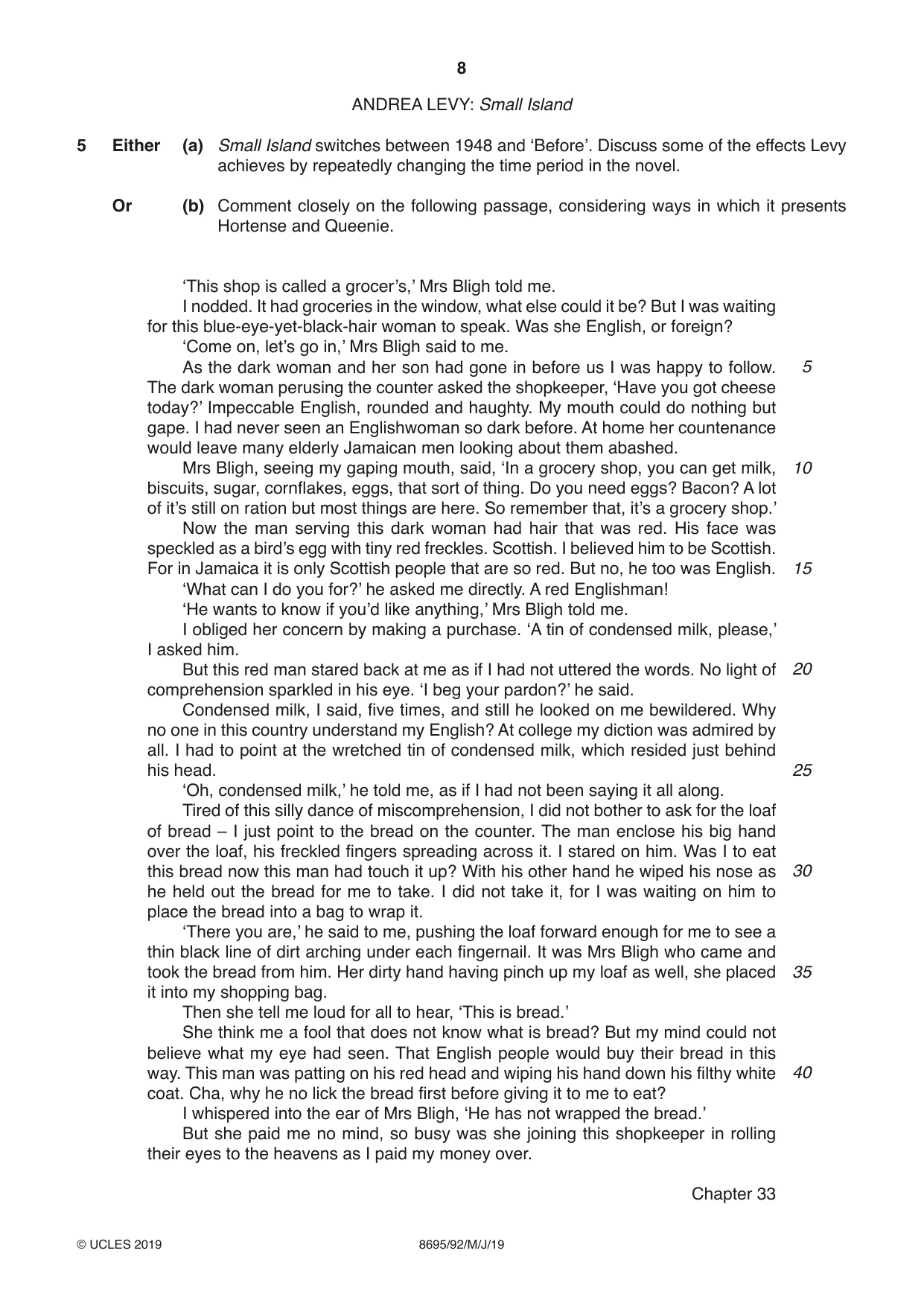
8 8695/92/M/J/19 © UCLES 2019 ANDREA LEVY: Small Island 5 Either (a) Small Island switches between 1948 and ‘Before’. Discuss some of the effects Levy achieves by repeatedly changing the time period in the novel. Or (b) Comment closely on the following passage, considering ways in which it presents Hortense and Queenie. ‘This shop is called a grocer’s,’ Mrs Bligh told me. I nodded. It had groceries in the window, what else could it be? But I was waiting for this blue-eye-yet-black-hair woman to speak. Was she English, or foreign? ‘Come on, let’s go in,’ Mrs Bligh said to me. As the dark woman and her son had gone in before us I was happy to follow. The dark woman perusing the counter asked the shopkeeper, ‘Have you got cheese today?’ Impeccable English, rounded and haughty. My mouth could do nothing but gape. I had never seen an Englishwoman so dark before. At home her countenance would leave many elderly Jamaican men looking about them abashed. Mrs Bligh, seeing my gaping mouth, said, ‘In a grocery shop, you can get milk, biscuits, sugar, cornflakes, eggs, that sort of thing. Do you need eggs? Bacon? A lot of it’s still on ration but most things are here. So remember that, it’s a grocery shop.’ Now the man serving this dark woman had hair that was red. His face was speckled as a bird’s egg with tiny red freckles. Scottish. I believed him to be Scottish. For in Jamaica it is only Scottish people that are so red. But no, he too was English. ‘What can I do you for?’ he asked me directly. A red Englishman! ‘He wants to know if you’d like anything,’ Mrs Bligh told me. I obliged her concern by making a purchase. ‘A tin of condensed milk, please,’ I asked him. But this red man stared back at me as if I had not uttered the words. No light of comprehension sparkled in his eye. ‘I beg your pardon?’ he said. Condensed milk, I said, five times, and still he looked on me bewildered. Why no one in this country understand my English? At college my diction was admired by all. I had to point at the wretched tin of condensed milk, which resided just behind his head. ‘Oh, condensed milk,’ he told me, as if I had not been saying it all along. Tired of this silly dance of miscomprehension, I did not bother to ask for the loaf of bread – I just point to the bread on the counter. The man enclose his big hand over the loaf, his freckled fingers spreading across it. I stared on him. Was I to eat this bread now this man had touch it up? With his other hand he wiped his nose as he held out the bread for me to take. I did not take it, for I was waiting on him to place the bread into a bag to wrap it. ‘There you are,’ he said to me, pushing the loaf forward enough for me to see a thin black line of dirt arching under each fingernail. It was Mrs Bligh who came and took the bread from him. Her dirty hand having pinch up my loaf as well, she placed it into my shopping bag. Then she tell me loud for all to hear, ‘This is bread.’ She think me a fool that does not know what is bread? But my mind could not believe what my eye had seen. That English people would buy their bread in this way. This man was patting on his red head and wiping his hand down his filthy white coat. Cha, why he no lick the bread first before giving it to me to eat? I whispered into the ear of Mrs Bligh, ‘He has not wrapped the bread.’ But she paid me no mind, so busy was she joining this shopkeeper in rolling their eyes to the heavens as I paid my money over. Chapter 33 5 10 15 20 25 30 35 40
Question paper, page 9
9 8695/92/M/J/19 © UCLES 2019 [Turn over Turn over for Question 6.
Question paper, page 10
10 8695/92/M/J/19 © UCLES 2019 Stories of Ourselves 6 Either (a) Discuss the presentation of children and young people in two stories. Or (b) Comment closely on ways in which the following passage from The Hollow of the Three Hills presents the old woman and her powers. The old woman seated herself on the trunk of the fallen tree, threw aside the hood that shrouded her gray locks, and beckoned her companion to draw near. ‘Kneel down,’ she said, ‘and lay your forehead on my knees.’ She hesitated a moment, but the anxiety, that had long been kindling, burned fiercely up within her. As she knelt down, the border of her garment was dipped into the pool; she laid her forehead on the old woman’s knees, and the latter drew a cloak about the lady’s face, so that she was in darkness. Then she heard the muttered words of a prayer, in the midst of which she started, and would have arisen. ‘Let me flee, – let me flee and hide myself, that they may not look upon me!’ she cried. But, with returning recollection, she hushed herself, and was still as death. For it seemed as if other voices – familiar in infancy, and unforgotten through many wanderings, and in all the vicissitudes of her heart and fortune – were mingling with the accents of the prayer. At first the words were faint and indistinct, not rendered so by distance, but rather resembling the dim pages of a book, which we strive to read by an imperfect and gradually brightening light. In such a manner, as the prayer proceeded, did those voices strengthen upon the ear; till at length the petition ended, and the conversation of an aged man, and of a woman broken and decayed like himself, became distinctly audible to the lady as she knelt. But those strangers appeared not to stand in the hollow depth between the three hills. Their voices were encompassed and re-echoed by the walls of a chamber, the windows of which were rattling in the breeze; the regular vibration of a clock, the crackling of a fire, and the tinkling of the embers as they fell among the ashes, rendered the scene almost as vivid as if painted to the eye. By a melancholy hearth sat these two old people, the man calmly despondent, the woman querulous and tearful, and their words were all of sorrow. They spoke of a daughter, a wanderer they knew not where, bearing dishonor along with her, and leaving shame and affliction to bring their gray heads to the grave. They alluded also to other and more recent woe, but in the midst of their talk, their voices seemed to melt into the sound of the wind sweeping mournfully among the autumn leaves; and when the lady lifted her eyes, there was she kneeling in the hollow between three hills. ‘A weary and lonesome time yonder old couple have of it,’ remarked the old woman, smiling in the lady’s face. ‘And did you also hear them!’ exclaimed she, a sense of intolerable humiliation triumphing over her agony and fear. ‘Yea; and we have yet more to hear,’ replied the old woman. ‘Wherefore, cover thy face quickly.’ Again the withered hag poured forth the monotonous words of a prayer that was not meant to be acceptable in Heaven; and soon, in the pauses of her breath, strange murmurings began to thicken, gradually increasing so as to drown and overpower the charm by which they grew. Shrieks pierced through the obscurity of sound, and were succeeded by the singing of sweet female voices, which in their turn gave way to a wild roar of laughter, broken suddenly by groanings and sobs, forming altogether a ghastly confusion of terror and mourning and mirth. Chains were rattling, fierce and stern voices uttered threats, and the scourge resounded at their command. All these noises deepened and became substantial to the listener’s ear, till she could distinguish every soft and dreamy accent of the love songs, that died causelessly into funeral hymns. She shuddered at the unprovoked wrath which blazed up like the spontaneous kindling of flame, and she grew faint at the fearful 5 10 15 20 25 30 35 40 45
Question paper, page 11
11 8695/92/M/J/19 © UCLES 2019 [Turn over merriment, raging miserably around her. In the midst of this wild scene, where unbound passions jostled each other in a drunken career, there was one solemn voice of a man, and a manly and melodious voice it might once have been. He went to-and-fro continually, and his feet sounded upon the floor. In each member of that frenzied company, whose own burning thoughts had become their exclusive world, he sought an auditor for the story of his individual wrong, and interpreted their laughter and tears as his reward of scorn or pity. He spoke of woman’s perfidy, of a wife who had broken her holiest vows, of a home and heart made desolate. Even as he went on, the shout, the laugh, the shriek, the sob, rose up in unison, till they changed into the hollow, fitful, and uneven sound of the wind, as it fought among the pine-trees on those three lonely hills. The lady looked up, and there was the withered woman smiling in her face. The Hollow of the Three Hills 50 55 60
Question paper, page 12
12 8695/92/M/J/19 © UCLES 2019 Section C: Drama WOLE SOYINKA: Death and the King’s Horseman 7 Either (a) Discuss Soyinka’s dramatic presentation of rituals and traditions in the play. Or (b) How, and with what dramatic effects, does Soyinka present Simon and Jane Pilkings in the extract below? You should pay careful attention to both language and action. The dance goes on for some moments and then the figure of a ‘Native Administration’ policeman emerges and climbs up the steps onto the verandah. Content removed due to copyright restrictions.
Question paper, page 13
13 8695/92/M/J/19 © UCLES 2019 [Turn over We only upset his delicate sensibilities by remaining here. Scene 2 Content removed due to copyright restrictions.
Question paper, page 14
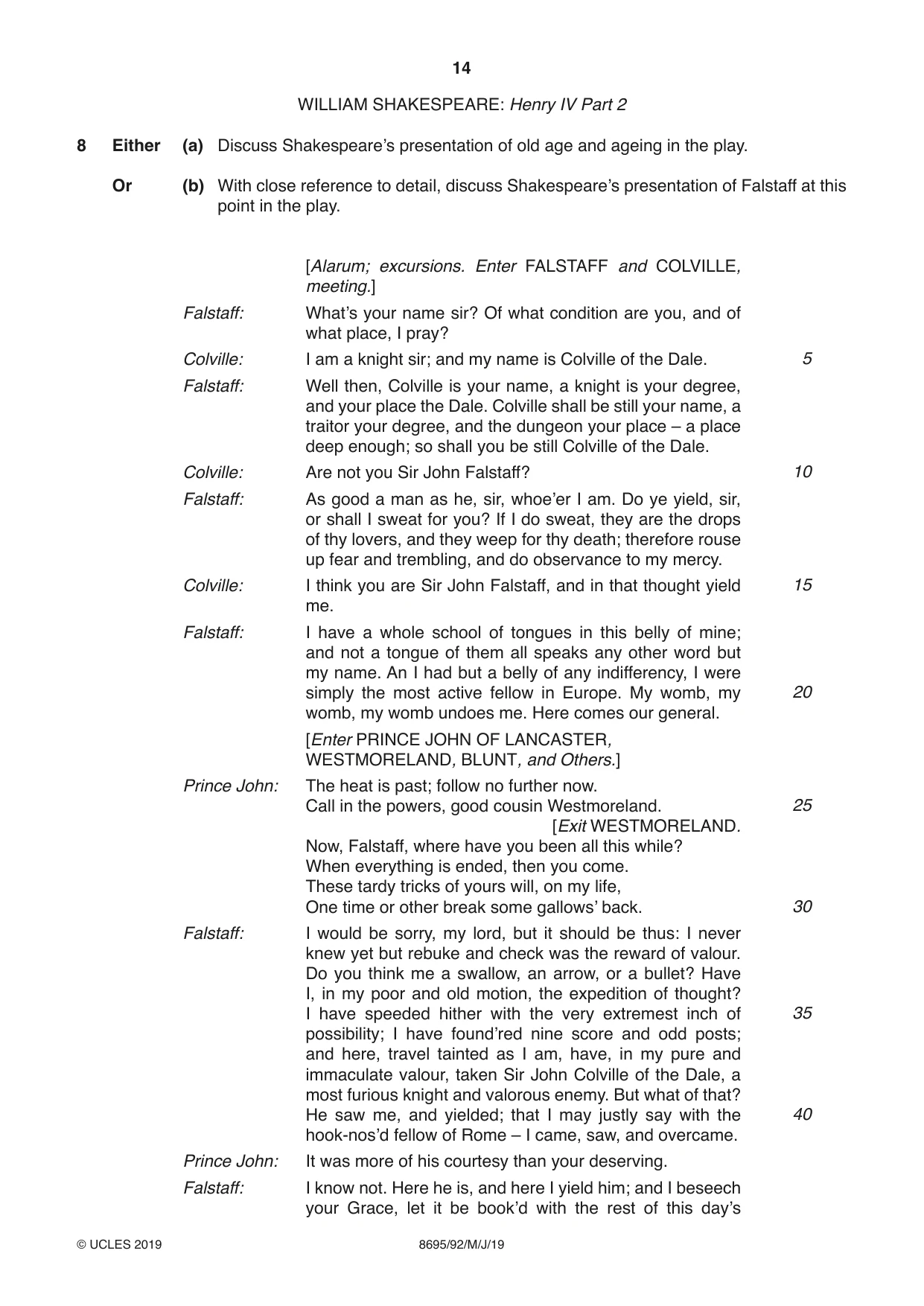
14 8695/92/M/J/19 © UCLES 2019 WILLIAM SHAKESPEARE: Henry IV Part 2 8 Either (a) Discuss Shakespeare’s presentation of old age and ageing in the play. Or (b) With close reference to detail, discuss Shakespeare’s presentation of Falstaff at this point in the play. [Alarum; excursions. Enter FALSTAFF and COLVILLE, meeting.] Falstaff: What’s your name sir? Of what condition are you, and of what place, I pray? Colville: I am a knight sir; and my name is Colville of the Dale. Falstaff: Well then, Colville is your name, a knight is your degree, and your place the Dale. Colville shall be still your name, a traitor your degree, and the dungeon your place – a place deep enough; so shall you be still Colville of the Dale. Colville: Are not you Sir John Falstaff? Falstaff: As good a man as he, sir, whoe’er I am. Do ye yield, sir, or shall I sweat for you? If I do sweat, they are the drops of thy lovers, and they weep for thy death; therefore rouse up fear and trembling, and do observance to my mercy. Colville: I think you are Sir John Falstaff, and in that thought yield me. Falstaff: I have a whole school of tongues in this belly of mine; and not a tongue of them all speaks any other word but my name. An I had but a belly of any indifferency, I were simply the most active fellow in Europe. My womb, my womb, my womb undoes me. Here comes our general. [Enter PRINCE JOHN OF LANCASTER, WESTMORELAND, BLUNT, and Others.] Prince John: The heat is past; follow no further now. Call in the powers, good cousin Westmoreland. [Exit WESTMORELAND. Now, Falstaff, where have you been all this while? When everything is ended, then you come. These tardy tricks of yours will, on my life, One time or other break some gallows’ back. Falstaff: I would be sorry, my lord, but it should be thus: I never knew yet but rebuke and check was the reward of valour. Do you think me a swallow, an arrow, or a bullet? Have I, in my poor and old motion, the expedition of thought? I have speeded hither with the very extremest inch of possibility; I have found’red nine score and odd posts; and here, travel tainted as I am, have, in my pure and immaculate valour, taken Sir John Colville of the Dale, a most furious knight and valorous enemy. But what of that? He saw me, and yielded; that I may justly say with the hook-nos’d fellow of Rome – I came, saw, and overcame. Prince John: It was more of his courtesy than your deserving. Falstaff: I know not. Here he is, and here I yield him; and I beseech your Grace, let it be book’d with the rest of this day’s 5 10 15 20 25 30 35 40
Question paper, page 15
15 8695/92/M/J/19 © UCLES 2019 [Turn over deeds; or, by the Lord, I will have it in a particular ballad else, with mine own picture on the top on’t, Colville kissing my foot; to the which course if I be enforc’d, if you do not all show like gilt twopences to me, and I, in the clear sky of fame, o’ershine you as much as the full moon doth the cinders of the element, which show like pins’ heads to her, believe not the word of the noble. Therefore let me have right, and let desert mount. Prince John: Thine’s too heavy to mount. Falstaff: Let it shine, then. Prince John: Thine’s too thick to shine. Falstaff: Let it do something, my good lord, that may do me good, and call it what you will. Prince John: Is thy name Colville? Colville: It is, my lord. Prince John: A famous rebel art thou, Colville. Falstaff: And a famous true subject took him. Act 4, Scene 3 45 50 55 60
Question paper, page 16
16 8695/92/M/J/19 © UCLES 2019 BRIAN FRIEL: Philadelphia, Here I Come! 9 Either (a) Discuss the presentation and dramatic significance of Gar’s relationship with Kate in the play. Or (b) With close attention to language and action, discuss Friel’s dramatic presentation of Gar’s feelings at this point in the play. Public: What a hope! Content removed due to copyright restrictions.
Question paper, page 17
17 8695/92/M/J/19 © UCLES 2019 Man, you’re looking powerful! Great! Episode 1 Content removed due to copyright restrictions.
Question paper, page 18
18 8695/92/M/J/19 © UCLES 2019 BLANK PAGE
Question paper, page 19
19 8695/92/M/J/19 © UCLES 2019 BLANK PAGE
Question paper, page 20
20 8695/92/M/J/19 © UCLES 2019 Permission to reproduce items where third-party owned material protected by copyright is included has been sought and cleared where possible. Every reasonable effort has been made by the publisher (UCLES) to trace copyright holders, but if any items requiring clearance have unwittingly been included, the publisher will be pleased to make amends at the earliest possible opportunity. To avoid the issue of disclosure of answer-related information to candidates, all copyright acknowledgements are reproduced online in the Cambridge Assessment International Education Copyright Acknowledgements Booklet. This is produced for each series of examinations and is freely available to download at www.cambridgeinternational.org after the live examination series. Cambridge Assessment International Education is part of the Cambridge Assessment Group. Cambridge Assessment is the brand name of the University of Cambridge Local Examinations Syndicate (UCLES), which itself is a department of the University of Cambridge. BLANK PAGE
Mark scheme, page 1
This document consists of 6 printed pages. © UCLES 2019 [Turn over Cambridge Assessment International Education Cambridge International Advanced Subsidiary Level LANGUAGE AND LITERATURE IN ENGLISH 8695/92 Paper 9 Poetry, Prose and Drama May/June 2019 MARK SCHEME Maximum Mark: 50 Published This mark scheme is published as an aid to teachers and candidates, to indicate the requirements of the examination. It shows the basis on which Examiners were instructed to award marks. It does not indicate the details of the discussions that took place at an Examiners’ meeting before marking began, which would have considered the acceptability of alternative answers. Mark schemes should be read in conjunction with the question paper and the Principal Examiner Report for Teachers. Cambridge International will not enter into discussions about these mark schemes. Cambridge International is publishing the mark schemes for the May/June 2019 series for most Cambridge IGCSE™, Cambridge International A and AS Level and Cambridge Pre-U components, and some Cambridge O Level components.
Mark scheme, page 2
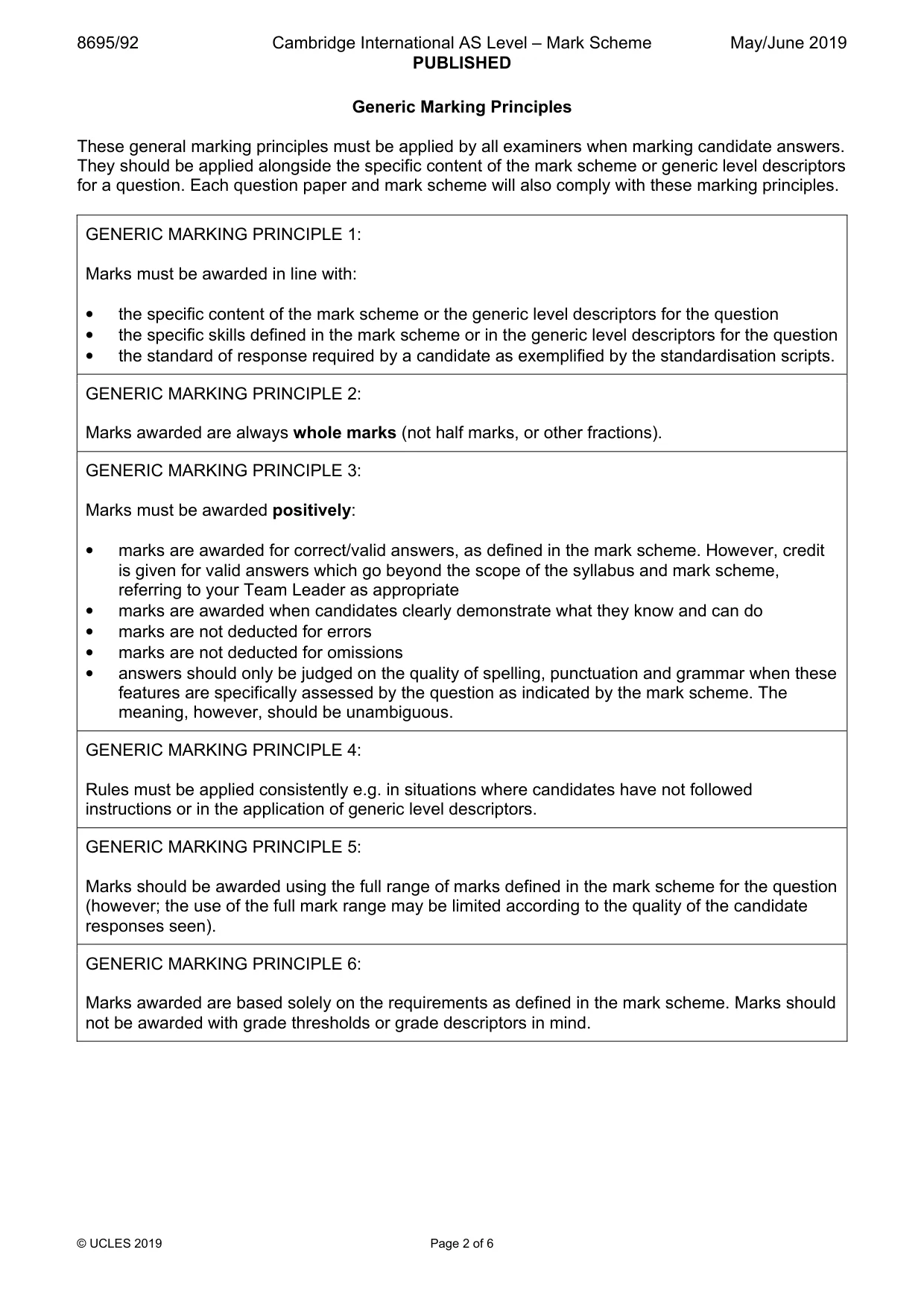
8695/92 Cambridge International AS Level – Mark Scheme PUBLISHED May/June 2019 © UCLES 2019 Page 2 of 6 Generic Marking Principles These general marking principles must be applied by all examiners when marking candidate answers. They should be applied alongside the specific content of the mark scheme or generic level descriptors for a question. Each question paper and mark scheme will also comply with these marking principles. GENERIC MARKING PRINCIPLE 1: Marks must be awarded in line with: • the specific content of the mark scheme or the generic level descriptors for the question • the specific skills defined in the mark scheme or in the generic level descriptors for the question • the standard of response required by a candidate as exemplified by the standardisation scripts. GENERIC MARKING PRINCIPLE 2: Marks awarded are always whole marks (not half marks, or other fractions). GENERIC MARKING PRINCIPLE 3: Marks must be awarded positively: • marks are awarded for correct/valid answers, as defined in the mark scheme. However, credit is given for valid answers which go beyond the scope of the syllabus and mark scheme, referring to your Team Leader as appropriate • marks are awarded when candidates clearly demonstrate what they know and can do • marks are not deducted for errors • marks are not deducted for omissions • answers should only be judged on the quality of spelling, punctuation and grammar when these features are specifically assessed by the question as indicated by the mark scheme. The meaning, however, should be unambiguous. GENERIC MARKING PRINCIPLE 4: Rules must be applied consistently e.g. in situations where candidates have not followed instructions or in the application of generic level descriptors. GENERIC MARKING PRINCIPLE 5: Marks should be awarded using the full range of marks defined in the mark scheme for the question (however; the use of the full mark range may be limited according to the quality of the candidate responses seen). GENERIC MARKING PRINCIPLE 6: Marks awarded are based solely on the requirements as defined in the mark scheme. Marks should not be awarded with grade thresholds or grade descriptors in mind.
Mark scheme, page 3
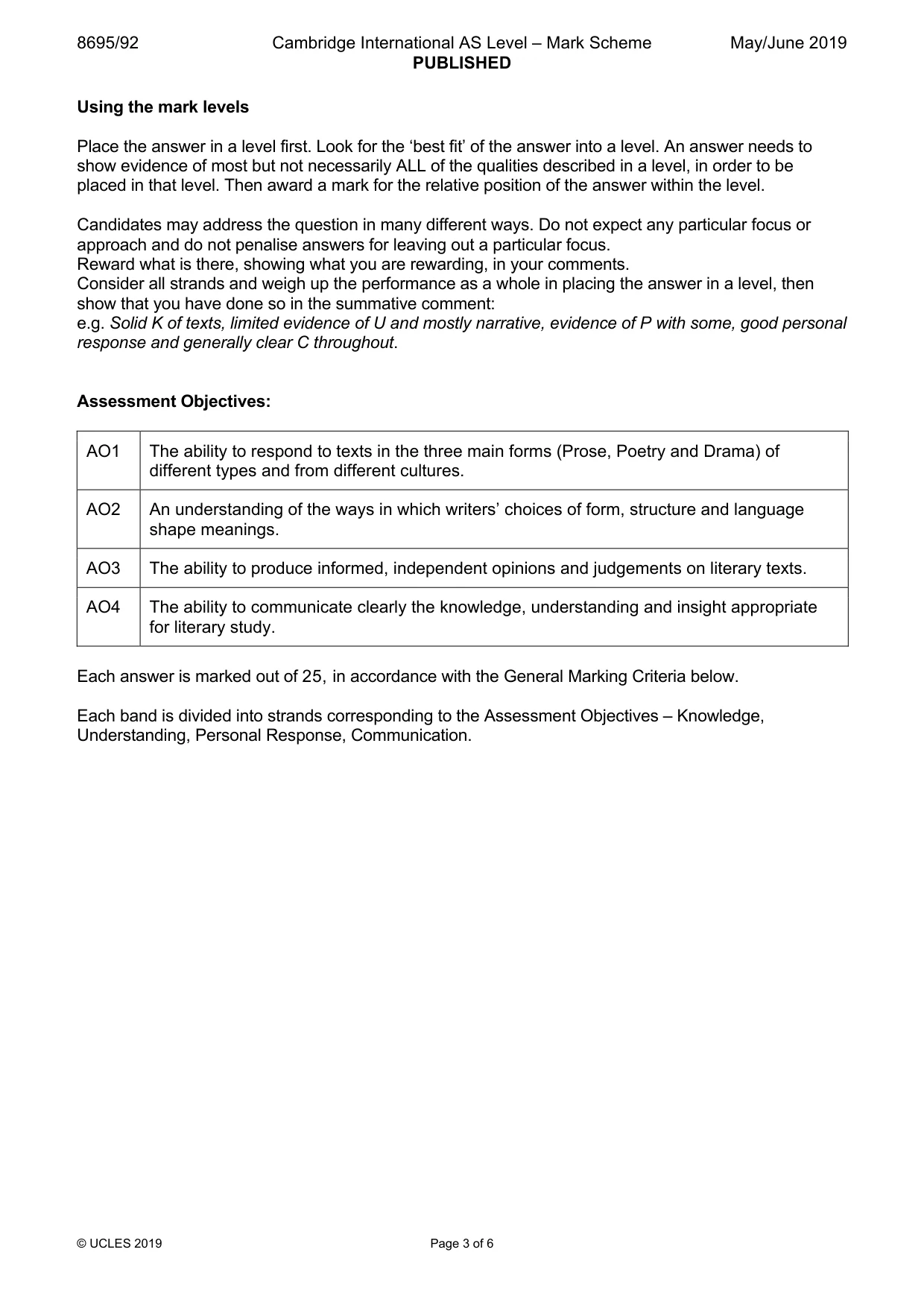
8695/92 Cambridge International AS Level – Mark Scheme PUBLISHED May/June 2019 © UCLES 2019 Page 3 of 6 Using the mark levels Place the answer in a level first. Look for the ‘best fit’ of the answer into a level. An answer needs to show evidence of most but not necessarily ALL of the qualities described in a level, in order to be placed in that level. Then award a mark for the relative position of the answer within the level. Candidates may address the question in many different ways. Do not expect any particular focus or approach and do not penalise answers for leaving out a particular focus. Reward what is there, showing what you are rewarding, in your comments. Consider all strands and weigh up the performance as a whole in placing the answer in a level, then show that you have done so in the summative comment: e.g. Solid K of texts, limited evidence of U and mostly narrative, evidence of P with some, good personal response and generally clear C throughout. Assessment Objectives: AO1 The ability to respond to texts in the three main forms (Prose, Poetry and Drama) of different types and from different cultures. AO2 An understanding of the ways in which writers’ choices of form, structure and language shape meanings. AO3 The ability to produce informed, independent opinions and judgements on literary texts. AO4 The ability to communicate clearly the knowledge, understanding and insight appropriate for literary study. Each answer is marked out of 25, in accordance with the General Marking Criteria below. Each band is divided into strands corresponding to the Assessment Objectives – Knowledge, Understanding, Personal Response, Communication.
Mark scheme, page 4
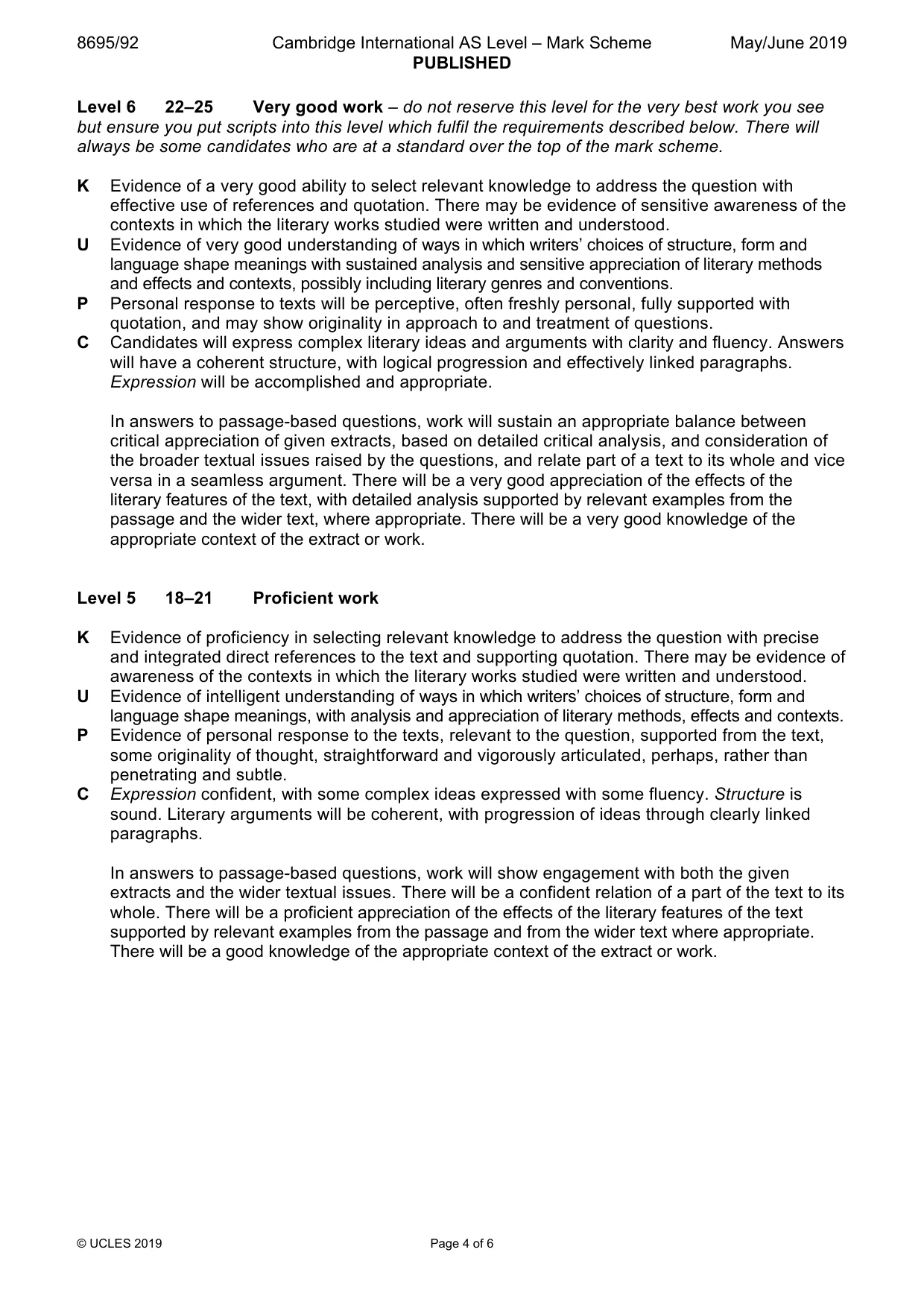
8695/92 Cambridge International AS Level – Mark Scheme PUBLISHED May/June 2019 © UCLES 2019 Page 4 of 6 Level 6 22–25 Very good work – do not reserve this level for the very best work you see but ensure you put scripts into this level which fulfil the requirements described below. There will always be some candidates who are at a standard over the top of the mark scheme. K Evidence of a very good ability to select relevant knowledge to address the question with effective use of references and quotation. There may be evidence of sensitive awareness of the contexts in which the literary works studied were written and understood. U Evidence of very good understanding of ways in which writers’ choices of structure, form and language shape meanings with sustained analysis and sensitive appreciation of literary methods and effects and contexts, possibly including literary genres and conventions. P Personal response to texts will be perceptive, often freshly personal, fully supported with quotation, and may show originality in approach to and treatment of questions. C Candidates will express complex literary ideas and arguments with clarity and fluency. Answers will have a coherent structure, with logical progression and effectively linked paragraphs. Expression will be accomplished and appropriate. In answers to passage-based questions, work will sustain an appropriate balance between critical appreciation of given extracts, based on detailed critical analysis, and consideration of the broader textual issues raised by the questions, and relate part of a text to its whole and vice versa in a seamless argument. There will be a very good appreciation of the effects of the literary features of the text, with detailed analysis supported by relevant examples from the passage and the wider text, where appropriate. There will be a very good knowledge of the appropriate context of the extract or work. Level 5 18–21 Proficient work K Evidence of proficiency in selecting relevant knowledge to address the question with precise and integrated direct references to the text and supporting quotation. There may be evidence of awareness of the contexts in which the literary works studied were written and understood. U Evidence of intelligent understanding of ways in which writers’ choices of structure, form and language shape meanings, with analysis and appreciation of literary methods, effects and contexts. P Evidence of personal response to the texts, relevant to the question, supported from the text, some originality of thought, straightforward and vigorously articulated, perhaps, rather than penetrating and subtle. C Expression confident, with some complex ideas expressed with some fluency. Structure is sound. Literary arguments will be coherent, with progression of ideas through clearly linked paragraphs. In answers to passage-based questions, work will show engagement with both the given extracts and the wider textual issues. There will be a confident relation of a part of the text to its whole. There will be a proficient appreciation of the effects of the literary features of the text supported by relevant examples from the passage and from the wider text where appropriate. There will be a good knowledge of the appropriate context of the extract or work.
Mark scheme, page 5
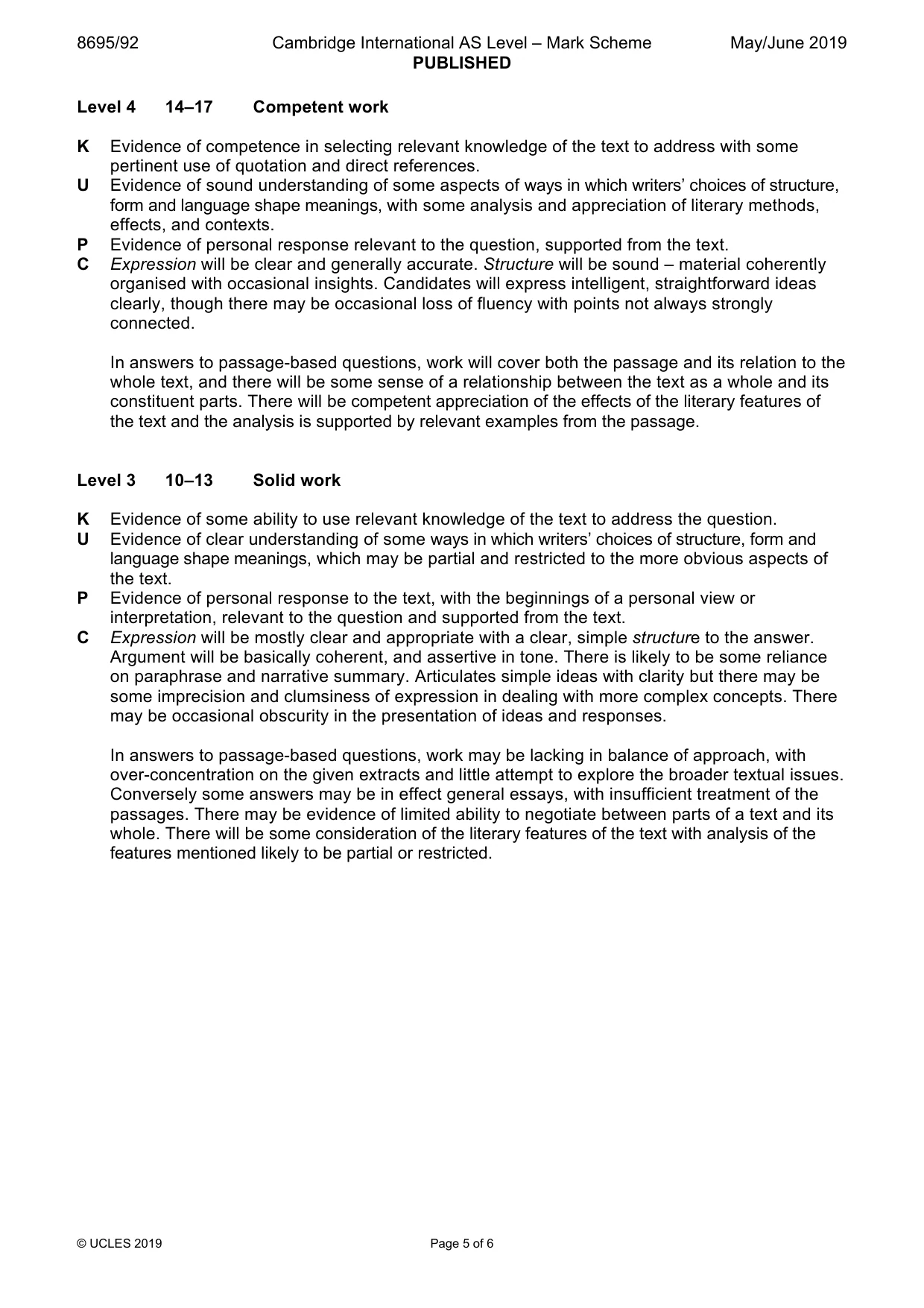
8695/92 Cambridge International AS Level – Mark Scheme PUBLISHED May/June 2019 © UCLES 2019 Page 5 of 6 Level 4 14–17 Competent work K Evidence of competence in selecting relevant knowledge of the text to address with some pertinent use of quotation and direct references. U Evidence of sound understanding of some aspects of ways in which writers’ choices of structure, form and language shape meanings, with some analysis and appreciation of literary methods, effects, and contexts. P Evidence of personal response relevant to the question, supported from the text. C Expression will be clear and generally accurate. Structure will be sound – material coherently organised with occasional insights. Candidates will express intelligent, straightforward ideas clearly, though there may be occasional loss of fluency with points not always strongly connected. In answers to passage-based questions, work will cover both the passage and its relation to the whole text, and there will be some sense of a relationship between the text as a whole and its constituent parts. There will be competent appreciation of the effects of the literary features of the text and the analysis is supported by relevant examples from the passage. Level 3 10–13 Solid work K Evidence of some ability to use relevant knowledge of the text to address the question. U Evidence of clear understanding of some ways in which writers’ choices of structure, form and language shape meanings, which may be partial and restricted to the more obvious aspects of the text. P Evidence of personal response to the text, with the beginnings of a personal view or interpretation, relevant to the question and supported from the text. C Expression will be mostly clear and appropriate with a clear, simple structure to the answer. Argument will be basically coherent, and assertive in tone. There is likely to be some reliance on paraphrase and narrative summary. Articulates simple ideas with clarity but there may be some imprecision and clumsiness of expression in dealing with more complex concepts. There may be occasional obscurity in the presentation of ideas and responses. In answers to passage-based questions, work may be lacking in balance of approach, with over-concentration on the given extracts and little attempt to explore the broader textual issues. Conversely some answers may be in effect general essays, with insufficient treatment of the passages. There may be evidence of limited ability to negotiate between parts of a text and its whole. There will be some consideration of the literary features of the text with analysis of the features mentioned likely to be partial or restricted.
Mark scheme, page 6
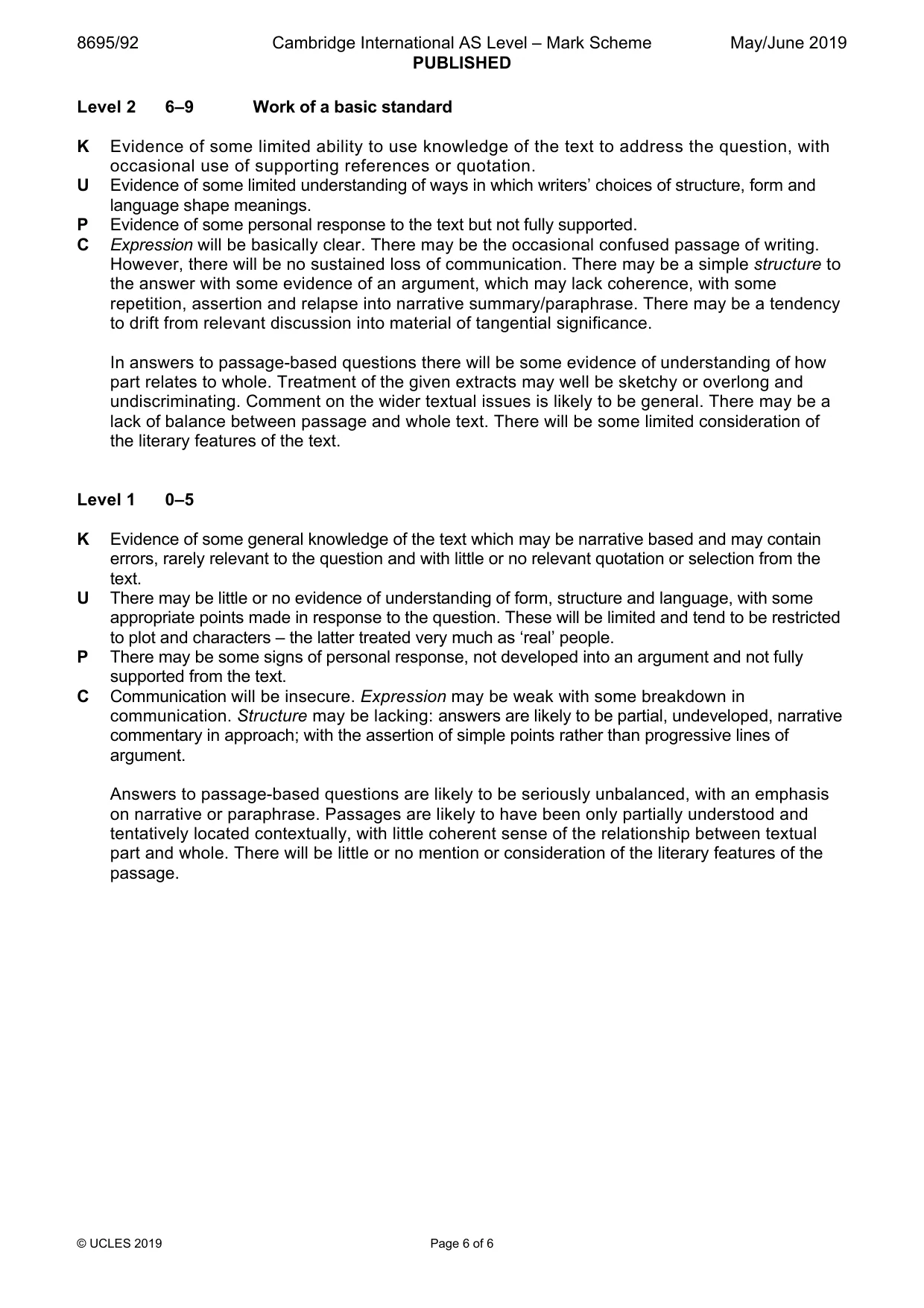
8695/92 Cambridge International AS Level – Mark Scheme PUBLISHED May/June 2019 © UCLES 2019 Page 6 of 6 Level 2 6–9 Work of a basic standard K Evidence of some limited ability to use knowledge of the text to address the question, with occasional use of supporting references or quotation. U Evidence of some limited understanding of ways in which writers’ choices of structure, form and language shape meanings. P Evidence of some personal response to the text but not fully supported. C Expression will be basically clear. There may be the occasional confused passage of writing. However, there will be no sustained loss of communication. There may be a simple structure to the answer with some evidence of an argument, which may lack coherence, with some repetition, assertion and relapse into narrative summary/paraphrase. There may be a tendency to drift from relevant discussion into material of tangential significance. In answers to passage-based questions there will be some evidence of understanding of how part relates to whole. Treatment of the given extracts may well be sketchy or overlong and undiscriminating. Comment on the wider textual issues is likely to be general. There may be a lack of balance between passage and whole text. There will be some limited consideration of the literary features of the text. Level 1 0–5 K Evidence of some general knowledge of the text which may be narrative based and may contain errors, rarely relevant to the question and with little or no relevant quotation or selection from the text. U There may be little or no evidence of understanding of form, structure and language, with some appropriate points made in response to the question. These will be limited and tend to be restricted to plot and characters – the latter treated very much as ‘real’ people. P There may be some signs of personal response, not developed into an argument and not fully supported from the text. C Communication will be insecure. Expression may be weak with some breakdown in communication. Structure may be lacking: answers are likely to be partial, undeveloped, narrative commentary in approach; with the assertion of simple points rather than progressive lines of argument. Answers to passage-based questions are likely to be seriously unbalanced, with an emphasis on narrative or paraphrase. Passages are likely to have been only partially understood and tentatively located contextually, with little coherent sense of the relationship between textual part and whole. There will be little or no mention or consideration of the literary features of the passage.
What you needed in this session
Cambridge’s own grade thresholds for 2019 May/June, Paper 9 · Variant 2. A higher threshold means an easier paper — the bar moves with how the cohort did.