Cambridge A Level English - Language and Literature (AS Level only, from 2016) 8695 — 2018 May/June Paper 9 · Variant 2
8695/92/M/J/18 · 50 marks · ≈56 min
The question paper and its mark scheme, free to read here and free to download. This is Cambridge’s own paper, exactly as it was sat.
Question paper20 pages




Mark scheme6 pages
Answers below. Sit the paper first if you are practising.
Paper as text
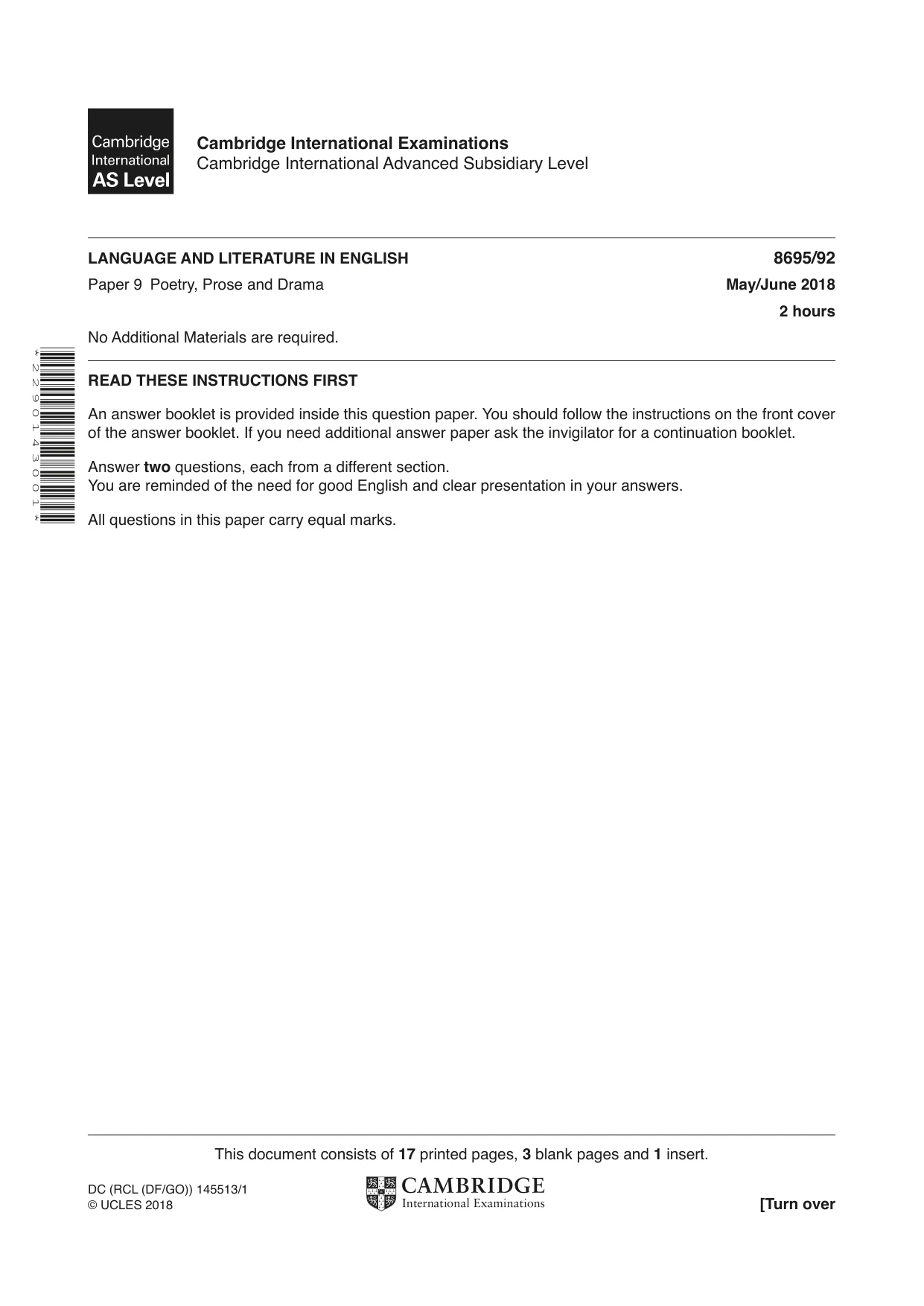
Question paper, page 1
This document consists of 17 printed pages, 3 blank pages and 1 insert. DC (RCL (DF/GO)) 145513/1 © UCLES 2018 [Turn over Cambridge International Examinations Cambridge International Advanced Subsidiary Level * 2 2 9 0 1 4 3 0 0 1 * LANGUAGE AND LITERATURE IN ENGLISH 8695/92 Paper 9 Poetry, Prose and Drama May/June 2018 2 hours No Additional Materials are required. READ THESE INSTRUCTIONS FIRST An answer booklet is provided inside this question paper. You should follow the instructions on the front cover of the answer booklet. If you need additional answer paper ask the invigilator for a continuation booklet. Answer two questions, each from a different section. You are reminded of the need for good English and clear presentation in your answers. All questions in this paper carry equal marks.
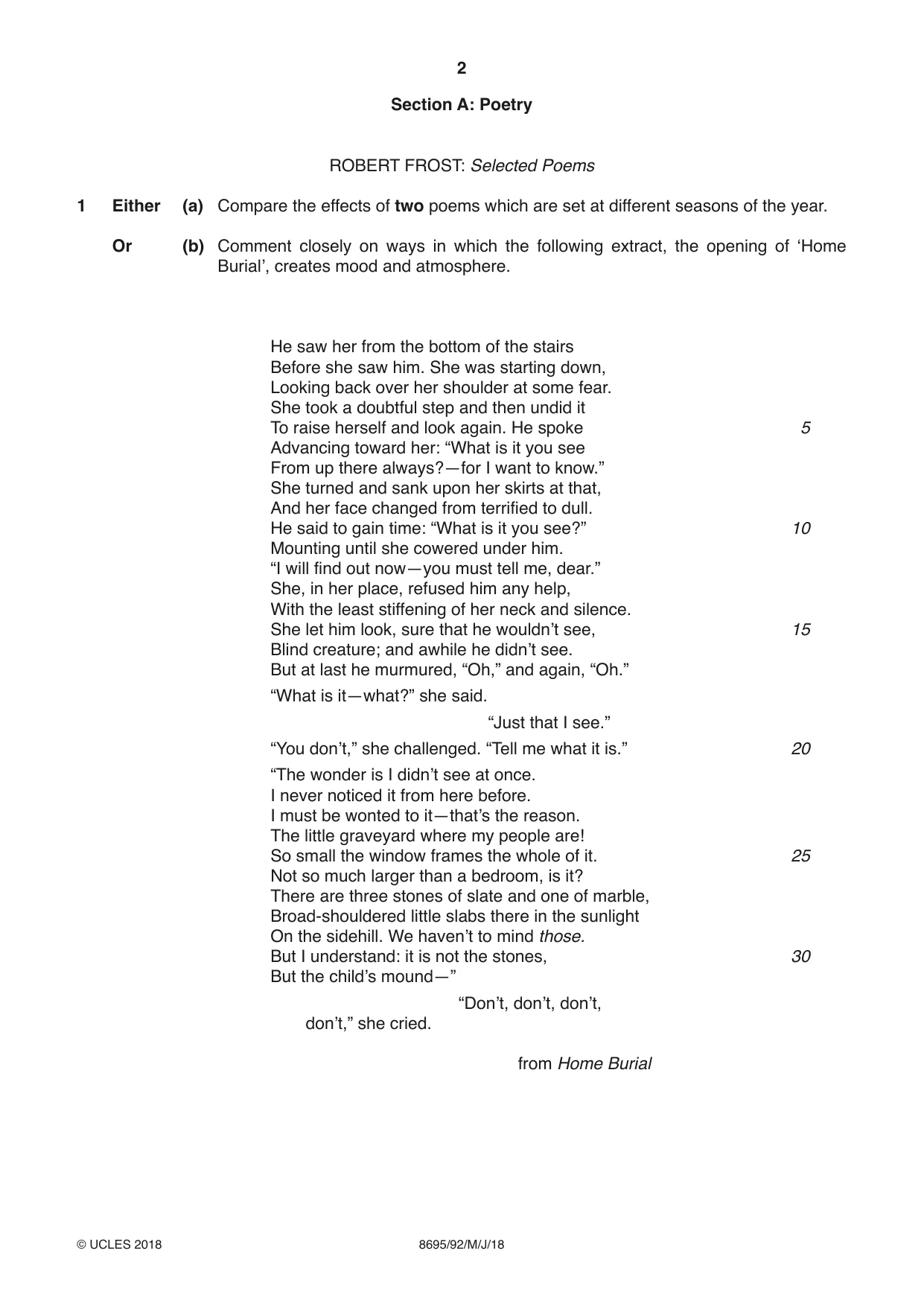
Question paper, page 2
2 8695/92/M/J/18 © UCLES 2018 Section A: Poetry ROBERT FROST: Selected Poems 1 Either (a) Compare the effects of two poems which are set at different seasons of the year. Or (b) Comment closely on ways in which the following extract, the opening of ‘Home Burial’, creates mood and atmosphere. He saw her from the bottom of the stairs Before she saw him. She was starting down, Looking back over her shoulder at some fear. She took a doubtful step and then undid it To raise herself and look again. He spoke Advancing toward her: “What is it you see From up there always?—for I want to know.” She turned and sank upon her skirts at that, And her face changed from terrified to dull. He said to gain time: “What is it you see?” Mounting until she cowered under him. “I will find out now—you must tell me, dear.” She, in her place, refused him any help, With the least stiffening of her neck and silence. She let him look, sure that he wouldn’t see, Blind creature; and awhile he didn’t see. But at last he murmured, “Oh,” and again, “Oh.” “What is it—what?” she said. “Just that I see.” “You don’t,” she challenged. “Tell me what it is.” “The wonder is I didn’t see at once. I never noticed it from here before. I must be wonted to it—that’s the reason. The little graveyard where my people are! So small the window frames the whole of it. Not so much larger than a bedroom, is it? There are three stones of slate and one of marble, Broad-shouldered little slabs there in the sunlight On the sidehill. We haven’t to mind those. But I understand: it is not the stones, But the child’s mound―” “Don’t, don’t, don’t, don’t,” she cried. from Home Burial 5 10 15 20 25 30
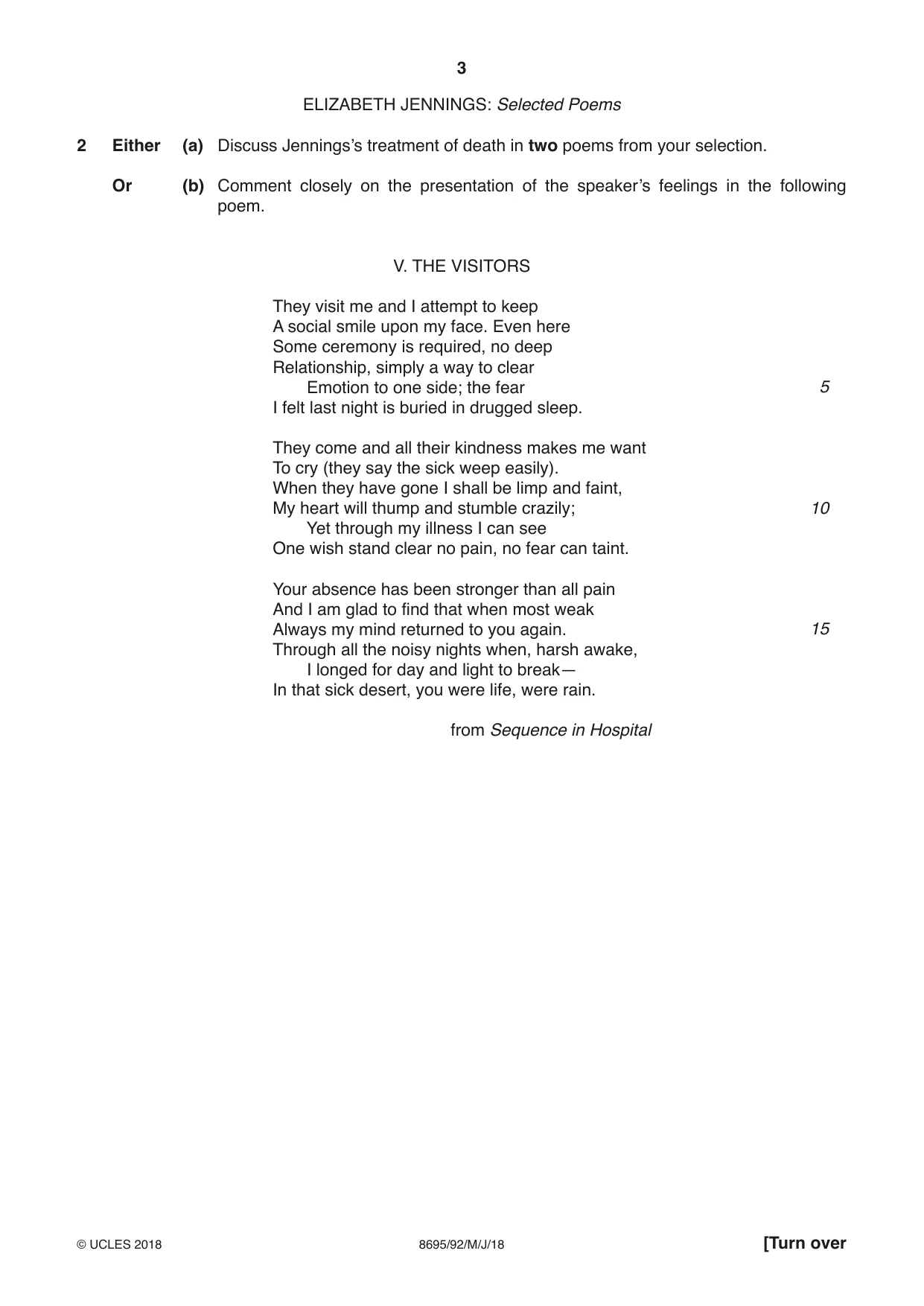
Question paper, page 3
3 8695/92/M/J/18 © UCLES 2018 [Turn over ELIZABETH JENNINGS: Selected Poems 2 Either (a) Discuss Jennings’s treatment of death in two poems from your selection. Or (b) Comment closely on the presentation of the speaker’s feelings in the following poem. V. THE VISITORS They visit me and I attempt to keep A social smile upon my face. Even here Some ceremony is required, no deep Relationship, simply a way to clear Emotion to one side; the fear I felt last night is buried in drugged sleep. They come and all their kindness makes me want To cry (they say the sick weep easily). When they have gone I shall be limp and faint, My heart will thump and stumble crazily; Yet through my illness I can see One wish stand clear no pain, no fear can taint. Your absence has been stronger than all pain And I am glad to find that when most weak Always my mind returned to you again. Through all the noisy nights when, harsh awake, I longed for day and light to break— In that sick desert, you were life, were rain. from Sequence in Hospital 5 10 15
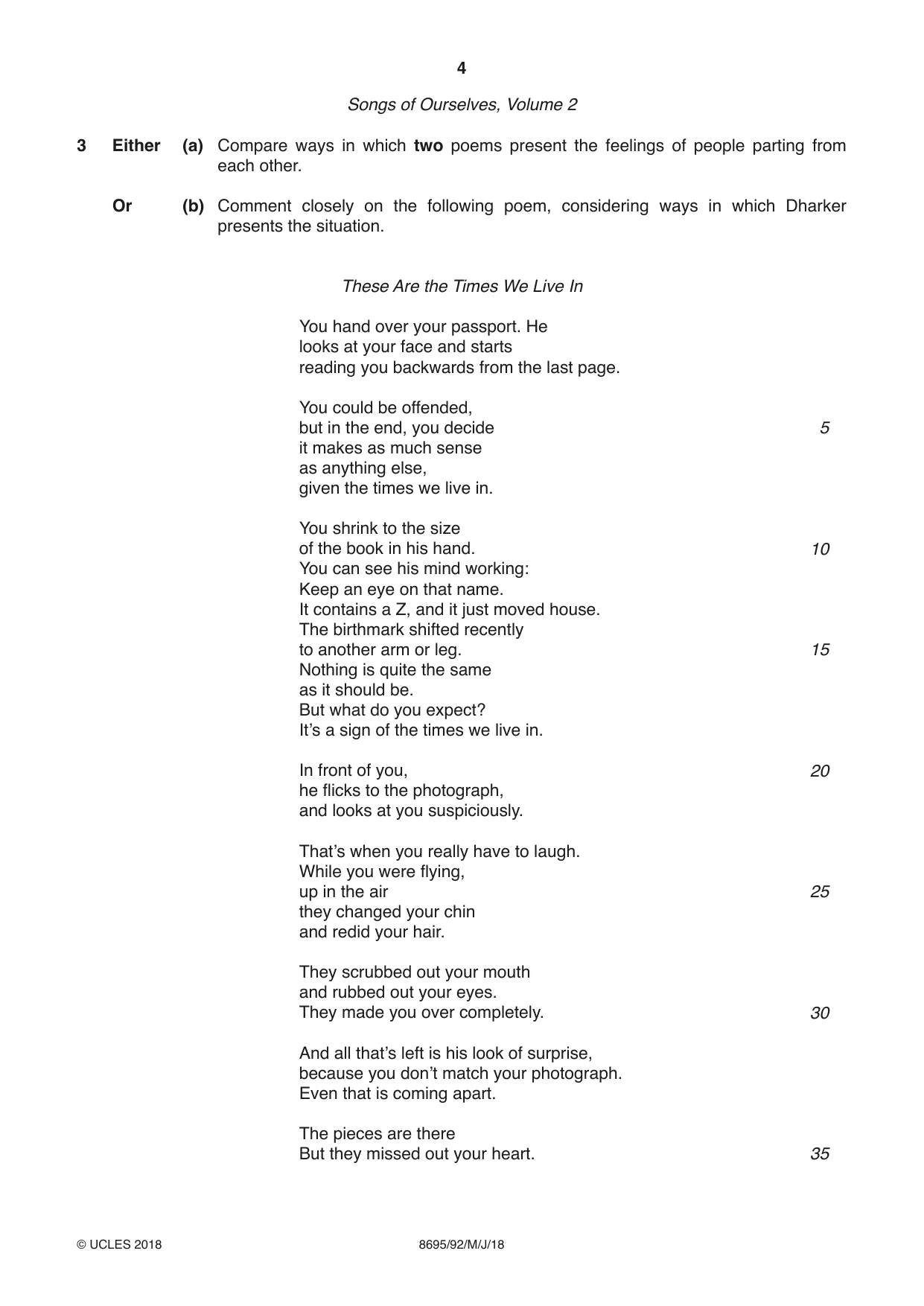
Question paper, page 4
4 8695/92/M/J/18 © UCLES 2018 Songs of Ourselves, Volume 2 3 Either (a) Compare ways in which two poems present the feelings of people parting from each other. Or (b) Comment closely on the following poem, considering ways in which Dharker presents the situation. These Are the Times We Live In You hand over your passport. He looks at your face and starts reading you backwards from the last page. You could be offended, but in the end, you decide it makes as much sense as anything else, given the times we live in. You shrink to the size of the book in his hand. You can see his mind working: Keep an eye on that name. It contains a Z, and it just moved house. The birthmark shifted recently to another arm or leg. Nothing is quite the same as it should be. But what do you expect? It’s a sign of the times we live in. In front of you, he flicks to the photograph, and looks at you suspiciously. That’s when you really have to laugh. While you were flying, up in the air they changed your chin and redid your hair. They scrubbed out your mouth and rubbed out your eyes. They made you over completely. And all that’s left is his look of surprise, because you don’t match your photograph. Even that is coming apart. The pieces are there But they missed out your heart. 5 10 15 20 25 30 35
Question paper, page 5
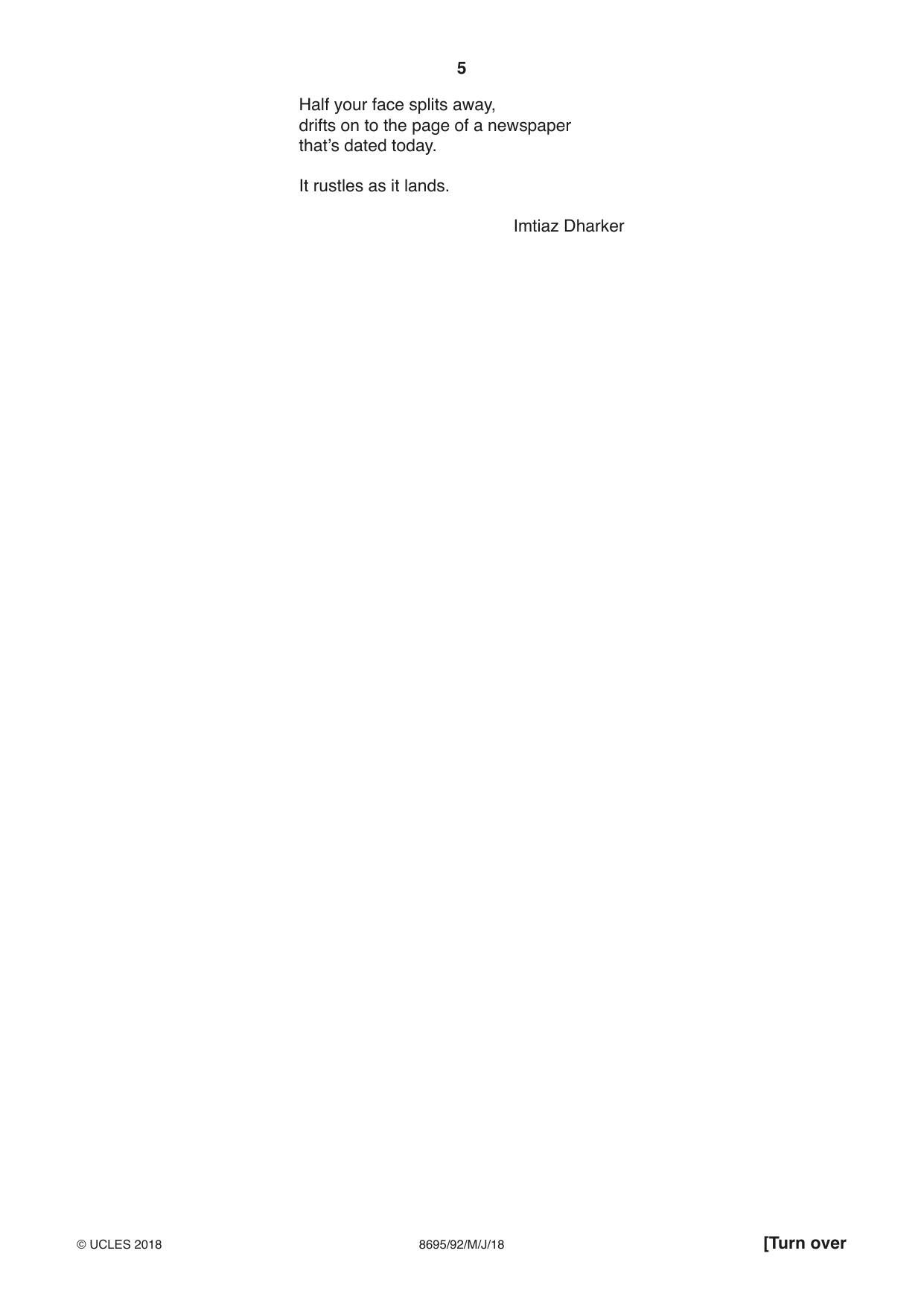
5 8695/92/M/J/18 © UCLES 2018 [Turn over Half your face splits away, drifts on to the page of a newspaper that’s dated today. It rustles as it lands. Imtiaz Dharker
Question paper, page 6
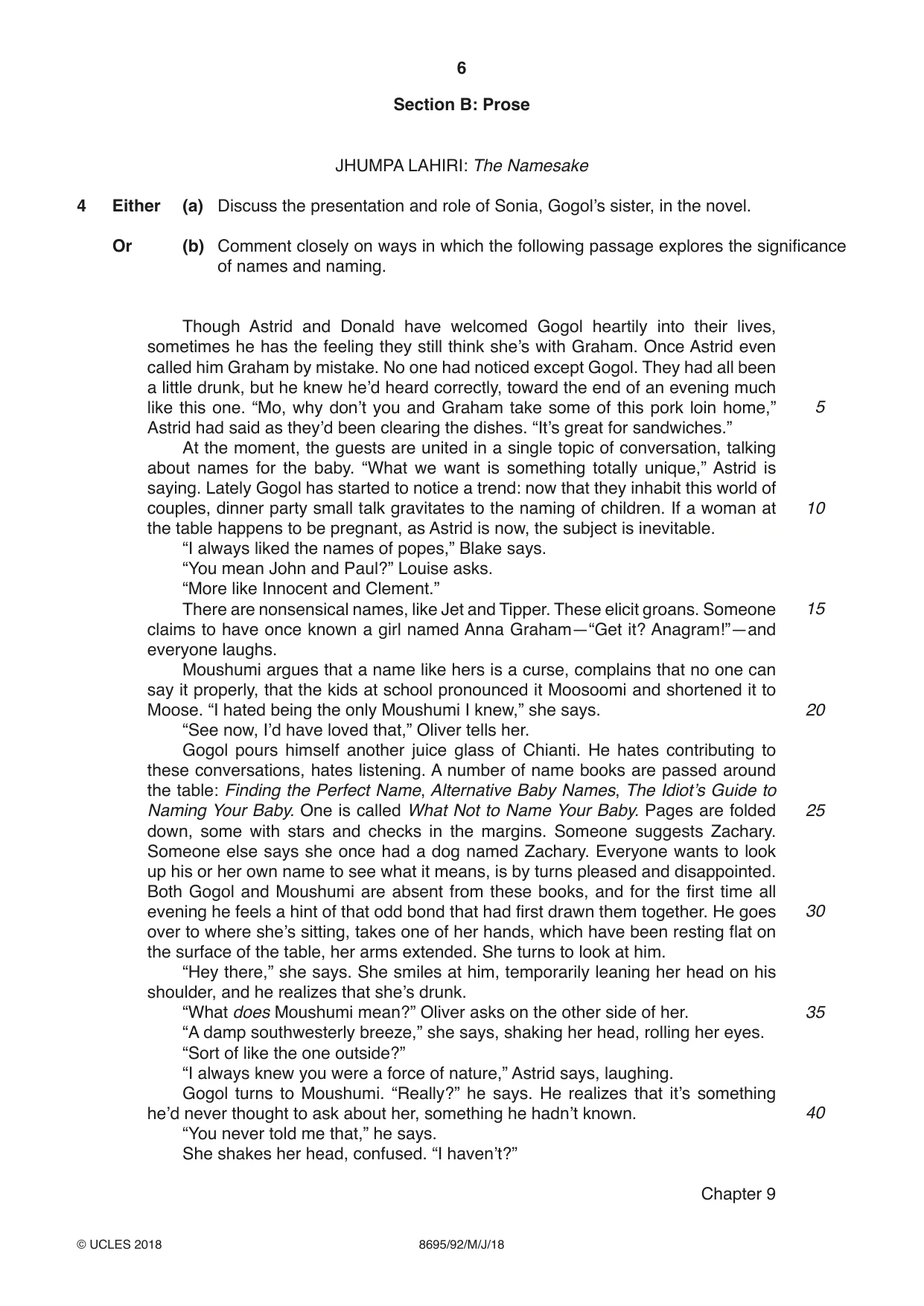
6 8695/92/M/J/18 © UCLES 2018 Section B: Prose JHUMPA LAHIRI: The Namesake 4 Either (a) Discuss the presentation and role of Sonia, Gogol’s sister, in the novel. Or (b) Comment closely on ways in which the following passage explores the significance of names and naming. Though Astrid and Donald have welcomed Gogol heartily into their lives, sometimes he has the feeling they still think she’s with Graham. Once Astrid even called him Graham by mistake. No one had noticed except Gogol. They had all been a little drunk, but he knew he’d heard correctly, toward the end of an evening much like this one. “Mo, why don’t you and Graham take some of this pork loin home,” Astrid had said as they’d been clearing the dishes. “It’s great for sandwiches.” At the moment, the guests are united in a single topic of conversation, talking about names for the baby. “What we want is something totally unique,” Astrid is saying. Lately Gogol has started to notice a trend: now that they inhabit this world of couples, dinner party small talk gravitates to the naming of children. If a woman at the table happens to be pregnant, as Astrid is now, the subject is inevitable. “I always liked the names of popes,” Blake says. “You mean John and Paul?” Louise asks. “More like Innocent and Clement.” There are nonsensical names, like Jet and Tipper. These elicit groans. Someone claims to have once known a girl named Anna Graham—“Get it? Anagram!”—and everyone laughs. Moushumi argues that a name like hers is a curse, complains that no one can say it properly, that the kids at school pronounced it Moosoomi and shortened it to Moose. “I hated being the only Moushumi I knew,” she says. “See now, I’d have loved that,” Oliver tells her. Gogol pours himself another juice glass of Chianti. He hates contributing to these conversations, hates listening. A number of name books are passed around the table: Finding the Perfect Name, Alternative Baby Names, The Idiot’s Guide to Naming Your Baby. One is called What Not to Name Your Baby. Pages are folded down, some with stars and checks in the margins. Someone suggests Zachary. Someone else says she once had a dog named Zachary. Everyone wants to look up his or her own name to see what it means, is by turns pleased and disappointed. Both Gogol and Moushumi are absent from these books, and for the first time all evening he feels a hint of that odd bond that had first drawn them together. He goes over to where she’s sitting, takes one of her hands, which have been resting flat on the surface of the table, her arms extended. She turns to look at him. “Hey there,” she says. She smiles at him, temporarily leaning her head on his shoulder, and he realizes that she’s drunk. “What does Moushumi mean?” Oliver asks on the other side of her. “A damp southwesterly breeze,” she says, shaking her head, rolling her eyes. “Sort of like the one outside?” “I always knew you were a force of nature,” Astrid says, laughing. Gogol turns to Moushumi. “Really?” he says. He realizes that it’s something he’d never thought to ask about her, something he hadn’t known. “You never told me that,” he says. She shakes her head, confused. “I haven’t?” Chapter 9 5 10 15 20 25 30 35 40
Question paper, page 7
7 8695/92/M/J/18 © UCLES 2018 [Turn over Turn over for Question 5.
Question paper, page 8
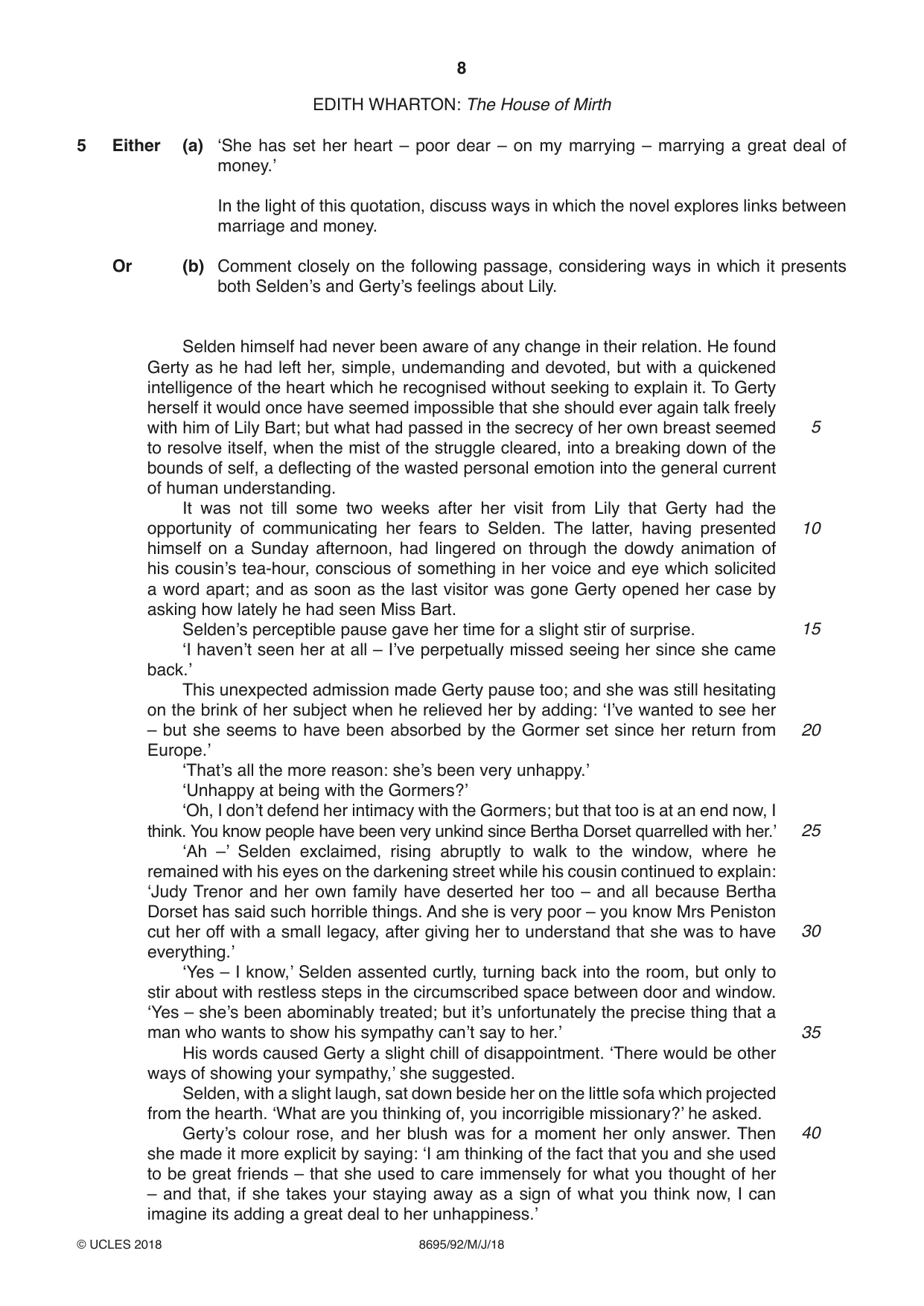
8 8695/92/M/J/18 © UCLES 2018 EDITH WHARTON: The House of Mirth 5 Either (a) ‘She has set her heart – poor dear – on my marrying – marrying a great deal of money.’ In the light of this quotation, discuss ways in which the novel explores links between marriage and money. Or (b) Comment closely on the following passage, considering ways in which it presents both Selden’s and Gerty’s feelings about Lily. Selden himself had never been aware of any change in their relation. He found Gerty as he had left her, simple, undemanding and devoted, but with a quickened intelligence of the heart which he recognised without seeking to explain it. To Gerty herself it would once have seemed impossible that she should ever again talk freely with him of Lily Bart; but what had passed in the secrecy of her own breast seemed to resolve itself, when the mist of the struggle cleared, into a breaking down of the bounds of self, a deflecting of the wasted personal emotion into the general current of human understanding. It was not till some two weeks after her visit from Lily that Gerty had the opportunity of communicating her fears to Selden. The latter, having presented himself on a Sunday afternoon, had lingered on through the dowdy animation of his cousin’s tea-hour, conscious of something in her voice and eye which solicited a word apart; and as soon as the last visitor was gone Gerty opened her case by asking how lately he had seen Miss Bart. Selden’s perceptible pause gave her time for a slight stir of surprise. ‘I haven’t seen her at all – I’ve perpetually missed seeing her since she came back.’ This unexpected admission made Gerty pause too; and she was still hesitating on the brink of her subject when he relieved her by adding: ‘I’ve wanted to see her – but she seems to have been absorbed by the Gormer set since her return from Europe.’ ‘That’s all the more reason: she’s been very unhappy.’ ‘Unhappy at being with the Gormers?’ ‘Oh, I don’t defend her intimacy with the Gormers; but that too is at an end now, I think. You know people have been very unkind since Bertha Dorset quarrelled with her.’ ‘Ah –’ Selden exclaimed, rising abruptly to walk to the window, where he remained with his eyes on the darkening street while his cousin continued to explain: ‘Judy Trenor and her own family have deserted her too – and all because Bertha Dorset has said such horrible things. And she is very poor – you know Mrs Peniston cut her off with a small legacy, after giving her to understand that she was to have everything.’ ‘Yes – I know,’ Selden assented curtly, turning back into the room, but only to stir about with restless steps in the circumscribed space between door and window. ‘Yes – she’s been abominably treated; but it’s unfortunately the precise thing that a man who wants to show his sympathy can’t say to her.’ His words caused Gerty a slight chill of disappointment. ‘There would be other ways of showing your sympathy,’ she suggested. Selden, with a slight laugh, sat down beside her on the little sofa which projected from the hearth. ‘What are you thinking of, you incorrigible missionary?’ he asked. Gerty’s colour rose, and her blush was for a moment her only answer. Then she made it more explicit by saying: ‘I am thinking of the fact that you and she used to be great friends – that she used to care immensely for what you thought of her – and that, if she takes your staying away as a sign of what you think now, I can imagine its adding a great deal to her unhappiness.’ 5 10 15 20 25 30 35 40
Question paper, page 9
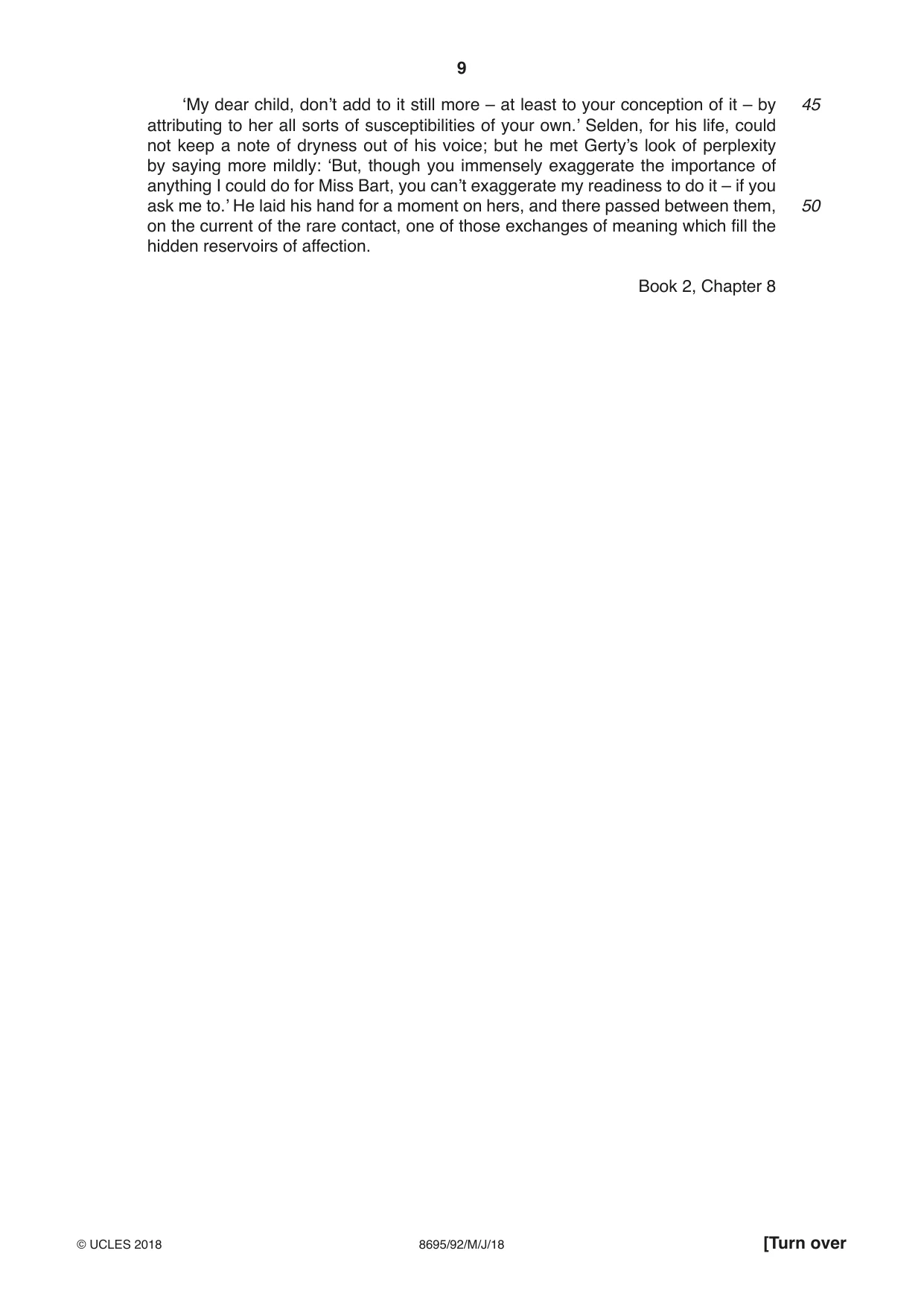
9 8695/92/M/J/18 © UCLES 2018 [Turn over ‘My dear child, don’t add to it still more – at least to your conception of it – by attributing to her all sorts of susceptibilities of your own.’ Selden, for his life, could not keep a note of dryness out of his voice; but he met Gerty’s look of perplexity by saying more mildly: ‘But, though you immensely exaggerate the importance of anything I could do for Miss Bart, you can’t exaggerate my readiness to do it – if you ask me to.’ He laid his hand for a moment on hers, and there passed between them, on the current of the rare contact, one of those exchanges of meaning which fill the hidden reservoirs of affection. Book 2, Chapter 8 45 50
Question paper, page 10
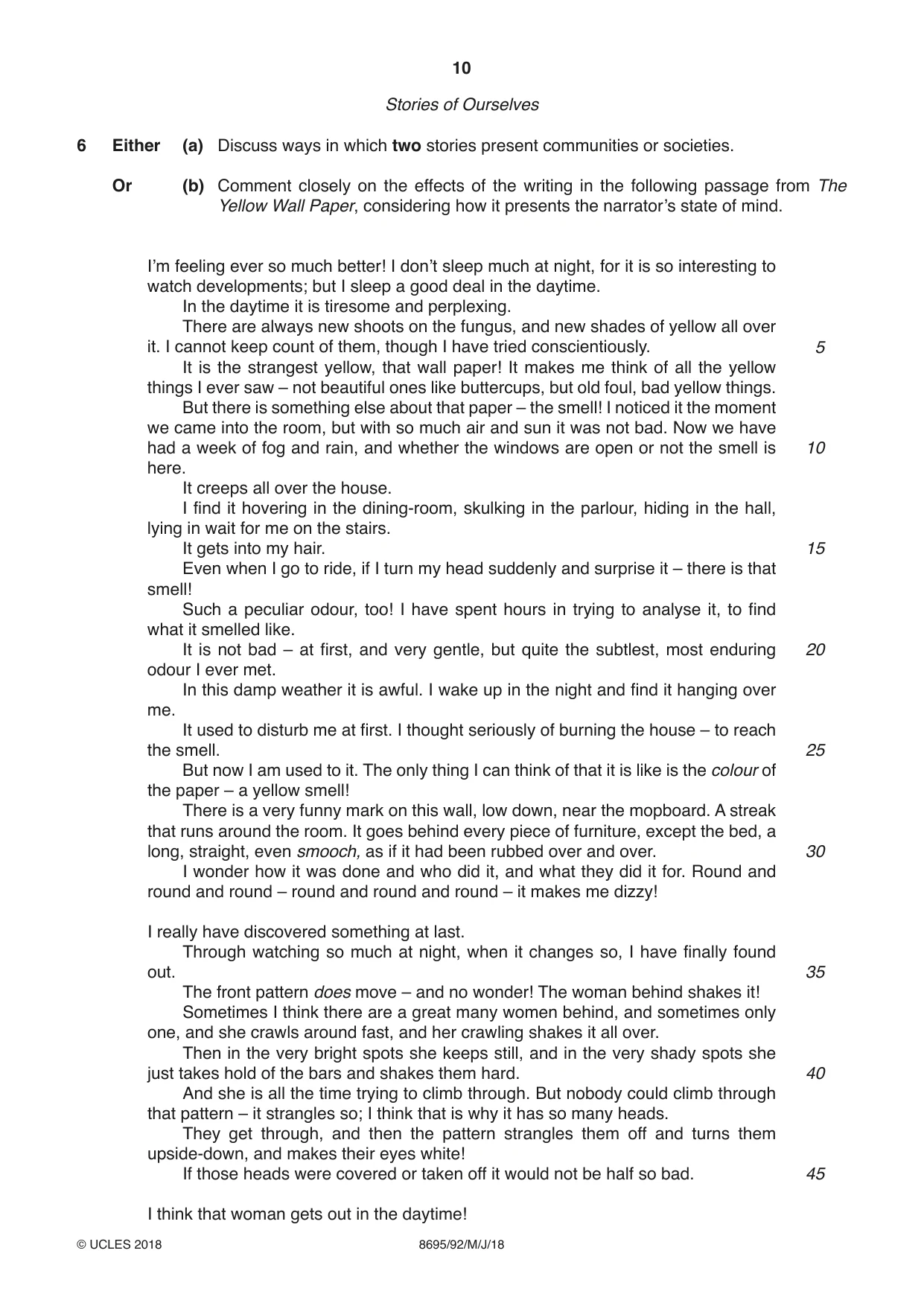
10 8695/92/M/J/18 © UCLES 2018 Stories of Ourselves 6 Either (a) Discuss ways in which two stories present communities or societies. Or (b) Comment closely on the effects of the writing in the following passage from The Yellow Wall Paper, considering how it presents the narrator’s state of mind. I’m feeling ever so much better! I don’t sleep much at night, for it is so interesting to watch developments; but I sleep a good deal in the daytime. In the daytime it is tiresome and perplexing. There are always new shoots on the fungus, and new shades of yellow all over it. I cannot keep count of them, though I have tried conscientiously. It is the strangest yellow, that wall paper! It makes me think of all the yellow things I ever saw – not beautiful ones like buttercups, but old foul, bad yellow things. But there is something else about that paper – the smell! I noticed it the moment we came into the room, but with so much air and sun it was not bad. Now we have had a week of fog and rain, and whether the windows are open or not the smell is here. It creeps all over the house. I find it hovering in the dining-room, skulking in the parlour, hiding in the hall, lying in wait for me on the stairs. It gets into my hair. Even when I go to ride, if I turn my head suddenly and surprise it – there is that smell! Such a peculiar odour, too! I have spent hours in trying to analyse it, to find what it smelled like. It is not bad – at first, and very gentle, but quite the subtlest, most enduring odour I ever met. In this damp weather it is awful. I wake up in the night and find it hanging over me. It used to disturb me at first. I thought seriously of burning the house – to reach the smell. But now I am used to it. The only thing I can think of that it is like is the colour of the paper – a yellow smell! There is a very funny mark on this wall, low down, near the mopboard. A streak that runs around the room. It goes behind every piece of furniture, except the bed, a long, straight, even smooch, as if it had been rubbed over and over. I wonder how it was done and who did it, and what they did it for. Round and round and round – round and round and round – it makes me dizzy! I really have discovered something at last. Through watching so much at night, when it changes so, I have finally found out. The front pattern does move – and no wonder! The woman behind shakes it! Sometimes I think there are a great many women behind, and sometimes only one, and she crawls around fast, and her crawling shakes it all over. Then in the very bright spots she keeps still, and in the very shady spots she just takes hold of the bars and shakes them hard. And she is all the time trying to climb through. But nobody could climb through that pattern – it strangles so; I think that is why it has so many heads. They get through, and then the pattern strangles them off and turns them upside-down, and makes their eyes white! If those heads were covered or taken off it would not be half so bad. I think that woman gets out in the daytime! 5 10 15 20 25 30 35 40 45
Question paper, page 11
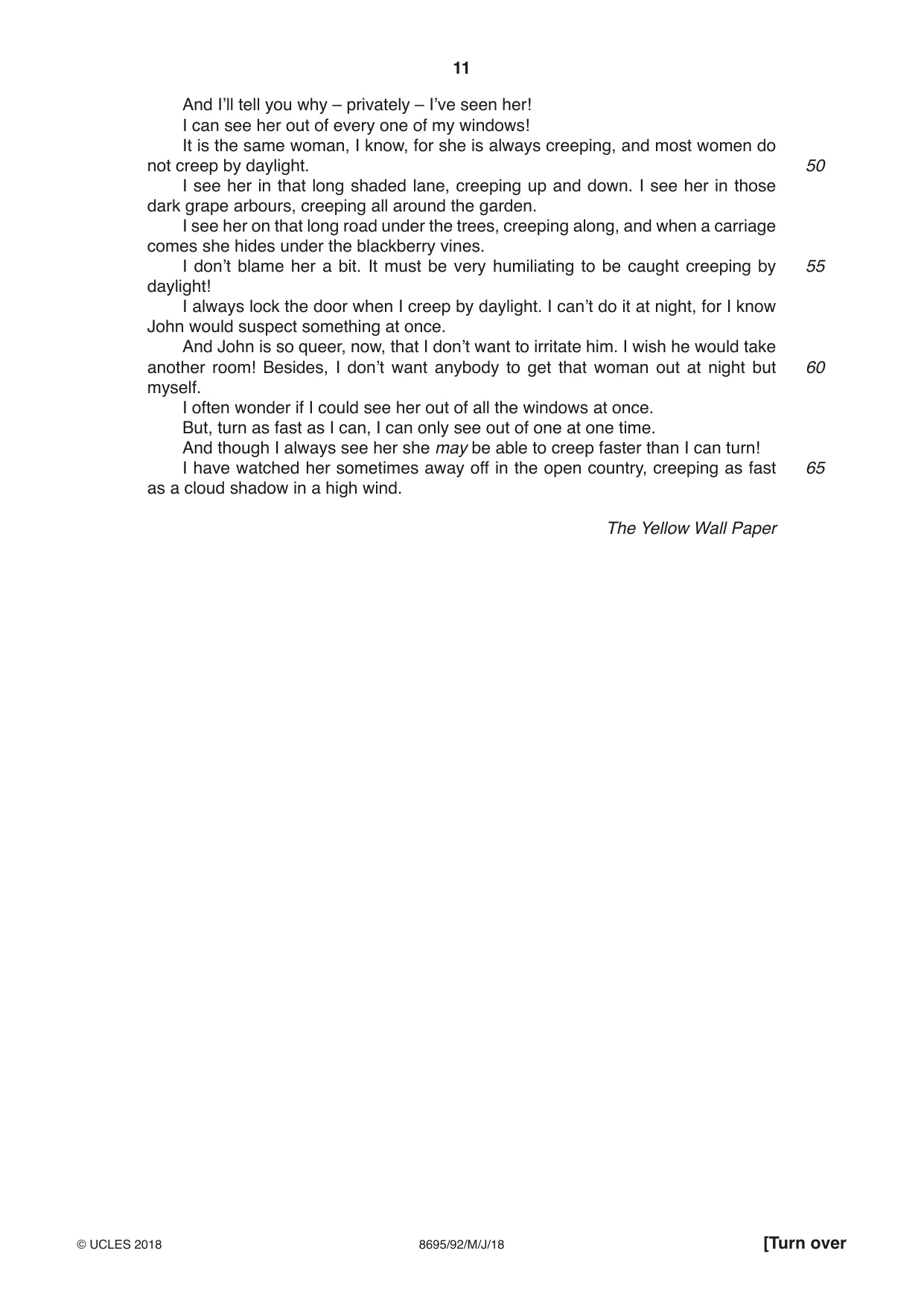
11 8695/92/M/J/18 © UCLES 2018 [Turn over And I’ll tell you why – privately – I’ve seen her! I can see her out of every one of my windows! It is the same woman, I know, for she is always creeping, and most women do not creep by daylight. I see her in that long shaded lane, creeping up and down. I see her in those dark grape arbours, creeping all around the garden. I see her on that long road under the trees, creeping along, and when a carriage comes she hides under the blackberry vines. I don’t blame her a bit. It must be very humiliating to be caught creeping by daylight! I always lock the door when I creep by daylight. I can’t do it at night, for I know John would suspect something at once. And John is so queer, now, that I don’t want to irritate him. I wish he would take another room! Besides, I don’t want anybody to get that woman out at night but myself. I often wonder if I could see her out of all the windows at once. But, turn as fast as I can, I can only see out of one at one time. And though I always see her she may be able to creep faster than I can turn! I have watched her sometimes away off in the open country, creeping as fast as a cloud shadow in a high wind. The Yellow Wall Paper 50 55 60 65
Question paper, page 12
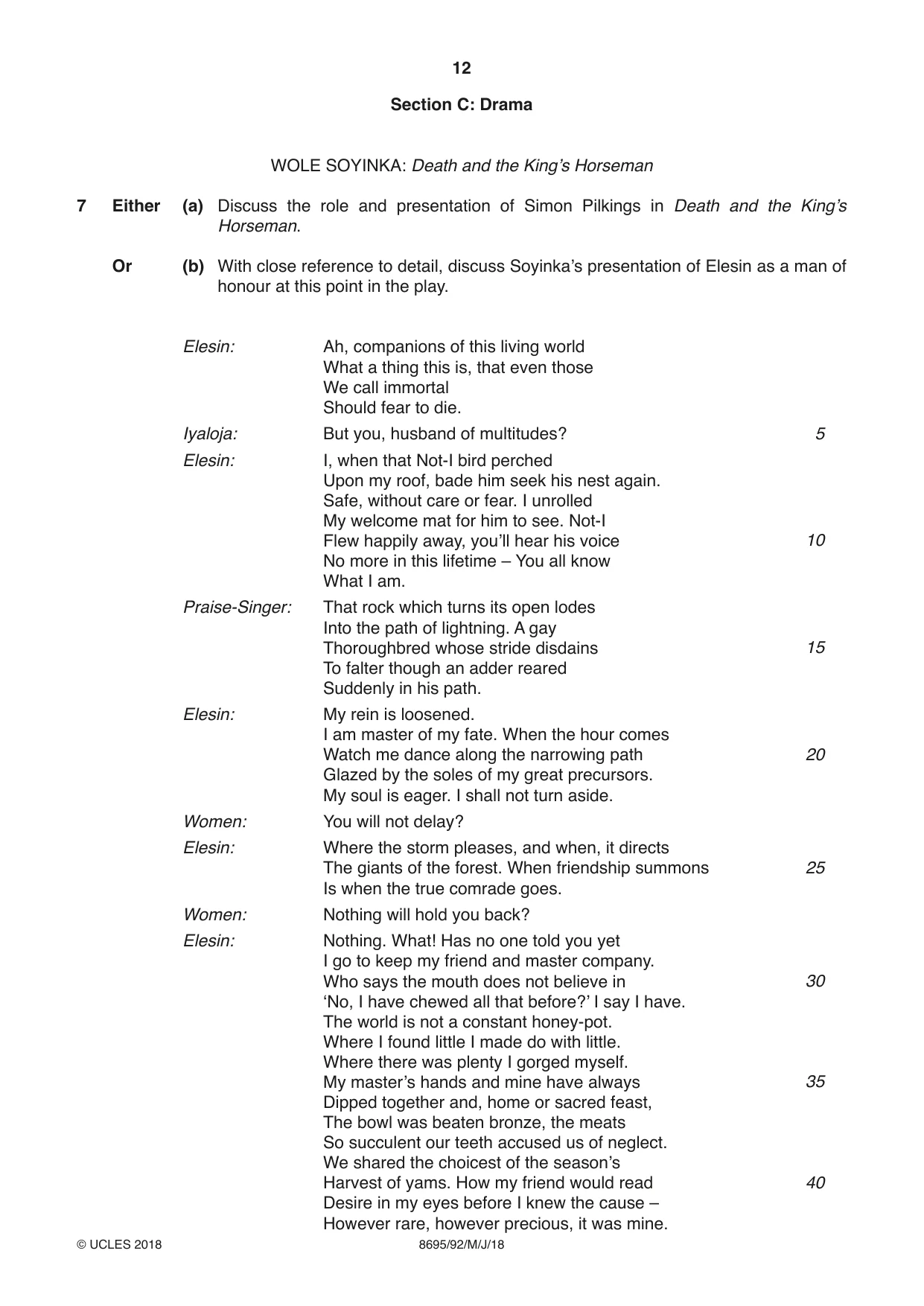
12 8695/92/M/J/18 © UCLES 2018 Section C: Drama WOLE SOYINKA: Death and the King’s Horseman 7 Either (a) Discuss the role and presentation of Simon Pilkings in Death and the King’s Horseman. Or (b) With close reference to detail, discuss Soyinka’s presentation of Elesin as a man of honour at this point in the play. Elesin: Ah, companions of this living world What a thing this is, that even those We call immortal Should fear to die. Iyaloja: But you, husband of multitudes? Elesin: I, when that Not-I bird perched Upon my roof, bade him seek his nest again. Safe, without care or fear. I unrolled My welcome mat for him to see. Not-I Flew happily away, you’ll hear his voice No more in this lifetime – You all know What I am. Praise-Singer: That rock which turns its open lodes Into the path of lightning. A gay Thoroughbred whose stride disdains To falter though an adder reared Suddenly in his path. Elesin: My rein is loosened. I am master of my fate. When the hour comes Watch me dance along the narrowing path Glazed by the soles of my great precursors. My soul is eager. I shall not turn aside. Women: You will not delay? Elesin: Where the storm pleases, and when, it directs The giants of the forest. When friendship summons Is when the true comrade goes. Women: Nothing will hold you back? Elesin: Nothing. What! Has no one told you yet I go to keep my friend and master company. Who says the mouth does not believe in ‘No, I have chewed all that before?’ I say I have. The world is not a constant honey-pot. Where I found little I made do with little. Where there was plenty I gorged myself. My master’s hands and mine have always Dipped together and, home or sacred feast, The bowl was beaten bronze, the meats So succulent our teeth accused us of neglect. We shared the choicest of the season’s Harvest of yams. How my friend would read Desire in my eyes before I knew the cause – However rare, however precious, it was mine. 5 10 15 20 25 30 35 40
Question paper, page 13
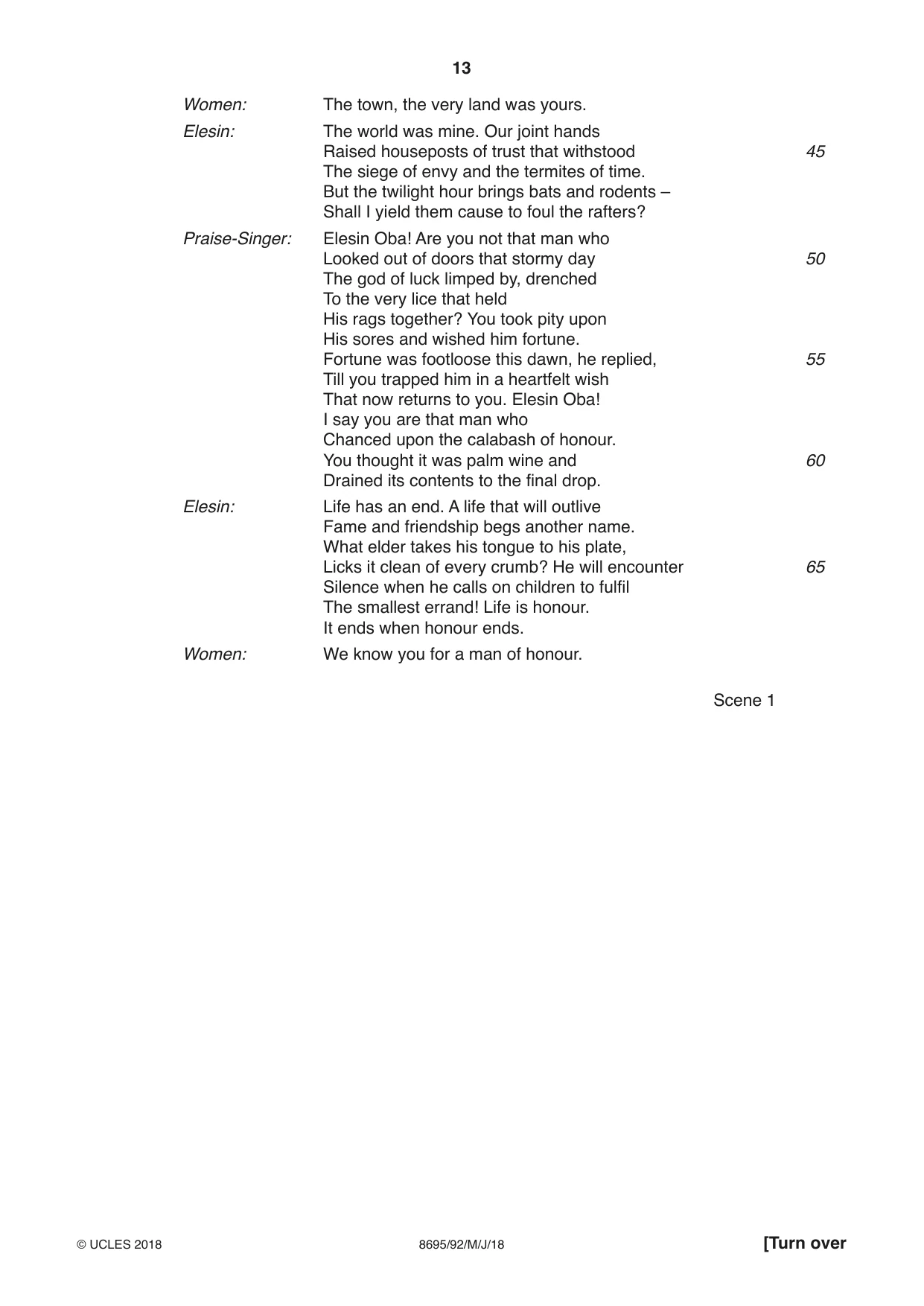
13 8695/92/M/J/18 © UCLES 2018 [Turn over Women: The town, the very land was yours. Elesin: The world was mine. Our joint hands Raised houseposts of trust that withstood The siege of envy and the termites of time. But the twilight hour brings bats and rodents – Shall I yield them cause to foul the rafters? Praise-Singer: Elesin Oba! Are you not that man who Looked out of doors that stormy day The god of luck limped by, drenched To the very lice that held His rags together? You took pity upon His sores and wished him fortune. Fortune was footloose this dawn, he replied, Till you trapped him in a heartfelt wish That now returns to you. Elesin Oba! I say you are that man who Chanced upon the calabash of honour. You thought it was palm wine and Drained its contents to the final drop. Elesin: Life has an end. A life that will outlive Fame and friendship begs another name. What elder takes his tongue to his plate, Licks it clean of every crumb? He will encounter Silence when he calls on children to fulfil The smallest errand! Life is honour. It ends when honour ends. Women: We know you for a man of honour. Scene 1 45 50 55 60 65
Question paper, page 14
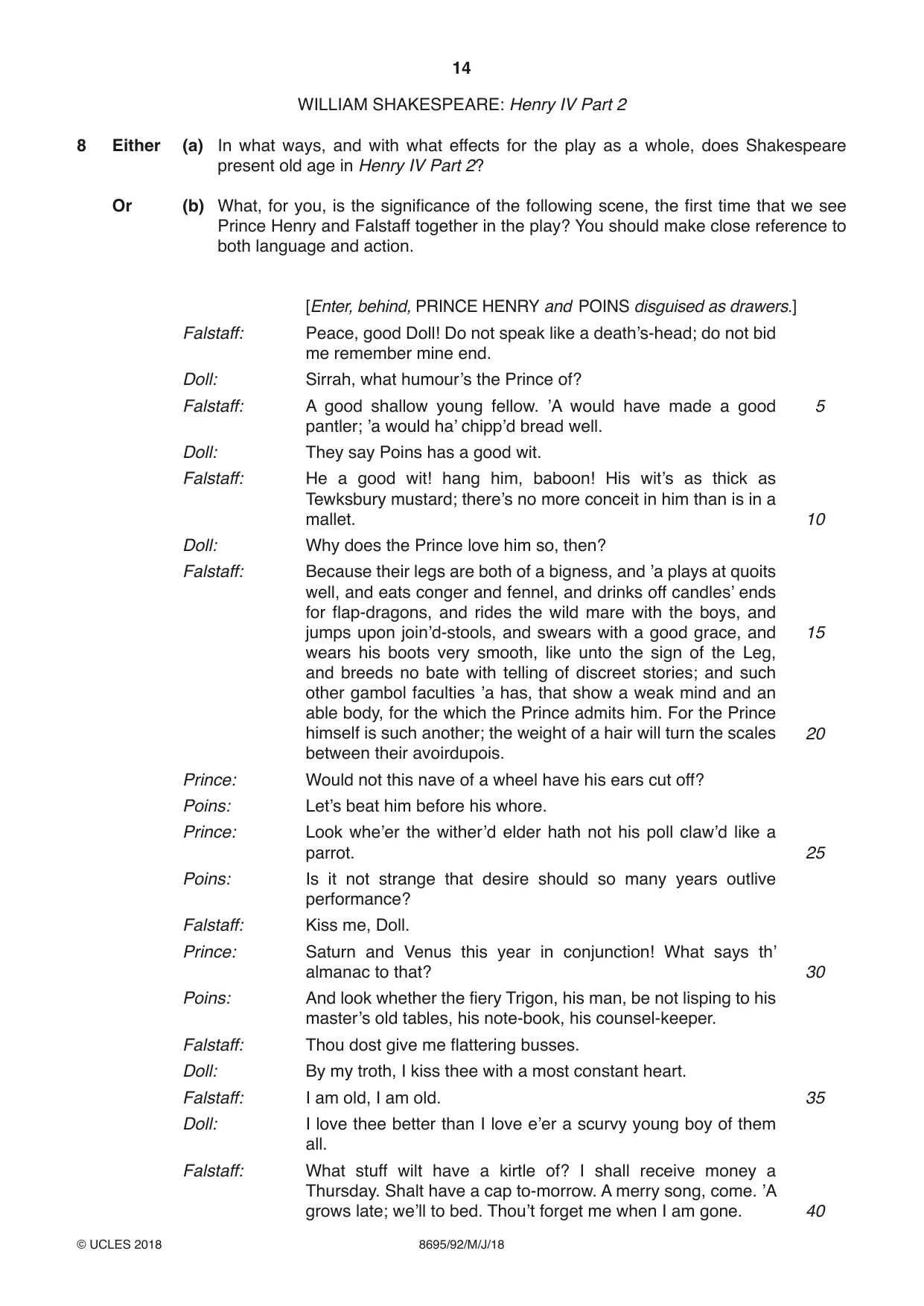
14 8695/92/M/J/18 © UCLES 2018 WILLIAM SHAKESPEARE: Henry IV Part 2 8 Either (a) In what ways, and with what effects for the play as a whole, does Shakespeare present old age in Henry IV Part 2? Or (b) What, for you, is the significance of the following scene, the first time that we see Prince Henry and Falstaff together in the play? You should make close reference to both language and action. [Enter, behind, PRINCE HENRY and POINS disguised as drawers.] Falstaff: Peace, good Doll! Do not speak like a death’s-head; do not bid me remember mine end. Doll: Sirrah, what humour’s the Prince of? Falstaff: A good shallow young fellow. ’A would have made a good pantler; ’a would ha’ chipp’d bread well. Doll: They say Poins has a good wit. Falstaff: He a good wit! hang him, baboon! His wit’s as thick as Tewksbury mustard; there’s no more conceit in him than is in a mallet. Doll: Why does the Prince love him so, then? Falstaff: Because their legs are both of a bigness, and ’a plays at quoits well, and eats conger and fennel, and drinks off candles’ ends for flap-dragons, and rides the wild mare with the boys, and jumps upon join’d-stools, and swears with a good grace, and wears his boots very smooth, like unto the sign of the Leg, and breeds no bate with telling of discreet stories; and such other gambol faculties ’a has, that show a weak mind and an able body, for the which the Prince admits him. For the Prince himself is such another; the weight of a hair will turn the scales between their avoirdupois. Prince: Would not this nave of a wheel have his ears cut off? Poins: Let’s beat him before his whore. Prince: Look whe’er the wither’d elder hath not his poll claw’d like a parrot. Poins: Is it not strange that desire should so many years outlive performance? Falstaff: Kiss me, Doll. Prince: Saturn and Venus this year in conjunction! What says th’ almanac to that? Poins: And look whether the fiery Trigon, his man, be not lisping to his master’s old tables, his note-book, his counsel-keeper. Falstaff: Thou dost give me flattering busses. Doll: By my troth, I kiss thee with a most constant heart. Falstaff: I am old, I am old. Doll: I love thee better than I love e’er a scurvy young boy of them all. Falstaff: What stuff wilt have a kirtle of? I shall receive money a Thursday. Shalt have a cap to-morrow. A merry song, come. ’A grows late; we’ll to bed. Thou’t forget me when I am gone. 5 10 15 20 25 30 35 40
Question paper, page 15
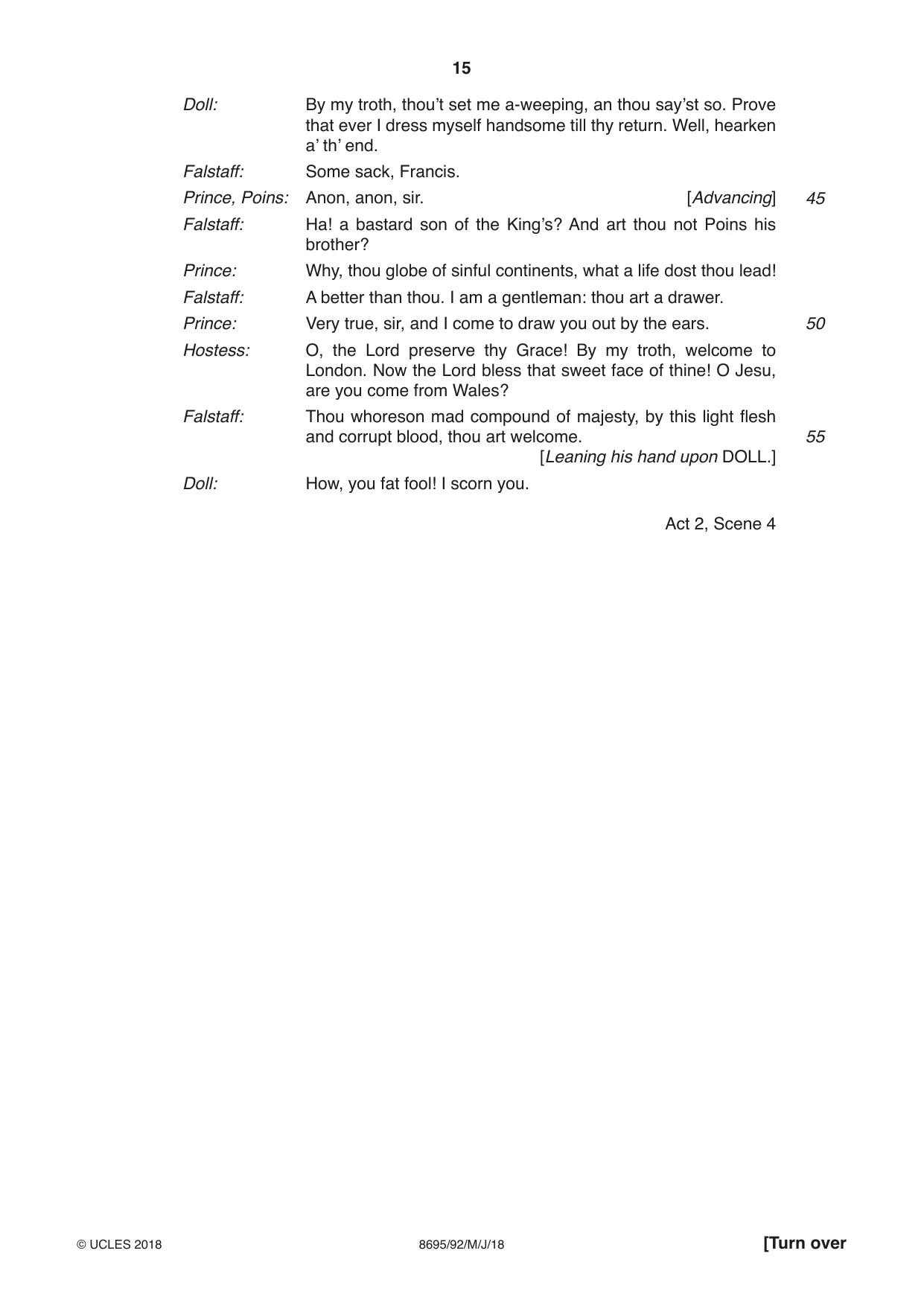
15 8695/92/M/J/18 © UCLES 2018 [Turn over Doll: By my troth, thou’t set me a-weeping, an thou say’st so. Prove that ever I dress myself handsome till thy return. Well, hearken a’ th’ end. Falstaff: Some sack, Francis. Prince, Poins: Anon, anon, sir. [Advancing] Falstaff: Ha! a bastard son of the King’s? And art thou not Poins his brother? Prince: Why, thou globe of sinful continents, what a life dost thou lead! Falstaff: A better than thou. I am a gentleman: thou art a drawer. Prince: Very true, sir, and I come to draw you out by the ears. Hostess: O, the Lord preserve thy Grace! By my troth, welcome to London. Now the Lord bless that sweet face of thine! O Jesu, are you come from Wales? Falstaff: Thou whoreson mad compound of majesty, by this light flesh and corrupt blood, thou art welcome. [Leaning his hand upon DOLL.] Doll: How, you fat fool! I scorn you. Act 2, Scene 4 45 50 55
Question paper, page 16
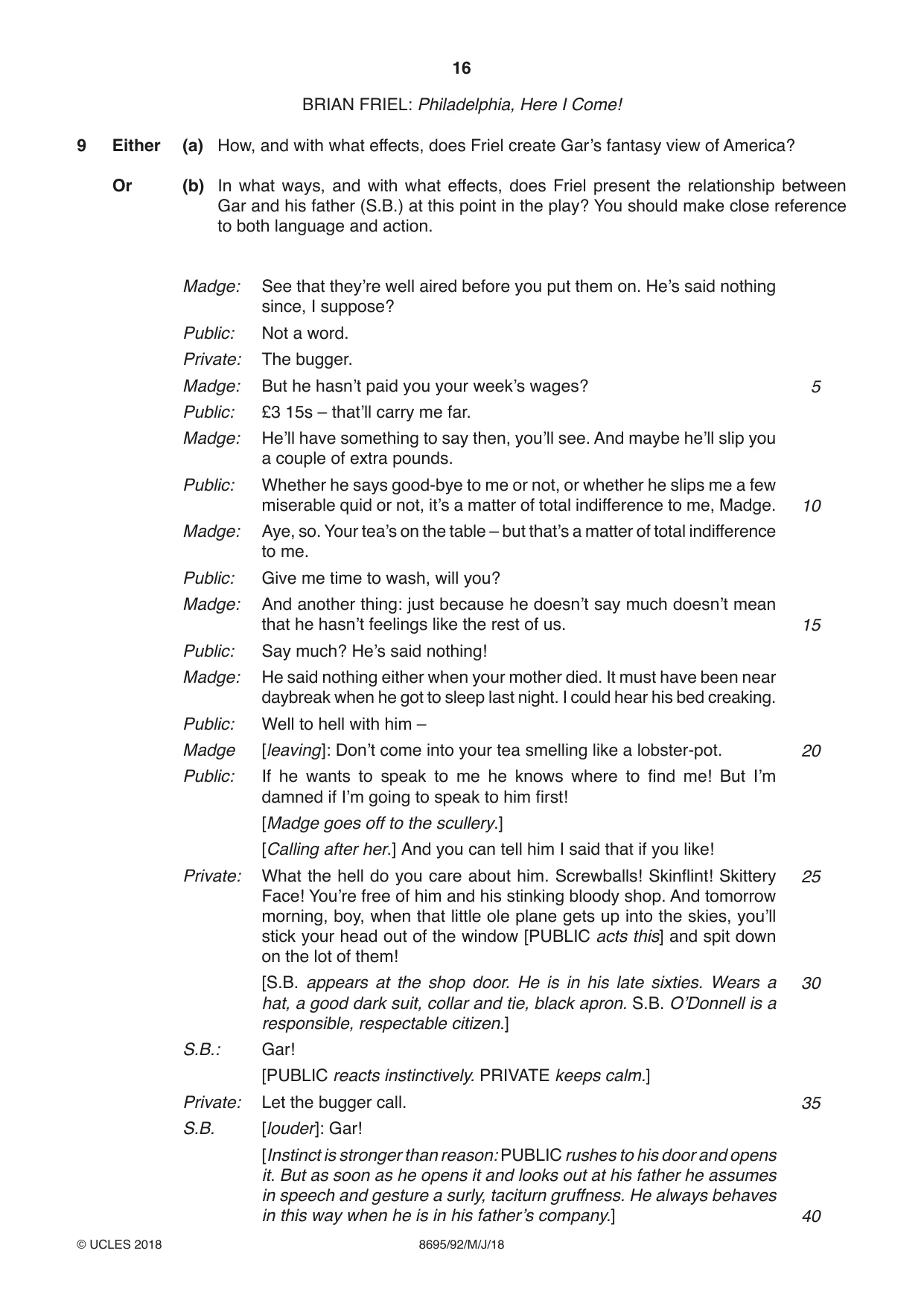
16 8695/92/M/J/18 © UCLES 2018 BRIAN FRIEL: Philadelphia, Here I Come! 9 Either (a) How, and with what effects, does Friel create Gar’s fantasy view of America? Or (b) In what ways, and with what effects, does Friel present the relationship between Gar and his father (S.B.) at this point in the play? You should make close reference to both language and action. Madge: See that they’re well aired before you put them on. He’s said nothing since, I suppose? Public: Not a word. Private: The bugger. Madge: But he hasn’t paid you your week’s wages? Public: £3 15s – that’ll carry me far. Madge: He’ll have something to say then, you’ll see. And maybe he’ll slip you a couple of extra pounds. Public: Whether he says good-bye to me or not, or whether he slips me a few miserable quid or not, it’s a matter of total indifference to me, Madge. Madge: Aye, so. Your tea’s on the table – but that’s a matter of total indifference to me. Public: Give me time to wash, will you? Madge: And another thing: just because he doesn’t say much doesn’t mean that he hasn’t feelings like the rest of us. Public: Say much? He’s said nothing! Madge: He said nothing either when your mother died. It must have been near daybreak when he got to sleep last night. I could hear his bed creaking. Public: Well to hell with him – Madge [leaving]: Don’t come into your tea smelling like a lobster-pot. Public: If he wants to speak to me he knows where to find me! But I’m damned if I’m going to speak to him first! [Madge goes off to the scullery.] [Calling after her.] And you can tell him I said that if you like! Private: What the hell do you care about him. Screwballs! Skinflint! Skittery Face! You’re free of him and his stinking bloody shop. And tomorrow morning, boy, when that little ole plane gets up into the skies, you’ll stick your head out of the window [PUBLIC acts this] and spit down on the lot of them! [S.B. appears at the shop door. He is in his late sixties. Wears a hat, a good dark suit, collar and tie, black apron. S.B. O’Donnell is a responsible, respectable citizen.] S.B.: Gar! [PUBLIC reacts instinctively. PRIVATE keeps calm.] Private: Let the bugger call. S.B. [louder]: Gar! [Instinct is stronger than reason: PUBLIC rushes to his door and opens it. But as soon as he opens it and looks out at his father he assumes in speech and gesture a surly, taciturn gruffness. He always behaves in this way when he is in his father’s company.] 5 10 15 20 25 30 35 40
Question paper, page 17
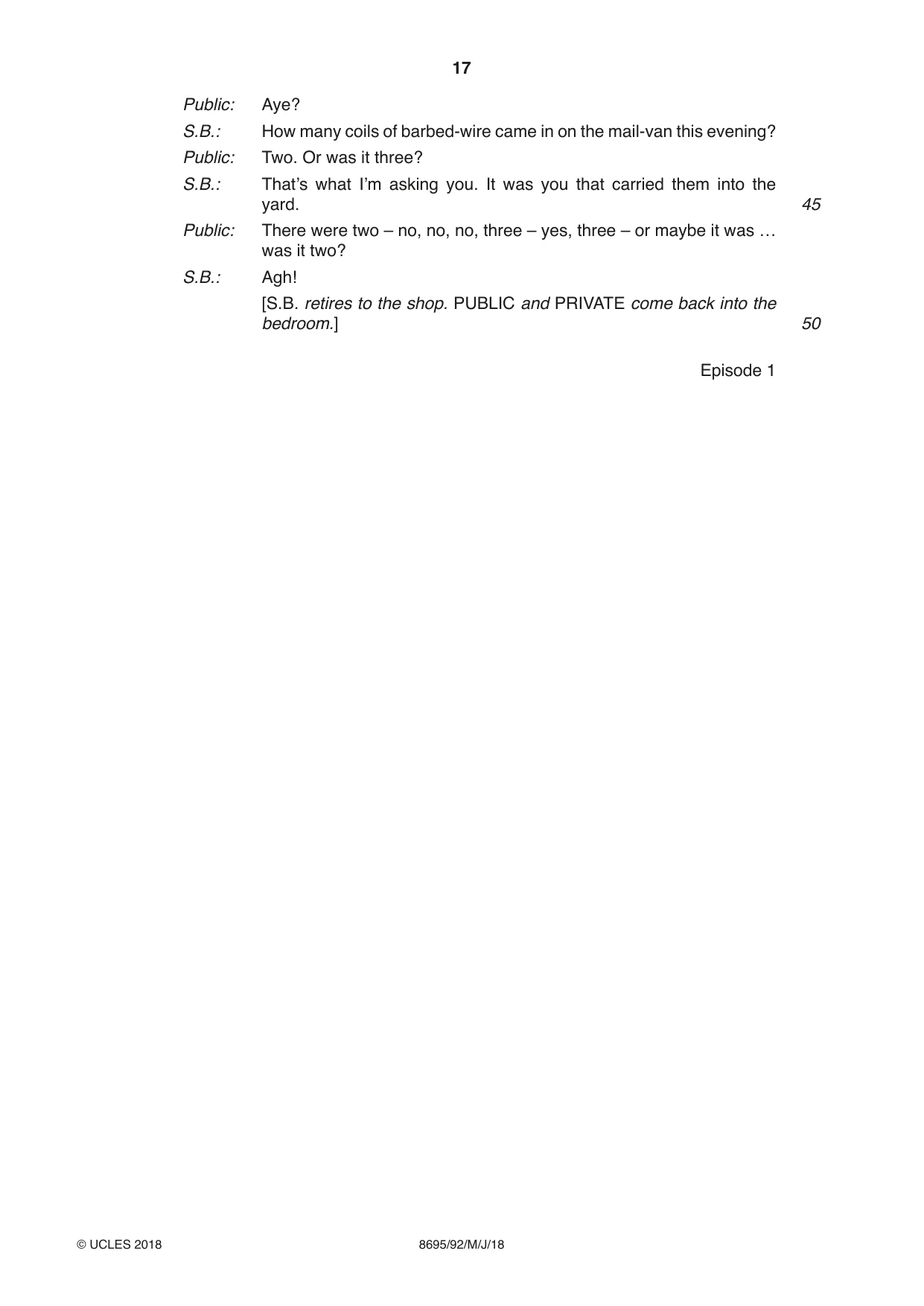
17 8695/92/M/J/18 © UCLES 2018 Public: Aye? S.B.: How many coils of barbed-wire came in on the mail-van this evening? Public: Two. Or was it three? S.B.: That’s what I’m asking you. It was you that carried them into the yard. Public: There were two – no, no, no, three – yes, three – or maybe it was … was it two? S.B.: Agh! [S.B. retires to the shop. PUBLIC and PRIVATE come back into the bedroom.] Episode 1 45 50
Question paper, page 18
18 8695/92/M/J/18 © UCLES 2018 BLANK PAGE
Question paper, page 19
19 8695/92/M/J/18 © UCLES 2018 BLANK PAGE
Question paper, page 20
20 8695/92/M/J/18 © UCLES 2018 Permission to reproduce items where third-party owned material protected by copyright is included has been sought and cleared where possible. Every reasonable effort has been made by the publisher (UCLES) to trace copyright holders, but if any items requiring clearance have unwittingly been included, the publisher will be pleased to make amends at the earliest possible opportunity. To avoid the issue of disclosure of answer-related information to candidates, all copyright acknowledgements are reproduced online in the Cambridge International Examinations Copyright Acknowledgements Booklet. This is produced for each series of examinations and is freely available to download at www.cie.org.uk after the live examination series. Cambridge International Examinations is part of the Cambridge Assessment Group. Cambridge Assessment is the brand name of University of Cambridge Local Examinations Syndicate (UCLES), which is itself a department of the University of Cambridge. BLANK PAGE
Mark scheme, page 1
IGCSE™ is a registered trademark. This document consists of 6 printed pages. © UCLES 2018 [Turn over Cambridge Assessment International Education Cambridge International Advanced Subsidiary Level LANGUAGE AND LITERATURE IN ENGLISH 8695/92 Paper 9 Poetry, Prose and Drama May/June 2018 MARK SCHEME Maximum Mark: 50 Published This mark scheme is published as an aid to teachers and candidates, to indicate the requirements of the examination. It shows the basis on which Examiners were instructed to award marks. It does not indicate the details of the discussions that took place at an Examiners’ meeting before marking began, which would have considered the acceptability of alternative answers. Mark schemes should be read in conjunction with the question paper and the Principal Examiner Report for Teachers. Cambridge International will not enter into discussions about these mark schemes. Cambridge International is publishing the mark schemes for the May/June 2018 series for most Cambridge IGCSE™, Cambridge International A and AS Level and Cambridge Pre-U components, and some Cambridge O Level components.
Mark scheme, page 2
8695/92 Cambridge International AS Level – Mark Scheme PUBLISHED May/June 2018 © UCLES 2018 Page 2 of 6 Generic Marking Principles These general marking principles must be applied by all examiners when marking candidate answers. They should be applied alongside the specific content of the mark scheme or generic level descriptors for a question. Each question paper and mark scheme will also comply with these marking principles. GENERIC MARKING PRINCIPLE 1: Marks must be awarded in line with: • the specific content of the mark scheme or the generic level descriptors for the question • the specific skills defined in the mark scheme or in the generic level descriptors for the question • the standard of response required by a candidate as exemplified by the standardisation scripts. GENERIC MARKING PRINCIPLE 2: Marks awarded are always whole marks (not half marks, or other fractions). GENERIC MARKING PRINCIPLE 3: Marks must be awarded positively: • marks are awarded for correct/valid answers, as defined in the mark scheme. However, credit is given for valid answers which go beyond the scope of the syllabus and mark scheme, referring to your Team Leader as appropriate • marks are awarded when candidates clearly demonstrate what they know and can do • marks are not deducted for errors • marks are not deducted for omissions • answers should only be judged on the quality of spelling, punctuation and grammar when these features are specifically assessed by the question as indicated by the mark scheme. The meaning, however, should be unambiguous. GENERIC MARKING PRINCIPLE 4: Rules must be applied consistently e.g. in situations where candidates have not followed instructions or in the application of generic level descriptors. GENERIC MARKING PRINCIPLE 5: Marks should be awarded using the full range of marks defined in the mark scheme for the question (however; the use of the full mark range may be limited according to the quality of the candidate responses seen). GENERIC MARKING PRINCIPLE 6: Marks awarded are based solely on the requirements as defined in the mark scheme. Marks should not be awarded with grade thresholds or grade descriptors in mind.
Mark scheme, page 3
8695/92 Cambridge International AS Level – Mark Scheme PUBLISHED May/June 2018 © UCLES 2018 Page 3 of 6 Using the mark levels Place the answer in a level first. Look for the ‘best fit’ of the answer into a level. An answer needs to show evidence of most but not necessarily ALL of the qualities described in a level, in order to be placed in that level. Then award a mark for the relative position of the answer within the level. Candidates may address the question in many different ways. Do not expect any particular focus or approach and do not penalise answers for leaving out a particular focus. Reward what is there, showing what you are rewarding, in your comments. Consider all strands and weigh up the performance as a whole in placing the answer in a level, then show that you have done so in the summative comment: e.g. Solid K of texts, limited evidence of U and mostly narrative, evidence of P with some, good personal response and generally clear C throughout. Assessment Objectives: AO1 The ability to respond to texts in the three main forms (Prose, Poetry and Drama) of different types and from different cultures. AO2 An understanding of the ways in which writers’ choices of form, structure and language shape meanings. AO3 The ability to produce informed, independent opinions and judgements on literary texts. AO4 The ability to communicate clearly the knowledge, understanding and insight appropriate for literary study. Each answer is marked out of 25, in accordance with the General Marking Criteria below. Each band is divided into strands corresponding to the Assessment Objectives – Knowledge, Understanding, Personal Response, Communication.
Mark scheme, page 4
8695/92 Cambridge International AS Level – Mark Scheme PUBLISHED May/June 2018 © UCLES 2018 Page 4 of 6 Level 6 22–25 Very good work – do not reserve this level for the very best work you see but ensure you put scripts into this level which fulfil the requirements described below. There will always be some candidates who are at a standard over the top of the mark scheme. K Evidence of a very good ability to select relevant knowledge to address the question with effective use of references and quotation. There may be evidence of sensitive awareness of the contexts in which the literary works studied were written and understood. U Evidence of very good understanding of ways in which writers’ choices of structure, form and language shape meanings with sustained analysis and sensitive appreciation of literary methods and effects and contexts, possibly including literary genres and conventions. P Personal response to texts will be perceptive, often freshly personal, fully supported with quotation, and may show originality in approach to and treatment of questions. C Candidates will express complex literary ideas and arguments with clarity and fluency. Answers will have a coherent structure, with logical progression and effectively linked paragraphs. Expression will be accomplished and appropriate. In answers to passage-based questions, work will sustain an appropriate balance between critical appreciation of given extracts, based on detailed critical analysis, and consideration of the broader textual issues raised by the questions, and relate part of a text to its whole and vice versa in a seamless argument. There will be a very good appreciation of the effects of the literary features of the text, with detailed analysis supported by relevant examples from the passage and the wider text, where appropriate. There will be a very good knowledge of the appropriate context of the extract or work. Level 5 18–21 Proficient work K Evidence of proficiency in selecting relevant knowledge to address the question with precise and integrated direct references to the text and supporting quotation. There may be evidence of awareness of the contexts in which the literary works studied were written and understood. U Evidence of intelligent understanding of ways in which writers’ choices of structure, form and language shape meanings, with analysis and appreciation of literary methods, effects and contexts. P Evidence of personal response to the texts, relevant to the question, supported from the text, some originality of thought, straightforward and vigorously articulated, perhaps, rather than penetrating and subtle. C Expression confident, with some complex ideas expressed with some fluency. Structure is sound. Literary arguments will be coherent, with progression of ideas through clearly linked paragraphs. In answers to passage-based questions, work will show engagement with both the given extracts and the wider textual issues. There will be a confident relation of a part of the text to its whole. There will be a proficient appreciation of the effects of the literary features of the text supported by relevant examples from the passage and from the wider text where appropriate. There will be a good knowledge of the appropriate context of the extract or work.
Mark scheme, page 5
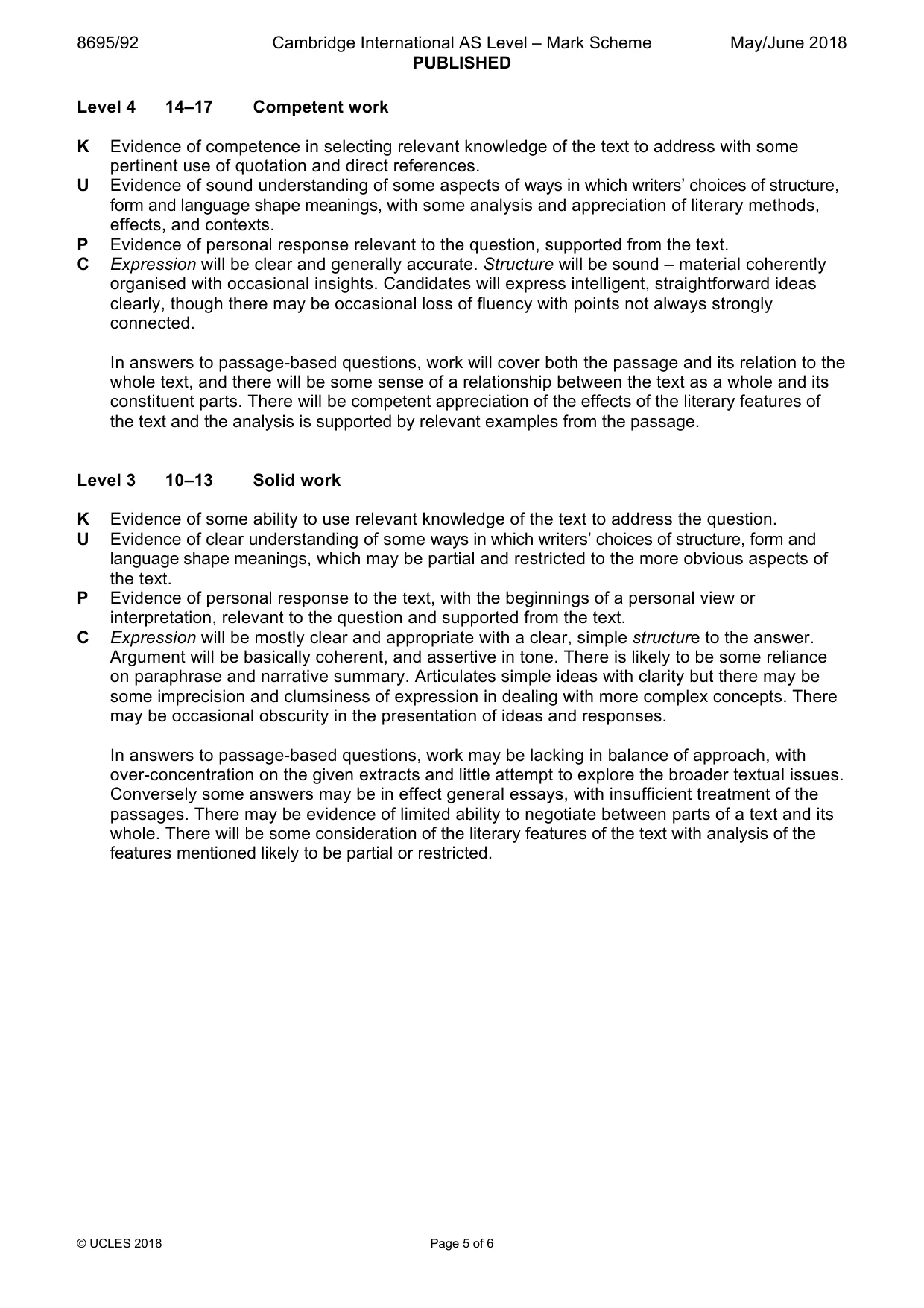
8695/92 Cambridge International AS Level – Mark Scheme PUBLISHED May/June 2018 © UCLES 2018 Page 5 of 6 Level 4 14–17 Competent work K Evidence of competence in selecting relevant knowledge of the text to address with some pertinent use of quotation and direct references. U Evidence of sound understanding of some aspects of ways in which writers’ choices of structure, form and language shape meanings, with some analysis and appreciation of literary methods, effects, and contexts. P Evidence of personal response relevant to the question, supported from the text. C Expression will be clear and generally accurate. Structure will be sound – material coherently organised with occasional insights. Candidates will express intelligent, straightforward ideas clearly, though there may be occasional loss of fluency with points not always strongly connected. In answers to passage-based questions, work will cover both the passage and its relation to the whole text, and there will be some sense of a relationship between the text as a whole and its constituent parts. There will be competent appreciation of the effects of the literary features of the text and the analysis is supported by relevant examples from the passage. Level 3 10–13 Solid work K Evidence of some ability to use relevant knowledge of the text to address the question. U Evidence of clear understanding of some ways in which writers’ choices of structure, form and language shape meanings, which may be partial and restricted to the more obvious aspects of the text. P Evidence of personal response to the text, with the beginnings of a personal view or interpretation, relevant to the question and supported from the text. C Expression will be mostly clear and appropriate with a clear, simple structure to the answer. Argument will be basically coherent, and assertive in tone. There is likely to be some reliance on paraphrase and narrative summary. Articulates simple ideas with clarity but there may be some imprecision and clumsiness of expression in dealing with more complex concepts. There may be occasional obscurity in the presentation of ideas and responses. In answers to passage-based questions, work may be lacking in balance of approach, with over-concentration on the given extracts and little attempt to explore the broader textual issues. Conversely some answers may be in effect general essays, with insufficient treatment of the passages. There may be evidence of limited ability to negotiate between parts of a text and its whole. There will be some consideration of the literary features of the text with analysis of the features mentioned likely to be partial or restricted.
Mark scheme, page 6
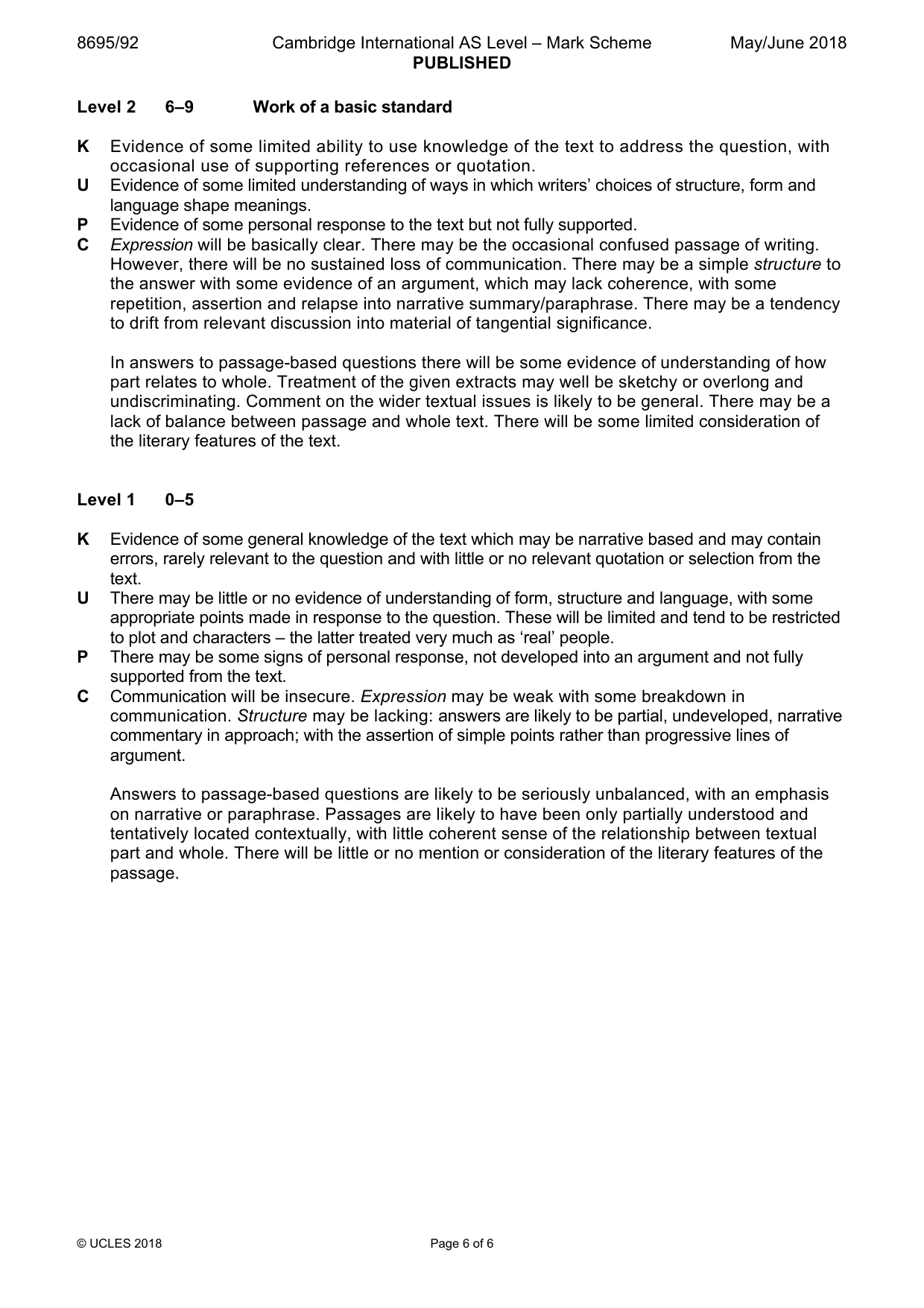
8695/92 Cambridge International AS Level – Mark Scheme PUBLISHED May/June 2018 © UCLES 2018 Page 6 of 6 Level 2 6–9 Work of a basic standard K Evidence of some limited ability to use knowledge of the text to address the question, with occasional use of supporting references or quotation. U Evidence of some limited understanding of ways in which writers’ choices of structure, form and language shape meanings. P Evidence of some personal response to the text but not fully supported. C Expression will be basically clear. There may be the occasional confused passage of writing. However, there will be no sustained loss of communication. There may be a simple structure to the answer with some evidence of an argument, which may lack coherence, with some repetition, assertion and relapse into narrative summary/paraphrase. There may be a tendency to drift from relevant discussion into material of tangential significance. In answers to passage-based questions there will be some evidence of understanding of how part relates to whole. Treatment of the given extracts may well be sketchy or overlong and undiscriminating. Comment on the wider textual issues is likely to be general. There may be a lack of balance between passage and whole text. There will be some limited consideration of the literary features of the text. Level 1 0–5 K Evidence of some general knowledge of the text which may be narrative based and may contain errors, rarely relevant to the question and with little or no relevant quotation or selection from the text. U There may be little or no evidence of understanding of form, structure and language, with some appropriate points made in response to the question. These will be limited and tend to be restricted to plot and characters – the latter treated very much as ‘real’ people. P There may be some signs of personal response, not developed into an argument and not fully supported from the text. C Communication will be insecure. Expression may be weak with some breakdown in communication. Structure may be lacking: answers are likely to be partial, undeveloped, narrative commentary in approach; with the assertion of simple points rather than progressive lines of argument. Answers to passage-based questions are likely to be seriously unbalanced, with an emphasis on narrative or paraphrase. Passages are likely to have been only partially understood and tentatively located contextually, with little coherent sense of the relationship between textual part and whole. There will be little or no mention or consideration of the literary features of the passage.
What you needed in this session
Cambridge’s own grade thresholds for 2018 May/June, Paper 9 · Variant 2. A higher threshold means an easier paper — the bar moves with how the cohort did.